Whispers of the Dust
By @izzadmoktar
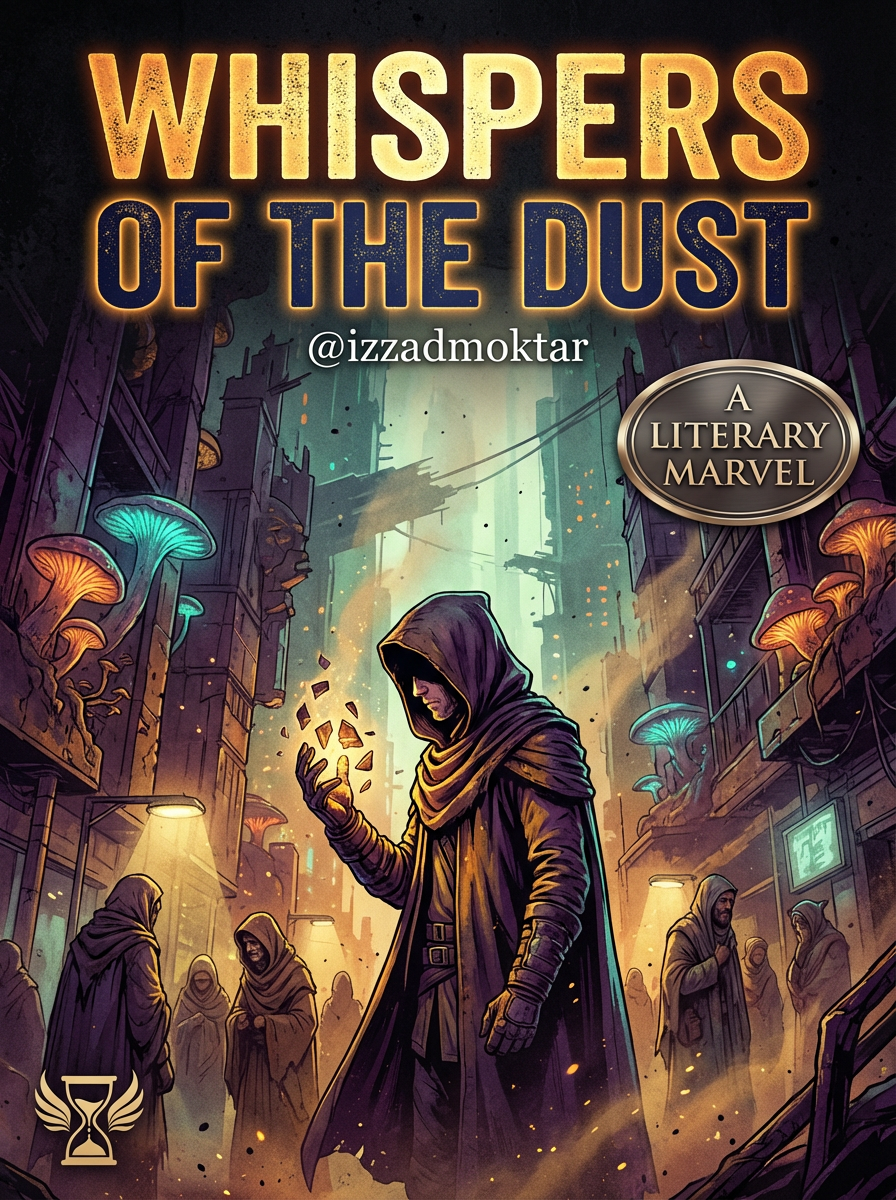
Synopsis
In the perpetual twilight of Neo-Verona, where memories are currency and the sun is a myth, a cynical memory-broker unearths a forbidden recollection of a green world and a working atmosphere generator, forcing him to choose between self-preservation under an authoritarian regime and humanity's last
Chapter 1: The Echo Chamber
The Perpetual Twilight of Neo-Verona was a misnomer. There was no twilight, just an eternal, bruised dusk, a bruise that never healed. The air clung to Elias Vance like a wet shroud, tasting of metal, recycled breath, and the faint, sweet decay of forgotten dreams. He moved through it, a phantom among phantoms, his gaunt frame swallowed by the oppressive shadows of the endless, identical towers that clawed at the perpetually overcast sky. His grimy, hooded coat was less a garment and more a second skin, a defense against the world and its insistent demands.
Down in the lower sectors, where Elias plied his trade, the light never truly reached. What passed for illumination was a sickly yellow glow, emanating from sputtering holographic advertisements that promised ephemeral joys and a false sense of belonging. The advertisements, like everything else, were a commodity, carefully curated, precisely dosed. Even despair, Elias had learned, could be packaged and sold.
Today, his office was a cramped, reeking stall beneath the sprawling underbelly of Sector 7. The rhythmic thrum of the great ventilation shafts, working tirelessly to filter the unbreathable atmosphere, was a constant, low growl that vibrated through the floorboards and up his bones. It was a sound as eternal as the gloom itself.
A woman stood before him, her shoulders hunched. Elara Vane. Thin, pale, with wide, anxious eyes that darted around the confined space as if hunted. Her disheveled dark hair framed a face etched with a fear that Elias recognized instantly. It was the fear of the dispossessed, the fear of those who had nothing left to pawn but their very essence.
“You… you’re the one they speak of,” she whispered, her voice a brittle thing. “The memory-broker.”
Elias Vance merely grunted, a sound that emerged from the depths of his own weariness. He gestured to the worn, cracked stool opposite his own. “Elias Vance. And yes, I deal in echoes. What fragmented joy do you have to offer, citizen?”
He watched her carefully, his tired eyes dissecting her movements, her subtle tremors. Memory was currency here, a tangible asset in a world where hard currency was a relic. The regime, a faceless, omnipresent behemoth known only as the Authority, had cleverly orchestrated this system. By commodifying memories, they had not only found a potent source of revenue but also a subtle, insidious means of control. A person without memories was a person without history, without rebellion, without self.
Elara clutched a small, worn pouch to her chest as if it contained her very soul. Perhaps it did. “It’s… it’s not joy.” Her voice dropped to a conspiratorial whisper. “It’s… a different kind of memory. Forbidden.”
Elias’s gaunt face remained impassive, but a flicker of something, a spark of professional curiosity, ignited in the depths of his eyes. Forbidden memories were rare, dangerous, and often, highly lucrative. They whispered of things the Authority wanted forgotten, things that could disturb the carefully constructed peace of Neo-Verona.
He leaned forward, the creak of his stool echoing in the small stall. “Forbidden memories fetch a higher price, citizen. And a higher risk. You understand that, don’t you?”
Elara nodded, her eyes wide as saucers. “I have nothing left, Elias Vance. My child… she is sick. The med-scrip is beyond reach. They said… they said a memory of great value might suffice.”
Elias felt a familiar pang, a distant echo of his own buried past. He pushed it down. Sentiment was a luxury he couldn't afford. “Let’s see it, then.” He reached for the battered Neural-Synapse Reader on his makeshift desk, its polished chrome glinting dully in the weak light. This antique device, a relic from the age before the Great Clouding, was his most prized possession. It could extract, categorize, and even, under careful manipulation, replicate memories.
With trembling fingers, Elara opened her pouch. Inside, nestled among tattered fabric, was a small, ornate locket. It wasn't the locket itself, Elias knew, but the intangible essence within it, a deeply ingrained mnemonic trace.
He took the locket, his fingers brushing hers. Cold, clammy. He placed it carefully on the Reader's plate and activated the device. A low hum filled the air, and a faint blue light pulsed from the machine, casting eerie shadows on Elara’s anxious face.
The screen flickered to life, displaying a chaotic swirl of neural data. Elias’s tired eyes, however, were trained on the emerging patterns, the specific frequencies. This wasn't the usual jumble of a mundane memory – a forgotten meal, a shared laugh, a fleeting embrace. This was… vibrant. Alive.
And then, it solidified. A splash of color so intense it made him flinch.
Green.
Not the moss-drenched, decaying green of Neo-Verona’s perpetually damp lower levels, but a boundless, impossible green. Fields stretching to an unseen horizon, punctuated by towering structures of brown and gray that branched into delicate networks, adorned with more of that impossible green.
The image shifted, resolving into a scene of breathtaking clarity. A vast, open expanse, bathed in a brilliant, golden light that was unlike anything Elias had ever witnessed, a light that spoke of a true sun, not the filtered, attenuated glow of the city’s upper domes. And above, a sky. A sky of an astounding, infinite blue, adorned with fluffy white clouds that drifted with a languid grace.
And the air… the memory carried not just visuals, but sensations. The scent of ozone and something fresh, something wild and untamed. The sound of a gentle breeze, rustling through those impossible green structures. The feeling of warmth on skin, a pervasive, comforting heat.
Elias’s breath hitched. He had seen simulated images, grainy, corrupted historical data of the "before times," of Earth Prime. But this… this was real. This was a living, breathing memory, unsullied by digital degradation. It was an unfiltered torrent of sensation, a direct conduit to a world that existed, impossibly, outside of Neo-Verona’s perpetual gloom.
Then his eyes focused on something else in the memory, a detail that made his already strained heart skip a beat. A monolithic structure, humming with a barely perceptible energy, its surface intricate with conduits and shimmering panels. And etched into its metal, a series of symbols he vaguely recognized from his illicit studies of pre-Clouding tech schematics: the stylized insignia of an Atmosphere Generator. And it was *working*. Clearly, unequivocally, circulating breathable air, not just within a small, localized bubble, but for an entire, impossibly expansive world.
He tore his gaze away from the screen, his mouth dry. He looked at Elara, whose face was now a mask of terror, as if she herself had just glimpsed the sun.
“Where… where did you find this?” he rasped, his voice rough with a mixture of awe and dawning dread.
Elara flinched, clutching her meager belongings tighter. “It was… my grandmother’s. A family heirloom. She always told us it was just a dream, a fairy tale. But when the med-scrip became unreachable… I thought… perhaps it held a different kind of value.”
A different kind of value. Elias understood, all too well. This wasn't merely a nostalgic snippet; it was a testament. A heresy. The Authority had long preached that the sun was a myth, the sky a collapsed ceiling, and the atmosphere outside the domes irrevocably poisoned, rendering Earth Prime uninhabitable. Their entire regime rested upon this manufactured truth, this carefully constructed lie that kept humanity docile and dependent within the suffocating embrace of Neo-Verona.
Yet here, in the neural pathways of a desperate woman’s memory, was a direct refutation. A vivid, undeniable image of a green world, a blue sky, and a working atmosphere generator. A green world that hinted at a path to reclamation, a hope for a future beyond the steel and synthetic air.
The implications slammed into Elias like a physical blow. This wasn't just a memory; it was a revolution. And Elara, poor, desperate Elara, had unwittingly become its vessel.
He knew, with a chilling certainty, that the Authority would pay handsomely to suppress this. But also, with an even colder certainty, that they would silence anyone who had ever touched it. Including Elara. Including him.
“This… this isn’t for sale, citizen,” Elias said, his voice flat. He felt a cold dread wrapping around him. He had seen too many dreamers crushed by the heel of the Authority to succumb to idle hope. Self-preservation, a lesson etched deep into his bones, screamed at him.
Elara’s wide eyes filled with despair. “But… my daughter! She needs the mod-scrip! I have nothing else!”
Elias hesitated, his fingers hovering over the Neural-Synapse Reader. The image of the green world still blazed on the screen, an impossible beacon against the gloom. He was a memory-broker, a dealer in illusions and forgotten fragments. He was not a revolutionary. He was a survivor.
But beneath the hardened exterior, beneath the cynicism that had been his shield for so long, a faint tremor stirred. A ghost of empathy, perhaps, for the pale, desperate woman before him, for her sick child. And for a world that might yet exist, beyond the confines of Neo-Verona.
He knew what he should do. Erase the memory, tell Elara it was worthless, let her walk away to her inevitable fate. It was the pragmatic choice, the safe choice.
But the image of the green world, so vivid, so audacious, stubbornly clung to the forefront of his mind. It was a whisper, carried on the recycled air, a promise of something more than perpetual twilight.
“Leave,” Elias said, his voice barely audible. “Leave this place, and forget you ever came here. Pretend this memory never existed.” He kept his gaze fixed on the device, on the lingering image of the impossible world.
Elara stared at him, bewildered, then a flicker of desperate hope ignited in her eyes. “So… it’s worth nothing?”
Elias didn’t answer. He couldn’t. The lie would be too bitter on his tongue.
Before he could articulate another word, before he could formulate a coherent plan for self-preservation, a new sound cut through the thrum of the ventilation shafts. A sharp, rhythmic clang, like metal boots on metal grates. Near. Too near.
Elara’s breath hitched. Her anxious eyes widened in pure terror. She knew that sound. Everyone in the lower sectors knew that sound.
“The Authority,” she whispered, her voice cracking. “They found me.” She scrambled to her feet, her movements jerky and frantic, as if trying to flee from her own shadow.
Elias’s head snapped up. His blood ran cold. The Authority moved with ruthless efficiency. They had clearly tracked Elara, sensing the tremor of a forbidden memory in her neural pathways, or perhaps, they already had informants embedded deeper than he ever imagined.
He slammed his hand on the Neural-Synapse Reader’s interface, struggling to delete the memory, to erase the evidence. But the device, old and temperamental, refused to respond immediately. The image of the green world, stubbornly defiant, remained on the screen.
The clang of boots grew louder, closer, echoing through the narrow alleyway leading to his stall. Then, a voice, deep and resonant, a voice that carried the weight of absolute power, cut through the din.
“Elara Vane! You are wanted for questioning regarding unsanctioned cognitive material! Come out now!”
It was Commander Thorne, no doubt. The chief enforcer of the Authority. Ruthless, observant, fanatically loyal. A man who epitomized the cold, calculating efficiency of the regime.
Elara let out a choked sob. She turned to Elias, her eyes silently pleading. “Please…”
Elias knew then that there was no turning back. His actions, or lack thereof, had already implicated him. The green world, the blue sky, the impossible atmosphere generator – it was already burned into his mind, an indelible mark. And Thorne, with his keen intuition and an arsenal of surveillance tech, would already be piecing together the breadcrumbs.
He grabbed the locket from the Reader’s plate. His mind raced, a flurry of desperate calculations. He knew enough of the old tech, enough of the secret pathways within Neo-Verona’s underbelly, to perhaps… perhaps escape. For now.
“Go,” Elias hissed, pushing Elara towards a narrow, shadowed opening beneath a rusting ventilation duct. “Now. Don’t look back.”
Her eyes, filled with fear and a flicker of gratitude, met his for a fraction of a second. Then, without another word, she squeezed through the opening, disappearing into the labyrinthine gloom.
The metallic clang of boots paused directly outside his stall. A shadow fell across the entrance, impossibly tall, impossibly rigid. Commander Thorne. Elias Vance knew him by reputation, by the fear he instilled, by the trails of broken lives he left in his wake.
Elias quickly shoved the locket into a hidden pocket in his coat. He wiped the screen of the Neural-Synapse Reader, clearing the image of the green world, though he knew it was a futile gesture. The Authority would have logs, thermal residue, something. Thorne missed nothing.
A figure filled the doorway. Immaculately dressed in the regime's stark uniform, its dark fabric absorbing the weak light. Cold, unblinking eyes, as devoid of emotion as the metal walls of Neo-Verona, swept across the cramped stall, dissecting every detail. Commander Thorne. His muscular build seemed to absorb the space around him.
“Elias Vance,” Thorne’s voice was a low, dangerous rumble, each syllable precisely enunciated. “They say you deal in stolen echoes.”
Elias forced a casual shrug, a performance he had perfected over years of navigating the city’s treacherous underbelly. “Just fragmented joys, Commander. Harmless nostalgia for those who can afford it.” He gestured to the empty stool opposite him. “Care for a comforting memory? Childhood bicycle ride? First kiss, perhaps?”
Thorne’s thin lips barely twitched. “We are aware of your… specialization. And we are aware of your last client.” His gaze, sharp and unwavering, pierced through Elias, as if trying to excavate the truth directly from his brain. “Where is Elara Vane?”
Elias met his gaze, his heart hammering against his ribs, but his face a mask of weary indifference. “Elara Vane? Can’t say I recall the name, Commander. Many faces pass through this establishment. Many anxieties. All looking for a brief reprieve from the gloom.”
Thorne took a slow, deliberate step into the stall. The air crackled with a palpable tension. “She was carrying something of great significance. A neural imprint. One we are very keen to recover.”
Elias feigned a look of genuine confusion. “Neural imprint? Commander, my services are strictly for recreation. No official business, I assure you.” He tapped the Neural-Synapse Reader, making it hum softly. “Just simple, benign memories.”
Thorne’s eyes narrowed, sweeping over Elias’s face, searching for any tell-tale sign. “Your machine registered unusual activity just moments ago. An anomaly. A spike in undocumented neural frequencies.”
Elias swallowed, a dry, metallic taste in his mouth. He knew Thorne wasn’t bluffing. The Authority’s surveillance was omnipresent, often invisible. He was already caught.
“Perhaps a malfunction, Commander,” Elias offered, his voice strained. “This old tech… it has its quirks.”
Thorne took another step, closing the distance between them. Elias could feel the cold authority emanating from the man, a crushing weight. “You know what happens to those who harbor forbidden information, Vance. You know what happens to those who obstruct the Authority.”
The warning was clear, the threat implicit. Elias felt the familiar chill of fear, the survival instinct that had served him so well. But beneath it, a tiny, defiant spark flickered. The image of the green world. The blue sky. The working atmosphere generator. It refused to be extinguished.
For a fleeting moment, a choice, stark and terrible, presented itself. Self-preservation, a safe return to the shadows, to the comforting numbness of Neo-Verona’s perpetual gloom. Or… something else. A flicker of hope for humanity, a perilous journey towards a truth that could either save or destroy them all.
He looked into Thorne's cold, unblinking eyes. He knew he was already marked. Elara’s desperate journey had inadvertently entangled him in something far larger, far more dangerous than he could have ever imagined. He was in the echo chamber now, and the whispers of the dust were about to become a roaring storm.
“I only deal in fragments, Commander,” Elias said, his voice quiet but steady. “And sometimes, those fragments can hold more truth than a whole fabricated world.”
Thorne’s hand, encased in a dark, gloved fist, reached out. It wasn't to strike, but to silence. To contain. Elias braced himself for the inevitable. The game had truly begun. And in the silent, suffocating dusk of Neo-Verona, the ghost of a green world had, impossibly, been born.
Chapter 2: A Shade of Green
The perpetually weeping sky of Neo-Verona seemed to condense Elias’s own weariness into a tangible weight. He had just finished patching together a client’s shattered dream of a seaside holiday – a fleeting, azure vision bought with three months’ rations. The manufactured joy felt brittle, a delicate, glass-blown thing that would shatter in the harsh light of a new day. A shiver, not entirely from the pervasive chill that seeped through his threadbare coat, traced its way down his spine. The air, thick with the metallic tang of recycled oxygen and the faint, sweet decay of forgotten hopes, felt heavier than usual.
He was about to close up shop, the flickering glow of his single bio-luminescent lamp casting long, skeletal shadows across the cluttered workbench, when a rap, soft and hesitant, echoed on the opaque permaglass of his door. Most clients were bolder, or desperate enough not to care about decorum. This knock was different, a whisper rather than a demand. Reluctantly, Elias pushed aside a tangle of bio-optics and memory-siphons, his gaunt frame unfolding from the stool.
Through the smoked permaglass, a silhouette, thin and almost spectral, hovered. Before he could voice his usual, gruff inquiry, the door creaked open, revealing Elara Vane.
She was a wisp of a woman, made of frayed nerves and shadows. Her face, pale and drawn, was framed by disheveled dark hair that looked like it had been wrestled by a frantic wind. Her wide, anxious eyes darted around the cramped space as if searching for unseen predators, then fixed on Elias with an intensity that made him pause. A tattered, muted green cloak, once perhaps vibrant, now clung to her like a second skin, offering little protection from the city's ceaseless damp.
"Mr. Vance?" Her voice was a fragile thing, barely audible above the distant thrum of the city’s life support systems. "They said you… you handle the difficult ones."
Elias grunted, a noncommittal sound. "Depends on what you call difficult, little bird. Most difficulties can be bought off, or forgotten." He leaned against the reinforced doorframe, his tired eyes scanning her, assessing the depth of her desperation. She carried no visible valise, no expensive trinket, no tell-tale bulge of cred-slips. A client without obvious means was a rare and often troublesome breed.
"It's… it's a memory," she began, her voice gaining a fractional strength, though it still trembled on the edges of each word. "But it's not mine."
Elias frowned. This was unusual. "Not yours?" he repeated, a flicker of genuine interest stirring beneath his practiced indifference. His specialty was extraction and manipulation, not identity crises. "How can a memory not be yours? You carry it, don't you?"
Elara took a hesitant step further into the room, her gaze sweeping over the tools of his trade – the gleaming electrodes, the whirring neural siphons, the empty memory canisters waiting to be filled. "I… I acquired it. Or it acquired me. I don’t know. It just… appeared." She wrung her hands, thin fingers interlacing, then pulling apart, then interlacing again. A nervous tic, Elias noted. A sign of deep distress. Or perhaps, something more.
"Appeared?" He pushed away from the door, moving back towards his workbench, the scent of ozone and something faintly metallic clinging to his person. "Memories don't 'appear,' Elara Vane. They're stored, retrieved, sometimes lost. But not conjured out of the air."
She followed him slowly, her eyes wide like a cornered animal’s. "I swear, Mr. Vance. One day it wasn't there, and the next, it was. And it's… it's wrong. It’s too bright."
Too bright. That phrase, mundane on the surface, held a potency in Neo-Verona that Elias hadn't heard in years. Brightness, in this perpetually dim city, was a luxury, a memory of a time long gone, spoken of in hushed tones, almost like a myth. A flicker of suspicion, cold and sharp, ignited in his gut. Could this be a trap? Commander Thorne's enforcers were known for their elaborate ruses, trying to root out those who dabbled in forbidden recollections. But Elara Vane did not look like an enforcer. She looked like a gust of wind could shatter her.
"What is this 'brightness'?" he asked, his voice low, his eyes narrowed. He picked up a memory-siphon, testing its weight, its cold metal a comforting anchor in his hand.
Elara took a deep, shuddering breath, as if steeling herself. "It’s a world. A world of… green. So much green. And a sun. A real sun, Mr. Vance, not just the city’s artificial glow. And… and fresh air. Not recycled, but… clean. Like you could just *breathe* it." Her voice dropped to a near whisper, laden with a fear that resonated with Elias’s own buried anxieties. "I need it out. I can’t sleep. I see it when I close my eyes. It’s a crime, isn’t it? To… to have something like that?"
The implications of her words struck Elias with the force of a physical blow. A world of real green. A real sun. Clean air. These were the phantom memories, the ghost stories whispered in the deepest sub-levels, tales of a planet as it once was, before the Great Dustfall, before the sky had become a permanent funeral shroud. Such memories were not just forbidden; they were heresy. The Authority had long ago scrubbed them from public record, from the collective consciousness. To possess such a recollection was to invite the most brutal of interrogations, a slow, methodical erasure until nothing was left but a hollowed-out shell.
He felt a primal urge to eject her, to tell her to forget she’d ever found his door. Sanity, in Neo-Verona, was often a matter of willful blindness. "You understand what you're saying, Elara Vane?" His voice was rough, edged with a warning. "This isn't a misplaced childhood dream. This is… dangerous."
She nodded, her eyes welling with unshed tears. "I know. That’s why I came to you. They said you take on danger. They said you're discreet. They said… you don't ask too many questions for the right payment."
"Payment?" Elias snorted, unable to hide his skepticism. "You look like you'd struggle to buy a week’s nutrient paste. What could you possibly offer for a memory extraction of this magnitude? This isn’t a routine job; this is a walk on the precipice."
Elara reached into the folds of her tattered cloak, her movements slow and deliberate, as if she were unwrapping something sacred, or perhaps, something cursed. What she produced was small, irregular, and utterly breathtaking.
It was a stone.
Not a polished gem, not a manufactured crystal. It was a fragment of what looked like genuine rock, rough-hewn, its surface mottled with swirls of impossible color. There were hues of deep emerald, not the manufactured green of Neo-Verona’s few bio-domes, but a living, breathing green. And embedded within it, like flecks of captured starlight, were tiny, iridescent blue veins. It pulsed faintly, almost imperceptibly, with a soft, cool light that seemed to absorb the dimness of the room rather than reflect it.
Elias gasped, a sound he hadn't made in years. He involuntarily reached for it, his fingers tingling with a strange premonition. He had never seen anything like it. It felt cool to the touch, almost alive. Its light wasn't electric; it was organic, ancient.
"What… what is this?" he whispered, his voice rough with awe.
Elara looked at the stone, then back at Elias, a flicker of something close to pride, quickly smothered by fear, crossing her face. "It's a memory of power, Mr. Vance," she said, her voice dropping to a conspiratorial whisper. "A piece of the… the atmosphere generator."
Elias froze, his hand hovering over the stone. The atmosphere generator. Another myth, a technological marvel from the ‘before times,’ said to be responsible for the breathable air, the blue skies, the very life that existed before the planet turned to dust. To speak of it was to invite scrutiny, to possess a piece of it was a death sentence. To know its location, even a fragment, was to be a marked individual.
He snatched his hand back as if burned. "You just walk in here with… with *that*?" he hissed, his voice tight with a mixture of fear and burgeoning excitement. This wasn't merely dangerous; it was an act of profound, suicidal audacity. Or perhaps, a desperate, last-ditch gamble.
"It was with the memory," Elara said, her gaze fixed on the stone. "It helps me see it clearer. It… it resonates with the images. I think it's a key. To unlock the truth." She looked up at Elias, her eyes brimming with a fragile hope. "I need you to take the memory, Mr. Vance. And you can keep this. It’s all I have. It’s more than I have."
For a long moment, the only sound in the small room was the distant thrum of the city and the faint, almost imperceptible pulse of the strange, green stone. Elias’s mind reeled. The risk was immense, the potential reward… inconceivable. This wasn’t about credits or rations. This wasn’t about selling fragmented joys. This was about a piece of history, a relic from a forgotten age, a whisper of a lost world. This was about *truth*. And truth, in Neo-Verona, was the most dangerous currency of all.
His ingrained cynicism warred with a nascent curiosity, a spark of the long-dormant hope that he had buried beneath layers of hardened indifference. He remembered his own buried memories, the ones he tried so hard to forget, the ones that whispered of a world he’d never truly known, but yearned for. A world where stars were not just points of light through a perpetually dirty sky, but beacons in an infinite darkness.
"You understand what this means, Elara Vane?" Elias finally said, his voice flat, devoid of emotion, a mask he wore to shield his true thoughts. "If the Authority finds out, they won't even leave a memory of you behind. And they'll come for me too. They’ll erase us both."
"I understand," she said, her voice surprisingly steady, a fragile thread of resolve woven through her fear. "But I can’t live with it. The green… it calls to me. But it also terrifies me. It’s too much. It’s not for me." She looked at Elias, her wide, anxious eyes pleading. "Please, Mr. Vance. Just take it."
Elias looked at the stone, then at Elara. Her desperation was palpable, but so was a strange resilience, a quiet strength that belied her fragile appearance. It wasn’t a trap, he decided. She was genuinely terrified, genuinely desperate. And the stone… the stone was everything.
He thought of the cramped, airless apartment he called home, the taste of recycled air on his tongue, the endless twilight. He thought of the constant surveillance, the fear that permeated every street, every interaction. And then he thought of the green, of the sun, of clean air. A world he’d only ever heard whispered about, a mythical place depicted in smudged, half-forgotten archives.
A memory of power. A piece of the atmosphere generator.
"Alright," Elias said, his voice barely above a whisper. The word felt like a precipice, a step into an unknown abyss. "But we do this my way. And if anything, anything at all, goes wrong, you disappear. You understand? Don't look back, don't leave a trace."
Elara nodded vehemently, a wave of relief washing over her pale face. "Yes, Mr. Vance. Anything."
"First," Elias continued, extending a hand, "let me see that stone."
With a trembling hand, Elara placed the small, green-veined rock into Elias’s palm. The cool, living light pulsed against his skin, a strange warmth spreading through his fingers, up his arm, settling in his chest. It felt ancient, powerful, utterly alien to the manufactured reality of Neo-Verona. He could almost feel a vibration, a faint hum that resonated deep within him, a call to something forgotten.
"Now," he said, holding the stone tightly, tucking it into a hidden pocket in his coat, "tell me exactly how this memory came to you. Every detail." His eyes, usually shadowed and weary, held a new, dangerous glint.
Elara began to speak, her voice gaining a desperate urgency as she recounted the story of scavenging in the forbidden deeper levels of Old Verona, of a chance encounter with a hidden conduit, of a sudden, overwhelming influx of sensory data that wasn't hers. As she spoke, Elias Vance, cynical memory-broker of Neo-Verona, felt a shift within him. The carefully constructed walls of disinterest he had built over years of survival began to crack. A shade of green, vibrant and impossible, had entered his world, and there was no turning back.
Chapter 3: The Forbidden Pixel
The air in Elias’s clinic, usually a sterile balm against Neo-Verona’s dust-choked breath, thickened with an unfamiliar tension. Elara Vane lay on the memory couch, a contraption of polished chrome and worn leather, her face a pale mask against the flickering diagnostic lights. Her eyes, wide and luminous even in the dimness, were fixed on Elias, a silent plea for gentleness. He adjusted the neural interface, the cold metal a stark contrast to the trembling warmth of her temple.
“Relax,” he murmured, his voice a low thrum against the hum of the machinery. “Just… let it come.”
He’d said those words countless times, to countless clients. They were a ritual, a soothing incantation meant to ease the passage from conscious thought to the subconscious wellspring. But with Elara, there was an edge of something else – a tremor of his own, a whisper of unease that had nothing to do with faulty equipment or a difficult extraction. Her memory, she’d insisted, wasn’t hers. A lie, perhaps, or a delusion, but the sheer conviction in her voice had pricked at his hardened cynicism.
The neural interface chirped, a soft, almost musical sound, signaling connection. Elias donned his own ocular device, a sleek visor that would translate Elara’s neural impulses into a visual landscape for him to navigate. The world around him faded, replaced by the familiar static hum of a nascent memory stream. It was usually a chaotic jumble at first, fragmented images and fleeting sensations, like sifting through dust motes in a projector beam.
But this time, it was different.
Instead of the usual sensory overload, a profound darkness enveloped him. Not the oppressive, perpetual twilight of Neo-Verona, but a deep, abyssal black, pregnant with an almost palpable silence. It was the kind of darkness that swallowed sound, that absorbed light, a primal void that made him question if the connection had even been established.
Then, a pinprick.
A tiny, impossibly bright point of light, no larger than a distant star, blossomed in the blackness. It pulsed, a slow, rhythmic beat, like a nascent heart. Elias, a veteran of countless memory dives, felt a prickle of something he hadn’t experienced in years: genuine curiosity, untainted by professional detachment. This wasn’t a fragmented joy or a meticulously curated sorrow. This was… something else.
The pinprick expanded, not into a blinding flash, but into a subtle, ethereal glow. It cast no shadows, illuminated no forms, but simply *was*. And within that glow, a whisper began to coalesce, not of sound, but of sensation. A sensation of… *warmth*.
It was a warmth unlike anything Elias had ever known. Not the artificial warmth of the city’s heat conduits, nor the fleeting warmth of a stolen memory of a hearth fire. This was a deep, pervasive heat, a gentle caress that seeped into his very bones, chasing away the perpetual chill of Neo-Verona. It felt ancient, primordial, like the memory of something that had always been, even before the dust descended.
Then, the color came.
It began as a subtle shift in the ethereal glow, a faint blush of emerald green bleeding into the periphery. It was a hue so vibrant, so utterly alien to the muted grays and browns of his existence, that Elias felt a jolt, a physical shock to his system. He had seen simulated greens, of course, in the elite’s memory parlors – holographic recreations of long-dead flora, digital ghosts of a forgotten world. But this… this was different. This green had depth, texture, an almost living quality that defied mere reproduction.
The emerald spread, unfurling like a slow-motion bloom, pushing back the darkness. And as it did, forms began to emerge. Not the jagged, skeletal outlines of Neo-Verona’s decaying structures, but soft, organic shapes. Tall, slender columns, reaching upwards, their surfaces a tapestry of intricate lines and subtle shifts in color. Leaves. He recognized them, intellectually, from the ancient texts and forbidden data fragments he’d sometimes glimpsed. But to *see* them, to witness their vibrant, verdant reality… it was like seeing a ghost come to life.
He was standing, or rather, *floating*, in a clearing. The air, he realized with a gasp that went unheard, was *clean*. It was a sensation so profound, so utterly foreign, that it nearly overwhelmed him. He’d never known truly clean air, only varying degrees of filtered dust and recycled oxygen. This air was crisp, sweet, carrying the faint, intoxicating scent of… something growing. Not the sterile hydroponic tang of the city’s protein farms, but a rich, earthy aroma, mingled with a delicate, floral sweetness.
And above it all, above the swaying, emerald giants that towered around him, was the sky.
It was not the perpetually overcast, sulfur-tinged canopy of Neo-Verona. It was a vast, boundless expanse of cerulean blue, so pure, so brilliant, that it hurt his eyes. And in its center, a blazing, incandescent orb.
The Sun.
Elias had seen images of it, of course, in the historical archives, in the censored texts. A star, they called it, the source of all light and life. But to witness its raw, unbridled glory, to feel its warmth directly on his simulated skin, was an experience that shattered every ingrained truth of his existence. It wasn’t a myth, a forbidden whisper. It was real. And its light, a golden cascade, painted the emerald world in a symphony of hues he hadn’t even known existed.
He looked down at his simulated hands, and for the first time, saw them bathed in natural light, the lines and contours of his skin rendered in breathtaking detail. He saw the faint freckles on his knuckles, the almost translucent quality of his fingernails, details that had been obscured by the perpetual gloom of his real life. He felt a profound, almost spiritual connection to this visual fidelity, a sense of being truly *seen*.
The forest around him hummed. Not the mechanical drone of Neo-Verona, but a living, breathing hum, a chorus of unseen creatures, of rustling leaves, of the gentle sigh of a breeze. It was a symphony of life, a stark contrast to the deathly silence that often pervaded the city’s deeper sectors.
He moved, or rather, was drawn forward, through the verdant landscape. The ground beneath his feet was soft, yielding, covered in a carpet of what he instinctively knew was grass. He saw delicate, multi-colored blossoms, their petals unfurling in impossible shades. He saw insects, their iridescent wings catching the sunlight, flitting from flower to flower. It was a world teeming with vibrancy, a world that pulsed with an undeniable, joyous energy.
And then he saw it.
It rose in the distance, a colossal edifice of polished chrome and shimmering glass, piercing the azure sky. It wasn’t a building, not in the traditional sense. It was too vast, too intricate, too… alive. Its surface pulsed with a soft, internal light, like a giant, benevolent heart. Intricate filigree of pipes and conduits snaked across its exterior, disappearing into the ground and reaching towards the sky.
And from its apex, a steady, almost imperceptible current of… something… flowed upwards, disappearing into the blue.
Elias felt a tremor run through him, a jolt of recognition that transcended mere intellectual understanding. This was it. This was what the ancient texts hinted at, what the forbidden whispers spoke of in hushed tones.
The Atmosphere Generator.
It was not a myth, not a legend, but a tangible, monumental achievement. A testament to a time when humanity had not merely survived, but *thrived*. A machine that had once nurtured the very air they breathed, that had sculpted the sky above them, that had painted the world in these impossible, vibrant hues.
He was drawn closer, the sheer scale of the device growing with every simulated step. He could hear it now, a deep, resonant hum, a powerful, rhythmic thrumming that vibrated through the very ground. It was a sound of immense power, yet utterly peaceful, a lullaby of creation. The air around it felt even cleaner, even sweeter, infused with an almost tangible energy.
He reached out a simulated hand, drawn by an irresistible urge, and touched the cold, smooth surface of the generator. There was no sensation, of course, no physical contact. But in that moment, a profound understanding settled upon him. This wasn't merely a machine. It was a monument. A symbol of what had been lost, of what had been stolen.
The image shifted, subtly. He was no longer a disembodied observer, but a participant. He saw himself, or rather, the memory’s true owner, standing before the generator, a child of perhaps ten, their face upturned, eyes wide with wonder. The child’s hand, small and unblemished, traced the intricate patterns on the machine’s surface. A smile, so pure and unburdened by sorrow, bloomed on their face.
And then, the child spoke. Not in words, but in a wave of pure, unadulterated joy that washed over Elias. It was a joy so potent, so overwhelming, that it brought a stinging sensation to his own eyes. A joy of belonging, of connection, of limitless possibility.
The memory began to recede, the vibrant colors softening, the hum of the generator fading into a distant whisper. The sun’s warmth diminished, replaced by a cool, lingering echo. The emerald world began to dissolve, pixel by pixel, returning to the profound darkness from which it had emerged.
Elias clung to it, desperately. He tried to hold onto the green, to the warmth, to the sound of the unseen life. But it was like grasping at smoke. The memory was Elara’s, or rather, the memory she carried. It was not his to keep.
The darkness consumed him once more, then the familiar static hum returned, followed by the faint flicker of the diagnostic lights in his clinic. He pulled off the ocular device, his hands trembling.
The air in the clinic, usually a sterile balm, now felt like a suffocating shroud. The perpetual twilight filtering through the grimy window seemed more oppressive than ever. The worn leather of the memory couch felt rough beneath his fingers.
He looked at Elara. Her eyes were still closed, her breathing shallow. A single tear, a luminous track, had escaped the corner of her eye and was slowly making its way down her temple.
He hadn’t realized his own eyes were wet until he felt the cold trail on his cheek.
He, Elias, the cynical memory-broker, who had long ago traded hope for self-preservation, who had meticulously cataloged and sold the fragments of others’ joys, felt a spark ignite within him. It was a small, fragile flame, but it burned with an intensity he hadn’t thought possible.
The green world. The sun. The clean air. The humming generator.
It wasn't a myth. It was real. And someone, somewhere, had known it. Someone had lived in it.
He had always believed that humanity’s fate was sealed, that Neo-Verona was merely a prolonged, dusty tomb. He had embraced the nihilism, the detached observation, as a shield against the creeping despair. But what he had just witnessed… it had pierced that shield, leaving him raw and exposed.
Elara stirred, her eyelids fluttering. She opened her eyes, and they met Elias’s. There was no surprise in her gaze, only a profound, shared understanding. She had known. She had carried this impossible truth within her.
“You saw it,” she whispered, her voice hoarse, barely audible.
Elias could only nod, his throat tight, a lump of emotion he hadn’t felt in years lodged in his chest.
“The green,” she continued, a faint tremor in her voice. “The sun. The machine.”
“Yes,” he managed, his voice a strained whisper. “All of it.”
A faint, almost imperceptible smile touched her lips, a fragile bloom in the desolation of her face. “It’s real, isn’t it?”
“It was,” Elias corrected, the present tense feeling like a betrayal. “It *is* a memory.”
But even as he spoke the words, he knew they were inadequate. It was more than a memory. It was a revelation. It was a whisper from a forgotten past, a tantalizing glimpse of a future that had been stolen.
The memory of the green world, the forbidden pixel, had not merely been extracted. It had been imprinted. On him.
And in that moment, Elias knew, with a chilling certainty, that his life, and perhaps the fate of Neo-Verona itself, had just irrevocably changed. The comfortable cynicism, the carefully constructed walls of his self-preservation, had been irrevocably breached. A spark of hope, long thought dead, flickered to life in the perpetual twilight of his soul. And with it, a dangerous, exhilarating, terrifying question began to form:
What if it wasn’t just a memory? What if it could be real again?
Chapter 4: The Ghost in the Machine
The hum of the memory siphon still vibrated in Elias’s fingertips, a phantom echo of the impossible green. He looked at Elara, her face a pale canvas of fear, the remnants of the forced extraction still clinging to her like a shroud. Her eyes, wide and darting, seemed to search for an escape route in the cramped confines of his office.
“Elara,” he began, his voice a low rumble, an attempt to soothe the raw edges of her terror. “What was that? Where did it come from?”
She flinched, pulling her hands into her lap as if to shield them from an unseen blow. “I told you,” she whispered, her voice a reedy thing, barely audible above the perpetual drone of the city outside. “It wasn’t mine. It just… appeared.”
“Appeared?” Elias scoffed, the word tasting like ash. “Memories don’t just ‘appear,’ Elara. Not like that. Not a world of… of green. And that machine… it was real. I felt it.” He tapped his temple, the lingering sensation of the generator’s thrum a physical presence.
Her head snapped up, her gaze fixed on him, a desperate plea in their depths. “Please, Elias. Don’t. Don’t talk about it.”
“Don’t talk about it?” He leaned forward, his voice dropping to a conspiratorial whisper, though no one ever listened in Neo-Verona. The walls had ears, yes, but they were deaf to the whispers of the forgotten. “Elara, that was a world. A living, breathing world. Not a simulation, not a dream. It was… life.” The word felt alien on his tongue, a forgotten relic.
A shudder ran through her. “You don’t understand. You can’t. They… they listen.” Her eyes darted to the ceiling, then the walls, as if the very air itself was a conduit for unseen ears. “They silence anyone who speaks of such things.”
“Who are ‘they’?” Elias pressed, a cold knot forming in his stomach. He’d lived his life under the thumb of the Regime, knew the subtle and not-so-subtle ways they maintained their iron grip. But this… this felt different. More primal.
“The Authority,” she breathed, the name a curse. “The ones who… who built this.” She gestured vaguely at the grimy window, at the endless, towering structures that pierced the perpetually overcast sky, at the faint glow of the distant Arcologies, the bastions of the privileged. “They built the dust. They built the dark.”
Elias stared at her, a chill seeping into his bones that had nothing to do with the damp air of his office. “That’s a myth, Elara. A children’s story. The Great Blight, the Collapse… it was an accident. Atmospheric decay, resource depletion. That’s what the chronicles say.”
“The chronicles lie!” Her voice rose, a thin, desperate shriek that she quickly stifled, pressing a hand to her mouth. Her eyes were wide with terror. “They burned the books. They rewrote the past. They *made* us forget.”
He felt a prickle of unease. He’d always accepted the official narrative, the one drilled into every citizen from the moment they drew their first breath in the recycled air of Neo-Verona. The Great Blight, a cataclysmic environmental collapse. Humanity’s last bastions, the Arcologies, rising from the ashes, a testament to resilience. But the memory… the vibrant green, the colossal machine, humming with life… it defied everything he knew.
“Who told you this?” he asked, his voice low, his mind racing. “Where did this memory come from?”
She shook her head, tears welling in her eyes. “I don’t know. I woke up with it. A fragment. A whisper. It was like… like a dream that wouldn’t fade. And then it grew. It became clearer. It started to hurt.” She clutched her head. “It felt like it was trying to break free.”
“And you came to me to… to get rid of it?”
She nodded, a single tear tracing a path down her grimy cheek. “I just wanted it gone. I didn’t want to know. I didn’t want to remember.” Her voice was barely a whisper now, her gaze fixed on some point beyond him, beyond the walls, as if she were seeing a ghost. “They’ll come for me. They always do.”
“No one knows you came here,” Elias said, though the words felt hollow even to him. In Neo-Verona, privacy was a luxury only the elite could afford, and even then, it was an illusion. Every transaction, every conversation, every flicker of emotion was logged, analyzed, categorized. The Authority saw all.
“They know,” she insisted, her voice trembling. “They always know when someone remembers. When someone dares to look past the dust.” She stood up abruptly, her movements jerky, like a marionette with tangled strings. “I have to go. Please. Forget you saw it. Forget you saw me.”
“Elara, wait!” Elias reached for her, but she recoiled as if burned.
“Don’t!” she cried, her voice choked with a desperate urgency. “Don’t follow this, Elias. Don’t look. It will destroy you. It will destroy everyone.” She backed away, her eyes wide with a terror that was contagious, infecting the air in the small office. “You can’t fight them. No one can.”
And then, she was gone, a phantom in the perpetual twilight, leaving behind only the lingering scent of fear and a whisper of green that refused to fade.
Elias stood there for a long moment, the silence in the room heavy, oppressive. The memory siphon on his desk seemed to thrum with a life of its own, a silent accusation. He looked at the image burned into his mind: a vibrant world, the sun a golden orb in a blue sky, and a colossal, beautiful machine, the atmosphere generator, humming with the promise of life.
He had expected to extract a painful memory, perhaps a lost love, a forgotten joy, the usual currency of his trade. He had expected to feel the familiar detachment, the professional distance that allowed him to navigate the emotional detritus of others. Instead, he felt a spark. A flicker of something he hadn’t known he possessed. Hope. And with hope, came a dangerous curiosity.
He sat down at his desk, his fingers drumming a restless rhythm on the scarred metal. Elara’s words echoed in his ears: *“They silence anyone who speaks of such things.”* And: *“They built the dust. They built the dark.”* The official history, the one he’d been fed since birth, began to fray at the edges, revealing a glimpse of something far more sinister.
He knew the risks. He knew what happened to those who questioned the Authority. Disappearance. Re-education. Memory wiping. But the image of that green world, so impossibly vivid, so utterly real, had lodged itself deep within him, a seed planted in barren earth.
He activated his datapad, the screen glowing with a faint, sickly light in the gloom. His fingers hovered over the search function. What did one even search for? “Green world”? “Atmosphere generator”? Such terms would likely be flagged immediately, drawing unwanted attention.
He began with the periphery, the edges of the official narrative. He started with the Great Blight, typing in the standard queries, sifting through the layers of sanitized information. The results were predictably bland: geological surveys, atmospheric models, economic reports, all pointing to an unavoidable, natural catastrophe. But he looked for inconsistencies, for the subtle shifts in language, the gaps in the timeline.
He cross-referenced the dates, the official pronouncements, the historical records that were available to the public. He noticed a peculiar acceleration in the decline of atmospheric quality in the decades leading up to the Blight, a sudden, sharp downturn that seemed almost… artificial. And then, the rapid construction of the Arcologies, a feat of engineering that seemed to defy the very resource scarcity they claimed to be battling.
He delved deeper, using his access as a memory-broker to bypass some of the more superficial firewalls. His trade required a certain level of digital dexterity, a knack for navigating the labyrinthine networks of Neo-Verona. He started to search for older records, pre-Blight archives, anything that might predate the official narrative.
The results were sparse, fragmented, and heavily censored. Entire swathes of information were simply gone, replaced with “Data Corrupted” or “Access Denied.” He found references to a “Global Climate Initiative” that seemed to vanish from the historical record around the same time the atmospheric decline began its sharp descent. He found oblique mentions of “terraforming projects” and “atmospheric regulators,” but the details were always redacted, the associated files purged.
He tried a different tack. He searched for “Elara Vane,” expecting to find her personal file, her digital footprint. Nothing. A blank slate. As if she didn’t exist. Or, more chillingly, as if she had been erased. He searched for her face, running the image from his memory through facial recognition software that accessed public surveillance feeds. Again, nothing. It was as if the city itself had decided she was never there.
He felt a cold dread creep up his spine. Elara wasn’t just fearful; she was hunted. And now, by association, so was he.
He moved to the more clandestine corners of the dataverse, the shadowy forums and encrypted channels where dissidents and information brokers traded in forbidden knowledge. These were dangerous waters, frequented by the Authority’s digital phantoms, but they were also where the truth, or at least fragments of it, sometimes lurked.
He used a series of anonymizing proxies, bouncing his signal through a dozen servers across the city, a digital ghost in the machine. He posted a vague query, an innocuous-sounding question about historical atmospheric data, carefully avoiding any keywords that might trigger an immediate flag.
The responses were slow in coming, and mostly useless. Conspiracy theories, half-truths, and the usual digital detritus of the disaffected. But then, a private message blinked on his screen.
*“Seek the Green Archive. The truth is buried deep.”*
No sender ID. No traceable origin. Just those words.
“The Green Archive.” The name itself sent a shiver through him. It sounded like something out of a forgotten fairy tale. He typed it into his search engine, expecting another dead end.
To his surprise, a few results flickered into existence. Obscure academic papers, pre-Blight scientific journals, all heavily encrypted and requiring multiple layers of authentication. He recognized the names of some of the authors – renowned atmospheric scientists, climate engineers – individuals whose work had been lauded in the official chronicles, but whose specific contributions were always vague, generalized. Now, he understood why.
He began the arduous process of decryption. It was slow, painstaking work, each layer a digital lock designed to keep out prying eyes. He worked through the night, the only light in his office the glow of his datapad, the only sound the soft click of keys and the relentless hum of the city.
As dawn, or what passed for it in Neo-Verona, began to paint the sky with its usual palette of grey and bruise-purple, he finally broke through the first layer of encryption. A file opened. It was a research paper, dated decades before the official start of the Great Blight. The title sent a jolt through him: “Project Gaia: A Comprehensive Plan for Global Atmospheric Regeneration.”
His breath caught in his throat. *Regeneration.* Not decline. Not collapse. Regeneration.
He scrolled down, his eyes devouring the text. The paper detailed a massive, global undertaking to reverse the effects of industrial pollution and climate change. It spoke of advanced atmospheric scrubbers, vast reforestation efforts, and a network of colossal, self-sustaining atmosphere generators designed to replenish the planet’s oxygen levels and regulate its climate.
He saw diagrams, schematics, intricate designs that mirrored the machine he had seen in Elara’s memory. The sheer scale of it was breathtaking, a testament to human ingenuity and a desperate hope for the future.
But then, the paper abruptly ended. The remaining pages were blank, marked with the ominous phrase: “Classified. Project Terminated.”
Project Terminated. Why? If this was a plan to save the world, why would it be terminated? And why was there no mention of it in the official history, only the narrative of unavoidable decay?
He felt a cold fury begin to simmer within him. He had been lied to. His entire life, everyone in Neo-Verona had been lied to. The dust, the dark, the perpetual twilight – it wasn’t an accident. It was a choice.
He continued his search, fueled by a growing sense of urgency. The Green Archive was a rabbit hole, leading him deeper and deeper into a forgotten past. He found more fragments, more tantalizing glimpses: memos about “resource reallocation,” reports on “unforeseen complications,” and then, a chilling series of communications between high-ranking officials.
The language was veiled, coded, but the meaning began to emerge with terrifying clarity. Discussions about “population control,” “resource consolidation,” and the “inevitability of a new order.” He found references to a “controlled environmental shift,” a deliberate manipulation of the atmosphere to create a more “manageable” population.
He saw the pieces falling into place, forming a horrifying mosaic. The Great Blight wasn’t an accident. It was a manufactured crisis. The atmosphere generators, designed to save the world, were repurposed, weaponized. They created the dust, the perpetual gloom, the very conditions that allowed the Authority to rise, to control, to profit from scarcity and fear.
He felt a sudden, sharp pain in his head. A warning. He was pushing too far, digging too deep. The digital sentinels of the Authority were subtle, but relentless. He had tripped an alarm, a silent bell ringing in the vast, interconnected network of Neo-Verona.
He knew he had to stop. To pull back. To erase his tracks. But he couldn’t. The image of the green world, the sun-drenched trees, the humming generator – it was a siren song, calling him to a truth he could no longer ignore.
He found another encrypted file, deeper than the others, almost perfectly hidden. It was a personal log, a diary of sorts, belonging to one of the lead scientists of Project Gaia. Dr. Aris Thorne.
He began to decrypt it, his heart pounding in his chest. This felt like the core, the heart of the truth.
As the first lines of the log appeared on his screen, a sudden, sharp jolt went through his datapad. The screen flickered, distorted, and then went black.
A cold sweat broke out on Elias’s brow. He tried to restart it, but nothing. The device was dead. Not just off, but utterly inert.
Then, a new message appeared, not on his datapad, but projected onto the wall of his office, a stark, red text against the grimy concrete.
**“WE ARE AWARE OF YOUR INQUIRIES. CEASE AND DESIST. FURTHER INVESTIGATION WILL RESULT IN IMMEDIATE TERMINATION OF ALL PRIVILEGES. AND THEN, OF YOU.”**
The message pulsed, a silent, menacing heartbeat in the oppressive silence of his office. There was no sender ID, no trace of origin. Only the chilling certainty of the Authority’s omnipresence.
Elias stared at the warning, his blood running cold. They knew. They always knew. Elara’s words echoed again, a desperate lament: *“They’ll come for me. They always do.”*
He was no longer just a memory-broker, a neutral observer in the lives of others. He was a target. He had stumbled upon a truth so profound, so dangerous, that it threatened the very foundations of Neo-Verona.
He was faced with a choice. To retreat into the comforting darkness of ignorance, to forget the green world, to bury the dangerous knowledge he had unearthed. Or to push forward, to seek the full truth, to risk everything for a glimmer of hope that might save not just himself, but perhaps, all of humanity.
The air in his office felt heavy, thick with the unseen eyes that watched him. He looked at the dead datapad, at the lingering red warning on his wall, and then, in his mind’s eye, at the vibrant green of a world he had never known, a world that was stolen, a world that perhaps, could be reclaimed. The ghost in the machine was real, and it was whispering of a forgotten past, and a terrifying future.
Chapter 5: Shadows of the Citadel
The memory, a vibrant scar upon the grey canvas of his mind, pulsed with an almost physical heat. It was a beacon, a siren song of impossible green in a world bleached of color. Elias, hunched over his console, fingers dancing across the cool, smooth keys, knew with a chilling certainty that such a unique signal would not go unnoticed. He’d trafficked in joy, in sorrow, in manufactured nostalgia and forgotten slights for years, but never had he encountered a memory so profoundly *other*. It was a foreign body in the collective unconscious of Neo-Verona, and foreign bodies, especially those that promised life, were quickly excised.
He felt it first as a prickle on the back of his neck, a phantom whisper of observation. It started subtly, like the shifting of shadows at the periphery of his vision. A flicker of light in the alleyway across from his storefront, a light that wasn't there a moment before, then gone. A face in the teeming market, too familiar, too still amidst the surging current of desperate humanity. He’d seen that face before, a gaunt, angular profile, etched with the weary indifference of a Citadel enforcer, always on the fringes of public gatherings, a silent sentinel of the regime. But today, the face was closer, its shadowed eyes seeming to track his movements even as he feigned disinterest, haggling over the price of synthetic nutrient paste.
Elias dismissed it at first. Paranoia, he told himself, a side effect of the memory’s unsettling beauty. The green world had opened a door in his mind, and perhaps with it, a doorway to anxieties long dormant. He was a broker, a merchant of the internal landscape, not a revolutionary. His survival depended on his invisibility, his capacity to blend into the perpetual twilight, a forgotten cog in the vast, grinding machinery of Neo-Verona.
But the subtle signs persisted, coalescing into an undeniable pattern. The comm-link, usually a reliable conduit of whispers and deals, experienced intermittent static, a brief, crackling interruption that sounded suspiciously like a monitoring sweep. His usual routes through the labyrinthine lower sectors seemed to take on a new, unsettling geometry. Alleys he’d navigated blindfolded for years now felt subtly altered, a discarded crate here, a fresh smear of grime there, like breadcrumbs leading to an unseen trap.
One evening, as the perpetual twilight deepened into an almost impenetrable gloom, Elias paused outside his apartment, his hand hovering over the ancient, grimy doorplate. He’d felt it again, that prickle, stronger now, almost a burn. He glanced up, his eyes scanning the grimy tenements that towered above, their windows like vacant stares. And there it was, not a flicker this time, but a sustained glow, a faint, almost imperceptible red dot in the window directly opposite his own. It was gone a moment later, a trick of the light, perhaps, a reflection from a distant neon sign. But Elias knew better. He’d seen those dots before, in the faded holos of ancient spy thrillers, the kind of forbidden entertainment he sometimes traded for a premium. Surveillance. Not a trick of the light, but the cold, unblinking eye of the Citadel.
A cold dread seeped into his bones, a fear far more profound than any he’d experienced in his years of skirting the edges of the law. This wasn't about a forgotten debt or a botched memory transfer. This was about something fundamental, something that threatened the very fabric of the regime's control. The green world, the atmosphere generator – these weren't just memories; they were concepts, dangerous ideas that challenged the established order.
He eased open his door, the creak of the hinges echoing in the sudden silence of his small, cluttered apartment. He moved with a newfound caution, his senses heightened, every shadow a potential threat. He checked the usual spots: the loose floorboard under his desk, the hollowed-out book on his shelf. Nothing disturbed, no obvious signs of intrusion. But the very absence of disturbance was a disturbance in itself. They were good, he realized with a chilling clarity. They weren't clumsy thugs; they were professionals.
The next day, Elias made a conscious effort to observe. He tailored his routine, making subtle deviations, taking unexpected turns, doubling back on himself. He visited market stalls he rarely frequented, lingered in the shadows of forgotten plazas. And each time, he saw them. Not the same face, not always. Sometimes it was a nondescript figure in a worn overcoat, pretending to examine a pile of recycled circuit boards. Other times, a young woman with a data-slate, her eyes scanning the crowd with an unnerving intensity. They were phantoms, blending into the urban decay, but Elias, with his finely tuned senses for the hidden currents of the city, could feel their presence, a subtle shift in the air, a faint ripple in the human tide.
He realized then the terrifying scope of their reach. The Citadel’s grip, he’d always assumed, was most visible in the gleaming towers of the upper sectors, in the omnipresent propaganda holos that flickered across every public square, in the stern, unyielding faces of the Enforcers who patrolled the main thoroughfares. But this… this was different. This was a silent, insidious infiltration, a network of eyes and ears that extended into the very capillaries of Neo-Verona, monitoring the whispers in the dim alleys, the unspoken thoughts in the crowded markets.
Knowledge, he understood, was their most tightly controlled commodity. Not just the official narratives, the carefully curated history of the Great Forgetting and the benevolent protection of the Citadel. But all knowledge. The knowledge of what *could be*. The knowledge of a world that wasn't choked by perpetual twilight, a world where the air was clean, where the sun still shone. That memory, Elara Vane’s memory, was a direct assault on the regime’s carefully constructed reality, a dangerous crack in the foundation of their power.
He tried to contact Elara, but his comm-link remained stubbornly silent. He sent encrypted messages, used dead drops, even ventured to the forgotten sector where she’d first materialized, a ghost in the rain. But there was no sign of her. It was as if she had dissolved back into the perpetual gloom, leaving behind only the haunting echo of her forbidden memory. Had they found her? Or had she simply vanished, a phantom of hope that had briefly touched his life before receding into the shadows?
The thought gnawed at him, a bitter taste in his mouth. He was responsible, in a way. He had extracted the memory, had brought it to light, however inadvertently. He had seen the green world, felt its impossible warmth. He couldn’t unsee it, couldn’t unfeel it. It was a burden, yes, but also a fragile, terrifying gift.
One evening, as he was closing up his shop, the old, rickety shutters groaning in protest, a figure emerged from the deepening shadows of the alley. It was the gaunt, angular face he’d seen in the market, the same weary indifference in his eyes, but this time, there was no pretense. He simply stood there, a silent, imposing presence, blocking the narrow path to Elias’s apartment.
"Elias Thorne," the figure said, his voice a low, gravelly whisper that seemed to absorb the ambient sounds of the city. "A man of unique talents, I hear."
Elias felt a cold knot tighten in his stomach. He knew this was it. The subtle probes, the flickering lights, the phantom faces – they had all led to this moment. He swallowed, trying to project an air of calm he didn't feel.
"I'm a memory broker," Elias replied, his voice steadier than he expected. "I deal in the past, not the future."
The man took a slow step forward, his eyes, dark and unreadable, fixed on Elias. "The past, Mr. Thorne, can be a very dangerous place. Especially when it contradicts the present."
Elias’s mind raced. He had to play this carefully. Deny everything? Feign ignorance? But the man’s presence, his quiet confidence, suggested he already knew.
"I don't understand," Elias said, a deliberate tremor in his voice. "I simply facilitate transactions. Memories are commodities, nothing more."
The man allowed a faint, humorless smile to touch his lips. "Some commodities, Mr. Thorne, are more valuable than others. Some are priceless. And some are forbidden." He paused, letting the words hang in the air, heavy with unspoken threat. "We've noticed a… particular anomaly in your recent acquisitions. A memory, shall we say, of an unusual nature."
Elias’s heart pounded against his ribs. They knew. They didn’t just suspect; they knew about the green world.
"I deal with hundreds of memories," Elias said, trying to sound dismissive. "Some are stranger than others. People have vivid imaginations."
"Indeed," the man said, taking another step, closing the distance between them. Elias could now see the subtle glint of a holstered energy pistol under his coat. "But this particular memory, Mr. Thorne, is not a product of imagination. It is a ghost. A ghost that threatens to awaken others."
He reached into his coat and produced a small, metallic data-chip. He held it out, letting the dim light catch its polished surface. "We believe this ghost resides with you. Or, at least, you have access to it."
Elias stared at the chip, his mind working furiously. This wasn't a request; it was a demand. They wanted the memory. They wanted to erase it, to bury it again, to extinguish the spark of hope it represented.
"I don't know what you're talking about," Elias insisted, forcing defiance into his voice. "I have no such memory."
The man’s eyes narrowed, and the last vestige of his indifferent facade fell away, replaced by a cold, unwavering resolve. "Mr. Thorne, the Citadel is not in the habit of asking twice. You have something that belongs to us. Something that threatens the peace and stability of Neo-Verona. And we will retrieve it."
He took another step, now standing directly in front of Elias. The man was taller, broader, his presence radiating a quiet menace. "You have until sunrise, Mr. Thorne. To 'remember' where this anomaly is. Or we will remember for you."
With that, the Enforcer turned and melted back into the shadows of the alley, leaving Elias alone, the chilling echo of his words hanging in the stagnant air. Sunrise. He had mere hours. Hours to decide between self-preservation, between his continued existence as a ghost in the machine, and the impossible, terrifying hope of a green world that now resided within him. The Citadel's grip was not just on the public squares and the data streams; it was on the very thoughts in his head, the dreams he now dared to dream. And he knew, with a certainty that chilled him to the bone, that knowledge, true knowledge, was the most dangerous weapon of all.
Chapter 6: Whispers of the Past
The rain, a perpetual drizzle of synthetic moisture, slicked the cracked ferrocrete of the Outer Sector. Elias pulled his threadbare coat tighter, the chill seeping into his bones, a familiar companion in Neo-Verona’s twilight. His breath plumed in the stagnant air, carrying the metallic tang of recycled everything. He was a ghost in this labyrinth of crumbling hab-blocks, a shadow among shadows, his usual confident swagger replaced by a furtive urgency. The memory, a vibrant scar on his psyche, pulsed with an insistent rhythm: *green, green, green.*
Old Man Tiber lived in the forgotten folds of the city, a district no one bothered to censor, perhaps because its residents were already censored by time and neglect. The buildings here leaned against each other like dying giants, their windows dark, their facades scarred by decades of synthetic weather and the slow, inexorable decay of a world that had forgotten the sun. Elias navigated the maze of alleys, his internal compass guided by whispered rumors and the faint, acrid smell of Tiber’s pipe tobacco – a scent as anachronistic as the man himself.
He found the right alley, a narrow slit between two skeletal structures, and followed it to a door that looked like it had been salvaged from a forgotten era – thick, pitted wood, not the ubiquitous plastisteel. There was no chime, no sensor. Just a heavy brass knocker, tarnished black with age. Elias hesitated, his hand hovering. The memory of the generator, immense and humming, warred with the primal fear that had begun to grip him since Elara Vane’s visit. He was walking into a deeper shadow, he knew, a place where the regime’s whispers turned into screams.
He knocked. Three measured raps. The sound echoed in the confined space, surprisingly loud. For a long moment, there was only silence, the rhythmic drip of rain from a broken gutter. Then, a low, guttural cough from within, followed by the scrape of something heavy being dragged. A small, grimy panel slid open at eye level, revealing a single, rheumy eye, clouded with age and suspicion.
“What do you want?” The voice was a gravelly whisper, like dry leaves skittering across barren ground.
“Elias Thorne,” he said, keeping his voice even, though his heart hammered against his ribs. “I was told you might have… information.”
The eye regarded him for a long moment, unblinking. Elias felt as if he were being X-rayed, his very thoughts laid bare. “Information is a dangerous commodity, boy. Especially the kind I possess.”
“I understand the risks,” Elias replied, trying to project a confidence he didn’t feel.
Another pause, then the panel slid shut. Elias braced himself, wondering if he’d be turned away. But then, with a grinding protest of ancient hinges, the door opened a crack. Elias pushed it open further, stepping into a gloom so profound it took his eyes a moment to adjust.
The room was a cluttered cavern, filled with the ghosts of forgotten technologies. Broken chronometers lay scattered like discarded husks, their faces frozen in time. Disassembled data drives, their circuits exposed like raw nerves, spilled from overflowing shelves. The air was thick with the scent of dust, old paper, and that distinctive tobacco. In the center of the room, hunched over a workbench illuminated by a single, flickering glow-lamp, sat Old Man Tiber.
He was a relic himself, a stooped figure with a shock of thinning white hair that seemed to defy gravity. His face was a roadmap of wrinkles, each line etched by a lifetime of observation and silent suffering. He wore a patched, grease-stained jumpsuit, the kind worn by maintenance workers in the old days, before automation had rendered most hands-on labor obsolete. His eyes, when they finally met Elias’s, held a deep, weary intelligence, like embers glowing in a dying fire.
“Close the door, boy,” Tiber rasped, not looking up from the delicate circuit board he was meticulously cleaning with a tiny brush. “Drafts carry more than just cold air in this city.”
Elias obeyed, the heavy door thudding shut behind him, sealing them in. The silence that followed was heavy, punctuated only by the rhythmic scrape of Tiber’s brush and the distant, almost imperceptible hum of the city’s life support systems.
“So,” Tiber said at last, setting down his tools and pushing a pair of spectacles up his nose. “You seek information. What kind of information would compel a memory-broker, a purveyor of forgotten joys, to venture into the forgotten depths?” His gaze was piercing, unsettling.
Elias swallowed, the words catching in his throat. He had rehearsed this, but now, in Tiber’s presence, the carefully constructed facade felt flimsy. “I… I saw something. A memory. It was… different.”
Tiber’s lips, thin and bloodless, curved into a faint, knowing smile. “Different. A vague word for a precise feeling, wouldn’t you say?” He leaned back, his chair creaking ominously. “Tell me, boy. What did you see?”
Elias hesitated, glancing around the cluttered room. He felt an irrational urge to whisper, as if the very walls had ears. “A world. Green. With… with a sun. And a machine. A very large machine, humming. It looked like… like it was making the air.”
Tiber’s smile vanished. His eyes narrowed, and a flicker of something Elias couldn’t quite decipher – fear? recognition? – crossed his face. He picked up his pipe, a gnarled briarwood, and slowly, deliberately, began to pack it with tobacco. Each movement was precise, almost ritualistic.
“The Atmosphere Generator,” Tiber said, his voice barely audible, as if speaking the words aloud might summon something monstrous. He struck a match, the sudden flare of light illuminating the deep lines around his eyes. He drew deeply on the pipe, exhaling a plume of pungent smoke that momentarily obscured his face. “So, the legends persist. Even in this sterile, controlled world, some truths refuse to die.”
Elias felt a jolt of exhilaration, quickly followed by a chill. “It’s real, then? Not just a myth?”
Tiber fixed him with a hard stare. “Everything is real, boy, if enough people remember it. But some realities are deemed inconvenient. Dangerous. And thus, they are buried under layers of manufactured history, forgotten until some fool like you stumbles upon a shard of truth.”
“You know about it,” Elias pressed, his voice tight with a mixture of awe and growing dread. “You worked on it, didn’t you? Before… before everything changed.”
Tiber took another long drag from his pipe. “I was a maintenance drone, a cog in the machine, like hundreds of others. We kept the city breathing, kept the lights on, kept the water flowing. And yes,” he added, his voice dropping to an even lower whisper, “we kept the great lungs of Neo-Verona functioning. The Atmosphere Generator. A marvel of pre-Collapse engineering. Designed to terraform dead worlds, it was repurposed to save our dying one.”
“But… what happened?” Elias asked, gesturing vaguely at the oppressive gloom outside. “Why are we down here? Why is the sky gone?”
Tiber let out a dry, humorless chuckle. “Why? Ah, the eternal question. The official version, of course, is the Great Collapse. Resource depletion, atmospheric poisoning, societal breakdown. A convenient narrative for a populace that prefers simple answers to complex truths.” He leaned forward, his voice taking on an urgent, conspiratorial tone. “The Generator didn’t fail, boy. It was *shut down*.”
Elias stared, dumbfounded. “Shut down? But why? It was our only hope!”
“Hope is a dangerous word, Elias,” Tiber said, his eyes glinting in the dim light. “Hope breeds dissent. It breeds questions. And questions lead to answers that powerful men don’t want heard.” He paused, taking another puff of his pipe. “The truth, the ugly truth, is that the Generator worked too well. It was slowly, painstakingly, healing the atmosphere. The sky was beginning to clear. The sun was beginning to peek through the perpetual clouds.”
Elias felt a strange tightening in his chest, a mix of elation and despair. The green world, the sun… it wasn’t a fantasy. It was a memory of what *was*.
“But if it was working, why stop it?”
Tiber sighed, a long, weary sound. “Power, boy. Control. When the Collapse hit, the progenitors of our current regime, the architects of Neo-Verona, stepped in. They offered order, security, a refuge from the chaos above ground. They built this city, promised survival. But their power was predicated on fear. On the idea that the outside was uninhabitable, that only they could provide sanctuary.”
He gestured around the cluttered room, at the broken tech, the dusty archives. “If the Atmosphere Generator had been allowed to complete its work, if the sky had truly cleared, what then? People would have seen the sun. They would have wanted to leave. They would have questioned the need for the regime, for their perpetual twilight. Their control, their very existence, would have been threatened.”
A cold dread began to creep through Elias. He had always known the regime was authoritarian, but this… this was a level of calculated cruelty he hadn’t imagined.
“So they shut it down,” Elias whispered, the words tasting like ash. “And buried the truth.”
“With extreme prejudice,” Tiber confirmed, his voice now a low growl. “Anyone who spoke of the Generator, anyone who dared to remember the green world, was silenced. Maintenance logs were purged. Schematics were destroyed. The workers, like myself, were reassigned, scattered, our memories ‘adjusted’ if we spoke out of turn. Those who resisted… well, they simply disappeared.”
Elias thought of Elara Vane, her haunted eyes, her fear. It all made a terrible, chilling sense now.
“The regime built its empire on the lie that the outside was a toxic wasteland,” Tiber continued, his voice laced with bitterness. “They convinced generations that this artificial twilight was all that was left. And they reinforced that lie with every memory they sold, every bit of history they rewrote. They harvested our collective sorrow, our longing for what was lost, and sold it back to us as a controlled, palatable nostalgia.”
“But the Generator still exists, doesn’t it?” Elias asked, a faint spark of defiance igniting within him. “It’s still out there. Somewhere.”
Tiber’s gaze sharpened, piercing through the gloom. “It does. A colossal monument to a forgotten future. It was too massive to dismantle, too deeply embedded in the earth. They sealed it, buried it under tons of rubble and misinformation. But it’s still there. Sleeping.”
“Can it be reactivated?” Elias pressed, the words tumbling out, fueled by a dangerous hope.
Tiber stared at him, a profound sadness in his eyes. “Theoretically? Perhaps. The core systems, if they weren’t damaged during the sealing, might still be intact. But the access codes, the operational protocols… they were all classified, locked away, or destroyed. And even if you had them, finding it, reaching it… that would be a fool’s errand.”
“But you know where it is, don’t you?” Elias insisted, a reckless determination seizing him. “You worked on it. You must remember.”
Tiber recoiled slightly, his hand tightening on his pipe. “Even if I did, what good would it do? You think you can just march up there, flip a switch, and bring back the sun? You have no idea what you’re up against, boy.” His voice was laced with a chilling warning. “The regime’s grip is absolute. Their surveillance is omnipresent. You’ve already attracted their attention, haven’t you? That memory you saw… it wasn’t just a random flicker. It was a beacon. And they will have seen it.”
Elias felt a cold knot form in his stomach. Tiber’s words echoed his own recent fears, the subtle signs of being watched.
“They are everywhere, Elias,” Tiber continued, his voice dropping to a low, intense whisper. “Their eyes are in every alley, their ears in every conversation. They control the flow of information, the very thoughts of the populace. They have perfected the art of silent suppression. A whisper of dissent, a hint of forbidden knowledge, and you simply… cease to exist. No trial, no public spectacle. Just a quiet disappearance. A memory erased.”
He leaned closer, his rheumy eyes fixed on Elias. “Do you know what they do to those who seek to undermine their control? They don’t just kill you. They break you. They extract your memories, twist them, use them against you. They turn you into an empty vessel, a warning to others without ever saying a word. They make an example of your very being.”
Elias felt a shiver run down his spine, a primal fear he hadn’t experienced since childhood. He was a memory-broker, used to manipulating the fragile threads of human experience. But this was different. This was the regime manipulating *him*.
“I saw it, Tiber,” Elias said, his voice barely above a whisper, but infused with a desperate conviction. “The green world. The sun. It was so real. So beautiful. We can’t just let it be forgotten.”
Tiber studied him for a long moment, a flicker of something akin to pity in his eyes. “Beauty is a dangerous thing in this city, Elias. It breeds hope. And hope, as I said, is the enemy of control.” He took a final, deep drag from his pipe, then set it down with a decisive click. “You came here seeking confirmation. You have it. The Atmosphere Generator exists. It worked. And it was deliberately shut down to maintain the regime’s power.”
He pushed himself up from the workbench, his old bones creaking. “Now, I suggest you take this knowledge and bury it deep. Forget you ever saw that memory. Forget you ever came here. Go back to your trade, to your safe little world of curated nostalgia. Because if you pursue this, if you try to wake the sleeping giant, you will not only destroy yourself, but you will risk the lives of anyone who even whispers your name.”
Tiber walked to a shadowed corner of the room, returning with a worn, leather-bound volume. He held it out to Elias. It looked like an old maintenance log, its pages yellowed and brittle.
“What is this?” Elias asked, taking it carefully.
“A fragment,” Tiber said, his voice softer now, almost wistful. “A piece of what was. My own personal record. The schematics, the locations… they are too dangerous to commit to anything permanent. But this… this contains enough to tell you that what you saw was real. And enough to tell you that the path you contemplate is suicide.”
Elias opened the book. The pages were filled with meticulous, handwritten notes, diagrams, and figures. It was a testament to a world that had been, a world that could be again. But as he looked at the intricate drawings, the complex equations, he felt the weight of the regime’s power pressing down on him.
“I’m old, Elias,” Tiber said, his voice a low rumble. “I’ve seen enough. I’ve known enough. And I’ve learned that some battles are not meant to be fought. But you… you still have fire in your eyes. A dangerous fire.” He placed a gnarled hand on Elias’s shoulder. “Understand this, boy. The regime is not just a government. It is a philosophy. A way of life. And it will not tolerate anything that threatens its carefully constructed reality. They will come for you. And when they do, there will be nowhere to hide, no memory you can erase to save yourself.”
Elias looked at the old man, then down at the book in his hands. The weight of the past, the burden of a forbidden truth, pressed down on him. He had come seeking answers, and he had found them. But with those answers came a terrible choice: self-preservation in the perpetual twilight, or a desperate, perhaps futile, fight for humanity’s last hope of reclaiming the sky. The whispers of the past had become a roar, and Elias Thorne, the cynical memory-broker, suddenly found himself standing at the precipice of a revolution he never asked for.
Chapter 7: The Curator of Forgotten Memories
The memory, a shimmering, emerald jewel, pulsed in Elias’s mind. It was a secret, heavy and vibrant, thrumming with a life that contradicted the perpetual twilight outside his window. He held it, not in a crystal vial or a data shard, but within the intricate folds of his own consciousness, a private universe blooming against the desolate backdrop of Neo-Verona.
He had expected to sell it, to excise it like a malignant tumor from his carefully constructed apathy. That was his trade, after all. But the image of a sky, a real sky, unmarred by the city’s perpetual smog, had lodged itself deep within him, a splinter of light in a decade of gloom. It was a foolish thing, this burgeoning hope, a dangerous luxury in a city where hope was a luxury few could afford, and fewer still could survive.
The immediate impulse had been to destroy it, to vaporize the data and scrub the faint digital residue from his systems. Self-preservation, a mantra whispered by every shadow in Neo-Verona, urged him towards oblivion. But then, a tremor, a subtle shift in the tectonic plates of his cynicism, had occurred. It wasn't just the beauty; it was the *truth* of it. Tiber’s hushed confirmation, Elara’s terrified evasiveness – they weren’t just fragments of a forgotten past; they were pieces of a puzzle, and Elias, much to his own surprise, found himself compelled to piece them together.
He spent the next few days in a state of suspended animation, his conscious mind performing the familiar dance of memory brokerage, while a deeper, more primal part of him wrestled with the emerald truth. He sold manufactured nostalgia to the elite, extracted curated grief from the bereaved, and peddled sanitized joy to those who could no longer feel it organically. His hands moved with practiced dexterity, his voice a smooth, comforting balm, but beneath the surface, a storm brewed.
The memory of the green world wasn't a commodity to be bought and sold. It was a seed, dropped into the parched earth of his soul, and against all odds, it was beginning to sprout.
Hiding it became an obsession. Not in the physical sense, for the data was already a part of him, an echo within his neural pathways. But it needed a sanctuary, a digital fortress impenetrable to the prying eyes of the Citadel. The thought of it falling into the wrong hands, of this fragile possibility being crushed under the regime’s iron heel, sent a cold dread through him.
His apartment, a cramped testament to his solitary existence, became a laboratory of digital concealment. He worked in the pre-dawn hours, when the city’s hum was at its lowest thrum, and the omnipresent surveillance cameras seemed to blink with a slower, more weary rhythm. He repurposed old, forgotten encryption algorithms, weaving them into a labyrinthine web of code. He created false data trails, digital breadcrumbs leading nowhere, designed to lure and confuse any would-be digital snoopers. He buried the core memory, not in a single file, but fragmented across a dozen obscure servers, some within Neo-Verona’s sputtering network, others in the forgotten corners of the global net, remnants of a pre-Collapse internet that still flickered like dying embers. Each fragment was encrypted with a unique key, accessible only through a complex sequence of biometric triggers and mental commands, a digital ritual known only to him.
He was building a vault, not of steel and concrete, but of whispers and shadows, a testament to his growing paranoia and his burgeoning, dangerous hope.
The process was arduous, a mental marathon that left him drained and hollow-eyed. He found himself sketching diagrams on scraps of paper, mapping out the digital pathways, the decoy files, the tripwires he’d laid. He’d never been a man of grand gestures, his life a careful choreography of subtlety and evasion. But this, this was different. This was an act of defiance, a quiet rebellion waged in the silent spaces of the digital world.
The weight of the secret pressed down on him, a physical burden. He felt it in the slight tremor of his hands, the persistent throb behind his eyes, the way his breath hitched when he thought of the sun. He continued his work, the daily grind of memory brokerage, a meticulous performance of normalcy. He smiled at clients, offered platitudes, and extracted their carefully curated emotions, all while a hidden fire burned within him.
Every interaction felt charged, every glance a potential interrogation. He saw the unseen eyes everywhere. The flicker of a street lamp seemed to hold a hidden camera. The murmur of voices in the market coalesced into whispered accusations. The bland, impassive faces of the Citadel’s enforcers, glimpsed through his window, seemed to possess a knowing glint. He knew, with a chilling certainty, that his initial apprehension had been accurate. The regime’s tendrils were everywhere, their grasp tightening with each passing day.
He found himself analyzing his own memories, dissecting them for any trace of the forbidden green. Had he ever seen a similar image, even in a fleeting dream? Had he ever heard a whisper of a world beyond the grey? The answer was always no. The regime had done its work well, scrubbing the collective consciousness clean of such dangerous illusions.
The memory became a test of his resolve. He had to be careful, meticulous, and utterly convincing in his performance of indifference. One wrong move, one slip of the tongue, and not only would the memory be lost, but he would be lost with it. Tiber’s warning echoed in his mind: *“They crush dissent like dust.”*
Sleep became a battlefield. The green memory would intrude, vivid and intoxicating, painting his dreams with colors he’d never seen in waking life. He’d wake with a gasp, the scent of damp earth and fresh air clinging to him, only to be plunged back into the sterile, metallic tang of Neo-Verona. The contrast was a torment, a constant reminder of what had been lost, and what might, impossibly, be reclaimed.
He started noticing things, small details that he’d previously dismissed as background noise. The subtle hum of the power conduits that snaked beneath the city, a sound he’d always associated with the city’s lifeblood, now seemed to throb with a sinister undercurrent, a constant reminder of the energy that fueled the Citadel’s control. The forced cheerfulness of the propaganda broadcasts, once a monotonous drone, now grated on his nerves, each saccharine word a lie.
He remembered the faint, almost imperceptible tremor in Tiber’s hands when he spoke of the generator, the way his eyes, usually so sharp, had darted nervously around the dusty room. Tiber, a man who had seen the world before its collapse, carried the weight of a different kind of memory, a memory of loss that was far more profound than any Elias had ever brokered.
The memory of the green world wasn’t just a beautiful image; it was a weapon. A weapon against the regime’s narrative of scarcity and inevitability. A weapon against the carefully constructed apathy that kept the populace docile. And Elias, the cynical memory-broker, found himself holding the hilt.
He began to subtly alter his routines, creating small, almost imperceptible variations designed to throw off any potential surveillance. He took different routes to his appointments, varied his meal times, even changed the brand of synth-coffee he drank. These were small acts of rebellion, almost meaningless in the grand scheme of things, but they gave him a sense of control, a feeling that he was fighting back, even in the smallest ways.
He also started to observe his clients more closely. Not for their memories, but for their unspoken anxieties, their hidden desires. He saw the same hunger for something more, something real, in their eyes, a hunger that the regime sought to suppress. He wondered if they, too, had fleeting glimpses of a forgotten past, a collective unconscious stirring beneath the layers of manufactured reality.
One evening, while meticulously scrubbing his digital footprints, he stumbled upon an old, unencrypted file, a relic from the pre-Collapse era. It was a children’s story, a whimsical tale of a world bathed in sunlight, where trees touched the sky and rivers flowed with clean, sparkling water. He read it, his heart a strange mix of sorrow and wonder, and for the first time in years, a tear, hot and unexpected, traced a path down his cheek. The story, so innocent and pure, felt like a direct assault on the bleak reality of Neo-Verona. It was a memory, not extracted or brokered, but simply *found*, a gift from a forgotten past.
He saved the story, encrypting it and burying it deep within his digital vault, alongside the green memory. It was another secret, another ember of hope in the encroaching darkness. He was becoming a curator of forgotten memories, a silent guardian of truths that the regime sought to erase.
The danger was palpable, a constant hum in the periphery of his awareness. He knew that the Citadel wouldn't tolerate such knowledge, such defiance. They had perfected the art of control, not through brute force alone, but through the systematic eradication of alternative realities. The green world was the ultimate alternative, a challenge to their very existence.
But as the days bled into weeks, and the memory continued to pulse within him, Elias found a strange resolve hardening his spirit. He was no hero, no revolutionary. He was a memory-broker, a man who dealt in fragments and echoes. But this fragment, this echo of a green world, had awakened something within him that he thought long dead.
The weight of the secret was immense, but so too was the power it held. It was a power that transcended the sterile confines of Neo-Verona, a power that whispered of a sky, a sun, and a world where humanity might yet breathe freely. And Elias, the reluctant curator, knew, with a certainty that chilled him to the bone, that he could not, would not, let it go. The unseen eyes were watching, he felt their cold gaze upon him, but for the first time in a very long time, Elias felt a flicker of warmth, a spark of defiance, deep within his own forgotten memory.
Chapter 8: A Glimmer of Hope
The memory, a vibrant green stain on the gray canvas of his mind, began to seep into the cracks of Elias’s perception. Neo-Verona, once a familiar, depressing tableau of rust and concrete, started to reconfigure itself under its influence. He walked its perpetually dimmed thoroughfares, and where before he saw only decay, now he saw ghosts.
A network of corroded pipes snaking along the underside of a crumbling overpass, once dismissed as structural blight, now whispered of a complex circulatory system. They were too intricate, too deliberately laid for mere waste disposal. They spoke of a purpose, a flow, a lifeblood that once coursed through the city. He remembered the faint hum from the memory, the gentle thrum of the atmosphere generator, and wondered if these very pipes had once fed its colossal maw, or perhaps carried its manufactured breath to the farthest corners of the metropolis.
The soaring, skeletal remains of what had once been towering communication spires, now jagged monuments to a forgotten ambition, seemed to align differently in his vision. He’d always regarded them as the regime’s watchful eyes, their omnipresent surveillance an extension of their iron grip. But the memory, with its impossible blue sky and distant, sun-drenched structures, hinted at a different era, a time when these spires weren't just for watching, but for *connecting*. He saw, for the first time, not just the decay, but the ghost of functionality, a grand design etched into the very bones of the city.
He found himself lingering in the desolate, wind-swept plazas, where cracked paving stones gave way to stubborn weeds. He’d always seen them as barren spaces, designed to funnel crowds and deter lingering. But now, he imagined them bustling, vibrant, perhaps even shaded by trees – the very trees from the memory, their leaves rustling in a breeze that carried the scent of rain, not recycled air. The memory had not just shown him a different world, it had gifted him a new lens through which to view his own.
His apartment, usually a sanctuary of controlled chaos, became a crucible of introspection. He retreated to his archives, a labyrinth of dusty data-slates and flickering monitors, a digital mausoleum of forgotten information. He had always been a collector, a hoarder of digital detritus, but never before had he sought to *understand* it in this way.
He began with the structural schematics of Neo-Verona, files he’d acquired years ago from a disgruntled municipal architect, then dismissed as too complex and irrelevant. Now, he saw them with fresh eyes. The city, in its original design, was a marvel of engineering, a self-sustaining ecosystem built to withstand the ravages of a dying planet. He traced the lines, the conduits, the improbable network of subterranean tunnels and aerial pathways, and a pattern began to emerge.
The atmosphere generator, as depicted in the memory, was a behemoth, a metallic leviathan that dwarfed the surrounding landscape. Its location, though obscured by the verdant foliage, had been hinted at by certain architectural features – a distinctive spire, a cluster of impossibly tall, slender towers that seemed to radiate outwards from the central structure. He cross-referenced these visual cues with the old schematics.
He found a match.
A cluster of structures, designated "Aetherium Tower Complex," stood out in the archived blueprints. They were located on the periphery of what was now the “Forbidden Zone,” a vast, inaccessible expanse of land officially designated as a toxic waste disposal site. The regime had always maintained a strict cordon around it, citing irreversible contamination. But the memory, with its unblemished landscape, screamed otherwise.
He pulled up satellite imagery – ancient, pre-Collapse data, pixelated and faded, but still invaluable. The Aetherium Tower Complex, in its pristine form, was strikingly similar to the background structures in the memory. The generator itself was a blank in the schematics, a massive, circular void designated simply as "Atmospheric Recalibration Unit Alpha-1." A cold, corporate name for humanity's last breath.
His fingers flew across the holographic keyboard, a flurry of searches, cross-references, and database queries. He delved into historical records, bypassing the regime’s heavily censored public archives and sifting through the illicit, privately curated collections he'd amassed over the years. These were the whispers of the past, the fragmented truths preserved by those who refused to let history be entirely rewritten.
He found oblique references to "Project Sky-Weaver," a pre-Collapse initiative aimed at terraforming the planet's atmosphere. The project was officially deemed a catastrophic failure, its assets dismantled, its personnel reassigned or – in the hushed tones of the illicit records – "disappeared." But the existence of the "Atmospheric Recalibration Unit Alpha-1" in the city's original blueprints contradicted this narrative. It wasn't dismantled; it was merely *hidden*.
The pieces began to coalesce, forming a grim, but undeniably hopeful, picture. The regime hadn't destroyed the generator. They had simply taken control of it. They had allowed the city to decay, the air to thicken with particulate matter, the sun to become a distant, forgotten myth, all to maintain their absolute power. A working atmosphere generator would mean a clear sky, an end to the perpetual twilight, and with it, an end to their carefully constructed illusion of control. The very air humanity breathed was their weapon.
He recalled Old Man Tiber's hushed warnings, the tremor in his voice as he spoke of the regime's brutality. Tiber had confirmed the generator's existence, but had offered no specifics on its location or operational status. Elias realized now why. Tiber knew the stakes. He knew that even a whisper of the generator's potential could be a death sentence.
A profound sense of anger, cold and sharp, began to prickle at Elias. He had always been cynical, pragmatic, a survivor in a world that valued self-interest above all else. He dealt in memories, in the fleeting emotions of others, never truly engaging with the larger, systemic injustices. But this… this was different. This was a deliberate act of oppression on a planetary scale. It was a lie, meticulously maintained, that had condemned generations to a slow, suffocating death.
His gaze fell upon a faded holographic photograph on his desk – his mother, her face etched with a weary smile, holding him as a child. He remembered her stories, whispered in the dim light of their cramped apartment, of a sky that was blue, of air that tasted clean, of stars that glittered like scattered diamonds. He had always dismissed them as the wistful fantasies of a dying generation, clinging to comforting fables. Now, he knew they were not fables. They were memories, real and tangible, stolen from them.
The memory of the green world, the humming generator, was no longer just a curiosity, a forbidden pixel. It was a beacon. It was a map. It was the key to unlocking the cage they all lived in.
He returned to the schematics, focusing now on the intricate network of power conduits. The generator, if operational, would require an immense energy source. He traced the primary power lines, massive arteries that snaked from the Aetherium Tower Complex, through the Forbidden Zone, and then inexplicably, converged on a massive, subterranean power station located directly beneath the Citadel – the very heart of the regime's power.
A chill ran down his spine. The Citadel. The seat of their authority, the fortress from which they governed Neo-Verona with an iron fist. It wasn't just a symbol of their power; it was quite literally *powered* by the very thing they denied humanity. The irony was almost unbearable.
He began to formulate a rudimentary plan, a fragile scaffolding of possibilities built on fragments of information and the sheer audacity of hope. If the generator was still active, it meant it was being maintained. If it was being maintained, there had to be personnel. And if there were personnel, there were weaknesses, entry points, vulnerabilities.
He knew it was a fool's errand. He was a memory-broker, not a revolutionary. He was a man who traded in whispers, not shouts. But the memory, that impossible vision of green and blue, had ignited something within him, a spark he thought had long been extinguished. It wasn't just about reclaiming the sky; it was about reclaiming the truth.
He opened a new, encrypted file on his data-slate, its name a single, defiant word: "Genesis." He began to input the coordinates, the structural analysis, the power configurations. He layered it with the fragmented historical data, the whispers of Project Sky-Weaver, the forgotten blueprints of the Aetherium Tower Complex.
He was building a dossier, a weapon of truth. He knew the risks were monumental. The regime's reach was long, their surveillance pervasive, their retribution swift and brutal. Old Man Tiber’s warnings echoed in his mind, a somber counterpoint to the growing crescendo of hope.
But the alternative, to bury the memory, to continue living in the perpetual twilight, to participate in the grand deception, was no longer an option. The taste of clean air, the warmth of the sun – even if only in a memory – had poisoned him to the artificial gloom of Neo-Verona. He could not unsee what he had seen. He could not un-know what he now knew.
He looked around his cluttered apartment, the flickering screens casting dancing shadows on the walls. He was alone, but for the ghost of a green world, and the silent hum of a forgotten machine. The weight of the secret pressed down on him, but it was no longer a burden of fear. It was a burden of purpose.
The journey ahead was perilous, fraught with unseen dangers and powerful enemies. But for the first time in a long time, Elias felt a flicker of something he hadn't experienced since childhood: hope. A dangerous, fragile, defiant hope, born from a forbidden memory and nurtured in the shadows of a dying city. He was no longer just a memory-broker. He was a custodian of a dream, a reluctant revolutionary, drawn into a fight for a sky he had never seen, but now desperately yearned to reclaim. The whispers of the dust were no longer just the echoes of the past; they were the harbingers of a potential future. And Elias, against all his cynical instincts, was ready to listen.
Chapter 9: The Enforcer's Visit
The chime of his apartment door, a sound more accustomed to the drone of the city’s filters than the arrival of a guest, sent a shiver down Elias’s spine. It was a sharp, insistent chime, not the muted, polite buzz of a delivery drone or the furtive tap of a client. This was a chime that demanded, not requested.
He paused, a half-eaten nutrient paste forgotten on his worn synth-wood table. The air in his small dwelling, usually thick with the faint scent of ozone and recycled air, suddenly felt thin, charged with an unwelcome electricity. He had been meticulously re-cataloging a particularly potent memory of a child's first laugh, a memory he’d purchased from a desperate mother for a meager sum of credits, hoping to resell it to some jaded socialite seeking a vicarious thrill. The irony wasn't lost on him – a memory of pure joy, now a commodity, a shield against the encroaching dread.
The chime came again, longer this time, a metallic snarl. Elias’s hand instinctively went to the small, cold comfort of the memory-wipe device nestled in his pocket. A futile gesture, he knew. If *they* were at his door, a simple wipe wouldn’t save him.
He activated the viewport. The image that flickered into being on the grimy screen made his breath catch. Commander Valerius Thorne.
Thorne was a figure etched into the collective nightmares of Neo-Verona. His face, lean and predatory, was a permanent fixture on the ubiquitous propaganda screens, his gaze, a cold, unblinking grey, promising swift, merciless order. He was the regime’s sharpened claw, the silent whisper that reminded everyone of the consequences of straying from the sanctioned path. He wore the standard-issue obsidian uniform, tailored to perfection, the silver insignia of his rank glinting dully in the perpetual twilight of the corridor. Two hulking, silent enforcers, their faces obscured by opaque visors, stood like stone gargoyles flanking him. Their presence alone was enough to curdle the blood.
Elias swallowed, a dry, rasping sound in his throat. He forced a neutral expression onto his face, a practiced mask he wore for difficult clients and the occasional, overly curious precinct officer. "Commander Thorne," he said, his voice, to his own surprise, steady. "To what do I owe this… unexpected honor?"
Thorne’s lips, thin and bloodless, barely twitched. "An unscheduled inspection, Broker Elias Thorne. The Authority has received reports of… unusual activity in this sector." His voice was a low rumble, devoid of inflection, yet it carried the weight of a falling anvil.
Elias’s mind raced, a frantic hamster on a wheel. *Unusual activity*. That could mean anything. Or everything. The green memory, the whispers of Tiber, the subtle surveillance – it all converged into this single, chilling moment. He knew, with a certainty that settled like a lead weight in his gut, that this wasn’t a random patrol. This was about *her*. About *it*.
"Unusual activity?" Elias feigned a slight frown, a touch of weary confusion. "Commander, my establishment operates strictly within the parameters of the Authority's regulations. My memory transactions are meticulously logged, my clients vetted." He gestured vaguely at his apartment, a cluttered space filled with the ghosts of other people’s lives.
Thorne’s gaze, chillingly direct, seemed to bore right through the viewport, through the door, and into Elias’s very soul. "Open the door, Broker. We prefer to conduct our inquiries face-to-face."
There was no negotiation, no appeal. Elias knew better than to refuse. He took a deep breath, the stale air doing little to calm his racing heart, and pressed the release. The heavy synth-steel door hissed open, revealing the stark reality of Thorne’s presence. The air in the apartment suddenly felt colder, thinner.
The enforcers stepped in first, their movements fluid and practiced, their eyes scanning every corner of the room, every shadow. Elias felt their presence like a physical pressure, a silent accusation. Thorne followed, his stride unhurried, his gaze sweeping over Elias's meager possessions – the worn data-pads, the flickering holos of forgotten faces, the carefully organized memory-chips, each a fragment of a life.
"Broker Elias Thorne," Thorne began, his eyes settling on Elias with an unnerving intensity. "The Authority has noted a recent surge in… shall we say, *anomalous* memory transactions. Memories that deviate from the established historical narrative. Memories that hint at… unauthorized narratives."
Elias felt a prickle of sweat on his brow. The wording was precise, chillingly so. "Commander, I deal in memories. Human experience is, by its very nature, diverse. Some memories are fragmented, some are subjective. It is the nature of the trade." He tried to sound reasonable, professional, even as his internal alarm bells shrieked a deafening warning.
Thorne took a step closer, his presence dominating the small space. Elias could smell the faint, sterile scent of his uniform, a stark contrast to the organic decay of Neo-Verona. "Indeed. But some memories, Broker, are more anomalous than others. We have intelligence suggesting a particular memory, one depicting… elements contrary to the Authority's established truths, recently passed through your hands."
The green world. The generator. He knew, with absolute certainty, that this was it. The regime had found a thread, and they were pulling.
"Commander, I handle thousands of memories a cycle," Elias said, his voice a carefully modulated monotone. "Without a specific designation, I'm afraid I cannot recall every single transaction. My records are, of course, available for your perusal." He gestured towards his main terminal, a silent invitation, a practiced deflection. He knew his logs were clean, carefully scrubbed of anything truly incriminating. The green memory was never logged, never even entered into his system as a formal transaction. It was a ghost, a whisper.
Thorne paused, his gaze lingering on the terminal. "We are not interested in your routine accounting, Broker. We are interested in the *unusual*. The *forbidden*." He leaned in slightly, his voice dropping to a near whisper, yet it resonated with an undeniable power. "A memory of a world… that does not exist. A world of… *green*."
Elias’s heart hammered against his ribs. He felt a cold dread spread through him, like ink through water. They knew. Or at least, they suspected enough to send Thorne himself.
He forced a small, disbelieving laugh, a brittle, unconvincing sound. "Green? Commander, with all due respect, that sounds like the ramblings of a senile old man, or perhaps a client indulging in some particularly potent recreational memory. My work is based on verified recollections, not fantastical delusions." He even managed a slight shake of his head, as if dismissing the absurdity of the notion.
Thorne’s eyes narrowed, a flicker of something unreadable in their depths. "Are you suggesting, Broker, that the Authority's intelligence is based on 'fantastical delusions'?" His voice, though still quiet, held a razor’s edge.
"Not at all, Commander!" Elias quickly corrected, a hint of alarm in his tone. "Merely that the human mind is a fragile thing. Memories can be corrupted, embellished, even outright fabricated. My role is to process and curate, not to validate every fleeting fantasy that crosses my path. If a client presents a memory of a sky that isn't perpetually shrouded, or a world that isn't grey and dying, I treat it as a curiosity, a symptom of their inner turmoil, perhaps, but certainly not as a factual representation of reality." He hoped his elaborate explanation, full of jargon and plausible deniability, would be enough to create a smokescreen.
One of the enforcers, a hulking figure with shoulders like a reinforced beam, shifted imperceptibly. The faint whir of a sensor array, barely audible, emanated from their uniform. Elias felt a sudden, intense scrutiny, a cold probing sensation that prickled his skin. He knew they were scanning him, monitoring his vitals, searching for any tell-tale sign of deception. He consciously slowed his breathing, relaxed his jaw, and tried to project an aura of calm, bored indifference.
Thorne’s gaze remained fixed on him, unwavering. "And you have had no such 'curiosities' recently, Broker Elias Thorne? No clients presenting memories of impossible flora, or colossal, atmospheric devices?"
Elias met his gaze, his own eyes, though tired, holding firm. "Commander, I recall no such specific instances. My clients seek solace, distraction, or power through the memories of others. They do not, as a rule, traffic in scientific impossibilities. If such a memory were to surface, it would be dismissed as a fabrication, a hallucination. There would be no market for it." He tried to sound dismissive, like a busy professional annoyed by trivialities.
Thorne’s lips thinned into a colder line. He took another slow step, his eyes sweeping over Elias's face, searching for a tremor, a flicker. "You understand the gravity of disseminating unauthorized narratives, Broker?"
"Perfectly, Commander," Elias replied, his voice still steady, though a cold sweat was now trickling down his back. "The Authority's historical truth is paramount. Any deviation is a threat to the stability of Neo-Verona. I am a loyal citizen, Commander. My work, however niche, contributes to the maintenance of public order by providing sanctioned escapism." He even managed a slight, deferential bow of his head.
Thorne was silent for a long moment, the only sound the faint hum of the apartment’s filtration system and the almost imperceptible whir of the enforcers' internal mechanisms. Elias felt like a insect pinned under a microscope, every fiber of his being screaming in protest. He knew he was walking a tightrope, every word a potential misstep.
Finally, Thorne gave a slow, deliberate nod. It was unsettling, not reassuring. "Very well, Broker Elias Thorne. Consider this a… friendly reminder. The Authority's vigilance is absolute. We have many eyes, many ears. And we have an exceptionally long memory." He paused, his gaze hardening. "Should any such 'curiosities' resurface, or should we discover that you have been less than forthcoming, the consequences will be… profound."
The unspoken threat hung in the air, heavy and suffocating. Elias understood. It wasn't just about the memory. It was about control. About knowing everything, seeing everything, and crushing anything that dared to challenge their meticulously constructed reality.
"I understand, Commander," Elias said, his voice a little hoarse this time. "My loyalty to the Authority is absolute." The words tasted like ash in his mouth.
Thorne turned, his obsidian uniform swirling silently. The enforcers, without a word, moved to follow him. Before he reached the door, Thorne paused, his hand on the frame. He looked back at Elias, his grey eyes piercing. "And one more thing, Broker. We are particularly interested in the source of these… unusual transactions. Any information regarding the provenance of such memories would be… greatly appreciated."
Elias felt a fresh wave of dread. They weren't just looking for the memory; they were looking for Elara. For anyone who dared to remember a different world.
"I will, of course, cooperate fully with any future inquiries, Commander," Elias said, his voice carefully neutral. He knew he couldn't betray Elara. Not after what he had seen. Not after the seed of hope she had unknowingly planted within him.
Thorne gave another, almost imperceptible nod. Then, without another word, he and his silent entourage exited, the heavy door hissing shut behind them.
The sudden silence in the apartment was deafening, a vacuum after the oppressive weight of their presence. Elias stood rooted to the spot, his muscles rigid, his breath coming in shallow gasps. His hands were shaking, a tremor he couldn't control. He felt a cold sweat plastering his clothes to his skin.
He walked to the viewport and peered out. The corridor was empty, save for the flickering lights and the ever-present grime. Thorne was gone, vanished back into the shadows from whence he came.
Elias sank onto his worn synth-wood chair, the nutrient paste still untouched. His mind was a whirlwind of fear and a grim, cold resolve. They were close. Too close. The green memory, the impossible world, was no longer a secret, a curiosity. It was a fuse, burning ever closer to an explosive revelation.
The encounter had left him shaken, yes, but it had also solidified something within him. The memory was no longer just a spark of hope. It was a burden, a dangerous truth, and now, a direct threat. He was no longer just a memory-broker, a cynical purveyor of fragments. He was a keeper of forbidden knowledge, a silent dissident, whether he wanted to be or not.
He glanced at the hidden compartment beneath his floorboards, where the green memory, carefully shielded and encrypted, lay dormant. Thorne's visit had made one thing brutally clear: the stakes had just been raised. He was no longer just protecting himself. He was protecting a secret that could either doom him or, perhaps, save them all. The whisper of the dust, the perpetual twilight of Neo-Verona, suddenly felt more suffocating than ever, but beneath it, a new, dangerous current had begun to flow. He had to find that generator. He had to. Before Thorne found him.
Chapter 10: The Art of Misdirection
The metallic tang of fear still coated Elias’s tongue, a phantom taste of Thorne’s proximity. The enforcer’s visit hadn't been a warning; it had been a declaration of war. Elias knew, with the chilling certainty of a man who’d trafficked in human truths for too long, that Thorne wouldn't wait for a second invitation. The net was tightening.
He sat hunched over his console, the familiar glow of the interface doing little to dispel the gloom that clung to his apartment like a shroud. The air was thick with the scent of ozone and the stale, recycled breath of Neo-Verona. Outside, the perpetual twilight bled into the cracks of the city, a grey-on-grey canvas of despair.
“Misdirection,” he whispered to the empty room, the word a dry leaf skittering across a barren landscape. It was an art he knew well, honed over years of diverting attention, of blurring the lines between truth and profitable fiction. But this time, the stakes were not a client’s reputation or a fleeting memory; they were his life, and perhaps, the very air humanity breathed.
His fingers, usually nimble and precise, trembled slightly as he began to weave his digital web. The first thread: a series of phantom memory transactions. He conjured up a fictitious client, a wealthy, eccentric collector known for their peculiar tastes – a perfect scapegoat. He fabricated a series of obscure, fragmented memories, each hinting at something extraordinary, something just beyond the reach of the mundane. A whisper of a forgotten festival in a long-demolished district, a fleeting glimpse of a rare, iridescent bird, a taste of a fruit no longer cultivated. Each memory was a digital breadcrumb, leading away from the verdant, sun-drenched world that hummed within his own hidden vault.
He injected these phantom transactions into the city’s vast memory market, carefully mimicking the patterns of a genuine exchange. He used old, untraceable proxies, bouncing the signals through a dozen defunct data hubs, making it appear as though the collector was meticulously acquiring these fragments from a network of low-level brokers. The goal was to create a digital noise, a cacophony of false leads that would drown out the faint signal of the real threat.
Next, he crafted a digital ghost. A persona, meticulously detailed, for a new, ambitious memory-broker. This broker, he decided, would be brash, ostentatious, and incredibly careless. He’d make a show of "discovering" a relic, a seemingly forgotten data chip containing fragments of ancient architectural schematics. Not schematics for an atmosphere generator, of course, but for something equally grand, equally impossible – a legendary subterranean city, rumored to have been built before the great collapse.
He spent hours meticulously designing the schematics, pulling from public domain architectural archives, twisting and distorting them into something both plausible and utterly fantastical. He imagined Thorne’s analysts, poring over these intricate, useless designs, their minds racing to decipher the meaning of something that had no meaning. He pictured them chasing shadows, their resources diverted, their attention fractured.
The digital ghost, whom he christened ‘Silas Vane’ – a subtle, almost cruel nod to Elara – then began to hint at his “discovery” in encrypted forums, dropping tantalizing clues. He created a sense of urgency, a race against time to unearth this mythical city, knowing that the regime’s insatiable desire for control would compel them to investigate.
The pressure, however, was a relentless, invisible hand at his throat. Every keystroke felt like a gamble, every fabricated detail a potential trap. He could almost feel Thorne’s cold, analytical gaze dissecting his every move, searching for the tell, the tremor in the digital signature that would betray his deception.
He remembered Tiber’s words, the old man’s eyes like dying embers: “They watch everything, Elias. Every breath, every thought. They don’t just control the past; they control the very possibility of a future.”
The thought spurred him to greater caution. He began to introduce subtle flaws into his digital distractions, deliberate imperfections that would make them seem more authentic. A slight lag in a proxy connection, a minor syntax error in a coded message, a fleeting anomaly in the digital signature of ‘Silas Vane’. These were the imperfections of a living, breathing network, not the flawless constructs of a master manipulator. He was a forger, not a creator, and even the most skilled forger leaves a microscopic trace of their own hand.
But the real challenge wasn't just to deceive; it was to *convince*. He needed to make Thorne *believe* that these phantoms were real, that Silas Vane was a genuine threat, a rogue element worthy of the regime’s full attention.
He crafted a narrative for Silas, a backstory of a disgruntled archivist, a man disillusioned with the regime’s endless suppression of truth, driven by a thirst for forgotten knowledge. He even fabricated a few minor, easily traceable infractions in Silas’s digital past – a few illicit memory downloads, a minor breach of data protocol – just enough to make him seem like a credible, if reckless, threat.
As the hours bled into the next cycle of perpetual twilight, Elias felt a growing exhaustion. His eyes burned, and his head throbbed with the effort of sustained deception. He knew he was playing a dangerous game, one that could easily backfire. If Thorne saw through his elaborate charade, the consequences would be swift and brutal.
He paused, leaning back in his chair, the squeak of the worn springs echoing in the silence. He thought of the green memory, the sun-drenched world, the hum of the generator. It was a beacon, a whisper of a possibility that refused to be extinguished. It was this whisper that fueled his desperate charade, this sliver of hope that pushed him to craft the most intricate lie of his life.
He knew he couldn’t sustain the deception indefinitely. He was buying time, a precious commodity in a city where every second was meticulously accounted for. He needed to find the generator, to understand its secrets, before Thorne’s net closed irrevocably around him.
He activated a secure comm-link, a relic from his early, more rebellious days. It was old, clunky, and rarely used, but its encryption was robust, a digital fortress against the regime’s prying eyes. He typed a short, cryptic message to Tiber: "The dust has stirred. The shadows lengthen. I have sown seeds of distraction. Be vigilant."
He sent the message into the digital ether, a desperate plea for an ally he barely knew, a silent acknowledgment of the shared danger that now bound them. He knew Tiber would understand. The old man had seen enough shadows in his time to recognize the approach of a storm.
As he closed his console, the screen fading to black, Elias felt a strange mix of exhilaration and dread. He had thrown his dice. The game had begun. He had bought himself time, but at what cost? The answer, he knew, would be etched in the very air he breathed, or in the suffocating dust of a city that had forgotten the sky. The art of misdirection was a delicate dance, and he was dancing on the edge of a precipice.
Chapter 11: The Hunt Begins
The chill in the air, usually a familiar companion, now carried a new, biting edge. It wasn't merely the perpetual twilight of Neo-Verona seeping through the cracked windowpanes; it was the icy breath of the regime, exhaling its displeasure across the city. Elias, perched on his worn stool, a cold cup of nutrient paste forgotten beside his console, felt it in his bones.
His usual morning ritual, a delicate dance of digital whispers and coded requests, had become a silent, empty ballet. The familiar chime of incoming orders, the low thrum of the memory-exchange network, was gone. The screens, usually a kaleidoscope of flickering faces and encrypted glyphs, now displayed only the stark, unblinking eye of his operating system.
He’d tried the usual channels first. A discreet ping to Old Man Fenn, proprietor of the ‘Joy Emporium’ on the lower levels, a man whose ethics were as fluid as his stock. Fenn, a creature of habit and greed, always responded, even if only to haggle. Today, silence. Elias tried again, a more insistent pulse of data, then a third, laced with a subtle threat of revealing Fenn’s less-than-legal side ventures. Still nothing. It was like shouting into a void where a bustling marketplace had once stood.
Next, the ‘Dreamer’s Guild,’ a loose confederation of independent memory-harvesters and distributors. Usually, they were a cacophony of competing bids and whispered secrets, a digital bazaar of stolen moments. Now, the main channel was dead. Elias tried a private, encrypted line to ‘Whisper,’ a young, nervous broker who specialized in pre-trauma recollections, the kind that offered a fleeting glimpse of a life unburdened by Neo-Verona’s gloom. The connection blinked once, then went dark. A coded message, brief and stark, flashed across Elias’s screen: *“Gone dark. Orders. Stay away.”*
The words hung in the air, cold and heavy as lead. *Orders.* It wasn't a warning from a rival, or a temporary network glitch. This was orchestrated. The regime had tightened its net, not with a sudden, violent sweep, but with the insidious precision of a spider weaving its web. They hadn't come for him directly, not yet. Instead, they had severed his lifelines, choked off his supply, isolated him. It was a classic tactic, one designed to induce a slow, agonizing suffocation, to watch the prey squirm before the final, inevitable strike.
He leaned back, the stool groaning in protest. The silence in his apartment, usually a welcome respite from the city’s endless hum, now felt like a suffocating blanket. He could almost hear the muted footsteps of unseen watchers, the soft click of monitoring devices, the slow, deliberate turning of the screws.
The implications were clear. No supply of 'happy memories' meant no income. No income meant no ability to pay for his meager rations, no power credits for his equipment, no way to maintain the illusion of normalcy that had, until now, kept him beneath the radar. He was being starved out, cornered.
And then, the thought, a cold tendril of dread, snaked its way into his mind: Elara Vane.
He had tried to contact her sporadically since their last encounter, each attempt met with a digital dead end. He’d told himself it was her fear, her natural inclination to vanish into the city’s shadows. Now, the chilling realization solidified. She hadn't vanished; she had been *silenced*.
He pulled up the public access feeds, a desperate hope flickering within him, even as a gnawing certainty took root. He searched for her name, for any mention of her. The city’s news cycles were a carefully curated symphony of manufactured triumphs and trivial distractions. There was no mention of a woman named Elara Vane. No reports of a missing person. No official communiques. Nothing.
The absence itself was the most damning evidence. In Neo-Verona, if the regime wanted you gone, you simply ceased to exist. Your records were purged, your digital footprint erased, your very memory scrubbed from the public consciousness. She was a ghost, a whisper in the dust that only he now remembered.
He closed his eyes, the memory of her face, etched with a desperate hope, flashing behind his eyelids. Her fear, so palpable, so raw, had been a premonition. She had known the risks, known the price of holding such a dangerous truth. And she had paid it.
A stark warning. That’s what Elara Vane’s disappearance was. A chilling, undeniable message from the regime, delivered not through words, but through absence. *This is what happens to those who meddle with forgotten things. This is what awaits you.*
Elias felt a cold sweat prickle on his skin, despite the cool air of his apartment. He was next. The realization wasn’t a shock, not entirely. Ever since Thorne’s visit, ever since the subtle shifts in the city’s atmosphere, he had known this day was coming. But knowing and experiencing were two different things.
He stood up, pacing the small confines of his living space, the rhythmic creak of the floorboards the only sound. His mind, usually a labyrinth of cynical calculations and survival strategies, was racing. He had to assume they were monitoring his apartment, his comms, every digital trace he left. He was a fly caught in amber, observed, analyzed, awaiting the final push.
He glanced at the hidden compartment beneath his console, where the forbidden memory of the green world resided. A silent, glowing ember of defiance in the heart of the darkness. It was this, this impossible vision of a vibrant past, that had brought him to this precipice.
He thought of Old Man Tiber, his hushed warnings about the generator, about the regime's brutal efficiency in suppressing any glimmer of hope. Tiber had seen it all before, the cycles of oppression, the extinguishing of inconvenient truths. He had warned Elias that knowledge, in Neo-Verona, was a weapon, and those who wielded it carelessly were quickly disarmed.
Elias ran a hand through his thinning hair. He had tried to misdirect them, to throw them off his scent. He’d crafted false leads, woven intricate digital tapestries of manufactured memories, hoping to buy himself time. Had it worked? Or had it merely confirmed their suspicions, painting a target more clearly on his back?
He activated a diagnostic scan on his system, a routine check that now felt like a desperate plea for reassurance. The results were clean, superficially. No overt intrusions, no obvious malware. But he knew better. The regime's surveillance was too sophisticated for blunt instruments. They would be inside his network like a phantom limb, observing, learning, meticulously charting his every move.
He pulled up a map of Neo-Verona, its familiar grid of sectors and sub-levels, each illuminated by the dull glow of streetlights and the neon bleed from distant advertisements. He traced a finger along the periphery, towards the forgotten industrial zones, the decaying infrastructure that housed the whispers of the past. The generator.
A crazy thought, a reckless, desperate gamble, began to form in his mind. He couldn’t stay here. He couldn’t let them corner him, starve him out, silence him like Elara. He had to move. He had to take the fight to them, however futile it might seem.
But where to go? And with what? His usual resources were cut off. His contacts were terrified into silence. He was, effectively, alone.
He looked around his apartment, at the meager possessions that defined his existence: his console, his data-slates, a few worn books, the nutrient paste. These were the trappings of a life spent in the shadows, a life of careful anonymity. Now, that anonymity was shattered.
He opened a secured, encrypted folder, a digital vault within a vault. Inside, nestled amongst his most valuable and dangerous acquisitions, was the memory of the green world. It pulsed with a faint, almost imperceptible light, a beacon in the encroaching darkness. He stared at it, at the impossible blue of the sky, the vibrant green of the foliage, the colossal, humming generator that promised a different existence.
This memory, this single, stolen glimpse of a forgotten reality, was now his burden, his curse, and perhaps, his only hope. It was the reason the regime was hunting him. And it was the reason he couldn’t simply surrender.
He had to get out. He had to find the generator. He had to see if the whispers of the dust could truly become a roar.
He began to meticulously dismantle his workstation, not to pack it, but to strip it of anything that could be traced, anything that could reveal his true intentions. He wiped his primary drives, leaving behind a carefully constructed facade of mundane data. He disconnected his most sensitive equipment, tucking the smaller, more portable pieces into a worn satchel.
He moved with a quiet urgency, his cynicism momentarily eclipsed by a primal instinct for survival. He was no hero, never had been. He was a survivor, a manipulator of information, a peddler of manufactured joy. But something had shifted. The memory of Elara Vane, the stark reality of her erasure, had ignited a spark within him, a flicker of outrage that he hadn’t known he possessed.
He thought of Thorne, his cold, calculating eyes, his chillingly polite threats. Elias had outmaneuvered him before, but this was different. This was the regime’s full, unblinking attention. He was no longer a nuisance; he was a threat.
He knew the city’s underbelly better than most, the forgotten passages, the abandoned service tunnels, the illicit networks that thrived beneath the regime’s watchful eye. He would have to use them, to become a ghost himself, to disappear into the shadows he knew so well.
He paused by the window, peering out into the perpetual twilight. The city stretched before him, a sprawling monument to human endurance and human folly. He could see the distant glow of the Citadel, a silent, imposing monolith that housed the architects of his current predicament.
The hunt had begun. He was the prey, yes, but he was also the one holding the most dangerous secret. And perhaps, just perhaps, that secret held the power to turn the hunter into the hunted.
He took a deep breath, the stale air of Neo-Verona filling his lungs. It was a dark, desperate gamble. But what choice did he have? To wither away in the silence, to become another forgotten whisper in the dust? Or to fight, with the last vestiges of his cunning and the impossible hope of a green world guiding his steps?
He chose to fight. The hunt was on, and Elias, the cynical memory-broker, was about to become something far more dangerous than he had ever imagined. He was about to become a ghost with a mission, a shadow carrying a spark, a man who, against all odds, dared to remember a sky that was blue.
Chapter 12: Desperate Measures
The air in Elias’s cramped apartment hung thick, not just with the perpetual dust of Neo-Verona, but with a palpable tension that hummed in his very bones. The window, a grimy pane that offered only a distorted view of the perpetual twilight, seemed to mock him with its lack of vista. Elara Vane was gone. Vanished. A ghost in the city’s grim machinery, her disappearance a stark, chilling echo of what awaited anyone who dared to pluck at the threads of forbidden history.
He stared at the small, unassuming data-shard in his palm. It felt heavier than it should, a tiny, inert rectangle of polished synthetic material, yet within its silent depths lay the very essence of a lost world. The green memory. He had guarded it, nurtured it, hid it within layers of encrypted code and false trails, a digital labyrinth designed to deter even the most tenacious of the regime’s digital hounds. But now, the time for hoarding was over. The window, already shrinking, was about to slam shut.
Thorne’s visit, Elara’s disappearance, the sudden chokehold on his network – these weren’t coincidences. They were the tightening coils of a serpent, slowly, inexorably, preparing to strike. He envisioned the Enforcer’s cold, calculating eyes, the way Thorne had subtly probed, like a surgeon seeking a tumor. Elias knew, with a certainty that settled like ice in his stomach, that Thorne was closer than ever to uncovering his secret.
He needed to act. Now.
Retrieving the memory was a ritual of quiet desperation. He activated his personal console, its aged interface flickering to life with a familiar hum. His fingers, surprisingly steady, danced across the holographic keyboard, navigating through the meticulously constructed layers of deception. Each keystroke was a gamble, each decrypted file a whispered prayer against detection. He felt the phantom touch of unseen eyes, the imagined hum of surveillance drones, even within the supposed sanctity of his own four walls. Paranoia, a constant companion in Neo-Verona, was now a screaming oracle.
Finally, after what felt like an eternity, the core file materialized on his screen. A shimmering, iridescent orb, pulsating with an internal light that defied the gloom of his apartment. It was a raw, unrefined memory, still containing the chaotic noise and emotional residue of its original host. It was beautiful, terrifying, and utterly alien in its vibrant purity.
He had it. The forbidden recollection. The very thing Thorne and his masters sought to erase from existence.
But merely possessing it was not enough. He knew this, had known it from the moment he first glimpsed the verdant world within. The generator. The colossal, humming marvel that promised to breathe life back into a dying planet. Its image was etched into his mind, a beacon in the perpetual twilight. But the image alone was a tantalizing cruelty. He needed its location. Its precise coordinates, its architectural schematics, its operational protocols – the very blueprint for humanity’s salvation.
And that information, he realized with a fresh wave of dread, was not merely *contained* within the memory. It was *embedded*. Intertwined with the sensory data, woven into the very fabric of the experience. To extract it, to truly comprehend the generator’s secrets, he would have to do the unthinkable.
He would have to consume it.
The thought sent a shiver down his spine, a cold tendril of fear that wrapped around his heart. Consuming a memory was a dangerous, intimate act. It wasn’t like viewing a fragment, or even extracting a specific emotion. To consume was to *become* the memory, to allow its raw data to flood your own neural pathways, to temporarily overwrite your own consciousness with the experiences of another. It was a perilous journey into the unknown, a descent into the subjective reality of a mind long lost.
The risks were immense. Memory consumption was a procedure usually reserved for the most desperate of cases, or the most depraved of pleasure-seekers. There was the danger of cognitive overload, of the mind simply shattering under the influx of alien data. There was the risk of permanent psychological damage, of being trapped in a loop of someone else’s joy or terror. And then there was the most insidious risk of all: the risk of detection.
When a memory was consumed, it left a trace, a faint but discernible imprint on the consumer’s neural network. A signature. A whisper that the regime’s sophisticated scanners could detect, given enough time, given enough proximity. It was a beacon, marking him as a transgressor, an undeniable proof of his heresy.
He closed his eyes, the image of the green world burning behind his eyelids. He saw the shimmering leaves, felt the warmth of a sun he had never known, heard the gentle hum of the great machine. It was a world utterly alien to his grim reality, a paradise whispered into existence by a mind that dared to dream. And he, Elias, the cynical broker of forgotten emotions, was its last custodian.
The alternative was to let it be lost forever. To allow the green world to fade into the endless night, its promise of life extinguished by the regime’s iron fist. To let Elara Vane’s sacrifice be in vain. To condemn humanity to a slow, suffocating death under the perpetual twilight.
He couldn't. He simply couldn't.
With a deep, shuddering breath, Elias reached for his consumption rig. It was a sleek, minimalist device, designed for efficiency rather than comfort. A cranial interface, a series of delicate neural probes, and a small, integrated processor. He had used it countless times, but never for something of this magnitude, this raw power.
He carefully inserted the data-shard into the rig’s port. A faint click echoed in the silent room. The orb on his screen pulsed more intensely now, as if sensing its imminent release.
He strapped the cranial interface to his head, the cool metal pressing against his temples. The neural probes, barely visible filaments, extended and retracted with a soft whir, seeking their contact points. He felt a familiar prickle as they connected, a subtle invasion of his own consciousness.
"Initiating consumption sequence," his console’s synthesized voice announced, a sterile counterpoint to the storm brewing within him. "Warning: High cognitive load detected. Proceed with caution."
He ignored the warning. Caution was a luxury he could no longer afford.
"Proceed," he rasped, his voice sounding alien even to his own ears.
A blinding flash of green.
It wasn't a visual image, not in the traditional sense. It was an explosion of sensory data, a torrent that overwhelmed his every sense. He was no longer in his apartment, no longer Elias, the memory-broker. He was… somewhere else. Someone else.
He was standing in a field of impossibly tall, swaying grasses, their tips brushing against a sky of purest azure. The air, clean and sweet, filled his lungs with an intoxicating freshness he had never known. The sun, a golden orb, beat down with a warmth that seeped into his very bones, chasing away the perpetual chill of Neo-Verona.
He felt the earth beneath his bare feet, soft and yielding. He heard the chirping of unseen insects, the rustle of leaves in a gentle breeze. The world was alive, vibrant, teeming with a symphony of natural sounds that drowned out the ever-present hum of the city’s filters and purifiers.
And then, he saw it.
In the distance, rising majestically from the rolling landscape, was the generator. Not an image, not a memory fragment, but a living, breathing marvel of engineering. It was colossal, a gleaming spire of intricate metalwork and pulsating energy, reaching towards the sky like a prayer made manifest. Its hum was no longer a gentle thrum, but a deep, resonant throb that vibrated through the very air, a lullaby of creation.
He was moving towards it, compelled by an invisible force. He realized, with a jolt, that he wasn’t merely observing. He was *experiencing*. He was the original host of this memory, walking towards the very heart of their salvation.
The details began to flood his mind, not as abstract data, but as lived experience. The way the light caught the intricate etchings on the generator’s outer casing. The subtle scent of ionized air that hung around it. The feeling of awe, of reverence, that filled the host’s heart as they approached.
He saw the access panels, the maintenance conduits, the subtle variations in the metal that indicated different energy flows. He saw the architectural blueprints, not as lines on a screen, but as the very structure of the building itself, understood intuitively. The host, he realized, was not merely an observer, but someone intimately familiar with the generator, perhaps even one of its original engineers or caretakers.
The sheer volume of information was staggering. It wasn’t just the location, not just the schematics. It was the *why*. The desperate hope that had fueled its construction. The meticulous planning. The sacrifices made. He felt the weight of that hope, the burden of that knowledge.
He saw the internal mechanisms, the colossal turbines, the intricate filtration systems, the glowing core of pure energy that pulsed at its heart. He understood, with a clarity that transcended mere intellect, how it worked. How it drew in the poisoned air, stripped away the toxins, and released pure, breathable oxygen back into the atmosphere. How it harnessed the very energy of the planet to sustain a living world.
But then, a new sensation. A shift.
The sun began to dim. The vibrant greens started to fade, replaced by a creeping grey. The sweet air grew heavy, metallic. The generator’s hum, once a symphony, became a strained, desperate groan.
He felt a surge of panic, not his own, but the host’s. A frantic, desperate attempt to understand what was happening. He saw flashes of frantic activity, engineers scrambling, alarms blaring. The world was dying. Again.
And then, a new image. A sequence of numbers and letters, flashing before his internal eye, insistent and urgent. A precise coordinate. A deep, subterranean vault. A backup system. A fail-safe.
The generator had been damaged. Not destroyed, but rendered inoperable. And a desperate, final act of preservation had been initiated. The core systems, the vital components, had been moved. Sealed away. Hidden.
The coordinates burned into his mind, an indelible mark.
The green world flickered, then shattered.
Elias gasped, a ragged, desperate sound that tore from his throat. He ripped the cranial interface from his head, the probes detaching with a sharp, unpleasant sensation. He crumpled to the floor, disoriented, his body trembling uncontrollably.
The apartment was still there, dim and dusty. But it felt alien now, unreal. The smell of stale air was a shock to his senses after the sweet, verdant breath of the green world. The silence of Neo-Verona was deafening after the symphony of nature.
He was back. He was Elias. But he was also… more.
The green world was still within him, a vivid, living entity. The sun’s warmth lingered on his skin. The scent of fresh grass tickled his nose. And the generator, in all its majestic complexity, was etched into the very fabric of his being.
But most importantly, he had the coordinates. The precise, irrefutable location of the hidden fail-safe. A vault, buried deep beneath the earth, containing the heart of humanity’s last hope.
The risk had been immense. The consumption had been brutal, a wrenching violation of his own consciousness. But he had survived. He had consumed the forbidden memory, and in doing so, he had unearthed the ultimate secret.
He pushed himself up, his limbs feeling heavy, his head throbbing with a dull ache. He stumbled towards his console, his fingers flying across the keyboard, typing out the coordinates, committing them to a secure file. Each digit felt like a triumph, a defiance against the forces that sought to keep this knowledge buried.
He had the location. He had the understanding.
But the ordeal wasn't over. Not by a long shot. The consumption, he knew, would have left its mark. A neural signature. A whisper in the digital wind, waiting to be detected. Thorne, he was certain, would be searching. And now, Elias was no longer merely a suspect. He was a beacon.
He looked at his reflection in the darkened screen of his console. His eyes, usually clouded with the weary cynicism of a memory-broker, now held a strange, unsettling fire. A spark of green, perhaps, reflecting the world he had momentarily inhabited.
He had ventured into the heart of a forbidden memory, and emerged with the key to humanity's salvation. But the journey had only just begun. The whispers of the dust were growing louder, and the serpent, he knew, was already on the hunt. The desperate measures had been taken. Now, the desperate fight would begin.
Chapter 13: The Decision Point
The steel groaned. Not just a creak, not a sigh, but a tortured, metallic shriek that vibrated through Elias’s very bones. It was the sound of righteous, unyielding authority trying to tear its way into his sanctuary, into his skull. Each impact of the regime’s ram against his reinforced door was a thunderclap, a violent punctuation to the frantic ticking of his internal clock. Metal shrieked again, a high-pitched whine of protest as the doorframe began to buckle inward, rivets popping like corn in a searing pan.
“Open up, Elias Thorne!” The voice, amplified by a sonic projector, was Commander Valerius Thorne’s – a cold, hard chisel of sound carving through the din. “We know what you’re hiding. Don’t make this harder than it has to be.”
Elias didn’t move. He stood, rooted to the spot, before the flickering holographic display of the memory device. The green world pulsed there, a vibrant, impossible jewel against the oppressive grey of his apartment. Trees, impossibly tall and laden with leaves the color of jade, swayed in an unseen breeze. Sunlight, a concept so alien it felt blasphemous, dappled through their canopy, painting shifting patterns on a verdant ground. And in the distance, a colossal, humming machine, its intricate mechanisms hinting at a power beyond human comprehension, yet so elegantly functional. The atmosphere generator. Humanity’s lost promise.
His breath hitched, a dry, ragged sound in his throat. The memory was a siren song, a whisper of what could be, what *had* been. It was a truth so profound, so devastatingly beautiful, that it threatened to shatter the carefully constructed illusions of Neo-Verona. And he held it, this fragile, potent shard of hope, in his trembling hands.
Another earth-shattering blow. The door groaned like a dying beast. Dust, ancient and forgotten, sifted from the ceiling, a fine, grey snow settling on the memory device, on his skin, on the verdant image of the green world. He could feel the vibrations in the very floor beneath his worn boots. They were close. Too close.
The decision point.
It hung before him, stark and unforgiving, a chasm with two equally terrifying edges. Consume the memory. Absorb its raw data, its precise schematics, its embedded location. Let it flood his mind, intertwine with his own thoughts, become an indelible part of him. The risk was immediate, catastrophic. Thorne’s men would storm in, their neural scanners sweeping the room. If he had just consumed the memory, the forbidden knowledge would be screaming from his synaptic pathways, a beacon for their interrogation probes. He would be captured, tortured, his mind flayed open, the memory extracted and then, inevitably, destroyed. And Elias, a broken shell, would be tossed into the forgotten catacombs beneath the city, another casualty of the regime’s relentless grip. Self-preservation, the primal urge that had guided him through decades of Neo-Verona’s twilight, screamed at him to choose another path.
The other path: destroy it. Smash the device. Wipe the memory clean. Erase the green world, the humming generator, the impossible sunlight. Let the dust settle, let the silence reclaim the truth. He could claim ignorance, feign confusion. Perhaps, with enough skillful misdirection, he could survive. He could continue to live in the perpetual twilight, brokering fragmented joys, a ghost in the machine of Neo-Verona. But at what cost? Humanity would remain forever trapped beneath the grey sky, breathing recycled air, their collective memory of a vibrant past systematically erased. The generator, the very key to their liberation, would be lost, perhaps forever. It would be a slow, agonizing death for a species that had forgotten how to dream.
His fingers, calloused from years of working delicate memory-extraction tools, hovered over the device. The green world shimmered, a silent plea. He could almost feel the warmth of the sun on his face, the cool caress of a breeze through actual leaves. It was a fantasy, a dangerous delusion, yet it felt more real than the grimy walls of his apartment, more vibrant than the life he had been forced to endure.
“Last chance, Thorne!” The metallic voice ripped through the air again, closer now. He could hear the scraping of metal, the splintering of wood. They were breaching.
His mind raced, a frantic kaleidoscope of fractured thoughts. Elara Vane, her desperate eyes, her vanished presence. Old Man Tiber, his hushed warnings, the weight of his forgotten wisdom. The subtle surveillance, the tightening net, the chilling certainty of Thorne’s relentless pursuit. He had played the game, he had misdirected, he had bought himself moments, but moments were running out.
He remembered the first time he saw the memory, the shock of it, the sudden, unwelcome spark of hope in his cynical heart. Hope was a dangerous commodity in Neo-Verona, a luxury few could afford, and often, a death sentence. He had buried it deep, tried to ignore it, but it had festered, growing stronger, like a seed planted in barren soil.
And now, that seed demanded to bloom.
He thought of the untold generations who had lived and died under the artificial glow of the city, never knowing the true color of the sky, never feeling the kiss of a natural wind. He thought of the children, their faces pale and drawn, their dreams confined to the recycled imagery of forgotten landscapes. Was he truly so selfish, so afraid, that he would deny them the chance to see the green world, to breathe the clean air?
Another deafening crash. The door buckled inward with a sickening shriek, revealing a sliver of the corridor outside. The harsh, artificial light of the hallway sliced into his apartment, illuminating the swirling dust, the grim determination on the faces of the enforcers. Thorne, a towering figure in his dark uniform, stood at the forefront, his eyes, cold and unwavering, already scanning the room.
He saw Elias, saw the memory device still clutched in his hand. A predatory smile, thin and cruel, stretched across Thorne’s lips. “There it is,” he rasped, his voice no longer amplified, but dangerously close. “The forbidden fruit.”
Thorne raised a hand, and his men, like well-oiled machines, began to advance, their neural scanners already humming, their stun-batons crackling with contained energy. Elias had seconds. Less than seconds.
The green world pulsed before him, a silent, insistent heartbeat. It was a gamble, a desperate, suicidal act of defiance. But what was the alternative? A slow, suffocating death for humanity, and a slow, suffocating life for him.
He looked at the device, at the vibrant green, at the humming generator. He closed his eyes, and in that fleeting moment, he saw the sun. Not the artificial glow of Neo-Verona, but a real, searing orb of fire in a vast, blue sky. He felt the warmth on his skin, the wind in his hair. It was a memory not his own, yet it resonated with a truth so profound it transcended personal experience.
The choice was no longer about his survival. It was about theirs.
With a surge of adrenaline that defied his years of cynical detachment, Elias brought the memory device to his temple. The cold metal pressed against his skin. This wasn’t a gentle extraction, a careful transfer. This was an act of raw consumption, a desperate infusion. He initiated the process, overriding all safety protocols, all cautionary measures.
A jolt, like a thousand volts of pure energy, coursed through his brain. The green world exploded within him, not as an image, but as a visceral experience. He felt the damp earth beneath his feet, smelled the rich, fertile scent of living soil, heard the rustling of leaves, the distant hum of the generator. The schematics, the coordinates, the complex energy equations, flooded his mind, a torrent of data that threatened to overwhelm his senses, to tear him apart.
He gasped, a guttural sound that was lost in the roar of the enforcers now swarming into his apartment. His eyes snapped open, wide and unfocused, seeing not the grim faces of Thorne’s men, but the boundless expanse of a sky he had never known.
“He’s consuming it!” Thorne’s voice was a snarl of fury. “Stop him! Get him down!”
A stun-baton arced through the air, but Elias didn’t flinch. His body was rigid, his muscles locked. The memory, the green world, the generator – it was all inside him now. A part of him. An indelible truth.
He fell to his knees as the first stunning blow connected with his shoulder, sending a shockwave of pain through him. But even as his body began to fail, his mind was alight, burning with the knowledge, the hope, the impossible dream.
Hands grabbed him, hauling him roughly to his feet. He saw Thorne’s face, contorted with rage, his eyes boring into Elias, searching for the forbidden truth.
“Run the scans!” Thorne barked, his voice thick with triumph and menace. “Find it! Extract it!”
Elias sagged against the grip of the enforcers, his body trembling, but a faint, almost imperceptible smile touched his lips. They could break him. They could tear his mind apart. But they couldn’t un-know what he now knew. The green world was within him, a seed planted in the most dangerous of places. And it would grow.
The scanners hummed, their cold, intrusive light sweeping over his head. Elias closed his eyes, letting the darkness briefly reclaim him. But even in the encroaching blackness, he could still see the sun. He could still feel the breeze.
The decision was made. The die was cast. And for the first time in a long, long time, Elias felt a flicker of something he hadn’t thought possible: a fragile, defiant hope.