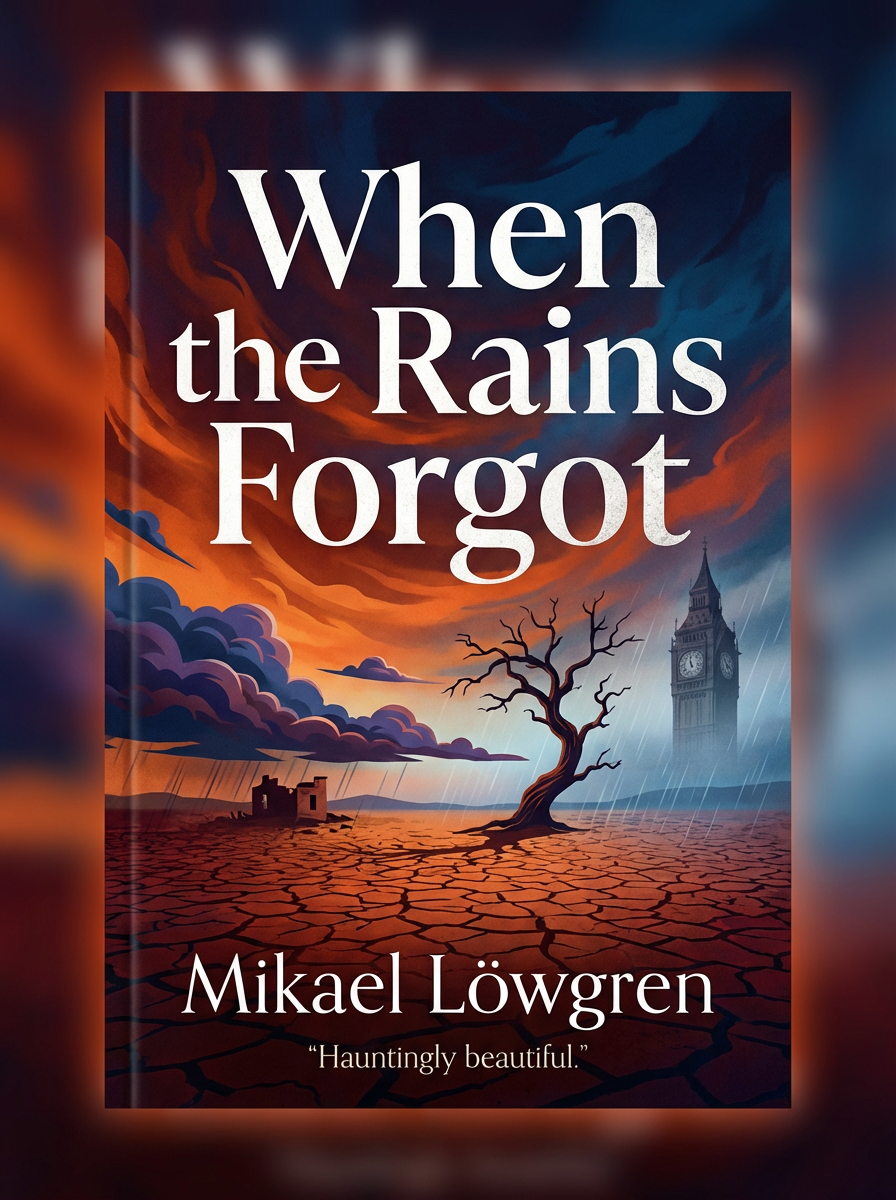
When the Rains Forgot
By Mikael Löwgren
Synopsis
Across a thousand years, a Maya farmer and a modern European farmer struggle against failing rains—each believing their world is too advanced to fall, until their stories begin to mirror each other in haunting ways, revealing a profound and cyclical truth about humanity's enduring vulnerability.
Chapter 1: The First Ripple
The air, thick and humid, clung to Ix Balam’s skin like a second hide. Above him, the jungle canopy, a riot of greens and shadows, exhaled the scent of rich earth and decaying leaves. He moved with the slow, deliberate grace of a man who understood the rhythm of the land. His machete, honed to a razor's edge, swished through the undergrowth, clearing the patch of land he’d chosen for this season’s milpa. Each stroke was a prayer, a whispered negotiation with the spirits of the forest.
He paused, wiping the sweat from his brow with the back of his hand. His dark, intelligent eyes scanned the newly cleared ground. The soil, dark and crumbly in his calloused fingers, smelled pregnant with possibility. He remembered his father, his father’s father, countless generations before them, all performing this same ancient dance. The knowledge was etched into his bones: where the sun fell just so, where the water would gather, where the best kernels would take root. It was not a science learned from glyphs, but from generations of observation, of living interwoven with the earth.
He pictured Xochitl and Itzel, their faces bright with anticipation. The corn, when it ripened, would be their sustenance, their lifeblood. He imagined Itzel’s small, agile fingers helping grind the kernels, her laughter echoing through their dwelling. It was a future he built with every swing of his blade, every seed he would eventually place into the earth.
“The omens are good, husband,” Xochitl had said that morning, her voice soft as the rustle of corn leaves. She had been observing the flight of the quetzals, the way the morning mist lifted from the cenote. He trusted her intuition as much as he trusted the turning of the seasons. Her gentle but firm demeanor was the bedrock of their small family.
But then, a flicker of something in his periphery. A bird, usually vibrant, sat hunched on a low branch, its feathers dull, its song absent. He paused, a strange coldness trickling down his spine. It was a tiny thing, easily dismissed. Yet, in his world, nothing was ever truly insignificant. Every deviation from the usual pattern held a meaning, a whisper from the spirits. He shook his head, returning to the clearing. He was a farmer, not a diviner. His task was to prepare the earth, to plant, to hope. The first ripple, he thought, was often too small to truly see.
***
Thousands of years and half a world away, Elin Andersson surveyed her fields from the climate-controlled cabin of her self-driving tractor. The vast expanse of green stretched to the horizon, an orderly testament to human ingenuity. Her fingers, strong and practical, danced across the tablet mounted beside her. Data streamed in a constant flow: soil pH levels, moisture content, nutrient ratios, projected yield metrics.
“Magnus is late,” she muttered to herself, though no one else was there to hear. Magnus Dahl, her agricultural advisor and climate policy expert, was meticulous, almost pathologically so. His arrival always signaled a new wave of data, a fresh set of models to parse and integrate.
Elin had inherited the Andersson farm from her father, a man who, until his last breath, had mistrusted anything that wasn’t tangible dirt and the sweat of his own brow. He had viewed her embrace of technology with a grudging respect, often shaking his head at the glowing screens and intricate machinery. But Elin knew better. In a world of increasing unpredictability, data was her shield, technology her sword.
This year's crop rotation was a marvel of genetic optimization. Drought-resistant strains, nutrient-efficient hybrids – everything designed to maximize yield and minimize risk. The long-range forecasts, culled from a dozen different meteorological agencies, painted a picture of mild shifts, nothing catastrophic. A slight increase in average temperature, perhaps a minor deviation in spring rainfall, but well within the parameters her crops were designed to handle.
She zoomed in on a section of her wheat field, her keen, discerning gaze picking out a subtle discoloration. Not a disease, the sensors confirmed, just a marginal dip in nitrogen uptake. She tapped a command, and a drone, a silent metallic insect, detached itself from the barn, hovering briefly before zipping towards the marked area, ready to deliver a precise micro-dose of fertilizer. This was farming elevated, a symphony of algorithms and genetic science. Her world, she believed, was too advanced to fall prey to the whims of nature.
A flicker of doubt, a momentary discord in her well-ordered world. A news alert, pushed to her tablet. “Unusual heatwave in Southeast Asia threatens rice crops.” She skimmed the article, half-listening to the disembodied voice of her tractor’s AI reporting on fuel efficiency. Southeast Asia was a long way off, a different climate zone entirely. But something about the phrasing, “unusual heatwave,” pricked at her. She dismissed it as a blip. Global weather patterns were complex, chaotic on the fringes, but predictable in her corner of the world. She had the data; she had the technology.
A familiar Volvo pulled up alongside her field, kicking up a plume of dust. Magnus Dahl, dressed in his neat business casual, emerged, tablet already in hand. He offered a small, earnest smile, a trace of apology in his eyes. “Elin, good to see you. Apologies for the delay, a conference call ran over. Important discussions on carbon sequestration models.” He held up his tablet, already eager to delve into the latest projections.
Elin nodded, a faint crease forming between her brows. Important discussions, she thought, about numbers and graphs, while the earth itself hummed its ancient song. But she pushed the thought aside. Magnus was well-meaning, intelligent. His models were rigorous. She trusted the data, and the data said they were prepared. For now, the future looked green and prosperous. The only ripple she saw was the gentle sway of her genetically optimized wheat in the breeze.
Chapter 2: A Change in the Air
The first tendrils of uncertainty, thin as morning mist, began to curl around Ix Balam’s meticulously tended milpa. The sun beat down, an unwavering disc in a sky of bleached cerulean. Day after day, it rose and set with a predictable, almost monotonous rhythm, yet the rhythm of the world beneath it faltered. The air, usually thick with the promise of coming deluge, remained dry, carrying only the scent of dust and distant, unfulfilled longing.
Ix Balam, a man whose hands knew the earth intimately, felt the subtle shift first. He walked his fields, the nascent corn sprouts, usually vibrant with anticipation, looking a shade paler than they should. The soil, which by now should have been softened by pre-monsoon showers, remained stubbornly brittle under his bare feet. He ran a hand through it, the dust clinging to his fingers like a fine, unwelcome powder.
He remembered his grandfather’s stories, tales of lean years when the Sky Serpent had withheld its breath, but those had always been followed by bountiful seasons. This felt different. There was a quiet hum of anxiety in the village, a tension that vibrated just beneath the surface of daily life. The women, usually loud with gossip and laughter as they ground maize, spoke in hushed tones. The children, normally carefree, seemed to linger closer to their mothers.
"The rains are late," Xochitl observed one evening, her voice a low murmur as she tended the cooking fire. Itzel slept soundly in a hammock woven from agave fibers, oblivious to the unspoken worry.
Ix Balam grunted, turning a piece of roasted plantain over the embers. "They will come. They always do." But even as he said it, the words felt thin, unconvincing, like a shield worn too thin by time.
Days bled into weeks. The morning dew, once abundant, became a fleeting gift, drying almost instantly under the sun’s intensifying glare. The ceremonial fire in the village square, meant to invite the rains, burned higher, fed by more offerings, its smoke rising in a desperate plea to the cloudless sky.
The elders gathered, their faces etched with the wisdom of many seasons, and many more anxieties. Their usual calm demeanor was frayed. Whispers of "never before" circulated among them. Ah Kin, the lead priest, a man whose presence was as imposing as the ancient ceiba tree in the center of the village, finally convened a formal meeting. His voice, usually resonating with authority, carried a faint edge of insistence.
"The gods test our faith," Ah Kin declared, standing before the gathered villagers, his ceremonial robes gleaming in the midday sun. "But the gods are ultimately just. K’awiil, the god of maize, and Chaac, the rainbringer, will not abandon us. They are pleased with our devotion, our offerings, our sacrifice."
Ix Balam watched him, a knot tightening in his stomach. Ah Kin’s eyes, ancient and unyielding, scanned the faces before him, daring anyone to doubt. But Ix Balam saw the flicker of unease in the priest’s own gaze, a momentary shadow that betrayed a deeper concern.
"We must intensify our prayers," Ah Kin continued, his voice regaining its previous conviction, "and prepare our fields. The rains, when they come, will come with abundance, for the gods reward perseverance."
A collective sigh, part relief, part resignation, rippled through the crowd. Ix Balam, however, felt no such comfort. His hands, though calloused, were sensitive to the subtlest vibrations of the earth. And the earth, he knew, was hungry and thirsty. He respected Ah Kin, revered his wisdom, but an unwelcome thought, sharp as a flint knife, pricked his mind: *What if the gods have other plans? What if their favor is not so easily guaranteed?* It was a dangerous thought, one he quickly suppressed, focusing instead on the rhythmic thump of a distant mortar.
***
Miles away, and a thousand years later, Elin Andersson surveyed her fields, not with the intuition of old, but through the cool, dispassionate lens of a data display. Her tablet glowed, showing moisture levels, soil composition, and predicted evapotranspiration rates. The numbers, usually reliable as the rising sun, were troubling.
An unprecedented spring drought had settled over southern Sweden. The typical April showers, the gentle, persistent rains that nurtured the early growth, had simply failed to materialize. Instead, days of uninterrupted sunshine, uncharacteristic for the season, beat down on the freshly planted fields.
"The 90-day forecast indicated a normal precipitation curve," Elin muttered, tapping the screen with a stylus. "This deviation is… significant." Her voice held a note of annoyance, an irritation at the unexpected rupture in her carefully constructed reality.
She’d spent years optimizing her farm, Andersson Farms, a legacy passed down through generations, but now functioning with cutting-edge efficiency. Genetically optimized crops, precision seeding, and, most importantly, a state-of-the-art irrigation system connected to subterranean aquifer pumps. It was a marvel of modern agricultural engineering, designed to mitigate against precisely these kinds of 'unusual deviations.'
Jonas Berg, her agricultural advisor, a man whose glasses often slipped down his nose as he spoke, leaned over her shoulder, his laptop open. "Indeed, Elin," he said, his tone a carefully modulated blend of academic reassurance and mild concern. "Our models show this as an anomaly, a statistical outlier. The Arctic oscillation pattern has been particularly stubborn, creating a high-pressure system over Scandinavia."
Elin raised an eyebrow, her gaze fixed on the wilting tips of some young wheat shoots. "An anomaly that’s threatening my crop yield, Jonas. My carefully calculated crop yield."
Jonas cleared his throat, adjusting his glasses. "Of course. And our models predicted a 92% chance of sufficient rainfall for this quarter. But climate systems are complex. There's always a margin of error." He waved a dismissive hand. "Think of it as a temporary blip. An unusual deviation, nothing more. We’ve had warmer springs before."
"But not this dry," Elin countered, her voice flat. She trusted Jonas, valued his expertise, but a cold seed of doubt had begun to sprout in her own carefully cultivated mind. Her family had farmed this land for centuries, and while they hadn't had climate models, they had known the land. And the land felt wrong.
The irrigation system, a network of pipes and sprinklers spanning dozens of hectares, was working overtime. The pumps hummed ceaselessly, drawing water from deep underground. It was a colossal effort, a technological tour de force, but even it was beginning to strain. The pressure gauges, usually steady, flickered occasionally. The energy consumption, meticulously tracked, was skyrocketing.
"The system is coping admirably, wouldn't you say?" Jonas offered, gesturing towards a distant sprinkler arc, a rainbow of artificial rain shimmering in the unseasonal sun. "Proof that our proactive strategies are effective. Without this infrastructure, your situation would be far more dire."
Elin watched the water arc, feeling a strange disconnect. It was beautiful, in a sterile, engineered way. But it wasn't the same as rain. The air around the sprinklers felt cooler, yes, but beyond that small radius, the dry wind picked up the moisture almost instantly, carrying it away like a fleeting memory.
"The aquifer levels," she said, cutting to the chase, "what do those models say about sustained extraction rates?"
Jonas clicked on his laptop, bringing up another graph. "Well, that's where the resilience comes in. The recharge rate is projected to be adequate. Again, based on our long-term climate predictions, which show a return to normal precipitation patterns by late summer."
"Late summer?" Elin repeated, the concern in her voice more pronounced. "By late summer, if this continues, I'll have nothing."
Jonas offered a reassuring smile that didn't quite reach his eyes. "Exaggeration, Elin. We have contingency plans. We can tap into additional reserves, deploy localized humidity generators if necessary. The technology exists to counteract these… temporary adjustments in weather patterns."
He spoke of technology with a reverence that Elin once shared. She had believed, absolutely, that humanity's ingenuity, fueled by data and innovation, could master any natural challenge. Her farm was a testament to that belief. Yet, looking at the struggling crops, at the unrelenting blue sky, a different kind of thought, quiet and unsettling, began to emerge. It was a murmur, a whisper of a doubt, that perhaps even the most advanced models and the most sophisticated machines had their limits. That some things, no matter how much data you poured into them, simply refused to conform to prediction.
She remembered her grandmother, stoic and weathered, shaking her head at a particularly bad season. "The earth gives, and the earth takes," she’d said, "and sometimes, it just forgets." Elin had dismissed it as quaint superstition, the ramblings of a generation ignorant of precision agriculture. Now, she wondered. Just wondered. The air, thin and dry, tasted of something more ancient than spreadsheets and satellites. It tasted of forgetting.