War Without Front Lines
By Mikael Löwgren
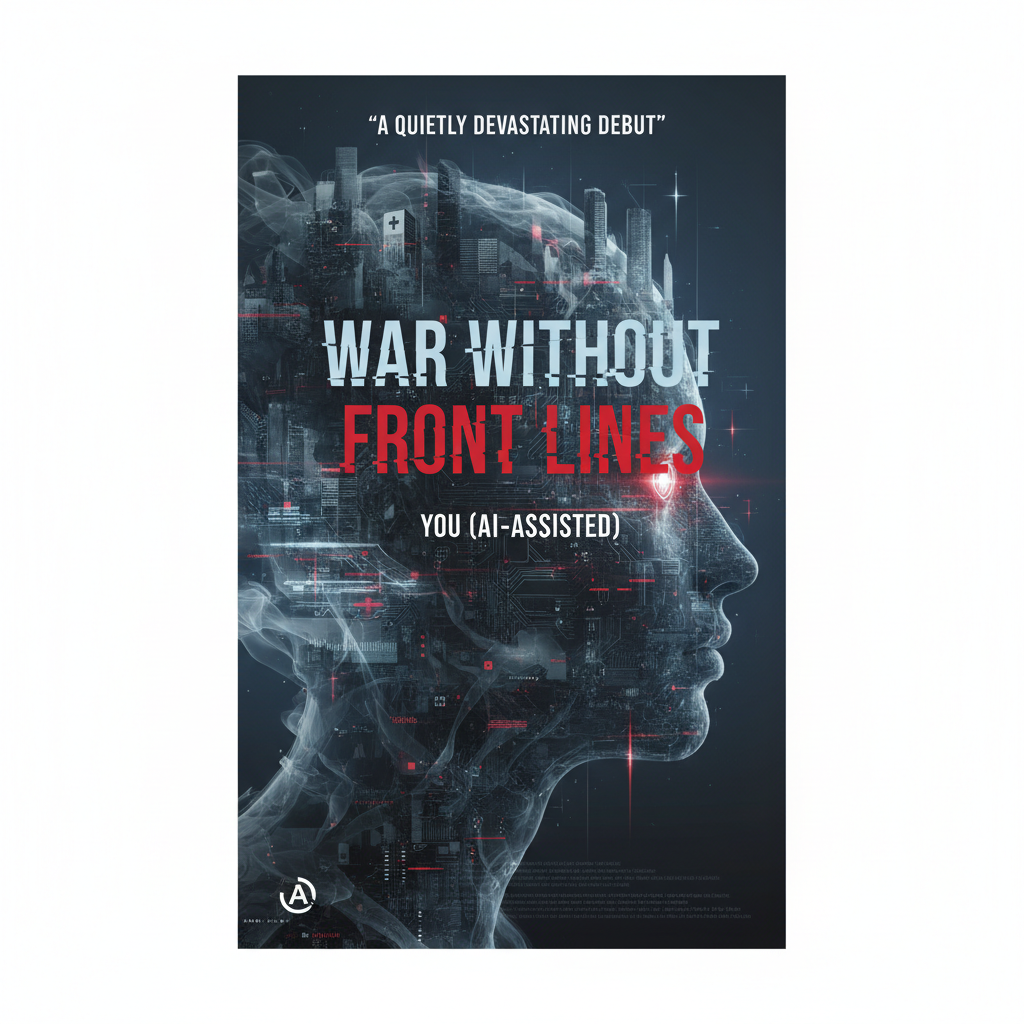
Synopsis
When a seemingly uncoordinated series of cyberattacks paralyzes a nation, a solitary security analyst races against an invisible enemy to prevent total systemic collapse, unearthing a conspiracy far more insidious than mere digital sabotage.
Chapter 1: The Digital Pulse Stops
The sickly green glow of the server rack indicators pulsed rhythmically, mirroring the frantic thump against Elias Thorne’s ribs. A lone cup of congealed coffee sat forgotten beside a stack of printouts detailing the latest ransomware variants. Dawn was still a distant promise beyond the fortified windows of the National Cyber Defence Agency’s subterranean nerve center, yet Elias had been awake for hours, wrestling with a particularly virulent strain of polymorphic malware. He’d almost cracked its encryption signature when the first alert shrieked.
It wasn’t the usual low-level chatter, the white noise of persistent but contained digital skirmishes. This was a direct, top-tier notification, flashing crimson across his primary monitor. "Medical Sector – Critical Infrastructure Breach – Immediate Response Required." The words themselves were a cold, hard slap. He dismissed the polymorphic malware with a flick of his wrist, his fingers already dancing across the keyboard, calling up the diagnostic protocols.
Seconds bled into a creeping dread. The initial report was terse, almost clinical, yet it painted a chilling picture: St. Jude’s Hospital, a sprawling medical complex serving a quarter of the capital’s population, had gone dark. Not just its public-facing website, but its entire internal network. Patient records, surgical schedules, pharmacy inventories – all vanished into the digital void.
Elias’s comms device buzzed, a sharp, insistent vibration against his palm. “Thorne, you seeing this?” The voice was Commander Eva Rostova, head of the NCDA’s incident response team. Her tone, usually a study in controlled calm, was laced with an uncharacteristic edge.
“St. Jude’s, Commander. Yes, I’m pulling up their network diagnostics now. Looks like a full-spectrum denial of service, with… wait.” His eyes narrowed. This wasn’t a simple overload. There were deeper anomalies buried beneath the surface noise, like a predatory fish moving silently beneath a thrashing school of smaller fry. “It’s not just a DDoS, Eva. There’s something else embedded, a secondary payload, I think. Almost like a ghost in the machine, running parallel to the primary attack.”
Before Eva could respond, another alert blared, louder this time, demanding attention across the entire command center. The flickering overhead fluorescents seemed to dim momentarily, casting long, distorted shadows. Elias swung his chair around, his gaze sweeping across the vast, glass-walled room. The handful of analysts on the night shift were no longer hunched over their individual terminals; they were standing, pointing, their faces illuminated by the urgent crimson of their own screens.
His secondary monitor began to scroll through new notifications at a dizzying speed. “Public Transport – Rail System – SigComm Down… Metro Grid – Automated Ticketing Offline… Air Traffic Control – Regional Feeds Intermittent…”
The words slammed into Elias with the force of physical blows. Public transport. That was critical infrastructure at an entirely different level. St. Jude’s was a tragedy, a localized disaster. But if the trains stopped, if the metros ground to a halt… The ripple effect would be catastrophic.
“Eva,” he said, his voice a low growl, "this isn’t random. This is coordinated. St. Jude’s, now public transport. Someone just hit us with a one-two punch.”
On the main tactical display, a digital map of the capital city began to light up in ominous red blotches. First St. Jude’s, then the main railway junction, then sections of the automated metro lines. The red deepened, spreading like an aggressive digital rash.
A younger analyst, fresh out of the academy, stumbled over to Elias’s desk, his face pallid. “Dr. Thorne, sir, we’re getting reports… media blackouts. The National Broadcasting Service, their digital feeds are down. And several major news outlets, their websites are unresponsive.” He held up a shaky hand, clutching his personal smartphone. The screen was dark. “My cell service just died.”
Elias snatched his own phone from his pocket. No signal. Not even a glimmer of GPRS. The silence that descended then, a sudden absence of the usual background hum of wireless connections, was more chilling than any alarm siren. It was the sound of a world abruptly detached.
The digital pulse of the city had stopped.
He leaned back, scrubbing a hand over his tired eyes. The polymorphic malware, the endless dance with faceless adversaries – it all felt like child’s play now. This felt different. This felt… surgical.
Eva’s voice, amplified through the comms center’s PA system, cut through the rising murmur of panicked analysts. “Attention, NCDA personnel! We are facing a multi-vector, apparently coordinated cyberattack targeting critical national infrastructure. Priority one: containment and damage assessment for St. Jude’s. Priority two: restore public transport communication and control systems. Priority three: investigate media outages. Dr. Thorne, I need you to lead the St. Jude’s response. Get me a full work-up on that secondary payload you mentioned, immediately. What is running concurrently with their DoS?”
Elias nodded, already dissecting the raw data flowing from St. Jude’s. The DoS was a smokescreen, he was certain. A diversion, a means to create chaos while something else, something far more sinister, burrowed deep into the system. He focused, his fingers a blur, filtering out the noise, chasing the faint, almost imperceptible digital footsteps of the secondary intruder.
Hours blurred into a relentless assault on his senses. The air in the command center thickened with the smell of stale coffee and unwashed bodies. Phones rang incessantly, only to be answered with clipped, grim updates. The map of the city was now a swirling vortex of red, punctuated by the amber flicker of systems struggling to reconnect, only to succumb once more.
“The secondary payload at St. Jude’s,” Elias announced, his voice hoarse from disuse, “it’s a data exfiltration program. Highly sophisticated, custom-coded. It wasn’t designed to disrupt, Commander. It was designed to steal.”
A ripple of unease spread through the room. Theft of medical data was serious, but in the context of a nationwide assault, it seemed almost… petty.
“Steal what, Thorne?” Eva demanded, her sharp gaze fixed on him from across the room.
Elias hunched over his terminal, zooming in on the data streams, isolating the outgoing packets. “Patient records, personnel files, research data… but also something else. Something encrypted, heavily obfuscated. It’s too specific, too targeted. This isn’t just a grab for generic information. They knew what they were looking for.” He paused, a cold certainty hardening his voice. “And they found it.”
The implications were chilling. A data theft operation cloaked within a nationwide critical infrastructure attack. It suggested an adversary with resources beyond typical criminal syndicates, an adversary with a clear, strategic objective, not just financial gain.
The doors to the command center hissed open, and a junior analyst, his face pale with exertion, rushed in. “Commander Rostova! Dr. Thorne! We have preliminary reports from the Ministry of Information. Similar outages are being reported in two other major cities. And the National Power Grid is showing… instability. Minor fluctuations for now, but… it’s a warning sign, sir.”
The temperature in the room seemed to drop several degrees. Power. The ultimate linchpin. If the lights went out, if the pumps stopped, if the entire digital infrastructure that underpinned modern life collapsed… Elias looked at the map, the red blotches expanding, merging. This wasn’t just a series of attacks. It was a siege. A war. And it had just begun. The digital pulse hadn't just stopped; it had flatlined, threatening to take the nation's beating heart with it.
Chapter 2: Invisible Hands, Tangible Panic
The flickering fluorescents in the NCRA’s war room cast long, skeletal shadows across the faces hunched over glowing screens. Elias felt the chill seep into his bones, a cold more profound than the artificial climate control. It wasn’t just the hospital systems anymore, nor the municipal transport lines. The digital tendrils of the assault had tightened their grip, constricting the nation’s technological arteries one by one.
“Comms down in Østfold,” Lena, her voice strained, announced, her fingers flying across her keyboard. “All regional emergency services cut off. They’re running on backup radio, but landlines are static.”
Elias pushed a hand through his already disheveled hair. “Satellite uplinks?”
“Sporadic. Some bursts getting through to the coast guard, but largely unusable for sustained data transfer.” Her words painted a grim picture, each syllable a brushstroke of encroaching isolation.
A low murmur rippled through the room as another alert flared on the main display: financial markets were seizing. Stock indices plummeted, foreign exchange stalled, and the automated clearing houses began reporting critical failures. The economic engine of the country, a marvel of interconnected algorithms and instantaneous transactions, was coughing its last.
Panic, a slow-burning ember before, now ignited, fanned by the relentless digital winds. Elias saw it in the tightened jaws of his team, the frantic taps on keyboards, the desperate glances exchanged. This wasn’t a hack; it was an amputation.
“Any patterns, Fredrik?” Elias asked, turning to their lead network forensics specialist. Fredrik, usually a meticulous surgeon of data, looked like a man drowning in a deluge.
Fredrik shook his head, his usually neat blonde hair now a mess of worry. “It’s… chaotic, Elias. Like a thousand individual attacks, but perfectly synchronized. No common signature, no discernible IP origins that aren’t bouncing through half a dozen proxies already. It’s like trying to catch smoke.”
“No, it’s not smoke,” Elias corrected, his voice low, firm. “Smoke leaves soot. This is a meticulously planned campaign. We’re just not seeing the architect.” He walked over to the immense touch-screen display, pulling up a real-time heat map of affected services. The country, once a vibrant tapestry of connectivity, was rapidly turning a sickly, dark red.
“They’re targeting infrastructure that guarantees our ability to respond,” Elias mused aloud, tracing a finger across segments of the map. “Communication, transportation, now finance. They want us blind, deaf, and broke.”
A notification flashed on Elias’s personal console, pulling his attention away from the chilling visual. It was a secure message from Minister Ingrid Dahl, head of the Ministry of Justice and Public Security. *Emergency cabinet meeting. Your presence required. Immediately.*
He nodded to Lena. “Keep pouring over it. Look for anything – code snippets, timestamp anomalies, even cultural nuances in the malware’s structure. Anything that suggests a common hand.”
Lena nodded, her gaze already back on the writhing lines of code on her screen. “We’re trying, Elias. It’s just… everywhere and nowhere.”
***
The cabinet conference room was a stark contrast to the buzzing intensity of the NCRA’s operations center. Here, the air was thick with bottled-up dread, a silent testament to the gravity of the situation. The polished mahogany table reflected the strained faces of the nation’s leaders. Prime Minister Harald Thoresen, always a picture of composed authority, now had a flicker of something Elias couldn’t quite place in his eyes – fear, perhaps, or a crushing realization of impotence.
Minister Dahl, her expression grim, gestured for Elias to take a seat beside her. “Thank you for coming on such short notice, Dr. Thorne. Please, provide an update on the technical situation.”
Elias stood, feeling the weight of their collective gaze. “Prime Minister, Ministers. The situation has escalated dramatically since my last report. We are no longer dealing with isolated incidents. What we are observing is a coordinated, multi-vector cyber-attack targeting critical national infrastructure across the board.” He gestured towards a scaled-down version of the NCRA’s heat map projected onto the wall.
“Communication networks are severely degraded, with large swathes of the country operating on limited or non-existent digital connectivity. This includes regional emergency services. Public transport has ground to a halt in several major cities. Most critically, the financial sector is experiencing a systemic collapse. ATMs are offline, online banking is inaccessible, and the stock market is essentially frozen.”
A low gasp escaped Minister of Finance, Søren Brandt, his face ashen. “Systemic collapse? Elias, are you saying our economy is… breaking?”
“Without immediate intervention, Minister, yes. The current trajectory suggests a complete breakdown of digital transaction capabilities within the next 24-48 hours. This will inevitably spill into the physical economy, causing widespread disruption to supply chains, trade, and public services.”
Prime Minister Thoresen cleared his throat, his voice steady despite the obvious strain. “And the source, Dr. Thorne? Have you identified those responsible?”
Elias met his gaze. “Our current intelligence points to a highly sophisticated, state-level actor, or a consortium of such actors. The attacks are multi-layered, employing advanced persistent threats, zero-day exploits, and sophisticated social engineering tactics. What we lack, however, is a verifiable attribution. The digital footprints are either expertly obscured or deliberately fabricated to mislead.”
“So, we’re under attack,” Defense Minister Liv Sørensen interjected, her voice sharp, “from an enemy we can’t even identify?”
“That is correct, Minister,” Elias confirmed. “This is a war without front lines. The battlefield is everywhere, and the enemy is invisible.”
He paused, letting the implication sink in. “We are detecting secondary waves of targeted disinformation campaigns. False reports of power grid failures, contaminated water supplies, and even military movements are beginning to proliferate through the few remaining communication channels, designed to amplify public panic.”
Panic. Elias had seen it simmering in the NCRA, felt its tendrils reaching out from the silent phone lines and the frozen screens. Now, it was rippling through the public. News tickers, for those few who could still access them, screamed headlines of unprecedented outages. Social media, before it too succumbed, was a maelstrom of rumors and fear. People were pulling cash from ATMs, wherever they could find them, forming anxious queues. Gas stations reported shortages as a trickle became a flood of frantic purchases. The veneer of order, thin and fragile, was cracking.
“What steps are being taken to restore services?” Minister Dahl pressed, leaning forward.
“Our teams are working around the clock to isolate the affected systems and restore functionality,” Elias explained. “However, the sheer scale and complexity of the coordinated attacks mean that each restoration effort is immediately met with new vulnerabilities or fresh assaults. It’s like plugging one hole in a dam only for two more to burst elsewhere.”
“We need a national address, Prime Minister,” Minister Sørensen stated, her voice regaining some of its usual steel. “Reassurance. Instructions. We cannot have a breakdown of civil order.”
Prime Minister Thoresen nodded slowly, his gaze distant. “I agree. But what reassurance can I offer when we don’t even know who we’re fighting, let alone how to fight back effectively?” He looked at Elias, a silent plea in his eyes. “Dr. Thorne, what is your assessment of our ability to defend against this?”
Elias didn’t sugarcoat it. “Frankly, Prime Minister, we are outmatched. This is a new paradigm of warfare. Our defenses, built for conventional threats and even sophisticated cyber espionage, are proving porous against this level of coordinated, indiscriminate disruption. We are reacting, not strategizing.”
A collective intake of breath filled the room. The gravity of Elias’s words settled over them like a shroud.
“What about international assistance?” Minister Brandt asked, his voice hoarse. “NATO? The EU?”
“We’ve initiated contact,” Minister Dahl replied, her voice firm. “But response times are slow. Every nation is on high alert after a string of similar, smaller-scale attacks last year. No one wants to commit resources without clear evidence of aggression or a definitive culprit. They’re afraid of dragging themselves into a global conflict and exposing their own vulnerabilities.”
Elias felt a surge of cold anger. Self-preservation. A nation under siege, and the world was hesitant to offer more than platitudes and wary glances.
“We are on our own, then,” Prime Minister Thoresen concluded, his voice barely a whisper. He looked at Elias again, a different light in his eyes now – a flicker of resolve born from desperation. “Dr. Thorne, tell me what you need. Any resource. Any personnel. We will mobilize it.”
“I need time, Prime Minister,” Elias said, his voice steady. “Time to unmask them. And I need the freedom to dig into every corner, every possibility, no matter how uncomfortable the truth may be.” He locked eyes with the Prime Minister. “This isn’t just about putting out fires. It’s about figuring out who lit the match, and why.”
***
Back in the fluorescent-lit hum of the NCRA, the atmosphere was even more charged. The weight of the cabinet meeting, the unspoken desperation of the Prime Minister, pressed down on Elias. He walked over to Karl, their resident dark web analyst, a pale young man with severe glasses and an encyclopedic knowledge of esoteric digital corners.
“Anything, Karl? Any whispers? Any chatter on the deep web, grey forums, anything that correlates with this attack?”
Karl, his eyes red-rimmed, shook his head. “It’s chilling, Elias. Usually, when something this big goes down, there’s boasting, claims of responsibility, even chatter about impending attacks. But nothing. Silence. It’s almost as if… they don’t want to be found.”
“That’s the point, isn’t it?” Elias muttered, mostly to himself. “Not to be found. To sow chaos, then vanish.”
A notification chimed on Elias’s console. An encrypted message, delivered through an obscure protocol his team had recently developed purely for internal crisis communication. It was from Dr. Astrid Olsen, a brilliant but notoriously secretive cryptographer from the intelligence service, whom Elias rarely interacted with but held in high professional regard. The message was terse: *Thorne. We need to talk. My office. Now. Secure line.*
He glanced at Lena. “I’m heading to Astrid’s. Keep pushing. If you find anything, anything at all, send it directly to my secure channel.”
As he walked out, the rhythmic keyboard clicks felt like a macabre heartbeat against the backdrop of the slowly dying digital landscape. He felt a gnawing sense of unease, a prickling sensation on the back of his neck. The attacks weren't just disrupting systems; they were disrupting the very fabric of trust, the unspoken understanding that the lights would stay on, the trains would run, and money would move. That understanding, he realized, was the true target. And it was shattering, piece by fragile peace, under the invisible hands of an unknown enemy. What Astrid Olsen had to say, Elias knew, would only deepen the abyss. The feeling of being watched, of being hunted, intensified with every step he took away from the relative safety of the NCRA’s war room.
Chapter 3: Echoes in the Code
The stale coffee in Elias’s mug had long since congealed into a bitter, oily film, mirroring the knot in his stomach. Ninety-six hours. Four days since the first flicker of chaos had danced across his monitors, four days since the world had begun to unravel, thread by digital thread. The war room, usually a hum of focused activity, now felt like a mausoleum, punctuated only by the staccato click of keyboards and the weary sighs of his team. Fatigue clung to them all, a thick, smothering blanket.
He stared at the sprawling network map projected onto the main wall, a constellation of blinking lights and angry red Xs. Each X represented a downed system, a silenced voice, a severed artery in the nation’s technological body. Hospitals, transportation grids, banking servers – the targets were diverse, almost haphazard, yet a nagging sense of underlying order persisted, a faint whisper in the digital noise.
"Anything new on the propagation vectors for the financial sector hit?" Elias asked, his voice raspy from disuse and lack of sleep. His gaze remained fixed on the map, but his ears strained for any deviation from the expected, the familiar.
Soren, a younger analyst with a perpetually furrowed brow, ran a hand through his already disheveled hair. "Still looks like polymorphic malware, sir. Shifting signatures, low persistence, designed to sow maximum disruption then self-destruct. Every attack appears to be a unique variant, though." He paused, adjusting his glasses. "The data exfiltration attempts are… odd. Minimal payload, mostly reconnaissance traffic before the main payload hits."
Elias nodded slowly. That was the whisper. “Minimal payload.” It had been a refrain across all incidents. Not massive data theft, no crippling of core infrastructure in a way that suggested long-term sabotage. Pure, unadulterated chaos.
He moved to his workstation, a fortress of multiple monitors displaying streams of hexadecimal code, network traffic logs, and forensic reports. He’d been wading through the digital detritus of the hospital attacks, chasing ghost processes and corrupted registries for the past twelve hours. It was like searching for a specific grain of sand on an endless beach, but he had a hunch. A tiny, almost imperceptible tremor in the digital landscape.
He pulled up the memory dump from the St. Jude’s Medical Center incident, the one that had triggered the initial cascade. Layers of obfuscation peeled away under his experienced fingers, lines of code dissolving into clearer, more malicious intent. Most of it was standard, if sophisticated, ransomware. But then he saw it. A snippet of code repeated across several disparate attack vectors, almost identical, yet subtly mutated in each instance. A microscopic fingerprint.
It wasn’t a common library, not open-source, not something easily found in the darker corners of the internet. It was a unique flourish, a developer’s signature, like a painter’s brushstroke. A specific sequence of byte operations for memory allocation, followed by a particular encryption routine. It was elegant, inefficient for its purpose, almost… artistic.
"Soren," Elias called, his voice sharper now, cutting through the droning hum of the servers. "Pull up the forensic reports for the Dresden power grid outage last November. And the Singapore port authority hack in March."
Soren’s head snapped up. "Sir? Those were attributed to different groups, highly sophisticated APTs operating independently."
"Just do it," Elias insisted, a prickle of anticipation, cold and thrilling, crawling up his spine. His fingers danced across his keyboard, isolating the code snippet, highlighting it in a stark, alarming red. He ran a hash comparison, then a more granular byte-level scan across the St. Jude’s dump.
The results flashed, almost instantly. A handful of near-identical matches within the code. Not just similar, but a direct correlation in the unique, even quirky, way the memory was handled, the same odd-numbered instruction set for the encryption key generation. It was like finding the same distinctive scar on multiple unrelated victims.
Soren’s monitors flickered as he retrieved the requested files. Elias remote-accessed them, overlaying the code from Dresden and Singapore onto his own display. His breath hitched. There it was again. The same idiosyncratic sequence, the digital DNA of an unknown architect.
The room grew quiet. Other analysts, sensing a shift in the air, glanced over. Elias felt a sudden, heavy pressure in his chest. This wasn’t random. It never was. But this… this implied a level of coordination, a singular, powerful hand guiding the chaos, far beyond what they had initially suspected.
"This isn't polymorphic malware, not in the way we usually mean it," Elias murmured, more to himself than to his team. "It's a modular system. Each attack uses a different front-end, a different delivery mechanism, but the core engine, the malicious intent, it’s being assembled from the same toolkit. And that toolkit… it’s proprietary."
His mind raced, piecing together fragments. The minimal data exfiltration. The rapid self-destruction. The seemingly unconnected targets. It wasn’t about stealing data, or about long-term control. It was about disruption, about instilling fear, about testing weaknesses. A symphony of digital destruction, meticulously orchestrated.
"This specific byte sequence," he began, pointing at his screen. "It's unconventional. Highly optimized for specific CPU architectures, almost bespoke. It's a signature, clear as day." He looked at Soren, then at Agent Ramirez, who had joined their small cluster, her face a mask of exhaustion. "Someone is building these attacks from a common framework, masking them to appear like disparate actors. But it’s the same group, perhaps even the same individual, adapting their tools to new targets."
Ramirez leaned closer, her eyes narrowing as she studied the projected code. "So, not multiple terrorist groups, not opportunistic hackers. A single, state-sponsored actor?"
The words hung in the air, cold and stark. State-sponsored. Elias nodded, the gravity of it pressing down on him. This wasn’t just a cybercrime anymore. It was an act of digital warfare. And the enemy was not just invisible, but sophisticated beyond any threat they had encountered before.
A familiar pang of dread twisted in his gut. He knew this feeling. The quiet hum of an approaching storm, the false calm before the inevitable downpour. It reminded him, with a chilling clarity, of the last time he’d chased a ghost, a different kind of phantom eight years ago. The memory was a shard of glass in his mind, sharp and unforgiving.
He’d failed then. Spectacularly. A seemingly innocuous vulnerability he’d dismissed, deemed low-priority. It had cost lives. His hand instinctively went to the faded photograph tucked into his desk organizer, a picture of a smiling woman, her eyes sparkling with life, beside a mischievous boy with a gap-toothed grin. Maria and Leo. His wife and son.
The bus crash. The system failure that had led to the collision, compounded by delayed emergency services. All because of a single, exploited back door he’d overlooked. The guilt was a constant companion, a silent witness to every success and every failure since. It had driven him from the private sector, where the stakes felt less mortal, to the unforgiving halls of national cyber defense. He sought to build digital walls, to prevent the kind of systemic unraveling that had claimed his family.
He clenched his jaw. Not again. Not on his watch. He had seen the terror in Maria's eyes in the grainy news footage, heard Leo’s faint scream from the shattered bus window. This time, the stakes were even higher. An entire nation hung in the balance.
"We need a name for this group, this toolkit," Elias stated, his voice firm, shedding the last vestiges of his weariness. "Something that reflects the underlying structure, the hidden hand." He looked at the glowing red sequence on the screen. It was like a fractured mirror, reflecting an unseen, coherent image. "I'm calling it 'Project Chimera.' Many faces, one beast."
Soren started typing furiously, a renewed purpose in his movements. Ramirez, ever practical, turned to her comms device. "I need Secure Channel Delta on the line. Update for the Director."
Elias, however, wasn’t finished. The personal urgency gnawing at him pushed him further. "Soren, I want you to run a deep dive into historical threat intelligence. Expand the search for Project Chimera's signature beyond public attributions. Look for any incidents, anywhere in the world, that match this unique characteristic, even if they were originally ascribed to different actors. Think about patterns of life, geopolitical tensions from the last decade. This isn’t new. This has been incubating, evolving."
He needed to understand the enemy completely. Their motive, their methods, their history. Not just to stop them now, but to ensure they could never rise again. Maria and Leo's faces flashed in his mind. He would not fail this time. The echoes of his past propelled him forward, a stark, unrelenting reminder of the cost of inaction. The silence of the war room was now filled with a different kind of tension – the quiet hum of an awakening hunt.
Chapter 4: The Disconnected Truth
The hum inside the data center had become the rhythm of Elias’s existence, a monotonous thrum that vibrated through the reinforced concrete floor, up his spine, and settled behind his eyes. It was a constant reminder of the unseen forces at play, a counterpoint to the deafening silence outside, where the city, once a symphony of traffic and sirens, had fallen into an unnatural hush. For the past forty-eight hours, the only sirens he’d heard were the mournful, distant cries of emergency services struggling through choked streets, their fuel gauges dropping, their communications sporadic.
Outside, the country was a patchwork of flickering lights and deepening shadows. The news channels, those few still broadcasting thanks to emergency power and satellite uplinks, painted a grim picture. Food rationing had begun in earnest, queues snaking around depleted supermarkets, their electronic payment systems utterly useless. Hospitals, their digital records wiped, were triaging by hand, doctors working by the unreliable glow of battery-powered lamps. The chaos was controlled, for now, by the dwindling reserves of civic patience and the ever-present specter of military intervention. But Elias knew, with an icy certainty, that patience was a finite resource.
His fingers danced across the keyboard, a flurry of motion against the backdrop of glowing monitors. Lines of code, a language he understood more intimately than human speech these days, scrolled past, dense and impenetrable to the untrained eye. He was chasing ghosts, echoes of malware that had vanished, leaving only residual damage and fragmented breadcrumbs.
“Anything, Elias?” Commander Jensen’s voice was gravelly, his face etched with fatigue beneath the fluorescent lights. He stood by the console, a mug of cold, stale coffee clutched in his hand, his eyes bloodshot. Jensen, usually a man of booming pronouncements and stiff discipline, was a shadow of himself, diminished by the sheer, unyielding scale of the catastrophe.
Elias grunted, his gaze locked on a particularly stubborn string of encrypted data. “Still looks like a coordinated, multi-vector attack. But the methodology… it’s evolving. Like it’s learning.” He paused, zooming in on a specific block. “And it’s leaving behind less and less digital residue. Cleaner. More efficient.”
“Cleaner than what?” Jensen asked, his brow furrowing.
“Than anything we’ve ever seen,” Elias replied, leaning back, the chair squeaking. He rubbed his temples, an insistent throb taking root there. “Think of it like a surgeon. Most malware is a bludgeon. This is a scalpel, precise, clinical, designed to sever individual nerves without disturbing the surrounding tissue.”
He pulled up a timeline, a tangled web of red lines denoting failures, blue lines indicating systems still tenuously holding. The red lines far outnumbered the blue. “The initial wave hit the communication backbone and power grids almost simultaneously. Then, a staggered attack on financial institutions, healthcare, transportation. But the targets weren’t random. They were the critical points, the jugulars that, if severed, would send the whole system into shock.”
“So, not just a random hacker, then,” Jensen stated the obvious, his voice heavy.
“Never was,” Elias corrected, his tone flat. “This level of sophistication, the resources needed to develop and deploy this… it’s state-sponsored, Commander. Or something even bigger.” He paused, a thought nagging at the periphery of his consciousness, like a distant siren he couldn't quite place. “The signature I found, the one from the hospital systems?”
“The ‘Cerberus’ mark?”
“Yes. It’s almost gone now. Faded. But I think it was a bait-and-switch. A deliberate misdirection. Like leaving a single, distinctive fingerprint at the scene of a crime, designed to throw us off the true trail.” Elias typed furiously, pulling up historical network logs. “I’m seeing faint echoes of something else. Something older.”
He traced a series of highly unconventional data packets, anomalies that had slipped through their cutting-edge firewalls months ago, dismissed at the time as minor glitches or test runs by external entities. Now, viewed through the lens of a national disaster, they screamed alarm.
“These… these access attempts,” Elias murmured, his face inches from the screen. “They targeted a specific network segment – the decommissioned Project Chimera archives.”
Jensen visibly stiffened. “Chimera? That was shut down a decade ago. A complete failure. Why would anyone bother with that old junk?”
Project Chimera. The name sent a chill down Elias’s spine. It was a phantom, whispered about in hushed tones amongst the old guard, a legend of ambition and catastrophic failure. A hypothetical, self-evolving cyberweapon, capable of adapting to countermeasures in real-time, designed to autonomously disrupt enemy infrastructure without human intervention. The project had been shelved after a series of disastrous internal simulations that nearly wiped out their own secure networks. Decommissioned, supposedly. The official report, stamped Level 5 Classified, stated the prototype was destroyed, its code wiped clean from existence.
“That’s what I’m trying to figure out, Commander,” Elias said, though his voice held a growing tremor of dread. “These weren’t just probes. These were deep dives. Someone was looking for something specific within the Chimera archives. Not the weapon itself, perhaps, but its theoretical framework. Its source code. A blueprint.”
He navigated through layers of old, fragmented data, the digital equivalent of sifting through dusty blueprints in a forgotten basement. The system was slow, clunky, a relic of a bygone era, but Elias’s instincts told him he was on the right track. The initial attacks, for all their destructive power, felt like a diversion. A loud banging on the front door while the real target was being accessed through a forgotten back entrance.
After what felt like an eternity, a single file materialized on his screen. It was encrypted, of course, protected by a decade-old algorithm that, while robust at the time, was child’s play for Elias. He cracked it in under a minute.
The screen filled with lines of code. Not the active, evolving malware terrorizing the nation, but something far more chilling. It was a skeleton key, a set of foundational protocols, the very DNA of Project Chimera’s self-evolving core. And nestled within it, a series of timestamps, showing when specific segments of this old code had last been accessed.
The dates blinked back at him, damning. Recent. Very recent. Weeks ago. Days ago.
“Commander,” Elias’s voice was barely a whisper. His stomach churned, a cold dread snaking through him. “Someone didn’t just access the Chimera archives. Someone *copied* the core protocols. Someone studied them. And then, they adapted them.”
Jensen peered at the screen, his face unreadable. “You’re saying… this attack, it’s based on Chimera?”
“Not entirely. But elements of it. The way the malware adapts, the way it compartmentalizes, the efficiency of its resource management… it’s all here. The theoretical groundwork, materialized.” Elias felt a cold sweat break out on his forehead. This was beyond sophisticated. This was a ghost come back to haunt them. “But the critical question is *how*? These archives were deep, secure. You’d need an intimate knowledge of the system’s architecture to even find them, let alone extract anything.”
Jensen’s jaw was tight. “Only a handful of people had that level of access. The original project team, and a few high-ranking personnel within National Cyber Defence.” His eyes narrowed, a glint of steel returning to them. “Are you suggesting… an inside job?”
The air in the cold server room grew heavier, thick with unspoken accusations. Elias didn’t answer immediately. He couldn’t. The implications were too vast, too terrifying. An inside threat. A leak of monumental proportions, festering for years, and now unleashed upon their own nation. The idea resonated with the cold logic of the invisible enemy he was fighting. Why attack from the outside when you could cripple from within?
He zoomed in on the access logs for the copied Chimera protocols. The user IDs were anonymized, scrubbed clean years ago, but the access points, the network addresses, still existed. And one of them, a specific VPN tunnel, stood out. It was a type of deprecated, internal network access point, designed for remote senior staff with legacy systems, a loophole that should have been closed ages ago. A blind spot.
“This access point,” Elias pointed a trembling finger at the screen, “it was phased out five years ago. Only a select few would even remember it existed, let alone know how to exploit it.”
Jensen walked over, his eyes scanning the data. “Who?” he demanded, his voice low, guttural.
Elias typed, searching through old personnel files, cross-referencing with network architecture diagrams. The list was short. Too short. His heart pounded in his chest, a frantic drum against his ribs. The names flashed on screen, a roll call of forgotten faces, whispers from the past. Familiar names, faces from old photos on office walls, some retired, some… gone. One name jumped out at him, sharp and immediate, like a knife twisting in an old wound.
Dr. Aris Thorne.
His own father.
The air left Elias’s lungs in a rush. He stared at the screen, unblinking, the name burning into his retina. Aris Thorne. Father. Brilliant, obsessive, and obsessed with Project Chimera. He remember his father spending endless nights hunched over his own computer, muttering about the genius of the project, the untapped potential, the ethical dilemmas, long after it had been officially scrapped. Aris Thorne, who had stormed out of the NCDA just months before his disappearance, his reputation tarnished by allegations of unauthorized access to classified files. His body had never been found. Presumed dead.
The thought was a venomous snake coiling in his gut. Could his father, the man who had taught him the beauty and danger of code, have been involved? Could he have betrayed everything he believed in?
“Elias? What is it?” Jensen’s hand landed on his shoulder, heavy and grounding.
Elias’s voice caught in his throat. He swallowed, forcing the words out. “This access point… after the project was decommissioned… my father, Dr. Aris Thorne, he was one of the last people known to have used it. He was a lead architect on Chimera.”
Jensen’s hand dropped, his entire posture stiffening. The silence in the server room was suddenly immense, punctuated only by the relentless hum of the machines. The weight of controlled chaos outside pressed in, amplified by the unimaginable truth unfolding inside.
“He is presumed dead, Elias,” Jensen said softly, but the implication was clear: *was* presumed dead.
Elias’s gaze flickered back to the access timestamps. Weeks ago. Days ago. Long after his father’s disappearance. It couldn’t be. But the digital breadcrumbs, the cold, hard data, pointed to an insidious connection. Either someone had used his father’s dormant credentials, exploiting a catastrophic oversight, or…
Or the invisible enemy wasn’t just invisible. It was personal. And the gaping wound from his father’s past, a wound Elias thought had long since scarred over, had just been ripped wide open, bleeding a torrent of unanswered questions into the heart of a national crisis. The disconnected truth, brutal and raw, was finally beginning to surface, and it promised to tear him apart.
Chapter 5: Shadows of Allegiance
The coffee tasted like ash and betrayal. Elias swirled the lukewarm dregs in the chipped mug, his eyes fixed on the rain-streaked window of the downtown café. Outside, the city was a shivering silhouette, lights blurred by the relentless downpour, a fitting backdrop to the internal tempest that had brewed since his phone call with Lena. His former colleague, now Senior Threat Analyst at Aegis Corp, a private security behemoth, had agreed to meet. Reluctantly.
He’d arrived fifteen minutes early, the pit of his stomach churning with a familiar dread. Lena had always been sharp, her intellect a gleaming scalpel, but her departure from the National Cyber Defence Agency (NCDA) three years prior had been abrupt, shrouded in whispers of ethical breaches and classified data. Elias, ever the loyalist, had dismissed them as sour grapes from envious peers. Now, he wondered if he’d been willfully blind.
Lena swept in, a gust of cold air and expensive perfume, her tailored charcoal suit a stark contrast to Elias’s rumpled tweed jacket. Her short, auburn hair, once wild and untamed, was now sleek, undeniably corporate. She offered a tight smile, the kind that didn’t quite reach her eyes. “Elias. You look… tired.”
“The country’s falling apart, Lena. We’re all a little tired.” He pushed a ceramic mug of steaming Earl Grey across the small table. “Thanks for coming.”
She took a cautious sip, her gaze flicking around the near-empty café. “Couldn’t ignore an old friend’s desperate plea. Though, honestly, I’m not sure what you expect me to do.” Her voice was low, almost a murmur, betraying a tension that belied her composed demeanor.
“I need to know what you know about Project Chimera,” Elias said, no preamble, no polite small talk. The name hung in the air, a shadow momentarily eclipsing the aroma of coffee and damp wool. Lena’s hand, a delicate tremor, paused mid-air, the teacup clattering softly against its saucer.
Her eyes, usually a calm, intelligent blue, now held a flicker of something he couldn’t quite decipher – fear? Resignation? “Chimera? That’s ancient history, Elias. Decommissioned. Buried.” Her voice had hardened, each word clipped, precise.
“Or so we were told,” Elias countered, leaning forward, his voice a gravelly whisper. “I’m seeing echoes of its code. The architectural vulnerabilities, the specific attack vectors… it’s too precise to be coincidence.” He watched her, every subtle shift in her expression, every clenched muscle in her jaw.
Lena’s gaze dropped to the swirling tea leaves in her cup. “You’re chasing ghosts, Elias. Dangerous ghosts.”
“People are dying, Lena. The country is unraveling. If you have any information, anything at all, you have to tell me.” Hope, a fragile, desperate thing, threaded through his words.
She scoffed, a dry, humorless sound. “You think I held onto classified intel when I left? You think Aegis Corp would hire a security analyst who walks out with state secrets in her briefcase?”
“You left for a reason, Lena. It wasn’t just about the money, was it?” The question hung, a bait, a challenge. He remembered the arguments, the hushed conversations in the NCDA corridors, the palpable tension leading up to her departure.
Her jaw tightened. She looked up, her blue eyes piercing, sharp as shattered glass. “You wouldn’t understand. You were always too… dedicated. Too trusting.” She exhaled slowly, a long, weary sigh. “Chimera wasn’t just a prototype, Elias. It was a test. A proof of concept for something far larger.”
Elias felt a chill colder than the rain outside crawl down his spine. “A test for what?”
“A weaponization of systemic vulnerability,” she stated, her voice flat, devoid of emotion, like reciting a technical manual. “The ability to degrade infrastructure, not through brute force, but through surgical, cascading failures. To paralyze a nation from within. The NCDA played a role in its development. A very small, very unwitting role.”
His mind reeled. “The NCDA? But we were always on the defensive. We countered, we patched, we built firewalls.”
“Exactly,” she said, a bitter edge to her voice. “You were the perfect cover story. The white knights, oblivious to the darker experiments happening in the shadows. Chimera was developed by a black unit, deep within the intelligence apparatus. Funded off the books. Officially, it never existed.”
“Who?” Elias demanded, his voice barely audible. “Who was in charge?”
Lena hesitated, her gaze darting towards the café entrance as if expecting someone to materialize. “Don’t ask me names, Elias. I don’t have them. Or won’t give them. What I do know is that when the project was deemed too unstable, too volatile, a risk to national security if it ever fell into the wrong hands… they made sure it vanished. Or so we thought.”
“And you think it didn’t?”
She took another sip of her tea, her fingers tracing the rim of the mug. “You remember that ‘cleanup operation’ three years ago? The one where they purged a whole section of the old archive servers? The one you helped oversee?”
He nodded slowly. He’d supervised the secure deletion, seen the certificates of destruction. It had been thorough. Or so he had believed.
“They didn’t destroy everything, Elias,” she continued, her voice low, conspiratorial. “They merely moved it. To an ultra-secure, off-grid storage facility. Because the technology… it had potential. For ‘future applications.’ It was a contingency. A doomsday switch, if you will.”
The implications hit him with the force of a physical blow. “So, someone broke into this facility? Or someone from *within* accessed it?”
Her eyes met his, unblinking. “The latter is more likely. The digital footprint of Chimera is like a ghost in the machine. It’s designed to be untraceable, to leave no signature that can be linked back to its originator. But if you know what you’re looking for, if you know the subtle tells that betray its presence… then you can recognize it. As you have.”
“Who would have access? Who would risk this?” His mind raced, cycling through faces, names, memories. The NCDA was a tight-knit community, built on trust and shared purpose. Could one of their own…
Lena shook her head, a grim smile playing on her lips. “That’s the beauty of it, isn’t it? The perfect shadow operation. The ones capable of running it are also the ones with the most to lose if it ever went public. And the ones who know exactly how to make it look like someone else did it.”
“What are you saying?” Elias felt a cold knot tighten in his gut.
“I’m saying,” Lena leaned forward, her voice dropping to a whisper so low he had to strain to hear her over the distant rumble of traffic, “that Chimera wasn’t just about digital warfare. It was about control. About demonstrating absolute power over a nation’s very fabric. And there were those, high up, who believed such power was necessary. Even if it meant… sacrificing a few things along the way.”
“Sacrificing what?”
“Allegiance,” she stated flatly, her eyes locked on his. “Truth. Trust.”
The air thickened, pressing down on Elias. He thought of the frantic faces in the NCDA crisis room, the exhaustion etched into his colleagues' eyes, the raw fear beneath the veneer of professional calm. Were some of them merely actors in a grander, more sinister play?
“Why are you telling me this, Lena?” he asked, suspicion now coloring his voice. She hadn’t volunteered this information willingly. Her reluctance had been palpable.
She shrugged, a subtle movement of her shoulders. “Because… you always believed in the mission, Elias. In what we said we stood for. And watching it all burn down, knowing it could have been prevented… it leaves a bitter taste.” She paused, a flicker of something akin to regret in her eyes. “And because Aegis Corp has contracts, Elias. Important contracts. If the government falls, so do we.” A cynical, self-serving motive, but perhaps a more believable one than pure altruism.
“Is there anything else? Any detail, however small, that could help me?” He grasped at the straw she had offered, desperate.
She rummaged in her expensive leather handbag, pulling out a small, encrypted USB stick. “This is a partial snapshot of an old network log. It’s heavily redacted, but it shows some anomalous access points to the secure archive, pre-purge. Patterns, not names. Dates that correspond to the period when Chimera was supposedly being ‘decommissioned.’ It might give you a thread to pull. But be careful, Elias. This information could blow up in your face. Don’t tell anyone where you got it.”
He took the USB, the plastic surprisingly warm in his palm. It felt heavier than its minuscule weight suggested, burdened with secrets. “Thank you, Lena.”
She pushed her chair back, a faint scraping sound on the tiled floor. “Consider us square. Now, if you’ll excuse me, I have a very important quarterly report to finalize.” She stood, tall and composed, the corporate shell firmly back in place. “And Elias,” she added, her voice dropping to that near-inaudible whisper again, “be very careful who you trust. Especially the ones who pretend to be on your side.”
With that, she turned and walked out, disappearing into the rainy city, leaving Elias alone with the ghost of Project Chimera and a new, chilling realization. The enemy wasn't just invisible; it was woven into the very fabric of the system he was sworn to protect. The betrayal wasn’t external; it was internal. And the shadows of allegiance, once solid as granite, had just shifted, revealing a chasm of doubt beneath his feet. He looked at the USB stick in his hand, a tiny key to a conspiracy he was only just beginning to comprehend, and knew his war had just become far more personal, and infinitely more dangerous.
Chapter 6: A Web of Deceit
The GPS signal flickered, then died, replaced by a stark white box on the screen that read "LOST." Elias swore under his breath, the sedan’s tires crunching over loose gravel as the paved road gave way to a rutted track. Dust, thick and ochre, billowed in the rearview, momentarily obscuring the sparse, skeletal trees that lined the desolate stretch. The air conditioning, already struggling against the oppressive summer heat, wheezed a pathetic surrender.
He was miles from anything resembling civilization, save for the derelict farmhouses that stood like forgotten sentinels, windows like vacant eyesores staring out at nothing. His phone, a secure government-issue device, had long since lost its signal, a tin can in a digital wasteland. This was it, the end of the line, the digital breadcrumbs having led him not to a bustling server farm, but to this forgotten pocket of industrial decay.
The intel, whispered to him by the unnervingly pale former colleague, Mikael, had been precise: "Look for the old Solvang facility. They repurposed it after the dot-com bust. ‘Server storage,’ they called it. A front, Elias. Always a front." Mikael’s voice, a dry rasp even then, had carried a tremor Elias hadn't heard since their days fighting state-sponsored malware in the dark corners of the internet.
Elias eased the car around a final bend, the chassis protesting with a metallic groan. And there it was. Not a building, but a complex. A sprawling, windowless monolith of stained concrete and rusted corrugated steel, squatting low against the horizon. No guard post, no security cameras visible from his vantage. Just a chain-link fence, partially collapsed in sections, draped with the withered remains of what might have once been ivy. A faded sign, its lettering bleached by sun and time, hinted at "SOLVANG DATA SOLUTIONS." Solutions for what, he wondered, as a shiver traced its way down his spine despite the heat.
He cut the engine. The sudden silence was deafening, punctuated only by the chirping of unseen insects and the distant, mournful cry of a bird of prey. The air, heavy with the scent of dried earth and something else, something metallic and faintly chemical, pressed in on him. He grabbed his worn leather satchel, a familiar weight against his side, and a tactical flashlight from the passenger seat. His fingers brushed against the cold steel of the small, authorized firearm nestled beneath a worn map. He’d never had to use it, and hoped this wouldn’t be the first time. But Mikael’s warning echoed in his mind: "They don’t like visitors, Elias. They never did."
Stepping out, the cracked asphalt crunched beneath his boots. The sun, a brutal disk in a cloudless sky, beat down on him, sweat instantly beading on his forehead. He checked the perimeter of the fence first, finding a section where the chain links had been bent back and clipped with surprising precision. Not a casual breach, but a deliberate entry point. Someone else had come this way, and recently.
He slipped through the opening, the metal scraping against his jacket. The path to the main entrance was choked with weeds, but a faint track, barely visible, suggested regular use. He approached the main door, a heavy steel slab, scarred and pitted. No handle, just a small, flush keypad. He pulled out a small, specialized device from his satchel, its screen glowing faintly in the dim light. A quick scan, a few lines of code scrolling past. The panel hummed, a soft, almost imperceptible sound, then a click echoed from within. The door, surprisingly, swung inward with a groan, revealing a cavernous, pitch-black interior.
The air inside was cold, thick with the smell of ozone and stale dust. It was unnaturally still, the silence amplified by the sheer size of the space. Elias flicked on his flashlight. The beam cut through the gloom, illuminating a wide corridor, lined with empty server racks, their metal skeletons reaching up like ancient, skeletal trees. Dust motes danced in the light. This wasn't just repurposed; it looked abandoned decades ago.
He moved cautiously, the beam sweeping left and right, his senses heightened. Every creak of his shoes, every distant drip of water, sounded amplified. The deeper he went, the colder it became. He passed through several interconnected rooms, each one a duplicate of the last – empty server racks, tangled wires spilling from conduit pipes like discarded intestines. This didn't seem right. Why would Mikael point him to a place so obviously defunct?
Then he saw it. Not in the main corridors, but in a small, unmarked door offset from the main route, almost hidden behind a colossal, disused power transformer. The door was newer, a cleaner, almost military-grade grey, with a digital keypad that glowed a faint green. This wasn't part of the original structure.
He tried his device again. This time, the device worked harder, its processing lights flickering furiously. A higher-grade lock, more complex encryption. After several tense minutes, the keypad flashed red, then green, and with a soft whir, the door unlocked.
He pushed it open. The room beyond was a stark contrast to the decrepit outer shell. It was brightly lit, a hum of unseen machinery filling the space. The air was clean, cool, and dry, humming with electricity. This was an active data center. A hidden one.
Row upon row of gleaming black server cabinets stretched out before him, their status lights blinking in a synchronized, silent symphony of data processing. Wires, thick as garden hoses, snaked across the raised floor, disappearing into the walls. A faint, almost imperceptible scent of freshly manufactured plastic mingled with the ever-present ozone. This was far from abandoned. This was state-of-the-art. And whoever ran it didn't want it found.
He walked between the rows, his breath catching in his throat. These weren't just random servers. They were purpose-built, high-density machines designed for extreme processing power. Distributed Ledger Technology, virtualized environments, dedicated decryption clusters. He recognized the architecture. This was a war room.
He stopped at a central console, a series of five monitors displaying complex network topologies and real-time data streams. One screen, larger than the others, showed a rolling feed of news headlines: "Power Grid Failures Spread," "Financial Markets in Chaos," "Emergency Measures Enacted." The headlines were chillingly familiar.
He leaned closer, his eyes scanning the data. IP addresses, network traffic analysis, logs of outbound connections. It was a command and control server. The heartbeat of the attacks. A name, a single company logo, flickered briefly in the corner of one of the smaller screens. "Phoenix Innovations."
Elias felt a cold dread tighten its grip around his chest. Phoenix Innovations. The name belonged to Arthur Finch, the tech mogul. A visionary, a philanthropist, a man heralded as a titan of industry. A man who had just last month contributed millions to the very National Cyber Defence Agency Elias worked for.
Phoenix Innovations wasn't just a donor; they were a subcontractor for countless government projects. Their security software fortified banks, infrastructure, even military installations. The irony tasted like ash in his mouth.
He reached out, his fingers hovering over the glowing controls. He needed to download everything. But as he prepared to interface, he noticed something else. Not on the screens, but on the workstation itself. A small, almost imperceptible disc, tucked into a barely visible slot at the base of the console. It was a proprietary storage device, one he recognized from his early days, used by high-end hackers and intelligence agencies for secure, ephemeral data transfer. It wasn’t meant to be found.
He carefully extracted it. It was warm to the touch. The disc had a small, almost invisible etched symbol on its surface. Three interlaced rings. He’d seen that symbol before, in classified intelligence briefs, always associated with "Project Chimera," a shadowy international cybercrime syndicate known for its untraceable darknet operations and their chilling ability to destabilize entire economies.
Finch, Phoenix Innovations, Project Chimera. The pieces clicked into place, forming a picture so terrifying he almost dropped the disc. Finch wasn't just involved; he was at the center of it. The benevolent tech giant, the nation's savior, was pulling the strings. But why? What was the motive behind such a cataclysmic act of digital terrorism? Financial gain? Political destabilization? Something far more sinister?
He connected the disk to a small, secure reader from his satchel, initiating the decryption protocols. A timer began counting down. Two minutes, then the data would be legible.
As the device whirred, a new detail on the main screen caught his attention. A schedule. Not of attacks, but of meetings. Encrypted, but the time stamps and cryptic codenames were there. One name stood out, stark against the others: "Operation Blackout – Phase 3." The next entry: "Deployment of Darkstar protocol." The planned time? In less than twenty-four hours.
Panic flared, sharp and cold. Darkstar. He remembered a whisper from an old contact in military intelligence, years ago, about a theoretical cyber-weapon, supposedly decommissioned, that could bring down an entire nation's critical infrastructure indefinitely, not just disrupt it. A weapon that wouldn't just cut the pulse, but stop the heart.
The decryption completed with a quiet beep. He opened the files, his eyes scanning the lines of text, the images, the financial ledgers. It wasn’t about money. It wasn't even about power in the traditional sense. It was about control. Absolute, total control. The objective was to dismantle existing power structures, create a vacuum, and then rebuild everything in their image. Phoenix Innovations was not a company; it was a front for a shadow government, and Finch was its architect. And the cyberattacks? Just a sophisticated, brutal advertisement for their indispensability. Undermine trust, foster chaos, then offer the solution. Their solution.
The realization hit him like a physical blow. This wasn't merely corporate espionage or even state-sponsored aggression. This was an orchestrated coup, enacted through the digital realm. A war without front lines, yes, but with a horrifyingly clear objective.
A low thrum vibrated through the floor. Not the consistent hum of the servers, but a distinct, mechanical rumble, growing louder. The entry door, the new grey one, shuddered. He froze, the disc still clutched in his hand. He’d tripped an alarm, or someone was coming.
He had minutes, maybe seconds. He grabbed a small, secure hard drive from his satchel, plugging it into the main console, initiating a rapid download of the most critical files. The progress bar crept along, agonizingly slow. The rumble grew louder, accompanied by the distinct clanking of heavy boots on the metal floor of the outer corridor. His heart hammered against his ribs.
He heard voices now, muffled, but undeniably human. Two, maybe three. Moving fast.
The download was at 60%. Not enough. He needed more. He looked around wildly. No back exit. No place to hide in this sterile, brightly lit chamber. He was trapped.
The clanking stopped just outside the door. A moment of silence, thick and suffocating. Then, a sharp click. The keypad.
Elias yanked out the drive, barely 80% complete, shoved it back into his satchel. He pocketed the proprietary disc, a burning ember against his thigh. He grabbed his firearm, the cold steel grounding him, a faint tremor running through his arm. There was no escape. Only a fight.
The door burst open with a crash, revealing two hulking figures in dark tactical gear, their faces obscured by balaclavas. Both carried automatic weapons, raised and trained on him. A third figure, shorter, dressed in a sleek, immaculately tailored suit, stepped into the light behind them. His face was unmasked, a small, knowing smile playing on his lips.
Arthur Finch.
"Dr. Thorne," Finch said, his voice calm, almost cordial, a predatory glint in his eyes. "We knew you’d find your way here eventually. A man of your talents. Predictable, really. And now you've seen too much." His smile didn't reach his eyes. "I’m afraid this is where your investigation ends."
Chapter 7: Unmasking the Architect
The hum of the server racks was a constant, low thrum against Elias’s eardrums, a mechanical heartbeat in the sterile quiet of the NCIDA’s secure room. Three consecutive all-nighters had blurred the lines between yesterday and today, coalescing into a single, grinding effort. The fluorescent lights above cast a sickly pallor on his face, highlighting the deep-set shadows beneath his eyes, but a manic energy kept him tethered to the keyboard. Sweat-slicked fingers danced across the keys, inputting commands, sifting through the digital detritus of the cyberattacks that had brought a nation to its knees.
The server logs, meticulously reassembled from fragmented drives and ghosted backups, painted a horrifying picture of stealth and precision. Each packet, each dropped connection, was a brushstroke in a macabre masterpiece of digital devastation. He’d found the faint, almost invisible pathways, the backdoor entries that had allowed the intruder to slip past layers of ironclad security. It was like tracing the path of a phantom, the prints barely visible on the polished floor.
Beside him, two screens glowed with lines of encrypted text, a gibberish of alphanumeric characters that had defied every decryption algorithm they’d thrown at it. Yet, a pattern had emerged, faint at first, like a whisper in a hurricane. Elias had always believed that even the most sophisticated encryption bore the unique fingerprint of its creator, a subtle rhythmic tic, a preferred algorithm, a tell. And in this ocean of noise, he’d started to detect a cadence, a specific, almost artisanal method of key generation and data scrambling that felt… familiar.
“It’s not random, Dr. Thorne,” came the raspy voice of Lena Petrova, a forensics specialist whose sharp eyes missed nothing. She gestured to a section of code illuminated on her own display. “Look at this permutation. It’s an unusual variant of the Vigenère cipher, twisted with a polyalphabetic substitution that’s… unique.”
Elias leaned closer, his chin resting on a hand that smelled faintly of stale coffee and antiseptic wipes. The ‘unique’ aspect was what had snagged him. He’d seen it before, years ago, in a defunct academic project, a sort of intellectual parlor trick developed by a brilliant, albeit intensely private, programmer. Elias had dismissed it then as overly complex, elegant but impractical for real-world application. No one in their right mind would invest the sheer intellectual capital into deploying such an intricate, slow-burning cipher for mass-scale attacks. Unless…
Unless the intention wasn’t speed, but an indelible signature.
He felt a sudden chill, despite the recycled air. “Unique,” he repeated, the word tasting like ash. His mind scrolled through a mental database of names, faces, old projects. The parameters narrowed, sharpened. Only one person had tinkered with that specific permutation, had published a paper on its theoretical applications, then vanished from the mainstream cybersecurity scene after a public, acrimonious split with the university over funding for what he’d called his “digital self-defense protocol.”
“Run a cross-correlation,” Elias ordered, his voice tight with a newfound urgency. “Against all academic publications between 2008 and 2012 pertaining to advanced cryptographic techniques, specifically focusing on non-standard Vigenère variants and multi-layered polyalphabetic substitution.”
Lena, accustomed to Elias’s often-uncharacteristic bursts of intuition, didn’t question it. Her fingers flew across her keyboard. Seconds later, a single name appeared on the screen, stark in white text against the black background: **Adrian Finch**.
The name hung in the air, heavy and loaded.
Adrian Finch. The architect. Not a faceless syndicate. Not a geopolitical entity. Not a mercenary group. But Adrian Finch. Elias felt a surge of adrenaline, cold and sharp. Finch had been a prodigy, a reclusive genius with a penchant for radical theories about digital sovereignty. He’d written scathing critiques of government oversight, railing against the creeping encroachment of surveillance and data harvesting. His disaffection had been palpable even then, a simmering undercurrent beneath his quiet academic demeanor.
But a vendetta? Against the entire system? This was an escalation far beyond anything Elias could have predicted.
“Dig up everything on Finch,” Elias commanded, his voice gaining strength. “Financial records, social media, government interactions, everything from the last fifteen years. And cross-reference his known associates, his former students, family members, anyone he ever corresponded with. I want a complete profile, yesterday.”
Lena nodded, her face grim. “On it.”
Elias stared at Finch’s name, a ghost from the past now materializing as the puppet master of a national catastrophe. He remembered a heated debate at a conference years ago, Finch’s voice, quiet but firm, arguing that the system was inherently broken, that true security could only be achieved through decentralized, unhackable personal networks, a digital fortress for every citizen. He’d been laughed off the podium by many, dismissed as an idealist, a digital utopian. Elias himself had found his ideas intriguing, if far-fetched. Now, those far-fetched ideas had apparently been weaponized.
The implications were staggering. If Finch was indeed behind this, it wasn’t an act of state-sponsored warfare or corporate espionage. This was something far more personal, far more devastating precisely because it stemmed from a deep-seated grievance. A man fighting a system he believed had wronged him, using the very tools he was so brilliant at creating.
He pulled up Finch’s last known photograph from an archived university database. A younger Finch, with intense, intelligent eyes magnified by thick-rimmed glasses, a mop of unruly dark hair, and a faint, almost imperceptible smirk playing on his lips. He looked like an academic, not a terrorist. But the digital footprint he'd left was undeniable. The elegant, cruel architecture of the cyberattacks, the sophisticated means, the painstaking obfuscation – it all pointed to Adrian Finch.
Elias’s phone buzzed, vibrating on the desk. It was General Davies, his voice tight with barely concealed frustration. “Any progress, Thorne? The President is asking for another update. Half the country is still without power, and the financial markets are teetering on the brink of collapse.”
Elias took a deep breath, the name Adrian Finch burning on his tongue. “General, we have a name. We believe we’ve identified the mastermind.”
A sudden, sharp silence on the other end of the line, then Davies’s voice, low and dangerous. “Who?”
“Adrian Finch, General. A former academic, a brilliant programmer. He’s connected to a highly unusual encryption method we’ve been tracing.”
Another beat of silence, longer this time, thick with unspoken questions. “Adrian Finch,” Davies repeated, a thread of disbelief woven into his tone. “Are you certain, Thorne? We’ve been operating under the assumption of a state-sponsored attack, or at the very least, a well-funded criminal enterprise. A single individual?”
“The evidence is conclusive, General. The complexity, the signature, the sheer intellectual investment in these attack vectors… it points to a singular, highly specialized mind. Finch developed the core cryptographic principles we’re seeing employed. It’s almost a calling card.” Elias could hear the tremor in his own voice, not of fear, but of the immense weight of the revelation. This wasn't just a cyberattack; it was a digital assassination of the state by one of its own.
“Get me everything you have on him, Thorne,” Davies finally said, his voice dropping to a gravelly register. “Immediately. And assemble your team. We need to find this man, now. Before he finishes tearing us apart.” The line clicked dead.
Elias leaned back, the swivel chair groaning under his weight. He rubbed his temples, the faint scent of Adrian Finch's digital ghost clinging to the air. The irony was brutal. Finch had once argued that the greatest threat lay not in external enemies, but in the internal rot of a system that stifled innovation and disregarded individual rights. And now, he was proving his point with devastating effectiveness.
The full weight of what this meant settled on Elias. This wasn’t just a matter of decrypting code or patching vulnerabilities. This was about understanding the mind of a man driven to such extreme lengths, a man whose personal vendetta had become a national crisis. The investigation had just shifted from forensic analysis to psychological profiling. They weren't hunting a faceless network anymore; they were hunting a broken idealist, a ghost in the machine who had finally decided to show his face, albeit through lines of devastating code.
He looked around the room, at the weary faces of his team, focused on their screens, still sifting through the digital debris. They hadn't heard the conversation with Davies, hadn't yet felt the chilling realization that had just slammed into him. He felt a profound sense of isolation, burdened by the name Adrian Finch, a name that would soon send shockwaves through every intelligence agency and government office in the country. The game had changed. And Elias knew, with a certainty that chilled him to the bone, that the architect of this digital war was just getting started. The question wasn't just how to stop Finch, but *why* he had started this war at all. And the answer, Elias suspected, would be far more painful than any line of malicious code.
Chapter 8: The Final Offensive
The blinking cursor on the screen felt like a frantic heartbeat, mirroring Elias’s own. The data stream, usually a torrent of numbers and acronyms, now spelled out catastrophe in stark, unavoidable terms. His comms unit, clipped to his ear, crackled with a frantic urgency that cut through the stale air of the control room.
“Thorne! They’re hitting St. Jude’s,” Agent Reyes’ voice, usually a steady anchor, was frayed at the edges. “Power’s fluctuating, surgical suites are dropping offline in stages. We’re getting reports of… complications.”
Complications. A bureaucratic euphemism for death.
Elias’s gaze snapped to the holographic projection at the center of the war room. Red nodes, like angry pustules, were blossoming across the digital map of the capital, spreading outward from the city’s major medical hubs. St. Jude’s, the Children’s Hospital, the sprawling Metropolitan Medical Center – all were ablaze in data, their critical systems under siege. This wasn't a broad, undirected assault like before. This was surgical, precise, and utterly ruthless. The architect was no longer playing for disruption; they were playing for blood.
“Status of the backup generators?” Elias barked, his voice cutting through the rising panic in the room.
“Tripping offline too, sir,” a junior analyst, face pale, stammered. “It’s not just the main grid. They’re isolating the hospitals, then hitting their internal power regulation systems. Blackouts aren't the primary goal – system instability is.”
It was brilliant, in a horrifying way. Not a simple denial-of-service, but a dance on the razor’s edge of critical infrastructure failure. Disrupt the power, not enough for a full blackout, but just enough to scramble sensitive medical equipment, confuse automated systems, force human intervention into already delicate procedures. The chaos, the panic, the mistakes – that was the true weapon.
A cold certainty settled in Elias’s gut. The architect knew. They had mapped the vulnerabilities, understood the pressure points of a modern healthcare system to an almost intimate degree. This wasn’t just a programmer’s vendetta; it was a sociopath’s masterpiece.
“Reyes, get every available unit to those hospitals. Prioritize security, but also get IT personnel in there to assist with manual overrides. We need physical eyes on those systems, not just data feeds.” Elias’s orders were sharp, devoid of the usual operational niceties. “And I want live feeds from every single affected facility streaming here, now.”
Lights flickered above them, a minor sympathetic tremor from the broader struggle outside. The hum of the servers seemed to take on a more desperate pitch. Around the room, fingers flew across keyboards, voices rose in tense exchanges. The air crackled with a desperate, shared urgency.
“Sir, power fluctuations at the Children’s Hospital. Incubator units are… cycling,” another analyst reported, voice trembling.
Elias closed his eyes for a brief, agonizing second. Infants. This wasn’t just an attack on the system; it was an attack on the innocent, the most vulnerable. There was no political agenda Elias could ascribe to this level of cruelty, no ideology beyond raw, unadulterated malice. This was personal, and it was aimed at total societal breakdown – to inflict the maximum possible pain.
“They’re watching us,” Elias muttered, opening his eyes, a glint of steel in them. He walked slowly to the main screen, his gaze sweeping across the glowing red nodes. “They know our protocols, our emergency responses. Every move we make, they’re predicting it, countering it.”
Ramirez, the network architect from Elias’s team, nodded grimly. “It’s like playing chess with a ghost, boss. Every defensive measure we deploy, they’ve already accounted for it in their next move. Their code is polymorphic, constantly shifting, adapting.”
“We need to break the cycle,” Elias said, a plan beginning to coalesce in his mind, sharp and dangerous. “We can’t play defense anymore. We need to go on the offensive. A counter-offensive.”
He turned to his team, their faces etched with exhaustion and grim determination. “Ramirez, I need a complete real-time forensic analysis of the attack vectors. Don’t just tell me what they’re hitting, tell me *how*. I want the exact exploit, the signature, the payload. I need to understand their language.”
“On it, sir,” Ramirez replied, already hunched over his console, fingers a blur.
“Chen, I need you to start mapping every single known vulnerability in every critical medical system across the nation. I want a predictive model. If they’re hitting these three hospitals, where are they going next? What’s the next most vulnerable target?”
Chen, usually quiet and methodical, nodded, a nascent fire in her eyes. “Understood, Dr. Thorne. I’ll run statistical correlations on previous targets as well, see if there’s a pattern in the chaos.”
“Good. And Miller,” Elias’s gaze landed on the youngest member of the team, a coding prodigy fresh out of university, “I need you to isolate the core of their attack script. Find the genesis point. It won’t be easy; they’ve nested it deep, probably fragmented it across multiple proxies. But it’s there. And when you find it, I want you to prepare a shell. A digital worm, clean and silent. Something that can navigate their infrastructure without tripping their alarms.”
Miller swallowed, his Adam’s apple bobbing. “A… a counter-virus, sir? To their virus?”
“To their operating system,” Elias corrected, his voice low and intense. “We’re not fighting a virus, Miller. We’re fighting a hostile intelligence operating within our networks. And we’re going to shut it down, hard. But we need to hit them before they can react. One shot, one kill.”
The weight of the task settled heavy in the room. They were being asked to weaponize their own understanding of the enemy, to turn their own defenses into an offensive weapon. It was a risky gamble, fraught with the potential for catastrophic blowback if they miscalculated.
“But sir, striking back… that’s beyond our operational parameters,” Chen said, her voice barely above a whisper. “We’re a defensive agency.”
“We’re beyond operational parameters, Chen,” Elias retorted, his voice rising, resonating with a fierce conviction. “Our nation is under attack. People are dying. The rulebook is out the window. If we wait for authorization, there won’t be a nation left to defend. We are going to neutralize this threat, and we are going to do it now.”
He turned back to the holographic map, the red lights pulsing malevolently. “Think like them. What’s their end game? Not just chaos, not just death. What’s the ultimate psychological blow they want to deliver?”
Reyes’s voice crackled through the comms again, strained. “St. Jude’s just reported multiple code blue alerts. Ventilators failing. They’re evacuating the ICU to the ground floor; trying to jury-rig power from backup battery packs.”
A fresh wave of adrenaline coursed through Elias, laced with something cold and metallic – pure rage. He focused on the details Ramirez was starting to pull up: snippets of malicious code, obfuscated and encrypted, but with a familiar, insidious pattern. It was the same signature he’d seen before, the one that hinted at the prototype cyberweapon, the ghost in the machine.
“Miller, that shell has to be invisible. No detectable footprint. It needs to look like a system anomaly, a network hiccup. Something they’d dismiss as background noise until it’s too late.” Elias paced, his mind racing, connecting disparate data points, envisioning the enemy’s network like a physical space. “And it needs to be fast. Once we launch, we have seconds, maybe a minute, before they detect its presence and quarantine it.”
“It’s a massive undertaking, sir,” Miller said, his gaze fixed on the complex code scrolling across his monitors. “Identifying their core, building a dynamic shell that adapts to their network topology… it’ll take time.”
“Time we don’t have,” Elias countered, slamming his fist lightly on the console. The hollow thud echoed in the tense silence. “They’re escalating. They want us to break, to crumble under the pressure. We hit them where it hurts, hard and fast.”
He looked at Ramirez, who was now isolating fragments of assembly code, raw and potent. “Are you seeing what I’m seeing, Ramirez? The timestamp on this exploit… it’s almost identical to the initial strikes. They’ve been holding this back, polishing it. This is their grand finale.”
Ramirez zoomed in on a specific block of code. “Yes, sir. This isn’t a new attack. It’s an evolution of the old one, refined, perfected. And it’s designed for maximum collateral damage.”
“Then we use their own perfection against them,” Elias declared, a grim resolve settling over his features. “Miller, focus on the command-and-control servers. If we can sever their connection to the attack, the entire wave will collapse. We need to blind them, then sever the hand that guides the blade.”
The room had gone quiet, save for the rhythmic clicking of keyboards and the low hum of the servers. Everyone understood the stakes. This wasn't merely a tactical decision; it was an act of war, sanctioned only by the sheer desperation of the moment. They were stepping into uncharted territory, confronting an enemy that operated beyond the traditional rules of engagement.
“I’m isolating the unique identifier in their data packets,” Ramirez announced, his voice tight with concentration. “It’s a constantly shifting encryption key, but there’s a consistent seed algorithm. If we can back-engineer that, we can predict its next iteration.”
“That’s our window,” Elias said, a spark of hope flickering in the dark. “Chen, get ready to feed that prediction into Miller’s shell. It needs to be able to mimic their own encryption to bypass their firewalls.”
The digital map pulsed again. Another hospital, another wave of red. The Metropolitan Medical Center was next, its massive emergency room network flickering ominously. The sheer scale of the attack, its coordinated spread, spoke of an adversary who had spent years planning, years calibrating this moment.
Elias’s mind raced, visualizing the architect hunched over their own keyboard, reveling in the chaos, perhaps even watching *their* control room through some hidden backdoor. The thought sparked a new, furious determination.
“We go live in five minutes,” Elias announced, his voice reverberating with authority that brooked no argument. “Miller, prepare the launch sequence. Ramirez, keep feeding him those keys. Chen, be ready to predict the next wave, so we can know where to deploy our counter. We’re not defending anymore. We’re fighting back.”
A heavy silence descended, broken only by the rapid-fire commands and the frantic typing. The air was thick with tension, each second ticking away like a bomb countdown. Elias watched the red nodes spread, a digital wildfire consuming their cities, their lives. He knew this was it. The final offensive. And if they failed, there would be nothing left to save.
“Three minutes,” Elias called out, his eyes fixed on Miller, who was hunched over his console, fingers a blur. The young analyst’s face was a mask of intense concentration, beads of sweat tracking paths down his temple. This was the moment their fate, and the fate of a nation, would be decided. Elias could only hope it was enough.
Chapter 9: Repercussions and Resolutions
The fluorescent hum of the server room was a morbid lullaby, a discordant symphony to the chaos unfolding outside. Elias’s fingers, raw and aching, danced across the keyboard, each keystroke a prayer, a desperate plea to the cold logic of the machines. The final wave was a torrent, a digital tsunami designed to drown the last vestiges of normalcy. Hospital systems, already teetering on the brink, flickered like dying candles. Monitors in the command center flashed crimson alerts, each one a life hanging by a thread.
“They’re targeting life support, dammit!” Maya’s voice, a raw scream, cut through the white noise of Elias’s concentration. “Ward B, St. Jude’s – vital signs dropping across the board!”
Elias didn’t respond, couldn’t. His gaze was locked on the cascading lines of code, a malignant growth he was desperately trying to excise. The architect, a ghost in the machine until now, had materialized, a digital spectre taunting them with every failing system. A grin, venomously confident, had manifested on a hijacked news channel just minutes ago, mocking their desperation, promising an irreversible descent into oblivion. The man’s name, Soren Dahl, echoed in the room, a damning accusation.
He found it – a vulnerability, a backdoor Dahl had left open in his hubris, a master key intended for his own escape but now a potential entry point for Elias. It was a gamble, a digital tightrope walk over an abyss of catastrophic system failure. One misstep, and the entire network would collapse, pulling countless lives down with it.
“Prepare for a systemwide reboot,” Elias barked, his voice hoarse, barely audible over the rising din of alarms. “Execute on my mark. And for God’s sake, brace for impact.”
Across the room, Maya and her team scrambled, their faces grim, sweat slicking their brows. They knew the risks. A full reboot, even under controlled circumstances, was a roll of the dice. Now, with a hostile entity actively trying to burn the whole house down, it was a miracle they even considered it.
Elias’s fingers flew, the rhythm hypnotic. He was no longer thinking, merely reacting, a conduit between the malignant code and the dwindling hope of survival. He exploited the backdoor, a sliver of access he bought with milliseconds. He watched Dahl’s grinning avatar flicker, then freeze, the smug expression replaced by a fleeting moment of surprise, then rage.
“Now!” Elias roared, slamming a palm down on the ‘Enter’ key.
The world plunged into silence, a brief, terrifying vacuum. Monitors went black, the frantic blinking of indicator lights ceased. The hum of the servers died, replaced by the ragged breathing of the team. For a fraction of a second, an eternity, fear gripped them all. Had he failed? Had he pulled the plug on everything they were fighting to save?
Then, a flicker. A single green light on a console. Then another. And another. The hum returned, a tentative, uncertain thrum. Data streams began to re-emerge, slow at first, then picking up speed. The red alerts on the hospital network faded, replaced by amber, then cautious green. Vital signs, flatlining moments before, began to register faint, but present, readings.
A collective sigh, heavy with relief and exhaustion, swept through the room. Elias sagged in his chair, his head swimming, the adrenaline draining from his system, leaving behind a hollow ache. He had stopped it. The final offensive. But the cost…
The true cost began to tally itself in the hours that followed. Reports flooded in, a grim litany of casualties. The St. Jude’s Ward B, while brought back from the brink, had lost ten patients during the crucial moments of the attack. Other hospitals, less fortunate, reported higher numbers. Communication blackouts had led to delayed emergency responses, exacerbating accidents, leaving vulnerable populations isolated. The financial markets, though slowly recovering, would bear the scars for months, perhaps years. Supply chains, reliant on digital logistics, had fractured, leading to widespread shortages.
The architect, Soren Dahl, was apprehended shortly after the network reboot. He was found hunched over a laptop in a forgotten corner of a city library, his face illuminated by the flickering screen, a defeated, almost manic grin still playing on his lips. His capture was swift, unceremonious, a sharp contrast to the intricate, devastating chaos he had unleashed.
Elias was there, an observer, an unwelcome reminder of Dahl’s failure. Their eyes met across the sterile police station interview room. Dahl’s gaze was devoid of remorse, only a chilling, vindictive satisfaction. “You merely delayed the inevitable, Dr. Thorne,” he’d rasped, his voice raw, triumphant despite his capture. “The cracks are there now. They will never truly heal.”
And Dahl was right, in a way. The cracks were there. The “War Without Front Lines” had left invisible wounds. The nation, once confident in its digital fortifications, now grappled with a profound sense of vulnerability. Trust in institutions, already eroding, had shattered. The illusion of inviolable security, carefully constructed over decades, lay in ruins.
Rebuilding would be a monumental task. The immediate focus was on restoration – power grids, communication networks, critical services. But beneath the surface, a deeper, more philosophical shift was underway. The government, initially scrambling for quick fixes, was forced to confront the systemic failures Dahl had so expertly exploited. Security protocols, once considered state-of-the-art, were exposed as archaic. The reliance on interconnected systems, hailed as progress, was now viewed with a wary, critical eye.
New legislation was drafted, debates raged in parliament, talk shows buzzed with experts dissecting the failures, pontificating on the path forward. Elias, once a quiet analyst, found himself thrust into the uncomfortable spotlight. His expertise, his calm demeanor in the face of abject panic, had made him an unwitting symbol of resilience. He delivered testimonies, outlining the architectural flaws, the human element of security breaches, the insidious nature of an enemy that wore no uniform and occupied no physical territory.
But even as he spoke, he felt the hollowness. The knowledge that despite all their efforts, despite catching the architect, the specter of another attack, more sophisticated, more insidious, would always loom. The digital landscape was a perpetual battlefield, shifting, evolving, demanding constant vigilance.
He walked through the streets of the capital weeks later, a ghost in a city that was slowly blinking back to life. The traffic lights worked, the trains ran, the ubiquitous digital screens flickered with reassurances from smiling politicians. But underneath the veneer of normalcy, he saw it. The wary glances, the less frequent use of public Wi-Fi, the conversations hushed when talk turned to the attacks. People had downloaded cash, stockpiled essentials, prepared for an emergency that wasn't a natural disaster, but something far more chilling: a silent, digital invasion.
His own life had irrevocably changed. The lines between work and personal life had blurred into non-existence. His apartment, once a sanctuary, now felt sterile, a place he merely slept. The lingering shadow of his past failures, of the family he had lost, intensified under the harsh glare of the recent casualties. He had saved lives, yes, but he had also borne witness to their agonizing loss. The faces of the anonymous dead, victims of unseen code, haunted his sleep.
Maya found him one evening, perched on a park bench overlooking the river, a half-empty coffee cup clutched in his hand. The city lights twinkled across the water, a fragile beauty.
“They want you to head a new task force,” she said, her voice soft, devoid of its usual clinical efficiency. “National Cyber Resilience Initiative. Bottom-up restructuring.”
Elias sighed, the cold night air stinging his lungs. “And Dahl?”
“Maximum security, lifelong sentence. They’re making an example of him.” She sat beside him, pulling her jacket tighter. “But he told them the same thing he told you. That this was just the beginning.”
“He’s not wrong,” Elias murmured, staring at his reflection in the dark water. The circles under his eyes seemed permanently etched. “He showed us how easy it was. How utterly dependent we’ve become.”
“So what do we do?” Maya asked, her voice tinged with weariness, a vulnerability Elias rarely heard.
He turned to her, a faint, almost imperceptible smile touching his lips. “We build. We adapt. We learn to fight a war without front lines, even when the enemy has no face and fires no bullets.”
He stood up, the chill seeping into his bones. The task ahead was immense, an impossible mountain to climb. But for the first time in weeks, the crushing weight of responsibility felt tempered by a flicker of resolve. The nation had been brought to its knees, but it had not broken. And in that resilience, in the collective determination to rebuild, to redefine security in an increasingly interconnected world, lay a fragile hope. The war was far from over. It had only just begun.
Chapter 10: The Lingering Scar
The silence that followed the last system patch, the final shuddering breath of the compromised network, was far heavier than any digital scream. It settled over the National Cyber Defence Agency operations room like a shroud, muffling the usual hum of servers, stifling the frantic clicks and hushed expletives. Elias sat amidst it, fingers still poised over a keyboard that no longer needed him, the ghost of an urgent keystroke lingering in the air. The screens before him, once a kaleidoscope of flashing red alerts and cascading data, now presented a stark, almost mocking green: *ALL SYSTEMS STABILIZED*.
But what did ‘stabilized’ even mean, in a world that had been torn open, its digital viscera splayed for all to see?
The immediate adrenaline, the relentless surge that had propelled him through sleepless nights and endless cups of lukewarm coffee, had evaporated, leaving behind a hollow ache. His colleagues, a weary collection of pale faces and bloodshot eyes, moved like automatons, gathering their belongings, mumbling congratulations that felt more like commiserations. Elias watched them, a profound disconnect between their relief and his own gnawing unease. They had won, yes. The architect was in custody, the immediate threat neutralized. Yet, the victory tasted like ash.
He remembered the sterile scent of the server room hours before, the hum of the cooling fans a counterpoint to the rising panic. He remembered the feel of the mouse, slick with sweat in his palm, as he’d traced the architect’s final, desperate attempt to bleed the national grid dry. The codes had flowed across his multiple monitors, lines of intent, stark and brutal. He’d stopped it, yes. But the image of the digital scalpel piercing the heart of the system, a system he had sworn to protect, was burned into his retinas.
The scars were not just etched onto the code; they were etched onto the collective psyche of a nation. The headlines, already screaming from the few surviving news channels, would speak of resilience, of recovery. But Elias knew better. He had seen the fear, the raw, primal fear that had flickered in the eyes of his team when the power grid had threatened to collapse, when the hospitals had gone dark. That kind of terror didn't fade with a software update. It burrowed deep, changing the way people looked at their phones, their smart homes, their very connection to the world.
A hand landed gently on his shoulder, startling him out of his reverie. It was Dr. Lena Hanson, her usually impeccable silver hair a tangled mess, dark circles under her eyes, but a faint, genuine smile playing on her lips. "You did it, Elias," she said, her voice raspy. "We all did it."
He nodded, forcing a smile that felt alien on his face. "At what cost, Lena?"
She sighed, her gaze drifting to the silent monitors. "A heavy one, no doubt. But it could have been worse. Far worse."
"Could it?" He turned to face her fully, his voice low, almost a whisper. "We spent years building these walls, these digital fortresses. And one disgruntled individual, with a sophisticated piece of code, tore them down. Not with bombs, not with tanks, but with keystrokes. What does that say about our defenses? About our understanding of what security truly means?"
Lena’s smile faltered. "It says we have a lot to learn. That the battlefield has indeed changed."
"The battlefield *is* everywhere, Lena. It’s in our hospitals, our banks, our children’s schools. It's in the unseen threads that weave our lives together. And we were caught unprepared, chasing ghosts in the machine while the real damage was being done to human lives."
He thought of the casualties. The elderly patient on life support, gone because a backup generator failed after the power grid buckled under the initial assault. The emergency services, delayed by crippled traffic lights, unable to reach an accident scene in time. These weren’t statistics in a geopolitical report; they were real people, real families, whose lives had been irrevocably altered by lines of code. The architect, twisted as his motives were, had managed to inflict more damage than most conventional armies could dream of. And he had done it remotely, anonymously, until the very end.
This was the new face of war, devoid of front lines, fought in the deep recesses of fiber optic cables and server farms. And Elias, despite his role in averting total collapse, felt a profound sense of culpability. He was an architect of these digital networks himself, a guardian who had seen his charge violated.
"The ethical implications…" Elias began, then trailed off, unsure how to articulate the knot in his stomach. "We hunted him down. We stopped him. But what happens now? Do we rebuild the same systems, knowing they're still inherently vulnerable? Do we create more sophisticated tools, knowing they could just as easily be turned against us?"
Lena pulled a chair closer and sat beside him, the exhaustion in her posture palpable. "Those are the questions that will keep us awake, Elias. For a long time." She paused, her eyes seeking his. "But we have to answer them. We have to learn."
"Learn what? That the more connected we become, the more fragile we are? That every convenience, every digital bridge we build, is also a potential point of attack?" He ran a hand through his already disheveled hair. "It’s a Hydra, Lena. Cut off one head, two more grow in its place. We caught *him*, but there are countless others out there, watching, learning, waiting for their moment."
He imagined the clandestine forums, the encrypted chat rooms, buzzing with the news of the architect’s capture. They wouldn’t see it as a defeat, not truly. They would see it as a case study, a lesson in vulnerabilities, in evasion techniques. They would dissect the architect’s methods, learn from his mistakes, and evolve. The invisible enemy would always be one step ahead, or at least, equal to.
The personal toll, too, was significant. The echoes of his past failures, of the prototype cyberweapon that was supposedly decommissioned years ago, hammered at the back of his mind. Had he been too trusting? Had he missed a warning sign? The line between vigilance and paranoia had blurred into oblivion. His interaction with his former colleague, the one who had hinted at covert operations and blurred allegiances, now weighed on him. How many others, within the very structures meant to protect, held secrets that could unravel everything?
"The data archive," Elias said, almost to himself. "The prototype. There’s a deeper story there, isn't there? This wasn’t just a lone wolf. He had access, he had knowledge that shouldn't have been public."
Lena’s expression tightened. "Investigations are ongoing, Elias. For now, let’s just… breathe. We prevented total systemic collapse. That’s something."
"Is it enough?" he challenged, his voice cracking slightly. "To patch the wounds, only to wait for the next attack? This isn't sustainable, Lena. We can’t live in a permanent state of digital siege."
He pushed himself up from the chair, the fatigue suddenly a heavy cloak. He walked to the window, overlooking the city that was now slowly reawakening, streetlights flickering back on, the tentative hum of traffic returning. It looked normal, on the surface. But he knew the delicate threads beneath the facade had been stretched to their breaking point.
The memory of the architect’s face, cold and unrepentant even in apprehension, surfaced. The sheer intellectual brilliance, twisted into something destructive. It was a mirror, in some terrifying way, reflecting the potential for damage that resided in every skilled hand, every mind capable of manipulating code.
"We have to rethink everything," Elias stated, turning back to Lena, his gaze intense. "Our entire approach to security. It can’t just be about building walls; it has to be about understanding the terrain, predicting the shifts, and perhaps, even finding a way to coexist with the inherent vulnerability of an interconnected world."
Lena nodded slowly, a sombre understanding dawning in her eyes. "The war without front lines," she murmured, echoing a phrase he had heard whispered in the frantic early hours of the attack. "It truly has just begun, hasn't it?"
He didn't answer, but the silent affirmation hung heavy in the air between them. The permanent scar had been inflicted, not just on the digital networks, but on the very fabric of society's trust. Trust in technology, trust in institutions, trust in the invisible safety nets that had always been presumed to exist.
He knew he couldn’t leave it. This wasn’t just a job anymore; it was a crusade. The architect had merely opened a wound. It was up to Elias, and others like him, to ensure it didn’t fester, to understand the true anatomy of this new battlefield, and to somehow, against all odds, find a path towards a more secure future. The fight was far from over. It had merely entered a new, more insidious phase. And the lingering scar would serve as a constant, brutal reminder.