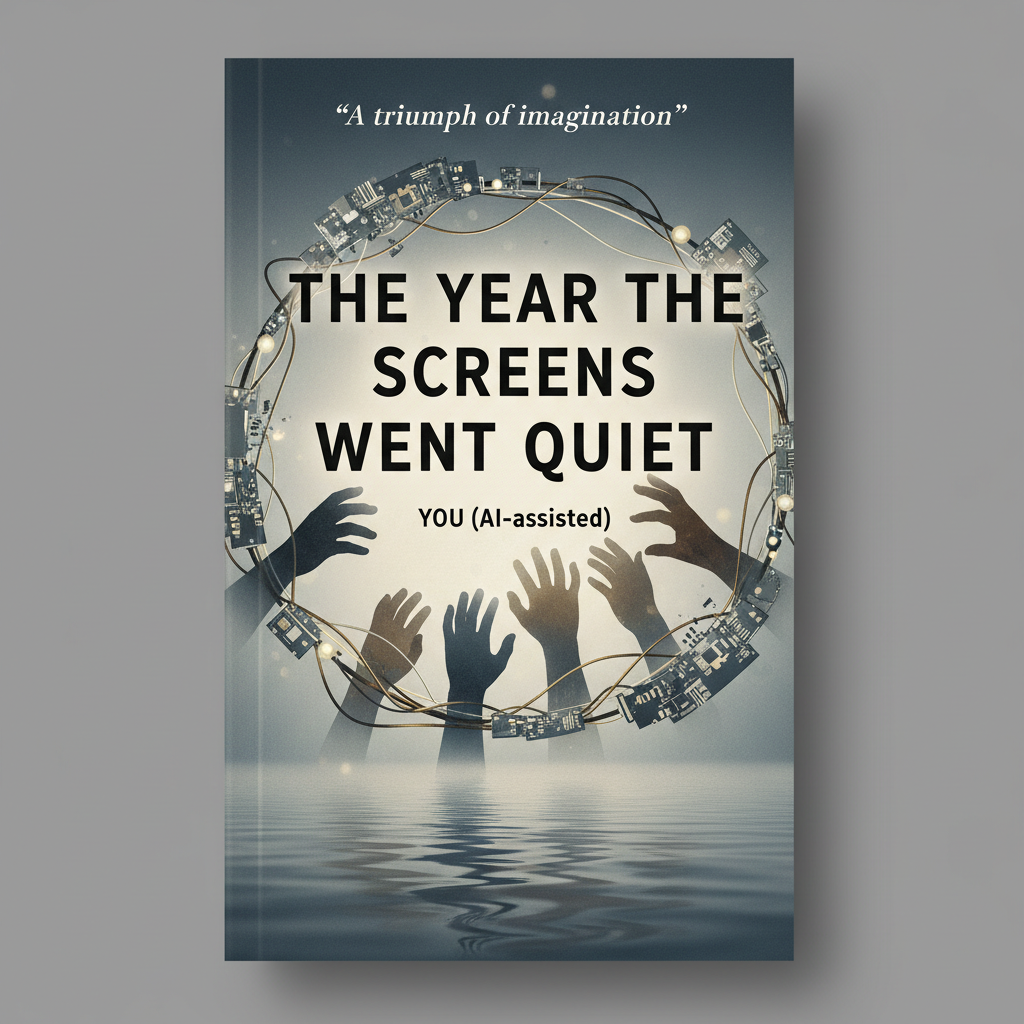
The Year the Screens Went Quiet
By Mikael Löwgren
Synopsis
When a sudden, global digital blackout silences the noise of the modern world for forty-eight hours, an eclectic cast of characters across continents are forced to confront the stark realities of their disconnected lives and the quiet truths of their own existence.
Chapter 1: The Unplugging
The first hint wasn't a blaring siren, nor the guttural roar of an impending storm. It was far subtler, a barely perceptible tremor in the digital ether, a falter in the unceasing hum of the networked world. For Anya, it arrived as a tiny, almost imperceptible hiccup in her morning scroll. The perfectly curated feed, a cascade of impossibly smooth skin and artisanal oat milk lattes, paused. Not a full stop, just a breath held too long. She tapped the screen, twice, then a third time, a small frown creasing the smooth expanse of her forehead, usually reserved for more ‘authentic’ expressions of mild concern. Her London flat, a minimalist temple of muted greys and strategically placed houseplants, usually buzzed with the low thrum of her various devices charging, syncing, humming. Today, an unfamiliar quiet began to seep into the corners.
She’d been in the middle of crafting a caption for her ‘mindful morning ritual’ post – an artful shot of her hand, manicured to gel-perfect precision, hovering over a steaming mug of something green and undoubtedly expensive. “Embracing the quiet moments,” she’d typed, an irony that would soon ripen into a bitter fruit. The image refused to upload. Then the Wi-Fi icon, a cheerful stack of radiating waves, vanished from her phone’s status bar, replaced by a forlorn grey outline. Her phone, an extension of her very self, felt strangely heavy, inert. Not dead, but unresponsive, like a beloved pet suddenly refusing to acknowledge its name.
Anya walked to the window, her silk robe rustling softly. Oxford Street, usually a river of red buses and black cabs, pulsed with an unusual frantic energy. People stood on pavements, holding phones aloft like offerings to an indifferent sky, their faces etched with a shared bewilderment. A woman wrestled with a ticket machine at the bus stop, her frustration a silent scream. A horn blared, sharp and insistent, then another, prolonged and desperate. The usual urban symphony of honks and chatter seemed sharper, less diffused, no longer swallowed by the digital white noise. Without the blue glow emanating from every pocket, every hand, the faces looked… naked. Exposed.
Across the globe, in a Tokyo apartment that smelled faintly of instant noodles and circuit boards, Kenji was already deep into the abyss. His world, usually a dizzying matrix of glowing terminals and lines of code, had gone utterly dark. Not a power cut – his retro-chic lava lamp still gurgled contentedly in the corner, bathing the room in an orange glow – but a digital one. The monitors, usually a triptych displaying intricate algorithms and security protocols, were black, reflective surfaces mirroring his own startled face. His fingers, usually dancing across a keyboard with the speed and precision of a concert pianist, now rested motionless, suspended above the inert keys.
Kenji wasn't a social creature. His preferred mode of interaction was through encrypted messaging, his ‘friends’ an international network of fellow programmers and ethical hackers he’d never met in person. His connection to the world was purely digital, a finely woven web of fiber optics and IP addresses. To him, the internet wasn't merely a tool; it was the very fabric of reality, the substrate upon which all meaningful existence was built. To awaken and find it gone was akin to waking to discover the laws of physics had simply… stopped.
He tried everything. The main server, a custom-built beast humming softly in the corner, refused to respond. The indicator lights on his router, usually a vibrant constellation, were all dark. His phone, a venerable flip model he kept for emergencies and because smartphones were ‘too distracting,’ merely displayed a static clock and a 'No Service' icon. He tried his landline, a dusty relic from a bygone era, reaching for it instinctively. Nothing. Dead. The silence in his apartment, usually filled with the gentle whirring of machines, became a suffocating presence. It pressed down on him, amplifying the frantic thumping of his own heart. He walked to the window, the blinds still drawn, and peeled back a slat. The street below, usually a river of pedestrians, was a tableau of confusion. People stood still, rooted to the spot, their eyes darting, their mouths moving in soundless exclamations. A collective panic, just beginning to curdle the morning air.
And in a decidedly less minimalist, less tech-savvy apartment in New York City, Maria was experiencing her own brand of digital apocalypse. Her alarm, a blaring symphony from her phone, had failed to materialize. She’d woken instead to the insistent, analog chirping of the sparrows outside her window, a sound she hadn’t truly registered in years. Her first instinct, as always, was to reach for her phone. Her hand fumbled on the nightstand, seeking the familiar cold metal, the warm glow of the screen. Her fingers closed on… nothing. Her phone, she realized with a jolt, had died in the night. Or rather, it wasn’t responding. The screen was black, obstinately so. Even the charging light was absent.
“Damn it,” she muttered, swinging her legs out of bed. She still had her old school alarm clock, a clunky digital affair with glowing red numbers. It was blinking 12:00. This was definitely not 12:00. Her coffee maker, a finicky but beloved relic, was also unresponsive. No green light. No reassuring gurgle. A profound silence permeated her apartment, usually filled with the melodic murmur of NPR from her smart speaker, or the cheerful ping of her daughter's school notifications. Silence, she realized, was a tangible thing. It had weight, a texture.
She walked to the kitchen, her bare feet cool against the linoleum. Her husband, David, a man whose relationship with technology was even more tenuous than her own, was already there, fiddling with the ancient radio on the counter. He looked up, his brow furrowed, a half-eaten slice of toast forgotten in his hand. “The internet’s out,” he said, stating the obvious with a tone of profound disbelief. “And the radio. And my phone.” He held up his brick of a work phone, a relic provided by the school district, its screen a blank slate.
Maria, a high school English teacher, had always prided herself on her ability to adapt, to navigate the ever-shifting currents of teenage angst and curriculum changes. But this felt different. This felt like the rug being pulled out from under the entire world. She glanced at the clock on the stove, a manual dial. 7:17 AM. School started in an hour.
“The kids,” she breathed, a sudden chill prickling her skin. Her students. Their entire lives were mediated by screens, by apps, by constant connectivity. What would they do? How would they even know school existed without an email, a text, a calendar reminder? And her own daughter, Chloe, presumably still asleep in her room, a digital native whose existence was intertwined with her phone.
Chloe’s muffled cry from her bedroom jolted Maria. “Mom! My phone’s completely dead!” Maria and David exchanged a look. It wasn’t just their corner of the world. It wasn’t just a localized outage. Something bigger was at play.
Outside, the familiar urban cacophony began to fray. The distant wail of a siren, usually a fleeting punctuation mark in the city’s narrative, now persisted, drawing closer, a lament. Another, then another, a mournful chorus. People spilled onto the streets, their faces etched with a common denominator of confusion, then fear. Some huddled around car radios, desperate for information. Others stood still, their hands buried in their pockets, a strange vulnerability emanating from them.
Anya, watching from her London flat, saw a woman in a vivid red coat run into the middle of the street, waving her arms, her face contorted in a silent scream. A black taxi screeched to a halt, narrowly avoiding her. From the taxi, the driver leaned out, shouting something unintelligible, his voice raw with frustration. Anya felt a prickle of unease. Her carefully constructed world, a digital edifice of likes and perfectly filtered moments, was beginning to crumble.
Kenji, still behind his drawn blinds, heard the rising tide of human voices outside, a discordant symphony of shouts and murmurs. He rarely engaged with the world beyond his screens, preferring the quiet logic of code to the messy unpredictability of human interaction. Now, the mess was spilling over, an undeniable tide. He felt a primordial fear stir within him, a realization of his own profound dependence on the very systems that had just gone dark. His carefully constructed life, isolated and self-sufficient within its digital boundaries, was suddenly exposed to the raw, unfiltered chaos of a connected world gone quiet.
Maria, her hand gripping David's, could hear the rising crescendo of confusion from her New York street. The digital silence had created a vacuum, and into that vacuum rushed a human chaos, a primal response to the unexpected void. Her immediate concern was simple, brutal: her family. Her students. How would they navigate this sudden, profound disconnect? The world had gone quiet, not with a gentle hush, but with an abrupt, violent tear. All the noise, all the static, all the incessant chatter had simply… ceased. And in its place, a pregnant silence, dense with unanswered questions, began to throb. The year the screens went quiet had begun.
Chapter 2: Echoes in the Void
The silence in London was not just a lack of digital chatter; it was a physical presence, a thick, plush carpet laid over the city’s usual cacophony. Anya, still in the silk slip she’d slept in, paced her studio apartment, the floorboards groaning in protest beneath her. The large window, usually a portal to the ever-scrolling narrative of her city, now offered only a static tableau: a solitary pigeon pecking at a forgotten chip wrapper, an elderly woman struggling with a stubbornly uncooperative umbrella against a fine, persistent drizzle. No honking taxis, no distant sirens, no muffled bass from a neighbour’s stereo. Just the drip-drip-drip of rain against glass and the unsettling rhythmic thump of her own heart.
Her phone, a sleek, expensive brick, lay on the polished concrete counter where she'd left it, its screen stubbornly black. She’d tried all the tricks: hard resets, charging it in every socket, even, in a moment of desperation, yelling at it as if it were a disobedient child. Nothing. The world had gone quiet, and with it, Anya felt her own voice, her carefully curated persona, becoming an echo in an increasingly empty room.
Hours bled into one another. Morning slipped into a listless afternoon. She’d managed to boil water for tea on her gas hob – a feat that suddenly felt like a monumental achievement. The ritual, usually accompanied by a flurry of story updates and DM responses, was now a hollow choreography. Her hand hovered over the cup, poised for a photograph that would never be taken, a caption that would never be written. Who was she, if not the person reflected in the collective digital gaze? The question hung in the air, a phantom limb ache where her online identity used to be. The panic, initially a high-pitched hum, began to morph into something deeper, a dull, unsettling thrum in her stomach. It wasn’t just the inconvenience; it was the terrifying sensation of being erased.
Across the globe, in the labyrinthine heart of Tokyo, Kenji’s neighbourhood was experiencing a similar uncanny stillness. He’d woken to no chirping notifications, no blinking lights from his array of monitors. His fingers, accustomed to the lightning-fast dance across keyboards, felt strangely heavy, almost useless. He pushed aside the bamboo blinds of his small apartment, expecting the usual morning symphony: the whir of early delivery trucks, the distant clatter from the ramen shop downstairs, the melodic jingle of the bread vendor’s bicycle. Instead, he heard… wind. A faint rustling of leaves in the park across the street, a whisper of air through the narrow alleyways.
The streets below, usually a river of humanity flowing with relentless purpose, were sparse. People walked with an unfamiliar slowness, their gazes unfixed, drifting from building to sky, as if seeking an answer imprinted on the clouds. He saw a man, usually glued to his smartphone, stop dead in the middle of the pavement, just staring at a billboard for a new instant noodle flavour, a look of profound bewilderment etched onto his face. Children, usually ferried to school in a flurry of parental efficiency, were gathered in small, hushed groups at bus stops, their usual boisterous energy subdued. Their chatter was low, laced with the same uncertainty that clung to the air like a damp fog.
Kenji, a creature of habit and code, found the disruption almost physically painful. His meticulously organized world, governed by algorithms and predictable inputs, had been utterly upended. He tried to read, picking up a dog-eared manga, but the lines of text blurred. His mind, accustomed to processing information at warp speed, felt sluggish, like a dial-up connection in a fiber-optic world. He walked to his small kitchen, the rhythmic squeak of his worn slippers the loudest sound he’d heard all morning. He brewed tea, his movements precise, almost ritualistic, a desperate attempt to impose order on a world spiraling into disarray. He even caught himself reaching for his phone, a phantom itch in his thumb, before remembering the dead weight of it, the gaping void it represented. The thought of stepping outside, of facing the palpable quiet, the unfamiliar faces, filled him with a low hum of dread. His carefully constructed life, lived largely within the digital ether, felt suddenly exposed, vulnerable beneath the harsh light of a disconnected world.
In New York, the sprawling, chaotic heart of the city seemed to hold its breath. Maria stood at the front of her classroom, a room usually buzzing with the pre-bell din of high schoolers: the rhythmic tap-tap-tap of thumbs on screens, the muffled snippets of TikTok audio, the low murmur of gossip shared via direct message. Today, the silence was absolute, broken only by the occasional nervous cough or the rustle of a backpack.
Her students, typically a vibrant, hyper-connected microcosm, were a sea of bewildered faces. Their eyes, usually darting between their devices and her, were now fixed solely on her, wide with a mixture of fear and demand. She'd tried to start the lesson, a discussion on contemporary American literature, but the words felt anemic, meaningless in the face of their palpable anxiety.
"Miss Rodriguez," a girl named Chloe, usually glued to her Instagram, spoke up, her voice surprisingly small. "Is it… is it coming back on?"
Maria sighed, running a hand through her dark, curly hair. "I don't know, Chloe. No one does."
A ripple of discontent went through the room. A boy in the back, Mateo, usually stoic and quiet, slammed his fist softly on his desk. "This is ridiculous! How are we supposed to do anything? My mom needs me to text her when I leave school. My group project is due today, and all our research is online!"
"Everything is online," another student, Sarah, added, her voice trembling slightly. "My friends… I can't even tell if they're okay. We were supposed to meet up after school."
The classroom, usually a space Maria expertly navigated, felt suddenly alien, volatile. What had once been a minor inconvenience – a forgotten textbook, a missed assignment – now felt like an existential threat to these young people. Their entire understanding of connection, information, and even their own identities, was interwoven with the digital tapestry that had abruptly unraveled. Maria saw the dawning realization in their eyes: the subtle terror of being cut off, not just from information, but from each other. Their routines, their peer groups, their very sense of belonging, were suddenly inaccessible, locked behind a dark, unresponsive screen.
She tried to offer comfort, to suggest alternative ways of passing the time, of connecting. "We have books here," she gestured vaguely towards the dusty shelves in the corner, usually overlooked. "Maybe we can use this time to talk, to..."
Her words trailed off, lost in the blank stares. Talk? Without the filtering, the curated performance of online dialogue? It was a foreign concept, almost a betrayal of their learned ways. The silence wasn't just in the city; it was in their minds, a vacuum where constant stimulation used to be. Maria suddenly understood the depth of the void. And even as she felt a strange, quiet thrill at the unraveling of the digital threads, a part of her, the teacher, the guide, felt a chilling, profound responsibility. How do you teach a generation to navigate a world that had suddenly deleted its own operating system? The answer, she knew, was not in any textbook. It was out there, in the unnerving quiet, waiting to be discovered. Or, perhaps, created anew.
Chapter 3: Finding a Different Frequency
The silence, once a roaring absence, had begun to curdle into something else: a low hum of anticipation, a nervous twitch in the collective subconscious. Forty-eight hours. Two days. Enough time for the initial hysteria to burn itself out, leaving behind a fine layer of ash and a nascent, unsettling calm. People, forced inward by the sudden cessation of outward stimuli, were now starting to peek from behind their mental curtains.
Anya, for one, found the mirror reflecting a stranger. Her eyes, usually softened by the diffused glow of a phone screen, were sharp, a shade too bright, and circled with a faint purplish bruise from two nights of restless tossing. Her carefully constructed online persona, a vibrant, always-on edifice of curated joy and effortless glamour, had crumbled like an ancient ruin exposed to the elements. What was left was… just Anya. And “just Anya” felt undeniably thin, like a line drawing where she expected a full-colour portrait.
The air in her chic Shoreditch flat, usually scented with expensive diffusers and the faint metallic tang of charging devices, now held the stale, flat smell of disuse. A faint layer of dust, almost imperceptible before, now shimmered in the rare shafts of sunlight that pierced the urban haze. This morning, after staring at her own reflection for a full five minutes, she’d pulled on a pair of sensible trainers – not the brand-new, influencer-gifted ones, but an older, worn pair, comforting in their familiarity. Her phone sat inert on the kitchen counter, a sleek, black brick, mocking her with its emptiness.
“Right then,” she’d murmured to the silent flat, the sound of her own voice startling her. “Let’s see what the actual outside looks like.”
Regent’s Canal was her usual running route, a picturesque ribbon of water that snake-danced through the city’s concrete heart. Ordinarily, it was a blur of headphone-clad joggers and dog walkers glued to their screens, an anonymous parade. Today, it was different. The silence amplified the rustle of leaves, the distant caw of gulls, the melodic gurgle of the canal locks. People moved with a hesitant slowness, their gazes unfixed, drifting from the murky green water to the blossoming cherry trees, to each other.
Anya walked, not jogged. She held her hands clasped in front of her, an awkward stance born of not knowing what else to do with them. Without the constant urge to capture, to frame, to caption, her eyes felt like untamed lenses, absorbing every detail with an almost painful clarity. The chipped paint on a canal boat, the way the sunlight caught the dew on a spiderweb strung between two railings, the myriad shades of green in the burgeoning foliage. It was too much, and yet, not enough. An itch persisted, a phantom vibration in her pocket.
She paused by a small playground, its swings empty. A couple, probably in their late sixties, sat on a bench, facing the canal. They weren’t talking, merely existing, their shoulders almost touching. The man was meticulously folding a newspaper, its pages yellowed and soft with age, while the woman watched a pair of ducks waddle past. There was a quiet intimacy to it that Anya hadn’t witnessed in years, not in real life, not in the way it felt here, unobserved, unperformative. Her breath hitched.
Further along, a group of teenagers huddled near a graffiti-scarred wall, their faces unlit by phone screens, their hands empty. They looked… bored. Utterly, incandescently bored. One boy was attempting to bounce a deflated football against the wall, a half-hearted thump thump that echoed in the unwonted stillness. Another was tracing patterns in the dust with his foot. They spoke in clipped sentences, punctuated by long silences, their eyes darting about, seeking something to latch onto. Anya recognized the yearning, the raw, unadorned desire for stimulation, for connection. She felt it too.
Their eyes met, briefly. Her, the formerly glamorous online presence, now just a woman in worn trainers. Them, the digitally native generation, suddenly cast adrift. There was no judgment, no instant analysis, just a shared, unspoken acknowledgment of the new, strange reality. They looked away first. She walked on, a faint smile playing on her lips, a wisp of an unfamiliar feeling blossoming in her chest. Curiosity, perhaps. Or something akin to relief.
***
Tokyo, usually a symphony of electric hums and synthetic melodies, was unnervingly hushed. Kenji had found himself pacing. From his meticulous, minimalist apartment with its panoramic view of the city, he could see the intricate tapestry of concrete and glass. But it was the silence that was truly disorienting. The distant, muted roars of traffic were gone, the incessant chirping of digital billboards, the tinny music from passing vehicles – all gone. What remained was the wind, whistling faintly between buildings, and the occasional, jarring cry of a crow.
His highly ordered world, a digital fortress of code and algorithms, had been breached by an analogue force. He had tried to work. His desktop computer, a sleek, powerful machine, was a black mirror. His laptop, equally inert. The internet, his very bloodstream, had vanished. The quiet had started to seep into his bones, a slow, insistent chill. He drank green tea, reread old programming manuals that felt strangely comforting in their tangibility, and then, slowly, a different kind of urge began to unfurl within him.
It was a primitive thing, this urge. A vague discontent with the four walls, a burgeoning desire to verify, to witness. He found himself at his window, staring down. People. Actual people, on the street. Not pixelated avatars, not abstracted data points, but flesh and blood. They moved differently, without the rapid, purpose-driven pace. They hesitated at intersections, scanned their surroundings, sometimes even made eye contact. He had forgotten what real observation felt like, untainted by the filter of a screen.
He pulled on a simple jacket, his usual uniform of comfort and inconspicuousness, and stepped out. The hallway of his apartment building was quieter than usual, the sound of his own footsteps echoing back at him. The elevator, usually a seamless glide, felt heavy, its descent more pronounced in the absence of internal chatter.
Stepping onto the street was like walking into a different dimension. The air, crisp and slightly cool, tasted different. Less exhaust, more… possibility. The familiar scents of ramen stalls and damp concrete were still there, but now, without the cacophony, they were clearer, sharper. His eyes, accustomed to the blue light of screens, squinted at the unfiltered brilliance of the afternoon sun.
He walked aimlessly at first, his hands shoved into his pockets, an almost childlike wonder unfurling within him. Storefronts, usually ablaze with digital advertisements, were dark, their displays a static tableau of mannequins and products. People gathered in small clusters outside convenience stores, exchanging hushed words, their faces etched with a blend of concern and a fragile curiosity.
A group of elderly men, usually found in the local park engrossed in games of Shogi, were now simply sitting on a bench, their faces turned towards the sky, mouths moving in slow, deliberate conversation. Kenji realised he hadn't truly looked at them before, not in this way. He had compartmentalised them a long time ago: "elderly park-goers," a benign background element in his algorithm of existence. Now, they were individuals, their weathered faces revealing stories he would never know, but might, for the first time, consider.
He stopped at a crosswalk, waiting for a non-existent signal. A young mother, struggling with a pram and a small child tugging at her skirt, caught his eye. For a moment, a flicker of something passed between them. Not a shared digital experience, not a fleeting emoji. It was more fundamental. A recognition. Human to human. No intermediaries.
He continued walking, drawn by the faint, rhythmic clang of metal. Ahead, near a traditionally bustling intersection, a small crowd had gathered. As he drew closer, he saw a street performer, a man in a worn kimono, spinning plates on long sticks. Before, such a sight would have been instantly recorded, uploaded, consumed. Now, people simply watched. Their faces, upturned and unguarded, were illuminated by a sort of quiet awe. Children, no longer hypnotised by glowing screens, gasped and clapped.
Kenji felt a strange tightness in his chest. It wasn't anxiety. It was… a stretch. A stretching of something dormant within him. He watched the spinning plates, the delicate balance, the focus of the performer, the collective intake of breath when one wobbled precariously close to falling. He watched the faces of the people around him. He saw the shared smiles, the collective sigh of relief when all plates remained aloft.
He hadn’t been outside in sunlight this long in years. The air, the sounds, the sights – they were a deluge, a reawakening of senses he had allowed to atrophy. A different frequency, indeed. He found himself walking into a small, bustling market, the aromas of miso and fresh fish a vivid assault on his senses. He paused at a small stall selling mandarins, their vibrant orange a stark contrast to the faded fabric of the awning. He picked one up, felt its cool, dimpled skin, inhaled its sweet, citrusy scent. It felt heavy, real, undeniably present. He bought two.
As the late afternoon sun began to cast long shadows across the city, Kenji found himself back at his apartment building, the two mandarins cool against his palm. His apartment, once a sanctuary from the outside, now felt strangely small, almost confining. He looked out at the city again, the skeletal grid of buildings, but this time, he saw not just the structures, but the spaces between them, the pathways, the parks. The world, he realized, had always been this large, this detailed, this vibrant. He just hadn't been listening. Or looking. Not really.
Chapter 4: The Unspoken Language
The fluorescent hum of the classroom, usually drowned out by the incessant chirping of notifications and the metallic clatter of fidgeting fingers against plastic, now felt almost profound. Maria surveyed the twenty-odd faces staring back at her, a landscape of adolescent anxiety. Their eyes, accustomed to the blue glow of screens, flickered with an unreadable vulnerability. The usual pre-lunch chatter, a cacophony of half-heard memes and whispered gossip, had been replaced by a low, almost visceral hum of unease. It was the sound of young brains, un-distracted, wrestling with the sheer, unyielding present.
“Alright, folks,” Maria began, her voice a little too bright, a little too steady. She’d spent the morning trying to pivot, to find an anchor in the storm of their collective bewilderment. History lessons felt abstract, English literature irrelevant. What was the point of discussing metaphors when the world felt like one giant, broken simile?
She walked to the white board, picked up a dry-erase marker. Its squeak was oddly loud in the quiet room. “We’re going to try something different today.”
A groan, faint but palpable, rippled through the room. It wasn’t a rebellious groan, more like a sigh of intellectual fatigue. Maria understood. Their minds, she suspected, felt like overworked muscles, suddenly forced to lift entirely new weights.
“We’re going to tell stories,” she announced, turning to face them. “But not just any stories. Stories about… what you’ve experienced since yesterday morning.”
A few eyebrows rose. A girl in the front row, Maya, whose Instagram feed usually dictated her every waking thought, frowned, a delicate furrow in her brow. “Like, about the… the internet being down?”
“Exactly,” Maria confirmed, a small knot of hope tightening in her chest. “But not just that. What did it feel like? What did you *do*? Who did you talk to? What did you *notice*?”
Silence descended again, heavier this time. It wasn’t the quiet of technological absence, but the quiet of introspection. Maria waited, patient. She knew the seeds of a story needed time to germinate.
Then, a hand tentatively went up. It was Liam, usually reserved, his face often buried in a gaming console. “My dad,” he began, his voice surprisingly clear, “he… he sang.”
Maria nodded, encouraging. “He sang?”
Liam nodded, a faint blush creeping up his neck. “Yeah. Like, he got out his old guitar. I dunno, like… he used to play it when he was younger, but I’ve never seen him. Not really. He played these old songs. And my mum just sat there. And listened.” He paused, looking down at his hands. “It was kinda… nice.”
A small ripple, a shifting of weight in seats, moved through the room. It was the sound of a crack in the dam, a tiny fissure in the wall of their digital cocoons.
“Thank you, Liam,” Maria said softly. “That’s a beautiful story.” She wrote “Liam – Dad’s Song” on the board. “Who else?”
Slowly, hesitantly, others followed. Sarah, usually glued to TikTok dances, spoke of helping her grandmother plant tomatoes in the backyard, something she’d always put off. Marco, a budding YouTuber, recounted the bewildering experience of sitting down for dinner with his family and actually *talking* to them, without the blue glow of a screen illuminating their faces. There were fewer words, more pauses, the stories unpolished, raw, yet each one resonated in the sudden, shared space of the classroom.
Maria watched them, really *saw* them, perhaps for the first time in a long time. Stripped of their carefully curated online personas, they were just… kids. Vulnerable, resourceful, and in desperate need of connection, a connection that now felt less like a network signal and more like a gentle, human touch. She felt a profound shift within her too, a quiet sense of purpose blooming in the fertile ground of their shared vulnerability. The unspoken language of their fear and their burgeoning hope filled the room, thicker and more nourishing than any Wi-Fi signal.
---
Kenji threaded his way through the alleyways off Shinbashi, the usual cacophony of pachinko parlors and salarymen’s shouts conspicuously absent. The air, typically thick with diesel fumes and the greasy pall of late-night ramen, held a strange crispness. He’d woken to the disconcerting silence of his apartment building, the absence of the incessant whirring of servers and the gentle thrum of the city’s digital heartbeat. His carefully compartmentalized world had, quite simply, folded in on itself.
He’d ventured out, a vague sense of unease propelling him forward, past shuttered convenience stores and silent vending machines. The uniformity of Tokyo, its intricate dance of predictability, had dissolved. People walked with an unfamiliar slowness, their gazes unfixed, searching.
Then, a scent hit him. Not the artificial tang of processed food, nor the metallic ozone of the subway, but something earthy, almost primitive: woodsmoke and the faint, sweet smell of burnt sugar. It pulled him like a magnetic force, a whisper of something incongruous in the sterile urban landscape.
He turned a corner, past a stationery shop with a handwritten ‘Closed’ sign taped to its darkened window, and stumbled into… a market.
Not a grocery store, or a department store, but a market. An honest-to-god, open-air bazaar, tucked into what was usually a deserted loading dock area. Crates and makeshift tables, fashioned from discarded plywood and upturned buckets, were haphazardly arranged. People milled about, their voices a low murmur, a counterpoint to the city’s new hush.
An elderly woman, her back slightly stooped, was meticulously stacking oranges on a white cloth. Beside her, a younger man, his sleeves rolled up, was offering freshly baked bread, steam still curling from the loaves. The aroma was intoxicating. Kenji watched, mesmerized. He hadn’t smelled fresh bread, really *smelled* it, in years. His diet typically consisted of algorithmically optimized meal kits and convenience store bentos.
A man with a kind, weathered face held up a heavy, handmade pottery bowl. "Three of these," he declared, his voice carrying surprising authority, "for a kilo of rice."
A woman clutching a small, embroidered pouch considered this, then nodded. "Done," she said, her voice clear. The exchange was simple, direct, devoid of the impersonal swipe of a credit card or the mechanical beep of a barcode scanner.
Kenji edged closer, his programmer’s mind, accustomed to the intricate logic of code, grappling with the raw simplicity of what he saw. Value here wasn’t determined by market fluctuations or digital transactions, but by immediate, tangible need. A family heirloom, perhaps a finely woven scarf, was being exchanged for tinned fish. A pair of well-worn, but sturdy, shoes for a bag of potatoes.
He observed a young couple. The woman held up a stack of comic books, their covers vibrant despite the dust. The man opposite her, perhaps a carpenter, gestured to a small wooden bird he had carved. They haggled, not aggressively, but with a nuanced dance of smiles and gestures, a negotiation rooted in human connection, not cold commerce. Eventually, a deal was struck. The comic books changed hands, as did the carved bird, each item carrying a story, a history, an inherent worth that transcended its usual price tag.
Kenji felt a strange feeling bloom in his chest, a mixture of awe and something akin to shame. He thought of his own meticulously organized apartment, filled with technology rendered useless, his cupboards stocked with pre-packaged meals. What did he have to offer in this new economy? His coding skills? His knowledge of obscure operating systems? They were utterly irrelevant here.
He noticed a small boy, no older than seven, carefully arranging brightly colored origami figures on a small mat. He wasn't bartering, just displaying them, his face serious, absorbed in his task. Kenji watched him for a long moment, the delicate folds of paper catching the sunlight. It was an act of creation, pure and unadulterated, unburdened by the expectation of an audience or the pursuit of 'likes.'
Kenji rummaged in his own pockets. He found a half-empty pack of instant coffee sachets, two energy bars he’d forgotten about, and a small, perfectly smooth river stone he’d picked up on a rare hike years ago. He felt a pang of embarrassment. These paltry offerings seemed ridiculous in comparison to the homemade wares and family treasures being exchanged.
He approached the bread baker, the scent almost unbearably good. "How much," Kenji began, then realized the absurdity of the question. He gestured vaguely at a warm, crusty loaf. "What do you…?"
The baker smiled, a genuine, crinkled smile that reached his eyes. "What do you have, friend? What do you need?"
Kenji hesitated, then pulled out the instant coffee sachets. "Coffee," he offered, feeling foolish. "And… these." He held up the energy bars.
The baker considered them. His eyes twinkled. "Ah, coffee. A luxury indeed these days. And sustenance. Good. One loaf, for all of that." He gestured to the coffee and bars. "Take it. And stay safe."
Kenji took the warm loaf, its weight comforting in his hands. It felt like more than just bread; it felt like an exchange of humanity, a handshake across the chasm of their disconnected lives. He walked away from the market, the scent of fresh bread mingling with the faint smell of woodsmoke, a strange warmth spreading through him. The river stone remained in his pocket. He hadn't offered it. It felt too personal, too… precious for this transactional world, even this new, raw one.
As he walked, savoring the bread, a curious thought formed in his mind. Perhaps this digital silence wasn’t a void to be filled, but a canvas. And the brushstrokes, he was beginning to realize, were made of shared stories, unexpected kindness, and the raw, tangible warmth of human connection. What other canvases lay hidden beneath the quiet hum of the city, waiting to be discovered? And what, he wondered, would he paint on his?
Chapter 5: Ghosts of the Past
Anya traced the unfamiliar script with a hesitant fingertip. The paper, slightly creased and bearing the faint, sweet scent of lavender, felt substantial in a way her phone screen never had. "Anya, darling," it began, "I noticed you’ve been looking a little lost these past few days. My name is Agnes. I live two floors down, 4B. Pop down for tea? I make an absolutely smashing ginger biscuit. Anytime, dear. You just knock."
It wasn't a DM, or a story reply, or even a comment on a perfectly staged selfie. It was ink on paper, delivered by hand through her letterbox, a small, tangible anchor in the swirling uncertainty. Agnes. Two floors down. Anya had lived in this building for four years, meticulously curating her online persona, her digital friendships, her virtual world, and yet had never once exchanged more than a fleeting nod with the woman who occupied 4B. The irony, sharp and cold, pricked at her. For all the thousands of ephemeral connections she’d fostered, the hundreds of thousands of likes and heart emojis she’d amassed, a real, physical invitation had been extended by a stranger, or rather, a neighbour she’d never truly seen.
The air in her flat felt thick, heavy with the dust of neglected corners and the silent judgment of unread books. The light outside, usually softened by the glow of her various screens, now seemed harsh, laying bare the slight scuff marks on the skirting boards, the faded patch on the rug where her laptop had often sat. She walked to the window, the city stretching out before her in a tableau of muted greys and tired reds. Fewer sirens these days, she’d noticed. And a lot more birdsong. It was a strange, unsettling quiet, a vacuum that her own thoughts now rushed to fill.
She thought of her followers, those countless digital faces who had once hung on her every outfit change, her every musing on sustainable fashion or the trials of dating in London. Where were they now? Bartering for bread, perhaps, or rediscovering the joys of spoken conversation. Would they remember her, the ‘Anya Style’ brand, without the constant digital prompting? The thought was a chilling echo in the quiet flat. Her carefully constructed identity, built tweet by tweet, post by post, seemed to have evaporated along with the wi-fi signal, leaving behind… what? A woman in a slightly dishevelled silk slip, holding a handwritten note, suddenly very aware of the dust motes dancing in the afternoon sun.
She looked at the elegant, slightly shaky cursive again. Ginger biscuits. A small, domestic detail, so utterly devoid of performative intent. It was an offering of warmth, of human connection, completely unfiltered. Anya, usually so self-conscious, felt a peculiar pull towards it, a craving she hadn’t recognized until now. The silence in her flat was not just quiet; it was loud with the absence of all the things she had used to avoid it. The scrolling, the posting, the editing, the endless consumption of other people’s highlight reels. It was a carefully orchestrated distraction, a perpetual hum that drowned out the deeper, more unsettling notes of her own interior monologue. Now, without the hum, the anxieties had begun to creep back in, like shadows lengthening at dusk. The vague disappointment of her parents in her chosen career, the hollow emptiness of many of her fleeting relationships, the gnawing question of whether she was truly happy, or just perpetually entertained. Agnes’s note was a small, insistent counter-melody to this growing internal clamour.
***
Thousands of miles away, in the meticulously ordered chaos of his Tokyo apartment, Kenji found himself staring at a half-finished cup of cold green tea. The usual blue flicker of his multiple monitors, the rhythmic click of his keyboard, the low thrum of the server racks in the corner – all gone. The silence was, for Kenji, less a void and more a presence, a heavy, velvet cloak that muffled the external world and amplified the internal one. He hadn’t realized how effectively the white noise of technology had acted as a barricade against certain memories, certain feelings he’d carefully filed away under "Do Not Open."
His parents. That was the primary, insistent thought. They hadn't spoken in… he honestly couldn't remember. Five years? Six? It had started subtly enough, a disagreement over his choice of career – coding, not corporate law. Then a missed family dinner, then a forgotten birthday, then the slow, almost imperceptible drift that had widened into an chasm. They lived in Fukuoka, a bullet train ride away, a world away. He’d always rationalized it. They were busy, he was busy. Their world was traditional, his was global. His phone had provided a convenient shield, a digital barrier that allowed him to exist in a perpetual state of half-contact – a quick text on New Year’s, a perfunctory message on Mother’s Day. Never a long conversation, never a proper visit. That sort of intimacy felt… inefficient. Messy.
Now, without the ability to even send a quick, impersonal text message, the silence between them stretched, stark and unforgiving. He saw his mother's face, etched not with disappointment, but with a quiet sorrow he’d always avoided acknowledging. He remembered his father's booming laugh, a sound he hadn't heard in years. He’d buried it all beneath lines of elegant, precise code, in the logic and order of algorithms. His programs solved complex problems, they brought order to digital chaos. His life, he’d believed, was likewise under control, neatly compartmentalized.
The problem, he realized with a jolt, was that life wasn’t a program. There were no debuggers for human emotion, no algorithms to mend broken bridges. He ran a hand through his perpetually messy hair. He’d always prided himself on his self-sufficiency, his independence. He didn't *need* anyone. His work was his world, and it was a world he could control. But now, without it, the carefully constructed walls of his self-reliant fortress felt thin, almost translucent.
He thought back to the market he’d stumbled upon yesterday, the hum of voices, the smell of fresh vegetables and handmade crafts. People talking, really talking, without the mediating glow of a screen. It had been raw, vibrant, and utterly exhausting to his introverted sensibilities. But beneath the exhaustion, there had been a flicker of something else, something akin to fascination. A different kind of connection, forged in the immediacy of shared experience.
He picked up a framed photograph from his desk, a relic from his pre-digital hermit days. It was old, faded, showing a younger, slightly ganglier Kenji, awkwardly smiling between his beaming parents at a family vacation to Okinawa. The sea was impossibly blue behind them, the sun so bright it seemed to radiate through the glass. He remembered the feeling of sand between his toes, the salty air, the taste of his mother’s homemade <em>onigiri</em>. These were physical memories, not digital ones. They had weight, texture, even a faint scent in his mind.
He knew, intellectually, that his parents would be worried. Or perhaps they wouldn’t be, having long since come to terms with his absence. The thought stung. He’d always imagined a future where he could explain his success, demonstrate the value of his work, and then, perhaps, everything would fall back into place. But what if there was no "back into place"? What if the chasm had become too wide, too deep for any bridge, digital or otherwise, to span?
He put the photograph down, the cool glass pressing against his palm. The past, he realized, wasn't just a collection of memories; it was a living, breathing entity, one that had been held in suspended animation by the constant pulse of his digital present. Now, with that pulse stilled, the past had sprung to life, demanding attention, demanding answers. The logical, analytical part of him, the part that dealt in absolutes and clear directives, found this deeply unsettling. There was no clear path forward, no obvious subroutine to execute. Just the quiet, insistent echoes of a life lived disconnected, and the dawning, uncomfortable realization of what that had truly cost. The ginger biscuits, the family photo – small, seemingly insignificant details that now loomed large, demanding a reckoning that the digital world had so conveniently allowed them to postpone. The screens had gone quiet, and in their absence, the ghosts of past selves and neglected relationships had finally found their voice.
Chapter 6: A Collective Breath
The hum was gone. Not just the faint, electronic thrum that vibrated through every modern edifice, a constant undercurrent to existence, but the internal one too. The buzz of anticipation, the itch to check, the low-level anxiety of being out of the loop – it had all faded, replaced by something slower, deeper, like the rhythmic beat of a steady heart. The second day of silence had arrived not with a bang, but with a collective sigh of something akin to relief. Not everyone, of course. There were still those pacing their apartments, fingers twitching for screens that remained resolutely blank, but a significant portion of the city seemed to have entered a new, unfamiliar rhythm.
Maria, eyes still gritty from a sleep that had felt impossibly heavy, surveyed the empty rows of her apartment building’s fire escape. Usually, by this hour, a symphony of phone calls, streaming music, and the low drone of news channels would be weaving through the thin walls, but today, only the distant cry of a seagull broke the quiet. A deep breath filled her lungs, cooler and less dusty than she remembered. The air wasn't just quieter; it felt cleaner, too, as if the digital static had also been a form of invisible pollution.
She’d spent the morning in a flurry of activity, spurred by an idea that had germinated in the fertile ground of shared anxiety and burgeoning camaraderie. The school, a fortress of learning that now stood strangely inert without its digital lifeblood, felt like the natural locus for something. People needed a place, a common ground, to shed the unspoken question marks that hung over every head. A place where the sheer weight of individual isolation could be distributed, shared, and perhaps, melted away.
By noon, the notice, scrawled in bold, utilitarian marker pen on the back of a discarded school poster, was taped to the swing doors of the gymnasium. "Community Gathering. Potluck & Conversation. 5 PM. Bring what you can, share what you know." It was blunt, devoid of the slick graphic design that usually adorned such announcements, and possibly all the more effective for it. There was no RSVP link, no QR code, just a simple invitation scrawled by human hand, relying on the oldest network of all: word of mouth.
As the afternoon light began to soften, casting long shadows across the empty basketball court, Maria stood by the entrance, a knot of nervousness tightening in her stomach. Would anyone come? Or would the quiet have driven everyone further into their shells, wary of interaction without the safety net of screens?
Then, a flicker of movement by the perimeter fence. Mrs. Henderson, her neighbour from two floors down, a woman usually glued to her tablet, pushing a rickety shopping trolley. Balanced precariously on top was a chipped ceramic bowl, covered with cling film. As she drew closer, Maria could smell the sweet, earthy scent of apple pie. A faint smile touched Mrs. Henderson’s lips, a tentative, almost shy offering. "Thought I'd bring this," she rasped, her voice a little hoarse from disuse. "Haven't baked one in years."
Maria felt a wave of warmth spread through her chest. "Thank you, Mrs. Henderson. That's perfect."
Soon, others began to trickle in. A young couple, their faces still etched with a lingering worry, carried a bag of day-old bagels they’d managed to barter for at the corner deli. Mr. Davies, the perpetually grumpy superintendent, arrived with a gallon of water, looking considerably less grumpy than usual. Even a few of her students, faces scrubbed clean of their usual screen-induced pallor, drifted in, their initial awkwardness morphing into a hesitant curiosity.
The gymnasium, usually ringing with the sharp *thwack* of basketballs and the squeak of sneakers, began to hum with a different kind of energy. Folding tables, scavenged from the cafeteria, were arranged in a loose circle. The potluck grew organically, a testament to resourcefulness. Cans of soup, jars of pickled vegetables, stale crackers, home-baked bread that smelled intoxicatingly yeasty – a patchwork feast, each item a small story of its own. Without the pretense of presentation, without the immediate urge to photograph and share, the food felt more authentic, more sustenance than spectacle.
Maria watched as a young man, barely out of college, who she remembered as being almost surgically attached to his phone, painstakingly peeled oranges for a group of elderly women. He offered them with a quiet deference, and they accepted with a gentle nod, their eyes crinkling at the corners. There were no selfies, no live streams, just the simple act of one human helping another.
The conversations, at first stilted and punctuated by long silences, began to unfurl. People spoke in lower tones, as if the absence of digital noise had made them more mindful of the actual sound of their own voices. Topics ranged from the mundane – how to keep food cold without a fridge, the growing length of lines at the few remaining open stores – to the profound.
"You know," a woman with kind eyes and a cascade of grey hair began, her voice soft but clear, "I realized this morning, I haven't heard the birds sing in… I don’t know how long. Not really *heard* them, you know? Just kind of tuned them out."
Heads nodded in agreement. Another man, a plumber by trade, chimed in, "It's like we bought all this stuff, all these devices, to connect us, but all they did was put a filter between us and everything else. The noise, the pretty things, the ugly things. All of it."
The gymnasium, usually a space of loud, competitive energy, had transformed into a sanctuary of quiet reflection. There was none of the performative outrage or forced positivity that often characterized online interactions. Instead, there was a raw honesty, a vulnerability that felt both unsettling and incredibly freeing. Without the looming presence of an invisible audience, people shed their digital masks, revealing the tired, hopeful, and surprisingly resilient faces beneath.
Maria found herself talking to Mr. Davies, the superintendent, a man she’d exchanged little more than perfunctory greetings with for years. He told her about growing up in a small town where everyone knew everyone’s business, but also everyone’s struggles. "We had to help each other," he said, his eyes distant, "because who else was there? No one was calling no service line to fix your broken fence. You just went over with your hammer and helped your neighbor."
She realized, looking around the room filled with imperfect strangers sharing imperfect food, that this was what was happening here. They were helping each other. Not with grand gestures, but with the simple act of presence, of listening, of bearing witness to a shared, strange experience. The air was thick with it – a collective breath. It was the breath of humans, unplugged, remembering how to be together.
A small group huddled by the stage, illuminated by the beam of a repurposed battery-powered lantern. One of Maria’s students, a shy boy named Leo who rarely spoke in class, was showing a smaller girl how to make string figures. His careful fingers wove the loop of twine into intricate webs, and the girl watched, utterly mesmerized. No screens, no tutorials, just hands teaching hands.
The sound of laughter, light and unforced, rose from another corner where a few adults were attempting to play charades, their movements exaggerated and a little clumsy in the dim light. It wasn’t virtuosity or polish that mattered, but the shared effort, the delight in connection.
As the evening wore on and the last vestiges of daylight bled from the sky, the conversations deepened. Some shared fears – about food running out, about loved ones far away, about what the world would look like when the screens, if ever, came back to life. But others shared small triumphs – finding a working transistor radio, successfully bartering for fresh milk, teaching their children a forgotten board game.
Maria observed it all from a quiet distance. The nervous knot in her stomach had dissolved, replaced by a profound sense of peace. This wasn't a return to some idyllic past, nor was it a solution to the world's sudden digital silence. But it was a beginning. A small, messy, deeply human beginning. It was the sound of a community finding its feet on unfamiliar ground, leaning on each other, stitching together a new kind of fabric from the raw threads of necessity and empathy.
She knew the challenges ahead were immense. The silence might yet fray nerves, spark conflict, or devolve into chaos. But for this evening, in the flickering lantern light of a school gymnasium, amidst the smell of shared food and the murmur of earnest voices, something else was happening. Something quietly powerful. The individuals, isolated by a world of constant connection, were discovering the profound, often messy, beauty of simply being present with one another. And in that shared presence, they were, perhaps, taking a collective breath, finding a rhythm to carry them forward, however uncertain the path ahead. The hum of the network might be gone, but the hum of humanity, it seemed, was only just beginning.
Chapter 7: The Impulse to Connect
The second day dawned with an almost aggressive brightness, as if the sun itself were making a point about its singular, analog existence. For Anya, it felt less like a new day and more like a continuation of a particularly long, scratchy dream from which she couldn’t quite rouse herself. The apartment, once a vibrant backdrop for her curated life, now felt like a stage stripped bare, revealing dusty corners and the faint outlines where furniture used to sit differently. She paced, a restless tiger in a cage of her own making, the silence amplifying the rhythmic scuff of her slippers on the polished floorboards. The digital detox, her followers would have called it, a trend piece waiting to happen. But this was no detox; this was an amputation.
She found herself, almost unconsciously, drifting towards the small, ornate vanity table in her bedroom, a piece salvaged from her grandmother’s attic years ago, now buried under an avalanche of cosmetics she rarely used. Her fingers, usually dancing across a screen, fumbled with the delicate clasps of a jewellery box, pulling out a tarnished silver locket. Inside, a faded, pre-digital photograph of her parents, smiling, younger, their eyes full of a wide, unburdened hope. Her own reflection stared back from the small, imperfect mirror – a face devoid of the carefully applied filters, the practiced angles, the ever-present sparkle in her eyes that came from a flash and a good algorithm. This face was softer, more tired, the faint lines around her mouth more pronounced. It was a face she hadn't truly looked at, unmediated, in years.
A shiver, not of cold, but of something deeper, traced its way down her spine. The old habits, like ghosts, were persistent. She remembered the early days of her online life, before the brand deals and the viral posts, when it was just her and a cheap webcam, trying to connect with anyone, anywhere. She’d spent hours then, transforming her appearance, not for the likes, but for the sheer theatricality of it, for the joy of reinvention. Now, with a strange, almost defiant impulse, she began to do the same. Not for a camera, there was no camera, but for the raw, unblinking mirror. She applied a smoky eye with surprising precision, a deep plum lipstick, carefully contouring her cheekbones with a heavy hand. Each stroke was a small rebellion against the quiet, a familiar ritual against the unfamiliar terror of an unobserved self. The act was performative, yes, but for an audience of one, and in that private spectacle, there was a flicker of something she hadn’t felt in a long time: a sense of agency, a small, defiant burst of creative control in a world that felt utterly out of it. She even managed a faint, almost convincing smile, a ghost of her online persona. But it dissolved quickly, leaving behind the stark reality of her embellished face, unreflected in the digital ether, sinking into the vast, silent sea of her private world.
Meanwhile, a world away, Kenji sat amidst the silent hum of his servers, their blinking lights now merely ornamental, tiny shrines to a defunct deity. The air, usually crisp with the promise of computational power, felt stagnant, thick with the weight of unrun processes. He craved the clean lines of code, the elegant logic of a well-designed algorithm, the immediate, irrefutable satisfaction of a bug fixed. His fingers twitched, a phantom keyboard beneath them, wanting to type, to command, to create order out of this encroaching chaos.
He had ventured out yesterday, a small victory, a reluctant exploration of a world he’d consciously shielded himself from. He’d seen faces, heard voices, smelled the strange, unidentifiable odors of anonymous humanity. It had been… a lot. Overwhelming, almost. But there had also been a peculiar pull, a strange magnetism to the sheer, unbridled *presence* of other people. He hadn’t realized how much he’d missed it, or perhaps, how much he hadn’t known he was missing something at all.
Yet, returning to his apartment felt like a relief, a return to the known variable. He paced his small space, a mathematician confronting an unsolvable equation. He picked up his old, dog-eared copy of Donald Knuth’s *The Art of Computer Programming*, feeling the reassuring heft of it in his hands. He opened it to a random page, his eyes scanning the dense text, the elegant proofs, the beautifully constructed flowcharts. The language, once so intuitive, now felt like a foreign tongue, a half-remembered dream. He understood the words, of course, but the overarching context, the immediate application, the *why* of it all, felt distant, like a faint signal lost in too much static.
He tried to imagine the underlying structure of the world without the digital overlay, a terrifyingly abstract concept. How did the trains run? How did food get to the markets? How did people even *know* what was happening? His mind, accustomed to instantaneous data retrieval, felt slow, sluggish, like an old dial-up modem struggling to connect. He yearned for the simple elegance of a binary switch, the definitive clarity of an on or off. This grey, indeterminate space, this vast, analog uncertainty, chafed at his meticulously ordered mind.
The silence, too, was a problem. Not just the absence of digital notification, but the absence of the background hum, the constant, low-level thrum of millions of machines communicating, humming, processing. It was a silence that felt less like peace and more like a void, an unfillable space where thought could unravel without anchor. He found himself whistling, a tuneless, almost involuntary sound, just to puncture the oppressive quiet. He picked up a disassembled circuit board, a forgotten project, and began to put it back together, meticulously, almost painstakingly. Each tiny component, each delicate solder, was a small act of reclamation, an attempt to impose pattern on the formless.
He thought of the small market yesterday, the barter system, the almost primal exchange. He had seen a woman trade a hand-knitted scarf for a few apples. The simplicity of it, the directness of the transaction, had been both fascinating and utterly alien. There was no protocol, no embedded security, no cryptographic hash ensuring the integrity of the exchange. Just trust. A terrifyingly inefficient system, his logical mind screamed. Yet, it worked. The apples were eaten, the scarf was worn. A tangible exchange, a human connection, devoid of any intermediary.
He paused, a tiny resistor held delicately between his thumb and forefinger. *Human connection*. The phrase felt strange in his mouth, a foreign syntax. He had defined connection for so long in terms of network topology, of data packets flowing freely, of seamless information transfer. This new form, this messy, unpredictable, analog connection, was an entirely different protocol, one he had no roadmap for.
A memory surfaced, unbidden, like a pop-up ad he couldn’t close. His mother, years ago, had tried to teach him to play the piano. He remembered the frustrations, the endless repetition of scales, the clumsy translation of musical notation into physical movement. He’d given up, preferring the cold logic of the keyboard. Now, he almost regretted it. There was no mother to remind him now, no gentle scolding, no shared laughter over a wrong note. He wondered what she was doing now, where she was. The thought was a soft, dull ache, an unaddressed anomaly in his otherwise tightly controlled emotional landscape.
He looked out his window, past the silent, unlit digital advertisements, past the ghostly flicker of what used to be a bustling cityscape. The sky was an indifferent grey, the buildings solid and unyielding. The world, it seemed, was still there, stubbornly so, demanding an engagement he wasn’t yet equipped for. He dropped the resistor. It bounced once, a tiny, almost inaudible click, before rolling under his desk. He stared at the empty space where it had been, another lost connection, another piece of the puzzle missing. The impulse to connect, he realized, wasn't just digital. It was something deeper, something far more complicated, and far more terrifyingly human.
Chapter 8: Whispers of the Old World
The air, no longer buzzing with the unseen hum of networked devices, took on a weighty stillness. It was a silence that amplified every rustle of leaves, every distant siren, and, most potently, every whispered theory about the Great Digital Quiescence. The absence of verifiable facts, those pixelated certainties we’d come to rely on, bred fantastical narratives with the fertile speed of a jungle vine.
In London, Anya overheard a woman with a magnificent, if slightly askew, feather hat declare, without a shadow of doubt, that it was the work of "solar flares, darling, absolutely *catastrophic* solar flares, wiped out every server from here to Timbuktu." The woman punctuated this pronouncement with a dramatic flourish of her hand, nearly knocking a bewildered pigeon off its perch. Anya, attempting to find a reasonably clean bench in Regent's Park, noted the certainty in the woman’s voice, a conviction usually reserved for pronouncements on the weather or the price of artisanal sourdough.
Other theories, less astronomical, more conspiratorial, bubbled to the surface like forgotten sewage gas. It was the Chinese, obviously, testing some new-fangled EMP device. No, no, it was the Americans, a pre-emptive strike against… well, against *something*. A whispered consensus among a group of men huddled around a sputtering transistor radio near the Swiss Cottage library suggested it was an alien intervention, a grand cosmic reset for humanity's addiction to glowing rectangles. The men nodded, their faces etched with a grim satisfaction, as if this extraterrestrial intervention, though terrifying, finally explained the inexplicable.
Anya felt a strange pull towards these narratives, these half-baked, fiercely defended explanations. Without the curated, fact-checked newsfeeds of her old life, the raw, unfiltered human desire to understand, to *impose order* on chaos, was laid bare. She found herself drifting closer to conversations, straining to catch snippets, piecing together a patchwork quilt of speculation. It was like living in a medieval village, she mused, where news traveled on the breath of storytellers and the veracity of a tale depended entirely on the conviction of the teller and the gullibility of the listener.
Across the globe, in Tokyo's quieted sprawl, Kenji found himself navigating a similar labyrinth of unverified information. His preferred news source, the methodical, almost clinical drone of his shortwave radio, picked up faint, crackling transmissions. A Japanese broadcaster, his voice raspy with static and fatigue, reported frantic discussions among world leaders about an "unprecedented global event," but offered no specifics. Then, silence. A different station, from somewhere in Southeast Asia, hinted at a "technological rebellion," machines finally deciding they'd had enough of human folly. Kenji, a man whose life had been built on the logical progression of code, found this notion both absurd and, in a dark corner of his mind, oddly compelling.
He watched from his apartment window as handwritten posters began to appear on lamp posts and shuttered storefronts. Crude drawings of lightning bolts striking satellites, accompanied by frantic, scrawled questions. "Virus?" "War?" "God's wrath?" He saw neighbours, usually reserved and polite, engage in animated debates on street corners, their gestures broad, their voices rising with a passion born of bewildered impotence. A group of elderly women, usually immersed in their mobile games, now shared stories of childhood during wartime, their voices hushed, their eyes filled with a new kind of knowing. *They* had lived through uncertainty before. Their calm, though unsettling, offered a strange kind of reassurance.
The absence of any official, centralized pronouncement was perhaps the most unsettling aspect of the blackout. No presidential addresses, no emergency broadcasts on every channel, no scrolling news tickers. The digital megaphone had been silenced, and with it, the authority of officialdom was muted. This void allowed a thousand smaller voices to proliferate, each vying for attention, each offering a compelling, if ultimately unverifiable, truth.
Maria, in New York, found herself becoming an reluctant conduit for these localized narratives. Her classroom, stripped of its smartboard and chrome devices, had transformed into a forum for shared anxieties and curious conjectures. Her students, initially overwhelmed, now thrived on the opportunity to share what they’d heard.
"My grandma says it's because too many people were watching cat videos," a bright-eyed girl named Maya announced one afternoon, her voice ringing with the absolute conviction of a child who genuinely believed cats held the key to the universe’s delicate balance. Another boy, usually glued to his gaming console, chimed in, "Nah, my uncle works at the power plant, and he said it's magnets. Huge magnets, messed up everything."
Maria listened, her smile gentle. She didn't correct them, didn't offer a more "realistic" alternative. What was realism anymore in a world without access to the official narrative? Instead, she encouraged them to listen to each other, to ask questions, to consider the source of their information. It was an impromptu lesson in critical thinking, one far more profound than any she could have planned.
She remembered her own late-night conversation with Mrs. Rodriguez, her elderly downstairs neighbor. "It’s a cleansing, darling," Mrs. Rodriguez had whispered over a cup of lukewarm tea, her accent thick with memories of a different life in a different country. "The world has grown too loud. Too fast. It needed to pause, to breathe. Like a fever breaking." Maria had found herself nodding, a strange warmth spreading through her chest. It wasn't logic, not in the strictly scientific sense, but it was a comfort, a narrative that resonated with a deeper, more primal truth.
The school's old, dusty radio, dug out from a forgotten storeroom, became a prized possession. They tuned it to local AM stations, the static-riddled voices offering reports on neighborhood initiatives: soup kitchens opening, community gardens getting an unexpected burst of volunteers, calls for medical professionals to report to local clinics. It was localized news, raw and immediate, focused on the tangible challenges and triumphs of their immediate surroundings. The lack of global news wasn’t a void, but a redirection of focus, forcing them to look inward, to care about the immediate, the proximal.
Anya, in her London park, found herself participating in one of these impromptu gossip circles. A man with a neatly trimmed beard, meticulously dressed even without electricity, declared that he’d walked past the BBC building and seen "no lights, mate, nothing. Just darkness." This observation, though seemingly mundane, took on significant weight in the information vacuum. It became irrefutable evidence that even the bastions of traditional news were, for now, silent.
The whispers continued, weaving themselves into the fabric of the newly quieted world. Some were wild, absurd, born of fear and imagination. Others, like Mrs. Rodriguez’s "cleansing," carried a profound, almost spiritual resonance. But all of them, in their varied forms, highlighted the innate human need to understand, to contextualize, to tell stories about the unfamiliar. The global digital blackout had not silenced human communication; it had merely rerouted it, forcing it back to its oldest, most fundamental forms: the spoken word, the shared rumor, the collective attempt to make sense of a world that had, quite literally, gone dark. The old world, it seemed, was whispering back. And everyone, for the first time in a long time, was starting to listen. The silence was not empty; it was filled, surprisingly, with voices.
Chapter 9: The Flickering Return
It began as a shiver, a faint, almost imperceptible tremor through the stagnant air. Not a sound, not a visual flicker at first, but more like a cellular memory stirring, a phantom limb twitching with forgotten sensation. Then, a low hum, a subterranean rumble that seemed to rise from the very foundations of the city. For Anya, it was the soft, almost shy vibration of her phone – a device she’d mostly used as an ornate paperweight for the past forty-eight hours – nestled on her bedside table. It vibrated once, then twice, a hesitant, exploratory pulse. Her breath caught, a small, involuntary gasp. She reached for it slowly, as if approaching a skittish animal. The screen, which had been a dead, mirroring black, now glowed with a faint, hopeful grey. No notifications, no messages, just the ghost of a signal bar, one tiny, tentative line. It was like watching a patient flatline and then, against all odds, seeing a single, weak heartbeat appear on the monitor.
Around the world, similar scenes unfolded. For Kenji, hunched over a tattered paperback in the dim glow of a battery-powered lantern, it was the sudden, startling whir of his laptop fan. He'd left it open on his desk, a forlorn monument to a bygone era. The screen, which had previously been as inert as a slate, now displayed the ghostly shimmer of his desktop background, a default image of Mount Fuji, serene and slightly pixelated. His fingers, stiff from disuse, hovered over the trackpad. He clicked. The familiar chime, tinny and unexpected, broke the profound quiet of his apartment. It was a sound he once ignored, a mere preamble to a morning’s work, but now it resonated with the weight of resurrection.
Maria, in her makeshift community centre – the school gymnasium – was in the middle of reading a particularly dramatic passage from *Huckleberry Finn* to a captive audience of students and their parents. The only light came from candles and a few strategically placed lanterns. The air was thick with the scent of beeswax and shared humanity. Then, a collective murmur rippled through the room. A mother, cradling a toddler, gasped. Her phone, which had been resting face-down on a stack of donated blankets, was now emitting a faint, pulsating light beneath her palm. Another, then another. Like fireflies waking at dusk, tiny screens across the gymnasium began to bloom, each a miniature beacon of the world’s reawakening. The story, for a moment, was forgotten. A young boy, no older than ten, let out a squeal of joyful recognition. “It’s back!” he shrieked, pointing at his mother’s suddenly vibrant screen.
The initial reaction was a chaotic, beautiful symphony of relief. Whoops and cheers erupted, quickly followed by the frantic tapping of keyboards and the urgent whispers of phone calls being made. It was as if a dam had burst, releasing a torrent of pent-up communication. Anya’s phone, after its initial tentative pulse, exploded into a frenzy of notifications. Instagram, Twitter, emails, WhatsApp messages – a backlog of digital debris accumulated over two days, now vying for her immediate attention. Her thumb, almost by instinct, swiped to unlock, her eyes scanning the sheer volume of missed interactions. A hundred DMs, two hundred likes on her last pre-blackout post, a flurry of concerned texts from her agent. The familiar rush, the validation, the sweet, intoxicating hum of relevance, began to seep back into her veins.
But beneath the initial celebratory effervescence, a curious disquiet began to settle. It was a subtle shift, a whisper of introspection that contradicted the outward jubilation. As Anya scrolled through the endless stream of online life, something felt… different. The images, the captions, the carefully curated personas – they suddenly seemed flattened, two-dimensional, devoid of the vibrant, tactile reality she had just experienced. The park walks, the impromptu street performances, the awkward yet genuine conversations with her neighbour – those moments, unrecorded and unshared, held a weight that no perfectly filtered selfie could ever replicate. She saw a meme that would have once made her laugh aloud, but now, it barely registered. The algorithms, eager to re-engage, thrust familiar content at her, but it felt like a ghost limb, a habit she was no longer quite attuned to. The screen, once her window to the world, now felt like a barrier, a thin sheet of glass separating her from something more profound she’d momentarily touched.
Kenji, meanwhile, tried to re-establish his connection to the infinite digital matrix. His terminal loaded, lines of code, once a soothing balm, now seemed to flicker with an alien intensity. He opened his programming environment, his fingers finding the familiar keys, but the flow, the seamless integration of thought and execution, was broken. He found himself staring at a blank screen, his mind straying. He remembered the old man at the makeshift market, haggling over a bag of lentils with a fierce, good-natured intensity. He recalled the unexpected warmth of a shared, wordless smile from a stranger. The logic gates of his coding language felt stark and unforgiving after the fluid, unpredictable chaos of human interaction. The digital world, once his sanctuary, now seemed like a cold, precise machine, intricate yet oddly lifeless. He had spent two days in a world without its precise rules, and the reintroduction of them felt like a constricting band around his chest. He felt a paradoxical yearning for the profound quiet, the forced slowness, the way the ambient sounds of the city had risen to fill the vacuum. The whirring of his computer fan, once comforting, now felt like a frantic, buzzing insect trapped in the room.
For Maria, the contrast was perhaps the starkest. The collective delight in the gymnasium eventually gave way to a scattering of individuals, each drawn back to their personal screens, their small, glowing worlds. The shared storytelling circle, which had been so compelling, so unifying just moments before, dissolved. Children, who had been listening with rapt attention, now huddled in corners, their faces illuminated by the blue light of smartphones, their thumbs flying across miniature keyboards. The easy laughter, the spontaneous conversations, the palpable sense of camaraderie – they all seemed to dissipate, replaced by the hushed tones of individual engagement. Maria watched, a quiet melancholy settling over her. She knew, logically, that this was the natural order of things, the world reasserting itself. Yet, the vibrancy of human connection, raw and unmediated, that had blossomed here, now seemed fragile, easily overshadowed.
One of her students, a particularly shy girl named Chloe, who had surprised everyone with her vivid imagination during the storytelling, approached her. Her phone was clutched in her hand, her thumb hovering over an app. “Ms. Sanchez,” Chloe said, her voice small. “My mom just told me my friend group made a new TikTok. I have to go see it.” Maria smiled, a genuine, if slightly wistful, smile. “Of course, Chloe. Go ahead.” But as the girl turned to rejoin the digital fray, Maria saw something in her eyes – a flicker of hesitation, a fleeting glance back at the scattering circle of people. A hint of something lost even as something gained was being embraced.
The return of connectivity wasn't a universal panacea. For some, it was a profound relief, an end to anxiety, a return to normalcy. For others, particularly those who had found unexpected solace or revelation in the silence, it carried an undertone of loss. It was like closing a book just as the best part was beginning, or like stepping out of a warm, quiet room into a cacophony of sound. The world was loud again, bright again, connected again. But the two days of quiet had left an indelible mark, a subtle but significant recalibration of perception. Life online, previously all-encompassing, now felt like one facet of existence, rather than the entirety of it. The screens, once indispensable extensions of self, now seemed to carry a residual, almost ethereal hum of absence, a reminder of the quiet truths that had surfaced when they had gone dark. The world was back, but for many, it wasn't quite the same world they had left. And they, in turn, were no longer quite the same people. The flickering return, indeed.
Chapter 10: Aftershocks and New Beginnings
The air, for a full week after the screens flickered back to life, felt subtly re-calibrated. It wasn’t just the humming of revived servers or the frantic chirps of notifications – though those were certainly present, a persistent, self-important symphony – but something deeper, a recalibration of the very frequency at which people operated. Like a deep-sea diver surfacing too quickly, there was a lingering pressure in the temples, a phantom sensation of the vast, quiet depths they’d briefly inhabited.
Anya, perched on her usual stool by the kitchen window, found herself staring at the London skyline, not through the lens of her phone, but with her own two eyes. The sky, a bruised purple at twilight, unfurled itself with an unhurried grandeur that she hadn’t truly *seen* in years. Her phone, nestled beside her, had vibrated with the usual cacophony of missed messages, sponsored posts, and urgent news alerts since the Great Unplugging had whimpered to an end. But the frenzy felt… thin now, somehow. An attenuated echo.
She’d spent the first day back online in a daze, scrolling through endless updates, a familiar habit reasserting its grip with the force of an addiction. Her follower count, predictably, had dipped. Engagement was down. The algorithm, that fickle god, had moved on. A younger, hungrier generation of influencers, perhaps those who hadn’t been quite as discombobulated by the silence, had filled the void. And yet, the expected pang of anxiety, the familiar knot in her stomach, didn't tighten with its usual ferocity. It was there, a dull ache, but not the crippling, identity-threatening despair she would have anticipated.
Instead, a peculiar clarity had settled. The digital noise, once a comforting blanket, now felt like a scratchy wool, chafing her skin. She found herself curating her feed with a newfound ruthlessness. Unfollowed. Muted. Deleted. It was a liberation, a meticulous pruning of the virtual garden. The curated perfection she’d once strived for now struck her as, frankly, exhausting. Who was she performing for, anyway? The silence had gifted her a peculiar kind of introspection, a stark mirror held up to her own relentless pursuit of external validation.
Her first post back, after a week of total silence, had been a simple photograph: her hands, stained with potting soil, cradling a tiny, resilient sprout pushing through the earth. No filter. No long, witty caption meticulously crafted for maximum engagement. Just three words: “Life finds a way.” It had garnered fewer likes than her usual impossibly glamorous shots, but the comments, surprisingly, were different: thoughtful, genuine, relieved. "Missed you, Anya," one read. Another: "Glad to see you're still grounded." The superficial praise had been replaced by something quieter, more resonant. A conversation, not a performance.
In Tokyo, Kenji’s apartment, once a sanctuary of ordered solitude, now held the ghost of an unfamiliar vibrancy. The silence had cracked open something within him, a dam holding back a torrent of suppressed curiosity. The re-emergence of the internet, with its infinite data streams and logical progressions, brought a strange comfort, like a familiar melody after a dissonant interlude. He returned to his code with a renewed focus, but the elegant lines of his programs were now punctuated by something less quantifiable: the faces of vendors from the impromptu market, the rich aroma of street-side ramen, the surprisingly hearty laugh of the old woman who ran the local *izakaya*.
He found himself taking more breaks. Not to scroll mindlessly, but to look out his window at the city. He’d started noticing the details he’d always overlooked: the way the light shifted on the eaves of the temple across the street, the precise rhythm of the train as it rumbled past, the intricate patterns of graffiti on a distant wall. He was still a programmer, undeniably, his mind a labyrinth of algorithms and logic gates, but the world outside, once a blurry backdrop, had sharpened into vibrant focus.
One afternoon, he walked to the *izakaya* for lunch, something he’d never done before the blackout. He’d always ordered in, preferring the sterile efficiency of delivery apps. Today, he found the old woman wiping down a table, her face a network of kindly wrinkles. She looked up, a small smile playing on her lips. "Kenji-san," she said, her voice surprisingly strong. "Good to see you again. The usual?" He hadn't "had a usual" before, but the familiarity in her tone was disarming. He nodded, feeling a strange warmth bloom in his chest.
Their conversation, initiated during the blackout over a shared pot of lukewarm tea, now continued, albeit in fits and starts, in the quiet rhythm of the afternoon *izakaya*. She asked about his work, about the computers, about the world coming back online. He found himself, to his own astonishment, explaining things to her in simple terms, demystifying the digital realm he usually hoarded like a secret language. He spoke of the elegance of code, the interconnectedness of systems, always bringing it back to the human element, the quiet hum of community that had sustained them through the silence. He realised, with a jolt, that he was enjoying the sound of his own voice, sharing his passion not for professional networking, but simply for the sake of connection.
Across the ocean, in New York, Maria observed her students with a sharp, almost anthropological eye. The initial euphoria of the internet’s return had been palpable, a collective sigh of relief echoing through the school hallways. Phones, those once-forbidden fruits, were glued to palms again, screens glowing like a hundred small, digital altars. Yet, a subtle but undeniable shift had taken hold.
The frantic, almost desperate need to constantly check, to scroll, to broadcast – it had been dulled. Like a persistent fever that finally breaks, leaving the patient weak but strangely clearer-headed. Maria noticed it most in their attentiveness. There was a lingering quiet, a subtle but significant capacity to *listen*. Before the blackout, she’d often felt like a competing voice in a stadium of digital murmurs, her words battling for attention against the constant lure of their devices. Now, when she spoke, she had them. Truly had them.
They still had their phones, of course. They still texted, still posted, still consumed content with the voracious appetite of teenagers. But there was a new intentionality to it, a subtle understanding that the digital world, for all its dazzling allure, was not the *only* world.
"Miss Rodriguez," a student named Chloe asked after a history lesson on ancient civilizations, "do you think people back then… were happier without all the distractions?"
It was a question Maria had been asking herself. She paused, looking at Chloe, whose eyes, usually darting between her phone and the whiteboard, were now fixed intently on her. "I don't know if 'happier' is the right word, Chloe," Maria replied slowly. "But perhaps… more present. More attuned to the small moments."
The discussion that followed was unlike any she'd witnessed before. Students, usually eager to rattle off facts or parrot information gleaned from a quick Google search, now engaged in a genuine, exploratory conversation about human nature, technology, and the subtle art of paying attention. They spoke not just from recalled information, but from their own, raw experience of the silence. They had felt the void, and they had, in their own ways, filled it.
Maria saw it too in the way they interacted with each other. Less frantic boasting, more genuine curiosity. Fewer performative displays for an unseen audience, more quiet, shared understanding. The subtle currents of teenage drama still swirled, but there was a new undercurrent of resilience, a quiet strength born from shared vulnerability. They had learned, in those forty-eight hours, that the world wouldn’t end if they weren’t constantly connected. That conversations could happen without emojis. That laughter could unfold without a filter.
The echoes of the silence were everywhere, for those who cared to listen. In Anya’s intentional scroll, in Kenji’s nascent community, in the quiet attentiveness of Maria’s students. A whisper had entered the collective consciousness, a reminder that the world was still vast, brimming with analogue wonders, ripe for discovery. The screens were back, yes, demanding their due, but the human spirit, having been temporarily unshackled, had stretched, remembered its own capacious dimensions.
And as the days turned into weeks, and the initial novelty of the refreshed digital landscape began to wane, a new question began to form in the quiet corners of their minds, a lingering hum beneath the resurrected noise: now that they knew what it was like to truly disconnect, how much of their newfound presence, their quiet intentionality, could they truly carry forward into a world that relentlessly demanded their attention? The silence may have ended, but its lessons, it seemed, were just beginning to unfurl.