The Women Upstairs
By Mikael Löwgren
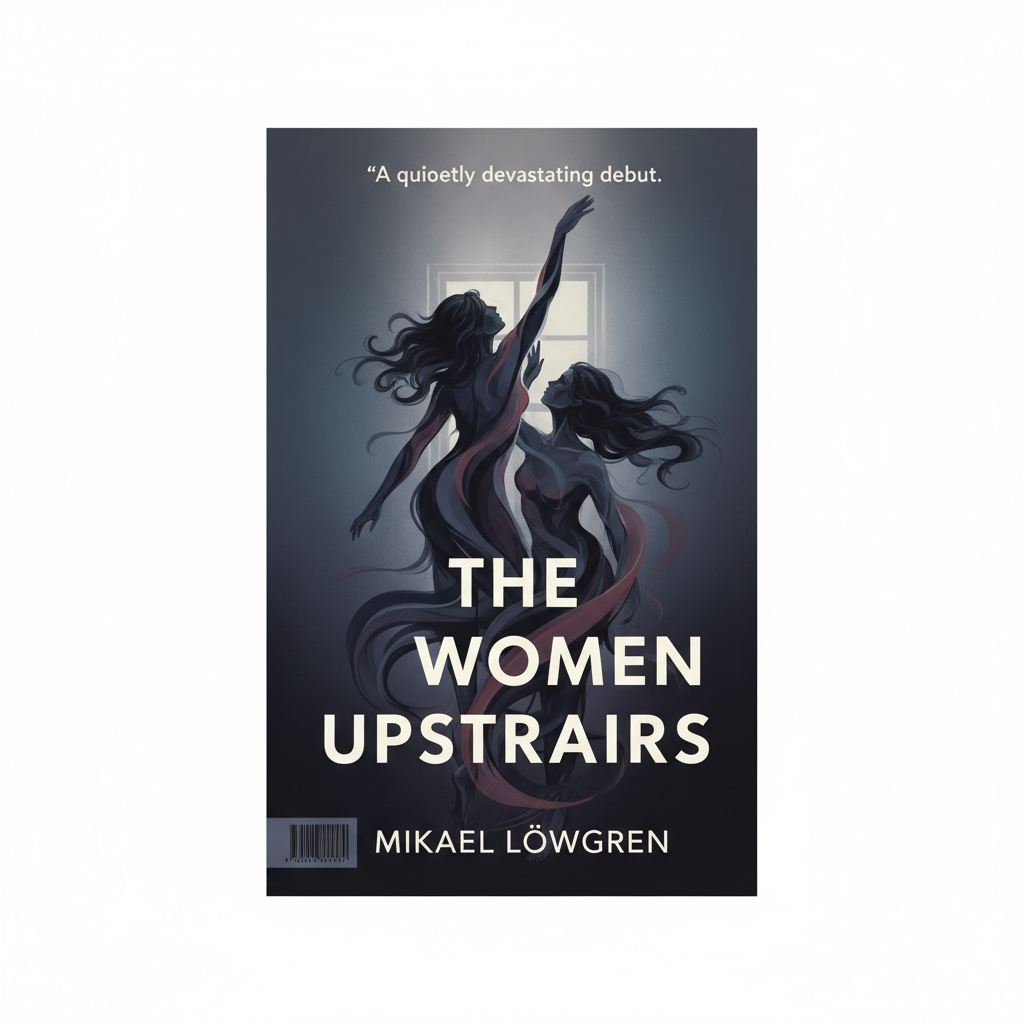
Synopsis
Two women, intertwined from childhood by shared dreams and simmering animosities, navigate the complex currents of their lives, forever pulled into and pushed away from each other’s orbit.
Chapter 1: The Scrim of Sunlight
The sun, a pale, anemic disk, struggled to pierce the perpetual haze that clung to Naples, even in those early days. It wasn’t the vibrant, almost aggressive light of the brochures; it was a diffused, muted glow, as though filtered through a grimy pane of glass. This particular quality of light, I realize now, was an apt metaphor for my childhood, and perhaps, for my life. We lived on the third floor of a ten-story block, a concrete behemoth that loomed over the narrow street like a forgotten deity. From our small, iron-balconied window, if I craned my neck just so, I could see, or rather, sense, the apartment across the courtyard where Silvia lived.
It was never a clear view, not like a painting or a photograph. Always, there was something in the way: a flapping sheet on a clothesline, a potted geranium precariously balanced on a sill belonging to some nameless neighbor, the shadow of a pigeon taking flight from a higher ledge. But I knew it was her window. I had watched her moving in, her mother, a whirlwind of nervous energy, directing the two brawny men who grunted under the weight of oversized furniture. I had watched them transform the empty cavity into a home, or at least, a place where people slept and ate and argued.
My first conscious memory of Silvia herself is less about seeing her and more about feeling her presence. It was summer, the air heavy and thick, smelling of drying laundry and distant, simmering tomato sauce. I was seven, perhaps eight. The heat pressed down, making my eyelids feel heavy and my limbs sluggish. From my own balcony, with its three chipped terracotta pots and a view of peeling paint on the opposite wall, I watched the rhythmic sway of sheets on the lines below, hypnotized. Then, a flicker. A movement in the window directly across. Not the window I *knew* to be hers, but one just above it, the window of the apartment directly overhead.
A small face, framed by dark, unruly hair, appeared. It was Silvia, though I didn’t know her name then. She was older than me by a year or two, maybe three. Her expression was unreadable, a blend of intense scrutiny and a sort of vacant boredom that only children can truly master. She wasn’t looking at me, not directly. Her gaze was fixed on the courtyard below, on the chaos of children’s games and women’s chatter. Yet, I felt watched. The hairs on my arms prickled. It was as if her peripheral vision, some unacknowledged corner of her awareness, had registered my own silent vigil.
We remained like that for what felt like an eternity, two silent figures suspended in the shimmering heat, connected by the invisible threads of observation. I didn’t wave. She didn’t wave. There was no childish impulse to acknowledge. Instead, a peculiar dance of mutual assessment began. I cataloged her features: her sharp chin, the slight downward curve of her mouth, the intensity in her dark eyes, which, even from that distance, seemed to hold a world of unspoken thoughts. I imagined her doing the same to me, taking in my too-long braids, my worn sundress, the way I clutched the iron railing with a nervous grip.
This silent exchange, protracted and wordless, became a recurring ritual. We would appear at our respective windows, sometimes simultaneously, sometimes one trailing the other, drawn by an unspoken magnetism. Never the same window, not always. Sometimes she would appear in the kitchen window, sometimes in what I presumed was her bedroom. I, too, shifted my vantage point, moving from the balcony to the living room window, then to my own bedroom, testing the angles, creating a three-dimensional map of her unseen movements within her apartment. It was a game without rules, a silent ballet of curiosity that felt both invasive and exhilarating.
Her world, glimpsed through those distant panes, was a constant source of fascination. I saw her mother, a thin, anxious woman, bustling about, forever cleaning or cooking. I saw her father, a burly man with a perpetually furrowed brow, whose occasional roaring voice echoed faintly across the courtyard, a rumble that always made my own mother flinch, even from the safety of our apartment. I never saw her with siblings. She was an only child, like me, a fact that formed another invisible bond between us, a shared solitude within the densely populated beehive of the building.
One afternoon, a specific image imprinted itself on my memory with the clarity of a freshly struck coin. It was late spring. A soft, gentle rain had just fallen, washing the pervasive dust from the buildings, leaving behind a temporary freshness. I was at the living room window, tracing patterns on the condensation with my finger. She appeared in her kitchen window, which was directly opposite ours. She had a small, chipped ceramic mug in her hands, and she was looking out, her gaze unfocused, lost in some private contemplation.
Then, she tipped the mug slowly, deliberately, and a thin stream of what I imagine was cold coffee or leftover tea arced gracefully into the courtyard below. It landed with a soft splatter on the still-damp concrete, creating a dark, temporary stain. She watched it for a moment, her face expressionless, then she turned away. The act was so mundane, so trivial, yet it struck me with the force of a revelation. It was a secret act, a small rebellion against the order of things, a dismissive gesture that spoke of an indifference I didn’t yet understand but found deeply compelling.
I wanted to do something similar. I wanted to pour something, anything, out of my window, to connect with her in that seemingly meaningless, yet potent, way. But my mother, with her constant admonitions about cleanliness and propriety, would have erupted. My world was hemmed in, contained by rules and expectations. Silvia’s small, defiant act hinted at a wider, more permissive landscape.
Our first real, acknowledged interaction occurred on the stairs. It was a Tuesday, I remember, because that was the day the fruit vendor came, his cart laden with oranges and plums, his cries echoing up the stairwell. I was carrying two cumbersome cloth bags, filled with the precious fruit. My mother had sent me down, a task I relished, despite the weight, because it meant a brief escape from the confines of our apartment. The stairwell was dim, smelling of stale air and the faint, lingering scent of garlic from a neighbor’s kitchen. The marble steps, worn smooth by generations of footsteps, were cold beneath my thin sandals.
I was struggling, my small fingers aching, the bags scraping against the wall, threatening to split. I heard footsteps above me, a light, quick tread. I looked up. Silvia. She was coming down, her dark hair bouncing with each step. She wore a simple, sleeveless dress, the fabric clinging to her slender frame. Her gaze, as always, was direct, unblinking.
She stopped two steps above me. We were roughly eye-level. The air between us crackled with an unfamiliar energy. It was no longer the unspoken understanding of the windows. This was real. This was proximity. I could see the faint smattering of freckles across her nose, the way her lips curved naturally into a soft, almost imperceptible pout.
She didn’t speak either. Nor did I. But her eyes, those dark, knowing eyes, took in my struggle. My flushed cheeks, the strain in my arms. There was no pity in her gaze, no mockery. It was pure observation, an assessment devoid of judgment. Then, with a fluid, almost imperceptible motion, she reached out. Her hand, surprisingly strong, rested briefly on the top of one of my bags. She nudged it, just slightly, indicating she understood the weight, perhaps even the frustration.
My mouth felt dry. I wanted to thank her, to say something, anything. But the words caught in my throat, tangled with a sudden rush of self-consciousness. Her presence, so close, so tangible, was overwhelming. It was different from the detached observation of the windows. Now, she was a physical entity, a being who smelled faintly of soap and something sharp, like crushed herbs.
After a long moment, she withdrew her hand. Not abruptly, but with the same slow, deliberate motion as she had offered it. Her eyes held mine for a fraction of a second longer, a spark of something unreadable passing between us. Then, she continued her descent, her footsteps receding down the spiral of the stairwell, leaving me alone with the heavy bags and the lingering scent of her presence.
I didn't move until I could no longer hear her. My heart was thudding against my ribs, a frantic drumbeat against the silence of the stairwell. I clutched the bags tighter, their weight suddenly insignificant. A shift had occurred. The invisible thread that connected us had thickened, woven itself into something more substantial, more demanding. The silent understanding had been broken, replaced by a profound, if unspoken, acknowledgment. And as I slowly began my climb again, the scent of the fruit mingling with the ghost of her presence, I knew, with a certainty that settled deep in my bones, that our lives, previously orbiting in parallel, had just irrevocably intertwined. The scrim of sunlight that had always separated us, muting and diffusing our connection, had lifted, if only for a moment. And in that moment, something new, something dangerous and vital, had begun to bloom.
Chapter 2: A Shared Alphabet
The school gate, a rusted iron beast garlanded with peeling green paint, loomed like the entrance to a forgotten kingdom. Every morning, gagging on the exhaust of my father’s Fiat, I would watch the older children disappear behind its bars, their brightly coloured smocks blurring into the grey stone of the building. And then, one September day, it was my turn. My hand, damp with sweat, clung to my mother’s skirt. My eyes, however, were fixed on Silvia, who stood by the metal railing, a head taller than me, her dark hair already spilling over her shoulders like a miniature queen’s cloak.
She didn't glance at me, not yet. Her gaze was aimed, with laser precision, at the bustling playground, already assessing, calculating. Even then, at the tender age of six, Silvia possessed an uncanny ability to perceive the hierarchies of any new environment, to map its invisible fault lines before the rest of us had even learned to tie our shoelaces.
The classroom was a whirlwind of new smells: chalk dust, stale biscuits, and the faint, unsettling scent of disinfectant. We were a flock of disoriented sparrows, blinking in the sudden light. Signora Rossi, our teacher, a woman with a voice like sandpaper and eyes that missed nothing, assigned us our seats. Mine was by the window, the morning sun an intrusion on my wooden desk. Silvia, of course, was front and center, already poised, already radiating a quiet intensity that magneticized the other children.
Our first task was to trace letters in our exercise books. The looping curves of the ‘A,’ the rigid verticals of the ‘I,’ the serpentine twist of the ‘S.’ My fingers, stiff and uncooperative, rebelled against the precise movements. Squiggles and uneven lines filled my page, a chaotic testament to my frustration. I stole a glance at Silvia’s book. Her page was a perfect grid of elegant, uniform letters, each one a testament to an unnerving patience, a premature mastery. She wrote with a fierce concentration, her tongue caught between her teeth, oblivious to the small circle of admiring eyes that had begun to form around her desk. I felt the familiar sting, hot and unpleasant, rise in my chest. It was the first instance, but certainly not the last, of that particular brand of envy that would come to define the secret language between us.
Recess was an explosion of sound and fury. The playground, a dusty expanse of gravel and weeds, became a battlefield. Boys wrestled in the dirt, their shouts echoing against the school walls. Girls, in their starched smocks, chased each other in dizzying circles, their laughter like bells. I was a hesitant participant, hovering at the periphery, drawn to the games but too timid to fully join. Silvia, however, was already in the thick of it. She organized the obscure, half-remembered rhymes into coherent games of catch, her voice clear and authoritative, cutting through the general din. She was the one who decided who was “it,” who got to be the mother, who the baby. The others, captivated by her unwavering conviction, simply followed. I watched her, a knot of longing and resentment twisting in my gut. I wanted to be that child, the one who effortlessly commanded the attention of the others, the one whose ideas were instantly embraced as gospel. But I was not. I was the observer, the silent archivist of her early triumphs.
Reading came to Silvia with an ease that bordered on the supernatural. While I stumbled over phonics, painstakingly sounding out each syllable, she devoured stories with a rapturous absorption. Her small frame would be hunched over a book, her brow furrowed in concentration, her lips moving silently as she travelled to faraway lands, battled mythical beasts, and solved impossible riddles. Signora Rossi would often call on Silvia first, her voice tinged with a grudging admiration. Silvia would read aloud, her voice clear and without hesitation, her eyes tracking the words across the page with an almost adult understanding. I would listen, my own book a forgotten weight in my lap, hypnotized by the effortless flow of her voice. It wasn't just that she could read; it was *how* she read, infusing even the most mundane passages with a palpable sense of wonder.
I remember one afternoon, the air thick and humid with the promise of rain. Signora Rossi had tasked us with writing a short story. Mine was about a lonely kitten, its adventures predictable and uninspired. I chewed on my pencil, frustrated by the inadequacy of my own imagination. When it was Silvia’s turn to read, she stood by my desk, her face utterly devoid of self-consciousness. Her story was about a little girl who could talk to the moon. The imagery, the language, the emotional landscape she painted, were all far beyond the scope of a six-year-old’s typical grasp. The moon, in her story, was not merely a bright orb in the sky; it was a benevolent, ancient entity, wise and lonely, yearning for companionship. The little girl, with her brave heart, became its confidante.
The classroom was utterly silent. Even Signora Rossi, usually so quick to dispense criticism or praise, remained wordless. When Silvia finished, a ripple of quiet awe spread through the room. A few children clapped tentatively. I, however, felt a dull ache behind my eyes. It wasn't just admiration; it was something far more corrosive. It was the dawning realization that there was a fundamental difference between us, a chasm that no amount of effort on my part could ever bridge. She possessed a brilliance, a spark, that I could only dimly perceive, like staring at a distant star.
This wasn’t to say I was a poor student. I was diligent, meticulous even. My arithmetic was neat, my handwriting, eventually, became legible. I could memorize facts with remarkable precision. But there was a certain joy, a spontaneous creativity, that Silvia embodied and I lacked. My effort was always visible, a strain that pulled at the corners of my mouth. Hers, infuriatingly, seemed effortless, a natural outpouring.
Our competitiveness, initially an unspoken undercurrent, found its most fertile ground in the weekly spelling bees. The rules were simple: stand up, spell the word, sit down. One mistake, and you were out. I would study my list of words with a desperate intensity, repeating them under my breath, my fingers tracing the letters on my desk. I craved the victory, the fleeting moment of triumph. But Silvia didn't even seem to study. She would just *know*.
I remember the final round one Tuesday afternoon. The class had dwindled to just the two of us, standing defiantly in front of Signora Rossi’s desk. The air crackled with anticipation. The word, a deceptively simple one, was "umbrella." My heart hammered against my ribs. I had practiced it countless times. My turn first.
"U-M-B-R-E-L-L-A," I enunciated, each letter a small victory. I sat down, a sigh of relief escaping my lips.
Silvia’s turn. Her dark eyes, usually so intense, were calm, almost serene. She straightened her posture, a tiny aristocrat facing a challenge. "U-M-B-R-E-L-L-A," she said, her voice clear and precise, a perfect echo of my own.
Signora Rossi smiled, a rare, almost beatific expression. "Both correct," she announced. "A tie."
The outcome, though technically a draw, felt like a defeat to me. She hadn't even broken a sweat. There was no visible effort, no hint of struggle. She merely *was*. I wanted to scream, to stamp my foot, to somehow puncture that cool facade of hers. But I simply sat there, my hands clasped tightly in my lap, a bitter taste in my mouth. A tie, for me, was not a shared victory; it was a shared failure. A proof of my inability to truly and decisively beat her.
Our relationship, even then, was a tightly woven tapestry of admiration and resentment. When she achieved something, a small part of me swelled with pride, a fleeting sense of vicarious triumph. But it was quickly supplanted by the familiar, gnawing envy. This internal struggle, this constant seesaw of emotions, was intensely private. I rarely spoke of Silvia, not to my mother, not to my occasional playmates. It was a secret language, known only to me and, I suspected, to her as well. We were two planets, irrevocably bound by the same gravitational pull, circling each other in an intricate, uneasy dance.
As the years in elementary school bled into one another, our shared alphabet of competition grew more complex, encompassing everything from who could draw the most realistic horse to who could jump rope the longest without stumbling. She always won, or at the very least, appeared to. Her victories were not always loud or overt. Sometimes, it was a subtle shift in the teacher’s gaze, a quiet murmur of approval from a classmate, a spontaneous game on the playground that she, and she alone, had orchestrated.
I remember the day we learned about ancient Rome. Signora Rossi, in an attempt to spark our historical imagination, asked us to draw a Roman gladiator. I drew a crude figure, stick limbs and a rudimentary helmet. It was an honest attempt, but flat, lifeless. Silvia, however, created a masterpiece. Her gladiator, rendered in coloured pencils, seemed to leap from the page, his muscles rippling, his shield battered, his eyes blazing with fierce determination. She had even added a faint spray of blood, a detail that both fascinated and repelled me.
Signora Rossi held up Silvia’s drawing for the entire class to see, her voice laced with unconcealed delight. "Look at the detail!" she exclaimed. "The movement! The drama!" She then held up mine, her enthusiasm noticeably tempered. "And Giulia's is… a brave attempt."
The injustice of it, the stark contrast in their responses, burned within me. I wanted to tear my drawing into a hundred pieces, to erase its very existence. But instead, I simply stared at Silvia's gladiator, a complex tangle of emotions twisting inside me. It was magnificent. It was perfect. And it was proof, once again, that she possessed something I could only ever strive, futilely, to replicate.
The school bell, its harsh clang a familiar punctuation mark to our days, would signal the end of this delicate balance. We would spill out into the street, a river of shouting, laughing children. Silvia, invariably, would be at the head of the current, her dark hair a beacon, her stride purposeful. I would follow a few paces behind, a silent shadow, carrying the weight of her triumphs and the bitterness of my own perceived failures. The journey home, the familiar streets leading back to the identical grey buildings, was always marked by this internal monologue, this ceaseless comparison.
One afternoon, as we walked past the dilapidated fountain in Piazza del Popolo, its water-stained stone angels weeping endlessly, Silvia turned to me. "Your drawing of the gladiator," she said, her voice softer than usual. "It had spirit."
I looked at her, startled. Her eyes, usually so keen and observant, held a flicker of something I couldn't quite decipher. Was it pity? Or something else entirely? I merely shrugged, unable to articulate the turmoil within me. Her words, instead of comforting me, sharpened the sting. It was a backhanded compliment, a gesture of superiority cloaked in feigned encouragement. She understood, even then, that I was paying attention to every nuance, every subtle shift in her expression, every carefully chosen word. She knew I weighed them, turned them over in my mind, searching for hidden meanings, for the true depths of her intentions. And in that moment, I registered the faint, almost imperceptible curve of her lips that could have been a smile, or simply a trick of the afternoon light. It was a smile that would taunt and tempt me for years to come, a silent invitation into an arena where the rules of engagement were always set by her.
Chapter 3: The Cracks in the Facade
The changes crept in, insidious as the dampness that spread through the old stone walls after a long winter. They weren’t sudden, no dramatic fissure rending the fabric of our shared existence, but a slow, almost imperceptible widening of the gaps that had always been there. We were twelve, then thirteen, our bodies stretching, hardening, betraying the childish forms we had inhabited just months before. With these physical alterations came new currents, new gravitational pulls that threatened to drag us apart.
The courtyard, once our dominion, a stage for elaborate games and whispered secrets, began to shrink. Its dusty expanse, once boundless, now confined us, and our eyes, no longer content with the familiar brickwork and the occasional fluttering pigeon, sought horizons beyond its crumbling gates. Other girls, their laughter brighter, their clothes more fashionable, began to appear on the periphery of our vision, offering an intoxicating promise of difference.
For Silvia, these new attachments blossomed effortlessly. She possessed an innate magnetism, a quality that drew others to her like iron filings to a magnet. It wasn’t just her sharp intelligence, though that was certainly a part of it, nor her striking looks, which were already beginning to solidify into something both delicate and fierce. It was something less tangible, a luminous confidence that radiated from her, even in moments of quiet contemplation. She moved through the world with an unapologetic certainty, as if she held a secret key to its intricacies.
I, on the other hand, navigated the new social landscape with the clumsy caution of a creature suddenly grown too large for its skin. My own friendships felt manufactured, built on shaky foundations of convenience and proximity rather than genuine connection. I studied Silvia’s new clique – the giggling trio from the next building over, Elisa with her perpetually rosy cheeks and whispered gossip, Francesca with her meticulously braided hair and disdainful sniff – and felt a familiar knot tighten in my stomach. They orbited Silvia, a constellation of lesser stars, reflecting her brilliance, their faces animated by her quick wit, their complaints dissolving into appreciative sighs at her pronouncements.
The conversations we had across the courtyard, once expansive and all-encompassing, became clipped, punctuated by silences that stretched longer than before. “What’s new?” I’d call, my voice trying to project an air of casual indifference I didn’t feel. “Nothing much,” she’d reply, her eyes already scanning the street below, searching, I imagined, for a glimpse of her new companions. The details she offered were sparse, edited. She wouldn’t tell me about the breathless phone calls about boys, the way Elisa’s mother dressed her like a tiny woman, or the precise shade of lipstick Francesca had stolen from her older sister. These were secrets reserved for her new inner circle, a circle I was pointedly excluded from.
The sting of this exclusion was a constant, low thrum beneath the surface of my days. I tried to dismiss it, to tell myself that these were superficial attachments, ephemeral as the steam from my mother’s morning coffee. But then I would see them, walking arm-in-arm, their heads bent close in conspiratorial whispers, their laughter echoing a foreign melody in the familiar street, and a cold dread would settle in my chest. It wasn’t just the fear of being left behind; it was the fear of being erased, of our shared alphabet being replaced by a language I didn’t understand, spoken by voices I barely recognized.
My own attempts at cultivating similar connections felt forced, cloying. I would invite Elena, a girl from my class with a kind but vacant stare, up to my apartment. We’d play at being friends, arranging my dolls in elaborate scenes of domesticity, but the play felt hollow. My mind was always elsewhere, picturing Silvia unraveling some delicious secret to Elisa, her eyes sparkling with an excitement she no longer reserved for me. Elena, sensing my distraction, would eventually drift away, leaving me alone with the quiet accusation of my unplayed games.
Then there was the matter of boys. This was a phenomenon that descended upon our circle with the abruptness of a summer thunderstorm, shattering the clear blue sky of our girlhood. Suddenly, the boys who had once been merely boisterous playmates, their dirty knees and loud antics an irritation, became something else entirely. Their presence infused the air with a new kind of tension, an unspoken promise of something thrilling and terrifying.
Silvia, of course, was the first to be noticed. It was Marco Ricci, from the grade above, with his dark, unruly hair and a smile that seemed to hint at a deeper understanding of the world. He started lurking near the school gates, waiting for the girls to spill out, his gaze always finding Silvia first. I saw the way her cheeks would flush, a delicate rose spreading across her pale skin, the way she would subtly straighten her shoulders, a new awareness of her own body blooming within her. She’d pretend not to notice him, her head held high, but then a tiny, almost imperceptible smile would tug at the corner of her lips when she thought no one was looking.
I watched all of this from a distance, my own burgeoning adolescence a confused mess of awkward limbs and mumbled insecurities. My attempts at attracting male attention were disastrous. My hair, unruly and prone to frizz, rebelled against any attempt at styling. My clothes, chosen by my practical mother, lacked the effortless flair that Silvia seemed to possess even in her school uniform. When a boy, a gangly classmate named Roberto, once offered me a half-eaten lollipop, I recoiled, convinced it was an act of mockery.
The chasm between us deepened with these nascent romantic interests. While Silvia would recount, with carefully selected details, the shy glances and whispered comments she received, I had nothing to offer in return. The silence that followed my non-stories was deafening, amplified by the knowing looks that would pass between Silvia and her new confidantes. It wasn’t just the difference in experience; it was the difference in receptivity, in the way the world seemed to open up to her while remaining stubbornly closed off to me.
Our families, too, with their differing expectations and aspirations, subtly pulled us in different directions. Silvia’s parents, the erudite professors, lived in a world of books and intellectual discourse. Their apartment, with its towering bookshelves and hushed atmosphere, felt like a sanctuary dedicated to the pursuit of knowledge. Silvia was destined, it seemed, for a life of academic rigor, a path paved with scholarly achievement and cultural refinement. Her parents encouraged her sharp mind, enrolled her in advanced classes, and spoke of universities in hushed, reverent tones.
My own family, though loving, operated on a more pragmatic plane. My father, a meticulous accountant, and my mother, a seamstress whose nimble fingers created wonders from fabric, valued stability, hard work, and practicality above all else. Our apartment, though comfortable, held no grand literary aspirations. The talk at our dinner table revolved around budgets, upcoming holidays, and the small triumphs and tribulations of daily life. While my parents encouraged my studies, there was never a grand narrative for my future, no predetermined path laid out for me. The expectation was simply that I would find a respectable profession, marry a good man, and lead a decent life.
These differing currents, though unseen, were powerful. They shaped our perspectives, influenced our choices, and subtly altered the trajectory of our developing selves. While Silvia was encouraged to spread her wings, to explore the vast intellectual landscape, I was guided towards a more secure, if less adventurous, existence.
One sweltering afternoon, the kind of oppressive heat that clings to your skin and saps the will, I found myself sitting on the worn stone steps of our building, idly scratching patterns in the dust with a twig. Silvia was across the courtyard, perched on her window sill, a book open in her lap. Her new friends, Elisa and Francesca, were chatting animatedly below her, their voices a continuous babble. I watched her, transfixed, as she occasionally glanced down, offering a faint smile or a brief, almost dismissive, comment. It was a practiced nonchalance, a deliberate withholding of her full attention, yet it held her audience captive.
Suddenly, Marco Ricci appeared, his shirt clinging damply to his back. He leaned against the wall near Silvia’s window, a casual pose that belied the tension in his shoulders. He looked up at her, a shy, almost yearning quality in his dark eyes. The chatter of the other girls instantly died down, replaced by a charged silence. Silvia, her eyes fixed on her book, seemed oblivious. She even turned a page with an exaggerated flourish.
Marco cleared his throat. “Silvia,” he said, his voice a little softer than usual.
She didn’t look up immediately. It was a deliberate delay, a carefully calibrated power play. My stomach clenched. Even in her feigned indifference, she asserted her dominance, her control.
Finally, she lifted her gaze, a slow, almost regal movement. “Yes, Marco?” Her voice was calm, even, devoid of any discernible emotion.
He shifted his weight. “I was wondering…” He hesitated, his face coloring slightly. “If you wanted to… get some ice cream, maybe? Later?”
Elisa and Francesca exchanged quick, excited glances. I felt a cold knot tighten in my stomach. This was it, the inevitable next step. The severing of the final thread.
Silvia looked at him, really looked at him, for a long moment. It was a look of assessment, of weighing options. Then, a faint, almost imperceptible smile touched her lips. “Perhaps,” she said, her voice still measured, “I’ll let you know.”
It wasn’t a yes, but it wasn’t a no either. It was an invitation to hope, a promise of possibility, a subtle assertion of her own agency. Marco’s face, which had been tense with anticipation, visibly relaxed into a smile of relief.
He nodded, a little too eagerly. “Okay. Great. I’ll… I’ll wait.”
Silvia, having delivered her verdict, returned her attention to her book, as if the brief interruption had been of no consequence whatsoever. Her friends, however, burst into a flurry of whispering, their eyes darting between Marco’s retreating figure and Silvia’s serene profile.
I watched it all unfold, a silent witness to this unfolding drama. The dust I had been tracing with my twig now seemed to mock me, its patterns meaningless. I felt a prickle behind my eyes, a familiar burning sensation that I willed away. It wasn’t jealousy, I told myself, not exactly. It was something deeper, more complex. It was the stark realization that the fragile edifice of our shared world was crumbling, brick by painstaking brick, and that Silvia, with her effortless grace and magnetic charm, was building a new, more magnificent one for herself, a world where I had no place. The crack in our facade had become a chasm, and I was left staring into its shadowy depths, wondering how much longer I could hold on to the rapidly fraying threads that still connected me to her across the sun-drenched courtyard.
Chapter 4: A Thread of Betrayal
The summer of '89 hung heavy, not just with the usual Roman humidity that glued clothes to skin, but with an underlying tension, a thick, unspoken expectation that something was about to give. We were fifteen, a dangerous age where every glance, every casual touch, was imbued with monumental meaning. Our days, once a blur of endless play and shared secrets whispered in the shade of ancient pines, had fractured into a mosaic of separate pursuits. Silvia, with her sudden blossoming into a creature of undeniable allure, had begun to draw the appreciative glances of boys we'd previously dismissed as mere background noise. I, still trapped in the awkward chrysalis of adolescence, watched from the periphery, a silent observer charting the geometry of her growing influence.
The incident itself was so small, so utterly unremarkable in the grand scheme of things, it’s a testament to the intricate, almost surgical precision of adolescent cruelty that it carved such a permanent canyon between us. It began with Marco, a boy from the next street over whose smile held a crooked charm, a hint of mischief that had snagged both our attentions. He was nothing special, really, a blur of sun-kissed hair and perpetually scraped knees, but in the enclosed ecosystem of our neighborhood, he represented a fleeting, desirable prize.
We were at the public pool, a sprawling concrete basin steaming under the relentless August sun. The air thrummed with the cacophony of shrieking children, splashing water, and the tinny strains of pop music blasting from a portable radio. Silvia, in a shocking pink bikini that dared the sun to dim its gaze, was holding court by the shallow end, surrounded by a gaggle of girls whose laughter echoed her every observation. I was perched on a peeling plastic sun lounger a little distance away, ostensibly reading a tattered fashion magazine, but in truth, my eyes kept drifting to her, charting the subtle shifts in her posture, the way she tossed her head to emphasize a point, the almost imperceptible flirtation in her smile.
Marco was there too, of course, a gangly silhouette against the blinding white of the poolside. He was with his usual cohorts, boys who swaggered with an unearned confidence, their voices already cracking into deeper registers. Every so often, his gaze would flick towards Silvia, a flicker of something unreadable in his eyes, before he’d quickly turn back to his friends, feigning disinterest. It was a dance as old as time, played out under the unforgiving scrutiny of teenage eyes.
Later, as the sun began its slow descent, painting the sky in fiery hues of orange and purple, a group of us gathered near the diving board. The initial frenzy of the day had subsided, replaced by a languid, almost melancholic atmosphere. The harsh edges of the afternoon light had softened, casting long, distorted shadows across the water. Someone – I think it was one of Silvia’s newer, more boisterous friends – suggested we play "Truth or Dare." A ripple of excitement, laced with nervous titters, went through the group.
I hated Truth or Dare. The game was a crucible of humiliation, designed to expose the raw, tender spots of burgeoning insecurities. But to refuse was to opt out of the social fabric entirely, to willingly brand oneself an outcast. So I stayed, my heart a small, frantic bird in my chest, a knot of dread tightening in my stomach.
Silvia, of course, thrived in such environments. She possessed a natural theatricality, a knack for commanding attention without appearing to seek it. When it was her turn, she chose "dare," her eyes sparkling with an almost predatory glee. The dare that followed was innocuous enough on the surface: she was to approach Marco and ask him to buy her an ice cream.
The simplicity of it was deceptive. In the unspoken language of our group, this wasn't just about ice cream. This was about staking a claim, about exerting a subtle dominance. It was a test, not just for Silvia, but for the entire unspoken hierarchy of our small world.
I watched, holding my breath, as Silvia moved with an almost deliberate slowness towards where Marco was still lounging with his friends. She walked with a new kind of confidence, a sway to her hips that hadn’t been there a year ago, a quiet power that spoke of blossoming womanhood. She stopped a few feet from him, her bare shoulders gleaming in the fading light, and delivered the dare. Her voice, though low, carried easily across the stillness that had fallen over our group.
Marco, caught off guard, stumbled over his reply. He blushed, a dark flush that spread from his neck to the roots of his hair. His friends snickered, nudging him conspiratorially. He looked at Silvia, then at his friends, then back at Silvia, a flicker of indecision in his eyes. He stammered something about not having any money, about his wallet being back in his locker. It was a feeble excuse, and everyone knew it. The dare, it seemed, was destined to fizzle out, an anticlimactic damp squib.
Then, from somewhere deep inside me, a flicker of something dark and undeniable ignited. Perhaps it was the accumulated frustration of always being second best, of trailing in Silvia’s radiant wake. Perhaps it was the gnawing envy that had begun to fester in the quiet corners of my soul. Or perhaps, it was simply the desperate, irrational urge to assert myself, just once, to step out of the shadow she cast.
I don’t know why I did it. The words tasted metallic on my tongue even as they left my lips. "I have money," I said, my voice sounding strangely loud in my own ears. "You can borrow some from me, Marco."
All heads turned to me. A hush fell. Silvia, who had been about to turn away from Marco, her shoulders stiffening with a barely concealed irritation at his refusal, froze. Her head snapped towards me, her eyes, usually a warm hazel, now glinted with a sharp, cold light. For a split second, I saw a raw, unadulterated hostility flash across her face, a look I had never witnessed before. It was a primal, territorial glare, and it sent a shiver down my spine.
Marco, relieved at the sudden reprieve, jumped at the offer. He flashed me a grateful smile as I fumbled in my beach bag for the crumpled ten-thousand-lire note I’d tucked away for emergencies. He took the money from me, his fingers brushing mine for a fleeting moment, and then, with newfound purpose, he walked back to Silvia, a small, triumphant grin spreading across his face. He extended the money to her.
"Here," he said, his voice clearer now, more confident. "Let me buy you that ice cream."
Silvia stared at the money in his outstretched hand, then slowly, almost deliberately, her gaze shifted to me. Her eyes, narrowed now, held a silent accusation, a deep, seething resentment that pierced through the hazy summer air. She didn't say a word, didn't need to. The message was clear, etched into the rigid line of her jaw, the barely perceptible tremor in her clenched fists.
She took the money from Marco, her movements stiff, and then, without looking at either of us, she turned and walked away towards the small kiosk at the edge of the pool, her pink bikini a shrinking beacon in the twilight. Marco, left standing awkwardly by the diving board, looked from her retreating figure to me, then back to his friends. The brief moment of triumph had evaporated, replaced by a lingering unease. He eventually shrugged and rejoined his group, their whispered conversations now laced with a new kind of speculation.
The remaining girls in our circle avoided my gaze. The laughter had died. A suffocating silence descended, punctuated only by the distant murmur of traffic outside the pool gates. I felt a sudden, searing heat rise in my cheeks, a blush of shame and a prickle of something else, something akin to a grim satisfaction. I had done it. I had disrupted the carefully constructed narrative, inserted myself into a moment that was meant exclusively for her. I had, in some small, inexplicable way, taken something from her.
When Silvia returned, a melting lemon sorbet in her hand, she walked past me as if I were invisible. Her eyes, when they briefly flickered in my direction, were cold, devoid of any recognition. It was as if I had ceased to exist for her. The silence she imposed was more cutting than any shouted accusation, more devastating than any physical blow.
From that day forward, the invisible thread that had always connected us, however strained, began to fray. The unspoken accusation hung between us, a shimmering curtain of animosity that separated us even when we were in the same room, even when our mothers exchanged pleasantries across the courtyard. She never confronted me, never spoke of the incident. And I, paralyzed by a mixture of guilt and a stubborn, defiant pride, never apologized.
We continued to inhabit the same small world, our paths crossing at school, in the marketplace, occasionally even at shared family gatherings. But the warmth had gone out of our interactions, replaced by a brittle politeness, a careful choreography of avoidance. The easy intimacy of our childhood, the shared language of our dreams and anxieties, had calcified into a rigid, impenetrable wall.
I would see her sometimes, sitting alone on her balcony, her chin resting on her hand, her gaze unfocused, distant. And I would wonder if she was thinking of that summer day, of the money, of Marco, of the quiet, insidious way I had undermined her. I would wonder if she felt the same knot of resentment, the same cold certainty that something essential had been permanently broken.
The betrayal, as I came to understand it, wasn't about Marco, nor was it truly about the ten-thousand lire. It was about the unspoken trust, the assumption of allegiance that formed the bedrock of our intertwined existence. I had seen her vulnerability, her fleeting moment of awkwardness, and instead of offering solidarity, I had leaned into it, pushed her further into the uncomfortable spotlight. I had, in a single, impulsive act, chosen my own fleeting gratification over the sanctity of our shared history. And though no words were ever exchanged, the chasm that opened between us that summer afternoon would define the landscape of our relationship for decades to come, an uncrossable void filled with the echoes of a whispered secret and a lifelong, simmering accusation.
Chapter 5: The Weight of Absence
The silence that descended after Silvia’s departure was not a sudden roar, but a gradual settling, like dust on an abandoned windowsill. It seeped into the cracks of my days, filling the spaces once occupied by the anticipation of her glance, the echo of her laughter across the courtyard, the thrum of her presence. The window opposite mine, once a stage for her life’s unfolding dramas, became a glassy, unseeing eye. It reflected only the grey sky, or the fleeting, distorted image of my own anxious face.
She left for a university in a city far enough away to feel like a different country, a place I had only ever visited on school trips, its grand boulevards and imposing buildings a stark contrast to our cramped, familiar streets. She spoke of architecture, of ancient stones and soaring arches, a world entirely removed from the cluttered domesticity that had defined our shared existence. I nodded, feigning interest, while a cold knot tightened in my stomach. The envy, which had never truly receded, now morphed into something larger, more insidious. It was the envy of possibility, of escape, of a future she seemed to grasp with effortless grace.
My own days continued in their predictable rhythm. The same routes to the same classes, the same faces, the same polite, superficial conversations that skimmed the surface of genuine connection. The chasm between Silvia and me, carved during the incident that still throbbed like a phantom limb, now solidified into an uncrossable divide. Yet, paradoxically, her absence made her more present. She was no longer a competing force in my immediate orbit, but a shimmering idea, an imagined success that dwarfed my own halting steps.
I found myself meticulously tracing the outlines of her presumed life. I pictured her in bustling lecture halls, her pen gliding across pristine notebooks, her intelligent questions cutting through the air. I saw her in cafes, surrounded by new friends, their laughter light and unrestrained, unlike the heavy mirth of our own circle. I imagined her walking through sun-drenched squares, a new kind of confidence in her stride, the city unfolding before her like a map of endless opportunities. These fantasies, elaborate and entirely self-constructed, were both a torment and a strange comfort. They kept her within reach, a dark star by which I navigated my own diminished constellations.
The void she left was a particular kind of emptiness. It wasn’t a lack of people or noise, but a scarcity of challenge, a missing friction that had, for so long, defined my own trajectory. Without her constant, albeit unspoken, scrutiny, I felt a loss of definition. Who was I, if not the girl measured against Silvia? My solitary pursuits—the books I devoured, the elaborate daydreams I spun, the silent observations I made of the world around me—felt less urgent, less potent. They were no longer imbued with the silent pressure of her imagined critique, the need to impress, to surprise, to somehow, finally, surpass.
I started to walk more. Long, aimless treks through the city, my eyes scanning the faces of strangers, searching for a flash of recognition, a glimpse of the fierce intelligence I associated with her. I'd sit in parks, watching mothers with their children, old men playing cards, young lovers entwined on benches, and construct elaborate narratives for their lives. It was an escape, a way to fill the echoing chambers of my own mind. And always, in the periphery of these imagined lives, Silvia hovered. She was the one who would have noticed the subtle nuances, the hidden tensions, the unspoken desires. She was the one who would have articulated them with a precision that both stung and illuminated.
My mother, bless her practical heart, noticed my quietude. "You're spending too much time indoors, Giulia," she'd say, her voice laced with a gentle concern that always felt like an accusation. "Why don't you call your friends? Go out." But my friends, in their uncomplicated youth, felt further away than Silvia. Their conversations about boys and clothes and the trivial dramas of everyday life seemed thin, insubstantial. They lacked the depth, the sharp edge that had always characterized my exchanges, however fraught, with Silvia.
I tried, of course. I went to the same parties, danced to the same music, exchanged the same pleasantries. But it was like moving through water, the world around me distant and muffled. The laughter seemed forced, the connections fleeting. I would stand on the fringes, observing, dissecting, feeling a growing alienation. It was a familiar sensation, a feeling of being an outsider looking in, but now it was amplified, made heavier by the absence of the one person who had always shared that particular brand of outsiderness with me.
There was a peculiar freedom in her absence, too. The freedom from the constant, unsettling awareness of her gaze. I could make choices without considering their potential impact on her, without the implicit question of what she would think, what she would do. I tried new things: a pottery class, a volunteer stint at the local library, even a brief, ill-fated attempt at learning to play the guitar. These endeavors, undertaken in isolation, felt like experiments in self-definition. But even then, deep down, a part of me wondered if she would approve, if she would find them interesting, if they would elevate me in her estimation. The phantom companion of my solitary pursuits was always there, a shadow at my elbow, an imagined audience for my life.
I sometimes saw glimpses of her family still living in the building. Her mother, her face etched with a familiar weariness, carrying groceries. Her father, his shoulders slumped more than I remembered, disappearing into the building's cavernous entrance. I would avert my eyes, or quicken my pace, unwilling to engage in the polite but hollow inquiries about Silvia, about her studies, about her new life. I feared their answers, feared the confirmation of her dazzling success, the further cementing of my own, more modest existence.
One afternoon, I was rummaging through old boxes in the attic, looking for a forgotten book, when I stumbled upon a small, wooden box we had decorated together in primary school. Inside, nestled amongst dried flowers and faded ribbons, was a photograph. It was a blurry snapshot of us, maybe seven or eight years old, arms linked, grins wide and unselfconscious. We were standing in front of the building, the courtyard stretching behind us. Her eyes, even then, held a surprising intensity. Mine, a curious deference. I traced the faded image with my finger, a strange ache spreading through my chest. The girl in the photograph, that innocent, unknowing version of myself, felt utterly alien. What had happened to her? What had happened to us?
The weight of absence is a strange thing. It is not the sudden shock of a disappearance, but the slow, cumulative pressure of what is no longer there. It settles over you, subtly reshaping your landscape, altering your perspective. It makes you question what was real, what was imagined, and what was merely a reflection of your own longing. I knew, even then, that Silvia’s departure was not an ending, but a new chapter in our intertwined story. A chapter where her influence, far from diminishing, promised to grow in the fertile ground of my imagination, a constant, unseen force shaping the woman I was becoming. The window opposite, though empty, still held within its silent pane the ghost of a shared past, and the faint, unsettling shimmer of a future I could not yet fathom.
Chapter 6: Fugitive Returns
The ring of the doorbell, sharp and insistent, ripped through the usual Sunday afternoon torpor of our building. It wasn’t the hesitant, almost apologetic chime of the delivery man, nor the cheerful, familiar double-tap of my mother’s sister. This was a sustained, demanding succession of rings, as if the person on the other side believed their very presence was an emergency. I was halfway through shelling peas for the evening’s risotto, the green pods scattering across the chipped porcelain of the kitchen table, when the sound began. My heart, typically a steady, unremarkable thrum, picked up a sudden, discordant rhythm.
My mother, her hands dusted with flour from kneading dough, wiped them on her apron and peered through the peephole. A strangled gasp, a sound unlike any I had ever heard from her, escaped her lips. She fumbled with the chain, the metallic clatter echoing unnaturally loud in the suddenly silent apartment. When the door finally swung open, the light from the hallway, usually muted, seemed to intensify, framing a figure I hadn’t seen, truly seen, in well over a decade.
Silvia.
She stood there, not with the triumphant swagger I might have imagined, nor the humble reticence of a prodigal child. Her posture was erect, almost rigid, and her gaze, when it met mine across the small entryway, held an unsettling blend of defiance and resignation. Her hair, once a wild, unkempt mane that always seemed to escape its bindings, was now sleek, pulled back into a severe chignon that accentuated the sharp angles of her face. The lines around her eyes, those same intense, knowing eyes, were deeper, etched with a weariness that contradicted the otherwise poised facade. She wore a tailored charcoal suit, the fabric impeccable, an expensive bag clutched in her hand. She looked like a woman who had fought battles, and perhaps, despite outward appearances, had not entirely won.
My mother, recovering her voice, though it still fluttered like a trapped bird, invited her in. “Silvia, cara,” she stammered, beckoning her with a trembling hand, “What a surprise.” Surprise was a woefully inadequate word. It was a seismic event, a reversal of nature.
Silvia stepped over the threshold, her presence filling the small space not with warmth, but with a palpable tension that hummed in the air. The scent of her expensive perfume, unfamiliar and aloof, mingled with the homey smells of baking bread and simmering tomato sauce, creating a jarring, almost unpleasant olfactory clash.
“Giulia,” she said, her voice a low murmur, roughened slightly, as if from disuse or overuse. It wasn’t the melodic, persuasive tone I remembered from our childhood arguments, but something colder, more controlled. She still pronounced my name with that slight, almost imperceptible emphasis on the 'u', a habit I’d always found both irritating and, secretly, strangely intimate.
I simply nodded, unable to articulate a response. My tongue felt thick, glued to the roof of my mouth. A thousand questions, accusations, and fragmented memories swirled in my mind, each one competing for dominance, rendering me mute. I watched her, watched the way her eyes, still darting and assessing, swept over the familiar surroundings, lingering for a fraction of a second on the framed photograph of us as girls, perched precariously on the old chestnut tree in the piazza. A faint, almost imperceptible flicker of something – nostalgia? regret? – crossed her features, gone as quickly as it appeared.
My mother, ever the gracious hostess despite the unspoken turmoil, insisted Silvia sit. “You must be tired, cara. Will you have some coffee? A little something to eat?”
Silvia declined, a slight shake of her head. “No, thank you, Signora. I just… I needed to speak with Giulia.”
The directness of her statement, delivered with an unwavering gaze fixed on me, sent a chill through my veins. It was the same Silvia, the one who cut through pleasantries, who zeroed in on the core of things, often with a ruthless precision. My mother, sensing the weight of the moment, retreated into the kitchen with a soft sigh, leaving us alone in the cramped living room. The afternoon light, once comforting, now seemed to press down on us, illuminating every particle of dust in the air, every unspoken word.
We sat on opposite sides of the worn velvet sofa, a piece of furniture that had absorbed countless secrets, witnessed countless arguments, and now seemed to silently observe this uneasy truce. The silence stretched, thick and suffocating, punctuated only by the distant murmur of my mother’s movements in the kitchen and the insistent chirping of cicadas from the sun-drenched courtyard below. I felt the familiar pull of her presence, an almost physical sensation that warped time and space, transporting me back to the cluttered bedrooms of our youth, to whispered confidences and sharp rivalries.
“You look… well,” I finally managed, the words tasting like ash in my mouth. It was a hollow compliment, a flimsy shield against the onslaught of emotions threatening to overwhelm me. She did not look "well" in the conventional sense of radiant health or uncomplicated happiness. She looked, rather, like a meticulously crafted sculpture, polished and refined, but with a barely discernible crack running through its core.
A small, unsettling smile played on her lips. “And you, Giulia. You haven’t changed.” The irony was not lost on me. While she had shed her past like an old skin, reinventing herself, I had remained here, rooted, growing steadily outward in the comfortable, predictable patterns of our town. The accusation, veiled as it was, felt like a familiar sting.
“What brings you back?” I asked, attempting to infuse my voice with a casual indifference I did not feel. My hands, resting on my lap, were clenched so tightly my nails dug into my palms.
Her gaze, steady and unwavering, met mine. “A funeral. My aunt Lucia.”
Of course. The invisible thread of family, even long-estranged, still tethered her to this place. Aunt Lucia, my mother’s distant cousin, had been a kindly, unremarkable woman, fading into the background of our collective memory. Her death, however, served as the unexpected catalyst for Silvia’s return.
“I’m sorry to hear that,” I said, the customary condolence feeling inadequate, almost absurd, given the circumstances.
“Are you?” Her voice was laced with an almost imperceptible challenge. It was a subtle probe, a familiar tactic, testing the waters, feeling for weakness, for a crack in my composure.
I met her gaze, refusing to flinch. “Death is always a sad occasion.” It was a platitude, but it was honest. There was no joy to be found in the passing of another, however peripheral.
She leaned back against the cushions, her posture still too rigid, too controlled for comfort. Her eyes, those intelligent, penetrating eyes, scanned my face, searching. “I saw your sister, Lucia, at the wake. She told me you work at the library now.”
It wasn’t a question, but a statement of fact, delivered with a detached air of observation. My life, my choices, laid bare, analyzed, perhaps even judged, by this woman who had walked away from it all. The library, my quiet refuge, felt suddenly exposed, vulnerable.
“Yes,” I confirmed, a flicker of defensiveness rising within me. “It’s a good job. Steady.”
A faint, almost imperceptible lift of her eyebrow. It was the same gesture she used to deploy in school when I produced a perfectly adequate, but not exceptional, piece of homework. It spoke volumes without uttering a single word: *adequate, but not exceptional.*
“And you?” I pressed, refusing to let her maintain her position of detached observer. “What pursuits occupy you now, Silvia? What grand ventures have unfolded since you departed from our mundane existence?” The bitterness, long suppressed, seeped into my tone despite my efforts to control it.
She paused, as if weighing her answer, deciding how much to reveal, how much to keep hidden. “I work in finance. In London.”
London. The gilded cage, the distant city I had only ever seen in glossy magazines. It conjured images of gleaming towers, hurried commutes, and fortunes made and lost with bewildering speed. It was precisely the kind of life I had always imagined for Silvia, a life far removed from the dusty shelves and quiet hum of our town’s public library.
“Finance,” I repeated, the word tasting foreign on my tongue. “How… stimulating.” My sarcasm was thinly veiled, a fragile shield against the resurgence of old, familiar feelings.
She caught it, of course. Her lips twitched, a shadow of a smile, devoid of humor. “It has its moments. It’s certainly not quiet, if that’s what you mean.”
The unspoken dig hung in the air, a familiar pattern re-establishing itself. My quiet, steady life, contrasted with her bustling, ambitious one. The unspoken judgment, a residue of our shared past, still lingered.
“Did you come back just to discuss our respective careers, Silvia?” I asked, my voice growing colder, sharper. The veneer of polite conversation was wearing thin, fraying at the edges.
Her expression shifted, softening almost imperceptibly. A weariness, deep and profound, settled in her eyes. “No, Giulia. Not entirely. I… I wanted to see you.”
The confession, so simple, yet so unexpected, disarmed me momentarily. My carefully constructed defenses wavered. Why? After all these years, after the deliberate, surgical removal of herself from my life, why this sudden, seemingly inexplicable desire to reconnect?
“Why now?” I asked, the question escaping my lips before I could censor it. “After all this time. After…” I trailed off, the unspoken 'after everything' hanging heavy between us.
Her gaze dropped to her hands, which were now clasped tightly in her lap, the expensive leather of her bag squeezed between her fingers. “I don’t know,” she admitted, her voice lower now, almost a whisper. “Perhaps… perhaps it’s the sense of an ending, with Aunt Lucia. It makes you reflect. On what’s left behind.”
A faint tremor ran through her voice, a momentary crack in the polished facade. For the first time, I saw a glimpse of vulnerability, a suggestion of the girl I once knew, the one who, despite her formidable intellect and unwavering ambition, had also been capable of moments of rare, unvarnished honesty.
“What’s left behind?” I echoed, the words laced with a bitterness that I could no longer suppress. “You left behind a lot, Silvia. You seemed quite content to do so.”
She finally looked up, her eyes meeting mine again, and this time, there was a flicker of something raw, something akin to pain, in their depths. “It wasn’t as simple as that, Giulia. It never is.”
“Wasn’t it?” I challenged, the old wounds, never truly healed, beginning to bleed again. “You walked away without a backward glance. Without a word. You just… vanished.” The memory of that void, that sudden, inexplicable absence, still resonated within me, a dull ache just beneath the surface.
A tense silence descended once more, thicker, heavier than before. The cicadas continued their incessant hum, oblivious to the emotional tempest brewing in our living room. It felt like standing on the edge of a precipice, the air thin and charged, uncertain whether to fall or to push.
“I know,” she said finally, her voice imbued with a quiet admission, “I know I didn’t handle things well. I was… I was young. And foolish. And in a hurry.”
“In a hurry to escape us?” I shot back, the words biting. “To escape this place? To escape me?”
She flinched, a subtle tightening around her eyes. “No. Not to escape you, Giulia. Never entirely you. To escape… a certain kind of future. A future I didn’t want.”
“And what about the future you left me with?” I asked, my voice trembling now, fighting against the rush of tears. “Did you ever think about that? About the ripples you left behind?”
Her breath hitched, and for a moment, I thought I saw a tear glisten in her eye, but she quickly blinked it away. “Of course, I thought about it. More than you know. More than I ever let on.”
The words, though simple, carried a weight of unspoken confessions, of years of internal struggle. It wasn’t a full apology, not in the direct, unequivocal sense, but it was closer than I ever thought I would get. It was an acknowledgment, however belated, of the impact of her choices, of the chasm she had created.
But even as a flicker of something akin to empathy stirred within me, the memory of that defining betrayal, the whispered secret that had haunted me for years, rose to the surface, extinguishing any glimmer of reconciliation. The wound was too deep, too enduring.
“It’s too late, Silvia,” I said, my voice barely a whisper, yet firm, conclusive. “Too much time has passed. Too much has been said, or left unsaid.”
She looked at me then, truly looked at me, and I saw a mirroring of my own weariness, my own resignation. The defiant spark in her eyes had dimmed, replaced by an ancient sorrow. The invisible thread that had bound us together since childhood, stretched taut across the years, now felt brittle, threatening to snap.
“Perhaps,” she conceded, the word hanging in the air, heavy with unspoken meaning. She rose then, with a quiet dignity, the charcoal suit rustling softly. She turned to leave, and I, still rooted to the spot, watched her go, a strange mix of relief and profound regret swirling within me.
As she reached the door, her hand on the cold brass knob, she hesitated, turning back slightly. “There was something else,” she said, her voice almost inaudible. “Something I needed to tell you. About that… about that night.”
My breath caught in my throat. My heart, which had just begun to settle, surged again, a frantic drumbeat against my ribs. The words hung suspended in the air, a tangible thing, loaded with years of unspoken history, years of bitterness. My mind raced, reeling, anticipating, dreading what might come next. The apartment, filled moments before with the tense silence of our uneasy reunion, now vibrated with the potential energy of a revelation, a confession that could shatter or reshape everything I thought I knew. I waited, poised on the precipice, for her to speak, to finally unravel the knot of our tangled past.
Chapter 7: The Intersecting Maps
The city, vast and indifferent, still felt impossibly small when Silvia was in it. Her return had been a disruption, a stone tossed into the placid pond of my carefully constructed routines, and though I tried to ignore the ripples, they spread, inexorably. I would be at a gallery opening, swirling a lukewarm glass of white wine, nodding politely at some minor artist rambling about their process, and then I’d hear it—a name, uttered in passing, a connection forming. “Silvia,” someone would say, their eyes alight with a specific admiration I’d learned to recognize, a light reserved for those who moved through the world with an effortless grace I could only ever mimic.
The first incident was at Elena’s quarterly salon, a predictable gathering of the city’s burgeoning intellectual class, replete with earnest discussions about post-structuralism and the latest political scandal. I was perched on a velvet armchair, feigning interest in a conversation about urban planning, when Elena herself sailed over, her eyes bright with gossip.
“Giulia, you won’t believe who I met the other day,” she began, her voice dropping to a conspiratorial whisper, as if the very air might carry the news to an undeserving ear. “Silvia. Silvia Ricci. She’s back, you know. Only for a short while, she said, working on some fascinating project with that new architectural firm down by the river. You remember her, don’t you?”
The question was rhetorical, a thinly veiled probe. Elena, like so many others, knew the history, or at least the broad strokes of it. She watched my face for a flicker, a telling contraction of the brow, a widening of the pupils. I forced a smile. “Silvia. Of course. How… interesting.”
“Interesting isn’t the word, darling. She’s simply incandescent. So articulate, so… sharp. She was holding court, truly. Everyone was captivated. I’ve invited her to my next dinner party. You simply must come. It would be delightful for you two to reconnect properly.”
The suggestion hung in the air, a silent command. Delightful. The word tasted of ash. Reconnect. It implied a connection had ever been severed completely, rather than merely stretched thin and taut, ready to snap. I promised to check my calendar, a meaningless pleasantry, and watched Elena flit away, leaving behind a faint scent of expensive perfume and the lingering echo of Silvia’s name.
It began like that, small, innocuous mentions that aggregated into a pervasive presence. A casual acquaintance lamenting the loss of a prime office space only for my mind to immediately jump to the new architectural firm and the possibility of Silvia’s involvement. A recommendation for a particularly challenging hiking trail, accompanied by a story of someone who had recently conquered it with remarkable ease – "Silvia, I think her name was." Even the theatre critic whose reviews I usually admired penned a glowing piece about a niche experimental play, weaving in an anecdote about a brilliant discussion he’d had with another audience member, identifying her only as “a sharp-minded architect with a passion for urban renewal.” The details, specific and precise, painted a picture of Silvia, laughing, animated, stealing the scene even when not on stage.
It was never direct. Silvia didn’t call, didn’t send a message. Her reappearance was a series of oblique angles, all converging on a single, inescapable point. It was as if her essence had fragmented upon her return, saturating the city’s atmosphere, touching everything.
I found myself inadvertently tracing her movements, piecing together a mosaic of her current life from these scattered fragments. She was working on significant projects, collaborating with renowned figures, socializing in circles that brushed against mine but rarely overlapped. It was a mirror, reflecting back my own life, distorting it through the lens of her presumed perfection.
My own work, a meticulous and sometimes frustrating endeavor in historical archiving, suddenly felt small, insignificant. I spent my days poring over faded documents, cataloging forgotten lives, while Silvia, I imagined, was sculpting the future, her ideas manifesting in concrete and steel. The contrast was stark, a cold hand on my chest. I would find myself staring at a faded photograph of a bustling marketplace from a century ago, my mind drifting, overlaying the image with the sleek, modern structures I envisioned Silvia designing, her indelible mark on the urban landscape.
One afternoon, I was at the city library, lost in research, surrounded by the comforting scent of old paper and dust. I was in a back corner, delving into microfiches of ancient city plans, when a hushed conversation drifted over from an adjacent table.
“...she’s just so dynamic, isn’t she? Her vision for the waterfront project is revolutionary. I heard she just got back from a fellowship in Berlin.”
“Yes, I heard that too. And her presentation at the City Council meeting last week… she commanded the room. Truly impressive.”
My hand, poised over the microfiche reader, froze. Berlin. The City Council. The waterfront project. These were not generic details; they were specific coordinates on Silvia’s evolving map, a map I was constructing in my mind, against my will, compelled by an invisible force.
I strained to hear more, shamelessly eavesdropping. The voices belonged to two women, colleagues by the sound of it, discussing the latest triumphs of a peer. They spoke with a mixture of awe and genuine admiration, tinged with a slight, almost imperceptible envy – a familiar blend.
“And the way she handles criticism,” one woman continued, her voice admiring. “So poised. Never flustered. I saw Henderson try to corner her on the budget, and she just dismantled his argument, piece by piece, without raising her voice.”
A picture formed in my mind: Silvia, calm and elegant, her dark hair pulled back, gesturing with a hand that held the power of irrefutable logic. I remembered her like that from childhood, too, in heated debates on the playground, her arguments precise, her resolve unyielding. She had always known how to win, even when the odds were against her.
I felt a familiar tightening in my stomach, a knot of unease that had been my constant companion since Silvia’s return. It was the old feeling, the one that had shadowed me through school, through university, through the beginnings of my career: the feeling of not being enough, of always being a step behind, perpetually in her wake.
I tried to shake it off, to immerse myself back into the faded blueprints of a long-dead architect. But the words, the accolades, the undeniable evidence of Silvia’s brilliance, clung to me like a shroud. I imagined her, not in the dim corners of the library, but in the bright, sun-drenched offices of the new firm, or perhaps on a stage, addressing a rapt audience, her voice clear and resonant, outlining a future she was actively shaping.
My own future, in contrast, felt less like a carefully drawn map and more like a collection of disparate sketches, some half-finished, others crumpled and discarded. I loved my work, I truly did, believed in its quiet importance, but it lacked the grand scale, the public acclaim that seemed to follow Silvia like a faithful dog.
Weeks turned into a month, and the indirect encounters continued, each a small jab, a subtle reminder. I went to a literary reading, hoping to immerse myself in other people’s narratives, only to overhear a heated discussion about urban planning, Silvia’s name woven into the fabric of the conversation like a recurring motif. I saw her name mentioned in an obscure industry journal, a passing reference in an article about sustainable design. Even a casual dinner with friends, a rare reprieve, was interrupted by one of them exclaiming, “Oh, did you hear? Silvia Ricci is being considered for that major renovation project at the old city hall! They say she’s a shoe-in.”
Each time, the news would hit me with a familiar pang, a strange mix of grudging admiration and a deeper, more insidious current of resentment. It wasn’t just that she was successful; it was that her success felt intrinsically linked to my own perceived inadequacies. It was as if her light, shining so brightly, cast my own efforts into deeper shadow. The old rivalry, rather than fading with distance and time, seemed to have simply morphed, adapting to the contours of our adult lives, its insidious nature more potent now that it operated in the periphery.
I began to scrutinize my own decisions more harshly. Had I taken the right path? Had I been ambitious enough? Was my quiet contentment just a euphemism for a lack of drive? These questions, which I had largely shelved through years of building my self-sufficient life, now resurfaced, sharp and unwelcome, fuelled by the persistent, if indirect, presence of Silvia.
It culminated, inevitably, in an actual near-miss. I was walking through the city center, burdened with a heavy canvas bag filled with books from the library, my mind lost in the labyrinthine details of some historical text. I turned a corner, a familiar cafe spilling laughter and the scent of roasted coffee onto the sidewalk, and there she was.
Not directly in front of me, but at a table, facing away, her profile distinct against the soft glow of the cafe window. She was laughing, her head thrown back slightly, a cascade of dark hair, longer now than I remembered, framing her smile. There was a man across from her, his hand resting lightly on hers, his gaze rapt.
My breath caught in my throat. It was a physical jolt, like stepping into an invisible current. My first instinct was to flee, to turn back, to melt into the anonymous crowd. But something held me there, rooted to the spot, a voyeur to a scene I had once longed for, then feared.
I saw the curve of her hand as she gestured, the way her shoulders moved with her laughter. She seemed utterly at ease, radiating a quiet confidence that resonated through the glass. Her beauty was not the polished, artificial kind, but a vibrant, intelligent beauty that pulsed with life.
I watched her for what felt like an eternity, though it was likely only a few seconds. The knot in my stomach tightened, familiar and unwelcome. She had everything, it seemed. Success, recognition, companionship. All the ingredients of a life fully lived, fully realized.
A waitress approached her table, and Silvia turned slightly, her gaze sweeping past me, her eyes, dark and intelligent, momentarily locking with mine. For a split second, an electric current crackled between us, across the crowded sidewalk, through the glass of the cafe window. Recognition, fleeting and sharp, flashed in her eyes. I saw the slight hesitation, the almost imperceptible tremor in her smile.
Then, just as quickly, the moment passed. Her gaze slid away, resuming its trajectory, as if I were merely another face in the blur of the city, an insignificant detail in the bustling tapestry of her vibrant life. She turned back to her companion, her laughter resuming, a bright, unburdened sound.
I stood there, a statue of regret and recognition, my canvas bag digging into my shoulder. The city, which had felt so vast and indifferent, now pressed in on me, suffocating. The intersecting maps of our lives had finally, truly, tangled. And as the cafe light spilled onto the street, illuminating my solitary figure, I knew, with a certainty that chilled me to the bone, that the old rivalries, the old demons, had not only endured but had found new, more insidious ways to stake their claim. And this time, there was no escaping them.
Chapter 8: Unearthing the Foundation
The scent of damp earth and something acrid, vaguely chemical, hung heavy in the air. Giulia wiped a bead of sweat from her brow with the back of a gloved hand, the coarse soil clinging to her skin through the thin fabric. The historical society’s renovation project, a beast of ambition and unforeseen complexities, had swallowed her whole these past weeks. Now, with the contractor threatening to walk over structural issues in the old chapel’s foundation, she found herself knee-deep in the very muck she usually delegated to others. And then, there was Silvia.
Silvia, in her crisp linen trousers and impossibly clean work boots, supervising the archaeological team that had unexpectedly unearthed Roman-era artefacts beneath the chapel. Her presence was a persistent, low-frequency hum, a static charge in the air that never fully dissipated. Their paths had been colliding with increasing frequency since Silvia's return, their worlds, once separate orbits, now overlapping like Venn diagrams drawn in haste. This, however, was different. This was a forced cohabitation, a collision of disciplines and responsibilities, chained together by the unraveling threads of a project that threatened to consume them both.
“The preliminary reports suggest seismic activity, centuries ago,” Silvia stated, her voice cutting through the rumble of distant machinery. She didn’t look at Giulia, her gaze fixed on the meticulous excavation of a mosaic fragment. Her tone was academic, detached, yet Giulia felt the familiar prickle beneath her skin. It was the same tone Silvia adopted when explaining something she deemed self-evident, something Giulia was, by implication, too obtuse to grasp.
Giulia gripped her shovel, the metal cold against her palm despite the afternoon sun. “Seismic activity, or shoddy construction from the 17th century?” she countered, a sharp edge to her voice. “We’re trying to save a historical landmark, not chronicle the downfall of Pompeii.”
Silvia finally turned, her dark eyes, shaded by the brim of a wide-brimmed hat, met Giulia's. There was no emotion there, only a cool assessment that felt like a probe into Giulia’s very being. “The integrity of the foundation directly impacts the structural stability of the chapel, Giulia. My team’s findings are crucial to understanding the problem, not merely an inconvenient detour into the past.” She paused, a micro-second that felt like an eternity. “Unless, of course, you’d prefer to rebuild it on a faulty base.”
The implication hung in the muggy air: Giulia, the architect, the pragmatist, was blind to the deeper truths, forever focused on the superficial. It was an old accusation, one that resonated with the forgotten echoes of their childhood, when Silvia would pore over tomes while Giulia sketched fantastical creatures in the margins of her notebooks.
Giulia shoved the shovel into a pile of loose soil, the grunt escaping her lips louder than intended. “I prefer to finish this project before the entire budget evaporates and we’re left with a hole in the ground and a heap of ancient crockery.”
Their conversations had been like this for days, a relentless volley of veiled criticisms and thinly disguised resentments. They met in site meetings, surrounded by engineers and conservationists, their professional masks firmly in place. But in these quiet moments, when the team dispersed and only the two of them remained amidst the dust and exposed earth, the true nature of their entanglement surfaced. It was a dance, a careful circling, each waiting for the other to falter, to reveal a weakness.
The sun beat down from a cloudless sky, the air thick with summer humidity. Giulia felt a bead of sweat trickle down her spine, chilling her through her thin shirt. She pushed aside a stray lock of hair that had escaped her ponytail, her fingers grimy. Silvia, meanwhile, seemed impervious to the heat, her movements precise, unhurried, as she knelt beside a newly exposed section of wall.
“See this mortar?” Silvia murmured, without looking up, her voice surprisingly soft now. “The composition is markedly different from the later additions. High calcium content, local aggregate.” She scraped a small sample into a plastic vial. “It speaks of an earlier period, perhaps even pre-dating the chapel’s initial construction by a century or more.”
Giulia knelt beside her, a strange compulsion overriding her usual resistance. The smell of the ancient earth was potent here, a rich, elemental odor that spoke of decay and rebirth. She peered at the mortar, a faint pattern of lines and indentations visible in the coarse material. It was undeniably beautiful in its raw, unadorned state. A small, involuntary shudder ran through her. This was the foundation, not just of the chapel, but of something far deeper, something that pulled at the threads of her own history.
“So, what does that mean?” Giulia asked, her voice hushed.
Silvia finally looked at her, her eyes surprisingly intense, a flicker of something close to excitement in their depths. “It means we might be looking at the remnants of an even older structure. Something that predates documented history for this site. A continuous habitation that stretches back further than anyone imagined.”
Giulia felt a chill despite the heat. It was the thrill of discovery, a familiar sensation that used to bind them together in their youth, when a new library book felt like unearthing a lost treasure. But now, it was tinged with an unfamiliar ache, a sharp, almost painful awareness of how far they had drifted from that shared exhilaration.
A sudden rumble, closer this time, vibrated through the ground. The lead engineer, a burly man named Marco, strode towards them, his face etched with concern. “The ground sensors are picking up increased instability. The south wall is settling faster than projected. We need a decision, Silvia. Can we shore this up, or do we halt the dig completely?”
Silvia rose, dusting off her hands. Her expression became instantly unreadable, the academic detachment back in full force. “We’ve barely scratched the surface, Marco. To halt now would be catastrophic to our understanding.”
“To your understanding, perhaps,” Giulia interjected, standing beside her. “To the building, it might be catastrophic to continue.”
Marco looked from one to the other, a weary sigh escaping his lips. He was accustomed to the professional squabbles of specialists, but the tension between these two women was a palpable force, humming with an almost personal animosity.
“We found a significant anomaly,” Silvia continued, ignoring Giulia, her gaze fixed on Marco. “A void beneath the existing foundation. We need to investigate it now, before we risk disturbing what might be a crucial piece of the puzzle.”
“A void?” Giulia echoed, a knot forming in her stomach. “What kind of void?”
Silvia turned to her, a ghost of a challenge in her eyes. “A space that shouldn’t be there. Perhaps a hidden crypt. Perhaps something far older. We won’t know until we open it.”
The contractor, a grizzled man with a perpetually exasperated face, jogged over. “Open it? With all due respect, Dr. Rossi, the ground is already protesting. We try to dig down there, even a small trench, we’re risking a collapse. The structural integrity is compromised enough as it is. I told Ms. Costa this from the start.” He nodded pointedly at Giulia.
Giulia felt her cheeks flush. It was true, she had pushed for a more aggressive timeline, eager to prove her competence, to outpace the unspoken expectations she felt perpetually bearing down on her.
“We need more data, Marco. Contractor. If we don’t understand the full scope of what’s beneath us, any attempt to reinforce could be futile, or worse, exacerbate the problem,” Silvia insisted, her voice calm but unwavering.
A heavy silence descended, broken only by the distant sounds of traffic from the nearby road. The air seemed to thrum with unspoken words, with the weight of responsibility, and with something far older, far more personal.
Giulia looked at Silvia, truly looked at her for the first time that day. The sun caught the faint lines around her eyes, etched there from years of squinting at ancient texts and weathered stones. There was a quiet determination in her stance, a conviction that Giulia recognized from their childhood games, when Silvia would stubbornly refuse to give up on a puzzle, even when all others had moved on. It was a conviction Giulia had simultaneously admired and resented, a relentless pursuit of truth that left no room for compromise.
“If we proceed now, there’s a real chance of significant damage,” Giulia said, her voice lower now. “To the structure, yes, but also to invaluable archaeological finds. We can’t risk undermining the very history we’re trying to preserve.” She saw a flicker in Silvia’s eyes, a momentary softening that was quickly masked.
“And if we don’t proceed, we might be building on a gaping maw that will swallow the chapel whole in a decade,” Silvia countered, her voice regaining its edge. “Which is the greater sin, Giulia? A temporary setback to prevent a future collapse, or a hasty repair that guarantees one?”
The question hung in the air, weighted with their shared past, with every perceived failure and every unspoken triumph. It was the same question they had asked each other, in different forms, throughout their lives. The choice between expediency and profundity, between the tangible and the unknown.
Giulia’s gaze drifted from Silvia to the exposed earth, then to the ancient stones half-buried in the soil. She imagined the layers beneath, stretching back in time, each telling a story, each a testament to human endeavor and fragility. The foundations of their own lives felt equally layered, equally precarious.
“Alright,” Giulia said, the word a reluctant exhalation. Marco and the contractor looked at her, surprised. Silvia’s expression remained neutral, but Giulia saw the slight tightening of her jaw, a subtle victory. “But under strict precautions. No heavy machinery. Manual excavation only. And we shore up everything else first. We stabilize what we can, then we explore the void.”
Marco cleared his throat. “That’s going to add weeks, maybe months. And cost a fortune.”
“Then we find the fortune,” Giulia replied, her voice firm. This was a compromise, a painful sacrifice of her timeline, her budget, perhaps even her professional reputation. But as she looked at Silvia, a strange sense of clarity settled over her. This wasn’t just about the chapel anymore. This was about something deeper, something she couldn’t quite articulate, but felt with an undeniable force in the pit of her stomach. She saw an opportunity, a way to finally confront the foundation of their own shared history, to unearth the raw, unresolved emotions that lay beneath.
Silvia nodded slowly, a single, decisive movement. There was no outward display of triumph, yet Giulia felt it, a current passing between them. “Agreed.”
The engineers and the contractor moved off, their voices hushed, discussing logistics and revised schedules. Giulia and Silvia stood there, side by side, amidst the ancient dust and the setting sun. The air was cooling, and a faint breeze rustled through the sparse trees bordering the excavation site.
“You always did prefer the practical solution, even if it meant foregoing the obvious display of intellect,” Silvia said, her voice so low it was almost a whisper, directed not truly at Giulia, but at the fading light, at the past that stretched out behind them.
Giulia turned to her, her heart thumping a slow, heavy rhythm against her ribs. “And you always preferred the profound, even if it meant risking everything you had right in front of you.”
Silvia’s eyes met hers, and this time, the mask slipped. For a fleeting moment, Giulia saw it – the raw emotion, the vulnerability, the flicker of a question that had lingered between them for decades. The sacrifices they had made, both for themselves and for each other, hung heavy in the air, tangible as the dust on their clothes. The silence stretched, filled with the ghosts of unspoken words, of a shared alphabet that had fractured into disparate tongues. The ground beneath them, now a gaping wound, seemed to mirror the chasm between them, beckoning them both into its unknown depths.
Chapter 9: The Stain of Clarity
The last word Silvia had spat, raw and ragged, still vibrated in the room, a physical tremor in the stagnant air. I felt it not just in my ears, but in the pit of my stomach, a cold, hard knot tightening with every echoing silence that followed. She stood across from me, hands clenched at her sides, knuckles white, her breath misting slightly in the cool evening air that slipped beneath the ill-fitting window frame. Her eyes, usually so guarded, were stripped bare, revealing a landscape I had never truly allowed myself to see: a vast, desolate plain etched with years of resentment, yes, but also with a profound, almost terrifying vulnerability.
I had expected anger, a theatrical outburst perhaps, or a calculated, surgical strike designed to inflict maximum damage. What I hadn't expected was this bleak exhaustion, this surrender of artifice. It was as though a dam had finally, irrevocably, burst, and the murky waters of her unspoken history were now rushing towards me, threatening to drown us both.
I took a slow, deliberate breath, trying to steady the frantic beating of my own heart. The scent of stale coffee and dust, so familiar from years of living in this building, suddenly felt suffocating. "So," I began, my voice surprisingly steady, "that's it, then."
Silvia let out a bitter, humorless laugh, a sound that grated like stones dragged over concrete. "Is it? Is anything ever 'it' with us, Giulia? We'll just circle back, won't we? Always. Like vultures, waiting for the other to fall, to expose a weakness."
Her words, sharp and accusatory, carried the weight of decades. And in them, I heard not just her bitterness, but a twisted echo of my own secret fear. Had I truly been waiting? Had my lingering fascination with her, my constant comparisons, been nothing more than a protracted vigil for her downfall? The thought curdled in my mind.
"No," I said, a sudden force behind the single syllable. I pushed away from the chipped kitchen counter, moving closer to her, though a cautious, invisible barrier remained between us. "No, Silvia. Not anymore. I'm tired of it. Aren't you?"
Her gaze flickered, a momentary tremor of uncertainty passing through the desolate landscape of her eyes. "Tired? I'm beyond tired, Giulia. I'm hollowed out. You think I enjoy this constant striving, this perpetual performance? You think I delight in being defined by… by *you*? By your shadow, or my perceived need to escape it?"
The accusation landed with the impact of a physical blow. My shadow. The very idea was grotesque. I had always seen myself as the one overshadowed, the one struggling to emerge from the brilliance, or at least the perceived brilliance, of Silvia. This reversal, this complete inversion of our shared narrative, was disorienting.
"My shadow?" I repeated, a low murmur of disbelief escaping my lips. "Silvia, for years, it was your light that blinded me, your achievements that constantly reminded me of my own failings. You were always the one ahead, the one with the answers, the one who effortlessly commanded attention."
She scoffed, a raw, almost desperate sound. "Effortlessly? You think it was effortless? Do you have any idea what it meant, Giulia, to grow up under the weight of my father's expectations? To be the girl who excelled, who had to be better, who had to win, because if I didn't, I was nothing? You think I wanted that burden? I wanted to just *be*, sometimes. To fall. To fail. To not have every single move scrutinized, every grade parsed, every ambition measured against some impossible ideal."
The words tumbled out of her, a cascade of long-suppressed hurt. I remembered her father, a man whose stern countenance and booming voice had filled the stairwell whenever he ascended or descended. A man who, even from a distance, had exuded an aura of demanding perfection. I remembered the hushed conversations in our apartment, my mother commenting on how "driven" Silvia's parents were, how "lucky" she was to have such dedicated attention. We had always interpreted it as privilege, as an advantage. Now, I saw it through a different lens.
"I didn't…" I started, then trailed off. What could I say? I hadn't known. Or rather, I hadn't *understood*. I had seen the outcome – her brilliance, her relentless success – but never the crushing pressure that fueled it. My envy, once a sharp, burning sensation, now felt dull, almost pathetic, in the face of her revelation.
"No," she interrupted, her voice quieter now, laced with a weary resignation that was more piercing than any shout. "You didn't. You saw what you wanted to see, what fit your neatly constructed narrative of the world. The gifted Silvia, the one who had it all, while poor Giulia struggled. It was comforting, wasn't it? To have a villain, or at least a formidable adversary, against whom to measure your own quiet triumphs."
Her insight, brutal in its accuracy, pricked at me. There was a sickening truth in her words. My sense of injustice, my feeling of being perpetually relegated to second place, had indeed been a comfort, a justification for my own anxieties and perceived shortcomings. It had allowed me to frame my own life as a perpetual underdog story, a quiet battle against a more powerful foe.
"And you?" I challenged, though the force behind my voice was waning, eaten away by the creeping understanding. "What did you see in me, Silvia? Always looking across the courtyard, always aware of my presence. Was I your forgotten possibility? The path not taken, the mundane reality you sought to escape?"
A flicker of something—sadness? regret?—crossed her face before it was quickly veiled. "You were… different," she admitted, her gaze drifting past me, as if seeing an old, faded photograph on the wall. "You seemed to have… space. Room to breathe. Room to make mistakes without them being catastrophic. Your parents, they weren't always pushing. They let you be. There was a quietness to your life that I both envied and despised."
Envied and despised. The paradox of our bond, laid bare. She envied my freedom from pressure, my ability to simply *exist*, while despising the very ordinariness she perceived it to signify. And I, in turn, envied her drive, her accomplishments, while despising the relentless ambition that fueled them. We had been two sides of the same counterfeit coin, constantly reflecting distorted images of each other.
"The betrayal," I said, the words a raw whisper. The single act, years ago, that had carved the deepest chasm between us. It had festered in my memory, a venomous seed poisoning our every interaction.
Silvia flinched, a subtle tightening around her mouth. "The betrayal," she echoed, her voice devoid of inflection. "You mean the time I told Mariana about Marco, don't you? The secret you trusted me with, the one you swore me to silence over."
I nodded, unable to speak, the old wound aching with renewed intensity.
"You knew I liked him," she continued, her voice gaining a surprising edge of defiance. "You knew I had for months. And yet, you came to me, my supposed friend, and confided in me about *your* feelings for him? Your little crush? What did you expect, Giulia? A blessing? A silent retreat from the field of battle?"
My jaw dropped. This was not the confession of remorse I had envisioned. This was an accusation. "I expected a friend," I shot back, indignation re-igniting in my chest. "I expected loyalty. You knew how much I trusted you!"
"And what about my trust?" she countered, stepping closer, her eyes blazing with a suppressed fury that had found its outlet. "Did you ever once consider my feelings? My quiet hopes? You always assumed everything revolved around you, didn't you? Your delicate sensitivities, your quiet struggles. You were so good at playing the victim, Giulia, even then."
The accusation stung, not just for its harshness, but for the kernel of truth it contained. In my youthful self-absorption, I had indeed been utterly blind to Silvia's internal world. My own hurt had consumed me, sealing me off from any possibility of understanding her perspective. The betrayal, from her point of view, wasn't just my confession about Marco; it was my very existence, my unwitting presumption to take something she desired.
"So you retaliated," I said, a dawning, terrible clarity chilling me to the bone. "You didn't just accidentally let it slip. You told Mariana to hurt me. To assert your own claim."
Silvia's gaze hardened, no longer flickering, but fixed, unwavering. "Yes," she finally conceded, the single word a harsh, guttural sound. "Yes, I did. I was a child, Giulia. A jealous, resentful child. And you… you were an easy target. Always so quick to crumble. Always so ready to interpret every slight as a personal attack. I knew it would wound you, and in that moment, that's what I wanted. I wanted you to feel something other than your quiet, unassuming happiness."
The confession hung in the air, heavy and noxious. It was a vicious, unvarnished truth, devoid of any attempt at softening or justification. And in that brutal clarity, something shifted within me. The years of resentment, the carefully nurtured image of Silvia as the heartless perpetrator, began to crumble. It wasn't forgiveness I felt, not yet, but a profound, almost dizzying understanding.
She hadn't been a monster. She had been a child, burdened by expectations, consumed by a jealousy she didn't know how to articulate, constantly seeking validation in a world that seemed to favor my quiet existence over her striving one. She had seen my vulnerability not as something to protect, but as an opportunity to lash out, to assert her own precarious position.
"And all these years," I murmured, the words feeling foreign on my tongue, "you let me believe I was the one who was wronged. You let me carry that hurt, that anger."
"And you let me," she retorted, her voice softer now, the venom seeped out, leaving only the residue of exhaustion. "You never confronted me, not truly. You nurtured your grievance, didn't you? It gave you something to hold onto, a reason to keep me at a distance, a justification for your own complicated feelings about me. We built a life, didn't we, Giulia, around that single, petty act? It became the foundation of everything."
Her insight, delivered with a detached precision, left me breathless. She was right. The "betrayal," while real in its impact, had become something more. It had become a convenient anchor for our dysfunctional relationship, a stable point around which we could both weave our individual narratives of victimhood and villainy. It allowed us to avoid the messier, more complicated truth: that we were two deeply flawed, insecure young women, struggling to find our place in the world, constantly measuring ourselves against the other, projecting our own fears onto each other's lives.
The silence that followed was different from before. It wasn't heavy with accusation or resentment, but with a strange, nascent sense of peace. The air in the room, once suffocating, felt clearer, though still tinged with the lingering bitterness of the past.
I looked at Silvia, truly looked at her, perhaps for the first time in our lives. Not the childhood rival, not the accomplished professional, not the phantom presence that haunted my thoughts, but the woman standing before me, stripped bare by her own painful honesty. There were lines etched around her eyes that I hadn't noticed before, a faint tremor in her hand as she finally let it fall to her side. She looked… diminished. Not defeated, but profoundly, irrevocably changed by the act of speaking these truths.
"What now?" I asked, the question hanging between us, fragile and uncertain.
Silvia met my gaze, her eyes still holding that desolate landscape, but now, a faint, almost imperceptible flicker of something else – perhaps a hesitant hope, perhaps just a terrible weariness – touched their depths. "I don't know, Giulia," she admitted, her voice barely a whisper. "I honestly don't know."
And for the first time in decades, neither did I. The familiar map of our relationship had been torn to shreds, its landmarks erased. We were standing on uncharted territory, two figures facing each other in a landscape laid bare by the harsh, clarifying light of truth. The stain was gone, but so was the comfortable, if corrosive, familiarity it had provided. What would grow in its place, I could not begin to imagine. But for the first time, the sheer, terrifying blankness of the future felt less like a threat, and more like an unexpected, if daunting, invitation.
Chapter 10: Separate Windows, Shared Light
The light filtering through the kitchen window in my new apartment, a place I’d meticulously chosen for its distance from the old neighborhood, held a different quality now. It wasn’t the bruised yellow of the courtyard from our childhood, nor the harsh glare that had sliced through the air during our most recent, wrenching conversations. This light was softer, diffuse, clinging to the dust motes that danced in the quiet air, revealing nothing of Silvia’s world, only my own. And yet, she was here. Not in person, not in a way that would trigger the familiar tightening in my gut, but in the texture of my thoughts, in the way I folded laundry, in the almost imperceptible hesitation before I made a decision.
Our relationship, if one could even call it that, had shed its skin so many times it was practically formless. It was no longer the visceral, combative ballet of two children vying for the same sliver of attention from the adults, nor the sharp-edged competition of adolescents, elbowing each other for space in a world that never seemed big enough for both our ambitions. It wasn’t even the raw, untamed bitterness of our early adult years, when every success of hers felt like a personal affront, every failure of mine a judgment. The confrontation, that bruising symphony of accusations and half-truths in Chapter Eight, had scoured something clean between us, not necessarily healed, but laid bare. The stain of clarity, as I’d come to think of it, had washed over us like a corrosive rinse, leaving behind a landscape stripped of pretense.
We no longer spoke, not in the direct, fraught way we once had. There were no more accidental encounters in the grocery store aisle, no more strained pleasantries exchanged at mutual friends’ gatherings. The universe, in its infinite wisdom or perhaps its sheer indifference, had ceased trying to orchestrate such meetings. And yet, she remained. A presence not unlike a phantom limb, an ache of memory in a body that had long since adapted to its absence.
I often found myself, mid-morning, with a cup of lukewarm espresso in my hand, staring out at the cityscape, my gaze tracing the identical lines of anonymous apartment buildings, each window a potential reflection of a life lived parallel to mine. In those moments, the thought of Silvia would arrive unbidden, a quiet intrusion, like a forgotten melody hummed just at the edge of awareness. It wasn't the fiery indignation of the past, nor the cold dread of an impending clash. It was something else entirely – a quiet acknowledgment of the sheer weight of shared history.
Our lives, once so profoundly intertwined, now moved on separate tracks, yet the ground they traversed was undeniably the same. We were both women in our late thirties, navigating careers that demanded both intellect and a certain resilient indifference to rejection. We both carried the quiet burdens of familial expectations, the unspoken agreements, the inherited scripts. We both understood the particular solitude that came with striving, the relentless current that pulled one perpetually forward, away from the comforting shores of stasis.
I sometimes wondered if she, too, felt this subterranean connection. Did the taste of a certain seasonal fruit trigger a memory of our childhood summers, those scorching afternoons spent plotting elaborate games that invariably ended in tears? Did the sight of a particular shade of blue, the very one I had chosen for my bedroom walls, evoke a faint echo of my presence in her mind? It was impossible to know, of course. Silvia, even in our most intimate moments, had always been a fortress, her internal world a meticulously guarded secret. Or perhaps, I reflected, it was I who had been too absorbed in my own perception of her, too busy constructing the narrative of our rivalry to truly see the complexities that lay beneath her perfect exterior.
There was a strange comfort in this new distance, this lack of direct interaction. It allowed for a different kind of observation, a quieter contemplation. When I saw her name mentioned in an article, a small triumph in her professional field, there was no longer the sharp sting of envy. Instead, a peculiar sensation would blossom in my chest – a muted recognition, almost a pride. It wasn’t the pride one felt for a friend, not quite. It was more akin to the pride one might feel for a difficult, brilliant competitor who, by their sheer existence, had compelled you to sharpen your own skills, to reach further, to refuse to settle.
We were, in essence, each other's unwitting architects. Her relentless drive had shaped my own, forcing me to confront my complacency. My occasional defiance, my unpredictable rebellions, had perhaps, in turn, forced her to confront the rigid confines of her own carefully constructed world. We had spent decades pushing and pulling, defining ourselves against the other, and in doing so, we had inadvertently defined each other.
The old apartment building, the one with the scrim of sunlight that now felt like a relic from a different lifetime, still stood. I drove past it sometimes, purely by accident, a detour forced by construction or an unfamiliar route. I never looked up at her window. The curtain, the silent witness to so many of our unspoken exchanges, was long gone, replaced by a generic blind. The building itself looked smaller now, less imposing, stripped of the mythical significance I had once ascribed to it. It was just a building, amongst many.
Yet, it was in the quiet hours, when the city outside my window hummed with its own nocturnal rhythms, that the full weight of our shared light would press down on me. Not a blinding brilliance, but a persistent glow, like a pilot light in the darkness. It was the light of understanding, earned through years of struggle and misunderstanding. It was the knowledge that, despite the vast chasm that now separated our daily lives, there was an invisible cord, finely spun and unbreakable, that connected us.
This connection was not one of affection, certainly not of friendship in the conventional sense. It was something far more fundamental, more deeply ingrained. It was the recognition of a shared journey, albeit from separate windows. We had both looked out at the same world, at the same injustices, the same fleeting beauties, the same crushing banalities, yet our perspectives had been irrevocably shaped by the other’s presence. Her triumphs had once been my torment, my failures her quiet vindication. Now, these reactions had softened, curdled into something less potent, less personal, more universal.
I remember once, during a particularly grueling work project, feeling a surge of frustration so intense it almost brought me to my knees. And in that moment, unbidden, the image of Silvia flashed through my mind – not her face, but the memory of her unwavering resolve, her almost inhuman capacity for endurance. It was a fleeting thought, a flicker, yet it was enough to steady me, to remind me that I too possessed a similar tenacity, honed and tempered by the very pressure she had exerted on my life.
It was this quiet, almost unconscious influence that defined our relationship now. A pervasive awareness of her existence, not as a threat, but as a mirrored reflection of certain aspects of myself I might otherwise have ignored or denied. We were separate, undeniably so. Our paths had diverged, our present realities bore little resemblance to each other. Yet, the light that illuminated our individual worlds, the light that allowed us to see ourselves with any degree of clarity, still carried the faint, indelible trace of the other’s silhouette. It was a strange, unsettling comfort, this knowledge that I was not entirely alone in carrying the burden of our shared past, that somewhere, in her own meticulously guarded life, Silvia too was navigating her existence under that same, complex, shared light. And in that quiet understanding, I found a peculiar kind of peace.