The White Silence
By Mikael Löwgren
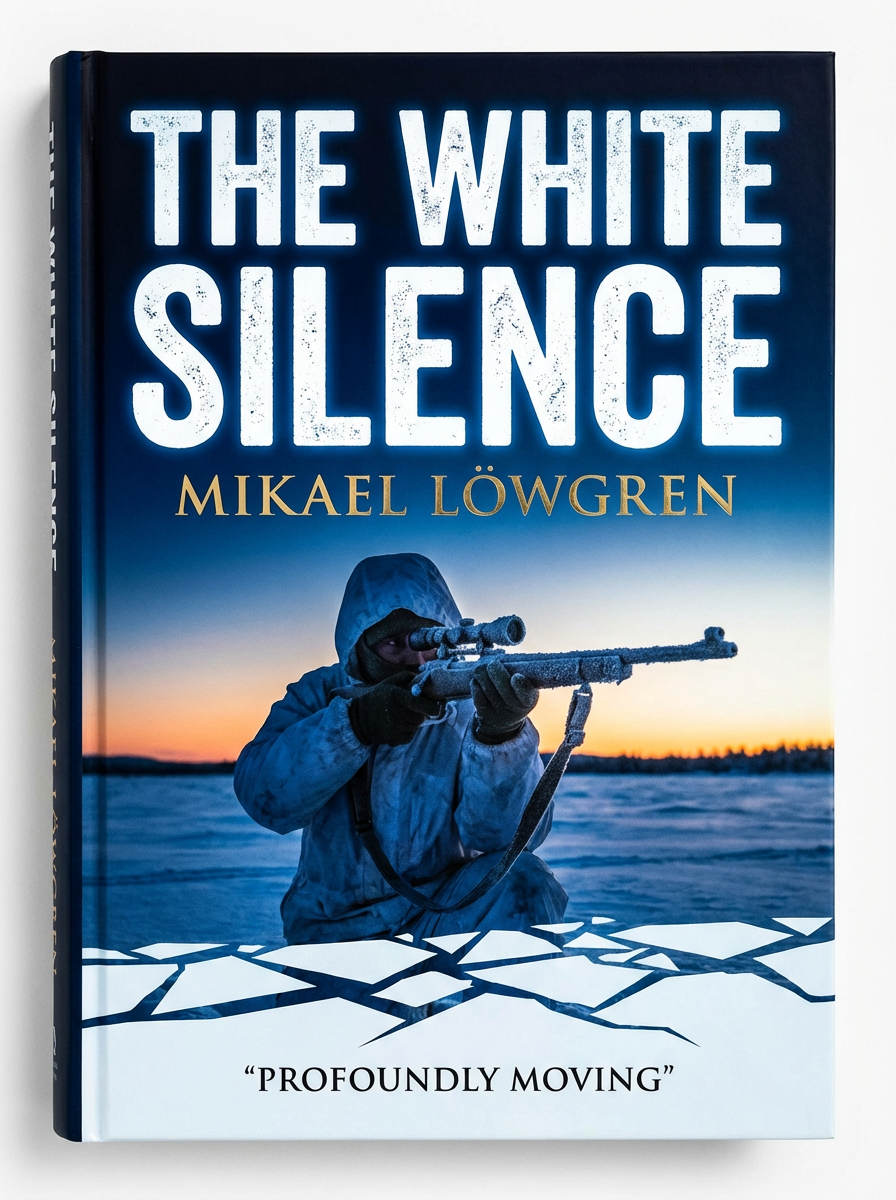
Synopsis
In the brutal silence of the Finnish Winter War, a humble farmer transforms into the legendary sniper known as 'The White Death,' meticulously accumulating a horrifying kill count even as the frozen wilderness and the weight of each life taken begin to fracture his soul, forcing him to confront the
Chapter 1: The First Snow, The Last Harvest
The air, sharp as a whetted blade, carried the scent of pine needles and impending snow. Simo Häyhä stood on the threshold of his small, sturdy cabin, his breath pluming white against the bruised grey November sky. His calloused hands, usually busy with the earth, rested on the worn timber of the doorframe. He had just finished patching the last chink against the coming winter, a ritual as old and comforting as the land itself.
Rautjärvi in autumn was a study in melancholy beauty. The birches had long since shed their golden tears, leaving stark white skeletal fingers reaching for the heavens. The lake, a mirror usually, was now a dull, pewter sheet, its surface hinting at the ice that would soon bind it as tightly as a lover’s embrace. This was Simo’s world, a quiet symphony of cyclical rhythms, of sowing and reaping, of enduring the long, frigid darkness only to greet the brief, astonishing burst of summer.
He had harvested his last potato, neatly stacked the cordwood that would feed his stove through the months of white silence, and mended the last fishing net. Everything was in order, just as it should be. There was a simple satisfaction in this, a quiet hum beneath his ribs that resonated with the deep, untamed pulse of the Finnish wilderness. He understood these rhythms, not with intellect, but with an instinct honed by a lifetime lived in intimate communion with the wild. He knew the way the elk moved through the frosted undergrowth, the rustle of a squirrel burying its hoard, the subtle shift in the wind that heralded a blizzard. These were the details he lived by, the silent language of survival.
But a new, discordant note had begun to hum on the edges of the familiar. It was not the whisper of the wind or the groan of the freezing earth, but a low, persistent thrum of human unease. News, carried by fleeting radio waves and the hushed conversations in the village store, spoke of border tensions, of Soviet bluster echoing across the Karelian Isthmus. It felt distant, a problem for Helsinki, for men in fine suits who debated things in warm rooms. Here, in Rautjärvi, the immediate concern was the frost on the windows, the weight of the coming snow.
He turned from the door, his gaze drifting to the old hunting rifle propped in the corner of the cabin. It was a well-worn M/28-30, a familiar extension of his arm, as comfortable as his own skin. He had taken countless hares with it, and deer, always with a clean shot, a swift end. Hunting was a necessity, a way of life, never a sport. There was a reverence in it, an understanding of the delicate balance between life and sustenance. He cleaned it meticulously, disassembled and oiled each part, a silent meditation. The cold steel felt alive in his hands, a conduit to something primal.
Later, as twilight bled into the deep indigo of early evening, a knock came at his door. Uncommon, for visitors were rare here, especially after the last logging trucks lumbered their way south for the year. He opened it to find Aino Toivonen, her breath puffing like a tiny steam engine, her cheeks rosy from the cold. She was his neighbor, a young woman with practical hands and eyes that held the clear light of innocence.
“Simo,” she said, her voice a little breathless, “Did you hear? They’ve called up the reserves. Even the older men. They’re saying… war.”
Simo felt a subtle shift within him, like a stone dislodged from a riverbed. He had heard the rumors, of course, but Aino’s words, delivered with a directness that bypassed the speculative hum of the village, cemented it into a stark, unambiguous truth. He looked at her, at the fear in her wide, earnest eyes, and felt a strange pang. She embodied the fragile beauty of this land, the simple life that was now being threatened by something ugly and immense.
“Mobilization?” he asked, his voice a low rumble, betraying little emotion.
She nodded, wrapping her shawl tighter around her. “Yes. My brother, Jussi, he left this morning. They said everyone able-bodied. They even came looking for you, Simo. Said you should report to the village hall in the morning.”
He looked out into the deepening gloom, towards the distant, invisible border. His mind, usually a quiet pool of contemplation, churned with an unfamiliar turbulence. War. The word felt alien, a jagged shard in the smooth fabric of his existence. What did he know of war? He knew the patience of waiting for a squirrel to emerge, the discipline of tracking a deer through fresh snow, the swift, clean kill. But war, as Aino spoke of it, felt like something else entirely – a brutal, senseless undoing of all that he knew.
“Right,” he said, the single word a quiet surrender to the inevitable. He offered Aino a cup of berry tea, and they sat in companionable silence, the only sound the crackle of the fire. She spoke of her worries, of Jussi, of the uncertainty. Simo listened, his gaze fixed on the dancing flames, seeing not the comforting warmth but the flickering shadows of an unknown future. He tasted the sour tang of disillusionment. All his careful preparations, all the rituals of a life attuned to the land, now seemed trivial, meaningless in the face of this incomprehensible upheaval.
The next morning, the world had transformed. A soft, silent blanket of white had fallen overnight, the first true snow of winter. It covered the familiar landscape in a pristine, unblemished sheet, muffling sounds, softening hard edges. It was beautiful, a breathtaking spectacle, but to Simo, as he walked the familiar path to the village hall, it felt like a shroud. The world he knew, the one he had cultivated with such care, was being quietly erased, covered over by the cold, indifferent hand of winter, and something far more destructive.
The village hall, usually reserved for boisterous harvest dances and solemn church meetings, buzzed with a tense energy. Men of all ages, their faces etched with a mixture of apprehension and grim resolve, stood in small groups, their civilian coats inadequate against the biting wind that snaked through the ill-fitting doors. Simo recognized many faces – his neighbors, men he’d shared a sauna with, men he’d bartered furs with. Now, they were all bound by a common, unspoken dread.
He saw Jalmari Väisänen, a burly farmer from the next valley over, his face red from the cold, his usual boisterous laugh absent. Jalmari caught Simo’s eye and nodded, a grim acknowledgement of their shared predicament. Simo offered a small, almost imperceptible nod in return. There were no effusive greetings, no customary handshakes. The air was thick with a silence that was far heavier than the quietude Simo cherished. This was a silence of foreboding, a quiet before the storm.
A man in a military uniform, a lieutenant whose face Simo didn't recognize, stood on a makeshift platform, shouting instructions. His words were clipped, efficient, devoid of comforting platitudes. They were being issued uniforms, rifles, given rudimentary instructions. The orders were clear: report to the designated staging area, then proceed to the front. The “front” – it sounded like a distant, abstract concept, yet it was undeniably real, drawing them in like a relentless undertow.
When his turn came, Simo was handed a uniform of grey-green wool, stiff and unfamiliar. It smelled of canvas and institutional disinfectant. He changed in an alcove, his movements precise and unhurried despite the nervous energy swirling around him. The rough fabric felt alien against his skin, a stark contrast to the comfortable worn cotton and wool he usually wore. He was being stripped of one identity and forced into another, one he neither asked for nor understood.
He was also given a rifle, a new M/28-30. It felt different from his own, crisper, unworn. He instinctively checked the action, the safety, the sights. The familiar weight of it in his hands was a small comfort, a shard of the known in a world rapidly becoming unrecognizable. He also noted the small, round tin of snuff given to each man. A luxury, perhaps, but a touch of familiarity in a strange new reality.
As he stood in line, waiting for the transport trucks, Simo looked around at the faces of his fellow farmers, now soldiers. They were all men of the land, men who understood the rhythm of seasons, the patience required for growth, the brutal honesty of survival. They were not warriors. They were men forced to defend something they loved, a quiet corner of the world that was suddenly under threat.
The snow continued to fall, soft and relentless, transforming the world into a canvas of pristine white. It coated his shoulders, his new cap, settled on the long barrel of his rifle. He closed his eyes for a moment, smelling the cold, crisp air, the faint scent of woodsmoke from a chimney nearby. He held onto that moment, that familiar sensation, as if trying to etch it into his memory before it was irrevocably altered.
He thought of his cabin, now probably buried under a foot of fresh snow, his stacked firewood, his neatly organized tools, the quiet warmth of his stove. A profound sense of loss, cold and sharp, pierced through his stoicism. He had cultivated a life of self-sufficiency, of peace, in harmony with the unforgiving beauty of this land. Now, that life was being torn from him, replaced by the unknown, by the brutal intrusion of human conflict.
The trucks arrived, their engines growling, belching acrid exhaust into the clean winter air. The men piled in, their boots crunching on the frozen snow. Simo found a place by the canvas flap, his gaze fixed on the receding landscape of Rautjärvi. The snow-covered fields, the dark sentinels of the pine forest, the distant, shimmering surface of the lake – it was all being swallowed by the falling snow, fading into a silent, white expanse.
He felt the rumble of the truck beneath him, carrying him further and further away from the life he had known. The first snow had fallen, marking the beginning of winter, a season of brutal beauty and hardship. But for Simo Häyhä, it also marked the end of something else: the last harvest of peace. The harvest of his quiet life, meticulously nurtured, was now over, and what lay ahead was a landscape as unyielding and unforgiving as the Finnish winter, a landscape that would demand a different kind of harvest entirely. And so, Simo Häyhä, a farmer, began his reluctant journey into the chilling unknown, into the white silence of war.
Chapter 2: A Blanket of White, A Shadow of Fear
The forest swallowed him whole. Not the familiar, comforting embrace of Rautjärvi’s pines, where every moss-covered stone and leaning birch held a story only he could read. This was a different forest, a predator’s lair, where the silence wasn't a gentle lullaby but a held breath, heavy with unspoken omens. He had arrived at the front days ago, a grey smudge among the endless white, stepping off a lorry that smelled of diesel and fear. The landscape was brutal, an unyielding canvas of snow and ice stretching to a horizon that promised only more of the same. This was where the war truly began, not in the distant whispers of news bulletins, but in the sharp sting of frozen air against exposed skin and the ceaseless, nagging ache in his bones.
Captain Mäkelä, his face etched with lines that spoke of too many winters and not enough sleep, had surveyed the new arrivals with a practiced eye. Simo had stood straight, a small man, unassuming, yet something in the quiet intensity of his gaze must have registered. "Häyhä," Mäkelä had grunted, consulting a clipboard. "Farmer, eh? Good. Plenty of patience in a farmer." He hadn't known then, of course, the kind of patience Häyhä possessed – a stillness deeper than any frozen lake, a watchfulness more ancient than the oldest fir.
The first few days were a blur of cold and confusion. The Finnish lines were sparse, scattered like lost pebbles against the vast, dark wave that was the Soviet advance. They were outnumbered, outgunned, and perpetually shivering. The constant thrum of distant artillery was a new kind of heartbeat for the world, a monstrous, irregular pulse that promised destruction. Simo learned to sleep with it, to eat with it, to exist within its thrumming dread. He watched his comrades, men who had been farmers and loggers and mechanics a mere month ago, transform under the relentless pressure. Some cracked, their eyes wide and vacant. Others hardened, their faces becoming masks of grim resolve. Simo, as ever, remained a still point in the storm.
He carried his M/28-30 rifle like an extension of his own arm, a tool he understood intrinsically. It was a good rifle, a Finnish design, hardy and accurate. He had spent countless hours with its older siblings, learning the subtle nuances of its weight, the crispness of its trigger, the satisfying thwack of a well-placed shot. Now, in this landscape of bleached white and skeletal trees, the rifle felt less like a weapon and more like a conduit to a fundamental truth.
Jalmari Väisänen, a man whose boisterous laughter usually cut through the gloom, had fallen silent these past days, his face chapped and reddened by the cold. He huddled next to Simo during a lull, stamping his feet in the snow. "Gods above, Simo," he muttered, exhaling a plume of frost. "It's like trying to stop an avalanche with a snow shovel, isn't it? They just keep coming."
Simo said nothing, his gaze fixed on a distant line of trees, where the shadows deepened and writhed with unseen movement. He understood Jalmari’s sentiment. The scale of the invasion was overwhelming, a brute force against their meager resources. They were a handful of men against an empire. Yet, something else stirred within Simo. Not despair, but a curious clarity.
The snow, usually a benign presence in his world, had become an accomplice. It muffled sounds, blurred distances, and offered a seamless canvas for deception. Simo, with his innate connection to the natural world, saw it not as a hindrance, but as a language. He understood its shifting drifts, its subtle nuances of shadow, the way it could conceal and reveal in equal measure. This forest, though alien in its brutal purpose, was still a forest, and he was still a man of the forest. The instincts that guided him in tracking game, in understanding the wind and the light, now translated seamlessly into the art of war.
He began to move differently. While others stumbled and cursed the treacherous terrain, Simo glided. He wore his white camouflage not as a uniform, but as a second skin, disappearing against the backdrop with an almost supernatural ease. His eyes, trained by years of observation on the hunt, picked out details others missed: a scuff mark in the snow, a barely perceptible tremor in a branch, the exact trajectory of a breath dissolving into the frigid air.
One morning, the order came down. Soviet patrols were probing their forward positions, testing their defenses, looking for weaknesses. Captain Mäkelä, his face grim, pointed at a map with a gloved finger. "They're pushing here," he said, his voice low, "along the eastern flank. We need eyes out there. Someone to deter them. Make them hesitant."
Simo stepped forward, his voice a low rumble. "I can do it, Captain."
Mäkelä raised an eyebrow, a flicker of surprise in his war-weary eyes. "You? You're a new recruit, Häyhä."
"I know the snow," Simo replied simply, "and I know how to wait."
There was something in his tone, a quiet certainty, that made Mäkelä pause. He looked at the small man, at the rifle gripped with such familiar ease, at the calm, impassive face that held more unspoken depth than any bluster. "Alright, Häyhä," he said, "take Väisänen with you. Don't engage unless absolutely necessary. Just observe, report, and make them think twice."
But Simo knew, deep in the marrow of his bones, that observation alone would not be enough. This was not a forest for reporting. This was a forest for action.
He moved through the trees, a ghost in white. Jalmari, plodding behind him, found his usual chatter dying on his lips. Simo moved with a fluidity that was unnerving, an almost preternatural awareness of his surroundings. He stopped abruptly, sinking into a snowdrift with a practiced motion, his rifle already raised.
"What is it?" Jalmari whispered, his breath clouding.
Simo held up a hand, silencing him. His eyes, narrowed to slits, scanned the frozen landscape. He saw them then. A patrol of five Soviet soldiers, their heavy winter coats making them seem like hulking shadows against the snow. They moved with a clumsy confidence, their laughter, thick and boisterous, carrying surprisingly far in the crisp air. They were oblivious, their weapons slung carelessly, their attention fragmented.
He watched them for a long time, the cold biting at his exposed skin, but he felt nothing but a profound stillness. He noticed the lead man, a young Private, perhaps no older than Simo had been when he first learned to track deer. The Private was laughing, his breath a white plume, kicking at a snowdrift with a careless boot. He saw the gleam of a metal canteen, the way the fur collar of another soldier's coat was matted with ice. He saw them not as enemies, not as faceless invaders, but as men, albeit men who were treading on his land, disrupting the order of his world.
A curious tranquility settled over him. This was similar to hunting, but with a different prey. He had always understood the necessity of the kill, the delicate balance of life and death in nature. Now, this balance felt skewed, distorted by a greater, more brutal force. Yet, the principles remained the same: patience, precision, an understanding of the environment.
He chose his target. Not the young Private, laughing obliviously. Not the one whose face seemed etched with weariness. He chose the one in the middle, a burly soldier whose every movement suggested a certain swagger, a sense of invincibility. It was an instinct, a sudden, inexplicable certainty.
His breathing was shallow, barely disturbing the fine snow that clung to his face. The world narrowed to the scope of his rifle, to the intersection of crosshairs and the soldier's chest. He remembered the feeling of the M/28-30 against his shoulder, a familiar weight, a promise of deadly accuracy. He had always been a marksman of exceptional skill, a fact acknowledged by local shooting clubs but never truly celebrated by himself. It was simply what he did.
He exhaled slowly, a wisp of vapor disappearing into the vast emptiness. His finger, calloused and strong, tightened gently on the trigger. The shot ripped through the stillness, a crack that echoed like a breaking branch.
The burly soldier stumbled, a guttural cry torn from his throat. He clutched at his chest, his eyes widening in disbelief, then collapsed into the snow, a dark blossom spreading rapidly beneath him.
The other soldiers froze, their laughter abruptly silenced, replaced by a stunned, disbelieving silence. They looked around wildly, their expressions shifting from confusion to terror. They saw nothing but trees, nothing but snow, nothing but the ghost of a rifle shot.
Simo had already melted back into the snow, a barely perceptible shift in the white landscape. He reloaded with a practiced ease, the click of the bolt a soft, almost domestic sound in the face of such sudden violence. Jalmari, his face pale, stared at the fallen soldier, then at Simo, a new kind of fear dawning in his eyes. He had seen Simo hunt, but never like this.
Another shot, quick and precise, found the second soldier who had been fumbling for his rifle, his eyes still darting frantically. He fell, a heavier thud this time, as if the weight of his fear had solidified him.
Panic seized the remaining three. They scattered, shouting in Russian, their heavy boots churning fresh snow. Simo chose a third, a running man, his aim unhurried, his mind clear. The man screamed as he went down, a high, panicked sound that seemed to tear at the fabric of the silent forest.
The last two, young and clearly terrified, simply dropped their weapons and fled, scrambling back toward their own lines, their figures disappearing into the deepening shadows. They carried with them a new kind of story, a chilling whisper of an unseen presence, a ghost that stalked the pristine white.
Simo watched them go, his expression unreadable. He had eliminated three. It was a cold, objective fact. The tranquility he felt was not one of triumph, but of a strange, bleak accomplishment. He had done what was necessary. He had, in his quiet, precise way, made them hesitant. He had introduced them to a new kind of fear, a fear of the invisible.
He turned to Jalmari, who was still staring at the fallen bodies, a horrified fascination in his eyes. "We go now," Simo said, his voice flat, devoid of emotion.
Jalmari nodded, his movements stiff. He followed Simo, stumbling occasionally, his breath coming in ragged gasps. The forest, which had felt menacing moments before, now felt truly haunted. He had witnessed Simo's transformation, or perhaps, Simo's unveiling. The quiet farmer had become something else, something terrifying in its efficiency.
As they made their way back to their lines, the only sounds were the crunch of their boots on the snow and the distant, fading echoes of the Soviet soldiers’ panicked cries. The sun had begun its slow descent, painting the snow in shades of violet and rose, a deceptive beauty. Simo felt the cold seep into his bones, but it was a familiar cold, no longer a discomfort, but a constant companion.
He thought of his fields back in Rautjärvi, softened by the first snow of winter. He thought of the quiet rhythm of his old life, the smell of woodsmoke and damp earth. All of it felt impossibly distant now, a dream from another existence. He had stepped into this new world, this brutal landscape of white, and it had begun to redefine him. The weight of each silent life taken had not yet fully settled, but he felt the first, subtle shift within his soul, a hardening, a detachment. He had entered the vast, white silence, and the silence, he instinctively knew, had entered him.
Chapter 3: The Silent Reckoning
The first kill wasn't a roar, or a scream, or even a sudden, jarring thud. It was a sigh. A soft, almost imperceptible exhalation of air, stolen by the wind before it could truly register. Simo, prone in the snow, his breath pluming in front of his face like a fragile ghost, watched the Soviet scout through the scope of his M/28-30. The man, a mere silhouette against the bleached canvas of a distant birch stand, was oblivious. He wore a heavy, shapeless coat, and his breath, too, was a visible testament to the biting cold. He was a small, insignificant detail in the vast, indifferent landscape, and yet, in that moment, he was the axis around which Simo's world revolved.
The air was still, heavy with the promise of more snow. The only sound was the faint, rhythmic pulse in Simo’s ears, a drumbeat of anticipation and something else, something unnamed and unsettling. He had been a hunter all his life, tracking deer and elk through these same woods, understanding the delicate balance between predator and prey. This was different. This prey wore a uniform, carried a rifle, and had a face that, even from this distance, held the subtle contours of a human being.
His finger, calloused and firm, found the trigger. It was a familiar sensation, the cold metal against his skin. He had polished and oiled this rifle countless times, felt its weight become an extension of his own arm. He knew its quirks, its whispers, its precise trajectory. He squeezed. Not a jerk, not a sudden release, but a slow, deliberate pressure, like a stone sinking into soft earth.
The shot was a sharp crack, a brief, violent punctuation in the profound silence. The scout, a millisecond after the sound, stumbled. Not a dramatic fall, but a subtle collapse, like a marionette whose strings had been abruptly severed. He folded in on himself, a heap of cloth and flesh, vanishing into the snow as if the earth had simply swallowed him whole.
Simo held his breath, the rifle still pressed to his shoulder. He waited. For a cry, for a return fire, for anything to shatter the fragile peace that had settled once more. But there was nothing. Only the wind, rustling through the skeletal branches, and the persistent, throbbing silence.
He exhaled slowly, a long, drawn-out sigh that mirrored the one he had just heard, or imagined he had heard, from the falling scout. The recoil had been a familiar jolt, a fleeting tremor that ran through his body. But the aftermath was new. A strange emptiness, a peculiar hollow where something should have been. He had taken a life. Not in a fit of rage, not in a desperate struggle, but with a cold, almost surgical precision. He had aimed, he had fired, and a man had ceased to exist.
He lowered the rifle, the metallic scent of gunpowder faintly clinging to the air. He felt no triumph, no surge of adrenaline. Only a profound stillness, a quiet hum that resonated deep within him. It was as if a tiny, unseen fracture had appeared in the bedrock of his being, a hairline crack that, though almost imperceptible, was undeniably there. A different man, indeed. The farmer, who had tilled the soil and nurtured life, had just extinguished it.
He crawled back, a ghost in the snow, leaving no trace. His movements were fluid, economical, honed by years of traversing these same forests. The snow, his constant companion, offered both concealment and a peculiar kind of intimacy. He understood its nuances, the way it drifted, the way it muffled sound, the way it could hide a man or betray him. He was a part of it, a creature of the white silence.
Back at the makeshift outpost, a cluster of snow-covered dugouts and camouflaged positions, Captain Antti Mäkelä was hunched over a map, his brow furrowed in concentration. Mäkelä was a man carved from the same granite as the Finnish landscape – stoic, disciplined, with eyes that missed nothing. He had seen too much, fought too long, to be easily surprised. Yet, a flicker of something akin to curiosity, perhaps even a nascent unease, had begun to stir within him regarding Private Simo Häyhä.
"Another one, Simo?" Mäkelä's voice was low, devoid of inflection. He didn't look up from the map, his finger tracing a line along a frozen river.
Simo merely nodded, his face impassive, the cold having etched a permanent rime on his eyelashes. "Scout. East flank. Heading towards the ridge."
Mäkelä grunted, a sound that could mean anything or nothing. He had received similar reports over the past few days. Single shots, followed by the silent disappearance of Soviet patrols. No witnesses, no struggle, just a void where a man had been. It was unsettling. The Soviets were notoriously cautious, and their scouts were usually well-trained. To be picked off with such regularity, and with such apparent ease, spoke of something beyond mere luck.
"You're a quiet one, Häyhä," Mäkelä finally said, lifting his gaze to meet Simo's. His eyes, the color of frozen lakes, held a peculiar intensity. "Never much for talk, even before all this."
Simo shrugged, a slight movement of his broad shoulders. "No need for words, Captain. The woods speak their own language."
Mäkelä leaned back, a faint smile playing on his lips, a rare sight. "Indeed they do. And it seems they've taught you well. Too well, perhaps." He paused, his gaze lingering on Simo's face, searching for something, a tell, a crack in the stoic facade. But there was nothing. Simo’s eyes, the color of peat, were like the deepest parts of the forest – dark, unreadable, yet holding an undeniable depth.
"Your aim, Simo," Mäkelä continued, his voice a low rumble, "it's… uncanny. Even for a hunter. It's not just skill, is it? There's something else."
Simo remained silent, his gaze fixed on a distant snowdrift, as if contemplating the intricate patterns of the wind-blown flakes. He knew what Mäkelä was implying. The whisper of something beyond the ordinary, a touch of the supernatural, perhaps. In these desolate, unforgiving lands, such beliefs were not uncommon. The forest held its secrets, and sometimes, it seemed, it bestowed them upon those who listened closely enough.
"I just see what needs to be seen, Captain," Simo finally said, his voice a low murmur, almost lost in the vastness of the dugout. "And I aim true."
Mäkelä nodded slowly, his eyes still fixed on Simo. "True, indeed. We've lost more men to their snipers than we care to admit. But you… you're turning the tables. One man, disappearing into the white, leaving nothing but dead Russians in his wake." He picked up a pencil and tapped it against the map. "They're calling you something, you know. The Soviets. They send word through our lines, through the prisoners. They’re afraid."
Simo felt a faint tremor, not of fear, but of something akin to a shiver, run down his spine. Fear. The Soviets, the invaders, the seemingly endless tide of men, were afraid of *him*. A humble farmer, armed with a rifle and a profound understanding of the snow. It was a strange, unsettling thought.
"What are they calling me, Captain?" Simo asked, his voice barely audible.
Mäkelä’s smile widened, a grim, almost feral expression. "They call you 'Belaya Smert'. The White Death."
The words hung in the air, cold and sharp, like icicles. *The White Death*. Simo felt the weight of the moniker settle upon him, a chilling embrace. It was a name born of fear, a testament to the silent, unseen terror he was inflicting. It was a name that would define him, perhaps forever.
He felt the tremor again, deeper this time. The fracture in his soul, the one that had appeared with the first kill, seemed to widen imperceptibly. The farmer, the man who cherished the quiet rhythms of life, was slowly being subsumed by something else, something far colder, far more lethal. The white silence, which had once been his comfort, was now becoming his identity.
Days bled into weeks, each one a repetition of the last. The biting cold, the endless snow, the constant vigilance. Simo became a phantom, a whisper in the wind. He would leave the outpost before dawn, a silent shadow against the pre-dawn gloom, and return only when the last vestiges of light had faded, leaving behind a trail of unseen deaths.
His routine was meticulous, almost ritualistic. He would find a position, often a snowdrift sculpted by the wind, or a cluster of snow-laden pines, and disappear into it. He would dig himself in, using a small shovel or even his bare hands, until he was indistinguishable from the landscape. He learned to control his breathing, to slow his heart, to become one with the stillness around him. He learned to read the wind, to anticipate the shifts in light, to understand the subtle language of the forest.
He would wait. Sometimes for hours, sometimes for an entire day. Patience, he knew, was the hunter's greatest virtue. He would watch the Soviet patrols, observing their movements, their patterns, their subtle tells. He learned their habits, the way they held their rifles, the way they scanned the treeline, the moments of their vulnerability. And then, when the moment was ripe, he would strike. A single shot, precise and unforgiving, followed by the immediate disappearance of his target.
Each kill was a further deepening of the silence within him. He no longer felt the faint tremor, the initial shock. Instead, there was a growing numbness, a quiet acceptance of the monstrous task he had undertaken. He was a cog in a brutal machine, a tool wielded by the unforgiving hand of war. The faces of the men he killed blurred into a single, indistinct image. They were not individuals, but targets – obstacles to be removed, threats to be neutralized.
Yet, sometimes, in the dead of night, when the cold gnawed at his bones and the silence pressed in around him, he would see them. Not the blurred targets, but glimpses of faces, fleeting and indistinct, like reflections in troubled water. A young man, barely out of his teens, his eyes wide with fear. An older man, his face etched with weariness, a faint tremor in his hands as he clutched his rifle. These were the moments when the fracture in his soul would ache, a dull, persistent throb. He would push them away, these ghosts, these unwelcome intrusions into his carefully constructed emotional fortress. He had to. To dwell on them was to falter, to hesitate, and hesitation in this unforgiving landscape meant death.
Captain Mäkelä continued to watch him, a silent observer. He saw the change, the subtle hardening around Simo's eyes, the way his movements had become even more economical, more precise. He saw the burgeoning legend, the fear his name instilled in the enemy, the hope it ignited in his own men. But he also saw something else, something that gave him pause. The growing isolation, the quiet retreat into himself. Simo was becoming a weapon, a formidable one, but at what cost?
One evening, as Simo was cleaning his rifle, the familiar scent of oil and metal filling the small dugout, Mäkelä approached him. The captain’s face was etched with the fatigue of command, but his eyes held their usual sharp intensity.
"They've put a bounty on your head, Simo," Mäkelä said, his voice low. "A considerable one. They're sending their own snipers after you. Special units, trained for this kind of work."
Simo paused, his cloth stilling on the rifle barrel. He felt a flicker of something, a faint spark of recognition. He was no longer just a hunter; he was the hunted. The game had escalated.
"Let them come," Simo said, his voice flat, devoid of emotion. "The snow is a fair judge."
Mäkelä studied him, a long, assessing gaze. "You're not afraid, are you, Simo?"
Simo looked up, his eyes meeting Mäkelä's. For a fleeting moment, the mask of impassivity slipped, revealing a glimpse of the man beneath. A man burdened, perhaps, but not broken.
"Fear is a luxury we cannot afford, Captain," Simo said, his voice a low rumble. "Not out here. Not in the white silence."
He returned to cleaning his rifle, the methodical movements a form of meditation. The weight of the kill count, the chilling truth of his own humanity, the war he never sought but was now inexorably defined by – all of it was slowly being absorbed into the vast, indifferent landscape of his soul. He was becoming the White Death, a legend born of snow and blood, a man who had found his terrible purpose in the brutal silence of the Finnish winter. And as the night deepened, and the cold tightened its grip on the frozen earth, Simo Häyhä knew, with a chilling certainty, that the reckoning had only just begun.
Chapter 4: Whispers of the White Death
The snow, Simo thought, was a vast, indifferent canvas. Each new fall erased the footprints of the last, a continuous, quiet absolution. He moved through it like a ghost, a ripple in the fabric of the desolate landscape. The M/28-30, an extension of his own bone and muscle, was cold against his cheek, its steel whispering of distant factories and forgotten hands. The forest was his church, his hunting ground, his confessional. Here, the world narrowed to the scope of his rifle, the beat of his own heart, and the almost imperceptible shiver of a branch under a distant boot.
Captain Mäkelä had stopped sending him out with others. Simo preferred it that way. Company was a distraction, a weakness in this theatre of stark solitude. He worked best alone, a solitary predator in a world of prey. The captain, a man of surprising insight for a military officer, seemed to understand this. He would simply point to a sector on the map, a smudge of red ink indicating enemy positions, and nod. Simo would nod back, a silent communion of purpose, and melt into the white.
The kills mounted, a silent tally in the ledger of the war. There was no exhilaration, no triumph, only a grim, methodical efficiency. Each life taken was a stone added to an invisible cairn in his mind, a monument to the relentless, unyielding nature of conflict. He didn’t think about their faces, their stories, their families. He thought only of the trajectory of the bullet, the subtle shift of the wind, the precise moment of impact. It was a chore, a necessary evil, like clearing a field of stubborn stones before planting.
But the silence, the vast, encompassing silence of the Finnish winter, had a way of amplifying things. It amplified the thud of a falling body, the faint gurgle of blood in the snow, the almost imperceptible sigh of a soul departing. These sounds, though muted, echoed in the hollow spaces within him. He didn’t dwell on them, not consciously. But they were there, a growing hum beneath the surface of his awareness, like the distant rumble of an approaching train.
The enemy, however, was not silent. They were bewildered. They were terrified. The stories began to circulate, whispers carried on the icy wind, distorted and exaggerated by fear. How could one man be so effective? How could he appear and disappear like smoke? He was a phantom, a myth in the making.
Simo heard snippets of these whispers, filtered through Finnish patrols who had intercepted Soviet communications, or from captured prisoners, their eyes wide with a fear that went beyond the immediate threat of capture. “They call you ‘Belaya Smert’,” a young recruit, barely older than a boy, had told him one evening, huddled around a meager fire. The recruit’s voice was a mixture of awe and terror. “The White Death.”
Simo had merely grunted, stirring the embers with a stick. The name meant nothing to him. It was a label, a sound, a meaningless string of syllables. He was Simo, a farmer from Rautjärvi, and now, a soldier. The ‘White Death’ was an invention of the enemy’s fear, a phantom born of their own terror. He was simply doing what needed to be done.
Yet, the name, once spoken, seemed to solidify around him, a cloak woven from the threads of countless lives taken. He felt its weight, not as pride, but as a chilling acknowledgment of the irreversible path he was carving through the frozen landscape.
One morning, the snow had fallen thick and heavy, transforming the forest into a monochrome dreamscape. The air was still, the cold so profound it felt like a physical presence. Simo lay prone, camouflaged perfectly in his white suit, a ghostly silhouette against the pristine canvas. He had been tracking a small Soviet patrol for hours, their movements clumsy and loud against the muffled quiet. They were searching, he knew. Searching for him.
He saw them first, three figures moving through the trees, their breath pluming white in the frigid air. They were spread out, nervous, their rifles held high, scanning the dense undergrowth. One of them, a stout man with a thick beard, stopped, his gaze sweeping over Simo’s position. Simo held his breath, his finger resting lightly on the trigger. He was invisible. He was nothing.
The bearded man suddenly shouted something in Russian, his voice raw with frustration. He gestured wildly towards a cluster of snow-laden pines, then brought his rifle to his shoulder and fired a burst into the innocent branches. Snow exploded, showering down like shattered glass. The other two soldiers flinched, then joined in, spraying bullets into the silent forest. It was a desperate, futile act, a scream of defiance against an unseen enemy.
Simo watched, a curious detachment settling over him. They were terrified. Their fear was a tangible thing, a thick, suffocating cloud that hung in the air. He could almost taste it, metallic and bitter. This was the ‘White Death’ they were battling, not a man, but an idea, a terrifying embodiment of their own helplessness.
He waited for a moment, letting their fear intensify. Then, with the practiced ease of a craftsman, he selected his target. The second soldier, a young man with a thin mustache, was lagging slightly behind. Simo exhaled slowly, the breath a faint wisp in the frigid air. The world narrowed again. The crosshairs found their mark.
The shot was clean, almost surgically precise. The young soldier stumbled, a hand flying to his chest, then crumpled into the snow, a dark stain blossoming against the white. The other two froze, their heads snapping in the direction of the sound. They hadn’t seen anything. They never did.
The bearded man roared, a sound of pure, unadulterated rage and terror. He fired wildly into the trees, his bullets tearing through bark and snow, a desperate attempt to strike back at the invisible predator. His companion, however, was already turning, a frantic, animalistic instinct for survival overriding any sense of duty. He fled, crashing through the undergrowth, a dark, fleeting shadow against the white.
Simo watched him go. He could have taken him. It would have been easy. But something held him back. He wanted the message to be carried. He wanted the whispers to grow louder, the legend to deepen. Let their fear become a weapon against them.
He rose slowly, a phantom emerging from the snow. He walked towards the fallen soldier, his boots crunching softly on the pristine surface. The young man lay face down, his breath misting faintly from his open mouth, already turning to ice. Simo knelt, his movements economical, devoid of emotion. He checked the man’s pockets, finding only a worn photograph of a stern-faced woman and two small children. He placed it back gently. It was not his to keep.
He found a small, crude map, detailing their patrol route. Simo memorized it, then tucked it into his own pocket. The war was a game of information, of knowing where the pieces were, even if you were the only one moving them.
As he turned to leave, a thought, unbidden and unsettling, surfaced from the depths of his mind. Was he still Simo? Or had the ‘White Death’ consumed him, leaving only an empty shell, a vessel for the grim mechanics of war? The question hung in the cold air, unanswered. He pushed it away, back into the silent corners of his consciousness. There was no time for introspection. There was only the next target, the next whisper in the snow.
The days blurred into a continuum of white and cold, punctuated by the sharp crack of his rifle. He moved from position to position, a silent sentinel, a harbinger of death. He learned to read the snow like a book, understanding its subtle shifts, its deceptive depths. He could tell by the angle of a shadow when a patrol was approaching, by the faint scent of woodsmoke where a bivouac was hidden. His senses, honed by years of hunting and now sharpened by the brutal necessities of war, were his most potent weapons.
His kill count, scrawled in a small, leather-bound notebook he kept hidden in his inner pocket, continued its relentless ascent. Each number was a small, almost insignificant mark, but together, they formed a chilling testament to his effectiveness. He didn’t derive any satisfaction from the numbers. They were simply data, a record of his grim task.
Captain Mäkelä, when Simo returned to camp for resupply and a brief respite, would look at him with a strange mixture of admiration and something else, something akin to concern. “Another good day, Simo?” he would ask, his voice low.
Simo would just nod, hand over the intelligence he’d gathered, and accept his rations. He rarely spoke. Words felt superfluous in this world of action and silence.
“They’re getting desperate,” Mäkelä said one evening, poring over a captured Soviet communiqué. “They’re sending out more patrols specifically looking for you. They’re offering a bounty.” He looked up, his eyes meeting Simo’s. “A very substantial bounty.”
Simo felt nothing. A bounty was just another concept, another whisper in the wind. He was not a prize to be claimed. He was a force of nature, as indifferent to their pursuit as the blizzard itself.
He remembered a dream he had, a recurring one from his childhood. He was standing in a vast, empty field, the snow stretching to the horizon. A single, gnarled tree stood in the distance, its branches skeletal against the pale sky. He would walk towards it, endlessly, but never seemed to get any closer. The dream was always accompanied by a profound sense of loneliness, a quiet yearning for something just beyond his reach. Now, the dream felt less like a dream and more like his reality. He was walking through an endless field of white, each kill a step closer to an unreachable destination, an elusive peace.
The Soviets, in their desperation, began to change their tactics. They started sending out counter-snipers, men specifically trained to hunt down snipers. These were different, more dangerous opponents. They moved with a subtle cunning, their eyes scanning the terrain for the faintest anomaly, the slightest disturbance in the pristine white.
Simo felt their presence, a subtle shift in the energy of the forest. It was like sensing a wolf in the woods, even before seeing it. He became even more cautious, even more meticulous. The game was escalating.
One afternoon, he found himself in a particularly tense standoff. He had spotted a Soviet sniper, a dark, almost imperceptible shadow against a distant ridge. Simo had been tracking him for hours, a slow, methodical dance of predator and counter-predator. The Soviet was good, very good. He had chosen his position well, concealed by a cluster of snow-laden firs, his rifle scope glinting faintly in the weak winter sun.
Simo knew the moment he was seen. It was a feeling, a prickle on the back of his neck, a sudden tightening in his gut. The Soviet sniper shifted, his rifle barrel moving almost imperceptibly. Simo dropped, melting into a snowdrift, a mere illusion of form. A shot rang out, a sharp crack that echoed through the silent forest, kicking up snow where his head had been moments before.
He lay still, his heart thudding a slow, heavy rhythm against his ribs. This was different. This was a direct challenge, an acknowledgment of his existence. The ‘White Death’ now had a target on its back.
He spent the next few hours in a silent battle of wits, a deadly game of hide-and-seek played out in the vast, indifferent wilderness. He moved, slowly, painstakingly, using every fold in the terrain, every shadow, every snowdrift as cover. He was no longer just hunting. He was being hunted.
Finally, as the pale winter light began to fade, casting long, blue shadows across the snow, Simo found his opening. The Soviet sniper, growing impatient, had shifted slightly, exposing a sliver of his position. It was a tiny mistake, almost imperceptible, but Simo’s eyes, trained by years of observation, caught it.
He took his shot. The sound was swallowed by the vastness of the forest. The Soviet sniper slumped, his rifle falling from his grasp, a dark, motionless figure against the darkening snow.
Simo waited, listening. The forest was silent again, save for the whisper of the wind through the pines. He rose, a ghost in the twilight, and moved towards his fallen opponent. He found the man, a young face, pale and still, eyes open and staring at the darkening sky. On his uniform, a small, embroidered patch: a wolf’s head, snarling. A symbol of their elite snipers.
Simo looked at the face, then at the patch. Another stone on the cairn. Another whisper of the ‘White Death’ carried on the wind. He retrieved the man’s rifle, a newer model than his own, and checked its scope. It was a good weapon. He left it there, a silent offering to the vast, indifferent silence. He had his own.
As he turned to leave, the chill of the evening deepened. The snow began to fall again, soft and persistent, covering the tracks, erasing the evidence, absolving the dead. Simo walked away, his silhouette fading into the deepening gloom. He was still Simo, the farmer from Rautjärvi. But the whispers of the White Death were growing louder, echoing not just in the minds of his enemies, but in the silent, frozen corners of his own soul. The line between the man and the legend was blurring, dissolving like breath in the frigid air. He was becoming the myth, an embodiment of the brutal, beautiful, terrifying silence of the Finnish winter. And he knew, with a chilling certainty, that there was no turning back.
Chapter 5: The Hunter and the Hunted
The snow, once a silent confederate, now seemed to conspire against him. Every flake that drifted down, every fresh layer that settled, was a fresh page for the enemy to read. The whispers had grown into shouts, and the shouts into a furious, guttural roar. Simo, who had moved like a ghost through the frozen pines, now felt a thousand eyes, unseen and relentless, scanning the white expanse for his silhouette.
The shift was subtle at first, like the almost imperceptible deepening of shadows at dusk. Instead of the haphazard patrols and the occasional, easily outmaneuvered scout, the Soviets began deploying their own hunters. Simo saw them, or rather, felt their presence, like a cold draft in a supposedly sealed room. Their movements were different – slower, more deliberate, their eyes sweeping the treeline with a practiced intensity that spoke of similar training, similar instincts. He’d learned to read the forest like a book, and now, a new, unsettling chapter was being written within its familiar pages.
One afternoon, nestled in a snowdrift he’d meticulously sculpted into a perfect hide, Simo watched a Soviet patrol advance. They weren’t looking for a skirmish; they were looking for him. One man, taller than the others, with a long, cumbersome rifle, moved with an almost unnatural grace, his gaze fixed on the higher ground where Simo often positioned himself. Simo felt a prickle of unease, a sensation he hadn't experienced since the early days of hunting when a bear had once sniffed him out. He lowered his scope, not wanting the glint of the lens to betray him. He held his breath, the cold air burning his lungs. The Soviet sniper paused, his head cocked slightly, as if listening to a distant, inaudible hum. Then, with a slow, deliberate movement, he raised his own scope, sweeping it across the very spot where Simo lay.
Simo didn’t flinch. He didn’t breathe. He was a stone, a root, a part of the snow itself. The Soviet’s scope passed over him, lingered for a fraction of a second, then moved on. Simo felt the cold sweat on his brow, not from exertion, but from the chilling proximity of discovery. He waited until the patrol had disappeared into the deeper woods before allowing himself a slow, measured exhale. The hunter had become the hunted, and the realization settled in his gut like a lump of ice.
The Soviets, it seemed, had a name for their own ghost. Whispers trickled back through the Finnish lines, carried on the frigid wind, of a "White Phantom" or a "Shadow Bear" – an enemy sniper who was as elusive as he was deadly. Simo found himself listening for these rumors with a strange, morbid curiosity. He wondered if this was the tall, deliberate man he’d seen. He wondered if this man, too, felt the weight of the snow, the constant hum of impending discovery.
The paranoia was a constant companion now, a low thrum beneath the surface of his thoughts. Every rustle of leaves, every creak of a branch, every distant bird call could be a signal, a warning. He slept less, and when he did, his dreams were fractured, kaleidoscope images of gun barrels glinting in the sun, of eyes staring out from the snow. He found himself checking his back more often, scanning the sky for the tell-tale plume of smoke from an artillery spotter, his senses heightened to an almost unbearable degree. The forest, his sanctuary, had transformed into a labyrinth of potential traps.
One morning, the artillery barrage began with an unnerving precision. Instead of the usual indiscriminate pounding, the shells landed with a chilling regularity in the areas he was known to frequent. Trees exploded into splinters, snow erupted into geysers of white, and the ground trembled beneath him. He was no longer just a target; he was a problem to be systematically eradicated. He moved constantly, never staying in one place for long, a nomad in his own territory.
He learned to anticipate the patterns of the Soviet artillery, the subtle shifts in the wind that might carry the sound of an approaching shell. He learned to read the trajectory of incoming fire, to gauge the precise moment to dive for cover. He was a fox, constantly dodging the hounds, and the hounds were growing smarter, their pursuit more relentless.
The first time he truly felt the presence of the Soviet sniper, the one they called Vasily Zaitsev, was not through sight, but through absence. He had been tracking a small Soviet detachment for hours, a routine hunt. He had them in his sights, a clean shot at the lead scout. He squeezed the trigger, and the shot rang out. But the scout didn't fall. Instead, a splinter of wood erupted from the tree directly beside Simo’s head, a whisper of a bullet that had gone wide.
Simo dropped instantly, his heart hammering against his ribs. He hadn't seen the flash, hadn't heard the report, but he knew. Another sniper. And a good one. He scrambled backwards, burrowing deeper into the snow, his senses screaming. He lay still, listening, his rifle clutched tight. The forest was silent again, a silence that felt heavier, more pregnant with unspoken threat than any barrage.
He waited for an hour, two, until the bitter cold began to seep into his bones. He heard nothing, saw nothing. But the message was clear. He was no longer operating in a vacuum. There was another, a mirror image, a dark reflection of himself, out there.
Over the next few weeks, their encounters became a macabre dance. Simo would set a trap, a feint, a carefully placed lure, only to find it subtly disarmed, or worse, turned against him. He'd find a fresh boot print near a hide he’d thought impenetrable, a faint scent of tobacco where he’d been hours before. He learned to recognize Zaitsev’s touch, the subtle artistry of his concealment, the patience that mirrored his own.
Once, Simo spent an entire day tracking a Soviet patrol. He was sure he had the advantage, positioned high on a ridge overlooking a narrow pass. He waited for the perfect shot, the wind just right, the light fading. He had his target centered. Just as he was about to press the trigger, he felt a faint tremor in the snow beneath him. Not a shell, not a footstep, but something else. He shifted his weight, and a small, almost invisible tripwire, crafted from fishing line, tautened and then snapped, triggering a small, almost silent flare that erupted from a nearby bush.
He cursed under his breath, scrambling away, knowing his position was compromised. He heard no shot, saw no movement. But the message was unmistakable. Zaitsev had been there, waiting, predicting his move, turning his own hunt into a trap.
A peculiar, grudging respect began to bloom in Simo’s breast. It was a cold, detached admiration, devoid of warmth, but present nonetheless. Zaitsev was good. He was resourceful. He understood the nuances of the snow, the language of the forest, the psychology of the hunt. Simo found himself thinking of him not as an enemy, but as a worthy opponent, a dark twin in this frozen hell.
He imagined Zaitsev, a man he had never seen, probably huddled in a snowdrift somewhere, his breath steaming in the brutal cold, his eyes scanning the same bleak landscape, his finger caressing the cold steel of his rifle. Did Zaitsev, too, feel the gnawing paranoia? Did he, too, see the faces of the men he killed in the flickering shadows of his fire?
Simo stopped taking unnecessary risks. He moved with a heightened sense of caution, his movements more fluid, more instinctive. He began to employ counter-measures, leaving false trails, setting his own tripwires, creating diversions. The war had become a chess match, a deadly game of cat and mouse, played out on the vast, white board of the Finnish wilderness.
One evening, after a day of fruitless cat-and-mouse, Simo found himself in a remote, abandoned trapper’s cabin. He lit a small, carefully concealed fire, the smoke curling up through a broken chimney. He ate his meager rations, the silence of the cabin broken only by the crackle of the fire and the distant, mournful howl of a wolf.
He thought of his farm, the quiet rhythm of his life before the war. The smell of freshly turned earth, the warmth of the sun on his skin, the gentle lowing of his cattle. It felt like a lifetime ago, a dream from another world. He was no longer Simo Häyhä, the farmer. He was the White Death, a creature of the snow, a predator in a landscape of predators. And now, he was also the hunted, forever shadowed by another, equally skilled, equally relentless.
He ran his fingers over the cold steel of his rifle, the weapon that had become an extension of himself. He had taken so many lives, each one a whisper in the vast, white silence. And now, someone else was trying to take his. The thought didn't fill him with fear, not exactly. It filled him with a strange, cold determination. He would not be caught. He would not be vanquished. He was a part of this land, and he would fight for it, even if it meant becoming something he no longer recognized.
He banked the fire, plunging the cabin into near darkness. Outside, the wind howled, a mournful lament across the frozen plains. Simo closed his eyes, but sleep wouldn't come. He was listening, always listening, for the faint whisper of a boot in the snow, the distant crack of a branch, the almost imperceptible shift in the wind that might carry the scent of his silent adversary. The white silence, once his ally, had now become a vast, echoing chamber of dread, where every sound, or lack thereof, held the potential for his undoing.
Chapter 6: A Ghost in the Birch Grove
The birch grove, a skeletal congregation of white and black, shimmered with a phantom presence. Not of the living, nor truly of the dead, but something in between, a residue of countless eyes that had passed through, each leaving a faint, ephemeral imprint on the snow. Simo knew these imprints intimately. He saw them in the swirling patterns of frost on his breath, in the fleeting shadows cast by the low-hanging sun, in the very texture of the silence that pressed in on him, a silence that had begun to hum with a discordant, internal music.
The monotony of it all was a slow, insidious poison. Days bled into nights, each marked by the same ritual: the patient crawl, the careful aim, the sharp crack that echoed only in his own skull, and then the waiting. Always the waiting. Waiting for the next target, waiting for the snow to shift, waiting for the cold to gnaw at his bones until they felt like brittle glass. The act of killing had become a practiced motion, a reflex almost, devoid of the initial tremor, the brief hesitation that had marked his first kill. Now, it was like breathing, like walking, an intrinsic part of his existence in this frozen purgatory.
But the absence of feeling was a deception. It wasn't that the emotions had vanished, merely that they had been driven deeper, like ice forming under a river’s surface. They manifested in strange, unsettling ways. The faces. They began to appear in the snow. Not just the faces of the men he had killed, though those were the most persistent, but other faces too. Faces he’d glimpsed only for a fraction of a second through his scope, faces he’d never seen but felt intimately connected to. They were ephemeral, like breath on a windowpane, appearing in the intricate patterns of snowflakes, in the mottled shadows of the birches, in the smooth, untouched stretches of white.
One morning, as he lay prone, his cheek pressed against the icy stock of his rifle, he saw the face of a young man, no older than himself, embedded in a patch of undisturbed snow just beyond his rifle’s sight. The eyes were wide, a startling blue, flecked with a fear so profound it seemed to emanate a coldness of its own. A thin scar bisected his left eyebrow. Simo blinked, and the face was gone, replaced by the pristine, indifferent canvas of the snow. He rubbed his eyes, a dull ache throbbing behind them. Had he imagined it? Or was the snow itself beginning to hallucinate?
He knew, with a certainty that chilled him more than the biting wind, that this was the price. Each life taken chipped away at something within him, not his resolve, but his connection to the world, to the simple, tangible reality he had once known. He was becoming a ghost in his own right, a phantom of the birch grove, as ethereal and silent as the snow itself.
The scent of pine needles, crushed under his boot, momentarily grounded him. He breathed deeply, trying to inhale the reality of the forest, the sharp, clean scent that spoke of life, of resilience. But even that felt tainted, a thin veneer over the pervasive metallic tang of blood that seemed to cling to his senses.
He was moving through a particularly dense thicket of spruce, the branches heavy with snow like the bowed heads of mourners. The air was still, as if the forest held its breath. His senses, honed to an unnerving degree, registered a faint disturbance. A snapped twig, too loud, too close. Not a deer. Not a fox. Human.
He froze, melting into the shadows cast by the spruces, becoming another dark, still form in the dense undergrowth. His rifle was already up, the scope a cold, unblinking eye. He waited. The silence stretched, taut and vibrating.
Then, a flicker of movement. Not the confident stride of a seasoned soldier, but a hesitant shuffle. A figure emerged from behind a snow-laden bush, a Soviet soldier, young, no more than eighteen, his uniform several sizes too large, making him appear even smaller, more vulnerable. His fur hat was askew, and a thin, almost imperceptible tremor ran through his body. He clutched his rifle, a Mosin-Nagant, as if it were a life raft in a turbulent sea.
Simo’s finger hovered over the trigger. It would be an easy shot. Too easy. The boy was looking around frantically, his eyes wide and unfocused, like a cornered animal. He was lost. And terrified.
The young soldier stumbled, his foot catching on a hidden root, and he let out a choked cry, a small, pathetic sound that tore through the brittle silence. He fell, sprawling in the snow, his rifle clattering beside him. For a moment, he lay there, a crumpled heap of olive-drab fabric against the pristine white. Then, slowly, he pushed himself up, his eyes darting wildly, as if expecting a blow from an unseen hand. Tears, leaving clean tracks on his snow-dusted cheeks, began to stream down his face.
He was murmuring something, a stream of rapid, panicked Russian. Simo couldn’t understand the words, but the tone was unmistakable. Despair. Pure, unadulterated despair. The boy was alone, lost, and utterly broken.
Simo’s finger remained still. The familiar urge, the cold, clinical efficiency, was there, a dull thrum beneath his skin. But something else was there too, a faint, almost forgotten echo. A memory of a different kind of fear, the fear of being lost, of being utterly alone in a vast, indifferent landscape. He remembered being a small boy, wandering too far into the forest behind his farm, the sudden, sharp panic when the familiar path vanished, when the trees all looked the same, when the silence became a roaring in his ears.
The boy, still whimpering, fumbled in his pocket and pulled out a small, crudely carved wooden bird. He clutched it to his chest, his knuckles white. It was a common sight among the Soviet soldiers, these little talismans, often carved by loved ones. A piece of home.
Simo watched, his breath held in his throat. He saw the terror in the boy’s eyes, the raw, unadorned humanity of it. He saw not an enemy, not a target, but a boy, lost and afraid, clutching a piece of wood that represented everything he had lost, everything he might never see again.
His finger twitched. Not in preparation for a shot, but in a sudden, involuntary spasm. The cold had begun to seep into his joints, making his movements stiff. The boy looked up, his gaze sweeping across the very spot where Simo lay hidden. For a fraction of a second, their eyes met. Or rather, Simo felt as if their eyes met, a fleeting, impossible connection across the vast chasm of war and hatred.
The boy’s eyes widened further, not with recognition, but with a primal, animal fear. He scrambled to his feet, dropping the wooden bird in his haste. He didn't pick up his rifle. He just ran. Ran blindly, stumbling through the snow, his cries echoing back through the trees, growing fainter and fainter until they were swallowed by the vast, indifferent silence of the forest.
Simo remained motionless for a long time, listening until he was certain the boy was gone. He slowly lowered his rifle, the weight of it suddenly oppressive. He pushed himself up, his muscles stiff and protesting. He walked over to where the boy had fallen. In the pristine snow, a small, dark shape stood out. The wooden bird. Its wings were smooth, its beak pointed, a simple, beautiful thing.
He picked it up. It was cold, worn smooth by countless touches. He turned it over in his gloved hand, feeling the grain of the wood, the subtle curves. He imagined the hands that had carved it, the hands that had held it, the hope and love it represented.
He stood there, the wooden bird a strange, alien object in his hand, a stark contrast to the cold steel of his rifle. He looked down at the tracks the boy had left in the snow, leading deeper into the forest, away from the battle lines, away from everything. He wondered if the boy would survive. If he would find his way back to his unit, or if he would simply wander deeper into the white silence, to become another frozen casualty, another ghost in the birch grove.
He knew he should have killed him. It was his duty. He was the White Death. He was supposed to be merciless, efficient, a faceless force of destruction. But he hadn't. He had watched him go, a silent observer, a ghost watching another ghost.
He tucked the wooden bird into his pocket, a small, smooth weight against his hip. It felt strange there, out of place among the cartridges and the small, practical tools of war. He knew he shouldn't keep it. It was a weakness, a sentimental indulgence he couldn’t afford. But he couldn't bring himself to discard it.
The incident, brief and almost surreal, clung to him. It was a burr under his saddle, a persistent hum in the back of his mind. He saw the boy’s face in the snow, not as a hallucination, but as a vivid, unsettling memory. The wide, terrified eyes. The tears. The desperate, animal fear. He knew, with a chilling clarity, that he could have been that boy. Or that boy could have been him, had the circumstances been different, had the lines of war been drawn differently.
The line between enemy and man, between hunter and hunted, had blurred, become indistinct, like tracks in melting snow. He was no longer just targeting a uniform, a position, a threat. He was targeting a boy with a wooden bird, a boy who cried in fear, a boy who had a home, a family, a life that had been shattered by the same brutal indifference that was slowly, inexorably, fracturing his own.
The silence of the forest, once a comfort, now felt heavy, pregnant with unspoken questions. He was a phantom, moving through a world of phantoms, each bullet a whisper, each kill a further descent into the white, echoing void within himself. He was the White Death, yes. But he was also Simo, the farmer, who had once known the simple joy of a good harvest, the warmth of a fire on a cold night, the quiet rhythm of life before the world had turned to ice and blood. And that Simo, the one who held the wooden bird in his pocket, was slowly, painfully, bleeding out in the vast, unforgiving silence. The ghost in the birch grove was not just a metaphor anymore. It was him.
Chapter 7: The Weight of Numbers
The air, a constant, biting reminder of existence, seemed to thicken around Simo. Not with snow, but with something heavier, something unseen and yet undeniably present. It was the weight of numbers, a silent accumulation that pressed down on him, even as it elevated him in the eyes of others. His name, or rather, the name they had given him, ‘The White Death,’ echoed in the frozen forests, a chilling mantra of fear for the Soviets, a desperate beacon of hope for his own men.
He heard the whispers, carried on the wind, etched into the frozen breath of his comrades. "He got another three today." "They say he took out a whole machine gun nest." "The Reds are shitting themselves just thinking about him." Reverence, a strange, uncomfortable sensation, clung to him like frost. They looked at him with awe, with a kind of fearful admiration, as if he were something other than human, a force of nature perhaps, or a vengeful spirit conjured from the snow itself. But their eyes, even in their admiration, held a distance. A chasm, invisible but vast, had opened between him and them.
He rarely spoke now. The words, when they came, felt like pebbles rattling in an empty tin. What was there to say? How could he articulate the granular truth of what he did? The precise alignment of sights, the controlled exhalation, the almost imperceptible click, and then the sudden, sickening stillness that followed. It wasn’t heroism, not in the way they imagined it. It was a chore, a relentless, grinding necessity, like chopping wood or mending fences. Except the wood was flesh, and the fences were lives.
His rifle, the M/28-30, became his only confidante. Its cold steel against his cheek was a familiar comfort, a certainty in a world gone mad. He knew its every curve, its every imperfection, the subtle shift in its balance when the magazine was full, the reassuring click of the bolt. It was an extension of himself, and in its unwavering purpose, he found a fleeting solace. The vast, empty landscape, too, was a kind of companion. The endless white, the skeletal trees, the deep, impenetrable silence of the sub-zero air – it mirrored the landscape of his soul. In its starkness, he found a strange kind of clarity.
He remembered a time, not so long ago, when the winter woods had been a place of quiet joy, of tracking hares and setting snares, of the promise of a warm meal by the hearth. Now, the woods were a labyrinth of shadows and potential death, a canvas for his grim artistry. Each tree, each rock, each drift of snow was a potential hiding place, a vantage point, a grave.
One evening, huddled around a meager fire, the flickering flames casting dancing shadows on their gaunt faces, a young recruit, barely out of boyhood, tried to engage him. "Sir," the boy began, his voice thin with nervous energy, "they say you can see things others can't. That you have a sixth sense for the enemy."
Simo grunted, stirring the weak coffee in his tin cup with a twig. He could feel the eyes of the other men on him, expectant. They wanted a story, a glimpse into the legend. But there was no legend, only the meticulous, painstaking process of observation and execution.
"No sixth sense," Simo finally mumbled, his voice raspy from disuse. "Just patience. And good eyes."
The boy’s face fell slightly, deflated. He had wanted something more, something mystical. Simo understood. They needed to believe in something extraordinary to make sense of the extraordinary horror they were living. But he offered only the mundane, the brutal truth of his craft.
He remembered the encounter with Private Alexei Volkov in the birch grove. The boy’s terror, the raw, unadulterated fear in his eyes, had been a sharp, unexpected jolt. He had seen it countless times before, but always from a distance, through the scope, a fleeting image before the world went dark for them. But this time, it was close, uncomfortably close. He had let the boy go. Why? He still couldn't articulate it, even to himself. A momentary lapse, perhaps, a fleeting weakness in the relentless machinery of his being. Or perhaps, a whisper of the man he once was, the farmer who would never harm a living thing without purpose.
That moment, that brief, unsettling connection, had become another pebble in the cairn, heavier than most. It was a reminder that behind every scope, every rifle, every uniform, there was a man, with a mother, a home, a life that would never be lived.
The fame, the legend, it was a strange burden. He was a symbol, a name whispered in hushed tones, both a reassurance and a terror. But Simo Häyhä, the man, was receding, becoming a ghost even to himself. He was the white silence, an absence, a void into which the lives of others disappeared.
He would sometimes catch glimpses of himself in the reflection of a frozen puddle, or in the dull sheen of his rifle barrel. A gaunt face, etched with lines that hadn't been there before, eyes that seemed to hold the cold, unblinking stare of a predator. He no longer recognized the jovial farmer who used to tease his neighbors about their slow oxen. That man was gone, replaced by this silent, efficient killer.
The cold was a constant, gnawing presence, a physical manifestation of the emotional numbness that had settled over him. He felt it in his bones, in the tips of his fingers and toes, in the deep ache in his chest. It was a cold that seeped not just into his flesh, but into his very soul. He had learned to embrace it, to become one with it. It was his shield, his camouflage, his constant.
During the rare lulls in fighting, when the shelling subsided and the crackle of distant gunfire faded, a profound loneliness would descend upon him. It was a loneliness unlike any he had known before, a loneliness born not of solitude, but of an insurmountable barrier between himself and the rest of humanity. How could he share a joke, a story, a moment of camaraderie, when his hands were stained with the invisible blood of hundreds? How could he speak of a future when his present was so utterly consumed by death?
He found himself retreating further into himself, into the vast, empty landscape of his thoughts. He would spend hours simply watching the snow fall, lost in the mesmerizing dance of the flakes, each one unique, each one ephemeral. He would trace the intricate patterns of frost on a windowpane, finding a strange beauty in their fleeting existence. These small, silent observations were his only tether to a world beyond the rifle scope.
Captain Mäkelä, a man Simo respected for his quiet competence and unwavering resolve, would occasionally seek him out. He would speak of strategy, of movements, of the enemy's perceived weaknesses. But he never delved into the personal, never asked about the burden. He understood, Simo suspected, that some things were beyond words.
One morning, Mäkelä approached him, his breath pluming in the frigid air. "The Soviets are bringing in more heavy artillery, Simo," he said, his voice low. "They're desperate to break through here. They're throwing everything they have at us."
Simo nodded, his gaze fixed on a distant line of trees. He could almost feel the vibrations of the approaching barrage, a low thrumming beneath the frozen earth.
"They're also talking about you, Simo," Mäkelä continued, a wry smile playing on his lips. "They've offered a bounty. A considerable one, I hear."
Simo merely grunted. A bounty. He was a prize, a target, a symbol. It was just another layer of the weight, another facet of the isolation.
"Don't let it get to you," Mäkelä said, sensing Simo's withdrawal. "It means you're doing your job. You're making a difference."
A difference. Was that what it was? Each kill, a tiny ripple in the vast ocean of war. A ripple that, when multiplied by hundreds, became a tidal wave of fear and despair for the enemy, and a fragile hope for his own side. But for Simo, each kill was a stone added to the invisible cairn, a silent monument to the lives he had taken. And with each stone, the chasm grew wider, deeper.
He remembered a dream he’d had recently, a recurring nightmare that had begun to plague his few hours of sleep. He was standing in a field, not the snow-covered fields of the front, but the lush, green fields of his farm in summer. The sun was warm on his skin, and the air was filled with the scent of hay and wildflowers. He was holding his rifle, but it felt impossibly heavy, its barrel glinting with an unnatural, metallic sheen. As he looked down, he saw that the field was not green with grass, but with a carpet of tiny, broken bodies, each one shimmering with a faint, ghostly luminescence. He tried to move, to run, but his feet were rooted to the spot, stuck in a viscous, unseen substance. And then, a whisper, a thousand whispers, rising from the field, calling his name. *Simo. Simo. Simo.* He would wake up in a cold sweat, the whispers still echoing in his ears, the weight of the dream pressing down on him.
He was a ghost in the birch grove, a phantom in the snow, a whisper of death carried on the wind. But he was also a man, haunted by the specters of his own making, burdened by the numbers that defined him, and utterly, profoundly alone in the white silence. The war had taken his peace, his innocence, his connection to others. All that remained was the rifle, the cold certainty of its purpose, and the vast, empty landscape that mirrored the growing void within him. He was becoming less of a man and more of an instrument, a finely tuned machine for killing. And in the chilling efficiency of his transformation, he felt the first faint cracks appear in the edifice of his soul. The weight of numbers was not just a burden; it was slowly, inexorably, crushing him.
Chapter 8: The Unraveling Thread
Sleep, when it came, was a frayed, moth-eaten thing. It offered no escape, no velvet curtain to draw across the day’s bloody tableau. Instead, it was a deeper descent into the same frigid landscape, only now populated by figures with eyes like shattered ice and mouths that opened to emit silent, echoing screams. The crack of his rifle, a sound he had grown to associate with a grim, necessary rhythm during waking hours, became a thunderclap in the dreamscape, tearing through the thin fabric of his subconscious.
Sometimes, the figures were shapeless, like smoke coiling from a dying fire, their features indistinct but their presence palpable, pressing in on him. Other times, they were too clear, too vivid. The young Soviet private, Alexei Volkov, his eyes wide with a terror that hadn't yet been extinguished by the bullet, now stood before him, a spectral accusation. He would reach out, a hand translucent as winter breath, and Simo would wake with a gasp, the taste of cold ash in his mouth.
He would lie in the darkness of the snow-covered dugout, the air thick with the scent of pine needles and damp wool, his heart hammering against his ribs like a trapped bird. The silence outside was absolute, a heavy, suffocating blanket, but inside his head, the echoes persisted. It wasn't the sound of the shot so much as the immediate aftermath – the thud of a body hitting snow, the sudden cessation of movement, the way the crimson bloomed against the white. Each death was a unique note in a macabre symphony, and his dreams played them back with agonizing fidelity.
He stopped trying to sleep. Instead, he would sit, hunched over his rifle, cleaning it with a methodical, almost ritualistic precision that bordered on obsession. The cold steel was a familiar comfort, a tangible anchor in the swirling chaos of his mind. He’d rub the oil into the wood, polish the barrel until it gleamed faintly in the dim light of a hidden lantern, feeling the smooth, cold resistance of the metal. His hands, though calloused and scarred, moved with a delicate tenderness, as if tending to a fragile, living thing.
He had always been a man of few words, even in the tranquil days of his farm. The forest had been his confessor, the rhythm of the seasons his liturgy. But now, the silence around him had deepened, becoming less a choice and more a necessity. Words felt hollow, inadequate to describe the chasm that had opened inside him. What could he say? That the snow was no longer just snow, but a canvas for blood? That the trees, once his silent companions, now seemed to whisper the names of the dead?
Captain Mäkelä, a man whose own face was etched with the strain of command, had noticed. He’d seen the way Simo’s eyes, once keen and observant, now held a distant, haunted quality, like embers glowing in a deep cave. He’d seen the way Simo moved, a little slower, a little heavier, as if carrying an invisible burden.
One bleak afternoon, after a particularly brutal skirmish that had left the snow stained red in a dozen places, Mäkelä found Simo sitting apart from the others, meticulously sharpening his hunting knife. The blade gleamed with a cold, unforgiving light.
“Simo,” Mäkelä began, his voice a low rumble against the biting wind. He squatted down, wincing slightly as his stiff knees protested. “You’ve been quiet. Even for you.”
Simo didn’t look up. His thumb ran along the edge of the blade, testing its sharpness with a practiced, almost unnerving precision. “There’s nothing to say, Captain.” His voice was a rasp, like dry leaves skittering across frozen ground.
Mäkelä sighed, a plume of white vapor in the frigid air. “The men… they look up to you, Simo. They need to see you… well, present. Not like a ghost.”
Simo finally raised his eyes. They were indeed haunted, like the eyes of an animal caught in a trap, yet there was also a stubborn, unyielding resolve in their depths. “I am present, Captain. More present than any of them. I see everything. I feel everything.”
Mäkelä shifted uncomfortably. He was a practical man, a soldier. He understood strategy, logistics, the grim arithmetic of war. He did not understand the intricate, internal landscape of a man like Simo. “Your… your numbers, Simo. They’re… extraordinary. A legend, already. But… at what cost?”
Simo’s lips, chapped and pale, barely moved. “The cost is paid, Captain. With every shot. With every breath.” He looked back down at his knife, the steel reflecting the muted, grey light of the Finnish winter.
“I worry about you, Simo,” Mäkelä pressed, his voice softened with genuine concern. “You carry a heavy load. No man can carry so much for so long without… without breaking.”
Simo finally looked at him again, a flicker of something unreadable in his eyes. “Breaking? Captain, I am a farmer. My fields break the earth, year after year, and it yields. My body breaks under the weight of the harvest, and it recovers. This… this is no different.” He paused, then added, almost as an afterthought, “My duty is to my country. To my home. To ensure my fields will be there for me to return to. That transcends personal discomfort.”
Mäkelä wanted to argue, to tell him that the breaking of a man’s spirit was far different from the breaking of earth or bone. But he saw the absolute conviction in Simo’s eyes, a conviction born of a grim, unwavering purpose. It was a wall, unyielding and impenetrable. He knew, instinctively, that any further attempt to probe would be futile, like trying to carve a message into solid ice with a bare hand.
“Just… be careful, Simo,” Mäkelä said, rising slowly. “Don’t let the silence consume you.”
Simo watched him walk away, his figure receding into the swirling snow. The silence, he thought, had already consumed him. It was a part of him now, an extension of the frozen landscape, a vast, echoing void where the echoes of the dead resided.
He returned to his rifle, the familiar weight of it in his hands. He ran a finger along the cold, smooth metal of the bolt, then rested his cheek against the worn wooden stock. It was the only warmth he knew now, the only constant. The world outside was a blur of white and grey, a ceaseless, grinding battle, but here, in the intimate space between man and rifle, there was a strange, terrible clarity.
He was a machine, finely tuned for a single purpose. Each kill was a cog in the mechanism, a necessary function. He had to believe that. He had to. For if he didn’t, if he allowed the chasm to open wider, if he allowed the ghosts to truly take hold, then what would be left of Simo Häyhä, the farmer who once cherished the smell of damp earth and the quiet rhythm of the seasons? He would be nothing but a phantom in a white shroud, an echo in the vast, unforgiving silence. And that, he knew, was a fate worse than any bullet.
The wind howled outside the dugout, a mournful, solitary sound. It carried no names, only the promise of more snow, more cold, more death. Simo closed his eyes, but the images were already there, waiting. The unraveling thread of his sanity, he knew, was a slow, deliberate process, unraveling one ghost, one shot, one silent scream at a time. And there was no turning back. Only forward, into the relentless white silence.
Chapter 9: Crimson on White
The air, already thin and sharp with the bite of the Karelian winter, now thrummed with a new, heavier resonance. It was the sound of a thousand iron fists pounding on a frozen door, the low growl of tanks grinding through snow, the ragged, desperate shouts of men caught between the hammer and the anvil. The Finnish lines, stretched thin as old parchment, were tearing. The forest, Simo’s sanctuary, was no longer a silent cathedral but a screaming battleground.
He moved, a shadow among shadows, his breath misting in the frigid air. The M/28-30 felt like an extension of his arm, a third limb forged in the crucible of war. There was no thought, no hesitation, only a fluid, almost unconscious dance between movement and stillness, sighting and firing. The world had narrowed to the precise geometry of his scope, the rhythmic thud of his own heart, and the sudden, jarring crack of his rifle.
Crimson on white. It was everywhere now. Not just the stark, brutal splatters on the pristine snow, but the deeper, more pervasive stain that seemed to seep into the very fabric of the landscape. The birch trees, their white bark once a symbol of purity, now seemed to blush with a faint, arterial hue in the low winter light. The sky, a vast, indifferent canvas, reflected the violence below, a bruised purple at dawn, a fiery orange at dusk.
He was a ghost, not just to the enemy, but to himself. The man who had tilled the soil, who had known the quiet dignity of a farmer’s life, was a distant memory, a faded photograph in a forgotten wallet. Simo Häyhä existed now only as an instrument of war, a living, breathing mechanism designed for one purpose: to kill. Each trigger pull was a reaffirmation of this new, terrifying identity.
The snow, once a comforting blanket, was now a treacherous accomplice. It muffled sounds, obscured vision, and offered fleeting moments of invisibility. But it also captured every misstep, every stumble, every drop of blood. He saw the tracks of men, the clumsy, desperate imprints of their boots, leading inevitably to their fate. He saw the trails of blood, dark hieroglyphs scrawled across the white, telling stories of pain and finality.
His senses were heightened to an almost unbearable degree. The subtle shift in the wind, the distant murmur of a motor, the faint scent of stale tobacco smoke carried on the breeze – each was a clue, a potential threat, a harbinger of death. He moved with a predatory grace, his body a finely tuned machine, his mind a cold, calculating instrument.
There was a surreal quality to these days, as if he were living in a dream, or perhaps a nightmare, from which he could not awaken. Time itself seemed to have fractured, moments stretching into eternities, eternities collapsing into fleeting seconds. He ate when he could, slept when exhaustion finally dragged him down, but even then, his mind remained vigilant, attuned to the subtle vibrations of the battlefield.
He saw the faces now, not just in his nightmares, but in the harsh reality of daylight. The young, the old, the terrified, the resolute. They were no longer simply targets, but momentary glimpses into lives that were about to be extinguished. A flicker of recognition, a brief, shared humanity, before the bullet found its mark. He didn’t dwell on them, couldn’t afford to. To do so would be to falter, to hesitate, to become one of them.
Captain Mäkelä found him one afternoon, crouched low in a snowdrift, a thin film of ice clinging to his eyebrows. The Captain’s face was etched with fatigue, his eyes hollow. He spoke in a low voice, his words swallowed by the wind.
“Simo. We’re losing ground. The Soviets… they’re pushing through. We need to hold this ridge.”
Simo simply nodded, his gaze fixed on the distant tree line. He could feel the pressure, the immense weight of the Russian advance. It was a physical presence, a cold dread that seeped into his bones.
“How many, Simo?” Mäkelä asked, his voice softer now, almost a whisper. “How many have you… accounted for today?”
Simo didn’t answer. He rarely did. The numbers were irrelevant. They were just… numbers. Each one a stone in the invisible cairn, yes, but the cairn itself was an abstraction. What mattered was the next breath, the next shot, the next moment of survival.
Mäkelä sighed, a cloud of white against the grey sky. “They’re calling you… the White Death. Our men, they say you’re a god. The Russians, they say you’re a demon.”
Simo remained motionless, his eyes unblinking. God or demon, it made no difference. He was just Simo, a farmer who had learned to kill.
The war had escalated to a brutal crescendo. The Soviets, relentless in their advance, threw wave after wave of men against the Finnish lines. The air was thick with the smell of cordite and blood, a metallic tang that clung to the back of his throat. He saw men fall, heard their screams, felt the tremors of explosions that shook the very ground beneath him.
He was in a state of near-constant combat, a blur of motion and stillness. He’d stalk through the snow, a phantom in white, his rifle poised, his senses hyper-alert. When he found his mark, he would exhale slowly, a ghost of a breath, and then the world would erupt in a sharp, violent crack. Another life extinguished, another stain on the white.
There was a grim efficiency to it all, a cold, almost detached precision. He wasn’t killing out of hatred, not anymore. Hatred was a luxury he couldn’t afford. He killed because it was his duty, because it was what was required to protect his homeland, to protect the dwindling number of men who still stood beside him. He killed because if he didn’t, they would.
He remembered a moment, a fleeting image from his childhood, of his father meticulously sharpening his scythe, the metal gleaming in the sun. The same quiet concentration, the same dedication to the task at hand. Only now, the harvest was human lives.
He moved through a bombed-out village, the skeletal remains of houses reaching towards the sky like supplicating hands. The snow here was churned into a dark, muddy slush, stained with oil and blood. A dead Soviet soldier lay sprawled in a doorway, his eyes wide and unseeing, staring at the grey sky. Simo paused, not out of pity, but out of a brief, almost academic curiosity. The man’s uniform was torn, revealing a patch of crimson on his chest, a stark contrast to the white snow that had drifted in through the broken window.
Crimson on white.
It was a recurring motif, a visual leitmotif of the war. He saw it in the splatters on the snow, in the uniforms of the fallen, in the raw, exposed flesh of wounds. It was the color of life, and the color of death, intertwined in a brutal, unending dance.
He heard the distant rumble of tanks, the clatter of their treads growing louder. Another assault was coming. He found a new position, a low rise overlooking a frozen stream, and settled in. The cold seeped into his bones, but he ignored it. His focus was absolute, his mind honed to a razor’s edge.
He saw them then, a line of Soviet soldiers emerging from the tree line, their figures stark against the white. They were young, most of them, their faces grim, their rifles held high. They advanced slowly, cautiously, their breath pluming in the cold.
Simo took a deep breath, the frosty air burning his lungs. He sighted down his rifle, his finger resting lightly on the trigger. The first man in his sights was a young corporal, his face partially obscured by a fur hat. Simo held his breath, the world narrowing to that single, precise point.
*Crack.*
The corporal stumbled, then fell. His comrade behind him flinched, then pressed on.
*Crack.*
Another fell. And another.
He was a spectral force, a silent reaper. Each shot was deliberate, precise, a cold act of necessity. There was no joy in it, no triumph, only a grim determination. He was a machine, and the machine was working.
The snow around him began to deepen in hue, a subtle but undeniable change. The pristine white was giving way to a mottled, reddish-brown, a tapestry woven with the threads of conflict. He saw the fear in the eyes of the remaining soldiers, their desperate attempts to find cover, to escape the invisible hand that plucked them from the ranks.
He remembered Captain Mäkelä’s words, about the legend, the demon. He understood now, in a detached, almost academic way, why they would say such things. From their perspective, he was an unseen force, a harbinger of death, a spectral presence that haunted their every step. He was the white death, and the snow was stained with their crimson.
He felt a profound exhaustion, not just physical, but a weariness that seeped into his very soul. The weight of each life taken, though suppressed, was still there, a silent, persistent hum beneath the surface of his consciousness. It was a burden he carried alone, a solitary penance in the vast, indifferent wilderness.
He saw a flash in the distance, the glint of sunlight on metal. A counter-sniper, perhaps. The thought registered, but it didn’t deter him. He was beyond fear now, beyond the petty anxieties of survival. He was simply existing, moving, firing.
The battle raged around him, a symphony of destruction. Machine gun fire chattered, artillery shells whistled overhead, explosions rocked the earth. He was at the epicenter of it all, yet strangely isolated, cocooned in his own world of precise movements and deadly intent.
He saw another wave of soldiers advancing, their numbers seemingly endless. The Finnish lines were indeed breaking. He could feel it, a chilling certainty that seeped into his bones. But he would not break. Not yet.
He continued to fire, his movements fluid and practiced. Each shot was a prayer, a desperate plea for his homeland, for his comrades, for the fading memory of the quiet farm life he had left behind. Each shot was a reaffirmation of his purpose, his grim duty.
Crimson on white. The world was awash in it now. The snow, once a symbol of purity and peace, was now a canvas for the brutal art of war. And Simo, the farmer turned sniper, was the artist, his rifle the brush, his bullets the indelible strokes of crimson. He was a machine, yes, but even a machine could feel the cold, heavy truth of its own existence, the chilling realization that it was irrevocably defined by the war it had never sought, but now, in this brutal crescendo, had become. The silence of the snow was broken only by the crack of his rifle, and the silent, echoing scream of his fracturing soul.
Chapter 10: The Bullet's Kiss
The world, for Simo, had narrowed to a cold, precise tunnel. Days bled into nights, marked only by the shifting quality of the light and the rhythmic pulse of his own blood in his ears. The landscape was a canvas of white, smeared with crimson. He moved through it like a ghost, a whisper of breath in the frigid air, his senses honed to an impossible keenness. Every creak of ice, every rustle of frozen branch, was a potential message, a warning, or an opportunity. He was no longer Simo Häyhä, farmer of Rautjärvi. He was the white silence, the cold hand that reached out from the snow.
Today, however, the silence felt different. It hummed with a strange resonance, a discordant note in the otherwise perfect symphony of the frozen forest. For three days, he had felt it, a faint prickle at the nape of his neck, the subtle weight of unseen eyes. He knew this feeling intimately, the low thrum of the hunter being hunted. It wasn't the clumsy, desperate pursuit of most Soviet soldiers, but something more deliberate, more patient. It was the work of another, a mirror image of himself, a man who understood the language of the snow.
He’d caught glimpses, fleeting shadows at the edge of his vision, a glint of sun on a distant scope. He knew it was Vasily. The name had been whispered among the Finns, a chilling counterpoint to his own legend. Vasily Zaitsev, the Soviet’s answer to the White Death. Simo had almost come to respect him, in a cold, detached way, as one might respect a particularly cunning wolf.
The current engagement was a maelstrom of sound and fury. Soviet artillery hammered the Finnish lines, shaking the very earth beneath Simo’s prone form. Machine guns chattered like angry teeth, and the air was thick with the acrid smell of cordite and the metallic tang of blood. Simo, nestled in a snowdrift near a cluster of skeletal birch trees, surveyed the chaos with an almost meditative calm. He picked his targets with the usual dispassionate efficiency, each shot a small, definitive punctuation mark in the ongoing tragedy.
A sudden, sharp crack, closer than the others, tore through the cacophony. It wasn’t the familiar report of a Soviet rifle. This was different, sharper, more resonant. Simo felt a jolt of recognition, a primal instinct screaming in his gut. He had heard that specific sound before, in training films, a high-velocity, specialized round. An explosive bullet.
He didn't even have time to flinch. The world exploded.
It wasn't a sound, not really. It was a pressure, a searing white-hot fist that slammed into the left side of his face. The impact was immense, like being struck by a runaway train. Bone splintered, flesh tore, and the world spun into a sickening kaleidoscope of white and red. He felt a sickening wetness bloom across his cheek, a hot, viscous tide that immediately began to freeze in the arctic air.
A roar, not his own, but a sound ripped from the very fabric of his being, tore through him. His rifle, a beloved extension of his arm, flew from his grasp and landed with a muffled thud in the snow. He was no longer a hunter, no longer the White Death. He was just a man, suddenly, terribly, utterly broken.
He collapsed, a marionette with severed strings. The snow rushed up to meet him, cold and indifferent. His body spasmed, a frantic, unthinking dance of agony. He tried to scream, but the sound that emerged was a choked gurgle, a strangled whisper of air through shattered tissue.
The pain was a living thing, a monstrous entity that consumed his entire being. It was a thousand needles, a thousand hammers, a thousand shards of ice tearing through his jaw, his cheek, his very skull. He felt the sickening give of bone, the ragged edges of torn flesh. He could taste blood, warm and salty, mixed with the grit of snow and something else, something metallic and utterly alien.
His vision blurred, the pristine white of the snow dissolving into a swirling vortex of crimson. He saw shapes, indistinct and fleeting: the dark silhouette of a birch tree, the glint of a distant rifle scope, the fleeting image of a young Alexei Volkov’s terrified eyes. The world pulsed with an unbearable rhythm, each beat a fresh wave of agony.
He was drowning, not in water, but in the white silence, a silence that was now punctuated by the frantic drumming of his own heart, a drumbeat that seemed to be slowing, faltering. He felt a strange detachment, a curious observation of his own demise. So this was it. This was the end of the legend, the final chapter of the White Death. Not a glorious, heroic death, but a messy, brutal, anonymous one, swallowed by the indifferent snow.
A kaleidoscope of memories, sharp and vivid, flickered through his mind. The scent of freshly turned earth in spring, the warmth of the sun on his face as he planted seeds, the quiet satisfaction of a perfect harvest. His father’s calloused hand, his mother’s gentle smile. The crisp, clean air of the forest, the familiar weight of his rifle, the almost spiritual connection he felt to the land. All of it, dissolving, like frost in the morning sun.
He thought of the men he had killed. Not the faces, not the names, but the sheer, overwhelming *number*. Each life, a stone in that invisible cairn in his mind. Now, the cairn was collapsing, its stones tumbling into a bottomless abyss. Did they feel this pain? This sudden, brutal cessation of existence? He had never allowed himself to consider it, not truly. He had been a tool, an instrument of war. But now, the instrument was broken, and the symphony had ceased.
He felt a curious sensation, a lightness, as if his spirit was beginning to detach from his ruined body. The cold, which had been an enemy, now seemed to embrace him, a comforting blanket pulling him down into its depths. The pain, though still immense, began to recede, replaced by a growing numbness.
He heard voices, faint and distant, like echoes from another world. Finnish voices, urgent and alarmed. He tried to respond, to signal, but his body refused to obey. He was a puppet, his strings cut, lying broken in the snow. The crimson on white spread, a morbid bloom, a testament to the bullet’s kiss.
His eyes, or what remained of them, stared up at the vast, indifferent sky. It was the same sky he had looked up at as a boy, a farmer, a soldier. It was the same sky that had witnessed his first kill, and countless others. And now, it would witness his last breath.
A final image bloomed in his fading consciousness: the face of Vasily Zaitsev, not cruel or triumphant, but grim, resolute, a mirror of his own reflection in a different uniform. They were two sides of the same coin, two shadows dancing in the white silence. And now, one shadow was about to fade.
He felt the cold deepen, seeping into his very bones. The blurring canvas of white and red began to darken, edges softening, colors bleeding into an indistinct haze. The sounds of battle, once so deafening, now seemed impossibly far away, muffled by a growing silence, a profound, absolute silence that was both terrifying and strangely peaceful.
His breath hitched, a ragged, rattling sound in his throat. He felt the last vestiges of warmth drain from his body. The world tilted, spun, and then, mercifully, went black. The White Death had been struck down. The legend, for a moment, hung suspended, fragile as a snowflake, teetering on the precipice of oblivion. But even in the encroaching darkness, a faint, stubborn spark of life, a flicker of defiance, clung to the shattered remains of Simo Häyhä. He was not gone. Not yet. Not entirely.
Chapter 11: Between Snow and Starlight
The world fractured into shards of ice and fire. One moment, the sharp, metallic tang of blood in his mouth, the next, a dizzying spiral into a void that hummed with a thousand unspoken questions. Simo’s body, a puppet with severed strings, collapsed into the unforgiving embrace of the snow. The silence, always his companion, now roared in his ears, a deafening white noise that swallowed all other sound.
He was falling, or perhaps floating. The sensation was not unpleasant, merely disorienting. Colors bled into one another: the stark white of the snow, the visceral crimson that stained it, and then, inexplicably, the vibrant green of summer pastures, shimmering under a sun that had no business being here. He could smell pine needles and damp earth, a scent so potent it made his phantom tongue ache.
A face materialized in the swirling kaleidoscope. Not an enemy, not a comrade, but his father, his brow furrowed with a familiar concern, his hands calloused from years of toil. He was holding a small, wooden bird, its wings carved with meticulous care. "Simo," his father’s voice, a low rumble, seemed to echo from a great distance, "the world is not always as it seems. Sometimes, the quietest things hold the most power." Simo reached out, but his hand passed through the image like smoke.
Then, the faces changed. They came in a relentless, silent procession, each one a stark, fleeting tableau against the backdrop of his disintegrating consciousness. The young Soviet private, Alexei Volkov, his eyes wide with terror, the rifle clutched clumsily in his hands. Simo remembered the tremor in his own finger, the almost imperceptible hesitation, before the shot. Now, Volkov’s lips moved, but no sound emerged, only a silent accusation that resonated deep within Simo’s fractured mind.
Another face, older, etched with the weariness of war, a faint scar bisecting his left eyebrow. Simo had seen him through the scope, a fleeting glimpse of a man lighting a cigarette, exhaling a plume of smoke into the frigid air. A fatal mistake. The smoke still curled, impossibly, in the air before Simo now, a ghostly, ephemeral breath.
And then, a woman. Her hair, the color of twilight, framed a face that was both familiar and utterly alien. He had never seen her before, not truly. But her eyes, deep and mournful, seemed to hold a sorrow that mirrored his own. She was holding a small, withered flower, its petals frost-bitten and fragile. She offered it to him, her fingers translucent. Simo felt a profound, inexplicable sadness, a longing for something he had never known he had lost.
He was vaguely aware of a rough, insistent jostling. Hands, strong and urgent, were pulling at him. Voices, muffled and strained, like sounds heard from the bottom of a well. “He’s still breathing!” one cried, the words distorted, stretched thin by the distance. “Get him out of here, damn you!” another, more desperate.
The cold, a familiar companion, was now a searing agony. It wasn’t the external cold of the Finnish winter, but an internal chill, a deep, pervasive frost that seemed to be spreading from his very core. He felt as though his bones were turning to glass, fragile and brittle.
His mind, however, was a kaleidoscope of memories, distorted and replayed. He was back in his childhood home, the scent of fresh-baked bread filling the air, the warmth of the hearth a comforting presence. He was carving a rifle stock, the wood smooth and yielding beneath his hands, the meticulous attention to detail a meditative act. He was stalking a deer through the silent forest, the snow crisp beneath his boots, the thrill of the hunt a pure, uncomplicated joy.
Then, the jarring shift. The deer’s eyes, wide and terrified, transformed into the eyes of a Soviet soldier, staring up at him from the snow, a silent question in their depths. The rifle stock he was carving became the M/28-30, its cold steel a familiar weight in his hands, but now it hummed with a different kind of power, a power that took rather than nourished.
He saw Captain Mäkelä’s face, etched with concern, his words a distant, unintelligible murmur. He saw his comrades, their faces grim, their eyes reflecting the stark reality of the war. They were pulling him, dragging him, their movements a desperate dance against the backdrop of an indifferent, snow-laden landscape. The effort was immense, the strain palpable, even in his detached state. They were risking their own lives for him, a man who had become a weapon, a legend, a ghost.
The snow, once a canvas for his deadly artistry, now seemed to mock him. It swirled around him, a blinding white shroud, each flake a tiny, crystalline mirror reflecting a fragment of his shattered existence. He was a part of it, and yet utterly separate, an intruder in the very landscape that had defined him.
He heard the faint, rhythmic thud of a distant mortar, then another, closer. The ground beneath him trembled, a subtle vibration that coursed through his broken body. He was still on the battlefield, still in the war. There was no escape, not even in this liminal space between life and death.
The woman with the twilight hair reappeared, her eyes still holding that profound sadness. She extended her hand again, and this time, Simo felt a faint brush against his own. It was cold, like ice, but also strangely comforting, as if she understood the chill that had permeated his soul. She didn’t speak, but her presence was a question, an unspoken inquiry into the choices he had made, the path he had walked.
He tried to answer, to explain, but his mouth was a mangled mess, his tongue a useless lump. The words, the justifications, the silent pleas, all remained trapped within him, echoing in the cavern of his mind.
The jostling intensified. He felt a sharp jolt, then the sensation of being lifted, hoisted onto something hard and unyielding. A sled, perhaps. The rhythmic crunch of boots on snow, the ragged breathing of his comrades, the metallic clinking of their gear – these sounds began to coalesce, to form a semblance of reality. But it was a reality filtered through a thick, distorting lens.
He was moving, being carried away. But where? To what? A fleeting image of his small, warm cottage, the stove radiating heat, his rifle hanging above the hearth, a silent sentinel. He yearned for that simple peace, that uncomplicated existence, with an intensity that surprised him. It was a yearning he hadn’t allowed himself to feel in months, in years.
The faces of the dead reappeared, a swirling vortex of silent accusation. They were closer now, their features sharper, more defined. The young private, Alexei Volkov, his eyes no longer terrified, but filled with a profound, weary understanding. He was no longer a victim, but an observer, a silent witness to Simo’s descent.
Simo felt a profound exhaustion, a weariness that went beyond the physical. It was a soul-deep fatigue, a consequence of the countless lives he had extinguished, the endless vigilance, the constant presence of death. He was tired of the snow, tired of the silence, tired of the relentless, unforgiving landscape that had become both his sanctuary and his prison.
He saw the flicker of starlight above, piercing through the swirling snow, tiny pinpricks of light in the vast, indifferent expanse of the night sky. Each star seemed to pulse with a cold, distant energy, a reminder of the universe’s endless indifference to the petty struggles of men. He was a speck, a fleeting shadow against this cosmic tapestry, his actions, his legend, ultimately meaningless in the grand scheme of things.
A new sensation, a sharp, stinging pain, jolted him. Someone was trying to staunch the flow of blood from his shattered jaw. He felt the rough texture of a bandage, the insistent pressure against his wound. It was an intrusion, a harsh reawakening from the hallucinatory dreamscape.
He whimpered, a guttural sound that barely escaped his throat. It was a sound of pain, yes, but also of protest, a primal cry against the relentless pull of reality. He wanted to return to the swirling visions, to the ambiguous comfort of the twilight woman, to the silent accusations of the dead. Anything but this searing pain, this brutal reminder of his shattered existence.
His eyes, or what he imagined were his eyes, fluttered open. He saw the blurred outline of a helmeted head, a worried face peering down at him. Captain Mäkelä. The captain’s lips moved, forming words that Simo couldn’t quite grasp. But the concern in his eyes was clear, a flicker of humanity in the brutal landscape.
Simo tried to focus, to anchor himself to this fleeting moment of connection. But the visions were too strong, the pull of the dreamscape too insistent. The faces of the dead pressed in, their silent accusations a relentless chorus. The snow swirled, blurring the line between reality and hallucination. The starlight, cold and distant, seemed to mock his struggle.
He was between worlds, between the brutal reality of the battlefield and the disorienting landscape of his own fractured mind. He was Simo Häyhä, the farmer who loved the land, and he was ‘The White Death,’ the silent killer, a legend forged in the crucible of war. These two identities, once distinct, were now inextricably intertwined, their edges blurred by the trauma, the blood, and the relentless, unforgiving silence.
He felt the cold seep deeper, the internal frost spreading its icy tendrils. He was dying, perhaps. Or perhaps, he was simply being reborn, shed of the old self, emerging into something new, something terrifyingly unfamiliar. The thought, however, brought no fear, only a profound, weary acceptance. The silence, his lifelong companion, was waiting for him, ready to embrace him fully, utterly. He had lived in it, killed in it, and now, he would perhaps, dissolve into it. The snow, the starlight, the ghosts of his past – they were all waiting.
Chapter 12: The Thaw and The Scar
The world was a muted hum, a constant, low-frequency thrum that vibrated through the cot, through his bones, through the very air. It was a sound he couldn't quite place, a distant echo of machinery, the hushed murmur of voices, the occasional clatter of metal on metal. Not the sharp, crystalline silence of the forest, nor the deafening roar of battle. This was a different kind of silence, a hospital silence, punctuated by the relentless, rhythmic pulse of his own pain.
He was adrift, a boat without a rudder on a dark, choppy sea. Days bled into nights, distinguished only by the subtle shifts in the quality of the light filtering through the high, grimy windows. Sunlight, a pale, anemic thing, gave way to the harsh, artificial glow of electric bulbs. He was aware of bodies around him, spectral figures moving with purpose, their faces indistinct. Hands, gentle but firm, ministered to him, changing dressings, administering bitter-tasting liquids, adjusting his pillows. He was a project, a piece of damaged machinery being meticulously reassembled.
His face. He hadn’t seen it, not truly, but he felt it. A heavy, unfamiliar weight. A dull ache that throbbed with its own persistent rhythm, sometimes flaring into a white-hot agony that stole his breath. He tried to touch it once, his fingers tentatively reaching, but a nurse, her voice soft but insistent, had stopped him. "No, Mr. Häyhä. Not yet. It's healing." Healing. The word felt like a lie, a cruel joke. How could something so fundamentally broken ever truly heal?
He remembered the explosion, the blinding flash of white, then the searing inferno. The taste of copper and ash. The sudden, absolute darkness. And then, the long, slow crawl back to a semblance of awareness, each breath a struggle, each beat of his heart a testament to a stubborn refusal to surrender. He was alive. A fact that felt less like a triumph and more like a prolonged, exquisite punishment.
The war, he knew, continued. The hum of the hospital was occasionally pierced by the distant, muffled thud of artillery, a sound that resonated deep within his chest, a phantom echo of battles he was no longer a part of. The nurses spoke in hushed tones of new casualties, of shifting front lines, of the relentless grind of winter. He was no longer ‘The White Death,’ a spectral force moving through the frozen landscape. He was merely Simo Häyhä, a broken man in a white cot, a patient among many, his formidable legend reduced to a footnote in the ongoing narrative of carnage.
He closed his eyes, but the darkness offered no respite. It was populated by the ghosts of his past, not the ethereal, ephemeral figures of his delirium, but sharper, more vivid. The faces of the men he had killed, not individual faces, but a composite, a mosaic of fear, surprise, and the sudden, vacant stillness of death. They swam before him, a silent, accusing chorus. And then, Alexei Volkov, the young Soviet soldier in the birch grove, his eyes wide with terror, a moment of shared humanity that had been swiftly extinguished by the demands of war. That face, in particular, lingered, a stark reminder of the fragile line between hunter and hunted, between life and its abrupt cessation.
He tried to recall the sensation of the rifle, the familiar weight, the cold steel against his cheek, the precise calibration of the scope. But the memory was distant, like a dream fading upon waking. His hands, once so steady, so precise, felt alien, weak. He flexed his fingers, a clumsy, uncertain movement. Could they ever hold a rifle again? Could he ever aim, ever pull a trigger, ever be that man again? The thought was both terrifying and strangely liberating.
One afternoon, a small mirror was held before him. He flinched, instinctively turning his head away. "Mr. Häyhä," the nurse's voice was gentle, "you should see. It's important." He hesitated, then slowly, reluctantly, turned back.
The reflection that stared back was not his own. Or rather, it was his, but irrevocably altered. The right side of his face was a landscape of scar tissue, a grotesque tapestry of puckered skin, distorted features. His jaw was rebuilt, a crude approximation of what it once was, pulling his mouth into a permanent, almost sneering grimace. His right eye, though still functional, seemed to gaze out from a different plane, a little higher, a little wider than its counterpart. It was a mask, a grotesque caricature of the man he had been. The bullet, the one that should have killed him, had left its indelible mark, a permanent testament to his survival, and to the brutality of his final encounter.
He stared, unflinching now, a strange calm settling over him. This was him. This was the scar. Not merely a physical wound, but a brand, a mark of the war etched onto his very being. The silence he had once mastered, the profound, almost spiritual quiet of the snowy forests, was now broken by the constant, dull throb of his reconstructed jaw, the phantom pain that resided deep within the scarred tissue. And in his mind, the echoes of conflict were relentless, a cacophony of explosions, rifle cracks, and the unspoken pleas of dying men.
Captain Mäkelä visited him sporadically, a gaunt, weary man whose eyes held a perpetual sadness. He spoke of the war in clipped, factual tones, avoiding any mention of Simo's past exploits, as if the legend of ‘The White Death’ had been buried under the same snows that had claimed so many lives. He brought small gifts – a book of poetry, a carefully rolled cigarette, a piece of dark bread – tokens of a friendship forged in the crucible of war, now struggling to find its footing in the sterile confines of a hospital.
"How are you feeling, Simo?" Mäkelä asked one afternoon, his voice low, almost a whisper.
Simo merely grunted, the effort of speech still painful, his words often slurred, difficult to understand. He felt a profound weariness, a bone-deep exhaustion that went beyond physical injury. It was the weariness of a soul that had witnessed too much, endured too much.
"They say… they say the war is winding down," Mäkelä continued, looking out the window at the bleak winter sky. "The Russians… they're pushing hard. But we've held them. We've held them, Simo."
Simo said nothing. Held them. At what cost? The question hung unspoken in the air between them, a heavy, suffocating presence.
He began to observe the other patients in the ward. Young men, their limbs missing, their faces etched with a similar, profound weariness. Old men, their bodies shattered, their eyes holding the distant, vacant stare of those who had seen too much. They were all fragments, pieces of a broken whole, united by the shared experience of suffering. He wondered if they, like him, carried the invisible scars, the ones that burrowed deeper than any bullet, deeper than any shrapnel.
He tried to read the poetry Mäkelä had brought, but the words blurred, the rhythm lost in the persistent hum of his pain. His mind, once so sharp, so focused, now felt like a sieve, unable to hold onto thoughts for long. He would drift, his consciousness a boat untethered, floating aimlessly on a sea of half-formed memories and disjointed images.
Who was he now? Beyond ‘The White Death’? The farmer, the quiet man who loved the land, who found solace in the methodical rhythm of planting and harvesting, seemed a distant, almost mythical figure. That man had been consumed, devoured by the war, leaving behind this scarred, broken shell. He felt a strange detachment, as if observing his own existence from a great distance.
One night, the silence of the ward was broken by a man's scream, raw and guttural, a nightmare made manifest. Simo opened his eyes, staring into the oppressive darkness. He heard the nurses rushing, the hushed murmurs, the distant sound of a needle being prepared. He closed his eyes again, but the scream lingered, an echo of the primal terror that permeated the very fabric of existence in this place.
He began to draw. With a stub of a pencil and scraps of paper provided by a sympathetic nurse, he painstakingly recreated the familiar contours of his rifle, the intricate details of its mechanism. He drew the birch trees, their graceful, white forms stark against the snow. He drew the outline of a man, small and indistinct, lurking in the shadows. He drew, not for art, but for memory, for a desperate attempt to reconnect with the man he had been, to understand the man he had become.
The drawings were crude, shaky, his fingers still stiff, his vision still slightly distorted. But the act itself was a solace, a small, tangible assertion of his will in a world where he felt utterly powerless. He traced the lines of his scar with his finger, a topographical map of his personal battlefield. It was a constant reminder, a physical manifestation of the war's relentless claim on him.
He often sat by the window, watching the snow fall, great, silent flakes drifting from the sky. It was a familiar sight, one that had once brought him a sense of peace, a profound understanding of the natural world. Now, it brought a different kind of feeling. The snow was no longer a blanket of comfort, but a shroud, a vast, indifferent expanse that had swallowed so much, that had borne witness to unspeakable horrors.
The doctors spoke of rehabilitation, of learning to speak clearly again, of regaining full use of his jaw. He listened, his gaze fixed on the middle distance, his thoughts elsewhere. He knew he would heal, physically, to a certain extent. The body, resilient in its own way, would mend. But the deeper wounds, the ones that resided in the silent spaces of his mind, those would remain. The scar on his face was merely an outward manifestation of a far deeper, more profound scarring.
He was no longer ‘The White Death.’ The legend, the moniker, the fear he had inspired, all of it belonged to a different time, a different man. He was Simo Häyhä, a farmer, a soldier, a survivor. And he carried the war not just in the memories that haunted him, but in the very fabric of his being, in the distorted landscape of his face, in the constant, low hum of pain that was now his permanent companion. The thaw had come, not just to the frozen earth, but to the cold, unfeeling efficiency that had defined his wartime existence. And with the thaw, came the slow, painful realization of the true cost of his survival, etched forever in the indelible mark of his scar.
Chapter 13: The Echo in the Forest
The bus wheezed, a tired beast disgorging its few passengers onto the dusty road that led to Rautjärvi. Simo stepped down, his gait stiff, a slight list to his left side. The air, even in late spring, carried a memory of winter’s bite, a faint scent of pine needles and damp earth. He looked around. The familiar landscape was both a comfort and a foreign country. The trees were taller, perhaps, or his perspective had shrunk. The fields, once meticulously tended under his hand, lay fallow, waiting for someone else to coax life from their dark soil.
The silence of Rautjärvi was a different silence now. It was no longer the deep, comforting hush of a world at peace, the sound of snow falling or the wind sighing through the birches. This silence was deeper, heavier, imbued with a thousand unspoken words. It was the silence of a house echoing with ghosts, a forest whispering forgotten names.
He walked the familiar path to what had once been his home. The small cabin stood, weathered but intact, a sentinel of a life that was no more. The windows, once bright with the reflection of the sun, were dull, like eyes that had seen too much. He pushed open the creaking door. Dust motes danced in the shafts of light that pierced the gloom, stirred by his entrance. The air inside was stale, cold, carrying the faint, persistent scent of woodsmoke and old memories.
He ran a hand over the rough-hewn table, the same table where he’d polished his rifle, where he’d eaten his mother’s bread, where he’d dreamt of a future that had since been shattered and reassembled into something unrecognizable. The wood felt cold beneath his fingertips, unyielding. He walked to the window, looking out at the cluster of birches at the edge of the property. He remembered a time when he could identify each tree by the twist of its trunk, the pattern of its bark. Now, they blurred into a green and white mass, an indistinct backdrop to the sharp images that flickered in his mind.
He saw Private Alexei Volkov, eyes wide with terror, a ghost in the birch grove. He saw the glint of a Soviet sniper’s scope, a tiny, deadly star in the distance. He heard the sudden, explosive crack that had torn his world apart. The echoes were not just in his ears, but in the very marrow of his bones, a constant hum beneath the surface of his consciousness.
He had come home, but home was no longer a sanctuary. It was a museum of his past, each object a relic, each corner holding a whisper of a different man. The rifle he had wielded with such deadly precision was gone, replaced by a phantom weight in his hands. The uniform, shed long ago, had left an indelible dye on his soul.
He sat on the edge of the narrow bed, the springs groaning in protest. He closed his eyes, and the silence deepened, becoming a vast, echoing chamber. He was alone in it, utterly and completely. He had always valued solitude, found solace in its embrace. But this was a different solitude, a crushing weight that threatened to suffocate him. It was the solitude of a man who had walked too long among the dead, whose hands were stained with the phantom residue of countless lives.
He remembered the words of Captain Mäkelä, spoken years ago, a concerned furrow in his brow. “Simo, you’re… changing. The silence has found a way into you.” Simo had dismissed it then, focused on the immediate, tangible threat. Now, he understood. The silence hadn't just found a way in; it had consumed him, becoming the very fabric of his being.
He rose and walked outside, drawn by an invisible force towards the forest that bordered his land. The trees stood tall, ancient sentinels. He knew these woods, every dip and rise, every moss-covered rock, every hidden hollow. He had learned to move through them like a whisper, to become one with their shadows. He had hunted here, fished here, lived here. And he had killed here.
The memory of the killing was not a single, sharp image, but a kaleidoscope of faces, moments, and the chilling certainty of his aim. He saw the Soviet soldiers, their breath pluming in the frigid air, their movements clumsy against the white canvas of the snow. He remembered the quiet satisfaction of a perfect shot, the almost spiritual connection to his rifle, an extension of his will. He remembered the cold logic that had driven him, the unwavering belief that each life he took was a life saved on his own side, a defense of his home, his people.
But now, years removed from the immediate brutal necessity, the logic felt thin, brittle. The faces returned, no longer just targets, but men. Men with families, with dreams, with fears. He saw the young soldier from the birch grove again, his fear so palpable it had almost been a physical presence. What had become of him? Had he survived? Or had Simo, in his relentless pursuit of the enemy, inadvertently contributed to his demise through a distant, unremembered shot?
The forest, once a place of comfort and belonging, now felt like a vast, open wound. Every rustle of leaves, every snap of a twig, carried an echo. The echo of a bullet tearing through the air. The echo of a body falling. The echo of a life extinguished.
He stopped by a cluster of fir trees, their branches heavy with the accumulated dust of seasons. He reached out, his scarred hand brushing against the rough bark. He remembered hiding here, waiting, breathing the cold air, his heart a steady drum against his ribs. He remembered the absolute stillness he could achieve, a stillness that had bordered on transcendence. In those moments, he had been pure predator, stripped of all extraneous thought, all emotion, all humanity, perhaps.
Was that what he had become? A predator, a machine of death, honed by the crucible of war? The newspapers had called him 'The White Death,' a legend, a hero. His comrades had revered him. He had been a symbol of resistance, a beacon of hope in the darkest of times. But what did that make him now, in the quiet aftermath?
He walked deeper, the shadows lengthening as the sun began its slow descent. The forest floor was soft underfoot, a carpet of pine needles and decaying leaves. He found himself at the edge of a small clearing, a place where he used to hunt grouse. The air here felt different, heavier, as if an old, unquiet spirit resided within it.
He sat on a fallen log, his gaze sweeping across the familiar expanse. He remembered the exhilaration of the hunt, the primal satisfaction of providing for his family. He remembered the joy of a good harvest, the smell of freshly turned earth. These memories were like faint watercolors, washed out and pale against the vivid oils of war.
He touched the scar on his jaw, a permanent testament to the war's final, brutal kiss. The bullet had taken a part of his face, but the war had taken something deeper, something within. It had taken his peace. It had taken his innocence. It had taken the simple, uncomplicated man he had once been.
He closed his eyes, and the echoes grew louder. He heard the distant thud of artillery, the sharp crack of his rifle, the cries of men, both Finnish and Soviet. He saw the crimson stains on the white snow, a recurring motif in the tapestry of his memory. He felt the cold, the hunger, the constant, gnawing fear.
He had been a savior, they said. He had protected his homeland. He had been a bulwark against the invading tide. And yet, the cost. The unbearable, immeasurable cost. Each life he had taken, no matter how justified by the exigencies of war, left an indelible mark, a tiny fracture in the edifice of his soul.
He opened his eyes. The clearing was bathed in the soft, golden light of the setting sun. A lone bird sang, its melody clear and pure, a stark contrast to the cacophony in his mind. He watched it, a small, vibrant spark of life in the quiet immensity of the forest.
He wondered if he would ever find peace again. If the echoes would ever fade. If the silence, which had once been his ally, would ever cease to be a tormentor. He was Simo Häyhä, the farmer, the hunter, the man who had loved his land. And he was 'The White Death,' the legend, the ghost in the snow, the man whose hands had taken more lives than he could count.
The two identities warred within him, a silent, relentless battle. He was a man consumed by the very darkness he had embodied, a darkness that had been necessary for survival, for the defense of his home. But now, in the quiet aftermath, it threatened to consume him whole.
He stood up, his joints protesting. The air grew cooler, carrying the scent of damp earth and impending night. He had returned to Rautjärvi, to the place where he had begun. But the journey back had been longer and more treacherous than any path he had walked in the war. It was a journey into the depths of his own fractured soul, a confrontation with the chilling truth of his own humanity, irrevocably altered by the white silence and the echoes it carried. He was home, but he was not whole. And the forest, his silent confidante, offered no answers, only the persistent, haunting echoes of a life irrevocably changed.