The Whispering Tombs of Cairo
By @albudoors
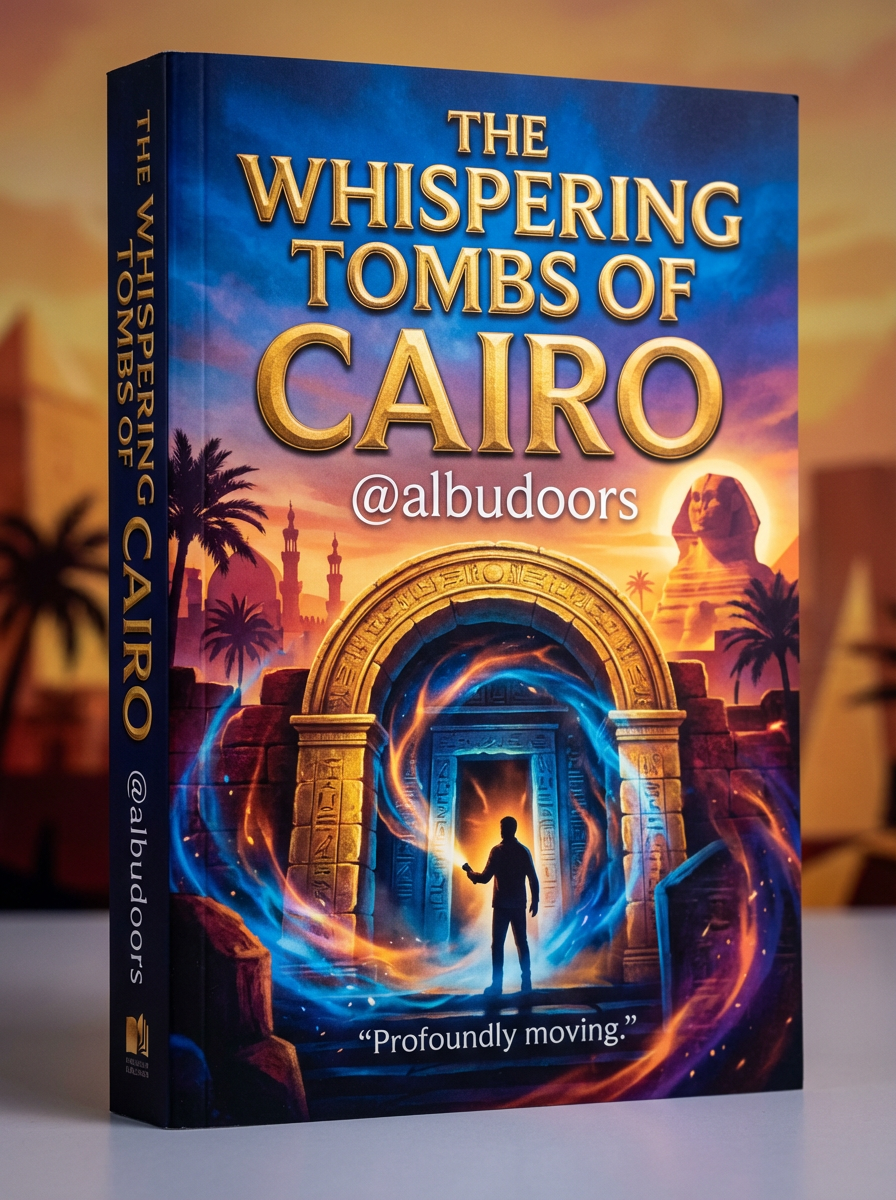
Synopsis
A seemingly innocuous visit to the Grand Museum in Cairo spirals into a harrowing venture as a disillusioned historian, Dr. Aris Thorne, unwittingly awakens an ancient entity during his research. Plagued by cryptic visions and a growing sense of dread, Thorne must decipher the museum's hidden histor
Chapter 1: A Dust-Caked Reverie
The air of Cairo, thick with the scent of diesel and dust, clung to Dr. Aris Thorne’s linen shirt like a second skin. He adjusted the spectacles perched on his nose, the polished lenses reflecting the chaotic brilliance of a city perpetually caught between ancient grandeur and modern clamor. This wasn’t a pilgrimage for him, no romantic rediscovery of a forgotten past. It was a meticulously planned excavation of data, a journey into the linguistic bedrock of history, not its shimmering façade.
His destination, the Grand Museum, rose before him, a colossal edifice of sand-colored stone, its sheer mass an architectural ode to perpetuity. It was a place where millennia slumbered behind glass and velvet ropes, a mausoleum of human ambition and belief. For Thorne, however, it was primarily a repository of scripts, a labyrinth of dead languages waiting to be decoded. He specialized in the nuanced silences between the lines, the forgotten inflections of words etched into stone, papyrus, and clay.
The main entrance, a cavernous maw, swallowed him whole. The din of the city receded, replaced by a hushed reverence, a palpable sense of the past breathing down one’s neck. The air inside was cooler, drier, carrying the faint, metallic tang of preservation chemicals and the indefinable scent of ages. Thorne inhaled deeply, a professional instinct more than an aesthetic appreciation. He’d visited countless museums in his thirty-eight years, each one a similar exercise in academic rigor and personal detachment.
He walked past towering statues of pharaohs, their impassive gazes fixed on some distant horizon, past cases gleaming with gold and lapis, past sarcophagi adorned with intricate scenes of the afterlife. To the casual observer, these were wonders; to Thorne, they were data points, historical markers in a sprawling narrative he was charged with interpreting. His disillusionment with the romanticized notion of history had long since settled into a comfortable, if somewhat cynical, resignation. He sought truth, not magic.
His purpose today was specific, almost prosaic: to verify a set of obscure hieroglyphs mentioned in a recently translated Old Kingdom funerary text. The text spoke of a particular invocation, a series of symbols believed to be a rare early variant of a protective charm, thought to ward off a specific, nameless malady. The museum’s vast collection of funerary stelae and tomb inscriptions was the perfect hunting ground.
He navigated the familiar layout with the efficiency of a seasoned researcher, his footsteps echoing softly on the marble floors. His briefcase, clutched in his hand, was heavy with annotated printouts, a digital recorder, and an array of specialized magnifying tools. He’d secured a permit for limited access to certain lesser-trafficked storage annexes, the dusty capillaries of the museum where the less glamorous, but often more significant, artifacts resided, awaiting their moment of academic glory.
It was in one such annex, a dimly lit corridor lined with objects shrouded in protective sheeting, that Thorne first felt it. A subtle chill, deeper than the museum’s ambient temperature, seemed to ripple through the air. It was less a physical sensation and more a prickling at the edges of his perception, a barely perceptible tremor in the fabric of his senses. He paused, frowning. Perhaps a draft from a poorly sealed window, or the hum of an old ventilation system. He dismissed it, attributing it to fatigue from his flight.
Yet, as he continued, the sensation intensified, a low thrumming that seemed to vibrate in his bones. It was like standing too close to a large, unmoving machine, feeling its dormant power. He peered through the gloom, straining to identify the source. The rows of shrouded artifacts stood like silent sentinels, their forms indistinct beneath their coverings.
Then he saw it.
Tucked away in a recess, overshadowed by a colossal granite sarcophagus that had been awaiting relocation for years, was another, much smaller, sarcophagus. It was unlike any he had encountered in the official inventory. It was unmarked, completely devoid of the elaborate inscriptions and vibrant paint typical of even the most modest burials. Its surface was a dull, dark basalt, unpolished, almost crude in its simplicity. A thin layer of ancient dust coated it, giving it a muted, ghostly appearance.
The unsettling presence, he realized with a jolt, emanated from this object.
He approached cautiously, his academic detachment slowly eroding, replaced by a flicker of that long-dormant curiosity he had thought extinguished years ago. His skepticism, his professional armor, suddenly felt flimsy. The air around the sarcophagus was noticeably colder, and a faint, acrid scent, like ozone mixed with something ancient and decaying, tickled his nostrils.
He consulted his notes, then cross-referenced them with the museum’s digital database on his tablet. Nothing. No record of acquisition, no provenance, no identification numbers. It was as if this object simply did not exist within the carefully cataloged universe of the Grand Museum. This shouldn't be possible. Every artifact, no matter how insignificant, underwent a rigorous documentation process.
Thorne reached out, his gloved fingertips hovering inches from the sarcophagus's surface. He hesitated, a strange apprehension tightening his chest. It felt…wrong. Out of place. Like a misplaced piece in a cosmic puzzle.
He finally touched it.
The basalt was surprisingly smooth beneath his gloves, yet it radiated an intense, focused cold that seemed to burrow inward, bypassing the fabric and chilling his very core. At the moment of contact, a jolt, not electrical, but something far more profound, surged through him. It was a flash of sensation, a kaleidoscope of ancient images assaulting his mind: sand-blasted winds, the guttural chant of unknown tongues, the glint of obsidian, and a profound, crushing silence that echoed with unspeakable power.
He snatched his hand back, gasping, his heart hammering against his ribs. The spectral images vanished as quickly as they appeared, leaving behind a faint ringing in his ears and a residual ripple of dread. He pressed a hand to his temple, feeling a sudden, pounding headache bloom behind his eyes.
This wasn't a draft, or fatigue. This was something else entirely.
His training demanded logic, explanation. He ran through a mental checklist of possibilities: a forgotten electrical conduit, a peculiar geological composition of the stone, even a localized humidity anomaly. But none of these accounted for the vivid, intrusive visions or the bone-deep chill that lingered.
He circled the sarcophagus, his gaze now sharpened, analytical, yet tinged with a nascent unease. Its design was stark, almost minimalist, lacking the usual symbolic richness. There were no depictions of Osiris, no protective goddesses, no prayers for safe passage to the Duat. It was a blank slate, an intentional void.
This absence of information was, in itself, a profound statement. In ancient Egypt, every object, especially for burial, was imbued with meaning, with purpose, with a defined place in the cosmos. To be utterly unmarked was an anomaly of staggering proportions.
Thorne pulled out his high-intensity flashlight and directed its beam across the basalt. The stone absorbed the light, reflecting little, revealing only its rough, unyielding texture. He ran his fingers along the seam where the lid met the base, checking for any cracks, any signs of tampering or damage. There were none. The seal appeared unbroken, perfectly preserved.
A cold, analytical thrill began to mingle with his apprehension. This wasn't merely an undocumented artifact; it was a mystery, a historical outlier that defied easy categorization. And mysteries, for all his jadedness, still held a certain magnetic pull for Aris Thorne.
He took out his camera, a high-resolution device he usually reserved for capturing intricate hieroglyphic details. He began to photograph the sarcophagus from every conceivable angle, meticulously documenting its blankness, the unique quality of the stone, its position within the annex. Perhaps, he thought, these images might trigger a memory in some obscure archival record he had overlooked.
As he worked, the strange atmospheric presence around the tomb intensified. It felt less like a passive aura and more like a subtle, expanding awareness. He had the distinct, unsettling impression of being observed, not by a person, but by something ancient and patient, stirring from a profound slumber.
The air grew heavy, thick with unseen pressure. He heard a faint, almost imperceptible hum, like a distant, resonant chord struck deep within the earth. It seemed to come from the sarcophagus itself. He paused, holding his breath, listening intently. Was it his imagination? The isolated silence of the annex played tricks on the mind.
He focused his flashlight beam on the lid again, searching for any faint etchings, any imperfection that might be a clue. He brought his powerful magnifying glass to his eye, sweeping it across the polished rock. Nothing. Absolute, unblemished blackness.
He was about to lower the magnifier when a fleeting shift in the stone caught his eye. For a fraction of a second, the surface seemed to shimmer, to warp, like heat rising from tarmac on a sweltering day. Then it solidified once more, obsidian-still.
His breath hitched. He wasn't hallucinating. He blinked, rubbed his eyes, and looked again. The stone was inert, impassive. But he knew what he had seen.
A primitive instinct, long suppressed by years of academic rationalization, began to stir within him. It was a primal alarm, a warning of something ancient and undeniably *wrong*. This wasn’t just an artifact; it felt like a container for something.
He felt a sudden, inexplicable urge to open it.
The thought was audacious, reckless. He was a historian, a linguist, not an archaeologist or a tomb robber. He had no right, no authority. But the impulse was powerful, a whisper in the silent crypt of his mind, more insistent than any rational objection. It wasn’t a desire for treasure or fame; it was a yearning for revelation, for the truth that lay beneath.
He shook his head, clearing it of the aberrant thought. This was the museum, a place of preservation, not exploration for its own sake. He had a task, a set of hieroglyphs to locate. He needed to refocus.
He turned away from the sarcophagus, forcing himself to walk towards the section of funerary stelae he had originally intended to examine. But the image of the dark, unmarked coffin burned in his mind, and the oppressive cold lingered, burrowing into his thoughts.
He busied himself with his research, meticulously examining each stela, cross-referencing symbols, taking down notes. Hours passed. The sun outside traversed its arc, and the muted daylight filtering through the high windows softened to a twilight glow. Museum staff began their rounds, urging the last stragglers out. Thorne, lost in his work, barely noticed.
But even as he deciphered the cryptic prayers of long-dead priests, fragments of the strange visions from the sarcophagus pulsed at the periphery of his consciousness: glimpses of swirling sand, the echo of a forgotten name, a profound sense of ancient power tethered to a boundless void.
He knew, with a certainty that chilled him to the bone, that his visit to the Grand Museum had taken an unforeseen turn. The simple verification of hieroglyphs had been overshadowed by a profound, disturbing encounter. The unmarked basalt sarcophagus, devoid of any discernible history, was humming with a secret, a dormant power that had stirred, however faintly, at his touch.
Aris Thorne, the jaded historian who sought only the verifiable, the concrete, found himself standing at the precipice of something intangible, something that transcended the neatly cataloged narratives of the past. He had come to the Grand Museum to dispel a linguistic enigma, but he had stumbled upon one far greater, one that whispered of a history that defied documentation, a power that even the most ancient texts had deliberately left unwritten.
As he finally gathered his belongings, preparing to leave, he cast one last glance back at the shadowed recess. The sarcophagus was obscured by the deepening gloom, but he could still feel its presence, a cold, hungry stillness in the heart of the museum. A flicker of the terror he had felt earlier returned, but this time, it was mingled with a dangerous, burgeoning sense of intrigue.
His dormant curiosity, it seemed, had not only flickered; it had ignited, casting a long, unsettling shadow that threatened to consume his carefully constructed world of reason and logic. The dust-caked reverie of the Grand Museum had, for Aris Thorne, just begun.
Chapter 2: The Obsidian Shard
The museum's hushed reverence transformed into an echoing emptiness under the cloak of night. Aris, his footsteps muffled by soft-soled shoes, moved through the darkened corridors with the practiced ease of a phantom. The faint glow of his handheld LED beam danced across ancient faces carved in stone, illuminating the watchful eyes of pharaohs and gods. A thrilling, illicit pulse quickened in his veins, a stark contrast to the weary resignation that usually defined his days. This was the historian’s true domain – not the sterile lecture halls or dusty archives, but the silent, breathing heart of the past, unobserved and unadulterated.
He reached the designated hall, the air growing perceptibly cooler, heavier. The unmarked sarcophagus, a stark basalt monolith amidst the polished exhibits, seemed to draw all available light into itself. Its plain, unadorned surface, devoid of the customary funerary texts or elaborate carvings, was precisely what had snagged his attention. It wasn’t a masterpiece, yet its very anonymity screamed of something forgotten, or perhaps, deliberately hidden.
Aris switched off his torch, allowing his eyes to adjust to the deeper gloom. Moonlight, filtered through the high arched windows, cast long, skeletal shadows across the floor, making the statues appear as if they were stirring from an eon-long slumber. He pulled on a pair of thin, tactile gloves, more for psychological comfort than any real protection from contamination – he wasn't planning on touching the interior, not yet.
He ran his gloved fingers over the rough-hewn stone, searching for anomalies. The lid, a colossal slab, was a masterclass in ancient engineering, fitting seamlessly. He’d already noted the absence of the conventional seals and protective curses, another peculiarity that only deepened the enigma. No inscriptions, no dedication, only the raw, unyielding rock. It was as if its contents were meant to be utterly obliterated from memory.
Minutes stretched into an eternity as he meticulously examined every inch of the outer surface. He brought the LED back, a focused beam tracing the lines. Then, his fingers brushed against a subtle indentation near the sarcophagus's base, at the juncture where the lid met the body. It wasn't a crack, nor a natural fissure in the basalt. It was a faint, almost invisible seam, a hairline fracture interrupting the otherwise monolithic surface. He leaned closer, holding his breath, a thrill of discovery momentarily overriding his usual cynicism.
He produced a set of specialized tools from his satchel – delicate picks, scrapers, and a tiny endoscope. The curator, Dr. El-Amin, would have apoplexy if he knew. This was blatant archaeological interference, a violation of protocol, but Aris couldn't shake the feeling that conventional methods wouldn't yield the answers he sought. This sarcophagus wasn't playing by the rules.
Carefully, he inserted a fine steel pick into the seam, gently probing. There was resistance, but not the solid, unyielding kind he expected from rock. It felt hollow, as if something lay just beneath the surface. He probed again, applying a fraction more pressure, and felt a faint *click*.
A section of the sarcophagus, roughly the size of his hand, recessed inward with almost imperceptible movement. It was a hidden compartment, ingeniously designed, a secret within a secret. His heart hammered in his chest, a primal drum echoing in the silent hall. This was it. This was why he’d been drawn here.
He widened the opening with his tools, revealing a small, dark recess. He angled his LED beam inside. There, nestled within a finely carved hollow, lay a single object. It was small, no larger than a child’s fist, and exquisitely smooth. It was a shard of obsidian, polished to an impossible sheen, darker than the deepest night.
What truly arrested him, though, was the light it seemed to absorb, or perhaps, radiate. A faint, internal glow, a simmering ember deep within its volcanic heart, pulsed with an almost imperceptible rhythm. And then, he felt it – a warmth. Not the natural heat of basalt retaining the day's warmth, but an active, unnatural heat, emanating from the obsidian itself, like a tiny, self-sustaining star.
A tremor of unease, cold and sharp, snaked up his spine. This wasn't merely an artifact; it was something else entirely. Against his better judgment, against every instinct of caution screaming in his mind, he reached out. His gloved fingers, calloused by years of handling brittle papyri and ancient pottery, grazed the surface of the obsidian.
The warmth intensified, no longer faint but an insistent, almost scalding pressure against his skin. It seeped through the thin fabric of his glove, burning with an internal fire that felt both ancient and alien. He felt a peculiar vibration, a low thrum that resonated not in his hand, but deep within his bones, a disharmonious chord strumming through his very being.
And then, the world fractured.
It wasn't a flash, not a blinding light, but an inversion of reality. The shadows in the hall dissolved, replaced by a suffocating, impenetrable darkness that pressed in on him from all sides. He was no longer standing in the Grand Museum of Cairo, but suspended in a void, a chilling vacuum where air itself ceased to exist.
A searing pain lanced through his skull, a pressure building behind his eyes as if his brain were trying to burst from its confines. Images, vivid beyond anything he had ever experienced, exploded into his consciousness, unbidden and terrifyingly real.
First, the city. Not Cairo, not any city he recognized from his extensive studies. This was an ancient metropolis, vast and sprawling, built of impossibly dark stone that seemed to drink the light. Its architecture was unlike any known civilization—towering, cyclopean structures, their facets sharp and unnerving, like a geometric nightmare. Spires pierced a sky that was not blue, but a perpetual twilight, tinged with sickly green and bruised purple, as if a cosmic bruise hung perpetually overhead.
He saw impossible angles, walkways that twisted upon themselves, defying gravity and logic. There were no discernible roads, only vast, empty plazas and narrow, canyon-like alleys that snaked between monstrous edifices. The air was thick with something he couldn't name, a pervasive, clinging dread that permeated every stone, every shadow.
And then, the people. They were not human, not precisely. Gaunt, elongated figures moved through the twilight city, their forms shadowy and indistinct, yet carrying an undeniable sense of purpose, of ritual. Their faces, obscured by shadow and the strange, iridescent hoods they wore, hinted at something beyond human comprehension – perhaps a terrifying parody of human features, or something utterly alien. They moved in silence, a dreadful, echoing silence that vibrated with suppressed screams.
Then, the shift. The dread thickened, becoming palpable, a suffocating blanket. Panic, cold and sharp, ignited within him. The perspective shifted, becoming more intimate, more terrifying. He was no longer an observer, but somehow *there*, amidst the silent throngs. The ground beneath his feet, the impossibly dark stone, felt slick and cold.
A sound, faint at first, then growing in intensity. It was a low, guttural chanting, not of human origin, devoid of melody or rhythm, a cacophony of scraping stone and rasping breath. It came from the towering structures, from the unseen depths of the endless alleys.
And then, the light. Not sunlight, but an unholy illumination that pulsed from the very air, a malevolent, shimmering aura that bathed the city in a grotesque glow. And with it, came *them*.
From the impossibly angled structures, from the depths of the shadowed alleys, they emerged. They were not figures, but sensations, presences that defied form. Tentacles of shadow, eyes that gleamed with cold malice, mouths that stretched into impossible, consuming voids. They moved with a predatory grace, flowing through the city like a tide of living darkness.
The creatures, whatever they were, began to consume the elongated denizens of the city. It wasn't violence as Aris knew it – no blood, no screams. Just a chilling dissolution. The shadowy figures of the city's inhabitants would be enveloped by the creeping darkness, their forms shimmering for a moment, then simply *gone*. Absorbed. Erased.
A silent, all-encompassing horror swept through the city. The chanting ceased, replaced by an even more dreadful silence. The remaining inhabitants did not flee; they seemed paralyzed, resigned, their gaunt forms stoically awaiting their inevitable absorption. There was no resistance, only a profound, ancient despair that resonated to his very core.
The vision intensified, zooming in, becoming intensely personal. He felt the cold touch of one of the shadowy tendrils on his own skin, tasted the metallic tang of fear, smelled the acrid scent of something ancient and foul. He struggled, desperate to break free, to escape this nightmare, but he was trapped, a helpless observer in a cosmic horror show. The world swirled into an amorphous mass of shadow and despair, the air thick with the silent screams of a devoured civilization.
Just as the darkness threatened to consume him entirely, a searing white-hot pain erupted in his hand, where his gloved fingers still clutched the obsidian shard. The world snapped back into focus with a disorienting lurch.
He was back in the echoing hall of the Grand Museum, moonlight still casting skeletal shadows, the sarcophagus looming before him. His hand, no longer gloved, was burning, a vibrant red welt already forming on his palm where the obsidian had rested. He barely registered the pain, his mind reeling, his breath catching in his throat.
The obsidian shard lay on the sarcophagus, its internal glow now barely perceptible, its unnatural warmth faded. It looked innocuous, a simple piece of volcanic glass, but Aris knew better. He knew what horrors it contained.
He stumbled backward, away from the sarcophagus, his legs threatening to give out. His chest heaved, his heart a frantic drum against his ribs. The images, though gone, left a terrifying residue, a visceral memory that clung to his senses. The taste of fear, the smell of despair, the chilling silence of a devoured civilization.
He leaned against a nearby display case, its glass front cool against his fevered forehead. His hands trembled uncontrollably. He squeezed his eyes shut, trying to force the images away, but they persisted, flickering at the edges of his vision. The cyclopean city, the shadowy figures, the consuming darkness.
Was it a vision? A hallucination brought on by fatigue, by the feverish excitement of discovery? His rational mind, the mind of a historian trained in objective analysis, screamed for a logical explanation. But the experience had been too vivid, too immersive, too terrifyingly real. The burning pain in his hand was tangible proof.
He opened his eyes, scanning the silent hall as if expecting the shadowy entities to manifest, to coalesce from the gloom. The ancient statues, once comforting in their familiarity, now seemed to leer, their carved expressions holding a secret knowledge. The air still felt heavy, charged with an unspoken dread.
Slowly, carefully, he pushed himself away from the display case. His movements were jerky, uncoordinated. He snatched his satchel, his scientific tools suddenly feeling like childish trinkets, utterly useless against the profound terror he had just witnessed.
He glanced back at the sarcophagus, at the innocuously dark shard. It held a horror he hadn't believed possible, a window into a reality that defied every principle he held dear. He had sought obscure hieroglyphs, archaeological anomalies. Instead, he had stumbled upon a nightmare.
Walking back through the museum's silent halls, Aris Thorne was no longer the jaded historian. The cynicism that had defined him for years had been burned away, replaced by a profound and chilling dread. The subtle, unsettling presence he had felt upon entering the museum now had a face – or rather, a lack thereof – and it was consuming.
He had awoken something. He had touched something ancient, something malevolent. And the nagging question that echoed loudest in the terrifying silence of his mind was: what had it touched in return? And what did it want? The whispers in the tombs of Cairo had just acquired a terrifying, silent roar.