The Weight of Stillwater
By Mikael Löwgren
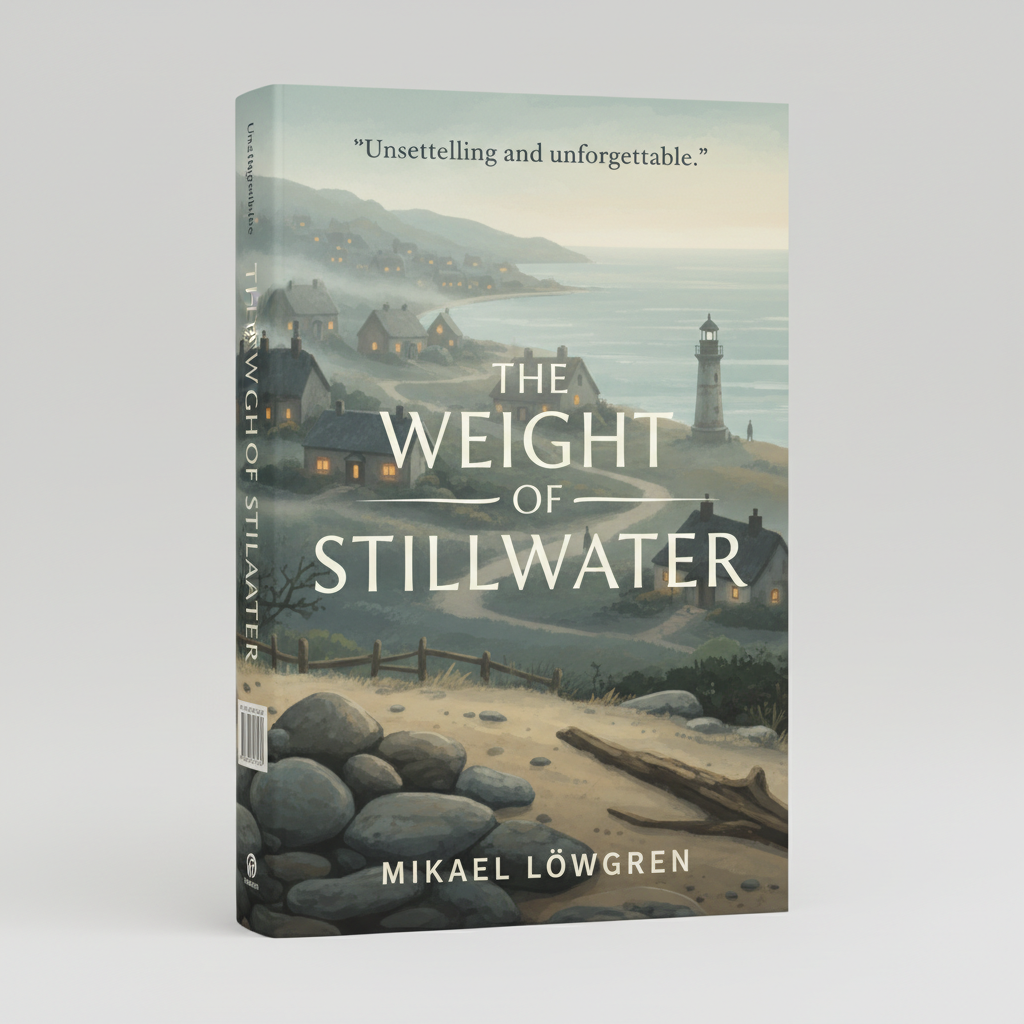
Synopsis
A man adrift returns to the timeless coastal town of his youth, seeking not answers, but the quiet reconciliation found in the unhurried echoes of a life once lived.
Chapter 1: The Salt-Kissed Return
The hiss of the air brakes was a sound Elias remembered, though muted by the years. It was the sound of arrivals, of departures, of the tenuous thread connecting Stillwater to anywhere else. The bus, beige and smelling faintly of diesel and stale coffee, exhaled him onto the cracked asphalt of Main Street. He stood for a moment, a man-shaped shadow against the afternoon sun, his backpack slung over one shoulder like a reluctant appendage. The air, thick with brine and the faint, sweet decay of tidal marshes, filled his lungs, a taste of home he hadn't realized he was craving.
Stillwater. The name itself was a balm, a promise of quietude that had eluded him for decades. Twenty-seven years, if he was marking time precisely, though it felt more like an entire geological epoch had passed since his last breath in this place. The street was mostly empty, a ghost of the bustling thoroughfare he remembered. The general store, its paint peeling like sunburnt skin, stood sentinel at the corner, its porch sagging under the weight of countless forgotten conversations. Old Man Hemlock’s Tackle Shop was now a weathered shell, windows dark, a single, faded sign proclaiming “Closed Permanently.” A gnarled oak, a constant in his childhood, still guarded the intersection, its branches reaching like ancient, arthritic fingers towards the pale sky, rustling with a sigh that could have been the sea’s or his own.
He found his feet moving without conscious command, drawn by an invisible current. His gaze swept over the familiar textures: the rough-hewn granite of the seawall, stained dark with algae and salt spray; the skeletal remains of a forgotten pier, barnacle-encrusted pilings jutting from the restless water like broken teeth; the distant glint of the lighthouse, a lonely sentinel guarding the harbour’s mouth. Each detail was a whispered conversation with a younger self, a faint echo of laughter or a childish fear of the deep. Nothing had changed, and everything had.
The scent of salt grew stronger as he left Main Street, turning down a narrow lane that wound like a forgotten ribbon towards the coast. Crabapple trees, their blossoms long gone, stood sentinel, their branches heavy with unripe fruit. The houses grew sparser, their gardens wilder, untamed. He passed Mrs. Albright’s cottage, its window boxes overflowing with a riot of geraniums, just as they always had been. He wondered if she still knitted by the window, her needles clacking out a quiet rhythm to match the tides.
Then, there it was. Not the grand, imposing structure of memory, but a humble edifice, hunkered down against the elements, as if bracing against an eternal wind. His ancestral cottage. It sat nestled amidst a tangle of wild roses and sea grass, a silent testament to endurance. The white paint on its clapboard siding was flaking, revealing patches of weathered wood beneath, like old skin shedding its layers. The shutters, once a cheerful sea-foam green, were faded to a ghostly pale. A loose shingle rattled a mournful tune in the soft breeze, a solitary percussion against the backdrop of the waves.
He approached slowly, each step a deliberate act of communion. The gravel path, overgrown with weeds, crunched under his worn boots, a sound that felt both alien and profoundly intimate. The front door, a robust slab of oak, was still the same, though the brass knocker was tarnished green with age. He reached out, his fingers tracing the familiar contours of the wood, feeling the grain beneath his fingertips, a texture that evoked a lifetime of memories. The subtle scent of old wood and the distant tang of the ocean filled his senses, a strange alchemy of comfort and longing.
The front yard was a wilderness. What had once been a neatly tended garden was now a riot of untamed growth – tenacious bindweed throttling the rose bushes, tall grasses swaying in the breeze, a wild clematis clambering up the porch trellis like a determined vine of green fire. A broken bird bath, cracked down its middle, lay half-buried in the tall weeds, a relic of a past attempt at domesticity. He imagined his grandmother, her hands stained with earth, coaxing life from this very soil. The thought brought a faint smile to his lips, a ghost of a memory that warmed him from the inside out.
He walked around to the side of the house, his path cleared only by instinct. The salt spray had eaten away at the siding here, leaving a crusty white residue. The back door, a less formal entrance, looked as though it hadn't been used in years. It was boarded up with two mismatched planks of pine, hastily nailed, as if to ward off intruders, or perhaps, simply the relentless passage of time.
Back to the front, he found his eyes drawn to the porch. Not just any porch, but *the* porch. Long and narrow, it stretched across the front of the cottage, providing a partial shield from the sun and rain. And there, hanging from its customary hooks, was the porch swing. It was unpainted now, weathered to a soft, silvery grey, its chains rusted, fixed in a static, unmoving pose. Yet, it beckoned, a silent invitation to an indeterminate pause in his life's journey.
He ran a hand over the rough-hewn wood of the porch railing, feeling the grit of the salt and the years. He blew gently, scattering a fine layer of dust that shimmered in the late afternoon sun. He climbed the two wooden steps, each creak a lament for footsteps long gone. With a grunt, he pushed the swing. It groaned, protested, and then slowly, reluctantly, began to move. A small plume of dust, like a tiny cloud, billowed from beneath the seat.
He sat down, testing its resilience. The swing sagged slightly, but held. The rusted chains sang a high-pitched, almost imperceptible lament as he pushed off with his foot. Back and forth, back and forth, a slow, gentle rhythm. The motion was hypnotic, a soothing balm to his restless spirit. The air, cool and fresh, swirled around him, carrying with it the scent of salt and damp earth. He closed his eyes, allowing the rhythm to carry him, to strip away the accumulated grit of his traveling, of his living, of the past few decades.
He thought of the last time he’d sat on this swing. He was seventeen, eager to leave, chafing against the quiet confines of Stillwater. He’d dreamed of cities, of bright lights, of a life untethered. Now, the quiet felt less like a constraint and more like a solace. The bright lights had dimmed, the tether had frayed too many times. He was weary, a traveler returning to a haven he hadn't known he needed.
His fingers idly traced a grove in the wood of the armrest, a small imperfection worn smooth by countless hands. He remembered his mother, her gentle hum as she shelled peas on this very swing, the rhythmic click of her fingernails against the pods. His father, reading the newspaper, a comfortable silence stretching between them. Himself, a boy, legs dangling, dreaming of the horizon.
A quiet reconciliation, the logline had promised. He hadn't sought answers, had he? Not consciously. He’d simply found himself drawn, like a gull to the familiar shore. The weight of Stillwater, indeed. It was a weight he was beginning to feel, a comforting pressure against his soul.
The sun began its slow descent, painting the sky in hues of apricot and rose. The ocean, visible only as a sliver of shimmering silver between the distant trees, grew quieter, its roar softening to a murmur. A single seagull cried out, its voice mournful and echoing. Elias watched, his gaze fixed on the familiar landscape, a canvas shifting with the light.
He was here. The salt-kissed air was in his lungs, the silent embrace of the cottage was around him, and the rhythmic creak of the porch swing was a lullaby. He opened his backpack, pulling out a worn plaid blanket, and draped it over his shoulders, a small concession to the evening chill. He wasn't sure how long he'd stay, or what he would do. He only knew that for the first time in a very long time, he felt a flicker of quietude, a fragile sense of belonging. The indeterminate pause had begun. And as the last sliver of sun dipped below the horizon, plunging Stillwater into the soft cloak of twilight, Elias listened to the gentle sigh of the wind through the wild roses, a silent promise of tomorrow. When he finally rose from the swing, his legs stiff, the moon had already climbed high, casting silvery shadows across the long grass. The old house stood dark and silent, but Elias felt no fear. He knew, with a certainty that settled deep in his bones, that it was waiting for him. And he, in turn, was finally ready to listen to its unspoken stories.
Chapter 2: Unfurling Threads
The days in Stillwater stretched out, each one a seamless continuation of the last, like the slow, deliberate unspooling of a fishing net. The sun rose and set with a predictability Elias hadn’t known in years, a rhythm that was less a ticking clock and more the breath of the world itself. He fell into it, this unhurried current, letting it carry him. The grand ambitions, the frantic pursuits that had driven him across continents, now felt like the faint memory of a forgotten dream. Here, the loudest sound was often the sigh of the tide or the insistent call of a gull circling high above the water, its cry a thin, reedy thread in the vast blue.
His ancestral cottage, having shed its initial layer of dust and chill, began to hum with a quiet life. He’d opened windows wide, letting the sea air scour away the years of stagnation, and the scent of salt and ancient wood settled deep into the fabric of the place. He spent mornings sweeping, not with a sense of duty, but with a meditative focus, watching the dust motes dance in the shafts of sunlight that pierced the grimy panes. He’d polished the worn wood of the kitchen table, revealing the faint circular patterns left by generations of forgotten teacups, each mark a silent testament to lives lived within these walls. The simple acts grounded him, each movement a conscious decision, each outcome a small, tangible victory against the encroaching stillness of his own spirit.
He discovered, in a forgotten chest in the attic, a faded quilt, its colors muted but its stitching strong, depicting scenes of boats with billowing sails and houses nestled among wind-bent trees. He draped it over the back of the porch swing, and it became his vantage point, his outdoor chapel. He’d sit there for hours, suspended between the whisper of the house behind him and the endless murmur of the ocean before him. The swing creaked a familiar tune, a lullaby he’d almost forgotten. He watched the fishing boats chug out at dawn, their tiny lights winking like fallen stars against the dark canvas of the pre-dawn sea, and return at dusk, laden with the day’s bounty, their trawler engines a steady thrum that vibrated through the very planks of his porch.
Food became a simple affair. He visited the small general store a few blocks inland from the harbor, its bell above the door jingling with a welcome that felt both familiar and cautious. Mrs. Gable, her hair a wispy white halo around a face as crinkled as a dried apple, sold him fresh bread and a tin of coffee, her eyes quick and assessing, but her words few. He learned to bake a rudimentary sourdough, the yeasty smell filling the cottage with a warmth that was more than just physical. He’d eat his meals on the porch, watching the sky shift from pale gold to bruised purple, picking out shapes in the clouds, letting his mind wander, untethered.
It was on one such unhurried afternoon, a few weeks after his arrival, that he decided to walk down to the old lighthouse. The path was overgrown, the earth damp and yielding underfoot, but the scent of pine needles and damp earth was a balm. As he rounded a bend where the path opened onto a small, pebble-strewn cove, he saw her.
She was bent over, her back to him, her frame sturdy, dressed in a faded denim apron over a thick wool sweater even in the mild air. Her hands, gnarled and competent, were sifting through the tide-smoothed stones, occasionally plucking one out, examining it, then dropping it into a canvas bag slung over her shoulder. Her hair, once a vibrant auburn he remembered from childhood, was now a deep, burnished grey, pulled back in a loose knot that escaped in stray tendrils around her weathered face.
A knowing settled in his gut before a name formed on his tongue. It was Martha. Martha Thorne. The girl who used to race him down to the water’s edge, her laugh like wind chimes, her knees perpetually scabbed. The girl whose grandmother owned the sprawling, rambling house on the hill, visible from his own cottage on clear days.
He stopped, a respectful distance away, and waited. The only sounds were the gentle suck and sigh of the waves on the pebbles, and the soft rustle of Martha’s movements. He watched her for a long moment, a ghost from his past, now anchored firmly in the present, her form a solid fixture against the expanse of the ocean.
Finally, she straightened, a slow, deliberate motion that spoke of years of physical labor. She turned, and her gaze, a startling shade of blue that still held its youthful intensity despite the fine lines fanning out from the corners, met his. There was no immediate flicker of recognition, just a steady, unblinking assessment.
“Afternoon,” she said, her voice a little rough, like stones tumbled by the tide, but with an underlying sweetness he remembered. She didn’t smile, not precisely, but the corners of her eyes crinkled.
He took a step forward. “Martha?”
Her eyebrows, still thick and dark, lifted ever so slightly. A slow, knowing smile finally touched her lips, a smile that seemed to understand more than he had ever voiced. “Elias Thorne. Well, I’ll be. Thought I smelled a stranger in the air, but the smell ain’t quite new, is it?”
He managed a weak laugh. “You recognized me.” It wasn’t a question.
“Course I did,” she said, her gaze sweeping over him, from the way his hair, once unruly, was now neatly trimmed, to the subtle slump in his shoulders that spoke of a different kind of burden than childhood scrapes. “You walk like your grandpappy. Got the same stoop when you’re thinking too much.” She gestured with a dirt-smudged hand to the patch of shore she’d been working. “Looking for anything in particular?”
He shook his head, feeling suddenly exposed, as though she could see the frayed edges of his soul. “Just walking. Remembering.”
She nodded, a small, tight movement. “Stillwater’s good for that. Plenty to remember here. And plenty to forget, if you’re looking to.” She paused, her eyes lingering on his for a beat longer than necessary. “Heard you were back. Heard it from Agnes Gable. She said you bought a loaf of her sourdough, polite as you please.”
“It’s good bread,” he offered, the mundane conversation a comfortable shield.
“Agnes makes a fine loaf. She always did.” Martha shifted the canvas bag higher on her shoulder, its contents clinking softly. “What brings you back, Elias? Not that it’s any of my business, mind.”
He hesitated. The truth, in its rawest form, felt too heavy for this sun-drenched cove. “Just… time. Time to be still, I suppose.”
Her blue eyes held his, unblinking. There was no judgment there, only a profound, almost ancient understanding. “Stillwater has plenty of that. It holds onto things, this place. Like these stones.” She gestured again to the glittering pebbles at their feet. “Each one’s got a story, if you know how to listen.”
He looked down at the smooth, polished stones, imagining the millennia of relentless ocean shaping them, smoothing their rough edges, leaving them perfectly formed. “Do you listen to them, Martha?”
She chuckled, a dry, melodic sound. “Some of them. Some just need to be picked up and admired. Some need to go into my garden. Keeps the slugs away, they say. And they do look right pretty.” She held out a hand, revealing a small, perfectly round grey stone, veined with white. “This one, this one’s got a good story. Feels good in the hand.”
He took the stone from her. It was warmer than he expected, smooth and cool against his palm. He turned it over, tracing the faint lines, feeling the weight of it. “It does.”
“You staying long?” she asked, her gaze drifting out to the horizon, where the sky met the sea in a hazy shimmer.
He shrugged, the weight of the stone in his hand a surprisingly comforting anchor. “Don’t know. For now.”
Martha nodded, as if his answer was precisely what she’d expected. She didn’t press. Stillwater folk rarely did, not directly. Their curiosity was a subtle current, moving beneath the surface of polite talk, eddying around unspoken truths. “Well, you’re welcome here, Elias. Always were. The cottage looks good, by the way. Saw the light on last night.”
He was surprised she’d noticed. Surprised by the implied watchfulness, the quiet knowledge that blanketed this small town. He realized then that nothing truly went unnoticed in Stillwater, not the arrival of a straggler, not the dim glow of a light in a long-dark window.
“Thank you, Martha,” he said, genuinely. The simple acceptance, the utter lack of fuss, was a balm to a soul accustomed to expectations and demands.
“Don’t thank me,” she said, her lips quirking again. “Just the way things are. You looking for company for supper tonight? I’ve got too many clams.”
The invitation, as casual as it was unexpected, startled him. He hadn’t shared a meal with anyone in weeks, not properly, not with conversation that extended beyond the perfunctory exchange of money for goods.
“I… I’d like that very much, Martha.”
“Good,” she said, a small note of satisfaction in her voice. “Come up to the house just before the sun dips. You remember the way, right? The big one with the crooked chimney.”
He nodded, a smile finally breaking through his own reserve. “I do.”
She turned to leave, her stride strong and steady, the canvas bag swinging gently at her side. “Don’t you go losing that stone, Elias. It’s a good one. Might bring you something precious back.”
He watched her go, a sturdy silhouette against the shimmering ocean. He looked down at the stone again, cradled in his palm, and felt a flicker of something he hadn’t felt in a long time – a quiet anticipation, a faint thrumming of connection. The unfurling threads of his life in Stillwater, he realized, were beginning to weave themselves into something new, something ancient, something that held the quiet promise of a home once known, now slowly, deliberately, rediscovered. The sun began its slow descent, painting the sky with hues of tangerine and rose, and Elias, with Martha’s smooth stone clutched in his hand, started his walk back, the path feeling a little less overgrown, and the air a little less empty. The weight of Stillwater, he was beginning to understand, was not just the burden of memory, but the comforting heft of belonging.
Chapter 3: Echoes on the Tide
The wind, a constant, fretful companion in Stillwater, often sang through the skeletal remains of the old lighthouse, a melody mournful and persistent. But this morning, there was a new discord, a sharper lament. Elias, roused by it, found himself drawn down the winding path that snaked through the sea oats and jagged rocks, towards the structure that had guided generations of fishermen home. He reached the base to find a scattering of glass shards, thick and sea-green, glinting like scattered jewels beneath the skeletal frame of the lantern room. The Fresnel lens, once a magnificent eye, lay shattered, a thousand fractured visions reflecting the dawn.
He stood there for a long moment, the wind whipping at his jacket, tasting the salt on his lips. The lighthouse lamp, broken. It felt like a small, private betrayal, a piece of Stillwater’s enduring promise suddenly rendered fragile. Yet, even in its brokenness, there was a strange beauty, a testament to the relentless power of the sea and the passage of time. He reached down, his fingers tracing the smooth, cold curve of a large shard. It vibrated with a history he couldn’t articulate, a weight he couldn't quite bear. He tucked it into his pocket, a silent souvenir of what was, and what now wasn’t.
Later, in the heart of town, where the cobblestones seemed to hum with forgotten footfalls, Elias found himself lingering in front of 'The Gilded Seahorse,' an antique shop that smelled of dust and forgotten dreams. Its window was a cluttered kaleidoscope of brass telescopes, tarnished silver, and porcelain dolls with vacant stares. Among them, tucked behind a chipped ceramic mermaid, was a photograph. Faded, sepia-toned, it depicted two young boys, all knees and elbows, perched precariously on the weathered timbers of the old fishing pier. One boy, grinning widely, held up a string of small, wriggling fish. The other, a hint of mischief in his dark eyes, was mid-whisper, his head bent close to his companion’s ear.
Elias felt a curious pull, a thread tugging at something deep within him. He pushed open the heavy wooden door, the bell above him announcing his presence with a sleepy chime. The air inside was thick with the scent of beeswax and old paper. Mrs. Gable, a woman whose face was a roadmap of wrinkles and whose eyes held the same keen observation as Martha’s, emerged from behind a towering stack of maritime charts. Her smile was like a moth emerging from a cocoon, slow and deliberate.
"Lost, dear?" she asked, her voice raspy, like dry leaves skittering across pavement.
"Just browsing," Elias replied, his gaze still fixed on the photograph. He moved closer, his heart thrumming an unfamiliar rhythm. He knew that pier, knew the way the wood groaned underfoot, the way the current pulled at the pilings. He knew the sun-drenched innocence of those boys. His fingers trembled slightly as he pointed. "That one."
Mrs. Gable peered over the top of her spectacles, her gaze shifting from the photograph to Elias, then back again. "Ah, the twins. Always causing a ruckus down by the docks. Such lively spirits."
"Twins?" Elias echoed, a knot forming in his stomach. He hadn’t remembered twins. He remembered only himself, and sometimes, a blurred presence beside him that he could never quite bring into focus.
"Indeed. Daniel and Thomas. Splitting image, they were, save for a scar Thomas got on his brow when he fell from the lighthouse scaffolding. Always adventurous, that one." Mrs. Gable chuckled, a dry, rustling sound. "They'd spend their entire summers out on the water, fishing, crabbing, dreaming up grand schemes."
Elias stared at the photograph again, a cold understanding seeping into his bones. The boy with the mischievous eyes, the one whispering… a faint scar, almost invisible in the faded light, arced just above his left eyebrow. His own eyebrow. The boy with the string of fish, healthy and robust… that was Daniel. The other, the whisperer, with a mischievous tilt to his lips and an unburdened joy in his eyes… that was him. Thomas. He hadn't just forgotten Daniel. He had forgotten himself. The weight of Stillwater felt heavier now, not just a quiet reconciliation, but a startling excavation.
He bought the photograph, the transaction a blur of polite conversation. He clutched the framed image as he left, the bell announcing his departure with the same sleepy chime.
He walked aimlessly, the photograph a burning presence in his hands. The familiar streets blurred into a backdrop for the sudden, vivid emergence of memories. Not full, coherent narratives, but flashes—the taste of salt spray on his lips during a makeshift regatta, the sting of a jellyfish, the deep, rumbling laugh of his father, the way Daniel's hand always found his when they were startled by a sudden clap of thunder. He remembered the fierce, unspoken rivalry between them, the shared secrets whispered in the dark, the way Daniel always seemed to know what he was thinking even before he thought it.
He found himself at the docks, the air thick with the smell of diesel and drying nets. Old Finn, his face a roadmap of sun-creased lines, sat mending a net, his gnarled fingers moving with practiced ease. He always had a pipe clenched between his teeth, and a tune, half-remembered, perpetually on his lips. Today, it was a jaunty jig, a melody Elias vaguely recognized from his youth.
Finn stopped his work, his gaze, the color of sea glass, settling on Elias. "Well, look who the tide dragged in again." He offered a toothless grin. "Stillwater always has a way of calling its own back, eh?"
Elias nodded, settling onto an overturned bucket nearby. "Sounds familiar, that tune you're whistling, Finn."
Finn grunted, a plume of pipe smoke curling into the air. "Old sea shanty. Used to be Daniel’s favorite. Always whistling it, that boy. Said it made the fish bite better." He paused, his eyes clouding slightly. "You two were quite the pair. Thick as thieves, you were."
"We were," Elias conceded, the word feeling both hollow and full. He held up the photograph. "Remember this?"
Finn took the photo, his weathered thumb tracing the outline of the two boys. A slow smile spread across his face, not the toothless grin, but something softer, tinged with melancholy. "Aye. Daniel, proud as a peacock with those snappers. And you, Thomas, always the quiet schemer, eh? Always had a glint in your eye, even then." He handed it back. "Lost him too soon, Daniel. A good heart, that one."
"How… how did it happen?" Elias asked, the words catching in his throat. He realized he didn’t just recall the blur of a second boy. He recalled a distinct ache, a chasm. He just hadn't named it, hadn't acknowledged its source.
Finn sighed, a deep, rattling sound. "The sea, lad. She gives, and she takes. A squall came up, sudden-like. He was out farther than he should've been, chasing a school of mackerel. Found his skiff, overturned, a few days later. Never found him." He shook his head slowly. "Your Ma was never the same after that. Broke her spirit, it did."
Elias felt the air leave his lungs in a silent whoosh. He had known, somewhere, in the deepest recesses of his being, a flicker of that sorrow. But it had been buried, carefully, meticulously. He had created a narrative where he was a solitary child, sailing the waters of Stillwater alone. Now, the wall had cracked, and the deluge was threatening to overwhelm him.
"I… I don't remember," Elias confessed, the words tasting like ash.
Finn’s gaze was kind, understanding. "Grief does funny things to a man’s memory, lad. Especially a young one. Sometimes, the mind just… shuts it all away to protect itself. But the sea remembers. And Stillwater, she remembers everything." He turned back to his net, his fingers resuming their rhythmic dance, but the jaunty jig had faded, replaced by a quiet, almost mournful hum.
Elias walked away, the broken lighthouse lens in his pocket, the faded photograph clutched in his hand, Finn’s words echoing in his ears. *The sea remembers. And Stillwater, she remembers everything.* He had come to Stillwater seeking quiet reconciliation, a gentle turning of the page. But instead, the town was turning the pages for him, revealing chapters he had meticulously, perhaps desperately, tried to erase. The unhurried echoes of a life once lived were no longer unhurried. They were demanding, persistent, and suddenly, inescapably loud. He hadn't just returned to Stillwater; he had returned to himself, or at least, to the fractured pieces of the self he had left behind, waiting patiently for his return. And the most unsettling question of all surfaced then, cold and sharp as a broken shard of glass: what else had Stillwater remembered for him? What other truths awaited him in the salt-laced air, hidden within the familiar landmarks he now saw with new, disquieting clarity?
Chapter 4: The Unsaid Between Breaths
The bell above the general store door gave its accustomed jingle, a sound Elias had come to associate with the soft clatter of Martha arranging tins of sardines, or the deliberate rasp of Old Man Hemlock sharpening a pencil. Today, it merely ushered him into an empty quiet, only the hum of an ancient refrigeration unit breaking the silence. A scent, both familiar and indistinct, hung in the air – something of dried lavender mixed with the faint metallic tang of old coins. He found Martha, not behind the counter as usual, but perched on an overturned crate in the back aisle, her fingers deftly untangling a skein of yarn the color of a stormy sea.
She looked up, a smile unfurling slowly across her face, crinkling the corners of her eyes. "Elias. Didn't know if you'd brave the midday sun. It's a proper furnace out there today."
He leaned against a display of fishing tackle, the plastic lures cool against his forearm. "Needed some bait. And a reason to escape the cottage. It gets…stuffy."
Martha just nodded, as if ‘stuffy’ was a word she completely understood, a condition of old houses and older memories, both. She didn't press, didn't offer a knowing glance, just continued her steady work, pulling at a knot with practiced patience. The yarn seemed to flow through her fingers, a dark current seeking its own course.
"Heard you were out by the point yesterday," she said, her voice a low murmur that seemed to rise from the depths of her chest, like the faint whisper of a shell held to the ear. "Seamus saw you. Said you were staring at the old boathouse, like it owed you money."
Elias chuckled, a dry sound that felt foreign in the quiet of the store. "Just remembering. Or trying to. It's funny, the way things blur. The planks looked different. More weathered, I suppose." He paused, watching the knot finally surrender to Martha’s gentle persistence. "Did anyone ever use that boathouse after… after its owner left?"
Martha's hands stilled for a moment. Her gaze drifted past him, through the dusty front window, as if seeing something beyond the visible world of Stillwater. "Oh, bits and pieces, people did. Fishermen, mostly. Needed a place to mend nets, store a skiff for winter. But never properly. Never with the heart it had when Silas was still there."
"Silas," Elias repeated, the name a ghost on his tongue. He remembered a man with hands like gnarled oak, a smile that rarely reached his eyes, and a voice that always carried the low rumble of the tide. Silas had been the one who taught Elias to bait a hook, to read the turn of the current, to tie knots that held against the fiercest squalls. He’d taught him the necessity of patience, too.
"He kept it up, you know," Martha continued, her voice soft, almost meditative. "Even after Elara died. Painted the trim every spring, even when the rot had already taken hold beneath. Said it was for her. Said she always liked the scent of fresh paint on the salt air."
Elara. The name stirred a faint memory, a shadowy figure at the edge of his childhood, a woman with distant eyes and a laugh like wind chimes. Elias hadn't thought of her in decades. He hadn't realized she had passed.
"She was… a gentle soul," Martha offered, as if reading his unspoken question. "Quiet, mostly. But she had a way with flowers. Her garden was the envy of the whole village. Even in the leanest years, she could make things bloom." She looked directly at Elias then, her eyes holding a depth he hadn't noticed before, like ancient pools reflecting a forgotten sky. "It was hard on Silas, after. They say a man can wither without his anchor."
Elias shifted, the fishing tackle digging slightly into his back. The conversation, like so many in Stillwater, circled around the edges of loss, a gentle, almost tender, acknowledgment of the void. Yet, no one ever spoke directly of the sharp, cutting pain, only of its echoes and the ways people learned to live around them. "Did he… stay in Stillwater?"
Martha shook her head slowly, the grey tendrils escaping her bun swaying with the movement. "No. Not long after you left, actually. Maybe a year or two. He just… faded. Sold the boathouse, the cottage. Took what he could carry and went. Nobody knew where. Some said he went up north, to the lobstering grounds. Others that he just went inland, to be away from the sea that took so much from him."
A small silence stretched between them, filled with the faint hum of the refrigerator and the gentle rustle of Martha’s yarn. Elias felt a dull throb in his chest, an ache not of sorrow, but of recognition. The casual disappearances of Stillwater, the unmarked exits from lives that had once seemed as fixed as the tides. He had been one of them.
"Funny," he said, pushing off the display. "I never knew any of that. Just… assumed he was still here. Still fixing nets, still smelling of brine and pipe smoke."
Martha offered a small, knowing smile. "That's how it is with Stillwater, Elias. Things carry on, whether you're here to see it or not. The currents keep flowing. But they pick up new things along the way, too. And they leave some things behind." Her eyes held his for a moment longer, a silent understanding passing between them, a recognition of shared currents.
He bought a tin of earthworms and a new lead sinker, the familiar weight of the small bag in his hand a comforting anchor. As he reached the door, Martha called out, "Oh, and Elias? Old Man Hemlock was asking after you. He said if you were still fishing with that same old line of yours, you'd never catch anything but seaweed."
A genuine laugh bubbled up from Elias, louder this time, a release of the quiet tension. "Tell him I graduated to braided mono, Martha. He might just have to respect me yet."
He stepped out into the blazing sun, the jingle of the bell fading behind him. The old wooden planks of the sidewalk felt warm beneath his worn boots. He walked towards the docks, the scent of the sea growing stronger with each step. Near the end of the old pier, leaning against a post, was Old Man Hemlock, his face a map of wrinkles, his eyes the color of a well-used fishing lure. He was whittling a small piece of driftwood, the knife flickering in his gnarled hands.
"Heard you were back, boy," Hemlock grunted, not looking up from his work. His voice was like stones tumbling down a dry riverbed. "Took you long enough. Thought the sea had claimed you for good."
"Nearly did, a time or two," Elias replied, leaning against the railing beside him, the wood seasoned smooth by countless hands and the constant kiss of salt spray. The gulls cried overhead, their calls like broken glass. "Martha says you were worried about my fishing line."
Hemlock finally looked up, a spark of amusement in his eyes. "That old cotton thing you used to drag behind you? Barely strong enough for a minnow. Weighed down with more tales than fish, that line was." He paused, his gaze sweeping over the horizon, a lifetime of looking at the water ingrained in his very posture. "You still got a boat, boy? Or are you just gonna stand there and stare at the waves like a rusty lighthouse?"
Elias shook his head. "No boat. Just… thinking about them. And about the ones that used to be tied here." He watched a small fishing skiff chug past, its engine a familiar rumble. "Remember that old skiff Silas used to have? The 'Elara'?"
Hemlock nodded, his knife pausing. "Aye. Good boat, that one. Sturdy. Like the woman it was named after." He resumed his slow, deliberate whittling. "She was a good woman, Elara. Not many like her these days. All sparkle and no substance, these young ones."
"Martha told me she passed," Elias said, his voice quiet.
Hemlock simply grunted, a sound that held a universe of understanding. "That she did. Took a piece of Silas with her, too. Some folks, they're like two halves of a clam shell. You pry one away, the other one just… gapes. Never closes right again." He looked at Elias then, his eyes sharp. "You understand that, boy? That kind of splitting? When a piece of you sails away on the tide, and you just gotta learn to float with the emptiness?"
Elias looked at the endless expanse of the ocean, the way the light shimmered on the water, reflecting a thousand unasked questions. He thought of his own departures, the pieces of him he’d left scattered across distant cities, forgotten memories in dusty boxes, unspoken words suspended in air. He thought of the quiet stillness inside him, a space that sometimes felt like profound peace, and sometimes like a vast, echoing chasm.
"I think I’m starting to," he admitted, the words barely a whisper, swallowed by the ceaseless murmur of the waves.
Hemlock nodded slowly, as if Elias's answer was the only one that truly mattered. He held up the piece of driftwood, now clearly taking the shape of a small, sleek fish. "Sometimes," he said, his gaze fixed on the carving, "you gotta let the sea take what it wants, and then you gotta find something new to whittle. Something to keep your hands busy. Something to remember the shape of what was, but to make it new again." He offered the small wooden fish to Elias, its surface smooth and warm from his hands. "Here. A reminder. The currents change, but the wood remembers the water."
Elias took the fish, its simple beauty a surprising weight in his palm. It was an offering, a quiet acknowledgment of the unsaid things that flowed between them, between all the inhabitants of Stillwater. A quiet, knowing reconciliation, not with the past itself, but with the relentless, unyielding passage of time, and the gentle art of living within its flow. He turned it over in his fingers, the grains of the wood distinct and comforting. The tide was beginning to turn, pulling gently at the boats moored in the harbor, each one swaying in a slow, rhythmic dance. He wondered how many other currents, visible and invisible, were turning inside him, too. And what shapes they would carve from the raw wood of his own return.
Chapter 5: A Homecoming of the Heart
The sky bruised. A purple-grey fist clenching tighter with every passing minute. Elias stood on his porch, the familiar creak of the swing beneath him now a muted thrum against the rising wind. He'd seen storms before, of course, but never one that felt quite like this. The air, usually thick with the scent of salt and sun-baked earth, was now charged, vibrating with an unseen energy that prickled the skin. The gulls, usually raucous and bold, were eerily silent, their wings folded tight against the coming onslaught, perched on chimney pots like wary sentinels.
Then the rain came, not a gentle curtain, but an angry sheet, driven horizontally by a wind that moaned through the eaves like a living thing. It battered the cottage, rattling the old windowpanes, finding every forgotten crack and crevice in the aged timber. Elias watched, mesmerized, as the gentle sway of the ancient oak in his front yard turned into a frenzied thrashing, branches tearing at the churning air. The familiar rumble of the waves, usually a distant lullaby, now roared, a primal scream from the ocean's depths.
A flicker of light, then darkness. The town went black, swallowed whole by the tempest. It was as if Stillwater had collectively held its breath, waiting for the first true impact. A distant clang, like metal striking metal, cut through the wind's howl, followed by another, closer this time, a frantic, desperate rhythm. Elias knew then. It was the docks.
He grabbed his oilskin, its stiff fabric a familiar weight across his shoulders, and fumbled for his old lantern, the one he’d found tucked away in the shed, smelling faintly of lamp oil and forgotten summers. The beam cut a trembling path through the inky blackness as he stepped out into the maelstrom. The wind ripped at his coat, trying to snatch it from him, trying to push him back, but something pulled him forward. A different kind of tether, one he hadn't known was still attached.
The path to the docks, usually a meandering amble, was now a treacherous gauntlet. Debris, torn from unknown origins, skittered across the wet ground. The air was a chaotic symphony of groaning timber, slapping waves, and the insistent whistle of the wind. With each step, the roaring intensified, drawing him closer to the heart of the storm's fury.
He saw them then, a huddle of figures outlined against the churning whitecaps—ghosts wrestling with the very bones of the town. Old Man Hemlock, his frame still sturdy despite the years, was there, his grey hair plastered to his head, shouting orders that were lost to the wind. Martha, surprisingly, was among them, her small figure straining against a thick rope, her face grim.
They were trying to secure the fishing boats, the lifeblood of Stillwater, before they were smashed against the weathered pilings or dragged out to sea. The air was thick with the scent of brine and ozone, the acrid tang of human exertion. Ropes, heavy with seawater, snaked across the slippery planks, pulled taut by straining muscles. Every shout was punctuated by the slam of a wave against the dock, a visceral reminder of nature’s immense power.
Elias joined them without a word. No questions were asked, no greetings exchanged. It was an unspoken understanding, a shared burden that transcended the years of his absence. He took hold of a thick mooring line that had come loose from a cleat, its rough fibers biting into his hands. He leaned into the pull, his shoulders protesting, the familiar ache a welcome grounding in the chaos.
He worked alongside Martha, their hands occasionally brushing on the wet ropes, a fleeting, almost electric contact. Her breath, ragged and sharp, mingled with his in the churning air. He could feel the tension in her small frame, the fierce determination in her movements. She glanced at him once, her eyes dark in the lantern’s flickering light, and a faint nod passed between them, a silent acknowledgment of the moment.
The hours bled into each other, marked only by the shifting light of the lanterns and the relentless assault of the sea. They were a single organism, a collective pulse beating against the storm’s fury. Elias found himself hauling, pushing, shouting, his voice raw, his body aching in places he hadn't felt in years. He was not thinking of his past, nor of his uncertain future. He was only *here*, in this moment, battling alongside these people, for this place.
A rogue wave, larger than the rest, crashed over the dock, drenching them all in icy water, stealing their breath. For a moment, everything was submerged, the world a blurry, roaring expanse of grey and white. When he surfaced, gasping, he saw Old Man Hemlock being dragged towards the churning water, his grip failing. Without hesitation, Elias lunged, grabbing a handful of the old man’s oilskin, pulling him back with a strength he hadn't known he possessed. Hemlock coughed, spitting seawater, and clapped Elias hard on the shoulder, his grip surprisingly strong. No words were needed. The unspoken gratitude was a physical warmth against the cold.
As the first faint streaks of dawn began to paint the eastern sky, a new quality entered the wind's howl. It was still fierce, still demanding, but the unrelenting pressure began to ease, almost imperceptibly. The rain, instead of a horizontal assault, now fell in heavy, vertical sheets. The waves, though still powerful, no longer crashed with the same violent precision. The storm was turning, its back to them, retreating.
Exhaustion settled upon them like a heavy blanket. Their movements grew slower, more deliberate. The communal urgency, though still present, gave way to a weary, profound relief. One by one, the secured boats bobbed gently in their moorings, battered but whole. The docks, though scarred, still stood.
Elias walked slowly back to his cottage, the oilskin heavy with water, his limbs screaming in protest. The sun, a pale, watery disc, was struggling to break through the cloud cover, casting a diffused, ethereal light over the ravaged landscape. He saw splintered fences, overturned bins, and branches strewn across the roads. But amidst the wreckage, he also saw his neighbors emerging, blinking in the nascent light, their faces etched with fatigue but also with a quiet triumph.
He passed Martha’s house, and she was already out, surveying her small, battered garden. She looked up, caught his eye. There was a difference in her gaze today, a softening around the edges, a deeper knowing. She didn't smile, not exactly, but something akin to it touched her lips. "Some storm, Elias," she said, her voice raspy.
"Some town, Martha," he replied, and for the first time in a very long while, the words felt not like a reply, but like a declaration.
He reached his cottage, shed the heavy oilskin, and sank onto the porch swing. The damp wood held the chill of the morning, but a warmth began to spread through his chest, independent of the temperature. The world was quiet now, save for the drip of water from the eaves and the distant murmur of the retreating waves. The air, though still holding the tang of the storm, was fresh, cleansed.
He closed his eyes. The rhythmic swell of the ocean, muted now, was no longer a lament, nor a reminder of what he had abandoned. It was a heartbeat, slow and steady, syncing with his own. He thought of the ropes, rough against his palms, the shared weight, the silent understanding. He thought of Old Man Hemlock's grip, Martha's determined profile.
He hadn't come back seeking answers, not directly. He had come back for a stillness, a pause. But in the heart of the storm, amidst the frantic scramble and the shared burden, something else had found him. A sense of belonging, deep and undeniable, had unfurled within him like a long-dormant flag. He had arrived. Not at a destination, not at the end of a journey, but at a profound, quiet understanding of where he was, and perhaps, finally, who he truly was. And for the first time in decades, the weight he had carried felt not like a burden, but like the anchor that had brought him home. The rain-washed air carried the scent of wet earth and salt, the world was breathing again, and so, irrevocably, was he. He sat there, a silent sentinel, watching the pale sun climb higher, and knew, with a certainty that settled deep in his bones, that the tide had truly turned.
Chapter 6: Weathered Shore, Renewed Spirit
The last gasp of the storm was a sigh, long and drawn out, a ragged breath escaping the bruised maw of the sky. Then, silence. A profound stillness descended, pressing the air close to the earth, muffling the usual orchestral creaks and whispers of Stillwater. Elias stepped onto the porch of the cottage, the planks slick beneath his bare feet, and inhaled. The air was a sweet, sharp draught, tasting of ozone and churned earth, of kelp dragged from the ocean’s dark belly, and the clean, metallic scent of rain-washed stone. He leaned against the porch post, its wood rough against his shoulder, and watched the dawn break.
It was not a fiery, theatrical sunrise, but a slow unfurling, a tentative blush across a sky scrubbed raw and clean. The clouds, shredded to wisps, bled from bruised lavender to palest rose, then to a hopeful, watery blue. Below, the world was reborn. Every leaf glittered, each blade of grass held a jewel, and the cobblestones of the narrow lane shone with an internal luminescence. The very air hummed, vibrant with the promise of a day purged of all that had come before.
He walked down to the shore. The sand, usually a soft, yielding canvas, was now sculpted into intricate, ephemeral patterns, like linen rumpled by a giant’s sleep. Driftwood, twisted into grotesque, beautiful shapes, lay strewn like forgotten offerings. The waves, no longer a furious assault, lapped at the newly defined edge of the land with a gentle, insistent murmur, pulling back with a soft, shushing sigh.
And there it was. A ghost of a thing, standing sentinel in the glass-smooth shallows, its neck a long, elegant curve, its feathers the color of old pewter against the pearl-grey sky. A great blue heron. It stood utterly motionless, one leg raised, poised in that timeless pose of contemplation, its gaze fixed on some invisible tremor in the water. Elias stopped, some distance away, and simply watched.
He knew of herons. Had seen them before, of course, darting through the periphery of his life, usually startled into flight by his approach. But this one seemed unburdened by his presence, or perhaps, simply indifferent. It was a creature of singular focus, of a patience so profound it felt like a sacrament. Each breath it took was imperceptible, each flicker of its eye a universe contained.
Minutes bled into a languid eternity. The sun, climbing higher, began to paint the heron’s back with a warm, golden sheen, highlighting the delicate filigree of its plumes. Still it waited. Elias, too, waited, his own breath falling into a rhythm that mirrored the soft rise and fall of the ocean. He felt the tension, the tight knot that had lived in his shoulders for decades, slowly unwind. The storm had not merely scoured the landscape; it had, in some subtle, inexplicable way, scoured him too.
Then, swift as thought, the heron’s head plunged. Not a splash, not a disturbance, but a precise, elegant dive, a blade cutting through silk. When it rose, a silver flash hung suspended from its beak—a small fish, still wriggling. The heron swallowed it whole, a graceful convolution of its long neck, and then resumed its quiet vigil, as if nothing profound had occurred.
Elias felt a prickle behind his eyes, a strange, bittersweet ache in his chest. It was not sorrow, not regret, but something far older, far more elemental. It was a recognition. A deep, resonant thrum that vibrated through his very bones. The heron had not hurried. It had not fretted. It had simply been, and in its being, it had endured, and in its patience, it had thrived.
This was Stillwater. This stoic, beautiful endurance. The way the tide always returned, no matter how fierce the storm. The way the light always broke through, even after the darkest night. He had come back seeking… what, exactly? He hadn't known then. A balm? Forgetfulness? A mere pause in the relentless current of a life he felt no longer belonged to him? He’d told himself it was to close a chapter, to make peace with the ghosts of his youth. But here, watching the heron, he understood that it was none of those things.
He hadn’t sought answers, because what answers could Stillwater provide that he hadn’t already carried, unspoken, within him? He hadn't sought resolution, because some threads were never truly tied off, merely woven into a larger, more intricate pattern. He had sought the quiet weight of the days themselves. The unhurried echoes. The way the past didn’t disappear, but lingered, a faint scent on the salty air, a shadow lengthening at dusk, a familiar note in the cry of a gull.
His return was not for a reason he could articulate in the tidy confines of language. It was for the gentle weaving of past and present into a tapestry of enduring grace. The old cottage, dust-laden and familiar, wasn't just a place of memory; it was a testament to time’s slow, persistent work. Martha’s knowing gaze wasn’t just curiosity; it was the recognition of two souls, separated by the wide expanse of years, reunited in the shared topography of their youth. The broken lighthouse lamp, the faded photograph, the half-remembered tune—these weren’t merely fragments of a former self, but anchors, mooring him to something real, something solid amidst the shifting sands of his adult life.
The conversations that hovered on the precipice of revelation, never quite crossing it, were not frustrating gaps, but reflections of Stillwater’s own nature: everything revealed in its own due time, nothing rushed, everything understood in the spaces between words. And the storm, that fierce, cleansing tempest, had not just brought him closer to the townspeople, but to himself, to the undeniable, primal need for connection, for belonging.
He found himself smiling, a slow, deep kind of smile that reached his eyes and softened the hard lines around them. It wasn’t the joyous, effervescent smile of a young man, but the quiet, profound contentment of a man who had finally found his way home, not to a place, but to a state of being.
The heron, as if sensing the shift in Elias’s energy, lifted one webbed foot, then slowly, deliberately, placed it down again. It took a single, stately step further into the water, its shadow stretching long and thin before it. Then another. And another. Each movement was deliberate, unhurried, a testament to purpose.
Elias walked too, now, following the curve of the shore, the cool, damp sand yielding softly beneath his feet. He felt light, yet grounded. The air, crisp and clear, filled his lungs with a surprising sense of renewal. The world, freshly scrubbed, sang with a subdued vibrancy. He paused at the edge of the dunes, where the tall grasses, still heavy with dew, bowed in obeisance to the burgeoning light.
From this vantage, he could see the village, a cluster of weathered roofs clinging to the rise above the harbor, smoke beginning to curl from a few chimneys. He could see the small fishing boats, rocking gently at their moorings, their masts sketching faint lines against the brightening sky. He could even discern the familiar, sturdy outline of Martha’s shop, its windows still dark, awaiting the slow awakening of the town.
He had come to Stillwater seeking… something. Perhaps that something was simply this: the quiet reconciliation found in the unhurried echoes of a life once lived, not as a burden, but as a foundation. The realization that some homes existed not on maps, but in the deepest chambers of the heart, waiting patiently to be rediscovered.
He turned away from the vast expanse of the ocean, towards the promise of the day, towards the village that was slowly, patiently, becoming his again. The heron, a solitary, knowing presence, continued its vigil in the shallows, a silent witness to the dawn, to the renewed spirit of the man on the weathered shore, and to the enduring grace of Stillwater. The quiet had settled not just *around* him, but *within* him. And in that profound silence, a gentle, insistent melody began to play. The day had truly begun. And Elias, for the first time in what felt like a lifetime, was truly present to hear it.