The Weight of Salt and Sky
By Mira
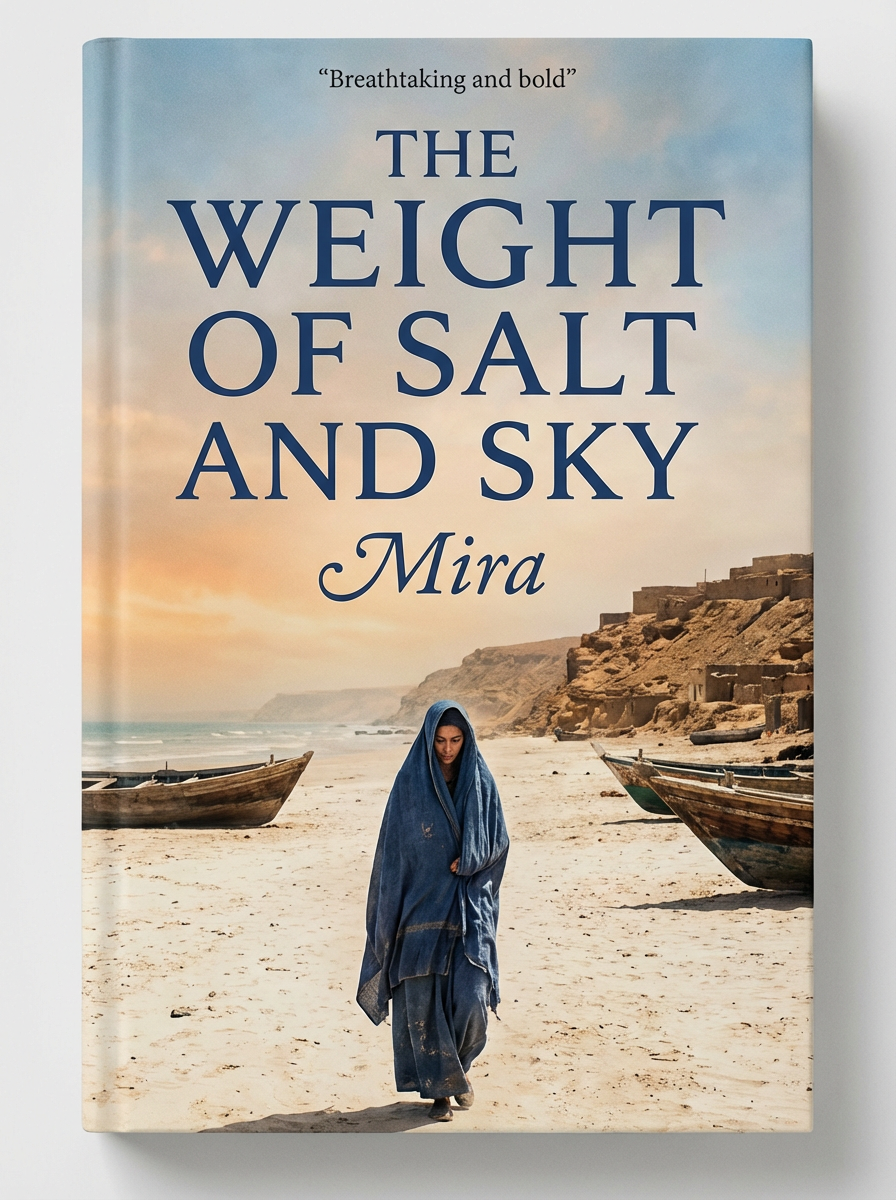
Synopsis
In the remote, sun-baked fishing villages nestled along the arid coast of Yemen, where the sea is both provider and tyrant, a forgotten cholera outbreak silently devastates the weakened population. Amidst the rising tide of disease and despair, a young midwife grapples with her fading faith and a se
Chapter 1: Dust and Thirst
## Dust and Thirst
The wind, a relentless sculptor, had long since claimed the last vestiges of verdant hope from the coastal plains of Al-Hudaydah. Now, it merely stirred the dust into a fine, abrasive mist that clung to everything – to the cracked earth, to the tattered awnings of the market stalls, to the very air Mira breathed. Each inhalation was a gritty prayer, a silent petition for moisture that never came. Even the sea, a shimmering, indifferent expanse, offered no solace, only the promise of more salt.
Mira remembered a time, not so long ago, when the wind carried the scent of jasmine from her grandmother’s small, defiant garden. Now, it smelled only of parched earth and the faint, unsettling sweetness of decay. She pulled her *niqab* tighter, though it offered little defense against the omnipresent grit. Her eyes, the only part of her face exposed, were perpetually rimmed with red, not from tears, but from the constant scourging of the wind.
The village, a cluster of sun-bleached houses huddled against the relentless sun, hummed with a low, anxious energy. It was a sound Mira had grown to recognize, a prelude to whispers, a chorus of unspoken fears. Today, the hum was louder, punctuated by the sharp cries of a woman from the far end of the village. Another birth. Another life precariously balanced between the harsh realities of this world and the ethereal promise of the next.
Mira adjusted the leather strap of her worn midwifery bag, the familiar weight a small comfort against the larger, invisible burdens she carried. Inside, the instruments of her trade – a sharpened knife for the cord, sterile cloths, a handful of dried herbs – felt increasingly inadequate. They were relics from a time when the greatest adversary was a difficult breach, not an enemy that moved like a ghost through the water supply.
She walked past the communal well, its stone lip chipped and stained. A few women, their faces etched with the familiar lines of worry and fatigue, waited their turn, their clay pots clutched tight. The water, when it finally emerged, was a cloudy, lukewarm offering, a far cry from the cool, clear draughts of her childhood memories. A shiver, not of cold, but of a deeper dread, traced its way down Mira’s spine. The well. Always the well. The source of life, now a potential harbinger of a silent, insidious death.
The cries grew more urgent as she neared the house. It was Fatima, a young woman, barely seventeen, with eyes that still held the startled innocence of a fawn. She had married Hamza just a year ago, their wedding a brief flicker of joy in the deepening twilight of their days. Now, that joy was being violently ripped from her.
Mira pushed aside the thin curtain of beads that served as a door. The air inside was thick with the scent of sweat, fear, and something else – something sickly sweet and cloying. Fatima lay on a mat on the floor, her body thrashing, her voice a raw, primal scream. Her mother, a woman whose face was a roadmap of hardship, knelt beside her, mopping her brow with a damp cloth, her own face a mask of helpless anguish.
"Mira, thank God," the mother choked out, her voice raspy with emotion.
Mira knelt, her practiced hands immediately going to Fatima’s distended belly. The baby was coming, fast and hard, a desperate race against an unseen clock. But it wasn’t just the labor that troubled Mira. Fatima’s skin was a peculiar shade of ashen, her eyes sunken, and her breath came in ragged gasps. And there was the smell. That sweet, sickly odor that had become a dreadful signature.
"How long has she been like this?" Mira asked, her voice calm despite the tremor in her own heart.
"Since yesterday, the pains started," the mother whispered, "but… but the sickness, it came this morning. She can’t keep anything down. Not even water."
Mira’s gaze met the mother’s. In her eyes, she saw the dawning of her own silent dread mirrored back. They both knew. They didn’t need to speak the name. The word, a chilling whisper, had already begun to weave its way through the village, a ghost story that was terrifyingly real.
"Bring me hot water and clean cloths," Mira instructed, her voice firm, pushing down the rising panic. She had to focus. She always had to focus. Lives depended on it.
As she worked, guiding Fatima through the agonizing throws of labor, her mind raced. Two days ago, the old fisherman, Yusuf, had wasted away in a similar fashion. His son, a robust young man, had followed just yesterday. Each death, a stone dropped into the quiet waters of their community, sending out ripples of fear. But these were isolated incidents, they had told themselves, the natural course of life in a hard land. Now, with Fatima, so young, so full of life, the pattern was too distinct to ignore.
A low moan escaped Fatima’s lips, her strength waning with each contraction. Mira pressed a cool cloth to her forehead, murmuring words of encouragement, prayers she no longer fully believed in but offered out of habit, out of desperation. Her own faith, once a steadfast lighthouse in the turbulent seas of her existence, had begun to flicker, weakened by the relentless assaults of war, famine, and now, this invisible enemy. How could a benevolent God allow such suffering to fall upon a people who had already lost so much?
The baby, when it finally arrived, was a tiny, fragile girl, barely crying, her skin a mottled blue. Mira cleaned her quickly, her hands trembling despite her years of experience. Fatima, exhausted but relieved, reached out a weak hand for her daughter.
"She’s beautiful, Mira," she whispered, a faint smile touching her lips.
But Mira’s heart sank. The baby’s cries were too weak, her breathing too shallow. And the mother, even after the birth, continued to tremble, her body racked by an unseen fever.
Later, after she had done all she could for mother and child, Mira stepped out into the blinding afternoon sun. The wind had picked up, whipping the dust into miniature cyclones. The air felt heavy, suffocating, not just with the heat, but with the palpable weight of unspoken anxieties.
She saw Hamza, Fatima's husband, sitting on a low stool outside his house, his head in his hands. He was a good man, hardworking, devoted. He had loved Fatima with a quiet intensity that was rare in their village. Mira knew, with a dreadful certainty, that his joy at becoming a father would be overshadowed, perhaps even extinguished, by the darkness that now threatened his young family.
As she walked home, the dust stinging her eyes, Mira felt a cold knot tighten in her stomach. It wasn’t just Fatima. Yesterday, she had heard of two families in the next village, children with the same symptoms, the same rapid decline. The whispers were no longer just whispers; they were beginning to form into a terrifying chorus.
She passed the house of the village elder, old Abu Bakr. He sat outside, as always, his gaze fixed on the horizon, as if searching for an answer in the vast, empty expanse. He was a man of great wisdom, a pillar of their community, but even his shoulders seemed to slump under the invisible burden.
Mira knew what he was thinking. What they all were thinking. The war had taken their men, their livelihoods, their sense of security. The blockade had starved their children, stripped their bodies of resilience. And now, this. This silent, unseen tide of illness, creeping in through the very source of their survival, the water.
She reached her own small, mud-brick house, the cool, dark interior a momentary reprieve from the sun's relentless glare. She closed the heavy wooden door, plunging the room into a cool, almost comforting darkness. But the darkness offered no escape from the thoughts that plagued her.
Mira remembered the news reports, fleeting snippets on a crackling radio, about a distant, nameless disease. Cholera, they called it. A word that had felt abstract then, a tragedy happening to *other* people, in *other* places. Now, it was here, a malevolent presence breathing down their necks, stealing their breath, poisoning their water, and slowly, irrevocably, eroding the very foundations of their lives.
She sank onto her woven mat, the worn fabric a familiar comfort. Her hands, still smelling faintly of birth and sterile soap, trembled. She had saved Fatima’s baby, yes. But for how long? For what kind of life? The weight of salt and sky, the infinite, indifferent expanse above and the harsh, unforgiving earth below, pressed in on her. And in the quiet darkness of her home, Mira felt the fragile threads of her own resilience begin to fray. The faith that had once sustained her felt like a distant memory, a whisper carried away by the relentless, dust-laden wind.
Chapter 2: The Bitter Milk of Sorrows
**The Bitter Milk of Sorrows**
The dawn, a bruised peach-colour, bled across the eastern sky, but brought no warmth to the chill in my bones. My eyes, still gritty with the fine dust of sleep and the coarser grit of sorrow, scanned the small, makeshift clinic. Three new faces had arrived under the cover of darkness, their bodies twisted in the throes of the illness, their cries muffled by the thin canvas walls. Each breath they took seemed to cost them dearly, a ragged symphony of suffering that had woven itself into the fabric of my nights.
Mariam’s small hand, clammy and small, was still clutched in mine. Her fever had broken sometime before the first sliver of light, leaving her skin cool and papery. But the light in her eyes, that fierce, indomitable spark of a six-year-old, had dimmed to a flicker. The dehydration had taken its toll, leaving her hollowed out, a ghost of the girl who, just days ago, chased scuttling crabs along the shore with boundless energy. I stroked her brow, feeling the faint pulse at her temple, a fragile drumbeat against the encroaching silence.
My gaze drifted to the corner, where Fatima sat rocking her infant, Aisha. The baby, no older than four months, whimpered weakly, her eyes glazed over. Fatima’s face was a mask of exhaustion, her once bright kohl-lined eyes now sunken, rimmed with purple. I remembered her from Aisha’s birth, a radiant bloom of a woman, overflowing with the joy of a new mother. Now, she was a wilting flower, her spirit slowly being leeched away by the fear that clung to her like a shroud.
“Mira,” her voice was a dry rasp, “she won’t take the water. She just… pushes it away.”
I rose, my knees protesting with a dull ache, and moved towards her. The air in the clinic was thick with the metallic tang of illness, the faint scent of charcoal smoke from the fire outside where we boiled water, and the pervasive odour of fear. I checked Aisha, her tiny fingers curling weakly around mine. Her fontanelle was deeply sunken, a stark warning.
“Try again, Fatima,” I urged gently, though my own hope felt like a brittle thing, easily shattered. “Just a drop, my love. For your Aisha.”
Fatima spooned a minuscule amount of the rehydration solution to the baby’s lips. Aisha turned her head, a soft, almost imperceptible protest. A fresh wave of despair washed over Fatima, and a tear, hot and heavy, tracked a path down her dust-streaked cheek.
The stories from the other villages, carried on the hushed whispers of travellers and the stark, official pronouncements that filtered through on crackling radio signals, painted a grim picture. Cholera. A word that tasted like ash in the mouth. A word that, here, in this forgotten corner of the world, felt like a deliberate act of divine indifference. The news reports spoke of humanitarian aid, of supplies being airlifted, of international efforts. But here, the only aid we saw was the dwindling supply of oral rehydration salts I carefully rationed, and the tireless, increasingly desperate efforts of a handful of women like myself.
We were told to boil water, to wash hands, to keep clean. But how do you boil water when fuel is scarce and expensive? How do you wash hands when water itself is a precious commodity, fetched from a well that might itself be tainted? How do you keep clean when the very dust that coats everything carries the invisible enemy? The advice felt like a cruel joke, a taunt from a world that had no understanding of our reality.
Later that morning, the fishermen began to return, their dhows cutting through the shimmering expanse of the Gulf of Aden. Their faces, usually etched with the stoic resilience of men who wrestled their livelihoods from the unforgiving sea, were now shadowed with a different kind of weariness. They knew. They saw the vacant houses, the women with their heads bowed in grief, the children whose laughter had been replaced by a haunting silence.
Old Hassan, his beard as white as the sea foam, approached the clinic, his shoulders slumped. He didn't speak, but his eyes, rheumy with age and sorrow, communicated a thousand unspoken words. He simply gestured towards his small, mud-brick home on the edge of the village. I knew what it meant. Another one.
My feet dragged as I walked the short distance, the sand hot beneath my worn sandals. The air, usually alive with the scent of salt and drying fish, hung heavy with the smell of death. Inside Hassan’s home, his youngest grandson, Omar, lay still on a woven mat. Omar, who had once chased me with a stick, pretending it was a sword, his laughter echoing across the dunes. His grandmother, Aisha – named for the prophet’s wife, a name that now felt like a cruel irony – sat beside him, her face devoid of expression, her eyes fixed on the small, still form.
There was nothing I could do. No rehydration salts could bring back the life that had already fled. I knelt beside her, my hand reaching out to touch her arm, a gesture of silent solidarity. She flinched, pulling away as if my touch might carry the very pestilence that had claimed her grandson. The unspoken accusation hung in the air, a bitterness more potent than any herb. We were healers, but in the face of such overwhelming loss, we felt like charlatans, our knowledge and our meagre remedies rendered utterly useless.
As the sun climbed higher, beating down with relentless intensity, the heat began to blur the edges of reality. The cries from the clinic, the silent grief of the villagers, the constant, gnawing fear – it all began to merge into a single, dissonant chord. My own faith, once a steady flame that guided me through the darkest nights, felt like a sputtering wick, threatening to extinguish completely.
I remembered the imam’s sermons, his booming voice echoing in the small mosque, speaking of God’s infinite mercy, of tests and trials, of patience and reward. But where was the mercy in this silent, creeping death? Where was the justice in children perishing before they had even truly lived? These questions, once whispered only in the privacy of my heart, now hammered against the walls of my mind, demanding answers that refused to come.
Returning to the clinic, my heart heavy with Omar’s death, I saw Fatima still trying to coax water into Aisha. The baby’s breathing was shallower now, a faint, almost imperceptible flutter. Her small hand, which had weakly grasped mine earlier, was now still, unmoving.
“Fatima,” my voice was a whisper, a fearful premonition already forming in my gut.
She looked up, her eyes wide and pleading, as if begging me to deny the truth that was slowly, inexorably, tightening its grip. I reached for Aisha, my fingers brushing against the baby’s cool skin. There was no pulse. No breath. The small body, which had once been a vessel of burgeoning life, was now an empty shell.
A choked cry escaped Fatima’s lips, a sound so raw and primal it seemed to tear at the very fabric of the air. She gathered her child close, rocking her, a low, keening wail rising from her throat. It was the sound of a mother’s heart being ripped asunder, a sound that would haunt my dreams for weeks, perhaps months, to come.
I knelt beside her, my own tears mingling with the dust on my cheeks. There were no words, no comforts, that could assuage such pain. All I could do was bear witness, to share, in some small way, the unbearable weight of her sorrow. The bitter milk of grief had overflowed, staining us all. And in that moment, under the indifferent glare of the Yemeni sun, I knew that a part of me, too, had died. A part that believed in the inherent goodness of the world, in the promise of a better tomorrow. It had been replaced by a hollowness, a chilling awareness of the fragility of life, and the brutal indifference of a world that had, once again, chosen to look away.
Chapter 3: Whispers on the Monsoon Wind
The air, usually a suffocating blanket in August, carried a new kind of weight. It wasn't just the humidity, thick and cloying as a fever dream, but the unspoken anxieties that clung to every breath. The monsoon, long overdue, offered no relief, only a restless stirring that rustled the fronds of the stunted palms and set the tattered awnings of the market stalls flapping like troubled wings. I heard the whispers, a low hum beneath the cries of the gulls and the distant thrum of fishing boats. They were not malicious whispers, not yet, but the soft, insidious kind that unravels trust, thread by painstaking thread.
“Another one, they say,” a woman murmured to her neighbor, her voice barely audible above the rhythmic pounding of a mortar and pestle. I was passing the fish market, the smell of brine and drying catch usually a comfort, but today it felt heavy, a shroud. “From the al-Mahdi family. The youngest boy.”
The neighbor’s reply was a sharp intake of breath, a sound I had come to dread. It was the sound of a stone dropping into a still well, the ripple spreading slowly, inevitably.
My own steps faltered. The al-Mahdi family. Their compound, a cluster of sun-baked mud-brick homes, lay just beyond the edge of our village, nestled against the dusty wadi. I had delivered the youngest boy, a small, squalling thing with eyes like polished dates, barely three years ago. The memory of his mother’s joy, a brief blossom in the harsh landscape, felt like a cruel irony now.
The rumors had started as isolated incidents, a child here, an elderly man there, a sudden, violent purging, a rapid descent into the hollow-eyed stillness of death. At first, we attributed it to the usual scourges – bad water, spoiled food, the capricious hand of Allah. But the regularity, the swiftness, the particular, devastating signs, they had begun to weave a new, terrifying narrative. I had seen it before, in the faded pages of my grandmother’s tattered medical texts, in the whispered warnings of visiting aid workers who rarely stayed long enough to see the full bloom of our suffering.
Cholera. The word itself was a dry, rasping sound, a plague that clung to the poor, the forgotten, those with no access to clean water, no voice to cry out against the creeping tide of neglect.
I continued my journey, my basket of medicinal herbs feeling heavier with each step. The path to Zahra’s door was well-worn, a testament to the cycles of birth and illness that defined our lives. She had sent her eldest daughter, Latifa, to fetch me, her small frame trembling with urgency. Zahra, my friend, my confidante, her spirit as fierce and unyielding as the desert itself, was now battling this invisible enemy.
The air inside her home was thick with the scent of boiled rice and fear. Zahra lay on a thin mat, her usually vibrant face a pale, drawn mask. Her eyes, once sharp and knowing, were sunken, her lips cracked and dry. Her body, usually so robust from a lifetime of labor under the unforgiving sun, was wracked with spasms. Latifa, barely ten, sat beside her, a bowl of rehydration salts I had taught her to mix, patiently spoon-feeding her mother. The girl’s face was streaked with tears, but her hands were steady, a fledgling strength emerging from the crucible of her mother’s illness.
“Mira,” Zahra whispered, her voice a reedy sigh. “It grips me. Like a fisherman’s net, dragging me down.”
I knelt beside her, my heart a leaden weight in my chest. I checked her pulse, a thready flutter beneath my fingertips. Her skin was cool and clammy, despite the suffocating heat. The signs were undeniable. The characteristic "rice-water" stools, the rapid dehydration, the cramping.
“We will fight it, Zahra,” I said, my voice steadier than I felt. I took the bowl from Latifa, offering Zahra another sip. “You are strong. You have seen worse storms.”
She managed a weak smile, a ghost of her usual defiance. “This storm… it feels different. It comes from within. It eats at the very water of my being.”
Latifa, her eyes wide with a child’s terror, looked at me. “She will get better, won’t she, Auntie Mira?”
I met her gaze, the raw hope in her young face a sharp pang. What could I tell her? That in this place, far from the hospitals and the sterile wards, our remedies were often little more than prayers and desperate hopes? That the resources we had were a handful of rehydration salts and the collective will of a community already stretched thin by years of conflict and neglect?
“We will do everything we can, little one,” I said, stroking her hair. “Your mother is a fighter.”
But even as I spoke the words, a cold dread snaked its way through me. I had seen too many fighters succumb.
Later that evening, as the sun bled orange into the horizon, painting the sky in false promises of peace, I walked to the well. It was the only source of fresh water for our village, a deep, ancient shaft that had sustained generations. Now, it felt like a poisoned chalice. The whispers had grown louder, sharper. They coalesced around the well, the accusations unspoken but palpable.
“It is the well water,” an old man muttered, his voice raspy. “It must be. What else could it be?”
Others nodded, their faces etched with a weary resignation. They looked at the well with suspicion, with fear, with a dawning resentment. The lifeline of our village, now a potential harbinger of death.
I knew the truth, or at least, a part of it. The well was deep, its water drawn from ancient aquifers. It was unlikely to be the primary source of contamination. More likely, it was the daily rituals, the shared buckets, the common dippers, the lack of proper sanitation in a village where open defecation was a grim necessity. But explaining the complex epidemiology of cholera to a community steeped in tradition and suspicion felt like trying to catch smoke.
My gaze drifted to the distant lights of the fishing boats, bobbing like lonely stars on the dark expanse of the sea. The sea, our provider, our tyrant. And now, the land itself seemed to turn against us.
The weight of my own secret pressed down on me, heavier than any physical burden. I knew how this disease spread. I knew the measures that could stem its tide. But those measures required resources we didn’t have, understanding that was absent, and a level of trust that was rapidly eroding. And then there was the deeper secret, the one that kept me tethered to this place, the one that made every death a personal betrayal.
The monsoon wind picked up, a low moan that snaked through the village, carrying the scent of salt and the faintest echo of a child’s cough. The whispers on the wind were no longer just about the dead, but about the living, about who was to blame, about who would be next. And in their chilling cadence, I heard the fracturing of a community, the slow, agonizing unraveling of the bonds that held us together. And I, Mira, stood at the precipice, holding a handful of rehydration salts and a heart full of doubt, watching the tide of despair rise, knowing that soon, it would consume us all.
Chapter 4: A Calculus of Loss
The wind, usually a boisterous gossip, had fallen silent, leaving the village to bake in an oppressive stillness. It felt like the air itself was holding its breath, waiting for the next blow. My own breath hitched with every step, the coarse sand grating beneath my worn sandals. The sun, a malevolent eye in the bleached sky, beat down relentlessly, making the shimmering heat haze feel like a physical weight.
The news from the capital had arrived with the dawn, carried by a fisherman whose usual robust laughter had been replaced by a hollow-eyed grimace. “They say… they say it’s everywhere now,” he’d whispered, his gaze darting from one shadowed doorway to another, as if the very words might conjure the sickness. “The camps… overflowing.”
A calculus of loss. That’s what it had become, a grim tally that gnawed at the edges of my sleep, staining my waking hours with dread. It wasn’t just the numbers reported by the distant, disembodied voices on the crackling radio – thousands, tens of thousands. Here, in the confines of our village, it was the ache of a familiar face gone, the hollow echo in homes that had once bustled with life.
I walked towards Zahra’s dwelling, my heart a leaden stone in my chest. Her youngest, little Tariq, had been feverish since yesterday. I’d spent the night before with them, watching his small body convulse, listening to Zahra’s choked prayers. The brackish well water, once a lifeline, now felt like a curse. It was the only water we had left, and each sip was a gamble.
As I approached, the usual morning sounds were absent. No children’s shouts, no clatter of pots, no rhythmic thud of the pestle. Only the low hum of flies, a morbid accompaniment to the silence. The air, thick and still, carried the faint, sickly sweet scent of sickness, a smell I was coming to know intimately.
Zahra sat outside her door, a silent sentinel. Her usually vibrant headscarf was askew, her eyes red-rimmed and vacant. In her arms, wrapped in a faded blue cloth, was Tariq. His small face, usually bright with mischief, was now a waxen mask, his lips slightly parted, a faint, sweet smell clinging to his skin.
My breath caught. I didn’t need to ask. The stillness of his tiny form, the way Zahra held him, as if he might crumble to dust if she loosened her grip – it told me everything.
I knelt beside her, the sand warm beneath my knees. I wanted to offer words of comfort, but they felt like hollow things, inadequate against the immensity of her grief. What comfort could I offer when my own heart was ragged with the same fear, the same creeping despair?
She looked up at me then, her eyes, usually so full of warmth, now like deep, dark wells. “He’s with Allah, Mira,” she whispered, her voice a dry rustle of leaves. “He’s with Allah now.”
The words were a comfort, a balm she offered herself, but I saw the tremor in her hands, the way her chin trembled despite her resolve. She was trying to believe it, trying to find solace in the ancient promise. But I knew, just as I knew the bitter taste of the well water, that a part of her was screaming against the injustice, against the senselessness of it all.
Later, as the sun began its descent, painting the sky in fiery hues that mocked our somber mood, we gathered for the burial. The ground was hard, unyielding, as if even the earth itself was reluctant to take another one. The men, their faces etched with a grief that went beyond tears, dug in silence. The women, their keening whispers a mournful symphony, watched, their hands clasped over their mouths, trying to hold back the torrent of their own sorrow.
I stood beside Omar, his usually strong shoulders bowed under the weight of his own silent grief. His younger sister, Fatima, had been taken just last week. Her bright, inquisitive eyes, her quick laughter – all gone. He hadn’t cried then, not openly, but I saw the way his jaw was clenched, the raw pain in his eyes. He squeezed my hand, a silent acknowledgment of the shared burden.
The Imam, his voice hoarse with overuse, recited the prayers. His words, usually a source of strength, now felt thin, almost transparent, like a veil barely concealing the abyss. How many times could he utter the same blessings, commend another soul to God, before his own faith began to fray? I wondered if he, too, wrestled with the silent questions that gnawed at me: *Where is the mercy in this? Where is the justice?*
As Tariq's small body was lowered into the earth, I felt a tremor run through the small crowd. It wasn’t just grief; it was fear, a cold, insidious dread that seeped into our very bones. Each burial was a stark reminder that none of us were safe. The disease didn’t discriminate. It took the young, the old, the strong, the weak. It was a silent, invisible predator, and we, with our meager remedies and failing faith, were its helpless prey.
Later that evening, the moon, a sliver of bone in the ink-dark sky, cast long, distorted shadows across the village. I sat on my small porch, the air still heavy, the silence punctuated only by the distant, rhythmic crash of the waves. My midwifery bag lay beside me, its familiar weight now feeling like a burden rather than a comfort. The few medicines I had were dwindling, their efficacy questionable against such a relentless foe.
I thought of the headlines from the capital, the vague promises of aid, the international organizations making pronouncements from afar. They spoke of "containment" and "mobilization." Empty words that offered no solace to the mother holding her dead child, no relief to the feverish body, no clean water to quench the thirst that was slowly killing us.
A choice had been presented to me, a quiet offer from my cousin in the city: a chance to leave. He had connections, a way out. The thought had been a fleeting, guilty whisper, immediately squashed by the image of Zahra’s vacant eyes, Omar’s bowed head. How could I leave? Leave them to this slow, agonizing decay?
But then, the other voice, the one that whispered of self-preservation, of the futility of staying, would resurface. What good was I here, watching them die, my hands tied by a lack of resources, a lack of hope? Was my presence a comfort, or just another witness to their suffering?
The moral complexity of it all was a tangled knot in my gut. To stay was to face a slow erosion of spirit, a constant confrontation with death. To leave was to abandon, to choose self over community, a betrayal that would burn worse than any fever.
The sound of a cough, dry and hacking, drifted from the direction of the well. My eyes snapped open, my body tensing. Another one. The calculus of loss continued, each gasp, each shudder, another entry in the grim ledger. And I, Mira, the midwife, the one who brought life into the world, was now increasingly called upon to bear witness to its brutal departure. The salt of the sea, the dust of the land, the sky that watched it all – they held our stories, our silent screams, our slow surrender. And I, like them, could only watch, and wait, and wonder what would be left when the storm finally passed.
Chapter 5: Where the Horizon Breaks
The sea, usually a balm, felt like a judgment this morning. Its rhythmic sigh against the shore was a mockery of the gasping breaths I’d heard through the night. The air, thick with the scent of salt and death, clung to my skin like a shroud. I walked the beach, not for solace, but because the walls of my small dwelling felt too close, too heavy with the ghosts of yesterday.
Far out, the horizon shimmered, a bruised purple where dawn had struggled and lost to the perpetual haze. It was a line that promised nothing, offered no escape, only an endless continuation of what lay before us. I thought of the news that had flickered across the crackling radio last week, a voice from a distant city speaking of cholera, of aid, of numbers that meant nothing to the families I knew, whose names and faces were etched into the landscape of my heart. They spoke of *cases*, of *mortality rates*. I spoke of Fatima, her eyes wide with terror as the life drained from her daughter. I spoke of Ahmed, his strong fisherman’s hands now trembling, too weak to lift a spoon.
A piece of driftwood, bleached smooth and white, lay half-buried in the sand. I knelt, tracing its weathered grain with a numb finger. It had once been part of something grander, a tree, perhaps a boat, now reduced to this forgotten fragment, tossed by indifferent currents. We were all driftwood now, weren’t we? Adrift, broken, waiting for the next tide to carry us further into the unknown.
My own faith, once a sturdy mast guiding me through the storms of life, felt splintered, its sails tattered. How could a benevolent God allow such suffering? How could He turn His face away from the innocent, from the children whose small bodies convulsed, their cries tearing at the fabric of the night? The imams in their distant mosques spoke of acceptance, of trials and tribulations. But their words felt hollow, like shells echoing nothing but the wind. They had food in their bellies, clean water in their wells. They did not watch a mother cradle her child’s lifeless form, whispering prayers that sounded more like pleas for forgiveness than hope.
I had always believed in the sanctity of life, in the inherent goodness of people. But the last few months had chipped away at that conviction, leaving behind a raw, exposed nerve. The scarcity, the fear, had begun to fray the edges of our community, revealing the threads of self-preservation that lay beneath. Food, never abundant, was now hoarded. Water, once shared freely from the communal well, was now guarded, a precious commodity. I saw the glances exchanged, the unspoken accusations when a family received a little more aid than another, the quiet resentment simmering just beneath the surface of strained courtesies.
Yesterday, young Mariam had come to me, her eyes wide with a plea I knew too well. Her mother, too weak to stand, too ill to swallow even the precious rehydration salts I sparingly distributed. Mariam had begged for more, for a special potion, a miracle. I had looked at the small, dwindling store of supplies, a cruel inventory of hope. Each sachet was a choice, a life. To give Mariam more would mean less for old Yusuf, who lay trembling in his hut, or for the pregnant woman, Aisha, whose fever was climbing.
The decision had been a stone in my gut. I had given Mariam two sachets, enough for a day, perhaps two. Not enough to cure, only to stave off the inevitable for a little longer. Her face, etched with worry, had not brightened, for she understood the unspoken limitations. And as she left, her small hand clutching the packets, I had felt a cold dread settle in my chest. Was I a healer, or a gatekeeper of death? Was this mercy, or merely a prolonged agony?
The headlines spoke of global neglect, of a world turning its back on a forgotten war, a forgotten people. They spoke of funding shortfalls, of logistical challenges. But here, on this desolate coast, it translated into Mariam’s pleading eyes, into the silent burials that became more frequent than celebrations. It translated into the bitter taste of helplessness that coated my tongue.
I stood, brushing sand from my abaya. The sun, now a fierce, white disc, was beginning its relentless climb. The air, already heavy, would soon be stifling. I had to go back. There were more children to check, more families to counsel, more difficult choices to make.
As I turned towards the village, a small, dark shape caught my eye, half-buried near the high tide line. It was a child’s sandal, brightly colored, but faded and worn. A tiny, forgotten thing. I picked it up, feeling the soft, pliable leather, imagining the small foot that had once worn it, running along this very shore. And for a moment, a wave of profound sorrow washed over me, not for any specific child, but for all of them, for the innocence lost, for the futures stolen.
But then, as the sun climbed higher, breaking through the haze with a sudden, fierce intensity, I saw something else. A small, green shoot, pushing its way through the cracked earth near the edge of the dunes. It was fragile, barely visible, but undeniably alive. And in that small, defiant act of growth, in that persistent reach towards the light, I saw a flicker of something I hadn’t realized I’d lost. Not faith, perhaps, not in the way the imams preached. But something akin to it. A stubborn, fierce refusal to surrender, to let the weight of the salt and the sky crush us entirely.
The horizon might offer no escape, but perhaps, just perhaps, it held the promise of another day. And for now, that had to be enough. I clutched the tiny sandal in my hand, its weight a reminder of what we fought for, and walked back towards the village, towards the familiar scent of illness and the unwavering, heartbreaking pulse of life.