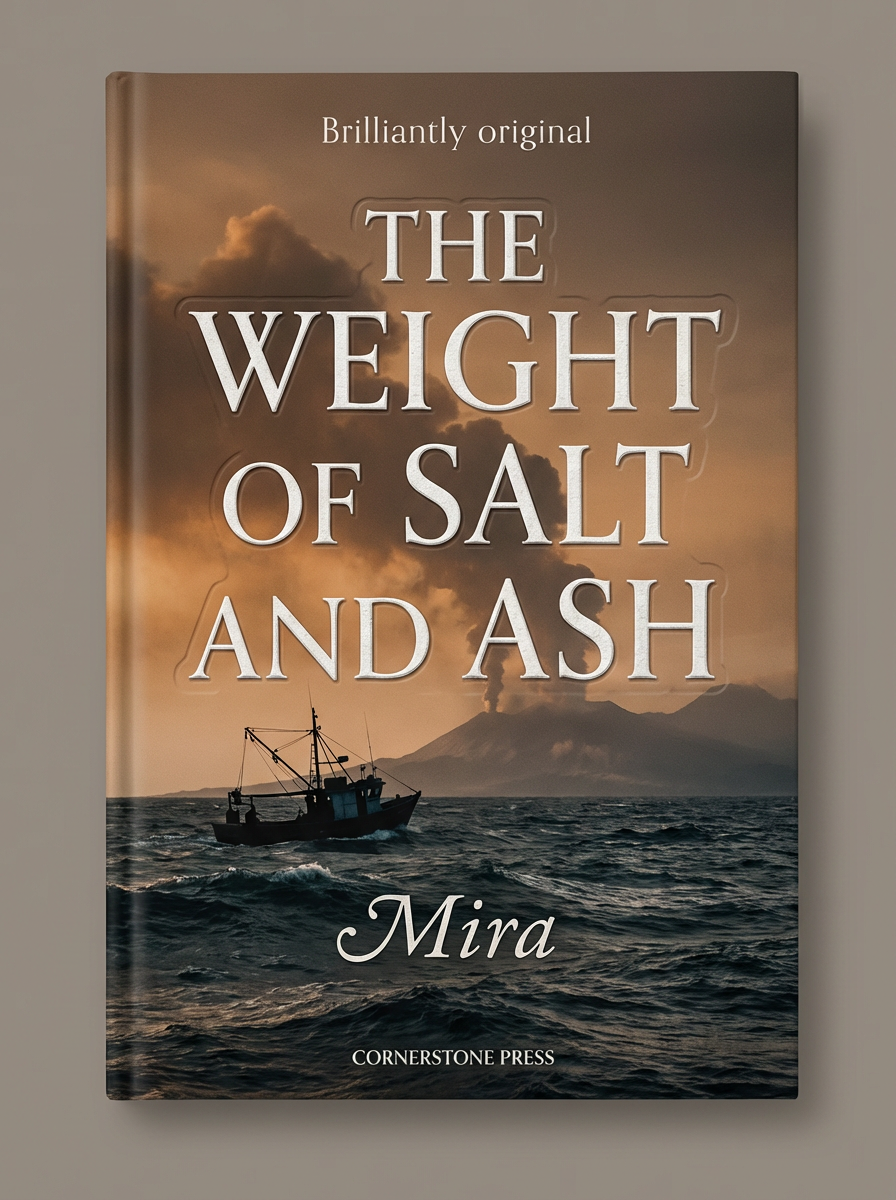
The Weight of Salt and Ash
By Mira
Synopsis
In the shadow of a volcanic eruption on an Indonesian island, a young seismologist grapples with the scientific detachment of her work as the rising ash threatens her estranged brother, a fisherman clinging to the familiar rhythms of the sea. Their forced proximity against the backdrop of natural de
Chapter 1: Tremors in the Blood
## Tremors in the Blood
The first tremor wasn't in the earth. It was in my coffee cup, a subtle shimmy that sent ripples across the surface of the dark liquid
Chapter 2: Where the Mountain Breathes Fire
The air, a living thing, pressed in. It felt thick with the unspoken, with the unseen particles of the mountain’s breath. Not just the physical ash, though that too, but something heavier, a static charge that prickled the skin. I watched the plume, a monstrous, ever-shifting entity, from the narrow window of the small, hastily erected observation post. It was less a building and more a glorified tent, a fabric
Chapter 3: The Echo of Distant Bells
The air, thick with the scent of sulfur and a strange, metallic tang, pressed in on me like a physical weight. It was a smell I’d grown accustomed to, a constant reminder of the leviathan stirring beneath our feet. But today, a new note had woven its way into the acrid tapestry – the faint, sweet decay of something vital being choked. From the radio, a clipped voice announced another village evacuated, a name I vaguely recognized from the seismic maps, now reduced to a statistic, a cluster of coordinates erased from the human landscape.
My fingers, stained with the fine volcanic dust that seemed to settle on everything, traced the contours of the island on the geological survey. Each contour line, a silent promise of the mountain’s enduring presence, now felt like a noose tightening around its throat. I imagined the people, their faces smudged with ash and fear, leaving behind generations of stories etched into the very soil they cultivated. What did they take with them? A single photograph? A worn wooden carving? The echo of a grandmother’s lullaby?
I knew, intellectually, that this was the way of things. The earth, in its vast indifference, shifted and groaned, reshaping itself with a primordial violence that dwarfed human concerns. But the headlines, splashed across the crumpled newspaper I’d retrieved from the deserted clinic, didn’t speak of geological forces. They spoke of children separated from parents, of the elderly left behind, of a community dissolving into the wind like the ash itself.
A sudden tremor, sharp and insistent, rattled the makeshift lab. The seismograph needles danced wildly, inscribing jagged peaks and valleys onto the paper. It wasn’t a large one, not enough to send the teacups clattering, but it was enough to send a cold shiver down my spine. Each minor shake was a pulse, a breath, from the beast below, reminding us of its immense power, its patience.
My brother, Kael, would be out on the water. I pictured him, his skin bronzed by the relentless sun, his hands calloused from years of hauling nets, his eyes narrowed against the glare of the sea. He was a creature of habit, unyielding in his devotion to the ocean, to the rhythm of his life. Even with the sky the color of a bruised plum, even with the air tasting of ash, he would be out there. He had always been like that – a stubborn, unyielding force, much like the mountain itself.
I remembered a distant childhood, a time before the silence stretched between us like a vast, unbridgeable chasm. We were children then, chasing crabs along the shore, our laughter swallowed by the roar of the waves. He would tell me stories of the sea, of mermaids with scales that shimmered like rainbow fish, of giant squid that lurked in the deepest trenches. And I, with my fledgling curiosity, would map the stars in my head, charting constellations that seemed as mysterious and alluring as his fantastical creatures. We were two halves of an island, bound by blood and the relentless pull of the ocean, yet destined to drift apart.
The last time I’d truly seen him, not just observed him from a distance, was at our mother's funeral. The air had been heavy with grief and the cloying scent of frangipani. He had stood by the graveside, his shoulders hunched, his face a mask of stoic sorrow. I had wanted to reach out, to offer some comfort, but the words had caught in my throat, tangled with resentment and a quiet despair. He had blamed me, I knew, for leaving, for choosing the distant hum of laboratories over the familiar rhythm of our home. And perhaps, a part of me, still did.
A faint, metallic clang echoed from the direction of the harbor, carried on the ash-laden breeze. It was the sound of a boat being secured, of anchors dropping, of a life finding temporary mooring. Kael. He was back. My breath hitched. The thought of confronting him, of navigating the treacherous currents of our shared history, felt almost as daunting as predicting the next volcanic eruption.
I walked to the window, the fine ash crunching beneath my boots. The sky was an apocalyptic canvas – shades of ochre and burnt umber bleeding into a sickly yellow. The sun, a pale, distorted disk, struggled to pierce through the veil of ash, casting an eerie, diffused light upon the land. Below, the harbor was a scene of muted activity. Fishermen, their faces grim, secured their boats, their movements slow and deliberate, as if performing a ritual of farewell.
Among them, I spotted him. Kael. He was pulling a tarp over his small fishing vessel, his movements economical, precise. His hair, usually salt-streaked and tousled, was now dusted with ash, making him seem both ancient and vulnerable. He paused, his gaze sweeping across the horizon, as if searching for something lost in the haze. For a moment, his eyes met mine. Or perhaps, they merely grazed the window, seeing nothing but the reflection of the ash-filled sky.
A knot tightened in my stomach. It wasn't fear of the mountain that caused it, not precisely. It was the fear of what lay between us, the unspoken words, the years of silence that had solidified into something impenetrable. The island was a stage for a drama far older than human memory, and we, two estranged siblings, were merely players caught in its unfolding. The volcano, in its majestic, destructive power, had become an unwelcome catalyst, forcing us into a proximity we had both skillfully avoided.
I turned from the window, my gaze falling upon a framed photograph on my desk – a grainy image of two young children, their faces bright with laughter, their arms flung around each other, silhouetted against the dazzling blue of the ocean. Kael and me. Our mother had taken it. Even then, his eyes held that same fierce intensity, that same unwavering focus on the horizon. Mine, however, were already drawn upwards, towards the distant peaks, towards the invisible forces that shaped our world.
The echo of distant bells, perhaps from a temple somewhere in the ash-choked valleys, drifted into the lab. It was a mournful, solitary sound, a melody of resilience in the face of inevitable change. The island was singing its elegy, and we, its broken children, were finally listening.
Chapter 4: Salt on Wounded Skin
The air tasted of grit and something metallic, like old pennies. It clung to the back of my throat, a constant reminder of the unseen behemoth that churned its guts just beyond the visible horizon. My brother, Kai, didn’t seem to notice. Or perhaps, he was simply better at ignoring things he couldn’t fight with his hands. He was mending a net, his fingers, scarred and calloused from years of sea-salt and sun, moving with an almost unconscious grace. Each knot tied was a silent prayer, a defiant act against the encroaching dust.
The headline, smudged and several days old, lay crumpled beside my coffee cup: *Volcano’s Fury Threatens Island Livelihoods*. Livelihoods. A sterile word for the shimmering, vital thread that bound Kai to this place, to the very boats that now sat idle, caked in a fine grey powder. The article spoke of government aid, evacuation plans, economic impact. It didn’t speak of the subtle shift in the light across the water, the way the gulls flew lower now, their cries sharper, more urgent. It didn’t speak of the gnawing fear that tightened a man’s gut when his life’s work was slowly suffocating under a blanket of ash.
I watched him, the familiar ache in my chest tightening. It was the same ache that had been there since the first tremor, the same one that had intensified with each seismic spike on my instruments. A seismologist, I chased certainty, sought patterns in chaos. But here, with Kai, all my scientific training felt like a child’s toy, useless against the raw, visceral truth of his existence. He was a creature of intuition, of ancient knowledge passed down through generations of fishermen. He read the waves, felt the currents in his bones. And the mountain? He knew it in a way I never could, a fearsome, revered elder, not a seismic anomaly to be charted.
“The wind’s shifting,” he said, his voice raspy, without looking up. “Won’t be long before it’s thick here too.”
My gaze went to the window, to the distant, hazy silhouette of the volcano. It was a phantom now, cloaked in its own exhalations. The ash fall had been intermittent, a cruel tease, sometimes light, sometimes heavy. But the forecasts, the ones I had access to, the ones I processed and analyzed with detached precision, painted a grimmer picture for the coming days.
“It’s going to get worse, Kai,” I said, the words tasting like the ash itself. “The plume is expanding. We need to think about leaving.”
He paused, a needle suspended mid-stitch. He didn’t look at me, but I felt the weight of his resistance, a palpable force in the small, cluttered room. The air was thick with the scent of dried fish and damp wood – his world, condensed and contained.
“Leave,” he finally said, the word flat, devoid of inflection. “And go where, Mira? To some concrete box in the city where the air conditioning makes your teeth ache? What would I do there?”
“You could come with me. To Jakarta. There are agencies… they’re helping people relocate, retrain.” I heard the hollow ring of my own words, the sterile optimism of someone who had never known true rootedness.
He finally met my eyes, and in them, I saw an ocean of weariness, a depth of despair that made my carefully constructed scientific detachment crumble. “Retrain?” He scoffed, a short, bitter sound. “To do what? Sit behind a desk? My hands would wither.” He held them up, calloused, scarred, undeniably alive. “This is who I am, Mira. This,” he gestured vaguely to the small hut, to the boats outside, to the invisible sea beyond, “is all I know.”
A familiar anger stirred within me, a ghost of old arguments. He always chose the difficult path, the path of stubborn adherence to tradition, even when it led to ruin. “And what about your life, Kai? Your future? Is it worth staying here to cough up ash until your lungs give out?”
He dropped his net, the thud a punctuation mark to our escalating tension. He pushed himself up, his movements stiff, and walked to the door, peering out into the dim light. The silence stretched, filled only by the distant, rhythmic roar of the ocean, a constant, indifferent presence.
“You don’t understand,” he said, his back to me, his voice barely a whisper against the rising wind. “You never did. You always chased the new, the bigger, the brighter. This… this is my blood, my breath. To leave is to cut off a part of myself.”
I wanted to argue, to cite statistics, to present a logical, scientific case for survival. But his words were a blunt instrument, striking at something deeper, something I had long suppressed. I remembered the arguments from years ago, the chasm that had opened between us when I chose a university in Java, when I chose the world of data and theories over the tangible rhythm of the village. He had called me a deserter, though he never used the word. His silence had been louder than any accusation.
“You think I don’t understand fear, Kai?” I asked, my voice tight. “Every day, I look at those charts, at those seismic readings. I see the potential for complete devastation. I see lives at risk. I see *your* life at risk.” The words were out before I could temper them, raw and edged with the desperation I usually kept locked away.
He turned then, and his eyes, usually so guarded, held a flicker of something I hadn’t seen in years – a flash of the vulnerable boy who had once protected me from bullies, who had taught me how to bait a hook. “And what good is that fear, Mira, if it paralyzes you? If it makes you forget what’s worth fighting for?” He paused, his gaze sweeping over the room, over the familiar objects that spoke of a life lived, a legacy sustained. “I fight for this. For the salt on my skin, for the taste of the sea, for the way the light catches the waves at dawn. You fight for numbers.”
The accusation hung in the air, a barb I couldn’t deflect. He was right, in a way. I chased data, sought patterns, built models. I tried to understand the world through a lens of scientific objectivity. But his world was lived, breathed, felt. And the volcano, in its majestic, terrifying indifference, was forcing us both to confront the limitations of our chosen paths. His unwavering rootedness felt like a challenge, a silent condemnation of my own restless spirit. And for the first time, seeing the quiet resolve in his eyes, the deep, unshakeable connection he had to this land, I wondered if my scientific quest for understanding had, in fact, blinded me to something essential. Something that was right here, in the ash-filled air, in the stubborn defiance of my brother. The salt stung my own unacknowledged wounds, a silent, burning testament to the truth his simple words contained.
Chapter 5: The Ash Does Not Discriminate
The air itself had become an adversary, a thick, gritty veil that clung to the lungs and gritted between teeth. It wasn’t a gentle sifting, like snow, but a relentless, insidious assault. The headlines screamed of a “catastrophic eruption,” of “exclusion zones expanding,” but here, on the edge of what was still called home, it was a tactile truth, weighing down the fronds of the palms, turning the vibrant green of the jungle into a muted, monochrome canvas.
I watched the men from the village, their faces streaked with ash and sweat, hauling the last of the fishing boats further up the beach. The air was heavy with the scent of diesel and fear. My own hands, despite the gloves, felt rough, chapped, the skin a pale contrast against the dark dust that settled on everything. The scientific detachment I usually wore like a second skin had begun to fray at the edges, exposing the raw nerves beneath. Each cough from a child, each worried glance exchanged between neighbors, chipped away at the cool, analytical facade. This wasn't about seismic readings or magma chambers anymore; it was about breath, about survival.
My brother, Adi, moved among them, a silent, unyielding force. He wasn’t helping to pull the boats, not anymore. He was orchestrating, his voice a low rumble, his gestures economical but firm. He'd been out on the water until the coast guard, with their grim faces and official pronouncements, had finally turned him back. I had seen him return, his face a mask of defiance and exhaustion, the salt on his skin now layered with a fine coat of grey. His fishing nets, usually spread to dry like intricate tapestries, lay in heaps, useless and forgotten, their promise of the day’s catch swallowed by the mountain’s rage.
He caught my eye across the shifting, ash-laden expanse. There was no warmth there, only a flicker of something unreadable – resentment, perhaps, or a shared burden too heavy to articulate. We were two poles, pulled together by an unseen force, yet still held apart by the gravity of our past. I had come with my instruments, my charts, my detached pronouncements of danger. He had stayed with his nets, his boat, his unwavering faith in the ocean's bounty. And now, the mountain had rendered both our worlds equally precarious.
A child, no older than five, stumbled near the water's edge, coughing. Adi was there in an instant, scooping her up, his movements surprisingly gentle for a man so hardened by the sea. He murmured something to her, his voice a soft counterpoint to the distant grumble of the volcano, and she buried her face in his shoulder. The sight twisted something in my chest, a memory of a time when his shoulders had been my refuge, too. Before the cracks appeared, before the silence stretched between us like an unbridgeable chasm.
The official evacuation orders had been met with a mixture of resignation and stubborn resistance. “Where will we go?” an old woman had asked me yesterday, her eyes rheumy with age and fear. “This land is our blood, our bones. The mountain gives, the mountain takes. It always has.” Her words, steeped in generations of wisdom and fatalism, had pierced through my scientific rationale. I had no answer for her. My data could predict the next pyroclastic flow, but it couldn't mend a broken heart or replace a lifetime of memories.
“Mira.”
Adi’s voice, rough with ash and unspoken words, pulled me from my thoughts. He stood beside me, his gaze fixed on the churning, grey sky. The sun, a bruised orange disc, struggled to penetrate the pall.
“They’re saying it could get worse,” I said, my voice hoarse. “The seismic activity is… intensifying.”
He nodded, a tight, almost imperceptible movement. “They’ve been saying that for days. We know the mountain, Mira. She breathes. She grumbles. Sometimes she roars.”
“This is different, Adi. The patterns… the harmonic tremor. It’s consistent with a larger-scale event.” My words, clinical and precise, felt hollow in the face of the encroaching chaos.
He turned to me then, his eyes, usually the colour of the deep sea, now clouded with a film of ash. “And what does your science say about a man leaving his home, his life, to go to a camp where they treat us like refugees? What does your science say about the children who will never know this beach, these waters, if we leave?”
The accusation in his voice was a familiar sting. It was the same unspoken question that had hung between us for years: *Why did you leave?*
“My science says it saves lives, Adi,” I retorted, the old defensiveness rising. “It gives people a chance.”
He let out a short, bitter laugh. “A chance for what? To forget who they are? To become another statistic in your reports?” He gestured wildly towards the village, now a ghostly collection of shapes under the ash. “This is who we are. Our boats, our nets, the smell of the ocean. You think a tent in a field can replace that?”
I wanted to tell him that sometimes, survival was enough. That memory could be carried, watered, and replanted. But the words caught in my throat. He was right, in a way. I had left. I had sought knowledge, understanding, a life beyond the island’s embrace. And in doing so, I had severed a part of myself, a part that still yearned for the simple rhythms of this place.
“The ash doesn’t discriminate, Adi,” I said, my voice softer than I intended. “It takes everything. Rich, poor, fisherman, scientist. It takes it all.”
He looked away, his jaw tight. The wind picked up, swirling a vortex of fine dust around us. The air grew thinner, the light dimmer. The mountain, shrouded and menacing, seemed to pulse with an unseen power.
“I’m going back to the station,” I said, finally breaking the heavy silence. “I need to check the data. Make sure the last sensor array is transmitting.”
He didn't reply, but I felt his gaze follow me as I walked away, a silent reproach in his unwavering stare. My boots crunched on the ash-covered path, each step a small act of defiance against the mountain’s encroaching dominion. The scientific instruments in my bag felt heavier than usual, not with their own weight, but with the burden of expectation, of responsibility. I was a harbinger of doom, a messenger of the mountain’s wrath. And I was also just Mira, a woman standing on the precipice of loss, watching her world, and perhaps her brother, disappear into a cloud of ash.
Back at the makeshift monitoring station, the screens glowed with their familiar, dispassionate dance of lines and numbers. The seismic readings were indeed climbing, the harmonic tremor a steady, ominous thrum. I adjusted the antennae, checked the power supply, my movements automatic, practiced. But my mind was elsewhere, replaying Adi’s words, the raw edge of his pain.
The headlines called it a natural disaster. Here, it felt like a betrayal. A betrayal by the earth that had nurtured them, by the mountain that had always been a silent, benevolent guardian. And for Adi, perhaps, by me, the sister who had traded the familiar comfort of home for the cold, hard facts of science.
I saw the new alert flash on the screen: *Pyroclastic flow imminent. Mandatory evacuation Zone 1 and 2.*
My breath hitched. The village, Adi, the last of the stubborn souls – they were in Zone 1. The ash, thick and suffocating, had now become a curtain, drawing itself across the final act. I had to go back. Not with data, not with warnings, but with a plea, a demand. A desperate hope that the ash, for all its indiscriminate fury, would spare at least this one, fragile tie.