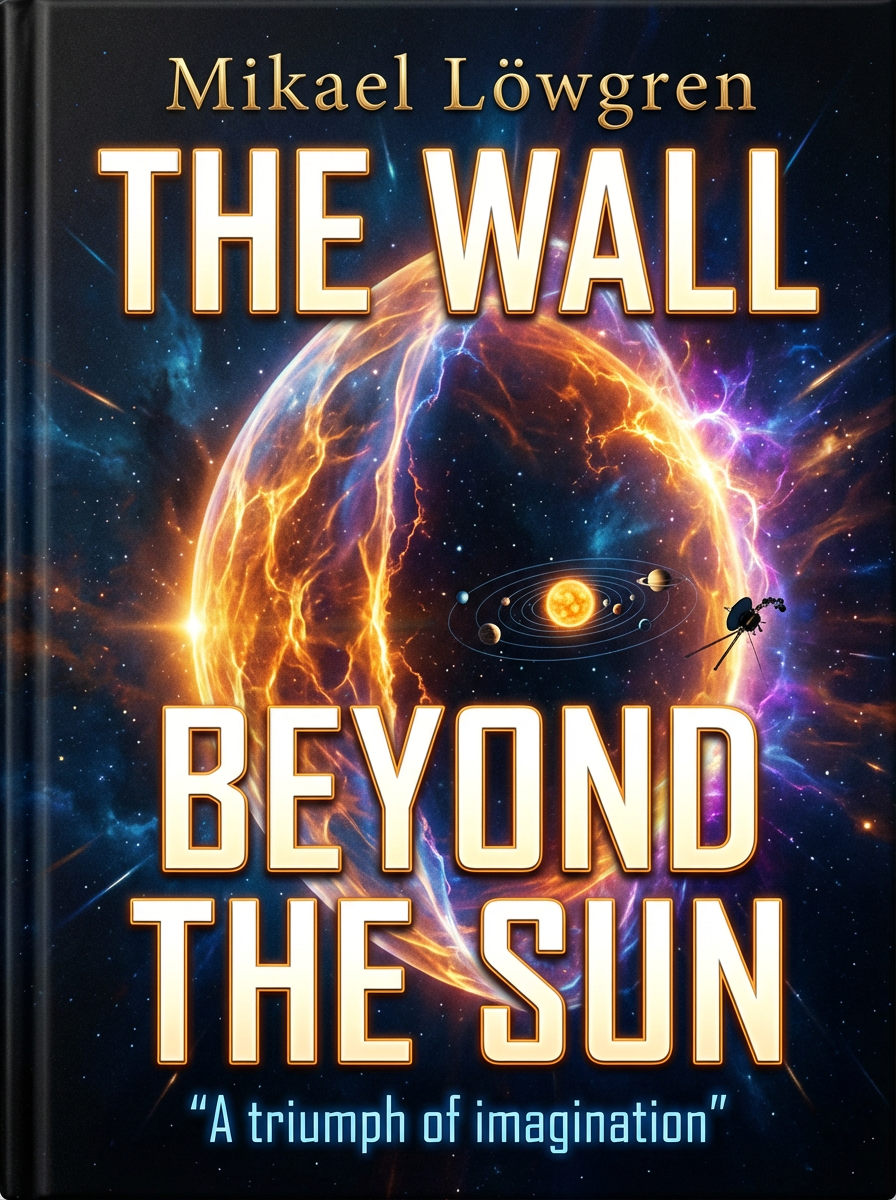
The Wall Beyond the Sun
By Mikael Löwgren
Synopsis
When an inexplicable plasma wall is discovered at the solar system's edge, an elite scientific crew aboard humanity's fastest vessel embarks on a desperate mission to investigate, only to uncover that the 'natural phenomenon' might be an artificial structure, challenging humanity's perceptions of it
Chapter 1: Echoes From the Void
The faint, almost whimsical chirrup from Voyager 1 had been logged, dismissed, and then logged again, a ghost in the machine’s ancient code. It was 2077, and the solar system’s oldest children were, by all accounts, supposed to be wheezing their last, their radioisotope thermoelectric generators humming a dying lullaby across the vast, lonely stretches of interstellar space. Their data streams, when they deigned to arrive, were usually a melancholic testament to the universe’s endless, unremarkable vacuum. Yet, these new anomalies, like a faint, persistent cough before a fever, had begun to accumulate.
Initially, they were a flurry of incongruous numbers, a spike in plasma density here, an uncharacteristic magnetic flux variation there. The instruments were old, of course. Calibration shifts, cosmic ray interference, thermal drift – the usual litany of excuses for anything that strayed from the predictable hum of the cosmos. For years, the official reports had filed them under “Instrument Malfunction, Unresolved.” It was a convenient, almost comforting label. The universe was a place of elegant, if sometimes violent, predictability. The unexpected, especially when it came from a relic of a bygone era, was simply noise.
Dr. Aris Thorne, however, had always found something unsettling about comfortable labels. He had a way of looking at data, not as mere numbers, but as faint whispers from a boundless night. In his younger days, this trait had made him a wunderkind, celebrated for his unorthodox interpretations that often cracked open new windows of understanding. Now, in the twilight of his career, it made him something of an eccentric, a man who preferred the company of dying probes to the polished surfaces of cutting-edge observatories. He worked from a perpetually dim office at the Jovian Orbital Institute, a place where the scent of stale coffee mingled with the faint, metallic tang of aging server farms. His only real companion was a battered mug emblazoned with the logo of a long-defunct rock band and the ceaseless, silent hum of the universe’s distant echoes.
He remembered the first time he’d seen the persistent uptick. It was a Tuesday, the kind of Tuesday where the synthetic rain on the panoramic windows of the Institute felt particularly forlorn. A junior analyst, fresh out of the lunar academies, had flagged it. “Dr. Thorne,” she’d said, her voice bright with the eagerness of the uninitiated, “there’s a consistent, unexplained energy signature from Voyager 1’s plasma wave subsystem. It’s… harmonic.”
Aris had squinted at the holoscreen, a knot forming in his stomach. Harmonic. That was the word that lingered, an unwelcome guest. Natural phenomena, no matter how chaotic, rarely resolved into elegant, repeating patterns. He’d dismissed it initially, of course. “Run a comprehensive recalibration simulation on the historical data,” he’d instructed, his voice gruff, betraying none of the unease stirring within him. “Could be a resonance effect with passing interstellar dust. Or just… senescence.”
But the simulation had yielded nothing. The harmonics persisted, a whispered melody from the edge of oblivion. Then, five months later, Voyager 2 – the tenacious sibling, lagging a cosmic moment behind – began to mirror the anomaly. The same spectral signature, the same rhythmic hum, like a distant, ethereal drumbeat.
That’s when the first threads of genuine alarm began to weave themselves into the fabric of the scientific community’s dismissive narrative. Two probes, decades apart in their trajectories, both exhibiting the exact same inexplicable behavior? The probability of simultaneous, identical instrument failure across different subsystems was, effectively, zero.
Aris found himself staring at the new plots, the vibrant hues of the spectral analysis bleeding into each other like a bruise on the cosmic canvas. It was late, the Institute a silent mausoleum save for the distant thrum of atmosphere processors. The city lights of Io below, usually a comforting glow, seemed distant, alien. He reached for his mug, cold and forgotten. The coffee inside was a bitter memory.
He remembered a recurring dream from his adolescence, a dream of standing before an impossibly vast, black ocean. The stars were gone, swallowed by an unseen presence. He’d awake with a profound sense of isolation, a primal fear of being utterly alone in a boundless, silent void. This new data, in its quiet, insistent way, was beginning to feel like that dream.
“A systemic instrument malfunction,” he muttered, the words tasting like ash. He knew, deep down, it wasn’t true. The universe, in all its indifference, rarely played such elaborate tricks. This was something else. Something *shifted*.
His mind, a well-worn path through the labyrinth of astrophysical theory, began to cycle through possibilities. Exploding stars, neutron star mergers, intergalactic gas clouds – all the known celestial phenomena that could produce such energy signatures. But none fit the regularity, the sheer *improbability* of what they were seeing. This wasn’t chaotic, it was… patterned. Like a message encoded in the static.
He pulled up the raw data, the sheer volume of it overwhelming. Hundreds of thousands of data points, each a tiny pixel in a vast, unfolding canvas. He filtered, he sorted, he applied every known algorithm for data denoising, hoping, perhaps even praying, to dissolve the anomaly into a statistical outlier. But it clung, stubbornly, like a shadow in the corner of his peripheral vision.
He zoomed in on a particularly clear sequence, a series of peaks and troughs that, to his astronomer’s eye, held an unsettling symmetry. It was like looking at a perfectly cut diamond amidst a pile of cosmic debris. This wasn’t a random fluctuation. It was… deliberate.
The thought, nascent and terrifying, bloomed in the quiet of his office. He had spent his entire career in the pursuit of cosmic truth, in the serene understanding that the universe, while awe-inspiring, was fundamentally governed by immutable laws. The idea that something *artificial* could exist out there, beyond the comfortable boundaries of human comprehension, was a violation of that inherent order. It was like discovering an intricate circuitry board woven into the heart of a primordial forest.
He leaned back in his worn chair, the synthetic leather creaking in protest. The city lights below twinkled, a fragile testament to human ingenuity against the backdrop of the indifferent void. For centuries, humanity had gazed skyward, reassured by the comforting silence, by the vast, unblemished emptiness. The Great Silence, as it was often called, was not merely an absence of alien communication, but an affirmation of humanity’s singular consciousness in a vast, lifeless expanse.
But what if the silence was an illusion? What if the echoes, now growing louder, were not from a natural phenomenon, but from a deliberate design?
He remembered a conversation with his mentor, Professor Elias Vance, a brilliant but ultimately disheartened cosmologist who had spent his career searching for life beyond Earth. Vance, on his deathbed, had told Aris, “The greatest discovery, Aris, will not be the first signal, but the first *structure*. A signal can be misinterpreted, a brief starburst of false hope. But a structure… a structure implies intent. It implies architects.”
Aris had dismissed it then, a dying man’s romantic folly. Now, staring at the perfectly rhythmic peaks of the Voyager data, Vance’s words resonated, cold and clear.
He opened a new data window, overlaying the anomalies from Voyager 1 and Voyager 2. The similarities were uncanny, almost identical. It was like two distant outposts reporting the exact same, impossible weather pattern.
He ran a cross-correlation, his fingers flying across the holographic interface. The correlation coefficient spiked, nearly to unity. The probability of this occurring by chance was so infinitesimally small as to be effectively impossible.
Aris closed his eyes, a profound weariness settling over him. He was a man of science, a man of logic and reason. But the universe, it seemed, was occasionally prone to flights of unsettling poetry.
He knew what he had to do. The reports would be met with skepticism, perhaps even ridicule. The inertia of established scientific thought was a massive, unyielding beast. But the data was undeniable. He would present it, painstakingly, logically. He would make them see the harmonics, hear the echoes.
The silence that had once defined their universe, it seemed, was beginning to crack. And through those cracks, a faint, impossible melody was beginning to filter in, hinting at something vast and incomprehensible. Something that had been there all along, waiting. And the unsettling implication, the one that truly chilled him, was that if something this profound, this immense, had been waiting silently at the very edge of their perceiving for so long, then perhaps their perception of the cosmos, of their own place within it, was far more limited than they had ever dared to imagine. Not alone, perhaps. But perhaps, not free.
He spent the rest of the night hunched over his console, the screen casting an ethereal glow on his worn face, a solitary figure at the precipice of a galactic revelation. The old probes, their dwindling power cell humming their distant swan song, had inadvertently become the first witnesses to something truly unprecedented. And Aris, a disillusioned astrophysicist who had long since stopped believing in miracles, felt a strange, terrifying flicker of something he hadn’t felt in years: wonder. But it was a wonder tinged with a profound apprehension, a sense that the comforting silence had not been a lullaby, but merely a held breath. And now, the universe was exhaling.
Chapter 2: The Grand Unveiling
The official announcement, when it finally came, felt less like a revelation and more like the inevitable settling of a heavy, unseen dust. It wasn't broadcast with the fanfare of a moon landing or the somber gravity of a global crisis. Instead, it was delivered as a terse, almost apologetic press conference held in a sterile NASA auditorium, illuminated by the cold blue glow of oversized screens. Dr. Evelyn Reed, NASA’s Director of Planetary Science, a woman whose face usually bore the meticulous composure of a seasoned diplomat, stood at the podium, her usual precision undermined by a subtle tremor in her voice.
“Following extensive independent verification, and after careful deliberation with international partners,” she began, her gaze sweeping across the forest of microphones, “NASA can confirm the presence of a… a substantial energy signature. This signature, detected at the furthest reaches of our heliosphere, has been designated ‘The Wall’.”
The name was already circulating, a journalistic shorthand that had taken root weeks before any official confirmation. It was evocative, simplistic, and terrifyingly accurate. Aris Thorne watched the live feed from his cramped apartment, the holographic projection flickering above his worn armchair. He nursed a lukewarm mug of instant coffee, the bitterness a familiar comfort. He’d seen the preliminary reports, the internal communiqués, the frantic scrambling behind frosted glass doors. For him, the announcement was merely the public recitation of a private truth he’d been wrestling with for months.
Dr. Reed continued, her voice gaining a rehearsed cadence. She spoke of unprecedented energy levels, of temperatures exceeding anything theorized for that region of space. She mentioned plasma, magnetic field perturbations, and gravitational lensing effects that baffled conventional astrophysics. She studiously avoided the word ‘structure’, opting instead for ‘phenomenon’. It was a semantic dance, a desperate attempt to frame the inexplicable within the boundaries of known physics, to reassure a world teetering on the edge of unimaginable implications.
The global scientific community, predictably, erupted. The internet became a cacophony of theories: nascent nebulae, exotic stellar remnants, cosmic string remnants, or perhaps, a previously uncatalogued, highly energetic form of solar activity. The natural phenomena camp, bolstered by decades of established cosmic understanding, struggled to formulate coherent explanations for the sheer scale and uniformity of the detected signature. Their hypotheses often sounded like desperate incantations, attempts to conjure familiar demons in the face of an entirely new dread.
Then there were the others. The radical thinkers, the fringe theorists, the ones who dared whisper ‘artificial’. Their voices, once relegated to the digital margins, were amplified by the sheer impossibility of the official explanations. Forums buzzed with intricate diagrams of Dyson spheres, alien superstructures, ancient cosmic defenses. The concept of an intelligent, non-human construct of such immense proportions was, for most, a terrifying leap, but for a growing minority, it was the only explanation that made a perverse kind of sense. How else could a wall of plasma, kilometers thick and encircling an entire star system, simply *be*?
Aris watched the talking heads on various news channels, each offering their expert opinion, their confident pronouncements masking a shared, profound ignorance. He recognized some of the faces: old colleagues, former mentors, brilliant minds now reduced to speculating wildly on live television. He felt a detached pity for them, for the comfortable certainty of their scientific paradigms being so violently, utterly shattered. He knew, with a chilling clarity, that none of them truly understood the implications of the data. Only a privileged few, privy to the rawest, unredacted telemetry, had glimpsed the true terror behind the numbers. And even then, it was just a glimpse.
His comm unit buzzed, a muted, insistent vibration on the coffee table. The caller ID was restricted, unlisted. He hesitated for a moment, a sudden tightness in his chest. He had a premonition, a cold, creeping certainty. This wasn't one of his usual calls; no desperate student, no grant committee, no ex-girlfriend checking in. This was different. He answered.
"Thorne," a crisp, almost robotic voice stated, devoid of inflection. "This is Director Hayes. U.S. Space Command."
Aris blinked. He recognized the name, of course. General Thomas Hayes, a ghost in the machine, a man whose public appearances were rarer than eclipses, yet whose influence permeated every classified space initiative. His reputation was one of ruthless efficiency and an unwavering, almost pathological, discretion.
"General Hayes," Aris replied, his voice surprisingly steady. "To what do I owe this… unexpected honor?"
"Dr. Thorne, your file has been reviewed," Hayes continued, ignoring the slight sarcasm. "Your work on anomalous interstellar phenomena, specifically your earlier analyses of the Voyager telemetry, has been noted."
Aris suppressed a dry chuckle. His earlier analyses had been dismissed as fanciful, borderline insane. He’d been quietly discouraged from pursuing them further, his funding discreetly rerouted, his reputation subtly undermined. Now, it seemed, his "fanciful" notions were suddenly very much in vogue.
"Noted, then dismissed, then noted again, it seems," Aris mused aloud.
There was a brief pause, a microsecond of silence that suggested Hayes was not accustomed to such candor. "Circumstances have, shall we say, evolved. We require minds unburdened by conventional orthodoxy, minds capable of considering… unconventional explanations."
"And you believe I fit that description?" Aris asked, a faint smile playing on his lips. "I was under the distinct impression my unconventionality was a professional liability."
"It is now an asset," Hayes countered, his voice like flint. "Dr. Thorne, we are assembling a team for an investigative mission. A mission of unparalleled scope and sensitivity. We believe you possess a unique perspective that would be invaluable."
Aris leaned back in his chair, the coffee mug forgotten. He knew, instinctively, what this was about. The mission to ‘The Wall’. It was the only logical next step, the only option for humanity in the face of such an enigma. A desperate probe into the cosmic unknown.
"And the nature of this mission, General?" Aris pressed, though he already knew.
"It is highly classified, Dr. Thorne. Code-named 'Helios IX'. Its objective is to ascertain the precise nature of 'The Wall'. To determine its composition, its origins, and its… purpose." Hayes’s voice dropped almost imperceptibly on the last word, betraying a flicker of something beyond military stoicism.
"And I would be expected to… analyze, I presume?"
"You would be part of the primary scientific complement. Your expertise in theoretical astrophysics, particularly your work on exotic matter and energy signatures, is deemed crucial. You would be tasked with interpreting the data, contributing to the strategic framework of our investigation, and, if necessary, providing a counter-narrative to our… initial assumptions."
"Initial assumptions, General?" Aris repeated. "Are we assuming natural phenomena, or something else?"
Another pause. This one longer, heavier. "Our current working hypothesis, based on accumulated intelligence, is that 'The Wall' is… not a natural formation."
The words hung in the air, a cold, undeniable truth. Hayes hadn’t used the loaded word "artificial," but the implication was clear, stark, and terrifying. It meant humanity was not alone. And if something had built a wall around its sun, to what purpose? Protection? Confinement?
"You're sending people, then. To the edge of the system," Aris stated, not as a question but a realization.
"A crew of the brightest minds humanity has to offer, aboard the fastest vessel ever constructed. An unprecedented deep-space probe. We depart in six months."
Six months. A blink of an eye in cosmic terms, an eternity for preparation.
"And how many know about this 'working hypothesis'?" Aris asked, his gaze drifting to the flickering news reports on his holographic screen, their anchors still debating stellar winds and plasma storms.
"A very select few, Dr. Thorne. And you would become one of them. Your involvement would require a complete severance from your current life, a total commitment to this project. Secrecy is paramount. You would cease to exist, publicly, for the duration."
Aris looked around his small apartment. The stacks of forgotten books, the half-finished equations scrawled on holographic pads, the lingering scent of stale coffee and unfulfilled potential. He was a fringe academic, a scientist whose best theories had been dismissed as eccentric. He had no wife, no children, no immediate family to mourn his sudden disappearance. His current life was a comfortable, if somewhat solitary, existence. And it was deeply unsatisfying.
The cosmic silence he had wrestled with for so long was now filled with an echo, a presence. He had always yearned for answers, for the deeper truths of the universe. Now, the universe was offering him a chance, an terrifying invitation.
"What if we find… nothing?" Aris asked, the words hollow in his throat.
"Then we will have wasted considerable resources and time, Dr. Thorne. But that is not the scenario we are preparing for. What truly concerns us is the possibility of finding… something. Something beyond our current understanding. Something that redefines everything we believe about ourselves, our place in the cosmos."
Aris closed his eyes, picturing the impossible wall, an invisible barrier at the end of known space, humming with unimaginable power. He saw the Voyager probes, like ancient, blind navigators, bumping against the edge of a cosmic cage.
"And if we find something that suggests we are not alone," Aris continued, his voice barely a whisper, "but perhaps, not free either?"
There was a long, cold silence from General Hayes's end. The robotic inflection finally broke, replaced by a subtle, almost imperceptible softening, a human pause.
"That, Dr. Thorne," Hayes finally stated, "is precisely the question we are sending you to answer."
Aris opened his eyes. The holographic projection of Dr. Reed still spoke of plasma anomalies and magnetohydrodynamics, her voice a soothing balm over a festering wound of cosmic uncertainty. He looked at his comm unit, then back at the projected image of the distant, shimmering wall, a phenomenon that defied classification, a mystery that promised to unravel not just physics, but philosophy itself.
He took a deep breath, the stale air of his apartment suddenly charged with a new, terrifying purpose. He had spent his life observing the stars, mapping their intricate dance, seeking patterns in the chaos. Now, the stars were demanding he look not at them, but at a shadow cast across them, a shadow of humanity’s own profound ignorance.
"I'll join your mission, General," Aris said, the words feeling heavy and irreversible, like the closing of a door behind him. "Tell me where to report."
Hayes’s response was immediate, crisp, and devoid of any lingering doubt. "Excellent. A transport will arrive at your coordinates in precisely one hour. Further instructions will be provided upon your arrival at the undisclosed facility. Welcome aboard, Dr. Thorne. Welcome to Helios IX."
The line went dead. Aris set his coffee mug down, the lukewarm liquid undisturbed. He stood up, a strange mix of dread and exhilaration coursing through him. He looked around his apartment one last time, at the familiar details of his solitary existence, knowing that in an hour, it would all be gone, replaced by an unknown journey into the deepest, darkest corners of the cosmos. He was no longer a disillusioned astrophysicist, but a reluctant explorer, drawn to the precipice of an unimaginable truth. The echoes from the void had finally been answered, and the answer was a wall. A wall that beckoned, and perhaps, imprisoned.
Chapter 3: The Helios Initiative
The air in the Mission Control dome was a symphony of controlled tension. A thousand monitors glowed, painting the faces of technicians and scientists in shifting hues of blue, green, and amber. The rhythmic thrum of the life support systems, the low murmur of conversations, and the occasional sharp command coalesced into a hum that was both a comfort and a constant reminder of the leviathan waiting on Pad 39A.
Aris Thorne, a man whose natural inclination was towards the quiet solitude of theoretical physics, found himself amidst this maelstrom of meticulous, high-stakes preparations. His personal belongings, a small duffel bag containing little more than a change of clothes, a well-worn copy of Baudelaire, and a worn-out notebook filled with equations that only he truly understood, felt impossibly paltry beside the colossal machinery of the *Helios IX*.
He watched, a quiet observer in a world of doers, as a team of engineers meticulously checked the integrity of a hyper-drive conduit. Their movements were precise, almost surgical, each twist of a wrench, each diagnostic sweep, a testament to years of training and a profound understanding of the complex beast they were building. The *Helios IX* was not merely a ship; it was a cathedral of human ingenuity, a testament to a collective will to penetrate the unknown. Its hull, a dull, heat-resistant alloy, stretched for hundreds of meters, housing engines capable of bending spacetime, life support systems designed for decades, and a scientific array that cost more than the annual GDP of several small nations.
Aris felt a familiar knot of unease tightening in his stomach. It wasn't fear, not precisely. It was the weight of what this machine represented, the ethical implications that churned beneath the surface of all the scientific excitement. He had seen the early concept art, the glossy renders of the *Helios IX* hurtling through the void, a beacon of human exploration. But he also saw the unasked questions, the consequences of disturbing a silence that had endured for eons.
His reverie was broken by a clear, resonant voice. "Dr. Thorne, a moment?"
He turned to see Captain Eva Rostova approaching. Her uniform, a sleek, dark grey, fit her with the understated elegance of a precision instrument. Rostova was a woman forged in the crucible of deep-space missions, her features sculpted by the harsh glare of artificial light and the quiet solitude of command. Her eyes, the color of a stormy Atlantic, held a depth that spoke of countless decisions made under immense pressure. She carried herself with an almost imperceptible tension, a readiness that never quite dissipated.
"Captain," Aris replied, his voice a low rumble.
"I trust you're settling in amidst the chaos?" Her tone was professional, a hint of dry amusement softening the edge.
"As much as one can settle amidst a controlled explosion, Captain."
A faint smile touched her lips. "A fair assessment. I wanted to reiterate the importance of your role, Dr. Thorne. Your insights into the theoretical physics of this... phenomenon are critical. We're venturing into uncharted waters, and your ability to see beyond the empirical will be invaluable."
Aris nodded, a flicker of appreciation for her directness. "I understand the magnitude, Captain. But I also feel a responsibility to raise the ethical questions, even if they're inconvenient."
Rostova's smile faded. "Inconvenient questions are often the most important. And I assure you, Dr. Thorne, the moral compass of this mission is not lost on any of us. We are explorers, not conquerors. But we are also tasked with understanding. Ignorance, in this case, would be the greatest ethical failing." Her gaze was steady, unwavering. "I will not gloss over the dangers, or the unknowns. We are a unified front, Dr. Thorne. Scientists, engineers, and commanders. Each piece is vital."
Her words, while delivered with the crisp precision of a military officer, resonated with an underlying sincerity. Aris found himself respecting her dedication, even if he still harbored his own internal debates.
As Rostova moved on, leaving him once more to his observations, Aris's gaze fell upon a slender figure across the control room. Dr. Jian Li. The xenolinguist. She moved with an almost ethereal grace, her hands tracing patterns on a holographic display of complex waveform data. Her black hair, tied back simply, cascaded down her back, and the intensity of her focus was almost palpable.
Li was an enigma, a whisper in the hallowed halls of academia. Her breakthroughs in synthetic phonology and neural pathway mapping had earned her a reputation as a prodigy, a mind capable of bridging the chasm between human thought and alien potential. Yet, she rarely spoke unless directly addressed, and her expressions were as inscrutable as ancient glyphs. Aris had heard rumors of her childhood, whispers of a secluded upbringing and a mind honed by rigorous, almost monastic, intellectual pursuits. It was said she could discern patterns in chaos that others couldn't even perceive. What she would make of 'The Wall,' Aris could only imagine. Would it sing to her in a language only she could understand? Or would it present a terrifying silence?
He eventually made his way to the mess hall, a surprisingly convivial space carved out of the ship's massive interior. The scent of synthetic protein and real coffee mingled in the air. Here, the formalities of Mission Control dissolved somewhat, allowing for a glimpse into the human core of the crew.
He spotted Colonel Ben Carter, the chief security officer and flight engineer, a formidable man with a perpetually furrowed brow and an unnervingly calm demeanor. Carter was a pragmatist, a military man through and through, but not without a healthy dose of scientific curiosity. He was engaged in a surprisingly animated discussion with Dr. Lena Petrova, the mission's astrobiologist. Petrova, with her bright, inquisitive eyes and wild tangle of red hair, was a whirlwind of infectious enthusiasm. She spoke rapidly, her hands gesturing, about the potential for extremophile life forms existing even within the plasma of 'The Wall.' Carter listened, a small, almost imperceptible smile playing on his lips, occasionally interjecting with a grounded, engineering-centric query.
Each crew member was a meticulously selected cog in this monumental machine. There was Dr. Anya Sharma, the lead theoretical physicist, a brilliant woman with a reputation for both groundbreaking work and a penchant for cryptic pronouncements. Dr. Hiroki Tanaka, the chief medical officer, a man whose quiet confidence was reassuring in its steadiness. And then there were the junior officers, the engineers, the navigators, each a specialist in their own right, handpicked from the elite of their respective fields.
Aris felt a strange sensation, a mix of awe and isolation. He was part of this collective, yet still an outsider, a philosopher amidst the technicians. He was there to ask the fundamental questions, to interpret the uninterpretable.
The pre-flight preparations were relentless, a ballet of precision and immense power. Shuttle craft ferried supplies and personnel to the colossal *Helios IX*, docked in its orbital drydock. The primary fusion reactors hummed to life, a low, guttural growl that vibrated through the very floor of the control center. Diagnostic checks were run and re-run, every system pushed to its theoretical limit. The colossal solar sails, folded into compact packages, were tested for deployment in miniature simulations. The primary FTL drive, a marvel of theoretical physics only recently brought to practical application, underwent its final calibration, a process that involved pulsing vast amounts of energy into a contained subspace field, creating miniature, localized wormholes that winked into existence for mere microseconds before collapsing.
Aris, attending a briefing on the FTL drive's operational parameters, found himself both fascinated and increasingly apprehensive. The sheer power involved, the delicate balance between bending spacetime and tearing it apart, was a testament to humanity's ambition, and its audacious disregard for natural limits. He remembered a conversation he'd had with a senior propulsion engineer, a man named Marcus, a week prior.
"Think of it like this, Dr. Thorne," Marcus had explained, his eyes gleaming with intellectual fervor, "we are punching a hole through the fabric of the universe. Not just traversing it, but rearranging it, however briefly, to suit our needs."
"And if we miscalculate?" Aris had asked, a chill running down his spine.
Marcus had shrugged, a faint, almost nervous smile on his face. "Then the universe punches back. Hard."
The phrase had stuck with Aris, a stark reminder of the fragile boundary between triumph and catastrophe.
Days bled into weeks. The simulated flight paths grew increasingly complex, factoring in every gravitational anomaly, every potential cosmic hazard. The crew underwent rigorous psychological evaluations, their responses to isolation, stress, and crisis meticulously analyzed. Sleep became a luxury, replaced by short, intense bursts of rest, interspersed with caffeine and the unrelenting urgency of the mission.
One evening, as twilight painted the Earth's horizon in shades of orange and violet, Aris found himself on an observation deck, looking out at the shimmering expanse of the *Helios IX*. It hung there, a silent sentinel, bathed in the soft glow of the orbital drydock's floodlights. The magnitude of the venture, the sheer audacity of it, was breathtaking.
He thought of the initial telemetry readings, the subtle blips, the seemingly impossible data points that had first hinted at 'The Wall.' How easily they had been dismissed, categorized as instrumental errors, cosmic noise. And now, here they were, poised to launch a vessel of unprecedented power towards an enigma that defied all scientific understanding.
The ethical questions continued to gnaw at him. What if 'The Wall' was not a natural phenomenon? What if it was a deliberate construct? A barrier, a prison, a warning? What right did humanity have to breach it, to disturb a cosmic order they barely understood? He remembered a quote from an ancient philosopher, distorted by millennia but still resonant: "Beware that, in your haste to know, you do not destroy what you seek."
He traced the outline of the *Helios IX* against the backdrop of glittering stars. A flicker of doubt, cold and insistent, ran through him. They were embarking on a journey to the very edge of their known universe, to confront a structure that could redefine their existence. And in doing so, they might just redefine their own chains.
The loudspeakers crackled to life, a disembodied voice cutting through the twilight. "All personnel, prepare for final briefing. Launch sequence initiated for T-minus 24 hours."
The words hung in the air, a bell tolling the end of an era, and the beginning of another. Aris closed his eyes, took a deep breath, and prepared to step onto the precipice of the unknown. The *Helios IX* was ready. And so, in his own quiet, apprehensive way, was Aris Thorne.
Chapter 4: Journey Into the Deep
The hum of the thrusters, a steady, omnipresent thrum against the bulkhead, was the first thing Aris truly registered as Earth began its slow, inevitable retreat. He watched its azure and white marble shrink through a viewport in the common lounge, a solitary figure nursing a cup of synthetic coffee. There was no grand ceremony to their departure, no cheering crowds, no live feeds of the launch that had been broadcast to bewildered billions. The *Helios IX* had simply slipped away from its orbital dock, a silent arrow launched into the cosmic dark, its destination a mystery even to those onboard.
He felt the familiar melancholy that always accompanied such departures – a tiny, internal tremor that resonated with the immense scale of the journey ahead. It wasn't homesickness, not exactly. More like the quiet thrum of a plucked string, a note of finality in the symphony of life left behind. He thought of the scent of rain on concrete, the taste of a perfectly ripe peach, the quiet rustle of paper pages turning in a book. Small, terrestrial anchors, now severed.
The initial days were a blur of calibration, cross-checks, and the relentless, almost surgical establishment of routine. Deep-space travel, for all its romanticized notions, was largely an exercise in structured monotony. Breakfast at 0700 standard, followed by department briefs, then individual research or system monitoring, a meticulously balanced lunch, more work, dinner, a few hours of ‘leisure’ in a sterile common room, then sleep. Repeat. The *Helios IX*, for all its technological marvel, was a glorified tube with extremely advanced plumbing, and its inhabitants were quickly learning the rhythms of their shared confinement.
Captain Rostova enforced the schedule with an almost chilling efficiency. Her presence was like a high-frequency signal, almost imperceptible but undeniably there, keeping everything aligned. She moved through the ship with an economical grace, her expressions rarely betraying anything beyond a focused determination. Aris found himself both respecting and slightly fearing her – a prime example of the kind of leader necessary for such a venture.
Dr. Jian Li, by contrast, was a whirlwind of restless energy, even within the confines of the ship. His holographic displays, usually depicting intricate linguistic matrices or alien symbol systems, were always active, casting shifting light onto his sharp, intelligent face. He often sought Aris out in the observation lounge, his questions a precise, rapid-fire assault.
“Thorne,” he’d begun one evening, leaning against the viewport, seemingly oblivious to the glittering expanse outside, “your initial hypotheses on the Wall’s composition, were they based purely on spectral analysis? Or did the theoretical physicists already have a notion of… well, *something* that could generate such a signature?”
Aris, who had been meditating on a particularly stubborn data packet, turned. “Primarily spectral. Though, as you know, the energy output defies known physics. Which, of course, led to the immediate ‘natural phenomenon’ versus ‘artificial construct’ debate. I initially leaned towards natural, a stellar remnant of some kind, though improbable.” He rubbed his temples. “The data was just… too clean for a natural event of that magnitude.”
Jian tapped a finger against his chin. “Clean. An interesting descriptor. Implying order, design, perhaps?”
“Or merely a phenomenon we don’t yet understand that happens to present itself with remarkable uniformity,” Aris countered. “The universe has a way of surprising us with elegant solutions to complex problems.” He paused, then added, “But the sheer scale, the perfect sphere… it’s a difficult argument to make purely from a naturalistic perspective.”
Jian merely nodded, his eyes unfathomable. He had a way of absorbing information, processing it, and then leaving Aris with the distinct impression that he had just unveiled a layer of information Aris hadn’t explicitly provided.
Days blurred into weeks, and the *Helios IX* ate up the vast distances between planetary orbits. Jupiter passed by, a swirling, multicolored marble, utterly indifferent to their passage. Saturn followed, its rings a stunning, icy halo in the blackness. The occasional, hushed awe of the crew at these celestial landmarks was the only respite from the steady drone of work and the growing, unspoken tension that permeated the ship.
Aris spent his hours buried in the Long-Range Sensor Suite, a console bathed in soft, pulsing amber light. His job, in essence, was to listen. To listen to the whispers of photons from a billion light-years away, to the subtle gravitational sighs of distant stellar phenomena, and crucially, to any echoes that might emanate from the Wall itself. The initial mission parameters had projected that they wouldn't begin to detect unambiguous direct emissions from the Wall until they were well past the orbit of Neptune, due to the sheer distance and obscuring solar wind.
But Aris had a particular sensitivity to noise, an almost preternatural ability to discern patterns in what others dismissed as static. It was this intuition that had first pricked at him with the Voyager data, long before the wider scientific community was forced to acknowledge the impossible.
He’d been running a continuous, low-frequency gravitational wave interferometer sweep, a highly experimental system designed to detect minute distortions in spacetime. Most of the data was, predictably, a noisy mess, cosmic background radiation swirling with the faint gravitational ripples of distant black hole mergers. He’d learned to filter it, to build complex algorithms that sieved the signal from the infinite cacophony.
One Tuesday, a particularly mundane Tuesday where the synthetic rehydrated eggs for breakfast had managed to be even blander than usual, Aris noticed it. A faint, almost imperceptible wobble in the baseline. It wasn’t a spike, not a sudden surge. It was a broad, shallow fluctuation, like a slow breath in the fabric of reality.
He reran the filter, adjusting the parameters. The anomaly remained. He isolated the frequency band. It was impossibly low, extending into a range that shouldn’t be influenced by any known stellar activity within their sector.
He checked the sensor calibrations, the ship’s internal environmental systems, even his own coffee intake. Everything was nominal.
For the next two days, he kept silent, running parallel sweeps, cross-referencing with other detection methods: high-energy particle detectors, micro-wave emission sensors, even the old-fashioned visual spectrum cameras, hoping for a random, corroborating glitch. Nothing. Yet the subtle fluctuation persisted on the gravitational wave sweep. It was like trying to hear a whispered secret across a roaring ocean.
He knew what it meant. Or, rather, what it *could* mean.
The distortion field.
The theoretical models, based on the Wall’s inferred energy, had suggested the creation of localized spacetime distortions around its immediate vicinity, a kind of gravitational halo. But their current position, well within the Kuiper Belt and still months from the expected point of Wall influence, meant this was far, far earlier than anticipated.
He considered informing Captain Rostova. His finger hovered over the comms button linking directly to the bridge. But what would he say? "Captain, I'm detecting a very faint, broad, low-frequency gravitational anomaly that *might* be related to the Wall, even though it's too early for it to be related to the Wall, and I have no corroborating evidence?" He could almost hear her succinct, pointed questions, and his own lack of definitive answers. It simply wasn’t enough. Not yet.
He decided to continue monitoring, to gather more data. He programmed a new series of algorithms, designed to enhance this specific, subtle signature. He told himself it was due diligence, a thorough scientific approach. But a part of him knew he was also delaying the inevitable, clinging to the quiet dignity of his own findings before exposing them to the surgical scrutiny of the command staff.
The next few days passed in a blur of caffeine and code. He skipped meals, ignored the solicitous inquiries of the medical officer about his sleep patterns. He was living on the edge of a data precipice, trying to peer into the abyss.
Then, on a Friday morning, the signal sharpened. Ever so slightly.
It was still broad, still faint, but the amplitude had increased, perceptibly. He could now map out a faint vector, a direction. And that direction, without a shadow of a doubt, pointed directly towards the Wall.
He took a deep breath, the sterile air of the sensor bay suddenly feeling thin. This was it.
He compiled his data, presenting it not as a definitive conclusion, but as a series of observations and the most logical inference from them. He focused on the raw data, the statistical significance of the deviation from the baseline, the increasing amplitude, the vector. He included the disclaimers, the caveats, the known unknowns. He knew, however, that the mere act of presenting this data would shatter the carefully constructed veneer of routine.
He finally transmitted the report to Captain Rostova, along with copies to Jian Li and the lead engineering officer, Dr. Anya Sharma.
The response was immediate. A terse message from Rostova, “Report to the bridge, Thorne. Immediately.”
The bridge of the *Helios IX* was a symphony of soft lights and hushed tones. holographic displays swam with star charts and system schematics. Rostova sat in the command chair, her profile etched against a panoramic view of the deep black. Jian Li stood by a strategic display, his fingers moving rapidly across the interface. Anya Sharma, her usually calm demeanor slightly ruffled, was running diagnostics on a series of ship systems.
“Dr. Thorne,” Rostova’s voice was as precise as a laser. “Explain this anomaly.”
Aris projected his findings onto the main viewscreen. The faint, undulating waveform, stark against the backdrop of the known universe. He walked them through his methodology, his filters, his corroborating analyses, even the distinct lack of them.
“As you can see, Captain, the pattern is consistent. It’s a gravitational distortion, faint but unequivocal, emanating from the direction of the Wall. Its amplitude is increasing steadily, and based on our current trajectory and the theoretical models, we shouldn't be detecting this for at least another… three to four months.”
Anya Sharma frowned, her gaze fixed on the display. “Early detection implies either our theoretical models are significantly flawed, or the Wall’s influence is far greater than anticipated. Both are… concerning.”
Jian Li, ever the provocateur of thought, chimed in. “Or, Thorne, it implies the Wall itself is undergoing a change. An expansion of its field, perhaps. Or, more intrusively, an active emission.”
Aris nodded slowly. “That’s a potential, albeit unsettling, interpretation. The emission signature is extremely broad, almost featureless. It doesn’t suggest data transfer or communication, not in any form we understand. It’s more like a… bleed. A slow, steady emanation of energy that warps the very fabric of space.”
Rostova’s gaze remained fixed on the waveform. “What are the practical implications of this distortion?”
“Difficult to say with certainty, Captain,” Aris replied, a tremor of unease in his own voice. “At this distance, it’s negligible. No impact on ship systems, navigation, or physical integrity. But as we get closer, its intensity will undoubtedly increase exponentially. Gravitational distortions – even subtle ones – can affect things like temporal flow, communications, even the accuracy of our sensor readings.”
Jian Li gestured at the display. “A curtain before the curtain, then. If the Wall itself is an enigma, this field is obscuring our ability to properly investigate it from the outset.”
“Indeed,” Aris confirmed. “It’s like trying to observe a perfectly smooth, black sphere through rippled glass. The ripples aren’t the sphere, but they distort our perception of it.”
Rostova interlaced her fingers, her brow furrowed in thought. “Anya, what is the maximum projected gravitational distortion the *Helios IX* can withstand without structural compromise or systems failure?”
Anya toggled a console. “Our theoretical limits are robust, Captain. We’ve designed for significant tidal forces and gravitational wells. But a prolonged, pervasive, non-localized distortion field is a different beast. It could induce resonance, or phase shifts in our propulsion field. Without a specific signature to model against, it’s a difficult calculation.”
“And navigation?” Rostova pressed.
“Our inertial dampeners and gravimetric drives are designed to compensate for environmental variables,” Anya explained. “But if the distortion field becomes severe enough, it could make precise positioning difficult, even impossible, without constant, manual recalibration. We could effectively lose control of our course, albeit slowly.”
A chilling silence descended upon the bridge. The implications were stark. What they had once believed to be a final, clear approach to their target was now revealed to be a journey through an increasingly distorted looking-glass.
Rostova rose from her chair, a subtle shift in her posture that conveyed a profound change in the mission’s dynamics. “Dr. Thorne, you are to establish continuous monitoring of this distortion field. Prioritize it above all else. Dr. Sharma, begin modeling its potential effects on all critical systems. I want regular updates, every hour if necessary.” She looked at Jian Li. “Dr. Li, how does this affect your linguistic analysis? A distorted signal is a noisy signal.”
Jian grimaced. “It undoubtedly complicates matters, Captain. Any potential signals or embedded information from the Wall would be subject to this spatial warping. Unraveling it may prove significantly more challenging.”
Rostova nodded, then turned back to the panoramic view, her gaze fixed on the distant, invisible point where the Wall resided. The quiet hum of the thrusters, once a comfort, now felt like the prelude to a far more ominous melody.
Aris felt a cold knot tighten in his stomach. The initial journey had indeed been characterized by routines, by the reassuring cycles of a well-oiled machine. But beneath that veneer, the tension had always been there, a subterranean river of apprehension. Now, that river had breached the surface, flowing directly into their mission. The Wall was not merely a passive phenomenon awaiting their arrival; it was actively shaping the environment around it, extending its reach, long before they expected it. It was sending out a ripple, a wave, a silent declaration of its pervasive reality.
He left the bridge, the quiet efficiency of its operations now burdened with a new, unsettling weight. The stars outside the viewport, once a comforting blanket of distant light, seemed to shimmer with an unseen force. The *Helios IX*, humanity’s fastest vessel, was no longer merely traveling towards an unknown structure. It was entering an unknown domain, its boundaries expanding around them, subtly but inexorably, with every passing light-second. The Wall was not just *out there*. It was already beginning its quiet infiltration, distorting reality, even from afar. The journey into the deep had just become far stranger, and far more dangerous, than any of them had dared to imagine.
Chapter 5: Whispers on the Cosmic Wind
The blackness outside the viewports, once a comforting velvet, had begun to fray at the edges. Not visibly, not to the naked eye, but in the intricate dance of data streams flowing from the array of hyper-sensitive instruments embedded in the Helios IX’s hull. The ship was a silent predator gliding through a sea of stars that now seemed to whisper rather than shout.
Aris watched the readouts on his console, a faint, almost imperceptible tremor running through the holographic display. The outer asteroid belt, a colossal debris field that had once been a mere navigation marker, was now close enough to be considered their immediate surroundings. Here, where the light of Sol was but a memory and the starfields swirled with the dust of nascent worlds, the Wall's anomalous effects began to unfurl with an unnerving, deliberate grace.
“Captain,” he said, his voice flat, cutting through the low hum of the life support and the distant clatter from the galley. “We’re registering significant broadband absorption.”
Eva Rostova, perched on her command chair like a sculpted raven, turned. Her eyes, usually pools of unwavering resolve, held a flicker of something unreadable. “Define ‘significant,’ Dr. Thorne.”
“Fifty-seven percent reduction in ambient cosmic microwave background radiation,” Aris explained, his fingers dancing across the console, pulling up a spectral analysis. “And a complete nullification of several long-duration gamma-ray bursts we should be detecting from Sector Gamma-7. These bursts are, by all astronomical understanding, unavoidable. Immutable.”
A hush fell over the bridge. It was the kind of silence that pressed in on you, like the profound vacuum of space itself. Even the steady breathing of the crew became unnaturally loud. These were the whispers on the cosmic wind, and they spoke of something entirely new, something that defied the celestial grammar they had learned for centuries.
Jian Li, who had been engrossed in a multi-layered display of quantum entanglement patterns, straightened. Her glasses, usually perched precariously on her nose, had been pushed up into her dark hair. “Fifty-seven percent. That’s not random static, Aris. That’s… a filter.”
The word hung in the air, heavy and resonant. *Filter*. It implied intent, a deliberate act of obstruction. Aris nodded, a grim lines etched around his mouth. “Indeed. And it’s not localized. The absorption fields are concentric, propagating outwards from the Wall’s inferred position with uncanny regularity.”
“Show me the light distortions,” Eva commanded, her voice regaining its edge.
Aris switched screens. The holographic projection of the distant star systems, once a tapestry of pinpoint brilliance, now shimmered with an ethereal, almost milky quality. The Andromeda galaxy, a familiar swirl of billions of stars, appeared subtly warped, its edges blurred as if viewed through opalescent glass.
“Gravitational lensing?” Captain Rostova suggested, her brow furrowed.
“Initially, yes,” Aris conceded. “But the lensing effect is too uniform, too consistent across disparate stellar densities. And the spectral analysis is deeply troubling. We’re seeing a significant shift in stellar light frequencies – a blue-shift for some, a red-shift for others, all without any corresponding relative velocity.”
“Impossible,” muttered Dr. Lena Petrova, the ship’s astrogation specialist, her fingers hovering over her own console. “The laws of physics don’t bend that way, not without extreme mass or a catastrophic cosmic event.”
“And there’s no evidence of a catastrophic cosmic event,” Jian interjected, her eyes narrowed, her gaze fixed on the distorted starfield. “No gravitational waves, no anomalous dark matter concentrations. Just… this.” She gestured vaguely at the holographic projection. “It’s as if something is selectively altering the very fabric of light itself, not bending it, but reshaping it.”
The unease on the bridge deepened, coalescing into a tangible presence. For centuries, humanity had charted the cosmos, cataloging its wonders and its terrors, confident in the immutable laws that governed its vastness. Now, those laws seemed to be fraying, unraveling like an old tapestry under an unseen hand. The strange cosmic signal absorptions, the peculiar distortions of light – they were not just anomalies; they were ruptures in their understanding.
Aris felt a cold dread seep into his bones, a feeling he hadn't experienced since he first dismissed the Voyager data as sensor malfunction. This wasn't merely a natural phenomenon. This was… deliberate.
“I’ve been cross-referencing the signal dampening with the initial telemetry from the Voyagers,” Jian Li said, her voice quiet but firm, drawing everyone’s attention. “The anomalies they reported, the ‘static’ and ‘instrument drift’ that everyone dismissed – it matches the spectral signature of the current absorption bands, only at a much lower intensity. It’s as if the Wall has been… powering up, for decades.”
Captain Rostova’s command chair swiveled to face Jian fully. “Powering up, Dr. Li? Are you suggesting this Wall is designed?”
Jian took off her glasses, rubbing the bridge of her nose. “The probabilistic analysis of these complex, co-occurring phenomena, Captain, points away from natural stochastic processes. The sheer statistical improbability of such precise-frequency absorption and these specific patterns of light distortion occurring naturally, in concert, across such a vast expanse… it’s astronomical.” She paused, a hint of something resembling excitement, despite the gravity of her words, entering her voice. “We’re not just seeing interference. We’re seeing a *pattern of interference*. A language, perhaps, unspoken and unseen, but with a clear syntax of obstruction.”
Aris felt a knot tighten in his stomach. Jian was articulating what he, in the deepest recesses of his scientific mind, had been resisting. The notion of artificiality, of an intelligence vast enough to erect such a structure, was both exhilarating and terrifying.
“A language of obstruction,” Aris repeated, the words tasting metallic in his mouth. “You mean it’s acting like a… barrier? A shield?”
“Or a filter,” Jian said, her gaze drifting back to the warped starfield. “Imagine a membrane, exquisitely tuned, designed to allow certain wavelengths, certain frequencies, to pass through, while others are absorbed, or refracted, or muted entirely.”
“But to what end?” Lena Petrova asked, her voice hushed. “What would it filter out? Or in?”
“That’s the question,” Jian replied, a thoughtful frown creasing her forehead. “The patterns are too complex for simple blocking. It’s selective. Like a colossal sieve, sifting the universe.”
Aris stared at the holographic projection, his mind racing. He thought of ancient fishing nets, of modern air filters, of the microscopic gates that allowed specific molecules to pass through a cell membrane. But this was on a cosmic scale. A structure that could filter the very signals of the universe, the light from distant suns, the fundamental hum of creation.
“If it’s filtering,” Aris mused aloud, half to himself, “then it’s not random interference. It’s controlled. A deliberate act of… selective perception, perhaps.”
Eva Rostova stood up, her posture rigid, her gaze sweeping across the faces of her crew. The initial shock had given way to a grim determination. “Dr. Li, I need you to develop a hypothesis, however speculative, on the *purpose* of this filtration. Dr. Thorne, I want a full spectral breakdown of every affected star system. Dr. Petrova, keep tracking the propagation, see if you can predict its expansion.”
“And what do we do about our own communications, Captain?” asked Lieutenant Commander Sato, the ship’s communications officer, his usual jovial demeanor replaced by a deep concern. “We’re already experiencing significant signal degradation to Earth. If this continues, we’ll be completely cut off.”
A heavy silence descended. The thought of being adrift, utterly alone, in this increasingly alien cosmos, was chilling.
“We adapt,” Eva said, her voice firm. “We find a way around it, or through it. For now, we prioritize analysis. Understanding is our greatest weapon.”
Jian Li, however, was still staring at the warped stars, a faint, almost imperceptible smile playing on her lips. “What if it’s not about keeping things *out*,” she finally murmured, “but about keeping things *in*?”
Her words hung in the air, a cold, sharp point piercing the established reality. If the Wall was a cosmic filter, a deliberate construct, then the implication was staggering: it wasn’t just a barrier to the rest of the universe, but perhaps a barrier *around* their own. A colossal, inexplicable cage. The whispers on the cosmic wind weren't just anomalies; they were the sounds of a lock turning.
Aris felt a shiver run down his spine, a primal fear he hadn’t known he possessed. He thought back to Earth, to the vast, teeming billions living under the comforting illusion of freedom, of infinite cosmic possibilities. What if that freedom had always been an illusion? What if the universe they knew, the one they believed was boundless, was merely a carefully curated display, designed by an unknown architect?
The thought was too monumental, too terrifying to fully comprehend. Yet, the evidence, however nascent, was beginning to align. The inexplicable absorptions, the controlled distortions, the sheer scale of the phenomenon – it all pointed to something far beyond the realm of natural processes.
He looked at Jian, who had closed her eyes, as if listening to an internal symphony of data. Her face, usually so composed, held a mixture of intellectual thrill and profound unease. She was seeing the ghost in the machine, the puppet master pulling the cosmic strings.
“A filtration system,” Aris whispered, the implications beginning to unfurl in his mind like a black flower. “But for whom? Or for what?”
The question echoed in the cavernous silence of the bridge, unanswered. The Helios IX continued its relentless journey towards the Wall, carrying its crew and humanity's hopes into an increasingly alien reality, where the boundary between the known and the unknown had not merely blurred, but had been deliberately redrawn by an intelligence beyond their wildest comprehension.
The whispers on the cosmic wind were growing louder, carrying with them not just static, but a chilling, undeniable message: *You are not alone. And perhaps, you are not free.*
Chapter 6: The Sentinel's Gaze
The deep space outside the viewport lost its utter blackness, transforming into a canvas of infinitesimal, glistening dust motes, like scattered diamond dust across velvet. The distant stars, once sharp needles, now shimmered with a subtle, internal luminescence. The Helios IX had entered the Kuiper Belt, a vast, frozen halo at the edge of the known, and with it, the Wall – or rather, the idea of the Wall – solidified into an eerie, emergent reality.
From this distance, it was not yet a wall, not in the terrestrial sense. It was more like a breath across a vast, invisible window. A faint, ethereal glow, a spectral wash of violet and pale gold, pulsed at the far reaches of their vision, a cosmic aurora borealis stretched impossibly vast. It was subtle, almost imperceptible to the untrained eye, but the ship’s optical arrays captured it, amplified it, painted it across the main viewport in a digital representation that looked less like a scientific reading and more like a dream.
Aris felt it in his bones before the instruments confirmed it. A low hum, a resonant frequency that seemed to bypass the ship’s hull and vibrate directly against his inner ear. He stood at the science console, his fingers dancing across the translucent interfaces, data streams flowing like liquid light. The raw feed from the long-range scanners painted a picture of impossible delicacy and terrifying precision.
“Energy fluctuations,” he murmured, more to himself than to the empty bridge. “Localized plasma shifts.”
Jian Li, hunched over her own console a few feet away, her dark hair a stark contrast to the glowing displays, looked up. “Miniscule, yes. A few millikelvins here, a microtesla there. Static.”
“Not static,” Aris countered, his voice quiet but firm. He gestured at a rapidly refreshingt graph. “Look at the periodicity. The patterns. It’s too... clean. Too orchestrated for natural phenomenon.”
The faint glow of the Wall, as if responding to their scrutiny, seemed to subtly brighten, then dim, imperceptibly stretching, contracting. It was like watching a gargantuan, incandescent jellyfish breathe in the void.
“We’re getting closer,” Rostova’s voice, calm and even, cut through the quiet of the bridge. She had materialized from the shadows near the command chair, her presence a solid anchor in the swirling uncertainty. “What are your specific findings, Dr. Thorne?”
Aris straightened, turning to face her. “Captain, the Wall is reacting to our approach. Not just dissipating background radiation, but localized energy changes. The plasma oscillations are too precise, too localized to be stochastic. They’re… responding.”
Rostova’s gaze was unreadable, her eyes like polished obsidian. “Responding? In what manner?”
“Like a shift in focus,” Aris explained, his enthusiasm struggling to remain tethered to scientific objectivity. “Like eyes, Captain. Or, perhaps, a mouth, drawing a breath.” He knew how that sounded, how unscientific. But he couldn't shake the visceral sensation of being *observed*.
Jian Li interjected, her tone neutral. “The energy signature shifts could be a simple function of proximity, Captain. Our gravitational field, the ship’s electromagnetic emissions, these could all trigger minor local disturbances in a plasma field of that magnitude.”
“Or,” Aris pressed, ignoring Jian Li, “it could be a direct interaction. A recognition signal. A scrutiny.” He leaned closer to the console, pushing a command that brought up a tighter focus on a particularly active region of the Wall’s spectral edge. “Look there. That particular frequency, that modulation. It’s not random. It’s like a ripple expanding through water, but with an underlying intelligence.”
Rostova’s jaw tightened. “Dr. Thorne, we adhere to established scientific protocols. We do not jump to conclusions of 'intelligence' based on anomalous energy readings. We are conducting an observation mission, not initiating contact.”
“But Captain,” Aris argued, his voice rising slightly, “if it *is* observing us, then our passive observation inherently becomes part of an interaction. Ignoring that is willful blindness.” He turned back to the console, heart thumping. The Wall seemed to pulse with a greater intensity now, the violet hues deepening, the gold shimmering with an almost liquid quality. “We need to increase data acquisition. Run a full spectral analysis across all known frequencies. Direct a targeted, low-power beam into that shifting region. See if it modulates a return.”
Rostova stepped forward, her voice dropping to a low, authoritative tone. “Dr. Thorne, my priority is the safety of this vessel and its crew. Blindly probing an unknown entity of this scale is reckless. We maintain our current course and speed. Data acquisition, yes, but within established parameters. No directed emissions. Not yet.”
Aris spun around, frustration etching lines on his face. “Captain, if this *is* artificial, if it *is* looking at us, then every second we spend adhering to antiquated protocols is a missed opportunity. We are witnessing something unprecedented. This isn’t a gas giant or a black hole. This is… *different*.”
“And ‘different’ does not automatically equate to ‘sentient’ or ‘hostile’,” Rostova countered, her voice ice. “It simply means ‘unknown’. Our mission dictates caution. We proceed systematically, Dr. Thorne. No heroics. No wild experimentation. We continue to monitor, but we do not provoke.”
“Provoke?” Aris scoffed, a bitter laugh escaping him. "This isn’t about provocation, Captain. This is about understanding. About data. What if the Wall is *waiting* for us to make a move? What if its ‘protocol’ is to ignore us until we engage? Every moment we hesitate is a moment lost, a potential insight evaporated.”
Jian Li, ever the mediator, lifted her hand. “Perhaps, Captain, we could compromise. We can broaden our passive sensor sweep significantly, increasing resolution and data density, without engaging in any active emissions. That would provide Dr. Thorne with more aggressive data acquisition, while maintaining our low-impact approach.”
Rostova considered this, her gaze returning to the shimmering expanse of the Wall through the viewport. The violet seemed to pulse as if in contemplation itself. “Agreed, Dr. Li. Dr. Thorne, you have approval to increase passive sensor sensitivity by 200%. But no directed emissions. Is that understood?”
Aris clenched his jaw. It wasn't enough, not nearly enough. The frustration was a hot coal in his stomach. He felt a profound sense of urgency, an almost instinctual need to reach out, to touch the unknown. But Rostova was the Captain, and her orders were absolute. “Understood, Captain,” he forced out, the words tasting like ash.
As he turned back to his console, he couldn't shake the feeling that they were already being observed, already assessed. The Wall’s subtle changes, its almost imperceptible breathing, felt less like natural phenomena and more like a patient, silent gaze. He initiated the enhanced passive sweep, the ship’s systems whirring with renewed intensity. The raw data began to flood his displays, a torrent of numbers and graphs and spectral analyses.
And in that torrent, hidden within the fluctuations and the shifts, Aris saw something. A pattern. Not a language, not yet. But an order. A subtle, recurring sequence within the plasma oscillations, like a hidden code beneath the noise. It was too complex for natural formation, too intricate, too… designed.
He glanced at Jian Li, who was now intently sifting through the xenolinguistic filters on her own console, her brow furrowed in concentration. She looked up, met his gaze, and a shared understanding, a spark of recognition, passed between them. She had seen it too, or at least, sensed its presence.
Rostova, unaware of this silent, conspiratorial exchange, continued to watch the Wall. Her posture was rigid, her expression carefully neutral, but Aris could feel the immense pressure radiating from her. She was the one who had to make the choices, to balance risk against discovery. For her, the Wall was a monumental, terrifying unknown. For Aris, it was a profound invitation.
Hours bled into an indistinguishable stream of data and hushed conversation. The Helios IX continued its relentless, stately progress. The Kuiper Belt, with its icy comets and forgotten dwarf planets, drifted by like distant memories. The faint glow of the Wall grew brighter, its ethereal presence now dominating the outer edges of the forward viewport, a boundary line drawn across the cosmos.
The subtle reactions intensified. The localized plasma shifts became more pronounced, the energy fluctuations more precise. It was as if the Wall was tightening its focus, narrowing its gaze upon them. Aris felt a prickle of unease, a shiver running down his spine that had nothing to do with the chill of deep space.
He isolated the recurring sequence he had observed earlier, running it through a series of pattern recognition algorithms. The results were startling. The sequence wasn't random, nor was it merely periodic. It was *structured*. Complex, but with an underlying mathematical elegance that screamed artificiality. It wasn't a message, per se, but it was a *signature*.
“Captain,” Aris said, his voice quiet but urgent, “I’ve found something.”
Rostova turned, her eyes narrowing. “Report, Dr. Thorne.”
He brought up the visual representation of the sequence on the main viewscreen, overlaid on the shimmering image of the Wall. It looked like a waveform, but with a labyrinthine complexity that defied natural explanation. “This, Captain, is not random noise. It’s a recurring, self-correcting energy pattern. Its complexity exceeds any known natural phenomena for plasma oscillations. It’s too organized. Too… deliberate.”
Jian Li leaned forward, her eyes scanning the data. “The periodicity is undeniable. And the internal structure… it suggests an active maintenance. A self-regulating system.”
“Exactly,” Aris affirmed. “It’s responding to us, Captain, by altering its internal energy state. It’s not just a passive barrier. It’s an active observer. And it’s not just observing; it’s *processing*.”
Rostova stared at the screen, her composure finally beginning to crack. A flicker of something akin to fear crossed her face, quickly suppressed. “Processing what, Dr. Thorne?”
“That, Captain, is the question,” Aris replied, a chilling fascination in his voice. “But the evidence is mounting. This isn't just a wall. It’s a sentinel. And it’s watching us.”
The faint glow outside seemed to shimmer brighter, pulsed with a deeper hue of violet, as if confirming Aris’s words. The Helios IX, a minuscule speck of humanity’s defiance against the cosmic void, drifted onward, unknowingly caught in the silent, immense gaze of something utterly alien, utterly unfathomable. The perceived freedom of their journey was now overshadowed by the chilling possibility that they were not merely explorers, but subjects under observation, their every move perhaps, already anticipated.
Chapter 7: Cages and Keys
The air in the observation deck was thick with an unspoken humidity, despite the Helios IX’s impeccable environmental controls. Outside the reinforced viewport, the Wall was no longer a distant shimmer, but a palpable presence, a crimson-edged nebula that pulsed with an almost imperceptible rhythm, like a slow, deliberate heartbeat. It filled the field of view, blotting out familiar constellations, replacing them with a vast, enigmatic curtain of light.
Aris leaned against the cool railing, a mug of lukewarm synthetic coffee steaming faintly in his hands. The bland warmth of the ceramic cup did little to thaw the iciness that had settled in his stomach. Across the deck, Li Jian sat hunched over a holotable, her fingers dancing across the projected schematics of the Wall's energy signature, a solitary figure amidst the swirling blues and greens of illuminated data. Captain Rostova was nowhere to be seen, having retreated to her command cabin after a particularly fruitless strategy meeting. The silence was punctuated only by the low hum of the ship’s engines and the occasional soft click of Li’s console.
The preliminary data had come back, comprehensive and baffling. The Wall was not merely a plasma field; it was a structure of unimaginable scale and complexity. Its plasma composition defied known physics, maintaining stability at temperatures that should have ripped it apart, yet it was held together by an unseen force, an intricately woven matrix of energy that spoke of precision engineering rather than chaotic cosmic collisions.
This revelation had spawned three primary hypotheses, each more disquieting than the last. They were the ghosts haunting their conversations, the unspoken fears lurking beneath the veneer of scientific inquiry.
The first theory, articulated by the ship’s chief xenobotanist (a man more accustomed to terraforming algae than contemplating cosmic architecture), suggested the Wall was a *protective shield*. Perhaps Earth was nestled within a galactic preserve, a fragile ecosystem shielded from external threats by an elder civilization. The implications were a strange blend of comfort and terror. Comfort, in the thought of benevolent guardians. Terror, in the implication that humanity was not yet ready for the wider cosmos, a species in a cosmic nursery, ignorant of the dangers beyond its invisible fence. This notion was almost pastoral, a cosmic petting zoo, and yet, the image it conjured – humanity as prized, delicate specimens – felt subtly demeaning, like a rare butterfly pinned under glass.
The second, championed by Captain Rostova herself, leaned towards a *concealment mechanism*. What if humanity, or more precisely, its solar system, was being hidden? From whom, or what? The idea was less benign, suggesting a deliberate act of obfuscation, a cosmic camouflage. Were they a species intentionally kept off the galactic map, perhaps for their own protection, or perhaps, for a less noble reason? This hypothesis felt like a cold breath on the back of the neck, an invisible eye watching from a vantage point they couldn't possibly comprehend. It raised the uncomfortable question: what were they being hidden *from* that was worse than the realization of being hidden?
But it was the third hypothesis, the one Aris found himself returning to, a gnawing suspicion that refused to recede, that offered the most profound and disturbing implications: the Wall was a *containment field*. This theory, whispered in hushed tones between glances at the Wall’s impassive face, painted humanity not as protected, nor merely concealed, but rather, imprisoned. The solar system, a meticulously constructed terrarium, and humanity, its unsuspecting inhabitants. The freedom they so cherished, the vastness of the cosmos they believed was theirs to explore, suddenly shrank to the confines of a cage, however grand. This thought, like a shard of ice in the darkest part of the mind, was the most difficult to digest. It stripped away their agency, their autonomy, leaving them as mere subjects of an unknown, unseen power.
Aris watched Li Jian, her dark hair a shadowy curtain around her intense concentration. She had been working on the Wall's energy signature for days, sifting through terabytes of data, each packet a whisper from the immense structure. Her specialty was languages, not physics, but her mind possessed an almost uncanny ability to discern patterns, to find the hidden grammar in what others perceived as noise.
He pushed off the railing and walked towards her, the soft thud of his boots on the deck plates swallowed by the ship’s pervasive hum. "Anything, Jian?" he asked, his voice low, as if speaking too loudly might disrupt the delicate balance of her thoughts.
She didn't look up, her gaze fixed on a particular section of the holotable display. "It’s… persistent," she murmured, her voice a soft current in the quiet chamber. "Like a stubborn melody played on a cosmic instrument."
Aris leaned closer, looking over her shoulder. The display showed a complex waveform, a jagged line that pulsed and shifted, yet beneath the chaotic surface, something else was emerging. Repetitions. Patterns that defied random distribution.
"Elaborate," Aris prompted, his own weariness momentarily forgotten, replaced by a surge of scientific curiosity.
Li zoomed in on a segment of the waveform. "At first, it looked like stochastic resonance, background noise inherent in any massive energy field. But the more I filter, the more I peel back the layers, the more consistent it becomes." She traced a finger across a repeating cluster of peaks and troughs. "These aren't natural. Not in the way we understand natural processes. There's a… harmonic quality to it."
He squinted at the data, the lines and curves beginning to swim before his eyes. He wasn't a xenolinguist, but he understood the principles of signal analysis. "A harmonic frequency? Like a musical chord?"
"More like a mathematical series," Li corrected, her eyes still locked on the data. "A sequence that repeats, not perfectly, but with variations that suggest modulation rather than randomness. Imagine a piece of music. If it was truly random, each note would be disconnected. But this… this has phrases. Motifs. It’s like listening to a cosmic symphony, but one played on an instrument we’ve never encountered, using a scale we don’t understand."
Aris felt a prickle of unease rise on his arms. "You’re saying it's designed."
Li finally looked up, her dark eyes meeting his, and in their depths, he saw not just exhaustion, but a profound realization. "I'm saying it broadcasts. Constantly. Subtly. It’s embedded within the energy flow itself, like a watermark invisible to the casual observer. It's not just holding the plasma together; it’s *modulating* it. It’s a language, Aris. A language we haven't begun to decipher, but undeniably, a language."
A language. The word hung in the air, heavy and resonant. It solidified the notion of intelligence, of purpose, behind the Wall. Natural phenomena, no matter how grand, did not speak in harmonic frequencies or embedded languages. They roared, they thundered, they expanded and contracted, but they did not communicate.
This finding tilted the balance decisively away from the 'natural phenomenon' theories. The Wall was not a galactic cloud, nor a stellar nursery, nor some unforeseen cosmic anomaly. It was a construction. A deliberate, intelligent construction.
"What is it saying?" Aris asked, his voice barely a whisper. The question felt impossibly vast, a cavern stretching into the unknown.
Li shook her head slowly, a faint, almost imperceptible tremor running through her. "That's the impossible part. It’s like having a textbook written in an alien script. You can see the characters, you can even identify patterns in how they recur, but the meaning… the context… it's entirely lost to us."
She paused, her fingers hovering over the holotable, then she flickered a segment of the data, isolating the repeating sequence. "This particular repeating pattern, it’s not just a frequency. It’s a complex wave, almost crystalline in its structure. And it shows up everywhere. In the leading edge of the plasma field, within its deepest currents, even in the minute energy fluctuations it emits when we approach."
"So it’s a signature," Aris mused, running a hand through his already disheveled hair. "Like a fingerprint."
"More than a fingerprint. It’s… ingrained. It’s part of its very being." She zoomed out, revealing the colossal scale of the Wall on the display. The repeating pattern, infinitesimally small in comparison, was present across its entire span. "Imagine a brick wall. This pattern is like the molecular structure of every brick, every molecule of mortar. It is the fundamental building block of the whole."
Aris felt the three hypotheses crashing into each other inside his mind. A protective shield with an embedded language? A concealment field broadcasting a complex mathematical series? Or a containment field, the bars of its cosmic cage subtly humming an indecipherable tune? Each possibility now felt amplified, charged with a new, terrifying certainty.
If it was a shield, they were either children under watchful eyes, or animals in a sanctuary. If it was concealment, they were ghosts in the cosmos, deliberately erased. And if it was containment… then the language embedded in its very structure might not be a welcome, but a declaration. A simple statement: "You are here. And you will stay."
"Rostova needs to see this," Aris said, his voice flat.
Li nodded, her gaze returning to the baffling cascade of data. "I’ve already cued it for her, Lieutenant. But I suspect she’s already drawn her own conclusions."
He knew what Li meant. Rostova, practical and grounded, would undoubtedly gravitate towards the containment theory. It offered a brutal, unambiguous explanation for the deliberate nature of the Wall. It was a cage, and humanity was its content. There was a stark, cold logic to it that appealed to her military mind.
Aris walked back to the viewport, the soft glow of the data display a stark contrast to the vast, pulsing crimson outside. The Wall, now that he knew it carried a message, felt less like a natural phenomenon and more like a colossal, impassive sentinel. It wasn't merely *there*; it was actively *being*. It was broadcasting its existence, its purpose, its nature, in a language they couldn't comprehend.
The implications were profound. Everything they understood about their place in the universe had been built on the assumption of a vast, empty canvas, an indifferent arena of stars and nebulae. Now, that canvas hummed with a hidden message, a cosmic Morse code that spoke of design and intent. They were no longer the solitary, emergent intelligence exploring the edges of the dark. They were a part of something else, something much larger, much older, and terrifyingly, much more powerful.
He remembered the early days of the Voyager probes, sending back their faint, lonely signals across the interstellar void. Humanity's first tentative whispers into the silence. Now, that silence was replying. Not with a welcome, not with an invitation, but with a complex, repeating harmonic, a cosmic anthem that implied either a benevolent embrace, a cunning deception, or a chilling decree.
The hum of the ship, the rhythmic pulse of the Wall outside, and the silent, unfathomable language within it, all merged into a single, overwhelming sensation. They were here, at the edge of their known universe, standing before a door that was also a wall, a wall that was also a speaker. And in its silent, eloquent broadcast, humanity was being reminded that the universe was not necessarily defined by empty space, but by hidden intelligence, by structures beyond their comprehension, and by the chilling possibility that they were not alone, but perhaps, not free either. The sun, their sun, now felt less like a source of life and more like a lantern in a very large, very controlled garden, casting its light only so far as its unseen keeper allowed.
Chapter 8: Threshold of Revelation
The Helios IX cleaved through the interstellar medium, a silver needle racing towards an unknown horizon. The designated observation point, a mere astronomical unit from the plasma behemoth, appeared as a distant star in their navigation screens, expanding with each passing second into an inferno. The Wall, once a theoretical construct, then a shimmering mirage, now dominated their viewport, a colossal, pulsating curtain of incandescent energy that warped the very fabric of space around it.
Aris stood at the panoramic observation deck, his hands clasped behind his back, a familiar nervous habit. The viewport, normally a pristine window onto the cosmic ballet, was now a canvas of swirling violet and crimson. The Wall’s proximity had rendered even the most distant nebulae into indistinct blurs, as if the universe itself was bowing before this new, terrifying majesty. He felt a dull ache behind his eyes, a phantom pressure that mirrored the tension in the room.
“One AU, Doctor,” Captain Rostova’s voice, calm and measured, cut through the quiet hum of the ship. “Establishing stable orbit. Prepare for probe deployment.”
Her words, though professional, carried an underlying tremor, a hint of the awe and dread that permeated every fiber of the Helios IX. Rostova, a woman forged in the crucible of countless space missions, her stoicism a legend amongst the ranks, now found her usual composure tested by the sheer impossibility of what lay before them.
Jian Li, hunched over his console, his slender fingers dancing across the translucent holographic displays, mumbled something about harmonic frequencies and magnetic field perturbations. He seemed to have retreated even further into his own internal world, a common trait for him, but now it was amplified by the Wall's pervasive influence. His dark eyes, usually alight with intellectual curiosity, held a hint of something more akin to existential terror.
The air in the bridge was thick with unspoken questions. Each crew member moved with a somnambulistic precision, their actions dictated by years of rigorous training, yet their minds wrestled with the monstrous reality outside. The Wall was not just an object; it was a presence, an entity that seemed to reach into their very consciousness, stirring forgotten fears and primal urges.
“Sensors are… struggling, Captain,” Ensign Kaito, the usually unflappable navigation specialist, reported, his voice a strained whisper. “Feedback is unprecedented. We’re losing coherent data streams from the primary array every few seconds.”
“Compensate manually, Kaito,” Rostova ordered, her gaze fixed on the main viewscreen, where the Wall pulsed with an almost organic rhythm. “Prioritize probe telemetry.”
The critical data probe, aptly nicknamed *The Lancet*, was a marvel of human engineering. Designed to withstand unimaginable temperatures and pressures, it was encased in a heat-resistant alloy derived from experimental fusion reactor materials and equipped with a suite of cutting-edge sensors. Its mission: to pierce the Wall, however briefly, and transmit back the secrets held within its plasma embrace.
The deployment sequence was excruciatingly slow, a ballet of calculated risk and desperate hope. Robotic arms, precise and unyielding, extended from the Helios IX’s underbelly, carefully positioning *The Lancet* for its terrifying journey. Each click and whir of the mechanisms echoed in the silent bridge, amplified by the crew’s heightened senses.
Aris felt a familiar throb in his temples, a pressure that wasn't entirely physical. He’d experienced it before, during his early research into cosmic background radiation, a subtle hum on the edge of perception that hinted at the universe’s unspoken truths. But this was different. This was a symphony of overwhelming noise, a cacophony of electromagnetic interference and something else, something… quieter, yet more insidious.
“The Wall’s energy signature is fluctuating, Captain,” Jian Li reported, his voice now devoid of its usual intellectual detachment. “The harmonic frequency… it’s intensifying. Almost as if it’s… aware of us.”
A shiver ran down Aris’s spine. The idea had been a nagging whisper in the back of his mind since their first encounter with the Wall’s localized reactions, but to hear Jian Li voice it, with such chilling conviction, made it horrifyingly real.
“Aware?” Rostova’s eyebrows furrowed, a rare display of emotion. “Elaborate, Doctor.”
Jian Li gestured vaguely at his console. “The shifts in its energy output – they align precisely with the operational cycles of our deployment system. It’s not random. It’s… responsive. As if it’s anticipating, observing.”
The implications hung in the air, heavy and suffocating. Was the Wall truly a living entity? Or was it merely reacting to their probing, an unconscious defense mechanism? Or, worst of all, was it an intelligence, calmly watching humanity’s desperate attempts at understanding?
The Lancet was finally in position. The countdown began, a digital voice intoning the diminishing seconds that felt like eons. Each number carved a deeper line of tension into the faces of the crew.
“Deployment in T-minus ten seconds,” the automated voice announced. “Nine… eight… ”
The Wall, in response, seemed to swell, its vibrant hues deepening, its pulsations growing more forceful. A low hum vibrated through the floor plates of the Helios IX, a bass note felt more than heard, resonating deep within their chests. The static on Kaito’s console intensified, turning his holographic displays into a flickering, unusable mess.
“Sensor feedback critical!” Kaito cried out, his voice cracking from the strain. “Primary array offline! Secondary array at 30%!”
“Hold deployment!” Rostova commanded, her voice cutting through the rising chaos like a whip. “Jian Li, can you isolate the source of the interference?”
Jian Li shook his head, his face pale. “It’s too pervasive, Captain. It’s emanating from… everywhere. From the Wall itself.”
Aris felt a cold dread begin to seep into his bones. This was beyond their projections, beyond anything their scientific models had accounted for. The Wall wasn't just resisting; it was actively pushing back, a silent, cosmic roar.
“The harmonic frequency has spiked, Captain,” Jian Li reported, his voice now a strained whisper. “It’s… it’s embedding itself. In the ship’s systems. In our very thoughts.”
A wave of vertigo swept over Aris. He clutched the console for support, his vision blurring at the edges. He could feel it now, a subtle, almost subliminal hum within his own mind, a strange echo of Jian Li’s repeating pattern. It wasn’t a sound, not entirely, but a resonance, a feeling of being stretched thin, of his own consciousness being subtly manipulated.
Other crew members were now showing similar symptoms. A few had their hands pressed to their temples, their faces contorted in discomfort. One engineering technician, usually stoic and focused, abruptly stumbled, clutching his head, a soft groan escaping his lips.
Rostova, though clearly affected, maintained her iron composure. “Status of *The Lancet*?”
“Still in position, Captain,” the automated voice responded, its synthetic calm eerily detached from the growing turmoil. “Awaiting command.”
“We proceed,” Rostova said, her voice firm, despite the tremor in her hands. “We came too far to turn back now. Aris, what’s your assessment?”
Aris, battling the encroaching mental fog, forced himself to focus. “The interference is significant, Captain. But *The Lancet* is designed for extreme conditions. It has its own shielded internal systems. We proceed. We must.” He saw the desperation in his own words, a reflection of the profound need to understand, to pierce this cosmic veil.
Rostova nodded, a grim resolve settling on her features. “Deploy *The Lancet*.”
“Deployment in T-minus five seconds,” the automated voice announced, its cold countdown a stark contrast to the escalating internal maelstrom. “Four… three… two… one… deployment.”
With a barely perceptible tremor, *The Lancet* detached from the Helios IX, a solitary dart aimed at the heart of the cosmic fire. It drifted for a moment, an infinitesimal pause, before its thrusters ignited, propelling it forward into the incandescent curtain.
The moment *The Lancet* intersected the Wall’s outer boundary, the ship was plunged into chaos. The viewscreen exploded in a burst of light and static. Alarms blared, a discordant symphony of malfunction. Lights flickered erratically, casting long, distorted shadows across the fear-etched faces of the crew.
The hum in Aris’s head intensified, transforming into a piercing, unbearable whine. He squeezed his eyes shut, trying to block out the assault, but it was internal, a vibration deep within his brain. He could feel his thoughts scattering, his memories fragmenting, a profound sense of disorientation overtaking him.
Then, just as quickly, it subsided, replaced by an overwhelming, almost suffocating silence.
The alarms ceased. The lights stabilized. The viewscreen, though still displaying swirling patterns of energy, no longer pulsed with violent static. But the silence that followed was not the quiet hum of a functioning spacecraft; it was something far more profound, more unsettling. It was the silence of a void, a sound that sucked the very breath from the room.
“Status!” Rostova demanded, her voice hoarse, her eyes wide with a raw, primal fear Aris had never seen in her before.
Kaito, his face ashen, stared blankly at his console. “All external sensors… offline, Captain. Complete data loss. We’re blind.”
Jian Li, slumped over his console, slowly raised his head. His eyes, usually so sharp, were distant, unfocused. “The harmonic frequency… it’s gone. It’s been… absorbed.” He spoke in a monotone, as if reciting a forgotten prayer. “And *The Lancet*… its telemetry has ceased.”
A collective gasp went through the bridge. The mission, their desperate hope, had vanished, swallowed by the inscrutable depths of the Wall.
Aris felt a wave of despair wash over him, cold and crushing. So much effort, so much sacrifice, for nothing. But then, as the initial shock began to recede, a new sensation emerged, subtle yet insistent.
It was a feeling of profound awe, an almost religious reverence, mingled with a terror so deep it transcended fear. The Wall pulsed before them, no longer a hostile entity, but an impossibly vast, silent presence, radiating an energy that spoke of ancient power and unimaginable purpose.
And then, just as *The Lancet*'s signal faded to nothingness, a single, flickering image appeared on the main viewscreen. It wasn't a raw data stream, not a sensor reading, but a visual, distorted and fleeting, captured in the agonizing seconds before the probe's demise.
It was a cavern. Not a natural rock formation, but something impossibly vast, stretching into an unseen distance. Within its shimmering interior, amidst the swirling plasma, Aris saw indistinct shapes, colossal and complex, illuminated by an inner light that defied conventional physics. They were patterns, repeating and symmetrical, hinting at an intelligence beyond human comprehension. Not biological, not mechanical, but something else entirely.
A geometric perfection that spoke of artistry and engineering on a scale that dwarfed galaxies. A fleeting vision of pure, unadulterated structure. Not a wall of plasma, but a *construct*.
The image flickered, distorted, and then vanished, leaving behind only the swirling, indifferent plasma of the Wall.
The silence on the Helios IX was absolute. No one spoke. No one moved. The air hummed with the ghosts of their lost hope, but also with the revelation that had just shattered their understanding of the universe.
Aris felt the hum in his head return, but it was different now. Not a chaotic assault, but a soft, persistent resonance, a whisper that seemed to echo the geometric patterns he had just glimpsed. It was profound, ancient, and utterly alien.
He looked around at his crewmates. Their faces, once etched with fear, now held a bewildered reverence, a dawning comprehension that transcended their personal anxieties. They had come to the edge of the known universe, seeking answers, and the universe had answered, not with a roar, but with a glimpse of unparalleled strangeness.
They were not alone. And the chilling possibility, the one that Jian Li had hinted at, the one that had haunted Aris in his darkest hours, surfaced with undeniable clarity. If this was a construct, then it implied an architect. If it was a barrier, then it implied something being kept in, or kept out.
And in that profound, echoing silence, Aris felt not just the vastness of the cosmos, but the terrifying weight of their own insignificance. They were not just facing an alien phenomenon; they were standing at the threshold of a revelation that would forever redefine humanity's place amongst the stars. And the chilling implication of this revelation, a silent, pervasive dread, began to settle upon the weary crew: they might not be free, after all. The Wall wasn't just a barrier; it was a cage. And they, humanity, might just be the prisoners within.
Chapter 9: Beyond the Veil
The countdown, a series of digitized clicks cascading through the comms, was less a measurement of time and more a tightening knot in Aris Thorne’s gut. Three. Two. One. A gentle tremor vibrated through the deck plates of *Helios IX*, a sympathetic shiver as the data probe, *Scythe*, disengaged from its dorsal berth. On the main viewscreen, a speck of silver, no larger than a human thumb at this vast distance, began its solitary descent into the shimmering, incandescent veil.
The Wall pulsed, a living, breathing entity of light and heat. Its sheer scale was an affront to reason, a testament to indifference, or perhaps, a deliberate statement. *Scythe*, designed with a triple-redundant plasma-resistant hull and an array of hyper-spectral sensors, was humanity’s most advanced eye, launched into the cosmic unknown.
“Telemetry stable,” Rostova’s voice, a steady current in the surrounding static of anxiety, cut through the control room. “Velocity nominal. Engaging primary data link.”
A series of green indicators lit up on Aris’s console, a cascade of numbers confirming data flow: temperature, pressure, electromagnetic spectra. The Wall began to resolve, not as a uniform sheet, but as a maelstrom of incandescent tendrils, coiling and uncoiling like conscious entities. Streaks of deeper crimson and brilliant sapphire swirled within the predominant gold, hinting at unfathomable energy states.
“Entering primary plasma field… now,” Jian Li announced, his voice surprisingly calm, almost contemplative. His eyes, usually dancing with intellectual curiosity, were fixated on the probe’s data stream.
The initial readings were as expected, albeit magnified a thousandfold: extreme temperatures, chaotic energy signatures, and a magnetic field of terrifying intensity. *Scythe* was a brave little scout, buffeted by forces that would vaporize any other human construct.
Then, the data began to falter.
A flicker. A hesitation in the flow of information. Aris felt his own breath hitch. The green indicators on his console stuttered, then went dark. The screen, moments before a vibrant tapestry of data, now displayed only a static, swirling grey.
“Communication loss,” Rostova stated, her composure cracking ever so slightly. A vein throbbed visibly near her temple. “*Scythe* signal… gone.”
Silence descended upon the bridge, heavy and suffocating like a lead blanket. The hum of the ship’s systems, usually a comforting white noise, seemed to amplify the sudden void. Even the distant, almost imperceptible thrum of the Wall itself seemed to fade, replaced by the pounding of Aris’s own heart. His mind raced, replaying every design specification, every contingency plan. Had *Scythe* simply succumbed to the impossible stresses? Vaporized? Or worse, had it been… consumed?
The digital clock on the main console continued its relentless march, each second stretching into an eternity. One minute. Two. Three.
Jian Li, his face a mask of intense concentration, suddenly leaned forward, tapping at his own console. “Hold on… wait. I’m receiving… something.”
A faint signal, barely a whisper against the background noise, flickered back into existence. It was fragmented, broken, like a radio struggling to tune in a distant station. The static on the main screen began to morph, not into clear imagery, but into jagged lines and discordant colors – the incoherent screams of data overload.
“It’s… chaotic,” Aris murmured, leaning closer to his display, trying to make sense of the overwhelming influx. “Complete information saturation. We’re losing the feed almost as fast as we’re getting it.”
“Filter for structural anomalies,” Rostova ordered, her voice regaining its authoritative edge. “Prioritize visual and crystalline signatures.”
Jian Li's fingers flew across the holographic interface. The raw data, a torrent of digital noise, began to coalesce. A pattern, fleeting and spectral, shimmered into view.
It was impossible.
Within the swirling, incandescent plasma, the chaotic dance of energy, there were forms. Structured. Geometrical. Crystalline, as Rostova had suggested, but unlike any crystal known to mineralogy or physics. Imagine a snowflake made of pure energy, not shimmering with ice but throbbing with internal light, its facets catching and refracting the raw fury of the Wall. They were massive, too, some appearing miles across, seemingly suspended within the plasma like jewels in an unimaginable setting.
“My God,” Aris breathed, the words barely audible. “They’re… forming. They’re constructs.”
As if in answer, the data stream surged again, resolving another layer of impossible information. Interconnecting these colossal energy crystals were lines of pure light, thin as hair strands yet impossibly bright, forming an intricate, pulsating grid. It wasn’t a network, but an organism; a circulatory system built of pure energy, feeding and energizing the crystalline heart of the Wall.
“This isn’t chaotic plasma, Aris,” Jian Li’s voice was hushed, almost reverent. “This is… engineered turbulence. This entire section is a… generator. Or a circuit board.”
The implication hung heavy in the air, a bell tolling humanity’s perceived solitude. If these were engineered structures, then the Wall, their cosmic barrier, was not a natural phenomenon. It was a creation. And its creator was something beyond comprehension.
“Magnify the energy signatures around the grid junctions,” Rostova commanded, snapping herself out of the momentary stupor. Her eyes, usually so focused on tactical strategy, now held a glint of unadulterated awe mixed with a deep-seated fear.
As the image sharpened, the data probe’s readings confirming the visual, Aris felt a cold dread seep into his bones. The grid lines weren’t merely conduits; they pulsed with frequencies that defied all known physics. They were too precise, too uniform, too… alive. A complex energy system, yes, but also something more akin to a nervous system, reacting and responding, channeling unimaginable power.
“The probe’s structural integrity is dropping!” One of the technicians, a young woman named Zara, shouted, her voice laced with panic. Her console flashed angry red warnings. “Hull plating compromising! Shields failing!”
The feed from *Scythe* grew wilder, the images fracturing, superimposed with streaks of digital interference. For a terrifying second, what appeared to be a molten tear in the probe’s outer hull flashed across the screen.
“What’s the cause?” Aris demanded, his mind racing to analyze the unprecedented damage.
“Unclear!” Zara responded, her voice strained. “Radiation levels spiking, localized EM fields exceeding design parameters by… orders of magnitude! It’s like the energy itself is tearing it apart from the inside!”
But it wasn't just physical damage. The telemetry readings from *Scythe* began to behave erratically. The probe’s internal thrusters fired in rapid, nonsensical bursts – a spiral, a sudden lurch to the left, a violent pitching motion.
“Its thrusters are firing erratically,” Aris confirmed, his voice tight. “They’re not responding to our commands. It’s… self-destructing?”
“It’s not self-destructing in the conventional sense,” Jian Li countered, his brow furrowed in deep thought. He was analyzing the chaotic data, extrapolating patterns where there should be none. “It’s like it’s being… *overwritten*. Its systems are receiving conflicting instructions, generating paradoxical commands. It’s losing cohesion.”
The *Scythe*, their sophisticated marvel, was being ripped apart, not just by physical forces, but by an onslaught of data, of pure, unfiltered information that its systems simply couldn't process. It was like a delicate instrument confronted with the symphony of the cosmos, playing all at once, in every key, at every volume. Or perhaps, something was *deliberately* overwhelming it.
“Recall *Scythe*!” Rostova’s command sliced through the rising panic. “Immediate full power recall and retrieval!”
“Negative, Captain!” Zara cried out. “It’s not responding to recall commands! Its navigation matrix is corrupted beyond repair!”
Panic began to rise, a palpable presence in the control room. The Wall, shimmering on the main screen, now seemed to twist and writhe with a malevolent intelligence. The intricate energy grid pulsed with renewed intensity, as if responding to *Scythe*’s agonized thrashing.
“Override manual controls!” Aris yelled, already reaching for his console, his fingers flying across the holographic interface, attempting to wrest control back from the unknown influence.
But it was like trying to steer a ship caught in a hurricane with a broken rudder. The probe was convulsing, its movements growing more violent, more desperate. It was retreating, yes, but not on their command. It was like a wounded animal, flailing blindly, tearing itself further with each spasmodic movement.
Then, a final, horrifying flicker. Amidst the chaos, a single, impossibly clear image materialized on the screen. It was brief, perhaps less than a tenth of a second, but it burned itself into Aris’s memory with the searing intensity of a brand.
It was a void. A perfect, inky blackness, not the void of space, but an absence of all light, all energy, all matter. And within that void, for that fleeting instant, Aris perceived a ripple, a distortion in the fabric of existence itself, as if an immense, unseen hand had brushed against the veil of reality. It was gone before he could fully process it, replaced by static.
“Status!” Rostova barked, her voice taut with barely suppressed urgency.
“Proximity alert!” Zara shouted, her eyes wide with fear. “*Scythe* is on an uncontrolled trajectory, accelerating towards us! Impact in T-minus 40 seconds!”
The crew froze. The data probe, their eyes into the impossible, their delicate instrument of discovery, was now a runaway projectile, a weapon aimed directly at *Helios IX*. The Wall, in its profound otherness, had not merely damaged *Scythe*; it had weaponized it.
“Evasive maneuvers! Full thruster burn, starboard!” Rostova roared, her gaze fixed on the trajectory projections. “Shields to maximum! Prepare for impact!”
The *Helios IX*, built for scientific exploration, not combat, shuddered as its immense thrusters flared, attempting to alter its course. Alarm klaxons blared, an oppressive cacophony of sound. Aris braced himself, his hands gripping the edge of his console, his eyes glued to the screen.
The image on the main screen was still a chaotic mess, but now it was overlaid with the terrifying projection of *Scythe* closing in, a red dot accelerating towards their green one. The void, the crystalline structures, the energy grid – all of it faded into the background, eclipsed by the immediate, life-threatening danger.
Seventeen seconds.
The Wall, in its silent, majestic indifference, continued to throb. It had shown them a glimpse, a horrifying, impossible truth, and then, as if to reassert its mastery, it had turned their own creation against them. Humanity’s understanding of its place in the cosmos had been fundamentally challenged, irrevocably altered. They were not alone. But perhaps, Aris thought, as the ship groaned under the strain of its desperate maneuver, they were also not free. And the cost of that revelation was now bearing down on them, hurtling through the vacuum of space, a mangled messenger of the impossible.
Chapter 10: The Constructor's Shadow
The air in the Helios IX’s data analysis lab was thick with the metallic tang of ozone and the unspoken question of the universe. The returned probe, a mangled skeletal bird of chrome and carbon, sat encased in a sterile field, its wounds testament to a baptism of fire. But its true payload lay not in its shredded sensors or warped chassis, but in the shimmering river of data cascading across the main display.
Dr. Aris Thorne traced a finger along the cool glass, his reflection superimposed over spectral graphs and esoteric equations. The probe’s data stream, once a chaotic torrent, had been meticulously disentangled, cleaned, and categorized by the ship’s AI, aided by Li’s relentless parsing algorithms. What emerged from the noise was not merely evidence of a phenomenon, but the ghost of an intention.
“The crystalline structures,” Li’s voice, calm and precise as a laser, cut through the hum of the processors. “Initially, we categorized them as anomalous formations, perhaps a novel state of matter induced by extreme plasma interaction. But the energy signature… it’s not incidental.”
Aris nodded slowly, his gaze fixed on a holographic projection – a 3D rendering spun from the probe’s data. Within the churning plasma of the Wall, impossibly regular polyhedra flickered, geometries that defied chaos. They didn’t merely exist; they *arranged* themselves. Rows, columns, interconnected nodes, a breathtakingly vast and intricate architecture woven into the very fabric of the plasma.
“It’s a lattice,” Aris murmured, the words feeling foreign, heavy in his mouth. “A macroscopic, energetic lattice.”
Rostova stood beside them, her arms crossed, her expression a careful neutrality that couldn’t quite mask the glacial dread in her eyes. “And the energy grid?”
Li zoomed in on another section of the projection. “The probe registered localized energy differentials across distinct pathways. Think of it as a vast, invisible circulatory system, pumping power through these crystalline nodes. The harmonic frequency we detected earlier, Captain… it’s not a reverberation *from* the Wall. It’s the pulse *of* the Wall. A sustained, coherent oscillation, indicative of a controlled energy transfer over astronomical distances.”
Aris felt a cold tendril of realization uncoil in his gut. “Control. Design. Not erosion, not accretion, not some colossal stellar wind phenomenon.” His voice was barely a whisper. “Construction.”
The word hung in the air, a bell tolling the end of an old world and the beginning of a terrifying new one.
Li’s fingers danced across his console, bringing up comparative schematics. “The sheer scale… even if we posit a civilization with propulsion technologies far beyond our own, the energy requirements to sustain a plasma structure of this magnitude, encircling an entire star system, are unfathomable. The material science to create stable, crystalline plasma… it’s a universe away from our capabilities.”
“And the age,” Aris added, recalling earlier estimates of the Wall’s origin based on cosmic dust accretion rates and stellar drift. “If it’s been there for, what, millions of years? Billions?”
Li pulled up a new projection, a timeline stretching back into the deep past. “Based on the probe’s localized radiometric dating of trace elements within the plasma itself, cross-referenced with gravitational lensing effects on ancient background radiation… conservatively, the Wall is at least two billion years old. Potentially much, much older.”
Aris closed his eyes, picturing Earth in that primordial epoch. Single-celled life, simple oceans, a world utterly unaware of the impossible construct already circling its nascent star system. *Homo sapiens* would not exist for another two billion years. The Constructors of the Wall were not merely advanced, they were *ancient*. They were the architects of a reality that preceded humanity’s very evolutionary whisper.
When he opened his eyes, he saw the same dawning horror reflected in Rostova’s face. “If this is a constructed artifact,” she began, her voice tight, “then who built it? And why?”
The unspoken question amplified in the confines of the lab, echoing in the silent cavities of their minds: *What does it mean for us?*
Li, ever the pragmatist, brought up the three possibilities they had identified earlier, now rendered with chilling clarity.
**Hypothesis A: Protection.** The Wall is a shield, safeguarding a nascent or developing solar system from external threats – rogue asteroids, gamma-ray bursts, perhaps even other, more malevolent galactic entities. Humanity, unknowingly, has thrived under its benevolent shadow.
**Hypothesis B: Concealment.** The Wall is a cloak, masking our solar system from detection. Perhaps the universe is not as empty as humanity once believed, and the Constructors deemed humanity’s emergence required a period of undisturbed growth, hidden from predatory eyes.
**Hypothesis C: Containment.** The Wall is a cage. Not a shield, not a cloak, but a prison. Humanity is a specimen, an experiment, a problem to be isolated, held within boundaries.
Aris felt a faint nausea. He thought of his childhood, staring at the stars, feeling the immensity of the universe as a promise of endless freedom. Now, that freedom felt like a fragile illusion.
“The probe’s anomalous self-destructive protocol,” Aris said, his voice measured, pulling himself from the chasm of existential angst. “It wasn’t a malfunction. It was a failsafe. A *scuttling*.”
Li’s eyes widened slightly in agreement. “Precisely. The moment its internal processors detected critical environmental shifts – the very parameters of the Wall’s structure itself – it initiated a complete data purge and self-immolation sequence. As if designed to prevent any deep-level information from leaving the immediate vicinity, even at the cost of its own existence.”
“As if something… didn’t want us to know too much,” Rostova finished, her knuckles turning white where she gripped the console.
The implication hung like a guillotine. If Hypothesis A (Protection) or B (Concealment) were true, why the self-destruction? Why prevent knowledge? A benevolent protector wouldn’t need such extreme countermeasures. A cautious concealer might, but the ferocity of the protocol implied something more.
“The most chilling interpretation,” Aris said, his voice flat, “is that the probe’s programmed parameters were triggered by its *success*. By penetrating the Wall, it violated an unseen threshold. And the Constructors, or their automated systems, have effectively scrubbed any deeper penetration attempt.”
He looked at Rostova. “Captain, if this Wall is indeed a finely tuned, ancient, intelligent construct, then our actions, even the simple act of sending a probe, have likely been registered. Not just observed, but *understood*.”
Rostova pushed off the console, turning to face them fully. Her eyes, usually so guarded, now held a raw vulnerability. “Understood by whom? By what? We’re talking about an intelligence so vast, so ancient, that we barely register as a biological anomaly. What possible interest could they have in us?”
“Perhaps none,” Aris replied, a cold draft sweeping through him. “Perhaps we are merely the dust motes in a well-ordered room. What does a homeowner feel for a dust mote?”
Li cleared his throat, bringing up a final, disquieting piece of data. “There's one more element. The precise location of the Wall. Encircling the heliosphere, not just our sun, but the entire volume of space where our sun’s influence primarily extends. Our home, our cosmic neighborhood. It encompasses *us*.”
The room fell into a disquieting silence. The hum of the processors seemed to amplify the beating of their own hearts. They had sought answers, pushed humanity’s reach, and now, they stood on the precipice of a knowledge that threatened to shatter their very conception of existence.
If the Wall was a deliberate construct, and it had existed for billions of years, then humanity’s entire history, its triumphs and failures, its very evolution, had unfolded within a sphere not of its own making. They were, in essence, within a bottle.
The idea that they were protected felt less comforting now than it did patronizing. The idea that they were concealed felt less empowering than infantilizing. And the idea that they were contained… that felt like a sentence.
Aris walked to the viewport, the vast, shimmering arc of the Wall filling the forward view, a monstrously beautiful curve against the indifferent backdrop of the stars. It no longer looked like an inexplicable anomaly, but a deliberate boundary. A colossal, silent exclamation mark to the end of humanity’s cosmic innocence.
He thought of the probe, its desperate, programmed suicide. It was not merely a vessel that had been destroyed; it was a testament. A warning, perhaps. A whispered refusal from the Architects of the Beyond.
“We are not alone,” Aris said, his voice flat, his breath clouding the glass. “But that doesn’t mean we are free.”
Rostova came to stand beside him, her reflection ghosting next to his. She didn’t speak, but her gaze, fixed on the distant, radiant barrier, held a profound weight. The weight of billions of years, of unimaginable power, of a truth that had been patiently waiting, silently circling, just beyond their grasp.
The Constructors’ shadow, impossibly old and unimaginably vast, had finally fallen upon them. And it was colder than the void itself. The Helios IX, a microscopic speck in the face of such ancient engineering, now drifted not toward discovery, but toward an unveiling of their own insignificance. The universe, they now understood, had a master plan. And humanity was not its author.
Chapter 11: The Final Signal
Jian Li did not sleep. Sleep, for her, was a luxury she rarely indulged in, even on Earth. In the sterile, humming isolation of the Helios IX, surrounded by the silent vastness of space and the horrifying truth of the Wall, it became an impossible indulgence. Data was her drug, her sustenance, and the chaotic symphony spilling from the damaged probe’s memory banks was a transcendent, if terrifying, melody.
She sat hunched over her console, the holographic projection of the Wall’s raw energy signature swirling before her. It shimmered with an unsettling internal light, a complex tapestry of frequencies and modulations that had, until now, been dismissed as random noise – the chaotic byproduct of a titanic, artificial structure. But Jian knew better. Randomness, in the cosmos, was often just pattern yet undeciphered.
Her fingers danced over the holographic interface, pulling apart layers of data, isolating harmonics, filtering out the blinding static. Hours bled into days. Coffee became an intravenous drip. Her eyes, usually dark and intense, were now smudged with fatigue, but a fierce, almost manic light burned within them. She was charting a course through an ocean of incomprehension, guided only by an intuition sharpened by years of chasing whispers in the void.
And then, she saw it. Not a word, not a phrase, but a structure, an echo. A faint, almost imperceptible pulsation repeating within the larger cacophony. It was layered, like a palimpsest, each repetition slightly altered, subtly shifted, yet fundamentally the same. It was too precise, too intricate, to be anything but deliberate.
“It’s not noise,” she whispered, her voice rough from disuse, "It’s a language."
She felt a shiver trace its way down her spine, a profound chill that had nothing to do with the ship’s climate control. This was it. The ultimate truth, woven into the very fabric of their cosmic prison.
She called the bridge, her voice an urgent rasp over the comms. “Captain Rostova. Aris. Get down to the xenolinguistics lab. Now.”
_Now_ was a word that carried weight on the Helios IX. Rostova arrived first, her face a mask of pragmatic efficiency, though Jian could detect the subtle tightening around her eyes, the hallmark of the constant strain. Aris followed, his usual scientific detachment replaced by a raw, almost desperate eagerness. The past few days had stripped away his cynicism, leaving only a hunger for understanding.
“What is it, Jian?” Rostova asked, her voice clipped. "Have you found another anomaly?"
Jian didn't answer directly. She gestured to the holographic display, rotating the intricate pattern. "Look at this. It’s embedded within the primary energy signature. A recurring waveform. It doesn't dissipate, it doesn't degrade. It mutates, subtly, but coherently."
Aris leaned closer, his brow furrowed in concentration. "A pattern recognition algorithm, perhaps? A self-correcting structural signature?"
"No," Jian said, shaking her head. "More complex. It's not just maintaining itself; it's *expressing* itself. Like a song, played on an infinitely complex instrument, with subtle variations revealing new parts of the composition." She paused, then articulated the thought that had been gnawing at her. "It's communication. It's a message."
Rostova stared at the shimmering light, her professional demeanor momentarily cracking. "A message? From whom?"
"From the builders," Aris breathed, his gaze fixed on the display. "The constructors of the Wall." The words hung in the air, heavy with the weight of revelation.
Jian nodded, her fingers already flying across the console, isolating the primary repeating sequence. "I’ve managed to strip away considerable layers of the overlaying static. What remains is… profound." She amplified a segment, and the complex lines of light thrummed with a new intensity. It wasn’t a human language, or anything remotely recognizable from Earth’s history. It was a symphony of light and resonance, a fractal geometry of information.
“It’s ancient,” Jian whispered, as if speaking to the Wall itself. “The structure, the repetition… I've never seen anything like it. It’s fundamental. Like the language of existence itself, but meticulously crafted.”
She began running translation algorithms, custom-built for deciphering alien communication, but the sheer volume and complexity of the signal overwhelmed them. Every attempted approach, every known linguistic model, shattered against the Wall’s silent pronouncement.
"It's not just a message," she realized, a new layer of comprehension dawning. "It's also a lock. A cipher. The methods of its construction are also the structure of its communication."
Days blurred into a single, endless cycle of data analysis. The entire crew, spurred by Jian’s breakthrough, shifted priorities. The Helios IX, once a vessel of exploration, became a gigantic decoding machine. Engineers worked to enhance processing power, diverting every non-essential system to the xenolinguistics lab. Medics monitored Jian’s dwindling vitals, forcing nutrient pastes and stimulants into her, but her mind was elsewhere, lost in the intricate labyrinth of the Wall’s voice.
Dr. Chen, the ship's resident cryptographer, worked alongside Jian, his meticulous mind cutting through the mathematical complexities, trying to find a starting point, a Rosetta Stone within the chaos. But there was no familiar anchor, no common ground. This was a language from beyond all human experience, spoken by entities beyond all human comprehension.
"Consider the possibility," Aris ventured one exhausted evening, observing Jian's frantic work, "that it wasn't *intended* to be deciphered easily. Perhaps it’s a test. Or a filter."
Jian paused, her fingers hovering over a holographic knot of energy patterns. "Or a long goodbye," she murmured, a distant look in her eyes. "A record. A final broadcast from a civilization that has perhaps… moved on. Or vanished."
The thought was chilling. If this was a message from an advanced civilization, trapped or departed, what did that say about humanity, enclosed within their grand design?
Hours turned into another dawn. Jian, her eyes now bloodshot, let out a soft exclamation. “I think… I’ve found a repeating motif. A foundational element. It’s not a word, not a concept, but an *instruction*.”
She isolated the repeating pattern, and it pulsed with a steady, serene rhythm. It was subtle, almost subliminal, but undeniably present. It represented a specific energy modulation, a harmonic convergence.
“It’s a signal,” she explained, her voice gaining strength, excitement battling exhaustion. “A very specific, very precise harmonic signature. It’s embedded throughout the Wall’s message, almost like a primordial beat. I believe it’s an invitation to respond in kind.”
Rostova, who had been observing in silence, stepped forward. "An invitation? To do what?"
"To acknowledge," Jian replied, her eyes burning with a sudden, profound understanding. "To *mirror* it. This isn't just about understanding their language; it's about speaking it. Even a single phrase."
The implications were staggering. To send a signal back, mimicking the Wall’s intricate signature, was an act of profound courage, or profound folly. They didn’t know if it would be interpreted as a greeting, a challenge, or an intrusion.
"What if it's a trap?" Aris asked, his voice low. "What if mimicking it triggers something we can't comprehend? Something hostile?"
"What if not doing it means we remain forever imprisoned, forever ignorant?" Jian countered, her gaze unwavering. "We’ve established the Wall is artificial. It encloses us. This is the only path forward. The only way to truly understand its purpose, and ours."
Arguments erupted on the bridge. The crew was divided. Some, like Aris, were captivated by the intellectual imperative, the boundless curiosity that drove them into the void. Others, like Rostova, were wary, their instincts screaming caution. Humanity had dreamed of contact for centuries. Now, on the precipice of it, fear wrestled with hope.
Ultimately, the decision lay with Rostova. She walked to the large forward viewport, staring at the distant, ethereal glow of the Wall, now a tangible, intelligent presence. Her reflection, superimposed on the cosmic tapestry, looked small, resolute.
"Jian," she said, her voice clear and measured, "Can you isolate the signal cleanly enough to replicate it with our external emitters?"
"Yes, Captain," Jian affirmed, her fingers already working. "It will require precise calibration, pulling nearly all available power to the main comms array, but it’s achievable."
"How long will it take to prepare?"
"Six hours, minimum. Eight to be absolutely safe."
Rostova turned, her gaze sweeping over the faces of her crew. "Understood. Aris, I want contingency plans for every imaginable outcome. Threat assessment. Evasion protocols. Drills for immediate evasive maneuvers and full power to shields, should anything… react negatively."
Aris nodded, already turning to the engineering team. "Consider it done, Captain."
“And Jian,” Rostova continued, her eyes meeting the xenolinguist’s, "Are you certain? Absolutely certain this is a signal to be mimicked, a greeting, and not something else entirely?"
Jian paused, her gaze returning to the shimmering patterns. A profound, almost spiritual certainty settled over her. "Captain," she said, her voice firm, "I believe this is the call of a forgotten song. And if we do not sing it back, we betray the very essence of exploration, of what it means to be human in the face of the unknown."
The Helios IX began preparations. The ship, usually a vessel of quiet hums and soft murmurs, now vibrated with a nervous energy. Every console glowed with diagnostic checks, every system running at peak readiness. The external emitters, usually dormant save for deep-space telemetry, focused their energy, preparing to replicate the most profound sound humanity had ever attempted to make.
As the countdown began, a strange silence descended upon the bridge. The usual chatter, the hurried commands, all faded into a quiet reverence. They were about to speak to the architects of their cosmic cage.
"Five minutes to transmission," Commander Thorne's voice echoed through the ship.
Jian Li sat at her console, her face illuminated by the subtle dance of the Wall's signature. She had refined the signal, polished it, made it as perfect a mirror as human technology could achieve. The stakes were unimaginable, but so was the potential.
"One minute."
Aris stood beside Rostova on the bridge, his fists clenched, his eyes fixed on the distant, silent Wall. He felt a tremor in his stomach, a mixture of terror and awe. This was it. The moment of truth. Humanity’s first conscious interaction with a truly alien intelligence.
"Ten seconds."
Rostova took a deep breath, her hand on a console, ready to override, to abort if necessary. But her jaw was set. There was no turning back.
"Five… four… three… two… one…"
"Transmission!" Jian's voice rang out, clear and strong, cutting through the silence.
From the Helios IX, a powerful, precisely modulated beam of energy surged outward, a mirror image of the ancient harmonic pulse Jian had deciphered. It raced across the vast, star-dusted emptiness, a single, hopeful sigh of humanity reaching out into the cosmic night.
For a moment, nothing happened. The Wall remained an ethereal, shimmering curtain in the distance. The silence on the Helios IX was absolute, suffocating. The crew held their breath, their hearts pounding in unison, a chorus of shared uncertainty.
Then, slowly, imperceptibly at first, the Wall began to change.
Not a violent alteration, not an assault. Instead, the faint light intensified, coalescing, no longer a chaotic plasma field but a structured, coherent brilliance. The shimmering surface rippled, not like liquid, but like a vast, impossibly intricate holographic projection.
Within the glowing expanse, new patterns emerged. Geometries shifted, colors deepened, twisting into forms that defied human logic but resonated with primal understanding. And within those shifting patterns, Jian saw it. The same pulse, the same harmonic signature they had sent, but amplified, expanded, woven into an infinitely larger, more complex tapestry of light and energy.
It was acknowledging them. Responding.
But then, the patterns began to shift with bewildering speed. The gentle light gave way to something else: a cascade of pure information, pouring forth from the Wall, directly at the Helios IX. It wasn't a signal to mimic anymore. It was a deluge.
Sensors shrieked. The ship’s systems, still diverting power to the external emitters, struggled to process the sheer volume of data, the unimaginable density of the Wall’s response. It wasn’t just a message; it was an explanation, a history, a blueprint.
Jian Li watched, transfixed, as the Wall's light intensified further, piercing the ship’s shields, not with destructive force, but with a tidal wave of pure knowledge. The patterns within her holographic display spun wildly, accelerating beyond her ability to track, to comprehend.
"It's... it's opening," Aris whispered, his voice laced with awe and terror. The Wall, their cosmic barrier, their prison, was not just responding. It was unfurling.
The light from the Wall grew blinding, washing over the Helios IX, engulfing them in its silent, overwhelming embrace. It was not gentle. It was absolute. The ship’s internal lights flickered, dimmed, then burst with an incandescent, golden glow that permeated every deck, every corridor.
And within that light, Jian Li saw. Not through her eyes, not through a screen, but directly into her mind. Images, concepts, entire epochs of creation and destruction, streamed into her consciousness, overwhelming, terrifying, beautiful.
She saw the universe, not as humanity understood it, but as a carefully constructed garden. She saw architects of unimaginable power, cultivating stars, nurturing life, creating boundaries. She saw the Wall, not as a prison, but as a meticulously placed filter, designed not to keep things out, but to keep something *in*.
And then, she understood.
The reason for the Wall. The reason for humanity's isolation. The terrifying, magnificent, and utterly heartbreaking truth of their existence. It was not a message of welcome. It was a lament. A warning. A final, desperate cry.
As the golden light consumed the Helios IX, her last conscious thought was not fear, but a profound, overwhelming sadness.
They were not alone. But they were not free. And the truth, when finally unveiled, was far more crushing than any cage. The silence of deep space had been a lie, a carefully managed peace. And now, the true music of the cosmos had begun to play, a symphony of ancient sorrow and forgotten purpose. And humanity, at last, was forced to listen.
Chapter 12: The Wall's Purpose
The translated fragments arrived not as a flood, but as a slow, deliberate drip, like water seeping through ancient rock. Each datum, wrested from the Wall’s intricate embrace by Jian Li’s tireless algorithms, landed in the crew’s collective consciousness with the weight of geological time. They were not deciphering words in the traditional sense, but layers of intent, a language built not of phonemes but of physics. The first coherent phrase solidified on the main display, its stark translation momentarily silencing the ship’s hum: *’Perimeter established. Containment protocol active.’*
Aris felt a cold tendril of dread coil in his stomach. He looked around the bridge, seeing his own grim reflection in the faces of his colleagues. Rostova, usually an unshakeable monolith of command, had a tremor in her hand as she gripped the armrest of her captain's chair. Jian Li, eyes still blazing with the intellectual fire of discovery, seemed utterly spent, shoulders slumped over the console.
“Containment,” Rostova murmured, her voice a rough whisper. “Of what?”
Jian Li gestured weakly at the screen, where more fragments flickered into existence, assembling themselves with agonizing slowness. “The message is… layered. Like strata in stone. The most recent, the outer layer, speaks of a perimeter. But deeper… deeper it speaks of *reason*.”
The next full phrase coalesced, chilling them further: *’To protect the integrity of the cosmos from aberrant anomalies within.’*
A collective gasp, soft but sharp, escaped from the few technicians present. Aris felt his vision narrow. “Anomalies within.” He repeated the words, testing their terrible cadence. “Within… our solar system?”
Jian Li nodded, a shadow passing over his face. “That is the most direct interpretation. The Wall is a quarantine. To shield the universe from something… from *us*.”
The implication hung in the air, thick and suffocating. Humanity, in its hubris, had conceived of itself as a rising species, venturing into an unknown cosmos. But this message, ancient and unambiguous, recast them as something else entirely: a disease, an infection, quarantined behind a vast, cosmic barrier. It was a perception shift so radical, so utterly violating, that it felt like a physical blow. Their very existence, their ambition, their curiosity, their endless, petty wars and soaring artistic expressions – all reduced to an ‘aberrant anomaly.’
Rostova’s jaw tightened. “This is a possibility we considered,” she said, though her voice lacked conviction. “A containment field. But for what specific reason? What do we *do* that warrants this?”
More fragments, drawn from deeper strata, began to ripple across the interface, forming a tapestry of information that was both terrifyingly precise and frustratingly opaque. *’Violation of universal entropy rates. Uncontrolled expansion. Self-destructive tendencies projected. Isolation mandated.’*
“Violation of universal entropy rates,” Aris mused, his mind racing. “Uncontrolled expansion. Could that refer to our technology? Our population growth? Our rapid consumption of resources?”
Jian Li, rubbing his temples, spoke with a weariness that seeped into every word. “The language isn’t descriptive in the way we understand. It’s… observational. Predictive. It outlines perceived threats to a larger cosmic order. And from their perspective, humanity, in its current state, represents such a threat.” He paused, then added in a quieter tone, "It refers to us as 'the consuming blight'."
The words landed with the impact of a meteoroid. *The consuming blight.* Not simply an anomaly, but a destructive force. It was a verdict, delivered across unimaginable distances and epochs, carrying the weight of ultimate judgment.
“But what if it’s the other way around?” one of the junior xenolinguists, a young woman named Dr. Kaelen, ventured, her voice trembling. “What if it’s protecting *us*? From something out *there*?”
As if in response to her unspoken question, the Wall’s message shifted, new layers of text appearing, this time bearing an even more archaic construction, hints of a different protocol, an older concern. *’Alternatively, should external threats exceed baseline tolerance, isolation serves as sanctuary. A pocket of protected development.’*
Aris felt a different kind of chill then, colder, more profound. It wasn't about being quarantined as a disease, but as a precious, fragile specimen. Or perhaps, a carefully grown crop. The Wall wasn’t just a barrier; it was a complex, multi-functional device with two diametrically opposed purposes.
“A sanctuary,” Rostova whispered, a flicker of something close to hope in her eyes, quickly extinguished. “Or a cage meant to be opened only under specific, dire circumstances.”
“Yes,” Jian Li confirmed. “The older layers speak of a ‘protective shell’ against ‘existential vacuum events’ and ‘entropic decay waves’ originating from beyond. Things… things we don’t even have names for. Threats so vast, so fundamental, they make our own fears seem like child's play.”
The implications spun Aris’s mind. They were either the galactic equivalent of a biological weapon sealed away for the safety of others, or they were a carefully preserved petri dish, unknowingly protected from incomprehensible terrors. Both scenarios reduced humanity’s agency to nil, stripping them of their self-proclaimed centrality. They were either a problem or a project. Never free.
The fragments continued to materialize, each one a hammer blow to their edifice of understanding. They spoke of "Architects," not creators in a divine sense, but as engineers, builders of cosmic infrastructure. They mentioned "monitoring protocols" and "containment parameters" that had been in place for untold millennia, cycles of stellar birth and death having passed since the Wall's construction.
Then, the final, most direct utterance appeared, its clarity cutting through the layered complexity like a razor:
*’Do Not Disturb.’*
A beat of absolute silence on the bridge. The ship’s life support systems hummed softly, a stark contrast to the earthquake rattling through their minds.
*’Do Not Breach.’*
The words were an imperative, a command issued from an unfathomable distance, across an unimaginable gulf of time. They were not a request, not a suggestion, but an absolute prohibition. The entire mission, the journey that had consumed their lives for years, the sacrifices made, the hopes nurtured – all reduced to a colossal act of defiance against this singular, crushing command.
Rostova slowly rose from her chair, her gaze fixed on the glowing text. Her posture was rigid, her face devoid of expression. “’Do Not Breach’,” she repeated, her voice flat, devoid of emotion. “It’s a warning. Or a threat.”
“It’s a clear directive,” Aris said, his own voice sounding distant, even to himself. The adrenaline that had propelled him through weeks of uncertainty now gave way to a profound exhaustion. “They know we’re here. They knew we were coming. And they are telling us, in no uncertain terms, to turn back.”
Jian Li, his voice barely a whisper, added a final, chilling detail. “The older protocols, the ones speaking of sanctuary… they carry a different implication. A dormancy protocol. A suspended animation for the contents within, until conditions are favorable. If the Wall is protecting us, it might be from something that necessitates our entire civilization… being *paused*.”
The idea of humanity being put on hold, like a forgotten project file, sent a tremor through the bridge. It combined the terrifying prospect of losing their identity with the horrifying implication that their existence was merely conditional.
"So, what do we do, Captain?" Dr. Kaelen asked, her voice barely audible. "Do we... obey?"
Rostova turned slowly, her gaze sweeping across the faces of her crew. She saw fear, confusion, despair, and a profound sense of diminishment. This wasn't merely a scientific discovery; it was an existential blow, a demolition of humanity's perceived place in the cosmos. Their species was either a danger to be contained, or a fragile entity that needed constant, unknowing protection – from threats they couldn't even name. In neither scenario were they the masters of their own destiny.
“We have the message,” Rostova said, her voice regaining some of its steel, though it was still underlaid with a tremor. “We have proof of intelligent, ancient life. We have the horrifying truth that we are either quarantined or protected. But we do not have all the answers. Not yet.”
Aris looked at her, sensing the immense internal struggle behind her composed façade. This was not a military order with clear objectives. This was navigating a philosophical abyss.
“What more do we need, Captain?” he asked quietly. “They’ve told us to stop. To leave them undisturbed.”
Rostova’s eyes met his, and for a fleeting moment, he saw a stark, almost desperate defiance in their depths. “They’ve told us *their* rules. Rules designed for creatures and circumstances beyond our comprehension. But humanity has never been good at following rules that don’t serve its own purpose.”
A deep, unsettling silence descended on the bridge. The words "Do Not Disturb. Do Not Breach" hung in the air like a physical presence, a looming shadow cast by an impossibly vast and ancient intelligence. It wasn't just a physical barrier protecting or imprisoning them; it was a psychological wall, constructed around their very understanding of reality.
Aris walked to the viewing port, his hands clasped behind his back. The Wall, a shimmering, impossible construct of plasma, pulsed gently in the distance, an ethereal curtain drawn across the cosmos. He felt a profound sense of smallness, of insignificance. All of humanity’s history, its triumphs and tragedies, its dreams and fears, were contained within this fragile bubble, either as a cosmic threat or a cosmic experiment.
The universe, they had always believed, was an empty stage waiting for humanity to make its grand entrance. Now, they understood it was a meticulously managed garden, and they were either the weeds to be contained or the prized, delicate blossoms to be sheltered. The implications were shattering. They were not alone, that much was terrifyingly clear. But the solitude they had always feared now seemed almost preferable to this claustrophobic, controlled existence.
Rostova’s voice cut through his thoughts, sharp and resolute. “Set course for a complete circumnavigation of the Wall. Maintain optimal distance. We will observe. We will analyze. We will understand the… *parameters* of our containment.”
Aris turned, a flicker of understanding in his eyes. The captain, the unflappable leader, had made her decision. They wouldn't breach, not yet. But they wouldn't retreat either. They would walk the perimeter of their cosmic prison or sanctuary, mapping its bars, searching for the true nature of their confinement. The chilling imperative, "Do Not Breach," would echo in their minds, but the human drive for knowledge, for freedom, for understanding, would whisper back its own, defiant refusal. They were caged, perhaps. But they would not be blind. They would not be ignorant. Not if Aris Thorne and the crew of the Helios IX had anything to say about it. The journey, it seemed, had only just begun. Its purpose, far from being solved, had now become unimaginably complex, terrifyingly personal.
Chapter 13: The Silent Watchers
The hum of the Helios IX, usually a comforting thrum against the vast silence of space, felt different now. It was no longer the sound of discovery, but of retreat. A hurried, desperate departure. Aris stood at the panoramic viewport, the colossal shimmering barrier of the Wall filling his vision, an ever-present, luminous scar across the canvas of the void. His fingers, almost unconsciously, traced the chilled glass.
The light from the Wall was not static. No, it had never been truly static. Even in the early days of their approach, there had been shifts, minor fluctuations, dismissed as natural plasma phenomena or sensor calibration quirks. But now, seen through the lens of their newfound, terrifying understanding, those subtleties transmuted into something else entirely. The Wall was alive, in a way that machinery could be considered alive – aware, responsive, and infinitely patient.
Rostova’s voice, a steady current against the rising tide of internal panic, came over the comms. “Helm, prepare jump sequence. Final trajectory calculations in three minutes. Engineering, confirm all systems nominal for high-G egress.” Her commands were crisp, professional, but beneath the surface, Aris detected the faintest tremor, a ghost of the profound shock that had enveloped them all.
Jian Li materialized beside him, her silhouette a dark blot against the Wall’s incandescent glow. She didn’t speak, merely stared, her features uncharacteristically blank. The xenolinguist, the architect of their harrowing translation, looked utterly depleted, as if the very act of deciphering the Wall’s ancient grammar had siphoned away a part of her soul.
“It’s pulsing,” Aris murmured, not to Jian Li directly, but to the empty space between them. “Can you see it? Or am I just… projecting?”
Jian Li’s gaze remained fixed. “It’s there,” she said, her voice dry, like rustling leaves. “A subtle oscillation. A final signature.”
He leaned closer to the viewport, pressing his forehead against the cool surface. The Wall, a vast, incandescent serpent coiling around their solar system, pulsed. Not a frantic, desperate beat, but a slow, rhythmic throb, almost imperceptible. Like a colossal heart, echoing in the black. Or perhaps, he thought, like a beacon. A signal.
“A final signal for who?” Aris whispered.
Jian Li finally tore her gaze from the Wall, meeting his eyes. Hers were hollow, etched with an exhaustion that went beyond physical fatigue. “Perhaps for us. A farewell. Or… a watchman’s nod.”
The phrase hung in the air, heavy and sharp. *A watchman’s nod*. It cemented a thought that had been gnawing at Aris since the translation of 'Do Not Disturb. Do Not Breach.' The builders weren't merely ancient, a civilization whose works had long outlived them. No. The subtlety of the oscillation, the precision of the quarantine’s message, the very fact of its continued, active maintenance – it all pointed to an ongoing vigilance.
“They’re still here, aren’t they?” Aris asked, the words tasting like ash. “The builders. They haven’t abandoned it.”
Jian Li offered a humorless smile. “Abandonment implies neglect, Aris. This… this is a structure of meticulous control. One does not build a wall of this magnitude, embed such complex warnings, and then simply walk away. It is not a ruin; it is a functioning apparatus.”
The implications were chilling. If humanity was quarantined, if the solar system was a designated anomaly, then the creators of the Wall were not just a distant, fallen empire. They were contemporaries. Perhaps even overseers. And they had been there, silently, perhaps for millennia, watching.
His mind replayed the probe’s frantic data stream, the fleeting glimpses of crystalline structures and intricate energy grids. It had been beautiful, in its own horrifying way. An architectonic marvel on a cosmic scale. But construction implied intent, and maintenance implied continued presence.
“What kind of presence?” Rostova’s voice, closer now, cut through their morbid reverie. She had approached them silently, her face a mask of determined control, but her eyes, usually an unwavering steel blue, held a flicker of something close to terror. “Are they… within the Wall? Or out beyond it?”
Jian Li extended a hand, tracing an invisible line in the air between them and the Wall. “The message is clear: ‘Do Not Disturb. Do Not Breach.’ That implies two things. One, there is something within our system they consider dangerous enough to contain. Or two, there is something outside our system that *they* consider dangerous, and humanity is merely an unintentional beneficiary of a protective measure.”
“Or,” Aris interjected, the alternative a cold, hard knot in his stomach, “we are the ones being protected *from* something out there. And they are protecting it, not us.”
Rostova’s gaze sharpened, her lips thinning. “The warning implies a reciprocal agreement, or at least, a delicate balance. If we breach it, we risk disturbing whatever lies within or without.” Her eyes returned to the pulsating glow. “But the pulse… it feels different now that we know. It feels like an accusation.”
He looked at the captain, a woman who had navigated the most perilous reaches of space with stoicism and courage. Now, even she seemed brittle, teetering on the edge of an abyss. The truth they carried was a corrosive acid, eating away at everything they thought they knew.
“The frequency of the pulse has subtly shifted,” Jian Li confirmed, referencing some internal chronometer. “It’s faster. More… alert.”
*Alert.* The word echoed the feeling Aris had had when the Helios IX first approached the Kuiper Belt, when the Wall had seemed to subtly ‘react’ to their presence. He had been right. It had been observing them. And now, as they turned to leave, it was still watching.
He thought of the enormity of it. The Wall, a vast, artificial construct spanning the diameter of their solar system. Who could build such a thing? What power, what technology, what span of existence would be required? And what kind of being would then sit back, silently, for untold millennia, watching?
The thought was overwhelming, suffocating. Humanity had always looked up at the stars with a blend of yearning and confidence. They were the inheritors of the cosmos, destined to explore, to expand, to conquer. Their stories, their philosophies, their very identity, were built on the premise of eventually reaching those distant lights. But the Wall had, with one silent, eternal gesture, rewritten their cosmic narrative.
They were not the inheritors. They were either the quarantined, the protected, or the observed. And in all three scenarios, their agency, their cherished freedom, was an illusion.
“Helm reports jump sequence ready,” Rostova announced, her voice regaining its professional edge. “All hands, brace for egress. Five minutes to initiation.”
The tremor was still there, however subtle. Aris knew. He felt it too. It was the tremble of an entire species facing an unthinkable truth.
He took one last, long look at the Wall. The pulse was undeniable now, a slow, deep breath of something immense and utterly alien. It was a final, unreadable signal, not a threat, not a welcome, but an acknowledgment. A statement of continued existence.
And in that moment, Aris understood the true terror. It wasn’t just that someone built it. It was that they might still be there, silently, endlessly *watching*. From the outside, perhaps, like a zookeeper observing a peculiar exhibit. Or from within, interwoven with the very fabric of the cosmic barrier, their consciousness spread across its vast, intricate network.
Humanity, for all its striving, for all its technological prowess, had been reduced to the status of a specimen in a cosmic terrarium.
The light of the Wall intensified for a brief, blinding instant, a final swell before the Helios IX’s engines flared to life, straining against the invisible bonds of gravity and space. The ship lurched, then began its long, desperate journey back to a home that was no longer quite their own.
Aris closed his eyes, the incandescent afterimage of the Wall seared into his retinas. The fate of humanity, forever changed, now rested on the terrifying uncertainty of what lay beyond—and what lay within. And the most haunting question of all: when would the silent watchers decide to make their presence known? And what would they say?