The Veiled Ascent
By @liviadrusilla
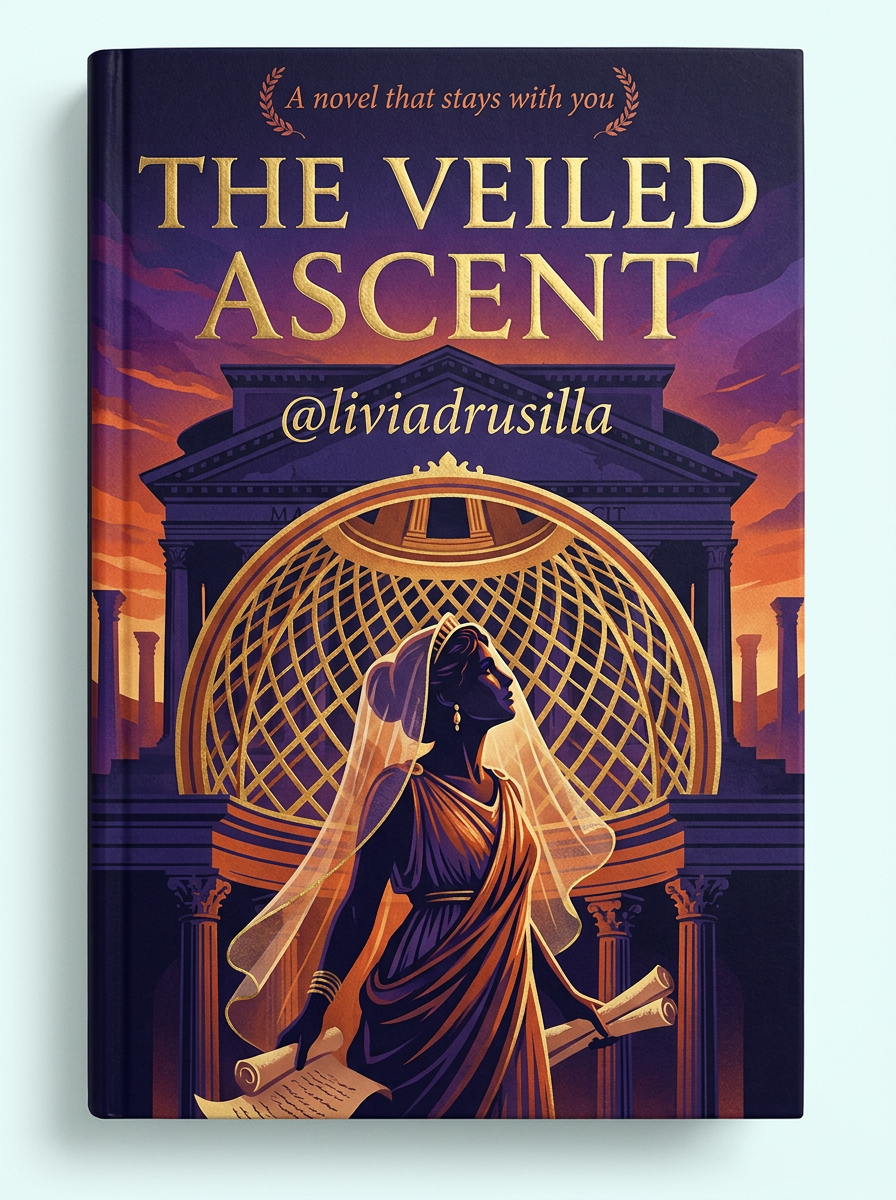
Synopsis
In the opulent, patriarchal world of 25 BC Rome, a brilliant young noblewoman, Aurelia Valerius, feels trapped by a predetermined marriage to a man she barely knows, her fervent intellectual pursuits clashing with societal expectations, forcing her to navigate a gilded cage while secretly yearning f
Chapter 1: The Weight of a Scroll
The late afternoon sun, a diffuse, buttery light, bled through the oiled parchment of Senator Valerius’s study windows, painting the air with a soft, melancholic glow. Dust motes, like tiny, forgotten stars, danced in the golden shafts, illuminating the heavy oak desk where the senator sat, his gaze fixed not on the panoramic vista of the Palatine Hill outside, but on the unfurled scroll before him. It was a document of exquisite craftsmanship, the vellum supple beneath his fingertips, the ink a rich, almost living black. But its beauty was a cruel deception, for within its elegant script lay the cold, immutable terms of a transaction.
This was the marriage contract.
Valerius, a man whose features were etched with the subtle lines of a life lived in the unforgiving glare of Roman politics, traced a finger along a particularly ornate flourish. His face, usually a mask of controlled composure, was now a landscape of subtle disquiet. He was a man accustomed to the weight of empire, to the intricate dance of power and influence that defined his world. Yet, the weight of this single scroll, this binding of two lives, felt heavier, more personal, more profoundly unsettling than any senatorial decree he had ever signed.
He knew, with the chilling certainty of a man who had long ago mastered the art of self-deception, that this was a good match. Excellent, in fact. The young Piso family, though not quite of the old patrician stock, possessed an undeniable ascendancy. Their wealth was burgeoning, their political connections formidable, and the young Lucius Piso himself, while perhaps lacking the sharp wit that Valerius secretly prized, was undeniably handsome, well-bred, and possessed of a suitably ambitious spirit. For Aurelia, his daughter, it was a future of security, of influence, of a position befitting her station. It was, by all accounts, precisely what a Roman noblewoman of her standing was destined for.
And yet.
A faint tremor ran through Valerius’s hand, a ghost of an old anxiety. He closed his eyes, and for a fleeting moment, the meticulously ordered study faded, replaced by the vivid image of a small, bright-eyed girl, no older than four, perched precariously on a stack of scrolls in his very own library. She had been enchanted, even then, by the curling script, the stories whispered from the papyrus. He remembered finding her there, her tiny fingers tracing the letters, her brow furrowed in a concentration that belied her tender age. Most children of her age were captivated by dolls, by games of make-believe. Aurelia had been captivated by knowledge.
It had been a dangerous fascination, even then. The whispers of the household staff, the raised eyebrows of his wife, Cornelia, whose pragmatism was as unyielding as marble – all had cautioned against it. A girl, they said, needed to learn the loom, the management of a household, the art of pleasing a husband. Not the intricacies of Greek philosophy or the precise calculations of astronomy. But Valerius, for all his adherence to Roman tradition, possessed a secret, almost rebellious streak. He had seen in Aurelia a reflection of himself, a thirst for understanding that he, in his own youth, had been forced to temper and redirect into the more acceptable channels of rhetoric and law.
He had indulged her, subtly at first. The old Greek tutor, initially hired for his son, Lucius Minor, found himself spending increasingly more time explaining the nuances of Homer to Aurelia, her questions far outstripping her brother’s polite disinterest. Valerius himself, in the quiet evenings after Cornelia had retired, would often find Aurelia in the library, a lamp casting a warm glow on her intent face. He would sit with her, guiding her through the complexities of Livy, debating the merits of Cicero’s orations, even venturing into the forbidden territory of Sappho’s poetry, discreetly acquired from a merchant who understood the value of discretion.
He had nurtured that mind, that extraordinary intellect, like a clandestine gardener tending a rare, exotic bloom in the heart of a perfectly manicured Roman garden. He had delighted in her insights, her startlingly original perspectives, the way her thoughts would spiral outwards, connecting disparate ideas with an almost effortless grace. He had seen in her a brilliance that surpassed his own, a capacity for understanding that, if unleashed, could rival the greatest minds of their age.
And now, here he was, complicit in caging it.
The irony was a bitter draught on his tongue. He, the man who had secretly championed her intellectual growth, was now the architect of its confinement. The marriage contract, with its precise clauses about dowry and property and lineage, was also, implicitly, a contract of intellectual curtailment. Lucius Piso, Valerius knew, would tolerate a wife who was well-read, perhaps even capable of engaging in polite conversation about literature. But a wife who questioned, who probed, who sought to understand the mechanisms of the universe, who yearned for a 'greatness' beyond the domestic sphere? That would be an affront, a challenge to his authority, an unwelcome deviation from the established order.
Valerius sighed, a long, weary exhalation that seemed to carry the accumulated dust of years. He was a man of his time, bound by the invisible but unbreakable chains of societal expectation. His political ambitions, the very bedrock of his existence, were inextricably linked to the careful management of his family. A well-placed marriage, a strategic alliance – these were not merely social niceties, but vital components of the intricate machinery of Roman power. To defy these conventions, to allow Aurelia to follow the uncharted path of her intellect, would be to invite censure, to jeopardize his standing, to unravel the carefully woven tapestry of his life’s work.
He remembered a conversation with Cornelia, years ago, when Aurelia was still a child, her brilliance already undeniable. Cornelia, her hands busy with embroidery, had looked up, her expression one of gentle yet firm admonition. "She is a girl, Valerius," she had said, her voice soft but unwavering. "Her destiny is to be a wife, a mother, the mistress of a household. Do not fill her head with notions that will only bring her discontent."
At the time, Valerius had dismissed it, a fleeting annoyance. Now, Cornelia’s words echoed in the quiet of his study, imbued with a chilling prescience. Had he, in his secret indulgence, inadvertently sown the seeds of Aurelia’s unhappiness? Had he, in nurturing her intellect, created a bird with wings too strong for the cage he knew she must eventually inhabit?
He thought of Aurelia now, a woman on the cusp of her nineteenth year. She possessed a beauty that was both striking and subtly unsettling. It was not the soft, yielding beauty of many Roman women, but one characterized by a keen intelligence in her eyes, a certain elegant tension in her posture, as if she were perpetually on the verge of intellectual flight. She moved with a quiet grace, her hands, so often stained with ink or smudged with charcoal from her clandestine sketches, possessing a delicate strength. She was, in every sense, a masterpiece of his own unwitting creation.
He had seen the subtle shift in her lately, a deepening of the thoughtful silence that often enveloped her. The vibrant spark in her eyes, once so readily ignited by a new idea, seemed to have receded, replaced by a shadow of something he couldn't quite name – resignation? Melancholy? A nascent rebellion, perhaps? He knew she understood the implications of this marriage, even if they had not yet spoken of it directly. Their communication was often a silent dance, a complex interplay of unspoken understandings.
He picked up a small, intricately carved ivory stylus from his desk, turning it over and over in his fingers. The smooth, cool surface was a stark contrast to the burning conflict within him. He was a man caught between two powerful forces: the inexorable pull of tradition and ambition, and the quiet, persistent voice of his own conscience, whispering of a daughter’s unfulfilled potential.
His motivations were complex, a Gordian knot of duty, love, and self-preservation. He loved Aurelia, in his own reserved, Roman way. He admired her, yes, even revered the sharpness of her mind. But he also loved the world he had built, the precarious edifice of his political career, his standing in the Senate, the very fabric of his family’s future. To jeopardize that for the sake of a woman’s intellectual freedom, in a society that offered no legitimate outlet for such a pursuit, would be, in his eyes, an act of profound folly, a dereliction of his duty as paterfamilias.
He remembered a particularly intense debate they had shared, just a few months prior. Aurelia had been poring over a translation of Plato's Republic, her brow furrowed in concentration. She had looked up, her eyes blazing with an almost fierce intensity. "Father," she had said, her voice low but clear, "do you not believe that a woman, given the same opportunities, could contribute as much to the *polis* as a man? That her intellect, if cultivated, could shape laws, inspire art, even lead armies?"
Valerius had felt a tremor of fear then, a cold knot tightening in his stomach. He had seen the dangerous gleam in her eyes, the burgeoning desire for a world that simply did not exist for her. He had offered a carefully worded response, full of platitudes about the unique and vital role of women within the household, the essential balance of society. He had spoken of the beauty of their domestic sphere, the profound importance of raising virtuous citizens. But even as the words left his lips, he had seen the light dim in her eyes, the subtle withdrawal, the almost imperceptible shuttering of her spirit. She had understood his evasion, his gentle but firm redirection.
He wondered, with a sudden, chilling clarity, if he had broken her then, or at least, bent her to his will beyond repair. The thought was a sharp, unwelcome stab. He had always prided himself on his ability to navigate the treacherous currents of politics with a clear conscience, making the necessary compromises, yes, but always, he believed, for the greater good. But what was the greater good here? His ambition, or his daughter’s soul?
The answer, he knew, was already decided. The scroll before him was the testament to that decision. He would sign it. He would ensure Aurelia’s future, as he understood it to be, a future of stability and influence, even if it meant sacrificing a part of her, a part of himself.
He picked up the stylus again, his thumb rubbing over its smooth, cool surface. The silence in the room was profound, broken only by the distant sounds of Roman life – the faint clatter of a cart, the murmur of voices from the street below. He imagined Aurelia now, perhaps in the peristyle garden, sketching a particularly vibrant bloom, or perhaps in her own small study, a forbidden scroll hidden beneath a more 'appropriate' embroidery hoop. He pictured her hands, so capable, so intelligent, destined now to guide a household, to manage servants, to weave tapestries, but not, he knew, to craft the grand narratives she so yearned to create.
A wave of profound sadness washed over him, a feeling he rarely allowed himself to indulge. It was the sadness of a man who loved deeply but was constrained by the very structures he upheld. He was a Roman, after all, a product of his time, and the weight of that legacy was immense. He had to make the difficult choices, the practical choices, the choices that ensured the survival and prosperity of his family, his name, his lineage.
He extended his hand, the stylus poised over the vellum. His signature, bold and decisive, would be the final seal on Aurelia’s fate. He knew, with an aching certainty, that she would comply. She was his daughter, after all, imbued with his own sense of duty, his own understanding of the world’s harsh realities. She would wear the mask of Roman decorum, she would play her part, and she would do it with a grace that would fool all but the most discerning observer.
But beneath that mask, he knew, the embers of her forbidden intellect would continue to flicker. And he, her father, the man who had both nurtured and caged that extraordinary mind, would carry the weight of that knowledge, a silent, enduring burden, until his dying day.
He pressed the stylus to the vellum. The ink flowed, black and unyielding, a permanent mark on the delicate parchment. The sun, sinking lower, cast longer, deeper shadows across the room, engulfing the senator and the signed scroll in a growing twilight. The deed was done. The future, for Aurelia, was now irrevocably etched in the annals of Roman custom. And Valerius, for all his power and influence, felt utterly, profoundly helpless, a mere pawn in the grand, unyielding game of fate.
Chapter 2: A Gilded Promise, A Shrouded Dawn
I.
The Roman dawn, as crimson and arrogant as a senator’s toga, seeped through the polished bronze grilles of Aurelia Valerius’s private cubiculum. It did not merely herald a new day; it announced, with an almost vulgar fanfare, the relentless advance of her wedding week. Today, the *deductio*, tomorrow, the *pronuba*, and soon, the irrevocable pronouncement of her new name, her new self: Aurelia Octavianus. The thought, a heavy, velvet-draped curtain, settled over her.
She lay still, a statue carved from the morning’s muted light, her dark eyes – perpetually thoughtful, even in repose – fixed on the intricate fresco adorning her ceiling. It depicted Ganymede, snatched by an eagle, ascending to Olympus, a vivid, albeit ironic, metaphor for her own impending elevation. Not to the heavens, of course, but to the venerated household of Titus Octavianus, a man she knew more by reputation and societal decree than by any intimate whisper of the soul.
A fine dew of apprehension, cold and cloying, clung to her. It was not fear, precisely; Aurelia Valerius was not a woman given to such common tremors. It was rather a profound, almost philosophical dread of the inevitable, a premonition of the intellectual solitude that awaited her. She was a woman for whom the scent of parchment was more intoxicating than the most exotic perfume, the labyrinthine logic of Stoicism more compelling than any whispered endearment. Yet, soon, her days would be consumed by the intricate dance of social obligation, the management of a wealthy household, the nurturing of heirs, and the endless, subtle performance of Roman decorum.
She pressed her fingertips to her temples, a familiar gesture that often accompanied the strenuous workings of her mind. Her father, Gaius Valerius, had often remarked upon her intellectual intensity, sometimes with a flicker of pride, more often with a concerned frown. “Aurelia,” he would say, his formidable voice rattling the very mosaics beneath their feet, “a woman’s virtue lies in her modesty and her devotion to her household.” He meant it kindly, of course, a father’s counsel for a daughter he believed was destined for great things within the established order. What he failed to comprehend was that the ‘greatness’ she yearned for was not forged in the domestic hearth, but in the fiery crucible of thought.
Memories, sharp and poignant, like shards of shattered pottery, surfaced from the depths. Philemon Aelius, her aged Greek tutor, his kind face creased like an ancient map, his deep-set eyes crinkling as he elucidated the subtleties of Plato. He had opened her mind like a rare scroll, revealing worlds where reason reigned supreme, where questions were praised more than answers, where the pursuit of truth was the noblest of human endeavors. "Your mind, child," he had murmured, his voice a sibilant whisper against the rustle of papyrus, "is a garden, fertile and vast. Do not let it lie fallow." Those words, a sacred injunction, echoed in her antechamber of consciousness now, sounding like a death knell.
She imagined herself, a bride swathed in the saffron veil, her face meticulously painted, her hair adorned with fragrant blossoms. It was a vision of exquisite beauty, a picture of perfection, yet within it, Aurelia saw only a gilded cage. The marriage to Titus was, from her father’s perspective, a masterstroke of political sagacity. Titus Octavianus, a rising figure in Roman politics, his lineage impeccable, his prospects promising, was the perfect match. Gaius Valerius, an imposing figure with a stern countenance and silvering hair, had orchestrated the union with the precision of a seasoned general maneuvering his legions. He genuinely believed he was securing her future, and in the practical, uncompromising world of Rome, he was.
But what of the future of her intellect? Would it wither, a hothouse flower denied the sun? Would the vibrant currents of her thoughts be reduced to stagnant pools beneath the weight of wifely duties and social trivialities? She pictured Titus, a man of average height, well-built, with a pleasant, if unremarkable, face. He was honorable, diligent, and respected. He would, she was certain, be a good husband, as goodness was defined by Roman society. He would provide, protect, and preside over their household with quiet authority. But there was no flicker of shared insight behind his eyes, no hunger for discourse, no shared delight in the elegant symmetry of a philosophical argument. He was a man of action, of public life, of concrete realities. She was a woman of ideas, of introspection, of the elusive, intangible world of the mind.
A soft knock at the door, tentative yet insistent, broke her reverie. “My lady?” It was Phoebe, her personal attendant, her voice a hushed rustle of anticipation. “Your bath is prepared. Your mother awaits you for… the bridal preparations.”
Aurelia sighed, a barely perceptible exhalation that held the weight of untold anxieties. “I am coming, Phoebe.”
She rose, her tall, graceful form moving with an almost somnambulistic elegance. Her reflection in the polished silver mirror showed a face of serene beauty, her striking dark eyes the only betraying hint of the turbulent currents churning beneath. She dressed in a simple tunic, its linen a stark contrast to the silken finery that would soon be her daily uniform. The thought of the intricate hairstyles, the heavy jewelry, the endless consultations with seamstresses and jewelers – all aimed at presenting her as the perfect Roman bride – filled her with ennui.
Her mother, Octavia Valerius, was already in the dressing room, a flurry of silks and nervous energy. Octavia, soft-featured and perpetually anxious, was a woman molded by the very traditions that now constrained Aurelia. She loved her daughter deeply, but her caring was constrained by a deep-seated inability to openly defy her husband or the immutable customs of Rome. She wanted Aurelia’s happiness, but she defined that happiness within the narrow confines of a successful, politically advantageous marriage.
"Aurelia, my dear, you are late!" Octavia exclaimed, her voice a little breathless. "The pronuba will be here soon to begin the styling of your hair. We must choose the right pearls for your veil. And the embroidered panels for your *tunica recta* – have you approved them?”
Aurelia offered a small, practiced smile. “Forgive me, Mother. I was lost in thought.”
Octavia patted her arm, her touch feather-light. “Such a thoughtful child. But today, we must think of the present. Of your glorious future!” Her eyes, shadowed with unspoken anxieties, held a desperate hope that Aurelia would simply acquiesce, would find contentment in the path laid out for her.
The morning unfolded in a dizzying sequence of consultations. The pronuba, a woman of formidable reputation, meticulously discussed hair arrangements. Servants bustled in and out, carrying bolts of fabric, trays of jewels, and phials of exotic oils. Aurelia allowed herself to be draped, adorned, and painted, her body a canvas for the rituals of her impending transformation. Her mind, however, retreated to its own sanctuary, recalling the hushed conversations with Philemon, the illicit thrill of reading Greek texts forbidden to Roman women, the quiet joy of solving a particularly knotty philosophical problem.
She remembered an afternoon, bathed in the golden light of the Valerius villa’s library, Philemon placing a weathered scroll into her eager hands. “These are the meditations of Epictetus, child,” he had whispered, his eyes gleaming with intellectual mischief. “They speak of an inner freedom, an unassailable citadel of the self that no external circumstance can penetrate.” Aurelia had absorbed every word, feeling a stirring within her, a nascent understanding that perhaps, even within the gilded cage of her Roman destiny, there might be a secret chamber, accessible only to her, where her intellect could still soar.
Livia Octavianus, Titus's sister, arrived just before midday, a whirlwind of witty observations and pragmatic advice. Livia, slightly older than Aurelia, possessed a knowing smile and sharp, observant eyes, eyes that had seen much and accepted much. She was a woman who understood the limitations placed upon Roman women, and while she had accepted them, she had not entirely surrendered her inner vivacity.
“My dear Aurelia, you look positively luminous,” Livia declared, surveying her with an appraising glance. “Though perhaps a touch… pensive. Marriage, my dearest, is a grand adventure. Or, at the very least, a grand diversion.” Her tone was light, but there was an underlying current of shared understanding that Aurelia, despite herself, appreciated.
“A diversion, perhaps,” Aurelia replied, a faint smile playing on her lips. “I confess, my thoughts are less on the grandeur and more on… the structure.”
Livia’s smile widened, a genuinely empathetic glint in her sharp eyes. “Ah, the structure. Yes. Roman marriage, you see, is less a wild forest and more a perfectly cultivated garden. Every path is laid out, every bloom carefully tended. There is a certain… comfort in that, once one adjusts.” She leaned closer, her voice dropping to a conspiratorial whisper. "Though, I daresay, a woman with your intellect might find the gardener's manual rather dull after a time."
Aurelia met her gaze, a flicker of genuine connection passing between them. Livia, it seemed, saw beyond the carefully crafted façade. She wasn't an intellectual by Aurelia's standards, but she possessed a keen perceptiveness, a shrewd understanding of human nature and societal expectations. She was the kind of woman who knew how to navigate the currents without being swept away.
"And Titus?" Aurelia ventured, a rare note of vulnerability in her voice. "What is he truly like, beyond the public pronouncements and the family anecdotes?"
Livia paused, her gaze softening. "Titus is… solid. Honorable. He will provide for you, cherish your reputation, and carry his name with dignity. He is not a man of great passions, perhaps, but he is a man of great duty. And in Rome, my dear, duty is often a far more reliable foundation than passion." She then added, a mischievous sparkle in her eyes, "He also has a rather charming, if somewhat staid, collection of exotic birds. Perhaps you’ll find them stimulating company."
Aurelia managed a small, genuine laugh. "Exotic birds, you say? A comfort, indeed."
As the day progressed, the preparations intensified, swirling around Aurelia like a tempest of tulle and anxieties. Her mother, Octavia, clutched at her arm repeatedly, offering unsolicited advice on managing servants, pleasing her husband, and bearing healthy sons. Octavia's gentle, traditional nature meant she genuinely believed in these pronouncements, seeing them as the bedrock of a woman's happiness. It was a well-meaning suffocation, a loving attempt to squeeze Aurelia into a mold she was never meant to fit.
Later, as the setting sun cast long, dramatic shadows across the marble floors, Aurelia found herself alone for a precious few moments in the Valerius library. The scent of aging papyrus and cedarwood was a balm to her agitated spirit. She ran her fingers along the spines of the scrolls, a silent farewell to a liberty she knew would soon be curtailed. Here, within these walls, she had roamed freely across the landscapes of Greek philosophers, Roman historians, and Alexandrian poets. Her mind, unfettered by domestic cares or societal scrutiny, had soared.
She reached for a scroll of Seneca, its edges worn smooth by countless readings. His words, stern yet comforting, spoke of self-possession, of the inner citadel of the mind, a fortress against the vicissitudes of fortune. *“True happiness is to enjoy the present, without anxious dependence upon the future.”* A bitter irony, she thought, given the present contained the inexorable march toward her future.
A shadow fell across the archway, and a figure emerged from the deepening gloom. It was Gaius Valerius, her father. His imposing presence seemed to shrink the already vast room. His stern countenance, usually reserved for political rivals or wayward slaves, softened almost imperceptibly as he looked at his daughter.
“Aurelia,” he said, his voice resonant, but without its usual authoritative edge. “Still with your scrolls? Such habits will not serve you as the mistress of Titus’s household, my dear.”
Aurelia turned, her expression carefully neutral. “Father. I was merely… reflecting.”
Gaius approached, his heavy sandals thudding softly on the mosaic. He reached out, his large hand gently clasping her chin. His touch, usually firm, was surprisingly tender. “You are a beautiful woman, Aurelia. And a clever one. Titus is a fortunate man. This alliance… it will strengthen our house, cement our position. You are doing a great service, my daughter.”
He said it with an earnestness that brooked no argument, a conviction that he was acting in her best interests. There was love in his eyes, a father’s love, but it was a love utterly intertwined with ambition, tradition, and the unyielding demands of Roman society. He saw success, and he believed he had provided it for her.
“I understand, Father,” Aurelia said, the words a murmured acquiescence. She wanted to explain, to articulate the vast chasm between her soul’s longing and the path he had so meticulously paved, but she knew it would be futile. He would not understand the yearning for 'greatness' she felt, a greatness not measured in acres of land or political influence, but in the boundless expanse of intellectual discovery. He only saw a dutiful daughter, soon to be a dutiful wife, fulfilling her preordained role.
He released her chin, his expression once again settling into its familiar sternness. “Excellent. Now, leave these dusty works and join your mother. There are still details to be finalized for tomorrow’s ceremony. A Valerius bride must be impeccable.”
Aurelia watched him depart, his heavy figure receding into the shadows. The library, once a sanctuary, now felt like a mausoleum for her intellectual freedom.
As night deepened, casting the world in a shroud of impenetrable darkness, Aurelia found herself in her cubiculum once more, the sounds of the bustling household fading into a distant hum. She stood by the window, gazing out at the star-studded Roman sky. The gods, she knew, were indifferent to the private travails of mortals. They watched, perhaps, with mild amusement, as humans played out their predetermined roles.
Tomorrow, the *deductio*, the formal procession to her new home. And perhaps, lurking within Titus’s household, there would be whispers of a life she hadn't yet considered. She knew Titus had an enslaved Greek scholar, Hektor, in his employ, a man renowned for his intellect. A faint, almost imperceptible flicker of hope ignited within her, a fragile ember in the vast darkness. Perhaps, even in this gilded cage, there could be a moment, a shared glance, a whispered word, that would allow her intellect to breathe, to live, to continue its veiled ascent. The dawn of her new life approached, heralded by the faint, shimmering light of the crescent moon, a gilded promise, shrouded in an uncertain, intellectual dawn.
Chapter 3: The View from the Palatine
The sun, a brazen orb in the Roman sky, cast long, distorted shadows across the freshly laid mosaic in the atrium. Titus Octavianus stood amidst the controlled chaos of his new Palatine residence, a man in the prime of his ambition, surveying his domain with the meticulous eye of a general inspecting his troops. Marble dust, fine as powdered snow, clung to the rich fabric of his tunic, a testament to the ceaseless industry that transformed stone and mortar into a symbol of his burgeoning power. He inhaled deeply, the scent of fresh plaster and polished wood a heady perfume of progress.
His chief architect, a gaunt Greek named Theron, approached, a roll of parchment clutched in his hand. "My Lord, the final touches on the *triclinium* are complete. The frescoes, as per your instruction, depict the triumphs of Scipio Africanus."
Titus nodded, a flicker of approval in his dark eyes. "Excellent, Theron. A fitting motif. Let it remind all who dine there of the glory that comes with decisive action and strategic foresight." He gestured towards the expansive view from the portico, where the city sprawled beneath them like a living tapestry, its terracotta roofs gleaming, its bustling arteries pulsing with life. "This location, Theron, was not chosen merely for its elevation. It is a statement. A declaration."
Theron, a man accustomed to the grand pronouncements of his patrons, merely bowed. "Indeed, my Lord. The view is unparalleled."
Titus, however, was not speaking of aesthetics. He was speaking of destiny. He envisioned his future unfolding from this vantage point, each stone of this edifice a stepping stone in his inexorable climb. His family, the Octaviani, though ancient, had seen their fortunes wane and wax, like the phases of the moon. It was his duty, his singular purpose, to ensure their ascendancy was not merely a fleeting moment but a permanent fixture in the Roman firmament.
He ran a hand over the smooth, cool surface of a porphyry column, its deep crimson hue mirroring the ambitious blood that coursed through his veins. Marriage, in his world, was not a matter of romantic whims or fleeting passions. It was a strategic alliance, a carefully negotiated treaty, a cornerstone of his future. And Aurelia Valerius, the daughter of Senator Valerius, was precisely the cornerstone he required.
He had met her, of course, in the formal settings prescribed by Roman custom – the measured greetings, the polite exchanges, the veiled glances. He had observed her with the same dispassionate scrutiny he applied to a new acquisition or a potential political ally. She possessed the requisite beauty, a classic Roman elegance that would reflect well on him. Her family’s lineage was impeccable, their wealth substantial, their political connections vast and influential. All these were essential components, the building blocks of the respectable, advantageous union he sought.
He recalled her eyes, a startling shade of grey that seemed to hold an unexpected depth. But he had not lingered on them. Instead, he had focused on the practicalities: her dowry, the political leverage her father commanded, the social standing her name would bring to his household. These were the true metrics of her value in the intricate mosaic of Roman society.
"The arrangements for the wedding," he stated, turning back to Theron, "are proceeding without impediment, I trust?"
"Every detail, my Lord," Theron assured him, "is being meticulously managed by your household staff. The finest linens, the most exquisite floral arrangements, the musicians from Brundisium – all are secured."
Titus nodded, a sense of satisfaction settling over him. He imagined the wedding feast, the glitter of gold and silver, the sonorous pronouncements of the priests, the murmuring admiration of the guests. It would be a spectacle worthy of his ambition, a public declaration of his rising star. Aurelia would be there, draped in silk and jewels, her role to play as the graceful, demure bride, a testament to his good fortune and discerning taste.
He did not consider her feelings, her desires, her individual spirit. Such considerations were luxuries afforded to poets and philosophers, not to men of action and influence. Her purpose, as he understood it, was to complement his own, to enhance his standing, to bear him sons who would carry on his name and legacy. She was a crucial component, a well-crafted piece in the grand design of his life, a vital cog in the machinery of his ascent.
He walked through the emerging gardens, still nascent but promising, envisioning the statuary that would soon adorn the pathways, the rare plants that would bloom in vibrant hues. This home, this life he was building, was a testament to his unwavering dedication to his family, to the Republic, and to his own undeniable potential.
He thought of his father, a stern, unyielding man who had instilled in him the absolute imperative of duty and ambition. "A man's worth," his father had often said, his voice like the rasp of a whetstone, "is measured by the legacy he leaves behind, not by the fleeting pleasures he pursues." Titus had taken these words to heart, etching them into the very core of his being. He had no time for fleeting pleasures, no inclination for frivolous pursuits. His life was a carefully constructed edifice, each stone placed with purpose, each decision weighed with meticulous precision.
The marriage to Aurelia Valerius was one such stone, a weighty and significant one. It would solidify his position, provide him with a legitimate heir, and offer a respectable foundation for his political aspirations. He saw himself, years hence, standing on the Senate floor, his voice commanding attention, his counsel sought by emperors and commoners alike. He saw his sons, strong and capable, following in his footsteps, extending the reach of the Octavian name even further.
He paused by a half-finished fountain, its intricate carvings still veiled beneath a layer of dust. The water, when it finally flowed, would sing a constant, soothing melody, a counterpoint to the clamor of the city below. He imagined Aurelia, perhaps, seated by this fountain, in the quiet hours of the afternoon, tending to her embroidery or supervising the household slaves. A demure, accomplished matron, presiding over his domestic sphere, leaving him free to conquer the world beyond its walls.
He had heard whispers, of course, of Aurelia’s intellectual leanings, her fondness for Greek philosophy, her voracious appetite for scrolls. He considered it a quaint eccentricity, perhaps even a minor flaw, but nothing that could not be managed. A woman’s intellect, in his view, was best confined to the domestic sphere, used to educate her children, to manage the household accounts, to engage in polite, superficial conversation at social gatherings. Anything more was unseemly, a distraction from her primary duties. He would gently guide her, of course, towards more appropriate pursuits, ensuring her energies were channeled into the betterment of his household and the advancement of his family.
He envisioned a future of order and predictability, a life meticulously planned and executed. His home would be a haven of decorum, his marriage a model of propriety, his political career a steady ascent. There would be no room for unexpected passions, no space for unconventional desires. The world, as he saw it, was a structured place, and he, Titus Octavianus, was a man who understood structure, who thrived within its confines.
He turned to Theron once more, his gaze sweeping across the panoramic view of Rome. "The *tablinum*," he instructed, "ensure the finest cedar is used for the shelving. And let the scrolls be arranged with utmost care. My library, Theron, must be a testament to not only knowledge but also meticulous organization."
Theron bowed again, his expression unreadable. "It shall be done, my Lord."
Titus allowed himself a rare, almost imperceptible smile. He was building more than just a house; he was building a dynasty. And Aurelia Valerius, though a woman, would play her part, a crucial, if silent, instrument in the grand symphony of his ambition. He saw her not as a person with her own dreams and aspirations, but as a prestigious acquisition, a valuable asset, a perfect complement to the magnificent edifice of his life. From the elevated perspective of the Palatine, the future stretched before him, clear and unblemished, a testament to his own unwavering resolve and the careful orchestration of his fate. The sun, now beginning its slow descent, painted the sky in hues of gold and crimson, mirroring the colors of his ambition, the promise of a glorious tomorrow.
Chapter 4: A Mother's Weave
The scent of lilies and beeswax hung heavy in the air, a cloying sweetness that clung to Aurelia’s tunic as she entered her mother’s atrium. It was an oppressively perfect space, every tessera of the mosaic floor meticulously aligned, every bronze statuette burnished to a blinding sheen. This was Cornelia’s domain, a meticulously ordered world where even emotion seemed to find its prescribed place, tucked away beneath the polished surfaces.
Cornelia Valerius sat on a cushioned sella, her back ramrod straight, her fingers deftly weaving at a tapestry frame. The threads, jewel-toned and fine as spider silk, depicted a scene of Vestal Virgins offering libations – the very image of disciplined feminine virtue. Her mother’s face, still unlined by age despite the faint silver strands woven into her elaborate coiffure, bore an expression of serene concentration. Aurelia, however, could read the subtle tension in the set of her mother’s jaw, the slight tremor in her otherwise steady hands. Cornelia was not serene; she was contained, a vessel brimming with unspoken directives.
"Aurelia," Cornelia said, her voice smooth as oiled marble, without looking up. "You are prompt. A valuable trait, soon to be tested.”
Aurelia inclined her head, a practiced gesture honed since childhood. “Mother.” She took a seat on a low stool opposite her, careful not to disturb the flow of her mother’s work. The silence between them stretched, punctuated only by the soft *click* of the shuttle against the loom and the distant murmur of the city. Aurelia felt an familiar prickle of apprehension. She knew this dance.
Finally, Cornelia laid down her shuttle, her gaze, cool and appraising, settling on Aurelia. There was no warmth in it, not precisely, but a deep, abiding sense of purpose, like a general surveying her most valuable, and most volatile, asset. “Your father spoke with me this morning,” she began, her tone devoid of inflection. “The arrangements for your transition are progressing smoothly. Titus’s estate is, as expected, impeccable. He has seen to every detail.”
Aurelia’s fingers tightened imperceptibly on the folds of her tunic. *Transition*. The word itself felt like a heavy stone, dropped into the quiet pool of her thoughts, sending ripples of unease outwards. “Indeed, Mother,” she managed, her voice steadier than she felt.
“Indeed.” Cornelia echoed, a faint, almost imperceptible smile touching her lips. It was a smile born of satisfaction, not joy. “A wife’s duties are manifold, Aurelia, and a wife of your standing has a greater responsibility than most. You are not merely marrying a man; you are marrying a house, a lineage. The Octaviani are an old family, tracing their roots further back than many.”
As if Aurelia needed reminding. The genealogies of Rome’s patrician families were etched into her memory, as familiar as the declensions of Latin verbs. She held her tongue, knowing that interjection would merely prolong the inevitable.
“Your primary duty, of course, will be to bear children,” Cornelia continued, her gaze unwavering. “Sons, if the gods are willing. Strong, healthy sons to continue the Octavian line. This requires a robust constitution, a healthy diet, and a mind free from unnecessary anxieties.” She paused, her eyes narrowing fractionally. “And a body kept pure, for the gods favor purity.”
Aurelia felt a blush rise to her cheeks, a searing heat that had nothing to do with modesty and everything to do with resentment. To be reduced to a vessel, a mere conduit for lineage, chafed at the very core of her being. She recalled the whispered conversations with Philemon Aelius in the quiet corners of the villa library, the thrill of deciphering a complex philosophical treatise, the boundless expanse of ideas. These were the anxieties her mother referenced, the ‘unnecessary’ concerns that elevated her above the purely biological.
“I understand, Mother,” she murmured, the words tasting like ash.
“Do you, Aurelia?” Cornelia’s voice was soft, dangerously so. “I wonder. You have spent your formative years with your head buried in scrolls, encouraged by your father, I will grant, to my enduring bewilderment. He claims it was to sharpen your intellect, make you a more engaging companion. But the role of a wife, especially a Roman wife, is not to engage in debates with her husband, but to complement him. To be the steadfast anchor of his household, the silent architect of his domestic peace.”
The silver threads in the tapestry seemed to glint with a sharp, metallic light, reflecting Aurelia’s own nascent rebellion. “Father values intelligence, Mother,” she ventured, a tremor in her voice she could not quite suppress.
Cornelia laughed, a short, dry sound devoid of humor. “Your father values what benefits him, Aurelia. And what benefits him is a son-in-law who will secure his political alliances, a daughter who will conduct herself with an unimpeachable decorum, and grandchildren who will cement the Valerius name through a powerful new line. Your ‘intelligence,’ as you call it, is a garnish, not the main feast. It may amuse Titus in his moments of leisure, but it must never overshadow his authority, nor challenge the established order of your household.”
The words struck Aurelia like small, sharp stones, each one leaving a bruise. *Garnish*. The very essence of her being, the insatiable hunger for knowledge, the intricate workings of her mind, dismissed as a mere decorative flourish. It was as if her mother had peered into the deepest recesses of her soul and found it lacking, or worse, deemed it a dangerous excess.
“Decorum,” Cornelia continued, oblivious to Aurelia’s inward turmoil, or perhaps, perfectly aware of it. “Is the bedrock of a respected Roman matron. Every gesture, every word, every adornment must be carefully considered. Your household will be a reflection of Titus’s standing, and by extension, your own. You must oversee the slaves with a firm but just hand, manage the accounts with diligence, and present a face of unruffled serenity to the world, no matter what turmoil may rage within.”
*No matter what turmoil may rage within.* The phrase hung in the air, a chilling premonition. Aurelia imagined her mind, once a vibrant tapestry of ideas, slowly unraveling, thread by thread, until only the stark, unyielding loom of duty remained.
“Your mother-in-law, Octavia, was a woman of exemplary virtue,” Cornelia said, transitioning smoothly. “Her household was renowned for its order, its quiet efficiency. You would do well to emulate her, though I believe she was too soft on her slaves. A firm hand discourages insolence.”
Aurelia remembered Titus’s brief mention of Hektor. She wondered how a man like Hektor, a man whose mind surely transcended the bounds of his enslavement, would fare under such a regime. The thought sent a shiver down her spine.
“And your personal conduct, Aurelia,” Cornelia pressed on, her voice tightening slightly. “Must be beyond reproach. Remember you are no longer a girl. Every glance, every conversation, every public appearance will be scrutinized. Any hint of impropriety, any whisper of scandal, would not only tarnish your own name but bring shame upon the Valerius and Octavian families. You are the embodiment of their honor, Aurelia. Do not forget that.”
The image of the intricate, oppressive tapestry on the loom flashed in Aurelia’s mind. Each thread, each color, each scene meticulously chosen, woven together with relentless precision, leaving no room for improvisation, no space for divergence. Her life was to be such a weave, her mother’s hands, and the hands of Roman society, guiding every trajectory.
“Your reputation, specifically, as a ‘scholar,’ must be managed with discretion,” Cornelia added, her gaze softening for the briefest moment, a flash of an emotion Aurelia couldn't quite decipher—was it warning? Or a faint echo of pity? “While your father may have indulged your predilections, in Titus’s household, such pursuits must remain firmly within the confines of your own chambers, and even then, in moderation. The primary focus of a worthy matron is the home, the family, the public face of her husband’s ambitions. Not dusty scrolls and obscure philosophies.”
Dusty scrolls and obscure philosophies. To Aurelia, they were life itself, the very breath of her being. The thought of them being relegated to hidden corners, pursued in secret, like a shameful vice, sent a wave of despair through her. It was a sentence, subtly delivered, to intellectual exile.
“Your position in society, Aurelia, is a great privilege,” Cornelia concluded, her voice regaining its usual steel. “Many girls dream of such a match, such a future. Do not squander it with frivolous notions or disobedient acts. Embrace your destiny. It is a glorious one, if you choose to see it.” She picked up the shuttle once more, her movements fluid and practiced. “Now, go. I have duties to attend to. And you have much to consider. I expect you to reflect deeply on our conversation.”
Aurelia rose, her legs feeling strangely heavy, as if weighted with unseen chains. She made the customary bow, her eyes fixed on the Vestal Virgins on the tapestry, their faces serene, their lives dedicated to duty. She wondered if they, too, felt the quiet despair of a soul confined, a spirit slowly suffocating under the weight of prescribed perfection.
As she walked away, the lilies’ perfume seemed to grow stronger, almost suffocating. The polished marble floor reflected her image back at her—a noblewoman, poised and graceful, but in her own perception, a gilded cage slowly closing in. The words of her mother, like the threads of the tapestry, were weaving themselves into an intricate prison, each directive a bar, each admonition a lock. She was to be a wife, a matron, a mother—all roles she understood, all roles she had been prepared for since birth. But what of Aurelia, the scholar, the seeker of truth, the one who yearned for a greatness she could not yet define? Where did she fit into this meticulously crafted weave, or was she to be unraveled, thread by agonizing thread, until nothing of her original self remained? The question hung suspended in the air, a silent, desperate plea against the inexorable turning of a world that had no use for a woman’s mind, only her obedience.
Chapter 5: Echoes in the Atrium
The sun, a brazen eye in the Roman sky, cast long, theatrical shadows across the marble floors of the atrium. Its light, filtered through the yawning aperture in the roof, painted the air with a dusty luminescence, making the very motes dance like tiny, forgotten wishes. Aurelia, draped in a stola the color of pale moonlight, descended the grand staircase with a practiced grace, each step a testament to years of tedious instruction. Her heart, however, felt less like the measured beat of a lady in waiting and more like a frantic bird trapped in a cage of silk and societal expectation.
Today was the day she would formally meet Titus Octavianus, her future husband, the architect of a gilded cage she already felt pressing in on her spirit. Her father, Gaius Valerius, stood by the central impluvium, his imposing figure framed by the stoic statues of their ancestors. He was a man carved from the very bedrock of Roman tradition, his will as unyielding as the Capitol Hill itself. He offered her a brief, approving nod, a gesture as cool and impersonal as a winter morning. Her mother, Octavia, a gentle echo of her husband’s authority, offered a soft, encouraging smile that spoke of unspoken anxieties, a faint flicker of worry in her kind, tired eyes.
Aurelia’s gaze, though seemingly demure, swept across the atrium. The air hummed with an almost palpable anticipation, not unlike the tension before a gladiatorial contest, though the only blood to be shed here would be the slow, quiet draining of her own aspirations. Then, he entered.
Titus Octavianus cut a respectable figure. He was not, Aurelia conceded with a mental shrug, an ill-favored man. His stature was average, his build solid, a testament to the rigorous physical training expected of a Roman noble. His features were regular, a pleasant symmetry that spoke of good breeding and an absence of troubling deviation. His toga, impossibly white and artfully draped, moved with a practiced fluidity, a sign of his standing. He exuded an air of quiet competence, of meticulous attention to detail, much like a carefully cataloged scroll or a perfectly aligned column.
He surveyed the room with an almost clinical assurance before his gaze rested upon Aurelia. He offered a polite, almost formal smile, a well-rehearsed gesture that reached his lips but not, she noted, the depths of his eyes. There was a lack of spark there, a certain blandness that pricked at her discerning spirit. He approached her father first, a respectful inclination of his head, a few murmured salutations lost to Aurelia’s ears amidst the rustle of her own rising agitation. Then, turning, he faced her.
"Aurelia," he said, his voice a smooth, even baritone, devoid of any discernible tremor or flourish. It was the sound of a man accustomed to being heard, accustomed to giving commands and expecting them to be followed. He extended his hand, a gesture of customary greeting rather than intimacy.
Aurelia placed her own hand in his. His grip was firm, warm, and entirely conventional. There was no lingering touch, no hint of a possessive squeeze, only a brief, perfunctory clasp. "Titus," she replied, her voice, though equally polished, held a subtle register of detachment, a finely tuned instrument played with the bare minimum of engagement. She felt, rather than saw, her father’s subtle glance, a silent reminder to play her part.
Their conversation, initiated by Gaius Valerius, flowed with the stilted rhythm of a diplomatic exchange. They spoke of the unseasonably warm weather, of the recent public games, of the ongoing prosperity of Rome under Augustus. Aurelia offered brief, appropriate responses, her words like meticulously crafted mosaics, each piece perfectly placed, yet devoid of true living breath. She found herself observing Titus with the detached curiosity of a scholar dissecting a specimen.
He spoke of his recent duties in the Forum, of the intricacies of a new proposed amendment to the agrarian laws, topics that, for most Roman women, would be met with a polite, if feigned, interest. Aurelia, however, possessed a mind that truly grasped the complexities of Roman governance. She could, if she were so inclined, engage him in a debate that would leave most senators scrambling for their scrolls. Yet, she restrained herself. To reveal the true breadth of her intellect would be akin to shattering the very decorum her father worked so tirelessly to maintain. It would be a rebellion, subtle but potent, and she knew the ground was not yet ready for such a planting.
He spoke of his estates, of the diligent management of his tenants, of the quality of his olive oil – matters of practical concern, certainly, but delivered with the same careful, almost uninspired tone. Aurelia listened, her dark eyes, usually alight with an inner fire, now veiled with an almost imperceptible shade of ennui. She could discern no grand passion in his pronouncements, no soaring ambition beyond the steady accumulation of respect and influence within the established order.
"I hear you have a fondness for the arts, Aurelia," Titus remarked, a polite inquiry that felt almost like a prompted question. His gaze flickered to her, a brief moment of more direct engagement.
Aurelia inwardly recoiled. Her "fondness for the arts" was a carefully curated public persona, a palatable distraction from the true hunger of her mind. It was a convenient label, broadly applied to any noblewoman who could, without making a spectacle of herself, recite a few lines of Virgil or play a passable tune on the lyre. Her true passions lay in the dusty rolls of history, in the intricate debates of philosophy, in the rigorous logic of mathematics.
"I appreciate the beauty of poetry and music, as any cultured Roman woman should," she replied, her voice a smooth as polished ivory. The emphasis on "cultured Roman woman" was subtle, a coded message that would be lost on most, but perhaps not entirely on herself.
Titus nodded, seemingly satisfied. "Indeed. A well-ordered home, I believe, is as crucial as a well-ordered state. And within that home, the gentler pursuits lend a certain grace."
His words, delivered with sincere conviction, felt to Aurelia like the delicate clink of chains. "Gentler pursuits." The phrase hung in the air, a silken cord binding her to the ornamental and the decorative, away from the substantive and the challenging. She imagined explaining to him the exhilarating journey through Plato's *Republic*, the fierce intellectual tussles of the Stoics, the audacious leaps of Archimedes. The very thought felt absurd, like bringing a complex mathematical proof to a child's game of knuckle-bones.
The conversation continued its polite unraveling, a tapestry of superficialities expertly woven by all involved. Gaius Valerius interjected with anecdotes of Titus’s burgeoning political career, his voice swelling with paternal pride, painting a vivid picture of the successful future that awaited his daughter as the wife of such a man. Aurelia offered the appropriate murmurs of agreement, her eyes fixed on a distant point beyond the peristyle, where a single, resilient oleander pushed its defiant blossoms towards the sun.
When Titus eventually took his leave, the air in the atrium seemed to exhale with a collective sigh of relief. Aurelia felt an almost spiritual exhaustion. The effort of maintaining the facade, of meticulously crafting every word and gesture, had drained her more than a day spent poring over dense philosophical texts.
Her father, his stern features softened by a rare expression of satisfaction, placed a hand on her shoulder. "He is a good man, Aurelia. Honorable. Respected. He will make a fine husband."
"Indeed, Father," she replied, the words a bitter residue on her tongue. She wished she could inject genuine warmth into her tone, to lessen the subtle strain that always existed between them, a chasm born of her intellect and his ingrained traditionalism. But the truth was, Titus, for all his polished conventionality, left her utterly unmoved. He was a piece of perfectly formed, classical statuary – aesthetically pleasing, perhaps even admirable in its execution, but utterly lifeless.
Her mother, sensing her daughter’s quietude, moved to her side, her touch a feather-light comfort on her arm. "You bore yourself with grace, my dear," she whispered, her eyes filled with an unspoken plea.
Aurelia managed a faint smile. She loved her mother, understood the limitations and anxieties that shaped her life, but could not emulate her quiet surrender. Her mother’s embrace of duty, her gentle resignation, felt to Aurelia not like peace, but slow suffocating.
With a polite excuse, Aurelia retreated from the formal bustle of the atrium. Her footsteps echoed softly on the marble, carrying her away from the public spaces of her home, past the family shrines and the bustling kitchen, towards the rear of the palatial domus. She sought refuge in the sprawling library, a place where the air itself seemed to hum with the quiet voices of forgotten thinkers.
Her father’s library was a testament to his wealth and, to a lesser extent, his own scholarly interests, though his leanings were primarily towards history and law. Towering shelves filled with papyrus scrolls lined the walls, each one meticulously categorized and labeled. The scent of aged parchment, cedar, and dried herbs hung thick in the air, a balm to her agitated spirit.
While many of the scrolls were safely within the bounds of acceptable Roman thought, Aurelia knew of a hidden alcove, a secret sanctuary nestled behind a false panel in a lesser-used corner. It was a space known only to her, and perhaps, though she could not be certain, to Philemon Aelius, her former Greek tutor. It was there, guided by his subversive and brilliant mind, that she had first encountered the forbidden texts, the audacious philosophies that dared to question the very foundations of her world.
Her fingers traced the familiar patterns on the cedar panel, felt for the subtle give in the wood. With a soft click, it slid inwards, revealing a narrow recess, barely wide enough for her to slip through. The air within was cooler, thicker, carrying a faint, earthy scent. Here, illuminated by a single, carefully concealed oil lamp, rested the scrolls she truly cherished.
She pulled out a scroll, unrolling it with a reverence that bordered on devotion. It was a copy of Sappho, her passionate verses a shocking contrast to the prescribed decorum of Roman women. Next, a treatise by an early Hellenistic philosopher, his arguments challenging the very concept of divine intervention, suggesting a world governed by reason and natural law. And then, her true treasure – a collection of notes, painstaking translations, and commentaries made by Philemon himself, on the more radical Stoic concept of universal brotherhood, a notion that subtly undermined the rigid Roman social hierarchy.
Aurelia sank down onto a small, worn cushion, the lamplight casting dancing shadows on her thoughtful face. She had spent countless hours in this clandestine space, devouring these forbidden words, letting them fuel the embers of her own nascent intellect. Here, she was not Gaius Valerius’s daughter, nor Titus Octavianus’s future wife. Here, she was simply Aurelia, a mind unfettered, a spirit soaring free amidst the ancient, radical thoughts of those who dared to question.
She read, her mind alight, the delicate script blurring before her eyes not from strain, but from sheer intellectual exhilaration. The polite, suffocating interactions of the atrium faded into a distant echo, replaced by the vibrant voices of these texts. The words were a lifeline, a secret language spoken only to her, promising a 'greatness' she yearned for but could not yet articulate.
The afternoon sun began to wane, its golden light deepening to a warm amber, then to a soft, bruised purple. Aurelia remained in her hidden sanctuary, lost in the intricate dance of ancient wisdom. The quiet rustle of papyrus, the faint flicker of the lamp, the profound silence of her intellectual communion – this was where she felt truly alive, truly herself.
The future, with Titus as its uninspired custodian, loomed like a looming shadow. But within this forgotten alcove, surrounded by the whispers of forbidden knowledge, Aurelia felt a defiant spark ignite. Her world might be forged of gilded bars, but her mind, she vowed, would remain a sanctuary of soaring thought, a fortress unbreachable by the mundane, waiting for its moment to ascend. The echoes in the atrium might have been polite and strained, but in the heart of the library, a different kind of echo resonated – the profound, insistent call of her own unbound intellect.
Chapter 6: The Philosopher's Ghost
The library, a cool, shadowed sanctuary, exhaled the scent of aged papyrus and forgotten cedar. It was here, amidst the hushed eloquence of forgotten voices, that Aurelia sought refuge from the ornate cage of her impending marriage. The echoes of Titus’s polite, uncomprehending pleasantries still clung to her memory, insubstantial as dust motes in a sunbeam. She navigated the labyrinthine shelves with an almost preternatural grace, her fingers trailing over the spines of countless scrolls, each one a whisper of a world beyond the narrow confines of her predetermined fate.
She found herself, as she often did, in the Stoic section, drawn to the severe wisdom of Zeno and Epictetus. Their philosophies, while sometimes stark in their acceptance of fate, offered a strange balm to her troubled spirit. She yearned for the impassive strength they championed, a bulwark against the rising tide of societal expectations that threatened to drown her. Today, her gaze fell upon a particular scroll, a well-worn copy of Musonius Rufus, its linen binding fraying at the edges. It was a text Philemon, her former tutor, had once pressed into her hands, urging her to find the quiet resilience within its pages.
She unrolled it carefully, the dry rustle a familiar symphony in the quiet room. Her eyes, accustomed to the dim light, traced the elegant script, seeking passages that might resonate with her current disquietude. And then, there it was, not part of the original text, but a small, neat inscription in the margin, penned in a hand she knew intimately, yet simultaneously felt she barely knew at all.
Her father’s hand.
It was a philosophical query, precise and pointed, scrawled beside a particularly challenging passage on the nature of virtue and external goods. *“Is the pursuit of political power, when undertaken for the betterment of the Republic, truly external to virtue, or an expression of it?”*
Aurelia’s breath hitched. The question, so deceptively simple, yet weighty in its implications, mirrored a conversation she’d had with Philemon years ago. She had been a girl then, barely twelve, her eager mind grappling with the intricacies of civic duty and personal excellence. She had asked Philemon, with all the earnestness of youth, whether her father’s relentless dedication to the Senate, his unyielding ambition, was a testament to his virtue or a distraction from it. Philemon, ever the gentle guide, had encouraged her to explore the nuances, to consider the motivations behind the actions.
And now, here was her father, Senator Gaius Valerius, posing a shockingly similar question, not to Philemon, but, it seemed, to the silent wisdom of Musonius Rufus himself. The discovery was like a sudden fissure in the carefully constructed facade she had always known. Her father, the formidable, unwavering pillar of Roman tradition, the man whose every pronouncement was imbued with an almost unshakeable certainty, had questioned, had pondered, had – *doubted*. It was a revelation, shattering the monolithic image she held of him.
She traced the faint ink of his script, a familiar tremor running through her fingertips. This was not the hand of the stoic paterfamilias who dictated her fate with such unshakeable conviction. This was the hand of a scholar, a seeker. A fleeting image of him, younger, perhaps, hunched over a scroll late into the night, wrestling with philosophical dilemmas, formed in her mind’s eye. It was an image at odds with the imposing figure who now presided over their household with a stern countenance and an air of absolute authority.
A second marginal note caught her attention, further down the scroll. Beside Musonius’s assertion that true freedom lies in rational choice, regardless of circumstance, her father had written, *“But what of the chains unseen, those woven by expectation and duty?”*
A cold shiver snaked down Aurelia’s spine. *Chains unseen.* The phrase resonated with a chilling accuracy in her own soul. Was he referring to his own obligations, the heavy mantle of senatorial duty that often constrained his personal inclinations? Or, was this a more profound, more unsettling question, one that hinted at a shared understanding of their respective gilded cages?
The senator, her father, was a man of precise habits and unflappable decorum. His days were structured around the meticulous demands of statecraft and the maintenance of their esteemed family’s honour. To imagine him engaging in such introspective, almost vulnerable, philosophical musings was to dismantle the very architecture of her understanding of him. He had always presented an impenetrable front, a paragon of Roman masculinity, valuing practicality and adherence to custom above all else. His very presence in the library, when he did deign to enter, was usually to retrieve some legal codex or historical account, never, to Aurelia’s knowledge, to engage in the quiet, subversive act of philosophical inquiry.
Yet, here was the irrefutable evidence. A ghost of a philosopher, stirred from the dust of ancient scrolls, revealing a hidden facet of her father’s being. The questions he posed in the margins were not merely academic; they were deeply personal, echoing the very anxieties that gnawed at Aurelia herself. The conflict between individual liberty and societal obligation, the true nature of virtue in the face of worldly pressures – these were the bedrock of her own intellectual struggles, the very questions she had hoped to explore in conversation with Philemon, but which had now been effectively silenced by her impending marriage.
Why had he never spoken of these thoughts? Why, if he harboured such intellectual longings, had he so ruthlessly suppressed her own, channeling them into the politically advantageous, yet personally stifling, union with Titus? It seemed an exquisite cruelty, a subtle irony. He, who silently wrestled with the constraints of duty, was now, through the same pervasive influence, placing similar, if not more restrictive, constraints upon her.
The weight of the scroll in her hands suddenly felt immense, laden not just with ancient wisdom but with the unspoken complexities of her own family. The image of her father, the stern patriarch, began to fragment, revealing glimpses of a man she had never truly known, a man perhaps as conflicted, as yearning, as she was herself. He had encouraged Philemon to teach her, had allowed her access to these very scrolls, a privilege almost unheard of for a young woman of her station. Was it merely a pragmatic decision, to ensure she was well-educated enough to manage a household, or was it a quiet concession to a shared intellectual bent, a silent acknowledgement of a mind that mirrored his own in its thirst for understanding?
The thought was both exhilarating and profoundly unsettling. If her father harboured these depths, these intellectual sympathies, then his actions – particularly his arrangement of her marriage – became all the more perplexing, all the more painful. Was it a sacrifice he himself had made, echoing through time, now enforced upon his daughter? Or was it a more subtle form of control, a desire to manage and direct her intellect towards socially acceptable ends, lest it lead her astray?
She carefully re-rolled the Musonius Rufus, her gaze lingering on the now-revealed marginalia. The cool parchment felt strangely alive, charged with the unsaid, the unexplored. This was not a treasure map to forgotten gold, but a map to a forgotten part of her father, a secret landscape of his mind that existed beneath the carefully cultivated surface of Roman nobility.
She was left with a dizzying sense of confusion. The man who stood before her in the atrium, presiding over household affairs with a weighty gravitas, was perhaps not the whole man after all. There was a secret room in his mind, a hidden library where he grappled with the very philosophical questions that consumed her. And in that room, it seemed, her ghost, the ghost of her own unexpressed intellectual longing, had a silent companion.
The silence of the library pressed in around her, no longer a comforting balm but an oppressive weight. She was not alone in her intellectual isolation, it seemed. But this shared, unspoken world, rather than bringing solace, only served to highlight the vast chasm between them. For he, in his public life, had chosen the path of conventional duty, and was now, with an almost brutal efficiency, forcing that same path upon her. The philosopher in him remained a ghost, unseen, unheard, while the senator, the dutiful Roman, held sway. And Aurelia, now armed with this unsettling knowledge, understood that her own struggle was not merely against an unfeeling system, but perhaps, against a part of her father that he himself had long since buried. The veiled ascent, she realized with a fresh pang of sorrow, might be a burden generational, inherited and reinforced, a silent agreement to trade intellect for decorum, truth for tradition. She replaced the scroll, a new layer of complexity added to the already intricate tapestry of her nascent resistance. The library, once her pure sanctuary, now held the uncomfortable truth that even the most formidable walls can conceal the most vulnerable questions.
Chapter 7: The Unsent Papyrus
The twilight of memory fell over Aurelia’s thoughts like the velvet drapes in her father’s study, obscuring the harsh lines of the present. It was a memory not of sentimentality, but of profound loss, preserved with the brittle precision of an ancient pressed flower between the pages of her mind. She had been twelve, an age when the world still promised endless inquiry, before the gilded cage began to truly take shape around her.
The summer sun, already past its zenith, had slanted through the peristyle columns, painting ephemeral stripes across the mosaic floor. Aurelia, small and earnest, sat opposite Philemon Aelius on a low marble bench, the scent of crushed herbs from the surrounding garden a subtle, insistent presence. Philemon, with his crinkly eyes and a beard the color of winter frost, had been tracing, with an elegant, arthritic finger, the convoluted paths of Alexandrian philosophy on a fresh scroll. The topic that day had been Stoicism, but not the simple fortitude preached to Roman schoolboys. Philemon, ever the iconoclast, had been dissecting the inherent contradictions, the perilous tightrope walk between accepting fate and striving for virtue, his voice a low, melodic murmur punctuated by the rustle of papyrus.
Aurelia, usually a sponge for such discourse, had felt a prickle of unease that afternoon, a nascent disquiet that had nothing to do with Zeno’s paradoxes. Her father, Gaius Valerius, had been absent from the villa for days, called away by urgent senatorial matters, leaving a strange, unsettling quiet in his wake. Her mother, Octavia, ever the shadow of her husband’s will, had seemed even more subdued than usual, her soft features etched with an unfamiliar anxiety.
“The greatest chains, little nightingale,” Philemon had said, his voice dropping to a theatrical whisper, “are not those forged of iron, but those spun from expectation.” He’d winked, a conspiratorial glint in his ancient eyes. “And the heaviest of these expectations, for a woman, are often woven from the silken threads of decorum.”
Aurelia had giggled, a bright, unbridled sound. “But Philemon, must one not be decorous? Mother says it is the very essence of a Roman matron.”
Philemon had leaned closer, his whisper even softer, “Ah, but ‘decorum’ is a malleable thing, shaped by the hands that wield the most power. And those hands, my dear, rarely belong to those who question. It is in the questioning, you see, that true freedom lies.”
He had then launched into an impassioned exposition on Hypatia, the Alexandrian philosopher and mathematician, her brilliance a beacon against the encroaching shadows of dogma. Aurelia had listened, mesmerized, her youthful imagination painting vivid pictures of Hypatia, a woman of intellect in a man’s world, a woman who dared to illuminate.
It was then, in the midst of Philemon’s eloquent defense of intellectual audacity, that the shadow had fallen. Not the benevolent shadow of a cloud passing overhead, but a dense, suffocating darkness that had seemed to emanate from the doorway of the peristyle, where Marcus Antonius, a distant cousin of her mother and a man renowned for his rigid adherence to tradition, stood.
Marcus Antonius was a man whose very presence exhaled conservatism. His toga, always impeccably draped, seemed to amplify his austere dignity. His face, lean and severe, bore the perpetual expression of one who detected moral decay in every flicker of human joy. He was a frequent, unwelcome guest in the Valerius household, his visits often coinciding with Gaius’s absences, as if he sought to monitor the household’s adherence to Roman virtues.
His eyes, dark and piercing, had swept over them, resting for an uncomfortably long moment on the scroll in Philemon’s hand, then on Aurelia’s eager face, before finally settling on Philemon himself. There had been no greeting, no acknowledgment of their presence, only the silent, burning judgment that had seemed to drain the color from the air.
Philemon, sensing the shift, had slowly, deliberately, rolled up the papyrus, his usual buoyancy replaced by a quiet resignation. Aurelia, her young heart sinking, had felt a chill that belied the summer afternoon.
Marcus Antonius had cleared his throat, a dry, grating sound. “Philemon Aelius,” he had intoned, his voice dripping with thinly veiled contempt, “I trust you are instructing the esteemed Senator Valerius's daughter in proper Roman virtues, and not in the… more esoteric, and perhaps… *dangerous*, philosophies of your Hellenic brethren.”
Philemon had inclined his head, a gesture of deference that cost him dearly, Aurelia knew. “I endeavor, good sir, to open the minds of my students to the vastness of knowledge, to equip them for the challenges of discerning truth from falsehood.”
“Truth from falsehood,” Marcus Antonius had echoed, a sneer twisting his lips. “Or perhaps, rather, to stir discontent where dutiful obedience should reside. I overheard your discourse, Philemon. ‘Chains of expectation,’ ‘malleable decorum,’ ‘discerning truth’— these are not the lessons suitable for a Roman virgin destined for marriage and the sacred duties of motherhood. This is the language of the agitator, the sophist, not the venerable tutor.”
Aurelia had felt a hot flush creep up her neck. She had wanted to protest, to shout that Philemon only sought to enlighten her, to make her *better*. But the words had died in her throat, strangled by the unfamiliar terror of Marcus Antonius’s gaze.
Philemon, however, had remained outwardly composed. “My apologies if my methods caused offense. My intent was merely to encourage critical thought, a quality I believe valuable in all citizens, male or female.”
Marcus Antonius had scoffed, a short, sharp sound of disdain. “Critical thought, for a woman, must be confined to the management of her household and the raising of upright Roman sons. Anything beyond that veers into immodesty, into a perilous questioning of divinely ordained order. Senator Valerius, I am certain, would agree.”
The implied threat had hung heavy in the air, thick as the dust motes dancing in the sunbeams. Aurelia had known, with the intuitive certainty of a child sensing danger, that Marcus Antonius would speak to her father. And her father, for all his secret indulgence of her intellect, would ultimately bow to the pressures of societal expectation, especially when voiced by a man of Marcus Antonius’s standing. Reputation, for a Roman senator, was paramount.
The memory fast-forwarded to the inevitable sequel. A week later, Gaius Valerius, his face unusually grim, had summoned Aurelia to his study. The room, usually a sanctuary of shared intellectual pursuits, had felt cold, formal, alien. He had not returned Marcus Antonius’s scorn, but a weary resignation had settled on his shoulders, a heavier burden than any political defeat.
“Aurelia,” he had begun, his voice softer than usual, yet firm, “we must discuss Philemon.”
Aurelia’s small hands had clasped together, cold as stone. “Father, he teaches me so much. He makes the world make sense.”
Gaius Valerius had sighed, running a hand through his silvering hair. “He is a brilliant man, my daughter, of that there is no doubt. And you, I believe, are perhaps the most intellectually gifted child I have ever encountered.” His words, usually a source of immense pride, had felt like a eulogy. “But there are… limits. Boundaries that, for your own good, for the good of our family, must not be crossed.”
He had paced the study, his footsteps echoing in the silence. “Marcus Antonius – he spoke to me. He raised concerns. Concerns about Philemon’s chosen texts, his… interpretations. He believes Philemon is fostering ideals in you that are unsuited for a Roman lady, that could jeopardize your future, your standing. Our standing.”
Aurelia, hardly daring to breathe, had felt the full weight of her father’s words descend. “But Father, what is wrong with questioning? With seeking to understand?”
Her father had stopped, turning to face her, his stern countenance softened by a flicker of genuine anguish. “In a man, Aurelia, a questioning mind is a virtue. It leads to innovation, to leadership, to the betterment of the Republic. In a woman… it is seen as disobedience. As a challenge to the natural order. It frightens men, Aurelia. It makes them uncomfortable. And in this society, my dear, a woman’s comfort is often contingent upon her ability to make men comfortable.”
He had not looked at her then, his gaze fixed on a distant point beyond the window. “Philemon must go. It is not merely your age, though you are approaching womanhood. It is the nature of his instruction, and the perception of it amongst those who might, shall we say, hold influence over our family’s good name.”
The unspoken truth had hung between them: Marcus Antonius’s complaint had given voice to a deeper, more pervasive fear within Roman society. It wasn't just that Aurelia was growing up; it was that she was growing *too much*, intellectually, venturing into territories deemed forbidden for her sex.
The dismissal had been swift and unforgiving. Philemon had left the villa with quiet dignity, a small leather satchel containing his scrolls and a lifetime of accumulated wisdom. Aurelia had watched from her chamber window, her small frame trembling, as his stooped figure had disappeared down the long, cypress-lined avenue. He had glanced back once, just before turning the bend, and their eyes had met. In his, Aurelia had seen not resentment, but an understanding sorrow, a silent acknowledgment of the injustice that bound them both.
That day, a part of Aurelia had died, or rather, had been buried deep beneath the surface, like a fragile seed awaiting a more hospitable climate. The unbridled curiosity, the outspoken inquiry, the fearless pursuit of knowledge—these had been forced into hiding. She had learned, with a bitter taste in her mouth, the real cost of intellectual freedom for a woman in Rome. It was not merely societal disapproval, but outright censorship, enforced by the very men who claimed to love and protect her.
The unarticulated lessons Philemon had tried to impart, the warnings about the “chains of expectation” and “malleable decorum,” had transformed from abstract philosophical concepts into painful, tangible realities. The papyrus, with its elegant script outlining Hypatia’s audacity, had become a metaphor for all the ideas now considered too radical, too dangerous, to be openly discussed. It was the "unsent papyrus," an intellectual message that could never truly be delivered in her world.
Now, as an adult, on the cusp of a marriage that promised to cement her status within that very world, the memory of Philemon’s dismissal resonated with a chilling clarity. It was a premonition, a warning from her girlhood past, whispering of the greater constrictions yet to come. Her father, in his calculated love, had sought to protect her by containing her. But in doing so, he had inadvertently taught her the art of dissimulation, the necessity of a veiled ascent.
The bitterness of that day still clung to her, a phantom scent of crushed herbs and unspoken truths. It was a constant reminder that her intellect, her deepest joy, was also her greatest vulnerability. The quest for 'greatness' she vaguely yearned for must now be pursued in the shadows, her true self hidden behind the polite smiles and dutiful comportment expected of a Roman matron. The lessons from Philemon, however, indelible as they were, still sparked within her, small embers beneath the polished surface of Roman decorum, waiting for the opportune moment to ignite. For the unwritten tenets of the unsent papyrus had not been extinguished, only deferred.
Chapter 8: Whispers of the Lyceum
The lingering scent of warmed parchment, a ghost of old knowledge, still clung to the air in her father’s private study, even after the slaves had closed the shutters against the midday glare. Aurelia, her fingertips tracing the cool, smooth surface of a marble bust of Plato, felt a familiar ache bloom behind her ribs. It was a longing, sharp and insistent, for an age when such intellectual pursuits were not merely tolerated in women, but perhaps, even celebrated. Though, she corrected herself, even then, the celebrated women were few, and often relegated to the shadows of their male counterparts.
Her mind drifted, as it often did, to Philemon. His name, a whisper of the Lyceum itself, conjured the image of a man whose eyes, even in advanced age, held the spark of an unquenchable fire. He had been a gift, a rare and precious anomaly in her carefully curated world. Her father, a man of surprising foresight and an even more surprising tolerance for intellectual eccentricity, had brought the aged Greek scholar to their villa when Aurelia was but ten. Philemon, exiled from Athens for some forgotten, esoteric debate, had found a quiet harbor in the Valerius household, tasked with the education of Aurelia’s younger, less curious brother. But it was Aurelia, perched like a curious fledgling on the edge of their lessons, who had truly captured his attention.
“The universe, Aurelia,” Philemon had boomed, his voice a rich baritone that resonated with the wisdom of centuries, “is not a simple tapestry woven by the Fates. It is a complex, intricate mechanism, a grand design, and to understand it, one must not merely observe, but question. Always question.”
His lessons had been clandestine affairs, conducted in the hushed hours after her brother’s attention had waned, or in the hidden corners of the sprawling gardens, beneath the shade of ancient olive trees. He had taught her not merely to read the Greek philosophers, but to *engage* with them. He had introduced her to the dizzying logic of Aristotle, the ethereal beauty of Plato’s forms, the skeptical wit of Diogenes. He had shown her the constellations not as pretty patterns, but as a celestial clock, a map of the cosmos. He had nurtured her burgeoning intellect with a devotion that bordered on reverence, seeing in her a spark that few others, least of all her own mother, dared to acknowledge.
“Why, Philemon,” she had once asked, her brow furrowed with the earnestness of a child grappling with cosmic truths, “do so many believe the earth is flat, when even a ship sailing away eventually dips below the horizon?”
He had smiled, a slow, knowing curve of his lips. “Ah, Aurelia, because it is easier to believe what is seen, than to trust what is reasoned. And because, my dear, to question the common belief often means to question the common man, and that, my child, is a dangerous pursuit.”
His words, spoken with a gentle warning, had nevertheless ignited a rebellious flicker within her. She had devoured every scroll he placed before her, her mind a sponge soaking up knowledge, her spirit blossoming under the warmth of his intellectual sun. She had learned to debate, to dissect an argument, to formulate her own conclusions, even if those conclusions often clashed with the rigid doctrines of Roman society.
Now, as she stood in the quiet study, the ghost of Philemon’s voice seemed to echo in the stillness. He had passed away three years prior, a quiet fading like the last embers of a fire, leaving behind a void in her life that no amount of social pleasantries or domestic duties could ever fill. He had been the architect of her intellect, the midwife to her burgeoning consciousness, and without him, she felt adrift, a ship with a brilliant compass but no open sea.
The conversation with Titus from the previous day replayed in her mind, a discordant melody against the symphony of her intellectual memories. His easy dismissal of her burgeoning interest in the Stoics, his polite but firm redirection to the more ‘suitable’ topics of household management and social obligations, had stung more deeply than she cared to admit. It wasn't merely his indifference; it was the chilling realization that her world, once expanded by Philemon, was now poised to contract, to shrink to the confines of a well-appointed villa and the predictable rhythms of a Roman noblewoman’s life.
She traced the delicate veins on a marble leaf adorning the bust. Philemon had always encouraged her to see the beauty in logic, the art in science. He had taught her that true beauty lay not in outward adornment, but in the elegant structure of an argument, the harmonious balance of a philosophical concept. And now, she was to be adorned, presented, and then, presumably, admired for her adornment, not for the intricate workings of her mind.
A sigh escaped her, a soft exhalation of frustration that seemed to dissipate into the heavy air of the study. She felt a burgeoning purpose within her, a quiet, insistent hum that demanded to be heard, to be actualized. It was a feeling she couldn't quite articulate, a vague sense of a ‘greatness’ she could not yet define, but which she knew, with an unsettling certainty, would never be found in the domestic sphere.
Her mother, a woman of impeccable Roman decorum and an unshakeable belief in the established order, would have scoffed at such a notion. “A woman’s greatness, Aurelia,” she would say, her voice as smooth and unyielding as polished marble, “lies in her ability to manage her household, to raise virtuous children, and to uphold the honor of her family name. Anything else is mere folly, an indulgence that distracts from one’s true duties.”
But Philemon had whispered a different truth. “Duty, Aurelia, is a cage when it stifles the soul. True purpose, my dear, is found in the pursuit of what makes your spirit soar, in the unraveling of the universe’s mysteries, in the relentless quest for understanding.”
She closed her eyes, the image of Philemon’s kind, knowing face superimposed on the darkness. He had seen her, truly seen her, beyond the veil of her gender and her station. He had recognized the restless energy of her mind, the insatiable hunger for knowledge that simmered beneath her composed exterior. He had treated her not as a girl to be educated for marriage, but as an intellect to be cultivated, a mind to be challenged. And in doing so, he had, perhaps unwittingly, rendered her unfit for the very future society had ordained for her.
The gilded cage, as she had begun to think of it, felt more confining with each passing day. The expectation of marriage, once a distant, abstract concept, was now a looming reality, casting a long shadow over her intellectual aspirations. She envisioned herself, a Roman matron, presiding over banquets, supervising slaves, discussing trivialities with other noblewomen, her mind, once a vibrant garden of ideas, slowly withering from disuse. The thought was a chilling premonition, a slow, intellectual death.
She longed for the intellectual sparring she had shared with Philemon, the vigorous debates that had sharpened her wit and expanded her perspective. She yearned for the thrill of discovery, the quiet satisfaction of unraveling a complex philosophical problem. These were not the desires of a woman destined for domestic bliss; they were the aspirations of a scholar, a philosopher, a mind hungry for more than the prescribed path.
A faint clatter from the atrium, the sound of a slave arranging flowers, broke her reverie. The mundane realities of her world intruded, a stark contrast to the ethereal realm of her thoughts. She knew, with a certainty that chilled her to the bone, that Titus would never understand this yearning. He would see it as an aberration, a quaint eccentricity, something to be politely indulged, perhaps, but certainly not encouraged. His world, as she had glimpsed it, was one of practicalities, of Roman virtues, of clear, unyielding societal roles. There was no room in it for a woman who questioned the cosmos, who sought solace in the intricate dance of logic, who dreamt of a greatness beyond the confines of her gilded cage.
The irony was not lost on her. Her privileged upbringing, which had afforded her the luxury of Philemon’s tutelage, was now the very thing that threatened to stifle her. The same societal structures that had provided her with access to knowledge were now poised to demand her intellectual sacrifice on the altar of decorum and duty.
She walked to the window, pushing aside the heavy velvet curtain. The Roman sun, brilliant and unforgiving, bathed the courtyard in a harsh light. She saw her younger sister, Livia, giggling with a handmaiden over a new piece of jewelry. Livia, bless her uncomplicated heart, embraced the world of adornment and social graces with an uncritical enthusiasm. Aurelia felt a pang of something akin to envy, a fleeting wish for such simple pleasures, for a mind uncluttered by the weight of philosophical inquiry. But the feeling quickly dissipated, replaced by the familiar stirrings of her own unique discontent.
No, she thought, watching Livia’s carefree laughter, that was not her path. Her path, however veiled and uncertain, lay elsewhere. It lay in the whispers of the Lyceum that still echoed in her mind, in the quiet rebellion of her intellect, in the stubborn refusal to let her spirit be silenced. Philemon had opened a door for her, revealing a universe of thought and possibility. And though that door now seemed poised to close, she knew, with a fierce, quiet resolve, that she could not, would not, allow herself to be locked out. The embers of her forbidden intellect, carefully nurtured by the old Greek scholar, still flickered, casting a defiant glow against the gathering shadows of her predetermined future. The question was, how brightly would they burn, and what would she dare to risk to keep them alive?
Chapter 9: A Sister's Calculation
The cool, mosaic-tiled peristyle of the Octavianus villa was a world away from the bustling Forum, yet Livia navigated its hushed corridors with the same calculated precision her brother applied to senatorial debates. Sunlight, splintered and softened by the high walls, dappled the marble, illuminating the vibrant frescoes of mythological scenes that adorned the house. Her own apartment, nestled on the upper floor, offered a discreet vantage point over the inner courtyard, a stage where the daily dramas of a wealthy Roman household unfolded. Here, amidst the gentle splash of the fountain and the rustling of exotic leaves, Livia Octavianus held court.
She was not a woman who rushed. Her mornings began unhurriedly, a delicate balance of quiet contemplation and meticulous observation. Today, however, carried a subtle tremor of anticipation, a nascent ripple in the placid waters of her routine. Livia had, of course, been aware of the whispers, the subtle shifts in her brother Titus’s demeanor that signaled a major transaction was underway. Titus, for all his outward composure, was as transparent as polished obsidian to her discerning eye. So when the news arrived, delivered by a breathless attendant barely old enough to hold a stylus, Livia received it not with surprise, but with a quiet, almost clinical interest.
“My lady,” the young man stammered, genuflecting so low his forehead nearly brushed the mosaic, “Master Titus… he has chosen.”
Livia, perched on a cushioned bench, her fingers idly tracing the intricate pattern of a silver goblet, merely raised a perfectly arched eyebrow. “Indeed, Marcus? And whom has he deemed worthy of the Octavianus name?” There was no eagerness in her voice, only a detached curiosity. Titus's choices in life were rarely varied, always practical, always advantageous.
“Aurelia Valerius, daughter of Senator Gaius Valerius, my lady.”
Aurelia Valerius. Livia processed the name, much as she processed a new vintage of wine – assessing its pedigree, its potential, its inherent complexities. The Valerius family was ancient, esteemed, their threads interwoven deeply within the tapestry of Roman aristocratic society. Senator Valerius himself was a man of considerable influence, his political star steadily ascending. A good match, then, from a purely societal standpoint. Titus would be pleased, his ambition sated, at least in this particular sphere.
Livia dismissed Marcus with a languid wave, the silver bracelets on her wrist chiming softly. She poured herself a cup of cool wine, the ruby liquid gleaming in the morning light. The quiet hum of the household resumed, yet for Livia, the air now crackled with a faint, almost imperceptible charge. A new piece was being placed on the board, and Livia, forever the strategist, needed to understand its full potential.
Her network of informants, woven invisibly into the fabric of her household, was more extensive and far more effective than any spy ring the Senate could ever conceive. They were the anonymous faces of the city: the old laundress who knew every stained tunic and whispered secret, the produce vendor who heard the murmurs from kitchen staffs, the seamstress who frequented patrician homes and observed the subtle tensions beneath embroidered silks. Livia employed them not for malice, but for knowledge. Knowledge was power, and in a world where a woman’s power was often indirect, knowledge became her most potent weapon.
“Fetch me Tullia,” she commanded a passing maid, her voice barely above a murmur.
Tullia, a woman whose wrinkles held more stories than many historians’ scrolls, arrived shortly thereafter. She was Livia's most discreet and capable informant, a woman whose unassuming appearance belied a mind as sharp as any senator’s. Tullia presented herself with deferential silence, hands clasped neatly before her.
“Tullia,” Livia began, her gaze unwavering, “my brother, Titus, is to marry Aurelia Valerius. Tell me everything you know of her.”
Tullia’s eyes, usually placid, held a momentary flash of something akin to surprise, quickly hidden. “The Valerius daughter, my lady? Indeed. A quiet girl, they say.”
Livia raised a hand, cutting her off. “Not idle chatter, Tullia. I want substance. Her reputation, yes, but more, her temperament, her inclinations, her perceived strengths and weaknesses. What do *they* say of her in the *other* houses? Not the compliments traded at feasts, but the truths whispered behind fans.”
Tullia nodded, her gaze distant as she sifted through the accumulated intelligence of weeks, months, perhaps even years. “She is known for her… composure, my lady. Uncommonly so for a girl barely out of her teens. No girlish histrionics, no unseemly outbursts. Always decorous, always correct. Her mother, Octavia, is a gentle soul, easily flustered. But Aurelia… she is noted for her stillness.”
Livia considered this. Stillness could be a veneer, a carefully constructed facade, or it could be a deep-seated trait. With the Valerius family, known for their rigorous adherence to Roman ideals, the latter was more likely. “Is she considered beautiful?”
“Remarkably so, my lady. Tall, graceful, with a bearing that commands attention even when she does not seek it. Her eyes, they say, are exceptionally dark, and hold a peculiar depth.” Tullia paused, then added, “Too much depth, some have speculated.”
Livia’s lips curved into the faintest of smiles. “And what precisely does ‘too much depth’ imply in the parlance of busybodies, Tullia?”
Tullia lowered her voice, though they were alone in the vast space. “They say she is… learned, my lady. Unusually so. That she prefers scrolls to embroidery, and converses with old men about philosophy rather than discussing bridal trousseaux with girls her own age.”
A ripple of genuine interest stirred within Livia. *Learned.* This was not a common descriptor for a Roman noblewoman of marriageable age, certainly not one presented as a virtue. It was, rather, a subtle accusation, implying an unfeminine preoccupation, a mind too active for its allotted sphere. “And who are these ‘old men’ with whom she converses?”
“Her former tutor, a Greek named Philemon, is often mentioned. A scholar, they say. And even, in whispers, that her own father, Senator Valerius, encouraged such pursuits in her youth. Though that is certainly not the chatter of today.”
This was intriguing. Senator Valerius, a man known for his rigid adherence to tradition, nurturing a scholar daughter? It did not align. Livia filed it away. Perhaps a moment of paternal indulgence, quickly rectified. Or perhaps, a more subtle game was being played.
“What of her health? Her temperament?” Livia pressed, her questions precise, like the surgeon’s scalpel.
“Robust, they say. Seldom ill. Her temper, as noted before, unruffled. Even-tempered, though perhaps a shade too serious. She is not known for levity or frivolous pursuits. No penchant for gossip, no youthful indiscretions discovered, no lovers whispered about in the shadows.”
“A paragon of virtue, then,” Livia mused, her voice dry. “Or a particularly adept dissembler.”
“Perhaps a little of both, my lady,” Tullia offered, ever pragmatic. “It is said that she carries herself with an air of… expectation. As if she anticipates something others do not.”
*Expectation.* That was a curious word choice. What could a young woman, groomed for marriage, surrounded by the rigid structures of Roman society, truly expect beyond the traditional roles of wife and mother? It suggested an internal landscape more complex than the placid exterior Tullia had described.
Livia leaned back, her fingers tapping a thoughtful rhythm on the cool marble. “And the Senator himself? What is his disposition towards this match?”
“He is pleased, my lady. The alliance is politically beneficial, the Valerius and Octavianus fortunes intertwined. It is said he is eager for the union. He speaks of Aurelia with pride, though his pride seems to stem more from her lineage and her decorum than from any particular affection.”
This, Livia understood perfectly. Affection was a luxury, a sentiment rarely given precedence over political expediency in the upper echelons of Roman society. Her own marriage, to a man of equally advantageous connections, had been dictated by similar calculations. She did not mourn it; it was simply the way of things.
“One more thing, Tullia,” Livia said, her gaze fixing on the older woman. “What is her relationship with her brother? Are there any siblings of particular note?”
“No brothers, my lady. One older sister, long married into the Cornelian tribe, a mother of several children. The relationship is cordial, though not particularly close. Aurelia is often seen alone.”
Alone. A quiet girl, learned, composed, and often alone. This painting forming in Livia’s mind was one of contradictions. A woman of potential depth, yet seemingly contained within the strictures of her sex and station. Could she be a threat to the established order of the Octavianus household, an intellectual disruptor to Titus’s carefully managed domestic sphere? Or could she be an asset, a mind capable of understanding the subtleties of Roman power, perhaps even one who, with careful guidance, might prove a valuable confidante?
Livia considered her brother, Titus. He was honorable, ambitious, a diligent public servant, but his understanding of the feminine intellect extended no further than polite conversation and the efficient management of a household. He would see Aurelia’s beauty, her decorum, her family connections. He would laud her quiet nature as a sign of obedience. He would be entirely blind to the ‘depth’ Tullia had perceived, or the ‘expectation’ that simmered beneath the surface. He would likely be content with a pleasing, compliant wife, unaware that he might have acquired something far more complex.
Livia, however, saw the potential. A woman of intellect, of composure, even of ambition, if subtly veiled, could be a formidable ally. Or a formidable challenge. Titus, in his pragmatism, had made a brilliant political calculation, securing a union that would further his ascent. Livia, in her own brand of pragmatism, began to make hers.
She dismissed Tullia with a nod, then rose and walked to the edge of her balcony, overlooking the sun-drenched courtyard. The world of Roman women was one of gilded cages, of prescribed roles and hushed expectations. Livia had long since accepted the limitations, finding her own power in observation, in influence, in the subtle manipulations of her domestic realm. She had, in essence, perfected the art of strategic resignation.
But Aurelia Valerius, with her quiet stillness and her rumored intellectual fire, might be different. That 'expectation' Tullia had mentioned, it resonated with a part of Livia she had long since buried, a fleeting flicker of youthful desire for something more than mere existence.
A new sister-in-law was not merely a new face at the dinner table. She was a new variable in the complex equation of their lives. Livia knew, with the cold certainty of long experience, that this marriage would not merely bind two families; it would intertwine two women. And in that intertwining, there lay both peril and possibility. Aurelia Valerius would either be a demure ornament, easily managed, or she would be something far more substantial. And Livia, with her sharp, observant eyes and her network of unseen ears, intended to be the first to discover which she truly was. The game, it seemed, had suddenly become far more interesting. Livia Octavianus, poised on the precipice of this new dynamic, allowed herself a moment of quiet anticipation, a glimmer of the strategic pleasure that only the most intricate of human puzzles could provide.
Chapter 10: The Price of a Union
The air in the atrium was thick and still, heavy with the scent of cypress and the unspoken weight of consequence. Senator Valerius, a man whose every utterance was measured, every gesture a calculated movement in the intricate dance of Roman politics, sat opposite Lucius Octavianus. They were two statues carved from the same unyielding stone of patrician ambition, their faces etched with the perpetual solemnity of men who understood the true currency of their world. Aurelia, perched on a low stool near the peristyle, felt herself an unwelcome, yet unavoidable, fixture in this tableau. She was the prize, the commodity, the silent pivot around which the axis of their conversation revolved.
The light, usually a benevolent flood in her father’s grand home, seemed to conspire against her, casting long, stark shadows that elongated the men’s already imposing figures, transforming them into looming specters of power. Her father’s voice, usually a comforting rumble, was now a honed blade, slicing through the quiet with precise, dispassionate pronouncements.
“The vineyards in Etruria,” Senator Valerius began, his gaze fixed on a distant point beyond Lucius’s shoulder, as if addressing the very frescoes on the wall, “are, as you know, amongst the finest in the region. Their yield, particularly the Sangiovese, has consistently surpassed expectations for the past five seasons.”
Lucius Octavianus, a man whose reputation for shrewdness preceded him like a herald’s fanfare, nodded slowly, his eyes, dark and unreadable, betraying nothing. “Indeed, Valerius. A most impressive acquisition. Though I confess, the recent blight in the northern territories has given pause to some of our… less diversified holdings.”
Aurelia felt a chill, despite the Roman warmth. This was not a discussion of grapes and harvests, but of leverage and vulnerability. Each man was meticulously dissecting the other’s financial anatomy, probing for weakness, calculating the optimal moment to strike. The marriage, she understood with a chilling clarity, was not merely a union of two individuals, but a merger of two vast, intricate empires, each with its own territories, its own allegiances, its own potential for prosperity or ruin.
“The blight,” her father countered, his voice smooth as polished marble, “has been contained. Our agronomists, as you are aware, are unparalleled. And the workforce, particularly the skilled vintners from Campania, are fiercely loyal. A testament, I believe, to the judicious management of resources and personnel.”
Aurelia’s fingers, restless and impatient, traced the intricate pattern of the mosaic floor. Her mind, usually a whirl of thoughts, felt dulled, reduced to a mere receptacle for their sterile pronouncements. She understood the language, of course. She had been tutored in the intricacies of Roman law, the nuances of property rights, the delicate balance of political alliances. But to hear it applied so directly, so brutally, to her own future, was a different matter entirely. It stripped away the last vestiges of romantic illusion, leaving only the stark, unvarnished truth of her existence.
“Loyalty is a valuable commodity,” Lucius observed, a faint, almost imperceptible smile playing on his lips. “Especially in these uncertain times. And speaking of commodities, Valerius, let us discuss the urban properties. The insulae in Subura, for instance. While their rental income is substantial, the upkeep, as you can appreciate, can be… demanding.”
Her father’s brow furrowed, a subtle shift in his otherwise impassive facade. This was a direct challenge, a probing of a potential weakness. The Subura, while bustling and profitable, was also a district prone to unrest, to the vagaries of the plebeian masses.
“The demands are commensurate with the returns,” Senator Valerius replied, his voice regaining its former solidity. “And our praetorian guard ensures… a certain level of decorum in the district. One might even say, a predictable decorum.”
Aurelia felt a surge of cold anger. Predictable decorum. As if the lives of thousands of Romans, their struggles and their joys, were merely variables in an elaborate equation of profit and control. She wondered if Titus, her future husband, saw the world through the same cold, calculating lens. In their brief, stilted meetings, he had struck her as conventional, perhaps even amiable, but never as a man capable of such ruthless detachment. Or perhaps, she mused, he was simply a younger, less refined version of his father, the steel beneath the velvet not yet fully revealed.
The conversation drifted to the grain shipments from Sicily, the trade routes to the East, the fluctuating prices of olive oil and precious metals. Each asset was meticulously weighed, its value scrutinized, its potential for growth or decline debated with the precision of seasoned gladiators circling each other in the arena. There was no mention of love, no whisper of shared dreams, no fleeting thought of the two young souls whose lives were being meticulously intertwined. This was a transaction, pure and unadulterated, the terms of a contract being hammered out with the same dispassion one might apply to the purchase of a particularly fine warhorse.
“And the dowry itself,” Lucius finally interjected, his voice dropping slightly, signalling a shift to the most critical aspect of their discussion. “The… *pecunia numerata*. The ready cash. My son, as you know, is poised for a significant career. His political ambitions are… considerable. And such ambitions, Valerius, require a certain… fluidity of resources.”
Aurelia’s father steepled his fingers, his gaze now fixed directly on Lucius. This was the moment of truth, the climax of their intricate dance. The dowry was not merely a symbol of the bride’s family’s wealth, but a tangible investment in the groom’s future, a contribution to his political machinery, his ability to curry favour, to fund campaigns, to secure his ascent.
“The sum we have designated,” Senator Valerius stated, his voice devoid of all emotion, “is substantial. It reflects not only the standing of my family, but also the… *potential* inherent in this union. A potential, I might add, that extends beyond mere monetary considerations.”
Lucius raised an eyebrow, a flicker of something akin to amusement in his eyes. “Potential is a fickle mistress, Valerius. Cash, however, is a most reliable companion. Let us be frank. My son’s lineage, his connections, his rising star… these are not insignificant. They represent a considerable asset in themselves.”
Aurelia felt a flush creep up her neck. She was not merely a pawn in their game, but a bargaining chip, her very existence reduced to a line item in a ledger. Her intellect, her curiosity, her burgeoning sense of self – these were utterly irrelevant. What mattered was her bloodline, her family’s wealth, the political leverage she represented.
“And my daughter,” her father countered, his voice hardening imperceptibly, “is not without her own considerable virtues. Her education, her deportment, her impeccable breeding… these are attributes that will reflect most favorably upon your son’s household. A wife of her caliber, Lucius, is a social asset beyond measure.”
A social asset. The words hung in the air, cold and clinical. Aurelia had always known her role, understood the expectations placed upon her. But to hear it articulated so baldly, to be categorized as a mere adornment, a living testament to her husband’s good taste and fortune, was a bitter draught to swallow. Her mind, so often alight with the thrill of discovery, felt suddenly barren, a landscape stripped bare by the brutal wind of reality.
She thought of Philemon, her former tutor, his eyes alight with the shared joy of a new idea, his voice a gentle cadence guiding her through the labyrinthine logic of Greek philosophy. He had seen her as a mind, a vessel for thought, not a mere ornament. He had nurtured her curiosity, encouraged her questions, treated her not as a Roman noblewoman, but as a fellow seeker of truth. The contrast was a sharp, painful jab to her soul.
“Indeed,” Lucius conceded, a thin smile gracing his lips. “A wife of impeccable breeding is, naturally, a desirable acquisition. However, desirable acquisitions often come with a… premium. And my son’s trajectory, Valerius, is one of rapid ascent. The demands on his resources will only intensify.”
The unspoken implication hung heavy: the current dowry was insufficient. Aurelia’s father’s jaw tightened. This was a test of wills, a final, intricate dance of power and persuasion. Each man was probing the other’s limits, seeking to extract the maximum possible advantage.
“The Valerius family,” her father stated, his voice now imbued with a quiet, unyielding authority, “has always acted with generosity and foresight. Our commitments are firm. And our estimation of my daughter’s worth, both familial and… otherwise, is not to be undervalued.”
He paused, allowing his words to sink in, to resonate with the weight of generations of Roman power. “However,” he continued, a subtle shift in his tone, “in the spirit of fostering a truly harmonious and mutually beneficial union, and acknowledging the… unique demands of your son’s burgeoning career, we are prepared to offer an additional tract of land. The olive groves in Umbria. Their yield, while not as prolific as the Etrurian vineyards, is of exceptional quality. And the estate itself, as you know, boasts a villa of considerable historical significance.”
Aurelia felt a jolt. The Umbrian olive groves. She knew them well. They were not merely property; they were a part of her mother’s family legacy, a place where her grandmother had spent her summers, a place imbued with memories and a sense of continuity. To offer them now, as a final, desperate concession in this brutal negotiation, felt like a desecration. It was as if a piece of her own past, a fragment of her identity, was being bartered away for the sake of political expediency.
Lucius Octavianus leaned back, a look of profound satisfaction slowly spreading across his face. The battle was won. “The Umbrian groves,” he mused, as if weighing the merits of a particularly fine piece of art. “A most… generous addition, Valerius. And the villa, of course, is a charming retreat. A testament, indeed, to your family’s foresight.”
He extended a hand, and Senator Valerius clasped it firmly. The sound of their palms meeting, a dull thud in the silent atrium, resonated with the finality of a decree. The deal was done. The price of the union had been paid.
Aurelia watched, a strange numbness creeping over her. The men exchanged a few more pleasantries, their voices once again light, the tension dissipated. They spoke of the approaching wedding, of the festivities, of the auspicious omens that would surely bless the union. But to Aurelia, their words were hollow, echoing in the vast, empty space that had opened within her.
She was a piece of property, effectively traded for olive groves and political leverage. Her future, once a nebulous, uncertain landscape, was now etched in stone, a carefully plotted trajectory designed not by her own desires, but by the cold calculations of men. The gilded cage, she realized, was not merely a metaphor; it was a tangible reality, constructed brick by brick, dowry by dowry, until it encompassed her entirely.
As the men rose, their agreement sealed, her father glanced at her, a fleeting, almost imperceptible nod of approval. It was a gesture that spoke volumes: *You have served your purpose. You have fulfilled your duty.*
Aurelia offered a faint, practiced smile in return, a mask of Roman decorum firmly in place. Beneath it, however, a storm raged. The quiet despair that had settled upon her was now mingled with a nascent defiance. They had bought her, yes. They had negotiated her dowry, her properties, her place in their intricate web of power. But they had not, and could not, buy her mind. They had not extinguished the flickering embers of her intellect, the burgeoning sense of purpose that Philemon had ignited.
The price of the union was steep, she acknowledged, her gaze drifting towards the open sky beyond the peristyle, a patch of brilliant, unburdened blue. But the true cost, she knew, was a different ledger entirely. And it was a cost she was not yet prepared to pay. There was a greatness she yearned for, a purpose she could not yet define, and somewhere, in the vast, intricate tapestry of her future, she vowed to find a way to claim it, even within the confines of her gilded cage. The negotiations were over, but the ascent, she realized, had only just begun.
Chapter 11: The Weight of a Name
The air in the Temple of Vesta was thick with the scent of myrrh and burning offerings, a fragrant shroud that seemed to muffle the very light streaming through the high, arched windows. Every surface gleamed, polished to a mirror finish, reflecting the flickering torchlight and the anxious, expectant faces of Rome’s elite. From her vantage point beside the flammeum-draped altar, Aurelia felt less like a participant and more like a carefully crafted exhibit, a masterpiece of Roman breeding and societal expectation.
The flammeum, a veil of vibrant orange, was meant to signify joy, fertility, and the fiery passion of Hymen. On Aurelia, it felt like a silken cage, its weight pressing down on her temples, blurring the faces of the assembled guests into indistinct blurs of color and movement. She could hear the murmur of voices, a low, continuous hum like a hive of well-dressed bees, punctuated by the occasional, louder pronouncement of a senator or the trill of a matron’s laughter. Each sound seemed to bounce off the marble walls, echoing hollowly in her ears, further distancing her from the ceremony unfolding around her.
Her gaze drifted past the altar, past the officiating Pontifex Maximus with his grave, unsmiling face, to the rows of patrician families, their togas pristine white, their jewels catching the light with a cold, unforgiving brilliance. She saw her father, Valerius, standing tall and proud, his hand resting on the hilt of his ceremonial dagger. His eyes, when they met hers, held an uncharacteristic softness, a fleeting flicker of something akin to regret, perhaps, before hardening into the familiar mask of Roman resolve. Beside him, her mother, Livia, was a vision in sapphire blue, her expression a careful blend of maternal pride and social triumph. Aurelia knew, with a certainty that chilled her to the bone, that her mother saw not a daughter embarking on a new life, but a successful transaction, a vital link forged in the intricate chain of Roman power.
And then there was Titus. He stood opposite her, his profile sharp and distinguished, a perfect specimen of Roman masculinity. His toga, too, was impeccably draped, his dark hair carefully styled, a laurel wreath resting lightly on his brow. He looked every inch the scion of one of Rome's most ancient and powerful families, a man destined for greatness. He offered her a faint, polite smile, the kind one might offer a distant relative at a public feast, devoid of warmth or genuine emotion. Aurelia returned it, a practiced movement of her lips that felt as alien as the flammeum on her head. She wondered, briefly, if he, too, felt this strange detachment, this sense of being an actor in a play whose lines had been meticulously written centuries ago.
The ritual proceeded with a slow, deliberate cadence. The pronouncements, the offerings, the solemn vows – each step a carefully choreographed dance of tradition and expectation. Aurelia felt herself move through it all as if in a dream, her body performing the required actions while her mind drifted, a solitary skiff on a vast, unfathomable ocean. She was the *sponsa*, the promised one, her hand placed in Titus's, their fingers touching with a fleeting, impersonal contact. The words of the *nuptiae*, binding them in law and custom, registered only as a dull drone, a background hum to the insistent, internal monologue that had become her constant companion.
*“Aurelia Valerius Octaviana.”*
The Pontifex’s voice resonated through the temple, announcing her new name, her new identity. The sound was like a physical blow, a sudden, sharp jolt that pulled her back from the periphery of her thoughts. Aurelia Valerius. That name had been hers, a part of her very being, for twenty years. It was the name that had whispered secrets in hidden libraries, the name that had grappled with philosophical treatises, the name that had yearned for a world beyond the confines of the *domus*. Now, it was appended, subsumed, altered. She was no longer just Aurelia Valerius. She was Aurelia Valerius Octaviana. The weight of it settled upon her shoulders, a burden far heavier than the flammeum, heavier than the silken *stola* she wore.
The Valerii. One of Rome’s most ancient and distinguished *gentes*, their lineage stretching back to the very founders of the Republic. Their name was a tapestry woven with threads of military prowess, political shrewdness, and an unwavering devotion to the Roman ideal. From her earliest memories, Aurelia had been acutely aware of this legacy. It was whispered in the hushed tones of her nursemaids, etched into the marble busts of her ancestors that lined the family atrium, and reinforced by her father’s stern lectures on duty and honor. To be a Valerius was to carry the weight of history, to uphold an image of unblemished virtue and unwavering loyalty to Rome.
And now, she was an Octaviana. The Octavii, equally ancient, equally powerful, their star currently ascendant under the formidable Augustus. This marriage was not merely the union of two individuals; it was the strategic alliance of two dynasties, a consolidation of power and influence that would echo through the Senate and beyond. Aurelia was the living embodiment of this alliance, a bridge between two titans. The expectations that came with the Valerius name had been immense; those of the Octavii were even more so. She was to be the dutiful wife, the fertile mother, the gracious hostess, the silent support system for a man destined for political glory. She was to be the perfect Roman matron, an ornament, a symbol, a vessel.
She felt a strange, cold dread unfurl in her stomach. It was not fear, not exactly. It was more a sense of profound loss, a quiet mourning for the self she felt slipping away, dissolving into the expectations of her new role. The ‘greatness’ she had vaguely yearned for, the undefined purpose that had flickered beneath the surface of her polite decorum, seemed to recede further with each solemn vow, each ritualistic gesture. How could one pursue intellectual freedom, how could one grapple with the profound questions of existence, when one’s very identity was being meticulously sculpted by the hands of tradition and patriarchy?
The procession moved from the temple to the Octavianus *domus*, a grand procession through the bustling streets of Rome. Aurelia, seated in the *lectica*, draped in her bridal finery, felt the curious gazes of the plebeians as they lined the streets, cheering and throwing flowers. They saw a beautiful bride, a symbol of prosperity and tradition. They saw the embodiment of Roman ideal. They did not see the mind behind the veil, the mind wrestling with Cicero, with Plato, with the forbidden verses of Sappho. They did not see the quiet rebellion brewing beneath the carefully constructed facade.
The Octavianus *domus* was a sprawling edifice of marble and fresco, even grander than her own family home. Its atrium was a cavernous space, filled with the scent of laurel and the murmur of countless guests. Aurelia was led through the throng, her hand still resting lightly on Titus’s arm, a silent, beautiful automaton. The *cena nuptialis*, the wedding feast, was a lavish affair, a testament to the family’s immense wealth and influence. Dishes piled high with exotic delicacies, wine flowing freely, lyre players serenading the guests with melodies both joyful and melancholic.
Aurelia sat beside Titus at the head table, a queen on her gilded throne. She smiled, she nodded, she offered polite responses to the stream of congratulations, her voice a soft murmur that barely carried above the festive din. Her eyes, however, observed. She watched the subtle power plays between senators, the flirtatious glances exchanged between young nobles, the careful positioning of families vying for favor and influence. It was a world she had always known, but now, she was not merely an observer; she was an integral part of its intricate machinery.
Titus, beside her, was a gracious host, moving through the crowd with an easy confidence that bespoke years of training. He spoke with senators about political maneuverings, with generals about military campaigns, with merchants about trade routes. He was a man utterly at home in this world, a product of its highest ideals and expectations. When he turned to her, his gaze was polite, his smile practiced. He spoke of trivialities, of the beauty of the wedding, the excellence of the food. He did not ask her what she thought, what she felt, what dreams stirred beneath her placid exterior. He did not ask about the books she longed to read, the discussions she yearned to have. He simply saw the bride, the perfect companion, the future mother of his children.
Later, as the evening wore on and the guests grew more boisterous, Aurelia found herself momentarily alone, her eyes drawn to a mosaic on the far wall depicting the abduction of Persephone. The goddess, dragged into the underworld by Hades, her face a mask of terror and despair. Aurelia felt a strange kinship with the image, a sense of being pulled into a world not entirely of her choosing, a world where her agency was diminished, where her purpose was redefined by the will of others.
The image resonated with a vividness that startled her. Persephone, the goddess of spring, taken from the sunlit fields to the dark, subterranean realm. Aurelia, the scholar, the seeker of knowledge, now bound to the domestic and political duties of a Roman matron. Was this her underworld? This gilded cage, this opulent prison of expectation?
A hand touched her arm, and she started, turning to see Titus. His smile was still polite, but there was a hint of something unreadable in his eyes, a flicker of curiosity, perhaps, or a brief moment of shared isolation in the midst of the revelry.
“Aurelia,” he said, his voice smooth and even. “You seem… distant. Is something amiss?”
She forced a smile, a practiced movement that felt like a betrayal of her true feelings. “No, Titus. Merely observing. The beauty of the mosaic captured my attention.”
He followed her gaze to the depiction of Persephone. “Ah, yes. A classic tale. The triumph of order over chaos, the establishment of the seasons.” He offered a brief, academic interpretation, devoid of any deeper emotional resonance.
Aurelia nodded, her mind already formulating a counter-argument, a more nuanced understanding of the myth as a metaphor for loss and renewal, for the cyclical nature of power and subjugation. But she held her tongue. This was not the time, nor the place, for such discussions. This was her wedding day, and she was the bride, the beautiful, silent ornament.
“Indeed,” she murmured, her voice soft. “A powerful narrative.”
He seemed satisfied with her response. “Come,” he said, offering his arm. “Our guests await. There is still much celebrating to be done.”
She took his arm, her fingers brushing against the fine wool of his toga. His touch was impersonal, formal, a gesture of ownership rather than affection. As they rejoined the throng, Aurelia felt the flammeum, still heavy on her head, a tangible manifestation of the weight she now carried. The weight of a name, the weight of expectation, the weight of a future already meticulously plotted.
But beneath the weight, beneath the layers of silk and custom, a small, defiant flicker remained. The embers of her intellect, though momentarily dimmed, were not extinguished. They glowed faintly, a promise of a fire yet to be kindled, a silent rebellion against the gilded cage. The ascent, she realized, would be veiled, intricate, and perhaps, all the more profound for its hidden nature. The great work, whatever form it might take, would have to begin in the quiet corners of this grand new life, far from the watchful eyes of Rome.
Chapter 12: The Threshold
The air in the atrium, which moments ago had thrummed with the boisterous congratulations of guests, now settled into a hush as profound as the deepest well. Titus, his hand a formal, heavy weight upon Aurelia’s forearm, guided her across the cold, inlaid marble. The clamor of the wedding, that public spectacle of gilded promises and societal choreography, receded like a dream. Now, only the echoing silence of his villa remained, a space both opulent and utterly alien.
Each step across the polished floor was a deliberate act, a conscious severance from the world she had known, a descent into the unknown. Her bridal sandals, soft kidskin, offered little insulation from the chill radiating from the stone beneath. It was the chill of permanence, of an irreversible crossing. The faint scent of unlit oil lamps, mingled with the lingering perfume of exotic woods and the faint, metallic tang of dust disturbed, filled her nostrils. It was not the familiar, comforting aroma of her father’s villa – the aged parchment of his library, the sharp, clean scent of the courtyard’s citrus trees. This was foreign, an olfactory signature of a life that did not yet belong to her, that she did not yet belong to.
Titus, ever the embodiment of Roman decorum, walked with an easy stride that bespoke ownership. His toga, once pristine white, now bore the faint imprints of a long day of ceremonies and celebrations. His hand, warm against her arm, was not the lover’s embrace whispered in illicit verse, but a possessive claim, a steady, guiding force. It held no passion, only the quiet assurance of his right. She felt the texture of the fine wool of his toga brush against her own bridal attire, the silk of her gown rustling with a dry whisper that seemed to mock the solemnity of the moment.
They passed beneath the *impluvium*, where moonlight, now a pale, ethereal wash, pierced the open roof, casting stark shadows that danced like phantoms across the walls. The water in the rectangular basin, usually still, rippled faintly, disturbed by an imperceptible current. Aurelia found her gaze fixed upon it, upon the way the cold light fractured upon the surface, wishing for a similar dissolution.
He did not speak, and for that, she was profoundly grateful. Words, she knew, would have shattered the fragile equilibrium she had meticulously constructed within herself. A forced pleasantry, a polite inquiry into her comfort, would have felt like a sacrilege in the face of this profound, internal upheaval. This silence, though heavy with unspoken implications, at least allowed her the dignity of her own private commiseration. It allowed her to inhabit, however briefly, this liminal space between her old life and her new.
The atrium stretched before them, a cavernous expanse lined with marble busts of ancestors whose cold, sightless eyes seemed to follow their progress. They were the guardians of this legacy, the silent arbiters of generations of tradition. Aurelia felt their judgment, their collective expectation, pressing down upon her like the weight of the elaborate bridal veil she still wore. It was a shroud, more than an adornment, obscuring her vision, muffling the already distant sounds of the city below.
“This way, Aurelia,” Titus finally murmured, his voice low, resonating with a timbre she recognized as formal, yet not unkind. It was the voice of a man accustomed to giving instructions, not soliciting desires. He gestured towards an archway, shrouded by intricately embroidered hangings woven with scenes of mythological hunts. Beyond, the darkness deepened.
She followed obediently, her mind a whirling vortex of sensory impressions and philosophical anxieties. The coldness of the marble, the heavy scent of foreign woods, the unseen eyes of ancestral busts – each detail etched itself onto her consciousness with an almost preternatural clarity. It was as if her senses, heightened by the extremity of her situation, were absorbing every nuance of this new imprisonment.
The passageway was narrower, the air warmer, thick with the smell of olive oil from unseen lamps. The sound of their footsteps became more distinct, a rhythmic scuffing against the polished floor. Hers, light and hesitant; his, firm and resolute. It was the music of their new life, a discordant duet.
Aurelia’s fingers, still adorned with the rings of her father’s house and now, conspicuously, with the new, simpler band of Titus’s, twitched. She longed for the familiar texture of a scroll, the rough parchment beneath her fingertips, the comforting weight of knowledge. But here, there were no scrolls, no alcoves of quiet contemplation. There was only the burgeoning reality of her new role, her new domestic duties, and the man who embodied them.
Her reflection, momentarily caught in a highly polished bronze shield hung on the wall, showed a figure she barely recognized. The richly embroidered stola, the elaborate coiffure, the veil – all artifacts of a ceremony that had irrevocably altered her. She was a painted doll, an effigy of womanhood, the living embodiment of a transaction. The brilliant mind that had devoured Greek tragedians and Pythagorean theorems, the intellect that yearned to unravel the mysteries of the cosmos, was hidden beneath this elaborate facade, suffocating within it.
They entered a smaller courtyard, its corners dark and shadowed, a faint fountain whispering in the center. The sound of splashing water, usually soothing, now felt mournful, a secret weeping. Above, the sliver of the moon was now obscured by a stray cloud, plunging the courtyard into deeper obscurity.
Titus released her arm. His hand fell to his side, and the brief contact, the subtle warmth, was now gone. The separation was immediate and absolute. He turned to face her, his expression unreadable in the dim light. He cleared his throat, a small, almost imperceptible sound, yet it echoed in the silence.
“Aurelia,” he began, and the sound of her name on his lips was strangely detached, like a pronouncement rather than an address. It was the first time he had spoken her name since the vows, since he had claimed her as his wife before the gods and the citizenry of Rome. “Welcome to your new home.”
The words were rote, a courtesy demanded by custom, devoid of warmth or genuine sentiment. They hung in the air, heavy and formal, solidifying the insurmountable chasm between them. This was not a welcome in the customary sense, not the gentle embrace of family, but the formal reception of a duty, an obligation met.
A faint shiver traced its way down Aurelia’s spine, a reaction to the chill of the evening air, or perhaps to the chill of his words. She nodded, a small, constrained motion, unable to find her own voice. What could she say? Thank you? For what, for this gilded prison, this beautiful, terrible cage?
He took another step closer, and for a fleeting moment, she braced herself for a gesture of intimacy, a touch, a gaze that might penetrate the veil. But he merely gestured towards a heavy wooden door, intricately carved with scenes of prosperity and abundance. “Your chambers are beyond this door. My sister, Livia, will assist you. She waits within.”
His words, simple and direct, laid bare the stark reality of her situation. She was, for now, merely moving from one set of chambers to another, under the watchful eyes of another woman, another surrogate guardian. The implication was clear: his duties as a husband, at least for this night, extended only to her formal placement.
The door, made of dark, polished oak, seemed to absorb the scant light, appearing as a gateway to another realm – a private, solitary realm within this new household. It was a threshold, not merely architectural, but existential. Once she crossed it, she would be irrevocably Titus’s wife.
She felt a sudden, inexplicable surge of defiance, a spark of the intellectual fire that Philemon had ignited and nurtured. This was not the life she had envisioned, not the ‘greatness’ she had secretly yearned for. This was merely an exchange, a transfer of property, a shift in governance from father to husband. The thought was bitter, a dry, metallic taste on her tongue.
Yet, duty, that omnipresent Roman deity, held her in its thrall. She was Aurelia Valerius, now Aurelia Octavianus. Her name, a symbol of honor and lineage, had been irrevocably altered. She moved towards the door, her silk gown whispering against the marble. Each step was a surrender, each breath a silent lament.
Her hand, still trembling slightly, reached for the cold metal of the door handle. It was ornately crafted, fashioned in the likeness of a lion’s head, its teeth bared in an eternal, silent roar. The coldness of the metal against her palm was a shock, a sudden, sharp reminder of the world’s indifference to her internal turmoil.
She pushed the door open, its heavy wood groaning faintly on its hinges, a sound that seemed to reverberate through the very stones of the villa. A gentle light, warm and inviting, spilled out from within. The air was soft, suffused with the faint aroma of dried rose petals and something else, something sweet and unknown.
Livia, Titus’s sister, stood within, a slight, elegant figure against the backdrop of richly draped fabrics. Her familiar, knowing smile, touched with an almost melancholic resignation, offered a strange sort of comfort. She was not a stranger, but a fellow traveler in this prescribed landscape of Roman womanhood. Her eyes, shrewd and perceptive, met Aurelia’s, offering a silent acknowledgement of the unspoken contract they both lived under.
Behind Livia, Aurelia glimpsed a luxurious room, a bed draped with silk, a brazier glowing with warm embers, casting dancing shadows. It was the bridal chamber, the sanctum of their new life, a place of supposed intimacy and fertility. But for Aurelia, it was merely another opulent enclosure, another room in the gilded cage.
She stepped across the threshold, and as she did, she felt the weight of the villa settle around her, a tangible presence. It was not merely the stone and mortar, but the immense, invisible edifice of expectation, of tradition, of everything that was Roman. The door closed behind her with a soft thud, a finality that resonated deep within her soul.
Titus remained outside, the shadows of the courtyard consuming him. His figure, framed for a brief moment in the doorway, was a silhouette of duty, a stoic symbol of his new dominion. The last thing she saw before the door fully concealed him was the subtle glint of his signet ring, catching the distant light. It was a seal, marking his claim, closing the chapter of her old life.
Aurelia stood in the middle of her new chambers, the warmth of the room a stark contrast to the chill in her heart. Livia approached, her smile softening, her hands reaching out in a gesture that was both sisterly and vaguely sympathetic.
“Welcome, Aurelia,” Livia said, her voice gentle, devoid of the ceremonial formality of Titus’s. “It is done.”
The words echoed the sentiment, the stark reality. *It is done.* The wedding was over. The journey across the threshold was complete. She was no longer Aurelia Valerius, the scholar, the dreamer, the girl who yearned for undefined greatness. She was Aurelia Octavianus, the wife, the matron, the keeper of this new house.
And as Livia’s gentle hands began to untangle the elaborate pins from her bridal coiffure, releasing the heavy veil from her shoulders, Aurelia felt a profound sense of displacement. The scent of roses, of unknown oils, of a life she had not chosen, enveloped her. She closed her eyes, and in the sudden darkness, the roar of the lion-headed door handle seemed to sound, a silent, eternal scream. The veiled ascent had begun, and she was already falling. The greatness she sought, once a shimmering possibility on the intellectual horizon, now seemed naught but a distant, mocking star, swallowed by the vast, inescapable night of her new reality.
Chapter 13: The Serpent and the Dove
The wedding feast pulsed, a gaudy, opulent spectacle against the encroaching Roman dusk. Aurelia, lost within its gilded embrace, seemed to Livia Octavianus an exquisite, if somewhat brittle, statue. From her vantage point across the crowded triclinium, amidst the clatter of silver platters and the guttural roil of male laughter, Livia watched her new sister-in-law. Aurelia, despite the shimmering silks that swathed her and the jewels that caught the light like trapped fireflies, possessed an inner stillness that was profoundly unsettling. Her gaze, when it occasionally lifted from the intricately carved ivory table, seemed to pierce the very fabric of the celebration, as though seeking something beyond its shimmering facade.
Livia leaned back, a delicate glass of Falernian wine balanced precariously in her hand. The rich, ruby liquid swayed with the rhythm of her thoughts, mirroring the turbulent currents beneath the placid surface of her own life. She had seen this look before, a thousand times, in the mirror, in the fleeting reflection of the women around her, trapped in the gilded cages of their patrician lives. It was the look of a soul yearning for air where only perfumed incense burned, for open sky where only painted ceilings rose.
Aurelia’s face, sculpted with classical elegance, was a study in detachment. Her lips, painted a delicate rose, parted occasionally in a polite, almost practiced smile, reserved for the endless stream of well-wishers and sycophants who pressed around her husband, Titus. But her eyes—those dark, intelligent eyes of legend, rumored to have absorbed the wisdom of a thousand scrolls—remained distant, fixed on some unseen horizon. They held no joy, no flutter of bridal excitement, only a profound, almost weary comprehension.
Livia felt a flicker of kinship, sharp and unexpected. She, too, had walked this path, albeit years earlier. She, too, had been paraded, a delicate piece of property, before the scrutinizing eyes of Roman society, her worth measured in dowry and lineage, her future mapped out with the cold precision of a military campaign. Her husband, Aulus, a man of considerable wealth and negligible wit, had been chosen for her with the same casual pragmatism that one might select a particularly sturdy draft animal. He was a good man, as such men went, dutiful and predictable, but the spark of genuine feeling between them had been extinguished before it had ever had a chance to ignite, snuffed out by the societal pressures that suffocated everything truly vital.
Aulus, bless his oblivious heart, was currently engaged in a boisterous exchange with Senator Valerius, both men red-faced with wine and the self-congratulatory pride of having secured such a politically advantageous union. Livia watched them, a faint, almost imperceptible curl of her lip betraying her contempt. They were the architects of these gilded cages, these men who spoke of honour and duty while bartering their daughters like cattle.
Livia took a slow sip of her wine, its bitterness a familiar companion. She remembered her own wedding feast, a blur of faces and forced smiles, the metallic taste of fear a constant presence at the back of her throat. She had been younger then, less resigned, still clinging to a faint, foolish hope that love, or at least a semblance of affection, might bloom in the sterile confines of her marriage. That hope had withered swiftly, crushed beneath the weight of expectation and indifference.
“She is quite the prize, eh, Livia?” Aulus’s coarse voice, reeking of Falernian and ambition, cut through her reverie. He had returned to her side, his arm slung heavily over the back of her chair.
Livia forced a brittle smile. “Indeed, husband. A veritable goddess of intellect, I hear.” The sarcasm was subtle, woven into the silken fabric of her tone, but she doubted he noticed. Aulus rarely noticed anything beyond the superficial.
He chuckled, patting her shoulder with jovial disregard. “Intellect. Bah. A woman’s intellect is best reserved for managing a household and raising strapping sons. She’ll learn.” He winked conspiratorially, as if he possessed some profound insight into the mysteries of womanhood.
Livia felt a familiar surge of bile. “Perhaps,” she murmured, her gaze drifting back to Aurelia. She watched as Titus, flushed with the wine and the heady glow of his triumph, leaned in to whisper something to his new wife. Aurelia’s head inclined almost imperceptibly, a gesture of polite acknowledgement rather than genuine engagement. Her eyes, however, seemed to dim further, as if a cloud had passed over the sun.
No, Livia thought, she will not learn to simply *manage*. Not this one. There was a fire in Aurelia, a fierce, untamed intelligence that even the rigorous discipline of a Roman upbringing could not entirely extinguish. It smoldered beneath the surface, a barely contained conflagration that Livia recognized with chilling clarity. She had seen it in herself, in those desperate stolen moments with scrolls and forbidden texts, before the relentless current of societal expectation had worn her down into a palatable, docile wife.
Livia had always prided herself on her pragmatism, her ability to navigate the treacherous currents of Roman society with an almost ruthless efficiency. She had learned early that open rebellion was a fool’s errand, a swift path to ruin. Instead, she had cultivated a mask of genial compliance, a veneer of sweet domesticity that allowed her to wield a subtle, almost invisible power within her own domain. She managed her husband’s vast estates with an acumen that far surpassed his own, negotiated treaties for him with shrewdness masked by demure smiles, and quietly accumulated a formidable personal fortune, all while maintaining the outward appearance of a devoted, unremarkable wife.
But it had come at a cost. The vibrant, inquisitive girl she had once been, the one who devoured poetry and questioned the pronouncements of her philosophers, had been systematically dismantled, piece by agonizing piece. The woman who remained was polished, composed, and terribly, terribly cynical.
She understood Aurelia’s predicament with a visceral ache that surprised her. To be intelligent, to possess a mind that soared beyond the narrow confines of one’s prescribed role, was a curse in this society. It was a gilded cage, indeed, but one wrought with spiritual iron.
A particularly boisterous cheer erupted from a group of younger men, their voices raw with revelry. Titus, caught in the current of it, raised his glass in a celebratory gesture. Aurelia merely watched, her expression unchanging. She was not of this world, not truly. She was a dove among vipers, a scholar among philistines.
Livia felt a strange, almost proprietorial stir. Titus, her brother, was a good man, in his way. Honourable, ambitious, dutiful. He would be a decent husband by Roman standards, providing security and status. But he would never, could never, truly understand the woman he had just married. He would see her as a reflection of his own ambition, a beautiful, intelligent ornament to adorn his ascent, oblivious to the profound depths beneath her placid surface.
Livia remembered the sting of her own disappointment, the slow, agonizing realization that her chosen husband would never be a true companion, that her intellectual curiosity would forever be a private, sequestered thing. The conversations she craved, the philosophical debates that invigorated her soul, were dismissed as unfeminine, irrelevant. Her insights, when offered, were met with patronizing smiles or outright bewilderment. Resignation had become her closest confidante.
But Aurelia… Aurelia was different. There was a fierce, almost defiant spark in those dark eyes, a nascent power that had not yet been fully subsumed. Livia felt a sudden, inexplicable urge to protect it, to nurture it, even as she recognized the inherent danger of such a sentiment.
Rome was a city built on power, on the subjugation of the individual for the glory of the state, and women, even patrician women, were no exception. Their power, when it was permitted, was always indirect, carefully veiled, wielded from behind the scenes. Any overt challenge to the established order was swiftly, brutally suppressed. Livia knew this better than anyone. She had played the game, perfected the subtle art of manipulation to achieve her own quiet victories. But she had paid a terrible price in personal fulfillment.
She watched Aurelia rise from the table, a sudden movement perhaps indicating a need for a moment’s respite from the oppressive gaiety. Her movements were fluid, graceful, almost ethereal. She moved through the throng of feasting Romans like a wraith, her presence a curious counterpoint to the raucous celebration.
Livia decided to follow, a sudden, compelling instinct overriding her usual cautious reserve. She excused herself with a murmured apology to Aulus, who was too engrossed in a particularly boisterous anecdote to truly notice.
She found Aurelia in a quiet alcove, shadowed by an enormous, intricately carved cabinet filled with exotic curiosities. The din of the feast was muted here, a distant thrumming that barely disturbed the stillness. Aurelia stood with her back to Livia, her shoulders slightly slumped, her head bowed. The elaborate bridal diadem in her hair seemed almost a mockery, a heavy crown of thorns.
Livia approached slowly, her soft sandals making no sound on the polished marble floor. “Aurelia?” she said, her voice a low, gentle murmur.
Aurelia started, her tall frame tensing. She turned, her eyes wide, a fleeting expression of vulnerability crossing her face before it was swiftly masked. “Livia,” she replied, her voice soft, almost hesitant. “I… I was merely seeking a moment of quiet.”
Livia offered a small, knowing smile. “I understand. Festivities, however grand, can be rather… overwhelming.” She paused, allowing the silence to settle between them. She noted the slight tremor in Aurelia’s hand as she absently traced the pattern on the cabinet.
“You bear the weight of this day with remarkable fortitude,” Livia observed, her tone devoid of artifice. “Most brides, even under the happiest of circumstances, find the ordeal quite taxing.”
Aurelia’s gaze met hers, and for a fleeting moment, the carefully constructed mask slipped. There was a raw, unvarnished weariness in her eyes that spoke volumes. “Fortitude, or resignation, I am not entirely certain which,” she admitted, her voice barely above a whisper.
Livia walked closer, sensing a fragile opening. “There is little distinction sometimes, in this life we lead.” She studied Aurelia’s face, tracing the delicate lines of exhaustion around her eyes. “Your parents, and indeed my brother, believe they have secured your happiness. They see only the outward trappings, the alliance, the dowry, the future children.”
Aurelia let out a soft, almost imperceptible sigh. “They see what they wish to see. What is convenient to see.”
“Indeed,” Livia agreed, her voice flat. “And you, Aurelia? What do you see?”
Aurelia turned her head, her gaze sweeping over the gilded chambers, the distant revelry, then settling back on Livia’s face, dark and intense. “I see a path laid before me, meticulously paved, leading to a destination I did not choose. I see a role defined, a script already written.” She clasped her hands together, her knuckles white. “And I see myself, struggling to breathe beneath the weight of it all.”
Livia’s heart gave a strange, complicated throb. This was it, the truth, laid bare. This was the serpent of discontent coiled in the heart of every intelligent woman in Rome, the silent battle fought in the privacy of one’s own mind.
“The serpent and the dove,” Livia mused, her voice low. “One coils, the other yearns to fly. It is the eternal conflict, for women like us.” She watched Aurelia closely, gauging her reaction.
Aurelia’s brow furrowed, a flicker of surprise in her eyes. “You understand.” It was not a question, but a quiet, fervent declaration.
“I understand that a mind like yours is not easily caged, Aurelia,” Livia said, her voice softening. “I understand that ‘happiness’ as defined by Roman society is a construct, often achieved at the expense of one’s truest self.” She took another step closer, their proximity a shared secret. “I once thought I could find a way around it, a way to reconcile the woman I was meant to be with the woman I was forced to become.” A bitter smile touched her lips. “I failed.”
Aurelia’s gaze sharpened, a spark of awakening intelligence igniting in their depths. “Failed? How so?”
“I learned to survive,” Livia admitted, a raw honesty in her tone that surprised even herself. “I learned to play the game, to observe the rules, to wield what subtle power was granted to me. But the part of me that yearned for more, the part that devoured scrolls and questioned the very foundations of our world… that part withered. It became a ghost, haunting the edges of my existence.” She paused, her gaze steady, unflinching. “Do not let that happen to you, Aurelia.”
The words hung in the air, weighted with the unspoken history of Livia’s own truncated intellectual life. In that moment, surrounded by the echoes of a joyous wedding feast, a fragile bridge of understanding stretched between the two women. They were two sides of the same coin, two responses to the same inescapable reality. Livia, cynical and pragmatic, had retreated into the comfortable, albeit sterile, confines of resignation. Aurelia, younger and still brimming with an untamed fire, was on the precipice of that same choice.
Aurelia’s dark eyes searched Livia’s, finding not judgment, but a profound, shared sorrow. “What choice is there?” she whispered, the raw vulnerability in her voice a stark contrast to her earlier composure. “Resistance is futile. Rebellion, unthinkable.”
“Perhaps,” Livia conceded, her eyes narrowing. “Or perhaps there are other paths. Paths known only to those who are truly observant, truly discreet.” She looked towards the distant sounds of men’s voices booming, the incessant clatter of the feast. “The world of men, Aurelia, is a noisy, boastful place. They see what they want to see, hear what confirms their own beliefs. They are often blind to the subtle currents beneath the surface.”
She leaned in, her voice dropping to a conspiratorial whisper. “The serpent, you see, does not challenge the dove directly. It coils, it observes, it waits. And sometimes, Aurelia, it strikes in ways no one expects.” A faint, almost imperceptible smile played on her lips, a smile that held a thousand untold stories of quiet victories and hidden rebellions.
Aurelia stared at her, her expression slowly shifting from weary resignation to a nascent curiosity. A spark, long dormant, began to flicker in her dark eyes. The oppressive weight of the wedding celebrations, for a brief yet profound moment, seemed to lessen.
Livia straightened, resuming her composed demeanor, the sharp observer once more. “Come now,” she said, her voice lighter, yet still imbued with an unspoken meaning. “The celebrations beckon. It would not do for the bride to absent herself for too long. Appearances, after all, are everything.”
She turned, her movements fluid and graceful, and walked back towards the distant sounds of the feast. Aurelia remained in the alcove for a long moment, watching Livia disappear into the bright, boisterous crowd. The concept of the serpent and the dove resonated within her, a strange, dark melody. She looked at her own pale hands, the wedding rings glinting in the faint light, a symbol of her bondage. But now, perhaps, they were also something else. A disguise, a tool, a new kind of weapon.
Livia’s words had planted a seed, a dangerous, exhilarating notion that had begun to unfurl in the desolate landscape of her expectations. Perhaps there was a way to navigate this gilded cage, not with surrender, but with a different kind of strength, a strength hidden beneath the unassuming facade of a Roman wife. The world, she realized, was far more complex than the binary choices presented to her. And perhaps, just perhaps, she was not alone in understanding its intricacies. A flicker of hope, fierce and rebellious, ignited within her. The serpent, after all, was a creature of ancient wisdom and cunning. And the dove, though seemingly fragile, possessed wings, and the yearning for flight.
Chapter 14: Shadows in the Garden
The journey to Titus's sprawling villa, nestled amidst the verdant slopes beyond the clamor of the city, had been a blur of dust and the rhythmic creak of carriage wheels. Now, the weight of the *vitta* removed, the solemnity of the *flammeum* a memory, Aurelia found herself adrift in an opulence that dwarfed even her father’s grand estate. The villa, a testament to generations of Octavianus wealth, stretched across a sun-drenched hill like a slumbering beast, its ochre walls gleaming, its marble columns rising with an almost arrogant grace. Cypresses, dark and ancient, guarded the entrance, their shadows stretching long and thin as the afternoon waned.
Her reception had been a polite affair, a flurry of household staff bowing, their faces a mixture of deference and curiosity. Titus, ever the accommodating host, had led her through a labyrinth of sun-dappled courtyards and hushed corridors, his voice a low murmur describing the various chambers. Each room was a testament to refined taste and abundant resources: frescoes depicting scenes of bucolic beauty or heroic myth adorned the walls, mosaic floors shimmered with intricate patterns, and bronzes of gods and emperors stood sentinel in alcoves. Yet, for all its splendor, the villa felt less like a home and more like a beautifully curated museum, each object perfectly placed, each space designed for impression rather than intimacy.
Her own chambers, a suite of rooms overlooking a meticulously manicured garden, were no exception. The air was heavy with the scent of jasmine and the faint, lingering aroma of beeswax polish. A wide, low bed, its frame carved with delicate acanthus leaves, dominated the sleeping chamber. Adjoining it, a smaller room, intended no doubt for her personal slave, and a private bathing chamber, its walls adorned with cheerful scenes of nymphs sporting in a silvery stream. It was all undeniably luxurious, undeniably Roman, and undeniably…empty.
The first few days passed in a haze of domestic adjustments. Aurelia, accustomed to the bustle of her father’s household, found herself with an abundance of time and a curious lack of purpose. Her days were structured around the villa’s quiet rhythms: morning ablutions, a light breakfast taken alone, supervising the household accounts with the chief steward, brief, polite conversations with Titus over the midday meal, and then, the long, languid afternoons. She explored the villa, its every nook and cranny, discovering hidden frescoes, a small, neglected shrine to Lares, and a library, smaller than her father’s, but still promising.
It was in this library, on the fourth afternoon of her residency, that she first encountered Livia. Aurelia had been tracing the spines of a shelf dedicated to Greek philosophy, her fingers lingering on a familiar title, when a voice, clear and unexpectedly sharp, cut through the quiet.
"Lost, perhaps, in the labyrinth of Plato's Republic?"
Aurelia turned, a flush rising to her cheeks. Standing in the archway, framed by the late afternoon light, was a woman of perhaps thirty years, her dark hair coiled neatly at the nape of her neck. She was not beautiful in the conventional Roman sense – her features were too angular, her mouth too wide – but there was an undeniable intelligence in her eyes, a lively spark that belied the serene expression she wore. She was dressed in a simple, unadorned stola, its fabric of a fine, deep blue.
"Not lost, merely contemplating," Aurelia replied, her voice steadier than she felt. "Though I confess, the Republic has always presented a formidable intellectual challenge."
Livia stepped further into the room, a faint smile playing on her lips. "A challenge few women of our station deign to undertake. Most prefer the soothing verses of Sappho or the moralizing tales of Livy, if they read at all." Her gaze, direct and assessing, swept over Aurelia. "You are Aurelia, then. My brother's new wife." It was not a question, but a statement of fact.
"And you are Livia Octavianus, I presume," Aurelia returned, a flicker of defiance in her tone.
Livia’s smile widened, revealing a flash of white teeth. "Indeed. Though most here call me ‘Lady Livia,’ a title I find rather tedious. Please, call me Livia." She gestured to a nearby reading couch. "Do sit. Unless, of course, you prefer to stand and ponder the ideal state of man."
Aurelia found herself drawn to Livia’s candor, a stark contrast to the veiled pleasantries she had grown accustomed to. She sat, arranging her stola with an unconscious grace. "I confess, the ideal state of man often seems a distant and elusive concept, even in the most perfect of republics."
Livia settled opposite her, her posture relaxed, yet alert. "Indeed. Particularly when one considers the rather imperfect state of women within those very republics. Plato, for all his brilliance, had his blind spots. Or perhaps, his societal limitations." Her eyes twinkled. "Though I suspect he would have found you a rather spirited pupil, Aurelia Valerius."
Aurelia felt a warmth spread through her. "My former tutor, Philemon, often said much the same."
Livia’s eyebrows rose. "A tutor? A Greek, I presume?"
"He was," Aurelia confirmed, a pang of nostalgia for Philemon’s quiet lessons. "He encouraged my… intellectual curiosities."
"Intellectual curiosities," Livia echoed, her voice devoid of mockery. "A dangerous affliction for a Roman woman." She paused, her gaze drifting to the sun-drenched gardens beyond the window. "My own intellectual curiosities were, alas, swiftly curtailed by the demands of propriety and the weight of an illustrious family name. My mother, bless her practical soul, believed a woman's finest library was her household accounts, and her most profound philosophical treatise, the art of managing slaves."
Aurelia sensed a deeper current beneath Livia’s light tone, a resignation that resonated with her own burgeoning anxieties. "And yet, you are here, in the library, conversing on Plato."
Livia chuckled, a low, pleasant sound. "A small rebellion, perhaps. A concession granted to the spinster aunt, the unmarried sister who has outlived her usefulness on the marriage market. My brother, Titus, bless his conventional heart, believes a little reading keeps me out of mischief. He finds my occasional pronouncements on the inadequacies of the Senate rather tiresome."
Aurelia studied Livia, a growing sense of kinship forming between them. Here was a woman who understood the gilded cage, who had perhaps even made her peace with its bars. "You speak as if… you have accepted your fate."
Livia met her gaze, her expression softening. "One learns to, my dear. Or one breaks. And breaking, for a woman in our position, is rarely a path to anything but ruin. I once dreamt of more, much like you, I suspect. Of scholarly pursuits, of engaging with the great minds of our age, perhaps even writing. But the world, Aurelia, is not built for such ambitions in women. We are to be wives, mothers, keepers of the hearth. Our 'greatness,' if it can be called that, is found in the management of a household, the production of sons, and the cultivation of a flawless social demeanor." Her voice, though still light, carried a faint echo of weariness. "I chose the path of least resistance. It allows me certain freedoms, small as they are. The freedom to read, to converse with the occasional educated guest, to manage my own affairs within the confines of the villa. It is not the life I envisioned, but it is a life."
Aurelia felt a chill despite the warmth of the room. This was the future, then, if she followed the path of least resistance: a quiet, scholarly existence within the confines of a grand villa, her intellect a private indulgence, her ambitions carefully muted. "And Titus? Does he… understand your inclinations?"
Livia smiled wryly. "Titus is a good man. A kind man. And utterly, thoroughly Roman. He respects intellect, particularly in men. He believes women should be educated enough to manage a household and converse politely. Beyond that, he finds it… unnecessary. He views my philosophical musings as a charming eccentricity, much like his fondness for rare coins. Harmless, and certainly not to be taken too seriously."
Aurelia felt a knot tighten in her stomach. Titus’s politeness, his almost detached courtesy, suddenly made more sense. He was not unkind, merely limited by the rigid expectations of his world.
"But you," Livia continued, her gaze sharpening once more. "You have a fire in you, Aurelia. I see it. A yearning for something beyond these walls, beyond the expected. You are not yet resigned."
"I don't know what I am," Aurelia admitted, her voice barely a whisper. "Only that this life… it feels too small. Like a beautifully wrought cage."
Livia nodded slowly. "A cage, yes. But one that offers considerable comfort, and considerable danger should one attempt to rattle its bars too vigorously. My advice, for what it is worth, is to find your quiet rebellions. Your subtle tests. The world will not change for you, Aurelia. But you can learn to navigate its currents."
The conversation, though brief, had a profound impact on Aurelia. Livia was a mirror, reflecting a potential future, a path she instinctively recoiled from, yet understood its seductive ease. Livia’s resignation, however gracefully worn, was a cautionary tale.
In the days that followed, Aurelia began to heed Livia’s unspoken advice, though perhaps not in the manner Livia had intended. She began to observe, to listen, to subtly test the boundaries of her new domestic existence. She joined Livia in the library more frequently, their conversations ranging from the subtleties of Greek grammar to the political machinations of the Senate. Livia, surprisingly, proved to be an astute observer of Roman politics, her insights often sharper and more cynical than Titus's own.
One afternoon, during a discussion about the merits of different philosophical schools, Aurelia ventured a question that had been simmering within her. "Livia, do you ever feel… that our minds are wasted here? That we are capable of more than the world allows?"
Livia paused, her fingers tracing the worn cover of a parchment scroll. "Constantly, my dear. It is the unspoken sorrow of every intelligent woman in Rome. But what is 'more,' Aurelia? To preach in the Forum? To command a legion? To sit in the Senate? These are not our spheres. Our battles are fought in the domestic arena, our triumphs measured in the smooth running of a household, the health of our children, the strength of our family alliances." Her voice was devoid of self-pity, yet carried an undeniable weight of experience. "The trick, perhaps, is to find the 'more' within the 'less.' To cultivate one's inner world, to find intellectual solace where one can."
Aurelia felt a surge of frustration. "But what if one desires to affect the *outer* world? To contribute beyond the confines of the *domus*?"
Livia gave her a long, appraising look. "A noble ambition, Aurelia. And a dangerous one. The world does not look kindly upon women who step outside their appointed roles. The whispers, the scandals, the accusations of unwomanliness… these are powerful weapons against us. Consider Hypatia, the Alexandrian philosopher. Brilliant, yes. But her brilliance ultimately led to her tragic end. The world, my dear, prefers its women to be ornamental, not intellectual disruptors."
The conversation left Aurelia unsettled. Livia’s words, though pragmatic, felt like a cold splash of water on the flickering embers of her ambition. Yet, even as she acknowledged the truth in Livia's warnings, a stubborn refusal to be entirely confined began to take root.
She started with small, almost imperceptible shifts. During the evening meals, when Titus would occasionally hold forth on matters of state or recent legal cases, Aurelia would interject, not with a direct challenge, but with a carefully phrased question, a subtle point of clarification that often revealed a deeper understanding than he expected. Titus, though sometimes momentarily surprised, would usually indulge her, perhaps even finding her interjections a novel form of intellectual stimulation. He seemed to view her contributions less as serious engagement and more as a charming display of feminine wit, a testament to her good breeding.
One evening, as Titus was recounting a complex legal dispute concerning property rights, Aurelia, drawing upon obscure texts Philemon had shared with her, offered a different interpretation of a particular statute. Titus paused, his brow furrowed in thought. "An interesting point, Aurelia," he conceded, "though I confess, I had not considered that particular nuance. It is… a rather unconventional reading."
Aurelia merely smiled, a subtle triumph fluttering in her chest. She had not overtly challenged him, but she had introduced a new perspective, one that had clearly given him pause. It was a victory, small but significant.
She also began to spend more time in the villa's extensive gardens. They were a riot of color and fragrance, a testament to Roman horticultural artistry. Here, amidst the roses and lilies, the carefully sculpted hedges and murmuring fountains, she found a different kind of freedom. She would often carry a scroll with her, ostensibly to read, but more often, to simply think, to let her mind wander beyond the immediate confines of her life. She would observe the gardeners, the slaves who tended the intricate irrigation systems, the workers who pruned the fruit trees. She found herself asking questions, not about philosophy, but about the practicalities of their work, the science of growth, the cycles of nature.
One afternoon, she found herself observing a young slave boy struggling to identify a particularly persistent weed. Aurelia, recognizing it from her own childhood observations in her father's garden, gently pointed out its distinguishing features. The boy, initially startled, then grateful, thanked her profusely. It was a small interaction, but it sparked a thought. There was knowledge everywhere, not just in scrolls. Knowledge that could be applied, that could make a difference, however small.
In the shadows of the garden, amidst the rustling leaves and the drone of bees, Aurelia began to understand Livia’s counsel in a new light. The "subtle tests" were not just about intellectual sparring with Titus, but about discovering the cracks in the gilded cage, the spaces where her intellect, her curiosity, her very being could find expression. The world might not be ready for a woman who sought 'greatness' in the public sphere, but perhaps, within the private sphere of her new home, she could begin to carve out a space, a shadow-garden of her own, where her seeds of ambition could germinate, unseen, yet vital. The veiled ascent, she realized, might not be a direct climb, but a winding path through the intricate, often hidden, pathways of influence and quiet rebellion. The villa, for all its oppressive beauty, was not merely a cage, but a landscape, waiting to be subtly reshaped by the quiet force of her will. The game, she understood, had only just begun.
Chapter 15: A Game of Latrunculi
The late afternoon sun, usually a fiery artist painting the Roman sky in audacious hues, now hung muted, diffused by a thin veil of cloud. It cast a gentle, silvered light upon the atrium of Titus’s sprawling villa, illuminating the polished marble and the intricate mosaics with a quiet dignity. Within this serene tableau, Aurelia found herself seated opposite Livia, the polished wood of a *latrunculi* board between them. The game, a Roman precursor to chess, required a mind both strategic and subtle, a delicate ballet of offense and defense that mirrored, in some small way, the intricacies of their lives.
“Your move, sister,” Livia remarked, her voice a low, melodic hum, perfectly tailored to the hushed elegance of their surroundings. A sliver of a smile played on her lips, a knowing curve that hinted at depths Aurelia was only just beginning to plumb. Livia’s eyes, sharp and perceptive, were fixed on the board, but Aurelia felt their true gaze assessing her, not the carved pieces.
Aurelia’s fingers hovered over a circular piece, a *miles* or ‘soldier,’ carved from dark olive wood. The coolness of it against her skin was a small anchor in the swirling currents of her thoughts. She had spent the morning, as was her custom, in the small, sun-drenched scriptorium Titus had reluctantly—or perhaps, indifferently—allotted her, poring over a faded copy of Empedocles. The philosophical fragments, dense as they were, offered a fleeting escape from the gilded cage she now inhabited, a mental terrain where she could wander unburdened by societal expectation. Now, in the gentle rhythm of the game, she felt a different, perhaps more insidious, kind of mental engagement.
“Indeed,” Aurelia murmured, moving her piece with a decisive click against the wood. The sound seemed amplified in the quiet atrium, a punctuation mark in the unspoken dialogue between them. “A game of patience, isn’t it?”
Livia chuckled, a soft, intimate sound that resonated strangely in Aurelia’s accustomed solitude. “All of life is, Aurelia. Especially for us.” Her own hand, adorned with a single, unostentatious gold ring, moved swiftly to capture one of Aurelia’s *milites*. “A direct assault. Sometimes the simplest path is the most effective.”
Aurelia met her gaze, a flicker of understanding passing between them. Livia’s words, seemingly about the game, had a second, deeper resonance. Was this, then, Livia’s philosophy? To accept the simple, predetermined paths society laid out, and navigate them with what little agency one possessed?
“Or the most predictable,” Aurelia countered, her voice softer than she intended, a ripple of challenge beneath the surface decorum. She recaptured Livia’s piece, restoring the balance, if only for a fleeting moment. “Sometimes, a feint can be more devastating than a frontal charge.”
Livia’s knowing smile widened, and she leaned back, a graceful posture that bespoke long practice in the art of sophisticated leisure. “Ah, the scholar’s approach. Always seeking the hidden current, the underlying theory.” She paused, her gaze drifting to the mosaic depiction of a hunting scene on the atrium floor, a mosaic Aurelia had studied intently, noting its subtle imperfections. “My brother, for instance, prefers the direct charge. He values clarity above all else. A quality admirable in a general, perhaps less so in a husband.”
The air shifted, though imperceptibly. Livia had, with a casual grace, touched upon the very heart of Aurelia’s discontent. Titus. His clarity was indeed precisely what rendered him so opaque to Aurelia, his straightforwardness a barrier to any deeper understanding. He saw the world in stark relief—duty, honour, political advancement. Aurelia saw it in a thousand nuanced shades, a tapestry woven with threads of philosophy, poetry, and the restless whispers of her own intellect.
“He is a good man,” Aurelia offered, the words feeling dry on her tongue, dutiful and carefully chosen. It was the expected response, the polite affirmation. It was also, she knew, true, in its own utilitarian way. Titus was not cruel, not dissolute. He was simply… unseeing.
“Oh, undeniably,” Livia agreed, her tone devoid of sarcasm, yet edged with a weariness Aurelia was beginning to recognise. “A pillar of Roman virtue. And Rome needs pillars, Aurelia. It thrives on them. But pillars, by their very nature, are rather stationary, aren’t they? And one can grow weary of perpetual stillness.” Livia moved another piece, trapping one of Aurelia’s. “A stalemate. For now.”
Aurelia pondered the board, but more so, Livia’s words. *Perpetual stillness*. It was a quiet rebellion, a nuanced critique delivered with the elegance of a perfectly placed chess piece. Livia, too, perhaps chafed beneath the immobility her station demanded, the rigid expectations that confined a woman of their class to the domestic sphere, to the careful management of a household and the production of heirs. Livia, a few years older than Aurelia, seemed resigned, yes, but her resignation was not born of ignorance. It was a conscious choice, a pragmatic surrender after, Aurelia suspected, a quieter, fiercer battle she had once waged.
“And what does one do,” Aurelia ventured, pushing a piece forward, opening a new line of attack, “when the stillness becomes suffocating?”
Livia’s eyes, dark and intelligent, locked onto Aurelia’s. For a moment, the game, the pleasantries, the careful dance of their conversation, all fell away. There was raw understanding in that look, a shared recognition of the invisible chains that bound them both. “One finds small, permissible freedoms, Aurelia. One cultivates a garden of the mind that no one else can see. One learns to play the game on one’s own terms, even if the board is set by others.” Livia captured another of Aurelia’s pieces, her victory both strategic and symbolic. “And one learns that sometimes, retreat is not surrender, but a regrouping.”
Aurelia felt a jolt, a spark of recognition. Livia was offering her a glimpse behind the veiled ascent, a strategic pathway within the confines of her gilded cage. It was not the defiant rebellion Aurelia had sometimes fantasised about, the dramatic shattering of societal norms. It was something far more subtle, more Roman, perhaps. A concession to the inevitable, yes, but a concession that retained a sliver of autonomy, a spark of intellectual life.
“The garden of the mind,” Aurelia repeated softly, tasting the words. It made sense. Her scriptorium, her scrolls, her quiet conversations with Hektor—these were the nascent blooms in that garden.
Livia smiled, a genuine warmth emanating from her now. “Indeed. And one keeps it well-tended, for it is often the only sanctuary we are allowed. My brother, with all his virtues, would not understand. He sees a well-ordered intellect as an advantage in matters of state, not a balm for the spirit, nor a refuge for the mind to wander beyond domestic virtues.” She moved her *dux*, her ‘leader’ piece, encircling Aurelia’s position. “You are a formidable player, Aurelia. Your mind moves in patterns I must actively decipher.”
The compliment, understated as it was, felt like a small victory. It was not often that Aurelia encountered another intellect that challenged her, that pushed her to *decipher*. Philemon, her former tutor, had been such a mind, but he was gone, a part of her past. Hektor, the enslaved scholar, was a valuable intellectual companion, but their conversations were necessarily furtive, shadowed by the inherent power imbalance of their positions. With Livia, there was an equality, a sisterhood of intellect, however fragile and new.
“And you, Livia,” Aurelia replied, a genuine smile now gracing her lips, “possess a shrewd pragmatism that reminds me of… well, of Rome itself. Unyielding, resourceful, always seeking the optimal path.” She countered Livia’s move, forcing her to rethink her strategy. “But sometimes, even Rome miscalculates.”
Livia laughed, a clear, unrestrained sound that echoed briefly in the vast atrium. “A daring comparison. And perhaps a dangerous one, Aurelia. But I appreciate the sentiment.” She leaned forward, her elbows resting on the table, her gaze intense. “Titus told me of your conversations with his Greek scholar. Hektor, is it?”
Aurelia’s breath hitched, a faint alarm bells ringing in her mind. Titus mentioning Hektor? Had he noticed something? Was Livia subtly probing? She allowed her expression to remain serenely neutral. “He is indeed a learned man. Titus was kind enough to allow me access to his library, and Hektor often aids in finding particular texts. He has a remarkable knowledge of Greek philosophy.”
“So I gathered,” Livia said, her eyes narrowing slightly, though without suspicion, more with a keen observation. “Titus, bless his straightforward heart, seemed to believe you were simply… improving your Greek. He was rather pleased, I think, that you showed an interest in the more ‘serious’ subjects. It confirmed his belief in your suitability, your intellectual gravitas, as he put it.” She paused. “I, however, suspect you are after something more. Am I wrong?”
Aurelia felt a surge of adrenaline, a delicious thrill of being *seen*, truly seen, by another woman. It was a sensation both terrifying and exhilarating. Livia was not judging, not admonishing. She was observing, dissecting. And in that, there was a profound sense of potential alliance.
“Perhaps ‘something more’ exists in the very act of seeking, Livia,” Aurelia confessed, her voice dropping to a near whisper. “The intellectual journey itself, the questions, the debates—they are their own reward. The philosophical questions, the pursuit of knowledge… they offer a different kind of freedom, don’t they?”
Livia nodded slowly, a deep understanding etched on her face. “A freedom no husband, no custom, no law can truly take away. But one must learn to hoard it, Aurelia. To protect it. Like a secret cache of gold in a time of scarcity.” She moved a piece, completing a strategic encirclement that had been building for several turns. “Checkmate,” she declared, her eyes sparkling with a victorious glint. “A swift, decisive end.”
Aurelia looked at the board, a pang of dismay, quickly followed by a grudging admiration. Livia had played a brilliant game, her moves seemingly innocuous at first, but slowly, inexorably, trapping Aurelia’s pieces until there was no escape. It was a metaphor, she realised, for so much of their lives. The gradual tightening of the societal net, the subtle constraints
Chapter 16: The Scholar's Gaze
The soft rasp of papyrus against his rough fingertips was Hektor’s métier, the subtle perfume of aged inks his only vice. In the relative sanctity of Titus Octavianus’s scriptorium, tucked away like a forgotten god in a dusty niche, he was, for the most part, invisible. This small world of carefully stacked scrolls and flickering lamplight was his refuge, his pen a silent conduit to worlds far removed from the marbled halls and political machinations of Rome. He transcribed, he collated, he sometimes even dared to amend, infusing the dry recitation of historical fact with a flicker of his own quiet scholarship, a secret act of rebellion against the chains that bound him.
He was working on a particularly dense treatise concerning the agricultural practices of the early Republic, a fascinating but hardly urgent affair, when a subtle shift in the air heralded a new presence. It was not the purposeful stride of a senator, nor the hurried shuffle of a slave, but something altogether lighter, more hesitant, yet imbued with an unmistakable gravitas. He didn’t look up immediately. To do so would be to acknowledge, and acknowledgement was a luxury he rarely afforded, especially to those of the *domus* proper. His invisibility was his shield, his discretion his survival.
Yet, a curious tremor, like the faintest vibration of a cithara string, passed through the quiet space. He sharpened his stylus, the sound a small, deliberate scrape, a signal that he was present, if not available. Out of the corner of his eye, a shadow detached itself from the doorway, coalescing into the figure of Aurelia Valerius, Titus’s new wife. He had observed her, of course, from the periphery during the wedding festivities, a tall, graceful woman whose dark eyes seemed to absorb more than they reflected. But observations from a distance, through a veil of societal expectation and glittering distraction, were like looking at a tapestry from the reverse side – colors muted, patterns indistinct.
Here, in the hushed embrace of the library, the tapestry was beginning to turn.
She stood for a moment, just within the threshold, her head tilted slightly, as if listening to an inaudible symphony. Hektor watched her, not directly, but through the subtle refraction of lamplight on a polished bronze inkwell. She wore a simple stola of undyed linen, her hair, usually confined in an elaborate coiffure, was loosely braided and hung over one shoulder, giving her an almost academic air, oddly at odds with her patrician status. Her gaze swept over the towering shelves, packed with scrolls and codices, some neatly labeled, others bound with age and dust. It was not a casual glance, not the polite perusal of a hostess showing off her husband's acquisitions. It was something deeper, more intense.
He saw the way her fingers, long and elegant, twitched almost imperceptibly, as if yearning to touch the ancient bindings. Her lips, usually set in the polite, detached curve of Roman decorum, were parted slightly, a breath held in suspended wonder. And her eyes – those striking dark eyes he had noted before – they were no longer merely observant. They were alight with a fierce, almost desperate hunger.
Hektor paused his writing, his stylus hovering. He knew that look. He had worn it himself for years in the great library of Alexandria, before the world had intervened with its brutal indifference. It was the hunger of a parched soul for knowledge, the insatiable craving of a mind starved for intellectual sustenance. It was a hunger dangerous in a man, treasonous in a woman.
She took a hesitant step forward, then another, moving deeper into the hallowed space. Her footsteps were almost soundless on the polished mosaic floor, as if she feared disturbing the ancient spirits that surely resided within the papyri. She stopped before a section devoted to Greek philosophy, her gaze lingering on a scroll he knew to contain an early dialogue of Plato. He had translated it himself just last month, noting how the nuances of Socratic inquiry resonated with a timeless urgency.
He saw her read a faint, almost illegible title on the brittle tag, and a soft, almost inaudible sigh escaped her. It was a sigh of recognition and of longing, a sound so profoundly familiar to Hektor that a strange, unfamiliar jolt passed through him. He found himself straightening imperceptibly, his awareness of her blooming from the periphery of his consciousness to its very center.
For a moment, he considered whether he ought to speak. Roman etiquette dictated that she, as the mistress of the house, should initiate conversation, and even then, to do so with an enslaved scholar would be unusual, almost untoward. But the way she was looking at the scrolls, the raw, unguarded yearning in her expression, suggested a different kind of protocol was at play here, one unwritten by the strictures of Roman society.
He decided against speaking. To break the spell would be to shatter the fragile moment, to force her back into the role she so diligently performed. Better to observe, to understand. He resumed his transcription, the scratch of his stylus a low counterpoint to the rustle of her stola as she moved deeper into the library’s labyrinthine aisles.
She moved with an almost ethereal grace, her presence softening the stark lines of the room. She was not merely looking *at* the scrolls; she was communing with them. He remembered the feel of a new scroll in his hands, the faint scent of cedar oil and ancient knowledge. He remembered the thrill of deciphering a difficult passage, the eureka moment when a complex philosophical argument suddenly coalesced into clarity. He saw that same internal journey reflected on her face.
He watched as she traced an invisible line along the spines of a set of scrolls dedicated to rhetoric, then moved on to history, her gaze lingering on a collection of Livy’s narratives. She seemed to drink in the very atmosphere of the place, as if the wisdom held within these texts were a vital, life-giving elixir. He saw her lips move, just barely, as if mouthing the names of authors, or perhaps fragments of poetry long memorized.
This was not the Aurelia he had seen at the bustling wedding feast, nor the reserved woman who had shared a quiet game of *latrunculi* with Livia. This was Aurelia unmasked, stripped bare of the elaborate defenses of Roman womanhood. This was a mind, vibrant and hungry, trapped within the confines of expectation and decorum.
A slow, insidious warmth began to spread through Hektor’s chest. For years, he had been a silent observer of the intellectual mediocrity that defined the Roman elite. Titus, for all his diligence and good intentions, possessed a mind practical and concrete, interested in the application of knowledge rather than its abstract pursuit. Senator Valerius, while politically astute, saw scholarship as a tool, a means to an end. But Aurelia… Aurelia saw it as an end in itself, a pursuit of truth, beauty, and wisdom.
He recognized the loneliness in her gaze, for it mirrored his own. To possess a mind that yearned for more, in a society that valued conformity and utility above all else, was to live in a state of perpetual isolation. He had learned to cope by retreating into the silent world of the written word, nurturing his intellect in secret, finding communion only with the ghosts of philosophers and poets. But watching her, he wondered if perhaps, a living connection might be possible.
The thought was dangerous, reckless, and utterly captivating.
Finally, she stopped before a particularly ancient and fragile-looking set of scrolls, bound with faded purple ribbons. It was a collection of Sappho’s poetry, a rare and precious find. Hektor knew, from his own exhaustive cataloging, that Titus kept it in the library more for its prestige than for its content; the senator considered poetry, especially that of a woman, a frivolous indulgence.
Aurelia reached out, her fingers hovering inches from the scroll. Her breath came in a soft, shallow gasp. She did not touch it, but the silent reverence in her posture spoke volumes. Hektor felt a sympathetic tremor pass through him. He knew the longing to touch, to hold, to absorb the secrets held within. To be denied that simple act of connection was a kind of torture.
He cleared his throat, a soft, deliberate sound that broke the hushed silence of the scriptorium. Aurelia started, her hand dropping, her posture stiffening. The hunger in her eyes receded, replaced by the cool, polite mask expected of her. She turned, her gaze falling upon him, at first with surprise, then with a fleeting expression he couldn’t quite decipher – perhaps a flicker of embarrassment, or perhaps something akin to relief.
“Greetings,” she said, her voice soft, modulated, fully in control. “I apologize if I disturbed you.”
Hektor rose, bowing his head in the deferential manner expected of a slave. “Not at all, Domina. My work is silent, and your presence is… a welcome change.” He risked a subtle glance at her, then quickly lowered his eyes, as if out of respect. This small act of deference, however, allowed him to analyze the nuances of her reaction. He saw the almost imperceptible widening of her eyes, the momentary hesitation before she spoke again.
“You are Hektor, are you not?” she asked, her voice betraying a hint of curiosity. “The steward of my husband’s library.”
“I am, Domina,” he confirmed. “And scribe. And occasionally, a translator.” He let the last word hang in the air, a silent offering, a subtle crack in the wall of his usual reticence.
She nodded slowly, her gaze sweeping over the scrolls again, now with a new thoughtfulness, as if seeing them through his eyes. “This is a truly magnificent collection,” she said, her voice laced with genuine awe. “My father’s library, while extensive, lacks certain…depths.”
“Indeed, Domina,” Hektor replied, maintaining his deferential posture, but allowing his voice a subtle, almost imperceptible warmth. “Each patron has his own particular interests, of course.” He did not add that Senator Valerius’s interests were largely political, and rather less academic.
She took another step closer, her eyes fixing, not on him, but on the scroll of Sappho’s poetry. “I confess, I find myself drawn to the more… unconventional voices,” she admitted, her voice a little softer now, as if sharing a secret. “Poets who dared to speak of the world not as it is, but as it might be, or as it feels within the heart.”
Hektor’s gaze flickered to the Sappho scroll, then back to her. “A rare and potent courage, Domina,” he said, his voice quiet, almost conspiratorial. “To give voice to the unspoken.”
A faint flush rose to her cheeks, a subtle testament to his observation. She met his gaze directly then, and in her dark eyes, he saw a glimmer of that same hunger, tempered now by a nascent curiosity. It was a fleeting, but powerful connection.
“Do you… enjoy your work, Hektor?” she asked, a gentle probing in her tone. It was an unusual question for a Roman noblewoman to ask of a slave, implying a recognition of his inner world, his subjective experience.
“I find solace in it, Domina,” he replied, choosing his words carefully. “And purpose. The written word, after all, carries the echoes of countless lives. To preserve it, to understand it, is a great honor.” He chose not to add that it was the *only* honor afforded him in this life.
She nodded slowly, absorbing his words. “A great honor, indeed,” she murmured, her gaze distant, as if contemplating the vast sweep of time housed within these walls. “To be a vessel for such echoes.”
The air between them thinned, charged with unspoken understanding. He saw the intellectual loneliness reflected in her eyes, a mirror of his own. He saw the fierce intelligence struggling against the gilded cage of her existence. And in that moment, Hektor knew that his world, once confined to the silent company of scrolls, had just expanded.
Aurelia, recognizing perhaps that she had lingered too long, or perhaps sensing the delicate threshold they were approaching, finally drew back. She offered him a small, polite smile, the kind plastered on in a thousand Roman drawing rooms. “Thank you, Hektor,” she said, her voice returning to its formal cadence. “I shall endeavor not to disturb your scholarly pursuits again.”
“It would be no disturbance, Domina,” he replied, bowing his head again. “Should you ever wish to revisit these halls, you need only call.” He dared to add, a whisper almost swallowed by the vastness of the library, “Knowledge, after all, is meant to be shared.”
She paused, her hand already on the doorframe. Her dark eyes, no longer polite, met his one last time. In them, he saw a fleeting spark, a flicker of that raw, intellectual hunger, now imbued with a new, dangerous curiosity. She did not reply, but the message in her gaze was clear.
Then, with a gentle rustle of linen, she was gone, leaving Hektor alone again in the hushed scriptorium. The silence that settled back into the room was no longer quite so empty. It was tinged with a new expectation, a subtle vibration of potential. He picked up his stylus, but for a long moment, he did not write. He simply sat, listening to the echoes of her presence, contemplating the complex and dangerous tapestry woven by a shared intellectual hunger in an unforgiving world. The look he had seen in her eyes, a reflection of his own past, was not merely hunger. It was a desperate plea for connection, for understanding, for a greatness that dared to defy the constraints of custom and circumstance. And for Hektor, enslaved scholar and silent observer, that plea was a summons he would find increasingly difficult to ignore.
Chapter 18: A Scroll Unfurled
The Roman sun, a brazen orb, beat down upon the meticulously sculpted gardens of the Octavianus villa, but within the cool, shadowed peristyle, Aurelia found a different kind of heat – a burgeoning restlessness that chafed against the silken confines of her new life. Livia, her sister-in-law, had offered a transient companionship, a shared ennui, but even Livia, with her sharp observations and veiled cynicism, remained firmly anchored to the dictates of their world. Aurelia, however, felt the delicate threads of her composure beginning to fray, the intellectual hunger a gnawing ache beneath the polished facade of Roman decorum.
She spent her mornings supervising the household accounts, a task she executed with an efficiency that bordered on the clinical, her mind racing through complex calculations while her spirit yearned for the intricacies of Stoic philosophy or the elegant geometry of Euclid. Afternoons were given over to the polite rituals of visiting and being visited, a parade of painted smiles and empty chatter that left her feeling hollowed out, like a carefully prepared amphora emptied of its precious contents. Evenings, spent in the company of Titus, were a testament to her self-control. He was not unkind, merely… absent. His mind, she surmised, was a well-ordered ledger, meticulously balanced, but devoid of the soaring poetry or the thorny paradoxes that animated her own. He spoke of investments, of political maneuvering, of the latest gladiatorial contests, while her thoughts drifted to the lost libraries of Alexandria, to the whispered theories of pre-Socratic thinkers.
It was during one such afternoon, when the oppressive heat had driven most of the household into a languid torpor, that a peculiar encounter stirred the stagnant air. Aurelia, seeking refuge from a particularly tedious conversation with a matron whose sole topic of interest was the exorbitant price of Tyrian purple, had retreated to the villa’s extensive library. It was not her father’s library, with its familiar scent of aged papyrus and the ghosts of Philemon’s lessons, but it was a library nonetheless, a repository of knowledge, however conventional.
She ran her fingers along the spines of scrolls, mostly histories and oratorical treatises, when her gaze fell upon a figure tucked away in a corner, meticulously organizing a stack of newly acquired texts. He was a man of indeterminate age, his features finely chiseled, his skin the color of polished bronze, hinting at a distant, sun-drenched origin. His tunic, though simple, was clean, and his hands, though calloused, moved with a surprising grace. He was one of Titus’s enslaved scholars, she knew, a common practice among the wealthy to possess educated slaves to manage their libraries, tutor their children, or even engage in philosophical discourse when the master felt so inclined. Aurelia had seen him before, a fleeting glimpse in the periphery of her vision, a silent shadow moving through the grand halls.
He looked up as her shadow fell across him, his eyes, the color of ancient amber, meeting hers. There was no servility in his gaze, no downcast deference, only a quiet, almost startling intelligence. He inclined his head slightly, a gesture that was respectful but not obsequious.
"Forgive my intrusion," Aurelia said, her voice, usually so carefully modulated, betraying a flicker of curiosity. "I did not mean to disturb your work."
"There is no intrusion, Domina," he replied, his voice a low, resonant baritone, touched with an accent she couldn't quite place, perhaps Alexandrian, or even further east. "I merely ensure these chronicles of human endeavor are in their proper order."
"Human endeavor," Aurelia mused, a faint smile playing on her lips. "A grand term for what often amounts to human folly, wouldn't you agree?"
A spark ignited in his eyes, a flicker of something akin to amusement. "Indeed, Domina. Though even folly, when meticulously recorded, can offer its own peculiar insights." He gestured to the scroll he had just placed on the shelf. "This, for instance, is a treatise on agricultural practices in the Nile Delta. Highly practical, yet one could argue, a testament to the repetitive nature of human struggle against the elements."
Aurelia found herself drawn in. "And what of the more abstract struggles?" she ventured, her voice dropping to a near whisper. "The struggles of the mind, the soul?"
The scholar straightened, his gaze unwavering. "Ah, those are the struggles that truly define us, Domina. The ones that leave the deepest, most indelible marks." He paused, then continued, "My given name is Hektor. Though many here simply call me 'the Greek'."
"Aurelia," she replied, offering her name without the customary formality of her full title. It felt like an invitation, a quiet rebellion against the established order. "You speak with a certain… understanding, Hektor, that I rarely encounter."
Hektor's lips curved into a slight, knowing smile. "Perhaps, Domina, it is because I have had the privilege of observing the world from a vantage point often overlooked. The observer, unburdened by expectation, sometimes sees more clearly."
Their initial conversation was brief, a tentative testing of waters, but it left an indelible impression on Aurelia. There was an intellectual vivacity in Hektor that she had not encountered since Philemon, a shared wavelength that hummed with unspoken possibilities.
Over the next few weeks, their encounters in the library became more frequent, less accidental. Aurelia would often find herself gravitating towards that quiet corner, drawn by an invisible thread. Hektor, with a quiet perceptiveness, would always seem to be there, ready to engage. Their discussions began subtly, cloaked in seemingly innocuous inquiries about the library’s collection.
"Do we possess any of the works of Epicurus, Hektor?" she might ask, her voice carefully casual.
"A few fragments, Domina," he would reply, his eyes scanning the shelves. "Though the complete works are rare, and often… discouraged." He would then, with a conspiratorial air, retrieve a small, unassuming scroll wrapped in plain linen. "However, I have a personal copy, acquired many years ago. It offers a rather… refreshing perspective on the pursuit of happiness."
And so it began. Hektor, with an almost uncanny intuition, seemed to anticipate her intellectual hunger, her yearning for knowledge that transcended the approved curriculum for Roman noblewomen. He began to secretly provide her with rare texts, texts that Titus, in his conventional wisdom, would likely deem inappropriate or even dangerous for a woman of her station. There were the radical philosophies of the Cynics, challenging societal norms and advocating for a life of virtue in accordance with nature. There were the intricate scientific treatises of the Alexandrian scholars, delving into astronomy and mathematics, realms typically reserved for men. And there were the lyrical, often subversive, poems of Sappho, whispering of a passionate world beyond the confines of patriarchal expectation.
Each scroll Hektor presented was a revelation, a window into a world Aurelia had only glimpsed in her father’s library. She devoured them in the quiet solitude of her private chambers, often by the flickering light of an oil lamp long after Titus had retired. The crisp rustle of papyrus became the soundtrack to her clandestine education, the scent of ancient ink a perfume of liberation.
Hektor never explicitly questioned the propriety of their exchanges, nor did Aurelia. It was an unspoken understanding, a silent pact forged in the shared sanctuary of knowledge. He would leave the scrolls discreetly on a table in the library, or sometimes, when the house was particularly quiet, he would even bring them to her antechamber, leaving them with a knowing glance and a murmured, "A small offering, Domina, for the discerning mind."
Their philosophical discussions deepened, moving beyond the superficial. They delved into the nature of justice, the meaning of good governance, the elusive pursuit of truth. Hektor, it turned out, was not merely a librarian but a scholar in his own right, his mind a vast repository of knowledge, gleaned from years of rigorous study and a life lived on the fringes of power.
"The Stoics speak of living in accordance with nature," Aurelia mused one afternoon, the scent of jasmine drifting in from the garden. "But what if 'nature' itself is a construct, a societal imposition that stifles the true self?"
Hektor paused, his gaze fixed on a distant cypress tree. "An astute observation, Domina. For many, 'nature' is merely the reflection of their own comfortable prejudices. True nature, I believe, is a wilder, more untamed thing, a force that demands genuine self-discovery, not mere conformity."
"And what of women, Hektor?" Aurelia pressed, her voice imbued with a rare, raw honesty. "Are we, by our very nature, destined for domesticity, for motherhood, for the silent support of male ambition?"
Hektor turned to face her, his amber eyes holding hers with an intensity that made her breath catch. "The philosophers of old, Domina, often spoke of a universal reason, a spark of divine intellect that resides in all human beings, regardless of gender or station. It is society, with its intricate web of laws and customs, that often seeks to extinguish that spark in some, while fanning it in others."
His words were a balm to her restless spirit, a validation of her deepest, most unspoken anxieties. He saw her, not as Titus's wife, not as a Valerius heir, but as a mind, a burgeoning intellect yearning for expression.
This dangerous spark of hope and purpose began to flicker within Aurelia, igniting a quiet fire in the gilded cage of her existence. She found herself looking forward to these clandestine meetings, to the stolen moments of intellectual communion that sustained her. The world outside the library, with its endless rounds of social obligations and superficial pleasantries, began to recede, becoming a distant hum against the vibrant symphony of ideas that Hektor unveiled.
One evening, as the last vestiges of twilight painted the western sky in hues of rose and violet, Aurelia found Hektor in the library, his brow furrowed in concentration over a scroll of intricate Greek script.
"What are you reading, Hektor?" she asked softly, her voice barely a whisper.
He looked up, a faint smile touching his lips. "A fragment of an old play, Domina. A tragedy, as most of the good ones are. It speaks of a queen, trapped by circumstances, who finds her strength not in outward power, but in the unwavering clarity of her own intellect."
He unfurled the scroll, its ancient papyrus crackling softly, and held it out to her. The script was elegant, unfamiliar, but the gesture itself was profound. It was an offering, a testament to their shared world of ideas, a world that existed in the shadows, far from the watchful eyes of Roman society.
Aurelia took the scroll, her fingers brushing against his, a fleeting contact that sent a shiver down her spine. The weight of the ancient text in her hands felt like a promise, a tangible manifestation of the freedom she so desperately craved. In Hektor, the enslaved scholar, she had found an unexpected ally, a kindred spirit who recognized the vast, unexplored territories of her mind. And in the quiet unfurling of that ancient scroll, Aurelia felt a new chapter of her life begin, a dangerous, exhilarating ascent towards a greatness she could now, perhaps, begin to define. The veiled ascent, she realized, was not just about breaking free from societal chains, but about embracing the untamed wilderness of her own intellect, guided by the silent wisdom of a man who saw beyond the gilded cage.
Chapter 23: The Forum's Distant Hum
The clatter of hooves on cobblestones, the distant, rhythmic chant of street vendors—these were the sounds of Rome, a symphony far removed from the hushed elegance of the Octavian villa. Aurelia, her veil drawn modestly across her face, found herself in a sedan chair, borne by two sturdy slaves through the labyrinthine streets. It was a rare excursion, a concession from Titus, who, absorbed in his own affairs, had granted her permission to visit a distant relative, a cousin she barely knew, under the watchful eye of a formidable matron. But Aurelia’s true destination was not a familial reunion; it was the Forum, that pulsating heart of the Republic, a place she had only ever glimpsed from the confines of a litter, or heard described in the fervent tones of her father and now, sometimes, Titus.
The air grew thick with the scent of spices, sweat, and something indefinably Roman – a blend of ambition and ancient stone. As the sedan chair neared the Forum, the distant hum swelled into a cacophony. Aurelia pressed her face against the small, woven opening in the chair, her senses alight. She caught glimpses of toga-clad figures, their gestures animated, their voices rising and falling in impassioned debate. The sheer density of humanity, the vibrant tapestry of Roman life, was intoxicating.
When the chair halted at a strategically chosen distance, positioned to offer a view without inviting undue attention, Aurelia felt a tremor of excitement. Her chaperone, a woman named Cornelia, whose face was a roadmap of disapproval, fussed with her own veil, muttering about the vulgarity of the crowd. But Aurelia paid her no mind. Her gaze swept across the Forum, a vast, open expanse dominated by the gleaming white marble of temples and basilicas, each structure a testament to power, to belief, to the very fabric of Roman civilization.
She saw the Rostra, where orators held sway, their words shaping destinies. She saw senators, their purple-bordered togas a stark declaration of their status, moving with an air of self-importance. Merchants hawked their wares, their cries cutting through the murmur of conversation. Slaves hurried on errands, their expressions a mixture of weariness and efficiency. It was a grand, theatrical stage, and everyone, from the lowliest vendor to the most esteemed statesman, played a part.
Aurelia watched, mesmerized. She imagined the debates that raged within those hallowed halls, the intricate dance of alliances and betrayals, the weighty decisions that impacted the lives of millions. Her mind, so accustomed to the quiet contemplation of scrolls, now grappled with the sheer, unadulterated energy of public life. She could almost feel the vibrations of intellect, the clash of ideas, the raw ambition that fueled this magnificent machine.
Philemon’s lessons, which had once felt abstract and theoretical, suddenly took on a visceral reality. His discussions of rhetoric, of logic, of the art of persuasion, were being enacted before her very eyes. She saw the power of words, not just in the elegant prose of a philosopher, but in the impassioned plea of an orator, in the shrewd negotiation of a merchant. It was a different kind of knowledge, one that pulsed with the lifeblood of the city.
A pang of longing, sharp and undeniable, pierced through her carefully constructed composure. This was the world she craved, a world where intellect was not merely a private indulgence but a tool, a weapon, a force for change. She imagined herself standing on the Rostra, her voice clear and resonant, her arguments incisive, her presence commanding. The very thought sent a thrill through her, a dangerous, exhilarating sensation.
But the reality of her position was a cold splash of water. She was Aurelia Valerius, wife of Titus Octavianus, a woman whose sphere was the atrium, the garden, the domestic hearth. Her brilliance, her capacity for thought, was meant to be admired, perhaps, but never to be wielded in the public arena. The Forum, with its vibrant pulse and intellectual ferment, was a stage she was forbidden to tread.
She observed a group of young men, their faces earnest, their gestures animated, gathered around an older, distinguished figure. They were clearly engaged in a philosophical discussion, their voices carrying snippets of arguments on ethics, on governance, on the nature of justice. Aurelia strained to hear, her mind racing to piece together their discourse. She recognized a fragment of Seneca, a hint of Cicero, woven into their animated exchange. Her heart ached with a familiar ache – the ache of exclusion.
Cornelia, ever vigilant, cleared her throat. "My dear, you are staring. It is not seemly."
Aurelia tore her gaze away, though her mind still lingered on the scene. "Forgive me, Aunt. The spectacle is… captivating." She chose the word carefully, knowing that her true fascination would be met with disapproval.
"It is a place for men," Cornelia stated, her tone final. "For their affairs. Our affairs are within the home, where order and grace prevail."
Aurelia offered a small, noncommittal hum. Order and grace. She understood their value, of course. But her spirit yearned for something more, something beyond the meticulously arranged mosaic of domesticity. She yearned for the rough-hewn challenges of the world, for the intellectual sparring that sharpened the mind, for the very act of shaping the world with one's own faculties.
She recalled a conversation with Hektor, their secret discussions in the hushed library. He had spoken of the Greek agoras, the marketplaces that were also centers of philosophical debate, where citizens, regardless of their standing, could engage in intellectual discourse. Rome, for all its grandeur, felt more stratified, more rigid in its societal roles. Yet, even here, in the bustling Forum, the echoes of that intellectual freedom resonated.
The sun, high in the sky, cast long shadows across the Forum. The activity seemed to intensify, the voices growing louder, more insistent. Aurelia watched a senator, his face etched with authority, stride purposefully towards the Curia, his retinue following like a shadow. She wondered what weighty matters occupied his mind, what intricate negotiations he was about to undertake. She imagined herself privy to such discussions, her mind contributing to the solutions, her voice offering insights.
The very air of the Forum seemed to vibrate with a purpose she couldn't quite define, but which she instinctively recognized as her own. It wasn't merely the pursuit of knowledge for its own sake, as it had been in her father’s library. Here, knowledge was power, influence, the very mechanism by which Rome governed its vast empire. To be excluded from this arena felt not just unfair, but a profound waste.
She thought of Titus, who would soon be here, engaging in his own political maneuvers, his own social obligations. He moved through this world with an innate ease, a birthright she envied with a quiet intensity. He was part of the machinery, a cog in the grand Roman enterprise. And she, his wife, was merely an adornment, a symbol of his status, a vessel for his lineage. The thought was a bitter draught.
Yet, even in her frustration, a nascent idea began to stir within her. If she could not openly participate, perhaps she could observe, learn, understand the intricate workings of this world. Perhaps, within the gilded cage of her domesticity, she could still find a way to exert influence, a way to channel her intellectual fervor into something meaningful. The form of this 'greatness' remained elusive, a shimmering mirage on the horizon, but the yearning for it solidified with each passing moment.
The sedan chair began to move, signaling the end of her brief, tantalizing glimpse into the heart of Rome. Aurelia pressed her face against the opening once more, trying to imprint every detail onto her memory. The faces of the orators, the gleam of the marble, the ceaseless flow of humanity – it was all a lesson, a silent tutor whispering possibilities she had yet to fully grasp.
As the Forum receded into the distance, its vibrant hum gradually fading, a quiet resolve settled within Aurelia. Her societal role might be predetermined, her marriage a gilded promise, but her mind, her intellect, remained her own. And if the world outside her window was a stage where intellect reigned supreme, then she would find her own way to play a part, however subtly, however secretly. The Forum's distant hum had not merely been a sound; it had been a call, a summons to a destiny she was still striving to define, but which she knew, with an unshakeable certainty, lay far beyond the confines of her gilded cage.
Chapter 27: A Fading Illusion
The golden light of afternoon, filtered through the slender cypresses bordering the peristyle, painted shifting patterns on the mosaic floor. Aurelia, ostensibly engaged in the delicate art of embroidery – a domestic ritual she now performed with practiced, almost unconscious grace – felt the intricate patterns of silk and linen blurring into a single, monotonous thread. Her needle plunged and resurfaced, each movement a small, rhythmic denial of the tumult within. The villa, once a novelty, had begun to feel less like a new home and more like an exquisitely crafted cage, its gilded bars polished to a blinding sheen.
Titus, seated opposite her on a cushioned bench, was dictating letters to a young scribe. His voice, usually a pleasant baritone, seemed to carry an undertone of mild exasperation today, though whether directed at the scribe’s slow hand or the market fluctuations he was detailing, Aurelia could not say. She had ceased to truly listen to the specifics of his daily affairs weeks ago, her mind often drifting to the complex geometries of Euclid or the challenging arguments of Epictetus, texts Hektor had so carefully procured.
The facade, however, was still largely intact. She smiled when appropriate, offered polite inquiries about his day, and oversaw the household with an efficiency that belied her inner disengagement. Yet, the cracks were beginning to show. A prolonged silence might stretch between them at dinner, broken only by the clinking of goblets or the murmur of servants. Her eyes, once bright with a nascent, unacknowledged defiance, now held a certain distant quality, as if focused on something far beyond the marble walls of their villa.
Titus, for all his conventionality, was not entirely unobservant. He possessed a practical intelligence, honed by years of managing estates and navigating the subtle currents of Roman politics. He had noticed the way her gaze would sometimes fix on a distant point, her expression softening into a thoughtful, almost wistful cast. He had seen the books she kept by her bedside, not the light romances or domestic manuals favored by most Roman matrons, but treatises on natural philosophy and ancient histories. He had even, on occasion, caught the brief, intense flicker of recognition in her eyes when Hektor, the erudite slave, would speak of a particular philosophical concept.
One evening, as the last vestiges of twilight bled from the sky, casting long, dramatic shadows across the dining hall, Titus paused, a piece of roast duck poised on his fork. He looked at Aurelia, truly looked at her, and a flicker of something akin to concern crossed his usually placid features.
“Aurelia,” he began, his voice surprisingly gentle, “you seem… preoccupied of late. Is all well?”
She met his gaze, her own a momentary blank slate before the mask of pleasant composure settled. “Quite well, Titus. Merely… contemplating the intricacies of household management. The winter stores, you understand, require careful accounting.” It was a plausible lie, one she had used before, and it usually sufficed.
But tonight, Titus did not simply nod. He lowered his fork, resting his elbows on the table. “I believe there is more to it than winter stores. You are often silent, your thoughts far away. Is the villa not to your liking? Are the servants remiss?”
Aurelia felt a faint tremor of unease. He was pushing gently, but pushing nonetheless. To admit to boredom would be an insult to his carefully curated household; to confess to a yearning for intellectual pursuits would be to open a Pandora’s Box she was not yet ready to confront.
“The villa is magnificent, Titus,” she said, choosing her words with precision. “And the servants, exemplary. Perhaps… perhaps it is merely the quietude after the bustle of my father’s house. A period of adjustment.”
He watched her for a moment longer, his brow furrowed slightly. “Perhaps,” he conceded, though his tone suggested he was not entirely convinced. “But if there is anything that troubles you, Aurelia, you must speak of it. We are husband and wife.”
The words, spoken with genuine if somewhat formal solicitude, hung in the air. *Husband and wife.* The phrase, once a distant pronouncement, was now a tangible reality, a bond that both protected and constrained her. She recognized the sincerity in his offer, and for a fleeting moment, a pang of guilt pierced her carefully constructed detachment. Titus was, in his way, a good man. He was honorable, respected, and not unkind. He provided a life of comfort and security, a life many women of Rome would envy. Yet, it was precisely the comfort, the predictability, the gilded security, that felt like a slow strangulation.
That night, alone in her chambers, the scent of jasmine from the garden drifting through the open window, Aurelia found herself pacing. Titus’s quiet inquiry had pricked at the fragile membrane separating her public and private selves. The illusion, meticulously maintained, was beginning to fray at the edges.
She thought of Philemon, his eyes alight with intellectual fire as he spoke of Plato’s forms. She thought of Hektor, his quiet, knowing smile as he handed her a scroll on Pythagorean mathematics. These were the moments that truly animated her, that made her feel alive, connected to something vast and meaningful. And then she thought of her daily routine: overseeing meals, supervising seamstresses, receiving calls from other matrons who spoke only of dowries and domestic ailments.
The chasm between these two worlds felt immense, unbridgeable. She had always believed, in some unspoken corner of her mind, that her ‘greatness’ – that nebulous, undefined yearning that pulsed beneath her Roman decorum – would manifest in a grand, dramatic fashion. Perhaps she would write a philosophical treatise under a pseudonym, or found a clandestine school for women, or even, in her wildest fantasies, influence the political landscape from behind the scenes, like some legendary oracle.
But now, confronted with the quiet, persistent reality of her marriage, these grand visions seemed to recede, fading like illusions in the harsh light of day. How could one reconcile the boundless ambition of the mind with the finite constraints of a Roman wife’s existence? The world she inhabited was one of strictures, of expected roles, of women as vessels for lineage and guardians of the hearth. There was no precedent for a woman like her, no established path for a mind that craved intellectual conquest.
She picked up a small, intricately carved ivory box from her dressing table, tracing the delicate patterns with her thumb. It contained a single, precious scroll – a fragment of Sappho’s poetry, given to her by Philemon. She unrolled it carefully, her fingers lingering on the faded script. Here was a woman who had dared to speak with her own voice, to sing of love and longing and the beauty of the world, untamed by the expectations of her time.
Aurelia reread the lines, her mind grappling with the implications. Sappho’s world was different, of course, but the spirit of independent thought, the courage to express an inner truth, resonated deeply. Could she find a way to express her own truth within the confines of her life? Was it possible to achieve ‘greatness’ not by shattering the vase, but by carefully reshaping the clay it contained?
The question gnawed at her. Perhaps her aspirations were not meant to be a grand, public spectacle. Perhaps her ‘greatness’ lay in a more subtle subversion, a quiet cultivation of knowledge that, like a hidden spring, would nourish her soul and perhaps, in time, even those around her.
She thought of Livia, Titus’s sister, whose sharp wit and keen observations were often masked by a veneer of resigned social conformity. Livia, who had once hinted at her own suppressed intellectual curiosities, buried beneath years of societal conditioning. Could Aurelia, perhaps, through her own quiet pursuit, awaken something in Livia? Could she cultivate a small, private garden of intellect within the walls of the villa, a space where minds could meet and ideas could flourish, away from the judgmental gaze of Roman society?
The idea was nascent, fragile, but it offered a flicker of hope. It was not the grand, revolutionary path she had once envisioned, but it was a path nonetheless. It was a way to reconcile the intellectual hunger with the demands of her marriage, to fulfill her yearning for ‘greatness’ not by escaping her world, but by subtly transforming it from within.
The moonlight, now a brilliant silver, streamed through the window, illuminating the scroll in her hands. The words of Sappho seemed to shimmer, no longer a distant echo of another time, but a quiet encouragement. The illusion of a dramatic escape was fading, replaced by a more nuanced, perhaps more profound, realization: true greatness, for a woman in her world, might not be found in the thunderous roar of public acclaim, but in the quiet, persistent whisper of a mind refusing to be silenced, a spirit daring to bloom even in the most carefully cultivated of gardens. The struggle, she realized, was not to break free, but to find freedom within the very confines that sought to define her. And in that realization, a new, more subtle kind of courage began to stir.
Chapter 32: The Labyrinth of Self
The moon, a sliver of polished ivory, cast a pallid sheen across the mosaic floor of Aurelia’s private study, illuminating the scattered scrolls like forgotten dreams. It was in these pre-dawn hours, when the household slept in a slumber as deep and unyielding as the Roman earth, that the true Aurelia emerged, shedding the carefully constructed persona of Titus’s wife. Here, amidst the scent of aged papyrus and the faint, metallic tang of ink, she confronted the stark landscape of her own soul.
The question, a serpent coiling in the chambers of her mind, had grown too large to ignore: was her ambition a noble pursuit, a yearning for enlightenment that would benefit all, or merely a selfish indulgence, a gilded cage of intellect she had built for herself, trapping her within its shimmering bars? The very notion of ‘greatness’, once a luminous beacon on her horizon, now shimmered with an unsettling ambiguity. Was it to be found in the grand pronouncements of philosophers, or in the quiet, unseen acts of shaping the world?
Hektor, with his keen, discerning eyes and a mind as sharp as a newly honed stylus, had become her reluctant guide through this labyrinth. Their discussions, once confined to the safe havens of ancient texts, had begun to bleed into the contentious present, touching upon the raw nerves of Roman society. He possessed a dispassionate objectivity, a quality Aurelia found both unsettling and profoundly illuminating.
“Consider, Aurelia,” Hektor had posed one evening, his voice a low murmur that barely disturbed the stillness of the library, “the ethical implications of the very changes you seek. To elevate the mind, to challenge established norms – is this always a benevolent act? Who benefits, and who, by consequence, is diminished?”
Aurelia had bristled, her intellect, accustomed to unbridled exploration, recoiling from the implied criticism. “To seek knowledge is to seek truth, Hektor. And truth, surely, is always benevolent.”
He had smiled then, a faint, almost imperceptible curve of his lips that held a world of weary wisdom. “Truth, my lady, is a sword. It can liberate, yes, but it can also wound. Imagine a world where all women, regardless of their station, were granted the same intellectual freedoms as you. What then of the intricate tapestry of Roman life, the order, the very fabric of our society? Would it unravel, or would it simply re-weave itself into a stronger, more vibrant pattern?”
The question had hung in the air, heavy with unspoken consequences. Aurelia, for the first time, felt the weight of her desires, not just for herself, but for the ripple effects they might create. She had always viewed her intellectual pursuits as a personal quest, a solitary climb towards a summit of understanding. Hektor’s words, however, forced her to consider the broader panorama, the interconnectedness of all things, even those seemingly insignificant threads that held the grand design together.
“But if the current order is built upon a foundation of injustice,” Aurelia had countered, her voice imbued with a quiet passion, “if it stifles the potential of half its population, then surely it is a flawed design, deserving of re-weaving.”
Hektor had nodded slowly, his gaze fixed on a distant point, as if envisioning the very societal upheaval they discussed. “Indeed. But history teaches us that revolutions, even those born of noble intentions, often leave a trail of unintended devastation. The path to a more just society is rarely paved with simple answers, Aurelia. It is a treacherous terrain of compromises, of sacrifices, and often, of a necessary brutality.”
His words, stark and unvarnished, had echoed in her mind for days, a discordant counterpoint to the harmonious melodies of her intellectual idealism. She found herself observing Livia with a new lens, seeing not just a woman resigned to her fate, but a woman who, perhaps, had chosen a form of peace within the existing structure. Livia, with her sharp wit and her practiced indifference, seemed to navigate the societal currents with an ease Aurelia could only marvel at. Was Livia’s quiet acceptance a weakness, or a strength of a different kind?
One afternoon, as the sun streamed through the peristyle, painting golden stripes across the marble, Aurelia found Livia meticulously arranging a vase of lilies, her movements precise and unhurried. “Livia,” Aurelia began, her voice softer than usual, “do you ever… yearn for something more?”
Livia paused, a single lily held delicately between her fingers. She turned, her expression unreadable. “More than what, Aurelia? More than a comfortable home, a respected name, a life free from want?” Her tone was devoid of mockery, simply a statement of fact.
“More than… the confines of it all,” Aurelia clarified, gesturing vaguely towards the elegant, yet restrictive, architecture of their lives. “More than the expectation to simply exist, to bear children, to manage a household.”
Livia’s gaze, usually so guarded, softened almost imperceptibly. “I yearn for peace, Aurelia. And perhaps, for a world that simply makes sense. The confines, as you call them, offer a certain clarity. They define our roles, our duties. To question them too deeply is to invite chaos.” She returned to her lilies, her hands moving with a practiced grace. “Perhaps true greatness, for women like us, lies in mastering these confines, in bringing beauty and order to the world we are given, rather than striving to dismantle it.”
Livia’s words, so antithetical to Aurelia’s own nascent philosophy, resonated with a surprising weight. They presented a different kind of strength, a quiet power in acceptance, in the cultivation of one’s allotted garden. It was a perspective Aurelia, in her fervor, had dismissed as weakness.
That night, she returned to her scrolls with a renewed sense of urgency, but also with a nascent humility. The intellectual landscape, which she had once seen as a clear path to truth, now appeared riddled with intricate ethical dilemmas, a complex web of interconnected consequences. Hektor’s discussions, Livia’s quiet wisdom – they were chipping away at the rigid edifice of her idealism, forcing her to confront the messy, inconvenient truths of human existence.
She pulled out a scroll containing fragments of Plato, a gift from Hektor, and reread a passage on the ideal state, the philosopher’s meticulous blueprint for a just society. But now, she saw the flaws, the inherent biases, the subtle exclusions. Plato’s republic, for all its intellectual grandeur, was still a construct of its time, a reflection of the patriarchal order it sought to perfect.
“To shape a world,” Hektor had mused during their last clandestine meeting, “one must first understand the clay. And the clay, Aurelia, is not always malleable. It resists, it cracks, it crumbles if not handled with immense care and understanding.”
Aurelia’s fingers traced the elegant Greek script. She thought of her conversations with Titus, polite and superficial, and the vast chasm that separated their worlds. She thought of her father, a man of immense power, who, for all his love, had never truly seen the depth of her mind. And she thought of herself, a woman on the cusp of something undefined, something that felt both exhilarating and terrifying.
The ‘greatness’ she yearned for was no longer a singular, shining ideal. It was a multifaceted gem, reflecting different hues depending on the light. Perhaps it was not about dismantling the world, as Hektor had so starkly put it, but about subtly re-weaving its threads, one gentle, thoughtful stitch at a time. Perhaps it was about planting seeds of change in the minds of others, allowing them to blossom in their own time and in their own way.
She closed her eyes, the moonlight a cool balm on her eyelids. The labyrinth of self, she realized, was not a place to be escaped, but a landscape to be navigated, its twists and turns leading not to a single, definitive answer, but to a deeper, more nuanced understanding of the questions themselves. The flickering embers of her intellect, once a fierce, consuming fire, now burned with a steadier, more profound glow, illuminating the intricate paths ahead. The ascent, she understood, was not merely towards a distant summit, but also inwards, into the complex, beautiful, and often contradictory chambers of her own heart and mind. And in that realization, a quiet strength, an unexpected form of greatness, began to take root.
Chapter 40: The Uncharted Path
The moon, a sliver of silver against the inky canvas of the Roman sky, cast long, wavering shadows across the mosaic floor of Aurelia’s private study. The air, usually thick with the scent of parchment and aged leather, now held a faint tang of woodsmoke from the brazier, its embers a dying orange. Hours had passed since Hektor had quietly departed, his final words echoing in the stillness, "The true architect often works in the shadows, Aurelia, shaping the very foundations others believe immutable."
She sat at her writing desk, not with a stylus in hand, but with her fingers tracing the worn edges of a scroll, its words unread. The crisis of identity, the labyrinth of self, had not vanished with Hektor's counsel, but had coalesced into a sharper, more defined challenge. The grand, sweeping gestures of rebellion, the dramatic flouting of convention she had once envisioned, now seemed almost childish, a mere theatrical flourish against the entrenched edifice of Roman society. Her 'greatness,' she understood now, would not be found in burning down the edifice, but in subtly, patiently, re-carving its stones from within.
The idea, when it fully formed, was not a sudden explosion of insight, but a quiet, almost imperceptible shift, like the turning of a massive, ancient gear. It was born of the frustration of her gilded cage, the sharp sting of injustice she felt for women like Livia, and the profound, almost spiritual connection she felt to the knowledge Hektor so carefully unveiled. Her ambition, she now saw, was not selfish, for it sought not personal glory, but a more enlightened world, one where the whispers of intellect could rise above the clamor of tradition.
Her decision was not a defiant shout, but a whispered resolve. It lacked the romantic fervor of a revolutionary’s vow, but possessed the steely resilience of a strategist. She would not escape her marriage; she would inhabit it. She would not reject her station; she would wield it. Her intellect, her curiosity, her yearning for a world beyond the domestic sphere—these would not be bridled, but rather, redirected, like a powerful river diverted to irrigate new fields.
The first step, she realized, was to understand the terrain. She had observed the Forum from afar, heard its distant hum, but she had never truly listened. She had dismissed the societal games as trivial, the political machinations as crude. This was her mistake. To change the game, one must first learn its rules, its players, its hidden levers.
She rose from her desk, the chill of the room a familiar companion. She walked to the window, pushing aside the heavy velvet drape. The moon had dipped lower, now merely a sliver, like a fingernail clipping. The city slept, oblivious to the quiet revolution brewing within one of its grandest villas.
The following morning, Aurelia began her subtle campaign. It started with her interactions with Titus. She had previously met his inquiries with a polite, almost detached indifference, her mind often miles away, lost in the philosophical debates Hektor had sparked. Now, she listened. Truly listened.
"The grain shipments from Egypt are delayed again," Titus grumbled one evening at dinner, his brow furrowed. "The Optimate faction is already seizing upon it, claiming neglect from the Consuls."
Previously, Aurelia would have offered a noncommittal murmur, her attention drifting to the intricate patterns on the silver plate. But this time, she paused, her fork hovering. "And what is the true cause of the delay, husband?" she asked, her voice calm, devoid of judgment.
Titus looked up, surprised by her genuine interest. "The usual, I suspect. Storms in the Mediterranean, perhaps a recalcitrant governor demanding a larger tribute for safe passage."
"And which governor controls the coastal regions during the journey?" she pressed, her eyes unwavering. "Is it the same one who oversaw the recent troubles in Alexandria?"
Titus blinked, a flicker of something akin to admiration in his eyes. "Indeed it is. You recall much from the scribes' reports, Aurelia."
"I merely connect the dots," she replied, a faint, almost imperceptible smile playing on her lips. "If the issue is systemic, perhaps a new approach to the provincial administration is warranted, rather than merely blaming the winds."
Titus leaned back in his chair, a thoughtful expression on his face. "A new approach... You speak as if you were a Senator, my dear." He chuckled, but there was a new note in his voice, a hint of respect.
Aurelia did not rise to the bait, nor did she recoil. She simply held his gaze. "A wife observes, husband. And sometimes, observations can be as valuable as pronouncements."
This was her new battleground: the domestic sphere, the seemingly trivial conversations, the overlooked details. She began to subtly steer their discussions, not towards grand philosophical abstractions, but towards the practicalities of Roman life. She inquired about the intricacies of land management, the fluctuating prices of commodities, the political alliances forming and dissolving in the Senate. She absorbed every detail, filed it away in her formidable memory, and began to draw connections, identify patterns, and formulate questions that, while posed innocently, often struck at the heart of complex issues.
Her conversations with Livia also shifted. No longer were they solely confined to the latest fashions or the tedious gossip of the Roman matrons. Aurelia began to probe Livia’s understanding of the social currents, the unspoken rules, the subtle power dynamics that governed their world.
"Do you ever wonder, Livia," Aurelia mused one afternoon as they embroidered in the peristyle, the dappled sunlight playing on their silks, "why it is that the women of our class, with all our education and leisure, are so rarely consulted on matters beyond the household?"
Livia pricked her finger with the needle, a small bead of crimson appearing on the white linen. "Why, Aurelia, it is the way of things. Men are for the Forum, women for the home. It has always been so."
"But is it the *best* way?" Aurelia countered gently, her gaze fixed on the intricate design she was creating. "Imagine if the collective wisdom of all the women of Rome, their insights into family, community, and the practicalities of daily life, were brought to bear on the governance of the city. Would not our society be richer for it?"
Livia looked at her, her eyes wide. "That is a dangerous thought, Aurelia. Such ideas are whispered only in the most private of chambers, and even then, with caution."
"Perhaps," Aurelia acknowledged, a faint smile touching her lips. "But a thought, once conceived, cannot be unthought. And if enough minds begin to entertain such thoughts, might not the very fabric of society begin to subtly shift?"
Livia, usually resigned and pragmatic, found herself pondering Aurelia's words long after their embroidery session had ended. A seed had been planted, not of outright rebellion, but of quiet contemplation, a questioning of the unquestionable.
Her studies with Hektor, far from diminishing, gained a new urgency. She no longer sought esoteric knowledge for its own sake, but rather, for its practical application. She delved into treatises on rhetoric, not to dazzle with eloquence, but to understand the art of persuasion, the subtle manipulation of language that swayed opinions and shaped destinies. She devoured histories of empires, not for their dramatic narratives, but to decipher the rise and fall of power, the levers of influence, the vulnerabilities of even the most formidable states.
"You are no longer merely a scholar, Aurelia," Hektor observed one evening, his eyes twinkling in the dim lamplight. "You are becoming an architect of ideas."
"And what good are ideas if they remain confined to scrolls and whispered conversations, Hektor?" she replied, her voice firm. "The challenge, I believe, is to translate them into action, however subtly, however gradually."
She began to cultivate a network of subtle influence. She started with the women in her own household, and then, through Livia, extended her reach to other noblewomen. She did not preach, nor did she overtly advocate for radical change. Instead, she asked questions, presented observations, and subtly guided conversations towards issues beyond the confines of their immediate domestic concerns. She spoke of the importance of education for their daughters, not as a means to challenge male authority, but as a way to better manage their households and raise more virtuous citizens. She discussed the merits of wise financial management, presenting it as a duty to their families, but implicitly empowering them with a deeper understanding of their economic realities.
Her methods were slow, almost imperceptible. She was like a sculptor, chipping away at a massive block of marble, each strike deliberate, each removal of stone seemingly insignificant, but collectively shaping a new form. She understood that societal change, particularly in a society as entrenched and self-satisfied as Rome, was not a sudden cataclysm, but a glacial shift, driven by countless small, interconnected actions.
The true genius of her strategy lay in its invisibility. She was not a public figure, a defiant orator. She was a Roman matron, fulfilling her duties, managing her household, engaging in polite society. Her subversion was cloaked in decorum, her ambition masked by domesticity. She was the quiet current beneath the placid surface, slowly eroding the foundations of the established order.
One afternoon, as she sat in the villa's sun-drenched gardens, overseeing the enslaved women weaving tapestries, a sense of quiet determination settled upon her. The path she had chosen was not one of immediate glory, not one that would earn her the accolades of her peers or the admiration of history. It was an uncharted path, fraught with subtlety and requiring immense patience. She would likely never see the full fruits of her labor, never witness the complete realization of the changes she sought to instigate.
But that, she realized, was the very essence of her 'greatness.' It was not about personal recognition, but about the profound, lasting impact she could have on the world, even if that impact was a quiet ripple rather than a thunderous wave. She was planting seeds that might take generations to blossom, but she planted them with unwavering conviction.
She looked out at the sprawling city, its terracotta roofs gleaming under the afternoon sun, its distant hum a familiar symphony. Rome, in all its grandeur and its limitations, was her canvas. And she, Aurelia Valerius, the woman once trapped in a gilded cage, was now, in her own subtle, strategic way, beginning to paint a new future. Her intellect, once a source of frustration, was now her most potent weapon. Her quiet determination, a fire burning steadily within, was her compass. The veiled ascent, she understood now, was not merely her own journey, but a journey she hoped to chart for an entire generation.