The Unsinkable Myth: A Chronicle of the Titanic's Fate and Legacy
By Mikael Löwgren
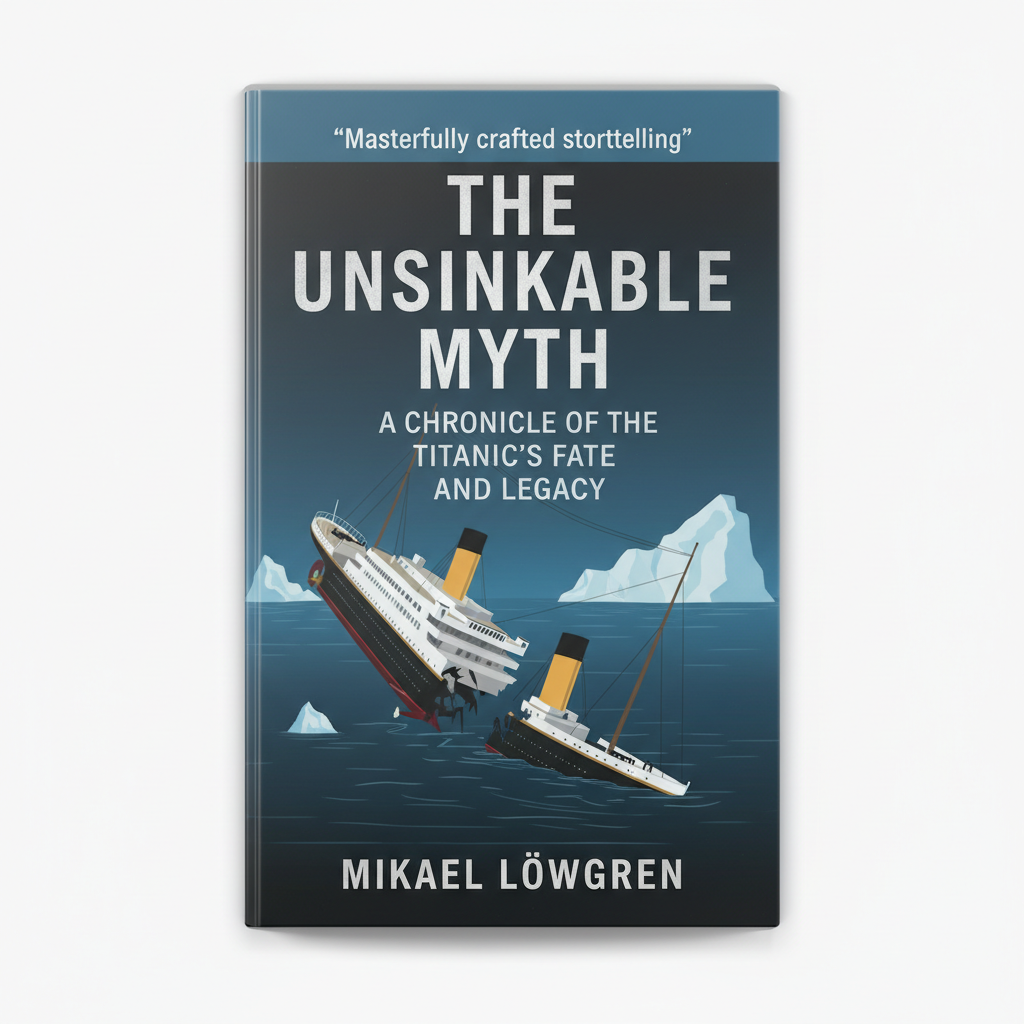
Synopsis
From the grand vision of its birth to its tragic demise and the profound lessons it imparted upon the annals of maritime history, this chronicle unveils the compelling saga of the RMS Titanic.
Chapter 1: A Disclaimer and the Dawn of a Dream
Before these pages unfold further, laying bare the chronicle of a dream both grand and tragically ephemeral, a caveat, like a lone sentinel upon a misty shore, must preface our journey. For though the narrative that follows strives for truth and endeavours to illuminate the shadowed corners of history with the lantern of diligent research, its very genesis springs not from the weathered hand of a human scribe, nor the whispered recollections of aged mariners, but from the intricate loom of artificial intelligence. Therefore, let the discerning reader, with a spirit kindred to the explorer charting unknown seas, approach this account not as an unchallenged decree, but as a carefully hewn vessel, sturdy in its construction, yet requiring the vigilant eye of further scrutiny. For the vast and intricate tapestries of the past are woven with countless threads, and even the most advanced loom may, upon occasion, omit a crucial stitch, or misinterpret the shade of a particular hue. Let this work, then, serve as a guide, a map to a forgotten land, but let every landmark be verified, every historical current examined against the broader ocean of established fact. The truth, like a distant lighthouse, gleams brightest when sought with intent and confirmed with independent gaze.
Now, having offered this honest preamble, let us turn our gaze to the nascent stirrings of ambition, to an era when the restless heart of man, not yet humbled by the immutable laws of nature, yearned to conquer the very oceans. The latter half of the nineteenth century and the initial dawn of the twentieth witnessed a titanic struggle, not of arms and empires, but of steel and steam, a silent war waged across the vast expanse of the North Atlantic. It was a contest of prestige, of engineering prowess, and of the pursuit of a fleeting yet potent ideal: speed. The prize? The coveted Blue Riband, a symbolic accolade bestowed upon the passenger liner achieving the fastest transatlantic crossing.
The great shipping lines – Cunard, White Star, Hamburg America, Norddeutscher Lloyd – were more than mere carriers of cargo and souls. They were standard-bearers of national pride, their liners veritable floating embassies, their every departure and arrival a spectacle. One might liken the rivalry to the ancient jousts of chivalry, though the tilt-yard was the tumultuous ocean, and the steeds, monstrous leviathans of riveted steel. The stakes were immense, for speed bred fame, and fame, in turn, filled cabins and cargo holds, drawing forth the eager purses of industrialists, adventurers, and those seeking new lives in the burgeoning lands of the New World.
The sheer scale of these enterprises was already, even then, a marvel. Harland & Wolff in Belfast, John Brown & Company on the Clyde, Blohm & Voss in Hamburg – these shipyards were industrial cathedrals, their cacophony of hammers upon steel and the hiss of steam their fervent hymns. Thousands of men, with calloused hands and soot-stained faces, toiled within their cavernous sheds, shaping raw materials into vessels of unimaginable size. The air would vibrate with the very effort of creation, a symphony of progress, punctuated by the sharp crack of striking metal and the guttural roar of furnaces.
It was into this fiercely competitive arena that the White Star Line, a venerable name in transatlantic travel, found itself in a rather unenviable position. While their fleet was renowned for its comfort and reliability, epitomised by stately vessels like the Republic and the Baltic, they lagged notably in the pursuit of outright speed. Cunard, their keenest rival, had recently launched the Lusitania and Mauretania, twin titans of the sea, whose sleek lines and powerful turbine engines had wrested the Blue Riband from all challengers. The Mauretania, in particular, was a swift greyhound of the ocean, a symbol of British engineering supremacy, regularly slicing through the waves at speeds exceeding twenty-five knots.
The directors of the White Star Line, men of considerable foresight and equally considerable ambition, found themselves contemplating this burgeoning disparity. There was J. Bruce Ismay, the managing director, a man of refined tastes and a keen business acumen, whose very lineage was intertwined with the White Star’s destiny. And at his side, the venerable Lord William Pirrie, chairman of Harland & Wolff, the shipbuilding firm that built every White Star vessel, a partnership as enduring as the tides themselves. Their discussions, held often in the hushed opulence of London clubs or the paneled offices overlooking Belfast Lough, were undoubtedly tinged with the weight of expectation.
To challenge Cunard on speed alone, they knew, would be a fool's errand. The turbine technology that propelled Lusitania and Mauretania was cutting-edge, expensive, and not yet perfected to White Star’s notoriously stringent standards of reliability. Furthermore, the sheer coal consumption required to maintain such speeds would be exorbitant, eating into already slim profit margins. A different strategy was required, a bold stroke that would redefine the very essence of transatlantic travel and cement White Star’s pre-eminence.
Their solution was not to outrun the competition, but to utterly outclass it. Their vision was grander, more audacious: to build the largest, most luxurious, and safest ships the world had ever seen. These vessels would not merely transport passengers; they would offer an experience, a floating palace designed to render the arduous journey across the ocean an unparalleled indulgence. Speed, they reasoned, was but one facet of desirability. Comfort, opulence, and an unshakable sense of security – these were the new standards by which White Star would measure its triumph.
Thus was born the audacious concept of the Olympic-class liners. The very name, ‘Olympic,’ resonated with an echo of ancient grandeur, a silent declaration of superlative intent. Three sister ships were planned, each a behemoth of steel, designed to dwarf every other vessel afloat. Their dimensions alone were staggering: over 882 feet in length, more than those of any structure on land save for the Eiffel Tower, and a breadth of 92 feet. Their displacement would be over 52,000 tons, a veritable floating city.
The details of their conception were painstakingly pondered, every facet a testament to human ingenuity and meticulous planning. Thomas Andrews, Harland & Wolff’s chief naval architect, a man of quiet brilliance and an almost paternal devotion to his creations, translated these grand aspirations into precise blueprints. He possessed a rare blend of technical mastery and an intuitive understanding of a ship’s organic nature, seeing beyond the cold steel to the lives it would encompass. His designs incorporated the latest advancements in naval architecture, alongside innovations dreamt up within the very confines of Harland & Wolff’s drawing offices.
The sheer audacity of the Olympic-class lay not merely in their scale, but in their holistic approach to luxury and perceived safety. The interiors would rival the grandest hotels ashore. First-class passengers would stroll through opulent promenades, dine in vast, gilded restaurants where the cuisine would vie with Parisian establishments, and relax in smoking rooms paneled with rich woods and leather, or libraries stocked with thousands of volumes. There were even plans for amenities never before seen on a ship: Turkish baths, a swimming pool, fully equipped gymnasiums, and grand reception rooms with soaring ceilings and intricate chandeliers. Every detail, from the cut crystal to the plush carpets, the intricate plasterwork to the gleaming brass, was carefully chosen to exude an atmosphere of unparalleled elegance.
Yet, this emphasis on luxury did not overshadow the equally paramount consideration of safety. Indeed, it was intertwined with the very marketing strategy of these behemoths. White Star proclaimed, with no small measure of pride, that their new liners would be "practically unsinkable." This bold assertion, oft repeated and widely believed, was rooted in several key design features. The most prominent of these was the innovative system of watertight compartments. The hull was divided by fifteen transverse bulkheads, forming sixteen ostensibly independent compartments. In theory, if any two of these compartments were breached and flooded, the ship would still remain afloat. This was a significant advance over earlier designs and instilled a deep sense of confidence, not just in the designers and owners, but in the travelling public.
Furthermore, the vessels would feature double bottoms, stretching for much of their length, an additional layer of protection against underwater damage. The engine rooms, where the titanic powerplants would churn, were designed with redundancy in mind, minimising the chance of a complete power failure. Indeed, the very structure of these ships was conceived as a bulwark against the inherent perils of the ocean.
Construction began upon the slipways of Harland & Wolff, specifically tailored and expanded to accommodate such monumental undertakings. The noise and activity surrounding the building of these ships – Olympic first, then her ill-fated sister, Titanic – was immense, a spectacle in itself. Thousands of men, riveters and carpenters, boilermakers and electricians, swarmed over the skeletal frames, patiently creating the form that would soon cleave the waves. The air was thick with the scent of hot metal and coal smoke, the clangour of industry echoing across the waters of Belfast Lough.
The launching of the Olympic in October 1910, followed by the Titanic's keel-laying shortly thereafter, was not merely a maritime event; it was a matter of national rejoicing, a symbol of progress and the enduring spirit of human ambition. These colossal ships were more than mere modes of transport; they were embodiments of an age, testaments to an unwavering belief in humanity’s mastery over nature. They represented the zenith of Edwardian engineering, the pinnacle of opulence, and, crucially, a profound and perhaps hubristic faith in the invincibility of human ingenuity.
As the great hull of the Titanic began to rise from the slipway, a veritable mountain of steel poised above the lough, its future seemed boundless, its journey destined to be one of triumph over the vastness of the sea. Little did anyone suspect that embedded within the very fabric of this grand design, alongside its strengths, lay a vulnerability, a crucial flaw, that would ultimately transform a symbol of unwavering confidence into an enduring emblem of the fragility of even the grandest human endeavours. The stage was set, not merely for a maiden voyage, but for a saga that would forever etch a ship’s name, for reasons most tragic, into the collective memory of mankind.
Chapter 2: Herculean Endeavors: The Birthplace of Giants
The mists that clung to the valleys of the Lagan, as if held captive by the very breath of industry, often gave way to a panorama unlike any other under the cold, grey Irish sky. Here, where the river broadened into a vital artery, lay Queen's Island, a place whose very sod vibrated with the ceaseless thrumming of man’s ambition. This was the domain of Harland and Wolff, a name destined to be stitched forever into the tapestry of maritime legend. It was here, amidst the clangour of steel and the incessant grind of human endeavour, that the titanic dream took its first, formidable shape.
One could not merely speak of construction; one spoke of a transfiguration, a reshaping of the very earth and air to accommodate giants. Before the first keel plate of the *Olympic* or the *Titanic* was even laid, the shipyard itself had to be remade. Existing slipways, grand as they were, proved utterly inadequate for the unprecedented dimensions envisioned. Thus, the twin behemoths known as the Arrol Gantry were born – a structure so immense that it dwarfed even the nascent hulls it was designed to serve. Rising over two hundred feet into the air, its steel skeleton spanned the breadth of two future leviathans, a vast temple of industry where cranes, like metallic spiders, traversed their intricate webs, ferrying colossal plates and ponderous beams with seemingly effortless grace. Under its shadow, the scale of the undertaking was hammered home with every echoing blow of the riveter, every shriek of protesting metal.
The daily ritual began before dawn, when the gas lamps still cast their shivering light upon cobblestone streets and the air was sharp with the scent of coal smoke and damp earth. A human tide, numbering in their thousands, flowed towards the shipyard gates – men of all ages, their faces etched with the grit of labour and the stern resolve of those who built a nation’s might. Shipwrights, their calloused hands knowing the grain of every timber; riveters, masters of fire and hammer, their bodies hardened by rhythmic toil; platers, smiths, carpenters, engineers – each a cog in a vast and intricate machine, each contributing their sweat and skill to a vessel that would be the largest moving object ever conceived by man.
The raw materials themselves were a testament to industrial prowess. Thousands upon thousands of tonnes of steel, smelted and rolled in the industrial heartlands of England and Scotland, travelled by rail and ship, converging upon Queen’s Island like tributaries meeting a mighty river. Plates, some an inch thick and weighing more than a score of men, were hoisted into position, guided by the sharp cries of foremen and the measured gestures of crane operators. The air was a cacophony: the deep, resonant clang of steel on steel, the sharp hiss of steam escaping, the guttural roar of furnaces, and, perpetually, the rhythmic rat-a-tat of riveting guns. It was a symphony of creation, raw and powerful, drowning out all lesser sounds.
But mere size was not the sole ambition. Design, that subtle marriage of art and engineering, played an equally crucial role. Thomas Andrews, the intellectual architect of the *Olympic*-class, was a frequent, almost omnipresent, figure amidst the growing framework. His slight frame, often clad in a practical suit, would be seen scaling precarious ladders, clambering over beams, his keen eyes scanning, scrutinising, envisioning the finished whole. He moved with a quiet intensity, speaking sparingly but with precise authority, his mind a living blueprint where every rivet, every bulkhead, every opulent fixture found its proper place. His dedication transcended mere professional duty; it was a passion, a deep-seated belief in the perfection of his craft.
The structure of the hull—the very skeleton of this metal beast—was revolutionary. While the double bottom, a common feature, offered a layer of protection against grounding, it was the division of the interior into sixteen supposedly watertight compartments that truly captured the imagination. These colossal chambers, separated by bulkheads reaching high above the waterline, were the ship's internal fortresses. The theory was simple, elegant, and reassuringly robust: even if a section of the hull were breached, water would be confined, and the undamaged compartments would provide sufficient buoyancy to keep the vessel afloat. The engineers, with careful calculation and confident declaration, affirmed that the ship could withstand the flooding of any two, and even certain combinations of three or four, of these compartments, and still regain port. This ingenious partitioning, coupled with remote-controlled watertight doors, was touted as the ultimate safeguard, a testament to man’s triumph over the whims of the sea.
The construction of these bulkheads, themselves vast walls of riveted steel, was an immense undertaking. Each section had to be perfectly aligned, each seam flawlessly sealed. The sheer number of rivets, that humble yet indispensable fastener, staggered the mind: over three million individual pieces of metal, each driven home by teams of riveters. A typical riveting gang consisted of a heater boy, who tended the small, portable furnace to bring the rivets to glowing readiness; a catcher, who plucked the white-hot rivet from the air with tongs; a holder-up, who braced the rivet from the inside; and the riveter himself, wielding the mighty pneumatic hammer, its percussive force binding steel to steel. This relentless, dangerous work marked the very pulse of the shipyard, the incessant hammering echoing across the island, shaping and solidifying the future behemoth.
Beyond the structural integrity, the meticulous attention to lesser-seen details bespoke a profound commitment to quality. The quality of the steel itself underwent rigorous testing, samples being pulled and stressed to their breaking point in dedicated workshops. The propulsion system, a marvel of contemporary marine engineering, saw the installation of two massive, four-cylinder triple-expansion reciprocating engines, flanked by a powerful low-pressure turbine. These three prime movers, fed by no fewer than twenty-nine boilers, each with three furnaces, were designed to churn out a combined fifty thousand horsepower, driving the colossal vessel through the waves at an anticipated twenty-one knots. The sheer physical size of these engines, their monumental crankshafts and pistons, demanded their construction *in situ*, piece by massive piece, within the very heart of the hull. Their installation transformed the ship's lower decks into a labyrinth of polished brass, gleaming steel, and powerful machinery, a testament to man's command over fire and pressure.
But the pursuit of strength and speed was matched, stride for stride, by the desire for unparalleled luxury. The inner world of the *Titanic* was conceived as a floating palace, a sanctuary of Edwardian elegance designed to beguile the most discerning of travellers. While the vast spaces of the first-class accommodation were still mere skeletal frameworks of steel, their future grandeur was already being meticulously planned. Designers and artisans thronged the drawing offices, translating visions of Louis XVI salons, Jacobean smoking rooms, and sumptuous Turkish baths into precise blueprints. The finest woods, carved and polished, were ordered from distant lands. Swaths of velvet and silk, stained glass, ornate plasterwork, and intricate tile mosaics were commissioned. Every detail, from the grand staircase stretching seven decks high to the delicate ceramic tiles of a private bathroom, was chosen to evoke an aura of unassailable prestige and comfort.
This dual focus, on engineering prowess and aesthetic perfection, fueled the spirit of invincibility that began to permeate the atmosphere of the shipyard. The sheer scale, the meticulous planning, the innovative safety features – all contributed to a growing conviction, among those who built her, that this vessel transcended mere naval architecture. Whispers began to circulate, subtle first, then bolder as the hull climbed ever higher above the Lagan, that this ship was not merely safe, but, perhaps… unsinkable. It was a sentiment born of pride, of a profound and justifiable confidence in human ingenuity, in the tireless efforts of thousands of hands, guided by brilliant minds.
And so, beneath the colossal span of the Arrol Gantry, a giant was taking shape. Each day brought it closer to completion, each rivet hammered, each plate secured, adding to its formidable mass and its burgeoning legend. The men who built her saw not just steel and wood, but the embodiment of their own ambition, their own relentless spirit. They worked on, silhouetted against the ever-changing sky, forging a vessel designed not merely to sail the seas, but to conquer them, to stand as an enduring monument to an age of unparalleled progress and unwavering faith in man’s dominion over nature. But even as the finishing touches began to hint at its future splendour, the sea, in its vast and ancient wisdom, held secrets yet untold.
Chapter 3: The Pinnacle of Edwardian Splendor: Design and Deck Plans
CHAPTER 3: THE PINNACLE OF EDWARDIAN SPLENDOR: DESIGN AND DECK PLANS
The gargantuan hull, once a mere skeleton of iron and rivet, now stood poised, a cavernous realm awaiting its soul. Within its vast confines, skilled artisans, with tools both delicate and robust, wrought a tapestry of grandeur beyond mere utilitarian necessity. For the Titanic, as with all the great vessels of its age, was not simply a conveyance across the unforgiving seas, but a floating testament to the burgeoning aspirations of a new century, a veritable palace carved from steel and wood.
One ascended to her upper reaches through broad, sweeping staircases, the very air seeming to thicken with the scent of polished mahogany and the faint, sweet perfume of varnishes newly set. The Grand Staircase, an architectural marvel itself, was the heart of this opulent world. Its sweeping curves of oak, adorned with shimmering bronze balustrades and classical carvings, drew the eye upwards, floor after majestic floor, culminating beneath a magnificent wrought-iron and glass dome. Sunlight, diffused and softened, poured through this oculus, illuminating the allegorical panel of "Honour and Glory Crowning Time," an unstated prophecy of the fate that awaited both ship and ambition. Here, beneath the gaze of cherubs frozen in gilded ecstasy, the gentry of the Edwardian age would descend to their nightly repasts, their silks rustling, their laughter echoing in the lofty spaces.
Beyond this central artery lay the First-Class Dining Saloon, a chamber of immense proportions, capable of seating hundreds in a single sitting. Its ceiling, supported by slender, fluted pillars, soared high above, adorned with intricate plasterwork. The walls, paneled in rich, dark oak, reflected the muted gleam of silver and crystal arrayed upon pristine white tablecloths. Here, beneath the soft glow of electric chandeliers, conversations would weave and wander, discussing politics and poetry, enterprise and engagement, all while the ship's massive engines pulsed a rhythmic, reassuring hum far below. The very air seemed to hum with prosperity, the clinking of cutlery upon fine china a constant undercurrent to the human symphony.
Yet, the indulgence did not cease with the dining alone. The First-Class Smoking Room, a sanctuary for gentlemen, exuded an atmosphere of hushed, club-like exclusivity. Its walls, clad in dark, heavy wood, were inlaid with mother-of-pearl, depicting scenes of hunting and heraldry. Deep leather armchairs, invitingly plump, were arranged around small tables, where gin and tobacco, and perhaps a game of cards, would occupy the twilight hours. Adjacent to this masculine domain, the First-Class Lounge, brighter and more airy, offered a gentler elegance. Decorated in the French Louis XV style, with lighter wood panels and delicate tapestries, it provided a space for ladies to socialize, to write letters at ornate desks, or simply to bask in the agreeable company of their peers.
The cabins themselves, even for the most discerning traveller, spoke of unparalleled luxury. They were not mere berths, but miniature apartments, complete with private bathrooms – a true innovation for ships of that era. Hot and cold running water, a luxury still uncommon in many land-based homes, flowed freely. Electric lights, controlled by elegant brass switches, banished the gloom of oil lamps, offering a bright, constant illumination. Each suite was a unique design, some decorated in Adam style with light wood and delicate patterns, others in Dutch Renaissance with heavy carvings, or even adorned with the exotic flair of the Colonial revival. These were rooms designed to forget one was at sea, to replicate the comforts and indeed, the grandeur, of a stately home on shore. One could imagine a lady, ensconced in silk and furs, gazing out at the endless horizon from her private promenade, a tumbler of claret warming in her hand, utterly unaware of the vast, cold waters that lay beneath.
However, the Titanic's reach of comfort extended beyond the highest echelons. The Second-Class accommodations, while less ostentatious, were nevertheless a significant step above the standards of most contemporary liners. Their dining saloon, though smaller and simpler than its First-Class counterpart, was still a large, airy room with respectable wood paneling and comfortable seating. The cabins, while lacking private facilities, offered well-appointed berths, often with two or four occupants, and boasted the same modern amenities of electric lighting and ample space. There was even a Second-Class Library and Smoking Room, providing dedicated spaces for relaxation and socialization, a testament to the White Star Line’s commitment to a higher standard of travel for all its paying passengers, though of course, with varying degrees of splendor. One could envision a small family, perhaps a tradesman and his wife with their children, enjoying a hearty meal in the dining saloon, their faces alight with the novelty of their journey, their dreams of a new life across the ocean shining bright.
Far below, nestled within the belly of the ship, lay the Third-Class quarters, often referred to as "Steerage." Yet, even here, the Titanic defied the grim expectations of the age. Unlike the cramped, communal dormitories of older immigrant ships, the Titanic offered genuine cabins, albeit simpler ones. Four, six, or sometimes even ten berths to a room, but they were private spaces, separated by wooden partitions. The sheer vastness of the ship allowed for a level of comfort previously unknown to these travellers. There were communal dining rooms, large and functional, where plain but wholesome fare was served. Separate smoking rooms for men and common rooms for women and children provided areas for respite. The very idea of having a dedicated recreation space for steerage passengers was revolutionary.
One could witness a group of hopeful immigrants, perhaps a young couple from Ireland, sharing a simple meal, their possessions bundled beside them, their clothes worn but clean, their faces etched with a mixture of trepidation and anticipation as they embarked on a journey that would redefine their lives. Though lacking the gilded splendor of the upper decks, these quarters were far from squalid. They offered electric lighting, though perhaps in fewer abundance than above, and running water, if not in every cabin, then certainly in accessible communal lavatories. The engineers and designers, in their meticulous planning, had striven to uplift even the humblest traveller, believing that even the lowest fare-payer deserved a measure of dignity on their arduous voyage. It was a subtle, yet profound, shift in the philosophy of transatlantic travel.
Beyond the aesthetics, the Titanic was a marvel of applied technology. Electric fans circulated air, preventing the stuffiness common on older ships. The advanced plumbing, ensuring constant fresh water and efficient waste disposal, spoke of a hygienic standard previously unimaginable at sea. Even the communication systems, with electric bells connecting cabins to stewards, represented a leap forward in onboard service. This was not merely a vessel; it was a self-contained, technologically advanced city, designed to operate with seamless efficiency.
The deck plans, sprawling blueprints of this floating metropolis, illustrate the careful stratification of society within its steel confines. The Promenade Deck, the highest open deck, was largely reserved for First-Class passengers, offering sweeping views of the ocean. Below it, the Boat Deck, where the lifeboats were stored, also provided ample open space for those who sought the bracing sea air. As one descended, the accessibility to different decks and amenities became increasingly segregated, a reflection of the rigid social hierarchies of the Edwardian era. Yet, even with these divisions, a shared sense of wonder at the vessel's sheer scale and sophistication permeated all corners. Whether one was sipping champagne in a private parlor or sharing a simple jest in the third-class dining hall, the Titanic was, for all, a crucible of dreams and a testament to man's audacious ambition.
This intricate dance of design, from the grandest hall to the humblest bunk, spoke volumes not merely of functionality, but of aspiration. It was a vessel designed to impress, to comfort, and, most importantly, to convince all who sailed upon her that the world had truly entered an era of unparalleled progress and security. The very grandeur of her construction, the careful segregation of her passengers, the technological marvels boasted within her hull – all contributed to an unspoken promise: that this vessel, beyond all others, was immune to the caprices of the sea, impervious to challenge, eternally secure. It was a myth born of meticulous planning and human ingenuity, a myth that was soon to be tested by the vast, indifferent ocean itself.
Chapter 4: The Maiden Voyage: A Crowning Achievement Sets Sail
Upon the morn of April the tenth, in the year of our Lord nineteen hundred and twelve, a breath of unparalleled excitement stirred the ancient streets and bustling docks of Southampton. The sun, a pale orb yet strong enough to banish the morning mists from the Solent, cast its nascent light upon a scene of burgeoning grandeur. For this day marked not merely the sailing of another great vessel, but the setting forth of a marvel, a veritable floating city, whose very name, Titanic, echoed the colossal ambitions of man.
From distant shires and famed capitals they came, drawn by the irresistible magnet of this maiden voyage. The air thrummed with a current of anticipation, a palpable hum that vibrated through the very timbers of the pier and the stones of the surrounding town. Cabs, both motor and horse-drawn, jostled through the thronged thoroughfares, disgorging their bedecked occupants – ladies in their finest silks, plumes fluttering like exotic birds, gentlemen in tailored suits, their silver-topped canes tapping a rhythm of prosperity against the cobblestones. Porters, bowed beneath mountains of leather trunks and wicker hampers, hurried with an eagerness born of both duty and the infectious enthusiasm of the moment.
The leviathan itself, dwarfing all else around it, lay tethered to the White Star Line’s berth, its four massive funnels, painted in the company’s distinctive buff-yellow, reaching skywards like the pillars of some oceanic temple. From its towering decks, the myriad portholes gleamed like a thousand watchful eyes, reflecting the cheerful chaos below. The mighty hull, a sheath of riveted steel, plunged into the deep green waters of the harbour, a testament to the labours of Belfast and the dreams of men. One could almost feel the latent power within, the sleeping giants of its engines awaiting their awakening.
And who were these pilgrims of the deep, who placed their trust so readily in this new wonder? They represented a cross-section of an age confident in its own supremacy. There were the titans of industry, men whose names were synonymous with fortunes amassed in steel, railways, and grand estates. John Jacob Astor IV, whose lineage was as storied as his wealth, boarded with his young bride, Madeleine, a vision of youthful elegance. Benjamin Guggenheim, a copper magnate, accompanied by his mistress, reveled openly in the heady freedom of crossing the ocean. Isidor and Ida Straus, the proprietors of Macy’s department store, a couple whose devotion to one another was as legendary as their charitable works, walked arm-in-arm, their faces alight with the prospect of travel. These were not mere passengers; they were emblems of an era’s gilded aspirations, their lives woven into the very fabric of the ship’s anticipated glory.
Yet, not all who embarked possessed such prodigious wealth. The ship was a microcosm, reflecting the stratified society it left behind. In the spacious and surprisingly comfortable second-class accommodations were professionals, academics, and prosperous merchants – men and women whose comfortable lives promised a more refined and private journey than the common steerage. Third-class, or steerage, though lacking the overt opulence, was nevertheless a significant improvement over previous generations of immigrant vessels. Here, dreams were equally potent, though of a different hue: the dream of a new life across the great ocean, of opportunity in a burgeoning land. Families, speaking in a multitude of tongues, their meagre possessions bundled close, gazed upon the vastness of the ship with a mixture of awe and trepidation, their hopes vested in the promise of America.
Among the crew, a different kind of excitement mingled with the solemnity of duty. Captain Edward J. Smith, a venerable figure in maritime circles, his distinguished white beard and kindly eyes a familiar sight on the White Star line, was at the helm for what was to be his final voyage before retirement. He personified the era's ideal of the seasoned mariner – experienced, unflappable, and synonymous with safety. His officers, men of skill and dedication, saw this as the crowning achievement of their careers, a chance to be part of history. The engineers, stokers, stewards, and galley staff, a multitude of souls numbering over eight hundred, knew their tasks intimately, their collective efforts a symphony of unseen labour that kept the great ship functioning.
As the morning wore on, the promenade decks filled with curious onlookers. Hands waved, handkerchiefs fluttered, and the sound of farewells, both joyful and tinged with a sweet sorrow, carried on the gentle breeze. The gangplanks, busy serpents disgorging their human cargo, were eventually retracted. At midday, a deep, resonant roar, not unlike the voice of a slumbering dragon, emanated from the ship’s funnels as the steam whistles shrieked their majestic farewell. The colossal anchors, their chains a symphony of grinding steel, were raised from the seabed, and slowly, imperceptibly at first, the great hulk began to move.
A ripple of cheers erupted from the docks as the *Titanic*, with an almost stately grace, slipped away from its berth. The tugs, like busy but diminutive sprites, nudged its colossal bulk into the deeper channels of the Solent. The departure was not without its minor dramas; as the *Titanic* carved its path, the suction generated by its passage was so immense that it snapped the mooring lines of the much smaller SS *New York*, causing the vessels to drift precariously close. Only through the quick thinking and skilled seamanship of Captain Smith and the tugboat pilots was a collision averted, a near miss that, in retrospect, seemed a fleeting, ironic whisper of what was to come. Yet, at the time, it was but a minor delay, a fleeting distraction from the grand undertaking.
And what was the prevailing mindset that enveloped this magnificent ship and its optimistic passengers? It was an age steeped in the intoxicating elixir of progress. The industrial revolution, with its relentless march of invention and ingenuity, had instilled in humanity a profound, almost unshakeable faith in technology. The advent of steam power, the mastery of steel, the weaving of electricity into the fabric of daily life – these were not merely advancements; they were seen as triumphs over the capricious forces of nature. Man, through his intellect and industry, was believed to be steadily taming the wild and unpredictable world.
This faith fostered a dangerous, yet understandable, hubris. Newspapers of the day, reflecting the popular sentiment, trumpeted the marvels of the *Titanic* with an almost religious fervour. She was described as ‘practically unsinkable,’ a fortress of steel, a testament to man’s ultimate victory over the elements. The double bottom, the watertight compartments – these features, revolutionary for their time, were hailed as guaranteeing absolute safety. It was believed that even if one or two compartments were breached, the integrity of the whole would remain uncompromised. This belief, oft repeated and rarely challenged, became ingrained not only in the public consciousness but, perhaps more perilously, within the very culture of the shipping line itself.
The ocean, once a terrifying, untamed expanse, was now considered a mere highway, albeit a grand one, to be traversed with increasing speed and luxury. The idea that a disaster of monumental proportions could befall such a vessel seemed an anachronism, a holdover from a less enlightened, less technologically advanced age. The prevailing wisdom held that human ingenuity, particularly British ingenuity, had finally conquered the unyielding forces of the deep. Safety, therefore, was not merely an aspiration; it was an inherent quality, a predefined attribute woven into the very fabric of the ship.
As the *Titanic* steamed out of Southampton, bound first for Cherbourg, then Queenstown, and finally, for the glistening shores of America, it carried not only its precious cargo of humanity and their dreams, but also the weighty burden of an era's unshakeable faith in itself. The magnificent vessel, a symbol of human ambition and technological prowess, sailed under a sky of deepening blue, its destination a land of promise, its future, in the minds of those who watched it disappear over the horizon, as certain and unassailable as the stars themselves. Little did they know, nor could they have possibly conceived, that the illusion of eternal safety woven by man's proud hand would soon be challenged by the cold, indifferent, and infinitely more powerful hand of nature herself.
Chapter 5: Whispers of Peril: The Unheeded Warnings
The boundless expanse of the Atlantic, once a mirror reflecting the unblemished sky, began, subtly at first, to assert its age-old dominion. The days since Southampton had been a testament to the marvel of man’s craft; the leviathan cut through the waves with an ease that belied its colossal bulk, a steady pulse thrumming beneath the decks. Passengers, lulled by this unwavering progress and the luxurious cocoon of their floating palace, surrendered to the rhythm of sea and indulgence. Yet, far beyond the gilded salons and the cheerful strains of the orchestra, the ocean itself was stirring, preparing to speak in a language few wished to hear.
It began as mere whispers, faint rustlings across the invisible ether that crisscrossed the vast waters. Vessels navigating the same broad highways of the sea, those less opulent, perhaps, and certainly less celebrated, were already encountering the errant fragments of winter’s slow retreat. Ice, the ancient sculptor of the northern lands, was breaking free, and its progeny drifted southward, borne on unseen currents towards the busy shipping lanes.
On Sunday, April 14th, as the Titanic steamed onward, oblivious in its splendid isolation, the wireless rooms of other ships began to hum with a growing urgency. From the SS *Caronia*, at 9:00 AM, a message pulsed through the air, picked up by the Titanic’s wireless operators: "West bound steamers report icebergs and field ice today in 42 deg. N. from 49 deg. to 51 deg. W." This was information of significance, delineating a scattered field of frozen danger across a wide swathe of ocean ahead. Yet, upon receipt, it was merely relayed to the bridge, a perfunctory nod to procedure, and then reportedly tucked into a pocket, later to be forgotten or simply misplaced amidst the bustle.
Hours later, at 1:42 PM, the German steamer *Amerika* transmitted another, more precise warning: "Passed two large icebergs in 41 deg. 27' N., 50 deg. 8' W." This, too, found its way to the Titanic, where it was noted, but the ship’s course remained unaltered, its speed undiminished. The vastness of the sea, in the prevailing mindset, was thought to dilute any isolated threat; surely, one could simply sail around such scattered obstacles.
The afternoon wore on, a golden haze settling over the ocean, inviting contemplation and repose. Below decks, the rumble of the engines formed an almost subliminal lullaby. Above, the sun, though bright, lent no warmth to the air, an unnoticed change that would later take on a chilling significance. The wireless operators, a vital but often overlooked cadre, continued their relentless vigil, their fingers dancing over the keys, their ears attuned to the faint crackles and hisses that promised connection across the void. They were, however, not solely dedicated to the solemn business of maritime safety. A significant portion of their precious bandwidth was devoted to the transmission of passenger Marconigrams – the personal messages of wealth and affection, of business and idle chatter, that connected the world of the Titanic to the land it had left behind.
At 5:30 PM, the tramp steamer *Californian*, a vessel whose name would forever be entwined with the tragedy, found itself caught in a treacherous grip. Its captain, Stanley Lord, a man of extensive experience and cautious disposition, ordered his ship to stop. Field ice stretched before them, a solid, impenetrable barrier under the fading light. "We are stopped and surrounded by ice," he radioed to all ships, his message clear and unambiguous, carrying the weight of immediate danger. This urgent communication, however, like those before it, was intercepted by the Titanic but seemed to vanish into the eddies of routine.
The prevailing ethos of the White Star Line, steeped in the competitive spirit of the era, prioritized schedule above all else. Speed was king. The fastest passage across the Atlantic brought not only prestige but also practical advantage in the cutthroat shipping industry. To slow down was to concede; to alter course significantly was to admit vulnerability. These were considerations that weighed heavily upon the bridge.
As darkness descended, the ocean, previously a shimmering expanse, transformed into an inky canvas, revealing only the immediate frothing wake of the Titanic’s powerful propellers. The cold deepened, a subtle current of air carrying with it the unmistakable tang of extreme chill. On the forward decks, stewards, accustomed to the vagaries of trans-Atlantic crossings, might have shivered a little more vigorously, but no alarm was sounded.
At 7:30 PM, a fresh warning arrived from the SS *Mesaba*: "Ice report. Saw much heavy pack ice and a great number large icebergs also field ice in 42° N from 49° to 50° W. April 14th. Regards. Mesaba." This was, arguably, one of the most critical warnings of the day, conveying not just isolated bergs, but "much heavy pack ice" and "a great number" of large icebergs. Yet, this message, too, failed to reach the critical eyes on the bridge. It passed instead into the hands of the wireless supervisor, Jack Phillips, who was overwhelmed by the backlog of passenger messages. In the chaotic clamour of modern communication, the critical alert was set aside, deemed non-urgent, perhaps, due to its initial preamble of “Ice report” rather than an immediate distress signal. This seemingly minor misjudgment, born of the demands of the nascent wireless technology and human fallibility, would prove catastrophic.
The night deepened. The stars, unobscured by land or cloud, blazed with an almost unnatural brilliance, their cold light reflecting faintly off the dark waves. The air grew still, the calm surface of the sea belying the menace that lurked beneath its deceptively placid veneer. Far ahead, in the inky blackness, lay the heart of the warnings, the silent, towering sentinels of the deep.
Then, at 10:55 PM, the *Californian*, which had been stopped for hours, its engines silent amidst the ice, sought to communicate directly with the Titanic. Cyril Evans, the sole wireless operator awake on the *Californian*, a young man stretched thin by long hours, sent a direct transmission: "Say, old man, we are stopped and surrounded by ice."
The reply, sharp and dismissive, crackled back from the Titanic: "Keep out! Shut up! I am busy. I am working Cape Race." Jack Phillips, the overburdened senior wireless operator on the Titanic, was in the midst of transmitting a lengthy sequence of passenger messages to the relay station at Cape Race, Newfoundland. The very station that facilitated the connection to the world, now became an unwitting accomplice in obscuring a desperate warning. Evans, bruised by the cutting retort and certain that the Titanic, being larger, would surely be able to navigate the ice, switched off his wireless for the night, heading to bed. The last direct warning, the very breath of peril upon the ship’s path, was summarily silenced.
Such was the tapestry of oversight and miscommunication woven that fateful day. It was not a grand conspiracy, nor a deliberate act of malice, but rather a slow, insidious erosion of vigilance, a quiet succumbing to the pressures of routine, prosperity, and the beguiling illusion of invincibility. Each warning, received but not acted upon, each piece of crucial intelligence set aside due to the press of triviality, chipped away at the fragile edifice of safety. The human element, so often the unseen variable, played its part in the unfolding drama, from the overworked wireless operator to the captain, perhaps overly confident in his vessel’s prowess, to the very culture that prioritized punctuality over prudence.
The vastness of the ocean continued its indifferent sway, the ship forging ahead into the deep, dark night. The air on deck grew frigid, a peculiar coldness that bit deep, quite unlike the usual sea chill. The stars above, so numerous and sparkling, seemed to gaze down with an ancient, knowing silence, their light barely illuminating the path ahead, a path now fraught with the unseen teeth of a lurking tragedy. The time approached midnight, and the warnings, dismissed and forgotten, lay waiting, suspended in the chill air, for the inevitable collision of hubris and nature’s unforgiving might.
Chapter 6: The Fateful Encounter: A Night of Icy Doom
The night, already an inky drape across the boundless ocean, deepened its embrace as the clock on the bridge neared half past eleven. A chilling stillness had settled upon the sea, an unnatural calm that rendered the vast expanse of water a polished obsidian mirror, reflecting a heaven studded with indifferent stars. There was no moon to cast its silver governance upon the waves, only the incandescent sweep of the Titanic’s bow wave, a phosphorescent serpent coiling ahead, and the glimmer of distant constellations.
In the crow's nest, high above the main deck, Frederick Fleet and Reginald Lee scanned the impenetrable gloom. Their breaths plumed like wraiths in the biting cold, a cold that seemed to seep into the very marrow of their bones despite their heavy coats. For hours, their eyes had traversed the featureless horizon, a vigilance born of duty rather than any presentiment of danger. The sea, for all its whispered warnings, had kept its secrets well.
Then, a flicker. A shade against shades. A formless mass, at first mistaken for a squall cloud, then for the distant smoke of a steamer. But the air was too still for a cloud, and the horizon too bare for another vessel. Fleet squinted, his eyes, accustomed by long years at sea to discerning the faintest outlines in the dark, straining against the velvet blackness. The form resolved itself, slowly, painfully, into something impossibly vast, impossibly close. No smoke, no cloud, but a towering, spectral wall, stark white against the gloom, the color of ancient ice and frozen death.
“Iceberg right ahead!” His voice, normally a steady grumble, cracked with the sudden, terrible urgency of discovery. The peal of the crow's nest bell, three sharp, frantic clangs, sliced through the frigid air, a sound that carried a primal terror even to those below who could not yet fathom its meaning.
On the bridge, Sixteenth Officer James Moody, a young man of earnest demeanor and keen attention, received the panicked call. His hand, swift and unhesitating, reached for the engine room telegraph, already in the process of shouting the alarm to First Officer William Murdoch.
Murdoch, a seasoned mariner with a reputation for both calm judgment and decisive action, instinctively understood the gravity of the warning. His mind, trained by years of oceanic navigation, raced through the necessary maneuvers. “Hard a-starboard!” he bellowed, his voice cutting through the sudden silence that had fallen upon the bridge. The wheelman, Robert Hitchens, a man of stout constitution, leaned into the helm, his muscles straining against the immense machinery that governed the rudder. For a terrible moment, the ship, a creature of immense inertia, held its course, unwavering. Then, with an agonizing slowness, the bow began to swing to port.
Simultaneously, Murdoch thrust the engine room telegraph handle to “Full Astern.” The colossal engines, which had propelled the Titanic across the Atlantic with such unwavering force, now began the arduous task of reversing their direction. Below, in the cavernous heart of the ship, engineers and stokers, roused from their routine by the sudden shift in demands, leaped to their stations, a flurry of shouts and clanging metal echoing through the humid air. The great turbines, their rhythm a deep, contented thrum moments before, began to shudder under the strain of reversing their titanic momentum.
A tense eternity passed. The massive ship, weighing more than 46,000 tons, was a leviathan in motion, and its course was not easily altered. The iceberg, a silent, implacable adversary, loomed larger and larger, its jagged peaks reaching towards the star-dusted sky. Bits of ice, dislodged by the ship’s passage, began to rain down upon the forward deck, tiny, glittering shards that announced the impossible proximity of the danger.
Then came the jolt. Not a shattering impact, not a cataclysmic crash, but a grinding tremor, a protracted shudder that ran the length of the ship like a monstrous, dying sigh. It was a sensation unlike any other, the sound of tearing metal muffled by the immense weight of water, the sickening vibration of a body under duress. For those on the bridge, it was a moment of profound, terrible realization. The bow had veered sufficiently to avoid a head-on collision, but the submerged spur of the iceberg, the vast, unseen bulk of it, had raked along the starboard side, a monstrous claw tearing through the ship’s steel skin.
In the first-class dining saloon, where the evening meal had concluded, a few late-stayers lingered over coffee and conversation. The shudder was a mere tremor, a distant, almost imperceptible vibration, but enough to cause glasses to rattle softly on tables, and the murmur of conversation to momentarily falter. Some dismissed it as the engines “hitting a rough patch,” or some commonplace mechanical adjustment. A few, more perceptive, exchanged uneasy glances.
In the second-class library, a game of cards was interrupted, the soft thud of the impact felt more acutely here, closer to the ship’s midsection. A gentleman fumbled his hand, a look of mild annoyance on his face, “What in heavens was that?” he muttered, more to himself than to his companions.
But for those in the lower decks, closer to the point of impact, the experience was markedly different. In third-class, where the ship’s vibrations were always more pronounced, the jolt was sharper, a lurch that threw some from their bunks. A low, prolonged rumbling sound, like that of a thousand distant thunderclaps, resonated through the steel plates. Water, frigid and black, began to surge into the mailroom, one of the lowest compartments in the ship, with terrifying speed. Sack after sack of letters, packages, and parcels, the precious cargo of human connection, were swallowed instantly by the icy torrent.
In the boiler rooms, deep within the ship’s bowels, the scene was one of sudden chaos. Stokers, stripped to the waist and glistening with sweat, had been toiling in the infernal heat, shoveling coal into the roaring furnaces. The grinding jolt, accompanied by a sound like a thousand tin roofs tearing, was undeniable. Moments later, the icy seawater, a stark contrast to the oppressive heat, burst through the rivet lines, a cold, violent geyser. Men scrambled, shouting, their faces etched with a fear born of instinct. Water levels rose quickly, engulfing coal bunkers, silencing the rhythmic clang of shovels, and hissing as it met the searing hot steel of the boilers.
On the bridge, the silence that followed the impact was more chilling than any sound. Murdoch, his face grim, dispatched Quartermaster George Rowe to investigate the forward well deck for damage. Captain Edward Smith, awakened swiftly by the impact, arrived on the bridge, his features a mask of professional composure, though his eyes held a glimmer of deep concern.
“What was it, Mr. Murdoch?” he asked, his voice steady.
“An iceberg, sir. Hard a-starboard, full astern. I thought we cleared it, but it scraped along the side. Got the bilge pumps working, sir.” Murdoch reported, his tone clipped, efficient, betraying nothing of the churning anxiety within.
Smith, a man of immense experience and a career free from serious incident, moved with an almost deliberate calm. He ordered the ship stopped and then dispatched Fourth Officer Joseph Boxhall to inspect the bow and carpenter J. Hutchinson to sound the wells. Neither man returned with good tidings. Moments later, Thomas Andrews, the ship's designer, who had been asleep in his cabin, arrived on the bridge, his face etched with a dreadful premonition. He had felt the impact, a sound and sensation he knew all too well from his intimate knowledge of the ship’s construction.
He accompanied Captain Smith and others below decks for a rapid, grim assessment. The reports from the mailroom and boiler rooms were confirmed with chilling certainty. Water was pouring into the bow compartments, not through one large opening, but through a series of six gashes, small enough to be insidious, but cumulatively catastrophic. The watertight doors, an emblem of the ship's purported invulnerability, had been swiftly lowered, isolating the flooded forward compartments. But the damage extended beyond the first four compartments, breaching the watertight bulkheads meant to confine such an ingress. A design flaw, a cruel irony – the bulkheads, tall enough to contain water in any two compartments, were not tall enough to prevent water spilling over their tops if more failed.
Andrews returned to the bridge, his face pale, his eyes hollow. He looked at Captain Smith, a silent communication passing between them, a profound and terrible understanding. The pride and joy of Harland and Wolff, the "unsinkable" Titanic, was fatally wounded.
“How bad is it, Mr. Andrews?” Captain Smith’s voice was barely a whisper, yet it carried the crushing weight of a command already knowing its answer.
Andrews, a man of meticulous calculation and profound understanding of the vessel he had helped bring to life, did not mince words. He explained, with a chilling precision, how the water, already filling the first five compartments, would inevitably spill over the tops of the transverse bulkheads into the next, and the next, until the entire ship succumbed.
“The ship can stay afloat with any two of her watertight compartments flooded, Captain. Perhaps even three, or four, if the damage is specific. But not five. Not six along the starboard side.” Andrews paused, his gaze fixed on some distant, terrible point beyond the starlit ocean. “She’s going down, Captain. There is no doubt.”
A cold dread gripped the hearts of those on the bridge. The impossible had occurred. The technological marvel, the symbol of man's triumph over the elements, was mortal. The ‘unsinkable’ myth, whispered with such confidence in dockyards and saloons around the world, had been brutally shattered by a silent, white phantom of the deep. The realization hung in the air, a palpable shroud of doom, as heavy and cold as the ocean itself. Now, the unthinkable task began: to save those who had placed their faith in the illusion of impregnable strength, aboard a vessel now slowly, irrevocably, tilting towards its icy tomb.
Chapter 7: The Descent into Chaos: A Struggle for Survival
As the ship began its slow, deliberate tilt, a dread unlike any known to man began to seep through the opulent decks, chilling the very marrow of those who had slept in blissful ignorance. The polite taps on cabin doors, the hushed reassurances from stewards, quickly gave way to a more frantic symphony of shouts and the undeniable scrape of boots on listing linoleum. The orderly dream of the *Titanic* dissolved into a nightmare of burgeoning chaos, a ghastly reversal of its earlier, serene procession across the waters.
A peculiar choreography unfolded in those initial, harrowing minutes. First, a stately procession to the boat deck, an air of almost theatrical curiosity still clinging to some as if this sudden summons were but an intriguing diversion. Women, bedecked in their finest evening gowns, clutched sable stoles and beaded purses, their companions, gentlemen in dinner jackets, offered steadying arms and platitudes about exercise and fresh air. Here, in the crisp Atlantic night, with the stars scattered like diamonds across an inky black canvas, the sheer inadequacy of the grand vessel's provisions for disaster began to unveil itself.
The lifeboats, so prominently displayed in the blueprints and promotional brochures, revealed themselves as a mere necklace of pearls on the throat of a giant – twenty vessels, designed to hold just over a third of the souls aboard. This stark arithmetic, a brutal truth of the Board of Trade regulations of the age, was now laid bare for all to witness. Yet, even this meager complement remained largely underfilled in the initial flurry. The cry “Women and Children First!” rang out, a chivalrous echo from a bygone age, but its execution was often haphazard, a desperate scramble born of inexperience and the crushing weight of circumstance.
On the starboard side, the famed First Officer William Murdoch, a man of steadfast courage, commanded his post with a grim precision. He saw the stern necessity of swift action, of not lingering for the boats to be filled to their theoretical capacity. Thus, lifeboat No. 7, the very first to be lowered, departed with but twenty-eight souls, many of them wealthy Americans who, through sheer fortune of cabin location or a quick wit in sensing the unfolding calamity, found themselves among the first rescued. It descended with a shuddering groan of ropes and pulleys, a fragile ark adrift in the vastness, leaving behind a deck still teeming with hundreds.
Near this scene, a young woman, Lady Lucille Rothes, found herself gently but firmly ushered into lifeboat No. 8. Her maid, a nervous creature named Roberta Maioni, clung to her mistress’s arm. They spoke little, their apprehension palpable, as the boat swung away from the immense hull, then dipped towards the churning water. Below them, the gleaming portholes, once a warm array of light, now seemed like sorrowful eyes weeping into the dark sea. She recalled a distant strain of music carried on the wind, a faint melody from the band still playing, a valiant, heartbreaking attempt at maintaining some semblance of order in the face of the unfathomable.
Conversely, on the port side, Second Officer Charles Lightoller, a man of rigid adherence to protocol, interpreted the "women and children first" dictum with an almost unyielding literalism. His boat, No. 6, departed with barely twenty-four occupants, predominantly women, and even then, only after he had had to physically restrain male passengers attempting to board. The air was thick with pleas and protests, a rising clamor against the insistent shouts of the officers and the crew, who themselves were often at a loss, grappling with a situation for which no training could have adequately prepared them.
The loading procedures themselves were tragically flawed. The davits, designed to lower the boats, had been tested at dockside, but never under the chaotic, listing conditions of a rapidly sinking ship. The crew, many of them stewards unfamiliar with the intricacies of lifeboat handling, struggled with the ropes, the cranks, and the simple act of maintaining order at the gunwales. Panic, a subtle miasma at first, turned into a palpable force, pushing and shoving as the ship's angle grew steeper. From the upper decks, where the affluent made their uneasy descent, to the lower reaches, where the majority of third-class passengers found themselves hemmed in by locked gates and winding passages, a desperate struggle for survival began to unfold.
Down below, in the cavernous labyrinth of the third-class decks, the horror was amplified by a cruel sense of abandonment. Here, families from distant lands, their worldly possessions bundled into canvas bags, often found their paths to the boat deck obstructed. Reports, whispered and then shouted, spoke of gates locked, of crewmen blocking stairwells, ostensibly to prevent a rush, but effectively trapping hundreds in the bowels of the doomed liner. The memory of steerage passengers being herded like cattle, their hopes for a new life extinguished in the frigid Atlantic, remains one of the bitterest stains upon the *Titanic*'s legacy.
Imagine young Daniel Buck, an immigrant from County Cork, who had saved every shilling for this passage, clutching his sister's hand as they stumbled through the dimly lit passages. The air, thick with the smell of damp metal and frantic breath, grew colder with each passing minute. They understood little English, but the terror in the voices around them was a universal language. Doors that had once led to bustling common areas were now barricaded, impassable. Up above, the stars; down here, the rising tide. The promise of America, once so vivid, faded into the chilling reality of the ocean's embrace.
Even when access was granted, the journey from G-deck or F-deck to the boat deck was a harrowing ascent through a maze of steep stairs and narrow corridors. By the time many third-class passengers reached the uppermost deck, the few lifeboats still remaining were being lowered, often already filled to bursting, or worse, the davits stood empty, swaying forlornly against the star-pricked sky. The social stratification that had governed every aspect of their voyage – from the elegance of their dining rooms to the cleanliness of their shared latrines – now dictated their very chances of survival.
The statistics, stark and unforgiving, paint a grim picture. For First Class women, a staggering 97% survived. In contrast, barely 49% of Second Class women and a meager 29% of Third Class women were rescued. The discrepancy was even more pronounced for men: 33% of First Class men survived, 8% of Second Class men, and a horrifying 16% of Third Class men, a statistic skewed by the sheer number of young, athletic men who, in their desperate fight for life, managed to clamber aboard overturned boats or find floating debris. The unwritten social contract of the era, where privilege often equated to precedence, played out in the most brutal fashion, etched into the ice-cold memory of that night.
The heroes and villains of that night were often indistinguishable, caught in a maelstrom of fear and duty. Captain Edward Smith, the seasoned commander whose steady hand had guided countless voyages, now stood on the bridge, a man wrestling with the ultimate failure. He had been heard to say, "Well, boys, do your best for the women and children, and look out for yourselves." His voice, though calm, carried the weight of a thousand regrets, a captain choosing to go down with his vessel, a stoic symbol of an age fast disappearing.
The choices made in those final hours, under the growing understanding that time was a currency rapidly depleting, were born of instinct, of training, and sometimes, of sheer, desperate luck. As the last boat scraped away from the side, a new sound began to permeate the roaring of the steam vents – the chilling, collective voice of a thousand souls, left behind to face the ultimate peril. No longer were they passengers, but simply human beings, standing on the deck of a colossal tomb, gazing out at the vast, indifferent ocean. The *Titanic*, once a monument to human ingenuity, was now a funeral pyre, its bright lights burning down to a last, defiant flicker, before the final, cataclysmic plunge into the abyss. And with its descent, a collective cry rose into the night, a sound that would echo through the years, a testament to the chaos, the bravery, and the profound tragedy of that unforgettable night. The icy grip of the Atlantic was tightening, preparing to claim its greatest prize, leaving those in the lifeboats to witness the final, majestic death-throes of a legend.
Chapter 8: The Depths' Embrace: Rescue, Remembrance, and Repercussions
Through the frigid, starlit expanse of the Atlantic night, a solitary vessel, the RMS Carpathia, cleaved the black waters with a desperate urgency. Her captain, Arthur Rostron, a man sculpted by the sea’s caprices, had driven his ship past all reasonable bounds of speed, risking his own charges to answer the distant, fading pleas for succour. The 58 nautical miles that separated his ship from the Titanic's last known position had seemed an eternity, each churning fathom a testament to the inexorable march of time against the failing hopes of those cast adrift.
As the pre-dawny gloom began to cede to the first whispers of light on that fateful Monday, April 15th, 1912, a new and terrible vista unfolded before the weary eyes on the Carpathia’s bridge. It was not the proud silhouette of the Titanic, whole and defiant, but a field of ice, vast and treacherous, shimmering malevolently in the nascent sun. And amidst this endless, glassy expanse, bobbing like lost sea birds, were the lifeboats.
A hush fell upon the Carpathia’s decks, a silence more profound than any spoken word, as the true scale of the catastrophe began to impress itself upon the minds of those who watched. The lifeboats, few in number and pitifully small against the enormity of the ocean, drifted in stark testament to the Titanic’s demise. There were no lights beckoning from a grand liner, no distant whistle affirming her continued existence. Only the relentless, shimmering ice and the tiny, vulnerable craft.
The first lifeboat to reach the Carpathia’s side was number two, under the charge of Fourth Officer Joseph Boxhall. His face, etched with a night of unimaginable horror, was the first true harbinger of the tragedy that had unfolded. As the survivors were carefully, painstakingly brought aboard – some strong enough to climb the rope ladders, others too weak and cold to do aught but be hoisted in canvas bags – a strange tableau began to form on the Carpathia’s deck.
They came, these spectres of the night, wrapped in blankets offered by the Carpathia’s solicitous crew and passengers. Some were silent, their eyes wide and unseeing, staring into an abyss that only they could perceive. Others, freed from the immediate terror of the deep, found their voices in choked sobs, recounting fragmented horrors, tales of goodbyes exchanged and promises swallowed by the sea. A young mother, pressing a shivering infant close, whispered of a kind stranger who had helped her into a boat. An elderly gentleman, his fine evening clothes now sodden and torn, spoke of the band playing on, a brave melody against the symphony of despair.
The Carpathia’s cabins, dining saloons, and even her smoking rooms were transformed into makeshift infirmaries. Doctors and nurses, aided by many selfless passengers, tended to frostbitten limbs, offered warm broth, and, perhaps most importantly, lent an ear to the unspeakable. But even as the living were gathered, an unspoken understanding settled upon the rescuers. Of the more than 2,200 souls who had sailed upon the Titanic, only a fraction – a mere 705 – had survived. The stark reality of the lost, a number exceeding fifteen hundred, began to press down with the weight of a thousand oceans.
The rescue operations, though meticulous and brave, concluded with the dawning realisation that no more lifeboats would be found, no more struggling figures hauled from the glacial waters. The ocean, vast and indifferent, had claimed its due. With a heavy heart, Captain Rostron gave the order to turn for New York, leaving behind the silent, shimmering graveyard of ice and memory. The journey back was a muted affair, fraught with a collective sorrow that transcended national boundaries and social divides. The rescued, a microcosm of the society they had left behind on the Titanic, were now bound together by a shared trauma, their lives forever altered by the breath of the sea's cold embrace.
News of the disaster, carried across the airwaves with a speed hitherto unimaginable, struck the world like a thunderclap. In New York, Southampton, London, and countless other cities touched by the Titanic’s grand promise, the initial disbelief gradually congealed into profound grief. Crowds gathered at newspaper offices, their faces etched with anxiety, devouring headlines that grew ever more stark, ever more terrible, with each passing hour. When the truth, unvarnished and brutal, was finally confirmed – the loss of life so staggering, the unsinkable ship now a sunken tomb – a collective gasp of horror reverberated across continents.
The personal stories, when they began to emerge, lent a human face to the statistical enormity of the loss. Families torn asunder, dreams shattered, the vibrant tapestry of individual lives abruptly unravelled. The plight of Isabella Van Cleve, whose husband and son had perished, became a poignant emblem of the widespread anguish. The bravery of figures like John Jacob Astor, who had ensured his young wife was placed in a lifeboat before resigning himself to his fate, entered the pantheon of heroic sacrifice. Yet, alongside these tales of nobility, whispered accusations began to ripple through the shocked communities. Why were there not enough lifeboats? Why had the warnings of ice been ignored? How could such a marvel of modern engineering so swiftly succumb to the sea?
These questions, sharp as shards of ice, spurred immediate, widespread demands for answers. The majesty and tragedy of the Titanic had captivated the world, and now, the world demanded accountability. Before the Carpathia had even docked in New York harbor, the wheels of inquiry were already in motion.
In the United States, Senator William Alden Smith, a man of formidable conviction, swiftly initiated a Senate inquiry. This American investigation, convened while the pain of loss was still raw and immediate, sought to unravel the intricate web of circumstances that had led to the disaster. Witnesses, from the highest-ranking surviving officers to the humblest seaman and the most prominent of passengers, were summoned to testify. The grand ballroom of the Waldorf-Astoria Hotel, usually the scene of elegant soirées, was transformed into a somber chamber of inquest.
The examination of witnesses was often contentious, marked by emotional outbursts, evasions, and stark contradictions. Through the often-grueling interrogations, details emerged that painted a picture not simply of an unfortunate accident, but of systemic failures. The insufficient number of lifeboats, a glaring inadequacy in the face of such a mass of humanity, was laid bare. Testimonies revealed a casual disregard for international maritime safety regulations, a reliance on outdated customs rather than prudent foresight. The chaos of the lifeboat loading, the priority given to women and children, often at the painful exclusion of men, and the tragic fact that many lifeboats had launched only partially filled, became matters of public record.
Perhaps most damning were the revelations concerning the wireless communications. The testimony concerning the repeated ice warnings received by the Titanic, and the cavalier manner in which they were sometimes treated by the ship’s wireless operators, painted a disturbing picture of hubris and misjudgment. The Californian, a ship notoriously close to the Titanic at the time of the collision, its wireless operator having gone to bed just before the fateful impact, found itself subjected to intense scrutiny. Its failure to respond to the Titanic's distress rockets, seen by some on the Californian in the distance, became a focal point of public outrage and condemnation.
Simultaneously, across the Atlantic, the British Board of Trade launched its own formal investigation. Chaired by John Charles Bigham, Lord Mersey, this inquiry, held in London, was a more sedate, yet equally thorough, undertaking. It delved into the minutiae of ship construction, the safety standards of the time, the training of the crew, and the navigational practices that had been in place. Experts from various fields, naval architects, experienced mariners, and government officials, provided detailed technical testimony.
The British inquiry also grappled with the issue of the Californian, its captain, Stanley Lord, vehemently defending his actions, or inactions. The conflicting accounts of what had been seen that night, the ambiguous lights, the distant rockets, formed a perplexing puzzle that fuelled endless debate. Unlike the more emotionally charged American hearings, the British investigation focused heavily on the regulatory framework, seeking to understand not just what had gone wrong on the Titanic, but why the existing system had allowed such conditions to persist.
Both inquiries reached broadly similar conclusions, exposing a dangerous confluence of factors: outdated safety regulations, a misplaced faith in technological invincibility, human fallibility, and a severe lack of preparedness for a mass evacuation at sea. The repercussions of these findings were profound and far-reaching.
The immediate aftermath saw a global outcry for substantial overhauls in maritime safety. A major international conference, the first Convention for the Safety of Life at Sea (SOLAS), was convened in London in 1913. This groundbreaking agreement, which would be subsequently updated and remains the primary international treaty concerning maritime safety today, ushered in an era of stringent new regulations. It mandated sufficient lifeboat capacity for all on board, established 24-hour radio watch on all passenger ships, introduced international ice patrol services, and stipulated improved vessel construction standards.
Beyond the regulatory shifts, the Titanic’s sinking left an indelible mark on the collective consciousness, forever intertwining the concepts of human achievement and human limitation. It shattered the prevailing Edwardian optimism, a world view that had placed immense faith in progress and technology. The "unsinkable" myth, born of human pride and ingenuity, had been brutally disproved.
The tragedy also cast a long shadow over the shipping industry, forcing a re-evaluation of design principles, operational procedures, and the balance between luxury and safety. The White Star Line, though eventually absolved of gross negligence, found its reputation tarnished, a stain that would contribute to its eventual amalgamation. The notion of absolute safety at sea, once a taken-for-granted assumption for the grand liners, was forever altered, replaced by a starker, more realistic understanding of the sea’s power and unpredictability.
And so, from the depths of despair and the chilling embrace of the Atlantic, rose not just the memory of a lost ship, but a renewed commitment to safeguard those who ventured upon the boundless waters. The Titanic, though she lay broken upon the seabed, had, in her tragic demise, paradoxically saved countless lives that followed, her lessons etched in the annals of maritime history, a somber, enduring testament to the cost of hubris and the enduring resilience of the human spirit. The very sea that had claimed her, now served as a stark reminder of what could be lost, and what, therefore, must be protected.
Chapter 9: Echoes on the Waves: Enduring Lessons and Lingering Mysteries
The chill Atlantic winds that had borne witness to the *Titanic’s* last hours now carried more than mere salt spray; they delivered the bitter taste of truth to the shores of a stunned world. The immediate aftermath, as recounted in previous chapters, saw a flurry of inquiries, their gavel-strikes reverberating with the insistent question: *Why?* But the answers, once painstakingly unearthed, did not merely sate a thirst for understanding; they carved new pathways in the very bedrock of maritime law, pathways that would forever alter the course of seafaring.
No single reform stands as tall as the edifice of the International Convention for the Safety of Life at Sea, or SOLAS. Born from the ashes and ice of the *Titanic* 1912 disaster, the first iteration of this monumental undertaking was convened in London in 1914, a mere two years after the catastrophe. Before this, navigation across the vast, indifferent oceans was a patchwork quilt of national regulations, often disparate, sometimes dangerously lax. The sea, in its boundless expanse, recognized no artificial borders, and the lessons learned in one nation's waters often remained unheeded in another's. But the *Titanic*, a vessel built on a grand scale by British hands, carrying passengers of myriad nationalities, and sinking in international waters, illustrated with brutal clarity that the perils of the deep were a shared human burden, demanding a shared human response.
Imagine, if you will, the hushed intensity of those early conferences. Esteemed delegates from thirteen maritime nations, their faces etched with the solemn weight of expectation, gathered to forge a new future for ocean travel. The air, heavy with the scent of lamp oil and old parchment, bore witness to impassioned debates and meticulous drafting. Every article, every paragraph, was hammered out on the anvil of past errors, each word a bulwark against future tragedies. The very first SOLAS treaty mandated sufficient lifeboat accommodation for *all* persons on board, a direct and damning indictment of the *Titanic's* grievous deficiency. Before, the number of required lifeboats was often dictated by a ship's tonnage, not its passenger capacity, a chilling oversight that had cost over 1,500 souls their lives. Now, the fear of vast decks teeming with desperate throngs, with only a fraction able to escape, was to be banished.
But the reach of SOLAS extended far beyond the simple, yet profound, arithmetic of lifeboats. It codified the requirement for continuous radio watch on passenger ships, a direct response to the Californian's fateful silence. The faint, barely heard SOS that had struggled across the ether, only to be dismissed by a sleepy radio operator, would now find an unceasing, vigilant ear. Furthermore, the convention established international standards for ship construction, fire safety, navigation, and crew training. It mandated regular safety drills and inspections, turning a blind eye to worn equipment or ill-prepared personnel into an international transgression. The invisible network of safety, once tenuous and incomplete, began to solidify, weaving itself into the very fabric of maritime operations. No longer would shipowners, in their pursuit of profit or grandeur, be permitted to gamble with human lives in the cold, unyielding lottery of the sea.
Yet, even as these protocols were meticulously laid down, the *Titanic* continued to exert its silent, potent influence. The ghost of the "unsinkable" ship haunted the drawing boards of naval architects. Bulkheads, once deemed sufficient, were re-evaluated. Watertight compartments, previously thought to be absolute barriers, were scrutinized for their true efficacy. The concept of "ship survivability" gained new currency, evolving from a vague aspiration into a measurable, engineered objective. Double bottoms became standard. The placement of pumps, the design of emergency lighting, the very materials used in construction – all were re-examined through the unforgiving lens of the *Titanic's* demise. The era of unchecked optimism, where human ingenuity seemed capable of conquering all natural forces, had given way to a more sober, pragmatic approach, acknowledging the ocean's formidable power and demanding a healthy respect for its relentless caprice.
Even the humble iceberg, the silent assassin of that April night, spurred a lasting international collaboration. The International Ice Patrol, established in 1914 by agreement among interested maritime nations, took up the mantle of vigilance. Imagine the lonely vigil of its cutter crews, patrolling the treacherous waters of the Grand Banks, their eyes scanning the horizon for the pale menace. Their mission: to track and report the movements of icebergs, broadcasting warnings far and wide, ensuring no vessel would again steam blindly into such a deadly ambush. Their work, unseen by most, yet vital for all, remains a quiet testament to the *Titanic's* enduring legacy, a constant reminder that even the most formidable constructs of humankind are but fragile things against the awesome, indifferent might of nature.
Despite the stringent reforms, the enduring allure of the *Titanic* has never waned. Indeed, the very reforms it inspired seem to have only deepened the fascination. For decades after its sinking, the precise location of the wreck remained a tantalizing enigma, a subject of wild speculation and thwarted expeditions. The ocean, in its vast, green embrace, had swallowed its prize whole, protecting its secrets with a shroud of crushing pressure and perpetual darkness. The notion of this magnificent vessel, once a symbol of human pride and technological prowess, lying broken and silent on the abyssal plain, captured the imagination like few other historical events.
But the year 1985 brought a dramatic shift. Dr. Robert Ballard and his team, utilizing cutting-edge deep-sea technology, pierced the veil of mystery. The first grainy, haunting images transmitted from the ocean floor sent shivers down the spines of viewers around the globe. There it was: the mighty bow, standing upright, defiant even in its decay, its gilded pride replaced by a patina of rusticles, a testament to the inexorable march of time and the hungry gnawing of the deep-sea currents. Further back, the stern lay twisted and ravaged, a grotesque spectacle of violence and implosion, a stark contrast to the preserved elegance of the fore.
The discovery sparked a new wave of fascination, an almost pilgrimage-like yearning to understand the final resting place. Subsequent expeditions, both scientific and commercial, have continued to unveil new facets of the wreck, each dive bringing forth a piece of the puzzle. The debris field, stretching for miles, scatters personal effects, technological curiosities, and structural fragments across the abyssal plain, transforming the ocean floor into an immense, silent museum. A leather briefcase, a porcelain doll's head, the carefully preserved lenses of a pair of spectacles – each object a whisper from a life abruptly extinguished, a tangible link to the human tragedy that unfolded on that terrible night.
Yet, even with these profound discoveries, mysteries linger, like the persistent fog that sometimes blankets the Grand Banks. The exact moments of the ship's final hours, the precise sequence of events leading to its dramatic break-up, continue to be debated among experts. Theories proliferate: was it a rapid, catastrophic splintering, or a more gradual, agonizing tear? The structural integrity of the ship, even with modern analysis, still presents complexities that defy complete understanding. And then there are the human stories, countless and unresolved. The unsung acts of heroism, the whispered final words, the silent terror in the moments before the waves claimed their final victims – these are the mysteries that no submersible can ever fully plumb, secrets held inviolate by the crushing darkness and the silent currents.
The wreck itself, while providing unparalleled insight, also raises ethical dilemmas. Should it be treated as a sacred tomb, left untouched to preserve the sanctity of its fallen passengers? Or is it a scientific treasure trove, a unique window into a pivotal historical event, deserving of careful, respectful exploration and even recovery of artifacts for study and preservation? The debate continues, reflecting the deep emotional resonance the *Titanic* still commands, a century and more after its watery burial.
The *Titanic* remains a powerful echo in the halls of history, a perpetual reminder of human hubris and the enduring power of the natural world. Its story, far from being confined to the annals of a bygone era, continues to shape our understanding of safety, risk, and the profound interconnectedness of humanity. From the solemn halls where SOLAS was forged to the silent depths where its broken hull rests, the *Titanic* continues to impart its stark, unforgettable lessons. And so, the legend endures, intertwined with the very fabric of our maritime consciousness, a ghost ship sailing eternally through the collective memory, its siren song a constant call to vigilance. For even now, in an age of satellites and GPS, when ships speak in a chorus of digital signals, the tale of the *Titanic* whispers a timeless truth: that the sea, in its vast and terrible beauty, forever holds the final, unyielding word.
Chapter 10: A Transformed Horizon: Modern Maritime Safety
The great shadow of April 1912, though receded into the past's mist-shrouded shores, yet casts a long and transformative light upon the vast, restless expanse of the world’s oceans. For ere the Titan of the seas met its doom, the practices of seamanship, though rich in tradition and daring, often relied more upon the keen eye of a lone lookout and the raw courage of a captain than upon the meticulous scaffolding of regulation and the cold, unblinking gaze of technological marvels. The ocean was then, in many regards, a dominion still largely untamed by human writ, its perils met with a spirit born from an age when the land-bound world was far more distant from the endless blue.
Consider the helmsman of old, his hand upon the polished spokes, his gaze swept across the boundless horizon. His world was one of stars and compass, of lead lines and the feel of the wind upon his cheek. Communication, when it occurred at all, was a halting, uncertain dance of flags or the crackle of a newly-invented wireless, often prone to the whims of man and machine. The perils of ice, of uncharted shoals, or the sudden, furious wrath of a tempest, were met with an almost fatalistic resignation, a battle to be fought rather than a calamity to be averted through foresight and collective wisdom.
But the Titanic’s descent into the frigid depths, a spectacle of human hubris humbled by nature’s indifferent might, carved an indelible mark upon this ancient order. It was a crucible in which the steel of complacency was shattered, and from its molten remains, a new era of maritime consciousness was forged. The unheeded warnings, the insufficient lifeboats, the fragmented communication, the very notion of an “unsinkable” vessel—all these became the stark, uncompromising lessons etched into the very fabric of subsequent maritime law.
Today, the scene upon the bridge of a modern leviathan of the waves bears but a passing resemblance to its Edwardian forebear. Gone are the lone lookout, the sole dependence upon the human eye. In their stead, a symphony of senses, both organic and synthesized, stands constant vigil. The wheelhouse, far from being a simple, exposed command post, is a sophisticated nerve center, a sanctuary of blinking lights and soft electronic hums, through which the vessel’s pulse is monitored with unceasing diligence.
Behold the Radar, its rotating antennae sweeping the vast circumference of the vessel, ceaselessly mapping the immediate vicinity in a web of electromagnetic pulses. It pierces the densest fog, laughs at the blackest night, and holds at bay the sudden, emergent threat. Where the lookout of 1912 strained his eyes against the encroaching gloom, the radar technician views a clear, digitized tapestry of echoes, discerning not merely the presence of an object, but often its vector, its speed, and its very size, affording precious minutes for evasive action. Gone are the days when an iceberg could ambush a ship from the shroud of night; now, its cold, immutable mass is heralded long before it poses a kinetic threat.
And beyond mere detection, the Global Positioning System, or GPS, stands as an omnipresent celestial guide. Where once a ship’s position was a careful triangulation of astral bodies or a tedious calculation based on dead reckoning, now satellites overhead, with an almost divine precision, bestow upon the mariner his exact coordinates, accurate to within a few meters. No longer can a vessel be truly lost upon the boundless ocean, nor can it inadvertently stray into treacherous, uncharted waters. The ghost of navigational uncertainty, that silent partner to disaster, has been largely exorcised.
The clamor and static of the old wireless room have yielded to the crystalline clarity of modern communication systems. Satellite phones, uninterrupted by the vagaries of atmospheric conditions, link vessels to shore, and to each other, with the ease of a terrestrial call. The Automated Identification System, or AIS, broadcasts a vessel’s identity, position, course, and speed to all other AIS-equipped ships within range, creating an intricate, ever-updating digital network of marine traffic. Collisions, once a common peril in busy shipping lanes, are now largely avoidable, the movements of each vessel plotted and predicted, their potential convergences highlighted with a foreboding clarity that leaves little to chance.
The very construction of ships themselves has undergone a veritable metamorphosis. The lessons of the Titanic’s fractured hull and the rapid flooding of its compartments were not merely acknowledged but enshrined in international law. Today, vessels are not merely built but also designed with an almost obsessive dedication to damage stability. Double hulls, longitudinal and transverse bulkheads extending to the uppermost decks, and intricate systems of watertight doors, often remotely controlled, segment a ship into numerous isolated compartments. The breach of one, or even several, may wound the vessel, but it rarely portends its immediate demise. The goal, always, is to afford sufficient time for evacuation, to buy life in precious, fleeting moments.
This relentless pursuit of safety culminates in the International Convention for the Safety of Life at Sea, or SOLAS. Born directly from the ashes of the Titanic, SOLAS stands as the most vital and comprehensive treaty governing maritime safety. It is a living document, constantly evolving, constantly adapting to new technologies and emerging threats. It mandates everything from the number and type of lifeboats and survival craft to the specifications of fire safety equipment, from the training requirements for crews to the protocols for navigation and communication. No longer are such critical aspects left to the discretion of individual shipping lines, nor to the whims of profit margins; they are legally binding diktats, enforced with rigorous inspections and penalties.
The human element, too, has been profoundly re-evaluated. The captain, no longer an autocratic deity of the sea, is now the leader of a highly trained, meticulously drilled team. Crew members, from the humblest seaman to the highest officer, undergo extensive training in emergency procedures, damage control, firefighting, and, critically, the proper deployment and handling of life-saving appliances. Drills, realistic and frequent, are not mere formalities but crucial rehearsals for the moment when fate might once again turn cruel. The chaos that gripped the Titanic’s decks during its final hours is now studied, dissected, and used as a blueprint for structured, disciplined response.
Even the very act of peering into the deep has changed. The International Ice Patrol, established in 1913, only a year after the disaster, tirelessly monitors the presence and movement of icebergs in the North Atlantic. Aircraft, satellites, and dedicated surveillance vessels chart these frozen wanderers, issuing warnings that are heeded with solemn gravity. No merchant vessel, no passenger liner, would dare to ignore such communiqués in the manner that the Titanic once did. The ocean, though still wild and unpredictable, is now mapped, monitored, and understood with an unprecedented degree of sophistication.
Yet, for all this technological prowess and regulatory rigor, the ocean remains the ocean. Its awesome power, its inherent treachery, can never be entirely tamed. Human error, though mitigated by training and technology, remains a persistent, if reduced, vulnerability. Mechanical failures, despite meticulous maintenance, can still occur. New and unforeseen dangers may yet emerge from its unfathomable depths or from the relentless march of human ingenuity and expansion.
But the profound difference lies in the scale of the response. Should a calamity strike today, it is met not with the isolated, often haphazard efforts of a bygone era, but with the full, coordinated might of international search and rescue operations, guided by precise location data, supported by advanced communication networks, and executed by highly trained personnel. The hope now is not merely that some might survive, but that all might be brought to safety.
The ghost of the *Titanic* sails no more in tragic solitude upon the waves. Rather, its memory has become the silent, ever-present co-pilot and navigator on every vessel that plies the world’s maritime highways. It stands as a perpetual reminder that vigilance must be unending, that hubris is a dangerous compass bearing, and that the greatest safeguard against the sea’s perils is not merely the strength of a ship’s hull, but the collective strength of human knowledge, foresight, and a profound, unwavering respect for the limitless power of the ocean itself. And so, the transformed horizon, once shrouded in the mists of tragedy, now gleams with the hard-won light of an unprecedented era of safety at sea, ensuring that never again shall such a catastrophe, born of oversight and a misplaced faith in unbridled progress, visit the scale of loss endured on that frigid April night.