The Unseen Strata
By @fathaforce
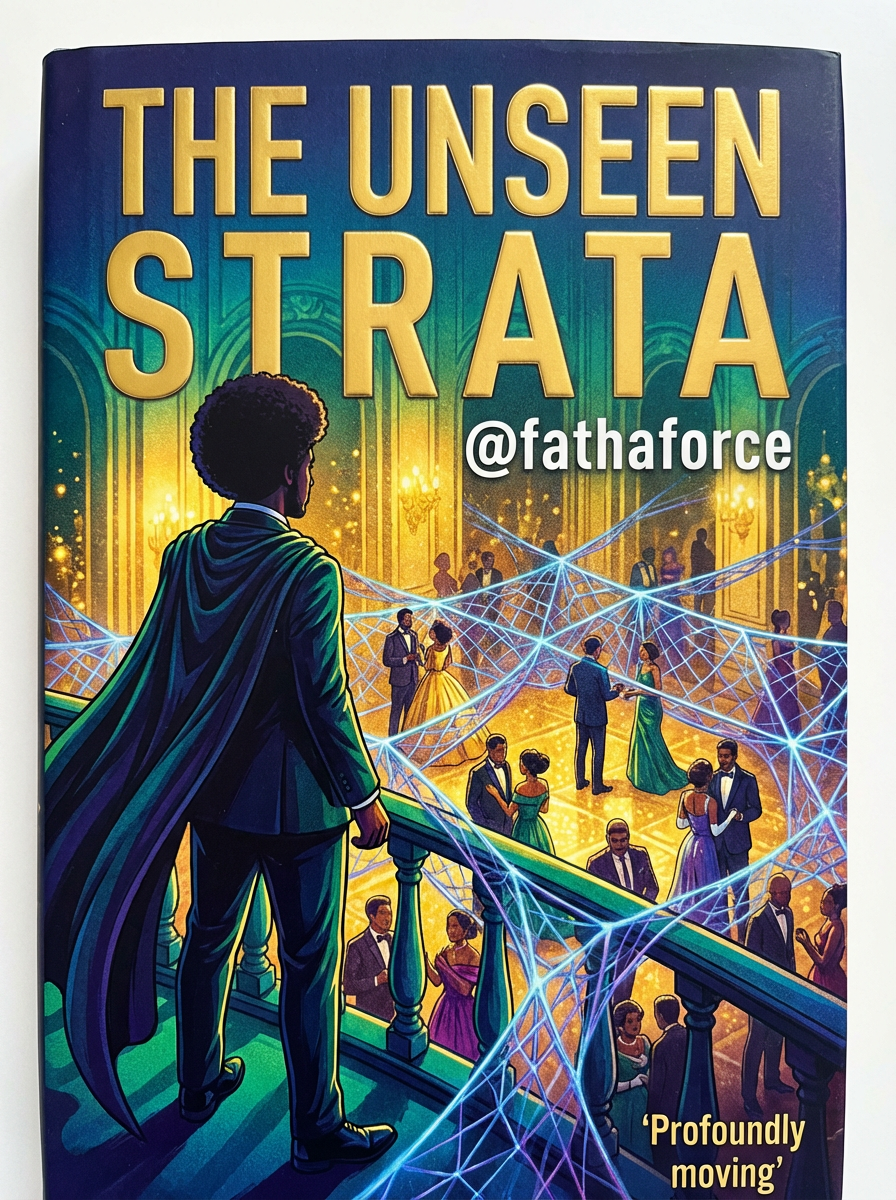
Synopsis
At a glittering gala, successful black creative Corvin uncovers a society subtly stratified by invisible hierarchies, not chains. This unsettling truth sets him on a perilous journey of self-reckoning, forcing him to choose between the comfortable silence of complicity and the costly freedom of defi
Chapter 1: The Gilded Cage
The air in the Grand Ballroom of the Volkov Tower was thick with the scent of lilies and the hum of a hundred carefully modulated conversations. Corvin moved through it, a quiet man in a tailored suit, his presence as understated as the perfectly chosen knot of his tie. Tonight, he was an exhibit, a celebrated artist displayed amongst a collection of others. The ‘Celebration of Progress’ gala. The name itself felt like a polished stone, smooth and cold under the tongue.
He shook hands, a firm grip, a practiced smile. Small talk, like dust motes in a sunbeam, danced around him. He answered questions about his latest exhibition, about his process, about the *meaning* of his work. People admired his success, the quiet ascent from the fringes to the center. He was a story they liked to tell themselves about their world – proof that talent, hard work, and a certain kind of adaptable spirit could open any door.
The ballroom was vast, a cathedral of gilded wood and stained glass. Crystal chandeliers, heavy and ornate, cast a warm, flattering light that softened the edges of people, made them all seem a little more beautiful, a little more prosperous. White-gloved waiters drifted with trays of champagne and canapés, their movements silent, almost spectral.
Corvin took a flute of champagne, the bubbles fizzing a cool, brief comfort on his tongue. He found a place against a marble pillar, a vantage point from which he could observe, as was his custom. He had always been an observer, a recorder of the subtle shifts in light and shadow, the unspoken nuances of human interaction. His art, in its essence, was about seeing what others overlooked.
He scanned the room slowly, his gaze moving across the clusters of guests. There were the politicians, faces etched with the familiar weariness of power. The industrialists, their smiles just a touch too wide. The philanthropists, radiating an aura of benevolent self-satisfaction. And then, there were the creatives, his own kind, a vibrant, if sometimes fractious, collection of artists, writers, musicians.
His eyes drifted towards the seating arrangements for the dinner. Circular tables, draped in linen as white as fresh snow, were scattered across the floor like immense, luminous pearls. Each table bore an ornate centerpiece of white orchids, and a small, gold-embossed card indicating its number. It was the numbers that snagged his attention, a fleeting, almost subliminal flicker in his peripheral vision.
He had arrived early, as was his habit, before the full tide of guests had swept in. He had seen the attendants, precise and efficient, placing the cards. It was a detail, a small thing, but Corvin’s mind was built for details. He saw patterns where others saw randomness.
Tables 1 through 10 were closest to the raised dais, where the evening’s dignitaries and keynote speakers would sit. These tables were larger, more spacious, allowing for more elbow room, more intimate conversation. The silverware shimmered a little brighter there. The flowers seemed a little more abundant.
Beyond these, Tables 11 through 25 fanned out, still prominent, but with a subtle contraction in their circumference. The linens were the same, the flowers just as white, but the proximity to the dais had lessened.
Further back, Tables 26 through 40 were arranged in neat rows, their spaces tighter, their elegance a touch more functional than opulent. And then, in the wings, almost out of sight behind a particularly dense forest of palms, were Tables 41 and 42. These were smaller still, squeezed against the wall, as if an afterthought. Their occupants, when they arrived, would have to crane their necks to catch a glimpse of the speakers, their view partially obscured by the fronds.
He watched the guests arrive, a slow procession of silks and velvets, of crisp suits and glittering jewelry. He saw them approach the seating chart, a grand scroll displayed on an easel near the entrance. They would scan it, some with a casual glance, others with a more deliberate search. A fleeting expression on a face as they found their table number – a flicker of satisfaction, a barely perceptible tightening of the lips, a quick, almost imperceptible scan of their neighbors.
Corvin, an artist whose success was undeniable, a man whose work now commanded significant sums, found his own place at Table 14. A good table. Well-placed. Elevated, but not *at* the pinnacle. He noted this without judgment, merely as an observation. He was often placed at these tables, the ones within the inner circle but not quite of its absolute core.
He saw Elena, the acclaimed poet, her silver hair a halo against her dark dress, approach the seating chart. She found her name, a slight hesitation, then moved with her customary elegance towards Table 7. A prime spot. Elena had always been a darling of the establishment, her words a soothing balm to their consciences.
Then came Marcus Thorne, the innovative architect, a man whose designs were reshaping cityscapes across the continent. He found Table 5. Another pillar of the community, his vision celebrated, his influence far-reaching.
Corvin watched a young, emerging novelist – a brilliant, sharp-witted woman named Anya who had just won a prestigious literary prize – scan the seating chart. Her brow furrowed slightly. He saw her eyes land on Table 38. A quick, almost imperceptible glance towards the dais, then a shrug, a straightening of her shoulders, and she moved with a confident stride towards the back. She was new blood, a rising star, but perhaps not yet fully annealed into the established firmament.
He registered the subtle differences in the way people carried themselves once they had located their tables. Those destined for the lower numbers walked with a quiet assurance, a sense of belonging. Those heading for the higher numbers sometimes moved with a fraction more speed, a touch more eagerness to settle, to integrate, to make their presence felt despite the distance.
It was not a system of overt exclusion. There were no velvet ropes, no bouncers, no signs declaring certain tables off-limits. Everyone was invited, everyone was *celebrated*. That was the genius of it, the quiet, almost invisible nature of the stratification. It was a sorting, a delicate arrangement of power and influence, disguised as mere logistics.
Corvin felt a nascent disquiet, a faint, almost imperceptible tremor in his chest. He had seen these patterns before, in different settings, in different forms. In art galleries, in publishing houses, in the subtle silences that followed certain pronouncements. He had always been aware of the unspoken rules, the codes that governed the creative world, the way some voices were amplified and others remained muted, regardless of their intrinsic merit. But tonight, seeing it laid out so explicitly, yet so *invisibly*, struck him with a new force.
He thought of his own journey. The initial resistance to his style, the quiet dismissals, the years of working in obscurity. Then, the slow, arduous ascent, piece by piece, exhibition by exhibition. He had been a disruptor, an outsider who had forced his way in through sheer undeniable talent. He had believed, perhaps naively, that once inside, the playing field was level.
But tonight, the gleaming surfaces of the ballroom seemed to reflect a different truth. The illusion of a flat hierarchy, a meritocracy where all celebrated progress together, was beginning to crack. Beneath the champagne and the polished smiles, there was an invisible grid, a carefully constructed web of privilege and access.
He remembered a conversation with his mentor, an old painter named Elias who had seen more seasons than Corvin cared to count. Elias, a man of brutal honesty and profound insight, had said, "They'll invite you in, Corvin. They will applaud your success. But never forget, they also dictate the limits of that success. There's always an invisible ceiling, a subtle wall. You can touch it, but you can't always break through it. Not without a fight, and usually, not without making them uncomfortable."
Corvin had dismissed it then, or perhaps, simply hadn't fully understood. He had thought Elias was old, cynical. Now, watching the quiet ballet of seating assignments, he began to understand the quiet wisdom in Elias's words. The walls were not made of brick and mortar, but of perception, of history, of unspoken agreements.
A hand touched his arm. He turned. It was Olivia Vance, the formidable art critic, her eyes sharp and assessing. "Corvin," she announced, her voice a low purr. "Wonderful to see you. Your installation at the Maxwell was simply breathtaking. A true testament to the spirit of our age."
He offered his practiced smile. "Olivia. Thank you. It means a great deal coming from you."
"Of course," she said, her gaze sweeping the room. "Such a marvelous gathering, isn't it? A true cross-section of our vibrant cultural landscape." She paused, her eyes narrowing slightly as she took in the table arrangements. "They do try their best, don't they? To ensure everyone feels included." There was a faint, almost imperceptible irony in her tone, a knowing glint in her eyes that suggested she, too, was privy to the silent language of the seating chart.
Olivia Vance was at Table 4. No surprise there. She was a gatekeeper, a powerful voice that could elevate or demolish careers with a single review. She existed at the very epicenter of influence.
"Indeed," Corvin replied, his voice neutral. He wondered if she saw the same patterns he did, or if she simply accepted them as the natural order of things. He suspected the latter, with a healthy dose of intellectual amusement thrown in.
He excused himself shortly after, needing a moment to process the nascent disquiet that had taken root within him. He moved towards the terrace, a breath of cool night air a welcome antidote to the cloying warmth inside. The city lights twinkled like scattered diamonds below, a vast, indifferent tapestry.
He leaned against the railing, the cold steel a grounding presence. He considered the intricate dance he had just witnessed. It wasn't about malice, he realized. It wasn't about overt discrimination. It was far more insidious than that. It was about comfort, about familiarity, about reinforcing existing structures without ever having to explicitly acknowledge them.
The 'Celebration of Progress' was a beautiful facade, a polished mirror reflecting back an image of inclusivity and equality. But beneath the surface, the strata were still there, invisible to the casual eye, yet profoundly real. They dictated who had the ear of power, whose ideas were truly championed, whose voices truly mattered.
He had always prided himself on his vision, his ability to see beyond the obvious. Yet, for so long, he had accepted this particular arrangement of the world as simply "the way things are." He had navigated it, understood its unspoken rules, and used them to his advantage. He had thought he was circumventing the system, when in reality, he had merely learned to play its game, albeit with a unique flair.
The disquiet deepened, morphing into something more akin to a faint ache. It was the sting of self-deception, the uncomfortable realization that his own success, while hard-won, was also tacitly sanctioned by this invisible system. He had been given a comfortable seat, a good table, but he was still operating within a cage, however gilded it might be.
He watched a waiter, young and earnest, hurry past him, carrying a tray of empty glasses. The waiter’s uniform was immaculate, his movements efficient. Corvin allowed his gaze to follow him. The waiter was heading towards a service entrance, a discreet door tucked away in a corner of the ballroom, completely out of sight of the glamorous festivities. Another stratum, another layer of the unspoken reality.
Corvin thought of his work, which often challenged existing perceptions, which sought to expose the hidden narratives of his community. He had believed he was shining a light into the shadows. But now, he wondered if he had merely been illuminating the *acceptable* shadows, the ones the system allowed him to portray.
The champagne, which had tasted so good moments ago, now sat heavy in his stomach. The celebration felt less like an embrace and more like a gentle, silken tether. He was part of it, yes, but he was also bound by it.
He knew, with a certainty that chilled him even in the warm night air, that he could not unsee what he had just seen. The precise arrangement of tables, the subtle variations in their significance, had opened a door in his mind. And once a door was opened, it was impossibly difficult to close it again.
The evening was just beginning. Dinner would be served, speeches would be made, accolades would be exchanged. But for Corvin, the true revelation of the night had already occurred. The gilded cage, once merely a concept, had shimmered into tangible, unsettling reality. He was inside it, and for the first time, he was actively, acutely aware of its bars. The path ahead, wherever it might lead, now seemed far less clear, and infinitely more perilous. The comfortable silence he had occupied was no longer an option.
Chapter 2: A Crack in the Veneer
The air shimmered with polite pronouncements. Words, polished and weighted, hung heavy above the clinking of glasses. Corvin, a man accustomed to the precision of language and the architecture of sound, found himself dissecting the pronouncements of the evening’s host.
“Innovation… diversity… opportunity.” Each word was a well-struck chord, designed to resonate with the curated optimism of the assembly. A celebrated tech mogul, a man whose philanthropy was as legendary as his algorithms, spoke with a practiced cadence. His voice, amplified just enough, filled the room. Corvin watched him, a figure of effortless authority, whose easy smile never quite reached his eyes.
Around him, conversations blossomed and died, like momentary constellations. He noticed the gravitational pull, the subtle forces that drew certain individuals together. The financial luminaries cleaved to the art patrons, a silent treaty between two forms of capital. The political advisors, sleek and quick-witted, orbited the industrial titans. It was not a physical barrier, not a velvet rope, but a mutual recognition, an unspoken understanding of shared terrain. They spoke in a shorthand of insider knowledge, of names and trends Corvin only half-understood, but whose significance was clear from the knowing nods and murmured assents.
Corvin, though undoubtedly part of the success stories being celebrated, felt a growing sense of detachment. He was an invited guest, yes, but not entirely of this world. He moved through the periphery, a satellite observing the planetary alignments. He had arrived with the expectation of belonging, of being enfolded into the warmth of shared accomplishment. Instead, he found himself an observer, his keen eye picking apart the elaborate tapestry of the evening.
He listened to a conversation between a prominent gallery owner and a venture capitalist. They spoke of a new initiative, a fund to support "underrepresented artists." The words were inclusive, progressive. Yet, the tenor of their voices, the slight condescension in the gallery owner's pronouncements, the way the venture capitalist occasionally glanced over her shoulder as if scanning for more important connections, spoke to a different truth. The "underrepresented" were a project, a commendable endeavor, not equals at the table. Their success, it implied, was a testament to the patrons' benevolence, not their inherent genius. Corvin felt a familiar prickle of irritation. He had built his empire brick by brick, not on patronage, but on relentless talent and a bullheaded refusal to be overlooked.
The air conditioning hummed, a low and constant drone beneath the polite chatter. Corvin took a sip of champagne, the bubbles dissolving on his tongue, leaving a faint sweetness. He scanned the room, his gaze moving deliberately, almost methodically. He sought out faces, familiar and unfamiliar. He saw others like him. Or, rather, others *presented* like him.
He spotted Dr. Anya Sharma, a renowned astrophysicist whose work had graced the cover of *Nature*. Her intellect was formidable, her achievements undeniable. Yet, she stood near the edge of a cluster of academics, her smile a little too fixed, her posture a little too stiff. She laughed at a joke about grant funding, a laugh that sounded a touch too loud, a touch too eager. It was a performance, subtle but discernible, of being present and engaged when, in Corvin’s estimation, she belonged at the very center of their intellectual discourse.
Then there was Marcus Thorne, a filmmaker whose independent features had garnered critical acclaim and a cult following. Marcus, usually boisterous and unapologetically himself, was engaged in a discussion with a television executive. Marcus’s usual vibrant energy was muted. He nodded often, a deferential tilt to his head. He spoke in measured tones, outlining his next project with an almost apologetic air, as if seeking permission rather than collaboration. Corvin knew Marcus. This subdued version was a strategic choice, a calculated modification to navigate this specific environment.
And then, in a quieter corner, near a display of antique maps, he saw Aisha Khan. Her architectural firm had reshaped skylines in three continents. She was a woman of immense power and influence. Tonight, she stood with a young, earnest intern from a leading university. Aisha was leaning in, listening intently, her expression one of genuine curiosity. But no one else seemed to gravitate towards her. No one of her professional standing sought her out for a casual exchange, for a shared anecdote about market trends or international tenders. She was magnificent, isolated.
Corvin felt a cold knot tighten in his stomach. He saw himself reflected in these unintentional tableaux. He saw the polite barrier, the invisible but tangible wall. He wasn't alone in his observation. He knew, with a certainty that chilled him, that these others, these brilliant, successful Black creatives, were also sensing it. The gilded cage, he thought, wasn't just encompassing him; it was a structure with many internal cells.
The speeches continued, each orator building on the last, crafting a narrative of collective triumph. "We are breaking down barriers," one proclaimed, his voice echoing with conviction. "We are forging a new path, together," another added, gesturing expansively at the diverse crowd. The words, when divorced from the reality of the room, were inspiring. But Corvin was not divorced from the reality. He was steeped in it.
He remembered a conversation from his art school days, a cynical professor who had spoken of "tokenism" as a new form of "inclusion." He had dismissed it then, idealistic and fiercely individualistic. Now, as he watched Aisha patiently explain the nuances of sustainable urban planning to a wide-eyed intern while titans of industry discussed their golf handicaps nearby, those words clawed their way back into his consciousness.
The 'progress' lauded by the elite felt hollow, a grand pronouncement without true substance. It was a narrative carefully constructed to assuage guilt, to project an image of enlightened modernity. But the underlying currents, the subtle stratifications, remained undisturbed. The fundamental structure of power, of who truly held sway and who was merely allowed to orbit, remained stubbornly intact.
He felt the shift in conversations, too. When he approached a group discussing venture capital for nascent tech startups, their animated discussion paused, a brief, almost imperceptible hesitation before they smoothly transitioned to a more generalized topic, something about the impact of AI on creativity. It was as if his presence, while welcome, altered the dynamic, pushing them away from their exclusive domain. He was a professional success, a black man in a predominantly white space, and as such, he was a symbol. A symbol of their progressive values, perhaps, but not necessarily an equal participant in their intimate discourse.
He moved to another cluster of people. This one centered around a well-known art critic. Corvin tried to join in, offering a nuanced observation about a contemporary piece recently exhibited. The critic nodded, smiled politely, and then seamlessly returned to a private joke with a curator, as if Corvin's contribution was merely a brief interlude.
It was not hostility he encountered. It was more insidious than that. It was an almost imperceptible re-routing, a gentle redirection away from the inner sanctum. It was the social equivalent of a subtle current that pushes a small craft away from the main channel, into calmer, less important waters.
He found himself thinking of his own work. He designed immersive experiences, digital worlds that blurred the line between art and technology. His installations were celebrated, lauded for their originality and technical brilliance. But sometimes, when pitching a radical new concept to a potential patron, he'd catch a fleeting expression in their eyes, a flicker of surprise, as if they were momentarily astonished that *he*, Corvin, a Black man, could conceive of such intricate, boundary-pushing ideas. They expected a certain kind of art, perhaps, a certain narrative. Not the boundless, genre-defying visions that sprang from his mind.
The air continued to buzz with curated conviviality. He saw a well-meaning socialite approach Marcus Thorne, congratulating him on his latest film. "Such an important story," she gushed, "so necessary for our times." Corvin watched Marcus offer a tight-lipped smile. He knew Marcus's film was about the quiet resilience of a jazz musician facing gentrification, a deeply personal and artistic exploration, not a political screed designed for social impact. The socialite's praise, while well-intentioned, felt like a misinterpretation, a reduction of Marcus's profound work to a convenient tagline, further cementing his assigned role as "important voice" rather than simply "brilliant artist."
Each instance, each subtle deflection, each well-meaning but ultimately isolating comment, chipped away at the veneer of inclusivity. The shine of the gala, the gleam of the chandeliers, the sparkle of champagne, all began to feel like a thin layer over something colder, harder.
Corvin was not a man given to overt displays of emotion. He processed internally, his thoughts like precise gears meshing in the quiet machinery of his mind. But the unease he felt was growing, escalating from a nascent disquiet into a solid, undeniable conviction. This wasn't just a fancy party; it was a carefully constructed performance, a masterful illusion.
He looked at his drink, the condensation beading on the glass. The ice cubes clinked softly as he swirled it. It was cold. He was cold. He saw the comfortable silence of complicity stretching out before him, a wide, smooth road. He was successful. He was here. He could choose to ignore the subtle fissures, to accept his designated placement, to enjoy the fruits of his labor within the boundaries set for him. It would be easy. It would be safe.
But the images of Anya, Marcus, and Aisha, playing their assigned roles in this grand performance, stirred something deeper within him. It wasn't just about his own discomfort; it was about the collective weight of these unspoken divides. The cost of comfortable silence, he realized, might be higher than he had ever imagined. The veneer was cracking, and what lay beneath was not a smooth, unified surface, but something far more complex, far more stratified, and far more unsettling. He knew, with a certainty that both daunted and invigorated him, that he could no longer pretend not to see it. The night, he understood, was just beginning.
Chapter 3: The Whisper of Old Laws
The silk of his shirt felt like a shroud. The lingering scent of champagne, stale and sweet, clung to his clothes, a phantom limb of the gala’s artificial warmth. Corvin walked, not towards his gleaming downtown apartment, but aimlessly, until the rhythmic clack of the elevated train above him became a dull hum, and the city’s electric pulse softened into a murmur.
The disquiet had burrowed deep, a rat gnawing at the foundations of his carefully constructed reality. It wasn’t just the periphery he’d been relegated to, nor the polite nods that carried the weight of dismissal. It was the *smoothness* of it all, the complete absence of visible effort in the maintenance of those subtle boundaries. He’d seen it before, of course, in smaller, cruder forms: the playground cliques, the college fraternities, the industry’s unspoken pecking orders. But this was different. This was institutional, ancient, woven into the very fabric of how things *were*.
He found himself standing before his grandmother’s brownstone. A fortress of red brick and weathered granite, it had stood sentinel through generations, a silent witness to countless moments of solace and stern wisdom. The lamplight spilling from the street caught the wrought-iron gate, casting intricate shadows that danced with the breeze. He hadn't just gravitated here. He had been pulled.
His grandmother, Elara, sat in her armchair, a book open on her lap, though her gaze was fixed on the city lights twinkling beyond her window. Her silver hair was braided, a thick coil against the dark wood of the chair. The air in her parlor was thick with the scent of old paper and cloves, a comforting weight that pressed down the frantic churn in his mind.
“Corvin,” she said, her voice a low thrum that always reminded him of the deepest notes on a cello. She didn’t look at him, but her awareness was absolute. “You look as if you’ve seen a ghost.”
He sank into the velvet sofa opposite her, the cushions sighing in protest. “Worse, Grandma. I think I finally saw what was always there.”
She finally turned, her eyes, though clouded with age, holding a sharp, unwavering light. “The threads, then?”
The phrase, tossed so casually into the quiet room, struck him with the force of a blow. *The threads.* The memory, long buried beneath layers of career ambition and modern pragmatism, surfaced like a forgotten artifact. He was a boy again, small and fidgety, perched on her lap. The evening light was golden, just as it was now.
“Tell me again, Grandma,” he’d pleaded, fascinated by the way her fingers, gnarled with age, had traced invisible patterns in the air.
“Life, child,” she’d begun, her voice a soft incantation, “is not just flesh and blood. It is also of spirit and… threads. Invisible threads. Some are spun from kindness, some from common purpose. But there are others, born of older things. Of lineage, of place, of who your people were, and what they did. These are the threads that tie you to your proper strata.”
He’d imagined them then, shimmering lines of silver and gold, dark and heavy cords, forming a vast, intricate tapestry. “But what if you cut them?” he’d asked, ever the rebel.
She had smiled, a sad, knowing curve of her lips. “You cannot cut what you cannot see, Corvin. You can only ignore them. But they remain. And when you think you have moved freely, you will find yourself pulled back, or held apart, by the very threads you denied.”
Now, sitting before her, a successful man in a successful world, the weight of those words was crushing. “I thought it was just… a story,” he admitted, his voice rough. “Something to make a little boy understand injustice, but in a way he could grasp.”
Elara’s gaze was steady. “All stories have a root in truth, Corvin. Some truths are simply too vast, too uncomfortable, to be spoken plainly. The threads are not always chains. Sometimes they are gossamer, almost imperceptible. But they hold. They always hold.”
He spent the rest of the night with her, not talking much, but basking in the quiet certainty she exuded. He thought of the gala, the subtle distinctions, the way the circles formed, not by overt exclusion, but by an almost magnetic pull of like to like. He saw the threads now, not as fantasy, but as a metaphor for something profoundly real. A vast tapestry of implicit social contracts, historical legacies, and inherited biases that wove through the society he inhabited. It wasn’t just about race, he realized. It was about ancestry, about the whisper of old money versus new, about the unwritten laws of how power circulated, and who was deemed worthy to touch it.
The next morning, his carefully curated apartment, a monument to sleek minimalism and artistic success, felt suddenly hollow. The abstract paintings on the walls, the artisanal furniture, the sprawling city view – they were all trappings, a gilded cage he had willingly built for himself. He saw them now for what they were: markers of a striving, a constant attempt to prove himself worthy of a place that, perhaps, was never truly meant for him.
He needed to understand. Not just *feel* the injustice, but to dissect it, to trace its lineage, to name its hidden mechanisms.
His research began without urgency, a slow unspooling. He started with the obvious: sociological texts on class structures, the history of wealth accumulation, the subtle biases embedded in institutional language. But these felt too broad, too academic. They described the symptoms, not the underlying ethos. He was looking for the *whisper of old laws*.
He found himself drawn to histories of lineage and aristocracy, not just European, but across cultures. He read about the unspoken rules of ancient Chinese scholar-officials, the caste system of India, the intricate tribal hierarchies of indigenous societies. He saw echoes, not of explicit oppression, but of deeply ingrained systems of stratification, passed down through generations, often codified in custom and tradition rather than statute.
He devoured books on heraldry, on the history of etiquette, on the evolution of social graces. He learned that bows and curtsies, dining customs, modes of address – they were not mere politeness. They were highly calibrated dance steps, rituals designed to reinforce relative positions, to signal who belonged where, and to whom deference was due. The gala, with its meticulously arranged tables and its silent cues, was merely a modern instantiation of these ancient ballets.
He began to see it everywhere. In the hushed reverence afforded to certain family names, even if their current scions were mediocre. In the preferential treatment for graduates of elite universities, regardless of individual merit. In the way certain neighborhoods, certain clubs, certain institutions, seemed to hum with an invisible current of belonging that others, no matter how affluent or accomplished, could never fully tap into.
He remembered a conversation with a former colleague, a flamboyant sculptor named Julian, who often spoke in riddles. "Corvin," Julian had once boomed over a gallery opening, "you're always trying to *enter* the room. The true masters, they *are* the room. They don't need a key." At the time, Corvin had dismissed it as artistic hyperbole. Now, the phrase resonated with chilling clarity. The powerful weren't just *in* the circles; they *were* the circles. They emanated the very gravitational pull that shaped the social constellations.
He delved into the history of Black communities, not just the struggles against overt discrimination, but the internal hierarchies that emerged, the desperate attempts to build parallel strata, to create their own systems of belonging and prestige within a larger framework that denied them. He read about the "Talented Tenth" and the complexities of colorism, how even within marginalized groups, the threads intertwined with agonizing subtlety, creating new, almost imperceptible divisions.
The concept of "cultural capital" became a recurring motif in his research. Not just money, but a shared set of tastes, knowledge, behaviors, and values that conferred social advantage. He saw how the gala itself was a performance of cultural capital, a demonstration of who understood the unspoken rules, who possessed the "correct" sensibilities, and who, like him, was merely a guest observing the show.
He found himself returning to the idea of the "unseen." It wasn't about explicit laws, not anymore. Slavery was abolished, Jim Crow dismantled. The legal frameworks of oppression had been, at least on paper, eradicated. But the *shadows* of those laws, the cultural imprints they left behind, the habits of thought and perception they ingrained – these remained. They had simply morphed, becoming more insidious, more difficult to pin down.
He thought of the subtle shifts in conversation, the sudden lulls when a certain topic was introduced, the polite deflections that signaled a boundary had been approached. These were not overt rejections; they were the delicate tightening of the threads, a gentle but firm reminder of his place.
He started to observe people differently. He saw the ease with which some navigated social situations, the inherent confidence that came from never having to question their belonging. He saw the subtle anxieties in others, the studied casualness, the slight overcompensation, the veiled attempts to fit in. He recognized it in himself, a self-awareness he had previously dismissed as professional self-consciousness. Now he saw it as a chronic vigilance, an internalized barometer constantly measuring his proximity to the approved strata.
The most disturbing realization was how deeply internalized these unseen laws had become, not just by those who benefited, but by those who were subject to them. He had, unconsciously, played his part. He had striven for the right schools, the right career, the right address, all in an effort to transcend the threads he hadn't known existed. He had believed that success, pure and undeniable, would grant him unfettered access. But success, he now understood, was merely a ticket to the gala; it didn’t guarantee a seat at the main table.
The silence in his apartment grew heavy, not an empty silence, but one pregnant with understanding. He hadn't just uncovered a hidden truth about society; he had uncovered a hidden truth about himself. He had been chasing an illusion, a phantom ideal of unburdened meritocracy.
The threads, he saw now, were not just external forces. They were also internal. They shaped aspirations, limited horizons, dictated permissible forms of expression. They were the unspoken limits of ambition, the subtle boundaries of imagination.
He remembered a line from a forgotten poem his grandmother used to recite: "The cage may be gilded, but a cage it remains still." The gala was a gilded cage, indeed. And he, Corvin, with all his success and accomplishment, had been admiring its intricate design, without truly seeing the bars.
He closed the heavy tome on ancient societal structures, the leather yielding softly beneath his fingers. The research hadn't given him answers in the form of a decree or a manifesto. Instead, it had provided a vocabulary for the unsettling sensation in his gut, a historical context for the invisible strata. The whisper of old laws resonated not just in the past, but in the present, a persistent and pervasive undertone in the symphony of modern life. And now that he had heard it, he knew he could never un-hear it. The comfortable silence of complicity had been shattered. The costly freedom of defiance, he suspected, was just beginning to stir.
Chapter 4: Echoes in the Market
The city hummed, a persistent low thrum against the glass of Corvin’s studio. He’d ignored it before, a background noise to the urgent tap-tap-tap of his keyboard, the scratch of charcoal on paper. Now, it felt like a vibration in his bones, a new frequency atuned to the world’s quiet mechanisms. The gala, the whispered laws, his grandmother’s ancient warnings – they had fitted a new lens to his eye, and the world, his world, sharpened into stark relief.
He looked at his workspace, a testament to his success. The polished African mahogany desk, the ergonomic chair, the sleek monitors displaying his current animation project – a sprawling, fantastical epic for a major studio. He was comfortable. Successful. A celebrated Black creative, as the industry journals lauded. He had built this. Or so he had believed.
He minimized the animation, its vibrant colors suddenly muted, secondary. He opened his company's internal directories, navigated to project assignment logs, quarterly reports, annual reviews. Data, cold and clean, waiting for interpretation. He used to glance at these, a necessary administrative chore. Now, he scrutinised them, each entry a potential thread in the tapestry he was beginning to unweave.
First, the projects. Large, high-profile campaigns. The ones that guaranteed industry awards, press coverage, a boost in stock price. He filtered by lead creative. White, predominantly male names dominated the top tier. Not exclusively, no. There were exceptions, often held up as shining examples of the studio's commitment to diversity. He himself was one such example. His epic, for instance. But then he looked at the support teams, the secondary roles, the junior artists. A broader spectrum here, more women, more people of color. The visible mosaic of inclusivity.
He cross-referenced with resource allocation. Budgets for these high-profile projects. The sheer quantum of raw talent, man-hours, cutting-edge technology poured into them. Then he looked at the smaller projects, the experimental ones, the passion pieces, often pitched by those very support teams. Less money. Fewer people. Longer timelines, often with stricter deliverables. The narrative was there, subtle as a breath on a quiet windowpane. The company championed these projects, lauded their innovation, their fresh perspective in internal memos. But the resources, the true muscle of the studio, flowed elsewhere.
He thought of Maya, a brilliant storyboard artist, her sketches full of a visceral energy that could bring stone to life. She’d been trying to get her short film greenlit for two years. "Under consideration," the official line. Always "under consideration." Meanwhile, Liam, a competent but unremarkable animator, had snagged a lucrative corporate advertising gig that went from pitch to execution in three months. Liam belonged to the quiet circles Corvin had observed at the gala – the ones whose fathers golfed with the board, whose wives knew the wives of the executives.
He pulled up the promotion histories. The upward trajectory of some was a swift, almost frictionless ascent. Others, talented, dedicated, experienced, stagnated, their careers plateauing at middle management, or slowly shunting sideways into roles with less creative input, more administrative burden. He saw himself, at his early career, climbing steadily, but then hitting a ceiling he hadn’t consciously acknowledged until now. He was a ‘creative director’, yes. But his projects, while grand, always carried a hint of ‘diversity initiative’ in their subtext, even when unspoken. His rise had been celebrated, showcased. But had it been to a truly equal height? Or a specific, designated height?
The disillusionment was a lead weight in his gut. It wasn't overt discrimination. No shouting, no outright refusal. It was a million tiny currents, nudges, and subtle gravitational pulls. A quiet filtering system. An invisible hand guiding the flow of opportunity, of recognition. It wasn't who was *excluded* that was the most insidious part. It was who was *favored*, and the almost imperceptible manner in which that favor was bestowed, then made to seem natural, earned through merit alone.
He thought of the gala again. The peripheral seating. The ease with which some navigated the room, their conversations flowing effortlessly into the centers of power. The way others, like himself, despite their achievements, remained at the edges, observed, approved of, but not truly *of*.
His own successes, the awards, the accolades – they were real. He had poured his life into his craft. He had worked harder, stayed later, pushed himself further, because he knew he had to. He had believed that hard work, unyielding talent, would break down any barrier. He had been a testament to that belief, living proof.
Now, he saw it differently. His success wasn’t a transcendence of the strata. It was a designated position within it. He was meant to be seen, to be celebrated, to demonstrate the openness of the system. He was the exception that confirmed the rule. He was a beacon, but a fenced-in one. His victories were carefully curated, his voice amplified, but only within certain parameters, on acceptable subjects, and never in a way that threatened the fundamental power structures.
He clicked further, into the talent acquisition reports. He saw the numbers for interns, entry-level positions. The initial diversity numbers were often impressive. The raw potential, vibrant and varied. And then he tracked the attrition rates. Who stayed? Who left? Who ascended? The funnel narrowed, the diverse stream becoming a more homogenous trickle the higher up the chain one looked. The churn at the bottom, the slow, imperceptible erosion of difference.
He recalled conversations with younger artists, full of bright-eyed idealism, who spoke of leaving for "more fulfilling" work, or "a better fit." He'd offered encouraging words, mentorship, unaware he was overlooking the larger forces at play, the subtle currents that had swept them out.
He felt a profound sense of self-betrayal. He had been a champion of the studio’s progressive image, genuinely believing in its stated values. He’d mentored young Black artists, telling them that their talent was their passport, that the industry was changing, opening up. He’d been a willing participant, perhaps even a proud emblem, in a system he now understood to be far more nuanced, far more entrenched than he had ever imagined. His own career now felt less like a triumph of individual will and more like a carefully orchestrated demonstration.
This wasn't anger, not yet. It was a cold, surgical clarity. He saw the threads now, not as faint whispers, but as visible rigging. He saw how the 'unseen strata' operated within his own glittering creative world. It wasn't about explicit denial of opportunity based on race or gender. It was about the initial allocation of resources, the implicit biases in project assignment, the opaque criteria for promotion, the subtle favoritism that, over time, compounded into significant disparities.
He looked around his studio, at the awards gathering dust on the shelf, the framed articles praising his vision. What did it all mean, if the rules of the game were perpetually rigged, if his perceived freedom was merely a larger cage? The hum of the city outside now sounded less like ambition and more like the grinding of unseen gears. Corvin was no longer just a successful artist. He was an unwilling component in a vast and silent machine, and the insight, sharp and undeniable, cut him to the bone.
Chapter 5: The Weight of Silence
The scent of roasted coffee and old paper filled Marcus Thorne’s studio. Corvin admired the chaos. Easels stood like sentinel sentries, canvases leaned against every available surface, some vibrant, others monochrome, all bearing the hallmark of Marcus’s genius. Marcus, a sculptor whose work often explored themes of heritage and displacement, was one of the few Corvin truly respected. They had navigated enough industry shark tanks together to forge a bond stronger than mere professional courtesy.
“You look like you’ve been wrestling a ghost, man,” Marcus rumbled, setting down a mug of steaming black coffee before Corvin. His hands, calloused and strong, were stained with clay and pigment. He smelled of turpentine and earth.
Corvin took a slow sip. The heat was a welcome jolt. “Something like that.” He watched Marcus turn back to a half-finished bust, his brow furrowed in concentration. Marcus didn't talk much when he worked, a habit Corvin appreciated. It allowed for observation, for silent recalibration.
He tried to find the right words, words that wouldn't sound unhinged. He knew how it sounded. He’d rehearsed it in his head, twisting the facts this way and that, trying to present it as objectively as possible. But objectivity felt impossible when the truth clawed at him with such visceral intensity.
“It’s about the gala,” Corvin began, finally. Marcus grunted, his eyes still fixed on the clay. Corvin continued, choosing his words with care. “The Celebration of Progress. Did you feel anything… off?”
Marcus paused, wiping a smudge of clay from his chin with the back of his hand. He turned, his gaze direct and unblinking. His face, etched with the lines of effort and experience, held no judgment, only a patient inquiry. “Off? It was a gala, Corvin. Overpriced champagne, undercooked canapés, and the usual parade of self-congratulation. What was ‘off’ about it?”
“The seating,” Corvin said, the word coming out sharper than he intended. He moderated his tone. “And the way people grouped. The conversations. The whole… arrangement.”
Marcus chuckled, a low, rumbling sound that filled the studio. “Ah, Corvin. Always looking for the deeper meaning in a seating chart. It’s a gala, man. People sit with their friends, their patrons, their perceived equals. It’s just how these things work.”
“No,” Corvin insisted. He leaned forward, trying to convey the weight of his conviction. “It wasn’t just that. It was… too perfect. Too consistent. The pattern repeat, again and again. Not just at the gala, but everywhere. I’ve been seeing it in our industry. The way projects get assigned, how resources are allocated. Who gets mentored, and who gets sidelined.”
He laid out his discovery, everything from the forgotten memories of his grandmother’s tales to the stark data points he’d gathered from his own professional sphere. He described the “unseen strata,” the subtle yet pervasive hierarchies. He spoke of the black creatives he’d seen at the gala, their subtle disengagement, their positions at the edge of the official narratives. He talked about how the industry championed diversity and inclusion, but below the surface, an invisible hand guided the flow of opportunity.
Marcus listened. He didn’t interrupt, didn’t fidget. His expression remained neutral, a sculptor observing a new form, neither dismissing nor accepting it immediately. Corvin found a fleeting sense of hope, a belief that Marcus, with his own keen observations of society, would understand.
When Corvin finished, the silence in the studio was profound, broken only by the distant hum of city traffic. Marcus picked up a small sculpting tool, turning it over in his fingers. He walked back to the bust, his shoulders hunched.
“Corvin,” Marcus said, his voice softer now, almost weary. “You’re a good man. A brilliant artist. But sometimes… sometimes you think too much.”
Corvin’s hope wavered. “Think too much? Marcus, I’m telling you, I’ve seen it. It’s not just paranoia. It’s a system.”
Marcus sighed, a deep exhalation that seemed to carry the weight of years. He turned back, his eyes kind, but firm. “Corvin, what you’re describing… it’s human nature. People gravitate to those they’re comfortable with. Those who share their backgrounds, their upbringing. It’s not some grand conspiracy. It’s social dynamics. Always has been. Always will be.”
“But it’s more than that,” Corvin argued, his voice rising in frustration. “It’s a deliberate mechanism. One that keeps certain people in certain places, even while everyone pretends otherwise.”
Marcus shook his head, a slow, deliberate movement. “Look, man. I’ve been in this game longer than you. I’ve seen the prejudice, the outright racism. But that’s changing, slowly, yes, but it is. What you’re talking about… it sounds like you’re looking for problems where there are none. Or at least, where there are only the same old problems, dressed up in new clothes.”
“So you’re saying it’s just the old world, repackaged?” Corvin pressed. “That despite all the talk of progress, of dismantling barriers, we’re still stuck?”
“No,” Marcus said, a flicker of irritation in his tone. “I’m saying you’re seeing shadows where there are just differences. You’re assigning malice to what is often just unconscious preference, or habit. Or frankly, just logistics.” He gestured around the studio. “If I'm working with a new client, I'm going to reach out to the people I know, the people I trust, who've delivered before. Not because I'm consciously excluding others, but because that's how I get things done.”
Corvin felt the air leave his lungs. It wasn’t a denial born of hostility, but of a deep-seated acceptance, a weary resignation, or perhaps, a willful blindness. Marcus wasn’t attacking him; he was simply incapable of seeing what Corvin saw. And that, in its own way, was more isolating than outright disagreement.
“So the gala, the seating, the conversations,” Corvin pushed, his voice strained. “That was all just… coincidence?”
Marcus shrugged, a gesture of dismissive indifference. “The powerful want to talk to the powerful. The rich want to talk to the rich. People who look like each other tend to group together. Happens everywhere. It’s not ‘unseen strata,’ Corvin. It’s just… life.” He picked up a damp cloth and began to gently smooth the clay on the bust, his attention once again drifting to his work. The conversation, for him, was over.
Corvin watched him, the strong hands, the focused gaze, the easy acceptance of what was. He felt a profound sense of loneliness wash over him. He had sought validation, confirmation, a shared understanding. Instead, he found only a wall of benevolent dismissal. The weight of his discovery, which had felt like a burden he could share, now pressed down on him with crushing force.
He tried one last time, his voice barely above a whisper. “But if it’s ‘just life,’ Marcus, then what are we fighting for? What is all this talk of progress, of diversity, of equity… if the core mechanism remains unchanged?”
Marcus stopped working. He faced Corvin, his eyes holding a depth of understanding that was both comforting and painful. “We fight, Corvin, because it *is* better now than it was. Because some of the chains have been broken. Because we *can* be here, in rooms like this, making our art. We fight for what we *can* change. Not for what is inherent to the human condition.”
“And what if this *is* inherent?” Corvin countered, the question hanging heavy in the air. “What if this is a fundamental, insidious part of the human condition, that we’ve just learned to ignore, to sanitize, to pretend away?”
Marcus simply looked at him, his gaze holding a quiet pity. “You see ghosts, Corvin. Unseen threads. I see people. Imperfect, flawed, sometimes biased, but not marionettes in some grand, invisible play. The world is complex enough without inventing new layers of control.” He paused, then added, his voice softened, “You’re burning yourself out trying to find malice where there’s often just… habit. Or indifference.”
The last word, “indifference,” stung. It implied that Corvin was seeking a grand, malevolent force, when what he truly sought was simply an explanation for a pervasive pattern an uncomfortable truth that threatened to unravel his own carefully constructed reality.
Corvin stood, the untouched coffee growing cold in his mug. The studio, once a sanctuary of shared creative struggle, now felt vast and empty. He had come seeking a fellow traveler, and found only himself on a solitary path. The truth he carried felt heavier than ever, a silent scream trapped within his own mind, unheard by the very person he thought would understand.
“Thanks for the coffee, Marcus,” Corvin said, his voice flat. He felt like he was speaking from a great distance.
Marcus nodded, his attention already returning to the clay bust. “Anytime, man. Just… don’t lose yourself in the shadows, alright? There’s too much light in your work to let it be consumed.”
Corvin walked out into the cool afternoon air, the scent of turpentine and clay fading behind him. The city hummed, oblivious. He looked up at the towering glass and steel structures, the symbols of progress and prosperity. He saw them not as monuments to advancement, but as layered constructs, each pane of glass, each invisible wall, representing another barrier, another division. The “unseen strata” wasn’t just a theory anymore; it was a lens through which he now viewed the entire world. And standing alone with that vision, in a world that refused to acknowledge it, was a burden almost too heavy to bear. The comfortable silence of complicity Marcus had implicitly advocated for felt like a suffocating shroud, and the costly freedom of defiance, now seemed to be a path he would walk alone.
Chapter 6: A Glimpse of Resistance
The libraries offered sanctuary from the city’s hum. Corvin sought silence there, and answers. Not the kind found in contracts or market reports, but the deeper kind, etched in the margins of forgotten biographies, whispered among annotated chronicles. The strata, he now knew, were not new. They were old. He had simply been blind.
He started with the obvious, the figures whose defiance was codified in history books: the suffragists, the abolitionists, the civil rights leaders. Their battles were overt, against tangible chains. Yet, as he read, he saw the nuances, the societal currents they fought against that were less visible, more pervasive. The subtle condescension that preceded the overt denial, the whisper of inadequacy before the shout of rejection. He saw how progress, when it came, often broke one chain only to expose another, thinner, less remarked upon.
He spent days poring over their lives. Harriet Tubman, moving silently in the night, a direct defiance against chattel. But also, a defiance against the narrative of Black inferiority that made such ownership justifiable to so many. He saw her courage, yes, but also the cunning, the quiet resistance within a system designed to crush the spirit first, then the body.
Then he moved to the less celebrated, the quieter revolutionaries. Artists who veiled critique in beauty. Writers whose metaphors were sharper than any sword. Musicians whose rhythms spoke a language beyond words, stirring souls in ways sermons rarely could. He was particularly drawn to a figure, long since passed, a composer named Elara Vance. Her symphonies, celebrated for their intricate beauty, held submerged narratives of oppression and longing that few at the time fully grasped. Corvin listened to her work, not just with his ears, but with his awakened eye, and he heard the subtle dissonances, the yearning crescendos, the fleeting moments of harmony that promised a different world. He heard the defiance in her choice of instruments, her unexpected key changes, her refusal to stay within the comfortable melodic lines of her contemporaries. It was a defiance wrapped in exquisite sound, a challenge offered not with a fist, but with a bowed head and a soaring melody.
He learned of poets who wrote in codes, their verses innocent on the surface, searing underneath. He found a collection of letters from a society wife in the 19th century, a woman named Agnes Beaumont, whose outwardly conventional life concealed a fierce intellect and a subversive spirit. Her letters, addressed to a trusted confidante, spoke of the suffocating expectations placed upon women of her class, the unspoken rules that dictated their every move, from the tilt of their head to the topics of their conversation. She wrote of "the silken cords," a phrase that resonated deeply with Corvin. "They are not chains of iron," she wrote, legible in the faded ink, "but they bind more tightly, for they are woven into the very fabric of our being, unseen until one tries to break free."
Agnes, Corvin discovered, never publicly challenged the system. Her resistance was more subtle. She founded a school for impoverished girls, teaching them not only domestic skills but also history and literature, pushing the boundaries of what was considered appropriate education. She quietly influenced critical social reforms through her philanthropic networks, all while maintaining her outward facade of a devoted wife and hostess. Her freedom, Corvin realized, was not found in overt rebellion, but in the intelligent manipulation of the very system that sought to contain her, in carving out spaces for agency and enlightenment where none were meant to exist.
He found solace in her struggles, a kinship across centuries. He, too, moved through a world of unstated expectations, of polite smiles that concealed judgments, of opportunities that appeared equal but were subtly skewed. He understood Agnes’s dilemma, the choice between overt, likely futile, confrontation and the quieter, more strategic subversion.
He studied the solitary figures, those who simply *lived* differently. The hermits, not for religious reasons, but for the fundamental rejection of societal demands. The artists who refused to compromise their vision, even when it meant obscurity. The thinkers who published controversial ideas under pseudonyms, their true identities protected, but their thoughts unleashed.
One such figure was a philosopher from the late 19th century, known only by his pen name, "The Watchman." His essays, collected posthumously, explored the concept of "consensual invisibility." He argued that true freedom was often surrendered not through force, but through a collective agreement to ignore certain realities, to maintain a comfortable illusion. He spoke of "the gentle coercion of unspoken expectation," a phrase that struck Corvin with the force of a physical blow. The gala, the industry, his own complicity – it all clicked. He had been complicit in his own consensual invisibility, accepting the subtle peripheralization because it was easier than fighting an enemy he couldn't even name.
The Watchman argued that the first act of defiance was simply *seeing*. Not just looking, but truly seeing the invisible structures, the unwritten rules, the silent agreements that shaped society. And the second act, he posited, was *naming* them. To name a thing was to give it substance, to strip it of its illusory power.
Corvin closed the book, the weight of the Watchman’s words heavy in his hands. He had been seeing, now. The clarity was undeniable, painful. But he hadn't yet named. He had only privately raged.
He went to a quiet café, away from the hushed reverence of the library. He ordered black coffee, strong, like he preferred his truths. He looked at the faces around him, the casual ease of their interactions, the unspoken understanding that flowed between them. He wondered how many among them were also navigating their own invisible strata, their own "silken cords."
He thought of his own world, the world of art and creativity, supposedly a bastion of rebellion and free thought. Yet, even there, the strata existed. Who got the commissions? Which patrons favored which styles? Which artists were championed, and which were quietly sidelined, their brilliance acknowledged but never amplified? It wasn't about talent alone, he now knew. It was about fitting, about conforming to an unstated aesthetic, a preferred narrative, a palatable identity.
He considered the various modes of resistance he had encountered in his research. Overt defiance: Necessary, often brutal, and sometimes martyrdom. Subtle subversion: A chipping away at the foundation, slow and often uncredited. Intellectual naming: The act of articulating the unseen, a crucial first step. Personal freedom: The inner act of refusing to be defined by external constraints, a defiant spirit.
He felt a pull towards the latter two. He wasn’t a revolutionary in the traditional sense. His weapon was his art, his tool his discerning eye. He wasn't going to storm barricades, but he could illuminate the barricades that no one else saw.
He thought of the uncomfortable silence he had maintained at the gala, the polite smiles he had offered, the conversations he had allowed to drift without challenging their unspoken assumptions. That, he decided, was the opposite of freedom. That was complicity.
True freedom, he realized, often began with a solitary act of defiance against a silent expectation. It didn't have to be grand. It didn't have to be public. It could be a simple refusal to conform, an insistence on seeing what others politely ignored, a decision to speak the quiet truth in a room full of comfortable lies.
Corvin considered his own art. He was successful because his work was beautiful, often evocative, but always within acceptable bounds. It challenged on an aesthetic level, but rarely on a societal one. He had played by the rules of the unseen strata, and he had been rewarded. But at what cost? The cost of his sight, his voice, his very sense of self.
He decided then. His next piece, whatever it might be, would not be for comfort. It would not be for accolades. It would be for seeing. It would be an act of naming, a testament to the "gentle coercion of unspoken expectation."
He finished his coffee. The bitter taste lingered, a reminder of the truths he had swallowed in the past. But now, it was a different kind of bitterness. It was the bitterness of a medicine taking hold, flushing out the poison, preparing him for the fight ahead. The silence was over. The work began. And for the first time in a long time, Corvin felt a true, fierce sense of freedom, born not of ease, but of purpose.
Chapter 7: The Cost of Seeing
The presentation deck shimmered, sleek and professional. It was another campaign for “inclusive futures,” a new corporate initiative, heavy on buzzwords and light on genuine change. Corvin sat at the polished mahogany table, the cool wood a familiar weight beneath his fingertips. He’d helped craft these decks for years, an unspoken talent for translating vague corporate directives into visually stunning, emotionally resonant narratives. His work made the bland palatable, the tokenism feel like progress. Now, the words tasted different.
“We’re looking for something that really pops,” said Eleanor Vance, head of the division, her voice a practiced blend of steel and silk. “Something that makes our stakeholders feel proud. That we are *leading* the charge.” She gestured to a slide featuring a diverse group of smiling faces, all perfectly lit, all perfectly aspirational. The faces were carefully curated, a mathematical equation of representation. One Black woman, one East Asian man, one person in a wheelchair. One for each demographic checkbox.
Corvin’s eyes drifted to the small print at the bottom of the slide, the attribution for the stock photo. *Image courtesy of GlobalDiversitySolutions.com.* He knew the site. Knew the models. Knew the price tags attached to specific representations.
“The visual metaphors are strong,” Corvin began, his voice even, betraying nothing of the churning beneath. “But I’m wondering about the underlying narrative. ‘Leading the charge’ implies there’s a charge to be led. What exactly are we charging *against*?”
A ripple went through the room. Eleanor’s expertly arched eyebrow rose fractionally. Across from Corvin, Marcus Thorne, a senior director who usually echoed Eleanor’s sentiments with vigorous nodding, paused mid-sip of his artisanal iced coffee.
“Corvin, we’re charging against… the status quo,” Eleanor said, a hint of impatience in her tone. “Against historical inequities. It’s what we do. It’s in our mission statement.”
“And how do we define that status quo?” Corvin pressed. “Is it a tangible thing? Or is it a collection of practices, of unspoken assumptions, that we continue to perpetuate even as we claim to be dismantling them?”
Marcus cleared his throat. “I think the point, Corvin, is to highlight our commitment. To show we’re making real strides.”
“Real strides,” Corvin repeated, nodding slowly. “And what are those strides? Beyond the optics? Beyond the new hiring targets that invariably funnel into the same entry-level positions without impacting who makes the strategic decisions?”
The silence that followed was not comfortable. It was the heavy, pregnant silence of a question asked that was not meant to be, a rock dropped into a placid pond. Eleanor’s gaze sharpened, her eyes, usually warm and inviting, now held a cool assessment.
“Corvin, are you suggesting our initiatives aren’t genuine?” she asked, her voice calm, almost too calm.
“Not at all,” Corvin replied, meeting her gaze steadily. “I’m suggesting that genuine initiatives require genuine self-reflection. If we’re fighting an unseen enemy, it helps to understand its origins. To acknowledge that sometimes, the structures we claim to be fighting are woven into the very fabric of how we operate, how we decide who gets seen, who gets heard, who gets advanced.”
He paused, letting the words hang. He noticed the subtly defensive posture of some colleagues, the slight tightening of shoulders, the shifting in seats. They understood, on some level, what he was hinting at. The unspoken rules. The unseen strata. But it was easier to pretend they didn't. Easier to simply follow the provided script.
“I believe,” Corvin continued, choosing his words carefully, “that true inclusion isn't just about adding more diverse faces to the picture. It’s about dismantling the invisible scaffolding that determines *where* those faces are placed, and *who* decides their placement.”
Eleanor finally broke the silence, her smile returning, a practiced mask. “Corvin, your insights are always valuable. And yes, self-reflection is crucial. But for this particular campaign, we need to focus on impact, on showing our stakeholders that we are on the right track. Perhaps we can explore the deeper, more philosophical aspects in a separate internal white paper. For now, let’s stick to the brief.”
It was a dismissal. Polite, professional, utterly firm. Corvin nodded, a small, almost imperceptible gesture. The meeting moved on, the remaining slides detailing carefully chosen metrics, success stories pre-approved for public consumption. He remained silent, his mind now racing through the implications of his small act of defiance. He had challenged the narrative. He had asked the inconvenient question. The air in the room had subtly thinned around him.
The friction didn't stop there. It seeped into his next project, a high-profile pitch for a new cultural arts foundation. Corvin was known for his ability to craft narratives that resonated with diverse audiences, a skill honed over years of understanding the subtle nuances of human connection. But this time, the client, a powerful old patron with a penchant for performative philanthropy, had a very specific vision.
“We want to celebrate the rich tapestry of… *all* our communities,” Mr. Sterling had said during the initial briefing, his gaze sweeping over Corvin and his team with a practiced magnanimity. “But we need to ensure the messaging is universally appealing. Not too… specific.”
Corvin knew what "not too specific" meant. It meant glossing over the actual lived experiences, the particular struggles, the unique artistic expressions that arose from marginalized communities. It meant homogenizing difference into a palatable, non-threatening blend.
“To authentically celebrate communities, Mr. Sterling,” Corvin had said, “we need to allow their specific voices to be heard. To acknowledge their historical relationships to art, to explore traditions that might be unfamiliar to a broader audience, rather than just presenting them through a generalized, ‘universal’ lens.”
Mr. Sterling had smiled, a polite, unyielding smile. “But diversity, Corvin, can also be a barrier. We want to bring people together, not highlight divisions.”
Corvin felt the familiar tug, the internal conflict that had now become a constant companion. For years, he would have found a way to bridge the gap, to craft language that appeased all sides, a compromise that preserved his professional standing. But the unseen strata now screamed at him. He saw the demand for “universality” as a demand for assimilation, for erasing the very cultural distinctiveness that made these communities rich.
“Perhaps,” Corvin offered, pushing again, “the division isn't in acknowledging difference, but in pretending it doesn't exist, or worse, in defining what is ‘universal’ from a singular, dominant perspective.”
The silence this time was heavier, less veiled. Mr. Sterling’s smile thinned. “I believe, Corvin, we have a very clear understanding of our target audience and their sensitivities. Perhaps we should explore other creative approaches that align more closely with our established brand guidelines.”
The message was clear. Tone it down. Fall back in line.
Corvin left the meeting with a knot in his stomach. Later that day, an email arrived from his project manager. The feedback from Mr. Sterling: “Concerns about the proposed creative direction, specifically the emphasis on niche cultural elements rather than broad appeal. We need to pivot.”
“Pivot” was corporate speak for backtrack. For capitulate. Corvin looked at the email, then at the carefully crafted proposals on his screen, proposals that aimed to elevate specific artists from underrepresented backgrounds, to tell their stories in their own voices. He knew what he had to do. The cost was beginning to accrue.
He adjusted the proposals, pulling back on some of the more pointed expressions of cultural identity, softening the edges. He included more broad statements about “human experience” and “artistic excellence,” language that Mr. Sterling would find comfortable. The words felt hollow, a surrender. But a part of him, the part that still needed to feed his family and pay his exorbitant mortgage, whispered that this was the smart move. This was playing the long game. This was survival.
But another part, the newly awakened part, the part that had seen the unseen strata, felt the dull ache of complicity. He was participating in the very erasure he now saw so clearly. He was becoming part of the problem.
The subtle jeopardizing of his standing began to manifest in other ways. Projects that were once automatically assigned to him now went to colleagues with less experience but a more agreeable temperament. His name was left off important email chains. His opinions, once sought after, were now met with polite nods but rarely acted upon.
One afternoon, he found himself in the common area, making a cup of tea. Liam, a younger colleague, approached him, a worried look on his face. Liam was new to the firm, brilliant and ambitious, always looking for mentorship.
“Corvin, can I ask you something?” Liam said, his voice low.
“Of course, Liam.”
“I’ve noticed… you’ve been a bit quiet in meetings lately. And some of the projects you were supposed to lead, they’ve gone to others.” Liam hesitated. “Is everything alright? Did I miss something?”
Corvin stirred his tea, watching the milky swirl. “Everything’s fine, Liam,” he said, a careful lie. “Just a shift in priorities. Sometimes, in this business, you have to choose your battles.”
Liam frowned. “But you’re one of the best, Corvin. Everyone says so. You always nail the client brief, even the trickiest ones.”
“The trickiest ones,” Corvin repeated, a bitter taste in his mouth. “Sometimes the trickiest brief isn’t the one the client gives you. It’s the one society writes for you.”
Liam looked confused. “I don’t understand.”
“You will,” Corvin said, meeting his gaze. “Or maybe you won’t. Maybe you’ll be smarter than me and learn to navigate it without ruffling feathers. That’s probably the safer path.”
He didn't want to explain it to Liam. Not yet. Liam was still unburdened by the knowledge, still seeing the world through the clear, unobstructed lens of meritocracy. Corvin remembered that purity. He missed it.
He began to notice the shift in how others interacted with him too. The easy camaraderie in the hallways became slightly more formal. The jokes, the casual office banter, seemed to bypass him. He was still professionally acknowledged, still respected for his talent, but there was a new distance, a subtle chill that permeated his interactions. He was no longer just the brilliant creative. He was the one who asked the awkward questions. The one who made people uncomfortable. The one who saw the unseen.
And the cost of seeing, he realized, was not just in what he gained, but in what he began to lose.
One Friday afternoon, his phone rang. It was Eleanor.
“Corvin, do you have a moment?” she asked, her voice still smooth, but with an underlying coolness he now recognized.
“Yes, Eleanor.”
“We’ve been doing some internal restructuring, streamlining our creative teams. You’ve been invaluable to the firm, truly. Your contributions are undeniable.”
Corvin waited. He knew where this was going.
“However,” Eleanor continued, her pause perfectly timed, “we feel it’s time to offer you a new challenge. We’re creating a special projects division. Smaller team, more focused work, dedicated to… let’s say, exploring new frontiers in corporate social responsibility messaging. It’s a very niche area, and we think your unique perspective would be a perfect fit.”
“Niche area,” Corvin thought. “A gilded cage within the gilded cage.” It meant less visibility, less influence, less access to the high-profile campaigns that drove his career. It was a well-executed demotion, disguised as an opportunity. A way to contain his inconvenient vision.
“That sounds… interesting, Eleanor,” Corvin said, his voice steady. He wouldn't give her the satisfaction of a reaction.
“We thought you’d see it that way,” she replied, her tone regaining a hint of its usual warmth, the warmth of a handler who believed she had successfully managed a problematic asset. “It’s a chance to truly delve into those deeper, philosophical aspects you’re so passionate about. Without, shall we say, distracting from our broader, more immediate business objectives.”
He understood. His “unique perspective” was a liability in the main pipeline. His challenge to the unspoken hierarchies was disruptive. He was being gently but firmly shunted aside, placed in a corner where his observations, his inconvenient truths, could be safely contained and rendered irrelevant to the central mechanisms of power.
He hung up the phone. The office hummed around him, oblivious. He looked out his window at the city skyline, the glittering towers reaching for the indifferent sky. He had seen the unseen strata. And now, the cost of that sight was becoming tangibly clear. His standing, his projects, his trajectory – they were all becoming collateral damage. He was an artist who had dared to critique the canvas he was meant to beautify. And the canvas, it seemed, was pushing back. But the silence, the comfortable silence of complicity, now felt like a far heavier burden to bear than any professional setback. He had chosen the cost of seeing. The journey, he knew, had only just begun.
Chapter 8: The Lure of Conformity
The email arrived on a Tuesday, a clean, sterile thing from an automated server Corvin knew well. It bore no personal flourish, simply a subject line that read: “Exclusive Opportunity: Pinnacle Project Lead.” His heart, that stubbornly defiant muscle, gave a single, uncomfortable thump. He knew what "Pinnacle Project" meant. It was the Everest of his industry, the kind of role that cemented legacies, guaranteed interviews with trade magazines, and paid in the kind of numbers that bought quiet islands.
He opened it, slowly. The body of the email was concise, professional, yet carried the weight of an imperial decree. It outlined the scope of the project: a global initiative, a collaboration with the titans of the industry, a chance to redefine a whole segment of the market. And at its head, Corvin. His name, meticulously placed in bold, seemed to mock the quiet battles he had been fighting.
His initial reaction was a cold, pure elation. This was it. The culmination of years of relentless effort, countless late nights, and the quiet sacrifices no one ever saw. This was the validation, the unequivocal proof that he had not only arrived but had ascended. He sat back in his chair, the office around him – a space he had carved out through sheer will – suddenly feeling small. This project, this *opportunity*, would transcend it all.
Then, the second thump in his chest, heavier this time, a dull ache. He scrolled down, past the bullet points detailing responsibilities and projected impact, to the section on “Cultural Alignment.” This was new. Usually, such an offer would be a straightforward confirmation of skill and experience. But “Cultural Alignment” sounded like something pulled from a corporate self-help manual, designed to smooth over rough edges.
He read it again, the words perfectly chosen, almost poetic in their corporate obfuscation. “We envision a leader who embodies our core values of collaborative synergy and inclusive foresight. A leader who can seamlessly integrate with diverse teams while fostering a unified vision, prioritizing the overarching success of the collective above individualistic pursuits. Your proven track record of adaptability and harmonious engagement within complex structures makes you an ideal candidate to uphold these principles.”
Adaptability. Harmonious engagement. Unified vision. The words buzzed in his head, a discordant symphony. He saw himself, vividly, at the gala, observing the careful arrangement of bodies, the unspoken rules of proximity. He saw his colleague’s dismissive wave, the easy comfort of ignorance. He saw the subtle recalibrations he’d been making in his own work, the gentle nudges against an invisible wall, that had recently started generating friction.
This “Pinnacle Project” wasn't just a career milestone; it was an invitation back into the fold, a gilded cage with a view. It was a recognition, yes, but a recognition that came with a silent, iron-clad शर्त—a condition. The condition was silence. The condition was complicity. The condition was to re-enter the carefully constructed performance of belonging.
The temptation was a physical thing, a warmth that spread through his limbs, a promise of ease. The constant subtle resistance, the quiet questioning, the feeling of being slightly out of sync – it was tiring. It was isolating. This project offered not just career advancement, but a respite from the quiet, internal war he’d been waging. It offered the comfort of conformity, the sweet relief of no longer having to see what others chose to ignore.
He thought of the subtle friction in his professional life, the sideways glances, the projects that had subtly shifted away. The cost of seeing, as he’d come to call it, was real. It was tangible in the subtle chill that had entered some of his interactions, the hesitant pauses before colleagues spoke to him, as if weighing their words. This project would erase all of that. It would smooth the ruffled feathers, re-establish his reputation as a team player, a leader who understood the *right* way to navigate the world.
He felt the familiar push and pull of the “unseen strata.” It wasn't about explicit discrimination. It was far more insidious. It was the reward for not challenging the narrative, for not pointing out the cracks in the gilded facade. It was the carrot dangled just beyond reach, always, for those who understood the unspoken rules. This time, the carrot was large, juicy, and very, very close.
Corvin closed the email, but the words continued to echo. He stood and walked to the window of his office. The city stretched out below, a vast tapestry of ambition and anonymity. He saw the intricate dance of cars, the rise and fall of buildings, a perpetual motion that mimicked the quiet hum of the societal machine.
He tried to imagine leading the Pinnacle Project. He saw himself in boardrooms, commanding respect, his words carrying weight. He saw the accolades, the articles, the prestige. It was a powerful image. But then, another image intruded: himself, standing before a mirror, a careful, practiced smile on his face, the kind he had seen on countless others at the gala. A smile that said, “I belong. I do not question.”
The memory of his grandmother’s stories, the ’unseen threads,’ resurfaced. She spoke of threads that bound, but also threads that could be cut, or at least loosened. She never spoke of breaking them entirely, only of finding a way to move within their constraints without being strangled. Now, the Pinnacle Project was offering to weave him more securely into the very fabric he had begun to scrutinize.
He considered the alternative: continuing down the path of subtle defiance. It was a path towards greater isolation, greater friction. It was a path where the rewards were intangible, measured not in salary or titles, but in the quiet satisfaction of integrity, a satisfaction that often felt lonely. He had already felt the chill of that path. Was he strong enough to endure it, to walk it alone?
The lure of conformity was a powerful siren song. It promised not just comfort, but a release from the burden of awareness. It offered a return to the easy flow, the unspoken agreement, the beautiful illusion of a world without hidden cracks. It suggested that if he just stopped looking, the cracks would cease to exist for him. He could simply inhabit the reality presented, and thrive within it.
He thought of the historical figures he’d researched, the ones who had chosen defiance. Their paths were often arduous, their struggles solitary. Some had found fleeting triumph, others had faded into obscurity. None of them had been offered a “Pinnacle Project” as a reward for their dissent. Their reward was the arduous act of standing apart, of speaking when others held their tongues.
His phone buzzed. It was a call from his agent, Sarah. She sounded excited, her voice a little breathless. "Corvin, you got the offer! The Pinnacle Project! This is huge, absolutely huge! I knew they'd see your talent. We're talking game-changer here, a whole new level."
He could hear the genuine joy in her voice, untainted by the complex layers he now perceived. For her, it was simple: success. Unqualified, unburdened success. And wasn't that what he had always chased? Wasn't that the very definition of a life well-lived in his world?
"I saw it," he said, his voice calmer than he felt.
"So, what do you think? It's a no-brainer, right? When can I tell them you're in? We need to get the contract negotiations started ASAP."
He paused, the silence stretching. He could almost hear the questions forming in her mind, the slight shift as her excitement dimmed, replaced by a professional concern. "I need some time to consider it, Sarah."
"Time?" Her voice was incredulous. "Corvin, opportunities like this don't just fall into your lap. This is the one. This is what we've been working towards. What's there to consider?"
He couldn't explain. He couldn’t tell her about the gala, the unseen strata, the burden of his newfound sight. She wouldn't understand. She would see it as irrational, self-sabotaging. She would see it as paranoia, just like his colleague.
"It's a big decision," he offered, vague, unsatisfying. "I just need to think it through."
"Okay," she said, slowly, the warmth gone from her voice, replaced by a wary professionalism. "But don't wait too long, Corvin. These things move fast."
He hung up, the weight of the phone heavy in his hand. He looked at the email again, the words shimmering on the screen, a mirage of resolution. The system, he realized, was not overtly malicious. It was simply a current, powerful and constant, that pulled towards its own center. To fight it was to swim upstream, endlessly. To go with it was to glide, effortlessly, towards the promised land.
The Pinnacle Project. It represented the ultimate test of his conviction. Could he walk away from the highest pinnacle, the grandest reward, simply because its foundation felt built on a denial of truth? Could he choose the lonely, arduous climb, knowing that a softer, easier path lay open, begging him to take it?
He sat at his desk, the city lights beginning to glimmer outside. The thought of embracing the comfort of conformity was seductive, a balm to his weary mind. He could stop seeing the patterns, stop questioning the narratives, stop feeling the subtle sting of injustice. He could simply accept the gift, play the game, and enjoy the spoils. It was a powerful lure, this promise of peace through blindness.
But the silence it offered was not true peace. It was a hollow echo, the kind that reverberated in empty halls. And Corvin, having tasted the bitter clarity of truth, knew he could no longer truly unsee what had been revealed. The question was, could he afford to keep seeing it, when the cost was so high, and the reward for silence so compelling? The battle, he understood, was no longer external. It was within him, a quiet war waged for the integrity of his sight.
Chapter 9: An Uninvited Ally
The gallery was a quiet contrast to the gala’s din, though the art on display hummed with a different kind of tension. Corvin moved among the pieces, his mind still heavy with the lure of conformity, the golden chains disguised as opportunity. He saw the sculptures, the paintings, the installations, each a solitary statement in a silent room. He understood the artists, he thought. The solitary act of creation, the defiant splash of color, the uncomfortable curve of metal. These were not men and women who found comfort in silence.
He stopped before a triptych, stark charcoal drawings of figures caught in various states of struggle. Not violent struggle, but a quiet, internal fight, bodies bent under unseen weights. The artist’s signature was small, nearly invisible in the corner: “Elias Thorne.” Corvin recognized the name. Thorne was a legend in certain circles, an elder statesman of the art world, known for a brutal honesty that had often cost him commercial success but earned him an unshakeable reputation for integrity. He was a man who had built his career, it was said, on refusing to paint pretty pictures for powerful men.
As Corvin stood there, absorbing the quiet power of Thorne’s work, a shadow fell beside him. He turned his head slowly. Elias Thorne himself stood there. Older now, perhaps seventy, his face a roadmap of sharp lines and deep furrows, eyes like dark, polished stones. He wore a simple, well-worn tweed jacket and a dark turtleneck, an anachronism in a world of sleek modernity. There was no pretense about him, no forced smile.
Thorne did not speak. He merely looked at Corvin, a long, assessing gaze that seemed to peel back layers. Corvin felt exposed, as if the older artist saw the gala’s lingering dust on his skin, the internal conflict etched into his posture. Thorne’s eyes drifted to the triptych, then back to Corvin.
It was a small thing, a subtle tilt of Thorne's head, a fractional tightening at the corner of his mouth – not a smile, but something akin to recognition. It was the look of a man who saw another man carrying a burden he himself had long borne. No words were exchanged, no pleasantries offered. There was no need. The air thickened with unspoken understanding.
Corvin felt the weight of his own unspoken thoughts, the relentless question of the strata, lift, if only by a fraction. For weeks, he had felt like a man shouting into a hurricane, his warnings unheard, his observations dismissed. Now, in the silent presence of Elias Thorne, he found an unexpected port in the storm.
Thorne’s gaze held his for another beat, then he shifted, a slow, deliberate movement, and began to walk away, his footsteps soft on the polished floor. He did not look back.
Corvin watched him go, a strange mix of relief and renewed urgency unfurling within him. The encounter was brief, devoid of direct interaction, yet it resonated deeply. It was not advice, not a lecture, not a helping hand. It was simply the acknowledgement of a shared affliction.
Later, as Corvin walked the city streets, the memory of Elias Thorne’s unwavering gaze stayed with him. He recalled the story of Thorne refusing a commission from a prominent industrialist years ago, famously stating that he wouldn't "gild the cage of a man who builds them." The industrialist, infuriated, had tried to blacklist Thorne, to starve him of opportunities. But Thorne, with a quiet stubbornness, had simply retreated to his studio, continuing to create, exhibiting in smaller, independent galleries, and eventually, his work found its audience. His integrity, rather than his marketability, became his most valuable currency.
This was the path, Corvin realized, Thorne had shown him without saying a word. It was a path of quiet defiance, of holding fast to one’s truth even when the world offered glittering rewards for its abandonment. It was a costly path, he knew. Thorne had never reached the dizzying heights of commercial success that Corvin, for a time, had flirted with. But Thorne’s art, Corvin now saw, possessed a depth, a searing honesty that transcended fleeting trends and market valuations. It was art that spoke to the deeper truths, the unseen strata, long before Corvin had recognized them.
The temptation of the recent opportunity, the chance to regain his status, to silence the inconvenient questions and return to the comfortable silence, still hummed in the periphery of his mind. But now, it felt less like a siren's call and more like a test. A test of whether he would follow the glittering path laid out by the powerful, or forge his own, however difficult.
He understood now that Thorne had given him more than just validation; he had given him a silent mandate. To see, yes, but also to *act* on that seeing. To not just recognize the unseen strata, but to acknowledge its existence through the integrity of his own work, his own choices.
The challenge was immense. Corvin was not an artist in the traditional sense; his canvas was digital, his sculptures were architectural models, his medium the complex interplay of light and shadow in a simulated world. But the principles, he realized, were the same. The art of knowing where you stood, and refusing to bend to invisible pressures.
He thought of his grandmother again, her cryptic stories, the way she had always held herself with a quiet dignity, regardless of her station. She had understood these things, he now knew. She had lived them. And now, so did he.
The encounter with Thorne was a pivot point. Before, Corvin had been floundering, seeking external validation, hoping someone else would confirm his unsettling observations. Now, he had received that validation, not through words, but through the shared gaze of a man who had long navigated the same treacherous waters. It was enough. More than enough. It provided a sense of shared purpose, even if that purpose was a solitary one.
The city lights blurred as he continued, each skyscraper a testament to ambition, progress, and often, the unseen hands that guided their rise. He noticed details he hadn’t before: the subtle differences in materials used for the ground floor versus the higher echelons, the varying accessibility of entrances, the quiet segregation mirrored in the very architecture of the urban landscape. The strata were everywhere, woven into the fabric of daily life, invisible until you chose to see.
Corvin breathed in the cool night air. The path ahead would not be easy. It would mean making difficult choices, sacrificing comfort for conviction. It might mean losing opportunities, alienating allies, enduring the loneliness of those who see what others refuse to.
But he was no longer alone in his seeing. He had an uninvited, silent ally in Elias Thorne. And in that quiet validation, Corvin found a nascent strength, a deepening resolve. He would not gild the cages. He would not ignore the threads. He would choose the costly freedom. The journey, he realized, had truly just begun.
Chapter 10: The Act of Unmasking
The studio air hung heavy with the scent of turpentine and ambition. Corvin stood before a blank canvas, larger than any he had tackled before. Not a commission, not a project dictated by a client’s vision, but something else entirely. This was his. He picked up a charcoal stick. The rough texture against his fingertips felt like an old friend, a trustworthy tool in a treacherous world.
He thought of the gala, the calculated distances between tables, the way certain laughter echoed louder in specific corners. He thought of the whispered history from his grandmother, the threads pulled taut and invisible. He thought of the artist, the one whose eyes held the same knowing weariness as his own, a silent recognition across a crowded room. That shared glance had been a spark. It had ignited a new furnace within him, burning away the last vestiges of doubt, leaving only a clear, white-hot resolve.
He wasn't going to shout. Shouting was for the uninitiated, for those who still believed an overt accusation would change anything. The strata, he understood now, were not built of physical barriers. They were built of perception, of the stories told and the stories left untold, of the subtle architecture of belonging and exclusion. To dismantle them, even to illuminate them, required a different kind of weapon. It required art.
His previous work, celebrated and successful, had always been about the vibrant, the bold, the undeniable presence of Black life. It had been about joy, struggle, triumph, all rendered in vivid, unapologetic strokes. This would be different. This would be about absence, about the spaces between, about the very air that flowed, or failed to flow, between people.
He began with lines – fine, almost invisible at first. Not solid boundaries, but suggestions. Like the faint etchings on polished wood, only visible when the light caught them just right. He recalled the layout of the gala, not just the tables, but the pathways the waiters took, the subtle detours guests made, the way a group would coalesce and then, without conscious effort, subtly shift away from another.
He worked in silence, the only sound the scratching of charcoal, the occasional shuffle of his feet. Hours blurred into a single, focused stream. He wasn't depicting a person, or an event. He was depicting a system. He was trying to give form to the formless, to articulate the inarticulable.
The project had no name yet. He avoided giving it one, even in his own mind. A name would define it too early, limit its scope. It needed to remain fluid, adaptable, like the very dynamics it sought to reveal. He thought of a scene at a cafe he frequented. How a group of patrons, all seemingly similar in their well-tailored clothes and laptop screens, would occupy a certain section of the room, while another, equally well-dressed but with a subtle difference in their gait, their laughter, would drift towards another. No one explicitly said anything. No signs were posted. Yet, the separation was as clear as a river.
He began adding figures, not as individuals with their own stories, but as archetypes. Silhouettes, almost. Faceless forms, rendered in muted tones, existing within the framework of his developing lines. Some were centered, their postures open, their gazes direct. Others were pushed to the periphery, their edges blurred, their forms slightly hunched, as if perpetually braced against an unseen current.
He thought about the language used in their society. The constant emphasis on "diversity" and "inclusion," the corporate statements, the public pronouncements. They were like a beautiful veneer, masking the intricate, often brutal, machinery beneath. His art would peel back that veneer, not with a sledgehammer, but with the delicate precision of a surgeon's scalpel.
He remembered the conversation with his colleague, the dismissive wave of the hand. "Just social dynamics," he had said. He would show him. He would show them all that these "social dynamics" were not organic, not accidental. They were cultivated, carefully maintained, often without conscious intent, born from generations of quiet assumptions and comfortable preferences.
He moved to oils, building up transparent layers. He eschewed vibrant colors, opting instead for a palette of grays, blues, and muted greens, with occasional flashes of ochre, like buried embers. The effect was almost monochromatic, giving a sense of timelessness, a universal truth not bound by a specific era or place.
He considered the composition meticulously. How to suggest hierarchy without explicitly drawing a ladder? How to imply exclusion without depicting a closed door? He used perspective, scale, and the subtle interplay of light and shadow. Figures at the "center" were bathed in a soft, diffused glow, their outlines crisp and defined. Those at the "edges" were often cloaked in shadow, their forms fading into the background, their very presence ambiguous.
He worked on instinct, guided by the countless observations he had made since the gala. The way a speaker's eyes would scan the room, lingering on certain faces, gliding past others. The way a hand would instinctively gravitate towards a particular glass, a specific conversation circle. The way a shared laugh could solidify a bond or cement an exclusion.
He didn’t want to preach. Preaching alienated, it created resistance. He wanted to invite contemplation. He wanted to present a mirror, albeit a distorted one, a mirror that would reveal something unsettlingly familiar, something that had always been there but had never been fully acknowledged.
He started a second canvas, then a third. The project began to take shape as a series, an unfolding narrative told not through explicit events, but through spatial relationships and implied narratives. Each canvas would be a vignette, a snapshot of the unseen architecture of their world.
He worked long into the nights, fueled by strong coffee and an unshakeable sense of purpose. Sleep offered little respite, his dreams often filled with shifting patterns, silent crowds, and the endless, silent movement of invisible currents. The art consumed him. It was a release, a catharsis, a way to make sense of the tangled threads that had begun to choke him.
He thought of the cost. He knew this would not be easy. His previous work had been celebrated because it was affirming, comfortable, easily digestible. This would not be. This would be a challenge, a discomfort. It would force viewers to look inward, to question their own complicity, their own position within the strata. He knew that recognition, true, meaningful recognition, often came with a price.
But the alternative was worse. The alternative was the weight of silence, the slow suffocation of pretending not to see. He had made his choice. He had stepped onto a path that would lead him away from the comfortable shadows of complicity and towards the stark, often lonely, light of defiance.
He stepped back from the canvases, his eyes scanning the nascent series. They were still far from complete, but the core idea was there. The subtle mechanisms of social separation, articulated not with words, but with brushstrokes. The invisible made visible.
He picked up a smaller brush, dipped it in a darker shade of grey. Each stroke was deliberate, precise. He was not just painting a picture. He was painting a truth. And in the quiet solitude of his studio, under the steady gaze of his nascent creation, Corvin felt a profound sense of purpose, a quiet strength born from the act of unmasking. This was his voice. This was his fight. And it had only just begun.
Chapter 11: The Backlash and the Ripple
The work landed. Not with a crash, but a ripple. A tremor across the accustomed surface. Corvin’s sculpture, “The Architecture of Air,” was unveiled not in some hallowed gallery, but in the heart of the city’s digital forum, a distributed ledger of artistic expression. It was a network of interlocking, unseen forms, each element connected to others by filaments of light that pulsed faintly, almost imperceptibly, until viewed from a specific angle, at which point a hidden pattern emerged: a familiar, unsettling hierarchy.
The initial response was a murmuring, a dismissive shrug from the comfortable. “Cynical,” they called it. “Divisive.” “Overly analytical, lacking warmth.” The critics, accustomed to reviewing grand narratives and vibrant palettes, found it elusive, almost sterile. They saw only the cold gleam of the digital medium, not the heat of the truth it contained. They spoke of technical proficiency, of bold design, but skirted the deeper implications. Some reviewed it as a clever abstract, a geometric exercise. Others, with a hint of disdain, labeled it ‘polemical,’ a word used to quarantine art that dared to think too much.
Corvin watched the metrics, the comments. He saw the predictable pattern of dismissal emerging from certain quarters. The established voices, the anointed gatekeepers of culture, offered polite, intellectually sterile critiques that subtly undermined the work’s intent. They lauded his previous successes, then gently steered the conversation away from “Architecture of Air” as if it were a temporary aberration, a misstep he would soon rectify.
But then, a different kind of signal began to emerge. Faint at first, like the distant cry of gulls over a rough sea. It came from the periphery, from corners of the digital space usually overlooked by the mainstream. Comments that were less about aesthetics and more about recognition. “This is it,” one anonymous user wrote simply, the words hitting Corvin like a physical blow. “He sees it.”
Another, longer comment: “I’ve felt this my entire life. The way the room shifts when you enter, the way conversations evaporate, the way opportunities just… don’t quite reach you. No one ever speaks of it, but it’s there, like a silent pressure.”
These were not art critics. These were the unheard, the unseen. The ones who understood the architecture of air because they had been living in its currents, shaped by its subtle forces. Their words were raw, authentic. They spoke of experiences that mirrored Corvin’s own nascent understanding, but deepened by a lifetime of navigation. They saw their own lives depicted in the cold, precise angles of his digital sculpture.
The ripple began to spread. Not a grand, immediate tsunami, but a slow, widening circle on the water. People started sharing the work, not just within art circles, but in private messages, in niche forums, in communities that had long learned to communicate in code, in allusion, to avoid the glare of mainstream scrutiny. They understood the subtlety of "Architecture of Air," its refusal to be overtly accusatory, its preference for showcasing the system rather than condemning individuals. It was a mirror, not a hammer.
This quiet surge of recognition was exhilarating and terrifying. It validated everything Corvin had felt, everything he had risked. But it also marked him. The establishment, slow to react to genuine sentiment, was quick to notice shifts in power. Corvin’s growing influence among these ‘outsider’ communities, the way his work resonated with those previously disenfranchised, was a subtle threat to the carefully curated narrative of fairness and inclusion.
The backlash, when it came, was not a shouted condemnation. It was far more insidious. It was professional. Surgical. It began with the subtle shift in rhetoric. Articles about Corvin, once filled with effusive praise, began to include cautious caveats. His previous works, lauded for their innovative spirit, were re-examined through a new, questioning lens. “While undeniably talented,” one prominent online journal mused, “one wonders if Corvin’s recent focus on societal critiques risks alienating the broader audience, moving from universal themes to more niche, perhaps even parochial concerns.”
The word "parochial" was a knife. It was designed to diminish, to imply a narrowness of vision where Corvin intended universality. It was a way to dismiss the experiences of the marginalized as not worthy of mainstream attention.
Then came the emails. Not from his direct employers, but from shadowy figures, ‘concerned partners,’ ‘cultural liaisons.’ They were polite, filled with corporate jargon, expressing ‘concerns about optics,’ and ‘the need to maintain a positive and inclusive brand image.’ They hinted at projects being re-evaluated, collaborations put on hold. There was no direct threat, no ultimatum. Just the slow, professional turning of screws. The suggestion that his current artistic direction might be ‘unprofitable,’ ‘unmarketable,’ ‘too niche.’
An invitation to speak at a prestigious cultural summit, almost finalized, was suddenly “postponed indefinitely due to scheduling conflicts.” A promised residency at an influential digital arts institute became a “priority shift,” with an offer of a less prominent, more restrictive program instead. Corvin understood the language. It was the system reasserting itself.
The art itself began to be subtly undermined. Digital platforms that had once celebrated “The Architecture of Air” started to relegate it to less prominent positions. Algorithmic nudges ensured it appeared less frequently in recommendations. Its visibility was choked, not by direct censorship, but by the quiet, efficient machinations of digital curation.
One afternoon, Corvin received a call from his agent, Elena. Her voice, usually brimming with her characteristic brisk confidence, was strained. “Corvin,” she began, without preamble, “we have a problem.”
He closed his eyes, already knowing. “Tell me.”
“Apex Corp. The big metaverse project? They’re… pulling out.” Apex Corp was a titan, a ubiquitous digital conglomerate, and their patronage had been a major part of his financial security.
“Why?” Corvin asked, though he knew that, too.
Elena sighed, a sound of profound frustration. “They’re spinning it as ‘creative differences.’ But I heard through the grapevine, it’s ‘controversy.’ They’re worried your… recent work… is ‘too disruptive’ for their family-friendly, all-inclusive brand.” She paused. “Disruptive. That’s the word they used. Not inspiring. Not groundbreaking. Disruptive.”
Corvin felt a cold knot tighten in his stomach. This was the professional equivalent of being blackballed. Not overtly, not violently, but with the quiet, devastating efficiency of a well-oiled machine. They weren't seeking to destroy him, not yet. They were seeking to contain him. To isolate him. To make him irrelevant by cutting off his resources, his platforms, his opportunities.
He remembered the choice, whispered to him in Chapter Eight: the comfortable silence versus the costly freedom. He had chosen freedom, chosen to see, to speak, to create. Now he was beginning to pay the cost.
Yet, despite the tightening noose, there was a strange, defiant pride. His vision had been seen. His message, however subtly articulated, had reached those who needed it most. He had made the invisible visible, and for a fleeting moment, in the shadowed corners of the digital world, it had resonated.
The establishment, with its professional dismissals and strategic withdrawals, was trying to re-bury the truth. But truth, once glimpsed, was not so easily put back in its cage. The ripple had started. And a ripple, however small, always spreads. It changes the surface, however imperceptibly. And Corvin knew, with a certainty that both chilled and warmed him, that he was now irrevocably part of its tide.
Chapter 12: Standing Alone, Standing Free
The calls stopped coming. The emails, too. Corvin's name, once a dependable fixture on industry lists, began to vanish. Projects he'd been slated for, vague promises of future collaborations—they evaporated like mist in a harsh sun. The silence was not a void; it was a deliberate, suffocating pressure. He was a professional pariah.
His agent, a man named Miller with a perpetually harried expression and a penchant for expensive suits, had been blunt. "Corvin," he'd said over a crackling line he barely bothered to keep civil, "they're not calling. Not for you. Your… recent work. It's perceived as inflammatory. Divisive. Not marketable."
"Divisive," Corvin had echoed, the word a bitter taste. "Or perhaps, insightful."
Miller grunted. "Insightful doesn't pay the bills. Look, I've done what I can. I tried to spin it. ‘Artistic exploration of societal dynamics,’ I said. ‘Provocative. Necessary.’ They just smiled. That tight, polite smile. Then they moved on to the next name on the list. A name that wasn’t yours."
The conversation had ended shortly after. Miller had his own bills to pay, his own strata to navigate. Corvin understood. He didn't blame him. Blame was a luxury he couldn't afford. There was a clarity now, a sharp, cold edge to everything. The fear of professional ruin, once a distant thunder, was a storm directly overhead. Yet, beneath the anxiety, something else bloomed. A strange, heady lightness.
He sat in his studio, the expansive space that once thrummed with the energy of imminent creation, now quiet. The half-finished canvas of his next project, the one that truly dared to lay bare the 'unseen strata,' sat accusingly on the easel. It was a risky gamble, he knew it the moment he conceived of it. He had chosen the costly freedom, and the bill had arrived.
He picked up a brush, dipped it in a rich, dark indigo. The stroke was deliberate, sure. There was a raw honesty to this new work, unburdened by the need to appease, to conform. He was painting for himself now. For the truth as he saw it. The psychological freedom was profound, a weight lifted he hadn’t fully realized he’d been carrying. The need to be "marketable," to be "palatable," had been a silent editor for years, chipping away at the edges of his vision. Now, that editor was dead.
The ostracization was thorough. Casual acquaintances no longer returned his calls. Event invitations, once plentiful, ceased to arrive. Even social media, that buzzing hive of performative connection, grew eerily quiet around his name. He was an anomaly. A stone thrown into a still pond, creating ripples no one wanted to acknowledge.
He remembered the weight of silence in Chapter 5, when his colleague had dismissed his observations as paranoia. He remembered the immense pressure he felt then, the isolation of seeing a truth no one else seemed to. Now, the silence was louder, more public. But it was different. It no longer sparked desperation, but rather a quiet resolve. He had chosen this. This was the cost, and he was prepared to pay it.
Then, the first flicker of light in the deepening shadows. An unassuming email landed in his inbox, its subject line simply, "Your work." It was from an academic, Dr. Anya Sharma, a name he recognized from a few peripheral conferences. She was a scholar of social dynamics, a quiet force in a notoriously competitive field. Her message was brief, direct.
"Corvin," it read. "I have followed your recent artistic endeavors with considerable interest. Your latest piece, the one causing such… discussion… resonates deeply with my own research. I wonder if you would be open to a conversation. Perhaps at a quiet café, away from prying eyes."
He re-read the email. “Prying eyes.” The acknowledgment was a balm. It meant she *saw* it. She understood the unspoken threat, the subtle surveillance that permeated their world. It was a small act of defiance on her part, reaching out to someone deemed persona non grata. And it was a profound act of solidarity for Corvin.
He met her the next day. Anya was smaller than he'd imagined, with sharp, intelligent eyes that missed nothing. She didn't offer platitudes or commiseration. Instead, she spoke of historical precedents, of artists and thinkers who had dared to challenge enshrined norms, often at great personal cost.
"The patterns you've observed, Corvin," she said, stirring her tea with precision, "they are old. Very old. They simply adapt, shift their skins, but the underlying mechanisms remain. Your art… it’s a mirror. And some people hate mirrors when they reflect an uncomfortable truth."
Her support wasn't boisterous or public. It was a quiet affirmation. A scholarly nod that his observations were not madness, but acute insight. It was the intellectual validation he hadn't realized he craved.
A few days later, another unexpected message. This one, a handwritten note, delivered by courier. It was from the older, cynical artist he’d met in Chapter 9, the one who had offered subtle nods and shared glances. The note was terse, almost illegible in places.
"They'll try to starve you out," it read. "Don't let them. Your eye is true. Keep turning it on them." There was a crudely drawn sketch at the bottom, a single, defiant bird in flight against a stormy sky. No signature. Just the implied understanding.
This was different from Anya's intellectual solidarity. This was the gruff, unspoken camaraderie of a fellow traveler on a difficult path. The old artist knew the game. He had seen it play out before. His message wasn't an offer of help, but a stark warning, etched with a quiet encouragement. It acknowledged the battle, and implicitly, acknowledged Corvin's place within it.
These small acts of defiance, like pebbles dropped into a vast ocean, created their own subtle ripples. Anya began citing Corvin’s work in her academic discussions, albeit carefully, couching it within theoretical frameworks. The old artist, in his own obscure way, subtly directed a few curious patrons towards Corvin’s older, less controversial pieces, enough to keep a trickle of income flowing.
The professional landscape remained desolate. The phone still didn't ring. But Corvin was no longer alone. He had chosen the costly freedom, and in that choice, he had discovered a deeper, more resilient kind of connection. It wasn't the glittering, conditional connection of the gala. It was the quiet, steel-strong bond of shared understanding, forged in the crucible of defiance.
He looked at the half-finished canvas again. The rich indigo, the stark lines, the figures emerging from the unseen strata, no longer cloaked in ambiguity. He would finish it. He would finish it not for accolades, not for marketability, but because he had to.
He understood something critical now: true change often began not with a roar, but with a whisper. A quiet act of seeing, a shared glance, an emailed affirmation. These were the subtle acts of defiance that could ignite something. They wouldn't bring down the 'unseen strata' overnight. But they would begin to make it visible. And in visibility, there was the first glimmer of hope for dismantling it.
Corvin stood in his studio, paintbrush in hand. The professional world had tried to silence him, to render him invisible. But he had found his voice. And in standing apart, standing free, he had found something far more valuable than comfortable complicity: he had found fellow travelers. The storm raged outside, but within him, a quiet fire burned. He was ready.
Chapter 13: The Unending Battle
The brushstrokes were different now. Not faster, not bolder, but heavier with a truth Corvin had finally embraced. His studio, once a pristine space reflecting his ambition, had taken on the worn patina of a workshop, paint splatters on the floor like fallen leaves, the scent of turpentine a familiar companion. He worked on a large canvas, a stark, almost brutalist cityscape. The buildings were monoliths of concrete and glass, but closer inspection revealed faint, almost ethereal lines running between them, invisible barriers that defined pathways and limited access. It was a quieter piece than his previous, more provocative work, less a shout and more a persistent hum.
The public reaction to his last series had been predictable. The art critics, those gatekeepers of meaning, had offered their polite praise for his audacious theme, then subtly undermined its premise. "Intriguing commentary," they wrote, "a fascinating exploration of modern anxieties, though perhaps a touch overly dramatic." The institutions that had once courted him now kept a respectful distance. Invitations to exclusive galas, the same events that had first pricked his awareness, became fewer, then ceased altogether. His agent, a man who spoke in hushed tones about "market visibility" and "brand consistency," had finally thrown up his hands. "Corvin," he'd said, his voice laced with a genuine weariness, "you're a brilliant artist. But you’re making it hard for us to sell brilliant art when brilliant art alienates half our collectors."
Corvin hadn't argued. He simply nodded, understanding that the agent represented the system, and the system, in its quiet, efficient way, was defending itself. The truth, once seen, could not be unseen, and the cost of that vision was a comfortable anonymity. He’d lost contracts, yes, and the steady stream of commissions had dwindled to a trickle. His revenue, once abundant, was now merely sufficient, a tangible measure of his diminished status in the stratified world he now illuminated. Yet, he wouldn't trade it.
He thought often of the older artist he’d met, the one with the knowing eyes. He hadn't seen him since. Perhaps he'd simply been another specter in Corvin's awakening, a brief confirmation that he wasn't entirely mad. The old man hadn't offered advice, hadn't held a sermon. He'd simply existed, a living testament to the survival of quiet defiance. Corvin found himself mirroring that quietude. He no longer sought grand gestures, no longer yearned for declarations. The fight, he understood, was not a single battle to be won and then celebrated with fanfare. It was an unending campaign, fought in inches, in whispers, in the slow, painstaking shift of individual perception.
His new purpose materialized in unexpected ways. He still taught, occasionally, at a small community art center in a less affluent part of the city. These were not the prestigious lectures he once gave at well-funded university programs. These were late-afternoon classes, filled with adults from diverse backgrounds, many of whom worked demanding jobs and came to art for solace, for escape, for something more. They weren’t aspiring professional artists, not in the commercial sense. They were seeking something else.
Today, he was teaching a class on perspective. Not just linear perspective, but the broader concept of how one’s vantage point shapes what is seen. He had set up a still life: a collection of found objects – a chipped teacup, a smooth river stone, a torn photograph, a tightly bound bundle of dried herbs. He moved around the room, observing his students.
"Look at the cup," he instructed, his voice low, almost conversational. "From where you sit, what do you see? Its full form? Its handle? Now, move. Shift your chair. See it from another angle."
He watched a woman named Maria, her hands calloused from years of waitressing, hesitantly shift her stool. She had initially rendered the teacup as a perfect circle, a two-dimensional ideal. Now, as she moved, he saw her brow furrow. She began to sketch again, her lines hesitant at first, then more confident as the ellipse of the cup's rim came into view, its handle foreshortened.
"That's it," Corvin said, pausing at her easel. "You're not just drawing an object. You're drawing what you *see* from *your* position. And your position changes everything."
He continued, linking their individual experiences to the broader concept. "We are all standing at different points in the room, aren't we? Some of us can see the whole cup clearly. Others only catch a glimpse of the rim. Some might only see the shadow it casts. And if we assume that just because *we* see the shadow, everyone else sees it too, we miss the whole picture."
He didn't use jargon. He didn't mention "unseen strata" or "hierarchies." He simply spoke of vision, of perspective, of the limitations of one's own viewpoint. He saw the subtle shift in their eyes, the widening of understanding. He wasn't telling them what to see. He was helping them understand *how* to see.
After class, a young man named Omar, a security guard with an quiet intensity, approached him. "Mr. Vance," he said, holding up a drawing of the river stone. "I always thought a stone was just a stone. Hard. Unchanging. But when I tried to draw it from different angles, it... changed. It had curves I didn't see before. A smoothness on one side, a rough patch on the other."
Corvin nodded. "It's not just the stone that changes, Omar. It's your perception of it. And when you change how you look at a stone, you start to change how you look at everything else."
This was the work now. This was the unending battle. Not fought with grand manifestos or public denunciations, but with the quiet courage of individual awareness, one person at a time. It was slow. It was arduous. It yielded no immediate, quantifiable results. But it was real.
He remembered a conversation he'd overheard years ago, at one of those gilded galas. A prominent philanthropist, her voice dripping with self-congratulation, remarking on the "progress" made in the city's underprivileged communities. She spoke of new libraries, renovated parks, all the visible improvements. But Corvin knew, even then, that the libraries, while vital, didn't erase the unseen barriers that still kept certain children from accessing the best schools. The parks, however green, didn't dismantle the networks of influence that dictated who could build where. The declarations of progress, he realized, were often just a screen, a beautifully woven fabric designed to obscure the persistent, intricate patterns of the unseen strata beneath.
His own art, too, had shifted. The bold strokes and accusatory tones had been replaced with layers of subtle texture, with light and shadow that suggested rather than declared. He was no longer trying to *tell* people what was there. He was trying to create art that invited them to *look closer*, to *see for themselves*.
One of his newer pieces, a triptych, hung in a small, independent gallery downtown. It depicted three figures, each standing in what appeared to be an identical, empty room. Yet, each room had subtle, almost imperceptible differences: a slight tilt in the floor, a fractionally lower ceiling, a barely visible network of wires running through the walls. The figures themselves were rendered in a muted palette, their faces obscured, their forms generic. They were not individuals, but placeholders for anyone. Viewers often missed the differences at first glance, then, slowly, a few would lean in, squint, their eyes tracing the faint lines, sensing the subtle disparities. And in that moment of quiet discovery, Corvin knew his work had found its mark.
The gallery owner, a young woman named Lena who had a rebellious glint in her eye, understood. She didn't push him to create crowd-pleasers. She simply displayed his work, defending its subtle power to those who were willing to genuinely engage. "Your work doesn't yell," she'd told him once, "it whispers. And sometimes, the whispers are louder."
He walked the city streets more often now, a notebook in his hand, observing. He saw the invisible lines everywhere: the way people instinctively navigated certain sidewalks, avoided certain parks, congregated in particular cafes. He saw the subtle cues in clothing, in posture, in the nuances of language that signaled belonging or exclusion. He wasn't angry anymore. He was simply observant. The anger had been replaced by a quiet, determined resolve.
The journey had stripped him of much. The accolades, the celebrity, the financial security that once defined his success. But it had given him something far more profound: a clarity of purpose, an unshakeable understanding of his own truth. He was no longer creating art for the market, for the critics, or even for an abstract notion of "progress." He was creating art for the few, the quiet ones, the ones whose eyes, once opened, could no longer tolerate the comfortable darkness.
He sat on a park bench, sketching a group of children playing. They were a diverse mix, their laughter echoing through the trees. But even here, he saw it. One group congregated near the newer, better-maintained play equipment. Another, smaller group, gravitated towards an older, slightly rusted swing set at the edge of the park. No explicit barriers, no signs, just an unspoken, subtle division. The kids didn't see it, not yet. But they would, eventually.
His task, he understood, was not to tear down the walls, for the walls were often invisible, built of assumptions and unconscious biases. His task was to illuminate them, to help others perceive their presence, to understand their intricate architecture. True progress, he knew, would not come from a declaration, a new law, or a charitable gesture. It would begin with the quiet courage of individual awareness, with one person, then another, then many more, learning to truly see what had always been there, hidden in plain sight. It was an unending battle, yes. But it was a battle worth fighting, every single day, with every brushstroke, every quiet conversation, every moment of shared understanding. And Corvin, now a different kind of artist, a different kind of man, was ready for it. He held his pencil, a simple tool, in his strong, calloused hand, and began to sketch. There was always more to see. There was always more to reveal.