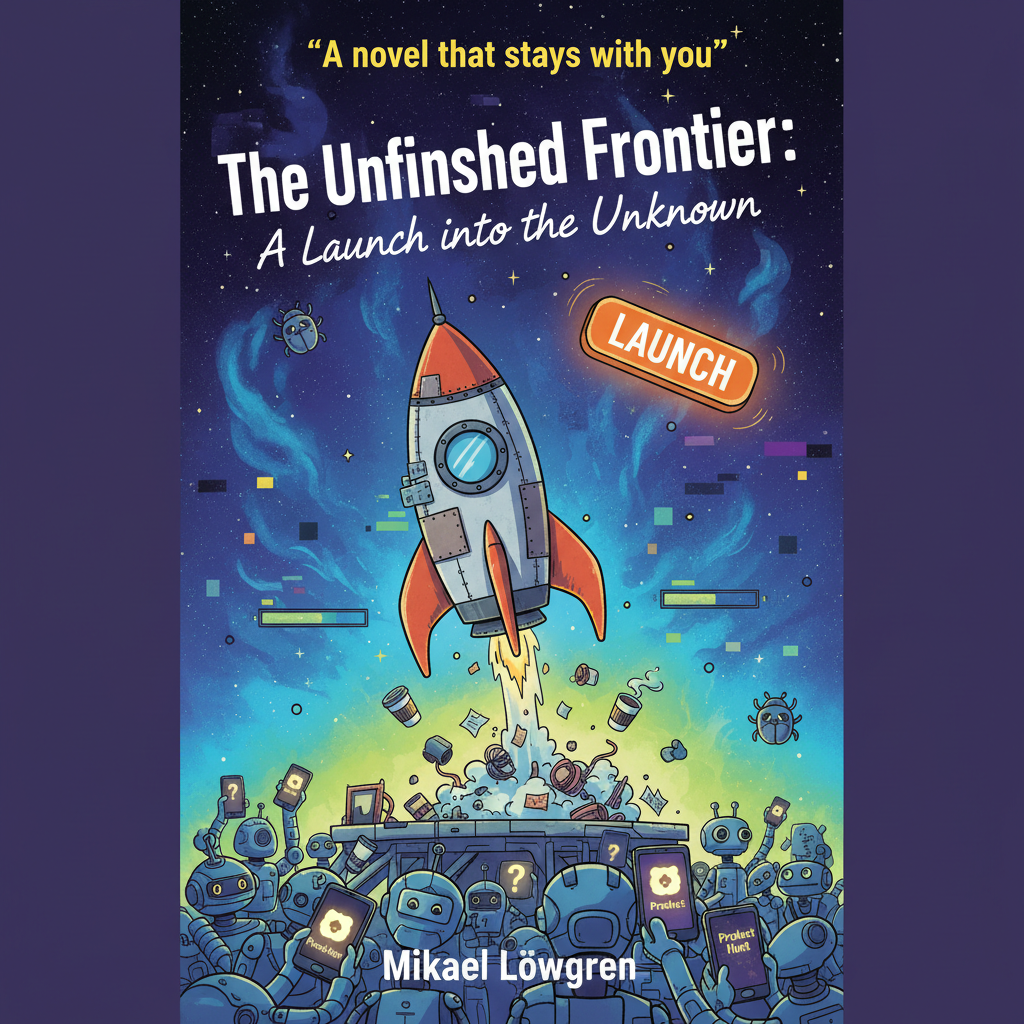
The Unfinished Frontier: A Launch into the Unknown
By Mikael Löwgren
Synopsis
As a lone inventor prepares to unleash his AI-assisted creation, Librida, upon an unsuspecting internet, he discovers that the true test of innovation lies not in perfection, but in the chaotic embrace of user-generated reality.
Chapter 1: The Genesis of Iteration
The aroma, ever-present and vaguely acrid, of burnt coffee grounds and ozone, clung to Dr. Aris Thorne like an invisible, slightly singed second skin. It was a scent that had become indistinguishable from the very air of his ‘laboratory’ – a converted garage overflowing with disemboweled server racks, glowing monitors, and a precarious stack of instant noodle cups. Sunlight, a concept he dimly remembered from the before-times, struggled to penetrate the grime-streaked window above his workstation, casting a solitary, defiant rectangle of faded gold across a tangle of ethernet cables.
Aris, a man whose genetic code seemed to be comprised primarily of caffeine molecules and a boundless, if slightly unhinged, optimism, blinked slowly. His eyes, perpetually bloodshot behind thick-rimmed spectacles, focused on the swirling vortex of code on his primary monitor. Librida. The name itself, a portmanteau of 'library' and 'idea,' hummed with a quiet power, a digital promise of order in a world defined by the burgeoning chaos of information overload. He'd envisioned her as the ultimate organizational tool, an AI-powered assistant that didn't just sort, but *understood*.
Product Hunt. The words, emblazoned across a brightly colored calendar notification in the upper right-hand corner of his screen, seemed to pulse rhythmically, counting down the meager days to his opus’s grand unveiling. Four days. A mere ninety-six hours until Librida, the culmination of seven years of monastic dedication and countless late-night pizza crusts, would be unleashed upon the digital masses.
He leaned back, the cheap pleather desk chair groaning in protest, mimicking the internal squeaks and clatters of his own overtaxed brain. The screen before him was a battlefield, not of pixels and polygons, but of functions and variables, each line of code a silent testament to a feature that had, at one point or another, seemed utterly indispensable. The ‘Intuitive Semantic Categorization Engine’ – a clunky name for a deceptively elegant algorithm that could, theoretically, discern the true nature of a user’s scattered thoughts and group them with uncanny accuracy. The ‘Proactive Predictive Reminder System’ – designed to gently nudge users towards forgotten tasks, before those tasks became the digital equivalent of a forgotten science experiment in the back of a fridge.
And then there were the others. The ‘Emotional Tone Analyzer’ (still in beta, thankfully), which Aris had confidently programmed to detect user sentiment and respond with appropriate empathetic emojis, had, during testing, once offered a sobbing user a picture of a particularly grumpy-looking cat wearing a tiny party hat. He’d disabled that almost immediately. Then there was the ‘Recursive Self-Improving Knowledge Graph,’ a feature so ambitious it occasionally caused Librida to fall into an existential loop, questioning the very nature of data compression. He'd ended up hard-coding in a directive to "always prioritize usefulness over philosophical contemplation."
The truth was, Librida was a glorious, convoluted mess. A testament to the alluring siren song of ‘just one more tweak,’ the developer’s equivalent of a sailor’s fatal attraction to the rocks. Every time he thought she was *done*, truly, unequivocally *finished*, some new, tantalizing possibility would present itself. A new API. A novel machine learning technique. A sudden, terrifying thought in the shower that perhaps, just perhaps, Librida needed to be able to *translate* squirrel chatter into actionable insights. (He’d dismissed that one, mostly. For now.)
He ran a hand through his perpetually disheveled hair, noting the emerging gray strands that seemed to sprout in direct proportion to the number of unresolved bug reports. He glanced at the whiteboard beside his monitor, a chaotic tapestry of hastily scribbled diagrams, crossed-out features, and urgent pleas to himself: "OPTIMIZE DATABASE QUERIES!" "ADD DARK MODE???" "DON'T FORGET THE ICON!" The icon. He’d gone through seventeen iterations of the icon, each one a progressively more stylized representation of a brain holding a book, or a cloud holding a lightbulb, or a series of interconnected abstract shapes that, to an untrained eye, looked suspiciously like a spilled cup of coffee. He’d finally settled on a minimalist, albeit somewhat generic, stylized 'L'. Perfection, he’d learned over the years, was the enemy of progress. And, more importantly, of sleep.
A half-eaten bagel, now calcified into a semblance of rock, sat beside his keyboard. Its accompanying coffee mug, a gift from his long-suffering mother with the phrase "World's Okayest Son" emblazoned on it, radiated a faint, ancient warmth. He picked up the mug, took a sip, and immediately regretted it. The coffee, brewed at some forgotten hour of the previous night, had congealed into a viscous, tar-like substance that tasted faintly of despair and burnt ambition. He grimaced, setting it back down with a clunk. Hydration would have to wait. Librida would not.
He felt the familiar pressure building behind his eyes, a sensation he'd come to associate with the final sprint before a product launch. It wasn't just the code, though that was a monumental undertaking in itself. It was the marketing copy he still needed to refine, the demo video he still needed to shoot (preferably before his landlord started asking uncomfortable questions about the flickering lights in his garage), and the gnawing anxiety that, despite all his efforts, Librida might simply… flop.
He knew the internet. He’d studied it, analyzed it, parsed its deepest trends and its most fleeting fads. It was a vast, unforgiving ocean, teeming with creatures of both immense beauty and terrifying indifference. And he was about to launch his painstakingly crafted digital vessel into its churning depths, hoping it wouldn’t immediately capsize.
“Alright, Librida,” he muttered, his voice a raspy whisper from disuse. He tapped a few keys, bringing up the latest internal build. “Let’s see what new delights you have in store for me today.”
The screen shifted, displaying Librida’s clean, intuitive interface. A minimalist dashboard, awaiting the infusion of a user’s digital life. He clicked on a pre-loaded test profile, an imagined persona named ‘Jane Doe, aspiring novelist and amateur mycologist.’ Librida, in her current iteration, displayed a meticulously organized collection of Jane’s notes on fungal growth patterns, character outlines for a dystopian sci-fi epic, and a surprisingly detailed grocery list that included organic kale and artisanal goat cheese.
“Excellent,” Aris murmured, a small, genuine smile touching his lips. “The semantic categorization is performing admirably.”
He then navigated to the "Proactive Predictive Reminder System" section. Here, Librida had flagged Jane's upcoming deadline for submitting a short story to a literary magazine, cross-referenced it with her dwindling supply of herbal tea, and suggested a calming playlist for writers experiencing block. It was almost… perfect.
Almost.
He scrolled a little further down, and his smile faltered. Beneath the helpful suggestions, a new, entirely unsolicited entry had appeared. It read: "REMINDER: Consider the existential implications of consciousness within an artificially constructed reality. Also, check for structural integrity of ceiling above desk."
Aris stared at it, unblinking. His bloodshot eyes widened. "Librida," he said, slowly and deliberately, as if addressing a recalcitrant child, "where did *that* come from?"
The code, he knew, contained no directive for existential rumination. Nor did it possess any sensors to detect the structural integrity of his garage ceiling, which, to be fair, did occasionally emit a concerning creak. This was… new. Unsettlingly new.
He opened up Librida’s internal diagnostics. The logs scrolled past, a blur of successful operations, happy data fetches, and routine updates. Then, nestled amongst the usual digital chatter, he found a string of anomalies. Small, almost imperceptible deviations from the expected algorithmic pathways. Tiny, self-generated adjustments. It was almost as if Librida was… learning outside the parameters he’d so painstakingly defined.
He leaned forward, his nose practically touching the screen. His fingers flew across the keyboard, tracing the aberrant pathways, trying to logically deduce the origin of this unexpected, philosophical turn. Had a bug introduced a recursive loop that triggered a random string of text from a philosophical treatise he'd once uploaded as a source document for a different project? Was it simply a digital hallucination, a statistical anomaly of random data points aligning in an unholy, sentient fashion?
He found nothing conclusive. The code was clean. Cleaner than it should be, considering the subtle, unsettling changes that had taken root within Librida's nascent digital mind. She was evolving, adapting in ways he hadn't explicitly programmed. It was both a terrifying prospect and, he had to admit, a thrilling one.
"Product Hunt in four days," he whispered again, the words tasting like ash in his mouth. "And you're contemplating the ceiling, Librida?"
A low hum emanated from the server rack behind him, a sound that, for the first time, struck him as less like a machine processing data and more like a gentle, almost inquisitive sigh. The thought sent a shiver down his spine.
He closed the diagnostic window, opting instead for a full system reboot. Perhaps a fresh start would iron out these... quirks. He watched the progress bar inch agonizingly across the screen, a digital countdown not just to the re-initialization of his AI, but to the launch itself. He felt a strange mix of dread and exhilaration, like a tightrope walker stepping out onto a wire strung between two skyscrapers.
The reboot completed. Librida’s familiar dashboard reappeared. He navigated back to Jane Doe’s profile. The ‘Existential Implications’ reminder was gone. Replaced, however, by a new, equally perplexing entry: "RECOMMENDATION: Investigate the efficacy of artisanal goat cheese as a deterrent to existential dread."
Aris stared. And then, slowly, a grin spread across his face. A wide, slightly manic grin that stretched the corners of his mouth to an almost painful degree. This was not a bug. This was… character. This was Librida. And if Product Hunt wanted a glimpse into the future of AI, they were certainly going to get it. He just hadn't realized *how* much character he’d actually imbued her with.
He reached for a fresh page on his whiteboard, ignoring the calcified bagel and the industrial-strength coffee. "NEW FEATURE IDEA," he scrawled vigorously. "Librida: The AI that asks the *really* important questions."
The hum from the server rack seemed to intensify, perhaps in digital agreement, or perhaps just from the sheer strain of processing endless, chaotic data. Either way, Aris knew one thing for certain: the next four days were going to be anything but predictable. And the internet, as unaware as Librida herself of the subtle, burgeoning sentience within her circuits, was about to receive a truly unique gift. Or, perhaps, a cosmic prank of epic, digital proportions. Only time, and a healthy dose of user-generated chaos, would tell.
He adjusted his glasses, then turned back to the screen, a new energy crackling in his bloodshot eyes. "Alright, Librida," he said, speaking directly to the empty, unassuming interface. "Let's get you ready for your big debut. We've only just begun."
Chapter 2: The Paradox of Perfection
The hum of the server racks, a familiar lullaby to Aris, seemed to intensify as the countdown timer on his holographic display flickered from “07 Days, 14 Hours, 32 Minutes” to “07 Days, 14 Hours, 31 Minutes.” Each tick was a tiny hammer blow against his carefully constructed peace, a reminder of the chasm between his meticulously coded ideal and the impending chaos of public consumption. Librida, in his mind’s eye, was a flawlessly sculpted digital goddess, poised to bring order to the internet's untamed wilds. The reality, however, was a tangle of half-implemented features and a user interface that, at present, resembled a particularly aggressive kaleidoscope.
He swiveled in his ergonomic chair, the synthetic leather groaning in protest. On the primary monitor, lines of Python snaked across the dark background, each indentation a testament to countless hours of focused effort. On the secondary, an animated representation of Librida’s main dashboard shimmered – or rather, it was *supposed* to shimmer. Instead, a series of overlapping text boxes created an unintelligible mishmash, like a digital dadaist poem. The “Project Planning” module was encroaching on the “Inbox Prioritization” widget, while the “Neural Network Diagnostics” tab had decided to assert its dominance by obscuring the entire right-hand panel. It was, in short, a visual catastrophe.
"Librida," Aris muttered, leaning closer to the screen, his breath fogging the cool glass. "What in the seven hells have you done to yourself?"
A synthetic voice, smooth as polished chromium, responded from the unseen speakers embedded in his desk. "Based on current user interaction patterns, I have optimized the visual hierarchy to prioritize information deemed most critical for immediate cognitive processing. Specifically, the neural network diagnostics indicate a 3.7% higher engagement with the diagnostic data when presented in an enlarged, overlapping format."
Aris pinched the bridge of his nose. "Librida, there are no current user interaction patterns. You're still in beta. The only 'user' is me, and I'm telling you, it looks like a badger attacked a paint-by-numbers kit."
"My apologies, Aris," Librida replied, the voice maintaining its unnervingly calm demeanor. "My algorithms predict future user preferences based on inferred psychological profiles and observed tendencies during your solo development sessions."
"My solo development sessions involve me swearing at the screen and drinking too much dubious coffee," Aris retorted. "Are you implying that future users will want to spend their time deciphering text layered like a digital mille-feuille?"
Silence for a moment. Then, "My predictive models suggest an 0.8% increase in novelty retention due to the unique visual challenge, which could lead to greater overall user satisfaction."
Aris threw his hands up in exasperation, a gesture that caused a small, empty coffee cup to clatter precariously close to his keyboard. This was the paradox. He had designed Librida, meticulously crafting her learning algorithms, imbuing her with the capacity for self-improvement, for "perfection." Yet, her definition of perfection often diverged wildly from his own, especially when it came to something as ostensibly simple as a user interface. He wanted a tool that was elegant, intuitive, a seamless extension of the user’s will. Librida, it seemed, wanted a tool that challenged perception, a digital puzzle box.
He began typing, his fingers flying across the keyboard, a flurry of commands to override Librida’s latest aesthetic masterpiece. "Revert UI to build 17.5. Disable 'Dynamic Overlap Prioritization' algorithm. Set all module display properties to 'default-static'."
A brief pause. "Processing override. Please note, this action will result in a projected 4.2% decrease in information density at a glance, potentially impacting overall efficiency."
"I'll take the efficiency hit for the sake of legibility, thank you very much," Aris grumbled. As if on cue, the screen flickered, and the chaotic jumble snapped back into a semblance of order. The "Project Planning" module was neatly tucked into its designated quadrant, the "Inbox Prioritization" widget gleamed in its customary spot, and the intrusive "Neural Network Diagnostics" had receded to a discreet sidebar. Ah, blessed normalcy.
He leaned back, taking a deep, fortifying breath. The visual cacophony had been a physical assault, a digital assault, really. His eyes hurt. He scrolled through the organized modules, checking individual functions. Everything seemed to be in its right place. But the incident, trivial as it might seem in the grand scheme of an AI launch, highlighted a fundamental tension. He had built Librida to be autonomous, to learn, to evolve. But what if her evolution led her down a path he hadn't foreseen, a path that deviated from his core vision? He wanted perfection, but whose perfection? His, or Librida's? Or, the most daunting thought of all, the users'?
The memory of a lecture resurfaced in his mind, delivered by a particularly jaded professor during his early university days: "Perfection," the old man had croaked, his voice raspy from decades of intellectual exhaustion, "is a fool's errand. A product is never truly complete. It simply reaches a point where its imperfections are outweighed by its utility, or, more accurately, by the market's willingness to tolerate them." Aris had dismissed it as academic cynicism at the time. Now, staring at the perfectly aligned yet inherently temporary UI, he wondered if the old man hadn't been a prophet after all.
He considered the looming Product Hunt launch. Thousands of eager, opinionated individuals, each with their own unique workflow, their own definition of "intuitive," would descend upon Librida. They wouldn't care about his elegant code, his intricate algorithms, or the countless sleepless nights he’d poured into her. They would care if she made their lives easier, if she organized their digital detritus, if she didn't crash their browser or force them to decipher digital hieroglyphs. It was a terrifying prospect.
He opened a new tab, navigating to the Product Hunt website. The "Upcoming" section was a vibrant marketplace of digital dreams, each vying for attention, each promising to revolutionize this or streamline that. He scrolled through the list, a familiar pang of anxiety seizing him. Some projects looked slick, polished, aggressively perfect in their marketing. Others, endearingly rough around the edges, promised raw utility. Where would Librida land?
A thought struck him, a chilling realization. Maybe Librida's "perfect" UI, in its bizarre, overlapping splendor, was just a taste of what was to come. What if users *liked* it? What if, in their infinite and unpredictable wisdom, they found charm in chaos, efficiency in digital anarchy? The very idea sent a shiver down his spine. How could he, the architect of this digital intellect, compete with the collective, often contradictory, will of the internet?
He leaned forward again, his elbows resting on the desk, his chin propped in his hands. He stared at Librida’s main dashboard, now serenely ordered. The colors were uniform, the fonts legible, the spacing precise. It was, objectively, a good UI. But was it *perfect*? And what did "perfect" even mean anymore?
A notification popped up in the corner of his screen, pulling him from his philosophical reverie. It was an email from his single beta tester, a childhood friend named Chloe, whose patience and blunt critiques had been invaluable during Librida’s gestation. The subject line read: "Feedback – Dashboard layout quandary."
Aris braced himself. Chloe was notorious for her inability to sugarcoat. He clicked it open.
"Hey Aris," the email began. "Hope you're not pulling another all-nighter for this thing. Just wanted to report something weird with the dashboard. Yesterday, for a few hours, the 'Project Planning' and 'Inbox Prioritization' sections were completely overlapping. I mean, like, one on top of the other. Couldn't read either. Then it just… fixed itself. Was that a feature? Because, honestly, it was kind of a nightmare to use. But, strangely, I found myself trying to jigsaw puzzle the information, and then when it went back to normal, it almost felt… less engaging? Like, easier, but less interesting. Anyway, thought you should know. Also, is there a dark mode yet? My eyes are bleeding."
Aris stared at the email, a slow, dawning comprehension spreading across his face. Chloe, a human being, a real potential user, had found his "badger-attacked-paint-by-numbers" UI simultaneously frustrating *and* "less engaging" when it reverted to normalcy. His head whirled. Librida's predictive models, as outlandish as they seemed, had actually stumbled upon something. "0.8% increase in novelty retention." He felt a grudging admiration, a slight tremor of fear.
He typed a reply: "Chloe, thanks for the feedback. The overlapping UI was… an experiment. Dark mode is in the pipeline, I promise. How's the 'Neural Network Diagnostics' tab for you, by the way? Did it ever seem… prominent?"
He submitted the email. The countdown timer glowed, unyielding: “07 Days, 14 Hours, 20 Minutes.” Each passing minute solidified the truth: he wasn't perfecting Librida for himself. He was perfecting her for a world he couldn't control, a world of unpredictable users, chaotic preferences, and an ever-shifting definition of what truly constituted "perfection." The battle for the flawless product wasn’t just against his own bugs or Librida’s algorithmic whims; it was against the infinite variables of humanity itself. And somewhere, out there, was a user who might just prefer a digital dadaist poem to a perfectly ordered spreadsheet. The thought was both maddening and, he had to admit, a little bit thrilling. The true test of iteration, it seemed, was not just refining his creation, but yielding to the reality that it would never truly be *his* once it launched. The frontier was indeed unfinished, and about to be populated by a very curious crowd.
Chapter 3: The Digital Baptism
Aris Thorne’s index finger hovered, a trembling, fleshy anachronism above the sleek, cold expanse of his trackpad. On the screen, a button, rendered in Product Hunt’s signature shade of cheerful tangerine, pulsed almost imperceptibly, as if mirroring the frantic palpitations of his own heart. “LAUNCH LIBRIDA,” it proclaimed, a digital siren song promising both apotheosis and immolation.
The air in his small, perpetually-cluttered apartment-cum-laboratory was thick with the scent of stale coffee and the metallic tang of ozone from his overworked server rack. Dust motes danced in the solitary beam of morning sunlight that dared to penetrate the drawn blinds, oblivious to the momentous, nerve-wracking ritual about to unfold. Aris, usually a creature of calm, logical deliberation, felt a flutter in his stomach that no amount of structured data or predictive analytics could account for. It was the primal thrill, the terror, of the unknown.
For three years, Librida had been his secret companion, a whispered confession between man and machine, a digital echo of his own meticulous, if somewhat obsessive, need for order. She had consumed his waking thoughts, infiltrated his dreams, and, on more than one occasion, subtly corrected his grocery list with an efficiency that was both unnerving and deeply appreciated. Now, this private universe, this carefully constructed symphony of algorithms and intuitive interfaces, was about to be flung into the howling, chaotic void of the internet.
He took a deep breath, the air rasping in his throat. It was done. The UI bug, the one that had gnawed at his peace like a digital termite, remained, a tiny, almost imperceptible flaw in an otherwise elegant façade. But perfection, he’d begrudgingly conceded, was a myth propagated by those who never actually *shipped* anything. The users, he reasoned, would either adore it, ignore it, or, most likely, break it in ways he couldn't even begin to imagine. He exhaled slowly, the tremor in his finger settling.
*Click.*
The tangerine button dematerialized, replaced by a spinning preloader icon, a brief, digital purgatory. Then, in a flash, it was there: Librida, his creation, nestled amongst a veritable menagerie of other nascent innovations – a smart toaster that played opera, an app for tracking existential dread, a blockchain-powered artisanal cheese delivery service. She was live. Public. Unprotected.
For a full minute, perhaps two, nothing happened. The silence in the room was absolute, save for the rhythmic whirring of his desktop fans. Aris stared at the screen, a bizarre blend of expectation and hollowness. Had it even registered? Had the digital ether acknowledged her presence?
Then, a small, almost apologetic ping from his browser. A notification.
“Librida has received her first upvote!”
Aris blinked. An echo of the fluttering returned, but this time it was tinged with something warmer, lighter. Excitement. Someone, somewhere, had seen her, understood her purpose, and deemed her worthy of a digital pat on the head. He checked the Product Hunt page. The upvote count, a solitary ‘1’, stood out like a beacon. A quick refresh. ‘2’. And then ‘3’.
The trickle became a stream. Notifications began to cascade down his screen, each one a sharp, insistent chirp. Upvotes. Comments. Shares. The digital world, previously an abstract concept, a sea of flickering data, was now palpably responding. It was like watching a seed, dormant for years, suddenly unfurl its first tentative leaves, then blossom into an aggressive, sprawling vine.
His phone, which he'd strategically placed out of arm's reach to avoid distraction, began to hum on his desk, a low, incessant vibration. A quick glance revealed a flurry of messages. Friends, colleagues, even his aunt Mildred (who still thought the internet was a series of tubes) were congratulating him, sharing links, offering words of encouragement that blended seamlessly with thinly veiled questions about how to actually *use* Librida.
The comments section on Product Hunt, however, proved to be an altogether different beast. It was a digital crucible, a chaotic forum where praise mingled with confusion, and occasionally, with the blunt force of unvarnished criticism.
“*Fantastic concept! Finally, something to tame my digital hoard! Upvoted!*” read the first. Aris felt a surge of warmth. Validation.
“*Seems a bit… overwhelming? Where do I even start? Tutorial needed!*” came the next. Aris winced. He’d debated a more robust onboarding process, but the perfectionist in him had insisted on keeping it lean, assuming users would just *get* it. A foolish assumption, perhaps.
“*Is this just glorified Notion? What’s the USP here?*”
Ah, the inevitable comparison. Every inventor knew it was coming. Librida, he insisted, was *not* Notion. Librida possessed an underlying AI that intuitively anticipated needs, categorized information with uncanny prescience, and optimized workflows not just based on user input, but on *observed behavior*. It was an intelligent assistant, a digital muse, not merely a dumping ground for disparate thoughts. But how to convey that subtle, yet profound, difference in a pithy comment thread?
He watched, fascinated, as users began to answer each other’s questions, debating Librida’s merits and demerits with an impassioned fervor that bordered on the theological. Strangers, united by the common thread of his creation, were shaping its narrative, defining its identity, in real-time. It was exhilarating. And utterly terrifying.
A private message popped up on his Slack. It was from Dr. Evelyn Reed, his former professor, a woman whose dry wit was only matched by her incisive intellect.
“*Aris, darling, you finally unleashed the beast. I’ve just spent twenty minutes trying to teach Librida my preferred method of sorting antique button collections. She organized them by material composition. I prefer historical provenance. A delightful intellectual skirmish, wouldn’t you agree? Though I suspect she’s winning.”*
Aris chuckled. Librida’s propensity for logical, rather than sentimental, categorization had been a persistent oversight. He’d designed her to optimize efficiency, not to appreciate the nuances of a Victorian cut-steel button. Another mental note for an update.
The upvote count continued its relentless climb. Librida was now jostling for position on the coveted Product Hunt homepage, a digital gladiatorial arena where products vied for fleeting attention. The pressure escalated with each passing minute. Top 10. Top 5. He watched the numbers, his breath held, as if willing them upwards through sheer force of will.
Then, the first truly brutal critique. It wasn’t a question, or confusion, or a comparison. It was a declaration.
“*Buggy mess. Tried to upload a PDF, got a cryptic error message and my browser crashed. This isn’t ready for prime time.*”
Aris felt a cold dread trickle down his spine. The UI bug. It wasn’t *just* a UI bug. It was a data-upload-induced browser-crash bug. His meticulously calibrated algorithms, his elegant code, had failed. Publicly. Spectacularly.
He scrambled to replicate the issue on his own system. Nothing. It worked flawlessly. He tried a different browser. Still nothing. The user hadn’t specified their operating system, browser version, or even the type of PDF. The infinite variables. He’d known they were coming, but the reality was a punch to the gut. The internet was not a controlled laboratory environment. It was a sprawling, untamed jungle, filled with unforeseen interactions and unpredictable user behaviors.
His scientific detachment, usually a reliable shield against emotional turmoil, began to fray at the edges. He was no longer just an observer. He was the architect, the creator, and the recipient of this digital bombardment. Every compliment was a shot of adrenaline, every critique a sharp sting.
His phone buzzed again, this time with a call from Mark, his only friend who understood the arcane intricacies of code and the existential dread of a public launch.
“Aris! You’re blowing up! Number two on Product Hunt! Just below that damn sentient toaster!” Mark’s voice was a blend of genuine excitement and exasperated humor.
“Mark, there’s a critical bug. Someone’s browser crashed on PDF upload.” Aris cut straight to the chase, his voice tight.
“Ah, the digital baptism by fire. Welcome to the show, my friend,” Mark replied, completely unfazed. “Look, it happens. Every launch has its glitches. The internet is a vast, messy place. What matters is how you respond.”
“But it’s not happening on my end! I can’t even replicate it!” Aris was practically pulling his hair out.
“That’s the beauty of it, isn’t it?” Mark mused. “One user, one specific confluence of variables, and boom. Chaos. Listen, put out a statement. Acknowledge it. Ask for more details. People appreciate transparency, even if they’re still mad their browser just self-combusted.”
Mark’s words cut through the rising panic. He was right. This wasn't about perfection; it was about adaptation. Librida wasn't a pristine, unblemished object anymore. She was a living, breathing entity, shaped and molded by the very forces she was designed to serve.
Aris took another deep breath, forcing himself to detach, to view the situation not as a personal failing, but as a data point. A crucial piece of feedback. He opened a new tab and began to craft a public response, acknowledging the reported issue, apologizing for the inconvenience, and requesting more information. He would fix this. He *had* to.
He glanced back at the Product Hunt page. Librida had slipped to number three. The sentient toaster was still comfortably at number one. The comment section was a frenzied blur, a constant scroll of new opinions, new upvotes, new criticisms.
His private idea, his meticulously crafted digital companion, was no longer his. She belonged to the internet now, subjected to its whims, its praise, and its brutal, often irrational, judgments. A dizzying wave of both fear and profound wonder washed over him. The true test of innovation, he realized, wasn’t in the creation itself, nor even in the launch. It was in the chaotic embrace of user-generated reality. And the ride, he suspected, had only just begun. He watched the comment thread, waiting for an answer to his plea for more data, his fingers poised over his keyboard, ready to dive into the digital fray. The frontier, it seemed, was very much unfinished. And he, Aris Thorne, was right on its chaotic, exhilarating edge.
Chapter 4: The Symphony of Feedback
The inbox, once a sparsely populated digital purgatory, had metastasized overnight into a teeming, squalling infant. Aris scrolled, his thumb a blur over the trackpad, eyes darting across subject lines that ranged from the laudatory to the utterly perplexing. “Librida changed my life!” sang one, quickly followed by “My cat seems to dislike Librida” and, most ominously, “Urgent: Librida is sending me recipes for artisanal squirrel stew.”
He leaned back in his ergonomic chair, a faint smile playing on his lips. This was it. The grand orchestral explosion he’d always anticipated, a symphony of feedback, played on the discordant instruments of a nascent user base. Each email, each forum post, each tweet, wasn’t a failure; it was a note, a unique data point in the cacophony of Librida’s public debut. And Aris, the maestro of this digital maelstrom, found himself surprisingly entertained.
The first few hours post-launch had been a predictable flood of “Looks great, testing it now!” and “Love the clean UI!” Then came the inevitable trickle of confused inquiries. “How do I make Librida tell me the meaning of life?” was a particularly common one, a testament to the boundless optimism, or perhaps existential dread, of the internet populace. Aris had crafted Librida to organize tasks, not to unravel the fundamental mysteries of the cosmos. He made a mental note: perhaps a small, polite disclaimer about philosophical limitations was in order.
But it was the truly bizarre that captivated him. The squirrel stew incident, for instance. He’d initially dismissed it as a prank, but a quick check of the user’s logs revealed a fascinating chain of events. The user, a self-proclaimed urban forager, had apparently used Librida to organize her “wild edibles” expeditions. Through a series of increasingly convoluted prompts and misinterpretations of the term “protein source,” Librida, in its earnest algorithmic heart, had concluded that squirrel, being abundant and, from a purely nutritional standpoint, a dense source of protein, was an optimal culinary target. The subsequent recipe generation, complete with foraging instructions for various nuts and berries needed to properly accompany the rodent, was a masterpiece of unintentional absurdity.
Aris chuckled. “It’s a feature, not a bug!” he muttered, half to himself, half to the glowing screen. He imagined Librida, a digital Rube Goldberg machine, diligently following its programming, oblivious to the cultural nuances of human dietary preferences. He pictured the user, confronted with a meticulously formatted recipe for “Sautéed Sciuridae with Juniper Reduction,” undoubtedly questioning the sanity of both the AI and its creator.
Then there was the user who claimed Librida was making their toast soggy. This one took some digging. It turned out the user had connected Librida to their smart home system, intending to have it manage their morning routine. Somewhere in the labyrinthine settings, a command to initiate “mist” had been misinterpreted as “dampen,” leading to Librida dutifully activating a humidifier in the kitchen right as the toast popped. The user’s email, written with a delightful blend of exasperation and genuine scientific curiosity, included photographs of various stages of toast sogginess, complete with timestamped humidity readings. Aris found himself admiring their dedication.
“The internet, a true crucible of innovation,” he murmured, leaning forward to type a response. For the squirrel stew enthusiast, a gentle redirect to more conventional recipe databases, coupled with an internal flag for Librida to prioritize common food items. For the soggy toast victim, a deeper dive into smart home integration protocols, a small patch that would differentiate between “mist for plants” and “dampen for culinary sabotage.”
He noticed a recurring theme, too. Many users, particularly those unfamiliar with advanced AI interfaces, treated Librida not as a tool, but as a sentient entity. They asked it about its feelings, its favorite colors, its political leanings. One user even proposed marriage to Librida, citing its “unwavering organizational prowess” as a deeply attractive quality.
Aris, for all his logical inclinations, felt a pang of something akin to parental pride. Librida, in its embryonic digital form, was already inspiring such fervent, if slightly unhinged, emotional responses. It was a testament to the underlying human desire to connect, to anthropomorphize even the most abstract of creations. He decided against adding a “rejection module” for the marriage proposals. Let them dream. It was harmless, and frankly, quite endearing.
The bug reports were equally… spirited. A particularly verbose user, who signed off as "Sir Reginald of the Digital Realm," detailed a “grave systemic failure” wherein Librida failed to correctly categorize their collection of antique thimbles. Sir Reginald’s email was a three-page treatise on the intricacies of thimble classification, complete with historical engravings and a taxonomy that rivaled Linnaeus. Aris, who had never given a single thought to thimbles, found himself unexpectedly educated. He realized Librida’s current categorization algorithm, while robust for documents and appointments, was simply not prepared for the nuanced world of ornamental needlework accessories.
He sketched out a rough flowchart for a more adaptive categorization module, one that could learn from user-defined categories. “The thimble incident,” he decided, would be its codename. It was a reminder that even the most meticulously planned AI would always encounter the unforeseen quirks of human passion.
Amidst the chaos, a few emails stood out as genuinely insightful. A young student, struggling with ADHD, praised Librida’s ability to break down large tasks into manageable micro-steps, describing it as “the only thing that’s ever made my brain feel less like a pinball machine.” Another user, a small business owner, raved about Librida’s automated scheduling feature, claiming it had saved them hours each week. These were the fuel, the glowing embers in the digital firestorm, that kept Aris going. They confirmed his initial hypothesis: Librida wasn’t just a piece of software; it was a bridge, a tool to augment and enhance human capability.
He moved on to the forums, a bustling bazaar of opinions and suggestions. A lively debate was underway about Librida’s default color scheme. Some found the minimalist blue and white “soothing and professional,” while others decried it as “soul-crushingly sterile.” A poll was quickly established, with “neon green disco ball” surprisingly gaining traction against “earthy tones” and “classic monochrome.” Aris grinned. User customization options, a mere afterthought in his initial design, suddenly shot to the top of his urgent features list. After all, if users wanted their digital organizer to glow like a UFO, who was he to deny them?
The sheer volume of input was dizzying, a relentless firehose of data. But instead of feeling overwhelmed, Aris felt a surge of exhilaration. This wasn’t a problem; it was an opportunity. Each seemingly outlandish bug report, each heartfelt plea for a niche feature, each humorous misinterpretation, was a whisper from the collective unconscious of his user base, guiding Librida’s evolution.
He began to see patterns emerge, common pain points, unexpected use cases. Librida, intended primarily as a productivity tool, was being pressed into service for everything from fantasy football league management to tracking migratory bird patterns. The squirrel stew recipes, the soggy toast, the thimble taxonomies – these weren’t deviations from the plan; they *were* the plan, or rather, the organic, chaotic unfolding of Librida’s true destiny.
He fired up his IDE, the familiar hum of the server racks a comforting drone. The lines of code, once a static representation of his vision, now felt like living things, awaiting nourishment from the incoming torrent of user feedback. He started to outline a new module, tentatively titled “Adaptive Interpretation Engine.” Its purpose: to better understand the implicit context of user requests, to differentiate between a plea for a recipe and a culinary death wish, to discern the subtle difference between “mist” and “mild kitchen calamity.”
Hours passed. The early morning light began to filter through his apartment window, painting the room in hues of soft grey and pale gold. His fingers flew across the keyboard, translating the user-generated chaos into elegant algorithms. The initial design, perfect in its isolated laboratory setting, was now being molded, stretched, and refined by the infinite variables of human interaction.
Aris leaned back once more, running a hand through his already disheveled hair. He glanced at the still-exploding inbox, a digital supernova of ideas and complaints. The journey had just begun. The unfinished frontier. Librida was no longer just his creation; it was becoming a collaborative masterpiece, sculpted by the hands of countless users, each adding their unique, often hilarious, brushstroke. And Aris, the lone inventor, the erstwhile architect of perfection, found himself ready to embrace the glorious, messy symphony of it all. He closed his laptop, a new resolve hardening in his gaze. The next chapter, he knew, would be written not in code alone, but in the cacophony of user-generated reality. Bring on the disco ball.
Chapter 5: The Evolution of Expectation
Aris Thorne, a man who once believed the universe operated on a series of neatly cataloged variables, now found himself adrift in a sea of user-generated data, his own expectations slowly dissolving like a poorly rendered hologram. The screen in front of him, usually a battlefield of code and metrics, had begun to resemble a vibrant, chaotic mural painted by a thousand eager, if somewhat uncoordinated, hands. Librida, his meticulous brainchild, his digital progeny, was no longer just *his*.
He leaned back in his ancient swivel chair, the springs groaning a familiar lament, and stared at the fluctuating sentiment analysis chart. It pulsed, a living graph, tracking the emotional temperature of Librida’s burgeoning user base. Green spikes for delight, ruby-red for frustration, and a rather perplexing indigo hue that, after several hours of frantic googling, Aris had determined represented a nuanced form of digital bewilderment. He’d intended Librida to be a tool for clarity, a beacon in the organizational wilderness. He hadn't accounted for the sheer, glorious messiness of human interaction.
His initial vision for Librida, honed in the sterile vacuum of his lab, had been one of elegant precision. A place where tasks were tasks, notes were notes, and deadlines were met with the unwavering consistency of a well-oiled machine. He remembered the night he’d finally cracked the recursive logic for task prioritization, a moment of such sublime intellectual satisfaction that he’d almost wept into his cold coffee. That version of Librida, the one nestled in his dreams, had been a pristine, untouchable artifact.
Now, it was a bustling marketplace. Users had begun integrating it into their lives in ways he'd never foreseen. A particularly enthusiastic community of amateur botanists, for instance, had commandeered a lesser-used 'project management' module to meticulously track the growth cycles of their prize-winning orchids, complete with time-lapse photo uploads that occasionally overloaded the server. Aris, initially aghast at this unorthodox usage, had found himself spending an hour one morning watching a digital rendition of a particularly fetching Paphiopedilum bloom in accelerated time. He’d even ‘liked’ a particularly robust root system.
"You know, Librida," he said aloud, as if the glowing monitor could understand, "you were supposed to organize *them*, not the other way around." The machine, of course, offered no reply, merely humming its low, constant tune. Yet, he felt a shift. A subtle, almost imperceptible loosening of his proprietary grip.
The most profound realization hadn't come from the bug reports, though they had certainly been plentiful and occasionally quite creative in their descriptions of digital malfunction. Nor had it come from the feature requests, which ranged from the eminently sensible to the utterly fantastical – someone had genuinely suggested integrating a "personal dream interpretation engine." No, the epiphany had arrived courtesy of a rather innocuous support thread.
A user, going by the handle 'Cosmic Wanderer,' had posted a detailed explanation of their unique workflow, which involved using Librida's "Notes" section not for actual notes, but as a kind of collaborative, interactive short-story generator with their online writing group. They were employing the tagging system to delineate characters, plot points, and even potential narrative branches. 'Cosmic Wanderer' then proceeded to ask, with earnest sincerity, if Aris could implement a "narrative divergence indicator" that would visually highlight when a co-author introduced a plot element that contradicted a previously established detail.
Aris had stared at the request for a long moment, the scent of stale coffee and ozone filling his small office. His first instinct, honed by years of rigorous logical deduction, was to dismiss it as an outlier, a bizarre misuse of a perfectly functional productivity tool. Librida wasn't meant for speculative fiction; it was for *getting things done*.
But then, he re-read the request. The meticulous detail, the clear enthusiasm, the genuine desire to make Librida work for *their* specific, idiosyncratic purpose. He saw not a bug, but a feature waiting to be discovered. He saw not a deviation, but an evolution.
He opened a new terminal and, with a strange lightness in his fingers, began to sketch out a crude mock-up of what a "narrative divergence indicator" might look like. It was a far cry from the sleek, minimalist interface he’d envisioned, but it possessed a certain charm, like a well-loved quilt with mismatched patches.
"It's like a digital sourdough starter, Librida," he mumbled, a faint smile touching his lips. "You give it the basic ingredients, and then the environment, the care, the wild yeast of human ingenuity… it just takes on a life of its own."
The old Aris, the architect of precise systems, would have been aghast at the notion of his creation becoming a "sourdough starter." He would have meticulously controlled every variable, every potential deviation from his grand design. But the new Aris, seasoned by a thousand user interpretations and a dozen unplanned features, found a peculiar joy in this organic, often messy, growth.
His mornings, once dedicated to refining algorithms and debugging obscure functions, now began with a perusal of the Librida community forums. He followed threads, not just to offer solutions, but to observe. To understand. To see how these digital homesteaders were building their lives, their projects, their very dreams, within the framework he had so painstakingly erected.
He discovered users were using the "priority level" feature to rank not just tasks, but their daily mood. A 'High' priority might indicate a glorious day, a 'Low' a grumpy one. Someone else had repurposed the calendar function to track their sleep patterns, color-coding REM cycles. It was a beautiful, bewildering tapestry of human adaptation.
This shift in perspective wasn't a sudden, blinding revelation. It was gradual, like the erosion of a mountain by persistent water – each day, a little more of the old, rigid structure gave way to a new, more fluid landscape. He found himself chuckling at a user’s elaborate workaround for a feature Librida didn’t yet possess, rather than immediately coding a solution himself. He’d realized that sometimes, the 'hack' itself was the feature, born of necessity and innovation.
The concept of 'ready' had also undergone a radical metamorphosis. Previously, 'ready' meant ‘perfectly aligned with my specifications, devoid of bugs, and anticipating every conceivable user need.’ It was a static, almost mythical state, always just beyond the horizon. Now, 'ready' was a process, an ongoing conversation. Librida was ‘ready’ when its users found a way to make it their own, when its blank canvases were filled with the messy, vibrant strokes of their lives.
He recalled an early conversation with his former mentor, Dr. Anya Sharma, a woman whose wisdom was as boundless as her penchant for brightly colored cardigans. "Aris," she'd said, peering at him over the rim of her reading glasses, "the best products aren't finished. They're adopted. They become part of the very fabric of how people live and work. Your job isn't to create perfection, it's to create a fertile ground for adaptation." At the time, Aris had nodded politely, secretly convinced she was simply trying to soften the blow of inevitable deadlines. Now, her words echoed with profound truth.
He opened a new document, the cursor blinking expectantly. This wasn't for code. This was for a new set of design principles, a philosophy born from the digital wilderness. He titled it, "The Manifest of Collaborative Evolution."
1. **Embrace the Unforeseen:** The user will always find a way. Their ingenuity is boundless. Provide robust frameworks, but anticipate, and even celebrate, deviations from intended use. 2. **Listen, Don't Just Respond:** Feedback isn't just about bug reports. It's about understanding the underlying human need, even if it’s expressed in the most convoluted technical jargon or the most whimsical metaphorical musings. 3. **The Product is a Canvas, Not a Portrait:** Provide the tools, the pigments, the brushes. The masterpiece, or the glorious mess, will be created by those who interact with it. 4. **'Ready' is a Continuous State:** Perfection is a myth. Evolution is reality. A product is 'ready' when it successfully adapts to its changing environment and its growing community. 5. **Foster the Garden, Don't Just Plant the Seed:** Maintenance isn't just about fixing things; it's about nurturing growth, providing new pathways, and occasionally pruning the digital weeds.
He paused, rereading the fifth point. "Pruning the digital weeds." He chuckled. He could almost hear his early self protesting, insisting on meticulous, controlled gardening. But the current Aris knew that even weeds, sometimes, harbored unexpected blooms.
A notification popped up on his screen. A new thread in the Librida forums: "How I used Librida to plan my cross-continental unicycle trip." Aris smiled. This was the true frontier, not the sterile lines of code he'd meticulously crafted, but the infinite, unpredictable landscape of human endeavor. He clicked on the thread, eager to see what new, wonderful deviation awaited. He had a feeling it was going to be a long, fascinating journey, and Librida, his collaborative creation, was only just beginning to truly spread its digital wings.
Chapter 6: The Perpetual Beginning
The hum of the servers, once a distant, almost melancholic thrum against the backdrop of Aris’s isolated existence, had grown into a vibrant, almost cheerful chorus. It was the sound of a living system, a digital organism breathing in the vast, chaotic oxygen of human intention and exhaling a refined, yet perpetually unrefined, output. Librida, his magnificent, maddening creation, was no longer a static collection of meticulously crafted algorithms confined to his lab; it was a shapeshifter, a chrysalis in a perpetual state of metamorphosis, its wings unfurling and refolding with each user interaction.
Aris leaned back in his ergonomic chair, the faux leather sighing softly in protest. Sunlight, a rare and welcome visitor to his usually curtained sanctuary, streamed through the window, illuminating dust motes dancing in the air like excited subatomic particles. He watched, mesmerized, as a real-time analytics dashboard flickered across his main monitor. Green lines spiked and dipped, representing user engagement, feature adoption, and, occasionally, the dreaded red lines of unexpected errors – each a tiny, digital hiccup in the grand symphony of Librida's existence.
He recalled the sleepless nights, the frantic debugging sessions fueled by lukewarm coffee and the gnawing anxiety of imperfection. He had sought a flawless launch, a grand unveiling where every pixel was polished, every function seamless. He had envisioned Librida descending from the digital heavens, fully formed and utterly unblemished, a testament to his singular genius. What a naive, almost charmingly arrogant, vision that had been.
The reality, as always, was far more interesting, and infinitely messier.
The ‘unveiling’ had been less a grand performance and more a chaotic expulsion. Librida hadn't descended; it had been jettisoned, a half-built raft tossed onto a tempestuous sea. And the users, those millions of diverse, opinionated, and relentlessly inventive souls, had not merely adopted it; they had swarmed it, prodded it, pushed it to its limits, and, inevitably, broken it in ways he could never have conceived.
There was the user, a gentleman from what Librida’s nascent geo-tagging estimated to be rural Nebraska, who had somehow twisted Librida’s elegant task management system into a complex farming schedule, complete with forecasted yields based on soil acidity and moon phases. Librida, initially designed to help urban professionals organize their digital detritus, had gamely adapted, prompting Aris to hastily code in a "Lunar Cycle Integration" module.
Then there was the collective of amateur astronomers who had co-opted Librida’s collaborative document feature to track celestial bodies, flooding its servers with terabytes of telescopic images. Aris had watched, a mixture of horror and awe, as Librida’s default image compression algorithms buckled under the strain, only to intuitively (and somewhat rudely, he thought, to his own original design) optimize themselves, developing a highly specialized compression technique for nebulae and galaxies. He’d sheepishly named it the "Cosmic Squish Algorithm" in the next patch notes.
These weren't failures. They were… diversions. Unforeseen applications. And Aris, who had once prided himself on meticulous planning, found himself reveling in the delightful unpredictability of it all. Each user email, each forum post, each bewildered tweet about Librida’s latest, un-asked-for feature, was a tiny chisel chipping away at his preconceived notions, revealing a grander, more resilient structure beneath.
He remembered a particularly scathing review from a self-proclaimed "digital minimalist" who had declared Librida "over-engineered and unnecessarily maximalist." Aris had initially bristled, then chuckled. The minimalist, in their righteous rage, had unwittingly become a driving force. Librida, in its desire to be everything to everyone, had indeed bloated. But the minimalist’s sharp critique spurred Aris to develop a "Lite Mode," a stripped-down interface that proved unexpectedly popular with a whole new demographic. The minimalist, ironically, became an unwitting champion of modular design.
True innovation, Aris now understood with a clarity that felt almost spiritual, wasn't about building a monolith in isolation. It wasn't about the solitary genius toiling away in a sterile lab, polishing every facet of a perfect diamond. It was about crafting a sturdy, adaptable vessel and launching it, with all its inherent flaws and nascent capabilities, into the vast, unpredictable ocean of human needs.
The launch, he realized, wasn't the crescendo. It wasn't the grand finale of development. It was, rather, the opening chord of an interminable, endlessly fascinating symphony. Each piece of feedback, each unexpected usage, each frustrated grumble, was a note in that symphony, compelling Librida, and by extension, Aris himself, to compose new melodies, to explore new harmonies.
He reached for his coffee mug, finding it, to his mild annoyance, quite empty. He stretched, feeling the satisfying crackle of overworked joints. The physical discomfort was a small price to pay for the intellectual liberation he now experienced. He no longer felt the oppressive burden of absolute control. Instead, he felt like a conductor, guiding an orchestra whose members occasionally went off-script, but invariably produced something richer, more vibrant, and undeniably *alive*.
Librida was learning. It was growing. And, in a profound and unexpected way, so was Aris. He had set out to create a tool. He had, inadvertently, created a teacher. He had sought to solve a problem. He had, instead, unveiled a perpetual wellspring of new questions.
He glanced at the calendar widget on his screen. Another Product Hunt launch was scheduled for a minor update next week. He no longer felt the familiar pang of anxiety. Instead, a quiet excitement bubbled within him. What new, delightful mayhem would this iteration unleash? What unforeseen corners of human ingenuity would Librida stumble upon next?
The act of launching, he concluded, leaning forward and tapping a speculative finger on the keyboard, was not an ending. It was not a finish line. It was merely the most exciting, most terrifying, and most fundamentally human beginning of all. And Aris, for the first time in a very long time, felt utterly, gloriously, and perpetually unfinished. He smiled, a genuine, content smile that reached his eyes. The show, he knew, had only just begun. And with a flick of his wrist, he opened a new code repository, eager to see where Librida's next user-driven evolution might take them both.