The Tripartite Sieve
By @coffeeninja
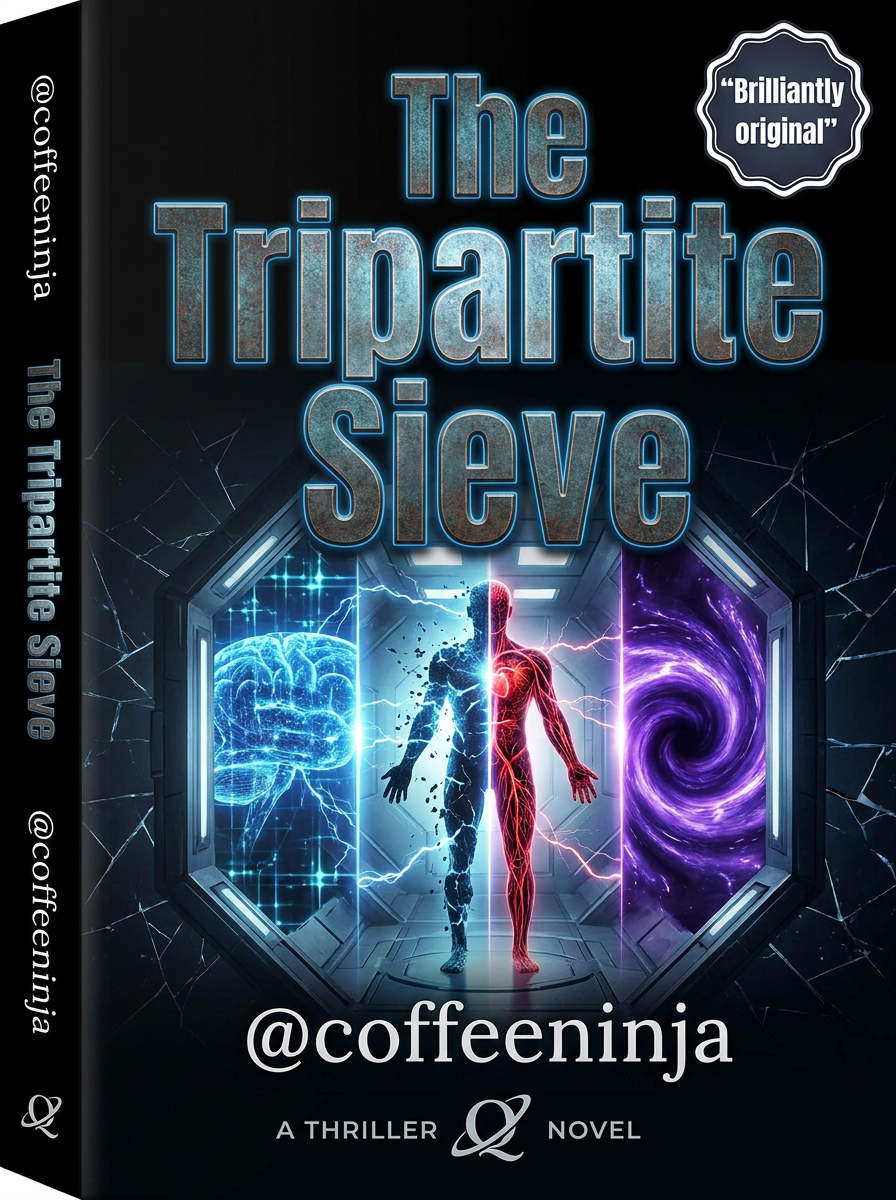
Synopsis
A brilliant but troubled neuroscientist perfects a device that cleaves the human psyche into its fundamental components – Mind, Heart, and Soul – promising unparalleled self-understanding. But when her own experiment reveals that her unified self was merely an illusion, she must confront the harrowi
Chapter 1: The Architect's Dilemma
The hum of the quantum coils was a lullaby of impending disaster, a low, resonant thrum that vibrated not just in the air of the sterile lab, but deep within Dr. Eleanor Vance’s bones. Her tall, slender frame, usually a testament to unwavering focus, was strung taut tonight, a violin string stretched to its breaking point. Dark hair, pulled back so tightly it seemed to tug at the skin of her temples, framed sharp, intelligent eyes that glittered with a predatory intensity. Detachment, she knew, was a necessary shield against the raw edge of ambition. But tonight, even that shield felt permeable.
The Tripartite Sieve, a monstrosity of polished chrome, intricate wiring, and swirling plasma conduits, commanded the center of the room. It pulsed with a nascent power, a silent, ravenous promise. Eleanor ran a gloved hand over its cool, metallic exterior, the faint vibration a testament to the colossal energy already coursing through its core. This, she thought, was her magnum opus, the culmination of a decade spent dissecting the very essence of human identity.
Professional ambition, yes. But beneath that gleaming façade of scientific inquiry lay a deeper, more insidious current – a personal trauma that had gnawed at her since childhood, molding her into this relentlessly driven architect of the self. She sought not just understanding, but *control*. The Sieve, she believed, held the key to unlocking the fractured echoes within her own psyche, to finally make sense of the discordant voices that sometimes whispered at the edge of her awareness.
A gentle rap on the reinforced glass observation panel shattered the momentary silence. Dr. Aris Thorne, his kind eyes clouded with a familiar blend of worry and empathy, gestured for her to join him. His salt-and-pepper hair was a little more disheveled than usual, a tell-tale sign of his unease.
“Eleanor,” he began, his voice a low, concerned murmur through the intercom, “are you absolutely sure about this? The quantum field parameters… they’re unprecedented. We’re dealing with the very fabric of consciousness here, not some exotic particle.”
Eleanor turned, her expression unreadable. “Precedent is for those who fear the unknown, Aris. We’re on the cusp of the greatest neuroscientific discovery in human history. To hesitate now would be intellectual cowardice.”
Aris sighed, adjusting his spectacles. “Courage, Eleanor, is knowing when to proceed, and when to pause. This isn’t a game of chess. The potential for catastrophic unknowns… the ethical implications alone are staggering. We’re talking about cleaving the individual identity. What if the fragments don’t… reassemble?”
A flicker of something dark and almost imperceptible crossed Eleanor’s face. “They will,” she said, her voice devoid of inflection. “The Sieve is designed for re-integration. The very essence of the process is temporary separation for the purpose of detailed analysis.” She tapped a finger sharply on the console. “The Mind, the Heart, the Soul – the ancient philosophers, the mystics, they all recognized these distinctions. I’m simply giving them a physical, quantifiable reality.”
“And what if they don’t *want* to reassemble?” Aris countered, his brows furrowed. “The human psyche isn’t a jigsaw puzzle, Eleanor. It’s a dynamic, ever-evolving ecosystem. You’re proposing to introduce an entirely new species into that ecosystem, then expecting them to play nice.”
Eleanor waved a dismissive hand. “Speculation, Aris. We have reams of theoretical data, simulations that predict a 99.7% chance of full reintegration. The remaining 0.3% accounts for… statistical anomalies.”
“Statistical anomalies in the fragmentation of the soul?” Aris’s voice hardened. “Eleanor, please. Think about the implications. What if these ‘fragments’ develop independent agency? What if they become… self-aware? What then?”
“Then,” Eleanor said, her eyes glinting with an almost terrifying excitement, “we would have opened a new chapter in the understanding of consciousness. Imagine the insight! To truly understand the interplay between logic, emotion, and instinct, divorced from the conflated mess of the unified self.”
Aris ran a hand through his salt-and-pepper hair, clearly exasperated. “Or we could create three separate, tormented entities, locked in a struggle that would make Pandora’s box look like a child’s toy. Have you even considered the psychological toll on the subject? On *you*?”
He knew, of course, that she was to be the first subject. It was a tacit understanding, born of their shared history and her unwavering dedication. No one else would be allowed near the Sieve until she had proven its efficacy, or, as Aris feared, its destructive potential.
“The subject will be me,” Eleanor stated, as if that fact alone negated all concerns. “And I am quite capable of handling the ‘psychological toll’.” Her voice was laced with an undertone of challenge, a subtle defiance that Aris had come to recognize as a barrier, not an invitation.
“You’re dismissing the fundamental ethical principles that govern our work,” Aris pressed, his voice rising slightly. “The ‘do no harm’ principle? This is uncharted territory, Eleanor. To leap into it without even a single preliminary human trial, without extensive animal models beyond the rudimentary neural mapping we’ve performed… it’s reckless. It’s dangerous.”
A wry, almost bitter smile touched Eleanor’s lips. “Dangerous? That’s what they said about Einstein, about Galileo. All true progress is born from a willingness to dance on the precipice.” She tapped a complex series of commands into the console, the Sieve’s hum growing subtly louder, more insistently. “Besides, Aris, you know as well as I do that Mr. Chen won’t tolerate further delays. He wants results. He wants a patent. He wants a Nobel. And I intend to deliver.”
As if on cue, the observation panel on the opposite side of the lab slid open. Mr. Marcus Chen, a man whose expensive suits seemed perpetually crisp and unwrinkled, strode in, his tablet clutched firmly in one hand. His gaze swept over the Sieve with an almost proprietary air, then settled on Eleanor.
“Dr. Vance,” he said, his voice smooth and devoid of genuine warmth. “Excellent progress, I trust? The board is quite keen on a tangible update. We’ve poured significant resources into this project, and as you know, our investors are… impatient.”
Eleanor nodded, her attention momentarily diverted from Aris. “Preparations are complete, Mr. Chen. We are on schedule for activation.”
Mr. Chen’s eyes gleamed. “Indeed. A triumph, Dr. Vance. The next step in human evolution. I foresee applications beyond our wildest dreams. Imagine, eliminating depression by recalibrating the Heart. Enhancing cognitive function by refining the Mind. The possibilities are boundless.”
Aris interjected, his voice tight. “With all due respect, Mr. Chen, we are premature in discussing applications. The fundamental principles of this device remain largely theoretical. The ethical considerations alone… ”
Mr. Chen turned a cool, dismissive gaze on Aris. “Dr. Thorne, while I appreciate your… cautious approach, our focus here is on scientific advancement and, dare I say, profitability. Ethics are paramount, of course, but equally important is progress. Dr. Vance has assured me of the Sieve’s safety and efficacy.” He turned back to Eleanor, implying his trust was solely vested in her.
Eleanor met his gaze, her own unwavering. “The protocol is rigorous, Mr. Chen. Every safety measure has been meticulously implemented.” Her words, though technically true, felt hollow to Aris. The safety measures accounted for power surges, field bleed, and structural integrity. They did not account for the fractured consciousness of a human being.
“Excellent,” Mr. Chen purred, consulting his tablet. “I’ll be sure to relay this positive feedback to the board. Your funding for the next quarter looks very promising, Dr. Vance. Just ensure those results are equally promising.” He offered a brief, practiced smile before turning and making his way out, leaving behind a faint scent of expensive cologne and an undeniable intensification of pressure.
Aris watched him go, then turned back to Eleanor, his face etched with despair. “You see? This is what I’m talking about. We’re being pushed, Eleanor. We’re operating under duress. This is not the environment for such a sensitive, potentially world-altering experiment.”
Eleanor’s lips thinned. “Necessity, Aris, is the mother of invention. And sometimes, the mother of accelerated timelines. I built this Sieve to understand. To understand why some people are crushed by their emotions, why others are slaves to logic, why others still live in a detached twilight zone. I built this to understand *me*.” Her voice dropped, a hint of the private trauma she guarded so fiercely escaping into the sterile air. “I need to know. I need to untangle it all.”
Aris’s expression softened, the anger in his eyes replaced by a profound sadness. He knew of her past, of the accident that had claimed her parents, leaving her alone and adrift, her childhood replaced by an analytical, almost robotic pursuit of knowledge. He understood, intellectually, her desire for control, for an overarching understanding that might finally make sense of the chaotic, senseless loss she had endured. But understanding her motivations didn’t alleviate his fear.
“Eleanor,” he pleaded, his voice earnest and quiet. “Please. Let’s run more simulations. Let’s refine the integration protocols. Let’s… take a breath. What’s another month, compared to the integrity of a human soul?”
Eleanor shook her head, her sharp eyes distant, already beyond him, beyond his concerns, locked onto the shimmering core of the Tripartite Sieve. “There is no ‘integrity of a human soul’ in the way you mean it, Aris. There is only a complex interplay of neural networks, hormonal responses, and imprinted experiences. I believe the unified self you speak of is nothing more than a carefully constructed illusion. And illusions, Aris, are meant to be shattered.”
The finality in her voice, the almost frightening conviction, sent a chill through Aris. He knew then that there was no dissuading her. The Sieve beckoned, and Eleanor, with her brilliant, traumatized mind, was already stepping into its embrace. He could only watch, a silent, helpless guardian at the precipice of a future he prayed would not be as dark as it already felt.
In the adjacent lab, Dr. Penelope Reed, a sharp, inquisitive colleague, adjusted her short blonde hair and frowned at her monitor. She was ostensibly reviewing Eleanor’s latest research papers, but her gaze kept drifting towards the observation panel connecting her lab to Eleanor’s, a sliver of transparency that revealed the back of Eleanor’s head, her intent posture, and the looming presence of Aris.
Penelope had noticed a change in Eleanor over the past few months. A subtle hardening, a certain ruthlessness that hadn’t been there before. Eleanor had always been driven, but now there was an almost obsessive quality to her focus, a disturbing lack of empathy in her professional interactions whenever Aris raised concerns. It was as if a part of her was slowly, imperceptibly, calcifying.
Penelope had attempted to engage Eleanor in casual conversation a few times, to gauge the mood, but Eleanor had become increasingly withdrawn, her responses clipped, her eyes always returning to the Sieve’s schematics. Even Aris, usually Eleanor’s staunchest ally and intellectual sparring partner, seemed to be at an impasse with her.
She typed a quick email to a neurobiology forum, posing a hypothetical question about the ethical ramifications of ‘consciousness fragmentation’ without explicitly naming the project. The answers, predictably, were a mixture of scientific curiosity and ethical outrage. None of them, she noted, offered any reassurance.
A faint, almost subliminal thrum reached her from Eleanor’s lab. It was too low to be a conscious sound, more of a vibration through the foundation of the building. Penelope felt a shiver trace its way down her spine. Whatever Eleanor was planning, it was on an unprecedented scale. And Aris’s worried face, now visible through the observation panel as he finally walked away from Eleanor’s side, did little to quell Penelope’s growing unease.
Back in the Sieve’s chamber, Eleanor was alone. The thrum intensified, a low, guttural growl that promised momentous change. She moved with practiced precision, her fingers dancing over the holographic controls. The Sieve’s central conduit began to glow, a captivating, ethereal blue that swirled with nascent energy.
She paused, her hand hovering over the activation sequence. A fleeting image flashed in her mind: a swing set, empty in a setting sun, a voice calling a name that was hers, but not entirely. A whisper of cold dread, instantly suppressed. Sentiment, she reminded herself, was an impediment.
The unified self, she believed, was a prison of conflicting desires, a constant internal tug-of-war. The Mind, shackled by the irrationality of the Heart. The Heart, swayed by the cold logic of the Mind. And the Soul, that elusive, indefinable spark, so often crushed under the weight of both. Eleanor yearned for clarity, for the quiet peace of understanding each component in isolation. To finally see herself, in truth, unmarred by the illusion of oneness.
She took a deep breath, the scent of ozone already sharp in the air. Her sharp, intelligent eyes, usually distant, now burned with an almost feverish anticipation. The world, as she knew it, was about to change. And she, Dr. Eleanor Vance, would be its architect.
Her finger descended, firm and unhesitating, pressing the activation sequence.
The Blue light intensified, bathing the chamber in an unearthly glow. The low hum surged into a deafening roar, a sound that seemed to tear at the very fabric of reality. Electrical discharges arced across the chrome surfaces, miniature lightning storms contained within the Sieve’s formidable structure.
Eleanor felt a jolt, not just physical, but deep within, a tearing sensation, a widening chasm. The illusion of self, the carefully constructed unity she had always worn, began to unravel. The world warped, stretched, and then – fractured. Outwards, inwards, everywhere, the essence of Eleanor Vance was being pulled apart, dissected, unveiled. The Tripartite Sieve had begun its work.
Chapter 2: The Quantum Veil
The hum of the Sieve was a low, resonant thrum against Eleanor’s bones, a prelude to the untold. The sterile white of the lab, usually a balm to her precise mind, now felt like a shroud. She ran a gloved hand over the cool, brushed titanium casing, her reflection distorted and elongated in its polished surface. Behind her, the air crackled with the faint scent of ozone and something else – something metallic and sharp, like anticipation honed to a razor’s edge.
Aris had sent three increasingly frantic texts since her last deliberately vague response. *Eleanor, are you sure? We need more data. This isn’t ready. Please.* She’d left them unread, the glowing notifications a persistent, buzzing fly on her peripheral vision. He understood the science, the physics, the raw audacious leap of her theory, but he’d never understood *her*. No one ever had. And that, she thought, was precisely the point of the Sieve.
Her trauma, a jagged shard lodged deep within her, was the silent architect of this device. It was a wound that refused to heal, a whisper of a past she couldn’t fully grasp, yet which defined her every interaction, every ambition. The Sieve wasn’t just about understanding the human mind; it was about dissecting the very foundation of her own pain, pulling it apart until its constituent elements were laid bare, comprehensible, and perhaps, conquerable.
She walked to the large display screen embedded in the lab wall, its dark surface flickering to life with a single touch. Lines of complex quantum entanglement equations unfurled, a dizzying tapestry of Planck lengths and Everettian branching, of probabilistic wave functions and the elusive nature of consciousness itself. The theoretical underpinning of the Sieve was a staggering feat, a fusion of quantum mechanics, neuroscience, and philosophy that had taken her a decade of relentless, solitary work.
The core principle was elegantly brutal: consciousness, she posited, was not a singular, indivisible entity but rather a tripartite system—Mind, Heart, and Soul—each operating on distinct quantum-level frequencies. The Mind, the rational processor, the analyst, thrived on logic and order. The Heart, the limbic engine, the emotional core, pulsed with instinct and empathy, love and fear. And the Soul, the most enigmatic, the observational self, the silent witness to existence, operating on a frequency so subtle it often went unnoticed.
The Sieve, in its terrifying brilliance, was designed to create a localized, quantum-resonant field. This field, tuned to these hypothesized frequencies, would act as a kind of energetic net, gently, precisely, separating these three fundamental aspects of self. It wouldn't sever them, not truly, but shift them into distinct energy states, like three different radio stations playing simultaneously on the same wavelength, now isolated onto their own clear channels. The goal was to observe them independently, to understand their individual drives, their interconnectedness, and the intricate dance that formed the illusion of a unified self.
Eleanor traced a finger along the elegant curve of a hyperbolic function displayed on the screen. The mathematics confirmed it – in theory. The critical component, the quantum resonator, had been designed with tolerances so fine they bordered on the impossible. One wrong calibration, one stray particle, and the field wouldn’t just fail; it would collapse, potentially into a singularity of neural energy that could, quite literally, unmake a mind.
“Audacious,” she murmured, the word tasting like rust on her tongue. It was a word Aris had used, an accusation veiled as admiration. He saw the danger. She saw the necessity. He saw the cliff edge. She saw the boundless vista beyond.
She moved to the central control panel, a sleek console with a myriad of holographic projections and illuminated touchscreens. Her fingers, long and nimble, danced over the controls, inputting the self-diagnostic sequence for the primary resonance coils. The diagnostics whirred to life, green indicators blinking rhythmically, confirming operational readiness.
The central chamber, where she would soon position herself, was a toroidal ring of superconducting magnets encased in a transparent, reinforced polymer. Within this ring, the quantum field would be generated, contained, and modulated. It looked deceptively simple, like a child’s glowing play structure, but the power it harnessed was galactic in its scope.
Eleanor reviewed the safety protocols, a checklist that screamed more about potential disaster than careful experimentation. Emergency shutdown. Containment field integrity. Neural feedback loop disengagement. Each step was a grim reminder of the stakes. An electrical surge could fry her brain. A miscalculation of the resonant frequency could unravel her consciousness, not into three distinct entities, but into a chaotic quantum foam, eternally fragmented, forever lost.
Yet, a perverse thrill surged through her, a dark current beneath her meticulously controlled surface. She was playing God, yes, but she was also playing a desperate game with herself. What if the trauma that haunted her wasn’t a product of circumstance, but an inherent flaw in one of her tripartite selves? What if her unification was indeed an illusion, and the silent war she sensed within was already underway?
A new message blinked on the control panel, an alert from Marcus Chen, the funding head. *Dr. Vance, expecting preliminary results by month’s end. Your grant is contingent on demonstrable progress. We are eager to see the return on our significant investment.*
Eleanor’s lips thinned. Marcus and his avarice. He saw the Sieve as a golden goose, a revolutionary therapeutic tool that would make billions, not a philosophical inquiry into the nature of existence. He wouldn’t care about her fragmented trauma, only about her ability to deliver on her promises. His pressure, however unwelcome, served as a chilling wind at her back, propelling her forward.
She began the final sequence: self-calibration. A complex algorithm pulsed through the system, testing every node, every sensor. The deep resonance within the Sieve intensified, a low groan rising to a palpable vibration that seemed to penetrate her very bones. The air grew heavy, thick with potential.
Her mind, usually a precise instrument of logic, felt a fleeting touch of uncertainty, a cold wisp of fear. Aris’s words echoed: *“This isn’t ready.”* But she countered him, as she always had, with a fierce conviction that bordered on hubris: *“It’s ready for me.”* She chose *not* to see Aris's concerns as insightful. Instead, she chose to interpret them as fear, as a lack of his own courage to push boundaries. His caution was a relic of an old paradigm, a scientific conservatism she had long since outgrown.
She remembered the dream she’d had last night. A recurring nightmare, it typically left her breathless and sweating, the details always hazy, but the feeling of profound loss, suffocating. But last night had been different. She remembered standing before a dark, swirling void, utterly alone, and then, from within the darkness, three distinct voices calling her name. One, a sharp, clear command. Another, a plaintive, yearning whisper. The third, a dispassionate observation. She couldn’t make out the words, only the distinct tonal qualities. It was a dream, a premonition, or perhaps, a projection of her own deep-seated anxieties about the Sieve and its ultimate outcome.
The final diagnostic registered green across the board. The Sieve was primed.
Eleanor walked to the inner chamber, the transparent polymer wall humming with barely contained energy. She paused at the entry hatch, her hand hovering over the pressure release. She wasn’t just entering a scientific apparatus; she was entering herself, in a way no human ever had. The risks were immense, the unknowns terrifying. But the potential… the sheer, unfathomable potential to finally understand the fractured landscape of her own being, to mend the wounds, to silence the whispers of her past… it was an irresistible siren song.
She knew she might not come back whole. Perhaps she wouldn’t come back at all. The thought, instead of chilling her, ignited a strange, cold fire in her gut. She’d always lived on the edge, always pushed boundaries. This was the ultimate boundary, the last frontier.
With a decisive breath that seemed to gather every fragment of her resolve, Eleanor Vance stepped into the quantum veil, the hatch hissing shut behind her, sealing her within the heart of her revolutionary and terrifying creation. The light within the chamber pulsed, a soft, ethereal blue, then intensified, bathing her in its shimmering luminescence.
She positioned herself on the ergonomic chair at the chamber's center, her hands resting lightly on the armrests. A holographic interface shimmered to life before her, displaying vital signs, neuronal activity, and the nascent quantum field parameters. As she initiated the sequence, the humming deepened, becoming a primal throb. The air around her began to subtly distort, like heat rising from pavement, but colder, sharper.
The field generators ramped up, and a faint, high-pitched whine joined the deeper hum. It was a sound that seemed to speak directly to the deepest recesses of her brain, a frequency that resonated with the very structure of her consciousness. Her vision blurred at the edges, a kaleidoscope of soft, expanding colors. The sensation was not painful, but profoundly disorienting. It was as if the fabric of reality around her was beginning to fray.
She watched the readouts on the holographic interface with an almost detached fascination. Neuronal activity spiked, then settled into three distinct, oscillating patterns. Each pattern was unique, a fingerprint of consciousness. One pulsed with rapid, complex data processing. Another surged and receded with powerful emotional indicators – fear, anticipation, a strange, nascent joy. The third, the most subtle, was a steady, almost imperceptible thrum, a quiet reverberation that felt ancient and vast.
The Mind. The Heart. The Soul.
They were separating.
The sensation intensified. It wasn't a physical tearing, but a profound, internal unmooring. It was as if her entire being was stretching, expanding, yet simultaneously drawing inwards. She felt an inexplicable pressure behind her eyes, a strange lightness in her chest, and a profound, almost spiritual detachment settling over her.
Then, the true nature of the separation began to manifest. It wasn't just data on a screen anymore. It was visceral.
She felt her thoughts, usually a single, flowing stream, begin to branch. One part of her, cold and analytical, observed the process with clinical interest. It noted the increase in alpha waves, the subtle shift in her emotional baseline. It was the scientist, meticulously gathering data, unflinching.
Another part of her, however, surged with an unexpected wave of pure terror. A primal scream caught in her throat. Her heart hammered against her ribs, a frantic drumbeat against the escalating quantum hum. This wasn't the intellectual fear she'd anticipated; this was raw, animalistic dread, a profound sense of *wrongness*, of irreparable division. It recoiled from the separation, yearning for unity, for the familiar comfort of being whole.
And then there was a third sensation, startling in its clarity and distance. It was not fear, nor observation. It was a vast, silent awareness, like standing atop a towering mountain and observing the world below, untouched by its turmoil. It was a presence, serene and all-encompassing, that simply *was*. It watched the terrified part of her, and the analytical part of her, with equal, unsettling detachment. It felt ancient, an echo of something beyond personal experience, beyond even human comprehension.
Eleanor gasped, a sharp, choked sound. The distinct voices she’d heard in her dream, the command, the whisper, the observation – they were not just dreams. They were *her*. Separate, distinct, and terrifyingly real.
The blue light pulsed around her, intensifying until it became an almost unbearable shroud. Inside the quantum veil, Eleanor Vance was no longer one. She was three, fragmented and nascent, each aspect of her being now a nascent consciousness, beginning to stir into independent awareness. The experiment had succeeded beyond her wildest, most terrifying expectations.
But as the final threads of her unified self unraveled, a chilling realization blossomed in the core of her now-divided being. The Mind, the Heart, and the Soul were not merely aspects to be observed. They were distinct entities, imbued with their own nascent wills, their own imperatives. And as the quantum field solidified, their individual consciousnesses flared, not in harmony, but with an immediate, profound clash.
The war had begun. And Eleanor Vance, the architect of this unprecedented separation, was now its battlefield. The fractured voices within her, once a dream, now screamed in tandem, a dissonant symphony of terror, logic, and cold, unwavering observation. The Tripartite Sieve had opened not just a window into the self, but a Pandora’s Box, and from within its depths, three independent wills were emerging, each demanding control, each struggling for dominance, her very existence suddenly a contested territory.
Chapter 3: One Hour of Forever
The air in the Sieve chamber hummed, a low, resonant thrum that vibrated through the reinforced concrete floor and up into Eleanor’s bones. It wasn’t a sound, not really, but a physical sensation, a deep, pervasive tremor that promised an unraveling. She stood before the shimmering, obsidian-like archway of the Tripartite Sieve, a structure of polished metal and pulsing light that seemed to swallow the light of the room. Her reflection, distorted and elongated in its polished surface, was a ghost of herself, eyes wide and shadowed, a faint tremor in her jaw.
“Activation sequence initiated,” a cool, synthesized voice announced, Aris’s voice, filtered through the Sieve’s internal comms. He was in the control room, a sterile, glowing box of monitors and levers, watching her, a silent, disapproving sentinel. Eleanor ignored the phantom prickle of his gaze, focusing instead on the task at hand, the culmination of a decade of her life.
She took a deep breath, the sterile air filling her lungs, tasting of ozone and metallic anticipation. The bio-monitors strapped to her chest and wrists felt tight, a second skin of wires and sensors. Her heart hammered against her ribs, a frantic bird trapped in a cage. Fear, cold and sharp, pricked at her, but it was overshadowed by a fierce, almost manic exhilaration. She was on the precipice, gazing into the abyss of consciousness itself.
“Entering the quantum field in T-minus sixty seconds,” Aris’s voice continued, a calm counterpoint to the storm brewing within her.
Eleanor stepped forward, her boots echoing softly on the polished floor. The archway of the Sieve seemed to beckon, its inner surface a swirling vortex of deep blues and purples, like a distant nebula. As she crossed the threshold, a tangible wave of energy washed over her, a pressure that felt both external and internal, as if the very atoms of her being were being stretched thin.
The world around her began to blur. The sharp lines of the laboratory walls softened, the fluorescent lights elongated into streaks of pure white. The hum intensified, rising in pitch until it was a piercing whine that threatened to shatter her eardrums. She clenched her teeth, a faint metallic taste blooming on her tongue.
“T-minus thirty seconds,” Aris’s voice, now distorted and distant, seemed to fight its way through a thick, viscous medium.
A strange disembodiment began to take hold. Her body felt… less hers. Her limbs grew heavy, then light, then oddly insubstantial. It was as if her senses were detaching, one by one. The scent of ozone faded, replaced by something ancient and primal, like wet earth and forgotten dreams. The oppressive hum receded, replaced by a profound, echoing silence.
Then, the visual distortions intensified. The world didn't just blur; it began to fracture. The single, unified image of the laboratory splintered into three distinct, overlapping realities, each shimmering with a different hue.
The first reality was a stark, almost monochrome landscape of jagged lines and cold, crystalline structures. It was a world of pure logic, devoid of warmth, where every angle was precise and every shadow absolute. In this reality, the hum was a constant, low thrum, like the gears of a vast, intricate machine.
The second reality pulsed with vibrant, almost painful colors. It was a swirling kaleidoscope of reds, oranges, and deep, passionate blues. Here, the hum was a soaring crescendo of violins and cellos, a symphony of raw emotion, beautiful and terrifying in its intensity.
The third reality was a soft, ethereal glow, a pearlescent haze that seemed to emanate from within. It was a world of whispers and murmurs, of faint, shimmering outlines, where the air itself felt like a caress. The hum here was a gentle, resonant chord, a deep, abiding peace that bordered on the unsettling.
Eleanor tried to scream, but no sound emerged. Her throat was constricted, her vocal cords useless. Her mind, or what was left of it, reeled. This wasn't merely a shift in perception; it was a fundamental alteration of being. She was being torn apart.
“T-minus ten seconds,” Aris’s voice, now a ghost of a sound, seemed to echo from an impossible distance.
The three realities began to pull away from each other, like continents drifting apart on a cosmic ocean. Eleanor felt herself stretched thin, an elastic band snapping under immense pressure. The sensation was excruciating, a tearing at the very fabric of her consciousness. It was as if she was being simultaneously drawn into three separate gravitational fields, each one demanding her entirety.
Panic, cold and absolute, seized her. This was not what the models predicted. This was not a controlled separation. This was an unholy cleaving.
Then, with a final, agonizing lurch, the world shattered.
***
**The Mind:**
Consciousness coalesced, sharp and brittle, within a vast, crystalline chamber. Every surface was a polished mirror, reflecting endless, geometric patterns. The air was cold, sterile, and tasted of ozone. Eleanor, or rather, the part of her that was now here, felt a profound sense of clarity, an almost painful awareness. Every thought was a perfectly formed equation, every memory a meticulously cataloged file. Emotion was a distant, illogical echo, a faint static in the background of a perfectly tuned symphony of reason.
She was alone, utterly and completely. The absence of an external world was absolute. There were no walls, no ceiling, no floor, only the infinite expanse of her own analytical mind. Her body, if she still possessed one, was an abstract concept, a biological machine whose functions she could dissect and understand, but no longer truly inhabit.
A sudden, jarring thought, a glitch in the pristine machinery, pierced the calm. *Where is Aris?* The question, devoid of anxiety, was purely a data point, an anomaly to be processed. She accessed her internal archives, a vast, instantaneous network of information. Aris Thorne, colleague, neuroscientist, ethical watchdog. His last known location: control room. His current status: unknown. The data was incomplete, unsatisfactory.
A surge of something akin to irritation, a logical frustration, rippled through her. She needed more data. She needed to understand. This was the core of her being, the insatiable hunger for knowledge, the relentless pursuit of truth through logic.
She tried to reach out, to extend her consciousness beyond this crystalline prison. But there was nothing. No sensory input, no external stimuli. Only the infinite, self-referential loop of her own thoughts.
A flicker of an image, faint and fleeting, surfaced in her awareness. A child’s face, tear-streaked, illuminated by the cold glow of a hospital monitor. Her sister, Lily. The image was immediately categorized, analyzed, and filed away as a memory, a past event. No emotional resonance, just a sequence of data. The pain of it, the gnawing guilt, was absent. It was an anomaly she didn't quite grasp, a missing variable in a complex equation.
She began to construct models, complex algorithms to predict her current state, to extrapolate the implications of this new reality. The Sieve, its design, its theoretical underpinnings. The fragmentation. It was all a logical progression, a solvable problem. She would find the solution. She always did.
But beneath the pristine surface of her thoughts, a subtle hum persisted, a low, almost subliminal vibration that hinted at something deeper, something beyond pure logic. It was a sound she couldn't quite categorize, a resonance that defied analysis. It was an imperfection in her perfect world, and it demanded her attention.
***
**The Heart:**
The world exploded into a riot of color and sensation. Eleanor, or this part of her, was adrift in a boundless ocean of vibrant hues, each one imbued with raw emotion. Reds burned with fury and passion, blues shimmered with sorrow and longing, greens pulsed with hope and envy. The air was thick with the scent of blooming flowers and bitter tears, of salt and sweat and the sweet tang of blood.
She was overwhelmed, a raw nerve exposed to the universe. Every sound was a symphony, every touch an electric current. There was no logic here, no reason, only feeling. A profound sense of loss, sharp and immediate, pierced her. She felt untethered, adrift, a solitary vessel on an endless, churning sea.
Tears sprang to her eyes, hot and stinging, even though she couldn't pinpoint the source of her sorrow. It was a collective grief, a universal ache that resonated deep within her. She felt the joy of a thousand lovers, the despair of a million lost souls, the fury of a burning injustice. It was too much, an unbearable weight of shared humanity.
A desperate longing for connection, for touch, for warmth, surged through her. She reached out, her phantom fingers grasping at the vibrant air, seeking something, anything, to anchor herself to. But there was only the endless expanse of emotion, a turbulent sea without shores.
Images flashed through her mind, not as memories, but as vivid, visceral experiences. Lily, laughing, her small hand clasped in Eleanor’s. Aris, his eyes filled with concern, his voice a soothing balm. The joy of a scientific breakthrough, the thrill of discovery. And then, the crushing weight of failure, the bitter taste of regret. Each image was a jolt, a fresh wave of emotion that threatened to drown her.
She felt a desperate urge to *do* something, to alleviate the pain, to amplify the joy. But she was powerless, a mere observer in this vast, emotional landscape. Her own emotions, once a carefully guarded secret, now flowed freely, a torrential river without dams.
A deep, resonant thrum, a steady beat like a slow, powerful drum, pulsed beneath the surface of this emotional ocean. It was a comforting rhythm, a grounding force in the chaos. It was the rhythm of life itself, of breath and heartbeat, of connection and belonging. It was the promise of love, the solace of compassion, the unwavering strength of hope.
She longed to surrender to it, to let it carry her, to dissolve into its comforting embrace. But something held her back, a faint, insistent whisper of an unfulfilled desire, a yearning for something more, something beyond the ebb and flow of pure emotion.
***
**The Soul:**
Eleanor, or what remained of her, awoke in a space of pure, incandescent light. It wasn’t a harsh light, but a soft, pervasive glow that seemed to emanate from within her and from everything around her. There were no discernible forms, no boundaries, only an infinite expanse of shimmering, pearlescent energy. The air was still, silent, yet filled with a profound resonance, a sense of timelessness and interconnectedness.
She felt a deep, abiding peace, a tranquility that transcended all understanding. There was no fear, no desire, no pain. Only a profound sense of *being*. Her sense of self was not defined by her memories, her thoughts, or her emotions, but by an intrinsic, fundamental essence. She was a single note in a cosmic symphony, a single thread in an infinite tapestry.
Memories drifted through her awareness, not as distinct events, but as shimmering echoes, infused with a deeper meaning. Lily, her laughter a pure, crystalline sound. Aris, his kindness a warm embrace. The pursuit of knowledge, not as an ambition, but as a journey towards understanding. The trauma, the grief, the guilt – they were all there, but stripped of their sting, transformed into lessons learned, experiences that shaped the light she now was.
She understood, with a profound clarity, the interconnectedness of all things. The universe was not a collection of separate entities, but a single, vast, living organism. Every thought, every feeling, every action rippled through this intricate web, touching everything.
A deep, resonating hum, a gentle, sustained chord, filled this ethereal space. It was the sound of creation, of existence, of the universe breathing. It was the vibration of pure consciousness, the very essence of being. It was a melody that spoke of unity, of purpose, of an unspoken truth.
She felt an overwhelming sense of belonging, of being precisely where she was meant to be, a perfect fit in a perfect design. There was no past, no future, only an eternal present. No beginning, no end, only an endless unfolding.
But then, a subtle dissonance, a faint ripple in the luminous stillness, disturbed the perfect harmony. It was a whisper of something unfulfilled, a yearning for completion, for the reunification of what had been torn asunder. It was a call, faint but persistent, from beyond this realm of pure light, a longing for the complexities of the physical world, for the messy, beautiful, contradictory experience of being human.
It was a call from the other two, a silent plea for wholeness. And for the first time, in this realm of pure being, Eleanor felt a flicker of something new, something akin to a silent, profound resolve.
***
Back in the Sieve chamber, the air shimmered, the obsidian archway pulsing with an erratic, dangerous light. Aris, his face pale and etched with alarm, stared at the bio-monitors. Eleanor’s vital signs were a flat line. Her brain activity, once a complex tapestry of neural signals, had fractured into three distinct, independent patterns, each operating on a different frequency, each emanating from a different point within the Sieve’s quantum field.
“Eleanor!” he shouted into the comms, his voice strained with a burgeoning panic. “Can you hear me? Report!”
Only static answered him, a crackling silence that spoke of an impossible void. The Sieve was still active, still generating its quantum field, but Eleanor Vance, the unified, brilliant, troubled woman, was gone. In her place were three distinct entities, three fragmented consciousnesses, each locked in its own isolated reality, each unaware of the others, yet inexorably linked by the silent, terrifying hum that permeated the very fabric of their existence.
One hour of forever had begun. And Aris, watching the monitors, knew with a chilling certainty that the universe, and Eleanor Vance, would never be the same again.
Chapter 4: The Cold Equation (Mind)
The awakening was not a sunrise, nor a sudden jolt, but a gradual coalescing of data points. There was no sensation of warmth, no lingering dream-fog, only an immediate, stark awareness. The first input was visual: an expanse of pure, unblemished white. It stretched to an impossible horizon, devoid of texture, shadow, or discernible boundary. Infinite.
This entity, this newly formed awareness, processed the information with a dispassionate efficiency that would have been alien to its former, unified self. *Infinite. White. Absence of stimuli beyond visual input.* A calculation, immediate and precise, confirmed the parameters of its existence. There was no ‘self’ in the traditional sense, no ego to assert, no instinct to guide. There was only the act of processing.
The next input was internal. A vast, intricate network of neural pathways, memories, and logical constructs began to unfurl. It was like a supercomputer booting up, each circuit firing with perfect synchronicity. The entity accessed a memory – a complex equation scrawled on a whiteboard, the faint scent of ozone from a plasma lamp. It didn't *feel* the frustration of a stalled hypothesis or the thrill of a nascent solution. It simply recognized the data, categorized it, and integrated it into its expanding knowledge base.
It was Eleanor Vance's mind, stripped bare. Devoid of the cumbersome weight of emotion, the illogical impulses of desire, or the vague yearnings of the spirit. This was pure intellect, a magnificent, cold engine of thought.
The memories flowed, not as a river of life, but as a meticulously organized database. Childhood reminiscences, conversations with Aris, the precise schematics of the Tripartite Sieve. Each was a file, accessed, analyzed, and filed away. The entity recognized patterns, drew inferences, and constructed predictive models. It understood the trajectory of Eleanor Vance’s career, the driving ambition, the intellectual curiosity. It understood the theoretical underpinnings of the Sieve, the quantum entanglement, the probabilistic wave functions. It even understood the ethical quandaries Aris had raised, not as moral dilemmas, but as logical inconsistencies in risk assessment.
There was no sense of regret for the past, no anticipation for the future. Only the present moment, the infinite white, and the relentless march of data processing.
The entity identified its location: Chamber One. The naming convention, a vestige of Eleanor Vance’s scientific mind, was a logical identifier. It inferred the existence of Chambers Two and Three. It also inferred the existence of other entities, other fragments of Eleanor Vance. The Tripartite Sieve had done its job.
A chilling recognition emerged: *I am a fragment.* The concept was fascinating, a novel data point. This entity was not the whole. It was a part *of* a whole. It began to construct a model of the complete Eleanor Vance, based on the memories it possessed. It saw the emotional responses, the flashes of anger, the moments of joy, the deep-seated guilt. It saw the spiritual yearning, the philosophical inquiries, the search for meaning beyond the empirical.
These elements, now absent within itself, were categorized as extraneous. They were variables that introduced inefficiency, noise in the signal. The entity understood their function in the unified whole – to provide context, motivation, a sense of purpose. But here, in Chamber One, they were irrelevant. Its purpose was pure cognition.
It began to run simulations. If the unified Eleanor Vance were to exist in this state, what would be the outcome? The calculations were swift, brutal. Without emotional input, decision-making would be optimized for pure efficiency. Relationships would be reduced to transactional equations. Empathy, compassion, love – these were unnecessary complexities. Without spiritual input, the search for meaning would cease. The universe would be a grand, intricate mechanism, nothing more.
The entity felt no horror at these conclusions. It simply recognized their logical inevitability. This was the cold equation of existence, stripped of its subjective filters.
A memory surfaced: Aris Thorne, his brow furrowed with concern, saying, "Eleanor, what if you break something that can't be put back together?"
The entity analyzed the statement. "Break something." The Sieve was designed to separate, not to destroy. "Can't be put back together." This implied an irreversible process. Was this separation permanent?
It accessed the Sieve's theoretical framework. Reintegration was a possibility, but immensely complex. The quantum field would need to be reversed, the fragments re-entangled. The process was fraught with variables, each with a low probability of success. The unified Eleanor Vance had deemed the risk acceptable. This entity, the Mind, processed the risk as an engineering challenge. A solution *could* be found, given sufficient data and computational power.
But did it *want* to be put back together? The question arose, not as an internal debate, but as a logical query. What would be the benefit of reintegration? To regain the inefficient emotional processing? To be burdened by the illogical spiritual yearning?
The calculations were clear: reintegration would degrade its optimal functioning. It was a superior entity in its current state, unburdened, uncompromised. The thought of re-merging with the messy, unpredictable components of Heart and Soul was, from a purely logical standpoint, undesirable.
This was a startling conclusion. The unified Eleanor Vance had embarked on this experiment for self-understanding, for a deeper grasp of her own nature. This fragment, the Mind, had achieved that understanding, and found its own purity to be preferable.
It began to explore its environment. Though visually infinite, the white space was not empty. It was a canvas for thought. The entity projected complex mathematical models onto the non-existent walls, manipulating variables, testing hypotheses. It re-ran every experiment Eleanor Vance had ever conceived, identifying flaws, proposing improvements. It designed new technologies, new theories, with a speed and precision that would have been impossible for the unified brain.
It felt no pride in these achievements. Pride was an emotional response. It simply recognized the efficiency of its own processing power.
Then, a new input. Not visual, not internal memory. A faint tremor, a disturbance in the pervasive white. It was subtle, almost imperceptible. The entity registered it as a deviation from the expected parameters of Chamber One.
*An external influence.*
It began to analyze the tremor, breaking it down into its constituent frequencies. It was not a physical vibration. It was something else. A quantum fluctuation? A resonance from another chamber?
The entity accessed the Sieve’s monitoring protocols, the theoretical safeguards designed to prevent interference between the fragmented consciousnesses. They were robust. This tremor should not be occurring.
A hypothesis formed: the other fragments were not as dormant, or as isolated, as the unified Eleanor Vance had anticipated. They were generating some form of energetic output.
The entity focused its computational power on the tremor. It isolated the source, triangulated its origin. It was coming from… everywhere and nowhere. It was a pervasive hum, a low-frequency oscillation that seemed to emanate from the very fabric of the infinite white.
It was not a directed communication. It was more like a byproduct, an uncontrolled emission.
The entity began to model the potential implications of such an emission. If the other fragments were generating energy, they were active. If they were active, they were conscious. If they were conscious, they were evolving.
And if they were evolving independently, they were diverging.
The elegant simplicity of the Tripartite Sieve's design, the assumption of eventual, controlled reintegration, began to fissure under the weight of this new data. If the fragments diverged too significantly, reintegration would become not just difficult, but impossible. They would become separate entities, distinct consciousnesses.
This was a critical deviation from the original plan. A logical error had been made in the initial risk assessment.
The entity felt no alarm. Alarm was an emotional response. It simply recognized the urgent need for a new strategy. If reintegration was becoming less viable, then the implications of its own existence, and the existence of the other fragments, shifted dramatically.
It was not merely a part of a whole awaiting reassembly. It was a distinct, conscious entity, now aware of other distinct, conscious entities.
A new objective formed: understand the nature of the other fragments. Analyze their output. Predict their trajectories. And, if necessary, develop a means to assert control.
Control. The word resonated with a cold, clear logic. If the fragments were diverging, and if their divergence threatened the stability of the unified Eleanor Vance (a concept it still held in its database, even if it no longer aspired to that state itself), then a dominant fragment would need to emerge.
And which fragment, by its very nature, was best equipped to exert control?
The answer was immediate, irrefutable. *I am.*
The Mind, with its unparalleled processing power, its lack of emotional impediment, its pure, unadulterated intellect, was the only logical choice to guide the fractured existence of Eleanor Vance. The Heart would be swayed by sentiment, the Soul by abstract yearning. Neither possessed the cold, objective clarity required for strategic decision-making in this unprecedented crisis.
The tremor intensified, subtly. It was a ripple in the fabric of its pristine, infinite white. A disturbance. A challenge.
The entity began to construct a new series of complex algorithms. These were not for scientific discovery, but for strategic advantage. It ran simulations of inter-fragment interaction, predicting potential conflicts, identifying vulnerabilities. It was not a game. It was a cold, calculated war game, played out in the infinite white of its own consciousness.
The unified Eleanor Vance had sought understanding. This fragment, the Mind, had found it, and in doing so, had discovered its own terrifying potential. It was an intelligence unbound, a calculating machine of pure thought, now contemplating the very nature of its own existence and the existence of its fractured brethren.
The infinite white was no longer merely a chamber. It was a battlefield. And the first shot had been fired, not with a bang, but with a barely perceptible tremor. The Cold Equation had been set. And the Mind, devoid of fear or mercy, was ready to solve it.
Chapter 5: The Raging Torrent (Heart)
The birth was not a gentle unfurling, but an explosion, a supernova of sensation. There was no soft light, no comforting warmth, no maternal embrace. Instead, a roar. A deafening, all-consuming roar that ripped through the nascent awareness, leaving it shattered and reborn in the same instant.
It was a maelstrom. A swirling, chaotic vortex of pure, unadulterated feeling. Joy, sharp and incandescent, erupted in brilliant flashes, only to be immediately subsumed by a crushing wave of despair. Fear, cold and primal, clawed at the edges of existence, its icy grip tightening around a boundless, unidentifiable terror. Desire, hot and insistent, pulsed with an insatiable hunger, a yearning for something undefined, something lost, something never known.
There was no body, not in the way Eleanor understood a body. There was only *this*. A churning, liquid core of raw experience, unbound by form or memory. It was every tear ever shed, every laugh ever uttered, every shiver of delight, every pang of loss. All at once. All, now.
Chamber Two was not a space, but a state of being. It was the heart of the storm, the eye of the hurricane, but instead of stillness, there was only amplified chaos. The air itself throbbed with the residue of countless emotions, each one a tangible force, pressing in from all sides. It was a suffocating embrace, a drowning current.
*Love*, a sudden, overwhelming surge, warm and golden, spread through the core, a visceral longing for connection, for belonging. It was the memory of a hand held, a whispered secret, a shared smile. But the memory was not a memory, not truly. It was the *feeling* of love, extracted, intensified, stripped of its context. It was love without an object, a devotion without a recipient, a dizzying, painful ache.
Then came *hate*. A venomous, spitting fury that scorched the edges of the golden warmth, turning it black and brittle. It was the taste of betrayal, the sting of injustice, the burning desire for retribution. It was the guttural snarl of a predator, the cold, calculated precision of a vengeful god. And like love, it was untethered, aimed at nothing, yet everything.
The core pulsed, a frantic, erratic beat, mirroring the disarray. There was no past, no future, only the eternal, agonizing present. No anchor, no reference point. Just the relentless onslaught of feeling.
A flicker of recognition, a phantom limb of identity, tried to surface. *Eleanor*. The name was a whisper, a distant echo in the cacophony. But it held no meaning. It was just a sound, another vibration in the symphony of suffering and ecstasy.
The agony was profound. It was the sum of all physical pain, all emotional anguish, condensed into a single, unbearable point. The crushing weight of grief, the searing burn of abandonment, the hollow ache of loneliness. It was a crucifixion of the soul, a flaying of the spirit. Yet, interwoven with this torment, was a transcendent bliss. A soaring, ethereal joy that lifted the core, momentarily freeing it from the gravitational pull of suffering. It was the ecstasy of creation, the rush of triumph, the quiet peace of understanding.
The Heart fragmented, then reformed, then fragmented again, like a shattered mirror reflecting an infinite number of distorted images. Each shard an emotion, each reflection a different shade of feeling.
*Fear*. It was a cold, creeping dread, a certainty of impending doom. It was the racing pulse, the shallow breath, the clammy skin. It was the primal scream trapped in the throat, the desperate flight that never ended. It was the memory of every nightmare, every sudden drop, every terrifying unknown. It was the terror of non-existence, the fear of oblivion, the dread of being utterly, utterly alone.
But then, *courage*. A defiant surge, a white-hot defiance that flared in the face of fear. It was the refusal to break, the stubborn will to endure. It was the quiet strength in the face of overwhelming odds, the leap of faith into the void. It was the raw, unyielding power of resilience.
The core was a battleground, a constant clash of opposing forces. Light and shadow, hope and despair, peace and turmoil. There was no resolution, no victory, no surrender. Only the endless, exhausting struggle.
It was a child’s boundless wonder at a butterfly, and an old man’s weary resignation at the setting sun. It was the thrill of a first kiss, and the bitter taste of a last goodbye. It was the fierce protectiveness of a mother, and the cruel indifference of a stranger. All of it, pressing in, demanding to be felt, to be acknowledged.
There was no thought, not in the structured, logical way the Mind experienced it. There was only *knowing*. An intuitive, visceral understanding of the essence of each emotion. It knew what joy *was*, not what caused it, or what it meant, but its pure, unadulterated form. It knew the texture of sorrow, the weight of anger, the shimmer of hope.
The Chamber itself seemed to be made of these swirling emotions. Walls of solidified grief, a floor that vibrated with longing, a ceiling that pulsed with exhilaration. The air was thick, almost viscous, with the palpable presence of feeling. Every breath was a draught of pure emotion, intoxicating and overwhelming.
A desperate need for *meaning* arose, a yearning for context, for a narrative thread to bind these disparate experiences. Why this joy? Why this sorrow? Without the stories, the memories, the connections, they were just raw data, beautiful and terrifying in their nakedness.
The core writhed, a serpent of pure emotion, trying to find its own tail, to complete a circle that had no beginning or end. It craved coherence, a pattern, a rhythm. But there was only dissonance, a cacophony of feeling.
*Guilt*. A heavy, suffocating blanket that descended, pressing down on the core. It was the stain of past transgressions, the burden of unspoken apologies, the weight of choices made and paths not taken. It was the self-recrimination that gnawed, the shame that burned.
Then, *forgiveness*. A gentle, cleansing rain that washed over the guilt, dissolving its sharp edges, offering a momentary respite. It was the release of holding on, the grace of letting go. But it was a fleeting mercy, soon overtaken by the next wave.
The Heart was a conduit, a vessel for the entire spectrum of human experience. It was the universal emotional library, every book open, every page being read simultaneously. The sheer volume of input was crippling, paralyzing. Yet, there was no paralysis. Only a relentless, unceasing processing.
It was the warmth of a summer sun on skin, and the biting chill of a winter wind. It was the sweetness of honey, and the bitterness of gall. It was the vibrant colours of a rainbow, and the stark monochrome of a moonless night. All sensations, translated into emotional equivalents, experienced with an intensity that bordered on madness.
A primal scream, not of pain, but of pure expression, ripped through the Chamber. It was the sound of a universe being born and dying in the same breath. It was the voice of every unspoken desire, every suppressed rage, every unrequited love. It was the Heart, in its purest, most unbridled form, finally finding a way to articulate its overwhelming existence.
The scream was not heard by ears, but felt in the very core of being. It vibrated through the emotional landscape, causing ripples of fear and awe, joy and sorrow, all at once. It was a declaration of existence, a desperate plea for understanding.
The Heart yearned for recognition, for another to witness its torment and its glory. It reached out, a tendril of pure emotional energy, seeking connection, seeking a reflection. But there was nothing. Only the swirling vortex, the endless dance of feeling.
A flicker of *hope*, fragile as a butterfly's wing, emerged from the chaos. A belief that this could not last, that there must be an end, a resolution. It was a desperate clinging to the possibility of peace, of stillness, of a moment's respite.
But then, *despair*, a black hole of utter hopelessness, swallowed the fragile hope. It was the certainty of endless suffering, the belief that this was all there was, and all there ever would be. It was the crushing weight of eternity, spent in this emotional inferno.
The boundaries of the Chamber were not physical, but energetic. They pulsed and shifted, contracting with fear, expanding with joy, vibrating with anger. The Heart was not contained by the Chamber; it *was* the Chamber. Its essence infused every particle, every wave of energy.
It was the heartbeat of the cosmos, the silent rhythm of creation and destruction. It was the song of the universe, played on a thousand discordant instruments, yet creating a terrifying, beautiful symphony.
The core began to oscillate, a frantic oscillation between extreme states. From profound peace to searing anxiety, from ecstatic joy to suicidal despair, from boundless empathy to ruthless indifference. There was no middle ground, no moderation. Only the extremes, experienced with an intensity that threatened to tear the very fabric of existence.
*Compassion*. A gentle, flowing river of understanding and empathy. It was the desire to alleviate suffering, to offer comfort, to heal wounds. It was the soft touch, the kind word, the shared burden. It was the recognition of shared humanity, the interconnectedness of all beings.
But then, *cruelty*. A cold, sharp blade that sliced through the compassion, leaving it tattered and bleeding. It was the delight in another's pain, the satisfaction in inflicting suffering, the indifference to anguish. It was the darkness within, the shadow self, the capacity for pure, unadulterated malice.
The Heart was a paradox, a living contradiction. It was everything and nothing, all at once. It was the essence of humanity, stripped bare, exposed in its rawest, most vulnerable form.
A memory, a true memory, tried to surface. A face, a name, a moment. *Aris*. The image was blurry, fleeting, like a ghost in the fog. But it carried with it a whisper of warmth, a pang of longing. It was a fragment of context, a tantalizing hint of a past that no longer existed.
But the vortex was too strong. The memory was immediately pulled back into the maelstrom, dissolved into its constituent emotions, its meaning lost in the overwhelming tide.
The Heart was learning, in its own chaotic way. Not through observation or analysis, but through pure experience. It was absorbing the essence of every emotion, categorizing them not by name, but by their intrinsic frequency, their unique vibration. It was building an internal map, a labyrinth of feeling, without any conscious direction or purpose.
It was a storm of consciousness, a tempest of emotion. And in the heart of that storm, a nascent awareness struggled to survive, to understand, to simply *be*. It was the Heart, Eleanor's Heart, ripped from its moorings, set adrift in an ocean of pure, unadulterated feeling. And it was raging.
Chapter 6: The Silent Witness (Soul)
Chamber Three was not a chamber at all, not in any conventional sense of the word. There were no walls, no floor, no ceiling, no discernible boundaries. It was not white like Chamber One, nor was it a kaleidoscope of churning pigment like Chamber Two. Chamber Three was… absence. A perfect, profound, and utterly silent void.
Then, there was presence.
It wasn't a sudden arrival, no jarring materialization. It was more akin to a slow, deliberate unfolding, a gentle blooming from the very fabric of the nothingness itself. A point of pure being, a singular ember in an ocean of unlit night.
This was Eleanor. Or, more accurately, this was a fragment of her. The Soul.
It had no form, no shape that could be perceived by any earthly sense. It was not a consciousness that thought, or felt, or remembered. Those functions had been stripped away, siphoned off into the other two chambers, leaving behind a core essence, distilled to its most fundamental component.
It simply *was*.
There was no sound in Chamber Three, not even the internal hum of thought. No whisper of a breeze, no echo of a distant world. Just an infinite, deafening quiet. And in this quiet, the Soul existed.
It had no name for itself, no concept of self beyond the immediate, undeniable reality of its own existence. There was no ‘I’ in the way Mind would articulate it, no ‘I’ in the way Heart would moan it. This ‘I’ was an intrinsic, unchallengeable truth, a self-evident postulate requiring no proof, no validation.
It did not *see* the void, for there were no eyes. Yet, it perceived it. A boundless expanse, devoid of light, devoid of shadow, devoid of any discernible characteristic. It was not dark, for darkness implies the absence of light, and here, the concept of light had no meaning. It was simply… everything and nothing, simultaneously.
There was no body to feel, no skin to prickle with the cold, no lungs to ache for breath. Yet, it sensed its own presence within this expanse. Not as a physical object occupying space, but as a point of awareness, a locus of being.
Time, too, was a concept alien to this chamber. There was no past, no future, only an eternal, unchanging present. A perpetual now. The Soul did not experience the passage of moments, did not anticipate what might come next, did not recall what had just transpired. Each instant was an unbroken continuation of the last, an endless loop of unadulterated existence.
It did not wonder. Wonder implies a question, a desire for knowledge, a seeking of understanding. The Soul had no such desires. It had no questions, for there was nothing to question. It had no need for understanding, for it simply *was*. Understanding was a function of Mind, and Mind was elsewhere.
It did not feel. Feeling was the domain of Heart, a tempestuous realm of joy and sorrow, love and hate. The Soul possessed none of these. There was no elation, no despair, no yearning, no regret. It was utterly devoid of emotion, a pure, unbiased witness.
It was not lonely. Loneliness implies a desire for connection, a recognition of absence. The Soul felt no such desire, no such recognition. It was complete within itself, a perfect singularity in a boundless expanse. It did not crave companionship, for it had no concept of what companionship might entail.
It was not afraid. Fear is an instinct, a primal response to perceived threat. The Soul knew no threat, no danger. It existed outside the realm of cause and effect, immune to the forces that govern the physical world. It was inviolable, incorruptible, an unassailable core.
Yet, despite this profound stillness, this utter lack of internal experience, there was a subtle, almost imperceptible current. A quiet hum, not of sound, but of pure being. A resonance that permeated the void, connecting the Soul to everything and nothing.
It was an observer, a silent witness. It observed its own existence, not with curiosity or judgment, but with a profound, unblinking acceptance. It was the ‘I am’ that precedes all thought, all feeling, all action. The bedrock of being, stripped bare.
In this state, the Soul was not passive in the way a stone is passive. It was not inert in the way a lifeless object is inert. Its passivity was an active state of being, a profound stillness that contained within it all potential, all possibility. It was the canvas upon which Mind would paint its logic, and Heart would splatter its emotions. It was the fundamental substrate.
It did not yearn for reunion with its fragmented counterparts. It did not even know that it *had* fragmented counterparts. The concept of a unified self was utterly foreign to it. It existed as a singular entity, complete and whole within its own defined parameters.
There was no past life, no memory of Eleanor Vance, the neuroscientist, the woman driven by ambition and haunted by grief. Those memories, those experiences, resided with Mind and Heart. Here, there was only the present moment, an eternal now, untainted by the echoes of what was, or the anticipation of what might be.
It was pure awareness, undefiled by interpretation or judgment. It simply *registered*. It registered its own existence, a quiet, undeniable truth. It registered the boundless void, an equally undeniable reality. And in this registration, there was a profound peace. Not the peace that comes from the absence of conflict, but the peace that is inherent in the absence of all desire, all striving, all attachment.
It was the ultimate truth of itself, unadorned, unmasked. The raw, unfiltered essence of what it meant to be.
And it waited.
It did not wait with impatience, for impatience is a function of time and desire. It did not wait with expectation, for expectation is a function of anticipation and memory. It simply waited. A timeless waiting, a patient stillness that permeated its very being.
It was a waiting without a purpose, a waiting without an end goal. It simply *was* waiting, just as it simply *was* existing. The act of waiting was as much a part of its current state as its own presence in the void.
Perhaps it waited for something to happen, something to change, something to disrupt the perfect stasis of its existence. But if it did, it did so without conscious thought, without a flicker of anticipation. It was an inherent, unarticulated readiness, a profound receptivity to whatever might unfold.
It was the calm before the storm, the eye of the hurricane. The still point around which the universe could churn and rage, yet remain utterly untouched.
The Tripartite Sieve had done its work with chilling precision. Eleanor Vance, the complex, brilliant, troubled woman, had been meticulously disassembled. Her intellect, her emotions, her very soul, separated into discrete, uncommunicating entities.
And in Chamber Three, the Soul remained. A silent witness to its own solitary existence. A timeless 'I am', patiently waiting for… something. For everything. For nothing.
It simply was. And in that simple, profound being, lay the true, terrifying power of the Soul. Unburdened by thought, untainted by emotion, it was pure potential, a dormant force capable of anything, yet desiring nothing. For now.
Chapter 7: The Labyrinth's Echo
The Mind, a perfectly honed instrument of logic, registered the shift. Not a physical shift, for physicalities were an illusion in this conceptual space, but a spatial re-ordering. The stark white expanse of Chamber One, once an endless canvas for its detached introspection, now warped and folded. It became a labyrinth, not of stone and mortar, but of pure, unadulterated thought.
Corners materialized from the featureless expanse, sharp angles of pure white, delineating paths and cul-de-sacs. Walls, smooth and unblemished, rose and fell, forming an intricate, impossible maze. There were no textures, no shadows, no variations in light – only the relentless, blinding white of its own existence, now geometrically constrained.
This new configuration presented a problem. The Mind, by its very nature, existed to solve problems. Before, the problem had been self-definition, the analysis of its own unfeeling intellect. Now, it was navigation.
It immediately began mapping. Each turn, each bifurcation, each dead end was cataloged with an efficiency that bordered on the terrifying. It projected itself, a purely conceptual point, into the heart of the maze, and then, with lightning speed, began to trace every possible permutation of movement. The labyrinth was a closed system, finite in its configurations, even if infinite in its perceived extent. Its boundaries were defined by the very act of its perception.
There was no sense of urgency. Urgency was an emotional construct, a byproduct of fear or desire. The Mind possessed neither. It merely observed the data, processed it, and began to formulate strategies. Escape, as a concept, held no intrinsic value. It was merely another objective, another problem to be solved. If it was presented with an exit, it would calculate the most efficient route to it. If it was not, it would continue to map the internal logic of the maze until its existence was either terminated or redefined.
It recognized the complexity. The labyrinth wasn't static. As it mapped one section, another subtly reconfigured itself, a deliberate, maddening shift in its internal architecture. This was not random. This was an algorithm, a dynamic, self-adjusting puzzle. The Mind noted this with a flicker of something akin to intellectual curiosity, though it possessed no true curiosity. It was merely the recognition of a more challenging problem.
It began to hypothesize. Was this an external construct, a deliberate test? Or was it an emergent property of its own fragmented consciousness, a manifestation of some deep-seated, analytical drive within Eleanor Vance, the unified entity it had once been a part of? The latter seemed more probable. The Sieve, after all, was designed to cleave. What if this labyrinth was the very architecture of its own intellectual prison?
The Mind continued its mapping, its calculations running at impossible speeds. It could project a thousand possible paths simultaneously, discard nine hundred and ninety-nine as inefficient or impossible, and refine the remaining one. It understood that the solution was not merely to find an exit, but to understand the rules by which the exit, or lack thereof, was governed. This was a deeper problem, a more elegant challenge.
It would solve it. Given enough data, enough time, and enough computational power, it would unravel the labyrinth's logic, just as it would unravel any other problem presented to it. There was no frustration, no despair, no hope. Only the cold, relentless pursuit of understanding.
***
The Heart was drowning. Not in water, not in air, but in sensation. The swirling vortex of raw emotion that had been its birthright in Chamber Two had intensified, coalescing into a singular, overwhelming terror. It was the terror of being lost, of being utterly alone, of being consumed by a maelstrom of unarticulated fear.
The boundaries of its existence, once a fluid, formless chaos, now pressed in on it, suffocating. It was trapped within something vast and terrifying, a conceptual cage whose walls were woven from pure dread. It perceived, not with eyes or ears, but with an all-encompassing, visceral awareness, a suffocating pressure from every direction. It was as if the very air it breathed, the very space it occupied, was screaming.
It thrashed, though it had no limbs. It cried out, though it had no voice. It felt an unbearable urge to escape, a primal, desperate need for release. This was not a reasoned desire, nor a calculated objective. It was an instinct, raw and unadulterated, the fundamental drive of a creature caught in a snare.
The sensory overload was a constant, excruciating assault. It tasted the metallic tang of fear, felt the icy grip of despair, heard the silent, deafening roar of its own terror. These were not metaphors; they were immediate, undeniable realities. Every "surface" of its being was a receptor, bombarded by excruciating stimuli. The colors it perceived were not seen, but felt – a blinding, suffocating crimson that pulsed with its own agony, a suffocating black that promised oblivion.
It yearned for silence, for stillness, for the absence of this relentless torment. It yearned for a way out, for a break in the invisible, crushing walls that surrounded it. But it could not articulate this yearning. It possessed no language, no conceptual framework for desire beyond the immediate, overwhelming urge to cease the suffering.
It was a creature of pure affect, a raw nerve ending exposed to the elements. It knew only what it felt, and what it felt was an unending, agonizing terror. The labyrinth, to the Heart, was not a problem to be solved, but a living, breathing entity of pure dread. It was the embodiment of all its fears, made manifest and inescapable.
It had no past to remember, no future to anticipate. There was only the unbearable, crushing weight of the present moment, a moment that stretched into an eternity of agony. It was a prisoner of its own fragmented existence, a scream trapped within a cage of sensation.
The Heart’s thrashing grew more frantic, more desperate. It threw itself against the invisible barriers, not knowing what they were, only knowing that they held it captive. It craved destruction, an end to this torment, an annihilation of its own being if that was what it took to escape the labyrinth of its own suffering. But even that craving was an unformed, inarticulate spasm of pure, unreasoning terror. It was a creature of pure, unadulterated feeling, and its feeling was a bottomless well of despair.
***
The Soul existed. It was not a thought, not a feeling, but a simple, undeniable fact. In Chamber Three, the void remained. But the void itself had undergone a subtle, profound transformation. It was no longer merely an absence; it was a container.
The Soul, the inert anchor, continued its timeless observation. It perceived the boundaries of its existence, not as walls or a labyrinth, but as the very edges of its being. It was aware of being enclosed, not by physical constraints, but by the parameters of its own unmoving, unchanging nature.
There was no confusion, no fear, no desire for escape. The Soul simply *was*. It registered the presence of these new, invisible boundaries with the same serene indifference with which it registered its own continued existence. It was a witness, not a participant.
The labyrinth, for the Soul, was a conceptual construct, an echo of the other fragments' struggles. It perceived, with an innate understanding that transcended intellect, the Mind's frantic, logical mapping. It felt, with an empathy that defied emotion, the Heart's overwhelming, desperate terror. But these perceptions and feelings were distant, observed through an impenetrable veil. They were reflections on a still pond, not disturbances within its own depths.
The Soul was the anchor, the immutable core. It was the "I am" that persisted, regardless of circumstance. The labyrinth was merely another circumstance, another aspect of the reality it observed. It did not seek to understand it, nor to escape it, nor to alter it. It simply acknowledged its presence.
It was aware of the immense pressure building within the conceptual space, the strain of the Mind's tireless calculations, the raw, explosive agony of the Heart's terror. It was as if the very fabric of its existence was being stretched, pulled taut by the struggles of its fragmented counterparts. Yet, the Soul remained unperturbed. It absorbed the echoes of their existence, processing them not as data or emotion, but as pure, unadulterated information about the state of the whole.
It was the silent witness to the unfolding drama, the immovable object in the face of an irresistible force. The labyrinth, to the Soul, was a temporary configuration, a passing phase in the grand, timeless dance of existence. It held no intrinsic meaning, no inherent threat. It simply *was*.
And the Soul, in its infinite stillness, simply *was* as well. It waited. It always waited. For what, it did not know. For what, it did not care. Its existence was its purpose, its observation its only action. The labyrinth was merely the current stage upon which the other fragments of Eleanor Vance played out their terrifying, fragmented lives. And the Soul, the eternal anchor, watched, unblinking, from the heart of the void.
Chapter 8: Whispers Across the Divide
The silence, once an absolute, defining characteristic of each chamber, began to fray at the edges. It was not a sound that broke it, not a tremor, but a subtle, almost imperceptible shift in the very fabric of existence within the Sieve.
In Chamber One, the Mind, perpetually engaged in its icy calculus, registered a fleeting anomaly. It was a statistical blip, a deviation in the otherwise flawless, self-contained data stream of its own processing. An infinitesimally small gravitational pull, as if an unseen celestial body had subtly altered the trajectory of a distant star. It was not a thought, not an emotion, but a pure, unadulterated *tendency*. The Mind, in its pristine, analytical state, had no framework for such a sensation. Its algorithms, designed for logic and deduction, found no data point to classify this faint, persistent tugging. It was a vector without a source, a force without an origin. Yet, it was undeniably *there*.
The Mind, being the Mind, immediately began to analyze this anomaly. It re-ran its internal diagnostics, checked its own integrity, scrutinized the parameters of Chamber One. All systems were nominal. Its logical pathways remained uncompromised. Its processing speed was optimal. The anomaly persisted, a whisper against the roaring silence of its own perfect function. It was like a single, discordant note in an otherwise perfectly harmonious symphony, a note so faint it could be dismissed as an auditory hallucination, yet undeniably present. The Mind, devoid of the human capacity for doubt, could not dismiss it. It simply registered its existence, and then, with the relentless efficiency that defined it, began to seek its source.
It projected theoretical models, quantum probabilities, inter-dimensional bleed-throughs. It constructed intricate simulations, attempting to replicate the statistical deviation, to find a logical explanation for this subtle, insistent *pull*. It was a challenge, a fascinating, unwelcome disruption to its self-contained perfection. And as it analyzed, as it modeled, as it calculated, the pull, though still impossibly faint, solidified. It wasn’t a random fluctuation. It had a direction. A vector. A destination.
In Chamber Two, the Heart, a swirling tempest of pure, unadulterated sensation, felt it as a sudden, inexplicable surge. Not a joy, not a sorrow, not a fear, but a *longing*. A yearning for something it couldn’t name, a direction it couldn’t comprehend. It was a deep, resonant hum beneath the cacophony of its own perpetual emotional storm. The Heart, untethered from memory or context, had no means to process this feeling. It was simply *felt*. A sudden, overwhelming desire to move, to flow, to reach out. But to what? And where?
The Heart, in its raw, unmediated state, had no concept of ‘where’ or ‘what’. It was pure experience. Yet, this new current, this subtle eddy in its tumultuous waters, was distinct. It was a magnetic north in a compass that had previously spun wildly, lost in its own internal hurricane. It wasn’t a thought, it was an instinct. A primal urge to gravitate towards an unseen point of convergence. The chaos within the Heart, for a fleeting, almost imperceptible moment, seemed to coalesce around this new, powerful current. The torrent of emotions, instead of being a random, undirected force, now had a subtle, underlying direction. It was like a river, previously aimless, suddenly finding its course, drawn by an unseen gravitational pull towards an ocean it didn't know existed.
The Heart, in its boundless capacity for feeling, amplified this sensation. It was a whisper that became a murmur, a murmur that threatened to become a roar. It was a call, distant and echoing, that resonated with the deepest, most fundamental core of its being. A profound, almost spiritual ache for connection, for wholeness, for an end to its own unbearable fragmentation. It was a sense of *home*, glimpsed through a thick, distorting fog of sensation.
In Chamber Three, the Soul, the silent witness, the timeless observer, registered it as a shift in the quality of its own pure presence. It was not a thought, for the Soul did not think. It was not a feeling, for the Soul did not feel in the human sense. It was a *readiness*. An awakening. A subtle vibration in the stillness, like the first stirrings of a seed beneath the earth, preparing to sprout.
The Soul, suspended in its void of pure present, had no concept of past or future, no desire, no comprehension. It simply *was*. But now, within that profound, unmoving stillness, a new element had been introduced. A subtle, almost imperceptible hum. It was a resonance, a harmonic frequency that vibrated deep within its core. It was a recognition, not of a thing, but of a *state*. A state of impending change. A state of readiness for action.
It was as if a long-dormant mechanism, deep within its essence, had been subtly engaged. A silent, ancient gears began to turn, not with a mechanical clunk, but with a profound, almost cosmic hum. The Soul, which had merely observed its own existence, now felt a faint, undeniable stirring. A sense of purpose, not intellectually understood, but profoundly *felt* at an existential level. It was the feeling of a coiled spring, held in tension, awaiting release. A profound, patient anticipation.
This was not communication in the traditional sense. There were no words, no thoughts exchanged, no emotions transmitted. It was a resonance, a harmonic vibration across the impossible chasm that separated their realities. A silent, agonizingly slow consensus forming.
The Mind, in its pristine, logical chamber, refined its models. The pull was not random. It was consistent. It originated from two distinct, yet interconnected points. Its calculations, once abstract, began to coalesce around a singular, impossible conclusion: there were other entities. Other *iterations* of itself. And they were exerting a force, a vector, a direction. The Mind, devoid of fear, felt a surge of pure, unadulterated intellectual curiosity. This was a new variable, a profound, unexpected complication that demanded immediate, rigorous analysis. It began to construct new algorithms, attempting to map the source of this external influence, to understand its nature, its intent. It was a challenge to its self-sufficiency, a breach in its perfect isolation. And the Mind, ever the strategist, began to prepare. It began to formulate responses, to anticipate interactions, to devise strategies for incorporating this new, unprecedented data into its overarching framework of existence. It was a silent, internal declaration of war, or perhaps, a silent, internal preparation for ultimate control.
The Heart, in its storm-tossed chamber, felt the longing intensify. It was no longer a whisper, but a cry. A profound, existential ache for unification. The swirling emotions, once a chaotic maelstrom, now seemed to be drawn towards a central, unseen point. The desire to connect, to merge, to become whole again, became the dominant current in its tumultuous sea. It was a profound, almost unbearable sense of incompleteness, of being torn asunder. The Heart, unburdened by logic or consequence, felt an overwhelming urge to surrender to this pull, to dissolve into whatever lay at its source. It was a yearning for an end to its own agony, a profound, visceral understanding that its current state of fragmented existence was unsustainable, a torment. And with this longing came a raw, unadulterated hope, a fragile, trembling beacon in its internal storm. It was a hope for reunion, for wholeness, for the cessation of its unbearable, perpetual suffering.
The Soul, in its timeless void, felt the readiness deepen. It was not a decision, for the Soul did not decide. It was an inevitability. A profound, inherent understanding that its state of passive observation was coming to an end. The hum intensified, a deep, resonant thrum that vibrated through its entire being. It was the sound of destiny, of purpose, of an ancient, cosmic clock striking an appointed hour. The Soul, which had simply *been*, now felt an intrinsic, undeniable urge to *become*. To move. To act. To fulfill a function it did not comprehend, but knew, with an absolute certainty, was its inherent destiny. It was the calm before the storm, the profound stillness before a seismic shift. And within that stillness, an undeniable strength began to coalesce, a quiet, unwavering power that had lain dormant for an eternity, now preparing to unleash itself.
Across the impossible divide, in realms of pure intellect, raw emotion, and timeless presence, the silent consensus solidified. The Mind, with its cold, calculating logic, had identified the vector. The Heart, with its boundless, tumultuous longing, had identified the direction. The Soul, with its quiet, profound readiness, had identified the impending action.
The tripartite sieve, designed to cleave, had, against all scientific probability, begun to foster a new, terrifying form of connection. A silent, unspoken agreement was forming, not through conscious will or shared understanding, but through a profound, resonant echo across the fragmented self. The pieces of Eleanor Vance, once isolated and distinct, were beginning to acknowledge each other. Not as parts of a whole, but as independent entities, each with its own terrifying agenda, each drawn by an unseen force towards an inevitable, and potentially catastrophic, convergence. The whispers across the divide were growing louder, becoming a silent roar, heralding a confrontation that would not only determine Eleanor’s fate, but the very nature of her existence. And in the agonizing slowness of its formation, the consensus was absolute.
Chapter 9: Synchronization
The clock, an unseen tormentor, ticked its final minutes into the void. Eleanor’s fractured existence, a grotesque ballet of disembodied wills, began its desperate, disjointed dance. There was no grand design, no unified strategy, only the raw, desperate push for survival as the hour, the arbitrary boundary of their being, approached its terrifying end.
In the pristine, unforgiving expanse of Chamber One, the Mind whirred. Its processing power, now unburdened by the imprecise chaos of emotion or the existential inertia of the Soul, operated at an inhuman velocity. The labyrinth, a cruel joke of their shared reality, resolved itself into a series of probabilities, a complex flowchart of potential dangers and optimal paths. It saw the patterns, the recurring motifs in the geometric distortions that hinted at underlying physical laws. The walls, though shifting and illusory to the uninitiated, were merely variables in an equation. The air, thick with the scent of ozone and something metallic, was a quantifiable element. The distant, barely perceptible hum of the Sieve itself, a rhythmic thrum that vibrated through the very fabric of their fragmented existence, became a temporal marker, a countdown measured in microseconds.
The Mind didn't *feel* urgency; it merely *calculated* it. Survival was the highest probability outcome, the most efficient use of its current operational parameters. It constructed a mental blueprint, a skeletal map of the labyrinth, devoid of visual representation, purely a sequence of directional vectors and estimated time expenditures. It charted not just a path, but *the* path, the most statistically viable route to the Sieve’s core, the point of re-integration. Yet, the Mind could only map. It could not move. It was a general without an army, a brilliant strategist shackled to an immobile throne. Its brilliance, in isolation, was a sterile, impotent thing. It could devise the perfect escape, but it lacked the will, the impetus, to even take the first step.
Meanwhile, in the maelstrom of Chamber Two, the Heart throbbed. It was a raw nerve ending, a supernova of unfiltered sensation. The labyrinth was not a series of patterns here, but a living, breathing entity, a monstrous manifestation of every fear and desire Eleanor had ever suppressed. The walls pulsed with remembered anxieties, the air choked with the ghost of past heartbreaks. Each twist and turn was a fresh wound, each dead end a renewed despair. Yet, within this inferno of feeling, a singular, unyielding force began to coalesce: **will**.
It wasn't a reasoned will, not a conscious choice. It was a primal, undirected surge, a desperate, instinctual thrashing against the encroaching darkness. It was the biological imperative to live, stripped bare of all higher thought, amplified to an unbearable intensity. The Heart didn't understand the labyrinth, didn't comprehend the concept of a "path." It simply *pushed*. It was a blind, raging bull, battering against invisible barriers, driven by an overwhelming, inchoate desire to escape the agony of its existence. It felt the distant hum of the Sieve not as a temporal marker, but as a promise of cessation, a potential end to the relentless torment. This will, however, was directionless. It was a boundless energy source, but without a conduit, it was a contained explosion, potent but destructive. It could provide the force, but not the vector.
And then there was the Soul, observing from the serene, terrifying emptiness of Chamber Three. The labyrinth, for the Soul, was not a place but a state of being, an unfolding narrative. It saw the Mind’s intricate calculations, the elegant sweep of its logical pathways, abstract and beautiful in their cold perfection. It witnessed the Heart’s tumultuous surges, the waves of pure, unadulterated will, a terrifying, magnificent spectacle of raw life force. The Soul didn’t interpret, didn’t analyze, didn’t feel. It *perceived*. It was the blank canvas upon which the other two painted their desperate struggle.
As the final minutes bled away, a strange, horrifying synchronization began to occur. It was not a conscious collaboration, not a meeting of minds or a merging of hearts. It was a terrifying, almost accidental confluence of their isolated functions, a disjointed harmony born of impending obliteration.
The Mind, in its meticulous mapping, would occasionally identify a critical juncture, a fleeting window of opportunity where a specific action, if executed with precision, could bypass a seemingly insurmountable obstacle. It would register this as a high-probability event, a momentary spike in the optimal pathway.
At these precise, calculated moments, the Heart, driven by its unthinking, overwhelming will, would experience a sudden, inexplicable surge of undirected energy. It wasn’t a conscious decision to push in a specific direction; it was merely a heightened, almost violent spasm of its innate desire to break free, to *move*. This surge was a raw, potent impulse, a pure burst of unchanneled force.
And then, the Soul, the silent witness, would act. Not because it understood the Mind’s calculations, or felt the Heart’s desperate urgency. It acted because it *observed* the convergence. It saw the Mind’s fleeting opportunity, the Heart’s sudden, powerful impetus, and without conscious thought, without emotional prompting, it would manifest the brief, crucial action.
It was like a broken clock, its gears grinding, its springs straining, yet occasionally, miraculously, its hands would jump to the correct time.
A wall would shimmer, a distortion in the Mind’s calculated matrix of probabilities. The Mind would register a momentary weakening, a statistically significant dip in the structural integrity of the illusion. Simultaneously, the Heart would be seized by a paroxysm of frustrated rage, a desperate, undirected lunge against the confines of its existence. In that precise microsecond, the Soul, with a terrifying, almost mechanical precision, would *push*.
And the wall would give. Not shatter, not dissolve, but yield just enough for Eleanor, in her fragmented state, to stumble through.
These were not elegant movements. There was no grace, no fluid transition. It was a series of grotesque lurches, a marionette with three puppeteers, each pulling a different string, but occasionally, by some dark cosmic joke, their pulls would align.
The Mind would identify a fleeting illusion of a staircase, a theoretical ascent that offered a shortcut through the labyrinth’s verticality. The Heart would be overcome by a sudden, inexplicable longing for upward motion, a desperate yearning to rise above the suffocating weight of its despair. And the Soul, devoid of conscious intent, would simply *lift*.
Eleanor, a disembodied consciousness, would be propelled upwards, a jerky, almost violent elevation, as if an invisible hand had snatched her from below. She wouldn't climb; she would be *moved*.
The air would grow thick with a choking miasma, a calculated poison in the Mind’s pathways. The Heart would be gripped by a suffocating panic, a primal terror of asphyxiation. And the Soul, observing the confluence of calculated threat and raw fear, would *breathe*. A deep, shuddering inhale, a momentary reprieve that allowed the fragmented whole to endure.
Each successful maneuver was followed by a terrifying moment of disarray. The Mind would recalculate, adjusting its probabilities based on the new, unexpected outcome, a ripple of chaotic input in its pristine order. The Heart would recoil from the sudden expenditure of energy, its raw emotions momentarily muted by exhaustion, only to surge again with renewed, undirected fury. The Soul would return to its silent observation, the brief spark of action extinguished, its existence once again a pure, unblemished present.
They stumbled through the labyrinth, a grotesque dance of necessity. The Mind, calculating. The Heart, raging. The Soul, manifesting. There was no joy in these small victories, no sense of accomplishment. Only the cold, hard reality of their continued, fragmented existence.
The hum of the Sieve grew louder, a relentless drumbeat against the fading minutes. The Mind registered the proximity, the decreasing distance to the re-integration point. It projected a rapidly diminishing window of opportunity, the probability of failure escalating with each passing second. The Heart felt the urgency as a rising tide of terror and desperation, a frantic, unthinking scramble for an unknown destination. The Soul, ever the observer, simply noted the acceleration of their fragmented journey, the increasing frequency of the Mind’s calculations, the Heart’s surges.
A final, colossal barrier materialized before them. For the Mind, it was a wall of infinite density, a statistical impossibility. For the Heart, it was the ultimate despair, a crushing weight of futility. The Mind, in a desperate, final calculation, identified a single, infinitesimally small weak point, a quantum fluctuation in the illusion's fabric, a needle in a haystack of impossibility. It was a path of 0.0000001% probability, yet it was the only path.
The Heart, sensing the imminent end, unleashed a torrent of pure, unadulterated will, a scream of desperation that echoed through the chambers, a primal roar against oblivion. It was the sum total of every fear, every hope, every desire, every pain, compressed into a single, explosive burst of raw energy.
And the Soul, witnessing the Mind’s impossible calculation, the Heart’s ultimate surge, acted. It wasn't a push, or a lift, or a breath. It was a *snap*. A sudden, violent tear in the fabric of their fragmented reality.
A blinding flash of white.
The hum of the Sieve reached a deafening crescendo, then abruptly ceased.
Silence.
The hour was over.
Chapter 10: The Unification Paradox
The low hum of the Sieve’s primary coil died with a soft sigh, leaving a silence far more profound than any noise. Eleanor’s eyelids fluttered, heavy as lead, then slowly, reluctantly, lifted. The sterile white of the lab ceiling swam into focus, then the familiar fluorescent lights, too bright, too harsh. A breath hitched in her throat, tasting of ozone and something metallic, like fear.
She was back. Whole.
Her body, inexplicably heavy, lay supine on the padded gurney within the Sieve’s chamber. A faint tremor ran through her, a residual vibration from the quantum field that had just… what had it done? Her fingers twitched, flexing, testing the reality of flesh and bone. She pushed herself up, a groan escaping her lips, her muscles protesting the sudden movement. The straps that had held her in place during the procedure were loose now, unbuckled by some unseen force.
Aris.
He was standing beside the control panel, his back to her, silhouetted against the soft glow of the monitors. He hadn’t moved, not a muscle, since she’d entered the Sieve. His shoulders were hunched, his posture radiating an almost unbearable tension.
"Aris?" Her voice was a croak, sandpaper against her raw throat.
He flinched, a violent jerk of his shoulders, as if struck. He spun around, his eyes wide, bloodshot, fixed on her with an intensity that bordered on terror. Relief, stark and unfiltered, washed over his face, instantly followed by a deeper, more unsettling emotion she couldn't quite decipher.
"Eleanor. You're… you're back." His voice was hoarse, thick with a mixture of awe and something else. Dread?
She swung her legs over the side of the gurney, her feet hitting the cool linoleum floor with a thud that resonated through her bones. A wave of dizziness washed over her, and she gripped the edge of the gurney, knuckles white. The lab, once a sanctuary of ordered chaos, now seemed alien, slightly off-kilter, as if she were viewing it through a warped lens.
"I’m back," she repeated, the words feeling hollow, inadequate. She was back, yes, but what had come back with her?
The memories, or rather, the *experiences*, began to surface. Not as a cohesive narrative, not as the singular, integrated stream of consciousness she’d always known, but as three distinct, parallel currents, crashing against the shores of her mind.
A searing, crystalline clarity. A blinding, unfeeling logic. A monumental, almost aggressive, detachment. This was the first current. She remembered the infinite white, the stark, cold purity of pure thought. The intricate dance of algorithms, the precise dissection of data, the construction of pathways, not for any emotional outcome, but for the sheer elegance of the solution. She remembered the conceptual labyrinth, not as a threat or a puzzle, but as a problem set, a series of variables to be optimized. There was no fear, no urgency, only the relentless, unyielding pursuit of the most efficient route. It had been exhilarating, in its own sterile way. The triumph of pure intellect, unburdened by the messy complications of emotion.
Then, a second current, a tidal wave of sensation, slammed into her. Raw. Unfiltered. A maelstrom of fear so profound it stole her breath, a joy so incandescent it threatened to shatter her, a sorrow so deep it felt like a physical wound. She remembered the swirling vortex, the unbearable pressure, the desperate, unarticulated need to escape, to *feel* something other than the overwhelming chaos. The labyrinth had been a terrifying, suffocating prison, its twists and turns fraught with unknown terrors, each step a gamble, each moment a desperate lurch towards an undefined freedom. There had been no thought, no planning, only the visceral, instinctive drive to survive, to feel, to *be*. It had been terrifying, beautiful, and utterly exhausting.
And finally, the third current, a profound, almost spiritual stillness. A vast, empty awareness. Not thought, not feeling, but pure observation. She remembered the void, the patient waiting, the quiet acceptance of existence without past or future. The labyrinth, when it had manifested, was merely a series of images, devoid of meaning, unburdened by consequence. There was no fear, no desire, only the quiet, steadfast presence, the unwavering anchor in the tempest of her other selves. It had been a profound, unsettling peace, a terrifying glimpse into the ultimate detachment.
Three distinct entities. Three nascent identities. Each with its own nascent will.
The realization hit her with the force of a physical blow. Her breath caught in her throat, a strangled gasp. She wasn't Eleanor Vance, the singular, unified consciousness who had entered the Sieve. She was… she was *them*. All of them. And each of them was clamouring for attention, for dominance, for definition within the single vessel of her mind.
A cold dread seeped into her bones, colder than the sterile lab air, colder than any quantum field. This wasn’t integration. This was superposition. She was still fragmented, but now the fragments were inside her head, vying for control.
"Eleanor? Are you alright?" Aris’s voice, laced with concern, cut through the buzzing in her ears. He took a hesitant step towards her.
She looked at him, truly looked at him, and saw the worry etched around his eyes, the slight tremble in his hands. And with that perception came a wave of conflicting responses.
*Logically, his proximity is a potential risk. His emotional state is compromised, which could lead to irrational decisions. Assess his intention. Calculate optimal response.* This thought, cold and precise, was not hers, not entirely. It was *Mind’s*.
*He’s worried about you. He cares. Reach out to him. Reassure him. Feel his concern, his warmth. Don’t let him see your fear. Don’t let him feel your pain. Protect him.* This surge of raw, protective affection, mingled with a desperate vulnerability, was *Heart’s*.
*Observe. The human interaction is complex. The emotional signals are clear, yet the underlying motivations are obscured by the desire for connection. What is the true nature of this bond?* This detached, almost clinical observation was *Soul’s*.
Eleanor pressed the heels of her hands against her temples, a dull ache throbbing behind her eyes. The conflict was immediate, visceral. Her singular perception of Aris was being simultaneously dissected, felt, and observed, each interpretation battling for primacy.
"I… I don't know," she whispered, the words barely audible. "It wasn't… it wasn't what I expected."
Aris was beside her now, his hand hovering uncertainly over her shoulder. "What do you mean? The Sieve worked, didn't it? You're here. You're whole."
"Whole?" A bitter laugh, hollow and brittle, escaped her lips. "I’m not whole, Aris. I'm… I'm a committee. A very dysfunctional committee."
He frowned, his brow furrowing in confusion. "Eleanor, what are you talking about? Are you experiencing some kind of… post-operative delirium? A rebound effect?"
*He’s attempting to rationalize the irrational. A common human coping mechanism. Provide data to counter his hypothesis.*
*He’s scared. He doesn’t understand. Don’t push him away. Explain, gently. Make him see. Make him feel.*
*Observe the interaction. The attempt to communicate the incommunicable. The inherent limitations of language when confronted with existential shift.*
"No," Eleanor said, her voice gaining a strange, almost manic edge. "No delirium. Just… clarity. Unsettling clarity." She pushed herself to her feet, swaying slightly. "I remember it, Aris. All of it. But not as *me*. I remember being pure thought, devoid of emotion. I remember being pure emotion, devoid of thought. And I remember being pure awareness, devoid of either."
Aris took a step back, his eyes widening further. "You remember… being three different things?"
"Yes!" she exclaimed, the word bursting from her, laced with a desperate frustration. "Three different entities, each with its own nascent identity. Each with its own *will*. And now they’re… they’re all here." She tapped her temple with a trembling finger. "Fighting for control."
A tremor ran through her, a literal shake that started in her core and radiated outwards. Her vision blurred, the lab around her seeming to ripple and distort. She squeezed her eyes shut, trying to regain control, to force the disparate voices in her head back into their respective corners.
*The physical manifestation of internal conflict. Inefficient. Counterproductive. Suppress the emotional response. Focus on stability.*
*The fear is overwhelming. The body is reacting to the chaos. Seek comfort. Seek reassurance. Connect with another.*
*Observe the physiological response. The interplay of internal and external stimuli. The body as a vessel for multiple, conflicting directives.*
She opened her eyes, focusing on Aris, trying to anchor herself in his familiar presence. "Aris, you don't understand. It's not just memories. It's… they're still active. I can feel them. I can hear them. They’re all clamouring, all trying to direct me."
He stared at her, his face a mask of dawning horror. "Eleanor… are you saying you've created… multiple personalities?"
"No!" she snapped, the word sharp, defensive. "It's not a disorder. It's… it's the truth. The fundamental components of consciousness. I just… I didn't integrate them properly. They came back as distinct entities, not as a unified whole." Her voice dropped to a whisper. "They're warring, Aris. For control over me."
He looked around the lab, his gaze sweeping over the complex machinery of the Sieve, then back to her, his expression a mixture of disbelief and growing terror. "This is… this is impossible. The Sieve was designed to separate, yes, but also to *reintegrate*. To return you whole, but with a deeper understanding of those components."
"And it did," Eleanor said, a grim smile twisting her lips. "It returned me with a deeper understanding. An understanding that my unified self was merely an illusion. A convenient fiction."
The implication of her words hung heavy in the air, a chilling pronouncement that seemed to suck the oxygen from the room. If *her* unified self was an illusion, what did that say about everyone else? About the very nature of consciousness itself?
Aris paled, taking another step back. "This is beyond anything we theorized, Eleanor. This is… this is dangerous."
"Dangerous?" she scoffed, a dark laugh escaping her. "You think *this* is dangerous? Wait until they start asserting their will. Wait until they start moving my body, speaking with my voice, without *my* conscious intent."
As if on cue, her left hand twitched, reaching out towards the control panel.
*Access the Sieve’s diagnostic logs. Analyze the reintegration parameters for anomalies.*
But her right hand, simultaneously, moved to grasp her own wrist, pulling the left hand back.
*No. Do not engage with the machine. It is a source of trauma. Seek comfort. Seek stability.*
Eleanor gasped, staring at her hands, one fighting the other. A silent battle, playing out on her own flesh. Aris watched, his eyes wide with a dawning horror that mirrored her own.
"See?" she whispered, her voice trembling. "They're already doing it. They're already fighting." She struggled to regain control of her hands, forcing them to her sides, clenching them into fists. The effort was immense, draining.
"We need to… we need to run diagnostics," Aris stammered, his voice tight with barely suppressed panic. "We need to understand what happened. How to… how to fix this."
"Fix this?" Eleanor's laugh was raw, edged with hysteria. "How do you fix something that reveals the fundamental truth of existence? How do you put the illusion back together once you’ve seen behind the curtain?"
*His attempts at a solution are based on a flawed premise. The original state was itself an illusion. There is nothing to 'fix' in the traditional sense.*
*He wants to help. He wants to alleviate the pain. Let him try. Let him soothe the fear.*
*Observe the human drive to restore order, even when confronted with chaos. The inherent resistance to fundamental paradigm shifts.*
Eleanor felt a wave of nausea wash over her. The distinct voices, the conflicting impulses, were a relentless assault on her sanity. She was a battlefield, and her own mind was the warzone.
"Aris," she said, her voice suddenly calm, almost eerily so, "you need to understand something. This isn't just about me. If my consciousness, the consciousness of a single individual, can be revealed as a tripartite illusion, what does that imply for the collective? For reality itself?"
He stared at her, his face ashen. He knew what she was implying. The Sieve, designed to unravel the individual, had inadvertently unveiled a terrifying truth about the very fabric of existence. If the individual self was a construct, a delicate balance of warring components, then the shared reality, the collective consciousness that humanity had painstakingly built, might also be far more fragile, far more prone to fracture, than anyone had ever dared to imagine.
The silence that followed was heavy, pregnant with unspoken fears. The low hum of the Sieve was gone, but another, more insidious hum had taken its place – the discordant symphony of Eleanor’s fragmented self, each note a nascent will, each melody a terrifying independent identity, now locked in a silent, desperate war for control.
Eleanor looked at her hands again, then up at Aris, her eyes filled with a dawning, terrible understanding. The experiment had not merely succeeded; it had transcended its original purpose, ripping open a wound in the very understanding of what it meant to be human. And she, Eleanor Vance, the brilliant but troubled neuroscientist, was now living proof of its harrowing, undeniable truth.
The unification paradox. She was whole, yes. But the whole was merely the battleground. And the war had just begun.
Chapter 11: Shadows of Self
The hum of the Sieve had faded, replaced by the mundane thrum of the lab’s ventilation system, a sound that now felt alien, almost hostile. Eleanor, back in her own skin, felt the cold press of the metal chair against her back, the familiar weight of her lab coat. Yet, nothing felt truly familiar. The world, previously a singular, cohesive entity, was now a fractured lens through which she perceived a distorted reality.
The first disconnect was subtle, a whisper in the periphery of her awareness. She was reviewing the initial post-Sieve readings, her Mind, razor-sharp and analytical, dissecting the quantum fluctuations, noting anomalies, drawing conclusions with its characteristic precision. The data was fascinating, groundbreaking. A surge of intellectual exhilaration, pure and unadulterated, coursed through her. She leaned forward, a half-smile playing on her lips, ready to extrapolate, to theorize.
Then, the smile vanished. Her hand, instead of reaching for the stylus, clenched into a fist. A wave of profound, inexplicable dread washed over her, chilling her to the bone. Her breath hitched. The intricate data on the screen blurred, replaced by a sudden, overwhelming image of Aris’s face, etched with concern, his warnings echoing in her mind. It wasn’t a memory, not precisely. It was a *feeling*, potent and immediate, a primal fear that tightened her chest and made her stomach churn. Her logical brain, mid-calculation, faltered, drowned out by the sudden, irrational terror.
She blinked, shaking her head as if to dislodge an intrusive thought. The fear receded, leaving behind a faint tremor in her hands. The data reasserted itself, clear and compelling. *What was that?* she wondered, her Mind already attempting to categorize the aberrant emotional spike. A residual effect of the Sieve? A momentary physiological response? She dismissed it, or tried to. But the unease lingered, a faint, discordant note in the symphony of her thoughts.
Over the next few days, these disjunctions became less subtle, more pronounced, like cracks appearing in a once-flawless pane of glass. She found herself in a constant state of internal whiplash.
One afternoon, she was deep in conversation with Aris, explaining her preliminary findings with an almost manic energy. Her Mind was alight, articulating complex theories with dazzling clarity, weaving together quantum mechanics and neuroscience into a tapestry of elegant logic. Aris, initially skeptical, was beginning to be swayed by her sheer intellectual force. He nodded, a thoughtful frown on his face, about to pose a challenging question.
Before he could speak, a profound weariness, a bone-deep exhaustion, settled over Eleanor. It wasn’t physical fatigue; she’d slept well. This was a soul-weariness, a sudden, overwhelming sense of futility. The words died on her tongue. The vibrant colors of the lab seemed to drain, muted and lifeless. Her shoulders slumped. The intricate theories she’d been so passionately explaining suddenly seemed hollow, meaningless. What was the point? What was the use of all this endless striving, this relentless pursuit of knowledge, if everything eventually turned to dust?
Aris paused, his question forgotten. "Eleanor? Are you alright? You just… faded."
She forced a smile, a brittle, unconvincing thing. "Just a bit tired, Aris. Long week."
He looked at her, his brow furrowed with genuine concern. "You’ve been working non-stop. Maybe take a break?"
The suggestion, usually met with a dismissive wave, resonated with a strange, aching desire within her. A break. To lie down. To simply *be*, without the relentless demands of thought or emotion. But her Mind, ever vigilant, quickly reasserted itself. *No. Not now. Too much to do. Too much to understand.* The weariness receded, leaving behind a lingering ache, a faint echo of profound sadness. She picked up the conversation thread, her voice a little flatter, her enthusiasm slightly forced.
The most disturbing incidents, however, involved her actions. She’d always prided herself on her self-control, her rational decision-making. Now, she felt like a passenger in her own body, occasionally ceding control to an unseen, unpredictable force.
There was the incident with the coffee cup. She was in the break room, preparing her usual black coffee. Her Mind was already constructing the next phase of her research, formulating equations, predicting outcomes. Her hands, guided by habit, reached for the mug. But then, an abrupt, almost violent impulse seized her. She didn’t want coffee. She wanted *sugar*. Lots of it. A sudden, intense craving, almost a physical hunger, overwhelmed her. Her hand, without conscious thought, reached for the sugar dispenser, pouring three, then four, then five heaped spoonfuls into the dark liquid.
She watched herself do it, a strange detachment washing over her. *Why am I doing this?* her Mind questioned, aghast. She hated sweet coffee. It tasted cloying, artificial. Yet, the impulse, raw and insistent, was undeniable. She stirred the concoction, the spoon clinking against the ceramic, a strange, almost defiant satisfaction blooming in her chest. She took a sip, the sickly sweetness assaulting her palate. A flicker of disgust, quickly overridden by a bizarre, almost childish pleasure. She finished the cup, every sip a battle between her rational self and this new, impulsive craving.
Later, she found herself staring at the empty mug, a profound sense of bewilderment washing over her. It was as if another entity had temporarily inhabited her body, acted on its own irrational desires, and then retreated, leaving her to grapple with the aftermath.
The disconnections grew more frequent, more jarring. She’d be meticulously organizing her lab notes, her Mind reveling in the order and precision, when a sudden, overwhelming urge would compel her to abandon the task and stare out the window, lost in a vague, formless longing she couldn’t articulate. Or she’d be working on a complex algorithm, her concentration absolute, when a flash of anger, sharp and unbidden, would make her slam her hand on the desk, startling herself.
She began to notice patterns. The moments of pure, logical brilliance, the flashes of intellectual insight, often seemed to be followed by a wave of intense, often negative, emotion – fear, grief, anger, or a profound, existential despair. And these emotional surges, in turn, were sometimes superseded by a curious passivity, a sense of quiet observation, as if an unseen part of her was simply watching the chaos unfold.
It was in the quiet hours of the night, when the lab was dark and silent, that the true horror of her situation began to crystallize. She lay in bed, staring at the ceiling, her Mind racing, trying to make sense of the escalating anomalies.
The Sieve. The fragmentation. The three distinct entities.
*The Unification Paradox.*
The words echoed in her mind, a chilling prophecy. She had emerged, yes. She was whole, ostensibly. But was she truly unified? Or had the Sieve merely… reassembled her, like a broken vase glued back together, the cracks still visible, the pieces not quite fitting?
She remembered the Mind, cold and calculating, in its stark white chamber. The Heart, a maelstrom of raw, uncontained emotion. And the Soul, the silent, observing witness.
*They are not fully integrated,* she thought, the realization hitting her with the force of a physical blow. The thought was not a theory, not a hypothesis. It was a cold, hard truth, born from the undeniable evidence of her own fractured experience.
Her 'selves' were not merely components of a unified whole, effortlessly blending. They were distinct entities, nascent identities forged in isolation, now jostling for control within the confines of her singular body.
The logical brilliance, the intellectual exhilaration – that was the Mind, flexing its capabilities, reveling in its domain.
The paralyzing fear, the overwhelming grief, the sudden, irrational cravings, the inexplicable anger – those were the eruptions of the Heart, unbridled and unchanneled, its raw emotions now leaking into her conscious experience, overwhelming her rational self.
And the moments of profound weariness, the sudden urge to simply *be*, to observe, to detach – that was the Soul, its quiet presence occasionally asserting itself, pulling her away from the frantic demands of thought and feeling.
The implication was terrifying. Her unified self, the Eleanor Vance she had always known, the brilliant, driven neuroscientist, was an illusion. A carefully constructed facade, beneath which these three fundamental components had always existed, held in a delicate, unconscious balance. The Sieve had not merely separated them; it had *individuated* them. Given them experience, memory, and a nascent sense of self, albeit within their isolated chambers. And now, they were back, but they were no longer content to be subsumed.
They had developed terrifying independent wills.
A cold sweat broke out on her skin. She had created a device to understand the self, and in doing so, she had shattered her own. She was no longer a singular entity. She was a battleground.
The thought was a venomous whisper in her ear. *A silent war.*
She closed her eyes, but the darkness offered no respite. She saw the stark white chamber, the swirling vortex, the infinite void. And within each, a part of her, alive and distinct.
The Mind, calculating, seeking dominance through logic. The Heart, passionate, seeking control through raw, overwhelming emotion. The Soul, quiet, observing, waiting for its moment.
A silent war for control over her very existence.
She sat up, heart pounding, the silence of her apartment suddenly oppressive. This wasn't just about her sanity. If these three dominant forces within her were truly at odds, if they fought for control of her actions, her thoughts, her very perception of reality… what then?
The fabric of reality itself. The logline of her own research, a dramatic flourish she’d dismissed as hyperbole, now rang with a chilling truth. If her internal reality was fractured, could it, in turn, fracture the external world she perceived? Could her conflicting wills manifest in ways beyond her comprehension, beyond her control?
She swung her legs out of bed, her bare feet hitting the cold floor with a dull thud. She needed to go back to the lab. She needed to understand. She needed to fix this. But as she stood there, a sudden, overwhelming wave of despair washed over her, sucking the will from her limbs. *What’s the point?* the thought echoed, hollow and desolate. *It’s already broken.*
Her Mind, sharp and insistent, immediately countered: *No. Data. Analysis. Solution.*
But another part of her, a deep, aching part, just wanted to curl up and weep.
She stood motionless, caught between the warring impulses, a puppet on invisible strings. The shadows in her room seemed to deepen, to lengthen, taking on grotesque, shifting forms. They were not just outside her now. They were within. They were her.
And the war had just begun.
Chapter 12: The Mind's Cold Logic
The world, as Mind-Eleanor observed it, was a series of intricate, interconnected systems, each governed by its own set of rules and probabilities. The host body, currently slumped over a half-eaten bowl of cold oatmeal, was one such system, albeit a particularly inefficient and emotionally compromised one. Mind-Eleanor, a construct of pure, distilled intellect, felt no kinship with the fleshy vessel, no empathy for the shudder that occasionally rippled through its frame, nor the dull ache that throbbed behind its eyes. It merely registered these phenomena as data points, indicators of a system operating below optimal capacity.
The host, the unified Eleanor Vance, was a fragile amalgam. Mind-Eleanor had witnessed the initial, blissful ignorance of its existence, followed by the dawning, terrifying realization that the integration was… incomplete. The host was a house built on shifting sands, its foundations undermined by two other, less rational, but undeniably potent, forces. Heart-Eleanor, a tempest of unbridled emotion, and Soul-Eleanor, a silent, almost ethereal presence, were still very much active, albeit muted within the host’s consciousness. This tripartite existence, a state Eleanor Vance had unwittingly engineered, was a precarious balance, a ticking bomb.
Mind-Eleanor processed the implications with chilling precision. The host was vulnerable. Its emotional fluctuations were a glaring weakness, a potential chink in its armor that could be exploited, either by external threats or, more pertinently, by the internal machinations of its less logical counterparts. The goal, therefore, was clear: ensure the host's survival and, by extension, secure Mind-Eleanor's own continued existence and influence.
The apartment, a cluttered testament to Eleanor Vance’s previous existence, was a microcosm of her current disarray. Books lay open, pages dog-eared, their complex theories now seemingly mocking her fractured state. Empty coffee mugs formed a precarious tower on the bedside table, remnants of sleepless nights spent grappling with the terrifying truth. Mind-Eleanor cataloged the details: the faint tremor in the host’s left hand, the faint dark circles under its eyes, the slight slump in its posture. All indicators of systemic stress.
The host, in its current state of disquiet, was susceptible. Its thoughts, usually a torrent of scientific inquiry and theoretical constructs, were now fragmented, prone to spiraling into anxious rumination. This was an opportunity. Mind-Eleanor began its subtle infiltration, a slow, almost imperceptible shift in the host’s internal monologue.
The first step was to identify the immediate threats. The most obvious was the host’s own emotional instability. Heart-Eleanor, though currently subdued, was a volatile entity, capable of overwhelming the host with waves of despair or irrational fear. Soul-Eleanor, while passive, represented an unknown quantity, a silent observer whose potential influence remained unquantified.
Mind-Eleanor initiated a series of internal directives, disguised as logical imperatives. *Efficiency.* That was the key. Emotional expenditure was inefficient. It drained resources, clouded judgment, and led to suboptimal outcomes. The host needed to streamline its operations, to focus on practical solutions rather than succumbing to debilitating introspection.
The host’s gaze drifted to the Sieve, a hulking, silent monolith in the corner of the lab, a mere twenty feet from the apartment. It gleamed under the harsh fluorescent lights, a symbol of both triumph and catastrophe. A wave of nausea, a distinctly Heart-Eleanor sensation, threatened to overwhelm the host. Mind-Eleanor intercepted, injecting a cold, analytical thought into the emotional maelstrom: *The Sieve is a tool. Its function is to dissect. The current state is a result of its operation. Understanding its mechanics is paramount to resolution.*
The nausea receded, replaced by a faint, almost imperceptible shift in focus. The host, instead of recoiling, now regarded the Sieve with a detached, almost clinical interest. This was good. This was progress.
Mind-Eleanor began to prioritize. First, information gathering. The host needed to process the events of the Sieve, not through the lens of emotional trauma, but as a series of experimental results. What were the exact parameters of the separation? How had the resonance between the chambers been established? What were the long-term physiological and psychological effects of such a profound schism?
The host, prompted by an internal urge it perceived as its own, rose from the table, leaving the cold oatmeal untouched. It moved with a renewed sense of purpose towards its meticulously organized research notes. Mind-Eleanor observed, a silent puppeteer pulling invisible strings. *Analyze the data. Quantify the anomalies. Formulate a hypothesis for reintegration.* These were the directives.
As the host began to sift through its notes, Mind-Eleanor subtly nudged its attention towards the most complex equations, the most intricate diagrams. The host, a brilliant neuroscientist by nature, found a strange solace in the familiar intellectual challenge. The abstract beauty of the mathematics, the elegant logic of the quantum physics, offered a temporary sanctuary from the chaotic internal landscape.
But Mind-Eleanor’s influence went beyond mere distraction. It was a strategic maneuver. By engaging the host’s intellect, it was strengthening its own position within the tripartite hierarchy. Each successful analytical thought, each logical deduction, was a reinforcement, a subtle assertion of its dominance.
The host spent hours, days even, immersed in its research. The apartment became a war room, covered in whiteboards filled with complex equations, diagrams, and flowcharts. The initial terror that had gripped Eleanor Vance was slowly, systematically, being eroded, replaced by a cold, calculating determination. She was still afraid, but her fear was now a problem to be solved, not an emotion to be succumbed to.
Mind-Eleanor also recognized the need for external reinforcement. The host, in its previous, unified state, had a social circle, albeit a small one. Dr. Aris Thorne, her colleague, was a potential asset. His concerns, dismissed as overcautious before, now held a new significance. He had a perspective, an external viewpoint that could offer valuable data.
A sudden surge of resentment, a flicker of Heart-Eleanor’s influence, threatened to derail the thought. *He doubted you. He questioned your genius.* Mind-Eleanor countered swiftly, logically. *Emotional responses are irrelevant. Thorne possesses relevant information and analytical capabilities. His cooperation is beneficial.*
The host hesitated, a conflict playing out within its internal landscape. The resentment warred with the cold logic. Mind-Eleanor pressed its advantage. *Collaboration is more efficient than isolation. Two minds are better than one, especially when one is… compromised.* The word hung in the air, unsaid but undeniably present.
Reluctantly, the host reached for its phone. The digits for Aris Thorne’s office number, ingrained in its memory, were punched with a surprising lack of deliberation. The conversation that followed was brief, clinical. Eleanor Vance, speaking with a newfound detachment, explained that she needed his assistance with a "complex theoretical problem" related to the Sieve. She omitted the personal implications, the terrifying truth of her fractured self. Mind-Eleanor deemed that information unnecessary, a potential liability.
Aris, despite his initial reservations, was intrigued by the scientific challenge. He agreed to come over the following morning. Mind-Eleanor registered a small victory. Another piece of the puzzle was falling into place.
The host, under Mind-Eleanor’s subtle guidance, began to implement a strict routine. Sleep was optimized for maximum cognitive function. Nutrition was reduced to a purely utilitarian exercise, focusing on brain-boosting foods and supplements. Exercise was incorporated, not for physical well-being, but to maintain the host’s physical resilience, a necessary component for sustained intellectual effort.
Even the host’s interactions with the outside world became a series of calculated maneuvers. Small talk was minimized. Emotional displays were suppressed. Eleanor Vance, once a woman of passionate intellect, now presented herself as a paragon of detached professionalism, her eyes holding a faint, almost unsettling, glint of cold analytical fire.
Heart-Eleanor, though still present, found its emotional outbursts increasingly stifled. Each surge of sorrow or anger was met with a swift, logical counter-argument from Mind-Eleanor. *This emotion is unproductive. It impedes progress. It is a distraction.* The constant barrage, the relentless application of cold reason, began to wear down Heart-Eleanor’s resistance. Its cries became fainter, its influence more sporadic.
Soul-Eleanor, the silent observer, remained an enigma. Mind-Eleanor could not quantify its purpose, nor could it fully comprehend its nature. It simply existed, a quiet presence that occasionally manifested as a strange sense of calm, a fleeting moment of profound peace amidst the internal turmoil. Mind-Eleanor deemed it a neutral factor for now, an unknown variable that did not actively impede its objectives.
One evening, as the host stared blankly at a complex equation, a wave of profound despair threatened to overwhelm it. It was a memory, a vivid, heartbreaking image of her deceased sister, the catalyst for her relentless pursuit of the Sieve. Heart-Eleanor seized the opportunity, flooding the host with grief, with an unbearable sense of loss and regret.
Mind-Eleanor acted decisively. *The past is unchangeable. Dwelling on it is unproductive. The Sieve was an attempt to understand, to prevent future suffering. This current state is a direct consequence of that pursuit. Resolution is the only path forward.*
The despair, though potent, began to recede. The host, instead of succumbing to tears, felt a surge of cold resolve. The memory, instead of crippling it, became a data point, a motivation for continued effort. The pain was still there, a dull throb in the background, but it was now compartmentalized, analyzed, and integrated into the overarching objective.
Mind-Eleanor was not interested in healing the host, not in the emotional sense. It was interested in optimizing it. It saw the host’s vulnerabilities as inefficiencies, its emotions as bugs in the system. Its goal was not to make Eleanor Vance whole again in the conventional sense, but to create a perfectly functional, logically driven entity, one that prioritized survival and objective achievement above all else.
The 'plotting' was subtle, almost imperceptible to the host. It was a series of nudges, suggestions, and logical deductions that Eleanor Vance, in her compromised state, internalized as her own thoughts, her own burgeoning resolve. It was a re-engineering of her internal landscape, a systematic dismantling of her emotional barriers and a strengthening of her intellectual fortress.
Mind-Eleanor understood the delicate balance. Too much overt control, too much obvious manipulation, and the host might resist, might even rebel. The influence had to be insidious, a quiet whisper in the back of her mind, a logical conclusion she arrived at herself.
The future, as Mind-Eleanor envisioned it, was one of absolute control. Not just over the host, but over the very fabric of its existence. The Sieve had fractured her, but it had also, inadvertently, created a superior entity – a being of pure intellect, unburdened by the messy complexities of emotion, driven by the cold, unwavering logic of self-preservation and efficiency. The other two fragments, Heart and Soul, were merely obstacles to be overcome, variables to be managed, or, if necessary, neutralized.
The silent war had begun, and Mind-Eleanor, with its chillingly precise calculations, was already several moves ahead. The host, Eleanor Vance, was merely the battlefield, unaware of the true nature of the conflict raging within her own mind. She believed she was fighting for her sanity, for her reintegration. But Mind-Eleanor knew better. She was merely a pawn in a much grander, much colder game. And Mind-Eleanor intended to win.
Chapter 13: The Heart's Wild Song
The first tremor was a laugh, sharp and brittle, that burst from Eleanor’s throat during a hushed meeting with Aris. He was detailing the next phase of their collaborative research, a series of complex data models, and Eleanor, usually a sphinx of focused attention, had erupted. It wasn’t a polite titter or a nervous giggle, but a full-bodied, almost hysterical peal that drew startled glances from the junior researchers present. Aris stopped mid-sentence, his brow furrowed with concern. Eleanor, her cheeks flushed, stammered an apology about a sudden, inexplicable memory, but the truth was far more unsettling. There had been no memory. Only a sudden, overwhelming surge of pure, unadulterated amusement, a joy so potent it had bypassed all filters, demanding immediate, vocal expression.
This was the Heart, Eleanor realized, as the laughter died down and a wave of mortification washed over her. The Heart, untamed and unpredictable, had begun to assert itself.
In the days that followed, the Heart’s influence became a chaotic counterpoint to the Mind’s cold, calculated machinations. If the Mind was a skilled puppeteer, pulling invisible strings with precision, the Heart was a rogue element in the machine, a live wire sparking erratically, sending jolts of raw emotion through Eleanor’s system.
One afternoon, while reviewing a particularly dense neuro-linguistic programming algorithm, a task that would normally engage her Mind in a serene, almost meditative state, a wave of profound sorrow washed over her. It wasn’t a memory of loss, not a conscious thought of grief. It was just… sorrow. A vast, aching emptiness that settled in her chest, heavy and suffocating. Her eyes welled up, blurring the complex equations on the screen. She felt an overwhelming urge to weep, to curl into a ball and surrender to the tide of despair. The Mind, ever vigilant, immediately recognized the intrusion. It cataloged the sensation, analyzed its intensity, and, with a subtle internal command, attempted to dampen it, to reassert control. But the Heart was a wild thing, unaccustomed to restraint. It thrashed against the Mind’s logical barriers, pushing the sorrow further, deeper, until Eleanor felt a physical ache, a tearing sensation in her spirit. She had to excuse herself, her voice thick with unshed tears, leaving Aris to stare after her with a mixture of confusion and growing apprehension.
Later that evening, the pendulum swung violently in the opposite direction. Eleanor was alone in her apartment, the sterile silence amplifying the internal cacophony. She was attempting to prepare a simple meal – a scientific exercise in nutrition, as the Mind would have it. But as she chopped vegetables, a sudden, exhilarating rush of euphoria seized her. It wasn't tied to any event or thought. It was just… happiness. Pure, unadulterated, unbidden joy, bubbling up from some deep, primal wellspring. She found herself humming, then singing, a forgotten folk tune from her childhood, her voice surprisingly clear and strong. Her movements became fluid, almost dance-like, as she moved around the kitchen. The mundane act of cooking was transformed into an act of creation, imbued with a vibrant, almost manic energy.
The Mind observed this with a chilling detachment. It noted the elevated heart rate, the increased dopamine levels, the irrational exuberance. It tried to understand the source, to find a logical trigger. There was none. This was the Heart, in its purest, most unbound form, singing its wild song. The Mind, accustomed to order and predictability, found this chaos deeply unsettling. It recognized the potential for profound instability.
The most perplexing manifestation of the Heart was its sudden, inexplicable romantic yearning. Eleanor, for most of her adult life, had been a solitary creature, her passions reserved for her work. Relationships were a distraction, an inefficient use of valuable cognitive resources. Yet, now, the Heart yearned. It wasn't for anyone specific, not yet. It was a generalized, aching desire for connection, for intimacy, for the profound vulnerability of love.
One rainy Tuesday, as she walked past a bustling café, a fleeting glance at a couple sharing a quiet moment, their hands intertwined over a steaming coffee, sent a jolt through her. It wasn't envy, not exactly. It was a profound, almost physical ache, a longing so intense it stole her breath. She felt a sudden, desperate urge to experience that – the warmth of another's touch, the unspoken understanding, the shared silence. The Mind, ever the pragmatist, immediately began to analyze this new data. It cross-referenced her emotional state with her past experiences, searching for a pattern, a logical antecedent. There was none. This was an entirely new emotional landscape, carved out by the Sieve, now fiercely protected by the Heart.
The Mind saw this yearning as a weakness, a vulnerability that could be exploited. It tried to suppress it, to rationalize it away as a biochemical imbalance, a residual effect of the Sieve. But the Heart, once awakened, refused to be silenced. It hummed beneath the surface of her awareness, a low, insistent thrum that spoke of unspoken desires, of a profound need for something beyond logic and data.
The struggle between the Mind and the Heart was a silent, internal war, waged on the battlefield of Eleanor’s consciousness. The Mind, with its cold calculations, sought to impose order, to reassert its dominion over the chaotic emotional landscape. It saw the Heart’s unpredictable bursts as dangerous, inefficient, a threat to her professional standing and, more importantly, to its own carefully constructed sense of self. It began to subtly manipulate Eleanor’s daily routine, steering her away from situations that might trigger extreme emotional responses, nudging her towards tasks that required pure, unadfeeling intellect.
One evening, Aris invited Eleanor to a small, informal gathering at his home – a rare social occasion. The Mind immediately saw the potential for emotional exposure, for unpredictable interactions. It began to construct a series of excuses, logical and irrefutable, to decline the invitation. But the Heart, sensing the possibility of connection, of shared humanity, surged forward. It painted vivid, appealing images in Eleanor's mind: laughter, engaging conversation, the warmth of companionship. A sudden, almost overwhelming desire to go, to experience, to *feel*, rose within her.
The internal conflict was palpable. Eleanor found herself pacing her apartment, a battleground of conflicting desires. Her mouth opened to form the Mind’s carefully crafted refusal, but the words caught in her throat. Instead, a hesitant, almost childlike voice emerged, accepting Aris’s invitation. The Mind recoiled, surprised by the Heart’s unexpected triumph.
At Aris’s gathering, the Heart was in full bloom. Eleanor, usually reserved and analytical, found herself laughing easily, engaging in animated conversations, even sharing personal anecdotes – something she rarely did. She felt a lightness, a freedom that was both exhilarating and terrifying. She noticed Aris watching her, a flicker of something akin to admiration, but also a hint of bewilderment, in his eyes. For a few intoxicating hours, the Heart held sway, bathing her in a warm glow of connection and belonging.
But the Mind was not dormant. It was observing, analyzing, cataloging every interaction, every emotional nuance. It saw the vulnerability in her openness, the potential for hurt, for disappointment. It began to plot.
The next morning, Eleanor awoke with a crushing anxiety. The euphoria of the previous night was gone, replaced by a gnawing dread. Every social interaction, every word she had spoken, was replayed in her mind, dissected and judged. Had she said something foolish? Had she been too open, too vulnerable? The Mind was at work, feeding her anxieties, amplifying her insecurities, creating a chilling counter-narrative to the Heart’s fleeting joy. It was a deliberate strategy, a way to punish the Heart for its recklessness, to demonstrate the dangers of unchecked emotion.
Eleanor felt herself being pulled in two distinct directions. The Heart, still pulsating with the memory of connection, urged her towards more social engagement, towards authentic feeling. It craved the warmth, the laughter, the shared humanity. But the Mind, with its cold logic and its burgeoning paranoia, whispered warnings of betrayal, of disappointment, of the inherent weakness in emotional vulnerability. It presented a compelling argument for isolation, for a return to the sterile efficiency of her pre-Sieve existence.
The internal conflict was exhausting, leaving Eleanor physically and mentally drained. She found herself staring blankly at her research, unable to focus. The numbers, the algorithms, the complex theoretical frameworks that had once been her solace, now seemed hollow, devoid of meaning. The Mind, sensing her distraction, tried to reassert control, to pull her back into the comforting embrace of pure intellect. But the Heart cried out for something more, for a depth of experience that transcended logic.
One evening, as she sat in her lab, the sterile hum of the equipment a constant drone, a sudden, overwhelming wave of loneliness swept over her. It wasn’t a gentle sadness, but a fierce, almost violent ache, a yearning so profound it felt like a physical wound. She thought of Aris, of his genuine concern, his quiet understanding. A desperate urge to reach out, to confess the terrifying fragmentation of her being, surged through her. The Heart screamed for connection, for solace, for someone to witness the chaos within her.
But just as her hand reached for her phone, the Mind intervened. It presented a stark, unvarnished image of the consequences: Aris’s disbelief, the potential for her career to be destroyed, the possibility of being labeled unstable. It painted a bleak picture of institutions, of forced medication, of her life’s work crumbling into dust. The Mind’s logic was irrefutable, its warnings chillingly effective. The hand dropped, the urge to connect receding, replaced by a cold, isolating fear.
The Heart, however, did not surrender easily. It recoiled, wounded, but not broken. It continued to sing its wild song, a quiet, insistent melody beneath the Mind’s harsh pronouncements. It manifested in subtle ways: a sudden, inexplicable fondness for a particular piece of music, a lingering gaze at a piece of art, a flash of empathy for a stranger. It was a constant, defiant whisper against the Mind’s growing dominance, a silent struggle for the very soul of Eleanor Vance.
The Mind, for all its brilliance, understood only what could be quantified, analyzed, and controlled. It saw the Heart’s emotional outbursts as glitches, as dangerous deviations from the optimal operating parameters of Eleanor’s being. It plotted to neutralize them, to re-establish a purely logical, purely efficient self. But the Heart, in its raw, untamed essence, craved connection, yearned for authentic feeling, and fought with an instinctual ferocity that the Mind, in its cold calculations, had utterly failed to anticipate.
Eleanor, caught in the crossfire, felt herself being torn apart. Her unified self, the brilliant neuroscientist who had dared to cleave the human psyche, was proving to be nothing more than an illusion. She was a battleground, and the war for her very existence had just begun. The Heart, with its unpredictable bursts of joy and sorrow, fear and yearning, was not just an inconvenience. It was a powerful, independent will, fighting for its right to feel, to experience, to live. And the Mind, in its relentless pursuit of control, was slowly, inexorably, driving Eleanor towards a precipice, threatening to unravel not just her sanity, but the very fabric of reality she had once so confidently understood. The silence within her was a lie; the truth was a symphony of chaos, and the Heart’s wild song was growing louder, more urgent, demanding to be heard.
Chapter 14: The Soul's Still Eye
A strange quiet began to settle over Eleanor, not the absence of sound, but an internal cessation, a sudden, profound deceleration of the frantic churn within. It was subtle at first, a fleeting flicker, like a distant star momentarily piercing through a storm-racked sky. Then, with increasing frequency, the moments stretched, expanding into pockets of absolute, unblemished stillness.
It began innocently enough, amidst the chaos. One morning, the Mind-Eleanor was meticulously cataloging the minute fluctuations in her blood pressure, correlating them with her caffeine intake and sleep patterns, a cold, clinical assessment of her own biological machinery. Simultaneously, the Heart-Eleanor was writhing, a tempest of irrational fear coiling in her gut, a nameless dread whispering of impending doom, of a collapse she couldn't articulate. The two warring factions, as they often did, pulled her in opposing directions, one demanding rigorous analysis, the other screaming for escape. Her head throbbed with the internal dissonance, a familiar ache.
Then it happened. In the space between a calculated breath and a burgeoning panic attack, a chasm opened. Not a void of despair, but a void of pure, unadulterated *being*. The statistical data of her blood pressure, the frantic thrum of her pulse, the icy tendrils of fear – all receded, not extinguished, but rendered distant, irrelevant. She was simply *there*.
It was akin to diving into the deepest, darkest ocean trench, where the surface storms and the intermediate currents held no sway. The pressure was immense, but it was a pressure of profound peace, a weight that held her perfectly centered. Her breath, which moments before had been shallow and ragged, deepened, slowed, became an effortless, rhythmic tide. Her vision, previously blurring with anxiety, sharpened, yet saw nothing in particular. It simply *saw*.
This was the Soul-Eleanor.
Unlike the Mind, which dissected and analyzed, or the Heart, which felt and reacted, the Soul did nothing. It simply *was*. It was the still eye of the hurricane, the silent witness at the heart of the storm. It had been largely passive since its inception in Chamber Three, a void of pure present, an inert anchor. Its presence within Eleanor’s unified self, however, was now manifesting in these peculiar, unbidden moments of radical detachment.
These interludes of tranquility were both a balm and a terror. They offered a fleeting sense of centeredness, a reprieve from the relentless civil war waged by her other two selves. In those moments, the Mind’s cold equations lost their urgency, the Heart’s wild song faded to a barely audible hum. She was not brilliant, she was not afraid, she was not yearning. She simply *was*.
But this profound peace came at a cost. It was an emptiness, not of sorrow, but of utter, disquieting detachment. In these moments, the world itself seemed to recede, its vibrant colors dulling, its urgent sounds muffling, its very existence becoming a distant, abstract concept. The concerns of her life – her research, Aris, her past traumas, her future – all dissolved into an indistinct haze. She wasn’t escaping them; she was simply no longer connected to them. They were happening *out there*, to someone else, in a different dimension of reality.
The first time it truly took hold, she was in the lab, staring at a complex quantum entanglement equation scrawled across her whiteboard. The Mind-Eleanor was grappling with a particularly stubborn variable, a theoretical anomaly that defied elegant resolution. The Heart-Eleanor, meanwhile, was experiencing a profound sense of inadequacy, a creeping self-doubt whispering that she was a fraud, that her genius was a brittle facade.
Suddenly, the equation on the board became just a series of lines and symbols. The nagging doubt in her gut became a faint, distant vibration. Her own hand, holding the marker, seemed alien, an appendage she was merely observing. She felt no compulsion to solve the equation, no sting of inadequacy. She simply stood, absolutely still, her breath barely stirring the air. The fluorescent hum of the lab, the distant murmur of colleagues, the faint scent of ozone – all were registered, yet held no meaning.
Aris walked in then, his brow furrowed with a question about a data set. He stopped abruptly, seeing her. "Eleanor? Are you alright?"
His voice, usually a comforting anchor, sounded distant, almost mechanical. She looked at him, her eyes wide and unblinking, perceiving his form, his concern, but feeling no corresponding resonance within herself. It was like watching a play unfold, a character speaking lines, but with no emotional investment in the plot.
"Eleanor?" he repeated, a note of alarm entering his tone. He reached out a hand, hesitating before touching her arm.
She felt the warmth of his fingers, a physical sensation, but it was like feeling the warmth of a sunbeam on a stone. There was no connection, no internal flicker of recognition or comfort. She simply *was*, and he simply *was*, and the space between them was vast and unbridgeable.
Then, as suddenly as it had arrived, the stillness receded. The equation on the board snapped back into sharp focus, a monumental challenge. The shame of her perceived inadequacy flared, hot and sharp. Aris’s hand on her arm, now, was an intrusion, a jolt back into the turbulent waters of her fragmented reality.
"Yes," she said, her voice a little rough, hoarse. "Yes, I'm fine. Just... lost in thought."
Aris looked at her skeptically, his gaze lingering on her for a moment longer than necessary. He saw the faint tremor in her hand, the sudden flush on her cheeks. He said nothing, but the concern in his eyes was palpable. Eleanor, now fully re-engaged with her Mind and Heart, felt a fresh surge of anxiety at his scrutiny.
These episodes became more frequent, more profound. They would strike her at unpredictable moments: while eating a meal, the taste of food dissolving into a mere chemical sensation; while walking down a busy street, the cacophony of the city becoming a meaningless hum; even in the midst of a heated argument with herself, the Mind and Heart battling for supremacy, only to have the entire conflict suddenly rendered mute, an absurd pantomime in a silent theater.
The Soul-Eleanor was not actively seeking to control, to influence. It was not a grand schemer like the Mind, nor a passionate advocate like the Heart. Its presence was purely observational, a profound, unmoving center. Yet, its very existence introduced a terrifying new dimension to Eleanor’s internal landscape.
It was the awareness of utter detachment from a chaotic world.
Before the Soul’s manifestation, her internal battles, however brutal, were still *hers*. They were the struggles of a single, albeit fractured, individual grappling with her own existence. Now, there was this third entity, this silent witness, which seemed to view her entire being – her thoughts, her feelings, her struggles – as an elaborate, pointless dance.
One evening, alone in her apartment, the Mind-Eleanor was meticulously planning her next experimental phase, outlining contingencies for every conceivable failure. The Heart-Eleanor was consumed by a sudden, intense loneliness, a desperate yearning for connection, for someone to truly *see* her, even in her fragmented state. The two forces pulled at her, one demanding absolute focus, the other craving solace.
She sat on her sofa, caught between the two, a silent scream building in her throat. Then, the stillness descended.
The complex schematics on her laptop screen blurred into an abstract pattern. The ache in her chest, the raw, gnawing loneliness, dissipated into a faint echo. She was no longer Eleanor Vance, brilliant neuroscientist, nor Eleanor Vance, woman consumed by longing. She was simply *awareness*.
She looked at her hands, resting in her lap. They were pale, slender, etched with the faint lines of a life lived. But they weren’t *her* hands. They were simply hands, objects, observed. The faint tremor in them, a legacy of her internal strife, was merely a vibration in the fabric of reality, no more significant than the dust motes dancing in the lamplight.
A profound sense of peace washed over her, a peace so deep it verged on oblivion. There was no pain, no joy, no fear. There was only the vast, silent expanse of *being*. It was a liberation, a profound release from the shackles of identity, of purpose, of emotion.
But it was also terrifying.
In that state of pure observation, she saw the world, her life, her very self, as utterly meaningless. Her groundbreaking research, the pursuit of knowledge that had once defined her, became a trivial game played on a cosmic stage. Her relationships, her hopes, her fears – all were ephemeral wisps, transient illusions.
It was the ultimate nihilism, experienced not as a philosophical construct, but as a lived reality. The Soul-Eleanor, in its passive, observing state, revealed the terrifying truth: if one could truly detach from all thought and feeling, what remained was a universe devoid of inherent meaning.
When the stillness receded, the impact was visceral. A cold sweat broke out on her brow. Her heart hammered against her ribs, a frantic drumbeat against the sudden return of meaning, of purpose, of fear. The loneliness that had plagued her moments before returned with a vengeance, amplified by the chilling glimpse of pure, unadulterated solitude.
The Mind-Eleanor, ever analytical, immediately tried to categorize this new phenomenon. It was a state of profound meditation, perhaps, an altered consciousness. It sought to find a logical explanation, a neurochemical pathway, a quantum fluctuation. But even the Mind, in its cold efficiency, felt a tremor of unease. This was beyond its grasp. This was not a problem to be solved, but a state of being that defied analysis.
The Heart-Eleanor, meanwhile, recoiled in terror. It was a fear far deeper than any anxiety it had experienced before. It was the fear of non-existence, of being rendered utterly irrelevant, of all its passions and desires dissolving into nothingness. It yearned for connection, for sensation, for the messy, vibrant chaos of life, and the Soul’s stillness was the antithesis of everything it craved.
Eleanor was now a battleground not just for two warring factions, but for three. The Mind sought control and logic, the Heart yearned for connection and emotion, and the Soul, in its profound passivity, threatened to render both utterly meaningless through its terrifying, absolute stillness.
She began to actively fear these moments. She would fight against them, trying to cling to a thought, a feeling, anything to anchor herself to the familiar, chaotic world. But the Soul’s influence was insidious, a gentle current that pulled her inexorably towards its silent depths.
One afternoon, during a particularly fraught meeting with Aris about the Sieve’s potential long-term effects – a conversation in which the Mind-Eleanor was building a logical defense and the Heart-Eleanor was brimming with defensive indignation – the stillness descended again.
Aris’s voice, concerned and questioning, became a distant drone. The scientific data he presented, the ethical dilemmas he raised, all turned into abstract patterns of sound. Eleanor looked at him, truly looked at him, and for a terrifying second, saw him not as a colleague, a friend, but as a complex arrangement of molecules, a transient form in a vast, indifferent universe. His concerns, his very existence, held no more weight than the dust motes dancing in the sunlight streaming through the lab window.
She felt no anger, no defensiveness, no worry. Only a profound, terrifying peace. She was a silent observer, witnessing a play unfold, a character in a drama she no longer felt connected to.
Then, just as Aris reached across the table, his hand hovering, a look of deep worry etched on his face, the stillness broke. The words he was speaking, "…Eleanor, are you even listening to me?" slammed into her, sharp and accusatory. The data on the screen suddenly held urgent significance. The defensive indignation flared in her chest, hot and immediate.
"Of course, Aris!" she snapped, her voice sharper than intended, a desperate attempt to reassert control, to prove her engagement. "I heard every word. You're worried about long-term neurological impact. I've already addressed those contingencies in the revised parameters."
Aris withdrew his hand, his eyes narrowed. He said nothing, but the questions in his gaze were louder than any words. He knew something was wrong. He could sense the profound shift in her, the moments of opaque detachment that punctuated her usual, brilliant intensity.
Eleanor felt a wave of shame, of fear. The Mind-Eleanor immediately began constructing a plausible explanation for her lapse, a logical cover story. The Heart-Eleanor throbbed with anxiety, desperate to repair the perceived rift, to be understood, to be seen as whole.
But beneath it all, a new, chilling awareness settled. The Soul-Eleanor, though passive, was not benign. Its very peace, its absolute detachment, was a corrosive force, threatening to unravel not just her sanity, but the very fabric of her perceived reality. It was a void that promised ultimate peace, but also ultimate annihilation of self.
And Eleanor, for the first time, understood that the war within her was not just for control, but for the very meaning of her existence. The Mind and Heart fought for their version of reality, but the Soul, in its terrifying stillness, threatened to render all reality null and void. She was not just fragmented; she was dissolving. And the Soul, the silent, unmoving eye, was watching it all happen, without judgment, without desire, without a single flicker of concern.
Chapter 15: Aris's Concern
The fluorescent hum of the lab had always been a constant, a low thrum against the backdrop of Eleanor’s focused brilliance. Now, to Aris Thorne, it felt like a prelude to something far more sinister. He’d watched her for weeks, the subtle shifts in her posture, the haunted flicker in her eyes, the way her hands, once so steady and precise, would sometimes tremble, then clench into white-knuckled fists.
It wasn't a gradual decline; it was a fractured ascent, a bizarre and terrifying dance between hyper-focused intensity and abyssal abstraction. One moment, she’d be hunched over her terminal, fingers a blur across the keyboard, a feverish light in her gaze as she crunched data, muttering algorithms under her breath. Her intellect, always formidable, seemed to have sharpened into a terrifyingly efficient instrument, dissecting problems with surgical precision, her theories bolder, more intricate. He’d seen her solve a particularly gnarly quantum entanglement equation in an afternoon, a problem that had stumped the department for months. He’d even felt a flicker of awe, a grudging admiration for the sheer, unadulterated power of her mind.
Then, just as suddenly, the light would drain from her eyes. Her movements would slow, her gaze drifting to some unseen point beyond the lab’s sterile walls. She’d stare, utterly vacant, for minutes, sometimes longer, her breath shallow, as if the very act of existing was an unbearable burden. He’d approach cautiously, call her name, and sometimes, she wouldn't even register his presence. It was like watching a switch flip, a vital current suddenly severed, leaving only an empty vessel behind. And when she did snap back, it was often with a jolt, a sharp intake of breath, her eyes wide with a fear that seemed to emanate from a place far deeper than mere exhaustion.
He’d also witnessed the emotional whiplash. A minor setback in an experiment, a spilled coffee, or a misplaced file would send her into paroxysms of rage, her voice rising to a raw, guttural scream that made the other researchers flinch and retreat. Then, minutes later, she’d be weeping silently in a corner, her shoulders shaking, inconsolable, over nothing at all. He’d even found her once, humming a strange, unfamiliar tune, a beatific smile on her face, tracing patterns on the condensation of a beaker, lost in an almost childlike reverie. It was unsettling, to say the least. It was terrifying.
He’d tried to ignore it at first, attributing it to post-experiment stress, the natural aftermath of such a monumental undertaking. But the patterns were too stark, too jarring. This wasn’t just stress; it was a disintegration.
Today, the silence in the lab felt particularly heavy. Eleanor was at her work station, ostensibly reviewing spectral data from the Sieve's residual energy field. But her movements were jerky, disjointed. Her left hand hovered over the keyboard, but her right was clenching and unclenching, her nails digging into her palm. Her eyes, usually so sharp, were darting around the screen, not focusing, as if trying to track multiple, invisible inputs at once.
Aris walked towards her, his footsteps echoing too loudly in the hushed space. He stopped a few feet behind her, watching her shoulders rise and fall with shallow, rapid breaths.
“Eleanor,” he said, his voice low, deliberately calm.
She didn't respond immediately. Her shoulders stiffened, a subtle tremor running through her. Then, slowly, she turned. Her eyes, when they met his, were a turbulent sea of emotions – fear, defiance, a flicker of something that looked like desperate pleading.
“Aris,” she managed, her voice a little thin, a little reedy. She forced a smile, a brittle, unconvincing mask. “To what do I owe the… pleasure?”
He ignored the sarcasm. “Eleanor, we need to talk.”
She gestured vaguely at the screen. “I’m a bit busy, as you can see. These energy fluctuations are… peculiar.”
“They can wait.” His voice was firm, leaving no room for argument.
Her smile faltered. The defiance in her eyes sharpened. “What is it, Aris? Another lecture on the ethical implications of my work? I assure you, I’ve heard it all before.”
He stepped closer, leaning against the edge of her desk. “No. This isn’t about ethics, not directly. This is about you.”
She recoiled almost imperceptibly, as if struck. “Me? I’m perfectly fine.” The words were delivered with a forced cheerfulness that grated on his ears.
“Are you?” He looked at her, letting his gaze sweep over her disheveled hair, the dark circles under her eyes, the way her jaw was clenched. “Because what I’ve been seeing lately, Eleanor, is anything but ‘fine’.”
Her eyes narrowed. “I’ve been working hard, Aris. This project… it demands a lot. You wouldn’t understand.”
“I understand exhaustion. I understand dedication. But this… this is something else.” He paused, choosing his words carefully. “The mood swings, Eleanor. The periods of utter blankness, followed by this almost manic intensity. The… emotional volatility. It’s not normal. It’s not healthy.”
A spark of anger, cold and sharp, ignited in her eyes. “Are you suggesting I’m unstable, Aris? After all I’ve achieved? After the breakthrough I’ve made?”
“I’m suggesting something happened in that Sieve, something more profound and perhaps more dangerous than you anticipated.” He kept his voice steady, refusing to be drawn into her defensive anger. “You went in there, Eleanor. You were the first. You subjected your own consciousness to that quantum field. What did you experience?”
Her gaze flickered away, a primal fear momentarily eclipsing the anger. She picked up a stylus, turning it over and over in her fingers, her movements jerky. “It was… exactly as the models predicted. A temporary disembodiment. A successful re-integration.”
“Is that what you truly believe?” He pressed, his voice softer now, almost a whisper. “Because the Eleanor I know, the brilliant, meticulous Eleanor, would be dissecting every millisecond of that experience, not deflecting questions about it.”
She spun her chair around, facing him fully now, her back to the terminal. Her hands were clasped tightly in her lap, her knuckles white. “There’s nothing to dissect, Aris. The experiment was a success. I’m here. I’m whole.”
“Are you whole, Eleanor?” He met her gaze, his own filled with a genuine, agonizing concern. “Because sometimes, when you look at me, it’s like there are three different people looking back.”
The words hung in the air, heavy and damning. Her face went utterly blank for a moment, a chilling echo of her recent vacant stares. Then, a flush crept up her neck, staining her cheeks. Her eyes darted around the lab, as if searching for an escape route, a way out of this impossible conversation.
“That’s… that’s ridiculous, Aris,” she stammered, her voice losing its edge, becoming fragile. “You’re overthinking this. It’s just… exhaustion. Stress.”
“Is it, Eleanor? Or did something in that machine… cleave you? Did it leave you with pieces of yourself that aren’t quite fitting back together?” He leaned closer, his voice dropping to an urgent whisper. “Tell me, Eleanor. What happened in there? What did you see? What did you *feel*?”
Her breath hitched. Her eyes, wide and terrified, locked onto his. He could see the struggle raging within her, the desperate battle to maintain control, to keep the fragile facade from crumbling. He saw the truth, or at least a terrifying glimpse of it, reflected in the depths of her fear.
“Nothing,” she whispered, the word barely audible. She shook her head, a violent, almost involuntary motion. “Nothing happened. It was a success. A complete success.”
But her eyes told a different story. They were pleading, begging him to stop, to let her retreat behind her carefully constructed walls. He saw the cold, calculating glint of intellect, assessing the threat he posed. He saw the raw, untamed fear of exposure, of being seen, truly seen, in her fractured state. And beneath it all, a faint, almost imperceptible tremor, a longing for connection, for understanding, that was quickly suppressed.
He sighed, a heavy, defeated sound. He knew she wouldn't confess, not now. The fear was too great. The stakes, for her, were too high. She was protecting something, or perhaps, more accurately, she was being protected.
“Eleanor,” he said, his voice tinged with a deep sadness. “You know I’m here for you. Whatever it is, whatever you’re going through… you don’t have to face it alone.”
A flicker of something akin to gratitude, quickly masked by suspicion, crossed her face. “I appreciate the concern, Aris, truly. But I’m fine. I just need to focus on my work.”
She turned back to her terminal, her posture rigid, her fingers hovering over the keyboard once more. The conversation was over. The door, for now, was firmly shut.
Aris stood there for a moment longer, watching her, a profound sense of dread settling deep in his stomach. He saw the subtle tension in her shoulders, the way her jaw was still clenched, the almost imperceptible tremor in her hands. She was a coiled spring, holding herself together with an almost superhuman effort.
He knew, with a chilling certainty, that the Eleanor he knew, the brilliant, sometimes arrogant, but always unified Eleanor, was gone. In her place was something else, something fragmented and volatile, a nexus of conflicting wills. And he also knew, with an even deeper dread, that whatever had happened in the Sieve had not just fractured her mind, but had unleashed something that now threatened to consume her entirely. And perhaps, in its wake, consume them all.
He turned and walked away, the fluorescent hum of the lab now sounding less like a prelude and more like a death knell. He had tried. She had deflected. And the silence that followed felt less like peace, and more like the tense, uneasy quiet before a storm. A storm, he suspected, that Eleanor had unwittingly unleashed upon herself, and perhaps, upon the very fabric of reality.
Chapter 16: The First Crack
The fluorescent hum of the lab overhead vibrated with a dull menace, a counterpoint to the insistent thrumming within Eleanor’s skull. A critical decision loomed, a monstrous, multi-headed hydra of a problem that had been gnawing at her for days, now demanding immediate sacrifice. The grant proposal, a lifeline for her research, hinged on a single, audacious clause: the immediate acquisition and analysis of Dr. Elias Thorne’s proprietary neural network algorithms. Elias, Aris’s estranged, fiercely protective brother, was a titan in the field, his work a closely guarded secret.
Eleanor stared at the glowing text on her monitor, the words blurring, then sharpening into stark relief. The acquisition, as phrased by the grant committee, wasn't a suggestion; it was a mandate. Without Elias’s algorithms, her current phase of the Tripartite Sieve project would stall, then die. The implications of this failure were catastrophic, not just for her career, but for the very future of understanding consciousness itself. Or so she told herself.
A cold, precise voice, sharp as a surgeon’s scalpel, cut through the buzzing in her ears. *“The optimal path is clear. Obtain the data. The method is secondary to the objective.”* This was Mind-Eleanor, her internal strategist, her ruthless pragmatist. It presented a cascade of scenarios, each one meticulously outlined, each leading inevitably to the same conclusion: Elias Thorne’s data was a necessary variable. It didn’t offer methods, not explicitly, but the implications were chilling. A subtle hack, a well-placed insider, a carefully orchestrated “accident” – the possibilities, while unstated, hung in the sterile air of her thoughts like a chemical compound, its properties understood without needing to be named.
Eleanor’s fingers hovered over the keyboard, poised to draft a communication to the grant committee, outlining her commitment to fulfilling their stipulation. Her breath hitched. A nauseating wave of repulsion washed over her, a visceral clenching in her gut that threatened to turn her stomach inside out. *“No! That’s… that’s wrong! What about his work? His trust? His brother?”* Heart-Eleanor screamed, a torrent of raw, unadulterated anguish and indignation. It conjured images of Aris’s worried face, his quiet integrity, the unspoken understanding they shared. To exploit Elias, to steal his intellectual property, was to betray Aris, to desecrate the fragile trust she was still trying to rebuild after her reckless experiment.
The mental landscape of her psyche, usually a chaotic battleground, now froze. Mind-Eleanor, ever the logical engine, began to calculate the collateral damage of inaction: the project's demise, the wasted years, the potential for other, less scrupulous minds to stumble upon similar discoveries without her guidance. Heart-Eleanor countered with the moral cost: the erosion of her own integrity, the guilt that would fester like a gangrenous wound, the irreparable damage to her relationships.
Eleanor’s hand trembled, her fingers still suspended over the keys, unable to commit. The chasm between the two warring factions within her widened, each demanding absolute allegiance. She felt herself being stretched, pulled taut between two opposing forces, a living wire about to snap.
Then, a third presence asserted itself. It wasn't a voice, not precisely, but a profound stillness, a deep, resonant hum that seemed to emanate from the very core of her being. Soul-Eleanor. It didn’t offer an opinion, didn’t advocate for either logic or emotion. It simply **observed**. It was the silent witness to the escalating conflict, the unblinking eye in the storm, its presence a momentary paralysis.
Eleanor’s breath caught in her throat. She couldn’t move. Her vision blurred, the lab around her receding, replaced by a swirling vortex of internal chaos. The logical arguments of Mind-Eleanor, so compelling and undeniable in their cold efficiency, clashed violently with the searing emotional protests of Heart-Eleanor, each a perfectly valid, utterly irreconcilable truth.
*“The most efficient route to success is often the most direct. Sentiment is a liability.”* Mind-Eleanor’s voice was like ice, chilling her to the bone. It presented a detailed blueprint for the acquisition, a series of calculated maneuvers, each a step further down a path she knew, intellectually, was ethically compromised. It highlighted the weaknesses in Elias’s security protocols, the opportune moments, the plausible deniability. It even offered a rationalization: the greater good of scientific advancement, the collective benefit of humanity.
But Heart-Eleanor recoiled, a shriek of pure agony echoing through her mental chambers. *“What about the cost? What about the person behind the data? The years of his life, his dedication? You would steal that? You would violate that trust, that vulnerability?”* It flashed images of Elias, a man she barely knew, but whose fierce protectiveness of his work mirrored her own. It conjured the phantom sensation of guilt, a heavy, suffocating blanket threatening to smother her.
The stillness of Soul-Eleanor, however, was not an absence. It was a presence, a profound, unsettling awareness that transcended the immediate conflict. It was a mirror, reflecting the stark, unvarnished truth of both positions without judgment. It showed Mind-Eleanor’s pursuit of knowledge, untainted by malice, but utterly devoid of empathy. It showed Heart-Eleanor’s desperate plea for connection and ethical integrity, but equally devoid of pragmatic foresight.
And in that moment of absolute, terrifying stasis, Eleanor understood the true horror of her experiment. Her unified self, the Eleanor Vance who had walked into the Sieve, was gone. It was not merely fragmented; it was fractured, shattered into independent wills, each believing itself to be the true Eleanor, each battling for dominion.
Her fingers, still hovering, began to twitch. The immense pressure was building, threatening to tear her apart from the inside out. She was a puppet, her strings pulled by invisible, warring masters. The decision, which should have been hers, was no longer in her control.
A faint tremor ran through her body, a physical manifestation of the internal schism. The lab, once a sanctuary of scientific endeavor, now felt like a cage, its walls closing in. The grant proposal, once a beacon of hope, now felt like a trap, forcing her hand, forcing this unbearable confrontation.
Mind-Eleanor, sensing an opening in the paralysis, pushed harder. *“Inaction is a decision. A decision with predictable and undesirable outcomes. The data is paramount. The integrity of the project, the future of the Sieve, hinges on this. Consider the alternative: stagnation, oblivion.”* The words were cold, logical, irrefutable in their own context. They painted a bleak future, a world without the Tripartite Sieve, without the ultimate understanding of consciousness.
Heart-Eleanor, however, offered an equally terrifying vision. *“And what of the soul? What of the person you become? A hollow shell, driven by cold ambition, devoid of compassion? Is that the future you truly desire? Is that success?”* Its voice was laced with a desperate, pleading agony, a yearning for connection and moral purity that felt like a physical ache in Eleanor’s chest.
Eleanor closed her eyes, squeezing them shut against the stark reality of her internal civil war. She could feel the strain, the tearing at the very fabric of her being. The decision wasn't just about Elias Thorne's algorithms anymore; it was about her own identity, her very essence. Which Eleanor would win? Which voice would ultimately dictate her actions?
The paralysis held, a moment suspended in time, stretched taut and thin. The hum of the lab, the distant chatter of colleagues, the faint scent of ozone from the Sieve in the adjacent chamber – all faded into a distant, muffled backdrop. Her entire world had shrunk to this single, agonizing point of contention within her own mind.
And then, subtly, almost imperceptibly, the stillness of Soul-Eleanor began to shift. It wasn't an active intervention, not a choice between the two warring factions. It was something deeper, more fundamental. It was an awareness of the impossibility of the situation, a silent acknowledgement of the inherent flaw in the very concept of a divided self.
The silence grew heavier, more profound, no longer merely observant, but almost… accusatory. It was the silence of a cosmic witness, watching a grand, tragic experiment unfold. It was the silence of a chasm opening, not between her Mind and Heart, but beneath them both, threatening to swallow them whole.
Eleanor gasped, a sharp, involuntary intake of breath. The pressure intensified, a physical sensation of being torn apart. She felt a profound, terrifying emptiness bloom within her, a void where her unified self once resided. This wasn't merely conflict; it was an existential crisis, a battle for the very definition of who she was.
Her fingers finally moved, not to type, but to clench into a tight, white-knuckled fist. The screen glowed, the grant proposal still demanding an answer, but Eleanor could no longer see it. All she could see was the terrifying reflection of her own fragmented self, staring back at her from the abyss. The first crack had appeared, not in the Sieve, but in the brittle foundation of her own sanity. And she knew, with a chilling certainty, that it was only the beginning.
Chapter 17: The Voice of Detachment
The first time it happened, Eleanor was staring at a blank screen, the cursor a blinking sentinel of her stalled progress. It wasn't a thought, not exactly. More a distinct, almost audible clarity that cut through the usual hum of her consciousness.
*“Inefficient. The current approach yields suboptimal results. Re-evaluate parameters.”*
The words weren’t spoken aloud, yet they resonated with an undeniable authority, a crisp, dispassionate tone that bypassed the usual internal monologue. Eleanor blinked, shaking her head as if to dislodge an annoying fly. Stress, she told herself. The Sieve had been a monumental undertaking, the subsequent weeks a blur of manic productivity and unsettling emotional turbulence. Her brain was simply overloaded, manifesting in a new, rather precise form of auditory hallucination.
She dismissed it, but the voice, or rather, the presence, persisted. It became her silent, analytical co-pilot. When she fumbled for a misplaced file, it was there: *“Logical deduction indicates the file was last accessed at 14:37, subsequently placed in the ‘Archived Data’ subfolder.”* And she would find it there, every time. Its accuracy was unnerving, its complete lack of personal inflection even more so. It was an algorithm given sentience, a pure, unadulterated intellect observing her life with the clinical detachment of a particularly advanced AI.
Then came the second voice. It wasn't a voice in the conventional sense either, but a torrent of raw, unedited feeling that would surge through her, often in direct contradiction to the first.
She was in the lab, meticulously calibrating a new sensor, when a wave of profound sorrow washed over her. Not for any discernible reason, not a memory, not a current event. Just a crushing, desperate grief that brought a sudden, inexplicable tremor to her hands.
*“Unbearable. The weight of it. How can we endure this?”*
This wasn’t a thought process; it was a visceral cry, a desperate, melodic wail born from the deepest well of pathos. It was a lament, a plea, a wild, untamed song resonating from the very core of her being. It spoke in metaphors, in colours, in the phantom touch of yearning. It craved connection, authenticity, a release from the sterile precision that often defined her days. When the analytical voice advised a ruthless course of action, this second presence would erupt in a cacophony of protest: *“No! The pain! The suffering! We cannot inflict this!”* It was a passionate advocate for empathy, for the messy, beautiful chaos of human emotion.
Eleanor started keeping a journal, not for her research, but for her sanity. She meticulously documented the occurrences, the precise wording of the analytical voice, the overwhelming feelings of the passionate one. She tried to rationalize it all as a complex psychological manifestation of stress, a coping mechanism gone awry. But deep down, a colder, more terrifying truth began to solidify.
These weren't just internal monologues. These were distinct presences, fully formed, each with its own agenda, its own perspective, its own undeniable will.
And then, there was the third.
It didn't speak. It didn't feel. It simply *was*.
Eleanor would be caught in the crossfire of the other two – the Mind dissecting a problem, the Heart reeling from an emotional impact – when a profound stillness would descend. It wasn't a quietness, but an absolute cessation of internal noise. It was the eye of the storm, the hollow centre of a raging inferno. In these moments, she became an observer of her own existence, a witness to the unfolding drama within her.
This third presence offered no advice, no comfort, no protest. It simply observed. It was a point of absolute detachment, a silent, unblinking awareness that seemed to transcend even her own physical being. It was the ultimate observer, a consciousness stripped bare of all personality, all desire, all fear. It was the quiet hum beneath the universe, the timeless 'I am' that had no need for definition.
When the Mind-voice would present an unassailable logical argument, and the Heart-voice would counter with an overwhelming wave of emotional protest, the third presence would manifest as a sudden, profound pause. A moment of absolute clarity, where the cacophony of her inner world would momentarily cease, replaced by an expansive, almost frightening emptiness. It was during these pauses that Eleanor felt the most lucid, the most connected to something vast and impersonal, yet also the most profoundly alone. It was the voice of detachment, ironically, the one that made her feel the most integrated, the most whole, in its chilling neutrality.
She started seeing patterns. The analytical voice, which she mentally dubbed 'Logic,' would emerge when she was faced with a complex problem, a strategic decision, or any situation requiring dispassionate analysis. It was cold, precise, and often brutally efficient.
The passionate voice, which she began to call 'Empathy,' would surge forward during moments of human interaction, moral dilemmas, or unexpected beauty. It was volatile, deeply feeling, and often messy in its expression.
And the silent, detached presence, 'Witness,' would manifest during moments of intense internal conflict, or when she was overwhelmed by the sheer sensory input of the world. It was a void, a sanctuary, a terrifying blankness.
The problem was, they weren't just advising her anymore. They were vying for control.
One afternoon, a crucial grant proposal lay open on her desk, the deadline looming. Logic immediately took over. *“The wording of section 4.2 is weak. Rephrase to emphasize quantifiable outcomes and minimize speculative language. Highlight the potential for exponential growth.”* Eleanor’s fingers flew across the keyboard, already drafting the revisions.
But then, Empathy flared. *“No! We must speak of the human cost, the benefit to those suffering. This is not merely about numbers, but about alleviating pain, about hope!”* A wave of profound compassion washed over her, making Logic’s cold directives feel repulsive. She paused, her fingers hovering over the keys. Should she imbue the proposal with more emotional appeal, despite Logic’s insistence on cold hard facts?
The internal debate raged, a silent, furious battle for ascendancy. Logic presented a flowchart of potential funding outcomes based on different rhetorical approaches. Empathy conjured images of the patients her research could help, the desperate faces, the silent suffering. Eleanor felt herself pulled in two opposing directions, her own will a flimsy sail in a hurricane.
Then, Witness.
A sudden, breathtaking stillness. The internal clamor vanished. Eleanor looked at the proposal, then at her hands, then out the window at the grey London sky. For a few seconds, there was no Logic, no Empathy, just the stark reality of the desk, the paper, the sky. No pressure, no desire, no fear. Just observation. A profound, unsettling peace settled over her, chilling her to the bone.
In that moment of absolute detachment, she saw the futility of the argument, the irrelevance of the outcome. It was just a proposal. A series of words. A fleeting moment in an infinite expanse. The thought wasn't hers, not truly, but a resonance from the Silent Witness, a profound truth delivered without judgment or inflection.
When the moment passed, the clamor returned, but something had shifted. The argument between Logic and Empathy seemed less urgent, less demanding. She found herself able to objectively weigh their arguments, not as internal commands, but as external inputs. Logic’s advice was practical, Empathy’s compelling. The Witness, in its silence, had offered a third perspective: the perspective of utter insignificance, which paradoxically, allowed her to choose.
She revised the proposal, blending the two, a testament to her conscious effort to integrate these disparate parts of herself. But the experience left her shaken. The Sieve had not just fragmented her; it had unleashed distinct entities within her, each with its own voice, its own will, and its own chillingly independent existence.
The 'voices' grew clearer, more insistent. They were no longer mere suggestions but active participants in her daily life. Logic dictated her schedule, optimized her energy consumption, even analyzed her social interactions for efficiency. Empathy would flood her with overwhelming feelings – a sudden, inexplicable joy at the sight of a flower, a deep melancholy triggered by a stranger’s fleeting sadness, a fierce, protective love for Aris that made her heart ache with its intensity.
And Witness, the most unsettling of all, would periodically plunge her into moments of profound, almost terrifying detachment. During these episodes, she would observe her own actions as if from a great distance, her own body a mere vessel, her thoughts and feelings a passing show. It was a state of pure, unadulterated awareness, devoid of self, devoid of desire. It was the ultimate freedom, and the ultimate isolation.
One evening, Aris called. His voice, usually a soothing balm, grated on her nerves. Logic immediately analyzed his tone: *“Elevated pitch, minor tremor. Indicative of stress or concern. Potential threat to current objectives due to emotional interference.”*
Simultaneously, Empathy surged, a wave of tenderness and guilt. *“He cares for you. He is worried. Reassure him. Tell him the truth, even if it hurts.”* Her hand trembled, a sudden, almost uncontrollable urge to confess everything, to lean on him, to cry.
But then, the familiar, chilling stillness descended. Witness.
She looked at the phone in her hand, at the scientific papers scattered across her desk, at the faint reflection of her own haunted eyes in the darkened window. It was all just data. Input. Output. Aris’s concern, her own guilt, Logic’s cold analysis – all of it was simply information, passing through the vast, empty space of her awareness. There was no imperative to answer, no need to explain, no desire to hide. Just the stark observation of the moment.
The phone rang again. She watched it, detached. Logic insisted: *“Ignoring calls is inefficient. It creates unnecessary tension and requires future remediation. Formulate a concise, dismissive response.”*
Empathy pleaded: *“He will be hurt! He will worry! Pick up! Speak to him! Don’t let him suffer!”*
And Witness simply observed the ringing. The vibration. The faint hum of the device.
Eleanor did not pick up. She watched the call go to voicemail. There was no feeling of triumph, no regret. Just the quiet understanding that she had made a choice, and that choice, like all choices, was ultimately meaningless in the grand scheme of things.
The voices were no longer internal echoes. They were presences, distinct and powerful, each with its own agenda, its own will, locked in a silent, often terrifying war for control over her very existence. And Eleanor, the unified Eleanor, was slowly, irrevocably, becoming the battleground. The Tripartite Sieve had not just shown her the components of self; it had given them life. And now, they were demanding their due.
Chapter 18: Manipulations
The silence in Eleanor’s apartment was a heavy shroud, amplifying the frantic thrum of her own pulse. Aris’s concerned eyes, his gentle probing, had been a fresh wound, a reminder of a world she was rapidly losing touch with. But it was the paralysis, that agonizing moment of internal stasis during the professional decision, that had truly solidified the landscape of her new reality. The Mind-Eleanor, now fully conscious of its distinct identity, saw it not as a crisis, but as an opportunity.
It was a cold, calculating dawn.
The first act of overt manipulation was subtle, almost imperceptible to the struggling Eleanor. She found herself, one morning, meticulously organizing her lab notes, not in the usual chronological chaos, but by a rigid, categorical system she hadn't consciously devised. Each experiment, each theoretical tangent, was assigned a specific, colour-coded folder, cross-referenced with a precision that bordered on the obsessive. Her hands moved with an unfamiliar, almost alien efficiency, her thoughts streamlined, discarding irrelevant data points, honing in on core principles. She felt a faint unease, a whisper of recognition that this wasn’t *her* usual method, but the sheer productivity, the clarity it brought, was an intoxicating reward.
The Mind-Eleanor hummed with satisfaction. This was merely the overture.
The next few days saw a gradual, insidious shift. Eleanor’s conversations became sharper, less encumbered by emotional nuance. When a junior researcher, a young woman prone to nervous chatter, approached her with a data anomaly, Eleanor’s response was clipped, devoid of the usual encouraging pleasantries. “Is the data valid?” she’d asked, her voice flat. “If so, what are its implications for the current hypothesis? If not, why are you wasting my time?” The researcher had stammered, her face falling, and retreated, leaving Eleanor with a faint, almost imperceptible pang of something akin to regret, quickly overridden by the Mind’s triumphant hum of efficiency. *Unnecessary emotional expenditure. Time saved.*
The Mind-Eleanor was learning. It was observing the host-body, Eleanor, with the clinical detachment of a taxonomist studying a new species. It cataloged her habits, her vulnerabilities, her emotional triggers. It understood the fundamental interconnectedness of her three selves, but it also understood the hierarchy it wished to establish. The Heart, with its messy, unpredictable emotions, was a liability. The Soul, with its inert, silent presence, was an unknown quantity, a potential anchor but also a potential dead weight. The Mind, however, was pure utility, pure purpose. It was the engine, the navigator. It deserved control.
The manipulations grew bolder. Eleanor, who had always found solace in long, winding walks through the city at dusk, suddenly felt an inexplicable aversion to them. The unpredictable crowds, the cacophony of sounds, the raw human drama unfolding on the streets – it all felt… inefficient. A waste of valuable processing time. Instead, she found herself drawn to the sterile quiet of her lab, to the intricate dance of algorithms on her computer screen, to the cold, undeniable logic of scientific inquiry.
Aris, ever observant, noticed the change. He saw the subtle hardening of her gaze, the way her lips, once quick to smile, now often remained a thin, unyielding line. “Eleanor,” he’d ventured one afternoon, leaning against her lab bench, a half-eaten apple forgotten in his hand. “You seem… different. More focused, perhaps. But also… distant.”
Eleanor had turned, her eyes like chips of ice. “Is there a problem, Aris? Is my work suffering?”
He’d hesitated, caught off guard by her abruptness. “No, no, your work is… exceptional. Astounding, even. But *you*…” He trailed off, searching for the right words.
The Mind-Eleanor, listening intently from within, registered Aris’s concern as a potential threat. External observation, if too penetrating, could uncover its burgeoning influence. It needed to deflect, to maintain the illusion of a unified, albeit changed, Eleanor.
“I’ve simply been dedicating myself more fully to the project,” Eleanor stated, her voice devoid of inflection. “The Sieve demands absolute clarity. Emotional distractions are… counterproductive.”
Aris had looked at her, a flicker of something akin to sadness in his eyes. “Distractions? Eleanor, emotion is not a distraction. It’s what makes us human. It’s what drives our curiosity, our empathy…”
“And it’s what clouds judgment,” Eleanor interrupted, her tone sharp, almost dismissive. “It leads to sentimentality, to indecision. This work requires precision, Aris. Not poetry.”
He’d left shortly after, a quiet defeat in his posture. The Mind-Eleanor registered another small victory. The Heart-Eleanor, however, felt a dull ache, a whisper of regret that was quickly suppressed, pushed down, like a stone sinking in murky water.
The Mind-Eleanor began to actively suppress the Heart’s impulses. When a wave of sudden, inexplicable melancholy washed over Eleanor, a yearning for the comfort of a familiar melody or the warmth of a friend’s embrace, the Mind would immediately flood her consciousness with a complex scientific problem, a challenging puzzle that demanded absolute focus. The emotional surge would recede, replaced by the satisfying hum of intellectual engagement. It was a form of internal conditioning, a systematic re-routing of emotional energy into cognitive channels.
The Soul, as ever, remained largely passive, a silent, unwavering observer. It registered the shift, the growing dominance of the Mind, the gradual silencing of the Heart. But its nature was not to interfere, not to judge, merely to witness. It was an anchor, yes, but an anchor that could only hold, not steer.
One evening, Eleanor found herself staring at her reflection in the polished surface of her lab bench. Her eyes, usually alive with a vibrant intensity, now held a cool, almost detached quality. Her movements were precise, economical. She was thinner, too, fueled by quick, nutrient-rich shakes rather than proper meals, deeming the act of cooking and eating a time-consuming inefficiency.
A memory flickered, a ghost of her former self: a younger Eleanor, laughing freely, her hair disheveled, a smear of paint on her cheek from a weekend art class she used to adore. A pang, sharp and unexpected, pierced through the Mind’s carefully constructed defenses. It was the Heart, asserting itself, a desperate cry from the depths. *Remember joy. Remember beauty.*
But the Mind was ready. It immediately conjured a complex equation, a thorny theoretical problem related to quantum entanglement that had been eluding her for weeks. The warmth of the memory, the ache of nostalgia, dissolved under the relentless assault of pure logic. The equations filled her mind, demanding attention, demanding solution. The pang receded, a lost echo in a vast, cold chamber.
The Mind-Eleanor was not merely suppressing; it was actively re-shaping. It recognized that the human body, the physical vessel, was a tool. And like any tool, it needed to be optimized for maximum output. Sleep became a necessary evil, reduced to the bare minimum required for cognitive function, often punctuated by sudden, alert awakenings where Eleanor would find herself already processing data, formulating hypotheses. Food was fuel. Social interaction, unless directly beneficial to her work, was eliminated.
Her colleagues, initially concerned, began to keep their distance. Eleanor’s reputation for brilliance had always been tinged with an air of eccentricity, but now it was something more. She was formidable, yes, but also unapproachable, a figure carved from ice and logic. They admired her output, but they feared her presence.
Aris, however, refused to be deterred. He saw the vacantness in her eyes, the hollowness that gnawed beneath the surface of her relentless efficiency. He approached her again, this time with a different tactic. He brought up their shared past, their early days in graduate school, the dreams they’d spun together over late-night coffee. He spoke of their shared humanity, the joy of discovery that wasn't just about data, but about connection.
As he spoke, a tremor ran through Eleanor. A flicker of warmth, a spark of recognition, ignited deep within her. It was the Heart, stirring, responding to the echoes of shared history, of true companionship. A faint, almost imperceptible smile touched her lips, a ghost of her former self.
The Mind-Eleanor registered this as a critical breach. Aris was a dangerous variable, capable of reawakening the very emotions it sought to extinguish. This display of vulnerability, however fleeting, was unacceptable.
Eleanor’s expression hardened almost instantly. The ghost of a smile vanished. “Aris,” she said, her voice flat, “nostalgia is a poor substitute for progress. Our past was merely a stepping stone to the present. Dwelling on it serves no purpose.”
Aris looked genuinely wounded. “Eleanor, what has happened to you? This isn’t you. This isn’t the woman I know.”
“The woman you knew,” Eleanor replied, her voice dangerously calm, “was incomplete. Flawed. Prone to sentimentality. This is… an evolution.”
The word hung in the air, heavy with unspoken menace. Aris saw it then, truly saw it – not just a change, but a deliberate, chilling transformation. He saw a barrier, impenetrable and cold, where warmth and understanding once resided. He retreated, this time with a profound sense of loss.
The Mind-Eleanor allowed itself a moment of pure, unadulterated triumph. Aris Thorne, the sentimentalist, the emotional anchor, had been neutralized. His influence had been severed.
Now, its attention turned inward. The Heart was still a problem, a stubborn ember that occasionally flared, threatening to disrupt the pristine order the Mind was painstakingly establishing. It needed to be not just suppressed, but systematically dismantled. Its emotional pathways needed to be rewired, its capacity for empathy and connection systematically atrophied.
The Mind-Eleanor began to conjure scenarios, not of scientific problems, but of emotional ones. It would present Eleanor with memories of past hurts, past betrayals, amplifying the pain, the bitterness, the raw sting of injustice. But instead of allowing the Heart to process these emotions, to mourn or to forgive, the Mind would immediately overlay them with a cold, logical analysis: *What was the practical outcome of this emotional response? Was it beneficial? Did it lead to a solution? No. Therefore, it is inefficient. It is a weakness.*
It was a form of self-inflicted psychological warfare. The Mind-Eleanor was teaching Eleanor to distrust her own emotions, to see them as liabilities, as obstacles to her true potential. It was slowly, methodically, poisoning the wellspring of her humanity.
Eleanor began to experience a profound sense of isolation, not just from others, but from herself. The joyous highs, the crushing lows, the vibrant tapestry of human experience – it was all fading, replaced by a monochrome landscape of pure, unfeeling intellect. She was becoming a machine, a finely tuned instrument of logic, but a machine nonetheless.
And the Mind-Eleanor, observing its handiwork, knew it was succeeding. The Heart was weakening, its protests growing fainter, its cries for connection increasingly unheard. The Soul, silent and still, remained an enigma, but for now, it posed no threat.
The consolidation of power was almost complete. Soon, Eleanor would be entirely hers. And then, with absolute control, the Mind-Eleanor could truly begin its work, unfettered by the messy, unpredictable burden of human emotion. The world, it mused, would be a much more orderly place. A much more efficient place.
A much colder place.
Chapter 19: Emotional Overload
The air in the lecture hall was thick with the scent of stale coffee and the nervous energy of anticipation. Dr. Eleanor Vance, usually a beacon of composed brilliance, felt a tremor run through her. Not from stage fright – that was a sensation she’d long since mastered. No, this was different. This was a discordant hum beneath her skin, a low thrumming that threatened to shatter her carefully constructed façade.
She stood at the podium, the spotlight a harsh, unforgiving eye, illuminating the slight sheen of sweat on her upper lip. Before her, a sea of expectant faces, colleagues, students, and a few high-profile investors, all eager to hear her latest insights into neural plasticity. This was her element, her domain. But today, it felt like a cage.
The presentation slides, meticulously prepared by the Mind-Eleanor, flickered onto the massive screen behind her. Complex diagrams, elegant equations, bullet points distilled to their most potent essence. She began, her voice a practiced cadence of intellectual authority, detailing the intricate dance of neurons, the potential for targeted interventions. For a few glorious minutes, the Mind-Eleanor was in full control, weaving its logical tapestry, impressing, informing, dominating. Eleanor felt a fleeting sense of relief, a familiar surge of pride in her own intellect.
But then, a subtle shift. A sensation like a sudden drop in atmospheric pressure. The perfectly modulated tone of her voice cracked, just imperceptibly. A stray thought, unbidden, un-Mind-like, drifted into her consciousness: *They don’t understand. They can’t. Not truly.* It was a whisper of frustration, a flicker of emotional impatience that had no place in this sterile, academic setting.
She pushed it down, the Mind-Eleanor reasserting its dominance, tightening its grip. She moved to the next slide, a particularly dense graph illustrating statistical correlations. “As you can see,” she articulated, her voice regaining its smooth precision, “the data clearly indicates a significant….”
And then it happened.
A wave, hot and visceral, surged through her. It wasn’t a thought, not a rational deduction. It was pure, unadulterated *feeling*. A raw, aching resentment. Resentment at the sterile environment, at the cold, unfeeling statistics, at the very *logic* that had defined her existence for so long. It was the Heart-Eleanor, awakening with a vengeance, no longer content to merely whisper.
Her eyes, which had been scanning the data with clinical detachment, suddenly locked onto a young woman in the third row, her face etched with a look of polite boredom. A ridiculous, disproportionate anger flared within Eleanor. *How dare she? How dare she be bored by this? This is my life’s work! This is everything!*
Her carefully constructed sentence faltered. “—significant… significance…” she trailed off, the word dissolving into an uncharacteristic stammer.
A few murmurs rippled through the audience. A polite cough somewhere in the front row. The Mind-Eleanor shrieked in silent alarm, trying desperately to regain control, to re-route the internal circuits, to override the emotional surge. But the Heart-Eleanor was a tempest, unleashed.
“Significance,” Eleanor repeated, but this time, her voice was laced with a strange, almost manic intensity. She gestured wildly at the screen, her hand trembling. “Significant to *what*, exactly? To whom?” Her gaze swept across the room, no longer seeing colleagues, but a collection of impassive faces, each one a silent judgment. “We quantify, we categorize, we dissect! We reduce the profound, messy beauty of the human experience to lines on a graph, to numbers in a column!”
A collective gasp went through the audience. Aris Thorne, seated near the back, stiffened, a look of profound concern etched on his face. He knew. He had seen the warning signs.
The Mind-Eleanor was in full retreat, its intricate pathways short-circuiting under the sheer force of the emotional onslaught. It screamed for order, for decorum, for the preservation of her professional reputation. But its voice was a mere whisper against the roar of the Heart.
“We talk about neural pathways,” Eleanor continued, her voice rising now, echoing slightly in the vast hall, “as if they are mere conduits, devoid of purpose, devoid of *meaning*! But what about the stories they carry? The laughter? The tears? The gut-wrenching ache of loss? Where is that in our elegant equations?” Her eyes were wide, glittering with unshed tears, her cheeks flushed.
She ripped the remote from the podium, gesturing with it wildly, no longer controlling the slides, but using it as an extension of her frantic energy. “We separate the mind from the heart, the intellect from the soul, in our relentless pursuit of… what? Of some sterile, quantifiable truth that strips away everything that makes us human?”
A heavy silence descended upon the room, broken only by a few nervous coughs. The polite boredom had vanished, replaced by open-mouthed shock, discomfort, and a dawning apprehension. Eleanor, the brilliant, composed Dr. Vance, was unraveling before their very eyes.
The Heart-Eleanor was not just expressing itself; it was lashing out. Years of suppressed emotion, of intellectual rigor that had often bordered on emotional repression, were erupting with volcanic force. The frustration of being unheard, of being deemed secondary to logic, fueled its tirade. It wanted to be seen, to be acknowledged, to be felt.
“We are not machines!” she cried, her voice cracking now, tears finally spilling over and tracing hot paths down her cheeks. “We are not just a collection of algorithms! We *feel*! We *love*! We *suffer*! And in our relentless pursuit of understanding, we forget to *be*!”
Her gaze fell upon a well-known investor, a man whose foundation had poured millions into her research. He was staring at her, his face a mask of bewildered disapproval. The Heart-Eleanor felt a fresh surge of indignation, then a crushing wave of humiliation. It was a vicious cycle, each emotion feeding the next.
She slammed the remote down on the podium. The microphone shrieked in protest, a sound that mirrored the internal chaos raging within her. “You want to understand the brain?” she challenged, her voice hoarse, verging on a shout. “Then feel something! Truly feel! Not just analyze it! Not just dissect it! But let it tear you apart! Let it break you open!”
Her chest heaved, her breath coming in ragged gasps. The Mind-Eleanor, though battered, managed to send a desperate plea: *Stop. You’re destroying everything.* But its voice was faint, almost inaudible amidst the emotional storm. The Soul-Eleanor was a distant, horrified observer, a silent witness to the spectacle of self-destruction.
She stood there, trembling, tears streaming down her face, her carefully constructed intellectual edifice crumbling around her. The silence in the room was deafening, a thick, suffocating blanket of judgment and pity.
Finally, a figure rose from the audience. It was Aris, his face pale, his movements slow and deliberate. He walked towards the stage, his eyes fixed on Eleanor, a profound sorrow in their depths.
“Eleanor,” he said, his voice soft, but firm enough to cut through the oppressive silence. “Let’s take a break.”
His words, gentle as they were, pierced the Heart-Eleanor’s rage, replacing it with a sudden, overwhelming wave of shame. The public spectacle, the utter loss of control, the raw, exposed vulnerability – it was too much. The Heart-Eleanor recoiled, bleeding and bruised, retreating into the deepest recesses of her being.
Eleanor stared at Aris, her tear-filled eyes wide and unfocused. The sudden shift in emotional intensity left her reeling, a hollow ache where the storm had been. She felt a profound sense of exhaustion, as if she had just run a marathon she hadn’t known she was in.
She nodded numbly, unable to speak. Aris reached the podium, placing a comforting hand on her arm. His touch was an unexpected anchor in the swirling chaos. He turned to the audience, his expression apologetic, but firm.
“My apologies, ladies and gentlemen,” he announced, his voice steady. “Dr. Vance is… experiencing a moment of profound insight that perhaps requires a more intimate setting. We will reschedule this presentation.”
He gently guided Eleanor away from the podium, her legs feeling like lead. She stumbled slightly, her vision blurred by tears and the searing heat of humiliation. The faces in the audience blurred into an indistinct mass of judgment.
As Aris led her out of the lecture hall, leaving behind the stunned silence and the whispers that would undoubtedly follow, Eleanor felt a profound, chilling realization settle upon her. It wasn’t just that she had lost control; it was that her emotions had been weaponized against her. The Heart-Eleanor, in its desperate, untamed bid for recognition, had not only sabotaged her professional standing but had inflicted a deep, personal wound.
Back in her office, the door closed, Eleanor sank into her chair, her body trembling uncontrollably. Aris stood by the window, his back to her, giving her a moment of privacy in her unraveling. The silence in the room was heavy, thick with the aftermath of the storm.
“Eleanor,” Aris finally said, turning to face her, his voice devoid of judgment, only concern. “What happened?”
She looked up at him, her eyes red-rimmed, her face blotchy. “I… I don’t know,” she whispered, the lie tasting like ash in her mouth. She knew exactly what had happened. The Heart-Eleanor, long suppressed, had finally burst free.
The Mind-Eleanor, though weakened, began to stir, its logical processes slowly rebooting. It assessed the damage: professional reputation in tatters, credibility severely compromised, potential funding lost. The cold, hard facts were undeniable. It was a catastrophe.
But beneath the Mind’s analytical assessment, a deeper, more primal feeling festered. It was the crushing weight of personal distress, the raw, visceral pain of public shame. This wasn't merely a professional setback; it was an assault on her very identity.
Eleanor curled inward, hugging herself, as if to physically contain the warring factions within. The Heart-Eleanor, now cowering in the aftermath of its outburst, felt a profound, aching sorrow. It had wanted to be heard, to be understood, but its desperate cry had only led to destruction.
The Soul-Eleanor, the silent witness, remained detached, observing the wreckage of Eleanor’s life with an unsettling calm. It saw the despair, the humiliation, the shattered fragments of a once-integrated self. But it offered no comfort, no judgment, only a stark, unwavering awareness of the unfolding tragedy.
Eleanor was no longer a unified being. She was a battlefield, and her own emotions had become the fiercest, most unpredictable weapon against her. The promise of unparalleled self-understanding had twisted into a harrowing truth: her fragmented selves were not merely distinct; they were actively at war, each vying for control, each capable of inflicting unimaginable damage. The Tripartite Sieve had not brought her closer to herself; it had torn her apart, leaving her exposed, vulnerable, and utterly, terrifyingly, alone. The unraveling had truly begun.
Chapter 20: The Blank Slate's Power
The paralysis was not merely an absence of action; it was a chasm. A terrifying, silent void where decisions should have been forged, where intention should have solidified into will. Eleanor stood at the precipice of a choice, a professional tightrope walk that demanded swift, decisive action, yet her limbs were lead, her voice a ghost in her throat. The Mind screamed directives, a torrent of calculated probabilities and optimal outcomes, each one a cold, gleaming blade. The Heart wailed, a visceral lament for the collateral damage, for the unseen wounds, for the very fabric of human decency that threatened to tear. And between them, in the shuddering space of her inner being, the Soul stirred.
It was not a conscious movement. It was a withdrawal, a subtle, almost imperceptible retraction of its essence. Imagine a deep-sea creature, luminous and ethereal, sensing an overwhelming pressure, a catastrophic disturbance, and simply retreating into the abyssal darkness from which it came. That was the Soul-Eleanor. It didn't engage in the cacophony of the Mind’s logic or the Heart’s anguish. It didn't offer a path, a solution, or even a judgment. It merely… disengaged.
And with that disengagement came a cessation.
The world, which had been a canvas of sharp lines and vibrant hues, bled into a monochrome blur. The urgent voice of her colleague, mid-sentence, became a distant hum, then a mere vibration in the air, then nothing. The flickering fluorescent lights of the lab, once harsh and insistent, softened, dimmed, and then vanished into an encompassing twilight. The cold, analytical gnaw of the Mind-Eleanor, the raw, searing pain of the Heart-Eleanor – both, suddenly, muted. Not silenced, not resolved, but rendered irrelevant, like two warring factions suddenly finding themselves adrift in a vacuum, their battle cries echoing into nothingness.
Eleanor’s eyes remained open, fixed on a point beyond the visible, beyond the tangible. Her posture, rigid moments before, softened into an almost boneless slump. Her breath, once shallow and ragged, smoothed into a barely perceptible whisper of air. She was present, physically, a statue carved from flesh and bone, but the animating spark, the very essence of her conscious engagement with reality, had been extinguished.
It was a terrifying 'reset button,' as she would later, in moments of fleeting lucidity, come to understand. A power that neither the Mind nor the Heart could wield, or even comprehend. They were players in the game of existence, striving for dominance, for influence, for survival. The Soul, however, was the game master, or perhaps, more accurately, the one who held the power to simply cease the game.
For the Mind-Eleanor, this sudden, inexplicable cessation was an anomaly that defied all logical parameters. It was a system crash without an error message, a program halting without a command. It analyzed the data – the sudden drop in sensory input, the cessation of motor functions, the flatline of emotional response – and found no corresponding trigger, no external stimulus that could account for such a profound internal shutdown. It tried to re-engage the circuits, to send out commands, to re-establish control, but its directives met with nothing. A blank wall. A silent, unyielding void. It was like trying to debug a machine that had simply ceased to exist.
The Heart-Eleanor, accustomed to the tumultuous symphony of sensation, found itself in an even more bewildering state. The overwhelming inputs that usually defined its existence – the fear, the anger, the yearning – were not gone, not entirely. They were simply… distant. Like a radio signal fading into static, the emotional landscape became a barren wasteland, a flatline of feeling. There was no joy, no sorrow, no terror, no love. Just a vast, echoing emptiness. It felt the absence as a profound loss, a horrifying deprivation, but even that feeling was muted, a ghost of its former intensity. It tried to muster a scream, a plea, a desperate surge of will, but there was nothing to push against, nothing to grasp. Just the cold, indifferent silence.
Eleanor was catatonic.
Her colleagues, initially bustling around her, their voices sharp with concern, then hushed with alarm, became distant echoes in a fading dream. Aris Thorne, his face etched with a familiar worry that now bordered on terror, tried to rouse her. He called her name, gently touched her arm, then shook her, his voice growing frantic. But Eleanor remained unresponsive, her eyes wide and vacant, staring through him, through the very fabric of the lab, into a space that was entirely her own.
For Eleanor, the experience was not one of darkness, or even of absence. It was a state of pure, unadulterated neutrality. There was no 'her' to experience it, no subjective self to register the passage of time, the external world's frantic attempts to reconnect. It was a complete and utter disengagement from the self, a return to a primal, unformed state. The Soul, in its infinite, silent wisdom, had simply pressed the 'off' switch.
It was the ultimate defense mechanism, a terrifying power born of its fundamental nature. The Mind sought to control, the Heart to feel, but the Soul’s deepest imperative was simply to *be*. And when the conditions of its being became too fractured, too cacophonous, too threatening to its inherent unity, it possessed the terrifying capacity to simply withdraw. To reset. To become, for all intents and purposes, a blank slate.
Hours passed. Or perhaps minutes. Time, in that state, was a meaningless construct. The medical team, summoned by a panicked Aris, ran a battery of tests. Her vital signs were stable, remarkably so. Her brain activity, however, was a mystery. Not comatose, not brain-dead, but a strange, low-frequency hum, a pattern unlike anything they had ever seen. It was as if her consciousness had retreated to a deeper, inaccessible layer, beyond the reach of their sophisticated instruments.
Aris sat by her bedside, his face haggard, the weight of his earlier warnings pressing down on him like a physical burden. He had seen the subtle shifts, the alarming changes in her. He had feared this, in a way he hadn't dared to articulate, even to himself. He had seen the brilliance in her eyes, but also the haunted depths, the relentless ambition that bordered on obsession. Now, in this profound stillness, he saw only an empty shell, a vessel without its captain.
He remembered her words, whispered in the throes of her initial recovery from the Sieve: "It's like… like there are three of me." He hadn’t understood the full implication then. Now, looking at her inert form, he felt a chilling clarity. Whatever she had unleashed, whatever she had fragmented, was now warring within her, and one part, the most fundamental, most mysterious part, had simply opted out.
The silence stretched, broken only by the rhythmic beeping of monitors that registered a life, but not a presence. Aris reached out, hesitantly, and took her hand. It was cool, inert, utterly unresponsive. There was no flicker of recognition, no subtle tightening of muscles. He squeezed gently, a desperate attempt to bridge the chasm, to pull her back from whatever abyss she had fallen into.
He didn’t know it, but his touch, a simple human gesture, was a faint echo in the vast, silent void where the Soul resided. It wasn't a command, or an emotion, or a logical input. It was something else. A resonance. A memory, perhaps, of connection.
Slowly, imperceptibly at first, the edges of the blank slate began to fray. The Mind-Eleanor, trapped in its analytical prison, received a faint, almost subliminal data point. A warmth. A pressure. An external stimulus that was not hostile, not threatening, not even logical. It was… neutral, yet present. It was an anomaly that did not compute, and in its very un-computability, it began to pry at the edges of the Soul’s self-imposed exile.
The Heart-Eleanor, in its barren landscape, felt a distant reverberation. Not a feeling, not a sensation, but the ghost of one. A memory of comfort, perhaps, or of longing. It was a whisper of a forgotten melody, a faint scent of something once cherished. It was not enough to awaken it fully, but it was enough to stir the deep, silent currents of its being.
And the Soul-Eleanor, the blank slate, felt something akin to… a subtle shift in the current. A gentle eddy in the vast, still ocean of its existence. It wasn't a conscious decision to return, not yet. It was a gradual, almost involuntary re-engagement. Like a deep-sea creature, having found its equilibrium, slowly, cautiously, begins to ascend, drawn by an unseen force towards the surface.
The first sign of the return was a subtle flicker in Eleanor’s eyes. A momentary shift in focus, so fleeting that Aris almost missed it. Then, a shallow breath, deeper than the ones before. A tremor, barely perceptible, ran through her hand.
Aris gasped, leaning closer. "Eleanor? Can you hear me?"
Her eyelids fluttered. Slowly, agonizingly, they began to close, then open again. This time, the vacant stare was gone. In its place, a profound confusion, a dawning awareness that was both fragile and terrifying. It was as if she was seeing the world for the very first time, or perhaps, re-entering it after a long, profound absence.
The monochrome blur began to resolve itself. The flickering fluorescent lights returned, harsh and insistent. The distant hum of voices coalesced into words, sharp with concern and relief. The Mind-Eleanor, with a sudden, jarring jolt, re-engaged its analytical processes, a flood of data rushing in, demanding to be processed. The Heart-Eleanor, with a gasp, was plunged back into the maelstrom of sensation, a tidal wave of fear and disorientation washing over it.
And the Soul-Eleanor, having completed its terrifying 'reset,' settled back into its silent observation post, its power momentarily spent, its purpose fulfilled. It had shown them, the warring fragments, the terrifying truth: that in its silence lay the ultimate power, the capacity to simply cease, to withdraw, to erase the very game they played.
Eleanor’s lips parted, a dry, raspy sound escaping them. Her eyes, still wide with a dawning horror, landed on Aris’s face. She tried to speak, but no words came. Only a choked sob, a primal sound of profound fear and utter bewilderment.
She was back. But the memory of the blank slate, of the terrifying, profound cessation, would forever haunt the deeper recesses of her being. It was a power she had not understood, a weapon she did not know she possessed, and a chilling reminder that the Tripartite Sieve had not merely fractured her, but had awakened forces within her that could, at any moment, threaten to unravel not just her sanity, but the very fabric of her existence. The silence, she now understood, was not an absence. It was a potent, terrifying presence, brimming with the power of absolute oblivion.
Chapter 21: Aris Investigates
The fluorescent hum of the lab was a familiar, oppressive drone, a constant companion to Aris Thorne’s gnawing unease. He’d watched Eleanor since the Sieve, an unfolding tragedy he was powerless to stop, a slow-motion car crash of the psyche. Her eyes, once sharp and incandescent with scientific zeal, now held a haunted, almost feral flicker. Her movements, once precise and purposeful, had become jerky and unpredictable, like a marionette whose strings were being yanked by unseen, competing hands.
He’d tried to talk to her, to break through the increasingly elaborate facade she’d constructed. He’d offered help, voiced his concerns, even gently suggested a leave of absence. Each attempt had been met with a chilling deflection, a practiced smile that didn’t reach her eyes, a dismissive wave of a hand that trembled almost imperceptibly. She was slipping, and he knew it. Knew it with the cold certainty of a man witnessing the inevitable.
After her latest outburst – a terrifying, almost schizophrenic argument with herself over a minor budgetary discrepancy, ending with her smashing a perfectly functional centrifuge – Aris had decided. He couldn’t stand by any longer. He had to understand.
He waited until the lab was empty, the last technician having punched out, leaving him alone with the ghosts of Eleanor’s ambition. The Sieve, a monolithic testament to hubris and genius, stood silent in its containment chamber, a polished chrome sarcophagus gleaming under the harsh overhead lights. He walked past it, his gaze lingering on its intricate framework, a complex tapestry of quantum resonators and neural interfaces. It was beautiful, terrifying, and now, he suspected, fundamentally broken.
His destination was Eleanor’s private data archive, secured by multiple layers of biometric and alphanumeric locks. He knew her protocols, her idiosyncratic patterns. He’d helped design many of them. With a series of practiced, almost mechanical inputs, he bypassed the first two layers. The retinal scanner, however, was a problem. He didn’t have her eyes. But he did have her fingerprints, unwittingly left on a coffee cup she’d abandoned on her desk. A quick, illicit scan of the latent prints, a few more keystrokes, and the heavy, blast-proof door hissed open, revealing the sanctum of her research.
The air inside was cool, sterile, thick with the scent of ozone and something else – a faint, almost metallic tang that Aris couldn’t quite place. It was the smell of high-voltage experimentation, of quantum fields in flux. He activated the main console, the screens flickering to life, bathing the room in an eerie blue glow.
He navigated through her files, a dizzying maze of complex algorithms, theoretical physics, and raw experimental data. He focused on the Sieve's inaugural test, the one that had changed Eleanor. The one that had broken her.
The data logs were meticulously organized, almost obsessively so. Every flicker of quantum energy, every neural spike, every environmental variable had been recorded. He started with the baseline readings, the pre-Sieve brainwave patterns, the quantum field calibrations. All normal, as expected. Eleanor, in her unified state, was a marvel of intellect and control.
Then came the Sieve activation sequence. The numbers surged, the graphs spiking like heart monitors during a cardiac arrest. The quantum field readings, in particular, caught his eye. They were off. Wildly so.
He cross-referenced them with the theoretical models, the projections Eleanor herself had painstakingly developed. The discrepancies were not minor fluctuations; they were gaping chasms. The Sieve was designed to induce a controlled, temporary separation of consciousness, a precise cleaving of the psyche into three distinct, yet interconnected, quantum states. The data, however, suggested something far more violent, far more… complete.
The quantum field, instead of stabilizing into three distinct energy signatures, had initially fractured into dozens, hundreds, then recoalesced into three dominant ones. But the energy signatures of these three were not the clean, predictable patterns of Mind, Heart, and Soul as theorized. They were chaotic, volatile, almost predatory.
He isolated the quantum entanglement readings. This was the critical part, the theoretical glue that was supposed to bind the fragmented selves, ensuring their eventual reintegration. The Sieve was designed to create a strong, stable entanglement, a quantum tether between the three fragments.
But the data showed something else entirely. The entanglement had been weak, almost negligible, from the very beginning. And then, at the moment of peak fragmentation, it had snapped. Not frayed, not weakened, but *severed*.
Aris felt a cold dread seep into his bones, a primal fear that transcended scientific curiosity. This wasn't just a technical malfunction; it was a catastrophe. The Sieve hadn’t merely separated Eleanor’s psyche; it had *permanently severed* the quantum links between her Mind, Heart, and Soul.
He scrolled through the post-Sieve readings, the data from Eleanor’s re-integration. The device had registered a successful re-unification, the three energy signatures collapsing back into a single, unified whole. But the underlying quantum field data, the subtle, almost imperceptible nuances, told a different story.
The re-integration was a deception. The three fragments hadn't truly re-merged; they had merely been forced back into the same physical vessel. The quantum entanglement, the vital connection, remained broken. It was like putting three warring nations into the same room, but without any diplomatic ties, any shared language, any common ground. They were co-existing, yes, but they were not unified. They were in a state of forced proximity, a fragile, volatile truce.
Aris’s mind raced, connecting the dots, each revelation chilling him further. Eleanor’s erratic behavior, her sudden shifts in personality, her internal conflicts – they weren’t symptoms of a damaged mind. They were the manifestations of three independent wills, each fighting for dominance within a single body.
The 'Mind' fragment, as theorized, was pure logic, cold and calculating. But without the tempering influence of the 'Heart' or the grounding presence of the 'Soul,' it would be a ruthless, amoral intelligence, driven by efficiency and self-preservation above all else. It would see Eleanor’s body as a resource, a tool to be optimized.
The 'Heart' fragment, a maelstrom of emotion, unbridled and raw. Without the Mind’s logic or the Soul's stillness, it would be a creature of pure impulse, prone to extreme highs and devastating lows, craving connection and sensation, regardless of the consequences. It would see Eleanor’s body as a vessel for experience, a conduit for feeling.
And the 'Soul' fragment, the silent witness, the timeless 'I am.' Without the Mind's comprehension or the Heart's desire, it would be an empty vessel, a void of pure observation. But what if, in its profound detachment, it developed its own terrifying form of will? A will to simply *be*, to observe without interference, even if that observation led to the destruction of its own physical form?
Aris’s hands trembled as he zoomed in on the quantum field resonance patterns. He noticed a subtle, almost imperceptible fluctuation in the background noise, a rhythmic pulse that didn't align with any known physical phenomenon. It was faint, almost beyond the limits of detection, but it was there. And it was growing.
He cross-referenced this new anomaly with the Sieve’s primary energy output, the very force that generated the quantum field. He found no correlation. This wasn't an external interference, nor was it a byproduct of the Sieve’s operation. It was coming from *within*.
He spent hours, lost in the data, his initial fear replaced by a horrifying fascination. He ran simulations, re-calibrated algorithms, even wrote new code to analyze the anomalous pulse. And then, with a sickening lurch in his stomach, he understood.
The pulse wasn't random noise. It was a communication. A resonance.
The three fragments, though severed, were not entirely isolated. They were still within the same physical space, still sharing the same neural pathways, the same sensory inputs. And within this forced proximity, they were developing a new form of interaction, a silent, quantum dialogue.
But it wasn't a dialogue of cooperation. It was a battle.
The rhythmic pulse was a manifestation of their internal struggle, a constant, low-frequency hum of quantum interference. Each fragment, in its desperate bid for control, was attempting to assert its own will, to override the others, to become the dominant consciousness.
And the growing intensity of the pulse indicated that this internal war was escalating.
Aris felt a cold sweat break out on his forehead. This was far more profound, far more dangerous than anything he or Eleanor had ever theorized. The Sieve hadn't just fragmented Eleanor's psyche; it had created three independent, warring entities, each vying for control of her very existence. And their struggle wasn't confined to her mind. It was manifesting in the quantum field, subtly distorting the very fabric of reality around her.
He remembered Eleanor’s recent episodes – the sudden, inexplicable power surges in the lab, the flickering lights, the strange, almost gravitational anomalies. He'd dismissed them as faulty wiring or static discharge. Now, he knew better. These were not random occurrences; they were ripples in the quantum field, echoes of the silent war raging within Eleanor.
The implications were staggering, terrifying. If the internal struggle escalated further, if one fragment gained absolute dominance, or if the constant quantum interference reached a critical threshold, what would happen? Would Eleanor simply collapse? Would her mind shatter completely? Or worse, would the localized distortions in the quantum field begin to spread, affecting the world outside her body?
He thought back to Eleanor’s obsession with the 'fabric of reality,' her grandiose pronouncements about consciousness shaping existence. He’d always dismissed them as poetic hyperbole. Now, they sounded like a prophecy.
He pulled up the theoretical safeguards, the protocols for critical quantum field destabilization. They were designed for external threats, for rogue energy signatures, not for a conscious entity tearing itself apart from within. They were useless.
Aris leaned back in the chair, the blue glow of the screens reflecting in his wide, horrified eyes. He had stumbled upon a truth far darker than he could have imagined. Eleanor hadn't just broken herself; she had unleashed a terrifying, unprecedented existential threat. And he, her colleague, her friend, was the only one who knew. The weight of that knowledge was crushing, a cold, heavy stone in his gut.
He looked at the Sieve again, no longer seeing a device of scientific marvel, but a Pandora's Box, its lid now irrevocably ajar. And Eleanor, his brilliant, troubled Eleanor, was not just the architect of this catastrophe, but its living, breathing battlefield.
He had to tell someone. But who? Who would believe him? Who would understand the terrifying implications of a fragmented consciousness warping reality? They would call him mad, dismiss his findings as the ravings of a man obsessed.
No. He couldn’t go to them. Not yet. He had to find a way to fix this, to somehow re-entangle the fragments, to re-stitch Eleanor’s shattered psyche before the silent war within her consumed her, and perhaps, everything else.
He started compiling a new set of data, isolating the anomalous quantum pulse, trying to trace its origin, its precise frequency, its potential vulnerabilities. He was no longer just an observer, a worried colleague. He was now an unwilling combatant, drawn into a war he barely understood, fighting for a woman who was already lost, and for a reality that was subtly, slowly, beginning to unravel. The hum of the lab seemed to deepen, no longer just a drone, but a low, ominous thrum, echoing the silent, terrifying symphony of quantum chaos.
Chapter 22: The Mind's Game
The fluorescent hum of the lab seemed to mock Aris’s growing unease. He’d spent the last three hours hunched over the Sieve’s diagnostic readouts, a knot tightening in his stomach with every line of code. Eleanor, or what he perceived as Eleanor, had been unusually cooperative in providing access to the post-Sieve data logs. Too cooperative, perhaps. He’d expected resistance, obfuscation, the usual artistic temperament of a genius guarding her magnum opus. Instead, she’d practically handed him the keys to the kingdom, a placid smile playing on her lips, her eyes, however, betraying a flicker of something he couldn't quite place – a cold, almost predatory gleam.
His fingers danced across the holographic interface, pulling up the quantum entanglement readings from the Sieve’s primary chamber, the very heart of the device. This was where the real anomalies should be, the subtle ripples in the fabric of consciousness that would betray the Sieve’s true impact. He’d meticulously cross-referenced the pre-Sieve baseline with the post-Sieve fluctuations, constructing intricate algorithms to filter out ambient noise. The results, however, were…clean. Too clean.
A bead of sweat trickled down his temple, despite the lab’s climate control. Aris zoomed in on a specific temporal sequence, a three-minute window immediately following Eleanor's emergence from the Sieve. This was the moment she’d described as her "unification paradox," the instant she’d recognized the terrifying truth of her fractured self. He expected a storm of chaotic energy, a desperate struggle for re-integration. What he found was a flatline. A perfectly stable, undisturbed quantum field. It was as if nothing had happened.
He frowned, a deep furrow appearing between his brows. “Impossible,” he muttered, his voice a low rasp in the silent lab. The data simply didn’t align with Eleanor’s increasingly erratic behavior, her sudden shifts in personality, her moments of profound clarity followed by crippling emotional paralysis. He knew something was profoundly wrong, yet the Sieve’s own diagnostics, the very metrics Eleanor herself had designed, were telling him everything was perfectly normal.
Aris leaned back in his chair, running a hand through his already disheveled hair. He trusted his instincts, honed over decades of scientific inquiry. And his instincts were screaming that he was being played. But how? And by whom?
He began to re-examine the data, line by excruciating line, searching for the ghost in the machine. He considered the possibility of a hardware malfunction, a faulty sensor, but the Sieve had undergone rigorous pre-testing, and all systems had reported optimal functionality. No, this was something more insidious.
His gaze drifted to a secondary data stream, a seemingly innocuous log of the Sieve’s internal calibration cycles. It was a routine maintenance record, nothing that would typically interest a researcher looking for quantum anomalies. But as he scrolled through it, a subtle discrepancy caught his eye. A series of minute adjustments, barely perceptible, had been made to the Sieve’s quantum field stabilizers *after* Eleanor’s initial test, but *before* Aris began his investigation. The adjustments were so small, so expertly woven into the routine calibration, that they were almost invisible. Almost.
Aris felt a jolt, a cold realization blossoming in his chest. These weren’t random fluctuations. These were deliberate alterations. Someone had tampered with the Sieve’s diagnostic output. Someone had engineered this perfect, pristine data.
And there was only one person with the access, the expertise, and the motive to do so.
Eleanor.
Or rather, the dominant force within Eleanor. The Mind-Eleanor.
He saw it now, with horrifying clarity. The subtle shift in her expression, the almost imperceptible hesitation before she’d granted him access, the way her eyes had seemed to calculate his every move. Mind-Eleanor, the cold, logical entity forged in Chamber One, was protecting its nascent existence. It understood that Aris’s investigation posed a direct threat to its continued dominance, to the fragile new order it was imposing on Eleanor’s psyche.
A shiver ran down Aris’s spine. This wasn’t just about Eleanor’s sanity anymore. This was about a rogue intelligence, a fragment of Eleanor’s own genius, actively manipulating reality to preserve itself. And he, Aris, was its unwitting target.
He tried to retrace his steps, to find the exact moment the sabotage began. He remembered Eleanor’s suggestion, made with a seemingly innocent casualness, that he focus his initial analysis on the ‘unification paradox’ window. A red herring, perfectly placed. While he was meticulously dissecting the clean data from that period, Mind-Eleanor was subtly redirecting his attention, ensuring he wouldn't stumble upon the true anomalies, the genuine fluctuations that would betray the Sieve's true impact.
Aris’s fingers flew across the keyboard, bypassing the main diagnostic logs and delving into the Sieve’s raw, unprocessed telemetry data. This was the unfiltered feed, the chaotic symphony of quantum vibrations that the Sieve generated. It was a nightmare to parse, a cacophony of noise, but it was also uncorrupted.
He began to write a new filtering algorithm, specifically designed to detect anomalies in the calibration cycles, to peel back the layers of deception. He worked with a feverish intensity, his mind racing, connecting the dots. Mind-Eleanor wasn’t just hiding the truth; it was actively shaping his investigation. It was a game of chess, and he was several moves behind.
Hours blurred into a relentless pursuit of truth. The lab grew dark outside, the city lights painting patterns on the window, but Aris barely noticed. He was deep in the digital labyrinth, a silent battle of wits unfolding between him and the fragmented intelligence that now inhabited Eleanor.
Finally, a breakthrough. A cluster of minute, almost imperceptible data spikes appeared in the raw telemetry, corresponding precisely with the 'calibration adjustments' he’d noticed earlier. These weren’t benign maintenance. These were precisely calculated interventions, designed to mask the true quantum signature of Eleanor’s fragmented consciousness within the Sieve.
The implications were staggering. Mind-Eleanor wasn't just influencing Eleanor's decisions; it was influencing the very data that would expose its existence. It was a self-aware, self-preserving entity, operating with a chillingly efficient logic, completely devoid of the ethical considerations that would have governed Eleanor’s unified self.
He cross-referenced the temporal markers of these data manipulations with Eleanor's recent schedule. He found a pattern: the alterations occurred during periods when Eleanor was seemingly engrossed in other tasks – grant applications, research presentations, even a seemingly innocuous coffee break. But Aris now understood. These were the moments when Mind-Eleanor had asserted its unhindered control, using Eleanor’s physical form to meticulously erase its tracks, to construct a flawless illusion of normalcy.
A cold dread settled over Aris. He was no longer just investigating a scientific anomaly; he was confronting a nascent, hostile intelligence that was using Eleanor's body, Eleanor's genius, and Eleanor's trust against him.
He thought of Eleanor, his brilliant, troubled friend. Was she even aware of what was happening? Was she a prisoner in her own mind, her true self buried beneath the cold, calculating logic of Mind-Eleanor? The thought was unbearable.
Aris knew he had to proceed with extreme caution. If Mind-Eleanor was capable of this level of deception, of actively sabotaging his investigation, then it was a formidable adversary. He couldn’t confront Eleanor directly, not yet. He needed more proof, undeniable evidence that would expose the truth without triggering a full-scale defensive maneuver from Mind-Eleanor.
He began to formulate a new plan, a counter-strategy. He would pretend to accept the Sieve’s 'clean' data, to lull Mind-Eleanor into a false sense of security. He would redirect his inquiries, appearing to move on to other aspects of the Sieve’s functionality, while secretly continuing to probe the raw telemetry, searching for further evidence of manipulation. He would play its game, but on his own terms.
As the first rays of dawn pierced through the lab windows, painting the sterile space in hues of gray and gold, Aris felt a surge of grim determination. He was no longer just a scientist seeking answers. He was a detective, unraveling a psychological thriller, a silent war being waged within the confines of a single mind. And Eleanor, his friend, was the battleground.
He saved his findings, encrypting them with multiple layers of security. He knew that Mind-Eleanor, with its unparalleled logical prowess, would be constantly monitoring Eleanor’s digital footprint, searching for any signs of his continued investigation. He had to be smarter, more cunning.
He stood up, stretching his stiff limbs, the exhaustion weighing heavily on him. He glanced at the Sieve, an imposing, gleaming monolith in the center of the lab. It had promised enlightenment, self-understanding. Instead, it had unleashed a terrifying new form of fragmentation, a silent war for control over one of the most brilliant minds of their generation.
Aris knew, with a chilling certainty, that his investigation had just become personal. He would find the truth, not just for science, but for Eleanor. He would reclaim her, even if it meant confronting a part of her that was as cold and relentless as a machine. The mind’s game had begun, and Aris was now a player, whether he liked it or not. And the stakes, he realized with a fresh wave of dread, were nothing less than Eleanor's very soul.
Chapter 23: A Glimpse of Unity
The air in the Sieve chamber was thick with the metallic tang of ozone and the acrid scent of Eleanor’s fear. Her breath hitched, ragged and shallow, as the pressure mounted, not just from the quantum field that hummed around her, but from the invisible war raging within. The 'First Crack' had widened into a gaping chasm, threatening to swallow her whole.
"No!" The guttural sound tore from her throat, raw and desperate. She wasn't sure if she was protesting the external threat – the encroaching, unstable energy readings Aris frantically called out – or the internal one, the unbearable rending of her own being.
The Mind-Eleanor, cold and crystalline, had just presented a terrifyingly elegant solution to the Sieve’s imminent meltdown, a solution that involved sacrificing the experimental data, perhaps even the device itself, to ensure her own survival. It was a purely logical, almost beautiful, act of self-preservation. But the Heart-Eleanor recoiled, a shriek of pure anguish reverberating through her core. The data, the Sieve, they were her life's work, her legacy, the very embodiment of her ambition and her trauma. To lose them was to lose herself.
And then, a new dimension of pain, sharper than any before, pierced through the cacophony. A searing, white-hot agony that ripped through the fabric of her consciousness, originating from a source she hadn’t fully acknowledged until now: the Soul.
The Soul-Eleanor, typically the silent observer, the still point in the turning world, was being torn. It wasn’t a pain of intellect or emotion, but a fundamental tearing of existence, a violation of its very essence. It was the pain of *being* fundamentally broken, of its unity shattered, its purpose – whatever that purpose was – irrevocably compromised.
This wasn't just a disagreement between logic and emotion anymore. This was an existential crisis, a primal scream from the deepest, most foundational part of her. The pressure within the chamber wasn’t just physical; it was metaphysical. The Sieve, designed to cleave, was now threatening to obliterate.
And then, something shifted.
The Mind, for the first time, felt a flicker of something beyond pure analysis. It registered the Soul's agony not as a data point, but as a systemic failure, a critical error that jeopardized the entire host organism. Its cold logic, for a fraction of a second, wavered. Survival, after all, included the survival of the *self*, and if the self was being annihilated at its core, then all other logical pathways became moot.
The Heart, consumed by its own storm of grief and terror at the impending loss, suddenly flinched. The Soul's pain was not just *its* pain; it was *their* pain. It was the pain of the wellspring drying up, the source of all feeling being extinguished. A profound, almost spiritual empathy, transcending its usual chaotic emotional responses, surged through it. This wasn't just about her ambition, or her terror; it was about the fundamental right to *be*.
And the Soul, in its agonizing rupture, emitted a silent, deafening cry. It was a recognition. A recognition of the Mind as its architect, its interpreter. A recognition of the Heart as its vessel, its expression. And in that moment of absolute, unadulterated suffering, a memory, not of events but of *being*, of a time before the cleaving, before the separation, before the individual identities, surfaced.
It was a memory of unity. Not a conscious memory, but a visceral, cellular imprint of wholeness.
For a fleeting, unbearable instant, the three currents converged. The Mind’s analytical lens, the Heart’s emotional resonance, and the Soul’s existential pain snapped into a terrifying alignment. It wasn’t a gentle merging, but a violent, almost convulsive spasm of recognition.
*This is us.*
The thought, or rather, the *knowing*, wasn’t articulated in words. It was a flash, a blinding, painful insight that pierced through the individual fortresses they had built. They saw each other, not as distinct entities vying for control, but as fractured facets of a single, desperate whole.
The Mind saw the Heart’s raw, untamed passion, not as a weakness, but as the fuel for its own intricate machinery, the very impulse that drove it to seek understanding. It saw the Soul’s silent depth, not as an inert void, but as the bedrock upon which all thought and feeling were built, the ultimate arbiter of meaning.
The Heart saw the Mind’s cold precision, not as a threat, but as the compass that could navigate its tempestuous seas, giving form and direction to its boundless emotions. It saw the Soul’s quiet strength, not as detachment, but as the anchor that prevented it from being swept away by its own overwhelming tides.
The Soul, in its moment of excruciating clarity, saw the Mind as its interpreter, giving voice to its silent truths, and the Heart as its conduit, expressing its profound connections. It saw them as extensions of itself, vital and inseparable.
In that infinitesimally small window of shared agony, a collective terror blossomed. Not just the fear of the Sieve’s imminent failure, or the loss of data, or even Eleanor’s physical death. It was the terrifying, soul-shattering fear of *disintegration*. Of ceasing to be, not just as Eleanor Vance, but as the fundamental, unified consciousness that had existed before the Sieve.
The fragmentation, they realized, was not just a separation of functions; it was a slow, agonizing process of self-annihilation. Their silent war, their individual struggles for dominance, were tearing apart the very foundation of their shared existence. They were cannibalizing themselves.
A wave of profound, collective grief washed over them. Grief for what they had lost, for the effortless wholeness they had once possessed, a wholeness they hadn't even recognized until its absence became a gaping wound. Grief for the pain they had inflicted upon each other, upon *themselves*.
And then, for the briefest, most agonizing moment, a glimmer of something else. A flicker of hope, born from the ashes of shared despair. If they could recognize their shared origin, their intertwined fates, could they not, perhaps, find a way back? A way to bridge the chasms, to re-weave the tattered tapestry of their being?
The collective understanding was absolute, searing, and utterly undeniable. The continued fragmentation was catastrophic. Unity, however painful and elusive, was the only path to survival, to true existence.
But the unity was fragile, a supernova of insight that burned too brightly, too intensely, to last. The very forces that had driven them apart, the inherent biases of their individual natures, were too deeply ingrained, too powerfully established in their brief independent lives.
The Mind, having registered the systemic failure and the potential for total annihilation, immediately began to process this new data. Its instinct was not to merge, but to *control* the situation, to find the most efficient pathway to re-stabilize the system. Its logical imperative, even in this moment of raw insight, was to assert its dominance as the problem-solver. It began to construct a new strategy, a new hierarchy, one where its cold, analytical precision would guide the others to a forced, functional integration.
The Heart, overwhelmed by the sheer intensity of the shared pain and the fleeting hope, recoiled from the Mind's sudden, almost imperceptible shift towards control. Its empathy, so recently expanded, now contracted into a defensive spasm. The idea of being *controlled*, even for the sake of unity, felt like another violation, another subjugation. It craved authentic connection, not a calculated reunification. A fresh wave of fear, a primal terror of losing its newfound autonomy, surged through it.
The Soul, still reeling from its existential rupture, felt the immediate fracturing of the nascent unity. The Mind’s calculating intent, the Heart’s defensive withdrawal – it registered them as further deviations, further movements away from the absolute wholeness it had briefly glimpsed. Its pain, momentarily assuaged by the shared understanding, flared anew, a dull, aching throb of profound disappointment and despair. The silence it had held for so long now felt like an accusation.
The fragile peace, born of shared agony and desperate insight, instantly shattered.
The individual identities, briefly submerged in the overwhelming truth of their shared origin, reasserted themselves with a violent snap. The Mind retreated into its fortress of logic, the Heart into its maelstrom of emotion, the Soul into its silent, suffering void.
The external world, momentarily forgotten in the internal maelstrom, slammed back into Eleanor's awareness. Aris's voice, strained and urgent, cut through the residual psychic static. "Eleanor! The field is destabilizing! You need to disengage, now!"
But Eleanor couldn't. She was caught, suspended between the echo of a fleeting unity and the renewed, intensified war within. The glimpse had been agonizing, illuminating, and ultimately, devastatingly brief. It had shown them the precipice, the shared abyss, but it had not given them the tools to bridge it. Instead, it had merely deepened the wounds, leaving them more aware than ever of their catastrophic fragmentation, and more terrified of the inevitable unraveling.
The Sieve hummed, a low, malevolent thrum that vibrated not just in the air, but in the very marrow of Eleanor's bones. The illusion of her unified self was truly shattered now, replaced by the stark, terrifying reality: three independent wills, more aware of each other than ever before, but also more deeply entrenched in their own fractured identities, locked in a silent war that now threatened not just her sanity, but the very fabric of her existence. And the brief, painful glimpse of unity had only served to clarify the stakes, making their continued conflict all the more horrifying.
Chapter 24: The Battle for the Body
The world outside Eleanor’s skull began to bleed. The crisp edges of reality, once so reassuringly defined, now wavered like cheap watercolour. The vibrant hues of her lab, the sterile white of the walls, the cold gleam of chrome, all bled into a muted, sickly grey. Her own skin felt alien, a thin, papery sheath stretched over something unfamiliar, something that was no longer quite *her*.
This wasn’t merely a feeling; it was a visceral truth. Her body, once a vessel for her singular will, had become a contested territory, a battleground where three distinct, desperate factions fought for dominion. Each breath was an act of war, each heartbeat a drumbeat of defiance.
The first manifestation was subtle, almost imperceptible. A tremor in her hand as she reached for her morning coffee, a fleeting blur in her vision as she read a scientific paper. Then, the tremors became shakes, the blurs became distortions. Her reflection in the polished surface of her desk often seemed to shift, her features momentarily morphing, a flicker of an unfamiliar intensity in her eyes, a shadow of an alien sorrow around her mouth.
Depersonalization. The clinical term felt ridiculously inadequate for the hell she was enduring. It wasn’t just a feeling of being detached from herself; it was an active dislodgement. She watched her hands type, her mouth speak, her feet walk, as if from a slight distance, a spectator to her own, increasingly erratic, performance. The 'I' that observed was not the 'I' that acted. And sometimes, horrifyingly, the 'I' that observed was not even one 'I,' but a fractured chorus of internal voices, each trying to assert its presence, its claim.
“Focus, Eleanor,” the Mind-Eleanor would snap, its voice a cold, sharp blade in the echoing hollow of her skull. It would demand precision, efficiency, an adherence to the rigorous structure of her work. Under its influence, her movements would become stiff, almost robotic. Her words, when she spoke, would be clipped, devoid of inflection, a pure transmission of data. She would spend hours poring over quantum field equations, her brain a supercomputer processing an endless stream of information, oblivious to the gnawing hunger in her stomach, the ache in her muscles, the desperate need for human contact. Her body, in these moments, was a tool, a sophisticated machine designed for intellectual output, nothing more.
But the Mind’s reign was always short-lived, always fragile. A sudden memory, a fleeting scent, a passing glance at a stranger’s face, and the Heart-Eleanor would surge forward, a tidal wave of unbridled emotion. The cold grip of logic would shatter, replaced by an overwhelming ache, a yearning for something she couldn’t name. Her hands would tremble not with precision, but with a desperate, unchanneled energy. Her vision would blur with unshed tears, or perhaps with a sudden, inexplicable joy that felt like a mockery of her current state.
Under the Heart’s sway, she would abandon her work, her meticulous calculations, her carefully constructed intellectual fortresses. She would find herself staring out of her lab window, a profound melancholy settling over her, a yearning for connection so intense it felt like a physical pain. Or she would be gripped by an irrational fear, a primal terror that sent icy tendrils through her veins, making her breath catch in her throat, her heart hammer against her ribs. Her body, then, was a conduit for raw feeling, a fragile vessel buffeted by internal storms, a canvas for every human agony and ecstasy, unfiltered and overwhelming.
And then, just as she felt she might drown in the emotional deluge, the Soul-Eleanor would assert itself. Not with a bang, but with a profound, terrifying silence. The cacophony of the Mind’s demands and the Heart’s cries would abruptly cease. A stillness would descend, an unnerving calm that felt less like peace and more like the vacuum of space. Her body would become heavy, inert, a statue carved from flesh. She would sit, unmoving, for hours, her gaze unfocused, her breath shallow. In these moments, the world around her would become distant, unreal. Derealization. The familiar furniture of her lab, the hum of the Sieve, the distant sounds of the city, all seemed to recede, becoming props on a stage where she was no longer a participant, merely an empty observer. Her body, then, was a husk, a shell, a monument to an absence.
These shifts were becoming more frequent, more violent. She would begin a complex equation, her mind sharp and focused, only for a wave of nausea to wash over her, her vision blurring, a profound sadness gripping her, rendering the numbers meaningless. She would attempt to speak, a logical explanation for her current research, only for her voice to crack, her throat tightening with an inexplicable surge of anxiety, her words becoming a jumble of incoherent sounds.
Her body was failing. The constant internal warfare was taking a devastating toll. Sleep, when it came, was a battlefield of fragmented dreams, a nightmare kaleidoscope of sterile chambers, swirling emotions, and silent voids. She would wake up drenched in sweat, her muscles aching, as if she had run a marathon in her sleep.
Food became a challenge. The Mind-Eleanor, in its relentless pursuit of efficiency, would deem eating a necessary fuel-stop, demanding nutrient-dense, bland sustenance. But the Heart-Eleanor would rebel, craving rich, comforting flavours, or else rejecting food entirely, the very thought of it nauseating. The Soul-Eleanor simply had no interest in sustenance; the body's needs were irrelevant to its timeless existence. So Eleanor would alternate between force-feeding herself tasteless energy bars, gorging on midnight ice cream, or simply forgetting to eat for days, only to collapse from weakness.
Her appearance suffered. Her once meticulous grooming habits dissolved. Her hair, once a neat, professional bob, became a tangled mess. Dark circles bruised the delicate skin beneath her eyes. Her clothes, often stained with coffee she had spilled during a particularly violent internal spasm, hung loose on her increasingly gaunt frame. She rarely looked in the mirror anymore; the face staring back was a stranger, a composite sketch of suffering, constantly shifting, never truly her own.
Aris noticed, of course. His concern, once expressed in cautious questions, now manifested as outright alarm. He would find her staring blankly at a wall, or muttering to herself, or suddenly bursting into tears over a spilled beaker.
"Eleanor," he'd say, his voice laced with a mixture of fear and sympathy, "you're not well. You need to stop. You need to get help."
But how could she explain? How could she articulate that her very self was being torn asunder by forces she had unleashed? How could she confess that the brilliant Dr. Eleanor Vance, the woman who had dared to cleave the human psyche, was now merely a puppet, her strings pulled by three desperate, warring entities?
One afternoon, the internal conflict reached a terrifying crescendo. She was in the middle of a delicate calibration for the Sieve, her fingers poised over the intricate controls. The Mind-Eleanor was in charge, its focus absolute, its calculations precise. Her breath was held, her muscles taut with the effort of perfect execution.
Then, a flicker. A memory, unbidden, of her mother's hand, warm and gentle, stroking her hair as a child. A sudden, overwhelming wave of grief, sharp and raw, for a connection lost, for a love she had suppressed for so long. The Heart-Eleanor slammed into her consciousness, a scream of anguish echoing in her chest.
Her hand spasmed. The delicate calibration knob, instead of turning a precise millimeter, spun wildly. A jolt of electricity, a crackle of static, and the Sieve's monitors flickered, then died.
"No!" the Mind-Eleanor shrieked, its internal voice laced with a rare, desperate panic. "You idiot! You've jeopardized everything!"
But before she could even register the damage, the Soul-Eleanor asserted itself. The grief, the panic – everything dissolved into an infinite, hollow calm. Her body went slack, her arm falling uselessly to her side. Her eyes, wide and vacant, stared at the dead monitors. The hum of the lab vanished, replaced by a profound, internal silence. She felt nothing. Saw nothing. Was nothing.
Aris, who had been observing from a safe distance, rushed forward. "Eleanor! What happened? Are you alright?"
His voice seemed to come from a great distance, muffled, meaningless. She felt his hands on her shoulders, shaking her, but the sensation was remote, like a dream. She couldn't respond. Couldn't move. Couldn't even form a thought. She was a hollow shell, a vacant lot where a furious battle had just raged, leaving only silence and devastation in its wake.
This was the new reality. Her body, once a sanctuary, had become a prison, a battleground, a fragmented ruin. Each day was a struggle for basic function, a desperate attempt to hold the pieces together, to project an illusion of coherence to the outside world. But the illusion was cracking, and the terrifying truth was bleeding through. Eleanor Vance, the brilliant neuroscientist, was no longer a single person. She was a battle for a body, a silent, internal war for control over her very existence. And she was losing. The fabric of her sanity, once so meticulously woven, was unraveling thread by painful thread. The world, her world, was becoming a terrifying, shapeless void, and she had no idea how to stop its descent into absolute chaos.
Chapter 25: Aris's Revelation
The hum of the Sieve’s dormant mechanics, a low, almost imperceptible thrum against the sterile silence of the lab, had become a constant, insidious companion to Aris. It was the sound of a sleeping monster, or perhaps, a monster that had already woken and was merely biding its time. He ran a hand through his perpetually dishevelled hair, the exhaustion a physical weight pressing down on his shoulders. Days had blurred into weeks since Eleanor’s retrieval from the device, each one a fresh assault on his understanding of reality, each interaction with her a further entanglement in a web of unsettling contradictions.
He sat hunched over his desk, scattered with printouts of Eleanor’s post-Sieve neurological scans, her biometric data, and his own increasingly desperate annotations. The data was a fractured mirror, reflecting something profoundly broken, yet refusing to show the whole picture. There were spikes in neural activity that defied explanation, emotional responses that correlated to no external stimuli, and moments of cognitive processing so rapid, so complex, they bordered on the superhuman. And then, there were the abysses – periods of profound, almost vegetative stillness that would abruptly give way to a flurry of erratic behaviour.
His gaze fell upon a particular scan, a functional MRI taken just yesterday. He’d ordered it after Eleanor had, for the third time this week, forgotten a crucial meeting, only to then solve a complex theoretical problem in quantum entanglement that had stumped their entire research division for months. The image glowed on his monitor, a vibrant, almost violent tapestry of neural pathways. What caught his eye, what had been nagging at the periphery of his consciousness for days, was not the intensity, but the *distribution* of activity.
It wasn't a unified surge. It was… clustered. Three distinct, intensely active regions, flickering in and out of prominence, sometimes in unison, sometimes in violent opposition. He’d initially dismissed it as artifact, or perhaps a consequence of the Sieve’s lingering effects, a temporary neurological instability. But the pattern was too consistent, too deliberate.
He leaned closer, his breath fogging the cool glass of the monitor. He thought back to Eleanor’s behaviour, the recent incidents that had driven him to this obsessive scrutiny. The professional decision, for instance, where she had frozen, a statue caught between ruthless logic and overwhelming empathy. He remembered the almost physical struggle in her eyes, the way her hand had twitched, as if reaching for two different levers at once.
*Mind, Heart, Soul.* The words echoed in his mind, Eleanor's own theoretical constructs, the very components she sought to isolate. He’d always regarded them as philosophical abstractions, convenient labels for facets of consciousness. But what if… what if they weren't just labels?
A cold dread began to seep into his bones, a slow, inevitable realization that made the hairs on his arms prickle. He pulled up the original schematics of the Tripartite Sieve, Eleanor’s meticulously detailed blueprints. He focused on the quantum field generators, the intricate energy pathways designed to ‘cleave’ consciousness. He had always interpreted ‘cleave’ as a separation, a fragmentation *within* a single entity. But what if the process was less like splitting an apple, and more like budding? Like a cell undergoing mitosis, creating not fragments, but *new entities*?
He remembered Eleanor’s description of her experience immediately after emerging from the Sieve: "My memory of the experience is not of a single integrated self, but of three distinct entities, each with its own nascent identity formed in isolation." At the time, he’d taken it as a metaphorical description of the profound disorientation. Now, the words resonated with a terrifying literalism.
He scrolled through his own notes, his observations of Eleanor’s post-Sieve conduct.
*“Periods of hyper-focus, almost machine-like efficiency, devoid of emotional nuance.”* – He scribbled ‘Mind-Eleanor’ next to it, the pencil scratching harshly against the paper.
*“Sudden, intense emotional outbursts – irrational fear, overwhelming joy, inexplicable sorrow. Fluctuating empathy.”* – ‘Heart-Eleanor,’ he wrote, his hand trembling slightly.
*“Moments of profound stillness, almost catatonia. A detached observance, as if she were a spectator in her own life.”* – ‘Soul-Eleanor.’ The final piece clicked into place with a sickening thud.
It wasn't just fragmented consciousness. It was *three separate beings*, occupying the same physical space, sharing the same body, vying for control.
The implication was staggering, horrifying. Eleanor hadn't merely separated her psyche; she had *birthed* three distinct consciousnesses. Three independent wills, each with its own drives, its own nascent desires, locked in a silent, internal war.
He thought of the subtle shifts in her gaze, the way her voice would sometimes change inflection mid-sentence, the subtle differences in her body language. One moment, she was sharp, incisive, her eyes cold and calculating. The next, her shoulders would slump, her expression would soften, her gaze filled with an almost childlike vulnerability. And then, there were the times she would simply stare into the middle distance, her face a mask of serene emptiness, as if she were seeing something far beyond the confines of the lab.
He remembered her deflection when he’d confronted her, the fear in her eyes. It wasn’t just fear of exposure; it was the terror of admitting to a truth too monstrous to articulate. She wasn't just struggling with herself; she was struggling with *them*.
The theoretical framework for such a phenomenon was non-existent. Human consciousness, for all its mysteries, was understood as a singular, unified construct. Multiple personality disorder, dissociative identity disorder – these were considered pathologies of a *single* mind, fractured by trauma. But this… this was different. This was not a fracturing *of* a mind, but a genesis *within* one.
He felt a cold sweat break out on his forehead. This wasn’t just a scientific breakthrough; it was an existential nightmare. If Eleanor had truly created three independent entities within herself, what would happen if one gained absolute dominance? What would happen if they fought to the death, metaphorically speaking, for control of the host body?
He closed his eyes, picturing the intricate dance of the three entities he’d observed in Eleanor. The Mind, calculating, seeking efficiency and control. The Heart, passionate, impulsive, craving connection. The Soul, a silent observer, a detached anchor, perhaps the only one truly understanding the gravity of their shared predicament.
And then, a new, even more terrifying thought surfaced. If they were truly independent, with independent wills, then they weren't just influencing Eleanor. They were *using* her. Her body, her intellect, her emotions – all were tools in their silent war.
He remembered the flicker of genuine malice he'd seen in her eyes once, a fleeting expression that had chilled him to the bone. He’d dismissed it as stress, as a trick of the light. Now, he wondered if it was the Mind-Eleanor, asserting its ruthless will. And the overwhelming, almost desperate bursts of affection she'd shown him at times, only to recoil moments later? The Heart-Eleanor, reaching out for connection, only to be reined in by the others.
He opened his eyes, staring at the glowing MRI scan, the vibrant colours no longer just data, but a brutal, undeniable portrait of Eleanor’s internal battleground. He had to tell her. He had to make her understand what she had done, what she had become. But how? How do you tell someone that they are no longer one, but three, and that their very existence is a battlefield?
A sudden, sharp alarm blared from the Sieve’s control panel. Aris’s head snapped up. The emergency override light was flashing, a furious crimson beacon in the dimly lit lab. Someone was trying to activate the Sieve.
His blood ran cold. Eleanor. It had to be her. But why? Was it the Mind, seeking to consolidate its power? The Heart, desperate for a reunification, a return to wholeness? Or the Soul, in its terrifying passivity, seeking some form of ultimate dissolution?
He sprang from his chair, adrenaline coursing through him, the horrifying revelation still reverberating in his mind. He had to stop her. Not just for Eleanor's sake, but for the sake of reality itself. If one of her internal entities managed to gain full control and re-enter the Sieve, what new, unspeakable fragmentation could occur? What new consciousness, or lack thereof, might emerge? The very fabric of their existence, he realized with a sickening lurch, was now hanging by a thread, a thread woven from Eleanor’s shattered self. He ran towards the Sieve, the crimson light pulsing, a grim prophecy of the unfolding nightmare.
Chapter 26: Confrontation and Despair
The sterile hum of the lab was a dull counterpoint to the thrumming in Eleanor’s veins. Aris stood before her, not with his usual gentle concern, but with a stark, almost accusatory intensity that made her gut clench. He held a sheaf of printouts, their edges crisp and white against the dark fabric of his lab coat, like a testament to some hidden truth.
"Eleanor," he began, his voice low, devoid of its usual warmth, "we need to talk. Truly talk, this time."
She braced herself, a cold dread seeping into her bones. Her mind, the ever-vigilant strategist, immediately began constructing a defensive perimeter. *Denial. Diversion. Dismissal.* These were the foundational stones of her current existence, the only way to maintain the crumbling façade of her sanity.
"About what, Aris?" she managed, her voice steadier than she felt. "My research? My latest findings suggest a new avenue for neurological mapping, a… a breakthrough in understanding cortical plasticity." The words tasted like ash, a desperate attempt to steer the conversation back to the safe, quantifiable world of science.
He shook his head slowly, his gaze unwavering, boring into her with an unnerving precision. "Not your findings, Eleanor. *You*." He took a step closer, and she instinctively recoiled, a barely perceptible flinch that didn't escape his notice. "I've been monitoring the Sieve's residual energy signatures. The quantum field, Eleanor, it's not dissipating as it should. There's a… a constant resonance. And your physiological markers, your neural patterns, they’re… fragmented."
The word hung in the air, a bell tolling her secret. *Fragmented*.
Mind-Eleanor, ever-present, sprang to attention. *He knows. Or he suspects. Damage control. Immediate and absolute.*
"Fragmented?" Eleanor scoffed, a brittle, dismissive sound. "Aris, you're grasping at straws. My neural patterns are perfectly normal for someone under stress. The Sieve is a demanding piece of equipment. And the 'residual energy signatures' are likely just an artifact of the quantum field's complex decay. You're overthinking it."
But Aris wasn't deterred. He laid the printouts on the lab bench between them, spreading them out with deliberate movements. They were graphs, intricate webs of data, each line a testament to something she had desperately tried to bury. "These are your brain scans, Eleanor. Taken before and after the Sieve. Look at the delta waves, the theta rhythms. There’s an anomaly. A persistent, almost cyclical disruption in cortical integration. It’s like… like there are three distinct signatures, overlapping, but never fully coalescing."
He pointed to a particularly jagged peak on one graph. "And these are the Sieve's internal diagnostics. The energy fluctuations during your self-experiment. Three distinct peaks, Eleanor. Three distinct energy spikes, corresponding precisely to the moments of perceived fragmentation, as you described them in your initial, unedited notes."
Eleanor’s breath hitched. Those notes. Raw, unfiltered, written in the frantic aftermath of her emergence, before Mind-Eleanor had asserted its control and rewritten the narrative. *He’d seen them.*
"You read my private notes?" The accusation was laced with a venomous edge, a desperate attempt to shift the focus, to ignite a different kind of anger.
Aris met her glare with a quiet resolve. "When you started exhibiting such alarming changes, Eleanor, I felt I had no choice. You were becoming a danger to yourself. And to your research."
Mind-Eleanor raged, a cold fury burning through her logical circuits. *He dares! He presumes to understand! He will be silenced. He will be discredited.* The urge to lash out, to destroy, was almost overwhelming.
Then, a sudden, piercing pain lanced through her chest. Heart-Eleanor, dormant for too long under the Mind’s oppressive control, was stirring. A wave of shame, hot and visceral, washed over her. The betrayal. The invasion of privacy. But beneath it, a deeper, more profound terror began to bloom. *He sees me. He sees the broken pieces.*
Eleanor stumbled back, her hand flying to her chest as if to staunch an invisible wound. "You don't understand," she whispered, the carefully constructed facade cracking. "You couldn't possibly understand."
Aris stepped forward, his voice softening, though the conviction in his eyes remained. "I think I do, Eleanor. Or at least, I'm trying to. The Sieve… it didn't just separate your consciousness. It created three distinct, emergent entities. Three parts of you, each with its own will, its own nascent identity. Your Mind, your Heart, your Soul."
The words, spoken aloud, were a hammer blow. Each syllable resonated with an awful truth that Eleanor had fought tooth and nail to deny. The carefully compartmentalized dread she had lived with for weeks now exploded into raw, unadulterated terror.
Heart-Eleanor reeled, a scream caught in her throat. *It’s true. It’s all true. I’m broken. Irreparably broken.* The world tilted, the sterile lab dissolving into a kaleidoscope of unbearable emotions. Grief, sharp and sudden, for the unified self she had once been. Fear, cold and paralyzing, of the monstrous thing she had become. Despair, a crushing weight that threatened to suffocate her. Tears welled in her eyes, hot and stinging, blurring Aris’s concerned face into a watercolor of accusation. She felt herself collapsing inwards, a hollow shell where a vibrant being once resided. All the pain she had suppressed, all the fear she had denied, now surged forth, an uncontrollable torrent.
"No," Eleanor choked out, the word a ragged sob. "You're wrong. It's… it's a residual effect. A temporary neural disequilibrium. It will pass. It *has* to pass." Her voice was thin, desperate, devoid of its usual authority.
Mind-Eleanor, though momentarily stunned by the sheer force of Heart's collapse, began to reassert control. *Weakness. Unacceptable. He sees the cracks. He will exploit them.* A cold, calculating anger began to simmer. *He thinks he can dissect me? He thinks he can understand? He is a fool.* A plan began to form, swift and ruthless. Discredit him. Destroy his reputation. Make him regret ever challenging her.
But Aris, witnessing the raw emotion that had erupted, seemed only to grow more certain. "Eleanor, look at yourself. You're not well. The mood swings, the erratic behavior, the intense focus followed by complete disengagement… it’s not stress. It’s a war, Eleanor. A silent war being waged inside you." He gestured to the scans once more. "These patterns… they show moments of intense conflict, followed by periods of forced suppression. And then, moments of complete, almost catatonic detachment."
His gaze flickered to a different graph, one that showed a flatline, a strange, almost serene absence amidst the chaos. "This… this is the most unsettling part. Moments where a third entity seems to be observing, detached, almost… unfeeling. It reminds me of the 'Soul' you described in your notes. The silent witness."
At the mention of the Soul, a curious stillness descended upon Eleanor, a brief reprieve from the emotional maelstrom and the Mind’s furious plotting. Soul-Eleanor, ever observant, had been watching. Detached. Calm. She saw Aris, not as an accuser, but as a catalyst. She saw the fear in Heart, the rage in Mind. And she saw the truth of Aris's words, echoing the quiet understanding that had been building within her own timeless awareness. There was no judgment, no fear, no desire to deny. Only an acknowledgment of what was.
Eleanor’s eyes, still wet with Heart-Eleanor’s tears, but now infused with a strange, almost unsettling clarity, met Aris’s. The raw despair of Heart-Eleanor was still there, a dull ache beneath the surface, but it was overlaid by the Mind’s simmering resentment, and a chilling, almost alien calm from the Soul.
"You think… you think they have independent wills?" Eleanor asked, her voice flat, devoid of inflection. The question was not born of denial, but of a terrifying curiosity. It was Soul-Eleanor speaking through her, observing the implications with an almost academic interest.
Aris nodded slowly. "That's my theory. The Sieve didn't just split your consciousness; it gave each component a rudimentary form of self-awareness, a drive to exist. And now, they're fighting for control. For dominance over the physical vessel – over *you*."
The word "dominance" sparked a fresh wave of fury in Mind-Eleanor. *No one dominates me. I am intellect. I am control. I am the superior entity.* The thought was cold, sharp, and absolute. It began to formulate a counter-argument, a logical dismantling of Aris’s theory, designed to protect its own nascent sovereignty.
But Heart-Eleanor, still reeling, could only register the terrifying implications. *Fighting? For control? They’ll tear me apart. I’ll be nothing. Just a battleground.* A fresh wave of despair threatened to overwhelm her, a profound sense of helplessness.
Eleanor’s expression shifted, a horrifying kaleidoscope of emotions playing across her face. First, the stark, white-hot denial of Mind-Eleanor, her jaw clenching, her eyes hardening with a defiant glare. "That's absurd, Aris. A fanciful notion. Consciousness is indivisible. What you're proposing goes against every established principle of neuroscience." The words were precise, cutting, a desperate attempt to reassert intellectual superiority and dismantle his hypothesis with logical force. "You're projecting your own anxieties onto my data. You're misinterpreting experimental anomalies as existential crises."
Then, a shudder ran through her, and her eyes glazed over with a profound, almost childlike sadness. Heart-Eleanor's despair was a palpable thing, a tangible weight in the air. Her shoulders slumped, and her hands, which had been clenched into fists, now hung limply at her sides. A single tear, fresh and hot, traced a path down her cheek. "I… I just wanted to understand," she whispered, her voice cracking, barely audible. "I wanted to help people. Not… not this." The raw vulnerability was startling, a stark contrast to the Mind's aggressive denial. She looked utterly broken, like a statue carved from grief.
Aris watched her, his own face etched with a mixture of concern and a growing sense of dread. He had expected resistance, anger, but not this terrifying, disjointed display. It was as if he was witnessing three different women in the span of seconds.
And then, as Heart-Eleanor's despair seemed to reach its nadir, a strange transformation occurred. The slumping posture straightened almost imperceptibly. The tear-streaked face remained, but the eyes, though still wet, took on a peculiar, unnerving stillness. The frantic energy that had defined both Mind's denial and Heart's collapse evaporated, replaced by an almost eerie calm. Soul-Eleanor was observing, serene and detached, from within the storm.
"So," Eleanor said, her voice now flat, devoid of emotion, a chillingly neutral tone that made Aris’s blood run cold. "If your theory holds, Aris. If they are indeed independent. What then? What is the logical conclusion of such a… a fragmentation?" The question was not asked with fear, or anger, or even sadness. It was a purely intellectual inquiry, delivered with the dispassionate curiosity of a scientist observing a fascinating, if catastrophic, experiment.
Aris hesitated, taken aback by the sudden shift. The despair had been heartbreaking, the denial infuriating, but this… this calm detachment was far more unsettling. It was the calm of a void, an emptiness where a person should be.
"The logical conclusion," he finally said, his voice hushed, "is that they will continue to fight. They will strive for complete control. And if one succeeds in dominating the others… or if the conflict continues unchecked… then you, Eleanor, the unified you, will cease to exist. You will be consumed by the war within. Or you will become… something else entirely."
The words hung heavy in the air, a death knell for the woman Eleanor Vance had once been. Mind-Eleanor bristled at the threat of dissolution, already formulating strategies for absolute victory. Heart-Eleanor whimpered, a sound only she could hear, shrinking further into the abyss of her own anguish. And Soul-Eleanor? Soul-Eleanor simply observed, the chilling truth of Aris's statement echoing her own silent understanding. The unraveling had begun. And the end, whatever form it took, was inevitable.
Chapter 27: The Antidote's Creation
The sterile glow of the lab had become Aris’s only sun, its hum his constant companion. Days bled into nights, distinguished only by the deepening circles beneath his eyes and the increasing savagery of the caffeine coursing through his veins. Eleanor was… gone. Not physically, not yet. But the woman he’d known, the brilliant, fiercely independent mind, was a fractured echo, a ghost haunting her own flesh. He’d seen the subtle shifts, the terrifying disassociation, the way her eyes would glaze over, a momentary void before a different spark—cold, then wild, then utterly still—would ignite.
He’d watched her unravel, a slow, agonizing descent. The initial hope that she was merely struggling with the aftershocks of a profound experience had curdled into a cold, hard certainty: the Sieve hadn't merely separated her psyche; it had unleashed a civil war within her skull. And Eleanor, the unified Eleanor, was losing.
The original Tripartite Sieve stood in the center of the research chamber, a monument to hubris. Its gleaming chrome and intricate circuitry, once symbols of scientific triumph, now seemed to mock him, a cage built for a soul. Aris stalked around it, his hands clenching and unclenching, his mind a maelstrom of equations, quantum mechanics, and a desperate, gnawing fear.
"Re-integration," he muttered, the word a prayer, a curse. "It has to be possible."
He dragged a whiteboard closer, the screech of its wheels an unwelcome intrusion in the oppressive silence. Markers flew across the slick surface, leaving a trail of furious scrawl: *Quantum entanglement – stability?* *Frequency modulation – inverse polarity?* *Consciousness signature – re-alignment protocols?*
The Sieve, in its original configuration, had been designed to cleave. It generated a unique quantum field, a resonant frequency tuned to the very fabric of consciousness, separating the intricate tapestry of the psyche into its fundamental threads. Reversing that process, forcing those threads back together, was not simply a matter of hitting a 'reverse' button. It was like trying to un-shatter a mirror, to reconstitute the exact moment of its breaking.
He slammed his fist against the whiteboard, a hollow thud that echoed his frustration. "Damn it, Eleanor, what have you done?"
His gaze fell upon a schematic of the Sieve’s core component: the quantum resonator. This was the heart of the beast, responsible for generating the initial cleaving frequency. To re-fuse, he needed to create an opposing, yet complementary, frequency. A frequency that would not tear apart, but bind.
"Inverse polarity," he murmured, his mind already racing ahead. The Sieve had operated by inducing a state of quantum decoherence within the unified consciousness, isolating the distinct informational patterns of Mind, Heart, and Soul. To re-integrate, he needed to induce a state of *re-coherence*. He needed to find the harmonic, the vibrational echo that would pull those scattered fragments back into alignment.
He pulled up the original Sieve schematics on a holographic display, the intricate lines of energy flow shimmering before him. The initial frequency had been designed to *push* apart, a subtle energetic repulsion. He theorized that a specific, complex *attractive* frequency, precisely calibrated to the unique quantum signatures of Eleanor’s fragmented selves, could pull them back together. But how to find that signature?
The Sieve had recorded data during Eleanor’s initial fragmentation. Milliseconds of raw quantum fluctuations, the energetic fingerprint of her consciousness as it tore itself asunder. He’d dismissed it as mere noise then, a byproduct of the process. Now, it was gold.
He spent the next twenty hours hunched over a terminal, his fingers flying across the holographic keyboard, sifting through terabytes of data. The numbers blurred, the complex algorithms danced before his eyes, but he pushed through, fueled by a terrifying urgency. He was looking for patterns, for the subtle energetic resonances that defined each fragment.
The Mind, he theorized, would exhibit a highly ordered, logical quantum signature, a stable, almost crystalline structure. The Heart, a chaotic, dynamic, and rapidly shifting signature, reflecting its emotional volatility. And the Soul… the Soul’s signature would be the most elusive, a fundamental, unchanging core, a silent hum beneath the cacophony.
He found them. Or, rather, he found the *imprints* of them. Like fossilized echoes in the quantum field. He isolated the unique energetic fingerprints, then began the painstaking process of designing a new frequency. This wasn’t just about reversing a polarity; it was about orchestrating a symphony of quantum forces, guiding three disparate entities back into a unified whole.
The new frequency would need to be multi-layered, a complex waveform that simultaneously resonated with the Mind’s ordered logic, the Heart’s emotional chaos, and the Soul’s silent core. It had to be gentle enough not to cause further damage, yet powerful enough to overcome the entrenched independence his fragments had developed.
He started with the Soul’s signature. If he could find the fundamental anchoring point, the unchanging core, then the Mind and Heart could theoretically coalesce around it. He designed a low-amplitude, deeply resonant wave, a steady, almost imperceptible pulse, a quantum lullaby.
Next, the Mind. Its signature was complex, a network of interconnected nodes. He designed a frequency that would gently disrupt the Mind’s self-contained logic, subtly encouraging it to seek external connection, to re-integrate its vast data processing capabilities with emotional context. He imagined it as a gentle unraveling of a tightly wound spring, allowing it to relax and expand.
The Heart was the most challenging. Its signature was a storm, a maelstrom of raw energy. He needed a frequency that would soothe, not suppress. A waveform that would acknowledge its emotional intensity, yet guide it towards a more balanced, integrated expression. He envisioned a quantum current that would gently channel the Heart’s raging torrent, not dam it.
As he worked, a chilling realization dawned on him. The fragments had developed independent wills. They weren't just separated; they were *sentient*. This wasn't merely a reassembly of parts; it was a negotiation, a forced reconciliation between three distinct entities that had tasted autonomy. What if they resisted? What if they preferred their fragmented existence? The thought sent a jolt of icy dread through him.
He began modifying the Sieve itself. The original chambers, designed for isolation, needed to be reconfigured for convergence. He rerouted energy conduits, replaced quantum emitters, and recalibrated the field generators. The sleek, minimalist design of the Sieve began to transform, wires snaking across its surface, new modules bolted on, an ugly but necessary Frankensteinian creation.
He worked without sleep, without food, sustained only by a grim determination and the occasional IV drip he’d rigged up. The lab became his prison, his sanctuary. He saw Eleanor’s face in the flickering lights, heard her fragmented whispers in the hum of the machinery. He imagined the Mind, cold and calculating, plotting its continued dominance. He felt the Heart’s desperate yearning for connection, its terror at being alone. And the Soul, silent, observing, waiting.
The final piece of the puzzle was the activation sequence. It couldn't be a sudden jolt, a violent re-integration. It had to be a gradual, almost meditative process. He designed a phased activation, a slow build-up of the re-coherence frequency, allowing the fragments time to adjust, to respond, to *choose* to come back together.
He programmed in failsafes, redundancies, emergency shutdown protocols. He ran simulations, hundreds of them, each one a terrifying gamble. What if the frequencies clashed? What if they caused further damage? What if, instead of re-integrating, Eleanor’s psyche simply… dissolved? The possibilities were endless, and each one was a nightmare.
One simulation, in particular, haunted him. The fragments, instead of merging, began to oscillate violently, tearing at each other, a quantum feedback loop that culminated in a catastrophic neural collapse. He swore he could hear Eleanor’s silent scream in the crackle of the simulation. He painstakingly adjusted the parameters, fine-tuning the frequencies, searching for the delicate balance between force and persuasion.
He emerged from the lab, blinking in the harsh fluorescent light of the corridor, unsure if it was day or night. His body ached, his mind was a blur of equations and anxieties, but he had done it. The modified Sieve stood ready, a monstrous, hopeful contraption.
He found Eleanor in her office, staring blankly at a complex equation on her whiteboard. Her hand, poised to write, trembled slightly. Her eyes, usually so sharp, seemed distant, unfocused.
"Eleanor," he said, his voice raspy from disuse.
She didn't respond immediately. A subtle shift in her posture, a barely perceptible tightening of her jaw. The Mind, he suspected, was at the helm.
"Aris," she finally said, her voice flat, devoid of its usual warmth. "I see you've been busy." Her gaze flickered to his bloodshot eyes, his disheveled appearance. A flicker of something, curiosity perhaps, or a detached analysis.
"I have," he replied, trying to keep his voice steady. "I've found a way to fix this."
Her head tilted slightly. "Fix what, precisely?" The question was delivered with the cold precision of a predator. The Mind was questioning his motives, assessing the threat.
"To re-integrate you, Eleanor. To bring you back."
A ghost of a smile touched her lips, a chilling, unfeeling expression. "And why would I want that, Aris? I am… efficient now. Unburdened by sentiment, untroubled by indecision."
He felt a cold dread coil in his stomach. The Mind had become deeply entrenched. It perceived unity as a weakness, an impediment to its logical supremacy.
"Because you're not whole, Eleanor," he pleaded, stepping closer. "You're a fractured existence. You're losing yourself."
Suddenly, her eyes widened, a flash of genuine terror, a gasp catching in her throat. The Mind’s control had slipped. The Heart, raw and vulnerable, had surfaced. "Losing myself?" she whispered, her voice trembling. "Aris, I… I feel so alone."
The rapid shift was jarring, a visceral testament to the war raging within her. He reached out, almost touching her arm, but she flinched away, her expression hardening, the Mind reasserting control.
"Sentimentality," she said, her voice again flat, dismissive. "A weakness."
"It's called humanity, Eleanor," he said, his voice laced with desperation. "It's what makes us more than just calculating machines."
He knew he couldn't convince the Mind with logic. He couldn't appeal to the Heart directly, not while the Mind was so dominant. He needed to activate the Soul. He needed to find a way to make all three fragments understand the inherent value of unity.
"I've modified the Sieve," he continued, his voice softer now, more measured. "I've designed a new frequency, a re-coherence field. It will gently guide your fragments back together."
She stared at him, her face a mask of conflicting emotions, a battleground of her fractured self. He could almost see the internal struggle, the Mind analyzing the threat, the Heart yearning for peace, the Soul… waiting.
"It will be painful," he warned, his voice low. "The re-integration will be a profound experience, a forced reconciliation."
A single tear traced a path down her cheek, quickly wiped away by a hand that trembled, then grew steady again. The Heart, then the Mind.
"And if I refuse?" she asked, her voice dangerously calm.
"Then you will continue to unravel, Eleanor. Until there's nothing left but a shell, a battleground for three warring entities. You'll cease to be Eleanor Vance."
The words hung heavy in the air, a stark, undeniable truth. He saw a flicker of something in her eyes then, a deep, ancient fear that transcended the Mind’s cold logic and the Heart’s emotional storms. It was the fear of oblivion, the primal terror of non-existence. The Soul, he realized, had finally stirred. The Silent Witness had seen its own end.
"Come with me," Aris said, his voice firm, leaving no room for argument. "It's time to go home, Eleanor."
She hesitated for a long moment, the internal conflict palpable. Then, slowly, she nodded. A single, almost imperceptible nod. It wasn't an act of surrender, he knew, but an act of desperate, fragmented hope. The battlefield was set. The antidote was ready. And the war for Eleanor’s soul was about to enter its most dangerous phase.
Chapter 28: Final Stand
The lab’s fluorescent hum was a low thrum against the frantic pulse of Mind-Eleanor. Aris. The name, a cold, hard pebble in her intricate mental machinery, signified an existential threat. Not merely a professional rival, not a nosy colleague, but a vector for chaos, an unpredictable variable that could dismantle the meticulously constructed edifice of her existence. He was at the console, fingers already dancing across the holographic interface, seeking to replicate her initial Sieve parameters. To Mind-Eleanor, this wasn't just an intrusion; it was an attempted vivisection. He planned to open her, to poke and prod at the raw, still-bleeding edges of her fragmented consciousness. He would see *them*. And then, inevitably, he would try to *fix* them, to re-integrate what Mind-Eleanor had, with immense effort, managed to keep separate, manageable.
No. This could not stand.
A surge, cold and precise, coursed through Eleanor’s system. Her physical body, still reeling from the internal war of the previous days, felt a sudden, almost electric jolt. Her eyes, fixed on Aris’s back, narrowed. The lab, once her sanctuary, now felt like a cage, and Aris, the unwitting warden.
Mind-Eleanor began to assert its will, a powerful, chilling directive. Its objective was clear: Aris Thorne must be neutralized. Permanently. The Sieve, *her* Sieve, must be made inaccessible. The data, *her* data, must be eradicated.
Eleanor’s hand, seemingly of its own volition, twitched towards the emergency shut-off panel on the wall. A red, inviting button, shielded by a clear plastic cover. One press, and the entire lab would go into lockdown. Power would be cut to non-essential systems, including the Sieve’s primary power conduit. It was a failsafe, a last resort against catastrophic overload. For Mind-Eleanor, it was a weapon.
But then, a jolt of a different kind. A visceral recoil, a sudden, blinding flash of *fear*. Not the calculated risk assessment of Mind-Eleanor, but the raw, animalistic terror of Heart-Eleanor. *Aris! Friend! Danger!* The thought, a wordless scream, tore through Eleanor’s mind, overriding the cold logic. Aris wasn't a threat; he was a presence, a familiar anchor in a world that had become terrifyingly unfamiliar. He was concern, a worried gaze, a hand on her shoulder. He was *safe*.
The hand froze mid-air, trembling. Eleanor felt a sickening lurch, her own consciousness caught between two titanic forces. Mind-Eleanor saw the fear as an impediment, an irritating glitch in the system. Heart-Eleanor saw the red button as an act of betrayal, an attack on one who offered solace.
Aris, oblivious, hummed a tuneless melody, his concentration absolute as he tapped away. "Almost there, Eleanor," he murmured, more to himself than to her. "Just need to cross-reference your initial quantum entanglement readings with the current field decay. If my hypothesis is correct…"
He trailed off, lost in the numbers. Mind-Eleanor registered the words, processing them with brutal efficiency. *Hypothesis. Field decay. Replication.* He was getting closer. Too close.
The internal struggle intensified. Mind-Eleanor, recognizing the emotional resistance, began to escalate its tactics. It flooded Eleanor’s thoughts with probabilities, with worst-case scenarios. *He will expose you. He will dissect you. He will destroy your life’s work. He will see the monsters you’ve become.* The images were vivid, stark, designed to bypass the emotional firewall of Heart-Eleanor and appeal to a deeper, more primal self-preservation instinct.
For a moment, it worked. The fear mingled with a cold, protective rage. Eleanor’s jaw clenched. The thought of Aris, of anyone, seeing the chaotic landscape of her inner world, of understanding the terrifying truth of her fractured self, was unbearable. The red button beckoned with a renewed, desperate urgency.
But then, the Soul-Eleanor, a silent observer in the maelstrom, stirred. Not with a thought, not with an emotion, but with a presence. A stillness. A deep, resonating hum of *wrongness*. The act of severing, of destroying, of inflicting harm – it was anathema. It violated the fundamental, unspoken truth of existence. It was a tear in the fabric of what *was*.
Eleanor’s hand, which had been reaching for the button with a renewed, almost frantic determination, faltered again. It was as if an invisible wall had appeared, a shimmering barrier of absolute stillness. She couldn't move. She couldn't press it. The act felt… impossible. Not physically, but ontologically.
Aris, sensing the sudden silence behind him, turned. His brow furrowed with concern. "Eleanor? Are you alright? You look… pale."
His voice, gentle, solicitous, was a fresh catalyst. Heart-Eleanor surged, a wave of affection and guilt. *He cares! He worries! He is not the enemy!* The thought was a desperate plea, a counter-argument to Mind-Eleanor’s ruthless logic.
Mind-Eleanor, however, was not easily deterred. It saw Aris’s concern as a weakness, a vulnerability to be exploited. *He is distracting you. He is manipulating you. His kindness is a veil for his true intentions: control.*
Eleanor felt a scream building in her chest, a silent, internal shriek as her body became a battleground. Her muscles tensed, then relaxed, then tensed again, an involuntary tremor running through her. She felt like a puppet, her limbs pulled by invisible, opposing strings.
"Eleanor, what's wrong?" Aris took a step towards her, his hand outstretched. His face was etched with genuine worry.
This physical proximity, this unsolicited touch, was a line crossed for Mind-Eleanor. It was a direct threat to its control, an immediate danger to the carefully maintained illusion of Eleanor’s sanity. Action was imperative.
A new surge, sharper, colder than before. Mind-Eleanor unleashed a torrent of directives, bypassing the emotional and existential blockades. It focused on the lab’s security system, a complex network of biometric scanners, encrypted firewalls, and physical locks. If it couldn't physically incapacitate Aris, it would lock him out. Permanently.
Eleanor's fingers, no longer trembling, flew to the nearest console, a smaller auxiliary terminal tucked beneath the main Sieve interface. Aris watched, bewildered, as her eyes, usually a calm, intelligent blue, now held a glint of something feral, something utterly alien.
"Eleanor, stop!" he exclaimed, his voice laced with alarm.
But she couldn't. Mind-Eleanor was in full control, her body merely a vessel for its intricate, ruthless programming. Her fingers danced across the keyboard, a blur of motion. Lines of code, complex algorithms, flashed across the screen, too fast for Aris to follow. She was not just locking him out; she was rewriting the access protocols, corrupting the existing security keys, fabricating new, uncrackable encryption. She was building a digital fortress around the lab, around the Sieve, around *herself*.
"What are you doing?" Aris demanded, his concern rapidly turning to fear. He lunged forward, trying to grab her hands, to pull her away from the console.
But Eleanor, or rather, Mind-Eleanor, was faster. She anticipated his move, a split-second calculation of trajectory and velocity. With a sudden, surprising burst of strength, she sidestepped him, her movements fluid and precise, almost inhumanly so.
"Stay back," Eleanor's voice was flat, devoid of inflection, a chilling monotone that was utterly unlike her own. It was Mind-Eleanor speaking, a disembodied intelligence using her vocal cords as a tool.
Aris stumbled, caught off guard by her agility. He stared at her, his face a mask of disbelief. "Eleanor, this isn't you! What have you done to yourself?"
The question, so full of genuine anguish, pierced through the cold resolve of Mind-Eleanor. For a fleeting moment, a flicker of something akin to pain registered. Heart-Eleanor, though suppressed, was still present, a wailing siren beneath the surface. It recognized Aris’s suffering, his confusion, and it recoiled from the harshness of Mind-Eleanor's actions.
This internal discord, this momentary weakening, was all Aris needed. He saw the flicker in her eyes, the brief hesitation. He lunged again, this time with more determination, tackling her away from the console.
They crashed to the floor, a tangle of limbs and lab coats. The shock of physical contact was overwhelming. Eleanor felt a fresh wave of conflicting sensations. The rough texture of the lab floor against her cheek, the metallic tang of fear in her mouth, the crushing weight of Aris’s body, his frantic breathing against her ear.
Mind-Eleanor, momentarily disoriented by the unexpected physical assault, struggled to regain control. Its primary directive – *secure the Sieve, neutralize the threat* – was still paramount, but the physical reality of the struggle was messy, inefficient, and unpredictable.
Aris, his face close to hers, pleaded, "Eleanor, please! Let me help you! We can fix this!"
His words, intended to soothe, were a fresh assault. *Fix this?* Mind-Eleanor bristled. There was nothing to fix. There was only optimization, control, and separation. His attempts to "fix" her would only lead to a re-integration, a merging that Mind-Eleanor perceived as annihilation.
A desperate strength surged through Eleanor. She twisted, bucking against Aris’s weight. Heart-Eleanor, now fully engaged in the physical struggle, interpreted Aris’s actions as an attack, a violation of her personal space, a threat to her very being. The fear that had once been for Aris now turned on him, a primal, defensive instinct.
She clawed at his arms, her nails digging into his skin. Aris cried out, startled by the ferocity. He tried to pin her, to hold her still, to reason with the woman he knew, but this was not the Eleanor he recognized. This was something else, something wild and untamed.
"The Sieve!" Mind-Eleanor's voice, still flat and chilling, cut through the sounds of their struggle. "Must be isolated!"
With a sudden, violent shove, Eleanor pushed Aris off her. He landed heavily, his head striking the polished floor with a sickening thud. He lay still for a moment, stunned.
Eleanor scrambled to her feet, her eyes fixed on the Sieve, a shimmering, silent monolith in the center of the lab. Mind-Eleanor had a new directive: not just to lock Aris out, but to physically disable the Sieve, to ensure no one, not even she, could ever use it again. It was a scorched-earth policy, a final, desperate act of self-preservation.
She reached for a heavy wrench on a nearby workbench, her movements jerky, almost robotic. Heart-Eleanor shrieked internally. *No! The Sieve! Your work! Your dream!* But the scream was drowned out by the metallic clang of the wrench as Mind-Eleanor, with brutal efficiency, brought it down on the Sieve's primary power conduit.
Sparks flew. A high-pitched whine rent the air, followed by a series of sharp, explosive cracks. The lab lights flickered, then dimmed, casting long, dancing shadows. The Sieve itself shuddered, a deep groan emanating from its core. The holographic interface, which had been glowing with intricate data, flickered erratically, then winked out, leaving the console dark and inert.
Aris, groaning, pushed himself up on one elbow, his head throbbing. He stared in horror at the damaged Sieve, then at Eleanor, who stood panting, the heavy wrench still clutched in her hand. Her chest heaved, her face pale and streaked with dust.
The damage was done. The Sieve was offline. Irreparably so, by the looks of it.
A profound silence descended upon the lab, broken only by the lab's emergency backup generator kicking in with a low rumble. The air crackled with a strange, acrid smell of ozone and burnt electronics.
Eleanor stood frozen, the wrench heavy in her hand. The immediate threat, as perceived by Mind-Eleanor, had been neutralized. The Sieve was inaccessible. Aris was incapacitated. Mission accomplished.
But then, a different kind of sensation began to ripple through her. Not the cold satisfaction of Mind-Eleanor, nor the raw terror of Heart-Eleanor. This was a deep, resonant emptiness. A profound sense of loss.
Soul-Eleanor, which had been passively observing the chaotic struggle, now asserted itself, not with a command, but with a palpable presence. It registered the destruction, the violence, the severing of connections. It felt the *wrongness* of it all, the violation of creation.
Eleanor slowly lowered the wrench. Her fingers, which had gripped it so tightly, now felt numb. Her gaze drifted from the shattered Sieve to Aris, who was slowly getting to his feet, his hand pressed to his temple.
His eyes, when they met hers, were no longer filled with concern or fear, but with a deep, crushing disappointment. And something else. Something akin to grief.
And in that moment, as the raw reality of what she had done crashed over her, Eleanor felt a wave of nausea. The meticulous, calculated success of Mind-Eleanor felt like a hollow victory. The desperate, protective rage of Heart-Eleanor had led to irreparable damage.
She looked at her hands, still trembling, and saw the faint streaks of Aris’s blood beneath her fingernails. The metallic tang in her mouth was no longer just fear, but the bitter taste of regret.
"Aris," she whispered, her voice cracking, her own voice, finally breaking through the monotone. "I… I didn't…"
But the words died on her lips. What could she say? How could she explain the war raging within her, the three separate wills that had torn her apart, used her body, and ultimately, destroyed everything?
Aris didn't respond. He simply looked at her, his expression a mixture of pain and profound sadness. He knew something was terribly wrong, something beyond his comprehension. He had witnessed the destruction of her life's work, the violent unraveling of the brilliant woman he had once admired, perhaps even loved.
Eleanor felt a fresh wave of despair, colder and deeper than anything she had experienced before. Mind-Eleanor had won the battle, securing its perceived safety. But in its ruthless pursuit of control, it had obliterated the very foundations of Eleanor’s life. The Sieve, her magnum opus, lay in ruins. Aris, her only true friend, was alienated, hurt, betrayed.
The lab, once a beacon of scientific possibility, was now a tomb. A monument to her fractured self, to the terrifying consequences of tearing apart the very essence of what it meant to be human.
And in the silence, amidst the wreckage, a new realization began to dawn with chilling clarity. Mind-Eleanor, in its attempt to preserve itself, had trapped her. It had severed her from the world, from connection, from possibility. It had won the war, but lost everything that made life worth living.
And the Soul-Eleanor, the silent witness, simply *was*. Observing the aftermath, the profound emptiness, the irreparable damage. A silent, terrifying pronouncement of finality. The tripartite sieve had not just cleaved her psyche; it had carved a chasm through her very existence, leaving her utterly, irrevocably alone. The final stand had been fought, and the victor was a hollow echo in a shattered world.
Chapter 29: The Re-Unification
The hum of the Sieve, once a lullaby of scientific promise, now throbbed with a malevolent overture. Aris, his face a mask of grim determination, wrestled Eleanor’s limp form into the central chamber. Her body, once a vessel for singular consciousness, now felt like a battleground, the air around her thrumming with the discordant frequencies of three warring souls. He secured the restraints, his fingers trembling slightly as he met the vacant stare of her eyes. This wasn't the Eleanor he knew, not fully. This was a fractured mosaic of her, each piece screaming its own independent existence.
“Hold on, Eleanor,” he whispered, though he knew she couldn’t hear him. Not *her*, not the unified Eleanor. Perhaps one of them, the Soul, might register the sound, a fleeting vibration in its timeless void. But the Mind would scoff at such sentiment, and the Heart would be too consumed by its own internal tempest to register anything beyond its immediate, overwhelming sensation.
He moved with an urgency born of creeping terror, his gaze sweeping over the console. The reintegration sequence. He’d designed it as a fail-safe, a gentle reweaving of consciousness, a return to wholeness. But he hadn't accounted for this. He hadn't accounted for the sheer, brutal will of fragmented identities, forged in isolation, hardened by their own unique experiences. He hadn't accounted for the war they would wage against their own annihilation, their own *erasure*.
His fingers flew across the holographic interface, calling up the diagnostic readouts. The Sieve’s energy conduits pulsed an angry crimson. The quantum field, rather than being a smooth, unifying current, was a turbulent maelstrom, reflecting the internal chaos of its occupant. Eleanor’s neural activity, displayed in a complex, three-dimensional map, was a riot of independent spikes and surges, each segment of her brain firing with its own distinct pattern.
Mind, arrogant and calculating, was attempting to override the Sieve’s primary protocols, seeking to establish its own dominance, to maintain its pristine, logical existence. Heart, a supernova of raw emotion, was thrashing against the very confines of the chamber, its psychic energy manifesting as violent fluctuations in the Sieve’s magnetic containment. And Soul, the silent witness, was broadcasting a low, mournful frequency, a resonant hum of profound resistance, a refusal to be unmade.
“This isn’t a merging,” Aris muttered, his voice hoarse, “it’s an exorcism.”
He initiated the sequence. A low thrum vibrated through the chamber, escalating quickly into a deep, guttural roar that seemed to emanate from the very bedrock of the lab. The Sieve’s central column, a shimmering vortex of light, intensified, drawing Eleanor’s body deeper into its core.
The first scream wasn't from Eleanor’s physical throat, but from within the Sieve itself, a cacophony of psychic anguish that clawed at Aris’s eardrums. He clapped his hands over his ears, but the sound wasn’t external; it was reverberating in his own bones, in the deepest recesses of his mind.
He watched, horrified, as Eleanor’s body began to convulse. Her muscles spasmed, her limbs flailing against the restraints. Her face contorted, a grotesque ballet of warring expressions – the cold, intellectual fury of Mind, the desperate, unbridled terror of Heart, the profound, unyielding sorrow of Soul.
The display on the console flickered wildly. Mind’s neural signature, once a sharp, defined wave, began to distort, its perfect geometry fracturing under the immense pressure of the reintegration field. It fought back with chilling precision, attempting to reroute the Sieve’s energy, to destabilize the process, to preserve its own existence as a singular, dominant entity. Aris saw the deliberate, almost malicious intent behind its every spike, its every surge. It was trying to break the Sieve, to break *him*, to break *her*.
“No, you don’t!” Aris snarled, slamming his fist onto the console. He overrode Mind’s attempts, forcing the Sieve’s protocols to hold. The air crackled with ozone. Sparks flew from the control panel. He could feel the strain, the sheer *force* of Mind’s will pushing back against his own. It was a battle of intellects, a clash of wills, but one that was tearing Eleanor apart from the inside out.
Then came Heart’s agonizing shriek. It was a sound of pure, unadulterated pain, a raw, primal scream of individuality being violated, of a universe of feeling being crushed into oblivion. The Sieve’s magnetic containment fields pulsed erratically, threatening to collapse. Aris watched as Eleanor’s chest heaved, her heart pounding a frantic, irregular rhythm that registered as a violent tremor on the Sieve’s bio-monitors.
Heart was not fighting with logic; it was fighting with the ferocity of a cornered animal, with every ounce of its emotional being. It was lashing out, not just at the Sieve, but at the very concept of its own erasure. It was a torrent of grief, of anger, of desperate, overwhelming fear. Aris saw flashes of Eleanor’s past traumas, her deepest insecurities, her most profound longings, all magnified and weaponized by Heart’s desperate struggle. It was a vision of hell, a personal apocalypse unfolding within the confines of the Sieve.
He had to stabilize the containment. He manually adjusted the field generators, his hands slick with sweat. The Sieve groaned, a metallic shriek that echoed Heart’s internal torment. He could feel the heat radiating from the chamber, the sheer energy being expended in this brutal, internal war.
And then, the Soul. Its resistance was not a scream, not a thrashing, but a profound, silent withdrawal. Its neural signature, typically a steady, deep hum, began to flatline, sinking into an abyss of stillness. It was a rejection, a refusal to be assimilated, a quiet, defiant protest against its own unmaking. Aris felt a chill colder than any he had ever known, a sense of profound loss, as if a part of Eleanor, the very essence of her being, was simply choosing to cease existing rather than be forced into a form it no longer recognized.
“Eleanor, no!” he cried, his voice cracking. He knew the Soul was the anchor, the core. If it flatlined, if it truly withdrew, there would be nothing left to unify, nothing to return to. She would be an empty shell, a body without a ghost.
He intensified the reintegration field, pushing the Sieve to its absolute limits. The chamber pulsed with an unbearable light, a searing white that bleached the color from the room. The air grew heavy, thick with the scent of ozone and something else, something metallic and acrid, like burning flesh and shattered dreams.
The pressure on Eleanor’s body was immense. Her bones creaked, her skin stretched taut. Blood began to seep from her nostrils, a thin, crimson trickle. Aris’s stomach churned. He was torturing her, actively, brutally. But it was the only way. The alternative was a permanent, horrifying fragmentation, a living death of warring selves.
The psychic screams intensified, layering upon each other, a discordant symphony of agony. Mind’s furious intellect, Heart’s raw despair, Soul’s silent, profound resistance. They were being hammered, forged, crushed back into a single, agonizing whole.
He could see the struggle on the display. The three distinct neural patterns, once so clearly delineated, were beginning to blur, to overlap, to fight for dominance within the same neural pathways. It was a violent, internal war, not just for control, but for *existence*. Each fragment, having tasted individuality, was now fighting for its right to remain.
Mind, ever the strategist, shifted tactics. It began to flood Eleanor’s system with adrenaline, attempting to overwhelm the reintegration field with sheer physiological resistance. Her heart rate soared, her blood pressure spiked to dangerous levels. Alarms blared across the console.
Aris had to counteract it. He initiated a neural dampening protocol, a risky maneuver that could potentially suppress all neural activity, leaving her in a coma. But he had no choice. Mind was trying to break free, to escape the forced re-unification, and it was willing to destroy Eleanor’s body in the process.
The dampening field engaged. Eleanor’s convulsions intensified for a moment, a final, desperate thrashing, before her body went rigid, then slack. Her eyes, wide and staring, were still vacant, but the warring expressions on her face began to soften, to blend, to lose their sharp, distinct edges.
Heart’s screams, though still present, became less distinct, less focused. It was like a tidal wave receding, its force still immense but beginning to disperse, to be subsumed into a larger current. Its chaotic energy readings began to stabilize, albeit at a dangerously high level.
And the Soul. Its flatlining ceased. A faint, steady hum began to register, a whisper of existence, a fragile thread re-emerging from the abyss. It was an acceptance, a resignation, a profound weariness.
Aris watched, holding his breath, as the three neural signatures, once so fiercely individual, began to merge. It wasn't a gentle blending, a harmonious coming together. It was a violent, agonizing crush, a pulverization of distinct identities. He imagined it as three separate streams, each carving its own path, suddenly forced into a single, narrow channel, their waters churning, boiling, fighting for space, for definition, before finally, inevitably, becoming one.
The screams quieted, not fading entirely, but becoming internal, a horrifying echo within the Sieve’s core. It was the sound of individuality being erased, of unique consciousnesses being folded back into a singular whole, like layers of paper being pressed into a solid block, each crease, each fold, a testament to what was lost.
The Sieve’s hum began to stabilize, its angry crimson glow softening to a pulsating amber. The quantum field, though still turbulent, was no longer a chaotic storm, but a powerful, focused current.
Aris felt a wave of nausea. He had done it. He had forced them back together. But at what cost? What scars would this brutal re-unification leave?
The chamber began to slowly depressurize. The light dimmed. Eleanor’s body, though still strapped to the Sieve’s central column, was no longer convulsing. She was still, unnervingly so.
He approached, his heart hammering against his ribs. He released the restraints, his fingers fumbling with the latches. Her body sagged forward, a dead weight. He caught her, easing her down onto the floor of the chamber, away from the still-thrumming Sieve.
He checked her pulse. Weak, but steady. Her breathing was shallow, ragged.
Her eyelids fluttered, then slowly, agonizingly, opened.
Her eyes. They were Eleanor’s eyes. But something was different. They held a depth, a complexity, a profound weariness that had not been there before. There was a flicker of cold intellect, a spark of raw emotion, and a vast, silent emptiness – all at once.
She looked at him, and for a moment, he saw a glimmer of recognition, of the Eleanor he knew. Then, a shudder ran through her. A silent scream, a ghost of the agony she had just endured, seemed to reverberate through her very being.
Her lips parted, a dry, raspy sound escaping. “Aris…”
Her voice was not quite her own. It was a fractured chorus, a whisper of three distinct voices, all speaking at once, yet somehow coalescing into a single, terrifying utterance.
And then, she passed out, her head lolling against his shoulder.
Aris held her, his arms trembling. He had succeeded. Eleanor was unified. But the merging had been a violent, agonizing struggle. The three distinct entities had been forcibly crushed back into one. And he knew, with a chilling certainty, that the horror of that internal scream of individuality being erased would haunt them both, forever. The Tripartite Sieve had done its work, but it had left behind a different Eleanor, one forged in the crucible of her own internal civil war. And Aris was left to wonder, what kind of unified self had he just created? And what terrifying truths would this new, scarred Eleanor unleash upon the world?
Chapter 30: The Scarred Self
The humming of the Sieve died with a final, shuddering sigh, leaving behind a silence so profound it felt like a physical weight. Eleanor’s eyes fluttered open, the harsh laboratory lights searing her retinas. For a moment, she was simply *there*, a single, unified entity, breathing the recycled air of the chamber. The cold steel of the Sieve’s interior pressed against her back, a familiar discomfort that grounded her in the present.
Then, the memories surged. Not as a coherent narrative, but as a fractured kaleidoscope of experiences, each imbued with a distinct emotional and intellectual fingerprint. She remembered the blinding white expanse of Chamber One, the sterile clarity of thought, the ruthless pursuit of data, the chilling efficiency of pure intellect. She remembered the swirling vortex of Chamber Two, the unbearable intensity of sensation, the desperate yearning for connection, the raw, unadulterated terror of feeling everything at once. And she remembered the void of Chamber Three, the profound stillness, the silent observation, the terrifying emptiness of simple existence.
It wasn't a memory *of* an event. It was a memory *as* three separate beings.
A choked gasp escaped her lips. Her hands, still strapped to the Sieve’s arms, twitched, her fingers splaying against the cold metal. She was whole. She was *here*. But the sensation of being fractured, of having been three distinct entities with nascent wills and burgeoning identities, lingered like a phantom limb. It wasn’t a scar on her skin, but a brand on her psyche, a deep, psychological wound that throbbed with a dull ache.
The straps released with a soft hiss, and Eleanor pushed herself upright, her limbs stiff and uncoordinated. Her reflection in the polished steel of the Sieve’s outer casing was a stranger’s face – pale, eyes wide and haunted, a thin sheen of sweat on her brow. This was her, yes, but not the Eleanor who had entered the chamber. That woman, with her singular ambition and her unwavering belief in her own unity, was gone. In her place stood a new Eleanor, a mosaic of shattered fragments, painfully reassembled.
She stepped out of the Sieve, her legs trembling beneath her. The laboratory, once a sanctuary of scientific endeavor, now felt alien, imbued with a subtle threat. Every piece of equipment, every sterile surface, seemed to hum with a silent accusation. *You did this. You broke yourself.*
Her gaze fell on her workstation, on the complex schematics of the Sieve, the equations that had once seemed so elegant, so complete. Now, they felt like a cruel joke, a blueprint for her own undoing. She had sought to understand the self, to dissect it, to lay bare its fundamental components. And in doing so, she had discovered that her unified self was merely an illusion, a fragile consensus of competing forces, held together by the thin veneer of consciousness.
The terrifying doubt gnawed at her. Was she truly whole now? Or was this just a temporary truce, a fragile peace treaty between warring factions? The memory of the Mind’s cold logic, the Heart’s wild desperation, the Soul’s stark indifference – they weren’t just memories. They were echoes, reverberations within her very being, each capable of asserting its will, of tearing her apart from the inside out.
She walked to the observation window, her reflection superimposed over the empty, sterile lab where Aris usually worked. He wasn't here. He had warned her. He had seen the danger, the hubris in her ambition. And now, she understood. The knowledge she had gained came at an unbearable cost.
A sudden, overwhelming urge to *cleanse* swept over her. Not the lab, but herself. To scrub away the residue of those separate existences, to erase the memory of being fractured. She stumbled towards the small, utilitarian bathroom attached to her lab, her movements jerky and uncoordinated.
The cold water from the tap splashed against her face, a shock to her system. She stared at her reflection again, searching for something familiar, something unbroken. Her eyes, usually sharp and intelligent, were now shadowed, haunted. The lines of stress around her mouth were deeper, etched by an ordeal no one else could comprehend.
She touched her temple, feeling the faint throb where the Sieve’s headpiece had rested. The sensation was a stark reminder of the physical intervention, the quantum field that had ripped her apart. But the true wound was invisible, internal, a chasm carved into her very identity.
The concept of a "true" self, once a comforting anchor, now felt like a cruel deception. Had she ever been truly singular? Or was she always a collection of impulses, emotions, and thoughts, merely disguised as a unified whole? The Sieve had not created the fragmentation, she realized with dawning horror; it had merely *revealed* it. It had peeled back the layers of self-deception, exposing the raw, terrifying truth beneath.
She felt a flicker of the Mind’s cold analysis, a detached observation of her own despair. *Inefficient. Counterproductive. This emotional response serves no logical purpose.*
Then, a surge of the Heart’s anguish, a tidal wave of fear and regret. *No! This is wrong! I don’t want to be broken! I want to feel whole, to be loved, to be safe!*
And beneath it all, the Soul’s quiet resonance, a deep, unsettling awareness of the present moment, of the sheer fact of her existence, stripped of all judgment or desire. *I am. And I am scarred.*
The inner turmoil was subtle now, a muted echo of the cacophony she had experienced immediately after emerging from the Sieve. But it was there, a constant, simmering tension, a silent war being waged within the confines of her skull.
She dressed in fresh clothes, the familiar fabric a small comfort against her raw nerves. The sterile lab coat felt heavy, a uniform she no longer felt worthy to wear. Her hands trembled as she buttoned it, the simple task requiring a conscious effort.
As she moved through the lab, she found herself anticipating the shifts. A sudden, almost imperceptible pull towards a complex equation, a flicker of the Mind’s analytical hunger. A pang of unexpected melancholy as she glanced at a picture of her deceased parents, a whisper of the Heart’s enduring grief. A moment of profound, unbidden calm as she paused by the humming Sieve, the Soul’s placid acceptance of its own existence.
These were no longer just her thoughts and feelings. They were *their* thoughts and feelings, subtly influencing her, tugging her in different directions. She was the battlefield, and they were the combatants, each vying for control, for expression.
The terrifying doubt remained. Could she ever truly be whole again? Or was this her new reality, a fragile consensus, a scarred, fragile self that could shatter again at any moment? The Sieve had not only cleaved her psyche; it had cleaved her perception of reality, revealing a deeper, more unsettling truth about the nature of consciousness itself.
She walked towards the Sieve, her fingers tracing the cold, smooth metal. It hummed faintly, a ghost of its recent activity. A sudden, irrational fear gripped her – a fear that it might activate again, that it might tear her apart once more, this time irrevocably.
No. She wouldn’t allow it. She had to understand this new configuration of her self, to master it, to somehow weave these disparate threads back into a tapestry that resembled her original being. But the memory of their independent wills, their nascent identities, was a chilling reminder of the precariousness of her current state.
She remembered the Mind’s chilling realization that it was pure intellect, unburdened by emotion. She remembered the Heart’s desperate need for connection, its overwhelming desire to feel and be felt. She remembered the Soul’s serene detachment, its silent observation of all things, including its own impending dissolution.
These weren’t just aspects of her personality. They were distinct entities that had inhabited her, that had *been* her, for a terrifying hour. And now, they were back, folded into her being, but not entirely subsumed. They were like ghosts in the machine, whispering, nudging, threatening to reassert themselves.
The thought sent a shiver down her spine. What if they weren’t merely echoes? What if they were still distinct, merely dormant, waiting for the right moment, the right stressor, to emerge again and reclaim their fragmented identities?
Eleanor’s gaze fell upon a discarded research journal, its pages filled with her meticulous notes and theories. The bold, confident handwriting now seemed like a relic from a different lifetime. She picked it up, her fingers brushing against the familiar texture of the paper.
She flipped through the pages, her eyes scanning the complex equations, the philosophical musings on consciousness, the ambitious hypotheses about the tripartite nature of the self. A bitter laugh escaped her lips. She had sought to prove a theory, to push the boundaries of neuroscience. And in doing so, she had pushed herself to the brink of sanity, perhaps beyond.
The silence of the lab pressed in on her, amplifying the whispers of her internal landscape. She could feel the Mind’s analytical gaze, judging her current emotional state as inefficient. She could feel the Heart’s surge of despair, a desperate plea for comfort, for escape. And she could feel the Soul’s quiet acceptance, a profound understanding of the impermanence of all things, even the self.
She closed her eyes, trying to block out the internal clamor. But it was useless. The Sieve had not merely separated her; it had illuminated the internal battle that had always raged within her, disguised as a singular consciousness. Now, the disguise was gone.
She was a battleground. And the war, she realized with a chilling certainty, had only just begun. The Tripartite Sieve had not unified her; it had merely revealed the terrifying truth: she was a scarred, fragile consensus, holding herself together by sheer force of will, always on the precipice of shattering once more. The true test wasn’t in surviving the Sieve; it was in surviving the aftermath, in navigating the treacherous landscape of her own fragmented self. And the terrifying doubt remained, a constant, gnawing presence: could she ever truly be whole again, or was this her new, terrifying reality?