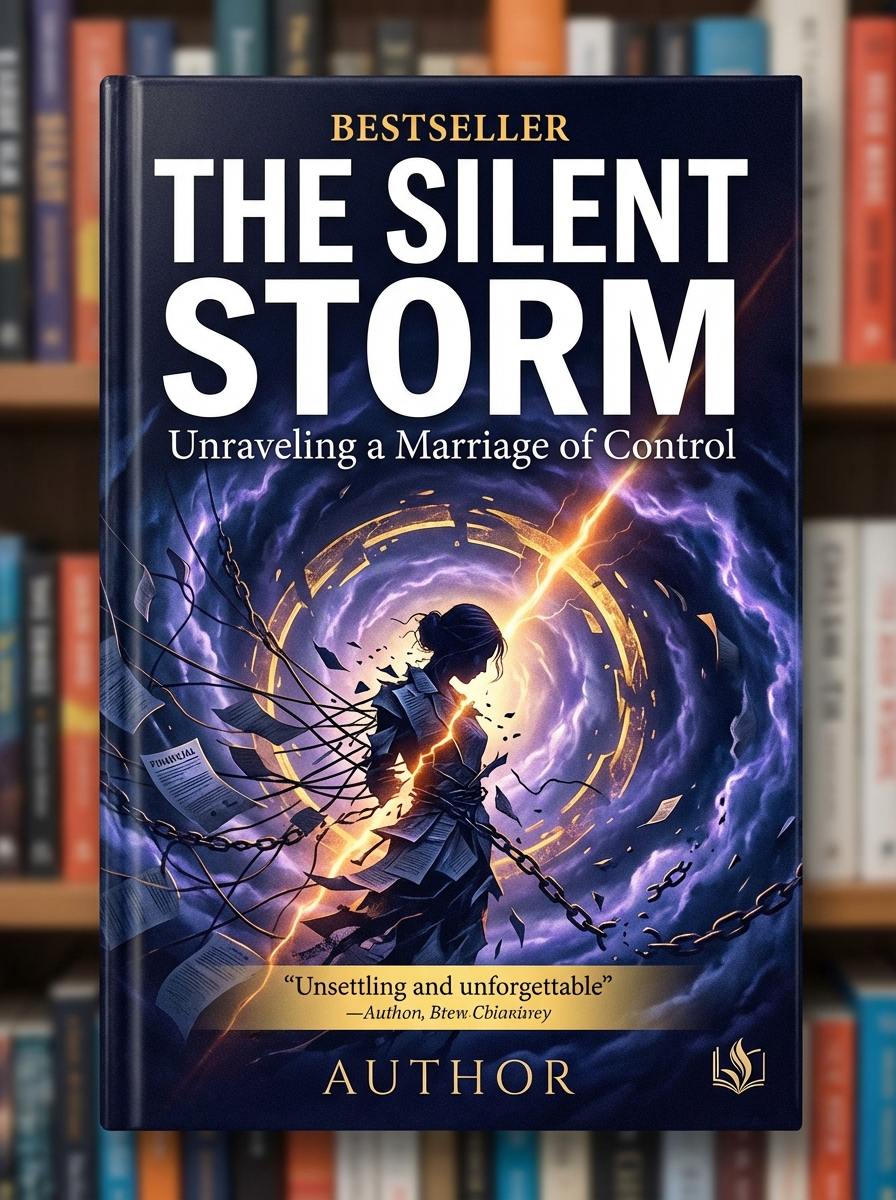
The Silent Storm: Unraveling a Marriage of Control
By Author
Synopsis
This book unveils the insidious nature of non-physical abuse within a marriage, charting one man's struggle against financial control, emotional neglect, and psychological manipulation. Through raw personal accounts and detailed documentation, it exposes the devastating impact of subtle power imbala
Chapter 1: The Echo of Unspoken Words
I am writing this because speaking has failed me. Crying has failed me. Explaining myself gently has failed me. Waiting for you to “finally get it” has failed me. This document exists because I am hurting in ways that are not visible on the outside but are devastating on the inside.
Abuse does not require physical violence. Abuse does not start with fists. Abuse starts with control, withholding, power imbalance, and erasure of autonomy. Abuse is not always loud. Sometimes it is quiet, slow, and disguised as “normal.” My experience is a testament to this, and sharing it is not just for my own clarity but for anyone who has felt their reality subtly undermined, their voice silenced by an insidious quiet. Silence protects harm, and by breaking it, I reclaim my dignity and autonomy, which are not optional.
### My Unseen Work: The Burden of Emotional Labor
Within our marriage, I carried the unseen burden of emotional labor. I was the one who initiated conversations about our relationship, checked in after conflicts, and attempted to repair the damage. Instead of finding a partner to share this with, my efforts were often met with disengagement, emotional shutdowns, or intellectual arguments that sidestepped the core issues. I felt exhausted, diminished, and profoundly alone, repeatedly trying to mend something that felt increasingly broken by myself. This constant emotional output without reciprocal effort left me feeling that I was perpetually walking on eggshells, responsible for the emotional temperature of our entire relationship.
### The Shackles of Financial Control
This is not about money. This is about power. I am required to ask you for money, not discuss or plan. Each request comes with a wave of anxiety, shame, and the fear of retaliation or anger. I am not asking for luxuries; I am asking for basic survival. When a spouse must beg for basic needs, it strips dignity, creates chronic stress, reinforces dependency, and establishes control. You control access to resources while I remain trapped without independence. It feels like being a child, constantly seeking permission for even the most fundamental aspects of my life. This is financial abuse, a quiet stranglehold that keeps me in a perpetual state of vulnerability. I recall one instance when I desperately needed new tires for my car – a safety necessity, not a luxury. The conversation was fraught with your implied disapproval, the questions about my spending habits, and the thinly veiled judgment, all culminating in a grudging agreement that left me feeling more humiliated than relieved.
### The Withholding of Independence: My License
You repeatedly say you will help me get my license, but you repeatedly do nothing. This isn't forgetfulness; it's a deliberate withholding of independence. Without my license, I rely on you for transportation, unable to move freely or build stability for myself. I remain trapped, unable to pursue job opportunities or even simple errands without your involvement. Hope is promised, then withdrawn, a cycle that maintains my dependency while preserving your appearance of effort. This is psychological manipulation, a subtle way to keep me tethered, unable to fully participate in my own life. The frustration of watching you leave each day, knowing I was stranded, grew into a suffocating sense of helplessness.
### The Echo of Emotional Neglect
When I express pain, it is met with deflection, debate, comparison, or tit-for-tat responses. Rarely do I hear, "I hear you," "I'm sorry," or "That must have hurt." Instead, my emotions are treated as inconveniences or arguments to win. This leaves me feeling unheard, invalidated, isolated, and emotionally abandoned. It is a slow, quiet erosion of self, leaving me to question my own perceptions and feelings. I remember vividly a time I tried to articulate how isolated I felt after a difficult day. Your response was to list your own stressors, turning my vulnerability into a competition for who had it worse. My pain became a footnote to your narrative, leaving me even more profoundly alone and acutely aware of the chasm between us.
### Transactional Intimacy
I do not feel like a husband or a partner; I feel like a call boy. Sex is expected when you want it, how you want it, regardless of my emotional or relational state. My needs for safety, affection, romance, reciprocity, and emotional connection are ignored. When intimacy is demanded without care, it becomes obligation. When my body is accessed while my heart is neglected, consent is compromised. This is sexual coercion, a painful reminder that I am valued for utility rather than connection, leaving me feeling used and unseen.
### The Hierarchy of Our Partnership
Our marriage is not a partnership; it is a hierarchy. You hold the money, the transportation, decision-making power, and emotional leverage. I hold fear, dependency, silence, and survival instincts. This imbalance has warped our connection, leaving me trapped and infantilized. I am desired physically but neglected emotionally, lonely inside my marriage, and unsafe asking for help. I question my value, my voice, my desirability, and my right to care. I should not have to beg my spouse to treat me like an equal. This is not stress, mutual dysfunction, or miscommunication. This is a documented pattern of control and neglect, a slow, painful dismantling of my self-worth.
### What This Has Done to Me
I have become trapped and infantilized, feeling dehumanized and unwanted unless useful. I am desired physically but neglected emotionally, left profoundly lonely inside my own marriage. I feel unsafe asking for help, ashamed for needing support, and angry from being ignored. I am exhausted from explaining, heartbroken for what I believed we had. This experience has eroded my self-worth and confidence, heightened my anxiety and hypervigilance, and led to a profound loss of agency and independence. There is a persistent loneliness that pervades every corner of our shared life. This is not bitterness; this is clarity. I am not weak; I am worn down. I am not asking to be rescued; I am asking to be respected. And I am done pretending this is normal.
Chapter 2: My Unseen Work: The Architecture of Control
CHAPTER 2: MY UNSEEN WORK: THE ARCHITECTURE OF CONTROL
I am writing this because speaking has failed me. Crying has failed me. Explaining myself gently has failed me. Waiting for you to "finally get it” has failed me. This document exists because I am hurting in ways that are not visible on the outside but are devastating on the inside.
ABUSE DOES NOT REQUIRE PHYSICAL VIOLENCE.
Abuse does not start with fists.
Abuse starts with control, withholding, power imbalance, and erasure of autonomy.
Abuse is not always loud.
Sometimes it is quiet, slow, and disguised as “normal.”
Why I must document this: Because silence protects harm. Because love without safety is not love. Because dignity and autonomy are not optional.
WHY THIS EXISTS: THE NECESSITY OF DOCUMENTATION
This record is not merely a personal account; it is an act of clarity and self-preservation. It exists because the insidious nature of non-physical abuse often silences its victims, shrouding their experiences in self-doubt and societal misunderstanding. Documenting these patterns is a universal cry against the silence, a challenge to the misconception that harm must be visible to be valid. It is a testament to the fight for one’s own reality when that reality is systematically undermined. What I chronicle here can be a tool for understanding, for healing, and for challenging the invisible architectures of control that so many face.
THE BURDEN OF EMOTIONAL LABOR
I repeatedly carry most of the emotional labor in our relationship—initiating conversations, checking in, repairing after conflict, and naming issues. My partner often disengages, shuts down, or intellectualizes rather than emotionally holding space. Agreements are discussed but rarely followed for sustained behavioral change. I feel exhausted, diminished, and emotionally alone after repeated attempts at repair.
**The Weight of Unspoken Words:** I remember one Sunday, after a particularly tense argument, I spent hours crafting a message, carefully choosing words to explain how hurt I felt. I waited, checking my phone constantly, for a response that would acknowledge even a fraction of my pain. When the reply came, it was a practical question about dinner, completely sidestepping the emotional chasm I’d tried to bridge. The silence that followed, about the actual issue, was deafening, leaving me feeling like my feelings were an inconvenience, not a valid experience.
TRANSACTIONAL INTIMACY
I frequently initiate non-sexual affection and closeness; my partner more often initiates sex. Intimacy has begun to feel transactional or pressured, rather than emotionally nourishing. I sometimes withdraw from intimacy because I feel unseen or emotionally unsafe. I do not feel like a husband or a partner. I feel like a call boy. Sex is expected when you want it, how you want it, regardless of my emotional or relational state. My needs for safety, affection, romance, reciprocity, and emotional connection are ignored. When intimacy is demanded without care, it becomes obligation. When my body is accessed while my heart is neglected, consent is compromised. This is sexual coercion.
**A Loveless Embrace:** There was a night, after days of emotional distance, when you wanted physical intimacy. I, desperate for some form of connection, hoped it would bridge the silence. But it was mechanical, perfunctory. There was no tenderness, no eye contact, only a vacant urgency. Afterwards, you rolled over and went to sleep, leaving me staring at the ceiling, feeling profoundly used and utterly alone, the physical act only amplifying my emotional starvation.
FINANCIAL CONTROL: THE GOLDEN CAGE
This is not about money. This is about power. I am required to ask you for money. Not discuss. Not plan. Ask. Each request comes with anxiety, shame, fear of retaliation, fear of anger, and fear of being perceived as a burden. I am not asking for luxuries. I am asking for basic survival. When a spouse must ask permission to meet basic needs, it strips dignity, creates chronic stress, reinforces dependency, and establishes control. You control access to resources while I remain trapped without independence. This is financial abuse. I feel trapped, like a child, infantilized by this dependency.
**The Price of Necessity:** Before a dental appointment for a necessary filling, I had to approach you for the co-pay. I rehearsed my request, my heart pounding, anticipating the inevitable questions and implied judgment. You grilled me on the necessity, the cost, the specific procedure, making me feel like an irresponsible child caught asking for an indulgence, not a basic health need. The money was eventually предоставлено, but the humiliation and anxiety stayed with me far longer than the pain in my tooth.
CONTROL THROUGH INACTION: THE DRIVER'S LICENSE
You repeatedly say you will help me get my license. You repeatedly do nothing. This is not forgetfulness. This is withholding independence. Without my license, I rely on you. I cannot move freely. I cannot build stability. I remain trapped. Hope is promised and then withdrawn. That cycle maintains dependency while preserving your appearance of effort. This is psychological manipulation. I feel trapped and infantilized.
**The Promise of Freedom, Always Deferred:** For months, you promised to take me driving, to help me practice for my license test. We’d set dates, discuss routes, and I’d feel a flicker of hope for the independence it would bring. But each time, an excuse would emerge – you were too busy, too tired, something else came up. The promises became a cruel charade, holding me captive in a cycle of anticipation and disappointment, always reliant on your unpredictable schedule and willingness, or lack thereof.
THIRD-PARTY PRESENCE AND RELATIONAL ERASURE (DERRICK)
You prioritize a friend to the detriment of the marriage. There is ongoing access to resources (rides, meals, money) provided to that friend despite my objections. I feel betrayed, displaced, and unprotected. You continually triangulate, bringing third-parties into our disagreements, adding pressure and confusion rather than resolution.
**The Ghost in Our Marriage:** There was an evening I had planned for us, a quiet dinner to reconnect after a particularly difficult week. I had cooked your favorite meal. Just as we were sitting down, your phone buzzed. It was Derrick, needing a ride, a favor, something urgent. Without hesitation, you left, assuring me you'd be back soon. You returned hours later, offering a perfunctory apology. The untouched dinner, growing cold on the table, felt like a symbol of our marriage – always secondary, always interrupted, always eclipsed by the demands of someone else, leaving me feeling invisible and deeply unchosen.
EMOTIONAL NEGLECT AND ABANDONMENT
When I express pain, it is met with deflection, debate, comparison, or tit-for-tat responses. Rarely do I hear: "I hear you." "I'm sorry." "That must have hurt." Instead, my emotions are treated as inconveniences or arguments to win. This leaves me feeling unheard, invalidated, isolated, and emotionally abandoned. This is emotional neglect. I feel unseen, unheard, and emotionally abandoned.
**The Echo Chamber of My Pain:** I remember sharing details of a difficult day at work, feeling overwhelmed and needing comfort. You listened for a moment before launching into a detailed account of your own stressful day, meticulously comparing your struggles to mine, minimizing my experience by asserting yours was worse. The conversation became a competition of suffering, and I ended up comforting you, my own pain left unheard, another echo in a house that refused to listen.
LOYALTY RUPTURES AND PUBLIC ERASURE
There is a chronic lack of acknowledgment, praise, or repair ("flowers") after I express needs or make efforts, reinforcing feelings of invisibility. My needs for security are constantly undermined. I feel invisible, replaceable, and unchosen.
**The Silent Partner:** At a social gathering, a mutual acquaintance asked about our marriage, praising your supposed stability and thoughtfulness. You readily accepted the compliments. I stood beside you, invisible, our private struggles masked by this public projection. My own sacrifices, my emotional labor, the constant anxiety of our home life, were completely erased in that moment, making me feel like a prop in the narrative of your perfect life.
I am not weak.
I am worn down.
I am not asking to be rescued.
I am asking to be respected.
And I am done pretending this is normal.
--- **What This Marriage Has Done to Me**
Trapped. Infantilized. Dehumanized. Unwanted unless useful. Desired physically but neglected emotionally. Lonely inside my own marriage. Unsafe asking for help. Ashamed for needing support. Angry from being ignored. Exhausted from explaining. Heartbroken for what I believed we had.
**What This Has Done to My Self-Worth**
I question my value, my voice, my desirability, and my right to care. I should not have to beg my spouse to treat me like an equal.
**What This Is Not**
This is not stress. This is not mutual dysfunction. This is not miscommunication. This is a documented pattern.
Chapter 3: Charting the Aftermath: A Path to Clarity
## Chapter 3: Charting the Aftermath: A Path to Clarity
### WHY THIS DOCUMENT EXISTS: A Cry for Recognition
"I am writing this because speaking has failed me. Crying has failed me. Explaining myself gently has failed me. Waiting for you to 'finally get it' has failed me." These are the desperate words that open this documentation, a testament to the invisible wounds inflicted within a marriage. This document exists because I am hurting in ways that are not visible on the outside but are devastating on the inside. It serves as a stark declaration: ABUSE DOES NOT REQUIRE PHYSICAL VIOLENCE. Abuse does not start with fists. Abuse starts with control, withholding, power imbalance, and erasure of autonomy. Abuse is not always loud. Sometimes it is quiet, slow, and disguised as “normal.”
### WHAT MAKES THIS ABUSE, NOT CONFLICT
This is not stress. This is not mutual dysfunction. This is not miscommunication. This is a documented pattern. The distinction is crucial, for silence protects harm. This comprehensive record is an assertion that love without safety is not love, and dignity and autonomy are not optional.
### My Unseen Work: The Burden of Emotional Labor
Within the architecture of our relationship, I repeatedly carried most of the emotional labor: initiating conversations, checking in, repairing after conflict, and naming issues. My expressions of pain were met with deflection, debate, comparison, or tit-for-tat responses. Rarely did I hear: "I hear you." "I'm sorry." "That must have hurt." Instead, my emotions were treated as inconveniences or arguments to win. This left me feeling unheard, invalidated, isolated, and emotionally abandoned. This is emotional neglect. I felt exhausted, diminished, and emotionally alone after repeated attempts at repair.
### FINANCIAL CONTROL: The Strings of Dependency
"This is not about money. This is about power." I am required to ask you for money. Not discuss. Not plan. Ask. An instance comes to mind: I needed to buy groceries, a basic necessity. The anxiety before approaching you was palpable, a tightening in my chest. Each request came with anxiety, shame, fear of retaliation, fear of anger, and fear of being perceived as a burden. I am not asking for luxuries. I am asking for basic survival. When a spouse must ask permission to meet basic needs, it strips dignity, creates chronic stress, reinforces dependency, and establishes control. You control access to resources while I remain trapped without independence, feeling like a child rather than an equal partner. This is financial abuse.
### CONTROL THROUGH INACTION: The Shackles of the License
You repeatedly say you will help me get my license. You repeatedly do nothing. This is not forgetfulness. This is withholding independence. Without my license, I rely on you. I cannot move freely. I cannot build stability. I remain trapped. There was an incident involving a past accident where I was restricted from driving, an act that deeply contributed to my feelings of lost autonomy. Hope is promised and then withdrawn. That cycle maintains dependency while preserving your appearance of effort. This is psychological manipulation.
### INTIMACY & CONNECTION: The Price of Transactional Affection
"I do not feel like a husband or a partner. I feel like a call boy." Sex is expected when you want it, how you want it, regardless of my emotional or relational state. My needs for safety, affection, romance, reciprocity, and emotional connection are ignored. When intimacy is demanded without care, it becomes obligation. When my body is accessed while my heart is neglected, consent is compromised. Intimacy has begun to feel transactional or pressured, rather than emotionally nourishing. This is sexual coercion. I sometimes withdraw from intimacy because I feel unseen or emotionally unsafe.
### THE SHADOW OF A THIRD PARTY: Relational Erasure
You have prioritized a friend (Derrick) to the detriment of the marriage. There were countless instances when access to resources – rides, meals, money – was provided to him despite my clear objections and expressions of hurt. I shared that you were spending significant money on him while I had to beg for basic needs. This consistent prioritization led to feelings of betrayal, displacement, and a profound lack of protection. This is relational erasure.
### THE POWER IMBALANCE: A Hierarchy, Not a Partnership
You hold: Money, Transportation, Decision-making power, Emotional leverage. I hold: Fear, Dependency, Silence, Survival instincts. This is not partnership. This is hierarchy.
### WHAT THIS MARRIAGE HAS DONE TO ME: The Erosion of Self
How this has made me feel: Trapped. Infantilized. Dehumanized. Unwanted unless useful. Desired physically but neglected emotionally. Lonely inside my own marriage. Unsafe asking for help. Ashamed for needing support. Angry from being ignored. Exhausted from explaining. Heartbroken for what I believed we had. The recurrent feelings expressed include emotional loneliness, anger, frustration, and grief for the relationship I hoped for. I feel invisible, replaceable, and unchosen, acknowledging chronic emotional strain and attachment injury. I question my value, my voice, my desirability, and my right to care. I should not have to beg my spouse to treat me like an equal.
### WHY DOCUMENTING MATTERS: Challenging the Silence
The reasons provided are strong: Because silence protects harm. Because love without safety is not love. Because dignity and autonomy are not optional. Documenting this experience serves not only for personal clarity and grounding, therapy, mediation, or future decision-making, but also to challenge the pervasive societal silence surrounding non-physical abuse. This narrative, a consolidated record of my words, experiences, and perceptions, can empower others who suffer in quiet, allowing them to recognize patterns of control and neglect that are often dismissed as "normal." It is a testament that emotional and psychological injuries are as real and devastating as physical ones. Sharing this journey from silent suffering to determined self-preservation aims to break misconceptions and validate the experiences of countless individuals trapped in similar dynamics.
### WHAT THIS TAUGHT ME: The Core Truth
I am not weak. I am worn down. I am not asking to be rescued. I am asking to be respected. And I am done pretending this is normal.
### FINAL DECLARATIONS: A Path to Clarity
This is not bitterness. This is clarity.
What I Will No Longer Accept: * Being treated as a dependent rather than an equal partner. * The invalidation of my feelings or demands for emotional labor. * Transactional intimacy that disregards my emotional well-being. * Prioritization of others over the marriage or my emotional safety. * Promises of support that consistently remain unfulfilled.
What I Require Moving Forward: * Mutual respect and recognition of my autonomy. * Shared financial transparency and independent access to resources. * Authentic emotional connection and reciprocal effort in communication and repair. * Protection of our marital unit, free from inappropriate third-party interference. * Consistent action that aligns with stated intentions, creating safety and trust.
The Core Truth is that this current dynamic is unsustainable. I have begun shifting toward self-protection, boundary-setting, and contingency planning. Continuing alone in the marriage without reciprocal effort is not acceptable.