The Silent Quarry
By Mikael Löwgren
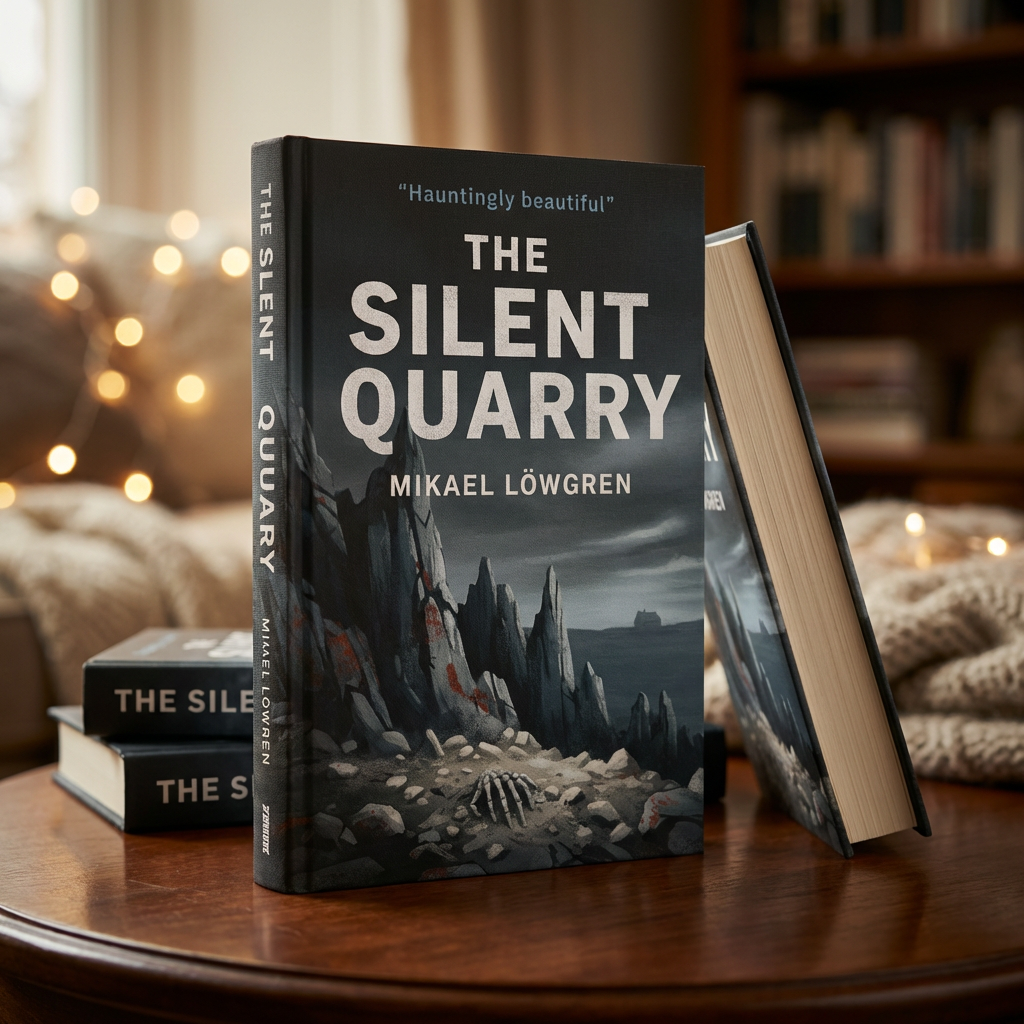
Synopsis
Beneath the desolate limestone cliffs of a remote Swedish island, skeletal remains surface, forcing a jaded detective to exhume not only a brutal crime but also the island's most deeply guarded secrets.
Chapter 1: The Unveiling
**Disclaimer**
This book was generated using artificial intelligence technology. The content is intended for informational and entertainment purposes only.
Readers are advised to independently verify any facts, figures, dates, or claims presented in this text. Information that appears unusual, spectacular, surprising, or implausible should be treated with particular caution and cross-referenced with authoritative sources.
Librida and the AI systems used in content generation do not guarantee the accuracy, completeness, or reliability of the information contained herein. This material should not be used as a sole source for academic, professional, medical, legal, or financial decisions.
---
Chapter 1: The Unveiling
The wind, a constant, nagging presence on Fårö, whipped Mariam’s hair across her face, tugging at the scarf she’d tied haphazardly that morning. It carried the sharp tang of salt and something else, something metallic and faintly sweet, a scent she instinctively recoiled from even as she knelt closer. The limestone, usually a stark, gleaming white under the fierce Baltic sun, was stained. A deep, unsettling ochre bled across its ancient surface, seeping into the pockmarked rock like an old wound.
Her gloved fingers, calloused from years of gripping geological hammers and chisels, trembled slightly as she scraped away the last vestiges of sandy detritus. Beneath the thin crust of earth, nestled precariously in a shallow erosion channel carved by centuries of wind and wave, lay a stark white cylinder. It was not rock, not shell, not any of the geological formations she spent her life cataloging. Too smooth, too porous, too undeniably… curated.
A hum started in her ears, a low thrum that drowned out the rhythmic crash of waves against the distant shore. The chill that spread through her was not from the encroaching autumn air. It was a cold that seeped from within, a premonition. Carefully, with the meticulous precision honed by years of fieldwork, she cleared more of the surrounding soil. The cylinder lengthened, curved. Another emerged beside it, smaller, thinner, then another, fused imperfectly by time and calcification.
They formed a pattern. A spine, vertebrae bleached by the elements, polished smooth by the relentless churn of sand and sea air. And then, at what should have been the terminus, a grotesque blossoming of bone. The irregular, shattered curve of a pelvis, fractured and eroded, clung precariously to the cliff face.
Mariam swallowed, her throat suddenly dry. The metallic sweetness intensified, acrid and cloying now. It was blood, she realized with a sickening lurch, or what was left of it, leached into the earth and fossilized with time. This was not a fossil, certainly not the ancient mollusks or trilobites that usually graced these cliffs. This was fresh, or at least, not *ancient* in the geological sense.
Her partner, Anders, a younger, greener geologist with an infectious enthusiasm that usually grated on Mariam but today seemed blessedly absent, stood a few yards away, his back to her, meticulously chipping at a basaltic intrusion. “Find anything interesting, Mariam?” he called out, his voice thin against the wind.
Mariam didn’t answer. She couldn't. Her breath hitched, catching in her lungs like a splinter. Her gaze, riveted to the unfolding tableau of decay, traced the curve of what could only be a human ribcage, the delicate latticework of bone exposed to the harsh light. The sheer, desolate beauty of Fårö, a landscape of raw, elemental power, seemed to mock the fragile remnant of humanity before her. The island, usually so stoic, so indifferent to the casual observer, suddenly felt like a vast, silent repository of secrets. She had seen death before, of course, mostly animal, sometimes the consequence of daring cliff walks gone wrong. But this… this felt different. Deliberate.
She fumbled for her satellite phone, her fingers numb. The small screen glowed incongruously in the raw, natural light. Her voice, when it finally emerged, was a strained whisper. “Anders. Come here. Now.”
_
Detective Inspector Elin Lind felt the familiar jostle of the ferry as it cut through the choppy waters of the Baltic. The journey from Visby to Fårö was short, but it always felt like crossing into a different world. Fårö, with its stark, wind-scoured landscapes and a population that dwindled with each passing winter, was a stark contrast to the medieval charm of Visby. It was an island that kept its secrets close.
The call had come in just after dawn. A geological survey, skeletal remains, coastal cliffs. The bare facts had been relayed in the clipped, official tone that always preceded something unpleasant. Elin tucked a stray strand of blonde hair, streaked with silver at the temples, behind her ear. Her face, etched with a quiet weariness that no amount of sleep seemed to alleviate, reflected the grey morning sky. Twenty years in the force had taught her that bodies found in beautiful places were often the most disturbing. They were anomalies, disruptions of the natural order.
Her official patrol car, a sturdy, unassuming Volvo, bumped along the gravel road that snaked through Fårö’s unique landscape. The famous raukar, towering limestone monoliths sculpted by millennia of erosion, loomed in the distance like silent, ancient sentinels. Their silent watch seemed to extend to everything, even the deepest human transgressions.
She pulled up to a makeshift cordoned-off area near the cliffs at Digerhuvud, the air already thick with the scent of salt and rock. A single police car was parked haphazardly, its blue lights flashing a muted warning in the overcast light. A few figures, huddled against the biting wind, stood near the edge of the cliff. Her new partner, Sergeant Klas Johansson, a man of quiet competence and an almost unnerving attention to detail, nodded a greeting. He was already speaking in low tones to a woman in a mud-splattered fluorescent jacket – likely the geologist who made the discovery.
“Inspector Lind,” Klas said, gesturing towards the woman. “Mariam Eriksson. She found it.”
Mariam, a woman with intelligent, weary eyes and a face weathered by sun and wind, extended a gloved hand. “Inspector. It’s… not pretty.” Her voice was raspy, still tinged with shock.
Elin nodded, her gaze sweeping over the scene. The cliff face here was a complex mosaic of stratification, layers of ancient sediment telling a geological story millions of years old. And now, a human story, brutally interrupted, was being forced into the narrative. The wind tore at her police-issue jacket, biting through to her bones.
“Show me,” Elin said, her voice calm, devoid of inflection. That was the trick, she’d learned. To keep the horror at arm’s length, to process it as data, as a puzzle to be solved. Emotion was a luxury she couldn’t afford right now.
Mariam led her to the edge of the chasm, pointing with a gnarled finger. “Here.”
Elin peered over. Below, nestled in a sheltered alcove, were the remains. They were more exposed now, Klas’s team having carefully cleared away some of the surrounding soil, revealing more of the grim tableau. The pale, brittle bones lay scattered, but not entirely haphazardly. There was a discernible form, a grotesque outline of what had once been a person. The limestone had, over time, fused with some of the smaller bones, creating a macabre sculpture. The larger bones, however, were starkly visible – a partial spine, a fractured skull, several ribs, all bleached by the elements to a uniform, unsettling white.
“Corroded by the sea air,” Klas murmured, joining her at the edge. “And likely scavenged by gulls and smaller animals over the years. But intact enough for forensic analysis.”
Elin squinted, her keen eyes taking in every detail. The skull, eroded but unmistakably human, lay on its side, the empty eye sockets staring out at the unforgiving sea. A fragment of mandible, jawbone, was detached, a few teeth still clinging stubbornly to the bone. No hair, no clothing visible, just bone and the relentless, abrasive touch of time.
“Estimated time of death?” Elin asked, not taking her eyes off the scene.
Klas consulted his notebook. “Preliminary assessment from the forensics team, based on bone degradation and calcification with the limestone, suggests anywhere from ten to thirty years. Possibly longer, but unlikely to be more recent than that. The way the bone has begun to merge with the rock, the erosion…” He trailed off, shaking his head. “It’s difficult to say without proper excavation.”
Elin knelt, positioning herself for a better view, ignoring the crunch of gravel under her knees. She felt the familiar jolt, the quiet hum of her detective’s intuition. This wasn’t an accident. The location, so remote, so difficult to access, spoke volumes. Accidents, drownings, they typically happened closer to the water, or on paths. These remains were tucked away, almost purposefully obscured, as if someone had wanted them to vanish.
“Any identification possible from what’s visible?” she pressed.
Klas shook his head again. “Not yet. No distinguishing features, no obvious jewelry, no dental work visible from this distance. Too much calcification, too much erosion.”
Elin’s gaze drifted from the bones to the surrounding cliff face. The very air here seemed charged with a silent memory. Fårö, an island famed for its ethereal light and Ingmar Bergman’s cinematic narratives, now held a darker, far more tangible secret within its ancient bones. She imagined the scene decades ago: the desolate shore, the fierce wind, the act of depositing a body in such a desolate, exposed place. It spoke of desperation, of a chilling resolve.
“We’ll need a full forensic team and an archaeologist,” Elin stated, her voice cutting through the wind. “This is a delicate excavation. We don’t want to lose any potential evidence.”
“They’re on their way from Uppsala,” Klas confirmed. “Should be here by late afternoon, weather permitting.”
Elin nodded, standing slowly, her joints protesting the cold. Her gaze lingered on the raukar in the distance. They stood stoic and indifferent, bearing witness to centuries, millennia even, of human dramas played out beneath their shadow. Only now, one of those dramas was resurfacing, refusing to stay buried.
“This will be a quiet operation,” Elin said, turning to Klas, her voice low but firm. “No leaks to the press until we know exactly what we’re dealing with. Fårö has its own way of protecting its own.”
Klas understood. The island community, small and insular, was known for its reticence, its deeply ingrained distrust of outsiders, especially those who came poking into old wounds. A discovery like this would send ripples through the tightly knit fabric of its society, unearthing not just a body, but perhaps long-buried rumors, whispered suspicions, and festering guilt.
She looked out at the churning grey sea, its vastness mirroring the unknowable depths of the human heart capable of such an act. The salt spray on her lips tasted bitter. The quiet beauty of the landscape had become a shroud, a silent testimony to a brutal past. Elin felt the familiar weight settle on her shoulders. Another life, brutally curtailed, crying out from the grave. And it was her job to listen, to decipher the whispers of the dead, to coax the truth from the unforgiving silences of Fårö. This was just the unveiling. The real work, the painful excavation of secrets, was yet to begin.
Chapter 2: Whispers of the Past
The biting east wind, carrying the scent of salt and damp earth, whipped Elin’s hair across her face as she stepped out of the patrol car. The small, prefabricated building that served as Fårö’s police substation stood stark against the grey sky, its windows reflecting the bleak landscape like vacant eyes. Inside, the air hung heavy with the smell of stale coffee and disinfectant, a familiar prelude to the cold reality of her work.
Her first task, as always, was to feel out the local pulse. Fårö was no bustling metropolis; its residents were few, their lives intertwined in ways an outsider could only guess at. They guarded their secrets fiercely, passed down through generations like heirloom silver.
“Morning, Elin,” muttered Börje Nyberg, the island’s lone constable, a man whose face seemed permanently etched with the weariness of a thousand grey Fårö winters. He clutched a steaming mug, his gaze fixed on a perpetually dripping tap. “Not much to report beyond the usual. A runaway sheep, a quarrel over fishing rights. Until now.” He gestured vaguely towards the forensics tent, a white scar on the horizon visible through the window.
Elin nodded, shrugging off her coat. “Any ideas, Börje? Anything you’ve heard, even whispers?”
He sighed, the sound like sandpaper against wood. “Whispers? Fårö runs on whispers, Elin. But nothing concrete. People keep to themselves out here, you know that. Especially when something… unnatural… happens.” He paused, weighing his words. “There was a girl, once. Decades ago. Went missing from the summer camp, just outside our jurisdiction. Never found her. But that’s a long shot. She was a mainland girl.”
“A girl?” Elin pressed, her mind already sifting through the limited details. “What was her name?”
Börje rubbed his chin, his eyes distant. “Astrid. Astrid Persson. Maybe a bit too wild for Fårö standards, even then. Blond hair, they said. A laugh that carried across the water.” He shook his head. “But that was a lifetime ago. No one talks about it anymore. Too painful for some, too convenient for others to forget.”
He continued to offer snippets of island lore, half-truths and long-held suspicions disguised as casual observations. An old man, Gunnar, known for his solitary life tending a small flock of sheep near the quarry, had once claimed to see “things” in the limestone cracks. A family dispute over lineage and inherited land that had festered for decades, sometimes boiling over into shouted exchanges at the local shop. These were the threads Börje offered, frayed and tangled, but Elin had learned that sometimes it was the frayed ends that led to the strongest knots.
Her next stop was the local ICA, Fårö’s social hub, where she hoped to catch a few early shoppers. The air inside was warm, smelling of fresh bread and ground coffee. Kerstin Eriksson, the owner, was a woman of sturdy build and even sturdier opinions, her eyes missing nothing that transpired within her small domain.
“Detective Lind,” Kerstin greeted, her voice a low purr. “A grim discovery, isn’t it? Just when summer was starting to promise a real season.” She wiped down the counter, her movements precise, almost ritualistic.
“Indeed, Kerstin,” Elin replied, choosing a package of crispbread from a nearly empty shelf. “Börje mentioned a girl, Astrid, who went missing years ago. Any memories?”
A flicker in Kerstin’s eyes, gone as quickly as it appeared. “Astrid Persson? Ah, yes. Poor thing. So young. Never had much to do with the islanders, really. She was from Stockholm, on holiday with her family at the camp. They searched, of course. For weeks. But Fårö holds many secrets, Detective. Things disappear here, swallowed by the sea or the earth, and sometimes, the memory of them too.”
Kerstin’s words, though delivered lightly, carried the weight of unspoken warnings. She didn’t elaborate, instead turning to serve a hunched figure who had just entered, leaving Elin to ponder the implications of selective memory.
Later that afternoon, the forensic team, comprised of two earnest young technicians, delivered their preliminary findings. Dr. Ingrid Bengtsson, a woman whose calm demeanour belied the grim nature of her work, held up a clear evidence bag, the contents within starkly bleached.
“The remains are human, Detective,” Ingrid stated, her voice even, professional. “Female, approximate age at death between 18 and 22. Heavy bone erosion consistent with prolonged exposure to a marine environment, coupled with the unique corrosive properties of limestone. We’ve found some textile fragments embedded in the rock matrix – synthetic, consistent with clothing styles from the late 1970s, early 80s.”
Elin felt a jolt. Astrid Persson. The timeline fit. “Any signs of trauma?”
Ingrid paused, adjusting her glasses. “Difficult to say with certainty, given the degradation. However, there is a distinct fracture pattern on the parietal bone, consistent with blunt force trauma. Post-mortem, or perimortem, we can’t yet be sure. But it’s not natural, Detective Lind. This was no accidental fall.”
The air in the substation grew heavier, the distant sound of the waves a morbid counterpoint to Ingrid’s findings. This wasn’t just an old disappearance; it was a murder. And after all these years, the murderer was still out there, walking the jagged paths of Fårö, carrying a secret that was now bubbling to the surface.
Word of the forensic findings spread across the island like wildfire, carried by the invisible currents of gossip. The tight-knit community, accustomed to the slow rhythm of island life, now hummed with an undercurrent of unease. Doors that had always been open now seemed subtly ajar, eyes that once met hers now darted away. Fårö, a place of stark, beautiful solitude, was suddenly bristling with suspicion.
Elin watched all of this from her temporary perch in the substation, sipping lukewarm coffee. She knew the pattern well. When a long-buried secret finally clawed its way to the surface, the ripple effect was swift and merciless. Old grudges, long-simmering resentments, and the brittle fragility of carefully constructed reputations.
She knew she would not sleep well tonight. The ghost of Astrid Persson, a young woman with a laugh that carried across the water, was awake now, demanding answers. And Elin Lind, a jaded detective from the mainland, was now bound to the cold stone and colder memories of Fårö, ready to exhume not just the past, but the living fear that still pulsed beneath its desolate beauty. The real work, the uncovering of Fårö’s most deeply guarded secrets, had only just begun.
Chapter 3: A Faded Photograph
The air in the Gotland Regional Archive was thick with the scent of aging paper and dust motes dancing in the faint light filtering through grimy windows. Elin, seated at a long, scarred oak table, pushed a stray lock of ash-blonde hair behind her ear, her gaze fixed on the faded photograph laid before her. It was a class picture, dated 1982, from the Fårö primary school. Thirty-odd children, scrubbed and earnest, stared out from the sepia-toned print, their faces a gallery of youthful dreams and burgeoning anxieties.
Her gloved fingertip traced the rows of unfamiliar faces. The forensic report had placed the victim’s age at disappearance somewhere between seventeen and nineteen. This photo, taken when she would have been around ten or eleven, offered the first tangible glimpse of her in life. After hours of sifting through municipal records – birth certificates, old school registers, census data – the archive assistant, a woman named Ingrid whose spectacles seemed permanently fused to her nose, had finally unearthed it. “It’s Himle primary,” Ingrid had said, her voice a reedy whisper that matched the hushed reverence of the archive, “They merged with the main Fårö school a few years later. Many of these children would have gone on together.”
Elin leaned closer, pulling a magnifying glass from her evidence kit. The girl in question, according to a partial school register found stapled to the back of the photograph, was named Astrid Lindholm. She was in the second row, third from the left. A small, solemn face framed by dark, straight hair, her eyes wide and almost unnervingly still among the fidgeting smiles of her classmates. There was a quiet intensity about her, even in that grainy image, a depth that hinted at unspoken thoughts. Elin felt a familiar pang – the recognition of a life abruptly curtailed, a story left unfinished.
Beside Astrid, a boy with unruly blond hair and a mischievous grin leaned against her, his shoulder almost touching hers. Their proximity suggested a familiarity, perhaps friendship. Elin made a mental note. Childhood connections, however fleeting, often left lingering shadows.
She spent another hour poring over the image, absorbing details, creating a silent narrative for each child. The girl with the crooked pigtails, the boy whose shirt was clearly several sizes too big, the stern-faced teacher at the edge of the frame, hands clasped, a faint, almost imperceptible frown etched between her brows. Elin noted the teacher’s name from the same register: Gunnel Eriksson.
Ingrid, sensing Elin’s absorption, had quietly offered, “Gunnel Eriksson still lives on the island, Inspector. A bit frail these days, perhaps, but her mind is as sharp as a seagull’s cry.”
The following morning, the Fårö wind whipped Elin’s scarf around her neck as she walked towards Gunnel Eriksson’s small, meticulously kept cottage. It stood on a slight rise overlooking the sea, its weathered façade a testament to decades of battling the elements. The scent of salt and drying seaweed permeated the air, sharp and invigorating.
An antique brass knocker, shaped like a fish, clanged softly against the oak door. After a moment, the door creaked open, revealing a woman who, despite Ingrid’s description, appeared less frail than simply… refined. Gunnel Eriksson, her silver hair pulled back into a neat bun, regarded Elin with eyes that were indeed sharp, a startling cerulean blue beneath finely wrinkled lids.
“Inspector Lind, I presume,” Gunnel said, her voice clear, with the distinct, slightly cadenced lilt of the Fårö dialect. “Ingrid alerted me to your interest in my past pupils. Please, come in. It’s too cold for pleasantries on the doorstep.”
The cottage interior was warm, imbued with the scent of cinnamon and old books. Every surface was adorned with intricately embroidered textiles or polished driftwood. It was the home of someone who cherished history, both personal and collective.
Elin shed her coat, taking a seat on a surprisingly comfortable antique armchair opposite Gunnel, who occupied a similar chair by a window overlooking the churning gray sea. A porcelain teapot and two delicate cups sat on a small, lace-covered table between them.
“Thank you for seeing me, Fru Eriksson,” Elin began, her voice calm and professional. “I appreciate you taking the time.”
Gunnel poured the tea, her movements precise. “It is no trouble. Curiosity, Inspector, is a difficult companion to shake off in old age. I remember the children, most of them. Tell me, who among them holds your attention?”
Elin produced a fresh print of the 1982 class photograph, laying it gently on the table. “We believe the remains found near the quarry belonged to Astrid Lindholm.” She pointed to the solemn girl in the second row. “She would have been in your class.”
Gunnel’s hand, poised over her teacup, trembled almost imperceptibly. Her gaze dropped to the photograph, lingering on Astrid’s quiet face. A sigh, thin as parchment, escaped her lips. “Astrid. Yes. A beautiful, sensitive child. So quiet. Always sketching in her notebook, watching the gulls. She was… different.”
Elin leaned forward slightly. “Different, how?”
Gunnel took a slow sip of her tea, her eyes unfocused, as if peering back through the decades. “She had an intense soul. Most children, they chatter and play. Astrid observed. She felt things deeply, I think. And she was rather alone, even surrounded by her classmates.”
“Was she bullied?” Elin probed, recalling the boy next to Astrid, his shoulder almost touching hers.
Gunnel hesitated, her gaze flicking to the photograph again, specifically to the boy with the unruly blond hair. A flicker, quick as a hummingbird’s wing, crossed her features – a momentary tightening around her eyes, a slight compression of her lips. It was gone as quickly as it came, leaving Elin questioning if she’d imagined it.
“Children can be cruel, Inspector,” Gunnel replied, her voice soft but firm. “Especially when someone is perceived as… other. Astrid was not like the others. She came from a family that kept to themselves, even by Fårö standards. Her father was a fisherman, but he was often away for long stretches. Her mother was… fragile.”
“Did she have many friends?”
Gunnel’s eyes returned to Astrid’s image. “She had a few, yes. That boy there,” she pointed with a slender finger to the blond boy next to Astrid. “Lars Bergman. They were inseparable for a time. He was a boisterous one, Lars. Full of life. He balanced her quiet nature.”
Elin made a note of Lars Bergman’s name. “Did anything unusual happen in the school or the community around that time? Anything that might have affected Astrid?”
Gunnel’s composure, though outwardly maintained, seemed to fray at the edges. Her grip on her teacup tightened, the fragile porcelain a stark contrast to her knuckles, which seemed to whiten. “The island was always a place of quiet rhythms, Inspector. Change came slowly here. But yes… sometimes, even in quiet places, shadows can deepen.”
“Shadows?” Elin prompted gently, observing the subtle shift in Gunnel’s demeanor. The careful control she held over her expression seemed to waver.
Gunnel’s gaze, which had been distant, now met Elin’s directly, and there was an undeniable flicker, a nervous current beneath the surface of her calm composure. It was a brief, almost imperceptible tremor, a fear buried deep, momentarily exposed. Her blue eyes, though still sharp, held a guardedness, a silent plea for restraint.
“There were… whispers,” Gunnel said, her voice dropping to just above a whisper itself. “About the quarries. About strange occurrences there, after dark. Children’s tales, mostly. But sometimes children’s tales have a grain of truth. Astrid, she was fascinated by the quarries. She would often go there after school, against my warnings. I remember her telling me once that the stones ‘spoke’ to her.” A faint, almost wistful smile touched Gunnel’s lips, quickly vanishing.
Elin picked up on the hesitant delivery, the slight pause before “whispers.” Gunnel was choosing her words with extreme caution. “What kind of whispers, Fru Eriksson? Can you be more specific?”
Gunnel looked out the window, her gaze lost somewhere beyond the turbulent grey sea. The wind howled softly, a mournful sound. “Just… old stories. About the earth taking what was not freely given. About sacrifices. Childish imaginings, perhaps. But Astrid… she had a way of believing in such things.”
“And you, Fru Eriksson?” Elin’s voice was neutral, but her eyes held steady on the old woman. “Did you believe in them?”
Gunnel turned back, her piercing blue eyes locking onto Elin’s. There was a depth there, an unspoken weight, which suggested far more than mere children’s tales. For a second, the careful veneer of the retired teacher cracked, exposing a raw disquiet.
“I believed enough to worry,” Gunnel admitted, her voice barely a murmur. “I worried about Astrid. The island held its secrets close, then and now. And some secrets… they are best left undisturbed.”
The nervous flicker in Gunnel’s eyes intensified then, a brief, almost desperate appeal. Elin recognized it instantly. It was the look of someone holding onto a dangerous truth, a truth that had been carefully shielded for decades, now threatening to break free. It was a fear, perhaps, not just for Astrid, but for herself. For the sanctity of her quiet life.
Elin held Gunnel’s gaze, letting the silence stretch, allowing the weight of the unspoken to settle between them. She knew that pushing too hard, too fast, would only cause Gunnel to retreat further into the carefully constructed fortresses of her memories.
“What happened to Lars Bergman?” Elin asked, shifting the subject slightly, sensing that direct interrogation about the “whispers” would be met with staunch resistance.
Gunnel blinked, bringing herself back from whatever dark corner of her memory she had visited. “Lars? Ah, Lars. He moved away, not long after… after Astrid disappeared. His family left Fårö entirely. Went to the mainland, to Stockholm, I believe. He was… quite upset, as any child would be when a friend simply vanishes.”
“Did he ever return?”
Gunnel shook her head. “Not that I’m aware of. The Bergman family, they were not ones for looking back.”
The wind outside intensified, rattling the windowpane. Elin knew she had hit a nerve, perhaps several. Astrid Lindholm, the quarries, the whispers, and the unspoken weight in Gunnel Eriksson’s cerulean eyes. The faded photograph, once merely a relic, had now opened a door to a past steeped in something far more sinister than simple childhood memories. The island was beginning to yield its secrets, one hesitant breath at a time. And Elin knew, with a chilling certainty, that Gunnel Eriksson held a piece of that dark puzzle, a piece she wasn’t yet ready to part with. The flicker in her eyes was a harbinger of truths still lurking in the silent quarry.
Chapter 4: The Outsider's Shadow
The stark white walls of the forensics lab offered no comfort, no distraction from the grim reality laid out on the stainless-steel table. Elin leaned closer, her breath misting slightly on the sterile air. Dr. Karlsson, a woman whose placid demeanor belied a mind sharper than any scalpel, pointed with a gloved hand.
“Dental records,” Karlsson’s voice was a low hum, a counterpoint to the quiet whir of the ventilation system. “A perfect match with Marianne Svensson’s childhood records. Born 1972, disappeared 1993.”
Elin felt a familiar weight settle in her chest. Twenty-one years old. So young. The name echoed faintly from the dusty school photo, a face in the background, a shadow among the brighter smiles. “Svensson,” Elin repeated, tasting the name. “Was she a local?”
Karlsson consulted her notes, a precise flick of her wrist. “No, not originally. Her primary school records are from the mainland, Stockholm. She moved to Fårö in late 1992, early 1993, just months before her disappearance.”
An outsider. The word hung in the air, thick and heavy. It explained the lack of strong recognition in the photo, the evasiveness of the older islanders. An outsider, even then, would have been viewed with suspicion on an island like Fårö, where generations were woven together tighter than a fisherman’s knot.
Elin thanked Karlsson, the methodical hum of the lab fading as she stepped back into the brisk Gotland air. The wind, ever-present, tugged at her coat, whipping strands of hair across her face. An outsider. The islanders had clammed up before. Now, knowing Marianne was not one of their own, they would turn even more inward.
Her first stop was the Fårö parish office, a squat stone building dwarfed by the towering lighthouse in the distance. Inside, the air was thick with the scent of old paper and dust. Annika Holm, the parish clerk, a woman with a face carved by years of wind and sun, looked up from a ledger as Elin entered. Annika’s eyes, a faded blue, held the island’s ancient skepticism in their depths.
“Detective Lind,” Annika acknowledged with a curt nod that offered no warmth. “Another question for the dead, I suppose?”
“Something like that,” Elin replied, keeping her voice even. “We’ve identified the remains. Marianne Svensson.”
Annika’s lips thinned, a faint tremor passing through her hand as she straightened a stack of hymn books. “Marianne. Yes. I remember her. Young woman. Not from here, of course.” The ‘of course’ was laced with a subtle accusation, a reminder of the island’s insular nature.
“Do you know why she moved to Fårö?” Elin pressed, watching Annika’s face for any tell-tale sign of discomfort.
Annika hesitated, her gaze drifting towards the small, arched window that framed a sliver of the steel-grey sea. “She came with her mother. Ingrid Svensson. From Stockholm. A difficult woman, Ingrid. Marianne was… quieter. Kept to herself.”
“Do you know where they lived?”
“A small cottage near Langhammars,” Annika said, her voice dropping a notch. “The one Harald Svensson owned before he died. Ingrid had some distant relation to him, I believe. Distant. Not enough to truly be family, not in the way we understand it here.”
Elin noted the emphasis. The island defined family not by blood alone, but by generations of shared salt and stone. “What about her father? Was he with them?”
“No father. Ingrid was a widow, she said. Moved here for… for quiet, she claimed. Fårö isn’t for everyone. Especially not for those used to the city.” Annika’s tone held a hint of satisfaction, a small vindication for the island’s unforgiving nature.
“Do you know if Marianne worked anywhere?”
Annika finally met Elin’s gaze, a flicker of something unreadable in her eyes. “She helped at the guesthouse, sometimes. The one down by the harbour. Cleaning rooms, washing dishes. She wasn’t there long. Then she was gone.”
The casualness of the last statement was jarring, a stark contrast to the gravity of a life brutally cut short. Elin suspected Annika knew more, her evasiveness a well-practiced art. “Do you remember anything else about her? Friends? Any particular conflicts?”
A sigh escaped Annika, a sound like dry leaves rustling. “Conflicts? On Fårö, we don’t have conflicts. We have understandings. Marianne just… didn’t fit in. She was a city bird trying to nest in a hawk’s eyrie. Some people tried to help, but she pushed them away. Always with a book, she was. Dreaming, perhaps, of a world beyond the water.” Elin pressed no further, sensing Annika had given all she intended to. The trail, though faint, led to the guesthouse.
The air grew colder as Elin drove towards the harbour, the wind whipping off the Baltic. The guesthouse, a weathered wooden building painted a faded blue, stood sentinel on the edge of the water. Its sign, bleached by decades of sun, creaked a mournful tune. Inside, the faint smell of stale coffee and old wood greeted her.
A woman with a formidable presence, her arms crossed over a vibrant floral apron, appeared from a back room. Her grey hair was pulled back in a tight bun, and her sharp eyes regarded Elin with open suspicion. “Can I help you?” she asked, her voice raspy.
“Detective Lind. I’m investigating a disappearance from 1993. Marianne Svensson.”
The woman’s face, etched with a lifetime of hard work, hardened further. “Marianne. Yes. I remember her. Eva Östberg.” She didn’t offer a hand, her stance unyielding. “Helped out here for a few months. Didn’t last.”
“Why not?” Elin asked, her gaze sweeping the small, tidy lobby.
Eva snorted. “Felt sorry for her mother, Ingrid. She was… lost. Trying to make a life on Fårö, bless her heart. But Marianne? She was too fragile for this place. Delicate. Always reading those books. Not much good for hard work.”
“Did she have friends here?”
“Friends?” Eva scoffed. “No. Not really. She was… different. Not like us. She didn’t understand our ways. Our jokes.” The emphasis on ‘us’ and ‘our’ was clear, an invisible barrier erected between islanders and outsiders. “Some of the young men perhaps, they’d try to talk to her. But she just looked through them. Didn’t seem to care for much beyond those stories in her head.”
“Any specific young men?” Elin probed, feeling a familiar tension in her jaw.
Eva pursed her lips, her gaze flicking away, then back. “Young Anders Karlsson, the fisherman’s son. Always thought too highly of himself. And Mikael Persson, from the farm up the road. But Marianne, she wasn’t interested. She was polite, but distant.”
The names, already familiar from her initial interviews, sparked a faint recognition. Anders Karlsson, the gruff fisherman she’d spoken to yesterday, had muttered about “old stories” and then clammed up. Mikael Persson, whose family farm bordered the quarry, had been equally terse.
“Was there any trouble?” Elin asked. “Any arguments? Harassment?”
Eva’s eyes narrowed. “Trouble? On Fårö, we settle our own affairs. If there was trouble, it was kept quiet. Marianne wasn’t the type to cause a fuss, either. She just… accepted things.” There was a subtle defensiveness in Eva’s tone, a hint of something unsaid.
“Did she ever talk about leaving Fårö?”
Eva considered this, a faint flicker of something akin to pity crossing her face. “Always. She spoke of going back to Stockholm, finding a university. She saw Fårö as a stepping stone, not a home. That’s why she didn’t mourn leaving it, I suppose.”
“Someone didn’t want her to leave,” Elin murmured, more to herself than to Eva.
Eva’s eyes, usually so sharp, clouded over. “Perhaps. Or perhaps, she just found peace where she lay. The island has a way of absorbing outsiders.” The words held a chilling double meaning.
Elin left the guesthouse feeling the chill deepen beneath her skin. The hostility, though subtle, was palpable. Each islander she spoke to seemed to build another brick in the wall of silence, protecting their own while leaving Marianne a forgotten ghost.
Her next stop was the community centre, a modern glass-and-wood structure that felt out of place amidst the ancient stone and weathered timber of Fårö. She found the head archivist, a stoic woman named Lena Nilsson, meticulously cataloguing photographs.
Lena, too, remembered Marianne Svensson, though with a detachment that bordered on disinterest. “Oh, yes, the Svensson girl. Her mother, Ingrid, tried to join our weaving circle. She was… enthusiastic. Marianne less so. She preferred the library.”
“Did she seem troubled?” Elin asked, leaning against a bookshelf laden with local histories.
Lena paused, a photograph of a smiling woman in traditional costume held delicately in her gloved hand. “Troubled? Difficult to say. She was always reading. Poetry, I think. She didn’t participate much in island life. She was an observer.” Lena’s voice was clipped, a hint of disapproval in her tone. “She didn’t make much effort to integrate.”
The narrative forming was clear: Marianne Svensson was an outsider who didn’t fit in, who didn’t try hard enough to fit in, and thus, her disappearance, while tragic, was almost expected. A self-fulfilling prophecy, perhaps, of an island’s harsh judgment.
“Was there anyone she spent time with, outside of her mother?” Elin pressed, growing frustrated with the vague generalities.
Lena hesitated, a faint crease appearing between her brows. “There was a young man, I think. Not from here. He was staying at one of the summer cottages, painting, I believe.” She tapped a finger against her chin, trying to recall. “Karl, or Erik. Something Swedish but not Fårö Swedish. He left abruptly around the same time.”
A name, finally. Not an islander, but another outsider. A connection. “Do you remember his full name?”
Lena shook her head. “No, not offhand. He wasn't registered. Just passing through. A summer fling, perhaps. Nothing serious.” The dismissive tone was back, but a thread, however thin, had appeared.
As Elin left the community centre, the wind seemed to howl a lament. The sea, a restless grey, crashed against the shore, mirroring her own inner turmoil. Marianne Svensson. An outsider. A girl who read poetry and dreamed of leaving. A girl whose disappearance had been conveniently overlooked, perhaps even welcomed, by a community that valued its peace above all else.
Elin pulled out her phone, the signal spotty on this remote part of the island. She needed to dig deeper into Anders Karlsson and Mikael Persson. And this new lead: the summer artist. Another transient, swallowed by Fårö’s unforgiving embrace.
The setting sun painted the sky in streaks of bruised purple and orange, a violent beauty. Elin looked towards the limestone cliffs, stark and silent against the darkening horizon. Somewhere beneath their ancient, unyielding embrace, Marianne Svensson had found her final resting place. And somewhere, hidden within the hearts of the islanders, was the truth. Getting them to loosen their grip on it, however, would be like trying to pry a limpet off a rock. The island’s silence was a formidable opponent, but Elin had faced harder. She would not let Marianne Svensson remain an anonymous shadow. Not anymore.
Chapter 5: Glimpses of a Secret
The air in the community hall hung heavy, thick with the scent of damp wool and old wood, a smell Elin had come to associate with Fårö itself. She watched the woman across the table, Märta Nilsson, a gnarled figure with hands like twisted roots and eyes that had seen too much, yet revealed too little. Märta’s gaze, watery blue, remained fixed on a point just beyond Elin’s left shoulder, as if the ghosts of the past were more real than the present.
“So you knew her, Kristina Lindgren?” Elin’s voice, a quiet assertion, cut through the silence.
Märta’s lips, a thin line almost lost in the web of wrinkles, barely moved. “She bought eggs from me, sometimes milk. A pretty thing, always with a kind word.” The words came out like pebbles rattling in a dry stream bed.
Elin leaned forward, her elbows resting on the polished, scarred surface of the table. “And did Kristina ever speak of her life on the mainland? Or perhaps a… relationship she might have left behind?”
A flicker in Märta’s eyes, brief as a dragonfly’s wing, dispelled her detached facade. Her gaze finally met Elin’s, sharp and knowing. “Young women always have boyfriends, Inspector. It’s the way of things.”
“But did *Kristina* have one? Here, on the island?” Elin pressed, her tone unwavering.
Märta picked at an invisible thread on her worn cardigan sleeve, her movements slow, deliberate. “Fårö is a small place, Inspector. Everyone knows everyone’s business. Or they think they do.”
The implication hung in the air: some secrets were too well-guarded even for Fårö’s relentless grapevine. Elin had encountered this before, in other remote communities. A tacit understanding not to speak ill, not to disrupt the fragile ecosystem of long-held grudges and unspoken truths. But this was different. This wasn’t just gossip; this was evasion, a collective amnesia masking something far darker.
She had spent the better part of the week trekking across Fårö, knocking on doors, tracing the faint outlines of Kristina Lindgren’s life. The picture emerging was fragmented, like a jigsaw puzzle with half the pieces missing. Kristina, the outsider from Öland, had arrived with a quiet determination, finding work at the small, family-run guesthouse near Sudersand. She was remembered as hardworking, polite, but ultimately unknowable. A polite smile, a soft voice, but always a certain distance. An invisible barrier that few had managed to breach.
And then there were the whispers. Faint, almost imperceptible, but present nonetheless. Whispers about late nights, about a car seen where it shouldn’t have been, about hushed conversations. Kristina, the unattached newcomer, had apparently not remained unattached for long.
Elin shifted tactics. “Did Kristina ever mention anyone specific? A friend, perhaps? A suitor?”
Märta finally sighed, the sound escaping her lips like air from a punctured tire. “There was talk. Always talk. About the Lundgren boy.” Her voice dropped, a mere whisper now. “Sven.”
Bingo. A name. Not much, but a tether in the swirling fog. “Sven Lundgren?” Elin repeated, tasting the name. “From the fishing family?”
A curt nod. Märta’s gaze returned to its distant point. “He was sweet on her. Always hanging around the guesthouse. Bringing her things. Flowers from the fields, fresh fish from his catches.” A hint of a wistful smile touched Märta’s lips, quickly vanishing. “But he was spoken for, then. Engaged to Anna Persson, old Petter’s daughter. A solemn girl, Anna, but with good land.”
The pieces were beginning to slot together, forming the familiar, tragic outline of a forbidden romance. The outsider, the young man from a prominent family, the jealous fiancée. It was a story as old as time, but on Fårö, it seemed, such stories had longer, more insidious echoes.
“And what happened to Sven Lundgren?” Elin asked, her voice deliberately neutral.
Märta shrugged. “Still here. Still fishing. Married Anna, too. Had children. A good life, by Fårö standards.” Her tone was flat, devoid of judgment, yet Elin perceived the weight of unspoken history in her words.
The interview with Märta yielded little more, but Elin had what she needed: a name, a motive, a new avenue of inquiry. As she left the community hall, the omnipresent Fårö wind whipped around her, sharp and insistent, mirroring the questions that now swirled in her mind.
Sven Lundgren. Elin knew his name from the initial list of island residents. A man in his late sixties now, still living in the family cottage by the western shore. She pulled out her notebook, the worn edges softened by countless investigations, and jotted down a series of bullet points.
* Sven Lundgren – Married to Anna Persson. * Former engagement to Anna. * Relationship with Kristina? * Motive: forbidden love, societal pressure.
The sun dipped low, painting the sky in fiery hues of orange and purple, making the stark landscape of Fårö seem both beautiful and menacing. As Elin drove the rental car along the winding coastal road, the limestone rauks stood like silent sentinels, their ancient forms etched against the dramatic canvas. They had witnessed everything, she thought grimly, these stony giants. Centuries of human dramas, triumphs, and betrayals. And they held their secrets with an unforgiving silence.
Her next stop was the guesthouse where Kristina had worked. It was still in operation, managed by Ingrid and Gunnar Karlsson, a couple in their eighties who had reluctantly agreed to speak with her.
Ingrid, a woman with a surprisingly sharp mind for her age, led Elin into a sun-drenched sitting room, the air perfumed with the faint scent of baking. Gunnar, a silent, stoic man, sat in an armchair by the window, his gaze fixed on the turbulent sea.
“Kristina was a good worker,” Ingrid began, her voice brittle but clear. “Always on time. Never complained.”
“And did she have many friends here on the island?”
Ingrid hesitated, glancing at her husband. Gunnar remained impassive. “She kept to herself, mostly. The young people here… they are born and bred. An outsider, it’s hard for them to truly fit in.”
A familiar narrative. Elin nodded, prompting her. “But did she ever seem… lonely? Or perhaps, secretly happy?”
Ingrid’s eyes, a faded blue, narrowed slightly. “She had a sparkle in her eye, sometimes. Especially late summer, early autumn. A… glow.”
“And did that glow coincide with any particular visitor? Or perhaps, a local connection?”
This time, Ingrid did not hesitate. Her gaze turned to Gunnar, a flicker of something unreadable passing between them. Then, she exhaled slowly. “Sven Lundgren. He was here often. Said he was delivering fish for the kitchen. But he always stayed a little longer, talked to Kristina. Bought her coffee.”
“Did you notice anything more explicit?” Elin asked, her voice low. “Any signs of intimacy?”
Ingrid wrung her hands. “They were discreet. But you live in a guesthouse, Inspector. You see things. A hand lingering too long. A shared look. A quiet walk on the beach after the guests had gone to bed.” She paused, her voice dropping to a near whisper. “Gunnar had to speak with him, eventually. It was… not proper. With Anna waiting.”
Elin turned her attention to Gunnar. “What did you say to Sven, Mr. Karlsson?”
Gunnar slowly turned his head, his lined face impassive. “I told him to watch what he was doing. Fårö is not a place for scandals. Not with a wedding planned.” His voice was rough, like sandpaper. “He promised he would stop. That it was just… friendly. But Kristina, she looked sad after that.”
“And did the visits stop?”
“For a while,” Ingrid interjected. “But then… they picked up again. More secretive. After dark. The car, sometimes, parked down the road, by the old fishing nets.”
Elin felt a jolt. This was it. The forbidden affair, carefully hidden, yet known to those who bothered to look. “And what did you do then?”
Gunnar finally spoke, his voice carrying the weight of past decisions. “What could we do? We are not her parents. We told her to be careful. That Fårö gossip can be cruel. But young love… it doesn’t listen to old warnings.”
She pressed them on the circumstances of Kristina’s disappearance. Did she just leave? Did she say goodbye?
“No goodbye,” Ingrid said, a tremor in her voice. “Just… gone. One morning, her room was empty. Her belongings, mostly, still there. I thought she’d gone for a walk, perhaps to the store. But she didn’t come back.”
“And you didn’t report it?”
A sigh escaped Ingrid. “We thought she’d gone back to the mainland. Disappointed, perhaps. After Gunnar spoke to Sven again. He’d promised to end it, for good, then. With the wedding so close.”
Elin felt the familiar chill of understanding. They had assumed she left. They had *wanted* to assume she left, to avoid the scandal, to avoid the disruption to their quiet Fårö lives. The silence, the lack of a missing person report, had been born of fear and convenience.
As she drove away from the guesthouse, the last vestiges of daylight bled from the sky, leaving Fårö cloaked in a chilling twilight. The wind intensified, a lamenting cry across the barren landscape. The island’s secrets were closing in, she realized, pressing in on her from all sides. Each answer, however small, seemed to birth a dozen new questions.
Kristina Lindgren had found more than just a job on Fårö; she had found love, forbidden and dangerous. And that love, Elin suspected, had led to her untimely end. But who was truly responsible? Sven, the conflicted lover caught between duty and desire? Anna, the jilted fiancée, desperate to protect her claim? Or someone else entirely, someone who saw the illicit affair as an affront to Fårö’s strict moral code, a reason to silence the outsider forever?
The rauks loomed larger in her rearview mirror, stark silhouettes against the darkening sky. They were not merely geological formations, she thought, but ancient witnesses, silent and unblinking. They held the truth, but they wouldn't speak. It was up to her to coax it from the unwilling lips of Fårö's living. And she knew, with a certainty that prickled her skin, that the island would not give up its secrets easily. There was a deeper current here, beneath the surface of the quiet lives and the harsh beauty, a darkness that had festered for decades, waiting for someone to finally disturb its slumber.
Elin leaned forward, gripping the steering wheel, her knuckles white. The road ahead was shrouded in shadows, a literal and metaphorical representation of the path she still had to travel. And somewhere in those shadows, Sven Lundgren was waiting. And he, Elin knew, held a key.
Chapter 6: The Betrayal
The air in Dagmar’s small, cluttered kitchen smelled faintly of stale coffee and unwashed wool. Elin had arrived unannounced, her official car stirring no small amount of dust as it crunched up the gravel path to the weathered cottage. The old woman, hunched by the worn pine table, had tensed the moment Elin’s shadow fell across the threshold. Dagmar’s eyes, rheumy and clouded by cataracts, had darted like trapped birds, searching for an escape that didn't exist in her modest home.
Elin leaned against the doorframe, letting the silence stretch, heavy and uncomfortable, between them. She had learned long ago that patience was a weapon often underestimated. “Mrs. Karlsson,” she began, her voice soft, almost a murmur against the ticking of a grandfather clock in the corner. “We found something else. Near the old quarry.”
Dagmar’s hands, gnarled and spotted with age, tightened their grip on the chipped mug she cradled. The faint rattling of porcelain was the only sound for a full minute. Elin didn't elaborate, didn't need to. The island’s grapevine, slow as it was, ensured everyone knew the grim news.
“Something else?” Dagmar’s voice was a dry rattle, like leaves skittering across frozen ground. She refused to meet Elin’s gaze, instead focusing on a faded floral tablecloth.
“A bracelet,” Elin supplied, pushing off the doorframe and taking a measured step closer. “Silver. With a single sapphire.”
Dagmar flinched, a subtle spasm that rippled through her thin frame. It was enough. Elin pressed on, her tone still gentle, but with an underlying current of steel. “It belonged to Märta. We have confirmation.”
The name hung in the air, a phantom in the small room. Dagmar’s breath hitched, a faint gasp that was almost swallowed by the silence. Elin watched her, not with judgment, but with a quiet understanding of the fear that was clearly etched on the old woman's face. Dagmar was older now, but the secrets of the past, Elin knew, never truly aged. They festered, drawing strength from the silence, until they burst forth, often with devastating consequences.
“You saw her that day, didn’t you, Mrs. Karlsson?” Elin’s question was not really a question, but a statement of fact. “Near the old fishing huts. Before the storm rolled in.”
Dagmar’s head snapped up, her eyes finally locking with Elin’s, filled with a raw, undiluted terror. “No. I saw nothing. I… I was at home. Mending nets.” Her voice was thin, reedy, utterly unconvincing.
“The weather reports from that day are very precise, Mrs. Karlsson,” Elin countered, her voice dropping a fraction, the gentle facade beginning to crack. “The storm didn’t hit until late afternoon. You were seen walking your dog near the cliffs that morning. A neighbour, Mr. Lundgren, remembered seeing you. Said you seemed… agitated.”
Dagmar recoiled as if struck. Her gaze flickered, a desperate search for an alternative truth. Elin watched the internal battle play out – the decades of silence versus the crushing weight of the present.
“He’s wrong,” Dagmar insisted, but her conviction was brittle. “Old man Lundgren, he imagines things.”
Elin stepped closer, pulling out a chair opposite Dagmar and seating herself slowly, deliberately. The chair scraped against the linoleum floor, a harsh sound in the quiet room. “Märta was a young woman, Mrs. Karlsson. She had her whole life ahead of her. Someone took that from her. Someone needs to answer for it.”
Dagmar’s eyes welled up, two slow tears tracing paths down her wrinkled cheeks. Her lower lip began to tremble uncontrollably. All the cultivated stoicism of a life lived on a windswept island, all the years of silence and practiced indifference, were crumbling before Elin’s steady gaze.
“I… I didn’t mean to see anything,” Dagmar whispered, her voice barely audible. “I just… I was walking Mårten. He liked to sniff among the gull nests.”
Elin leaned forward, her elbows on the table, her voice low and comforting, yet firm. “What did you see, Mrs. Karlsson? Tell me.”
Dagmar swallowed hard, her Adam’s apple bobbing. Her gaze drifted to the window, to the endless expanse of grey sky above the dark line of the sea. “She was by the old boathouse,” Dagmar began, her words coming out in uneven bursts, as if she were wrestling them from some deep, painful recess of her memory. “Arguing. Fists clenched. Her face… so red.”
Elin felt a jolt. This was it. “Arguing with whom, Mrs. Karlsson?” she prompted, her voice still steady, betraying none of the urgency she felt thrumming beneath her skin. This was the glimpse of a secret she had been searching for.
Dagmar shuddered, clutching her mug so tightly her knuckles were white. Her eyes darted back to Elin, wide with a fresh wave of fear. “He told me… he told me to forget it. That if I spoke, misfortune would befall me. Be precise.”
“Who, Mrs. Karlsson?” Elin pressed, her voice a little sharper this time. The smell of fear in the room was palpable now, mingling with the stale coffee.
Dagmar closed her eyes, as if shutting out the memory would make it disappear. When she opened them again, they were glazed with a distant horror. “Kjell,” she rasped, the name barely a whisper, yet it roared in the small kitchen. “Kjell Svensson.”
Elin felt a cold current run through her. Kjell Svensson. The name was synonymous with the island. The Svenssons owned half the fishing fleet, ran the largest guesthouse, and had a lineage stretching back centuries on Fårö. They were the unofficial royalty of the island, pillars of the community, respected and feared in equal measure. A prominent island family, indeed.
“Kjell Svensson?” Elin repeated, letting the name hang in the air, giving Dagmar no immediate response, allowing her to process what she had just said.
Dagmar nodded frantically, the tears now flowing freely. “He was shouting. His face was like thunder. Märta… she was standing up to him. She wasn’t afraid. Not then.”
“What were they arguing about, Mrs. Karlsson?” Elin’s gaze was unwavering, piercing through the old woman’s fear.
Dagmar wrung her hands, her gaze fixed on some point beyond Elin, a scene replaying in her mind’s eye. “Something about… about a child. And money. She said he wouldn’t get away with it. That she would tell everyone. That everyone would know what he had done.”
A child. And money. The pieces began to fall into place, chillingly. The forbidden relationship, the suppressed scandal. It was more than just an affair; it was a betrayal of a profound, devastating kind. A child, likely Kjell’s, conceived outside the sanctity of marriage, a stain on his carefully crafted reputation, a threat to his family’s dynasty. And Märta, the outsider, daring to challenge him, to expose his carefully guarded secrets.
“Did you hear anything else?” Elin asked, her voice low, almost a plea.
Dagmar shook her head, tears streaming down her face. “No. He saw me then. Just for a moment. But his eyes… they burned right through me. He gave me a look. A look that said… danger.” She shuddered again, the image clearly as vivid now as it had been decades ago. “He walked towards me, then, saying nothing, but his eyes were like chips of ice. I just turned and ran. Mårten was whimpering. I didn't stop until I was in my own yard.”
Elin felt a grim satisfaction, mingled with a growing sense of dread. The silence, the fear, the carefully constructed walls around Märta’s disappearance – they were all beginning to make terrible sense. Kjell Svensson. The prominent island figure. The very man who had greeted Elin with a courteous, if somewhat distant, welcome at the harbor when she first arrived, offering his assistance, his family’s local knowledge. The image of his calm, patrician face now morphed into something darker, colder in her mind.
“Thank you, Mrs. Karlsson,” Elin said, rising slowly from her chair. “You’ve been very brave.”
Dagmar didn’t respond, simply stared blankly ahead, lost in the shadows of her past. Elin knew the old woman had given her all she could, that the confession had cost her dearly.
Stepping out into the crisp Fårö air, Elin took a deep, steadying breath. The wind, which had seemed merely bracing earlier, now felt sharp, cutting. Kjell Svensson. The family’s reputation. The island’s secrets. It always came back to control, to power, to the desperate measures people would take to protect their carefully constructed lies.
The investigation had shifted dramatically. It was no longer about a forgotten outsider, but a clash of wills, a brutal betrayal, and a powerful family’s desperate attempt to bury the truth. The anonymous victim had a name, a voice, and a story that Kjell Svensson had clearly tried to silence.
Elin pulled out her phone, her fingers already dialing. The forensic team would need to return to the boathouse, to the area Dagmar had described. Every cracked plank, every weathered stone, every speck of dust near that old structure would now be scrutinized anew. There was no doubt in Elin’s mind now. The quarry had indeed been a silent witness. But the betrayal that led Märta there had been anything but. And now, Elin would make certain it was heard. The quiet, desolate beauty of Fårö had a dark heart, and she was about to expose it.
Chapter 7: The Quarry's Echo
The wind, a constant, mournful presence on Fårö, whipped Elin’s hair across her face as she stepped out of the police vehicle. The limestone quarry, usually a place of stark, almost alien beauty, now hummed with a different kind of energy, a spectral resonance of tragedy. She’d visited it countless times since the discovery, but today was different. Today, she didn't see a geological marvel; she saw a crime scene, decades old, laid bare by the relentless currents and the passage of time.
The forensic team had done their initial sweep, meticulously bagging bone fragments and sifting through the coarse sand, but Elin knew that a human eye, unburdened by protocols and checklists, could sometimes see what instruments missed. Or rather, feel what they missed. The pathologist’s confirmation – a young woman, missing for decades – had solidified the quarry’s macabre role, transforming it from a mere resting place to the stage of a forgotten final act.
She walked towards the base of the towering cliffs, her boots crunching on the loose shale. The air smelled of salt and damp earth, a scent that had begun to embed itself in her clothes, her hair, even the lining of her nostrils. Above her, the scarred rock face rose, pockmarked and ancient, like the skin of some colossal, slumbering beast. The afternoon sun, weak and pale, cast long, distorted shadows that writhed across the quarry floor, mimicking the unsettling dance of memory.
Elin moved slowly, her gaze sweeping across the natural amphitheater, taking in the jagged outcrops, the patches of resilient moss that clung to impossible surfaces, the deep fissures that snaked like veins through the stone. She tried to imagine the scene, not as it was now, but as it might have been all those years ago. The victim, the "outsider," struggling against an aggressor, perhaps in the twilight, the sounds of their struggle swallowed by the vast emptiness of the quarry, carried out to sea by the wind.
The area where the remains had been found was roped off, a stark yellow barrier against the muted grays and browns of the landscape. Elin stepped under it, ignoring the faint, ghostly outline of forensic footprints. She knelt, running her gloved fingers over the rough, cold stone where the first bone had been sighted. It was smooth in places, polished by centuries of water and wind, yet sharp and unforgiving in others. It was a brutal, beautiful place to die.
Her eyes drifted upwards, towards the dizzying height of the cliff face. How had she ended up here? Had she been thrown? Pushed? Had she fallen in a desperate attempt to escape? The theories swam in her mind, each more chilling than the last. The witness from the previous chapter, the one who’d seen the victim arguing with a prominent island family member, had described a ferocious confrontation, a rage barely contained. That kind of rage, Elin knew, often led to desperate choices, and desperate choices often led to places like this.
She stood again, moving with a deliberate slowness, her head tilted slightly, as if listening to an inaudible whisper carried on the wind. The quarry was silent, save for the occasional cry of a gull circling high above. But Elin felt a pressure, a heaviness in the air, a sense of untold stories trapped within the ancient stone. It wasn’t a supernatural feeling, not exactly. It was the intuitive understanding of a detective who had spent too many years walking on hallowed ground, deciphering the silent narratives of the dead.
Her attention was drawn to a series of deep striations in the rock, almost like steps carved by a primordial hand, leading up to a shelf about ten feet off the ground. It wasn't a natural formation, but rather the remnants of some old quarrying activity, long abandoned. There was a small, dark opening just beyond the shelf, barely wider than her shoulders, partially obscured by a resilient tangle of thorny scrub. It looked like a crevice, or perhaps a narrow cave entrance, unremarkable to the casual observer. But something about its tucked-away nature, its forgotten stillness, pricked at Elin's professional curiosity.
She approached it cautiously, her boots finding purchase on the uneven surface. She pulled a small, powerful flashlight from her investigative kit, its beam cutting a stark white path through the gathering shadows. As she neared the opening, the wind lessened, replaced by a cool, damp stillness. The thorny bushes scratched at her trousers as she pushed them aside, revealing the mouth of the crevice more fully. It was narrower than she’d thought, a tight squeeze, but intriguing.
Elin knelt, shining the beam into the darkness. The air inside was still and heavy, carrying a faint, musty scent. The passage wasn't deep, maybe a dozen feet or so, pinching into a tight corner at the back. The floor was uneven, strewn with loose pebbles and fine silt, carried in over the years by wind and water. Nothing. Just a hidden pocket of emptiness. She sighed, a small ripple of disappointment. Her intuition had led her to a dead end.
But as she retracted the flashlight beam, something caught the light. A faint glimmer, almost imperceptible, nestled against the wall where the crevice narrowed. She leaned in further, straining her neck, her breath catching in her throat. Slowly, carefully, she extended her gloved hand, her fingers brushing against something small and cool to the touch.
She pulled it out, bringing it into the pale light filtering from the quarry floor. It was a button, not a grand, ornate one, but a simple, pearlized button, about the size of her thumbnail, with two small holes for thread. It was old, certainly, its surface dulled by the passage of time and the elements, but still intact, still recognizable. And it felt familiar.
Elin stared at it, her mind racing. Then, with a jolt, she remembered. The faded photograph from the archive, the one showing the victim at a school picnic, vibrant and smiling despite her "outsider" status. She had been wearing a simple, light-colored dress in the photograph, with a distinctive row of such buttons running down the front. The image was grainy, distorted by age, but the buttons had been clearly visible – small, luminous disks against the fabric.
A wave of cold certainty washed over Elin. This wasn't some random piece of detritus. This was a direct link. This was a piece of her, left behind in her final moments. Perhaps it had torn off in a struggle, perhaps she had desperately tried to hide it, a desperate gesture of a woman knowing her end was near.
Her gaze returned to the crevice. It was a perfect hiding spot, a natural grave marker, unnoticed for decades. The discovery was small, but profound. It confirmed what Elin had suspected all along: the quarry wasn't just where her remains were *found*. It was where she had *died*. Her final breath had been drawn in this unforgiving place, the echo of her struggle absorbed by the silent rock, waiting for someone to finally listen.
Elin held the button in her palm, its smooth surface growing warmer beneath her glove. It was a tangible piece of evidence, a silent witness to a brutal crime. It narrowed the focus, strengthened the narrative of a violent encounter occurring right here, in this remote, desolate amphitheater. No longer just a body dumped, but a life extinguished, right here.
She carefully placed the button into a small evidence bag, sealing it with practiced movements. The wind picked up again, whistling through the quarry, carrying with it the scent of the sea and the faint, unsettling whisper of the past. The quarry had kept its secrets well, but now, finally, it was beginning to give them up. And Elin knew, with a chilling clarity, that this was just the beginning. The button was a thread, caught in the fabric of a much larger, darker tapestry. And she intended to unravel every stitch.
Chapter 8: Unraveling the Lie
The interrogation room smelled of stale coffee and fear. Not a pungent, raw fear, but a cold, refined dread that clung to the starched collar of Henrik Dahlberg’s expensive shirt. He sat opposite Elin, his posture still rigidly impeccable, a thin, almost imperceptible tremor running through his left hand as he absently smoothed the front of his tie. His wife, Ingrid, was in the room next door, her brittle silences punctuated by the occasional sob that filtered through the soundproofing, a low, animalistic keening Elin found far more unnerving than any outright confession.
“Mr. Dahlberg,” Elin began, her voice calm, almost conversational, a stark contrast to the storm brewing within her. The small, tarnished silver locket lay on the steel table between them, catching the harsh overhead light. It was open, revealing two faded photographs: one of a young, hopeful Malin Nordin, smiling shyly into the lens, and the other, disturbingly, of a younger Henrik Dahlberg himself, his arm draped possessively around her waist. “We found this an hour ago, in a crevice within the quarry. Barely visible, just beneath a loose slab of marl. Your footprint, distinct and unmistakable from an old injury, was just inches away.”
Henrik’s gaze flickered to the locket, then to Elin, a tiny muscle twitching in his jaw. The carefully constructed mask of indignation he'd worn for the past two days, since the first tentative questions about Malin’s disappearance, began to crack. “That… that’s impossible,” he stammered, his voice reedy, thinner than before. “I haven’t been to the quarry in years. Not since… well, not since we closed off the main access routes.”
Elin leaned forward, lowering her voice. “Malin Nordin died in that quarry, Mr. Dahlberg. Not of natural causes. Her skull was fractured, a blow from behind. The preliminary forensics indicate it happened around the time she disappeared, the same time our witness saw you and Malin arguing there, just hours before she vanished. And this locket, her most cherished possession, was found right where she lay. With your reflection inside. Tell me again it’s impossible.”
He flinched as if struck. His eyes, once sharp and commanding, darted around the austere room, searching for an escape route that wasn’t there. The air thickened, heavy with unspoken truths. Elin watched him, her gaze unwavering, seeing not just the man across from her, but the shadow of the man in the photograph – younger, less burdened by the weight of his own lies, but with the same possessive gleam in his eyes.
A long silence stretched between them, punctuated only by his ragged breathing. Then, a low, guttural sound escaped his throat, a sound of profound defeat. He buried his face in his hands, his shoulders beginning to heave. “She was… she was going to ruin everything,” he choked out, his voice muffled, almost indistinguishable. “Everything we’d built, everything Ingrid and I had sacrificed for.”
Elin let the words hang in the air, allowing the shame and self-pity to fester. She knew the pre-meditated lies, the decades of careful omissions, were about to unravel. This wasn't a sudden confession of passion or rage, but a calculated defense of a fractured empire.
“Ruin what, Mr. Dahlberg?” Elin pressed gently. “Your family’s reputation? Your standing in the community? Or the secret life you led, behind closed doors, with a young woman who was half your age?”
He lifted his head, his face blotchy, eyes red-rimmed. “She was obsessed,” he insisted, his voice regaining a fraction of its former force, a desperate plea for understanding. “Malin, she… she believed we were going to run away together. That I would leave Ingrid, leave the business, everything. It was madness!”
Elin raised an eyebrow, a silent challenge. “Was it madness, Mr. Dahlberg, or was it a promise you made to her, perhaps more than once, to keep her quiet, to keep her available?”
He recoiled. “I cared for her, in my own way,” he muttered, glancing away. “But she became… demanding. Unreasonable. She threatened to expose us. To tell Ingrid. To tell everyone in Visby about our… our arrangement.”
The word "arrangement" hung in the air, a euphemism for a power imbalance, for exploitation. Elin felt a cold knot of disgust tighten in her stomach. “So you argued. At the quarry. The place she often met you in secret, away from prying eyes. And then what, Mr. Dahlberg? Did she fall? Or did you push her?”
His head snapped up, his eyes wide with a sudden, fresh terror. “No! I didn’t… I never laid a hand on her, not like that. We argued, yes. It was heated. She was screaming, accusing me of leading her on, of making false promises. I told her it was over, that she had to stop this fantasy. She was hysterical. She threatened to scream for help, to expose me then and there.” He swallowed hard, his Adam’s apple bobbing. “I just wanted her to be quiet. I put my hand over her mouth, just for a second. To calm her. To stop the shouting. She thrashed… she fought. And then… she just fell.”
Elin leaned back, crossing her arms. “Fell where, precisely, Mr. Dahlberg? Into the crevice where her locket was found? The same crevice just inches from your distinctive footprint? Or was she already on the ground, silenced, and you just pushed her body deeper into the darkness?”
He started to shake his head, then stopped, his eyes unfocused, fixed on some terrible memory beyond the sterile walls. “She was at the edge… of that old quarry face, the one overlooking the water. We had walked there. I didn’t push her. She stumbled. I swearshe stumbled backward, trying to get away from me, and she just… went over the edge. I heard a thud. A sickening sound. I rushed to look, but it was dark, almost night. I couldn’t see her.” His voice dropped to a barely audible whisper. “I didn’t know what to do. I panicked. I just wanted to leave. To pretend it hadn’t happened.”
The confession, albeit incomplete, hung in the air, heavy and undeniable. Elin knew the truth was still being twisted, sculpted to minimize his culpability, but the core of it was there. Malin Nordin had died at the quarry, and Henrik Dahlberg had been there. He had not sought help or reported her fall. He had left her to die. Or, worse, had ensured her death.
She paused, letting his guilt gnaw at him. “And the personal item, Malin’s locket? Was that accidentally left behind, or did you drop it in your haste to cover your tracks?”
He looked at the locket again, a flicker of something that might have been regret crossing his face. “I don’t remember. I was… disoriented. I just wanted to get away. I went home, and I didn’t tell anyone. Not a soul.” He looked up at Elin, a desperate plea in his eyes. “Ingrid doesn’t know. She can’t know. This will destroy her.”
As if on cue, a louder, more distinct sob echoed from the adjacent room. Elin glanced at the opaque window, then back at Henrik. “I think, Mr. Dahlberg, your wife already knows more than you realize.”
***
Ingrid Dahlberg had been a vision of sophisticated composure when she first entered the interrogation room. Her silver hair was elegantly coiffed, her silk blouse pristine, her expression one of weary patience, as though she were enduring a tiresome but ultimately inconsequential inconvenience. Now, two hours later, her composure had fractured into a thousand sharp pieces. The silk blouse was rumpled, her face blotchy, and her eyes, once sharp and shrewd, were swollen and vacant.
Detective Lundgren, a younger officer from Visby who had accompanied Elin, was gently pushing the photographs across the table. They were not forensic images, but snapshots from community events, from island gatherings spanning two decades. In several of them, Henrik Dahlberg and Ingrid stood proudly, a picture of island success and marital solidity. But in a few grainy, background shots, almost imperceptible, was Malin Nordin, always on the periphery, watching. In one, she was working as a waitress at a local celebration, her gaze lingering on Henrik as he laughed with his wife. Another, far more damning, depicted a discreet encounter behind the old church, Henrik’s hand resting briefly, intimately, on Malin’s arm. The witness who had come forward, now granted anonymity, had provided it to Elin, a small, forgotten detail from a long-lost moment.
“Mrs. Dahlberg,” Lundgren said, his voice soft, almost apologetic. “These pictures show a pattern. A young woman, clearly infatuated, and a man who, at the very least, cultivated that infatuation. And you, Mrs. Dahlberg, a woman of great intelligence and perceptiveness. Are you truly telling us you never noticed anything amiss?”
Ingrid’s head was bowed, her shoulders shaking with choked sobs. She lifted her head slowly, her eyes meeting Elin’s. There was no defiance left, only a raw, unvarnished pain. “Did I notice?” she whispered, her voice hoarse. “Of course I noticed. I saw everything.”
Elin felt a jolt of surprise. This was not the confession of ignorance they had expected.
“Everything?” Elin echoed, her tone carefully neutral.
“The way she looked at him,” Ingrid continued, wiping a tear from her cheek with a trembling hand. “The little smiles she’d try to hide. The late nights he’d come home, smelling of something other than his usual cologne. The whispers, the gossip that floated through the village like smoke. I wasn't blind, Detective. I was just good at pretending I was.”
She laughed then, a hollow, bitter sound that held no humor. “For years, I told myself it was just a phase. A young girl’s foolish crush, or his mid-life crisis. That it would pass. That he would come back to his senses, to *us*. To our family. To everything we had built.” Her gaze hardened, directed at the photographs. “He never did.”
“So you knew about Malin Nordin’s involvement with your husband,” Elin pressed. “You knew they were having an affair?”
Ingrid flinched, the harshness of the word clearly affecting her. “Affair,” she repeated, tasting it like poison. “It started as a… dalliance. Then a weakness. Then a humiliation. And finally, an unbearable threat.”
“A threat, Mrs. Dahlberg?” Lundgren asked, leaning forward slightly.
“She started making demands,” Ingrid said, her voice rising now, laced with a venomous resentment. “She wanted him to leave me. To marry *her*. Can you imagine? Some uneducated girl from the mainland, coming here and thinking she could just waltz in and destroy everything? Our reputation, our standing, our legacy?” Her eyes flashed with a steely resolve that momentarily pushed aside her grief. “This island runs on reputation, Detective. On family. On the facade of respectability.”
Elin exchanged a look with Lundgren. This was the same motivation Henrik had offered, but from a different, perhaps more insidious, perspective.
“And what did you do about this threat?” Elin asked, her voice low. “When Malin Nordin threatened to expose Henrik, to ruin your family?”
Ingrid’s face crumpled again, the fragile strength she had momentarily displayed evaporating. “I confronted him,” she choked out. “I told him it had to end. That he had to choose. Me, or her. Our family, or this… this disgrace.” Her voice dropped to a whisper, filled with a raw despair. “He promised he would. He swore she meant nothing, that he would sever all ties.”
Elin held her gaze. “And did you believe him?”
Ingrid stared at the locket, now lying on the table in front of her. Slowly, painfully, she reached out a finger and traced the outline of Malin’s faded image. “I wanted to,” she admitted, her voice barely audible. “I prayed I could. But she wouldn’t let it go. She kept calling our house. She even came to the property, banging on the door. It was unbearable. The shame… the fear of everyone finding out.”
“So what happened the night Malin Nordin disappeared, Mrs. Dahlberg?” Elin asked, her voice quiet but firm. “Henrik claims he argued with her at the quarry, that she fell. Did you know he was there?”
Ingrid closed her eyes, a fresh wave of tears coursing down her cheeks. “He came home agitated. Distraught. Said he’d had a terrible argument with Malin. That she was irrational, screaming threats, that she had stumbled. He looked… terrified. He told me he hadn’t meant for it to happen, that he had run away. That he thought she was… gone.” She opened her eyes, meeting Elin’s gaze with a desperate intensity. “He never said he killed her. He just said she fell, and he left her. He was convinced if anyone found out, it would destroy us.”
“And you agreed to help him cover it up?” Elin asked, the question hanging heavy in the air.
Ingrid nodded, a single, agonizing tear tracing a path down her cheek. “What else could I do? Our son, Erik, was still young. Our business depended on our family’s good name. I thought… I thought if we just stayed silent, it would all blow over. That she would just… disappear. And eventually, she did.”
A chilling silence descended upon the room. The carefully constructed facade of the Dahlberg family, built on decades of status and deception, had not just cracked; it had shattered into irreparable pieces. The truth, ugly and raw, was finally being laid bare. It wasn’t a story of passionate crime, but of cold calculation, of reputation valued above human life, of a family united not by love, but by a shared, terrible secret. The island’s most deeply guarded lie had finally unraveled. And Elin knew this was just the beginning. The quarry had indeed echoed its secrets, and the repercussions would reverberate through Fårö for generations.
Chapter 9: Confession in the Mist
The air hung heavy and damp, a shroud of typical Fårö mist clinging to the weathered stones of the old farmhouse. Elin stood on the porch, the rhythmic pounding of her heart echoing in the quiet. Inside, she could hear the shuffling steps of an old man, a sound that spoke of age and perhaps, of fear.
The door creaked open, revealing Sten Karlsson. His once-imposing frame was now stooped, his face a roadmap of deep wrinkles and sunspots. His eyes, though clouded with cataracts, still held a flinty resolve, a hint of the man he once was. He squinted at her, a flicker of something unreadable in his gaze.
"Detective Lind," he rasped, his voice a dry rustle of autumn leaves. "I was expecting you."
His words hung in the mist, heavy and resigned. There was no defiance, no feigned surprise. Just a weary acceptance. Elin stepped inside, the scent of dust, old wood, and unburnt tobacco filling her nostrils. The house was sparsely furnished, a relic of a bygone era, much like its occupant.
"Mr. Karlsson," Elin began, her voice steady despite the chill that snaked up her spine. "We need to talk about Lena Svensson."
Sten didn't flinch. He walked slowly to a worn armchair by a cold fireplace, lowering himself into it with a sigh that seemed to carry the weight of decades. "Lena," he murmured, his gaze fixed on the empty grate. "A beautiful girl. Too bright for this island."
Elin remained standing, her eyes never leaving him. "She was brutally murdered, Mr. Karlsson. And her remains were found in the quarry, not far from your land. We know she was last seen arguing with your family."
A humorless chuckle escaped Sten. "My *family*? Yes, the family always argued. Lena argued with everyone who tried to box her in. Especially those who thought they owned this island." He paused, a strange glint entering his eyes. "But it was *I* who met her that night."
The words, though anticipated, still hit Elin with a cold jolt. This was it. The moment. The years of silence, the carefully constructed facade, all crumbling in a single, quiet confession.
"Tell me what happened, Mr. Karlsson," Elin pushed, her voice deliberately soft, almost inviting.
Sten picked at a loose thread on his armchair, his gaze still distant. "She came to me that evening, full of fire. She always was. She had discovered... things. Things that would have ruined us. Not just the family name, mind you. But everything. The quarry, the fishing rights, the land deals. All tied up in a neat little bow of 'local prosperity,' as my father used to call it."
Elin’s mind raced, piecing together the fragments. "Illegal activity, Mr. Karlsson? Corruption?"
He finally looked at her, his eyes surprisingly sharp. "Corruption? Perhaps. But out here, Detective, it was called survival. The island is harsh. Opportunities are few. We made our own. Lena, she had found ledgers, letters. Evidence. Proof that the quarry wasn't just extracting limestone. It was a front. A way to launder money, to smuggle goods. To silence anyone who dared to question the island's 'natural order'."
The "natural order." A chilling euphemism for a web of deceit and power.
"Lena threatened to expose it all," Sten continued, his voice devoid of emotion, as if discussing a weather report. "She was young, idealistic. She believed in truth, justice. Naive. I tried to reason with her. Explain that revealing such things would not only ruin *us* but would destabilize the entire island's economy. People would lose their livelihoods, their homes, because of our 'transgressions'."
Elin felt a knot tighten in her stomach. "You tried to cover it up, Mr. Karlsson. You didn't just ask her to be quiet; you intended to silence her."
A faint smile, devoid of mirth, touched the corners of his lips. "She wouldn't listen. She was going to the mainland, to the police, the newspapers. She had copies of everything. She felt betrayed. She thought our family, *my* family, was different. She saw the good in the islanders, not the rot beneath."
"She was in a relationship with someone in your family, wasn't she?" Elin prodded, remembering the early whispers.
Sten nodded, a shadow passing over his face. "My son. Torbjörn. He was young, infatuated. He told her things he shouldn't have, innocent in his youthful trust. He swore he knew nothing of the deeper dealings, but she later confronted him with the evidence. He came to me in a panic that night, beside himself. He couldn't stop her. He loved her, in his own way. But even he knew what her exposé would mean for us all."
His gaze drifted again to the cold fireplace, seeing not the empty grate but a scene from decades past. "I met her outside, near the quarry entrance. The fog was thick, just like tonight. She had a bag with her, ready to leave. She looked at me, not with anger, but with profound disappointment. That look... it was harder to bear than any accusation."
The air in the room grew heavier, thick with unspoken violence.
"I pleaded with her, Elin. I truly did. I offered her money, anything to keep her silent. To let us make amends, to slowly dismantle the illegal operations without exposing everything all at once. She refused. Said she couldn't live with herself. That the islanders deserved to know the truth about how their lives were being manipulated by a few powerful families."
Elin could almost hear Lena's impassioned voice, her fight for justice, against the cold, calculated logic of power.
"When she turned to leave," Sten’s voice dropped to a barely audible whisper, "I grabbed her arm. She struggled. She was strong, full of life. But I was stronger then. Desperate. We fell. There was a rock, just there, by the edge of the pit. She hit her head." His eyes were distant, flat. "It was... quick."
A silence descended, broken only by the mournful cry of a distant gull. Elin felt a cold wave wash over her. Not passion, not rage, but a desperate, calculated act to protect a sprawling criminal enterprise. The horror of it lay in its cold, logical brutality.
"You pushed her," Elin stated, not a question.
Sten finally looked at her, his eyes clear for a moment, revealing an abyssal depth of old sorrow and pragmatic cruelty. "I had to. There was no other way. She was a threat. To everything. To our way of life." He paused. "I dragged her body further into the quarry, to an old crevice, a natural fissure at the base of the cliff. Covered her with rocks, with debris from the quarrying. I thought no one would ever find her."
The missing personal item, the brooch Elin found in the crevice – a cruel confirmation. He had thrown it there with her, a final, intimate desecration.
"Did anyone help you, Mr. Karlsson?" Elin asked, her gaze unwavering.
He shook his head slowly. "No. I did it myself. Torbjörn arrived moments later, frantic, calling her name. He saw me, saw the look on my face, saw a bloodied rock. He didn't ask. He just knew. He helped me make sure no one saw while I covered her." He sighed, a shudder passing through his aged frame. "He carried that secret, too. All these years. It broke him."
Torbjörn, the broken son, who had lived a life of quiet despair, bound by his father’s crime. Now Elin understood the cryptic words, the haunted glances, the deep-seated guilt. They had borne the burden of a crime committed not for love or hate, but for cold, calculated self-preservation.
"You let her family believe she simply ran away, that she abandoned them," Elin pressed, the injustice of it burning in her chest.
"It was easier," Sten said, his voice flat. "For everyone. The island needed to believe she was just a flighty girl, an outsider who couldn't handle our ways. That's what we told ourselves, too. It made it easier to sleep at night."
Elin stared at the old man, a figure of aged vulnerability and unrepentant ruthlessness. He had confessed, not out of remorse, but from a profound sense of inevitability. He had played his hand, and now the cards were on the table.
"You protected your family, Mr. Karlsson," Elin said, the words tasting bitter. "At the cost of an innocent life, and decades of deceit."
"The island demanded it," he replied, his voice regaining some of its old defiance. "This place, Detective Lind, it protects its own. It swallows secrets whole. Sometimes, it demands sacrifices."
The mist outside thickened, pressing against the windowpanes, obscuring the world beyond. Elin knew this wasn't just the confession of a killer; it was the chilling unraveling of an island's dark soul. The truth, when it finally surfaced, was far more insidious than a simple crime of passion. It was the legacy of systemic corruption, ruthlessly defended, that had claimed a young life and shrouded a community in decades of silence.
The sense of injustice was palpable, a heavy weight in the room. Lena Svensson had dared to challenge the "natural order" of Fårö, and for that, she had been silenced. And now, after all these years, the old man, withered and frail, still clung to the belief that it was an act of grim necessity.
Elin moved towards the phone, her fingers already dialing. The call would bring uniforms, official statements, the sterile machinery of justice. But as she watched Sten Karlsson, his gaze once again fixed on the empty hearth, she knew that for the island, for Lena’s memory, true justice might forever remain out of reach. The silence had been broken, but the echoes of its injustice would likely linger in the mist-shrouded cliffs of Fårö for generations to come.
Chapter 10: Silent Shores No More
The gulls still cried, a relentless, mournful sound, even after the last of the police vehicles had rumbled down the narrow Fårö lanes, leaving only the faint scent of exhaust fumes hanging in the crisp autumn air. Elin had watched them go, a silent exodus that left an unfamiliar hollowness in her wake. Not the satisfying emptiness that often followed the conclusion of a complex case, but something heavier, more profound. A lingering chill that no amount of wool or hot coffee seemed able to dispel.
Justice, in its cold, precise way, had been served. The killer—a man whose face was now etched with a bitterness far older than the decades he’d spent carrying his secret—was in custody. The victim, finally named, finally mourned, could perhaps at last rest. But the island itself… it exhaled now, a slow, ragged breath, like a patient after a long, draining illness. The silence that had once defined Fårö, the quiet dignity of its ancient stones and windswept shores, felt different now. It was no longer the peaceful hush of an undisturbed sanctuary, but the charged quiet of a place that had witnessed too much, endured too much. A silence pregnant with memory and forgotten screams.
Elin moved through the small, loaned cottage, packing her few belongings. The space felt larger than it had a few days ago, stripped of the urgency that had filled every corner. Each item she folded, each book she closed, seemed to carry a faint echo of the investigation. The scent of stale coffee grounds, the metallic tang of evidence bags, the phantom whisper of secrets reluctantly shared. She paused before the window, gazing out at the rauks, those monolithic limestone formations that stood sentinel along the coast. They had seemed so stoic, so indifferent, when she first arrived. Now, she saw them differently. Accidental monuments, perhaps, to all the unsaid, all the hidden.
The local ferry, which had seemed so remote and solitary on her arrival, now felt like a pathway back to a world less burdened. Yet, the thought of leaving brought no surge of relief, only a dull ache. She understood Fårö now, not just as a geographical location on a map, but as a living, breathing entity, scarred and beautiful in equal measure. She had peeled back its layers, revealing not just the brutality of a single crime, but the rot that had festered beneath its surface, protected by generations of complicity and fear.
She remembered the nervous flickers in the eyes of the elderly teacher, the almost imperceptible tensing of a jaw when a certain name was mentioned, the way conversations would veer sideways, like startled birds, when she approached sensitive topics. It wasn't just a community protecting a killer; it was a community protecting its own fragile equilibrium, its carefully constructed narrative. The victim, an outsider, had threatened that narrative, and for that, she had been erased. The island, in its own way, had consented.
The air outside was sharper than it had been, the wind whispering secrets through the skeletal branches of the pines. Elin pulled her coat tighter, her gaze sweeping across the familiar, yet now profoundly altered, landscape. The sea, a restless grey under the lowering sky, churned against the shore. Its hypnotic rhythm, which she had initially found soothing, now sounded like a relentless, guilt-ridden sigh.
She’d spoken to the forensic team leader one last time before he left. "The quarry," he’d said, his voice flat, "it's told us everything it can. The ground's still disturbed in places, though. Even with all the work, you can still feel it." Elin knew what he meant. The physical evidence had been collected, cataloged, and removed. But the ground itself, the very earth that had held the secret for so long, still bore the weight of it.
The villagers, those she encountered in the small shop or on the handful of winding roads, offered polite, almost unnervingly subdued nods. No effusive thanks, no open relief. Just a quiet acknowledgment, a solemnity that suggested they understood the true cost of their peace. The truth, once unearthed, could not be re-interred. It had changed them, changed the very fabric of their existence. The idyllic veneer of Fårö had been fractured, exposing the dark, intricate patterns of human cruelty and complicity that lay beneath.
Elin got into her rental car, the engine sputtering to life, a jarring sound in the prevailing quiet. She drove slowly, taking a final, lingering look at the places that had become inextricably linked to the case. The isolated farm where the killer had lived, its windows now dark, its fields empty. The small, unassuming church where generations of islanders had sought solace, perhaps even forgiveness. And the quarry itself, a gaping wound in the earth, now devoid of investigators but forever marked by its grim discovery.
She found herself, almost instinctively, pulling over near the rauks again, where the pale limestone met the bruising grey of the sea. The giants stood silent, as they always had, but Elin saw them now not as mere geological formations, but as witnesses. Silent for too long, but now imbued with the collective memory of a suffering finally acknowledged.
A single gull landed nearby, its beady eyes fixed on some unseen morsel in the rocks. It let out a sharp cry, then ruffled its feathers, entirely unconcerned by her presence. Its indifference was a stark contrast to the tumult within her. Elin had seen human darkness in many forms throughout her career. In the grimy back alleys of the city, in the suburban homes hiding their secrets behind manicured lawns. But here, on this beautiful, remote island, it felt somehow more profound, more insidious. The sheer effort to maintain the illusion of purity, of an untouched Eden, had required such a deep, systemic betrayal.
She thought of the young woman whose skeletal remains had started it all. Her hopes, her fears, her brief, vibrant existence swallowed by the silent shores. Her life, though cut tragically short, had finally spoken, echoing through the island, shattering its quietude. And while the truth had been painful, she knew it was necessary.
Elin leaned her forehead against the cool glass of the car window, letting her eyes close for a moment. She could almost taste the salt and stone, the lingering scent of damp earth and something less tangible, something ancient and sorrowful. She was tired, bone-weary in a way that sleep alone wouldn’t fix. This kind of weariness settled deep in the soul, a quiet understanding of the shadows that lurked even in the most sun-drenched places.
She started the car again, the rumble of the engine a final, insistent sound. As she drove towards the ferry terminal, the rauks slowly receded in her rearview mirror, becoming smaller, less imposing. But their presence, she knew, would remain, etched onto the very landscape of her memory. Fårö had given up its secrets, not with a bang, but with a slow, agonizing whisper. And Elin, the outsider who had dared to listen, carried a piece of that whisper with her. The quiet of the island would never again be truly silent, not for her, not for anyone who truly listened. The waves would continue to crash, the wind to moan, but beneath it all, the echoes of a buried truth would forever murmur, a stark reminder that even in paradise, darkness could take root, and only truth, however brutal, could bring it to light.
The ferry horn blared, a deep, resonant sound slicing through the air. It was time to leave. Elin gripped the steering wheel, her knuckles white. She had brought justice, yes, but she had also irrevocably altered this place. And in doing so, Fårö had altered her. The world ahead, the familiar bustle of Visby, seemed distant, almost unreal. For a time, Fårö and its silent quarry had been her world, a world where the beautiful and the brutal had intertwined, leaving behind a mosaic of sorrow and revelation. She drove onto the ramp, the metal groaning under the weight of the car, and the island, shrouded in mist, began to shrink behind her. The silent shores were silent no more.