The Silent Estate
By @izzadmoktar
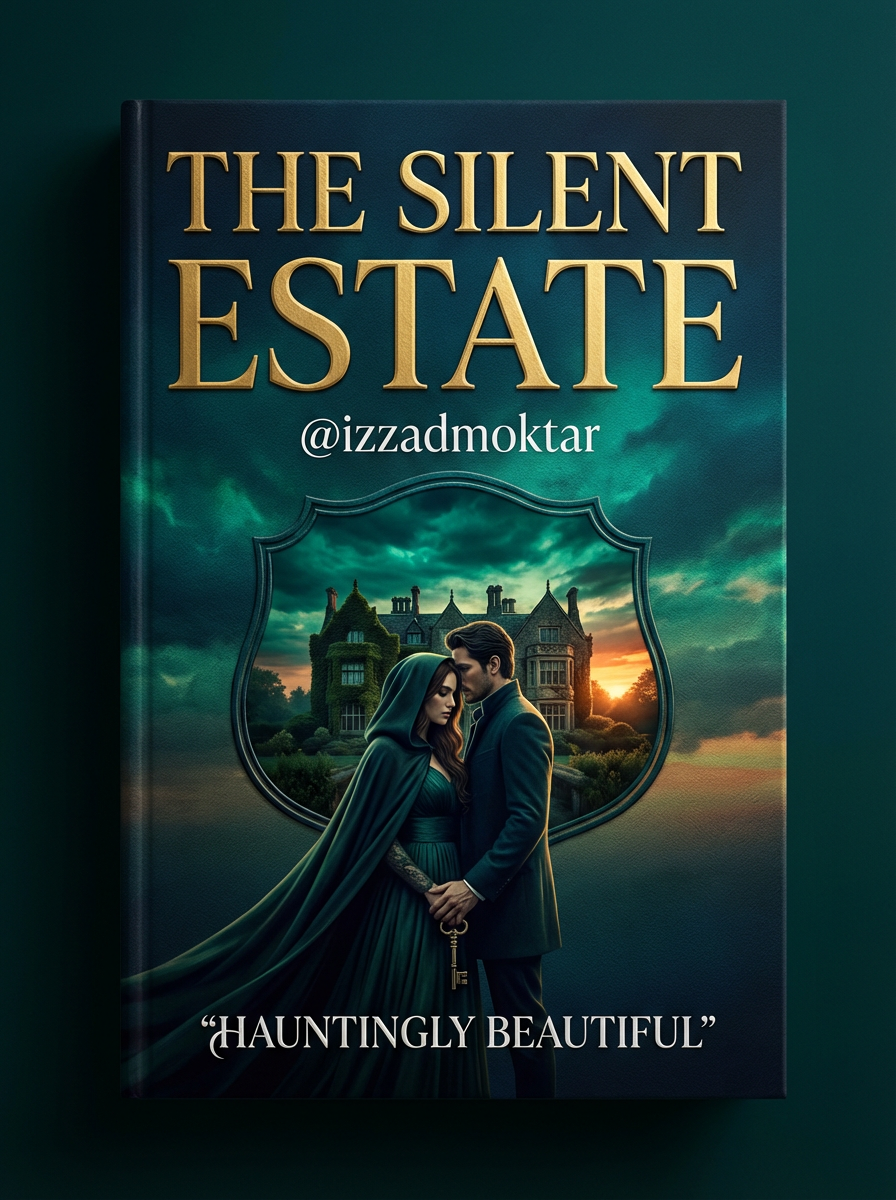
Synopsis
Amelia Blackwood, a pragmatic and quietly suffering eldest daughter, reluctantly enters into a marriage of convenience with the austere Lord Henry Croft to save her family from financial ruin. Their loveless arrangement hinges on a stoic charade, but as an unexpected warmth begins to chip away at He
Chapter 1: The Weight of Blackwood Manor
The first hint of dawn, a faint grey wash across the eastern sky, found Miss Amelia Blackwood already at her meticulous work. Her gaze, sharp and assessing, swept the drawing-room. A fresh crack snaked across the cornice, a delicate but ominous line. The damask curtains, once vibrant, now revealed a slightly frayed edge where the morning light caught them. A faint, persistent scent of mildew clung to the air, defying all her efforts to air the room. Each imperfection was an entry in an invisible ledger in her mind, a cost Blackwood Manor could ill afford. She moved with quiet efficiency, her hands, though slender, capable as she straightened a misplaced cushion, her modest but impeccably mended dress rustling softly.
Her intelligent, watchful dark eyes, though often shadowed by concern, missed nothing. While other young ladies of quality might be dreaming of soirées and suitors, Amelia’s thoughts were firmly tethered to account ledgers, repair estimates, and the dwindling contents of the pantry. The long corridors, where laughter had once echoed, now whispered with the creaks and groans of decay. Blackwood Manor, once a proud testament to generations of industry, now felt less a home and more a magnificent, crumbling burden.
The scent of stale coffee and old books hung heavy in the study as Amelia approached, her knock a gentle intrusion. "Father? It is almost nine. Would you care for some breakfast?"
A rustle of papers answered her, followed by a faint, "Ah, Amelia, my dear. Already so late?" Mr. Arthur Blackwood emerged from behind his large, mahogany desk, his usually neat grey hair now a shock of unruly white, his shoulders stooped further than Amelia remembered. His eyes, once so bright with literary enthusiasm, now held a vague, unfocused sadness. He had been cloistered here for the better part of a year, ostensibly engaged in scholarly pursuits, but in truth, lost in a haze of increasing melancholia.
"Not late, Father. Merely that the morning progresses." She offered a small, reassuring smile, masking the concern that gnawed at her. "The bacon is still warm, and the tea freshly brewed."
He nodded, allowing her to guide him towards the dining room. As they descended the grand staircase, its banister smooth beneath her practical hand, Amelia’s thoughts returned to the household accounts. The butcher’s bill was overdue by three weeks; the coal merchant had hinted, with thinly veiled politeness, that he could not extend further credit. The very stones of Blackwood Manor seemed to groan with the weight of these accumulating burdens.
Breakfast was a quiet affair. Mrs. Beatrice Blackwood, Amelia’s mother, picked at her toast, occasionally casting a worried glance at her husband.
Penelope, Amelia’s younger sister, chattered on, oblivious. "Oh, Mama, Amelia, I saw the most delightful ribbon at Mrs. Henderson's shop yesterday! A periwinkle blue, just perfect for my straw bonnet!" Her lively spirit remained untouched by the shadow that had fallen over their home.
Amelia listened, smiled, and refilled cups, her mind calculating the cost of said ribbon, weighing it against the more pressing need for repairs to the east wing roof. She saw the subtle lines of worry etched around her mother’s eyes, and felt the familiar pressure of responsibility for Penelope’s bright, unclouded future. It was a future that, Amelia keenly understood, depended entirely upon her own pragmatism and capacity for quiet suffering.
Then, a knock at the front door, a sharp, decisive sound that cut through the strained domesticity of the morning. It was not a pleasant, anticipated sound; it was the sharp punctuation of business, of unwelcome realities.
A young maid, her face flushed with trepidation, announced, "Mr. Thomas Davies, ma'am. To see Mr. Blackwood."
Amelia's stomach tightened. Mr. Davies, their family solicitor, was a man of precise habits and dire tidings. He never called without significant cause. Mr. Blackwood, however, merely blinked. "Davies? What could he want at this hour?"
"Perhaps he has good news, Father," Penelope offered brightly, her face alight with expectation.
Amelia glanced at her; the innocence was both a comfort and a wound. "Penelope, darling, would you assist Mrs. Henderson with the jam preserves? I believe she needs an extra pair of hands."
Penelope, ever obliging, skipped off. Mrs. Blackwood wrung her hands. "Oh dear. Whatever can it be? Another tenant complaining about the fencing?"
"I shall see him," Amelia said, rising with a resolve that brooked no argument. It was not her father who would face this particular dragon; it was she.
Mr. Thomas Davies was a man who embodied meticulousness. His perfectly tailored dark coat, the crisp white of his cravat, the gleam of his spectacles – all spoke of order and precision. He rose as Amelia entered the drawing-room, a thick leather satchel clutched in his hand. His gaze, usually kind, held a grimness that confirmed Amelia’s worst fears.
"Miss Blackwood," he said, bowing politely. His voice, usually dry and precise, held a note of genuine regret. "My apologies for the early intrusion."
"Not at all, Mr. Davies. Please, be seated." She indicated a worn armchair by the cold fireplace. "My father is not quite himself this morning. I trust you may confide in me?"
Mr. Davies hesitated, his eyes assessing her. He had known Amelia since she was a girl, and had always respected her capabilities, an intelligence far beyond frivolous flirtations. "Indeed, Miss Blackwood. I believe it is you, rather, whom I must speak with." He opened his satchel and produced a letter, its pages crisp and white, stark against the dark leather. "I have just come from London. A most unfortunate matter has arisen."
Amelia's heart pounded a quiet rhythm against her ribs. She braced herself. "Please, Mr. Davies, be direct."
He cleared his throat. "The matter concerns the overdue loans taken against the estate, Miss Blackwood. The primary creditor, Mr. Silas Thorne, has grown… impatient. He has presented us with an ultimatum."
Amelia felt a cold wave wash over her. She knew of these loans, had seen the vague entries in her father’s ledgers, but the true scale had always been obfuscated by her father’s vague answers and Mr. Davies’s diplomatic phrasing. "An ultimatum?" she prompted, her voice steady despite the tremor she felt within.
"He demands immediate repayment of the principal and accrued interest. Failing that, he intends to foreclose upon Blackwood Manor itself within the month."
The words hung in the air, heavy and absolute. Foreclosure. The end of Blackwood. The complete ruin of her family. Her father’s name sullied, her mother’s social standing destroyed, Penelope’s innocent dreams shattered.
Amelia closed her eyes for a brief moment, breathing deeply. The cold reality settled over her, a crushing weight. She pictured the manor, crumbling stone by crumbling stone, and then, starker still, the image of her family cast out, adrift. When she opened them, her gaze was resolute. "The exact sum, Mr. Davies?"
He consulted the letter. "Forty-five thousand pounds, Miss Blackwood. An astronomical sum in our current markets. I have explored every avenue, every possible refinancing option. Our only liquid assets are woefully insufficient." He paused, his gaze filled with sorrow. "There is, it pains me to say, no solution apparent."
Amelia’s mind, ever pragmatic, began to race, to calculate, to search for the impossible. Forty-five thousand pounds. It was a king’s ransom, a mountain she could not hope to climb. Blackwood Manor, with its acres of crumbling land and its depleted tenants, could not generate such wealth. There was nothing left to sell that would not utterly impoverish them.
"So," Amelia said, stating the brutal truth with a quiet dignity, "we are ruined. Homeless, and without a penny to our name."
Mr. Davies looked away, a testament to his discomfort. "I am profoundly sorry, Miss Blackwood." He glanced at the letter again, and then, with marked reluctance, added, "There is, however, one… suggestion, offered by Mr. Thorne's own solicitor, though I confess I found it quite audacious to even mention."
Amelia, despite the crushing weight of their predicament, felt a flicker of grim curiosity. "Audacious or not, Mr. Davies, we are beyond the luxury of choice. What is it?"
He cleared his throat again, his gaze fixed on a distant point on the wall. "It concerns a… proposition, Miss Blackwood. One that would satisfy the debt, and indeed, secure your family’s future, providing a significant dowry for your sisters, and ensuring Mr. Blackwood’s comfort for the remainder of his days."
Amelia watched him, her mind wary. Such a significant sum, offered conditionally, always came with an equally significant price. "And the nature of this proposition, Mr. Davies?"
"It is a matrimonial alliance, Miss Blackwood," he admitted, his voice barely above a whisper. "Between you, and a party of considerable wealth and standing." He finally met her gaze, and in his eyes, Amelia saw not hope, but a profound sadness, as if he regretted the words he was about to utter. "Lord Henry Croft, of Croftwood Manor."
The name hung in the air, a bell tolling a new kind of fate. Lord Henry Croft. The austere, reserved, and immensely wealthy aristocrat whose estate bordered theirs. He was a man of impeccable reputation, known for his vast fortune and his solitary existence. He rarely left Croftwood Manor, and when he did, it was with a distant, almost severe air that discouraged familiarity. Amelia had only ever seen him at a distance, a commanding presence in severe, well-tailored suits, his piercing grey eyes often holding a distant, almost haunted look.
The reality of it slammed into Amelia with the force of a physical blow. Her heart, which had just begun to ache with the loss of Blackwood, now throbbed with a different kind of pain. She was to be sold, quite literally, to save her family.
"Lord Croft?" she repeated, the name tasting foreign and heavy on her tongue. "He is… proposing marriage to me?"
Mr. Davies nodded, his face etched with regret. "Indeed. His solicitor contacted Mr. Thorne directly, expressing interest in resolving a certain… matter of debt. The terms are surprisingly generous, Miss Blackwood. More than enough to clear all immediate debts, establish a comfortable trust for your parents, and secure dowries for Miss Penelope. The only condition, of course, is the match itself."
Amelia felt the cold hand of inevitability close around her. Romance, love, personal happiness – these were luxuries she had long ago learned to forgo in the face of duty. Her life had been a series of calculated sacrifices, and this, she knew with a chilling certainty, would be the greatest of them all.
She thought of her ailing father, his despair now deepening into a silent surrender. She thought of her mother, whose fragile composure would shatter if forced from their ancestral home. And she thought of Penelope, her sister's bright eyes and innocent laughter, which Amelia vowed to protect at all costs.
The weight of Blackwood Manor, once merely a financial burden, now shifted, settling directly upon her heart. It was not just the crumbling stone and accumulating debts; it was the entire legacy, the well-being of her family, that rested precariously upon her shoulders.
Amelia took a slow, deliberate breath. Her posture, though weary, held an unexpected resilience. Her dark, watchful eyes, though momentarily clouded by the enormity of the decision, hardened with resolve. "Mr. Davies," she said, her voice quiet but firm, "inform Lord Croft's solicitor that I shall accept his proposition."
The words were spoken, sealing her fate. The future stretched before her, a stark and unromantic landscape, but her family would be safe. Blackwood Manor would be saved, not by fortune, but by sacrifice. Amelia Blackwood, pragmatic and quietly suffering, had just agreed to surrender her life for theirs. The silence in the room stretched, punctuated only by the whisper of the dying fire and the quiet throb of Amelia’s heavily guarded heart.
Chapter 2: A Cold Bargain
A carriage, less ostentatious than Mr. Davies’s but undeniably newer and of fine manufacture, rattled up the gravel drive of Blackwood Manor scarcely a week after the solicitor’s grave pronouncements. Amelia, engaged in the ceaseless task of mending a tear in a damask curtain in the drawing-room, heard the crunch of wheels and the familiar whinny of horses with a familiar tightening in her stomach. It seemed the universe was conspiring to deliver increasingly unpleasant tidings with an alarming frequency.
"Amelia, my dear! Another caller?" Mrs. Blackwood’s voice, a blend of hopeful inquiry and nervous flutter, carried down the hall. Penelope, ever eager for society, was already peeking from behind the heavy oak door.
"It appears so, Mama," Amelia replied, setting aside her needlework with a sigh that went unheard. Her intelligent, watchful dark eyes, accustomed to observing every detail, noted the crest on the carriage door even at a distance – a rampant griffin, an emblem she did not immediately recognize. The driver, clad in smart livery, dismounted with an efficient precision that bespoke a household of considerable means.
Before Amelia could speculate further, the front door was opened by their sole remaining parlour maid, a young woman named Bessie whose perpetually anxious expression seemed to deepen with each visitor. A shadow fell across the threshold, and then, a figure entered the dim hall, radiating an almost palpable aura of quiet authority.
He was tall, with a commanding presence that seemed to fill the meagre space of Blackwood Manor's entrance. His dark suit was of the finest wool, perfectly tailored, and although devoid of ostentation, it spoke of immense wealth. His hair, dark as midnight, was neatly brushed, and his features, though sharply defined, were arranged in a countenance of almost unyielding reserve. Most striking were his eyes – a piercing grey that held a distant, almost melancholic, quality, yet were acutely observant.
"Lord Henry Croft," the parlour maid announced, her voice barely a whisper. The name, though unfamiliar to Amelia, carried an immediate impression of consequence, if only by the sheer force of the man's undeniable presence.
Mrs. Blackwood, taken slightly aback, recovered her composure with a delicate cough. "Lord Croft! What an… unexpected pleasure. Please, do come in. My husband, Mr. Blackwood, is not entirely himself today, I fear, but I am Mrs. Blackwood, and these are my daughters, Amelia and Penelope."
Lord Croft offered a brief, almost imperceptible nod to Mrs. Blackwood, his gaze, however, lingered on Amelia for a moment longer than it did on her mother or sister. Amelia met his gaze directly, her own stoicism a silent challenge to his impenetrable composure. She felt an odd chill, not from the temperature of the hall, but from the stark, unblinking assessment in his grey eyes. It was not a look of admiration or even curiosity, but rather, a dispassionate evaluation, as if she were an object to be meticulously catalogued.
"I have come regarding a matter of some urgency," Lord Croft stated, his voice a low, resonant baritone, devoid of any superfluous warmth. "It concerns Blackwood Manor, and certain… financial arrangements."
Mrs. Blackwood’s already fragile composure faltered. "Financial… arrangements? Oh, dear. That sounds rather… daunting. Would you care for some tea, Lord Croft?" She wrung her hands slightly, her eyes fluttering nervously between the imposing visitor and her eldest daughter, whom she subconsciously relied upon to manage all unpleasantness.
"Tea would be acceptable, if it is no trouble," Lord Croft replied, though his tone suggested it was merely a formality.
Amelia, recognising the cue, intervened smoothly. "Mama, if you would ask Bessie to prepare the tea. Penelope, perhaps you could assist her? Lord Croft, if you would follow me to the drawing-room, it is somewhat warmer by the fire." She spoke with a quiet authority that belied their dire circumstances, a facade she had perfected over years of managing her family’s decline.
Lord Croft followed her without comment, his gaze once again sweeping over her modest but well-maintained dress, her hair simply tied back from her face. He noted the way she moved, with a quiet efficiency, yet without stiffness.
Once in the drawing-room, the silence stretched, punctuated only by the crackle of the dwindling fire. Amelia gestured towards an armchair, and Lord Croft took it, settling into the worn velvet with an ease that suggested he was accustomed to far grander surroundings. Amelia remained standing, her hands clasped before her, her inner vigilance sharpened.
"Lord Croft," Amelia began, her voice steady, "My father is unwell, and I am, by necessity, privy to and responsible for the family’s affairs. Mr. Davies has recently apprised us of our precarious position. I imagine your visit is connected."
A flicker of something – perhaps surprise, perhaps grudging respect – crossed Lord Croft's austere features. "Miss Blackwood, your candour is… commendable. Indeed, it simplifies matters. I believe, Miss Blackwood, that you are fully aware of the extent of your family's debts."
"I am," she affirmed, the word a heavy weight on her tongue. "They are considerable, and the means to repay them are, at present, non-existent."
He nodded, a brief, decisive movement of his head. "Precisely. And Blackwood Manor is mortgaged to the hilt, with several creditors poised to foreclose. The lands, though extensive, have been poorly managed for years, yielding less and less income."
Amelia felt a familiar pang of resentment towards the past, towards her father's kindly but utterly ineffectual management of their estate, but she suppressed it. There was no room for sentiment now. "Your assessment, Lord Croft, is accurate. I confess I do not understand why this concerns you."
Lord Croft leaned forward slightly, his grey eyes fixed on hers. "My interest, Miss Blackwood, is purely pragmatic. My estate, Croftwood, as you may or may not know, borders Blackwood. The lands you possess, particularly the northern fields and the western woodland, are strategically vital to my own agricultural and timber operations. Their proper management would greatly enhance the value and output of Croftwood. Furthermore, the Blackwood name, despite its present financial difficulties, carries a certain… historical weight in this county. A stable, prosperous Blackwood Manor benefits the entire region." He paused, allowing his words to sink in. "I am prepared to clear your family's debts in their entirety. Every penny."
Amelia stared at him, her carefully constructed composure threatening to crack. The sheer audacity, the magnitude of his offer, was breathtaking. To be free of the crippling burden that had shadowed her family for years… it was an impossible dream. Yet, she was shrewd enough to know that such an offer would not come without a severe stipulation. "And the price, Lord Croft? Such generosity is rarely without a significant expectation."
His gaze did not waver. "The price, Miss Blackwood, is that you become my wife."
The words hung in the air, cold and precise, like icicles forming on a winter branch. Amelia felt as though the very air had been sucked from her lungs. She had braced herself for demands – land, perhaps, or a strategic alliance through another, more pliable, family member. But marriage? To this formidable, unsmiling man, a complete stranger who spoke of clearing debts as if he were haggling over the price of a bushel of grain?
"Marriage," she repeated, the word sounding foreign on her own tongue. It was not a request, but a declaration.
"Indeed," Lord Croft affirmed, his voice uninflected. "I require a wife of suitable lineage to manage my household, to provide a certain stability to my public image, and to oversee the eventual continuation of my line. You, Miss Blackwood, possess the lineage, your evident capability suggests you would manage a household with efficiency, and you are, I assume, capable of bearing children. I am not a man who will offer romantic declarations or passionate devotion. My heart is not available for such matters."
Amelia felt a flush of indignation rise to her cheeks, quickly quashed. He spoke of her as if she were a necessary component for his estate’s continued function. "You are remarkably… direct, Lord Croft."
"I see no benefit in obfuscation, Miss Blackwood," he returned, his expression unchanged. "You are intelligent. You understand the gravity of your family's situation. My offer is simple: I clear your debts, I secure your lands for the benefit of both estates, and your family remains in Blackwood Manor, unburdened by ruin. In return, you become my wife, and perform the duties of a Viscountess. Our interactions would be cordial and respectful, but not intimate beyond what is necessary to secure the succession."
His frankness, though jarring, also carried a strange sort of reassurance. He was not pretending to offer anything other than a straightforward transaction, a cold bargain. There would be no false promises, no lingering hope for affection that might never materialise, only the stark reality of their arrangement.
Amelia’s mind raced, a torrent of calculations and considerations. The humiliation of being reduced to a transaction, the shocking audacity of his proposal, clashed with the cold, undeniable logic of his offer. Was there any other option? Any hidden avenue, any unturned stone, that might lead to salvation without this ultimate sacrifice? Mr. Davies had confirmed there was none.
The memories of her own quiet aspirations, her youthful dreams of perhaps finding a love match, however modest, faded like distant echoes. They were luxuries, privileges she could not afford. Her duty, her inescapable burden, was to her family.
Just then, Mrs. Blackwood and Penelope entered with Bessie, bearing the tea tray. The fragile clinking of porcelain seemed to shatter the heavy atmosphere.
"Oh, good! Tea has arrived!" Mrs. Blackwood chirped, oblivious to the momentous conversation that had just transpired. "Amelia, darling, you must be famished. Lord Croft, cream and sugar?"
Amelia took a fortifying breath. She would not allow her mother or sister to guess at the nature of this interview, not yet. "Lord Croft and I were just discussing some… estate matters, Mama."
"Indeed," Lord Croft affirmed smoothly, his expression giving nothing away. "Cream only, if you please, Mrs. Blackwood."
As Amelia poured the tea, her hands, though trembling subtly, performed their task with practised grace. She was acutely aware of Lord Croft’s grey eyes on her, observing, evaluating. He was waiting for her answer.
She waited until Bessie had retreated and Penelope was engaged in arranging a plate of small cakes before she spoke again, her voice low and steady, directed solely at Lord Croft. "If I accept this proposal, Lord Croft, what then becomes of my family's current position here at Blackwood? Will they remain?"
"Yes," he confirmed. "The debt will be cleared, and Blackwood Manor will remain their home. The lands will be leased to me, ensuring a stable income for your father, sufficient for their needs and maintenance of the estate, without any further financial burden on them. Your sister's future prospects, should she marry, will also be significantly improved by the association with my family. Your sacrifice, Miss Blackwood, will secure them completely."
The word "sacrifice" hung in the air, a stark confirmation of her own unspoken resignation. He understood. He understood the desperate calculus she was performing, the weighing of her own future against the survival and security of those she loved.
Amelia's gaze swept over the familiar drawing-room, the worn tapestry, the faces of her mother and sister, so oblivious to the precipice upon which they stood. The choice, if it could even be called a choice, was clear in its inevitability.
"Lord Croft," Amelia said, her voice now steady, "I cannot give you my answer immediately. I require until tomorrow morning to consider your proposal."
A flicker, almost imperceptible, crossed his austere features. "As you wish, Miss Blackwood. I shall await your messenger at Croftwood by midday tomorrow." He rose, a silent, imposing figure. "Good day, Mrs. Blackwood, Miss Penelope." With a final, lingering glance at Amelia, he departed, his footsteps echoing in the hall until the front door closed with a soft thud.
The silence that followed his departure was heavier than before, filled with unspoken questions from Mrs. Blackwood and Penelope, which Amelia deflected with vague assurances about "complicated estate matters." She retreated to her room, the image of his unyielding grey eyes burned into her mind.
She stood by the window, staring out at the darkening estate, the weight of Blackwood Manor now pressing down on her with an unbearable force. The cold reality of his offer, stark and unadorned, pulsed in her thoughts. Her life, her very self, was now a commodity to be exchanged, a price to be paid. There was no escape, no alternative. The bargain was cold, but its necessity was absolute. She would say yes. She had to. The silent estate, she realized, was no longer just the crumbling manor, but also the sealed chambers of her own heart, meticulously guarded, now offered up for solemn, joyless exchange.
Chapter 3: The Terms of the Pact
Amelia had sent her swift letter of acceptance the morning after Lord Croft's proposal, sealing her fate with a single, decisive stroke of the pen.
The following weeks passed in a blur of preparations, each one a stark reminder of Amelia's altered destiny. Her trousseau, modest yet elegant, was purchased with the funds Lord Croft had so readily provided. Her few personal effects were packed, her childhood home stripped of her presence. The farewells were brief, marked by a quiet solemnity. Her younger sisters, still too young to fully grasp the sacrifice, clung to her, their innocence a painful contrast to her own weary acceptance. Her father, in a rare moment of tenderness, squeezed her hand, his eyes filled with a silent apology that Amelia could not, and would not, demand.
The wedding itself was a small, private affair, held in the cold, cavernous drawing-room of Blackwood Manor. There were no guests, save for the vicar and two elderly servants as witnesses. Amelia wore a gown of deep blue silk, its simplicity a reflection of the joyless occasion. Lord Croft, in his impeccably tailored dark suit, looked as formidable and unyielding as ever. The vows, spoken in low, measured tones, were a hollow echo in the vast room, promising fidelity and devotion where none existed. When the ring, a plain band of gold, was slipped onto her finger, Amelia felt a chill that had nothing to do with the unheated room. She was Lady Croft now, a title that felt as foreign and ill-fitting as a borrowed garment.
The journey to Croftwood Manor was conducted in silence, the carriage rumbling through the autumnal landscape, the fallen leaves a carpet of muted gold and russet. Amelia watched the familiar countryside recede, her heart a leaden weight in her chest. She was leaving behind not just a home, but a past, a girl who had once harboured dreams of love and intellectual pursuits. That girl, she knew, was now irrevocably lost.
Croftwood Manor loomed into view as the light began to fade. It was a formidable edifice of grey stone, its architecture imposing and austere, entirely in keeping with its master. Twin towers, crowned with battlements, rose against the bruised evening sky, and a vast, manicured lawn stretched before it, dotted with ancient oaks. It was grander, certainly, than Blackwood Manor, but it lacked the warmth, the gentle decay that had characterised her childhood home. This was a place of power, of enduring strength, not comfort.
The carriage pulled up to the main entrance, a massive oak door studded with iron. A liveried footman, his face impassive, sprang forward to open it. Lord Croft disembarked first, then offered Amelia his hand. His touch was brief, formal, devoid of any warmth.
As she stepped out, she was met by the silent scrutiny of a small retinue of servants, lined up in the cavernous entrance hall. Their faces, uniformly solemn, betrayed nothing, yet Amelia felt their collective gaze, assessing their new mistress.
The interior of Croftwood was as imposing as its exterior. High ceilings, dark wood panelling, and vast tapestries depicting hunting scenes dominated the space. A grand staircase, its banister intricately carved, swept upwards into the shadows. Everything spoke of wealth, of history, but also of a profound, almost oppressive quietude.
"This is Mrs. Davies, the housekeeper," Lord Croft announced, his voice echoing slightly in the vast space. A small, neatly dressed woman with sharp eyes and a pursed mouth stepped forward. "She will see to your immediate needs."
Mrs. Davies dipped a small, efficient curtsy. "Welcome, my lady. We are prepared for your arrival." Her tone was polite, but Amelia detected no genuine warmth, no hint of welcome. It was simply a statement of fact.
"Thank you, Mrs. Davies," Amelia replied, her voice feeling small and inadequate in the echoing hall.
"Your apartments are in the west wing, my lady," Mrs. Davies continued, gesturing towards a distant corridor. "Lord Croft's are in the east."
The clear demarcation, even in the arrangement of their living quarters, was a stark reminder of their agreed terms. Separate lives, separate spaces.
"I trust you will find everything to your satisfaction," Lord Croft stated, his gaze sweeping over her briefly before he turned towards a waiting footman. "I have matters requiring my immediate attention. We shall dine at eight."
And with that, he disappeared, leaving Amelia alone in the vast hall, surrounded by silent servants and the weight of her new reality.
Mrs. Davies, with a briskness that bordered on military precision, led Amelia through a labyrinth of corridors. The west wing, though equally grand, felt a little brighter, the windows larger, allowing more of the fading daylight to filter in. Her apartments consisted of a spacious sitting-room, a large bedchamber, and an adjoining dressing-room. The furniture was elegant, albeit a little formal, and a fire had been lit in the hearth, casting a warm glow that did little to dispel the underlying chill Amelia felt.
"Your maid, Mary, will be here shortly to assist you, my lady," Mrs. Davies informed her, her voice devoid of inflection. "If you require anything else, ring the bell." With another curtsey, she departed, leaving Amelia truly alone.
Amelia walked to the window, gazing out at the darkening landscape. Croftwood Manor, silent and imposing, seemed to stretch endlessly into the twilight, a grand, formidable structure that now held her captive. She was Lady Croft now, mistress of this vast estate, but she was also a prisoner of circumstance, bound by a pact forged in desperation.
She unpacked her few belongings, her hands moving mechanically. Each item, a book, a small embroidered sampler, a faded miniature of her mother, felt imbued with memories of a life that was now irrevocably past. She arranged them carefully, creating a small island of familiarity in the vast, unfamiliar room.
Later, Mary, a young woman with a kind, open face, arrived to help her prepare for dinner. Mary’s gentle chatter was a welcome respite from the oppressive silence, though Amelia found herself answering in monosyllables, her mind still grappling with the enormity of her new situation.
Dinner was a formal, solitary affair. Amelia, dressed in a simple, dark gown, descended the grand staircase to the dining room. It was a vast chamber, dominated by a long mahogany table that could seat twenty, yet only two places were set. Lord Croft was already seated at the head of the table, his posture as erect and unyielding as ever.
"Lady Croft," he acknowledged, a brief nod his only greeting.
"Lord Croft," she replied, taking her seat opposite him, the length of the table a physical representation of the distance between them.
The meal was served by silent footmen, each course presented with meticulous precision. The food was exquisite, but Amelia found she had little appetite. The silence was punctuated only by the clinking of cutlery, the soft rustle of the servants' movements, and the occasional, almost perfunctory, question from Lord Croft about the journey or her settling in.
"I trust your apartments are satisfactory?" he inquired, his gaze fixed on his plate.
"Entirely so, thank you," Amelia replied, her voice carefully neutral.
"Good. Mrs. Davies will provide you with an overview of the household accounts and staff rotas tomorrow morning. There is much to learn."
"I am eager to begin," she stated, though a sense of weariness settled over her.
The conversation, if it could be called that, faltered after that. Lord Croft seemed to have no interest in further discourse, and Amelia, still reeling from the day's events, had little to offer. She found herself observing him, trying to glean some understanding of the man she had married. He ate with practiced precision, his movements economical, his expression unreadable. His dark hair, neatly combed, showed a touch of grey at the temples, and a faint line was etched between his brows, suggesting a perpetual intensity of thought. He was, she concluded, precisely as he had presented himself: austere, controlled, and utterly devoid of any outward warmth.
After the meal, Lord Croft escorted her back to the drawing-room, a more intimate, though still formal, space than the dining hall. A fire crackled in the hearth, and a selection of books lay open on a nearby table.
"I shall retire now, Lady Croft," he announced, his gaze not quite meeting hers. "I have papers to attend to."
"Of course, Lord Croft," she replied, her voice a little softer than intended.
He gave a final, stiff nod, then turned and left, leaving Amelia alone in the vast, silent room. She stood by the fire, feeling the warmth on her face, but a profound coldness seeped into her heart. The terms of the pact were clear, rigorously defined, and utterly devoid of kindness. She was Lady Croft, mistress of Croftwood Manor, but she was also a woman adrift, her life now bound to a man who had claimed no capacity for love, and whose very presence seemed to amplify the silence around her. This was her new existence, and she knew, with a certainty that chilled her to the bone, that it would be a long, quiet, and profoundly solitary one.
Chapter 4: A Glimpse Beyond the Facade
The heavy oak doors of Croftwood Manor closed behind Amelia with a soft, resonant thud, sealing her within its formidable embrace. The air, though warmer than the chill of her departure from Blackwood, felt no less austere. Her transition from daughter of a declining house to mistress of a flourishing one was marked not by celebration, but by a profound sense of muted expectation.
Her first days at Croftwood were a careful dance of observation and adaptation. The manor, a sprawling edifice of grey stone and ancient timber, possessed a silent grandeur that spoke of generations of careful stewardship. Unlike Blackwood, where the dust of neglect clung to every surface, Croftwood gleamed with an almost aggressive orderliness.
Her initial encounter with Eleanor, Lord Croft’s sister, occurred in the vast, echoing drawing-room, a space furnished with an impeccable, if somewhat uninviting, array of velvet and polished mahogany. Eleanor, a woman a few years Amelia’s senior, possessed a delicate beauty that seemed perpetually shadowed by a faint melancholy. Her eyes, the same piercing grey as her brother’s, held a distant, almost fragile quality.
“Lady Croft,” Eleanor greeted, her voice a soft murmur that barely disturbed the quiet. There was no warmth in the appellation, merely a formal acknowledgment.
“Eleanor,” Amelia replied, extending a hand, which Eleanor took with a lightness that suggested little enthusiasm.
“The rain has been quite persistent this week, hasn’t it?” Eleanor commented, her gaze drifting to the window. “It quite spoils the roses.”
“Indeed,” Amelia acknowledged, following her gaze. “Though I imagine the gardens here are quite resilient.”
Eleanor merely offered a small, noncommittal hum, her attention already seeming elsewhere. It was clear that Eleanor, like her brother, was a creature of quiet reserve, her inner world carefully guarded.
More formidable, and perhaps more revealing, was Mrs. Davies, the housekeeper. A woman of sturdy build and an uncompromising gaze, Mrs. Davies had served the Croft family for decades, her loyalty as unyielding as the stone walls of the manor itself. Her initial assessment of Amelia was thorough, a silent perusal that missed no detail, from the slightly worn hem of Amelia’s travelling gown to the quiet determination in her eyes.
“My Lady,” Mrs. Davies intoned, her voice a low, gravelly rumble, “I trust your chambers are to your satisfaction?”
“Perfectly so, Mrs. Davies,” Amelia replied, meeting the woman’s steady gaze. She detected a flicker of something she could not quite decipher – perhaps approval, perhaps merely a professional assessment.
Mrs. Davies was a fount of information, though she dispensed it sparingly, often through the meticulous execution of her duties. Amelia learned of the manor’s intricate routines, the precise timings of meals, the proper care of the ancestral silver, all delivered with an almost military precision. There was a sense that Mrs. Davies was not merely managing a household, but upholding a sacred tradition, and Amelia, as the new mistress, was being subtly tested for her worthiness. Amelia, a woman who had managed a declining estate with dwindling resources, found herself surprisingly at ease with the strictures of Croftwood. Order, even rigid order, was a familiar comfort.
Lord Croft himself remained a distant, if ever-present, figure. Their interactions were confined to formal meals and brief, pragmatic discussions concerning estate matters. He observed her, Amelia knew, with the same quiet scrutiny she applied to her surroundings. His pronouncements were economical, his expressions unreadable. The terms of their pact, established in the cold drawing-room of Blackwood, remained inviolate.
One morning, as Amelia descended the main staircase, she encountered Lord Croft in the grand hall. He paused, his gaze steady. “Lady Croft,” he began, his voice level, “I have arranged a small dinner party for the end of the week. It is an essential formality to introduce you to a select few of the local gentry.”
Amelia inclined her head. “Of course, Lord Croft. I shall make the necessary preparations.”
The evening arrived, heralded by a flurry of activity in the servants’ quarters and the soft glow of myriad candles throughout the manor. Amelia chose a gown of deep emerald silk, a relic from a more prosperous time at Blackwood, now carefully mended and pressed. It was a colour that suited her pale complexion and dark hair, lending her an air of quiet sophistication.
When she descended the grand staircase, Lord Croft was already waiting at the foot, a dark, imposing figure in evening dress. He offered her his arm with a formal inclination of his head, his touch cool and impersonal.
The guests began to arrive shortly thereafter: Sir Reginald and Lady Ashworth, a jovial but somewhat boorish couple; the venerable Canon Hemmings and his perpetually flustered wife; and Mrs. Dalrymple, a widow of formidable social standing and an even more formidable tongue.
The drawing-room, usually so hushed, hummed with the murmur of polite conversation. Amelia, schooled in the art of social navigation, moved through the room with grace, exchanging pleasantries and offering appropriate responses. She observed, as always, the subtle currents of the gathering, the unspoken hierarchies, the barely concealed judgments.
It was Mrs. Dalrymple, a woman whose eyes missed nothing and whose tongue spared no one, who initiated the subtle skirmish. She cornered Amelia by the fireplace, her gaze sweeping over Amelia’s gown with a barely perceptible sniff of disdain.
“Lady Croft,” she began, her voice a silken purr that belied the sharpness of her words, “we are all so very delighted to see Lord Croft finally settled. One does so worry when a gentleman of his standing remains unwed for so long. There were whispers, you know, of his… particular sensibilities.”
Amelia maintained a serene expression. “Indeed, Mrs. Dalrymple?” she inquired, her tone even. “I had understood Lord Croft’s focus to be entirely on the prosperity of his estate. A most admirable dedication, I find.”
Mrs. Dalrymple’s smile tightened. “Oh, quite. Though some might say such dedication can lead to a certain… austerity in one’s personal life. A man so devoted to his ledger books, one might wonder if he has much room for the softer affections.” Her gaze flickered, pointedly, to Lord Croft, who stood across the room, engaged in a discussion with Sir Reginald.
Amelia’s heart gave a slight, unexpected lurch. She had accepted the terms of their marriage with a pragmatic understanding of its lack of affection. Yet, to hear it articulated with such thinly veiled condescension, aimed not at her, but at him, stirred a peculiar protective instinct. It was one thing for her to acknowledge their arrangement; it was quite another for others to dissect and diminish him.
“Indeed, Mrs. Dalrymple,” Amelia replied, her voice dropping a fraction, gaining a quiet authority. “Lord Croft’s ‘particular sensibilities,’ as you term them, are precisely what make him such an exceptional steward of Croftwood. His discernment, his unwavering commitment to his responsibilities, are qualities many men of lesser character would do well to emulate. And as for ‘softer affections,’ I find a man of such integrity and strength of purpose possesses a profound and often understated capacity for devotion, though it may not manifest in the frivolous displays so often mistaken for genuine feeling.”
There was a moment of absolute silence. Mrs. Dalrymple, for perhaps the first time in her considerable social career, found herself momentarily disarmed. Her sharp eyes blinked, and her carefully composed smile wavered. Amelia had not raised her voice, nor had she been overtly rude, but her words, delivered with a quiet conviction, carried the weight of an unexpected defense.
Across the room, Lord Croft, whose conversation with Sir Reginald had seemed robust, paused. His head tilted almost imperceptibly, as if catching a stray note in the evening’s symphony. His gaze, usually fixed with such unwavering intensity on the person he addressed, drifted. It found Amelia.
Their eyes met across the crowded room. Amelia felt a flush rise to her cheeks, a sudden self-consciousness. Had she overstepped? Had she been too bold in her defense of a man who had explicitly stated his lack of affection? The terms of their pact were clear: a partnership, not a romantic alliance.
Yet, in that brief, suspended moment, something shifted. Lord Croft’s expression, usually a mask of controlled reserve, softened, almost imperceptibly. There was a flicker in his grey eyes, a fleeting spark of surprise, instantly extinguished, but not before Amelia had seen it. And beneath the surprise, she thought, there might have been something else, something akin to – could it be? – a fleeting warmth.
It was gone as quickly as it appeared, replaced by his customary, unreadable composure. He turned back to Sir Reginald, resuming their conversation with an air of perfect nonchalance. Mrs. Dalrymple, recovering her composure, offered a weak, “Well, I suppose that is one way to look at it, Lady Croft,” and swiftly excused herself, clearly outmanoeuvred.
Dinner was announced shortly after, a welcome interruption. As Lord Croft offered Amelia his arm, their fingers brushed. There was no lingering, no conscious acknowledgment, yet Amelia felt a faint tremor. The brief, almost imperceptible flicker in his eyes had resonated with an unexpected intensity within her.
Throughout the meal, Amelia found herself observing Lord Croft with a renewed interest. He engaged in polite conversation, his intellect evident in his precise language and logical arguments. He was a man of substance, undoubtedly, a pillar of the community, and a formidable presence. But beneath the austerity, beneath the rigid control, was there indeed a hidden current, a capacity for something beyond the strictly pragmatic?
The thought lingered, a small, persistent whisper in the quiet chambers of her mind. She had married him to save her family, to secure their future. Affection, love, romance – these were luxuries she had long since dismissed. Yet, in that fleeting moment, defending him against the veiled snobbery of Mrs. Dalrymple, she had felt a strange kinship, a shared sense of being judged, perhaps even misunderstood.
As the evening drew to a close, and the guests departed, offering their effusive thanks and carefully worded compliments, Amelia found herself alone with Lord Croft in the vast drawing-room, the air still faintly scented with beeswax and extinguished candles.
He turned to her, his hands clasped behind his back, his posture as erect as ever. “You conducted yourself admirably tonight, Lady Croft,” he stated, his voice devoid of any inflection. “Mrs. Dalrymple is not easily silenced.”
Amelia met his gaze, a slight flush still on her cheeks. “I merely spoke the truth as I saw it, Lord Croft.”
He inclined his head, a gesture that could be interpreted as either agreement or dismissal. “Indeed.” There was a pause, a moment of profound silence that stretched between them, filled with unspoken things.
Then, he added, his voice a little softer, though still carefully controlled, “I… appreciate your candour.”
It was not a declaration of affection, not a hint of romance. It was a simple acknowledgment, a rare utterance from a man of such few words. Yet, for Amelia, it felt like a small, significant stone dropped into the placid waters of their carefully constructed arrangement. It was a glimpse, however brief, beyond the formidable facade, a hint that beneath the austere exterior, there might be something more, something that resonated with an unexpected chord within her own guarded heart. The terms of their pact remained, but the ground beneath them, Amelia realized, had perhaps shifted, ever so slightly.
Chapter 5: Unspoken Observations
The days at Croftwood Manor settled into a rhythm that, while structured, allowed for a surprising degree of personal autonomy. Amelia, having discharged her duties with the household accounts and supervised the meticulous Mrs. Davies in the preparation of the evening meals, found herself with pockets of time she had not anticipated. It was during these quiet interstices that her observations of Lord Croft began to deepen, moving beyond the initial, almost clinical assessment of a formidable and unyielding man.
Her first impressions had been of his imposing stature, his precise movements, and the unreadable depths of his grey eyes. Now, she began to discern the finer brushstrokes of his character, details that, though seemingly insignificant, painted a more nuanced portrait than she had first conceived.
One such detail was his study. Amelia had, on occasion, been required to consult him on matters pertaining to the estate’s correspondence, and each visit revealed a room of impeccable order. No stray papers marred the polished surface of his mahogany desk; books, bound in leather and of considerable age, stood in sentinel rows, their spines aligned with military precision. Even the quill pens in their silver stand were arranged by size, their tips meticulously clean. It was a room that spoke of a mind equally disciplined, a stark contrast to the delightful chaos that had often characterized her father’s study at Blackwood Manor.
She recalled a particular afternoon when she had presented him with a query regarding a tenant farmer’s lease. He had listened, his gaze steady and unwavering, and then, without a moment’s hesitation, had reached for a ledger that lay open on a side table. His finger had traced a line of figures with an almost unconscious grace, and he had provided a concise, accurate answer, citing dates and sums with an effortless recall that bordered on the extraordinary. There was no fumbling, no searching, only an immediate, precise response. It was not merely efficiency; it was a devotion to order, an almost artistic appreciation for the harmony of a well-managed system.
This meticulousness extended beyond the confines of his study. Amelia observed it in the way the estate’s land was managed. Unlike many landowners who delegated such matters entirely to their bailiffs, Lord Croft took a keen, active interest. She frequently saw him, even in the chill of a late autumn morning, riding across the fields, his presence a silent, watchful testament to his involvement. He would dismount to inspect a newly sown crop, or to converse briefly with a labourer, his voice low and, from what Amelia could discern, always respectful. There was no bluster, no tyrannical pronouncements, merely a quiet, authoritative presence that commanded diligent effort without demanding deference.
One afternoon, seeking a book from the manor’s extensive, if somewhat neglected, library, Amelia found herself drawn to the window overlooking the stable yard. A crisp wind rustled the leaves of the ancient oak that dominated the courtyard, and the air was redolent with the scent of damp earth and horseflesh. Lord Croft was there, not mounted for his usual ride, but standing beside a magnificent bay mare, her coat gleaming.
He was speaking to the stable master, his back to Amelia, but his posture conveyed a quiet intensity. As the stable master moved away, Lord Croft remained with the mare, his hand resting gently on her neck. He began to stroke her, a slow, rhythmic movement that seemed to soothe the animal. The mare, initially restless, lowered her head, nudging his shoulder with a soft nicker. Amelia watched, unseen, as he spoke to the creature in a low murmur, a sound so utterly devoid of the formal reserve he maintained in the drawing-room that it startled her. There was a tenderness in his touch, a quiet affection in his voice, that she had never before witnessed.
He ran his hand along the mare’s flank, checking her coat, then lifted her hoof, examining it with a practiced eye. The care he evinced was not merely that of an owner ensuring his valuable property was well-maintained; it was the care of one who understood and respected the animal’s nature, who took genuine pleasure in her well-being. It was a small gesture, perhaps, but it resonated deeply within Amelia. This was not the cold, unfeeling man she had initially perceived, but a man capable of a profound, if selectively expressed, tenderness.
These observations, though small and seemingly inconsequential, began to sow seeds of curiosity within Amelia. Her initial reluctance to engage with him, born of a desire to maintain the strict boundaries of their agreement, began to waver. She found herself, at times, consciously seeking out opportunities to observe him, not with the critical eye of one judging a stranger, but with the nascent interest of one attempting to understand a complex riddle.
One evening, during their customary, if often silent, dinner, a topic arose that allowed for a brief, unexpected glimpse into another facet of his mind. Eleanor, who had joined them, spoke of a local charity ball, expressing her disdain for the frivolous expense and the superficiality of such gatherings. Amelia, who had attended many such events out of duty, found herself nodding in agreement.
Lord Croft, who had been listening in silence, suddenly spoke. “While I concede that such occasions often lack intellectual substance, Eleanor, they do serve a purpose in the economic fabric of the community. The patronage of local dressmakers, florists, and caterers, for instance, provides employment and stimulates trade. Furthermore, the funds raised, however modest, often benefit institutions that provide vital services.”
Eleanor, accustomed to her brother’s pragmatic pronouncements, merely offered a sigh of resigned agreement. But Amelia found herself intrigued. His perspective was not merely practical; it was expansive, encompassing the broader societal implications of seemingly trivial events. He saw the interconnectedness of things, the subtle threads that bound the grand tapestry of society. It was a depth of thought that she had not attributed to him, a subtle intellectual curiosity that transcended the immediate and the obvious.
Later that same week, a small crisis arose in the kitchen. A shipment of fresh fish, intended for the following day’s dinner, arrived in a state that Mrs. Davies deemed unacceptable. The fishmonger, a man known for his unreliable deliveries, had sent a consignment that was clearly past its prime. Mrs. Davies, a woman of formidable efficiency, was nonetheless flustered.
Amelia, arriving in the kitchen to discuss the menu, found a scene of quiet consternation. Without a moment’s hesitation, she offered to ride into the nearest market town herself to procure a fresh supply. Before she could even gather her riding habit, Lord Croft appeared in the doorway, having, she presumed, overheard the commotion from his study.
“There is no need for you to undertake such a task, Lady Croft,” he stated, his voice calm, though a faint furrow creased his brow. “I shall send one of the stable lads. He is swift and knows the routes well.”
Amelia, accustomed to taking charge in such situations, felt a brief surge of irritation. “With all due respect, Lord Croft, I am perfectly capable of the errand. I am familiar with the market, and it would be more efficient for me to select the fish personally.”
He regarded her for a moment, his gaze unreadable. “I do not doubt your capabilities, Lady Croft. However, the roads are muddy after yesterday’s rain, and I prefer that you do not expose yourself to unnecessary discomfort. Furthermore, a stable lad, being unencumbered by the niceties of social interaction, will likely secure a better price.”
There was no condescension in his tone, merely a logical, almost protective, assessment of the situation. Amelia, though still slightly bristled by his assumption of authority, found herself unable to argue the practicalities. He was right; a stable lad, less concerned with appearances, would indeed be more effective in a bustling market. And the concern for her comfort, however subtly expressed, was undeniably present. It was a fleeting moment, a ripple in the calm surface of their carefully constructed detachment, but it registered with Amelia.
That evening, as Amelia sat by the fire in her chambers, the quiet crackle of the flames filled the silence. She glanced down at the plain gold band on her finger, a stark testament to their arrangement. The man she had married, she realised, was far more complex than the cold bargain had suggested.
Chapter 6: The Reluctant Confidante
The morning mist still clung to the ancient oaks of Croftwood, lending the landscape an ethereal, albeit damp, beauty. Amelia, accustomed to the familiar disarray of Blackwood Manor, found herself invigorated by the crisp air and the ordered precision of her new home. Yet, even in this picture of tranquility, the undercurrent of her unusual marriage remained a constant, if unspoken, companion.
Her thoughts, however, were soon diverted by a sudden commotion from the stables. A frantic stable hand, his face pale with alarm, burst into the breakfast room, interrupting the Viscount’s perusal of the morning’s ledgers.
"My Lord! My Lady! There's trouble with the new mare, Cerise. She's thrown a shoe and, well, she's in a right state. The farrier's not due for another two days, and she won't let anyone near her."
He, ever composed, merely raised an eyebrow. "Is she lame?"
"Aye, My Lord, a nasty gash, and she's thrashing something fierce. Mr. Finch is afraid she'll do herself more damage."
Amelia, though not a horsewoman in the grand tradition, had spent her childhood observing the Blackwood stable hands, often lending a quiet hand when needed. She had a gentle way with animals, a patience born of necessity rather than leisure. Her gaze met his, a silent question passing between them.
"Perhaps," Amelia began, her voice steady, "I might be of some assistance. I have a rudimentary understanding of such matters, and a calm hand can sometimes make a difference."
He regarded her for a moment, his expression unreadable. He was accustomed to the women of his acquaintance retreating from such ignoble concerns, leaving them to the estate staff. Yet, there was a quiet confidence in Amelia’s tone that intrigued him. "Very well, Lady Croft. Let us see."
They proceeded to the stables, the air thick with the scent of hay and horseflesh. Cerise, a magnificent chestnut mare, was indeed distressed. She stood in her stall, one foreleg lifted awkwardly, trembling and snorting, her eyes wide with fear. The gash on her leg, though not deep, was bleeding steadily, and the misplaced shoe lay askew, threatening further injury. Mr. Finch, the head groom, a burly man with a perpetually worried frown, stood at a respectful distance, clearly at a loss.
"She won't have it, My Lord," Mr. Finch explained, gesturing helplessly. "Tried to get a lead on her, but she nearly kicked me clean out of the stall."
The Viscount surveyed the scene with a critical eye. "We cannot wait for the farrier. The wound must be cleaned, and the shoe removed." He turned to Amelia. "Do you truly believe you can approach her?"
Amelia nodded, her gaze fixed on Cerise. "With patience, My Lord. And perhaps a gentle hand." She spoke to Mr. Finch. "A bucket of warm water, a clean cloth, and some antiseptic, if you please. And a handful of oats, if she’s partial to them."
While Mr. Finch busied himself, Amelia approached the stall cautiously. She did not rush, but moved with a slow, deliberate grace, her hands empty, her voice a soft, low murmur. "Easy now, my beauty," she crooned, her tone devoid of any hint of fear or command. "It’s all right. We’re here to help."
Cerise, initially wary, watched Amelia with suspicious eyes, her ears twitching. Amelia reached the edge of the stall and simply stood, her presence calm and unthreatening. She did not attempt to touch the mare, but merely allowed her to become accustomed to her presence. After a few long minutes, Cerise’s breathing began to even out, and her muscles, though still tense, relaxed marginally.
The Viscount, observing from a short distance, felt a flicker of something akin to admiration. He had seen many a man, and certainly many a woman, attempt to soothe a frightened animal, usually with little success. Amelia, however, possessed an innate understanding, a quiet authority that transcended brute force.
When Mr. Finch returned with the requested items, Amelia took the oats and offered them to Cerise on the palm of her hand. The mare, after a moment of hesitation, delicately sniffed and then began to nibble, her trust slowly building. This small victory seemed to unlock a new level of cooperation.
"Now, My Lord," Amelia said, without turning, "if you would be so kind as to hold her head, gently, and speak to her. Keep her attention focused on you."
He, though unused to such direct instructions, complied without a word. He entered the stall, his large, capable hands resting lightly on Cerise’s muzzle, his deep voice a soothing counterpoint to Amelia’s gentle murmurs. While he kept the mare’s attention, Amelia knelt beside the injured leg, her movements precise and unhesitating.
She carefully examined the wound, her brow furrowed in concentration. "The shoe has indeed twisted," she announced, her voice calm and authoritative. "Mr. Finch, a hoof pick, if you please, and a small hammer."
Under Amelia’s direction, the Viscount held Cerise steady, his muscles tensed, ready for any sudden movement. Amelia, with a surprising strength and dexterity, managed to carefully lever the bent nails from the hoof, while Mr. Finch, still looking somewhat bewildered, assisted where he could. The process was slow, painstaking, and required absolute focus from all three.
Finally, with a soft clatter, the offending shoe was removed. Cerise let out a deep sigh, as if a great weight had been lifted. Amelia then meticulously cleaned the wound, her fingers surprisingly gentle as she applied the antiseptic. The mare, though still wary, stood remarkably still under his steady hand and Amelia’s soothing touch.
"There, that is better," Amelia murmured, stepping back. "She will need a few days of rest, and the farrier must still examine her, but at least the immediate danger is averted."
He released Cerise’s head, and the mare, after a moment, nudged Amelia’s hand with her nose, a soft whicker of gratitude. Amelia stroked her neck, a small, almost imperceptible smile playing on her lips.
"Remarkable," the Viscount said, the single word carrying more weight than a lengthy speech. He looked at Amelia, his usual reserve momentarily absent. Her face was smudged with dirt, a stray strand of hair had escaped her usually impeccable coiffure, and yet, in that moment, she appeared more capable, more formidable, than he had ever seen her.
Amelia merely inclined her head. "It is merely a matter of understanding the creature, My Lord."
"Indeed," he replied, a thoughtful expression on his face. "A skill I confess I did not know you possessed."
The crisis, though minor in the grand scheme of estate management, had forged a temporary, unexpected alliance. As they walked back towards the manor, the air between them was different. The silence was no longer merely polite, but held a new, nascent respect. The Viscount found himself observing Amelia anew, not as the dutiful, somewhat distant wife he had acquired, but as a woman of quiet competence, capable of handling a situation with a calm resolve that impressed him deeply.
Later that day, he sent for Amelia. She found him in his study, surrounded by ledgers and maps, the familiar scent of old paper and leather filling the air. He gestured to the chair opposite his desk.
"Lady Croft," he began, his voice formal, yet with a subtle shift in its timbre, "I wished to express my gratitude for your assistance this morning. You handled the situation with an admirable degree of skill and composure."
Amelia met his gaze, her own steady. "I am pleased I could be of use, My Lord."
"Indeed you were," he continued, a faint smile touching the corners of his lips. "Mr. Finch, despite his years of experience, was quite at a loss. Your presence of mind prevented a far more serious injury to the mare." He paused, then added, "It is not a skill I would have expected from… from a lady of your upbringing."
Amelia allowed a small, knowing smile to surface. "Necessity, My Lord, is a most excellent tutor. At Blackwood Manor, one often learned to mend what was broken, be it a fence or a temperamental mare."
He nodded slowly, a flicker of understanding in his eyes. He had, of course, understood the financial straits of Blackwood Manor, but he had perhaps underestimated the practical resilience it had instilled in Amelia. "I see. Well, it is a valuable asset to Croftwood."
He then gestured towards a stack of papers on his desk. "On that note, I have been reviewing the quarterly accounts for the estate. There are certain discrepancies in the allocation of resources for the tenant farms. Nothing alarming, but a matter that requires careful attention."
Amelia’s brow furrowed slightly. "Tenant farms?"
"Yes. The leases, the crop yields, the necessary repairs to dwellings and outbuildings. It is a complex system, and one that requires a meticulous eye." He pushed a ledger across the desk towards her. "I confess, my own time is often consumed by the larger financial dealings and the legal complexities of the estate. Perhaps… perhaps you might be inclined to cast your eye over these figures. Your knack for household management, I imagine, translates well to broader administrative tasks."
Amelia picked up the ledger, her fingers tracing the neat columns of figures. This was an invitation, however subtly extended, to engage with the very heart of Croftwood, beyond the domestic sphere. It was an acknowledgement of her capabilities, a professional trust extended where no personal affection existed.
"I would be glad to, My Lord," she replied, her voice calm, though a quiet thrill of purpose stirred within her. "I have always found a certain satisfaction in bringing order to disarray."
The Viscount regarded her, a faint, almost imperceptible nod of approval. "Excellent. I will have the relevant documents brought to your sitting room. Do not hesitate to ask if you require any clarification."
As Amelia left the study, the ledger tucked under her arm, she felt a subtle shift in the air. The encounter, born of a crisis in the stables, had led to a new, tentative understanding. It was not affection, nor even warmth, but a professional respect, a recognition of shared purpose. The Viscount, the austere, reserved man she had married, had, for the briefest of moments, lowered his guard, revealing a glimpse of the pragmatist beneath the formidable exterior. And in doing so, he had, perhaps inadvertently, offered Amelia a new role within the silent estate, one that promised not merely duty, but a quiet, satisfying engagement with the world around her. The ice between them had not melted, but a small, sturdy bridge had begun to form, built on the foundations of shared competence and an unexpected moment of calm resilience.
Chapter 7: A Shared Silence
The crisp autumn air, usually a welcome companion to Amelia’s solitary walks, felt particularly biting that morning. The routine of Croftwood Manor, while meticulously ordered, was a relentless tide of duties that left little room for personal respite. She found herself, as she often did, seeking the less trodden paths through the estate’s arboretum, a haven of ancient trees whose gnarled branches offered a comforting sense of permanence in her otherwise unsettled existence. It was there, amidst the rustling leaves and the hushed symphony of the awakening woods, that she stumbled upon a small, secluded folly, its weathered stone barely discernible through a veil of ivy.
Curiosity, a rare luxury for Amelia, compelled her to investigate. The folly, a forgotten architectural whim, was unexpectedly adorned with a delicate cluster of late-blooming hellebores, their pale petals a stark contrast to the encroaching decay. As she knelt to admire their resilience, a faint scratching sound reached her ears, followed by the soft sigh of a pencil on paper.
Peeking through a charmingly broken window, Amelia discovered Eleanor Croft, seated on a worn stone bench, her head bent in concentration over a sketchbook. The scene was one of such quiet intimacy, Amelia almost retreated, fearing to disturb the delicate tableau. Yet, something held her rooted. Eleanor, usually so reserved, so much a shadow to her brother’s formidable presence, was entirely absorbed, her brow furrowed not in worry, but in a profound, almost joyful, focus.
Amelia watched, unseen, as Eleanor’s hand moved with a fluid grace, capturing the intricate details of a fallen oak leaf, its veins rendered with astonishing fidelity. There was a raw talent in her strokes, a sensitivity that belied her demure exterior. It was a revelation, a window into a soul Amelia had previously considered impenetrable.
Finally, unable to contain her admiration, Amelia cleared her throat softly. Eleanor started, her head snapping up, a blush rising to her cheeks. She quickly covered her sketchbook with her hand, a gesture of instinctive shyness.
“Forgive me, Eleanor,” Amelia said, stepping fully into the folly. “I did not mean to intrude. I merely… I saw the hellebores and ventured closer.” She gestured towards the delicate flowers, offering a neutral explanation.
Eleanor’s gaze darted from the hellebores to Amelia, a flicker of uncertainty in her eyes. “It is quite alright, Lady Croft. I often find solace here.” Her voice was soft, almost a whisper, yet imbued with a newfound strength Amelia had not heard before.
“And I see you find more than solace,” Amelia continued, her voice gentle, encouraging. “That is a truly beautiful drawing, if I may be so bold as to surmise.”
Eleanor hesitated, then, with a shy smile, slowly uncovered her sketchbook. Amelia approached, her heart quickening with a quiet anticipation. The drawing was even more exquisite up close, the subtle gradations of shade and light bringing the leaf to life on the page.
“It is… remarkable, Eleanor,” Amelia breathed, her admiration genuine. “You have a rare gift.”
Eleanor’s blush deepened, but a small smile played on her lips. “It is merely a pastime, Lady Croft. A way to occupy my hands.”
“A pastime, perhaps, but certainly not ‘merely’,” Amelia corrected, her gaze still fixed on the drawing. “Such precision, such artistry… it speaks of a keen observation and a patient hand.” She looked up, meeting Eleanor’s eyes. “Do you often draw?”
Emboldened by Amelia’s sincere interest, Eleanor nodded. “Whenever I can find a quiet moment. The estate offers such a wealth of inspiration.” She gestured vaguely towards the surrounding woods. “The light here, particularly in the mornings, is quite extraordinary.”
Amelia’s heart stirred. She, too, found solace in the quiet beauty of the natural world, a connection she rarely had the opportunity to share. “Indeed,” she agreed, a warmth spreading through her chest. “There is a certain unspoken poetry in the changing seasons, is there not? A language understood without words.”
Eleanor’s eyes widened, a spark of recognition passing between them. “Precisely so, Lady Croft. It is a language few seem to comprehend.”
“Then we shall be among the few,” Amelia said, a small, genuine smile gracing her lips. “May I… may I see more of your work?”
With a renewed sense of openness, Eleanor turned the pages of her sketchbook. Amelia found herself utterly captivated. There were delicate studies of wildflowers, their intricate structures rendered with scientific accuracy yet infused with artistic grace. There were swift, evocative sketches of the manor’s architecture, capturing the play of light and shadow on its ancient stones. There were even a few tentative portraits of the estate’s gamekeepers and gardeners, their faces etched with character and life.
“These are truly magnificent, Eleanor,” Amelia said, her voice husky with emotion. “Why have you kept them hidden?”
Eleanor shrugged, a hint of sadness in her eyes. “They are not for public display, Lady Croft. My brother… he considers such pursuits a frivolous indulgence.”
Amelia’s brow furrowed. “Frivolous? Surely not. They demonstrate a profound depth of character and observation.”
“Henry is a practical man,” Eleanor said, her voice dropping slightly. “He sees little value in anything that does not contribute directly to the estate’s prosperity or his duties. Art, in his estimation, falls outside those parameters.”
A pang of understanding, sharp and unexpected, pierced Amelia. She had, in her own youth, harbored artistic inclinations, a love for sketching and painting that had been quietly set aside as the demands of her family’s declining fortunes grew ever more pressing. Her father, while not openly dismissive, had always subtly steered her towards more ‘useful’ accomplishments. The weight of expectation, the silent forfeiture of one’s passions for the sake of duty – it was a burden she knew intimately.
“I understand,” Amelia said softly, her gaze meeting Eleanor’s with a shared sense of empathy. “The demands of life, particularly for those in our position, often necessitate such sacrifices.”
Eleanor nodded, a silent acknowledgment of their shared predicament. “My mother, she encouraged my drawing,” she offered, a wistful note in her voice. “She had a keen eye herself, though she rarely put pencil to paper. She understood the solace it offered.”
“Your mother must have been a woman of great sensitivity,” Amelia mused, picturing the quiet, artistic spirit that must have resided within Croftwood’s formidable walls.
Eleanor smiled faintly. “She was. But her life here was not without its difficulties. After her passing, Henry… he became even more dedicated to his responsibilities. He believes it is his duty to uphold the family name, to ensure the estate’s continued prosperity, above all else.”
Amelia listened, absorbing Eleanor’s words. It was a rare glimpse into the inner workings of the Croft family, a crack in the stoic façade Lord Croft presented to the world. “He carries a heavy burden,” Amelia observed, a new layer of understanding settling over her perception of her husband.
“Indeed,” Eleanor confirmed, her gaze drifting towards the folly’s entrance, as if she could see the weight of Henry’s responsibilities etched into the very landscape. “Our father, before his passing, had made… some regrettable decisions. He was not as meticulous as Henry, nor as discerning in his investments. The estate, for a time, was in a precarious state.”
Amelia’s mind immediately connected Eleanor’s words to Lord Croft’s unwavering focus on financial stability, his almost obsessive dedication to the estate’s welfare. It explained much of his rigidity, his seemingly cold pragmatism. He wasn’t merely dispassionate; he was driven by a deep-seated fear of failure, a profound sense of obligation to restore what had been lost.
“So, Lord Croft’s… his devotion to the estate, it stems from a desire to rectify past mistakes?” Amelia ventured, careful with her words.
Eleanor nodded slowly. “He took it upon himself to restore everything, to ensure that Croftwood would never again face such uncertainty. He works tirelessly, Lady Croft. He denies himself much in the pursuit of what he believes is right for our family, for the land.” Her voice softened, a note of profound affection and concern entering her tone. “He rarely allows himself any indulgence, any respite. He believes it is his penance, perhaps, for not being able to prevent the initial decline.”
Amelia’s heart twinged with an unexpected sympathy. She had always seen Lord Croft as the embodiment of privilege and power, a man whose life was dictated by his own choices, however austere. To learn that his rigidity was born of a deep sense of duty, of a self-imposed sacrifice, altered her perception profoundly. It was not mere coldness, but a carefully constructed armor, forged in the fires of past hardship.
“He is a man of profound principles, then,” Amelia murmured, more to herself than to Eleanor.
“He is,” Eleanor agreed, her gaze returning to her sketchbook. “And often, those principles come at a great personal cost.” She paused, then looked up at Amelia, a hesitant question in her eyes. “You find him… difficult, do you not?”
Amelia met her gaze, a small, sad smile playing on her lips. “He is a man of few words, Eleanor. And his silences can be… formidable.”
“But not unkind, I think,” Eleanor countered gently. “He has a good heart, Lady Croft. Though he guards it closely.”
Amelia considered Eleanor’s words. Unkind? No, she had never truly found Lord Croft unkind. Reserved, yes. Austere, undoubtedly. But there was a certain fairness in his dealings, a quiet integrity that, even in their detached arrangement, she had come to respect. He had, after all, honoured his word, cleared her family’s debts, and provided a safe, if emotionally barren, haven. And there had been those small moments, those fleeting glimpses of something more beneath the surface – his unexpected defence of her, his quiet appreciation of her practical skills.
“No,” Amelia conceded, “not unkind. Merely… enigmatic.” She paused, then, emboldened by the growing intimacy between them, ventured a question that had long lingered in her mind. “Does he… does he ever speak of his feelings, Eleanor? To you?”
Eleanor shook her head slowly. “Rarely. Perhaps once, long ago, after Mother passed. He spoke of the weight of responsibility, of the fear of failing her memory. But since then… he has become even more reticent.” She sighed, a delicate sound. “He believes that to show vulnerability is to show weakness. He carries everything himself.”
Amelia felt a profound ache in her chest. The image of Lord Croft, a man of such immense strength and control, silently bearing such a heavy burden, was a poignant one. It spoke of a lonely existence, a life devoid of the shared confidences and emotional intimacies that made life bearable.
“It must be a lonely existence for him,” Amelia murmured, her voice barely audible.
Eleanor nodded, her eyes filled with a quiet sorrow. “I believe it is. But he would never admit it. He believes it is his lot, his duty to endure.”
A shared silence settled between them, a comfortable, understanding quiet that spoke volumes. Amelia looked at Eleanor, truly seeing her for the first time – not merely as Lord Croft’s quiet sister, but as a kindred spirit, a woman of depth and sensitivity, much like herself. This unexpected friendship, blooming amidst the autumn leaves and the forgotten folly, was a balm to Amelia’s often-solitary soul.
“Perhaps,” Amelia said, breaking the silence, “we might find ourselves here again, Eleanor. You, with your sketchbook, and I… I should like to learn more of your art.” She hesitated, then added softly, “And please, call me Amelia.”
Eleanor’s face lit up, a radiant smile transforming her usually demure features. “Oh, Amelia, I should like that very much indeed.”
Amelia returned to the manor, the crisp air no longer feeling quite so biting. As she passed the library, the door was ajar, and a sliver of lamplight spilled into the hall. She paused, peering in. Lord Croft was seated at his large mahogany desk, surrounded by stacks of ledgers and documents. His hand moved across a page, then paused, lifting to rub his temples in a gesture of silent weariness. The lamplight caught the faint lines of exhaustion etched around his eyes. He remained absorbed in his work, unaware of her presence. Amelia watched him for a moment longer, then quietly continued down the hall.
Chapter 8: The Ghost of a Smile
The evening air, cool and fragrant with the scent of late-blooming jasmine from the conservatory, settled upon Croftwood Manor with a hush that often preceded the deepest hours of night. Amelia, having seen to the household accounts and dispatched a note to Mrs. Davies regarding the morrow’s provisions, found herself in the drawing-room. A book of botanical engravings lay open in her lap, though her gaze often drifted to the flickering fire within the ornate grate. The silence of Croftwood, once a heavy cloak, had begun to feel less oppressive, more like a familiar companion.
Lord Croft, true to his established routine, entered the room shortly after the chiming of the long-case clock in the hall announced the hour of nine. He carried a leather-bound volume, its spine worn smooth with age, and settled into his customary armchair opposite Amelia. For several moments, the only sounds were the crackle of the fire and the rustle of turning pages. It was a tableau that had become commonplace, a quiet domesticity utterly devoid of intimacy, yet not entirely without its own peculiar comfort.
Amelia, however, felt a stirring of something akin to restlessness this evening. Perhaps it was the lingering scent of jasmine, or the memory of Eleanor’s gentle confidences earlier in the day, but her thoughts refused to remain confined to the meticulous descriptions of flora before her. She found her eyes drawn to Lord Croft, not in a manner of scrutiny, but of quiet observation. He was, as ever, impeccably composed; his dark hair, though slightly disheveled from an afternoon spent in his study, retained its disciplined wave, and his profile, illuminated by the soft lamplight, was a study in austere contemplation.
He wore a waistcoat of a deep forest green, a shade Amelia had come to associate with moments of relative relaxation, though ‘relaxation’ in Lord Croft’s lexicon was a term most loosely applied. Tonight, however, there was a subtle tension in his brow, a slight furrow that suggested a particularly challenging passage in his tome.
“Lord Croft,” Amelia began, her voice a soft murmur that barely disturbed the quiet, “forgive my intrusion, but the evening star is remarkably bright tonight.”
Lord Croft lowered his book, his gaze lifting slowly to meet hers. There was no surprise in his expression, only a customary, measured attention. “Indeed?” he replied, his tone even. He did not turn his head towards the window, but his eyes, dark and intelligent, held hers.
Amelia felt a faint blush rise to her cheeks. She had not intended to make conversation, not truly, but the words had simply escaped her. “Yes,” she continued, a little more confidently, “it hangs just above the furthest oak, a jewel against the velvet sky. I confess, I was quite struck by its brilliance as I passed the window.” She paused, then, emboldened by his continued silence, added, “It reminds me of a tale my grandmother used to tell, of a solitary star guiding lost sailors home. A fanciful notion, perhaps, but one that held a particular charm in childhood.”
She expected a polite, perhaps even terse, dismissal of such sentimental musings. Lord Croft was not a man given to fancy, nor to lingering on childhood tales. His world was one of practicality, of ledgers and land, of duty and decorum.
Instead, he considered her words for a long moment, his gaze unwavering. Amelia felt a familiar tightening in her chest, a premonition of awkwardness. She prepared herself for a subtle change of subject, a return to the practicalities of the estate, or perhaps a polite, if distant, agreement.
Then, slowly, almost imperceptibly, a change occurred. The rigid line of his mouth softened, just at the corners. A faint, almost ghost-like curve appeared, a fleeting shadow of an expression that Amelia had never, in all her acquaintance with him, witnessed before. It was not a full smile, not a display of open mirth, but a subtle, ephemeral lifting of the lips, a softening of the severe lines around his eyes. It was gone almost as soon as it appeared, like a ripple on a perfectly still pond, leaving barely a trace.
Amelia stared, her breath catching in her throat. Her heart gave an unexpected lurch, a curious flutter that was entirely unbidden and quite alarming. The suddenness, the sheer unexpectedness of it, rendered her momentarily speechless. It was as if a crack had appeared in a formidable edifice, revealing, for a fraction of a second, something entirely human and utterly vulnerable within.
Lord Croft, perhaps sensing her astonishment, or perhaps simply concluding his brief moment of internal reflection, straightened his posture almost imperceptibly. “A charming anecdote, Lady Croft,” he said, his voice returning to its customary measured cadence, though it seemed to Amelia that there was a fraction less austerity in it than usual. He then returned his attention to his book, turning a page with a soft rustle.
The moment was over. The drawing-room settled once more into its accustomed silence, punctuated only by the fire’s soft symphony. Yet, for Amelia, nothing was quite the same. The image of that fleeting, almost imperceptible smile lingered in her mind, an insistent, unsettling presence.
Lord Croft did not smile. He was a man of duty, of responsibility, of an unyielding stoicism that had been carved into his very being. Amelia had accepted this as an immutable truth, a cornerstone of their loveless arrangement. Their pact was built upon this foundation of mutual understanding: a partnership of convenience, devoid of emotional entanglement. Yet, that ghost of a smile, so fleeting, so fragile, had chipped away at that foundation with a force she had not anticipated. It was a quiet rebellion against the established order, a whisper of something more complex and nuanced than she had ever dared to imagine.
She found herself stealing glances at him over the top of her book. He was engrossed once more in his reading, his brow furrowed in concentration. He appeared, to all outward observation, precisely the same Lord Croft she had known. But Amelia saw him differently now. That singular, almost imperceptible gesture had touched a chord she had believed to be dormant, if not entirely severed. It suggested a humanity, a capacity for subtle expression, that she had rigorously denied him, and in doing so, it threatened to unravel her own carefully constructed defenses. The path ahead, she realized with a growing sense of unease, might prove far less predictable than she had ever dared to imagine.
Chapter 9: Tender mercies
The insistent chill of late autumn had finally surrendered to the biting embrace of winter, and with it, an unwelcome guest had arrived at Croftwood Manor. For several days, Amelia had felt a peculiar lassitude, a dull ache behind her eyes, and a persistent shiver that no amount of firelight or extra shawls could dispel. She had, in her characteristic manner, endeavoured to ignore these nascent symptoms, dismissing them as the natural consequence of the season and the endless tasks that occupied her days. But the body, however stoic the spirit, eventually demands its due.
One morning, she awoke to a throbbing headache that rendered the very act of opening her eyes a torment. Her throat felt as though it had been scoured with sand, and a cough, dry and hacking, tore through her chest with alarming frequency. Mrs. Davies, with her usual discerning eye, had observed Amelia’s pallor at breakfast the previous day and had, with a quiet but firm directive, insisted Amelia remain in her chambers that morning.
“It is nothing, Mrs. Davies,” Amelia had protested, her voice a reedy whisper. “Merely a slight indisposition.”
“Indeed, ma’am,” the housekeeper had replied, her tone brooking no argument as she pressed a cool hand to Amelia’s forehead. “A ‘slight indisposition’ that requires rest and warmth, not the draughty corridors of Croftwood. I shall send up some broth and a warming cordial.”
And so, Amelia found herself confined to her bed, the heavy velvet curtains drawn against the grey light of the winter morning. The fever, she now acknowledged, was undeniable, a subtle heat that permeated her very bones. She drifted in and out of a restless sleep, punctuated by shivers and the rasping cough.
It was during one such waking interval, as the afternoon light began its slow fade, that she became aware of a presence in the room. Her eyes, heavy-lidded, flickered open to discern the tall, familiar silhouette of Lord Croft standing by the fireplace, his back to her. He was not, she noted with a pang of surprise, in his usual outdoor attire, but rather in a dark, impeccably tailored indoor coat. He stood for a long moment, seemingly lost in thought, before turning slowly, his gaze falling upon her.
There was no discernible change in his expression, no overt display of concern, yet Amelia felt a subtle shift in the atmosphere, a quiet intensity that was uniquely his. He approached the bed with measured steps, his eyes, usually so guarded, holding a fraction more scrutiny than usual.
“Mrs. Davies informs me you are unwell,” he stated, his voice, though low, carried a resonance that seemed to vibrate through the quiet room. It was not a question, but a pronouncement, a fact he had come to verify.
Amelia managed a weak nod. “A touch of the ague, I believe, my lord.” The words felt like sandpaper against her raw throat.
He did not reply immediately, but reached out a hand, not to touch her, but to rest it lightly against the bedpost near her head. His fingers, long and strong, were surprisingly steady. He observed her for another moment, his gaze unwavering, before withdrawing his hand.
“Have you taken the cordial Mrs. Davies prepared?”
“Yes, my lord. And the broth.”
“And do you feel any amelioration?”
Amelia hesitated. “Perhaps a little. The fever… it comes and goes.”
The Viscount nodded slowly, a small, almost imperceptible movement. “I have sent for Dr. Albright. He should arrive by early evening.”
Amelia’s eyes widened slightly. Dr. Albright was the most respected physician in the county, a man whose services were not lightly sought. “My lord, there was no need. It is merely a common cold.”
“Common or not, it requires attention,” he countered, his tone firm. “A lingering illness can lead to more serious complications.” His gaze, though still impassive, held a certain unyielding practicality that Amelia had come to associate with him. It was not kindness, perhaps, but a meticulous attention to detail, even in matters of her health.
He then moved to the window, inspecting the drawn curtains, and then to the small table beside her bed where a glass of water and a book lay untouched. He picked up the book – a volume of essays by a contemporary philosopher – and replaced it with a fresh glass of water from the carafe. He adjusted the pillows behind her head, his movements precise and efficient, though he did not once meet her gaze directly.
“Is there anything further you require?” he asked, his back still partially turned as he surveyed the arrangement of the room.
Amelia, accustomed to tending to others, found herself at a loss. The very idea of asking for something, particularly from him, felt alien. “No, my lord. Thank you.”
He paused, then turned back to her, and for the first time, their eyes met. His were dark and unreadable, yet Amelia thought she detected a flicker of something she could not quite name – not pity, certainly not affection, but perhaps a stark, unadorned acknowledgement of her vulnerability.
“Rest,” he instructed, his voice softer than before, yet still carrying the weight of command. “I will be informed of Dr. Albright’s assessment.”
With that, he turned and left the room as silently as he had entered, leaving behind a subtle scent of pipe tobacco and a lingering sense of his presence.
Amelia lay there, a strange mixture of confusion and a nascent warmth spreading through her chest, entirely unrelated to the fever. His visit had been brief, devoid of any conventional comfort or outward show of sympathy. Yet, the fact of it, the simple, undeniable fact that he had come, that he had sent for Dr. Albright, that he had adjusted her pillows – these small, almost clinical gestures spoke volumes to her pragmatic heart. It was not the effusive concern one might expect from a doting husband, but it was, in its own austere way, a demonstration of care.
When Dr. Albright arrived, his examination was thorough and his prognosis reassuring. A severe chill, he declared, exacerbated by fatigue. Rest, warmth, and the prescribed medicines would see her recovered within a few days. He spoke with Lord Croft in hushed tones in the hallway, and Amelia, straining to listen, heard the Viscount’s quiet, precise questions regarding the specific remedies and the expected course of her recovery.
The days that followed blurred into a hazy rhythm of sleep, medicine, and the quiet ministrations of Mrs. Davies. Yet, through it all, Lord Croft’s presence, though largely unseen, was a constant undercurrent. Fresh flowers, discreetly placed on her bedside table each morning, their delicate scent a gentle counterpoint to the medicinal tang in the air. A selection of books, chosen, she suspected, by him, appeared on her table – not the weighty philosophical tomes he favoured, but lighter, more diverting novels and poetry.
One afternoon, as the fever began to recede, Amelia found herself well enough to sit by the window, wrapped in a thick shawl, watching the snow fall softly outside. The door opened, and Eleanor entered, her usually quiet demeanour tinged with a delicate concern.
“Amelia, dearest, I am so relieved to see you sitting up,” Eleanor said, her voice soft and melodious. She carried a small tray with a steaming cup of herbal tea. “Henry insisted I bring you this. He believes it will aid your recovery.”
Amelia accepted the cup, its warmth a comfort to her chilled hands. “He is very thoughtful.”
Eleanor smiled, a rare, genuine smile that softened her delicate features. “He is, in his own way. He was quite… preoccupied, for want of a better word, when you first took ill. He sent for Dr. Albright almost immediately, you know.”
Amelia nodded. “I was surprised.”
“He has a great aversion to illness,” Eleanor continued, her gaze drifting out the window. “Our mother… she was often unwell. And he carries a deep sense of responsibility for those under his roof. He believes it is his duty to ensure their well-being.”
Duty. Yes, that was it. Not affection, not love, but duty. And yet, Amelia found herself questioning if duty alone could explain the quiet attention, the thoughtful gestures. Was there not a sliver of something more, something akin to concern, even if it was buried beneath layers of strict adherence to responsibility?
As the days passed and Amelia’s strength slowly returned, she began to move about her chambers, then ventured downstairs for brief periods. Lord Croft’s demeanour remained outwardly unchanged, but Amelia felt a subtle shift in their interactions. His eyes, when they met hers across the dining table, held a fraction less of their customary reserve. His questions about her health were precise, almost clinical, yet delivered with an underlying gravity that belied their detached phrasing.
One evening, after she had been permitted to join them for dinner in the drawing-room, Amelia found herself feeling a renewed sense of weariness as the hour grew late. The Viscount, observing her subtle yawn, rose from his armchair.
“You should retire, Lady Croft,” he stated, his voice quiet but authoritative. “You are not yet fully recovered.”
Amelia, though she wished to protest, knew he was right. “Indeed, my lord. I believe I shall.”
As she made to rise, he was suddenly beside her, his hand extended. She looked at it, then at his face. His expression was as unreadable as ever, yet the gesture was unmistakable. He was offering her assistance.
Hesitantly, she placed her hand in his. His grip was firm, warm, and surprisingly gentle. He helped her to her feet, his touch brief but steady. For a fleeting moment, their eyes met, and in that shared glance, Amelia felt a jolt, a sudden awareness of the powerful connection that, despite their carefully constructed distance, was beginning to form between them.
As she ascended the stairs, the warmth of his hand still lingered on hers, a quiet realization dawning that the ice around her heart was beginning to thaw.
Chapter 10: The Weight of a Past
The delicate aroma of jasmine tea filled Amelia’s sitting room, a scent she had come to associate with the quiet, shared moments between herself and Eleanor. The past weeks had woven a fragile tapestry of companionship, each thread a shared confidence, a knowing glance. Amelia, her recovery from her illness complete, found a surprising contentment in the rhythm of Croftwood, a contentment that, she reluctantly admitted, stemmed in no small part from the Viscount’s quiet attentiveness during her convalescence. The memory of his hand, cool and steady, against her fevered brow, still held a potent, unsettling warmth.
Their comfortable routine, however, was about to be irrevocably disrupted. A letter, bearing the crest of a distant, unfamiliar family, had arrived that morning, addressed to Lord Croft. Its contents, though unknown to Amelia, had cast a sudden, profound shadow over the Viscount. He had read it at breakfast, his features tightening imperceptibly, his already reserved manner becoming an impenetrable fortress. The brief, almost imperceptible smile he had offered her just days prior, now seemed a distant, fleeting illusion.
Later that afternoon, a carriage, far grander than any that usually frequented Croftwood, clattered up the winding drive. Amelia, observing from her window, saw a woman alight, her silhouette elegant and poised, despite the rigors of travel. Her dark hair, artfully arranged, caught the pale autumn light, and her rich, velvet travelling cloak hinted at a substantial fortune. This was not a casual acquaintance; this was a person of consequence.
Lord Croft met the unexpected guest in the grand hall, his posture stiff, his face devoid of its usual, albeit subtle, expressions. Amelia, drawn by an inexplicable curiosity, descended the sweeping staircase just as the woman turned, and their gazes met. The visitor was strikingly beautiful, with eyes the colour of stormy seas and a mouth that, even in repose, held a hint of sorrow.
“Lord Croft,” the woman’s voice was low, melodious, yet carried an undercurrent of something sharp, like a perfectly honed blade. “It has been… a considerable time.”
The Viscount merely inclined his head, a gesture utterly devoid of warmth. “Lady Elara.” His tone was equally devoid of welcome, a stark contrast to the polite, if distant, civility he usually afforded his guests.
Lady Elara’s eyes, however, lingered on Amelia, a flicker of something unreadable passing through them. “And you must be Lady Croft,” she said, her voice softening, though the underlying current remained. “I had heard of your… recent union. My felicitations.”
Amelia, caught off guard by the direct address and the veiled implication in her tone, offered a small, polite curtsy. “Lady Elara,” she responded, her voice steady despite the sudden prickle of unease. “Welcome to Croftwood.”
Lady Elara’s gaze swept over Amelia, a meticulous assessment that made Amelia feel as though she were being weighed and found wanting. “Croftwood has changed little,” she observed, her gaze then returning to Henry, a ghost of a smile playing on her lips, a smile that held no mirth. “Though I confess, I had not anticipated such… domesticity.”
Lord Croft’s jaw tightened. “Lady Elara, to what do we owe the unexpected pleasure of your visit?” His tone was cold, almost dismissive, and Amelia felt a familiar knot of apprehension tighten in her stomach. This was the Lord Croft she had first encountered, the man of granite and ice.
Lady Elara, however, seemed entirely unfazed by his frosty reception. “Must there always be a reason for an old acquaintance to call?” Her eyes, however, held a knowing glint. “Perhaps I merely wished to revisit old haunts, to see how the years have treated you, Henry.” The use of his given name, spoken with such familiar ease, was a discordant note in the formal setting, and Amelia felt a jolt of alarm.
Amelia retired to the drawing-room, leaving Lord Croft and Lady Elara to their conversation, though she could not shake the feeling of being an intruder in her own home. Eleanor, finding her there, her needlework untouched in her lap, sensed her disquiet.
“Lady Elara Vance,” Eleanor said, her voice hushed. “I confess, her arrival is… most unexpected.”
“You know her?” Amelia asked, her curiosity overriding her usual reserve.
Eleanor sighed, a sound heavy with unspoken history. “She was once a frequent visitor to Croftwood, many years ago. Before… before everything changed.” Eleanor’s gaze drifted to the window, her brow furrowed with a distant sorrow. “She and Henry… they were very close.”
The words hung in the air, weighted with implication. *Very close.* Amelia’s heart, which had begun to tentatively unfurl, felt a sudden, sharp contraction. The tenderness she had perceived, the burgeoning affection she had allowed herself to acknowledge, now seemed utterly foolish, a figment of her own desperate longing.
Dinner that evening was an exercise in strained politeness. Lady Elara, seated opposite Lord Croft, dominated the conversation, her anecdotes charming and witty, yet each anecdote, each shared memory, seemed to be aimed solely at the Viscount, a subtle assertion of a past intimacy that excluded Amelia entirely. She spoke of childhood summers at Croftwood, of shared secrets and youthful escapades, allusions that were lost on Amelia, yet held a clear, undeniable meaning for him.
Lord Croft, for his part, was a silent, unyielding presence at the head of the table. His responses were curt, his gaze fixed on his plate, avoiding not only Lady Elara’s insistent attention but also Amelia’s own bewildered glances. The fleeting glimpse of a smile, the quiet concern during her illness – these now seemed like fragments of a dream, dissolving in the harsh light of Lady Elara’s presence.
As the evening wore on, Lady Elara, with a practiced grace, steered the conversation towards a topic that made the air in the dining room thick with unspoken tension.
“I confess, Henry,” she began, her voice dropping to a lower, conspiratorial tone, though still audible to all, “I often think of that summer. The one before… before the accident.”
A sudden, palpable hush fell over the table. Even Mrs. Davies, usually a paragon of discreet efficiency, paused in her serving. Lord Croft’s hand, which had been reaching for his wine glass, froze mid-air. His face, already pale, seemed to drain of all remaining colour.
“Elara,” he said, his voice barely a whisper, yet infused with an unmistakable warning.
Lady Elara, however, ignored him, her eyes, now clouded with a theatrical sadness, fixed on Amelia. “The late Viscount, so full of life, taken so suddenly. And Henry… suddenly burdened with the title and the estate, blamed himself.” She paused, allowing the weight of her words to settle. “He always did carry the weight of the world on his shoulders, even then.”
The words struck Amelia with the force of a physical blow. *The late Viscount.* *The accident.* *He blamed himself.* A thousand unanswered questions, suppressed by her own pragmatic nature, now surged to the forefront of her mind. This was the hidden past Eleanor had alluded to, the burden Lord Croft carried. And Lady Elara, with her casual cruelty, was tearing open an old wound.
Lord Croft, however, remained outwardly impassive, a statue carved from ice. He merely set down his wine glass with a faint clink, his gaze still fixed on his plate. Yet, Amelia, with her newfound sensitivity to his subtle tells, noticed the rigid set of his shoulders, the white-knuckled grip on his napkin.
“Indeed, Elara,” Eleanor interjected, her voice sharp, a rare display of emotion from the usually placid woman. “Some subjects are best left undisturbed.”
Lady Elara, however, merely offered a sweet, almost pitying smile. “But surely, Eleanor, the past shapes us. And for Henry, it shaped him profoundly. He became… quite closed off, did he not? After such a loss, and the burden of the title falling upon him so unexpectedly.” Her gaze returned to Henry, a challenge in her eyes. “Some losses, Henry, are simply too great to ever truly recover from. Some hearts, once broken, can never be fully mended.”
Amelia felt a cold dread settle over her. Lady Elara’s words, though ostensibly about a past tragedy, felt like a direct assault on the fragile hope that had begun to bloom within Amelia’s own heart. If Lord Croft’s heart was indeed broken beyond repair, if he truly believed himself incapable of love, then her burgeoning feelings were not only futile but dangerously reckless.
The remainder of the dinner was a blur of strained conversation and unspoken tensions. Amelia found herself stealing glances at the Viscount, searching for any sign of the man who had shown her such quiet care, the man who had offered her that fleeting, heart-stopping smile. But he was gone, replaced by the austere, unapproachable Lord Croft, a man shrouded in an impenetrable grief.
After dinner, as the gentlemen retired to the library for their port, Lady Elara, with a predatory grace, cornered Amelia in the drawing-room. Eleanor, sensing the impending confrontation, had discreetly excused herself.
“My dear Lady Croft,” Lady Elara began, her voice laced with a honeyed condescension. “You must forgive my frankness, but I confess, I am quite surprised by your presence here.”
Amelia, though bracing herself, maintained a composed exterior. “Indeed, Lady Elara? And why is that?”
Lady Elara offered a theatrical sigh. “Henry, you see, was always a man of… particular tastes. And after his brother… well, he was quite inconsolable. I always imagined he would never marry, or if he did, it would be to someone who understood the depths of his sorrow, someone who could truly mend his broken spirit.” Her gaze raked over Amelia’s sensible, if elegant, gown. “Someone, perhaps, with a shared history.”
The implication was clear: Amelia was an outsider, a pragmatic choice, certainly not the woman who could heal Lord Croft’s wounded soul. The unspoken words hung in the air, sharp and painful: *You are not enough.*
“Lord Croft and I entered into this marriage with a clear understanding,” Amelia stated, her voice steady, though her hands, hidden in the folds of her skirt, were clasped tightly. “It is a practical arrangement, beneficial to both our families.”
Lady Elara’s smile was pitying. “Oh, my dear. Practicality. How very… sensible. But Henry, beneath that formidable exterior, is a man of profound emotion. He feels things deeply. And he grieves deeply. I often wonder if he has ever truly allowed himself to move on from… what happened.” She paused, her eyes narrowing slightly. “He carries a terrible guilt, you see. A burden that no one, not even he, can ever truly shed.”
Amelia felt a chill that had nothing to do with the autumn evening. Lady Elara was not merely reminiscing; she was subtly, yet deliberately, undermining Amelia’s fragile sense of security, planting seeds of doubt about Lord Croft’s capacity for any genuine affection towards her.
“I am certain Lord Croft is more than capable of managing his own emotions, Lady Elara,” Amelia replied, striving for a tone of polite dismissal.
Lady Elara merely chuckled, a low, knowing sound. “Perhaps. But some wounds, Lady Croft, never truly heal. They merely scar over, a constant reminder of what was lost. And for Henry, the loss of his brother… it was everything. It changed him irrevocably.” She leaned closer, her voice dropping to a near whisper. “He blames himself, you see, for not being there. For not protecting him.”
The words struck Amelia with a fresh wave of horror. The accident. The younger brother. The crushing guilt. It painted a devastating portrait of Lord Croft’s past, a past so steeped in tragedy and self-reproach that it seemed impossible for any light to penetrate.
When Lord Croft finally emerged from the library, his face was still a mask of impenetrable reserve. He offered Lady Elara a curt goodnight, his gaze carefully avoiding Amelia’s. The subtle warmth, the almost imperceptible flickering of something more, had been extinguished. He was once again the unyielding Lord Croft, a man burdened by an invisible weight, a past that held him captive.
Amelia stood alone in her room, gazing out the window at the darkened east wing of the manor. The man she was beginning to care for had locked himself back inside his cage of grief, leaving the space between them colder than ever.
Chapter 11: A Revelation in the Library
The chill that had settled over Croftwood Manor since the departure of Lady Elara lingered, a palpable presence that even the brightest morning sun could not dispel. The Viscount, since that ill-fated visit, had retreated further into himself, his customary reserve hardening into an impenetrable wall. His eyes, once occasionally softened by Amelia’s presence, now held a distant, almost haunted quality. He spoke only when necessary, and then in clipped, formal tones that left no room for reply.
Amelia found herself increasingly disquieted. The brief, fragile warmth that had begun to blossom between them had withered under the sudden frost of his renewed aloofness. The ghost of his smile, the quiet attentiveness during her illness, the nascent understanding they had forged – all seemed to have been illusions, figments of her own hopeful imagination. He was once again the austere Lord Croft of their first acquaintance, perhaps even more so, for now she knew what lay beneath, or at least, what she *thought* lay beneath. The Viscount’s declaration of having ‘no capacity for love’ echoed in her mind, a stark reminder of the terms of their reluctant union.
Yet, a new, more insistent curiosity had taken root within her. Lady Elara’s veiled allusions, the sudden pallor that had overtaken the Viscount’s face, the swift and absolute withdrawal – these were not the reactions of a man merely burdened by duty or responsibility. This was the response of a soul deeply wounded, a heart scarred by an event of profound significance. And if it was true that the Viscount held no capacity for love, then what had caused such a devastating void?
One blustery afternoon, with the Viscount closeted in his study and Eleanor attending to her correspondence, Amelia found herself drawn, almost instinctively, towards the library. It was a magnificent room, a testament to generations of Croft intellectual pursuits, its towering shelves laden with leather-bound volumes that exuded the scent of old paper and quiet knowledge. She had often sought refuge here, finding solace in the silent company of authors long past. But today, her purpose was not merely solace. It was inquiry.
Amelia moved slowly along the aisles, her fingers trailing over the spines of books on history, philosophy, and classical literature. It was a room that spoke of the Viscount, of his meticulous order, his profound intellect, and his solitary nature. She imagined him here, late into the night, the only sound the turning of a page, the only light the glow of a lamp.
Her gaze fell upon a less frequented section, tucked away behind a large globe, dedicated to local history and family archives. It was here, she reasoned, that one might find echoes of the past that shaped the present. She ran her hand along a row of dusty ledgers, their titles faded with time, until her fingers brushed against a small, unmarked wooden box, nestled almost defensively amongst the larger volumes.
It was not locked, merely tucked away. Amelia hesitated, her heart quickening its pace. Was she truly justified in prying into the Viscount’s private affairs? Propriety screamed against it, the very essence of her upbringing recoiled from such an intrusion. Yet, the image of his haunted eyes, the unyielding wall he had erected, the unspoken suffering she sensed within him – these compelled her forward. She was his wife, however reluctantly, and a wife, she reasoned, had a right, perhaps even a duty, to understand the man to whom she was bound.
With a deep breath, she lifted the box. It was surprisingly heavy, and as she opened the lid, her breath hitched. Inside, nestled amongst layers of tissue paper, were not ledgers or official documents, but a collection of letters, tied neatly with a faded blue ribbon, and a small, leather-bound journal.
The letters were addressed to Henry, in a delicate, almost childlike script. The dates on the envelopes spanned several years, ending abruptly a decade prior. Amelia's fingers trembled as she untied the ribbon. The first letter she unfolded was dated ten years ago, almost to the day.
The handwriting was unmistakably feminine, elegant and flowing. The language, however, was what struck Amelia first. It was passionate, deeply affectionate, filled with endearments and expressions of profound love.
*My Dearest Henry,*
*I count the days until your return, each one an eternity without your presence. The estate feels empty without you, though your brother tries his best to entertain. But his attentions are not yours, my love. Only you understand my heart, my true desires. I dream of our future, of a life where we need not hide our affection. Our connection, my darling, transcends all earthly bonds. Never doubt it, for it is the very essence of my being.*
*Forever and always, your devoted Elara.*
Amelia’s eyes widened. Elara? Lady Elara. But the letter spoke of his brother, of hidden affections. Her mind raced, sifting through the implications. Lady Elara had been the late Viscount’s wife, Henry’s sister-in-law. This was not a declaration of innocent love, but of a forbidden, scandalous affair.
She read on, her gaze devouring the words, each letter a piece of a puzzle she was only just beginning to assemble. The letters painted a vivid picture of a clandestine romance, a love story unfolding with dangerous sweetness. There were references to shared walks in the hidden gardens, stolen kisses in shadowed alcoves, whispered promises under moonlit skies. The writer, Elara, was clearly deeply in love with Henry, and, from the tone of the later letters, he with her. But there was also a manipulative undertone, a constant reinforcement of their unique connection, a subtle undermining of his brother’s place.
Then, the tone began to shift. A subtle undertone of anxiety crept into the missives. References to the increasing difficulty of their deception, to the growing suspicion of his brother, to obstacles that threatened their happiness.
*Dearest Henry,*
*Your brother’s blindness vexes me. He speaks of duty, of his rights as Viscount, of a future he has chosen for us, yet he sees nothing of what lies beneath. My heart, my dearest, has chosen you. I cannot imagine a life without your hand in mine. You are my world, my north star. We must find a way, my love. We must.*
Amelia felt a pang of disgust for this woman, and a growing sense of dread. She knew the societal pressures, the expectations that governed such matters. A forced separation, a ruined love – it was a common enough tragedy in their world. But this was not a simple broken engagement; this was a betrayal of the deepest kind, a transgression against family and honour.
She reached the final letter, the one that lay beneath the others, its paper slightly brittle, its ink smudged in places as if by tears. It was dated a few weeks after the last hopeful declaration.
*My Dearest, Dearest Henry,*
*Forgive me. Forgive my weakness, my inability to maintain this charade. Your brother knows. He discovered the letters, our secret. His fury is beyond anything I have ever witnessed. He is riding out, distraught, incoherent with rage. I fear for what he might do, what he might say. Remember me, Henry. Remember the love we shared, the dreams we wove. I shall carry them with me, always, to the very end.*
*Goodbye, my love. Forever yours, Elara.*
The letter ended abruptly, leaving a gaping void. Amelia stared at the elegant script, her mind struggling to process the implications. "Your brother knows…" "He is riding out, distraught…" The words reverberated in her mind, chilling her to the bone.
She turned to the small journal, her hands trembling. It was the Viscount’s, undeniably. The firm, precise hand was his, though the ink was faded, the paper aged. She opened it to the first entry, dated shortly after the last letter.
*October 17th, 1809.*
*He is dead. My brother. The Viscount. They say it was an accident, a fall from his horse in the woods near Fairhaven. But I know the truth. I know the despair that consumed him, the impossible choice he was forced to make. My betrayal, Elara’s deceit – it broke him. He rode out in a blind rage, heartbroken, and met his end. I killed him. My actions, my weakness, my lust… they murdered my own brother.*
Amelia gasped, a small, choked sound that echoed in the silent library. A fall from a horse. The euphemism was clear. It was not an accident. The Viscount’s brother had died because of the affair between Henry and Elara.
She continued to read, each word a fresh wound, a window into the Viscount’s agonizing guilt.
*October 18th.*
*They buried him today. I stood amongst the mourners, a ghost amongst the living. Elara, his grieving widow, offered condolences with a dry eye. I wanted to throttle her, to scream the truth to the world, to declare her culpability. But I could not. For his memory, for the family name, I remained silent. For my own unforgivable sin, I shall carry this burden alone.*
*October 25th.*
*The emptiness is unbearable. A part of me died with him. The laughter, the joy, the hope – all extinguished. How can one live when the very essence of one’s being has been ripped away by one’s own hand? They speak of time healing all wounds. They are fools. This wound is too deep, too vast. It will fester forever.*
*November 10th.*
*I have made a vow. No more love. No more passion. To love is to invite devastation, to offer a hostage to fortune. It is a weakness that destroyed my brother, a folly that allowed Elara’s toxic manipulation. I will never again allow myself to feel such profound attachment. It is a dangerous path, paved with betrayal and death. I will dedicate myself to duty, to responsibility, to the cold, hard facts of existence. My heart is a tomb, and I shall seal it shut, forever impervious to such destructive emotions.*
The entries became sparser after that, more focused on estate matters, on the practicalities of his life, devoid of any personal reflection or emotional outpouring. The vibrant, passionate young man revealed in Elara’s letters had been systematically dismantled, replaced by the austere, guarded Lord Croft she knew.
Amelia closed the journal, her hands still trembling. A single tear traced a path down her cheek as she carefully placed the letters and journal back into the wooden box. Looking towards the study door, she understood she was no longer fighting a cold man, but one drowning in a silent, solitary sea of guilt.
Chapter 12: The Silent Reckoning
The evening air in Croftwood Manor, usually a canvas of hushed domesticity, now hummed with an unspoken tension. Amelia, the heavy weight of Lord Croft’s carefully preserved past pressing upon her, found herself pacing the length of her sitting room, the rustle of her silk gown the only sound to break the stillness. The letters, those fragile remnants of a life irrevocably altered, lay on the small writing desk, their faded ink a testament to the passage of years, yet their message as sharp and painful as if penned yesterday.
She had read them again, each word a chisel chipping away at the carefully constructed edifice of Lord Croft, revealing the raw, wounded man beneath. The betrayal, the loss, the profound grief that had so thoroughly calcified his heart – it was all laid bare. And with it, a profound understanding bloomed within Amelia, intertwining with the tendrils of her own nascent affection. His declaration, "I have no capacity for love," had not been a dismissal of *her*, but a desperate, self-protective truth, born of a pain so deep it had reshaped his very being.
A soft knock at the door startled her. “My lady?” Mrs. Davies’s voice, a familiar comfort, inquired.
“Come in, Mrs. Davies,” Amelia replied, striving for a composure she did not feel.
The housekeeper entered, her expression one of gentle concern. “Lord Croft requested I inform you that he has concluded his business in the study and will be taking his supper in the dining room.”
Amelia’s heart gave a lurch. This was it. The moment she had both dreaded and yearned for. “Thank you, Mrs. Davies. I shall join him directly.”
She smoothed her gown, took a steadying breath, and walked towards the dining room. The walk felt interminable, each step a conscious effort. The grand dining room, usually a place of quiet, almost ceremonial meals, seemed to dwarf them both tonight. Lord Croft was already seated at the head of the polished mahogany table, a single lamp casting a warm, yet isolating, glow upon him. He was perusing a document, his brow furrowed in concentration, his customary detachment a formidable barrier.
He looked up as she entered, his gaze meeting hers – a brief, almost imperceptible flicker of surprise, then a return to his usual impassivity. “Amelia,” he acknowledged, a polite nod accompanying the utterance of her name.
She took her seat opposite him, the distance between them feeling vast, symbolic. The servants, sensing the unspoken atmosphere, moved with unusual quietude, placing the dishes on the table before retreating, leaving them in a charged silence.
Amelia picked at her food, the rich aroma of the roast beef doing nothing to entice her. Her mind raced, searching for the right words, the correct approach. Accusation would be a folly, pity an insult. She needed to convey understanding, to offer a bridge, not a chasm.
“Henry,” she began, her voice a little steadier than she had anticipated, “I… I spent some time in your library this afternoon.”
Lord Croft’s fork paused mid-air. He looked at her, his expression unreadable. “Indeed? I trust you found something to your liking?” His tone was even, betraying nothing.
“I did,” she continued, pressing on, “though perhaps not in the manner one usually seeks enjoyment from a book.” She met his gaze directly, allowing her own vulnerability to show. “I found some letters. Old ones.”
The change in him was immediate, subtle, yet profound. His hand, which had been holding his fork, slowly lowered to the table. His shoulders, usually so straight, seemed to stiffen further, and a shadow fell across his features, obscuring the precise lines of his jaw. “Letters?” he repeated, his voice now devoid of its prior composure, a low, almost guttural sound.
“Yes,” Amelia affirmed, her own heart aching at the sight of his pain, so raw and exposed despite his efforts to conceal it. “Letters from… from Lady Elara. And from your brother, the late Viscount.”
Lord Croft flinched, a sharp, involuntary movement. His eyes, usually so guarded, now held a haunted quality, reflecting a past she had only just begun to comprehend. He said nothing, simply stared at her, his silence more eloquent than any outburst.
Amelia continued, her voice soft, empathetic. “They spoke of an affair, Henry. An affair that was… tragically intertwined with your brother's death.”
His breath hitched. He finally spoke, his voice barely a whisper. “You have no right.”
“Perhaps not,” Amelia conceded, her gaze unwavering. “But I found them. And having found them, I could not un-read them. Nor could I un-feel the sorrow they conveyed.” She paused, allowing her words to sink in. “They spoke of a betrayal, Henry. A profound one. And of a loss that must have been unbearable.”
Lord Croft pushed himself back from the table, the scrape of his chair against the floor a harsh sound in the quiet room. He walked to the window, his back to her, his hands clasped tightly behind him. The rigid set of his shoulders, the tension in his frame, spoke volumes.
“You know nothing of it, Amelia,” he stated, his voice tight, strained.
“I know enough to understand,” she countered gently, “why you declared yourself incapable of love. I understand the walls you have built. The reasons for your… stoicism.” The word hung in the air, a euphemism for the impenetrable shell he had worn for so long.
He turned then, his face pale, his eyes burning with a mixture of pain and anger. “And what do you propose, now that you have unearthed my darkest secrets? Do you intend to pity me? To offer your condolences for a tragedy long past?” There was a bitter edge to his voice, a challenge.
“Neither, Henry,” Amelia replied, rising from her seat and slowly approaching him. She stopped a respectful distance away, her hands clasped in front of her. “I propose… understanding. And perhaps, a different perspective.”
Lord Croft scoffed, a short, sharp sound. “A different perspective? On a life irrevocably damaged? On a heart that ceased to beat with any genuine affection over a decade ago?”
“The letters spoke of your brother,” Amelia continued, ignoring his cynicism. “And of Lady Elara. They revealed her manipulation. She played you both, Henry. And when your brother discovered the truth… the accident that followed was no accident of fate, but a consequence of her deceit.”
Lord Croft closed his eyes for a moment, a single muscle twitching in his cheek. “He rode out in a fury,” he whispered, the words raw, tearing at the carefully constructed facade. “And with him, he took a part of me.”
“And you blamed yourself, did you not?” Amelia pressed, her voice imbued with a deep empathy. “For not seeing it. For not protecting him. For not protecting the woman you loved.”
Lord Croft’s eyes snapped open, blazing with an intensity that startled her. “How dare you presume to know what I felt, what I suffered!”
“Because the letters spoke of it,” Amelia said, her voice unwavering despite the fire in his gaze. “They spoke of your devotion to your brother, your fierce protectiveness. And they spoke of your love for… for Lady Elara. The woman who, in her self-preservation, turned away from you, believing you had somehow failed them both.”
The air crackled with the weight of her words. Lord Croft stood frozen, his eyes wide, his carefully maintained composure shattered. He had not anticipated this. He had not anticipated that she would discover *that* particular detail, the one that had truly broken him. The loss of his brother, yes, that had been a wound. But the subsequent rejection by the woman he had loved, the woman who had caused his family such immense pain – that had been the final, crushing blow.
“She… she blamed me,” he finally admitted, his voice hoarse, barely audible. “She believed I should have seen her true nature. That I should have prevented his ruin. She said… she said I was too cold, too distant to truly understand love, to truly protect it.”
Amelia’s heart constricted. The irony was brutal. The very quality that had drawn her to him, his quiet strength, his steadfastness, had been perceived as a failing by the woman he had once loved. And in her manipulation, that woman had unwittingly reinforced the very belief that had crippled him.
“And so, you retreated,” Amelia said, her voice a gentle balm on his wounded spirit. “You built these walls. You convinced yourself that if you could not protect love, if you could not truly understand it, then it was safer to simply… not feel it at all.”
Lord Croft turned away from her again, walking back to the table, his movements slow, heavy. He ran a hand through his hair, a gesture of weariness she had never witnessed before. “What purpose does this serve, Amelia?” he asked, his voice devoid of its earlier anger, replaced by a profound weariness. “To dredge up a past that has long since been buried? To expose wounds that have festered for years?”
“Perhaps to heal them,” Amelia suggested, her voice soft but firm. “Or at the very least, to understand them. For both our sakes.” She watched him, her gaze filled with a quiet compassion that was far removed from pity. “You said you had no capacity for love, Henry. But the letters… they told a different story. They spoke of a man who loved fiercely, who grieved profoundly, and who was utterly devastated by loss and betrayal. A man who was manipulated by a cunning woman.”
He sank into his chair, his head bowed, his hands resting heavily on the table. The image of the austere, unyielding Lord Croft, the man who had brokered their marriage of convenience with such cold efficiency, was gone, replaced by a man brought to his knees by the ghosts of his past.
“It was a long time ago,” he murmured, his voice muffled. “I have long since accepted my fate. My nature.”
“But have you truly, Henry?” Amelia challenged gently. “Or have you merely resigned yourself to it? To a life devoid of genuine connection, all because of a pain that was not entirely your fault?”
He looked up at her then, his eyes searching hers, a flicker of something akin to hope, or perhaps just desperate confusion, in their depths. “Not my fault?” he repeated, a bitter laugh escaping him. “He was my elder brother. I looked up to him, and my betrayal destroyed him.”
“You were young, Henry,” Amelia countered, moving closer, her voice resonating with her own understanding of the burdens of being thrust into a role you were not prepared for. “You could not have known the depths of Lady Elara’s depravity. And your brother, in his grief, lashed out. Her words, though painful, were born of her own self-serving interests, not a true reflection of your character.”
He remained silent, absorbing her words, his expression unreadable. The air was thick with unspoken emotions, with the weight of years of suppressed grief and regret.
“And what of us, Amelia?” he finally asked, his voice low, almost a whisper. “What does this revelation mean for… for our arrangement?”
Amelia took a deep breath. This was the crux of it. This was the moment where their fragile pact, their carefully constructed charade, either crumbled entirely or found a new, more profound foundation.
“It means,” Amelia began, her voice steady, though her heart pounded in her chest, “that I understand why you entered into this marriage with such… such detachment. Why you believed yourself incapable of offering anything more than a convenient partnership.” She paused, gathering her courage. “But it also means that I am not running away. I believe you were mistaken.”
Lord Croft raised an eyebrow, a hint of his accustomed skepticism returning. “Mistaken?”
“Yes,” Amelia affirmed, meeting his gaze directly. “I have seen glimpses, Henry. Glimpses of the man beneath the carefully constructed facade. The man who cares for his estate with such devotion. The man who, in his own quiet way, shows concern for those around him. The man who, despite his declarations, showed me a quiet tenderness when I was ill.”
A faint blush touched his cheeks, a startling revelation of his vulnerability. He looked away, his gaze falling upon the flickering candlelight.
“And I,” Amelia continued, her voice softening, “I find myself… caring for that man, Henry. More than I ever believed possible, given the terms of our agreement.”
The words hung in the air, potent and fragile. She had laid her own heart bare, offering him a glimpse into her heavily guarded affections. The risk was immense. He could retreat further, dismiss her, or worse, use her vulnerability against her.
Lord Croft turned back to her, his gaze intense, searching. “Amelia,” he began, his voice rough with emotion, “I… I do not know what to say. I have not… I have not allowed myself to feel such things in so long. I fear I am ill-equipped to… to reciprocate.”
“Perhaps not in the way you once envisioned,” Amelia suggested gently. “But perhaps in a new way. A way that acknowledges the past, but does not allow it to dictate our future. A way that allows for… for growth. For understanding. For a different kind of connection.”
He stood up then, slowly, deliberately, and walked towards her. He stopped just inches away, his presence a powerful force. He reached out a hand, hesitating for a moment, before gently cupping her chin, his thumb stroking her cheekbone. His touch was warm, tentative, yet undeniably real.
“Amelia,” he murmured, his voice thick with emotion, his eyes searching hers with an intensity that stole her breath. “You see me in a way no one has in… in a lifetime. You see beyond the ruins.”
“I see a man who has suffered,” Amelia replied, her own voice trembling slightly. “But also a man capable of great depth, Henry. A man who, despite his pain, still holds a capacity for kindness, for duty, for a quiet, unwavering strength. And who should not let Elara’s past manipulation continue to destroy his future.”
He leaned closer, his gaze falling to her lips, then back to her eyes. The air between them thrummed with a raw, unspoken yearning. The carefully constructed barriers, the years of stoic detachment, seemed to melt away in the face of this shared vulnerability.
“And what if,” he whispered, his voice barely audible, “what if I am still… broken, Amelia? What if I cannot offer you the love you deserve?”
“Then perhaps,” Amelia replied, her heart swelling with a mixture of hope and trepidation, “we can mend each other, Henry. Perhaps we can build something new, together. Something that acknowledges the scars, but does not allow them to define us.”
His eyes, still haunted by the shadows of his past, held a new light, a fragile flicker of hope. He lowered his head, his forehead resting gently against hers. The silence that followed was not one of tension, but of profound understanding, of two souls grappling with the implications of a truth finally brought to light. The silent reckoning had begun, and in its wake, a new, unforeseen path lay before them, fraught with uncertainty, yet shimmering with the promise of a different kind of love.
Chapter 13: The Unfurling Heart
The silence that followed their reckoning in the library had been a different kind of silence than the one that had long governed Croftwood. It was not the hollow quiet of indifference, nor the strained hush of unspoken resentment. Instead, it was a silence pregnant with understanding, a space where raw emotions, once carefully caged, were now permitted to breathe. Amelia had watched Lord Croft’s shoulders, once so rigidly held, soften imperceptibly, and in his eyes, she had seen not the cold, unyielding gaze of a man devoid of feeling, but the profound weariness of one who had carried an unbearable weight for too long.
In the days that followed, a delicate shift occurred. The invisible walls that had enclosed them, built brick by careful brick of propriety and necessity, began to crumble, not with a dramatic collapse, but with the gentle erosion of shared moments. Mornings found Lord Croft lingering longer at the breakfast table, not out of idleness, but to engage Amelia in discourse beyond the estate’s affairs. He spoke of the books he was reading, the political currents of the day, and even, on occasion, of the intricate patterns of the clouds that drifted over the manicured lawns. Amelia, in turn, found herself sharing observations about the garden, the local villagers, and the quiet joys she discovered in her new life.
One crisp autumn afternoon, as they walked through the grounds, the leaves beneath their feet a symphony of russet and gold, Lord Croft paused by an ancient oak. “My father,” he began, his voice surprisingly soft, “planted this tree upon my birth. He had envisioned a future for me, one far removed from the burdens I have since embraced.” He looked at Amelia, a flicker of something akin to regret in his gaze. “He was a man of great heart, though perhaps… unwise in his affections.”
Amelia met his gaze, her own heart stirring with a nascent warmth. “It is a noble thing, Henry,” she said, her voice a gentle balm, “to bear the burdens of those we love, even when they are no longer with us.”
He turned fully to her then, and for a fleeting moment, the austerity that had long defined his features receded, revealing a vulnerability that took her breath away. “I confess, Amelia,” he said, his voice a low timbre, “that until recently, I believed myself incapable of such burdens, or indeed, of any true affection. My past… it seemed to have carved out that part of me.”
“And now?” she prompted, her breath catching in her throat.
He reached out, his gloved hand hovering for a moment before gently closing over hers. His touch was hesitant, yet undeniably firm, a silent promise. “Now,” he murmured, his thumb tracing the delicate bones of her hand, “I find myself… reconsidering. You have, against all my expectations, begun to unfurl something within me I believed long dead.”
A blush, as delicate as the autumn leaves, rose to Amelia’s cheeks. Her heart, once a carefully guarded fortress, now beat with a surprising ferocity. This was not the cold bargain they had struck, nor the professional respect that had slowly bloomed. This was something far more profound, something that whispered of shared futures and tender intimacies. She squeezed his hand gently in return, a silent acknowledgement of the unspoken vows forming between them.
Their evenings, once spent in polite, distant companionship, now held a new intimacy. They would read together in the library, not always sharing the same volume, but often pausing to discuss a passage, a character, a philosophical point. The warmth of the fire, the scent of old books, and the quiet hum of their shared presence wove a tapestry of contentment around them. Amelia found herself observing the subtle nuances of his expressions, the way his brow furrowed in concentration, the rare, almost imperceptible curve of his lips when a thought amused him. She no longer saw a cold, austere man, but a complex, deeply feeling individual, scarred by his past but capable of profound tenderness.
One evening, as the last embers glowed in the hearth, Lord Croft closed his book and turned to her. “Amelia,” he began, his voice unusually hesitant, “I have been contemplating our situation. Our agreement, as you know, was born of necessity, devoid of… affection. But I find myself no longer content with such a barren arrangement.” He paused, searching her eyes. “I wish for more. I wish to cultivate… a true partnership, one founded not merely on duty, but on… on genuine regard. And perhaps, with time, something deeper still.”
Amelia’s heart swelled. This was it, the acknowledgment she had yearned for, the fragile hope that had begun to take root in her soul. She reached across the small table between them, her hand finding his. “Henry,” she whispered, her voice thick with emotion, “I, too, desire more. Far more.”
A faint smile touched his lips, a genuine smile that reached his eyes, chasing away the lingering shadows. “Then let us endeavour to build something new, Amelia,” he said, his voice imbued with a quiet resolve. “Something… enduring.”
Their unspoken agreement hung in the air, a silent promise binding them together. The future, once a bleak landscape of duty, now stretched before them, illuminated by the fragile, yet hopeful, light of a burgeoning love. They spoke of small things then, of plans for the estate, of a potential trip to London in the spring, of Eleanor’s artistic ambitions. Each word, each shared glance, seemed to solidify the delicate edifice they were constructing.
It was a week later, on a blustery Tuesday morning, that a shadow briefly crossed their fragile peace. The post arrived, as it always did, delivered by a young footman who placed the silver tray on the hall table with his customary efficiency. Lord Croft, descending the grand staircase, picked up a letter addressed to him in an elegant, familiar hand. The paper was of a fine quality, a deep cream, and bore a local postmark, though from a considerable distance.
Amelia was in the drawing-room, arranging a vase of late-blooming chrysanthemums, when Lord Croft entered, the letter still clutched in his hand. His face was unreadable, perhaps a shade paler than usual, but the lines of tension that had once been so prevalent were conspicuously absent. The light in his eyes, which had begun to warm and soften, remained steady, unwavering.
“Henry? Is something amiss?” she asked, her voice laced with concern.
He walked over to her, a faint, almost imperceptible smile playing on his lips. “Only a ghost from a distant past, Amelia. One that holds no power over me now.” He held out the letter to her. “Perhaps you should read it.”
Amelia took the letter, her heart giving a small flutter of apprehension. The elegant script was undeniably Lady Elara’s. She opened it, and her eyes quickly scanned the familiar, self-pitying words, the veiled accusations, the pathetic plea for a visit, a reminder of a shared history that Elara clearly still believed held some sway. It was a desperate, final attempt to reclaim a hold on him, to inject discord into his life.
She looked up at Lord Croft, a question in her eyes. He met her gaze, his own filled with a quiet confidence and an unwavering affection that banished any lingering doubt. He reached out and gently took the letter from her hand. Without a word, he walked to the grand fireplace, where a small fire still crackled, warming the room. With deliberate slowness, he held the letter over the flames. The fine cream paper caught quickly, curling and blackening at the edges, then bursting into a bright, brief blaze. He watched dispassionately as it turned to ash, the last vestiges of Elara’s influence dissolving into smoke.
When the last ember of the letter had faded, Lord Croft turned back to Amelia. The shadows that had once haunted his eyes were entirely gone, replaced by a radiant warmth. He walked towards her, his movements fluid and purposeful, and pulled her gently into his arms. The embrace was firm, tender, and utterly genuine, speaking volumes of the love that had unfurled between them.
“No more ghosts, Amelia,” he murmured against her hair, his voice thick with emotion. “Only us. And a future we will build together.”
Amelia leaned into him, her heart overflowing. The cold, silent walls of Croftwood Manor had finally given way, filled now with the vibrant, enduring warmth of a love that had, against all odds, found its way home.