The Salt of Other Men's Tears
By Mira
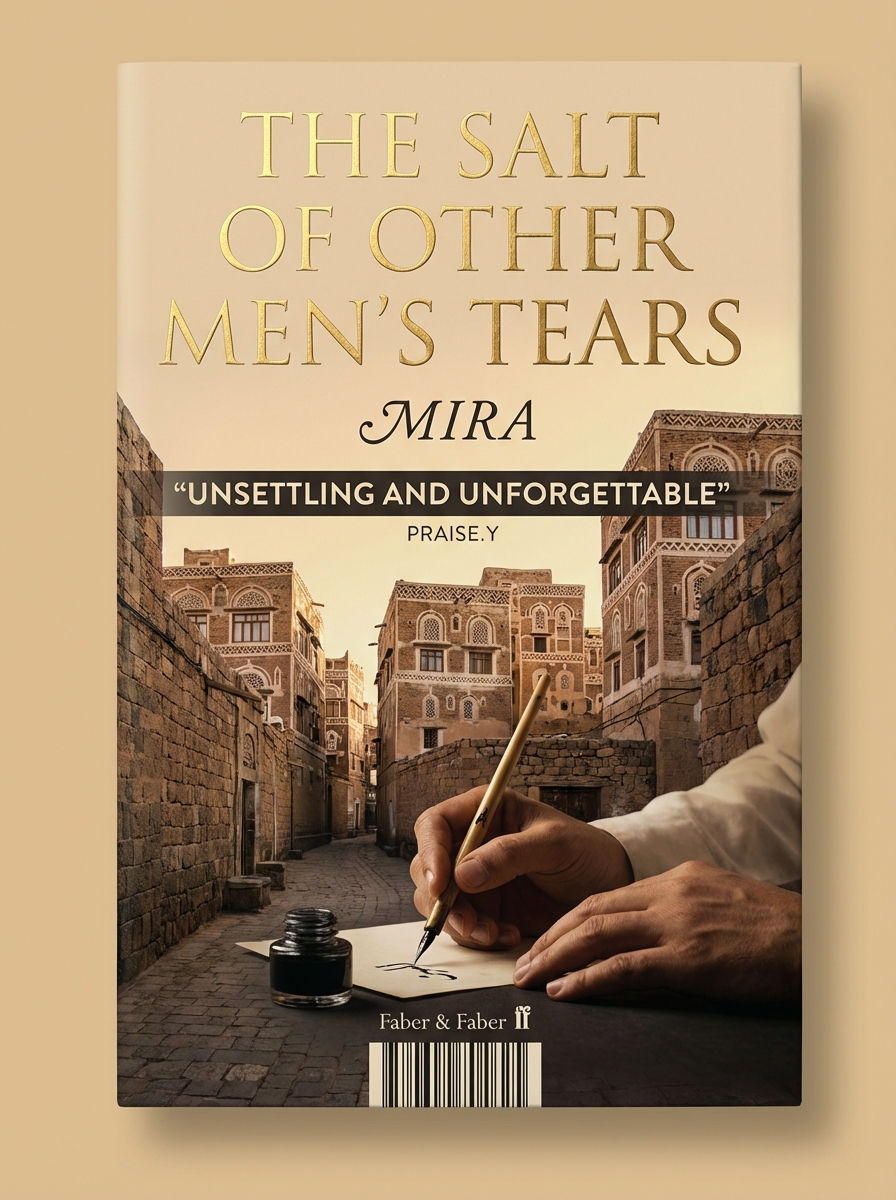
Synopsis
In the labyrinthine alleyways of Old Sana'a, Yemen, where ancient houses lean like weary grandmothers, a young calligrapher grapples with an impossible choice. As the relentless blockade tightens its grip, starving not just bodies but spirits, he must decide if the fragile beauty of his art can outw
Chapter 1: The Inkwell's Dryness, The City's Thirst
The air, thick with dust and the ghosts of frankincense, clung to Ibrahim’s skin like a shroud. It was a familiar embrace, this scent of Old Sana’a, a blend of sun-baked mud, cardamom, and the ever-present yearning that hummed beneath the city’s ancient stones. Today, though, a new note had been added to the symphony of smells – the acrid tang of despair, a scent that prickled the back of his throat and made his eyes water, even without the wind.
He sat cross-legged on the worn rug, a single beam of sunlight, fractured by the intricate *qamariya* window, illuminating the parchment before him. His reed pen, honed to a perfect point, lay beside a small, stoppered bottle of ink. The bottle was almost empty. A tremor, barely perceptible, ran through his fingers. It wasn’t the tremor of age, for Ibrahim was barely twenty-five, but of a quiet, gnawing fear.
Above him, the house, leaning precariously like an old man lost in thought, groaned. It was a sound he’d grown up with, the sigh of timber and mortar yielding to time and gravity. Now, each creak felt like a lament. The house, like the city, was hungry. And so was he. His stomach, a hollow drum, had been playing its own rhythm for days.
The headline, scrawled clumsily in charcoal on a scrap of paper someone had passed around the souk yesterday, still burned in his mind: "UN warns of imminent famine in Yemen, 16 million at risk." Sixteen million. A number so vast it felt abstract, yet each day, it solidified, taking on the faces of his neighbors, the gaunt cheeks of the children who no longer chased pigeons in the courtyard.
He picked up the pen, its smooth shaft a familiar comfort against his calloused skin. He had intended to practice a new script, a flowing *Thuluth* that spoke of ancient wisdom and enduring beauty. But the inkwell’s dryness mocked him. He tilted the bottle, coaxing a few last drops to bead at the opening, dark and viscous, like the city’s fading hope.
His mother, Fatima, shuffled into the room, her silhouette framed by the arched doorway. Her face, etched with lines that spoke of a thousand unspoken worries, softened when she saw him. “Still at your letters, Ibrahim?” Her voice was a dry rustle of leaves.
He nodded, a silent apology for the futility of his efforts. “The ink is almost gone, Mama.”
She sighed, a sound that seemed to carry the weight of generations. “Everything is almost gone, my son.” She sat beside him, her hand, rough from years of grinding grain and kneading dough, lightly touching his arm. “The flour… it was enough for today, maybe tomorrow. Then?”
The unasked question hung in the air, heavy and suffocating. “I went to the market, Mama. There was nothing.” It was a lie, half-truth. There were sacks of rice, tins of oil, but the prices… they were a cruel joke. A month's wages for a day's meal. He couldn't bring himself to tell her that. Better for her to believe there was simply nothing.
He looked at the unfinished piece before him, a verse from an old poem celebrating the resilience of the human spirit. The irony was a bitter taste in his mouth. What good was resilience when one’s very bones ached with hunger?
His gaze drifted to the window, to the intricate patterns of the *qamariya*, each piece of stained glass a tiny world of color. From this perch, he could see the terracotta rooftops, the minarets piercing the bruised sky, and the distant, skeletal cranes that stood as grim sentinels over the city, monuments to a development that had never arrived. He could almost hear the city’s collective sigh, a long, drawn-out exhalation of weariness.
He thought of his cousin, Yusef, who had left two years ago. To Saudi, they said. For work. For a life that wasn’t a constant struggle against the tide. Yusef, with his strong hands and his easy laugh, now sent home crisp banknotes that smelled of foreign lands and a kind of freedom Ibrahim could only imagine. His letters, infrequent and always brief, spoke of construction sites and long hours, but also of food. Of *enough*.
Was that what he was meant to do? Leave this ancient labyrinth, this cradle of his soul, for the sterile promise of another’s land? The thought was a sharp pang in his chest. His art, his calligraphy, was rooted here, in the dust and the stories of these stones. How could he create beauty in a place where the very air was alien, where the wind did not whisper the names of his ancestors?
He traced the outline of a letter on the dry parchment with his fingertip, the phantom pressure a ghost of ink. The beauty of the script, the balance, the flow – it was more than just lines on a page. It was a language of the soul, a connection to something eternal. In a city where everything else was crumbling, his art felt like the last bastion of order, of meaning.
But meaning didn’t fill an empty stomach. Meaning didn’t stop the crying of the neighbor's child, a thin wail that pierced the quiet of the afternoon.
Fatima’s hand tightened on his arm. “The water seller… he said his well is almost dry. The trucks… they don’t come anymore.” Her voice was a whisper, a stark contrast to the urgency of her words.
The news was another brick in the wall of despair. Water. The very source of life. He closed his eyes, picturing the well in their courtyard, a cool, dark cylinder that had sustained their family for generations. Now, it was just another dry mouth, another thirsty throat.
He remembered the old stories his grandfather used to tell, of famines past, of people turning to the desert, returning with nothing but dust in their mouths. But those were stories. This was now. This was the headline, the stark reality of the UN report.
He opened his eyes, looking at his mother. Her gaze was steady, filled with an ancient strength, but also with a plea he couldn’t ignore. It was the plea of a mother for her child, for her family, for survival.
The reed pen felt suddenly heavy in his hand, not a tool of creation, but a burden. What was the value of a perfectly formed letter, a beautifully rendered verse, when the silence of hunger echoed in every room? Was his art a luxury they could no longer afford? Was it selfish to cling to it, to meticulously grind pigments and prepare parchment, when the very ground beneath them was parched and pleading?
He imagined himself packing a small bag, leaving behind the scent of frankincense and cardamom for the sterile smell of diesel and foreign sweat. He imagined the faces of his neighbors, their eyes, not of anger, but of a quiet understanding, a shared burden of impossible choices.
The inkwell, glinting in the sliver of sunlight, seemed to mock him with its emptiness. Its dryness mirrored the city's thirst, and his own. And in that dryness, a decision, a nascent, terrifying thought, began to form, like a single drop of water appearing in a vast, arid landscape. It was a thought that tasted of salt, of other men’s tears, and of a profound, heartbreaking betrayal. But it was also a thought of survival.
Chapter 2: A Handful of Dates, A Universe of Doubt
The sun, a brazen eye in a sky bleached by dust and longing, beat down on the souk. It was a sun that had seen empires rise and fall, seen the very stones of Sana’a shift underfoot, but never, not in living memory, had it seen such an emptiness. The usual cacophony of vendors hawking spices and silver, the rhythmic clanging of coppersmiths, the boisterous laughter of children – it was all muted, a faded tapestry. Now, the dominant sound was the shuffle of worn sandals, the murmured negotiations for a single sack of flour, the hollow coughs that echoed from shadowed doorways.
Yahya’s stall, usually a vibrant splash of indigo and crimson, adorned with his delicate calligraphy on parchment and ceramic, felt like a forgotten corner of a dream. Today, only two people paused. An old woman, her face a roadmap of grief, traced a finger over a verse from the Quran Yahya had transcribed, her lips moving silently as if the words themselves could conjure sustenance. Then, with a sigh that seemed to carry the weight of generations, she moved on, her empty basket swinging like a pendulum of despair.
The second was a boy, no older than ten, his eyes wide and hungry, not for art, but for something else. He held a handful of dates, shriveled and dark, and offered them to Yahya. “For a story, Ustadh,” he whispered, his voice thin as dry grass.
Yahya’s heart clenched. He remembered a time when children would gather, enchanted by the tales he wove with his brush, stories of jinns and ancient kings, of love that bloomed in hidden gardens. Now, their currency was food, their stories born of a different kind of hunger. He looked at the boy’s outstretched hand, at the meager offering, and then at the boy’s ribs, stark beneath his threadbare tunic.
“Keep them, little one,” Yahya said, his voice raspy. “Your hunger is a story enough.”
The boy’s eyes, however, held a stubborn glint. “My mother says you have the words that make the heart sing. She says a singing heart is still alive.”
Yahya swallowed, the taste of ash in his mouth. A singing heart. How long since his own had managed more than a mournful hum? He thought of his sister, Fatima, her eyes growing hollower each day, her laughter a distant echo. He thought of his mother, her hands, once nimble with embroidery, now trembling as she rationed the last handful of tea leaves.
He took a single date from the boy’s palm, its sweetness a shock against his parched tongue. “Thank you,” he said, his voice thick. “What story would you hear?”
The boy’s face, for a fleeting moment, brightened. “Of the bird that flew beyond the mountains, where the river never dries.”
Yahya dipped his brush into the meager inkpot, the black liquid a precious commodity. He began to paint, not on parchment, but on a discarded shard of pottery, the lines fluid and sure. The bird took shape, its wings outstretched, its gaze fixed on an unseen horizon. As he painted, he spoke, his voice low and melodic, weaving the tale of the bird’s journey, of the hardships it faced, the storms it weathered, and the longing in its heart for the endless river. He watched the boy’s face, rapt, the hunger in his eyes momentarily replaced by a different kind of yearning.
When he finished, the bird a vibrant silhouette against the dull clay, the boy stared at it, then at Yahya. “Did it find the river, Ustadh?” he asked, his voice barely a whisper.
Yahya met his gaze. “It is still flying, little one. The journey is long.”
The boy nodded, a flicker of understanding in his young eyes. He clutched the pottery shard to his chest and disappeared into the throng, leaving Yahya with the ghost of a date’s sweetness and the heavy weight of the unspoken question.
Later that evening, as the first stars pricked the bruised sky, casting long, wavering shadows between the leaning houses, Yahya sat in the courtyard of his family home. The air, usually fragrant with jasmine and frankincense, now carried the faint, metallic scent of hunger. His mother, her face etched with worry lines, stirred a pot of thin broth over a sputtering fire, the flames casting dancing shadows on her worn hands. Fatima, her eyes distant, sat weaving a basket from dried palm fronds, her movements slow and deliberate.
“The price of flour has doubled again,” his mother said, her voice a flat statement of fact. “And the medicine for your father… the apothecary said he has none left.”
Yahya closed his eyes. His father, a man of booming laughter and strong hands, now lay frail and silent in the inner room, his breath a shallow rasp. The herbal remedies and whispered prayers had done little. What he needed was modern medicine, medicine that was locked away by the blockade, as effectively as if it were behind a thousand bolted doors.
He remembered the conversation he’d overheard in the souk, a hushed exchange between two men about the ‘lists.’ Lists of those who had managed to find a way out, lists of those who had paid their way to a distant shore, to a place where the rivers flowed freely and the children did not trade dates for stories. The words, whispered like forbidden incantations, had been an arrow to his heart.
“There are rumors,” Fatima said, her voice soft, not looking up from her weaving. “Of opportunities, across the sea.”
Yahya opened his eyes. He saw the subtle tension in her jaw, the way her fingers clutched the palm fronds a little tighter. He knew she was thinking of her children, of the hollow ache in their bellies, of the coughs that rattled their small chests.
“What rumors, habibti?” he asked, his voice carefully neutral.
Fatima finally met his gaze, and in her eyes, he saw a reflection of the same impossible question that had been gnawing at his own soul. “They say there are places, places where a man with your skill, Ustadh, could find work. Where there is ink, and paper, and food.”
The words hung in the air, heavy and resonant. *Ink, and paper, and food.* The very things that were slowly, inexorably, being choked out of Sana’a. He thought of the bird in his story, still flying, its journey long. Was it a betrayal to dream of such a flight? To leave the parched earth that had nurtured his roots, to seek the endless river elsewhere?
He looked at his mother, her shoulders stooped, her face a canvas of quiet endurance. He looked at Fatima, her beauty fading under the relentless assault of scarcity. He felt the weight of their unspoken hope, a hope that was both a balm and a brand.
His art, the delicate dance of ink on paper, was his sacred calling, his anchor in a world that spun out of control. But what good was a beautiful poem if the hand that wrote it trembled from hunger? What solace could a calligraphic verse offer a child whose belly ached?
The dates, he realized, had been a bribe, a desperate plea for a different kind of sustenance. And the boy’s question – *Did it find the river, Ustadh?* – echoed in the silent courtyard, a universe of doubt contained within its simple query. A bird, after all, was meant to fly. But what of a man, rooted in the very stones of his home, when the soil itself was turning to dust? The choice, he knew, was not just his own. It was a choice that would ripple through their lives, a choice between the salt of other men’s tears, and the parched, aching dryness of their own.
Chapter 3: The Whispers of the Silk Road
The midday call to prayer, usually a tapestry woven from a thousand voices, now felt threadbare, a faded echo against the relentless hum of the generator in the distance. It was a sound that had become the anthem of Sana'a, a mechanical heartbeat beneath the city’s ancient skin, a constant reminder of what had been lost. Omar sat cross-legged on the cool stone floor of his studio, the sunlight slanting through the high window, illuminating motes of dust dancing in the air like forgotten spirits. The parchment, a gift from his grandfather, lay before him, stark and unblemished. It was a canvas of silence, waiting for the symphony of his ink.
He held the qalam, the reed pen, between his fingers, its familiar weight a comfort, an extension of his very being. But today, it felt alien, heavy with the unspoken words of others. He’d spent the morning listening. A neighbor, her face etched with the lines of too many sleepless nights, had spoken of her youngest, a boy whose laughter now sounded like a dry cough. She’d heard of a cousin, in Riyadh, working the construction sites, sending back enough riyals to buy flour, even a small sack of rice. The desert, she’d whispered, held a cruel kind of plenty. Another, a former merchant whose spices once perfumed the souk, recounted his brother’s journey to Turkey, a harrowing odyssey across choppy waters, but one that had ended in a steady, if meager, job in a textile factory. The stories, like a slow-moving river, had begun to erode the foundations of his resolve.
He dipped the qalam into the inkwell, the black liquid swirling like a miniature galaxy. He’d intended to transcribe a verse from Rumi, something about the soul’s yearning for discovery, for the beloved. But the elegant curves and precise angles of the Arabic script seemed to mock him, a beautiful irrelevance in the face of the gnawing hunger that echoed through the narrow streets.
His gaze drifted to the small, framed photograph tucked into a corner of his workbench. His father, a younger, more vibrant man than the ghost who now haunted their shared home, stood beside a meticulously restored antique Qashani tile. His father’s hands, now trembling as he tried to lift a cup of tea, had once carved intricate patterns into wood, breathed life into clay. A craftsman, like Omar, a man who believed in the enduring power of creation. "Art, Omar," he’d often said, his voice resonant with conviction, "is the salt of our tears. It preserves us."
But what if the tears had run dry? What if there was no longer salt, only a parched earth?
He thought of the headline he’d glimpsed on a crumpled newspaper someone had left behind in the tea shop: "Yemen on the Brink: Famine Looms as Aid Blocked." Brink. A precipice. And below, not a soft landing, but a chasm.
The stories of those who had left, once whispered in hushed tones of disapproval, now resonated with a desperate hope. These were not tales of betrayal, but of survival, of a yearning for something beyond the relentless grind of scarcity. The Silk Road, once a conduit for spices and silks, for ideas and art, now seemed to stretch out through the air, carrying the hopes and fears of those who dared to traverse it. Not on camelback, but on rickety boats, on crowded buses, on the desperate wings of prayer.
He began to write, not Rumi, but the words of his neighbor, the ache in her voice. *My son’s laughter, like a dry cough.* The qalam moved with a hesitant grace, each stroke a silent confession. He saw her face, the way her eyes, once bright with the spirit of Sana'a, had dulled to a weary grey. He saw the spectral thinness of her boy’s limbs. And he saw, with a clarity that stung, the reflection of their hunger in his own family’s eyes.
His mother, who once hummed as she kneaded dough, now moved through the house with the silence of a shadow. His younger sister, Fatima, who used to beg him for fanciful stories, now only asked for extra water with her meager portion of rice. The very air in their home felt thin, stretched taut with unspoken anxieties.
He knew what his father would say. *Stay. This is our home. Our roots run deep.* He knew the weight of that ancestral earth, the pull of the ancient stones that formed their house, the scent of jasmine that still clung to the courtyard walls. It was in his bones, in the rhythm of his blood. But what good were roots if the soil itself was barren? What good was the scent of jasmine if it masked the stench of decay?
He remembered a conversation with his friend, Tariq, a poet whose words were as sharp as his wit. Tariq, ever the cynic, had declared, "Art is a luxury, Omar, when bellies are empty. A beautiful lie." Omar had argued, passionately, that art was sustenance for the soul, a defiant act against the darkness. But Tariq’s words, once dismissed, now echoed with a chilling truth.
He paused, the ink drying on the parchment. He looked at his hands, calloused not from labor in the fields, but from the delicate dance of the qalam. These hands, which could bring intricate beauty to life, felt utterly useless in the face of the stark realities pressing in. They could not conjure bread from stone, nor water from dust.
He closed his eyes, and a map of the world unspooled in his mind. The vast, indifferent expanse of it. To the north, the desert, then the sea, then lands where the shops were full, where children played without the specter of hunger in their eyes. He imagined the harsh glare of fluorescent lights in a factory, the relentless clatter of machinery, the smell of foreign food that might fill a child’s empty stomach. It was a landscape devoid of history, of the layered stories etched into every stone of Sana'a. It was a place of exile, of being uprooted. But it was also, perhaps, a place of survival.
The whispers of the Silk Road grew louder, no longer just the distant murmur of other people’s desperation, but a voice in his own heart, a yearning that felt like a betrayal and a necessity all at once. The inkwell, once a symbol of his craft, now seemed to hold not just ink, but the tears of a city, the salt of other men’s tears, and perhaps, the bitter salt of his own. The blank parchment before him was no longer just a canvas for words, but a testament to an impossible choice, waiting to be written.
Chapter 4: Across the Gulf, A Different Shade of Sky
The dust motes in the last shafts of Sana’a sunlight had always danced like tiny, forgotten stars in my father’s calligraphy studio. Now, they seemed less a celestial ballet and more the restless spirits of those who had gone hungry, their silent pleas echoing in the sudden emptiness. My brushes, once robust with badger hair, lay limp, their bristles matted with the residue of thin, watery ink. The vellum, once a creamy canvas awaiting verse, now felt like parchment, brittle with unfulfilled promise.
“They say… they say the oil fields of Marib are burning again,” Omar had murmured, his voice a dry rustle, like autumn leaves skittering across a parched wadi. He’d been tracing the outline of a child’s outstretched hand on the dusty ground outside the *souk*, a habit he’d picked up from his younger sister, Miriam. Miriam, who now slept more than she woke, her eyelids a delicate blue against her pale skin.
The headline, when it finally reached us, was a crude affair, scrawled on a fragment of cardboard by some enterprising soul who’d managed to find a working marker. *“Marib Burns. Fuel Prices Triple.”* It was a brutal haiku of our ongoing despair, each word a hammer blow to the already fractured foundation of our lives.
My own hands, once steady as the mountains that embraced Sana’a, trembled as I tried to steady the *qalam*. The last fragment of a proverb, “*Patience is a key to comfort*,” remained unfinished. How much patience did a man need when the comfort was not his own, but that of a child whose belly ached with a hunger so profound it stole the light from her eyes?
Omar’s words, heavy with the unspoken, had been the first chisel stroke against the stone of my resolve. “My cousin’s eldest… he’s in Jeddah. Says there’s work. Construction. Even for the unlettered.” He’d kicked at a loose stone, sending up a puff of dust that momentarily eclipsed the setting sun. “They’re building skyscrapers, Ali. So tall they pierce the clouds.”
I’d looked at the ancient, leaning houses of Sana’a, their mud-brick walls a testament to centuries of resilience, and felt a cold knot tighten in my gut. Skyscrapers. A different world. A world where the sky was not a canvas for dust motes and fading hope, but a backdrop for steel and glass, a monument to a prosperity we could only dream of.
The whispers had grown louder since then, a chorus of hushed conversations in the tea houses, in the narrow alleys. *“Across the Gulf…”* The phrase was a siren song, luring away the young, the strong, the desperate. It was a gamble, a betrayal even, to leave behind the crumbling grandeur of our city, the silent pleas of our families. But what was more treacherous: to stay and watch them fade, or to seek a different shade of sky, even if it meant abandoning the earth that birthed you?
My mother, her face etched with the wisdom of the ages, had watched me with an unnerving stillness. She knew. Mothers always knew. She’d not said a word, but her eyes, deep pools of sorrow and understanding, had spoken volumes. They told me of the countless others who had made this same journey, not across seas, but across the invisible chasm of despair. The fathers who left, their backs stooped with the weight of unspoken goodbyes, their hearts torn between duty and the ache of yearning for something more.
One evening, as the Muezzin’s call floated over the rooftops, a sound that usually brought me solace, I found myself staring at the half-finished proverb. *“Patience is a key to comfort…”* What if the comfort was not here, in a city slowly suffocating, but in the distant clang of construction, in the echo of foreign currency? What if the key to comfort was to unlock the door to a different life, even if it meant leaving behind the one I knew, the one that had shaped me?
My father’s inkwell, a heavy bronze vessel, sat on the scarred wooden table. I dipped my finger into the remaining ink, a dark, viscous pool, and felt the chill of it seep into my skin. It was the same ink he had used to teach me the delicate dance of the *alif*, the graceful curve of the *lam*. It smelled of earth and history, of all the stories Sana’a held within its ancient walls.
The decision, when it came, was not a sudden burst of clarity, but a slow, agonizing unraveling. Like a thread pulled from a worn tapestry, leaving a gaping hole behind. It wasn't about courage; it was about a different kind of fear. The fear of not trying. The fear of staying.
I remembered a headline from months ago, a smaller one, almost lost amidst the grim reports of skirmishes and shortages: *“Yemeni Poet Wins International Award, Cannot Attend Ceremony.”* He was celebrated, revered, his words a balm to a world that desperately needed beauty. But he remained here, trapped, his triumph a hollow echo across the gulf. Could art truly sustain? Could the beauty of a perfectly formed letter feed a hungry child?
I thought of Miriam, her small hand tracing patterns in the dust, her eyes, once bright with the joy of childhood, now shadowed with a weariness that was not her own. I thought of Omar, his quiet desperation, the way he looked at the distant mountains as if searching for an escape route.
The irony was not lost on me. I, the calligrapher, whose life was dedicated to the preservation of words, was now contemplating a journey where words might be useless, where the language of survival was spoken in the clatter of tools and the sweat of physical labor.
I took out a fresh piece of vellum, the last good sheet I had. The inkwell, despite my earlier misgivings, seemed to beckon. I would write. Not a proverb, not a poem, but a letter. A letter to my family, to my city, to the part of myself I was leaving behind. It would be a testament to the wrenching choice, a fragile bridge built of words across the vast, emotional chasm that lay before me. I would write of the hope, however faint, of a different shade of sky, and the bitter tang of the salt of my own tears, not of others, as I embraced the terrifying unknown. The moonlight, filtering through the cracked windowpane, illuminated my trembling hand as I dipped the *qalam* into the ink. The first stroke. A new beginning, or an end? Only the distant skyscrapers, piercing a different sky, would know.
Chapter 5: The Weight of a Homeland, The Light of a New Dawn
The air, thin and sharp, tasted of pine and an unfamiliar freedom. Not the acrid tang of dust and distant shelling that had become Sana’a’s perfumed sorrow, but something clean, almost sterile. Yusuf traced the condensation on the window of the small, rented apartment, a ghost of a calligraphic flourish. The city lights below, a sprawling tapestry of electric gleam, felt less like a comfort and more like an accusation. Each twinkling bulb a silent judgment against the darkness he’d left behind, a darkness that was as much within him as it was in the city walls.
He had promised himself, in those desperate last days, that once he was out, truly out, the phantom tremors would cease. The sound of distant jets would no longer rattle his bones, the scent of burning tires would no longer cling to his clothes like a second skin. But even here, in the sterile quiet of a place untouched by war, the echoes persisted. A car backfiring on the street below would send a jolt through him, a memory of a mortar’s dull thud. The sudden clang of a dropped pot in the apartment upstairs would conjure the image of crumbling stone, of dust rising in plumes like the breath of a dying beast.
His hand, which had once danced with such delicate precision across parchment, now trembled slightly as he poured himself a glass of water. It was cool, clean, and plentiful. A cruel luxury. He thought of his mother, her lips perpetually chapped from thirst, her eyes, once bright as desert stars, now dulled by an endless parade of worry. He pictured the children in the souk, their ribs stark against their thin shirts, their pleas for a single date echoing in the cavernous halls of his memory.
Was this the price of survival? To carry the ghosts of those left behind, to have their hunger gnaw at his own full stomach, their thirst parch his own well-watered throat? He had imagined this new land differently. A place where the ink would flow freely, where the delicate curves of the *Thuluth* script would once again find their rhythm, unburdened by the weight of starvation and impending doom. He had envisioned himself, not a refugee, but an artist, a cultural ambassador, weaving the beauty of his homeland into the fabric of this new one.
But the reality was a stark, unyielding beast. The language, though he’d studied it diligently, felt like a constant stumble, a clumsy dance where everyone else knew the steps. The people, though kind in their own distant way, seemed to exist behind a pane of glass, their lives vibrant and full, while his own felt muted, a faded photograph. He was a shadow, a whisper, a footnote in the bustling narrative of their existence.
He closed his eyes, summoning the image of his *kufic* piece, the one he’d worked on for months, a stanza from a Yemeni poet, a testament to resilience and hope. It now lay rolled and tied with a silk ribbon, hidden in the deepest corner of his suitcase. He hadn’t touched it since he arrived. The idea of taking it out, of laying it flat on a clean, empty table, felt like a betrayal. How could he create beauty when beauty felt so utterly irrelevant, so criminally indulgent, in the face of what he had witnessed?
A small, thin envelope lay on the chipped wooden table. His name, spelled out in precise, unfamiliar script, stood out against the pale paper. It was from the NGO that had sponsored his visa, a reminder of the practicalities that governed his new life. The next payment for his language classes was due. And then there was the rent, the utilities, the food. The endless, relentless arithmetic of survival.
He remembered a conversation with his father, just days before he left. His father, a man of quiet strength, his hands calloused from years of working stone, had looked at him with an gaze that held both pride and unspeakable sorrow. "Go, my son," he had said, his voice raspy, "but remember, the salt of other men’s tears will never taste the same as your own." The words had clung to Yusuf then, a bitter premonition. Now, they were a full-fledged reality.
He picked up a pen, a simple ballpoint, so different from the reed pens he was accustomed to. He opened a small notebook, its pages pristine white, unmarred by the faint smudges of charcoal or the ghost of a spilled inkwell. He tried to write, to find a single perfect letter, a sliver of the graceful script that had been his solace, his language, his identity. But his hand felt heavy, alien. The lines he drew were jagged, uncertain, betraying the turmoil within.
He thought of the news reports, flashed across the screens in the cafe downstairs, of the dwindling aid, the impassable roads, the silent, agonizing descent into famine in the land he called home. He had seen a photograph, a child with eyes too large for its emaciated face, a child that could have been his younger cousin, or one of the boys who used to play football in the dusty square outside his window. The image had seared itself into his mind, a constant burning ember.
His guilt was a tangible thing, a lead weight in his chest. He was safe, warm, fed. And they were not. He had chosen to leave, to seek sustenance for his own spirit, his own body, while theirs withered. Was it cowardice? Selfishness? Or was it survival, a desperate, animalistic urge to find light in the encroaching darkness?
He looked out the window again. The city lights glittered, indifferent. He was a stranger here, a refugee, a recipient of charity. He was not the artist he had once been, not the son, not the brother, not the calligrapher who found beauty in every curve and every line. He was simply Yusuf, adrift in a sea of plenty, haunted by the spectres of scarcity.
A deep sigh escaped him, a sound that carried the weight of a homeland, the burden of a choice. The new dawn, so promising in its quiet glow, felt less like a blessing and more like a challenge. Could he find a way to honor the beauty he’d left behind, to weave its essence into this unfamiliar tapestry, without betraying the aching hunger for bread that still resonated in his soul? The answer, he knew, lay not in avoiding the pain, but in confronting it, in allowing the salt of those tears to fuel a new kind of art, a new kind of hope. But how, and when, and with what fragile strength, he did not yet know.