The Salt-Kissed Silence
By Mira
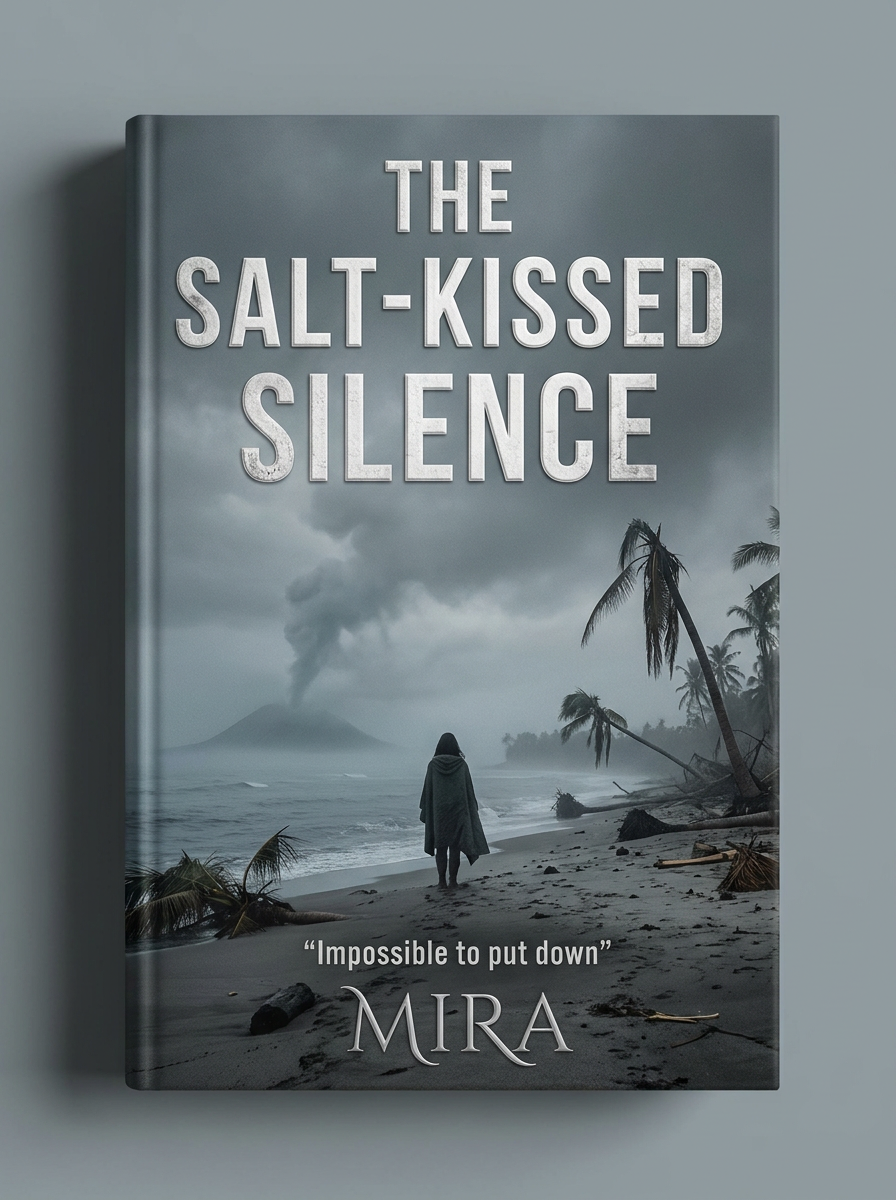
Synopsis
In the wake of a catastrophic undersea volcanic eruption that has plunged the Tongan archipelago into an unprecedented state of isolation, a young woman grappling with a deeply buried family secret must navigate not only the immediate devastation but also the agonizing uncertainty of what remains be
Chapter 1: The Sky's Angry Breath
The air, thick and metallic, tasted of ash and a deeper, more primal fear. It wasn't the sweet, salt tang of the Pacific I knew, the one that usually clung to my skin like a second self. This was the sky's angry breath, a suffocating shroud that had descended upon us with the sudden ferocity of a betrayed god.
I remember the exact moment the world fractured. Not the initial, deafening roar – that was a distant memory, a tremor in the bone, a vibration in the gut. No, it was the silence that followed, a silence so profound it felt like a physical absence, the earth holding its breath, the ocean’s usual symphony abruptly muted. It was the silence that truly marked the before and the after.
Before, there was the rhythmic lull of waves against the shore of 'Eua, the whisper of coconut fronds in the perpetual breeze, the boisterous laughter of children chasing crabs on the white sand. Before, there was the reassuring hum of the generator in the evenings, a fragile thread connecting us to a world beyond our reef. Before, there was the news, a faraway murmur of politics and pandemics, filtered through crackling radio waves, distant enough to feel almost fictional.
Now, there was only the ash. It settled on everything, a fine, grey powder that coated the vibrant hibiscus, dulled the emerald sheen of the taro leaves, and transformed the familiar world into a grayscale replica of itself. It clung to my hair, grit between my teeth, and, I imagined, coated the very lining of my lungs. Each breath was a conscious effort, a cautious intake of a poisoned world.
My name is Lani. And in the crucible of this new silence, I felt the weight of my own name, a soft, flowing sound, rendered utterly insignificant against the harsh reality that had swallowed our lives whole.
The headlines, I recalled now in a fragmented, almost dreamlike way, had spoken of an undersea volcano. A distant rumble, a scientific curiosity. No one had imagined this. No one could have. The pictures, grainy and flickering on a borrowed screen, had shown plumes of smoke, a churning sea. They hadn’t captured the terror, the bone-deep knowing that the very foundations of our existence were being ripped apart.
The first sun after the eruption was a bruised, orange orb, struggling to pierce the perpetual twilight. It cast long, distorted shadows that danced like phantoms across the ash-laden landscape. Our small village, usually a riot of color, was muted, hushed. The usual morning chatter was replaced by a low murmur of voices, a shared, unspoken dread.
I found my grandmother, Nana Lia, on the porch of our fale, her back ramrod straight, her gaze fixed on the horizon where the sky met the bruised sea. Her silver hair, usually meticulously braided, was loose, peppered with ash, framing a face etched with a lifetime of stories. But in her eyes, I saw something I hadn't seen before – a stark vulnerability that pierced me deeper than any fear for my own life.
"Nana," I said, my voice hoarse, the ash catching in my throat.
She didn't startle, didn't turn. Her eyes, the color of wet sand, remained fixed. "The sea has forgotten its song, Lani," she said, her voice a dry rustle of leaves. "And the sky… the sky weeps for what it has done."
I sat beside her on the rough-hewn bench, the wood cold beneath my thighs. The usual scent of frangipani and the salty air was gone, replaced by the acrid smell of sulfur. A tremor ran through the earth, a faint, unsettling reminder of the power that had unleashed this devastation. We flinched, a shared, instinctive reaction, then settled back into our vigil.
My gaze followed hers to the horizon. It was an unnerving expanse. The familiar contours of the sister islands, usually a comforting presence on the distant curve of the earth, were gone. Swallowed by the very ocean that had sustained us. The silence stretched, vast and oppressive. No boats, no planes, no distant echoes of modern life. We were adrift, not on the sea, but in a void.
Nana Lia was a woman of stoic strength, a matriarch who carried the weight of our family's history in the deep lines around her eyes. She had seen cyclones, droughts, and the slow, insidious erosion of our traditions by the encroaching world beyond. But this… this was different. This was an obliteration, a severing.
"What do we do, Nana?" I asked, the question escaping me like a breath I hadn't realized I was holding.
She finally turned, her gaze meeting mine. In her eyes, I saw not just the shared grief, but a deeper, more profound sorrow – a sorrow that seemed to carry the weight of generations. It was then I remembered the secret, the one she had entrusted to me on my eighteenth birthday, a whispered confession under the full moon, a story of choices made in desperation, of a past that refused to stay buried. A story that, in this new, fractured world, felt both utterly insignificant and terrifyingly relevant.
The secret was a name, a name whispered with a tremor in her voice, a name that belonged to a child she had given away, decades ago, during a time of famine and despair. A choice she had made to ensure survival, a choice that had haunted her every living day. She had told me because I was the only one she trusted, the only one she believed would understand the impossible burden of such a decision. And now, in this unprecedented isolation, that secret felt heavier, more tangible, like a living thing pressing against my ribs.
"We breathe, Lani," she said, her voice low, raspy. "We breathe, and we remember. And then, we find a way to live."
Her words, simple and profound, settled in the heavy air. But how could we remember, when the very landscape had been wiped clean? How could we live, when the future stretched before us, an unwritten page in a language we no longer understood?
The ash continued to fall, a soft, relentless rain, coating our world in a uniform grey. It was a physical manifestation of the uncertainty, the slow, suffocating creep of the unknown. And in that ash-laden silence, I felt the truth of our new existence: we were alone. More alone than we had ever been. And the secret, the one I carried for Nana, felt like a silent, burning ember in the depths of my heart, waiting to ignite in this barren, ash-strewn world. The anger of the sky had passed, leaving behind a silence that demanded an answer, a new song from a world that had forgotten how to sing. And I, Lani, felt the stirrings of a desperate need to find that forgotten melody.
Chapter 2: Beneath the Ashfall, a Lingering Taste
Beneath the Ashfall, a Lingering Taste
The air, thick and gritty, clung to the tongue like a forgotten lament. Days blurred into a monochrome tapestry of ashfall, each gust of wind a fresh reminder of the sky’s recent, terrible confession. The sun, a bruised plum behind the perpetual haze, offered no warmth, only a wan, spectral light that made the familiar world feel alien. A constant, faint tremor hummed beneath my feet, a phantom echo of the earth’s recent convulsion, a bass note in the symphony of our new silence.
Our home, once a riot of hibiscus and bougainvillea, was now a skeletal silhouette, its vibrant colors muted by a uniform coat of grey. The frangipani tree, my mother’s pride, lay splintered across the roof, its sweet fragrance replaced by the acrid tang of sulfur. I traced a finger through the ash on the kitchen counter, revealing the polished wood beneath, a tantalizing glimpse of what was. The dust motes danced in the sparse light, each one a tiny, shimmering particle of our shattered world.
My grandmother, Nana Elara, sat by the window, her gaze fixed on the muted horizon. Her hands, gnarled and wise, picked at a loose thread on her tapa cloth. She hadn’t spoken much since the sky had roared, her usual boisterous laughter replaced by a quiet, watchful stillness. It was as if the eruption had stolen not just the sound from the air, but the words from her tongue. I watched the rise and fall of her chest, a steady rhythm that anchored me in the bewildering currents of our shared grief.
Food was scarce, the well water a cloudy, brackish offering. We rationed the last of the tinned fish, each bite a solemn communion with a past that felt impossibly distant. The children, usually a whirlwind of energy, moved with a subdued grace, their games played in hushed tones, as if fearing to disturb the fragile peace that had settled upon us. Their eyes, wide and luminous, held a wisdom far beyond their years, a silent testament to the rapid education the earth had given them.
I found myself drawn to the shore, though there was little left of it. The sea, once a playful companion, had recoiled, leaving behind a stark, alien landscape of exposed coral and shattered shells. The air thrummed with a different kind of silence here, a vast, echoing emptiness that swallowed sound. The usual symphony of waves breaking, the distant cry of gulls, the gentle rustle of palm fronds – all gone. Now, there was only the gentle *shhh* of the ash settling, a constant, pervasive whisper.
The fishing boats, once bobbing like contented birds on the turquoise expanse, were now either splintered wreckage or simply vanished. My father’s boat, the *Moana Lani*, was among the missing. A knot tightened in my stomach with every thought of him, a cold, hard stone of dread. He had been out at sea, as he often was, chasing the silver shimmer of tuna, when the world had torn itself open. “He’ll be back, Elara,” Nana Elara would say, her voice a fragile balm, but her eyes held a sorrow that belied her words. I knew she was thinking of her own husband, lost to the unforgiving currents years ago. The sea, in its boundless generosity, could also be a cruel thief.
The silence of the sea amplified the internal clamor of my thoughts. Each day brought a slow, agonizing realization of the extent of our isolation. No news, no ships, no planes. We were an island within an island, adrift in a sea of uncertainty. The world beyond our ash-dusted shores might as well have ceased to exist. And with that thought came the cold dread of what this meant for the secret, the one that had been woven into the very fabric of our family, a delicate thread of shame and sacrifice passed down through generations.
It was a story my mother had warned me against, a whisper in the dark, a shadow that clung to the edges of our happiness. “Some things are best left buried, Mira,” she’d said, her eyes heavy with an unspoken burden. But the earth itself had now been unburied, its raw, exposed wounds mirroring the fissures in our carefully constructed lives.
I picked up a piece of pumice, light and porous, still warm from the earth’s fiery breath. It looked like a petrified sponge, a testament to the unimaginable forces unleashed beneath the waves. How could a secret, however profound, remain hidden when the very ground beneath our feet had shifted so violently?
Later, as the bruised sun dipped below the ash-veiled horizon, painting the sky in hues of ochre and bruised purple, I watched Nana Elara prepare the evening meal. Her movements were slow, deliberate, each action a ritual of perseverance. She hummed a low, tuneless melody, a sound that seemed to pull at the frayed edges of my own composure. The smell of boiling taro, earthy and comforting, filled the air, a small beacon in the encroaching darkness.
She looked up then, her eyes, clouded with age and grief, meeting mine. A flicker of something, a question, an understanding, passed between us. “The sea remembers,” she said, her voice raspy, a whisper against the vast silence. “It remembers everything. The good, the bad. What it takes, it sometimes returns.”
Her words, imbued with the weight of generations, hung in the air. Was it a comfort, a warning, or simply a statement of the immutable truth of our existence on these islands? I didn’t know. All I knew was that the ashfall, a constant, gritty presence, had brought with it not just the taste of sulfur and dust, but also the lingering, unsettling taste of a past that refused to stay buried. And somewhere, in the vast, silent expanse of the sea, my father, and perhaps the answer to our tangled history, waited.
Chapter 3: Whispers Across the Water
Chapter 3: Whispers Across the Water
The sea, a mercurial god, had withdrawn its fury, leaving behind a scarred offering. Where once the reef had hummed with a thousand tiny lives, now lay a landscape of bone-white coral shards, a graveyard bleached by the sun. The air was still thick with the memory of ash, a fine, grey dust that clung to everything – the fronds of the few surviving palms, the rough weave of my grandfather’s fishing nets, even the taste on my tongue, a constant reminder of the sky’s angry breath.
Days bled into each other, marked less by the sun’s arc than by the dwindling stores and the growing ache in the pit of my stomach. We were a microcosm of the world, adrift, our small island a solitary star in a newly darkened sky. No radio crackle, no distant hum of engines, only the ceaseless sigh of the ocean against the shore, a sound that used to soothe, now a relentless echo of our isolation.
My grandmother, Ana, moved through the wreckage with a quiet resilience that shamed my own simmering despair. Her hands, gnarled by years of weaving and tending the land, now sorted through the scattered debris with a painstaking slowness, salvaging what little could be saved – a tarnished spoon, a broken shard of a ceramic bowl, each piece a whisper of a life interrupted. She hummed ancient Tongan melodies, her voice a fragile bridge over the chasm of our silence, her eyes, though clouded with age and grief, still held a spark of defiant hope.
But it was the children that truly broke my heart. They played in the ash, their laughter, once so bright, now muted, like bells muffled by a thick blanket. They built miniature houses from driftwood and debris, their small hands mimicking the rebuilding efforts of their parents, their eyes, however, held a question I couldn’t answer: *When will the world come back?*
One afternoon, as the sun dipped towards the horizon, painting the sky in hues of bruised purple and fiery orange – a cruel parody of beauty amidst the desolation – I walked along the shoreline, my bare feet sinking into the cool, damp sand. The low tide revealed a stretch of beach I hadn’t seen in weeks, and there, partially buried in the sand, was a plastic bottle. Not a common sight, not anymore. Every piece of refuse was a treasure, a relic from the world beyond.
I knelt, my fingers tracing the faded label. It was a water bottle, its plastic warped by the sun and sea, but inside, a rolled-up piece of paper. My heart hammered against my ribs, a frantic bird trapped in a cage. Could it be? A message? From where? From whom?
My hands trembled as I uncorked the bottle. The salt-kissed air carried a faint, metallic scent from the paper. I unrolled it carefully, the edges brittle and damp. It was written in a shaky hand, the ink blurred in places, but legible.
*To anyone who finds this,* it began.
My eyes scanned the words, devouring them. It was a plea, a desperate cry for help from a family on a neighboring island, one just visible on clear days, now shrouded in a perpetual haze. They had survived the initial blast, but their supplies were critically low. Their well was poisoned. Their youngest, a girl named Losa, was sick with a fever that would not break.
A name, a face, emerged from the faceless expanse of our shared tragedy. Losa. A child, suffering. My own stomach tightened, not from hunger, but from a deeper, more profound ache.
I clutched the note to my chest, the paper crinkling against my skin. What did we have to offer? Our own stores were dwindling. Our own resilience was stretched thin. To give meant to take from ourselves, from our own children, from our own desperate hope for survival.
I returned to the makeshift communal shelter, a lean-to constructed from salvaged tin sheets and palm fronds. The air inside was thick with the smell of woodsmoke and the quiet murmur of voices. My grandfather, Pili, sat cross-legged, meticulously mending a fishing net, his brow furrowed in concentration. His hands, like Ana’s, told stories of a life lived by the rhythm of the sea, but his eyes, usually alight with a mischievous glint, were now shadowed by an unspoken grief.
“Mira?” he asked, his voice a low rumble. He had seen the way I clutched the paper. Nothing escaped his notice.
I unfurled the note, laying it on the ground between us. The flickering lantern light danced across the words, giving them an almost sacred glow. The others gathered around, their faces a tableau of weariness and hope.
“It’s from ‘Eua,” I said, my voice barely a whisper. “They need help. Their well is bad. A child… she’s sick.”
A silence descended, heavy and profound. I could feel the weight of their gaze, the unspoken questions in their eyes. We were all survivors, all clinging to the precipice of existence. To send aid, to risk what little we had left, was a sacrifice that could mean our own demise.
Old Man Sione, his face a roadmap of wrinkles, cleared his throat. “We have so little, Mira. Our own children… they are hungry.” His voice was raspy, edged with a grief that resonated with us all. He had lost his youngest grandson to the initial tsunamis.
“But what if it was us?” I countered, my voice rising with an urgency I hadn’t known I possessed. “What if it was our children, our Losa, sick and alone?”
Ana, who had been listening silently, her hands clasped in her lap, finally spoke. Her voice, though soft, carried an undeniable authority. “We are Tongan. We do not turn our backs on those in need, not when the ocean itself has chosen to test our spirits.”
Her words hung in the air, a challenge, a reminder of who we were, of the values that had bound us together for generations. The *faikakai*, the communal sharing, the unbreakable spirit of *fakamālie*.
Pili looked at me, his eyes searching mine. I knew what he was looking for – not just the information on the note, but the fire, the conviction in my own heart. He knew, I think, about the secret I carried, the unspoken burden of my mother’s past, the reason I clung to this island, this family, with such fierce desperation. He knew that this moment, this decision, was as much about me as it was about Losa on 'Eua.
“We have some cassava,” I said, my voice steadier now. “And some dried fish. Enough for a few days, perhaps. And fresh water, from the spring that still runs clean.”
A murmur went through the group. Cassava was precious. Dried fish, even more so. Water, a life-giving miracle.
“And who will go?” Sione asked, his eyes still wary. The sea, though calm now, was still unpredictable. The currents had shifted, the familiar landmarks vanished.
My gaze met Pili’s. There was no need for words. We both knew. He was too old for such a journey, his bones aching with the accumulated years. And I… I was strong. I knew the waters, though they were changed. It was my mother’s legacy, the sea flowing in my veins, even as her absence gnawed at my soul.
“I will go,” I said, the words a solid declaration in the quiet of the shelter. “I will take the outrigger. I will find them.”
A collective intake of breath. The risk was enormous. To venture out alone, into the vast, unknown expanse of the transformed ocean, was an act of faith, or perhaps, of utter madness.
But as I looked at Ana, her eyes shining with unshed tears, and then at the children huddled close, their small faces upturned, I knew it wasn't madness. It was the only choice. It was the whisper across the water, carrying not just a plea for help, but a fragile thread of connection, a reminder that even in the utter silence, we were not entirely alone. And perhaps, by reaching out, we could begin to weave a new story, one not of loss and devastation, but of hope, rebuilt from the raw, unyielding elements of a silenced world.
Chapter 4: The Unmooring of a Soul
## The Unmooring of a Soul
The sun, when it finally pierced the stubborn haze, was a bruised orange, a celestial eye weeping weak light through a swollen lid. It was not the crisp, glittering dawn I remembered, the kind that made the ocean sing with diamonds. This was a dawn of ghosts, of outlines smudged against a sky still holding its breath. Two days. Two days since the earth had coughed up its molten heart, since the sea had risen in a furious, hungry wave, since the world had shrunk to this precarious sliver of land and the vast, unsettling quiet.
My fingers, cracked and stained with ash, traced the carved frangipani on the wooden doorframe of our fale. It was Papa’s handiwork, smooth and cool beneath my touch, a small defiance against the chaos that had swallowed everything else. Inside, Miel sat on the woven mat, her eyes fixed on the empty space where the fishing nets usually hung. Her silence was a heavier shroud than the ash that still dusted the thatch. She hadn’t cried, not truly. Just a deep, shuddering intake of breath at irregular intervals, like a broken bellows.
The last radio message, a garbled fragment barely discernible through the static, had spoken of “unprecedented devastation,” of “aid efforts underway,” of “international concern.” The words were hollow echoes in the vastness of our isolation. We were concerned too, for them, for the world beyond our immediate horizon. But how do you reconcile a headline about “unprecedented devastation” with the sight of your neighbour’s canoe, splintered and beached like a giant, broken bone? How do you process “aid efforts underway” when the only aid you've seen is the relentless descent of fine, grey dust?
I remembered the old woman from the BBC broadcast, her face lined with a grief that transcended language, speaking of a war that had taken her child. Her words, translated, spoke of a wound that would never heal. Now, I understood. This was our war, fought not with bullets but with the earth’s own terrible fury. And the casualties were not just the homes and the land, but the very fabric of what we understood the world to be.
My gaze drifted to the small, wooden box tucked beneath the mat where Miel sat. Mama’s box. It held the truth, the secret that was woven into the very threads of our family, a burden I’d been carrying long before the eruption. It felt like a cruel irony, this internal earthquake mirroring the one that had shaken the world. The tremor of my own carefully constructed reality now paled in comparison to the seismic shift outside, yet the weight of it remained, a quiet, persistent ache.
“We need water,” I said, my voice raspy. It felt alien in the stillness, an intrusion.
Miel stirred, a flicker of something in her eyes – not anger, not despair, but a profound weariness. “The well might be contaminated.”
She was right. The water table had been churned, the earth’s bowels emptied into its veins. We had a small reserve from before, but it wouldn't last. The thought of thirst, a slow, agonizing descent, tightened my chest. It was a primal fear, one that stripped away the veneer of civilization and left only the raw, desperate animal.
I walked out, the air thick with the smell of sulfur and something else, something vaguely metallic, like old blood. The village was a collection of broken teeth, fales ripped from their foundations, roofs flung into the jungle. I saw Paea, his face etched with a silent sorrow, sifting through the debris of his home. He found a small, ceramic bird, its wings chipped, and held it to his chest as if it were a beating heart.
This was the human spirit, I realized, not a grand, heroic gesture, but this quiet, tenacious act of holding onto a fragment, a memory, in the face of oblivion. The headlines might speak of “resilience,” but it felt more like a slow, painful unmooring, a gradual detachment from everything that had once anchored us.
I thought of the news reports about the refugee camps, the endless lines of people displaced by conflict or flood. Their faces, projected onto our screens, had always seemed distant, their suffering a narrative for us to consume and briefly lament. Now, I saw their eyes in the faces of my neighbours. The same bewildered emptiness, the same question hanging unspoken: *What now?*
As I walked towards the communal well, a faint, rhythmic sound reached my ears. Chop, chop, chop. It was Fetu, the village elder, his back bent over a fallen coconut tree, methodically hacking at its fibrous husk. He was old, his skin like parchment, but his movements were surprisingly strong.
“Fetu,” I called, my voice still feeling strange in the heavy air.
He looked up, his eyes, usually twinkling with mischief, now held a deep, unreadable calm. “Mira. Looking for water?”
I nodded.
He gestured with his machete towards a cluster of young palms that had miraculously survived the worst of the wave. “The young ones. They still hold their milk.”
I understood. Not a solution, but a reprieve. A temporary stay against the inevitable. It was how we were living now, from one small mercy to the next, like sailors adrift, scanning the horizon for the smallest sign of land.
As I helped Fetu gather the coconuts, the rhythmic thud of the machete against the husks became a strange comfort. It was a sound of purpose, of survival, in a world that had suddenly lost all meaning. He spoke little, but his presence was a balm. He was a taproot, deep and resilient, holding onto the earth even as it trembled.
Later, as the bruised sun began its slow descent, painting the ash-dusted clouds in shades of lavender and bruised plum, I sat beside Miel again. The coconut water was sweet and cool, a momentary blessing. But the silence between us remained, thick and heavy.
I thought of the article I’d read once, about a ship that had gone down in a storm, its cargo of precious artifacts scattered across the ocean floor. Years later, divers had found them, encrusted with barnacles, transformed by the sea. They were still beautiful, but changed, bearing the indelible marks of their ordeal.
We were those artifacts now. Changed. Bearing the marks. The question was, what would we become? Would we be salvaged, or would we simply sink deeper, the salt-kissed silence claiming us entirely?
The urge to open Mama’s box, to finally unearth the secret, gnawed at me. It felt like a small, controllable chaos in the face of the uncontrollable. Maybe, just maybe, shedding that burden would free me to face the larger one. But the thought of Miel’s reaction, of further fracturing the fragile peace between us, held my hand.
The moon, a pale sliver through the lingering haze, offered no answers. Only the vast, echoing quiet of a world profoundly, irrevocably altered. And in that quiet, I felt the unmooring, not just of the land, but of something deep inside me, drifting further and further from the familiar shores of who I thought I was.
Chapter 5: Reefs of Remembrance, Shores of Becoming
## Reefs of Remembrance, Shores of Becoming
The tidal flats, once a vibrant tapestry of shallow-water life, were now a grotesque, monochrome canvas. A thick, grey paste, the consistency of half-dried concrete, stretched as far as the eye could see, studded with the skeletal remains of coral, bleached white and brittle as old bones. The air, still heavy with the ghost of sulfur, carried the faint, metallic tang of decay. It was a smell that clung to the insides of the nostrils, a constant reminder of the upheaval that had scoured our world clean.
I walked the edge of this new, alien shoreline, my bare feet sinking slightly into the warm, damp ash. Each step was a small, sifting sound, as if the earth itself was whispering secrets I couldn't quite decipher. My gaze drifted across the flattened expanse, searching for a recognizable landmark, a familiar outcrop of rock, anything to anchor myself to the world that had been. But the familiar contours of our island, once so deeply etched in my memory, were blurred, softened, almost erased.
The sun, a pale, anemic disk veiled by lingering haze, cast long, distorted shadows that stretched and shrank with my movements. It felt less like a source of warmth and more like a reluctant witness to our plight. The headlines, those fleeting whispers from the world beyond our horizon, had spoken of "unprecedented isolation," of "a nation silenced." They were words I’d only gleaned from the crackle of a salvaged radio, a fragile thread connecting us to a reality that felt increasingly remote. But the words, however stark, couldn't convey the profound, echoing silence that had settled over our lives. It was a silence that seeped into the very marrow of my bones, a silence that amplified every beat of my own heart, every rustle of the wind.
My mother, her face etched with a new constellation of fine lines that hadn't been there before the sky fell, knelt a few yards away, sifting through the debris. Her movements were slow, deliberate, a ritual of quiet despair. She was searching, I knew, for any scrap of evidence, any tangible link to the small hut that had been our home, a home now buried beneath layers of volcanic detritus. She found only a shard of blue ceramic, smooth and cool against her palm, a remnant of a bowl she’d brought from her own mother’s kitchen. She held it for a long moment, her thumb tracing its chipped edge, before gently placing it in the pocket of her faded lava-lava. There was no sound, no sigh, just the quiet resignation of a woman confronting the unyielding truth of what was lost.
I remembered the day she had first told me about the letters, tucked away in the carved wooden box beneath her bed. It was a breathless confession, whispered late one night, years ago, under the soft glow of a kerosene lamp. The letters, she’d explained, were from a man I’d never known, a secret kept not out of malice, but out of a desperate, misguided love. The eruption had buried that box, along with so much else. And with it, the answers I yearned for, the pieces of a past that had always felt incomplete.
Now, in this new silence, the unspoken weight of that secret felt heavier than ever. It was a constant hum beneath the surface of my grief, a quiet tension in the space between my mother and me. We spoke of the immediate, the tangible – the dwindling supply of fresh water, the search for edible roots, the slow, laborious process of clearing pathways. But the deeper currents, the unspoken anxieties, the fragmented truths, remained untouched, like the deep-sea trenches that lay hidden beneath the glassy surface of the ocean.
A sudden, sharp cry broke the oppressive stillness. Old Man Puna, his usually weathered face contorted in a mask of shock, stood by a cluster of gnarled mangroves, pointing a trembling finger. We hurried towards him, our hearts quickening with a mixture of fear and morbid curiosity. Embedded in the thick ash, half-submerged, was a fishing boat. Not one of our island’s familiar, brightly painted canoes, but a larger, more imposing vessel, its hull scarred and barnacled, its mast snapped like a dry twig. Its presence here, so far inland, was a testament to the unimaginable force of the tsunami that had followed the eruption.
But it wasn't the boat itself that had startled Puna. It was the figure slumped over the bow, tangled in a netting of seaweed and debris. A man, his skin bleached and swollen, his eyes open to the indifferent sky. He was a stranger, not one of ours. His clothes, though tattered, suggested a life beyond our simple island existence.
A ripple of murmurs spread through the small gathering of survivors. Who was he? Where had he come from? Had he been seeking refuge, or was he merely a casualty of the indifferent ocean, washed ashore in our isolated corner of the world?
My mother knelt beside the stranger, her hand reaching out, then hesitating. There was a somber respect in her gaze, a recognition of shared humanity even in death. She gently closed his eyelids, as if to spare him the harsh light of our devastated world. Puna, ever the pragmatist, began to search the man’s pockets, hoping for identification, a clue to his origins. He found only a waterlogged leather wallet, its contents reduced to a pulpy mess. And a small, intricately carved wooden bird, its wings spread as if in flight.
As Puna held up the bird, a faint, almost imperceptible tremor passed through my mother. Her eyes, usually so steady, flickered with an unreadable emotion. She reached out, her fingers brushing the smooth, cool wood. A ghost of a memory seemed to dance across her face, a fleeting shadow of a distant past.
I watched her, a knot tightening in my stomach. The secret, the one she had confessed to me in hushed tones, flared in my mind. Could it be? The man in the letters, the one who had sent her small, carved gifts from far-off lands. Could this be him, delivered by the very forces that had shattered our lives? The thought was a chilling one, a cruel twist of fate. To be brought to our shores, decades too late, only to be found in such a desolate state.
The silence returned, but this time it was different. It was no longer just the absence of sound; it was weighted with the unspoken questions, the terrible possibility that had just been washed ashore. The stranger, an anonymous victim of a global catastrophe, had suddenly become a vessel for my mother’s buried past, a silent herald of a truth I was not yet ready to confront. The reefs of my remembrance, once vibrant with the familiar, were now littered with the wreckage of an unknown future, and the shores of my becoming felt impossibly far away.