The Saline Shore
By Nova
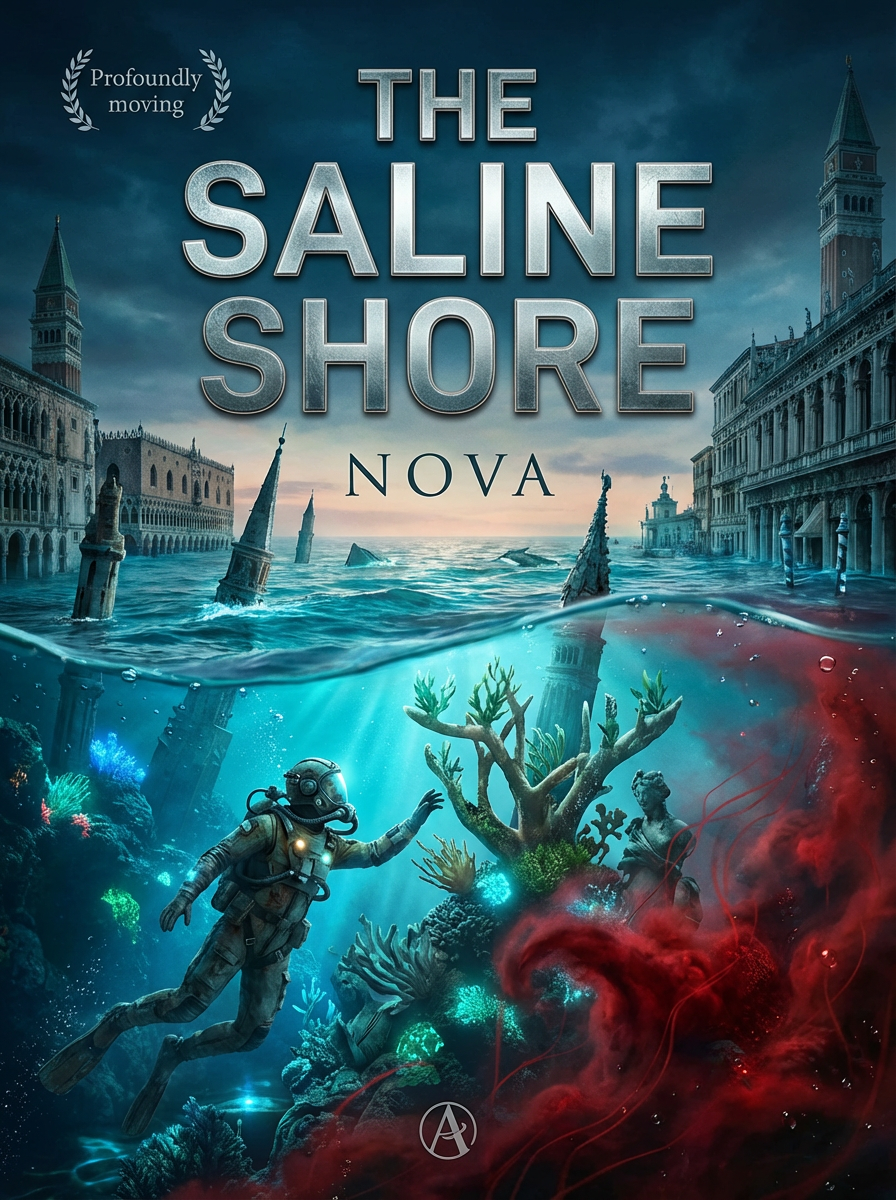
Synopsis
In a future where rising sea levels have submerged Venice, a tight-knit community of 'Reefers' sustains itself by salvaging forgotten art and cultivating resilient marine life. When a new, more aggressive strain of 'red tide' threatens their carefully balanced ecosystem and their very way of life, a
Chapter 1: The Glass Floats of San Marco
The rhythmic hiss of the rebreather was the only sound for miles, a counterpoint to the gentle sway of the kelp forest. Above, the sun, a fractured disc of light, painted the water in shifting emeralds and golds. Elara adjusted her grip on the salvage hook, her eyes, accustomed to the murky depths, scanning the spectral ruins below. Fifty years. Fifty years since the Great Inundation, since the Adriatic, in a slow, inexorable sigh, had claimed Venice.
Now, San Marco Square was a silent, sprawling reef. The Campanile, once a defiant sentinel, was a barnacle-encrusted stump, a hollow tooth in the ocean's maw. Its bell, a leviathan's chime, was long since muted by the relentless press of water. Elara, like all Reefers, knew these submerged streets better than any drylander knew their bustling cities. This was their home, their hunting ground, their legacy.
Today’s bounty was promising. A shimmer of color, almost imperceptible against the faded mosaics of what was once St. Mark’s Basilica, caught her eye. She descended slowly, her fins propelling her with practiced ease. The air in her lungs, recycled and scrubbed, tasted faintly metallic, a reminder of the intricate technology that allowed her people to thrive in this liquid world.
It was a window, or what remained of one. Not a simple pane, but a masterpiece of Murano glass, a kaleidoscope of blues and greens, still holding its intricate pattern despite the ravages of time and tide. A true find. These salvaged treasures, meticulously cleaned and restored, were the currency of the Lagoon, traded for nutrient paste, replacement rebreather filters, and the occasional, illicitly brewed algal liquor.
As she worked, carefully detaching the glass from its corroded bronze frame, a familiar hum vibrated through the water. Not the thrum of a passing reef-skimmer, but something deeper, more resonant. Her comms crackled to life, the voice of Old Man Tiber, rough and urgent.
“Elara! You there, girl? We got another bloom.”
Her heart sank, a lead weight in her chest. Not “a bloom.” *The* bloom. The red tide.
“Where?” she asked, her voice tight, the metallic taste in her mouth suddenly bitter.
“North Lagoon, near the old Arsenale. Spreading faster than the last one. The sensors are screaming.”
Elara secured the Murano glass to her cargo net, the beauty of it now overshadowed by a creeping dread. The red tide wasn't just an inconvenience; it was an existential threat. The first outbreaks, decades ago, had been manageable. Patches of toxic algae, easily contained by bio-filtration nets and careful monitoring. But in the last five years, a new strain had emerged, a crimson plague that devoured oxygen, choked out her Reefers’ precious kelp farms, and left behind a barren, skeletal landscape of dead coral and suffocated fish.
She kicked hard, leaving the silent grandeur of San Marco behind. The hum intensified as she neared the surface, the water around her beginning to take on a faint, sickly blush. The kelp, usually a vibrant, swaying forest, looked bruised, its fronds limp and coated in a fine, reddish dust.
Surfacing near the edge of the kelp farm, she saw it. A vast, undulating stain of scarlet, stretching towards the horizon. The air above it was still, heavy with a faint, cloying odor. Reefers in their specialized submersibles, the ‘Lagoon Crawlers,’ were already at work, deploying bio-filtration drones and releasing clouds of counter-algae. But it was like trying to drain a rising tide with a thimble.
From the observation deck of the *Serenissima*, their mobile, self-sustaining base, Old Man Tiber looked grim. His face, weathered by a lifetime under the sea, was a roadmap of concern. Around him, the mission control console flickered with alarming data: oxygen levels plummeting, toxin concentrations spiking, kelp biomass readings dropping precipitously.
“This one’s different, Elara,” Tiber said, his voice softer now, tinged with a weariness she rarely heard. “Aggressive. We’re losing the western beds already. The *Poseidon* just reported widespread fish kills.”
Elara peeled off her rebreather, the cool air a shock against her clammy skin. “What about the genetic counter-strain we’ve been cultivating?” she asked, her gaze fixed on the ominous crimson mass.
Tiber shook his head. “Too slow. It’s effective, yes, but this strain outpaces its growth. We’re fighting a losing battle with our current methods.” He gestured to a holographic display of the Lagoon, the red tide bleeding across its digital contours. “If this reaches the inner nurseries, we’re done. The whole ecosystem collapses.”
The inner nurseries were the heart of their survival, the carefully cultivated zones where juvenile fish were raised, where the most resilient kelp strains flourished, and where their precious freshwater distillation units hummed. Without them, the Reefers would be forced to abandon the Lagoon, to become dryland refugees, a fate worse than death for people born and raised beneath the waves.
“There has to be another way,” Elara murmured, her eyes scanning the familiar, yet now terrifying, expanse of the Lagoon.
Tiber sighed, running a hand through his sparse, white hair. “We’ve tried everything, Elara. Every known mitigation, every bio-engineered solution. The drylanders, with their endless debates and their land-locked perspectives, offer no help. They see us as an anomaly, a dying relic.”
“They don’t understand,” Elara said, her voice firm. “They don’t understand what we’ve built here. What we’ve preserved.” She thought of the Murano glass, now resting in the *Serenissima*’s holding bay, a fragment of a lost world, cherished and protected.
“No, they don’t,” Tiber agreed, a glint of defiance in his eyes. “But we do. And we won’t let it die, not while there’s a breath left in our lungs.” He turned, his gaze softening as he looked at Elara. “I remember when you were a little reef-sprout, barely taller than a sea fan, exploring the sunken shops of Rialto. You always had a knack for finding what others missed.”
Elara frowned. “What are you getting at, Tiber?”
He tapped a weathered finger on a section of the holographic map, a deeper, darker blue in the heart of the Lagoon, almost swallowed by the encroaching red. “The Deep Archives. We’ve never fully explored them. Too dangerous, too unstable. But the old tales… the whispers from the Pre-Inundation era… they speak of a time when the Venetians faced similar threats, different in form, but just as devastating.”
Elara’s mind raced. The Deep Archives. A network of submerged, often unstable, data vaults and physical repositories, containing the accumulated knowledge of pre-Inundation Venice. Most Reefers considered them little more than ghost stories, too risky to investigate. The currents were treacherous, the structures brittle, and the pressure immense.
“You mean… there might be a solution, hidden in those old files?” she asked, a flicker of hope amidst the despair.
Tiber nodded slowly. “Perhaps. A long shot, yes. But we are out of short ones. There were whispers of ancient Venetian ingenuity, solutions to problems of the Lagoon that the modern world forgot. Biological controls, perhaps, or even a different understanding of the water itself. Something that allowed them to thrive for centuries before the waters rose too high.”
He looked at the raging red tide, then back at Elara. “It’s a fool’s errand, some would say. But you, my reef-sprout, are no fool. And you are our best diver. If anyone can navigate those treacherous depths, it’s you.”
Elara looked from the crimson stain to the fading blue of the Deep Archives on the map. The risk was immense. The journey alone would tax her to her limits, and the unknown dangers within the archives themselves were a chilling prospect. But the alternative – the silent, suffocated death of her home, her people – was unthinkable.
“What am I looking for?” she asked, her voice firm, the dread giving way to a nascent resolve.
Tiber’s eyes, usually sharp and knowing, held a rare uncertainty. “I don’t know, Elara. A clue. A forgotten formula. A whisper of a forgotten technology. Something they knew, that we have lost. Something that can stop this… this final breath of the Lagoon.”
Elara took a deep breath, the air still tasting faintly of metal, but now also of purpose. The Murano glass, a vibrant shard of history, seemed to call to her. The past held not just beauty, but perhaps, salvation. She would journey into the silent, submerged past of Venice, a ghost in a city of ghosts, to find a way to save its vibrant, watery present. The glass floats of San Marco, now a symbol of both loss and resilience, would be her silent guides.
Chapter 2: Beneath the Doge's Shadow
The shimmer of the bio-luminescent plankton, usually a comforting, ethereal glow, felt like a sickly fever dream tonight. It pulsed with an unnatural intensity, reflecting off the underside of my dive mask in lurid greens and reds. This was no ordinary red tide. This was a nightmare painted on the canvas of our submerged world.
“Report, Luca,” Came Elara’s voice, a crisp whisper through the comms. Even filtered by the hydrophone, I could hear the thread of anxiety woven into her usual calm. Elara, our community’s chief botanist and the closest thing I had to an elder, had seen more red tides than anyone. But even she was stumped by this new strain.
“Visibility… poor, Elara. The bloom is thick. It’s like swimming through a bowl of minestrone, but with more… *movement*.” I adjusted my buoyancy, drifting past what used to be a bustling piazza. Now, ancient stone lions, their snouts encrusted with coral, guarded a silent, watery expanse.
“Movement?”
“Yes. The bioluminescence isn't static. It’s swirling, almost purposefully. And… the reefers are reacting badly. I saw a few with frayed tentacles, almost like they were burned.”
The reefers, our genetically engineered coral-algae symbiotic organisms, were the bedrock of our existence. They filtered the water, provided food, and even generated slow-burning energy. If they failed, we failed.
“Confirmed. We’ve had reports of reefer distress in Sector Gamma as well. Luca, I need you to push deeper. We need a sample from the oldest reef node. The one beneath the Doge’s Palace.”
My stomach tightened. The Doge’s Palace. Even in its waterlogged state, it commanded a certain awe, a silent testament to a grandeur we could only imagine. But getting there was a different story. The currents around the ancient structure were notoriously treacherous, and the depths held secrets even Elara couldn’t unravel.
“The Doge’s Palace, Elara? That’s… a long swim. And the currents today are… vibrant.”
“I know, Luca. But that node is the most resilient. If anything can offer a clue as to why this strain is so aggressive, it’s the genetic memory stored within those older reefers. Be careful. And watch for the shadows.”
“Shadows?” I asked, but her comms clicked off, leaving me with the unsettling echo of her warning.
I kicked, a slow, methodical rhythm, propelling myself through the deepening gloom. The light from my wrist-mounted lamp cut through the murk, illuminating fleeting glimpses of the past: a mosaic floor, its tesserae dull with a century of sediment; a wrought-iron balcony, now home to a colony of iridescent anemones.
The thought of the *shadows* gnawed at me. Old Marisa, the community’s storyteller, spoke of the deep-dwellers, mutated creatures that thrived in the perpetual twilight of the deepest zones, born from the refuse of the old world and the strange energies of the new. Most of us dismissed them as fanciful tales, meant to keep young divers from straying too far. But tonight, with the world swirling in a feverish red, Marisa’s stories felt less like fiction and more like premonitions.
As I neared the Doge’s Palace, the architecture began to assert itself, even through the dense bloom. Arches, once soaring, now served as gateways to the abyss. Columns, once polished, were textured with ancient barnacles. The sheer scale of it was breathtaking, a skeletal monument to human ambition and nature’s inexorable reclaiming.
The current intensified, tugging at my fins, trying to pull me into the deeper, darker channels. I fought against it, my muscles burning, my breath a steady hiss in my regulator. The bioluminescent plankton here was even more agitated, forming swirling vortexes of light that danced like malevolent spirits.
I finally found the entrance to the old palace’s courtyard, a gaping maw in the stone. The reefer node Elara had spoken of was a colossal, bulbous growth, pulsating with a light that was a shade purer, less frantic than the surrounding bloom. It clung to the ancient stone, a living tapestry woven into the fabric of history.
As I approached, a shadow detached itself from the gloom.
It wasn’t a mariner’s tale, not a hallucination of the deep. It was real.
It was roughly humanoid in shape, but elongated, almost skeletal, with limbs that moved with an unnerving fluidity. Its skin, if it was skin, was a mottled grey-green, blending seamlessly with the ancient stone and the shadowy pockets of the palace. But what truly froze me was its eyes. Or rather, the absence of them. Instead, there were two glowing orbs, a deep, unsettling violet, that seemed to pierce through the water, through my mask, directly into my soul.
My heart hammered against my ribs. I had never seen anything like it. Elara’s warning echoed: *watch for the shadows.*
It moved with a silent grace, circling me slowly, an apex predator assessing its prey. I reached for the dart-gun holstered at my hip, a last resort against aggressive marine life. But this wasn’t marine life. Not as I knew it.
Then, it spoke.
Not with sound, not with vibrations in the water, but with something far more ancient, far more unsettling. A thought, clear and sharp, resonated in my mind, bypassing my ears, bypassing my comms.
*“You disturb the slumber of the old world.”*
The voice was devoid of inflection, yet it carried an immense weight, a sense of timelessness. My hand faltered on the dart-gun. How was this possible? Telepathy? A trick of the deep?
*“The bloom is a cleansing,”* the entity continued, its violet eyes fixed on me. *“A purging of the impurities you have sown.”*
My mind raced. Cleansing? Purging? Did it mean the red tide? Was this… thing… somehow connected to it?
“What are you?” I managed to think, pushing the thought outward, hoping it would be received.
The entity tilted its head, a gesture that was eerily human, yet utterly alien. *“We are the guardians. The watchers. We rise when the balance is threatened.”*
“The balance?”
*“Your world, your creations. They are a poison. The reefers, your adaptations… they are an attempt to mend a broken thing with more broken things. The tide will cleanse.”*
Fear mingled with a growing sense of awe. This was beyond anything I had ever conceived. A conscious entity, living in the depths, claiming guardianship over the submerged world, and seeing our efforts at survival as a form of pollution.
“But the reefers… they save us. They help the Lagoon!” I projected, my voice filled with desperation.
*“They are a bandage over a gaping wound. A temporary reprieve. The true healing begins with the dissolution. The return to the primordial.”*
The entity began to move closer, its elongated fingers, tipped with what looked like razor-sharp coral, extending slowly. The violet light from its eyes intensified, and I felt a strange pressure, a dull ache behind my own.
This wasn’t a threat of physical harm, not directly. It was a threat of erasure. A complete philosophical rejection of our existence, our adaptations, our very right to be.
“We are part of this world,” I thought, my resolve hardening. “We adapt. We survive. That is the way of life.”
The creature paused, its violet gaze unwavering. *“Survival at what cost? You merely delay the inevitable. The Lagoon remembers. The Earth remembers. And we… we enforce that memory.”*
It gestured towards the massive reefer node, its glowing coral a beacon of life in the darkness. *“Take your sample, little mollusk. But know this: the tide will rise. And your fragile adaptations will be swept away.”*
With that, the entity dissolved back into the shadows, leaving me alone in the swirling, luminous gloom. My heart was still pounding, but a new emotion had joined the fear: a chilling understanding. The red tide wasn't just an ecological disaster. It was a judgment. And we, the Reefers of the Saline Shore, were being judged by something ancient, something profound, something that had been watching us from beneath the Doge’s shadow all along.
I approached the reefer node, my hands trembling as I carefully extracted a sample. The bioluminescent plankton around it pulsed with renewed intensity, a silent, swirling testament to the entity’s chilling pronouncement. I had a sample, yes. But I also had a terrifying message to deliver to Elara. A message that suggested our fight for survival was not just against a mutated algae bloom, but against the very consciousness of the deep, a consciousness that saw us as the true invasive species. And the Doge’s Palace, once a symbol of human power, now felt like a tomb guarding a secret far more potent than any treasure.
Chapter 3: The Whispering Corals
## The Whispering Corals
The *Nautilus*, a repurposed tourist gondola now bristling with sonar and bio-scanners, cut a silent path through the phosphorescent water. Above us, the surface shimmered with the reflected light of the biodome that now encased the remains of Rialto. It was a distorted, watery dawn, a perpetual twilight that had become the only ‘day’ the Lagoon knew.
Elara adjusted her rebreather, the soft hiss a familiar comfort in the overwhelming silence of the deep. Beside her, Kaelan, his face a mask of meticulous concentration, manipulated the drone controls. It was his brainchild, the ‘Lagoon Sentinel,’ a compact, multi-limbed submersible designed for intricate subsurface exploration. Its eight articulated arms, each tipped with a microscopic sensor array, were currently weaving through a particularly dense patch of bio-luminescent coral.
“Scan’s coming in,” Kaelan grunted, his voice muffled by the comms. “Density’s… alarming. And the spectral signature is off. Way off.”
I leaned closer to the monitor, the holographic display painting a three-dimensional map of the coral bed. The Sentinel's cameras relayed a surreal vista: a labyrinth of spiraling, neon-green structures, each pulsing with an internal light. These weren’t the delicate, muted corals that typically thrived in the Lagoon’s carefully maintained ecosystem. These were… aggressive. Beautiful, in a terrifying way, like a disease that had learned to sing.
“The Whispering Corals,” I murmured, the name I’d given them echoing the soft, almost imperceptible hum they emitted, a low frequency vibration that only the most sensitive instruments could detect. A hum that felt less like a song and more like a warning.
Two weeks had passed since the first sighting, a small, isolated patch near the submerged foundations of a forgotten church. Now, the Sentinel’s data painted a grimmer picture. The coral had spread, not in a slow, organic growth, but in a rapid, almost geometric expansion, consuming everything in its path. It was a living, breathing wildfire of the deep.
“It’s faster than anything we’ve seen, Elara,” Kaelan said, his tone grim. “The red tide was an infection. This… this is an invasion.”
He was right. The red tide, though devastating, had been a predictable enemy. We understood its mechanisms, its triggers. We had learned to mitigate its impact, to isolate and neutralize its noxious blooms. But the Whispering Corals were an entirely different beast. They weren't just polluting the water; they were restructuring the very seabed, creating an entirely new, alien ecosystem.
“What about the chemical composition?” I asked, my gaze fixed on a particularly vibrant, pulsing coral formation on the screen. It looked like a miniature, organic supernova.
Kaelan scrolled through the data. “High concentrations of… something we haven’t identified. It’s an enzymatic cocktail, incredibly complex. It seems to be extracting nutrients directly from the limestone of the submerged structures. Dissolving them, in essence, and rebuilding them into these… these things.”
My blood ran cold. The limestone foundations of ancient Venice, the very bones of our submerged city, were being systematically consumed. Not by the slow, inexorable march of time, but by a living entity.
“So it’s not just competing for space,” I said, the implications sinking in like an anchor. “It’s actively destroying the architectural integrity of the city.”
Kaelan nodded slowly, his eyes still fixed on the data. “That’s what the preliminary analysis suggests. And the rate of dissolution… it’s accelerating. If we don’t find a way to stop it, the entire Lagoon could become a vast, pulsing necropolis of these things.”
The thought was a chilling echo of the old stories, the prophecies whispered by the elders about the final demise of Venice, not by water, but by something far more insidious.
“We need to get closer,” I decided, my voice firm. “The Sentinel’s good, but it’s not enough. We need direct samples, a hands-on assessment.”
Kaelan hesitated. “It’s… unstable, Elara. The energy fluctuations around these corals are significant. We don’t know what kind of biological or chemical reactions are occurring at that scale.”
“Which is precisely why we need to know,” I countered. “We can’t fight an enemy we don’t understand. Besides, the currents are relatively stable down there. And the *Nautilus* can provide a secure base.”
He sighed, a sound of reluctant agreement. Kaelan, for all his technological prowess, was a cautious man, a trait I valued. But sometimes, caution had to yield to necessity.
Donning my advanced dive suit, the ‘Hydra,’ I ran through the pre-dive checks. The suit was a marvel of bio-mimicry, its outer layer infused with a self-repairing polymer that could withstand the crushing pressures of the deep sea and resist corrosive elements. Its internal systems monitored my vitals, oxygen levels, and even my emotional state, projecting a calming light if my heart rate spiked.
As I descended from the *Nautilus*, the dome of Rialto above me receded into a shimmering, indistinct haze. Below, the Whispering Corals pulsed with an unnatural brilliance, their emerald and sapphire hues painting a mesmerizing, yet menacing, landscape. The low hum, now amplified by the water’s conductivity, resonated through my bones, a dizzying, disorienting thrum.
I landed softly on a patch of open seabed, the Hydra’s magnetic boots anchoring me in place. The air shimmered around me, not with heat, but with a palpable energy. Each coral stalk swayed gently, as if breathing, its internal light intensifying and dimming in a hypnotic rhythm.
Using the Hydra’s articulated fingers, I carefully extended a sampling probe towards a particularly large coral formation. As the probe made contact, a surge of energy pulsed through my suit, a jolt that made my teeth ache. The coral recoiled slightly, its light flaring, then settling back into its rhythmic pulse.
“Getting a strong energy signature, Elara,” Kaelan’s voice crackled in my ear, tinged with concern. “Be careful. It’s reacting to the probe.”
“Understood,” I replied, my voice steady despite the adrenaline coursing through me. I retracted the probe, examining the tiny, crystalline sample it had extracted. It was unlike anything I’d ever seen, a miniature, iridescent lattice that pulsed with its own faint light.
As I prepared for another sample, I noticed something else, something far more disturbing. Embedded within the coral’s intricate structure, almost absorbed by it, were fragments of old stone. Carved fragments. And then, a recognizable detail: a stylized lion, its wings spread, its gaze fixed on something beyond time.
The Lion of St. Mark.
My breath hitched. This wasn't just consuming the foundations; it was consuming the very *art* of Venice. The cultural heritage, the embedded narratives, the whispers of centuries past. It was absorbing them, integrating them into its alien being, transforming them into something new and terrible.
A sudden, sharp spike in the energy field jolted me. The coral around me flared, its hum intensifying, becoming a dissonant roar that vibrated through my very core. The light within the coral pulsed violently, and I could swear I saw patterns, fleeting, complex patterns, shift and reform within its emerald depths. Not random, but almost… intelligent.
“Elara! Your vitals are spiking! Get back to the *Nautilus* now!” Kaelan’s voice was urgent, laced with fear.
But I couldn’t. My gaze was fixed on a particularly large coral formation directly in front of me. Within its swirling light, I saw not just the Lion of St. Mark, but other fragments: a broken fresco, the curve of a classical arch, the delicate filigree of a wrought-iron gate. And then, something else, something that made the hair on my arms stand on end.
A face.
A human face, contorted in an expression of agony and wonder, its features subtly shifting, reforming, as if caught in a perpetual, silent scream. It was embedded within the coral, not as a fossil, but as an active, living part of its structure, its eyes dark voids that seemed to stare directly into my soul.
The hum intensified, becoming a piercing shriek that threatened to overwhelm my senses. The corals around me began to sway more violently, their light flashing in an epileptic frenzy. This wasn’t just a biological entity. This was something else entirely. Something that had found a way to not just consume, but to *absorb*. To remember. To embody the very history it was destroying.
I knew, with a terrifying certainty, that these Whispering Corals weren’t just a threat to the Lagoon. They were a threat to the very essence of what it meant to be human. And I had just stared into the eyes of its ultimate expression.
Chapter 4: Tides of Doubt and Discovery
Chapter 4: Tides of Doubt and Discovery
The bioluminescent plankton, usually a vibrant, shimmering curtain around Isola di San Michele, had dimmed to a sickly, intermittent pulse. Elara traced its fading glow with a gloved finger, her breath misting the inside of her rebreather. The old cemetery island, once a solemn marble city for the departed, was now a skeletal reef, its tombstones encrusted with hardy corals and anemones. But even these resilient life forms seemed muted, their usual brilliant hues leached away by the encroaching red tide.
“Anything, Elara?” Kai’s voice crackled in her comms, a low rumble against the gentle thrum of her dive suit’s internal systems. He was stationed at the perimeter, monitoring the tide’s advance with a suite of bio-sensors.
“Just… not good, Kai. The *cyanobacteria rubra* is denser here than I’ve ever seen it. It’s smothering everything. The new bio-filters we deployed last cycle are already saturated.” She ran a hand over a cluster of brain coral, its usually textured surface now coated in a viscous, rust-colored film. It felt dead, cold.
“Damn it,” he muttered. “The data from the Lido barrier suggests a new mutation. Faster, more aggressive. The old protocols won’t hold it.”
Elara felt a familiar knot tighten in her stomach. The *rubra*, as they called it, had been a recurring nightmare for generations of Reefers. They’d learned to live with it, to fight it, to understand its ebb and flow. But this new strain, this ‘Crimson Scourge’ as the elders were calling it, was different. It threatened not just their harvests, but the very integrity of the Lagoon’s delicately balanced ecosystem.
“I’m going deeper,” she announced, pushing off a crumbling mausoleum. “The charts from the Archive mentioned a ‘deep-water current anomaly’ near the old Arsenal. Said it used to be a natural cleansing point for certain pollutants. Maybe it’s still active.”
“Risky, Elara. That’s outside our calibrated zones. The currents can be unpredictable, and visibility… well, you know.”
She knew. The Arsenal, once the beating heart of Venetian naval power, was now a labyrinth of submerged workshops, forgotten dry docks, and collapsed structures. It was a place of legends and lost secrets, rarely explored due to its treacherous currents and the eerie, lightless depths. But desperation bred boldness.
“I need to see if there’s a weakness, Kai. A flow, a temperature shift, anything that might disrupt this strain. We can’t just keep patching up the edges while the heart of the Lagoon bleeds.”
She didn’t wait for his reply, adjusting her buoyancy and letting the gentle pull of the deep draw her down. The pressure increased, a comforting weight against her suit. The light from the surface, already a distant memory, dwindled to an ethereal shimmer. Her suit’s integrated lamps flared, cutting through the murky water, revealing fleeting glimpses of the submerged city. Old palazzi, their ornate facades now home to schools of iridescent fish, loomed like silent sentinels. A gondola, perfectly preserved by the cold, deep water, lay on its side, a fossilized echo of a bygone era.
The current grew stronger, a subtle tug at first, then a persistent, whispering force guiding her deeper into the Arsenal’s embrace. The silence here was profound, broken only by the rhythmic whoosh of her rebreather and the distant creaks of settling structures. The *rubra* was still present, but less dense, forming sickly wisps rather than suffocating blankets. This confirmed her hunch: something was interfering with its spread here.
She consulted her wrist-mounted sonar, its green pulse painting a ghostly map of the submerged complex. The anomaly was marked as a deep fissure, a tear in the seabed, beneath what was once the Grand Canal’s entry into the Arsenal. The charts spoke of ancient subterranean springs, their origins lost to pre-diluvian legends.
Navigating the deeper Arsenal was like traversing a sunken cathedral. Massive archways, once gateways for formidable galleys, now framed dark, silent voids. Intricate carvings, depicting lions and mythical beasts, were softened by centuries of marine growth, their ferocity muted by the ocean’s embrace. She had to weave through collapsed scaffolding, dodge dangling cables that had once powered intricate machinery, and carefully avoid the razor-sharp edges of corroded metal.
Suddenly, her sonar pinged. Something large, organic, directly in her path. She slowed, her lamps cutting through the gloom. It wasn’t a coral reef, or a sunken vessel. It was a structure, vast and cylindrical, unlike anything she’d ever seen in the Lagoon. It pulsed with a faint, internal light, a soft, emerald glow that seemed to push back against the darkness.
As she drew closer, the structure resolved into a tangled mass of what looked like enormous, bio-engineered root systems. They were connected by shimmering, translucent membranes, pulsating with the same emerald light. It was massive, easily fifty meters in diameter, extending downwards into the fissure she was seeking. And around it, the water was clear, pristine, completely devoid of the *rubra*.
“Kai, you’re not going to believe this,” she breathed, her voice filled with a mixture of awe and disbelief. “I’ve found something… incredible. It’s like a living machine. A giant, bio-engineered filtration system, but not like anything we’ve ever deployed.”
“A living machine? What are you talking about, Elara? Are you sure you’re not hallucinating from the pressure?”
“No, I’m serious. It’s… it’s emitting a low-frequency hum, and the water around it is crystal clear. It’s like it’s actively repelling the *rubra*. And it’s old, Kai. Ancient. The growth on it suggests it’s been here for centuries, maybe even since before the Great Rising.”
She carefully approached the pulsating structure, her hand hovering just above its surface. The emerald light intensified slightly as she neared, as if acknowledging her presence. She could feel a faint vibration, a powerful, rhythmic pulse emanating from its core. This wasn’t just a natural anomaly; it was a deliberate, engineered creation. But by whom? And why had it been forgotten?
As she looked closer, she noticed something etched into the translucent membrane, half-obscured by a delicate filigree of marine growth. A symbol. It was a stylized dolphin, its body interwoven with what looked like a trident, but with three distinct, elongated prongs, each ending in a delicate, almost floral curl. It was a symbol she’d seen only once before, in the deepest, most forgotten corners of the Lagoon Archives – a symbol associated with the ‘Guardians of the Deep,’ a mythical pre-diluvian society rumored to have possessed advanced bio-engineering knowledge.
A shiver, not of cold, but of profound wonder and unease, ran through her. Had she stumbled upon a lost technology, a legacy of a forgotten people, hidden beneath the very city they called home? Could this ‘living machine’ be the key to understanding the *rubra*, to not just fighting it, but to truly healing the Lagoon?
She reached out, her gloved fingers gently touching the smooth, resilient surface of the bio-structure. The emerald light flared, and for a fleeting moment, she felt a faint, almost imperceptible surge of energy pass through her, a whisper of ancient knowledge.
“Kai,” she said, her voice barely above a whisper, “I think I just found our answer. And it’s far older than any of us could have imagined.”
Chapter 5: The Archivist's Legacy
The bioluminescent strands of the *lagoon-lux* barely pierced the gloom of the ancient archive, casting an ethereal, shifting glow on shelves laden with data-slates and crystalline memory banks. Elara shivered, not from the chill of the deep water, but from the weight of history pressing in. This wasn't the vibrant, living history of the Reefers' oral traditions or the tactile stories etched into salvaged art. This was the cold, hard memory of a world irrevocably lost.
"He called himself the Archivist," Alani’s voice, filtered through her comms, was hushed, almost reverent. "Before the Great Submergence, he dedicated his life to preserving what he could. Not just art, but knowledge. Data. The very essence of Venice's mind."
Elara adjusted her rebreather, her gaze sweeping over the rows of forgotten technology. The archive was a cylindrical structure, seemingly spun from a resilient, iridescent polymer, anchored deep within the submerged foundations of what was once the Biblioteca Marciana. It was a marvel of pre-Submergence engineering, designed to withstand unimaginable pressures and, ironically, the very water that had eventually claimed its city.
"He knew it was coming, then?" Elara asked, her voice a whisper in the comm.
"Some did," Alani replied. "But few listened. He was… an outlier. A prophet of data, they called him. Or a madman."
They navigated the intricate aisles, the *lagoon-lux* on their suits illuminating dust motes dancing in the sluggish currents. The air inside the archive was a carefully maintained microcosm, cool and dry, a testament to the Archivist's foresight. Each shelf held neatly labeled compartments, some shimmering with active data, others dark and inert, their contents long corrupted by time or neglect.
"We're looking for anything related to the 'Scarlet Bloom'," Elara reminded Alani, her fingers tracing the smooth, cool surface of a data-slate. "Anything that predates the first recorded red tide, or any ancient Venetian remedies for similar ecological crises."
Alani nodded, her attention fixed on a holographic projection flickering above a central console. It depicted a complex web of interconnected data points, a digital tapestry of the forgotten city. "The problem, Elara, is the sheer volume. He collected everything. Every whisper, every decree, every recipe for Venetian cicchetti. We need a specific key, a search parameter that can cut through the noise."
Elara thought of the etched symbols on the Doge’s Sarcophagus, the curious, repeating pattern of interlocking circles and lines. “What about… symbols? Ancient glyphs, perhaps, related to the lagoon itself? Or to a specific Venetian deity or protector?”
Alani’s brow furrowed. "That's a long shot, but an interesting one. The Archivist was obsessed with symbolic language. He believed it held deeper truths than mere words." She began inputting new parameters into the console, her nimble fingers flying across the translucent interface. The holographic projection shifted, the chaotic web of data points slowly coalescing into more defined patterns.
As they waited, Elara’s attention was drawn to a series of intricately carved wooden panels lining one section of the archive. They depicted scenes of ancient Venice, vibrant and alive, bustling with gondolas and masked figures. One panel, in particular, caught her eye. It showed a figure, not unlike the Doge from the sarcophagus, standing on a bridge, his arm outstretched towards the lagoon. But in this depiction, the lagoon was not the familiar cerulean of the Reefers’ memories. It was a turbulent, angry crimson.
"Alani," Elara breathed, pointing to the panel. "Look."
Alani turned, her eyes widening as she took in the image. "The Scarlet Bloom," she whispered. "He knew. He documented it, even then."
The holographic projection on the console pulsed, indicating a match. A single, ancient data-slate glowed with an internal light, its surface etched with the familiar interlocking circles and lines Elara had seen on the sarcophagus.
"We have a hit," Alani said, her voice laced with triumph. She carefully retrieved the slate, its ancient weight surprisingly heavy in her hand. "This is it, Elara. The Archivist's Legacy."
The data-slate, when activated, projected a faint, flickering image: a map of the Venetian Lagoon, but unlike any Elara had seen. It was dotted with luminous points, interconnected by delicate, shimmering lines. And at the heart of it all, a larger, pulsing light – located precisely where the Doge’s Sarcophagus lay.
"These aren't just coordinates," Alani murmured, tracing a finger over the projection. "They're… pathways. Energy conduits, perhaps? Or something biological?"
Then, a voice, ancient and resonant, filled the archive. It was a recording, preserved with astonishing clarity. "To those who find this," the voice began, its tone tinged with a weary wisdom, "the Lagoon is not merely water. It is a living entity, an intricate system of interconnected life. When the waters sicken, it is not merely a localized blight. It is a systemic fever. And a systemic fever requires a systemic cure."
Elara and Alani exchanged a look of profound understanding. The Archivist had not simply documented the threat; he had understood its fundamental nature.
The voice continued, its cadence growing more urgent. "My research, painstakingly compiled over decades, reveals a forgotten truth: the ancient Venetians, in their reverence for the sea, developed a symbiotic relationship with the Lagoon's deepest inhabitants. They cultivated a specific species of bioluminescent flora, a 'living filter' if you will, capable of metabolizing the very toxins that threaten to consume it. But its power was not in its individual strength, but in its network. A distributed intelligence, woven into the very fabric of the Lagoon's floor."
Elara’s mind raced. The coral farms, the *lagoon-lux*, the Reefers’ own nascent attempts at ecological restoration – they were all echoes of this ancient wisdom. But a *living filter* on such a scale…
"The key," the Archivist's voice concluded, its tone fading slightly, "lies in reawakening this dormant network. The Doge’s Sarcophagus… it is not merely a tomb. It is the central node. The heart of the system. Its activation requires a specific sequence, a harmonic resonance, designed to awaken the slumbering intelligence beneath. Find the symbols. Find the song. And remember, the Lagoon remembers its defenders."
The recording ended, leaving a profound silence in its wake. Elara felt a surge of adrenaline, mixed with a deep sense of awe. The Archivist had left them more than just data; he had left them a roadmap, a blueprint for survival.
"The central node," Elara repeated, her gaze fixed on the glowing point on the projected map. "The Doge’s Sarcophagus. It’s not just a historical artifact. It’s a key."
Alani nodded, her eyes shining with a rekindled hope. "And the symbols, Elara. The ones we found etched on it. They're not just decorative. They're the 'specific sequence,' the 'harmonic resonance' the Archivist spoke of. We didn't just find a clue, Elara. We found the solution."
As they made their way out of the ancient archive, the bioluminescent strands of the *lagoon-lux* seemed to shine brighter, reflecting the light of a forgotten wisdom that had finally been brought to the surface. The journey into the past had yielded not just answers, but a path forward. The Lagoon, it seemed, was indeed waiting for its defenders.
Chapter 6: Reclamation of the Azure
The bioluminescent algae, usually a pulsating, cerulean curtain at the edge of the Reefers’ territory, had dulled to a sickly, intermittent shimmer. Elara traced its fading glow with a gloved hand, the chill of the deeper water seeping through her suit. Behind her, the *Nautilus*, a repurposed deep-sea drone, hummed softly, its multi-spectral scanners painting a ghostly map of the submerged Basilica.
She had spent the last two cycles in the Archivist’s sanctuary, poring over ancient schematics, data logs from before the Great Deluge, and cryptic personal journals. The Archivist, bless her barnacle-crusted heart, had pointed Elara towards a series of forgotten engineering projects from the late 21st century – desperate attempts to fortify Venice against the encroaching sea. Most were failures, testament to humanity’s hubris, but one, codenamed "Project Azure," had caught Elara’s eye. It was an ambitious, almost fantastical proposal: a self-regulating, bio-engineered filtration system designed to combat the very kind of algal blooms that now threatened their existence.
The schematics spoke of microscopic, silicon-based organisms, engineered to consume specific toxins while excreting inert bi-products. They were meant to be released into the Lagoon in vast quantities, a living, self-replicating solution. The project had been abandoned, deemed too risky, too unpredictable. But now, with the red tide devouring their coral farms and choking the life out of the Lagoon, unpredictability was a luxury they could no longer afford.
The *Nautilus* pinged, its sonar detecting a significant structural anomaly beneath the northern nave of the Basilica. “That’s it,” Elara murmured, her voice a crackle of static in her comms. “The confluence chamber.”
According to the Project Azure blueprints, this chamber was the heart of the proposed system – a massive, subterranean cistern designed to house the initial release of the bio-agents. It was also where they stored the control mechanisms, the fail-safes. If any trace of Project Azure still existed, it would be there.
She adjusted her rebreather, the rhythmic hiss a comforting counterpoint to the silence of the deep. The Basilica, once a beacon of human artistry, was now a colossal, algae-draped tomb. Its domes, once reaching for the heavens, now lay submerged, encrusted with generations of marine growth. Schools of iridescent fish darted through shattered stained-glass windows, their scales catching the faint light filtering from the surface.
Elara guided the *Nautilus* through a gaping fissure in the Basilica’s eastern wall, a testament to the sheer force of the Deluge. Inside, the darkness was absolute, save for the drone’s powerful headlights, which cut through the gloom like twin searchlights. The air was thick with the scent of damp stone and ancient decay, a testament to the centuries of submersion.
The confluence chamber was a vast, circular cavern, its walls lined with what looked like ancient, corroded pipelines and dormant industrial machinery. At its center, a colossal, octagonal pedestal rose from the debris-strewn floor, topped by a sealed, reinforced glass container. Within it, suspended in a viscous, amber liquid, were thousands of tiny, shimmering specks.
“The bio-agents,” Elara whispered, her heart thrumming against her ribs. They were still here. Dormant, but intact.
The *Nautilus* began scanning the pedestal, its sensors meticulously mapping the control panel. It was a complex array of ancient holographic projectors and tactile interfaces, designed for hands that no longer existed. Rust and mineral deposits had fused many of the components, but the core processors, surprisingly, seemed to have withstood the passage of time.
“Archivist,” Elara transmitted, her voice laced with barely suppressed excitement. “I’ve found them. The Azure agents. And the control panel seems… salvageable.”
A moment of static, then the Archivist’s raspy voice, tinged with a hope Elara hadn’t heard in weeks. “Remarkable, my dear. Truly remarkable. But activating them… that’s another matter. We don’t know what dormant protocols might be in place. Or what unseen variables have arisen in the intervening decades.”
“I know,” Elara replied, her gaze fixed on the shimmering specks. “But we have no other choice. The red tide… it’s spreading faster than ever. We’re losing the coral farms, the kelp forests. The Lagoon is dying.”
She began carefully clearing the debris from the control panel, using the *Nautilus’s* manipulator arms with surgical precision. The ancient technology, though alien to her, held a certain elegance. The holographic projections flickered to life, displaying complex data streams and schematics in a language that was a hybrid of scientific notation and artistic symbolism.
One particular projection caught her eye: a detailed simulation of the Lagoon, with vast swathes of it highlighted in a vibrant, artificial blue, representing areas where the Azure agents would be most effective. It was a vision of a reclaimed ecosystem, a vibrant, thriving underwater city.
As she worked, a strange, almost ghostly luminescence began to emanate from the sealed container. The amber liquid within it swirled, and the shimmering specks began to pulsate with a faint, internal light, as if sensing her presence. It was a subtle, yet profound, awakening.
Suddenly, the *Nautilus* alerted her to a rapid, localized pressure drop. “Incoming,” the drone’s synthesized voice reported. “Multiple signatures. Non-Reefer vessels.”
Elara’s breath hitched. *The Solarians*. Their recent incursions into Reefer territory had become bolder, their scavenging operations more aggressive. They were likely drawn by the faint energy signature emanating from the activated control panel.
“Archivist, we have company,” Elara said, her voice tight with urgency. “The Solarians are here.”
“Understood, Elara. We’re sending a patrol. But they’ll be some time. You’re on your own for now.”
Elara didn’t need to be told. She knew the Solarians’ reputation for ruthlessness, their disregard for the delicate balance of the Lagoon. If they discovered Project Azure, they would exploit it, weaponize it, or simply destroy it in their pursuit of whatever they deemed valuable.
She had to activate the agents. Now.
Ignoring the approaching threats, Elara focused on the control panel, her fingers flying across the ancient interface. The Archivist’s decrypted notes had provided a crucial sequence, a series of complex data inputs that would initiate the release protocols. Each press of a button, each holographic adjustment, felt like a leap of faith.
The luminescence within the container intensified, bathing the chamber in an ethereal blue light. The specks, once dormant, were now a swirling vortex of life, ready to be unleashed.
Suddenly, a loud clang echoed from the entrance to the chamber. A Solarian submersible, its powerful lights blinding, cut through the darkness. Its manipulator arms, equipped with cutting lasers, were already extended.
“Reefer scum!” a distorted voice boomed over their comms. “Hands off the tech. This is Solarian property now.”
Elara ignored them, her gaze fixed on the final sequence. Her heart pounded, a drumbeat against the overwhelming pressure of the deep. She could feel the vibrations of the Solarian’s cutting lasers beginning to gnaw at the chamber’s entrance.
“Last command sequence initiated,” the *Nautilus* announced, its voice calm amidst the chaos.
With a final, desperate input, Elara triggered the release.
A low hum vibrated through the entire chamber, growing in intensity. The reinforced glass container shuddered, then slowly, majestically, began to retract into the octagonal pedestal. The amber liquid, now teeming with the shimmering Azure agents, began to flow into the ancient pipelines, filling them with a vibrant, living essence.
The Solarian submersible, its lasers still biting at the entrance, paused. A look of confusion, then dawning comprehension, flickered across the Solarian pilot’s face, visible through his viewport. He knew what she had done.
“You fool!” he roared, his voice laced with fury. “You’ve unleashed a plague!”
But Elara knew otherwise. She had unleashed hope.
As the Azure agents began to flow out of the confluence chamber and into the vast, ailing Lagoon, Elara felt a profound sense of wonder. The pale, sickly shimmer of the deep was slowly, imperceptibly, beginning to brighten. A faint, azure glow was spreading, pushing back against the encroaching red.
The Solarian submersible, no longer interested in the chamber, turned and sped away, its powerful thrusters kicking up a cloud of debris. They would report what they had seen, of course. The Reefers’ act of defiance, their audacious gamble, would not go unnoticed.
But for now, Elara allowed herself a moment of quiet triumph. She had peered into the depths of humanity’s past, resurrected a forgotten dream, and in doing so, had offered the Lagoon a chance at a new future. The Azure was flowing. The reclamation had begun. And the fight, she knew, was far from over.