The Saline Scar
By Nova
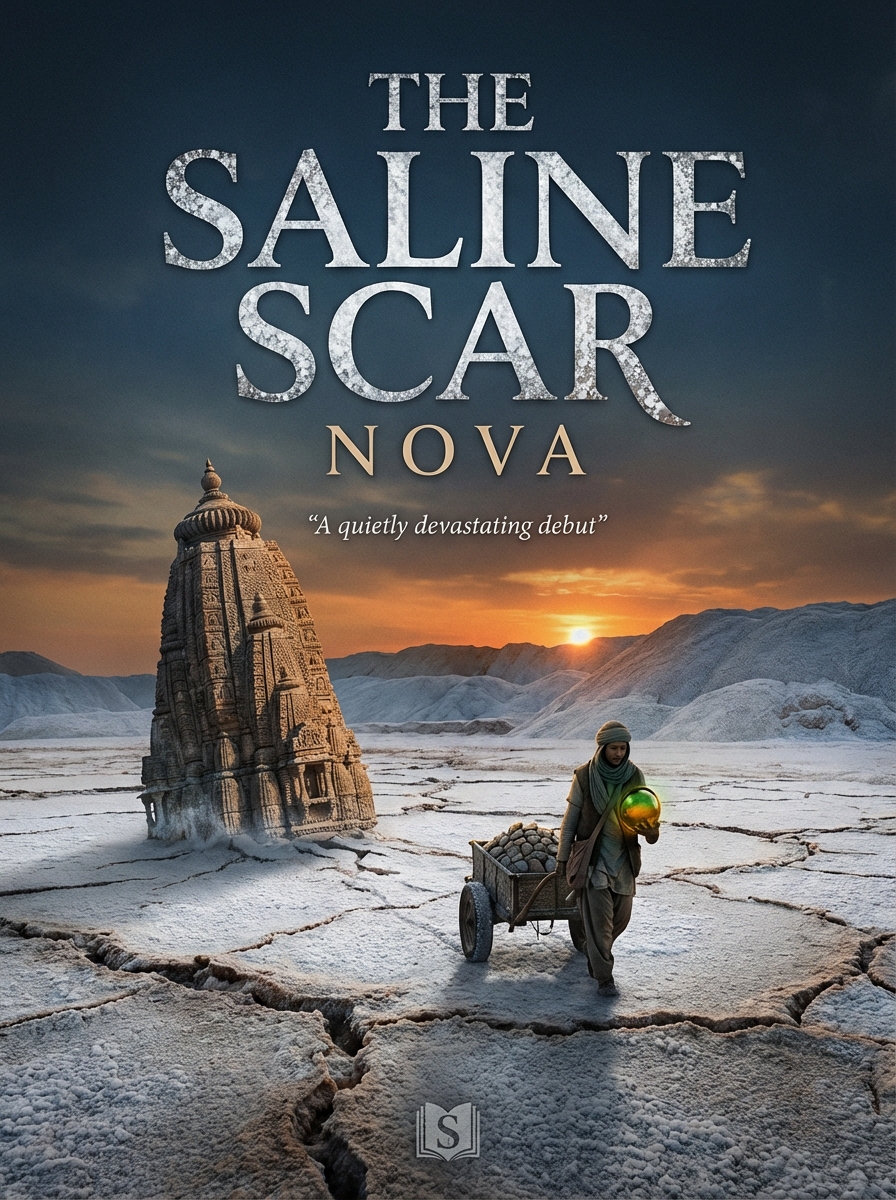
Synopsis
Decades after the catastrophic 'Great Deluge' submerged coastal Bangladesh, displacing millions, communities struggle to reclaim their heritage from the encroaching, infertile saline earth. When a desperate expedition unearths an ancient, forgotten agricultural secret, it sparks a perilous journey t
Chapter 1: Dhaka's High Tide Mark
The air in Sector 7, what used to be called Mirpur, tasted of salt and desperation. Not the invigorating tang of a fresh sea breeze, but the acrid memory of an ocean that had swallowed half a nation. Forty years after the Great Deluge, the high-tide mark wasn’t a line on a beach; it was etched into the very sky, a psychological horizon above which the sun seemed to mock the endless, glittering flats below.
Amina, her fingers stained with the perpetual ochre dust of the reclamation project, squinted at the horizon. The sun, a brutal orange disc, was beginning its descent, painting the distant, skeletal remains of once-grand high-rises in a final, defiant glow. These were the ‘Ghost Towers,’ the upper floors of structures that had poked above the waterline during the worst of the Deluge, now monuments to a submerged past, their lower levels still home to the silent, saline ghosts of Dhaka.
Her com-bead, a cheap, government-issued flicker of light on her wrist, buzzed. “Amina. Report.” The voice of Director Karim, crisp and unyielding, cut through the humid evening.
“Sector 7, North Quad, reclamation efforts proceeding,” Amina recited, her voice flat. “Another fifty meters of leached earth cleared today. Salinity readings still critical. No viable biomass indicators.”
A beat of silence. “As expected,” Karim’s voice was devoid of emotion. “Continue deep-tilling protocols. We need the next twenty hectares ready for the Phase Beta trials by cycle end.”
Phase Beta. The current, failing iteration of a hundred failed iterations. Pumping freshwater from the dwindling northern reservoirs, attempting to flush the salt from the soil, only to watch it seep back up from the brackish groundwater like a malevolent spirit. Amina closed her eyes briefly, the futility a cold knot in her stomach.
She tapped the com-bead. “Director, with respect, the deep-tilling is only skimming the surface. We need a more… systemic approach. The old methodologies, the ones in the pre-Deluge archives, they speak of…”
“The pre-Deluge archives are a romantic distraction, Amina,” Karim cut her off, his voice hardening. “We operate on data, on the present reality. The methodologies you speak of predate the global salinity crisis. They are irrelevant. Focus on the task at hand. Your sector’s output is already below projection.”
The comm went dead. Amina sighed, her shoulders slumping. Karim, like so many in the ‘New Dhaka’ administration, was a pragmatist, a scientist hardened by decades of ecological disaster. He saw the world in data points and output graphs, not in the cultural memory of fertile fields and vibrant river systems. But Amina, whose grandmother had whispered tales of emerald rice paddies and mango groves, knew that some solutions lay not in the future, but in the forgotten past.
She glanced at the small, waterproof satchel slung across her chest. Inside, nestled amongst her daily rations and field tools, was a cracked, laminated printout. It was a digital reconstruction of a pre-Deluge agricultural text, salvaged from a partially submerged library server farm. Its pixelated images showed ancient farming techniques, intricate water management systems, and illustrations of plants that seemed impossibly lush, impossibly green. Karim would call it heresy. Amina called it hope.
The sun dipped below the Ghost Towers, casting long, distorted shadows that stretched across the saline flats like grasping fingers. The air grew cooler, but the oppressive weight of the land remained. Around her, the other reclamation workers, their faces grimed and weary, were packing up their automated tillers and leaching pumps. They were the ‘Salt-Eaters,’ the displaced millions from the coastal districts, now relegated to the arduous and often fruitless task of reclaiming their lost land. Their faces, etched with a shared weariness, were a testament to generations of resilience, and an equal measure of quiet despair.
Among them was Reza, a man whose family had farmed the same patch of land for centuries before the Bay of Bengal had decided to claim it. He walked with a slight limp, a souvenir from a collapsed seawall during the initial chaos of the Deluge. He paused beside Amina, his eyes, the color of burnt umber, surveying the endless, shimmering expanse.
“Another day, another layer of salt,” he said, his voice raspy. “My grandfather used to say a good monsoon could wash away anything. Now, the monsoon only brings more of the sea.”
Amina nodded, a shared understanding passing between them. “But it wasn’t always like this, Reza. There were ways. Before the salinity, before the industrial floods. Ways to make the land give.”
Reza snorted, a dry, bitter sound. “Ways for the wealthy, maybe. The ones who built their arks and fled north. We were left to drown, or to eat salt.”
His words, though harsh, held a kernel of truth. The Great Deluge hadn't just submerged land; it had solidified the existing social stratification. The 'Ark-Dwellers,' now the elite of New Dhaka, lived in climate-controlled high-rises, their food synthesized, their water purified. The 'Salt-Eaters,' the majority, clawed at the devastated earth, their existence a constant struggle against an unyielding environment.
“No, Reza,” Amina insisted, her voice soft but firm. “Ways for everyone. For the land. My grandmother, she spoke of the *Dhankhet*, the rice fields, and how they thrived, even with the river’s ebb and flow. She spoke of *Jol-Jomi*, water-lands, where crops grew differently.”
Reza looked at her, a flicker of something in his eyes that might have been curiosity, or perhaps just the ghost of memory. “Old stories, Amina. Ghosts of a world that’s gone.”
“Maybe not entirely gone,” Amina mumbled, clutching her satchel. “Maybe just buried.”
As the last light faded, Amina made her way back to the communal living units, a collection of modular, prefabricated shelters clustered around a central filtration plant. The air grew thick with the smell of recycled water and the faint, metallic scent of nutrient paste – the staple diet of the Salt-Eaters.
Inside her tiny unit, the single glow-panel cast a stark light on her face as she unrolled the laminated printout. The images swam before her – intricate diagrams of *char* lands, flood-resistant varieties of rice, and a peculiar depiction of what looked like a large, root-like structure, almost like an underground bulb, being carefully planted in a watery field. The accompanying text, partially corrupted and fragmented, spoke of ‘saline-resilient cultivation’ and ‘bio-engineering pre-Deluge.’
She traced the image of the root-like structure. It was unlike anything she had ever seen grown in the sterile, automated hydroponic farms of New Dhaka, or indeed, in the failing reclamation plots. The text mentioned a ‘Salt-Heart,’ a legendary plant said to thrive in brackish conditions, drawing the salinity from the soil and converting it into sustenance. A myth, perhaps, a folk tale from a bygone era. Or, she dared to wonder, a forgotten truth.
Her com-bead buzzed again. This time, it was a message from an unregistered source, encrypted and anonymous. Amina hesitated, then opened it.
The message was brief, a single line of text: *“The old ways are not dead. The Salt-Heart lies where the river once met the sea. Seek the remnants of the Sundarbans.”*
A jolt went through Amina. The Sundarbans. The legendary mangrove forest, once the largest in the world, now largely submerged, a perilous labyrinth of brackish water and exposed roots, rumored to be home to mutated wildlife and forgotten secrets. It was a no-go zone, officially off-limits for reclamation or exploration, deemed too dangerous, too unstable.
But the message… it spoke of the Salt-Heart, the very thing she was desperate to find. It connected to her grandmother’s whispers, to the tantalizing hints in the pre-Deluge archives.
Amina looked at the images of the ancient cultivation, then at the cryptic message on her com-bead. A perilous journey, indeed. But what was the alternative? To continue tilling a barren earth, watching her people slowly starve, their culture fading with every lost harvest?
She made a decision. A dangerous, potentially suicidal decision. But hope, like the tenacious roots of the mangroves themselves, could find purchase even in the most saline of soils. She had to find the Sundarbans. She had to find the Salt-Heart. For the sake of the land, and for the soul of a nation drowning in salt.
Chapter 2: The Salt-Crusted Fields of Barisal
## The Salt-Crusted Fields of Barisal
The air, thick with the scent of sun-baked salt and distant, struggling mangrove, clung to Elara’s skin like a second, grittier garment. The high-speed maglev, a sleek silver serpent against the bruised sky, had ejected them from the sterile, climate-controlled comfort of Neo-Dhaka’s upper tiers into a reality that felt ancient and raw. Barisal, or what remained of it, stretched before them – a landscape scarred not by war, but by the relentless, creeping tide.
From the observation deck of the repurposed comms tower that served as the regional survey hub, the view was a cruel diorama of ecological devastation. Where once emerald rice paddies had thrived, now lay vast, shimmering plains of white. The salt, crystalline and unforgiving, had encrusted everything: the skeletal remains of fishing boats, the lower stories of submerged buildings, even the branches of dead trees that clawed at the sky like skeletal fingers. Patches of sickly, stunted halophytes, specially engineered for salt tolerance, dotted the landscape like desperate green wounds, a testament to decades of failed reclamation efforts.
“Welcome to the frontline, Dr. Rahman,” said a voice, startling Elara from her grim contemplation.
Jahid Khan, his face etched with the deep lines of a man who’d seen too many sunrises over a dying land, extended a hand. His skin was tanned almost to leather, and his eyes, though weary, held a spark of defiant resilience. He was the head of the Barisal Reclamation Project, a thankless, underfunded endeavor that had nonetheless managed to keep a flicker of hope alive in this blighted region.
“Jahid,” Elara replied, shaking his hand firmly. “The reports… they don’t quite capture it.” She gestured towards the shimmering expanse. “It’s… more complete than I imagined.”
Khan’s lips thinned. “Complete is one word for it. Despair is another. We’ve been fighting this for fifty years, Elara. Fifty years of research, of engineered crops, of desalination plants that break down faster than we can repair them. The sea took what it wanted, and it left us this… this ghost of a home.”
He led her through the bustling, though somewhat ramshackle, hub. It was a hive of activity, a strange mix of cutting-edge drone technology and rudimentary manual labor. Researchers in immaculate bio-suits mingled with local workers in patched clothing, their faces streaked with dust and salt. The air thrummed with the low hum of machinery, the chatter of holographic displays, and the rhythmic clang of metal on metal from a nearby repair bay.
“We’re trying, Elara. We really are,” Khan continued, his voice laced with a quiet desperation. “We’ve managed to cultivate *some* salt-tolerant varieties of rice, but the yield is abysmal. Barely enough to feed the immediate population, let alone contribute to national food security. The aquifer is brackish, the soil is dead. We’re living on borrowed time, on imported nutrients, on the goodwill of Neo-Dhaka.” He spat the last words with a hint of bitterness.
Elara understood. Neo-Dhaka, with its gleaming sky-scrapers and advanced hydroponic farms, had long since distanced itself from the ecological wounds of the past. The coastal regions, once the breadbasket of the nation, were now viewed as an unfortunate, costly burden.
“Tell me about the anomaly,” Elara said, turning the conversation to the purpose of her visit. “The energy fluctuations. What have your preliminary scans shown?”
Khan’s expression shifted, a flicker of genuine intrigue replacing the weariness. “That’s where it gets… interesting. For decades, our geological surveys have mapped the subsurface, looking for pockets of less salinized earth, anything we could work with. About six months ago, our deep-scan probes started picking up something unusual beneath what was once the oldest part of Barisal city – the pre-Deluge settlements. A localized, low-frequency electromagnetic anomaly. Consistent, but peculiar.”
He led her to a large holographic display, where a shimmering, three-dimensional map of the Barisal basin pulsed with data. A small, bright red node flickered deep beneath the surface, nestled amidst the blue and grey hues of saline-saturated earth.
“We thought it was residual energy from some ancient, buried infrastructure. A power conduit, perhaps. But the signature is… organic. Or at least, not purely technological. And it’s not localized to a single point. It’s diffused, like a network.”
Elara leaned closer, her mind already racing. “Organic? Like… a root system?”
Khan nodded slowly. “That was my thought. But a root system that emits an electromagnetic signature? And one that’s survived fifty years of saltwater inundation?” He shook his head. “It defied all known biological and geological principles.”
“And the water itself?” Elara pressed, her eyes fixed on the red node. “Is it affected?”
“That’s the most baffling part,” Khan replied. He zoomed in on the holographic display, highlighting a cross-section of the anomaly. “We drilled a bore-hole directly above it. The water at that depth, surprisingly, shows a significantly lower salinity level than the surrounding bedrock. Not fresh, mind you, but closer to brackish than hyper-saline. And the soil… the soil samples from that core show traces of ancient, rich loamy earth, remarkably preserved.”
A thrill, cold and sharp, shot through Elara. This wasn’t just an anomaly; it was a defiance of the Deluge itself. A small, impossible pocket of resistance against the overwhelming forces of nature.
“You’ve tried to excavate directly?” she asked, already knowing the answer.
Khan sighed. “We tried. The ground is too unstable, too saturated. And the anomaly itself seems… sensitive. Any direct attempt to penetrate it causes the signature to fluctuate wildly, almost defensively. We lost three probes to sudden seismic shifts. It’s like something is pushing back.”
“Pushing back,” Elara murmured, the words echoing the defiant spirit in Khan’s own eyes. She thought of the ancient texts, the fragmented historical records of pre-Deluge Bangladesh, of the indigenous agricultural practices that had sustained generations. Could there be a connection? A forgotten wisdom, buried beneath the salt and the despair?
“That’s why you’re here,” Khan said, sensing her thoughts. “Your expertise in pre-Deluge bio-engineering, your understanding of ancient agricultural symbiosis… you’re our best hope. We need to understand what this is, Elara. And if it holds a secret, we need to unlock it.”
Elara turned from the holographic display, her gaze sweeping across the salt-crusted fields, the struggling halophytes, the weary faces of the reclamation workers. The weight of their hope, and their desperation, settled heavily on her shoulders.
“Show me the drilling site, Jahid,” Elara said, her voice firm, resolute. “I want to see the core samples. I want to feel the earth that has defied the sea.”
As they walked towards the transport bay, the setting sun, a bruised orange disc, cast long, distorted shadows across the endless, shimmering saline plains. The air grew cooler, but the scent of salt remained, a constant reminder of the fight ahead. Elara knew this wasn’t just a scientific expedition; it was a rediscovery. A journey into the heart of a lost world, searching for a seed of hope in the unforgiving landscape of Barisal. The whispers of the past, preserved in the earth, were calling. And Elara, for the first time in a long time, felt a profound sense of purpose.
Chapter 3: Whispers from the Sundarbans
## Whispers from the Sundarbans
The air in the Sundarbans was a living thing, thick and humid, carrying the scent of salt, mud, and a thousand unseen blossoms. It pressed in on Elara as the slender skiff, powered by a whisper-quiet electric motor, glided deeper into the emerald labyrinth. The sun, a bruised orange disc, was already sinking, painting the sky in fiery streaks that reflected off the murky water, turning it to liquid copper.
“We’re almost there, *didi*,” said Rohan, his voice barely audible above the rhythmic slap of water against the hull. He was younger than Elara, barely twenty, but his face was etched with the premature wisdom of those who’d grown up on the water, navigating currents and tides as instinctively as breathing. His eyes, sharp and brown, scanned the dense mangrove canopy, searching for landmarks that were invisible to Elara’s city-trained gaze.
Elara nodded, her hands gripping the worn wooden seat. Dhaka, with its shimmering hydro-towers and enclosed bio-domes, felt a lifetime away. Here, the very ground was alive, shifting and breathing with the tides. The mangroves, ancient and gnarled, rose like skeletal guardians from the water, their pneumatophores reaching skyward like countless grasping fingers. This was the legendary sanctuary, the last bastion of true wilderness on the subcontinent, a place where the Great Deluge had carved its deepest, most enduring scar.
For decades, the Sundarbans had been a no-go zone, deemed too dangerous, too unpredictable, too saline-ravaged for any sustained human presence. The few who ventured in were mostly illegal timber harvesters or desperate fishermen, their tales of colossal tigers and sentient spirits dismissed as fevered ramblings by the civilized world. But the rumors, persistent as the tide, had reached Elara’s ears: whispers of small, isolated communities, living in defiance of the saline curse, practicing ancient ways. And one specific whisper: of a woman, a Shaman, who held the key to the land’s forgotten heart.
Rohan steered the skiff expertly through a narrow, almost hidden channel. The air grew cooler, heavier with the scent of decay and something else – a faint, sweet aroma that Elara couldn't quite place. The canopy overhead grew denser, filtering the last vestiges of twilight into a mosaic of shifting shadows. Bioluminescent plankton, disturbed by the skiff’s passage, bloomed like tiny galaxies beneath the surface, tracing ephemeral patterns in the dark water.
“There,” Rohan whispered, cutting the motor. He pointed towards a small, almost imperceptible opening in the mangrove wall.
Elara peered into the gloom. What she saw was not a village, not even a cluster of huts. It was a clearing, barely larger than the skiff itself, where the mangroves receded slightly to reveal a small, elevated platform built from salvaged timber and woven reeds. A single, flickering lantern cast a warm, inviting glow.
As they drew closer, Elara saw her. She sat cross-legged on the platform, silhouetted against the lantern light. Her hair, the color of weathered rope, was braided with shells and dried leaves. Her face, though deeply lined, held an ageless serenity. She wore a simple, hand-spun tunic, and around her neck hung a necklace of polished stones. She looked up as they approached, her eyes, dark and knowing, meeting Elara’s across the water.
Rohan brought the skiff alongside a small, rickety pier. “Shanti Ma,” he murmured respectfully, "We have come a long way."
The woman, Shanti Ma, did not speak immediately. She merely observed them, her gaze lingering on Elara’s face, then on the small, sealed chest Elara cradled in her lap – the last remnant of the Barisal expedition. A faint smile touched her lips, a smile that held both welcome and a profound sadness.
“The earth remembers,” Shanti Ma’s voice was like the rustling of dry leaves, soft yet resonant, carrying an unexpected power. “And so do the waters.” She gestured towards a small, woven mat on the platform. “Come, child of the high towers. You carry the wounds of the land within you.”
Elara, surprised by the directness of the Shaman’s words, climbed onto the unsteady pier, her legs still stiff from the journey. Rohan, with a deferential bow, opted to remain with the skiff, an unspoken understanding passing between him and Shanti Ma.
As Elara sat opposite the Shaman, the sweet aroma she’d noticed earlier became stronger. It was the scent of damp earth, of something growing intensely, vibrantly, in defiance of the salt. Around the edges of the platform, Elara could now make out small, iridescent patches of moss and fern, thriving where nothing should have.
“You seek the seed,” Shanti Ma stated, her eyes fixed on Elara’s. It wasn't a question.
Elara’s breath hitched. “How… how did you know?”
Shanti Ma chuckled, a dry, reedy sound. “The forest whispers many things. It remembers the hunger, the desperation. It remembers the promise of the ancient grain.” She leaned forward, her gaze intensifying. “You found it, didn’t you? In the bowels of the earth, where the ancestors hid their hope.”
Elara carefully unlatched the chest and opened it. Inside, nestled in layers of preserved cloth, were the small, dark seeds, no bigger than grains of sand, yet holding the potential of an agricultural revolution.
Shanti Ma reached out a gnarled hand, not to touch the seeds, but to hover over them. A faint, almost imperceptible glow emanated from her palm. Elara felt a strange warmth, a tingling sensation that resonated deep within her.
“They are sleeping,” Shanti Ma murmured. “Long have they slept, waiting for the right hands, the right heart, to awaken them.” She looked up, her eyes holding a deep, ancient wisdom. “But the waking will not be easy, child. The land is scarred, the heart of the earth is broken. The salt remembers the deluge, and it holds its grip tight.”
“We need to heal it,” Elara said, her voice a fervent plea. “We need to make it fertile again. The communities, the displaced, they’re starving, Shanti Ma. They’re losing their heritage, their very sense of belonging.”
Shanti Ma nodded slowly. “Healing requires more than just seeds. It requires understanding. It requires reconnection. The land needs to remember what it once was, before the great forgetting.” She paused, her gaze drifting towards the impenetrable mangrove wall. “And the people… they too must remember. They must remember their roots, their collective strength, the wisdom of their ancestors.”
Elara thought of Dhaka, of the stratified society, the Uppers living in bio-domes while the Lowers struggled on the saline-encroached fringes. She thought of the engineers, the scientists, the corporate titans who saw the seeds as a commodity, a technological fix. And she thought of the Barisal communities, clinging to their broken traditions, their spirit slowly eroding with the land.
“The seeds alone are not enough,” Shanti Ma continued, as if reading Elara’s thoughts. “They are a catalyst. A promise. But the true healing… that must come from within, from the collective will of the people, and from the ancient knowledge that still flows through these waters, through these trees.” She gestured to the surrounding mangroves. “These are not just trees, child. They are the keepers of memory, the guardians of resilience. They have held the land together through countless storms, countless changes. They know how to thrive where others perish.”
Elara looked at the dark seeds, then at the Shaman’s ancient, knowing face. The whispers of the Sundarbans were not just legends; they were echoes of a profound truth. The solution, she realized, was not merely technological resuscitation, but a deep, spiritual communion with the land itself. The seeds were a gift, yes, but the real treasure was the wisdom that surrounded them, the forgotten language of resilience woven into the very fabric of this primordial ecosystem.
"What do we do?" Elara asked, her voice hushed, realizing the enormity of the task ahead.
Shanti Ma’s lips curled into another faint smile. "We listen. We learn. And then, we begin to sing the land back to life." Her gaze drifted to the seeds, then beyond, to the vast, unseen expanse of the saline scar. "The journey has just begun, child. The earth is waiting."
Chapter 4: The Cartographers of Loss
The humid air in the Dhaka Data Archive was a deliberate, climate-controlled exhale, a stark contrast to the city’s usual suffocating breath. Aisha’s fingers, stained faintly with turmeric from a quick, regretted lunch, hovered over the glowing holographic projection of a topographical map. This wasn't the Bangladesh of her textbooks, the one with its intricate filigree of rivers and verdant delta. This was a ghost, a land consumed.
"Notice the shift here, Dr. Rahman," a reedy voice broke her concentration. Dr. Kenji Ito, a visiting geo-historian from the Neo-Kyoto Hydro-Institute, pointed a slender stylus at a submerged ridge. "Pre-Deluge, this was a vibrant agricultural zone, renowned for its jute. Now… a reef. More specifically, a coral nursery established by the Submerged Reclamation Authority."
Aisha nodded, her gaze tracking the faded outlines of settlements swallowed by the digital blue. "The SRA's efforts are commendable, Dr. Ito, but they’re not addressing the problem on land. We're not trying to recover buried villages. We're trying to make the *earth* fertile again."
"Indeed," Ito conceded, his spectacles glinting in the soft light. "And that's where the old maps come in. You see, the cartographers of loss weren't just charting what was *gone*. They were, perhaps inadvertently, charting what *remained*."
He zoomed in on a section of what was once the coastal district of Barisal, a region Aisha knew intimately from her field work – the land of her ancestors, now a testament to saline desolation. The projection shimmered, overlaid with layers of archived data: soil salinity readings from 2035, projected tidal surges from 2040, even satellite imagery from the immediate aftermath of the Great Deluge, showing the frantic, chaotic retreat from the advancing waters.
"Look at this anomaly," Ito continued, his voice picking up a quiet intensity. He highlighted a small, roughly circular area, barely a kilometer in diameter, nestled deep within the digital wasteland. "According to our models, this zone should have been inundated, its soil equally saturated with salt. Yet, the 2035 readings show a significantly lower salinity concentration than its immediate surroundings."
Aisha leaned closer, a thrill of professional curiosity mingling with a more personal, primal hope. "A pocket of resistance? But how?"
"That's what we're trying to decipher," Ito said, pulling up another layer of data. This one was far older, a hand-drawn map, meticulously scanned and digitized. Its script was archaic Bengali, the characters elegant and flowing. "This map was recovered from the archives of the Barisal Folk Museum, just before it was deemed too unstable for public access. It dates back to the late 19th century."
Her eyes widened. "A pre-colonial map?"
"Precisely. And it depicts… a different kind of agricultural system. Not the typical monoculture, nor even the advanced hydro-farming techniques that were developed later. It shows a network of interconnected ponds, canals, and what appear to be raised cultivation beds, often interspersed with specific tree species."
Aisha felt a jolt of recognition. "Our *dighi* and *beel* systems. The ancient water management practices."
"Yes, but with a nuance," Ito clarified, zooming in further. "Notice the symbols here. They aren't just illustrating water features. They appear to denote specific plant populations, almost like a botanical legend. And দেখুন, Dr. Rahman, these symbols correspond precisely with that low-salinity anomaly you just examined."
Her breath hitched. The cartographers of loss hadn't just documented the land; they had inadvertently preserved the memory of its resilience. This wasn't just a geographical oddity; it was a ghost of a solution, shimmering through the digital ether.
"So, the traditional methods… they weren't just about water management," Aisha mused aloud. "They were about *soil* management. About creating micro-climates, about biological barriers to salinity."
"It's a strong hypothesis," Ito affirmed. "The trees, for instance, could have been halophytes, drawing salt from the water table. The raised beds, acting as capillary breaks, preventing salt from wicking up to the surface. The interconnected waterways facilitating controlled flushing during monsoon season, directing freshwater to specific zones."
The image of the Saline Scar, the vast, unforgiving expanse of salt-crusted earth, flashed in Aisha’s mind. It was a wound that had festered for decades, driving millions inland, creating the sprawling, overcrowded megacities and the ever-present hunger. But what if the cure wasn't a futuristic marvel, but a forgotten wisdom?
"This could be it, Kenji," Aisha whispered, her voice thick with emotion. "This isn't just an anomaly. It's a blueprint. A way to fight back against the scar."
Ito smiled, a rare, genuine expression that softened his academic austerity. "That's why I reached out, Dr. Rahman. Your work with the Barisal Reclamation Unit is exactly what's needed for this. Theory is one thing. Ground truth is another. And if this ancient knowledge holds the key..."
He trailed off, leaving the implication hanging in the air like the scent of possibility. The weight of it settled on Aisha's shoulders, a familiar burden of hope and immense responsibility.
Later that evening, as the glow of the archive faded and the cacophony of Dhaka's night reclaimed her, Aisha found herself walking through the labyrinthine alleys of her old neighborhood. The air was thick with the smell of street food, diesel fumes, and the ever-present humidity. Children, their faces smudged with dirt and laughter, played a game of tag around a sputtering generator.
She passed a makeshift shrine, adorned with faded marigolds and a flickering candle, dedicated to the "Lost Lands." People still remembered, still mourned. But memory alone couldn't grow rice.
The thought of the ancient map, its intricate symbols hinting at a forgotten harmony, resonated deeply within her. It wasn't just about agriculture. It was about a way of life, a worldview that understood the land not as something to be conquered, but as something to be negotiated with, nurtured.
Her comm-unit buzzed. It was Reza, her lead field operative in Barisal. "Aisha, we just finished the preliminary drone survey of the designated zone. The topography matches the old maps with startling accuracy. There are remnants... you can still see the outlines of some of the old dighi, even after all this time."
A pang of excitement, sharp and visceral, shot through her. "And the soil samples?"
"Processing them now. But the visuals alone… it's like the earth remembers its old wounds, but also its old remedies." Reza’s voice, usually so pragmatic, held a note of awe.
Aisha stopped walking, looking up at the smog-veiled stars. The Saline Scar felt less like an immutable curse and more like a challenge, a riddle whispered across centuries. And for the first time in a long time, looking at the faded, archaic symbols on a digital map, Aisha felt a flicker of something she hadn't allowed herself to entertain since the Deluge: not just hope, but a fierce, bone-deep certainty. They were going to heal the land. They were going to bring the green back. And the cartographers of loss, in their meticulous charting of a world that was, had unknowingly left them the very instructions for building a world that could be.
Chapter 5: Seeds of the Old Earth
The air in the biolab, a repurposed, climate-controlled cargo container perched precariously on stilts above the saline-scarred earth, hummed with a low, almost sentient energy. Dr. Anya Sharma, her face illuminated by the holographic projection flickering above a dissection table, traced the intricate vascular network of a fossilized seed pod. The pod, no larger than her thumbnail, glowed with an otherworldly luminescence, a faint echo of the life it had once contained.
"Remarkable," she murmured, her voice barely a whisper in the sterile silence. "The cellular integrity… it's almost impossible." Beside her, Rashid, his usual boisterous energy subdued by the solemnity of the discovery, adjusted a high-magnification lens.
"Impossible, perhaps, by our current understanding," he countered, his eyes glued to the magnified image. "But the Old Earth had its own secrets, didn't it? Secrets we’ve been too arrogant to remember."
This seed pod, recovered from the deepest, least-salinated layers of the ancient silt unearthed by the Sundarbans expedition, was unlike anything Anya had ever encountered. Genetic sequencing, run on their rudimentary, solar-powered biocomputer, had yielded fragmented, enigmatic data. It didn’t match any known extant species, nor did it fully align with any of the pre-Deluge botanical databases they had painstakingly reconstructed from fragmented digital archives.
"The lignin structure is incredibly dense," Anya observed, her fingers hovering over the glowing projection. "And the chlorophyll traces… they suggest a photosynthetic efficiency far beyond anything we cultivate today. Even the hydro-resistant strains developed post-Deluge."
Rashid leaned back, rubbing his temples. "So, we have a phantom seed. A ghost of a plant that could thrive in conditions we can only dream of recreating. But how do we bring it back? We don't even know what it *is*."
The question hung heavy in the air. For decades, the Foundation had poured its dwindling resources into genetically modifying existing crops to tolerate the ever-increasing salinity. They’d achieved marginal successes – salt-tolerant rice, a hardy variety of jute – but these were stop-gap measures, bandaids on a gaping wound. The land was still dying, slowly but inexorably. This seed, this whisper from the past, held the promise of true restoration.
Anya adjusted the environmental controls, a faint whirring sound accompanying the subtle shift in temperature and humidity. "That's the beauty of it, Rashid. We don't *need* to know what it is, not yet. We need to understand *how* it worked." She zoomed in on a microscopic cross-section of the seed's outer layer. "Look at these nanopores. They suggest a highly sophisticated osmotic regulation system. It wasn’t just tolerating salt; it was actively managing it."
What they had found wasn't just a seed; it was a blueprint. A forgotten technology, encoded in DNA, that could unlock the secrets of living in harmony with a saline world.
Their next step was audacious: genetic reconstruction. Using the incomplete sequences they had, combined with predictive AI models trained on a vast library of ancient botanical data, they would attempt to piece together the full genome. It was like trying to reassemble a shattered vase from a handful of dust and a vague memory of its shape.
Days bled into nights within the biolab. The rhythmic hum of the machinery, the soft click of keyboards, and the low murmur of their voices became the soundtrack to their relentless pursuit. Anya, fueled by strong, bitter tea brewed from scavenged leaves, felt a resurgence of a hope she hadn't realized she’d lost. It wasn't the fleeting hope of a new, marginally more resilient crop; it was the profound, almost spiritual hope of reclaiming something fundamental that had been ripped away.
One evening, as the twin suns dipped below the horizon, painting the saline-scarred landscape in hues of bruised purple and fiery orange, the AI, a perpetually calm voice named 'Gaia', chimed softly.
"Dr. Sharma, Dr. Rahman. Reconstruction complete. Confidence level: 78.4%."
Anya gasped, her heart leaping into her throat. Rashid let out a whoop of triumph, startling a flock of iridescent salt-flies that had settled on the cargo container's window.
"Show us, Gaia," Anya commanded, her voice trembling slightly.
The holographic projection shimmered, and a complete, intricate double helix spiral materialized before them. It pulsed with a soft, green light, like a living thing.
"The estimated full genome," Gaia announced, "suggests a plant of the *Mangifera indica* family, or a closely related ancestor. However, it exhibits unprecedented genetic markers for hyper-osmotic tolerance and aggressive soil desalinization capabilities."
"Mango!" Rashid exclaimed, his face alight with wonder. "A salt-eating mango tree? It's a miracle!"
Anya, however, felt a chill run down her spine. *Mangifera indica*. The mango, the national fruit, a symbol of fertility and prosperity. To find its ancient, resilient ancestor, capable of healing the very land that had rejected it, felt less like a miracle and more like an echo, a poignant reminder of what they had lost.
But their journey had only just begun. Reconstructing the genome was one thing; bringing the plant back to life was an entirely different challenge. They needed to synthesize the missing genetic components, develop a suitable growth medium, and, most critically, find a way to coax life from a blueprint that had lain dormant for centuries.
The next phase involved the bioprinters. These sophisticated machines, usually reserved for fabricating synthetic tissues for medical applications, were repurposed to lay down the complex organic molecules, layer by painstaking layer, recreating the cellular structure of the ancient seed. It was a slow, agonizing process, fraught with the risk of contamination, genetic mutation, or simply outright failure.
Days turned into weeks. Anya and Rashid, along with a small team of dedicated botanists and geneticists, became hermits in their high-tech sanctuary. The air grew thick with anticipation, with the unspoken prayers of a generation yearning for green.
Finally, after what felt like an eternity, the first synthetic seed pod emerged from the bioprinter. It was small, no larger than the original, but it hummed with a faint, internal vibration, a promise of latent power.
"We have to plant it," Rashid said, his voice thick with emotion.
Anya nodded, her gaze fixed on the fragile seed. "But not here. Not in a controlled environment. We need to see if it can truly live in the world it was designed for."
The decision was made. They would take their precious cargo to the most unforgiving, saline-crusted land they could find – the very heart of the Saline Scar, the desolate plains of Barisal, where the land had been dead for generations. It was a perilous journey, a gamble with the last vestiges of their hope. But as Anya held the synthetic seed in her palm, feeling the faint, rhythmic pulse within, she knew they had no other choice. The Old Earth had given them a gift, a chance to reclaim their heritage, and they would honor it, no matter the cost.
Chapter 6: A Green Dawn Over the Delta
The drone’s hum was a familiar lullaby now, a mechanical counterpoint to the distant cry of a water buffalo. Ayesha watched its iridescent wings glint in the nascent sun, a tiny sentinel patrolling the nascent fields. Below, the revived *dighis* shimmered, their freshwater surfaces reflecting the impossible green that was slowly, painstakingly, reclaiming the scarred earth.
It had been three years since the expedition, three years since the discovery of the *Amrita Vana*. Three years since the first, hesitant sprouts of the saline-resistant rice, the ancient varietals, pushed through the unforgiving soil of the Barisal reclamation zones. Now, a swathe of land, several hundred hectares strong, pulsed with life. Not the monoculture of the past, but an intricate tapestry of interdependent crops, designed by generations long lost, rediscovered by necessity.
The "Green Dawn" was less a sudden burst and more a slow, meticulous unfolding. The first year had been brutal. The *Amrita Vana* seeds, though robust, needed careful nurturing. The saline content of the soil, even after layers of sand and composted detritus from the floating cities, was still formidable. Many crops failed. Hope, a fragile thing in these climes, flickered dangerously.
But the *Pani Purush*, the water-men of the Sundarbans, proved invaluable. Their ancestral knowledge of water management, of diverting small freshwater currents from the dwindling rivers, of constructing intricate, temporary barrages of woven reeds and recycled plastics, was the lynchpin. They didn't just understand the water; they *spoke* to it, their weathered hands guiding its flow with an almost spiritual reverence.
Ayesha, now a senior agronomist at the Barisal Reclamation Project, felt a profound connection to these people. Their quiet strength, their unwavering belief in the land's resilience, mirrored the ancient texts she had studied. She often found herself walking the fields at dawn, just as the first rays touched the dew-kissed leaves, watching them work. Their techniques, initially dismissed as superstitious by some of the more technocratic engineers from Dhaka, were now integrated into the core curriculum of the reclamation academies.
The automated drip irrigation systems, powered by miniature solar panels dotting the landscape like metallic mushrooms, worked in tandem with the *Pani Purush*'s earthworks. Sensors buried deep in the soil transmitted real-time data on salinity, moisture, and nutrient levels to the central AI, ‘Shobuj’, housed in a repurposed cargo container. Shobuj, named for the Bengali word for green, then fine-tuned the water release, the nutrient distribution, and even the deployment of bio-pest controls. It was a symphony of ancient wisdom and cutting-edge tech, a blend that Dhaka had initially struggled to comprehend.
The sociological impact was perhaps even more profound than the agricultural. The success in Barisal became a beacon. Climate refugees, who had spent decades in the cramped confines of the floating cities or the overcrowded inland districts, began to trickle back. Not in a panicked rush, but in organized, managed migrations orchestrated by the newly formed Ministry of Climate Resettlement.
These new settlers, a blend of traditional farmers and tech-savvy urban youth, formed a unique community. They lived in modular, elevated houses, designed to withstand future floods, clustered around the revitalized *dighis*. The houses, printed from recycled plastics and local bio-composites, were surprisingly comfortable, powered by their own micro-grids. Community kitchens, fed by the bounty of the fields, became vibrant hubs of exchange and laughter.
Yet, not all was harmonious. The "Saline Scar" still ran deep, not just in the earth, but in the collective memory. Some of the older returnees found it difficult to adapt to the new ways, to accept the integration of technology with the old farming practices. They yearned for the simplicity of the past, a past that was irrevocably lost.
And then there was the issue of ownership. The land, once privately held, was now under the stewardship of the Reclamation Project, managed by the state. This communitarian approach, while necessary for the massive undertaking, clashed with centuries of individual land rights. Discussions were ongoing, often heated, about how to fairly allocate plots once the land was fully viable. The specter of social stratification, a ghost from the old world, loomed.
One afternoon, as Ayesha supervised the harvesting of the first substantial crop of *Dhaka-24*, a high-yield, saline-resistant variant of traditional Bangladeshi rice, a familiar figure approached. Dr. Rashid, his hair now streaked with more silver than black, his eyes still holding the fire of an unwavering scientist, walked with a slight limp, a souvenir from their Sundarbans trek.
"Ayesha," he greeted, his voice raspy with emotion as he gestured to the overflowing baskets. "It truly is a green dawn, isn't it?"
Ayesha smiled, a rare, genuine smile that reached her eyes. "It is, Dr. Rashid. But the work is far from over. The Barisal model needs to be scalable, reproducible across the entire delta. And the social challenges…" she trailed off.
Rashid nodded, his gaze sweeping across the fields, then to the distant clusters of new homes. "The land heals, but humanity is a more complex ecosystem. The *Amrita Vana* gave us the tools, but we must decide how to wield them. The initial success here, it's attracting attention. Not all of it benevolent."
Ayesha frowned. She knew what he meant. Rumors had been circulating about corporations, giant agri-tech conglomerates from the global North, expressing "interest" in the *Amrita Vana* seeds and the associated technologies. They saw the potential for immense profit, a lifeline for a world struggling with food security. But their history of exploitation was a bitter taste in the collective mouth of the delta.
"We have safeguards," Ayesha said, though a flicker of doubt crossed her mind. The *Amrita Vana* was declared a global heritage asset, its genetic code carefully protected and distributed only under strict international oversight, overseen by a UN-chartered body. But money had a way of circumventing even the most robust safeguards.
Rashid placed a hand on her shoulder. "Safeguards are only as strong as the will behind them, Ayesha. This is not just about rice anymore. It's about sovereignty. It's about remembering why we fought so hard to find these seeds in the first place."
He looked out at the fields, the setting sun painting the sky in hues of orange and purple, reflecting off the water. "Our ancestors knew this. They understood the land, not as a commodity, but as a living entity, a sacred trust. If we forget that, if we allow the old hunger for profit to consume this new dawn, then all of this, all our struggle, will have been for naught."
Ayesha watched the drone make its final pass, its light blinking in the twilight. The air was thick with the scent of damp earth and growing things. The Green Dawn was real, tangible, a vibrant promise. But the shadows of the past, of human avarice and discord, still stretched long across the delta. The fight for the land, for its future, was far from over. It had only just begun.