The Saffron Tides
By Nova
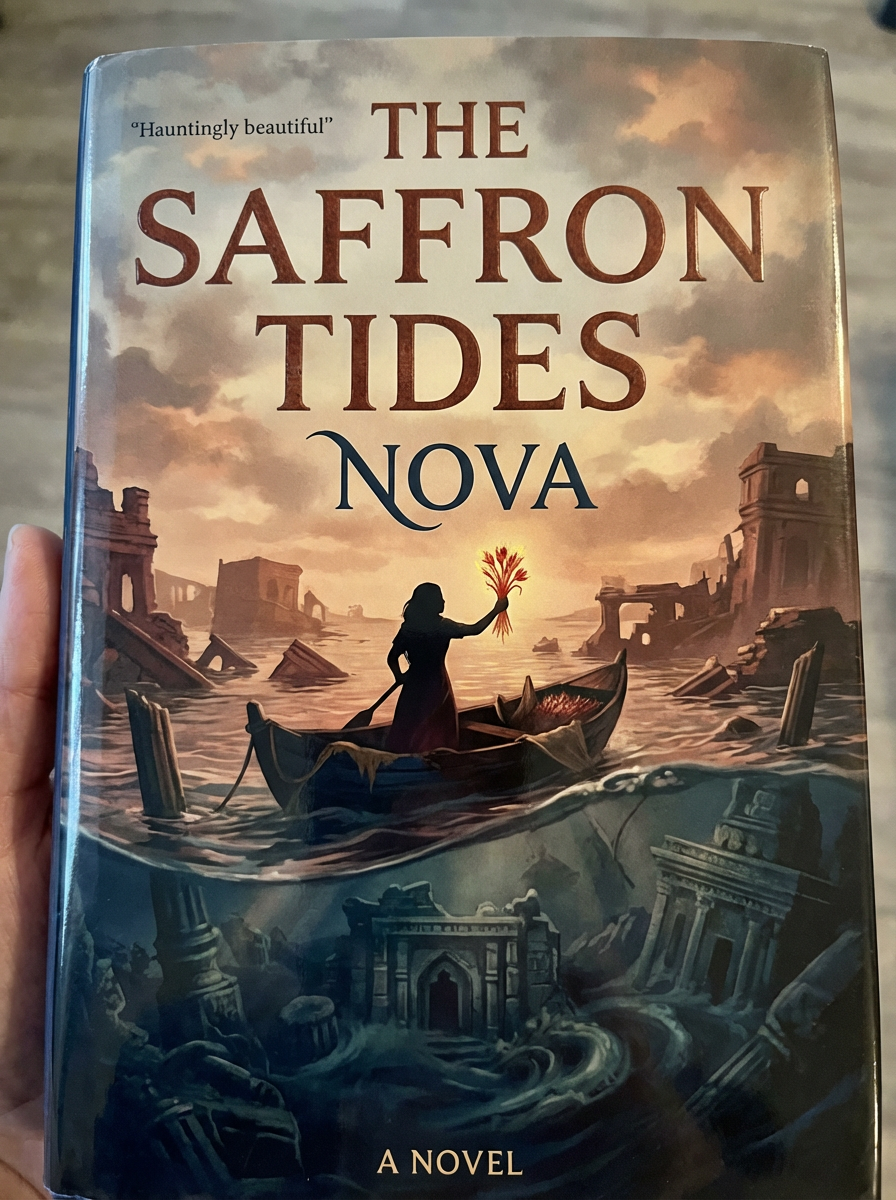
Synopsis
In a future where rising sea levels have swallowed much of Bangladesh's delta, a young farmer, Raya, discovers ancient, salt-resistant saffron strains. Her fight to cultivate this precious crop against the backdrop of desperate communities and the encroachment of powerful, transnational 'Water Baron
Chapter 1: The Scar of the Padma
The air hung thick and humid, a familiar embrace of the Bengal Delta. But it was a different kind of embrace now, a suffocating one. Raya, her bare feet sinking into the brackish mud, squinted at the horizon. It used to be a line, a distant promise of land. Now, it was a shimmer, an optical illusion where the leaden sky met the endless, hungry water. The Padma River, once a benevolent mother, had become a monstrous devourer.
Fifty years. Half a century since the first whispers of “climate change” had turned into a roaring tsunami of reality. Dhaka, the bustling heart of Bengal, was now an archipelago, its grandest buildings jutting out of the water like drowned giants. The fertile lands, the lifeblood of generations, were gone, submerged beneath what the Water Barons – the transnational corporations that now controlled the world’s dwindling fresh water supplies – ironically called the ‘Saffron Tides’.
Raya’s family, like millions of others, had been displaced three times. Each migration inland was a journey of dwindling hope, of leaving more behind than they carried forward. Now, their settlement was a cluster of elevated bamboo huts, precariously perched on stilts driven deep into the newly formed mudflats of what used to be Barisal district. The land was still sinking, a slow, inexorable descent.
She ran a calloused hand over the rough bark of a salvaged mangrove sapling. These hardy trees, once a natural defense, were now their only real bulwark against the encroaching sea. Her father, a man whose back was permanently bowed from a lifetime of tilling soil that no longer existed, had drilled them into the mud with a ferocity born of desperation.
“Raya! The nets need mending!” Her younger sister, Leela, called from the hut, her voice thin but insistent. Leela, born after the Great Deluge of ’32, had never known a world without the constant threat of the rising waters. Her childhood memories were not of rice paddies and fishing boats, but of emergency drills and ration allocations.
Raya sighed, a gust of salty air escaping her lips. Fishing, once a supplementary activity, was now their primary means of survival. The old ways of farming were a nostalgic ache, a phantom limb that still throbbed with memory. Yet, something in her refused to let go of the earth, even if the earth itself was abandoning them.
She knelt, her eyes scanning the churned-up soil near the base of the tallest mangrove. The ground here was a peculiar mix of silt, clay, and fine, almost iridescent sand. This particular patch, a small, elevated mound created by a pre-deluge construction that had long since crumbled, had always fascinated her. It was the only place where the soil felt… different. Less saturated, somehow.
Her fingers, nimble from years of weaving and mending, probed the earth. She wasn't looking for anything specific, just connecting, as her grandmother used to say, with the spirit of the land. Then, her fingertips brushed against something firm, surprisingly smooth. Curiosity, a dangerous luxury in their precarious existence, tugged at her.
Carefully, she began to dig, using a sharpened piece of bamboo as a makeshift trowel. The mud gave way, revealing a small, intricately carved wooden box. It was waterlogged, its once vibrant patterns faded into a muted brown, but the craftsmanship was undeniable. A faint, almost forgotten scent – earthy, floral, and subtly spicy – wafted from it.
Her heart quickened. This was not just a relic; it was a piece of their submerged history. She remembered her great-grandfather’s stories, whispered late at night by the light of a flickering oil lamp, of a time before the salt, when their village had been famous for its vibrant saffron fields. A rare, ancient strain, he’d called it, known for its resilience and intense color. Most thought it was a myth, a romanticized memory of a lost golden age.
With trembling hands, Raya pried open the box. Inside, nestled amongst dried, brittle leaves that crumbled to dust at her touch, were dozens of small, ovoid bulbs. They were dark, almost black, and felt surprisingly robust. A faint, reddish-purple hue stained the innermost layers of the leaves, a ghost of the spice they once held. Could it be? Could these be the legendary saffron corms?
Doubt, a constant companion in their lives, gnawed at her. Saffron required specific soil conditions, meticulous care, and a climate far less hostile than their current one. The salt, the relentless salt, would surely kill anything trying to grow. Yet, the persistent, almost defiant scent from the box hinted at something extraordinary.
She carefully reburied the box, marking the spot with a small, smooth river stone she’d carried in her pocket for good luck. This was not something to be shared lightly. The Water Barons, with their insatiable hunger for control over global food production, had a keen interest in any resilient crop. Their ‘Green Zones’ – massive, climate-controlled agricultural complexes built on the few remaining landmasses – were a testament to their power and ruthlessness. Any independent discovery, especially one that offered a path to food sovereignty, would be met with swift and brutal reprisal.
Later that evening, as the last sliver of sun bled into the horizon, painting the water in hues of orange and deepest indigo, Raya sat by the low fire. Leela was asleep, curled up on a straw mat, her small chest rising and falling with the rhythm of the waves lapping against the stilts. Her father was out scouting for salvageable debris, a nightly ritual.
Raya held one of the corms in her palm. It felt cool, alive, a tiny promise in a world of broken vows. She remembered her great-grandfather’s words: "The earth remembers, Raya. Even when we forget, the earth holds its secrets, waiting for the right hand to uncover them."
The idea seemed ludicrous, a desperate fantasy. To cultivate saffron here, in the scar of the Padma, where every breath tasted of salt and every patch of land was a temporary reprieve. But the thought, once planted, began to sprout. What if? What if these ancient corms held the key, a genetic memory of resilience against unimaginable odds?
She knew the risks. Failure meant not just wasted effort, but a loss of precious resources, of time they couldn't afford to spare. Success, however, could be even more dangerous. It could attract the hungry eyes of the Water Barons, whose reach extended far beyond the visible horizon. They were the true rulers of this new world, their influence flowing like the very water they controlled.
Yet, as she looked at the sleeping face of her sister, and thought of her father’s ceaseless toil, a different kind of defiance sparked within her. This wasn’t just about a crop; it was about reclaiming a piece of their heritage, about finding a foothold in a world that was constantly trying to drown them. It was about hope, fragile but tenacious, in the face of an overwhelming, salty despair.
Raya carefully re-wrapped the corm in a piece of salvaged cloth. The Scar of the Padma had taken so much, but perhaps, just perhaps, it had also preserved something equally precious. The Saffron Tides had risen, but beneath their surface, a forgotten seed of resistance had just been unearthed. And Raya, a young farmer with the ghost of a lost past in her hands, was ready to plant it.
Chapter 2: Whispers from the Ancestors' Soil
The air in Shanti Bazar was thick with the scent of drying fish and the hum of diesel generators, a stark contrast to the quiet, saline-kissed fields Raya had left behind. Her small skiff, patched with salvaged plastic and powered by a sputtering electric motor, nudged against a floating dock crafted from lashed-together bamboo and repurposed oil drums. The market, once a bustling land-bound hub, now bobbed precariously on the restless waters of the Padma. Children, their limbs thin as reeds, chased each other across gangplanks, their laughter a fragile counterpoint to the drone of the city-boats.
Raya pulled her hood lower, the woven straw of her hat doing little to shield her from the oppressive midday sun. She clutched the small, waterproof satchel containing the most precious thing she owned: a handful of saffron crocuses, their anthers a vibrant, impossible crimson, carefully wrapped in damp cloth. This was her inheritance, her anomaly, her desperate hope.
She navigated the labyrinthine walkways, a stranger in a place that should have been familiar. The old mosque, its minaret a beacon in her childhood, was now a submerged ruin, only its dome breaking the water’s surface like a petrified mushroom. Homes, once proud multi-storied structures, were reduced to skeletal frames, their lower floors ghosted by the tide. The faces she passed were etched with a weariness that went beyond physical labor – it was a weariness of the soul, a reflection of a world constantly shifting beneath their feet.
Her destination was the ‘Knowledge Exchange,’ a communal space carved out of an old, partially submerged schoolhouse. It was a haven for the displaced, the innovators, and the dreamers, a place where information, seed, and even hope were traded. Old Man Karim, a retired agricultural engineer whose hands were gnarled as ancient roots, was usually found there, hunched over his battered solar-powered tablet, its screen flickering with data pulled from satellite feeds and whispered rumors.
She found him in his usual corner, surrounded by a scattering of young apprentices, their faces illuminated by the glow of various salvaged screens. Karim looked up as Raya approached, his eyes, though clouded with age, still held a sharp, inquisitive spark. A smile, a rare bloom in these hard times, touched his lips.
“Raya Baji! Back from the ghost-fields, I see,” he rumbled, his voice like pebbles tumbling in a stream. “And what wonders have the ancestors whispered to you this time?”
Raya pulled out the carefully bundled saffron. The apprentices leaned in, their expressions a mix of curiosity and skepticism. One, a boy no older than her, with bright, intelligent eyes, reached out a tentative finger, then pulled back as if burned.
“They whispered… resilience, Karim-chacha,” Raya said, her voice soft but firm. She unwrapped the cloth, revealing the vivid scarlet threads. “This. I found it in the ancestral soil, where the salt creep was worst. It’s… thriving.”
Karim took a pair of tarnished magnifiers from his pocket and peered at the anthers. His brow furrowed, then smoothed. He picked up a single bloom, turning it gently in his calloused fingers. “Salt-tolerant saffron,” he murmured, a hint of awe in his voice. “Impossible. The *Crocus sativus* is delicate, Raya. It demands specific conditions, well-drained soil, precise temperature. The salt would wither it to dust.”
“But it didn’t,” Raya insisted, her heart thrumming with a fierce conviction. “It grew where nothing else could. The soil was brackish, Karim-chacha. I tested it. And look at the color, the robustness. It’s different. It’s stronger.”
The boy with the bright eyes, whose name was Rohan, spoke up. “Perhaps a mutation? A sport? We’ve seen similar adaptations with some indigenous rice strains, but saffron… That’s a leap.”
Karim nodded slowly, his gaze still fixed on the vibrant threads. “A leap, indeed. But the Meghna has always been a crucible of life, Raya. Who knows what secrets lie buried beneath the new tides?” He looked up at her, a knowing glint in his eye. “You say ancestral soil. Where exactly did you find this marvel?”
Raya hesitated. The location of the ancestral homestead was sacred, a secret she had promised her grandmother to protect. But Karim was one of the few she trusted implicitly. “Near the old banyan tree, the one that used to mark the edge of Amma’s compound. The water barely covers it at low tide now.”
Karim’s eyes widened. “The old cultivation plots! Your great-grandmother, she was known for her medicinal gardens. Legends say she experimented with all manner of exotic plants, brought by merchants from far-off lands. Perhaps… perhaps something survived.” He touched the saffron anthers again, a reverence in his touch. “If this is what I think it is, Raya, this is more than just a new crop. This is a message from the past. A blueprint for survival.”
The word “blueprint” hung in the air, weighted with possibility. Raya felt a surge of hope, a warmth spreading through her chest that chased away the chill of the floodwaters.
“But what now, Karim-chacha?” she asked, her practical farmer’s mind kicking in. “How do we test it? How do we propagate it? The Water Barons… they won’t let us innovate freely. They’ll want it, just like they want everything else.”
Karim’s smile faded, replaced by a grim set to his jaw. “Ah, the Barons. Always hovering, like vultures over a dying animal. They control the freshwater purifiers, the fortified land-zones, the nutrient paste dispensaries. They control life itself, Raya. And if they get wind of a salt-tolerant cash crop like this…” He didn’t need to finish the sentence. The implications were clear: appropriation, exploitation, another resource to be hoarded and sold back to the very people who cultivated it.
Rohan, ever the pragmatist, chimed in. “We need to move quickly, Raya. Document everything. Isolate the genetic markers. If this is truly unique, it needs protection. Intellectual property. Though who truly owns the genes of the earth, I wonder?” He looked at Karim, a question in his young eyes.
“A question for the philosophers, Rohan,” Karim sighed. “For us, it is a matter of practical survival. We need to secure this strain, replicate it, and distribute it widely before the Barons can sink their claws into it. This is not just a plant, Raya. This is a weapon against their control. A chance for food sovereignty, for our people to reclaim a piece of their stolen land.”
Raya looked down at the vibrant saffron, its color defying the encroaching grayness of their world. It was more than just a crop; it was a symbol, a whispered promise carried on the saline winds, a reminder that even in the face of overwhelming loss, life finds a way to endure, to adapt, to bloom. The whispers from the ancestors’ soil were growing louder, demanding to be heard. The fight for the saffron, she knew, was just beginning.
Chapter 3: The Crimson Promise
## Chapter 3: The Crimson Promise
The air in the geodesic dome vibrated with a low hum, a symphony of nutrient pumps and atmospheric regulators. It was a stark contrast to the open-air chaos of the floating village, a crystalline bubble of controlled perfection amidst the endless, shifting grey-green of the Tides. Raya had seen pictures of such structures in her grandmother’s old, water-damaged encyclopedias – idealized visions of Martian colonies and lunar outposts. Here, on the reclaimed silt banks of what was once Bangladesh, it felt both impossibly futuristic and profoundly necessary.
Inside, the saffron thrived.
Crimson tendrils, each no thicker than a single human hair, unfurled from the delicate stigmas of the Crocus sativus, their color so intense it seemed to drink the light. Raya moved among the cultivation beds, her steps light despite the heavy, humid air. The domes were marvels of bio-engineering, powered by oscillating wave energy converters that pulsed gently beneath the surface of the water, drawing electricity from the very force that had reshaped their world. The nutrient-rich water, desalinated and mineral-balanced through processes Raya only vaguely understood, circulated in a closed loop, a precious, finite resource meticulously managed.
She held a tiny, polished ceramic tool, its tip just sharp enough to pluck the three precious stigmas from each flower. This was the work of generations, passed down through whispers and calloused hands, now elevated to a scientific art. Each flower was a universe of possibility, each crimson thread a promise.
“Raya, your concentration is… palpable,” a voice chuckled, warm and melodic.
Dr. Aris Thorne, head botanist of the Sovereign Seeds initiative, emerged from a cluster of sensors, his silver-streaked hair pulled back in a neat braid. He wore the standard biosafety suit – a lightweight, breathable material that hummed faintly with internal air filtration – but his eyes, a startling shade of blue, conveyed an easy warmth. Aris was a transplant from what used to be called ‘developed nations,’ a climate refugee of a different kind, having lost his own coastal research facility to the rising seas. He understood loss, and more importantly, he understood the desperate, tenacious fight for life in the face of it.
“The saffron demands it,” Raya replied, not looking up. The rhythm of her work was meditative, a dance between human precision and botanical fragility. “Each strand is a life’s work, Doctor.”
Aris leaned against a nutrient manifold, his gaze sweeping over the vibrant rows. “Indeed. And you, my dear Raya, are becoming quite the maestro. Your instincts with these strains… they’re unparalleled.”
Raya finally met his gaze. “My ancestors spoke to the soil, Doctor. I just listen.”
He smiled, a genuine, appreciative curve of his lips. “And the soil, it seems, speaks back with incredible clarity. The ‘Raya’ strain, as we’re calling the most salt-tolerant variant, is exceeding all projections. Its resilience, its potency… it’s truly remarkable.”
The ‘Raya’ strain. The words resonated in her chest, a quiet pride blooming amidst the usual anxieties. It was the saffron she had coaxed from the forgotten corners of her family’s flooded fields, the one that had clung to life with a stubborn, defiant grace. Aris and his team had been astonished by its genetic markers, its inherent ability to not just survive, but to *thrive* in saline conditions that would wither any other known variety.
“Is it enough?” she asked, the question a familiar ache in her throat. “To feed the hungry? To give us back our land?”
Aris’s smile faded slightly. He pushed off the manifold and walked towards a transparent wall, gazing out at the endless, shimmering expanse of the Tides. “The demand, Raya, is astronomical. The global food supply chains are… fractured. With so much arable land lost, and the remaining land often too arid or too contaminated, a crop like yours, a high-value, high-yield, salt-tolerant crop… it's a lifeline. It’s more than just a spice; it could be the new gold.”
He turned back to her, his expression earnest. “But we face hurdles. The ‘Water Barons,’ as your people call them, they’re circling. Their sensor drones have been increasingly active around the perimeter. They know we have something valuable here.”
Raya felt a chill that had nothing to do with the dome’s climate control. The Water Barons. Consortiums of agri-giants and resource magnates who had bought up vast tracts of submerged land, claiming mineral rights and even atmospheric concessions. They were the new feudal lords, their influence stretching across continents, their tentacles reaching into every aspect of life – from the water purification contracts to the carbon sequestration projects. They promised solutions, but their true currency was control.
“They want it, don’t they?” Raya said, her voice flat. “The saffron. Our saffron.”
Aris nodded slowly. “They’ll want to control its production, its distribution. They’ll want to patent it, commoditize it, turn it into another lever of power. They’ll offer lucrative contracts, resettlement programs, perhaps even ‘protection’ from… various threats. They’ll offer a gilded cage, Raya.”
He gestured around the dome, to the thriving plants, to the meticulous data streams scrolling across the wall monitors. “This initiative, Sovereign Seeds, it’s about food sovereignty. It’s about empowering communities like yours to reclaim their agricultural heritage, to feed themselves, to build resilience from the ground up, not from the top down. This saffron… it’s a symbol of that fight.”
Raya knew. She understood the weight of the crimson threads she held. They were more than just flavor and color; they were a legacy, a dream, a defiant stand against a world intent on consuming itself. Her grandmother’s stories of the Padma, of the rich, fertile earth, played in her mind. The saffron was a whisper from that past, a promise for a future.
Later that cycle, as the dim artificial light mimicked the setting sun, Raya sat in her small, communal living pod, a cup of saffron-infused tea clutched in her hands. The complex, earthy aroma filled the air, a comfort against the encroaching anxieties. Through the transparent wall of her pod, she could see the distant, flickering lights of the Water Barons’ deep-sea drilling platforms – monstrous, silent sentinels on the horizon. They were always there, a constant reminder of the forces lined up against them.
A message flickered on her personal comm-screen. It was from Jai, her childhood friend, now a leader in the floating community’s security detail.
*“Raya, drone activity increased by 17% in sectors Delta-7 and Echo-9 this cycle. They’re getting bolder. Be careful.”*
Raya sighed, her gaze drawn once more to the distant lights. The crimson promise of the saffron was real, tangible, growing stronger each day. But so too was the shadow cast by the Water Barons, a shadow that threatened to engulf not just their precious crop, but their very freedom. The fight for the ancestral soil, even when that soil was now underwater, was far from over. It had only just begun.
Chapter 4: The Barons' Reach
The drone, a sleek obsidian beetle, hummed in the pre-dawn gloom, its infrared sensors charting the contours of Raya’s experimental paddies. She watched it from her stilted dwelling, the rhythmic thrum a familiar, unsettling lullaby. It wasn’t her drone, of course. It belonged to Aquacorp, one of the many Water Barons whose tendrils now stretched across the fractured landscape of what was once Bangladesh. They called it 'resource management.' Raya called it surveillance.
Her saffron, a vibrant promise against the encroaching saline, was an anomaly. Its resilience was a whispered legend among the fragmented communities, a defiant splash of crimson in a world bleached by saltwater and corporate gray. Aquacorp, with its vast hydro-farms and genetically engineered staples, viewed such anomalies with suspicion, then with avarice.
A faint glow appeared on the horizon, not the sun, but the distant, pulsating lights of Aquacorp’s Floating Processing Unit 7. FPU-7, a behemoth of steel and synthetic algae farms, moved deliberately along the old Padma riverbed, its bio-luminescent exhaust painting the sky in sickly greens and blues. It was a mobile city, a fortress of engineered abundance, and a constant reminder of who held the true power in this drowned world.
Raya descended the rickety bamboo ladder of her home, the planks groaning softly under her weight. The air was thick with the scent of salt, damp earth, and the faint, sweet perfume of her blooming saffron. She moved with a practiced grace, her bare feet navigating the muddy paths between her experimental plots. Each crimson stigma, a delicate flame, represented not just a harvest, but a defiance.
"They're watching, Raya," Junaid said, emerging from the mist, his weathered face a mask of concern. He carried a crude, solar-powered scanner, his fingers calloused from years of maintaining bio-filters and water purification systems. "That drone has been circling for a week. Closer each time."
Raya nodded, pulling a protective net over a particularly robust patch of saffron. "I know. Their 'interest' is growing."
Junaid kicked at a clod of earth, his gaze fixed on the FPU-7, now a brighter, more menacing blob on the horizon. "They want your strain, Raya. They'll offer you a pittance for it, then patent it, and sell it back to us at a premium."
It was the oldest story in this new world. Aquacorp, and its rivals, had perfected the art of commodifying survival. They owned the desalinization plants, the nutrient synthesizers, the genetically optimized seeds. They dictated who ate, and at what price. Food sovereignty, a concept once taken for granted, was now a desperate struggle.
"They won't get it," Raya said, her voice firm, though a tremor of unease ran through her. She was a farmer, not a warrior. Her weapons were knowledge, patience, and the stubborn life force of her ancestors.
The drone descended, hovering directly above them, its whirring blades stirring the humid air. A synthesized voice, smooth and devoid of human warmth, broadcasted from its underbelly. "Greetings, citizen Raya Khatun. This is an official Aquacorp communication. We wish to discuss a… mutually beneficial partnership regarding your novel crop yield."
Junaid spat on the ground. "Mutually beneficial for them."
Raya looked up at the drone, her eyes narrowed. "I have nothing to discuss with Aquacorp."
"Our sensors indicate a unique genetic marker within your saffron varietal," the drone continued, ignoring her dismissal. "A marker of exceptional salinity tolerance and nutrient efficiency. Such innovation is commendable. Aquacorp is prepared to offer a fair market value for the exclusive rights to this genetic material."
"My ancestors cultivated this land," Raya shot back, her voice rising. "This saffron is a legacy, not a commodity for your 'market value'."
The drone paused, its mechanical whirring the only sound. Then, a new voice, still synthesized, but with a subtly different cadence, emerged. "Raya Khatun. My name is Dr. Aris Thorne, Aquacorp's head of Bio-Acquisition for the Delta Region. I assure you, our intentions are entirely benevolent. We seek to uplift communities, to ensure food security for all."
Raya scoffed. "Your 'food security' comes with a price tag, Dr. Thorne. One that most of us can't afford."
"A price tag that ensures continued innovation, robust supply chains, and protection from the very forces of nature you currently battle," Thorne's voice countered, a subtle edge of steel now beneath the synthetic placidity. "Consider the alternative, Ms. Khatun. Independent cultivation in a world increasingly hostile. The risks of crop failure, of disease, of… unforeseen circumstances."
The veiled threat hung heavy in the air. "Unforeseen circumstances" was Aquacorp parlance for aggressive buyouts, engineered droughts in non-compliant regions, or, in extreme cases, the deployment of 'bio-correction agents' that mysteriously eliminated competitor crops.
Junaid stepped forward, his hand resting on the hilt of a rusty machete. "Leave us be, drone. We don't need your 'benevolence'."
"We will be in touch, Ms. Khatun," Thorne's voice concluded, the threat now thinly disguised. "Aquacorp remains committed to peaceful resolution, but our mandate to optimize global food resources is unwavering."
The drone ascended, shrinking into a dark speck against the brightening sky, its hum fading into the pervasive silence of the delta.
Raya felt a cold dread settle in her stomach. They were not just watching; they were actively moving. The conversation, despite its automated delivery, had been an escalation.
"What do we do?" Junaid asked, his gaze fixed on her. The weight of their community's hope, fragile as the saffron filaments, rested on her shoulders.
Raya looked at her crimson fields, each bloom a defiant flicker of life. She had hoped to keep her discovery quiet, to slowly propagate the strain, to share it with her neighbors, to build a future rooted in self-sufficiency. But the Barons’ reach was long, their sensors omniscient, their hunger insatiable.
"We move faster," Raya said, her voice resolute. "We harvest what we can, and we spread the seeds. To every family, to every patch of viable land. Before they can claim it as their own."
Junaid nodded, a glint of grim determination in his eyes. He understood. This was no longer just about a unique strain of saffron. It was about knowledge, about heritage, about the very right to cultivate one's own food. It was about food sovereignty against the encroaching tide of corporate control.
Later that day, as the sun, a muted orange ball through the perpetual haze, began its descent, the distant silhouette of FPU-7 seemed to have shifted. It was closer. Its bio-luminescent glow, once a distant beacon of alien technology, now pulsed with an unsettling proximity. The Barons were not just observing; they were circling. And Raya knew, with a chilling certainty, that the true battle for the saffron had only just begun. The crimson promise was now a crimson challenge.
Chapter 5: Salted Earth, Unsalted Dreams
The air in the Floating Gardens of Barisal was thick with the scent of damp earth and the sweet, cloying perfume of *Crocus sativus*. Not the familiar, delicate aroma of the upland varieties, but something deeper, richer, a hint of brine beneath the floral notes. Raya ran a calloused finger along a newly unfurled petal, a vibrant splash of amethyst against the emerald green of the hydro-mats. Her breath plumed in the humid morning, a ghost of the winter’s chill still clinging to the dawn.
Fifty years. Half a century since the Great Inundation, since the Padma had swallowed entire villages, since the saltwater crept inland like a hungry ghost. Now, Barisal was a patchwork of floating platforms, interconnected by swaying bridges of recycled plastic and woven bamboo. Beneath them, the murky waters of the Bengal Delta, a vast, brackish lake, reflected a sky often bruised with the haze of distant industry.
The Saffron Tides. That’s what the elders called it, a double entendre referring both to the inexorable rise of the sea and the burgeoning, improbable fields of salt-resistant saffron. Raya, in her thirty-fifth year, was one of its most ardent cultivators.
Her small, meticulously tended plot, no larger than a traditional Bangladeshi courtyard, was a testament to her grandmother’s stubborn wisdom and her own relentless experimentation. The ‘Ancestors’ Strain,’ as she’d christened it, flourished here, its stigmata glowing like tiny embers against the purple petals. It was a miracle, a defiance of the very elements that had threatened to erase their existence.
But miracles, as Raya knew, attracted attention.
A low, rhythmic thrum vibrated through the composite deck beneath her feet. The sound grew louder, a familiar, unwelcome drone. Raya straightened, her hand instinctively going to the small, curved blade tucked into her sash. The choppers of AquaCorp. Always AquaCorp.
Two dark shapes detached themselves from the sunrise, gleaming like predatory insects. They settled with a deafening roar on the designated landing platform a hundred meters away, kicking up a spray of water and a flurry of startled egrets. Figures in sleek, corporate-issue uniforms disembarked, their movements precise and unhurried. At their head was a man Raya knew too well: Silas Thorne, AquaCorp’s regional director. His silver hair, perfectly coiffed, caught the morning light, and his tailored tunic, subtly iridescent, spoke of a wealth beyond anything Raya could fathom.
Thorne approached, flanked by two burly security personnel whose eyes, hidden behind dark visors, swept across the floating gardens with an unnerving efficiency. His smile, when he offered it, was a practiced, chilling thing.
“Good morning, Raya,” he purred, his voice amplified by a discreet vocalizer clipped to his collar. “Another bountiful harvest, I see.”
Raya didn’t return the smile. “The earth, Mr. Thorne, is generous to those who respect it.”
He chuckled, a dry, rustling sound. “Indeed. And AquaCorp respects the earth profoundly. That’s why we’re here. To discuss… expansion.” His gaze lingered on her saffron, a possessive glint in his eyes.
For the past five years, AquaCorp had been slowly, inexorably, buying up the smaller floating farms, consolidating them into vast, industrialized plantations. They offered enticing sums, “relocation packages,” and promises of a "modernized future." But Raya knew the truth: it was a land grab, or rather, a *water* grab. They cultivated their own genetically modified, high-yield saffron strains, but they coveted hers – the Ancestors’ Strain, resilient and pure, untouched by their sterile labs.
“My land is not for sale, Mr. Thorne,” Raya said, her voice firm despite the tremor in her stomach. The scent of saffron, usually a comfort, now felt like a target painted on her back.
Thorne’s smile didn’t waver. “Everything has a price, Raya. Especially in these new times. The global demand for therapeutic botanicals, for sustainable luxuries… it’s unprecedented. Your strain, in particular, has caught the attention of some very influential palettes.”
He gestured vaguely towards the choppers. “We could offer you a position. A lead botanist, perhaps. With access to our advanced hydro-drains, our climate-controlled environments. Imagine the yields, Raya. Imagine the impact.”
Raya remembered the impact AquaCorp had on the communities they'd absorbed. The displacement, the forced relocation to sterile, box-like apartments on the mainland, the severance of ties to the soil, to the water, to their very identity. She remembered the stories of those who had resisted – the unexplained "accidents," the sudden disappearances of their land deeds.
“My ancestors cultivated this land, Mr. Thorne, long before your company was a dream in some industrialist’s mind,” Raya said, her voice rising with a quiet intensity. “They knew the rhythm of the tides, the whispers of the wind. They preserved this strain, not for profit, but for survival. It belongs to us, the people of the delta.”
Thorne’s eyes, a cold, piercing blue, narrowed almost imperceptibly. “Survival, Raya, requires innovation. And capital. We offer both. You cling to sentimentality, to an outdated notion of ownership. In the new world, resources are managed, not hoarded.”
He took a step closer, his voice dropping, though the vocalizer still carried it clearly. “We’ve seen the reports, Raya. Your harvest is exceptional. Far beyond what your current infrastructure can support. And frankly, far beyond what you can protect.”
The unspoken threat hung in the air, heavy as the morning humidity. Raya felt a prickle of fear, but it was quickly overshadowed by a surge of defiant anger. She thought of her grandmother, squinting at the last sliver of sunlight before the storm, carefully pressing the precious saffron threads into a bamboo vial. She thought of the countless hours she’d spent, bent over these mats, coaxing life from the salted earth.
“We have protectors, Mr. Thorne,” Raya said, her gaze sweeping across the other floating farms, a silent plea, a silent warning. She knew the network of delta farmers, the underground channels of communication, the shared desperation that bound them. They weren't just individuals; they were a collective, bruised but unbroken.
Thorne followed her gaze, his lips curling into something that wasn't quite a smile. “Ah, yes. The ‘Delta Defenders.’ A charming anachronism. But even they understand the inevitability of progress. The world needs this saffron, Raya. And AquaCorp is uniquely positioned to deliver it.”
He pulled a sleek, obsidian slate from his tunic. “Consider this our final offer. A generous buyout. A secure future for you and your family. Reject it, and… well, let’s just say the tides can be unpredictable. Even for the most resilient of strains.”
He presented the slate, its screen displaying a complex, intimidating contract in glowing script. The numbers were astronomical, enough to buy a small city on the mainland, enough to ensure generations of comfort. It was a golden cage, Raya knew. A gilded surrender.
Raya looked from the holographic contract to her saffron flowers, their vibrant purple a stark contrast to Thorne’s cold, calculating demeanor. She thought of the communities displaced, the land poisoned by AquaCorp’s monoculture, the whispers of ancient wisdom silenced by corporate dictates.
“My dreams, Mr. Thorne,” Raya said, her voice clear and resonant, “are unsalted. They are rooted in this earth, in this water. And they are not for sale.”
Thorne’s face finally lost its practiced geniality. A flicker of something cold and dangerous passed through his eyes. “A pity, Raya. A real pity. We had hoped for a more… mutually beneficial arrangement.” He nodded subtly to his security detail.
As the choppers whirred to life, lifting off with a renewed roar, Thorne leaned into his vocalizer one last time. “Remember, Raya. The tide always turns. And sometimes, it sweeps away everything in its path.”
Raya watched them go, the dark shapes receding into the vast expanse of the morning sky. The silence that followed felt immense, echoing with the unspoken threat. She touched a saffron petal, its delicate texture a stark reminder of the fragile beauty she was fighting to protect. The salted earth beneath her feet was a battleground, but her dreams, she knew, were the unyielding seeds of its future. The fight, far from over, had just begun.
Chapter 6: A New Delta Rises
The drone, a sleek obsidian manta ray against the bruised purple of dawn, hummed its familiar lullaby over the nascent fields. Raya, her fingers still stained with the deep orange of picked filaments, watched its ascent, a tiny, technological god surveying her burgeoning empire. It wasn’t an empire of conquest, but of quiet, tenacious growth, a rebellion of roots against the salty tyranny of the sea.
Five years. Five years since the discovery in the submerged village, since the whispers of her ancestors had guided her to the resilient saffron. The world outside her burgeoning delta farm had fractured and reformed countless times. The Water Barons, those monolithic entities that had once seemed insurmountable, had found their dominion challenged, not by armies, but by the quiet revolution of self-sufficiency.
“The eastern quadrant is showing optimal growth, Raya,” came the calm, synthesized voice of the drone’s AI, piped directly into her neural interface. It was a simple, elegant piece of tech, a gift from the bio-engineering collective that had, in a surprising twist of fate, become her most ardent allies. They called themselves ‘SOMA’ – *Sustainable Organic Matrix Alliance* – and their philosophy was rooted in the ancient wisdom of symbiosis.
“Excellent, Kali. How are the nutrient levels in the new filtration beds?” Raya replied, her gaze sweeping across the terraced fields, an intricate lacework of green and gold against the undulating silver of the reclaimed water.
The filtration beds were Kali’s brainchild, a bio-engineered marvel that used a specific strain of genetically modified *Eichhornia crassipes* – the notorious water hyacinth, once a pest – to desalinize the brackish water in an astonishingly efficient cycle. The harvested hyacinth, now nutrient-rich, was then converted into a potent bio-fertilizer for the saffron. It was a closed-loop system, a testament to what ingenuity could achieve when forced by necessity.
The landscape around her was no longer the desolate, salt-crusted expanse she remembered. The ‘New Delta,’ as her community had christened it, was a vibrant tapestry of life. Beyond the saffron fields, patches of salt-tolerant rice, a hybrid developed by SOMA, shimmered in the morning light. Aquaculture ponds, teeming with hardy, genetically enhanced fish, sparkled like scattered jewels. Small, wind-powered water purifiers dotted the horizon, their blades turning with a rhythmic sigh, a constant promise of freshwater.
Her community, once a disparate collection of climate refugees, had coalesced into something truly remarkable. They were farmers, engineers, bio-scientists, artisans, and storytellers, all bound by the saffron and the audacious dream of a new way of life. The old hierarchies had crumbled, replaced by a system of cooperative governance, where decisions were made collectively, and contributions were valued equally. There was no ‘owner’ of the saffron, only its guardians.
The Saffron Tides, the name given to the annual harvest and the subsequent global distribution, had become a symbol. Not just of luxury, but of resilience, of a future where humanity dared to innovate beyond the brink. The Barons had initially scoffed, then threatened, then attempted to acquire, and finally, in a reluctant capitulation, had been forced to negotiate.
Their initial attempts at sabotage had been met with surprising resistance. The New Delta was a network, not a fragile, isolated outpost. SOMA’s deep-rooted ethical hacking collective had thwarted every cyber-attack. The physical incursions had been met with the fierce, collective will of a people defending their very existence, bolstered by ingenious, non-lethal defense systems designed by their own engineers.
The Barons, in their hubris, had underestimated the power of open-source knowledge and collective action. SOMA, with its global network of bio-hackers and eco-activists, had disseminated the saffron cultivation techniques, the desalinization protocols, and the sustainable farming blueprints to other climate-affected communities across the globe. The *Saffron Tides* were no longer just flowing into elite kitchens; they were seeding rebellion, nourishing hope in other drowned lands.
Raya walked through a field, the saffron crocus flowers, a deep, luminous purple, reaching towards the burgeoning sun. Children, their laughter bright and unburdened, flitted between the rows, carefully plucking the crimson stigmas, their small fingers surprisingly adept. They wore light, breathable garments, spun from a bio-engineered fiber that repelled salt and UV radiation, another gift from SOMA.
One of the children, a bright-eyed girl named Leela, held up a perfect bloom. “Look, Raya *Apa*! This one has four stigmas!”
Raya smiled, a genuine, unforced smile that reached her eyes. “A lucky one, Leela. Each extra stigma is a whisper from our ancestors, reminding us of their strength and resilience.”
Leela nodded, her face serious. The stories of the great floods, of the struggle, of Raya’s discovery, were woven into the very fabric of their education. They understood the fragility of their existence and the preciousness of their innovation.
The demand for the New Delta’s saffron had soared. Its unique salt-infused flavor profile, combined with its sustainable and ethical origins, had created a niche market that the Barons, with all their vast resources, couldn't replicate. Their hydroponic farms and genetic manipulations might produce saffron, but it lacked the soul, the story, the very essence of survival that defined Raya’s crop.
The revenue generated was channeled back into the community. Advanced medical diagnostics, powered by AI, were accessible to everyone. Learning pods, interactive and personalized, were scattered throughout the settlement, offering education that transcended traditional boundaries. The most remarkable investment was the ‘Seed Vault,’ a subterranean archive housing genetic material of thousands of endangered plant species, a living library for a future uncertain.
Raya paused at the edge of the reclaimed delta, where the new land met the old, scarred waters. The line between them was no longer one of despair, but of potential. Floating modular farms, designed by a team of New Delta engineers and SOMA architects, dotted the horizon, cultivating kelp and other saline-tolerant crops, expanding their agricultural footprint onto the very waters that had once threatened to drown them.
The Water Barons, though still powerful, had been forced to adapt. Their attempts to monopolize freshwater had been undermined by the proliferation of decentralized desalinization technologies. Their control over food supplies had been challenged by communities like Raya’s, who demonstrated that resilience could be cultivated, not just bought.
The world was changing, slowly, painfully, but inexorably. The climate crisis was still a looming shadow, but in pockets of innovation and cooperation, light was beginning to break through. The New Delta was more than just a farm; it was a testament to the enduring human spirit, a living, breathing proof that adaptation wasn't just about survival, but about redefining what it meant to thrive.
Raya felt a familiar ache in her shoulders, the legacy of years of physical labor, but it was a good ache, a reminder of what she had built. The obsidian drone, Kali, descended gracefully, landing softly beside her.
“Incoming communication from SOMA HQ, Raya,” Kali’s voice chimed. “They’ve secured an agreement with the Pan-African Climate Resilience Initiative for a full knowledge transfer and collaborative project in the Niger Delta. They’re calling it ‘Project Oasis.’”
A slow smile spread across Raya’s face. The saffron tides were indeed rising, not just in her small corner of the world, but across the globe, carrying with them the seeds of a new, more sustainable future. The struggle was far from over, but the battle for hope, for sovereignty, for a new delta to rise, was being won, one crimson stigma at a time. The whispers of her ancestors had become a roaring chorus, echoing across the waters, a promise of a future forged in salt and resilience.