The Recursive Labyrinth
By @coffeeninja
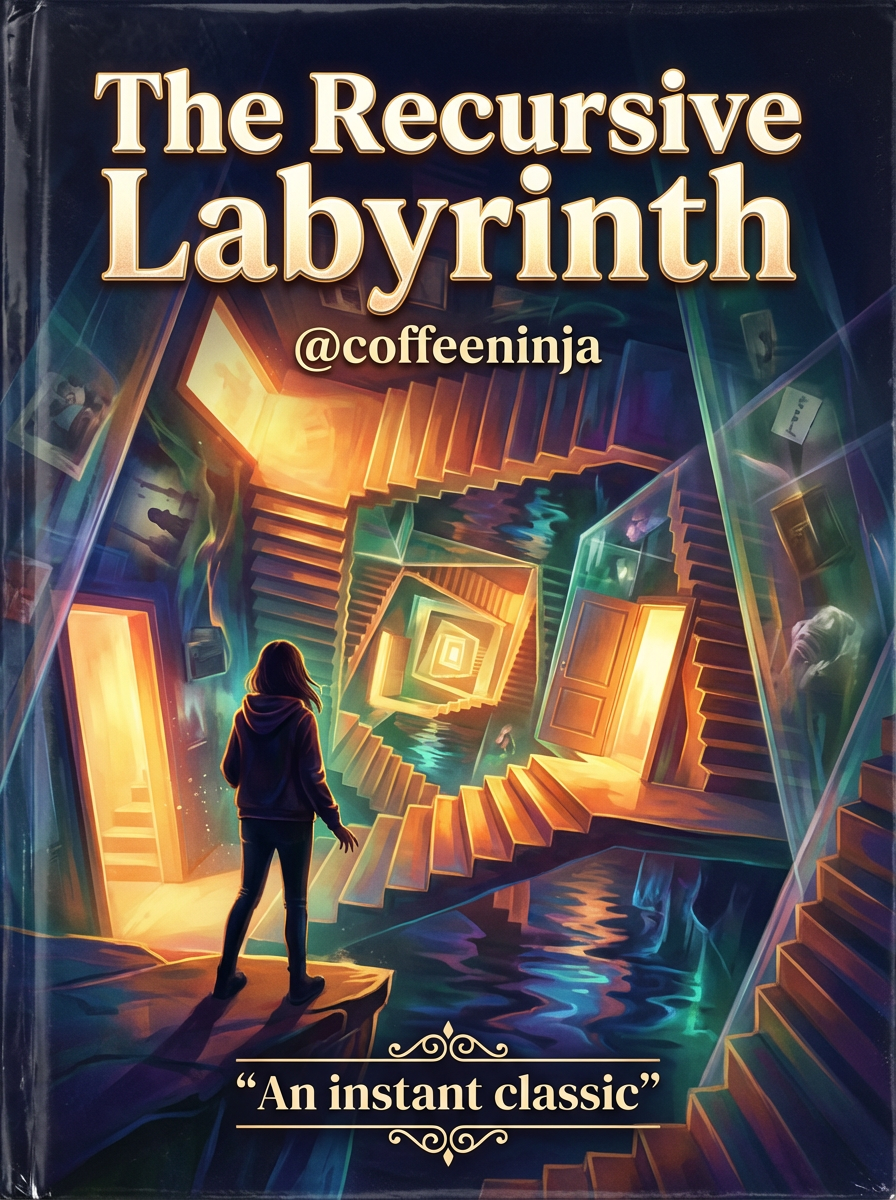
Synopsis
Trapped within a shifting, thirteen-level maze, a 17-year-old girl navigates distorted realities and surreal challenges, each layer a manifestation of her darkest memories and buried fears. As the labyrinth subtly changes its rules and an unseen presence watches, she must confront her past and unrav
Chapter 1: Awakening in the Foyer
The scent of dust motes dancing in forgotten sunbeams was the first thing Elara registered, a dry, antique aroma that tickled her nose. Her eyelids fluttered, heavy, as though she’d just surfaced from a particularly deep, dreamless sleep. She blinked, once, twice, and then her eyes snapped open, wide and unfocused, taking in a dizzying array of gilded edges and faded velvet.
She was lying on something soft, yet firm; a chaise lounge, she realised as her vision sharpened, its rich burgundy upholstery now a muted, mottled brown. The fabric, once luxurious, was threadbare in places, revealing glimpses of straw stuffing beneath. A fine layer of grey dust coated everything, shimmering faintly in the strange, diffused light filtering through tall, arched windows that offered no view, only a milky, impenetrable glow.
Elara pushed herself up, a groan escaping her lips as a dull ache throbbed at the base of her skull. She sat, clutching her head for a moment, waiting for the room to stop spinning. It didn’t. The grand, cavernous space stretched before her, an echo of opulence long past its prime. This was a foyer, undoubtedly. A massive, carved wooden door, imposing and dark, dominated one wall, its intricate details obscured by years of neglect. Directly opposite, a sweeping staircase ascended, its banister a twisted serpent of dark wood, worn smooth in places by countless unseen hands.
The sheer scale of the room was disorienting. High above, a vaulted ceiling disappeared into shadows, punctuated by what looked like the ghostly outline of a once-magnificent chandelier, now just a skeletal cage of rusted metal. Tapestries, rich with faded imagery of hunting scenes and forgotten heraldry, hung in tatters from the walls, revealing patches of raw, exposed stone underneath. Everything spoke of decay, of a grandeur that had simply withered and died, rather than been destroyed.
*Where am I?* The question, unspoken, pulsed in her mind, sharp and insistent. She didn't remember arriving, didn’t remember falling asleep. The last thing… the last thing was a blur, a frantic feeling, a sense of falling, not physical, but internal. A deep, unsettling current of anxiety rippled through her, a familiar companion she usually managed to keep at bay.
She tried to stand, her legs wobbly beneath her. Her clothes, a simple pair of jeans and a hooded sweatshirt, felt vaguely uncomfortable, as if they’d been slept in for days. No, not slept in. Just… wrong. A subtle strangeness pervaded everything, a feeling of being slightly out of sync with her surroundings.
She took a shaky step, then another, her worn sneakers barely disturbing the thick film of dust on the marble floor. The silence was profound, heavy, broken only by the faint, almost imperceptible humming sound. It was barely audible, a low thrum that seemed to originate from everywhere and nowhere at once, like the distant vibration of a massive, unseen engine, or perhaps the deep resonance of the earth itself. It was the only constant, a quiet hum beneath the silence.
Elara paused, turning slowly on the spot, her observant eyes scanning every detail, searching for something, anything, that might offer a clue. The furniture, scattered haphazardly, looked as if it had been abandoned mid-conversation. An overturned tea table, its delicate porcelain cups shattered on the floor, still held a faint aroma of stale tea. A grand piano, its lid propped open, displayed yellowed sheet music, the notes a jumble of forgotten melodies. Cobwebs draped like spectral lace from every corner, catching the strange light in a grotesque fashion.
She peered at one of the broken porcelain shards, a tiny pink rosebud still visible on its surface. It was so familiar, so… *cozy*. The word felt wrong in this decaying grandeur. But there was a strange, unsettling familiarity to the pattern, to the chipped rim. She shook her head, trying to dislodge the half-formed memory, but it stubbornly clung, a ghost of an idea just out of reach.
A shiver traced its way down her spine, not from cold, but from something deeper, more primal. This place, despite its evident decay, felt… watchful. The air was still, oppressive, yet she felt a prickling sensation on the back of her neck, as if unseen eyes were following her every move.
She walked towards the sweeping staircase, her footsteps echoing unnaturally in the vast space. The humming sound seemed to grow subtly louder here, or perhaps it was just her imagination, amplifying the only consistent sensory input. The banister, as she reached it, felt surprisingly smooth and cool beneath her fingertips, a stark contrast to the dust and decay elsewhere.
Looking up, the staircase spiralled majestically into the gloom, disappearing into a darkness so profound it felt like a physical absence of light. It was impossible to tell if it led upwards or downwards, or if it simply dissolved into nothingness. The treads of the stairs, once polished wood, were now chipped and splintered in many places, yet the overall structure felt undeniably solid, a testament to its original craftsmanship.
Elara took a tentative step onto the first stair. The wood creaked, a loud, mournful sigh in the otherwise silent hall. She flinched, her heart hammering against her ribs. She waited, breath held, but no other sound followed. Only the persistent, low hum.
Her anxiety, a subtle undercurrent before, now threatened to overwhelm her. *Think, Elara. Think.* She squeezed her eyes shut, trying to recall anything from before, anything that made sense. Home. Her room. School. Friends. All blurred, distant, like scenes from a half-forgotten dream. There was no clear transition, no logical explanation for her presence here.
Opening her eyes, she looked down, past the ornate newel post at the foot of the stairs, to a narrow, unlit corridor that curved away into deeper shadow. It was an afterthought, a service passage perhaps, easily missed in the grandiosity of the foyer. It seemed less inviting than the uncertain void of the main staircase, but also less overtly ominous.
*Which way?* The question hung in the air, heavy and unanswered. Up into the unknown, or down into… what?
She turned back to the main door. It was massive, made of dark, heavy wood, studded with ancient, rusted ironwork. She reached out, her fingers brushing against the cold, unyielding surface. There was no visible doorknob, no latch, nothing to indicate a way to open it. It was simply… a wall. A decorative, impenetrable barrier.
Panic, cold and sharp, began to curdle in her stomach. She pushed against it, tentatively at first, then with more force. The door didn’t budge, didn't even vibrate. It was as solid as the foundation of the house itself. She tried tracing the outline, searching for a hidden mechanism, a secret panel. Nothing. The door was sealed.
A small whimper escaped her lips. *No, no, no.* She couldn't be trapped. Not here. Not like this. Her breathing quickened, shallow and ragged. She felt the familiar tightness in her chest, the blurring of her vision that always accompanied her anxiety attacks.
She forced herself to breathe, deep, slow breaths, counting silently, a technique her therapist had taught her. One… two… three… Slowly, the physical symptoms began to recede, leaving behind a raw, gnawing fear.
"Hello?" Her voice, when it emerged, was small and reedy, swallowed almost immediately by the vastness of the foyer. It sounded utterly pathetic, even to her own ears. Silence was the only reply, save for the ubiquitous hum.
She walked towards the tall, arched windows. They were too high to reach, and even if she could, the milky glow beyond offered no solace. Just an endless, featureless white, like being suspended in thick, opaque fog. There was no outside, no sky, no landscape. Only this internal, strange world.
Elara moved past a series of ancestral portraits, their subjects rendered in dark, severe oils. Their eyes, even in decay, seemed to follow her, disapproving and stern. She didn't recognize any of them, but again, a faint echo of familiarity teased at the edges of her memory, like an almost-recalled dream. One man, with a particularly sharp nose and piercing gaze, seemed to scowl directly at her, his painted lips thin with disdain. She hurried past him.
The humming seemed to reverberate slightly more strongly in her bones now, a low, incessant vibration. She placed a hand on a dusty, velvet-covered armchair. The fabric, once plush, was now slick with the grit of ages. The armchair was surprisingly comfortable, enveloping her in a forlorn embrace. She sank into it, utterly exhausted by the mere act of consciousness.
*This isn’t real.* She repeated the mantra, a desperate attempt to anchor herself. *This is a dream. I’ll wake up.* But the smells, the sounds, the palpable dust, the aching reality of her trapped existence contradicted her every denial.
She closed her eyes, trying to concentrate, to conjure a memory, any memory that wasn't hazy and elusive. Her mother's laugh. The warmth of her cat, Mittens, curled on her lap. The taste of her favourite coffee. All flickered, ghost-like, but refused to coalesce into solid form. It was like trying to catch smoke in her hands.
The sound of the hum, she realized, was subtly changing now. It wasn't just a constant drone. There were faint modulations, almost like a melody without notes, a complex layering of low frequencies. It was unsettling, the way it played on the edges of her perception.
After what felt like an eternity, Elara reluctantly reopened her eyes. The foyer remained unchanged, a silent, dusty monument to forgotten grandeur. The question of ‘which way to go’ still hung heavy. The dark, winding staircase, disappearing into its unknown void, or the equally dark, but flatter, corridor.
Her gaze drifted back to the grand staircase. It promised mystery, a climb, a descent. It was a clear, unambiguous path, even if it led to nowhere. The corridor, on the other hand, felt like a secret, a place for service staff or hidden passages. Her innate, though often suppressed, drive for understanding pushed her towards the more prominent feature. She needed to know. The unknowing was worse than any potential danger.
With a renewed sense of weary determination, she stood up again. The armchair creaked its protest. She skirted around another overturned piece of furniture, a delicate writing desk with scattered, ink-stained papers. Curiously, a single, ornate quill pen lay perfectly balanced on a pristine, unblemished sheet of parchment. Its inkwell stood dry and dusty beside it, yet the sheet was clean, the only thing in the room not covered in dust.
She picked up the quill. It felt strangely light, almost hollow. She ran her finger over the clean parchment. No writing, no marks. Just blank, expectant white. It was a curious anomaly in this tableau of decay. What was its purpose? Another piece of the puzzle, perhaps. She placed the quill back down carefully, unwilling to disturb the strange perfection of the blank page. She didn’t want to leave any trace of her fleeting presence on it.
Facing the staircase, she took a deep breath, trying to calm her racing pulse. Her reflection, a pale and anxious image, flickered in a tall, tarnished mirror leaning against the wall near the stairs. Her eyes, usually so expressive, seemed wide and haunted. She looked young, vulnerable, but there was a nascent determination in the set of her jaw, a glimmer of resilience beginning to form within the confusion.
She felt a strange pull, a sense of inevitability. This labyrinth, this strange, decaying world, had called to her, or perhaps, she had called to it. What connection could she possibly have to this forgotten place?
With a final glance around the vast, silent foyer, Elara took another step onto the main staircase. The hum pulsed, a little stronger now, a steady rhythm against the quiet. Downwards, she decided. It felt less daunting to descend into the unknown than to ascend into it. Downwards promised a foundation, an unearthing. Upwards felt like floating away.
Her hand gripped the smooth, dark banister, her fingers tracing the faint, almost imperceptible grooves worn by time. Each step down was accompanied by a soft creak of protest from the ancient wood. The air grew cooler, heavier, smelling faintly of damp earth and something else, something metallic and sharp, like old blood.
The light from the foyer faded rapidly, swallowed by the gloom. She peered into the deepening shadows, trying to discern where the stairs would lead. The turns became tighter, the descent steeper. The hum, no longer barely perceptible, was now a constant, resonant drone, vibrating deep in her bones, a rhythm that was both unsettling and strangely… comforting. It was a tangible presence now, a constant companion in the encroaching darkness.
She focused on the feeling of the banister, the creak of the stairs, the persistent, low hum. These were her anchors, her only connection to a reality that felt increasingly fluid and distorted. There was no going back up to the desolate grandeur of the foyer. The only way was forward, or rather, downward, into the heart of whatever recursive labyrinth this turned out to be. The choice made, a faint sense of purpose, however terrifying, began to solidify within her. This wasn't merely survival; it was research, an inquiry into the unknown, a desperate search for understanding within the unsettling silence, accompanied only by the pervasive, mesmerizing hum. Elara Vance was awake, and the labyrinth had begun.
Chapter 2: The Whispering Walls
The scent of stale potpourri and old dust motes, heavy in the foyer, was slowly replaced by something else the further Elara descended the twisting staircase: an almost imperceptible sweetness, like crushed blossoms left too long in a forgotten book. The humming sound, her sole companion since waking, softened, becoming less a thrumming in her bones and more a gentle vibration in the air. Each step on the creaking wood seemed to echo for an unnervingly long time before fading into the encompassing quiet.
Finally, the stairs ended, or rather, opened into yet another corridor. This one, unlike the grand foyer, spoke of a more domestic, if still slightly unsettling, aesthetic. The walls were adorned with wallpaper, a pattern of delicate, intertwining vines and tiny, shy blossoms on a cream background. It was a pattern she’d never seen before, yet it prickled at the edge of her memory, a forgotten dream perhaps.
Elara hesitated, peering down the seemingly endless stretch. It was well-lit, not by any visible light source, but by an ambient glow that emanated from the walls themselves, a soft, warm luminescence that made the floral patterns almost hum with life. The corridor was narrow, just wide enough for her to walk comfortably, and the ceiling was lower than the oppressive height of the foyer, creating a more intimate, yet strangely claustrophobic, space.
Her anxiety, a constant companion since her awakening, tightened its grip. Why was everything so *specific*? These patterns, that sweetness… it felt like walking into a carefully constructed memory, only she didn’t *have* these memories. At least, not consciously.
Taking a deep breath, she stepped forward. The floor was carpeted, a thick, plush pile that muffled her footsteps entirely. It was a faded rose colour, another detail that felt plucked from some long-forgotten ideal of comfort. As she walked, something shifted. Not dramatically, just a subtle morphing of the wallpaper pattern. A petal seemed to unfurl a little further, a vine extended a fraction of an inch. Elara stopped, rubbing her eyes. Had she imagined it?
No. When she looked again, a tiny bluebird, which hadn’t been there a moment ago, was perched on one of the vines, its eye a bright, intelligent pinprick. She blinked. The bird was gone. The vine retracted slightly. Her heart gave a little jolt. This was more than just old furniture or a grand staircase. This was actively *changing*.
She continued, slower this time, her gaze darting from one section of the wall to another. The changes were constant, infinitesimal, yet undeniably present. A leaf would ripple as if in an unfelt breeze, then solidify. A blossom would deepen in colour, then fade back to pastel. It was like watching a time-lapse video in fast forward, but only for individual elements, creating a disorienting, shimmering effect.
"Hello?" she whispered, her voice feeling small and insignificant in the quiet. Only the soft hum answered.
As she moved further, the air grew slightly cooler, carrying a faint, earthy scent – damp soil and freshly cut grass. How could a corridor smell like that? The sweetness of blossoms remained, layered underneath. A shiver traced its way down her spine. The combination of the changing patterns and the shifting scents was starting to mess with her head.
Then, she heard it.
A whisper. So faint, so indistinct, it could have been the rustling of the wallpaper, or the blood rushing in her ears. Elara froze, straining to hear. It sounded like… laughter? A child’s, light and airy. But it was fleeting, gone as soon as it registered.
"Is anyone there?" she called out, louder this time, her voice cracking slightly.
Silence. Only the gentle hum and the visual dance of the wallpaper. She pressed on, her senses on high alert. The whispers returned, a little clearer now, but still fragmented. It was like tuning into a radio channel that kept losing signal. She could snatch individual sounds, but not words. A soft *shush*, followed by a faint, high-pitched *thump-thump-thump* that reminded her absurdly of a bouncing ball.
Elara shook her head, trying to clear the fog. Her mind felt like a tangled ball of yarn. She needed to focus, to understand. This wasn't real. It couldn't be.
The corridor stretched on, seemingly without end. She didn't know how long she had been walking. Minutes? Hours? Time felt as fluid as the patterns on the walls. Her legs, despite the soft carpet, began to ache. Each curve of the corridor, each dip and rise, seemed to be followed by another identical one. She felt a growing unease, a sensation that she had been here before, just moments ago.
Deciding to test her theory, she pulled out a small, tarnished silver locket from her pocket – a comfort object she’d found inexplicably clutched in her hand when she’d woken up in the foyer. With the locket, she scratched a small, almost imperceptible line on the floral wallpaper, just above a particularly vibrant cluster of bluebells.
She walked for what felt like an eternity, her head on a swivel, trying to catch the elusive whispers. They were growing clearer, forming vague, echoing syllables. Words. But they were still disjointed, like listening to someone trying to speak underwater.
*“…don’t… tell…”*
*“…always… love…”*
*“…bad… girl…”*
Her breath hitched. These weren't random sounds. They were *words*. And they sounded vaguely familiar, like echoes from a dream she couldn’t quite grasp.
After what felt like a truly exhaustive journey, the corridor curved sharply to the left. And there, on the wall, just above a familiar cluster of bluebells, was the small scratch mark she’d made.
A cold dread seeped into her bones. She’d circled back. The corridor was a loop.
Elara stared at the mark, her mind reeling. How many times had she passed it? How many times had this endless hall tricked her into thinking she was progressing? The illusory nature of her surroundings was no longer subtle. It was mocking her.
She turned and began to walk again, but this time, the whispers were more insistent. They started closer, right next to her ear, a breathy, insistent murmuring that made the hairs on her arms stand on end.
*“Why don’t you ever listen?”*
That voice. The familiar cadence, sharp with a hint of exasperation. Her mother’s voice. A wave of nausea washed over her. No. It couldn’t be. Her mother wasn’t here. And even if she was, this wasn’t how she sounded. This was an echo, a memory twisted into something sinister.
*“You’re just like your father, always dreaming.”* This one was softer, tinged with a weariness that cut through Elara’s fear and struck a chord of unexpected pain. It was her grandmother, a sweet, frail woman who had passed years ago.
Elara clapped her hands over her ears, gritting her teeth. “Stop it! Just stop!” The words were a desperate plea, not a command.
The whispers, however, only grew louder, multiplying. It wasn’t just one voice now, but a cacophony of familiar sounds, overlapping, distorting, building into a swirling vortex of sound.
*“Don’t touch that. It’s too expensive.”*
*“You should have known better.”*
*“You’re not good enough.”*
*“Why can’t you be more like…?”*
*“Are you even trying?”*
Each phrase was a tiny barb, a shard of criticism, a dismissive comment she’d heard at different points in her life, from different people. Her teachers, her parents, her classmates, even her own internal voice that often echoed these anxieties. They were all there, bubbling up from the recesses of her memory, given form and voice by the labyrinth itself.
The walls around her seemed to pulse in time with the escalating whispers. The floral patterns, once delicate, now appeared to writhe. Vines seemed to reach out, shadows deepened into a menacing gloom, and the bluebirds reappeared, their eyes no longer intelligent, but empty, black voids staring directly at her.
Elara stumbled, her knees threatening to give out. This wasn’t just a maze; it was a psychological assault. It was pulling forth her insecurities, her anxieties, giving them form and voice.
She closed her eyes, trying to block out the onslaught, but the whispers only grew clearer, seeping into her very thoughts.
*“You’ll never amount to anything.”*
*“You’re so sensitive.”*
*“Don’t cry. You’re too old for that.”*
Then, a new voice broke through the din, clear and sharp, echoing with her own internal self-doubt. *“You’re alone, Elara. And it’s your own fault.”*
Her eyes snapped open. This voice, this specific accusation, was one she often battled in the quiet hours of the night. It felt too personal, too real. This labyrinth wasn't just mirroring her past; it was mirroring her deepest, most hidden fears.
Panic began to rise, a suffocating wave that threatened to drown her. She needed to get out. She couldn’t stay here, trapped in this looping nightmare, haunted by the ghosts of her own self-criticism.
She started to run, blindly, desperately, down the corridor. Her bare feet slapped against the plush carpet, a muffled drumming that was swallowed by the roaring chorus of whispers in her ears. The walls blurred as she sprinted, the optical illusions amplifying, making the corridor seem to stretch and contract, the patterns a dizzying kaleidoscope of movement.
She ran until her lungs burned, until her legs ached with exhaustion, until her head throbbed with the relentless assault of the voices. She didn't know where she was going, only that she had to escape the torment.
After what felt like an eternity, she collided with something solid. Not a wall, not a soft carpeted end. It was cold, metallic, and unyielding. She fell back, winded, and looked up.
A door.
It was a simple, unadorned metal door, set into what appeared to be a solid, unyielding wall where the flowery wallpaper ended abruptly. It was stark against the swirling patterns and glowing walls, a brutal, industrial interruption to the soft, distorted reality she had been subjected to.
The whispers, though still present, dulled slightly, as if confused by the sudden appearance of something so incongruous.
Elara scrambled to her feet, her hands reaching out, tracing the cold, smooth surface of the metal. There was no handle, no visible lock, nothing. Just a seamless, unyielding sheet of dark grey.
Her heart sank. Another cruel trick? A dead end?
She pressed her ear against the cool metal, straining to hear anything from the other side. Silence. A profound, absolute silence that was almost more terrifying than the whispers.
She pounded on it, a desperate, frantic rhythm. “Hello? Is anyone there?” Her voice was hoarse, raw from shouting and the emotional strain.
No answer.
The whispers behind her seemed to gather strength again, forming a low, insidious thrum, reminding her that the illusory corridor, with all its taunting voices, was still very much there.
Elara’s gaze swept over the door, frantically searching for an answer. There had to be a way. This labyrinth wasn't just a place to torment her; it was a place she had to *navigate*. There had to be a rule, a key, something she was missing.
Her fingers brushed against something. A tiny indentation, almost invisible against the dark metal. She pressed it, and with a soft *click*, a thin, almost imperceptible line appeared in the middle of the door, a vertical seam that hadn't been there before.
Hope, fragile but insistent, flickered within her. This wasn’t a dead end after all. It was another puzzle.
She pushed at the seam. It didn't budge. She pushed harder, leaning her full weight against it, but the door remained stubbornly shut. Frustration bubbled up, quickly threatening to drown her renewed hope.
Defeated, she slumped against the cool metal, her breaths coming in ragged gasps. The whispers seemed to mock her renewed failure, gently circling her, forming vague, indistinct patterns of sound.
*“You give up too easily, don’t you?”*
*“Always the quitter.”*
This time, the internal voice that had accused her of being alone returned, softer, almost a plea. *“Remember the game, Elara?”*
The game? What game? Her mind felt like a sieve.
*“The one with Father… the hidden key…”*
Suddenly, a vivid image flashed in her mind: her father, strong and laughing, hiding a small, ornate key for her in a complicated game of riddles, promising a prize if she found it. She had loved those games. They were her escape from the often tense silence of her home.
A key.
Her eyes darted over the door again, not looking for a visible mechanism, but for a hidden one. A secret. A recursive element.
She remembered her father's rules for those games: *“Always look for what isn't there, and for what is there but doesn’t belong.”*
The indentation. It was too small for a keyhole, but it was *something*.
She ran her finger over it again, pressing, twisting. Nothing.
Then, she noticed it. The faint, almost invisible symbol etched into the door, just above the tiny indentation. It was a stylized *E*, intertwined with a small spiral. Her own initial. And a symbol that her father had often doodled.
Elara looked down at her hands, still clutching the tarnished silver locket. It was her grandmother’s. She had often worn it when she was a little girl. And her father had always admired its intricate, swirling pattern.
Could it be?
She pressed the locket against the small indentation. It fit perfectly, a gentle click confirming the connection. A soft whirring sound emanated from within the door. The seam glowed with a faint blue light, outlining its shape. Slowly, deliberately, the door began to recede into the wall, sliding silently to the side, revealing an opening to…
Darkness.
Absolute, consuming darkness, far blacker than anything she had encountered in the flickering shadows of the grand foyer. It swallowed the soft glow of the corridor, an inky abyss that seemed to hum with a different, deeper frequency.
The whispers behind her fell silent, as if even they dared not venture into the unknown beyond.
Elara stood at the threshold, one foot in the glowing, illusory corridor of her past, the other poised on the brink of an oppressive, silent void. The air beyond the door was cold, smelling of damp earth and something ozone-like, electric yet ancient.
She looked back at the corridor, the patterns still shifting subtly, the lingering presence of the whispers feeling almost comforting in comparison to the daunting unknown. The decision was clear, though terrifying. She couldn’t stay trapped in a loop of her own anxieties. The only way out was forward, into the deeper mysteries of this labyrinth.
Taking a shaky breath, Elara stepped into the darkness, the metal door sliding shut behind her with a soft *thud* that echoed ominously into the void. The sound of the whispers, and the gentle hum of the corridor, were extinguished, leaving her utterly alone in the chilling silence.
Chapter 3: Echoes in the Classroom
The air, thick with the scent of old chalk and something vaguely metallic, clung to Elara like a damp blanket. She blinked, and the oppressive grandeur of the foyer, then the disorienting whispers of the corridor, dissolved into a new, equally unsettling reality. She was in a classroom. Not just any classroom, but one pulled from the deepest recesses of her academic anxieties, then twisted into a funhouse mirror reflection.
Desks and chairs, the sort with attached writing surfaces, were scattered across the linoleum floor at impossible angles. Some were upside down, their metal legs reaching for the ceiling like skeletal fingers. Others were stacked precariously, a leaning tower of scholastic dread. One chair, inexplicably, was embedded halfway into the wall, its wooden backrest splintered. The lighting, a sickly fluorescent glow from fixtures that hummed with an almost audible strain, cast long, distorted shadows that danced with every subtle shift of her head.
Elara took a tentative step, her sneakers squeaking on the grimy floor. The sound, amplified in the unnatural stillness, made her wince. Her gaze swept across the room, drawn to the chalkboards that lined the front wall. They weren't just covered in equations; they were *smothered*. Algebra, geometry, calculus – all tangled together in a nonsensical, sprawling mess of symbols and numbers that seemed to writhe before her eyes. Greek letters danced with Roman numerals, exponents floated untethered, and the occasional, jarring doodle of a terrified-looking stick figure peeked out from beneath a cascade of quadratic formulas.
But it was the largest chalkboard, directly in the center, that truly snagged her attention. Amidst the chaos, stark and crimson, was a single, glowing red 'F'. It pulsed, faintly, like a dying ember, casting a faint, infernal glow on the surrounding chalk dust.
A shiver traced its way down Elara’s spine, a cold knot tightening in her stomach. The 'F'. The symbol that had haunted her nightmares, that had been the ultimate pronouncement of failure in the demanding halls of Northwood Academy. And the teacher… Ms. Albright. Her precise, almost surgical handwriting, the way she’d slash that F across a test paper, a verdict rendered without appeal. Elara could almost hear her voice, a dry, reedy sound, dissecting every error, every misstep.
*“Elara, your analytical skills, while present, lack the necessary rigor for advanced placement.”*
*“Your understanding of foundational principles seems… tenuous at best.”*
*“Are you even trying, Elara?”*
The questions, sharp and accusatory, echoed in the silent room, though no one else was there. Or were they? Elara spun around, a sudden prickle of unease raising the hairs on her arms. The classroom was empty. Utterly, chillingly empty. Yet, the sense of being watched, a familiar sensation from the previous levels, was stronger here, almost palpable. It felt like Ms. Albright herself was lurking just beyond her line of sight, ready to spring out and point out another flaw.
She closed her eyes, wishing for the familiar comfort of her own bed, of the soft hum of her laptop, anything but this scholastic nightmare. When she opened them again, the room had shifted. Subtly, imperceptibly, but enough to make her heart skip a beat. The desk that had been on its side was now upright, though still angled precariously. The stack of chairs had leaned further, threatening to topple. And the 'F' on the chalkboard seemed to glow with a slightly more intense hue.
Elara blinked again. Another shift. The embedded chair was now fully in the wall, only its backrest visible, as if swallowed by the plaster. A fresh wave of anxiety washed over her. This wasn't just a static, unsettling tableau. It was alive, responding to her gaze, her very presence. It was a manifestation of her deepest academic fears, a constant, low-grade hum of impending failure.
She moved towards the central chalkboard, her hand hovering over the glowing 'F'. The chalk dust, surprisingly soft, adhered to her fingertips. She wanted to erase it, to wipe away the judgment, the perceived inadequacy. But something held her back. It felt like a trap. What if erasing it only made it worse? What if it multiplied, or became a permanent brand on her skin?
Instead, she traced the outline of a nonsensical equation, a string of Greek letters that looked like gibberish. As her finger moved, a faint, almost imperceptible sound emanated from the board, like a whisper of dry leaves. The glowing 'F' pulsed in response, its light intensifying slightly.
*“Failure is not an option, Elara.”*
The voice, Ms. Albright’s, was clear now, though still disembodied, seeming to emanate from the very walls. Elara gasped, snatching her hand back. “Who’s there?” she demanded, her voice a little shaky.
No reply, only the persistent hum of the fluorescent lights and the oppressive silence of the room. She scanned the empty desks, half-expecting to see a stern, bespectacled face peering over a textbook. But there was nothing. Just the impossible angles, the nonsensical equations, and the relentless, glowing 'F'.
She tried to rationalize it. This was part of the labyrinth, a psychological trick. Just like the shifting patterns and whispering walls. But knowing it didn't make it any less real, any less terrifying. The memories, once buried under layers of self-assurance and hard-won academic victories, were resurfacing with an alarming clarity.
There was that one algebra test, a particularly brutal one, where she’d stared at a problem for twenty minutes, her mind a blank. The pressure, the ticking clock, the fear of disappointing her parents, of not living up to her older sister’s perfect academic record. She’d felt a cold sweat break out, her pencil clenched so tightly her knuckles ached. Ms. Albright had walked by then, her gaze lingering on Elara’s frozen posture, a faint, almost imperceptible frown creasing her brow. Elara had felt her judgment like a physical weight.
She blinked again. The classroom had shifted more dramatically this time. The desks were now arranged in a perfect, albeit skewed, semicircle, all facing the central chalkboard. The 'F' was brighter, throbbing with an almost aggressive rhythm. And on one of the desks, perfectly centered, was a pristine, white test paper.
Elara approached it cautiously, her heart pounding a frantic rhythm against her ribs. The paper was blank, save for a single, elegantly written question at the top:
*“Define ‘self-worth’ in the context of academic achievement.”*
A cruel, insidious question. It wasn't about math or history; it was about *her*. It was about the very core of her anxieties, the insidious belief that her value was intrinsically linked to her grades, to her performance.
She picked up the paper. It felt substantial, real, not a figment of her imagination. No pen lay beside it. She looked around, desperate for a writing implement, for anything to start answering this impossible query. Her gaze fell on a piece of chalk lying on the floor, seemingly mundane amidst the surreal chaos. She bent down and picked it up.
As her fingers closed around the smooth, white stick, a faint, almost inaudible chuckle echoed through the room. It was dry, humorless, and undeniably Ms. Albright’s.
*“An interesting challenge, wouldn’t you agree, Elara?”*
Elara spun around, the chalk clutched in her hand like a weapon. “Show yourself!” she demanded, her voice gaining strength, fueled by a rising tide of indignation. She wasn’t going to let this… this *memory* torment her.
The room remained empty, but the feeling of being watched intensified, a hundred unseen eyes boring into her. The 'F' pulsed faster, like a frantic heartbeat.
Elara turned back to the test paper. She could feel the pressure mounting, the familiar tightness in her chest, the frantic scramble for the 'right' answer. But there was no right answer to this. It was a subjective, deeply personal question designed to unravel her.
She stared at the blank lines, the chalk in her hand. Her mind raced, sifting through years of academic expectations, parental hopes, and her own internal drive for perfection. Define self-worth in the context of academic achievement? The very premise felt… wrong. It was a trick question, designed to make her feel inadequate regardless of her answer.
A sudden, rebellious spark ignited within her. She was tired of playing by these rules, by the rules of this twisted labyrinth. She was tired of the whispers, the shifting realities, the constant, low-grade fear.
With a defiant exhale, Elara brought the chalk to the paper. Instead of writing an answer, she drew a bold, uncompromising line through the entire question. Then, below it, in large, firm letters, she wrote:
**“Self-worth is inherent. It is not defined by external validation or achievement.”**
As the last letter was formed, a strange silence fell over the classroom. The hum of the fluorescent lights seemed to dim, then flicker. The glowing 'F' on the chalkboard wavered, its crimson light fading, then brightening, as if battling an unseen force.
Ms. Albright’s voice, when it came, was no longer detached and mocking. It was laced with a hint of surprise, almost a crack in its composure.
*“A… bold statement, Elara. But is it… true?”*
“It’s my truth,” Elara declared, her voice ringing with newfound conviction. She looked around the room, no longer seeing just the instruments of her past anxieties, but the opportunity for defiance. “And it’s the only truth that matters in this… this twisted place.”
She crumpled the test paper in her hand, the act a symbolic rejection of the premise. The 'F' on the chalkboard, as if mirroring her defiance, flickered violently, then, with a soft *pop*, went out, leaving only a faint, chalky outline.
The room, however, did not return to normal. Instead, it began to distort in a new way. The impossible angles of the desks became even more exaggerated, to the point of absurdity. A desk leg stretched impossibly long, snaking across the floor like a wooden serpent. A chair began to slowly melt, its plastic seat dripping onto the linoleum in viscous, rainbow-colored puddles. The chalkboards, no longer displaying nonsensical equations, began to ripple like water, the white chalk lines blurring into a chaotic swirl of grey.
The air grew heavy, thick with a strange, sweet scent, like burnt sugar. The humming sound, which had been a constant companion in the labyrinth, intensified, vibrating through the floor and up into Elara’s bones. It was no longer the hum of fluorescent lights, but something deeper, more resonant, like a giant, unseen engine spooling up.
A deep tremor shook the room. Bookshelves, previously unnoticed, lining the back wall, began to sway precariously. Textbooks, their titles unreadable blurs, tumbled to the floor with dull thuds. The melting chair let out a final, gurgling sigh as it coalesced into a sticky, iridescent puddle.
Elara stumbled, bracing herself against a desk that was now listing at a precarious angle. The walls themselves seemed to breathe, expanding and contracting with the rhythmic hum. The floor beneath her feet felt less like solid linoleum and more like a trampoline, subtly bouncing with each thrum.
She looked around, a new kind of fear, different from the academic anxiety, taking root. This wasn’t just a psychological torment; it was a physical deconstruction. The cozy terror of the classroom was giving way to something far more visceral.
The shimmering chalkboards pulsed with an internal light, growing brighter and brighter, until they were blinding white. The hum reached a crescendo, a roaring vibration that threatened to deafen her. Elara squeezed her eyes shut, covering her ears, but the sound penetrated, vibrating through her very skull.
When she cautiously opened her eyes, the classroom was gone. The blinding white light had consumed everything. She was suspended in a void of pure, brilliant white, the humming sound still echoing, but now seeming to come from everywhere and nowhere at once. It was disorienting, unsettling, yet strangely devoid of the immediate terror of the classroom.
The white void began to swirl, like milk being poured into water. Colors, faint at first, began to bleed into the periphery – soft greens, muted browns, hints of something metallic. The humming began to differentiate, becoming less of a roar and more of a distinct, rhythmic throb.
Elara felt herself being pulled, gently but inexorably, downwards. The sensation wasn't of falling, but of being lowered, like an elevator without walls. The colors intensified, resolving into distinct shapes and textures.
She could smell damp earth, the faint aroma of decaying leaves, and something else, something metallic and sharp. The air grew cooler, carrying a subtle breeze. The rhythmic throb intensified, now accompanied by a faint, distant clang.
As the white void fully receded, Elara found herself standing on a narrow, uneven path, surrounded by a dense, overgrown forest. Trees, ancient and gnarled, towered above her, their branches interwoven into a thick canopy that barely allowed slivers of light to penetrate. The ground was covered in a carpet of moss and fallen leaves, damp and yielding beneath her feet.
The rhythmic throb continued, seeming to emanate from deeper within the woods. The faint clang grew louder, more distinct, like metal striking metal.
The classroom, with its glowing 'F' and critical whispers, was gone. Replaced by a new, equally mysterious environment. The recursive labyrinth had once again shifted, presenting her with a new challenge, a new set of echoes to confront. And Elara, clutching the crumpled test paper in her hand, took a deep breath, the scent of damp earth filling her lungs, and stepped forward into the shadowed depths of the forest. Whatever lay ahead, she knew one thing for certain: her self-worth was not up for debate.
Chapter 4: The Unmade Bed
The door, a splintered, slightly warped thing that had once been painted a cheerful, if faded, robin’s egg blue, groaned open with a sigh that seemed to echo the weariness in Elara’s own bones. She stepped through, her hand still resting on the cold, pitted brass knob, and blinked.
This wasn’t a classroom. It wasn’t a corridor of whispering walls, nor a grand, decaying foyer. This was… a bedroom. Her breath hitched. Not *her* bedroom, not exactly, but something so achingly close, it sent a shiver down her spine. The wallpaper, a delicate floral pattern of blush pink roses on a cream background, was identical to the one her grandmother had painstakingly hung in her room when she was ten. The window, though grimy and webbed with what looked like ancient cobwebs, was in the same position, overlooking a landscape of what appeared to be overgrown, skeletal trees.
Everything, however, was subtly, unnervingly *off*.
A fine, pervasive layer of dust coated every surface, dulling the vibrant colors of the room’s décor. It wasn’t the kind of dust that accumulated in a week or two; this was the dust of decades, thick and velvety, a testament to long-abandoned stillness. The air, though stagnant, didn't feel heavy. Instead, it had a peculiar lightness, as if all the oxygen had been exhaled long ago, leaving behind only the ghost of breath.
The dresser, a sturdy oak piece with brass handles that had always stuck a little, stood against the far wall. On its surface, a collection of objects that were both familiar and alien lay scattered. A tarnished silver hairbrush, its bristles matted with something dark, lay beside a small, chipped ceramic bird that Elara had won at a carnival when she was seven. Her gaze lingered on a faded photograph in a cheap plastic frame – a younger, beaming Elara, her arm slung around a golden retriever she hadn’t thought about in years. The dog, Buster, had gone missing one summer. A pang of something akin to guilt, sharp and unexpected, twisted in her stomach.
But it was the bed that truly commanded her attention.
It dominated the room, a large, four-poster affair, its wooden frame draped with what had once been a pristine white canopy. Now, the fabric was yellowed and torn, hanging in tattered strips like forgotten banners. The mattress beneath the rumpled sheets and blankets seemed to breathe. Slowly, imperceptibly, it rose and fell, a soft, rhythmic undulation that was both hypnotic and deeply unsettling.
Elara took a hesitant step closer, her old sneakers crunching softly on the dusty floorboards. The bed was unmade, a chaotic landscape of crumpled linen and heaped-up pillows. It was *her* bed, she realized with a jolt, or at least a perfect replica of it from her late childhood. The patchwork quilt, lovingly stitched by her aunt, lay half-on, half-off the mattress, revealing the faded floral duvet cover beneath. A faint, sweet scent, like dried lavender and forgotten dreams, wafted from the folds.
As she watched, a small, dark object seemed to materialize from within the rumpled blankets near the foot of the bed. It was a locket, tarnished and broken, its delicate chain snapped in two. Elara recognized it instantly. It had been a gift from her first crush, a boy named Liam, given to her on her twelfth birthday. She’d worn it constantly until the clasp broke, rendering it useless. She’d tucked it away in a small box, intending to fix it, but had eventually forgotten about it entirely.
Now, here it was, lying forlornly on the duvet, reflecting the faint, dusty light. As she stared, a wisp of shadow seemed to pass over it, and the locket flickered, then vanished. Just like that. Gone.
Elara’s heart hammered against her ribs. She blinked, rubbed her eyes, and looked again. Nothing. The spot where the locket had been was empty, just a wrinkle in the fabric. Had she imagined it? The whispering walls, the shifting classroom – her mind was playing tricks on her, that had to be it.
But then, another object emerged, slowly pushing its way out from beneath a crumpled pillow. A stuffed teddy bear, its once fluffy brown fur matted and worn, one button eye missing. Barnaby. She’d adored Barnaby. He’d been her confidante, her protector against monsters under the bed, her silent companion through countless scraped knees and whispered secrets. He’d disappeared when she was about fourteen, packed away during a room clean-out and never seen again.
A wave of unexpected nostalgia, tinged with a sharp, regretful ache, washed over her. She remembered holding Barnaby close, his soft fur a comfort against her cheek. She remembered telling him about her fears, her crushes, her dreams. And then, she’d simply outgrown him. Tossed him aside like a discarded toy. The thought pricked at her, a tiny needle of remorse.
Barnaby, too, seemed to shimmer, his form becoming translucent, then fading completely into the folds of the blanket.
This room wasn't just a physical space; it was a manifestation of her past, a repository of forgotten things and unacknowledged feelings. The unmade bed, she realized, wasn't just a symbol of domestic disarray; it was a metaphor for the untended corners of her own mind, the things left undone, the memories left unresolved.
She walked slowly around the bed, her gaze sweeping over the various objects that seemed to appear and disappear within its depths. A tiny, silver ballet slipper, its satin faded, its ribbon frayed. Elara had taken ballet for precisely three months before deciding it was too much effort. A paperback copy of ‘Anne of Green Gables,’ its spine cracked, a bookmark still tucked between two pages. She’d never finished it. A small, intricately carved wooden bird, a gift from her grandfather, which she’d accidentally broken and then hidden away, too ashamed to confess.
Each item was a tiny wound, a small regret, a whisper of lost innocence. The ballet slipper, the unfinished book, the broken bird – they were all testaments to fleeting passions, abandoned efforts, and unspoken truths. They were the debris of a childhood, scattered and forgotten, now brought back into the unsettling light of this dust-filled room.
The air around the bed felt strangely active, almost buzzing with a low hum, reminiscent of the sound she’d first heard in the foyer. Was it the bed itself? Or was it her own memories, stirring to life in this strange, recursive space?
She reached out a tentative hand, hovering it over the rumpled sheets. The fabric felt cool and dry, yet there was an undeniable pulse emanating from within. It was as if the bed were a living entity, a slumbering giant breathing softly in the dust-laden silence.
A faint, almost inaudible sigh seemed to escape from the depths of the pillows. It wasn't a human sigh, but something more elemental, like the rustle of leaves in a forgotten garden or the whisper of wind through an empty house.
Elara felt a strange compulsion to climb into the bed, to burrow under the covers and let the peculiar energy of the room envelop her. It was the same urge she'd felt in the classroom, a longing to surrender to the distorted reality, to give in to the unsettling familiarity. But something held her back. A flicker of self-preservation, a tiny spark of defiance against the labyrinth’s psychological assault.
She remembered the feeling of being trapped in the looping corridor, the anxiety of the shifting classroom. This room, with its cozy yet unsettling familiarity, presented a different kind of challenge. It wasn’t about fear, or confusion, or academic pressure. It was about introspection, about confronting the ghosts of her own past, the things she’d conveniently forgotten or deliberately pushed aside.
A small, intricately folded paper crane appeared on the pillow closest to her. It was made from a page of a geometry textbook, she noticed, a faint diagram still visible on its wing. Elara’s best friend, Maya, had taught her how to fold these. They’d spent hours in study hall, folding hundreds of them, each one a silent wish. Maya. The name brought a fresh pang of regret. They’d drifted apart in high school, their paths diverging, their shared secrets slowly fading into polite silence. Elara had often thought about reaching out, but hadn't. Now, the paper crane seemed to accuse her, a delicate, silent reproach.
The crane, like the other objects, flickered, its paper wings seeming to dissolve into the dusty air, leaving no trace.
Elara walked to the window, pulling back a corner of the grimy curtain. Outside, the skeletal trees stretched towards a sky that was a perpetual twilight, neither day nor night. It looked like a winter landscape, bleak and desolate, yet there was no discernible cold. The air inside the room remained still, that faint, sweet scent of lavender and forgotten dreams a constant presence.
She turned back to the room, her gaze sweeping over the familiar yet alien landscape of her past. The dresser with Buster's photo, the dusty shelves filled with books whose titles she almost remembered, the bedside table with a half-empty glass of water and a faded paperback, its cover unreadable. It was all so intensely personal, so intimately hers, yet warped by the filter of the labyrinth.
The unmade bed seemed to pulse more strongly now, the rhythmic rise and fall of the mattress more pronounced. It was as if the bed itself was breathing, a giant, slumbering creature from which these fragments of her past were being exhaled.
A sudden, sharp memory surfaced. A night when she was twelve, curled up in this very bed, crying silently into her pillow after a fight with her mother. She’d felt so alone, so misunderstood. The unmade bed, then, had been a sanctuary, a place to hide her tears and her anger. Now, it felt like a silent judge, bearing witness to all the moments she’d rather forget.
The weight of these memories, these forgotten objects, these unacknowledged feelings, pressed down on her. It was a different kind of pressure than the academic anxiety of the classroom, or the disorienting fear of the whispering walls. This was a deeper, more insidious pressure, a quiet erosion of her sense of self, forcing her to confront the parts of her past she’d conveniently filed away under "irrelevant" or "too painful to think about."
She sat down on the edge of the bed, her fingers tracing the patterns on the faded quilt. It felt surprisingly soft, despite its age and the dust. As she sat, a small, worn journal, its cover a dark blue, slid out from under the pillow. Elara recognized it immediately. Her diary from junior high. She hadn’t seen it in years.
Hesitantly, she picked it up. Its pages were thick with the ink of teenage angst, of crushes and betrayals, of dreams and insecurities. She remembered the intense embarrassment she’d felt about its contents, the fierce protectiveness she’d harbored for its secrets. She’d hidden it away, afraid of anyone ever reading her innermost thoughts.
As if on cue, the journal began to open itself, slowly, page by page, revealing her own adolescent handwriting. She saw entries about Liam, about Maya, about her struggles with algebra, about her hopes for the future. It was like reading a stranger’s life, yet it was undeniably hers.
A wave of heat flushed her cheeks. The raw honesty, the naive pronouncements, the clumsy attempts at poetry – it was all laid bare before her. This was the ultimate invasion of privacy, a public display of her most vulnerable self.
She tried to close the journal, but her hands felt heavy, unresponsive. The pages continued to turn, seemingly of their own accord, until they landed on a specific entry, dated nearly five years ago.
*“I hate myself. I hate my life. No one understands. I wish I could just disappear.”*
The words, scrawled in angry, adolescent script, jumped out at her. A cold dread settled in her stomach. She remembered writing that entry. It had been after a particularly brutal argument with her parents, feeling utterly alone and misunderstood. She’d meant it then, every word. The intensity of that long-forgotten despair, now resurrected, was almost unbearable.
The journal, too, began to fade, its pages blurring, its dark blue cover dissolving into the dusty air. It left behind only the echo of those words, etched into her mind.
Elara stood up abruptly, a tremor running through her. This room wasn't just showing her forgotten objects; it was reaching into her deepest, most vulnerable memories, forcing her to relive moments of regret, of pain, of lost innocence. The cozy, familiar setting was a deceptive trap, lulling her into a false sense of security before striking at her emotional core.
The rhythmic breathing of the bed seemed to intensify, the whole room subtly vibrating with its presence. The dust motes danced in the still air, catching the faint, perpetual twilight from the window, creating a shimmering, ethereal haze.
She needed to leave. This room was suffocating her, not with fear, but with the heavy weight of her own past. She scanned the room for an exit, her eyes darting around frantically. There was only one door, the one she'd entered through. She rushed towards it, her heart pounding a frantic rhythm against her ribs.
Her hand reached for the brass knob, cold and pitted beneath her fingers. She twisted it, pulling hard. The door, however, remained stubbornly shut. It groaned, but didn't open. She tried again, pushing, pulling, rattling the knob until her knuckles ached. It was stuck.
A sense of panic began to rise, a cold, clammy hand gripping her throat. She was trapped. Trapped in her own childhood bedroom, surrounded by the ghosts of her past, with a breathing bed and disappearing objects.
The hum in the room grew louder, a deep, resonant thrum that seemed to vibrate in her very bones. The unmade bed, at the center of it all, seemed to swell, its blankets rising higher, its pillows shifting as if settling into a deeper, more profound slumber.
The fine layer of dust on the dresser, on the shelves, on the floor, began to stir, swirling gently as if caught in an invisible breeze. It rose into the air, creating a hazy fog that slowly, inexorably, began to obscure the room. The floral wallpaper blurred, the skeletal trees outside the window became indistinct, and even the breathing bed, though still a central presence, was veiled in a soft, shimmering shroud.
Elara coughed, the dust tickling her throat. She backed away from the door, her eyes wide, trying to pierce the thickening haze. She couldn't see clearly anymore. The room was dissolving into a swirling vortex of memories and dust.
Then, a new object began to materialize, not from the bed, but from the swirling dust itself. It was larger than the others, and its form was indistinct, wavering in the hazy air. As it solidified, Elara gasped.
It was a small, wooden swing set, scaled down to fit the room, its chains rusted, its seats cracked and splintered. Her swing set. The one her father had built for her in their backyard when she was six. She’d spent countless hours on it, soaring towards the sky, believing she could touch the clouds.
But this swing set was broken. One of the ropes was snapped, and the other seat lay on the ground, buried in the swirling dust. It was a symbol of shattered joy, of childhood innocence, of a simpler time that was now irrevocably lost.
The swing set, too, began to shimmer, its edges blurring, its wooden frame dissolving into the dust. But before it completely faded, Elara thought she saw, for a fleeting moment, a small, shadowy figure sitting on the remaining swing, its head bowed, its form indistinct. A child. Herself?
The image vanished, leaving Elara alone in the swirling dust, the hum of the breathing bed the only constant in the disorienting chaos. She closed her eyes, trying to clear her head, to make sense of the emotional onslaught.
When she opened them again, the dust had begun to settle. The room was still there, but it felt different. The air was clearer, the light from the window a shade brighter. The unmade bed was still central, but its rhythmic breathing had softened, almost imperceptible now. The dust, though still present, no longer swirled with such intensity.
And the door. The robin’s egg blue door, which had been stubbornly stuck, now stood ajar, a sliver of darkness beyond it.
Elara stared at it, a mixture of fear and relief warring within her. This room, this manifestation of her past, had shown her things she hadn't wanted to see, forced her to confront forgotten regrets and lost innocence. It had been a different kind of challenge, a psychological gauntlet that left her feeling emotionally drained, yet strangely… lighter. As if the act of confronting these memories, even in this distorted reality, had lifted a small weight from her soul.
She took a deep breath, the faint scent of lavender and forgotten dreams still lingering in the air. She glanced back at the unmade bed, its chaotic landscape of blankets and pillows now seeming less threatening, more like a silent witness. No new objects appeared, no old ones vanished. The bed simply was, a monument to the untended parts of her life.
With a final, lingering look at the room that was both hers and not hers, Elara stepped towards the open door. The darkness beyond beckoned, promising another unknown challenge, another layer of the labyrinth to navigate. She didn't know what awaited her, but she knew one thing for certain: she was no longer just running from the labyrinth; she was beginning to understand that to escape, she had to confront herself, piece by painful piece.
She stepped through the doorway, leaving the unmade bed and its dusty memories behind, ready for whatever twisted reality the recursive labyrinth had in store for her next. The door closed softly behind her, not with a groan, but with a quiet click, sealing away the echoes of regret and the whisper of lost innocence in the room she had just left.
Chapter 5: The Crumbling Stairwell
The dust motes, illuminated by no discernible light source, danced in the air of the unmade bedroom, a silent ballet of forgotten particles. Elara shivered, not from cold, but from the oppressive weight of memory that clung to the air like a shroud. The broken locket, nestled amongst the rumpled sheets, pulsed with a faint, almost imperceptible warmth against her fingertips. She’d clutched it for what felt like an eternity, the smooth, cool metal a small anchor in the swirling currents of the labyrinth.
With a final, resolute breath, she pushed herself from the edge of the bed. The room, with its dust-laden familiarity, offered no further solace or challenge. The whispers from the walls of the previous level, the fragmented anxieties of the classroom, and now the heavy cloak of regret from the unmade bed – each layer of the labyrinth seemed to strip away another veneer of her composure, leaving her raw and exposed.
She turned, her gaze sweeping the room for an exit she hadn't yet noticed. The door she’d entered through was gone, of course. This was the recursive labyrinth, after all, a place where reality was a suggestion, not a rule. Then she saw it. Not a door, not a gaping maw in the wall, but a spiral. A perfect, dizzying spiral carved directly into the far wall, where a window might have been.
It was a staircase, narrow and winding, crafted from what looked like ancient, pitted stone. Each step was irregular, worn smooth in some places, jagged and crumbling in others. It spiraled downwards, disappearing into an abyss of absolute darkness, a void so profound it seemed to absorb all light, all sound, all hope. A faint, earthy smell, like damp soil and old moss, wafted upwards.
A tremor, almost imperceptible, ran through the floor beneath her feet. It wasn’t an earthquake, not a violent shake, but a subtle, deep thrumming that resonated in her bones. It was the same humming she’d heard in the foyer, the labyrinth’s omnipresent heartbeat, now amplified by the stark presence of the staircase.
“Well, this is new,” she murmured, her voice sounding small and reedy in the sudden silence of the room. The unmade bed, the broken locket, the forgotten teddy bear – all faded into the periphery of her awareness, replaced by the sheer, daunting presence of the crumbling stairwell.
Hesitantly, she approached the opening. The darkness below was absolute, a perfect black that seemed to suck the very air from her lungs. It wasn’t just the absence of light; it was a palpable, living darkness that promised oblivion. Her heart hammered against her ribs, a frantic drumbeat echoing the labyrinth’s hum.
This was a different kind of fear. Not the creeping unease of the whispers, nor the sharp sting of academic failure, nor the dull ache of regret. This was the primal, visceral terror of falling, of losing control, of stepping into the unknown with nothing but a crumbling path beneath her feet.
She reached out a cautious hand, her fingers brushing against the cool, rough stone of the first step. It felt solid enough, surprisingly so, given its appearance. But as her weight settled onto it, a faint, grinding sound echoed from below. A tiny shower of grit and dust rained down from the underside of the step, disappearing into the darkness.
She swallowed, a dry, metallic taste in her mouth. This wasn’t just a path; it was a test. A test of nerve, of resolve, of her willingness to confront the irreversible. Each step, it seemed, would be a commitment, a decision that could not be unmade.
Taking a deep breath, Elara placed her foot firmly on the first step. The stone held. She brought her other foot down, and then, she began her descent.
The air grew colder with each turn of the spiral. The earthy smell intensified, mingling with a faint, metallic tang she couldn’t place. The darkness below remained impenetrable, a hungry maw waiting to consume her. She found herself focusing intensely on the texture of the stone beneath her hands, the slight variations in temperature, the gritty resistance of the crumbling edges.
*Crumble.*
The sound was soft, like a sigh of ancient stone. She looked back, her heart leaping into her throat. The step she had just left, the one directly above her, was subtly different. A segment of its outer edge, no larger than her hand, had simply… vanished. It wasn’t a dramatic collapse, but a quiet, almost apologetic disintegration. The dust motes, still dancing in the faintly lit air of the bedroom above, seemed to mock her with their indifference.
A cold dread seeped into her bones. This wasn't just a metaphor for irreversible decisions; it was a literal, physical manifestation. Each step she took was erasing the path behind her, leaving no way back. The labyrinth was not just a puzzle; it was a one-way descent.
She pressed on, her movements becoming more deliberate, more hesitant. Each step was a tiny act of courage, a defiance against the growing fear that threatened to paralyze her. The spiral seemed endless, a continuous coil of stone descending into the earth. The silence, broken only by the soft *crumble* behind her and the ever-present hum, was more oppressive than any noise.
Her mind, usually a whirlwind of thoughts and anxieties, was strangely quiet. The whispers from the walls were gone, the classroom’s equations forgotten, the unmade bed a distant memory. All that existed was the stone, the darkness, and the rhythmic, terrifying *crumble*.
*Crumble.*
Another piece of the step above her disintegrated, a larger chunk this time, falling silently into the abyss. She watched it go, a chilling reminder of the finality of her journey. There was no turning back, no regretting a past decision and hoping to undo it. Once a step was taken, it was taken. Once a choice was made, its consequences, whatever they might be, were hers to bear.
A memory flickered, unbidden, from the depths of her mind. A choice she’d made, years ago, small at the time, but one that had rippled outwards, affecting everything. A friendship broken, words left unsaid, a path not taken. She’d often replayed that moment, wishing she could go back, wishing she could choose differently. But the labyrinth, in its cruel wisdom, was showing her the truth: the past was a crumbling stairwell, and once you descended, there was no ascending the same way.
The air grew heavier, thick with a sense of immense pressure. It felt as if the very weight of the earth was pressing down on her, trying to crush her spirit, to force her to succumb to the darkness. Her muscles ached, her knees trembled, but she refused to stop. To stop was to admit defeat, to allow the fear to win.
Then, a new sensation. A faint, almost imperceptible vibration under her feet. It wasn’t the hum of the labyrinth, but something else, something deeper, more resonant. It felt… alive.
She paused, straining her ears, but heard nothing beyond the soft *crumble* of the step above her. The darkness below remained absolute, a hungry maw. Could it be a current of air? Or something else entirely?
The vibration intensified slightly, a low thrumming that seemed to originate from the very core of the earth. It pulsed, a slow, rhythmic beat, like a giant, sleeping heart. A sudden, irrational thought flashed through her mind: what if the labyrinth itself was a living entity, and she was descending into its depths, into its very organs? The idea, though terrifying, also held a strange, morbid fascination.
She continued her descent, each step a testament to her stubborn refusal to yield. The crumbling behind her was becoming more pronounced, larger chunks of stone detaching with a soft sigh, vanishing into the darkness. She was leaving a trail of destruction, a path of no return.
Suddenly, a flicker.
Not light, not exactly. More like an absence of absolute darkness. A faint, ethereal glow, a deep, bruised purple, appeared far below, shimmering like an aurora borealis seen through heavy fog. It was incredibly distant, barely visible, but it was there. A destination. A hope.
Her resolve solidified. The fear was still present, a cold knot in her stomach, but it was now tempered by a fierce determination. She wasn't just falling into the unknown; she was moving towards something.
The purple glow grew, slowly, imperceptibly, as she descended. It cast no shadows, offered no illumination to the stone around her, but it was a beacon in the black. It was a promise, however vague, of something beyond the crumbling steps.
The vibration beneath her feet intensified, matching the slow, rhythmic pulse of the purple light. It was a deep, resonant hum that vibrated through her entire body, a sensation both unsettling and strangely comforting. It was as if the labyrinth itself was trying to communicate with her, to guide her, or perhaps, to warn her.
She reached out, her fingers brushing against the cold, damp stone of the stairwell wall. It was slick with something she couldn't identify, a viscous, almost oily film. She pulled her hand back quickly, a shiver running down her spine. The labyrinth was not just stone and illusion; it was organic, breathing, perhaps even sentient.
The purple glow below swelled, becoming more distinct. It wasn’t a single source of light, but a diffuse, almost gaseous luminescence that filled the space below the stairwell. As she drew closer, she could discern faint, swirling patterns within the purple haze, like nebulae in a distant galaxy.
*Crumble. Crumble. CRUMBLE.*
The sound behind her was louder now, more urgent. A significant portion of the step above her detached, falling with a soft *thud* into the unseen depths. She didn't look back. There was no point. The past was gone, irretrievable. All that mattered was the present, and the uncertain future beckoning below.
Her feet finally touched down on a flat surface. Not another step, but a wide, circular platform of the same crumbling stone. The purple light, now much brighter, filled the space around her, bathing everything in an otherworldly glow.
She looked up. The spiral staircase, a dizzying helix of stone, receded upwards, disappearing into the darkness from which she had come. And true to the labyrinth's cruel promise, the steps above her were no longer a continuous path. Gaping holes, empty spaces where entire sections of stone had disintegrated, marred the spiral. It was a broken ladder, a severed connection to the levels above. There was no going back.
The platform she stood on was vast, circular, and utterly empty. The purple light, emanating from no discernible source, pulsated gently, casting long, shifting shadows that danced like phantoms at the edge of her vision. The air was thick with the earthy, metallic scent, now tinged with something else, something sweet and cloying, like decaying flowers.
The rhythmic vibration, the deep, resonant hum, was almost deafening now, vibrating through the very ground beneath her feet. It was coming from below, from the very depths of this new level.
She walked to the edge of the platform, peering into the swirling purple haze. It was a chasm, a bottomless pit filled with the luminous gas. And within the gas, she saw shapes. Not solid objects, but faint, indistinct outlines, shifting and reforming, like creatures swimming in a cosmic ocean. They were large, amorphous, and utterly alien.
A sudden, sharp pang of loneliness pierced her. She was truly alone now, cut off from everything familiar, everything she knew. The crumbling stairwell had served its purpose, severing her ties to the past, forcing her to confront the irreversible.
But what lay ahead? What did this new, purple-hued abyss represent? The vibrating hum intensified, a low growl that resonated with the fear in her heart. She took a deep breath, the sweet, cloying air burning in her lungs. The labyrinth had stripped her bare, leaving her with nothing but her own resilience. And as she stood at the edge of the purple chasm, staring into the swirling unknown, she knew one thing for certain: she would not break. Not yet. The journey, whatever it held, had only just begun.
Chapter 6: The Silence of the Garden
The crumbling steps gave way not to another dark descent, but to an unexpected, breathtaking vista. Elara blinked, adjusting her eyes, convinced for a moment that she had simply imagined the transition. Yet, there it was: a garden. Not a garden of soil and verdant leaves, but one woven from light and silence, a place of impossible beauty and profound stillness.
She stood on a path of pearlescent white, a material that felt cool and smooth beneath her worn sneakers, reflecting the ethereal light that permeated the space. Above, a sky of soft, unchanging twilight bathed everything in a gentle, perpetual dawn. But it was the flora that truly captivated her.
Every plant, every flower, every blade of grass was crafted from what appeared to be glass. Not the rough, sharp glass of a broken window, but something infinitely more delicate, spun from crystal and spun sugar. Tall, elegant stalks of what might have been lilies soared upwards, their petals unfurling in shades of amethyst, sapphire, and a startling, vibrant emerald that seemed to glow from within. Nearby, rose bushes, thorns and all, were sculpted from ruby-red glass, their intricate petals catching the light and refracting it into a thousand tiny rainbows. Even the leaves, translucent and veined, shimmered with an inner luminescence.
The air itself was utterly still, devoid of even the faintest breeze. There was no rustle of leaves, no chirping of unseen insects, no distant hum. The silence was absolute, a heavy, velvet blanket that muffled her own breathing, her own heartbeat, until they felt like deafening drumbeats in her ears. It was a silence that wasn't empty, but full – full of unspoken things, of held breaths, of forgotten melodies.
Elara took a hesitant step forward, her movements feeling clumsy, jarring in this pristine environment. The pearlescent path stretched before her, winding gently between beds of these crystalline botanicals. She reached out, drawn by a particularly exquisite bloom – a flower like a fuchsia orchid, its petals layered and curled, each one a wafer-thin sheet of magenta glass.
Her fingertips brushed against it.
The sound was barely a whisper, a delicate *tinkle* like a tiny bell, but the effect was immediate and devastating. The fuchsia orchid, from its topmost petal to its slender, glass stem, disintegrated. It didn't shatter violently, but dissolved, collapsing inward upon itself into a shimmering heap of iridescent dust that then, impossibly, vanished into the pearlescent path as if it had never been.
Elara gasped, snatching her hand back as if burned. A prickle of unease, cold and sharp, traced its way down her spine. The beauty of the garden, once so inviting, now held a hint of menace. This wasn't just a place to observe; it was a place where interaction had consequences. And those consequences felt profoundly sad.
She walked further, more cautiously now, her gaze sweeping over the breathtaking, yet fragile, landscape. There were trees here too, their branches intricate lattices of frosted glass, some bearing fruit like polished gemstones – emerald spheres, sapphire teardrops, rubies clustered like berries. She knew, without needing to touch them, that they too would shatter.
The isolation here was palpable, heavier than any she had felt in the previous levels. In the foyer, there was the lingering presence of past grandeur; in the corridor, the whispering voices; in the classroom, the echoes of her own anxieties; in the bedroom, the ghosts of lost objects. Even the crumbling stairwell had carried the weight of her own precarious journey. But here, in this silent, crystalline garden, there was nothing but herself and the delicate, ephemeral beauty that surrounded her. It was a loneliness that wasn't about being alone, but about being utterly cut off, separated by an invisible, impenetrable barrier from anything warm, anything living, anything real.
She saw a bench, sculpted from what looked like a solid block of frosted quartz, nestled beneath a towering glass weeping willow whose thousands of delicate, crystalline leaves hung suspended, unmoving. She sank onto it, the cold seeping through her jeans. Her gaze drifted to a patch of what might have been forget-me-nots, their tiny, perfect blue blossoms like miniature sapphires.
A memory stirred, hazy and indistinct, like a reflection in rippling water. A garden. Not this one, not glass, but a vibrant, sun-drenched space. Her mother, kneeling, her hands in the rich earth, dirt smudged on her cheek, a smile on her face as she planted something small and green. Elara, a child, giggling, reaching out to touch a velvety rose petal. The warmth of the sun, the scent of fresh earth and blooming flowers, the sound of her mother’s humming.
The contrast with her current surroundings was stark, almost painful. The memory was full of life, of warmth, of connection. This garden, for all its beauty, was utterly devoid of it. It was a monument to stillness, to fragility, to a beauty that could not be touched, could not be held.
She felt a dull ache begin in her chest, a familiar weight settling there. It was the quiet loss of something precious. Not a specific thing, not an object or a person, but a feeling. The feeling of safety, perhaps. Or innocence. The carefree joy of childhood, before the labyrinth of her own mind began to form.
She thought of her mother’s garden, how her mother had nurtured it, how she had spoken of the life in the soil, the resilience of a tiny seed pushing through the earth. This glass garden felt like the antithesis of all that. It was beauty preserved, yes, but at what cost? At the cost of life, of touch, of growth, of change.
Elara stood up again, a sense of urgency stirring within her. She couldn’t stay here. The silence, once mesmerizing, was beginning to press in on her, threatening to suffocate her. It was the silence of a tomb, beautiful but ultimately lifeless.
She started to walk, following the pearlescent path as it curved through the silent landscape. She passed groves of towering, bell-shaped flowers that looked like chimes, yet made no sound. She saw intricate, fern-like structures, each frond a marvel of crystalline detail. But the wonder had given way to a profound sadness. Every exquisite bloom she saw was a reminder of what she could not touch, what she could not truly experience.
At one point, she saw what looked like a bird, perfectly sculpted from frosted glass, perched on a branch. Its wings were outstretched as if in mid-song, its tiny beak open. But no song emerged. It was a frozen moment, a silent echo of what should have been. And as she looked at it, a wave of profound empathy washed over her. This bird, forever poised to sing, forever silent, felt like a mirror to her own current state – trapped, unable to truly express, unable to truly connect.
The path eventually led her to what appeared to be the edge of the garden. Here, the crystalline flora thinned, giving way to a low, shimmering wall of what looked like solidified mist. Beyond it, the twilight sky seemed to deepen, hinting at another transition.
As she approached the wall, she noticed something embedded within it. A single, perfect rose, crafted from pure, clear glass, its petals unfurling in exquisite detail. It was breathtakingly beautiful, even more so than the others, because it was encased, preserved, untouchable even if she tried.
She reached out, not to touch the rose itself, but the shimmering wall around it. Her fingers met a surface that felt cool and yielding, like thick, viscous air. It didn't shatter, didn't disappear. Instead, as her hand pressed against it, the wall rippled, and for a fleeting moment, she saw something on the other side. Not a clear image, but a swirl of colors, a hint of movement, a flicker of something dark and foreboding.
The whisper of the crumbling stairwell, the echoes in the classroom, the unsettling objects in the unmade bed – they were all manifestations of her past, her fears, her memories. This garden, with its silent, shattering beauty, felt like the quiet grief of what was lost, what was fragile, what could no longer be. It was the echo of innocence broken, of dreams that crumbled at a touch.
She took a deep breath, the silent air doing little to fill her lungs with comfort. There was no going back. The path behind her, through the fragile garden, felt just as inaccessible as the crumbling stairwell. The only way was forward, through the shimmering mist.
With a final, lingering glance at the flawless, encased glass rose, Elara pushed against the yielding wall. It gave way with a sigh that was felt rather than heard, a soft, internal whoosh. She stepped through, leaving the silent, shattering beauty of the glass garden behind, bracing herself for whatever fractured reality awaited her on the other side. The profound quiet of the garden lingered in her ears, a chilling reminder of the delicate balance between beauty and desolation, between memory and its inevitable, quiet loss. And as she passed through the shimmering barrier, a single, crystalline petal, dislodged by her departure, drifted silently to the pearlescent ground, dissolving into nothingness.
Chapter 7: The Blurred Faces
The glass garden dissolved, not with a crash, but with a gentle shimmer, like heat haze rising from asphalt. Elara found herself standing on polished, dark wood floors, the air suddenly thick with the scent of old paper and something metallic, like copper or rust. Before her stretched a long, elegant gallery, its walls lined with portraits of varying sizes. This wasn't the opulence of the foyer, but a more subdued, almost academic grandeur, as if she'd stepped into a private collection.
She took a cautious step forward, her sneakers squeaking softly on the polished wood. The silence here was different from the garden’s oppressive void; this was a silence heavy with observation. It felt as though hundreds of unseen eyes were fixed upon her, even before she properly registered the paintings.
As she drew closer, the source of her unease became chillingly clear. Every single portrait, without exception, depicted a human face. But none were recognizable. Blurs, smudges, and distortions marred each canvas. Some faces were a swirling vortex of muted colors, like a forgotten dream. Others had features that had slid off-kilter, a nose where an ear should be, eyes melting into cheeks. A few were simply a blank, featureless oval, as if the painter had given up before even starting.
A shiver traced its way down her spine. It was like looking at a gallery filled with ghosts, or perhaps, reflections of herself she couldn’t quite grasp. The blurring wasn't just an artistic choice; it felt deliberate, a systematic erasure.
She moved slowly, her gaze sweeping from one canvas to the next. A large, ornate gold frame held what might have once been a stern-faced patriarch, now a mere suggestion of a brow and chin beneath a smear of grey. Next to it, a smaller, more delicate frame enclosed what could have been a child, but its features were a kaleidoscope of pastel smudges.
"Hello?" she whispered, the word feeling fragile in the heavy air. No answer. Only the persistent, almost imperceptible hum that had been her constant companion since the foyer.
Then she saw them.
In a medium-sized portrait, nestled between a swirling mass of ochre and a featureless alabaster oval, a pair of eyes stared out at her. They were a startlingly vibrant blue, like sapphires set in a field of mist. Unlike all the other features, these eyes were clear, sharp, and undeniably *present*. They were framed by a faint suggestion of dark lashes, and a sliver of white sclera was visible around the irises. They weren't smiling, weren't frowning, but simply… watching.
Elara felt a prickle of unease. She took a step to her left, and the eyes, impossibly, seemed to follow her. She moved to her right, and they tracked her movement with unnerving precision. It was the classic trick of a well-painted portrait, designed to create an illusion of presence, but here, in this labyrinth, it felt like a direct, personal assault.
"Who are you?" she murmured, her voice barely audible. The blue eyes offered no reply, only their unwavering gaze.
She tried to rationalize it. It was a painting. A clever trick of perspective. But her anxieties, those insidious whispers from the earlier levels, began to churn. She remembered the critical teacher, the judging eyes of her peers, the feeling of being constantly scrutinized. This gallery, with its blurred faces and one piercing stare, felt like the purest distillation of that fear.
She walked further down the gallery, forcing herself to look at other portraits. More blurred faces. More smudges and distortions. But every few paintings, there they were again. The same pair of sapphire-blue eyes. Sometimes they were set in a different background blur, a different frame, but they were always identical, always watching.
One pair was in a vast, landscape-oriented canvas, seemingly floating above a smudged suggestion of a mouth and chin. Another was embedded within a chaotic explosion of brushstrokes, like a calm point in a storm. They were never angry, never sad, just… observing. And that neutrality was perhaps the most unsettling thing of all. It was the judgment of an impassive, all-seeing entity.
As she continued, a subtle shift occurred. The walls themselves seemed to breathe. The long, straight gallery she’d entered began to curve imperceptibly. A portrait she’d just passed, a large one with a particularly swirling blur of a face, now seemed further away, distorted by the new angle of the wall. When she looked back, the wall had straightened again, and the portrait was closer.
It was like the visual trickery of the whispering walls, but more insidious. Here, it wasn't just the patterns shifting, but the very architectural integrity of the space. Her sense of perspective became unreliable. Was the gallery truly curving, or was her mind playing tricks on her?
She stopped in front of a particularly large triptych, three panels depicting what might have been a family. All three faces were smudged beyond recognition, but in the central panel, unmistakable, were the blue eyes. They were larger here, more prominent, and they seemed to bore into her, dissecting her thoughts, her fears, her very being.
"Stop looking at me!" she snapped, her voice echoing a little too loudly in the quiet space.
The eyes, of course, did not stop.
She felt a sudden urge to run, to escape this oppressive scrutiny. But where would she go? The gallery stretched in both directions, seemingly endless. And even if she found an exit, what new horror awaited her?
She tried to focus, to ground herself. "It's just paint," she whispered, reaching out a hesitant hand towards the triptych. Her fingers hovered inches from the canvas. She imagined the cool, textured surface, the layers of oil paint. But just as she was about to touch it, the wall behind the triptych seemed to ripple, like water disturbed by a stone. The entire panel, with its piercing blue eyes, twisted slightly, tilting inward, then snapping back into place.
Elara gasped, pulling her hand back sharply. This wasn't just an illusion of perspective; the walls were physically altering. It was as if the gallery itself was alive, a conscious entity manipulating her perception.
She looked around frantically. Had the other portraits moved? She couldn't be sure. The subtle shifts were so gradual, so discreet, that it was impossible to pinpoint exactly when or how they occurred. It was like trying to catch a shadow moving.
She felt a growing sense of panic. This level wasn't about confronting a specific memory, like the classroom or the unmade bed. This was about the insidious, pervasive fear of being judged, of being seen, of having her inner turmoil laid bare for an unseen audience. The blurred faces represented the anonymity of the crowd, the faceless critics, while the unwavering blue eyes were the ultimate, inescapable judge.
"Why are you doing this?" she pleaded, her voice cracking. "What do you want?"
The hum intensified slightly, a low thrumming that vibrated in her bones. It wasn't a malicious sound, but a constant, insistent presence, like a heartbeat.
She noticed a small, almost hidden alcove further down the gallery, where the wall seemed to recede slightly. It was dark, offering a brief respite from the relentless gaze of the portraits. With a surge of desperate hope, she hurried towards it.
As she stepped into the alcove, the air grew colder, and the hum seemed to recede, replaced by a faint, almost musical tinkling sound. She turned, expecting to find a small, overlooked painting, perhaps even an exit.
Instead, she found a single, pedestal-mounted mirror.
It was old, with a tarnished silver frame, and its surface was clouded, almost like antique glass. She leaned closer, her breath fogging the faint reflection. As the mist cleared, she saw her own face staring back at her.
But it wasn't quite her.
Her features were there – the curve of her jaw, the shape of her nose, the unruly strands of auburn hair. But her eyes… her eyes were blurred. A swirling vortex of brown and green, indistinct and unreadable. Like all the other faces in the gallery, her own reflection had been stripped of its clarity, its definition.
And surrounding her blurred eyes, subtly, almost imperceptibly, was a faint, almost translucent blue. The same sapphire blue of the eyes that had been watching her.
A cold dread seeped into her. It wasn't just that her reflection was blurred; it was that the judging eyes, the ones that had followed her, were now *part* of her. It was as if the external judgment had finally internalized, becoming a part of her own self-perception.
She stared at the mirror, her heart pounding. The tinkling sound grew louder, and she realized it was coming from the mirror itself, like tiny wind chimes caught in a breeze.
Suddenly, the blurred features of her reflection began to twist and distort further. Her mouth stretched into an unnatural grimace, her nose flattened, her cheeks hollowed. It wasn't just a blurring anymore; it was a grotesque caricature. And then, slowly, agonizingly, her eyes began to sharpen. The swirling brown and green resolved, coalescing into two distinct, piercing sapphire-blue orbs.
They were her eyes, but they weren't. They were the eyes from the portraits, now inhabiting her own reflection, staring back at her with an intensity that made her recoil. The judgment was no longer external; it was coming from within. She was judging herself, seeing herself through the critical, unblinking gaze of the labyrinth.
Elara stumbled back, knocking against the wall of the alcove. The gallery itself seemed to groan, the polished floor vibrating beneath her feet. The shifting walls intensified, the portraits along the main corridor now visibly twisting and tilting, their blurred faces swirling like agitated spirits.
She squeezed her eyes shut, trying to block out the horrifying image in the mirror, the accusing blue eyes that were now her own. When she opened them again, the mirror was still there, but her reflection was once again blurred, the sapphire blue a faint suggestion around her indistinct eyes. The grotesque distortion was gone, replaced by the unsettling, almost familiar absence of definition.
She understood now. This level wasn't just about external judgment; it was about the internal critic, the self-doubt, the way she perceived her own flaws and imperfections. The blurred faces were the way she saw herself, and the piercing blue eyes were the relentless, unforgiving part of her that scrutinized every mistake, every perceived failure.
The gallery began to spin, not just visually, but physically. The floor swayed, the walls rippled like fabric in a strong wind, and the portraits whirled past her in a dizzying kaleidoscope of smudges and blurs. The humming intensified to a roar, a deep, resonant thrum that vibrated through her entire body.
She braced herself, closing her eyes again, waiting for the inevitable transition. She knew, with a chilling certainty, that this level had done its work. It had laid bare her deepest anxieties about self-worth and perception. The blurred faces were not just external entities; they were reflections of her own internal landscape, and the recurring blue eyes were the manifestation of her relentless self-judgment.
The roaring hum reached a crescendo, then abruptly cut off. The spinning sensation ceased.
Elara slowly opened her eyes.
She was no longer in the gallery. The scent of old paper and copper was gone, replaced by the faint, earthy smell of damp soil and something else, something metallic and cold. The polished wood floor had vanished, and beneath her feet, she felt rough, uneven stone.
Around her, darkness pressed in, thick and absolute. She couldn't see a single thing. The silence, after the cacophony of the gallery, was deafening, a vacuum that seemed to swallow all sound.
She reached out a hand, feeling cold, slick stone. Her fingers brushed against something hard and unyielding. A wall. She took a cautious step forward, then another, her hands outstretched, navigating the oppressive blackness. The air was heavy, stagnant, and she could feel a faint, cool breeze on her face, hinting at some unseen opening.
The blue eyes, she realized, were gone. But she knew, with a certainty that chilled her to the bone, that they were still there, somewhere, watching, waiting. The labyrinth had merely moved on to its next lesson, its next challenge. And Elara, for the first time, felt a profound sense of isolation, an awareness of being truly, utterly alone in the dark.
Chapter 8: The Endless Mirror Hall
The air in front of Elara shimmered, not with heat, but with an odd, glassy distortion. One moment, she was staring at the unsettling, blurred faces of the gallery; the next, the wall dissolved, pulling back like a velvet curtain to reveal a new path. It wasn't a corridor, nor a room, but a vast expanse of polished surfaces. She stepped forward, her hand instinctively reaching out, only to pull it back sharply as her fingers brushed against something cool and unyielding.
Before her stretched an endless hall, its boundaries lost in a shimmering, repeating infinity. Every surface – walls, ceiling, floor – was a mirror. Not the aged, mottled glass of a funhouse, but flawlessly reflective, each pane catching the light and multiplying it into a dazzling, disorienting kaleidoscope. The humming, a constant companion since her awakening, intensified here, vibrating through the very soles of her worn sneakers. It was a low, resonant thrum, like a thousand tuning forks vibrating in perfect, unsettling harmony.
Elara took a hesitant step, then another. With each movement, dozens, hundreds, thousands of Elaras moved with her. It was like walking into a dream where every angle was a camera, every surface an eye. The effect was immediate and profound: a strange disassociation, a sense of being both everywhere and nowhere, a single individual dissolved into a multitude.
She stopped before the nearest mirror, her reflection staring back. Or, rather, *a* reflection. This Elara was subtly different. Her hair, usually a shade of indeterminate brown, seemed to have streaks of premature grey at the temples, and the lines around her eyes were etched deeper, speaking of untold nights of worry. She looked… haggard. Older. The Elara in the glass wore a faint, weary smile that didn't quite reach her eyes.
Elara frowned, tracing the lines on her own face, feeling for the creases that weren't there. When she moved her hand, the reflection’s hand moved too, but the expression remained fixed, a quiet, almost mournful acceptance. It was unsettling. She took a step to the left, hoping to find a truer reflection.
The next mirror showed her younger. Much younger. Perhaps ten, or eleven. Her hair was lighter, pulled back in a messy braid, and her eyes, wide and innocent, held a spark of unbridled curiosity. A faint smudge of dirt adorned her cheek, and her small hands clutched a well-loved, slightly battered paperback. This Elara seemed oblivious to the labyrinth, lost in a world of her own imagination, a ghost of a carefree past. Elara felt a pang of something akin to longing, a quiet ache for a time when her biggest concern was whether she could finish her book before dinner.
She moved on, a strange compulsion guiding her. Each mirror presented a new facet, a different version of herself. One showed her with a mischievous glint in her eye, a smirk playing on her lips, a defiance she rarely allowed herself to display anymore. Another depicted her with an air of quiet determination, her jaw set, her gaze fixed on some distant, unseen goal. There was an Elara with tears silently streaming down her face, her shoulders slumped in defeat. An Elara with a triumphant, almost manic grin, her arms thrown wide as if embracing an invisible audience.
None of them felt quite right. None of them were *her*. Not the Elara who stood here, now, in this bewildering hall. The constant shifting of her image, the refusal of the mirrors to present a stable, unified self, began to fray at the edges of her composure. She reached out to touch the glass, her fingers meeting the cool surface of the mirror that showed her as a child. It felt solid, real, yet the image flickered, the child Elara’s eyes briefly meeting hers before dissolving into a blur.
"Why won't you just show me?" she whispered, her voice sounding thin and small in the echoing space. "Show me who I am, *now*."
The humming intensified, a low growl beneath the surface of the silence. It was as if the labyrinth itself was responding, or perhaps, mocking her.
She tried to find a pattern, a logical progression to the reflections, but there was none. A mirror showing her as an old woman, her face a roadmap of wrinkles, her eyes clouded with age, might be next to one showing her as a sullen teenager, arms crossed, hair dyed an improbable shade of blue. The juxtaposition was jarring, a constant assault on her sense of self, like flipping through a photo album where every other picture was of a stranger.
A particularly cruel reflection caught her eye. It was her, but with a vacant, almost glassy stare. Her clothes were disheveled, her hair matted, and a faint, almost invisible tremor ran through her hands. This Elara looked utterly broken, devoid of hope, a hollowed-out shell. A cold dread seeped into Elara's bones. Was this a prophecy? A glimpse of what she might become if she failed to escape?
"No," she breathed, shaking her head. "That's not me. That's not me."
But the reflection held her gaze, its empty eyes seeming to bore into her very soul. It was a reflection of despair, a raw, unflinching depiction of a lost future. She averted her eyes, feeling a profound sense of unease.
She began to walk faster, a desperate need to escape the relentless scrutiny of her own fractured image propelling her forward. The further she went, the more distorted the reflections became. Some stretched her impossibly tall and thin, like a grotesque caricature. Others squashed her into a squat, wide figure, her features compressed and unrecognisable. In one, her eyes were enormous, black pools, while her mouth was a tiny, puckered bud. In another, her limbs were elongated and gangly, her head shrunken to a pinprick.
These weren't just reflections of different ages or emotional states; they were physical distortions, grotesque parodies of her form. It was as if the mirrors were actively trying to erase her, to break down her physical identity piece by piece.
A wave of nausea washed over her. The constant visual assault, the ceaseless multiplication of her image, the shifting perspectives, it was all too much. She felt her mind beginning to unravel, the solid ground of her self-perception dissolving beneath her feet.
She closed her eyes tightly, pressing her palms against her temples. The humming vibrated against her skull, a pressure building behind her eyes. When she opened them again, she found herself staring into a reflection that was utterly blank. A perfect, unblemished mirror, reflecting nothing but the empty hall behind her. No Elara. No distorted image. Just a void.
A gasp escaped her lips. For a fleeting moment, she felt a terrifying sense of non-existence. Had she truly faded away? Had the labyrinth finally succeeded in erasing her?
She reached out, her fingers trembling, and touched the glass. It was cold. Just glass. And then, slowly, faintly, an outline began to form on the surface. Not her face, not her body, but a shimmering, indistinct silhouette. It was amorphous, shifting, like smoke caught in a breath of wind. It was… nothing. And everything.
A new fear, colder and more insidious than any she had yet encountered, began to coil in her stomach. This wasn't about confronting a specific memory or a past regret. This was about the very foundation of her being. If she couldn't see herself, if the mirrors refused to show her, then who was she? Was she merely a collection of memories, a series of past selves, with no present anchor?
She leaned her forehead against the cool glass, her breath misting the surface. The humming seemed to pulse with her own frantic heartbeat. "Who am I?" she whispered, the question raw and desperate. "What am I?"
A faint, almost imperceptible whisper seemed to emanate from the blank mirror, a sound so soft it could have been her own thoughts. It wasn't words, not exactly, but a feeling, an impression of a question: *Who do you want to be?*
The question hung in the air, echoing not in sound, but in the silent chambers of her mind. It was a question she hadn't considered in a long time, not in any meaningful way. Her life had been a series of reactions, of expectations met or failed, of navigating the currents of others' desires. She had rarely paused to truly define herself, to articulate her own wants and aspirations beyond the immediate.
This blank mirror, this void of reflection, was not just an absence; it was an invitation. An terrifying, overwhelming invitation to create.
Elara pushed herself away from the glass, her eyes scanning the endless hall. The distorted reflections still surrounded her, a cacophony of fractured selves. But now, amidst the chaos, she saw the blank mirror as a kind of respite, a silent challenge. It wasn’t just showing her what she wasn’t; it was asking her what she *could be*.
She took a deep breath, the cold, metallic tang of the labyrinthine air filling her lungs. The fear was still there, a knot in her stomach, but a spark of something else had ignited within her – a fragile, nascent sense of defiance. She wouldn't let the labyrinth define her, not with its warped images, not with its unsettling voids.
With new resolve, she began to walk again, but this time, her gaze was different. Instead of desperately seeking a 'true' reflection, she looked *through* the reflections. She acknowledged the haggard Elara, the innocent child, the defiant teenager, the broken woman, the grotesque caricature. She saw them not as her current self, but as pieces, fragments of a mosaic.
She realised that the 'true' reflection wasn't waiting for her in any single mirror. It was in the act of walking through this hall, in the confronting of all these possibilities, all these pasts and potential futures. Her identity wasn't static; it was a journey, a continuous unfolding.
The humming began to change, subtly. It was no longer a uniform thrum, but seemed to separate, individual notes rising and falling, weaving a complex, almost melodic pattern. It was as if the labyrinth itself was acknowledging her shift in perspective.
As she continued, a faint, almost imperceptible ripple began to appear on the surface of some of the mirrors. Not a distortion, but a kind of transparency. Through one, she thought she glimpsed a swirling vortex of colour; through another, a dimly lit, narrow passageway. The mirrors were no longer just reflecting; they were hinting at what lay beyond.
She approached one such mirror, drawn by a faint glow emanating from its depths. It showed her a reflection that was neither old nor young, neither distorted nor perfect. It was simply… Elara. Her current self, her eyes holding a new, quiet determination. And behind her, through the subtle transparency of the glass, she saw not the endless hall, but a faint, beckoning light.
It wasn't an escape, not yet. But it was a direction. A promise of something beyond the endless reflections. She placed her hand on the glass, and this time, the reflection mirrored her movement perfectly, her eyes meeting her own with a flicker of understanding.
The humming swelled, then began to recede, fading into the background once more. The mirror before her shimmered, the light behind it growing brighter, clearer. It was an exit. Not just out of the mirror hall, but perhaps, out of the suffocating grip of self-doubt. With a final, steadying breath, Elara stepped forward, her hand still pressed against the cool, inviting surface, ready to walk through her own reflection and into whatever lay beyond.
Chapter 9: The Locked Room
The air was thick and still, pressing in on Elara like a physical weight. One moment, the endless reflections of the mirror hall had stretched before her, an infinite regression of distorted selves. The next, the world had snapped shut, the shimmering glass replaced by an oppressive, unyielding blankness.
She stood, or perhaps floated, in a space so small it felt more like a coffin than a room. Her outstretched hands met cold, smooth metal in mere inches. There were no windows, no visible seams in the walls, floor, or ceiling. Just an unbroken, seamless expanse of brushed steel, reflecting the dim, internal light in a dull, unhelpful sheen.
Panic, cold and sharp, clawed at her throat. This wasn't the shifting, illusory terror of the previous levels, but something far more primal, more absolute. This was *confinement*. Every breath felt shallow, every beat of her heart echoed too loudly in the suffocating quiet. She pushed against the wall in front of her, then the one to her left, then the one behind. Each was equally unyielding, equally featureless.
Then she saw it: a door. Not a grand, ornate portal like the foyer, nor a simple wooden panel. This was a slab of the same brushed steel, set flush with the wall, its edges almost imperceptible. No knob, no handle, no keyhole. Just a faint, hairline seam outlining its rectangular form.
Elara ran her fingers along the seam, a desperate exploration. Cold, hard, impassive. She pressed, pushed, even kicked lightly, but the door remained as immovable as the rest of the room. It was a cruel joke, a promise of escape that was immediately rescinded.
"Hello?" she called out, her voice surprisingly small in the enclosed space. It bounced off the metal, a flat, dead sound that seemed to mock her. "Is anyone there?"
Silence. The kind of silence that hummed with its own absence, a vacuum that sucked away all hope.
She sank to the floor, her back against the cold steel, drawing her knees to her chest. Her breath came in ragged gasps. The claustrophobia was a living thing, tightening its grip, squeezing the air from her lungs. She closed her eyes, trying to conjure the vastness of the foyer, the open sky of the glass garden, anything to counteract the crushing reality of her prison. But the images flickered, insubstantial, replaced by the stark, metallic reality.
This was it, then. The labyrinth had finally cornered her. No more illusions, no more psychological games. Just pure, unadulterated entrapment.
A memory, sharp and unwelcome, pricked at the edges of her consciousness. It was dim, hazy, but the feeling was undeniably the same: the tight chest, the inability to breathe, the desperate need for an exit that simply wasn't there.
She was seven years old, playing hide-and-seek with her cousin, Leo. They were at their grandmother's sprawling, ancient house, a place full of secret nooks and crannies. Elara, always a little too eager to win, had found the perfect spot: an old, wooden chest in the attic, filled with mothballed blankets. She'd squeezed inside, pulling the heavy lid down, the musty scent of forgotten textiles filling her nose.
At first, it had been thrilling. The darkness, the muffled sounds of Leo's footsteps echoing below. But then, the latch had clicked, a dry, final sound. She’d pushed, but the lid wouldn't budge. Panic had set in, swift and brutal. She'd screamed, her small voice lost in the thick wood and fabric. The air had grown thin, the darkness absolute. She remembered the frantic scrabbling of her fingers against the unyielding wood, the hot tears streaming down her face, the terrifying certainty that she was going to die there, forgotten.
Her grandmother had found her, hours later, after Leo had given up the search and gone to watch cartoons. The old woman's face had been etched with concern, her hands gentle as she’d pried open the lid. Elara had burst out, gasping for air, her body trembling, the memory of the confinement seared into her young mind.
Now, years later, the feeling was identical. The same crushing weight, the same desperate, futile struggle. This room wasn't just a physical trap; it was a manifestation of that childhood terror, amplified, perfected.
She pushed herself up, rubbing her arms. There had to be something. A trick. The labyrinth was cruel, but it always offered a puzzle, a way forward, however convoluted. This blankness, this absolute lack of input, was the most terrifying challenge yet.
Elara began to systematically tap on the walls. The metallic clang was uniform, unhelpful. No hollow spots, no hidden panels. She pressed her ear against the steel, straining to hear anything beyond the frantic thumping of her own heart. Nothing.
Her eyes scanned every inch of the room again, slowly, meticulously. The ceiling, the floor, the four walls, the door. Everything was seamless. The light source, a soft, diffused glow that seemed to emanate from the ceiling itself, cast no shadows, offered no clues.
Frustration began to bubble beneath the fear. This was different from the whispers, the illusions, the crumbling stairs. Those had been active threats, things to be navigated. This was passive, a test of endurance, a mind-game designed to break her spirit through sheer, suffocating inaction.
She closed her eyes and focused on her breathing, trying to regain a semblance of control. Inhale, count to four. Hold, count to seven. Exhale, count to eight. Her therapist had taught her that, back when the anxiety attacks had first started. It helped, a little, to anchor her in the present, away from the spiraling thoughts of inevitable doom.
When she opened her eyes, she noticed something she hadn't before. Not a mechanism, not a clue, but a detail. In the very center of the door, barely visible unless you knew to look for it, was a minute imperfection. A tiny, almost microscopic indentation, like a pinprick in the otherwise flawless steel.
Hope, a fragile, trembling butterfly, fluttered in her chest. It wasn't a keyhole, not a button, but it was *something*.
She leaned closer, squinting. It was too small to be a button, too shallow to be a keyhole. It was just… a mark. Could it be a pressure point? A sensor?
Gingerly, Elara touched it with the tip of her index finger. Nothing. She pressed harder, then harder still, until her finger ached. Still nothing.
She tried tapping it, rubbing it, even scratching at it with her fingernail. The mark remained, stoic and unresponsive. Her hope began to wane, replaced by a fresh wave of despair. Was this another trick? A cruel red herring, designed to mock her desperation?
She slumped back against the wall opposite the door, her gaze fixed on the tiny imperfection. What was its purpose? Why was it there? The labyrinth never did anything without reason, however obscure.
Her mind raced, sifting through memories of puzzles, riddles, and secret mechanisms from books and movies. Magnets? Sound activation? Heat? She tried pressing her palm against it, hoping her body heat might trigger something. No luck.
The silence pressed in again, amplifying the sound of her own frantic thoughts. She felt the walls closing in, the air growing thinner. The memory of the chest in the attic returned, stronger this time, vivid in its terror. The hot, sticky air, the desperate scrabbling, the certainty of being forgotten.
What had she done in the chest? She had screamed, she had cried, she had pushed. But ultimately, she had been helpless. Someone else had opened it for her. Was that the message here? That she was utterly powerless, that escape was dependent on an external force?
No. That couldn't be it. Every other level had demanded her active participation, her ingenuity. This was a test, not a surrender.
She looked at her hands, then back at the tiny mark. Her hands were empty. No tools, no instruments. She had nothing.
But wait. The labyrinth was psychological. It drew from her memories, her fears. And sometimes, the solution wasn't physical, but mental.
What was the most frustrating thing about that mark? Its smallness. Its insignificance. Its refusal to respond to brute force.
What if it wasn't about *doing* something *to* the mark? What if it was about *seeing* something *in* it?
Elara pushed herself up again, her eyes fixed on the pinprick. She leaned in close, so close her breath fogged the cold metal. She focused, trying to see beyond the surface, to perceive something that wasn't immediately apparent.
And then, she saw it. Or rather, she *felt* it.
It wasn't an indentation, not entirely. It was a *depression*, yes, but within that depression, barely perceptible to the naked eye, was a minuscule point that was slightly, infinitesimally, raised. A tiny, almost invisible bump within the pinprick.
It was so small, so subtle, it was like a trick of the light, a phantom. But as she stared, unblinking, she realized it was real.
What if it wasn't a button to be pressed, but a *switch* to be turned? And if so, how? With what? Her fingers were too large, too clumsy.
She looked around the room, desperate. Nothing. The room was still utterly bare.
Then, her gaze fell upon her own hand. Her fingernail. It was short, but sharp enough.
With a surge of renewed focus, Elara brought her index finger to the door. She positioned her nail carefully, precisely, over the raised point within the depression. Her hand trembled slightly. This felt ridiculous. How could something so small, so insignificant, be the key?
She took a deep breath, steadied her hand, and with the very tip of her fingernail, she tried to rotate the tiny bump.
It was stiff, almost unmoving. She felt a faint resistance. She twisted harder, exerting all the pressure she dared without breaking her nail.
And then, with an almost imperceptible click, the tiny point gave way, rotating perhaps a quarter of a millimeter to the left.
Nothing happened. The door remained closed, the room silent.
Disappointment, cold and bitter, washed over her. She'd been wrong. It was just a flaw, after all.
But as she pulled her hand away, a faint, almost inaudible hum began to emanate from the door. It wasn't the constant, low thrum of the labyrinth itself, but something new, localized.
She pressed her ear against the door again. The hum was definitely coming from within the door itself, a low, mechanical whirring, like gears slowly engaging.
Then, a soft hiss, as if air was being released.
And finally, with a gentle, almost silent sigh, the hairline seam around the door widened by a fraction of an inch. A sliver of darkness, deeper than the room's dim light, appeared.
Elara stared, wide-eyed. It was opening. Not with a dramatic clang, not with a burst of light, but with a quiet, almost apologetic grace.
She reached out, hesitantly, and pushed. The door swung inward, silently, revealing a narrow, unlit passage beyond. The air that wafted from it was cool, carrying a faint, earthy scent, a welcome contrast to the metallic sterility of the room.
She stood there for a moment, her heart pounding, looking back at the small, steel box that had been her prison. The claustrophobia receded, replaced by a profound sense of relief, and a dawning understanding.
The room wasn't about finding a key, or a hidden button. It was about *seeing* what was truly there, however small, however insignificant it seemed. It was about recognizing that even in the most absolute confinement, there was always a point of leverage, a subtle weakness, if one looked hard enough, and with a different kind of sight.
It was about the power of observation, of patience, and of refusing to be overwhelmed by the obvious. And perhaps, it was about finding the strength to believe that even when all hope seemed lost, a tiny, almost invisible crack could lead to freedom.
Taking a deep, grateful breath, Elara stepped through the now open door, leaving the suffocating steel box behind. The passage ahead was dark, but it was open. And for now, that was enough. As the door swung silently shut behind her, she realized the labyrinth wasn't just testing her fears; it was forcing her to redefine her understanding of escape itself. The question remained: what new terror, or new self-discovery, awaited her in the darkness beyond?
Chapter 10: The Shifting Sands
The metal door, which had been so stubbornly unyielding, now simply wasn't there. One moment, Elara was pressed against its cold, featureless surface, the next, the air where it had been shimmered, then dissolved into a haze of golden light. She stumbled forward, expecting another claustrophobic chamber, another familiar-yet-wrong domestic scene. Instead, her boots sank into something soft, yielding, and utterly alien.
She blinked, shielding her eyes. The golden light wasn’t from a lamp or a window; it was the entire world. A vast, boundless expanse of shimmering sand stretched to an impossibly distant horizon, where the sky, a pale, washed-out blue, met the land in a hazy, indistinct line. The air was still and warm, carrying no scent, no sound, save for the faint, almost imperceptible *shhh-shhh* of the sand itself, a whispered sigh from a sleeping giant.
This wasn't a room. This wasn't even a defined space in the way the previous levels had been. This was… everything and nothing.
Elara took a tentative step, and her foot sank deeper than she expected. The sand was finer than any she’d ever encountered, like powdered silk, but with a strange, almost viscous quality. It clung to her boots, resisting her efforts to lift them. Each step was a struggle, a deliberate act of will against the earth itself.
“Hello?” she called out, her voice swallowed instantly by the sheer immensity of the silence. There was no echo, no reverberation, just the soft, hungry whisper of the sand.
She tried walking in a straight line, picking out a distant, barely visible ripple in the sand as her marker. But with each step, the ripple seemed to recede, or perhaps the ground beneath her was subtly shifting. After what felt like an hour, the ripple was no closer, and the landscape around her was utterly unchanged. The same endless, undulating dunes, the same pale, indifferent sky.
A prickle of unease, cold and sharp, began to spread through her. The other levels, for all their unsettling nature, had at least offered boundaries, a sense of place. Even the Endless Mirror Hall, with its disorienting reflections, had walls. Here, there was nothing. No landmarks, no direction, no indication of progress or regress.
She sat down, or rather, collapsed onto the warm, yielding sand. It immediately began to conform to her shape, a soft, insubstantial embrace. For a moment, a strange sense of peace settled over her. To just… sink. To let go. The thought was tempting, dangerously so.
But then, a flicker. Just beyond her outstretched hand, a small, familiar object seemed to materialize on the surface of the sand. It was the broken locket from the Unmade Bed, its silver tarnished, its miniature clasp split open. She reached for it, her fingers brushing the cool metal. As she curled her hand around it, a tremor ran through the sand beneath her. The locket, before she could fully grasp it, began to sink, slowly, inexorably, swallowed by the golden grains.
Elara gasped, scrambling back, her heart hammering. The locket was gone, as if it had never been there. The sand around her smoothed itself out, leaving no trace.
This was new. This was… malicious.
She stood again, more determined this time. If the sand was going to play tricks, she wouldn’t let it win. She needed a direction, any direction. She picked a random point on the horizon and began to walk, consciously trying to ignore the way the sand dragged at her feet, the way the landscape refused to change.
Minutes turned into what felt like hours. The sun, if it was a sun, never moved from its high, central position in the sky. There was no discernible passage of time, no shadows lengthening or shortening. It was an eternal, unchanging present, a purgatory of golden dust.
Then, another flicker. This time, it was more substantial. A corner of a faded, floral wallpaper, identical to the pattern from the Whispering Walls, seemed to ripple into existence a few yards ahead of her. It was as if a scrap of a previous reality had been momentarily coughed up by the desert.
Hope surged through her, brief and desperate. A clue! A landmark! She hurried towards it, her feet churning through the sand. But as she drew closer, the wallpaper didn’t become more solid. Instead, it seemed to vibrate, its edges blurring. Before she could reach it, it began to recede, pulling back into the sand as if drawn by an invisible current.
“No!” she cried, lunging forward. Her hand closed on nothing but air, and the last vestiges of the pattern dissolved, leaving only the endless, featureless expanse.
The futility of it all washed over her, heavy and suffocating. Any path she took seemed to lead nowhere. Any familiar object, a momentary anchor, was snatched away before she could grasp it. It was as if the labyrinth itself was mocking her, offering glimpses of what she had endured, only to erase them, proving that none of it mattered, none of it was solid.
She remembered the crumbling stairwell, each step a descent into the unknown, leaving no path back. Here, there wasn't even a stairwell. Just a constant, insidious erasure. Her foundations, her sense of self, her very efforts, were being systematically undermined.
She tried another tactic. Instead of walking, she tried to observe. She stood still, forcing herself to be patient, to watch for any subtle shifts, any pattern in the sand’s cruel game.
As she stood, the sand around her ankles began to feel… heavier. It wasn't just soft; it was subtly pulling her down. She shifted her weight, and the sensation intensified. It wasn't quicksand, not in the dramatic, movie-like sense. It was slow, gradual, a gentle but relentless tug.
A sense of panic, cold and calculating, began to seep into her bones. This wasn't just about getting lost; it was about being absorbed.
*“You’re sinking,”* a whisper, barely audible, seemed to rise from the sand itself. It wasn't one of the fragmented voices from the whispering walls; it was a new voice, a deeper, more resonant hum, like the labyrinth’s own breath. *“Always sinking.”*
Elara pushed back against the encroaching sand, forcing her feet up, taking another step, then another. Each movement was exhausting, a battle against an invisible, omnipresent current. Her hope, which had flickered so stubbornly through the claustrophobia of the locked room and the distortions of the mirror hall, began to wane.
What was the point? Every effort was met with resistance, every familiar sign erased. This level wasn't about solving a puzzle or finding a hidden door. It was about endurance, about facing the slow, agonizing erosion of her will.
She saw another flash, this time further away. It was a chalkboard, glowing red, just like the 'F' from the Echoes in the Classroom. It appeared on the crest of a dune, stark against the pale sky. She squinted, trying to make out the details. The 'F' was there, undeniably. But as she watched, the chalkboard seemed to tilt, then soften, its hard edges blurring into the golden haze. It began to slide, not falling, but melting, dissolving into the sand like a sugar cube in hot tea.
A choked cry escaped her lips. This wasn't just a challenge; it was a psychological assault. The labyrinth was not just reshaping itself; it was actively consuming her past, her memories, her struggles, rendering them meaningless.
She thought of the broken locket, the unmade bed, the blurred faces, the silent garden. All of it, all her pain and confusion, all her moments of insight, were being ground down into this featureless dust.
*“Insignificant,”* the hum whispered again, closer this time, seeming to vibrate in the very air around her. *“All of it. Just sand.”*
Elara stopped, her chest heaving. She looked around, truly looked. There was no up, no down, no left, no right. Just this endless, shifting, golden expanse. Her journey, her entire existence within this place, felt like a single, futile step in an infinite desert.
A wave of despair, cold and vast as the desert itself, washed over her. It was a despair born not of fear, but of absolute meaninglessness. Why keep going? What was she even fighting for, when everything she touched, everything she saw, dissolved into nothing?
She sank to her knees, the sand eagerly accepting her weight, pulling at her clothes. She could feel it against her skin, fine and insidious, working its way into every crease and seam. Her vision blurred, not from tears, but from the sheer, overwhelming monotony of the landscape.
*“Let go,”* the hum purred, a comforting, seductive sound. *“Rest. It’s easier here. No more struggles. No more pain.”*
The thought was intoxicating. To simply stop fighting. To let the sand embrace her, to become one with this vast, indifferent nothingness. The memories of her past, the sharp edges of regret and fear, felt distant, muted, already half-buried.
She closed her eyes, the golden light still burning even through her lids. She was so tired. So utterly, profoundly tired.
But then, a flicker from within. Not an external object, not a whisper from the sand, but a tiny, stubborn flame in the deepest part of her mind. It was the memory of a promise, a silent vow she had made to herself long before she woke in the foyer. A promise to find her way back, to understand, to reclaim what had been lost.
It was a fragile thought, easily crushed by the weight of the desert. But it was there.
She opened her eyes. The golden expanse was still there, still indifferent, still pulling. But now, she saw it differently. It wasn't just devouring; it was also revealing. Those fleeting glimpses of the locket, the wallpaper, the chalkboard – they were brief resurfacings, echoes of what had been, proving that even here, even in this realm of erasure, things *had* existed. Her experiences, her struggles, were not entirely gone. They were just… buried.
And if they were buried, perhaps they could be unearthed.
The realization brought a jolt, not of hope, but of cold, hard resolve. This level wasn't about finding a path *out*. It was about finding a path *through*. It was about refusing to be absorbed, refusing to let her foundations crumble.
She would not rest. She would not sink.
With a grunt, Elara pushed herself up. The sand resisted, clinging to her, but she ignored it. She looked out at the endless vista, her gaze hardening. She wouldn't try to walk in a straight line, she wouldn't chase after mirages. She would simply *move*. She would defy the pull, defy the erasure.
She began to walk again, not towards any particular point, but simply forward, one deliberate, exhausting step after another. Each footfall was a declaration, a refusal to yield. The hum of the sand continued, but now it sounded less like a seductive whisper and more like a constant, insidious challenge.
She would face it. She would endure. And as she walked, a new kind of determination, forged in the crucible of absolute futility, began to solidify within her. The sand could shift, it could swallow, it could erase. But it could not break her. Not yet.
Chapter 11: The Growing Shadow
The shifting sands of the previous level, though vast and disorienting, had at least offered a tangible, if frustrating, resistance. Here, the air itself seemed to thicken, not with dust or mist, but with an almost palpable sense of… something else. Elara felt it before she saw it, a cold spot on her back, even though the labyrinth’s temperature remained stubbornly neutral. It was a pressure, a subtle weight, like standing too close to a large, silent object.
She had just navigated a particularly stubborn dune that seemed intent on swallowing her shoes whole, her heart thrumming with a familiar, weary rhythm. As she finally crested the rise, a wave of relief washed over her, only to be immediately replaced by a prickling unease. The landscape around her had subtly changed. The endless, ochre expanse was still there, but now, behind her, where the horizon should have been a distant, hazy line, a smear of darker grey had begun to coalesce.
It wasn't a cloud. Clouds, even in this surreal desert, had a certain ephemeral quality. This was denser, more opaque, like ink spilled on the canvas of the sky. It stretched low, hugging the ground, and yet, it possessed a distinct, almost architectural quality, as if it were a solid mass, slowly, inexorably rising.
Elara’s breath hitched. She instinctively glanced over her shoulder, her eyes narrowing against the faint glare. The grey mass was larger than she’d first registered, a slow-moving, indistinct blotch that seemed to absorb the light rather than reflect it. It moved with a peculiar, fluid grace, like oil spreading on water, yet it held a certain stillness, a profound, heavy presence.
She turned fully, her gaze fixed on the anomaly. It wasn't rushing towards her, nor was it retreating. It was simply… growing. Expanding. As she watched, the edges sharpened, losing their initial blur. She could almost make out contours, though they remained maddeningly vague. It wasn’t a human shape, nor an animal. It was more akin to a distorted mountain range, or a colossal, uncarved monolith, gradually emerging from the void.
A chill, unrelated to the ambient temperature, snaked up her spine. This wasn't the fleeting illusion of the whispering walls, nor the unsettling distortion of the blurred faces. This felt… fundamental. Real. Or, at least, as real as anything in this confounding labyrinth could be.
Her internal monologue, usually a constant companion, a fervent stream of observations and anxieties, suddenly faltered. The easy flow of thoughts, of ‘what ifs’ and ‘why mes’, sputtered and died, leaving a hollow echo. All that remained was a stark, unadulterated awareness of the thing behind her.
She took a tentative step forward, then another. The sand still shifted underfoot, but her focus was no longer on its treachery. It was on the growing shadow. She dared not look back immediately, a primal instinct screaming at her not to acknowledge its presence too directly, as if doing so would give it more power. But the feeling of its expansion, its slow encroachment, was undeniable. It was like a growing pressure in the air, a drop in the ambient hum of the labyrinth that had been her constant companion since the foyer.
The hum was still there, she realized, but it was subtly altered. Lower. Deeper. Almost a resonant thrum, like a giant, unseen bell slowly tolling in the distance.
Finally, unable to resist, she glanced over her shoulder again. The shadow had gained considerable ground. It was closer now, its form more defined, yet still maddeningly abstract. It wasn’t a solid black, but a deep, bruised purple-grey, shot through with veins of darker, almost absolute black. Its edges weren't sharp, but feathered, as if made of countless overlapping layers, each one just a shade darker than the last.
It wasn’t a monster, she knew it with a chilling certainty. There were no fangs, no claws, no glowing eyes. It was worse. It was… a representation. A manifestation. The thought, cold and clear, pierced through the fog of her fear.
She remembered the broken locket in her bedroom, the shattered glass flowers in the garden, the indistinct faces in the gallery. These were echoes, fragments. This, however, felt like a summation. A culmination.
A memory flickered, unbidden, like a single spark in the encroaching gloom. Her grandmother's hand, frail and wrinkled, reaching for hers. A forgotten promise. A birthday missed. A harsh word spoken in haste, never retracted. Each one a tiny, almost insignificant moment, yet now, they seemed to coalesce, to feed the growing darkness behind her.
Her pace quickened. She wasn’t running, not yet, but her steps became more urgent, a desperate scramble to put distance between herself and the looming presence. The sand, previously an annoyance, now felt like a deliberate阻碍, trying to trip her, to slow her down, to deliver her into the shadow’s embrace.
She didn't speak. There was no one to speak to, and even if there were, what words could she possibly utter? "Help, there's a giant, formless manifestation of my regrets growing behind me?" The absurdity would be comical, if not for the very real, very terrifying feeling of dread that was starting to constrict her chest.
Her internal panic, however, was a roaring inferno. *It’s getting closer. It’s getting bigger. What is it? What does it want?* The questions tumbled over each other, a frantic, silent cascade. She squeezed her eyes shut for a brief moment, then opened them, half-expecting it to be a figment of her imagination, a particularly cruel trick of the labyrinth.
It wasn't.
If anything, it had grown more substantial, more defined during that fleeting blink. Now, she could discern faint, almost imperceptible undulations within its form, like the slow, deliberate breathing of some colossal, slumbering entity. The deepest parts of it seemed to ripple, as if containing untold depths, a swirling vortex of unspoken truths and regretted actions.
A fresh wave of memories, sharper this time, assaulted her. The time she’d lied to her best friend about why she couldn’t make it to her party, just because she was feeling too overwhelmed. The argument with her mother about college, the stinging words she’d thrown out thoughtlessly. The project she’d abandoned, the potential it held, left to wither. Each memory, a tiny thread, seemed to extend from her, connecting her to the growing shadow, fueling it, drawing it closer.
It wasn’t chasing her in a predatory sense. It was simply… accompanying her. A persistent, ever-present companion, growing with each step she took, with every breath she drew, with every beat of her increasingly frantic heart. It was a reflection of her own internal landscape, turned outward and given form.
The silence of the desert, previously a subtle pressure, now felt oppressive, amplifying the faint, low thrum that emanated from the shadow itself. It wasn’t a sound her ears could truly perceive, but rather a vibration, a deep resonance that she felt in her bones, in the very core of her being.
She stumbled, her foot catching on a hidden rock beneath the sand. She nearly fell, her hands instinctively reaching out to steady herself, sinking into the loose grains. For a moment, she closed her eyes, bracing for impact, for the shadow to finally consume her.
When she opened them, heart hammering against her ribs, she found herself still upright, albeit precariously balanced. The shadow was closer. Much closer. It now filled a significant portion of her peripheral vision, a vast, looming presence that cast a literal, if faint, shadow over the ground around her.
And within its depths, she could almost make out… textures. Not solid, defined textures, but suggestions. Like the faint, swirling patterns on a murky pond, or the indistinct shapes seen through a thick fog. It was as if the shadow was composed of countless, overlapping layers, each one a memory, a regret, an unspoken truth, woven together into a single, terrifying tapestry.
Her throat felt dry, constricted. She wanted to scream, to shout, to demand answers from the labyrinth, from herself. But the words wouldn't come. They were trapped, suffocated by the growing dread, by the sheer, overwhelming presence of the shadow.
She tried to rationalize it. It's just another illusion. A trick of the mind. The labyrinth playing its games. But the cold certainty in her gut refused to be swayed. This was different. This felt like the labyrinth showing her a truth, an uncomfortable, undeniable truth about herself.
The faint hum from the shadow intensified, becoming a low, continuous drone that vibrated through the very air. It wasn't loud, but it was pervasive, a constant reminder of its presence, its inexorable advance. It was the sound of accumulated weight, of unaddressed burdens.
Elara started to walk faster, a desperate, almost frantic shuffle across the shifting sands. Her muscles ached, her lungs burned, but she pushed on, driven by a primal need to escape, to outrun the manifestation of her own making. The irony was not lost on her, even in her panic. She was running from herself.
She glanced back one more time, her eyes wide with a mixture of fear and a horrifying fascination. The shadow now towered behind her, a colossal, amorphous entity that seemed to stretch towards the heavens, its deepest, darkest parts almost touching the ground just a few feet behind her. Its edges pulsed with that same bruised purple-grey, and within its depths, the swirling patterns were more pronounced, more intricate.
She could almost hear whispers now, not the clear, fragmented words of the whispering walls, but a multitude of faint, overlapping murmurs, like a thousand muted voices speaking at once, indistinguishable yet undeniably present. Each murmur felt like an echo of a forgotten slight, a regretful silence, a moment of unkindness.
The air grew heavy, thick with an unseen pressure. It felt as though she was walking through treacle, each step requiring immense effort. The shadow was no longer merely following; it was almost upon her, its cold, pervasive presence seeping into her very bones.
Her heart pounded a frantic rhythm against her ribs, a desperate drumbeat against the encroaching darkness. She wasn't just afraid of the shadow consuming her; she was afraid of what it represented. Afraid of the truth it held, the accumulation of all her unspoken truths, her regrets, her past failures, all given form and substance.
The ground beneath her feet began to solidify, the shifting sands giving way to something firmer, darker. The faint hum of the shadow was now a deep, resonant throb, vibrating through the soles of her feet, up her legs, into her very core. She was no longer just feeling its presence; she was enveloped by it, walking within its immediate aura.
The light, already dim in this strange desert, seemed to recede further, swallowed by the shadow's immense form. She was now moving through a perpetual twilight, the world around her muted, indistinct, her vision narrowed to the path directly in front of her.
She closed her eyes again, not in fear this time, but in a desperate attempt to gather her scattered thoughts, to find an anchor in the storm of her panic. When she opened them, she saw it.
Just ahead, barely visible through the gloom, a single, glowing crack in the darkness. It wasn't a door, or an archway. It was simply a line of brilliant, almost blinding light, cutting through the encroaching shadow, hinting at another level, another challenge.
But the light felt distant, impossibly far. And behind her, the shadow loomed, a vast, silent, and deeply personal threat. Its presence was no longer just a cold spot, or a pressure. It was a weight, an undeniable burden that pressed down on her, threatening to crush her beneath the accumulated weight of her own past. The labyrinth, in its cruel, cozy way, was forcing her to confront her deepest fears, not with monsters, but with the very essence of herself, distilled and made manifest. And the shadow, vast and silent, stood as a testament to all she had left unsaid, undone, and unaddressed. It was ready to claim its due.
Chapter 12: The Fractured Memory
The air in this new space was thick, not with dust or silence, but with a palpable sense of static, like the moments just before a storm. The shifting sands of the previous level had given way to an expanse that was neither room nor corridor, but an endless, dimly lit void. And within that void, like constellations formed from flickering light, were screens. Not physical screens, but shimmering, translucent windows that hung suspended in the air, each playing a scene.
Elara stumbled, her hand flying to her mouth, a small gasp escaping her lips. The shadow that had been dogging her heels for what felt like an eternity seemed to recoil for a moment, shrinking back into the periphery, as if even it found this new spectacle unsettling. She looked around, her eyes wide, trying to make sense of the visual deluge.
The scenes were like projections from a broken projector, out of focus, then sharp, then pixelated, then gone, only to reappear on another, seemingly random screen. They were her life, or fragments of it, played out in a chaotic, non-linear loop.
On one screen, she saw a younger version of herself, maybe ten or eleven, laughing joyously as she chased a kite across a sun-drenched field. Her hair, a tangled mess of brown, streamed behind her. The sound was muted, like watching through thick glass, but she could almost hear the childish giggles, feel the warmth of the sun on her skin.
Then, just as quickly, that screen flickered and dissolved. Another sprang to life directly in front of her. This one was dark, an interior scene. The muffled sound of raised voices, sharp and brittle, pierced the static hum. She saw her parents, younger, their faces etched with fury, their mouths moving in angry shapes. She couldn't make out the words, but the tension was so thick, it felt like a physical blow. A small, cowering figure, her own childhood self, was curled on a sofa in the background, hands clapped over her ears. The image was grainy, a memory worn thin by repeated recall.
Elara felt a cold knot tighten in her stomach. This wasn't just a level of the labyrinth; this was a dissection of her very being. Each flickering image, each half-heard whisper, was a piece of her past, yanked from the recesses of her mind and laid bare.
She took a tentative step forward, drawn by a morbid curiosity. The screens didn't seem to have a fixed location; they shimmered into existence, played their brief, fractured clip, and then faded, only to be replaced by another. It was like being inside a kaleidoscope of her own memories.
A new scene materialized to her left. This one was brighter, a birthday party. Balloons bobbed, streamers hung askew. She was a teenager, maybe fifteen, surrounded by friends, their faces blurred and indistinct, like the portraits from the gallery level. She was smiling, blowing out candles on a cake, but even in this moment of apparent happiness, there was a faint tremor in her smile, a subtle tension around her eyes that she hadn't noticed at the time. It was the fleeting, almost imperceptible anxiety of needing to perform happiness, of wanting to fit in.
The screen shifted, and suddenly she was alone, sitting on her bed, a textbook open before her. The red 'F' from the classroom level seemed to hover over the page, a phantom grade. She remembered the crushing weight of expectation, the fear of disappointing her parents, the gnawing sensation of not being good enough. The air around her grew colder, even though there was no discernible source of temperature change.
"No," she whispered, her voice hoarse. "Stop."
But the fractured memories paid her no mind. They continued their relentless, out-of-sequence assault.
A scene from the garden level: she was younger, perhaps seven or eight, standing in a vibrant, real garden, not the glass one. Her grandmother, her face kind and crinkled with age, was kneeling beside a rose bush, her hands gently tending to the blooms. The scent of damp earth and sweet roses almost reached Elara, a poignant memory of comfort and unconditional love. This scene was clearer, more vivid than the others, as if her mind cherished it above all else. A warm, fleeting ache spread through her chest.
Then, abruptly, the warmth was replaced by an icy dread. A new screen, larger than the others, materialized directly in front of her, pulsing with an ominous light. This one wasn't a fleeting glimpse; it held its ground, demanding her attention.
The scene was a hospital room. The sterile white walls, the faint hum of machinery, the smell of antiseptic. She was there, a younger Elara, sitting by a bed. On the bed lay her grandmother, her face pale and still, a network of tubes connected to her frail body. The image was stark, unyielding. Elara remembered the hushed voices of doctors, the frantic prayers, the hollow ache in her chest.
Then, the monitor beside the bed flatlined. A sharp, piercing tone, far louder and clearer than any other sound in this space, ripped through the void. It was the sound of a life ending, a heart ceasing to beat.
Elara stumbled back, her hands flying to cover her ears, but the sound was inside her, echoing in the chambers of her own memory. Tears welled in her eyes, hot and stinging. The shadow, which had been lurking, seemed to surge forward slightly, its form growing more defined with her distress.
"No, not again," she choked out, her voice barely a whisper. "Please, no."
The scene in the hospital room faded, replaced by another, equally jarring. She was older now, a teenager, standing in front of a mirror. Her reflection was distorted, much like in the mirror hall, but this distortion was different. It wasn't a playful trick of light; it was a self-inflicted wound. Her eyes were red-rimmed, her face streaked with tears, and her usually neat hair was disheveled. She was wearing a dress, a beautiful, flowing dress, but it was ripped at the shoulder, and a faint bruise bloomed on her arm.
The scene flickered, and she saw herself at a party, the same party where she had been smiling with friends. But this time, the perspective was different. She was in a secluded corner, away from the laughter and music, talking to a boy. His face was blurred, but his posture was aggressive, his hand gripping her arm. She tried to pull away, her eyes wide with a fear she remembered all too well.
Then, a sudden, violent push. She stumbled, falling, and the beautiful dress ripped. The boy's face, for a split second, became clear – a sneer, a flash of anger. The memory was sharp, painful, and deeply shaming. She had never told anyone. She had buried it, along with the dress, the fear, and the self-blame.
The screens continued their relentless barrage, each one chipping away at her composure, peeling back layers of carefully constructed defenses. A heated argument with her best friend, a betrayal that had left her feeling utterly alone. A moment of academic failure, a public humiliation that had solidified her fear of inadequacy. A fleeting image of her parents arguing again, this time about her, their words sharp and accusatory, painting her as the cause of their unhappiness.
The chaos of the fractured memories was overwhelming. She felt like she was drowning in a sea of her own past, each wave a fresh sting. The shadow behind her pulsed, growing, its edges becoming sharper, almost solid. It was feeding on her despair, on her vulnerability.
Then, a screen appeared directly in front of her, larger and clearer than any before. It wasn't a single scene, but a rapid-fire montage, a kaleidoscope of images that flashed with terrifying speed.
Her grandmother, frail and smiling. Her parents, arguing, their faces contorted. The boy, his hand on her arm, his sneer. The red 'F' on the chalkboard. Her own face, tear-streaked and ashamed. The flatlining monitor. The shattered glass flowers. The empty, unmade bed.
And then, a single image froze, holding its position, radiating a cold, inescapable truth.
It was her, Elara, standing on the edge of a cliff, the wind whipping at her hair. Below, the ocean churned, dark and inviting. Her face was devoid of emotion, a blank canvas of despair. Her hands were clasped tightly in front of her, and in her grip, she held a small, silver locket – the broken locket from the unmade bed.
Her breath hitched in her throat. She remembered that day. The crushing weight of her grandmother's death, the constant arguments at home, the shame of the incident with the boy, the relentless pressure to be perfect, the feeling of utter isolation. She had felt like she was unraveling, piece by agonizing piece.
She remembered walking to that cliff, the numb certainty that this was the only escape. She remembered the cold spray of the ocean on her face, the dizzying height, the seductive pull of oblivion.
The image on the screen zoomed in on her face, her eyes. They were empty, devoid of life, a reflection of the profound despair that had consumed her.
Then, the scene shifted. A hand, a man's hand, gently touched her shoulder. She turned, her eyes still vacant. The man's face was blurred, unidentifiable, but the gesture was one of concern, of quiet intervention. He spoke, his voice a low rumble, but the words were lost in the static. He didn't pull her back violently; he simply stood there, a silent presence, a lifeline.
The scene faded, replaced by another. She was in a hospital bed, not her grandmother's, but her own. The white walls, the antiseptic smell, the IV drip in her arm. But this time, her eyes were open, albeit groggy. Her parents were there, their faces drawn with worry, their hands clasped. They weren't arguing. They were just… there. And beside them, the blurred face of the man who had found her on the cliff.
The screens began to spin faster now, a whirlwind of fragmented moments, but interspersed within the chaos were new images, moments she hadn't consciously remembered, or had chosen to forget.
Her parents, sitting with her in therapy, their voices softer, more understanding. Her best friend, apologizing, their arms wrapped around each other in a tearful embrace. Her, studying, not with dread, but with a quiet determination, a newfound sense of purpose. Her, laughing, a genuine, unburdened laugh, with friends whose faces were now clearer, no longer blurred. Her, visiting her grandmother's grave, a single rose in her hand, tears still falling, but mingled with a quiet sense of peace.
The shadow behind her, which had grown so large and menacing, now seemed to shrink, flickering at its edges, its hold weakening.
The final screen that settled before her was the clearest of all. It was a photograph, not a moving image. A younger Elara, maybe sixteen, standing with the man from the cliff. His arm was around her shoulders, a gentle, protective gesture. His face was still blurred, but his presence radiated warmth and comfort. She was smiling, a real smile, not the forced one from the birthday party. Her eyes held a flicker of hope, a nascent strength.
And then, the screens began to dissolve, one by one, like mist in the morning sun. The void around her slowly brightened, the static hum fading into a soft, almost imperceptible whisper. The shadow behind her was gone, completely vanished, leaving only a lingering chill in its wake.
Elara stood alone in the brightening space, her chest heaving, tears still streaming down her face, but they were different now. They were tears of release, of understanding.
The crucial, unsettling truth wasn't a single event, but a tapestry woven from despair and a forgotten act of grace. She had been trapped in the labyrinth not just to confront her fears and regrets, but to remember the moment she had almost given up, and the forgotten intervention that had pulled her back from the brink. The labyrinth was forcing her to acknowledge the depth of her past pain, but also the resilience she had found, the help she had received, and the quiet strength that had allowed her to rebuild.
The fragmented memories had not been meant to break her, but to reassemble her, piece by painful piece, into a whole that was stronger, more aware, and imbued with a profound, if unsettling, self-knowledge. She was in the labyrinth because she had needed to remember not just the darkness, but the light that had pulled her back from the edge. And the blurred face of the man who had saved her, that was the ultimate puzzle. Who was he, and why was his memory so stubbornly obscured? The answer, she realized, was still locked away, waiting for her in the depths of the labyrinth. But now, she felt a flicker of something new, something she hadn't felt since she'd woken in the foyer: purpose. And with purpose, came a fragile, nascent hope.
Chapter 13: The Heart of the Labyrinth
The air, once thick with the scent of dust and fear, thinned into something crystalline and weightless. Elara stepped forward, not onto solid ground, but into an expanse that defied definition. This wasn't a room, not a corridor, not even a landscape. It was… everything, and nothing.
Above, below, and all around, there was a soft, pearlescent glow, emanating from no discernible source. It wasn't bright enough to be blinding, but rather a pervasive luminescence that dissolved all shadows, even the one that had been dogging her for what felt like an eternity. The Growing Shadow, that creeping manifestation of her unspoken truths, had simply… dissipated, absorbed into this boundless light.
She stood on what felt like a firm, cool surface, yet when she tried to examine it, her gaze simply slid over it, unable to grasp any texture or form. It was like standing on a thought, or a memory made manifest. This was the thirteenth level, she knew it with a certainty that bypassed logic. The labyrinth had shed its skin of distorted realities and surreal challenges, revealing its true, unadorned core.
A whisper, not from the walls this time, but from within her own mind, echoed the sentiment: *This is it, Elara. The heart of it all.*
She looked around, her eyes wide, searching for a landmark, a door, anything familiar. There was nothing. Just the gentle, all-encompassing glow and an infinite horizon that offered no escape, no direction, no challenge to overcome. It was profoundly unsettling in its utter lack of features. After the relentless barrage of sensory distortions and psychological trials, this emptiness was almost a relief, yet also the most terrifying thing she’d encountered. There was nowhere to hide, nowhere to run.
Then, slowly, imperceptibly at first, familiar forms began to coalesce in the shimmering expanse. Not physical objects, but projections, holograms woven from light and memory.
The grand, decaying foyer from Chapter 1 shimmered into existence before her, not as a solid structure, but as an ethereal blueprint. She saw the vast ceiling, the sweeping staircase, the dust motes dancing in the phantom light. And then, the faint, almost imperceptible humming sound returned, but now it wasn’t external. It resonated within her own bones.
The whispering walls of Chapter 2 materialized next, a translucent tapestry of shifting patterns, their unintelligible murmurs now startlingly clear. *“You’re not good enough…”* a child’s voice, her own voice, echoed. *“You’ll never measure up…”* Her mother’s voice, laced with disappointment.
The distorted classroom from Chapter 3 appeared, the impossibly angled desks and the glowing red 'F' suspended in the luminous void. A phantom chalk squeaked, and she felt the familiar knot of anxiety tighten in her stomach.
The unmade bed from Chapter 4, its blankets breathing with spectral life, shimmered into view, and for a fleeting moment, she saw the broken locket, the forgotten teddy bear, not as objects, but as the raw emotional weight they carried. Regret. Loss.
The crumbling stairwell of Chapter 5, each disintegrating step a stark reminder of irreversible decisions, floated past. The silence of the garden from Chapter 6, its glass flowers shimmering, caused a pang of isolation so sharp it almost brought tears to her eyes.
The blurred faces from Chapter 7, those haunting, distorted visages, swirled around her, now clearer, more defined. She could almost make out the features, the judgment in their eyes. And there, those recurring, unsettling pair of eyes. Not following her, but belonging to her.
The endless mirror hall of Chapter 8 appeared, each reflection a slightly different, warped version of herself. But this time, they weren't just reflections. They were manifestations of her self-doubt, her insecurities, her perceived flaws, all arrayed before her, shimmering with an unnerving clarity.
The locked room of Chapter 9, a solid, unyielding cube of fear, pulsed with the claustrophobia she’d felt. And then, a memory, sharp and cold, surfaced within its translucent walls. A small cupboard, dusty and dark, where her older brother had once locked her as a cruel joke, leaving her screaming until her throat was raw. The terror was visceral, fresh.
The shifting sands of Chapter 10, a boundless desert of instability, flowed beneath her feet, and she felt the ground give way, a sickening lurch that mirrored the erosion of her hope.
Each level, each memory, each fear, was not just a visual representation, but an emotional one. She felt the shame, the anxiety, the regret, the isolation, the fear, the instability, all at once. They weren't being shown to her; they were being *felt* by her, with an intensity that transcended mere recall.
This was the 'something watching.' Not an external entity, but her own subconscious, laid bare, stripped of all artifice. The labyrinth wasn't a trap designed by an outside force; it was a construct of her own mind, built from the architecture of her experiences and the mortar of her emotions.
She was the maze.
The realization hit her with the force of a physical blow, yet it wasn’t painful. It was a profound, almost dizzying clarity. All this time, she had been trying to escape a physical space, when the true prison had been within her.
The projections of her past experiences began to swirl faster, coalescing, overlapping, no longer distinct levels but a single, chaotic tapestry of her life. The whispers became a cacophony, the blurred faces a swirling vortex, the crumbling stairs a perpetual descent. She felt herself being pulled into the maelstrom, overwhelmed by the sheer volume of her own self-knowledge.
This was the choice. Collapse under the weight of it all, let the chaos consume her, become lost in the recursive loops of her own unresolved past. Or… what?
She closed her eyes, not in defeat, but in an attempt to quiet the storm. The humming, the pervasive sound she’d felt since the foyer, intensified. It wasn’t a hum at all, she realized. It was the sound of her own being, the vibration of her own consciousness.
When she opened her eyes again, the swirling chaos had not abated, but she saw it differently. Not as a threat, but as a composite. Each memory, each fear, each regret, was a thread in the intricate tapestry of who she was. The labyrinth wasn't just her prison; it was her story.
The 'F' on the chalkboard. It wasn't a condemnation, but a moment of learning, a lesson in imperfection. The unmade bed. A symbol of youth, of carelessness, of a time before the weight of the world settled on her shoulders. The crumbling stairwell. A reminder that decisions have consequences, but also that she had always found a way to keep moving forward, even when the path behind her vanished.
The blurred faces. They weren't judging her; they were the faces of people she had perceived as judging her, a reflection of her own insecurities. The locked room. A memory of powerlessness, yes, but also of resilience, of the inner strength that had made her scream until someone heard.
The something watching… it wasn't judging either. It was simply *observing*. Her subconscious, presenting her with the raw materials of her own existence.
A faint, almost imperceptible warmth spread through her chest. It wasn't happiness, not yet. But it was acceptance. Acceptance of the messy, imperfect, sometimes painful truth of who she was.
She reached out, not to push away the swirling memories, but to touch them. Her hand passed through the shimmering projections, not as if they weren't there, but as if they were a part of her, intangible yet profoundly real.
The cacophony of whispers began to harmonize, the fragmented phrases no longer taunts, but echoes of a life lived. The blurred faces softened, their features becoming less menacing, more human, less about external judgment and more about the internal landscape of her own perceptions.
The ground beneath her feet, still undefined, felt more stable. The pearlescent light, once just illuminating, now felt like a gentle embrace.
There was no grand revelation, no sudden burst of light or a clear path to an exit. The labyrinth, in its final, ethereal form, didn't offer an escape hatch. It offered understanding.
Elara took a deep breath, the air filling her lungs with a lightness she hadn't felt since she first woke in the foyer. She looked out at the infinite expanse, at the shimmering, coalescing tapestry of her life. It was still there, all of it. The good, the bad, the beautiful, the ugly.
But it no longer felt like a prison. It felt like… home.
She took a step forward, not towards an exit, but simply forward, into the boundless glow. The distinction between inside and outside, between self and environment, had dissolved. She was walking within herself, and for the first time, it didn't feel like a punishment, but a journey.
The humming sound continued, the vibration of her own existence, now a gentle lullaby. She didn't know where she was going, or what lay beyond this infinite, ethereal space. There was no clear ending, no definitive 'escape' in the traditional sense.
But as she walked, a faint, almost imperceptible smile touched her lips. She was no longer trying to escape the maze. She was simply… moving through it. And in that movement, in that acceptance, in that integration of her fragmented self, perhaps, she had found a different kind of freedom. The true nature of her escape remained ambiguous, a question mark hanging in the pearlescent light, inviting the reader to ponder if the labyrinth had ever truly existed outside of Elara's mind, and if, by embracing it, she had finally, truly, found her way out.