The Price of Guilt
By @izzadmoktar
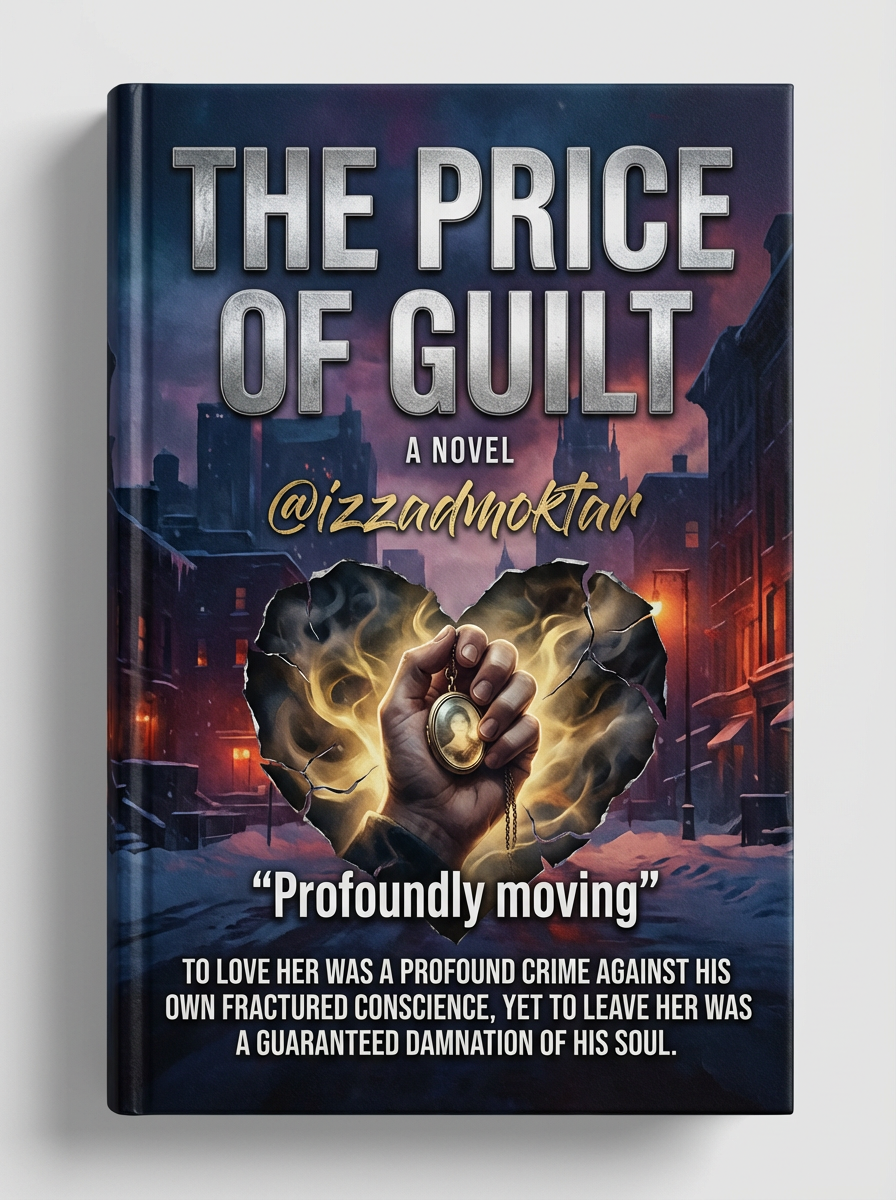
Synopsis
Haunted by a dark past and philosophical torment, a destitute former student finds his isolation brutally shattered by a gentle woman sacrificing everything for her family; their forbidden love, forged in mutual guilt and desperation, faces the impossible choice between quiet escape and a vengeful c
Chapter 1: The Chill of Solitude
The icy tendrils of a Petersburg winter snaked through cracks in Nikolai Ivanovich Rostova’s attic hovel, a skeletal caress against his already chilled flesh. He lay on a thin, soiled pallet, his gaunt frame swallowed by a threadbare blanket that offered more psychological comfort than actual warmth. The fever, a relentless guest these past weeks, gnawed at his bones, painting grotesque hallucinations behind his eyelids, the most persistent of which was a swirling, inchoate mass of crimson – the color of something unforgotten, unspeakable.
His eyes, dark pools of torment in a face made sharp and angular by hunger and sickness, were open, fixed on the peeling plaster of the ceiling. It was early morning, though the perpetual gloom of the city’s heart made discerning the time a matter of instinct more than sight. The clamor from the street below – the jingle of a cab, the distant cry of a hawker, the ceaseless, grinding rhythm of human existence – reached him as if through a thick, distorting medium, a constant reminder of a world he had willingly, perhaps even zealously, forsaken.
A faint scratching sound from the door, barely audible above the street noise, drew his attention. He stiffened, every muscle tensing. It was the landlady. He recognized the hesitant shuffle of her worn boots, the soft click as she set something down. A moment later, the scent of fresh bread, yeasty and warm, mingled with the faint aroma of weak tea, wafted under the door. His stomach clenched in protest, a violent, painful spasm that momentarily eclipsed the fever's grip. He squeezed his eyes shut, a wave of nausea washing over him. The kindness, the unsolicited mercy, felt like an accusation, a burning brand on his skin. He would wait; he always waited until the footsteps had long faded, until even the echo of her presence had dissipated, before he would consider touching the offering. To accept it immediately would be to acknowledge a need, a dependence, a crack in his carefully constructed fortress of self-punishment. He was twenty-four, yet felt the antiquity of a man thrice his age. The intellectual fire that had once burned so brightly in his university days, fueling endless debates on ethics and existentialism, now flickered weakly, reduced to a smoldering ember under a mountain of ash, much like the promise of that bread, now growing cold. He had been a student, a promising one, a mind primed for profound inquiry. Now, he was merely a husk, sustained by the intermittent generosity of a sympathetic, albeit terrified, landlady.
His self-exile was not accidental; it was a carefully constructed fortress, built stone by agonizing stone from the rubble of some unnamed catastrophe. He had come to Petersburg, a city of shadows and grand facades, seeking not a new beginning, but an end to the old one. He had sought the oblivion of the masses, the anonymity of destitution, believing that in such squalor, his monstrous guilt, too abstract to articulate yet too real to ignore, might finally dissipate. It had not. Instead, it had festered, growing richer, more intricate, interwoven with the very fabric of his being.
A particularly violent shiver wracked his body. His hand, bony and trembling, instinctively went to the small, wooden box tucked beneath his thin pillow. His fingers brushed against the smooth, cool surface, then curled around a delicate, silk ribbon, faded blue, tied in a simple bow. The fabric, soft against his calloused skin, was imbued with the faint, lingering scent of lavender and something else, something sweet and innocent that made his breath catch. He yanked his hand back as if burned, a sudden, crushing weight settling on his chest, constricting his lungs. The image of a young girl with wide, trusting eyes flashed behind his eyelids. Her laughter, light as a summer breeze, echoed in his memory, quickly followed by the suffocating sensation of drowning. He recoiled from the ribbon, pushing the box away, a silent moan escaping his lips. The memory was a physical assault, a brutal reminder of the purity he had, in his warped self-assessment, irrevocably tainted.
His days blurred into a monotonous cycle of hunger, fever, and the ceaseless dialogue within his own mind. He rarely left his room, venturing out only when the gnawing emptiness in his stomach became too unbearable to ignore, or when the desperate need for a few kopecks spurred him to pawn a book, a relic of his former life. On these rare excursions, his appearance—gaunt, feverish, with eyes that held the ghosts of forgotten dreams—often elicited wary glances, occasionally a muttered epithet. He welcomed it all. The world’s disdain was merely a mirror of his own.
The air in the room was dense with the smell of damp plaster, stale sweat, and the faint, coppery scent of his own lingering illness. He pulled the blanket tighter, a futile gesture against the penetrating cold. He coughed, a dry, rasping sound that tore at his throat, and tasted blood, faint and metallic. He had been down this path before, this descent into physical decay. It was merely a natural progression, a mirroring of his inner state. He accepted it with a weary fatalism.
He closed his eyes again, but the crimson swirl persisted, now faintly outlined by the spectral faces of those he had known, those he had, in his warped self-assessment, betrayed. His professors, their brows furrowed in concern; his few friends, their laughter now hollow echoes; and then, the face he had just pushed away, the vision of youthful innocence, now tainted by his touch. To allow her image to break through the carefully constructed barriers of his despair, to dwell on the feel of that ribbon, would be to invite a madness more profound than his current torment.
He was unworthy. That was the unshakeable truth, the bedrock of his existence. He was a moral anomaly, a blight upon humanity, and his continued solitude, his suffering, was merely the just price. He belonged to the shadowy corners, to the damp and the cold, to the silent scream of an unconfessed transgression. He was a being defined by its absence, a negative space in the vibrant tapestry of Petersburg life.
The chill seeped deeper, past his skin, into his very marrow. He was profoundly alone, and in this solitude, he found a perverse comfort. He was safe from the contamination of others, and they, he believed, were safe from the contagion of him. The world could go on, oblivious to the rotting soul in this forgotten attic, and he, in turn, would continue his quiet decay, a living monument to his own overwhelming guilt, until the fever, or the cold, or the crushing weight of his philosophical torment, finally granted him the oblivion he so desperately craved. He was Nikolai Ivanovich Rostova, and he was nothing. The silence in the hovel became absolute, a heavy, suffocating blanket drawn tight around him, so complete it seemed to absorb all light, all sound, all possibility. A sudden, sharp rap on the door, unlike the timid shuffle of his landlady, brutally shattered it, echoing through the small space with an alarming, undeniable finality.
Chapter 2: A Glimpse of the Abyss
The gnawing in Nikolai’s gut was a familiar companion, a dull, aching counterpoint to the sharper, more intellectual pangs of his guilt. The cold, however, was a more insidious tormentor, seeping into his bones, reminding him with every shiver of his utter material destitution. After days spent huddled in the glacial confines of his rented hovel, subsisting on crusts so dry they threatened to splinter his teeth, the hunger became an undeniable tyrant. It dragged him from his self-imposed prison, out into the swirling grey of Petersburg’s nascent dusk, a dusk that blurred the wretchedness of the streets with a merciful, if temporary, veil.
He walked aimlessly at first, his gaunt frame a specter against the brick and ice. His breath plumed in the frigid air, a visible manifestation of the meager life force still flickering within him. His mind, usually a tempest of philosophical abstraction, was dulled by the physical agony. He noticed little but the biting wind and the dull ache in his stomach, a primal need that bypassed all intellectual barriers. He veered, without conscious decision, towards the more populated, though no less squalid, thoroughfares, where the faint promise of discarded morsels, or perhaps a sudden, desperate opportunity for a kopeck, clung to the very air.
The city, even in its impoverished districts, possessed a brutal, indifferent vitality. Carriages, though fewer here, rattled past, their occupants often shrouded in furs, their faces fleeting blurs of comfort and disdain. Peddlers hawked their meager wares, their voices hoarse with effort and cold. Beggars, like Nikolai himself, formed a silent chorus of desperation, their outstretched hands trembling, their eyes vacant or pleading. He passed them by, not out of cruelty, but because he was one of them, merely a few degrees removed from a prostrate heap on the frozen cobblestones. What right had he to judge, or to offer solace he did not possess himself?
He found himself, without conscious intent, in a particularly squalid square, dimly lit by a single, sputtering gas lamp. Here, the raw edges of human survival were laid bare. A group of rough-looking men huddled by a brazier, their faces ruddy with cheap spirits and the heat of the coals, their laughter coarse and unsettling. A few women, their faces painted with a tragic defiance, lingered in the shadows, their eyes scanning the passing figures with an unnerving mixture of hope and resignation. It was a place where societal veneers crumbled, revealing the desperate, often ugly, machinery of existence.
It was then that she appeared, a figure almost too frail to hold her own against the brutal currents of the street. She was standing near the flickering gas lamp, its weak glow casting long, wavering shadows that seemed to swallow her whole. Her head was bowed slightly, as if under an invisible weight, and her hands, visible beneath the thin shawl draped over her shoulders, were clasped tightly. Nikolai, whose eyes usually registered the world as a series of abstract problems, felt a sudden, inexplicable jolt of recognition. It was not a physical recognition, for he was certain he had never seen her face before, but a recognition of spirit, of a profound and singular suffering that resonated with his own.
He paused, a phantom chill cutting through the material cold. His philosophical musings, for a fleeting moment, vanished, replaced by an acute, almost painful observation. She was young, perhaps no older than twenty, yet her face held the weary resignation of an old woman. Her eyes, when she lifted them briefly to meet his, were an astonishing, almost luminous blue, framed by long, dark lashes, and held a depth of sorrow that pierced him. They were eyes that had seen too much, endured too much, yet still contained an inexplicable grace, an almost saintly purity. Her features, though pale and thin from hardship, were finely sculpted, hinting at a delicate beauty that circumstances had relentlessly tried to extinguish.
She wore a simple, dark dress, worn but meticulously clean, which emphasized her slender frame. No trinkets adorned her, no finery; only the stark honesty of poverty. Yet, despite the obvious signs of destitution, there was an unmistakable dignity about her, a quiet strength that belied her fragile appearance. She was not begging, not overtly, but her presence there, in that particular corner of the city, at that unholy hour, spoke volumes.
As a particularly rough-looking merchant, corpulent and with a sneering mouth, approached her, Nikolai felt an unpleasant tightening in his chest. The merchant paused, his gaze lingering on her with an appraising, almost predatory gleam. He spoke to her, his voice a low rumble, and though Nikolai could not discern the words, he saw the almost imperceptible flinch that ran through her. Her head bowed further, and she answered him, her voice, when it finally reached Nikolai’s ears, was a soft, almost ethereal murmur, nearly swallowed by the clamor of the street. It was infused with a desperate humility that made Nikolai’s blood run cold.
"Still here, Sonya Sergeevna?" the merchant sneered, his voice thick with a mocking familiarity. "Not found your fortune yet, eh?"
He knew, with a certainty that transcended mere observation, what this interaction implied. He was a creature of these streets; he understood its brutal lexicon. And yet, to see it embodied in such fragile grace… it was enough to wrench him from his accustomed detachment.
He stood transfixed, a silent witness to a deeply private torment played out in the harsh theatre of the public square. The merchant, after a moment, let out a short, dismissive laugh, slapped her lightly on the cheek with an insolent familiarity, and passed on. The gesture, casual and brutal, was like a physical blow to Nikolai. He took an involuntary half-step forward, his hands clenching into fists at his sides, a primal urge to intervene surging through him before his own guilt and cowardice forced him to freeze, to step back into the deeper shadows. He saw the faint flush that rose to her pale cheeks, the way her lips pressed together, as if to staunch a wound. She did not cry out, did not protest, only resumed her silent vigil, her gaze fixed on the frozen ground, as if searching for some lost hope in the cracks of the cobblestones.
Her desperation mirrored his own, he realized, but the texture of it was entirely different. His was a self-inflicted wound, a philosophical malady, a self-imposed exile born of guilt and intellectual pride. Hers, undoubtedly, was a desperation born of necessity, of a selfless purpose that eclipsed her own suffering. There was no abstract guilt in her eyes, only a raw, unvarnished burden.
What compelled her to this public display of silent agony? He knew, with an instinctive dread, that it was not for herself. Such profound self-abnegation could only be for others. A family, perhaps? Starving siblings? An ailing parent? The thought, once planted, took root in his fevered mind, blossoming into a vivid tableau of the destitution that chained her to this grim ritual. Her face, etched with such profound, almost saintly suffering, became a canvas upon which he projected the full, terrible weight of her silent burden.
He felt, then, a tremor, not of cold, nor hunger, but of something far more unsettling. He, Nikolai Ivanovich Rostova, who prided himself on his intellectual detachment, on his ability to dissect human misery from afar, felt a stirring of deeply buried compassion. It was a sensation so foreign, so utterly unexpected, that it startled him. He had deliberately cut himself off from humanity, convinced that his own transgressions rendered him unworthy of connection, that any warmth he might offer would only poison those who received it. And yet, this young woman, this Sonya, shook the very foundations of his carefully constructed isolation.
He wanted to approach her, to speak a word, any word, of comfort. But what comfort could he, a man who had abandoned his own soul, offer? What right had he to intrude upon her sacred suffering? His own guilt, that constant, oppressive companion, surged forward, reminding him of his own moral squalor. He was a hypocrite, a self-indulgent philosopher wallowing in abstract despair, while she, a true martyr, faced the concrete horrors of existence with an unbearable grace.
He watched her for a long time, until the cold began to prickle his skin with a renewed intensity. Other men approached her, their movements bolder, their words clearer, their intentions unmistakable. Each interaction was a fresh stab into Nikolai’s burgeoning awareness. He saw her subtle refusal, the almost imperceptible shake of her head, the quiet, unwavering dignity that somehow repelled the cruder forms of solicitation. She was not selling herself cheaply, not in the vulgar sense. Her presence here was a negotiation, a desperate gamble, undoubtedly for a sum that would buy a loaf of bread, a handful of coals, a single day of life for those she protected.
The utter injustice of it all—the senseless cruelty of a world that forced such purity into such degradation—stirred a dormant rage within him. It was a rage both intellectual and visceral, directed at the unseen forces, the societal structures, the powerful, indifferent individuals who benefited from such suffering. He had always analyzed the mechanisms of societal oppression in the sterile confines of books and lectures. Now, it was etched onto the face of a young woman, a living embodiment of the abyss.
He finally tore himself away, his legs stiff with cold and prolonged standing. He walked away from the flickering gas lamp, away from the silent, suffering figure of Sonya Sergeevna, but he did not walk away unaffected. Her image was seared into his mind, an indelible photograph of saintly anguish. The gnawing in his stomach had not ceased, but it was now overshadowed by a far more profound hunger, a yearning for something he could not name, a disturbing sense of connection to a suffering he had no right to share.
He returned to his cold room, the biting wind an unnoticed caress against his face, his mind burning with the image of her sorrowful eyes. The memory of her weary eyes haunted him. The abstract guilt that had been his constant companion now seemed shallow, self-indulgent, almost a luxury. Her suffering was real, tangible, demanding. He fumbled in the dark for the crust of stale bread his landlady had left on the small, rickety table. His initial vow of self-annihilation, of letting himself waste away, felt suddenly hollow. He had to survive. He had to see her again, if only to understand the depth of this new, terrifying spark she had ignited within him. He bit into the hard, dry bread, a desperate, fearful choice to live, a choice he had not believed himself capable of making. The abyss he had glimpsed was not simply her torment, but the terrifying chasm opening in his own carefully guarded soul. He was no longer alone in his suffering; her image had broken through the walls he had built, and he was, for the first time in a long time, truly, terrifyingly, exposed.
Chapter 3: The Unspoken Connection
The biting wind, a familiar tormentor, whipped Nikolai’s threadbare coat around him as he shuffled down a narrow alley, the stench of refuse and desperation clinging to the brickwork like a second skin. It was the following morning, a grudging dawn after the meager sustenance of stale bread had granted him a restless, feverish sleep. That desperate choice, to eat and survive another day, had forged a new, unsettling resolve within him. He had sought the anonymity of the back streets, a place where the shadows were deep enough to swallow a man whole, where the cries of poverty were so common they ceased to be heard. But today, his steps were not aimless. He was searching. He was looking for her.
He had found her, just moments ago, near the bustling haymarket, her head bowed against the gale, a small, worn basket clutched in her hands. She was haggling, he presumed, over some pitiful trifle, her voice a low murmur lost amidst the cacophony of vendors and beggars. He had averted his gaze, as was his custom, a reflex born of years of self-imposed exile from human connection. To look, to acknowledge, was to invite the insidious tendrils of empathy, a luxury he could not afford. Empathy, he had long ago convinced himself, was a weakness, a gateway to the very human entanglement he so assiduously avoided.
But then, a sudden gust, more violent than the rest, had snatched a worn shawl from her shoulders, sending it tumbling into the muddy street. She had cried out, a small, choked sound, and instinctively, before his mind could intercede with its usual cold logic, Nikolai had moved. It was a fleeting, almost unconscious act, a phantom limb of his former self reaching out. He had retrieved the shawl, its coarse wool surprisingly warm against his frozen fingers, and extended it towards her.
Their eyes met then, in that brief, suspended moment between the gust and the return of the urban din. Hers were the color of twilight, deep and shadowed, yet with a startling clarity that cut through the fog of his own despair. There was no coquetry, no fear, no judgment in them, only a profound weariness, a knowledge of suffering so profound it seemed to transcend her youth. And beneath that weariness, or perhaps intertwined with it, was something else, something that resonated with a forgotten chord within him: a raw, unvarnished pain that mirrored his own, stripped bare of all intellectual pretense.
He saw in her eyes the same abyss he stared into each night, the same gnawing emptiness, but hers was not born of abstract guilt and philosophical torment. No, hers was a concrete, visceral suffering, a burden carried for another, perhaps many others. It was a pain that demanded action, not contemplation, a sacrifice of the self for something tangible, something real. And in that recognition, a tremor, an unbidden shiver, ran through Nikolai. It was not the cold, nor the hunger, but something far more unsettling. It was the stirrings of a conscience he had believed long dead, a faint, almost imperceptible pulse in the barren wasteland of his soul.
He had simply handed her the shawl, his fingers brushing hers for a fraction of a second – a contact so fleeting, yet it felt like an electric jolt, a current passing between two isolated islands. Her hand was surprisingly soft, despite the obvious hardship etched on her face, and cold, so utterly cold. She had nodded, a slight, almost imperceptible inclination of her head, her lips parted as if to speak, but no words came. Her gratitude was silent, conveyed solely through the depth of her gaze.
Then, just as abruptly as it had begun, the moment shattered. A gruff voice from a nearby stall, a vendor hawking stale bread, broke the spell. Nikolai, startled, recoiled, his carefully constructed wall of indifference snapping back into place. He turned on his heel, merging back into the throng, his heart thumping with an unfamiliar rhythm. He did not look back, yet he felt her gaze linger, a spectral touch on his retreating form.
He walked for what felt like hours, the image of her eyes burned into his memory, a persistent phantom. He tried to dismiss it, to relegate it to the realm of fleeting encounters in a city teeming with anonymous faces. He tried to intellectualize it, to dissect the encounter with the cold precision of a philosopher examining a text. What was it, this unsettling recognition? Was it merely the shared misery of their circumstances, a transient camaraderie born of destitution? Or was it something more, something he dared not name, something that threatened to unravel the carefully constructed edifice of his isolation?
He found himself pacing the cramped, frigid confines of his garret room, the flickering candlelight casting grotesque shadows on the peeling wallpaper. His mind, usually a maelstrom of abstract thought, of moral dilemmas and existential despair, was now strangely fixated on Sonya Sergeevna. He saw her face, not just as he had seen it moments ago, but also as he had glimpsed it earlier, near the market, etched with that profound, almost saintly suffering.
His own torment was a self-inflicted wound, a punishment for an unnamed transgression that festered in the depths of his being. He had chosen this path of isolation, believing himself unworthy of human warmth, of redemption. But her suffering, he sensed, was a burden she carried for others, a sacrifice. And that, he realized with a jolt, was the crucial difference: his guilt had driven him inward, into the cold, sterile chambers of his own mind, making him a specter amongst men. Her pain, raw and visceral, propelled her outward, a quiet dignity in her sacrifice that shamed his own self-pitying despair, a clear, unambiguous purpose born of hardship. He pictured her hands, worn and chapped, tending to the needs of hungry children or an ailing parent, sacrificing her meager comfort for theirs.
He tried to shake her from his thoughts, to immerse himself in the familiar rhetoric of his own despair. He picked up a worn copy of Schopenhauer, his usual companion in the lonely hours of the night, but the words blurred. The lingering electric jolt of her touch, the phantom coldness of her hand on his own fingers, seemed to physically disrupt his intellect, making abstract pronouncements on suffering and futility feel like intellectual games, hollow and divorced from the raw, tangible reality he had just witnessed. He closed the book with a frustrated sigh, the sound echoing in the silence of the room.
He walked to the grimy window, peering out at the dimly lit street below. A thick fog had rolled in, shrouding the city in a veil of gray, blurring the harsh edges of its poverty. He imagined Sonya Sergeevna out there, somewhere, navigating the treacherous labyrinth of the city, her small, frail form a beacon of quiet resilience.
Why did her image persist? Why did her unspoken pain resonate so deeply within him? He, who had deliberately cultivated an impenetrable shell of indifference, who had convinced himself that human connection was a weakness, a source of inevitable pain. He, who had embraced isolation as a penance, a deserved punishment for his unconfessed sin.
He felt a strange, almost unsettling pull towards her, a recognition that transcended words, a nascent understanding that defied his carefully constructed intellectual barriers. It was as if, in that fleeting exchange of glances, their souls had briefly converged, two wounded spirits recognizing a shared landscape of suffering, albeit for vastly different reasons.
He had always believed himself beyond redemption, beyond the reach of human warmth. His guilt, he had convinced himself, was a permanent stain, an indelible mark that condemned him to a solitary existence. But in the quiet strength of Sonya Sergeevna's gaze, he had glimpsed something else, a flicker of possibility, a faint whisper of hope, a notion so terrifyingly alien that it made his heart race with a mixture of fear and an almost unbearable longing.
He knew, with a certainty that chilled him to the bone, that he could not dismiss her from his thoughts. She had become an unwelcome intrusion, a persistent question mark in the carefully constructed narrative of his despair. Her image, her silent suffering, had lodged itself in his mind, a raw recognition of pain that, oddly, stirred his dormant, conscience-stricken soul in a way no philosophical treatise ever could. He recalled the shocking softness of her hand, the chilling coldness of her skin against his, the brief, electric jolt that had passed between them. It was a physical memory, more potent than any abstract thought, a feeling that clawed at him. And for the first time in years, Nikolai Ivanovich Rostova, the gaunt, feverish former philosophy student, felt a terrifying, almost unbearable urge to break free from the icy grip of his self-imposed isolation. He would find her again. The next time he saw her, he would follow her, trace her steps through the labyrinthine streets of Petersburg, discover where she lived, who she was sacrificing herself for. He would know her name, and the face of her torment. The price of guilt, he was beginning to understand, was not just solitude, but the chilling realization that even in the deepest abyss, a flicker of human connection could still ignite, threatening to consume him entirely, and demand a terrifying, transformative action.
Chapter 4: Beneath the Veil of Despair
The grey, persistent ache in Nikolai’s temples, a constant companion since his descent into this Petersburg purgatory, seemed to intensify with each passing day. It was no longer merely the cold, the hunger, or the gnawing intellectual despair that pressed upon him; it was a new, unwelcome burden, a splinter of human connection he had so assiduously sought to excise from his being. Sonya Sergeevna Lebedeva, with her weary eyes and inexplicable grace, had become an unsolicited occupant of his thoughts, a radiant, sorrowful image that stubbornly refused to fade into the city’s bleak anonymity.
He told himself it was morbid curiosity, a detached, almost scientific interest in the raw mechanics of human suffering. He, the former student of Kant and Schopenhauer, the self-proclaimed connoisseur of existential dread, was merely observing a specimen of profound destitution. Yet, the justifications felt thin, like the threadbare lining of his coat. There was something else, something visceral and unsettling, that drew him back to the grimy thoroughfares where he had first encountered her.
He began to follow her, not with the furtive desperation of a stalker, but with the heavy-footed, almost somnambulistic gait of a man compelled by an invisible force. His usual haunts—the shadowed alleys, the forgotten corners where he could brood in undisturbed misery—now felt hollow, devoid of the very despair he had once clung to like a shroud. He needed to see her, to witness the quiet choreography of her struggle.
His observations were, at first, sporadic, then became a daily ritual, as ingrained as his ceaseless self-recrimination. He learned her patterns, the subtle rhythms of her existence. She lived in a cramped, dilapidated tenement on the outskirts of the Haymarket, a labyrinth of peeling paint, perpetually damp stairwells, and the pervasive stench of poverty. He would position himself across the street, huddled in doorways, his face obscured by the perpetual gloom, his gaze fixed on the single, grimy window of her lodging.
He saw her emerge each morning, a wraithlike figure bundled against the biting cold, her shoulders hunched not just against the wind, but against the crushing weight of her responsibilities. He watched her navigate the treacherous ice of the streets, her movements precise, almost delicate, as if each step was a prayer against further misfortune. He saw her haggle with merchants, her voice low but firm, her eyes, even from a distance, conveying an unwavering determination that both fascinated and disturbed him.
He learned of her family, piece by agonizing piece, through snatches of overheard conversation. Once, peering through the fogged glass of an apothecary’s window, he saw her receive a small packet of herbs. The kindly apothecary, a man with a perpetually flour-dusted apron, had leaned closer, his voice a low murmur. “And how is your mother, Elizaveta Petrovna? Are these helping her cough?” Sonya had nodded, her face tight with worry. “A little, thank you. And the children, Pavel and Irina, they are well?” Sonya’s reply was too soft to discern fully, but the names, once uttered, lodged themselves in Nikolai’s memory. He imagined the slow, relentless erosion of hope in that small, airless room, the constant battle against illness and despair.
He saw Sonya with them, her hands calloused but gentle, her voice soft as she guided them, protected them, shielded them from the harsher realities she herself faced daily. He watched her mend their threadbare clothes, prepare their meager meals, and read to them by the flickering light of a single candle, her silhouette a stark monument to selflessness.
His ideological fortress, so meticulously constructed from years of philosophical abstraction and self-imposed isolation, began to crack. He had always prided himself on his intellectual detachment, his ability to dissect human suffering as a mere symptom of a flawed existence. He had found solace in the grand, sweeping theories of the universe, believing that personal anguish was merely a fleeting illusion against the backdrop of eternal truths. But Sonya, with her quiet fortitude, her unwavering devotion to her family, was not an abstract concept. She was flesh and blood, a living, breathing testament to a kind of heroism he had never considered.
He saw the predatory gaze of society upon her, the leering eyes of men in taverns as she passed, the dismissive sneers of wealthier women as she offered her services, whatever they might be, in the marketplace. He saw the subtle indignities, the casual cruelties inflicted upon her simply for existing in her state of poverty. And with each observation, a cold, unfamiliar rage began to simmer within him, a righteous anger that pulsed beneath the surface of his own profound guilt.
He, who had deemed himself unworthy of human connection, found himself inexplicably connected to her struggle. He, who had sought only to escape the world, now found himself drawn deeper into its messy, painful reality by the sheer force of her quiet endurance. He watched her, day after day, and with each passing moment, the carefully constructed walls of his self-imposed prison began to crumble, revealing not the abyss he expected, but a glimmer of something he had long believed extinguished: empathy.
One particularly bitter afternoon, the kind that seemed to leach the very color from the world, Nikolai saw her engaged in a desperate negotiation with a burly, red-faced merchant. The man’s gestures were aggressive, his voice loud and contemptuous. Sonya, her face pale with cold and exhaustion, stood her ground, her gaze unwavering, her hands clenching and unclenching beneath her shawl. Nikolai couldn't hear the words, but the tableau was clear: the powerful preying on the vulnerable.
A sudden, sharp pain lanced through Nikolai’s chest, a feeling he hadn't experienced in years. It was not hunger, nor cold, but a profound sense of injustice, a burning indignation on her behalf. He felt an irrational urge to intervene, to step out of the shadows and confront the brute, to defend this woman he barely knew, this woman he had deliberately sought to keep at arm's length. The absurdity of the thought, coming from a man who considered himself utterly worthless, was almost comical. Yet, the urge was potent, almost overwhelming.
He watched as Sonya, after a prolonged, agonizing exchange, finally conceded, her shoulders slumping in defeat. The merchant snatched a handful of coins from her outstretched hand, then, with a casual, brutal flick of his wrist, knocked the small, tightly bundled package she carried from her grasp. It tumbled to the icy cobblestones, scattering a handful of dried herbs and a few meager carrots across the frozen ground. The merchant laughed, a coarse, guttural sound, and strode away, leaving Sonya to stoop, her back aching, to gather her meager belongings while the indifferent city swirled around her. She turned away, her head bowed, and began to walk, her steps heavier than before, each movement a testament to her profound weariness.
Nikolai, hidden in the shadows of an archway, felt a tremor run through him. He saw her pause, just for a moment, her back to him, and he imagined the silent tears that must be falling, unseen, unheard. He knew, with a certainty that chilled him to the bone, that she would return to that cold, dim room and face her ailing mother, her hungry siblings, with a smile, with words of reassurance, with a strength that defied explanation.
He understood then, with a terrible clarity, the true extent of her sacrifice. It was not merely physical labor, not merely the daily grind of survival. It was the constant suppression of her own pain, her own despair, for the sake of those she loved. It was a crucifixion of the self, enacted daily, silently, beneath the indifferent gaze of the city.
And in that moment, something shifted irrevocably within Nikolai. His philosophical torment, his abstract guilt, which had once felt like the most profound suffering imaginable, now seemed almost self-indulgent, a luxurious affliction in comparison to the raw, tangible anguish he witnessed in Sonya. His guilt, rooted in an unspoken transgression, felt pale beside her selfless suffering, her ceaseless battle against a world that seemed determined to crush her. The veil of despair, which he had so carefully woven around himself, was tearing, thread by agonizing thread. And through the rents, he saw not only Sonya’s suffering, but a reflection of his own, a distorted yet strangely compelling mirror. He saw her humanity, and in seeing it, he glimpsed, perhaps for the first time in years, the faintest outline of his own. The price of his guilt, he was beginning to understand, was not merely his own isolation, but the recognition of a shared humanity he had so desperately tried to deny.
Driven by a surge of righteous indignation, a white-hot spark in the chill of his self-imposed prison, Nikolai stepped out of the shadows. His usual caution, his carefully cultivated detachment, evaporated. He watched Sonya disappear into the grimy entrance of the tenement across the street, her silhouette swallowed by the gloom. Without conscious thought, his feet began to move. He crossed the street, the icy wind biting at his exposed face, his gaze fixed on that same dark doorway. The chill of solitude was no longer a comfort, but a burden to be shed. He reached the door, his hand, trembling slightly, resting on the cold, splintered wood. He had observed long enough.
Chapter 5: A Shared Confession
The chill of the Petersburg night, usually a balm to Nikolai’s fevered mind, now offered little solace. He had walked for hours, a restless, unmoored spirit, the image of Sonya’s weary eyes burning holes in the fabric of his self-imposed solitude. His philosophical constructs, once so rigid and unyielding, felt like crumbling edifices before the simple, undeniable truth of her suffering. He had tried to intellectualize it, to dissect her pain into abstract concepts of societal injustice or the inherent tragedy of existence. But the raw, human ache he felt at the sight of her, the gnawing regret that he, a man of intellect, could offer nothing, was beyond the cold comfort of theory.
He found himself, inexplicably, drawn back to the familiar, grimy street where he’d first seen her. The gas lamps cast long, sickly shadows, illuminating the squalor with a brutal honesty. He told himself he was merely observing, a detached chronicler of human misery. But his heart, a thing he had long believed calcified, beat with an unnerving rhythm. He saw her then, emerging from the shadowed doorway of her building, a worn shawl clutched tightly around her. She moved with a weary grace, her shoulders hunched against the cold, her gaze fixed on some distant, unseen point.
“Madness,” he muttered, his breath pluming in the frigid air. “Utter madness.”
Yet, his feet carried him forward, propelled by an impulse he neither understood nor controlled. His mind screamed warnings, recounted his own unworthiness, the poison he carried within. But his body, a traitorous vessel, ignored the protests. He approached her, his steps hesitant, each one a violation of his sacred isolation.
She didn't hear him at first, lost in her own somber thoughts. He cleared his throat, a dry, rasping sound that felt alien in the stillness.
Sonya started, her head snapping up, her eyes wide with a flicker of fear quickly masked by a weary resignation. She recognized him, he could tell. The man from the market, the one with the haunted eyes that seemed to mirror her own unspoken burdens.
“Forgive me,” Nikolai began, his voice rough, unused to articulation. “I… I did not mean to startle you.” He felt a fool, a charlatan. What could he, a man who barely fed himself, offer her? His words hung in the air, hollow and inadequate.
She simply looked at him, her gaze unwavering, searching. There was no judgment in her eyes, only a profound weariness that resonated with the depths of his own despair. “You are the… gentleman from the market, are you not?” Her voice was soft, melodic even in its exhaustion, a stark contrast to the harshness of their surroundings.
“Nikolai Ivanovich Rostova,” he supplied, almost automatically. “And you are Sonya Sergeevna.” The name, spoken aloud, felt intimate, a transgression.
A faint, almost imperceptible tremor passed through her. “How do you know my name?” she asked, her brow furrowing slightly.
He cursed himself inwardly. He had observed her, yes, learned of her through the whispers of the neighborhood, the pitying glances directed at the Lebedeva family. But to admit this felt intrusive, predatory. “I… I have seen you,” he stammered, his usual eloquence deserting him. “And heard snippets. The city… it speaks.”
A shadow of understanding, perhaps even a flicker of recognition, crossed her face. She knew, he realized, that he had been watching. And yet, she did not recoil. This absence of revulsion, this quiet acceptance, was more disorienting than any anger or fear she might have shown.
The biting wind, like a personal rebuke, whipped around them, tugging at Sonya’s shawl. From down the street, the raucous laughter of a group of drunken men echoed, growing louder with each passing moment. Without a word, Sonya turned and retreated into the narrow, unlit entryway of her tenement building. Nikolai, driven by an instinct he couldn’t name, followed, the heavy door thudding shut behind them, plunging them into a claustrophobic gloom illuminated only by the faint glow filtering from a grimy window high above. The air here was still cold, but it offered a fragile shelter.
She leaned against the damp, brick wall, pulling her shawl tighter, her gaze still fixed on him, though now tinged with a guardedness he hadn't seen before. “You look… troubled, Nikolai Ivanovich,” she said, her voice gentle, almost solicitous. It was a strange reversal. He, the one who had approached, the one who supposedly sought to offer aid, was now being observed, and with a tenderness he hadn’t encountered in years.
“Troubled?” He gave a short, bitter laugh. “That is… a polite way of putting it. I am… lost, Sonya Sergeevna. As perhaps… you are too.”
The words hung between them, a fragile bridge built of shared desolation. She did not deny it. Instead, she lowered her gaze, her fingers tightening on the shawl. “One does what one must,” she murmured, her voice barely audible.
“Yes,” he agreed, the single word laden with a lifetime of unspoken burdens. “And sometimes… what one must do… leaves one… profoundly altered.” He saw the subtle shift in her posture, a slight stiffening. He had touched a nerve. He had, perhaps, glimpsed the abyss within her, the one she fought so valiantly to conceal.
“I… I have no money to offer,” he confessed, the truth a bitter pill. “No connections, no influence. I am… less than nothing.” He expected her to turn away, to dismiss him as another madman on the streets of Petersburg. But she remained, her eyes still fixed on him, a profound, almost desperate curiosity in their depths.
“Then what do you offer, Nikolai Ivanovich?” she asked, her voice imbued with a quiet challenge.
He hesitated, searching for an answer. He had nothing material, nothing tangible. But there was something else, a currency of the soul, perhaps. “Understanding,” he said, the word emerging with surprising clarity. “And… perhaps… the grim satisfaction of knowing one is not entirely alone in one’s… predicament.”
A flicker of something akin to awe, or perhaps just profound weariness, crossed her face. She looked away for a moment, down the desolate stairwell, as if contemplating the vastness of their shared predicament. Then, she turned back to him, her gaze meeting his with an intensity that made his breath catch.
“I… I saw you,” he confessed, the words tumbling out, unbidden, raw. “In the market. And… later. I saw what you… what you do.” He couldn’t bring himself to name it, the indignity, the sacrifice.
She flinched, a subtle drawing back, her eyes clouding with a familiar shame. “You ought not to speak of such things, Nikolai Ivanovich.”
“Why not?” he challenged, his voice rising slightly, infused with a sudden, desperate energy. “Are we not both prisoners of our circumstances? Are we not both forced to… compromise… ourselves in ways we never imagined?” He saw the glint of tears in her eyes, quickly blinked back.
“My guilt,” he continued, the words now flowing, a torrent long suppressed, “is a thing of the mind, a philosophical construct, a torment I have inflicted upon myself for a transgression… a betrayal… that haunts my every waking moment. It is abstract, formless, yet it gnaws at my soul. But your guilt, Sonya Sergeevna… it is born of love. Of sacrifice. Of a desperate, unwavering devotion to those you cherish.”
He watched her, gauging her reaction. She was listening, truly listening, her face a canvas of complex emotions: shock, understanding, and a profound, aching sorrow.
“You see it then,” she said, her voice barely audible, “the shame.”
“I see the burden,” he corrected, his voice firm, imbued with a conviction he hadn’t felt in years. “I see the impossible choice. And I see the strength… the immense, terrifying strength it takes to make it, day after day.”
A single tear escaped her eye, tracing a path through the grime on her cheek. She did not wipe it away. A long, shuddering breath escaped her. “My mother… she is worse today,” she whispered, her voice barely audible, as if the words themselves were a heavy burden. “The fever… it comes and goes. And Pavel… he coughs incessantly. The cold… it is relentless. They depend on me. My mother… Pavel… Irina. They have no one else.”
“And you bear it alone,” he finished, his voice soft, almost tender. “Just as I have borne my own particular madness alone.”
A long silence stretched between them, broken only by the distant clatter of a passing carriage and the mournful cry of a street vendor, muffled by the heavy door. In that silence, a fragile understanding bloomed. He saw in her eyes, not judgment, but a reflection of his own profound isolation, a shared recognition of the dark, unforgiving currents that had swept them both into this desolate corner of existence.
“Tell me, Nikolai Ivanovich,” she said at last, her voice still quiet, but with a new, almost desperate urgency. “This… transgression you speak of. What is it that haunts you so?”
He hesitated, the old fear, the old shame, rising like a cold tide. To articulate it, to give it form, felt like an act of self-immolation. But in her gaze, in her quiet acceptance, he found a flicker of courage he hadn’t known he possessed. He leaned back against the cold brick wall of the stairwell, the dampness seeping through his threadbare coat. His breath hitched, and he struggled to draw air into his lungs, as if the very act of speaking threatened to suffocate him.
“It is not a crime in the eyes of the law, Sonya Sergeevna,” he began, his voice dropping to a low, confessional tone, cracking slightly with the effort. “But it is a betrayal. A betrayal of trust. Of ideals. Of a friend. I… I was a student, a promising one, they said. Full of grand ideas, of philosophical zeal. And I… I stood by… I said nothing… when a man, a friend, was condemned for a radical pamphlet that I, in my arrogance, had helped to craft. He took the fall. And I… I watched. I rationalized. I intellectualized his sacrifice, even as it consumed him. And I, the coward, walked away, free, but forever tainted.”
He stopped, his confession hanging in the air, a raw, bleeding wound. He expected revulsion, contempt. But Sonya’s gaze remained steady, filled with a profound, almost spiritual empathy.
“You carry that burden still,” she observed, her voice barely a whisper. “The weight of unspoken truth.”
“It crushes me,” he admitted, the words escaping in a ragged breath. “It has driven me to this… this living death. I believed myself unworthy of human connection, unworthy of light, of warmth. I sought only to punish myself, to wallow in the mire of my own making.”
She reached out then, a hesitant, almost tentative gesture, her hand hovering for a moment before lightly touching his arm. Her touch, so unexpected, so gentle, sent a jolt through him, a warmth he hadn’t felt in years.
“You are not alone in your torment, Nikolai Ivanovich,” she said, her voice imbued with a quiet, fierce conviction. “We are both… prisoners of our conscience. Though our cells may be built of different sorrows, the bars are equally unforgiving.”
He looked into her eyes, and for the first time in what felt like an eternity, he saw not pity, not judgment, but a profound, aching understanding. In the shared confession of their disparate guilts, a fragile, unexpected solace began to form, a tiny ember of connection in the vast, cold darkness of their lives. It was a dangerous thing, this intimacy, forged in desperation and despair. But in that moment, under the indifferent gaze of the Petersburg night, it felt like the only truth that mattered.
Chapter 6: The Price of Tenderness
The biting wind of Petersburg seemed to lose some of its ferocity when they were together, huddled in the periphery of the city's ceaseless thrum. Their meeting place, a forgotten alcove beneath a crumbling bridge, offered little in the way of warmth or comfort, yet within its grimy confines, a fragile warmth began to bloom. It was a warmth born not of physical proximity, but of a shared understanding that transcended words, a language spoken in the haunted depths of their eyes.
Nikolai, who had for so long meticulously cultivated his isolation, found himself drawn to Sonya with an intensity that both exhilarated and terrified him. Her presence, a balm to his festering wounds, was also a dangerous disruption to his carefully constructed edifice of self-loathing. He had believed himself beyond redemption, beyond human connection, a pariah destined to wander the earth burdened by his unspoken sin. Yet, Sonya, with her quiet strength and unwavering gaze, saw past the tattered coat and the feverish eyes, past the philosophical torments that gnawed at his soul, to something intrinsically human within him.
Their conversations, initially tentative, grew into long, whispered confessions under the pale light of the gas lamps. He spoke of his past, not the specifics of his transgression – that remained a locked chamber in his soul – but the suffocating weight of its aftermath, the intellectual pride that had crumbled into existential despair, the philosophical theories that had offered no solace in the face of raw human suffering. He spoke of the emptiness, the gnawing guilt that had become his only companion, the cold logic that had driven him to embrace his own destitution as a form of penance.
Sonya listened, her hands often clasped in her lap, her gaze unwavering. She didn't offer facile reassurances or empty platitudes. Instead, she offered the profound understanding of one who had herself plumbed the depths of human despair. She spoke of her family, of her ailing mother, Elizaveta Petrovna, whose cough grew more insistent with each passing week, of her younger siblings, Pavel and Irina, whose innocent faces were a constant reminder of her burden. She spoke of the sacrifices, the humiliations, the daily struggle to keep them fed, clothed, and sheltered. She did not speak of the specifics of her "occupation," not yet, but the unspoken truth hung heavy in the air between them, a shared secret that bound them even tighter. Nikolai, who had once dismissed such suffering as mere existential fodder for his intellectual exercises, now felt it in his very bones, a visceral ache that mirrored her own.
He found himself, for the first time in years, experiencing affection. It was a sensation both alien and intoxicating. His body, long accustomed to the chill of indifference, now tingled with an unfamiliar warmth whenever Sonya’s hand brushed his, however accidentally, or when her gaze met his with that profound, almost maternal, understanding. It was a terrifying sensation because it threatened to dismantle the very walls he had so painstakingly erected around his heart. To feel was to be vulnerable, and vulnerability, to Nikolai, had always been synonymous with weakness, with the very human failing that had led him to his present state.
Yet, he could not resist it. Sonya’s tenderness was like a gentle hand reaching into the abyss of his soul, pulling him back, however reluctantly, from the brink. He found himself craving her presence, her quiet voice, the way her eyes, though weary, held a flicker of hope that he had long extinguished within himself. He would spend hours observing her, from a distance, as she moved through the grim streets, her slender form a beacon of resilience amidst the crushing poverty. He would follow her, not as a predator, but as a shadow, a silent guardian, his heart clenching with a perverse mixture of admiration and despair at the sight of her unwavering resolve.
Sonya, in turn, found in Nikolai a safe harbor. His troubled, intensely sincere gaze held no judgment, only a deep, almost painful understanding. The world outside their crumbling alcove was a harsh, unforgiving place, quick to condemn, quicker still to exploit. But with Nikolai, she could shed the heavy cloak of pretense, the mask of weary endurance she wore for the world. She could speak of her fears, her exhaustion, the gnawing anxiety that kept her awake at night, and he would listen, truly listen, not with pity, but with a shared sense of existential dread that somehow made her own burden lighter.
She saw the raw intelligence in his feverish eyes, the remnants of a once-brilliant mind now consumed by self-inflicted torment. She saw the profound guilt that shadowed him. Her guilt, on the other hand, was active, a conscious choice made out of desperation, a sacrifice of her own purity for the survival of her loved ones. Yet, in their shared affliction, they found a strange kinship, a bond forged in the crucible of suffering.
The societal condemnation their association would inevitably bring was a constant, silent presence between them. One frigid afternoon, as the first flakes of snow began to fall, dusting the grimy streets with a fleeting, deceptive purity, Sonya shivered, her thin shawl offering little protection against the biting cold. Nikolai, without a word, removed his own threadbare coat, a garment he had worn for so long it had become a second skin, and draped it carefully over her shoulders. The act was simple, yet it spoke volumes. It was a gesture of protection, of self-sacrifice, a silent declaration that he would endure the cold if it meant she would be warmer.
Suddenly, a harsh voice cut through the stillness. “Look at this, then! The little saint and her fevered beggar! What a pair of vermin.”
A stout merchant, his face red from the cold and perhaps something stronger, paused his cart on the bridge above, spitting a stream of tobacco juice that landed perilously close to Sonya’s feet. His eyes, narrowed with disgust, raked over Sonya, then lingered on Nikolai with open contempt. “Thought you were better than this, girl, for all your praying. Consorting with street trash.” He sneered, then whipped his horse, and the cart rumbled away, leaving a lingering stench of cheap spirits and judgment.
Sonya flinched, her shoulders hunching, and a flush crept up her neck. Her gaze fell to the ground, the brief warmth of Nikolai’s coat failing to ward off the chill of the merchant’s words. Nikolai felt a searing bolt of rage, cold and sharp, pierce through him. His fists clenched involuntarily, his feverish eyes burning. The insult was aimed at Sonya, yet it struck him with a force that made his own humiliation feel secondary. He saw her public shame, felt it as if it were his own, and for a terrifying moment, he wanted to lash out, to silence the world that dared to demean her. But he remained frozen, his own destitution a cage.
Sonya looked up at him, her eyes glistening. "Nikolai Ivanovich," she whispered, her voice barely audible above the wind. "You will freeze."
He shook his head, a faint, almost imperceptible smile touching his lips. "I am already frozen, Sonya Sergeevna. This… this is nothing."
His words, meant to reassure, only deepened the ache in her heart. She knew the truth of them. He had been frozen for so long, encased in a self-imposed ice of guilt and despair. And yet, for her, he was willing to endure even more.
She reached out, her fingers trembling slightly, and gently touched his cheek. His skin was cold, almost clammy, but beneath her touch, she felt a faint pulse, a flicker of life that defied the chill of his existence. "You are not frozen, Nikolai Ivanovich," she said, her voice imbued with a quiet conviction. "Not entirely."
In that moment, a profound understanding passed between them. It was a recognition of their shared vulnerability, their mutual need, and the terrifying, exhilarating possibility of finding solace in each other's brokenness. It was a dangerous game they were playing, a dance on the precipice of societal ruin, but neither of them had the strength, or perhaps the desire, to pull away.
The tenderness between them was not a romantic flutter, not the naive passion of youth. It was something far more profound, more elemental. It was the tenderness born of shared suffering, of witnessing the raw, unvarnished truth of another's soul and finding it strangely beautiful. It was the desperate embrace of two lost souls, adrift in a sea of indifference, clinging to each other for warmth, for meaning, for a fleeting glimpse of redemption.
Nikolai, who had once believed himself incapable of love, found himself experiencing something akin to it. It was a love born not of idealism, but of profound empathy, a recognition of Sonya’s inherent goodness, her unwavering spirit in the face of unimaginable hardship. He saw in her a reflection of the humanity he had long denied in himself, a beacon of hope in the suffocating darkness of his own guilt.
And Sonya, who had known only the harsh realities of life, the transactional nature of human interaction, found in Nikolai a purity of intention, a depth of understanding that was utterly foreign to her experience. He saw her, truly saw her, not as a means to an end, not as a commodity, but as a woman burdened by circumstance, yet possessed of an extraordinary strength of spirit.
Their bond deepened rapidly, a subterranean current flowing beneath the surface of their desolate lives. Whispered secrets became shared confessions, each revelation a thread weaving them closer together. He told her of the philosophical treatises he had once devoured, the grand ideas that had once consumed him, and she, in turn, spoke of the simple joys and sorrows of her family, the small triumphs and crushing defeats that marked their daily existence.
After a moment of silence, still reeling from the merchant’s insult, Nikolai reached into his inner pocket. His fingers fumbled, then emerged with a small, carefully folded object. He hesitated, his eyes searching hers for a sign of acceptance, of understanding. It was a threadbare scarf, mended with painstaking, clumsy stitches, clearly his own handiwork. He held it out, a silent offering.
Sonya’s eyes widened slightly as she took it, her fingers brushing his. His touch was cold, but the scarf, though worn, held a faint warmth, a scent of old wool and something indefinably his. She smoothed the fabric, her gaze soft with gratitude. “Thank you, Nikolai Ivanovich,” she whispered, her voice thick with emotion. She tied it around her neck, pulling it tight, feeling not just its meager warmth but the profound gesture it represented.
The world outside continued its indifferent turning, oblivious to the fragile bloom of tenderness that had taken root in the heart of its squalor. The snow fell, the cold intensified, and the shadows lengthened. But within their crumbling alcove, a different kind of light flickered, a light born of shared guilt, of desperate hope, and of a tenderness so profound, so utterly unexpected, that it threatened to shatter the very foundations of their carefully constructed despair.
Nikolai, for the first time in years, felt a tremor of life stir within his ossified soul. It was a terrifying sensation, for it meant he had something to lose. And Sonya, despite the ever-present threat of societal condemnation, found herself clinging to this dangerous, exhilarating connection, a connection that promised not salvation, but perhaps, just perhaps, a fleeting moment of peace in a world that offered none. The price of this tenderness, they both knew, would be steep, but in the face of their shared desolation, it was a price they were, however reluctantly, willing to pay. For in each other, they had found a reflection, a mirror to their own tormented souls, and in that reflection, a glimmer of something akin to hope.
Chapter 7: Whispers of the Past
The dim light of the single tallow candle, flickering precariously in the draft that seeped through the cracks in Sonya’s wretched dwelling, cast dancing shadows upon the peeling wallpaper, creating a grotesque ballet of disembodied forms. Outside, the Petersburg winter, a relentless, unforgiving entity, howled its mournful dirge, but within, a fragile warmth had begun to bloom, nurtured by the silent language of two tormented souls.
Nikolai, perched precariously on a stool that threatened to collapse under the weight of his introspection, watched Sonya as she mended a threadbare tunic for her brother, Pavel. Her fingers, nimble and accustomed to hardship, moved with a quiet elegance that belied the coarseness of her surroundings. The needles, glinting faintly in the meager light, seemed to weave not just fabric, but the very threads of his own unraveling existence back into some semblance of order. He had never witnessed such diligent, selfless devotion, not in the gilded salons of his youth, nor in the hallowed halls of the university where abstract ideals had been debated with detached fervor. Here, in the raw, unvarnished reality of Sonya’s life, he found a devotion that was both terrifying and profoundly beautiful.
Their conversations, once halting and punctuated by long, uncomfortable silences, had begun to flow with a nascent ease. They spoke not of grand philosophies or societal ills, but of the mundane, the immediate, the desperate hopes that flickered like their candle flame against the encroaching darkness. Yet, beneath the surface of these quotidian exchanges, an undercurrent of something deeper, something unspoken, pulsed with an insistent rhythm.
Tonight, however, a different kind of silence had fallen. It was not the awkward silence of strangers, but the pregnant pause of intimacy, a space where unspoken truths hung heavy in the air, demanding acknowledgment. Nikolai felt it pressing in on him, a familiar weight that had been his constant companion for years, now magnified by Sonya’s gentle, unwavering presence. He had, in his solipsistic despair, believed himself beyond the reach of human connection, beyond the necessity of confession. But Sonya, with her quiet strength and her profound capacity for understanding, had begun to dismantle his carefully constructed fortress of isolation.
He cleared his throat, a dry rasp that sounded alien in the quiet room. Sonya, without looking up, paused her mending, her head cocked slightly, as if she had been anticipating his utterance.
“Sonya,” he began, his voice a low rumble, rough with disuse and the weight of his words, “there is… a darkness within me.”
She finally lifted her gaze, her eyes, those infinite wells of compassion, meeting his. There was no fear there, no judgment, only a deep, abiding sorrow that seemed to mirror his own. It was this absence of condemnation, this unconditional acceptance that both terrified and emboldened him.
“I know, Nikolai Ivanovich,” she said, her voice soft, almost a whisper, yet resonating with an understanding that pierced him to his core. “We all carry our burdens.”
“No,” he corrected, the word sharp, almost a protest. “Mine is… different. It is not merely a burden, Sonya. It is a… a transgression. A philosophical one, perhaps, but with very real, very human consequences.” He gestured vaguely, as if trying to grasp the elusive concept in the air. “It is not a crime in the eyes of the law, perhaps, not in the way the world understands such things. But in the tribunal of my own soul… it is a sin of the gravest magnitude. And yet, you allow me to sit here, in your home, knowing what I have done, knowing about the pamphlet, and my friend.”
He paused, searching for the words, for a way to articulate the ineffable. How could one explain a moral failing that defied easy definition, a betrayal not of a person, but of an ideal, of the very fabric of human dignity? It was not a physical act, not a theft or an assault, yet its impact on his being was more devastating than any physical wound.
“I… I once believed,” he continued, his gaze drifting to the flickering candle, as if seeking answers in its unsteady flame, “that certain principles, certain… *truths*, were paramount. That the pursuit of a higher good, even if it necessitated… difficult choices, was justified. That the suffering of a few could be overlooked for the enlightenment of the many.” He scoffed, a bitter, self-deprecating sound. “A grand delusion, born of intellectual arrogance and youthful hubris.”
Sonya remained silent, her gaze unwavering, her hands now still in her lap. She listened not with the impatient curiosity of an inquisitor, but with the profound empathy of someone who had herself wrestled with the complexities of moral compromise.
“I saw myself as a kind of… architect of morality,” he confessed, the words tasting like ashes in his mouth. “Able to discern the path, to weigh the scales of justice, even when others could not. I believed I possessed the intellectual fortitude to make decisions that transcended the petty concerns of individual lives. And in that grand conceit, I… I allowed something to happen. Something that, though I did not directly cause it, I did not prevent. Something that, in its very essence, violated the sanctity of a human spirit. My friend, the pamphlet… I told you this. But what I did not tell you is how I rationalized it, how I convinced myself it was for the greater good.”
He shook his head, the memory a physical ache. “It was not a single knife thrust, Sonya, but a slow, deliberate poisoning. A poisoning of spirit, of hope, of the very possibility of redemption for another. And I… I stood by. More than that, I justified it. I rationalized it with my grand theories, my convoluted logic. I told myself it was for the greater good, for the advancement of some abstract ideal. But there is no greater good that justifies the destruction of a single soul.”
He looked at her then, his eyes pleading for understanding, for a glimmer of recognition that he was not simply mad, that his torment was real, however abstract its origins.
Sonya, her face etched with a profound and familiar sadness, reached out a hand, her calloused fingers gently resting on his arm. The touch, so simple, so unadorned, sent a jolt through him, a warmth that spread through his chilled veins, startling in its intensity.
“I understand, Nikolai Ivanovich,” she said, her voice barely audible, yet ringing with an unwavering conviction. “The burden of what one has done, or what one has failed to do, can be heavier than any chains. The torment of the mind… it can be a crueler prison than any dungeon. And the world… it demands its price.”
He stared at her, astonished. She simply understood the *nature* of his suffering, the philosophical weight of his transgression, and the lingering shame that clung to him. It was as if she peered directly into the darkest recesses of his soul and, instead of recoiling, offered a silent, profound acceptance.
“You… you do not condemn me?” he stammered, bewildered.
She smiled faintly, a sad, knowing curve of her lips. “What good would that do, Nikolai Ivanovich? The specifics of your choices are for you to bear, to wrestle with in your own conscience. But the feeling… the feeling of being unworthy, of having erred beyond redemption, of carrying a mark that no water can wash away… that I know.”
Her words, so simple, yet so profound, resonated with the deepest chords of his being. He saw in her eyes not a reflection of his own guilt, but a shared understanding of the human condition, of the inherent fragility of morality, of the ever-present shadow of human failing. She did not seek to absolve him, but to acknowledge his pain, to stand with him in the crucible of his self-condemnation.
“You… you have never done such a thing, Sonya,” he murmured, his voice thick with emotion. “You are pure. You sacrifice for others.”
She shook her head slowly, her gaze drifting to the worn wooden crucifix hanging precariously on the wall. “Purity is a concept for saints, Nikolai Ivanovich, and I am merely a woman. I have made my own compromises, my own difficult choices. I have felt the sting of regret, the crushing weight of what might have been, or what had to be. In this city, in this life, both your intellectual betrayal and my own… sacrifices… they leave a stain. The world, Nikolai Ivanovich, it is not always kind to purity. Sometimes, it demands a price that leaves a stain, even on the most innocent of souls.”
He understood then, with a sudden, painful clarity, that her suffering, while different in its manifestation, was rooted in the same soil of moral compromise, of living in a world that often demanded impossible choices. Her struggle, though born of circumstance and selfless love for her family, was no less a torment than his own abstract philosophical one.
“We are two broken vessels, then,” he said, a strange mix of despair and relief in his voice. “Cracked and leaking, but perhaps… perhaps together, we can hold a little water.”
Sonya’s hand tightened on his arm, a gentle, reassuring pressure. Her eyes, filled with a sorrowful tenderness, met his once more. “Perhaps, Nikolai Ivanovich. Perhaps that is all we can hope for.”
In that moment, a new bond was forged between them, deeper and more profound than any fleeting affection. It was a bond born not of shared joy, but of shared brokenness, a mutual recognition of their unworthiness that, paradoxically, made them worthy of each other. He had come seeking solace, perhaps even an absolution, but he had found something far more precious: an unwavering, gentle acceptance that did not demand details, but simply understood the universal language of human suffering.
The candle flickered, casting their intertwined shadows on the wall, two figures leaning into each other, finding solace in the silent communion of their shared guilt. The world outside remained cold and unforgiving, but within the confines of that humble room, amidst the grime and the despair, a fragile, forbidden love had found its footing, bound by the whispers of their pasts, and illuminated by the fierce, unwavering light of their mutual understanding. He had hinted at his darkness, and she had, without judgment, embraced it, making it, in some inexplicable way, a part of their shared existence. And in that acceptance, he found a glimmer of hope, a terrifying, exhilarating possibility that perhaps, just perhaps, his tormented soul might not be condemned to eternal solitude after all.
Chapter 8: The Shadow Lengthens
The chill seeped into Nikolai’s bones, a familiar companion these Petersburg nights, but tonight it was laced with something far more insidious than mere frost. He crouched in the narrow alleyway across from the Lebedevs’ tenement, the stench of refuse and damp stone a bitter counterpoint to the blossoming rage in his gut. He had been drawn here by an uneasy premonition, a flicker of dread that had sharpened into certainty when he saw the hulking form of Ivan Fyodorovich Volkov emerge from the tenement doorway, a predatory smile stretching his thick lips.
Volkov. The name, once an abstract symbol of Petersburg’s grasping avarice, now tasted of ash and bile on Nikolai’s tongue. He watched, a silent, unseen witness, as Volkov paused on the cobblestones, his gaze sweeping the dreary street as if surveying his dominion. Then, Sonya appeared, her slight figure framed by the grimy entrance, her face a mask of forced composure. Behind her, Pavel, small and pale, clutched at Irina’s hand, the girl’s bright eyes wide with a mixture of apprehension and youthful curiosity.
“Ah, Sonya, my dear,” Volkov rumbled, his voice unnaturally smooth, like oil on ice. He extended a hand, heavy and ringed, not to touch her, but to gesture expansively towards the street. “And your admirable siblings. Always so diligent, aren’t we?”
Nikolai’s fists clenched, his nails digging into his palms. This was the ‘benevolence’ Sonya had spoken of, the poisoned charity that bound them tighter than any legal contract. He saw the subtle flinch that rippled through Sonya’s shoulders, the way her gaze darted to her mother’s darkened window, a silent plea for protection that would never come.
Volkov’s eyes, small and unnervingly bright beneath heavy brows, fixed on Irina. “And our little scholar, Irina. Still devouring those books I sent, I trust?” He chuckled, a low, guttural sound that seemed to vibrate through the cold air. “Such a keen mind. It would be a tragedy, a true tragedy, to see such promise wither in these… circumstances.” He paused, allowing the unspoken threat to hang in the air, then turned his gaze to Pavel.
His heavy hand descended onto Pavel’s shoulder, a gesture that was meant to be paternal but felt to Nikolai like a predator’s paw. Pavel, no more than ten, flinched but stood his ground, his small face a picture of bewildered obedience. “And Pavel, my boy,” Volkov continued, his voice softening with a false theatricality. “Still growing, still eager for honest work, I presume? The warehouse needs strong backs, dedicated young men. A good opportunity, eh? To learn a trade, to provide for your family.”
He squeezed Pavel’s shoulder, a possessive, almost crushing grip. Nikolai imagined Pavel’s small frame shuddering under the weight, the boy’s nascent hopes being twisted into chains. This was not opportunity; it was indenture, a subtle form of slavery disguised as generosity. Volkov was not merely helping them; he was *buying* them, piece by agonizing piece.
Sonya’s voice, when it came, was strained, almost a whisper. “You are too kind, Ivan Fyodorovich. We are… eternally grateful.” Her eyes, deep wells of sorrow and resilience, betrayed the lie. They held a flicker of terror, a desperate plea for understanding that Nikolai, with his burgeoning love, could not ignore.
Volkov released Pavel, his gaze sweeping back to Sonya, lingering on her face with an unsettling intensity. “Kindness, my dear, is a rare commodity in this city. One must cultivate it carefully, nurture it, so that it might… blossom.” His eyes, like a snake’s, seemed to devour her, to strip away her defenses, laying claim to her very being. “And you, Sonya, are a bloom worth cultivating.”
A cold, venomous rage began to coil in Nikolai’s gut. It was a sensation he had not known in years, a primal, visceral fury that transcended his usual intellectual detachment. This was not abstract guilt; this was the burning indignation of a man witnessing the systematic desecration of something he held sacred.
Volkov took a step closer to Sonya, his shadow falling over her small form. “I hear,” he purred, his voice dropping to a conspiratorial murmur, “that you have acquired a… philosophical acquaintance. A man of no fixed abode, perhaps, who lingers in the shadows.” His eyes, without shifting from Sonya’s terrified face, seemed to bore into the very brickwork of the alley where Nikolai hid. “One must be careful, my dear. Not all shadows are benign. And not all philosophies are… suitable for a dutiful daughter.”
He paused, a beat of chilling silence stretching between them, thick with unspoken menace. Then, slowly, deliberately, Volkov turned his head. His eyes, small and black, locked with Nikolai’s across the narrow street. There was no surprise, no sudden recognition in Volkov’s gaze, only a profound, chilling certainty. A subtle, mocking smirk played on Volkov’s lips, a silent acknowledgment that he had known Nikolai was there all along. He dipped his head, a minuscule, almost imperceptible nod, as if to an old acquaintance, then turned back to Sonya, the smirk fading into a bland, benevolent smile.
“Good day, Sonya,” he said, his voice once again smooth, devoid of any discernible threat. He bowed slightly, a caricature of respect, and then, with a final, lingering glance at her, moved off down the street, his heavy footsteps echoing in the silence.
Sonya watched him go, her body rigid, her breath held. Only when Volkov’s formidable bulk disappeared around the corner did she sag against the doorframe, her hands trembling as she pulled Pavel and Irina inside.
Nikolai remained in the alley, the chill of the night forgotten, replaced by an inferno of rage. Volkov knew. He had known all along. The abstract guilt that had paralyzed him for so long was slowly being eclipsed by a concrete, focused hatred. This was not a theoretical problem to be debated; it was a tangible evil that threatened to devour the only fragile beauty he had found in his desolate existence. He stared at the closed door of Sonya's tenement, a white-hot epiphany striking him with the force of a physical blow. He would not flee. He would not allow this serpent to coil its way around Sonya’s life, around the lives of her innocent siblings. The thought terrified him, yet it also held a strange, intoxicating allure. It was the only way, he now knew, to truly reclaim his own humanity, to atone for the abstract sins of his past by confronting a tangible evil in the present. The shadow had lengthened, stretching out from Volkov’s opulent mansion to the grimy tenement, and now, irrevocably, into the very core of Nikolai’s being. The game had begun, and Nikolai, the reluctant player, knew that the stakes were nothing less than their very souls. He would confront him. He would break Volkov’s hold, or he would die trying.
Chapter 9: Plans for Escape
The biting wind, a relentless sculptor of human misery, howled through the fractured pane of their wretched dwelling, carrying with it the promise of a winter so merciless it would surely claim them. Nikolai, hunched over a flickering stub of candle, watched the meager flame dance, a fragile defiance against the encroaching darkness. Sonya, her breath a faint mist in the frigid air, sat opposite him, her hands clasped tightly in her lap, her eyes, usually a wellspring of quiet resignation, now held a glint of something sharper, more desperate.
The shadow of Volkov, that corpulent, sneering titan of their shared misfortune, stretched long and cold even into their hovel. His presence, though unseen, was as palpable as the gnawing hunger in their bellies, as suffocating as the acrid smoke from the communal stove that offered no warmth. This was not merely the discomfort of poverty; this was a deliberate, calculated oppression, a slow strangulation. They could not, Sonya had whispered last night, her voice thin with fear, survive another month under his thumb, let alone the full, brutal onslaught of the Petersburg winter. The food he grudgingly provided was barely sustenance, the rent he demanded an ever-tightening noose. He was not merely their landlord; he was their gaoler, and their escape was not merely a desire, but an imperative.
“We cannot stay,” Sonya said, her voice barely audible above the wind’s lament. It was not a question, but a statement of undeniable truth.
Nikolai nodded, his gaze still fixed on the stubbornly flickering flame. His philosophical torments, once an intricate labyrinth he had willingly traversed, now seemed a self-indulgent luxury. Guilt, once an abstract concept, had taken on the corporeal form of Volkov, of Sonya’s emaciated frame, of the cough that wracked her mother’s lungs. His self-imposed isolation, his intellectual disdain for the world, had proven to be a fortress built on sand. Now, he was dragged into the raw, urgent reality of survival, and surprisingly, he found a strange, terrifying clarity there.
“No,” he affirmed, his voice raspy. “We cannot.”
The silence that followed was heavy, pregnant with unspoken fears and unimagined possibilities. Where would they go? How would they live? They possessed nothing but the tattered clothes on their backs, a few kopecks Sonya had managed to squirrel away from Volkov’s clutches, and a love that, in its nascent intensity, felt both like a fragile blossom and an unbreakable anchor.
“The south,” Sonya mused, her eyes distant, as if already seeing beyond the grime-streaked walls. “They say the winters are milder there. Perhaps… a village. A small plot of land.” Her voice trailed off, the fantasy too grand, too audacious for their present circumstances.
Nikolai, however, seized upon the thread. “A village,” he repeated, testing the word on his tongue. It conjured images of open fields, of sky unmarred by factory smoke, of a life stripped bare of the elaborate cruelties of the city. His mind, once a battleground of abstract thought, now engaged with the prosaic, yet infinitely more vital, problem of logistics. “It would be far. Beyond Volkov’s reach.”
He looked at her then, truly looked, and saw the faint tremor in her lower lip, the weary slump of her shoulders. This was not an adventure for her, but a desperate gamble, a sacrifice she was willing to make for her family. He knew, with a certainty that chilled him to the bone, that he was part of that sacrifice. His presence, his love, had complicated her already impossible life. Yet, she did not recoil. Instead, her gaze met his, unwavering, filled with a fierce, protective tenderness that humbled him to his core.
“We would need money,” she said, bringing them back to earth with a brutal thud. “For tickets, for a start somewhere new.”
Money. The eternal barrier. Volkov, in his insidious generosity, had ensured they had none. Every kopeck earned, every potential avenue of income, was either siphoned off or blocked by his ubiquitous influence.
“There must be a way,” Nikolai muttered, rubbing his temples. His mind, accustomed to dissecting philosophical texts, now grappled with the crude realities of thievery, of subterfuge. He, the man who had once lectured on Kantian ethics, was now contemplating how to escape a tyrant, perhaps even how to steal from him. The irony was not lost on him, but it held no sting. The moral compass of his past had been shattered, replaced by the raw, urgent need to protect Sonya.
A thought, dark and unsettling, began to coalesce in his mind. Volkov, for all his power, was not invulnerable. He had weaknesses, vulnerabilities, just like any man. And he, Nikolai, had spent enough time observing the man, cataloging his habits, his associates, his movements, to have noticed certain patterns.
“Volkov,” Sonya began, her voice low, almost a whisper, “he keeps his ledgers… his private accounts… in his study. In a locked chest.”
Nikolai turned to her, his brow furrowed. “How do you know this?”
Her gaze dropped, a faint blush rising to her cheeks. “He… he sometimes made me come to his study to receive his ‘charity.’ He would open it to take out a few coins, never enough. He never thought I noticed, but I did. It’s a large, dark oak chest, against the far wall, near the window.”
He nodded slowly, a new understanding dawning. “He is a creature of habit. Every Thursday evening, he attends a meeting of the merchant’s guild. He returns late, often… inebriated. His house is large, but he lives alone, save for a few servants who are usually confined to their quarters by then.”
The audacity of the plan, the sheer madness of it, hung heavy in the air. To break into Volkov’s house, to steal from him, was to invite a wrath that would surely consume them. But what choice did they have? To stay was to die, slowly, miserably, under his crushing heel. To flee empty-handed was to merely prolong their suffering. This was a desperate gamble, indeed.
“It’s dangerous, Nikolai,” Sonya breathed, her hand reaching out to touch his arm, her fingers cool against his skin. “If he caught you…”
“If he catches us here, we are already condemned,” he countered, his gaze firm. “This is our only path, Sonya. Our only chance.” He saw the doubt, the terror in her eyes, but also a dawning resolve. She was not a woman to shrink from a necessary evil, especially when it concerned her family.
“What would we take?” she asked, her voice steadier now. “Just enough to get away? Or… enough to truly start anew?”
Nikolai considered this. To take just a little would be to invite pursuit, to leave them vulnerable. To take a significant sum, however, would be to make Volkov’s rage boundless, his pursuit relentless. But it would also buy them time, distance, and perhaps, a genuine future.
“Enough,” he decided, his jaw hardening, “to truly disappear. To make him believe we vanished into thin air.”
The plan, rudimentary and fraught with peril, began to take shape in their whispered conversations over the following days. They spoke in hushed tones, the very air in their hovel seeming to listen, to carry their forbidden words. Nikolai, once a man of abstract thought, now found himself meticulously planning the mundane details of a burglary. Sonya, her brow furrowed in concentration, used a piece of charcoal to sketch a rough layout of the house on a scrap of paper, her finger tracing the path to the back entrance, pointing out the creaking floorboards near the servants’ quarters. She described the placement of rooms, the heavy doors, the windows, recalling details from her traumatic visits. Nikolai absorbed her knowledge, his mind, accustomed to dissecting philosophical texts, now engaged in a new, vital kind of analysis.
Sonya, with her practical wisdom, thought of the necessities for their journey: warm clothes, a small amount of preserved food, a map. She spoke of her mother, Elizaveta Petrovna, and her siblings, Pavel and Irina. “We must tell them nothing until the last moment,” she insisted. “Elizaveta Petrovna would worry herself to death. And Pavel… he is still a boy, he might speak carelessly.”
Nikolai agreed. The fewer who knew, the safer they all would be. The weight of responsibility for these innocent lives, for Sonya’s family, settled upon him with a crushing force, yet it also ignited a fierce resolve he hadn't known he possessed. This was no longer just about his own redemption, his own escape from guilt. This was about their collective salvation.
Their love, once a quiet, almost melancholic understanding, transformed into a desperate gamble. It was a crucible in which their individual fears and hopes were forged into a singular, unwavering purpose. In the cold, unforgiving nights, wrapped in each other’s arms, they spoke not of romantic dreams, but of practicalities: the best route to the train station, the disguise Nikolai might wear, the plausible story they would concoct for their sudden disappearance.
The philosophical torment that had once consumed Nikolai seemed to recede, replaced by a visceral, immediate anxiety. The guilt, however, remained, but it was no longer an abstract concept. It was the guilt of a man about to commit a crime, a necessary evil, yet a transgression nonetheless. But this time, it was a guilt borne of love, a guilt he was willing to carry for Sonya, for her family, for the faint, shimmering possibility of a life free from the suffocating judgment of Petersburg and the predatory gaze of Volkov.
He looked at Sonya one evening, her face illuminated by the dying embers in the hearth, and saw not just a woman he loved, but a fellow conspirator, a partner in this audacious act of defiance. Her gentleness, once a source of solace, now held an underlying steel. Her sacrifice, once a silent burden, was now a shared responsibility.
“What if… what if we fail?” she whispered, her eyes wide with a sudden, overwhelming fear. The enormity of their plan, the sheer impossibility of it, sometimes threatened to overwhelm them both.
Nikolai reached out, taking her hands in his, his grip firm, reassuring. “Then we fail together, Sonya. But we will not fail. We cannot.” He spoke with a conviction he did not entirely feel, but one he knew he *must* project. For her sake, for their sake, he had to believe.
He thought of Volkov, of his smug cruelty, his unearned power. A purely vengeful confrontation was not his primary goal. His goal was escape, pure and simple. But if, in the act of escaping, he could strike a blow against the man who tormented them, who held them captive in this wretched existence, then so be it. The abstract guilt that had once consumed him had curdled into a tangible, focused rage against Volkov, a rage that fueled his determination.
The date was set. The following Thursday. The night of Volkov’s guild meeting. The air grew colder, the days shorter, and the unspoken tension between them tightened like a spring. They moved through their days with a strained normalcy, Sonya still tending to her family, Nikolai still feigning his solitary existence, but beneath the surface, a storm was brewing.
They spoke of a new life, however meager, as if it were a fragile bird they were nurturing, a creature of hope in the desolate landscape of their present. Perhaps a small cottage, far from the city’s grime. Perhaps a garden, where Sonya could grow flowers instead of selling her soul for kopecks. Perhaps, in time, a quiet, unburdened existence, where the whispers of their past, of Nikolai’s transgression, of Sonya’s suffering, would finally fade.
It was a dream, yes, but it was a dream they were willing to steal, to fight for, to risk everything for. Their love, forged in mutual guilt and desperation, had become their weapon, their shield, and their only hope against the forces arrayed against them. The price of guilt, it seemed, was not just suffering, but also a desperate, audacious courage. And as the brutal winter drew closer, they knew, with a chilling certainty, that the time for quiet endurance was over. The time for action, for escape, had come.
Chapter 10: A Glimmer of Hope, A Shadow of Doubt
The frost, a relentless sculptor, carved intricate patterns upon the grimy windowpanes of Sonya’s garret, its breath a chilling reminder of the world they sought to flee. Inside, a different kind of warmth, fragile yet fervent, hummed between them. The air was thick with unspoken tension, a palpable current of dread and desperate hope. Tonight was Thursday. Tonight, their fragile scaffolding of hope would either hold or shatter.
Nikolai, his mind, once a labyrinth of abstract torment, now found itself surprisingly agile, navigating the concrete realities of their impending act. He had meticulously planned his route, the tools he would need, the precise window of opportunity. Sonya watched him, her gaze fixed on him with an intensity that both nourished and terrified him. Her belief in him, in *them*, was a potent, almost hallucinatory elixir. It was a belief he had not dared to harbor for himself in years, a belief that threatened to shatter the very foundations of his self-imposed guilt, leaving him exposed and vulnerable to the very possibility of happiness.
“We could go south,” he murmured, tracing a phantom line on the worn wooden table with a calloused finger. “Odessa, perhaps. Or even further, across the border. There are places where a man can disappear, where a past can be… forgotten.” The word ‘forgotten’ tasted bitter on his tongue, a lie he desperately wished to believe. Could a man truly forget the indelible stain upon his soul? Could he, Nikolai Ivanovich, ever shed the skin of his transgression?
Sonya’s hand, small and calloused from endless toil, reached across the table, her fingers brushing his. The touch was electric, a jolt of raw, unadulterated life. “Anywhere, Nikolai,” she whispered, her voice a silken thread against the harsh silence of the room. “As long as it is with you.”
Her unwavering devotion, a beacon in his self-made darkness, was both a blessing and a burden. He saw in her eyes not just love, but a profound, almost saintly, trust. It was a trust he felt utterly unworthy of, a gift too precious for a man like him, stained as he was by an invisible, yet crushing, sin. He knew the world would condemn her for even associating with him, let alone fleeing with him. The thought, a venomous serpent, coiled in his gut: was he not dragging her further into the mire, instead of lifting her out? Was his love, this intoxicating, dangerous emotion, merely another facet of his inherent selfishness?
Yet, the alternative, the thought of leaving her to Volkov’s predatory mercies, to the slow, agonizing decay of her family in the Petersburg slums, was a wound that festered in his very soul. No, he would not abandon her. He could not. His philosophical torment, once an abstract, intellectual exercise, had found its terrifying, tangible form in Volkov. The merchant was the embodiment of the societal rot he had once merely dissected in books, and a visceral, almost animalistic rage simmered beneath Nikolai’s carefully constructed façade of detachment. He would tear Volkov’s world apart, brick by gilded brick, if it meant Sonya’s freedom.
“We will need money,” Sonya said, her voice dropping to a near whisper, pulling him from his internal maelstrom. She looked away then, her gaze settling on the threadbare shawl draped over a chair, a symbol of their perpetual penury. “More than the few kopecks I earn. More than what we could ever save.”
A shadow passed over her face, a fleeting expression of profound weariness that spoke of burdens too heavy for such slender shoulders. Nikolai knew, with a chilling certainty, what she was thinking. Her ‘earnings’ were often supplemented by the reluctant, painful transactions that had become a grim necessity for many women in their district. He had seen the subtle shifts in her demeanor on certain evenings, the way she would return, her eyes holding a distant, haunted quality, her lips pressed into a thin line. He had never pressed her, for he understood the unspoken horror of her choices, choices made not out of depravity, but out of a desperate, self-sacrificing love for her family.
“That is why I am going tonight,” Nikolai said, his voice firm, his gaze meeting hers. “Volkov’s study. His locked chest. He will pay for what he has taken from your family. He will pay for what he has forced you to do.” He reached for her hand again, this time clasping it firmly, his thumb stroking the back of her knuckles. “I will take back what is owed to you. To them.”
Sonya turned back to him, her eyes, though still shadowed, held a flicker of something new – a nascent hope, mingled with an ancient sorrow. “So we become thieves, Nikolai?” she whispered, the word tasting strange on her tongue, as if she were trying it on for size. "Taking what we must in the dark... just like me?" A bitter, self-deprecating smile touched her lips, a wound opening before his eyes.
“Not like you, Sonya. Never like you.” He wanted to tell her she was pure, untainted, but the words felt like a lie, for they both knew the truth of their stained existence. Instead, he simply held her gaze, pouring into it all the unspoken adoration, the profound respect, and the desperate, consuming love he felt for her.
It was then, in that fragile moment of shared vulnerability, that Sonya’s carefully constructed composure began to fray. A tremor ran through her, and her eyes, usually so stoic, welled with unshed tears. “Nikolai,” she began, her voice a mere breath, “I am afraid. Not for myself, no, never for myself. But for them. My mother, Pavel, Irina.”
Her gaze drifted to the corner of the room where a small, carved wooden bird, a gift from Pavel, sat on a makeshift shelf. It was a crude, childlike creation, yet to Sonya, it was a priceless treasure, a tangible representation of the innocent lives she fought so desperately to protect.
“They depend on me,” she continued, her voice thick with emotion. “Every kopeck, every scrap of bread… it comes from my hands. What will become of them if I leave? If I… if I choose you?” The last words were barely audible, laced with a guilt so profound it mirrored his own.
Nikolai felt a sharp pang in his chest. This was the crux of her torment, the invisible chains that bound her. He knew the depth of her devotion to her family, a devotion that transcended all personal desire, all dreams of self. It was a selfless love that shamed his own, often self-absorbed, philosophical anguish.
“We will find a way, Sonya,” he vowed, his voice hoarse with conviction. “We will send for them. Once we are settled, once we are safe, we will bring them to us. I swear it.”
But the words, though meant to reassure, seemed to only deepen her distress. A tear escaped, tracing a path down her cheek, a glittering testament to her inner turmoil. “But what of the price, Nikolai? The price of my choices? My mother… she believes in salvation, in purity. She believes in God’s grace. And I… I have soiled myself. For them. For us.”
Her confession, whispered in the hushed intimacy of the garret, hung heavy in the air, a palpable weight of shame and sacrifice. Nikolai saw in her eyes the reflection of his own guilt, the abstract philosophical transgression he had carried for so long now made flesh and blood in her. Her ‘sin,’ born of necessity and boundless love, was a mirror to his own, which felt, in comparison, almost luxurious in its intellectual origins.
“You have done nothing but sacrifice, Sonya,” he said, his voice imbued with a fierce tenderness. He pulled her closer, wrapping his arms around her, holding her as if she were the most fragile, precious thing in the world. He felt the trembling in her slender frame, the silent agony that wracked her soul. “You are the purest soul I have ever known. Your actions, born of love, are no sin. They are a testament to your boundless heart.”
But even as he spoke the words, a shadow of doubt flickered within him. Could he truly absolve her? Could he, a man steeped in his own philosophical torment, a man who believed himself beyond redemption, offer her absolution? And even if he could, would she accept it? Or would the relentless self-condemnation that plagued her, that mirrored his own, continue to gnaw at her, a persistent, insidious poison?
“My mother,” Sonya murmured, her face pressed against his shoulder, her tears dampening his worn shirt. “She does not know the full extent of… of what I have done. She sees only my weariness, my fading youth. She prays for my soul, Nikolai. And I… I pray she never truly knows the depths to which I have fallen.”
It was then that she revealed the full extent of her sacrifice, not in graphic detail, but in the raw, unvarnished truth of her emotional landscape. She spoke of the gnawing fear of discovery, the humiliation, the slow erosion of her spirit with each forced smile, each transaction that stripped away a piece of her soul. She spoke of the men, their hands, their eyes, their demands, all blurring into a faceless, oppressive force. And through it all, the burning ember of her love for her family, a love that forced her to endure, to swallow her pride, to sacrifice her very essence.
Nikolai listened, his heart aching with a profound, almost unbearable empathy. He had observed her, had inferred much, but to hear it articulated, to feel the raw, visceral pain of her experience, was a revelation. His own abstract guilt, once a solitary, intellectual burden, now felt inextricably intertwined with hers. Her ‘sin’ was a consequence of a brutal world, a world he had, in his philosophical ivory tower, merely observed. Her suffering made his own feel almost trivial, yet it also bound them together with an unbreakable, agonizing bond.
“And now,” she continued, pulling back slightly, her eyes, though red-rimmed, meeting his with a desperate intensity, “now I am choosing you. Choosing a future that is… uncertain. A future that will further separate me from the life my mother envisions for me, from the path of righteousness she believes I walk. Is this not another sin, Nikolai? To choose my own fleeting happiness, my own selfish desires, over the sanctity of my family’s honor, over their eternal salvation?”
Her words struck him with the force of a physical blow. He saw the philosophical torment that had once consumed him, now reflected in her, twisted and amplified by the harsh realities of her existence. The question of choice, of individual desire against societal expectation, against moral imperative, was a familiar demon. But for Sonya, it was not an academic debate; it was a matter of life and death, of salvation and damnation, both temporal and spiritual.
“No, Sonya,” he insisted, his voice firm, resolute, though his own heart hammered with doubt. “It is not a sin to seek a life free from oppression. It is not a sin to choose love, when that love offers a glimmer of hope in a world of despair. Your family’s honor is in your unwavering devotion to them, not in the judgment of a cruel and unforgiving society. And as for salvation…” He trailed off, the word feeling hollow in his mouth. What salvation could he offer, a man who believed himself beyond it?
But he saw in her eyes a desperate need for absolution, a yearning for redemption that mirrored his own. And in that moment, he realized that perhaps, just perhaps, in their shared unworthiness, in their mutual guilt, lay the seeds of something akin to grace. If they could not find salvation in the eyes of God or society, perhaps they could find it in each other, in the defiant act of choosing love in the face of insurmountable odds.
He cupped her face in his hands, his thumbs gently wiping away the last of her tears. “We are bound, Sonya,” he said, his voice raw with emotion. “Bound by the suffering we have endured, by the choices we have been forced to make. And now, we are bound by this. This fragile, dangerous, beautiful thing between us.”
He leaned in, pressing his lips to hers. The kiss was not passionate in the conventional sense, but rather a desperate communion, a silent vow exchanged between two souls adrift in a tempestuous world. It was a kiss of shared guilt, of mutual desperation, and of a nascent, terrifying hope.
As they clung to each other, the silence of the garret was broken only by the rhythmic creak of the building and the distant, muffled sounds of the city. Outside, the world was a harsh, unforgiving place, teeming with Volkovs, with judgment, with the relentless chill of winter. But within the fragile confines of their embrace, a tiny, flickering flame of hope burned, fueled by their illicit love, a love that promised either redemption or a tragic demise.
Nikolai pulled away, his eyes, though still shadowed with emotion, now held a steely resolve. He took a deep breath, the chill air in the garret a stark contrast to the warmth of Sonya's body. "I must go."
He pulled on his threadbare coat, securing the tools for his desperate mission inside. Sonya watched him, her hand pressed to her lips, her eyes wide with fear and love. He met her gaze one last time, a silent promise passing between them. Then, with a final, lingering look at the woman who had become his entire universe, he stepped out of the garret and into the freezing Petersburg night, carrying the weight of their sins, heading towards Volkov's mansion. The shadow of doubt, however, remained, a persistent, insidious presence, whispering questions in the recesses of Nikolai’s mind. Could their love truly conquer circumstance? Could they outrun the past, the pervasive guilt, the powerful man who sought to destroy them? Or would their desperate gamble merely condemn them to a deeper, more profound form of madness? He did not know. But in Sonya’s arms, for the first time in years, he felt a flicker of something akin to courage, a willingness to face the abyss, as long as he did not face it alone.
Chapter 11: The Unveiling
The Petersburg night, a canvas of perpetual gloom, pressed in on Nikolai like a shroud. He moved through its labyrinthine alleys, a phantom among the shadows, the chill seeping not merely into his threadbare coat but into the very marrow of his bones. Sonya’s face, pale and resolute, flickered in his mind’s eye, a fragile beacon against the encroaching darkness. Tonight, a Thursday, was the night for the mansion. He was not here for escape funds, not yet. He was here, at this tavern near Volkov’s estate, to find Dmitri, a ghost from a discarded life, to secure a specific tool or a crucial piece of information needed to overcome the formidable lock on Volkov’s dark oak chest.
Dmitri was a fellow student whose idealism had once burned brighter than his own, before the world had extinguished it with cynical ease. Dmitri had spoken of connections, of an underground network that dealt in information and, occasionally, in tangible aid for those deemed worthy. A dangerous man, Dmitri, but then, Nikolai himself was a man who walked with danger as a constant companion.
The tavern, ‘The Black Cat’s Whiskers,’ reeked of cheap spirits, stale tobacco, and the unspoken desperation of its patrons. It was a place where secrets were bought and sold, where identities were shed and assumed with the ease of a discarded coat. Nikolai, his face partially obscured by the shadow of his cap, scanned the murky interior. Dmitri was to be found here, if anywhere. He saw no familiar face, only a swirling miasma of lost souls and hardened men. He ordered a glass of kvass, the cloying sweetness a stark contrast to the bitter bile rising in his throat.
He leaned against the stained wall, his senses preternaturally alert. He had learned, in the harsh crucible of the streets, to listen, to observe, to discern the truth hidden beneath layers of deceit. His philosophical torment, once an abstract intellectual exercise, had been sharpened into a brutal, practical tool. He caught snippets of conversation, fragments of lives being lived and unlived. A gambler lamenting his losses, a prostitute haggling over a price, a merchant boasting of a dubious deal.
Then, a voice, low and conspiratorial, snagged his attention. Two men, their faces obscured by the flickering candlelight, huddled in a corner booth, their heads almost touching. One was burly, with a scar that bisected his eyebrow, the other slender, with nervous, darting eyes. They spoke in hushed tones, but the words, like drops of poison, began to seep into Nikolai’s consciousness.
“…Volkov… too much power… the syndicate…”
Nikolai’s breath hitched. Volkov. The name, a brand of ice and fire, ignited a primal rage within him. Ivan Fyodorovich Volkov, the man who had cast his shadow over Sonya, the man who embodied the very corruption Nikolai had once railed against in lecture halls.
“…the new recruits… so young… easily swayed…”
The burly man grunted. “They always are. The hunger, the fear… it makes them pliable. Volkov knows this. He preys on it.”
Nikolai’s mind, a labyrinth of interconnected thoughts, began to work with a terrifying speed. He remembered scattered whispers from his student days, rumors of a shadowy organization, a secret society that operated in the underbelly of Petersburg, preying on the destitute, offering false hope, then binding them in chains of debt and obligation. He had dismissed them then as the fevered imaginings of radical students, but now…
The slender man shifted nervously. “But this new venture… the ‘Benevolent Brotherhood’… it’s too overt. People are starting to ask questions. Especially after the incident with the Lebedeva family.”
Nikolai froze. The Lebedeva family. Sonya’s family. A cold dread, more profound than any he had ever known, seized him. He pressed himself further into the shadows, straining to hear.
“The old woman, Elizaveta Petrovna, she’s become a problem. Resists at every turn. Volkov says she needs to be ‘silenced’ very soon. Make it look like an accident, a tragic fall.” The burly man chuckled, a sound devoid of mirth. “A fall down the stairs. How cliché. Probably tomorrow.”
The words struck Nikolai like a physical blow. Elizaveta Petrovna. Sonya’s mother. The thought of her, vibrant and frail in equal measure, being targeted, silenced… it ignited a hot, protective fury within him.
A wave of nausea washed over Nikolai. He remembered Sonya’s quiet desperation, her resolute determination to protect her siblings. He remembered the subtle, almost imperceptible fear in her eyes when Volkov’s name was mentioned. It was not merely the fear of a predator, but something deeper, more insidious.
The slender man continued, his voice barely a whisper. “And the children… Pavel, Irina… once the mother is out of the way, Volkov intends to bring them into the ‘Brotherhood,’ doesn’t he? For their ‘protection’?”
“Protection from what?” the burly man scoffed. “From their own mother’s foolishness? Volkov wants them. Another two souls for his coffers. He grooms them, educates them, makes them useful. They become indebted, loyal. And then… he uses them.”
Nikolai felt the blood drain from his face, leaving him cold and clammy. This was not merely about Sonya’s family. This was a pattern, a system. The ‘Benevolent Brotherhood.’ The name itself was a grotesque mockery. He remembered the idealistic fervor of his youth, the impassioned debates about social justice, about exposing the corruption that festered in the heart of society. He had seen himself as a champion of truth, a demolisher of illusions. But his own descent into intellectual pride, then despair, had led him to abandon those ideals, to retreat into his own self-imposed exile of guilt.
And now, here it was. The very evil he had once sworn to expose, staring him in the face, intertwined with the woman he had come to love.
He listened further, the pieces of the horrifying mosaic clicking into place. Volkov, the seemingly benevolent merchant, was the architect of this clandestine organization. He recruited the desperate, the vulnerable, promising succor, then entrapping them. They became his eyes and ears, his enforcers, his instruments of control. The ‘Benevolent Brotherhood’ was a front for a vast network of exploitation, a sophisticated machine that consumed human lives and spat out profit.
And Nikolai, in his self-absorbed philosophical torment, had been blind to it all. He had been so consumed by his own abstract guilt, his own intellectual pride, that he had missed the tangible, brutal evil unfolding around him. The irony was a bitter draught. He had believed himself beyond redemption, unworthy of human connection, when in fact, his isolation had rendered him utterly useless, a mere spectator to the suffering he had once vowed to alleviate.
He heard the burly man mention a name, a contact who could provide “certain documents” that detailed the Brotherhood’s operations, its finances, its key players. “The old priest, Father Mikhail, he kept a ledger. Before Volkov had him… dealt with. Volkov keeps it locked away, in that dark oak chest in his study, the one he guards so fiercely.”
A ledger. Evidence. A way to dismantle this monstrous edifice. And it was in the very chest he intended to breach tonight.
A cold, hard resolve settled within Nikolai. His own guilt, once a burden, now became a weapon. His philosophical torment, once a source of paralysis, now fueled a burning clarity. He had allowed himself to be consumed by self-pity, by the illusion of his own unique suffering. But Sonya, with her quiet fortitude, her unwavering love, had shown him a different path. She had pulled him from the abyss of his own making, and now, he understood why. Their lives, their love, were not merely a desperate gamble for personal escape. They were inextricably linked to a larger struggle, a battle against the very forces that had sought to destroy them.
He remembered his youthful vows. To expose. To destroy. He had failed then, but he would not fail now. Not when Sonya’s family was being targeted, not when countless others were being ensnared.
The two men in the corner suddenly rose, their conversation concluded. Nikolai melted further into the shadows, his heart pounding with a mixture of fear and exhilaration. He had come here seeking a tool for a simple robbery. But he had stumbled upon something far greater, something that demanded not retreat, but confrontation.
The heist, he realized, was no longer merely a matter of personal survival or a means to escape. It was a prelude to war. Volkov. The ‘Benevolent Brotherhood.’ He would dismantle it, piece by agonizing piece, even if it meant sacrificing his own life, his own fragile hope for a quiet existence with Sonya.
He thought of Sonya, her eyes filled with a love that transcended their shared misery. He thought of her mother, Elizaveta Petrovna, a potential victim of this insidious network. He thought of Pavel and Irina, soon to be pawns in Volkov’s cruel game.
A profound, almost spiritual transformation was taking place within Nikolai. The abstract guilt that had tormented him for so long began to coalesce, to find its true object. It was not merely an intellectual transgression, but a failure to act, a betrayal of his own conscience. And now, the path to atonement lay before him, fraught with unimaginable danger, but undeniably clear.
He would not find Dmitri. There was no time. The immediate objective was the mansion, the dark oak chest, the ledger. The price of guilt, he understood now, was not merely personal suffering. It was the burden of complicity, the silent endorsement of evil. And he would no longer pay that price. He would fight. For Sonya. For her family. For all the forgotten souls caught in Volkov’s web.
He pushed away from the wall, the sound of his own breathing loud in his ears. The kvass remained untouched. His thirst was for something else entirely now. Justice. Revenge. Redemption. The Petersburg night, once a symbol of his despair, now seemed to pulse with a grim, exhilarating purpose. The unveiling had begun. He turned and walked out of the tavern, not towards the city’s underbelly, but directly towards Volkov’s mansion, his heart a hammer against his ribs.
Chapter 12: The Serpent's Embrace
The biting wind of Petersburg clawed at Nikolai’s threadbare coat, a fitting companion to the icy resolve that now hardened his gaze. Volkov. Ivan Fyodorovich Volkov. The name, once a phantom of abstract evil, a symbol of the insidious corruption he had railed against in his student days, now pulsed with a monstrous, undeniable reality. The man whose predatory gaze haunted Sonya’s every step, the architect of her family’s suffering, the very embodiment of the injustice he had once vowed to dismantle – he was the same man. And tonight, he would face him, not with philosophical treatises, but with the cold, hard logic of a desperate man.
His descent into destitution, his self-imposed exile in the city’s grimy underbelly, his very retreat from the world of ideas and action – it was not merely a reaction to an unspoken transgression, but a surrender. A surrender born of the overwhelming power of men like Volkov, a retreat from the very fight he had sworn to wage. He had been a coward, a broken idealist, and the guilt of that cowardice had festered, poisoning his spirit. But tonight, that guilt would be his fuel.
He moved through the labyrinthine alleyways surrounding Volkov’s mansion, a shadow amongst shadows. Sonya’s whispered instructions from their hushed planning, a fragile map of hope and danger, echoed in his mind: "The back entrance, Nikolai, usually left unlatched for the late deliveries… the third window on the left, overlooking the kitchen garden… the creaking floorboard outside the study, near the ancestral portraits…" Each detail was a thread in the intricate tapestry of their desperate plan.
He located the back entrance, a heavy oak door partially concealed by overgrown ivy. His fingers, surprisingly steady, found the loose latch. It gave way with a soft click that seemed to reverberate through the silent night. He slipped inside, the air suddenly warmer, redolent with the faint smell of expensive cigars and old money.
The interior was a labyrinth of hushed opulence. He navigated the dimly lit corridors, his senses hyper-alert, every creak and rustle magnified in the oppressive quiet. His philosophical torment, which had for so long been an internal, abstract battle against the amorphous evils of society, now coalesced into the physical act of infiltration. Each step was a defiance, a reclamation of the fight he had abandoned.
He found the study, its heavy door a dark maw in the wall. The specific creaking floorboard Sonya had mentioned groaned beneath his weight as he passed the ancestral portraits, a discordant note in the silent house. The lock on the study door was rudimentary, a mere formality for a man who believed his dominion absolute. With a small, practiced tool, Nikolai coaxed it open.
Inside, the room was vast and imposing, filled with the scent of leather and old paper. A large, dark oak chest, exactly as Sonya had described, stood against one wall, dwarfed by towering bookshelves. This was it. The repository of Volkov’s hidden shame, the ledger that held the names, the dates, the cold, hard evidence of the "Benevolent Brotherhood’s" insidious reach.
His hands, surprisingly deft, worked at the chest’s ornate lock. The metallic scraping of the tool against the tumblers seemed deafening in the silent room, each click a hammer blow on the anvil of his anticipation. He could hear the ragged rhythm of his own breathing, every heartbeat a drum in the oppressive quiet. Finally, with a soft thud, the lid sprang open.
Inside, nestled amongst silks and velvet, lay a thick, leather-bound ledger. He pulled it out, its weight substantial in his hands. He flipped it open, his eyes scanning the precise, elegant script. Dates, names, transactions – the meticulous record of Father Mikhail’s damning evidence, the very document that could shatter Volkov’s empire and free Sonya’s family. The physical weight of it was immense, a tangible representation of the truth, the justice, and the vengeance he sought.
He carefully tucked the ledger inside his threadbare coat, feeling the reassuring, heavy bulk of it against his chest. The cold, metallic taste of rust and forgotten blood that had filled his mouth earlier now gave way to a surge of adrenaline, a terrifying, exhilarating clarity. He had it. He had the proof.
Just as he turned to leave, a soft, almost imperceptible click echoed from behind him. The heavy study door, which he had left ajar, slowly, deliberately, swung open further. A tall, imposing silhouette filled the doorway, blocking the faint light from the corridor.
"Leaving so soon, my dear Nikolai?" The voice, deep and resonant, was laced with an icy amusement, a predator playing with its prey. "I was rather hoping for a more… intimate conversation."
Volkov. He stood there, fully dressed, his eyes glinting in the dim light, a knowing smile playing on his lips. Nikolai was trapped. The serpent’s embrace had tightened, not around them in a crushing grip, but around his very being, binding him irrevocably to a path of vengeance and sacrifice. The battle he had abandoned, the battle for his soul, had returned. And this time, it seemed, he would fight it in the very heart of the serpent's lair.
Chapter 13: The Price of Vengeance
The heavy oak door of Volkov’s study loomed, an impassable barrier. Volkov himself stood before it, a corpulent silhouette against the dim light filtering from the hallway, his face a mask of predatory amusement. Nikolai, pinned in the center of the opulent room, felt the weight of the leather-bound ledger pressing against his ribs beneath his coat, a silent, damning presence. The air, thick with the scent of expensive tobacco and impending confrontation, hummed with a tension that threatened to snap.
“So, my little philosopher,” Volkov purred, his voice a low, dangerous rumble that echoed in the confined space. “Caught like a rat in a trap, eh? And with a rather interesting piece of cheese, I presume?” His gaze, sharp and knowing, flickered to the bulge beneath Nikolai’s coat. “Such a shame. I rather thought you were above such common thievery.”
Nikolai’s heart hammered against his ribs, a frantic drumbeat against the silence. He had been so close, so foolishly confident in his stealth. Now, the abyss yawned before him, not an abstract philosophical construct, but a very real, very present danger. He forced himself to meet Volkov’s gaze, a flicker of defiance in his own. “It is not thievery when one reclaims what was stolen,” he rasped, his voice rough with forced bravado.
Volkov chuckled, a chilling sound devoid of humor. “Always the idealist, aren’t you? Still believing in grand pronouncements and moral righteousness. Tell me, does that philosophy keep you warm at night in your hovel? Does it buy bread for your… companion?” He paused, his eyes narrowing. “Or perhaps it simply justifies your pathetic existence, your inability to truly *act* in this world, to grasp power for yourself.”
The words struck a raw nerve, a brutal echo of Nikolai’s own self-condemnation. He clenched his fists, the ledger a hard, unyielding presence beneath his arm. “You speak of power, Volkov, but wield it like a common brute. My actions, however small, are born of a higher purpose.”
“Higher purpose?” Volkov scoffed, pushing off the doorframe and taking a slow, deliberate step towards Nikolai. “You mean the pathetic delusion that you can change anything? I have seen your kind before, boy. Full of fire and indignation, until the world shows them its true face. This ledger, you imagine it’s some weapon? A key to my downfall? Foolish. These are merely records, a testament to the order I bring to chaos, the structure I impose on the desperate. They will see me as a necessary evil, perhaps, but a vital one. And you… you will be seen as nothing. A fly buzzing around a lion.”
He stopped inches from Nikolai, his bulk an oppressive presence. “But I am a generous lion. I will offer you a deal, philosopher. Hand over the ledger. Forget what you think you know. Walk away from this house, walk away from Petersburg, and I will ensure you are never bothered again. You can return to your garret, to your books, to your… Sonya. And I will allow her family to live. A simple exchange. Your foolish crusade for their lives. What say you?”
The cynical offer hung in the air, a poisoned chalice. Walk away. Leave Volkov untouched. Leave Sonya’s family to their fate, even as he promised their lives. The unspoken implication was clear: Sonya herself would remain in his thrall, a pawn in his game. The thought was a searing brand on Nikolai’s soul. This was the moment of his ultimate test, the crucible where his abstract guilt met concrete evil. To accept would be to condemn himself to a deeper, more profound abyss than any philosophical torment. It would be a betrayal of Sonya, of himself, of everything he had once believed.
“No,” Nikolai said, the word a steel-hard declaration, surprising even himself with its force. “I will not. This ledger… it is more than just names and dates. It is the truth. And the truth, Volkov, has a way of finding the light, no matter how deeply you bury it.”
Volkov’s eyes narrowed, his predatory amusement replaced by a flicker of genuine malice. “You overestimate yourself, boy. And you underestimate my reach. Do you truly believe you can waltz out of here, ledger in hand, and expose me? To whom? The police? They are in my pocket. The courts? They are blind to my operations. Your pathetic academic contacts? They will laugh you out of their studies.”
Nikolai’s mind raced, a whirlwind of desperation. Volkov was right. He couldn't just walk out. He couldn't trust the established channels. But he had to act. He had to make Volkov understand the true danger he was in, not just to himself, but to his entire operation. A desperate, reckless idea sparked in his mind.
“Perhaps not,” Nikolai said, his voice gaining a dangerous edge, “but fire… fire is an indiscriminate judge. This house, Volkov, is filled with your secrets, your ill-gotten gains, your… trophies. And this ledger, it is made of paper. Highly flammable paper.” He gestured vaguely towards the heavy velvet drapes, the oak paneling, the stacks of old documents on Volkov’s desk. “Imagine the blaze. A grand spectacle for Petersburg. And when the authorities finally arrive, when the fire is doused, what do you think they will find amidst the ashes? A half-burned ledger, perhaps. Enough to pique their curiosity. Enough to point them in the right direction. And then, Volkov, even your carefully constructed empire will begin to crumble.”
Volkov’s face, for the first time, showed a flicker of something akin to fear. His eyes darted around the room, assessing the threat. His mansion, his sanctuary, his monument to power, was indeed a tinderbox. And the thought of his secrets, even partially revealed, being exposed in such a public, chaotic manner, clearly unnerved him more than any direct confrontation.
“You wouldn’t dare,” Volkov hissed, but there was a tremor in his voice.
“Wouldn’t I?” Nikolai countered, pushing his advantage. “What have I to lose, Volkov? My life? It has been a burden for too long. My freedom? I have known little of it. But Sonya… her life, her family… they are worth this gamble. This… sacrifice.” He took a step back, positioning himself closer to a small, ornate table where a single, flickering oil lamp cast a warm glow. His hand, shaking slightly, reached out, hovering above the lamp.
Volkov’s eyes widened, a cold dread replacing his arrogance. He was a man of calculation, of control. This wild, desperate act of a man with nothing left to lose was outside his understanding, outside his carefully constructed world. He knew Nikolai was not bluffing. The fire, the ensuing chaos, the potential for even a fragment of the ledger to survive and reach the wrong hands – it was a risk he could not afford. His entire network, built on secrecy and hidden connections, would unravel.
“Stop!” Volkov roared, his voice cracking. “Don’t be a fool! This is madness!”
“Perhaps,” Nikolai replied, his fingers brushing the warm glass of the lamp. “But sometimes, madness is the only path to justice.”
A tense silence descended, broken only by the frantic beat of Nikolai’s heart. Volkov, for all his power, was cornered. He had underestimated the desperation of a ruined man, the fierce love of a broken soul.
“Alright,” Volkov finally conceded, his voice tight with suppressed fury. “Alright. Put down the lamp. You have made your point. What do you want? What is your price, philosopher?”
“My price,” Nikolai stated, his voice steady now, resolute, “is your destruction. But not by my hand, not in a blaze of glory. That would be too simple. Too clean. No. You will walk out of here, Volkov. You will allow me to leave, with the ledger. And then, you will watch as your empire crumbles, piece by piece, from within. This ledger will go to Dmitri Ivanov. He is a man of integrity, a man who will know how to use it. He will expose you, Volkov. He will dismantle everything you have built. And you will be left with nothing but the ruins of your own depravity.”
Volkov stared at him, his face a mask of impotent rage. He knew the name Dmitri Ivanov. He knew the man’s reputation, his incorruptibility. To allow Nikolai to walk out with the ledger and deliver it to Ivanov was unthinkable. And yet, the alternative… the fire, the public scandal, the utter loss of control…
“You truly are a madman,” Volkov spat, his hands clenching into fists.
“Perhaps,” Nikolai said again, his fingers tightening around the lamp. “But I am a madman who will see justice done. Now, step aside, Volkov. Or watch your world burn.”
Slowly, reluctantly, Volkov moved away from the door, his eyes never leaving Nikolai’s face, a promise of future vengeance in their depths. Nikolai, ledger clutched tightly, lamp still in hand, backed towards the door, his gaze fixed on Volkov. He reached the door, fumbled with the handle, and then, without another word, he was out, plunging into the cold, dark Petersburg night.
***
The following weeks were a blur of clandestine meetings, whispered conversations, and the relentless, methodical work of Professor Ivanov. The ledger, a map to Volkov’s hidden empire, was meticulously deciphered, its coded entries revealing a vast network of exploitation, corruption, and human suffering. Ivanov, a man of quiet courage, moved with a calculated precision that belied his age, gathering irrefutable evidence, building a case that even Volkov’s considerable influence could not suppress.
The blow, when it finally fell, was swift and devastating. Volkov’s assets were seized, his connections severed, his carefully constructed façade shattered. The whispers began in the salons, then became shouts in the streets. The powerful man, the merchant prince, was exposed as a monster, his name synonymous with depravity. Sonya’s family, spared the horrific fate that awaited them, were released from their debt, their chains broken.
But for Nikolai, the victory was a hollow, melancholic echo. He watched it all unfold from the shadows, a ghost observing the consequences of his actions. Volkov’s empire had indeed crumbled, justice had been served, and Sonya’s family was free. Yet, the price of that vengeance, that moral reckoning, had been his own freedom. He could not remain in Petersburg, a known enemy of a powerful, albeit ruined, man. His face, etched with the memory of that night, was too recognizable, his actions too dangerous to be ignored by those who still held sway in the city’s dark underbelly. Dmitri Ivanov had ensured Sonya’s safety, her family’s protection, but for Nikolai, anonymity was the only path forward.
He found Sonya one last time, in the quiet solitude of their garret, the candle flickering between them as it had so many times before. Her eyes, no longer haunted by fear, held a profound sorrow, a deep understanding of the sacrifice he had made.
“You saved us, Nikolai,” she whispered, her hand tracing the lines of his gaunt face. “You gave us a future.”
“And you, Sonya,” he replied, his voice thick with emotion, “you gave me a purpose. A reason to fight. A reason to believe.”
Their farewell was not one of grand declarations, but of shared silence, of knowing glances, of a love forged in the crucible of guilt and desperation, now refined by sacrifice. He would go, a wanderer once more, bearing the heavy burden of his past, but now also the quiet triumph of his actions. He would not have a quiet life with her, not the gentle peace he had once yearned for. That was the price.
As he walked away from Petersburg, from Sonya, from the one place he had found a glimmer of hope, the cold wind whipped around him. The city, now free from Volkov’s immediate tyranny, seemed to breathe a sigh of relief. But Nikolai carried his own storm within him. He had paid the price of vengeance, not with his life, but with his future, with the quiet happiness he had glimpsed. Yet, as he walked into the vast, indifferent landscape of Russia, a strange peace settled over him. He had acted. He had truly lived. And though his path was solitary, he carried the image of Sonya’s resolute eyes, the memory of her unwavering love, a beacon in the desolate expanse. The price of vengeance was steep, but the redemption it offered, though bittersweet and solitary, was, for the first time in his tormented life, truly earned.