The Perilous Perils of Polished Parquet (and Other Domestic Disasters)
By @coffeeninja
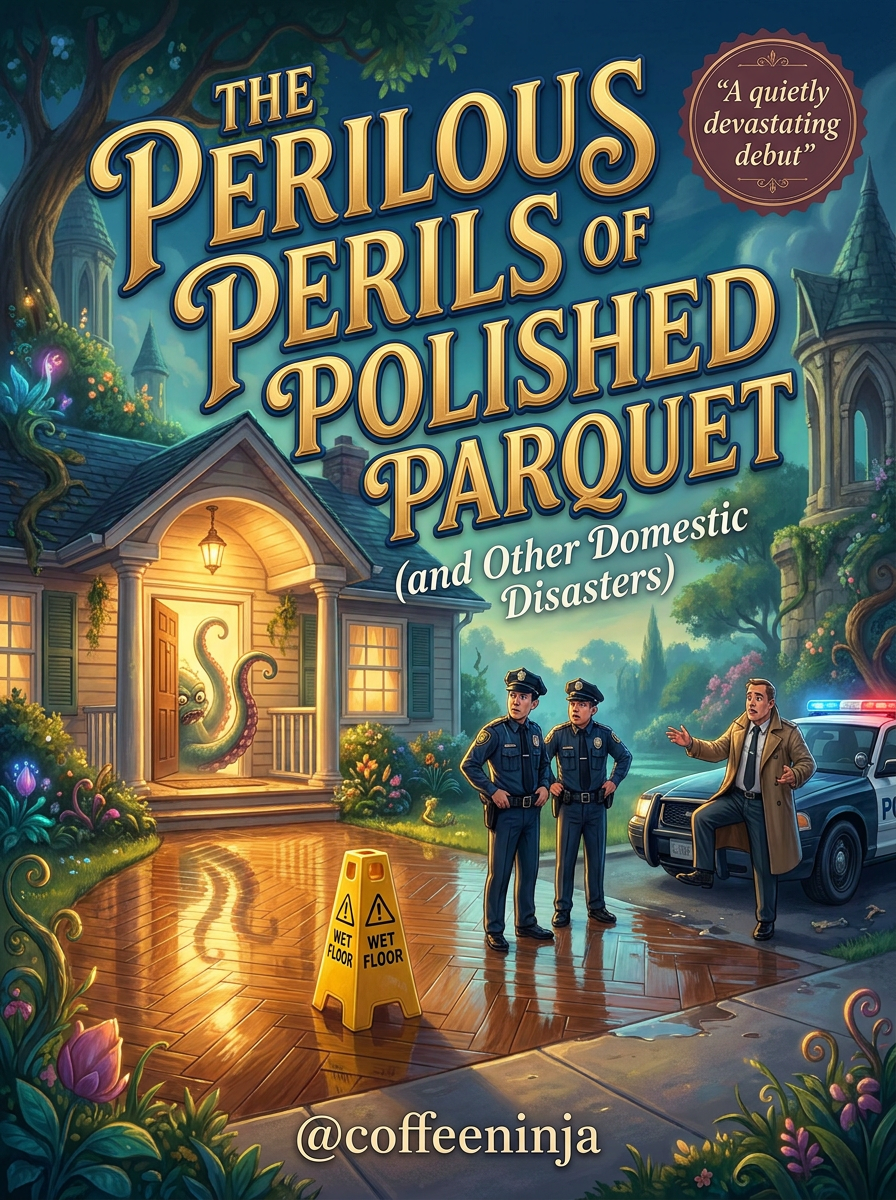
Synopsis
When a seemingly straightforward domestic dispute involving a 'wet floor' and a trigger-happy wife escalates into a bizarre standoff with law enforcement paralyzed by liability fears, a Florida man's desperate plea from within his booby-trapped home unravels a hilarious tale of bureaucratic absurdit
Chapter 1: The Initial Lament: A Very Wet Situation
The rhythmic *swish-swash* of Mrs. Mildred Butterfield’s industrial-grade mop was, for Floyd Butterfield, a sound more terrifying than a banshee’s shriek and more insistent than a tax auditor’s knock. It meant only one thing: Armageddon, but with lemon-scented floor cleaner.
“Floyd!” Mildred’s voice, honed over thirty years of domestic tyranny, cut through the late afternoon quiet like a laser through butter. “Did you *really* just tramp across my freshly polished parquet? On your way for… *another* soda? From the *refrigerator*?” The escalating volume suggested the soda was not the primary offense.
Floyd, a man whose life goals largely consisted of making it to the next commercial break unscathed, froze mid-stride. One foot, encased in a suspiciously stained slipper, hovered precariously over the gleaming, reflective surface of the living room floor. The other, already committed, had left a faint, almost invisible, but to Mildred’s eagle eye, utterly catastrophic, smudgetrail. He was, to put it mildly, in a very wet situation.
“Darling,” he began, attempting a soothing tone that usually only worked on elderly golden retrievers, “it’s merely a tiny… patina. A whisper of an imprint, if you will. Adds character.”
The ‘patina’ argument, he knew, was pure folly. Mildred believed character was something best reserved for novels, not her immaculate hardwoods. He saw her hand, a blur of motion, dip into her apron pocket. It re-emerged, clutching not a duster, not a sponge, but a pearl-handled derringer, glinting innocently in the afternoon sun that dared to stream through her meticulously cleaned windows.
“Character, Floyd,” Mildred said, her voice now dangerously calm, “is what your toe will lack when I’m through with it.”
There was a pop. A sting. And a surprised, rather undignified yelp from Floyd. He looked down. A small, smoking hole had appeared in the toe of his slipper. And, he noted with a grimace, in the very tip of his right foot. The blood, he mused, would certainly make a mess on the newly polished floor. Mildred would be furious.
“Right then,” Floyd mumbled, collapsing onto the nearest, and thankfully rug-covered, armchair, fishing his ancient, cracked flip-phone from his pocket. “This officially escalates beyond ‘mild misunderstanding’.” His thumb hovered over the emergency services dial. “Hello, 911? Yes, I believe my wife has... *shot* me. Yes, for walking on the floor. No, not emotionally. Physically. There's a hole. Yes, in my foot. No, it’s not life-threatening, but it *is* rather inconvenient. And messy.” He paused, listening. “Yes, I’ll stay put. Not that I have much choice, really. She’s staring at my blood with an expression that suggests extreme disapproval.”
It took precisely seven minutes and thirty-two seconds for the first siren to wail in the distance, a sound that usually meant neighborhood kids were setting off fireworks again, but today, ominously, was heading straight for their pristine cul-de-sac.
“Mildred, dear,” Floyd called from his perch, gingerly wrapping his injury in a tea towel sporting a rather cheerful pattern of dancing teacups. “The cavalry is en route. Perhaps put the firearm away? Or at least pretend it’s a particularly aggressive feather duster?”
Mildred, however, was preoccupied. She was meticulously scrubbing the tiny speck of Floyd’s blood from the parquet with a dedicated, travel-sized bottle of surgical alcohol and a lint-free cloth. Her back was ramrod straight, her spectacles perched firmly on her nose. The derringer lay, forgotten, on the polished mahogany end table, a silent testament to her unwavering commitment to cleanliness.
The first police cruiser, a sleek, intimidating beast of a vehicle, squealed to a halt outside the Butterfield residence. Its partner, an equally imposing SUV, followed suit, disgorging two officers in pristine uniforms.
Officer Darren O'Malley, tall and lanky, with a seriousness that suggested he’d been born wearing a tiny uniform, was the first out. He marched with purpose towards the front door, his hand already on his sidearm. Behind him, Officer Bethany Henderson, young and earnest, clutched her radio, her brow furrowed with concern.
“Police! Anyone in there?” O’Malley bellowed, rapping sharply on the door.
From inside, Mildred’s voice, unexpectedly melodic, floated back. “Just a moment, Officer! I’m just finishing up! Don’t want to track anything in, do we?”
O’Malley exchanged a bewildered glance with Henderson. This was not typical protocol for a ‘domestic disturbance involving a firearm’ call. He tried the doorknob. Locked.
Suddenly, a small, elderly woman in a floral housecoat, binoculars clapped to her eyes, appeared from behind a hydrangrea bush across the street. This was Gladys Gribble, the unofficial, self-appointed leader of the neighborhood watch, and current holder of the ‘Most Eager to Broadcast Community Developments’ award.
“It’s a domestic!” Gladys shrieked, as if relaying news from a war zone. “Mildred shot Floyd! Over a clean floor! Can you believe it? The nerve of some men!”
O’Malley ignored her, focusing on the problem at hand – the locked door. “Ma’am, we need you to open the door. Now.”
There was a click. The door swung inward just enough for Mildred to peek out, a pristine feather duster clutched in one hand. “Oh, excuse me, Officer,” she said, her voice dripping with artificial sweetness. “I just finished waxing the entryway. It’s terribly slick. You know, for traction and all.” She gestured with her chin. “Careful now.”
O’Malley took a cautious step forward, boots gleaming in the late afternoon sun. He peered inside. And then he saw it.
Standing proudly in the center of the Butterfields’ meticulously polished entryway, a small, yellow A-frame sign proclaimed in bold, black letters: “CAUTION: WET FLOOR.”
O’Malley stopped dead. His foot, which had been mid-air, retracted as if it had stepped on a scorpion. His eyes, usually impassive, widened fractionally.
“Officer O'Malley?” Henderson inquired, sensing a sudden shift in her partner’s demeanor. “Everything alright?”
O’Malley pointed a rigid finger at the sign. His voice, usually gruff, was now a strained whisper. “The sign, Henderson. *The sign*.”
Henderson leaned forward, peering past him. “The ‘Wet Floor’ sign? Sir?”
“It's a liability, Henderson!” he hissed, pulling her back with a surprisingly strong grip. “A *major* liability! You know what happened to Jenkins back in ’09, don’t you? Twisted ankle, six months off, permanent aversion to linoleum. The city paid a fortune! A fortune, Henderson!”
Captain Rex Rexington, a man who viewed bureaucracy as a higher calling than justice, arrived on the scene just then, his cruiser pulling up behind the patrol cars. He was a barrel-chested man with a perpetually exasperated expression, as if the world was constantly challenging his meticulously maintained paperwork. He surveyed the scene, taking in the small cluster of neighbors (Gladys Gribble now flanked by two equally nosy ladies, all armed with binoculars), the two nervous officers, and the gleaming surface of the Butterfield entryway, made even more ominous by the tiny yellow sentinel.
“What’s the situation, O’Malley?” Rexington barked, already reaching for his clipboard. “Domestic disturbance, firearm involved, shots fired. Let’s move, people!”
“Captain, sir!” O’Malley saluted crisply, his eyes still glued to the yellow sign. “We have a… situation. Pre-existing conditions. And a ‘Caution: Wet Floor’ sign.”
Rexington’s eyebrows, which usually resided in a state of permanent low-level fury, shot up in alarm. “A *wet floor* sign?” His voice, normally a booming command, dropped to a horrified near-whisper. He took two steps closer, then stopped abruptly, as if hitting an invisible barrier. “Is it… *actually* wet?”
“Yes, sir!” Henderson piped up, eager to be helpful. “Mrs. Butterfield just finished waxing.”
Rexington cursed under his breath. “Jenkins. ’09. The damn Banana Republic lawsuit cost us a fortune. Six figure settlement, permanent disability, and the city council *still* brings it up during budget meetings.” He ran a hand over his face. “We can’t go in there. Not with that sign up. It’s a legal minefield.”
“But Captain,” Henderson ventured, “there’s a man inside who’s been… shot.”
“Property damage, potentially negligent discharge, *and* a slip-and-fall claim?” Rexington looked as if he might spontaneously combust. “No, no, no. This is a multi-jurisdictional nightmare. We need to follow protocol. Strictly.”
Inside, Floyd, having heard the commotion and the increasingly anxious tone of the police, decided to offer some assistance. He shuffled carefully to the open door, his toe throbbing. “Officers! Wonderful to see you all! I’m Floyd Butterfield, the rather perforated husband. My wife is Mildred, an artist with the mop. Look, I’m perfectly capable of walking out. Just avoid the shiny bits. She used a particularly potent blend of carnauba and bee’s wax today, apparently.”
Mildred, still inside, gave a tut. “It’s *parquet*, Floyd. Show a little respect for the artisanal craftsmanship.” She glared at his bandaged toe. “And that bloodstain. Honestly.”
The officers, however, were not listening to Floyd. They were staring at Captain Rexington, whose face had gone from merely exasperated to a shade usually reserved for very ripe plums.
“He said he’s *walking out*?” Rexington sputtered. “On the wet floor? Is he *insane*? He’s undermining the entire liability defense!” He turned to O’Malley. “Don’t let him leave! Or, rather, don’t let him *slip* while leaving! This is a delicate situation regarding… flooring integrity!”
“Captain, with all due respect,” Henderson interjected, her young voice surprisingly firm, “he’s bleeding. Shouldn’t we offer medical assistance?”
“Medical assistance outside the perimeter of the potential slip-and-fall zone!” Rexington ordered, brandishing his clipboard. “We establish a safe zone. Negotiate his extraction. But *no one* touches that floor! We’re not getting sued for a collateral slip-and-fall on top of a negligent discharge.” He turned to Officer O’Malley. “O’Malley, set up a perimeter. No one in, no one out, until we get clearance from legal regarding the ‘Wet Floor’ sign’s legal standing in a domestic intervention scenario. And call the city attorney. Get them on a hot mic, now!”
Officer O’Malley, a man who understood rules more than common sense, snapped to attention. “Perimeter established, sir! No unauthorized foot traffic on the Butterfield parquet!”
Floyd, leaning against the doorframe, still bleeding, looked out at the scene. Three police cruisers, flashing lights, a growing crowd of curious neighbors (Gladys Gribble was now organizing a potluck), and his injured toe, all held hostage by a small, yellow plastic sign. He sighed. This was going to be a long day. He glanced at Mildred, who was now polishing the gleaming derringer. His wife, he realized, was surprisingly calm for a woman who had just shot her husband. And her floor was impeccably clean. Priorities.
Captain Rexington, meanwhile, was already on his satellite phone, pacing frantically just outside the ‘Wet Floor’ exclusion zone. “Yes, Mr. Henderson from legal. Rexington here. We have a rather… unique situation. A domestic. Shots fired. One rather droll gentleman with a perforated toe. And a woman. And… a ‘Caution: Wet Floor’ sign. Yes. A yellow one. No, I haven’t touched it. Good heavens, man, do you think I’m suicidal? What’s the protocol for a ‘wet floor’ hazard during a lawful entry in a domestic dispute where the suspect has *actively* warned of said hazard, thus potentially creating contributory negligence issues for the responding officers should they choose to ignore said warning?”
From across the street, Gladys Gribble, still armed with binoculars, nudged her neighbor. “Did you hear that, Ethel? ‘Contributory negligence issues’! This is even better than when the Gormans tried to barbecue on their roof!”
Floyd, inside, shook his head. “I just wanted a soda,” he mumbled to himself, examining his toe. “A simple, refreshing soda.” He considered his options. He could probably just limp over to the fridge, grab a cola, and limp back. But then what? Mildred would probably shoot the *other* foot for defiance. Or worse, she’d make him clean up his own blood. The thought alone was enough to make him re-evaluate his entire life.
Just then, a small, white car with a sign that read “Pizzalo’s Pizzeria – We Deliver (Eventually)” pulled up, beeping cheerfully. A young man, barely old enough to shave, with a perpetually bewildered expression and permanent tomato sauce stains on his uniform, stepped out. This was Chuck Pizzalo.
“Anyone order a large pepperoni with extra cheese?” Chuck called out, holding up a flat, insulated bag.
Captain Rexington froze mid-sentence, his eyes widening. “Stay back, son!” he yelled, waving frantically. “You’re approaching an active incident involving a potential slip-and-fall hazard!”
Chuck, oblivious, merely blinked. “Active incident? Is that like… a no-tipping zone?”
Officer Henderson, ever the practical one, quickly stepped forward. “Sir, there’s an ongoing police situation. You need to leave the area immediately.”
Chuck shrugged. “Okay, but who’s gonna pay for the pizza? We don’t do returns for ‘police situation’.”
Floyd, seeing his opening, called out, “I’ll take it, son! Just slide it under the door! And for heaven’s sake, watch the floor!”
Mildred, however, was already there. She snatched the pizza, her movements surprisingly fast for a woman who had just polished a floor to a near-liquid sheen. “No external contaminants, Floyd,” she stated, as if discussing a biological weapon. “And certainly no greasy pizza. We just had lunch.”
Chuck Pizzalo, having retrieved his payment (Mildred, despite her eccentricities, always paid cash), retreated in bewilderment. He didn't understand. Why were all those police cars there? And why was everyone staring at a yellow sign? Seemed like an awful lot of fuss for a small delivery.
Captain Rexington, meanwhile, had concluded his conversation with the city attorney, his face a mask of grim resignation. “Alright, O’Malley! Legal says we maintain the perimeter. We are to inform the occupants that any attempt to traverse the ‘Wet Floor’ by *them* would be considered an assumption of risk, thus absolving the city of liability. However, we cannot, under any circumstances, *order* them to cross it, as that could be construed as coercion. And if they *do* slip, we are to immediately document the incident, photograph all scuff marks, and secure the scene as a potential civil infraction.”
Officer O’Malley, nodding solemnly, relayed the message through the barely open door. “Mr. Butterfield! Mrs. Butterfield! The City Attorney’s Office has advised that while you are free to egress the premises, doing so across the marked ‘Wet Floor’ will be considered an assumption of risk, thus negating any potential liability on the part of the City of Fort Lauderdale should any untoward incident involving a loss of footing occur.”
Floyd just stared. Mildred, however, perked up. “Assumption of risk, you say? Hmm. Interesting.” She looked at Floyd, then at her pristine floor. A gleam came into her eye.
Floyd had a very, very bad feeling about this. The Perilous Perils of Polished Parquet, he realized, had only just begun.
Chapter 2: Captain Rexington's Quandary of Caution
The flashing blue and red strobes painted the manicured lawn of the Butterfield residence in an insistent, frantic disco. Captain Rex Rexington, having navigated the baffling labyrinth of suburban streets and listened to a preliminary synopsis that sounded alarmingly like a rejected cartoon plot, finally arrived. He slammed the door of his patrol cruiser with a sigh that could curdle milk, his perpetually exasperated expression deepening into a canyon of mild annoyance.
He surveyed the scene: two patrol cars strategically angled to block a view of precisely nothing, a small gaggle of gawking neighbors (led, inevitably, by Gladys Gribble and her binoculars, sharp as a hawk’s talons), and three of his finest officers standing… stock still. This was not the dynamic, tactical response he expected from a call involving a reported gunshot wound.
“O’Malley! Henderson! What in the blazes is going on here?” Rexington bellowed, his voice accustomed to cutting through the general din of police stations and the occasional riot. He marched towards his officers, his stout frame radiating an aura of bureaucratic impatience.
Officer O’Malley, ever the literal-minded rule follower, snapped to attention so rigidly he looked like a freshly planked sardine. “Captain, sir! Officer O’Malley and Officer Henderson, sir, reporting a… a stalemate, sir.”
Rexington stopped short, his brow furrowing deeper than the Grand Canyon after a particularly violent monsoon. “A stalemate? Against whom, O’Malley? Are we facing a rogue Roomba with a vendetta against dust bunnies? A particularly aggressive flamingop?”
“No, sir! Not a Roomba, sir!” O’Malley insisted, his eyes darting towards the front door of the Butterfield house. “It’s… the sign, sir.” He pointed a trembling finger.
Rexington followed his gaze. There, directly in front of the open doorway, perched like a sentinel of domestic tyranny, stood a bright yellow, plastic A-frame sign. Bold, black letters, stark against the warning hue, declared: “CAUTION: WET FLOOR.”
A beat of silence hung in the air, thick and oppressive, broken only by the distant squawking of an agitated parrot from a neighbor’s cage and the increasingly plaintive, muffled cries of “Help! I’m still bleeding in here, you know!” emanating from inside the house.
Rexington stared at the sign. He stared at his officers. He stared at the sign again, as if willing it to transform into an actual, fire-breathing dragon, which would at least make some modicum of sense. “That’s it?” he finally managed, his voice dangerously low. “A… a sign?”
Officer Henderson, young and earnest, stepped forward, her voice a nervous squeak. “Well, not just *a* sign, Captain. It’s a *liability* sign. Officer O’Malley explained that if we were to proceed, and one of us were to, you know, slip…”
O’Malley nodded vigorously. “Indeed, Captain! The ‘Jenkins Incident of ‘09,’ sir. Officer Jenkins, sir, he twisted his ankle on a spilled coffee, un-manned by a ‘Wet Floor’ sign in the precinct breakroom. The paperwork, sir! The worker’s compensation claim! The subsequent sensitivity training on ‘Navigating Everyday Hazards in a Bureaucratic Environment’… it consumed six fiscal quarters, Captain! Six!”
Rexington felt a vein begin to throb in his temple, a familiar precursor to one of his legendary bureaucratic rants. The Jenkins Incident. Oh, the Jenkins Incident. A bureaucratic nightmare that had spawned enough inter-departmental memos to wallpaper the entire state capitol building. Officer Jenkins, a man whose primary contribution to law enforcement was perfecting the lukewarm coffee break, had managed to milk that ankle sprain for so long, the department had considered awarding him a Purple Heart for ‘Valor in the Face of a Spilled Beverage.’
“So let me get this straight,” Rexington said, each word enunciated with a frosty precision that could shatter glass. “We have a reported gunshot victim… bleeding… inside that house… and you, my brave and highly trained officers, are being held at bay by a piece of molded plastic with a strongly worded suggestion on it?”
“Regulation 4B, subsection C, paragraph 7, Captain!” O’Malley recited, as if reading from an invisible tablet. “Protection of personnel from foreseeable hazards, including, but not limited to, aqueous surface anomalies. The municipal liability insurance policy explicitly states that failure to observe clearly marked hazard warnings may result in… well, a lot of very inconvenient meetings and potentially a reduction in precinct pastry budget, sir.”
From inside the house, Floyd’s voice, now tinged with a distinct note of desperation, wafted out. “Is anyone out there listening? I’m starting to get lightheaded! And I think my novelty band-aid is slipping!”
Officer Henderson, her youthful eagerness battling with her newfound adherence to policy, wrung her hands. “But Captain, shouldn’t we… I mean, a person is injured. Logically, shouldn’t the priority be the person?”
Rexington shot her a look that could curdle milk *twice*. “Henderson, ‘logic’ is a messy, unpredictable beast in these hallowed halls of public service. ‘Policy,’ on the other hand, is a clear, concise pathway to avoiding inconvenient questions from Internal Affairs. The problem, as O’Malley has so cogently elucidated, is liability. If one of you slips, and we disregard that sign, the city, and by extension, *I*, become responsible.”
He gestured vaguely at the ‘Wet Floor’ sign, as if it were a booby-trapped tripwire. “This isn’t just a sign, Henderson. This is a legally binding suggestion. A pre-emptive declaration of who is to blame should gravity assert itself prematurely.”
A collective gasp rippled through the gathering of neighbors as Mrs. Butterfield, serene as a sphinx carved from granite, glided into view at the doorway. She held a feather duster like a ceremonial scepter. Her spectacles glinted in the sunlight, reflecting the police cruisers.
“Is there a problem, officers?” she asked, her voice an unsettlingly calm murmur. “Floyd is rather prone to exaggeration. I’m quite certain it’s just a flesh wound. I used a low-caliber dusting pistol, as per the manual. And do be careful. I just buffed the parquet. It’s positively gleaming.”
The officers exchanged bewildered glances, their faces mirroring Rexington’s open-mouthed astonishment. A “dusting pistol”? The Butterfield household was clearly operating on a different plane of existence.
“Mrs. Butterfield,” Rexington began, attempting to inject a modicum of authority into his voice, “your husband is claiming to have been shot. And to be bleeding. And we’re attempting to render assistance, but your… your hazard warning is impeding our progress.”
Mrs. Butterfield simply raised a perfectly manicured eyebrow. “Oh my. I do apologize for the inconvenience, Captain. But one simply *must* adhere to proper caution protocols after an extensive floor treatment. It’s for everyone’s safety, really. We wouldn't want a public servant to sustain an avoidable injury, now, would we? The paperwork alone…”
She trailed off, leaving the implied horrors of paperwork to hang in the air like a noxious gas. Rexington felt a flicker of grudging respect for her. She had, in her own peculiar way, weaponized the very mechanisms of bureaucracy against him.
“But what about Mr. Butterfield?” Henderson interjected, her concern for the injured husband overriding her fear of administrative reprimand. “He needs medical attention!”
“Ah, yes, the ambulance.” Rexington rubbed his temples. “O’Malley, what’s the ETA on the paramedics?”
O’Malley checked his radio, his face a mask of consternation. “Captain, sir, the ambulance is… also experiencing a delay. Apparently, the dispatch operator, after hearing about the ‘wet floor’ scenario, consulted with the city’s emergency liability guidelines and determined that a ‘red carpet’ protocol had to be initiated.”
“A what now?” Rexington spluttered, convinced he’d misheard.
“Red carpet, sir! Requires a preliminary assessment from a qualified ‘Safe Passage Coordinator’ to ensure the path from the ambulance to the patient is free of potential slip-and-fall hazards. They’re bringing a special non-slip matting. Apparently, there was a particularly egregious incident in sector three last month involving an EMT, a spilled milkshake, and a severe case of whiplash. The ensuing litigation was… legendary, sir.”
Rexington felt the last vestiges of his professional composure draining away, replaced by a growing sense of surreal comedic horror. The “Perilous Perils of Polished Parquet (and Other Domestic Disasters)” wasn’t just a catchy title; it was rapidly turning into the documentary of his life.
From inside, a faint crash was heard, followed by Floyd’s plaintive yell. “Ow! I think I chipped a tooth on the coffee table! And the band-aid really *is* slipping!”
Gladys Gribble, binoculars firmly affixed to her face, elbowed her neighbor. “See? I told you she was unhinged! Who shoots their husband for walking on a floor? And to think, she gets those floors shinier than mine! I use Lemon-Fresh Pledge!”
Mrs. Butterfield tutted from the doorway. “Honestly, Floyd. So dramatic. It’s just a flesh wound. And you know the coffee table is solid oak. You’ll be fine.” She then turned her steely gaze back to Rexington. “Now, about that ambulance. Will the Safe Passage Coordinator be wearing booties? I just waxed the trim.”
Rexington stared at Mrs. Butterfield, then at the bright yellow sign, then at his three officers, frozen in place by the legal implications of a clean floor. He pulled out his radio, his jaw clenched so tightly he probably ground down several molars.
“This is Captain Rexington to dispatch. Requesting immediate deployment of… of a hazard assessment drone. And a legal consultant. And possibly a priest. And a very large mop. Over.”
The dispatcher’s voice crackled back, sounding utterly bewildered. “A… a hazard assessment drone, Captain? And a priest? For a domestic dispute?”
“Just send them!” Rexington barked. “And ensure they’re briefed on the ‘Wet Floor Protocol’! I don’t need another Jenkins Incident on my hands!” He looked at the ‘CAUTION: WET FLOOR’ sign, feeling a primeval urge to stomp it into a thousand tiny pieces. But then he remembered the inevitable paperwork, the formal incident report, the justification for unnecessary destruction of property. He sighed.
Another moan from Floyd echoed from within. “I think I’m losing a lot of… decorum! And possibly blood! Could someone at least throw me a towel? A dry one, preferably!”
Officer Henderson, a wellspring of earnest if misguided compassion, took a tentative step forward, her hand reaching for the doorknob.
“Henderson! Halt!” Rexington commanded, his voice sharp as a guillotine blade. “Are you forgetting the Jenkins of ‘09, already? We do nothing until the Safe Passage Coordinator arrives, the non-slip matting is deployed, the drone has provided a full thermal imaging scan of potential slip-zones, and I have a signed affidavit from three separate legal departments indemnifying my command from any and all liability!”
Henderson, halted in her tracks, looked crestfallen. O’Malley nodded sagely, as if Rexington had just delivered the Gettysburg Address of Bureaucratic Prudence.
Rexington finally turned his gaze towards the nosy neighbors, particularly Gladys Gribble, who was now audibly narrating the entire standoff through her binoculars to a rapidly growing crowd. “And here, folks, you see the Captain himself! He’s looking mighty vexed! Probably because Mrs. Butterfield’s floors are too clean even for law enforcement!”
Rexington felt a muscle twitch in his eye. This wasn't just a domestic dispute. This was a spectacle. A national embarrassment in the making. And at the center of it all, a small, innocent-looking yellow sign. The ultimate weapon against efficiency, logic, and possibly, common sense.
He pulled a pristine, untouched evidence bag from his pocket. “O’Malley,” he said, his voice laced with the kind of grim determination usually reserved for hostage negotiations, “tape off the perimeter. No one, and I mean no one, approaches that sign without my express written permission and a signed waiver in triplicate.”
O’Malley saluted, a flicker of genuine excitement in his eyes. This was the kind of meticulous, policy-driven action he understood. He began to unspool the yellow crime scene tape, marking a large, absurd circle around the ‘CAUTION: WET FLOOR’ sign, as if it were a highly volatile, unexploded ordnance.
From within the house, Floyd’s voice, now a mere whisper, punctuated the sudden silence imposed by the tape. “Anyone… anyone got a spare muffin? And maybe a tourniquet for my ego?”
Captain Rexington sighed. This was going to be a long day. And he had a feeling that somewhere, Officer Jenkins was smiling.
Chapter 3: Laminate of Lies, Vinyl of Vexation
The early morning sun, usually a cheerful harbinger of Floridian warmth, now cast long, accusatory shadows across the neatly manicured lawn of the Butterfield residence. Captain Rexington, a man whose career had seen him face down drug lords, bank robbers, and even a particularly aggressive flamingo, found himself utterly stumped by a humble yellow plastic triangle.
“Alright, Butterfield!” he bellowed, cupping his hands around his mouth. His voice, usually a booming instrument of command, cracked slightly at the end, a subtle betrayer of his mounting frustration. “We need some information! Crucial information!”
From within the house, a muffled, plaintive cry echoed back. “Crucial? More crucial than me bleeding out on a perfectly polished floor, Captain?”
Rexington ignored the jab, though he did notice Officer Henderson wince. Henderson, a fresh-faced recruit still sporting the optimistic gleam of someone who believed in justice and non-slippery surfaces, looked like he was about to burst into tears.
“The floor, Butterfield! What kind of floor are we dealing with in there?” Rexington tried to inject a sense of urgency into his voice, as if the floor type held the key to unlocking a secret vault full of tactical insights.
A beat of silence. Then, Floyd’s voice, now tinged with a distinct whine, drifted out. “What kind of floor? It’s… it’s a *clean* floor, Captain! A very, very clean floor!”
Rexington pinched the bridge of his nose. “Not *clean*, Butterfield! The *material*! Is it hardwood? Tile? Carpet?” He gestured wildly with his free hand, as if illustrating the various flooring options for an unseen audience.
Another pause, punctuated by what sounded suspiciously like a whimpering sigh. “It’s… well, it’s not carpet, Captain! Definitely not carpet! My wife hates carpet. Says it harbors dust mites. And… and I’m pretty sure it’s not hardwood. We can’t afford hardwood. Not with the economy the way it is.”
Officer Rodriguez, a veteran with a perpetually weary expression, muttered under his breath, “Can’t afford hardwood, but can afford a wife with a hair-trigger and a penchant for polished surfaces. Priorities, Butterfield, priorities.”
Rexington shot Rodriguez a glare that promised extra paperwork in the near future. “Focus, Rodriguez! This is vital!” He turned back to the house. “Butterfield! Give me something concrete! Is it… is it laminate?” He threw the word out like a lifeline, hoping it would snag onto something.
A new sound emerged from the house – a sort of strangled gasp, followed by a series of what could only be described as choked giggles. “Laminate, Captain? Laminate? Oh, that’s a good one! You think I’d be in this predicament if it were mere *laminate*?”
Rexington’s brow furrowed. What was so funny about laminate? He’d always thought it was a perfectly respectable, if somewhat uninspired, flooring choice. He glanced at Sergeant Miller, who merely shrugged, his expression as blank as a freshly wiped whiteboard.
“Why, Butterfield? What’s wrong with laminate?” Rexington demanded, feeling a sudden, irrational urge to defend the honor of all laminated surfaces.
Floyd’s voice, now laced with a theatrical flourish, boomed out, “Laminate, Captain, is a *lie*! It pretends to be wood, but it’s merely a composite of wood products and resin, masquerading as something it’s not! A deceitful imposter! My wife, Captain, has no patience for deceit!”
A collective shiver ran through the assembled officers. The implication was clear: if laminate was a lie, and Mrs. Butterfield had no patience for lies, then anything that *wasn’t* laminate must be even more dangerous. Rexington felt a bead of sweat trickle down his temple. This wasn't just a domestic dispute; it was a philosophical treatise on flooring.
“So, not laminate,” Rexington mumbled, scribbling a note on his pad. He looked at the house again, feeling a growing sense of dread. “Alright, Butterfield. If not laminate, then… what about tile? Ceramic? Porcelain?”
Floyd’s response was immediate and filled with a fresh wave of indignation. “Tile? Captain, are you implying we live in a… a *bathroom*? Or a… a *deli*? My wife has aesthetic sensibilities, Captain! She wouldn’t stoop to the utilitarian bleakness of tile in the main living areas. The grout lines alone would send her into a paroxysm of despair!”
Henderson, still looking green, whispered to Rodriguez, “Paroxysm of despair? Is that a medical term?”
Rodriguez merely rolled his eyes. “It’s a Butterfield term, kid. Best to just nod and look concerned.”
Rexington, however, was far beyond nodding and looking concerned. He was teetering on the precipice of a full-blown existential crisis. He, Captain Rexington, who had once disarmed a live grenade with a paperclip and a piece of chewing gum, was being held hostage by a man’s wife, a wet floor, and a highly opinionated discourse on interior design.
“Alright, Butterfield! Enough with the architectural critiques! Just tell me what the damned floor is made of!” Rexington’s voice was now a strained roar, echoing off the neatly trimmed hedges.
Another pause, longer this time. It was a pregnant pause, heavy with unspoken implications, like the silence before a particularly devastating punchline. Then, Floyd’s voice, a mere whisper now, yet somehow carrying more weight than all his previous pronouncements, drifted out.
“It’s… it’s vinyl, Captain.”
The word hung in the air, a death knell to any lingering hope of a swift resolution.
Rexington felt the blood drain from his face. Vinyl. The word was like a cold, wet cloth slapped across his consciousness. He looked at Sergeant Miller, whose face had gone from blank to a shade of ashen grey. Officer Rodriguez visibly flinched, as if he’d just heard a ghost story. Henderson, bless his innocent heart, just looked confused.
“Vinyl?” Rexington repeated, his voice barely a croak. He knew, instinctively, that this was bad. Very, very bad.
Floyd, sensing the shift in mood, seemed to gain a new surge of energy. “Yes, Captain! Vinyl! High-gloss, premium, ‘looks-like-wood-but-is-actually-a-durable-and-water-resistant-synthetic-polymer’ vinyl! My wife chose it specifically for its low maintenance and its ability to withstand… well, let’s just say ‘high-traffic’ areas. And also for its extraordinary ability to achieve a mirror-like sheen when freshly polished!”
The officers exchanged horrified glances. Vinyl. Not just any vinyl, but *high-gloss, premium* vinyl. This was a nightmare scenario.
“Why… why is vinyl so bad?” Henderson whispered, his voice trembling.
Rodriguez, ever the pragmatist, leaned in and explained in a low, gravelly voice. “Kid, laminate, while a ‘lie’ as Butterfield so eloquently put it, has a certain friction. It’s got a bit of give. Tile, though aesthetically challenged in Butterfield’s eyes, at least offers grout lines. Texture. But vinyl? Especially high-gloss vinyl? That stuff is a one-way ticket to a broken hip and a lawsuit that’ll make your pension look like pocket change.”
Sergeant Miller, who had remained stoic throughout the entire ordeal, finally spoke, his voice unusually grave. “It’s the *liability*, Henderson. The sheer, unadulterated liability. If one of us goes in there, slips on that vinyl, and injures ourselves… the department will be paying out for decades. And with a ‘wet floor’ sign already established, it’s practically a pre-emptive admission of guilt.”
Rexington felt a cold dread seep into his bones. He pictured the headlines: “Police Captain Sues Own Department After Slipping on Polished Vinyl Floor During Domestic Dispute.” His career, his reputation, his last chance at early retirement – all of it, potentially, sliding away on a treacherous sheet of synthetic polymer.
“So, Captain,” Floyd’s voice, now eerily calm, drifted out again. “Now that you have this… crucial information… what’s the plan? Are we going to discuss the socio-economic implications of flooring choices all day, or are you going to send in a highly-trained, presumably slip-resistant rescue team?”
Rexington stared at the house, a fortress of polished peril. He looked at his officers, their faces a mixture of fear and resignation. He looked at the ‘Caution: Wet Floor’ sign, now gleaming malevolently in the rising sun.
“The plan, Butterfield,” Rexington said, his voice devoid of all hope, “is… to continue to assess the situation.” He scribbled another note on his pad, his hand shaking slightly. “Floor type: Vinyl. High-gloss. Premium. Extreme Caution Advised. Do Not Engage.”
Henderson, still clinging to a sliver of optimism, piped up. “But Captain, he’s bleeding! We can’t just leave him in there!”
Rexington sighed, a deep, weary sigh that seemed to carry the weight of all the world’s bureaucratic absurdities. “We’re not *leaving* him, Henderson. We’re… strategically containing the incident. Until we can devise a method of entry that minimizes risk to personnel and, more importantly, to the department’s legal standing.”
Rodriguez nodded sagely. “The department’s legal standing is paramount, kid. More paramount than Butterfield’s femoral artery, apparently.”
Floyd’s voice, now laced with a bitter irony, cut through the morning air. “Minimizing risk to personnel, eh? And here I was, thinking my personal risk of expiring from a gunshot wound on a pristine vinyl floor might be a priority. Silly me.”
Rexington ignored him, turning to his officers. “Alright, perimeter secure. No one goes in. No one even *thinks* about going in. I want a full risk assessment. I want a report on every single non-slip footwear option available to law enforcement. I want a detailed analysis of the coefficient of friction of high-gloss vinyl when wet.”
Sergeant Miller, ever the pragmatist, raised an eyebrow. “Captain, are we going to need a team of physicists for this?”
“If necessary, Miller, if necessary!” Rexington snapped, his frustration finally boiling over. “I am not going to be the Captain who green-lighted a slip-and-fall lawsuit that bankrupts the entire police force! Not on my watch! Not on this vinyl! This… this *vinyl of vexation*!”
He clenched his fists, glaring at the innocent-looking suburban house, which now seemed to shimmer with an almost malevolent sheen. The sun, finally high above the horizon, glinted off the windows, reflecting a distorted image of Captain Rexington, a man undone not by villains or monsters, but by the perilous perils of polished parquet… or, in this case, the treacherous truth of high-gloss vinyl. The standoff had officially entered a new, even more ridiculous, phase. And somewhere, a lawyer was probably already salivating.
Chapter 4: The Jenkins Precedent and the Ethics of Entry
"Captain," Officer Bethany ‘Bess’ Henderson, all of twenty-two and still smelling faintly of ambition and fresh laundry detergent, ventured, her brow furrowed in a manner that suggested actual thought, "with all due respect, isn't this... a bit much? I mean, Mr. Butterfield is clearly in distress. And Mrs. Butterfield is, well, *inside*." She gestured vaguely towards the house, as if Mrs. Butterfield might at any moment emerge, wielding a feather duster and a scowl.
Captain Rexington, who had just finished adjusting his belt for the fifth time in as many minutes – a nervous tic developed after years of dealing with paperwork more dangerous than perps – sighed. It was the sigh of a man who’d seen too many ‘Caution: Wet Floor’ signs and too few common-sense solutions. "Officer Henderson," he began, his voice taking on the sonorous, slightly theatrical tone he reserved for lectures, "I understand your youthful exuberance. Your desire to ‘do good.’ To ‘serve and protect.’" He punctuated each phrase with a weary nod. "But we are not here to reenact a scene from a particularly poorly choreographed action movie. We are here to uphold the law, yes, but also, and I cannot stress this enough, to *avoid litigation*."
Bess blinked. "Sir, I thought we were here to help Mr. Butterfield, who, if I recall correctly from the 911 call, has a bullet wound."
Rexington winced. "A minor detail, Officer. A flesh wound, at best. He was still coherent enough to complain about the ambulance taking too long. Clearly, his life isn't hanging by a thread. Now, the *department's* financial future, on the other hand… that, Officer Henderson, is a tightrope walk over a pit of hungry, litigious sharks."
He paused, letting the dramatic imagery hang in the humid Florida air. The other officers, a motley crew of various ages and levels of jadedness, shifted uncomfortably. They’d heard this speech before, or variations of it. It usually involved a PowerPoint presentation and stale donuts.
"Let me tell you a story, Officer Henderson," Rexington continued, his voice dropping to a conspiratorial whisper, as if he were recounting a tale of ancient, forbidden magic rather than departmental policy. "A cautionary tale. A tale of hubris, of youthful impetuosity, and ultimately, of a twisted ankle that cost the city more than a small nation's GDP."
Bess, despite her growing exasperation, felt a flicker of morbid curiosity. "The Jenkins Precedent?" she ventured, remembering a dimly-lit training video she’d mostly slept through.
Rexington’s eyes widened in surprise. "You've heard of it! Excellent! Someone *does* pay attention in those mandatory refresher courses. Though I suspect you were probably just trying to impress that cute instructor from HR."
Bess flushed. "No, sir. I just… it was a particularly memorable video. The slow-motion replay of his ankle buckling was… vivid."
"Indeed!" Rexington beamed. "A masterpiece of instructional cinema. A testament to the power of proper safety protocols. Or, rather, the catastrophic consequences of *ignoring* them."
He cleared his throat, adopting the posture of a seasoned storyteller. "It was 2009. A simpler time. Before smartwatches, before TikTok dances became a legitimate threat to national security. Officer Jenkins, bless his overly enthusiastic heart, was a rookie, much like yourself. Full of fire. Full of… well, let's just say he hadn’t yet learned the subtle art of strategic inaction."
He gestured towards the ‘Caution: Wet Floor’ sign, now a silent, yellow sentinel of bureaucratic paralysis. "The situation was remarkably similar to this one. A domestic dispute. A wife, let's call her… Agnes. And a husband, let’s call him… Bartholomew. Bartholomew had, in a moment of what he later claimed was 'artistic expression,' painted the living room ceiling a rather startling shade of neon green. Agnes, being a woman of discerning taste and a deep-seated aversion to anything resembling a glow stick, had taken umbrage. Strong umbrage. With a broom."
A few chuckles rippled through the assembled officers. The absurdity of the situation seemed to be a universal language.
"Now, Agnes, in her righteous fury, had not only wielded the broom with the precision of a seasoned samurai but had also, in a burst of post-brawl tidiness, decided to mop the kitchen floor. And what, Officer Henderson, did she place squarely in the middle of that freshly mopped floor?" Rexington paused for dramatic effect, his gaze sweeping over Bess.
"A 'Caution: Wet Floor' sign, sir?" Bess offered, playing along, though she felt a growing sense of unease.
"Precisely! A beacon of forewarning! A silent, yellow guardian of the department's future insurance premiums! Now, Officer Jenkins, in his misguided zeal to 'intervene' – bless his well-meaning but utterly naive soul – saw the sign. He acknowledged the sign. He even, according to the incident report, *read* the sign aloud, albeit with a derisive snort."
Rexington shook his head, a mournful expression on his face. "He then, Officer Henderson, *stepped over it*. Boldly. Defiantly. As if daring the very laws of physics to challenge his authority."
A collective gasp, feigned or otherwise, went through the ranks.
"And what, Officer Henderson," Rexington continued, his voice now a hushed whisper, "was the immediate, devastating consequence of this egregious disregard for departmental safety protocols?"
Bess hesitated. "He… slipped?"
"He *slipped*!" Rexington boomed, his voice echoing off the suburban houses. "He slipped, Officer Henderson! On a patch of deceptively damp linoleum! His ankle, a testament to the fragile nature of the human skeletal system when confronted with a lack of appropriate traction, twisted like a pretzel in the hands of a particularly aggressive baker!"
He clutched his own ankle dramatically, wincing as if reliving the trauma himself.
"The screams, Officer Henderson! The wails of agony! Not from Bartholomew, mind you, who was still cowering under the neon-green ceiling, but from Officer Jenkins himself! A sound that, to this day, haunts the dreams of every veteran officer who witnessed it."
One of the older officers, a grizzled sergeant named Miller, nodded solemnly. "I still hear it, Captain. Especially after a particularly strong cup of coffee."
"Indeed, Miller, indeed," Rexington acknowledged. "The ambulance, which had been called for the minor spat between Agnes and Bartholomew, suddenly had a much more urgent patient. Officer Jenkins, writhing in pain, his career potentially derailed, his future as a competitive ballroom dancer – a secret ambition, apparently – shattered!"
Bess struggled to keep a straight face. "But sir, wasn't the initial call about a domestic dispute? And a broom?"
"Details, Officer, details!" Rexington waved a dismissive hand. "The real tragedy, the true injustice, was the sheer cost. The medical bills! The lost workdays! The therapists, both physical and psychological! The endless bureaucratic wrangling! The department was sued, Officer Henderson! Sued by Officer Jenkins himself! For negligence! For failing to adequately warn him about the inherent dangers of wet floors, despite the presence of a clearly visible, department-approved warning sign!"
He threw his hands up in exasperation. "The irony! The sheer, unadulterated irony! He was suing us for not protecting him from a danger he had deliberately ignored!"
"He won, didn't he?" Bess asked, a sinking feeling in her stomach. She knew the answer. The Jenkins Precedent was infamous.
"He did!" Rexington practically spat the words out. "A jury, swayed by a particularly charismatic lawyer and a tearful testimony about his shattered dreams of the tango, awarded him a substantial sum! A sum that, I might add, could have funded a small fleet of new patrol cars! Or, perhaps, a very, *very* large supply of industrial-strength floor mats!"
He pointed a finger at Bess, his eyes blazing with the fervor of a man who had personally witnessed the fiscal apocalypse. "And that, Officer Henderson, is why we do not cross that yellow line. That is why we respect the 'Caution: Wet Floor' sign. It is not merely a piece of plastic. It is a sacred barrier. A bulwark against bureaucratic ruin. A testament to the fact that, in this litigious society, a twisted ankle can be far more damaging than a bullet wound."
From inside the house, a faint, muffled groan echoed. "My leg! Oh, the humanity! My poor, poor leg!"
Rexington winced. "Sounds like Mr. Butterfield is still in fine form. Probably just hamming it up for the cameras. Or, in this case, for the insurance adjuster."
Bess looked from the 'Caution: Wet Floor' sign to the house, then back to the captain, her expression a mixture of disbelief and dawning horror. "So, sir, we just… wait? While Mr. Butterfield bleeds out in there?"
Rexington puffed out his chest. "We wait, Officer Henderson, for a *certified, department-approved professional* to assess the wetness of the floor. We wait for a *waiver* to be signed. We wait for a team of *fully insured, highly trained specialists* to mitigate the slip hazard. And only then, *only then*, will we consider breaching that sacred yellow boundary."
He clapped her on the shoulder, a gesture that felt more like a warning than encouragement. "Welcome to the real world, Officer Henderson. Where the greatest dangers aren't always the ones with fangs or firearms. Sometimes, they're just a freshly mopped surface and a particularly aggressive legal team."
Bess stared at the 'Caution: Wet Floor' sign, its innocent yellow surface now imbued with a menacing, almost supernatural power. She imagined Officer Jenkins, his dreams of tango shattered, his ankle a crumpled mess, and a wave of despair washed over her. The job, she realized, was going to be far more complicated, and far less heroic, than she had ever imagined.
"So," she finally ventured, her voice barely a whisper, "what about Mrs. Butterfield? The one with the gun?"
Rexington just shrugged. "She's on the *other side* of the wet floor, Officer. Ergo, not our immediate problem. Unless, of course, she decides to *cross* the wet floor herself. Then we'd have a whole new set of jurisdictional and liability nightmares on our hands." He shuddered at the thought. "Let's just hope she stays put. And for the love of all that's holy, doesn't decide to re-mop anything."
Chapter 5: A Second Shot, A Dry Floor, A Demented Plan
The second shot, when it came, was less a bang and more a *thwack*. A dull, percussive sound, like a particularly robust potato hitting a particularly robust wall. It echoed through the tense suburban air, silencing the chirping crickets and even, for a moment, the distant wail of a siren that was still, inexplicably, several miles away.
Sergeant Higgins, who had been meticulously sketching a diagram of the incident on a damp napkin – a diagram that mainly consisted of a stick figure labeled “Floyd” and an arrow pointing to a very large, very wet puddle – shrieked. It was a high-pitched, almost operatic shriek, entirely unbefitting a man of his girth and stern demeanor. He dropped his napkin, scattering crumbs of what appeared to be a partially eaten donut, and instinctively ducked behind the nearest patrol car, which happened to be Captain Rexington’s.
Captain Rexington, a man who had faced down armed robbers, irate geese, and an unholy amount of paperwork, merely flinched. His eyes, however, widened to the size of saucers that had just witnessed a particularly disturbing magic trick. He’d barely had time to process the first gunshot, let alone prepare for a sequel. His hand instinctively went to his service weapon, then paused. What exactly was he going to shoot? The house? The concept of domestic discord?
“Another one?” he mumbled, more to himself than to the quivering Sergeant Higgins, whose substantial posterior was now pressed firmly against the Captain’s left thigh. “Are we sure she’s not just… reloading?”
A collective gasp went through the assembled officers, who had all adopted various states of defensive crouch behind their vehicles, looking like a particularly well-armored game of hide-and-seek. The idea of Mrs. Butterfield, the seemingly demure woman who baked award-winning lemon bars for the annual neighborhood potluck, being a crack shot with a penchant for sustained fire, was a deeply unsettling one.
“Reloading what, Captain?” asked Officer Jenkins, peeking out from behind a particularly sturdy oak tree. “A shotgun? A bazooka? Her sense of personal injustice?”
Before Rexington could formulate a suitably pithy, yet reassuring, response, a new sound emanated from the Butterfield residence. It wasn't another gunshot. It was a faint, almost imperceptible *drip, drip, drip*. Followed by a slightly louder *splish*.
Rexington’s brow furrowed. He exchanged a bewildered glance with Officer Miller, who was currently attempting to make himself invisible by merging with a hedge. Miller, a man whose primary experience with domestic disputes involved mediating between his two perpetually feuding cats, simply shrugged, a silent admission that he had absolutely no idea what was going on.
Then, a voice, unmistakably Floyd’s, wafted through the open window, sounding remarkably… dry. “Honey, for the love of all that is holy, you’ve shot the water heater! And the ceiling fan! And… is that a priceless Ming vase?”
A beat of silence. Then, a distinctly feminine, slightly exasperated voice, belonging to Mrs. Butterfield, replied, “Well, it was *you* who insisted on walking on my pristine floor, Floyd! And besides, the vase was hideous. Mother-in-law’s taste, you know. And now look! The entire dining room is flooded! You’ll have to mop it up!”
Another beat of silence. The dripping sound intensified, now accompanied by the unmistakable gurgle of water escaping its intended confines.
Captain Rexington slowly straightened up, pushing Sergeant Higgins’s rather ample derriere away from him with a sigh. He walked to the edge of the police tape, peering intently at the Butterfield residence. The faint, metallic tang of gunpowder still hung in the air, but now it was mingling with the distinct aroma of… damp drywall.
He turned to his assembled officers, a slow, almost predatory grin spreading across his face. “Gentlemen,” he announced, his voice taking on a theatrical flourish that usually preceded either a brilliant tactical maneuver or a particularly bad pun, “I do believe we have an unexpected development.”
The officers, still wary of potential incoming projectiles, remained largely unmoving.
“The floor,” Rexington continued, gesturing dramatically towards the Butterfield home, “is likely dry now.”
A moment of confused silence. Then, a ripple of understanding, followed by a smattering of chuckles, ran through the ranks.
Officer Jenkins, ever the pragmatist, was the first to vocalize it. “Dry, Captain? As in… not wet? As in… no liability?”
Rexington’s grin widened. “Precisely, Jenkins. Mrs. Butterfield, in her infinite domestic wisdom, appears to have inadvertently solved our primary obstacle. The ‘wet floor’ sign, I daresay, is now a rather quaint historical artifact.”
Sergeant Higgins, emerging from behind the patrol car, blinked. “So… we can go in?” he asked, a hopeful tremor in his voice. The thought of a warm donut and a dry, liability-free interior was clearly a powerful motivator.
“Well, not quite ‘go in’ as in ‘stroll in for tea and crumpets’,” Rexington clarified, his tone shifting back to the serious, albeit still slightly amused, police captain. “She still shot her husband. Twice, if we’re counting the water heater. And the ceiling fan. And the hideous Ming vase. But yes, the primary *legal* impediment to our intervention has been… liquidated.” He paused, a twinkle in his eye. “Pun intended.”
A groan went through the officers. Rexington’s puns were legendary, and not in a good way.
“So, what’s the plan, Captain?” asked Officer Miller, cautiously emerging from the hedge, looking remarkably like a startled deer.
Rexington rubbed his chin, his gaze fixed on the Butterfield house. The sounds of dripping water and Floyd’s increasingly desperate pleas for a mop were growing louder. He could even hear Mrs. Butterfield, now, instructing Floyd on the proper technique for wringing out a sponge, all while maintaining the air of a woman who had just endured a minor inconvenience, not just shot up her house.
“The plan, gentlemen,” Rexington declared, a wicked gleam in his eye, “is to exploit this unexpected hydrological event. We have a window of opportunity, however absurd it may seem. The ‘wet floor’ is no longer a deterrent. It is, in fact, now a *very* wet floor, but with the crucial distinction that the *cause* of the wetness is no longer a freshly mopped surface, but rather a structural plumbing failure induced by a domestic firearm incident.”
He paused, letting this rather convoluted explanation sink in.
Officer Jenkins raised a hand. “So, we’re going in under the pretense of… emergency plumbing assistance?”
Rexington snapped his fingers. “Precisely! Or, more accurately, under the pretense of responding to a structural damage report, which conveniently allows us to also address the ‘husband with gunshot wound’ situation. It’s a multi-faceted approach. A two-birds-with-one-stone, if you will. Or, in this case, two-bullets-with-one-water-heater.”
Another groan.
“But Captain,” Sergeant Higgins interjected, his voice still a little shaky, “she’s still armed, isn’t she? And clearly… unhinged.”
“Ah, but Higgins,” Rexington said, his voice dropping to a conspiratorial whisper, “that’s where the ‘demented plan’ comes in.” He gestured for the officers to huddle closer. They did, albeit reluctantly, still keeping a wary eye on the Butterfield residence.
“Here’s what we’re going to do,” Rexington began, his voice barely audible above the gurgling house. “We’re going to approach the house. *Cautiously*, of course. But we’re going to approach it not as a SWAT team, not as a crisis negotiation unit, but as… a concerned civic services department.”
The officers exchanged bewildered glances.
“Captain, with all due respect,” Officer Miller ventured, “we’re police. Not… municipal waterworks.”
“Exactly!” Rexington exclaimed, a triumphant glint in his eye. “That’s the beauty of it! We’re going to leverage the very thing that made us hesitate in the first place: the absurdly litigious nature of modern society. Mrs. Butterfield is clearly concerned about her property. The ‘wet floor’ was a symbol of her domestic pride, now tragically undermined by a structural integrity issue. We will appeal to that pride.”
He leaned in closer. “Sergeant Higgins, you will be our ‘Building Inspector.’ Officer Jenkins, you’re our ‘Water Damage Assessment Specialist.’ Officer Miller, you’re our ‘Public Safety Liaison,’ here to ensure no further ‘structural incidents’ occur.”
Sergeant Higgins looked horrified. “Me? A building inspector? I can barely tell the difference between a load-bearing wall and a particularly sturdy bookshelf!”
“Nonsense, Higgins,” Rexington waved a dismissive hand. “You have a clipboard, don’t you? And a pen? That’s 90% of the job. Just look concerned and nod a lot. And maybe occasionally tap a wall with your knuckles. It’s all about appearance.”
Rexington then pulled out a crumpled piece of paper and a slightly chewed pen from his pocket. He began to draw furiously, sketching out a crude diagram. “Here’s the approach. Higgins, you’re in front, clipboard held aloft, looking gravely at the ceiling. Jenkins, you’re behind him, with a measuring tape, looking at the floor. Miller, you’re providing ‘security’ – which mainly means looking very serious and occasionally glancing nervously at the bushes.”
“And you, Captain?” Officer Jenkins asked, a hint of suspicion in his voice.
Rexington grinned. “I, gentlemen, will be the ‘Chief of Emergency Mitigation Services.’ I’ll be the one to engage Mrs. Butterfield directly. I’ll commiserate with her about the plumbing, the structural damage, the sheer inconvenience of it all. And then, subtly, I’ll get her to surrender the weapon.”
“Subtly?” Miller repeated, skepticism dripping from his voice. “She just shot her husband over a wet floor, Captain. I don’t think ‘subtle’ is in her behavioral repertoire.”
“Ah, but that’s where the human element comes in,” Rexington declared, tapping his temple. “We understand human psychology. We understand the primal urge to protect one’s home. We’re not going in as an armed response; we’re going in as empathetic problem-solvers. We’re there to *help* her with her domestic crisis, which just so happens to involve a distressed spouse and a firearm.”
He looked at each of his officers, his eyes gleaming with a mixture of conviction and barely suppressed mischief. “This is our chance, gentlemen. A second shot, a dry floor, a demented plan. It’s unconventional, yes. It’s absurd, certainly. But it’s also the only way we’re going to get Floyd out of there without violating a single liability protocol. Think of the paperwork we’ll avoid!”
The last point seemed to resonate deeply with the officers. The sheer dread of filling out a mountain of forms detailing a ‘wet floor’ related shooting incident had been weighing heavily on their minds.
“Alright, Captain,” Sergeant Higgins said, straightening his uniform, a newfound determination in his eyes. “Building Inspector Higgins, reporting for duty. Where’s my hard hat?”
Rexington clapped him on the shoulder. “Excellent, Higgins! No hard hat needed. Just a profound sense of civic duty and a willingness to look at leaky ceilings with gravitas.”
He then turned to the Butterfield residence, which was now sounding less like a home and more like a particularly ill-tempered fountain. Floyd’s cries had taken on a more urgent, aquatic tone. “Honey, the water’s reaching the antique Persian rug! The one Aunt Mildred gave us!”
Mrs. Butterfield’s voice, surprisingly calm, floated out. “Well, you shouldn’t have tracked mud on it after I specifically told you to take your shoes off, Floyd. Now, hand me that bucket. And try not to splash.”
Rexington took a deep breath. This was it. The moment of truth. The most absurd, convoluted, and potentially brilliant police operation in the history of suburban law enforcement.
“Alright, team,” he announced, his voice firm and resolute. “Let’s go save Floyd Butterfield, and his Persian rug, from the perils of polished parquet… and plumbing-related firearm incidents. And remember, gentlemen, act natural. As natural as three police officers pretending to be a municipal assessment team, approaching a house where a woman has just shot her husband and her plumbing, can possibly be.”
With that, Captain Rexington, followed by a clipboard-wielding Sergeant Higgins, a measuring-tape-brandishing Officer Jenkins, and a very-serious-looking Officer Miller, began their slow, deliberate march towards the Butterfield residence. The wail of the ambulance, still distant, now seemed to mock their elaborate charade. But for Captain Rexington, it was a challenge he was ready to embrace. After all, what was a little domestic chaos when compared to the glorious absurdity of a truly demented plan?
Chapter 6: The Perils of Mrs. Butterfield, or: The Cleaner's Creed
The world through Floyd’s eyes was, at present, a rather blurry, pain-addled mess of beige carpet and the underside of a mahogany coffee table. But even through the haze of a bullet wound and mild concussion (he’d hit his head on the table on the way down, naturally), he could still appreciate the *pristineness* of the beige carpet. Not a single crumb. Not a stray fiber. It was, in its own terrifying way, a testament to Mildred’s unwavering dedication.
“Mildred,” he croaked, his voice barely a whisper, “the paramedics… they can’t come in.”
A sniffle, then a huff. “Well, they can’t expect me to let them track mud all over my freshly polished parquet, can they? Honestly, some people have no respect for a clean home.”
Floyd closed his eyes. He should have known. He should have *always* known. His entire marriage, in retrospect, had been one long, agonizing dance with a woman who believed cleanliness wasn't just next to godliness, but a prerequisite for it. God, he suspected, had Mildred on speed dial for tips on how to keep the heavens sparkling.
He remembered their first date. A quaint little Italian place. He’d accidentally spilled a tiny drop of red wine on the pristine white tablecloth. Mildred had produced a miniature stain remover pen from her purse, dabbed at the offending spot with the intensity of a surgeon, and then, to his horror, had subtly *wiped down their entire section of the table* with an antibacterial wipe, muttering something about “unsanitary restaurant practices.” He'd found it endearing then. A quirky little habit. He was a fool. A naive, lovestruck, soon-to-be-scrubbed-into-oblivion fool.
The escalation had been gradual, insidious. First, it was just the floors. A daily mopping, a weekly waxing. Then came the 'no shoes in the house' rule, enforced with the solemnity of a papal edict. Floyd, a man who enjoyed the simple pleasure of kicking off his work boots upon entering his own home, found himself performing a clumsy, one-legged ballet at the threshold, trying to maintain balance while Mildred hovered, a stern guardian of the doormat.
Then the furniture. Dusting became an art form, a religious ritual performed with an array of exotic cloths and sprays that smelled vaguely of industrial strength lemon and existential dread. He once, innocently, rested his feet on the coffee table. The resulting lecture had been so thorough, so detailed in its description of microscopic skin flakes and potential fabric degradation, that he’d felt the need to apologize to the inanimate object itself.
The kitchen was a war zone. Any errant crumb was treated as a biohazard. He’d learned to eat over the sink, hunched and apologetic, as if he were personally responsible for the invention of gravity. The dishwasher, Mildred insisted, was to be loaded with surgical precision, each plate, cup, and utensil positioned at the optimal angle for maximum water distribution and minimal spotting. He once dared to load a spoon facing the wrong way. He almost lost an eye. Not from Mildred, but from the sheer force of her exasperated sigh.
But the floors. Oh, the floors. They were Mildred’s Sistine Chapel, her Everest, her very reason for existence. Their home, a charming three-bedroom ranch, had been transformed into a museum of meticulously maintained surfaces. The living room, a gleaming expanse of polished parquet. The kitchen, a blinding white tile. The bathrooms, a mosaic of sparkling porcelain. And the bedrooms, a plush, vacuumed-daily carpet that felt less like a floor covering and more like a sacred altar.
He remembered the Great Juice Incident of 2018. Their nephew, little Timmy, a sweet, clumsy five-year-old, had visited. Timmy, in a moment of pure, unadulterated childish glee, had attempted a mid-air juice box transfer. The result was a sticky, orange explosion across Mildred’s pristine white kitchen tiles.
Mildred’s reaction had been… legendary. It wasn’t a scream. It wasn’t a shout. It was a guttural, primal sound of pure, unadulterated horror, a sound that Floyd still heard in his nightmares. She’d frozen, eyes wide, before launching into a blur of motion, grabbing paper towels, disinfectant, and a scrub brush with the speed of a seasoned SWAT team member. Timmy, bless his innocent heart, had merely stared, juice box still clutched in his hand, as his aunt scrubbed the floor with a ferocity usually reserved for exorcisms. He hadn't been allowed back since. “Too much… *potential for spillage*,” Mildred had explained, eyes darting nervously at the kitchen floor.
The "wet floor" sign had appeared shortly after that. Not the flimsy yellow plastic ones you see in supermarkets. Oh no. Mildred’s was a custom-made, heavy-duty, stainless steel behemoth, professionally engraved with the words: “CAUTION: WET FLOOR. PROCEED AT YOUR OWN PERIL. VIOLATORS WILL BE HELD ACCOUNTABLE FOR ALL MICROBIAL CONTAMINATION AND POTENTIAL DAMAGE TO FLOORING SUBSTRATE.” It even had a little motion sensor that emitted a high-pitched whine if you got too close while it was deployed. Floyd had initially thought it was a joke. He was, as always, wrong.
The whirring of the automatic floor polisher became the soundtrack to his life. The smell of bleach, pine cleaner, and some obscure, expensive Italian marble polish clung to his clothes, his hair, his very soul. He’d once tried to sneak a bag of chips into the living room. Mildred had intercepted him at the threshold like a highly trained customs agent, confiscating the chips and subjecting him to a full-body lint-rolling before allowing him passage.
The current predicament, then, was merely the logical conclusion of years of escalating clean-freakery. He’d stepped onto a freshly polished patch of parquet, a tiny, almost invisible damp spot near the doorway. He’d been trying to get to the bathroom, a desperate, bladder-bursting dash. He’d slipped. Not a dramatic, cartoonish slip, but a subtle, almost graceful slide that had ended with his foot leaving a faint, barely perceptible smudge.
Mildred, who had been admiring her handiwork from a respectful distance, had seen it. Her eyes had widened, a vein throbbing in her temple. “Floyd,” she’d said, her voice eerily calm, “you’ve… you’ve *defiled* the parquet.”
He’d tried to explain. “Mildred, my bladder… it’s a biological imperative! I couldn’t help it!”
Her response had been to grab the antique flintlock pistol, a family heirloom that had been purely decorative until that moment. He’d thought she was going to use it to point at the smudge, perhaps as a visual aid for an upcoming lecture on floor care. He should have known better.
The shot had echoed through the meticulously cleaned house, a jarring, unholy sound in a sanctuary of silence and polish. He’d felt a searing pain in his thigh, then the sudden, sickening lurch as he went down, hitting his head on the coffee table. And through it all, as the pain bloomed and the world tilted, he’d heard Mildred’s voice, clear as a bell, “Now look what you’ve done! You’ve bled all over my clean carpet!”
He heard a muffled thud from the vicinity of the front door. “Mildred, what was that?” he asked, his voice weak.
“Oh, just the mailman,” she replied, her tone dismissive. “Tried to leave a package on the porch. I told him he couldn’t place it directly on the welcome mat. It’s freshly vacuumed, you see. He insisted. I merely… *discouraged* him.”
Floyd decided not to ask for details. The mailman was probably fine. Or, at the very least, he was no longer attempting to defile the welcome mat.
He listened to the faint, distant shouts from outside. The police. The paramedics. All held at bay by a yellow sign and Mildred’s unwavering commitment to a sparkling home. It was absurd. It was terrifying. And yet, in a twisted, darkly humorous way, it was perfectly Mildred.
He remembered her mantra, a phrase she’d uttered countless times, a creed she lived by, breathed by, and, apparently, shot by: “A clean home is a happy home, Floyd. And a happy home is worth protecting, no matter the cost.”
He’d always thought she meant protecting from burglars, or perhaps dust bunnies. He now realized she meant protecting from *him*. From anyone who dared to disrupt the pristine order of her domestic domain.
He coughed, a dry, rattling sound. The pain in his leg was a dull throb now, but the headache from the coffee table incident was blossoming into a full-blown symphony of agony. He needed medical attention. He needed to get out of this house. But how? Mildred had effectively turned their home into a fortress of cleanliness, a hygienic prison from which escape seemed impossible.
He heard her humming now, a cheerful, almost manic tune. He risked opening one eye. She was, to his utter horror, meticulously scrubbing the tiny speck of his blood from the beige carpet with a small, specialized brush and a bottle of what he suspected was industrial-strength stain remover. She was wearing rubber gloves. Of course, she was.
“Mildred,” he said again, his voice raspier this time. “They’re trying to help me.”
She paused her scrubbing, looking up with an expression of mild annoyance. “Help you what, Floyd? Make more of a mess? Honestly, you men are all the same. No appreciation for the finer points of domestic harmony.” She sighed dramatically, as if the entire situation was a personal affront to her spotless existence. “Besides, they’re making too much noise. They’ll disturb the dust motes.”
Dust motes. He was bleeding out on a pristine carpet, surrounded by law enforcement paralyzed by liability, and his wife was worried about *dust motes*. This was his life. This was the perilous peril of polished parquet. And Floyd Butterfield, a man who just wanted to use the bathroom, was now its most unfortunate victim. He closed his eyes again, hoping that perhaps, just perhaps, when he opened them, he would be in a different, less surgically clean, dimension. A dimension where floors were meant to be walked on, not worshipped. A dimension where a little dirt was just… dirt. Not an act of war.
Chapter 7: Neighborhood Watch: The Spectacle Awaits
The siren’s wail, once a potent symbol of impending doom or, at the very least, a particularly enthusiastic ice cream truck, had, by this point, become little more than background noise to the residents of Maple Avenue. It was the kind of noise that, after a while, you barely registered, like the hum of the refrigerator or the persistent existential dread of a Monday morning. However, the sight of three police cruisers, two ambulances (one of which was still stubbornly parked three houses down, apparently awaiting a ‘dry’ path), and a fire truck (because, you know, protocol) parked haphazardly on their perfectly manicured street was a different matter entirely. This wasn’t just a noise; this was *drama*. And Maple Avenue, in its quiet, suburban way, was a connoisseur of drama.
Gladys Gribble, a woman whose life revolved around the precise timing of her morning tea and the even more precise timing of her neighbors' misfortunes, was the first to emerge. She was a formidable force of nature, clad in a floral housecoat that had seen more battles than a medieval knight, and armed with a pair of binoculars that could spot a misplaced garden gnome at fifty paces. Gladys didn’t merely *walk*; she *prowled*, her gaze sweeping across the scene with the predatory intensity of a hawk spotting a particularly plump field mouse. Her cat, a ginger tabby named Marmalade whose primary ambition in life was to be fed and then judged, followed her like a furry, judgmental shadow. Marmalade, unlike Gladys, was less interested in the human drama and more in the potential for unattended snacks.
“Well, I never!” Gladys declared, her voice carrying across the neatly trimmed lawns with surprising clarity. She wasn’t speaking to anyone in particular, but rather to the universe at large, inviting it to bear witness to the unfolding scandal. “Police tape! On *our* street! What has that Butterfield boy gotten himself into *now*?”
Captain Rexington, who at that very moment was attempting to explain the nuances of ‘wet floor’ liability to a bewildered fire chief (who, to his credit, was only subtly hinting that perhaps a hose could just… *wash away* the problem), felt a sudden shiver run down his spine. It wasn’t the Florida humidity; it was the distinct sensation of being observed, dissected, and irrevocably judged. He glanced over and saw Gladys, her binoculars trained on him with the precision of a sniper. He swallowed hard. Gladys Gribble was a legend in the precinct, not for any criminal activity, but for her unerring ability to file complaints about everything from excessive siren volume to the alleged “unseemly parking habits” of utility workers.
Soon, other residents began to trickle out of their homes. Mrs. Henderson, still in her hair curlers, clutching a half-eaten Danish like a comfort blanket. Mr. Peterson, in his pristine golf attire, looking as if he’d just stepped off the eighteenth green and into an episode of *Cops*. Even the notoriously reclusive Mr. Finch, who hadn’t been seen outside his house since the last presidential election, was peeking through his blinds, a testament to the irresistible allure of a good neighborhood spectacle.
The scene quickly morphed from a tense standoff into a bizarre block party. Lawn chairs appeared as if by magic, unfolding on the perfectly manicured grass. A cooler, suspiciously similar to the one Mrs. Henderson usually brought to church picnics, materialized. Children, sensing a reprieve from homework and chores, darted between police cars, giggling and pointing. One particularly enterprising youngster had even set up a lemonade stand, clearly operating under the assumption that a prolonged police presence equated to a thirsty clientele.
“Five dollars a cup!” the boy, a freckled terror named Kevin, chirped, holding up a plastic cup filled with a suspiciously cloudy yellow liquid. “Special police discount: three dollars!”
Captain Rexington, whose blood pressure was already performing a frantic salsa, felt a vein throb in his temple. He was trying to manage a hostage situation involving a man trapped by a wet floor, a trigger-happy wife, and a bureaucracy so labyrinthine it made the Minotaur’s Labyrinth look like a straight shot, and now he had to contend with a miniature entrepreneur hawking overpriced lemonade.
“Officer Jenkins,” Rexington barked, his voice strained. “Can you… can you *do* something about the… the *audience*?”
Officer Jenkins, a man whose primary ambition in life was to make it to retirement without ever having to engage in anything more strenuous than a donut run, shrugged. “Captain, they’re on their own property. And, well, it’s quite a show, isn’t it?” He even offered a small, appreciative nod in the direction of a woman who had just unfurled a personalized lawn sign that read: “GO FLOYD! WE BELIEVE IN YOU (AND YOUR DRY FEET)!”
Gladys Gribble, meanwhile, had upgraded her surveillance. She’d dragged out a sturdy wooden step-stool and was now perched precariously atop it, her binoculars scanning the scene with the intensity of a seasoned war correspondent. Marmalade, having given up on the prospect of unattended snacks, had settled at her feet, occasionally letting out a disgruntled meow that sounded suspiciously like a commentary on the poor quality of the local gossip.
“Heard it was a domestic dispute,” Gladys announced, her voice echoing across the lawn. “That Butterfield woman, always a bit… high-strung, wasn’t she? Remember that incident with the prize-winning petunias? Said they were ‘looking at her funny’.”
A ripple of murmurs went through the crowd. The petunia incident was indeed a local legend, involving a garden hose, several bewildered neighbors, and a very traumatized gnome.
Rexington clenched his jaw. This was precisely what he *didn’t* need. His carefully constructed perimeter of caution tape, designed to convey an air of official gravitas, was now merely a backdrop for a spontaneous neighborhood reunion. The media, he knew, would be next. And then it would truly descend into chaos.
He glanced at the house, a perfectly ordinary suburban dwelling that had, in the space of a few hours, become the epicenter of an absurd international incident. From within, he could still hear Floyd Butterfield’s muffled cries for help, occasionally punctuated by his wife’s surprisingly cheerful whistling. The juxtaposition was truly unsettling.
“Captain,” said Sergeant Miller, his voice a low rumble, “we’ve got a live feed from Channel 7 news. They’re calling it ‘The Wet Floor Standoff’.”
Rexington closed his eyes, counted to ten, then opened them again. The world had not, in fact, disappeared. He looked at the assembled crowd, a sea of curious faces, some holding smartphones aloft, others simply enjoying the free entertainment. He looked at Gladys Gribble, still perched on her step-stool, her binoculars unwavering. He looked at Kevin and his lemonade stand, now doing a brisk business.
This wasn’t just a police incident anymore. This was a spectacle. A bizarre, uniquely Floridian spectacle. And he, Captain Rex Rexington, was the reluctant ringmaster. He could almost hear the popcorn popping.
Just then, a voice from the crowd shouted, “Hey, Captain! Any chance we could get some hot dogs? This is going to be a long one!”
Rexington sighed, a deep, weary sound that seemed to carry the weight of a thousand bureaucratic nightmares. He looked at the ‘Caution: Wet Floor’ sign, still standing sentinel in front of the Butterfield residence. It seemed to shimmer with an almost malevolent glee.
“Sergeant Miller,” Rexington said, his voice surprisingly calm despite the internal hurricane raging within him. “Call the mayor. Tell him we need a contingency plan for… public relations. And perhaps… a really, really long dry runner.”
He knew, with a chilling certainty, that this was only the beginning. The world, it seemed, was about to discover the perilous perils of polished parquet. And Captain Rexington, for better or worse, was about to become a reluctant celebrity in the most absurd standoff in recorded history. He just hoped Floyd Butterfield had enough snacks to last until then.
Chapter 8: The Pizza Delivery Debacle and the Drone Dilemma
The tantalizing aroma of pineapple, ham, and molten cheese wafted through the humid Florida air, momentarily eclipsing the scent of desperation and stale police-issue donuts. Officer Jenkins, ever the connoisseur of fine cuisine, inhaled deeply. “Is that… Hawaiian?” he murmured, his eyes widening.
A beat-up Honda Civic, its once-pristine white paint now adorned with a mosaic of faded bumper stickers advertising everything from ‘Bob’s Bait & Tackle’ to ‘Support Your Local Sasquatch Research Team,’ rumbled to a halt directly in front of the Butterfield residence. A young man, barely old enough to shave – or perhaps just choosing not to – emerged from the driver’s side, a large, flat, cardboard box clutched in his hands. He wore a uniform that consisted primarily of a stained t-shirt emblazoned with the words “Pietro’s Pizza Palace: We Put the ‘Pie’ in ‘Pious’ (Sometimes).”
“Pizza delivery!” he chirped, his voice high and reedy, completely oblivious to the tableau of flashing lights, armed officers, and the increasingly frantic cries emanating from within the house. He bounced on the balls of his feet, a picture of youthful exuberance and a profound lack of situational awareness.
Captain Rexington, who had been mid-sentence explaining the finer points of ‘constructive entry’ to a bewildered Officer Rodriguez, snapped his head around. “What in the blazes…?”
The pizza delivery driver, whose name tag (barely visible beneath a smear of what looked suspiciously like anchovy paste) identified him as ‘Chad,’ took a step towards the yellow tape. “Delivery for a… Floyd Butterfield?” he called out, his voice echoing slightly in the strangely silent standoff.
A collective groan rippled through the police line. Floyd’s voice, now laced with a fresh wave of panic, squawked from inside, “NO! DON’T! IT’S A TRAP! SHE’LL EAT IT ALL!”
Chad paused, his brow furrowing in confusion. “A trap? Is this some kind of… escape room thing? ‘Cause I’m not really authorized for that, man. Just the pizza.” He gestured vaguely with the box. “It’s a large Hawaiian, extra pineapple, no olives. And a two-liter of Diet Dr. Pepper.”
Officer Jenkins, his stomach rumbling a symphony of longing, took a step forward. “Son, you might want to… just leave that on the curb.”
“But the instructions said ‘hand delivery to customer’,” Chad protested, holding the box protectively. “And the tip is contingent on that, dude. My boss is a stickler for the rules. He once made a guy deliver a deep dish to a submarine.”
Before anyone could properly intervene, Chad, with the unshakeable confidence of someone who has never been informed of an impending domestic dispute involving a firearm and a freshly polished floor, ducked under the yellow tape.
Captain Rexington’s face went from bewildered to a shade of puce usually reserved for overripe plums. “STOP HIM!” he bellowed, but it was too late. Chad was already halfway to the front door, humming a jaunty tune that sounded suspiciously like a commercial jingle for a rival pizza chain.
“Floyd Butterfield?” Chad called out again, rapping enthusiastically on the front door. “Your tropical delight has arrived!”
A guttural growl, distinctly feminine and far more menacing than anything Floyd had produced, emanated from within the house. “HAWAIIAN? I TOLD HIM NO HAWAIIAN! THE PINEAPPLE IS AN ABOMINATION!”
Chad, bless his naive heart, merely chuckled. “Hey, man, don’t shoot the messenger, literally! I just deliver the cheesy goodness.”
Suddenly, the front door, which had been stubbornly shut, creaked open a sliver. A single, furious eye, framed by a shock of brightly dyed magenta hair, peered out. It was Brenda Butterfield, Floyd’s trigger-happy spouse, and she looked less than thrilled to see a pizza delivery boy.
“You brought… Hawaiian?” Brenda’s voice was low, dangerous.
Chad, still oblivious, grinned. “Yep! Straight from Pietro’s oven to your… uh… domicile!” He even managed a little flourish with the pizza box.
Brenda’s eye narrowed. “You know what happens to people who bring Hawaiian pizza to my house?”
Chad frowned. “Uh… they get a delicious meal?”
A loud *THWACK!* echoed through the air as Brenda, with surprising agility for a woman who had just shot her husband, snatched the pizza box and slammed the door shut. A moment later, a muffled but distinct *SPLAT!* and a furious shriek from Floyd indicated the fate of the tropical delight.
Chad stood there for a moment, blinking. “Well, that was… unexpected. Do I still get the tip?”
Officer Jenkins, who had watched the entire exchange with a mixture of horror and morbid fascination, finally managed to stammer, “Son, I think you just delivered a weapon of culinary destruction.”
Captain Rexington, rubbing his temples, let out a long, weary sigh. “Alright, get that kid out of here before he gets hit by a stray pepperoni. And someone call Pietro’s Pizza Palace and explain that their delivery driver just became an unwitting accessory to… well, whatever this is.”
As Chad was gently but firmly escorted back to his Civic, still muttering about his missed tip, Captain Rexington turned back to his officers, his gaze sweeping over the increasingly demoralized group. The pizza incident had, if anything, exacerbated the absurdity of the situation.
“Alright, new plan,” Rexington announced, trying to inject some authority into his voice, though it came out sounding more like a defeated whimper. “We need to get eyes inside that house. And I don’t mean Officer Rodriguez peeking through the mail slot.”
Officer Rodriguez, who had indeed been attempting to peer through the mail slot, quickly straightened up, a sheepish expression on his face.
“We need… a drone,” Rexington declared, the words feeling foreign and slightly distasteful on his tongue. He hated drones. They were finicky, prone to crashing, and invariably attracted flocks of angry seagulls.
Officer Miller, a young, tech-savvy officer who looked like he’d been born with a smartphone in his hand, perked up. “A drone, Captain? We have the new FPV-500 ‘Eagle Eye’ model! It’s got 4K resolution, thermal imaging, and can even carry small payloads!”
Rexington winced. “Payloads? What kind of payloads?”
“Uh, tranquilizer darts? Small packages? A very tiny, very brave chihuahua?” Miller offered, rattling off options with an almost alarming enthusiasm.
“No chihuahuas,” Rexington stated firmly. “And no tranquilizer darts. We’re not trying to sedate Mrs. Butterfield, just… observe.” He paused, a flicker of an idea crossing his mind. “Though, a tranquilized Mrs. Butterfield would certainly simplify things.” He shook his head. “No. Legal ramifications. Just observation.”
Officer Miller, however, was already halfway to the patrol car containing the departmental drone equipment. He returned moments later, cradling a sleek, black drone that looked less like a surveillance tool and more like a miniature alien spacecraft.
“This beauty is the FPV-500, Captain,” Miller enthused, holding it up like a proud parent. “It’s got an eighty-minute flight time, twenty-mile range, and a built-in AI for obstacle avoidance!”
Rexington eyed the drone with suspicion. “Obstacle avoidance, you say? Because I distinctly recall the ‘Hawk-Eye 300’ model from last year’s Fourth of July parade. It ‘avoided’ obstacles right into the grand marshal’s prize-winning poodle.”
Officer Miller winced. “Ah, yes, the Poodle Incident. But that was a software glitch, Captain! And the poodle was, uh, surprisingly resilient.”
“Resilient enough to chase the drone for three blocks with a very angry grand marshal in tow,” Rexington grumbled. “And let’s not forget the ‘Squirrel Scramble’ incident, where a departmental drone mistook a particularly aggressive squirrel for a hostile combatant and engaged it in aerial combat, resulting in a downed drone, a traumatized squirrel, and a very confused elderly gentleman who thought he was witnessing an alien invasion.”
“Lessons were learned, Captain!” Miller insisted, his enthusiasm undimmed. “We’ve updated the AI! It can now differentiate between small mammals and, well, actual threats.”
“And what about the ‘Seagull Swarm of Shame’?” Rexington pressed, enjoying Miller’s discomfort. “That drone, if I recall correctly, was last seen being carried off by a flock of seagulls, presumably to be used as nesting material.”
Miller flushed. “That was… an anomaly. A rogue flock. They were clearly anarcho-syndicalist seagulls, Captain. Anti-establishment.”
“Right,” Rexington said dryly. “And the drone that ‘accidentally’ filmed the mayor’s pool party, mistaking a rubber duck for a suspicious package?”
“That drone was decommissioned due to… irreconcilable differences with the concept of privacy,” Miller admitted, looking down at his shoes.
Rexington sighed again. “Look, Miller, I don’t care if this drone can make me a latte and file my taxes. Just get it in the air, get us a visual on Floyd, and try not to crash it into Mrs. Butterfield’s prize-winning petunias.”
“Yes, Captain!” Miller saluted smartly, then began the pre-flight checks, his fingers dancing over the drone’s controls. The small propellers whirred to life with a high-pitched whine.
As the drone ascended, hovering precariously above the Butterfield residence, Rexington felt a familiar knot of dread tightening in his stomach. He had a premonition. A strong, undeniable feeling that this drone, despite all its technological marvels, was about to add another chapter to the department’s illustrious history of drone-related debacles. It was Florida, after all. And in Florida, even the machines had a flair for the dramatically absurd.
Chapter 9: Negotiations with a Broom and a Buffer
Captain Rexington, a man whose patience was usually as sturdy as a reinforced concrete bunker, felt it begin to erode like a sandcastle in a hurricane. He stared at the pristine, shimmering parquet floor, the "CAUTION: WET FLOOR" sign gleaming with an almost malevolent glee, and then back at the phalanx of officers, all of whom looked as though they were contemplating the existential dread of a particularly challenging sudoku.
“Alright, people,” he boomed, his voice echoing slightly in the suburban stillness, “This is getting ridiculous. We have a man bleeding inside that house, a woman with a… a broom, and you’re all acting like it’s the Rubicon, not a hallway.”
Officer Henderson, a man whose primary contribution to police work seemed to be the ability to look perpetually bewildered, piped up, “But Captain, the sign! The liability!”
Rexington pinched the bridge of his nose. “The liability, Henderson, is *not* getting the man medical attention. The liability is *not* apprehending the woman who shot him. The liability is letting a *wet floor* dictate our entire response!” He gestured wildly at the house, a perfectly innocuous-looking bungalow that had, in the past hour, transformed into a fortress defended by domestic hygiene.
“We need to establish communication,” Rexington declared, trying to inject some semblance of official procedure into the unfolding farce. “Someone get a megaphone. Or a really loud walkie-talkie. We’re going to talk to Mrs. Butterfield.”
A junior officer, fresh out of the academy and still radiating an earnestness that Rexington found both endearing and utterly naïve, scurried off. He returned moments later, lugging a megaphone that looked suspiciously like it had been repurposed from a high school football game.
Rexington took the megaphone, adjusted it, and cleared his throat. “Mrs. Butterfield!” he bellowed, his voice distorted and tinny, echoing off the neatly trimmed hedges. “This is Captain Rexington of the Florida Police Department! We need to talk!”
A beat of silence. Then, a faint whirring sound emanated from within the house. It was a rhythmic, almost hypnotic hum, punctuated by the occasional scrape.
“Is that… a leaf blower?” Officer Rodriguez whispered, squinting.
“No, Rodriguez,” Rexington sighed, “I believe that’s the sound of a floor buffer.”
Indeed, through the front window, a diminutive figure could be seen. Mildred Butterfield, a woman who, in any other context, would be described as ‘sweet’ or ‘grandmotherly,’ was gliding across her polished parquet, pushing a large, industrial-grade floor buffer with an air of serene determination. She wore a floral apron, a pair of sensible orthopedic shoes, and a hairnet that kept every strand of her silver hair immaculately in place. Her expression was one of profound concentration, as if she were performing delicate brain surgery rather than buffing a floor.
Rexington tried again, his voice cracking slightly with the effort of maintaining a professional demeanor. “Mrs. Butterfield! We are aware of the situation inside! Your husband is injured! We need to come in and render aid!”
Mildred paused her buffing, the machine humming softly to a halt. She turned her head slowly, her gaze, magnified by her thick spectacles, fixing on Rexington. She didn’t look angry, or scared, or even particularly surprised. She looked… mildly inconvenienced.
She raised a hand, not in surrender, but in a gesture that clearly indicated, “Just a moment, dear.” With a practiced flick of her wrist, she guided the buffer to the edge of the room, parked it neatly against the wall, and then, with surprising agility for a woman of her years, picked up a rather intimidating-looking broom. It wasn’t your average kitchen broom; this was a heavy-duty, industrial model, its bristles stiff and unyielding, clearly designed for serious sweeping.
She then approached the front door, still holding the broom like a medieval weapon. The officers collectively tensed. Was she going to charge them? Was this some new, terrifying form of domestic self-defense?
Mildred, however, merely opened the door a crack. A sliver of the pristine, gleaming floor was visible behind her.
“Captain Rexington, you say?” she asked, her voice surprisingly calm, almost melodic, despite the circumstances. “I believe we spoke on the phone. You’re the one who called about the… incident.”
“Yes, Mrs. Butterfield, that’s me,” Rexington said, trying to project an aura of authority while simultaneously bracing himself for a potential broom-based assault. “We need to get medical personnel in there for Mr. Butterfield. He’s been shot.”
Mildred sighed, a delicate, almost mournful sound. “Oh, Floyd. He just never learns, does he? I told him, time and time again, ‘Floyd, if it’s wet, don’t step.’ But does he listen? No. Always thinks he knows better than his Mildred.” She gestured vaguely with the broom. “Now look at the mess he’s made. Blood on my freshly polished parquet. Do you have any idea how hard it is to get bloodstains out of oak, Captain?”
Rexington blinked. “Mrs. Butterfield, with all due respect, the man has a bullet wound. The bloodstains are a secondary concern at best.”
“Secondary?” Mildred’s voice took on a sharper edge, and she tightened her grip on the broom. “Captain, a clean home is a happy home. And a happy home starts with a spotless floor. Floyd knows this. He just… he just disrespects the process.”
Officer Jenkins, a burly man who usually dealt with armed robbers and drug dealers, whispered to Rexington, “She’s… she’s serious about this floor, isn’t she?”
“Evidently, Jenkins,” Rexington muttered back. “More serious than I’ve ever seen anyone about anything, short of a stampede at a Black Friday sale.”
“Now, about you coming in,” Mildred continued, her gaze sweeping over the assembled officers, lingering on their sturdy, presumably dirt-tracking boots. “I understand you have your… duties. But I simply cannot allow you to track mud and grime all over my magnificent parquet. It’s just been buffed, Captain. Buffed to a high sheen. The kind of sheen that makes a statement.”
“Mrs. Butterfield,” Rexington said, trying to keep his voice even, “we’re not here to admire your floor. We’re here to help your husband. And to apprehend you, if necessary.” He regretted the last part immediately. It sounded far too aggressive for a woman wielding a broom and discussing floor polish.
Mildred’s eyes narrowed slightly. “Apprehend me? For what, Captain? Maintaining a pristine living environment? Protecting my domestic sanctuary from scuff marks and general untidiness?” She tapped the broom’s handle against the doorframe, a surprisingly firm thud. “I’ll have you know, Captain, that I am a law-abiding citizen. And a meticulously clean one at that.”
“You shot your husband, Mrs. Butterfield,” Rexington reminded her, trying to steer the conversation back to the actual crime.
“A warning shot, Captain!” she declared, her voice rising slightly. “A necessary deterrent! He was *about to step*! I saw it in his eyes! That reckless, untamed glint that says, ‘I don’t care about the integrity of this freshly cleaned surface!’” She paused, a faraway look in her eyes. “It was a moment of pure, unadulterated defiance, Captain. What else was I to do?”
Rexington rubbed his temples. This was going to be a long day. “Mrs. Butterfield, we have paramedics here. They need to get to Mr. Butterfield. Can we at least get them in?”
Mildred considered this, her head tilted to one side. “Paramedics,” she mused. “Do they have shoe covers, Captain? Proper, full-coverage shoe covers? Not those flimsy little blue things that rip the moment you look at them sideways. I’m talking industrial-grade, non-slip, fully sterilized shoe covers.”
The paramedics, two strapping individuals named Dave and Sharon, exchanged bewildered glances. Dave, a veteran of countless gruesome accidents, had never once been asked about the tensile strength of his shoe covers.
“We… we have shoe covers, ma’am,” Dave offered hesitantly. “Standard issue.”
Mildred scoffed. “Standard issue. Hah! I’ve seen ‘standard issue’ shoe covers, young man. They’re a menace. They’re a breeding ground for dirt and disease, and they offer precisely zero protection against the insidious transfer of outdoor detritus onto an impeccably maintained indoor surface.” She gestured with her broom again, this time towards the ground in front of them. “Look at your shoes, young man! Mud! Gravel! Goodness knows what else! You think that’s going to simply vanish with a flimsy blue slip-on?”
Rexington stepped forward, taking a deep breath. “Mrs. Butterfield, we appreciate your dedication to cleanliness. Truly. But this is an emergency. We can’t stand here debating the merits of various shoe cover technologies while your husband potentially bleeds out.”
“He’s not bleeding out, Captain,” Mildred stated with unwavering certainty. “I aimed for the fleshy part of the leg. A warning, as I said. A firm, unequivocal warning. He’s probably just lying there, contemplating his actions.”
From inside the house, a faint, pained groan could be heard. It was unmistakably Floyd.
“See?” Rexington said, seizing on the sound. “He’s in pain! We need to get him help!”
“He’s just being dramatic,” Mildred sniffed. “Always has been. Remember the time he pretended to have a splinter the size of a redwood tree just to get out of doing the dishes? Oh, he’s a master of theatrical suffering, that Floyd.”
Officer Henderson, who had been listening with an expression of increasing horror, leaned into Rexington. “Captain, I think she’s actually… enjoying this.”
Rexington shot him a look that promised a week of desk duty. “Henderson, now is not the time for psychological evaluations.”
“But Captain,” Henderson persisted, “she’s calm. She’s in control. She’s got a broom and a buffer, and she’s running the show.”
He wasn’t wrong. Mildred Butterfield, in her floral apron and hairnet, exuded an aura of unshakeable domestic authority. She held the power in this standoff, not the police department. The wet floor, the true antagonist, had created an impenetrable barrier, and Mildred was its unflappable guardian.
“Alright, Mrs. Butterfield,” Rexington tried a different tack. “What if… what if we send in one officer? Just one. And they’ll remove Mr. Butterfield. And they’ll wear those… those really good shoe covers you mentioned. The industrial ones.” He looked desperately at Dave and Sharon. “Do we have any industrial-grade shoe covers?”
Dave, bless his innocent heart, gulped. “I… I think we have some in the back of the ambulance, Captain. For biohazard situations.”
Mildred’s eyes lit up, just a fraction. “Biohazard, you say? Now *that* sounds promising. Are they yellow? I’m rather fond of yellow. It’s such a cheerful color, don’t you think?”
Rexington, feeling a flicker of hope, nodded vigorously. “Yes! Absolutely yellow! The brightest, most cheerful yellow you’ve ever seen! Like a field of sunflowers!” He was officially making things up now, but desperation was a powerful motivator.
“Alright,” Mildred said, after a moment of thoughtful consideration. “One officer. And the paramedics, but only if they promise to be exceptionally careful. And they must wipe their feet thoroughly on the mat before putting on the yellow biohazard shoe covers. And no touching the walls, the furniture, or, heaven forbid, the freshly polished baseboards.” She pointed her broom at the front porch. “There’s a mat there. It’s for wiping. Use it.”
Rexington felt a wave of relief wash over him. Progress! Albeit progress dictated by the whims of a woman with a broom.
“Understood, Mrs. Butterfield!” he exclaimed. “Officer Rodriguez, you’re up! Get those biohazard shoe covers from the ambulance! And wipe your feet!”
Rodriguez, looking utterly bewildered but also somewhat relieved to be doing *something*, hurried off. Dave and Sharon, the paramedics, exchanged another glance that clearly said, “Is this really happening?”
Moments later, Rodriguez returned, clutching a pair of bright yellow, surprisingly robust-looking shoe covers. He looked at the mat, then at Mildred, then back at the mat. He wiped his feet with an exaggerated, almost theatrical motion, as if performing a delicate ballet.
Mildred watched him like a hawk. “Thoroughly, young man. Thoroughly.”
Rodriguez, now sweating slightly, wiped his feet again, adding a little twist and a pivot for good measure.
“Better,” Mildred conceded. “Now, the shoe covers.”
Rodriguez carefully pulled on the yellow covers, which reached almost to his knees. He looked like a giant, very clumsy canary.
“Alright, now,” Mildred instructed, her voice firm. “You may enter. But, and I cannot stress this enough, *do not deviate from the path*. There is a clear path, young man. It’s been buffed specifically for this purpose. Do not, under any circumstances, step on the unbuffed sections. They’re still drying.”
Rexington’s jaw dropped. She had buffed a *path* for them? This wasn’t just dedication; it was a tactical operation.
Rodriguez, now moving with the cautiousness of a bomb disposal expert, took his first tentative step onto the gleaming parquet. The floor reflected his yellow-covered feet like a mirror.
“Good, good,” Mildred murmured, observing his every move. “Now, the paramedics. And remember to wipe!”
Dave and Sharon, equally bedecked in yellow, followed Rodriguez, moving with a synchronized, almost comical shuffle. They looked less like emergency responders and more like a trio of oversized, very nervous ducks.
As they slowly, painstakingly, made their way into the house, Mildred remained at the door, broom still held firmly, her gaze unwavering. She was the gatekeeper, the guardian of the parquet, and no one, not even the law, was going to compromise her domestic sanctity.
Rexington watched them disappear into the house, a surreal scene unfolding before his very eyes. He had dealt with hostage situations, drug busts, even a particularly aggressive squirrel incident, but never, in his distinguished career, had he encountered a standoff quite like this. A standoff where the primary weapon was a floor buffer, the main obstacle was a wet floor, and the perpetrator was a sweet-looking old lady with an unyielding commitment to cleanliness.
He sighed, running a hand over his face. He could already picture the headlines: "Police Stymied by Spick-and-Span Standoff," or "Wet Floor Wreaks Havoc on Law Enforcement." He just hoped Floyd Butterfield was indeed merely "contemplating his actions" and not, in fact, bleeding out all over Mildred’s magnificent, freshly buffed, utterly pristine parquet floor. Because if he was, Rexington had a feeling the cleanup would be far more contentious than the actual shooting.
Chapter 10: The Cavalry Arrives (Sort Of): The Insurance Adjuster
The collective sigh that rippled through the gathered law enforcement personnel was less a sign of relief and more a weary exhalation of exasperation. It wasn’t the cavalry they’d hoped for, no SWAT team rappelling from helicopters, no tactical entry specialists breaching the door with military precision. No, this was something far more terrifying, far more insidious in its potential for bureaucratic mayhem: an insurance adjuster.
She emerged from a pristine white sedan, a vehicle so devoid of character it might as well have been a sentient filing cabinet on wheels. Barbara ‘Barb’ Higgins, her name tag announced in crisp, efficient lettering, was a woman who clearly considered ‘sensible’ a high compliment. Her hair, a practical, no-nonsense bob, looked like it had been styled by a protractor. Her sensible shoes, sensible skirt, and sensible blazer were all sensible shades of beige and taupe, colors designed to blend seamlessly into any actuarial table. She carried a clipboard like a weapon, a pen poised like a dart, and her gaze, as it swept over the scene, was not one of concern, but of meticulous assessment.
Captain Rexington, who had been mid-soliloquy about the legal ramifications of a rogue Roomba, snapped his mouth shut. He’d dealt with plenty of lawyers, plenty of angry citizens, plenty of rogue squirrels in his time, but insurance adjusters held a special place in the pantheon of ‘people who can ruin your entire week with a single, well-placed question.’
Barb Higgins marched directly towards the police line, her sensible heels clicking a rhythm of imminent audit. She didn’t acknowledge the officers, didn’t spare a glance for the hastily erected police tape, or the bewildered neighbors peeking from behind their curtains. Her eyes, sharp and unblinking, were fixed on the source of the chaos: Floyd Butterfield’s house.
“Captain Rexington, I presume?” she stated, her voice as flat and unyielding as a freshly paved parking lot. She didn’t wait for an answer, merely flipping open her clipboard. “Barbara Higgins, Alliance Assurance. Claim number 743-B-9, property damage and potential liability for… well, it’s a bit vague at this stage, isn’t it? ‘Wet floor-related domestic incident resulting in gunshot wound and police standoff.’ Most unusual.”
Rexington felt a bead of sweat trickle down his temple. “Ms. Higgins, we’re currently in a delicate situation here. We have a gentleman, Mr. Butterfield, inside the residence, potentially injured, and his wife, Mrs. Butterfield, who… well, she’s still inside.” He gestured vaguely towards the house, as if pointing out a particularly stubborn stain.
Barb’s pen hovered over her clipboard. “Right. And the nature of the injury? Bullet wound, yes. But specifically *where* on the body? And was it a clean shot? Through and through? Or lodged? Important for assessing potential long-term medical costs, you understand. And secondary damage to internal organs. We’ll need a full medical report, naturally, once he’s… extracted.” She underlined ‘extracted’ with a flourish that suggested it was a technical term for ‘eventually.’
“We haven’t been able to ascertain the full extent of his injuries,” Rexington admitted, feeling a distinct urge to bang his head against the nearest lamppost. “He’s… communicating, but not entirely clearly. And we can’t get in to assess him due to… well, the wet floor.”
Barb’s head tilted, a movement so slight it was barely perceptible. “The wet floor. Yes, I saw that noted in the initial incident report. A ‘Caution: Wet Floor’ sign, prominently displayed. Interesting. And this sign, was it placed prior to or after the incident?”
“Prior, we believe,” Rexington mumbled, feeling a sudden, inexplicable need to defend a plastic yellow sign. “Mrs. Butterfield had just finished mopping.”
“Ah, a pre-existing condition, then,” Barb mused, making a notation. “And was the floor *actually* wet? Or merely damp? Or perhaps, dry but still glistening, giving the *impression* of wetness? This distinction is crucial for liability purposes. A genuinely wet floor with proper signage is one thing. A floor that *appears* wet but isn’t, yet still causes injury, opens up an entirely different can of worms.”
One of the younger officers, Officer Jenkins, who had been trying to surreptitiously finish a donut, choked on a sprinkle.
“It was, by all accounts, very wet,” Rexington said, his voice strained. “Mr. Butterfield himself confirmed it. He slipped.”
“Slipped, or merely lost his footing?” Barb countered, her pen now poised like a tiny, bureaucratic scalpel. “There’s a difference. A slip implies a lack of traction due to a surface condition. Losing one’s footing could be attributed to clumsiness, an improperly tied shoelace, or even a sudden, unexpected gust of wind. Did Mr. Butterfield have any pre-existing conditions that might predispose him to loss of balance? Inner ear issues? Vertigo? A fondness for adult beverages?”
Rexington stared at her, his jaw slack. “Ms. Higgins, he was shot! He’s been shot by his wife! The wet floor was just… the catalyst!”
Barb’s gaze remained unwavering. “Indeed. And that brings us to Mrs. Butterfield. The claimant, I presume, in terms of potential homeowner’s insurance claims for… well, for the bullet hole, at the very least. And any incidental damage to the property from the… incident. What is her state of mind? Was she under duress? Or was this an act of premeditated… redecorating?”
“She’s… agitated,” Rexington hedged. “And armed. And she’s refusing to let us in because we might track water onto her freshly cleaned floor.”
Barb’s eyebrows, which had remained perfectly level throughout this exchange, finally twitched upwards by a millimeter. “Refusing entry to law enforcement due to a wet floor. Fascinating. And the weapon? What caliber? And is it registered? Is it insured? We’ll need proof of ownership and any relevant permits. A firearm discharged within the home, especially if it’s not properly secured, could void certain clauses in the homeowner’s policy.”
“Ms. Higgins,” Rexington said, his voice dangerously low, “we are trying to save a man’s life here. His wife shot him. He’s bleeding. And we can’t get to him because of a *wet floor sign* and her insistence on maintaining a pristine domestic environment.”
Barb finally looked away from her clipboard, her eyes scanning the house with a practiced eye. “I see a small crack in the siding near the living room window. Is that pre-existing damage, or related to the… incident? And the landscaping appears to be slightly overgrown. Potential tripping hazard for visitors, which could also lead to future liability claims. And the roof tiles… are those original? Or has there been a recent repair? We’ll need proof of materials and labor for any post-incident claims.”
Floyd’s voice, faint but undeniably desperate, suddenly wafted from an open window. “Someone! Anyone! My leg feels like it’s filled with angry wasps! And I think I can see my tibia!”
Barb’s head snapped back to Rexington. “Tibia. Noted. That’s a bone, correct? Significant. And the ‘angry wasps’ comment, is that a direct quote or a paraphrase? We need precise language for the claims report.”
Rexington felt his sanity slowly unraveling, like a cheap knitted sweater. “Ms. Higgins, with all due respect, I don’t care about the state of his tibia! I care about getting him medical attention before he bleeds out!”
“And we, Captain, care about ensuring that any medical attention he receives is properly covered, and that the financial burden does not fall disproportionately on Alliance Assurance due to negligence or pre-existing conditions that were not disclosed at the time of policy inception,” Barb stated, her voice as calm and unruffled as a still pond. “Now, back to the wet floor. Were there any anti-slip mats in place? Or perhaps a warning cone? A simple ‘Caution: Wet Floor’ sign, while helpful, may not meet the highest standards of liability mitigation, especially in a household with a known history of… well, of domestic disputes escalating to projectile weaponry.”
“Known history?” Rexington spluttered. “What known history?”
Barb consulted her clipboard. “Previous claims. November of last year, a claim for ‘minor structural damage due to an argument involving a flying casserole dish.’ Two years prior, a claim for ‘smoke damage from an incident involving a burnt toast and a heated discussion about breakfast preferences.’ And five years ago, a claim for ‘broken window due to an unexpected trajectory of a remote control during a disagreement over television programming.’ The pattern, Captain, is clear. The Butterfields, while perhaps charming individually, appear to be a high-risk household.”
Rexington could only stare, dumbfounded. He had been so focused on the immediate peril, the absurdity of the wet floor, the sheer illogicality of the situation, that he hadn’t even considered the broader history of Butterfield domestic chaos. He now saw the house not as a crime scene, but as a ticking time bomb of insurance liabilities.
“So, to recap,” Barb continued, oblivious to the existential dread now seeping into Rexington’s very soul, “we have a gunshot victim, possibly with a compromised tibia, inside a residence where his armed wife is preventing access due to a wet floor, which itself may or may not be adequately marked for liability purposes, and all of this occurring in a household with a documented history of projectile-based disagreements. Do I have that correct?”
“Yes,” Rexington whispered, defeated. “Yes, that’s… depressingly accurate.”
“Excellent,” Barb said, making a final, decisive notation on her clipboard. “Now, about the bullet. What material is it made of? Lead? Copper? Or perhaps a more exotic alloy? This is important for assessing potential environmental contamination to the property. And what about the trajectory? Did it impact any load-bearing walls? Or merely a decorative vase? The structural integrity of the home is paramount.”
From within the house, Floyd’s voice, now tinged with a new, weary resignation, drifted out. “It went through the porcelain cat. The one Aunt Mildred gave us. So, yes, decorative.”
Barb’s pen scratched furiously. “Porcelain cat. Noted. Sentimental value? Or purely aesthetic? Important for replacement cost calculations. And Aunt Mildred, is she still living? Does she have a receipt for the cat? Or perhaps a written appraisal?”
Rexington closed his eyes. He could feel the last vestiges of his professional composure slipping away. He had faced down armed robbers, dealt with hostage situations, even negotiated with a particularly stubborn squirrel who had stolen a police officer’s lunch. But this… this was an entirely different beast. This was the cold, unfeeling, meticulously documented beast of bureaucracy and liability, and it was far more terrifying than any bullet.
“Ms. Higgins,” Rexington said, his voice barely a croak, “is there any chance you could… you know… help us get Mr. Butterfield out of there?”
Barb looked up from her clipboard, her expression one of mild surprise. “Help? Captain, my role here is to assess the damages, verify the claims, and ensure Alliance Assurance is not unduly burdened by unforeseen circumstances. Direct intervention would constitute a breach of protocol and could open us up to a whole new set of liabilities. For example, if I were to slip on that wet floor while attempting to ‘help,’ who would be responsible for my medical bills? And what if I accidentally damaged the property further? No, no, Captain. My job is to observe, document, and quantify. The actual… extraction… is entirely your purview.”
She paused, then added, almost as an afterthought, “Unless, of course, you’d like to file a separate claim for ‘inability to perform duties due to inadequate personal protective equipment against wet floor hazards.’ We do have a rider for that, though it’s generally reserved for professional cleaning staff.”
Rexington simply stared at her, his mind reeling. He was trapped between a man bleeding out, a trigger-happy wife, and an insurance adjuster who spoke in actuarial tables and liability clauses. The cavalry had arrived, indeed. But instead of saving the day, they were merely documenting its impending financial ruin. He suddenly understood why Floyd Butterfield was so desperate. Not just for medical attention, but for an escape from this very particular, very polite, and utterly soul-crushing brand of absurdity.
He ran a hand over his face, feeling the stubble of a long, terrible day. “Just… just tell me, Ms. Higgins. If we were to, say, breach the door and track water onto the floor, would that be considered willful damage to the property?”
Barb’s pen was already poised. “Ah, an excellent question, Captain. That would depend on the necessity of the breach, the extent of the water tracking, and whether less invasive methods were thoroughly explored and documented as unfeasible. We’d also need to consider the pre-existing condition of the door itself. Was it solid wood? Hollow core? And what about the threshold? Was it properly sealed against moisture intrusion?”
Rexington closed his eyes again, a silent scream building in his chest. He was going to need a very, very strong drink after this. And possibly a new career. Perhaps something in a field with fewer wet floors and more logical, less liability-obsessed individuals. Like, say, lion taming. At least lions were straightforward in their intent. They wanted to eat you. There was no ambiguity, no clauses, and certainly no insurance adjusters to complicate matters with questions about the lion’s dental history.
Chapter 11: The Great Floor Drying Initiative: A Tactical Failure
After much deliberation, punctuated by the increasingly frantic whimpers emanating from Floyd’s besieged domicile, Captain Rexington finally slammed his fist on the hood of his cruiser. “Right! This is ridiculous! We’re not going to let a glorified puddle hold us hostage all day!”
Officer Jenkins, still clutching his liability waiver like a holy relic, piped up, “But, Captain, the, uh, *fluidic integrity* of the domestic environment is… compromised. And the signage is quite explicit.”
Rexington shot him a glare that could curdle milk. “Signage? Jenkins, we’ve got a man bleeding out in there, and you’re worried about a ‘Caution: Wet Floor’ placard? What are you going to do next, arrest the mop bucket for obstruction of justice?”
A few snickers rippled through the assembled officers, quickly stifled by Rexington’s next pronouncement. “No, we’re going to dry it. We’re going to dry it so thoroughly, so unequivocally, that not even the most litigious lawyer in all of Florida could claim a ‘slip and fall’ on that parquet.”
A collective murmur went through the ranks. Dry it? How? Officer Rodriguez, ever the pragmatist, raised a hand. “Sir, we don’t exactly have industrial-grade dehumidifiers in our patrol cars.”
Rexington, however, had a glint in his eye. “No, Rodriguez, we have something even better. We have ingenuity. We have… *leaf blowers*.”
A beat of silence. Then, a bewildered, “Leaf blowers, sir?” from a rookie officer whose face clearly indicated he thought this was a prank.
“Indeed, Officer Greenhorn!” Rexington declared, puffing out his chest. “And portable fans! We will create a veritable gale force, a hurricane of dryness, that will obliterate every last molecule of moisture from that floor!” He gestured grandly towards Floyd’s house, as if envisioning a legion of wind-wielding warriors.
The officers exchanged glances. This was, without a doubt, the most Florida-man-esque police operation they had ever been involved in. But Rexington, for all his bluster, was their captain. And he was clearly on a mission.
Within minutes, the suburban street transformed into a scene straight out of a bizarre gardening convention. Officers, usually armed with firearms and tasers, were now brandishing gasoline-powered leaf blowers and industrial-sized fans, scavenged from their own garages, local hardware stores (with a hastily signed requisition form that would undoubtedly be questioned later), and even, in one instance, a particularly robust fan from a local pizza parlor’s kitchen.
The first leaf blower roared to life, a guttural growl that instantly drowned out Floyd’s increasingly faint cries for help. Then another, and another, until the air vibrated with a cacophony of internal combustion engines and whirring blades. The sound was deafening, a symphony of suburban utility, completely out of place in a hostage situation.
“Form ranks!” Rexington bellowed, his voice barely audible above the din. “Operation: Parquet Purge is a go! Rodriguez, you take the left flank! Jenkins, you’re on right! Greenhorn, you’re with me, and try not to blow the entire house down!”
The officers, a motley crew of uniformed men and women wielding gardening equipment, advanced toward Floyd’s house. The initial strategy was simple: aim the blowers at the front door, create a channel of dry air, and then… well, the plan got a little hazy after that. Rexington was a man of action, not necessarily meticulous planning.
As the first wave of wind hit the porch, a curious phenomenon occurred. The “Caution: Wet Floor” sign, previously a immovable barrier, began to flap wildly. Then, with a dramatic flourish, it lifted off its stand and sailed gracefully into the air, spinning like a rogue frisbee before landing with a soft thud in Mrs. Henderson’s prize-winning petunias.
A cheer went up from the officers. “The sign! It’s gone!” someone shouted, clearly forgetting the man still bleeding inside.
“Excellent!” Rexington roared, momentarily distracted by this small victory. “The psychological barrier has been breached! Now, the physical! Full power, gentlemen! Let’s get this floor drier than a desert iguana’s armpit!”
The combined force of a dozen leaf blowers, all aimed at the front door, created a miniature hurricane. Dust, stray leaves, and an alarming amount of Fluffernutter sandwich crusts (presumably from a particularly messy post-school snack session) were whipped into a frenzy. The air became thick with debris, making it difficult to see, let alone breathe.
Inside the house, Floyd, who had been on the verge of passing out, was jolted awake by the sudden, deafening roar. He coughed, a cloud of dust tickling his already raw throat. “What in the… are they trying to vacuum the house from the outside?!” he croaked, his voice barely a whisper. He could feel the pressure on the door, a mighty wind trying to force its way in.
The wet patch on the parquet, however, proved to be more resilient than anticipated. The initial blast of air merely created ripples, like a miniature inland sea. The water, instead of evaporating, began to migrate, forming new, smaller puddles in previously dry areas.
“Captain!” Jenkins hollered, his voice strained. “The… the moisture is relocating! It’s like a liquid insurgency!”
Rexington squinted through the swirling dust. He saw it. The water, instead of being vanquished, was merely being herded. And worse, the powerful fans, meant to aid in the drying, were creating an unforeseen consequence.
“The wind direction!” Rexington suddenly exclaimed, a dawning horror on his face. “It’s… it’s turning!”
Indeed, the sheer volume of air being pumped into the relatively confined space of Floyd’s porch was creating a vortex. The wind, instead of blowing directly into the house, was now swirling, creating unpredictable drafts. A rogue gust, originating from a fan placed too close to the side of the house, picked up a rather large, suspiciously damp garden gnome from Mrs. Henderson’s yard and sent it hurtling directly towards the front door.
*WHUMP!*
The gnome, a cheerful, bearded fellow with a fishing rod, struck the door with a surprising amount of force, leaving a rather distinctive dent.
“My gnome!” Mrs. Henderson shrieked from her porch, where she had been observing the spectacle with a mixture of horror and morbid curiosity.
“Apologies, ma’am!” Rexington yelled back, though his focus was on the increasingly chaotic scene.
The wind, now truly a law unto itself, began to wreak havoc. Officer Rodriguez’s hat was snatched from his head and sent spiraling upwards, eventually landing in a bird’s nest in a nearby oak tree. A stack of neighborhood flyers, previously neatly tucked into mailboxes, exploded into a blizzard of paper. And then, the true tactical failure became apparent.
The air, instead of drying the floor, was now merely pushing the water *around*. The leading edge of the wet patch, instead of shrinking, was expanding, creating a wider, albeit thinner, layer of moisture. It was like trying to clean a spilled drink by blowing on it – you just spread the mess.
“Captain, the floor is… wetter!” Officer Greenhorn gasped, pointing a trembling finger at the now-enlarged wet zone.
Rexington stared in disbelief. His grand drying initiative, his hurricane of dryness, had backfired spectacularly. The parquet, instead of being bone-dry, was now uniformly damp, extending further into the living room than before. And to add insult to injury, the sheer force of the wind had dislodged a rather ornate, but clearly not securely fastened, portrait from the wall inside Floyd’s house.
A muffled *CRASH* echoed from within, followed by a faint, pained groan from Floyd.
“Oh, for crying out loud!” Rexington muttered, running a hand through his already disheveled hair. “Floyd, are you alright in there?!”
“I’m… I’m mostly just… covered in dust and… and a painting of a startled badger!” Floyd’s voice, though still weak, held a new note of exasperation. “And I think the floor is actually *wetter* than it was before!”
Rexington winced. He couldn't deny it. The “Great Floor Drying Initiative” was, in military terms, a colossal failure. The cacophony of engines, the swirling dust, the flying debris, and the ever-expanding wet patch painted a picture of utter disaster.
“Alright, alright, everybody, stand down!” Rexington bellowed, waving his arms frantically. “Cease fire! I repeat, cease fire on the floor drying! We’re making it worse!”
Slowly, reluctantly, the officers powered down their leaf blowers and fans. The sudden silence was almost as jarring as the previous din, punctuated only by the distant chirping of birds and the faint, aggrieved whimpers of Floyd Butterfield.
The street was a mess. Leaves, dust, flyers, and the occasional rogue garden gnome littered the ground. Mrs. Henderson was now actively trying to retrieve her gnome from the dented front door, muttering darkly about police brutality against lawn ornaments.
Rexington surveyed the scene, his shoulders slumping. He had tried. He had truly tried. But the forces of nature, combined with a particularly stubborn wet patch and an overzealous application of suburban yard tools, had conspired against him.
“Alright,” Rexington sighed, rubbing his temples. “New plan. We’re going to need… towels. Lots and lots of towels.”
Officer Jenkins, ever the stickler for protocol, cleared his throat. “Sir, with all due respect, what about the liability implications of *touching* the wet surface with our bare hands? Or, indeed, with a towel that might then become a projectile?”
Rexington stared at him, a vein throbbing in his temple. “Jenkins, if I hear one more word about liability, I swear to all that is holy, I will personally throw you onto that wet floor and tell you to sue me.”
Jenkins, for once, wisely decided to remain silent.
Rexington turned back to the house, a new sense of grim determination settling over him. The floor drying had been a tactical failure, a comedic interlude in a tragically serious situation. But Floyd was still in there, and they still had to get him out. And somehow, they had to navigate the treacherous waters of that wet parquet.
“Someone call the fire department,” Rexington ordered, a wild idea forming in his mind. “Tell them we need… a very large, very absorbent sponge.” He paused, then added, “And maybe some more duct tape. I have a feeling we’re going to need a lot of it.”
The officers exchanged bewildered glances once more. A sponge? This police operation was rapidly descending into the absurd. But then again, given the initial premise, perhaps it had always been there. The perils of polished parquet, it seemed, were far more complex and far funnier than anyone had ever anticipated. And Floyd Butterfield, somewhere amidst the dust, the startled badger painting, and the now-wetter floor, could only sigh. This was going to be a long day.
Chapter 12: Floyd's Escape Attempt: The Slippery Slope of Freedom
The silence was… unnerving. Floyd, sprawled precariously on the living room rug – a rug he’d now decided was his spirit animal, a fluffy, defiant island in a sea of polished treachery – cautiously lifted his head. Mildred, usually a whirlwind of domestic fury, was… gone. Not just out of sight, but *gone*. No tell-tale clatter of ceramic, no rhythmic thumping of her insoles against the un-mopped areas of the house, not even the faint, ominous hum of the dishwasher.
He sniffed the air. No lingering scent of lemon-fresh floor cleaner. Could it be? Had the gods of domestic bliss (or perhaps the demons of domestic discord) finally smiled upon him? He risked a peek. The hallway leading to the kitchen, previously a shimmering, impassable glacier, now looked… dry. Not just ‘less wet,’ but genuinely, unequivocally, *dry*. It was a sight so beautiful, so liberating, it brought a tear to his eye. A tear he quickly wiped away, lest Mildred reappear and accuse him of weeping on her freshly polished wood.
This was it. His chance. The window of opportunity, literally and figuratively. He had to move. But where to? The front door was a no-go, guarded by the liability-fearing police force and, more importantly, Mildred’s formidable glare. The back door? Probably also a no-go. Mildred had a sixth sense for back door shenanigans. No, his best bet was the side exit, the one leading to the overgrown herb garden he’d always promised to tend. It was a perilous route, involving a jump from a window, but at this point, a broken ankle seemed a small price to pay for freedom.
He began to crawl, a commando in his own home, inching across the now-dry parquet floor. Every creak of the floorboards, every rustle of his pajama pants, sent a jolt of adrenaline through him. He imagined Mildred, a domestic ninja, lurking behind a pot plant, ready to pounce with a freshly wrung-out mop. But no. The silence persisted, a heavy, expectant blanket.
He reached the hallway. The floor felt… normal. Not sticky, not slick, not even vaguely damp. It was a miracle. He almost wept again. Almost. He stood up, slowly, testing the waters. No slip. No fall. He took a tentative step. Then another. He was walking! On a dry floor! It was like learning to walk again, but with the added thrill of potential spousal wrath.
His destination: the small, rarely used window in the guest bathroom. It was high, but not impossibly so. He’d once climbed out of it to retrieve a rogue frisbee, a memory that now felt like a prophetic training exercise. He just needed something to stand on. His eyes darted around the hallway. The laundry basket? Too flimsy. The stack of old magazines? Definitely too flimsy.
Then he saw it. The antique, hand-carved, intricately detailed, and surprisingly sturdy, mahogany side table. Mildred’s pride and joy. The one she’d inherited from her great-aunt Petunia, who, according to Mildred, had once hosted a tea party attended by a minor European dignitary and a ferret in a top hat. Floyd had always secretly hated the table. It was perpetually covered in doilies and miniature porcelain figurines that looked like they were plotting world domination. But now, it was his ladder to freedom.
He dragged it, carefully, towards the guest bathroom. The scraping sound of its heavy legs on the polished parquet was like fingernails on a chalkboard, and he winced with every inch. He imagined Mildred, wherever she was, suddenly developing a twitch in her left eye, a premonition of mahogany-related distress.
He finally got it under the window. It was perfect. Just the right height. He clambered onto it, feeling a surge of triumph. He was halfway there! He reached for the window latch. It was stiff, of course. Mildred believed in thorough security, even for a window that overlooked a patch of weeds and a perpetually bewildered squirrel.
He wrestled with it, grunting with effort. The latch finally gave way with a loud *snap*. He froze, listening. Still nothing. He pushed the window open, a gust of fresh air, smelling of damp earth and distant barbecue, filling his lungs. Freedom was so close he could almost taste it. It tasted like… well, like freedom. And maybe a little bit like the neighbor’s burnt sausages.
He swung his leg over the sill. This was the tricky part. The drop wasn’t huge, but it was enough to sprain an ankle if he landed awkwardly. He looked down. The herb garden, a tangled mess of mint, rosemary, and what he suspected was a particularly aggressive strain of bindweed, beckoned.
He was about to commit, to push off and make the leap, when his eyes snagged on something. Something small. Something round. Something… strategically placed.
It was a ceramic garden gnome. Not just any gnome, but the one Mildred had specifically forbidden him from touching, claiming it had “sentimental value” because it resembled her great-aunt Petunia’s ferret in a top hat. And it was sitting directly below the window, in the precise spot where he was about to land.
Floyd groaned. Of course. Mildred wouldn’t just leave him an open escape route. That would be too easy. This was a test. A final, cruel twist of the domestic knife. Landing on that gnome would not only be painful, it would incur Mildred’s righteous fury, a fury far more terrifying than any sprained ankle.
He withdrew his leg, sighing. This required a new strategy. He couldn’t just jump. He needed to… maneuver. He looked around the bathroom. Towels? Too soft. Toilet brush? Too unhygienic, and likely to snap.
His gaze fell upon the shower curtain. A heavy, floral monstrosity that Mildred insisted on, despite his repeated pleas for something, anything, less… chintzy. It was attached to a sturdy metal rod. An idea, daring and desperate, began to form.
He grabbed the shower curtain rod, yanking it free from its anchors with a metallic shriek that surely echoed through the entire neighborhood. He winced, expecting Mildred to materialize, steam rising from her ears. But still, nothing. He was either incredibly lucky, or Mildred was in a deep, meditative trance, perhaps communing with the spirits of overly polished floors.
He held the rod out the window, aiming for a small, sturdy-looking branch on a nearby rose bush. If he could hook the rod onto the branch, he could use it to swing himself clear of the gnome. It was a long shot, a truly ridiculous plan, but at this point, Floyd was beyond logic. He was operating on pure, unadulterated desperation.
He extended the rod, the floral shower curtain flapping wildly in the breeze. He nudged it, trying to catch the branch. It was just out of reach. He stretched further, his body contorting in an impressive display of middle-aged flexibility. He felt a bead of sweat trickle down his forehead.
Then, with a triumphant *thwack*, the rod caught the branch. He held on tight, testing the weight. The branch seemed sturdy. He took a deep breath. This was it. The moment of truth.
He swung his legs out the window, holding onto the rod for dear life. He was suspended in mid-air, a human pendulum, the floral shower curtain now acting as a makeshift parachute, billowing around him. He looked down. The gnome, with its smug, painted-on smile, seemed to mock him.
He pushed off the wall, swinging himself in a wide arc. He aimed for a clear patch of earth, well away from the gnome. He was flying! He was free!
Then, the rose bush, perhaps insulted by his impromptu gymnastics, decided to exact its revenge. A particularly thorny branch, heretofore unnoticed, snagged the shower curtain. With a sound like a giant tearing a silk sheet, the curtain ripped.
Floyd plummeted.
He landed with a most undignified *oof*, not on the clear patch of earth, but directly into the bindweed. The thorny tendrils wrapped around his legs, his arms, even his hair, holding him captive. He was tangled, disoriented, and covered in scratches. And, to add insult to injury, he’d landed within spitting distance of the gnome, which now seemed to be openly cackling at his misfortune.
He struggled, trying to free himself from the bindweed’s embrace. It was like fighting a particularly aggressive, leafy octopus. He heard a rustling sound. His heart pounded. Was it Mildred? Had she heard his pathetic cries?
No. It was the bewildered squirrel, who had apparently decided that Floyd, in his current predicament, was an excellent source of entertainment. It chittered at him, then scampered up a tree, presumably to gather its friends and spread the news of the human-bindweed-gnome incident.
Floyd lay there, defeated, scratched, and utterly humiliated. His escape attempt had been a spectacular failure. He closed his eyes, bracing himself for Mildred’s inevitable appearance. He imagined her, standing over him, a triumphant smirk on her face, holding a freshly brewed cup of chamomile tea, offering it with a saccharine "Having a spot of bother, dear?" before unleashing her full wrath.
But still, she didn’t appear. The silence, previously unnerving, was now just… confusing. Where *was* she? Had she finally snapped and gone to live in a commune dedicated to the art of floor polishing? Had she been abducted by aliens who had a particular fondness for domestic goddesses?
He risked another peek. The window, now curtain-less, gaped open. The antique mahogany table stood sentinel, a silent testament to his failed ambitions. The air was still. Too still.
Then, he heard it. A faint, almost imperceptible *thump* from the front of the house. Followed by another. And another. A rhythmic, heavy thumping.
It wasn't Mildred. It was… something else. Something large. Something approaching.
Floyd, despite his current predicament, felt a fresh wave of panic. Whatever was making that sound, it wasn’t good. He tried to untangle himself from the bindweed again, but it was like being caught in a thorny net.
The thumping grew louder. Closer. He could hear it now, distinctly. It sounded like… someone dragging something. Something heavy. Something… metallic?
He squeezed his eyes shut, bracing himself for whatever fresh hell awaited him. He’d barely escaped Mildred’s wrath, only to be confronted by… what? A rogue refrigerator? A sentient washing machine? In this house, anything was possible.
The thumping stopped. Right outside the window.
Floyd slowly, cautiously, opened one eye.
He saw it. Or rather, he saw *them*.
Two police officers, red-faced and sweating, were standing by the window. They were holding a large, metal, industrial-sized fan. The kind they use to dry out flooded basements.
One of them, a burly officer with a handlebar mustache, looked at Floyd, then at the fan, then back at Floyd. He scratched his head.
"Sir," he said, his voice surprisingly gentle for a man who looked like he could wrestle a bear, "we've been instructed to 'expedite the drying process' so we can, you know, actually *enter* the premises."
The other officer, a younger, more nervous looking man, gestured vaguely at the open window. "Captain Rexington thinks if we get enough airflow in there, the 'wet floor' situation will resolve itself. He said something about 'unforeseen variables' and 'mitigating liability through proactive ventilation.'"
Floyd, still tangled in bindweed, stared at them. They had brought a *fan*. To dry the floor. So they could avoid liability. While he was out here, slowly being consumed by a rogue plant, having just attempted a daring, and failed, escape.
"You… you brought a fan?" Floyd croaked, his voice hoarse from effort and despair.
The burly officer nodded. "Yep. Big one. We figured it'd do the trick. You know, get things moving." He gestured at the fan, which was now humming ominously. "We're just about to plug it in."
Floyd watched in horrified fascination as the younger officer fumbled with an extension cord. This was it. The final indignity. He was going to be dried out, along with the floor, by a giant fan, while Mildred was… still a mystery.
He closed his eyes again. He could already feel the bindweed hardening around him, the leaves crisping. He imagined himself, a permanent, desiccated fixture in the herb garden, a cautionary tale for all future husbands who dared to question a freshly mopped floor.
"Wait!" he yelled, a sudden surge of adrenaline giving him strength. "Where's my wife? Mildred? Where is she?"
The burly officer paused, his hand hovering over the fan's power switch. He looked at the younger officer, who shrugged.
"Sir," the burly officer said, "we haven't seen your wife since we arrived. We assumed she was… inside. You know, keeping an eye on things."
Floyd’s jaw dropped. Mildred wasn’t inside? She wasn’t lurking in the shadows, waiting to pounce? She wasn’t even *in the house*?
A new, terrifying thought struck him. If Mildred wasn't in the house, and he was out here, tangled in bindweed, and the police were about to blast the house with an industrial fan…
Who was going to stop them? Who was going to protect the sanctity of the polished parquet?
He imagined the fan, roaring to life, creating a maelstrom of air that would surely send his prized porcelain figurines (and Great-Aunt Petunia’s ferret-gnome) flying. He pictured the curtains, Mildred’s beloved chintz, flapping wildly, perhaps even ripping to shreds. He saw the dust bunnies, usually kept at bay by Mildred’s meticulous cleaning, rising in a triumphant, fluffy horde.
The younger officer finally found the outlet. He plugged in the fan.
"No!" Floyd screamed, a desperate, primal yell. "Don't do it! You'll ruin everything! The dust bunnies! The figurines! The *parquet*!"
But it was too late. The fan whirred to life, a low rumble that quickly intensified into a powerful roar. A gust of wind, surprisingly strong, shot out from the fan, tearing through the open window.
Floyd watched, helpless, as a small, porcelain shepherdess figurine, one of Mildred’s favorites, was lifted from the mahogany table, spun around in a dizzying pirouette, and then, with a pathetic *tinkle*, shattered against the opposite wall.
A wave of pure, unadulterated terror washed over Floyd. Forget his own escape. Forget the bindweed. Forget the liability. This was a domestic catastrophe of epic proportions. Mildred was going to kill him. And then she was going to kill the police. And then she was going to kill the fan.
"Shut it off!" Floyd shrieked, struggling even harder against the bindweed. "You don't understand! The consequences! The *consequences*!"
The burly officer, seemingly unfazed by the sudden porcelain carnage, merely adjusted his grip on the fan. "Just trying to help, sir. Expediting the drying process."
Floyd watched in horror as a doily, one of Mildred’s hand-crocheted masterpieces, detached itself from the side table and began to dance a chaotic jig in the swirling air. He knew, with chilling certainty, that Mildred would consider this an act of war.
He had to get inside. He had to stop them. He had to protect the house from the very people who were supposed to be protecting *him*.
With a renewed surge of desperate energy, Floyd pulled, twisted, and thrashed. The bindweed, perhaps surprised by his sudden ferocity, gave way. He stumbled to his feet, covered in scratches, leaves, and a surprising amount of dirt.
He ran towards the open window, scrambling over the gnome, which he now considered a secondary threat. He launched himself back through the window, landing with a clumsy thud inside the guest bathroom.
The fan, still roaring, was now creating a miniature hurricane in the house. Curtains flapped, papers scattered, and a small, decorative pillow launched itself across the living room like a fluffy projectile.
Floyd, ignoring his aches and pains, sprinted towards the front of the house, towards the source of the chaos. He had to stop them. He had to save his home. He had to save his life.
He burst into the living room, tripping over a rogue dust bunny that had achieved critical mass. He scrambled to his feet, his eyes wide with panic.
The house was a whirlwind of domestic destruction. The porcelain figurines were now engaged in a terrifying aerial ballet, smashing against walls and furniture. The doilies spun like demented UFOs. And the carefully polished parquet floor, now thoroughly dry but covered in a fine layer of dust and porcelain shards, reflected the chaos in a distorted, terrifying mirror.
Floyd saw the burly officer, still holding the fan, smiling benignly at the scene.
"See?" the officer yelled over the roar of the fan. "It’s working! It’s drying up nicely!"
Floyd stared at him, then at the destruction, then at the open front door where Captain Rexington and a bewildered Mildred were now standing, their faces a mixture of shock, horror, and incandescent fury.
Mildred, her eyes blazing with an unholy light, took in the shattered porcelain, the airborne doilies, the dusty floor, and the fan-wielding officer.
She pointed a trembling finger at Floyd, then at the officers, then at the fan.
"My… my… *parquet*," she whispered, her voice a low, terrifying growl.
Floyd knew, with absolute certainty, that his escape attempt, however brief and ill-fated, had just landed him in more peril than he could ever have imagined. He had traded a wet floor for a whirlwind of domestic destruction, and the wrath of a wife whose polished parquet had just been subjected to the indignity of "proactive ventilation."
He swallowed hard. This was going to be a long, painful day. And he had a feeling it was only just beginning.
Chapter 13: Resolution (of Sorts): The Truce of the Tiled Foyer
The sun, now a malevolent orange orb, was beginning its slow descent, casting long, dramatic shadows across the manicured lawn of the Butterfield residence. Captain Rex Rexington, feeling less like a seasoned law enforcement officer and more like a particularly inept umpire, rubbed his temples. Hours had passed since Floyd’s initial, rather dramatic, 911 call. Hours filled with increasingly absurd discussions about coefficient of friction, the legal ramifications of a slipped officer, and the surprising lack of a “Wet Floor Response Unit” in the county budget.
Inside, the silence was punctuated only by the occasional, mournful creak of the floorboards as Mildred Butterfield, a woman whose dedication to cleanliness bordered on the fanatical, paced her pristine domain. Floyd, still sprawled precariously close to the offending ‘wet floor’ sign, had resorted to humming increasingly off-key renditions of 80s power ballads. He was fairly certain he’d just butchered “Total Eclipse of the Heart” for the third time.
“Mildred,” Floyd called out, his voice hoarse from a combination of pain and singing. “Honey, my leg is starting to feel… *less attached*.”
A sharp, indignant sniff wafted from the direction of the kitchen. “Well, perhaps you shouldn’t have *dared* to traverse my freshly polished parquet, Floyd.”
“It was tile, Mildred! TILE!” he yelled back, a fresh wave of indignation momentarily eclipsing the throbbing in his limb.
Outside, Captain Rexington, having exhausted all his diplomatic and tactical options (which, to be fair, mostly consisted of yelling through a megaphone and then sighing heavily), was contemplating a truly desperate measure: ordering a pizza. He figured a well-fed officer was a less litigious officer.
Just as he was about to dial, a new voice, surprisingly calm and collected, cut through the tense atmosphere. “Captain, if I may be so bold.”
Officer Bethany “B.T.” Thompson, a rookie whose enthusiasm for police work was matched only by her encyclopedic knowledge of retail product catalogs, stepped forward. She held a rather sleek, remarkably modern-looking mop. It gleamed under the dying sunlight.
Rexington, whose faith in humanity (and mops) had been severely tested today, eyed it suspiciously. “What in the name of… is that, Officer Thompson?”
B.T. beamed. “This, Captain, is the ‘Hydro-Glide 5000: The Future of Floor Care.’ It boasts a revolutionary micro-fiber head, a self-wringing mechanism that reduces water residue by 98.7%, and an ergonomic handle designed to prevent carpal tunnel syndrome even during extended cleaning sessions.”
Rexington blinked. “And you brought… a mop… to a hostage situation?”
“Technically, Captain, it’s a ‘domestic dispute with potential for significant slip-and-fall litigation,’” B.T. corrected, ever the stickler for precision. “And yes, I did. I happened to be at ‘Home Depot Galore’ on my lunch break – they had a fantastic two-for-one on industrial-strength grout cleaner – and I saw this beauty. It sparked an idea.”
Rexington, whose ideas at this point mostly involved a stiff drink and early retirement, gestured for her to continue, albeit with a weary sigh.
“Mrs. Butterfield, from what I've gathered, is deeply concerned about the integrity of her flooring and the potential for re-soiling. This mop, Captain, is designed for rapid, streak-free drying. It virtually eliminates the ‘wet floor’ hazard.”
A glimmer of something – hope, or perhaps just the reflection of the setting sun off B.T.’s ridiculously shiny mop – sparked in Rexington’s eyes. “You’re suggesting we offer her… a better mop?”
“Precisely, Captain. It’s a diplomatic offering. A gesture of goodwill. A peace treaty, if you will, forged in the crucible of advanced cleaning technology.”
Rexington, against his better judgment, found himself intrigued. He grabbed the megaphone. “Mrs. Butterfield! This is Captain Rexington again! We have a proposition for you!”
Silence from within. Mildred, it seemed, was not easily swayed by propositions.
“We have… a new mop!” Rexington blurted out, feeling utterly ridiculous. He glanced at B.T., who gave him an encouraging thumbs-up.
A faint, almost imperceptible gasp was heard from inside the house. Then, a voice, surprisingly close to the front door, inquired, “A *new* mop, you say?” Mildred’s tone was laced with a dangerous blend of skepticism and a flicker of something akin to maternal curiosity.
“Yes, ma’am! The ‘Hydro-Glide 5000’!” B.T. piped up, her voice echoing with the megaphone’s amplification. She held it aloft, twirling it with the panache of a seasoned infomercial presenter. “It’s got a self-wringing mechanism! Micro-fiber head! And it virtually eliminates water residue!”
Another, longer silence. Floyd, from his prone position, felt a tremor run through the house. He knew that tone. It was the tone Mildred used when she was contemplating a new kitchen appliance, a tone that usually preceded a significant dent in their savings account.
Then, the sound of a lock disengaging. The front door, still adorned with its ‘Caution: Wet Floor’ sign, slowly creaked open. Mildred Butterfield stood framed in the doorway, a formidable figure in a floral apron, her hair meticulously coiffed. Her eyes, however, weren't fixed on the officers. They were fixed on the Hydro-Glide 5000.
“Self-wringing, you say?” she asked, her voice barely a whisper, as if speaking too loudly might break the spell.
“Indeed, Mrs. Butterfield!” B.T. chirped, pushing the mop forward like a trophy. “No more struggling with those cumbersome bucket wringers! Just a simple push, and it’s perfectly damp, not dripping wet!”
Mildred took a cautious step forward, her gaze sweeping over the sleek design of the mop. Floyd, from his vantage point, saw a momentary softening in her usually unyielding expression. It was the look of a woman who had just discovered the holy grail of household appliances.
“And the micro-fiber?” she pressed, her voice gaining a touch more enthusiasm. “Is it genuinely effective on… *pet hair*?”
B.T. nodded vigorously. “Absolutely! It’s designed to trap and lift even the most stubborn pet dander, leaving your floors spotless and allergen-free!”
Floyd, who had long suspected the cat was the true source of Mildred’s cleaning obsession, swallowed hard.
Mildred slowly extended a hand, as if to touch the sacred object. “May I…?”
B.T. reverently presented the mop to her. Mildred took it, her fingers tracing the ergonomic handle. A small, almost imperceptible smile touched her lips.
Captain Rexington, watching this bizarre exchange unfold, felt a wave of relief wash over him. He had faced armed robbers, escaped convicts, and even a particularly aggressive flock of geese, but never had he encountered a situation where a cleaning implement held the key to resolution.
“So,” Rexington ventured, cautiously. “Does this mean… we can come in, Mrs. Butterfield? To assist your husband?”
Mildred’s smile vanished, replaced by her usual stern expression. She clutched the Hydro-Glide 5000 like a scepter. “Under very specific conditions, Captain.”
Rexington braced himself. He had a feeling these conditions would involve more than just a polite request to remove his shoes.
“Firstly,” Mildred declared, her voice ringing with newfound authority, “no one, and I mean *no one*, is to step one foot onto my polished parquet without… *booties*.”
The officers exchanged bewildered glances. Booties?
“You mean… those little disposable shoe covers?” Officer Miller, a man who prided himself on his tactical gear, asked, looking utterly horrified.
“Precisely!” Mildred snapped. “I have a fresh box by the door. And they are to be worn at all times. Any deviation, any rogue toe venturing onto my meticulously cleaned surfaces, and the deal is off.” She punctuated this with a firm tap of the Hydro-Glide 5000 on the floor.
Rexington sighed, but a small part of him, the part that just wanted to go home and lie down, was willing to concede. “Understood, Mrs. Butterfield. Booties it is.”
“Secondly,” Mildred continued, her gaze sweeping over the assembled officers, “the new mop stays. It’s mine now. A gift, if you will, for my… *inconvenience*.”
B.T., still basking in the glow of her successful negotiation, nodded enthusiastically. “Of course, Mrs. Butterfield! A complimentary gift, a token of our appreciation for your… understanding.”
“And thirdly,” Mildred said, her eyes narrowing, “Officer Thompson. You seem to possess a commendable understanding of floor care. You will be supervising the… *extraction* of my husband. And you will ensure that not a single speck of dirt, not a single drop of stray water, contaminates my pristine tiled foyer.”
B.T., looking rather pleased with her new supervisory role, saluted. “Consider it done, Mrs. Butterfield!”
Floyd, from his uncomfortable position, let out a weak groan. He was about to be rescued, but at what cost? He imagined B.T., armed with her new Hydro-Glide 5000, hovering over him like a particularly fastidious guardian angel, ensuring his every movement was free of dust.
Captain Rexington, a man who had seen his fair share of absurd situations, shook his head. He watched as Officer Miller, looking utterly miserable, fumbled with a pair of flimsy blue booties. The sight of a burly police officer in full tactical gear, struggling to put on a disposable shoe cover, was a sight he knew he would never forget.
The truce of the tiled foyer had been established. It was a fragile truce, built on a foundation of micro-fiber, liability fears, and Mildred Butterfield’s unwavering dedication to a spotless home. As the officers, now all sporting their fetching blue booties, cautiously made their way into the house, Rexington had a sudden, terrifying thought: What if Mildred decided the ambulance stretcher was too dirty for her floors? He quickly dismissed it. For now, the Hydro-Glide 5000 had bought them peace. A very, very clean peace.
Chapter 14: The Aftermath: A Clean Slate and a Criminal Record
The cacophony of sirens, which had become the soundtrack to Floyd’s increasingly surreal existence, finally dwindled to a distant hum. The front door, once a symbol of impenetrable domesticity, now hung askew, a testament to the tactical (and decidedly ungraceful) entry of Officer Jenkins, who had, in a moment of pure, unadulterated desperation, simply *vaulted* over the ‘Wet Floor’ sign. The thud of his boots on the pristine parquet was followed by a collective gasp from his colleagues, then a stunned silence as Jenkins, remarkably, remained upright. It was as if he had defied the laws of physics, or at least, the laws of homeowner’s insurance.
“Floyd? Mr. Butterfield?” Jenkins’ voice, usually a booming instrument of authority, was now a shaky whisper, laced with a tremor that suggested he half-expected the floor to spontaneously combust beneath him.
Floyd, who had spent the last several hours in a fetal position behind a sturdy, albeit slightly singed, armchair, slowly uncurled. His face was a roadmap of exhaustion, fear, and a lingering sense of utter bewilderment. He looked less like a man who had survived a domestic dispute and more like a particularly bedraggled houseplant that had been forgotten in a dark corner for a week.
“Officer?” Floyd croaked, his voice raspy from disuse and the faint scent of singed eyebrows. “Is it… is it safe?”
Jenkins, still hyper-aware of the gleaming surface beneath his feet, shuffled cautiously towards Floyd. “Safe, sir. The… the floor. It’s… it’s fine.” He said the last part with the conviction of a man who was actively trying to convince himself.
Behind him, a cautious procession of officers, their movements resembling a slow-motion ballet of apprehension, finally entered the living room. Each step was measured, each glance darted nervously at the polished parquet. Captain Rexington, looking as though he’d aged a decade in a single afternoon, brought up the rear, his face a mask of profound relief and an equally profound sense of professional trauma.
“Mildred,” Rexington announced, his voice regaining a fraction of its usual gravitas, “is in custody.”
Floyd blinked. “Mildred? Oh. Right. Mildred.” The name sounded alien on his tongue, a relic from a distant, pre-parquet past. He’d almost forgotten about his trigger-happy spouse in the grander scheme of floor-related anxieties.
Mildred, it turned out, had been found in the kitchen, calmly polishing a silver tea set, completely oblivious to the police circus unfolding just feet away. She’d merely looked up, offered a polite, if somewhat frosty, smile, and asked if anyone wanted a cup of Earl Grey. The officers, still reeling from the floor-induced psychological warfare, had simply cuffed her, too stunned to even decline the tea.
As Floyd was carefully extricated from his armchair sanctuary, a paramedic, a young woman with a perpetually exasperated expression, finally made her way inside. She took one look at Floyd, then at the floor, and sighed. “Just a few minor burns, some dehydration, and… significant emotional distress,” she rattled off, more to herself than to anyone else. “Standard Florida man fare, really.”
Floyd was bundled onto a stretcher, feeling both utterly ridiculous and profoundly grateful. As he was wheeled past the now-empty living room, his eyes fell upon it: the ‘Wet Floor’ sign. It stood sentinel in the middle of the room, a beacon of absurdity, its bright yellow plastic gleaming under the harsh interior lights. It looked less like a warning and more like a trophy.
“Can… can I keep it?” Floyd mumbled, pointing a shaky finger.
The paramedic paused, then exchanged a bewildered glance with Officer Jenkins. “The… the sign, sir?”
“Yes!” Floyd insisted, a flicker of his old, pre-parquet personality returning. “It’s… it’s a memento. A reminder.”
Jenkins, who had seen enough to question the very fabric of reality, simply nodded. “Sure, Mr. Butterfield. We’ll… we’ll see what we can do.” He knew, with a certainty that chilled him to the bone, that this sign would become a legend.
***
The precinct, usually a bustling hive of bureaucratic activity, was unusually quiet. The officers involved in the Butterfield incident sat in the break room, nursing lukewarm coffee and staring blankly at the chipped Formica countertop. They were physically unharmed, yes, but their souls bore the indelible scars of the polished parquet.
Officer Rodriguez, who had been the first to encounter the dreaded ‘Wet Floor’ sign, still flinched every time he heard the word “vinyl.” Officer Chang, a man known for his unflappable demeanor, had developed a nervous tic in his left eye and now instinctively checked the floor for suspicious sheen wherever he went. And Officer Jenkins, the brave (or perhaps foolhardy) soul who had breached the parquet barrier, had taken to wearing non-slip shoes even when off duty. His wife, he’d explained with a haunted look, had recently purchased a new mop.
Captain Rexington, meanwhile, was in his office, attempting to fill out the incident report. It was proving to be a Herculean task.
*Nature of Incident: Domestic Dispute (escalated to armed standoff)*
*Primary Weapon: Not applicable (perpetrator used a firearm, but primary deterrent was a ‘Wet Floor’ sign).*
Rexington sighed, erased “Not applicable,” and scrawled “Highly polished parquet floor.” He then immediately erased that too. This was going to be a nightmare for Internal Affairs.
He moved on to the “Injuries Sustained” section.
*Officer Jenkins: Mild psychological trauma (re: floor aversion).* *Officer Rodriguez: Acute floor phobia.* *Officer Chang: Chronic floor-induced twitch.* *Captain Rexington: Existential dread (re: the legal system and common sense).*
He threw his pen down in exasperation. This was absurd. He was a seasoned police captain, not a therapist for traumatized janitors.
Just then, a knock sounded on his door. It was Officer Miller, holding a bright yellow object.
“Captain,” Miller said, his voice tinged with a reverence that was usually reserved for the Chief of Police, “Mr. Butterfield wanted you to have this.”
Rexington looked up, his eyes widening as he saw it. The ‘Wet Floor’ sign. It gleamed, pristine and triumphant, in Miller’s hands.
“He said,” Miller continued, his voice dropping to a conspiratorial whisper, “that it belongs to the precinct now. As a… a reminder of what we faced.”
Rexington stared at the sign. It was a symbol, he realized. A symbol of bureaucratic paralysis, of the absurd lengths to which liability concerns could stretch, and of the sheer, unadulterated power of a well-placed warning.
“Put it in the evidence locker, Miller,” Rexington said, his voice gravelly. “And make sure it’s labeled ‘Exhibit A: The Great Parquet Standoff.’”
Miller nodded, a solemn expression on his face. He knew, as did every officer who had been on that call, that this wasn’t just a piece of plastic. It was a legend in the making.
***
Mildred Butterfield, surprisingly, took her arrest with a detached air of aristocratic indifference. When informed of the charges – attempted murder, reckless endangerment, and a rather obscure bylaw violation concerning the unauthorized discharge of a firearm within city limits – she merely raised an eyebrow.
“Attempted murder?” she sniffed. “Really, officer. I merely intended to discourage his uncouth pedestrian habits. And he *knew* the floor was wet.”
Her lawyer, a harried public defender named Ms. Higgins, looked like she’d aged considerably since taking on Mildred’s case. She’d spent the last few days in a frantic scramble, trying to make sense of the police report, which read like a surrealist poem.
“So, to clarify, Mrs. Butterfield,” Ms. Higgins began, pinching the bridge of her nose, “you shot your husband because he walked on a freshly mopped floor.”
“Precisely,” Mildred replied, her voice as crisp as a freshly ironed linen. “One simply *does not* desecrate a pristine surface. It’s uncivilized.”
Ms. Higgins scribbled furiously, then sighed. “And the ‘Wet Floor’ sign? That was your idea?”
“Of course,” Mildred said, as if it were the most obvious thing in the world. “A clear warning. A statement of intent. He chose to ignore it. One must reap what one sows.”
Ms. Higgins considered this. “So, in essence, you’re arguing that the sign, and the wet floor it indicated, constituted a legitimate, albeit extreme, defense against an act of… domestic defiance?”
Mildred’s lips curved into a faint, almost imperceptible smile. “Precisely, Ms. Higgins. You grasp the nuance of the situation perfectly.”
Ms. Higgins, however, did not feel she grasped the nuance at all. She felt she was drowning in a sea of polished parquet and legal absurdity. This was going to be a long, *long* trial.
***
Floyd, meanwhile, was recuperating at his sister’s house, a place blessedly devoid of any polished surfaces. He was still a bit jumpy, flinching at the sight of mops and developing an irrational fear of yellow. But he was alive. And Mildred was in custody.
He’d also received a rather peculiar package from the precinct. Inside, nestled among layers of bubble wrap, was the ‘Wet Floor’ sign. Attached was a note, scrawled in Captain Rexington’s distinctive handwriting:
*Mr. Butterfield,*
*As per your request. May it serve as a reminder of… well, everything. We’ve decided to make it a permanent fixture in our break room, as a testament to the unforeseen challenges of law enforcement. Consider this a loaner.*
*Sincerely,* *Captain Rex Rexington* *Precinct 42*
Floyd stared at the sign. It was absurd. It was ridiculous. And it was, in its own strange way, a symbol of his survival. He propped it up in his sister’s living room, much to her bewilderment.
“Floyd,” his sister, Carol, said, eyeing the sign with suspicion, “what in the good Lord’s name is that doing here?”
Floyd merely smiled, a weary, knowing smile. “It’s a long story, Carol. A very long story. But let’s just say, from now on, I’m only walking on carpet. And even then, I’ll be checking for damp spots.”
Carol just shook her head, muttering something about the Butterfield family curse of attracting bizarre incidents.
The Butterfield incident, as it quickly became known, became a legend within Precinct 42. New recruits were often shown the ‘Wet Floor’ sign, now proudly displayed in the break room, as a cautionary tale. “Never underestimate the power of a clean surface,” Captain Rexington would intone, his voice heavy with the weight of experience. “And always, *always* read the warning signs.”
The floor in Floyd’s house, of course, remained gleam— no, *gleaming*. It was still there, polished to a mirror-like finish, a silent testament to Mildred’s meticulousness and Floyd’s near-fatal encounter with domestic hygiene. The house was now up for sale, complete with a disclaimer in the listing: “Prospective buyers are advised that the parquet flooring is exceptionally well-maintained and *extremely* slippery when wet. Non-slip footwear recommended at all times.”
Floyd, with his newfound appreciation for carpet and a healthy respect for warning signs, was ready for a clean slate. Or, at the very least, a less polished one. He had a criminal record for his wife, a permanent aversion to mops, and a story that would make even the most seasoned barfly raise an eyebrow. And somewhere, in the annals of law enforcement, the ‘Wet Floor’ sign from the Butterfield incident became more than just a piece of plastic. It became a symbol. A funny, absurd, and utterly unforgettable symbol of the perils of polished parquet.