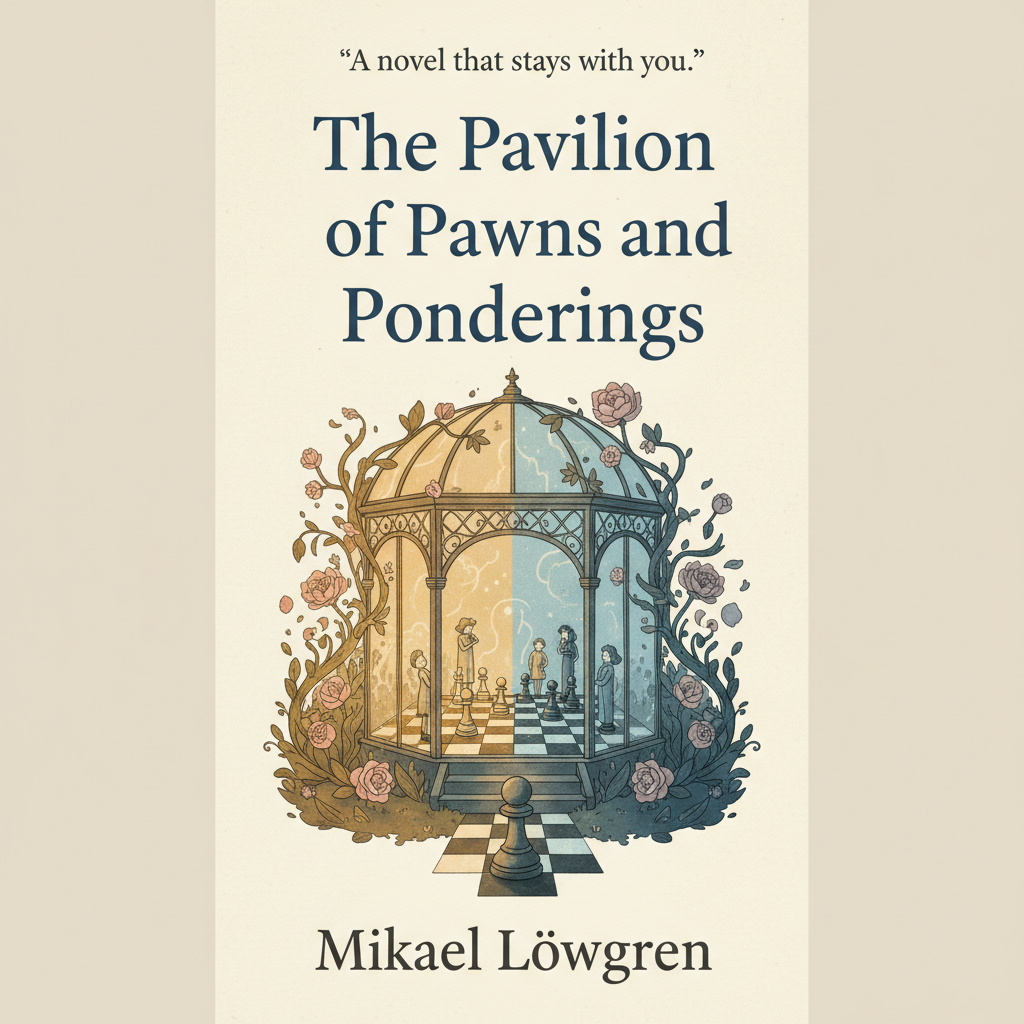
The Pavilion of Pawns and Ponderings
By Mikael Löwgren
Synopsis
In a cozy seaside town, a quiet librarian and a free-spirited artist find their intertwined lives mirrored in a single, pivotal online chess game. As White (Mikael) and Black (Angela) navigate the strategic dance of pawns and bishops, they are forced to confront their own unspoken desires, long-held
Chapter 1: The Gentle Opening of White
The glow of the monitor cast a pale, rectangular island on Mikael’s face, illuminating the faint lines around his eyes that spoke of late nights and meticulously cataloged thoughts. Outside, the Oakhaven evening was settling in, a soft, damp blanket woven from the Pacific mist and the scent of salt. A lone seagull, quite possibly the same one that often perched on the library’s weathered roof, let out a mournful cry that seemed to underline the quietude of his small apartment. This was his hour. The hour of ritual, of quiet contemplation, of the gentle opening.
His fingers hovered over the mouse, a familiar anticipation, soft as worn velvet, unfurling within him. The online chess board, stark in its digital black and white, lay before him, waiting. The anonymity of the internet, usually a vast, indifferent ocean, transformed, in this particular corner, into a private, intellectual arena. His opponent, known only as "Inkbrush," was already present. The little green light indicating their readiness blinked steadily. A good sign. Some players, he’d noticed, were prone to dawdling, to a kind of digital restlessness that made the opening moves feel less like a dance and more like a series of hesitant nudges. Inkbrush, however, always seemed to arrive, settle, and wait with an almost Zen-like composure. It was something Mikael appreciated, a quiet synchronicity that added a subtle layer of pleasure to the game.
His gaze swept across the pristine digital squares, a miniature world of possibilities and imminent conflict. He was White. The advantage of the first move, a subtle gift, a tiny head start in the intricate machinery of strategy. Most players, he knew, favored e4 or d4. Aggressive, direct openings, like a blacksmith striking the iron with a practiced, powerful blow. But Mikael had always been drawn to the less heralded path, the indirect, the understated. He preferred the feather-light touch, the slow accumulation of influence, like the gradual rise of a tide.
His mind, a finely tuned instrument honed by years of cross-referencing and the whisper of turning pages, began to unfurl its tendrils. He thought of the antique maps he cherished, their delicate lines and faded hues telling stories of exploration not of conquest, but of discovery. A new world, seen from a slightly different angle. A fresh perspective on familiar boundaries. His first move, he mused, carried a similar spirit. It was an announcement, a statement of intent, whispered rather than shouted.
His finger descended. A whisper. A click.
1. b3.
The pawn on b2 nudged forward, a modest advance, opening a diagonal for his queen’s bishop. The King’s Indian Attack, some called it. Others, more poetically, the Nimzo-Larsen Attack. He preferred to think of it simply as his own quiet way of saying hello. It wasn't about dominating the center immediately, but about controlling it from a distance, like a lighthouse keeper observing the churning currents from his solitary perch. It was the chess equivalent of settling into a comfortable armchair with a good book, rather than bursting into a crowded room.
A faint hum emanated from his mini-fridge, a subtle counterpoint to the distant wash of the waves. He’d made himself a cup of green tea, steeped just so, a delicate brew that promised clarity without the jittery edge of coffee. The warmth seeped into his hands, a small anchor in the wide, digital sea. This ritual, like the chess itself, was a comforting braid woven into the fabric of his evenings.
His existence in Oakhaven was, in many ways, a carefully curated collection of such rituals. The morning walk to the library, the comforting weight of knowledge within its walls, the afternoon tea break with Mrs. Gable, the ancient but surprisingly spry head librarian who still insisted on organizing the periodicals by hand. Even the mild, predictable annoyance of the occasional overdue book, or the faint, lingering scent of petunias from Mrs. Gable’s floral arrangements, had become part of a comfortable background hum. He was a creature of habit, and he didn’t mind it one bit. In fact, he rather relished the gentle predictability of it all. It was a bulwark against the vast, chaotic currents that he knew ebbed and flowed just beyond the town’s quaint, protected harbor.
He considered the nature of his subtle anxiety, which often accompanied these quiet moments. It wasn't a gripping, throat-tightening fear, but more of a persistent, low-frequency hum, like a distant ship’s foghorn on a particularly dense night. It was the anxiety of the unexpressed, the road not taken, the quiet longing for something just beyond his carefully constructed boundaries. His life was neat, orderly, and largely self-contained. Perhaps, he sometimes pondered, a little *too* contained.
The opponent had made their move: 1... e5.
A straightforward, assertive response. They were claiming the center, staking their territory. It was, Mikael noted with a faint, internal smile, a very Inkbrush move. No hesitation, no indirect feints. A direct challenge. He liked that. It offered a clear line of communication, even within the silent framework of the game.
His gaze drifted from the screen, momentarily unfocused, to the small, framed print hanging on the wall opposite his desk. It was an abstract piece, a swirl of cerulean and crimson, with flecks of gold that seemed to catch the lamplight. He’d bought it from the small gallery down by the harbor, a place known for its rather eclectic collection. It was one of Angela’s. Angela Moreno. The local artist.
Angela. The name itself seemed to carry a faint, vibrant hum, like a tuning fork vibrating in a quiet room. She was, in many ways, the antithesis of his own carefully measured existence. Her world, as far as he could tell from his librarian’s perch, was a riot of color and spontaneous creation. She painted with a fervent energy, her canvases often splattered with bold, unapologetic strokes. When she came into the library, which she did with surprising regularity, she moved with a kind of restless grace, her dark, curly hair often escaping its haphazard bun, a smudge of paint usually adorning her cheek or the sleeve of her oversized sweater.
She didn't conform to the quiet hum of Oakhaven. She was a different kind of music altogether, a jazz improvisation in a town that preferred classical minuets. He’d sometimes see her walking along the beach, even in the coldest weather, sketching furiously in a worn leather-bound book, her scarf billowing like a brightly colored flag in the wind. She even had a particular way of asking for books, a slight tilt of her head, a flash of intelligent humor in her eyes, that always left him feeling a little… off-kilter, in the most pleasant way possible.
He remembered a particular afternoon, perhaps six months ago, when she’d been searching for a book on early twentieth-century German expressionism. He’d helped her navigate the narrow aisles, the faint scent of turpentine clinging to her, a curious counterpoint to the dusty aroma of old paper. As he retrieved the heavy volume, their fingers had brushed for a fleeting moment. A spark, not of electricity, but of something warmer, something akin to the feeling of sun-warmed stone. He hadn’t thought much of it at the time, dismissing it as a natural consequence of proximity, a brief physical interface in an otherwise intellectual transaction. But the memory, like a favored bookmark, had a way of reappearing in the quieter corners of his mind.
He picked up his green tea again, the warmth a comforting weight. Inkbrush, he mused, was very much like the initial assertion of a strong color on a blank canvas. Whereas he, Mikael, preferred the subtle blending, the careful layering. Black's e5 move was a clear statement. Now it was his turn to respond, to continue the conversation.
He moved his knight: 2. Nf3.
A classic developing move, challenging Black’s central pawn, preparing for castling. It was a familiar pattern, a safe harbor. Yet, even in this conventional opening, he felt the underlying currents of the game, the intricate dance of attack and defense, of influence and control. It was a dialogue, carried out in silence, with pieces of wood and faith.
His mind drifted again to Angela. He’d overheard snippets of conversation about her at the local bakery, tales of her passionate arguments with the town council over the preservation of a particularly gnarled, ancient oak tree (she’d won, much to everyone’s surprise, and the oak now stood, slightly more gnarled, a testament to her tenacity). He’d seen her work, not just in the gallery, but in the small cafe down the street, where a mural depicting Oakhaven as a fantastical, swirling vortex of fish and stars had transformed a formerly drab wall into a vibrant portal. She infused the town with a vitality that was both unsettling and undeniably alluring.
He wondered if she played chess. It was a curious thought, one that hadn't occurred to him before. If she did, he imagined her style would be audacious, perhaps a little reckless, but always with a surprising flash of genius. Not like his own measured, almost academic approach. He pictured her pawns charging forward, her knights leaping with audacious abandon, a whirlwind of calculated chaos.
He blinked, pulling himself back to the illuminated board. Inkbrush had responded: 2... Nc6.
Developing their knight, defending the e5 pawn. A solid, logical choice. The game was taking shape, the initial skirmishes giving way to a more structured engagement. His b3 opening, while subtle, had already begun to influence the board. The dark squares on the queenside felt a little more open, a little more responsive to his touch.
He took another sip of tea. The taste lingered, a ghost of jasmine and earth. The quiet anxiety, that low hum, hadn’t entirely dissipated. It had simply shifted, focusing now on the unknown territories of the game, the possibilities that stretched out like an uncharted sea. Every move was a plunge into that unknown, a commitment, a revelation. The beauty and the apprehension of it all, intertwined like the threads of a carefully woven tapestry.
His next move was a decision, not just of strategy, but of personality. Would he continue the subtle, fianchetto development, or would he pivot to a more direct challenge? The clock on the screen ticked softly, a digital heartbeat. He considered the lines, traced the imaginary paths of the pieces, like following the contours of a coastline on one of his antique maps.
He could feel the presence of his opponent, not as a physical entity, but as a mind reaching across the digital ether. A mind that responded, adapted, and pushed back. It was a strange intimacy, built on logic and a shared understanding of the rules, yet devoid of faces, voices, or even names. Simply "Inkbrush" and "Mikael."
He thought of the logline he’d once stumbled upon in an old, forgotten notebook he used to jot down philosophical musings: "We are all merely pieces on a cosmic chessboard, seeking connection in the grand, silent game." He'd dismissed it as overly dramatic at the time, a flourish of youthful sentimentality. Yet, now, in the quiet glow of his monitor, facing an unknown opponent in a game of pawns and ponderings, the words resonated with a surprising, gentle truth.
He moved his bishop: 3. Bb2.
Fianchettoing the light-squared bishop, reinforcing his control over the long diagonal, aiming it squarely at Black's kingside. It was a long-range weapon, a patient observer, ready to strike when the opportunity arose. It was, he knew, a distinctly Mikael move. A slow burn, a steady accumulation, a quiet power that lay just beneath the surface.
The game had truly begun. The gentle opening of White. And in the silent, strategic dance, the subtle currents of his life, his anxieties, his quiet affections, all flowed into the elegant geometry of the chessboard, waiting for their unexpected revelation. The night was young, and the digital squares held untold stories, waiting to be unearthed.
Chapter 2: Angela's Irregular Counterpoint
The brush, laden with a vibrant cerulean, paused mid-air. Angela’s head, a wild tangle of auburn curls usually held back by a hastily knotted scarf, was tilted, her gaze piercing the canvas with an intensity that bordered on bewilderment. The painting before her wasn’t merely a collection of pigments; it was a conversation she was having with the infinite expanse of the ocean she could hear whispering just beyond her studio window. It wasn't finished, not really. It was, rather, a fleeting thought captured, a momentary understanding of light refracting through water, and now, it was demanding a companion, a counterpoint, a dissonance that would somehow resolve into harmony.
Her phone, nestled among tubes of cadmium yellow and titanium white, buzzed. A muted hum, easily ignored, lost in the symphony of her own inner monologue. But it persisted, a gentle insistence, like a persistent wave licking at the shore. She sighed, a soft expulsion of air that carried the faint scent of turpentine and forgotten tea. She knew what it was, or at least, she surmised it was one of the many digital solicitations that punctuated her otherwise analog existence. Yet, something about its rhythmic insistence, unlike the usual demanding ping of a social media notification or the sharp jolt of an email, piqued her interest. It was…polite.
With the careful deliberation of an archaeologist unearthing a fragile artifact, she set down her brush. Her fingers, stained with a rainbow of hues, gingerly picked up the device. The screen glowed with an invitation: an online chess game. Her initial thought was a soft, dismissive chuckle. Chess? Her? She, who often forgot her grocery list and once attempted to bake bread using an old cookbook written entirely in Russian (the results had been…memorable, if not edible). Strategy and meticulous planning were not typically her strong suits. Her life, much like her art, was an improvisation, a series of intuitive leaps and happy accidents.
But then she saw the name: “Mikael.”
A ripple of recognition, warm and pleasant, spread through her. Mikael. The librarian. The one with eyes the color of worn leather-bound books and a quiet smile that held the secrets of countless forgotten stories. She’d encountered him often enough in the hushed aisles of the Oakhaven Public Library, a sanctuary where she would occasionally seek out obscure oceanic botany texts or long-lost poetry collections to ignite some latent artistic spark. He was a creature of meticulous organization, she surmised, observing the way he meticulously re-shelved books, his movements precise, his spectacles perched just so. A stark contrast to her own chaotic orbits, which often left a trail of misplaced belonging and unanswered queries in their wake.
She remembered a particularly frustrating afternoon spent trying to decipher a faded map of ancient maritime trade routes for a commissioned piece, a large mural for the local seafood restaurant. Mikael had approached, a silent, knowing presence, and without a word, had simply pointed to a small, almost invisible inscription in the corner of the map. It was a cypher, he’d explained, a forgotten code used by eighteenth-century cartographers. His voice was a gentle melody, almost a whisper, yet infused with an authority that left her spellbound. She’d spent the rest of the afternoon staring at him, not the map, fascinated by the precise economy of his gestures, the thoughtful tilt of his head as he considered a historical footnote he was explaining to a young history enthusiast.
Now, here he was, inviting her to a game of chess. The sheer incongruity of it struck her as profoundly delightful. It was like finding a perfectly symmetrical seashell on a beach she’d always considered wild and untamed.
Her fingers, still smelling of oil paint and linen, hovered over the “Accept” button. A whimsical impulse, a sudden desire to see what form this particular interaction would take, to witness how her own brand of beautiful chaos would clash or coalesce with his quiet orderliness, propelled her forward. She tapped the screen.
The chess board appeared, stark in its black and white geometry. The pieces, elegant and familiar, were arranged in their starting positions. White had already moved. 1. b3.
Angela tilted her head, a familiar gesture when confronted with something new and utterly baffling. B3? It struck her as…unassuming. Not the aggressive push of e4 or d4, nor the solid, defensive block of c4. It was a preparatory move, almost tentative, a subtle opening of a diagonal for the bishop, a whisper rather than a shout. It felt, in a strange way, utterly Mikael. A deferential opening, a patient probing.
Her mind, still awash in the blues and greens of her unfinished painting, didn’t bother with grand strategy or theoretical principles. Her chess knowledge, if one could even call it that, was entirely intuitive, a series of vague recollections from childhood games played against her grandfather, who, bless his eccentric soul, had always encouraged her to “play like a poet, not a mathematician.” So, she did.
Her finger, guided by a sudden, unbidden impulse, moved to the c-pawn. And then, she pushed it two squares forward.
1... c5.
The Sicilian Defense, though she didn’t know it by name. To her, it was simply an attempt to assert a presence in the center, to establish a foothold, but not in the most obvious way. It felt like a subtle challenge, an invitation to a dance that might not follow traditional steps. It was, in essence, an Angela move. Irregular, a little off-kilter, but possessing a certain stubborn directness.
She watched the virtual board, almost expecting a reaction from the invisible Mikael on the other side. A pause. A gentle thrumming of the digital ether. She imagined him, perhaps in his own quiet study, a cup of herbal tea steaming beside him, his brow furrowed in thoughtful consideration. Would her unconventional move surprise him? Would it amuse him? Or would it simply register as another data point in his meticulous analysis of the world?
A faint smile ghosted across her lips. The game, she realized, had already begun, long before the pawns moved.
Returning her attention to her painting, the cerulean still waiting patiently on the brush, Angela found a renewed vigor. The chess move, unexpected and uncalculated, had somehow unlocked a new possibility in the canvas. The ocean, which had previously felt contained, now seemed to possess a hidden current, a turbulent undertow that added depth and complexity. She began to layer a darker blue, a Prussian blue, hinting at the depths, the unseen forces that shaped the surface.
Her thoughts, however, kept drifting back to Mikael. His precision. Her spontaneity. What a fascinating juxtaposition. She imagined him meticulously tracking her artistic phases, perhaps even possessing a mental catalogue of her more flamboyant creations. She remembered once, weeks ago, presenting a rather avant-garde piece at the local gallery, a sculpture crafted from driftwood and woven fishing nets, adorned with iridescent shards of sea glass. It had been met with a mixture of polite confusion and genuine admiration from the Oakhaven art community. Mikael had simply stood before it for a long time, his hands clasped behind his back, a silent observer. She had caught his eye briefly, and he had offered that small, knowing smile, a smile that suggested he saw something beyond the material, something of the impulse that had brought it into being.
This thought, oddly enough, delighted her. It suggested an understanding that transcended words, a recognition of the underlying currents that guided her creative life. She often wondered about his own creative outlets, if any. Did he write? Did he collect rare editions? Did he, perhaps, sketch detailed botanical drawings in a leather-bound journal she’d never seen? The rigid structures of a library, she mused, might be a necessity for some minds, a way to contain the boundless expanse of knowledge. For her, it was a place of wild discovery, a labyrinth where she could happily lose herself for hours.
The chess board, a small window to this unfolding enigma, remained open on her phone. She didn’t feel compelled to check it, to fret over Mikael’s next move. It was enough, for now, to have set something in motion, a pebble dropped into a calm pond, awaiting the ripples. The beauty of it, she felt, lay in the unknowing, in the gentle unfolding of possibility.
The afternoon light began to soften, casting long shadows across her studio floor. The scent of linseed oil mingled with the salty tang of the sea air that drifted through the open window. Outside, the calls of gulls echoed, a familiar, comforting sound. Angela continued to paint, her strokes more deliberate now, more confident. The cerulean and Prussian blues swirled and blended, giving way to flashes of emerald green, hinting at the sun-dappled surface of the waves.
The chess game, a silent conversation across the digital ether, was an invisible thread woven into the fabric of her day. It was a gentle counterpoint, an unusual rhythm, an unexpected harmony. It wasn’t about winning or losing, not really. It was about the exchange, the subtle dance of two distinct energies colliding and merging, however briefly, within the confines of a black and white grid.
She wondered what Mikael would make of her haphazard approach, her tendency to follow instinct rather than established theory. Would he see it as a lack of discipline, or merely a different kind of logic? She hoped for the latter. She hoped he would understand that sometimes, the most expressive moves were not the most logical ones. Sometimes, the most beautiful art emerged from embracing the irregular, the unpredictable, the charmingly off-kilter.
And as the last golden rays of the sun painted the western sky in hues of apricot and rose, Angela picked up a smaller brush, dipped it in a pure, almost translucent white, and added a delicate spume of sea foam to the crest of a painted wave. It was a perfect, spontaneous detail, a flash of fleeting beauty. Just like, she mused, the unexpected joy of playing an online chess game with a quiet librarian. The board remained, awaiting its next move, a silent testament to the gentle unfolding of an irregular, yet utterly captivating, counterpoint.