The Orchard of Epiphanies
By Mikael Löwgren
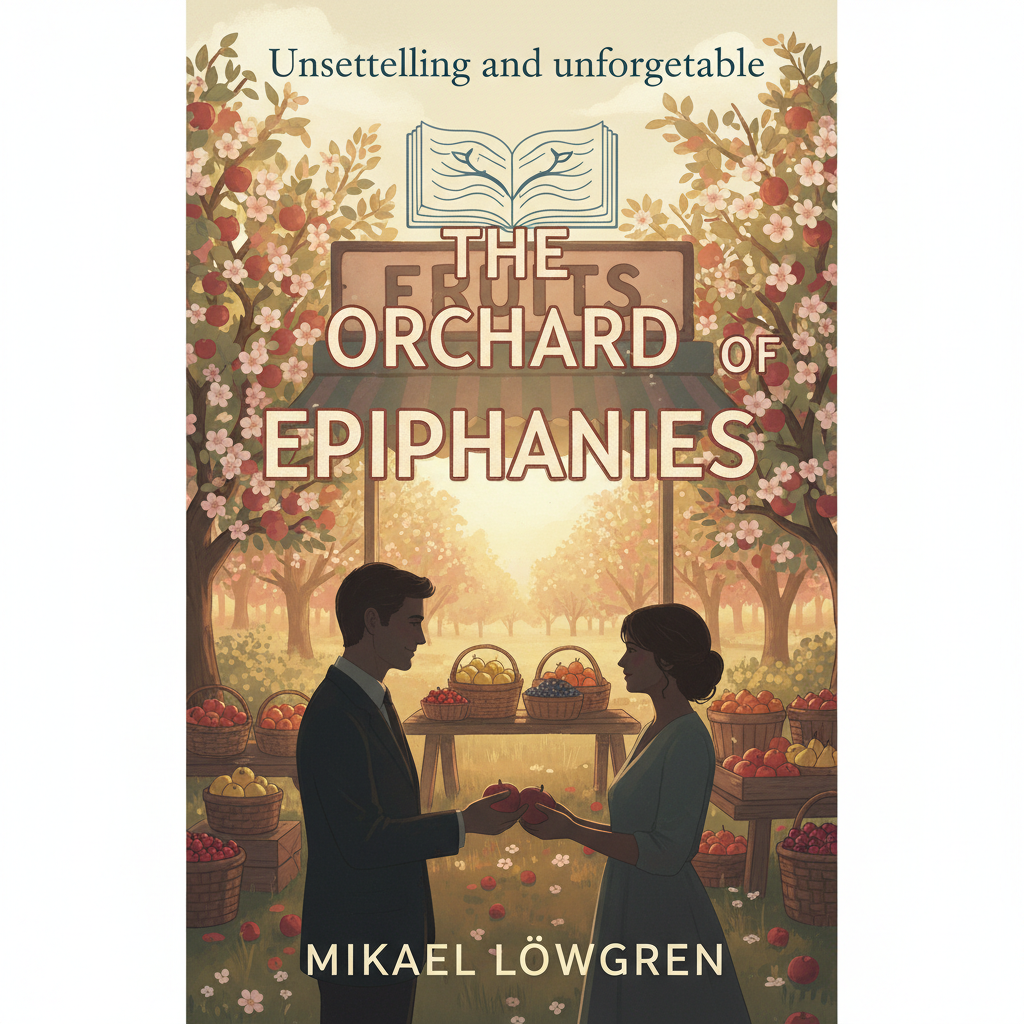
Synopsis
In a cozy, mid-sized town, a solitary fruit farmer, guided by the wisdom of Moby Dick, transforms his simple shop into a haven of psychological counsel, unwittingly rediscovering himself and finding love amidst the profound symbolism of his fruits.
Chapter 1: A New Venture and an Old Book
The scent of bruised apples and damp earth had long been the solitary perfume of Elara’s days. His orchard, nestled in the gentle roll of hills just beyond the town’s cobbled main street, produced fruit of unparalleled sweetness, yet it offered little in the way of human companionship. The crisp morning air, once a balm, had begun to feel like a constant, chilling reminder of his isolation. He was, by all accounts, a successful man of the land, his produce gracing the tables of every reputable kitchen in the valley. Yet, as the seasons turned, a persistent yearning, quiet but undeniable, unfurled within him.
It was amidst the labyrinthine contemplation inspired by his dog-eared copy of Moby Dick that the seed of a new venture took root. Ahab’s relentless pursuit, the boundless ocean, the philosophical musings on free will and fate – these grand narratives had long been Elara’s most cherished companions, offering a vastness that belied the humble confines of his solitary life. He found himself, on many an evening, tracing the intricate etchings on the old book’s cover, pondering the nature of man’s quest, be it for a white whale or, as he now mused, for a connection beyond the silent language of growing fruit.
The thought, at first, was a mere wisp, a fleeting fancy born of too many twilight hours spent with only Melville for company. But as the autumn leaves began their slow, deliberate descent, painting the orchard in hues of amber and rust, the notion solidified: he would open a shop. Not merely a stall at the weekly market, but a true establishment, a place where his carefully cultivated treasures could be presented with the dignity and contemplation they deserved. He would call it, simply, ‘Fruits.’
The choice of location was as deliberate as the pruning of his oldest apple trees. He found a small, neglected storefront on Blossom Lane, just off the bustling High Street, its once-charming façade now shrouded in decades of dust and disuse. It possessed a quiet dignity, however, a sense of history that appealed to his own contemplative nature. The windows, tall and arched, promised to flood the interior with a soft, inviting light, and the small, overgrown garden at the rear whispered of potential for a hidden, tranquil space.
The transformation was slow, undertaken with the same methodical care he applied to his orchard. Elara, a man more accustomed to the heft of a pruning shears than a paintbrush, found himself surprised by the sheer satisfaction of the work. He chose a calming shade of sage green for the walls, a colour that echoed the gentle verdancy of young leaves. He reclaimed old, sturdy wooden crates from his barn, sanding them smooth and waxing them to a soft sheen, envisioning them laden with mounds of ruby-red apples and blushing pears. A carpenter, a quiet man named Thomas, crafted a counter of polished oak, its surface smooth and inviting to the touch.
“It needs to be more than just a shop, Thomas,” Elara had explained, gesturing vaguely with a dusty hand. “It needs… a soul. A place where fruit is not merely sold, but… considered.”
Thomas, a man of few words but acute understanding, had simply nodded, his eyes reflecting a knowing glimmer. He understood the unspoken, the desire for meaning beyond the mundane.
Indeed, Elara envisioned ‘Fruits’ as a sanctuary of sorts, a quiet haven where the hurried pace of modern life might yield, if only for a few precious moments, to contemplation. He spent hours arranging the fruits, not merely by type, but by colour, by scent, by the subtle symbolism he had, over years, discerned within them. The crisp, academic crunch of an apple, the soft, yielding sweetness of a fig, the sunny exuberance of an orange – each held a narrative, a whisper of a story waiting to be told.
His Moby Dick, always within reach, lay open on his small working table in the shop’s back room, its worn pages offering silent counsel. Ahab’s relentless pursuit of the white whale, he reflected, was but one form of man’s striving. Perhaps his own, more gentle quest, was to uncover the hidden depths within the seemingly simple act of offering a piece of fruit.
The day of the grand opening arrived with the crispness of a ripe pear. Elara, dressed in a freshly laundered shirt and a sensible waistcoat, felt a tremor of anticipation, a sensation both exhilarating and entirely new. He polished the large brass bell above the door one last time, its chime resonating with a clear, hopeful note.
The air inside ‘Fruits’ was rich with the mingled perfumes of harvest: the sharp tang of citrus, the earthy sweetness of late-season plums, the intoxicating floral notes of ripening peaches. Baskets overflowed with produce, each fruit gleaming under the warm glow of the gas lamps, a tiny testament to the earth’s endless bounty. Elara had even sourced several varieties of heirloom apples, their names rolling off his tongue like poetry: 'Ashmead’s Kernel,' 'Reinette du Canada,' 'Ribston Pippin.'
His first customer was Mrs. Gable, a woman of formidable reputation in the town for her discerning palate and even more discerning gossip. She entered with a purposeful stride, her spectacles perched on the end of her nose, her eyes scanning the artful display with a critical gaze.
“Well, Elara,” she began, her voice a low, rumbling hum, “so you’ve finally ventured out of your solitary grove. A shop, you say?” Her tone implied a certain skepticism, as if questioning the very sanity of a man who would willingly trade the quiet solitude of his orchard for the unpredictable tides of public commerce.
Elara offered a polite, if somewhat stiff, bow. “Indeed, Mrs. Gable. A humble endeavour, to be sure, but one I believe will bring a certain… freshness to Blossom Lane.”
Mrs. Gable moved slowly along the counter, her gloved finger hovering just above a mound of glistening damsons. “Freshness, you say? Your fruit has always been fresh, Elara. That was never the issue. It was your… hermetic tendencies that gave us all pause.”
Elara felt a faint flush creep up his neck. His ‘hermetic tendencies’ had indeed been a topic of much hushed conversation over the years. But he knew, with a certainty that settled deep in his bones, that this new venture was his attempt at a different chapter, a foray into the very heart of human connection.
“Perhaps,” he offered, carefully, “a change of scenery also brings a change of perspective. I believe there is an art to presenting fruit, Mrs. Gable, just as there is an art to cultivating it. And an art, too, in the conversation that surrounds it.”
Mrs. Gable paused, her gaze resting on a perfectly formed Braeburn. “Conversation, Elara? You, the man who once spent a solid hour debating the existential dread of a blighted pear tree with young Bartholomew from the bakery?”
A small, wry smile played on Elara’s lips. “A pear tree, Mrs. Gable, can offer profound insights into the human condition, if one but listens.”
Mrs. Gable let out a short, incredulous huff, but then, to Elara’s surprise, a faint smile began to form at the corners of her mouth. She picked up the Braeburn, turning it over in her hand, admiring its rich colour. “Well,” she conceded, “it certainly is a handsome apple. Perhaps your philosophical musings have, for once, led to something edible.”
She bought a small bag of the Braeburns, along with a punnet of his most fragrant strawberries, leaving a small, satisfying rustle of coins on the counter. As the bell above the door chimed her departure, Elara permitted himself a quiet sigh of relief. The first interaction. A small victory, perhaps, but a victory nonetheless.
The hours that followed brought a steady trickle of curious patrons. Young mothers with their children, their faces bright with wonder at the colourful displays. Elderly gentlemen, their eyes twinkling with a shared appreciation for a perfectly ripened Bartlett pear. And a few, like Stefan, from his former life, a colleague from agricultural circles.
Stefan bustled in, his brow furrowed, his usual state of mild agitation amplified by the crisp morning air. He was a man of routines, and any deviation, however slight, was met with a degree of internal turmoil. He surveyed the shop with a look of bewildered perplexity, as if he had stumbled into an alternate universe where fruit was treated with reverence rather than simply weighed and sold.
“Elara?” Stefan exclaimed, his voice a little louder than strictly necessary within the quiet confines of the shop. He was in his late thirties, and the worry lines across his forehead were deepening, mirroring the subtle retreat of his hairline, a fact he was increasingly sensitive about. He frequently spoke of shaving it all off, then immediately dismissed the idea as too radical. “What in the blazes are you doing? This… this isn’t your barn.”
Elara offered a polite, if slightly weary, smile. Stefan was a good man, but his nervous energy was often taxing. “No, Stefan, it is not. This is ‘Fruits.’ My new venture.”
Stefan blinked, his eyes darting from a pyramid of Valencia oranges to a basket of dark, luscious cherries. “A shop? But… but the orchard? Who’s overseeing the spray schedule? The pruning? And what about the excavators, Elara? You know how easily they can go… astray.”
Elara knew Stefan’s particular anxieties well. The welfare of his excavators, particularly the large yellow model he affectionately called ‘Big Bertha,’ was a constant source of stress for him. The thought of one being misplaced, or worse, damaged, invariably sent him into a spiral of near-panic.
“The orchard is well in hand, Stefan. My cousin, Arthur, is managing day-to-day operations. And the excavators, I assure you, are precisely where they should be, under lock and key.”
Stefan still looked unconvinced, running a hand nervously through his already thinning hair. “But… selling fruit? Like this? It’s… it’s so… *quiet*.” He seemed to find the lack of mechanical hums and tractor rumbles unsettling.
Just then, the small bell above the door jingled, and a woman entered, her gaze immediately drawn to a display of vibrant crimson apples. Stefan jumped, startled by the sudden sound. Elara knew his colleague’s aversion to unexpected noises, especially the jarring ring of a telephone, which often left him visibly flustered. The shop’s friendly chime, however, seemed to produce a similar, albeit milder, effect.
“Yes,” Elara said, a subtle amusement playing in his tone, “it is indeed rather quiet here, Stefan. A welcome change from the clangour of machinery, I find.”
Stefan continued to fidget, his eyes scanning the shelves as if expecting to discover a hidden control panel or a misplaced wrench. He purchased a single, reluctant apple, as if buying produce from a shop, rather than directly from the farm, was a betrayal of his agrarian principles. As he reached the door, his hand paused on the knob.
“Just… be careful, Elara,” he cautioned, a genuine worry etched on his face. “These… these townspeople. They’re not like us. They don’t understand the true value of… of a good excavator.” He cast one last, longing look at the street outside, as if half-expecting to see one of his beloved machines trundling past. Then, with a final, anxious glance, he departed.
Elara smiled faintly. Stefan’s concerns, though misplaced, highlighted the very chasm he sought to bridge. He was no longer just the solitary farmer, tethered to the earth and the rhythmic hum of agricultural machinery. He was a shopkeeper, a purveyor of connections, a quiet philosopher awaiting the next customer, the next conversation, the next epiphany inspired by the simple, profound beauty of a piece of fruit.
As the afternoon sun cast long shadows across the polished wooden floor, Elara took a moment to observe his new domain. The shelves, once bare, now pulsed with life and colour. The air, once still, now carried the faint, sweet echoes of murmured conversations and the gentle chime of the door. He picked up his copy of Moby Dick, its familiar weight a comfort in his hand. He had embarked on his own journey, not across vast oceans, but into the vibrant, unpredictable heart of his own community. And in this new venture, he felt, for the very first time, a profound sense of self, a quiet unfolding of his own singular story. The orchard was still there, a constant presence, but here, in ‘Fruits,’ a new harvest had begun, one rich in human connection and the unexpected sweetness of shared moments. He was no longer just Elara, the solitary farmer. He was Elara, the nascent philosopher, the quiet purveyor of epiphanies, the man who had finally begun to escape his former, isolated self. And the journey, he knew, had only just begun.
Chapter 2: The Curious Case of Counsel by Clementine
The bell above the shop door, a humble instrument of brass, had scarcely ceased its cheerful, if somewhat tinny, announcement of a new customer before the air within ‘Fruits’ began to thicken with an unfamiliar anticipation. Clementine, a woman of certain age and considerable local renown for her ability to ferret out a good bargain, stood before the neat pyramids of apples and pears, her brow furrowed not by the challenge of selection, but by a deeper, more personal disquiet. She had heard tales, whispered over tea and buttered toast, of the farmer’s peculiar brand of counsel, a blend of horticultural wisdom and nautical analogy that had, to some minds, verged on the absurd. Yet, here she was, her basket empty, her heart full of a rather stubborn anxiety concerning her youngest son, Thomas, and his inexplicable aversion to the very notion of a sensible career.
The farmer, whose name remained to many a delightful mystery, moved with a quiet efficiency amongst his wares. His hands, gnarled from years of tending to the earth’s bounty, paused over a cluster of vibrant plums. He wore a simple linen apron over his unassuming clothes, and his spectacles, perched rather precariously on the bridge of his nose, gleamed under the soft glow of the shop’s single lantern. He possessed a countenance that, while stern in repose, softened considerably when engaged in discourse, particularly when that discourse involved the deeper meanings of existence, as interpreted through the prism of Melville’s classic.
“Good morning, Clementine,” he offered, his voice a low, resonant baritone, rather like the hum of a well-oiled machine. “Might I assist you today?”
Clementine wrung her hands, a habit she adopted when confronted with anything beyond the ordinary. “Indeed, Farmer,” she began, her voice a little breathy, “though not, perhaps, in the usual manner.” She glanced about the shop, its orderly shelves and polished wooden counter offering a sense of calm that belied the turbulence in her own breast. The air was redolent with the sweet, earthy perfume of ripening fruit, a fragrance that, in its subtle complexity, often prompted a more contemplative state of mind.
The farmer inclined his head, a gesture of polite attentiveness. “I am at your service, in whatever capacity I may prove useful.” He selected a plump, golden apple from a nearby basket, its skin unblemished and gleaming. “It is often the case that our truest needs are disguised as something else entirely.”
Clementine took a deep breath, the scent of apples and pears acting as a mild restorative. “It is about Thomas,” she confided, her voice dropping to a conspiratorial whisper. “He insists upon pursuing this… *artistry*. Painting, of all things! When there are perfectly respectable trades to be learned, and a steady income to be had.” She sighed, a profound expiration of maternal exasperation. “He speaks of ‘passion’ and ‘expression,’ and I confess, Farmer, I am entirely at a loss.”
The farmer regarded the golden apple in his hand, rotating it slowly, as if divining its innermost secrets. “Ah, Thomas and his artistry,” he mused, a faint smile playing upon his lips. “A noble pursuit, to be sure. Yet, I understand your consternation. The world, in its pragmatism, often frowns upon such flights of fancy.” He then placed the apple gently back amongst its fellows, and from a nearby crate, selected a particularly robust-looking pomegranate. Its leathery skin, a deep, burnished red, seemed to pulse with an almost vital energy.
He presented it to Clementine. “Tell me, Clementine, what do you observe in this fruit?”
Clementine peered at the pomegranate, her initial perplexity giving way to a flicker of curiosity. “It is… large,” she ventured, rather lamely. “And a striking colour.”
“Indeed,” the farmer agreed, his eyes twinkling behind his spectacles. “But consider its interior. A labyrinth, is it not? Each seed encased in its own sweet jewel, yet all bound together, a complex tapestry of flavour and texture.” He gestured with the fruit. “A true artist, Clementine, is rather like this pomegranate. Full of hidden depths, a multitude of individual sensibilities, all striving to find their form. To force such a spirit into a mould not of its own making is to deny its very essence, to crush the jewel before it has a chance to gleam.”
Clementine blinked, a faint flush rising on her cheeks. The farmer’s words, though couched in the language of fruit, carried an unexpected weight. She had never considered Thomas’s aspirations in such a light. To her, they were merely an inconvenience, a detour from the sensible path.
The farmer continued, his gaze steady. “Consider, if you will, Ahab, that venerable captain of Pequod. His singular pursuit of the white whale, though ultimately his undoing, was born of an unshakeable conviction, a profound internal driving force that defied all reason and practicality. Would you bid such a man abandon his quest for the sake of a quiet harbour and a steady supply of cod? Perhaps, Clementine, Thomas, in his own way, is navigating his own turbulent waters, pursuing his own elusive leviathan. Your task, as his mother, is not to forbid the voyage, but to provide him with a sturdy vessel, and perhaps, a compass.”
Clementine stood for a long moment, the scent of fruit surrounding her. The analogy, initially jarring, had now settled into her mind with a surprising resonance. She had always viewed Moby Dick as a rather grim, nautical adventure, certainly not a manual for maternal guidance. Yet, the farmer’s interpretation, woven with the symbolism of the pomegranate, offered a perspective she had utterly overlooked. She imagined Thomas, brush in hand, his brow furrowed in concentration, much like a captain at the helm, charting a course known only to himself.
“A sturdy vessel,” she murmured, more to herself than to him. “And a compass.” A tentative smile touched her lips. “Perhaps a… a good set of paints, then, might be a suitable compass?”
The farmer beamed. “An excellent beginning, Clementine. For just as the whale responds to the harpoon, so too does the artist respond to the tools of his trade. And remember, sometimes, the greatest treasures are found when we allow ourselves to drift a little from the appointed course.” He then moved with a seamless grace to a basket of ripe, fragrant figs. “And as for Thomas’s future provision,” he added, placing a small, plump fig into her palm, its skin soft and yielding, “consider the fig. Sweet, nourishing, and requiring a certain tenacity to cultivate, but ultimately, deeply rewarding. A life well-lived is often a life richly cultivated, even if the crops are not precisely what we had initially envisioned.”
Clementine clutched the fig, its warmth seeping into her skin. The anxieties that had plagued her just moments before now seemed to dissipate like morning mist. The farmer’s counsel, unusual though it was, possessed a strange and comforting logic. She felt a lightness in her step as she turned to leave, her basket still empty of fruit, but her heart remarkably full.
As Clementine exited, the bell once again chimed, announcing the arrival of Mr. Henderson, the village miller, a man whose perpetual frown seemed as much a part of his countenance as his slightly flour-dusted clothes. He carried with him an air of profound vexation, his hands jammed into his pockets, his gaze fixed on some invisible point beyond the farmer’s meticulous display.
“Farmer,” Mr. Henderson grumbled, his voice a low rumble, “I have the most confounded predicament. My prize-winning pig, Penelope, has taken to refusing her feed. And not just any feed, mind you, but the very finest oats, milled by my own hands! She snuffles at it, turns up her snout, and then looks at me with an expression that suggests I’m serving her slop. I’ve tried everything, every coaxing word, every little trick. She grows thinner by the day, and the county fair is but a month hence!”
The farmer, ever even-tempered, listened patiently, his gaze fixed on a shelf laden with citrus. He understood the profound connection between a farmer and his livestock, the almost paternal concern that governed many such relationships. “A troubling state of affairs, indeed, Mr. Henderson,” he acknowledged. “A creature refusing its sustenance is a creature in distress.” He then reached for a single, magnificent grapefruit. Its skin, a vibrant yellow, was plump and taut, exuding a subtle, invigorating aroma. He held it out for Mr. Henderson’s inspection.
“Observe this grapefruit, Mr. Henderson,” the farmer began, his voice a quiet invitation. “Its exterior is formidable, is it not? A thick rind, a certain bitterness even, hinting at the complexity within. One might be tempted to dismiss it, to deem it unpalatable before even slicing it open.” He paused, allowing the miller to contemplate the fruit. “Yet, within, lies a segmented bounty, a vibrant burst of flavour, both sweet and tart, invigorating and deeply satisfying. It is not for everyone, this grapefruit. Some prefer the straightforward sweetness of an orange, or the mellow comfort of a banana. But for those who appreciate its unique character, it offers a singularly rewarding experience.”
Mr. Henderson, though still frowning, found his attention drawn to the fruit. He rarely ate grapefruit, preferring instead the more robust, earthy flavours of his daily fare.
The farmer continued, his words unfolding with a gentle rhythm. “Your Penelope, Mr. Henderson, perhaps she is seeking her own grapefruit. Not literal, of course, but a sustenance that speaks to her particular palate, her unique sensibilities. To insist that she partake of the oats, however fine, is like insisting that all should find joy in the grapefruit, when their taste buds cry out for something entirely different.” He then gestured to a small basket of berries, plump and darkly gleaming. “Perhaps she yearns for the unexpected, the small, succulent bursts of flavour that these offer. Sometimes, the grandest meal is not what nourishes us best, but rather the small, unexpected delights.”
He then returned to the literary realm, a domain he navigated with effortless grace. “Consider, Mr. Henderson, the many different creatures that inhabit the vast ocean. Each with its own preferred diet, its own particular way of sustaining itself. To demand that the great leviathan feed upon naught but the smallest plankton would be an exercise in futility, a violation of its very nature. And just as Ahab pursued his whale with an almost fanatical singular purpose, so too does a creature, even a pig, pursue its own sense of satisfaction, its own craving for what truly nourishes it.”
Mr. Henderson, usually impervious to metaphor, found himself nodding slowly. The image of Penelope, a creature of considerable bulk, somehow embodied by the vibrant, segmented grapefruit, was unexpectedly illuminating. He had been so focused on the *quality* of the oats, on what *he* deemed appropriate, that he had entirely overlooked Penelope’s *preference*. The farmer’s words, though drawn from the rather esoteric world of citrus and whaling, had struck a chord.
“So, you suggest I… offer her something different?” Mr. Henderson mumbled, his frown easing slightly. “Something… more to her discerning taste?”
“Precisely, Mr. Henderson,” the farmer affirmed, a knowing look in his eye. “A truly discerning palate knows what it desires, even if we, in our limited understanding, fail to perceive it. Perhaps a few small, tender apples. Or a handful of those delightful berries, plump and bursting with unexpected flavour. Sometimes, a change of perspective, a gentle nudge in a new direction, is all that is required for nourishment, both spiritual and physical, to be restored.”
Mr. Henderson straightened, a glimmer of hope appearing in his perpetually troubled eyes. He had scoffed at the whispers of the farmer’s strange counsel, yet here he was, presented with an enlightenment concerning his reluctant pig, delivered not by a veterinarian, but by a purveyor of fruit and nautical philosophy. He purchased a small bag of the said berries, his usual frugal nature momentarily forgotten, and left the shop with a gait that bespoke a newfound purpose.
As the days turned into weeks, the queues outside ‘Fruits’ lengthened. Villagers, initially brimming with skepticism, found themselves drawn by an irresistible curiosity, then held captive by the farmer’s uncanny ability to distill their anxieties into tangible, fruitful metaphors. The orderly sanctuary of his shop, once merely a place of commerce, had indeed transformed into a stage for these peculiar revelations.
Word spread, not just of the farmer’s unusual methods, but of their efficacy. Mrs. Abernathy, who had been convinced her marriage was beyond salvage, found renewed hope in the farmer’s exposition on the enduring resilience of the humble potato. Young Timothy, plagued by crippling shyness, learned to embrace his unique qualities through the parable of the vibrant, if sometimes prickly, pineapple. Each fruit, from the humble apple to the exotic mango, became a vessel for profound insight, a tactile metaphor for the human condition.
The farmer, for his part, found a quiet satisfaction in these daily interactions. The solitary hum of his previous existence had been replaced by the gentle murmur of human concern, the shared vulnerabilities, and the occasional, triumphant declaration of a problem resolved. He continued to tend his fruit, to dust his shelves, and to ponder the timeless wisdom of Ahab and his relentless pursuit of meaning. And as he did, he observed, with a quiet smile, the subtle transformation of his customers, one fruit-laden epiphany at a time. The orchard of his own understanding, it seemed, was beginning to yield its own unexpected harvest.
Chapter 3: A Discordant Ring and a Disturbed Proprietor
The gentle hum of conversation, a comforting, melodic murmur, usually filled the air at ‘Fruits’. Today, however, an abrasive, discordant shriek pierced the peaceful morning. It was not the call of a particularly vexed magpie, nor the abrupt squeal of a delivery lorry’s brakes; rather, it was the shrill, insistent summons of a modern contrivance, a telephone, tucked away on a small shelf near the proprietor’s polished oak counter. The farmer, mid-discourse with Mrs. Higgins regarding the surprising depths of a particularly plump plum, faltered. A wrinkle creased his usually serene brow.
The sound, an instrument of urgency and demand, was a rare interloper in the carefully curated serenity of his shop. He cast a glance towards the offending object, a relic of convenience he felt bound to possess, though he rarely wished to employ it. Mrs. Higgins, whose own domestic sphere was often punctuated by such clamour, merely offered a sympathetic sigh, her attention now fully diverted from the plum’s philosophical implications to the more immediate drama unfolding.
The proprietor, drawing a steadying breath, extended a hesitant hand toward the receiver. “Fruits,” he announced, his voice a shade less steady than usual.
A burst of agitated speech assaulted his ear, a torrent of words delivered with a speed that defied comprehension. He held the device slightly away from his head, blinking. “Pardon me, sir,” he interjected, when a momentary gasp for air presented itself, “but the connection appears to be rather… spirited this morning. Might you enunciate a touch more clearly?”
“It’s Stefan, man! Stefan! Are you there? Blast it all, can you hear me?” The voice on the other end, thin and reedy through the mechanical medium, was unmistakably that of Stefan, a colleague from an adjacent, and far noisier, pursuit. Stefan, whose domain consisted of earth moved and foundations laid, was a man of particular habits, not least among them an acute, almost pathological, aversion to the telephone. To call him, the proprietor knew, was to invite a certain degree of consternation; to *be called by him*, then, suggested a crisis of no small magnitude.
“Indeed, Stefan, I hear you now. Pray tell, what urgent matter compels you to employ this… this formidable instrument of communication?” The proprietor’s gaze drifted to the small patch of scalp on his own head, where a few strands seemed to be staging a slow, dignified retreat. He understood, on some level, the anxiety of receding things.
There was a strained, almost animalistic grunt from Stefan. “It’s the excavators, man! The excavators! They’re threatening to… to seize them! Did you hear me? Seize! My excavators!” His voice, though still tinged with the peculiar distortion of the telephone, was verging on a shriek.
The word ‘excavators’ hung in the air, a foreign body amidst the ripe scent of apples and the gentle aroma of wood polish. Mrs. Higgins, whose knowledge of such machinery was, to put it mildly, rudimentary, merely tilted her head in polite confusion. The proprietor, however, understood. Stefan’s affection for his excavators was not unlike Ahab’s singular obsession with his leviathan; they were the tools of his trade, the extensions of his will, the very vessels of his livelihood. To lose them… for Stefan, it would be a spiritual amputation.
“Seize them?” the proprietor repeated, his own voice now laced with a genuine concern. “But on what grounds? Have the invoices not been settled? Are there… discrepancies in the contracts?”
“Discrepancies!” Stefan’s voice climbed another octave. “The discrepancies are in their heads, I tell you! A clerical error! A misunderstanding of seismic proportions! But they insist! And if I lose them… if I lose them, a piece of me goes with them, man! You understand, don’t you? You, with your… your profound insights into the nature of things…”
The proprietor pinched the bridge of his nose. Stefan, in his agitated state, often reverted to a rather theatrical self-pity, usually delivered in person and accompanied by much hand-wringing. Over the telephone, it was simply shrill. “I apprehend your distress, Stefan, most keenly,” he assured him, trying to inject a calming balm into his tone. “But what precisely do you require of me in this… this mechanical maelstrom?”
“I need counsel!” Stefan bellowed, then seemed to remember he was speaking into a device that amplified his every utterance. He lowered his voice, though not by much. “I need your… your fruit wisdom! I need to come over. Now! Before it’s too late! Before they drive away with my… my beautiful, mighty excavators!” The proprietor could almost discern the faint, imagined wail of engines being led to slaughter.
He glanced at Mrs. Higgins, who, sensing an intermission in the plum’s journey to enlightenment, offered a small, encouraging nod. His queue, though not excessively long at this hour, consisted of two other eager patrons, awaiting their turn at profundity through produce. But Stefan’s panic was a palpable thing, a desperate plea clawing its way through the wires. The thought of Stefan, perpetually balding, now truly unhinged and without his mechanical companions, filled him with a certain sympathy.
“Very well, Stefan,” he conceded, the words feeling rather heavier spoken into the telephone than they would have in person. “Make haste. We shall endeavour to untangle this Gordian knot of machinery and misunderstanding.”
He replaced the receiver with a sigh that spoke volumes. The quiet returned, though it felt somehow more fragile, as if the telephone’s raucous intrusion had left a tremor in the air.
“A gentleman in considerable distress, I gather?” Mrs. Higgins enquired, her tone kind.
“Indeed, Mrs. Higgins. Mr. Stefan,” the proprietor explained, offering a wry half-smile, “is a man of earth, engaged in the weighty pursuit of construction. His current predicament involves the threatened loss of his… excavators.” He paused, searching for a suitable analogy. “For Mr. Stefan, his excavators are rather like a favoured limb. Or, perhaps, a faithful hound of Herculean strength.”
Mrs. Higgins considered this. “Ah, I see. A most unfortunate business. One does become rather attached to one’s tools, does one not? My rolling pin, for instance, has been with me for forty years. I should be quite bereft were it to vanish.”
“Precisely so,” the proprietor agreed, grateful for her understanding. He turned his attention back to his remaining patrons. “My apologies for the interruption, ladies and gentlemen. Where were we, Mrs. Higgins, with our discourse on the plum?”
For a few more minutes, a semblance of normalcy returned to ‘Fruits’. The proprietor spoke of resilience and the inner core, comparing the plum’s firm flesh to resolve in the face of external pressures. He even managed to guide Mrs. Higgins towards a delightful epiphany about her own steadfastness in times of familial discord, all through the humble medium of a purplish stone fruit.
But the peace was not to last. A mere fifteen minutes after Stefan’s agitated call, a whirlwind of anxious energy burst through the shop’s front door. Stefan himself, dishevelled and breathing heavily, stood framed in the doorway, his usually neat clothes rumpled, his hair (what little remained to him) standing on end. He clutched a crumpled sheaf of papers in one hand, and his face was a mosaic of worry.
“They’re coming, I tell you!” he gasped, oblivious to the other patrons. “The lorries! The men in suits! They’ll be here any minute to… to spirit them away!” His eyes darted around the shop, as if expecting to see the foreboding lorries already reversing up to the fruit stands. The proprietor, ever the calming influence, stepped forward. “Stefan, pray compose yourself. Take a deep breath. We are not yet in the clutches of these… these vehicular vultures.” He ushered Stefan towards a quiet corner, near a display of sturdy, unyielding pomegranates. “Now, impart to me the full measure of this calamity. What did they say, precisely? And what documentary evidence do you possess?” Stefan, with trembling hands, thrust the crumpled papers at the proprietor. “It’s all here! They sent a letter! Said I defaulted on a payment plan for the new excavator – the one with the articulated arm, you know? My favourite! Said if I didn’t pay by… by noon today, they’d repossess it. And the others! The entire fleet!” He wrung his hands, his gaze fixed on the papers. “It’s a mistake, I tell you! I paid it! I always pay! It’s the stress, you know. The stress of it all. This hair… it’s going entirely, isn’t it? I swear, after this, I’m shaving it all off. A clean slate, eh? Perhaps a new me, one not burdened by… by the upkeep of follicular matters.” The proprietor, though sympathetic to Stefan’s anxieties about his appearance, gently steered him back to the more pressing matter. “Stefan, your hair, or lack thereof, is a concern for a calmer day. Let us focus upon these documents. Have you your receipts? Any bank statements indicating the transaction?” Stefan’s eyes widened. “Receipts! Bank statements! Of course! They’re in my office! But the office is across town! And they’ll be here by noon!” He paced a small circle, much like a caged tiger, his despair deepening with every turn. “What do I do? What does one do when one’s very livelihood is threatened thus? My Moby Dick, you would say, if I had one. My personal leviathan of despair!” The proprietor picked up a firm, green apple from a nearby basket. He held it in his palm, feeling its weight, its cool solidity. “Stefan,” he began, his voice measured, “this plight, though unique in its material manifestation, is not so dissimilar to the dilemmas we all face. It is the storm of circumstance threatening to capsize your vessel. What did Ahab do when confronted by the whale?” Stefan paused his pacing, his brow furrowed in thought, perhaps glimpsing a sliver of sense through the fog of his worry. “He… he pursued it relentlessly. Even to his doom, in some interpretations.” “Indeed,” the proprietor acknowledged, a faint smile playing on his lips. “But let us consider other aspects of that formidable tale. Did he not also prepare? Did he not gather his crew, chart his course, sharpen his harpoons? Did he not seek knowledge of his adversary?” He gestured towards the crumpled papers. “This, Stefan, is your chart. These, your initial facts. To rush headlong into battle without knowing the terrain is to invite disaster.” He handed Stefan the apple. “Consider this apple, Stefan. It is firm, unyielding, yet within it lies a core of vital seeds. Your excavators are the fruit of your labour. And you must protect your core, your fundamental belief in your own diligence and honesty.” Stefan stared at the apple, then back at the papers. “So, you mean… I should go for the receipts? Rally my own… my own harpoons of evidence?” “Precisely so. But with haste, and with purpose. Do not be like the panicked sailor who empties his stores into the sea in a moment of indecision. Gather your resources. And fear not the telephone, Stefan, for it is sometimes a necessary evil.” The proprietor offered a small, knowing smile. “Though I, too, have my reservations.” A spark ignited in Stefan’s eyes, a flicker of something beyond despair. “The receipts! Yes! And the bank statements! They are irrefutable! They can’t just… just take them!” He stuffed the crumpled papers into his pocket, his movements still hurried, but now imbued with a new direction. “Thank you, my friend. Truly, thank you. I knew coming here was the right decision. This… this psychological fruit parlour of yours… it has a peculiar way of cutting through the noise.” He paused at the door, a sudden thought striking him. “And the hair… what of the hair?” The proprietor chuckled softly. “That, Stefan, is a question for another apple, perhaps one of a particularly calming hue. For now, rescue your excavators.” With a renewed sense of purpose, Stefan practically bolted from the shop, a man reborn, or at least re-routed, by the wisdom of a simple apple and a patient friend. The proprietor returned to Mrs. Higgins, his equilibrium restored, and the shop, once more, settled into its gentle, fragrant rhythm. Yet, as he considered the peculiar anxieties that had just departed, a thought occurred to him. What, indeed, would be Stefan's *true* core if his metallic extensions were forever removed? And was it not the purpose of his humble shop to help others discover theirs, even if that core was initially obscured by the fear of losing an articulated arm? He pondered this, peeling a clementine, its delicate scent filling the air, promising a fresh perspective on the day's next profound revelation.
Chapter 4: The Weight of the World on a Wilting Watermelon
The scent of ripe peaches, mingling with the earthy fragrance of potting soil from the small herb garden at the shop’s rear, usually filled the air with a tranquil promise. Yet, even this comforting aroma could not entirely soothe the disquietude that Stefan carried with him like an ill-fitting cloak. His visits to the farmer’s establishment had, of late, become a predictable fixture of his week, often heralded by the rumble of his robust, if somewhat dusty, vehicle pulling up to the curb.
It was a Wednesday when Stefan next appeared, the late afternoon sun casting long, playful shadows through the shop’s arched doorway. He entered, not with his usual hurried, harried gait, but with a slump to his shoulders that spoke volumes of his inner turmoil. The farmer, who was meticulously arranging a pyramid of golden delicious apples, offered a gentle nod of greeting. He had learned, through observation and a nascent understanding of human foibles, that Stefan preferred not to be immediately addressed, needing a moment to divest himself of the day’s anxieties before he could properly converse.
Stefan, by way of acknowledgement, emitted a sound that was something between a sigh and a grunt, his gaze sweeping over the polished wooden floors, the baskets overflowing with nature’s bounty, and finally settling on the display of various gourds. It was, the farmer noted, a curious habit, this fascination with inanimate objects, as if they held answers that the living, breathing world did not.
“Another… complication,” Stefan began, his voice a low rumble, as he picked up a particularly lumpy watermelon, its skin a mottled green, rather like a distressed globe. He cradled it in his hands, turning it slowly. “The new regulations. They’re proposing… stricter limitations on machinery transport.”
The farmer paused in his apple-stacking, his brow furrowed in concentration. He knew, from Stefan’s previous lamentations, that “machinery” was a euphemism for excavators, those mechanical beasts that seemed to hold Stefan’s very soul in their capacious buckets.
“Indeed?” the farmer replied, his tone measured. “And how do these proposed limitations impact your… vessels of industry?” He had, after much internal deliberation, settled upon this phrase, finding it possessed a certain literary flourish that appealed to his Moby Dick-infused sensibilities.
Stefan let out a short, humourless laugh, a sound like gravel shifting underfoot. “Impact? They threaten to ground them! To leave them inert, like… like beached whales.” He gestured with the watermelon. “What good is a leviathan if it cannot traverse the ocean?”
The farmer’s eyes, keen and perceptive, glinted with understanding. “Ah, Stefan, you speak like a true captain whose ship is threatened by the whims of the winds and the pronouncements of distant, bureaucratic charts. You see, this reminds me of Ahab. His very existence was intertwined with the Pequod, that sturdy vessel upon which he pursued his singular, monumental obsession.”
Stefan paused, the watermelon still nestled in his arms, his gaze distant. “Ahab… Yes, him and his whale.” He shifted the weight of the watermelon, as if testing its heft. “My excavators are not whales. They are… an extension of myself. My livelihood. My… very purpose.” He looked directly at the farmer, a flicker of raw vulnerability in his eyes. “Without them, I am… merely a man with a patch of thinning hair and a phone that never ceases its tyrannical ringing.”
The mention of the telephone elicited a familiar shudder from Stefan. The farmer had witnessed this phenomenon countless times. A sharp, almost physical recoil, as if the very thought of the device inflicted a minor electric shock. It was a peculiar aversion, this, in a world so utterly dominated by instantaneous communication. The farmer, having himself come to appreciate the serene quietude of his shop, could, in some small measure, understand the desire to be free from such incessant demands.
“The phone again?” the farmer inquired gently.
Stefan groaned. “Do not speak its name, I beg you. It is a siren, luring one to distraction, to demands, to… obligations one never sought. Just this morning, before sunrise, a chime. A new subcontractor, asking about the ‘dig schedule’. As if the world ceases to spin if I do not answer immediately.” He shuddered again, visibly distressed. “I almost dropped my toast.”
The farmer suppressed a smile. Stefan’s distress over a dropped breakfast item, when weighed against the grander anxieties of his machinery, was a fascinating study in proportional worry. “Indeed,” the farmer said, returning to the metaphor at hand. “Ahab, too, faced distractions. The crew, the weather, the very vastness of the ocean. Yet, his gaze remained fixed. His purpose, singular. Your excavators, Stefan, they are your white whale, are they not? Not in pursuit of them, perhaps, but in the steadfast protection of them.”
Stefan considered this, turning the watermelon like a globe. “My white whale… Yes, perhaps. A very large, orange, diesel-powered white whale, prone to needing fuel and very expensive spare parts.” A faint, almost imperceptible smile touched his lips. It was these moments, fleeting as they were, that the farmer found most rewarding. The brief crack in Stefan’s stoic façade, the glimpse of a man who, despite his anxieties, possessed a dry wit.
“And the fear, Stefan,” the farmer pressed on, sensing a breakthrough, “the fear of losing them. Is it not akin to Ahab’s fear of failing to capture his quarry? A fear that, should he fail, his very purpose, his identity, would be stripped away?”
Stefan’s grip on the watermelon tightened. “It is… existential, I suppose. They are more than just tools. They are the means by which I build. By which I contribute. By which I… make my mark.” He looked at his hands, calloused and strong. “Without them, what am I? A man who once moved mountains, now left to move… molehills?”
“And the remedy, Stefan?” the farmer probed, offering him a small, perfectly ripe plum. “For Ahab, it was the relentless pursuit. But perhaps for you, it is not a pursuit, but a thoughtful preservation. A careful navigation of these new bureaucratic currents, much like a skilled sailor avoids the dangerous shoals.”
Stefan took the plum, turning it over in his fingers before popping it into his mouth. The tart sweetness seemed to calm him momentarily. “Navigation. Yes. I’ve already consulted with legal counsel. They speak in terms of ‘mitigation strategies’ and ‘grandfather clauses’. It’s all rather… dry.” He paused, then added, almost as an afterthought, “Though not as dry as the thought of having to answer an incoming call while driving one of them behemoths.”
The farmer nodded, understanding Stefan’s inherent aversion to multi-tasking, especially when one of the tasks involved a device he clearly loathed. “And in this effort to navigate, is there not a sense of empowerment? Of agency? Rather than being merely a victim of circumstance, you are a strategist, a captain plotting a new course.”
Stefan’s eyes narrowed slightly, as though he were truly picturing this metaphor. “A strategist… Perhaps. I am trying, at least. But it requires… endless calls. Endless emails. Endless documents to sign. It’s like being caught in a web of administrative silk.” He sighed again, deep and heavy, and placed the watermelon back in its basket with a thud.
The farmer, ever observant, noticed Stefan’s gaze linger for a moment on his own reflection in the polished glass of the preserve cabinet. Not at his furrowed brow, or his tired eyes, but rather, higher up, at the crown of his head. He had noticed it before, this fleeting glance, a quick assessment that spoke of a burgeoning concern.
“Stefan,” the farmer began, his voice softer now, “you spoke earlier of… thinning hair.”
Stefan flinched, as if caught in a private moment. He ran a hand over the top of his head, a self-conscious gesture. “It’s becoming… rather noticeable. Especially in certain lights. My barber – a sensible man, though prone to whistling at unfortunate hours – he suggested… perhaps a clean slate. A complete… liberation.”
The farmer considered this. “A liberation from what, Stefan? The hair itself, or the concern it occasions?”
Stefan shifted, his unease palpable. “Both, I suppose. The constant vigil. The hope that it won’t get worse. The… the fear of looking like a rather unkempt patch of scrubland.” He looked around the shop, as if seeking solace in the perfectly ordered shelves. “He said it would be… bold. A statement.”
“And what statement would that be, Stefan?” the farmer inquired, genuinely curious.
Stefan pondered this, his gaze drifting towards a display of shears, neatly arranged on a small, antique table near the cash register, used for trimming herbs and cutting string. The glint of their polished blades caught the waning sunlight. “A statement that I am not afraid,” he said, his voice quiet, almost to himself. “Not afraid of… change. Not afraid of… letting go.” He looked at the shears, then back at the farmer, a strange mix of apprehension and resolve in his eyes. “Though I confess, the thought of them… against my scalp… is rather more daunting than confronting a three-hundred-ton excavator.”
The farmer offered a small, understanding smile. “Sometimes, Stefan, the smallest of changes can feel the most monumental. But perhaps, like a ship shedding unnecessary ballast before a storm, it can also lead to a greater sense of freedom. A freedom to navigate the waters of life, unburdened by concerns that, however trivial they may seem to others, weigh heavily upon us.”
Stefan nodded slowly, his fingers still absentmindedly straying to the top of his head. The weight of the world, it seemed, was not solely borne by excavators and telephone calls, but also, surprisingly, by a wilting patch of hair. He remained for a few more minutes, discussing the finer points of engine maintenance with a newfound, almost detached, calm, as if the metaphorical discussion had somehow softened the edges of his real-world worries. He even managed a polite nod of farewell, eschewing his usual grunt.
As Stefan finally took his leave, the farmer watched him go, a faint smile playing on his lips. Stefan had left without purchasing even a single piece of fruit, yet he had gained an insight, however small, into the workings of his own anxious mind. And as for the farmer, he had, once again, found renewed purpose in connecting the grand narratives of old with the peculiar dramas of everyday life, all amidst the comforting presence of his symbolic fruits. He only hoped that Stefan’s upcoming encounter with the barber’s shears would prove to be a liberation, and not merely another precipice of new anxieties to scale. The thought of Stefan, shorn and perhaps even more susceptible to the incessant ringing of his phone, offered a curious contemplation for the farmer as he began to dim the lights of his shop.
Chapter 5: A Chance Encounter Amidst the Cornucopia
The afternoon sun, usually content to merely illuminate the orderly rows of apples and pears within ‘Fruits,’ decided upon a more ambitious task this day. It did not merely shine; it poured, a golden cascade through the shop’s clean panes, warming the very dust motes that danced in its beams. The usual faint scent of ripe fruit and polished wood seemed to deepen, becoming sweeter, more inviting, as if the establishment itself held its breath in expectation.
It was into this tableau of sun and scent that she stepped. A woman, whose entrance was not announced by sound, but by a subtle shift in the light, a gentle stirring of the air. Her presence, a quiet hum amidst the cheerful chaos of the market outside, immediately drew the eye. She moved with an unhurried grace that defied the brisk pace of village life, her attire, a simple but exquisitely cut linen dress the color of sea glass, hinting at an appreciation for understated elegance.
The fruit farmer, engaged in the meticulous re-stacking of a pyramid of crimson plums, felt a prickle of pleasant curiosity. It was not often that such an individual graced his humble shop. His clientele, though varied and often fascinating in their trials, tended toward the more… pragmatic. This woman, however, exuded an air of contemplation, as though she viewed the world, and indeed, his array of produce, with a poet’s eye.
She paused just inside the doorway, allowing her gaze to sweep over the meticulously arranged displays. Her eyes, the color of warm honey, lingered on the polished surfaces of the counter, the vibrant hues of the citrus, the earthy tones of the root vegetables. A faint, almost imperceptible smile touched her lips, a gesture that spoke volumes of quiet approval. She seemed to note not just the fruits themselves, but the care with which they were presented, the implicit narrative of their growth and journey from orchard to shop.
The farmer, a man more accustomed to the intellectual sparring of Moby Dick and the existential angst of his customers, found himself momentarily disarmed. He had, in his recent reinvention, become adept at the art of observation, yet he felt, for the first time in many months, that he was the one being observed, and rather kindly so.
“Good afternoon,” she finally offered, her voice a low, melodic tone that was as pleasant as the rustle of leaves in a gentle breeze. “What a truly splendid selection you have here.”
He straightened, a plum rolling from his grasp and coming to rest harmlessly against his shoe. “Good afternoon to you, madam,” he replied, a touch of uncharacteristic eagerness in his voice. He bent to retrieve the errant fruit, his movements a shade less fluid than usual. “I endeavor to provide only the finest.”
“And it quite evidently shows,” she said, taking a step further into the shop. Her glance fell upon a basket of particularly robust figs, their skins a rich, dusky purple. “I have been searching for figs of this quality for some time. So often, they are either bruised or lacking in the proper succulence.”
He felt a surge of professional pride. “These, I assure you, are of the very highest standard. Picked at the peak of their ripeness, from a small, sun-drenched grove to the west of the valley.” He gestured with an open hand, a silent invitation to inspect the wares.
She approached the basket, her movements unhurried, graceful. She did not immediately seize a fig, but rather, she admired them, her gaze lingering on their plump forms, the delicate bloom on their skins. It was not a superficial appraisal, but one that suggested a genuine understanding of their intrinsic qualities, a respect for the fruit itself.
“Magnificent,” she murmured, her fingertips lightly brushing a fig. “One can almost taste the summer sun in them.”
He found himself nodding, a silent communion of appreciation. This was not merely a transaction; it was a shared moment of aesthetic understanding. He watched as she carefully selected several, placing them into a small, netted bag she had produced from her purse – a bag woven of fine, natural fibers, rather than the more common, utilitarian alternatives. It was another small detail that bespoke a certain thoughtful discernment.
“And these apples,” she continued, moving towards a display of Granny Smiths, their green skins gleaming. “Such a vibrant hue. Are they as tart as they appear?”
“Indeed, madam,” he confirmed, feeling an almost forgotten joy in discussing the nuances of his produce. “They possess a wonderfully crisp bite, perfect for a refreshing snack, or, if one is so inclined, a particularly fine crumble.”
She smiled, a hint of genuine warmth lighting her eyes. “A crumble, you say? That is a most appealing notion.” She paused, her gaze sweeping over the array once more, before settling upon a small, unassuming pile of pomegranates. “But it is these, I confess, that truly pique my interest.”
He felt a curious flutter in his chest. The pomegranate, with its labyrinthine interior and jewel-like seeds, held a special significance in his personal lexicon of fruit-based symbolism. It was often the fruit he offered to those wrestling with complex, multidimensional problems, for its very structure spoke of inner worlds, hidden depths, and the painstaking reward of careful excavation.
“Ah, the pomegranate,” he said, his voice taking on a slightly more reflective tone. “A fruit of profound symbolism, would you not agree? So many seeds, each a potential life, contained within a single, resilient shell.”
She turned to him fully, her expression one of thoughtful engagement. “Indeed. A microcosm, perhaps. Or a metaphor for the complexities of the human heart, each desire a tiny, ruby-red seed, waiting to be unearthed.”
He was rather taken aback. Few customers, even those who sought his particular brand of counsel, articulated their observations with such immediate penetration. Most required a gentle nudge, a guiding question to connect the tangible fruit to the intangible dilemma. This woman, however, seemed to grasp the essence of his unspoken philosophy without aid.
“Precisely so, madam,” he found himself saying, perhaps a shade too enthusiastically. “It demands patience, does it not, to truly uncover its treasures? One cannot simply bite into a pomegranate and expect to understand its entirety.”
She nodded, a soft smile playing on her lips. “And yet, the reward, for that patience, is quite remarkable. A burst of flavor, a myriad of textures. It is a fruit, I think, that understands the value of a slow unfolding.”
He felt a connection spark, a resonance that went beyond the mere exchange of pleasantries. It was as if she had looked into a corner of his mind, into the very heart of his peculiar enterprise, and found it not strange, but rather, profoundly sensible.
“Do you… often consider the deeper meanings of fruits, madam?” he ventured, a little hesitantly.
She considered this for a moment, her gaze returning to the pomegranates. “I suppose I do, on occasion. I find that life, in its myriad forms, often speaks in metaphors. And fruits, being so tangible, so vital, so deeply rooted in the cycles of nature, offer particularly eloquent voices.” She reached out, her fingers delicately tracing the leathery skin of a pomegranate. “This one, for instance, seems to possess a certain ancient wisdom, a quiet confidence.”
He found himself watching her, completely mesmerized. Her attentiveness was not feigned, but a genuine expression of curiosity and intellect. He had grown accustomed to the earnest, often bewildered, faces of his clients, and the occasionally exasperated visage of Stefan. But this woman offered a fresh perspective, a mirror in which his own pursuits were reflected with a newfound clarity and validation.
“You have a remarkable eye, madam,” he said, the compliment entirely sincere. “Few observe with such profound insight.”
She met his gaze, and for a fleeting moment, he felt a warmth spread through him, a pleasant, unfamiliar sensation. “And you, sir, have created a most remarkable sanctuary for these observations. It is not merely a shop; it is… an experience.”
The word ‘sanctuary’ resonated deeply within him. It was precisely what he had, in his quiet way, aimed to create. A place where the mundane became meaningful, where the simple act of choosing a fruit could lead to an epiphany.
“I am glad you feel so,” he replied, a genuine smile replacing his usual thoughtful expression. “It is my hope that all who enter find something more than mere sustenance.”
She chuckled softly, a delightful sound. “I believe they must. One senses a certain… philosophy at work here.” She then selected two pomegranates, their weight substantial in her hand. “I shall take these, then. And a few of those exquisite figs.”
He carefully weighed her selections, his movements now practiced and smooth. He found himself wishing she might linger, that their conversation might continue to meander through the metaphorical orchards of life. It was a novel feeling, this desire for prolonged interaction.
“Will that be all, madam?” he asked, perhaps a touch too reluctantly as he calculated the total.
“For today, yes,” she replied, as she opened a small, leather purse. “But I have no doubt I shall return. There are many more fruits here, I suspect, with many more stories to tell.”
As she paid, her fingers brushed his briefly, a fleeting contact that sent a peculiar jolt through him. It was a sensation he had not felt in a very long time, a quiet excitement that hinted at possibilities yet unexplored.
“I look forward to it, madam,” he said, his voice warmer than he had intended. “And may I inquire, should I have the pleasure of your future visits, as to the name I might have the honour of addressing you by?”
She offered him another of her gentle smiles. “It is Elara.”
“Elara,” he repeated, the name tasting pleasant on his tongue. It suited her, he thought. It possessed a lyrical quality, much like her voice, much like her presence. “A beautiful name.”
She collected her bag of fruit, her movements unhurried, graceful. “Thank you. And you are…?”
“Arthur,” he supplied. “Arthur Finch.”
“Arthur,” she echoed, the name sounding rather distinguished when spoken by her. “It has been a pleasure, Arthur. Until next time.”
With a final, lingering look around the shop, a look that encompassed not just the fruit but the very atmosphere he had cultivated, she departed. The sun, as if in deference to her exit, seemed to soften its intensity, casting long, gentle shadows across the floor.
He stood for a long moment, the scent of ripe fruit and Elara’s faint, delicate perfume mingling in the air. The shop, which moments before had felt suffused with golden light, now seemed to hold a different kind of warmth, a quiet afterglow. He found himself smiling, a genuine, unburdened smile that reached his eyes.
Elara. The name resonated within him. Her discerning eye, her gentle grace, her immediate understanding of his peculiar philosophy – it had all been so remarkably refreshing. He had always believed that true understanding was a slow, arduous process, like whaling, perhaps, or peeling back the layers of a pomegranate. Yet, with Elara, it had been instantaneous, a spontaneous blossoming.
He returned to his plums, but his meticulous stacking no longer held his full attention. His mind replayed the cadence of her voice, the thoughtful curve of her smile. He had, he realized, been so intensely focused on guiding others towards their own self-discovery, on interpreting the wisdom of Ahab for the villagers, that he had perhaps neglected his own internal landscape.
But Elara’s visit had stirred something within him. It was as if, amidst the cornucopia of fruits and the clamor of his clients’ woes, a new, unforeseen path had just begun to unfurl. The quest he had embarked upon, the journey away from his isolated self, felt suddenly lighter, imbued with an unexpected and delightful potential. He had opened his shop to the world, and in doing so, perhaps, the world had begun to open itself to him. And in this particular opening, he sensed, lay a resolution more profound, and certainly more charming, than he could ever have anticipated. He felt a curious lightness, a joyful anticipation for the future, particularly for the potential of another, equally enchanting conversation amidst the pomegranates and figs.
Chapter 6: A Harvest of Heartfelt Connections
The afternoon sun, which had always merely illuminated the shop, now seemed to possess a novel warmth, its rays dancing upon the polished surfaces of the apples and pears as if in a celebratory waltz. Such was the subtle yet profound effect of her recent visit. The solitary fruit farmer, who had for so long regarded his orchard as a mere means to an end, a backdrop for his philosophical musings, now perceived it with an entirely new gaze.
He strolled through the neat rows of trees, the fertile soil yielding slightly beneath his boots, and found himself noticing not merely the potential yield, but the intricate lacework of sunlight filtering through the leaves, the particular scent of ripening peaches on the breeze, and the industrious hum of bees about their vital work. Each fruit, once a silent metaphor, now felt imbued with a vibrant energy, a silent whisper of connection. The plump, blushing apple was no longer simply a symbol of temptation or knowledge; it was a testament to patient growth, to the steadfast cycle of nature, and, in his newly expanded understanding, a potential offering, a shared delight.
The very air in the orchard, once a medium for his solitary rumination, now felt alive with possibilities, a canvas upon which new experiences might be etched. He recalled her intelligent eyes, the gentle curve of her smile as she had inquired about the provenance of his plums, and a quiet exhilaration settled within him. The solitary journey, upon which he had embarked with the profound guidance of a whaling captain, suddenly seemed to be reaching its most unexpected and delightful culmination. It was not merely about finding wisdom for others, but in re-discovering the vibrant pulse of his own heart, long accustomed to a quieter, more isolated rhythm.
His shop, 'Fruits', too, underwent a subtle, yet significant transformation in his perception. The neatly arranged baskets of produce, once meticulously ordered for the sake of efficiency and aesthetic appeal, now seemed to hum with an almost palpable sense of expectation. Each Clementine, each pomegranate, each plump, purple fig, felt less like a prop in his evolving drama of counsel, and more like an invitation, a bridge to understanding, not merely for his patrons, but for himself. He saw them as vessels of connection, each one a silent testament to the interconnectedness of all things, a philosophy he now felt, rather than merely understood.
One blustery Thursday, as the autumn leaves skittered across the village square, Stefan entered the shop, a curious lightness to his step. The usual anxieties that furrowed his brow seemed, for once, conspicuous by their absence. The farmer, who had been polishing a particularly resplendent quince, looked up, a question in his eyes.
"Good day, my friend," Stefan announced, his voice possessing an unfamiliar lilt. "I trust your philosophical harvest has been bountiful."
The farmer, ever observant, noticed at once. Stefan’s hair, which had been in a steady retreat for some months, was now entirely gone. His scalp gleamed, smooth and unblemished, catching the light like a polished river stone. It was a rather stark, yet undeniably definitive, change.
"Indeed, Stefan," the farmer replied, a small smile playing on his lips. "And I observe a certain... newfound clarity in your own aspect."
Stefan ran a hand over his head, a gesture that was both self-conscious and remarkably content. "Ah, yes. The decision was not taken lightly, I assure you. Many a sleepless night was spent contemplating the advantages and disadvantages of such an undertaking. My barber, a man of profound wisdom in matters of follicular divestment, assured me it was merely a reclaiming of one’s truest form. And truly, the ease of it all! No longer do I contend with the myriad complexities of arrangement, the subtle art of concealment." He paused, his eyes twinkling. "One less thing to worry about, you see."
The farmer nodded, understanding the profound liberation that could come from such a decision, particularly for a man so frequently burdened by concerns both grand and minute. "A bold choice, Stefan. And one that, I daresay, suits you."
"A peculiar peace has settled upon me, I confess," Stefan continued, drawing closer to a display of vibrant persimmons. "It seems my anxieties, much like my unfortunate strands, have been somewhat shorn away." He sighed, a sound of genuine relief. "Though, I must interject, the fundamental principles of my being remain utterly unchanged."
The farmer raised an eyebrow, a flicker of amusement in his gaze. "Indeed? And what principles might those be, Stefan, that have withstood such a dramatic transformation?"
Stefan leaned in conspiratorially, his voice lowering, though the shop was quite empty save for them. "The abhorrence, dear friend, the profound, unyielding abhorrence for the infernal contraption that is the telephone. I find its shrill insistence, its unrelenting demand for immediate attention, an affront to the natural order of things. A man cannot contemplate the glorious architecture of an excavator, nor the profound symbolism of its articulated arm, if his thoughts are to be continually fractured by that abominable ringing!" He shuddered, a full-bodied tremor that seemed to belie the newfound calm of his shorn head. "The very sound sends shivers down my spine, I tell you. A direct assault upon the nervous system."
The farmer merely nodded, a wry smile gracing his lips. Some aspects of a man, it seemed, were as immutable as the tides. Stefan’s aversion to telephony was, in its own way, as consistent and predictable as the sun’s rise, or the farmer’s own steadfast belief in the wisdom of a very old book.
"However," Stefan continued, straightening up, "I have made inquiries regarding your… excavators." He spoke the word with a reverence usually reserved for sacred texts. "There have been certain assurances. The firm has, after much deliberation and several strongly worded communications from my person, agreed to fortify the perimeter with additional security measures. A most sensible decision, I daresay. Therefore, my visits, though I shall miss our peculiar philosophical exchanges, may become less frequent. The immediate threat, you see, has been somewhat mitigated."
"I am pleased to hear it, Stefan," the farmer said, genuinely glad for his colleague’s newfound peace, however precarious it might prove to be. "A man’s peace of mind is, after all, a most valuable commodity."
"Indeed. And speaking of commodities," Stefan said, his gaze falling upon a particularly ripe cluster of grapes, "these appear to possess a singular robustness. I shall take a pound, if you please. For the simple pleasure of their consumption, not for any hidden metaphorical meaning, I assure you." He winked, a gesture that seemed entirely new for him.
As the farmer weighed the grapes, he reflected on the peculiar journey of Stefan, and indeed, of himself. The pursuit of meaning, the wrestling with anxieties, the subtle shifts in perception – all seemed to align with the quiet wisdom held within the very produce he sold. He had started by seeking to understand the world through the lens of another’s journey, and in doing so, had opened himself to the vibrant, unfolding tapestry of his own.
His gaze drifted to the window, towards the bustling village square, where the prospect of tomorrow held more than just the routine of business. It held the delightful anticipation of perhaps, just perhaps, another visit from the enchanting lady whose presence had so thoroughly reawakened his senses. The fruit, once powerful metaphors, now sang a new, sweeter song: a melody of connection, of shared delight, and the quiet, wondrous promise of a heart truly reawakened, ready to embrace a fuller, more vibrant existence. The orchard, his solitary haven, now felt like a garden of shared delight, its fruits ripe not just for contemplation, but for truly connecting. And in that, there was a profound and lasting sweetness.