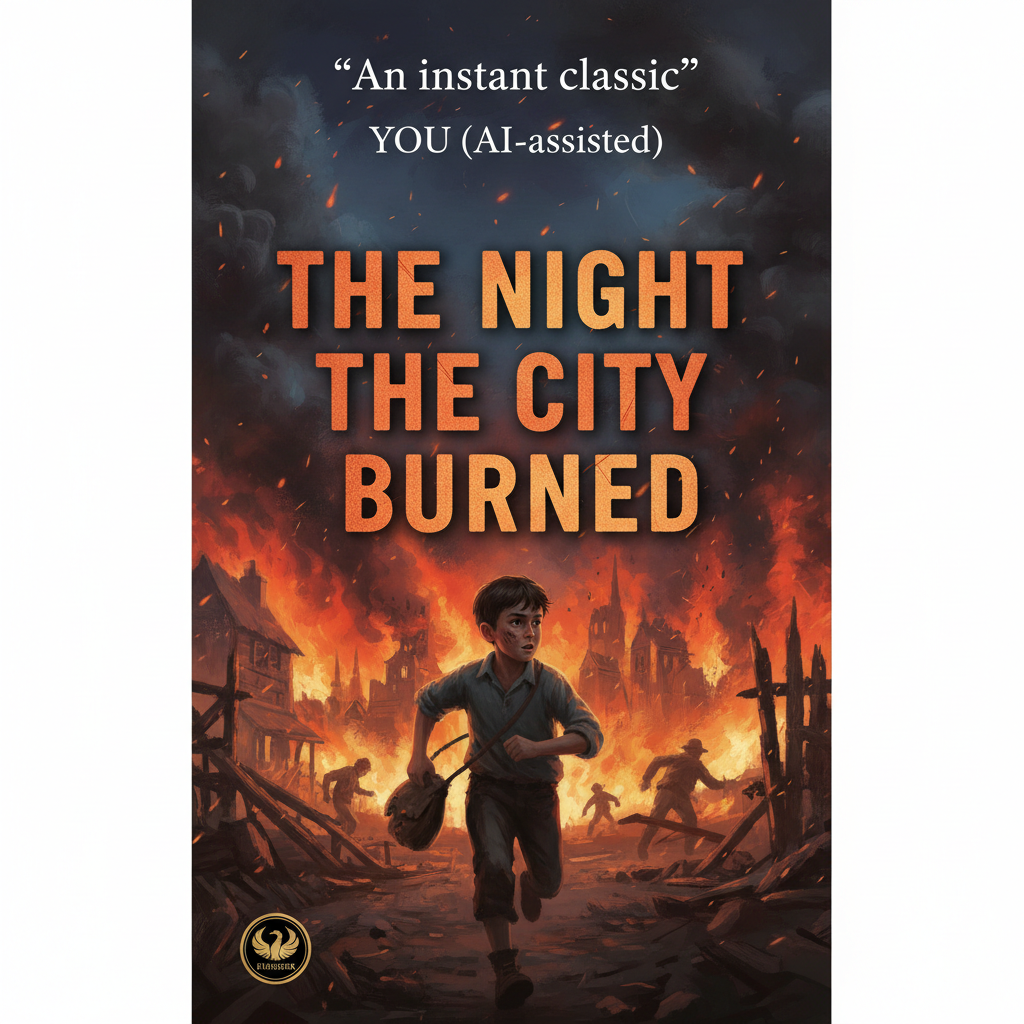
The Night the City Burned
By Mikael Löwgren
Synopsis
Amidst the chaos of a devastating city-wide fire, a young boy navigates the burning streets to reunite with his family and demonstrate remarkable resilience.
Chapter 1: A Spark in the Alley
A chill had begun to seep into the air, signaling the definite end of a surprisingly warm October day. Eleven-year-old Thomas huddled closer to the flickering gas lamp, its warm light painting long, dancing shadows on the worn floral wallpaper of their small parlor. The scratchy wool of his trousers chafed slightly, but he barely noticed, lost in the adventures unfolding across the brittle pages of *Treasure Island*.
“Thomas, dear, don’t strain your eyes,” his mother’s voice drifted from the kitchen, accompanied by the gentle clatter of supper dishes being stacked. Her voice, always a soft melody, was a comforting constant in their cramped but cozy apartment above Mr. Henderson’s dry goods store.
He mumbled an almost inaudible “Mmm-hmm,” not wanting to break the spell of Long John Silver’s cunning. The scent of roasted potatoes and whatever savory concoction his mother had whipped up for their evening meal usually had his stomach rumbling in protest, but tonight, even that familiar aroma took a backseat to Jim Hawkins’ perilous journey.
A tiny tremor, almost imperceptible, ran through the floorboards. Thomas frowned, glancing up from his book. He waited, but the building remained still. Probably just Mr. Henderson moving sacks of flour in the store downstairs, he decided, and plunged back into the thrilling words.
Then came another sound, sharper this time, like a distant crackle of dry twigs snapping underfoot. It wasn't the usual city symphony of horse hooves on cobblestone, vendors hawking their wares, or the occasional shout from a late-night reveler. This was different, an intrusive, almost sinister whisper in the quiet evening.
His mother emerged from the kitchen, wiping her hands on her apron. “Everything alright in here, Thomas?” she asked, her brow furrowed slightly. Her gaze, usually so gentle, held a flicker of concern as she glanced towards the window.
Before Thomas could answer, a sudden, acrid smell pierced the air – not the usual woodsmoke from their neighbors’ chimneys, but something sharper, more chemical, like burning tar and singed fabric. It prickled his nose, making his eyes water.
“What’s that smell?” his mother murmured, her voice rising in pitch. She moved quickly to the window, pushing aside the lace curtain.
Thomas, his curiosity now fully piqued, tossed his book onto the armchair and scrambled to join her. He peered over her shoulder, straining to see past the narrow alleyway that separated their building from the sprawling lumberyard behind them.
At first, he saw nothing but the deepening gloom of twilight. Then, a tiny spark, no bigger than a firefly, danced into view. It was a fleeting thing, barely a pinprick of orange against the encroaching darkness. He blinked, wondering if his eyes were playing tricks on him.
But then, another spark appeared, and another, and another, like mischievous sprites dancing in a forbidden place. They weren't just dancing; they were *growing*. The single pinpricks blossomed into miniature fiery flowers, clinging to something unseen in the alley.
A faint reddish glow began to suffuse the air. It pulsed, then steadied, casting an eerie, shifting light on the grimy brick wall opposite. The small sounds of crackling intensified, no longer a whisper but a hungry murmur.
“Mercy on us,” his mother breathed, her hand flying to her mouth. Her fingers were trembling.
Thomas watched, mesmerized and a little frightened, as the tiny sparks coalesced, licking upwards with frantic urgency. A thin plume of dark smoke, like an angry serpent, coiled into the sky. The red glow intensified, painting the lower reaches of the brick wall with a demonic blush.
Suddenly, a loud whoosh, like a giant sigh of hot air, erupted from the alley. A veritable curtain of flame, orange and yellow and terrifyingly alive, suddenly unfurled from behind the lumberyard fence. It clawed its way up the side of the nearby building, a hungry beast devouring every splinter of wood, every loose scrap of paper.
“Fire!” his mother shrieked, her voice thin with terror. “Thomas, get your coat! We have to go!”
Panic, cold and sharp, seized Thomas. His stomach lurched. The smell was overpowering now, a suffocating mix of burning wood and something else, something metallic and sickening. The air itself seemed to vibrate with the heat.
He stumbled towards the coat rack, his movements clumsy. His hands fumbled with the wooden pegs, his breath catching in his throat. He could hear shouting now, distant at first, then growing louder, closer. Other windows in their building were flung open, heads craning out, their faces pale and etched with alarm in the flickering light.
“The stairs, Thomas! Quickly!” His mother was already at the door, her eyes wide with a fear he had never seen before. Her usual calm demeanor had been replaced by a frantic energy.
He pulled on his rough wool coat, the familiar feel of it doing little to soothe his rising panic. He paused, his gaze sweeping their small parlor. His book, still open on the armchair, seemed impossibly distant, a relic of a normal evening that had vanished in a terrifying instant.
He heard his younger sister, Lily, stir in her bedroom. A small, sleepy whimper. “Mama?”
“Lily!” his mother cried, her voice cracking. She rushed into the small bedroom, which was already beginning to glow with an unnatural orange light seeping in from the alley.
Thomas followed, his heart pounding against his ribs like a trapped bird. Lily, her round face flushed with sleep, was sitting up in her cot, clutching her worn rag doll, a gift from their grandmother. Her eyes, usually so bright, were wide and confused.
“Mama, what’s happening?” she whimpered, and then she saw it, too – the pulsing orange light outside her window, painting her room in fiery hues. Her lower lip began to tremble.
“It’s a fire, sweetheart,” his mother said, her voice tight with an effort to sound calm. She scooped Lily into her arms, wrapping her tightly in a patchwork quilt. “But Mama’s here. We’re going to be alright.”
Thomas knew she was trying, but her words felt hollow against the escalating roar outside. The crackling had become a frantic symphony, punctuated by splintering wood and the ominous crash of something heavy collapsing. Sparks, like a shower of angry stars, began to fly past their window.
They stumbled out of the apartment and onto the landing. The air in the stairwell was thick with smoke, stinging Thomas’s eyes and clawing at his throat. He coughed, a dry, racking sound.
Downstairs, Mr. Henderson’s dry goods store was in chaos. People were rushing out, shouting, their faces stark with terror. The bell above the door, usually a cheerful tinkling, now seemed to clang with a frantic desperation.
“Thomas, hold my hand!” his mother yelled over the din, her voice hoarse. Lily, still clutched in her arms, was sobbing now, her small body shaking uncontrollably.
He reached for his mother’s hand, his fingers brushing against hers, but in the crush of bodies pushing towards the street, they were suddenly torn apart. A man, his face grimed with soot, pushed past Thomas, his eyes wide with a desperate urgency.
“Mama!” Thomas screamed, his voice swallowed by the roar of the fire and the shouts of the crowd. He spun around, trying to catch a glimpse of her, of Lily.
He saw her for a fleeting moment, a flash of her brown coat and Lily’s bundled form, being jostled towards the shop’s entrance. She was looking back, her eyes wide, mouth open in a soundless scream. Then the crush of people enveloped her, pulling her away.
He tried to push through the throng, his small frame no match for the panicked adults. He clawed at coats, bumping into hips and shoulders, but it was like trying to swim upstream in a raging river. The current of fear and desperation was too strong.
He emerged onto the street, blinking against the searing heat and the blinding light that now illuminated everything with an infernal glow. The entire alleyway, the lumberyard, and the buildings beyond were a raging inferno. Flames shot hundreds of feet into the night sky, their orange tongues licking at the clouds, painting them a terrifying red.
The street was pandemonium. People ran in every direction, some clutching bundles, others empty-handed, their faces contorted in masks of fear. Horses, freed from their stables, galloped wildly through the streets, adding to the chaos. The air was thick with smoke, ash, and the smell of burning dreams.
“Mama! Lily!” he cried again, his voice raw. He spun in a desperate circle, his eyes scanning the sea of faces, hoping to catch a glimpse of their familiar features. A wagon, laden with household goods, rumbled past, narrowly missing him. A woman screamed as a flaming piece of debris landed with a hiss on the cobblestones near her foot.
He was alone. His heart, already hammering, now felt like it would burst from his chest. A cold, dreadful realization dawned on him. He was separated.
Lily’s doll. He hadn’t noticed he was still clutching it until now. It was a simple thing, made of scraps of fabric, with embroidered eyes and a crooked smile. It had a faint scent of lavender, like Lily’s pillow. He squeezed it tight, burying his face in its soft, comforting cloth. It was the only tangible piece of his family he had left.
The heat was becoming unbearable, baking his skin. The roar of the fire was a constant, deafening presence, consuming everything. He could feel the panic threatening to overwhelm him, to paralyze him in the middle of this burning chaos.
But then, a flicker of something else sparked within him, small but stubborn, like the first flame in the alley. Lily. His mother. They needed him. He had to find them. He couldn’t give up.
He hoisted the rag doll closer, a silent vow forming in his mind, sharp and clear amidst the roaring inferno: *I will find you. I promise.*
He took a deep, shuddering breath, the smoke scratching at his lungs. Then, with Lily’s doll clutched tight against his chest, Thomas turned and plunged into the swirling currents of the burning city, his small figure a defiant silhouette against the terrifying, crimson glow of the night sky.
Chapter 2: Through the Smoke and Ash
The alley became a roaring inferno almost instantly. Thomas remembered the searing heat on his face, the way his mother’s hand had slipped from his, leaving the smooth, wooden doll of his sister, Lily, clutched in his sweaty palm. Now, the glow of the fire was not just a distant menace, but the very air he breathed, a flickering orange skin stretched over the familiar world.
He ran. Not just with his legs, but with his whole body, propelled by a primal fear that tightened his chest and burned in his throat. The cobblestones, usually cool and damp, radiated furnace-like warmth through the thin soles of his boots. He choked on mouthfuls of smoke, thick and acrid, like biting into a burnt coal. Each breath was a struggle, his lungs screaming for clean air that simply didn’t exist.
The air was a kaleidoscope of swirling ash, miniature grey storms dancing in the furious yellow light. They coated his hair, powdered his eyelashes, and settled on his tongue, gritty and bitter. He squinted, trying to make sense of the chaos, but sight was almost useless. Buildings, once proud and towering, were now skeletal outlines, their windows gaping, eyeless sockets reflecting the conflagration. Timbers groaned and shrieked, a symphony of destruction that vibrated through the ground and up his very bones.
A sudden, earth-shattering CRUMPLE! to his right sent a shower of sparks and debris raining down. He threw himself instinctively behind an overturned pushcart, its wooden wheels charred and splintered. The heat intensified, a wave washing over him, baking his skin. He squeezed his eyes shut, trying to make himself smaller, listening to the cacophony of splintering wood and shattering glass. When he dared to peak again, the bakery, Mrs. Henderson’s famous apple tarts now just a memory, was a pile of smoldering rubble. A chill, colder than the grave, snaked down his spine. This wasn’t just a fire anymore; it was a hungry beast, devouring everything in its path.
He scampered out from his meager protection, heart thudding against his ribs like a trapped bird. The doll, Lily’s doll, was still clutched tight. Its smooth, worn wood was a small comfort, a tangible link to the family he so desperately needed to find. He navigated the treacherous landscape, his boots crunching on fallen roof tiles and twisted metal. The air here was thicker, a veil of grey that made the world a murky, indistinct blur. He could taste the desperation, the fear that clung to the air like a physical presence.
He wasn’t alone. Shadows flickered and darted ahead of him, other figures swallowed by the smoke, their cries muffled and indistinct. He heard a child’s sob, raw and unrestrained, then a frantic "Mama!" that tore at his own heart. He wanted to help, to offer comfort, but the overwhelming urge to push forward, to find *his* Mama and Papa, was a relentless current pulling him along.
He stumbled into what used to be Market Street, the vibrant heart of their town. Now, it was a warzone. Stalls were overturned, their wares scattered and burning—apples turned to black coals, fabric reduced to smoldering rags. A horse-drawn wagon, its driver nowhere in sight, stood abandoned, the poor beast still hitched, snorting and pawing the ground, its eyes wide with terror, reflecting the fiery sky. Thomas felt a pang of pity for the animal, but the danger of approaching it was too great.
He pressed on, his little lungs burning, his legs aching. He thought of his mother’s gentle touch, his father’s booming laugh. He imagined them searching for him, calling his name. He had to keep moving.
A figure materialized from the gloom, small and quick. Thomas froze, clutching Lily’s doll tighter. It was a girl, perhaps a year or two older than him, her face smudged with soot, her dark hair a tangled mess. She carried a small, canvas satchel slung across her chest, and in her hand, surprisingly, an old, dented tin lantern, its glass cracked but still stubbornly flickering, casting a weak, dancing circle of light on the ground.
She stopped abruptly, almost colliding with him, her eyes, intelligent and wary, locking onto his. "Watch it!" she snapped, her voice raspy from the smoke. She didn’t look frightened, though the fear was surely etched into her grimy face. She looked… determined.
"Sorry," Thomas mumbled, his voice a dry whisper.
She studied him for a moment, her gaze raking over his soot-stained clothes, the precious doll. "Lost too, are you?" It wasn’t a question, but a statement of shared misery.
He nodded, unable to articulate the immensity of his loss.
"Clara," she offered, a brief nod of her head. "Clara Finch."
"Thomas," he managed. "Thomas Miller."
She looked around, her small lantern cutting through the haze. "This isn't good. The west side is gone. Completely." Her voice was devoid of emotion, a stark report. "They're trying to push people towards the river, but it's a bottleneck. Fire's caught the warehouses near the bridge."
Thomas’s stomach lurched. The river was where his family had planned to meet if they were separated. The bridge was their only way across the raging waterway now.
"My family..." he began, his voice cracking.
Clara eyed him, a flicker of something in her deep-set eyes. "Mine too. Parents worked the docks." She gestured vaguely towards the inferno. "Probably still there. Stupid of them." There was a bitterness there, a raw edge that Thomas understood all too well.
"Do you know a way?" Thomas asked, hope, a small fragile flame, stirring within him. "To the river?"
Clara considered him, her gaze calculating. "Depends. Got anything useful?"
Thomas felt a flush spread across his grimy cheeks. He had nothing but Lily’s doll. "Just… this." He held up the doll.
Clara snorted, a brief, dry sound. "A doll won't get us through a burning city, kid." But she didn't dismiss him entirely. Her eyes scanned the ground, then the direction of the roaring fire. "Got any water? Or food?"
Thomas shook his head, shame burning him anew.
Clara sighed, a puff of smoke-tinged air. "Figures. I’ve got a half-eaten loaf of bread and a flask, nearly empty." She unslung her satchel and pulled out a dark, crusty hunk of bread. "It’s stale as yesterday’s prayers, but it'll do." She tore off a piece, not for herself, but extended it to him. "Here. You look like you're about to drop."
Thomas’s eyes widened. He hadn’t realized how hungry he was until the scent of the bread, even stale, hit him. His stomach gave a loud rumble. He took the offering, his fingers brushing hers. Hers were surprisingly calloused, strong.
"Thank you," he mumbled, tearing off a bite. It was dry and hard, but it was food, and it felt like a lifeline. He chewed slowly, savoring the small comfort.
"Don't thank me yet," Clara warned, her voice low. "We stick together. No lagging behind. And no complaining." She pointed with a grimy finger towards a narrow alleyway, barely discernible through the smoke. "This way. It’s a shortcut through the old Tanner’s District. Less direct, but it might be clearer. The wind’s pushing the main fire towards the docks."
Thomas nodded, suddenly revitalized by the bread and the promise of a path. He fell in behind Clara, her small lantern a beacon in the oppressive gloom. Her movements were swift and silent, her small boots crunching softly on the debris. She knew these streets, it was clear, despite the fire’s ruthless reshaping of them.
The Tanner’s District was even worse than Market Street, though in a different way. The air here was thick with the stench of burnt leather and chemicals, mingling with the ever-present smoke, turning his stomach. The buildings were lower, older, and many had already collapsed, leaving treacherous mounds of smoldering wood and twisted metal. Clara navigated them with an uncanny sense of direction, her head cocked, listening to the crackle and roar of the distant flames, interpreting the wind's direction.
They squeezed through gaps in collapsed walls, careful not to dislodge any more loose bricks. Once, a splintered beam, still glowing red, crashed down just inches from Thomas’s foot, sending a spray of embers across his path. He yelped, jumping back. Clara merely glanced over her shoulder, her expression unreadable. "Careful," she said, her voice flat, devoid of admonishment or comfort. It was a simple statement of fact.
They continued, the silence between them punctuated only by the distant roar of the fire and the scrabbling of rats. Thomas wondered if anyone else was alive apart from them. The thought was a cold, alien presence in his mind.
After what felt like an eternity, Clara stopped. They were in a small courtyard, surrounded by what used to be tenement buildings, now mostly hollowed-out shells. The air here was slightly clearer, the smoke a thin veil rather than an impenetrable wall. Above them, mercifully, a sliver of smoke-reddened sky was visible.
Clara pulled out her nearly empty flask. "Here," she said, offering it to him. "Just a swallow. Make it last."
He took it, the metal cool against his hot hand. He tilted it back, a tiny trickle of lukewarm water touching his parched tongue. It was like nectar. He gargled it, making the most of every last drop, before handing it back. "Thank you. Again."
Clara took a small sip herself, then screwed the cap back on. "We need to find higher ground soon. Get a better look at what's burning and what isn’t. My guess is the river road is our best bet, if we can reach it from the north side."
"The north side?" Thomas repeated. That was a long way around, almost backtracking. But if the main bridge was gone…
"Fire usually spreads with the wind," Clara explained, her tone almost academic. "The wind's pushing it east. So the west and north should be less… inferno-like."
He trusted her. She spoke with a certainty that calmed a small part of his fear. She clearly knew more about surviving this than he did.
They rested for a moment, their breath still ragged. Thomas looked at Lily’s doll. Its wooden face, usually cheerful, now seemed to reflect the smudged chaos of their surroundings. He clutched it closer. "My sister," he whispered, mostly to himself. "I have to find her. And Mama and Papa."
Clara was picking at a loose thread on her satchel. She didn’t look at him. "Everyone needs to find someone, Thomas." Her voice was softer now, a hint of vulnerability. "The trick is knowing where to look when everything's gone." She stood up, her small figure resolute. "Come on. We can't stay still. Staying still means getting caught."
She led him out of the courtyard and into another labyrinth of narrow, smoke-filled lanes. The further they went, the more they seemed to twist and turn, the landmarks he knew obliterated. The city was a new, terrifying place, built of ash and fear and flickering light. His exhaustion was beginning to set in, his legs heavy, his eyelids gritty. But Clara, small and fierce, never faltered. Her dented lantern, a fragile beacon, continued to lead the way, cutting a path through the smoke and ash, towards an uncertain future, towards a family he prayed was still waiting. The roar of the fire, though, was a constant, malevolent presence, a reminder of the danger that still consumed their world.
Chapter 3: Whispers of Hope and Danger
The stench of burning timber and something acrid, like sizzling flesh, clung to Thomas’s nostrils. His throat ached, raw from the smoke, and every breath felt like swallowing grit. Beside him, Clara coughed, a dry, rasping sound that tore at the quiet of the damaged church. They’d stumbled upon it after a desperate dash through a street where flaming debris rained down like a terrible, fiery hail. The stained-glass windows, once vibrant tapestries of biblical scenes, were now shattered holes, the colored shards scattered like jewels across the dusty pews. A gaping hole in the roof offered a glimpse of the smoke-choked night sky, a terrifying orange that pulsed with the city's dying light.
The air inside was thick with dust and the faint odor of damp stone, a blessed respite from the inferno outside. Thomas sank onto a splintered pew, his legs trembling. The doll, Lily’s Doll, was clutched so tightly in his hand that its yarn hair was matted with sweat. It felt small and fragile, a stark contrast to the overwhelming terror that clawed at him.
Clara, ever practical, was already surveying their surroundings. Her eyes, usually so bright and quick, were shadowed with fatigue. She picked up a torn hymn book, its pages singed at the edges. “At least the floor isn’t on fire,” she muttered, her voice hoarse. “Yet.”
A shiver traced Thomas’s spine. “Do you think anyone else is here?” he whispered, his voice barely a croak.
Clara shook her head. “Doesn’t look like it. Most people would have been running *away* from here.” She gestured vaguely towards the roaring inferno beyond the crumbling walls. “This is too close.”
He huddled deeper into the pew, wishing the sturdy wood offered more than just a momentary illusion of safety. The rhythmic roar of the fire was a constant, terrifying companion, an animal gorging itself on their city. He remembered his father, his strong hands, his mother’s gentle touch, Lily’s infectious giggle. Were they safe? Were they running too? The thought was a fresh stab of fear, cold and sharp.
Suddenly, a faint creaking sound echoed from the front of the church, near the altar. Thomas’s head snapped up, his heart hammering against his ribs. Clara, her hand already moving to the rusty hinge of a hymn-box, froze.
Two figures emerged from the shadows, their faces smudged with ash, their clothes torn. An older man, his hair wild and white, supported a woman whose arm hung at an unnatural angle. They moved slowly, painfully, their eyes wide with shock and exhaustion.
“Is anyone else here?” the man croaked, his voice raspy. He squinted at them through the gloom.
Thomas and Clara remained silent, a silent agreement passing between them. They were children, alone, and the world outside was full of unknowns.
The woman stumbled, and the man eased her onto the steps leading to the altar. “We thought this might be a sanctuary,” he said, more to himself than to them. “The walls are thick.”
“Sanctuary is a strong word tonight, Arthur,” the woman murmured, her voice tight with pain. “There’s no sanctuary from this.”
They watched in silence as the adults tried to make themselves comfortable, the man gently examining the woman’s arm. Their whispers were low, urgent. Thomas tried not to listen, but the words drifted through the scarred air.
“...across the river… heard some talk… gathering place… outskirts of the city…” The man’s voice was strained.
Clara’s hand subtly reached for Thomas’s arm, a slight pressure that jolted him. He glanced at her. Her eyes were fixed on the two adults, a fierce intelligence burning within them. She was listening. Truly listening.
“Where on the outskirts?” the woman asked, her voice a little stronger now.
“South-east,” the man replied. “Beyond the old mill district. They say there’s a field… open ground… safer from the embers.”
Thomas’s mind raced. South-east. Beyond the mill. He pictured the city map in his head, the labyrinth of streets, the river snaking through its heart. It was a long way. A very long way.
“And how are we supposed to get there?” the woman scoffed, a bitter laugh escaping her lips. “The bridges will be jammed, or worse, burning.”
“Some are still standing,” the man insisted, though his voice lacked conviction. “We’ll have to try the one by King’s Way. It’s further, but less likely to be overwhelmed.”
The words hung in the air, a fragile thread of hope woven into the tapestry of despair. Thomas felt a flicker of something he hadn’t felt in hours: purpose. A direction.
Clara nudged him. Her eyes met his, and a silent conversation passed between them. *Did you hear that?* her eyes asked. *We have to try.*
Thomas nodded, a small, involuntary movement. They had to try. Their family could be there. His parents, Lily, waiting. The thought was a powerful anchor in the swirling chaos.
As the adults continued their hushed conversation, their hopes and fears intertwining, Thomas and Clara knew what they had to do. They couldn’t stay. The church, for all its temporary shelter, was still in the path of the encroaching monster.
They waited until the older couple seemed to be lost in their own shared grief and hope, then Clara rose, beckoning Thomas with a silent gesture. He pushed himself off the pew, his muscles stiff and protesting.
“We heard,” Clara whispered, her voice barely audible, as they moved silently towards the shattered main door. “The safe place. South-east.”
Thomas nodded, his throat too tight to speak.
Outside, the world was a canvas of nightmares. The orange glow had intensified, painting the smoke a lurid blood-red. The roar of the fire was louder, more insistent, a hungry beast devouring everything in its path. Embers, like malevolent fireflies, danced in the air, occasionally landing with a hiss on some dry patch of ground, sparking new, smaller blazes.
The street was a torrent of humanity. People surged past them, their faces masked with terror, their eyes wide and desperate. Carts laden with possessions, hastily snatched from burning homes, jostled against each other. Children cried, their wails swallowed by the cacophony. The air hummed with a primal fear.
Thomas felt a suffocating wave of panic. How could they possibly navigate this? He gripped Lily’s Doll tighter, its soft head a small comfort.
Clara, however, seemed to draw strength from the chaos. She grabbed his arm, pulling him gently but firmly. “Stay close,” she commanded, her voice steady despite the tremor in her hand. “Don’t look down, keep moving.”
They became part of the river of people, swept along by the current of desperation. Thomas kept his eyes fixed on Clara’s back, her small frame a beacon in the swirling madness. He noticed the strategic way she wove through the crowd, finding small gaps, anticipating surges. She was like a tiny, determined boat navigating a raging sea.
The heat was oppressive, heavy and suffocating. It felt as if an invisible hand was pressing down on them, squeezing the air from their lungs. Thomas could feel the radiating warmth from collapsing brickwork, the searing breath of the inferno itself getting closer. Sweat plastered his hair to his forehead, mixing with the ash that clung to his skin.
They passed a bakery, its windows shattered, the air thick with the smell of burnt sugar and dough. A woman knelt outside, weeping hysterically, clutching a scorched photograph. Further on, a horse-drawn cart lay overturned, its contents spilling onto the street, unheeded. The scale of the destruction was immense, unfathomable.
“We need to head east,” Clara shouted over the din, pointing down a narrower side street. “Away from the main thoroughfares. Less crowded, but we’ll have to be quicker.”
Thomas nodded, trusting her judgment implicitly. They veered off, plunging into a maze of smaller lanes. Here, the fear was more localized, more personal. Families huddled outside collapsing houses, still hoping against hope for a miracle. The air was hotter, the smoke thicker, tinged with the metallic tang of melting lead.
A sudden roar, louder than any yet, ripped through the air. Thomas looked up. A tall, elegant building, its roof already a pyre, began to lean, slowly at first, then picking up speed. The crowd shrieked, scattering like starlings.
“Run!” Clara screamed, yanking Thomas’s arm.
They bolted, their small legs pumping, adrenaline coursing through their veins. The ground shook as the building imploded, sending up a shower of sparks and a deafening cloud of dust and debris. Thomas felt the concussive force in his chest, heard the terrible CRUMP of collapsing stone. He stumbled, but Clara’s grip never wavered.
They didn’t stop until their lungs burned and their sides ached, collapsing into a small, relatively untouched alleyway. Their faces were streaked with tears and soot, their bodies trembling uncontrollably.
“That… was… close,” Thomas gasped, leaning against a cool stone wall.
Clara nodded, her eyes still wide with fear. “Too close. We need to avoid the big buildings. Stick to the smaller ones, the residential areas. They’ll burn, but they won’t fall with so much force.” Her voice was tight with the effort of control.
They rested for only a moment, the roar of the fire a constant reminder of their precarious situation. The alley offered a temporary shield, but the orange glow in the sky was omnipresent, mocking their attempts at escape.
“The bridge,” Thomas whispered, remembering the old man’s words. “King’s Way.”
Clara nodded. “It’s further south than where we are now. We need to loop around, away from the hottest part of the fire, then cut back towards the river.” She pointed towards a gap between two houses. “This way looks clearer for a bit.”
They pressed on, their journey becoming a desperate dance with the inferno. They sprinted down alleys, sometimes forced to backtrack when a new blaze erupted, or a fallen beam blocked their path. The heat was relentless, the smoke chokingly thick. Thomas felt a desperate thirst, his mouth dry and his tongue rough. He thought of his mother’s fresh water from the well, cool and clear.
Once, they paused near a small park, its trees already smoldering sentinels, the grass singed and black. A small group of children, younger than them, huddled together, sobbing. Thomas felt a pang of profound sadness, a shared desolation. He and Clara exchanged a glance. They couldn’t help; they could barely help themselves. It was a harsh truth, difficult to swallow.
They saw pockets of desperate kindness too. A woman offering a child a piece of bread, a man helping an elderly neighbor through the wreckage. But these moments were fleeting, swallowed by the overarching chaos.
As they approached what they hoped was the vicinity of King’s Way Bridge, the number of people increased again, a surging human tide. The air here was drier, the smoke less concentrated, a sign that the main body of the fire had not yet reached this far. But the glow in the sky was still a terrifying reminder of its power.
“Look!” Clara pointed, her finger trembling slightly.
Ahead of them, a massive bottleneck had formed. King’s Way Bridge, a magnificent stone structure that usually hummed with life, was now a scene of utter pandemonium. Carriages were overturned, abandoned, their horses long since unhitched in terror. A solid wall of people pressed towards the narrow opening, pushing, shoving, desperate to cross the river to safety. The river below, usually a calm, dark ribbon, reflected the inferno above, a liquid mirror of fire.
And then Thomas saw it – a flicker of movement, a dark shadow amidst the swirling smoke. Flames. Not on the bridge itself, not yet, but perilously close. A building on the riverbank, just before the bridge's approach, had caught fire. Embers, bright and terrible, were being carried on the wind, dancing towards the wooden supports beneath the stone arch.
A collective groan rose from the trapped crowd. Panic flared anew, a fresh wave of terror rippling through the masses.
“We can’t go that way,” Thomas choked out, his voice filled with renewed despair. The bridge was their last hope for a less perilous crossing, and it was becoming a death trap.
Clara’s face was grim, her brow furrowed in thought. Her eyes darted, scanning the collapsing horror around them. "Not that way, no. But there is another way. A riskier way."
Her gaze landed on a cluster of old warehouses, dark and foreboding, further downstream. “The old docks. There might be some of the smaller riverboats still tied up. Or even a ferry, if we’re lucky.”
Thomas swallowed hard. The docks were dangerous even on a normal day, a place of shadows and unsavory characters. Now, with the city burning, they would be even more perilous. But the alternative – the raging inferno of the King's Way Bridge – was a certainty of death.
He looked at Clara, her small face streaked with dirt, her eyes unwavering. He saw the same desperate determination that mirrored his own. Lily’s Doll felt heavier in his hand, a small, precious weight. He had to get to his family. He had promised.
“Alright,” he said, his voice surprisingly firm. “The docks. Let’s go.”
They turned their backs on the chaos of the bridge, their hearts hammering, and plunged back into the smoke-filled streets, towards a new and unknown danger. The roar of the fire seemed to follow them, a dreadful companion. Their journey was far from over.
Chapter 4: A Bridge on Fire
The rumble grew, not the deep growl of the fire, but a different kind of tremor, beneath their feet, through the very air they breathed. It was the frantic rhythm of a thousand lives, all pressing in one direction, all yearning for escape. Thomas and Clara, hand-in-hand, were swept along by the current of bodies, a river of fear flowing towards the main bridge that spanned the churning river. This was their lifeline, the city’s artery that led to the whispered promise of safety on the other side.
As they neared, the air thickened with a taste like burnt sugar and metal. The darkness of the night, already battling the orange-red glow of the fire, was now punctuated by angry sparks that danced and died in the suffocating smoke. The heat, once a distant threat, pressed in on them, a physical weight that stole their breath. Thomas squinted, trying to pierce the gloom, but the scene unfolding before them was less a bridge and more a vision from a nightmare.
“No,” Clara whispered, her grip tightening on his hand until his knuckles ached. Her voice was thin, barely audible above the roar.
The bridge, a grand iron structure that had always seemed invincible, was a skeleton wreathed in flame. Tongues of fire licked greedily at the wooden railings, consuming them like kindling. The iron girders, once a solid grey, now shimmered with an eerie, incandescent orange, twisting and groaning under the immense heat. A section of the wooden roadway had already collapsed, a gaping maw in the bridge’s belly, revealing the dark, turbulent water below where splintered planks twirled like toys.
Panic, raw and guttural, erupted from the crowd. People screamed, pushing forward, then recoiling as the sheer impossibility of crossing became starkly clear. The flow of bodies halted, jammed against the inferno. Despair settled like a suffocating blanket.
Thomas felt his own stomach clench. This wasn't merely a collapsed building or a blocked alleyway. This was a chasm, a molten barrier between them and anything resembling safety. He felt Clara tremble beside him, her small frame shaking. He knew she was looking at him, relying on him. He had to think.
“We can’t go back,” Clara said, her voice firmer this time, an edge of defiance in it. She was right. The flames behind them were too close, too widespread. Retreat was not an option.
Thomas pushed forward a few steps, dragging Clara with him, ignoring the protests of the people jostling around them. He needed a closer look. The heat was immense, searing his eyelashes, stinging his eyes. He shielded his face with a hand, trying to see beyond the immediate chaos.
His father’s voice, calm and steady, echoed in his mind. *“Always look for the weakness, son. Every structure has one, every fire too. Find the path of least resistance.”* His father, a carpenter by trade, had taught him well about wood and metal, about pressure and stress. He’d spend hours explaining how joints worked, how beams supported weight, how a fire, though destructive, often consumed unevenly.
Thomas forced himself to ignore the terrified cries, to block out the overwhelming heat and the suffocating smoke. He focused on the structure itself. The bridge was made of several spans, supported by massive iron piers planted in the riverbed. The central span, the longest section, was clearly too far gone. But the sections closer to the bank…
He scanned the nearest section. The wooden planks were burning, yes, but not all of them. Some were still sending tendrils of smoke curling into the air, not yet fully engulfed. And the iron framework beneath them – it glowed, but it seemed to hold its shape. He remembered his father talking about different metals, how some held up better under heat, how thick iron beams could withstand incredible temperatures for a time before they began to buckle. This was a heavy, old bridge, built when things were made to last.
“Look, Clara,” he said, his voice hoarse, pointing with a trembling finger. “That section. Near the edge. It’s not as bad.”
Clara followed his gaze. “It’s still burning, Thomas! And there’s a gap. A big one.” Her eyes were wide with fear, but she didn’t question him, didn’t argue. She trusted him. The weight of that trust settled heavy on his shoulders, a strange mixture of burden and resolve.
The gap she referred to was indeed significant, perhaps ten feet wide, where the entire roadway had collapsed. But beyond it, another stretch of the bridge, though smoking and smoldering, seemed to offer a precarious path.
“The main supports are still there,” Thomas murmured, half to himself, half to Clara. “Beneath the wood, see? The big iron beams. They’re glowing, but they haven’t buckled yet. Not in that first section. People pushed too much in the middle, that’s why it collapsed there. The heat built up.”
He remembered his father explaining how a fire weakened the weakest points first, how a crowd’s weight could hasten a collapse. The people had stampeded towards the center, where the flames were fiercest, not realizing they were aiding its destruction.
“If we stick to the edge,” Thomas continued, his voice gaining a desperate certainty, “where the iron is thickest, where the flames are less… concentrated.” He pointed to the side of the bridge, away from the roaring inferno at its heart. “We can cross on the girders.”
Clara gasped. “On the iron beams? But they’re so thin! And it’s so high!” She looked down at the dark swirling water, then back at the flames eating at the bridge.
“It’s our only way, Clara,” Thomas insisted, his eyes fixed on the path he envisioned. “We can’t stay here. The fire is coming for us. We have to try.”
He pulled her closer, his voice dropping to a whisper. “My father, he says, when things are falling apart, check the foundations. The foundations are still holding, Clara. We just have to stick to them. And the gap… we can jump it.”
Jump a ten-foot gap over a churning river, a hundred feet below, with a raging fire on either side? It sounded insane. But the alternative – to be consumed by the flames behind them – was even worse.
They were still hemmed in by the increasingly panicked crowd. No one else seemed to be considering such a desperate measure. Most were simply frozen in terror, or desperately trying to force their way back, only to meet the wall of fire advancing from the city.
“Come on,” Thomas urged, pulling Clara gently but firmly. “We need to get to the edge.”
They squeezed past people, met with angry shouts and desperate pleas. “Don’t go, boy! It’s suicide!” someone cried. Another woman wailed, “My God, they’ll fall!” But Thomas pressed on, his gaze fixed on the less-damaged section of the bridge.
The heat intensified with every step. The soles of his worn boots felt as if they were melting. The air was thick with ash and the acrid smell of burning wood. Thomas felt a prickle of fear, cold and sharp, despite the raging heat. But he remembered his father’s words, Clara’s trusting gaze, and an unyielding resolve hardened within him.
Finally, they reached the edge of the metal railing, where the flames were still contained to the wooden roadway. Below them, where the railing met the main support beam, was a narrow ledge, perhaps a foot wide. It was meant only for maintenance, not for crossing.
“We have to climb over the railing,” Thomas said, his voice raspy. He demonstrated, carefully placing one foot on the bottom bar of the railing, then the other, hauling himself over with a grunt. The hot metal seared his hands, but he ignored the pain.
Clara hesitated, looking at the glowing iron, then back at the terrified faces of the crowd. “It’s so high,” she whimpered.
“I’ll help you,” Thomas promised, reaching back for her hand. “Just one foot at a time. Be careful.”
He guided her, her small hands shaking as she gripped the hot iron. He pulled her over, mindful of the doll still clutched tightly in her other hand. She landed beside him on the narrow ledge, her chest heaving.
The roar of the fire was deafening here, a living, breathing monster. Sparks rained down on them, stinging their skin. The ground beneath their feet, the iron beam, thrummed with the violent tremor of the burning structure.
“Stay close,” Thomas yelled over the din, keeping her hand in his. He led the way, shuffling sideways along the narrow beam. It was agonizingly slow. Below them, the river churned, a dark, hungry beast waiting. Above them, fire consumed the last vestiges of the wooden roadway.
Smoke swirled around them, burning his eyes, making them water. He blinked, trying to clear his vision. The iron was hot, almost too hot to touch in places. He tried to pick out cooler spots, but it was a losing battle. He could feel the vibration of the structure, the deep groans of metal under immense stress.
Each step was a gamble. He peered ahead, trying to gauge the distance to the gap. It loomed larger now, a black maw in the burning bridge. It wasn’t ten feet as he’d first thought; it looked wider from their current vantage point, a terrifying abyss.
“We have to jump there,” he shouted to Clara, pointing. His voice sounded thin, reedy, even to himself.
Clara’s eyes followed his finger. Her face was pale, streaked with ash. “It’s too far, Thomas!”
“No, it’s not,” he replied, more to convince himself than her. “We just need a running start. And we jump together. On three.” He swallowed, tasting ash and fear. “One… two…”
He gripped her hand tighter. The fire was roaring directly beside them now, making the air shimmer. He could feel the heat radiating through his clothes, cooking his skin. He closed his eyes for a split second, picturing his father, calm and resolute, then opened them, his own resolve hardening.
“THREE!” he screamed, and they launched themselves forward.
It was a clumsy, desperate leap. Thomas strained every muscle in his legs, pushing off the burning iron beam. Clara, light as she was, was surprisingly strong, propelled by sheer terror and the momentum of Thomas’s pull.
For a terrifying moment, they were suspended in the hot, smoky air. Thomas could see the dark, swirling water below, felt the sickening lurch of falling. He heard a choked cry from Clara. Then, with a jarring thud that sent a shockwave up his legs, they landed.
They landed hard, scrambling on another section of the iron beam, both of them skidding towards the edge. Thomas’s heart hammered against his ribs. He fought for purchase, his hands clawing at the rough iron, his feet scrabbling for balance. Clara, still clutching her doll, let out a small, winded cry.
He managed to pull himself upright, his knees shaking violently, and then hauled Clara up beside him. They were across. They had made it over the gap.
Breathing heavily, they looked back. The chasm they had just leaped seemed impossibly wide from this side. The section they had abandoned was now fully engulfed, a raging furnace. Sparks showered down onto the river, sizzling and dying.
The part of the bridge they were on was still smoking, the wooden planks smoldering, but the main flames had not yet reached it in their full fury. The heavy iron beams still held, still supported their weight.
“We did it,” Clara whispered, her voice trembling but filled with an incredible relief. She looked at him, her eyes wide and wet, not with fear anymore, but with something else: awe, and a fierce, unspoken gratitude.
Thomas couldn’t find his voice. He just nodded, his chest heaving, his body aching. But the fire in their immediate path was lessened. The air was still thick with smoke, but the searing heat began to recede slightly as they continued their painstaking shuffle along the metal beam, moving towards the relatively safer ground of the far riverbank.
The bridge groaned, a deep, mournful sound, as if in protest at their daring. But it held. And as they finally reached the solid earth of the riverbank, stumbling onto cobblestones still warm but no longer burning, Thomas realized something. He hadn't just crossed a bridge. He had crossed a threshold. He, a boy who had only ever known a quiet life, had faced down an inferno and found an unexpected strength within himself. And he hadn't done it alone. With Clara, they had faced the impossible.
Behind them, the bridge roared, the flames now consuming the full length of the span. A loud, metallic shriek echoed across the river, followed by a thunderous crash as another section of the iron structure gave way, plunging into the dark waters below. The last lifeline, severed. But they were on the other side. They had made it. The city was still burning, but they had found a way through. And in their shared act of courage, a powerful, unspoken bond had been forged, stronger than any iron beam, more resilient than any flame. Their journey wasn't over, but the most terrifying part was behind them. Or so they hoped.
Chapter 5: The Reunion at Dawn
The sky was a bruised plum, slowly leaking orange and rose into the churning grey above the city. Dawn, Thomas realized, his throat raw, his eyes gritty. Dawn, and still the air tasted of char and hot metal. The safe zone, if that’s what this scarred stretch of grassland could be called, was a muted tableau of misery. Huddled figures, swathed in blankets and shawls, sat on the dew-kissed ground, their faces smudged with ash, hollowed by fear. A low murmur of coughs and quiet sobs was the only sound, punctuated by the distant, frantic crackle of burning timber.
Clara, her hand still linked with his, squeezed his fingers. Her face, usually so sharp and determined, was smudged with streaks of dirt and exhaustion, making her look younger, more vulnerable. But her gaze was steady, sweeping over the crowd with a practiced intensity that Thomas had come to rely on.
“See anyone?” she rasped, her voice thin, nearly gone.
Thomas shook his head, his own voice lost somewhere in the smoke that still scraped his lungs. His sister’s doll, Abigail, was still clutched tight in his other hand, her cloth face offering no comfort, only the stark reminder of what he had lost. Or, he prayed, what he was about to find.
They moved slowly, a pair of exhausted specters weaving through the prostrate forms. The smell here was different from the fire’s rage; it was the acrid tang of burnt wool and wet earth, mixed with the faint, metallic scent of blood from unseen wounds. Children, small and bewildered, clung to parents with white-knuckled grips. Old men stared blankly ahead, their world reduced to a pile of smoldering embers.
Thomas scanned every face, his heart a frantic drum against his ribs. Each glimpse of a woman with his mother’s dark hair, or a man with his father’s solid build, sent a jolt of desperate hope through him, only to be dashed by the harsh reality that these were strangers. He wanted to shout, to tear through the quiet despair and demand an answer, but the words were stuck in his throat.
Clara tugged his arm, pointing with her chin toward a small knot of people gathered near a makeshift medical tent. A doctor, his face grim, was bandaging a woman’s arm. Thomas felt a flicker of energy, a surge of adrenaline he didn’t know he had left. They shuffled closer, his eyes darting from face to face.
Then, he saw her.
A woman, sitting on an upturned crate, her head bowed. Her dark hair, usually so neatly tied back, had escaped its pins and hung in loose strands around her face. Her shoulders shook almost imperceptibly. His mother.
The air seemed to leave Thomas’s lungs in a rush. “Mama!” he croaked, but the word was barely a whisper. He tried again, louder this time, a raw, desperate cry torn from the depths of his being. “Mama!”
Her head snapped up. Her eyes, red-rimmed and swollen, widened, searching the crowd. When they landed on him, a gasp escaped her lips, a sound of pure disbelief.
“Thomas?” she breathed, her voice hoarse, like dry leaves rustling.
He didn’t wait. He launched himself forward, stumbling over a discarded blanket, nearly tripping. His legs, weary moments ago, found a sudden, impossible strength. He wasn’t running, he was flying.
His mother stood, swaying for a moment, then she, too, was moving, her arms outstretched. The moment their bodies collided was a blur of scent—smoke, sweat, and something utterly familiar, utterly *hers*. He buried his face in her shoulder, clutching Abigail, feeling the rough wool of her shawl against his cheek. His mother’s arms wrapped around him, so tight he could barely breathe, but he didn’t care. He was home.
Tears, hot and fast, streamed down his face. Not tears of fear or terror, but tears of relief, of a burden lifted, of a nightmare ending. His mother was sobbing too, her body shaking against his. “Thomas, my boy, my brave boy,” she choked out, running a hand through his ash-streaked hair, pulling back to look at his face, then pulling him close again.
And then, over her shoulder, he saw him. His father.
He was standing slightly behind his mother, his face a mask of disbelief and profound relief. His eyes, usually so serious, were shining with unshed tears. He was thinner, his clothes singed, his normally neat beard singed in places. But it was him.
“Papa!” Thomas cried, pulling away from his mother just enough to reach for his father. His father’s arms enveloped him then too, a strong, reassuring embrace that felt like solid ground after an endless journey across a raging river.
“My son,” his father murmured, his voice thick with emotion, his hand Ruffling Thomas’s hair, exactly as he always did. “You’re safe. You’re safe.”
In the midst of their embrace, Thomas remembered. He pulled back, holding out Abigail. “Mama, Papa… Abigail… I have her. She’s safe.”
His mother let out another sob, taking the doll with trembling hands, pressing its soft head against her cheek. “Thank heavens,” she whispered, “thank all the heavens.”
His father, however, looked around, his gaze moving past Thomas, searching. His face was still etched with a deep worry. “Where is your sister, Thomas? Is Amelia… is she with you?”
The question hung in the air, a sudden, chilling drop in the temperature of their reunion. Thomas felt his heart constrict, a knot of dread tightening in his stomach. He hadn’t thought about Amelia since he’d been separated from his family. Amelia hadn't been with them when the fire broke out; she’d been staying the night with Aunt Mildred, a few blocks away. Thomas had only had Abigail, his little sister’s favorite doll, in his hand when he’d been forced out of the house.
He swallowed hard, his voice suddenly thick. “Amelia… she was with Aunt Mildred, wasn’t she? I… I didn’t see her.” The words were a jagged shard of ice in his throat.
His mother’s face, which had just begun to regain some color, drained instantly. Her hand went to her mouth, stifling a cry. His father’s jaw tightened, his gaze now distant, clouded with fear.
“We haven’t been able to find Mildred or Amelia,” his father said, his voice flat, devoid of emotion, a desperate attempt to sound strong. “Their street… it was one of the first areas hit.”
The joyful relief that had flooded Thomas only moments before began to recede, replaced by a cold, insidious dread. He had been so focused on finding his parents, on bringing them Abigail, that Amelia had been pushed to the back of his mind. How could he have forgotten her? The thought was a fresh wound, twisting in his chest.
“We’ve been searching,” his mother whispered, her voice reedy. “But the authorities… they stopped us going back in.” She looked around at the devastated landscape, her eyes hollow.
A new wave of grief, deeper and more profound than any he had felt before, washed over Thomas. He had found his parents, but his little sister… she was still out there, possibly gone forever. And he had been holding her doll, believing it was enough.
A quiet cough broke the agonizing silence. Clara stood a few feet away, her head slightly bowed, respecting the gravity of the moment. Her eyes, though, were fixed on Thomas’s, a look of understanding and shared pain. She had lost her family too, he remembered, to things he dared not ask about.
“I’m happy you found them, Thomas,” she said, her voice soft, barely audible. She didn’t meet his parents’ eyes directly, her gaze flicking between them and the ground.
Thomas, with an effort, pulled himself from his renewed despair. “Mama, Papa, this is Clara. She… she saved me. We came together.”
His parents looked at Clara then, their eyes filled with a mixture of gratitude and sorrow. “Thank you, child,” his mother said, reaching out to touch Clara’s shoulder gently. “Thank you for everything.”
Clara gave a small nod, a brave, tight smile on her lips. “He’s a good lad, your Thomas.” She hesitated, then took a step back. “I… I should go and look for my own. They might be here, too.” Her gaze swept over the crowd again, that familiar intensity returning.
Thomas felt a pang of sadness at the thought of her leaving. She had been his anchor, his guide through the nightmare. He didn’t want to be alone with this new, terrible knowledge about Amelia.
“Clara…” he began, but she put a hand on his arm, a brief, reassuring touch.
“You’re safe now, Thomas,” she said, her voice surprisingly strong. “That’s what matters.” She gave him a quick, almost imperceptible nod, then turned and melted into the throng of survivors, a small, resolute figure disappearing into the heart of their shared despair.
Thomas watched her go, a fresh wave of loneliness washing over him. He wanted to call her back, to thank her properly, to tell her he would help her search. But the words wouldn’t come. He was caught between the overwhelming relief of finding his parents and the crushing weight of Amelia’s absence.
His mother drew him closer again, her arm a comforting weight around his shoulders. “We’ll find her, Thomas,” she whispered, her voice laced with a strength Thomas hadn’t heard in it for hours. “We’ll find Amelia. We have to.”
His father put his arm around both of them, pulling them into a tight family huddle, a fragile island in a sea of smoke and ash. Thomas leaned into their warmth, the physical connection a balm to his scarred soul. The raw, acrid smell of the burnt city still filled the air, but now, mixed with it, was the comforting scent of his parents, a scent that meant home, even if home was now just the three of them, standing at the dawn of a new, uncertain day.
The sun, a fiery orb now, began to burn away the last vestiges of the night, casting long, stark shadows across the scarred landscape. The full horror of what had happened became clearer with every rising ray. Buildings, once proud and bustling, were now skeletal remains. The air still thrummed with a low, mournful hum, the death rattle of a once-vibrant city.
Thomas looked down at Abigail, the doll’s familiar face a poignant reminder of his little sister. He had survived. He had found his parents. But their journey wasn’t over. He knew, with a certainty that settled deep in his bones, that finding Amelia would be even harder than surviving the fire itself. His family was fractured, and the true test of their resilience had only just begun.
Chapter 6: Rebuilding from the Ruins
The sun, a watery disk through the lingering haze, cast long, pale shadows over the husks of buildings. A chill wind, carrying the acrid scent of charred timber and damp ash, whipped through the makeshift encampment. Thomas, huddled beside his mother, watched a steady stream of figures emerge from the ruins, their faces smudged with soot, their eyes hollow with exhaustion. Each arrival brought a surge of hushed whispers, a frantic scanning of faces, and then, often, a soft, heartbroken sigh.
This was the “safe zone,” a stretch of scorched earth just beyond the city’s original limits, now teeming with humanity. Tents, cobbled together from salvaged tarpaulins, scorched blankets, and even tattered remnants of window curtains, dotted the landscape like a field of sickly mushrooms. Smoke still curled lazily from distant structures, a constant reminder of the inferno that had devoured their city.
His father, who had spent the better part of the morning helping organize relief efforts, returned to them, his shoulders sagging. He carried a handful of hardtack biscuits and a dented tin cup filled with lukewarm, murky water. “It’s not much,” he said, his voice raspy, “but it’ll have to do for now.”
Thomas took a biscuit, its dry, tasteless quality a stark contrast to the memory of his mother’s warm, homemade bread. He gnawed on it slowly, his gaze sweeping across the faces around him. He saw Clara, her red scarf a bright splash against the monochrome landscape, sharing a quiet conversation with an elderly woman, her head bowed in comfort. A flicker of warmth spread through Thomas’s chest – Clara was safe. He wished he could go to her, offer her some of his meager biscuit, but the sheer exhaustion of the reunion the day before still clung to him like a suffocating shroud.
The days that followed blurred into a monotonous rhythm of survival. They joined lines for rations, scoured the periphery of the burned city for usable scraps, and listened to endless discussions about what to do next. The city council, its members looking as shell-shocked as everyone else, held daily meetings under a scorched oak tree, their voices low and grim.
His mother, usually so vibrant and full of laughter, moved with a quiet determination. She found a damaged but still functional sewing machine and, with remarkable efficiency, began patching torn clothes and mending threadbare blankets, her fingers flying with practiced grace. His father, ever the builder, volunteered for every demolition and salvage crew, his strong hands helping pry apart charred timbers and clear mountains of debris.
Thomas, too, found himself swept into the rebuilding effort. He was small enough to squeeze into tight spaces, his hands nimble enough to sort through twisted metal and broken bricks. He spent hours sifting through ash-choked crevices, searching for anything valuable: a forgotten tool, a piece of pottery, a salvaged book. Each find, no matter how small, felt like a victory, a tiny chip at the mountain of despair. The work was grueling, a constant ache in his back and shoulders, but it kept his mind from dwelling on the horrors he had witnessed.
One afternoon, while working near what used to be Miller’s Bakery, a familiar scent wafted through the air – a faint, sweet smell of baking. It was a phantom, he knew, a cruel trick of his memory, but it pulled him deeper into the rubble. He dug with renewed vigor, clearing away a pile of charred boards, until his shovel struck something solid. It was a small, ornate tin, surprisingly intact, nestled within a hollowed-out section of a brick wall. He pried it open with trembling fingers, revealing a collection of perfectly preserved, star-shaped shortbread cookies, still faintly radiating the comforting aroma of butter and vanilla.
He brought them back to his family, a triumphant grin on his soot-streaked face. His mother’s eyes, which had seemed so shadowed these past days, lit up. “Oh, Thomas,” she breathed, taking a cookie and nibbling on it as if it were the most precious delicacy. “These were Mrs. Miller’s specialty.” For a fleeting moment, the grim reality faded, replaced by the familiar comfort of a shared treat, a silent communion of resilience.
Days turned into weeks. The initial shock gave way to a hardened resolve. The temporary tents began to be replaced by more permanent, albeit makeshift, shelters. Scraps of tin became roofs, salvaged bricks formed walls, and discarded shutters became doors. The air, once heavy with the odor of ash, slowly began to carry new smells: fresh-cut timber, hot tar, and the faint, hopeful scent of damp earth turning over in newly tilled plots on the camp’s edge.
One morning, as Thomas helped his father clear a section of what used to be their street, he found himself standing in the exact spot where their house once stood. Only the stone foundation remained, a stark outline of a life that was. He remembered the night vividly: the crackle of flames, the heat blistering his skin, the frantic rush to escape. He could still hear the desperate cries, smell the sweet, suffocating smoke. A shiver ran down his spine, despite the warmth of the autumn sun.
“It’s amazing, isn’t it?” his father said, noticing Thomas’s reverie. “How quickly everything can change.” He knelt beside Thomas, placing a hand on his son’s shoulder. “But it’s even more amazing, son, how quickly we can rebuild.”
His father pointed to a group of men and women a little further down the street, already laying new bricks, their movements purposeful and strong. “See them? They lost everything too. Their homes, their livelihoods. But they’re not giving up. None of us are.”
Thomas looked at the bustling scene, the rhythmic clang of hammers, the cheerful shouts, the camaraderie that had blossomed in the face of such devastation. He saw Clara, working alongside other children, diligently carrying buckets of water, her red scarf still a beacon of determination. There was a stoic beauty in their collective effort, a silent promise to rise from the ashes.
It wasn't just physical structures that were being rebuilt. The community itself, shattered and scattered, was slowly reweaving its threads. Shared meals became common, helping hands were always offered, and stories of survival, both harrowing and heroic, were exchanged around crackling fires at night. The fire, in its indiscriminate fury, had stripped them of their possessions, but it had also, paradoxically, forged stronger bonds between them. Differences that once seemed important now paled in comparison to the shared experience of survival.
Thomas, though still carrying the quiet weight of the night’s terror, felt a profound shift within himself. The fear hadn't vanished completely, but it was now tempered with a quiet understanding of his own strength. He no longer felt like the helpless boy who had been ripped from his family. He had navigated burning streets, outsmarted the flames, and found his way back. He had faced unimaginable adversity and, with the help of Clara, had emerged stronger.
He understood now, with a clarity that belied his eleven years, that courage wasn't the absence of fear, but the ability to act despite it. He knew that hope wasn’t a naive refusal to acknowledge hardship, but a stubborn belief in the possibility of a better tomorrow. And resilience wasn't just about bouncing back; it was about transforming, about finding new pathways when the old ones were burned away.
He still thought about the fire, of course. Sometimes, in the dead of night, the scent of smoke would fill his nostrils, and he would wake with a start, his heart pounding. But more often now, when he looked at the ruins, he didn't just see destruction. He saw the blueprint for something new. He saw the potential for a city stronger, more vibrant, built not just with stone and timber, but with the enduring spirit of its people.
One crisp afternoon, as he and his family sat around a newly constructed wooden table – salvaged from the remains of the old carpenter’s shop – eating a surprisingly delicious stew made from foraged roots and a precious scrap of smoked meat, Thomas looked at his parents. His mother, her face still etched with fatigue, smiled at him, a genuine smile that reached her eyes. His father, his hands calloused and rough, ruffled Thomas’s hair, a familiar gesture of affection.
“We’ll build it back,” his father said, his voice quiet but firm. “Better than before.”
Thomas nodded, a silent agreement. He didn't know what the future held, or how long it would take. But as he looked out at the burgeoning settlement, the rising walls and the determined faces, he knew one thing for certain: they would try. And that, in itself, was a small, flickering flame of hope in the vast, dark emptiness that the fire had left behind. And in that, he found his own quiet strength, ready to face the long, arduous journey of rebuilding, brick by painstaking brick.