The Mud and the Echo
By @bishopclt
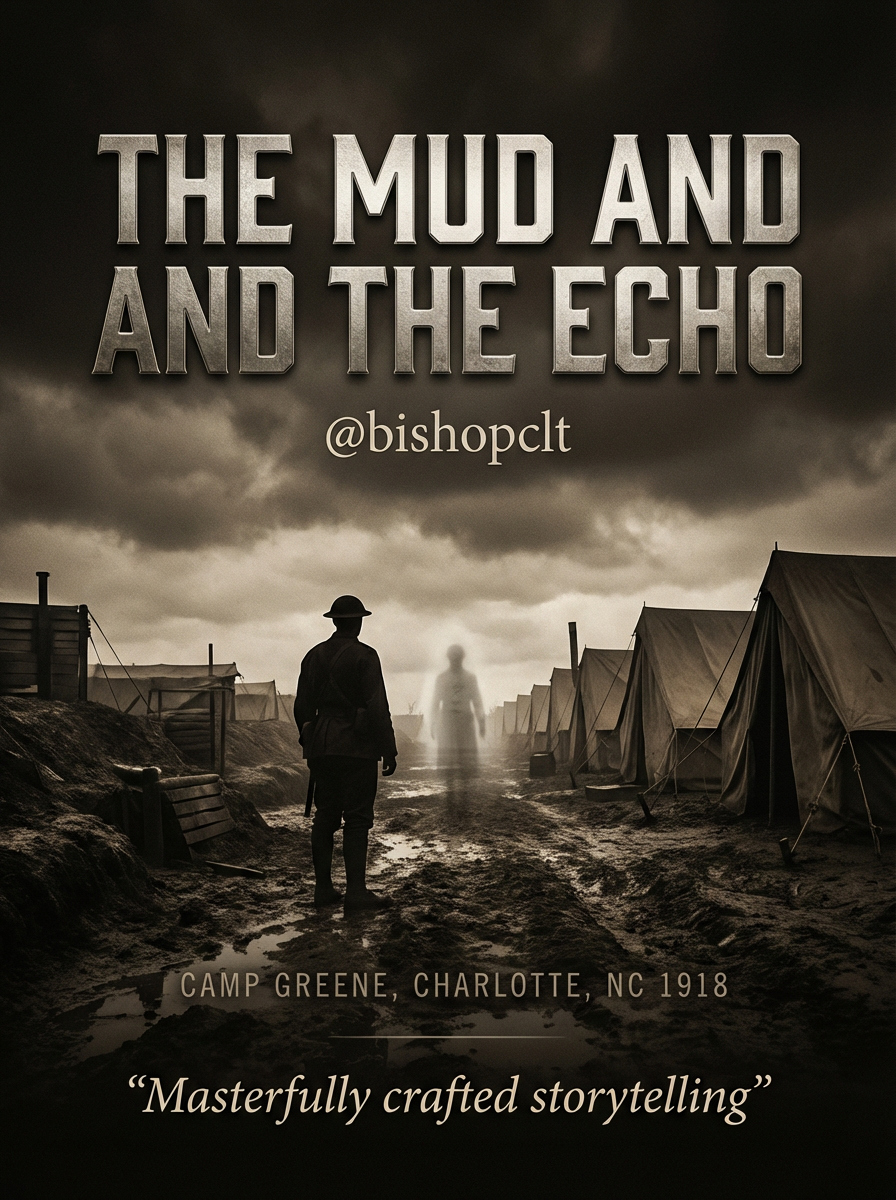
Synopsis
In the fevered summer of 1918, Private Arthur Pendelton, a greenhorn infantryman stationed at Camp Greene, Charlotte, NC, grapples with the suffocating reality of military life, the constant threat of deployment, and the insidious psychological toll of war's shadow, even far from the trenches. This
Chapter 1: The Bell's Toll and The Grey Dawn
The bell didn't merely ring; it tore a ragged hole in the humid predawn air, a metallic shriek that burrowed into the skull before Arthur Pendelton's eyes had even registered the grey smear of light clinging to the barracks windows. It was reveille, a sound he'd come to associate with the ripping of fabric, the final severance of sleep from consciousness. He jolted upright on his straw mattress, the stale scent of sweat and mildew-soaked wool instantly assaulting his nostrils. His heart, a frantic hummingbird trapped in his ribs, beat a staccato rhythm against a fresh wave of cold sweat.
The nightmare, a tenacious beast, still clung to the fringes of his mind. Not the one where shells screamed overhead, nor the faceless enemy with bayonets glinting. No, this was the insidious kind, the psychological rot that burrowed deeper. It was always the same: a vast, churning ocean of mud, swallowing everything – men, horses, hope – and him, Arthur, sinking slowly, inexorably, the mud slicking his throat, gagging him, until the bell, that brutal salvation, dragged him back to the slightly less suffocating reality of Camp Greene.
A groan rippled through the barrack, a collective lament from a hundred souls unwillingly snatched from oblivion. Wooden bunks, crudely hammered together, groaned in protest as men, shadowy hulks in the gloom, began to stir. The air was thick, heavy with the expelled breath of sleeping bodies and the pervasive tang of cheap tobacco. Arthur blinked, trying to scrub the last vestiges of the dream from his vision, but the pervasive sense of dread, the cold, slimy tendril of it, had already wrapped itself around his gut, a constant companion since he'd arrived in this purgatory.
He was a greenhorn, barely two months into this mockery of soldiering, and still the rough edges of civilian life clung to him like burrs. He hadn't yet achieved the blunted sensibilities of the veterans, the hardened indifference that allowed them to wake, dress, and face another day without the existential weight of it all pressing down. His eyes, naturally observant, were now perpetually tired, shadowed hollows that seemed to hold a sadness far older than his twenty years. His frame, slightly built, felt perpetually inadequate.
A boot crashed onto the floorboards beside his bunk, the sound sharp and uncompromising. “Pendelton! Yer not sleeping in till noon, are ya, boy?”
It was Sergeant George Blackwood, a burly menace with a voice like gravel scraping over stone. Even in the dim light, the sergeant’s bulk was formidable, a walking, breathing embodiment of authority. His weathered face was a roadmap of unpleasant experiences, and his piercing gaze seemed capable of flaying a man alive. Blackwood believed in breaking men down, in grinding away individuality until only the uniform shell remained, ready for the grinder of war. He moved with a practiced, brutal efficiency, his presence alone enough to accelerate the waking process of even the most stubborn recruit.
Arthur fumbled with the coarse wool blanket, pushing it aside. “No, Sergeant. Up, Sergeant.” His voice was a reedy whisper, still thick with sleep and the residual terror of the dream.
“Speak up, Pendelton! I ain’t no mind reader. You got lead in yer britches, or what?” Blackwood’s tone was a low growl, enough to make the hairs on Arthur’s neck prickle.
He swung his legs over the side of the bunk, feeling the raw wood against his bare calves. The floorboards were cold, unforgiving. “No, Sergeant!” he managed, forcing more volume into his voice.
Around him, the barrack hummed with suppressed activity. The clang of metal footlockers, the muted scrape of boots, the low murmurs of men who knew better than to provoke Blackwood’s ire. The air, already oppressive, was beginning to thicken with the smell of unwashed bodies and the acrid tang of urine from the latrines, a pervasive reminder of the cramped, uncomfortable intimacy of military life. There was no privacy here, no personal space, only a constant, crushing proximity to a hundred other men, all grappling with their own demons, or at least, their own bodily functions.
Arthur snatched his uniform from the foot of his bunk. The coarse khaki felt like sandpaper against his skin. Every movement was a struggle, his muscles stiff, his mind sluggish. The monotonous routine was already etched into his bones, a dull ache that never completely subsided. Shirt, trousers, puttees wrapped tight around his calves, boots. Each item a step closer to relinquishing himself to the grinding machinery of the day.
Corporal Frank Jenkins, on the bunk opposite, was already dressed, his movements economical, silent. Jenkins was a lean, almost gaunt man, with a perpetually somber expression that rarely lifted. He was a veteran, rumored to have seen action on the border with Mexico, and his eyes, though often downcast, held a quiet, distant understanding that Arthur found both terrifying and oddly comforting. Jenkins rarely spoke, but when he did, his words were carefully chosen, imbued with a gravitas that hinted at unseen burdens. He was a survivor, a man marked by experience, and Arthur, in his confused vulnerability, secretly looked to him as a quiet mentor, a benchmark for how to simply exist in this place.
Jenkins glanced at Arthur, his dark eyes meeting Arthur’s for a fleeting second. There was no pity there, but rather a shared weariness, a recognition of the same suffocating reality. He nodded almost imperceptibly, a silent acknowledgment of the struggle, and then turned his attention to lacing his boots with meticulous precision.
Blackwood, having completed his circuit of the barracks, his presence a dark storm cloud, turned for the doorway. “Five minutes, you slugs! Chow! Anyone late, anyone not squared away, can explain to me why they’re wasting His Majesty’s time. And believe me, you don’t want to see my face before breakfast.”
The threat hung in the air, cold and sharp. The scramble intensified. Footlockers slammed shut. Half-eaten letters from home were shoved under mattresses. The immediate, almost animalistic instinct for survival, for avoiding the ire of Sergeant Blackwood, governed every frantic movement. It was a simpler, more primal battle than the one across the ocean, but no less real.
Thomas Thompson, a fidgety, gaunt recruit two bunks down from Arthur, let out a nervous whimper as he dropped his button stick. The metal clattered loudly on the wooden floor, a jarring note in the orchestrated chaos. His hands, perpetually trembling, fumbled to retrieve it. Thompson was a constant, stark reminder of the psychological fragility that seemed to permeate this place, a living testament to the fact that the war's shadow, even without proximity to the trenches, was already casting a long, insidious pall. Arthur watched him, a knot tightening in his own stomach. Thompson's anxiety was contagious, a current that flowed through the already tense atmosphere of the barrack.
Arthur, though quicker than Thompson, still felt clumsy. His puttees kept slipping, requiring him to re-wrap them, his fingers thick and uncooperative. The thought of breakfast, a tasteless slop of oatmeal and hardtack, held no appeal. His stomach was a tight ball of apprehension. The dread of the dream still clung to him, a foul tasting residue in his mouth. He imagined the mud, that ever-present antagonist, slowly rising, inexorably, claiming another victim.
He finally stood, his uniform rumpled, but passable. He ran a hand through his stiff, sandy hair. His eyes swept across the barrack, taking in the scene: the hastily made bunks, the worn wooden floor, the sparse, functional nature of everything. It was a space designed for utility, not comfort, a temporary holding pen for men being prepared for slaughter. The sheer anonymity of it all, the erasure of individual identity, was a terror in itself.
A thin, grey light now filtered through the windows, painting the edges of the room in stark relief. It wasn't the welcoming, hopeful dawn, but a bleak, monochromatic light, devoid of warmth or promise. It was a dawn that seemed to begrudgingly acknowledge the existence of a new day, but offered no solace. The Bell had tolled, and the grey dawn had arrived, pulling Arthur Pendelton, and every other man in that barrack, into another cycle of their temporary, uncertain existence. The real war, the one with bullets and blood, lay waiting over the horizon, but the shadows of it, the grinding machinery of preparation, were already at work, relentlessly shaping them, day by day, into something that might survive it, or break beneath its weight. And Arthur, with his tired eyes and heavy heart, was increasingly aware that the battle within, the one against the encroaching darkness of his own mind, might prove to be the most formidable enemy of all.
Chapter 2: Breakfast and the Whispers of Flu
The clang of the reveille bell still echoed in Arthur Pendelton's ears, a phantom vibration against his eardrums, even as the barracks emptied into the pre-dawn chill. The air, thick with the damp heat of a Charlotte summer, clung to his uniform like a shroud. He felt a familiar hollowness in his gut that transcended mere hunger, a cold knot of dread that had taken up permanent residence since his arrival at Camp Greene. He was new to this, new to the rigid conformity, the constant roar of a thousand men, the ever-present threat of a war that felt distant yet intimately, terrifyingly close.
He shuffled along with the flow of humanity, a river of olive drab snaking its way towards the mess hall. Each bootfall on the hard-packed earth was a jarring reminder of his temporary reality, a reality far removed from the quiet, tree-lined streets of his hometown. The barracks, a long, low-slung building, had been a crucible of sorts, forging a reluctant camaraderie among men who, only weeks prior, had been strangers. Now, they were bound by the shared ordeal of military life, an invisible chain that chafed as much as it connected.
The mess hall, when they finally spilled into it, was a sensory assault. The air hung heavy with the acrid scent of burnt coffee and the cloying sweetness of watery grits. It was a smell that, once inhaled, seemed to lodge itself in the very fabric of his uniform, a constant reminder of the bland sustenance that propelled their bodies through the rigorous days. The vast, echoing space was a cacophony of metal on metal – tin plates scraping against rough wooden tables, the clatter of forks, the scraping of chairs. It was a discordant symphony, each note a percussive blow to Arthur’s already frayed nerves.
He found a spot at a long table, wedged between two larger men, their elbows jostling his as they reached for their portions. The food, slapped onto his plate by a grim-faced cook, was a greasy simulacrum of nourishment. The coffee, thin and lukewarm, tasted of rust and regret. He picked at his grits, the lumpy white mass a testament to the kitchen's indifference. Conversation, or rather, the boisterous shouts and barked jokes, washed over him, a tide of sound he struggled to decipher. It was a language of gallows humor, born of shared hardship and the relentless march towards an uncertain future.
Across the table, Corporal Frank Jenkins, his gaunt face reflecting the dim yellow light of the overhead lamps, ate with the unhurried efficiency of a man who had long ago ceased to derive pleasure from food. Jenkins was a veteran of two years service, a quiet presence whose eyes held a depth of sorrow that Arthur sometimes caught himself staring at. Arthur had learned quickly to value Jenkins's economy of words, his silent observations often more potent than any shouted command. Today, his brow was furrowed, a faint line of worry etched between his eyes, a worry that Arthur knew wasn’t solely about the quality of the breakfast.
Whispers, like tendrils of smoke, began to weave through the boisterous din. At first, they were indistinct, lost in the clatter and the shouts. Then, as if a collective ear had tuned itself, they began to coalesce, to gain a shape. Arthur heard phrases, fragmented and unsettling – “Spanish Lady,” “bad cough,” “going fast.” His stomach, already queasy, tightened further.
“You hear that, Pendelton?” The voice belonged to Thomas Thompson, a new recruit like Arthur, seated beside him. Thompson was gaunt, with a nervous tic that caused his eye to twitch uncontrollably. His hands, perpetually fidgeting, drummed a restless rhythm on the table. “They’re saying it’s the flu. The Spanish Flu.” Thompson’s voice was barely a whisper, his tone laced with a tremor of pure panic.
Arthur merely nodded, unable to articulate the cold dread that was creeping up his spine. He had read about it in the papers, snippets of alarming reports from distant lands, a new plague sweeping across Europe. But Europe felt a world away, a dark and bloody tapestry where other men fought and died. Now, the “Spanish Lady,” as some fearfully called it, had crossed the ocean, invisible and insidious, and had found its way into the beating heart of Camp Greene.
A gust of laughter, coarse and loud, erupted from a group of men a few tables over. “Flu, hell! It’s just a bad head cold. Always somethin’ new to scare us with, ain’t there?” The speaker, a beefy man with a booming laugh, slapped his knee. His comrades, feigning bravado, joined in the hearty guffaws, but Arthur noticed the subtle tensing in their shoulders, the quick, darting glances at each other. Even false courage had a brittle edge.
Corporal Jenkins, without looking up from his plate, cleared his throat softly. “The Spanish Lady ain’t no head cold, boys,” he murmured, his voice low, almost drowned out by the surrounding noise. “Saw it startin’ in France, before I shipped back. Takes men quick, it does. Faster than a sniper sometimes.”
It was the first time Arthur had heard Jenkins speak about his experience in France, and the casual, almost flat delivery of such chilling information sent a shiver through him. Jenkins’s words cut through the facile bravado like a surgeon’s scalpel, exposing the raw fear beneath. Thompson, beside Arthur, whimpered faintly, his twitching eye now working overtime.
“They say it starts with a fever,” Thompson stammered, his voice barely audible. “And then… then your lungs fill up. Drown in your own fluids.” He looked at Arthur, his eyes wide and terrified, a mirror to Arthur’s own unspoken anxieties.
Arthur swallowed, the lukewarm coffee suddenly tasting like ash. He glanced around the mess hall, seeing now, through a new lens, the subtle shifts in behavior. A man across the aisle coughed, a dry, hacking sound, and several heads turned, a flicker of apprehension in their eyes. Another man wiped his nose with the back of his hand, and his neighbor subtly leaned away. The invisible threat had taken root, poisoning the air, transforming casual interactions into potential vectors of disease.
Sergeant George Blackwood, a formidable presence even when not barking orders, strode through the mess hall, his boots thudding against the wooden floorboards. He was a mountain of a man, his weathered face set in a perpetual scowl, his voice a gravelly roar that could cut through any din. He was a man who believed in discipline, in breaking men down to build them up into the fighting machines the army demanded. Yet, even Blackwood, as he surveyed the men, seemed to carry a new tension in his shoulders, a slight tightness around his eyes that Arthur had not noticed before. His usual bluster was absent, replaced by a grim resolve. Blackwood paused at a table nearby, his gaze sweeping over the men. “Alright, you lot! Finish up! Got training exercises all morning. No malingering!” His voice, though still powerful, lacked its usual zealous fury. There was an undercurrent of something else, a subdued quality that bespoke a deeper, unacknowledged concern.
Arthur watched Corporal Jenkins. The veteran’s face, usually a mask of controlled weariness, seemed to have taken on an even deeper pallor. Jenkins’s eyes, usually fixed on some internal landscape of battlefields past, now darted subtly around the mess hall, observing, assessing. He saw the concern on the faces of the cooks, the subdued movements of the orderlies. Jenkins, Arthur realized, was seeing the cracks in the army’s formidable facade, the vulnerability that even their rigorous training and iron discipline couldn’t fortify them against.
The war in Europe was a monstrous, hungry entity that devoured men whole, but at least, Arthur thought, it was a tangible enemy. You could see the trenches, hear the artillery, feel the concussion of explosions. The Spanish Flu, however, was an enemy without form, without a front line. It was an invisible whisper, a microscopic assassin, stealing breath without a sound.
He pushed his plate away, the unappetizing remnants of his breakfast staring back at him. The thought of ingesting another spoonful of the tasteless grits made his already uneasy stomach revolt. The knowledge, however vague, of this new threat, layered itself onto the existing anxieties: the fear of deployment, the constant physical exertion, the suffocating lack of privacy, the ever-present shadow of death that hung over every aspect of military life. Before, death had been an abstract concept, something that happened "over there." Now, it felt like a silent passenger, exhaling its cold breath onto their necks.
A familiar weariness, deeper than physical exhaustion, settled over Arthur. It was the weariness of the human spirit, constantly braced for the next blow, the next indignity, the next existential threat. He longed for the simple quiet of his own bed, the scent of his mother’s cooking, the mundane comfort of an ordinary day. But those days were gone, perhaps irrevocably. He was in Camp Greene now, a cog in a vast, impersonal machine, and the machine was rumbling, not just towards the battlefields of Europe, but towards an unseen, internal conflict, a war fought not with bullets and bayonets, but with coughs and fever.
He watched Jenkins again. The corporal caught his eye for a fleeting moment, and in that brief exchange, Arthur saw a world of unspoken understanding. It was a look that said, *We are all in this now. All of us.* Jenkins’s silent anxieties, far from being a weakness, were a testament to his clear-eyed assessment of their grim reality. He wasn't afraid of the *idea* of the flu; he was afraid of its *reality*, of its potential to decimate them before they even reached a battlefield.
The mess hall slowly began to clear, the clatter of plates diminishing as men finished their meager meals and prepared for the day’s drills. The hum of conversation softened, replaced by the shuffling of feet and the low murmur of voices. Arthur stood, the cold knot in his stomach still present, a grim companion for the day ahead. The Spanish Flu, a silent, invisible enemy, had officially joined their ranks, adding another layer of unseen terror to their already precarious existence. The war, it seemed, wasn't just in France anymore. It was here, in the crowded mess hall, in the stifling air, in the hushed whispers that spoke of fever and sudden death. It was a new kind of battle, and Arthur, a greenhorn recruit grappling with the suffocating reality of military life, felt the oppressive weight of it all settle upon his already burdened shoulders. The mundane, he realized with a chilling certainty, had truly become menacing.