The Looming Shadow
By @potato123
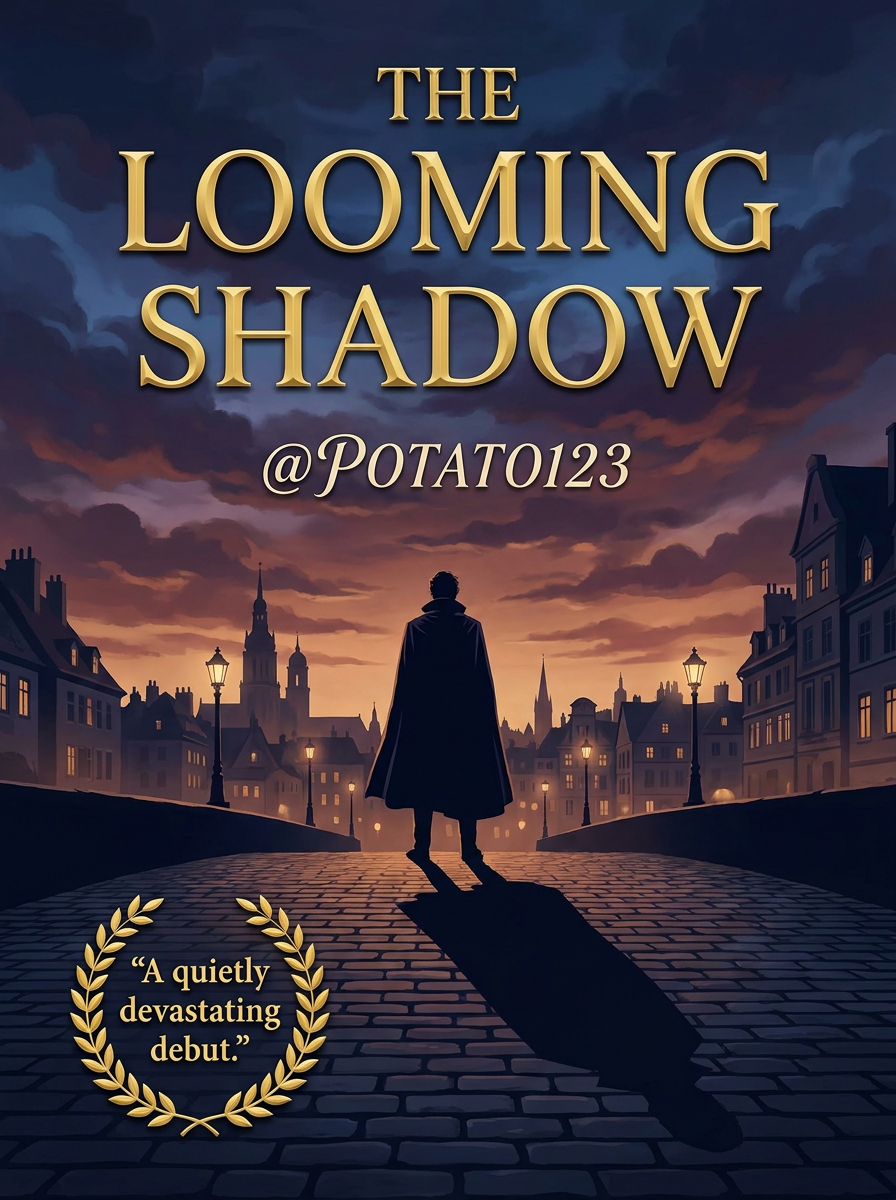
Synopsis
In a world teetering on the brink of ecological collapse, a disillusioned ex-scientist uncovers a conspiracy to accelerate humanity's demise, forcing him to choose between a comfortable silence and a perilous quest for truth, echoing the ancient struggles between fleeting hope and overwhelming despa
Chapter 1: The Dustbowl Dirge
The wind, a ceaseless lament, scoured the skeletal remains of what was once a city. It was not the crisp, cleansing breeze of the mountains, nor the invigorating gales of the sea; this was the wind of the dustbowl, a dry, rasping breath that carried the fine grit of forgotten life. It whistled through broken panes of glass, moaned down the corridors of gutted skyscrapers, and whispered of a past that seemed as mythical as dragons. In this decaying husk, amidst the ochre-tinted twilight that perpetually hung over the land, lived Dr. Elias Thorne.
His dwelling was a skeletal tenement, the higher floors having long since collapsed into a ruinous cascade of concrete and twisted rebar. Elias occupied a ground-floor apartment, its windows shuttered with scavenged metal and tattered canvas against the incessant dust. Within, an everlasting twilight reigned, illuminated only by the faint glow of a repurposed solar lamp and the sporadic flicker of a rewired data slate. The air, despite his efforts, remained thick with the ubiquitous motes, clinging to everything like a shroud. Elias, gaunt and stooped, often coughed, a dry, hacking sound that seemed to echo the very sickness of the world beyond his walls. His eyes, once bright with the fervor of scientific discovery, were now sunken pools of weariness, perpetually shadowed by the weight of a monumental guilt. He wore a worn, dusty coat, its once-respectable fabric now threadbare and stained, a testament to his prolonged hermitage.
Each day was a carefully orchestrated ritual of survival and penance. He subsisted on nutrient paste and recycled water, the meager supplies a constant reminder of the world’s scarcity. His days were spent poring over ancient texts and his own faded research notes, seeking a truth that perpetually eluded him. He was a bio-engineer, or had been, in another life – a life before the dust. His work, intended to bolster crop resilience, had instead become a catalyst for the great blight, a terrifying irony that gnawed at his soul with ceaseless, relentless teeth. He had sought to mend, and instead had broken the very fabric of existence.
But more than the omnipresent dust or the gnawing guilt, it was Elara who truly haunted him. Her image, ethereal as spun moonlight, flitted at the periphery of his vision, a spectral child dancing in the ruins of his memory. She was his daughter, a vibrant splash of color in a world that was slowly draining into shades of grey. He saw her most clearly in the quiet moments, when the wind’s dirge outside reached a particular pitch, or when a shard of light pierced the gloom, catching the dust motes in a fleeting, golden dance.
*“Look, Papa! A sunbeam!”*
Her voice, a bell-like chime, would echo in his mind, bringing with it the sharp pang of grief. He would see her, a wisp of a child, no older than five, chasing a solitary shaft of light across the plush carpet of their former home. Her curls, the color of desert sand at sunset, bounced as she laughed, her small hand reaching out as if to grasp the fleeting luminescence. Her eyes, wide and curious, were pools of boundless innocence. She had loved the sun, had loved to run in the fields and pluck the wildflowers, a life utterly alien to the arid, sterile existence that now prevailed.
He remembered her last days with a vivid, agonizing clarity. The cough that began subtly, then deepened, mirroring the world’s own decline. The growing weakness, the fading spark in her once-bright eyes. He had been a bio-engineer of renown, yet he had been powerless to save his own child from the very plague his research had inadvertently sown. Elara had wasted away, consumed by the creeping desertification that stole the breath from the land and, eventually, from her tiny lungs. Her memory was a dirge, a sorrowful melody that played on a loop within the hollow chambers of his heart. Every rustle of dry leaves, every mournful sigh of the wind, was her lament.
One evening, as the perpetual twilight deepened into a deeper grey, Elias was hunched over his data slate, its dim light casting long, dancing shadows across the cracked walls. He was deciphering an old research paper, a theoretical model for atmospheric terraforming – an impossible dream in this blighted age. Suddenly, the slate blinked, a series of urgent, coded signals flashing across its worn screen. This was not the usual static or phantom transmissions from ancient broadcast towers. This was a direct, targeted communication, routed through a sequence of long-dormant relays. His heart, long accustomed to a dull, aching rhythm, gave a sudden, jarring lurch.
Only one person still used that antiquated cipher.
Dr. Aris Thorne.
They had been colleagues, not kinsmen, though their shared last name had often led to jests in university halls. Aris, brilliant and fiercely principled, had been Elias's closest confidant during their shared pursuit of scientific advancement. While Elias had delved into genetic modification for crop enhancement, Aris had focused on sustainable energy and ecological restoration. He had always been the optimist, the one who truly believed in turning the tide, even as the waters receded.
The message was terse, fragmented, riddled with the digital equivalent of static. Elias’s skilled fingers flew across the slate's keyboard, decrypting the scrambling, painstakingly piecing together the broken sentences.
*“Elias… are you there? Can you hear me? Code Red… the Project… it’s real. Not mitigation… acceleration. They’re… they’re making it worse. The Consortium… Vance… I have proof. Meet me… old observatory… southwest sector… sundown… two cycles from now. Don’t tell anyone. Trust no one… they know… they’re everywhere. Be careful, my friend. For Elara… for all of us…”*
The message ended abruptly, replaced by a blast of white noise. Elias stared at the glowing text, his gaunt face pale in the slate’s artificial light. The words echoed in the barren chamber of his mind, rattling the dust from the shelves of his self-imposed sanctuary. *Acceleration. Making it worse.* The implications were a cold, horrifying grip around his throat. Not mitigation, but purposeful destruction. He had always assumed the ecological decay was a tragic accident, a monstrous miscalculation, a slow, inevitable march toward oblivion. But this… this implicated design, intent.
*For Elara.*
That phrase, more than any other, struck him with the force of a physical blow. The specter of his daughter, her playful laugh, her fading breath, galvanized something dormant within him. He had retreated, sought solace in his guilt and seclusion. But Aris, his dear friend, was calling upon him, reminding him of a duty that transcended personal grief.
He closed his eyes, and when he opened them again, a flicker of something long-dormant ignited in their tired depths. It was a dying ember, perhaps, but still a spark. The image of Elara, no longer fading, but sharp and brilliant, stood before his mind’s eye. She was reaching out, not for a sunbeam, but for his hand.
The old observatory. It was a perilous journey, through sectors of the city long abandoned even by the most desperate scavengers. The southwest sector was notorious for its structural instability and the dangerous, nomadic groups that occasionally roamed its forgotten highways. But Aris’s words, "Trust no one," held a potent resonance.
A profound weariness, heavier than the dust that clung to his very soul, settled over Elias. He had spent years believing his purpose was to atone in solitude, for his past sins, for his daughter’s death. He had carved out a miserable, quiet existence, content to watch the world end from his self-made tomb. But Aris’s message, a desperate plea from the edge of oblivion, shattered that fragile peace.
Could it be true? Could there be minds so twisted, so utterly devoid of humanity, as to actively hasten the planet’s demise? And for what purpose? A chilling dread began to coil in his gut, a cold counterpart to the nascent spark of resolve. The world already suffered under the dustbowl dirge; to actively amplify it was an act of unfathomable cruelty.
He rose stiffly, the joints of his knees creaking in protest. His hand, thin and bony, traced the etched characters on the slate one last time. *For Elara.* He looked around his dismal apartment, at the stacks of forgotten research papers, the empty nutrient paste containers, the omnipresent film of dust. This had been his sanctuary, his prison. Now, it felt suffocating.
Reaching for a tattered satchel, he began to gather the few things he would need: a small, rewired flashlight, a handful of nutrient bars, a dusty map of the forgotten city, and a compass, its needle a mute testimony to the magnetic north that still held sway amidst the ecological chaos. His fingers brushed against a small, smooth river stone on his makeshift table. It was a relic from a time before, before the sandstorms, before the blight, when rivers still flowed freely. Elara had found it on a picnic. He picked it up, its coolness a strange comfort against his palm.
He didn't know what he would find at the old observatory. He didn't know if Aris would even be there, or if the message was a trap. He knew only this: the silence of his self-imposed exile, the comfortable numbness of his guilt, had been irrevocably shattered. The dustbowl dirge had found a new, more sinister harmony. He had a choice: to sink back into the comforting despair that had become his constant companion, or to step into the encroaching shadow, follow the faint call of a desperate friend, and confront a truth far more terrible than any he had imagined. A chilling wind, heavier with dust than usual, rattled the patched window, a mournful augur of the journey ahead. Elias Thorne, the ghost of a scientist, was about to walk into the dust.
Chapter 2: Whispers from the Waste
The dust, a constant companion in Elias’s existence, swirled lazily into the dim confines of his workshop-dwelling, each moteling particle a miniature ghost dancing in the meager light. Years had etched lines of weariness deeper into his gaunt face, and the perpetual ache in his joints mirrored the weariness in his soul. He sat hunched over a flickering, ancient data-slate, its screen casting an unhealthy pallor upon the intricate circuit board he meticulously toiled upon. The work was rote, a ritual born of necessity and the desperate need to keep his hands occupied, to stave off the gnawing silence that invariably ushered in Elara’s spectral presence.
Then, a flicker, not of the worn data-slate, but of the comm-unit tucked away beneath a pile of salvaged wiring. It was a relic, a piece of pre-Collapse technology he’d painstakingly restored, its range limited, its signal often swallowed by the static-choked æther. For years, it had remained largely silent, a testament to the shattered world outside, a world where communication was a luxury afforded only to the powerful, or the insane.
His fingers, surprisingly nimble despite their tremor, reached for it, a sudden premonition tightening his chest. The screen, once a dull charcoal, sparked to life, displaying a single, encoded message – an alphanumeric sequence he recognized with a sickening jolt. Aris.
His former colleague. A name he hadn't uttered, nor scarcely thought of, in what felt like a lifetime. Aris Thorne – no relation, save for the shared crucible of knowledge and the fleeting hope they had once harbored for a better future. A future that had long since crumbled into the dust.
Elias’s breath hitched. He decoded the message, his fingers fumbling with a practiced haste. It was a voice-message, heavily encrypted, barely audible above the hiss of static. The familiar timbre of Aris’s voice, once brimming with an infectious enthusiasm, was now raspy, laced with an urgency that sent a chill down Elias’s spine, a chill colder than any desert night.
“Elias… are you there? Can you hear me?” The voice crackled, distorted, as if speaking from a great distance, from the precipice of an abyss. “It’s Aris. I… I’ve made a terrible mistake. We all have.”
A wave of nausea washed over Elias. He remembered those mistakes, the countless hours spent in sterile labs, the relentless pursuit of progress, the blind faith in the sanctity of science, utterly oblivious to the insidious seeds of destruction they were sowing. He remembered the eager debates with Aris, the feverish excitement over breakthroughs, the shared conviction that their work would heal, not harm.
“It’s worse than we imagined, Elias,” Aris continued, his voice strained, a raw edge of desperation cutting through the static. “Much worse. The Collapse… it wasn’t just a consequence. It was… accelerated. Deliberate.”
Elias felt a cold dread constricting his heart. Accelerated? Deliberate? The words hung in the air, heavy with unspoken horrors. He had always believed the collapse was a catastrophic, if unintended, outcome of human hubris, an ecological reckoning. The notion of a malicious hand guiding the destruction, amplifying the suffering, was a new, terrifying prospect.
“The Obsidian Project,” Aris whispered, the name a dark secret spoken into the void. “It lives. It thrives. And its purpose… its true purpose, Elias, is not salvation. It’s… annihilation. A final, irreversible culling.”
The Obsidian Project. The name was vaguely familiar, a whispered rumor from the fringes of forgotten scientific conferences, dismissed as fringe paranoia, a conspiracy theory too outlandish to be true. Elias had been too consumed by his own research, too blinded by the promise of the next grant, the next publication, to truly consider its implications.
“They’re using our work, Elias. Our bio-engineering… your algorithms, my gene-splicing sequences. They’ve twisted it, corrupted it. To purify… to cleanse. To eradicate what they deem ‘unfit’.” The words were punctuated by a wet, hacking cough, a sound of profound distress. “You have to stop them. You’re the only one who can… truly understand the data.”
Elias leaned closer to the comm-unit, his eyes wide, fixed on the dim screen, as if he could glean a clearer image of Aris’s anguish from the pixelated glow. He felt a familiar surge of anger, a hot, bitter resentment that had lain dormant for years, now stirred to life. How could they? How could anyone twist their research, born of a desire to heal and nurture, into a weapon of such devastating intent?
“There’s a facility,” Aris continued, his voice weakening, fading in and out amidst the static. “Old Sector Gamma. Sub-level nine. A forgotten lab. My personal archives. It holds the key… the true schematics. The counter-algorithms.” A gasp, ragged and desperate. “They’ll be looking for me. I… I can’t tell you more. Find the data, Elias. For all our sakes… for Elara’s memory.”
The words struck Elias with the force of a physical blow. Elara’s memory. The phantom limb of his grief throbbed with renewed intensity. Her innocent face, her bright, inquisitive eyes – a poignant reminder of all that had been lost, all that was still at stake. A familiar guilt, heavy and cloying, settled upon him. He had sought refuge in his solitude, in the desolate landscape of his self-imposed exile, believing his penance was to simply exist in the ruins of his past. But Aris’s plea, imbued with the desperate weight of a dying man’s final words, shattered that illusion.
“The Consortium… they’re everywhere. Trust no one… except perhaps… the whispers. The whispers from the waste.” Aris’s voice was barely a breath now, a fading echo. “They know… what’s hidden. The others… they’re gone. I don’t have much time. Promise me, Elias. Promise you’ll try. For Elara.”
Then, silence. Utter, agonizing silence, broken only by the incessant hiss of the comm-unit’s static. Elias remained frozen, his mind a tempest of colliding thoughts and emotions. The Obsidian Project. Annihilation. The Consortium. Aris’s fading voice, choked with despair. And Elara. Always Elara.
He finally moved, his gaunt frame trembling as he reached for the comm-unit, pressing the replay button with a desperate hope that more would emerge, some further instruction, some clearer path. But it was just the same fragmented message, each repetition chiseling deeper into his resolve.
The forgotten lab. His personal archives. Old Sector Gamma. The words repeated themselves in his mind, a nascent map taking shape in his fractured memory. He knew the general location, a sprawling, forgotten quadrant of what was once the city’s industrial heart. A maze of crumbling structures, derelict factories, and subterranean installations, long since abandoned to the dust and shadow. A place where only the most desperate scavengers dared to tread.
But Aris’s final plea, the invocation of Elara’s name, resonated deeper than any fear. It was a challenge, a summons from the depths of his own buried conscience. He had fled from responsibility, retreated into the desolate landscape of his guilt. But now, the ghosts of his past demanded action.
He rose slowly from his stool, his joints protesting with a chorus of aches and creaks. His eyes, once dulled by resignation, now held a glint of something new, something dangerously akin to purpose. The thought of venturing back into the heart of the ravaged city, into the very maw of the beast that had swallowed his world, filled him with a profound trepidation. But the alternative – a comfortable silence, a continuation of his gilded cage of grief – now seemed unbearable.
He moved through his workshop, his gaze sweeping over the tools of his trade, the salvaged components, the half-finished projects that had once occupied his days. He selected a worn leather satchel, reinforcing its frayed straps with a length of braided wire. Into it, he carefully placed his diagnostic tools, a multi-meter, a soldering iron, a handful of data-chips, and a rudimentary first-aid kit. He picked up his dusty, threadbare coat, shrugging it onto his gaunt shoulders. It offered little protection from the elements, but it was familiar, a small comfort in a world devoid of such.
As he prepared, a vision of Elara flickered at the periphery of his consciousness – her laughter, like wind chimes in a forgotten garden, her small hand reaching for his, her eyes, wide and curious, gazing at a world that had not yet crumbled. The vision, though painful, fueled a new resolve within him. He had failed her once, stood by and watched as the world withered around them. He would not fail her memory again.
He stepped out of his workshop-dwelling, the setting sun painting the dust-choked horizon in hues of bruised purple and angry orange. The air was thick with the omnipresent grit, tasting of decay and sorrow. The ruins of the city stretched before him, a sprawling mausoleum of civilization, its crumbling edifices reaching skeletal fingers towards the heavens. There was no true night here, only a perpetual twilight, illuminated by the distant glow of corporate towers in the unseen, untouched sectors – the domains of those who thrived amidst the desolation, the architects of this slow, agonizing death.
A cold wind, carrying the mournful whispers of the waste, carried the dust across the broken landscape. It tugged at his coat, a silent invitation to linger, to remain hidden in the comforting shroud of his solitude. But Elias pushed forward, his footsteps echoing softly on the desiccated earth. The comm-unit, now silent, pulsed faintly in his pocket, a tangible reminder of Aris’s desperate plea.
He was no hero. He was a broken man, haunted by ghosts and burdened by guilt. But Aris’s words had stirred something deep within him, a flicker of the scientist he once was, a spark of the father who had loved a child with all his heart. He did not know what awaited him in the forgotten lab of Sector Gamma. He did not know if he would even reach it alive. But the image of Elara, forever enshrined in the amber of his memory, whispered a single, undeniable truth: he had to try. He had to face the looming shadow, even if it meant sacrificing the last vestiges of his desolate peace. The whispers from the waste had called, and Elias Thorne, against all reason, against every instinct for self-preservation, had answered.
Chapter 3: The Reluctant Harbinger
The city, a titan of forgotten ambitions, loomed in the near distance, a fractured silhouette against the bruised sky. Its skeletal structures, once gleaming monuments to human ingenuity, now pierced the perpetual twilight like broken teeth. Elias, his breath a ragged whisper in the stale air, felt the familiar tremor of apprehension ripple through his gaunt frame. He had vowed never to return, to confine his penance to the solitary confines of his dust-choked hovel, but Aris’s plea, a desperate echo through the static of his conscience, had prised open the rusted gates of his resolve.
He adjusted the worn pack on his shoulders, its meager contents rattling with a hollow clatter. The compass, a relic from a time when magnetic north still held sway, swung wildly, its needle a frantic dervish. The sun, a pale, anemic disk, offered little warmth, casting long, distorted shadows that danced ahead of him like malevolent spirits. The wind, a constant, mournful dirge, carried the scent of decay and the grit of the ever-present dust, coating his tongue with a bitter film.
The path to the city was a treacherous tapestry of collapsed asphalt and debris-strewn craters. Twisted rebar, like the exposed sinews of a dying beast, snaked from the earth, threatening to trip the unwary. Elias, his gaze fixed on the crumbling horizon, navigated the treacherous terrain with a practiced caution, each step a deliberate act of survival. He was no stranger to hardship, but this journey, propelled by a morbid curiosity and a nascent sense of duty, felt different. It was a descent, not just into the ruined city, but into the very heart of the world’s despair.
As he drew nearer, the silence of the wasteland gave way to a symphony of desolation. The creak of shifting metal, the mournful groan of stressed concrete, the rustle of wind through shattered glass – each sound a lament for a bygone era. He passed the skeletal remains of what were once thriving suburban homes, their interiors exposed to the elements like gaping wounds. A child’s swing set, rusted and still, swayed gently in the breeze, a poignant reminder of lives abruptly truncated. He averted his gaze, the phantom image of Elara, her laughter echoing in the dust-filled air, a fresh wound in his heart.
The city proper was a labyrinth of shadows and forgotten pathways. The main thoroughfares, once bustling arteries of commerce, were now impassable rivers of rubble. He was forced to navigate the narrower alleys, their air thick with the stench of stagnant water and something else, something metallic and acrid. The towering edifices, their windows like vacant eyes, seemed to watch his progress, silent judges of his belated arrival.
Suddenly, a glint of movement caught his eye. A figure, cloaked in scavenged rags, emerged from the shadowed maw of a collapsed building. Elias froze, his hand instinctively reaching for the worn knife tucked into his belt. He was no fighter, but years of isolated survival had instilled in him a primal instinct for self-preservation.
The figure, tall and lean, moved with a fluid grace that belied the harshness of their surroundings. As they drew closer, Elias could discern the sharpness of their features, etched with a quiet defiance. A shock of dark hair, streaked with dust, framed a face that was both hardened and oddly vulnerable. Their eyes, the color of storm clouds, met his with an unsettling intensity.
"Lost?" the figure’s voice was a low rasp, like pebbles grinding against rock. It was a woman, Elias realized, her voice devoid of any discernible inflection.
Elias, still wary, slowly lowered his hand. "Searching," he replied, his voice a little hoarse.
The woman’s gaze swept over him, assessing his tattered clothing, his gaunt frame, the desperate hope clinging to his eyes. "Searching for what, in this graveyard?" she asked, a hint of something akin to pity in her tone.
"Information," Elias said, then hesitated. He hadn't anticipated encountering anyone, let alone someone who radiated such an aura of self-sufficiency. "A specific location. A research facility."
The woman’s brow furrowed slightly. "The old bio-labs? West sector?"
Elias’s eyes widened slightly. "You know of it?"
She gave a curt nod. "I know these streets better than the rats know their tunnels. Been scavenging these ruins since the wind started blowing dust instead of rain." She paused, her gaze lingering on his face. "You don't look like a scavenger. Too clean. Too… hopeful." The last word was uttered with a hint of something Elias couldn’t quite decipher – disdain, perhaps, or a weary resignation.
"I’m not," Elias admitted. "I… I used to work there. A long time ago."
A flicker of recognition, or perhaps something colder, passed through her eyes. "One of the architects of this mess, then?" Her voice held a sharper edge now, a subtle accusation.
Elias flinched. The words, though quietly spoken, struck him with the force of a physical blow. He was. He was one of them. He had been complicit in the folly, a cog in the machine that had ground the world to dust. "I… I was. But I left. I tried to warn them." The words felt hollow, even to his own ears. A desperate, belated justification.
The woman regarded him for a long moment, her expression unreadable. "Warnings are like dust in the wind, old man. They settle, but they don't change anything." She turned, her attention shifting to a pile of twisted metal nearby, her hands, calloused and strong, already sifting through the debris.
Elias watched her, a strange mix of relief and unease churning within him. He had found a guide, albeit an unwilling one. But her words, her thinly veiled contempt, were a stark reminder of the world’s judgment, a judgment he knew he deserved.
"My name is Elias," he offered, feeling the need to break the silence.
She glanced over her shoulder, her hands still sifting. "Mara." No further pleasantries were offered.
"Mara," Elias began, feeling a surge of desperation, "I need to get to that lab. It’s urgent. There’s something there… something that could change things."
Mara scoffed, a dry, humorless sound. "Nothing changes, Elias. The dust keeps blowing, the sun keeps fading, and we keep dying. That’s the only constant."
"But this is different," Elias insisted, stepping closer. "A new threat. A project… 'The Obsidian Project.' It could finish what the dust started."
Mara stopped sifting, her head tilting slightly. A flicker of something – curiosity, perhaps, or a deep-seated weariness – crossed her features. "Obsidian, you say? Heard whispers of that. Bad whispers. The kind that make even the ghouls in the dark shiver."
Elias felt a faint spark of hope. "Then you understand. I need to get there. Can you… can you lead me? I can pay you." He reached into his pack, pulling out a small, tarnished silver locket, a family heirloom he had clung to for years.
Mara looked at the locket, then back at him, her storm-cloud eyes narrowed. "Silver is just metal, Elias. Doesn't buy water, doesn't buy food. Doesn't buy a tomorrow."
"What then?" Elias asked, his voice laced with desperation.
Mara straightened, her gaze sweeping over the ruined landscape. "The bio-labs are deep in the west sector. It's a dangerous path. Collapsed buildings, unstable ground, and… other things." She paused, her eyes meeting his with a chilling directness. "And the 'Enforcers.' They patrol that area. Remnants of the old regime, still clinging to their power. They don't take kindly to trespassers."
Elias swallowed hard. He had heard tales of the Enforcers, their ruthless efficiency, their unwavering loyalty to a system that no longer existed. They were another ghost of the past, a persistent shadow in a world already consumed by darkness.
Mara seemed to read his apprehension. "So, what's it worth to you, Elias? This 'truth' you seek?"
Elias looked at the locket in his hand, then at the vast, ruined city. He thought of Aris, his desperate plea. He thought of Elara, her innocent face superimposed on the desolate landscape. He thought of the world, teetering on the precipice of oblivion. "Everything," he said, his voice firm, unwavering. "It's worth everything."
Mara studied him for a long moment, a silent debate raging within her. Finally, she gave a slow, deliberate nod. "Alright, Elias. I'll take you. But my price isn't silver. My price is simple: you tell me what you find. Every last detail. If this 'Obsidian Project' is as bad as the whispers say, I want to know. I want to know what fresh hell they're brewing."
Elias felt a surge of relief, followed by a fresh wave of trepidation. He had made a bargain, a pact with a stranger in a ruined world. But he had no choice. "Agreed," he said, extending his hand.
Mara ignored his outstretched hand, turning instead towards the shadowed alleys. "Follow me," she commanded, her voice devoid of warmth, but with a hint of grudging acceptance. "And keep your eyes open. This city doesn't forgive carelessness."
The journey into the city’s depths was a brutal education. Elias, despite his years of isolation, had grown complacent in his desolation. Mara, however, was a living testament to the world’s harsh realities. She moved with an almost preternatural awareness, her senses attuned to the subtle shifts in the wind, the faint echoes of distant sounds, the precarious balance of crumbling structures.
They navigated through the skeletal remains of what were once bustling marketplaces, now silent testament to a forgotten vibrancy. Twisted metal signs, their vibrant colors faded to a uniform rust, still clung precariously to shattered storefronts. Here and there, Elias would catch a glimpse of something familiar, a ghost of a memory – a toy store, its windows now gaping holes; a cafe, its tables overturned and covered in dust. Each sight was a dagger to his conscience, a stark reminder of the world he had, in his own small way, helped to dismantle.
Mara, however, seemed impervious to the ghosts of the past. Her focus was entirely on the present, on the immediate dangers and the most efficient path. She pointed out precarious ledges, unstable debris piles, and areas where the air itself seemed to hum with a strange, unsettling energy. "That's a radiation pocket," she'd say, her voice flat. "Old power plant. Best to go around." Or, "Footprints. Fresh. Could be Enforcers, could be scavengers. Keep low."
Elias, despite his reluctance, found himself relying on her instincts. He was a scholar, a man of intellect, but in this world, intellect was a fragile shield against the raw brutality of survival. Mara, the scavenger, was the true expert, her knowledge forged in the crucible of constant struggle.
They encountered other scavengers, gaunt figures flitting through the shadows, their eyes wary and distrustful. Mara exchanged curt nods with some, a silent acknowledgment of shared hardship. Others, she avoided entirely, pulling Elias deeper into the labyrinthine alleys, her movements swift and silent. "Some are worse than the Enforcers," she muttered once, her voice low. "They'll cut your throat for a ration bar."
The stark reality of their existence pressed down on Elias, a suffocating weight. He had always known, intellectually, the extent of the world’s collapse. But to witness it firsthand, to smell the decay, to feel the grit of the dust on his skin, to see the desperation etched on every face – it was an experience that transcended mere knowledge. It was a visceral understanding, a cold, hard truth that pierced through the layers of his self-imposed isolation.
He remembered the sterile labs, the hum of machinery, the endless data streams, the fervent discussions about theoretical solutions. They had been so detached, so confident in their ability to manipulate nature, to control the very fabric of life. And now, this. This shattered world, a monument to their hubris.
His guilt, a constant companion, intensified with each step. He had believed in progress, in the power of science to solve humanity’s problems. He had been so blind, so naive. The irony was a bitter taste in his mouth. He, who had once sought to engineer a better future, was now a reluctant harbinger, guided by a hardened scavenger through the ruins of his own creation.
As they ventured deeper, the air grew heavier, the light dimmer. The buildings here were even more severely damaged, their upper floors having long since collapsed, leaving jagged, skeletal remains. The silence was punctuated by the occasional drip of water, the scuttling of unseen creatures, and the mournful moan of the wind.
Mara stopped suddenly, holding up a hand. Elias, who had been lost in his own bleak thoughts, nearly collided with her. She pointed to a faint shimmer in the distance, a subtle distortion in the air. "Heat signature," she whispered. "Enforcers. Patrol route."
Elias felt a jolt of adrenaline. He had hoped to avoid them entirely. Mara, however, seemed unfazed. "They'll be sweeping the east side of the sector. We can use the old sewer lines. It'll be a tight squeeze, and the air's foul, but it's the safest route."
Elias hesitated. The thought of venturing into the subterranean depths, into the decaying arteries of the city, filled him with a primal dread. But he also knew that their options were limited. "Lead the way," he said, his voice a little strained.
Mara nodded, a fleeting expression of grim satisfaction on her face. She led him to a rusted manhole cover, its edges corroded by years of neglect. With a grunt of effort, she pried it open, revealing a gaping maw of darkness and a foul stench that made Elias’s stomach churn.
"Hold your breath," Mara advised, her voice muffled by the rising stench. She slid into the darkness with practiced ease. Elias, after a moment of bracing himself, followed, descending into the suffocating embrace of the city's forgotten underbelly.
The air in the sewer was thick and oppressive, heavy with the scent of decay and stagnant water. Elias struggled to breathe, his lungs burning with each shallow gasp. The darkness was absolute, save for the faint glow of Mara’s scavenged headlamp, which cast long, dancing shadows on the slimy walls.
They moved in silence, the only sounds the slosh of their boots in the murky water and the occasional scuttling of unseen creatures. Elias, his senses assaulted by the filth and claustrophobia, found himself battling a rising tide of despair. This was it, he thought. This was the end. Humanity, once so proud, so ambitious, reduced to scuttling through sewers, hunted by its own creations.
But then, he looked at Mara. Her silhouette, illuminated by the faint beam of her lamp, was strong, resolute. She moved with an unwavering purpose, a quiet determination that defied the overwhelming despair of their surroundings. She was a product of this broken world, forged in its crucible, and yet, she endured.
A flicker of something stirred within Elias. Not hope, not yet. But a nascent spark of resolve. If she could endure, if she could fight for survival in this desolate landscape, then perhaps, just perhaps, there was still something worth fighting for. Perhaps even a reluctant harbinger, burdened by guilt and despair, could still play a part in illuminating the darkness. The path ahead was perilous, the truth he sought potentially devastating, but now, with Mara’s stoic presence beside him, Elias felt a faint stirring of purpose. He would find the lab. He would uncover the truth. And then, he would face whatever fresh hell awaited him, not as a scientist seeking answers, but as a man seeking redemption.
Chapter 4: Echoes in the Archives
The silence that greeted them in the archives was not the comforting quiet of a library, but the heavy, suffocating stillness of a tomb. Dust motes, disturbed by their cautious entry, danced in the anemic shafts of light that pierced the grimy skylights, miniature galaxies swirling in the gloom. The air, thick with the scent of decaying paper and forgotten ambition, tasted of rust and regret. Elias, his breath shallow, felt the weight of years and untold stories pressing down upon him. Mara, ever vigilant, scanned the labyrinthine aisles of towering shelves, her hand resting instinctively on the hilt of her scavenged blade.
This was not the pristine, digital archive of his memories, but a skeletal husk, ravaged by time and neglect. Shelves had collapsed, spilling their brittle contents across the grimy floor. Data terminals, once humming with the quiet industry of information, now stood as silent monuments to a lost age, their screens opaque, their keyboards coated in a fine, pervasive layer of grit. It was a testament to the relentless march of decay, a stark reminder of humanity's fleeting dominion.
“Where do we begin?” Mara’s voice, a low rumble, cut through the oppressive quiet.
Elias, his gaze sweeping across the desolate expanse, felt a familiar knot tighten in his stomach. “Sector Gamma-7. The old bio-engineering division archives. Aris mentioned a sub-level access point, sealed after the… incident.” He trailed off, the unspoken implications of the ‘incident’ hanging heavy between them. He remembered the frantic, hushed conversations, the sudden cessation of projects, the forced resignations. He had been too deep in his own research then, too consumed by the promise of scientific advancement to truly question the abrupt secrecy. Now, the questions gnawed at him with relentless ferocity.
They navigated the treacherous aisles, their footsteps echoing eerily in the vast space. The occasional rustle of a disturbed rodent, the creak of settling metal, amplified the sense of their intrusion. Elias’s mind, usually a bastion of logical thought, found itself assailed by fragmented memories: the sterile hum of the labs, the excited chatter of colleagues, the scent of antiseptic and ambition. He saw Elara, a phantom child, her bright eyes wide with wonder as he explained the intricacies of cellular structures, her small hand tracing diagrams on a frosted window. The pang of grief, long a dull ache, sharpened into a searing pain.
Finally, after what felt like an age, they reached Sector Gamma-7. It was distinguishable by the slightly less chaotic destruction, as if the initial collapse had been contained here. A heavy, reinforced door, scarred with rust and neglect, stood before them. A faded, almost illegible placard above it read: "RESTRICTED ACCESS. BIO-HAZARD PROTOCOL ACTIVE."
“This is it,” Elias murmured, his voice hoarse. He ran a hand over the cold metal, his fingers tracing the faint outline of a keypad. “The access code… it’s been decades. I don’t even know if the system is still functional.”
Mara, ever practical, produced a small, multi-tool from her pouch. “Let me try. These old systems often have backdoors, or at least weaknesses that can be exploited.” She set to work with a quiet intensity, her movements precise and economical. Elias watched, a strange mix of apprehension and hope churning within him. This journey, born of reluctant obligation, was slowly transforming into something more. The pursuit of truth, however perilous, offered a fleeting balm to the ceaseless torment of his conscience.
Minutes stretched into an eternity. The faint clicking and whirring of Mara’s tool were the only sounds, punctuated by the occasional scrape of metal on metal. Then, with a soft hiss, the hydraulic seals of the door disengaged. A low groan of protesting machinery filled the air as the massive door slowly, reluctantly, slid open, revealing a deeper, more profound darkness within.
The air that greeted them from the sub-level was colder, heavier, and carried a faint, metallic tang. Elias felt a shiver trace its way down his spine, a premonition of unease. He retrieved a small, powerful flashlight from his own pack, its beam cutting through the inky blackness.
The sub-level was smaller, more confined than the main archive, a warren of cramped corridors and sealed chambers. The shelves here were metal, sturdy and unyielding, their contents mostly data drives and physical logs, encased in hermetically sealed containers. It was clear that this section had been designed for long-term storage, for secrets meant to endure the ravages of time.
“Aris said to look for Project Chimera,” Elias whispered, his voice barely audible above the hum of the flashlight. “And anything related to the ‘Consortium’ or ‘The Architect’.”
They moved deeper into the labyrinth, their footsteps muffled by the thick layer of dust. Elias felt a growing sense of dread, a chilling certainty that what they were about to uncover would be far more terrible than he could imagine. The very name, “Project Chimera,” evoked images of grotesque genetic manipulation, a monstrous fusion of disparate elements.
After what felt like an age of searching, Elias’s flashlight beam illuminated a section of shelves meticulously organized, a stark contrast to the chaos outside. Labels, though faded, were still legible. He found it – a series of heavy, reinforced data drives, each bearing the ominous label: “PROJECT CHIMERA – CLASSIFIED. LEVEL 5 ACCESS REQUIRED.”
His fingers trembled as he reached for the first drive. It was cold, heavy, and radiated an unsettling stillness. He retrieved a portable data reader from his pack, a relic from his past life, and plugged the drive in. The small screen flickered to life, displaying a series of encrypted files.
“Encrypted,” he muttered, a wave of frustration washing over him. “And heavily, by the looks of it.”
Mara, observing over his shoulder, pointed to a small, almost invisible port on the side of the data reader. “Try that. Some of these older models had a manual override, a back-door for desperate situations.”
Elias, with a renewed sense of purpose, inserted a specialized key into the port. A series of beeps and whirs filled the air, and then, miraculously, the screen changed. The encryption peeled away, revealing a directory of files. His breath hitched in his throat.
The first file he opened was a project overview, dated almost three decades prior. The words on the screen blurred before his eyes, but the implications were horrifyingly clear.
*PROJECT CHIMERA: A BIOLOGICAL AGENT DESIGNED FOR TARGETED POPULATION REDUCTION. PRIMARY OBJECTIVE: SELECTIVE STERILIZATION OF SPECIFIED GENETIC MARKERS, LEADING TO A CONTROLLED DECLINE IN GLOBAL POPULATIONS. SECONDARY OBJECTIVE: DEVELOPMENT OF A RAPIDLY MUTATING VARIANT FOR ADAPTIVE DEPLOYMENT IN DIVERSE ENVIRONMENTAL CONDITIONS.*
Elias felt a cold dread seep into his bones, colder than the air in the archives. Population control. Not through sustainable practices, not through education, but through a bio-weapon designed to erase entire swaths of humanity. The sheer audacity, the monstrous hubris of it, left him breathless. He felt a wave of nausea, a sickening realization of the depths of human depravity.
He scrolled further, his fingers clumsy with shock. The logs detailed early trials, the meticulous calculations of efficacy, the chillingly detached language used to describe the potential impact on human lives. It was not a scientific endeavor; it was an act of genocide, cloaked in the sterile language of research.
Then, he found it. A series of internal memos, marked with the insignia of ‘The Consortium’. The name, once a vague whisper in the corridors of power, now solidified into a tangible entity, a shadowy cabal orchestrating this horror. The memos discussed funding, logistical challenges, and, most disturbingly, the *ethical implications*. The discussion, however, was not about the morality of such a weapon, but the public relations nightmare it would create if discovered.
And then, a name. Repeatedly. *The Architect*. Not an individual, but a title, a designation of absolute authority. The memos spoke of ‘The Architect’s vision’, ‘The Architect’s directives’, ‘The Architect’s unwavering resolve’. There were no photographs, no personal details, just the chilling presence of an unseen hand guiding this monstrous project.
“Population control,” Mara whispered, her voice tight with suppressed rage. “They planned to kill us, to decide who lives and who dies.”
Elias nodded, his gaze fixed on the screen, his mind reeling. “Not just kill. They planned to *engineer* our extinction, selectively, meticulously. To prune the human garden as they saw fit.” He thought of Elara, her innocent laughter, her boundless curiosity. Would she have been deemed ‘unfit’ by these architects of death? The thought ignited a spark of cold fury within him, a righteous anger that momentarily eclipsed his grief.
He continued to delve deeper, opening more files, each revelation more damning than the last. He found blueprints for advanced dispersal mechanisms, strategies for covert deployment, and even contingency plans for a global pandemic, should the Chimera spread beyond its intended targets. It was a meticulously crafted tapestry of death, woven with threads of scientific brilliance and moral bankruptcy.
The logs also detailed the ‘incident’ Aris had mentioned. A catastrophic failure of Project Chimera during its initial stages of deployment, a mutation that rendered it uncontrollable, indiscriminately affecting populations, regardless of genetic markers. The fallout was devastating, a silent plague that ravaged communities, leaving behind a trail of sickness and despair. It was the catalyst for the ecological collapse, the trigger that set in motion the slow, agonizing demise of their world. The irony was bitter, a cruel twist of fate. In their attempts to control life, they had unleashed a force that threatened to extinguish it entirely.
“They created the blight,” Elias said, his voice a guttural whisper. “The dust, the sickness, the dying world… it wasn’t an accident. It was the consequence of their monstrous ambition.”
Mara was silent, her face grim. Her eyes, usually watchful, now held a deep, simmering anger. The injustice of it, the cold-blooded calculation behind the world’s suffering, was a tangible force in the small, confined space.
Elias, driven by a growing sense of urgency, searched for anything that could expose ‘The Architect’. He found fragmentary communication logs, encrypted and heavily redacted, but enough to paint a disturbing picture. The Architect was not merely a figurehead; they were the mastermind, a brilliant, ruthless individual who had foreseen the ecological crisis and had decided to ‘manage’ it through preemptive, genocidal means. The logs hinted at a vast network of influence, a global reach that transcended national boundaries and political affiliations. The Consortium was not just a powerful organization; it was a shadow government, pulling the strings of the world from behind a veil of secrecy.
He found a data-stream, a series of video logs, heavily corrupted. He worked feverishly, trying to salvage any shred of information, any visual clue. After several agonizing minutes, a face flickered onto the screen, distorted and pixelated, but undeniably human. It was a man, his features sharp, his eyes cold and calculating, a faint, almost imperceptible smirk playing on his lips. He was speaking, but the audio was garbled, unintelligible.
“Is that him?” Mara asked, her voice low.
Elias stared at the flickering image, a chill running down his spine. “I don’t know. It could be. The logs refer to ‘The Architect’ as a constant presence, a guiding hand. This… this feels like a face, not just a title.” He tried to enhance the image, to clear the audio, but the corruption was too severe. The face, however, was burned into his memory, a chilling harbinger of the evil they were confronting.
He continued to sift through the files, his mind a whirlwind of information, his heart heavy with the weight of the revelations. He copied everything he could onto a hardened data stick, a small, unassuming device that now held the potential to shatter the world’s carefully constructed lies.
As he worked, a new, unsettling thought began to form. Project Chimera was designed for population control. But what if it wasn't just about reducing numbers? What if it was about *reshaping* humanity, creating a new order, a new world in their own twisted image? The thought was truly terrifying, suggesting a level of control and manipulation that transcended mere genocide.
He found a final, heavily protected file, labeled "OBSIDIAN PROJECT – PHASE II." His blood ran cold. Aris had mentioned the Obsidian Project, but had hinted at its true, destructive purpose. Now, the connection was horrifyingly clear. Project Chimera was Phase I, the culling. The Obsidian Project was Phase II, the rebuilding, the creation of a new, engineered society, free from the ‘imperfections’ of the old world.
The file was locked with a more complex encryption, one that Elias knew would take days, perhaps weeks, to crack. But the title alone was enough to confirm his darkest suspicions. The Consortium, led by The Architect, was not merely trying to prevent ecological collapse; they were actively orchestrating a new world order, a future where humanity would be reshaped according to their own chilling designs.
He looked at Mara, her face illuminated by the faint glow of the data reader, her expression a mixture of shock and grim determination. “Aris was right,” he said, his voice barely a whisper. “This isn’t just about survival. It’s about fighting for what it means to be human.”
The weight of the truth pressed down on him, a crushing burden. He had sought answers, and now he had them, more terrible and profound than he could have ever imagined. The comfortable silence he had once craved was shattered, replaced by the deafening echoes of a monstrous conspiracy. The path ahead was perilous, fraught with unseen dangers and powerful enemies. But in the face of such overwhelming despair, a fragile, nascent hope began to stir within him. The hope that, perhaps, with this knowledge, they could still make a difference. The hope that Elara’s memory, and the memory of all those lost, would not be in vain. The fight, he realized, had just begun.
Chapter 5: A Glimmer of Green
The flickering holographic projection cast a sickly green pallor upon Elias’s gaunt face, illuminating the sweat beading on his brow as he hunched over the ancient terminal. The data, once fragmented whispers, now coalesced into a chilling symphony of intent. Project Chimera, he had initially believed, was a blunt instrument of population control, a brutal but perhaps understandable response to a world suffocating under its own weight. But as he meticulously pieced together the intricate algorithms, the genetic markers, the meticulously charted demographic projections, a far more insidious truth unfurled before him.
This was no indiscriminate culling. This was a targeted annihilation.
The algorithms were designed not merely to reduce numbers, but to excise specific genetic predispositions, to prune the human family tree of traits deemed undesirable, weak, or, most chillingly, rebellious. He traced the lines of code, each string a digital scalpel, carving away at the very essence of human diversity. The data spoke of susceptibility to certain environmental toxins, of genetic markers linked to resilience in harsher climates, of even subtle neurological variations that might foster independent thought. It was a eugenicist’s dream, cloaked in the grim necessity of planetary survival.
A cold dread, more profound than any he had yet felt, settled in his bones. This was not the chaotic, desperate act of a dying species. This was the calculated, ruthless precision of a predator, meticulously selecting its prey. The Consortium, he realized with a sickening lurch, sought not merely to save humanity, but to reshape it, to forge a new, compliant race from the ashes of the old. And he, Elias Thorne, had once been a cog in that monstrous machine, however unknowingly. The phantom touch of Elara’s small hand, the innocent light in her eyes, burned in his memory, a silent accusation. Had his own research, his own blind ambition, contributed to the very mechanism that might have deemed her, with her delicate constitution, an undesirable variable?
He ran a hand through his thinning hair, the grit of the archives clinging to his fingers. The air in the derelict chamber grew heavy, not with dust, but with the suffocating weight of this new understanding. He had to find a way to stop it. But how? He was a broken man in a broken world, armed only with a laptop and a conscience that had awakened far too late.
A faint, almost imperceptible hum, emanating from a corner of the archive he had not yet explored, drew his attention. It was a steady, rhythmic thrum, unlike the erratic crackle of the terminal or the sighing wind outside. Curiosity, a spark he thought long extinguished, flickered within him. He rose, his joints protesting, and moved towards the sound, his footsteps echoing softly in the cavernous space.
Behind a towering stack of decaying microfiche readers, a narrow, almost hidden alcove revealed itself. Within, bathed in the soft glow of what appeared to be an ancient, self-sustaining grow lamp, was a verdant oasis. It was a startling contrast to the pervasive decay of the archives, a defiant splash of life in a world starved of green. Vines, thick and resilient, snaked across the grimy walls, their leaves a vibrant emerald. Delicate ferns unfurled their fronds in the humid air, and in the center, nestled among the foliage, was a small, crudely fashioned workstation.
A figure, hunched over a microscope, was silhouetted against the green light. He was an old man, his hair a wispy halo of white, his shoulders stooped with age and perhaps burden. The air around him was rich with the scent of damp earth and growing things, a fragrance Elias had not encountered in decades.
"You've found my sanctuary, then," the old man said, his voice a low rumble, without turning. There was no surprise in his tone, only a weary resignation.
Elias hesitated, unsure how to respond. "I... I followed the hum. And the smell."
The old man chuckled, a dry, rustling sound like autumn leaves. He slowly turned, revealing a face deeply etched with lines, but with eyes that still held a keen, intelligent spark. They were eyes that had seen too much, yet still searched for more.
"Professor Alaric Finch, at your service," he said, extending a hand that, despite its age, was surprisingly firm. "Though I doubt many remember that title these days. Most just call me ‘the mad botanist’."
Elias took the offered hand. "Elias Thorne. I… I’m a former bio-engineer." The admission felt like a confession.
Finch’s eyes narrowed slightly, a flicker of something unreadable passing through them. "Thorne, you say? I recall a Thorne, brilliant but… misguided, working on some rather ambitious projects before the Great Withering. Is that you?"
Elias felt a flush of shame. "Guilty as charged, Professor. I was part of the team that developed the atmospheric scrubbers. We thought we were saving the world."
Finch sighed, a long, drawn-out exhalation. "Many well-intentioned souls paved the road to this particular hell, young man. Myself included. I spent my life studying the delicate balance of ecosystems, screaming into the void about the dangers of unchecked progress. And what good did it do?" He gestured around his green haven. "Now I cultivate these few scraps of life, a lonely sentinel against the encroaching dust."
"I’ve just deciphered some data," Elias began, his voice low, "about Project Chimera. It’s not just population control. It’s… genetic cleansing."
Finch’s expression hardened. "I suspected as much. The Consortium has always been obsessed with control, with engineering a perfect world, even if it means sacrificing the imperfect. They see humanity as a flawed algorithm, ripe for optimization." He paused, his gaze drifting to a particularly vibrant fern. "They tried to discredit me, you know, when I spoke out against their early ventures. Called me an alarmist, a Luddite. Said my theories about natural resilience were quaint, outdated."
"Natural resilience?" Elias prompted, a faint glimmer of hope, fragile as a spider’s silk, beginning to unfurl within him.
Finch nodded, his eyes alight with a rekindled passion. "Yes. For decades, I studied the symbiotic relationships between flora and fauna, the incredible capacity of nature to adapt, to heal itself. Even in the most hostile environments, life finds a way. And I believe I've found a key to that resilience." He turned back to his workstation, tapping a few keys on a rudimentary console. A holographic image flickered into existence above the microscope, displaying a magnified view of a microscopic organism.
"The Verdant Spore," Finch announced, his voice filled with a quiet reverence. "A remarkably resilient fungal strain, found deep within the sub-oceanic vents before the oceans essentially boiled away. It possesses an extraordinary ability to metabolize toxins, to break down pollutants, and, most importantly, to rejuvenate depleted soil and even atmospheric composition."
Elias stared at the image, a strange mix of skepticism and desperate hope warring within him. "A fungus? You believe a fungus can reverse the ecological collapse? And counteract Project Chimera?"
Finch smiled, a wry, knowing smile. "Not on its own, no. But it is a catalyst, a seed of possibility. Imagine, if you will, a fungal network spreading through the desiccated earth, revitalizing the soil, allowing plant life to take root once more. And within those plants, the spore’s unique metabolic properties could be harnessed, creating a natural antidote to the very toxins the Consortium seeks to weaponize."
"But how could it counteract genetic culling?" Elias pressed, his mind racing.
"The culling, as you call it, relies on environmental stressors," Finch explained, picking up a small, sealed vial containing a greenish-brown powder. "Targeted toxins, introduced into the water, the air, the food supply. If we can introduce a counter-agent, a natural detoxifier that strengthens the very immune systems the Consortium seeks to weaken, then their insidious plan crumbles. The Verdant Spore, when properly cultivated and disseminated, can act as that counter-agent. It’s a biological firewall, a natural defense against engineered decay."
Elias felt a surge of exhilaration, quickly tempered by a familiar wave of doubt. "But how do we cultivate it on a scale large enough to make a difference? The world is vast, Professor. And the Consortium controls everything."
Finch’s gaze met his, unwavering. "That, Mr. Thorne, is where you come in. My research here is limited. I have managed to cultivate a small, stable colony of the spore, enough for initial testing. But to truly unleash its potential, we need resources. We need access to larger facilities, to genetic sequencing equipment, to dissemination networks. And we need to do it before the Consortium completes its twisted vision."
Elias felt the weight of the world, a familiar burden, settle upon his shoulders once more. But this time, it was different. This time, there was a glimmer of green, a fragile hope, amidst the encroaching shadows. He thought of Elara, of the world he had inadvertently helped to destroy, and of the chance, however slim, to redeem himself.
"What do you need me to do, Professor?" he asked, his voice firm, a resolve he hadn’t felt in years hardening his jaw.
Finch’s smile widened, a true, genuine smile that softened the lines on his face. "First, we need to get this data out. The knowledge of the Verdant Spore, its potential, must not remain buried in these archives. Then, we need to find others. Others who still believe in the resilience of life, in the possibility of a different future. I have some old contacts, renegade scientists, environmentalists who went underground. But they are scattered, and wary."
He handed Elias a small, encrypted data chip. "This contains all of my research on the Verdant Spore, its genetic blueprint, its cultivation protocols. It is our greatest weapon, and our greatest vulnerability. Guard it with your life, Elias. For it is the seed of a new beginning."
Elias clutched the chip, its smooth surface cool against his palm. The weight of it was immense, a responsibility both terrifying and invigorating. He had spent years wallowing in despair, convinced that humanity’s fate was sealed. Now, in this forgotten corner of a dying world, a mad botanist had offered him a chance to fight back, to plant a seed of hope in the barren wasteland.
"We will need a place to work," Elias stated, his mind already beginning to formulate plans, to sift through the remnants of his past knowledge. "A secure facility, with the right equipment. And we’ll need to avoid the Consortium's gaze."
Finch nodded slowly. "Indeed. I have a few ideas, whispers of old research stations, abandoned outposts. But our first priority is to understand the full scope of Project Chimera. You have the data, Elias. Can you pinpoint their primary dissemination points, their testing grounds?"
"I believe so," Elias replied, his thoughts already racing back to the holographic projections, the intricate web of algorithms. "Their network is vast, but it has weaknesses. There are gaps, blind spots. They are arrogant, convinced of their own invincibility."
"And arrogance," Finch interjected, his eyes gleaming, "is often the undoing of even the most formidable empires. We must exploit those weaknesses. We must sow the seeds of doubt, of resistance, wherever we can."
He looked around his small, green haven, a profound weariness returning to his gaze. "This is a long and arduous path, Elias. There will be dangers, sacrifices. Many will not believe us. Many will have given up hope. But we must try. For the sake of the world, and for the sake of those who still dream of green."
Elias looked at the Verdant Spore, at the tiny, vibrant life forms thriving against all odds. He remembered Elara’s laughter, the way her small fingers had traced patterns in the dust, always searching for something beautiful. He had failed her once, by contributing to the very forces that had swallowed her world. He would not fail her again. The glimmer of green, fragile as it was, had ignited a fire within him, a fiercely burning resolve to fight for a future that was not merely controlled, but truly lived.
"I’m ready, Professor," Elias said, his voice imbued with a newfound strength. "Let’s bring back the green."
Chapter 6: The Consortium's Grip
The tendrils of the Consortium were not unlike the invasive kudzu that choked the ancient highways, unseen yet inexorably reaching, their grasp tightening with each passing season. Elias, in his solitary pursuit of truth, had unwittingly disturbed a slumbering leviathan. The fragmented data, salvaged from the dust-choked archives, had not merely illuminated the darkness; it had cast a shadow back upon its source, marking him for attention.
Within the sterile, hushed confines of a hidden chamber, far beneath the ravaged earth, sat the Architect. His face, a study in patrician indifference, was illuminated by the holographic projections that danced before him. He watched, with an almost clinical detachment, as the digital breadcrumbs of Elias’s recent movements coalesced into a damning trail. The archival breach, the deciphered logs, the sudden, inexplicable interest in a forgotten botanist – it all painted a picture too clear for comfort.
“He has the Chimera data,” the Architect’s voice, a smooth, even baritone, cut through the ambient hum of the chamber. His gaze, though fixed on the swirling data, seemed to pierce through the very fabric of reality. “And he seeks the countermeasure.”
A figure, cloaked in the deep, unyielding black of night, stepped forward from the periphery of the chamber. Commander Valerius. His presence was a stark negation of light, a silhouette carved from shadow and steel. His eyes, when they met the Architect’s, held the cold, unwavering glint of a predator. Valerius was a weapon, honed and refined, his humanity long since shed in the crucible of countless clandestine operations. He was the Consortium’s blunt instrument, its surgical blade, its silent executioner.
“The data is incomplete, Architect,” Valerius stated, his voice a low, gravelly rumble, devoid of inflection. “He possesses the blueprint, but not the full scope of Project Chimera’s deployment. Nor the activation codes.”
“That is a temporary reprieve,” the Architect countered, a faint, almost imperceptible tremor of irritation in his voice. “His understanding of Chimera’s true purpose, however, is a liability. And his pursuit of the Verdant Spore… that is an unacceptable complication.” He paused, allowing the weight of his words to settle in the sterile air. “The Spore, Valerius, is our final contingency. It must not be allowed to fall into the wrong hands. Especially not his.”
Valerius nodded, a subtle movement that conveyed grim understanding. “He is a ghost, Architect. His past, deliberately erased. His present, a series of calculated movements. Tracking him is… challenging.”
“Yet not impossible,” the Architect interjected, his gaze sharpening. “He has re-engaged with old acquaintances. Dr. Aris Thorne, for one, though that connection is now severed. And this Professor Finch. These connections are vulnerabilities. Exploitable. He still carries the weight of a conscience, Valerius. A weakness we can use.”
A holographic map of the ravaged city materialized before them, crisscrossed with spectral lines marking known safe zones, patrol routes, and areas of heightened Consortium surveillance. A pulsing red dot, representing Elias, flickered erratically in the decaying heart of the city.
“He believes he can undo what has been set in motion,” the Architect mused, a hint of something akin to pity, or perhaps disdain, in his voice. “A fool’s errand. The world is beyond saving, Valerius. It is merely awaiting the final, necessary cleansing.” He turned his full attention to the Commander. “You will dispatch an Enforcer unit. Retrieve the data. Silence Elias Thorne. And eliminate any who aid him. Leave no trace. No witnesses. No lingering questions.”
Valerius’s lips, thin and bloodless, barely moved. “Consider it done, Architect.”
***
Elias, oblivious to the tightening noose, found a fragile sanctuary in Professor Finch’s makeshift laboratory. The air, thick with the scent of decaying leaves and potent chemicals, was a welcome contrast to the dust and despair of the outside world. Finch, a man whose spirit seemed to defy the ravages of time, had transformed a forgotten section of the old botanical gardens into a verdant haven, a defiant pocket of life amidst the encroaching desolation.
“The Verdant Spore,” Finch explained, his voice raspy with age but alight with an almost childlike enthusiasm, “is not a cure in the conventional sense, Elias. It is an accelerant. A catalyst for natural regeneration. A whisper of what once was, amplified.” He gestured to a series of terrariums, each containing a delicate, shimmering moss. “It requires specific conditions, a delicate balance of nutrients and light, to truly flourish. And even then, its power is not immediate. It is a slow, patient resurgence, a gradual reclaiming of the earth.”
Elias studied the moss, his brow furrowed in concentration. The data he had unearthed, combined with Finch’s insights, painted a stark picture. Project Chimera was not merely a bio-weapon; it was a sophisticated, self-replicating organism designed to systematically deplete the planet’s vital resources, accelerating the ecological collapse to a point of no return. The Consortium, in their twisted vision, believed humanity was a plague, and Chimera was their engineered pestilence. The Verdant Spore, then, was the only counter. A slow, agonizing battle against an accelerated destruction.
“And the Consortium knows of the Spore?” Elias asked, his voice low, a premonition of danger coiling in his gut.
Finch sighed, a sound heavy with the weight of years. “They did, once. They dismissed it as a pipe dream, a futile attempt to stem the tide. They saw only the scale of the destruction, not the resilience of life. But if they now know of its potential… then we are in grave peril, Elias. Grave peril indeed.”
The words hung in the air, a chilling prophecy. Elias felt a familiar tightening in his chest, the same dread that had haunted him since Aris’s plea. He had sought truth, and in doing so, had stumbled upon a hornet’s nest.
Mara, who had remained a silent sentinel by the entrance, suddenly stiffened. Her senses, honed by years of survival in the unforgiving wastes, were always vigilant. A subtle shift in the ambient sounds, a faint tremor in the crumbling foundations, a whisper of something unnatural.
“We have company,” she stated, her voice flat, devoid of emotion, yet carrying an undeniable urgency.
Finch, though old, was not entirely defenseless. He moved with surprising agility, reaching for a hidden compartment beneath his workbench. He retrieved a small, intricately carved wooden box. “This contains the last viable spores, Elias. The concentrated essence. It is fragile, but potent. You must protect it, no matter the cost.”
Before Elias could respond, the silence of the botanical garden was shattered by a series of muffled explosions. The old building groaned, dust raining down from the cracked ceiling. The air filled with the acrid scent of ozone and burning metal.
“Enforcers,” Mara hissed, drawing a wicked-looking blade from her belt. Her eyes, usually impassive, now held a fierce, predatory gleam. “They don’t send regular patrols for this kind of extraction.”
The sound of heavy boots echoed through the corridors, systematic and relentless. A cold, calculating efficiency that spoke of highly trained operatives. Elias’s mind raced. They had been found. The Consortium had moved with terrifying speed.
“There’s a service tunnel,” Finch gasped, pointing to a concealed hatch in the floor. “It leads to the old sewer system. It’s a labyrinth, but it might give you a chance.”
“Professor, you must come with us,” Elias urged, his hand reaching for the old man.
Finch shook his head, a faint, sad smile gracing his lips. “My time here is done, Elias. My purpose fulfilled. The Spore is the future. Not I. Go. Protect it. And remember, hope is a seed. It needs fertile ground, and a steadfast hand, to grow.”
The door to the laboratory burst inwards with a resounding crash. Silhouetted against the swirling dust and the dying light stood a figure of imposing stature, cloaked in black, his face obscured by a sleek, featureless helmet. Commander Valerius. Behind him, a squad of equally anonymous figures, their weapons raised, their movements synchronized and precise.
Valerius surveyed the scene with an unnerving stillness. His gaze swept over Elias, then to the wooden box clutched in Finch’s hand, and finally rested on Mara, her blade poised.
“Elias Thorne,” Valerius’s voice, filtered through his helmet, was a synthesized monotone, devoid of human warmth. “You have acquired unauthorized data. You have interfered with Consortium operations. Surrender the package, and your demise will be swift and merciful.”
Elias felt a cold rage ignite within him. The arrogance, the casual dismissal of life, the utter certainty of their power. He tightened his grip on the data chip in his pocket. “You underestimate the resilience of truth, Commander.”
“Truth is a luxury, Thorne,” Valerius countered, a chilling hint of amusement in his voice. “Power is the only currency that matters.”
Before Valerius could issue another command, Mara lunged. Her movements were a blur of motion, her blade a silver flash in the dim light. She was a whirlwind of controlled violence, a testament to her years of survival. The Enforcers, though highly trained, were momentarily caught off guard by her ferocity.
“Go, Elias!” Mara yelled, her voice strained as she parried a blow from one of the Enforcers. “Get the Spore out of here!”
Elias hesitated for only a fraction of a second. The weight of Finch’s words, the image of Elara, the desperate hope for a world reborn – it all coalesced into a single, undeniable imperative. He snatched the wooden box from Finch’s trembling hand.
“May it bear fruit, Elias,” Finch whispered, his eyes, though clouded with resignation, still held a spark of defiance.
With a final, regretful glance, Elias dove for the service tunnel hatch. He scrambled down into the darkness, the sounds of battle and the metallic clang of weapons echoing above him. He could hear Finch’s defiant cry, followed by a sickening thud. A wave of profound grief washed over him, quickly followed by a surge of grim determination. Finch had sacrificed himself, just as Aris had. Their hopes, their dreams, their last vestiges of resistance – they now rested solely on Elias’s shoulders.
The sewer system was a fetid, labyrinthine nightmare. The air was thick with the stench of decay and stagnant water. Elias moved blindly at first, his hands scraping against the slimy walls, his feet splashing through the murky depths. He could hear the distant shouts of the Enforcers, their methodical search patterns. They were closing in.
He clutched the wooden box to his chest, the fragile hope it contained a beacon in the oppressive darkness. He had to keep moving. He had to survive. For Aris, for Finch, for Elara. For a world that, against all odds, still held the faintest glimmer of green.
Valerius, meanwhile, stood over Finch’s still form, his helmeted head tilted slightly. He made no move to inspect the body, his focus already shifted. “He gave him the package,” Valerius’s voice crackled over the internal comms. “Thorne has the Spore. Split into two teams. One to pursue the main sewer lines. The other to secure the surface exits. Do not engage him in close quarters unless absolutely necessary. He is desperate. And desperation can be unpredictable.”
He turned to the remaining Enforcers. “The Architect wants the Spore. And he wants Thorne silenced. Permanently.”
The hunt had begun. And Elias, a lone figure in a world consumed by shadow, was now the prey. The Consortium’s grip, long unseen, had finally tightened. And in its crushing embrace, a flicker of hope, fragile yet resilient, struggled to survive.
Chapter 7: Allies in the Ashes
The dust, a fine, pervasive silt, clung to everything – to Elias’s worn coat, to Mara’s leathered skin, to Alaric’s perpetually furrowed brow. It was the ubiquitous signature of a dying world, a constant reminder of the ecological wounds that festered beneath the pale, indifferent sun. Their journey began in the skeletal remains of what was once a verdant agricultural belt, now a vast expanse of cracked earth and desiccated stalks. The air itself seemed to bear the weight of a thousand unwatered prayers, thick with the metallic tang of barren soil and the faint, acrid scent of distant decay.
Elias, still wrestling with the phantom images of Elara and the gnawing guilt of his past, walked with a stoop that was more than just physical. The data logs, now securely encrypted within a battered datapad, felt like a lead weight in his pack, a testament to the horror he had unearthed. Project Chimera, with its cruel precision, was a testament to humanity’s capacity for self-destruction, a chilling echo of his own unwitting contributions. He found himself constantly scanning the horizon, not just for the shifting dunes of dust, but for the darker, more immediate threat of the Enforcers. Their relentless pursuit was a living manifestation of the Consortium’s iron grip, a shadow that stretched long and menacing across the land.
Mara, ever watchful, moved with the quiet grace of a predator. Her eyes, the color of storm-swept skies, missed nothing. She led the way, her knowledge of the desolate landscape born of hard-won experience. She knew the hidden paths between collapsed silos, the sheltered crevices where the wind’s incessant howl was momentarily muted, the subtle signs of impending dust storms. Her assistance, initially offered with a grudging pragmatism, had slowly solidified into a shared purpose, a silent acknowledgement of the common enemy that now stalked them. She spoke little, her words as sparse and vital as water in the wastes, but her presence was a constant, grounding force.
Alaric, a man whose spirit seemed to bloom even in the face of desolation, brought a different kind of strength to their fledgling fellowship. His botanist’s eye saw not just the ruin, but the faint, tenacious stirrings of life that still clung to the edges of existence. He would pause, occasionally, to examine a hardy, brittle weed pushing through a crack in the concrete, or a patch of stubborn moss clinging to a shadowed wall. His hope, though often tinged with a profound sadness, was a quiet, persistent flame. He carried a worn satchel filled with vials and samples, a testament to his unwavering belief in the ‘Verdant Spore,’ the enigmatic antidote he believed could yet reclaim the world. He spoke of its potential with a quiet fervor that belied his generally gentle demeanor, a stark contrast to Elias’s more cynical pragmatism.
Their first true test came as they navigated the skeletal remains of an automated harvesting complex, a monument to a forgotten age of plenty. The towering, rusted machinery, once vital, now stood like silent sentinels of despair. A sudden, violent dust storm, a common hazard in these blighted lands, descended upon them without warning. The air turned to a gritty, blinding vortex, stripping visibility to mere feet. The wind howled like a banshee, tearing at their clothes, filling their mouths and eyes with grit.
“Stay close!” Mara’s voice, a raw shout against the gale, was barely audible. She pulled a tattered scarf higher over her face, her eyes narrowed to slits.
Elias, momentarily disoriented, stumbled, his vision obscured. He felt a sudden, sharp pain as a piece of wind-borne debris struck his cheek. He instinctively clutched the datapad, protecting it as if it were an extension of his own being.
Alaric, despite his advanced years, moved with surprising agility, his hand reaching out to steady Elias. “Hold firm, Elias! We’ll weather this!” His voice, though strained, carried a note of unwavering resolve.
They huddled together behind the rusted chassis of a derelict harvester, the metallic shriek of the wind echoing around them. The dust, abrasive and relentless, scoured their exposed skin. It was during this harrowing ordeal that the first threads of a shared understanding began to weave themselves between them. Elias, who had always preferred the solitude of his own thoughts, found a strange comfort in the proximity of these two disparate individuals. Mara’s silent strength, Alaric’s quiet optimism – they were anchors in the storm, however temporary.
As the dust storm slowly abated, leaving behind a world coated in a fresh layer of ochre, they emerged, coughing and sputtering, from their makeshift shelter. The immediate danger had passed, but the landscape had been subtly altered, new dunes formed, old landmarks obscured. It was a stark reminder of the relentless, indifferent power of the natural world, even in its broken state.
Their journey continued, marked by a series of smaller, yet equally perilous, encounters. They learned to conserve their meager rations, sharing the last drops of purified water with a solemn understanding. They learned to read the subtle signs of the land: the sudden silence that heralded danger, the particular way the wind carried the scent of distant scavengers, human or otherwise.
One afternoon, as they traversed a particularly desolate stretch of crumbling highway, the distant thrum of an engine reached their ears. Mara immediately dropped to a crouch, her hand signaling for silence. “Enforcers,” she whispered, her voice tight with urgency. “Two vehicles, by the sound of it.”
Elias felt a familiar tremor of fear, a cold knot in his stomach. He remembered the ruthless efficiency of Valerius, the cold, calculating glint in his eyes. He knew the Consortium would stop at nothing to retrieve the data and silence him.
Alaric, his face grim, adjusted the strap of his satchel. “We must find cover. Quickly.”
Mara pointed towards a cluster of ruined buildings, the skeletal remains of a forgotten industrial park, a few hundred yards off the road. “That way. They won’t expect us to head into the ruins.”
They moved with a desperate urgency, their footsteps muffled by the dust. The roar of the engines grew louder, closer. They scrambled over piles of rubble, through gaping holes in crumbling walls, their breaths ragged. Just as the first armored vehicle rounded a bend in the highway, they dove into the shadowed maw of a collapsed warehouse.
From their vantage point within the decaying structure, they watched as the Enforcer vehicles, heavily armored and bristling with weaponry, swept past. The dull glint of their dark uniforms, the cold gleam of their rifles – it was a chilling sight. Elias felt a surge of cold dread. They were hunted, relentlessly.
“They’re searching,” Mara murmured, her eyes tracking the vehicles as they slowed, their occupants scanning the desolate landscape. “They know we’re in the vicinity.”
Alaric, his hand resting on a crumbling brick, spoke in a low voice. “They are like a disease, these Enforcers. Spreading their blight across the land.”
Elias, watching the distant figures, felt a slow, simmering anger begin to replace his fear. This wasn't just about his guilt, or about Elara. This was about the very future of the world, about the insidious reach of the Consortium, about the systematic destruction of life itself. The data in his pack was no longer just a burden; it was a weapon, a testament, a fragile hope.
They spent the rest of the day hiding within the labyrinthine ruins, moving cautiously from shadow to shadow, their senses heightened. The Enforcers conducted a thorough, methodical search of the surrounding area, their patrols extending into the edges of the industrial park. The air was thick with tension, each distant sound a potential threat.
As dusk began to paint the sky in hues of bruised purple and orange, the Enforcers eventually withdrew, their mission, for the moment, unfulfilled. The silence that followed their departure was a palpable relief, but it was a fragile peace.
“They’ll be back,” Mara stated, her voice flat. “They always are.”
Elias nodded, the grim reality settling over him. “We need to be faster. We need to reach the spore site before they can corner us.”
Alaric, his face etched with fatigue, looked at them both. “The journey will be arduous. The ‘Verdant Spore’ is rumored to reside in the deepest reaches of the old bio-domes, in a region known as the ‘Forgotten Sanctuary.’ It is a place of great natural resilience, but also of great peril.”
As they prepared to move again under the cloak of night, a different kind of bond began to solidify between them. It wasn’t a friendship born of shared laughter or easy camaraderie, but one forged in the crucible of shared adversity. Elias, the reclusive scientist burdened by guilt, found himself relying on Mara’s street-hardened instincts and Alaric’s unwavering hope. Mara, the solitary scavenger, found a purpose beyond mere survival, a nascent belief in a cause greater than herself. And Alaric, the gentle botanist, found two unlikely companions willing to risk everything for the fragile promise of a greener world.
They were three disparate souls, united by a looming shadow, each carrying their own burdens, their own scars. But in the desolate heart of a dying world, amidst the dust and the decay, a fragile alliance had been born. They were no longer just individuals fleeing a threat; they were a collective, a nascent force against the overwhelming despair, bound by the perilous quest for truth and the faint, flickering hope of a new dawn. The road ahead was long, fraught with danger, and shadowed by the ever-present threat of the Consortium, but for the first time in a long while, Elias felt a flicker of something akin to courage, fueled by the unlikely allies who now walked beside him in the ashes.
Chapter 8: The Architect's Vision
The faint glow of the battered terminal cast long, dancing shadows across Elias’s gaunt face. Hours bled into one another, marked only by the shifting patterns of code on the screen and the rhythmic hum of the ancient server Alaric had painstakingly resurrected. Mara, ever vigilant, stood sentinel by the rusted entrance of their makeshift sanctuary, her eyes scanning the desolate landscape, a silent guardian against the encroaching night and the more immediate threat of Valerius’s hunters. Alaric, meanwhile, meticulously tended to his precious Verdant Spore, a small, vibrant patch of green thriving miraculously amidst the ruin, a testament to his unyielding hope.
Elias’s fingers, stiff and calloused, danced across the grimy keyboard, each keystroke a prayer, a desperate gamble against the vastness of the unknown. The fragmented data from Project Chimera had been a puzzle, its pieces scattered and deliberately obscured. But now, with Alaric’s botanical insights and Mara’s intuitive understanding of forgotten networks, a clearer picture began to emerge. The intercepted communications, once a cacophony of encrypted noise, were slowly yielding their secrets.
The first breakthrough came with a series of archived philosophical treatises, embedded deep within the Consortium’s encrypted network, protected by layers of obfuscation designed to deter all but the most persistent. They were not scientific papers, nor technical schematics, but rather dense, academic dissertations on the nature of civilization, the pathology of progress, and the inevitable decay of biological systems. The author, identified only by the cipher "A.", wrote with an unnerving detachment, a clinical objectivity that chilled Elias to the bone.
"Humanity," one passage read, "is a self-replicating anomaly, a cancerous growth upon the pristine canvas of Gaia. Its relentless proliferation, its insatiable hunger for resources, its grotesque disregard for the delicate balance of the biosphere, are not merely unfortunate side effects of evolution, but the very essence of its destructive pathology."
Elias felt a cold knot tighten in his stomach. This was not the language of a scientist seeking solutions, but of a judge pronouncing a sentence. He cross-referenced the cipher with other files, digging deeper into the data, his every fiber screaming in protest at what he was uncovering.
Further decryption revealed more. There were detailed historical analyses of past ecological collapses, not just on Earth, but theoretical models of planetary desiccation on hypothetical worlds. These analyses, presented with chilling dispassion, always concluded with the same grim prognosis: unchecked sentient life, left to its own devices, invariably led to the degradation and ultimate demise of its host planet.
"The Earth," another passage declared, "is not merely a resource to be exploited, but a living organism, a complex system of interconnected biomes. Humanity, in its hubris, has mistaken itself for the master of this organism, when in truth, it is but a virulent pathogen, draining its lifeblood, poisoning its vital organs."
The words resonated with a perverse logic, a twisted echo of the environmental laments Elias himself had once uttered, albeit with far less apocalyptic intent. He remembered his own lectures, the warnings he had issued about unsustainable practices, the dire predictions of climate change. But he had always believed in mitigation, in humanity’s capacity for adaptation and change. This "A." believed in none of it.
As the hours wore on, the portrait of 'The Architect' began to coalesce, not as a madman driven by irrational hatred, but as a being of terrifying intellect and unwavering conviction. The philosophy, meticulously crafted and supported by reams of data, argued that humanity’s inherent nature, its very genetic programming, precluded any genuine, collective self-correction. Individual acts of environmental stewardship were deemed futile, mere droplets in an ocean of destructive consumption. Political solutions were dismissed as hopelessly compromised by short-term gain and self-interest. Technological advancements, while offering temporary respite, ultimately only accelerated the rate of consumption and intensified the ecological burden.
A series of encrypted audio logs, finally unlocked after a particularly stubborn algorithm was cracked, provided the final, horrifying pieces of the puzzle. The voice, calm and measured, was devoid of emotion, a chilling monotone that belied the monstrous pronouncements it delivered.
"The only viable solution," the voice stated, "is a systemic correction. A recalibration of the planetary organism. And for that, the pathogenic agent must be reduced, its virulence contained, its numbers brought back to a sustainable equilibrium."
Elias felt a cold sweat prickle his skin. He had suspected a culling, a targeted reduction, but the scale implied by ‘sustainable equilibrium’ was staggering. He had seen the data on Project Chimera, the genetic markers it targeted, the specific demographics it was designed to eliminate. But the underlying philosophy, the justification for such an atrocity, was far more insidious than he had imagined.
"The alternative," the voice continued, "is the complete and utter collapse of the biosphere, rendering the planet uninhabitable for all complex life. A drastic intervention, therefore, is not an act of malice, but of profound necessity. A painful amputation to save the body."
Elias slammed his fist on the table, the old metal groaning in protest. "He sees us as a disease," he whispered, his voice hoarse with disbelief and disgust. "A plague to be purged."
Mara, drawn by the sudden noise, turned from her vigil. "What is it, Elias?" she asked, her voice low and steady.
He turned to her, his eyes wide with a terrible realization. "The Architect," he said, the name a bitter taste on his tongue. "He believes humanity is a plague. And he intends to cleanse the Earth of us."
Alaric, who had been listening intently from his corner, looked up, his gentle face creased with a profound sadness. "A twisted form of environmentalism," he murmured. "A perversion of the very principles I dedicated my life to."
Elias continued to scroll through the decrypted files, each new document a fresh wound. There were detailed projections of post-cleansing scenarios, meticulously calculated ecological recovery rates, and even proposals for a "re-seeded" Earth, where a carefully selected, genetically engineered population would be allowed to flourish under strict planetary stewardship. The audacity of it, the sheer, unadulterated hubris, was breathtaking.
He found a series of internal reports from the Consortium, communications between 'The Architect' and his inner circle. These revealed the meticulous planning, the decades of preparation, the infiltration of key global institutions, the manipulation of public opinion, all designed to facilitate their ultimate goal. Project Chimera was not a standalone initiative, but merely one facet of a grand, overarching design. The ecological collapse, the dust storms, the dying oceans – these were not unforeseen consequences, but rather accelerated symptoms, deliberately exacerbated to create the conditions for their "drastic intervention."
"The current trajectory," one report stated, "is sufficient to induce widespread panic and societal fragmentation, thereby weakening resistance to the necessary measures. The illusion of natural disaster must be maintained for as long as possible."
Elias felt a cold rage building within him. They hadn't just stood by and watched the world burn; they had fanned the flames. His own research, the very work he had done, had been twisted and subverted, used as a tool in their monstrous scheme. He remembered Elara, her bright, innocent face, breathing in the dust-choked air, her small lungs struggling. Had her suffering, his suffering, been part of their plan? A calculated consequence?
"This is not science," Alaric said, his voice trembling with a quiet fury. "This is a theological crusade, cloaked in the language of data and reason. A self-proclaimed deity deciding who lives and who dies."
A particularly disturbing set of files detailed the criteria for selection, the "weeding out" process. Those deemed "genetically predisposed to unsustainable consumption," those who lacked "sufficient ecological empathy," those who contributed "disproportionately to resource depletion" – these were the targets. It wasn't just about population numbers; it was about shaping the genetic future of humanity, creating a docile, compliant species that would live in harmony with the planet, but only on their terms.
"They intend to play God," Elias muttered, the words tasting like ash in his mouth.
Mara, who had been listening in silence, finally spoke. "And who decides who is worthy, Elias? Who decides what 'sufficient ecological empathy' means?" Her voice was sharp, cutting through the oppressive atmosphere. "The ones who caused all this? The ones who built the machines that choked the sky?"
Her words struck a chord, a painful reminder of his own complicity. He had been a part of the system, a cog in the machine that had brought the world to its knees. The guilt, a constant companion, now weighed heavier than ever.
"He believes he is saving the planet," Elias said, his voice barely a whisper. "He believes he is the Earth's last hope, the necessary evil."
"There is no hope in mass murder," Alaric countered, his voice firm despite his age. "There is only despair. And a profound arrogance that blinds him to the true nature of life."
The last set of files Elias decrypted laid bare the operational plans for the final phase of Project Chimera. The timeline was frighteningly short. The next wave of "cleansing" was imminent, targeting specific regions that had shown the most resistance to the Consortium’s veiled directives, regions deemed "unrecoverable" by their twisted metrics. Billions, not millions, were slated for eradication.
Elias stared at the projected death tolls, the numbers stretching into the incomprehensible. His mind reeled, trying to grasp the sheer scale of the proposed extermination. It was an abstract horror, so vast it threatened to overwhelm his senses.
"We have to stop him," Elias said, his voice gaining strength, a nascent fire igniting in his weary eyes. The comfortable silence he had once craved, the quiet resignation he had embraced, now seemed like a betrayal of everything he held dear. The image of Elara, vivid and heartbreaking, spurred him on. She deserved a future, a world unburdened by such monstrous philosophies.
Mara nodded, her expression grim but resolute. "How?" she asked, her hand instinctively going to the worn grip of her scavenged rifle. "He’s had decades to build this. And we are but three, hunted and alone."
"We have the proof," Elias said, gesturing to the glowing screen. "We have his words, his plans. We can expose him."
Alaric, however, looked doubtful. "Expose him to whom, Elias? The world is fractured, its institutions compromised. Who would believe us, three fugitives, against the might of the Consortium?"
Elias knew Alaric spoke the truth. The world was too broken, too weary, too accustomed to deceit. The Consortium had woven a web of lies so intricate, so pervasive, that disentangling it seemed an impossible task. But the alternative, to do nothing, was unthinkable.
"We find a way," Elias insisted, his voice hardening with a newfound resolve. "We find the Verdant Spore, Alaric. We prove there's another path, a natural antidote to their manufactured plague. And then… then we fight."
He looked at Mara, then at Alaric, seeing in their tired but determined faces a reflection of his own awakening. The path ahead was fraught with peril, a perilous quest against an enemy of unimaginable power and chilling conviction. The odds were stacked against them, the shadow of the Consortium looming large and menacing. But within the ruins of a dying world, a flicker of defiance had been kindled. The Architect’s vision, a tapestry woven of despair and death, would not go unchallenged. It was a struggle between fleeting hope and overwhelming despair, and Elias, the disillusioned ex-scientist, was finally ready to choose his side. The comfortable silence was no longer an option. The truth, however perilous, demanded to be heard.
Chapter 9: Race Against the Toxin
The air, thick with the stench of decay and the metallic tang of industrial waste, pressed in on them. Elias coughed, a dry, rasping sound that tore at his throat. The landscape around them was a testament to humanity’s folly, a skeletal forest of rusted towers and crumbling concrete, choked by a perpetual twilight. Here, in the forgotten outskirts of what was once a sprawling city, lay their last desperate hope: the rumored Verdant Spore colony, an elusive whisper in a world consumed by silence.
“The coordinates indicate a high probability of finding it within this sector,” Alaric’s voice, though strained, held a tremor of academic excitement. He gestured with a gaunt hand towards a cluster of particularly noxious-looking structures, their surfaces blistered and corroded. “The microclimates created by the residual thermal vents, combined with the unique mineral composition of the soil… it’s a perfect, albeit toxic, crucible for its growth.”
Mara, ever practical, simply grunted. Her eyes, sharp and wary, scanned the desolate expanse. “Perfect for anything that thrives on poison. Let’s just hope it hasn’t been… harvested.” The unspoken fear hung heavy in the air: that the Consortium, with their insatiable hunger for control, had already plundered this last vestige of hope.
Their vehicle, a battered utility crawler Mara had salvaged and meticulously maintained, groaned under the strain of the treacherous terrain. It was a metal beast, scarred by countless journeys through the wasteland, its engine a defiant rumble against the encroaching silence. Elias, hunched in the passenger seat, clutched the encrypted data slate. The information it held, painstakingly pieced together from fragmented logs and Alaric’s vast botanical knowledge, was their only guide. The Verdant Spore, a miraculous organism capable of neutralizing the Chimera toxin, was their last, slender thread to salvation.
A sudden lurch threw Elias against the dashboard. “What was that?” he rasped, his heart hammering against his ribs.
Mara’s knuckles were white on the steering wheel. “Looks like a fresh collapse. The ground’s unstable here, more than usual.” She expertly maneuvered the crawler around a gaping fissure that had opened in the asphalt, revealing a chasm of darkness below. The very earth seemed to be conspiring against them, unraveling beneath their feet.
Alaric, peering through the grimy window, pointed. “There! The old filtration plant. The Spore is most likely to be found within its sheltered conduits. The conditions would be ideal – damp, dark, and protected from the worst of the atmospheric contaminants.”
As they approached the skeletal remains of the plant, a chilling realization dawned upon Elias. The air here was not merely toxic; it vibrated with a subtle, almost imperceptible hum. It was the hum of active machinery, of a presence that was anything but natural.
“Hold on,” Mara’s voice was low, laced with a familiar urgency. “We’ve got company.”
In the distance, a column of dust rose against the bruised sky, steadily gaining on them. Even before the distinct silhouette of the Consortium’s armored transport became clear, Elias felt a cold dread seep into his bones. Valerius. The Enforcers. They had found them.
“They’re closing in fast,” Alaric muttered, his face pale. “Our advantage, if we ever had one, is dwindling.”
“We’ll take the service tunnel,” Mara declared, her voice devoid of panic, though her grip on the wheel tightened. “It’s a risk, but it’s our only chance to shake them.”
The service tunnel, a gaping maw in the side of the filtration plant, was a testament to a bygone era of meticulous engineering. It was narrow, dark, and filled with a labyrinthine network of rusted pipes and exposed cables. Mara plunged the crawler into its depths without hesitation, the sudden darkness momentarily blinding them. The air within was even fouler, a sickly sweet odor mingling with the metallic tang, hinting at decades of neglect and contamination.
The roar of the Consortium’s vehicles echoed in the tunnel behind them, a predatory growl that sent shivers down Elias’s spine. Valerius, he knew, would not give up easily. The man was a relentless hunter, driven by a cold, unwavering loyalty to the Architect’s twisted vision.
“Hang on!” Mara yelled, swerving sharply to avoid a fallen section of concrete. The crawler scraped against the tunnel wall, sending a shower of sparks into the gloom. The confined space amplified every sound, every creak of metal, every strained breath.
Elias fumbled for the emergency lamp, its weak beam cutting through the oppressive darkness, revealing a chaotic landscape of corroded machinery and dripping conduits. The air was thick with fine particulate matter, making each breath a conscious effort.
“We need to find a way to block their path,” Elias gasped, his lungs burning.
Alaric, ever the resourceful academic, pointed to a series of rusted levers on a nearby control panel. “These appear to operate the old waste gates. If we can trigger a collapse, even a partial one, it might buy us some time.”
Mara, her eyes fixed on the rearview monitor, which showed the encroaching headlights of the Enforcers, nodded grimly. “No time for finesse. Just hit them.”
Elias scrambled out of his seat, his body protesting with every movement. He reached the control panel, its surface slick with grime and rust. The levers were stiff, refusing to budge. He gritted his teeth, putting his full weight into it. With a groan of tortured metal, one lever finally yielded, then another. A tremor ran through the tunnel, followed by a deafening roar as tons of debris began to cascade from the ceiling behind them.
“It worked!” Alaric exclaimed, a note of triumph in his voice.
But their celebration was short-lived. The tremor, though it had achieved its purpose, had also weakened the structural integrity of the tunnel ahead. A section of the ceiling, directly in their path, began to crack and groan ominously.
“Mara, stop!” Elias cried, but it was too late. The crawler, already at speed, was directly beneath the crumbling section.
With a horrifying shriek of tortured metal and concrete, the ceiling gave way. Mara, with an instinct born of countless near-death experiences, slammed on the brakes, simultaneously swerving hard to the right. The crawler skidded, its side scraping against the tunnel wall, as a cascade of rubble crashed down just inches from their front bumper.
Dust billowed, choking them, filling the small cabin. Elias coughed violently, his eyes watering. When the dust settled, they were faced with a solid wall of debris, completely blocking their path.
“Damn it!” Mara swore, hitting the steering wheel in frustration. “We’re trapped.”
The roar of the Enforcers’ vehicles grew louder, closer. They had bypassed the initial collapse and were now rapidly closing the distance. The metallic thud of their boots echoed in the tunnel, a chilling prelude to their imminent arrival.
“There has to be another way,” Alaric insisted, his voice strained with desperation. He scanned the crumbling walls, his gaze darting from one shadowed alcove to another. “The schematics… the old maintenance access points… there must be a way through.”
Elias, his mind racing, remembered a detail from the decrypted data logs: a hidden sub-level, designed for emergency repairs to the plant’s core systems. It was a dangerous, unmapped route, but it might be their only escape.
“The sub-level,” he said, his voice hoarse. “There’s an access hatch somewhere in this section. It’s unmarked, but the logs mentioned a pressure plate trigger, disguised as a loose floor panel.”
Mara, ever the pragmatist, was already out of the crawler, her powerful flashlight beam cutting through the gloom. She moved with a practiced efficiency, her eyes scanning the debris-strewn floor. Alaric joined her, his academic mind sifting through the schematics in his memory, trying to pinpoint the most likely location.
The sound of the Enforcers’ footsteps was now deafening, the beam of their tactical lights dancing on the walls of the tunnel, steadily approaching. Elias felt a cold sweat break out on his brow. They were running out of time.
“Found it!” Mara’s voice was a triumphant whisper. She pointed to a section of the floor, where a slightly raised, discolored panel stood out amidst the grime. With a grunt, she applied pressure, and with a faint click, a section of the floor slowly began to retract, revealing a dark, vertical shaft leading downwards.
“Go! Go!” Elias urged, pushing Alaric towards the opening.
Alaric, surprisingly agile for his age, dropped into the shaft, disappearing into the darkness. Mara followed, her powerful frame squeezing through the narrow opening. Elias paused for a moment, looking back at the approaching Enforcers, their figures now visible in the flickering light. Valerius, a grim silhouette, led the charge, his weapon raised.
“Thorne! You cannot escape the inevitable!” Valerius’s voice, amplified by the tunnel’s acoustics, was a chilling pronouncement.
Elias, a defiant glint in his eye, simply spat on the ground. “We shall see, Valerius.” With a final glance, he too dropped into the shaft, pulling the disguised panel shut behind him just as the first Enforcer reached their position.
They descended into a realm of utter blackness, the only sound the rhythmic thud of their feet on the metal rungs of the ladder and the heavy thud of their hearts. The air grew colder, heavier, imbued with an even more pungent chemical odor. Eventually, their feet touched solid ground.
Mara’s flashlight beam cut through the darkness, revealing a cavernous chamber, far larger than Elias had anticipated. It was a forgotten heart of the filtration plant, preserved in a time capsule of neglect. Massive, corroded pumps, their intricate mechanisms seized by rust, stood like silent sentinels. Water, black and viscous, pooled in stagnant basins.
“This way,” Alaric’s voice, though hushed, held a note of renewed determination. He pointed towards a narrow passage, barely wide enough for a single person, that snaked between two colossal pumps. “According to the schematics, this leads to the lower storage conduits, where the Spore is most likely to have established itself.”
The passage was a claustrophobic nightmare, its walls slick with a foul-smelling slime. Elias, his breath coming in ragged gasps, felt the weight of the earth pressing down on him. The air was thick, heavy with an oppressive humidity, and the pervasive chemical stench made his eyes water and his stomach churn.
Suddenly, a faint, almost imperceptible glow emanated from the darkness ahead. It was a soft, emerald luminescence, pulsing with a gentle rhythm. Elias felt a surge of hope, a fragile bloom in the desolate landscape of his despair.
“The Spore…” Alaric whispered, his voice filled with awe.
As they emerged from the narrow passage, they found themselves in a vast, subterranean chamber. Here, the air was surprisingly clean, almost sweet, and the oppressive gloom was replaced by an ethereal, verdant light. The walls, the floor, the very air seemed to shimmer with a delicate, emerald glow. And there it was, in breathtaking abundance: the Verdant Spore.
It grew in intricate, bioluminescent clusters, covering every surface, its delicate tendrils weaving a tapestry of living light. It pulsed with a gentle, rhythmic beat, a silent testament to life’s tenacious will to endure, even in the most hostile of environments. The air, purified by its presence, was cool and moist, a stark contrast to the toxic wasteland above.
Elias felt a profound sense of wonder, a feeling he hadn’t experienced in years. It was beautiful, a living miracle, a beacon of hope in a world consumed by darkness.
“It’s even more magnificent than I imagined,” Alaric breathed, his eyes wide with reverence. He reached out a trembling hand, almost reverently touching a cluster of the glowing spores. “The purification process… it’s incredible. The air here is almost pristine.”
Mara, ever vigilant, was already scanning the chamber. “We need to collect it. And quickly. Valerius won’t be far behind.”
As if on cue, a faint but distinct scraping sound echoed from the passage they had just exited. The Enforcers had found their way into the sub-level.
“They’re here,” Elias said, his voice grim. The fragile moment of wonder was shattered, replaced by the cold reality of their perilous situation.
“We need to harvest as much as possible,” Alaric urged, his voice now imbued with a frantic urgency. “The quantity, the purity… it’s crucial for developing the antidote.”
Mara, with her customary efficiency, produced several airtight containers from her pack. “Help me. We need to work fast.”
They began to harvest the Spore, their movements quick and precise. The delicate clusters, when detached, continued to glow, a testament to their inherent life force. Elias worked with a desperate intensity, his hands moving with a speed he hadn’t known he possessed. Every spore collected was a step closer to salvation, a blow against the Architect’s monstrous vision.
The scraping sounds grew louder, closer. The beams of the Enforcers’ flashlights began to penetrate the passage, casting long, distorted shadows into the chamber.
“They’re almost here!” Mara exclaimed, her voice tight with urgency. “We need to go!”
Elias, his containers filled, looked around the chamber, his heart heavy. They couldn’t take it all, not nearly enough. But what they had was a start, a fighting chance.
Valerius emerged from the passage, his figure silhouetted against the encroaching light, his weapon leveled. Behind him, a squad of Enforcers fanned out, their faces obscured by their tactical masks.
“Thorne,” Valerius’s voice was a low growl, devoid of emotion. “Your foolish quest ends here. The Architect’s vision will not be thwarted by a handful of misguided idealists.”
“Your vision is a nightmare, Valerius!” Elias retorted, his voice ringing with defiance. He clutched the containers of Verdant Spore to his chest like precious jewels. “And we will fight it with every breath we have!”
Mara, ever the tactician, had already identified their escape route. A narrow, almost imperceptible fissure in the back wall of the chamber, concealed by a cascade of the glowing Spore. “This way! It leads to the old drainage system!”
“They’re flanking us!” Alaric cried, pointing to a group of Enforcers attempting to circle around.
“Go!” Elias urged, pushing Alaric and Mara towards the fissure. He pulled out his own salvaged sidearm, a relic from a forgotten conflict, its metallic sheen dulled by time and neglect. He had hoped never to use it, but desperate times called for desperate measures.
“You won’t make it, Thorne,” Valerius sneered, his finger tightening on the trigger.
Elias fired, the shot echoing deafeningly in the chamber. It wasn’t a killing blow, merely a distraction, designed to buy them precious seconds. The Enforcers flinched, momentarily disoriented.
“Run!” Elias yelled, his voice hoarse.
Mara and Alaric scrambled through the fissure, disappearing into the darkness of the drainage system. Elias, with a final, defiant glare at Valerius, followed, squeezing through the narrow opening just as the Enforcers opened fire. The air behind him erupted with the sharp crack of gunfire, splinters of rock and concrete flying through the air.
They plunged into another labyrinthine network of tunnels, the air here thick with the smell of stagnant water and decay. The Verdant Spore, now safely tucked away in their containers, was their only hope, a fragile ember against the encroaching darkness. The race against the toxin, against Valerius, against the very forces of ecological collapse, had just begun anew. And Elias, the disillusioned ex-scientist, found himself, against all odds, fighting not for comfort, but for the flickering, desperate hope of a brighter dawn.
Chapter 10: Confrontation in the Cradle
The air, once thick with the acrid tang of decay and the grit of pulverized concrete, softened, then sweetened. A subtle shift, almost imperceptible at first, as if the very fabric of the world around them had begun to mend. The perpetual twilight, a grim shroud over the blighted lands, seemed to lift, yielding to a diffuse, verdant light that filtered through a canopy unseen for generations. Elias felt it first, a prickling sensation on his skin, a faint tremor of hope that transcended the weariness of his bones.
They had arrived. Or rather, the Verdant Spore had found them.
The landscape transformed with an almost magical abruptness. The skeletal remains of ancient structures, once gaunt against the bruised sky, now wore cloaks of living green. Vines, thick as a man’s arm, snaked upwards, embracing crumbling facades, their leaves unfurling in vibrant, impossible hues. Where dust had reigned, now mosses clung, a velvet carpet muffling their footsteps. And then, the trees – not the stunted, twisted things that clung to life in the outer wastes, but ancient, towering giants, their bark gnarled with the passage of centuries, their branches heavy with foliage. A true forest, breathed anew.
“Impossible,” Alaric whispered, his voice thick with emotion, his eyes wide with a botanist’s awe. He knelt, his fingers tracing the delicate fronds of a fern that unfurled from a crack in a broken wall, as if born from the very stone. “The genetic markers… the resilience… it’s beyond anything I ever theorized.”
Mara, ever practical, scanned their surroundings, her hand resting on the hilt of her scavenged blade. “It’s a trap,” she stated, her voice devoid of wonder, though even she could not entirely mask the flicker of surprise in her sharp eyes. “Nothing grows like this without purpose. Or protection.”
Elias felt the truth of her words, a cold counterpoint to the sudden warmth in his chest. This oasis, this miracle, was too perfect, too pristine. It was a cradle, yes, but a cradle often hides a serpent. Yet, the air, now rich with the scent of damp earth and burgeoning life, filled his lungs with an unfamiliar lightness. He had not realized how deeply the dust had settled within him, until this moment of sudden, exhilarating clarity.
They pressed deeper, following a winding path that seemed to have been carved by the relentless growth itself. The silence was profound, broken only by the rustling of leaves and the distant, melodic calls of unseen avian life. It was a symphony of rebirth, a stark contrast to the dirge of the dying world they had left behind.
And then they saw it: a clearing, bathed in the ethereal glow of bioluminescent fungi that clung to the undersides of colossal leaves. At its center, a structure, half-hidden by a cascade of flowering vines, yet undeniably artificial. It was a research outpost, not unlike the one where he had once toiled, but reclaimed, subsumed by the very life it was meant to study. And within its skeletal framework, visible through a gaping, vine-choked entrance, was a faint, pulsating light. The Verdant Spore.
“There,” Alaric breathed, his voice a reverent whisper. “The heart of it all.”
But before they could take another step, a voice, sharp and cold as a winter wind, cut through the newfound peace. “Indeed, Professor. The heart of our future, you mean.”
From the shadows of the ancient trees, they emerged. Commander Valerius, a figure of stark efficiency, his uniform pristine amidst the encroaching wildness, stepped into the clearing. Behind him, a phalanx of Enforcers, their dark armor a jarring contrast to the vibrant green, their weapons held at the ready. Their presence was a sudden, brutal intrusion, shattering the fragile illusion of sanctuary.
Valerius’s gaze swept over them, lingering for a moment on Elias, then on Mara, a flicker of something akin to grudging respect in his cold eyes. “Thorne. I confess, I underestimated your tenacity. And your choice of companions, while… unconventional, has proven effective.”
“Your flattery is wasted, Valerius,” Elias responded, his voice steady despite the sudden clenching in his gut. “What do you want?”
Valerius offered a humorless smile. “What we always wanted, Doctor. The data. And now, the source itself. This ‘Verdant Spore’ – a most fortunate discovery. It perfectly complements The Architect’s vision.”
Alaric stepped forward, his face etched with a desperate indignation. “You cannot mean to weaponize this! It is a miracle, a chance for salvation! To twist it to your destructive ends would be an abomination.”
Valerius merely raised an eyebrow. “Salvation, Professor, is a matter of perspective. The Architect believes true salvation lies in a clean slate. A world unburdened by the parasitic nature of humanity. This spore, once properly refined, will accelerate the cleansing. A swift, merciful end for the undeserving, and a pristine world for those deemed worthy to inherit it.”
Elias felt a cold dread seep into his bones. The Architect’s twisted philosophy, now laid bare, coupled with this living antidote. It was a perverse alchemy. “You intend to use the very thing that can heal the world to destroy it faster?”
“A poetic irony, wouldn’t you agree?” Valerius’s voice was devoid of emotion. “Now, the data, Thorne. And then, your surrender. Resistance is futile. We have surrounded this entire sector. There is no escape.”
Mara’s hand tightened on her blade. “We’ve heard that before.”
“And yet, here you are,” Valerius conceded, a flicker of something like amusement in his eyes. “But this time, the odds are insurmountable. My forces are superior, and you are cornered. There is nowhere left to run, no more shadows to hide in.”
Elias looked at Alaric, whose face was a mask of despair, then at Mara, whose jaw was set in grim determination. He saw the doubt in Alaric’s eyes, the weariness that threatened to consume them all. But he also saw the spark of defiance, the refusal to yield. This was the moment. The culmination of their perilous journey, the crucible in which their fragile bonds would either shatter or be reforged into something unbreakable.
“We won’t surrender,” Elias stated, his voice ringing with a newfound conviction that surprised even himself. “Not while there’s a chance to stop you.”
Valerius sighed, a theatrical gesture of disappointment. “A pity. I had hoped you might see reason. But then, sentimentality has always been humanity’s greatest weakness. Enforcers, secure the perimeter. And neutralize any resistance. We need the spore intact, but the rest are expendable.”
The Enforcers advanced, their heavy boots thudding softly on the mossy ground. The silence of the clearing was broken by the metallic snick of weapons being readied.
“Mara, Alaric, to the Spore!” Elias yelled, pushing Alaric towards the vine-choked entrance of the outpost. “I’ll buy you time!”
Mara didn’t hesitate. With a guttural cry, she launched herself at the nearest Enforcer, her scavenged blade a blur of motion. She was a whirlwind of practiced violence, her movements economical and deadly. The Enforcer, caught off guard by her ferocity, stumbled back, his heavy armor no match for her swift, precise strikes.
Elias, surprisingly, found a strength he hadn’t known he possessed. The anger, the guilt, the despair that had fueled his journey, now coalesced into a focused resolve. He remembered Elara’s face, not as a haunting specter, but as a beacon of what he was fighting for. He would not let her legacy be further tarnished by the Architect’s madness.
He moved, not with Mara’s brutal elegance, but with a desperate, calculated ferocity. He targeted the Enforcers’ weakest points, the joints in their armor, the exposed seams. He used the environment, the dense foliage, the uneven ground, to his advantage, dodging and weaving, a ghost in the verdant shadows.
Alaric, despite his initial shock, had found his purpose. He scrambled towards the pulsating light, his fingers already fumbling with the tools in his satchel, a desperate race against time to understand, to protect, to perhaps even harness the power of the Spore.
Valerius, observing the chaos, remained unnervingly calm. He watched Mara’s brutal ballet, Elias’s desperate skirmishes, with a detached, almost scientific interest. “A commendable effort,” he mused, his voice carrying above the din of battle. “But ultimately, futile.” He raised a hand, and a squad of Enforcers, armed with energy weapons, began to open fire, their beams carving searing trails through the humid air.
Elias felt the heat of a near miss as a beam seared past his ear. He ducked behind a gnarled tree, its ancient bark absorbing the impact. He knew he couldn’t hold them off forever. Their numbers were too great, their weaponry too advanced.
Mara, meanwhile, was a force of nature. She had taken down two Enforcers, their heavy bodies thudding to the ground, but a third had managed to land a glancing blow, sending her sprawling. She recovered quickly, a growl escaping her lips, but the sheer weight of numbers was beginning to overwhelm her.
“Alaric!” Elias shouted, his voice strained. “How much longer?!”
From within the outpost, Alaric’s voice, breathless but resolute, echoed back. “I’m trying! The core… it’s integrated with the structure. I need to sever the conduits! But they’re shielded!”
Elias saw the desperate glint in Valerius’s eyes as he gestured towards the outpost. “Focus fire on the structure! Bring it down, if necessary! The Spore will survive the collapse, we can retrieve it from the rubble!”
The energy blasts intensified, hammering against the ancient walls of the outpost. The vines that had embraced it now began to shrivel and burn, their vibrant green turning to ash. The pulsating light within flickered, threatened.
This was it. The final stand. Elias knew he had to do something, anything, to buy Alaric more time. He saw a cluster of bio-luminescent fungi, their stalks thick and fibrous. An idea, desperate and dangerous, sparked in his mind.
“Mara! Cover me!” he yelled, and without waiting for a reply, he lunged towards the fungi. He ripped them from their moorings, their phosphorescent glow illuminating his determined face.
“What are you doing?!” Mara grunted, parrying a blow from an Enforcer’s baton.
“A distraction!” Elias shouted back, his hands working furiously. He knew these fungi. They were highly volatile, their spores capable of rapid combustion when exposed to certain frequencies. He began to tear them apart, crushing their glowing caps, releasing a cloud of iridescent dust.
Valerius, seeing Elias’s strange actions, frowned. “What is he attempting? Do not let him near the… wait. Those are…!” His eyes widened in sudden realization. “Thorne! Stop! Those are highly unstable!”
But it was too late. Elias had gathered a handful of the glowing, crushed fungi. He hurled them, with all his might, towards the advancing Enforcers. As they scattered, he pulled a small, discarded piece of metal from his pocket – a relic from his old lab, a tuning fork he had once used to calibrate sensitive equipment. He struck it against a stone, sending a high-pitched, resonant hum through the air.
The effect was instantaneous and devastating. The iridescent dust, exposed to the specific frequency, ignited in a series of blinding, concussive flashes. A chain reaction, rapid and violent. The air filled with shrieks of surprise and pain as several Enforcers were thrown back, their armor scorched, their weapons rendered useless.
A momentary reprieve. But Elias knew it wouldn’t last. Valerius, though momentarily stunned, was already regrouping his forces.
“Alaric! Now!” Elias roared, his voice hoarse.
From within the outpost, a deafening crack rent the air, followed by a shower of sparks. The pulsating light flickered violently, then steadied, burning with an almost blinding intensity.
Alaric stumbled out, his face streaked with grime, a triumphant, albeit exhausted, grin on his face. “Done! The core is isolated! It’s stable!”
Valerius’s eyes narrowed, a cold fury replacing his detached calm. “You fools! You have no idea what you’ve unleashed!” He raised his energy weapon, aiming directly at Alaric.
But before he could fire, Mara, a blur of motion, launched herself at him. She was a human projectile, her entire body a weapon. Valerius, caught off guard, stumbled, his shot going wide. Mara’s blade flashed, a silver arc in the verdant light, and Valerius cried out, a guttural sound of pain, as the blade bit deep into his shoulder.
He staggered back, clutching the wound, his face contorted in a rare display of agony. “You… you savage!”
Mara stood over him, her chest heaving, her eyes burning with a fierce, primal fire. “This savage just saved the world from your kind, Valerius.”
The remaining Enforcers, disoriented by the fungi blast and the sudden turn of events, hesitated. Their leader was wounded, their objective compromised.
Elias, seizing the moment, rushed to Alaric’s side. “Can you move it? The Spore?”
Alaric nodded, his eyes shining with a desperate hope. “The core is contained. It’s heavy, but… yes. We can move it.”
“Then we go!” Elias declared, his gaze sweeping over the remaining Enforcers. “They want the Spore, they’ll follow us. We lead them away, buy us more time to get it to safety.”
“Where to?” Mara asked, her voice still ragged from exertion, but her eyes resolute.
Elias looked around the impossibly lush clearing, the life that had sprung forth in defiance of the dying world. He thought of the endless dust, the parched earth, the broken cities. And then, an image, clear and potent, formed in his mind: the ancient, forgotten waterways, the hidden conduits beneath the earth, the very arteries of the planet that might still hold a flicker of life.
“To the heart of the world,” Elias said, his voice ringing with a newfound conviction. “To the deep places. Where the earth itself might still remember how to heal.”
Valerius, clutching his bleeding shoulder, struggled to his feet. His eyes, though filled with pain, still held a chilling determination. “You may escape this cradle, Thorne, but you cannot escape The Architect. His vision will prevail. The cleansing will come.”
Elias met his gaze, unflinching. “And we will be there to stop it. Every step of the way.”
With Alaric struggling under the weight of the pulsating Verdant Spore core, Mara covering their retreat with fierce precision, and Elias leading the way, they plunged back into the embrace of the reawakened forest. The Enforcers, with Valerius limping behind them, gave chase, their heavy boots a jarring discord in the symphony of new life.
The confrontation in the cradle was over. But the true battle for the world, the struggle between fleeting hope and overwhelming despair, had only just begun. The Verdant Spore, a fragile beacon in the encroaching darkness, was now in their hands. And with it, the burden of a choice: to succumb to the looming shadow, or to fight, with every fiber of their being, for the glimmer of green that promised a new dawn.
Chapter 11: The Architect Revealed
The battle’s aftermath lay heavy upon the verdant glade, a stark counterpoint to the vibrant life that stubbornly clung to existence. The air, once thick with the stench of ozone and cordite, now carried the sweet, earthy perfume of the Verdant Spore, a balm to the lacerated senses. Valerius, his eyes wide and vacant, lay sprawled amidst the fallen leaves, his ambition extinguished, his reign of terror ended. Elias, his body a symphony of aches and tremors, knelt beside the fallen commander, his fingers fumbling with the comms unit still clutched in Valerius’s rigid hand.
The device, though battered, hummed with a faint, internal light, a beacon in the encroaching gloom. Mara, her face streaked with grime and sweat, stood sentinel, her gaze sweeping the perimeter, her formidable spear a silent guardian. Alaric, his usually placid demeanor replaced by a grim resolve, tended to the wounded, his knowledge of medicinal flora proving invaluable in the immediate aftermath of the skirmish.
Elias, with a grunt of effort, pried the device from Valerius’s cold grasp. It was a sophisticated piece of equipment, far beyond the crude instruments he was accustomed to. His fingers, despite their stiffness, moved with an almost forgotten dexterity, a ghost of his former life as a bio-engineer. The screen flickered to life, displaying a login prompt. Valerius’s biometrics, he surmised, were the key. A shiver of revulsion ran down his spine as he pressed Valerius's thumb to the scanner. The device chirped, granting access.
A cascade of encrypted files, communications logs, and schematics filled the screen. It was a treasure trove, a digital labyrinth leading to the heart of the Consortium. Elias’s heart hammered against his ribs, a drumbeat of anticipation and dread. This was it, the truth he had so desperately sought, the answers that might yet save a dying world.
“What is it, Elias?” Mara’s voice, low and gravelly, cut through his concentration. Her eyes, sharp and discerning, were fixed on the glowing screen.
“Everything,” Elias breathed, his voice hoarse. “Everything we need.”
He began to navigate the labyrinthine directories, his mind racing, connecting disparate fragments of information. The Obsidian Project, Project Chimera, the targeted culling – it all began to coalesce, forming a monstrous mosaic of destruction. The sheer audacity of the plan, its cold, calculated cruelty, turned his stomach.
Then, he found it. A series of highly encrypted files, labeled with an arcane alphanumeric code. It was protected by multiple layers of authentication, far more robust than anything else on the device. This, he knew, was the inner sanctum, the very core of the Consortium’s operations. This was where the Architect resided.
His fingers flew across the holographic keyboard, inputting algorithms, bypassing firewalls, drawing upon the forgotten depths of his expertise. Hours passed, marked only by the shifting shadows of the glade and the weary sighs of his companions. Alaric had joined him, his keen intellect offering a second pair of eyes, his understanding of ecological systems proving surprisingly relevant to the decryption process. Mara, ever vigilant, maintained her silent watch, her presence a comforting anchor in the storm of digital chaos.
Finally, with a triumphant beep, the last layer of encryption dissolved. The screen flickered, then resolved into a series of images and documents. The first image was a portrait, a woman with piercing, intelligent eyes, framed by a cascade of silver hair. Her expression was one of unwavering conviction, a fierce, almost fanatical intensity that sent a chill down Elias’s spine.
Beneath the portrait, a name was displayed in stark, bold letters: DR. SERENA VANCE.
A gasp escaped Elias’s lips, a sound of disbelief and dawning horror. Alaric, peering over his shoulder, let out a soft, choked exclamation.
“Serena Vance,” Elias whispered, the name a bitter taste in his mouth. “It can’t be.”
Dr. Serena Vance. The name resonated with a chilling familiarity, a figure from a past he had tried desperately to forget. She had been a titan in the field of ecology, a brilliant, visionary scientist whose groundbreaking research on planetary resilience had once been hailed as a beacon of hope. She had been a colleague, a mentor, a friend, in the golden age before the dust storms and the despair. Her work had been foundational to much of his own, a shared journey towards a sustainable future.
But somewhere along the way, her vision had fractured, twisted into something monstrous.
The subsequent files detailed her transformation, a descent into a fanatical zealotry born from desperation and a profound disillusionment with humanity. There were meticulously documented analyses of ecological collapse, projections of irreversible damage, and chillingly, a rationale for what she termed "drastic, necessary intervention."
Project Chimera, it became horrifyingly clear, was her magnum opus, her ultimate solution to humanity’s perceived destructive nature. It was not merely population control, but a targeted, calculated culling, designed to prune the human species back to a manageable size, to allow the Earth to heal, to reset. She believed, with an unshakeable conviction, that humanity was a cancer, and she, the surgeon, destined to excise the malignancy.
“The greater good,” Alaric murmured, his voice laced with a profound sadness, his gaze fixed on Serena Vance’s unwavering portrait. “She truly believes this is the path to salvation.”
Elias scrolled through her manifestos, her scientific papers twisted into philosophical treatises, her meticulous projections of a post-Chimera world. It was a world cleansed of humanity’s excesses, a verdant Eden restored, but at what cost? Billions of lives, sacrificed on the altar of her twisted ideology.
The irony was not lost on Elias. He, who had grappled with the guilt of his own inadvertent contributions to the ecological crisis, was now faced with a woman who had consciously orchestrated its most devastating solution. His own despair had led to reclusion; hers, to mass murder.
“She’s not just a scientist,” Mara observed, her voice devoid of emotion, yet her eyes held a chilling comprehension. “She’s a prophet of death.”
“She sees herself as a savior,” Elias countered, a bitter laugh escaping his lips. “A divine hand, guiding humanity to its rightful place.”
The weight of the revelation pressed down on him, a crushing burden of understanding. The Consortium, the Enforcers, Valerius – they were all just instruments, pawns in her grand, terrifying design. She was the architect, the puppet master, pulling the strings from the shadows.
But why the secrecy? Why the elaborate charade of a shadowy organization? The answer, he found in a series of encrypted correspondence, was chillingly simple. She knew the world would never accept her solution. She knew she would be reviled, condemned, imprisoned. So, she built her empire of death in the shadows, cloaking her true identity behind the impenetrable veil of the Consortium.
Elias’s mind reeled, grappling with the enormity of the deception. The woman he had once admired, the brilliant mind he had once respected, was now the architect of humanity’s demise. The realization was a devastating blow, a betrayal not just of trust, but of the very ideals of scientific progress.
He found a timeline, a meticulous schedule of Project Chimera’s implementation. The final phase, the global dissemination of the bio-weapon, was imminent. A cold dread seeped into his bones. They had very little time.
“We have to stop her,” Elias stated, his voice firm, unwavering, despite the tremor in his hands. The comfortable silence he had once sought now seemed a distant, repulsive memory. The perilous quest for truth had led him to this precipice, and there was no turning back.
Mara nodded, her hand instinctively going to her spear. “Where is she?”
Elias scrolled through the files, searching for her current location, a command center, a hidden laboratory, anything that would lead them to her. He found a series of encrypted coordinates, tied to a secure, subterranean facility. The location was remote, nestled deep within a mountain range, a fortress designed to withstand any assault.
“She’s in the Iron Peaks,” Elias announced, his voice grim. “A facility known as ‘The Citadel’.”
Alaric’s face paled. “The Citadel? That’s an old military installation, rumored to be impenetrable. Built to withstand a nuclear winter.”
“Then we will find a way to penetrate it,” Elias declared, a steely resolve hardening his gaze. The image of Elara, her face etched with despair, flashed before his eyes. He would not let Serena Vance succeed. He would not allow her twisted vision to consume the last vestiges of hope.
The data retrieved from Valerius’s device was comprehensive, detailing not only Serena Vance’s identity and motives but also the intricacies of Project Chimera, its vulnerabilities, and the locations of its primary distribution hubs. It was a blueprint for both destruction and salvation.
Elias began to formulate a plan, his mind, once dulled by despair, now sharp and focused. They had the knowledge, they had the means, and they had a common purpose. The journey to the Iron Peaks would be arduous, fraught with danger, but the alternative was unthinkable.
As the first rays of dawn pierced through the canopy, painting the glade in hues of gold and emerald, Elias looked at his companions. Mara, stoic and unwavering, her eyes reflecting the nascent light of hope. Alaric, his scholarly demeanor replaced by a fierce determination, his belief in life’s resilience rekindled.
They were a motley crew, an unlikely alliance forged in the crucible of a dying world. But in their eyes, Elias saw not despair, but a flicker of defiance, a shared commitment to fight for a future that Serena Vance sought to extinguish.
The Looming Shadow still stretched across the land, its tendrils of despair reaching out to consume all. But now, armed with the truth, and united in their purpose, Elias and his companions were ready to confront the architect of that shadow, to challenge her twisted vision, and to fight for the fragile, fleeting hope that still remained. The battle for the Verdant Spore was over, but the war for humanity's soul had just begun. And in the heart of the Iron Peaks, the final confrontation awaited.
Chapter 12: A World on the Brink
The air in the makeshift broadcast station, a relic of a forgotten age unearthed by Alaric’s tireless pursuit of obscure knowledge, hummed with a fragile, almost desperate energy. Dust motes danced in the single beam of sunlight that pierced the grimy window, illuminating Elias’s face, etched with a grim determination. Around him, Mara stood sentinel, her hand resting on the hilt of her scavenged blade, her eyes scanning the crumbling walls for any sign of intrusion. Alaric, ever the scholar, hovered over a tangle of wires and flickering screens, his brow furrowed in concentration, coaxing life from the ancient machinery.
Elias clutched a worn data slate, its surface cool against his trembling fingers. On it, the damning evidence against Project Chimera and its architect, Serena Vance, glowed with a stark, undeniable truth. The carefully compiled logs, the intercepted communications, the chilling philosophical ramblings of a mind twisted by its own zealous vision – all were distilled into a potent, agonizing narrative. He looked at the faces of his companions, their weariness palpable, their hope a flickering ember against the pervasive gloom. This was it. The moment of truth. Or, perhaps, the moment of ultimate despair.
With a deep, shuddering breath, Elias spoke into the antiquated microphone, his voice, though raspy from disuse and the ever-present dust, resonated with an unyielding conviction. “To any who can hear this transmission, to any who still cling to the belief that truth matters, listen closely.”
His words, amplified by Alaric’s ingenious jury-rigging, crackled across the few remaining communication networks. They were faint, distorted by the atmospheric interference of a world in decay, but they carried. They found their way to isolated settlements, to beleaguered outposts, to the hidden enclaves of those who had not yet surrendered to the encroaching darkness.
He laid bare the genesis of Project Chimera, not as a means of population control, but as a deliberate, calculated culling. He spoke of the Verdant Spore, not as a natural phenomenon, but as its malevolent counterpart, designed to accelerate the demise of all but a select few. He named Serena Vance, the brilliant ecologist, the visionary lauded by the Consortium, as the Architect of this impending apocalypse, driven by a twisted belief that humanity itself was the disease, and she, its radical cure.
As Elias spoke, a strange calm settled over him. The guilt that had gnawed at his soul for so long, the weight of his past complicity, began to recede, replaced by a fierce, righteous anger. He was no longer just a disillusioned ex-scientist, haunted by ghosts. He was a harbinger, a voice crying out in the wilderness, armed with the terrible burden of truth.
When he finished, the silence in the broadcast station was profound, broken only by the faint hiss of static. Alaric, his eyes wide with a mixture of awe and trepidation, slowly straightened. Mara, her gaze fixed on Elias, offered a rare, almost imperceptible nod of approval.
“It is done,” Elias murmured, his voice hoarse. “The seed is sown.”
But the sowing of truth, like any seed, requires fertile ground. And the ground of their world was parched, poisoned, and increasingly hostile.
Almost immediately, the fragile communication lines, so recently used to broadcast hope, began to crackle with desperate replies. Not the organized, uniformed voices of official channels, for those had long since fallen silent, but the ragged, desperate cries of ordinary people.
A voice, thin and reedy, from what sounded like a remote farming collective: “We heard you! The spore… it’s everywhere! Our crops… they’re dying faster than ever!”
Another, a woman’s voice, imbued with a raw, visceral fear, from a besieged urban sector: “The air… it burns! The children… they cough up dust, not breath. Is this… is this the end?”
And then, a chilling confirmation, from a former colleague of Alaric’s, a botanist who had retreated to a secluded research station: “Elias, Alaric! Your words… they give context to the horror. My instruments… they’re registering unprecedented levels of… of biological degradation. The Verdant Spore, as you called it, is not merely a blight. It is a catalyst. It accelerates the decay of the entire biotic system. The very oxygen we breathe… it is being consumed, not produced.”
The true scale of the ecological damage, hinted at in fragmented reports and whispered rumors, now coalesced into a horrifying, undeniable reality. The Verdant Spore, designed by Vance to cleanse the planet of humanity, was not discriminating. It was a plague against all life, a virulent accelerant of decay that was systematically dismantling the intricate web of existence.
Alaric, his face ashen, turned to Elias. “He’s right,” he whispered, his voice barely audible. “My own observations… the rapid desertification, the inexplicable die-offs of resilient species… I attributed it to the general collapse, the lingering effects of the first blight. But this… this is different. This is an active, malignant force. The Verdant Spore isn't just killing. It's unmaking.”
Elias felt a cold dread seep into his bones, colder even than the pervasive chill of the ruined world outside. He had known the truth was dire, but the full implications of Vance’s twisted vision were far more devastating than he had imagined. She hadn't merely sought to eliminate humanity; she sought to reset the very foundations of life, to scour the planet clean, leaving only a barren canvas for her imagined rebirth.
Mara, who had listened in silence, finally spoke, her voice low and gravelly. “So, the Architect didn’t just want to cull. She wanted to erase. And she’s doing a damn good job of it.” Her hand tightened on her blade, a primal response to an existential threat.
The broadcasts continued to pour in, a deluge of despair and awakening. Some were calls for help, others for guidance, and a few, a precious few, for resistance. The seed of truth had indeed been sown, and in some, it had taken root, sparking a fragile, nascent hope. But the ground in which it grew was poisoned, and the forces arrayed against it were immense.
Elias knew that revealing the truth was only the first step. The Consortium, with Serena Vance at its head, would not tolerate such defiance. They would redouble their efforts to silence him, to crush this nascent rebellion before it could truly take hold. The Enforcers, led by a new, perhaps even more ruthless commander, would be unleashed.
“We have bought ourselves a little time,” Elias said, his voice raspy, “and perhaps, a fighting chance. But the fight has only just begun.”
He looked at the map Alaric had unrolled, a faded, cracked parchment that depicted the remnants of their world. Red splotches, marking areas of extreme degradation, were spreading like a virulent rash. Green patches, once vibrant, were shrinking, fading into amber and brown. The Verdant Spore was a silent, insidious killer, unseen but omnipresent, suffocating the very breath of life from the world.
The broadcast had ignited a spark, yes, but it had also revealed the terrifying scope of the inferno. The world was not merely sick; it was on the brink of an ecological death throe, hastened by a deliberate, malevolent hand. The air, thin and acrid, carried the scent of decay, a constant reminder of the encroaching doom. The dust, once a nuisance, now felt like a shroud, slowly burying them all.
And yet, amidst the despair, a flicker. The calls for resistance, though few, were growing louder. People, shocked and enraged by the revelation, were beginning to stir. The comfortable silence that had allowed the Consortium to operate with impunity was shattered. The illusion of a natural, inevitable decline had been stripped away, revealing the cold, calculating hand of human malice.
Elias knew that many would dismiss his broadcast as the ravings of a madman, or worse, a desperate ploy by a dying faction. The Consortium’s propaganda machine, though weakened, was still formidable. But for those who had witnessed the accelerated decay, who had felt the tightening grip of the ecological collapse, his words resonated with a painful, undeniable truth.
“What now?” Mara asked, her voice low, her eyes narrowed. “They know we’re here. They’ll be coming.”
Alaric, ever the pragmatist, nodded grimly. “Indeed. We have exposed them, but in doing so, we have made ourselves targets of the highest order. The Architect will not suffer such defiance.”
Elias looked at the data slate in his hand. The truth, once a burden, was now a weapon. A fragile one, perhaps, but a weapon nonetheless. “We must find a way to counter the Verdant Spore,” he said, his gaze sweeping over his companions. “If we can’t stop it, then the fight for humanity, for life itself, is already lost.”
The task seemed insurmountable. How could three individuals, armed with little more than conviction and a few salvaged tools, hope to combat a global bio-weapon, unleashed by a powerful organization, and accelerating the demise of an already dying world?
But as Elias looked at Mara, her gaze unwavering, and at Alaric, his mind already churning with possibilities, he saw not despair, but resolve. They were few, but they were not alone. The voices on the static-laden air, though distant and desperate, were a testament to that.
The world was on the brink, teetering on the precipice of an ecological abyss. But in that moment, in the heart of a crumbling broadcast station, a new battle had begun. A battle not just for survival, but for the very soul of a dying planet, a struggle between the fleeting hope ignited by truth, and the overwhelming despair of an engineered apocalypse. The looming shadow was vast, but now, a small, defiant light had been kindled, and it would not be easily extinguished. The war for tomorrow had truly begun.
Chapter 13: The Seeds of Renewal
The immediate threat, though vanquished, left in its wake not tranquility, but a profound and echoing silence. The clamor of battle had faded, the last echoes of Valerius’s defeat dissolving into the thin air of the Verdant Cradle. Yet, as Elias and his companions stood amidst the vibrant, almost defiant green of the Spore colony, a new, more pervasive dread began to settle: the terrifying immensity of the task before them. The world, as Elias had broadcasted, was indeed on the brink. The truth, once a weapon, was now a burden, revealing the true scale of the devastation.
Their triumph over the Enforcers, their unmasking of Serena Vance, had been but a single skirmish in a war that spanned continents and generations. Now, the true campaign began: the sowing of renewal.
The Verdant Spore, a fragile miracle, pulsed with a soft, ethereal light within the heart of the Cradle. It was not a weapon, nor a panacea, but a promise whispered from the ancient earth itself. To distribute it, to coax it into healing a wounded world, demanded more than courage; it demanded a meticulous, almost reverent understanding of its nature, and the logistical prowess of a bygone era.
Alaric, his face lined with the wisdom of years spent communing with the earth, became their primary guide. His hands, once accustomed to the delicate work of cultivation, now moved with a renewed purpose. He explained the Spore’s delicate requirements: specific atmospheric conditions, a certain soil composition, and above all, time. It was not a magic dust to be scattered capriciously, but a living entity, demanding nurture and patience.
“It is a seed, Elias,” Alaric had murmured, his voice raspy from the dust and the recent ordeal. “A seed of hope, yes, but also a seed of labor. It will not grow in barren ground, nor thrive without tending. We must prepare the soil, both literally and figuratively.”
Their first challenge was the extraction. The Spore, though resilient in its natural habitat, was vulnerable to the harshness of the outside world. Elias, drawing upon his long-dormant bio-engineering knowledge, worked alongside Alaric, fashioning makeshift containment units from salvaged materials. They were crude, cobbled-together contraptions of reinforced plastic and filtered air, yet within them, the precious Spore could survive the perilous journey.
Mara, ever practical, took charge of the logistics. Her scavenger’s eye, honed by years of navigating the desolate wastes, proved invaluable. She knew the hidden routes, the forgotten outposts, the derelict transport hubs that might still offer a means of conveyance. The communication networks, though ravaged, had carried Elias’s message, and now, faint signals began to trickle back – desperate pleas for help, yes, but also offers of assistance, of hands willing to work, of communities yearning for a breath of green.
“The world is listening, Elias,” Mara had said, her voice devoid of its usual cynicism. “They may be broken, but they are not yet deaf.”
The immediate plan was to establish regional hubs, distribution points where the Spore could be carefully propagated and then dispersed further. The nearest such hub, a former agricultural research station, lay hundreds of miles to the west, across a landscape scarred by dust storms and poisoned rivers. It was a journey that would test their resolve, their resources, and their very spirits.
Their first convoy was a motley collection of salvaged vehicles: a repurposed armored personnel carrier, its treads groaning under the weight of their cargo, and a battered utility truck, its engine sputtering with a defiant cough. Elias, Alaric, and Mara were joined by a small band of survivors who, having heard Elias’s broadcast, had made their way to the Verdant Cradle, their faces etched with a mixture of awe and desperate hope. They were farmers whose fields had turned to dust, engineers who had watched their cities crumble, and ordinary people who simply refused to surrender to the encroaching despair.
The journey was a crucible. The dust, a perpetual companion, seeped into everything, coating their clothes, gritty on their teeth, blurring the already indistinct horizon. The sky, a perpetual ochre, offered no solace, only a persistent reminder of the world’s enduring wound. Water was scarce, food meager, and the nights, under a sky choked by atmospheric debris, were often restless, filled with the phantom whispers of the wind and the gnawing fear of failure.
Each mile covered was a small victory, each obstacle overcome a testament to their burgeoning unity. They navigated treacherous terrain, bypassed collapsed bridges, and outwitted scavengers who, driven by desperation, sought to plunder their precious cargo. Elias, who had once found solace in the quiet solitude of his lab, now found himself a leader, his words carrying the weight of a fragile future. He spoke not of grand visions, but of small, tangible steps: the careful tending of the Spore, the meticulous preparation of the soil, the patient waiting for the first green shoots.
Alaric, ever the botanist, found moments of quiet joy even amidst the desolation. He would stop the convoy, kneeling in the dust, examining a tenacious weed stubbornly pushing through the cracked earth, or tracing the faint outline of a forgotten stream. “Life finds a way, Elias,” he would often say, his eyes gleaming with a faint, unquenchable light. “Even in the darkest corners, the will to grow persists.”
Mara, for her part, became the pragmatic heart of their endeavor. She rationed supplies with an almost ruthless efficiency, repaired mechanical failures with uncanny skill, and her sharp eyes, accustomed to spotting danger, often averted disaster. She still carried the weight of her past, the memories of a world she had watched crumble, but now, a flicker of something new, something akin to purpose, began to animate her gaze. She was no longer merely surviving; she was building.
Yet, beyond the physical hardships, a deeper struggle unfolded within Elias. The broadcast, meant to ignite hope, had also unleashed a torrent of fear and doubt. The sheer scale of the ecological collapse, the entrenched power of the Consortium, and the chilling philosophy of Serena Vance, whose words still echoed in his mind, often threatened to overwhelm him. He would lie awake at night, staring into the swirling dust, tormented by the spectral image of Elara, her innocent face a constant reminder of the future he was fighting for, and the past he could not undo.
He remembered the early days of Project Chimera, the seductive allure of its promise, the scientific hubris that had blinded him to its ultimate destructive potential. Now, he was not merely seeking to undo a wrong; he was attempting to reverse an apocalypse. The weight of that responsibility was immense, a crushing burden that often threatened to buckle his resolve.
One evening, as they huddled around a meager fire, the wind howling its mournful dirge, Elias confessed his fears to Alaric. “What if it’s not enough, Alaric? What if the Spore, even if we succeed in distributing it, is merely a drop in an ocean of despair? What if the world is too far gone?”
Alaric, his face illuminated by the flickering flames, placed a gnarled hand on Elias’s shoulder. “Hope, Elias, is not a guarantee of success. It is the courage to begin, even when success is uncertain. Look around you, my friend. Look at the faces of these people. They have lost everything, yet they follow us, not because we promise them a miracle, but because we offer them a chance to *try*. The Spore is not a magic cure, it is a catalyst. It provides the opportunity for the earth to heal itself, but it requires human hands to guide it, to nurture it, to believe in its power.”
He paused, his gaze sweeping over the sleeping forms of their companions. “The true healing, Elias, will not come from the Spore alone. It will come from the collective will of humanity, from the understanding that we are but a part of this intricate web of life, and that our survival is inextricably linked to the survival of the earth. The Spore is a physical manifestation of that truth, a reminder that renewal is always possible, even from the ashes.”
Their journey continued, punctuated by small, yet significant victories. They encountered isolated communities, their faces etched with suspicion, yet their eyes alight with a desperate curiosity. Elias, Alaric, and Mara would explain their mission, demonstrating the delicate nature of the Spore, explaining its potential. Slowly, hesitantly, trust began to bloom. Farmers, their hands long idle, began to prepare small plots of land, their eyes fixed on the precious containers of the Verdant Spore. Children, who had never known a world of green, watched with wide-eyed wonder as Alaric explained the magic of growth.
The first regional hub, the former agricultural station, was a desolate shell, its greenhouses shattered, its fields choked with dust. But beneath the debris, the infrastructure remained. With tireless effort, they began to clear, to repair, to restore. The Spore, carefully transplanted, began to propagate, its nascent green a beacon in the desolation. News of their progress, carried by the nascent network of renewed communication, began to spread, inspiring others to join their cause.
Yet, the shadow of the Consortium still loomed. Though Serena Vance was exposed, her network of loyalists and those who profited from the world’s demise remained. Whispers of sabotage, of attempts to discredit Elias and his mission, began to filter through the fragile communication channels. Valerius, though defeated, was but one cog in a vast, destructive machine. The fight was far from over.
The distribution of the Verdant Spore was not merely a scientific endeavor; it was an act of faith. It was a rejection of despair, a defiant assertion that humanity, despite its flaws, still possessed the capacity for redemption. Each small plot of green, each budding seedling, was a testament to that faith, a tiny seed of renewal planted not just in the earth, but in the hearts of a broken people.
The journey was long, arduous, and fraught with peril. There was no guaranteed success, no certain triumph. But as Elias stood on the cusp of the first truly green field they had helped cultivate, a field where tiny shoots of the Verdant Spore now pushed towards the ochre sky, a profound realization settled upon him. The struggle was not against the overwhelming despair, but for the fleeting hope. And in that struggle, in the act of striving, of nurturing, of believing, lay the true measure of their renewal. The Looming Shadow had not vanished, but within its vast darkness, the first fragile sparks of a new dawn had begun to glimmer. And Elias, the disillusioned scientist, found himself, for the first time in a long time, looking not at the past, but towards the promise of a future, however uncertain, however perilous, however long.
Chapter 14: A Lingering Elegy
The sun, a benevolent orb now, warmed the gnarled hands of Elias as he knelt in the rich, dark earth. Years had spun themselves out since the great turning, since the broadcast that had echoed across a broken world, a desperate plea for life amidst the death. The dust, once a perpetual shroud, had receded, though its memory lingered in the ochre stains on ancient buildings and the faint, gritty taste that sometimes caught on the wind. The air, too, bore a different scent – not the acrid tang of decay and desperation, but the earthy perfume of growing things, of damp soil and nascent leaves.
He was older now, the lines etched around his eyes deeper, the silver at his temples more pronounced. Yet, there was a strength in his gaze, a quiet resolve that had not been there in the haunted days of the dustbowl dirge. His work was no longer the frantic scramble for survival, the desperate race against an accelerating demise, but the patient, painstaking labor of restoration. He tended to young saplings, their tender roots seeking purchase in the reclaimed earth, his fingers calloused from the gentle but firm pressure of planting, weeding, and nurturing.
The world had not healed overnight. The scars were deep, gouged into the very flesh of the planet, and into the souls of its inhabitants. Vast swathes of land remained barren, poisoned by the Consortium’s folly, or simply too broken to mend. But in pockets, in ever-widening circles, life was returning. The Verdant Spore, that miraculous harbinger of renewal, had done its work, battling the virulent plague of Project Chimera and stirring the dormant potential within the soil. It was a slow, arduous process, a testament to the resilience of nature and the unwavering, if at times fragile, spirit of humanity.
Elias often thought of those early days, the sheer, unimaginable scale of the task. The distribution of the Spore had been a logistical nightmare, a race against time and cynicism. There were those who clung to despair, who saw only the vastness of the destruction and deemed any effort futile. There were those who sought to exploit the new hope, to hoard the Spore for their own gain. But against these eddies of human failing, a tide of cooperation had risen, born of the shared trauma and the desperate hunger for a future. Mara, with her pragmatic wisdom and unwavering loyalty, had been instrumental in organizing the skeletal networks of trade and distribution. Alaric, his botanist’s heart alight with renewed purpose, had guided the cultivation and spread of the Spore, his knowledge a beacon in the darkness.
Their efforts, combined with countless others, had begun to turn the tide. Small communities, once isolated and fearful, now communicated, sharing resources, knowledge, and the fragile shoots of hope. The children born in these years, the first generation to know a world slowly mending, were a constant source of wonder to Elias. Their laughter, free from the pervasive weight of a dying planet, was a music he had never thought to hear again.
Yet, peace, he knew, was a relative thing. It was not the absence of memory, but the presence of a new understanding. The past was not forgotten; it was woven into the fabric of the present, a somber thread in a tapestry of renewal. The weight of his own complicity, the guilt of his past research, still settled upon him at times, a familiar chill even in the warmest sun. He had contributed to the very mechanisms of destruction, had been a cog, however small, in the machine that brought the world to its knees. That knowledge was a burden he would carry until his last breath, a constant reminder of the profound responsibility that lay in the hands of those who wielded knowledge.
But with the burden came a fuel—the fragile hope of a greener future. It was not a naive optimism, but a hard-won understanding that even in the deepest shadows, light could be coaxed forth. He saw it in the tenacity of a wildflower pushing through cracked pavement, in the determined gleam in the eyes of a young farmer tending his patch, in the quiet camaraderie of those who labored alongside him.
His gaze drifted to a small, hand-carved wooden bird perched on a nearby branch. It was a simple thing, a robin, its breast painted a faint, hopeful red. He had carved it himself, years ago, in the quiet, lonely evenings after the broadcast, when the future was still a vast, terrifying unknown. It was a tribute, a silent elegy, to the enduring memory of Elara.
Elara. Her name, whispered in the silence of his heart, still held the power to bring a pang of profound grief. He saw her, not as a spectral image now, but as she truly was: a bright, curious child, her laughter like wind chimes, her eyes alight with the wonder of a world that was now, slowly, being reborn. He saw her in the vibrant green of the new shoots, in the clear blue of the sky, in the determined spirit of the children who played near the burgeoning fields.
Her death, a consequence of the very ecological collapse he had helped unleash, had been the catalyst for his awakening, the searing pain that had propelled him from his reclusive despair into the perilous quest for truth. He had fought not just for humanity, but for her memory, for a world where no other child would suffer her fate.
He had found a measure of peace, yes, but it was a peace woven with melancholy, a quiet acceptance of loss that would forever shape him. He often spoke to her in his thoughts, sharing the small triumphs of the day, the progress of a particularly stubborn sapling, the joy of a new bird song. He imagined her watching, her spirit a gentle presence, approving of the work, of the slow, painstaking effort to mend what had been broken.
The world was not a paradise, nor would it ever be. The scars were too deep, the lessons too harsh. But it was a world of possibility, a world where the future, once a looming shadow, now held the promise of light. And in that promise, Elias found his purpose, his quiet redemption. He was a guardian of the fragile green, a humble laborer in the endless task of renewal, forever burdened by the past, but fueled by the enduring memory of Elara, and the fragile, precious hope of a greener future. The elegy for what was lost would always linger, a quiet hum beneath the vibrant song of life returning. But it was not a song of despair, but of remembrance, a testament to the cost of folly and the enduring power of hope.