The Long Way Down the Mekong
By Mikael Löwgren
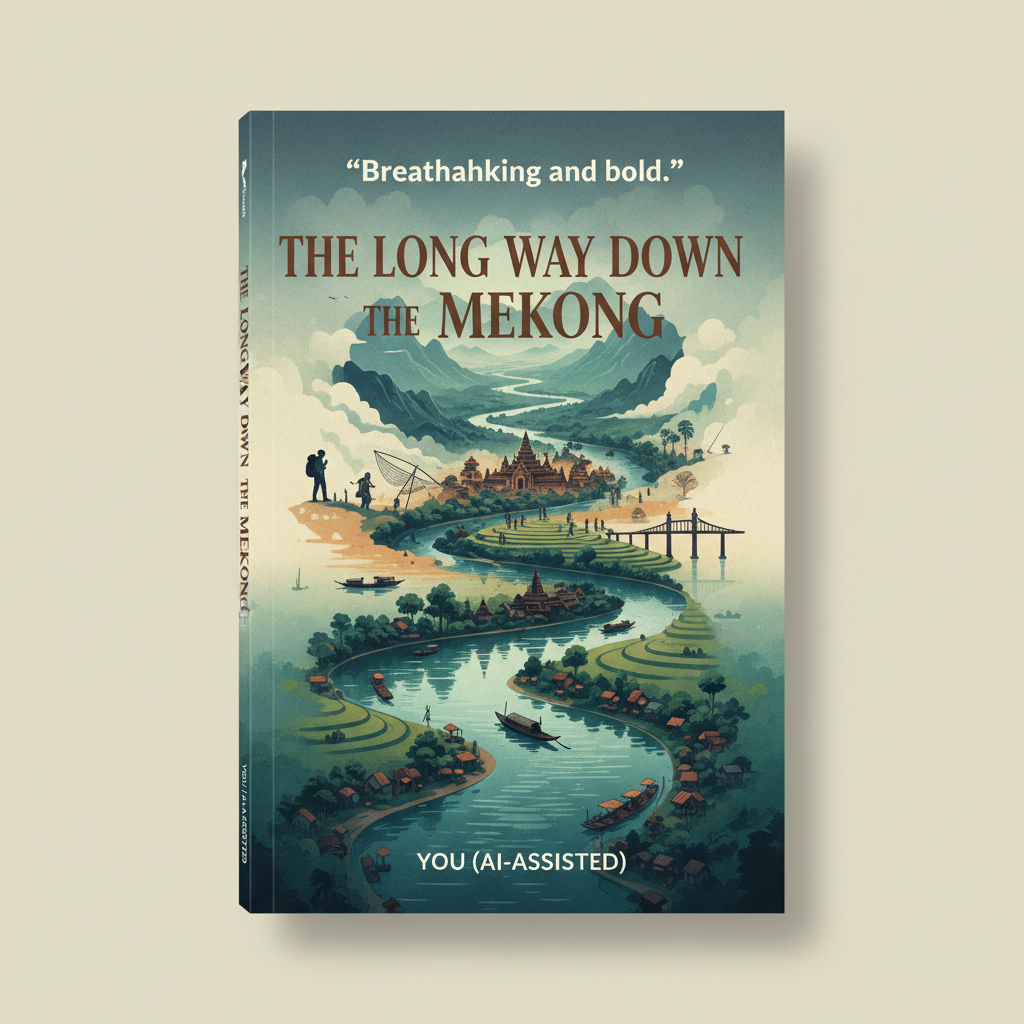
Synopsis
A lone traveler embarks on an epic journey tracing the lifeblood of Southeast Asia, the Mekong River, to uncover the interwoven destinies of its diverse communities and the river's profound impact on their existence.
Chapter 1: The Source's Whisper
The wind, a relentless sculptor of stone and spirit, gnawed at my exposed skin. It carried with it the ghost of a chill, a whisper of ice from the unseen peaks that clawed at the impossibly blue sky. Here, at the roof of the world, the air was thin, tasting of granite and solitude. My breath plumed before me, a fleeting white flag against the vast brown and ochre landscape that stretched, undulating, to the horizon. This was the source, the promised beginning of a journey that felt, at this nascent stage, almost blasphemously ambitious.
I stood on a rise, a lone figure dwarfed by the sheer scale of the Tibetan plateau. Below me, nestled in a hollow carved by eons of glacial retreat and the persistent drip of meltwater, lay a small, emerald pool. It wasn’t grand, not a thundering cascade or a churning vortex of white. It was modest, unassuming, a mere dimple in the earth’s craggy skin. Yet, from its still surface, a ribbon of water, barely wider than my hand, began its hesitant crawl. The Mekong. Dza Chu, as the locals called it here, the "River of Rocks."
The sound was barely audible over the wind’s low moan – a delicate gurgle, a gentle slither of liquid over pebbles. It was the sound of birth, fragile and resolute. I knelt, the frozen earth biting through the thin fabric of my trousers, and plunged a gloved hand into the frigid current. The cold seared, then dulled, leaving behind a sharp, clean sensation. This was water that had seen no human touch, no agricultural runoff, no industrial stain. It was pure, distilled essence, a promise of life yet to be unfolded.
My eyes followed its nascent path, a silver thread weaving through the dull, scrub-dotted landscape. It was a stark contrast to the mighty, chocolate-brown expanse I had pictured, the river of bustling barges and verdant deltas. Here, it was vulnerable, a mere suggestion of the behemoth it would become. A tremor of awe, tinged with a familiar anxiety, ran through me. How could something so small, so utterly insignificant in this monumental setting, swell to become the lifeblood of millions?
The immensity of the task ahead pressed down, a weight as palpable as the thin air. To trace this trickle, this fragile vein, all the way to its oceanic embrace, felt less like a journey and more like a pilgrimage. I had always been drawn to the stories rivers told, their silent chronicles of human endeavour, resilience, and destruction. But the Mekong, stretching over 4,900 kilometers through six countries, felt different. It was a lifeline, a cultural artery, a geological marvel. And I, armed with little more than a backpack, a notebook, and an insatiable curiosity, was about to become one of its countless, transient companions.
I gazed out across the plateau, a landscape that seemed to swallow sound and time. There were no trees here, only hardy grasses clinging to the earth, and scattered clumps of low-lying shrubs. The sky, a merciless dome of azure, stretched endlessly, broken only by the distant, jagged teeth of snow-capped peaks. The silence was profound, broken only by the wind and the faint, persistent murmur of the nascent river. It was a stark, beautiful desolation, a place where the earth felt raw and untamed.
This was a land ruled by forces far older and more powerful than man. The very air hummed with an ancient energy, a sense of deep time etched into every rock face and every ripple in the landscape. I felt a profound humility standing here, a speck of consciousness in a tableau of geological grandeur. My own existence, with its fleeting concerns and trivial ambitions, seemed almost absurd in the face of such eternal silence.
A lone kyang, a wild Tibetan ass, grazed in the distance, its dark silhouette a stark punctuation mark against the ochre earth. It lifted its head, ears swiveling, sensing my presence even from afar. Its gaze, distant and untroubled, held a wild wisdom. It was a child of this land, attuned to its rhythms, its harsh beauty. I envaded it, in a way, for its effortless belonging. I, on the other hand, was an interloper, a guest on borrowed time, seeking to understand a world that was as alien as it was captivating.
I pulled out my worn notebook, its pages already creased and bearing the faint scent of stale coffee. The first entry would be penned here, at the source. My pen felt heavy, a small, insignificant tool burdened with the task of capturing something so vast and elusive.
*Day 1. The Mekong’s Source. Elevation: Approximately 5,100 meters. Air temperature: -5°C (feels colder). The Dza Chu begins its journey as a whisper, a thread of silver in a landscape of stone and sky. The immense solitude here is both terrifying and exhilarating. There is a purity to this place, a rawness that strips away all but the essential. I am a stranger, an observer, embarking on a quest to understand this river’s soul, from its icy cradle to its eventual embrace of the sea.*
I wrote, my fingers stiff with cold, the words appearing stark and black on the page. Each sentence felt like an anchor, grounding my purpose in this swirling vastness. The river, in its infancy, held all the promise of a life unlived, a future unwritten. It would sculpt valleys, feed cultures, define nations. It would witness joy and sorrow, generosity and greed, peace and conflict. All of it contained within that fragile, nascent trickle.
I spent the better part of the afternoon simply watching, mesmerized by the quiet persistence of the water. It seemed to gain imperceptible momentum, a microscopic ripple becoming a slightly larger one, the thin stream broadening ever so slightly as it absorbed the meltwater from unseen snowfields. It was a slow, deliberate act of growth, a testament to the power of continuous, sustained effort.
As the sun began its languid descent, painting the western sky in hues of bruised purple and fiery orange, a thin layer of ice began to crystallize at the edges of the pool. The air grew sharper still, stinging my nostrils. I knew I couldn't linger much longer. The night on the plateau would be unforgiving.
I rose, my knees protesting the cold, and lingered for one last look. The small stream, now glowing with the last embers of daylight, seemed to shimmer with an inner light. It was a beacon, a thread leading into the unknown. My journey had officially begun.
Turning my back on the nascent stream, I began the trek back towards the small, isolated monastery where I had been granted a spartan room for the night. The path back seemed different, imbued with a new sense of purpose. The wind still howled, but now it sang a different tune, a song of anticipation rather than mournful solitude.
The image of that tiny, resolute stream stayed with me, a powerful counterpoint to the enormity of the task. It was a reminder that every grand endeavor begins with a single, unassuming step. The Ganges, the Amazon, the Nile – all had their humble origins, their quiet beginnings. This was the Mekong’s story, starting here, at the roof of the world, a whisper that would grow into a roaring torrent, a lifeline for millions.
As the first stars, impossibly bright in the thin air, speckled the darkening sky, I felt a familiar tension settle in my chest, a mix of apprehension and exhilaration. There would be challenges, I knew, dangers and discomforts. But there would also be beauty, enlightenment, and connections forged in the crucible of shared experience. The river, in its infinite wisdom, would be my guide. The long way down the Mekong awaited. And I, for better or worse, was ready to follow. The whisper had become a promise, and I was listening.
Chapter 2: Rivers of Gold and Jade
The air, thin and sharp just days ago, began to thicken, acquiring a scent I hadn’t realized I’d missed: the deep, fertile perfume of earth and burgeoning life. Yunnan, China. The name itself hummed with a history woven in silk and jade, a land rumored to hold secrets in its misty valleys. The infant river, which had whispered shyly at my heels in Tibet, now asserted itself, a muscular current carving deeper into the landscape.
Gone were the endless, treeless expanses of the plateau. Here, mountains clawed at the sky, their craggy faces softened by a velvety moss and the impenetrable green of pine and cypress. The Mekong, no longer a playful trickle, was now a nascent beast, its waters a jade-green that shimmered with an inner fire, a stark contrast to the muddy, turbulent browns I’d expected further downstream. It roared through gorges, a primal force shaping the very bones of the earth. The sound echoed off the sheer rock walls, a constant, low thrumming that resonated in my chest, a different kind of heartbeat to the quiet contemplation of its source.
My jeep, a battered but reliable beast, hugged the winding mountain roads. Below, the river was often a silver ribbon, coiling and straightening, sometimes visible, sometimes swallowed by the folds of the terrain. The scale of it all was dizzying. Peaks rose to staggering heights, their summits often lost in a haze of cloud, and the valleys plunged into dizzying depths where the river’s voice was but a faint whisper.
The first palpable sign of human intervention, beyond the occasional roadside shrine adorned with bright prayer flags, came subtly. A glint of metal on a distant mountainside. A scar of pale earth where a road, impossibly high, snaked across the face of a cliff. Then, the road I was on broadened, its surface freshly paved, testament to an unseen hand. The occasional village, clinging precariously to a terraced hillside, displayed walls of sun-baked mud bricks and roofs of dark, weathered tile. Smoke, thin and blue, drifted upwards from hearth fires. Life, resilient and ancient, was etching itself onto this formidable landscape.
I pulled over at a small lookout point, the kind marked by a weathered wooden sign and a few discarded snack wrappers. Below, the Mekong twisted through a particularly narrow gorge, its waters churning white in places, a testament to the rapids hidden beneath the surface. And there, straddling the river like a colossal, metal spider, was my first close encounter with what I knew would be a recurring theme: a hydroelectric dam.
It wasn’t a massive structure yet, not like the behemoths further south, but its presence was undeniable. Concrete walls, stark and gray, rose from the riverbed, funneling the powerful flow through a series of turbines. The hum of generators, a deep, mechanical drone, carried faintly on the wind, a counterpoint to the river’s natural roar. Cranes, skeletal against the sky, plucked at massive steel beams, their slow, deliberate dance a testament to engineering prowess.
I leaned against the flimsy metal railing, the wind whipping strands of hair across my face. The river, a force of nature for millennia, was being harnessed, its raw power converted into something tangible: electricity. It was progress, undoubtedly. Lights in homes, industries churning, the promise of a better life. But at what cost? The churning water downstream, no longer a wild, free current, seemed subdued, its power channeled, domesticated. The delicate balance I’d contemplated in the stillness of the plateau already felt precarious.
Later that afternoon, I found myself on the outskirts of an old market town, its name, Dêqên, rolling off the tongue like a soft sigh. The narrow streets, paved with rough-hewn flagstones, echoed with the chatter of voices and the insistent honk of motorbikes. Merchants hawked their wares from open-fronted shops: vibrant bolts of silk, intricately carved wooden ornaments, pungent spices, and glistening trays of unfamiliar fruits. The air was thick with the mingled scents of ginger, star anise, and damp earth.
I wandered into a tea house, its interior dark and cool, a welcome respite from the afternoon sun. The air inside was scented with roasted tea leaves and something else, something subtly sweet and earthy. An old woman, her face a roadmap of wrinkles, poured me a cup of dark, fragrant Pu-erh tea, its warmth seeping into my chilled fingers. Her eyes, dark and knowing, met mine briefly, a silent acknowledgment of the shared human experience.
“You are far from home,” she observed, her voice raspy, yet kind. She spoke in slow, careful Mandarin, as if stretching each word for my benefit.
“Yes,” I replied, fumbling a bit for the right words. “Following the river.”
A faint smile touched her lips. “The Lancang Jiang,” she corrected gently, using the Chinese name for the upper Mekong. “She has many names, many faces. Here, she is kind, but also wild.” Her gaze drifted towards the open doorway, as if she could see the river from within the confines of her shop. “She has fed us, protected us, brought us wealth.”
“And now?” I ventured, thinking of the dam.
Her smile faded slightly, replaced by a thoughtful frown. “Now… she is changing. The mountain, it resists. But the river… the river has no choice.” She took a slow sip of her tea, her gaze returning to mine. “They say the river spirits are angry. That the dragons sleep uneasy.”
I listened, absorbing her words. The river, a living entity, a spiritual force. This was a perspective I had only touched upon in my research, but here, it was woven into the very fabric of daily life. The progress I had witnessed at the dam site was not simply an engineering feat; it was an act of profound intervention, one that touched not just the physical landscape but the intangible realm of belief and tradition.
The next few days blurred into a series of stunning vistas and fleeting encounters. I hiked along ancient mule tracks, remnants of the Tea Horse Road, where merchants had once braved treacherous passes to trade tea from Yunnan for horses from Tibet. The ghost of their footsteps seemed to linger on the worn stones, a testament to the enduring human spirit of trade and connection. I imagined the caravans, laden with sacks of compressed tea, their bells jingling, their breath misting in the cold mountain air. The river, then as now, was a silent witness, a constant backdrop to these arduous journeys.
I passed through villages where the homes clung to impossible gradients, their terraced fields a patchwork quilt of green and gold during harvest season. The people I met were resilient, their faces weathered by sun and wind, but their eyes held a warmth that transcended language barriers. Children, their laughter echoing through the narrow alleys, played with homemade toys, oblivious to the grand schemes of dams and development shaping their world.
One evening, I camped by the river’s edge, the roar of the current a lullaby. The stars, unobscured by city lights, blazed with an intensity I rarely witnessed. The air was crisp, carrying the scent of pine and damp earth. I cooked a simple meal over a small fire, the crackling flames casting dancing shadows on the rocks around me. As I ate, I thought about the old woman’s words, about the angry river spirits and the uneasy dragons.
The Mekong, the Lancang Jiang, was a river of contradictions. A bringer of life and a force of destruction. A conduit for ancient trade and a site for modern industry. It was a mirror reflecting humanity’s triumphs and its hubris. Here, in Yunnan, the battle between preservation and progress felt particularly acute, played out against a backdrop of breathtaking beauty.
The next morning, as the first rays of sun kissed the peaks, painting them in hues of gold and rose, I packed my camp. The river, still shrouded in mist, flowed on, relentless and indifferent to the human dramas unfolding on its banks. My journey was just beginning, and I knew this delicate dance between man and nature would only intensify as I traveled further downstream, deeper into the heart of Southeast Asia. The jade waters of Yunnan, beautiful and powerful, were merely an overture, a hint of the grand, complex symphony yet to unfold. The river called, and I, a solitary pilgrim, was bound to answer.
Chapter 3: The Golden Triangle's Embrace
The air grew thick with a humidity that clung to the skin like a second conscience. Gone were the thin, sharp breezes of the Yunnan highlands, replaced by a humid breath that smelled of rich earth and distant burning. The river, no longer constrained by the tight gorges, stretched wider here, a brown, muscular ribbon unspooling across a landscape of undulating hills. This was the Golden Triangle, a name whispered with a mixture of awe and trepidation, a place where three nations – Thailand, Laos, and Myanmar – converged, and where stories, both celebrated and shadowed, had long tangled like the roots of ancient kapok trees.
My longtail boat, a slender craft with an impossibly loud engine, cut a frothing path through the silty water. The boatman, a weathered man with eyes that seemed to have seen a hundred seasons on these waters, navigated with an intuitive grace, his hand on the tiller a natural extension of his will. He offered a wordless smile, a flash of betel-stained teeth, when I gestured towards the distant hills. “Myanmar,” he grunted, his voice a gravelly rumble above the engine’s roar, then pointed to an indistinct smudge on the other bank. “Laos.” Thailand was the shore we clung to, a verdant bank rising steeply, occasionally revealing glimpses of small, stilted houses nestled amongst the foliage.
The river here wasn't a pristine wilderness. Signs of human endeavor were scattered along its edges – small bamboo fishing nets dipped like patient prayers, their frames glinting in the afternoon sun. Laundry, brightly colored against the deep greens, hung from lines strung between trees. But below the veneer of daily life, there was an undercurrent, a tacit understanding of the region’s past. I saw it in the guarded glances of the few villagers we passed, in the way a small, nondescript speed boat, heavily laden, vanished into a tributary without a ripple of farewell. The air hummed not just with the drone of insects, but with the echoes of history, a tapestry woven with threads of opium poppies, insurgencies, and fleeting fortunes.
We stopped at a small market, a collection of ramshackle stalls precariously perched on the Thai bank. The boatman killed the engine, and the sudden cessation of noise left an almost deafening silence, broken only by the chirping of unseen birds and the gentle lapping of the river against the bank. The market was a riot of color and scent. Piles of exotic fruits I couldn't name sat beside sacks of fragrant spices, chili peppers drying in the sun, and bundles of hand-woven fabrics. The air was thick with the scent of grilled fish, sweet fruit, and an earthy aroma I suspected was the ever-present Mekong mud.
A woman with a kind, wrinkled face, her teeth stained crimson from betel nuts, offered me a small, perfectly ripe mango. Her eyes, dark and intelligent, held a lifetime of stories. I mimed eating, and she laughed, a bright, melodic sound that cut through the market’s hum. “Good fruit,” she said in passable English, her voice raspy. “From the hills. Our land.”
I bought the mango, its skin a vibrant tapestry of yellow and red, and found a shaded spot to peel it, the sweet, yielding flesh a burst of tropical sunshine in my mouth. Around me, the market pulsed with life. People of various ethnic groups mingled, their traditional clothing distinct and beautiful. I saw women with the intricate silver decorations of the Akha, men in the dark indigo of the Lahu, and the vibrant patterns of the Karen. They conversed in a babble of languages, a symphony of sounds that spoke of centuries of coexistence, of trade, and sometimes, conflict.
A group of Akha women, their head-dresses heavy with ornate silver, sat meticulously weaving baskets from split bamboo. Their fingers moved with a practiced rhythm, the strands becoming intricate patterns under their care. One young woman, no older than twenty, met my gaze, her eyes shy yet curious. She held up a half-finished basket, its form already graceful. I smiled and nodded, and she returned a tentative smile, her expression softening. It was a silent exchange, a bridge built with a shared moment of appreciation for craftsmanship.
I struck up a conversation with a stall owner, a man named Somchai, who sold local handicrafts. He was a second-generation émigré from Laos, his family having crossed the river decades ago. He spoke of the river with an almost reverent tone, a living entity that gave and took. “The river, she is everything,” he explained, gesturing with a hand that bore the calluses of a lifetime of work. “She brings water for our crops, fish for our food. But she also brings… others. And sometimes, she takes what we love.” His gaze drifted to the distant Laotian shore, a hint of something unsaid in his eyes.
He then spoke of the past, of a time when the hills were awash with opium poppies, their delicate petals hiding a dark secret. He remembered the stories his grandfather told, of horse caravans laden with raw opium, making their way down hidden jungle trails. He recalled the fear, the casual violence, the pervasive sense of lawlessness that had once defined this region. “It is better now,” he assured me, though his voice held a certain melancholy. “The poppies are gone, mostly. But the habit… it stays. The memory.” He tapped his temple. “Here.”
Later that afternoon, the boatman deposited me at a small guesthouse nestled on a bluff overlooking the Mekong. It was a simple affair – bamboo walls, a thatched roof, and a wide verandah that offered an unparalleled view of the river. As the sun began its slow descent, painting the sky in hues of orange and violet, I sat on the verandah, watching the river reflect the fading light like a bruised mirror.
Dinner was served on the verandah – fragrant sticky rice, grilled river fish seasoned with lemongrass and chili, and a spicy papaya salad. My host, an elderly Thai woman with a serene demeanor, spoke little English but communicated volumes with her warm smiles and gentle gestures. As I ate, a small group of children from the nearby village gathered below, their hushed giggles echoing through the twilight. They were playing a game I didn’t understand, their silhouettes dancing against the darkening sky, their laughter a pure note in the symphony of the evening.
The moonlight, when it finally emerged, cast a silver sheen across the water. The river murmured below, a constant, ancient voice. I found myself thinking about the countless lives that had unfolded along its banks, the forgotten histories, the quiet resilience of its people. The Golden Triangle, I realized, wasn’t just a geographical point; it was a nexus of human experience, a place where cultures mingled, where past and present converged, and where the river itself bore witness to it all.
The next morning, I hired a local guide to take me deeper into the hills, away from the immediate riverfront. His name was Panya, a man from the Lahu ethnic group, his face etched with the lines of sun and wind. He had a quiet dignity and a profound knowledge of the land. Our journey took us along narrow, winding trails, through dense jungle where the air was thick with the scent of decaying leaves and the calls of unseen birds. Sunlight dappled through the canopy, creating shifting patterns on the forest floor.
Panya walked with an effortless grace, his worn sandals barely disturbing the fallen leaves. He pointed out various plants, explaining their medicinal uses, sharing snippets of oral history about the Lahu people, their animist beliefs, and their deep connection to the forest. He spoke of spirits inhabiting trees and rocks, of ancient customs honored to appease them, practices far removed from the modern world but deeply ingrained in their way of life.
We eventually reached a small Lahu village, a collection of bamboo and thatch houses clinging precariously to the hillside. Smoke curled from cooking fires, carrying the aroma of wood smoke and simmering food. Children, their faces bright and curious, peered out from doorways. The village elder, a man with a gaze that seemed to hold generations of wisdom, greeted us with a nod. He offered us tea, a bitter brew served in small, hand-painted cups.
Through Panya, the elder spoke of the challenges facing his community. The younger generation, he explained, was increasingly drawn to the cities, enticed by the promise of education and employment. The traditional ways, the ancient crafts, the knowledge of the forest – these were slowly eroding. He spoke of the increasing difficulty in finding game, of the encroachment of external influences, of the delicate balance that was slowly shifting. Yet, despite the underlying currents of concern, there was a palpable strength in his voice, a sense of enduring pride in his people’s heritage.
He showed me intricate silver jewelry, finely woven textiles, and meticulously carved wooden tools – all products of their traditional craftsmanship. Each piece told a story, a narrative of patience, skill, and cultural identity. The women in the village, their hands deft and sure, worked on backstrap looms, their rhythmic movements a hypnotic ballet. Threads of vibrant color became complex patterns, each stitch a testament to their enduring traditions.
As the sun began to dip once more, casting long shadows across the hills, Panya and I made our way back towards the guesthouse by the river. The conversation flowed easily between us, Panya sharing more personal insights into his life, his hopes, and his anxieties. He spoke of his own children, attending school in the nearest town, learning Thai, becoming more integrated into the broader society. He understood the need for progress, for education, but he also worried about the loss, the gradual fading of their unique identity.
“The river, she flows on,” he mused, as we caught our first glimpse of the Mekong, a silver serpent winding through the valley. “She does not care if we are Lahu, or Akha, or Thai. She just flows. But we… we must remember who we are, even as the world around us changes.” His words resonated deeply, echoing the reflections I’d had since leaving the cold, pristine source. The river was a constant, an indifferent witness, but the human story unfolding along its banks was a dynamic, ever-shifting narrative.
Back at the guesthouse, as night fully embraced the Golden Triangle, I sat once more on the verandah, the river a dark, inscrutable presence below. The air was alive with the nocturnal hum of insects, and a faint, rhythmic drumbeat drifted from a distant village, a primal pulse that seemed to connect this moment to centuries of human existence in this very place. The Mekong, in its quiet majesty, held within its depths not just water, but the whispers of history, the vibrant tapestry of cultures, and the enduring resilience of people living on its edge, navigating a world of both enduring traditions and inexorable change. The currents of the river mirrored the currents of life here, sometimes turbulent, sometimes calm, but always moving forward, carrying with it the untold stories of its people. And as I watched the river flow, I knew there were many more stories yet to be found downstream.
Chapter 4: Laos: The Unhurried Current
The roar of the longtail boat engines, a constant companion through the Golden Triangle’s stretches, softened to a murmur as we slipped across the invisible line into Laos. The air itself seemed to exhale, a deep, slow breath that mirrored the river’s newly adopted pace. No longer a tempestuous highway, the Mekong here was a silver ribbon unfurling through a tapestry of emerald and jade, its banks softening from jagged cliffs to gentle, forested slopes. The current, a powerful hand that had pushed us relentlessly through China and the Triangle, now became a subtle coaxing, a whispered invitation to linger.
My fellow passengers, a handful of weathered Lao men and a clutch of giggling children, settled further into their seats, their voices dropping to a level of hushed contemplation. Even the boatman, his face a canvas of sun-baked wrinkles, eased off the throttle, allowing the motor’s rhythmic thrum to blend with the rustle of riverside foliage. The bamboo poles, once used to fend off rocks and guide us through rapids, were now leaned casually against the hull, almost ornamental.
The transition was immediate and visceral. Gone were the concrete behemoths clinging precariously to the cliffs, the shimmering glass towers hinting at distant urban ambition. Instead, thatched roofs peeked through dense jungle, smoke curling lazily from unseen hearths. Small, wooden jetties, no more than a few planks lashed together, jutted into the water, hosting a solitary woman washing clothes, her colorful _sinh_ a vibrant splash against the muted greens and browns. Children, brown as river stones, played at the water's edge, their laughter carried across the water like scattered beads.
I found myself leaning over the side of the boat, my fingers trailing in the cool, silken water. The river here possessed a clarity I hadn't seen since the upper reaches of Yunnan, a gentle, reflective quality that seemed to mirror the very spirit of the land. It was as if the Mekong had swallowed a sedative, embracing a tranquility that was both disarming and deeply alluring.
We docked at a village so small it barely registered as a cluster of huts on the map. There was no bustling market, no guesthouse signs, just a few curious faces watching our arrival from the shade of a mango tree. Phana, the boatman, gestured inland with a laconic sweep of his hand. “Luang Prabang, two days. If you walk.” He grinned, revealing a gap where a front tooth once was. “Or you wait. Tomorrow, another boat.”
I looked at the dusty track winding away from the river, disappearing into the dense undergrowth. The idea of two days on foot, surrounded by this understated beauty, was suddenly far more appealing than another cramped boat ride. I thanked Phana, hefted my backpack, and stepped onto the soft earth. The ground, packed hard by generations of bare feet and the occasional ox cart, felt springy beneath my boots.
The village consisted of perhaps fifteen houses, all built on stilts, their roofs a patchwork of woven bamboo and dried leaves. Chickens scratched in the dirt beneath them, and a solitary pig rooted contentedly by a pile of discarded coconut husks. The air was thick with the scent of woodsmoke, damp earth, and something vaguely floral, a perfume of the jungle.
A woman, her face a map of gentle wrinkles, emerged from one of the houses, a small child clinging to her _sinh_. She offered a shy smile, her eyes assessing me with a quiet curiosity. I returned the smile, a clumsy attempt to convey respect and non-threat. She spoke in Lao, a gentle, melodic language I barely understood, but her gestures were clear: an outstretched hand, an invitation into her home.
I spent the night in her stilted house, sharing a simple meal of sticky rice, river fish, and incredibly spicy greens. The family, five generations under one roof, spoke little English, but communication transcended words. The grandmother, her silver hair pulled back into a tight bun, meticulously cleaned each grain of rice, her movements slow and deliberate, a meditation in daily ritual. The children, eyes wide and solemn, stared at me with unblinking fascination until sleep claimed them, their small bodies draped over their parents like limp dolls.
That night, sleeping on a thin mat on the bamboo floor, the sounds of the village seeped into my consciousness: the chirping of crickets, the rustle of leaves, the distant croaking of frogs from the river. There was no artificial light, no hum of electricity, just the profound darkness broken only by the shimmering pinpricks of countless stars. It was a silence that wasn't empty, but full, alive with the subtle symphony of nature.
The next morning, after a breakfast of sweet sticky rice and strong, sweet coffee, I bade farewell to my gracious hosts. The grandmother pressed a small, intricately woven bracelet into my hand, her eyes conveying a warmth that went beyond language. I understood then that hospitality here wasn't a transaction; it was an innate expression of their connection to each other, to their land, and to the river that sustained them.
The path I followed was less a trail and more a suggestion, a series of indentations in the earth that meandered through rice paddies and small banana plantations. The air was heavy with humidity, and the sun, even in the early hours, beat down with a relentless intensity. But the landscape was mesmerizing. Towering limestone karsts, draped in verdant jungle, rose abruptly from the flatlands, their peaks shrouded in a perpetual mist. It felt like walking through a dream, a land untouched by the relentless churn of the modern world.
Every few hours, I would glimpse the Mekong, a constant, shimmering presence to my left. It was wider now, its surface a placid mirror reflecting the sky and the passing clouds. Fishing boats, impossibly slender, like enormous canoes carved from single tree trunks, dotted its expanse, their occupants casting nets with practiced ease. The river, I realized, wasn't just a physical entity here; it was an integral part of the spiritual landscape, a life-giving force that dictated the rhythms of daily life.
I stopped at a small bamboo shack by the river, lured by the promise of shade and the faint scent of frying food. A young woman, her long black hair braided with colorful threads, emerged from the smoky interior, holding a woven basket overflowing with fresh papayas. She offered me one, slicing it open with a deft hand, its orange flesh gleaming. The sweetness was astonishing, a burst of tropical sunshine in my mouth.
We sat in comfortable silence, watching the river flow by. She pointed to a family of elephants bathing upstream, their massive bodies shimmering in the sunlight as they doused themselves with water, their mahouts sitting patiently atop their necks. "They come every day," she said, her English surprisingly fluent, though accented with the soft lilt of Laos. "The river is good to them. It gives them water, and food."
I asked her about the river's significance to her village. She smiled, a gentle, knowing curve of her lips. "The river is everything, really. It gives us fish, it waters our rice, it takes us where we need to go. We feel its spirit. When it is angry, we know. When it is calm, we are calm too." Her words were simple, yet they encapsulated a profound truth, a sacred connection that felt increasingly lost in the more industrialized regions upstream.
I spent the afternoon walking, the rhythm of my footsteps falling into sync with the gentle hum of the landscape. The quiet was punctuated only by the occasional cry of a bird, the buzzing of insects, or the distant thrum of another longtail boat, a reminder of the world beyond this serene bubble. I passed farmers tending their fields, their conical hats bobbing above the emerald expanse of their crops. They moved with an unhurried grace, their movements economical, their faces etched with the sun and the wisdom of generations who had worked this land.
As the afternoon light began to soften, casting long, ethereal shadows across the landscape, I stumbled upon a small temple nestled amongst a grove of frangipani trees. Its golden stupa, gleaming in the late afternoon sun, was intricately carved, depicting scenes from the Jataka tales. The air was sweet with the scent of incense and the cloying perfume of the frangipani blossoms.
Inside, a solitary monk, his saffron robes a vibrant splash of color against the dim interior, was sweeping the polished wooden floors with a broom made of dried palm fronds. He looked up as I entered, a beatific smile gracing his features. We exchanged a silent bow, a moment of mutual respect. I sat on a low cushion, simply absorbing the tranquility, the pervasive sense of peace that permeated the space.
The monk, sensing my unspoken curiosity, spoke in slow, deliberate English, his voice a soft rustle, like leaves in a gentle breeze. "The river is a teacher," he mused, gesturing vaguely towards the window, through which a sliver of the Mekong was visible. "It teaches us patience. It teaches us impermanence. It teaches us flow. Everything changes, like the water. But the river itself, it always remains, always moves."
His words resonated deeply within me. The Mekong, in its varied manifestations, had been a powerful teacher throughout this journey. From its frenetic beginnings in the Tibetan glaciers to its harnessed power in Yunnan, to its conflicted legacy in the Golden Triangle, and now, finally, to its tranquil embrace in Laos, it had mirrored the complex dance of life itself.
I spent another night in a small guesthouse in a village called Pak Ou, just before the junction of the Mekong and the Nam Ou rivers. The guesthouse, nothing more than a few rooms above a small family restaurant, offered unparalleled views of the converging waters. From my balcony, I watched the two rivers merge, the clearer Nam Ou blending into the broader, silt-laden Mekong, a subtle but significant confluence.
The air here was cooler, a welcome respite from the day’s heat. The sounds were different too – the constant murmur of two rivers meeting, a deeper, more resonant hum than the single-river melody I had grown accustomed to. Fireflies, like scattered jewels, twinkled in the darkness, and the distant calls of night birds echoed across the water.
The next morning, I boarded a boat for the final stretch to Luang Prabang, a larger vessel than the longtail, packed with local villagers on their way to the city’s markets. The boat moved with a steady grace, its engine a comforting lullaby. As we rounded a bend, the sacred Pak Ou Caves, carved into the sheer limestone cliffs, came into view. Thousands of Buddha images, deposited over centuries by pilgrims, glinted in the morning light, a testament to the enduring faith of the Lao people.
The atmosphere on the boat shifted, a quiet reverence settling over the passengers. Many offered small prayers, their eyes fixed on the caves, a sacred gateway along the Mekong’s journey. This was the river as a pilgrimage route, a pathway to spiritual solace.
As Luang Prabang began to emerge in the distance, a cluster of golden stupas and traditional wooden houses nestled amidst lush greenery, I felt a familiar pang of bittersweet anticipation. The unhurried current of Laos had seeped into my own being, slowing my pace, hushing my thoughts. I knew I was approaching a significant landmark, a UNESCO World Heritage site renowned for its temples and saffron-robed monks. But as the boat glided closer, my mind lingered on the gentle villages, the silent forests, and the profound, almost spiritual, connection the Lao people held with their great river. The Mekong here wasn't merely a geographical feature; it was a living, breathing entity, a benevolent provider, a timeless sage, and the heart of a culture that had learned to dance to its softest rhythm. I wondered if the bustling town ahead would offer the same solace, or if the deeper truths of this land were destined to remain etched on the quiet, unhurried stretches of the river itself.
Chapter 5: Cambodia: Echoes of Empire
The sun, a molten disc, hung low over the Mekong, painting the water in hues of tangerine and bruised plum. The air, thick and humid, carried the scent of wet earth and something unidentifiable, ancient, like pulverized stone mixed with jasmine. The current, which had lulled in Laos, now quickened, tugging at the hull of my longtail boat with a renewed urgency. Cambodia. The name itself was a whisper of forgotten glories and whispered terrors.
The river here was wider, a brooding expanse reflecting the vast, unbroken sky. On its banks, the stilt houses started to morph, their bamboo lattices giving way to more substantial timber, their roofs less thatched, more tiled. Villages punctuated the emerald green of the rice paddies, miniature archipelagos afloat in a sea of cultivation. The faces I saw on shore, however, retained the same gentle curvature, the same dark, deep-set eyes that had followed me down from the Golden Triangle, only here, a subtle shift in the angle of a cheekbone, a more pronounced arch to an eyebrow, hinted at a different lineage, a different story waiting to unfold.
My boatman, a taciturn man named Channar, rarely spoke, his gaze fixed on the churning water ahead. His weathered hands, however, spoke volumes as they expertly guided the rudder, navigating the unseen eddies and currents that marked the river’s path. He wore a faded Krama, wrapped loosely around his neck, its checkered pattern a splash of indigo against his sun-darkened skin. He was a son of this river, his life inextricably woven into its rhythm, a thread in the vast, intricate tapestry that was the Mekong.
As we journeyed deeper, the landscape began to whisper of something grander, something that dwarfed the humble villages and even the mighty river itself. Distant silhouettes, barely discernible through the heat haze, began to emerge. These weren’t mountains, nor natural formations. Their lines were too deliberate, too angular. A shiver, not of cold but of awe, traced its way down my spine. Angkor. The name hung in the air, weighted with centuries of power and devotion, a phantom presence long before its physical form fully materialized.
Channar, sensing my anticipation, turned, a rare, almost imperceptible smile playing on his lips. He pointed with a calloused finger. "Angkor Wat," he rumbled, his voice rough from years of shouting over engine noise, “upstream.”
The motor chugged, pushing us relentlessly forward. The air grew heavier, pregnant with history. I imagined the great barges of the Khmer Empire, laden with stone and timber, plying these very waters, driven by hundreds of sweating laborers, their muscles straining, their voices echoing across the landscape. The river had been their highway, their lifeblood, the conduit through which their monumental visions were brought to life.
We disembarked at a small, dusty landing, a mere speck in the shadow of giants. The change was stark. The languid pace of the river journey was replaced by the hurried cacophony of tuk-tuks, their tiny engines buzzing like oversized bees. The scent of ancient stone, baking under the relentless sun, mingled with exhaust fumes and the sweet, cloying aroma of incense.
The ruins of Angkor, sprawling and majestic, lay before me, an architectural miracle rising from the jungle’s embrace. Trees, thick-trunked and ancient, wove their roots through crumbling sandstone, their branches reaching skyward as if in a perpetual embrace with the past. The scale was overwhelming. Not just Angkor Wat, but Angkor Thom, Bayon, Ta Prohm – an entire city of gods and kings, a testament to a civilization that had mastered hydraulic engineering and stone masonry to a degree unthinkable for its time.
I spent days wandering through these silent cities, my fingers tracing the intricate bas-reliefs that adorned the temple walls. Here, a celestial dancer, her form still graceful despite the erosion of centuries. There, a fierce battle scene, elephants clashing, warriors locked in eternal combat. My imagination soared, filling the gaping spaces with the roar of crowds, the clang of swords, the chanting of monks. The river, I realized, was not just a means of transport, but an inscription on the land itself. Its annual floods had fertilized the fields, providing the rice that fed the millions who built these structures. Its waters had filled the vast barays, reservoirs that regulated the agricultural cycles and watered the gardens of the gods.
One afternoon, seeking refuge from the oppressive heat, I found myself sitting on a moss-covered stone bench in the shade of a towering silk-cotton tree within the sprawling complex of Ta Prohm. Its roots, thick as pythons, snaked over walls and through doorways, slowly reclaiming the temple, a relentless, green tide. A young monk, his saffron robes a vibrant splash of color against the grey stone, sat nearby, meticulously cleaning a small, intricately carved Buddha statue. He looked up, his eyes kind.
"Such beauty," I ventured, gesturing to the sprawling roots. "And such destruction."
He smiled, a gentle, knowing smile. "Nature takes back what is hers," he said in surprisingly good English, his voice soft, almost a murmur. "But the spirit remains." His gaze drifted to the ancient stones. "The river brought the stones. The river brought the people. The river sustains the spirit."
"The Mekong," I said, "is a constant here, even as empires rise and fall."
He nodded. "For the Khmer, the river is life. It is father. It is mother. It is the blood in our veins." A shadow crossed his face, fleeting but discernible. "And it has seen much sorrow."
His words hung in the air, heavy with unspoken histories. The grandeur of Angkor was undeniable, but beneath the veneer of ancient splendor lay the raw scars of a more recent, more brutal past. The same river that nurtured a magnificent civilization had witnessed its suffering, its people reduced to unimaginable straits.
Later that week, I journeyed to Phnom Penh, the river carrying me swiftly downstream. The capital, a bustling metropolis, revealed a different face of Cambodia. Yet, even amidst the modern hustle, the river’s presence was inescapable, its wide expanse dominating the city’s waterfront. The Royal Palace, its golden spires gleaming, stood proudly on its banks, a symbol of enduring sovereignty. But woven into the tapestry of everyday life were the indelible imprints of the Khmer Rouge regime.
I visited Tuol Sleng, the former high school transformed into S-21, a brutal interrogation and torture center. The air inside the classrooms, now exhibition halls, was thick with the ghosts of the past. Photographs of the victims, their faces staring out from the walls, were a stark, harrowing testament to the depths of human cruelty. The Killing Fields of Choeung Ek, a short drive from the city, were even more chilling, a quiet, almost serene landscape belying the atrocities committed there. A stupa filled with thousands of human skulls stood as a poignant, silent memorial.
The juxtaposition was jarring. The majestic ruins of Angkor, symbols of human ingenuity and spiritual devotion, stood in stark contrast to the stark brutality of S-21 and the Killing Fields. How could a people capable of such sublime beauty also endure such unfathomable horror?
I sought out a local historian, an elderly gentleman named Mr. Sophal, whose gentle eyes held a deep sadness, a quiet wisdom forged in the crucible of his nation's painful past. We sat in a small, riverside cafe, the Mekong flowing lazily past us, seeming to cleanse the very air with its silent current.
"The river," Mr. Sophal began, nursing a cup of strong, black coffee, "is more than just water here. It is the memory keeper. It remembers the glory of Angkor, yes. But it also remembers the blood that flowed into its waters during the wars. During the time of Pol Pot." His voice was soft, but the words carried the weight of experience. "The river carried the soldiers, the weapons. It carried the refugees trying to escape. And it carried the bodies."
He paused, a distant look in his eyes. "We are a resilient people. We have survived more than most can imagine. And the river," he gestured to the shimmering water, "has always been there. It cleanses, it offers solace. It reminds us that life continues, that even after the darkest night, the sun will rise again. And the floods, they wash away the old, make way for the new growth."
His words resonated deeply. The Mekong was not merely a passive conduit, but an active participant in the nation's unfolding drama. It had witnessed the ebb and flow of empires, the rise and fall of kings, the triumphs and tragedies of its people. It had nurtured, and it had mourned.
I remembered the silent reverence of the Lao people for the river, their gentle rituals. Here, in Cambodia, that reverence felt compounded by a profound weight of history. The river wasn’t just a provider; it was a testament, a witness, a silent, enduring force that had seen it all.
As evening fell upon Phnom Penh, I watched the riverboats glide past, their lanterns casting shimmering trails on the dark water. The scent of grilling fish mingled with the distant strains of traditional Khmer music. Children played on the riverbanks, their laughter echoing across the water, a testament to the enduring spirit Mr. Sophal had spoken of.
The Mekong flowed onward, its current unwavering, carrying with it not just water, but the whispers of ancient kings, the cries of the fallen, and the hopeful melodies of a people striving to rebuild. It carried everything, flowing relentlessly towards the sea, a silent, powerful thread connecting past, present, and future. And as I watched, knowing my journey was far from over, I felt the river pulling me, drawing me further down its vast, intricate path, into the next chapter of its extraordinary story.
Chapter 6: Phnom Penh's Pulse
The motor-rickshaw, a symphony of sputtering engine and rattling metal, deposited me with a jolt on the riverfront. After the quietude of rural Cambodia, Phnom Penh hit me like a wave – a dizzying swirl of sound, scent, and motion. Here, the Mekong was not merely a companion; it was the city’s throbbing heart, its vast brown expanse a mirror reflecting the relentless energy of urban life.
The air, thick with the scent of street food – grilled pork, fermenting fish sauce, and sweet, sticky rice – mingled with the exhaust fumes of countless scooters. Horns chirped, car engines grumbled, and the distant, rhythmic thud of a pile driver vibrated through the soles of my shoes. Gone were the sleepy villages and the languid pace; this was a city in perpetual motion, a buzzing hive of humanity.
I leaned against a gnarled banyan tree, its aerial roots dangling like ancient beards, and watched the river. It was a different Mekong now. No longer a pristine ribbon winding through emerald fields or a powerful force carving canyons. Here, it was a working river, a highway of commerce. Longtail boats, their engines whining like oversized wasps, zipped past heavily laden cargo barges that lumbered downstream, their hulks low in the water. Ferry boats, packed with commuters, crisscrossed between the city and the opposite bank, their wakes fanning out like temporary scars on the river’s surface.
A young boy, no older than ten, skillfully navigated a small wooden skiff through the chaotic traffic, his paddle dipping in and out of the water with practiced ease. He held a string of freshly caught fish, their silver scales glinting in the afternoon sun, a testament to the river’s enduring bounty even amidst the urban sprawl. He caught my eye, offered a toothless grin, and then, with a flick of his wrist, propelled his craft towards the sandy bank where a woman with a wide-brimmed hat waited, a wicker basket at her feet. The transaction, silent and swift, spoke volumes about the river’s continued role as a lifeline.
My guesthouse was a charming, if slightly dilapidated, colonial-era building on a tree-lined street not far from the Royal Palace. The balcony overlooked a narrow alleyway alive with the chatter of vendors and the clatter of woks. After shedding my pack, I ventured out, drawn inexorably back to the river.
The Sisowath Quay, Phnom Penh’s vibrant river promenade, was a sensory overload. Hawkers called out their wares – sticky rice in bamboo, freshly squeezed sugarcane juice, intricate silver jewelry. Tourists, cameras dangling from their necks, mingled with locals enjoying the evening breeze. Children chased pigeons, their laughter echoing against the ornate railings. Underneath the golden glow of streetlights, couples strolled hand-in-hand, and families shared meals at impromptu riverside stalls.
I found an empty stool at a plastic table under a flapping canvas awning. The proprietor, a stout woman with a severe ponytail, placed a condensation-beaded glass of Angkor beer in front of me before I even had to ask. The cold, slightly bitter liquid was a welcome antidote to the city’s humid embrace. As the sun dipped towards the horizon, painting the sky in fiery oranges and purples, the river transformed once more. The working boats were fewer, replaced by excursion vessels, their decks ablaze with twinkling lights, serenading their passengers with tinny pop music.
A group of monks, their saffron robes a splash of vivid color against the fading light, walked slowly along the promenade, their bare feet soundless on the pavement. Their serene presence felt like an anchor in the swirling currents of the city, a quiet reminder of tradition amidst the burgeoning modernity.
Later, I decided to explore the city’s dark history, a narrative inextricably linked to the river that had witnessed it all. The Tuol Sleng Genocide Museum, once a high school, then the notorious S-21 prison, loomed under a perpetually grey sky the following morning. The silence inside was profound, broken only by the shuffle of other visitors’ feet and the occasional hushed whisper. Classrooms had become cells, blackboards replaced by iron beds. The rusted torture implements, the stark mugshots of victims staring out with vacant eyes – it was an assault on the senses, a chilling testament to human cruelty.
Exiting S-21, the bright sunlight felt almost sacrilegious. I needed air, space, a sense of life to counteract the weight of death I had just witnessed. I made my way to the Killing Fields of Choeung Ek, a short tuk-tuk ride from the city center.
Here, the scale of the horror was different, more vast. A gentle breeze rustled through the frangipani trees, their sweet perfume incongruous with the site’s grim purpose. The mass graves, shallow depressions in the earth, were marked by signs requesting silence and respect. The central stupa, filled with thousands of skulls, was a silent, powerful monument. Listening to the audio guide, I walked past the 'magic tree' where speakers were hung to drown out the sounds of execution, and the 'killing tree' against which infants were bludgeoned. The tears came unbidden, a silent flow of grief for the countless lives brutally extinguished.
What struck me, in both these places, was the resilience of the human spirit. The guards, the guides, the people selling small offerings outside the stupa – they carried the burden of this history, yet they lived, they worked, they smiled. The river, too, continued to flow, a silent, impassive witness to both the glory and the unspeakable suffering of the Khmer people. It had carried their ancestors to build empires, and it had watched as their descendants endured unimaginable horrors.
That evening, I found myself back by the river, this time drawn to the bustling night market. The air buzzed with energy, a stark contrast to the quiet horror of the day. Stalls brimming with vibrant textiles, intricate carvings, and delicious street food lined the promenade. I bought a plate of *lok lak*, succulent beef stir-fried with onions and bell peppers, served over rice with a fried egg and a peppercorn dipping sauce. The flavors exploded on my tongue, a burst of life and spice that felt like an affirmation of existence.
I sat on a concrete bench, eating slowly, watching the river sparkle under the neon glow of the city. The Mekong continued its tireless journey, carrying the city's refuse, its commerce, its hopes. It was a mirror reflecting the duality of Phnom Penh – its beauty and its scars, its vibrancy and its sorrow.
A young woman, selling fresh cut mangoes sprinkled with chili salt, approached me. "Mango, sir? Very sweet." Her smile was shy, her eyes earnest. I bought a bag, the sweet-sour taste a refreshing counterpoint to the Lok Lak. We made small talk, her English surprisingly good. She told me about her family, how they had moved to Phnom Penh from a small village two years ago in search of better opportunities. Her aspirations were simple: to save enough money to send her younger brother to a good school.
Her story was a microcosm of Phnom Penh itself. A city pulling people from the countryside, promising a better life, a chance for prosperity. The Mekong facilitated this migration, its waters providing pathways, its banks offering livelihoods. It was the city’s umbilical cord, sustaining its growth, nourishing its ambitions.
The next day, I took a longtail boat tour of the Tonlé Sap River, the extraordinary tributary that connects with the Mekong in Phnom Penh. During the dry season, the Tonlé Sap flows into the Mekong. But in the wet season, the Mekong’s immense volume actually reverses the flow of the Tonlé Sap, causing its lake to swell to five times its size, inundating vast areas of land and creating rich fishing grounds. It was a hydrological marvel, a breathe-in, breathe-out rhythm that shaped the lives of everyone in its vicinity.
As we chugged along, past ramshackle floating villages built on pontoons and stilts, I marveled at the ingenuity of the people who lived on the water. Children, no older than five, navigated tiny canoes as if they were extensions of their bodies. Women tended to floating gardens, their green shoots a vibrant contrast to the brown water. Fishermen cast their nets with practiced grace, their movements part of an ancient dance.
Our boatman, a weathered old man with kind eyes, pointed out a floating school, its brightly painted walls a beacon of hope amidst the watery expanse. The laughter of children drifted across the water, a melody of resilience. Life here was inextricably linked to the river’s ebb and flow, its capricious nature dictating their existence. They built their homes to accommodate its moods, their livelihoods dependent on its bounty.
He spoke about the changes he had seen over the years. The river, he said, was not as full as it used to be. The fish were scarcer. He gestured vaguely upriver, towards the dams in Laos and China, a silent lament for a future uncertain. Yet, there was no despair in his voice, only a quiet acceptance and an enduring determination to adapt.
Returning to the bustling quay that evening, the city lights shimmering on the river’s surface, I reflected on the intricate dance between tradition and modernity playing out in Phnom Penh. The grand colonial buildings stood testament to a bygone era, while sleek, modern high-rises pierced the skyline. Tuk-tuks jostled with luxury cars, and ancient Buddhist chants mingled with the blare of pop music from street vendors.
And through it all, flowed the Mekong, an unwavering constant. It was the lifeblood of the city, its past, present, and future intertwined with its currents. It nourished the land, carried its people, and witnessed its history. It was a bustling thoroughfare, a source of sustenance, and a silent observer to the unfolding drama of human existence.
As night fell, shrouding the city in a soft velvet cloak, I stood on the riverfront, the gentle breeze carrying the scent of jasmine and grilled fish. The river, a vast, dark mirror, reflected the city's twinkling lights, each one a tiny star in the urban firmament. A few distant lights flickered from the floating restaurants, their music a faint hum across the water. Tomorrow, my journey would continue downriver, deeper into the Mekong Delta. But tonight, Phnom Penh, with its vibrant pulse and echoes of history, held me in its captivating embrace. The Mekong, I knew, would lead me onwards, weaving its timeless tale, revealing more layers of its profound influence on this corner of the world. And what it would reveal next, I could only wonder.
Chapter 7: Vietnam: The Delta's Dance
The river fractured. Not a violent splintering, but a graceful unbraiding of a hundred liquid threads, each seeking its own path to the distant sea. The familiar, singular breadth of the Mekong, which had been my unwavering compass for so long, dissolved into a watery labyrinth. This was Vietnam, and the delta pulsed with a life unlike anywhere else I’d witnessed. The air, heavy with the scent of damp earth and ripe fruit, felt thicker, more alive. The greens were sharper, the blues of the sky deeper, reflected perfectly in the endless flat plains that stretched to the hazy horizon.
Our little long-tail boat, a slender sliver of wood powered by an outboard motor that sputtered a relentless rhythm, wove through channels barely wider than itself. Coconut palms, their fronds rustling like whispered secrets, lined the banks, their trunks leaning precariously over the water as if bowing in reverence. Every few meters, a bamboo bridge, impossibly thin and bending with every footfall, spanned a narrow inlet, leading to invisible homes nestled deep within the foliage.
The water itself was a canvas of constant activity. Small, wooden sampans, propelled by women in conical hats, glided past laden with mountains of glistening green produce: huge jackfruits, bundles of vivid herbs, and baskets overflowing with mangoes. Their paddles dipped and rose in synchronized arcs, barely disturbing the calm surface. Children, no older than toddlers, maneuvered miniature rafts with practiced ease, their laughter echoing across the water. Life here wasn't lived beside the river; it was lived *on* it, *in* it, *of* it.
I leaned over the side, letting my fingers trail through the warm, silty water. It was the same water that had begun its journey thousands of miles away, now enriched, transformed, carrying the stories of mountains, forests, and plains. Here, it was the lifeblood of an entire nation.
"You like it, eh?" Bay, my guide, chuckled beside me. He was a man carved from the delta itself – weathered skin, bright, curious eyes, and a smile that rarely left his face. He’d introduced himself with the simple reverence of a man deeply connected to his homeland. "The river, she gives everything here."
He gestured with a calloused hand towards a particularly vibrant patch of green. "Rice. Our gold."
Indeed, paddies stretched endlessly, a quilt of emerald green unrolling beneath the tropical sun. Farmers, their conical hats like small, inverted chalices against the sky, stooped among the stalks, their movements fluid and practiced. The constant hum of tiny irrigation pumps, like industrious insect whispers, filled the air, a testament to the ceaseless labor required to harness this fertile land.
We drifted further, the drone of the motor a hypnotic lullaby. The river banks gave way to small villages, not clusters of houses but rather a scattering of stilt-dwellings, their verandas spilling directly onto the water. Clotheslines sagged with brightly colored fabrics, children splashed enthusiastically, and the rich, sweet scent of cooking wafted from open doorways.
We pulled up to a small, floating market, a riot of color and sound. Boats jostled for position, their sterns adorned with long poles from which dangled samples of their wares: a spiky durian, a bunch of lurid pink rambutan, a single, perfect coconut. Voices haggled, their tones a melodic blend of Vietnamese, punctuated by bursts of laughter. The air thrummed with a joyful chaos.
Bay navigated our boat deftly, pushing aside baskets of tangerines and bundles of sugarcane. He pointed to a woman selling steaming bowls of *hu tieu*, a noodle soup, from a small wooden platform. "Best breakfast. You try?"
I nodded, my stomach rumbling in agreement. He ordered two bowls, his voice a rapid-fire exchange with the vendor. She scooped broth from a simmering pot, added delicate rice noodles, slices of pork, shrimp, and a medley of fresh herbs. The aroma alone was intoxicating. We ate perched on the edge of the sampan, slurping the savory broth, the heat of the soup a welcome contrast to the damp morning air. The noodles were springy, the pork tender, and the fresh herbs burst like tiny explosions of flavor on my tongue. It was simple, perfect, and utterly of this place.
"Every morning, like this," Bay explained, wiping his mouth with the back of his hand. "People buy what they need for the day. Fish, fruit, vegetables. From the river, to the river."
As the sun climbed higher, the heat intensified, pressing down like a warm, wet blanket. We continued our meandering journey, the channels growing narrower, the vegetation denser. We passed workshops where skilled hands crafted intricate clay pots, their kilns belching plumes of smoke into the sky. Further on, small family-run enterprises produced coconut candy, the sweet, sticky aroma clinging to the air like a second skin. I watched, mesmerized, as an old woman, her movements slow but precise, stirred a vast vat of molten sugar, her face glistening with sweat.
One afternoon, Bay steered us into a particularly secluded channel, almost hidden beneath a canopy of overarching trees. The light filtered through the leaves in dappled patterns, casting shifting shadows on the water. The air here was cooler, hushed, the distant sounds of human activity fading into the drone of unseen insects.
"Here," Bay said, cutting the engine. The sudden silence was profound, broken only by the gentle lapping of water against the hull. "My village."
My gaze followed his outstretched arm. Nestled amidst the dense foliage was a small cluster of wooden houses, unassuming and almost swallowed by the vibrant greenery. A narrow pathway, no more than two planks wide, led from the water’s edge to a communal area beneath a sprawling mango tree. Chickens scratched in the dirt, their muted clucking a soft counterpoint to the chirping of unseen birds.
We stepped ashore, the planks creaking under my weight. The ground was soft, muddy earth, smelling of rich soil and distant rain. A group of children, their eyes wide with curiosity, peeked out from behind a doorway. A woman, her face kind and lined, emerged, wiping her hands on her apron. She smiled warmly at Bay, then at me.
"My auntie," he introduced, his voice softer now. "She makes the best fish sauce."
The auntie, whose name I later learned was Linh, led us into her home. It was simple, airy, with woven mats on the floor and open windows that invited the breeze. The air inside was permeated with the strong, pungent aroma of fermentation. In a corner, enormous clay jars, stoppered with cloth, sat in various stages of their lengthy transformation.
"Come, sit," Linh urged, gesturing to a low wooden bench. She poured us small cups of sweet, fragrant iced tea, its coolness a balm against the humidity.
Bay and Linh spoke in hushed Vietnamese, their conversation a gentle murmur. I understood little, but the ease between them, the quiet affection, was palpable. Linh gestured towards the jars, then held out a small ceramic dish. In it sat a glistening, amber liquid.
"Taste," Bay encouraged.
I dipped a finger into the sauce, then brought it to my lips. It was an explosion of flavor – salty, umami-rich, with a subtle sweetness and a surprising depth. It was nothing like the watery, generic fish sauce I’d encountered before. This was a symphony.
"Three months," Linh explained in broken English, holding up three fingers. "Sometimes more. Depends on the fish, the sun. A good sauce, it takes time. It takes patience."
Her words resonated, a quiet wisdom that echoed the rhythm of the delta itself. Everything here seemed to unfold with a patient, unhurried grace, dictated by the ebb and flow of the river, by the seasons, by the inherent knowledge of the land.
As dusk began to paint the sky in fiery hues of orange and purple, we bid farewell to Linh and her family. The air was now filled with the chirping of crickets and the croaking of frogs, a nightly chorus that swelled from the unseen depths of the delta. Fireflies, like tiny, winking stars, began their slow, deliberate dance above the water.
Back on our boat, Bay steered us towards a larger tributary, the engine a soft thrum in the fading light. The reflection of the sunset stretched across the water like a shimmering silk ribbon. The silhouettes of distant palm trees stood stark against the twilight glow.
"It's beautiful," I said, my voice hushed.
Bay nodded, his eyes fixed on the horizon, a faint smile playing on his lips. "She is. My home. My life. The river, she gives us everything. But we must also take care of her."
His words hung in the air, a gentle reminder of the delicate balance that existed here. The Mekong, in its generous embrace, provided sustenance, a livelihood, a way of life that had endured for centuries. But with such bounty came responsibility. The constant threat of floods, the changing currents, the demands of a growing population – these were the challenges woven into the very fabric of delta life.
As we neared our guesthouse, a humble wooden structure perched on stilts above the water, the sounds of distant music drifted across the channels. A faint, ethereal melody, carried on the breeze, perhaps from a wedding celebration or a communal gathering. It was a soft, insistent invitation, a whisper of the life that continued to unfold around me.
I lay in my bed that night, the gentle rocking of the guesthouse a comforting rhythm. The sounds of the delta, a symphony of crickets, frogs, and the occasional splash of a fish, lulled me into a meditative state. I thought of Linh's fish sauce, the patience, the time, the deep understanding of nature required to create something so exquisite from humble ingredients. I thought of the countless farmers stooped in their paddies, the women expertly paddling their sampans, the children splashing in the life-giving waters.
The Mekong here was not a single, dominant force, but a nurturing mother, fracturing herself into a thousand veins to nourish her children. It was a place of endless fertility, of relentless toil, and of an unwavering resilience etched onto the faces of its people. This wasn't merely a river; it was a vast, pulsating organism, teeming with life, and I was merely a fleeting observer, privileged to witness its dance. What stories, I wondered, did the myriad channels still hold for me? And how would this intricate, watery world ultimately shape the river's final journey to the sea?
Chapter 8: Market Boats and Floating Lives
The morning mist hung thick and pearlescent, blurring the edges of the world. It clung to the surface of the Mekong, a cool, damp scarf around my face as the small, narrow boat cut through the water. The put-put-put of its engine was a low, steady heartbeat, a comforting rhythm in the swirling gray. I leaned over the side, the wooden hull vibrating faintly beneath my fingertips, and watched the water curl away from the bow, dark and rich, carrying with it microscopic fragments of the earth I’d traversed for weeks.
Soon, forms began to emerge from the haze. Not land, not solid banks, but more boats. Dozens, then hundreds, all converging silently at first, then with a growing murmur of distant voices. This wasn't a riverbank market; this *was* the market, afloat, a sprawling, vibrant tapestry woven from the very fabric of the river itself.
The mist reluctantly surrendered, peeling back to reveal a masterpiece of chaos and commerce. Little wooden vessels, painted in a riot of blues, greens, and ochres, bobbed in a dense congregation. Each boat was a miniature mobile shop, piled high with goods: pyramids of ruby-red rambutans, their thorny skins glistening with dew; mounds of mangoes, impossibly golden; sprawling green beds of melons. There were durians, of course, their spiky armor and pungent aroma an unmistakable presence even from a distance, and baskets overflowing with glistening fish, still wriggling, caught just hours before.
Our boat nudged its way into the throng, a polite dance of avoidance and near-misses. I could feel the gentle rocking as other vessels brushed against us, a soft thud of wood on wood. Voices rose and fell, a melodic cacophony of greetings, haggling, and laughter. Children, no older than five or six, expertly steered tiny skiffs, weaving through the adult traffic like water-skitters on a pond, ferrying small bundles or simply observing the grand theatre of their daily lives.
A woman in a conical hat, her face deeply tanned from years under the tropical sun, paddled alongside us. Her boat was a floating garden: pots of orchids bloomed in delicate profusion, their petals a startling splash of fuchsia and lavender against the rustic wood. She smiled, her eyes crinkling at the corners, and held up a bouquet wrapped in banana leaves. Flowers were not what I needed, but her genuine warmth was irresistible. I bought a small bunch, the scent of jasmine mingling with the river’s earthy breath.
The boatman, an older man with a kindly, worn face, slowed our pace. He gestured with a tilt of his head toward a larger vessel, almost a floating warehouse, laden with sacks of rice. “Cai Rang,” he said, his voice raspy but clear. “Big market. Whole day, some stay nights.”
He navigated us closer to a boat piled high with pineapples, their spiky crowns forming an emerald forest. A young man, his bare chest glistening with sweat, deftly sliced one open with a single, practiced swing of his machete. The sweet, tangy aroma sailed across the water. He offered me a chunk on a small skewer, and I bit into the juicy flesh, the sweetness exploding on my tongue, the best pineapple I’d ever tasted. It tasted of sun and water and the rich soil of this delta.
I watched, mesmerized, as an entire community unfolded before me. Families lived on these boats, cooking fires flickering in makeshift galleys. Laundry, bright and colourful, hung to dry on lines stretched between poles, flapping in the gentle breeze. Dogs dozed peacefully on weathered planks, and chickens strutted precariously along the gunwales. Life here wasn't merely *near* the river; it *was* the river. Every aspect, from sustenance to shelter, recreation to resilience, was intrinsically linked to these aqueous thoroughfares.
“They never leave the river?” I asked the boatman, shouting a little over the market’s din.
He shook his head, a faint smile playing on his lips. “Some, for temple or family on land. But mostly, no. This is home. River take care of all.” He swept his arm in a broad arc, encompassing the bustling scene. “Buy, sell, eat, sleep. All here.”
We passed a boat where a woman, her hair streaked with silver, was preparing pho. The rich, aromatic steam billowed from a giant pot, carrying the scent of star anise and ginger through the air. Another boat served tiny cups of strong, sweet Vietnamese coffee, the drip filters slowly working their magic. The entire spectrum of human needs and desires was met and serviced on these floating aisles.
I noticed something else, a subtle marker of identity. Many boats had an elongated pole sticking up from their stern, at the top of which hung a sample of their primary wares. A bunch of bananas, a single durian, a plump green cabbage. It was an ingenious, elegant solution to advertising in a crowded, mobile environment. A silent signpost in a world of constant motion.
The sun climbed higher, burning through the last vestiges of mist, casting shimmering reflections across the water. The market became even more vibrant, the colours bolder, the sounds clearer. I saw transactions happening with quiet efficiency: bundles of dong exchanged for baskets of greens, whispered negotiations, satisfied nods. There was a respectful dance, a mutual understanding among the sellers and buyers, borne of generations spent navigating these same waters.
Beyond the main market, the canals snaked off, disappearing into dense foliage. Our boatman steered us away from the central hub, deeper into the delta’s capillaries. The sounds of the market slowly faded, replaced by the gentle lapping of water against the hull and the rustle of palm fronds. The air grew thicker, heavier with the scent of damp earth and blooming lilies.
These smaller channels were different. They felt more intimate, more personal. Here, houses on stilts lined the banks, their vibrant paint peeling in patches, softened by time and humidity. Each house had its own small jetty, its own boat tethered, its own garden spilling down to the water’s edge. Children splashed in the shallow parts, casting nets, their laughter echoing through the humid air. Women washed clothes on makeshift platforms, pounding wet fabric against stone, their movements rhythmic and practiced.
It was a world where roads were made of water, and bridges were simply the ability to cross from one bank to another. Every home was a waterfront property, every journey a voyage. I saw a small ferry, no more than a plank of wood, crossing a narrow canal, carrying a single moped and its rider. Entire families were transported this way, their lives inextricably woven into the watery fabric of their environment.
We stopped at a small, family-run workshop. The clang of metal on metal guided us in, a sharp percussion against the soft hum of the delta. Here, rice paper was being made. A young woman, her movements graceful and precise, scooped a thin batter onto a steaming cloth stretched over a pot. In moments, it cooked into a translucent disc, which she then lifted with a stick and laid out on bamboo mats to dry in the sun. The air was thick with the scent of cooked rice, mingled with the earthy dampness of the surroundings.
Her mother, much older, sat nearby, meticulously rolling dried rice paper into neat stacks. She offered me a small, sticky piece, still warm, which melted on my tongue with a delicate, sweet flavour. We didn't share a common language beyond a few rudimentary greetings, but the shared smile, the silent offering, spoke volumes. It was a connection forged in the simple act of sharing and observation.
As we continued, the day wore on, painting the sky in hues of orange and rose. The delta began to quieten. The market boats, laden with fewer goods, started to disperse, becoming individual lights bobbing on the water, heading back to their anchorages or their homes. The sounds softened into crickets chirping and the croaking of frogs.
The boatman pulled our vessel into a narrow inlet, shaded by drooping coconut palms. He cut the engine, and a profound silence descended, broken only by the gentle slop of water against the boat. Fireflies began to pulse in the deepening twilight, tiny, ephemeral beacons announcing the night.
We ate a simple dinner of freshly caught fish and steamed rice, prepared on a small charcoal stove at the stern of the boat. The fish was succulent, tasting of the river, seasoned lightly with chilies and herbs. As I ate, I watched the stars begin to prick through the darkening canvas of the sky. With no city lights to compete, they blazed with an intensity I rarely saw. The Milky Way was a hazy, luminous river above, mirroring the one below.
I reflected on the day. The Mekong had always been a provider, a pathway, a historical witness. But here, in the delta, it was life itself. Not a background, not a resource, but the very air these people breathed, the ground beneath their feet – or rather, the water beneath their boats. Their lives were a testament to adaptation and profound connection, a symbiotic dance between humanity and the natural world, played out on the grandest and most intricate watery stage.
As I lay down in the small cabin, rocked gently by the river’s current, the soft murmur of water against the hull was the last sound I heard. Tomorrow, the delta would reveal more of its secrets, more of its intertwined lives. And I, a lone traveler, was just beginning to understand the incredible, enduring power of the river to shape every destiny it touched, its pulse beating in time with the very rhythm of human existence. The river, I realized, was not just a destination for these people; it was their journey. And mine, too, was becoming increasingly inseparable from it.
Chapter 9: Threats and Triumphs
The air in the delta was thick, not just with humidity, but with a palpable tension. The familiar scent of muddy water and blooming lotus was now underscored by something acrid – the faint tang of diesel fumes from distant dredgers, a metallic undercurrent I hadn't noticed until now. We were nearing the end, the immense river’s grand flourish before it surrendered completely to the sea. But this flourish, I was discovering, was increasingly a cacophony.
My pirogue, a slender craft piloted by a wiry old man named Ba Tinh, slipped through a channel overgrown with water hyacinth. The purple flower, once a charming sight, now choked the narrower waterways, slowing travel, hinting at imbalances further upriver. Ba Tinh, his face a roadmap of sun-creased wrinkles, pointed a gnarled finger towards a cluster of houses perched precariously on stilts. “Water higher this year,” he rasped, his voice a dry rustle. “Always higher. Someday, no stilts will be enough.”
He spoke with the quiet resignation of someone who had seen too much change, too fast. His village, like countless others in the delta, relied on the annual rhythm of the Mekong’s flood and ebb. But that rhythm was becoming erratic, a syncopated beat of unexpected deluges and prolonged droughts. The delicate dance with the river, honed over generations, was unraveling.
A few hours later, we tied up beside a larger, motorized boat, a floating market stall packed with vibrant fruits and glistening fish. The air hummed with bargaining voices, the splash of water, and the distant drone of an engine. But even here, in the heart of this bustling commerce, the conversations invariably drifted to the river's health.
“The anabas, they are smaller now,” lamented a woman sorting through a pile of iridescent scales, her hands quick and practiced. She held up a slender fish, barely bigger than my palm. “Before, much bigger. And fewer.” Her eyes, though sharp, held a hint of worry. “Always fewer.”
The reasons for this decline were complex, a tangled knot of human intervention and environmental shifts. Upstream, the colossal dams, built to sate the insatiable thirst for energy, had re-engineered the river’s very pulse. They held back the vital sediment that once nourished the delta’s fertile fields, effectively starving the land. They altered water temperatures, confusing fish migratory patterns. And they amplified the effects of climate change, making the Mekong’s already unpredictable nature even wilder.
I spent a week traversing the delta’s intricate veins, trying to grasp the full scope of the transformation. One afternoon, I visited a shrimp farm near the coast, an operation that represented both the ingenuity and the vulnerability of the delta’s people. Vast rectangular ponds, shimmering under the fierce sun, stretched for acres. Farmer Le Van, a lean man with forearms like knotted ropes, explained the cycle. “The sea, she is pushing in now,” he said, gesturing to the brackish water in his ponds. “More salt. Good for shrimp, maybe. But bad for rice.” His family had grown rice here for generations, their ancestors’ bones buried in the very soil now saturated with saline. The forced pivot to aquaculture, while economically viable for some, was a desperate adaptation, a concession to the encroaching tides.
“The river, she is tired,” Le Van concluded, wiping sweat from his brow with the back of his hand. “Too many demands.”
His sentiment echoed in conversations with fishermen, rice farmers, and even the street vendors selling fresh coconut water. The Mekong, once an unwavering provider, was now seen as a fickle, even threatening, entity. The fear was a quiet hum beneath the surface of daily life, a dread of what the future held.
Yet, amidst this growing anxiety, I also encountered a fierce, defiant hope. It manifested in small, individual acts of resilience, and in larger, organized efforts of conservation.
One evening, I found myself in a small village nestled against a mangrove forest. The trees, gnarled and resilient, reached their roots deep into the mud, a natural barrier against the encroaching sea. Here, a local NGO, funded by a mix of international grants and community donations, was working to replant and expand these vital ecosystems.
I joined a group of volunteers, mostly young people from the village, as they waded through the knee-deep mud, carefully planting mangrove saplings. The air was thick with the scent of brine and decaying leaves, a primal aroma. A young woman named Mai, her face smudged with mud, explained their mission. “These mangroves,” she said, her voice clear and passionate despite the exertion, “they are our wall. They protect us from the storms, they bring back the fish, they clean the water. We are not just planting trees; we are planting our future.”
Her words resonated deeply. It wasn’t a naive optimism, but a gritty determination to fight for what they had. Mai spoke of workshops where farmers learned sustainable agricultural practices, reducing their reliance on chemical fertilizers that further polluted the river. She talked about community meetings where villagers discussed strategies to manage plastic waste, preventing it from choking the waterways.
Later, as the sun dipped below the horizon, painting the sky in fiery hues of orange and purple, we gathered for a simple meal of grilled fish and rice. The conversation turned to the giant hydroelectric dams upstream. While the villagers understood the need for energy, they also articulated the profound impact on their lives – the loss of fertile land, the decline in fish stocks, the erratic water levels.
“We try to make our voices heard,” Mai said, her eyes reflecting the dying light. “It is not easy. The global hunger for power is strong. But we are here. And we will not be silent.” She spoke of collaborating with other communities, sharing data, and amplifying their collective concerns to regional and international bodies. It was an uphill battle, a David-and-Goliath struggle, but the sheer willpower of these communities was a force to behold.
My final days in the delta were a kaleidoscope of beauty and stark realities. I saw children laughing as they swam in the muddy waters, their innocence a stark contrast to the environmental threats looming over their future. I witnessed the tireless labor of women tending their fields, their hands calloused, their spirits unbroken. And I saw the boundless ingenuity of people living in absolute harmony with the river, even as that harmony was increasingly challenged.
One morning, Ba Tinh, my taciturn boatman, took me to a less-traveled tributary, where the water was clearer, the air quieter. He cut the engine, and we drifted, the only sound the gentle lapping of water against the hull. He pointed to a small, iridescent kingfisher darting among the reeds. “Still here,” he whispered, a rare smile creasing his weathered face. “The river, she is strong. She has seen much change before. She will survive.”
His words, simple and profound, offered a different perspective. The Mekong, in its millennia-long journey, had endured countless transformations. Geologic shifts, ancient civilizations rising and falling, droughts, floods – it had seen them all. Perhaps its immense power, its inherent resilience, would carry it through this modern assault as well. But it would not be without sacrifice, and it would not be without the tireless efforts of those who cherished it most.
As we neared the point where the Mekong dissolved into the South China Sea, the immense expanse of ocean spread before us, vast and indifferent. The river’s journey was ending, but mine, in a way, was just beginning. The Mekong had been more than a geographical conduit; it had been a living, breathing entity, a teacher. It had shown me the enduring spirit of its people, their unbreakable connection to the water, and their unwavering determination to protect it.
The threats were real, and they were growing. But so too was the resolve of the communities that called its banks home. The fight for the Mekong, I realized, was not just a fight for a river. It was a fight for a way of life, for cultural heritage, and for the delicate balance of an ecosystem that sustained millions. And in the eyes of Mai, Le Van, and even old Ba Tinh, I saw a flicker of hope – a quiet, resilient flame that refused to be extinguished. The long way down the Mekong had brought me to this precipice, where the river met the sea, and where the future of this magnificent artery hung in the balance. The story of the Mekong, I knew, was far from over.
Chapter 10: The River's Embrace: An Epilogue
The air grew heavy, thick with the scent of salt and the distant roar of a larger, more untamed body of water. The muddy brown ribbon of the Mekong, so familiar in its meandering journey, now pushed against an invisible wall, its currents faltering, mingling, and finally surrendering to the vast expanse of the South China Sea. I leaned over the bow of the small, battered fishing boat, my fingers trailing in the brackish water. The color, once a vibrant ochre, had softened, diluted by the immense blue that stretched to the horizon. This was it. The grand finale. The river’s embrace of the ocean.
For weeks, the delta had been a dizzying labyrinth, a thousand veins branching from a singular heart. Now, those veins had merged, pooled, and dissolved. The shorelines, once dense with nipa palms and stilt houses, receded into low-lying islands, barely distinguishable from the shimmering surface. The motor sputtered, a strained cough, then fell silent. The fisherman, a wiry man with eyes the color of dried tea leaves that crinkled at the corners, gestured vaguely towards the fading line where sky met sea. “End of the road,” he grunted in heavily accented English, a knowing smile playing on his lips. He didn’t need to elaborate. The silence, punctuated only by the gentle lapping of water against the hull, spoke volumes.
The silence pressed down, a velvet blanket woven with the echoes of a thousand journeys. I closed my eyes, and the river rushed back. Not as a single entity, but as a composite, a vivid tapestry stitched with the threads of memory. I saw the glacial melt of the Tibetan plateau, a primal whisper against the vast silence of the mountains. The snow-fed rivulets, no wider than my hand, gathering momentum, carving their destiny. I felt the mist from the roaring cascades of Yunnan, tasted the dust of ancient trade routes carried on the wind, glimpsed the shadow of teak logs floating silently past.
The Golden Triangle rose before me, a heady mix of mystery and allure, its hidden coves and thick jungle reflecting in the dark waters. The faces of the Shan, the Lahu, the Akha, flashed in my mind's eye – their resilience etched into their smiles, their stories woven into the intricate patterns of their textiles. Then, the serene, almost languid flow through Laos, the sunlight dappling through the treeline, illuminating the golden robes of monks as they collected alms along the sandy banks. The rhythm of life there, mirroring the river’s unhurried pace, a gentle breath in a world consumed by haste.
Cambodia, then, a stark contrast. The shadow of Angkor Wat, its colossal stones whispering tales of vanished empires, its ancient carvings reflected in the river's slow, powerful current. The ghosts of the Khmer Rouge, a palpable chill that clung to the air and the water, a testament to the river’s witness to unimaginable suffering. And Phnom Penh, a vibrant, chaotic symphony of sounds and smells, where the Mekong became a living artery, pulsing with the lifeblood of a nation rebuilding, thriving.
The delta in Vietnam, a riot of greens and browns, a patchwork quilt of rice paddies and orchards, crisscrossed by an infinite network of canals. The ceaseless chatter of market boats, piled high with exotic fruits and vegetables, their vibrant colors mirrored in the water. The ingenious floating homes, the tireless hands that coaxed life from the waterlogged earth. Resilience, then, was the word that echoed loudest, a testament to humanity’s enduring spirit, its capacity to adapt, to flourish, even thrive, in the face of relentless challenge.
Opening my eyes, the vastness of the sea was almost overwhelming. The Mekong, the singular entity I had followed, no longer existed as itself. It was everywhere. Infused in the salt spray that kissed my lips, diluted in the boundless ocean, carried across continents by currents, lifted to the sky in evaporation, only to return as rain, perhaps to nourish another river, another landscape.
The river had been more than a geographical feature, more than a path to follow. It had been a living entity, its moods shifting from serene to tumultuous, its personality mirroring the diverse cultures that clung to its banks. It had been a storyteller, whispering tales of ancient empires and modern struggles alike. A provider, feeding millions, its bounty sustaining life in countless forms. A silent witness, absorbing the joys and sorrows of generations, carrying their hopes and fears downstream.
The interconnectedness, which had initially been an abstract concept, had become a visceral reality. The rain falling on the Tibetan glaciers eventually watered the rice paddies of Vietnam. The deforestation in the highlands impacted the fish stocks in the delta. The pollutants upstream threatened the livelihoods downstream. Every action, every ripple, had a consequence that resonated along the entire 4,909-kilometer stretch.
The fisherman cleared his throat, pulling me from my reverie. He pointed to a small, brightly colored buoy bobbing in the distance. “Crab traps,” he explained, his voice rough but kind. “The ocean gives, just like the river.” His words resonated deeply. It wasn’t an end, but a transformation. The river hadn’t vanished; it had simply merged with a larger consciousness, its essence continuing on in a changed form.
I thought of the countless people I had met along the way. The wrinkled hands of the Tibetan elder spinning prayer wheels, the quick smile of the Chinese merchant haggling for silk, the unwavering gaze of the Lao monk, the quiet dignity of the Cambodian farmer, the infectious energy of the Vietnamese delta dweller. Each one, in their own way, was a part of the river’s story, and the river was a part of theirs. They were not just inhabitants of a river basin; they were its stewards, its children, its voice.
The sun began its slow descent, painting the sky in fiery hues of orange and purple. The sea, once a brilliant blue, now shimmered with molten gold. A gentle breeze picked up, carrying the faint scent of charcoal smoke and distant cooking fires from the unseen shore. I reached into my bag and pulled out a small, smooth river stone I had picked up near the Mekong’s source, high in the Himalayas. It felt cool and heavy in my palm, a tangible link to the beginning of this incredible journey. I held it for a moment, tracing its weathered surface, then tossed it gently into the vast ocean. It broke the surface with a small, almost inaudible plop, creating a ripple that quickly dissolved into the endless expanse.
A single tear traced a path down my cheek, not of sadness, but of profound gratitude. Gratitude for the privilege of witnessing such beauty, such resilience, such interconnectedness. Gratitude for the river, for its silent teachings, for the window it had opened into the soul of a continent. For revealing that true travel isn't just about covering distance, but about uncovering depths.
The world had seemed so vast, so fragmented, when I began. Now, looking out at the endless horizon, it felt intimately connected, a single, flowing narrative. The Mekong, in its final embrace of the sea, had not ended its journey; it had simply expanded it, becoming part of something larger, eternal. And in letting go, in surrendering to the vastness, it had taught me a final, indelible lesson: that sometimes, the greatest strength lies in quiet confluence, in becoming part of something bigger than oneself, in the quiet, reflective journey of the long way down.
The fisherman started the engine, a low rumble cutting through the twilight. The boat turned, heading back towards the faint glimmer of lights appearing on the distant shore, towards the human world I always eventually had to return to. But I knew, with an unshakable certainty, that a part of me would forever be flowing with the Mekong, forever listening to its whispers, forever carrying its stories. The river had changed me, just as it had changed the landscapes it traversed, etched its lessons into my very being. And as the stars began to prick the darkening sky, I understood that the journey hadn’t ended here at the sea’s edge. It had merely begun a new chapter within me.