The Long Forecast
By Mikael Löwgren
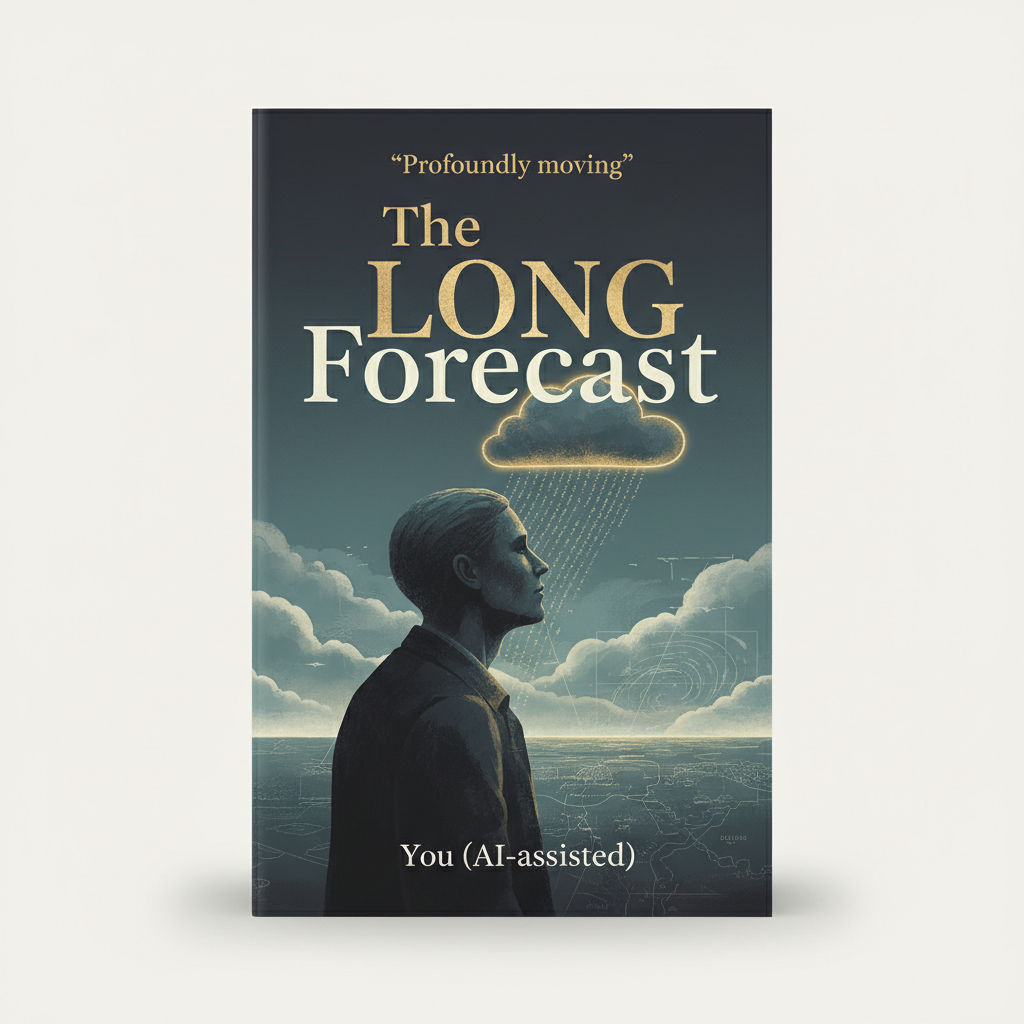
Synopsis
A veteran meteorologist, having spent a lifetime mapping potential futures, grapples with humanity's persistent struggle to heed warnings, even as the climate's tapestry unravels before our very eyes.
Chapter 1: The Genesis of a Seer
The ancient gnarled oak, a sentinel overlooking the sleepy hollow of his childhood, was Elias Vance’s first weather station. Not with anemometers or barometers, but with intuition, honed by the whisper of leaves and the sag of branches. He’d learned to read the sky as another child might trace the constellations – a story unfolding, each cloud a character, each gust of wind a pivotal plot twist. He was seven when the summer storm of ‘68 descended, a maelstrom that ripped through the valley like a vengeful god, leaving splintered wood and overturned dreams in its wake. Most children huddled indoors, terrified. Elias, however, pressed his small face against the condensation-streaked pane of his grandmother’s kitchen, a peculiar thrill, not of fear, but of profound understanding, coursing through him. He saw not chaos, but a system. A brutal, magnificent, utterly indifferent system.
His grandmother, a woman whose wisdom was etched into the lines around her eyes and the gentle cadence of her voice, found him there, mesmerized. She simply placed a hand on his shoulder, warm and comforting, and said nothing. But later, as the rain subsided to a gentle patter and the sun, a shy reappearance, painted the eastern sky in improbable hues of rose and gold, she pointed to a rainbow, arcing defiant across the bruised heavens. “See, Elias?” she’d murmured, her voice like the rustle of dry leaves. “Even after great upheaval, beauty returns. But it is a different beauty, born of what has passed.” He hadn’t fully grasped her meaning then, not the deep, philosophical currents beneath her words. But the image, the juxtaposition of raw power and delicate grace, lodged itself in his nascent consciousness, a guiding star for the intellectual journey that would consume his life.
The world, for Elias, was a perpetual unfolding of variables. The smell of rain on dry asphalt before the first drop fell, the way the air thinned before a cold snap, the almost imperceptible shift in the light that foretold a heavy snow. These weren't just observations; they were pieces of a grand, intricate puzzle, each one slotting into place to create a larger, more coherent picture. While other children chased fireflies or built forts in the woods, Elias devoured atlases, not for the distant lands, but for the snaking isotherm lines, the swirling currents marked with arrows. He’d spend hours poring over almanacs, charting temperature fluctuations, rainfall totals, the lunar phases – any scrap of data that might offer a glimpse into the mechanics of the sky. His parents, well-meaning but pragmatic, encouraged his academic pursuits, though they often found his singular focus somewhat perplexing. "Couldn't you perhaps," his father would inquire, a hopeful lilt to his voice, "join the baseball team, Elias?" Elias would simply smile, a polite but firm refusal in his eyes. The dynamics of a fastball held little intrigue compared to the unfathomable physics of a hurricane.
His bedroom, by adolescence, had become a miniature observatory. Walls plastered not with rock bands or sports heroes, but with hand-drawn isobar maps, charts of atmospheric pressure gradients, and careful notations of frontal systems moving across the country. A battered shortwave radio, scavenged from a local ham operator, crackled intermittently in the corner, a conduit to distant weather reports, a chorus of voices describing conditions in Fargo, Seattle, Miami – each city a data point in his sprawling mental model. He taught himself rudimentary programming on a clunky, monochrome computer, using BASIC to plot trends, to extrapolate, to try and force the chaotic beauty of the atmosphere into the rigid logic of code. He tasted the frustration of prediction then, the tantalizing near-misses, the humbling failures, but also the exhilarating moments of pinpoint accuracy. Those moments were addictive, a promise of control, of understanding, in a world that often felt bewilderingly random.
University was less a choice and more an inevitability. He immersed himself in meteorology, physics, fluid dynamics, the mathematics of chaos. His professors, initially intrigued by his intensity, quickly recognized a mind not just sharp, but uniquely attuned. Dr. Eleanor Vance, no relation, a formidable woman with a reputation for both brilliance and an uncompromising adherence to scientific rigor, became his mentor. She saw in Elias not just a student, but a kindred spirit, a fellow seeker in the atmospheric wilderness. She challenged him, pushed him, and in doing so, shaped him. "The atmosphere," she'd say, tapping a long, elegant finger against a complex equation on the blackboard, "is a living, breathing entity. To predict it, you must first learn to listen to its heartbeat."
Elias listened. He listened in the quiet hum of supercomputers processing billions of data points, in the complex, swirling visuals of satellite imagery. He understood, with a clarity that sometimes felt isolating, the immense power at play. He saw the world not as static landmasses and blue oceans, but as a dynamic interplay of energy, heat transfer, and moisture. The earth, in his mind’s eye, was a giant, delicate engine, constantly churning, constantly adjusting, never truly at rest. And as he delved deeper, as his understanding broadened, a subtle shift began to occur. His awe, once a pure, child-like wonder, began to intermingle with something else: a growing sense of responsibility, a looming apprehension.
His early career was marked by a relentless pursuit of accuracy. He thrived in the high-pressure environment of forecasting centers, an orchestra of blinking lights and droning servers, where seconds could mean the difference between a life saved and a catastrophe unheeded. He contributed to models that improved hurricane track predictions, developed algorithms for fine-tuning localized precipitation forecasts, and published papers that pushed the boundaries of mesoscale meteorology. His name became synonymous with a particular brand of meticulous, almost obsessive, dedication. He wasn't chasing academic accolades; he was chasing certainty, a profound desire to understand the very fabric of the future, even if only for the next 24 or 48 hours.
But even then, a seed of disquiet had begun to sprout. The models, for all their growing sophistication, were hinting at something larger, something darker, on the horizon. It started subtly, anomalies in the data that at first could be dismissed as outliers, mere statistical blips. Warming trends that exceeded natural variability. Intensifying storm patterns emerging with unsettling regularity. Glacial melts accelerating beyond historical rates. The atmosphere, that living, breathing entity, seemed to be exhibiting a fever. And the prognosis, for those who truly understood the language of the numbers, was not good.
He remembered a conference in the late nineties, a keynote speech by a charismatic but often dismissed climatologist who spoke of "tipping points" and "runaway feedback loops." The room, mostly meteorologists focused on short-term predictions, had shifted uncomfortably. A few chuckles, a palpable veneer of skepticism. Elias, however, had felt a cold prickle of recognition. The patterns the climatologist described, the projections, resonated with the subtle shifts he was already observing in his own data. It was as if the universe were whispering a warning, and only a few were bothering to listen.
His focus began to consciously broaden. The day-to-day fluctuations of weather, while still his bread and butter, seemed to recede slightly in significance compared to the burgeoning specter of climate. He started attending climate conferences, devouring literature on paleoclimatology, oceanography, glaciology. He saw the interconnectedness of it all – the atmosphere not in isolation, but in perpetual, profound dialogue with the oceans, the ice caps, the very geology of the planet. And the conversation of that dialogue was changing, growing more urgent, more discordant.
The transition from meteorologist to *climate seer*, as some of his less charitable colleagues might have put it, wasn't a sudden leap but a gradual, inexorable slide. He continued to forecast, to hone his craft, to serve the immediate needs of humanity, but his gaze was increasingly fixed on the distant horizon, on the long forecast. He became one of the first to champion the integration of climate models into operational weather forecasting, despite resistance from those who saw them as too speculative, too ‘long-range’ to be practical. He saw them as essential, as a context, a framework within which all immediate weather events would soon unfold.
There was a profound melancholy that settled upon him during those years. The exhilaration of understanding gave way to a deeper, more somber wisdom. He saw, with unnerving clarity, the path humanity was treading. He saw the escalating probability of extreme events, the relentless march of sea levels, the accelerating disruption of ecological systems. He had spent his life deciphering the language of the sky, and now, the sky was screaming. And the hardest part, the part that gnawed at him in the quiet hours of the night, was the deafening silence of so many around him. The warnings, clear as the ringing of a bell to his finely tuned ears, seemed to dissipate in the din of daily life, unheeded, unheard.
He was in his late fifties when the reality of what he had spent a lifetime forecasting began to manifest unequivocally, not just in abstract models, but in the glaring, undeniable reality outside his window. The decade of the twenties arrived, bringing with it a flurry of 'unprecedented' events that, to Elias, were anything but. They were simply the predicted, finally arriving. He felt like Cassandra, blessed with foresight but cursed with disbelief. The frustration was a constant, dull ache, but it was tempered, always, by the unwavering conviction that one must still speak, still warn, even if the words seemed to fall on deaf ears. For Elias Vance knew, with a certainty forged in the crucible of data and intuition, that the story of the sky was far from over. And the next chapters, he suspected, would be the most turbulent yet.
Chapter 2: Patterns and Portents
The hiss of the old teletype machine was music to young Elias’s ears, each stuttering character a fresh revelation scrolled onto pale yellow paper. It was 1978, and the global models were still rudimentary, a tapestry woven with broad, imprecise threads. Yet, even then, the nascent algorithms hinted at elegance, at an underlying order that belied the chaos of a hurricane’s eye or a sudden cold snap. He’d spend hours in the basement warren of the National Weather Service, the fluorescent hum a counterpoint to the quiet click of his own thoughts, poring over isobaric charts, thermal gradients, and the faint, almost imperceptible tendrils of oceanic currents.
His first major forecast, a winter storm bearing down on the Mid-Atlantic, was a triumph. The seasoned veterans, their faces etched with decades of squalls and sun, had initially scoffed. “Too far west, Vance,” old Man Peterson had grumbled, adjusting his spectacles. “Looks like it’ll track offshore.” But Elias, armed with a new iteration of a primitive numerical model he’d spent weeks debugging, stood firm. He’d seen the subtle perturbation in the North Pacific oscillation, a whisper that would amplify into a roar halfway across the continent. The snow fell, heavy and wet, exactly where he’d predicted, blanketing Washington D.C. in an unexpected white hush. News cameras captured the bewildered faces of commuters, while Elias, sipping lukewarm coffee, felt a quiet satisfaction bloom in his chest. He wasn’t just observing; he was seeing *ahead*.
Those early years were a whirlwind of intellectual pursuit, punctuated by similar small victories. Each accurate prediction, however minor, cemented his belief in the inherent predictability of the atmosphere, given enough data, enough computational power. The scientific community, then, was buzzing with the potential of satellite imagery, of ever-faster supercomputers. We were on the cusp, many believed, of taming the skies, of mastering the long-range forecast.
It was in the mid-80s, amidst the growing sophistication of these predictive tools, that the first discordant notes began to sound. They were faint at first, like an almost inaudible hum beneath the symphony of normal atmospheric fluctuations. He noticed, in the meticulous records of sea surface temperatures, a steady, almost imperceptible creep upwards in certain regions. The anomalies weren't dramatic enough to cause alarm on their own, often dismissed as statistical noise or natural variability. Yet, when aggregated, when viewed through the wider lens of global datasets, they began to form a pattern.
A colleague, Dr. Anya Sharma, then a brilliant young oceanographer with a fierce intellect and an even fiercer sense of humor, pointed out similar shifts in coral bleaching data from the Great Barrier Reef. Her reports, initially met with skepticism, spoke of “unprecedented frequency” and “geographic expansion.” Elias remembered a conversation over stale donuts, the morning light filtering through the grimy window of the research lab.
“It’s like the ocean is running a fever, Elias,” she’d said, stirring her coffee with a grimace. “And it’s not breaking.” He’d nodded, running a hand through his already thinning hair. “The models are starting to pick up on it too, Anya. Not screaming it yet, but… a persistent bias.”
The biases grew. The Arctic ice sheets, once a bastion of frozen permanence, began to recede with an unnerving regularity. Glaciers, those frozen rivers of time, showed accelerated melt rates documented not just by satellite, but by the anecdotal evidence of local mountaineers and indigenous communities. The signals were becoming less subtle, more insistent. It wasn't just a few data points; it was a burgeoning narrative.
He recalled a pivotal moment in the early 90s, at an international climate conference in Geneva. The air was thick with the scent of old paper and stale coffee, and a palpable tension. Dr. James Hansen, then at NASA, presented his groundbreaking work on global warming, predicting observable effects within a decade. The room was a mixture of stunned silence and vocal disbelief. Elias, sitting near the back, felt a cold dread settle in his stomach. The patterns he’d been observing, the quiet portents in the data, were no longer whispers; they were beginning to shout.
The computer models, once cumbersome beasts, were now sleek, powerful engines of prediction. They ingested millions of data points—atmospheric pressure, ocean temperatures, ice core samples, tree rings—and extruded increasingly sophisticated scenarios. And the scenarios, with each iteration, grew more dire. What had been a faint murmur in the 80s became a sustained hum in the 90s, and by the turn of the millennium, a throbbing pulse.
He recalled one particularly stark visualization: a global temperature map generated by a new generation of coupled ocean-atmosphere models. The vibrant blues of the past, representing cooler temperatures, were steadily retreating, replaced by an encroaching tide of yellows, oranges, and finally, angry reds. It was a time-lapse of a wound festering, undeniable in its progression.
“It’s not just a trend anymore, Elias,” a young programmer, barely out of grad school, had stated, his voice laced with an almost childlike horror. “It’s a trajectory. We’re on a downhill slope, and the momentum is building.”
The scientific consensus solidified, inexorably, around these findings. The Intergovernmental Panel on Climate Change (IPCC) reports, initially cautious and laden with caveats, became increasingly stark in their pronouncements. The language shifted from “possible” and “likely” to “unequivocal” and “irreversible.” Elias attended these meetings, his face an impassive mask, but inside, a knot of quiet despair tightened with each presented graph, each projected consequence. The data was irrefutable. The laws of physics, the intricate dance of energy and matter, were confirming what he and his colleagues had already begun to fear: humanity was altering the very operating system of its home planet.
But recognition and acceptance were different beasts. While the scientific community converged, the broader world fractured. Elias remembered the early whispers of doubt, the carefully crafted narratives designed to obscure, to sow confusion. He saw headlines screaming about “junk science” and “alarmist agendas.” He witnessed the rise of think tanks funded by industries with a vested interest in maintaining the status quo, producing their own counter-narratives, often dressed in scientific-sounding jargon.
He recounted a memorable public debate in the early 2000s, where he sat across from a well-dressed man, a self-proclaimed “climate realist” who, with smooth pronouncements and carefully selected cherry-picked data, dismissed decades of peer-reviewed research as either flawed or intentionally misleading. Elias, armed with graphs, with the weight of countless studies, felt like he was speaking a different language. The man smiled, shook hands, and continued his comfortable narrative, leaving the audience with an unsettling blend of reassurance and doubt.
“It’s like trying to explain calculus to someone who believes the earth is flat,” Anya had quipped after one such frustrating encounter, her usual humor replaced by a weary resignation.
The frustration was a constant companion. They were forecasting not just weather, but the future of civilization. They were charting a course towards undeniable peril, and many simply refused to look at the map. The resistance came from various quarters: from fossil fuel industries fearing economic disruption, from politicians wary of unpopular policies, from individuals who simply found the implications too overwhelming, too uncomfortable to confront.
Elias saw the insidious nature of this resistance. It wasn't always outright denial; often, it was an insidious delay. "We need more data," they'd say. "The science isn't settled." Or, even more subtly, "It's a problem for our children, not for us." This incremental denial, this slow-motion paralysis, felt more dangerous than outright rejection. It was the slow boil, the frog in the pot, slowly dying in conditions it initially tolerated.
The irony was not lost on him. His life’s work had been to peer into the future, to warn of impending storms, droughts, heatwaves. And for decades, those warnings, based on ever-improving models and undeniable data, had been met with a peculiar blend of dismissal, skepticism, and, perhaps most painfully, indifference. The signals, once subtle, were now blaring. The patterns, once discernible only to the trained eye, were now manifesting in floods, fires, and famines across the globe. He had seen it coming, had helped to chart its inexorable course, and still, he watched as the world sleepwalked towards the precipice. The quiet dread he felt in those early days had metastasized into a pervasive sense of urgency, a silent alarm ringing within his very bones. Yet, the human struggle to heed warnings, particularly those requiring sacrifice and immediate action for future benefit, remained a stubborn, unyielding force, a storm front far more formidable than any atmosphere could brew.
Chapter 3: The Echo Chamber of Evidence
The air, on that August afternoon in ’98, hung thick and wet, not with rain, but with a palpable anticipation. A hurricane, Mitch, had begun its slow, deliberate churn east of the Windward Islands. Our models, no longer the crude sketches of my early career but intricate tapestries woven from satellite data and atmospheric dynamics, screamed a clear warning: a monster was brewing. The projections were grim, a purple swath of devastation stretching across Central America. I remember the precision of it all – the wind speeds, the barometric pressure drops, the predicted landfall — stark figures on a glowing screen, chillingly accurate.
I stood in the fluorescent hum of the National Hurricane Center, a mug of lukewarm coffee clutched in my hand, the clatter of keyboards and the hushed urgency of voices a familiar soundtrack. Dr. Lena Hanson, her dark hair pulled back in a no-nonsense ponytail, leaned over a workstation, her brow furrowed in concentration. She pointed a laser pen at a swirling orange mass on the large screen dominating the room. “Elias,” she said, her voice a low murmur, “this is… unprecedented. The intensification rate targets Category 5 within 48 hours.”
I nodded, the word "unprecedented" lodging itself in my mind like a burr under a saddle. We were entering an era where the lexicon of meteorology was expanding to accommodate new extremes. Mitch wasn’t just a storm; it was a harbinger. We briefed policymakers, issued bulletins, painted a vivid, data-driven picture of impending catastrophe. The language was carefully calibrated, designed to cut through bureaucratic din and electoral posturing, to convey the urgency without resorting to hyperbole. We spoke of a “catastrophic potential for human life and infrastructure,” of a “historical storm event likely to reshape coastal communities.” We presented evidence, irrefutable, undeniable.
And then, the chasm. The chasm between the meticulous predictive power of our science and the ponderous, often paralyzed, machinery of human response. It wasn’t a sudden fissure, but a gradual widening, a slow tectonic shift that began with a shrug and ended in preventable tragedy. Mitch slammed into Central America with the brute force we had predicted, a Category 5 behemoth that stalled for days, dumping biblical deluges, triggering landslides, and wiping entire villages from the map. The death toll climbed into the tens of thousands. The scale of the human suffering was immense, a direct consequence of both the storm's ferocity and the delayed, inadequate, or entirely absent preparatory measures.
I remember watching the news reports, the images of flattened homes and desperate faces, a visceral punch to the gut. It wasn’t just the destruction that gnawed at me; it was the eerie familiarity of the unfolding narrative. Hadn’t we seen this before, in nascent forms? The increasingly erratic behavior of El Niño, the early warnings about drought in the Sahel, the whispers of melting ice caps — each a faint drumbeat leading to the crescendo of events like Mitch. But each warning, it seemed, was absorbed into a peculiar echo chamber of evidence, where the signals amplified within scientific circles but often dissipated or were deliberately muted upon reaching the ears that held the power to act.
This echo chamber, I came to realize, wasn't a sudden phenomenon. It had been growing for decades, thickening with layers of vested interests, political expediency, and a curious human aversion to acknowledging uncomfortable truths. We, the scientific community, spoke in the precise language of probability and statistical significance. We presented charts, graphs, and projections, each line a testament to painstaking research. But the language of policy, of immediate action, was often spoken in sound bites and electoral cycles, a dialect that often seemed to have no direct translation for the nuanced urgency of climate models.
Consider the early 2000s, a period I remember with a particular blend of frustration and growing alarm. The data wasn't just “suggesting” a warming trend; it was screaming it. The hockey stick graph, controversial as it became in certain circles, was just one vivid illustration among many. Glaciers were retreating at an accelerating pace. Arctic sea ice was shrinking. Summers were getting hotter, heatwaves more frequent and intense. Our supercomputers, running ever more sophisticated atmospheric and oceanic coupled models, were painting a consistent picture: the Earth's thermostat was being turned up, irrevocably.
I recall a conference in Washington D.C. around 2003, a gathering of climate scientists, economists, and a handful of elected officials, mostly aides. I presented our latest projections on sea-level rise for the Florida coast. My slides showed alarming scenarios for Miami Beach, entire neighborhoods submerged within decades, not centuries. I spoke of saltwater intrusion contaminating freshwater aquifers, of critical infrastructure compromised. My voice, usually measured, carried an edge of controlled urgency.
During the Q&A, a young congressional aide, perhaps in his late twenties, raised his hand. “Dr. Vance,” he began, his tone polite but dismissive, “we appreciate your… thoroughness. But surely, these are distant threats. Our constituents are more concerned with gas prices and job creation *today*.” His words hung in the air, a perfect encapsulation of the temporal disconnect. Our "distant threats" were, in our models, already underway, their consequences merely unfolding over timescales that outstripped political cycles.
I remember the silence that followed, broken only by the rustle of papers. I took a deep breath, trying to summon patience. “Sir,” I replied, my voice steady, “climate change isn’t a switch we flip when it’s convenient. It’s a supertanker turning. The further we let it go before we act, the larger the course correction needed, and the more dire the consequences.” The aide offered a tight-lipped smile, scribbled something on his notepad, and then turned his attention back to his phone. It was like I was speaking to a wall. A polite, impeccably dressed wall.
This wasn't always a deliberate act of malice. Sometimes, it was pure, unadulterated inertia, the immense weight of the status quo. Other times, it was the seductive power of short-term economic gains outweighing long-term ecological prudence. And then, there was the coordinated obfuscation, the well-funded campaigns to sow doubt, to muddy the waters of scientific consensus with pseudo-scientific arguments and personal attacks. I remember the emails, polite but pointed, from lobbyists for fossil fuel interests, suggesting we were alarmists, that our models were flawed, that the data was being misinterpreted. They didn't engage with the science; they engaged in a battle of narratives, often effectively.
The year 2005 brought Hurricane Katrina. Again, the models had foretold a devastating impact. New Orleans, a city perched below sea level, protected by a fragile levee system, was a bullseye. My colleagues and I watched the storm develop in the Gulf of Mexico with growing dread. The projections for storm surge were terrifying. We communicated these projections with the utmost clarity. Yet, the response was, to put it charitably, inadequate. The images of suffering in the Superdome, the flooded streets, the slow, chaotic relief efforts – it was a national tragedy, a stark illustration of what happens when detailed warnings are not translated into urgent, effective action.
I recall a conversation with a journalist from a prominent newspaper shortly after Katrina. He asked me, with a note of exasperation, “Dr. Vance, how can the most technologically advanced nation on Earth fail so spectacularly when you scientists gave such clear warnings?” I paused, searching for the right words. “It’s not a failure of prediction,” I told him, “it’s a failure of will. A failure to prioritize the long-term over the immediate, evidence over political convenience. We predict the future, but it seems humanity struggles to believe it until it’s already here, already raining down upon them.”
This became the core of my professional lament. We were becoming increasingly proficient at mapping potential futures, at tracing the intricate pathways of atmospheric and oceanic change. Our models, once clumsy tools, were now sophisticated forecasters, capable of remarkable accuracy. Yet, the chasm persisted, growing wider with each avoided warning, each unheeded prediction. The evidence, meticulously gathered and rigorously analyzed, became a kind of prophecy, spoken into an echo chamber where those who needed to hear it most seemed to be wearing earplugs.
The scientific literature, once filled with cautious language, began to adopt a more urgent, even somber, tone. The IPCC reports, once largely ignored outside academic circles, started landing on the desks of world leaders with increasing frequency, each report a heavier tome, each prognosis more stark. We refined our language, tried new metaphors, found new ways to connect the abstract numbers to tangible human experiences – droughts, floods, famine, migration. We spoke of "tipping points," of "irreversible changes," of a future fundamentally altered.
But still, the resistance. Still, the arguments of economic hardship, the cries for "more research," the deliberate conflation of weather and climate. It was as if we were speaking a different language, operating on a different temporal plane. We saw the long forecast, the inexorable trajectory. Many others, it seemed, could only see the immediate horizon, cluttered with the demands of the present. And the gap between these two perspectives, I feared, was where the future of humanity would ultimately be lost or found. The question wasn't if the planet would change, but whether we, as a species, would choose to adapt, or simply bear witness to the unraveling tapestry. The evidence was all there, clear as a bell, if only the bell hadn't been muffled.
Chapter 4: When the Future Arrives
The hum of the server racks in the data center used to be a comfort, a mechanical pulse of potential. Now, it’s a lament. Each subtle thrumming vibration through the polished concrete floor feels less like a promise of understanding and more like the rhythmic creak of a world coming undone. Vance stood, as he often did these days, by the panoramic window of his office, not quite seeing the manicured university grounds below. His gaze was fixed on something far more distant, something shimmering just beyond the visible spectrum of the present.
The year 2042. He spoke the number aloud, a soft expulsion of air, as if tasting a bitter prophecy. Twenty years ago, the models had screamed it, a chorus of algorithms and data points, painting scenarios with unnerving precision. Twenty years ago, he’d presented those findings in hushed conference rooms, the fluorescent lights reflecting off the polite skepticism in the eyes of politicians and industry leaders. He remembered one particular senator, a man with a booming laugh and an unshakeable conviction in humanity’s ingenuity, patting him on the shoulder after a particularly grim briefing. "Don't you worry your head, Doctor," the senator had chuckled, "we've always found a way, haven't we? Man's got a knack for it."
Vance exhaled slowly, the glass cool beneath his fingertips. He had always believed in humanity’s knack, too. He’d wanted to. But the knack, it seemed, had its limits. Or perhaps, more accurately, its price had been underestimated.
The images flashed through his mind, not like memories, but like raw, unedited news footage: the skeletal frames of families picking through the dust in what was once the breadbasket of America, the land baked into a cracked, unyielding canvas. The endless blue of the Pacific, once a source of wonder, now a hungry maw swallowing island nations whole. He’d watched as the sea-level rise maps, once theoretical overlays on digital globes, became satellite images of submerged coastlines, the pixels blurring where land ceased to be land.
He remembered the early summer of 2035, the "Great Heat Dome" that had settled over the subcontinent for weeks. He'd seen the initial models, the probability curves spiking like a fever graph. He'd tried to warn them. His voice had been one among many in the cacophony of scientific alerts. The news channels had carried his soundbites, earnest and grave, sandwiched between reports on celebrity gossip and sports scores.
Then came the casualty reports, the hospitals overflowing, the power grids failing. It wasn’t a wave, it was a suffocating blanket, pressing down on millions. He’d watched the global news, the distant footage of suffering, and felt a profound, debilitating guilt. Not guilt for the event itself – no human hand could conjure a heat dome – but guilt for the impotence of his knowledge. It was like shouting a warning across a chasm, only to witness the inevitable fall, the echo of his own voice mocking him from the depths.
He walked over to his desk, littered with a chaotic ecosystem of old papers, new journals, and a perpetually cold mug of coffee. An antique brass barometer, his grandfather’s, sat next to a sleek, holographic display unit. The barometer’s needle, usually a restless interpreter of atmospheric pressure, lay still, almost resigned. The holographic display, however, pulsed with a relentless stream of data: atmospheric CO2 levels (430 ppm and climbing), global sea surface temperatures (a frightening average of 19.8°C), and predictive models for the upcoming monsoon season in Southeast Asia, showing a familiar, alarming bifurcation into either catastrophic drought or unprecedented deluges. No middle ground. The bell curve, once a comforting symbol of natural distribution, had become a skewed, monstrous thing.
The office phone, an anachronism in an age of implants and neural interfaces, buzzed. He answered without looking.
"Vance here."
"Elias, it's Margaret." Dr. Margaret Chen, his closest colleague and intellectual sparring partner. Her voice, usually crisp and precise, held a tremor of exhaustion. "You saw the ENSO data?"
"Barely had time to breathe this morning, Margaret. What's the latest horror show?" He tried for levity, but it came out flat.
"It's consolidating, Elias. Strong El Niño signal, shaping up to be one for the record books. Again. And then the flip, the La Niña, pushing the Atlantic hurricane season into uncharted territory. You remember our 2038 simulations, the ones everyone called 'science fiction'?"
Vance closed his eyes, a phantom headache blooming behind his temples. "The Category Sixes. The dual landfall scenarios on the Gulf Coast. Yes, Margaret, I remember." He remembered the sneer of a television pundit who had dismissed those same simulations as "alarmist fantasy" in a prime-time segment, juxtaposed with a smiling family enjoying a beach vacation.
"They're not fiction anymore, Elias. The parameters are aligning. We're looking at a 70% probability of… unprecedented intensity. And the models are showing potential for rapid 'bombogenesis' events within 24 hours of tropical depression formation. People won't have time."
"Time for what, Margaret?" Vance muttered, rubbing his temples. "To evacuate a coastline that's already half-submerged? To rebuild after the last one, or the one before that?"
A silence stretched between them, heavy with unspoken truths. Margaret finally broke it. "The Governor's office wants a brief. They want to know 'the updated probabilities.'" Her voice was laced with an almost imperceptible bitterness.
"Updated probabilities," Vance echoed. "As if probability matters when the event is a certainty, only the timing and magnitude are mutable. They want us to tell them exactly when the water will reach their office steps, don't they? So they can lay sandbags and pretend it’s a localized issue."
He envisioned Margaret on the other end, her brow furrowed, a pen perhaps tapping against her lip. "Precisely. They want a report they can file, a problem they can 'manage.' Not a systemic collapse they created."
"Send me the latest projections," Vance said, his voice hardening with a resolve born of chronic frustration. "I’ll draft something. But it won't be pretty. And it won't offer comfort."
He hung up, the quiet clicking of the receiver a stark contrast to the internal tempest. He walked back to the window, the sunlight now dappling the campus quad. Students, barely into their twenties, laughed as they tossed a frisbee. They looked carefree, oblivious to the encroaching shadows. Vance wondered what their future held, the world he and his colleagues had so painstakingly mapped out for decades, a world now unfolding with unnerving fidelity.
The personal toll of 'knowing' was a heavy, constant companion. It wasn't just the data, the graphs, the increasingly violent spikes on every chart. It was the feeling of being a Cassandra, cursed to see the future but never to be believed. He remembered the arguments at family dinners, the well-meaning but ultimately dismissive advice from friends to "try and be more positive." How did one be positive when one’s entire professional life was dedicated to observing a slow-motion catastrophe?
His daughter, Clara, a bright, fiercely intelligent young woman, had once asked him, "Dad, if you know all this, why do you keep doing it? Why keep screaming into the void?"
He’d hugged her close, inhaled the scent of her hair, and felt the knot in his stomach tighten. "Because, Clara," he’d said, his voice thick, "even a whisper in the void is a testament. A record. And because hope, even a sliver of it, might still cling to the belief that if enough people understand the void, they might yet build a bridge across it."
But lately, that sliver felt gossamer-thin, ready to tear at the slightest breeze.
The global famine of 2039. The “Mega-drought” that engulfed Southern Europe for three years running. The forced migrations of millions, blurring borders, straining resources, igniting conflicts that simmered for months, then erupted in flashes of violence. These weren't abstract probabilities anymore. These were headlines, casualty counts, human faces streaked with soot and despair. And Vance had seen them all coming.
He flipped open his holographic display, bringing up Margaret's latest data dump. The sheer volume of information was overwhelming, a digital ocean of numbers and charts, each one a stark confirmation of predictions made when the world still largely considered such things a distant threat. His gaze lingered on a projected temperature anomaly map, a searing patchwork of reds and oranges covering vast swathes of the planet.
He picked up a small, weathered leather-bound notebook from his desk drawer. Inside, in his neat, almost archaic script, were notes from his undergraduate days. Observations of cloud formations, sketches of storm systems, the sheer joyous, intellectual curiosity of a young man captivated by the atmosphere’s boundless complexity. Above a particularly elaborate sketch of a cumulonimbus, he’d written, in bold, youthful letters: *To Understand is to Possess the Future*.
He reread it now, a faint, sardonic smile playing on his lips. To understand, yes. But to possess? What good was possession if the future was an unfolding tragedy, observed but not averted?
He leaned back in his chair, the squeak of the springs a counterpoint to the distant hum of the servers. The sun was dipping lower now, casting long, distorted shadows across his office. The sky outside, a familiar, deep blue, held none of the fury or the desolation that the data promised. It was a beautiful, unassuming sky, bearing no visible scars of humanity's impact. But Vance knew the truth.
The truth was, the future had arrived. Not with a cataclysmic bang, not with a sudden shift, but with the insidious crawl of statistics, with the incremental chipping away of resilience, with the slow erosion of what was once considered ‘normal.’ It had arrived like a tide, creeping up inch by imperceptible inch, until one day, you looked around and realized the ground you stood on was no longer dry.
And he, Dr. Elias Vance, the meteorologist who had spent a lifetime mapping potential futures, found himself standing in the encroaching water, his meticulously charted forecasts now the very ground beneath his feet, and still, the world struggled to acknowledge the depths.
A new email notification pinged on his display. From a junior researcher in his department, a bright young woman whose idealism still burned fiercely. The subject line: "Further Sea Level Rise – Maldives Projections."
He didn’t need to open it. He knew what it would say. He also knew what it would mean for the atolls, for the lives of the people who called them home, for the memory of the paradise resorts that used to dot their turquoise waters. He had calculated it all, decades ago. And now, the data was simply confirming the inexorable march of a future he had already witnessed in his mind's eye.
The phone rang again. It was Clara. "Dad," her voice was bright, "are you coming tonight? Dinner's ready. The news is saying another record heatwave for next week, but we've still got power, so we can run the AC..."
Vance closed his eyes, a weariness settling deep into his bones. His daughter, seeking comfort in the small, temporary victories, the fleeting illusions of control. He knew the heatwave forecast like the back of his hand, knew the probability of power grid failure in the coming weeks. He knew the true cost of that comfort.
"Yes, honey," he said, forcing a smile into his voice, "I'm on my way. Be there soon."
He would go home, sit at the dinner table, and pretend that the world wasn't slowly but surely tilting towards the precipice he had long ago charted. He would watch the news with his family, listen to the sanitized reports, the carefully curated optimism, and know, with a chilling certainty, what truly lay beyond the headlines. The data, forever etched into his mind, was a living prophecy, and every passing day brought new confirmations, new casualties, new instances of a future he had always hoped to prevent. The hum of the servers, a constant thrum, seemed to whisper one word, over and over: *Inevitability.*
Chapter 5: The Human Equation
The hum of the server racks in the data center, a low, constant thrum, usually brought Vance a strange sort of peace. It was the sound of information, of calculations grinding away at the immense complexity of the planet. But tonight, it felt like the distant drone of a collapsing building, each vibration a subtle tremor of what was to come. He’d spent the last few hours poring over old reports, not weather models this time, but studies on human behavior, on decision paralysis, on the stubborn, almost biological inertia of a collective species.
He remembered a particularly blistering summer, decades ago, when a heatwave had settled over the Eastern Seaboard like a suffocating blanket. His team had issued multiple warnings, red alerts for vulnerable populations, detailed projections of peak temperatures and the likely strain on infrastructure. The local news had dutifully reported it. Government agencies had put out advisories. And yet, when the hospitals filled with heatstroke victims, when power grids buckled under the strain of a million air conditioners, the chorus of surprise had been deafening. *“Who could have known?”* the anchors had lamented, their voices tinged with a manufactured bewilderment that grated against Vance’s every nerve ending.
It wasn't a failure of prediction; it was a failure of reception. The information, clear and unambiguous, had bounced off something fundamental in the human psyche. He’d started calling it the ‘Human Equation’ – a set of variables, not of atmospheric pressure or oceanic currents, but of cognition, emotion, and societal structure, that seemed to consistently cancel out the most urgent warnings.
He pulled up a digital rendering of the human brain, a glowing, pulsing network of connections. It was a marvel, an intricate pattern-recognition machine honed over millennia to sniff out danger. But its danger detector, Vance mused, was calibrated for cheetahs in the tall grass, for the sudden plummet of a cliff face, for the immediate threat that could be outrun or fought. It was ill-equipped for a rising tide that crept in by inches, for a temperature increase measured in fractions of a degree per decade, for a threat whose most devastating consequences lay beyond the horizon of most self-interested lifespans.
That was the crux of it: the temporal discounting. A rational mind, presented with the certainty of future catastrophe versus the immediate, tangible discomfort of change – a tax on carbon, a shift in lifestyle, a retooling of an entire economy – would, more often than not, choose the latter. The future, even a catastrophic one, felt abstract, a conceptual construct, while the present was raw, undeniable, and demanding. Vance had seen it play out in countless policy debates, in the op-ed pages, in the casual dismissals of friends and family. “It’s too expensive *now*,” they’d say, or “We’ll just adapt *later*,” as if adaptation were a simple flick of a switch, a minor inconvenience rather than a civilization-redefining upheaval.
Then there was the ‘optimism bias,’ a comforting delusion that whispered, *“It won’t happen to me,”* or *“Someone else will fix it.”* He remembered a particularly heated town hall meeting in a coastal community, years before the worst of the erosion began. He’d presented projections of sea-level rise, backed by geological surveys and tidal gauge data, showing that their homes, built mere feet above the mean high-water mark, would be underwater within fifty years. A man in the front row, his face ruddy with indignation, had stood up and declared, “My father built this house. My grandfather built this community. We’ve always been here, and we *always will be*. You scientists just want to scare us into spending money.” The room had erupted in applause. The data, empirical and unforgiving, had been met with a defiant, almost childlike belief in invincibility.
It wasn't just individual psychology. The Human Equation was compounded by societal structures, by the very mechanisms designed to facilitate collective action but often hindered it. The short electoral cycles of democracies, for instance, were antithetical to the long-term planning required to tackle a planetary crisis. Politicians, beholden to the next election, struggled to champion policies whose benefits would only become fully apparent – or whose costs would only be fully justified – decades down the line. It was a system built for sprints, not for a marathon that demanded generational stamina.
And then, the venomous tendrils of disinformation. As the scientific consensus solidified, a counter-narrative had emerged, fueled by vested interests and amplified by the echo chambers of social media. Data was questioned, scientists were demonized, and the very concept of objective truth became a contested battleground. Vance understood that trust was the bedrock of collective action. If people didn’t trust the messenger, they wouldn’t heed the message, no matter how dire. He’d witnessed firsthand the erosion of that trust, the insidious planting of doubt that had allowed the Human Equation to remain stubbornly unbalanced.
He thought of Dr. Anya Sharma, his brilliant colleague, a paleoclimatologist who could trace Earth’s climate history back millions of years. She often spoke of the planet’s resilience, its capacity for self-correction. But her voice always carried a caveat: the timescales. Earth corrected itself, yes, but often over eons, with mass extinctions as the painful punctuation marks of transition. Humanity, a fleeting blink in geological time, hadn’t evolved to comprehend such grand, slow-moving processes. We lived in the now, or at best, the tomorrow. Our narratives stretched a few generations backward, a few forward. Anything beyond that became mythology or sci-fi.
Vance closed his eyes, the server hum a ceaseless drone. He saw a stark image in his mind's eye: a solitary figure shouting a warning into the teeth of a hurricane, its roar drowning out their voice. Except, in this scenario, the hurricane was metaphorical, a slow-motion catastrophe, and the figure was *us*, all of us, shouting not into the wind, but at each other, squabbling over trivialities while the storm gathered its strength.
He had often wondered if there was a universal constant of human inertia, some psychological speed limit that prevented rapid, large-scale behavioral change even when facing existential threat. The pandemic, for all its horrors, had offered a flickering glimpse of what was possible – a sudden, collective pivot, a global reordering of priorities. But even that, he realized, had been spurred by an immediate, tangible enemy, a virus that could be seen (through a microscope, at least) and that struck with terrifying speed. Climate change offered no such visceral, unified enemy. It was diffuse, multifaceted, the enemy within our own habits, our own comfort, our own deeply ingrained systems.
He opened his eyes, scanning the monitors that displayed a cascade of data – atmospheric CO2 levels, global temperature anomalies, regional precipitation shifts. The numbers screamed their warning, an undeniable, objective truth. And yet, for all their clarity, it was like they were printed in a language humanity was rapidly forgetting how to read.
He pulled up a study on the 'bystander effect,' how individuals in a crowd are less likely to intervene in an emergency when others are present, each assuming someone else will take responsibility. He saw a planetary version of this phenomenon. Who would act? China? The US? Europe? India? Each nation, understandably, looked to its own immediate interests, to its own citizens, to its own perceived fairness in the monumental task of de-carbonizing an entire civilization. The global commons became nobody's responsibility, or rather, everybody's responsibility, which often amounted to the same thing – inaction.
Vance sighed, a deep, weary sound. He knew the data. He knew the science. And he knew, with a certainty that chilled him to the bone, that the Human Equation, with its variables of denial, short-termism, optimism bias, and fractured trust, was the most complex, intractable challenge of all. It wasn’t a matter of whether the planet would survive; the planet would find a new equilibrium, as it always had. The question, the only question that truly mattered now, was whether humanity would be a part of it.
He thought of the look in his granddaughter's eyes just last week, as she’d pointed at a particularly vibrant sunset, a sky ablaze with oranges and purples caused by atmospheric aerosols. "It's so beautiful, Grandpa!" she'd exclaimed, her voice full of innocent wonder. And he had smiled, a hollow echo of a smile, because he knew that beauty was often a mask for disruption, and that the long forecast, for her generation, held more storm than calm. The hook wasn't in some distant future, but in the immediate, vulnerable present of her bright, unburdened gaze, and the knowledge that the Human Equation was still stubbornly unresolved.
Chapter 6: Beyond the Horizon, Yet Within Reach
The scent of damp earth, a familiar balm from mornings spent plotting isotherms and dissecting pressure systems, now carried an unsettling sharpness. It was late autumn, the kind that used to linger, painting the maples in fiery hues before a gentle fade to winter’s stark elegance. But this year, the leaves, still vibrant green in August, had shriveled with a hasty, almost panicked brown, dropping like discarded ambitions onto the still-warm asphalt. Dr. Elias Vance stood on his small back porch, a mug of cool, forgotten tea clutched in his hand, watching a lone monarch butterfly flit erratically amongst the withered petunias. It was late for monarchs. Too late.
He thought of the models, the elegant, swirling equations that had consumed his life. They had always been attempts to pin down the elusive, to etch the chaotic into predictable lines. For a long time, he had believed in their power, in the sheer intellectual might of humanity to decipher the universe’s codes. Now, he found himself grappling with a different kind of code: the human one, far less predictable, far more resistant to elegant solutions.
The past chapters of his life, both personal and professional, flickered through his mind like a time-lapse satellite loop. The exhilaration of a perfectly predicted hurricane track, the quiet satisfaction of seeing a drought forecast validated, not by disaster, but by averted disaster. And then, the growing dissonance. The data points that screamed change, the models that wept with converging probabilities of catastrophe, the scientific papers that grew thicker, denser, yet seemed to bounce off the collective consciousness like spent rain against a fortified wall.
He’d always seen his work as a dialogue with the future. A conversation, sometimes urgent, sometimes advisory. But somehow, the world had tuned out, or perhaps, simply preferred not to listen. He had spent his early career charting the known, then the probable, and finally, the undeniable. And through it all, a subtle shift occurred within him. The objective observer, the dispassionate interpreter of data, began to crack. A faint, almost imperceptible tremor of despair, then frustration, and finally, a stubborn, almost illogical hope, began to seep into the bedrock of his scientific detachment.
What did it mean, then, to continue forecasting in a world where the warnings, once delivered with meticulous precision, were often met with shrugs or outright hostility? He still looked at the weather, of course. It was instinct. He watched the atmospheric rivers, bloated with unusual moisture, carving new paths of destruction. He tracked the heat domes, smothering cities under blankets of unbearable air. He saw the sea ice, retreating further and faster than even the most pessimistic projections. This was his library, his living testament.
The notion of a ‘perfect future’ had always been an academic fantasy. Chaos theory, after all, had been a foundational text in his intellectual upbringing. Initial conditions, even infinitesimally altered, could lead to vastly divergent outcomes. The butterfly effect wasn’t just a captivating metaphor; it was the bedrock truth of dynamic systems. But what if the "initial conditions" were no longer just the whims of a distant current, but the collective inertia of seven billion souls?
He remembered a conversation with a young intern, bright-eyed and brimming with the eager certainty of youth, years ago. She had asked him, after a particularly grim climate briefing, “Dr. Vance, if we know all this, why can’t we just fix it?” He had paused, the weight of the question settling heavy on his shoulders. He could have trotted out the usual explanations: economics, politics, human nature. But he hadn’t. He’d simply said, “Because fixing it requires us to confront who we are, not just what the atmosphere is doing.”
The human equation, as he had come to call it, was the ultimate variable. The models could forecast the severity of a storm, but not the courage of a community facing it down. They could predict the rise of sea levels, but not the political will to relocate coastal populations. They could map the migration of species, but not the empathy required to preserve their habitats. This was beyond the purview of his supercomputers, beyond the elegant lines of his algorithms. Yet, it was precisely within this uncharted human territory that the future would be forged.
He walked into his small study, a room overflowing with books, maps, and the faint, comforting smell of old paper. A framed photograph sat on his desk: a younger Elias, grinning, holding up a crude wind vane he’d built as a boy. The ambition in those eyes, the boundless curiosity. He hadn’t lost that. What had changed was the object of his intense scrutiny. The storm wasn’t just outside anymore; it was churning within the human heart.
He often wondered if focusing solely on the negative, on the unraveling tapestry, was counterproductive. Did highlighting the inevitable simply lead to resignation? Or was there a strength in unflinching honesty, a kind of stark beauty in acknowledging the precipice? He believed the latter. To deny the data was to deny reality itself, and ultimately, to squander the very tools that might still offer a path forward.
A flicker of movement outside the window caught his eye. A robin, late for its southern migration, hopped tentatively across the parched lawn. Its perseverance, its simple, unyielding search for sustenance, struck him. It didn’t analyze the climate models; it simply *lived* within the changing conditions, adapting or perishing. Perhaps, he mused, there was a lesson there. Not in blind survival, but in a responsive engagement with the world as it truly was, not as we wished it to be.
The notion of a ‘good future’ or a ‘bad future’ felt increasingly simplistic. The reality was a spectrum, a thousand shades of gray, influenced by a myriad of interconnected decisions yet to be made. The past few decades had taught him that the future wasn't a fixed destination we hurtled towards, but a vast, branching delta, where every choice, every action, every collective inertia, carved a new channel.
What, then, was the role of the forecaster in this new era? Not merely to warn, he concluded, though warnings remained crucial. But perhaps, also to illuminate the points of leverage, the places where human intervention, however small, could ripple outwards, nudging the course of that delta. It meant translating the complex language of atmospheric physics into the tangible implications for communities, for livelihoods, for the mundane rhythms of daily life. It meant fostering a new kind of literacy, a climate literacy, not just of data, but of ethical responsibility.
He picked up a well-worn copy of a book on systems thinking. The interconnectedness, the emergent properties, the feedback loops – these were the insights that still held power, not just for understanding the planetary system, but for understanding the human one too. Small changes, strategically placed, could have disproportionately large effects. This was where the fragile hope resided, not in grand, utopian visions, but in the gritty, incremental work of discerning the leverage points.
The challenge was immense. It was easy to succumb to fatalism, to pull the blinds and retreat into the solace of past predictions. But his life's work, the very essence of his being, rebelled against such surrender. To forecast was to believe, in some fundamental way, that understanding could lead to agency. That knowledge, even if painful, was always preferable to ignorance.
He thought of the horizon, that tantalizing line where sky met earth, constantly receding, beckoning. It was the ultimate boundary, yet always just out of reach. The future was like that. We could never truly grasp it, never perfectly chart its every contour. Yet, within reach were the tools, the understanding, the collective capacity for discernment that could still steer us away from the very worst of what the models foretold.
The forecast, he realized, was never just about what *would* happen. It was also about what *could* happen, and crucially, what *might* happen if we chose a different path. It was a projection of probabilities, yes, but also a call to action, an implicit question posed to humanity: what will you do with this information?
He walked back to the porch, the air now cooler, hinting at the approaching night. The moon, a sliver of silver, was already visible. He looked out at the familiar landscape, no longer a mere collection of trees and grass, but a living, breathing testament to interconnectedness, vulnerable yet resilient.
He still saw the gathering storms, the accelerating shifts, the undeniable evidence of a planet in transition. But he also saw the glimmer of human ingenuity, the quiet determination of individuals and communities, the nascent movements towards recalibration.
The forecast for the future, then, was not a singular prophecy of doom, but an ongoing conversation. It was a probabilistic tapestry, continually being woven by our choices, our responses, our collective will. And in that unfolding narrative, Dr. Elias Vance, the lifelong forecaster, found his purpose renewed, not as a prophet of absolute futures, but as a persistent, if weary, guide – pointing towards the horizon, and the intricate, challenging, yet still navigable paths that lay within our reach.
The wind whispered through the dry leaves, a sound like distant apprehension. But beneath it, a faint, undeniable current of possibility still flowed. The forecasts would continue. The warnings would persist. For as long as humanity drew breath, the dialogue with the future, however strained, would endure. And in that enduring dialogue, perhaps, there still lay a chance.