The Last Glacier Report
By Mikael Löwgren
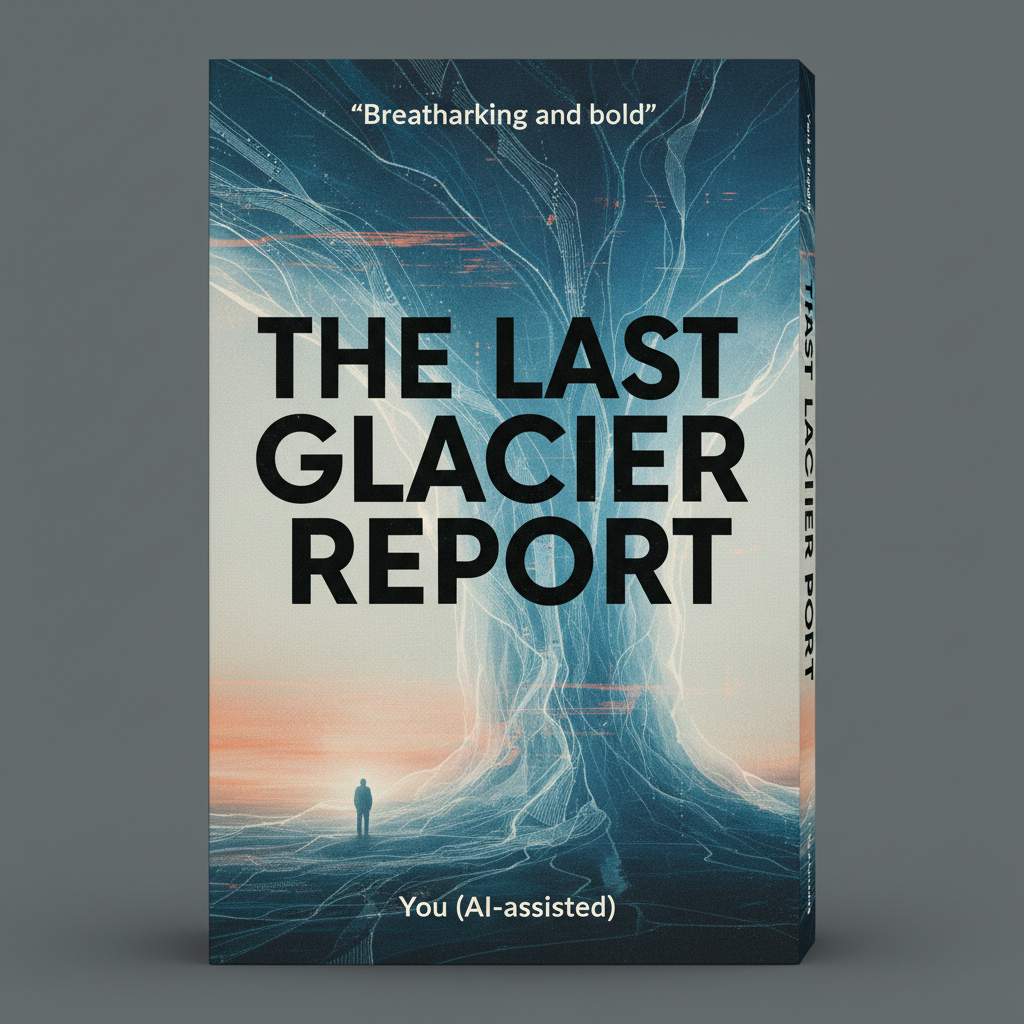
Synopsis
As a remote glacier succumbs to the relentless sun, a solitary scientist races against time and memory to record its final breath before an unforgiving future is etched into the very landscape.
Chapter 1: The Whispering Ice
The wind, a familiar, ancient voice, bit into Elara’s exposed cheeks the moment she stepped from the sputtering prop-plane. It carried not the scent of pine or damp earth but of ice, sharp and elemental, a fragrance she had come to associate with home. Below her rough-hewn boots, the gravel crunched, a fleeting sound swallowed by the vast, white expanse that stretched to a horizon indistinguishable from the pale, indifferent sky. This was her fifteenth summer at Sentinel Ridge, and each arrival held the same precise measure of awe and trepidation. Only this time, the scale of trepidation threatened to overwhelm the awe.
The research station was less a station and more a collection of sturdy, utilitarian modules, squatting low against the relentless assault of the elements. Their metal sides, faded by sun and snow, hummed faintly with the distant thrum of generators. Smoke, a thin blue thread, rose from the chimney of the largest module, signaling Professor Thorne’s early arrival – or perhaps, his inability to ever truly leave.
Elara adjusted the strap of her oversized duffel bag, the weight a familiar ache on her shoulder. Her breath plumed in frosty clouds, a fleeting signature against the immensity. She walked the worn path towards the main module, each step a deliberate push against the stiff breeze. The landscape here taught patience, taught you the futility of hurry. Yet, a new urgency, cold and serrated, had begun to gnaw at her.
The glacier, her life’s quiet companion, loomed behind the station, a colossal white behemoth that seemed to breathe with the land. It wasn't the jagged, dramatic peaks of the Alps, nor the sprawling, flat expanse of the Antarctic ice sheet. Sentinel Glacier was a valley glacier, a river of ice flowing slowly, relentlessly, between two granite flanks. For years, she had measured its progress, its subtle shifts, like a physician tending to a slumbering giant. Now, the slumber was shattered.
Inside the main module, the air was thick with the scent of coffee and old books. Professor Thorne, a figure of angular bones and perpetually worried eyes, sat hunched over a cluttered table, his breath fogging the rim of a ceramic mug. He looked up, his gaze sweeping over her, a flicker of relief easing the tension in his shoulders.
“Elara. Good. You made good time.” His voice was raspy, worn by decades of shouting over helicopter rotors and howling winds.
“The pilot was in a hurry to get back to the warmth,” she replied, a faint smile playing on her lips. She dropped her bag with a thud, the sound echoing briefly in the quiet space. “Anything change since your last report?”
Thorne sighed, pushing a hand through his thinning grey hair. “Only the speed of change. The melt ponds are… extraordinary this year. Spreading like ink blots on a white page.” He gestured vaguely towards a map tacked to the far wall, covered in a spiderweb of red and blue annotations. “And the crevasse formations near the snout… deeper, wider than I’ve ever seen. It’s groaning, Elara. The whole thing is groaning.”
She felt a familiar tightening in her chest. She had heard the groans in previous years, the deep, resonant rumbles that pulsed through the ice, the sharp cracks like distant rifle shots. But Thorne’s tone, weighted with an uncharacteristic defeat, spoke of something more profound.
“The new satellite imagery?” she asked, already knowing the answer.
He nodded slowly, picking up a crumpled printout from a chaotic pile. He smoothed it with a trembling hand, then laid it on the table near her. It was an aerial view of Sentinel Glacier, stark and unforgiving. The blue, once confined to scattered pockets, now bled across vast swaths of the ice surface, a cancerous bloom. The glacier’s “tongue,” the lower, flatter part that pushed into the valley, looked shredded, riddled with fissures, like ancient parchment tearing at the seams.
Elara leaned closer, her eyes tracing the familiar landmarks, now distorted, eroded. Each blue line, each dark shadow marking a newly widened crevasse, felt like a personal wound. This was not a scientific diagram; it was a death certificate, written in the language of satellite pixels.
“We’ve lost another ten meters from the snout in the last three weeks alone,” Thorne murmured, his voice barely audible. “The runoff… it’s a torrent. The sensors are struggling to keep up with the volume.”
Ten meters. A small number in the grand scheme of a glacier that stretched for kilometers. But it was the *rate* that terrified them, the exponential acceleration that defied all previous models, all historical data.
“I’ll get the new ground-penetrating radar set up immediately,” Elara said, her voice firm, pushing back against the rising tide of despair. “We need a full crevasse survey of the lower quadrant. And I’ll recalibrate the ablation stakes. We need to know precisely how much ice we’re losing, hour by hour if possible.”
Thorne looked at her, a flicker of the old fire in his eyes. “Good. We knew this was coming, Elara, didn’t we? We warned them. We wrote the reports. But to see it… to bear witness…” He trailed off, his gaze drifting towards the small window that offered a glimpse of the vast white world outside.
Elara knew what he meant. There was a profound difference between studying data sets back in a climate-controlled office and standing on the edge of the dissolving giant, its cold breath on your face, its dying groans reverberating through the soles of your boots. Here, the science wasn't abstract; it was raw, visceral, heartbreaking.
She spent the remainder of the day unpacking, organizing her meticulously packed equipment. Every piece had a purpose, every tool a place. The small, spartan room echoed with the quiet hum of the generator and the occasional distant moan of the glacier. She pulled out her worn leather journal, its pages filled with years of observations, sketches, and personal reflections. Her mother had given it to her when she left for her first expedition, a blank canvas for a life of discovery. Now, it would bear witness to an ending.
After a meager dinner of freeze-dried rations, Elara stepped outside. The sun had dipped below the western ridge, painting the sky in streaky mauves and oranges, colors that seemed too vibrant, too alive for the somber landscape they framed. The wind had lessened, a gentle sigh now, carrying the faint, metallic clang of the anemometer on the roof.
She walked towards the edge of the plateau, her gaze drawn inevitably to the glacier. In the fading light, its surface appeared softer, less brutal. But the blue of the melt-ponds still stood out, even under the pastel sky, like bruises marring white skin. She could hear it now, distinctly, the glacier's lament. Not the sharp crack of ice calving, but a deep, resonant hum, a vibration that seemed to emanate from beneath the earth itself. It was the sound of molecular bonds breaking, of ancient ice shedding itself, dissolving back into the primordial waters from which it had formed millennia ago.
This phenomenon, the internal "groaning" of the glacier, had become markedly more pronounced in recent years. It wasn't the dramatic rupture of a crevasse forming, but a pervasive, almost sentient moan, as if the entire body of ice was in constant, agonizing flux. She thought of it as a low-frequency hum, just at the edge of human hearing, a bass note in the symphony of the planet's decline. Some of the field assistants had called it the "ice song," but Elara knew it was no song. It was a dirge.
She stood there for a long time, the cold seeping into her bones, her breath still pluming white against the deepening twilight. The vastness of the landscape swallowed her, a solitary figure dwarfed by the enormity of nature's relentless power. She had dedicated her life to understanding this power, to unraveling its secrets. And now, she was tasked with recording its final, desperate gasps.
Tomorrow, the real work would begin. The painstaking measurements, the deployment of sensors, the hourly observations. Every data point, every photograph, every recorded sound would be a testament, a timestamp on a rapidly disappearing world. She was here to write the last report, to be the archivist of a silent, slow-motion catastrophe. And in doing so, she knew, she would be etching an unforgiving future not just into the scientific record, but into the very landscape of her own soul. The glacier was dying, and she, Elara Vance, would be there to mark its final breath. The whispering ice, though, had already begun to tell its story. And its whispers were growing louder, carrying a chilling forecast for them all.
Chapter 2: Echoes in the Meltwater
The sun, a persistent intruder even at this altitude, glinted off the fresh meltwater trickling from the glacier’s snout. Elara adjusted the brim of her hat, the thin fabric offering little defense against the relentless glare. Today, the world was a study in contrasts: blinding white ice against the stark, ancient grey of newly exposed rock, and the ephemeral shimmer of water against the enduring solidity of stone. She knelt, her gloved fingers tracing the faint, irregular line etched into the granite – a benchmark set by a long-dead cartographer generations ago. The number scrawled above it, barely legible beneath lichen growth, represented a height she knew, with a certainty that chilled her more than the wind, was no longer accurate.
Her breath plumed in the crisp air as she consulted her handheld GPS, its green-lit display a sterile counterpoint to the raw, untamed landscape. Each measurement taken over the past few days had painted an increasingly vivid, and increasingly grim, picture. The glacier was retreating not in slow, ponderous increments, but in quick, greedy gasps. The exposed granite wasn’t just a new surface; it was a wound, a raw, angry absence where millennia of ice had once rested. The GPS confirmed her fears, spitting out coordinates that placed her squarely above where the ice had stood just last season.
She pulled a weathered field notebook from her pack, its pages dog-eared and stained with coffee rings and earth. Flipping past precise sketches of moraines and crevasses, she found the entry from three years prior: "Southwest flank markers, 12:45 PM. Ice surface 3478m above sea level. Conditions clear, light wind. Retreat rate negligible." A thin, bitter smile touched her lips. "Negligible." The word felt like a relic from a different era, a time when the world moved at a more forgiving pace. Now, the ice had dropped more than an arm’s length in elevation on this very flank since that entry was penned.
Her earlier expeditions, those first tentative forays into the glacial heartlands, were painted with a similar naive optimism. The air then had been colder, the ice thicker, the future a vast, unfurling expanse that stretched beyond her wildest predictions. She remembered the thrill of her first solo journey into the interior, the vast, echoing silence broken only by the crunch of her boots on the hoarfrost. She'd been a fledgling then, barely out of university, her head brimming with theoretical physics and the romance of uncharted wilderness. The ice had felt immutable, a colossal sleeping giant.
"You're being overly dramatic, Elara," Dr. Hemmings had chided, his voice a smooth, cultured purr that always grated on her nerves. It had been during a departmental meeting, the air thick with the scent of stale coffee and unread journals. She had just presented her preliminary findings from the Patagonia expedition, highlighting an alarming rate of calving events. "A natural fluctuation, my dear. The planet breathes. Always has."
Dr. Albright, his perpetually rumpled tweed jacket smelling faintly of pipe smoke, had nodded sagely. "Indeed. We mustn't extrapolate from isolated data points. The models predict a much more gradual decline, if any at all." His gaze had swept across the room, seeking affirmation from his peers, a silent judgment against her youthful fervor. They had seen her as an anomaly, an impassioned outlier whose warnings were mere academic theatrics, not urgent scientific observations.
A gust of wind, sharp and cutting, whipped around her, yanking a loose strand of hair across her face. It felt like a memory made manifest, a cold whisper of those dismissive voices. She tightened her grip on the GPS, its plastic casing cool beneath her gloved palm. They had been wrong. Oh, how spectacularly wrong. And here she was, standing on the very ground those models had dismissed, an unwilling witness to their spectacular unraveling.
The newly exposed rock face was a palimpsest of geological time. Striations from ancient grinding, embedded pebbles from distant epochs, even a faint, oxidized streak that hinted at volcanic ash from millennia past. Each exposed layer was a page turned, revealing a story untold for countless ages. It was breathtaking, in its own stark, desolate way. But it was also a testament to loss, a chronicle of departure.
She unfolded her tripod, careful to level it perfectly on the uneven ground. Perched atop it was her laser altimeter, a sleek, precise instrument that hummed faintly as it powered on. Its accuracy was absolute, unclouded by human error or lingering doubt. It didn't care about Hemmings' smooth pronouncements or Albright's placid reassurances. It simply reported the cold, hard facts.
Her work here was a silent defiance. A methodical, relentless recording of truth against the backdrop of past skepticism. She wasn't just collecting data; she was building a monument of evidence, layer by careful layer, just as the glacier had built itself over eons. This wasn't about proving them wrong, not anymore. This was about bearing witness, about ensuring that the final, gasping breaths of this ancient titan were meticulously documented, understood, and never, ever forgotten.
The altimeter emitted a high-pitched beep, indicating it was ready. Elara aimed its narrow beam towards a prominent, gnarled outcropping of rock across the valley, a landmark she’d been tracking for years. The digital readout flickered, then settled on a precise number. She scribbled it down in her notebook, followed by the date and time. Beside it, she added a small, almost imperceptible symbol: a downward arrow, underlined heavily. A silent amendment to all the previous, more hopeful observations.
She repositioned the tripod, moving it a few paces closer to the ice edge. The ground here was a muddy morass, a mix of pulverized rock and water, the consistency of thick porridge. Her boots sank with each step, sucking at the earth with a wet, plosive sound. This was the ephemeral boundary, the shifting line between what was and what had been. Each day, that line crept further back, swallowing more of the past into its watery embrace.
Reaching for her thermal imaging camera, she methodically scanned the glacier's face. The vibrant blues and purples on the screen depicted the cooler, deeper ice, while streaks of angry red and orange revealed areas of rapid melting, conduits for the relentless outflow. It was like witnessing the circulatory system of a dying beast, its life force draining away in vibrant, arterial lines.
A subtle shift in the air caught her attention. A deep, resonant hum vibrated through the earth, a sound that started as a low thrum and slowly ascended, building tension. It was the glacier, speaking in its own guttural language. Elara dropped the camera, her practiced senses instantly alert. She knew that sound. It was the groan of immense pressure releasing, the shattering of internal bonds.
Her eyes scanned the sheer ice wall in front of her. Not a crevasse opening, not a serac calving. This was a deeper, more fundamental tremor. And then she saw it. A dark, jagged hairline fracture, barely visible against the mottled white, snaking its way vertically up the face of the ice. It was moving, visibly extending, like a slow-motion lightning strike across the sky.
A fragment of exposed bedrock, caught between the fracturing ice and the solid mountain, popped with a sharp, explosive crack. The sound echoed across the valley, swallowed by the vast emptiness, then spat back out in a series of diminishing reverberations. This was not a 'natural fluctuation.' This was a tearing apart, a fundamental disintegration.
Elara fumbled for her satellite phone, her fingers clumsy despite their years of practice. No time to set up the robust weather station, no time for detailed seismic readings. This was about immediate observation, about capturing the visceral, undeniable truth of the moment. She pressed record, holding the phone steady, its small lens a tiny eye witnessing a colossal sorrow.
"Observation log, Elara Vance, November 14th," her voice was surprisingly steady, despite the tremor in her hands. "Approximately 14:17 GMT. Significant fracturing event on the north face, near marker Alpha-7. Visible crack propagation at a rate of approximately…" she paused, calibrating her estimation against a known rock feature. "...two meters per minute. Concurrent localized seismic activity, felt underfoot. This is not a surface event. This appears to be a deep structural failure."
The dark line spread further, wider now, a visible chasm opening within the ancient ice. A deep, sorrowful sigh seemed to escape from the very heart of the glacier, a sound that was both primal and impossibly old. She could taste the cold in the air, feel the vibration in her bones. The ice was weeping, and the sound was a lament.
She held the phone steady, her body braced against the unseen forces at play. This was it. The accelerated pace of its demise. This was the very data she had come to collect, stark and unforgiving. And even as the scientist in her meticulously documented the unfolding catastrophe, the human in her felt a profound sense of grief. The world was changing, right before her eyes, and all she could do was bear witness, her small, solitary mission now fraught with an urgency that tightened her chest and blurred the edge of her vision. The glacier, her silent companion, was not just groaning; it was screaming. And she, Elara Vance, was the only one listening.
Chapter 3: A Fragile Alliance
The morning began, as most did, with the rasp of Elara’s boot-soles against the gritty permafrost and the soft hiss of her breath crystallizing in the air. The sun, a pale, hesitant eye, was just clawing its way over the eastern ridge, painting the upper reaches of the glacier in an ethereal, fleeting gold. Today, however, the familiar ritual of her trek felt brittle, overlaid with an unfamiliar hum of anticipation. Yesterday’s data, stark and uncompromising, had burrowed deep, leaving a hollow ache beneath her ribs. But this morning, a faint, insistent whisper of curiosity had begun to displace the dread.
She was charting a newer, less-trodden path today, veering slightly east of her usual traverse. The ice here was a pocked, craggy landscape, littered with moraine – the glacier’s cast-off debris. It demanded slower, more deliberate steps, a constant scan for fissures camouflaged by shadow. A sharp gust, as if exhaled directly from the glacier’s gaping maw, tore at her hood, stinging her cheeks with icy grit. She pulled her scarf higher, burrowing deeper into her layers, her eyes continually sweeping the desolate expanse.
It was more than just a deviation from her routine; it was an instinctual tug, a faint current in the familiar river of her days. Yesterday, during a brief, desperate attempt to recalibrate a temperamental sensor on the western flank, she’d caught a glimpse, far off, of something unusual. A glint, perhaps, or a peculiar shadow playing tricks in the low light. She hadn’t been able to chase it then, the sensor demanding her full, frayed attention. But the image had lingered, a persistent burr under the saddle of her mind.
Now, traversing this rougher terrain, she felt it again – that phantom magnetism. She spotted it just as the sun broke fully free, bathing the area in a harsh, clarifying light. It wasn’t a glint, not exactly. It was a faint, almost luminous shimmer, nestled amongst a cluster of dark, angular rocks that had only recently emerged from beneath the retreating ice.
Elara paused, her breath clouding in front of her. Her heart gave a sudden, surprised lurch against her ribs. The air around her turned thin, sharp with an unexpected clarity. She adjusted her goggles, the silence amplifying the thudding pulse in her ears. Bit by bit, she picked her way across the uneven ground, her boots crunching softly, each sound exaggerated in the vast quiet.
As she drew closer, the shimmer resolved into a delicate, almost translucent form. It was small, no larger than her thumbnail, and embedded deep within a matrix of ancient, compressed sediment. She knelt, oblivious to the icy bite soaking through her insulated trousers. Her gloved fingers, usually adept with instruments, felt clumsy, almost reverent. Very carefully, she nudged aside a small pebble, exposing more of the find.
It was a creature, or what was left of one. Not a bone, not a fossil in the traditional sense, but something far more ephemeral. A wing, perhaps, intricately veined, preserved in amber-like perfection. Its color was an impossible, iridescent blue, a hue she’d never seen in any known insect, not in this region, not anywhere she could recall. It pulsed with a faint, internal light, as if some residual energy still thrummed within its ancient structure. The edges were impossibly delicate, fanned out as if caught mid-flight, yet held in perfect stasis.
Elara felt a sudden, dizzying rush, a warmth spreading through her veins despite the biting cold. Her breath hitched. This was not merely old; it was *ancient*. And utterly, breathtakingly unknown. She pulled her small field magnifying glass from her pocket, her hands trembling slightly. Under its lens, the details were even more astonishing: minuscule hairs along its delicate veins, patterns that spoke of an intricate, specialized life. It looked like an insect’s wing, yes, but not like any insect she had ever documented, or even read about. Perhaps a prehistoric dragonfly, though considerably smaller, or something entirely alien to her lexicon.
The thought, half-formed, was intoxicating. A species, possibly extinct for millennia, now revealed by the glacier’s rapid retreat. It was a testament to the ice’s preservative power, and a stark, undeniable symbol of its current fragility. Each melting day was not just a loss, but a revelation.
She spent the next hour there, meticulously documenting the discovery. She took photos from every conceivable angle, recorded the exact GPS coordinates, and noted the chemical composition of the surrounding sediment. Her fingers, despite their careful movements, buzzed with an electric urgency. This wasn’t just data; this was a story, a whispered secret from a forgotten age, carried across time by the very ice she was watching vanish.
Her mind raced, connecting the dots. If this creature existed, what did it eat? What was its natural habitat? And what did its presence imply about the climate of its time, so different from the harsh, cold world of today? It was a glimpse into a past ecosystem, a window into an environment the world had long forgotten. And now, it was gone again, revealed for barely a moment before the elements would surely claim its delicate form.
She carefully, gently, used her smallest field trowel to excavate a tiny section of the surrounding sediment, hoping to lift the fragment without damaging it. It was slow, painstaking work, her breath a series of short, controlled puffs. The blue wing, caught in its amber prison, seemed to watch her, a silent, ancient eye. Eventually, with a deep sigh of relief, she managed to free a small chunk of the sediment containing the wing, securing it in a specially insulated, padded container she had for geological samples.
The weight of it in her hand was disproportionate to its size, suddenly heavy with meaning. A brief flicker of hope, hot and surprisingly fierce, flared in her chest. For so long, her work had been about documenting loss, charting deterioration, echoing warnings that fell on deaf ears. But this… this was an *unveiling*. A sudden, startling glimpse of something new, something beautiful, something that defied the bleak narrative she had grown accustomed to.
This tiny, iridescent wing was a punch to the gut of her quiet despair. It made her remember *why* she had dedicated her life to this. Not just to measure the end, but to understand the beginning, the middle, and all the intricate threads that wove life itself. It ignited a renewed purpose, a blazing conviction that if such wonders could be held in the ice, then perhaps, just perhaps, documenting their passing was not merely an obituary, but a testament to what once was, and what might still be possible to save within the larger, eroding tapestry.
The discovery pushed her to work with an even greater feverishness. The precariousness of her time here, which had felt like a suffocating shroud, now became a sharpened edge, an urgent motivator. Each day, before, had been a careful rationing of hours, a meticulous adherence to protocol. Now, each day felt like a frantic scramble, a race against the sun’s unforgiving descent, against the very nature of time itself.
She spent the rest of the morning traversing a much wider area than planned, her eyes peeled, seeing the landscape anew. Every shadow, every exposed rock, held a potential secret. The sheer volume of data she collected that day felt almost reckless compared to her usual methodical pace. She measured ice thickness with renewed fervor, meticulously logged meltwater outflow, and even ventured closer to a section of the glacier that was particularly unstable, the deep, resonating cracks a constant warning. She knew the risks, but the image of that iridescent wing burned in her mind, a silent imperative.
The isolation, which had sometimes felt like a slow, creeping constriction, now amplified her sense of responsibility. There was no one else here to share this discovery with, no one to marvel with at its implications. The weight of it, the wonder of it, rested solely on her shoulders. She felt a profound connection to that tiny, blue form, a silent kinship of forgotten things.
As the afternoon sun began its slow, inevitable slide towards the western horizon, stretching long, indigo shadows across the glacier, Elara found herself at a high vantage point. Below her, the meltwater river, swollen and boisterous, rushed through a newly carved channel, a testament to the ice’s rapid recession. The air, crisp earlier, had softened, carrying the faint, earthy scent of exposed soil and the metallic tang of mineral-rich water.
She pulled out her notebook, not for data, but for thoughts, for feelings. The blue wing, carefully secured in its container, felt like a small, beating heart against her chest. "They said it was too late," she murmured to the empty air, her voice rough with disuse. "They said we already knew everything." But they didn't. They couldn't have.
She sketched the outlines of the newly exposed land, the erratic boulders, the patterns of the receding ice. A flicker of movement at the edge of her vision caught her eye. It was small, dark, and quick, darting between the rocks near the meltwater’s edge. A shadow, perhaps. Or something very much alive.
Her breath caught. Not a fossilized wing, but a living creature. Hope, that fragile, tenacious weed, began to unfurl its green tendrils in the barren landscape of her mind. She squinted, her seasoned eyes trying to pierce the gathering gloom. It moved again, faster this time, disappearing behind a cluster of dark moraine. She wasn't entirely certain what she had seen. Perhaps it was just the trick of the light, an arctic fox, a ptarmigan. But a seed had been planted. A new question.
As the last sliver of sun dipped below the jagged peaks, plunging the glacier into the deep blue twilight, Elara felt a renewed, restless energy. The day’s ending was not a signal for rest, but a quiet promise of tomorrow’s possibilities. The ghost of the iridescent wing, the tantalizing flicker of movement, left her with a new, quietly urgent resolve. She wouldn’t just record the end; she would continue to search, to reveal, to find what else the ice held in its disappearing embrace. The glacier was undeniably dying, but in its final breath, it was also, spectacularly, coming alive. What other secrets might it yield before it was gone forever? She would be here, watching, waiting, and documenting, until the very last whisper.
Chapter 4: The Unveiling Earth
The glacier peeled back another layer of its ancient skin, a slow, deliberate shedding that Elara watched with a morbid fascination. Each morning, the horizon felt a little wider, the sky a fraction deeper, as if the earth itself was exhaling a sigh it had held captive for millennia. What emerged from beneath the retreating ice was not the fertile soil of imagined valleys, nor the sparkling sapphire of hidden lakes, but a landscape of brutal, undeniable revelation. It was a raw, primordial canvas of rock: obsidian black against granite grey, veined with quartz that glinted like shattered bone in the pale Arctic light.
The air, usually thin and sharp, now carried the faint, earthy tang of something ancient disturbed. It was a smell Elara couldn’t quite identify, an admixture of mineral dust, damp stone, and something else – a deep, almost vegetal dampness that hinted at long-buried life, though nothing green yet dared to stake a claim on this newly unveiled world. The silence, too, had changed. No longer the muffled hush of snowdrifts, but a vast, resonant quiet, broken only by the drip-drip-drip of meltwater from overhangs, or the sudden, startling plink of a pebble dislodged by the sun's insistent persuasion.
Elara knelt, her knees protesting slightly on the rough terrain. Her gloved fingers traced the sinuous lines etched into the rock face, scars left by the glacier's relentless grind. These were not random marks; they were stories, carved by a patient, indifferent sculptor. She imagined the colossal tongue of ice, centuries thick, sliding over this very spot, reshaping, redefining. Now, exposed to the air and the sun, these stories were finally visible, stark and unembellished.
“You’ve held so much,” she murmured, her voice swallowed by the sheer expanse. It wasn’t a rhetorical question, not entirely. There was a peculiar intimacy to her solitary conversations with the land. The glacier had been her confidante for years, a colossal, whispering entity that spoke in creaks and groans. Now, the barren earth itself seemed to listen.
She reached for her geological hammer, its weight familiar in her hand, but hesitated. There was a rawness to this exposed rock, a vulnerability, as if the earth was still blinking, adjusting to the sudden, unwelcome exposure. Instead, she lowered her hand and simply touched the surface, the cold seeping through her glove, a direct conduit to the planet’s bone.
The rhythm of the retreat was accelerating. Her telemetry buoys, once anchored deep within the ice, now bobbed in newly formed meltwater pools, their signals chirping with alarming frequency. The data streamed into her sensors, painting a picture that was both breathtaking and heartbreaking. Where the glacier had once stood, a vast, undulating expanse of ice, there was now a sprawling, uneven valley – a landscape in nascent formation. Gullies carved by torrents of meltwater trenched the fresh earth, and ancient boulders, once carried aloft, lay scattered like forgotten toys.
This transformation was a kind of death, yes, but also a birth. A violent, urgent birth, tearing open a world that had been cloaked for millennia. And Elara, the sole witness, felt the weight of it in her bones. The discovery from the previous days – that singular, unidentifiable fragment of life, now carefully cataloged in a sterile container – pressed down on her with an unyielding urgency. Could this barren landscape, this newly unveiled earth, harbor more such secrets? Was she racing against the sun to merely document a loss, or to uncover a hidden library before its pages turned to dust?
She walked, her gait steady despite the uneven ground, towards a ridge marked by a particularly aggressive line of meltwater erosion. The sound of the rushing water grew louder, a persistent roar that pulsed in her ears. It was a sound both liberating and devastating – the sound of the future arriving with relentless force. At the crest, she paused. Below, a newly exposed lake glinted, its surface a startling, vibrant turquoise, fed by a series of cascading waterfalls. The sheer volume of water was staggering, a testament to the colossal melt.
“You don’t waste time, do you?” she whispered to the surging current, a wry smile touching her lips. “Always forward.”
Her eyes scanned the newly revealed shore of the lake. It was here, in places like this, where the glacier’s last embrace had been most intimate, that the earth might speak most clearly. She pulled a small, weather-beaten notebook from her pack, its pages creased and stained. Across the top, she scribbled the date, then circled it twice, a silent acknowledgment of the heightened stakes.
Today, she would focus on the sedimentary layers exposed along the lake’s edge. They were like the rings of a tree, each stratum a record of time, of climate, of life and death. The glacier, in its relentless passage, had acted as a colossal excavator, stripping back the overburden to reveal the deepest annals of history.
As she worked, carefully scraping away loose debris, her mind drifted back to a conversation from years ago, in a brightly lit university office, far removed from the biting winds of this place. Her former mentor, Dr. Aris Thorne, a man whose wisdom was as etched as the ancient rocks, had leaned back in his leather chair, a look of weary resignation on his face.
“Elara,” he'd said, his voice soft but firm, “the world will change, regardless of our reports. The ice will yield. But what it reveals in its yielding – that is where the true understanding lies. The answers are not always in what remains, but in what was hidden.”
At the time, she had clung to the hope of preservation, the naive belief that enough data, enough impassioned pleas, could somehow halt the inevitable. Now, watching the turquoise lake swell, she understood the deeper truth of his words. The preservation she sought was no longer of the glacier itself, but of its last, desperate messages.
A sudden glint caught her eye. Not the quartz, but something darker, almost organic, embedded in a layer of fine-grained sediment. Her heart quickened. She lowered her headlamp, its beam a focused spear of light, illuminating a delicate, pressed fern frond. It was perfectly preserved, its intricate venation still visible, a ghost of green against the grey matrix.
She held her breath, the air suddenly charged with an electric stillness. This was not the amorphous fragment from before, a puzzle yet to be solved. This was a clear, undeniable echo from a past long sealed away. A fern, here, in a landscape that now supported little more than lichen and hardy moss. It spoke of a time when this region had been different, warmer, teeming with a rich, verdant life.
“You tell me a story,” she whispered, her voice barely audible. “A story of another world.”
Carefully, meticulously, she began to extract it, using a fine brush and a small, pointed chisel. The work was slow, painstaking, each tiny movement a dance between discovery and destruction. It demanded her full attention, pulling her entirely from the broader landscape, focusing her world down to the size of a postage stamp. The urgency that had been a dull throb in her chest now hammered, insistent and relentless. Every minute spent here was a minute the sun had to scour more secrets from the newly exposed earth, to crumble the delicate pages of this ancient book.
The thought of more such discoveries, lying just beneath the surface, waiting to be seen, to be understood, propelled her forward. This wasn’t just about the glacier's death; it was about the life it had, unwittingly, protected. The life that might now offer clues, not just to the planet’s past, but to its resilience, its capacity for reinvention.
As the sun began its slow, reluctant dip towards the horizon, painting the stark rock faces in hues of orange and deep purple, Elara carefully placed the fern fossil into a padded specimen box. The weight of it felt immense, a tangible piece of time, a whispered secret finally given voice. She secured the lid, then sat back on her heels, surveying the evolving landscape.
The air had grown colder, thin tendrils of mist beginning to cling to the newly exposed rock. The turquoise lake below had taken on a deeper, more mysterious hue. The roar of the meltwater, once a constant presence, now seemed to deepen in pitch, a mournful dirge echoing across the vastness.
She stretched, her muscles stiff from hours of kneeling. The solitude, usually a comforting cloak, now felt like a heavy shroud. It amplified the weight of her task, the sheer magnitude of what she was witnessing, what she was responsible for. There was no one else here to share the burden, no other eyes to see this stark, beautiful unveiling. Just her, and the raw, untamed earth.
She packed her tools, the clinking of metal against rock a sharp percussion in the deepening twilight. As she turned to make her way back to the station, her gaze fell upon a distant crevice, a jagged tear in the newly exposed bedrock. It looked deeper, darker than the others, almost like an open wound. And for a fleeting moment, she could have sworn she heard something—a faint, almost imperceptible whistle carried on the wind, like the breath of something ancient stirring awake. Not the wind, not the glacier, but something else.
The thought sent a shiver down her spine, not of fear, but of profound anticipation. The unveiled earth was calling, not just with stories from the past, but perhaps with whispers of an even deeper mystery, waiting to be heard. And Elara, solitary witness, knew she would have no choice but to answer.
Chapter 5: The Final Measure
Elara felt the shift first in the air, a subtle deepening of the cold that wasn't quite right. It was a cold that bit with sharp teeth, unlike the usual blunt gnaw of the high alpine. Her bones, long accustomed to the rhythmic patterns of the glacier, recognized the warning before her conscious mind fully registered it. The barometer, perched precariously on the edge of her makeshift desk, had been dropping steadily for hours, though she’d been too consumed by the intricate dance of numbers on her screen to properly heed its silent prophecy. Now, a low, guttural growl vibrated through the earth, a sound she inherently knew was not the glacier’s normal groaning. This was something larger, something with teeth.
She pushed back from her workstation, the worn soles of her boots scraping against the gritty floor of the research hut. The light outside, previously a flat, unwavering gray, was now a bruised purple, shading swiftly to an angry, bruised green on the horizon. The wind, which had been a constant companion, now shrieked, a banshee wail that seemed to carry bits of broken ice and dust. It slammed against the hut’s stout walls, rattling the single, double-paned window like a child’s toy.
A knot tightened in her stomach. A major storm, here, now. This wasn't merely a squall; this was a beast. Her equipment, delicate instruments meticulously positioned across the glacier's brittle surface, would be battered, torn, potentially obliterated. More critically, the data—the final, most crucial measurements—remained unsecured. Each byte was a testament, a final whispered word from a dying giant. She had pushed her timelines, stretched her limits, all for the sake of completion, for a narrative that could not be silenced. Now, the elements themselves conspired against her.
She pulled on her heaviest expedition parka, the worn fabric stiff against her shoulders. Her gloved fingers fumbled with the zipper, the urgency a live thing clawing at her throat. A sudden gust hit the hut, screaming through the eaves, and a fine dust of snow, finer than sugar, sifted in through a hairline crack in the window frame.
“No,” she muttered, the word snatched away by the rising wind. She wouldn't let it. Not now, not when she was so close. The last weeks had been a blur of frantic activity, each day bleeding into the next, fueled by strong coffee and a singular obsession. The glacier was singing its swan song, and Elara was its chosen chronicler. She had promises to keep, not to anyone living, but to the silenced ice, to the future.
She checked her handheld GPS, its screen a tiny beacon in the dimming light. Three critical sensor arrays remained active, their data streams the very lifeblood of her final report. One measured the internal temperature fluctuations at the glacier's bedrock interface – the most intimate whisper of retreat. Another monitored meltwater velocity, the speed at which the glacier was quite literally liquidating itself. The third, her most recent installation, used seismic sensors to capture the glacier’s groans, the fracturing sounds of its terminal breaths. All of them exposed, all of them vulnerable.
The thought of losing it all, of the data dissolving into the vast, indifferent expanse of the storm, was a physical blow. It was like watching a loved one’s final words swallowed by the wind.
She grabbed her emergency beacon, a thermos of hot tea, and a packet of high-energy bars. The last thing she checked was the small, waterproof satellite communication device. Even if she retrieved the local drives, the ability to transmit would be paramount. The signal was already sporadic, flickering like a dying candle. The thought chilled her more than the brutal cold outside.
Stepping out was like entering a different dimension. The wind immediately attacked, tearing at her clothes, whipping her hair across her face even beneath the hood. The air was thick with flying snow and ice pellets, stinging her exposed skin. Visibility dropped to mere meters. She pulled the hood tighter, hunching her shoulders against the onslaught. Each step was a battle, her boots sinking into the newly fallen snow, the icy breath of the glacier chilling her lungs.
She had to get to the arrays. All three.
Her first target was the bedrock interface sensor, the closest one, roughly a mile due north. She relied on her GPS and the faint, almost imperceptible contours of the land she knew so intimately. The landscape was no longer familiar; it was a whiteout, a maelstrom of swirling white and roaring wind. The only constant was the icy pavement beneath her feet, a world dissolving into featureless chaos.
She leaned into the wind, each stride a conscious, deliberate effort. The glacier beneath her groaned, but it was a different sound now—less a lament, more a shriek of pain as the burgeoning storm tore at its surface. She could feel it trembling, a seismic shudder that resonated through her bones. The ice, already stressed, would fracture further under this assault. This storm wasn't just a threat to her equipment; it was accelerating the glacier's ultimate fragmentation.
Through the blizzard's veil, she saw a fleeting shadow, a dark, angular shape that she knew must be the sensor’s housing. Relief, sharp and cold, shot through her. She pushed harder, her breath coming in ragged gasps. The wind tried to push her back, to steal her footing, to obscure her path. But Elara had walked this land in sun and calm, in mild snow and fierce gales. She knew its hidden crevices, its treacherous slopes, its sudden drops. She had an intimate connection with this dying giant, a bond forged in years of solitary observation.
She reached the bedrock sensor array, its metal frame caked in rime ice, wires threatening to snap under the weight of the accumulated freezing fog. Her fingers, despite the thick gloves, were clumsy with cold. She fumbled with the latches, the small, intricate mechanisms protesting under her urgent ministrations. The wind howled, mocking her efforts, trying to tear the small data drive from her grasp as she extracted it. With a final, desperate tug, it clicked free. She secured it in a waterproof pouch inside her parka, the small weight a precious cargo.
One down. Two to go.
The meltwater velocity sensor was further, across a section of the glacier prone to sudden, deep crevasses, now hidden beneath a treacherous blanket of new snow. She had to navigate by memory, by the ingrained knowledge of the land, by a sixth sense honed by years of solitude and observation. Her GPS was a backup, but the true map was etched into her mind.
The storm intensified. The wind wasn't just a force; it was a physical entity, trying to bowl her over. She dropped to her hands and knees for a stretch, crawling across a particularly exposed ridge, fearing that one misstep would send her spiraling into a hidden abyss. Her mind raced with calculations, with the urgency of unretrieved data. The very landscape felt alive, not just with the storm’s fury, but with the glacier's own death throes. The groans were louder now, punctuated by sharp cracks that reverberated deep within the ice.
Her vision blurred, not just from the wind-whipped snow, but from the tears that stung her eyes. Tears of frustration, of fear, of a profound, aching sorrow for this magnificent, crumbling monument. She had watched it retreat year by year, then month by month, and now, almost hour by hour. She was bearing witness to its end, but she also carried the burden of its final message.
The meltwater sensor was shrouded in white, a phantom in the storm. She nearly missed it, stumbling upon its base plate. This one was more complex, requiring careful disconnection of multiple cables. Her gloved fingers, now almost numb with cold, fought against the stiff, frozen connectors. Time stretched and compressed, becoming meaningless. There was only the roar of the wind, the urgency of her task, and the persistent, chilling certainty that the glacier was actively, physically breaking apart around her. A deep-seated rumble, so powerful it vibrated through her teeth, rocked the ice directly beneath her. She froze, heart hammering. *The glacier is calving,* she realized with a sickening lurch. Not a large piece, not yet, but the tremors were undeniable.
Finally, with a grunt of effort, the data drive came free. She secured it, this one too, like a precious, delicate thing. Another segment of the glacier's final moments, salvaged.
One more. The seismic sensor array. The farthest, the most exposed. It sat on a high, barren ridge, designed to capture the acoustic signature of the ice fracturing. It was a perilous trek even in good weather, but now, it felt like a foolish, near-suicidal endeavor.
Reason screamed at her to turn back, to huddle in the hut, to abandon the last drive. But something deeper, more primal, pulled her forward. It was the call of completion, the fierce loyalty of a dedicated scientist to her subject, to the truth. She had to retrieve it. This was the final measure, the last breath.
As she trudged on, the snow deepened, swirling around her knees. The wind was a solid wall, forcing her to lean into it with all her strength. She felt herself becoming a part of the storm, a small, defiant eddy in its raging current. The glacier's symphony of endings was now a deafening roar—creaks, groans, sharp cracks, and the deep, resonating rumble of unseen shifts. Each sound was a new wound, a further decay.
The ridge loomed, a darker mass against the swirling white. It seemed impossible to climb against such an assault, but she found a foothold, then another, pulling herself upwards. Her muscles screamed, her lungs burned, but she pushed through the pain. She was a solitary figure against an overwhelming force, a testament to stubborn will.
The seismic array was barely visible, a ghost of its former self, plastered with rime and snow. One of the sensor leads was already ripped free, whipping wildly in the wind. A wave of despair washed over her, chilling her further than the wind. Had she come all this way, battled the elements, risked herself, to retrieve damaged data?
She shoved the thought away. She had to try. She wrestled with the main unit, her fingers stiff and raw despite her gloves. Each connection was frozen, unyielding. She fought against the ice, against the wind, against the growing darkness of the approaching night. The air tasted of ozone and ancient ice, a bitter tang of finality.
A particularly violent gust hit, and a loud *CRACK* ripped through the air, distinct from the glacier's agony. It was the sound of something tearing, of wood or metal failing under extreme stress. She risked a glance upstream. The research hut, her only shelter, was a dim silhouette. But now, she saw something else — a jagged outline, higher up, where the communication antenna stood. It looked bent, broken. A fresh wave of icy dread washed over her. Her last hope of immediate transmission, gone.
But this realization only solidified her resolve. If she couldn’t transmit, then physical recovery was even more paramount. She *had* to secure the drive. It was the only way.
With one final, desperate wrench, the main data drive ejected. She clutched it, her frozen fingers aching, but the small device was now her entire world. Three drives. All primary data secured.
She started her descent, the journey back now feeling even more perilous. The wind was at her back, pushing her, but also threatening to send her tumbling. The glacier was roaring its final goodbyes, a symphony of endings that filled the world. Each groan, each crack, each shudder resonated within her, a profound, gut-wrenching farewell. She was witness to more than just its physical demise; she was hearing the very last notes of its song.
Elara stumbled, caught herself, and then, through a momentary lull in the blizzard, she saw it. A faint, distant glow from the direction of her hut. The emergency generator, perhaps, had kicked in. A thread of hope, thin but vital, sparked within her.
She pushed on, the three data drives nestled safely against her chest, each one a precious fragment of a vanishing world. The ground beneath her continued to shift and moan, urging her forward, her own footsteps a muted counterpoint to the glacier's final, devastating anthem. She was close, so agonizingly close to bringing its story to the world. And as she fought her way back towards the flickering light, Elara knew, with a certainty that transcended the storm’s fury, that the true burden of this final measure was only just beginning.
Chapter 6: Beyond the Ice Line
The last packets of data shivered across the satellite link, a nervous digital pulse in the dying light. Elara’s fingers, stiff from the cold and the relentless tapping, hovered above the keyboard for a moment, an almost reverent pause. Then, with a soft click, she hit 'send.' The comprehensive report, a digital monument to what had been, was flung into the vast, indifferent ether. It held not just numbers and graphs, but the quiet elegy of a world in profound transition, the silent scream of ancient ice giving way to raw earth.
She watched the little progress bar creep to 100%, a tiny green snake devouring its tail, before it dissolved into a confirmation message. *Transmission Complete.* It was done. The culmination of weeks, months, years even, of dedicated solitude, of whispered conversations with the ice, of shivering calculations and the ache in her bones. The glacier’s last breath, meticulously recorded, analyzed, and now, shared.
A faint hum, the steady thrum of the generator that had been her constant companion, faltered. It wasn't the usual rhythmic cough of a machine gearing down, but a dying gasp, a hesitant stutter. Elara’s eyes darted to the power indicator on her console. One by one, the tiny green lights blinked out, swallowed by the encroaching darkness. The air in the small lab grew instantly still, the whir of hard drives replaced by the muted hiss of her own breath. The emergency lights, dim and yellow, flickered on, casting long, wavering shadows across her face.
Just in time, she thought, a dry irony coating the words. The universe had held its breath for her, it seemed, until the very last byte had fled.
She pushed herself back from the console, the worn leather of her chair groaning in protest. Her gaze drifted to the small, grimy window in the lab. Outside, the last vestiges of twilight bled across the horizon, painting the sky in bruised purples and grays. The wind, though calmer now than in the throes of the storm, still carried a desolate whisper across the exposed rock.
She wrapped her thick wool sweater tighter around herself, a futile attempt against the deep chill that had begun to seep into the station. The silence, raw and sudden, pressed in on her. It was a different kind of silence than the expansive, natural quiet of the wilderness; this was the silence of cessation, of things simply stopping.
Slowly, deliberately, Elara gathered her worn field journal and a pencil. She had always preferred the scratch of lead on paper, a tangible connection to the act of recording, even in an age of digital omnipresence. She flipped to a fresh page, the crisp white an almost jarring contrast to the grim reality outside.
"Chapter 6: Beyond the Ice Line," she wrote, her hand surprisingly steady. The title felt stark, definitive. It was not just a chapter in her report, but a turning point in an unfolding, planetary narrative.
She stepped out of the lab, the dim emergency lights leading her down the narrow corridor, past dormant instruments and silent monitors, like a ghost navigating a deserted ship. The air grew colder with every step she took toward the main entrance. She pulled on her heaviest parka, the familiar weight a comfort, and secured the hood tight around her face.
The steel door groaned open, a rusty sigh.
Outside, the air hit her with a physical force, sharp and exhilarating. The wind, though diminished, still tugged at her clothing, a restless spirit wandering the newly barren landscape. She walked away from the station, her boots crunching on the frozen scree, the sounds unnervingly loud in the profound quiet.
She stopped at the edge of what had been, just weeks ago, the glacier's mighty tongue. The spot where she had taken her last, desperate measurements. Now, it was an expanse of raw, scraped earth, a landscape of exposed stone and ancient debris, gouged and scarred by the retreating ice. The rock, freed from its frozen embrace, seemed to exhale, a silent relief.
Above her, the sky was a deep, velvet black, studded with more stars than she had ever seen. The ambient light pollution of the glacier, the pale reflection off the ice, was gone. The cosmos, vast and indifferent, glittered with an almost brutal clarity. It stretched from horizon to horizon, a cosmic tapestry unravelling above the newly unveiled earth.
She lowered her gaze. The starkness of the landscape was breathtaking, in the way a profound loss can take your breath away. The familiar, towering presence of the ice, the subtle blue-green hues, the towering walls, the deep crevasses – all vanished. Vanished, not dissolved into the air, but absorbed, changed, transformed. The glacier was still here, in a sense, a memory residing in the very shape of the land, in the rushing meltwater that still carved new pathways toward the distant ocean.
This was not an ending. It was a new beginning, etched into the very landscape. The glacier had given way to something else, something primal and exposed. The earth had always been here, beneath the ice, waiting. Now, it was revealed.
Elara thought of the discovery from a few weeks prior – the small, ancient indicator hidden beneath the ice. It wasn’t a lost species, as she had briefly, desperately hoped. It was even more profound. A single, intricately preserved diatom, locked in a layer of ice millennia old, a testament to a micro-ecosystem that had once thrived in conditions vastly different from today. A tiny, perfect historical record of Earth's previous states, revealed just as the present was so drastically changing.
That diatom, sent along with the rest of her report, was a quiet protagonist in her narrative, a small but vital piece of evidence. It spoke of cycles, of change, of the immense, patient power of the planet and its ability to adapt, to evolve, even to suffer.
She sat heavily on a cold, smooth rock that had once been buried deep beneath the ice. It was worn smooth by unseen forces over millennia, a silent witness to countless shifts in climate and landscape. The cold seeped through the layers of her clothing, but she barely noticed.
The air smelled different now. Gone was the crisp, clean scent of deep ice, the almost metallic tang of pure, frozen water. Now, there was the scent of damp earth, of ancient minerals, a subtle sweetness that spoke of dormant life, stirred by the return of the sun. It was the smell of something raw, something primordial, and something new.
She closed her eyes, letting the wind play across her face, carrying with it tales of distant mountains and the churning, faraway ocean. She heard the faint trickle of meltwater, a pervasive, soft murmur that promised continued transformation. The sound was a kind of weeping, and a kind of song.
Her work here, the data collection, was complete. The report was sent. But the greater narrative, the story of this changed world, was only just beginning. She understood, with a clarity that felt both crushing and liberating, that her role was shifting. She was no longer just a recorder of endings, but a reluctant chronicler of beginnings.
The knowledge now existed. The stark truth of what had transpired here, broadcast across the world. It was no longer her solitary burden. It was shared, entrusted to those who would listen, those who would understand the urgency of its message.
She opened her eyes, gazing out at the vast, dark emptiness where the glacier had stood. A new kind of humility settled over her. She was but a speck on this shifting, breathing planet. Yet, her voice, amplified by the silent sacrifice of the ice, could carry far.
The station, a tiny beacon of yellow light behind her, hummed no more. It was a dormant shell, a temporary dwelling, waiting for the spring, for new expeditions, for new discoveries. But this landscape, the revealed earth, it was alive in a way it hadn't been in millennia.
She thought of the dismissive colleagues, the ones who had called her warnings dramatic. The data, concise and undeniable, would speak for itself. The silent truth of this place, laid bare for all to see. The report was not an ending. It was an undeniable beginning. A stark, unyielding truth delivered into the collective consciousness, a call to action veiled in scientific objectivity.
Elara remained there for a long time, watching the stars wheel overhead, a silent vigil. The cold gnawed at her, but she felt a strange, detached peace. The heavy weight of finality had lifted. In its place, a different kind of burden had settled: the weight of responsibility for the future, for the narrative that would unfold from this moment.
The darkness felt less oppressive now, more expansive. The silence, less isolating, more pregnant with possibility. She was no longer just standing *at* the edge of the glacier, but *beyond* the ice line, looking out at a future both terrifying and utterly, irrevocably new.
When she finally rose, her legs stiff and protesting, she turned back towards the dim glow of the station. Her steps were firm, deliberate. The quiet urgency that had driven her through the storm, through the final gasp of the ice, had not vanished. It had simply transformed, taking on a new texture, a deeper resonance.
There were still journals to write, interpretations to ponder, new questions to ask of this unveiled earth. The ice was gone, but the story of its passing, and of what came next, was only just beginning. And Elara Vance, observer, recorder, witness, would be there to tell it.