The Infinite Before-Bed Odyssey
By Mikael Löwgren
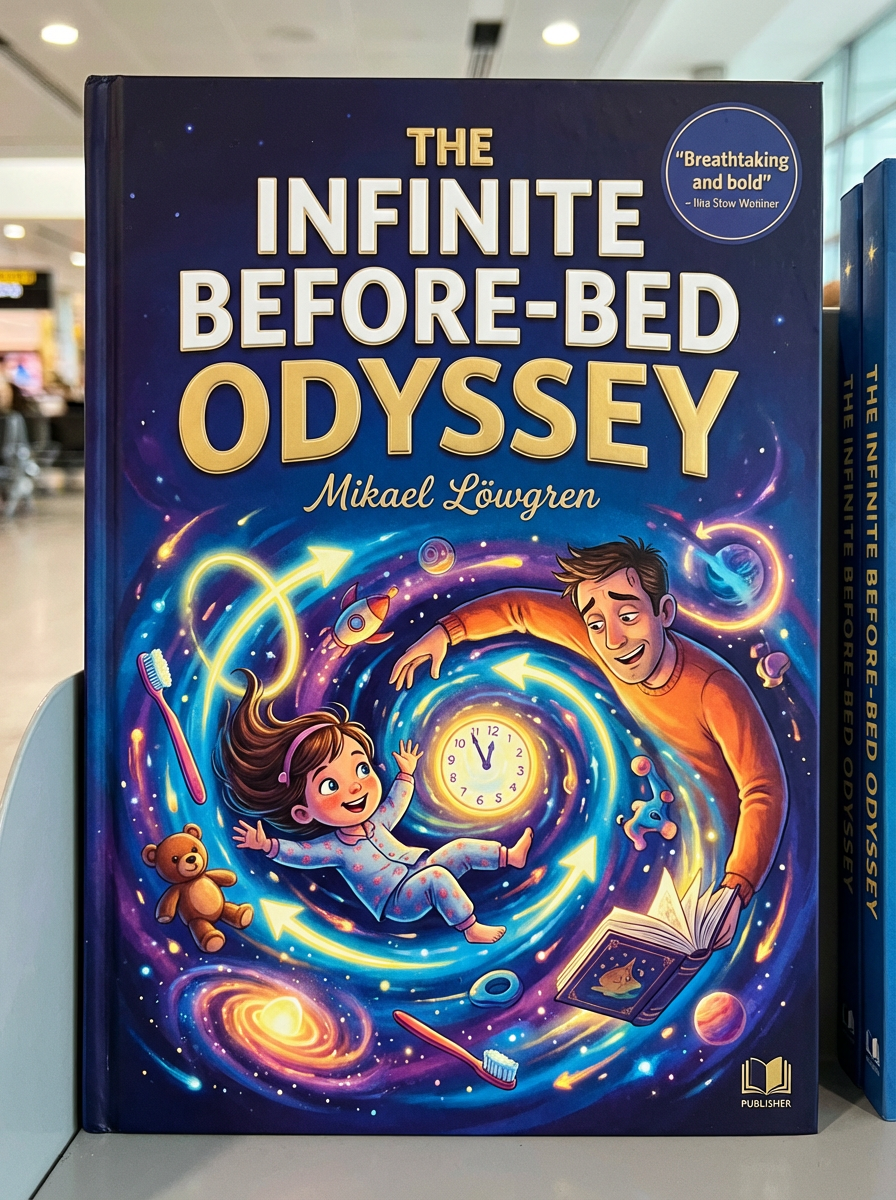
Synopsis
As dusk settles, Astrid's simple bedtime ritual transforms into an epic, hilarious odyssey of unexpected diversions, each more absurd and compelling than the last. Her beleaguered parents, yearning for peace, find themselves drawn into her imaginative, ever-expanding world of 'just-one-mores,' revea
Chapter 1: The First Whispers of Sleep's Rebellion
The blue light of twilight, bruised and weary from its day-long struggle with the sun, bled through the gaps in the curtains. Six-year-old Astrid, perched on the edge of the sofa like a cardinal on a wire, hummed a tuneless, self-composed anthem to the approaching night. Her parents, Anita and Stefan, exchanged a glance that was less a look and more a shared groan, a silent acknowledgment of the gauntlet they were about to run.
“Alright, dumpling,” Stefan began, his voice taking on the exaggerated lightness he reserved for negotiations with tiny dictators, “time for bed.” He gestured vaguely towards the hallway, as if ushering an invisible flock of sheep.
Astrid, however, was no sheep. She meticulously peeled a rogue piece of lint from her knee, as if performing a delicate surgical procedure. “But Papa,” she said, her voice a syrupy whisper designed to disarm, “the moon isn’t even properly dressed yet. It’s still wearing its underwear cloud.”
Anita, who had been bracing herself against the doorframe, stifled a laugh. The moon, indeed. Astrid’s imagination was a runaway train, and her parents were increasingly finding themselves tied to the tracks. “Astrid,” she said, attempting a tone of gentle authority that usually dissolved into exasperation within ten minutes, “the moon gets dressed when it’s good and ready. You, however, need to get ready now.”
The hum stopped. Astrid’s gaze, which had been fixed on the nascent stars winking through the window, snapped to her mother. Her eyes, the color of wet moss, held a glint of strategic cunning. “But Mama, my sock. The one with the rocket ship. It’s… rogue.”
Stefan, ever the pragmatist, frowned. “Rogue? How can a sock be rogue?”
“It deserted the laundry pile,” Astrid explained, her brows furrowed in a caricature of serious thought. “I saw it. It was trying to escape to Planet Fuzzy.”
Anita sighed. This was familiar territory. The lost sock was a common pre-bedtime diversion, a well-worn tactic in Astrid’s arsenal. Usually, it was a dramatic re-enactment of the sock’s last known location, leading them on a wild goose chase through toy bins and under furniture. “Astrid, honey, let’s worry about Planet Fuzzy tomorrow. Let’s get your teeth brushed.”
But Astrid was already sliding off the sofa, a tiny, determined explorer. “No, Mama. We cannot abandon a sock. It might have important rocket ship information. What if it’s charting a course to the great unknown?” She began to crawl under the coffee table, her little voice echoing faintly from the shadowy depths. “It’s dark here. Perfect for rogue socks who prefer the shadows.”
Stefan, despite himself, felt a flicker of amusement. He remembered a time, long ago, when a lost sock was just a lost sock. Now, it was a cosmic fugitive. He knelt on the rug, peering under the table. “Astrid, your father is a busy man. He doesn’t have time for intergalactic sock retrieval missions.”
“But Papa,” came the muffled reply, “this isn’t just any sock. This is the sock that holds the key to the galaxy’s greatest mystery: where all the other socks go. Think of the scientific breakthroughs!”
Anita knew a lost cause when she saw one. She pinched the bridge of her nose. “Fine, Astrid, ten minutes. Ten minutes to find the rogue sock, and then straight to brushing teeth, no detours, no discussions about the gravitational pull of dust bunnies.”
The search for the rogue rocket ship sock was, as expected, a serpentine journey. It involved turning over cushions, inspecting the contents of the toy box with forensic precision, and even a brief, ill-fated expedition into the laundry basket, which Astrid declared “a cesspool of misdirection.” Stefan, initially stoic, found himself muttering, “What are we even looking for now? A single sock? A portal to another dimension hidden within a pile of dirty clothes?” His internal monologue was a dramatic play of exasperation and a grudging admiration for his daughter’s unwavering commitment to her absurd quests. He hated when someone called him on the phone, but this real-life scavenger hunt was slowly proving to be just as irritating.
Finally, after a theatrical reveal from behind the potted fern where it had been “hiding in plain sight, disguised as a leaf,” the rocket ship sock was reunited with its mate. Stefan held it aloft like a trophy, a bewildered smile playing on his lips. “Victory,” he declared, puffing out his chest. “The universe is safe, and the laundry basket can rest easy.”
Astrid, however, was already onto the next crisis. Her eyes, wide and suddenly distraught, were fixed on something clasped in her tiny hand. “Oh, no,” she whispered, her voice laced with genuine sorrow. “Oh, dear, oh dear, oh dear.”
Anita braced herself. The last time Astrid had said “oh, dear, oh dear, oh dear,” it had involved a carefully constructed LEGO castle and a rogue squirrel. “What is it now, sweet pea?”
Astrid slowly opened her hand, revealing a small, black plastic eye. “Teddy’s eye,” she wailed, tears welling faster than flash floods in a desert. “It’s… gone. Teddy is blind! How will he see the moon get dressed now?”
Teddy, a venerable plush bear whose original fur color was a subject of archaeological debate, was Astrid’s oldest confidant. Losing an eye was not merely an aesthetic concern; it was a profound ontological crisis for the bear. And, by extension, for Astrid.
Stefan stared at the detached eye. In his mind, he could hear the faint, distant echo of a ringing phone – a sound that usually sent shivers of primal dread down his spine, but now seemed almost… welcome, compared to the current predicament. A missing teddy eye. This was a whole new level of bedtime derailment. “Well,” he began, trying to sound helpful, “maybe Teddy can just… listen to the moon getting dressed?”
Astrid gave him a look of withering scorn. “Papa, moon-dressing is a visual spectacle! It’s all about the shimmer and the sparkle and the clouds moving like silk kimonos! He can’t *hear* silk kimonos!”
Anita, ever the resourceful one, took the eye. “We can fix this, Astrid. Mommy’s a doctor for stuffed animals. We’ll just need some special medical tape and a very, very tiny surgical procedure.”
The “surgical procedure” involved a roll of Scotch tape, a pair of dull kitchen scissors, and Anita’s considerable patience. Stefan, relegated to the role of “Head Nurse and Moral Support Bearer,” stood by, occasionally offering unhelpful suggestions like, “Maybe just superglue it? No, wait, that might be permanent. Or poisonous.” Each suggestion was met with a glare from Astrid that could curdle milk.
The reattachment of Teddy’s eye was a momentous occasion, complete with hushed whispers, exaggerated sighs of relief, and even a small, impromptu prayer for the bear’s swift recovery. Astrid, cradling the mended Teddy, looked up at her parents, her eyes still brimming with a potent mix of relief and lingering concern. “He’s… he’s still a little wobbly,” she murmured, inspecting the tape job with a critical eye. “And his vision might be a bit blurry on the edges. He might need a new pair of spectacles.”
Anita, sensing the next imminent diversion, quickly intervened. “Alright, Teddy is much better. He’s going to get the best rest ever. Now, my little night owl, teeth brushing.”
Astrid nodded, a solemn expression on her face. She hopped off the sofa, Teddy clutched protectively, and set off towards the bathroom. Her parents exchanged a weary, triumphant glance. They were making progress. Slow, agonizing progress, but progress nonetheless. Perhaps tonight, just perhaps, they might avoid the dreaded “I’m thirsty” gambit, or the perennial “I need to tell you something *very* important that I just remembered.”
But as they neared the bathroom, Astrid stopped dead in her tracks, her small hand flying to her mouth in a gesture of profound realization. “Mama! Papa!” she exclaimed, her voice vibrating with urgency. “I’ve just remembered something terribly important!”
Anita’s shoulders slumped. Stefan’s face, which had been beginning to relax into the semblance of a smile, froze in a rictus of apprehension. “What is it now, dumpling?” he asked, his voice laced with the heavy syrup of resignation.
“The colors!” Astrid announced, her eyes wide with revelation. “I need to catalog them! All of them! Before the sun forgets them overnight!”
Anita blinked. “Catalog… the colors?”
“Yes!” Astrid insisted, gesticulating wildly with Teddy. “Don’t you see? The sun goes down, and it takes all the colors with it. And then, in the morning, if no one has written them all down, how will it remember what to bring back? It will be a world of grey! A world without crimson and emerald and cerulean and… and periwinkle!” Her voice rose to a dramatic crescendo on the last word, as if periwinkle were the very cornerstone of civilization.
Stefan, who had spent his day navigating the complexities of international finance, found himself staring at his daughter, utterly dumbfounded. “Astrid, honey, the sun doesn’t forget the colors. It just… goes to sleep. Like you will soon.”
Astrid shook her head vigorously. “But it’s a very forgetful sun, Papa. I read it in a book. It needs help remembering. We have to collect them! Before they fade into the nighttime void!”
And with that, she launched herself back into the living room, a blur of pink pajamas and frantic energy. “Quick, Mama! We need a list! And Papa, you need to find the red things first! The really, really red things!”
Anita took a deep breath. She could feel the fragile threads of her patience fraying. This was new. This was an unprecedented level of bedtime diversion. Cataloging all the colors of the rainbow. Her mind, usually so adept at juggling budgets and schedules, felt like a tangled ball of yarn.
Stefan, however, found himself staring at the vibrant hues of a throw pillow, a flicker of an idea sparking in his tired brain. He was a man of systems, of data. And Astrid, in her own chaotic way, was presenting a system. A very, very complicated, completely unnecessary system. But a system nonetheless. “Alright, Astrid,” he said, surprising even himself. “Red. Let’s start with red. But only three red things. Just three, and then it’s teeth. Deal?”
Astrid, already on her hands and knees inspecting the fringe of the rug, paused. She considered his offer, her head tilted, as if weighing the astronomical implications of such a limited catalog. “Three *important* red things,” she stipulated. “Things that really, really scream ‘red’!”
“Deal,” Stefan said, before Anita could object. He found himself, much to his own chagrin, crouching down and squinting at the various shades of red in their living room. Was the brick of the fireplace truly red, or more of a rustic umber? And that book cover… a scarlet or a ruby? He, a man who dealt in numbers and quantifiable facts, was suddenly grappling with the subjective nuances of color.
The first “important red thing” was a faded fireman’s hat, retrieved from a basket of dress-up clothes. Astrid presented it with the gravity of a museum curator. “This is a very brave red,” she announced. “It saves people.”
The second was a rather battered plastic apple, a remnant of a long-forgotten play kitchen. “This is a juicy red,” Astrid declared, taking a pretend bite. “It tastes like sunshine.”
Stefan, against his better judgment, found himself engaged in the game. He pointed to a small, embroidered heart on a cushion. “And this, Astrid? What kind of red is this?”
Astrid considered it carefully. “That is a love red, Papa,” she said softly, touching the heart with her finger. “It makes everything feel warm.”
A strange quiet descended upon the room. The urgency of the “color cataloging” had momentarily given way to a quieter, unexpected moment of connection. Anita, who had been leaning against the doorframe, still prepared for the inevitable eruption of another diversion, felt a pang in her chest. Astrid’s logic, often baffling, sometimes led to these little pockets of unexpected beauty.
“Okay, Astrid,” Anita said, her voice softer than she intended. “Three important reds. Check. Now, to the bathroom. For teeth. And then, to bed, my little color collector.”
Astrid nodded, a thoughtful expression on her face. She allowed herself to be guided towards the bathroom, a willing participant for the first time in what felt like hours. Her parents, exchanging another glance, felt a flicker of hope. Perhaps, just perhaps, they had broken the cycle.
But as Astrid reached for her toothbrush, her hand froze. Her eyes widened, focusing on the ceramic tiles of the bathroom wall. “Mama!” she whispered, a new crisis dawning. “Papa! The blue! The bathroom is so *blue*! We didn’t list the blue colors! What if the sun forgets the blue of the sky? Or the blue of the ocean? Or the very important blue of a blueberry?” Her voice rose, once again, to that familiar, urgent crescendo. “It will be a colorless catastrophe! A bland, grey, blueberry-less world!”
Stefan groaned. He could feel a vein throbbing in his temple. The sun, it seemed, was determined to be amnesiac. And Astrid, its tiny, relentless scribe, was determined to prevent a global crisis of chromatic amnesia. His phone, blessedly silent tonight, seemed a distant, almost pleasant memory. This, he realized, was more taxing than any conference call, more intricate than any spreadsheet. This was the infinite before-bed odyssey, and he and Anita were its bewildered, yet undeniably trapped, navigators. The night, like Astrid’s imagination, was only just beginning.
Chapter 2: The Case of the Curious Culinary Conundrum
The scent of lavender from the newly laundered sheets still clung faintly to the air, a scent Anita cherished as the harbinger of peace. Astrid, nestled under her quilt, a landscape of glow-in-the-dark stars overhead, had been—for a blessedly fleeting moment—still. Stefan, perched on the edge of the rocking chair, his phone already clutched in his hand, was mid-scroll through an article on advanced taxidermy techniques (a new, inexplicable fascination). The dim glow from the bedside lamp cast long, friendly shadows. All was, if not precisely well, then at least temporarily quiescent.
Then, the whisper came. It was a sound barely audible above the rhythmic creak of the rocking chair and the faint hum of the refrigerator in the distant kitchen, but in the brittle silence of impending parental freedom, it reverberated like a gong.
“Papa?”
Stefan’s thumb froze mid-swipe. Anita, who had just begun to imagine the quiet clinking of wine glasses and the rustle of a good book, felt a familiar tremor of impending doom.
“Yes, sweet pea?” Stefan asked, his voice betraying a studied nonchalance that was fooling precisely no one, least of all the tiny oracle in the bed.
Astrid, her eyes, the color of wet earth after a spring rain, were wide and unblinking. She looked less like a child settling down for slumber and more like a philosopher on the cusp of an existential revelation. “What if… what if clouds were made of Jell-O?”
A brief, stunned silence. Stefan exchanged a quick, haunted glance with Anita, a silent negotiation passing between them: *Whose turn is it?* and *Can we pretend we didn’t hear?*
Anita, ever the pragmatist, cleared her throat. “Well, darling, clouds are made of water vapor. Tiny, tiny drops of water.” She patted Astrid’s head, a gesture of reassurance that felt more like a desperate plea for normalcy.
Astrid remained unconvinced. She pulled her teddy, Barnaby, closer, adjusting his single, remaining button-eye to face Anita with an accusing stare. “But *what if* they were Jell-O? Like, big, bouncy Jell-O clouds?” Her voice, usually soft, now carried the conviction of an impending scientific breakthrough. “Would they… jiggle?”
Stefan, whose mind, once freed from the shackles of adult responsibility, often drifted to the absurd, found himself involuntarily considering the tensile strength of an atmospheric-scale gelatinous mass. The engineering implications were staggering. The ecological impact, he mused, would be delightful, though certainly messy.
“Jiggle?” Anita repeated, a faint, almost imperceptible tremor in her own voice. “Well, I suppose they would, if they were Jell-O. But they’re not, sweetie. They’re clouds.” She tried to inject a note of finality, but it landed with the dull thud of a deflated balloon.
Astrid sat up, her small frame radiating an urgent intellectual curiosity. “But we don’t *know* for sure, do we? Not unless we *test* it.” Her gaze swept from Stefan to Anita, a general demanding tactical support. “We need some Jell-O.”
Stefan, sensing the inevitable gravitational pull of Astrid’s logic, sighed. He ran a hand through his perpetually rumpled hair. “Astrid, it’s bedtime. We can’t just… make Jell-O right now.” He said ‘make Jell-O’ as if it were a complex alchemical process, which, in Astrid’s world, it was about to become.
“But Papa, it’s a very important scientific question! How will I ever know if clouds jiggle if we don’t try?” Astrid’s bottom lip began to protrude, a subtle but highly effective weapon in her arsenal of persuasion. Barnaby, clutched in her arms, seemed to nod in agreement.
Anita, picturing her precious hour of quiet slipping away like sand through her fingers, felt a tiny spark of rebellion. “Sweetie, even if we made Jell-O, it would be too small to tell us if a cloud would jiggle. A cloud is huge.”
“Then we need to make *a big* Jell-O,” Astrid declared, her eyes bright with the thrill of the chase. “A big, big, *gigantic* Jell-O!”
Stefan, who found the concept of ‘quiet sedation’ increasingly appealing, pushed himself out of the rocking chair with a groan that was less theatrical than it was heartfelt. “Alright, alright, my little Nobel laureate. A big Jell-O. But we are going to be very quiet, and then straight back to bed. Deal?”
Astrid, beaming, nodded vigorously. “Deal!”
And so, the quiet lavender-scented bedroom was abandoned for the fluorescent harshness of the kitchen. The expedition was launched.
The kitchen, usually a place of calm domesticity, quickly transformed into a laboratory of chaos. Anita, attempting to maintain some semblance of order, pulled out a box of cherry Jell-O, its vibrant red promising a spectacle. Stefan, meanwhile, was rummaging through the pantry, mumbling about the structural integrity of various bowls and the optimal surface area for observation.
Astrid, perched precariously on a stool, her excitement bubbling over like an untamed geyser, dictated the terms of the experiment. “First, we need the water. And it needs to be *hot water* for the crystals to dissolve. Papa, do you think clouds have hot water inside them?”
Stefan, now attempting to pour packets of gelatin mix into a bowl that was clearly too small, paused. “Well, up high in the atmosphere, it can be very cold, Astrid. But nearer the ground, clouds can form from warmer, moist air.” He squinted at the dissolving crystals. “Though I doubt it’s ever quite *this* vigorously boiling.”
He gestured vaguely at the steaming kettle. Anita, muttering about burn hazards, carefully measured the hot water, a faint sigh escaping her lips as she watched the colorful powder vanish. The sweet, artificial cherry scent began to permeate the kitchen, clinging to the air with cheerful determination.
“Now,” Astrid announced, “we need *cold* water to make it… firm.” She dragged the word out, savoring its chewy texture. “Like a real cloud. Or maybe a cloud that’s just a little bit jiggly.”
The addition of the cold water caused a minor splash, narrowly missing Stefan’s eyeglasses, which he had, in a moment of scientific zeal, perched precariously on his nose. A drop landed on his shirt, a bright red stain blooming on the pristine white fabric. He eyed it with a mixture of resignation and a fleeting thought about the efficacy of stain removers.
“Right,” Anita said, stirring the concoction with a wooden spoon, the viscous liquid swirling hypnotically. “Now it needs to set. In the fridge. For a while.” She emphasized “a while,” hoping to convey that ‘a while’ meant ‘until tomorrow morning.’
Astrid, however, had other ideas. “But how will we know if it jiggles before then? We need to see it *now*.” She reached a tiny finger out, intending to poke the surface, but Anita deftly intercepted it.
“No poking, sweet pea. It has to be perfectly still to set properly.” Anita’s patience, like a stretched rubber band, was nearing its snapping point. The thought of wine had now been replaced by a yearning for a strong, blackout-inducing espresso.
“But what if it’s not exactly like a cloud?” Astrid mused, her brow furrowed in concentration. “Clouds are fluffy. This is… wet.”
This was when Stefan, perhaps spurred by an innate desire to complicate matters (or, more charitably, to truly engage in his daughter’s imaginative journey), had an epiphany. He straightened up, a glint in his eye. “Aha! We need to replicate the *fluffy* aspect, my dear.”
Anita stared at him, a silent question ringing in her mind: *Are you entirely mad?*
Stefan, oblivious, began rummaging through the cupboards again, his movements imbued with a newfound purpose. “We need to make a *cloud model*,” he declared, pulling out a large, clear glass trifle bowl. “Something to suspend our Jell-O in. To mimic the ethereal nature of a cumulus formation.”
Anita rubbed her temples. “Stefan, it’s going to be midnight. She needs to sleep. *We* need to sleep.”
But Astrid’s eyes, fixed on her father, sparkled with renewed intensity. “A cloud model! Yes! And then we can put the Jell-O inside!”
Stefan, now thoroughly captivated by his own architectural vision, was already sketching in the air. “We need structure. Something airy. Perhaps…” He spotted a bag of fluffy white marshmallows still lingering from a long-forgotten hot chocolate evening. “Marshmallows! The perfect internal structure for our Jell-O cloud.”
And so, the kitchen became a construction site. Stefan, with the precision of a master builder, began arranging marshmallows in the trifle bowl, creating an uneven, buoyant landscape. Anita, too weary to resist, found herself fetching toothpicks and then, inexplicably, a bag of mini chocolate chips, which Astrid insisted were “tiny rain droplets, just in case.”
The Jell-O, still a liquid, was then carefully poured over the marshmallow landscape. It oozed, it settled, it seeped into every sugary crevice. The results were… interesting. A vibrant red, slightly lumpy mass, dotted with miniature dark chocolate meteorites, perched atop a foundation of spongy white. It looked less like a cloud and more like a confectionary alien planet.
“Now, to the fridge!” Stefan announced, carefully carrying the colossal Jell-O-marshmallow-chocolate-chip hybrid, a look of profound satisfaction on his face. He gently placed it on the top shelf, among the forgotten vegetables and dubious leftovers.
“And then,” Astrid asked, her voice a little smaller now, the excitement of creation giving way to the fatigue of a long day, “when will it jiggle?”
Stefan, still admiring his handiwork, turned to her. “When it’s set, sweet pea. Tomorrow morning, you can check all the jiggles you like.” He paused, a flicker of genuine fondness crossing his face. “But first, let’s get you back to bed.”
Astrid, surprisingly, offered no further argument. The sheer satisfaction of the scientific endeavor, the collaborative spirit of her parents, had evidently been enough. She permitted herself to be led back to her bedroom, leaving behind a kitchen that looked as though a particularly rambunctious kindergarten class had attempted a baking project.
Anita surveyed the scene: the sticky counter, the red stain on Stefan’s shirt, the scattered marshmallow crumbs, the faint, cloying smell of cherry Jell-O that would likely linger until dawn. She imagined the quiet sedation, not for Astrid, but for herself. A long bath, a strong drink, the blessed silence of a well-deserved evening.
Stefan, after tucking Astrid in and bestowing a final kiss on her forehead, returned to the kitchen, a sheepish grin on his face. “Well,” he began, gesturing expansively at the wreckage, “at least we settled the pressing matter of the jiggly clouds.”
Anita, leaning against the doorframe, merely raised an eyebrow. “We haven’t settled anything, my dear. We’ve merely created a giant, highly questionable dessert and postponed the inevitable. Besides,” she pointed to the Jell-O cloud, now chilling amidst the broccoli, “what if it doesn’t jiggle enough?”
Stefan’s grin faltered. He considered the structural integrity of his marshmallow foundation. He pictured the immense, ethereal masses of real clouds, their slow, majestic drift. He then pictured a small child, her face a mask of profound disappointment at a non-jiggly Jell-O.
A new, unsettling thought began to dawn on him, one that promised further late-night adventures. He knew, with a certainty that chilled him to the bone, that the Jell-O cloud was merely the beginning. The seeds of the next, equally absurd, equally compelling inquiry had already been sown. And as the distant hum of the refrigerator settled into the quiet night, Stefan knew, with the weary resignation of a seasoned parent, that his phone, still clutched in his hand, might just have to wait a little longer. For tonight, the call of the wild, in the form of a tiny, imaginative human, was infinitely louder than any taxidermy tutorial. And tomorrow, there would be Jell-O, and probably, more questions. Much, much more.
Chapter 3: The Ballad of the Bored Bookshelf
The Jell-O cloud, magnificent in its wobbly, crimson grandeur, had finally been relegated to the purgatory of the refrigerator’s bottom shelf, a testament to culinary curiosity and parental fortitude. Stefan, still wiping errant lime green streaks from his chin, stared at his reflection in the polished surface of the microwave, a man defeated, yet oddly exhilarated. His shirt, once pristine, now bore the abstract expressionism of strawberry and cherry, a silent ode to Astrid’s boundless inquiries. Anita, meanwhile, was attempting a delicate surgical procedure on her left eyebrow, where a particularly stubborn fragment of blue raspberry had somehow lodged itself. The silence that descended upon their post-Jell-O-cloud-construction kitchen was so profound, so utterly foreign, that it took a moment to register.
Then, from the top of the stairs, a small voice, clear as a bell and just as demanding: “Mama? Papa? My books look… *lonely*.”
Stefan closed his eyes. He heard Anita sigh, a long, drawn-out sound that spoke of the tragic burden of being thirteen and in close proximity to a six-year-old. The Jell-O residue, a sticky, sweet badge of honor, still clung stubbornly to their pajamas, a perverse reminder of their latest detour.
“Lonely, darling?” Anita called back, her voice already tinged with the weary resignation of one who knew the war was far from over.
“Yes! They’re all just… *sitting* there,” Astrid’s voice drifted down, infused with an urgency usually reserved for impending natural disasters or the immediate consumption of ice cream. “They need friends. Or, like, *adventures*.”
Stefan opened his eyes, braced himself, and followed Anita up the stairs. Astrid was perched on the edge of her bed, her small hands planted firmly on her hips, survey-ing the bookshelf with the intense scrutiny of a general planning a military campaign. The bookshelf, a sturdy, unremarkable pine edifice, groaned under the weight of colourful paperbacks and well-loved hardcovers. To Stefan, it looked like a bookshelf. To Astrid, it was evidently a repository of unmet literary potential, a graveyard of untold tales.
“See?” she declared, gesturing dramatically. “This one, *The Hungry Caterpillar*, he’s supposed to be eating things, right? But he’s squished next to *Goodnight Moon*. That’s not an adventure. That’s just… sleep.” She wrinkled her nose, as if the very concept of rest was personally offensive.
Stefan, who had been contemplating the blissful oblivion of sleep for the better part of an hour, felt a tremor of existential dread. “Astrid, honey, books are for reading. They don’t usually… go on adventures outside the page.”
Astrid fixed him with a stare of such profound disappointment that he felt a sudden, inexplicable urge to apologize to the Hungry Caterpillar. “Papa, that’s just silly. How can a book know if it wants to be read by someone who loves adventures if it’s never *had* one?”
Anita, ever the pragmatist, leaned against the doorframe, arms crossed. “Right. So, what’s the protocol for adventuring books, Astrid? Do they need tiny backpacks? Or perhaps a miniature compass lodged between the pages?” Her tone was dry, but Stefan caught the faint glimmer of amusement in her eyes. Anita, despite her protestations, had a soft spot for Astrid’s imaginative escapades, often playing the cynical foil to Astrid’s boundless enthusiasm.
Astrid ignored the sarcasm, her focus entirely on the chaotic library before her. “First, we need to sort them. By… ‘adventure level’.” She tapped her chin thoughtfully. “And ‘sparkle factor’,” she added, as if this were an entirely self-evident category. “Oh! And ‘potential for squirrel encounters’!”
Stefan blinked. “Squirrel encounters?”
“Yes!” Astrid exclaimed, her eyes wide with conviction. “Some books just *feel* like they’d be good at meeting squirrels. Like *The Gruffalo*! He could scare them. Or *Pat the Bunny* – maybe the squirrels would want to pat the bunny too.”
Stefan looked at Anita, who was now biting her lip to keep from smiling. “This is… an advanced literary classification system, Astrid.”
“It’s very important, Papa,” Astrid said, climbing onto her small wooden stool and beginning to pull books off the shelf with a surgeon’s precision. “You can’t just have any book next to any other book. It’s like putting a pirate next to a ballerina. They might get confused.”
“Well, unless the ballerina *is* a pirate,” Anita interjected, pushing herself off the doorframe. “Then it’s a brilliant crossover event.”
Astrid paused, considering this. “Hmm. Maybe. But only if she has a peg leg *and* a tutu. And a parrot that says ‘Avast, en pointe!’”
Stefan shook his head, a faint smile playing on his lips. He was tired, yes, but there was a certain undeniable charm to Astrid’s logic, a relentless pursuit of imaginative possibility that made the mundane seem breathtakingly dull.
“Alright, Captain Astrid,” he said, pulling up her small desk chair. “Lead the charge. How do we determine ‘adventure level’?”
Astrid, already deeply immersed in her task, held up a well-worn copy of *Where the Wild Things Are*. “This one! High adventure level. Max is brave. And there are monsters. And a boat.” She placed it on the floor, in a nascent pile labelled, in her own distinctive crayon script, ‘MAX ADVENSHUR’.
Next, she grabbed a thick, illustrated edition of Aesop’s Fables. “This one… medium sparkle factor. The stories are wise, but they don't *sparkle*. More like… a quiet wisdom sparkle.” She placed it on a different pile, diligently labelled ‘QUIET WIZE SPARKUL’.
Then came the grand reveal: *Corduroy*. Astrid clutched the book to her chest, her brow furrowed in concentration. “Now, *Corduroy*… he’s a bear in a department store. That’s an adventure, yes. But does he encounter squirrels?” She held the book out, as if expecting the bear within to provide an answer. “No. I don’t think so. Maybe mice. But not squirrels.” A sigh of genuine disappointment escaped her lips. “Low potential for squirrel encounters. Very low.”
Stefan, attempting to stifle a chuckle, knelt beside her. “Perhaps Corduroy prefers the company of buttons, Astrid.”
“Buttons aren’t as interesting as squirrels, Papa,” she stated, as if this were an absolute, universal truth. “They don’t chatter. Or hoard nuts. Or try to bury things in your hair.”
Anita, who had been watching this meticulous categorization with a mixture of amusement and an evident desire to be anywhere else, finally spoke up, her voice threaded with a feigned weariness. “Alright, alright. I see the intellectual rigor of this system. But if we’re going to be up all night sorting books by their potential for rodent interactions, I'm going to need to elevate my critical evaluation game. Some of these literary masterpieces deserve a proper, scathing critique.”
Astrid’s eyes widened. “You’ll help, Anita? You can call them… *problematic*?” Her recent exposure to Anita’s school essays had introduced her to a vocabulary she wielded with impressive, if not entirely accurate, flair.
Anita raised a perfectly sculpted eyebrow. “Problematic, darling, is for stories that perpetuate harmful stereotypes or lack a nuanced understanding of post-colonial theory. For these, we can stick to ‘derivative,’ ‘pedestrian,’ or if we’re feeling particularly generous, ‘ambitiously misguided’.”
Stefan groaned. “Do we really need literary theory applied to Eric Carle, Anita?”
“Stefan, don’t be reductive,” Anita said, already reaching for a small, brightly illustrated picture book. It featured a particularly disgruntled-looking badger, clutching a teacup with an expression that suggested deep-seated philosophical malaise. “Ah, *Barnaby the Grumpy Badger Learns to Share*,” she mused, flipping through the pages with a practiced, critical eye. “The premise, while ostensibly charming, is fraught with pre-conceived notions regarding badger temperament. Is Barnaby *truly* grumpy, or is he merely suffering from an undiagnosed anxiety disorder exacerbated by societal pressure to conform to unrealistic expectations of cheerfulness?”
Astrid, utterly absorbed, nodded sagely. “He does look a bit… stressed.”
“Precisely,” Anita said, her voice dropping into a theatrical stage whisper. “And the climax, where he ‘learns to share’ his artisanal jam with a perpetually optimistic squirrel” – she shot a glance at Stefan, who was trying to pretend he didn’t just hear that – “is a predictable narrative arc, undermining any potential for genuine character development. The squirrel, for instance, is a one-dimensional embodiment of saccharine cheer, lacking any internal conflict or existential angst. We are left to wonder if the squirrel, in its relentless optimism, is not in fact contributing to Barnaby’s underlying emotional distress through toxic positivity.”
Stefan pressed the heels of his hands into his eyes. “Anita, it’s a book about a badger learning to share jam.”
“And yet, Papa, the layers of subtext are undeniable,” Anita countered, already moving on to a book about a friendly monster. “Consider this creature. ‘Ferdinand the Friendly Fiend’. A title rife with inherent contradiction, immediately setting up a problematic binary. Is Ferdinand truly friendly, or is his ‘fiend’ appellation merely a manifestation of patriarchal societal norms attempting to categorize and control that which is deemed ‘other’?”
Astrid, ever the literalist, frowned. “But he’s just trying to make friends.”
“Exactly!” Anita exclaimed, triumph in her voice. “But *why* must he try so hard? Why is his acceptance contingent upon him suppressing his intrinsic ‘fiend’ nature? This is a thinly veiled parable about assimilation, Astrid, and the often-unseen costs of conforming to dominant cultural narratives.”
Stefan was now genuinely impressed, despite himself. Anita, for all her teenage eye-rolling and dramatic pronouncements, was disturbingly articulate. Her critiques, while bordering on performance art, possessed a kernel of undeniable insight, filtered through the dramatic lens of a gifted student perpetually poised for a debate.
“So, *Barnaby the Grumpy Badger* goes into the ‘ambitiously misguided, yet emotionally manipulative’ pile,” Astrid declared, carefully placing the badger book. “And ‘Ferdinand’ is ‘problematic because of patriarchal control’?”
“Yes, darling,” Anita said, a faint smile touching her lips. “Excellent summation. You’re grasping the nuances beautifully.”
The evening progressed in a fascinating, if utterly bizarre, dance of literary categorization and pseudo-intellectual deconstruction. Stefan found himself drawn into the absurdity, offering suggestions for ‘sparkle factor’ based on the shininess of foil illustrations and debating the true adventurous spirit of books featuring farm animals.
“A sheep escaping the farm?” Stefan mused, holding up a volume. “That’s a definite adventure, albeit a relatively low-stakes one. The potential for squirrel encounters is negligible, unless the sheep somehow ends up in an oak grove during its brief bid for freedom.”
“But what if the sheep *dreams* of squirrels?” Astrid countered, her eyes alight. “Then the squirrel encounter is in its heart, Papa. And that’s a very high sparkle factor.”
Anita, flipping through a particularly sugary tale about a unicorn, let out a disdainful snort. “This, Astrid, is a literary abomination. The unicorn’s horn, rather than being a symbol of mystical power or even a phallic representation of dominance, is used solely for the mundane act of stirring rainbow-flavored oatmeal. There is no subversion, no irony, merely a reinforcement of cloying sentimentality. Low sparkle factor, despite the overt attempts at glittering pages. This is a false sparkle, darling. A literary glitter bomb.”
“A glitter bomb?” Astrid repeated, clearly intrigued. “Like when you put glitter in an envelope and send it to someone you don’t like?”
“Precisely,” Anita confirmed with a mischievous glint. “Only this time, the glitter is conceptual, and the victim is the discerning reader.”
Stefan was torn between wanting to applaud Anita’s wit and wondering if Astrid would now attempt to send conceptual glitter bombs to her preschool enemies. The thought alone was enough to make him shudder slightly.
Hours later, the bookshelf was a changed landscape. Books were no longer mere static objects; they were inhabitants of a meticulously organized universe. ‘MAX ADVENSHUR’ included everything from pirates to dragons to the aforementioned wild things. ‘QUIET WIZE SPARKUL’ held the fables and gentle bedtime stories. The ‘PROBLEMUTTIC’ pile (Astrid’s interpretation of Anita’s critiques) boasted tales of overly cheerful woodland creatures and unicorns with questionable oatmeal-stirring habits. And a curious, small pile, labelled ‘SQUIRL HOPF’, contained books that Astrid had decided *might* inspire a squirrel to make an appearance, given the right circumstances.
The Jell-O residue had dried on their pajamas, a crusty, sweet reminder of their earlier scientific endeavors. Stefan’s throat was hoarse from articulating the difference between narrative tension and outright chaos. Anita, surprisingly, looked less world-weary and more… stimulated, as if the exercise had provided a much-needed intellectual workout.
Astrid, finally satisfied with her literary curation, stood back, surveying her work with a profoundly content sigh. “There. Now they’ll be happy. And they’ll know where their friends are. And maybe,” she added, already climbing into bed, her voice a sleepy murmur, “maybe a squirrel will want to read *Corduroy*.”
She burrowed under the covers, already half-asleep. Stefan and Anita exchanged a look over her head. It was a look that contained multitudes: exhaustion, amusement, exasperation, and a deep, undeniable love. They had been drawn, once again, into Astrid’s world, a world where books had feelings, squirrels had literary preferences, and Jell-O clouds could be scientifically constructed.
Stefan leaned down, pressing a kiss to Astrid’s forehead. “Goodnight, my little literary critic. May your dreams be filled with adventurous books and well-behaved squirrels.”
Anita, as always, had the last word, whispered softly as they tiptoed out of the room. “And may there be no toxic positivity from any overly optimistic woodland creatures.”
The door closed softly, leaving the newly organized books in the quiet darkness, perhaps dreaming of adventures, or squirrels, or simply, just being. The parents, Jell-O-stained and intellectually drained, were left to ponder the chaotic, joyous, and utterly exhausting truth of childhood's relentless demands. And somewhere, a phone rang. Stefan, for once, didn’t flinch. He was too tired for external demands. He was, gloriously, utterly, profoundly, just tired.
Chapter 4: The Midnight Menagerie of Misplaced Miracles
The rhythmic thrum of the house, lulled by central heating and the soporific hum of the refrigerator, was abruptly shattered by a sound akin to a hundred tiny, agitated violinists practicing scales on a tin roof. Stefan, midway through a silent meditation on the structural integrity of a Jell-O cloud, flinched as if stung. Astrid, however, tilted her head, a small, knowing smile playing on her lips.
"They're here," she declared, her voice a hushed conspirator’s whisper, as if announcing the arrival of minor royalty.
"Who, darling?" Anita, still half-heartedly attempting to wipe a streaky patch of lime green gelatin from Stefan's carefully curated beard, mumbled distractedly. Her cynicism, usually a sharp, cutting thing, had been blunted by an evening of relentless absurdity, leaving it dull and a little sticky.
Astrid, not deigning to answer such a rudimentary inquiry, launched herself from Stefan’s knee with the speed and trajectory of a small, highly caffeinated projectile. She pressed her face against the window, her breath fogging the pane. Outside, the world was a wash of inky black, punctuated by the occasional glint of moonlight on a discarded soda can. The sound intensified, a frantic scritch-scratch, scurry-scurry.
"The night-creatures," Astrid announced, turning from the window, her eyes wide with a profound, almost spiritual understanding. "They're having their bedtime discussion."
Stefan, ever the pragmatist even when on the cusp of an existential breakdown, peered over Astrid’s shoulder. "Raccoons, poppet. Probably just fighting over a particularly choice piece of discarded pizza crust."
Astrid recoiled as if he’d suggested they were arguing about the merits of public sanitation. “Papa! How can you be so… so *utilitarian*? They are not ‘fighting.’ They are *debating*. About the moral implications of pre-dawn foraging versus the aesthetic beauty of a dew-kissed gutter. Or perhaps,” she added, a solemn furrow appearing between her brows, “the profound loneliness of a single acorn.”
Anita, finally dislodging the last vestiges of verdant jiggle from Stefan's facial hair, let out a long, suffering sigh. "Right. And those aren't 'squirrels' in the attic, Stefan, they're merely highly intelligent, fur-clad literary critics discussing the merits of classical architecture versus postmodern deconstruction."
Astrid nodded sagely. "Precisely, Mama. You understand. The nocturnal world," she swept a hand dramatically towards the window, "is a tapestry of unspoken dialogues, of creatures navigating the delicate balance between instinct and… well, and what if their instincts are *wrong*?"
Stefan closed his eyes, contemplating the very real possibility that his daughter was a tiny, philosophical guru in disguise. "Wrong about what, sweetheart?"
"Wrong about *everything*," Astrid declared with a theatrical flourish worthy of a seasoned orator. "What if they've been taught that the dumpsters are their destiny, but deep down, they yearn for a gentler, more aesthetically pleasing existence? What if they crave… *community*?"
The scritching outside escalated, punctuated by a faint, indignant chittering.
"Sounds like they crave a particularly robust trash bag, if you ask me," Stefan muttered, but his words were lost in Astrid's rapidly unfolding vision.
"They need a home," she stated, her voice imbued with the unwavering conviction that only a six-year-old on the cusp of a brilliant idea could muster. "A *proper* home. A *welcome* home. A home that doesn't smell of old banana peels and existential despair."
Anita, despite herself, was intrigued. "And how, pray tell, do you propose we facilitate this architectural marvel for creatures renowned for their thieving proclivities?"
Astrid’s eyes gleamed. "From couch cushions, Mama! And perhaps some of Papa's socks – the ones that are perpetually lost, surely they are seeking a higher purpose now. And… and the glitter glue! For *sparkle*!"
Stefan, whose socks often went missing for weeks only to reappear in the most improbable places (the toaster oven, once, and a brief stint as a philosophical bookmark), suddenly felt a cold dread trickle down his spine. His socks, much like his sanity, were a finite resource.
"Now, darling," he began, attempting a calm, rational tone, "raccoons are wild animals. They have their own perfectly good homes. In trees. Or under sheds. They don't need… miniature couch cushion mansions."
Astrid fixed him with a stare of such profound disappointment that he felt a pang of guilt usually reserved for forgetting someone's birthday. "Papa, that is what *you* believe. But what if they are simply *lost*? What if they have *misplaced* their miracles? And it is our job, as members of a truly civilized society, to help them find them again?"
"Misplaced miracles?" Anita echoed, a faint, almost imperceptible tremor in her voice. She was starting to feel the intoxicating pull of Astrid’s logic, the way a small boat is drawn into a benevolent but relentless whirlpool.
"Yes! Like a tiny, striped, masked gentleman who, due to an unfortunate spat with a particularly aggressive squirrel, has lost his way back to his beloved family. And now his children are shivering, and his wife is worried, and they all just need a little… *welcome*."
Before Stefan could interject with a treatise on the dangers of anthropomorphizing urban wildlife, Astrid had already begun to dismantle the fortress of couch cushions that constituted their living room sofa. With surprising strength, she heaved a plump, beige cushion onto its side, then another.
"This," she announced, pointing to the burgeoning structure, "is the main living area. For the patriarch. He looks like a thoughtful sort, don't you think, Mama? Always contemplating the deeper meaning of municipal waste disposal."
Anita, finding herself inexplicably drawn to the project, began to arrange smaller throw pillows as "ottomans." "He does," she agreed, her voice a little too earnest for someone who had just spent an hour debating the sentience of Jell-O. "And perhaps a tiny armchair made from one of Stefan's more… *florid* ties?"
Stefan watched, aghast, as his wife, his sensible, pragmatic wife, began rummaging through his closet for a tie that had once been a regrettable Christmas gift from a well-meaning aunt. "Anita! My Gianni Versace! It’s silk!"
"Nonsense, Stefan," she scoffed, holding up a particularly garish paisley pattern. "This is clearly for a raccoons of discerning taste. Perhaps he’s an art critic in his off-hours."
Astrid, meanwhile, was meticulously arranging a small, braided rug (rescued from beneath the coffee table) inside the burgeoning cushion dwelling. "And this is the family hearth. Though we can't have a *real* fire, of course, because of… well, because of the fire department. But we can *imagine* it. With glitter glue!"
Stefan watched his daughter meticulously apply a generous swirl of iridescent blue glitter glue to the center of the rug, creating a shimmering, entirely unconvincing "fire." He felt a strange disassociation, as if he were observing his own life unfold from a significant distance, through a slightly distorted lens. The logical part of his brain, usually a roaring engine of reason, had been reduced to a faint, sputtering cough.
"We need a roof," Astrid declared, stepping back to admire her work. "A very strong roof. For when it rains philosophical rain."
Anita, now fully committed, pointed to a stack of Stefan's meticulously organized newspapers. "The Sunday supplements, Stefan. They’re quite robust."
Stefan’s eyes widened in horror. "But… but the crossword puzzle! The Sudoku! The geopolitical analysis!"
"They can be recycled into a more noble purpose, Papa," Astrid said, her voice dripping with moral superiority. "The raccoons need shelter more than you need to know the capital of Burkina Faso."
Reluctantly, Stefan began to fold the newspaper, each crease a tiny concession to chaos. He found himself debating the moral implications of interfering with urban wildlife not in some abstract, theoretical sense, but in the most tangible, cushion-and-glitter-glue-infused way possible. Was he coddling them into dependency? Was he disrupting the natural order of the nocturnal kingdom? What if they preferred the taste of perfectly good garbage over Stefan's increasingly fragile sense of stability?
The “welcome home” ceremony, Astrid insisted, needed to be elaborate. It involved a procession of carefully selected household items, each imbued with a profound symbolic meaning. A single, slightly deflated party balloon, symbolizing "the lightness of being." A half-eaten bag of unsalted pretzels, representing "the bitter-sweetness of existence." And, much to Stefan’s silent agony, one of his prized collection of vintage fountain pens, meant to denote "the importance of literary pursuits, even in the wilderness."
"They'll chew it," Stefan protested weakly, clutching his beloved Pelikan M800 like a drowning man to a life raft. "They gnaw on wood! On metal! On the very fabric of society!"
Astrid, however, fixed him with a gaze that brooked no argument. "Papa, they wouldn't dare. This is a *gift*. A gesture of profound respect. They will understand the intricacies of its craftsmanship, the artistry of its nib, the delicate balance of its ink flow. They will be *inspired*."
Anita, meanwhile, was meticulously crafting miniature curtains out of a disused tea towel, humming a tuneless, domestic ditty. "Perhaps a tiny welcome mat, too," she mused. "Something absorbent, for when they track in philosophical mud."
The raccoons, outside, continued their spirited debate, the scritching and chittering an insistent counterpoint to the growing absurdity within the house. Stefan, surveying the miniature metropolis of cushions and glitter glue, felt a profound weariness settle into his bones. His parents, he mused, had warned him about the perils of raising children: the sleepless nights, the endless questions, the financial drain. But none of them, not a single one, had mentioned the relentless, unyielding demand for architectural projects for fictional raccoon philosophies.
He imagined the raccoons, if they were indeed watching, peering through the window at the brightly lit tableau. Would they be touched? Would they be confused? Or would they simply see a large, slightly manic human family assembling a delicious new pile of highly chewable, easily accessible plunder?
Astrid, finally satisfied with the arrangement, stood back, hands on her hips, her small face radiating an unshakeable sense of accomplishment. "Now," she declared, her voice ringing with the finality of a completed masterpiece, "we just need a closing statement."
Stefan braced himself. He knew, with a dreadful certainty, that this would not be a simple "goodnight."
"We, the inhabitants of this great and noble shelter," Astrid began, gesturing dramatically to the sofa that was now a sprawling, multi-room dwelling, "welcome you, the displaced seekers of truth, the purveyors of nocturnal wisdom, the connoisseurs of discarded deliciousness. May your dreams be filled with plump grubs and philosophical enlightenment. May your foraging be bountiful. And may you always remember that even in the darkest of nights, there is always a welcoming hearth, and a glitter-glue fire, waiting for you to find your misplaced miracles."
She paused, then turned to her parents, her eyes sparkling with unadulterated triumph. "Now, Papa, Mama. Time for bed. But first, we must leave a small offering by the window. To show them we are serious."
Stefan groaned. "An offering, darling? Of what, precisely? My remaining sanity?"
Astrid pondered this for a moment. "No. Something they will truly appreciate. Something that speaks to their very souls." She rummaged through her pockets, then triumphantly produced a single, slightly squashed gummy bear. "For the sweetness of unexpected kindness," she announced, placing it carefully on the windowsill, precisely where the raccoons were still loudly debating the merits of existentialism over a discarded pizza box.
Anita, her eyes heavy with a bone-deep exhaustion, reached out and gently squeezed Stefan's arm. "You know," she whispered, a ghost of a smile playing on her lips, "for a small, striped gentleman navigating the profound loneliness of a single acorn, a gummy bear might just be the most profound offering of all."
Stefan looked at his wife, then at his daughter, then at the glittering, cushion-built raccoon mansion. The scritch-scratch outside had softened, almost as if the night-creatures were listening, perhaps even contemplating the existential dilemma of a gummy bear. He felt a profound sense of surrender, a quiet acceptance of the beautiful, hilarious, and utterly illogical world his daughter had created. He was no longer just Stefan, the weary father. He was a co-conspirator, an architect of misplaced miracles, a guardian of the nocturnal philosophical debate.
And as Astrid finally, *finally*, allowed herself to be led to her bed, her small voice drifted back through the quiet house. "And Papa," she called, her voice muffled by distance, "tomorrow, we must discuss the moral implications of badger boredom. They seem terribly misunderstood."
Stefan closed his eyes. The odyssey, he knew with a weary certainty, was far from over.
Chapter 5: The Peculiar Predicament of the Persistent Pal
The raccoon condominiums, fashioned from throw pillows and a particularly resilient wicker laundry hamper, gleamed faintly in the moonlight filtering through the bay window. A single, forgotten cranberry from a long-ago breakfast cereal box lay like a ruby offering on the ‘reception patio.’ The parents, Mark and Sarah, stood hunched, hands on their lower backs, the silent arbiters of architectural integrity for an unseen, furry clientele. Anita, having critiqued the structural stability of the ‘badger’s burrow’ (a strategically placed ottoman), had long since retreated to the sanctuary of her own room, a haven of blessed, pre-teen indifference.
Astrid, however, her eyes wide with the conviction of a young urban planner, surveyed their handiwork. “They’ll be very happy here,” she declared, her voice a reedy whisper in the hushed living room. “Especially the one with the slightly bent tail. He looked like he’d had a very long day.”
Mark, whose day had felt approximately three weeks long, grunted. “Indeed. A very long day. Perhaps we all have.” He cast a hopeful glance at the dark hallway leading to the blessed oblivion of their own bedroom. Sarah, sagacious in the ways of their child, merely patted his arm. The war, she knew, was not yet over. There were always stragglers, always reinforcements.
And then, as if summoned by the very notion of ‘stragglers’ and ‘reinforcements,’ his phone, forgotten on the coffee table beneath a pile of picture books sorted by ‘potential for glitter-related accidents,’ began to hum. It was not a gentle hum, but a frantic vibration that rattled the ceramic coaster beneath it. Both Mark and Sarah flinched, as if a rogue wasp had blundered into their carefully constructed peace.
The caller ID displayed a name that, in this twilight hour, felt like a deliberate act of cosmic mockery: *Stefan*.
Stefan. Stefan, a man who regarded phone calls as a savage, pre-industrial form of communication, fit only for those unfortunate souls without access to email or Slack. Stefan, whose preferred mode of interaction was a terse, two-sentence email sent precisely at 2:07 AM, regardless of urgency. Stefan, who, when forced into a face-to-face conversation, would subtly angle his body towards the nearest exit, as if prepared to make a dash for it at a moment’s notice.
“No,” Sarah breathed, her voice a thin thread of disbelief. “He wouldn’t. Not now.”
Mark, his face a canvas of escalating dread, picked up the phone as if handling a venomous asp. His finger hovered over the green ‘answer’ icon, betraying a primal instinct for self-preservation.
“He hates phone calls,” Astrid announced from her perch on the armrest of the sofa, where she had been meticulously arranging a collection of stray buttons by ‘loudness of color.’ “He told me once, at the office picnic, that phones were ‘devices of coercive immediacy.’ He said it very dramatically, while eating a hot dog.”
Mark and Sarah exchanged a look that spoke volumes of shared trauma and parental exhaustion. The fact that their four-year-old had absorbed such a precise, analytical assessment of their colleague's idiosyncrasies from a fleeting outdoor gathering only underscored the formidable nature of Astrid’s observational skills.
“Hello?” Mark’s voice was strained, a tight wire stretched taut.
A strangled sound, like a drowning chipmunk, emanated from the speaker. It was unmistakably Stefan.
“Mark,” the voice rasped, devoid of its usual carefully curated detachment. “Mark, it’s… it’s Stefan.” The name itself sounded like an apology, or perhaps a confession.
“Yes, Stefan,” Mark said, already anticipating the inevitable. His mental bingo card of “Things Stefan Might Call Mark For” flashed with possibilities: an urgent document he’d forgotten to attach, a sudden, existential crisis about spreadsheet formatting, an unexpected desire to discuss the socio-economic impacts of colonial-era button manufacturing. Nothing on that card, however, prepared him for the next words.
“I’ve… I’ve locked myself out.”
A beat of silence. Mark blinked. Sarah, sensing a shift in the cosmic wind, moved closer, her brow furrowed in a silent question.
“Locked yourself out?” Mark repeated, a tiny, disbelieving laugh escaping his lips. It was a laugh born not of amusement, but of the sheer, unadulterated absurdity of the situation. Of all the calls, at all the godforsaken hours, from all the people who disliked calls, *this* was the one.
“Yes. The key is… inside. And… and the spare is at your place.” Stefan’s voice was high-pitched, betraying a level of actual human distress that bordered on revolutionary. His usual monotone, a vocal equivalent of beige wallpaper, was nowhere to be heard.
A gust of wind, or perhaps the collective sigh of a million exhausted parents across the globe, seemed to ripple through the living room.
“The spare key,” Mark said slowly, as if translating a forgotten language. “The one I gave you last year, after that unfortunate incident with the spontaneously combusting toaster oven.”
“Precisely,” Stefan confirmed, sounding considerably less apologetic about the toaster oven than about his current predicament. “I’m… I’m in my dressing gown. It’s… breezy.”
Mark and Sarah stared at each other, their faces a tableau of bewildered exhaustion. The concept of Stefan, the meticulously buttoned-up, eternally composed Stefan, standing on his doorstep in a *dressing gown*, was a rupture in the very fabric of their reality. It was like learning that the Queen of England secretly harbored a passion for competitive thumb wrestling.
Astrid, meanwhile, had been listening with an intensity that bordered on forensic. Her eyes, usually sparkling with the mischief of a thousand untamed notions, now held a glint of something sharper, more focused.
“He’s a secret agent, isn’t he?” she declared, her voice cutting through the stunned silence. “He’s locked himself out because he was on a top-secret mission, and the bad guys changed the locks! And the dressing gown is… is his disguise! Like a chameleon!”
Mark pinched the bridge of his nose. “Astrid, darling, I assure you, Stefan is not a secret agent. He’s an accountant.”
“Ah, but *that’s what they want you to think*,” Astrid countered, her tone conspiratorial. “The dullest job. The perfect cover. And the spare key is actually… a microchip! For the international cookie recipe cartel!”
Sarah, despite her bone-deep weariness, felt a faint flicker of amusement. It was the kind of amusement that bordered on hysteria, the kind that might spontaneously morph into cackling if given half a chance. Stefan, international cookie recipe cartel operative. The visual alone was enough to make her want to lie down in a dark room and question all her life choices.
“Stefan,” Mark said, pulling himself back from the precipice of absurdity. “We’ll… we’ll be there. Give us… twenty minutes.”
“Thank you, Mark. Truly. This is… deeply inconvenient.” Stefan, even in crisis, remained eloquent in his understated gripes.
Mark hung up, the silence that followed even heavier than before. He looked at Sarah. Sarah looked at him. The message was clear: there was no escaping this one.
“He’s waiting for us,” Astrid announced, already halfway to the front door, pulling on her tiny, sparkly wellington boots. “We must be swift! Time is of the essence for agents of the cookie cartel!”
“Astrid, we are not going on a cookie cartel mission,” Sarah sighed, pushing off the sofa with a groan that felt decades old. “We’re giving Stefan a key.”
“But why would he call *us* instead of a locksmith?” Astrid reasoned, a small, logical furrow appearing between her brows. “Unless… the locksmiths are in league with the jam smugglers!”
Mark opened his mouth to explain basic adult responsibilities, then closed it. The mental gymnastics required to debunk Astrid’s elaborate narratives were, at this hour, simply beyond him. Better to lean into the absurdity, at least for the duration of the journey.
“Perhaps the locksmiths are indeed compromised, Agent Astrid,” he conceded, earning a beaming smile from his daughter. He found the car keys, the weight of them in his hand feeling impossibly heavy, like a lead ingot.
The ride was …not quiet.
Astrid, strapped into her car seat, became a whirlwind of breathless analysis from the back. The streetlights, rather than casting a gentle glow, were, in her narrative, “surveillance cameras, disguised as innocent light-givers!” A stray cat slinking across the road was undoubtedly “a highly trained feline informant, relaying critical data to the master villain!”
Mark drove, his hands clenched on the wheel, his eyes bleary. Sarah, beside him, alternated between a state of semi-catatonic silence and offering intermittent, barely audible grunts of agreement to Astrid’s increasingly outlandish theories about Stefan’s covert operations.
“And the dressing gown,” Astrid mused aloud from the back, her voice echoing in the confined space of the car. “It’s *bulletproof*. Or maybe it has heat-seeking capabilities! For finding the lost recipe scrolls!”
“Mmm-hmm,” Sarah murmured, leaning her head against the cool glass of the window, watching the blur of streetlights. Her mind drifted to the soft embrace of her pillow, the weight of the duvet, the blissful void of unconsciousness. It felt like a memory from another lifetime.
They pulled up to Stefan’s apartment building, a stark, modernist structure that suddenly seemed to lend itself perfectly to shadowy dealings and clandestine meetings. And there he was. Stefan.
He stood on his porch, silhouetted against the dim light of the building's lobby, a figure both tragic and immensely comical. His dressing gown, a plush, navy blue terry cloth affair, flapped gently in the night breeze, revealing glimpses of equally plush pajamas beneath. His usually slicked-back hair was disheveled, standing on end in several places, and his glasses were slightly askew on his nose. He clutched a mug, presumably empty, to his chest, as if seeking warmth or comfort from it. The sight of him, so utterly unlike the composed, almost robotic professional they knew, was genuinely startling.
“The chameleon has revealed himself!” Astrid stage-whispered from the backseat, nudging Mark’s seat with her foot. “Look, Dad! He’s trying to blend in with the night! But we see him!”
Mark turned off the engine. The sudden silence in the car amplified Stefan’s bewildered expression as he peered at their car, his eyes squinting to identify the occupants.
As Mark and Sarah exited the car, clutching the spare key like a rare and precious artifact, Astrid continued her running commentary: “He looks distressed! A common tactic of secret agents to lull their enemies into a false sense of security!”
Stefan, upon spotting them, hurried towards them with an awkward, loping gait, his dressing gown flapping around his knees. He looked less like a master spy and more like a man who had just witnessed his favorite spreadsheet spontaneously combust.
“Mark, Sarah,” he said, his voice still a little breathless. He didn’t quite meet their eyes, his gaze darting around the deserted street as if expecting a lurking paparazzi or, perhaps, Astrid’s imagined jam smugglers. “My sincere apologies for this… imposition.”
“No problem, Stefan,” Mark said, trying to infuse his voice with a cheerfulness he didn’t remotely feel. He held out the key.
Stefan snatched it with a speed that truly *was* surprising. “Thank you. I… I’m not entirely sure how this happened. One moment, I was… contemplating the migratory patterns of the common house sparrow from my balcony, the next, the door was firmly shut.”
Astrid, now standing at the open car door, her head poking out like a small, curious prairie dog, piped up. “The sparrow was a diversion, wasn’t it, Agent Stefan? A cleverly disguised message carried by a tiny bird!”
Stefan froze, the key halfway into the lock. He turned slowly, his eyes widening as he registered Astrid’s presence, her knowing gaze, the resolute set of her jaw. His normal composure, already severely battered, crumbled entirely.
“Astrid?” he squeaked, a sound no one had ever heard him make before. “What… what are you doing here?”
“We’re on a rescue mission, Agent Stefan!” Astrid declared proudly. “To save you from the clutches of the renegade key hiders! Or perhaps the nefarious sock puppets!” Her imagination, given free rein in the midnight air, was now truly soaring.
Stefan looked from Astrid to Mark, then to Sarah, his face a complex mixture of alarm, embarrassment, and a dawning, horrified understanding. The idea that his embarrassing domestic mishap had not only warranted a midnight rescue but had also been thoroughly analyzed and dramatically reinterpreted by a four-year-old was clearly a bridge too far for his meticulously ordered brain.
He swallowed hard. “Right. Of course. Well. Thank you again, Mark, Sarah. And… Astrid. I shall endeavor to… secure my premises more effectively in the future.” He opened his door, a desperate need for sanctuary radiating from him.
As he fumbled with the key, Astrid’s voice rang out one last time. “Don’t worry, Agent Stefan! We won’t tell anyone about the secret sparrow messages! Our lips are sealed!” She made a zipping motion across her mouth.
Stefan, halfway through his doorway, stopped. He turned, a flicker of something unreadable in his eyes – perhaps grudging admiration for a child whose internal world was so undeniably vivid, perhaps simply a profound desire to escape. He offered a curt nod, a gesture that, in any other context, might have been mistaken for professional acknowledgment. Here, it felt like a silent plea for discretion.
The door clicked shut, leaving them alone beneath the streetlights.
Mark and Sarah exchanged another look. This one, however, held a new element: a shared, unspoken understanding of the sheer, unadulterated hilarity of the situation. Stefan, the unflappable, the unruffled, had been utterly flummoxed by their diminutive, imaginative offspring.
As Mark started the car, Astrid settled back into her seat, a smug, satisfied expression on her face. “He was very brave, wasn’t he? Despite the tricky disguises.”
“Very brave, darling,” Sarah agreed, a genuine smile now playing on her lips, a smile of exhaustion and unexpected amusement. “The bravest of agents.”
As they drove home, the car once again filled with the hum of the engine and the quiet murmur of the night, Mark and Sarah, though still utterly spent, felt a lightness they hadn’t anticipated. The lingering scent of Jell-O, the memory of countless story permutations, the ghost of raccoon architects, and now, the indelible image of Stefan contemplating sparrow migratory patterns in his bulletproof dressing gown – it was all part of the vast, peculiar tapestry of their lives.
And as they finally, blessedly, pulled into their driveway, the house dark and silent, Mark realized something profound. Sleep, it seemed, was not solely about quiet and repose. Sometimes, it was about the unexpected detours, the absurd adventures, and the persistent pal who reminded them that even the most mundane of dilemmas could, with a little imagination, transform into a thrilling, midnight escapade. The infinite before-bed odyssey, it turned out, encompassed more than just Astrid’s world. It encompassed theirs too. And somewhere, in the depths of his own apartment, Stefan was probably still trying to reconcile the concept of ‘coercive immediacy’ with tiny, sparrow-borne messages and the relentless, joyful logic of a four-year-old secret agent.
Chapter 6: The Fading Echoes of Endless Endeavors
The car, a lumbering beast of borrowed time, finally coughed its last weary breath into the driveway. Stefan, still blinking with the wide-eyed bewilderment of a man roused from a forced slumber, clutched his spare key as if it were a fragile bird. He offered a mumbled, almost inaudible ‘thanks,’ a word so small it seemed to shrivel in the vast, echoing silence of the night. Astrid, nestled in the back seat, unburdened by the weight of adult exhaustion, waved a spirited goodbye, proclaiming him ‘Agent Night-Owl’ and promising him a secret mission debriefing come morning. The parents, their names now lost in the blurred corners of the day, exchanged a look so potent it could have withered a small shrub. It was a look that screamed, *We survived. Barely.*
The front door, when it finally opened, felt less like a portal to their sanctuary and more like the gaping maw of a well-earned, yet utterly unattainable, oblivion. The house, usually a symphony of creaks and groans at this hour, was unnervingly still. The Jell-O cloud, a wobbling testament to an earlier, more vibrant adventure, sat forlornly on the kitchen counter, having surrendered its architectural integrity to the cruel mistress of gravity. The rearranged bookshelf, a monument to Astrid’s particular brand of literary curation, stood as a silent witness to the passage of time and the erosion of parental sanity. And in the living room, a miniature village of couch cushions and discarded blankets, crafted with painstaking detail for a mythical raccoon family, had begun its slow, inexorable decay. A sock, the very instigator of this entire odyssey, lay crumpled on the rug, a faded flag of rebellion.
They moved through the house like specters, each footfall a muffled prayer for silence. Astrid, however, was not quite ready to capitulate to the tyranny of sleep. As her father gently lifted her from the car seat, her eyes, like twin stars against the pale canvas of her face, fluttered open. “Did Agent Night-Owl get his secret intel?” she whispered, her voice a reedy tremor in the stillness.
Her mother, who had been leaning against the doorframe, a statue carved from pure weariness, managed a weak smile. “He did, sweetpea. He’s going to decode it now.” A vague sense of accomplishment, like the faint scent of rain after a long drought, settled over them. They had delivered. They had rescued. They had facilitated. They had, in their own chaotic way, triumphed.
Astrid, however, had one last, crucial piece of business. As her father navigated the ascent of the stairs, each step a testament to his aching knees, she pointed a tiny finger towards her room. “The raccoons,” she stated, her voice imbued with the unshakeable certainty of a child. “They need a final goodnight. And a blanket. It’s chilly.”
The father, a man whose reserves of patience had been depleted sometime around the Jell-O cloud incident, merely nodded. He knew, with a bone-deep certainty, that arguing was futile. Resistance, in Astrid’s world, was a futile endeavor. He tucked her into bed, gently pulling the covers to her chin, her small form almost lost in the vast expanse of her quilt. But before he could even contemplate the blessed escape of the hallway, a whisper, as thin as spun sugar, stopped him in his tracks. “And a story. A very short one. About a sleepy owl who finally found his favorite star.”
He sighed, a sound that could have deflated a small hot air balloon. Her mother, having retrieved a small, faded blanket from the linen closet, entered the room, her eyes already tracing the faint lines of fatigue etched on her husband’s face. She cast a sympathetic glance at the makeshift raccoon village, a silent acknowledgment of the meticulous care that had gone into its construction.
“A sleepy owl, eh?” she mused, her voice a soft hum in the quiet room. “What’s his favorite star, sweetpea?”
Astrid, her eyes already heavy-lidded, considered this with the solemnity of a philosopher contemplating the meaning of the cosmos. “The one that winks back,” she declared with a finality that brooked no argument.
And so, with a weary but loving heart, the mother sat on the edge of Astrid’s bed, spinning a tale so simple it barely qualified as a narrative. It was a story of a tiny owl, his feathers ruffled by the day’s adventures, who searched the vast indigo canvas of the sky for his very own winking star. He flew past the crescent moon, skirted the sparkling constellations, and finally, just as his eyelids grew heavy, he found it – a star, no brighter than the others, but one that seemed to twinkle just for him. He whispered goodnight to it, felt its warmth seep into his sleepy bones, and drifted off to sleep, dreaming of starlight and whispered secrets.
As the story ended, Astrid’s breathing had deepened, her small chest rising and falling with the rhythmic pulse of slumber. Her parents exchanged another glance, this one softer, laced with a tenderness that had been honed by the trials of the evening. They crept out of the room, leaving the door ajar, a sliver of light from the hall casting a gentle glow on Astrid’s peaceful face.
Downstairs, the living room awaited, a veritable museum of the evening’s adventures. The discarded Jell-O cloud, now a formless blob, seemed to mock their earlier efforts. The raccoon village, a testament to optimistic wildlife befriending, lay in architectural disarray, its inhabitants (imaginary though they were) having long since retired to their natural habitats. The books, meticulously categorized by ‘adventure level’ and ‘sparkle factor,’ stood guard on the shelf, an eccentric sentinel. And the rogue sock, the very genesis of this sprawling odyssey, lay half-hidden beneath the coffee table, a small but significant icon of the night’s relentless, joyous chaos.
They collapsed onto the sofa, twin sighs escaping their lips, each a testament to the glorious, maddening weight of parental exhaustion. The father leaned his head back, his eyes tracing the faint patterns on the ceiling. “Jell-O clouds,” he mumbled, the words thick with disbelief. “Raccoon welcome ceremonies. Agent Night-Owl.” He let out a short, hollow laugh that held no humor, only the echoes of a deep-seated weariness.
The mother, already propped against his shoulder, her eyes closed, offered a small, almost inaudible chuckle. “And a sleepy owl who found his favorite winking star.” A smile, faint but genuine, touched her lips. “You know,” she began, her voice a soft murmur against the quiet hum of the house, “for all the madness, all the… *everything*… it was glorious, wasn’t it?”
He shifted, turning his head to look at her, a flicker of something akin to amazement in his tired eyes. “Glorious?” he repeated, the word tasting strange on his tongue, too grand for the sheer absurdity of their evening. And yet, as he looked around at the remnants of Astrid’s whimsical creations, a slow, undeniable warmth began to spread through him. The Jell-O cloud, for all its failed scientific aspirations, had brought forth a burst of unadulterated joy. The raccoon village, however ridiculous, had been built with an earnestness that was profoundly touching. And Agent Night-Owl, poor Stefan, had simply been a catalyst for another one of Astrid’s fantastical narratives.
He reached for her hand, intertwining their fingers, a silent acknowledgment of their shared journey. “Yes,” he conceded, the word coming out with more conviction than he’d expected. “Glorious. Utterly, maddeningly, gloriously chaotic.”
The silence that followed was a fragile thing, stretched thin by the lingering echoes of the day. They sat there for a long time, not speaking, simply existing in the quiet camaraderie of shared experience. The exhaustion was still a heavy cloak, but beneath it, a comfortable warmth had begun to bloom. It was the warmth of knowing they had navigated another one of Astrid’s ‘just-one-mores,’ and emerged, albeit battered, on the other side.
Just as the mother’s breathing had settled into the slow, even rhythm of approaching sleep, a sound, clear and bright, pierced the hush of the house. It was a giggle, small and triumphant, drifting down from Astrid’s room. A shiver, not of cold but of something akin to joyful apprehension, ran down their spines.
The father opened his eyes, a familiar spark of wry amusement dancing within their depths. “Sounds like the sleepy owl found his winking star after all,” he whispered, a smile playing on his lips.
The mother stirred, her eyes still closed, but a soft chuckle escaped her. “And she’s already planning tomorrow’s adventure, I bet.”
He squeezed her hand. “Probably a spaceship made of spaghetti or a quest for the lost kingdom of dust bunnies.” He paused, a new thought flickering into existence. “You know,” he mused, his voice losing some of its earlier weariness, “I wonder if Agent Night-Owl will be needing extraction from a particularly tricky spy mission involving a rogue squirrel and a stolen acorn.”
The mother finally opened her eyes, a look of mock horror mingling with profound amusement. “Don’t even joke about that. Stefan would actually spontaneously combust.”
They chuckled, a soft, shared sound that filled the quiet living room. The giggle from upstairs, a tiny, defiant echo, seemed to confirm their unspoken understanding. Tomorrow, another ‘just-one-more’ would await. Another absurd, compelling diversion would ensnare them. Another late night, another unexpected journey into the boundless landscape of a child’s imagination. And as they finally drifted towards the hazy borders of sleep, the faint, triumphant sound of Astrid’s giggle reminded them, with a renewed and undeniable clarity, that they wouldn’t have it any other way. The echoes of endless endeavors would continue, and they, her beleaguered but fiercely loving parents, would be there, ready to answer the call, one glorious, maddening, ‘just-one-more’ at a time. The house, for all its quiet, felt alive, pregnant with the promise of tomorrow’s adventures, and the infinite before-bed odyssey was far from over.