The Glutton's Gambit
By @mikaellowgren
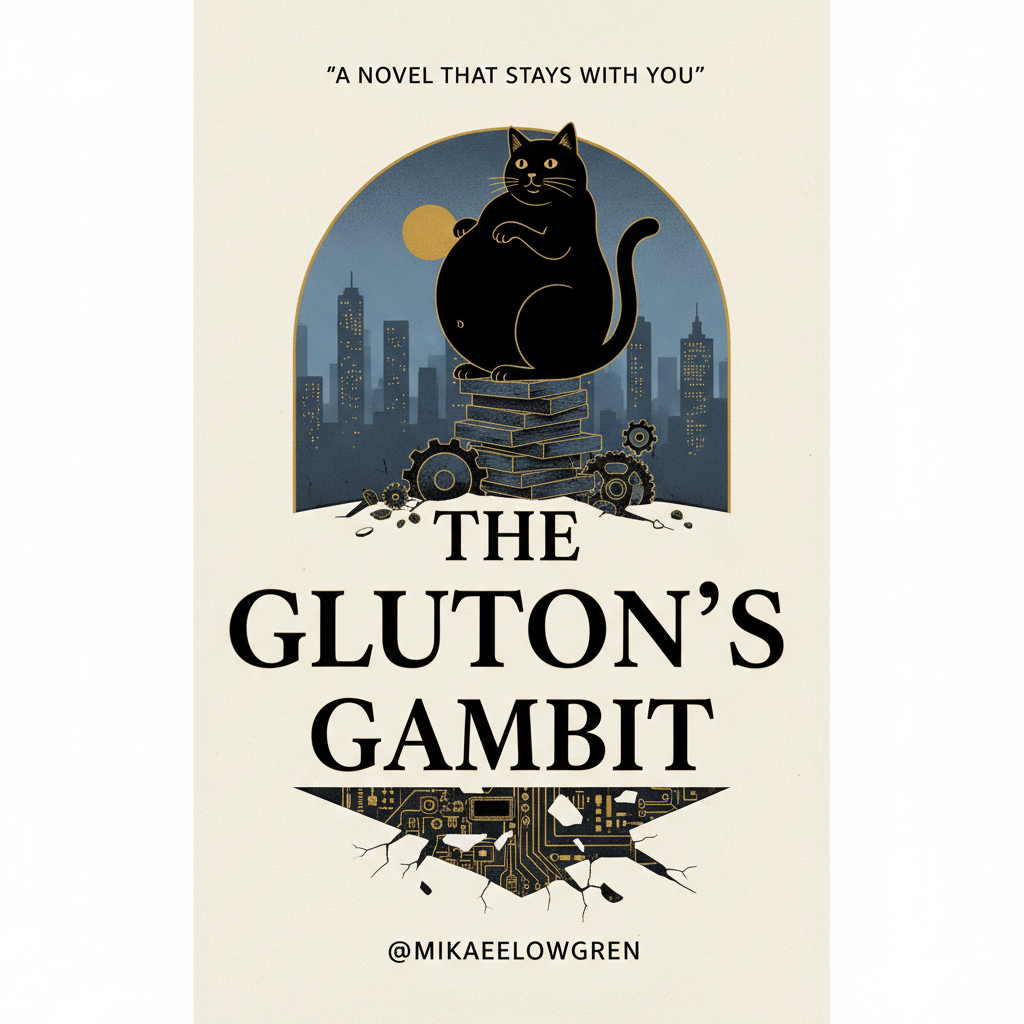
Synopsis
In a society obsessed with order and rationing, a seemingly ordinary feline's insatiable appetite inadvertently exposes the cracks in a meticulously constructed, yet fundamentally unjust, system.
Chapter 1: The Austere Abode
The bell, an instrument of precise and terrible finality, chimed at precisely seven o'clock. Not the gentle, dulcet peal of some imagined idyll, but a sharp, metallic clang that sliced through the pre-dawn gloom of Comrade Mildred’s household like a surgeon’s scalpel. It was an auditory declaration, a daily manifesto that proclaimed the unwavering triumph of order over the slovenly chaos of individual inclination. Whiskers, a creature whose very nomenclature suggested a certain luxuriant hirsuteness, but in reality possessed only the sparsest, most utilitarian of facial hairs, understood this bell. He understood it with the grim, resigned certainty of a prisoner awaiting his daily gruel.
He lay curled on a stiff, unyielding mat in a corner of the scullery, a space chosen not for comfort, but for its strategic proximity to the kitchen. From this vantage point, a subtle, almost imperceptible shift in the air pressure, a faint tremor in the floorboards, could signal the imminent commencement of the day’s most significant event: the dispensing of rations. His stomach, a cavernous, echoing void, had long ago ceased to grumble in overt protest. Instead, it communicated its profound emptiness through a slow, dull ache, a constant companion that had become as unremarkable as the persistent chill that permeated the house.
Comrade Mildred herself was a formidable edifice of tweed and rectitude, a woman whose every movement exhaled the very essence of duty. Her face, a landscape of sharp angles and judiciously pursed lips, rarely softened, even for the fleeting indulgence of a smile. Her eyes, magnified by spectacles that perched precariously on the bridge of her nose, missed nothing. Whiskers had learned this painful truth early in his tenure, after an ill-advised attempt to purloin a splinter of potato peel had resulted in a swift, sharp rap from a wooden spoon. The incident had cemented within him the understanding that spontaneity, particularly where sustenance was concerned, was a luxury neither afforded nor tolerated in this particular corner of the world.
Today, like every day, the ritual began with the heavy tread of Comrade Mildred’s worn house slippers across the scrubbed linoleum. The clatter of enamelware followed, each dish, each spoon, each identical, unadorned bowl, placed with a deliberate precision that suggested deep reverence for the scarcity they contained. Their scarcity, Whiskers mused, was the very bedrock of their significance. Abundance, presumably, would render them mere objects, devoid of the almost sacred value bestowed upon them by their rarity.
First, the family. Comrade Mildred presided over the table like a high priestess at a sacrifice. Her husband, Comrade Bartholomew, a man whose spirit had been systematically leached away by years of diligent conformity, sat opposite her, his shoulders slumped in a perpetual posture of apology. His eyes, the color of weak tea, stared blankly at the tabletop, awaiting the inevitable. Their two children, young Thomas and even younger Elara, were models of subdued anticipation. Their small hands, scrubbed raw from aggressive hygiene, rested primly on the table’s edge, their faces devoid of the boisterous impatience one might expect from the young. They had been thoroughly indoctrinated, their youthful exuberance effectively trimmed back like an overgrown hedge, leaving only the neat, manageable shoots of expectation.
The rations for the humans were measured with a meticulousness that bordered on the fanatical. A precise slab of greyish porridge for each, its consistency that of unenthusiastic gruel. A sliver of what was ostensibly dried apple, but possessed the textural resilience of an old leather boot. And a single, small, hard biscuit, designed, Whiskers suspected, not for enjoyment, but for the sheer act of mastication, a reminder that the digestive process was a mechanism, not a pleasure.
Whiskers watched, his tail, a sparse, twitching appendage, giving away the only outward sign of his internal turmoil. His ears, perpetually swiveling like tiny radar dishes, picked up the sounds: the clink of spoons against enamel, the muted chewing, the infrequent, almost apologetic cough from Comrade Bartholomew. No one spoke. Conversation, like food, was carefully portioned, reserved for designated times and sanctioned topics. The meal was a silent tableau of enduring self-denial.
After the humans had concluded their austere repast, bowls meticulously scraped clean and stacked with militaristic efficiency, it was Whiskers’ turn. This was the moment he both dreaded and yearned for. Dreading it, because the portion was invariably insufficient, a cruel teasing of his perpetually empty stomach. Yearning for it, because it was, after all, *something*.
Comrade Mildred produced a smaller, chipped ceramic bowl. Into it, she measured a few paltry dry pellets, grey and shapeless, smelling faintly of sawdust and regret. Sometimes, on a day of exceptional leniency, a minuscule drop of milk would be added, creating a watery, unappetizing slurry that Whiskers would lap up with a desperate ferocity, pretending it was the richest cream, the most succulent morsel. Today, however, no milk. Just the pellets.
He approached his bowl with a carefully cultivated air of nonchalance, a deliberate feigned indifference to mask the ravenous hunger gnawing at his insides. He knew better than to display overt eagerness. Such displays, he had observed, often resulted in a further diminution of his already meager allowance. It was as if his hunger, made manifest, was an offense to the prevailing ideology of restraint.
He ate quickly, efficiently, each pellet crunched with the methodical precision of a tiny, famished machine. The taste was unremarkable, a bland, dusty flavor that offered little satisfaction, yet promised just enough caloric input to sustain the minimal functions of his feline form. His tongue scoured the bowl, trying to extract every microscopic crumb, every invisible trace of sustenance. When he was finished, the bowl was so clean, it gleamed.
The ritual was complete. The dishes were washed, dried, and stacked. The kitchen, once again, was a sterile, orderly space. Comrade Mildred, a veritable sentinel of domestic rectitude, surveyed her domain, a faint flicker of satisfaction in her usually unreadable eyes. Another day, another triumph over profligacy.
Whiskers retreated to his mat, the brief flicker of sustenance already fading. The ache returned, a familiar ghost in his belly. He watched the world beyond the kitchen window, a world of grey skies and identical grey houses, each one a testament to the efficient, unyielding order that governed their lives. A stray sparrow, plump and brazen, landed on the windowsill outside, chirping an impertinent song. Whiskers felt a pang of something akin to envy, a fleeting resentment at the sparrow’s unburdened existence, its ability to flit and forage without the stern oversight of Comrade Mildred and her omnipresent bell.
He closed his eyes, his mind replaying the day’s meager offerings, an inventory of inadequacy. The thin gruel, the desiccated apple, the hard biscuit. The sawdust pellets. He imagined, in a fleeting, rebellious surge of fancy, a world where food was abundant, where the act of eating was a joy, not a duty. A world where a cat’s bowl brimmed with moist, fragrant fish, where cream flowed like a river, where the concept of 'rations' was an alien, absurd notion.
This fantasy, however, was dangerous. It was a perilous deviation from the approved mental pathways, an indulgence in frivolous imaginings that might, if nurtured, lead to sedition. Or at the very least, a severe reprimand from Comrade Mildred. So he pushed it away, the delicious vision dissolving into the familiar dull ache.
He would spend the remainder of the day in quiet observation, his senses honed by hunger. He would track the movements of the humans, noting their habits, their routines, constantly on the alert for any accidental dropping, any unnoticed crumb, any oversight in the meticulous accounting of their daily sustenance. For in a world where scarcity was king, even the most insignificant overlooked morsel could represent a bountiful feast for a creature as perpetually underfed as Whiskers. It was his daily gambit, his silent, desperate game against the relentless order of Comrade Mildred's household. And though the odds were stacked against him, the tantalizing prospect of a forbidden crumb, a forgotten pea, a glorious speck of something *more*, kept a flicker of grim determination alive within him. It was a meagre hope, perhaps, but in this austere abode, it was all he had. And tomorrow, the bell would chime again, ushering in another day of meticulous scarcity. He wondered, with a shiver that had little to do with the cold, if his luck might finally turn.
Chapter 2: A Crack in the Edifice
The afternoon sun, usually a grudging, clinical light filtering through the grimy windowpanes, cast a single, anomalous shaft across the linoleum. It illuminated not dust motes dancing in the sluggish air, but a small, rectangular package, incongruously pristine amidst the usual utilitarian drabness. This was no common delivery, no standard allotment of Protein Block Q-4 or Dehydrated Vegetable Fibre J-9. This *thing* sat on the freshly scrubbed kitchen counter like a misplaced jewel in a pile of coal, utterly unattended.
Whiskers, who had been contemplating the existential dread of an empty food dish with his characteristic blend of feline stoicism and theatrical despair, observed this interloper with a sudden, prickling intensity. His whiskers, though sparse, twitched. His tail, usually held with the weary resignation of a forgotten banner, gave a tentative, almost involuntary, flick.
The package was wrapped in a dull, grey paper, unadorned by the usual officious stamps of the Ministry of Sustenance. No stark black lettering proclaimed its contents, no barcode declared its precise calorie count or designated recipient. It simply *was*. And the scent, oh, the scent that emanated from it, subtle at first, then growing in its insidious allure, was unlike anything Whiskers had encountered in his starved existence. It was not the thin, metallic tang of the nutrient gruel, nor the dry, cardboard essence of the rehydrated protein flakes. This was... richer. Deeper. It spoke of warmth, of fat, of a boundless, almost decadent promise.
Comrade Mildred, a woman whose life was a testament to the virtues of systematic deprivation, had, in a moment of absentmindedness as rare and precious as gold, left the package unattended. Her daily liturgy of mending socks, polishing the already gleaming communal table, and meticulously itemising the household's minuscule consumption had momentarily eclipsed all other concerns. She was, at this very instant, in the adjoining utility closet, humming a tuneless revolutionary air whilst wrestling with a stubbornly stiff mop head. The faint rhythmic thud-thud of mop against bucket served as a deceptive lullaby, a false sense of security for the kitchen's small, grey tyrant.
Whiskers, emboldened by the unprecedented lack of supervision and the increasingly insistent call of his stomach, launched himself onto the counter in a single, fluid motion—a manoeuvre usually reserved for the illicit pursuit of an errant dust bunny, or a fleeting shadow. He approached the package with a cautious, almost reverent curiosity. His nose, a finely tuned instrument of detection honed by years of sniffing out the slightest deviation from the norm, was pressed against the grey paper. The scent intensified, becoming a heady, almost intoxicating perfume.
He began to knead the package, his small paws working with an instinctive, rhythmic pressure. The paper, surprisingly flimsy for something emanating such powerful aromas, gave way with a soft, tearing sound. A small, almost imperceptible slit appeared. And through it, a viscous, pale brown substance oozed.
It was, according to the official nomenclature, 'Nutrient Paste R-7'. Its intended purpose was highly specialised, a calculated infusion of concentrated sustenance for the most delicate of convalescents, or perhaps, in times of extreme surplus (a concept whispered like a forbidden gospel), a reward for particularly diligent Labour Corps brigades. It was certainly not meant for the casual consumption of an opportunistic feline.
Whiskers, however, was no stickler for regulations. He extended his tongue, a small, pink probe, and dabbed at the exposed paste. The flavour exploded on his palate. It was everything he had ever dreamed of, every phantom scent that had tantalised him from the forbidden bins, every distant memory of a world before rationing and scarcity. It was rich, savoury, unctuous. It was, in a word, *good*. Not "good for you" in the bland, medicinal sense prescribed by the Ministry, but good in a primal, overwhelming, utterly irrefutable way.
A low, guttural rumble started in his chest, a sound born of pure, unadulterated satisfaction. He licked again, then again, with increasing urgency. The small slit in the paper quickly became a gaping maw, as Whiskers, with an almost surgical precision, began to tear at the package, exposing more and more of the glistening, pale brown paste. His movements became a blur of concentrated effort, his small head plunged into the parcel, his tail a veritable propeller of ecstatic intent.
He ate. He ate with the single-minded devotion of a zealot, the tireless energy of a machine, and the boundless enthusiasm of a creature who had known only want. Each lick was a triumph, each swallow a defiance. The grey wrapper quickly became saturated with the paste, adhering to his fur, painting his face a mottled, delicious brown. His ears were plastered back, his eyes half-closed in a beatific trance. The sheer volume of his consumption was, by any rational standard, obscene. He was performing a culinary feat that would have earned him a public reprimand, perhaps even re-education in the Ministry for Moderation's re-alignment centres, had he been a citizen. But he was only Whiskers, a creature of instinct, and his instinct roared with a triumphant, gluttonous hunger.
The steady rhythm of the mop in the utility closet continued, oblivious to the quiet revolution unfolding on the kitchen counter. Mildred, her brows furrowed in concentration over a particularly stubborn streak of grime, remained cloistered in her righteous obliviousness. The world outside, a world structured on careful allocations and precise control, hummed along, utterly unaware that its delicate balance was being subtly, deliciously, undermined by a small, furry anarchist.
When Whiskers finally surfaced, gasping faintly, his face a testament to his epicurean endeavour, a considerable portion of the Nutrient Paste R-7 was gone. The package lay in shredded ruin, a husk of its former self, its contents transmuted into the delightful distension of his own belly. He looked, for the first time in his life, utterly sated. His fur gleamed with a greasy sheen, his small body radiated an almost palpable warmth.
He cleaned his face with an exaggerated, almost theatrical fastidiousness, his pink tongue sweeping across the sticky remnants, ensuring not a single glorious particle was wasted. Then, with a burp that was both refined and entirely unapologetic, he surveyed the scene of his conquest. The remnants of the package, the smeared counter, the faint, lingering aroma of illicit indulgence—these were the spoils of his silent rebellion.
A rebellion, of course, that was entirely accidental. Whiskers had no grand designs, no political aspirations. His actions were not born of malice, but of a profound, unadulterated gluttony. He was merely a creature responding to an irresistible impulse, a hunger that had been denied, repressed, and systematically ignored.
He felt... different. Not just physically full, but imbued with a strange, nascent sense of power. The dull ache in his stomach, a lifelong companion, had vanished, replaced by a warm, contented glow. His mind, usually sharp but constrained by the ever-present pangs of hunger, felt clear, almost expansive. Perhaps, he mused with feline logic, this was how the privileged lived all the time. This abundance, this effortless satisfaction. The thought, fleeting as it was, carried a dangerous seed of insight.
He jumped down from the counter with a surprising lightness, his movements no longer burdened by the usual lethargy of perpetual want. He stretched, luxuriating in the unaccustomed feeling of fullness, then padded softly towards the utility closet. The rhythmic thudding had ceased. A new sound emerged: Comrade Mildred’s exasperated sigh, followed by the clatter of a fallen bucket.
The precise moment of discovery, Whiskers knew, was imminent. He settled himself by the kitchen door, carefully licking a stray smudge of Nutrient Paste from his paw. He looked impossibly innocent, a picture of feline tranquility, his belly radiating warmth. But behind those placid, half-closed eyes, something had shifted. A small crack had manifested in the meticulously constructed edifice of his world, and he, Whiskers, had been the unwitting agent of its appearance. The consequences, he dimly understood, would be interesting. And perhaps, just perhaps, delicious.
Chapter 3: The Expanding Problem
The transformation began subtly, as all insidious things do. At first, it was merely an unusual roundness to Whiskers’ formerly taut belly, easily mistaken for the satisfied bulge of a well-fed housecat by those unaccustomed to the lean aesthetic of sanctioned existence. But the daily consumption of Nutrient Paste R-7, conducted with the secrecy of a spy and the single-minded devotion of a zealot, soon rendered such innocent explanations untenable. His frame, once a sleek testament to economical design, began to swell with an alarming, almost defiant, exuberance.
His fur, which had always lain flat and precisely, now seemed to stand at attention, stretched taut over an ever-increasing acreage of flesh. His head, which had once seemed proportionate to his body, now appeared strangely small, a mere pinprick atop a burgeoning, cylindrical trunk. The effect was not altogether uncomical, though comedy was a concept largely banished from their severe household. When he walked, it was no longer the fluid, silent glide of a predator, but a ponderous waddle, his bulk swaying from side to side like a poorly packed sack of flour. The floorboards, previously accustomed to his negligible tread, now emitted faint, grudging creaks under his expanded mass.
His favourite napping spot, a narrow ledge above the kitchen window, became a precarious perch. He’d haul himself up, a feat of unexpected exertion, only to find his considerable posterior overhanging the edge, a plump, furry glob threatening to topple at any moment. The strain in his eyes, once only visible during moments of intense hunger, was now a permanent fixture, an unspoken testament to the physical labour involved in merely existing in his new, expanded state.
It was Rex, the household’s venerable but perpetually anxious Alsatian, who first voiced the quiet observation of Whiskers' burgeoning form. Rex, whose diet consisted solely of ‘Canine Maintenance Biscuits, Grade B,’ possessed an almost pathological adherence to routine and an uncanny ability to sniff out deviations. One afternoon, as Whiskers attempted with comical futility to groom his own back – a section now utterly inaccessible to his tongue – Rex let out a low, interrogative whine. It was a sound that articulated a question without forming words: "What, exactly, has happened to the cat?"
He watched Whiskers’ labored movements with an air of profound disquiet, his brow furrowed in a manner that suggested a mathematical equation gone horribly awry. Rex had known Whiskers since the cat was a kitten, a small, lithe creature that would skitter across his broad back with infuriating impunity. This monstrously inflated version was an anomaly, an affront to the natural order of things.
Squeaky, the scrawny, omnipresent rat who scurried through the wainscoting and beneath the floorboards, offered a more visceral reaction. Squeaky, a creature whose very existence was a testament to the efficient consumption of crumbs and the desperate avoidance of capture, viewed scarcity as a fundamental law of the universe. To see Whiskers in such a state of corpulence was, to Squeaky, both an obscenity and a miracle.
He would observe Whiskers from the safety of a shadowy corner, his tiny, bead-like eyes gleaming with a mixture of terror and awe. Whiskers, once a terrifying, if rather inept, hunter, was now a slow-moving target, but his sheer scale suggested a power that Squeaky found almost mythical. The rat had seen many things in his life, many desperate battles over a stray potato peeling, but never had he witnessed such an overt display of… abundance. It was as if Whiskers had discovered a secret chamber of infinite cheese, a concept so fantastical it bordered on sacrilege.
“He’s getting… substantial,” Rex murmured to himself one evening, his large, intelligent eyes fixed upon Whiskers, who was snoring with the resonant depth of a small engine on the kitchen floor. The Alsatian’s voice was a low rumble, barely audible above the rhythmic tick-tock of the grandfather clock in the hall, a clock whose insistent chime dictated the very rhythm of their lives.
Squeaky, materializing from a crack in the skirting board, twitched his whiskers in agreement. He didn’t speak the human tongue, of course, but his sharp, knowing gaze communicated a full understanding of Rex’s observation, and perhaps even a hint of envy. He had witnessed Whiskers’ nocturnal forays into the pantry, the stealthy slinking that belied his new mass, the desperate licking of the empty Nutrient Paste R-7 tins. Squeaky knew the source of the cat’s transformation, and the knowledge was a burden of delicious, dangerous gossip.
The whispers began, carried on the drafts that snaked through the old house. The other animals, a hierarchy defined by species and utility, noticed. The hens in the coop, their lives dictated by the precise schedule of egg production, clucked amongst themselves, their yellow eyes darting at the sight of Whiskers’ burgeoning frame whenever he ventured into the yard. Even the aloof tabby, a creature of superior lineage and even more superior disdain, exhibited a flicker of something akin to surprise when Whiskers attempted, and failed spectacularly, to jump onto the window-sill. The tabby merely observed, a slow blink of its green eyes, before returning to its serene contemplation of nothing in particular. But even that was a significant gesture.
Comrade Mildred, a woman whose life was a carefully constructed edifice of schedules, regulations, and an unwavering belief in the efficacy of rationing, was, for a remarkable period, entirely oblivious. Her vision, honed by years of scrutinizing ledgers and verifying inventory, was curiously blind to deviations in the personal. She saw the household not through the lens of individual beings, but as a system, a well-oiled machine, and individual components were expected to remain within their prescribed parameters. A cat was a cat, a dog was a dog, and both consumed their allotted rations. The notion of a cat becoming… more cat, was simply not within her conceptual framework.
Her initial observations of Whiskers’ increasing bulk were dismissed as minor aberrations. “He’s looking… robust,” she’d murmur, patting his considerably broader back with a detached hand. “Good. Healthy.” Her definition of ‘healthy’ was rooted in a practical, utilitarian sense: a cat that could perform its duties, that consumed its rations with satisfactory efficiency. A cat of this new, expanded dimension was, in her unspoken calculations, simply a more robust version of the same.
Yet, the changes became increasingly difficult to ignore. One morning, Whiskers, in a grand display of his new, ponderous agility, attempted to leap onto the kitchen counter, a space he had traditionally frequented with effortless grace. The attempt was a disaster. He launched himself with a grunt of exertion, his stubby legs flailing in the air for a moment, before his substantial bulk thumped back to the floor with a sound that vibrated through the lino. A casserole dish, precariously balanced on the edge, teetered and crashed to the floor, scattering fragments of pottery and a thin, brown gravy across the pristine tiles.
Comrade Mildred, who prided herself on the unblemished cleanliness of her kitchen, froze. She stood, spoon in hand, her eyes widening at the destruction. She stared at the broken porcelain, then at Whiskers, who sat amidst the wreckage, a single droplet of gravy clinging to his burgeoning jowls, looking utterly bewildered.
“Whiskers!” Her voice was sharp, a rare deviation from her usual calm, measured tones. “What in the name of…!” She trailed off, her gaze sweeping over the cat’s unexpectedly vast form. It was no longer simply ‘robust.’ It was… immense. An inconvenient truth, now undeniably manifest in a shattered dinnerware.
Later that day, as she swept up the last shards, a subtle unease began to gnaw at her. It was not anger, for anger was an inefficient emotion, but rather a disquieting sense that something was amiss in her meticulously ordered universe. Whiskers had always been a creature of reliable dimensions, a predictable variable in the equation of her household. Now, he was a growing anomaly, a physical embodiment of a problem that defied categorization.
She began to observe him with a new, more discerning eye. She noted the way he seemed to fill the armchair, overflowing its boundaries like a surfeit of dough. She saw the exaggerated sway of his gait, the difficulty with which he navigated tight corners. She even noticed the faint sheen of sweat on his brow after a particularly strenuous walk across the living room.
The unease deepened, no longer a mere prickle, but a dull throb in the back of her mind. It was a feeling she loathed, a sense of having overlooked something, of a carefully constructed reality beginning to fray at the edges. She checked her inventory of Nutrient Paste R-7, scrutinizing the dates and quantities. Everything was accounted for. Every tin of Canine Maintenance Biscuits, every bag of Fowl Feed, all present and correct. Rationing, after all, was an exact science.
Yet, Whiskers continued to expand. He became a living, breathing, purring testament to a hidden abundance, a walking paradox within a landscape of strictures. He was a secret made manifest, a silent, furry rebellion against the tenets of scarcity. And Comrade Mildred, though she still struggled to articulate the precise nature of the problem, felt a growing certainty that this expanding furball was merely the visible symptom of a deeper, more troubling deviation the likes of which she was not prepared to contend with.
Chapter 4: The Investigation Commences
The morning sun, filtered through the grime of Comrade Mildred’s kitchen window, did little to dispel the gloom that had begun to settle over the household. A peculiar chill, not of temperature but of atmosphere, had permeated the very marrow of the scullery walls. It had started, as all insidious things do, subtly. A measurement slightly off here, a container feeling a fraction lighter there. But Comrade Mildred, with her eyes like polished steel ball bearings and a mind trained in the rigorous accounting of state-mandated sustenance, was not one to be deceived by fractions.
The ritual began, as always, at precisely 0600 hours. A faint click, then the insistent whir of the automated dispenser, ejecting the day’s allotted portion of ‘Nutrient Paste R-7’ into the designated bowls. Rex, the long-suffering canine whose loyalty was a carefully cultivated response to regular, if meagre, feeding, nosed at his share with a predictable lack of enthusiasm. Squeaky, the rat, a nervous twitch in his whiskers betraying a life lived perpetually on the edge of detection, darted in, snatched a quick bite, and then retreated to the safety of a skirting board crack, his tiny eyes darting hither and thither.
And then there was Whiskers.
His bowl stood empty. Not merely licked clean, as it often was, but entirely devoid of the thin, ochre-coloured paste. Comrade Mildred, whose hand instinctively reached for the re-distribution lever, paused. Her brow furrowed. She recalled the faint disquiet of the previous morning, a similar absence of paste, dismissed then as a mere oversight of the dispenser’s calibration. But twice? In a household where every gram was logged, every calorie calculated, such an oversight was not only improbable; it was an act of insubordination by the very laws of physics.
Her gaze, already sharp, sharpened further. It swept across the kitchen, lingering on each animal in turn. Rex, sensing the shift in the air, flattened himself fractionally, his tail, usually a meter of languid optimism, now tucked close to his flank. Squeaky, already a study in abject terror, froze mid-chew, a tiny globule of paste clinging precariously to his chin.
And Whiskers.
He sat, as he often did, on the worn linoleum, his tail wrapped with a curious neatness around his undeniably bulkier frame. His fur, once a sleek, unremarkable grey, now seemed to strain across an unseen expansion, lending him a curious, almost bulbous aspect. His eyes, usually half-lidded in a permanent state of feline ennui, were fixed on some distant, non-existent point in the room, affecting an air of almost exaggerated innocence.
Comrade Mildred’s eyes narrowed. The missing paste. The increasing girth. The two inconvenient facts collided in her mind with the force of a pre-dawn ideological broadcast. She walked to the dispenser, her sensible shoes clicking ominously on the linoleum, and pressed a series of buttons, bringing up a flickering digital display. The figures scrolled, a parade of precise measurements and calculated disbursements. Each animal, by its biometric identity, was allotted its due. And each, save for Whiskers, showed consumption consistent with the recorded outtake.
But Whiskers’ entry… it registered zero. Zero for the paste dispensed. Yet the overall stock of ‘Nutrient Paste R-7’ was demonstrably lower than it should have been. A deficit. An unexplained, unquantified deficit. The very word was anathema to Comrade Mildred’s ordered existence.
“This,” she declared, her voice, usually a flat drone, now held a faint, almost imperceptible tremor, “is irregular.”
The word hung in the air, heavy with unspoken implication. Rex whined, a low, barely audible sound that he quickly stifled. Squeaky squeaked, a high-pitched protest that was instantly cut short as he scuttled entirely out of sight. Whiskers merely blinked, a slow, deliberate movement that suggested profound contemplation of the ceiling tiles.
Comrade Mildred left the kitchen then, not to return to her ledgers, but to the pantry. The industrial-sized vat of ‘Nutrient Paste R-7’ stood on a low shelf, a bland monument to collective sustenance. She brought forth her personal, calibrated measuring stick, a finely etched piece of metal that had served her through countless audits of various state provisions. With meticulous care, she lowered it into the viscous, pale yellow substance.
Her lips thinned as she retrieved it. The level was undeniably, irrevocably lower than it ought to be. Not by a mere few grams, but by a substantial, undeniable margin. Enough, perhaps, for several days’ worth of Whiskers’ rations. Or, conceivably, an entire week’s worth for Squeaky. Or, in the case of Rex, a single, unsatisfying snack.
She stood there, clutching the measuring stick like a divining rod, the silence of the pantry amplifying the frantic machinations of her mind. This was not a dispenser malfunction. This was not a clerical error. This was… a consumption event without a recorded cause. An unauthorised expenditure of communal resources. A theft.
She returned to the kitchen, her gaze hardening by degrees. Whiskers, still affecting his air of profound disinterest, seemed to have expanded even further in her brief absence. His normally sleek grey coat now presented a series of gentle undulations, a landscape of subtle curves where once there had been lean angles. When he moved, which he did now with a curious deliberateness, there was a faint, almost imperceptible wobble to his midsection, as if he carried a small, highly effective ballast within him.
Comrade Mildred made a mental tally. The evidence, circumstantial though it was, coalesced into a disturbing narrative. The dwindling paste. The expanding feline. The undeniable correlation. The conclusion, though still unvoiced, began to take on a terrifying clarity in her mind.
“Whiskers,” she said, her voice now devoid of tremor, flat and precise as a freshly drawn line.
The cat, as if roused from a profound slumber, slowly turned his head. His eyes, a shade of opaque green, met hers. There was no defiance in them, only that infuriating, almost Zen-like placidity. It was the look of a creature who had seen the universe and found it surprisingly uninteresting.
“There has been,” Comrade Mildred continued, her gaze unwavering, “an unauthorised depletion of state provisions.”
Whiskers blinked again. A slow, regal blink. He shifted his weight, and the linoleum beneath him gave a faint, almost silent creak.
Rex, watching from beneath the kitchen table, let out another suppressed whine. His nose twitched, picking up the scent of suspicion, thick and pungent in the otherwise sterile air. He understood. He had lived long enough to understand the dangerous currents that ran beneath the placid surface of Comrade Mildred’s household. An unexplained absence, a deviation from the norm, inevitably led to unpleasant consequences. And often, those consequences were borne by the most convenient scapegoat.
Squeaky, meanwhile, had pressed himself so tightly against the wall that he resembled a faint, dusty smudge. His tiny heart hammered against his ribs, a drum solo of pure, unadulterated fear. He had witnessed Whiskers’ illicit feasts, a silent, trembling spectator to the cat’s astonishing gastronomic feats. He had seen the packages of ‘Nutrient Paste R-7’ disappear with a speed that defied the laws of ordinary consumption. He knew. And his knowledge was a heavy, terrifying burden.
Comrade Mildred began her investigation with the methodical precision of a state auditor. She began to measure Whiskers. Not merely his weight, which had become, for lack of a better word, *significant*, but his dimensions. The circumference of his middle, the span of his chest, the surprisingly sturdy breadth of his hindquarters. Each number, read aloud in her toneless voice, was meticulously noted on a small, dog-eared pad.
Whiskers endured this indignity with remarkable stoicism. He allowed himself to be turned and prodded, a furry, living testament to the efficacy of the stolen provisions. His very bulk seemed to mock the concept of rationing, a silent, fleshy rebellion against the principles of scarcity.
“Seventy-three centimetres,” Comrade Mildred announced, her voice rising slightly at the end, as if expecting a refutation, a denial from the very fabric of reality. But reality remained stubbornly silent.
“This,” she repeated, the word now imbued with a chilling finality, “is highly irregular.”
The other animals watched, their fear turning to a kind of morbid fascination. Rex, with a slow, deliberate movement, poked his nose out from under the table. He saw Whiskers, his comrade in domestic servitude, transformed from a lean, unremarkable creature into a veritable monument of excess. And he understood, with a chilling clarity, that this transformation, this unapproved expansion, would not, could not, go unpunished. It was a violation of the fundamental tenets of their existence. It was, in its own way, a revolutionary act.
Squeaky, from his hidden vantage point, felt a cold dread seep into his tiny bones. He had seen the packages of ‘Nutrient Paste R-7’, the unguarded bounty that had so tempted Whiskers. He had known, in the deepest, most primal part of his rat-brain, that such abundance was a dangerous anomaly. Now, the anomaly had come home to roost. The quiet desperation of his own existence seemed amplified by the looming catastrophe facing Whiskers. For if such a transgression could be committed, and so obviously manifested, what untold dangers lay in wait for those who merely observed?
Comrade Mildred finished her measurements. She stood back, the measuring tape dangling from her hand like a serpentine accuser. Her eyes, those cold, steel ball bearings, fixed once more on Whiskers.
“The evidence,” she said, her voice a low hum of forensic certainty, “is compelling.”
Whiskers, as if on cue, let out a small, almost imperceptible burp. It was a sound of profound contentment, a quiet echo of untold culinary indulgence. It hung in the air, a final, damning piece of evidence in the nascent investigation, sealing his fate with the undeniable force of a well-oiled guillotine. The investigation had begun. And its target, in his splendid, expanding glory, seemed entirely oblivious to the storm he had inadvertently unleashed.
Chapter 5: The Public Spectacle
The kitchen, usually a sterile testament to efficiency and abnegation, was now arranged as a crude, if meticulously swept, amphitheater. A single, rather dim, incandescent bulb, precisely 60 watts as per regulations, cast long, flickering shadows that danced with the dust motes in the stagnant air. In the center, upon a stool that groaned under the strain, sat Whiskers. Or rather, *upon* the stool, and overflowing it in every conceivable direction, lay Whiskers.
Comrade Mildred, perched stiffly behind a card table draped with an impeccably ironed, though somewhat threadbare, white sheet, surveyed her assembled household. Rex, the scrawny terrier cross, quivered silently in a corner, his jowls hanging low, eyes darting between Mildred’s stern visage and the monumental feline. Squeaky, the rat, a creature normally relegated to the inaccessible crevices behind the skirting boards, was compelled to stand at attention on a small upturned bucket, twitching his whiskers with a nervous rapidity that threatened to dislodge his entire nervous system. Even the usually invisible silverfish, disturbed by the unusual assembly, ventured tentatively from behind the flour sacks, a shimmering, scurrying audience to the unfolding drama.
Mildred cleared her throat, a dry, rasping sound that managed to echo in the hushed room. She held a clipboard, its pristine white paper a stark contrast to the smudged reality of their existence. On it, in her precise, almost architectural script, were the charges.
“We are gathered here today,” she began, her voice devoid of inflection, “to address a… divergence from established protocols. A fundamental disruption to the equilibrium of our communal sustenance.” Her gaze, sharp and unwavering, swept across the room like a searchlight. It lingered momentarily on Rex, who responded by sinking further into his own fur, and then on Squeaky, who froze mid-twitch. Finally, it settled upon Whiskers.
The cat, however, offered no reciprocal acknowledgment. He was a landscape of fur and adipose tissue. His head, once a neat, symmetrical orb, was now a rather lopsided sphere, his once-sharp features softened and blurred by layers of comfortable fat. His eyes, mere slits amidst the folds, blinked slowly, a movement betraying an utter lack of concern, or perhaps, an impenetrable depth of sloth-induced contentment. His ears, no longer pert and inquisitive, lay flattened against his skull, lost in the vastness of his jowls. When he moved, which was rarely, his entire frame rippled like some vast, submerged continent shifting upon its tectonic plates.
Mildred adjusted her spectacles, a tiny tremor in her hand betraying a nascent frustration. “Comrade Whiskers,” she enunciated, as if addressing a particularly stubborn collective. “You stand accused of egregious consumption. Of unilateral appropriation of communal resources. Specifically,” she paused for dramatic effect, rustling the papers on her clipboard, “Nutrient Paste R-7. Batch number 047-B. Quantity, indeterminate, but demonstrably substantial.”
Whiskers emitted a soft, rumbling sound, a subterranean vibration that seemed to emanate from the very core of his being. It began as a purr, deep and throaty, then devolved into a full-bodied yawn that stretched his enormous mouth to an absurd degree, revealing a surprisingly pink tongue and teeth that seemed disproportionately small for a creature of such bulk. The yawn concluded with a sigh, a gust of warm, fishy-smelling air that ruffled the fringe of Mildred’s meticulously coiffed hair.
Mildred’s left eyebrow twitched. “This is not a tea party, Comrade Whiskers,” she stated, her voice hardening. “This is an inquiry. A fact-finding mission. Your cooperation is not merely requested, it is… expected.”
She pointed a gnarled finger at a rather large, inexplicably empty metal drum positioned beside Whiskers. “This, Comrade Whiskers,” she declared, her voice rising slightly, “was the receptacle for the aforementioned Nutrient Paste R-7. It was, until recently, full. Overflowing, one might even say. Now, it is not.” She paused, allowing the stark truth of the empty drum to resonate.
Whiskers, as if to underscore the absurdity of the indictment, extended a paw, a surprisingly delicate appendage considering the mass it supported. He gave the drum a languid prod with a padded toe. A dull, metallic clang echoed in the room. He then retracted his paw, tucked it under a substantial fold of belly, and closed his eyes.
“Do you deny it, Comrade Whiskers?” Mildred pressed, growing visibly agitated. “Do you deny consuming the contents of the communal Nutrient Paste R-7, thereby jeopardizing the caloric intake of all members of this household hierarchy?” Her arm swept dramatically to encompass Rex, who flinched, and Squeaky, who nearly toppled from his bucket.
Rex, sensing an opportunity for self-preservation, let out a nervous whine. “Woof?” he offered, his eyes wide and pleading, attempting to deflect suspicion from himself. Squeaky, emboldened by the dog’s pathetic display, squeaked twice, a high-pitched, almost accusatory sound.
Mildred’s gaze flickered to them, a momentarily mollified expression on her face. “See?” she declared, turning back to Whiskers. “Even your fellow comrades acknowledge the… irregular nature of your expansion. Your… undue corpulence.”
But Whiskers was beyond the reach of such petty accusations. His breathing was slow and measured, his chest rising and falling with the effortless rhythm of a well-oiled machine. He was, to all appearances, either deep in meditation or simply asleep. His very presence, immense and imperturbable, mocked the carefully constructed order of the room. The stool beneath him creaked again, a faint wood-on-wood complaint, as if expressing its own silent protest against the immense burden it bore.
Mildred, unaccustomed to such blatant disregard, slammed her hand on the table. The clipboard rattled. “Comrade Whiskers! Such insolence will not be tolerated!” Her voice was now sharp, edged with a desperation she barely managed to conceal. “Your abnormal growth, your disproportionate allocation of… biomass, is a direct challenge to the principles of equitable distribution!”
It was a preposterous accusation, delivered with the gravity of a capital offense. The irony, though lost on Mildred, was palpable to any keen observer. Whiskers’ current state was a living, breathing, purring testament to the failure of the system Mildred so dogmatically upheld. He was an accidental, sentient monument to unrestricted consumption in a world designed for constraint. His rolls of fat, his distended belly, the sheer, undeniable *mass* of him, screamed the truth that Mildred refused to acknowledge: that somewhere, somehow, the rules had been bent, broken, and ultimately, devoured.
A sliver of light from the window caught the sheen of Whiskers’ fur, revealing the stretched skin over his enormous frame, a veritable tapestry of gluttony. He merely repositioned a paw, a movement so slow as to be almost imperceptible, and began to groom a patch of fur on his immense shoulder, his rough tongue making a faint rasping sound that was shockingly loud in the silence.
“Are you suggesting, Comrade Whiskers,” Mildred continued, her voice now a strained whisper, “that this… this accumulation of substance… is merely a natural phenomenon? An act of… spontaneous generation?” She gestured wildly at his bulk, then to the empty drum, then back to his bulk, as if caught in an inescapable logical loop.
Whiskers paused his grooming. He lifted his head, slowly, with an effort that seemed to sag his jowls even further. He fixed Mildred with one of his half-closed, knowing stares. A faint, almost imperceptible tremor ran through his whiskers. Then, he let out another magnificent, chest-rumbling purr, louder this time, a resonant hum that seemed to vibrate through the very floorboards. It was a sound of absolute, unassailable contentment.
It was not an admission of guilt. Nor was it a denial. It was, rather, a statement of fact. A declaration of being. It said, without words, *Here I am. Examine me. Deduce what you will.*
Mildred stared at him, her face a mask of furious perplexity. Her meticulously constructed narrative of order, of rationing, of the carefully calibrated caloric intake for every creature under her roof, was crumbling before her eyes. Whiskers wasn't just a glutton; he was a living, breathing, immensely fat paradox. He was everything her system was designed to prevent, manifested in the most inconveniently undeniable form. How could she punish a physical state? How could she demand an explanation from a creature whose very existence was the explanation?
The sight of him, vast and serene, occupying more space than seemed ecologically responsible, made the entire proceeding seem ludicrous. The empty drum, the scowling Mildred, the trembling Rex, the twitching Squeaky – all suddenly seemed like props in a particularly absurd play, with Whiskers as the unwitting, yet irresistible, star.
Mildred’s voice, when it finally emerged, was strained. “This… this defiance cannot stand. This… visual anomaly… must be addressed. We will… we will reconvene. Further inquiries will be initiated.” She gestured weakly. “The evidence… is overwhelming.”
Whiskers, hearing the slight concession, merely curled his enormous body more comfortably onto the stool, which groaned again in protest. A truly prodigious burp, soft and resonant, escaped his lips, carrying with it faint echoes of what might have once been fish. He closed his eyes once more, a picture of profound, unburdened satiety.
Mildred stared at him, her carefully constructed world teetering on the precipice of utter ridiculousness. The cat, simply by existing in his current, unashamedly enormous state, had rendered her entire interrogation moot. His bulk was a truth she could not explain away, a testament to an unseen feast, a living, breathing hole in her carefully calculated ledgers. The public spectacle, intended to expose insubordination, had instead revealed the glaring, undeniable flaw in the grand design itself, all courtesy of a cat who simply could not stop eating. The audience, though silent, understood. The implications, immense and undeniable, were only just beginning to settle into the collective consciousness of the household.
Chapter 6: A Ripple in the System
Whiskers, that monument of corpulence, remained upon his cushioned perch. He did not stir. He offered no apology, no pathetic mewl for mercy, no sudden spasm of remorse. He merely sat, a vast, furred testament to the inefficacy of vigilance and the profound, undeniable truth of a full stomach. The public spectacle, orchestrated by Comrade Mildred with such meticulous intent, had collapsed not into the desired tableau of shamed confession, but into something far more unsettling: a quiet, unarticulated truth.
The air in the scullery, thick moments ago with the stale scent of accusation and the faint tang of fear, now hung heavy with something else – a formless, shifting disquiet. Rex, the canine embodiment of dutiful compliance, shifted his weight from paw to paw, a low, uncertain whine escaping his throat. It was not a whine of distress, precisely, nor of sympathy, but rather a sound born of cognitive dissonance. For years, Rex had understood the world as a series of clear directives, of boundaries firmly drawn and consequences rigorously applied. Yet here, before his very eyes, sat an animal who had transgressed every known tenet of their austere existence, and had not, apparently, suffered for it. Indeed, he seemed to have *thrived*.
Squeaky, the rat, usually a creature of darting shadows and paranoid glances, had edged out from behind the chipped ceramic basin. He did not approach Whiskers, no; such an act would have been a brazen display of solidarity, and Squeaky’s ingrained caution was a thick hide indeed. But he observed. His tiny, intelligent eyes, usually alight with the calculations of survival, now held a glint of something akin to incredulity. He saw not merely a fat cat, but a living, breathing paradox. A system designed to deny, to limit, to regulate every calorie, had produced a creature of such abundant, unearned plenty. It was as if the very laws of their meticulously engineered scarcity had been suspended, irrevocably, by the sheer, unthinking hunger of one remarkably determined feline.
Comrade Mildred, framed by the stark, utilitarian lines of her kitchen, remained frozen. Her spectacles, usually perched with an air of unyielding authority, now seemed to sag slightly on her nose. Her mouth, accustomed to shaping pronouncements and regulations, hung subtly ajar. The theatricality of the confrontation had been her tool, her method of reasserting control. She had expected a cowering, a confession coerced by the sheer weight of her moral rectitude. She had prepared for the penitent gaze, the nervous tremor. What she had received instead was a tranquil, spherical indifference.
This was not defiance as she understood it. Defiance was a raised paw, a muttered complaint, an attempt to hide a forbidden crumb. This was…something else entirely. Whiskers wasn't defying the system; he was simply *obliterating* it, not with grand gestures or revolutionary fervor, but with the quiet, persistent pressure of his own expanding mass. His very existence was an unanswerable argument against the meticulously crafted narrative of scarcity that formed the bedrock of their lives.
The silence stretched, punctuated only by the distant, rhythmic ticking of the scullery clock – a relentless, metallic heartbeat that usually underscored Mildred's dominion, but now seemed to mock it. The tick-tock, tick-tock, counting out the moments of her own diminished authority.
Finally, with a stiff, almost involuntary movement, Comrade Mildred adjusted her spectacles. It was a gesture of ingrained habit, a futile attempt to impose order on a reality that stubbornly refused to cohere to her exacting standards. She looked from Whiskers to Rex, then to the barely visible Squeaky. She saw not the cowed, obedient animals she had cultivated, but creatures whose eyes, even Rex's dull brown ones, held a flicker of something new, something that had not been there before the great revelation of Whiskers’ girth. It was not open rebellion, not yet. It was something far more insidious: a nascent understanding. A quiet, terrifying comprehension that if one could break the rules with such astounding impunity and achieve such spectacular, undeniable results, then perhaps the rules themselves were not quite as immutable as they had been led to believe.
Comrade Mildred found her voice, though it emerged somewhat thinner than usual, a threadbare banner in the face of such overwhelming evidence. "The… the matter is concluded," she announced, the words ringing hollow in the suddenly cavernous scullery. She did not specify *how* it was concluded, nor *what* had been concluded. The truth of the matter was, nothing had been concluded. Only begun.
She turned on her heel, a movement that usually conveyed absolute finality, but today merely indicated a strategic retreat. Her back, usually ramrod straight, held a faint stoop. As she exited, the heavy wooden door swung shut behind her with a soft thud, a sound that seemed less like an exclamation mark and more like a reluctant ellipsis.
The scullery remained, for a long moment, eerily still. Then, slowly, the animals began to stir.
Rex, emboldened by the absence of Mildred’s severe gaze, took a tentative step towards Whiskers. He sniffed, a long, investigative inhalation, at the air around the cat. He seemed to be checking if the laws of physics, or perhaps the mandates of Comrade Mildred, had somehow failed to apply to Whiskers’ very scent. There was nothing untoward. Just the faint, comforting aroma of well-fed feline. Rex let out a soft sigh, a sound of profound puzzlement. He then did something entirely uncharacteristic: he lay down, not in his designated sleeping area, but a few feet from Whiskers, his chin resting on his paws, his gaze fixed on the gargantuan cat. He watched, as if Whiskers were a complex puzzle he was determined to unravel, or perhaps a prophecy unfolding before his very eyes.
Squeaky, meanwhile, scurried out further, his whiskers twitching with a newfound audacity. He scampered over to the corner where the empty Nutrient Paste R-7 container had once stood sentinel. He sniffed at the faint, lingering scent, then looked at Whiskers, a silent comparison forming in his tiny, sharp mind. He saw the correlation, the direct consequence. A forbidden pleasure, consumed, and the astonishing, undeniable result. The implications of this simple equation were, for a rat, revolutionary. The carefully curated fear of infraction, the built-in assumption of inevitable punishment, had been proven false by a cat whose only ambition seemed to be the attainment of maximum achievable corpulence.
Life, as Comrade Mildred had declared, went on. But it did not go on as it had before. The delicate machinery of their existence, once running with the austere precision of a single-minded clockwork, had developed a subtle but significant wobble.
The rationing, for instance. It was still rigidly enforced, the portions still measured with the precision of a chemist. Yet, an almost imperceptible change had occurred in the atmosphere surrounding its distribution. Before Whiskers' grand unveiling, every animal had accepted their allotted portion with a stoic resignation, a deep-seated belief in the absolute necessity of it all. Now, as Mildred spooned out the tasteless gruel, there was a fleeting, almost defiant glance from Rex, a momentary lingering of Squeaky’s eyes on her hand, as if measuring not just the portion, but the *might* behind its restriction.
Comrade Mildred herself, the architect of their orderly misery, found her days subtly altered. She still patrolled, still inspected, still issued her directives. But the confident snap in her voice was often replaced by a slight hesitancy, a faint tremor that was invisible to the casual observer, but acutely felt by those whose existence depended on her unshakeable resolve. She would often find herself glancing at Whiskers, who had, after his initial performance, returned to his default state of serene inactivity. He was no longer just a cat; he was a living, breathing symbol, a constant reminder of something profoundly disruptive.
She would try to assign him tasks, small, meaningless errands designed to impose a sense of purpose and discipline, even on a cat. "Whiskers," she would command, "Patrol the pantry for errant crumbs." Whiskers, from the depths of his cushioned repose, would merely twitch an ear, a gesture that conveyed utter, unshakeable apathy. He had done his patrolling. He had achieved his purpose. His purpose, it seemed, was to exist as an unanswerable question mark at the very heart of Comrade Mildred's ordered world.
The other animals, particularly Rex and Squeaky, began to exhibit more overt signs of this shift. Rex, once a model of canine obedience, began to sniff at the edges of their boundaries with a new curiosity. A dropped crumb, once meticulously ignored lest it incur Mildred's wrath, might now be investigated, perhaps even, daringly, consumed. His tail, once a barometer of his subservience, now wagged with a slightly less obsequious rhythm.
Squeaky, ever the pragmatist, saw the situation in stark, undeniable terms of risk and reward. If Whiskers could accumulate such immense wealth (of a caloric nature, at least) without consequence, then perhaps the system of scarcity was not, as assumed, an unyielding law of the universe, but rather an artificial construct, upheld by fear and the belief in its own inviolability. He began to explore with a daring that bordered on recklessness, venturing into new territories of the kitchen, his tiny brain whirring with the possibilities that Whiskers's existence had laid bare. He did not seek to become large like Whiskers; Squeaky was far too shrewd for such overt displays. But he did seek the smaller, more discreet advantages, the hidden bounties that had previously been overlooked in the universal fear of transgression.
The very air of the household, once humming with the oppressive efficiency of a well-oiled machine, now held a faint, almost imperceptible dissonance. The bells still rang, the schedules were still adhered to, but beneath the surface, a subtle re-evaluation was taking place. The animals had witnessed, firsthand, the limits of their overseer's power. They had seen the system, so carefully constructed, so ruthlessly maintained, buckle under the simple, weighty truth of one cat’s inconveniently prosperous physique.
Comrade Mildred, in her moments alone, would sometimes find herself staring at the scullery wall, a faint flush creeping up her neck. She knew, with a certainty that chilled her to the bone, that the incident with Whiskers had not been forgotten. It had burrowed deep into the collective consciousness of the household, a persistent, unspoken query. The grand, unassailable narrative of scarcity, once so effortlessly maintained, had been publicly eroded, not by argument or protest, but by the sheer, undeniable reality of a feline who had simply, and quite spectacularly, refused to be meagre.
The cracks were there, undeniable and permanent. Life would go on, yes, but the meticulous order, once a bastion of unquestionable authority, now hummed with a quiet, insidious hum of doubt. And Whiskers, oblivious to the philosophical upheaval he had wrought, merely purred, a low rumble emanating from his colossal frame, a sound of profound contentment that echoed through Comrade Mildred’s dreams like a distant, mocking thunder. The true rebellion, it seemed, was not in the angry roar, but in the supremely satisfied sigh.