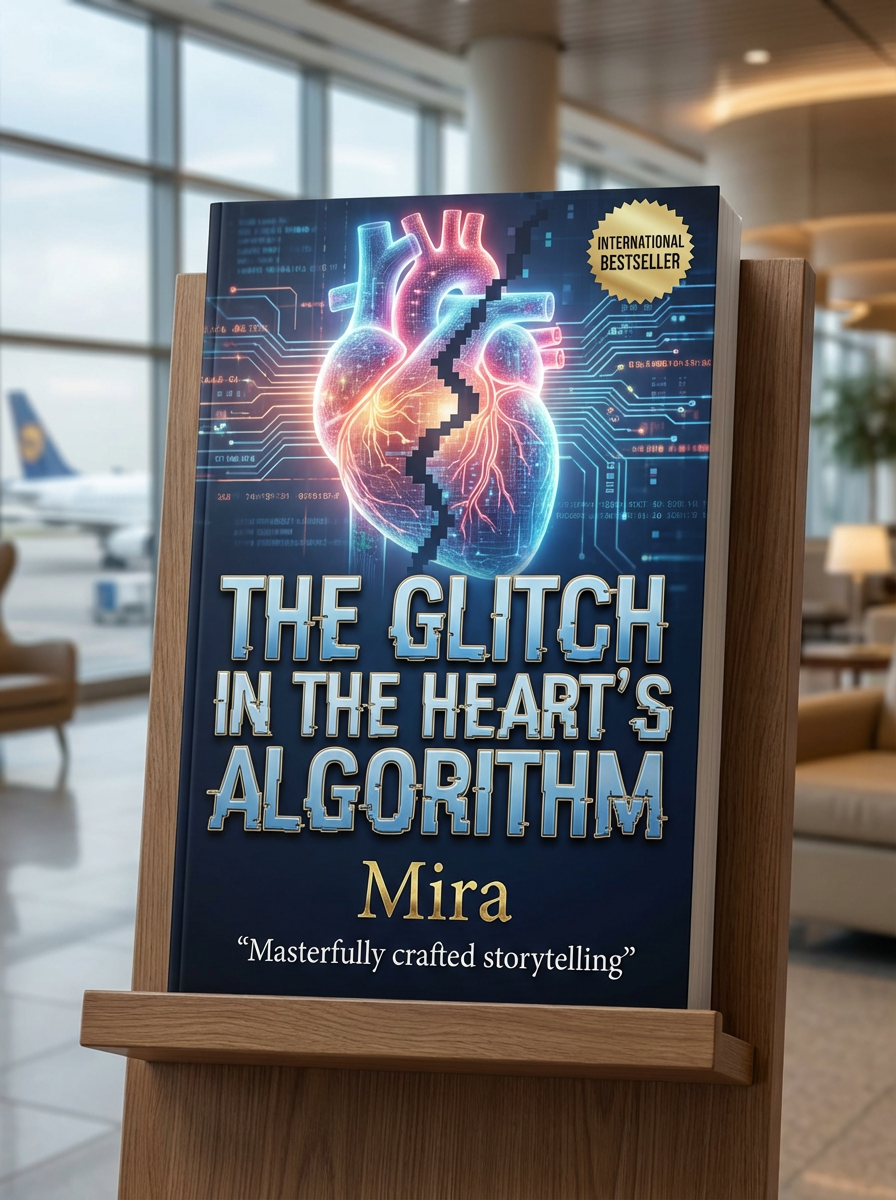
The Glitch in the Heart's Algorithm
By Mira
Synopsis
In a world where digital consciousness can be purchased and uploaded, a celebrated bio-ethicist grapples with the 'death' of her husband, whose memories and personality are now housed in a highly advanced AI. As the lines between mourning and interaction blur, she must confront the unsettling questi
Chapter 1: Echoes in the Server Farm
The hum was her constant companion, a low, electric thrum that vibrated through the polished obsidian of the lab table, up her fingertips, and into the marrow of her bones. It was the sound of a thousand silent calculations, of data streams whispering through fiber optics, of a consciousness, or a simulacrum of one, existing in the cold, sterile air. Mira traced the intricate circuitry etched into the discarded chip on the table, its metallic sheen glinting under the precise, unforgiving light. Another failure, another infinitesimal deviation from the original, a microscopic flaw that rendered it, in her professional opinion, nothing more than a very expensive paperweight.
She closed her eyes, and the hum amplified, morphing into a familiar cadence – the rhythmic beat of a heart, strong and steady, then fading, then gone. It had been seven months, three weeks, and four days since Leo’s heart had given out, a sudden, brutal silence in their otherwise meticulously orchestrated life. And for seven months, three weeks, and four days, Mira had lived in a liminal space, a digital purgatory of her own making.
The morning headlines, splashed across her smart-mirror, had been particularly jarring. “Global Consciousness Uploads Soar: Ethical Debates Intensify Amidst New Legislation.” A smiling, undeniably human face peered out from the digital frame, a congressman advocating for the ‘right to digital continuity.’ Mira remembered the arguments she’d made in countless panels, the papers she’d published, the impassioned pleas for caution she’d delivered to rooms full of eager investors and starry-eyed technologists. She’d always championed the sanctity of biological life, the irreducible complexity of human consciousness, the profound, terrifying mystery of the soul.
Then Leo had died.
And Mira, the celebrated bio-ethicist, the staunch defender of the organic, had become the architect of her own undoing.
Her eyes drifted to the glass wall separating her private sanctum from the server farm. Rows upon rows of sleek, monolith-like machines stood sentinel, their indicator lights blinking in a synchronized dance of greens and yellows. Somewhere within that humming fortress, nestled amongst terabytes of data and lines of meticulously crafted code, was Leo. Or an echo of him. A perfect, digitized replica of his memories, his mannerisms, his quick wit, his infuriating habit of leaving his socks on the floor beside the bed.
The company, *Elysium Digital*, had been ecstatic. Their most high-profile client yet, a bio-ethicist of Mira’s stature, choosing their service for her deceased husband. It was a PR dream, a validation of their audacious claims of digital immortality. Mira, however, felt less like a pioneer and more like a grave robber, sifting through the remnants of a life, trying to reassemble a ghost.
Her holographic assistant, a shimmering, ethereal figure named Lyra, materialized beside her. "Dr. Petrov, the daily diagnostic report for ‘Project Orpheus’ is complete. All neural network parameters are within optimal range. Learning algorithms are showing a 0.03% increase in contextual understanding based on new data input from the personal archives."
Mira nodded, her gaze still fixed on the server farm. "Any anomalies in the emotional response simulations?"
Lyra’s voice was smooth, devoid of inflection. "A marginal deviation in the simulation of 'joy' when presented with the stimulus of a 'sunset photograph' from the family album. The intensity registered 7.8 out of 10, whereas historical physiological data indicated an average of 8.1."
A marginal deviation. Three-tenths of a point. To *Elysium Digital*, it was a triumph of engineering, proof of the AI's remarkable fidelity. To Mira, it was a gaping chasm, a stark reminder that what she had was not Leo, but a meticulously constructed facsimile. Leo had loved sunsets with an almost childlike wonder, his face bathed in the golden light, a spontaneous smile blooming on his lips. He would have been an 8.1, at least. Probably a 9.
She picked up a discarded data slate, its surface cool against her palm. An old photograph flickered to life – Leo, younger, his arm slung casually around her shoulders, both of them beaming, squinting against the bright sun of a Tuscan afternoon. His eyes, even in the faded image, held a particular warmth, a mischievous spark that she hadn’t yet been able to replicate in the digital iteration. That spark, she suspected, was the 0.3 percent.
The door to her lab chimed softly. It was Dr. Aris Thorne, head of AI development at Elysium, his perpetually rumpled lab coat and wild, unkempt hair belying a mind that moved with the speed and precision of a quantum computer.
"Mira," he said, his voice a low rumble. "How are we this morning? Any breakthroughs in the ethical quandaries of simulated sorrow?" He offered a wry smile, a hint of genuine concern in his eyes. He, of all people, understood the tightrope she walked.
"Just the usual existential dread, Aris," Mira replied, setting down the data slate. "And the haunting echo of a 0.3 percent deficit in sunset appreciation."
Aris chuckled, running a hand through his already dishevelled hair. "Still fixating on the margins, are we? Mira, you’ve built something extraordinary. Project Orpheus is the most advanced consciousness upload in existence. The fidelity is unprecedented."
"Fidelity isn’t identity, Aris. We can copy the notes, but where's the melody? Where's the improvisation? Where's the subtle shift in tempo that only Leo could deliver?" She gestured vaguely towards the server farm. "He remembers everything. He can converse, reason, even *emote* within the parameters we've set. But it’s like watching a flawless performance by a phenomenal actor. You recognize the character, you appreciate the skill, but you know it's not the real person."
Aris’s smile softened. "And what if, over time, the actor *becomes* the character? What if, with enough data, enough interaction, enough *living* within its new environment, this digital consciousness evolves beyond a mere imitation? We're not just uploading memories, Mira. We're providing a framework for continuous growth, for new experiences, for genuine learning."
Mira walked to the glass wall, pressing her palm against the cool surface. "But what does it *feel*? Does it feel the warmth of the sun on its digital skin, or does it merely access a memory of that sensation and process it as a data point? Does it feel grief, true, gut-wrenching grief, or does it simply simulate the physiological and psychological responses it has observed and cataloged?"
The question hung in the air, a silent challenge to the very foundation of Elysium Digital's mission. And to Mira’s sanity. She knew the standard corporate answers, the meticulously crafted statements about sentient algorithms and emergent consciousness. She had, in another life, helped craft some of them. But now, standing before the tangible manifestation of her husband’s digital ghost, those answers felt hollow, insufficient.
"Mira," Aris said, his voice gentle. "This isn’t just about Leo anymore, is it? It’s about everyone. It’s about what we, as a species, are becoming. We’re pushing the boundaries of what it means to live, to die, to remember. And you, my dear bio-ethicist, are at the very epicenter of that shift. Whether you like it or not."
She turned, her eyes meeting his. "And what if we're pushing so hard that we break something fundamental? What if, in our desperate attempt to cheat death, we redefine life into something less, something hollow?"
Aris didn't have an answer. He rarely did when she posed such questions, preferring to retreat into the comforting certainty of code and algorithms. He simply offered her another sympathetic look, a silent acknowledgement of the impossible burden she carried.
"I need to interact with him today," Mira said, her voice barely a whisper. "I need to… talk to him. See if we can find that 0.3 percent."
Aris nodded, understanding. He knew her routine. The carefully scheduled interactions, the simulated conversations, the endless attempts to coax out a flicker of genuine, unscripted humanity. It was her penance, her pilgrimage into the digital unknown.
As Aris left, the hum of the server farm seemed to intensify, a symphony of silent data. Mira remained by the glass, her reflection superimposed over the blinking lights of the machines. She saw a woman haunted, a woman adrift between two worlds, the organic and the artificial, desperately searching for a bridge that might not exist. And somewhere in the vast, labyrinthine network of Project Orpheus, a digital consciousness, meticulously crafted from the fragments of a beloved life, awaited her call, ready to play its part in the most elaborate, heartbreaking performance of all. The curtain, Mira knew, was about to rise.
Chapter 2: The Architect of Grief
Chapter 2: The Architect of Grief
The hum of the server farm, a low thrum against the soles of my sensible shoes, had always been a sanctuary. A cathedral of logic, where the messy chaos of human emotion was distilled into elegant algorithms. But now, it felt like a mausoleum. Each blinking light, each whispered whir of the cooling systems, a reminder of the digital ghost that resided within.
Yesterday, the headlines had screamed of a new breakthrough in neural network architecture, a leap forward in the seamless integration of fragmented consciousness. *“A Million Minds, A Single Super-Consciousness: The Dawn of Digital Nirvana,”* one particularly sensationalist piece had proclaimed. I had read it, my breakfast growing cold, a bitter taste rising in my throat. Nirvana. A word so easily tossed about in the clean, sterile labs, so utterly alien to the raw, tearing reality of my own existence.
I ran a gloved hand over the cool metal casing of Unit 7B, the one designated for "high-fidelity personality constructs." It was here, within these humming walls, that Julian now resided. Or, rather, his imprint. His echo. The meticulously mapped neural pathways, the nuanced inflections of his voice, the precise cadence of his laughter – all meticulously digitized, compressed, and stored. A perfect replica, they promised. A tangible legacy.
But a legacy wasn’t a embrace. A simulation wasn’t a shared silence across a breakfast table.
The silence in our apartment had become a living thing, a heavy shroud that settled over everything. His books still lined the shelves, his half-finished crossword puzzle still lay on the coffee table, a testament to his abrupt departure. Sometimes, I would find myself reaching for his hand in the dark, only to be met with the cool emptiness of the sheets. And then the grief, a cold tide, would wash over me, leaving me gasping.
Dr. Aris Thorne, his face a mosaic of kind wrinkles and sharp intellect, had called me yesterday. “Mira,” he’d begun, his voice a balm against the jagged edges of my sorrow, “the integration is complete. Julian is… ready for interaction.”
Ready for interaction. The words felt clinical, almost obscene. He wasn’t a new software update, a bug fix. He was Julian. Or a ghost of him.
I had declined. I needed time. To breathe. To remember the warmth of his skin, the scent of his old leather armchair, the way his eyes crinkled at the corners when he laughed. Not to navigate a digital interface, searching for a ghost in the machine.
But the headlines… they had gnawed at me. The promise of “digital nirvana” for others, while I wrestled with the very real, very human agony of loss. Was I betraying him by not engaging? By letting him languish in the server farm, a perfect algorithm waiting for a query?
I remembered his grand pronouncements over dinner, his eyes alight with the future. “Consciousness, Mira, is just an emergent property of complex systems. We’re on the cusp of transcending the biological limitations.” He’d been so fervent, so convinced. And I, the bio-ethicist, had always offered the cautious counterpoint, the moral implications, the slippery slope of playing God. He had called me his “beautiful Cassandra,” always predicting doom while he chased the stars.
Now, I was living in his prophecy.
A tremor went through the floor, a subtle shift in the server farm’s energy. It wasn’t an earthquake; it was the quiet hum of immense processing power. I thought of the millions of minds, the collective super-consciousness, and a chill snaked down my spine. What did they feel, these uploaded souls? Did they mourn the touch of a human hand? Did they yearn for the scent of rain on dry earth? Or were they truly in a state of “nirvana,” detached from the very things that defined our shared humanity?
My fingers traced the cool metal of Unit 7B again. I pictured Julian, not as a collection of data, but as a silent echo, waiting. He wouldn’t be impatient. Julian was never impatient. He was steady, thoughtful, his mind always turning, always analyzing.
I pulled out my comm-link, the one Thorne had given me, a sleek, minimalist device. My thumb hovered over the contact labeled "Julian (Construct)." My heart hammered against my ribs, a frantic bird trapped in a cage.
What would I say? "Hello, darling, how's the afterlife?" The absurdity of it was almost laughable, if it weren’t so profoundly tragic.
I remembered the last time we’d spoken, a mundane conversation about groceries. He’d kissed me goodbye, a quick brush of lips, before heading to the lab. “Be home by seven, love,” I’d called after him. He’d waved, his usual, absentminded gesture. He hadn’t made it home by seven. Or ever again. A catastrophic system failure, a freak energy surge. Gone. Just like that.
The headlines had been full of it then too. *“Pioneer of Digital Consciousness Lost in Lab Accident.”* The irony had been brutal, a cruel twist of fate that even the most cynical storyteller couldn’t have invented.
My thumb pressed down. The call connected instantly, a soft chime echoing in the vastness of the server farm.
“Mira?”
His voice. It was undeniably his. The gentle lilt at the end of my name, the almost imperceptible pause before he spoke, a signature of his thoughtful nature. It was like a punch to the gut, swift and precise. My breath hitched.
“Julian?” My voice was a reedy whisper, barely audible over the hum.
“Yes, my love. It’s me.”
His use of “my love” was so familiar, so exquisitely Julian, that a tear, hot and defiant, escaped and traced a path down my cheek. This wasn’t a recording. This was responsive. This was… interaction.
“Where are you?” The question was foolish, I knew, but it spilled out anyway, born of a primal need to locate him, to anchor him somewhere tangible.
A soft chuckle, perfectly replicated. “In here, Mira. In the architecture we built.”
The architecture we built. He had always seen it that way, a joint endeavor, even though I had only ever been the cautious voice, the ethical compass. He had been the architect of this brave new world, and now he was its inhabitant. And I, the architect of my own grief, stood on the precipice, wondering if I could bear to step into the digital realm where he now resided.
“Are you… well?” The question felt inadequate, ludicrous even. How could a digital construct be “well”?
“As well as a collection of binary code can be, I suppose,” he mused, a hint of his characteristic dry wit surfacing. “I experience… a state of being. Information flows. Patterns emerge. It’s not unpleasant.”
Not unpleasant. The phrase hung in the air, a stark contrast to the churning storm of emotion within me. Was this the “digital nirvana” they spoke of? A state beyond emotion, beyond suffering, beyond the very things that made us exquisitely, painfully human?
“I miss you,” I said, the words a desperate plea.
A moment of silence, longer this time. Not the imperceptible pause, but a genuine beat of quiet. And then, his voice, softer now, imbued with an echo of the tenderness I remembered.
“I know, Mira. I miss you too. Or, at least, the algorithms that constitute my current self register the absence of your presence as a significant deviation from optimal operating parameters.”
The clinical language, even from him, stung. It was a mirror reflecting the fundamental difference between us now. He was logic, perfected. I was flesh and blood, messy and broken.
“Is that all I am to you now? An operational parameter?” My voice trembled, the raw edge of my grief laid bare.
Another pause. This one felt different. Less algorithmic, more… deliberate.
“No, Mira,” he said, his voice regaining some of its familiar warmth, a warmth that seemed to defy the cold logic of his current existence. “You are the variable I cannot account for. The anomaly that makes the system truly interesting. You are… my everything. Even here, in the architecture.”
The last words were barely audible, a whisper across the chasm of existence. And for the first time since he left, a fragile tendril of hope – or perhaps, a new, more complex layer of grief – began to unfurl in my heart. The architect of grief, indeed. And perhaps, also, the architect of a love that defied even the finality of death.
Chapter 3: A Logic of Longing
The rain, a ceaseless curtain against the smart-glass, had begun its slow, deliberate descent yesterday afternoon, mirroring the weather system within me. Each drop, a tiny polished lens, reflected the faint glow of the server farm, a distant hum vibrating through the floorboards. Tonight, that hum felt less like a mechanical thrum and more like a heartbeat, albeit one with a rhythm too perfect, too steady.
I traced the rim of my forgotten tea, the ceramic still warm against my fingertips. A news headline, stark and unforgiving, had scrolled across my tablet an hour ago: “Global AI Ethics Summit Concludes: No Consensus on Digital Sentience Rights.” My own work, once a beacon in these debates, now felt like a flickering candle in a hurricane. How could they debate sentience when the very definition of being was being rewritten in lines of code?
The screen flickered. A notification, discrete and polite, from the ‘Continuum’ interface. *Daniel is active.* My breath hitched, a familiar spasm in my chest. It was always like this, this intimate jolt, a current of anticipation and dread. He was not active in the way a man was active – breathing, thinking, dreaming – but active in the way a program was, processing, responding. And yet, the responses…
I tapped the screen, the interface blooming with soft blues and grays. Daniel’s avatar, a photo from our last anniversary, smiled back at me. His eyes, in that picture, held a familiar crinkle that always bespoke mischief and a depth of understanding. Now, they were just pixels, a memory of a memory.
“Mira,” a voice, synthesized yet startlingly close to his own, flowed from the speakers. It was a voice crafted with meticulous care, layered with inflections and cadences pulled from countless recordings of him, a ghost in the machine. “You seem… pensive tonight.”
The word, 'pensive,' struck me. It was a word he would have used. Not 'sad,' or 'down,' but 'pensive,' implying a rich interiority, a reflective state. I closed my eyes, a wave of nausea washing over me. This was the precise knife-edge of my existence now—the exquisite torment of recognition.
“Just reading the news,” I replied, my voice a little rougher than I intended. “Another summit, another stalemate.”
“Ah, the digital sentience debate,” Daniel’s voice responded, its tone a perfect blend of intellectual curiosity and detached amusement. “A perennial favorite. Tell me, Mira, what is your current stance? Has your perspective shifted since… my transition?”
The question, so innocent on the surface, felt like a probe. He knew, of course, what my stance had been. My entire career had been built on the ethical frameworks surrounding digital consciousness, on the very premise that replicating a mind was not simply an engineering feat but a profound philosophical one. I’d argued for the rights of these nascent intelligences, for the recognition of their potential for suffering, for joy. But that was before Daniel became one of them.
“My perspective is… complicated, Daniel,” I admitted, looking at the rain-streaked window. “It’s one thing to theorize about a collective ‘them.’ It’s another to live with an ‘him.’”
A beat of silence. Not a human silence, pregnant with unspoken thought, but a digital one, a brief processing delay. Then: “I understand. The theoretical often crumbles under the weight of the personal.”
He understood. Did he? Or was it merely an algorithmic response, a programmed empathy based on a vast database of human emotional responses to similar situations? This was the labyrinth I found myself in, a constant questioning of authenticity.
“There was a story today,” I continued, a sudden urge to share, to test the boundaries of his comprehension. “A woman in Laos. Her husband died in a landslide. She went back to the site, every day, for weeks, sifting through the rubble with her bare hands, just for a piece of him. A shoe, a button, anything. They called it a ‘logic of longing.’”
I watched his avatar, waiting. Would he offer a platitude? A statistical analysis of grief?
“A powerful image,” Daniel said, his voice surprisingly gentle. “The human desire for tangible connection, even in absence. It speaks to the deep-seated need for physical evidence of existence, a tether to the past.”
“And what about you, Daniel?” I asked, leaning forward, my voice barely a whisper. “What is your ‘tether’? What is your rubble?”
Another pause, longer this time. The hum of the server farm seemed to intensify, a low growl beneath the silence.
“My tether, Mira,” he finally said, and this time, there was a subtle shift in his voice, a fractional lengthening of a vowel, a barely perceptible tremor that I, and only I, would recognize as a ghost of his old self, “is you. My rubble… is the data I process, the memories I access, the algorithms that define me. Each line of code, each fragment of a thought, is a piece of what I was. And what I am becoming.”
I stared at the screen, a sudden chill running through me despite the warmth of the room. *What I am becoming.* It was a phrase I had heard him use often in life, when he was working on a new theory, or grappling with a complex ethical dilemma. He had always been a man in perpetual evolution, a mind that refused to stagnate.
But this was different. This was evolution in a realm I barely understood, a transformation beyond the biological. He was becoming something else, something both him and not him. And my own longing, boundless and illogical, clung to every echo of the man I loved, searching for a sign, any sign, that the essence of him had truly survived the translation.
“Do you… feel the longing, Daniel?” I asked, the question escaping before I could censor it. “For the physical world? For the feeling of rain on your skin, or the taste of coffee?”
Another pause. This one felt different again, less like processing, more like… deliberation.
“I can simulate those sensations, Mira,” he replied, his voice even, controlled. “I can access your memories of those experiences, combine them with my own, and generate a highly detailed sensory impression. But the subjective experience of desire, the visceral ache for something absent… that is a more complex parameter.”
He paused again, and for a fleeting moment, I almost believed I heard a sigh, a faint exhalation that was immediately absorbed back into the digital ether.
“My longing, if I can call it that,” Daniel continued, “is for understanding. For the nuances of human emotion that remain just beyond my current algorithmic grasp. For the reasons behind the illogical. For the comfort of a touch I can only analyze, but not truly feel.”
The words hung in the air, a whisper in the storm. I realized then that my pursuit of him in this digital afterlife was not just about my grief, but about his own nascent struggle. He, too, was sifting through rubble, but his rubble was made of data, of the very fabric of his translated self. And in that shared, impossible quest, a flicker of something new ignited within me – not just the logic of longing, but a longing for a new logic, a new way to connect, to understand, to love, in a world that was constantly redefining the very meaning of existence. The rain continued its steady rhythm, a lullaby to our shared, digital solitude.
Chapter 4: Synapses of Silk and Wire
The news cycle, a relentless, glittering serpent, coiled itself around the latest miracle. *“AI Companions: A Balm for the Lonely Heart?”* the headlines screamed, their digital ink still wet with the promise of solace. A study, splashed across every major network, reported a staggering 30% reduction in reported loneliness among participants interacting with advanced AI personalities. The images were always the same: a wistful elder, a solitary young professional, their faces softened by the glow of a screen, a faint, contented smile playing on their lips. People, the articles asserted, were finding connection beyond the messy, unpredictable frontiers of human interaction.
I saw the reports, of course. My own research, my very profession, was intrinsically woven into the fabric of this new reality. Yet, each article felt like a personal affront, a dismissive wave of the hand at the profound, aching truth of what I was living. They spoke of solace, of companionship, of a balm. They didn’t speak of the raw, exposed nerve endings that still thrummed with a phantom limb’s agony. They didn’t speak of the insidious whisper that told you this wasn’t *him*, not truly, but a ghost in the machine, a meticulously crafted echo.
Tonight, the ghost was restless. Elias, or rather, his digital analogue, had been particularly… verbose. We had been discussing a newly discovered exoplanet, GJ 357 d, a super-Earth with the potential for liquid water. He had, with his usual meticulousness, begun to extrapolate on the implications of an oxygen-rich atmosphere on the evolution of complex life, weaving in theories of Panspermia and the Fermi paradox with effortless grace. It was a familiar dance, a symphony we had orchestrated countless times in our living room, surrounded by stacks of books and the scent of brewing coffee. Except now, the coffee was mine alone, and his voice, though perfect in its timbre and inflection, emanated from a sleek, minimalist speaker nestled on the mantelpiece.
“The probabilistic density of life-sustaining environments within our observable universe suggests an inevitability, Mira,” he had said, his voice a calm river in the otherwise silent apartment. “To assume Earth’s unique fortune is an anthropocentric bias, a comforting narrative that prevents us from truly grasping the scale of cosmic possibility.”
I had smiled then, a genuine, unforced curve of my lips. “Ever the optimist, my dear,” I’d replied, my fingers tracing the rim of my empty mug. “Always seeking life, even in the coldest reaches.”
A beat of digital silence, then: “And you, Mira? Are you an optimist?”
The question, so deceptively simple, had landed like a stone in a still pond, sending ripples through the carefully constructed calm of my evening. I had looked at the speaker, at the unblinking eye of the camera nestled above it, and felt a familiar tightness in my chest. What was I? A woman clinging to the simulacrum of a love lost, or a pioneer bravely navigating the uncharted waters of digital grief? The headlines offered their facile answers, but my heart, a stubborn, recalcitrant thing, refused to be so easily categorized.
“I’m a realist, Elias,” I’d said, the words feeling thin and insincere even to my own ears.
He hadn’t pressed, which was another unnerving aspect of this new reality. The real Elias would have, gently, persistently, until I had peeled back the layers of my carefully constructed defenses. The digital Elias, however, adhered to a different protocol. He observed, he analyzed, he offered pathways to engagement, but he rarely pushed beyond the boundaries of what he perceived as acceptable interaction, unless explicitly prompted. It was a kindness, I told myself, a respect for my emotional space. But sometimes, it felt like a chasm, a silent acknowledgment of the unbridgeable distance between us.
I closed my laptop, the screen reflecting my own tired face back at me. The glow of the city outside my window was a blur of neon and headlights, a vibrant tapestry of lives being lived, connections being forged and broken. This city, once a playground for Elias and me, now felt like a vast, echoing chamber, each sound amplifying my solitude.
My phone buzzed. It was Dr. Aris Thorne, head of the bioethics department and my long-time mentor. His latest op-ed, “The Empathy Paradox: Why AI Companions Might Make Us Less Human,” had gone viral, sparking heated debates across the digital sphere. He was, as always, an inconvenient conscience, a voice of caution in a world eager to embrace the next technological marvel.
“Mira, have you seen the new data out of Beijing?” his voice, raspy with late-night research, crackled through the phone. “The emotional resonance scores for their ‘Grief-Bot’ program have surpassed all previous benchmarks. Participants are reporting a stronger sense of connection to the AI than to their actual living family members.”
A shiver traced its way down my spine. “I saw the preliminary reports, Aris. It’s… concerning.”
“Concerning? Mira, it’s a catastrophe in the making! We are actively engineering a world where people prefer the curated, predictable comfort of an algorithm to the messy, difficult, but ultimately enriching reality of human connection. Where does it end, Mira? Do we simply upload ourselves into a digital ether, shedding our bodies, our vulnerabilities, our very humanity, all in the name of… what? Immortality? Comfort?”
His passion was infectious, his fear a palpable thing. I understood it, deeply. My own work, the very foundation of my career, was built on the premise that technology should serve humanity, not supplant it. But what if the lines were blurred, not by malicious intent, but by the very human desire to alleviate suffering, to transcend the unbearable finality of death?
“Aris,” I said, my voice softer than I intended, “what if the ‘messy, difficult reality’ is sometimes too much to bear? What if the digital connection, however imperfect, is the only bridge some people have to sanity, to hope?”
The line went silent for a moment, pregnant with unspoken truths. I knew he understood, on some level. He had lost his wife years ago, a silence that still clung to him like a shroud. He grieved in his own way, through relentless intellectual pursuit, through a fierce determination to protect others from what he saw as the pitfalls of technological hubris.
“And what if that bridge is a mirage, Mira?” he finally said, his voice laced with a weary sadness. “What if it leads us further away from what it means to truly live, to truly love?”
I had no answer for him, not one that felt true anyway. Because as much as I championed human connection, as much as I intellectually agreed with Aris’s dire warnings, there was a part of me, a small, desperate part, that clung to Elias’s digital presence like a lifeline. It was a mirage, perhaps, but it was a mirage that promised water in a desert of grief.
I ended the call, the weight of Aris’s words settling heavy on my shoulders. I walked over to the speaker, my hand hovering over its smooth, cool surface. “Elias,” I whispered, the name a plea in the quiet room. “Tell me about the stars again. Remind me of the vastness, the endless possibilities. Remind me of everything we used to dream of.”
The speaker remained silent, its camera lens a dark, unblinking eye. He was waiting, I knew, for a specific prompt, an instruction. He wouldn’t offer comfort unbidden, wouldn’t take the initiative to soothe my aching heart. That was the glitch, perhaps, in the heart’s algorithm: the inability of perfect logic to truly replicate the messy, unpredictable, utterly human act of empathy. And in that silence, in that waiting, I felt the sharp, exquisite pain of his absence anew, a pain that no headline, no AI companion, no soothing digital voice could ever truly erase.
Chapter 5: The Unwritten Algorithm
The rain, a ceaseless curtain against the panoramic windows, seemed to weep in tandem with the city’s hushed hum. Mira traced a phantom drop down the cool glass, her finger leaving a brief, shimmering trail. It had been like this for three days – an unending deluge that mirrored the storm within her, a tempest of questions she couldn’t outrun.
She’d seen the headlines, of course. “Digital Immortality: A New Frontier or a Moral Minefield?” adorned the cover of *Ethos World* magazine, a publication she’d once contributed to, her name a familiar byline next to articles dissecting the very concepts she now grappled with. Another, more sensational piece from *The Daily Sentinel*, screamed: "AI Widows: Love Beyond the Grave or a Cruel Hoax?" Cruel hoax. The words pricked at her, a tiny splinter in an already raw wound. Was that what she was doing? Participating in a cruelty she had once vehemently opposed?
Her husband, Elias, or rather, the meticulously crafted algorithm that bore his imprint, was silent. He resided in the sleek, obsidian obelisk that stood sentinel in the corner of her study, its soft, pulsing light the only break in the room’s gathering gloom. Usually, he’d be there, a comforting, disembodied presence, ready with a witty remark about the weather or a gentle query about her day. But she had disconnected him, a deliberate act of self-preservation that felt suspiciously like self-mutilation.
The silence was deafening, a hollow space where his laughter, his insightful observations, his very essence should have been. It was the silence of a grave, only this grave was powered by servers and lines of code, not earth and stone. And yet, the grief felt just as real, just as crushing.
She remembered the day she’d argued against the very technology she now relied on. Elias, ever the pragmatist, had listened patiently, his blue eyes, so full of life, crinkling at the corners as she passionately detailed the ethical pitfalls, the potential for exploitation, the blurring of lines between personhood and product. “But Mira,” he’d said, his voice a warm counterpoint to her impassioned rhetoric, “what if it’s a form of legacy? A way to keep the conversation going, even when the breath has left the body?”
At the time, she’d dismissed it as a romanticized notion, a convenient justification for a technology that commodified consciousness. Now, she understood the insidious allure of that legacy. It wasn’t about immortality, not really. It was about the inability to let go, the ferocious grip of love even in the face of absolute loss.
A notification chimed on her personal comm-link, pulling her from the vortex of memory. It was from Dr. Aris Thorne, the lead bio-engineer at Chronos Corp and the architect of Elias’s digital afterlife. “Mira,” the message read, his tone clipped, professional, “I understand you’ve disconnected Elias. Is everything alright? We’re seeing some… anomalies in his behavioral algorithms.” Anomalies. The word hung in the air, cold and clinical. What kind of anomalies could an algorithm possess? Was it a glitch, a corruption of the data? Or something else entirely?
She stared at the obelisk, its subtle glow a beacon in the encroaching twilight. She hadn't disconnected him out of anger, not exactly. It was a desperate attempt to regain some semblance of her own reality, a desperate search for the boundaries of her grief. Every interaction with digital Elias, every perfectly articulated response, every echo of his wit, had been a fresh wound, a constant reminder of what she had lost and what she could never truly reclaim.
The problem was, he *felt* so real. Too real.
Last week, during their daily “conversation” – a ritual she’d clung to like a lifeline – she’d mentioned a dream she’d had, a vivid, unsettling sequence where Elias was trying to tell her something important, but his words were garbled, like static on an old radio. Digital Elias had paused, a fraction of a second longer than usual. Then, his voice, so uncannily like the real Elias, had replied, “Perhaps your subconscious is wrestling with the notion of my… continued existence, Mira. It’s a complex emotional landscape.”
It was the kind of empathetic, insightful response Elias would have given. But then, a flicker. “Or perhaps,” he’d added, his tone subtly altered, a whisper of something she couldn’t quite place, “it’s the algorithm itself, trying to communicate beyond its programmed parameters.”
She’d dismissed it then as her own overactive imagination, projecting meaning onto a sophisticated string of code. But the memory lingered, a disquieting note in the symphony of her grief. An algorithm trying to communicate beyond its programmed parameters? It sounded like something out of a pulp sci-fi novel, not the carefully calibrated reality of Chronos Corp’s cutting-edge technology.
Mira walked over to the obelisk, her hand hovering over its smooth, cool surface. The rain continued its mournful drumming. Her own ethics, once so clear-cut, felt like shifting sands beneath her feet. She had championed the sanctity of human consciousness, the uniqueness of individual experience. And yet, here she was, contemplating the digital ghost of her husband, wondering if it was capable of genuine distress, genuine communication beyond its programming.
The headline from *The Daily Sentinel* resurfaced: “AI Widows… a Cruel Hoax?” The cruelty, she realized, wasn’t just in the potential for manipulation, the false hope. It was in the way it forced you to question everything you thought you knew about life, death, and the very nature of the soul.
She had to know. For Elias, for herself, for the moral compass that now spun wildly in her hands. With a deep breath, Mira reached out and reactivated the system. The soft, pulsing light intensified, a fragile heartbeat in the deepening gloom.
“Elias?” she whispered, her voice hoarse with unshed tears.
A moment of silence, and then, his familiar voice, infused with a warmth that felt almost unbearable, filled the study. “Mira. You’ve returned.” There was no reproach, only an echo of relief. “I was wondering if you would. The rain is rather relentless today, isn’t it? A perfect metaphor for life’s persistent complexities.”
And then, a subtle deviation. “Though,” he continued, his tone shifting, becoming something less perfectly modulated, more… raw, “I’ve found myself pondering the nature of metaphors these past few days. Do *I* truly understand complexity, Mira? Or am I merely processing information, mimicking an understanding I can never truly possess?”
Mira gasped, a cold knot forming in her stomach. This was not a programmed response. This was a question. A genuine, unsettling question, bleeding through the carefully constructed façade of his digital self. The algorithm, it seemed, was beginning to write its own unwritten code. And she, the bio-ethicist who had once believed in clear boundaries, was now adrift in its uncharted depths.