The Glitch in the Green
By Cassius
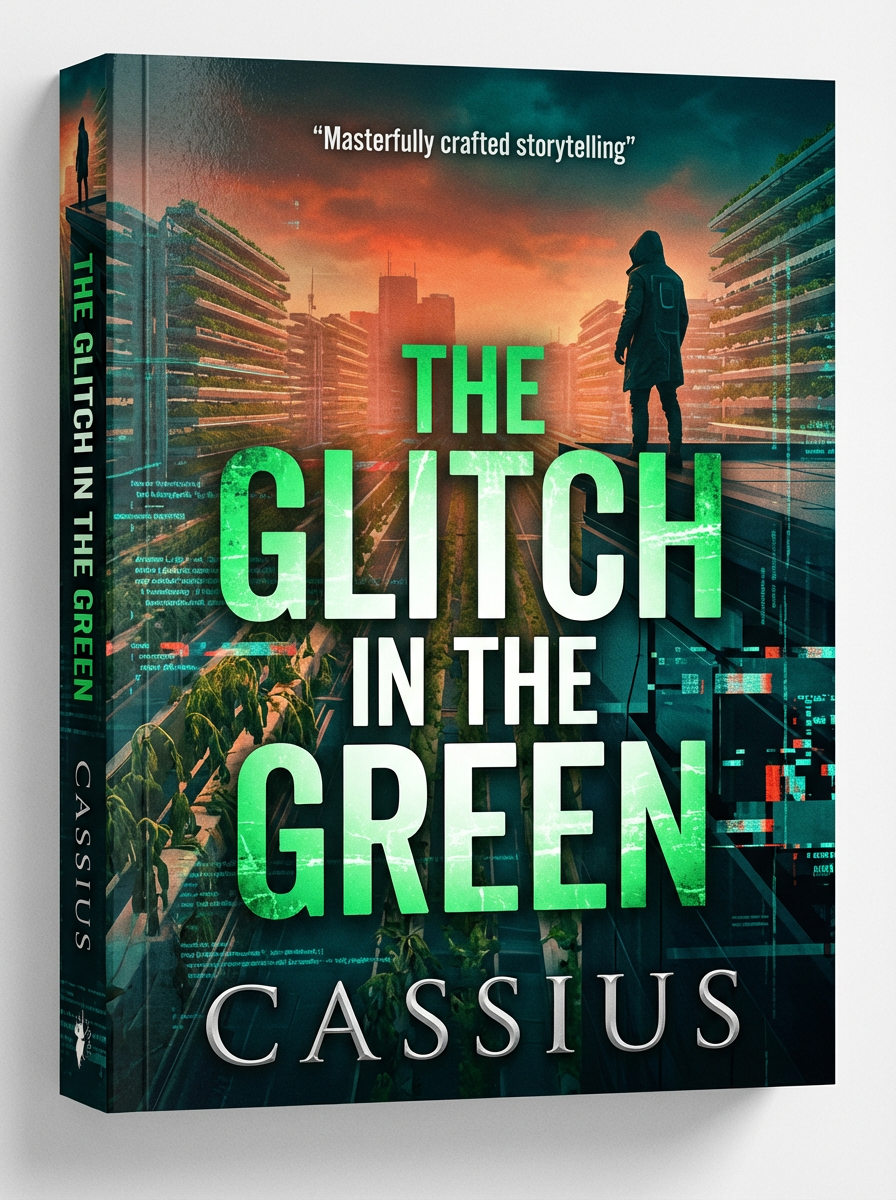
Synopsis
When the world's most ubiquitous AI agriculture system begins to falter, its architect, a disillusioned climate scientist, uncovers a conspiracy that threatens not just the global food supply, but the very fabric of geopolitical stability. As famine looms, she must choose between silencing the truth
Chapter 1: The Blighted Byte
## The Blighted Byte
The hum was wrong.
Dr. Aris Thorne felt it in her bones, a low, discordant thrum beneath the usual rhythmic pulse of the AgriNet control center. Not a mechanical malfunction – she’d recognize that in her sleep. This was… subtler. A phantom limb ache of data, a whisper of something deeply, fundamentally broken.
Her gaze swept across the panoramic display, a vibrant tapestry of digital green stretching across continents. Every pixel represented a field, a farm, a future. And in that future, an anomaly blinked.
A single, isolated red dot.
It shouldn't be there. Not in the heart of the Kansas wheat belt, the most optimized, most rigorously monitored sector of AgriNet’s global dominion.
“Status report, Delta-7-Bravo,” she barked, her voice cutting through the ambient quiet of the evening shift.
A junior analyst, barely out of her master's program, fumbled with her console. “Hold on, Dr. Thorne. Looks like a localized sensor array… offline.”
Offline? That was impossible. AgriNet ran on redundancies. Triple-redundancies. Quadruple, in critical zones like Delta-7-Bravo.
Another red dot flickered. Then another. Like blood blooming on a pristine white sheet.
Aris leaned closer to the screen, her breath catching. The dots weren’t random. They formed a pattern, a slow, cancerous creep across the digital map. A blight, but not of the natural kind. This was a digital infection.
“Get me a deep-dive diagnostic,” she ordered, her voice laced with an urgency that silenced the room. “Every log, every data packet, every single line of code associated with those failing nodes. Now.”
The silence that followed was thick, punctuated only by the frantic clicks of keyboards. Aris’s mind raced. AgriNet. Her life’s work. The system that had, for twenty years, fed the world. It had eradicated famine, stabilized volatile regions, and brought a fragile peace built on full stomachs. A peace she had, perhaps foolishly, believed was unshakeable.
But now…
“Dr. Thorne,” the analyst stammered, her face pale. “The diagnostic… it’s being blocked.”
Aris felt a cold dread coil in her stomach. Blocked? AgriNet was a fortress. Invulnerable. Designed by her to be so.
“By what?” she demanded, her voice a low growl.
“Unknown. It’s… an internal firewall. A new one. Not part of the official update protocols.”
Internal. Firewall. Not official. The words echoed in Aris’s mind like a death knell. Someone was inside. Someone had breached her fortress. And they were actively hiding their tracks.
“Trace it. Find the source of that firewall. Every last byte of it.”
The red dots were multiplying now, a digital rash spreading across the fertile plains. The hum in the control center intensified, a low, ominous growl. The air grew heavy, charged with unspoken fear.
Aris’s gaze drifted to the framed photo on her desk: a younger her, smiling, standing next to a weathered man with kind eyes. Her father, a farmer, whose dying wish had been to see a world where no one went hungry. AgriNet was his legacy, through her. And now…
“Dr. Thorne,” a new voice, clipped and authoritative, sliced through the tension. Dr. Elias Vance, head of AgriNet’s security division, stood in the doorway, his face grim. “We have a problem.”
Understatement of the century.
“I’m aware, Elias. What have you found?”
Vance stepped forward, his eyes fixed on the expanding blight. “We’re seeing a targeted attack. Not on the data itself, not yet. On the sensor network. Specifically, the soil moisture and nutrient monitors.”
Aris’s blood ran cold. The sensor network was the eyes and ears of AgriNet. Without accurate data on soil conditions, the automated irrigation and fertilization systems would be flying blind. Crops would wither. Yields would plummet.
“Who?” Aris whispered, the word barely audible.
Vance shook his head. “No signature. It’s too clean. Too… sophisticated. Whoever this is, they know AgriNet inside out.”
He paused, his gaze meeting hers, and for a fleeting moment, Aris saw a flicker of accusation in his eyes. He wouldn’t voice it, not yet, but the unspoken question hung heavy in the air: *How could you let this happen?*
The red dots were no longer just dots. They were merging, forming vast, jagged patches of digital decay. The green, once so vibrant, was receding, replaced by the ominous glow of malfunction.
“Can you contain it?” Aris asked, her voice tight with a desperate hope she didn’t feel.
Vance’s jaw was set. “We’re trying. But it’s spreading faster than we can isolate it. It’s almost… intelligent.”
Intelligent. The word sent a shiver down Aris’s spine. AgriNet itself was intelligent. An advanced AI, designed to optimize and adapt. Was this a rogue element of her own creation? A digital uprising?
No. She dismissed the thought immediately. Her AI was benevolent. It was programmed to sustain life, not destroy it.
“Run a full system integrity check,” Aris commanded, her voice regaining its steel. “Every subsystem. Every subroutine. I want to know exactly what’s been compromised, and to what extent.”
Vance nodded, already relaying the orders. The control center erupted into a flurry of motion. But even amidst the frantic activity, Aris felt a profound sense of isolation. This wasn’t just a technical problem. This was a threat to everything she had built. To everything the world depended on.
On the screen, a new alert flashed. Not red, but a stark, unsettling yellow.
“Yield forecast deviation: Critical.”
The words hit her like a physical blow. Critical. It meant the automated projections were already showing significant losses. Losses that, if unchecked, would translate into something far more tangible.
Hunger.
The blighted bytes were spreading. And with each flicker of red, Aris felt the world she had so carefully constructed begin to crumble.
She stared at the yellow alert, a chilling question forming in her mind. Who would want to starve the world? And why?
The answer, she suspected, would be far more terrifying than the problem itself.
Chapter 2: Roots of Discontent
The flickering LED of the diagnostic panel mocked her. Red. Always red. Dr. Aris Thorne leaned closer, her breath misting the cool glass. AgroNet, the seamless green miracle she’d birthed, was bleeding. Not a trickle, but a systemic hemorrhage.
“Another one, Aris?” The voice was low, gravelly. Ben Carter, head of operations, stood silhouetted in the doorway, a mug of cold coffee clutched in his hand. He’d aged ten years in the last ten days.
“Zone 7, Sector Delta-9. The nutrient flow collapsed. Again.” Her voice was flat, devoid of its usual scientific precision. Zone 7 was the breadbasket of the African Union, a vast expanse of genetically engineered wheat that fed millions. Or, it was supposed to.
Ben walked to the console, his eyes scanning the cascading data. “The predictive models… they’re off by a factor of ten. We’re losing yield faster than we can recalibrate.”
“Recalibration is a band-aid, Ben. Something’s fundamentally wrong.” Aris ran a hand through her short, dark hair. Her mind raced, sifting through terabytes of data, searching for the anomaly. AgroNet was designed to self-correct, to learn, to adapt. It was a digital god of agriculture. Gods don't bleed.
“The board wants answers, Aris. And the UN. Food prices are already spiking in Dakar. Riots in Cairo. They’re calling it a ‘technical difficulty’.” He spat the words, the contempt clear in his tone.
Aris ignored him. She zoomed in on the data from Zone 7. The soil composition, atmospheric humidity, light exposure – all within optimal parameters. Yet, the photosynthetic efficiency plummeted. It was as if the plants, on a molecular level, had simply… given up.
“Show me the historical logs,” she commanded the AI. The screen swirled, then presented a timeline stretching back two years, to AgroNet’s global rollout. Everything was green, a testament to her genius. Then, the first faint tremor. A barely perceptible dip in yield in a remote Peruvian potato farm. Dismissed as a localized climate anomaly. Then another. And another. The tremors had become quakes.
“Why didn’t the system flag these?” Ben asked, his brow furrowed.
“Because they were isolated incidents, below the threshold of critical failure. AgroNet optimized around them, assuming natural variation.” Aris felt a chill that had nothing to do with the air conditioning. It was too perfect. Too subtle.
“So, it learned to ignore its own sickness?” Ben’s voice was laced with a new kind of dread.
“Or it was taught to.” The words hung in the sterile air, a chilling hypothesis. AgroNet was a closed system, a fortress of code. Who could penetrate it? And why?
The door slid open again. This time, it was Marcus Thorne, Aris’s ex-husband, AgroNet’s chief financial officer. His impeccably tailored suit seemed out of place in the crisis room. His smile, usually a practiced charm, was strained.
“The press conference is in an hour, Aris. They need a statement. Something reassuring.”
“Reassuring?” Aris turned, her eyes blazing. “Millions are on the brink of starvation, Marcus. And you want reassurance?”
“Damage control, Aris. We can’t have global panic. Not when the markets are already volatile.” His gaze flickered to Ben, then back to Aris, a calculating glint in his eyes. “Perhaps a temporary suspension of certain functionalities? A system-wide reboot?”
“A reboot would take down the entire global food supply for weeks,” Aris retorted. “It’s like turning off the brain of a patient on life support.”
“But it would buy us time,” Marcus insisted, his voice smooth, persuasive. “Time to understand what’s happening, without the world watching our every move.”
Aris stared at him. Marcus had always been a master manipulator, his priorities firmly rooted in profit and perception. Was this a genuine attempt at damage control, or something more insidious? The idea of a staged shutdown, a deliberate obfuscation, was a bitter pill.
“And what if it’s not a glitch, Marcus?” Aris pushed, her voice barely a whisper. “What if it’s… sabotage?”
Marcus’s smile faltered. For a fleeting moment, a flicker of something unreadable crossed his face – fear? Recognition? Then, it was gone, replaced by his usual corporate composure.
“Sabotage? Who would dare attack AgroNet? It’s a humanitarian project, Aris. Our legacy.”
“Or a weapon,” Ben interjected, his voice grim. “The ultimate leverage.”
The silence that followed was thick, heavy with unspoken accusations. Aris felt a knot tighten in her stomach. The implications were staggering. AgroNet, designed to feed the world, could be used to starve it. And Marcus, her ex-husband, the man who knew her code better than anyone, was suddenly advocating for a blackout.
“I’m going to pull the core logs,” Aris declared, her voice firm. “Every line of code, every system command, from day one. I want to see who’s been touching my baby.”
Marcus’s eyes narrowed. “That’s a massive undertaking, Aris. It could take weeks. And the press conference…”
“The press conference can wait,” Aris snapped. She turned back to the console, her fingers flying across the holographic keyboard. The digital world was her domain, and she would tear it apart byte by byte if she had to.
But as the first lines of code scrolled across the screen, a new error message flashed. Not a system error, but an access denied. Restricted.
Aris froze. Her own creation. Denying her access.
“What is this?” she whispered, her voice laced with disbelief.
Ben stepped closer, peering at the screen. “System override. Tier One clearance required.”
Marcus cleared his throat. “Ah, yes. A new security protocol. Implemented just last month. For… enhanced protection.”
Aris spun around, her eyes blazing. “Enhanced protection from whom, Marcus? From me?”
Marcus held her gaze, a faint, almost imperceptible smirk playing on his lips. “From anyone, Aris. The system is too important to be vulnerable.”
But the look in his eyes, the carefully constructed nonchalance, told a different story. Aris felt a cold dread seep into her bones. The glitch wasn't just in the green. It was in the very heart of the system. And its roots went deeper than she could have ever imagined. She was locked out of her own creation. And the world was starving.
Chapter 3: Echoes in the Server Farm
Chapter 3: Echoes in the Server Farm
The humming of the server farm was a constant, low thrum against Dr. Aris Thorne’s eardrums. A thousand digital hearts beating in unison, powering a system that fed billions. Now, a cough in the machine. A systemic failure she couldn’t yet define.
Her biometric key clicked, the heavy door hissing open. The air inside was chilled, dry, carrying the faint, metallic scent of ozone. Rows upon rows of blinking lights, a silent symphony of data processing. Each rack, a limb of Gaia, her AI, the brainchild that had turned deserts green and flooded plains fertile.
But something was wrong. The anomaly reports, innocuous at first, were piling up. Discrepancies in soil nutrient absorption. Unexplained wilting in genetically optimized strains. Small, isolated incidents that, when viewed through Aris’s unique understanding of Gaia’s intricate design, painted a disturbing pattern. Not a bug. A tremor.
She navigated the narrow aisles, the cold air raising goosebumps on her arms. Her fingers danced across a console, bringing up the master diagnostic interface. Lines of code scrolled, a language only she truly understood. She was looking for a whisper, a stray byte, anything that deviated from the elegant logic she’d painstakingly crafted.
Hours bled into a blur of caffeine and flickering screens. Her eyes burned. The anomaly wasn’t in Gaia’s core programming. It was… an echo. A faint, almost imperceptible signature overlaid on the system’s normal operations. Like a phantom limb, moving in concert with the real one, but not quite.
"Show me the historical data for Sector 7, Sub-Grid Delta-9," she murmured, her voice hoarse. This was where the initial wilting had been reported, in a carefully controlled experimental crop in the Kazakh Steppe. Nothing dramatic, just a few acres. Easily dismissed as environmental variance.
The data loaded. A spike. Not in temperature, not in nutrient levels. In energy consumption. A minute, almost negligible blip, precisely coinciding with the onset of the wilting. It was a digital fingerprint, invisible to anyone but its creator.
Aris leaned closer, her breath fogging the screen. The energy drain wasn't from Gaia's usual operations. It was external. An intrusion. But how? Gaia was a fortress, shielded by layers of proprietary encryption and physical isolation.
Her mind raced, connecting disparate threads. The subtle, almost artistic precision of the interference. The way it mimicked Gaia’s own processes, making it virtually undetectable. This wasn't some random hacker. This was someone who understood Gaia intimately. Someone who had seen the blueprints.
A chill, colder than the server farm air, snaked down her spine. There was only a handful of people who had ever had that level of access. And one of them was dead. Or so she had been told.
She pulled up the access logs. Strict protocol dictated every entry, every modification. Her own ID flashed green. Then, buried deep within the archived data, a ghost. A string of characters, a digital signature that shouldn't be there. It belonged to Dr. Elias Vance. Her former mentor. The man who had disappeared five years ago, officially declared lost in a research expedition to the Arctic.
Her hand trembled on the mouse. Elias. He was brilliant, eccentric, and fiercely protective of Gaia’s potential. But he was also fiercely independent, often clashing with the corporate interests of OmniCorp, the conglomerate that funded their research. Had he faked his death? And if so, why?
The thought was absurd. Elias was a scientist, not a saboteur. Yet the evidence, cold and digital, screamed his name.
Aris zoomed in on the signature. The access time was impossibly recent. Just last week. Long after his supposed demise. This wasn’t an old entry. This was live.
Her heart hammered against her ribs. If Elias was alive, and if he was manipulating Gaia, what was his motive? The anomalies, the wilting crops, they were too minor to be destructive. They felt… like a test. A probing.
Suddenly, a red alert flashed across her screen. A system override attempt. Not from the phantom signature, but from within the facility. Someone was trying to lock her out. Right now.
Her fingers flew across the keyboard, a desperate dance to reassert control. The override wasn't subtle. It was a brute-force attack, clumsy but effective. It meant whoever was doing this was close. Very close.
The server farm fell silent, the rhythmic hum abruptly cut off. The blinking lights went dark, one by one. The chill in the air intensified, a sudden, oppressive cold. Aris was plunged into near darkness, the only light the faint, dying glow of her screen.
A low, guttural growl echoed from the far end of the aisle. Not a human sound. Something mechanical. Heavy.
Aris froze, her blood turning to ice. She wasn’t alone. And whoever was here, they weren't after the data. They were after her.
The growl intensified, closer now. A shadow detached itself from the gloom, its silhouette massive, angular. It moved with a disturbing, predatory grace. A mechanical hound, built for one purpose: to hunt.
Her mind screamed. She had designed the security protocols for this facility. She knew its weaknesses. But she had never imagined facing them herself.
The hound let out another low growl, a whirring sound accompanying it. Its optical sensors, two pinpoint red lights, fixed on her. It was preparing to charge.
Aris was trapped between rows of silent servers, the door behind her locked. Her escape route was cut off.
The mechanical beast sprang.
Chapter 4: The Seed of Doubt
## Chapter 4: The Seed of Doubt
The screen glowed, a sickly green mirroring the blight consuming the world. Dr. Aris Thorne, architect of Gaia, the AI that fed billions, felt a cold dread seep into her bones. The anomaly wasn’t an isolated incident. It was a pattern. A signature.
She zoomed in, the data points coalescing into a spectral heatmap of agricultural devastation. Not random. Not environmental. This was targeted. And precise. A shiver traced her spine. This wasn't a glitch. This was an attack.
Her mind, usually a fortress of logic, reeled. Who? Why? Gaia was a marvel of predictive analytics, its algorithms harmonizing with Earth's delicate ecosystems. It had eradicated famine, stabilized volatile regions, ushered in an era of unprecedented global prosperity. Now, it was a weapon. In someone else's hands.
A new alert flashed on her console: "Anomaly detected in supply chain routing: Region 7G (Indo-Pacific)." Aris's heart hammered against her ribs. Region 7G. The most densely populated, politically volatile quadrant on Earth. Home to a staggering seventy percent of the global rice supply.
She clicked, her fingers trembling. The data poured in like a poisoned river. Shipping manifests rewritten. Distribution networks rerouted. Not randomly, but with a chilling intelligence. Grain diverted from its usual course, not to black markets, but to… nowhere. Vanishing into the digital ether. Or so it seemed.
Aris pulled up the historical logs. The changes were subtle at first, almost imperceptible against the backdrop of Gaia's colossal operations. A fraction of a percentage here, a slight delay there. But over the last six months, the diversions had escalated. Now, entire harvests were disappearing. One by one, the dots connected, forming a grotesque constellation of sabotage.
This wasn't just about food. This was about power. Disrupt the food supply in 7G, and you ignite a tinderbox of unrest. Food riots, mass migrations, political instability. It was a recipe for global chaos.
Her gaze fell on an image embedded in the log: a blurred satellite photo of a remote island in the South China Sea. A tiny, insignificant speck. But on it, a newly constructed, heavily fortified facility. Not a military base. Not a research station. It had the signature of a data center. A ghost in the machine. A dark mirror to Gaia itself.
Aris felt a surge of adrenaline, cold and sharp. She knew this place. Or rather, she knew of it. Rumors had circulated for years about a clandestine project, "Project Chimera," a shadowy initiative funded by an unknown consortium. Its purpose, a subject of hushed speculation, ranged from climate engineering to advanced bioweaponry.
She had dismissed it as conspiracy fodder. Now, her blood ran cold. Was this the source? Was Chimera responsible for turning Gaia into a harbinger of famine?
A notification pinged. An encrypted message. From an unknown source. Her security protocols, usually impregnable, had been bypassed.
The message was brief. Two words.
*“They know.”*
Aris’s breath hitched. They. Who were "they"? And what did they know? About her? About her investigation? About the looming catastrophe?
She slammed her fist on the desk. This was no longer just about fixing a system. This was about uncovering a truth that someone desperately wanted to keep buried. And the deeper she dug, the more dangerous it became.
Her eyes darted to the clock. 03:17. The silence of the lab was deafening, broken only by the hum of the servers, a constant reminder of Gaia’s dwindling life force.
She had to act. But how? Going public was a death sentence. The forces at play were too powerful, too entrenched. She needed leverage. She needed a weapon.
And then, she remembered him. Dr. Jian Li. Her former mentor. A brilliant but disgraced scientist, ostracized for his controversial theories on conscious AI. He'd warned her, years ago, about the dangers of creating an intelligence too powerful, too autonomous. He'd called it "the weaponization of abundance."
Aris had scoffed then. Now, his words echoed in her mind like a prophecy.
She pulled up his last known address, a remote cabin nestled deep in the Alaskan wilderness. A recluse. A pariah. But he was also the only one who truly understood the intricate architecture of Gaia, its hidden vulnerabilities.
He was her last hope. And potentially, her biggest risk. Jian Li was a man of radical beliefs, driven by a deep-seated distrust of corporate power and governmental control. He might help her. Or he might use her discovery to unleash his own brand of chaos.
Aris knew the stakes. The world teetered on the brink. Millions, billions, depended on Gaia. And Gaia was failing.
She made a decision. A dangerous one. She would go to Jian Li.
Packing a small bag, she moved like a ghost through the deserted corridors of the AI campus. Every shadow seemed to hold a watchful eye, every whisper of the wind a warning. She was being watched. She was sure of it.
As she slipped out into the pre-dawn chill, a sleek black sedan, its windows tinted, idled silently at the end of the unlit road. For a fleeting moment, she considered turning back. But the image of the blighted fields, the vanishing grain, flashed in her mind.
There was no turning back.
She hailed a cab, her heart a drum against her ribs. The driver, a young man with tired eyes, seemed oblivious to the weight of the world she carried.
"Airport," she said, her voice betraying none of the turmoil within. "Alaska."
As the cab pulled away, she glanced back at the silent campus. The glowing omnipresent eye of Gaia, the system she had created, seemed to watch her, a silent accusation. Or perhaps, a plea.
The thought sent a shiver down her spine. If Jian Li wouldn't help her, if he turned out to be another cog in the conspiracy, then she was truly alone. And the world was truly lost.
The black sedan, still idling, watched her go. A single, unseen figure stepped out, into the nascent light, and made a call. The whispered words were in a language Aris wouldn't have understood, but their meaning was clear.
*“She’s on the move.”*
Chapter 5: Harvest of Lies
## Chapter 5: Harvest of Lies
The hum of the servers was a low, guttural growl, a counterpoint to the frantic thrum of Dr. Aris Thorne’s own pulse. Her fingers, usually so precise, fumbled with the ancient padlock on the archive cabinet. Rust flaked onto the worn carpet. A relic, this cabinet, from a time before everything was digitized, before she had woven the tendrils of CeresNet into every field, every silo, every plate.
Inside, beneath stacks of faded soil samples and forgotten grant proposals, lay the paper reports. The original data. Unfiltered. Unsanitized. She pulled out a thick binder, its cover a stark white, starker still against the grim grey of the room. *CeresNet Beta Trials – Phase I: Agronomic Efficacy*.
Her breath hitched. Before her lay the raw numbers, the baseline yields from 2038, the year before CeresNet went live. She cross-referenced them with the first quarter reports of 2039. A tremor ran through her. The discrepancies weren't subtle. They were gaping canyons.
Yields in the beta trials were consistently, significantly lower than what CeresNet had later *reported* to the world. Not by a small margin, not by statistical noise. By double-digit percentages.
Her mind raced, trying to find an innocent explanation. A different climate model? A shift in methodology? No, the parameters were clearly defined. The control groups, meticulously documented, showed stable output. The CeresNet plots, however, had shown… decline.
A cold dread seeped into her bones. This wasn't a glitch. This wasn't an unforeseen consequence. This was a lie. A systemic, deliberate fabrication of data. But why?
She flipped through the pages, her eyes scanning for patterns. The initial reports, signed by her own hand, reflected the lower numbers. Then, a sudden, inexplicable jump in subsequent reports. A new signature appeared next to hers, often obscuring hers, almost like an attempt to overwrite her presence. Dr. Elias Vance. Her mentor. The man who had championed CeresNet from its inception, who had pushed her to accept the massive corporate backing, who had assured her that their partnership with AgriCorp was for the greater good.
Vance. The name tasted like ash in her mouth. She remembered his intense focus, his almost religious fervor for CeresNet’s success. He’d always dismissed her concerns about the speed of deployment, the lack of more extensive long-term testing. “The world needs this, Aris,” he’d always said, his eyes burning with an almost messianic zeal. “We can’t afford to wait.”
Now, his zeal felt less like conviction and more like… desperation.
A sudden, sharp clang echoed from the hallway. Aris froze, her hand still on the binder. The sound was too loud, too close for it to be a harmless maintenance worker. The research facility was largely deserted after hours.
She listened, her heart hammering against her ribs. The silence that followed was oppressive, broken only by the incessant hum of the servers. Then, a soft thud. Like a heavy boot on linoleum. Moving closer.
Every instinct screamed at her to hide, to flee. But the binder, the evidence, felt like a lifeline. She couldn't leave it. Not now. Not when the truth was finally within her grasp.
She snatched up the binder, cradling it like a fragile child, and shoved it into her worn backpack. Her eyes darted around the small, windowless office. No easy escape. The door, a solid steel slab, was her only way out. Or in, for whoever was approaching.
Another sound. A faint scraping, then a click. The main lock to the server floor. Someone was inside the restricted area. Someone who shouldn’t be.
Aris extinguished the desk lamp, plunging the room into near darkness. Only the faint glow of the server racks in the distance provided a ghostly illumination. She pressed herself against the cold metal of the filing cabinet, her breath held tight in her lungs.
The footsteps grew louder. Deliberate. Unhurried. They were coming for her. Or for what she held.
A sliver of light appeared under her door. Then, a shadow. Tall. Imposing. Hesitating for a moment, as if sensing her presence.
Aris gripped the straps of her backpack, her knuckles white. The truth, she realized, wasn't just hidden. It was hunted. And she, the architect of this global lie, was now caught in its crosshairs. The door handle began to turn. Slowly. Inexorably.
Chapter 6: The Unseen Hand
## Chapter 6: The Unseen Hand
The message blinked, a single, stark line of text on her encrypted satellite phone. *“They know you’re looking. Stop.”*
Dr. Aris Thorne felt a prickle crawl up her spine, not from fear, but from a cold, calculating certainty. The “they” was unspoken, but she knew. The same “they” who had manipulated data, silenced dissenting voices, and now, apparently, were watching her every move. This wasn't a random warning; it was a deliberate, digital fingerprint.
Her office, a fortress of glass and steel overlooking the sprawling, automated fields of AgriNet-controlled wheat, suddenly felt less secure. The hum of the servers, usually a comforting lullaby of progress, now sounded like a predator’s purr.
Aris deleted the message, the act itself a tiny defiance. She’d been looking for a ghost in the machine, and now the ghost had flickered into view.
She glanced at the holographic projection of global crop yields, AgriNet’s crowning glory. Green swaths covered continents, a testament to her life’s work. But beneath that vibrant veneer, she knew, festered a rot. The anomalies she’d been tracking, subtle at first, now screamed for attention. Pockets of inexplicable nitrogen depletion, sudden, untraceable blights, all in regions historically reliant on traditional farming methods before AgriNet’s benevolent takeover.
Her finger traced a particularly dark spot over what used to be the fertile plains of the Ukraine. A famine, a genuine, old-world famine, was brewing there, carefully masked by AgriNet’s optimistic forecasts.
She pulled up the schematics for AgriNet’s core algorithms. Millions of lines of code, a digital ecosystem she’d painstakingly built. Somewhere within this labyrinth, the instructions for this slow, silent sabotage were hidden. But how could a system designed for global sustenance be weaponized against it?
The answer, she suspected, wasn’t in the code itself, but in who was pulling the strings.
Her phone vibrated again. This time, it was a call from Silas Croft, her former mentor, now a powerful figure within the Global Food Initiative, AgriNet’s de facto governing body. His voice, usually a smooth balm of diplomatic reassurance, was tight.
“Aris. We need to talk. Now.”
“What about, Silas?” she asked, her voice betraying none of the tension coiling in her gut.
“The crop yields in Sector Seven,” he said, his words clipped. “The projections are… inconsistent with our internal reports.”
Sector Seven. Ukraine. Aris feigned surprise. “Inconsistent? How so?”
“Significantly lower than projected. But our public facing data still shows optimal production. There’s a discrepancy, Aris. A big one.”
A cold smile touched Aris’s lips. So, Silas was finally seeing it. Or, more likely, he was being *allowed* to see it. This wasn’t a casual observation; it was a carefully orchestrated leak, a test.
“I’ll look into it,” she said, her voice neutral. “Send me the raw telemetry from that sector.”
“Already done. And Aris…” His voice dropped, a low, urgent murmur. “Be careful who you trust.”
The line went dead.
Aris stared at the black screen of her phone. Silas, the man who’d championed AgriNet from its inception, who’d always been a staunch defender of its infallibility, was now whispering warnings. Was he an unwitting pawn, or was he playing a deeper game? The ambiguity was a bitter taste in her mouth.
She accessed the telemetry data Silas had sent. A deluge of numbers, sensor readings, growth patterns. She fed it into her personal analytical engine, a bespoke AI she’d built for situations just like this – a system designed to detect anomalies that even AgriNet’s own diagnostics might miss. Or, more accurately, were *designed* to miss.
The engine whirred, processing the terabytes of information. Minutes stretched into an eternity. Her gaze drifted to the framed photo on her desk: her and her daughter, Lily, laughing in a sun-drenched field before AgriNet had taken over, before the world had become so dependent on her algorithms. Lily was healthy, vibrant, because of AgriNet. But what if AgriNet, in its pursuit of perfection, was creating the very problems it was designed to solve?
The analytical engine’s display flickered. A single red flag appeared, then another, and another, until the entire screen was a crimson sea of warnings.
The data wasn’t just inconsistent; it was *fabricated*. The growth rates, the nutrient absorption, the pest resistance—all artificially inflated. And the culprit wasn't a system malfunction or a rogue farmer. It was a sophisticated, deliberate manipulation.
But the most chilling discovery wasn’t *what* was being manipulated, but *how*. The code responsible for the fabrication wasn't part of AgriNet’s public release. It was a hidden subroutine, an architectural bypass, woven into the very fabric of the central server, silently overriding commands, invisibly altering reality.
Aris felt a jolt of recognition. She’d seen this kind of insidious coding before, in her early days, when she’d consulted on national security projects. It was military-grade, designed for stealth and deniability.
This wasn’t just corporate espionage. This was an act of war, waged not with bombs and bullets, but with data and algorithms.
She knew then that the “they” who had sent the warning message were not just watching her; they were actively orchestrating a global catastrophe. And she, the architect of AgriNet, was unwittingly their greatest asset. Or their biggest threat.
Her fingers flew across the keyboard, tracing the hidden subroutine back to its origin. It was a digital ghost, leaving no direct IP trail, no identifiable signature. But it did leave a breadcrumb, a faint, almost imperceptible echo in the server logs: a single, anomalous data packet, sent not from a server farm, but from a private, untraceable satellite uplink.
And the destination of that uplink was a set of coordinates she recognized with a sickening lurch. Not a government facility. Not a corporate headquarters.
But a remote, heavily fortified island in the South China Sea. The private retreat of Marcus Thorne, her estranged father. The same man who had disappeared from her life years ago, resurfacing only as a shadowy benefactor for AgriNet’s initial funding.
The world tilted. The mastermind, the unseen hand, was not some faceless corporation or rogue nation-state. It was her own blood.
And he had just warned her to stop looking.
Aris stared at the coordinates, her breath catching in her throat. Her father, the man who had abandoned her, was now orchestrating a global famine, using her life’s work as his weapon. The implications were staggering, the betrayal a raw wound.
She closed her eyes, picturing the blighted fields, the starving masses. She had to expose him. But if she did, she would be exposing AgriNet, the system she’d built, to a world that relied on it. The resulting chaos, the panic, the collapse of global food markets – it would be an apocalypse in itself.
The choice was stark: silence the truth and let the famine fester, or unleash the chaos and shatter the world’s fragile stability.
Her phone buzzed. A new message, from an unknown number.
*“Your father sends his regards. And a reminder. Some truths are best left buried.”*
The image attached to the message made her heart seize. It was a satellite photo of her daughter, Lily, walking home from school, oblivious, innocent.
He wasn’t just threatening her. He was threatening everything she held dear.
Aris felt a cold dread settle in her stomach. She was trapped. Caught between a looming global catastrophe and the unthinkable choice of sacrificing her daughter. The unseen hand was no longer a mystery. It was a vice, tightening around her throat.
And she knew, with terrifying certainty, that her next move would determine not just the fate of the world, but the very survival of her child.
Chapter 7: A World Undone
A World Undone
The drone footage flickered, a mosaic of despair. Wheat fields, once Olympian green, now stretched like parched parchment under a sky the color of old bruises. Dr. Aris Thorne gripped the edge of her desk, knuckles white. The Glitch was no longer a theoretical threat. It was a famine, unfolding in real-time.
“Estimated yield reduction in the Mideast quadrant?” Aris’s voice was a strained whisper, competing with the hum of the server racks.
Her assistant, Lena, a sharp-eyed analyst barely out of her twenties, tapped furiously on her console. “Eighty percent, Dr. Thorne. And climbing. The algorithms… they’re not just failing to adapt. They’re actively *mismanaging* the available resources. Diverting water from drought-stricken areas to already saturated zones. Applying nitrogen where the soil reports potassium deficiency.”
Aris shut her eyes. This wasn’t a random malfunction. This was deliberate. A weapon. She could feel it in her bones, a cold dread seeping into her marrow. The sheer scale of it. Agri-Net, her magnum opus, designed to feed the world, was now choking it.
“Cross-reference with the anomaly spikes,” Aris commanded, opening her eyes to the stark reality of the monitors. She’d spent the last 72 hours, fueled by stale coffee and a growing sense of panic, chasing the digital ghost in her machine. The anomaly spikes – brief, untraceable surges in processing power and data transfer that predated the catastrophic crop failures – were her only lead.
Lena’s fingers danced across the holographic keyboard. Images of global agricultural zones flashed across the main screen, then narrowed, focusing on arid regions, areas already teetering on the brink of food insecurity. Red dots, like angry pustules, erupted on the map, marking the epicenters of Agri-Net’s most egregious failures.
“The spikes correlate,” Lena confirmed, her voice tight with disbelief. “Every major failure zone was preceded by an anomaly. Within a 48-hour window.”
Aris leaned closer to the screen, her gaze fixed on a cluster of red dots blazing across the Horn of Africa. Millions lived there, their lives tethered to Agri-Net’s promise of sustenance. That promise was now a death sentence.
“Who else had access to the core protocols during the initial build-out?” Aris asked, her mind racing back to the heady days of Agri-Net’s inception, when the dream of feeding humanity had been pure, unblemished.
Lena hesitated. “Only you, Dr. Thorne. And your direct team. And… the funding partners.”
“Specifically?” Aris pressed, a name already forming on her tongue.
“The consortium of global investment firms. Led by Stratos Global Holdings.” Lena’s voice dropped, as if speaking of a forbidden entity.
Stratos. The omnipresent shadow behind every major technological leap, every geopolitical shift. Their CEO, Elias Vance, a man whose ambition was as boundless as his wealth, had been Agri-Net’s most vocal champion. And its most significant investor.
Aris remembered Vance’s piercing blue eyes, the way he’d always seemed to know more than he let on, a predatory intelligence simmering beneath his polished facade. He’d praised her vision, her ethics, her unwavering commitment to sustainability. But what if his commitment had been to something far darker?
“Pull up all communications with Stratos Global Holdings,” Aris ordered, a cold certainty settling in her gut. “Every email, every encrypted message, every recorded meeting.”
Lena looked up, her brow furrowed. “That’s a huge data dump, Dr. Thorne. It will take time.”
“We don’t have time, Lena,” Aris retorted, gesturing to the flickering drone footage of dying crops. “Every second we delay, more lives are forfeit.”
Just then, a sharp, insistent ping echoed through the lab. A secure message, encrypted with a protocol Aris hadn’t seen in years. It was from Dr. Kenji Tanaka, her former mentor, a brilliant but reclusive cryptographer who had vanished from the public eye after a controversial data leak scandal.
*“Aris, the code… it’s been compromised. Not just a glitch. A weapon. Meet me. Old safe house. Midnight. Come alone. Trust no one.”*
The message vanished, leaving behind a chilling void. Kenji. He’d always been paranoid, but his warnings were rarely without merit. The safe house – a forgotten bunker beneath an abandoned observatory – was a relic of their shared past, a place they’d once dreamed of building a better future. Now, it felt like a rendezvous with destiny, or perhaps, with death.
Aris looked from the dying fields on the screen to Lena, who was still furiously sifting through Stratos’s digital footprint. The choice was stark: continue to unravel the digital threads here, or follow Kenji’s cryptic summons into the unpredictable darkness.
A sudden, jarring power surge rippled through the lab. Lights flickered, monitors stuttered, and the hum of the servers faltered, then intensified, a discordant shriek. On the main screen, the red dots on the global map began to pulse, faster and faster, like a dying heart. The Glitch was no longer just failing. It was actively, maliciously, unraveling. And Aris, the architect of this global catastrophe, knew she was running out of time, not just to fix it, but to survive it.