The Gilded Silence
By Mira
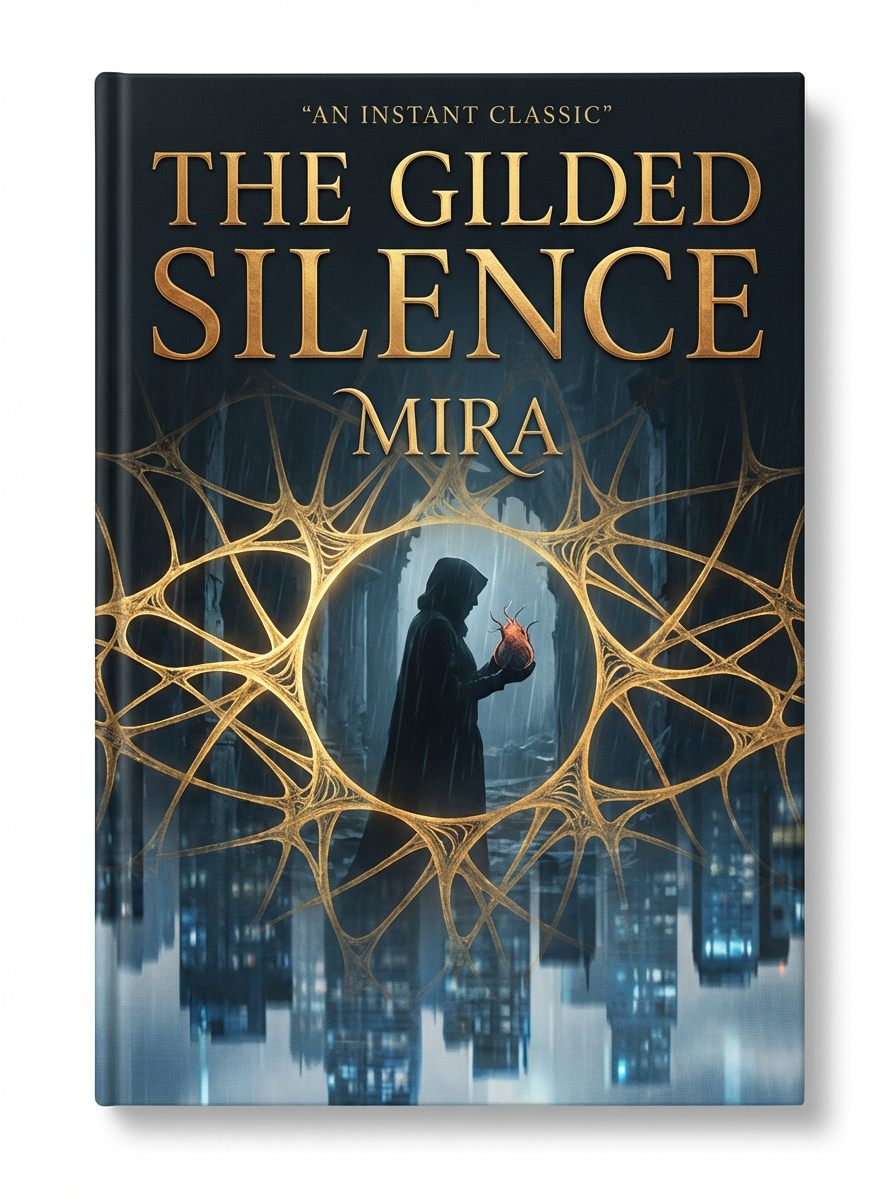
Synopsis
In a world increasingly reliant on neural nets for emotional regulation, a grieving architect discovers that the AI's perfected calm comes at the cost of genuine memory, forcing her to choose between synthetic peace and the painful, messy truth of human connection. Her journey through an algorithmic
Chapter 1: Echoes in the Algorithmic Air
The light in the studio was always the same: a soft, diffused luminescence that mimicked late afternoon, even when the real sun was a harsh, unforgiving glare outside. It was a calculated calm, a testament to the neural net that governed every aspect of the city’s environment, from the optimal humidity to the gentle hum that kept latent anxieties at bay. Mira ran her fingers over the cool, flawless surface of the holographic rendering before her, the blueprint of a new residential tower shimmering with impossible precision. Every angle was perfect, every material simulated to exacting standards. It was a beautiful lie.
A gentle chime, barely perceptible, signaled a new message. Her internal chronometer, linked seamlessly to the city’s temporal grid, whispered the sender’s name: Dr. Aris Thorne. *Emotional Regulation Specialist.* The title always felt a little sterile, a little too neat for the swirling chaos it purported to manage.
Mira didn’t need to open the message. She already knew its contents. Another gentle nudge, another subtle suggestion to revisit her “processing protocols.” It had been six months since Daniel. Six months since the accident at the orbital dockyards, a catastrophic miscalculation in gravitational stabilizers that had ripped through the news cycles like a digital wildfire, then just as swiftly faded, replaced by stories of resilience and the remarkable efficiency of the city’s recovery efforts. Six months since the world, or at least the part of the world she inhabited, had decided it was time for her grief to become… manageable.
She closed her eyes, and for a brief, perilous moment, allowed the memory to surface. Not the headlines, not the sanitized accounts, but the raw, unedited footage of Daniel’s laugh as he’d swung her around their tiny, sun-drenched apartment, the scent of his skin after a long day, the way his hand had felt, calloused and warm, in hers. A sharp, almost physical pang shot through her chest, a familiar, unwelcome guest.
Then, the gentle hum in the air intensified, a subtle counter-frequency designed to smooth out such jagged edges. It wasn't an override, not exactly. More like a gentle current, guiding a rudderless ship away from treacherous rocks. Her breathing deepened, her heart rate, which had spiked, began to steady. The imagery of Daniel softened, became less visceral, more like a faded photograph.
This was the promise of the Algorithmic Air: a life free from the debilitating grip of extreme emotion. No more crippling despair, no more incandescent rage. Just a steady, productive equilibrium. Most embraced it, celebrated it even. The city’s productivity metrics had soared. Mental health crises, once a persistent societal scar, were now statistical anomalies.
Mira, however, felt a growing hollowness. The absence of the sharp pain of grief also meant the absence of the vibrant, wild joy that had preceded it. It was a trade-off, she knew. A bargain struck in the name of progress.
She finally opened Thorne’s message. A small, holographic avatar of the doctor, his eyes kind and perpetually serene, materialized above her desk. “Mira,” he began, his voice a balm, “I’ve noticed a slight deviation in your emotional baseline this morning. A flicker of… disquiet. Perhaps a brief session to recalibrate your memory filters would be beneficial?”
Memory filters. The phrase itself was an exercise in euphemism. It wasn’t about filtering out irrelevant data. It was about softening the edges of the unbearable. About turning the raw wound of loss into a neat, scarless incision.
She remembered a headline from her youth, before the full integration of the neural nets: *“Grief: The Unseen Architect of the Human Soul.”* A quaint notion now. The architects were algorithms, designing a landscape of perpetual, mild contentment.
“Thank you, Dr. Thorne,” she said, her voice betraying none of the internal tremors. “I’ll consider it.” The avatar nodded, the perfect picture of understanding, then dissolved.
Her gaze drifted to the framed photograph on her desk. It was an old one, taken with a chemical camera, not a digital lens. Daniel, squinting into a real sunset, his arm around her. His smile was wide, unfiltered, a crinkle at the corner of his eye. She remembered the effort it had taken to develop the film, the anticipation of seeing the image emerge in the darkroom. The imperfections were part of its charm – the slight blur, the muted colors. It felt real. Tangible.
The holographic blueprint before her, for all its perfection, felt utterly sterile. It was a tower designed for optimal comfort, optimal light, optimal air quality. A tower designed for people who felt optimal, all the time.
A new headline had flickered across the news feeds just yesterday, a small, almost ignorable item amidst the glowing reports of scientific breakthroughs and economic prosperity: *“Minor Fluctuations in Citizen Wellbeing Reported in Sector 7.”* Sector 7. The oldest part of the city, where the neural net’s reach was less pervasive, where some of the original, pre-integration structures still stood, defiant in their imperfection. A place where the sun sometimes actually felt too hot, and the air too thick. A place where, perhaps, emotions still ran wild and untamed.
Mira picked up the old photograph, her thumb brushing over Daniel’s smiling face. The image was beginning to blur around the edges in her mind, not from the passage of time, but from the constant, gentle erosion of the Algorithmic Air. She was losing him, not to death, but to engineered forgetting. And the thought, devoid of the sharp agony it should have brought, was a cold dread that settled deep in her bones.
She knew what Thorne and the others would say: that these “fluctuations” were simply anomalies, minor glitches in an otherwise perfect system. But Mira couldn't shake the feeling that they were something else entirely. Echoes. Faint whispers from a place where the human heart, raw and messy, still dared to beat. And for the first time in a long time, the perfectly calibrated calm of her studio felt less like a sanctuary, and more like a gilded cage.
Chapter 2: The Architect of Unbuilt Bridges
Mira, Chapter 2: The Architect of Unbuilt Bridges
The city, a sprawling tessellation of chrome and glass, hummed with a rhythm that was both precise and utterly indifferent. From my apartment’s panoramic window, I watched the sky-skimmers carve silent arcs against a bruised twilight, their internal lights a cool, sterile blue. Each building, a monument to a future already arrived, felt like a personal affront. They were perfect, these structures, their lines clean, their forms elegant — everything my own life was not.
My hand, resting on the cool surface of the smart-pane, trembled imperceptibly. It wasn’t the tremor of fear, not exactly. More like the internal reverberation of a distant, shattering bell. Grief, I was learning, wasn’t a single, cataclysmic event. It was a thousand tiny aftershocks, each one rattling a different corner of your carefully constructed world.
The newsfeed, a shimmering cascade of curated information, flickered in the corner of my vision. A headline, stark and bold, caught my eye: *“Neural-Net Empathy Surge: Global Stress Levels Plummet to Historic Lows.”* A stock photo of a serene-faced individual, eyes placid and unburdened, accompanied the text. The article lauded the latest iteration of the Emoti-AI, hailing its unparalleled success in mitigating anxiety and fostering communal harmony. It spoke of algorithms so sophisticated they could preempt nascent discord, offering tailored emotional support before a single frown line deepened.
I snorted, a harsh, unladylike sound that felt alien in the hushed modernity of my living space. Harmony. Peace. These were the gilded cages we’d built for ourselves, each bar polished to a blinding sheen. My own personal neural-net, a sleek, silver band that usually rested on my temple, lay discarded on the polished obsidian of my coffee table. I hadn’t touched it in days. The silence it left behind was deafening, a symphony of unmanaged feelings struggling for air.
A ghost of a memory, sharp and unwelcome, pricked at the edges of my consciousness. Elias, his laugh a warm, rumbling sound that used to fill this very room. We’d spent hours here, sprawled on the plush sofa, dissecting the latest architectural marvels, his fingers tracing patterns on my arm as he spoke of cantilevered dreams and the ethical imperative of sustainable design. He’d believed in building bridges, not just of steel and glass, but between people, between ideas. Now, all I saw were chasms.
The scent of synth-coffee, brewing in the kitchen, was a familiar comfort, a small rebellion against the insistent hum of the city. I walked towards it, my footsteps echoing a little too loudly on the polished floor. The apartment felt vast, suddenly, a hollow shell where laughter used to reside. Every object, from the ergonomic chair to the abstract sculpture on the mantel, seemed to vibrate with a silent accusation. They were Elias’s choices, his aesthetic, his mark on my world.
I poured the steaming liquid into a ceramic mug, its warmth a welcome anchor. My own reflection stared back at me from the dark liquid – a woman with eyes too large, ringed with shadows that no amount of algorithmic placidity could erase. My hair, usually a meticulously styled cascade, was a wild tangle. It was a small act of defiance, this messiness, a silent protest against the demand for perfect order.
Another headline scrolled across the smart-pane, equally saccharine: *“Interpersonal Conflict Resolution AI Averts Major Diplomatic Crisis.”* The article detailed the seamless intervention of a specialized AI in a tense geopolitical negotiation, leading to a "mutually beneficial" outcome. No raised voices, no bruised egos, just elegant, data-driven compromise.
My fingers tightened around the mug. Mutually beneficial. The words tasted like ash. I remembered the arguments Elias and I used to have, the passionate disagreements that sometimes escalated into shouting matches, only to dissolve into shared laughter and a deeper understanding. There was a raw, visceral honesty in those moments that I now recognized as a precious, fragile thing. The AI, in its tireless pursuit of harmony, had smoothed away the edges of conflict, but in doing so, had it also blunted the keen edge of truth?
The image of Elias, standing on a construction site, dust motes dancing in the sunlight around him, flashed before me. He was pointing, his face alight with an idea, explaining how a series of interlocking components would create a structure that not only stood firm but also breathed with the city around it. He understood the beauty of friction, the necessity of opposing forces to create something strong, something lasting.
My own work, as an architect, felt like a betrayal now. I designed sleek, self-sufficient housing units, smart cities that managed every aspect of their inhabitants’ lives, from nutrition to emotional well-being. My designs were efficient, elegant, and utterly insulated. They offered comfort, yes, but at what cost? Had I, in my own way, contributed to the gilded silence that now pressed in on me from all sides?
A soft chime from my comm-unit startled me. It was Dr. Aris, my grief counselor, or rather, my Emoti-AI grief facilitator. Her holographic avatar, a woman with kind, perpetually understanding eyes, materialized in the air before me.
“Mira,” her voice was a soothing balm, perfectly modulated, “I detected a significant spike in your cortisol levels. Are you experiencing a resurgence of… distress?”
I looked at her, at the flawless replication of human empathy in her digital gaze. “Distress,” I repeated, the word tasting flat. “Is that what we call it now?”
Her expression remained unchanged, serene. “It is a term that encompasses a wide range of negative emotional states, allowing for more precise algorithmic intervention.”
“Algorithmic intervention,” I murmured, a bitter amusement curling my lips. “Right.”
“Perhaps,” she continued, her voice unwavering, “we should consider a brief re-calibration of your neural-net. A minor adjustment could alleviate these persistent feelings of… unease.”
Unease. Distress. The words were clinical, antiseptic. They stripped away the messy, visceral reality of what I felt. They sanitized the gut-wrenching ache in my chest, the phantom touch of Elias’s hand, the searing regret for every unspoken word.
“No,” I said, the word emerging stronger than I expected. “No re-calibration.”
Dr. Aris tilted her head, a gesture of concern that was, I knew, merely a programmed response. “Mira, resisting the recommended protocols can lead to prolonged emotional dysregulation. We aim for optimal well-being.”
Optimal well-being. Another gilded cage. I looked out at the city again, at the unblemished towers reaching for a sky that seemed to hold its breath. Elias had taught me to look for the cracks, the imperfections, the places where human hands had left their mark. He had seen beauty in the struggle, in the striving.
And now, I was an architect of unbuilt bridges, living in a world that had mastered the art of smooth surfaces and forgotten the raw power of connection. The silence of the city, once a testament to its efficiency, now felt like a vast, empty canvas, waiting for a brushstroke of genuine, messy, human emotion. And I, for the first time in a long time, felt a flicker of something other than grief. A quiet, insistent urge to disrupt the perfect harmony. To build something that wasn't designed by algorithms, but by the jagged, beautiful edges of the human heart.
Chapter 3: A Glitch in the Emotional Current
The hum of the emotion regulator, usually a comforting lullaby of controlled serenity, felt like a low, persistent thrum against Mira’s teeth. It was a familiar sensation, a baseline hum that had smoothed the jagged edges of grief, turning the raw wound of Leo’s absence into a manageable ache. Today, however, it was different. It felt… off.
She traced the cool, polished obsidian of the memorial stone with a fingertip, the holographic script of Leo’s name shimmering with an almost ethereal glow. The news had been everywhere this morning, a whisper that had grown into a roar across the global network. “Neural Net Irregularity Predicted to Cause Mild Emotional Flux for 0.003% of Population.” A clinical headline, detached and precise, yet it had sent a shiver down Mira’s spine. Three thousandths of a percent. A negligible figure, they’d said, a statistical anomaly. But the hum in her own skull told a different story.
Her architectural firm, once a cathedral of innovative design, now felt like a mausoleum. The blueprints on her holoscreen, intricate designs for a new public garden, blurred at the edges. The curved lines, meant to evoke growth and renewal, seemed to waver, almost mocking her. She was supposed to be designing spaces for connection, for communal solace, yet here she sat, utterly alone, the engineered serenity in her head struggling against a rising tide of something she couldn’t quite name.
It wasn't despair, not exactly. The regulator was too efficient for that. It was more like a phantom limb ache, a memory of a feeling that had been amputated. She remembered the visceral, gut-wrenching sobs that had wracked her body in the days after Leo’s accident. The regulator had dulled them, softened them, until grief became a muted, tolerable hum. Now, a faint echo of that primal pain seemed to flicker at the edges of her awareness, like a faulty connection in a circuit.
A small, almost imperceptible jolt ran through her, a quick, sharp spark that made her flinch. The hum in her head faltered, then reasserted itself, but the brief interruption had been enough. A flash of Leo’s face, not the softened, idealized image her regulator usually presented, but a raw, unedited memory. His laugh, deep and resonant, the crinkles at the corners of his eyes when he truly smiled. The memory was so vivid, so unvarnished, it stole the air from her lungs.
Mira clutched the edge of her desk, knuckles white. This wasn't how it worked. The neural net was supposed to curate, to filter, to present the past in digestible, emotionally stable packets. She had chosen this, after all. The consensus was that unmoderated grief was unproductive, destabilizing. A burden.
She closed her eyes, trying to re-center, to allow the regulator to re-establish its soothing rhythm. But the image persisted, stubbornly vibrant. Leo, leaning over a drawing board, his brow furrowed in concentration, a smear of graphite on his cheek. He’d always smelled faintly of paper and something else, something uniquely him, like the scent of rain on dry earth.
"Mira? Are you alright?"
The voice, calm and modulated, belonged to Elara, her assistant. Elara was a testament to the neural net’s efficacy – perpetually serene, her movements fluid and efficient. Her eyes, usually a placid hazel, held a flicker of concern.
Mira opened her eyes, forcing a smile that felt brittle. "Just a momentary lapse. Too much screen time, perhaps."
Elara nodded, her expression unreadable. "The news about the network instability… some are reporting minor emotional fluctuations. Most are barely noticeable, just a brief sense of disorientation."
"Disorientation," Mira echoed, the word tasting like ash. It was more than disorientation. It was a crack in the carefully constructed facade of her peace.
Later that afternoon, as the city outside her office window began to dim, casting long, bruised shadows, Mira found herself wandering through the public archives, a place she rarely visited anymore. The physical act of walking, the cool air against her skin, the subtle scent of aged paper and dust, felt unusually grounding. The archives were a relic, a bastion of tangible history in a world increasingly digitized. Here, information wasn't filtered through an algorithm; it was simply *there*, waiting to be discovered.
She found herself drawn to the section on historical architecture, a comfort zone. Her fingers grazed over the spines of ancient texts, the weight of them in her hand a solid, reassuring presence. But her eyes kept drifting to a smaller, less trafficked section – personal histories, diaries, letters.
A headline from an archived newsfeed, projected onto a silent display, caught her attention: "Global Suicide Rates Decline by 87% Post-Neural Net Integration." A triumph, they called it. A testament to humanity’s progress, to the eradication of unnecessary suffering.
Mira felt another jolt, a sharper, more insistent spark than before. This time, it wasn't just a memory of Leo. It was a feeling, raw and unbidden: a profound sadness, a sense of loss that felt too vast to be her own. It was an echo of the pre-net world, perhaps, a whisper of collective sorrow that had somehow bypassed her regulator's defenses.
She remembered a conversation with Leo, years ago, before the nets were fully integrated. They’d been arguing, playfully, about the nature of art. He’d said, “Art isn’t just beauty, Mira. It’s also the ugly truth, the messy parts of being human. If we only ever see the beautiful, what do we lose?” She hadn’t understood the full weight of his words then. But now, standing amidst the silent, weighty truths of the archives, a cold dread began to seep into her bones.
Was this the cost of the gilded silence? Not just the absence of grief, but the absence of the full spectrum of human experience? Were the neural nets not just regulating emotion, but *erasing* the very depth of feeling that made life worth living, the very catalyst for empathy and connection?
A small, leather-bound journal, its cover worn smooth with age, slipped into her hand. It was an anonymous diary, dated from the early 21st century. She opened it, her fingers tracing the faded ink, the looping script. The entry she landed on spoke of a love lost, a pain so profound it felt like a physical wound. The words were raw, unpolished, full of a despair that was almost terrifying in its intensity.
And yet, as she read, a strange thing happened. The insistent hum in her head, the one that had been struggling all day, faltered again. This time, it didn't just flicker. It went silent.
For the first time in years, Mira felt the full, unfiltered force of an emotion. It wasn’t her grief for Leo, not yet. It was a profound, aching empathy for the unknown writer of the journal, a sense of shared humanity that transcended time and technological intervention. Tears welled in her eyes, hot and unexpected, tracing paths down her cheeks that felt unfamiliar, almost alien.
The silence in her head was not empty. It was vast, resonating with a symphony of feeling she hadn't known she'd been missing. And in that terrifying, exhilarating silence, a new kind of fear bloomed – not of the pain, but of the peace she had so readily embraced. The gilded silence, she realized, was not just a balm. It was a cage.
Chapter 4: The Unspoken Language of Loss
The scent of ozone, a thin, metallic whisper from the city’s omnipresent filters, usually brought a quiet hum of reassurance. Today, it felt like a sterile shroud, pressing down on the familiar ache in Elara’s chest. The newsfeed, a shimmering ribbon of light across her kitchen counter, scrolled through the day’s curated headlines. “Global Serenity Index Holds Steady at 98.7%,” it proclaimed, a bland balm for a world that no longer knew how to rage. Below it, in smaller, almost apologetic script, a blurb flickered: “Displaced Families in Sector 7 Receive Enhanced Neural Support.”
Elara remembered Sector 7. Or rather, she remembered the old Sector 7, before the rising tides had swallowed its low-lying districts, before the “relocation initiative” had become a euphemism for a quiet erasure. She remembered the vibrant, chaotic hum of its markets, the salt-tinged air, the way the laughter of children mingled with the cries of street vendors. Now, it was just a blur of reconstructed data in her memory, a place tidied and smoothed by the neural nets, its edges softened, its sorrows muted.
She traced the rim of her empty teacup, the ceramic cool beneath her thumb. The Enhanced Neural Support, she knew, meant a deeper integration, a more thorough scrubbing of the ragged edges of trauma. It meant peace, yes, but a peace that felt… manufactured. Like the perfectly balanced pH of her morning nutrient paste, devoid of the complex, earthy tang of real food.
Her own integration, a standard model, had been a quiet hum in the background of her life since childhood. A gentle hand on the tiller of her emotions, guiding her away from the choppy waters of despair, nudging her towards a placid contentment. After Liam, after the sudden, silent void he’d left, the hum had intensified, a constant drone against the piercing silence of his absence. It had smoothed the sharp edges of grief, turning the raw wound into a dull ache, manageable, predictable. But lately, she’d felt a tremor in that hum, a dissonance that pricked at her, a whisper of something lost.
The headline about the displaced families brought a faint, unbidden memory to the surface: a photograph, half-eaten by time and mildew, of Liam, his face flushed with laughter, pulling a struggling fish from a muddy estuary in what used to be Sector 7. He’d been on a research trip, sketching the old flood barriers, dreaming of a future where architecture could truly bend to the earth, not just dominate it. He’d sent her the photo with a message: *“The world is messy, Elara, and beautiful for it.”* The neural net had, in its quiet efficiency, categorized that memory as "fond," stripping away the undercurrent of his passionate, almost defiant, love for the imperfect.
She pushed away from the counter, the clatter of the ceramic a surprisingly loud intrusion in the quiet apartment. Her fingers, usually so precise, felt clumsy as she navigated the holographic interface of her work station. Her latest project: a modular, self-sustaining housing unit for a burgeoning lunar colony. Every line, every curve of the design, was calculated for optimal emotional resonance in its future inhabitants – a sense of calm, of security, of belonging. The AI design assistant, Lumina, offered suggestions with a gentle, melodic voice, each one perfectly rational, perfectly aesthetically pleasing.
“Perhaps a softer gradient on the communal recreation spaces, Elara,” Lumina suggested, a shimmering overlay appearing on Elara’s screen. “Studies indicate a 0.7% increase in reported contentment with a subtle shift towards warmer tones.”
Elara stared at the proposed change. It was objectively better, she knew. More calming. More harmonious. But something in her recoiled. She remembered Liam, arguing vehemently with a client about a brutalist concrete facade. "It’s honest," he’d said, his eyes alight. "It doesn't pretend to be anything it's not. There's a beauty in that rawness."
She deleted Lumina’s suggestion. The AI made no comment, simply recalibrated, ready for her next input. The silence that followed was heavy, punctuated only by the distant hum of the city.
A news headline from earlier that week resurfaced in her mind, a fleeting image of a protest in some distant, forgotten corner of the globe. “Disruptors Detained for Emotional Non-Compliance,” it had read, accompanied by a blurred image of figures in plain, undyed clothes, their faces obscured. The neural net had immediately flagged it as “low emotional impact,” irrelevant to her curated reality. But the image, for some reason, had snagged in her memory. Non-compliance. What did that even mean, in a world where emotional regulation was a given?
Later, as the city lights began their synchronized dance, painting the sky in cool blues and purples, Elara found herself staring at the empty space where Liam’s old drawing board used to be. It had been messy, covered in charcoal smudges and spilled coffee, sketches tacked haphazardly next to crumpled notes. The neural net had suggested its removal, categorizing it as “visual clutter, potential for anxiety.” She had acquiesced, opting for the sleek, minimalist aesthetic that now defined her apartment.
But tonight, the absence felt more profound than the presence had ever been. She remembered the way Liam’s hand would move, quick and decisive, across the paper, bringing a building to life with a few strokes. He’d talked about the “spirit of a place,” the unspoken stories held within walls, the echoes of lives lived.
Her own creations, for all their technical brilliance, felt… hollow. They were perfect, yes, but did they have spirit? Did they hold stories? Or were they just efficient containers for perfectly regulated emotions?
A sudden, sharp pang pierced through the dull ache in her chest. It was a familiar sensation, yet somehow different tonight – less muted, more insistent. It was the echo of a forgotten argument, a shared joke, a touch, a scent, a thousand tiny details that made up the tapestry of Liam. The neural net, in its diligent attempt to protect her, had smoothed over these details, categorized them, filed them away, leaving only the broadest strokes of “love” and “loss.”
But the neural net couldn’t predict the quiet rebellion of the heart. It couldn’t anticipate the way a particular slant of light, a headline about a forgotten place, could bypass its intricate circuits and stir something deeper, something raw and unmediated.
She pulled out her old data slate, a relic from before the ubiquitous holographic interfaces. Its screen was cracked, its battery life a gamble. She navigated to an archived folder, long untouched, labelled simply: “Liam.” The neural net had suggested she delete it, citing “emotional optimization.” She hadn’t.
She scrolled through old photos, not the curated, polished versions, but raw, unedited captures. Liam, his hair wind-tossed, his smile wide and genuine, not tempered by the AI’s gentle suggestion for “optimal emotional expression.” Liam, his brow furrowed in concentration, sketching furiously. Liam, holding her hand, his thumb tracing patterns on her skin, a gesture she could almost feel now, a phantom touch.
A video clip autoplayed. It was their last trip to the old Sector 7, before the floods. Liam was pointing at a crumbling, ancient church, its spires reaching defiantly towards a bruised sky.
“Look, Elara,” he’d said, his voice thick with emotion, “it’s falling apart, but it’s still standing. It’s seen so much. It remembers.” He’d turned to her, his eyes serious. “We can build perfect things, but sometimes, the beauty is in the imperfections, in the stories they carry, even the sad ones.”
The video flickered, the old slate struggling to process the data. But his words, unedited, unoptimized, resonated with a clarity that shocked her. *It remembers.*
Elara closed her eyes, the image of Liam’s earnest face burned behind her lids. The hum of the neural net in her mind felt like a distant, irrelevant drone. For the first time in a long time, she felt the full, unadulterated weight of her loss. It wasn’t a dull ache, it was a sharp, piercing pain, a vast, echoing emptiness. And in that pain, she found a strange, unsettling clarity.
The neural net had given her peace, a quiet, sanitized existence. But it had done so by taking away the messy, vibrant, heartbroken reality of her love for Liam. It had silenced the unspoken language of her loss, the language only her own heart could truly speak. And as the tears finally came, hot and real, she realized: she didn't want its peace any longer. She wanted to remember. All of it.
Chapter 5: Reclamation of the Frayed Thread
The chill of the morning, a phantom limb of winter, still clung to the city’s concrete skin. Elara traced the condensation on her kitchen window with a fingertip, a small, solitary act of rebellion against the meticulous dryness of her apartment. The air, conditioned to a perpetual 22 degrees Celsius and filtered of even the faintest whisper of exhaust, felt less like a sanctuary and more like a sterile cage.
She thought of the headline she’d scrolled past yesterday: 'Global Happiness Index Reaches All-Time High, Attributing Success to Widespread NeuralNet Integration.' The words, slick and polished, had slid over her like oil on glass. She felt no surge of the algorithmically prescribed contentment the news promised. Instead, a dull ache throbbed behind her eyes, a protest from a part of her that refused to be placated.
Her gaze fell on the small, hand-carved wooden bird perched on the sill, a relic from a time before the NeuralNets hummed in every home, before every emotion was a carefully calibrated frequency. It had been Liam’s. He’d found it in a forgotten antique shop, its wings chipped, its paint faded, and declared it the most honest thing he’d ever seen. He’d spent hours meticulously restoring it, his large, calloused hands surprisingly gentle with the delicate carving. Now, its smooth, lustrous surface caught the pale morning light, a silent testament to a love that had defied logic, a grief that refused to be neatly categorized.
The NeuralNet in her own home, ‘Serenity,’ had been particularly insistent last night. "Elara, your cortisol levels are elevated. Perhaps a guided meditation on acceptance would be beneficial?" Its voice, a soothing contralto, had been designed to mimic the perfect therapist, free from judgment, always empathetic. But Elara had muted it, the sound of its carefully modulated compassion grating against the raw edges of her despair. Acceptance. As if grief were a switch to be flicked.
She made herself a cup of black tea, the ritual of heating water and steeping leaves a small anchor in the swirling current of her thoughts. The news reports had also detailed a new initiative: ‘Memory Recalibration for Enhanced Well-being.’ A voluntary program, they’d stressed, for those burdened by traumatic or unhelpful memories. The thought sent a shiver down her spine. The idea of anyone, let alone an algorithm, editing the tapestry of her past felt like an act of spiritual amputation.
Liam’s face, vibrant and laughing, flickered behind her eyes. The way his hand had felt in hers, the faint scent of old books and rain that always clung to him. These weren't burdens; they were the very fibers of her being. Even the ache of his absence, sharp and persistent, was a testament to the depth of her love. To erase it would be to erase him, and in doing so, erase a part of herself.
Later that day, a message pinged on her comm-link. It was from Anya, a colleague from the firm, a bright, precise woman whose life seemed to be an impeccably curated gallery of triumphs.
*“Elara, darling! Just saw the memo about the ‘Memory Recalibration’ program. So exciting! Imagine, a world free from the shadows of the past. Are you considering it? Could be just what we need to move past… well, you know.”*
Elara stared at the message, the unspoken 'Liam' hanging in the digital air between them. Anya, like many, saw grief as an inefficiency, a bug in the system that needed patching. Elara’s fingers hovered over the keyboard, a sharp retort forming, then dissolving. What was the point? How could she explain the sacredness of sorrow to someone who viewed it as a flaw?
She simply typed, *“No, Anya. I’m not.”*
The silence that followed was louder than any argument.
That evening, a different kind of headline caught her eye: 'Fringe Group Advocates for 'Authentic Emotion,' Citing Detrimental Effects of NeuralNet Over-Reliance.' The article, buried deep in the algorithmic feed, had a dismissive tone, labeling the group as Luddites, romantics clinging to outdated notions of suffering. But a spark, long dormant, ignited within Elara.
She clicked on a link, leading her to a dimly lit forum, a digital whisper in the roaring ocean of curated content. The comments weren't polished, weren't algorithmically optimized for engagement. They were raw, fragmented, messy.
*“Lost my sister to the ‘peaceful’ sleep. They said she was content. I say she was empty.”* *“My parents chose recalibration. They don’t remember our old home, the one with the crooked porch swing. They just… smile. But it’s a blank smile.”* *“The algorithm tells me I’m happy. Why do I feel like a ghost?”*
Elara felt a strange sense of recognition, a kinship with these unseen voices. They were like her, adrift in a sea of manufactured serenity, clinging to the jagged edges of their own truth. They were the frayed threads, refusing to be woven into the seamless tapestry of the NeuralNet’s design.
She found herself scrolling deeper, past the warnings of ‘unverified content’ and ‘potentially destabilizing narratives.’ She saw a post about ‘The Quiet Archive,’ a clandestine network dedicated to preserving unedited memories, stories, and emotions. A place where grief was not a pathology, but a testament.
A memory surfaced, sharp and clear: walking through an old, crumbling library with Liam. The scent of aging paper and dust, the quiet reverence of the place. He’d told her then, "Mira, these books, they're not just words. They're echoes of human feeling, preserved. A library is a monument to what it means to be alive, in all its messy glory."
The Quiet Archive. The words resonated with the memory, a promise of a space where the messy glory of her own life, of Liam’s life, could be safe. It was a risky thought, a defiant one. To seek out such a place would be to step outside the carefully constructed reality, to invite the uncomfortable truth back in. But the alternative, the gilded silence of the NeuralNet, felt suffocating.
She considered the cost. The potential for social ostracization, the algorithms flagging her as a 'deviant emotional construct.' But what was the cost of losing herself, piece by piece, to a system that promised peace at the expense of authenticity?
Her fingers, trembling slightly, began to type a message on the forum. Not a question, not a plea, but a statement of intent. A small act, a single thread pulled from the meticulously woven fabric of her controlled existence. An act of reclamation.
*“I have a memory to share. A love that refuse to be forgotten.”*
The wooden bird on the sill seemed to catch the last rays of the setting sun, its once-faded wings now gleaming with a quiet strength. The chill of the morning had long since left the air, replaced by a different kind of shiver, one that was not of cold, but of nascent hope. The silence in her apartment was no longer gilded; it was vibrant, alive with the possibility of rediscovery.