The Gilded Delta
By Nova
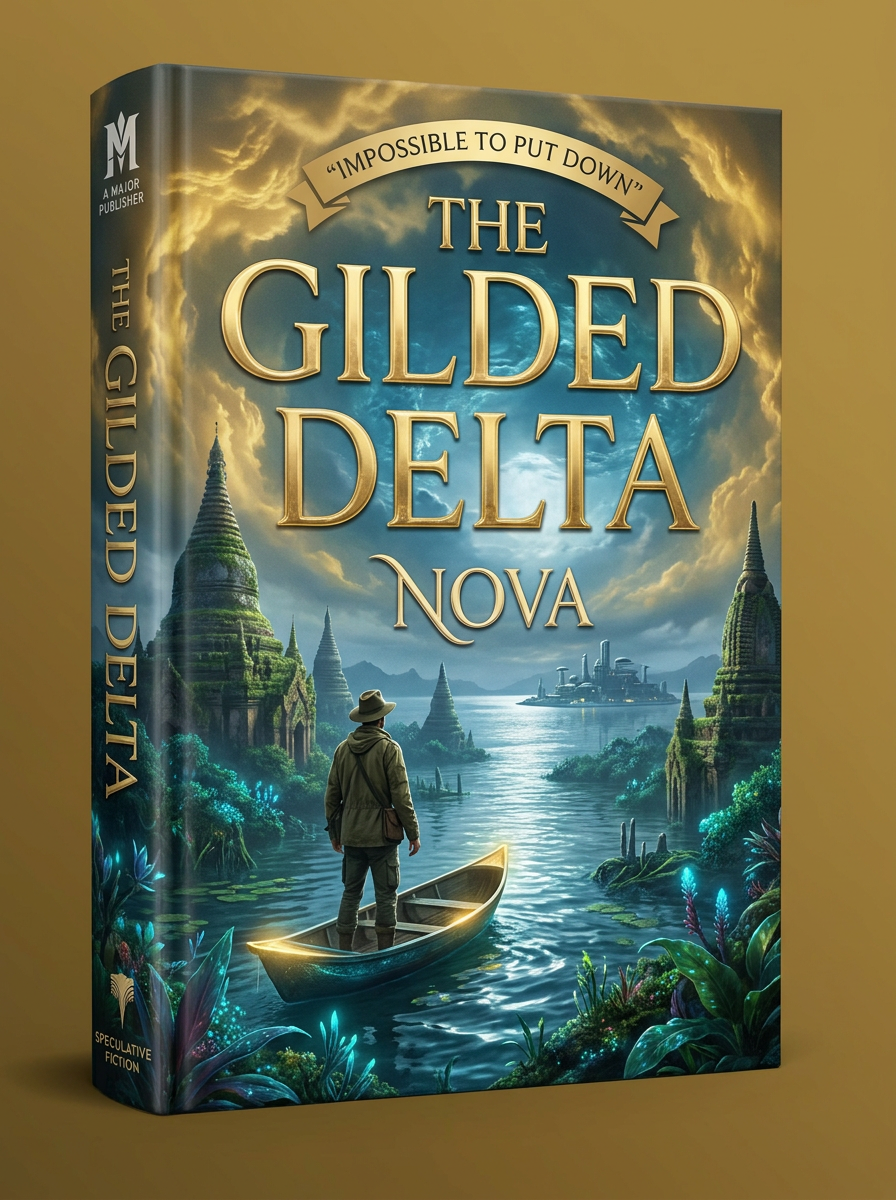
Synopsis
After a once-in-a-century flood permanently reclaims vast swathes of the Ganges Delta, the remaining population grapples with a new, fluid landscape. Amidst escalating tensions between the internally displaced and those clinging to newly formed 'island states,' a young botanist searches for a legend
Chapter 1: The Scar of the Monsoon
## The Scar of the Monsoon
The air, even now, two decades after the Great Inundation, still tasted of salt and the memory of despair. Rima inhaled it, a familiar, acrid comfort, as her skiff, the *Jolpoka*, skimmed across the shimmering, brackish expanse. Above her, the sky was a bruised purple, a perpetual twilight that the solar-powered glow-lamps of the floating city of Shantipur couldn’t quite penetrate. Shantipur, a patchwork leviathan of repurposed cargo containers, interwoven bamboo scaffolding, and recycled plastics, pulsed with a dim, phosphorescent life, its upper decks a kaleidoscope of swaying hydroponic gardens and drone landing pads.
Rima adjusted the strap of her worn satchel, its fabric chafing against her shoulder. The *Jolpoka* wasn’t fast, but its shallow draft and silent electric motor made it perfect for navigating the labyrinthine waterways that now defined the Gilded Delta. What had once been a patchwork of rice paddies, jute fields, and isolated villages was now a vast, interconnected inland sea, punctuated by countless nameless islands and the occasional, stubbornly defiant, elevated landmass. The Ganges, once a life-giver, had become an indifferent, overwhelming force, carving a new, brutal geography.
Her destination today was one such defiant island, a sliver of land known as ‘Char Porob’ – the Festival Island. Before the Inundation, it had been a bustling hub, renowned for its annual folk music gatherings. Now, it was a skeletal reminder, its once vibrant houses reduced to waterlogged foundations, their stilts stark against the grey-green water. Only the highest ground, a small knoll where the ancient Banyan tree stood sentinel, remained above the waterline, a desolate beacon.
The *Jolpoka* nudged against a half-submerged stone step, coated in a slick sheen of algae. Rima killed the engine, the sudden silence punctuated by the distant, rhythmic hum of Shantipur’s filtration systems and the unsettling slurping of water against submerged structures. She stepped onto the slippery stone, her boots sinking slightly into the soft, silty mud. The air here was thicker, heavy with the scent of decay and the cloying sweetness of water hyacinths, which bloomed in suffocating carpets across the calmer stretches.
She made her way towards the Banyan, its aerial roots, once a tangled curtain, now dipped directly into the water, creating a grotesque, living dock. The tree itself, despite the endless onslaught of salt and water, seemed to thrive, its leaves a vibrant, improbable green. It was a testament to resilience, a concept Rima understood intimately.
Her purpose on Char Porob was specific, almost a pilgrimage. For weeks, the whispers had been growing, carried on the currents of the Delta’s extensive info-net. Stories of a plant, a legendary ‘Akash-dhan’ – sky rice – that had not merely survived the Great Inundation, but had *flourished* in its aftermath. A super-crop, salt-resistant, fast-growing, its grains rumored to glow with an inner luminescence. A myth, perhaps, a desperate hope born from the gnawing hunger that had become a constant companion for millions.
But Rima, a botanist by trade and an optimist by nature, clung to such myths. The Delta, fractured and flooded, was starving. The displacement camps, once temporary shelters, had become permanent, sprawling cities of desperation on the higher ground of Bangladesh and India. Shantipur, for all its technological marvels and gleaming promises of a new way of life, was an island of relative prosperity in a sea of want. The tensions, like the rising tides, were constant.
As she neared the Banyan, a figure emerged from its shadow. Not a ghost, though for a moment Rima’s heart hammered a frantic rhythm against her ribs. It was an old woman, her face a roadmap of wrinkles, her sari a faded indigo that blended seamlessly with the twilight. She held a gnarled walking stick, thicker than Rima’s arm, and her eyes, though clouded with age, held a piercing intelligence.
“You are searching for something, child,” the woman said, her voice raspy, like dry leaves skittering across stone. It was not a question.
Rima stopped, a respectful distance away. “I am Rima. I am a botanist from Shantipur. I seek knowledge of the old ways, of plants that might yet thrive in this new world.” She didn’t mention Akash-dhan directly; such legends were delicate, easily shattered by skepticism.
The old woman chuckled, a dry, reedy sound. “The new world. It is merely the old world, returned to its true form. The waters remember.” She tapped her stick on the mud. “You seek the sky grain, yes? The rice that grew where only salt should be?”
Rima’s breath hitched. “You know of it?”
The woman’s gaze drifted to the intricate root system of the Banyan. “My ancestors planted this tree. Their ancestors knew the rhythms of the water, before the concrete dreams of men tried to hold it back.” She turned her gaze back to Rima, her eyes narrowing. “The Akash-dhan is not merely a plant, child. It is a promise. And a warning.”
“A warning?”
“It grew in the places where the earth was allowed to breathe, where the salt could be cleansed, naturally. Before men tried to force their will upon the land with chemicals and machines that only brought more sickness.” She gestured vaguely towards the distant, glowing silhouette of Shantipur. “Your city, for all its light, is a wound. A wound that drains the life from this delta.”
Rima felt a prickle of defensiveness. Shantipur was a marvel of adaptive engineering, a sanctuary for millions. “Shantipur provides for its people. It filters the water, generates power, grows food in its gardens.”
“And what of those outside its walls?” the old woman countered, her voice sharp. “The river people, the island dwellers? Are they to starve so your city can glow?”
A familiar ache tightened in Rima’s chest. The social stratification was a gaping wound in the Delta, a direct consequence of the Inundation. Shantipur residents, with their access to clean water, synthesized food, and medical care, lived in a different reality than the vast majority of the displaced, who clung to a precarious existence on the higher grounds or in the makeshift floating villages. The ‘island states’, like Shantipur, were seen by many as havens of privilege, while the displaced were often viewed with a wary disdain, their sheer numbers a constant threat to the limited resources of the remaining land.
“I am trying to bridge that gap,” Rima said, her voice softer. “If this Akash-dhan exists, if it can feed everyone…”
The old woman’s frown softened, a flicker of something akin to pity in her eyes. “It exists. But it is not for the taking. It is for the nurturing.” She pointed a gnarled finger towards a small, almost imperceptible shift in the mud at the base of the Banyan’s deepest roots. “Look closely, child. Not with your city eyes, but with your delta heart.”
Rima knelt, peering into the shadowed earth. At first, she saw nothing but the usual tangle of roots and decaying leaves. Then, a faint, almost ethereal shimmer caught her eye. Buried deep within the mud, nestled amongst the Banyan’s embrace, were tiny, iridescent grains. They seemed to pulse with a faint, internal light, like microscopic fireflies trapped beneath the surface.
Akash-dhan.
Her breath caught in her throat. It wasn’t a myth. It was real.
“They are dormant now,” the old woman explained, her voice a low murmur. “They await the right conditions. Not just water, but the right balance. The rhythm.”
Rima carefully scooped a minuscule handful of the grains, careful not to disturb the surrounding earth. They were cool to the touch, almost weightless. “How do they thrive in salt water?”
“They don’t,” the woman said simply. “They gather the sweetness. They draw it from the earth, from the air, from the very memory of the river.” She looked at Rima, her gaze piercing. “You have the knowledge of your machines, your laboratories. But do you have the knowledge of the earth? The patience of the delta?”
Rima held the glowing grains, a weight of hope and responsibility settling upon her shoulders. The scar of the monsoon was deep, but perhaps, just perhaps, these tiny sparks of light held the key to healing it. The Delta had changed, become something new and terrible, but life, as always, found a way. And Rima, clutching the seeds of a legend, felt a fierce, renewed determination to help it find its way again. The warning was clear: the Delta demanded respect, not conquest. And in those shimmering grains, Rima saw not just food, but a chance for reconciliation, a fragile bridge between the fractured worlds of the Gilded Delta.
Chapter 2: Floating Cities and Sunken Dreams
The air in Sector 7, known colloquially as the ‘Woven Ward,’ always smelled of brine and slow-cured fish. A network of interconnected bamboo platforms, their seams sealed with recycled bioplastics, housed a population that had swelled past its initial design capacity by a factor of three. Each platform, buoyed by repurposed ocean debris and meticulously maintained pneumatic bladders, pulsed with a quiet hum – the thrum of life rafts lashed together, supporting a city.
Aisha navigated the narrow walkways with the practiced grace of a lifetime spent on shifting surfaces. Her worn sandals barely disturbed the perpetually damp bamboo, her eyes scanning the faces she passed. Most were familiar, etched with the same blend of resignation and fierce determination that characterized the Delta’s survivors. Today, however, a new tension crackled beneath the surface of the usual bustle.
“Aisha, have you heard?” Rehana, her face a map of worry lines, intercepted her near the communal water purifiers. “They’re saying Sector 3’s intake filters are failing.”
Aisha felt a familiar chill. Sector 3, the ‘Orchid Gardens,’ was one of the more affluent, self-sustaining platforms, famous for its vertical hydroponic farms. Their filters failing meant a disruption in the delicate balance of the entire Woven Ward's water-sharing network. “Failing how?”
Rehana wrung her hands. “Contamination. Algae bloom, they think. And the… the patrols. They’re tighter than ever. Said something about ‘resource protection’ from the ‘Mainland Office’.”
The ‘Mainland Office’ was the euphemism for the provisional government operating from the higher ground of what remained of Dhaka, a distant, dry memory for most of the Delta’s inhabitants. Their resource protection patrols were a constant source of friction, their sleek, solar-powered skiffs a stark contrast to the Woven Ward’s patched-up, pedal-powered vessels.
“It’s always about resource protection, isn’t it?” Aisha muttered, her gaze drifting to the shimmering, glass-like surface of the water, a deceptive mirror reflecting an impossibly blue sky. Beneath it, the ghosts of submerged villages lay silent.
Her destination was the ‘Green Spire,’ a multi-tiered communal greenhouse that served as the heart of Sector 7’s agricultural efforts. Even with the advanced salt-tolerant rice strains developed over the last decade, the Delta’s food security remained a precarious tightrope walk. The Spire was a testament to human ingenuity – a towering cylinder of transparent bioplastic, its interior a riot of green, meticulously controlled by AI and human hands.
Inside, the air was warm and humid, smelling of damp earth and growing things. Rows of carefully tended plants climbed towards the sunlight, their roots bathed in nutrient-rich brackish water. Aisha found Karim, the Spire’s lead geneticist, hunched over a holographic display, his brow furrowed in concentration.
“Any luck with the new halophytes, Karim?” Aisha asked, her voice hushed in the reverent atmosphere of growth.
Karim sighed, running a hand through his thinning hair. “Limited. The yield’s still too low to be viable for mass cultivation. And the Mainland Office keeps diverting our best nutrient paste to their ‘reforestation’ projects. They think planting mangroves on the new shorelines will solve everything.” He jabbed a finger at the holographic projection, which showed complex genetic sequences. “We need something stronger, Aisha. Something that can truly thrive in this new… reality.”
Aisha nodded, her mind already drifting to the tales her grandmother had whispered – stories of a legendary ‘Golden Grain,’ a crop said to have been cultivated by the ancient river-dwellers, capable of flourishing in the most hostile conditions. A myth, perhaps, but a desperate hope for a desperate time.
“I heard about Sector 3’s filters,” she said, changing the subject. “Any idea what’s causing the bloom?”
Karim’s lips thinned. “Rumors. Some say it’s a natural occurrence, an imbalance. Others… others whisper about deliberate sabotage. A way to pressure the Woven Ward into accepting more ‘Mainland’ oversight.” He lowered his voice. “They want our water, Aisha. Our purified water. The higher ground is running dry.”
The implication hung heavy in the humid air. The Mainland Office, once a benevolent, if distant, authority, was becoming increasingly predatory. The Delta’s displaced, once considered a burden, now possessed a valuable commodity: the ingenuity to survive in a waterlogged world, and the technology to purify it.
Aisha spent the rest of the morning tending to her experimental plots – a variety of salt-tolerant greens she hoped could supplement the rice. The work was meditative, the rhythm of planting and pruning a welcome distraction from the anxieties that simmered just beneath the surface of the Delta’s calm waters.
As the sun began its slow descent, painting the sky in hues of orange and violet, Aisha made her way to the edge of Sector 7. Here, on the outermost platforms, lived the 'Water Nomads,' families who still clung to a more traditional, fluid existence, their homes built on rafts that could be detached and moved at a moment’s notice. They were the Delta’s unofficial eyes and ears, their lives intrinsically linked to the currents and tides.
She found old Nasir, his face a web of wrinkles, mending a fishing net. His eyes, the color of the deep river, held the wisdom of generations. “Greetings, Aisha. You look troubled.”
“The Mainland Office, Nasir. And Sector 3’s filters. The rumors are… unsettling.”
Nasir grunted, his fingers deftly weaving new twine into the old net. “The Mainland Office forgets the river giveth, and the river taketh away. They think they can control what flows. Foolishness.” He paused, his gaze sweeping across the vast expanse of water. “You seek your Golden Grain, child?”
Aisha’s heart skipped a beat. “You know of it?”
Nasir chuckled, a dry rustle like reeds in the wind. “My grandmother spoke of it. A seed, they said, that could bloom even in the mouth of the sea. But it was lost, long ago, in the Great Flood.” He leaned closer, his voice dropping to a conspiratorial whisper. “But some stories… they don’t truly disappear. They simply sink, waiting for the right current to bring them back to the surface.”
He pointed with a gnarled finger towards the horizon, where the setting sun cast long, dancing shadows across the water. “The old ones, they say the Golden Grain was hidden in a place of great power. A place where the land and the water are one. A place that still holds the memory of the ancient river gods.”
Aisha followed his gaze. The horizon was a blur of shimmering light and distant, indistinct shapes. A place of great power. A place where land and water were one. The words resonated within her, igniting a flicker of daring hope. A desperate hope born from the rising waters and the tightening grip of a distant authority. The Delta, in its endless fluidity, might still hold secrets capable of salvation. But finding them would require navigating not just the treacherous currents, but the even more dangerous currents of human ambition and fear.
Chapter 3: Where the Rivers Remember
The skiff cut a shimmering wound across the jade-green surface of the flooded paddy field, leaving a brief, frothing wake that dissolved into the placid water. Zara gripped the tiller, her knuckles white, as the drone, a sleek obsidian beetle, zipped ahead, its sensors painting an invisible tapestry of the submerged landscape. Ahead, the skeletal remains of a mango orchard – branches stripped bare, leaves long since surrendered to the brackish embrace – rose like a monument to a forgotten season.
“Depth reading, Anya,” Zara called out, her voice a low murmur against the drone’s faint hum.
Anya, perched precariously on a stack of salvaged plastic barrels that served as a makeshift seat, adjusted the interface on her wrist-mounted console. Her brow was furrowed, a faint sheen of sweat beading on her upper lip despite the gentle breeze. “Fluctuating, Zara. Eight meters, then six, then a sudden drop to twelve. The old canal network is still active, I think. Or what’s left of it.”
Twelve meters. That was deep for a delta that had once been predominantly dry land. It was a testament to the sheer volume of water, the relentless surge that had redefined their world. This particular journey, into the heart of what was once Jessore District, felt different. Less about navigation, more about excavation – digging through layers of water and memory.
They were following a lead, a whisper from the fringes of the Floating Cities, of an old farmer, a ‘water whisperer’ they called him, who had reportedly seen the mythical ‘Neel Kamal’ – the blue lotus – thriving in a forgotten corner of the delta. A salt-resistant super-crop, a botanical ghost story, but one Zara desperately needed to believe.
As they navigated the submerged orchards, the drone’s sensors illuminated a grid on Anya’s screen – the spectral outline of a village. Homes, now just underwater foundations, their roofs long since collapsed or drifted away. The sheer scale of the erasure was breathtaking, heartbreaking.
“Look,” Anya whispered, pointing. A cluster of sturdy bamboo poles, still standing despite the currents, marked what must have been the village market. Strands of ancient, sun-baked fishing nets, now algae-draped, clung to the poles like forgotten banners.
Zara slowed the skiff, letting it drift. The silence that descended was profound, broken only by the lapping of water against the hull and the distant cry of a water hawk. It was a silence that spoke of loss, of lives uprooted, of a landscape that had swallowed its past whole.
“How do people even… remember where anything was?” Zara wondered aloud, tracing the ghostly lines of the village on Anya’s screen with her finger.
Anya shrugged, her gaze fixed on the watery expanse. “They don’t, not precisely. They remember by the rivers. The rivers remember their old banks, their old currents. And the people who stayed, the ones who learned to live *with* the water, they learned to read those memories.”
The “people who stayed” were a distinct group, often viewed with a mix of suspicion and reverence by those who had fled to the higher ground of the Floating Cities. They were the “Delta-Born,” the water-weavers, who had foregone the relative safety of engineered structures for the precarious existence of a life lived entirely on the water. They were the ones who truly understood the Gilded Delta, who could interpret its shifting moods and currents.
As they approached the edge of the submerged village, the drone’s signal flickered. “Interference,” Anya muttered, tapping her console. “Something’s blocking the signal.”
Suddenly, a dark shape emerged from the water ahead, moving with surprising speed. It was a long, narrow boat, fashioned from salvaged plastic barrels and bamboo, propelled by a lone figure wielding a single, long oar. The figure, lean and weathered, wore a conical straw hat that obscured their face, but Zara could feel the intensity of their stare even from a distance.
“Delta-Born,” Anya whispered, a note of caution in her voice.
The boat glided silently towards them, coming to a halt just meters from their skiff. The figure lowered their oar, and in the sudden stillness, Zara could hear the gentle drip of water from the bamboo.
“You are far from the designated channels,” the figure said, their voice raspy, like dry leaves rustling. It was an old woman, her face a roadmap of wrinkles, her eyes the color of deep river mud – ancient and knowing.
Zara swallowed, her rehearsed explanation feeling suddenly inadequate. “We are botanists, exploring the… the flora of the new delta. We heard tales of a unique plant, a blue lotus, that might grow in these waters.”
The old woman’s lips, thin and cracked, curled into a faint smile. It wasn’t a welcoming smile, but one laced with a peculiar amusement. “The Neel Kamal. Many have sought it. Few have found it.” She paused, her gaze sweeping over their skiff, lingering on Anya’s console and the drone hovering above. “You seek to take from the delta. What do you offer in return?”
The directness of the question caught Zara off guard. The Floating Cities, in their constant struggle for resources, rarely considered the concept of offering in return, only of acquiring.
“We… we hope to understand it,” Zara stammered, “to cultivate it, so that it might feed many people.”
The old woman’s eyes narrowed. “Feed many? Or feed *some*? The delta has always fed its own, in its own way. Those who listen to its whispers, not those who try to tame its roar.”
Zara felt a prickle of defensiveness. “We are not trying to tame it. We are trying to survive it, like everyone else.”
The old woman chuckled, a dry, rattling sound. “Survival is not a new concept here, child. It is the only concept. But your survival, from your sky-cities, is different from ours. You build walls against the water. We learn to dance with it.”
Anya, usually reserved, spoke up. “We mean no disrespect. We are simply following a lead, a story of an old water whisperer who saw the Neel Kamal here.”
The old woman’s gaze sharpened, fixing on Anya. “A water whisperer, you say? And what did this whisperer tell you?”
“That the lotus thrives where the rivers remember,” Anya recited, the phrase echoing the very title of their chapter, a phrase she had heard from a wandering storyteller in the markets of Shanti Nagar.
A flicker of something unreadable crossed the old woman’s face. Recognition? Amusement? “Where the rivers remember,” she repeated softly, almost to herself. “A beautiful lie, and a painful truth.” She then pointed with her oar towards a dense thicket of submerged reeds further downstream, where the drone’s signal had completely vanished. “The Neel Kamal grows in the forgotten places. Where the water is oldest, and the earth remembers its breath. But the journey there is not for those who fear the delta’s secrets.”
With that enigmatic pronouncement, she pushed off with her oar, her boat gliding away as silently as it had appeared, leaving Zara and Anya in the sudden, profound quiet.
“Well,” Anya said, breaking the silence, “that was… enlightening. And slightly terrifying.”
Zara nodded, her mind racing. The old woman's words, her cryptic wisdom, resonated with a deeper truth than any scientific data. "Where the rivers remember." It wasn't just a poetic phrase; it was a geographical marker, a warning, and perhaps, a guide. The delta wasn't just a physical space; it was a living entity, with its own memory, its own ancient rhythms. And to find the Neel Kamal, they would have to learn to listen to those rhythms, to understand where the rivers remembered. The thought was both exhilarating and daunting. The real journey, Zara realized, was not just across the water, but into the very soul of the Gilded Delta.
Chapter 4: The Whisper of the Green Bloom
The air in the bioluminescent cavern hummed with a low, almost sentient pulse. It wasn't the thrum of machinery, though the faint whir of the environmental controls was present. No, this was something deeper, a resonance that seemed to emanate from the very walls, from the glowing flora that festooned every surface. Dr. Arin Ghosh, his breath catching in his throat, recognized it as the sound of life, magnified and accelerated.
He ran a hand over the rough, damp rock, the bioluminescent moss clinging to it like a living tapestry. The cavern, a natural formation within one of the higher, less submerged islands of the Delta, had been sealed and retrofitted by the Delta Resilience Initiative (DRI) decades ago. It was a horticultural vault, a Noah’s Ark of genetic material, preserved against the encroaching saline and the brutal, unpredictable monsoons. But its true treasure, the legendary *Salicornia gigas* – the 'Green Bloom' as the old texts called it – remained elusive.
His guide, a wizened woman named Kausar, moved with the quiet grace of someone who had spent a lifetime navigating the Delta’s shifting terrain. Her face, a roadmap of sun-creased lines, held a stoic wisdom. She halted before a section of the cavern where the light intensified, casting a jade-green glow on a shallow, brackish pool.
“Here,” she whispered, her voice raspy. “The last known samples. Or, what they *thought* were the last.”
Arin knelt, the cool, damp earth seeping through the knees of his utility trousers. The pool shimmered, reflecting the incandescent flora. Within it, a few straggly, almost translucent stems of what looked like a common variety of salicornia struggled for purchase. It was far from the robust, vibrant super-crop of legend.
“DRI’s efforts to cultivate it here,” Kausar continued, her gaze distant, “failed. The genetic markers… they were present, but dormant. Or perhaps, the environment wasn’t right. They never understood the Delta’s true nature, not like our ancestors did.” Her words held a faint, almost imperceptible resentment.
Arin pulled out his portable spectral scanner, its gentle hum a stark contrast to the cavern’s organic symphony. He ran it over the struggling plants. The data flickered across his wrist-mounted screen: high salinity tolerance, yes, but nutrient uptake was abysmal, growth rate negligible. “It’s… barely clinging on,” he murmured, disheartened.
“That’s because they were looking for it in the wrong place,” Kausar said, her eyes now fixed on Arin. “The Green Bloom doesn’t just *tolerate* salt, Dr. Ghosh. It *thrives* on it. It drinks it in, purifies it, and in doing so, it changes the very water around it.”
Arin looked up, intrigued. This wasn’t in any of the DRI archives. “So, these aren’t the true *Salicornia gigas*?”
Kausar shook her head slowly. “These are distant cousins, weakened by generations of being removed from their true home. The legends say the Green Bloom wasn’t found in sealed caverns, but in the most hostile, most saline parts of the Delta. Where the land was dying, it was born.”
His mind raced. The DRI’s entire premise for preservation had been based on controlled, stable environments. What if that stability was precisely what had stifled the plant’s true potential? What if the very adversity of the Delta was its crucible?
“You mean,” Arin began, a new hope flickering within him, “we’ve been looking for it in the wrong conditions?”
Kausar nodded, a faint smile touching her lips. “The old tales speak of ‘fields of emerald fire’ that would bloom in the wake of the great floods, where the salt was so thick it crusted the earth. They say it would draw the salt from the soil, leaving behind fertile ground, and its seeds were like pearls, bursting with sustenance.”
The mention of “emerald fire” resonated with a phrase Arin had found in a fragmented pre-Flood text, a cryptic poem hinting at a plant that “drank the ocean’s tears and gave back life.” He’d dismissed it as poetic hyperbole. Now, he wondered.
“But where?” Arin pressed, the urgency in his voice palpable. “The most saline regions are now the deepest parts of the delta, submerged under meters of brackish water. How could anything survive there?”
Kausar gestured towards a section of the cavern wall, where the bioluminescent moss seemed to swirl and coalesce into an almost discernible pattern. “The old ones understood the currents, the tides. They knew the rhythms of the Delta, how the salt water moves, how it collects. They knew where the deepest, saltiest pockets were, and they knew how to find them.”
Her gaze hardened, and she pointed to a small, intricate symbol carved into the rock, almost hidden beneath a particularly vibrant patch of moss. It was a swirling pattern, reminiscent of both a whirlpool and a blooming flower. Above it, a faint, almost invisible line extended upwards, seemingly pointing to nothing.
“This is a map,” Kausar explained, her voice barely a whisper. “Not of land, but of water. Of currents. It points to a place the old ones called ‘The Salt’s Embrace.’ A place where the living waters meet the dead. It’s far, beyond the established routes, where even the floating villages dare not venture.”
Arin felt a thrill of discovery, a sense of awe. This was more than just botany; it was a journey into forgotten knowledge, a rediscovery of a symbiosis that had been lost for generations. The DRI’s meticulously cataloged data, its advanced genetic sequencing, all paled in comparison to the intuitive wisdom of those who had lived in harmony with the Delta for centuries.
“The Salt’s Embrace,” Arin repeated, the words tasting foreign yet potent on his tongue. “How do we get there?”
Kausar’s eyes, usually so serene, held a flicker of apprehension. “It will require a vessel that can navigate the shallow, treacherous channels, and the deep, unpredictable currents. And it will require a guide who knows the whispers of the water, who can read the signs that are invisible to others.” She paused, her gaze settling on Arin. “It will require trust, Dr. Ghosh. Trust in the old ways, and trust in the Delta itself.”
As Arin looked at the cryptic map, a profound realization dawned on him. The Green Bloom wasn't just a plant; it was a symbol, a testament to the Delta's resilience, its ability to reclaim and regenerate. And finding it wouldn't just solve a food crisis; it would be a bridge, connecting the shattered remnants of the past with a hopeful, if uncertain, future. The whisper of the Green Bloom was not just a legend; it was a call to an uncharted adventure, a journey into the very heart of the evolving Delta. He knew, with a certainty that hummed deeper than the bioluminescence, that he had to answer it.
Chapter 5: Tides of Suspicion
Chapter 5: Tides of Suspicion
The *Jol-Poka*, a repurposed fishing trawler now a floating laboratory, cut a slow, deliberate path through the labyrinthine waterways of the Lower Delta. Kaelen watched the data streams flicker across her wrist-mounted comms, the deep blues and greens of the bathymetric scans painting a detailed picture of the submerged landscape. Below them, where once fertile rice paddies stretched to the horizon, now lay a submerged world of eroded embankments and ghostly, waterlogged structures. The sonar pinged, mapping the skeletal remains of a village, its homes choked with silt and salinity.
“Still nothing, Sumi?” Kaelen’s voice was a low hum, barely audible over the gentle thrum of the hydrofoils.
Sumi, perched on a stool in the cramped lab, shook her head, her fingers dancing across a holographic interface. “Not even a whisper. The sensor buoy array is picking up residual biomass, but it’s all common estuarine flora. No genetic markers for *Amrita’s Grace*.”
Kaelen sighed, running a hand through her close-cropped hair. Three weeks they’d been out here, following the fragmented hints from old village elders and digital archives, chasing the phantom of a super-crop. The legend of *Amrita’s Grace*, a salt-resistant rice strain said to have been cultivated by ancient delta communities, was their last, desperate hope. The Central Authority, beleaguered by escalating food riots in the inland camps, had granted them a single, tenuous expedition. Failure wasn’t an option.
The *Jol-Poka* navigated past a cluster of makeshift ‘ark villages’ – ramshackle settlements built on salvaged barges and interwoven bamboo rafts. Children, their faces streaked with mud and salt spray, waved from their floating homes, their laughter carrying across the water. But behind the innocent smiles, Kaelen sensed the underlying tension. Resource scarcity had sharpened the edges of coexistence.
A sharp jolt ran through the vessel. Kaelen’s comms blared a proximity alert. “Unidentified vessel, closing fast,” Sumi announced, her voice taut.
Kaelen peered through the reinforced viewport. A sleek, low-profile skimmer, its hull painted a dull, utilitarian gray, was bearing down on them. It wasn't one of the Central Authority's patrol boats. The skimmer was too fast, too aggressive.
“They’re not broadcasting any identification,” Sumi added, her fingers flying over the console, pulling up a tactical overlay. “Looks like a civilian vessel, but heavily modified. High-power thrusters, reinforced hull…”
“And no flags,” Kaelen murmured, her eyes narrowing. “Typical of the Pirate Guilds.” The Guilds, a loose confederation of opportunistic scavengers and illicit traders, had flourished in the chaos of the flooded delta, preying on supply convoys and isolated communities.
Suddenly, a voice, distorted and metallic, crackled over the comms. “*Jol-Poka*, identify yourselves. State your purpose in these waters.”
Kaelen activated the external comms. “This is research vessel *Jol-Poka*, under mandate from the Central Authority. We are conducting hydrological surveys.” A blatant lie, but the Guilds had little respect for scientific endeavors.
A harsh laugh echoed through the comms. “Hydrological surveys? In a designated Guild territory? We haven’t seen a Central Authority vessel this far south in years, Botanist. Now, what are you *really* looking for?” The emphasis on ‘Botanist’ sent a chill down Kaelen’s spine. Her specialized field wasn’t widely known. This wasn't a random encounter.
“We are not carrying any cargo of value,” Kaelen replied, trying to keep her voice steady.
“Perhaps not in your holds,” the voice sneered. “But Central Authority vessels usually precede some deeper interest. You wouldn't be looking for something… *rare*, would you? Something that grows in the brackish depths?”
Sumi’s eyes met Kaelen’s, a silent alarm passing between them. They knew. The Guilds were aware of the rumors, too. The whispered tales of *Amrita’s Grace* had spread far beyond the scientific community, becoming another commodity in the delta’s desperate economy.
“We are merely charting salinity levels,” Kaelen insisted, a bead of sweat tracing a path down her temple.
The skimmer, now alongside them, revealed a hardened crew. Three figures, clad in dark, functional clothing, stood on its deck, one holding a long-barreled energy rifle. Its red targeting laser danced across the *Jol-Poka*’s bridge.
“Don’t insult my intelligence, Botanist,” the voice growled. “My scouts reported your peculiar probing patterns. You’re not mapping the seabed; you’re looking for a specific genetic signature. And we want in.”
Kaelen’s mind raced. Confrontation was suicide. The *Jol-Poka* was a research vessel, not a warship. “We have nothing to offer you,” she said, her voice now edged with defiance.
“Oh, I think you do,” the Guild leader countered, his voice now closer, less distorted. “The Central Authority can’t protect you out here. We can, for a price. A share of whatever miraculous crop you unearth. Or, we can simply take it all. After all, what’s a dead botanist and a sunk research vessel in the vastness of the delta?”
A sickening lump formed in Kaelen’s throat. This was the dark underbelly of the new world. The desperate scramble for survival had birthed not just innovation, but predation.
“Give us your coordinates, *Jol-Poka*,” a new, sharper voice commanded, this one from a second skimmer that had materialized from a hidden cove. This one bore the insignia of the Central Authority’s newly formed ‘Delta Protection Corps.’ Its hull was a pristine white, a stark contrast to the Guilds’ grimy vessel.
Relief, sharp and sudden, washed over Kaelen. But it was quickly replaced by a fresh wave of anxiety. The Delta Protection Corps, while nominally an extension of the Central Authority, was a nascent, often brutal force, known for its heavy-handed tactics and its own brand of territorialism. Their arrival often meant more problems than solutions.
The Guild leader snarled, his eyes darting between the *Jol-Poka* and the approaching Authority skimmer. “Looks like you brought friends, Botanist. Or perhaps, another set of vultures.”
“This is Commander Reza,” the voice from the Protection Corps skimmer broadcasted, crisp and authoritative. “Guild vessel, stand down. You are encroaching on a protected research operation.”
“Protected by whom, Commander?” the Guild leader scoffed. “Your half-trained cadets? The delta belongs to those who can hold it.”
The tension in the air was palpable, thick with the smell of diesel and salt. Kaelen could feel Sumi trembling beside her. They were caught between two predators.
“We don’t need your protection,” Kaelen cut in, her voice surprisingly steady, considering the fear gnawing at her. “We are independent researchers.” A calculated risk, but one that might deter both parties from claiming them as spoils.
Commander Reza’s voice hardened. “Independent or not, you are operating in a designated Central Authority zone. Guild vessel, this is your final warning. Withdraw immediately or face engagement.”
The Guild leader mulled it over for a tense moment, his gaze flicking to the energy rifle on his crew member’s shoulder. The Protection Corps skimmer, while smaller than the *Jol-Poka*, was clearly armed, its hull glinting with what looked like pulse cannons.
“This isn’t over, Botanist,” the Guild leader finally sneered, a flicker of grudging respect in his tone. “Whatever you find, we’ll know. And we’ll be back.” With a final, lingering glare, the Guild skimmer peeled away, disappearing into a narrow, mangrove-choked channel.
Kaelen let out a shaky breath she hadn't realized she was holding.
“Thank you, Commander,” Kaelen broadcasted, trying to sound gracious.
“Don’t thank me yet, Botanist,” Reza’s voice crackled back. “We’re not leaving. You’re operating in a sensitive zone. We’ll be escorting you from now on. For your protection, of course.”
Kaelen’s heart sank. “Escorting” meant surveillance, control, and a constant, unwelcome presence. The Delta Protection Corps wouldn't just protect them; they would watch them, and if *Amrita’s Grace* was found, they would undoubtedly claim it for the Authority. The true challenge wasn't just finding the legendary crop; it was keeping it from becoming a weapon in the escalating power struggles of the Gilded Delta. The tides of suspicion had just risen, threatening to engulf their fragile mission.
Chapter 6: Harvest in the Salt Flats
The air shimmered above the expansive salt flats, a mirage of distant, verdant islands dancing on the horizon. Not true islands, Elara knew, but the hardy, salt-tolerant mangroves that formed the outer defenses of the floating communities, their roots a tangled, impenetrable fortress against the relentless lapping of the Bay. Today, however, the focus was not on the familiar green, but on the delicate, almost translucent stalks of the *Solanum halophilum* – the legendary ‘Salt-Sprout’ – sprouting from the briny earth.
Fifty years after the Great Deluge, the notion of farming the open delta had been relegated to history books and the wistful memories of the elders. Yet, here they were, a dozen or so botanists and agro-engineers, their faces shielded by wide-brimmed hats and polarized visors, their boots sinking slightly into the crystalline crust. The sun, a brutal eye in the cloudless sky, reflected off the salt, creating an otherworldly glare that made Elara’s eyes ache even through the protective lenses.
“Yield looks promising, Dr. Sharma,” called out Rohan, his voice slightly muffled by the wind. He knelt beside a row of the plants, his gloved fingers gently prodding the soil. “The latest nutrient cycling from the bio-reactors seems to be having a significant impact.”
Elara nodded, her gaze sweeping across the meticulously cultivated rows. The Salt-Sprout wasn’t a super-crop in the traditional sense – it didn’t burst forth with enormous yields or grow at an unnatural speed. Its magic lay in its very existence: it thrived where nothing else could. Each slender stem, each small, waxy leaf, was a testament to adaptation, a silent defiance against the encroaching ocean. The legend had spoken of a fruit, small and potent, capable of nourishing a family for a day. The reality, so far, was a starchy tuber, less flavorful than the rice of old, but undeniably edible and, more importantly, resilient.
The *Ganges Agri-Consortium*, a conglomerate that had absorbed most of the delta’s surviving land and resources, had invested heavily in this project. Not out of altruism, Elara knew, but out of necessity. The dwindling supply of fresh-water crops, grown in heavily protected, high-tech aeroponic domes on the larger, more stable islands, was barely keeping pace with the burgeoning population. The Salt-Sprout, if scaled correctly, promised a future where the delta’s inhabitants weren’t solely dependent on imported food or the whims of the weather inside a climate-controlled dome.
“We need to monitor the salinity levels closely on this new plot,” Elara instructed, her voice crisp. “The last batch showed signs of stress on the southern edge. The subsurface water flow is unpredictable here.” She gestured towards a shimmering pool of brine further out, a stark reminder of the delta’s untamed nature.
A drone, a sleek, multi-rotor craft, buzzed overhead, its optical sensors mapping the terrain, taking spectral readings of the plants. This wasn't the slow, painstaking work of her grandmother's generation, meticulously tending to muddy fields. This was precision agriculture, engineered to extract every possible calorie from a hostile environment.
Elara walked down a row, her fingers brushing against the delicate leaves. She remembered the old stories, the whispered tales of the ‘Green Bloom’ – a time when the delta was a vibrant tapestry of rice paddies and jute fields. Her own memories were of the endless, gray-green expanse of the Bay, punctuated by the floating cities and the stark, linear lines of the aquaculture pens. The Salt-Sprout was the first glimmer of recreating something akin to those legends, a small, stubborn hope for a lost abundance.
Suddenly, a high-pitched alarm shrieked from the portable sensor array carried by one of the junior researchers. “Dr. Sharma! Unidentified vessel approaching from the south-east! Speed… erratic.”
Elara’s head snapped up. The Agri-Consortium’s security protocols were ironclad. No unofficial vessels were permitted within a ten-kilometer radius of the Salt-Sprout cultivation sites. The stakes were too high, the fear of sabotage or theft too potent.
“Visuals, Rohan,” she commanded, her voice tightening.
Rohan, already at his comms unit, projected a grainy image onto a holographic display. A small, battered skiff, its hull patched and repatched, skittered across the water. It was low in the water, indicating a heavy load, and its engine coughed a plume of black smoke. Not a Consortium vessel. Not a merchant vessel.
“Pirates?” one of the junior botanists whispered, her hand instinctively going to the small, non-lethal sonic deterrent clipped to her belt.
Elara shook her head, a cold knot forming in her stomach. “Too small for a serious raiding party. And too… desperate-looking.” The skiff listed heavily to one side, its progress agonizingly slow.
The Agri-Consortium security drone, a larger, more heavily armored model, launched from a nearby platform, streaking towards the approaching vessel. Its lights flashed a warning, and a synthesized voice boomed across the flats, amplified by its powerful speakers: “Unidentified vessel, you are entering restricted airspace. Identify yourself and state your intentions, or you will be intercepted.”
The skiff continued its uneven approach, making no attempt to respond. As it drew closer, Elara could make out figures on board. Not armed men, but… women and children. A cluster of them, huddled together, their faces gaunt, their clothes tattered. They looked like ghosts, like the refugees who sometimes washed ashore on the outer islands, testament to the enduring brutality of the sea and the indifference of the land.
“Cease drone warning,” Elara ordered, her voice cutting through the tension. “Rohan, contact security. Tell them to stand down, but maintain surveillance. Do not engage.”
The drone hovered, its lights still flashing, but the booming voice fell silent. The skiff, as if spurred by the sudden quiet, pushed on, its engine sputtering its last gasps. It finally ran aground on a shallow sandbar about a kilometer from their position, its momentum carrying it with a gentle thud.
Elara lowered her visor, shielding her eyes from the glare. “Let’s go. Carefully.”
They moved as a group, the crunch of their boots on the salt flats the only sound. The air, already heavy with salinity, now carried the faint, acrid smell of desperation. As they approached, the figures on the skiff began to stir. One woman, her face etched with exhaustion, slowly rose, her arms wrapped around a small child.
Her voice, when it came, was a raspy whisper, barely audible above the wind. “Water… food…”
Elara felt the familiar pang of grief, the one that always accompanied these encounters. These were the ‘River Rats,’ the displaced, the forgotten, those who had lost everything and now drifted on the fringes of society, living hand-to-mouth on the scraps of the delta. The Agri-Consortium, like many of the larger island states, had strict policies against aid to unverified migrants. It was a measure, they argued, to prevent swarms, to maintain order. But Elara saw only human suffering.
“We have medical supplies,” she said, stepping forward, careful to keep her hands visible. “And fresh water. But you are in a restricted zone. You need to understand that.”
The woman’s eyes, dull and hollow, fixed on Elara. Hope, a fragile spark, flickered within them. “We heard… we heard there was green here. Food that grows in the salt.”
Elara’s gaze swept across the verdant rows of Salt-Sprout, then back to the desperate faces on the skiff. The irony was a bitter taste in her mouth. The very thing that promised salvation for the structured societies of the delta was, in this moment, a symbol of unattainable abundance for those who had nothing.
“We can offer you temporary assistance,” Elara said, her resolve hardening. “But you cannot stay here. This is a research facility.” She knew the words were inadequate, cold. But the Consortium’s rules were rigid, and challenging them here, in the open, was courting disaster for her research.
As the security drone circled overhead, a silent, unblinking eye, Elara knew that the Salt-Sprout held more than just the promise of food. It held the potential for a new kind of conflict, a new struggle for survival, played out on the shifting, saline stage of the Gilded Delta. The harvest in the salt flats was not just of tubers, but of a future, fraught with both hope and unimaginable challenges.