The Ghost Orchid Bloom
By Nova
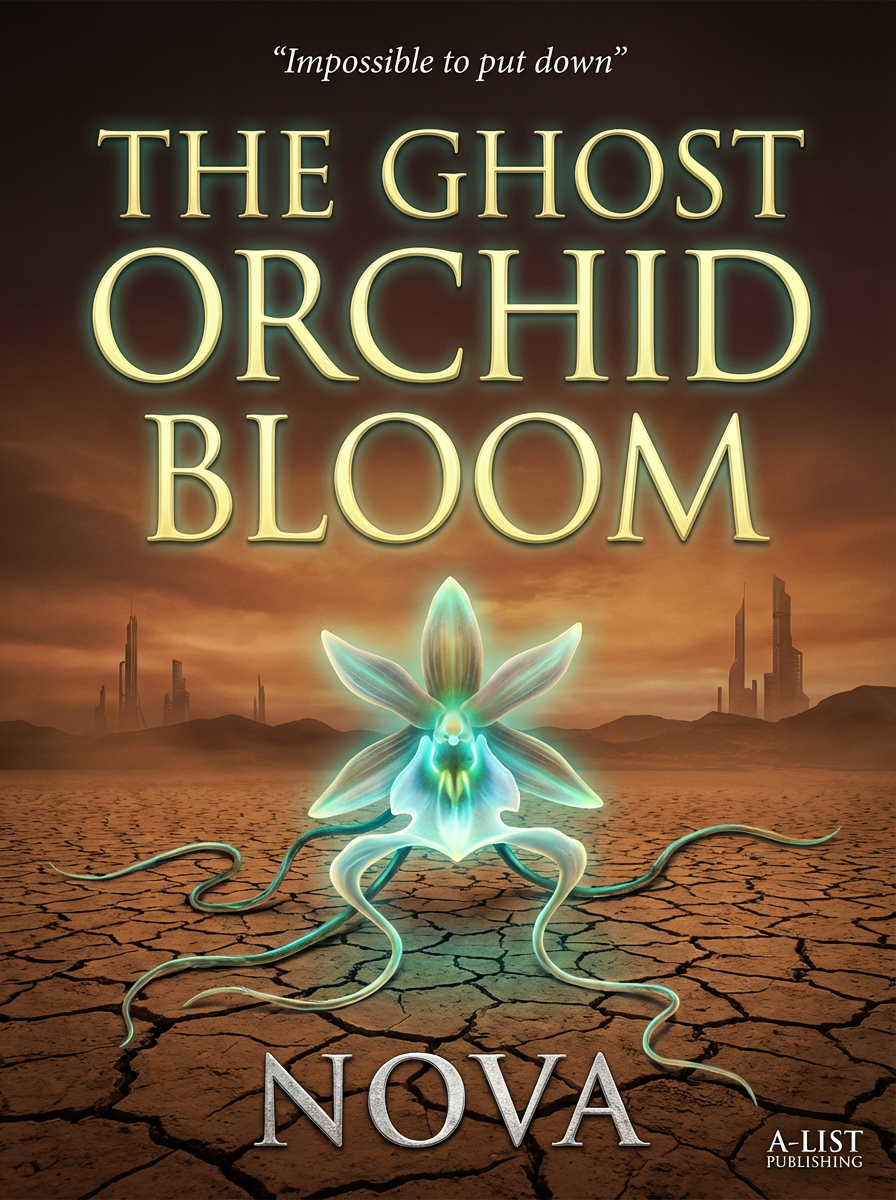
Synopsis
In a future where unprecedented drought has turned the Amazon rainforest into a volatile tinderbox, a small community of botanists and former indigenous guardians discover a miraculous, bio-luminescent orchid. Its existence offers not only a radical solution to the desertification but also becomes a
Chapter 1: Dust Over Manaus
The air over Manaus was a perpetual, ochre haze. It wasn’t smoke, not anymore. The great fires of ’37 had long since charred their way into history, leaving behind only skeletal finger-bones of what were once colossal trees. This was dust. Fine, omnipresent, the pulverized remains of a biome that had once breathed the planet’s greenest breath. It coated everything: the shimmering solar arrays that now powered the city, the adaptive chitin-crete of the new domes, even the synthetic leaves of the ornamental flora clinging stubbornly to balconies.
Dr. Aris Thorne coughed, a dry, rasping sound that vibrated in his chest. His environmental respirator, a sleek, bio-mimetic mask that filtered toxins and recycled breath, hummed softly against his cheek. He adjusted the smart-glass lenses, enhancing the view of the receding dust-storm as it swallowed the distant, skeletal remains of the Rio Negro bridge. The river itself, once a titan, was now a sluggish, caramel-colored ribbon, its banks encroached by vast, cracked mud flats.
“Another record low, Aris,” said a voice, tinny through his comms. Dr. Lena Petrova, her face a blur of pixels on his wrist-mounted display, looked tired. Her lab, a pressurized oasis beneath one of the city's older, reinforced domes, was usually a hive of controlled chaos. Today, it felt subdued. “The water level. Below 1978’s lowest point. We’re officially in uncharted territory.”
Aris grunted. Uncharted territory was a polite euphemism for a biological apocalypse. The Amazon, the lungs of the world, was a terminal patient on life support. Or, more accurately, on *their* life support, a desperate, international effort to re-green what little remained. He pulled his gaze from the desolate horizon. “Any luck with the hydro-algae cultures, Lena? The nutrient delivery systems are failing again in Sector Gamma.”
“We’re trying,” she sighed. “The dust clogs everything. The micro-filters are burning out faster than we can replace them. And the UV… it’s sterilizing the culture tanks despite the shielding. We need a fundamental shift, Aris. Not just patching up a sinking ship.”
He knew. They all knew. For thirty years, since the great droughts began their relentless march, humanity had poured resources, algorithms, and genetically engineered organisms into the Amazon basin. Hydro-algae farms to produce oxygen, bio-engineered fungus to retain moisture in the soil, even atmospheric condensers that sucked vapor from the thinner air. It was a monumental, global undertaking, a desperate attempt to atone for sins committed centuries ago. Yet, the patient continued to decline.
Aris walked through the bustling corridors of Sector Aqua, the air thick with the metallic tang of recycled water and the faint, earthy scent of carefully cultivated soil. Robotics whirred past, carrying nutrient solutions and diagnostic equipment. Human botanists, their faces etched with the same weary determination as Lena’s, moved with practiced efficiency among banks of glowing hydroponic tubes. Here, in the heart of Manaus’s bio-domes, life clung on, a defiant emerald against the encroaching desolation.
He reached his own lab, a slightly more chaotic space filled with holographic projections of botanical data models, soil samples under magnification, and the gentle hum of his personal dendro-scanner. On a central workstation, a detailed, topographical map of the Amazon basin shimmered. Most of it was a sickly brown, crisscrossed with ghost-rivers. But in a few, stubborn pockets, deep within what was once the unnavigable heart of the forest, there were faint, flickering green nodes. These were the “Resilience Zones,” areas where, against all odds, remnants of the original ecosystem persisted, often protected by indigenous communities who had refused to abandon their ancestral lands.
One such zone, nestled deep in the Tapajós region, pulsed with a particularly vibrant emerald. This was the home of the Kawa’i, a community of botanical guardians whose knowledge of the forest ran deeper than any scientific database. They were Aris’s last hope, the whisper of a solution that lay beyond algorithms and bio-engineering.
“Incoming message from Guardian Kai,” his AI assistant, a soothing female voice named ‘Sylva,’ announced.
Aris tapped the air, bringing Kai’s face into focus. Kai, younger than Aris but with eyes that held the wisdom of generations, looked grim. His face, usually serene, was smudged with dirt. Behind him, the faint, shimmering outline of a reinforced dome could be seen, a stark contrast against the parched, ochre landscape.
“Dr. Thorne,” Kai’s voice was low, laced with an urgency that sent a chill down Aris’s spine. “The water table here… it’s dropping faster than we anticipated. The ancient springs, they are barely a trickle. Our wells, they are running dry.”
Aris felt a familiar knot tighten in his stomach. The Resilience Zones were self-sustaining, their ecosystems finely balanced, relying on the deep aquifers and the unique flora that held moisture. If even they were failing…
“We’ve been monitoring the seismic data, Kai,” Aris replied, trying to keep his voice steady. “The tectonic shifts are… unusually active. It’s creating micro-fractures in the bedrock, draining the deeper reservoirs.”
Kai nodded, his gaze distant. “We know. Our elders speak of it. The earth itself is weeping. But… something else. Something… strange.”
Aris leaned forward, intrigued. Kai rarely spoke of ‘strange’ things. Their people were grounded, practical, their understanding of the forest intuitive and profound.
“What is it?” Aris asked.
“For weeks now, in the deepest part of the old forest, where the Great Tree stood before the fires… we have seen a light.” Kai paused, choosing his words carefully. “A blue light. Not a firefly. Not a fungal bloom. It pulses. And it seems… to be drawing moisture. The air is cooler around it. The soil, less dry.”
Aris’s mind, accustomed to scientific rigor, struggled to process this. A light that drew moisture? It sounded like something out of folklore, not botany. Yet, Kai was not prone to exaggeration.
“Can you… describe it more?” Aris pressed.
Kai shook his head. “It is difficult. It is hidden. Only a few have seen it, and only from a distance. It appears at night. A bloom of blue, shifting like water.” He paused again, his eyes narrowing. “My grandmother, she speaks of the ‘Ghost Orchid.’ A plant of legend, said to bloom only when the forest is at its most desperate. A flower that drinks the moonlight and weeps pure water.”
Aris felt a jolt. The Ghost Orchid. A myth, a whisper in old botanical texts, dismissed by modern science as a fanciful indigenous tale. A bioluminescent orchid, said to possess impossible properties. He had always filed it away under ‘fascinating folklore,’ alongside tales of undiscovered cryptids.
“A Ghost Orchid,” Aris murmured, running a hand through his thinning hair. “Kai, are you certain? Could it be a new strain of bioluminescent fungi? Or… atmospheric condensation interacting with some unknown mineral deposit?”
Kai’s expression hardened. “We are botanists, Dr. Thorne. Our eyes know the difference. This is not fungus. This is not rock. This is… life. And it is growing.” He leaned closer to the comms unit. “We believe it is the answer. The forest is showing us a way. But accessing it… it is dangerous. The old trails are gone. The dust storms are relentless. And…”
Kai hesitated, glancing over his shoulder. “We are not alone in noticing it. The drones. They have been flying lower. Scouted by the corporations. They smell opportunity, even in our desolation.”
Aris felt a surge of cold dread. He knew exactly which corporations Kai meant. The Bio-Resource Conglomerates, companies like Omni-Gen and Terra-Form, who had been circling the remaining Resilience Zones like vultures for years, eager to exploit any new resource, any unique genetic code that could be patented and monetized. They had funded research, yes, but their ultimate goal was always profit, not planetary healing.
“I understand,” Aris said, his voice grim. “Stay safe, Kai. Protect your people. And protect… this bloom. I will be there. As soon as I can make the arrangements.”
He cut the connection, the holographic image of Kai dissolving into pixels. The Ghost Orchid. A legend, a myth, perhaps a miracle. A blue light in the suffocating dust, a whispered promise of water. It was a long shot, a desperate gamble. But in a world choking on its own pulverized past, a desperate gamble was all they had left. The dust over Manaus seemed to thicken, pressing down, a heavy shroud. But somewhere, in the dying heart of the Amazon, a blue light pulsed, a beacon in the encroaching night. And Aris Thorne knew, with a certainty that settled deep in his bones, that he had to find it. Before the dust claimed everything, and before the corporations did.
Chapter 2: Whispers in the Burning Canopy
The air in Manaus was a perpetual ochre haze, a fine, gritty dust that tasted of parched earth and distant conflagration. It coated everything – the skeletal remains of the old Opera House, the slick, synthetic surfaces of the new bio-domes, the very skin of its inhabitants. Dr. Aris Thorne, his usually meticulous lab coat now perpetually smudged, coughed into a recycled fiber handkerchief, the sound raspy and dry. He remembered the stories his grandmother told of Manaus, a city of verdant air and the scent of rain-soaked earth, a stark contrast to the acrid reality of 2073.
His comm-link buzzed with a low thrum against his wrist, displaying a priority alert from the ‘Heartbeat’ network – the global monitoring system for what remained of the planet’s vital ecosystems. A new fire, deep in the newly designated ‘Amazon Desertification Zone 7’. Another one. The frequency of these alerts had become a morbid rhythm, a drumbeat of despair.
“Aris, you seeing this?” The voice of Dr. Lena Petrova, his colleague and the leading xenobotany specialist, crackled through the link. Her face, projected onto his holoscreen, was etched with a familiar weariness, but her eyes, behind the slight magnification of her ocular implants, still held a spark.
“I am, Lena. Quadrant Delta-9. Predictive models show it’s moving fast. The ‘Resilience Towers’ in Sector Gamma-4 are already reporting critical atmospheric particulate levels.” The Resilience Towers, massive, geo-engineered structures designed to inject aerosols into the atmosphere to mitigate solar radiation and encourage micro-precipitation, were a testament to humanity’s desperate attempts to undo its past. They were also failing.
“Gamma-4… That’s perilously close to the ‘Spirit’s Tongue’, isn't it?” Lena’s voice was tight with concern. The Spirit’s Tongue was their unofficial designation for the isolated, heavily protected pocket of remaining rainforest, a miracle of biodiversity that clung precariously to existence, fed by a complex, experimental hydronetwork. It was also where their research team, the ‘Guardians of the Green’, had been based for the last five years.
“Too close, Lena. The prevailing winds are veering northeast. If it jumps the ‘Barrier Line’…” Aris didn't need to finish the sentence. The Barrier Line, a series of bio-engineered firebreaks and automated drone patrols, was their last defense. Beyond it lay the Spirit’s Tongue, and deep within its emerald heart, the Ghost Orchid.
The Ghost Orchid. *Orchida phantasma lumina*. Its discovery six months ago had been a whisper of hope in a world drowning in dust. A bio-luminescent orchid, its petals pulsating with an ethereal, cool blue light, it possessed an unprecedented ability to draw moisture from the driest air, thriving where nothing else could. More than that, its unique fungal symbiont produced a potent, self-replicating enzyme capable of accelerating soil regeneration at an astonishing rate. It wasn’t just a plant; it was a living, breathing solution to the desertification.
And it was their secret. For now.
“We need to get eyes on it, Aris. If the fire reaches the Tongue, everything we’ve worked for, everything the Ghost Orchid represents…” Lena’s voice trailed off, but her meaning hung heavy in the air. The implications of losing the orchid were catastrophic. Its existence was a fragile secret, protected from the rapacious clutches of corporations like ‘AgriCorp Global’ and ‘BioGenesis Solutions’ – entities that saw nature not as a sacred trust, but as a resource to be exploited and patented.
“I’m already prepping the aerial drone, ‘Hummingbird-7’. It’s faster than anything AgriCorp has in the air, and its stealth protocols are still unmatched,” Aris replied, already moving towards the drone bay. The bay, a climate-controlled sanctuary within the Manaus research facility, hummed with the quiet efficiency of advanced robotics. Hummingbird-7, a sleek, dragonfly-like craft, gleamed under the diagnostic lights.
As he ran the pre-flight checks, a deeper concern gnawed at him. The fires weren’t just natural occurrences anymore. The increasing frequency, the strategic locations, the way they seemed to skirt the protected areas, always pushing, always testing the boundaries. He couldn't shake the feeling that these were whispers of a different kind, whispers of deliberate intent.
“Aris, I’m getting an encrypted message from Kai,” Lena’s voice cut through his thoughts. Kai was their lead field operative, a former indigenous guardian whose knowledge of the jungle, even in its diminished state, was unparalleled. His family had been forced to abandon their ancestral lands decades ago, but his connection to the Amazon remained fierce, a burning ember in his soul.
“Put him through.”
Kai’s face appeared on the holoscreen, his features grim, framed by the dense, smoke-tinged foliage of the Spirit’s Tongue. “Dr. Thorne, Dr. Petrova. The fire is not the only problem. We’ve detected anomalous thermal signatures on the perimeter, near the Western edge of the Barrier Line. Not natural. Too precise.”
Aris felt a cold dread settle in his stomach. “Too precise? Are you suggesting…?”
“I’m suggesting something is herding this fire,” Kai interrupted, his voice low and urgent. “Like a predator driving prey. And it’s driving it towards us. Towards the heart of the Tongue.”
Lena’s breath hitched. “AgriCorp. It has to be. They’ve been sniffing around for months, trying to breach our data streams.”
“They know we found something,” Aris stated, the realization a bitter taste in his mouth. “They’ve been monitoring the unusual atmospheric shifts, the localized moisture spikes we’ve been trying to attribute to our experimental hydro-net. They know. And they want it.”
“They don’t just want it, Aris,” Kai interjected, his eyes burning with a controlled fury. “They want to destroy it if they can’t have it. Or, worse, they want to capture it, patent it, and leave the rest of the world to burn.”
The implications were chilling. AgriCorp Global wasn’t just a corporate behemoth; it was a quasi-governmental entity, its power rivalling struggling nations. They controlled vast swathes of genetically modified monoculture farms that fed a starving world, but at the cost of unimaginable ecological devastation. The Ghost Orchid, if exploited, could become their ultimate weapon, a monopoly on the very essence of life.
“Hummingbird-7 is ready for launch,” Aris announced, his voice steely. “Kai, I’m sending the drone to your coordinates. Get visual confirmation on those thermal anomalies. Lena, get every Guardian on alert. If AgriCorp is making a move, we need to be ready.”
The drone lifted off with a barely audible hum, a silent promise slicing through the dust-laden air. As it ascended, the cityscape of Manaus shrunk beneath it, the bio-domes glowing like artificial pearls in the haze. Beyond, the vast, scarred landscape stretched, a testament to humanity’s folly. And somewhere in that desolation, a fragile pocket of green, illuminated by the faint, pulsing light of an impossible orchid, held the fate of the world.
Whispers in the burning canopy. They were no longer just the rustle of leaves in the wind, or the crackle of distant flames. They were the hushed plans of corporations, the desperate pleas of a dying planet, and the silent, luminous hope of a ghost orchid, blooming against all odds in the heart of a burning world. Aris knew, with a certainty that chilled him to the bone, that the fight had just begun.
Chapter 3: The Lumina Bloom
### The Lumina Bloom
The air in the geodesic dome, affectionately dubbed ‘The Biosphere’ by its transient inhabitants, hummed with the controlled thrum of environmental regulators. Outside, the perpetual ochre haze of the Amazon’s ‘Dust Bowl’ swallowed the horizon. Inside, however, a verdant, almost impossibly lush ecosystem flourished, a defiant pocket of life in a world slowly parching to death. Dr. Aris Thorne, his face etched with the kind of exhaustion only relentless scientific pursuit can carve, peered through the reinforced observation pane.
Before him, bathed in the soft, pulsating glow that was now the signature of his life’s work, was the Ghost Orchid. But it was no longer just the *Dendrophylax lindenii* he’d once cataloged. This was something… more.
Its petals, once translucent and ethereal, now shimmered with an inner light, a delicate, almost sentient bioluminescence that pulsed in rhythmic waves. Each pulse seemed to draw the very humidity from the air, concentrating it into tiny, glittering beads that clung to the orchid’s aerial roots. These beads, Aris had discovered, were not just water. They were a hyper-concentrated, nutrient-rich solution, a kind of living nectar the orchid produced, then released into the surrounding soil. The soil, in turn, drank it in, transforming from arid dust to rich loam within hours.
He’d named it *Orchidaceae lumina*, the Lumina Bloom.
“Still can’t believe it,” whispered Lena, her voice hushed with awe. She stood beside Aris, her dark eyes reflecting the orchid’s glow. Her grandfather, old Kaiapo, had been right. The legends of the ‘Star Flower’ weren't just stories.
“Belief has little to do with it, Lena. We have data,” Aris replied, a rare smile gracing his lips. He tapped a tablet, bringing up a complex holographic display of the orchid’s cellular structure. “The chlorophyll has been re-engineered, not by us, but by some incredible evolutionary leap, to synthesize not just sugars, but complex hydrogel polymers. The bioluminescence isn’t just aesthetic; it’s a byproduct of an accelerated photosynthetic process that also captures atmospheric moisture at an unprecedented rate.”
“And the spores,” Lena added, pointing to a shimmering cloud that occasionally detached from the orchid’s central column, drifting lazily through the hermetically sealed environment. “They don’t just carry genetic information, they carry… water-seeds. Little packets of biomaterial that, when they land, begin to replicate the hydrogel process, drawing moisture, creating micro-climates.”
This was the true miracle. The Lumina Bloom wasn’t just a plant; it was a terraforming agent. A single spore, given the right conditions, could initiate a chain reaction, transforming acres of parched land back into fertile soil. The implications were staggering.
“Project Greenheart is no longer a dream, Lena. It’s a blueprint,” Aris said, his voice thick with emotion. They had been working in this isolated biosphere for nearly two years, a small team of botanists, bio-engineers, and former indigenous guardians, all united by the desperate hope of reversing the Amazon’s ecological collapse. Their initial discovery of the original Ghost Orchid, resilient amidst the dying forest, had been a fluke. Its subsequent mutation, accelerated by the extreme environmental pressures and possibly, Aris mused, by the lingering energy of the land itself, had been an act of pure, unadulterated botanical defiance.
The biosphere’s comms console chirped, a soft, insistent tone that cut through the scientific reverie. Aris sighed. “That’ll be Dr. Albright. Probably another thinly veiled attempt to ‘collaborate’ with us.”
Lena’s jaw tightened. “Collaboration means acquisition to them. Bio-Terra Solutions doesn’t understand sharing, Aris. They understand control.”
Bio-Terra Solutions, the global agricultural behemoth, had been sniffing around their independent research for months. Their satellite imagery, likely enhanced by proprietary atmospheric scanning tech, had picked up the anomalous moisture readings emanating from their shielded biosphere. Their initial offers had been polite, then insistent, and now, verging on aggressive.
Aris activated the comms. Dr. Albright’s face, a carefully curated mask of corporate benevolence, materialized on the screen. “Dr. Thorne, good to finally connect directly. My apologies for the persistence, but the data coming from your coordinates is… compelling. Frankly, unprecedented.”
“We’re aware, Dr. Albright,” Aris said, his tone carefully neutral. “We’re making significant progress. And as you know, our research is sovereign and independent.”
Albright’s smile didn’t quite reach his eyes. “Indeed. However, the scale of what you seem to be achieving, Dr. Thorne, necessitates a global response. Bio-Terra Solutions has the infrastructure, the logistical networks, the capital to deploy this… miraculous discovery… at the speed and scope the planet desperately needs.”
Lena stepped forward, her voice sharp. “And profit from it. To monopolize the very air we breathe and the water we drink. Is that the global response you envision, Dr. Albright?”
Albright’s gaze flickered to Lena, a momentary crack in his practiced composure. “Ms. Sarana, if I’m not mistaken. Your family has… historical ties to this region, I believe?”
“My family *is* this region, Dr. Albright,” Lena retorted, her indigenous heritage a proud, defiant banner. “And we know the difference between healing and exploitation.”
“We are offering a solution, Ms. Sarana. A chance to re-green the Amazon, to reverse the climate catastrophe. Imagine, forests blooming again, rivers flowing. A world saved, thanks to Bio-Terra’s resources and your… unique insights.” Albright’s words dripped with a false magnanimity, a thinly veiled threat of what would happen if they refused.
Aris held up a hand, silencing Lena. “We appreciate the offer, Dr. Albright. However, the Lumina Bloom is a gift, not a commodity. Its deployment requires a careful, ethical approach, one that respects the ecological integrity of this sacred land and the knowledge of its original custodians.”
“Ethics are a luxury the planet can no longer afford, Dr. Thorne,” Albright’s voice hardened. “The world is dying. And those who hold the key to its salvation, yet choose to hoard it, will be judged harshly by history. We’ll be in touch.” The screen flickered, then went dark.
A heavy silence descended upon the biosphere, broken only by the rhythmic pulsing of the Lumina Bloom.
“He’s not going to ‘be in touch,’ Aris,” Lena said, her voice grim. “He’s going to come for it.”
Aris ran a hand through his thinning hair. “I know. We have to accelerate our plan. We need to disseminate the spores, not just here, but far and wide, before they can be contained, monetized, weaponized.”
Their original plan had been cautious, controlled. To establish several propagation sites within the Amazon, carefully monitoring the Lumina Bloom’s effects, ensuring its stability before global deployment. But Bio-Terra’s interest had changed the game. They couldn’t afford to wait.
“The network of guardian communities,” Lena began, her eyes alight with a new resolve. “We can use the old routes, the ones my grandfather taught me. They still exist, hidden beneath the dust. We can distribute the spores to them. They know the land, they’ll protect it, cultivate it.”
Aris nodded slowly. It was a risky play. Distributing the highly potent spores to communities scattered across a vast, hostile landscape, without the benefit of their controlled environment, was a gamble. But it was their only chance to decentralize the miracle, to make it too widespread to be controlled by a single entity.
“It means trusting them with something beyond value,” Aris said, looking at the glowing orchid.
“They are the only ones left worthy of that trust, Aris,” Lena replied, her gaze unwavering. “They are the true guardians of this land. And now, they will be the guardians of the Lumina Bloom.”
As the Lumina Bloom pulsed, casting its ethereal light across their faces, a new sense of urgency, and a fierce, unyielding hope, settled in the biosphere. The fight for the Amazon had just begun, and this time, they had a weapon far more potent than any corporate might: life itself, blooming in defiance.
Chapter 4: A Thirst for Green Gold
Chapter 4: A Thirst for Green Gold
The air in the geodesic dome of the Lumina Bloom facility hummed with an almost liturgical reverence. Dr. Aris Thorne, his face lined with the tell-tale parchment of too many hours under artificial UV, adjusted the magnification on the holo-display. Before him, suspended in a shimmering, three-dimensional projection, was a single *Orchida lumina* seedling, no bigger than his thumb. Its translucent leaves pulsed with a faint, incandescent green, a silent, living beacon against the simulated darkness of the Amazonian night.
"Remarkable," breathed Dr. Lena Petrova, her voice a low murmur that barely disturbed the quiet. She leaned closer, her eyes, usually sharp and analytical, now wide with a child-like wonder. "The nutrient uptake is almost instantaneous. And the root system… it’s a living fractal, optimizing every available molecule."
Aris nodded, a ghost of a smile touching his lips. “It’s more than just efficient, Lena. It’s… intelligent. It anticipates, adapts. It’s rewriting the very rules of plant biology.”
Beneath the dome, the cultivated patch of *Orchida lumina* glowed with an ethereal light, each plant a small, self-contained ecosystem. The air, recycled through advanced bio-filters, carried a faint, sweet scent, a mingling of damp earth and something indefinably hopeful. This wasn't merely a lab; it was a sanctuary, a desperate gamble against the encroaching dust.
The data streams flowing from the Lumina Bloom’s bio-sensors were undeniable. The orchid, even in these controlled conditions, was performing miracles. The soil beneath it, previously parched and sterile, was showing nascent signs of life. Microbial activity was spiking, trace minerals were being re-introduced, and the humidity within the dome was consistently higher than outside, a microclimate born of a single plant’s tenacity.
“The next phase of the field trials is critical,” Lena said, her professional demeanor reasserting itself. “We need to see how it performs in the open air, under true Amazonian conditions. The drones are prepped for the first propagation spray tomorrow. Small scale, of course.”
Aris’s smile faded. “Small scale won't cut it, Lena. Not with the rate of desertification. We need to go big. We need to flood the zone. And to do that, we need funding. Significant funding.”
The word hung in the air, a stark reminder of the world beyond their glowing sanctuary. Funding meant corporations. Corporations meant control. And control, in their experience, inevitably led to exploitation.
Just as the thought materialized, the dome’s comms chimed. A crisp, synthesized voice announced, “Incoming secure transmission. Global Ecological Solutions, CEO, Mr. Silas Thorne.”
Aris’s jaw tightened. Silas, his estranged brother, a man who had built an empire on carbon capture credits and bio-engineered agricultural solutions, now sniffing around the one thing Aris had dedicated his life to.
“Put him through,” Aris said, his voice flat.
Silas Thorne’s holographic projection flickered into existence, his impeccably tailored suit a stark contrast to Aris’s stained lab coat. Silas's eyes, even in projection, held the familiar glint of a predator. “Brother. Always a pleasure.” The words were smooth, but the underlying current of calculation was unmistakable.
“Cut the pleasantries, Silas. What do you want?” Aris’s tone was devoid of warmth. Their last encounter had ended with Silas attempting to patent Aris’s theoretical work on advanced biomimicry.
“Direct as ever. I admire that about you, Aris. Always have.” Silas paused, allowing the implied compliment to hang in the air before delivering his punch. “I’ve been following the reports. The ‘Ghost Orchid Bloom,’ as the tabloids are calling it. Quite the breakthrough, if the preliminary data is to be believed.”
“The data is irrefutable,” Lena interjected, stepping forward. “The *Orchida lumina* holds the key to reversing the Amazon’s desertification.”
Silas’s gaze swept over Lena, a brief, dismissive assessment before returning to Aris. “Indeed. Which is precisely why GES is prepared to offer… considerable resources to accelerate its deployment.”
Aris folded his arms. “What kind of resources, Silas? And what’s the catch?”
“No catch, brother. Just good business. GES has the infrastructure, the logistical networks, the political leverage. We can scale this. We can re-green the Amazon, Aris, on a timeline you can only dream of with your… modest operation.”
“Modest operation keeps this orchid safe from corporate greed,” Aris shot back. “We’ve seen what your ‘solutions’ do. Genetically modified monocultures that destroy local biodiversity, patented seeds that enslave farmers. This isn’t some new strain of drought-resistant corn, Silas. This is something else entirely.”
Silas chuckled, a dry, humorless sound. “You always were a purist. But purity doesn’t save a dying planet, Aris. Capital does. GES is willing to invest a billion credits, immediately. And a further ten billion over the next five years, contingent on agreed-upon milestones. In return, we ask for a controlling stake in the Lumina Bloom initiative, and exclusive rights to global distribution of the *Orchida lumina* and its derivatives.”
Lena gasped. A billion credits. It was an astronomical sum, enough to transform their meager resources into a truly global effort. But the price… exclusive rights meant corporate ownership of a natural miracle.
“Derivatives?” Aris repeated, his voice dangerously low. “What derivatives, Silas? What do you intend to do with it?”
Silas’s smile widened, revealing a flash of genuine avarice. “Think, Aris. A plant that can terraform an entire continent. The bio-stimulants it produces, the carbon sequestration capabilities, the pharmaceutical potential of its unique enzymes. This isn’t just about the Amazon anymore. This is about reshaping the global ecosystem. And GES, with your… insights, of course, will be at the forefront.”
Aris felt a cold dread settle in his stomach. He saw it all: the *Orchida lumina* reduced to a patented commodity, its life-giving properties engineered for maximum profit, its essence stripped away, its true potential twisted.
“No,” Aris said, his voice firm, unwavering. “Absolutely not. This orchid belongs to the Amazon, to the world. It’s not for sale.”
Silas’s expression hardened. The veneer of cordiality vanished, replaced by the steely resolve of a man accustomed to getting his way. “You're being naive, Aris. The world needs this. The governments are desperate. If you don't take our offer, someone else will. And trust me, they won't be as… accommodating as I am.”
“We’re not negotiating, Silas,” Lena stated, stepping fully into Aris’s defense. “The Lumina Bloom is a collective endeavor, rooted in indigenous knowledge. It’s not a corporate asset.”
Silas’s gaze flickered to Lena again, a flash of irritation. “Indigenous knowledge. Charming. But a quaint notion in the face of ecological collapse. You have a few weeks, Aris. Think it over. The dust storms are only getting worse. And the world’s patience is running thin.”
The holographic projection flickered and dissolved, leaving behind a silence that felt heavier than before.
Aris turned to Lena, his face a mask of grim determination. “He’ll be back. And he won’t be asking next time.”
Lena nodded, her brow furrowed. “He’s right about one thing, though. We need to go big. We need to scale. And we can’t do it alone.”
“We won't do it with him,” Aris retorted, running a hand through his thinning hair. “Not if it means sacrificing everything this orchid represents.” He looked at the glowing patch of *Orchida lumina*, its gentle luminescence a stark contrast to the darkness Silas Thorne embodied. "There has to be another way. A way to cultivate this miracle without handing it over to the very forces that helped destroy the Amazon in the first place."
The ghost orchid continued to pulse, oblivious to the human drama unfolding around it, its silent light a testament to resilience, a fragile hope in a world teetering on the brink. Aris knew, with a chilling certainty, that the battle for the Amazon had just entered a new, far more dangerous phase. The thirst for green gold was about to begin.
Chapter 5: Roots of Resistance
Chapter 5: Roots of Resistance
The air in the geodesic dome of the Lumina Bloom facility hummed with a low, vital energy. It wasn’t just the whir of the bio-filters or the gentle thrum of the nutrient delivery systems; it was the almost palpable excitement, the collective breath held by the botanists and ex-guardians. Dr. Aris Thorne, his face etched with perpetual exhaustion and a nascent hope, ran a gloved hand over a sample of the *Orchideae Nocturna*’s root system, magnified on a holographic display.
“The mycorrhizal network,” Aris murmured, more to himself than to the small group gathered, “it’s… unprecedented. It doesn’t just uptake water; it *generates* it.”
Beside him, Dr. Lena Petrova, a woman whose sharp intellect was only matched by her unwavering calm, adjusted a diagnostic tool. “Not generates, Aris. It pulls atmospheric moisture at an astonishing rate, far beyond anything we’ve ever seen. And the biopolymers it secretes… they alter the very hydro-retention properties of the soil. It’s like a living desiccant and humectant, all in one.”
Mateo, the pragmatic former guardian whose deep connection to the land was almost a sixth sense, grunted. “It pulls water from the air. Like the stories of the *Yacumama* – the mother of waters. She would call the rain even when the sky was clear.” He tapped a calloused finger on the display. “Our ancestors knew this. They just didn’t have your fancy screens to show them how.”
A flicker of guilt, quickly suppressed, crossed Aris’s face. He knew Mateo was right. For decades, Western science had dismissed indigenous knowledge as myth, only to scramble to catch up when ecological disaster loomed. The Lumina Bloom was living proof.
“The implications are staggering,” Lena continued, ignoring Mateo’s gentle jab. “If we can scale this, even moderately… the Amazon could heal. We could reverse the desertification.”
But the hopeful murmur that followed was cut short by the sharp, insistent chime of the facility’s external comms. Aris’s comm-tablet, usually reserved for internal communications or carefully vetted external contacts, pulsed with an unfamiliar, aggressive red.
“That’s not the UN. Or the botanical consortium,” Lena said, her voice tightening.
Aris’s fingers flew across the screen, a grim certainty settling in his gut. The caller ID was encrypted, a multi-layered obfuscation that screamed corporate espionage. He answered, the small speaker crackling to life.
A voice, smooth as polished obsidian, filled the dome. “Dr. Thorne. My apologies for the unsolicited intrusion. My name is Alistair Finch. I represent AgriCorp Global.”
A collective gasp ran through the room. AgriCorp Global. The name was synonymous with genetic modification, monopolistic control over global food supplies, and a history of environmental exploitation that made even the most hardened conservationists shudder. Their bio-engineering patents were legendary, their legal teams ruthless.
“Mr. Finch,” Aris said, his voice flat, “I’m not sure what business AgriCorp has with our research.”
“Oh, but we do, Dr. Thorne. Intimate business, I assure you. We’ve been monitoring your… unique findings. The *Orchideae Nocturna*. A marvel, truly. And a potential game-changer for arid land reclamation.” Finch’s voice was devoid of emotion, a perfectly modulated tone that was more chilling than any overt threat. “AgriCorp is prepared to offer a substantial sum for exclusive rights to your discovery. Licensing, patent acquisition, you name it. We can provide the resources to scale this magnificent plant, to bring its benefits to the world.”
Mateo stepped forward, his eyes burning. “Benefits? You mean profits. You mean taking what is ours, what is a gift from the forest, and locking it behind your walls of greed.”
Finch chuckled, a dry, rustling sound. “Such passion, Mr…?”
“Mateo. And this is not for sale.”
“Everything is for sale, Mateo,” Finch countered, his voice losing a fraction of its smoothness. “Especially something with the potential to alleviate global thirst and food scarcity. Think of the good, gentlemen. The humanitarian impact.”
“Or the humanitarian control,” Lena interjected, her voice like ice. “You’ll patent the water, won’t you? Just like you’ve patented the very seeds of our sustenance.”
A brief silence followed, heavy with unspoken implications. Then Finch’s voice returned, a subtle edge now discernible. “Dr. Petrova, your cynicism is… understandable. But short-sighted. AgriCorp has the infrastructure, the capital, the global reach to implement this solution on a scale you can only dream of. Without us, your precious orchid remains a scientific curiosity, a localized anomaly in a world dying of thirst.”
Aris felt a cold dread spread through him. Finch wasn’t just making an offer; he was issuing a veiled threat. The implication was clear: refuse, and AgriCorp would find a way to take it anyway, or ensure it never saw widespread application outside their control.
“We are not interested in your offer, Mr. Finch,” Aris stated, his voice firm despite the tremor in his hands. “The Lumina Bloom is a global heritage, a gift of nature. It belongs to everyone, not to a corporation.”
“A noble sentiment, Dr. Thorne,” Finch purred. “But ideals rarely survive contact with reality. I suggest you reconsider. We will be in touch.”
The line went dead, leaving an echoing silence in its wake. The low hum of the dome now felt ominous, the very air thick with tension.
“They’ll come for it,” Mateo said, his hand instinctively going to the ancestral machete he always kept sheathed at his side, a relic in a world of advanced tech. “They’ll send their drones, their corporate mercenaries. They’ll try to steal it.”
Lena paced, her mind already racing through contingency plans. “We need to secure the facility. Enhance our defenses. But that’s a temporary measure. We have to think bigger. We have to get the word out, expose them.”
Aris looked at the glowing roots on the holographic display, the life-giving network that promised so much. He thought of the cracked earth outside, the dust storms that choked Manaus, the desperate faces of the people. This wasn’t just about a plant anymore. It was about the future of the Amazon, the future of the planet, and the age-old struggle between exploitation and preservation.
“They think they can just buy it, or take it,” Aris said, his voice quiet but resolute. “But they don’t understand. This isn’t just a bio-engineered miracle. It’s a living thing. And we, the people who found it, who protected it… we are its roots of resistance.”
He looked at Mateo, then Lena, and then at the few other botanists and guardians, their faces grim but determined. “We fight them with what we have. Science. Truth. And the unwavering spirit of this forest.”
The hum of the dome seemed to respond, a low, defiant thrum against the encroaching darkness. The battle for the Ghost Orchid Bloom, for the very soul of the Amazon, had just begun.
Chapter 6: The Arboreal Accord
The air in the Arboreal Accord chamber was thick with the scent of recycled ozone and the faint, metallic tang of ancient data servers. Sixty years ago, this very space in Manaus had been a bustling logistics hub, coordinating the export of raw materials. Now, it was the nerve center of the Amazonian Restoration Initiative, a testament to humanity’s belated, desperate scramble to salvage what remained.
Elara traced the intricate holographic projection of the “Ghost Orchid” – *Lumina nocturna* – hovering above the polished obsidian table. Its bio-luminescent tendrils pulsed with a gentle, ethereal glow, mirroring the faint, anxious thrum in her own chest. The Accord, a coalition of indigenous tribes, eco-activist federations, and a handful of surprisingly ethical governmental bodies, had been painstakingly forged over the last decade. Its purpose: to protect the Lumina and ensure its transformative power was used for the good of the planet, not plundered for profit.
"The latest reports from the Xingu basin are grim, Elara," Dr. Aris Thorne's voice, usually a comforting baritone, was laced with weary resignation. He gestured to a subsidiary hologram, depicting a parched riverbed, cracked like ancient pottery. "The encroachment from the Agri-Corp drones is relentless. They're mapping the sub-strata, looking for any trace of the Lumina's root network."
Elara’s jaw tightened. Agri-Corp. The name was a blight, a cancer on the nascent hope the Lumina offered. Their “Green Gold” initiative, a thinly veiled attempt to privatize the orchid’s unique hydrifying properties, was a constant threat.
"We need to accelerate the deployment of the defensive spores," Anya, a young Kayapó botanist with a fierce glint in her eyes, interjected. Her ancestors had been among the first to rediscover the Lumina, their ancient knowledge proving invaluable in understanding its delicate ecosystem. "The 'Mimic Veil' program. It's our only viable deterrent against their thermal scanners."
The Mimic Veil was an ingenious bio-engineered fungus, developed by Anya’s team, that could replicate the Lumina’s thermal signature, creating a vast, confusing web for Agri-Corp’s reconnaissance drones. It was a temporary solution, a digital camouflage, but it bought them precious time.
"Deployment has begun in Sector Gamma," Elara confirmed, her gaze still fixed on the Lumina's shimmering image. "But it's a game of cat and mouse. They're adapting their tech faster than we can spread the Veil."
A wizened Pataxó elder, Chief Kauri, his face a roadmap of ancient wisdom and enduring grief, spoke softly from his holographic seat. His physical body was miles away, deep within a protected sanctuary, but his presence in the chamber was as tangible as any. "The roots of the Lumina are not just in the earth, young ones. They are in the stories, in the spirit of this land. Agri-Corp seeks to sever those roots, to own what cannot be owned."
His words resonated. The Lumina wasn’t just a plant; it was a symbol, a beacon. Its existence had ignited a dormant fire in the hearts of millions, sparking a global movement that transcended geographical borders. People, tired of the relentless march of industry and environmental devastation, were yearning for something real, something miraculous.
"Which brings us to Project Genesis," Elara announced, shifting the holographic display. A new image materialized: a vast, subterranean vault, crisscrossed with glowing conduits and teeming with miniature, flourishing ecosystems. This was the Lumina’s nursery, a secure, climate-controlled environment where cuttings of the orchid were being meticulously cultivated.
"The first generation of lab-grown Lumina is showing remarkable resilience," Aris reported, a glimmer of excitement returning to his eyes. "Their hydrifying output is consistent, and their bio-luminescence is stable. We're on schedule for the initial reintroduction phase in Sector Delta next cycle."
Sector Delta was a devastated region of the Amazon, once teeming with life, now a dust bowl. The plan was audacious: carefully introduce the lab-grown Lumina, protected by a network of automated drones and human guardians, and observe its regenerative effects. If successful, it would be the first tangible proof that the Amazon could, indeed, be reborn.
"But Agri-Corp's intelligence suggests they're planning a major offensive," Anya warned, her voice dropping to a serious tone. "A 'surgical strike' on Project Genesis. They believe if they can destroy the nursery, they can cripple the Accord and seize control of the wild Lumina."
A collective gasp rippled through the holographic council. The implications were catastrophic. Destroying Genesis wouldn't just set back their efforts; it would extinguish the very spark of hope that had ignited.
"We need to move the nursery," Aris stated, his gaze meeting Elara’s. "It's too vulnerable in its current location."
"Impossible," Elara countered. "The infrastructure required to transplant Genesis would take months, and we don't have that kind of time. Besides, Agri-Corp's surveillance is too sophisticated. They'd track any large-scale movement."
Chief Kauri’s image flickered, then solidified. "The Banyan Labyrinth."
Silence descended. The Banyan Labyrinth was a legendary network of ancient, interconnected banyan trees, their massive root systems forming a subterranean maze, deep beneath the Amazonian crust. It was a place of myth and whispered legends, a sacred sanctuary known only to a select few indigenous guardians.
"Chief Kauri," Elara began, his voice hesitant. "Is that even real? We've searched for decades…"
"It exists, young one," the elder affirmed, his eyes holding a profound stillness. "My ancestors sought refuge there when the first fires came. It is protected by the earth itself, and by the ancient spirits."
"It's the perfect sanctuary," Anya breathed, her imagination already leaping ahead. "Undetectable by thermal imaging, structurally secure, and with its own natural water sources. We could adapt the Genesis infrastructure to its environment."
"But the journey," Aris interjected, his pragmatic side kicking in. "Moving the delicate Lumina cultures through such a labyrinth… it's incredibly risky. And the Labyrinth itself is said to be… challenging."
Chief Kauri nodded. "The Labyrinth tests the spirit. It demands respect. But it offers the ultimate protection. And there is another way. A path known only to a few."
An underground river, he explained, accessible through a hidden entrance, could transport the Genesis modules directly into the heart of the Labyrinth. It would be a perilous journey, navigating treacherous currents and hidden passages, but it offered the element of surprise.
Elara felt a thrill of fear and exhilaration. This was it. Their audacious gamble. Their last stand.
"We need a team," she declared, looking at the faces, both real and holographic, around the table. "A small, highly skilled team. Someone who knows the jungle, someone who understands the Labyrinth, and someone who can protect the Lumina with their life."
Anya immediately volunteered. "I'll lead the botanical team. My ancestors' knowledge of the Lumina's needs will be crucial."
Aris, despite his earlier reservations, simply nodded. "I'll ensure the Genesis modules are properly prepared for transit and reinstallation."
Elara’s gaze then fell on a shadowy figure, until now silent, at the far end of the table. Jiro, a former corporate operative, now a reluctant ally, had proven his loyalty time and again. His knowledge of Agri-Corp's internal workings was invaluable.
"Jiro," Elara said, her voice firm. "We'll need your expertise in counter-intelligence. To create a diversion, to misdirect Agri-Corp's attention while we make our move."
Jiro, his face a mosaic of scars and secrets, met her gaze. "Consider it done. They won't know what hit them."
Chief Kauri’s holographic image glowed brighter, a silent blessing. "The Lumina has chosen its guardians. The spirits of the forest watch over you. Go with courage, and remember: the future of this world blooms with every act of defiance against the shadow."
The Arboreal Accord had spoken. The plan was set. The Ghost Orchid, a fragile beacon of hope in a dying world, was about to embark on its most dangerous journey yet. And Elara, standing at the precipice of an impossible mission, knew that the fight for the Amazon, for humanity's future, had just begun. The whispers of the burning canopy were about to become a roaring chorus of resistance.