The Ember Dawn
By @fishohnautic
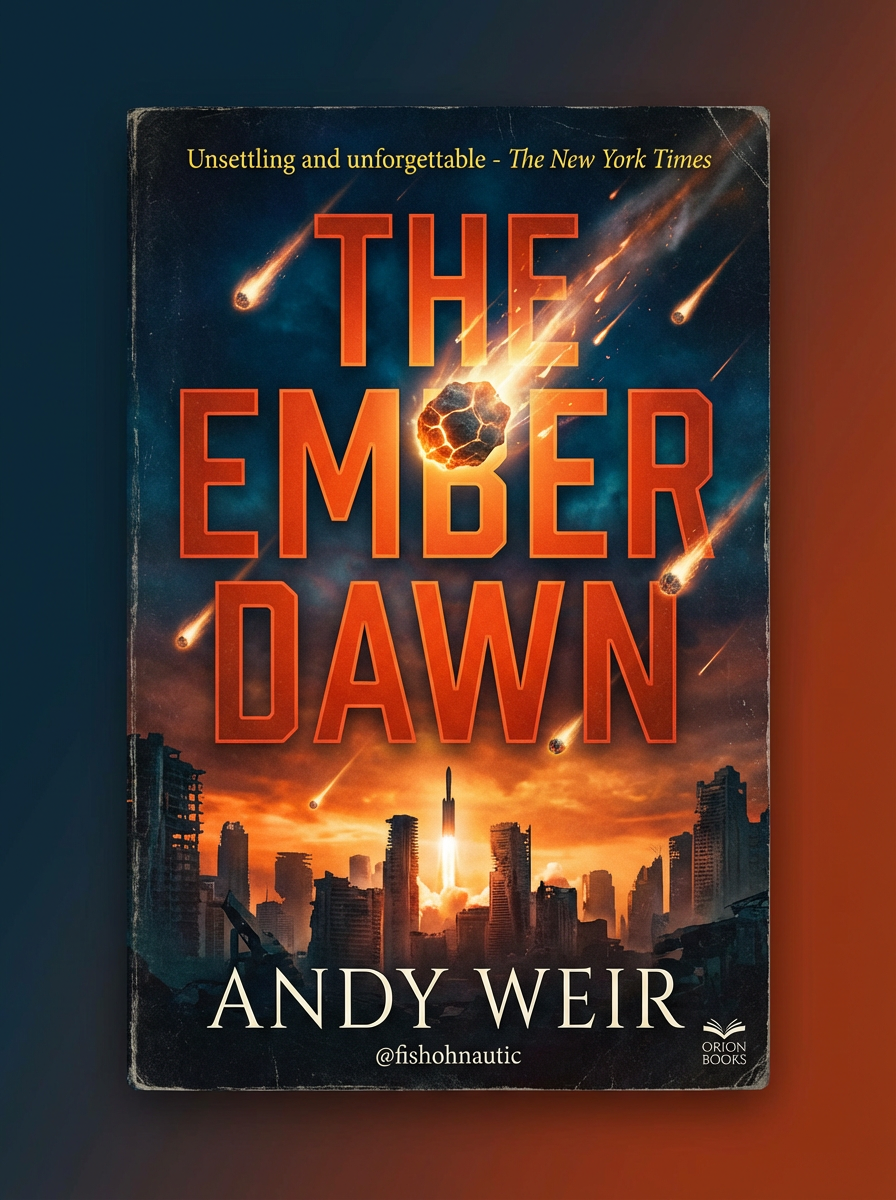
Synopsis
In a near-future Earth ravaged by self-inflicted climate catastrophe, two disillusioned friends uncover a government conspiracy: a thirty-year countdown to an apocalyptic meteor shower, concealed since 1998, with humanity’s only hope lying in a clandestine off-world exodus for a select few. As the g
Chapter 1: The Grey Drip
The year 2048 was a monochrome canvas, perpetually streaked with the grey drip. Neo-London, once a vibrant artery of commerce and culture, now resembled a blighted monument to a forgotten ambition. The sky, a permanent bruise of industrial cloud cover, wept an incessant, corrosive drizzle that etched scars onto every surface. Ethan, hunched against the sting of the acid rain, pulled his government-issue raincoat tighter. The synthetic fabric, designed to repel the chemical assault, felt thin and inadequate against the psychological weight of the city.
Each step he took on the cracked pavement was a testament to humanity’s relentless march towards its own decay. The infrastructure, once a source of pride, now resembled the skeletal remains of some colossal beast, its exposed rebarrusted like weeping wounds. Buildings leaned precariously, their upper floors swallowed by the perpetual gloom, their windows like vacant eyeballs staring out at nothing. The air itself was a palpable presence, thick with the metallic tang of pollution and the damp, earthy scent of slow degradation. No, not slow. Relentless.
Ethan’s journey to the Sector 7 archive facility was a familiar pilgrimage through the urban rot. The public transport system, a vestige of a more optimistic era, was unreliable at best, a metal coffin on rails at worst. So he walked, as most did, his head bowed, shoulders hunched, a silhouette against the perpetual twilight. The streetlights, when they flickered on, cast a sickly yellow glow that did little to dispel the gloom, merely highlighting the puddles of iridescent runoff that collected in every hollow.
He passed the skeletal remains of what was once a towering office block, now hollowed out, its interior a grotesque sculpture of twisted metal and shattered glass. In its shadow, a small encampment of the dispossessed huddled around a barrel fire, its smoke adding another faint plume to the already overburdened sky. Their faces, illuminated by the flickering embers, were gaunt and etched with a weariness that transcended mere physical fatigue. They were the visible evidence of the failure, the human cost scrawled across the landscape. Ethan averted his gaze, a familiar tremor of guilt coiling in his gut. He was a survivor, yes, but what exactly was he surviving for?
Once, Ethan had been an environmental engineer, a hopeful architect of a sustainable future. He’d meticulously designed systems to scrub the atmosphere, to purify the water, to reclaim the land. He’d believed in the ingenuity of humanity, in its capacity for course correction. The memory of that earnest young man felt like a phantom limb, a painful reminder of a world that no longer existed. His projects, like so many others, had been consumed by the encroaching desolation, swallowed by the sheer, overwhelming inertia of global apathy and corporate greed. Now, his days were spent performing routine maintenance on the city’s decrepit filtration systems, a Sisyphean task that achieved little beyond delaying the inevitable.
He remembered the arguments, the desperate pleas of the scientific community in the early 2000s, warning of the impending cataclysm. The news cycles had been filled with dire predictions, with graphs and charts mapping a terrifying ascent of global temperatures, a dizzying spiral of species extinction. The response had been a collective shrug, a whisper of "not my problem," a blind faith in human exceptionalism. And now, they lived in the aftermath of that collective delusion, a monument to their own self-inflicted wounds. The grey drip was their penance, their perpetual reminder.
He rounded a corner, the familiar, acrid smell of ozone growing stronger. The Sector 7 archive was a brutalist concrete cube, unadorned and uninviting, a fortressof forgotten truths. Its perimeter was patrolled by silent, stoic Enforcers in their dark grey uniforms, their faces obscured by opaque visors. Their presence was a constant, low thrum of authority, a reminder that even in this ruin, the structures of control remained. They were the visible hand of the Ministry of Public Order, the unseen puppeteers pulling the strings of a decaying society.
To the public, the archives were a relic, a tomb of trivial data. Who cared about past weather patterns when the present was a constant struggle for breathable air and potable water? The official line, disseminated through the tightly controlled media, was that the archives were maintained for "historical context," a polite euphemism for "we have nowhere else to put this junk." But Ethan knew Anya. He knew her relentless curiosity, her stubborn refusal to accept the official narrative. She believed there were still answers to be found, even in the dusty corners of forgotten government facilities. He admired her tenacity, even as he questioned its utility. What good was knowledge when the world was already dead?
He gave his identity chip a swipe at the heavy, steel door. A dull red light flashed, then a click, and the door hissed open, revealing a short, sterile corridor. The air inside was cool, dry, and oddly devoid of the city’s pervasive stench. A stark contrast to the external desolation. Another security checkpoint, another silent Enforcer, another scan of his retinal patterns. The process was ritualistic, devoid of human interaction. The Enforcer’s gaze, or what he presumed was a gaze behind the visor, was impersonal, robotic. Just another cog in the vast, impersonal machine.
"Purpose of visit?" a synthesized voice, emotionless and flat, emanated from a wall speaker.
"Meeting Dr. Sharma," Ethan replied, his voice sounding hollow in the confined space.
"Identity verified. Proceed to Sector 3, Sub-level 4."
The directions were displayed on a small monitor embedded in the wall, a condescending arrow pointing him down a brightly lit corridor. The archive labyrinth was a bureaucratic masterpiece, designed to confuse and deter. Sub-level 4 was effectively the basement of the basement, a place where information was not merely stored, but buried.
As he walked, the silence of the archive pressed in on him. It was a different kind of quiet than the muffled hum of the city, a deeper, more profound stillness. Here, there was no wind, no distant rumble of failing machinery, no dripping rain. Only the faint, almost imperceptible whir of ventilation systems and the hum of countless data servers, eternally churning. It was the sound of information, vast and overwhelming, sitting dormant, waiting to be accessed, or perhaps, forgotten forever.
He found Anya in a small, cramped study cubicle, surrounded by screens displaying scrolling lines of ancient code and complex meteorological charts. The air in her cubicle was thick with the faint scent of old paper and the lingering aroma of lukewarm rehydrated coffee. She was a small woman, but her presence was immense, a vibrant spark in the gloom. Her dark hair was pulled back in a practical bun, a few rebellious strands escaping to frame a face that was perpetually animated, even in repose. Her eyes, usually sparkling with an almost childlike curiosity, were currently narrowed in concentration, flickering between the multiple data streams.
She wore the standard archive uniform, a nondescript grey jumpsuit, but had personalized it with a faded, almost invisible embroidery of a blooming flower on the breast pocket—a quiet act of defiance, a subtle declaration of hope in a hopeless world.
"Ethan," she said, without looking up, her voice a low murmur. "You’re late. The 3 o’clock atmospheric particulate report is due in fifteen minutes, and I’m still cross-referencing anomaly 7-gamma."
"Traffic was horrific," he lied, knowing that the journey had been as mundane and miserable as any other. He didn’t need to explain the existential weariness that made each step a struggle. She understood.
He slid into the seat opposite her, a worn plastic chair that creaked under his weight. On her desk, alongside the holographic displays, sat a small, battered metal box. He recognized it instantly. Her "memory box," she called it. Inside, she kept a handful of pre-Collapse relics: a smooth skipping stone, a faded photograph of a vibrant, green forest, a single, perfectly preserved seashell. Reminders of a world that was no more.
"Anomaly 7-gamma?" he asked, trying to summon a semblance of interest. He knew it was important to her.
She finally looked up, her gaze piercing, even through the fatigue. "It’s a persistent discrepancy, Ethan. A spike in stratospheric ozone depletion, unusually concentrated, occurring globally, between late 1998 and early 1999." She pointed to a glowing section on one of her screens. "The official reports from that era hand-waved it as a ‘brief, inexplicable fluctuation.’ But it wasn't brief, and it wasn't inexplicable. The data patterns are… distinct."
Ethan stifled a sigh. "Anya, how many times have we been over this? The official accounts, flawed as they are, are all we have. And after decades of environmental degradation, it’s all one giant anomaly now."
"That’s precisely the point, Ethan," she countered, her voice rising slightly, a hint of frustration lacing her tone. "They *are* all one giant anomaly. But there are still patterns within the chaos. And this one… this one feels orchestrated. Too clean. Too convenient."
She leaned forward, her elbows resting on the desk, her eyes bright with a spark of renewed curiosity. "I’ve been comparing the satellite imagery from that period with the atmospheric composition readings. There’s a strange confluence of data sets. A sudden, almost instantaneous drop in certain greenhouse gases, coupled with an increase in others, alongside this ozone anomaly. It's like… like something was being actively scrubbed from the atmosphere, while something else was being introduced."
Ethan rubbed his temples. "Active scrubbing technology in the late 90s? Anya, that’s… that’s beyond what was publicly available."
"Precisely," she said, a triumphant glint in her eyes. "Which means it was *not* public. It was clandestine. And why clandestine, unless they were hiding something? Something big."
He’d heard this before, her endless theories, her pursuit of forgotten truths. He admired her intellect, her relentless spirit, but he couldn’t shake the feeling of futility. What difference would it make now, discovering a hidden government project from fifty years ago? The world was already burning, albeit slowly, under the grey drip.
"And what do you hope to achieve, Anya?" he asked, his voice weary. "Even if you uncover some grand conspiracy of atmospheric manipulation from the last century, what then? Who will care? The Ministry will simply reclassify it as ‘national security historical data’ and lock it away. Or worse, declare you a subversive."
She flinched at the word "subversive," but her jaw remained set. "Knowing, Ethan. Sometimes, knowing is all we have left. And sometimes, knowing is the first step towards understanding how to prevent it from happening again."
"Prevent what from happening again?" he scoffed gently. "The collapse? It’s already happened, Anya. We’re living in its shadow."
"No," she insisted, shaking her head. "We’re living in its *consequences*. But the collapse itself was a process, not a singular event. And if parts of that process were accelerated, or even initiated by covert means… then we have a right to know."
Her passion was infectious, despite his cynicism. He remembered the vibrant, idealistic Anya from their university days, the girl who would spend hours debating ecological ethics, who truly believed in the power of knowledge to change the world. That girl still existed, buried beneath layers of resignation, but she flickered to life in moments like these.
"So, you think someone, back then, was actively engineering aspects of the climate to… what? Accelerate the collapse to some hidden agenda?" He tried to keep the sarcasm out of his voice, but it was a struggle. The idea, cloistered in the stale air of a forgotten archive, felt absurd.
"Not necessarily to accelerate it," she corrected, her brow furrowed in thought. "More like… to modify it. To guide it. Or perhaps… to test something." She gestured towards a different screen, where a complex simulation of atmospheric currents swirled. "Look at the prevailing wind patterns from that era. They’re being influenced. Not by natural forces. Not entirely."
He leaned closer, trying to see what she saw, but it was just a mass of swirling colors and data points to him. He was an engineer, practical and grounded in the tangible. She was a climatologist, capable of seeing intricate patterns in vast, abstract data sets.
"Test what, Anya?" he pressed.
She turned to him, her eyes wide, a strange mix of fear and excitement. "That’s what I haven’t figured out yet. But I’ve found something else. Something buried deep in the unclassified weather balloon data from that period. A subtle encoding. Almost imperceptible. Like a timestamp, or a marker."
She typed furiously, bringing up a series of numerical sequences. "These patterns, Ethan. They repeat. And they’re always linked to these atmospheric anomalies. It’s too specific to be random noise. I believe it’s a form of embedded communication. A hidden message, woven into the very fabric of the data."
Ethan felt a prickle of unease. He’d seen enough corporate and government obfuscation in his life to know that secrets often hid darker truths. But this felt different. This felt… vast.
"A message from whom? To whom?" he asked, his voice softer now, his cynicism giving way to a nascent curiosity.
"That’s the enigma," she admitted, leaning back, the fervor in her eyes cooling slightly. "But it's a code, I’m sure of it. And I’ve been trying to break it. I’ve run every known encryption algorithm, every historical cipher. Nothing." She sighed, running a hand through her hair. "It’s too sophisticated for anything I’ve encountered."
He looked at her, truly looked at her. Her youthful optimism had been eroded by the grim realities of their world, but her spirit remained unbroken. She was still fighting, even when everyone else had surrendered.
"Maybe it’s not a message for *us*," he mused, looking around at the silent, dead archives. "Maybe it was a message for… someone else. Or a marker for a future event."
Anya stiffened. She looked at him, her gaze suddenly intense. "A marker for a future event," she repeated, the words hanging in the air, heavy with unspoken implication.
The silence that followed was broken only by the hum of the servers and the distant, synthesized announcement of an expiring data session. Outside, the grey drip continued its relentless assault on Neo-London, washing away the remnants of a world that was, slowly but surely, disappearing. Anya's discovery, if true, was more than just a historical footnote. It was a tremor, a subtle shift in the decaying foundation of their understanding. And Ethan, despite his deep-seated disillusionment, felt a faint, almost imperceptible stir of something he hadn't felt in a very long time: a flicker of hope, or perhaps, a premonition of a profound and terrifying truth yet to be unveiled. The grey drip, it seemed, was not just washing away the past, but also concealing a future that was already, chillingly, predetermined.
Chapter 2: Subterranean Whispers
The air in the subterranean facility was a damp, metallic breath, smelling of ozone and forgotten time. Ethanol-laced fumes, remnants of cleaning solvents, stung Anya’s nostrils as she navigated the narrow corridors beneath the English countryside. This wasn’t a sleek, futuristic lab, but a relic, a testament to a bygone era of bureaucratic inefficiency and boundless optimism. The concrete walls, scarred with hairline cracks, sweated a fine patina of condensation. Fluorescent lights, flickering like dying embers, hummed a monotonous dirge, barely illuminating the peeling paint and disused equipment that lined the passageways.
“You’re late,” Anya stated, her voice echoing in the dead air as Ethan finally rounded a corner, his silhouette momentarily filling the weak light. She didn't turn from the ancient server rack she was hunched over, her fingers dancing across a keyboard, bathed in the sickly green glow of a monitor.
Ethan merely grunted, shaking a bead of water from his hair. “The Grey Drip’s particularly enthusiastic today. And the automated transport system decided to self-immolate near Piccadilly Circus.” He gestured to his damp, threadbare utility jacket. “Classic.”
Anya scoffed, a short, brittle sound. “Classic indeed. Humanity’s capacity for self-destruction never ceases to amaze.” She finally straightened, her slender frame a stark contrast to the hulking machinery around them. Her eyes, usually sharp and analytical, were shadowed with exhaustion, dark smudges beneath them speaking of too many sleepless nights. “Another initiative launched today, did you hear? ‘The Green Sprout Project.’ Plant a shrub, save the world. It’s almost comical in its futility.”
Ethan leaned against a defunct air filtration unit, its grimy filters a monument to past failures. “Comical is too kind. It’s an exercise in managed apathy. Give the plebs something to do, something to believe they’re contributing, while the real rot continues unabated.”
“Precisely.” Anya gestured vaguely at the labyrinth of wires and humming machinery. “I’m here, sifting through the digital detritus of a dead future, for what? To prove what we already know? That the data was always there, shouting at us, and we simply chose to deafen ourselves?” Her voice, usually calm and measured, held an edge of bitterness. “I present my findings, meticulous correlations of historical climate models with current atmospheric degradation, projections that paint a picture so bleak it would make a stoic weep, and what do I get? Funding cuts. A suggestion to ‘reframe the narrative’ for ‘public morale.’ As if morale matters when the oceans are boiling and the continent’s aflame.”
She ran a hand through her short, practical hair. “They want their token initiatives. Their ‘Sustainable Futures’ propaganda and their ‘Eco-Citizen’ awards. It’s a carefully orchestrated charade. A palliative for a terminal illness. And the public, bless their bewildered hearts, swallows it whole. They want to believe in the Green Sprout Project. They want to believe that by sorting their synthetic waste into five separate bins, they’re somehow staving off the inevitable.” Her laugh was humorless. “The sheer, monumental ego of humanity, to believe we can negotiate with thermodynamics.”
Ethan watched her, his own weariness mirrored in his eyes. He knew this frustration, felt it gnawing at his own gut every time he looked at the sky. He’d abandoned environmental engineering precisely because he’d become a glorified architect of greenwashing, designing solar arrays that barely powered a single data center while the global grid faltered. “So, what are you digging up in this overgrown mausoleum of data? More evidence of our collective idiocy?”
Anya turned back to the server. “More than that, perhaps. I’ve been wading through these archived servers, dating back to the late 20th century. Petabytes of raw meteorological data, geological surveys, atmospheric composition readings. It’s all here, meticulously recorded. The precise moment the curve started to bend irrevocably, the subtle shifts the algorithms picked up, long before the politicians decided to acknowledge the weather wasn’t just having a ‘bad year’.”
A faint *thrum* echoed from deeper within the facility, a low vibratory hum that seemed to resonate in their bones. This wasn’t the usual hum of the server racks, but something deeper, more resonant. Anya paused, her brow furrowed. “Did you hear that?”
Ethan nodded slowly. “What is this place, exactly? I thought it was just an old climate monitoring station.”
“It was, among other things,” Anya replied, her eyes scanning a digital schematic on her monitor. “Built in the late 1980s, during the Cold War. A bunker system, ostensibly for scientific research, but with layers of redundant systems, blast doors, and enough power generation to run a small city. Standard government paranoia of the era.” She tapped a finger on a highlighted section of the schematic. “This particular section is labeled ‘Advanced Climatological Modeling Unit 7-Gamma.’ Not exactly inspiring. But the infrastructure alone suggests a far greater importance than mere weather forecasting.”
She then pointed to a row of imposing, black server monoliths lining the far wall, distinct from the older, beige units she’d been working on. They pulsed with a soft, blue light, and emitted a faint, high-pitched whine that the other machines didn't. “And these… these are newer, somehow. Or at least, they contain drives that are. They’re isolated from the main network, running on their own closed system. And extremely well-shielded, physically and digitally.”
Ethan pushed off the air filtration unit, his curiosity piqued despite himself. “What’s on them?”
“That’s the maddening part,” Anya sighed, rubbing her temples. “I’ve found references to them in some ancillary logs. Entries from the late 1990s, mentioning ‘Project Ouroboros’ and ‘Celestial Impact Modeling.’ Vague, bureaucratic code that usually signifies nothing more than another overfunded, underperforming government boondoggle.” She leaned closer to the monitor, zooming in on a line of code. “But the security protocols for accessing these files are… excessive. Far beyond anything I’ve encountered for climate data, even proprietary models.”
Ethan peered over her shoulder, his former engineering mind recognizing the complexity of the digital locks depicted. “AES-512, layered with quantum encryption? For weather models? That’s… unprecedented. Unless they were modeling the weather on Mars.”
Anya gave a grim smile. “My thoughts exactly. It speaks of a classified project of immense sensitivity. And it’s not just the encryption. The physical security around these particular server units was equally absurd. Biometric locks, air-gapped from external networks, and a dedicated, redundant power supply independent of the main bunker. Layers of redundancy usually reserved for nuclear launch codes or the Crown Jewels.”
She brought up a fragmented log entry she’d managed to partially decrypt from a peripheral interface. The script was a relic, an ancient command-line interface that required a specific kind of digital archaeology to navigate. Characters scrolled rapidly across the screen, a language of zeros and ones that spoke of a different age.
`>>> ACCESS DENIED. CLEARANCE LEVEL 9 REQUIRED. INITIATING PROTOCOL: AEGIS.`
`>>> UNATHORIZED ACCESS DETECTED. LOG ENTRY RECORDED. ALERTING SECTION CHIEF K. VALERIUS.`
`>>> USER: ANYA.SHARMA@GOV.CLIM.SEC`
`>>> TIMESTAMP: 2048-03-14 03:17:22 UTC`
Anya tapped the screen with a frustrated sigh. “K. Valerius. The section chief’s name appears repeatedly. But there’s no record of a ‘K. Valerius’ holding any significant position in the climate division during the 1990s, or any other time for that matter. The name comes up most frequently in personnel files attached to ‘Special Projects Division (Advanced Threat Assessment).’ A division that was officially decommissioned in 2002.”
“Advanced Threat Assessment,” Ethan mused, a chill running down his spine despite the clammy air. The term itself felt like a relic, a whisper of old fears. “That sounds less like climate and more like… something else.”
“Precisely.” Anya’s voice was low, thoughtful. “And it’s the nature of these encrypted files themselves that is so intriguing. They’re huge. Enormous data packets, beyond anything required for even the most complex global climate simulations. And the file names… there are hundreds of them, all encrypted, but I’ve managed to glean some patterns from the metadata and partially corrupted headers.” She gestured to a list now displayed on the monitor.
`FILE_1998_CETUS_001.ENC` `FILE_1998_ORION_002.ENC` `FILE_1999_LYRA_003.ENC` `FILE_2000_PEGASUS_004.ENC` `FILE_2001_DRACO_005.ENC`
The list continued, constellations and years intertwined. “It’s a chronological sequence, tied to celestial objects. Why would climate models be cataloged this way? And why the continuous numbering, implying an ongoing, long-term data collection? We knew about orbital mechanics in the 90s. We could track celestial bodies. This is redundant.”
Ethan frowned. “Unless they weren't tracking familiar celestial bodies. Unless they were tracking… something new. Or something that wasn’t supposed to be public knowledge.” His mind, accustomed to the elegant simplicity of engineering, struggled with the implication. Climate science was one thing. Astronomy, especially heavily classified astronomy, was another entirely.
Anya pushed herself away from the console, pacing a small circle in the dimly lit space. The rhythmic hum of the servers filled the silence. “And the timeframe. Late 1990s. The cusp of the new millennium. A period of misplaced optimism, just before the undeniable signs of collapse began to manifest. Why bury such an elaborate, highly sensitive project then? If this was genuinely about climate, why not share the findings, however dire, with the scientific community? Why the need for such absolute secrecy?”
She stopped pacing, facing Ethan. Her eyes, usually so analytical, now held a glint of something akin to fear, or perhaps, dawning comprehension. “It goes against every principle of scientific inquiry. Knowledge dissemination is fundamental. Yet, these files are sealed tighter than a tomb. And for mundane climate modeling? It makes no logical sense. Unless…”
She trailed off, her gaze unfocused, as if piecing together an invisible puzzle. The implication, though unstated, hung heavy in the air. *Unless it wasn’t climate modeling at all.*
The *thrum* from deeper within the facility resonated again, stronger this time, almost a low growl. It was a rhythmic pulse, like a slow, deliberate heartbeat of something incomprehensible. Anya’s head snapped up, her senses on high alert.
“That’s new,” she whispered, not to Ethan, but to herself. “I haven’t heard that before. The facility is supposed to be dormant, except for emergency power to the main servers.”
She moved towards a heavy, reinforced door at the back of the server room. The door itself was a behemoth, made of thick, composite metal, sealed with multiple interlocking bolts. It looked like it hadn’t been opened in decades.
“Where does that lead?” Ethan asked, a prickle of unease unsettling his composure.
“Schematics suggest it’s an access tunnel to a deeper, more fortified section. ‘Level B-7,’ it’s labeled. Restricted access, even by this bunker’s standards. Which, given the Cold War paranoia, is saying something.” Anya ran her glove over the cold, metallic surface of the door. “I tried to access it before. The command console is completely offline. Bricked, as far as I can tell.” She frowned, her fingers brushing against a faint, almost invisible seam in the door frame. “But… it feels like there’s power now.”
Suddenly, with an audible *clunk*, a small, circular light above the door flickered green, then pulsed a soft, amber. A low, grinding sound emanated from within the door itself, the sound of ancient mechanisms stirring from a long slumber. Then, with a series of heavy *thuds*, the massive bolts began to retract, one by one, with agonizing slowness.
Anya and Ethan exchanged a look, their faces illuminated by the eerie glow. The air grew perceptibly colder, carrying with it a new, distinct scent: not ozone, or dust, but something metallic and sharp, like the smell of a freshly opened wound.
“What in God’s name is down there?” Ethan breathed, his hand instinctively going for the worn handle of his multi-tool, a useless gesture against whatever lay beyond that reinforced door.
The last bolt clicked back, and with a low hiss of displaced air, the heavy door began to swing inward, revealing a darkness so profound it seemed to absorb the meager light from the server room. From within that inky void, the rhythmic *thrum* intensified, a subterranean whisper that promised to reveal something far more terrifying than the gradual decay of their own world. It was a whisper of secrets kept, of truths buried not just in data, but deep beneath the earth itself, waiting for the opportune moment to resurface. And Anya, with her insatiable hunger for truth, found herself standing on the precipice of a revelation that would shatter whatever disillusioned certainty she held about humanity’s curated extinction. The mundane climate modeling data from the late 20th century, it was clearly not.
Chapter 3: The Ghost in the Machine
The air in Anya’s cluttered apartment tasted of old paper and the metallic tang of failing electrical systems. The ambient hum of the city’s decrepit power grid, a constant, low-frequency thrum, vibrated through the floorboards, a testament to the ever-present decay. Ethan, his fingers stained with the grime of forgotten circuits, traced the outline of an ancient data port on the side of Anya’s battered research terminal. His optimism, once a vibrant flame, had long since dwindled to a flicker, but the intricate dance of logic and code still held a perverse fascination. This was a language he understood, a refuge from the chaotic entropy of the world outside.
"This is…vintage," he murmured, his voice a low gravel. The terminal, a relic from the pre-Collapse era, boasted specifications that were laughable by contemporary standards, yet its antiquated architecture was precisely what shielded it from the more invasive network monitoring of the present day. "You really dug this out of a museum, didn't you?"
Anya, hunched over a pile of printouts that looked more like archaeological finds than scientific documents, grunted in response. Her face, usually sharp and focused, was etched with a fatigue that went beyond mere lack of sleep. "Desperate times, Ethan. The newer systems are too clean, too traceable. They’ve scrubbed everything that truly matters from them. This… this has the dirt still clinging to it." She gestured vaguely at the terminal. "It’s a ghost in the machine, almost, humming with forgotten anxieties."
Ethan set to work, the familiar rhythm of diagnostics a comfort. His tools, salvaged and meticulously maintained, gleamed dully under the single, flickering overhead bulb. For years, his hands had built models of sustainable infrastructure, utopian visions devoured by the relentless tide of public indifference and governmental inaction. Now, they were dissecting the digital remains of a forgotten past. The irony was not lost on him.
What followed were days indistinguishable from one another, a blur of lukewarm instant coffee, synthetic nutrient bars, and the ceaseless cascade of code across the terminal’s amber screen. The air grew thick with the smell of dust and the faint metallic scent of overworked electronics. Anya, with her encyclopedic knowledge of climate modeling and her relentless analytical mind, was the guide. Ethan, with his intimate understanding of network topologies and encryption protocols, was the surgeon.
"The files aren't just encrypted," Anya muttered one evening, her voice hoarse from lack of use. "They’re layered. And the outermost shell is… an old government standard, from before the big ‘consolidation’ of all public data. It’s almost designed to be ignored, to appear mundane."
Ethan nodded, his eyes fixed on the flow of hexadecimal digits. "A common tactic. Hide the extraordinary in plain sight, wrapped in the ordinary. Like a bomb in a bureaucrat's briefcase." His fingers flew across the keyboard, a phantom symphony of clicks and taps. He was navigating the labyrinth of a forgotten operating system, a digital fossil. "The problem isn't just breaking the encryption, Anya. It's understanding the architecture it was built on. It's like trying to translate an ancient language using a modern dictionary. The definitions don't quite align."
He delved into the digital intestines of the system, his mind constructing an intricate map of its archaic pathways. He recognized fragments of obsolete network protocols, defunct data compression algorithms – ghosts of a digital past that had long since been superseded. This wasn’t just a simple decryption; it was an act of digital archaeology. Each successful step felt like chipping away at layers of hardened earth, revealing fragile remnants of a lost civilization.
The first breakthrough came on the third day. Ethan let out a soft exclamation, a sound of triumph that was quickly swallowed by the oppressive silence of the apartment. A section of the encrypted data shimmered, then resolved into a series of dates and numerical sequences.
"What is it?" Anya demanded, her head snapping up from a discarded printout.
Ethan zoomed in, his brow furrowed. "It's… not climate data. At least, not in the way we understand it. These are… coordinates. And references. References to celestial bodies."
They spent another twenty-four hours in concentrated silence, the only sounds the whirring of the aging terminal and the occasional rustle of paper. Anya, who had initially dismissed the astronomical references as peripheral, grew increasingly agitated. Her fingers constantly ran through her already disheveled hair.
"This isn't just stray data, Ethan," she finally declared, pushing a stack of diagrams across the table. Her voice was taut, vibrating with a barely contained urgency. "These aren't random star charts. These are… trajectory predictions. Look at the velocities, the estimated masses. These aren't just observations. They’re projections. Predictions of *impact*."
Ethan, who had been struggling with a particularly stubborn layer of encryption, paused. The word "impact" hung in the air, a bell tolling a grim warning. He looked at the diagrams Anya had thrust before him. They were crudely drawn, hand-annotated, but unmistakably depicted celestial objects, their paths arcing towards a blue sphere. Earth.
"Impact of what?" he asked, his voice low.
Anya stared at the screen, her eyes wide with a dawning horror. "Comets. Asteroids. A significant celestial event. And look at the dates, Ethan. They begin in… 1998."
The revelation struck them with the force of a physical blow. 1998. That was decades before the first official warnings of irreversible climate change, decades before the Grey Drip began its relentless fall. What were scientists in 1998 doing tracking celestial impacts with such meticulous detail, under such extraordinary levels of secrecy?
The decryption process now took on a new, frantic pace. The mundane was gone, replaced by the utterly terrifying. As Ethan peeled back layer after layer of the digital onion, what emerged was not climate data, but a chilling narrative woven from astronomical observations, mathematical models, and stark, alphanumeric classifications.
They found more than just impact trajectories. They found Project files. Files bearing names like "Project Nightingale," "Project Exodus," and, most ominously, "Project Phoenix." These weren’t vague references; they were highly detailed dossiers, complete with budget allocations, personnel lists, and technological schematics.
"Nightingale," Anya read aloud, her voice a strained whisper as she scrolled through a recently decrypted document. "Preliminary studies into deep-space propulsion and cryo-stasis systems. Estimated operational capability: T-minus twenty-five years from initiation date."
"Initiation date being 1998?" Ethan muttered, his stomach churning. Everything was clicking into place with a horrifying precision.
Then came "Project Exodus." This file was even more comprehensive, outlining the construction of "self-sustaining orbital habitats" and "interstellar transport vessels." The scale of it was staggering, a monumental undertaking that dwarfed any publicly acknowledged government project. And the most damning detail: a meticulous, chillingly clinical selection criteria for potential "colonists." Expertise in zero-gravity agriculture, advanced robotics, genetic engineering. Not a single mention of climate resilience or ecological restoration. It was a list for *survival*, not salvation.
"They weren't trying to fix the Earth, Ethan," Anya said, her voice shaking with a cold fury. "They knew. In 1998. They knew about the meteor shower. And they decided then, then and there, that Earth was a lost cause. They didn't try to stop the climate collapse, because they knew something else was coming. Something irreversible. All the ecological efforts, the climate summits, the token initiatives—it was just a distraction. A performance."
Ethan felt a cold dread spread through him, a deeper, more profound chill than any Neo-London rainstorm could bring. The apathy, the futility, the public's disillusionment – it wasn't just a consequence of failed policies, but a carefully orchestrated illusion. Humanity had been lulled into a false sense of security, fed a narrative of slow ecological decline while a secret clock ticked down to a far more catastrophic end.
"Phoenix," Ethan murmured, his finger hovering over the final, encrypted file in the sequence. "What could be worse than Exodus?"
The decryption for Project Phoenix took longer, protected by a final, almost impenetrable layer of security. When it finally yielded, the contents were sparse but devastating. It wasn’t a plan for survival, but for obfuscation. It detailed protocols for data suppression, media manipulation, and population management – a comprehensive strategy to maintain social order and prevent widespread panic as the end drew near. It was about controlling the narrative, about managing the dying days of a species kept in blissful, or perhaps convenient, ignorance.
The silence that followed was suffocating, heavier than any silence Ethan had experienced in the desolate wastes of his dismantled career. The flickering bulb above them seemed to dim further, as if even the light itself recoiled from the implications of their discovery.
"Thirty years," Anya whispered, her voice barely audible. "Since 1998. A thirty-year countdown. We're in 2048. That means… that means it’s imminent, Ethan. The meteor shower."
The world, which had seemed to be slowly suffocating under the weight of its own ecological mistakes, now revealed itself as standing on the precipice of a sudden, violent demise. The climate catastrophe, the acid rain, the poisoned air – these were merely symptoms of a dying planet, a slow prelude to a far more abrupt and cosmic extinction.
Ethan looked at the screen, at the stark tables of data, the chillingly pragmatic plans. He saw the cold, calculated logic of those who had decided humanity's fate in secret conclaves, decades ago. They hadn't worried about the rising tides or the dwindling resources. They had worried about meteors. And their solution wasn't to save Earth, but to abandon it. To abandon *most* of it.
"They've known all along," he said, the words tasting like ash in his mouth. "All the suffering, all the despair. They let it happen. They even cultivated it, perhaps, to make us numb. To make us believe the slow death was the only death."
Anya slumped back in her chair, her face pale, the usual sharp intelligence in her eyes replaced by a terrifying emptiness. "The chosen few," she breathed, almost to herself. "A select population. A pristine ark, while billions drown in the grey drizzle, unaware of the actual apocalypse awaiting them beyond the clouds."
The ghost in the machine wasn't just a set of encrypted files. It was the specter of a secret history, a forgotten future, and a deliberate betrayal of monumental proportions. The truth wasn't about impending doom; it was about the profound, unforgivable lies that had paved the way for it. And now, armed with this knowledge, they were faced with a choice that dwarfed even the looming celestial downpour. To expose this truth, to ignite a desperate, perhaps futile, fight for survival, or to watch, in silent horror, as humanity marched blindfolded towards its predetermined, curated extinction. The question began to form, chilling and insistent, in the quiet, decaying room: Did life, truly, have a future beyond the impending celestial downpour? And if so, for whom?
Chapter 4: Project Exodus
Their weariness, a constant companion throughout the decryption process, was abruptly banished by the screen’s sudden burst of clarity. The monolithic text, once a disorienting cascade of encrypted gibberish, resolved into a stark, unambiguous declaration: **PROJECT EXODUS**.
Ethan leaned closer, the faint hum of the outdated server rack a counterpoint to the thunderous silence in his own ears. Anya, her face illuminated by the sickly glow of the monitor, seemed to hold her breath, a porcelain statue carved from disbelief.
Below the project title, a date flickered: **INITIATED: SEPTEMBER 12, 1998.**
"Ninety-eight," Anya whispered, the word barely audible. "Why 1998?"
Ethan scrolled down, his fingers trembling slightly. The document was a chillingly bureaucratic masterpiece, a testament to the cold, clinical efficiency of an apocalypse carefully managed. It detailed a scenario so devastating, so utterly unthinkable, that its very existence seemed to warp the fabric of their reality.
**THREAT ASSESSMENT: KUDU METEOR SHOWER. ESTIMATED DATE OF IMPACT: AUGUST 24, 2028.**
Ethan stopped scrolling. Twenty-twenty-eight. That date had passed, two decades ago. Had they somehow missed the cataclysm? Was this some elaborate, forgotten contingency plan for a threat that never materialized? The acidic rain beating against the derelict facility’s roof seemed to mock his fleeting hope. No, this was not a relic of a averted disaster.
He continued reading, a cold knot tightening in his stomach.
**RE-EVALUATION AND CORRECTION: KUDU METEOR SHOWER. TRAJECTORY INTERPRETATION ERROR. IMPACT EVENT WINDOW EXTENDED. REVISED ESTIMATED DATE OF IMPACT: AUG 24, 2078.**
Anya gasped, a sharp, involuntary sound that was instantly swallowed by the echoing silence of the subterranean chamber. Their current year was 2048. Thirty years. Thirty years until the Kudu Meteor Shower rendered the planet uninhabitable. The timeline, once baffling, now slotted into place with horrific precision. The thirty-year countdown. Not for their generation, but for their children’s. For a species blissfully ignorant.
"They knew," Anya breathed, her voice a ragged whisper. "They knew all along."
The document went on to describe the Kudu Meteor Shower in clinical, detached language that only amplified its terror. It wasn’t a single impact event, but a sustained bombardment, a celestial hail storm of unprecedented scale and duration. Atmospheric collapse. Global sterilization. An Extinction-Level Event, a phrase previously confined to sensationalist documentaries, now laid bare as a meticulously calculated certainty.
**PROJECT GOAL: CONSTRUCTION OF INTERSTELLAR ARK 'HOPE' (H-01). PRIMARY OBJECTIVE: PRESERVATION OF HUMAN GENETIC DIVERSITY AND RE-ESTABLISHMENT OF TERRESTRIAL LIFE ON CLASS M EXOPLANET designated 'EDEN-7'.**
"Eden-7," Ethan murmured, the name a bitter irony. A new paradise, built on the ashes of the old. But for whom? The answer was not long in coming.
**SELECTION CRITERIA FOR ARK PERSONNEL (ASPIRANT SURVIVOR POPULATION):**
The list unfurled with a chilling logic, a blueprint for a designer humanity. * **Genetic Viability:** Absence of known hereditary diseases, strong immune system markers. * **Reproductive Fitness:** Demonstrated fertility, optimal age range (25-40 years for females, 30-45 for males). * **Psychological Resilience:** High stress tolerance, adaptability, low propensity for social discord. Extensive psychiatric evaluation required. * **Specialized Skillsets:** Priority given to individuals proficient in astrophysics, bio-engineering, terraforming, sustainable agriculture, and critical infrastructure maintenance. Artistic and philosophical disciplines deemed non-essential for initial colonization phase.
"Non-essential," Anya repeated, a bitter laugh escaping her lips. "So, no poets, no musicians, no philosophers. Just cogs in the machinery of survival." Her gaze drifted to the stack of forgotten books in the corner, ancient tomes of poetry and history, accumulating dust. "What kind of humanity are they saving?"
The files continued, revealing the colossal scale of Project Exodus. The construction of the Ark, a self-sustaining cylindrical vessel several kilometers in length, had been initiated in secrecy within a vast, subterranean complex beneath the desolate plains of the Australian outback. Financing, the document obliquely stated, was drawn from "diverted global defense budgets and privately endowed trusts." The opaqueness spoke volumes.
The secrecy itself was a masterpiece of deception. The public, placated by meaningless climate summits and the illusory promise of green technology, had been fed a steady diet of optimistic rhetoric while the true fate of the planet was meticulously concealed. The "Grey Drip," the acid rain, the perpetual twilight – these were not unforeseen consequences, but the predictable erosion of a world deliberately allowed to wither, a perfect smokescreen for humanity's quiet abandonment.
"They just let it happen," Ethan said, his voice flat, devoid of emotion. He felt a profound hollowness, a sense of betrayal so vast it dwarfed even the looming cataclysm. "They knowingly let the planet die while building themselves an escape hatch."
Anya slumped into the nearby chair, her fingers running through her disheveled hair. "It's worse than that, Ethan. This implies a level of coordinated deception, a global conspiracy, stretching back decades.” She pounded a fist softly on the metallic desktop. "All those climate reports, the dissenting scientists, the calls for radical action – they weren't ignored because of incompetence or greed. They were ignored because a chosen few already had their exit strategy."
The files detailed the intricate web of protocols enacted to maintain the secrecy: compartmentalized operations, misinformation campaigns, the deliberate discrediting of whistleblowers, and the slow, insidious erosion of public trust in any institution that might expose the truth. The environmental collapse, in effect, served as a global anesthetic, a distraction from the true suffering yet to come.
"Think about it, Ethan," Anya continued, her voice gaining a desperate urgency. "The perpetual twilight. The scarcity. The manufactured despair. It all serves a purpose. It keeps the masses docile, too preoccupied with survival to question the grander narrative."
Ethan nodded, a grim understanding settling over him. He remembered the government-sponsored PSAs from his youth, peddling a facile optimism that even then had felt hollow. "A curated extinction," he murmured, recalling a phrase he’d once dismissed as cynical hyperbole. Now, it was revealed as the chillingly precise term for their predicament.
Further sections of the document outlined the "psychological conditioning protocols" for the selected Ark personnel, designed to foster absolute loyalty to Project Exodus and its objectives. "Emotional detachment from terrestrial attachments" was a recurring theme. The idea was to create a society of practical, unemotional pioneers, devoid of the sentimental baggage of a dying world.
Another section detailed the fate of the "non-designated population." The very phrase was dehumanizing, a bureaucratic euphemism for everyone else. No plan for their survival was outlined, only a tacit acceptance of their inevitable demise. "Resources allocated to essential personnel only." The cold-blooded efficiency was a profound shock.
"They're going to leave us all behind," Anya whispered, the horror truly sinking in. "They're going to watch us burn."
Ethan scrolled to the very end of the primary document. A series of appendices were listed, detailing construction schedules, resource acquisition, and astronomical data. One particular appendix caught his eye: **APPENDIX D-7: OPERATIONAL SECURITY AND INFORMATION CONTAINMENT (OSIC) PROTOCOLS.**
Clicking on it, he found a network diagram so complex it resembled a pulsating, digital nervous system. It mapped out the redundant security measures, "dead man" switches, and automated deletion routines designed to obliterate any trace of Project Exodus if compromised.
"This is designed to vanish," Ethan said, pointing at the glowing lines of code. "If anyone ever got this far, the system would purge itself. The fact it's still here… it means something went wrong with their fail-safe."
Anya's eyes widened. "The facility we're in… it was designed for climate data, not interstellar evacuation plans. Perhaps this was a remote backup, a temporary store that was forgotten in the chaos, and the OSIC protocols never reached it."
It was a plausible explanation, one that spoke to the inherent fallibility even in the most meticulously planned conspiracies. A single forgotten server, a tiny digital oversight, now held the fate of humanity in its rusty circuits.
As they absorbed the magnitude of the revelation, the implications began to swirl around them like a toxic fog. This wasn't just a government failing; it was a deliberate act of planetary abandonment, an orchestrated betrayal on a scale previously unimaginable.
Ethan leaned back, running a hand over his face. He thought of the Grey Drip outside, the perpetual gloom, the hunger in people’s eyes. He thought of the endless promises of new "carbon-capture technologies" and "geo-engineering solutions" that never materialized, always just out of reach. Now he understood. They were never meant to materialize. They were distractions, lullabies sung to a dying species.
"What do we do?" Anya’s voice was barely a whisper, laden with a despair that mirrored his own. Her usual scientific detachment had shattered, replaced by raw desolation.
The question hung in the stale air, gravid with impossible weight. The truth, once a burning desire, was now a searing burden. To expose it would ignite a global panic of unimaginable proportions, potentially leading to chaos that would rival the meteor shower itself. The world, already teetering on the brink, would collapse into a brutal, cannibalistic frenzy.
But to remain silent, to allow humanity to march blindly towards its pre-ordained extinction, was an act of complicity equally abhorrent. It would be to endorse the judgment rendered by the architects of Project Exodus: that the majority were expendable, mere biological flotsam to be washed away by the celestial tide.
Ethan stared at the glowing text on the screen: **EDEN-7**. A new world. But for whom? And at what cost? The silence in the cavernous chamber was deafening, amplified by the distant, rhythmic drumming of the acid rain. They had unearthed not merely a secret, but a moral abyss. The ghosts of 1998 had reached across the decades, gripping them now in an inescapable, terrible embrace. The choice was not merely one of action versus inaction, but of igniting a desperate, perhaps futile, fight for the masses, or witnessing humanity’s curated demise, questioning if life truly had a future beyond the impending celestial downpour. The burden of this knowledge was a crushing weight, heavier than any meteor.
Chapter 5: The Architects of Silence
The air in Anya’s hidden laboratory, typically recycled and meticulously filtered, now felt thick with an invisible dust of revelation, clinging to the lungs and thoughts. Ethan, hunched over a holoscreen displaying a network of interconnected data nodes, had the strained, bloodshot eyes of a man who had stared too long into an abyss. Anya, her movements precise even in their weariness, brewed another pot of recycled nutrient paste, its metallic aroma a poor substitute for the sustenance their minds craved.
“The sheer audacity,” Anya murmured, more to herself than to Ethan, stirring the grey gruel. “To plan this, to execute it for decades, right under our noses.”
Ethan didn't respond immediately. His fingers danced across the holographic interface, tracing lines of encrypted communication, unearthing financial records that stretched back to the late 20th century. “Audacity is too small a word, Anya. This is… a global cathedral built on lies. And the architects aren't just sitting in Washington.”
The initial shock of Project Exodus had been the meteor shower itself, the monstrous, unavoidable celestial truth. But as they burrowed deeper, the real horror began to unfurl: the intricate, meticulously woven web of human deceit. The files didn't just reveal a secret space program; they exposed a deliberate, worldwide orchestration of ignorance.
“The US government was the crucible,” Ethan explained, his voice hoarse, pointing to a swirling data visualization. “The initial funding, the legal framework, the intelligence compartmentalization – all spearheaded from Langley, ostensibly as a ‘deep space exploration initiative’ to bypass public scrutiny. But look here.” He highlighted a series of transactions, coded in obsolete digital currencies and routed through shell corporations based in tax havens that had since been swallowed by the encroaching ocean. “The money trail quickly branches. London. Frankfurt. Tokyo. Beijing.”
Anya’s spoon clattered against the ceramic bowl. “A global consortium.”
“Not just governments, Anya,” Ethan corrected, expanding the visualization. “These are corporations. Energy conglomerates that thrived on fossil fuels. Biotech firms that patented the very air we breathed. Pharmaceutical giants that profited from managing the symptoms of a dying world. Mining corporations that stripped the Earth bare even as they funded the construction of the ark.”
He zoomed in on a particularly sprawling node. 'OmniCorp Global Holdings.' The name was almost a parody, a textbook villain from a forgotten sci-fi film. Yet, OmniCorp was horrifyingly real. They had their fingers in every pie – deep-sea mining, atmospheric terraforming projects that were now universally acknowledged failures, even the production of the nutrient paste they were currently consuming.
“OmniCorp,” Anya said, the name tasting like ash. “They own half the infrastructure in the Neo-States. And they’re heavily invested in the ‘climate mitigation’ industry.”
“Exactly,” Ethan affirmed, leaning back, the holographic light casting stark shadows on his gaunt features. “They weren’t just complicit; they were instrumental. Project Exodus wasn't just a government initiative; it was a private enterprise masquerading as one, funded by a global cabal of the obscenely rich and the politically powerful. The same individuals and entities who preached carbon neutrality and sustainable development were simultaneously building their escape vessel.”
The implications were chilling. For decades, humanity had been fed a narrative of valiant struggle against an environmental catastrophe of its own making. The perpetual grey skies, the acid rains, the rising sea levels – these were the consequences of unchecked capitalism, they were told, and only through collective effort and technological innovation could humanity reverse the tide. This narrative, they now understood, was a meticulously crafted diversion.
“The climate crisis,” Anya whispered, a dawning horror stealing the usual cynicism from her voice. “It wasn't the *primary* threat. It was a *secondary* catastrophe, expertly managed to obscure the *true* one.”
Ethan nodded grimly. “It was the perfect smokescreen. The world was already grappling with a very real, very terrifying problem. Resources were scarce. Public attention was fragmented. Fear was an ever-present hum. What better way to hide the inevitable destruction of the planet than to have everyone focused on a slower, supposedly remediable decline?”
He brought up a series of archived news feeds, dating back to the early 2000s. Headlines blared about receding glaciers, extreme weather events, and the urgent need for international cooperation. Interspersed with these were articles subtly promoting the burgeoning industries of climate adaptation: sea walls, drought-resistant crops, new energy solutions. OmniCorp was prominently featured in many of these narratives, presented as a visionary leader in sustainable development.
“They didn’t just let the climate worsen, Anya,” Ethan said, his voice flat with disbelief. “They *encouraged* it, or at least strategically neglected opportunities to truly reverse it. Every initiative, every protocol, every international agreement that favored incremental change over radical overhaul – it all served to keep the population focused on managing the crisis, not solving it.”
Anya looked at the processed nutrient paste in her bowl, suddenly nauseated. “All those years… the countless conferences, the impassioned speeches, the grassroots movements… All of it, a meticulously choreographed distraction.”
“A global disinformation campaign of unprecedented scale,” Ethan confirmed. “They knew in 1998. They had the data. They calculated the trajectories, mapped the meteor swarm, understood the impact. And instead of sounding the alarm, they launched Project Exodus and, simultaneously, Project Aesop.”
A new file glowed on the holoscreen: 'Project Aesop.' Its contents were a chilling blueprint for manipulating global perception. It detailed strategies for shaping public discourse around climate change, emphasizing the complexity of the issue, the need for gradual solutions, and the dangers of alarmism. It outlined methods for discrediting dissenting scientists who might stumble upon anomalous astronomical data, framing them as fringe conspiracists or fear-mongers.
“They even had protocols,” Ethan read aloud, his finger tracing a paragraph in the file, “for managing ‘ecological refugees’ and ‘climate dissenters.’ The camps, Anya. The ‘re-education’ initiatives disguised as agricultural work programs. They weren’t just about control; they were about minimizing potential vectors for revelation.”
The weight of this truth was almost unbearable. Every protest march Ethan had ever joined, every petition Anya had signed, every hour spent analyzing environmental data to find solutions – it had all been rendered meaningless by a secret cabal working toward a different endgame. Their efforts, and the efforts of millions like them, had been unwittingly co-opted into a grand illusion, a theatrical performance designed to keep the masses docile while a chosen few built their escape craft.
“The public was deliberately kept ignorant of the true nature of the threat,” Anya articulated, trying to compartmentalize the horror, to process it with scientific detachment, but failing. “They were given a manageable enemy – themselves, their consumption, their waste – to fight, while the real, unmanageable enemy approached from the stars.”
“And it wasn’t just about hiding the meteor shower,” Ethan added, pulling up a section of Project Aesop that detailed communication protocols. “It was about cultivating an atmosphere of resignation. The constant drip-feed of environmental catastrophe porn, the endless debates about carbon footprints, the portrayal of humanity as inherently destructive – it all served to diminish hope, to make the idea of universal survival seem utopian and naive. By the time the meteor shower hits, the prevailing sentiment will be a grim acceptance, a general sense that humanity had it coming.”
Anya gripped the edge of the console. “They engineered despair. They weaponized apathy.”
“Precisely. Their intention was never to save humanity; it was to save *themselves*. And to do that, they needed silence. The silence of resignation, the silence of ignorance, the silence of a species too busy arguing about carbon taxes to look up at the sky.”
He scrolled further down through Project Aesop, revealing schematics for global surveillance networks that dwarfed anything the popular imagination had ever conceived. Data harvesting on a planetary scale. Predictive algorithms designed to identify individuals and groups likely to deviate from the carefully constructed narrative. The internet, once hailed as a tool for liberation, had been weaponized into the most efficient propaganda and control mechanism in history.
“Every ‘smart city’ initiative, every ‘integrated citizen network’ – it was all dual-purpose,” Ethan explained, disgust coloring his voice. “Ostensibly for efficiency and public safety, but primarily for monitoring dissent, for tracking anomalies, for preempting any organized resistance or accidental discovery.”
Anya remembered the increasingly stringent data privacy laws, the constant updates to digital security protocols that felt less about protecting individuals and more about controlling information flow. It all made a horrifying kind of sense now.
“So, they’ve also been curating the exodus population,” Anya deduced, the realization hitting her with sickening force. “It’s not just about space and resources. It’s about genetic diversity, yes, but also about *mindset*. Who gets to go? Who is deemed worthy of carrying humanity forward?”
Ethan pulled up another database, cross-referencing Project Exodus personnel files with Project Aesop’s psychosocial profiles. “The criteria are explicit: genetic viability, high cognitive function, demonstrable loyalty to the ‘continuity of civilization’ – which, effectively, means loyalty to *them*. And, of course, the ability to contribute to a closed, self-sustaining society. Scientists, engineers, doctors, agricultural experts… all vetted, all brainwashed, all primed to accept their narrative.”
He paused, his eyes fixed on a specific entry. “And children, Anya. A significant number of infants and young children, selected for their genetic potential and, crucially, their malleability. They’ll be raised without any knowledge of Earth’s true fate, fed the story of a glorious mission, a selfless escape from a planet that had simply run its course.”
The image of generations of children, born into a lie, living a curated existence in the void, severed from their true history, was perhaps the cruellest revelation yet.
“They are not just the architects of silence,” Anya murmured, her voice barely a whisper, the last vestiges of her scientific detachment crumbling. “They are the architects of a new humanity, built on the ashes of the old, with a foundation of deceit.”
The weight of their discovery settled upon them, heavy and suffocating. They weren't just confronting a secret space program; they were staring into the heart of a global conspiracy that had redefined truth, manufactured consent, and orchestrated the quiet demise of billions. The grey drip outside, the perpetual gloom, the crumbling infrastructure – these weren't just the symptoms of climate collapse; they were the meticulously placed stage props for the greatest deception in human history.
Ethan finally pushed away from the console, rubbing his tired eyes. “The question, Anya, is what do we do with this truth? We have spent years believing we were fighting for a future that was never meant for us. Now we know, we are mere spectators in a carefully planned extinction event, curated by the very people who claimed to be leading us out of the darkness.”
Anya looked at the nutrient paste, then at the desolate cityscape outside their reinforced window, bathed in the perpetual twilight of Neo-London. The answer, she knew, would not be found in data or code, but in the depths of their own ravaged humanity. The silence they had uncovered was not impenetrable. It was a hollow construct, and they now held the key to its shattering. But what would be the cost of that liberation? And was humanity, so long lulled into manufactured apathy, even capable of hearing the truth, let alone fighting for it? The architects of silence had done their work well. The challenge now was to undo decades of carefully constructed oblivion, before the celestial downpour washed away all chances for a future, for anyone.
Chapter 6: The Weight of Knowledge
The knowledge settled upon them, a leaden cloak stifling breath and thought. The sterile glow of the data terminal, illuminating the grim hieroglyphs of history, became a funereal pyre for their remaining illusions. It was worse than they had imagined, worse than any dystopic fantasy they had ever entertained in the quiet hours of their despair. This wasn't merely neglect; it was a curated oblivion, a thirty-year fabrication designed to usher billions into a planetary tomb while a chosen few slipped away into the cold, indifferent void.
Ethan leaned back, the cheap plastic of the chair groaning in protest, mimicking the sound of his own defeated spirit. His gaze, vacant and unfocused, fixed on a spot on the far wall, as if seeking an answer in the peeling paint. The numbers, the dates, the cold, clinical assessment of Earth’s impending demise – they hadn’t just read them; they had absorbed them, every syllable, every digit, tattooing themselves onto the rawest parts of their consciousness.
"Thirty years," he rasped, the words tasting like ash. "Thirty. Since ninety-eight. They knew." The emphasis on 'they' was chilling, imbued with a venom he rarely allowed himself. It was a condemnation of an entire generation of powerful men and women, of institutions that had ostensibly existed to protect, to guide. Instead, they had presided over a grand deception, a silent slaughter.
Anya, who usually met every challenge with a defiant intellectual fury, sat utterly still, her hands clasped so tightly on the old keyboard that her knuckles were white, bloodless knots. The light from the screen cast harsh shadows on her face, deepening the lines of exhaustion that had etched themselves around her eyes over the years. But tonight, that exhaustion had mutated into something else – a profound, soul-rending grief.
"All of it," she murmured, her voice barely a whisper, a stark contrast to the usual crispness of her tone. "The reports, the warnings, the endless debates over CO2 levels, the carbon credits, the green initiatives, the public awareness campaigns, the climate summits where nothing was ever truly decided beyond another hollow pledge… it was all a distraction. A grotesque charade."
Her shoulders slumped, a surrender she rarely displayed. Ethan watched her, feeling a reciprocal ache in his own chest. He had seen Anya enraged, frustrated, heartbroken by humanity's inertia. But he had never seen her broken. Not like this.
He thought of the long hours, the meager grants, the derision from politicians and the apathy from the public, as she had tirelessly presented her models, her projections, her increasingly desperate pleas for action against the climate crisis. He remembered her face when her research had been dismissed as alarmist, when her warnings had been drowned out by the clamor of economic interests and political opportunism. And all along, beneath the veneer of concern, beneath the performative hand-wringing, the true arbiters of power had known. They had known there was no reversing the tide, no mitigating the damage, because the real threat wasn’t slowly cooking the planet; it was hurtling towards it at unimaginable speeds from the vacant expanse of space.
"My entire career," Anya continued, her voice catching, "my life's work… it was all secondary. A necessary fiction to keep the herd docile while the true shepherds prepared their escape." She raised her head, and her eyes, usually so sharp and analytical, were filled with a raw, primal hurt. "Every time I spoke, every time I presented a paper, every time I argued with some government bureaucrat about funding for predictive modelling, they were laughing. Or worse, they were pitying me, the earnest scientist, tilting at windmills when the real dragon was already in the sky."
The futility of it all was suffocating. Every protest march Ethan had joined, every article he had written, every system he had designed in his brief, hopeful career as an environmental engineer, felt like a cruel joke. He had believed in the fight, in the possibility of turning the tide, however slim. He had poured his intellect, his passion, into delaying a disaster they were now told was merely a symptom, a convenient alibi, for an even greater, utterly unavoidable one. What was the point of preserving a climate that was destined for pulverization?
"And the others," Ethan said, thinking aloud, his voice flat. "The ones who pushed the climate narratives, the figureheads, the well-meaning scientists… were they complicit? Or were they just as much a part of the illusion?"
Anya shook her head slowly. "Some, perhaps, at the very highest echelons, must have been aware enough to play their part. But most? No. They truly believed. They were us, Ethan. Just on a grander stage, with more robust funding, and ultimately, even more effective in their unwitting deception. The beauty of the system, from their perspective, was its self-perpetuating nature. The public’s apathy, stoked by conflicting narratives and economic anxieties, did most of the work. The genuine fear of climate catastrophe served as an excellent blind, keeping eyes averted from the real horizon."
The irony was a bitter taste in his mouth. Humanity, so adept at self-destruction, so singularly brilliant at creating its own nightmares, had unwittingly collaborated in its own misdirection. The climate catastrophe, the "Great Slow Burn" as the journalists called it, was still very real, still claiming lives, still making swathes of the planet uninhabitable. But it was a side-show, a supporting act to the main event: the celestial hammer stroke that would wipe the slate clean.
"Project Exodus," Ethan whispered the name, letting it hang in the air like a phantom. "A Noah's Ark for the rich and the reproductively viable. A curated survival. A genetic lottery overseen by unseen hands." The sheer audacity of it, the cold, calculating cruelty of selecting who lives and who dies, based on some arbitrary calculus of genetic diversity and societal utility, was profoundly sickening.
He tried to imagine the conversation in 1998, the moment the decision was made. The sterile conference rooms, the hushed voices, the PowerPoint presentations detailing the statistical probability of extinction. And then, the pivot: not how to save everyone, but how to save *someone*. A small, select seed of humanity to carry the torch to a new, pristine world, while billions perished on the dying ember of this one. It was a god-like arrogance, a hubris that dwarfed any he had ever witnessed.
"They decided we weren't worth saving," Anya stated, her voice devoid of emotion, a dangerous calm settling over her. "Not the billions, at least. Resources too scarce, problem too large, solution too inconvenient. Better to cut the losses, preserve the ‘best’ specimens, and discard the rest. Like culling a herd when a disease runs rampant."
The raw, dehumanizing logic of it was an assault. They had been reduced to an inconvenient mass, an unfortunate statistic. All the dreams, the struggles, the joys and despairs of individual lives, rendered meaningless by a cosmic deadline and a bureaucratic decision made by people who considered themselves superior.
A fragile hope had always lingered within them, a subconscious belief that humanity, for all its flaws, possessed an intrinsic worth, a stubborn will to survive that, when truly tested, would rise to the occasion. That hope now flickered precariously, threatened by the icy winds of this newly revealed truth. If their leaders, the very architects of their societal structure, could contemplate and execute such a deception, what true hope remained for the species?
"What do we do with this, Anya?" Ethan finally asked, the question heavy with the weight of consequence. It wasn't just a revelation; it was an active bomb, ticking down to obliteration, with their fingers on the detonator.
Silence stretched between them, thick and suffocating. The air in the dusty server room felt suddenly colder, the hum of the ancient machines a morbid lullaby. The choices were stark, terrifying, and fraught with moral quicksand.
Expose the truth. Ignite a desperate fight for survival. But what would that even look like? Thirty years. Thirty years for a world already teetering on the brink of collapse, scarred by climate change, fractured by inequality, to unite against an unstoppable celestial force? The resources, the political will, the sheer logistical impossibility of saving billions, let alone diverting the meteor shower – it felt like a recipe for global panic, anarchy, and an even more horrific end. Would revealing the truth simply accelerate the descent into chaos, making the last three decades of humanity on Earth a living hell?
Or, silently observe humanity's slow march towards a curated extinction. Let the great deception continue. Let the billions live out their remaining years unaware of the cosmic guillotine awaiting them, clinging to their small hopes and dreams, believing their efforts against climate change truly mattered. Allow the chosen few, the "Exodus" passengers, to slip away, carrying the genetic torch to a new world. It was a utilitarian calculus, designed to avoid mass societal breakdown in the face of an impossible truth. But it was also a profound abandonment, a betrayal of unparalleled magnitude. Could they, knowing what they knew, become complicit in that grand silence?
The hope for humanity, already a dying ember in the ceaseless grey drip of their lives, now threatened to extinguish entirely. If intelligence, if foresight, if the power to avert disaster could lead to such a monstrous deception, if the survival of a few justified the abandonment of billions, then what was the inherent value of human life? Did life truly have a future beyond the impending celestial downpour, if the cost of that future was such an unforgivable moral compromise?
Ethan looked at Anya, her profile etched against the dim light, a symbol of everything he had once believed in – intellect, integrity, a fierce dedication to truth. He knew the question hanging in the air was too large, too profound, for an immediate answer. It was a question that would haunt their waking hours and invade their dreams, demanding an impossible choice.
He reached out, his hand hovering uncertainly, then gently clasped her shoulder. Her skin was cold under his palm. She didn't flinch, didn't acknowledge his touch, her gaze still fixed on some invisible point beyond the terminal. Her mind, he knew, was already running through the endless permutations of their grim options, weighing the impossible costs, confronting the abyss.
The weight of knowledge was a crushing burden, heavier than any meteor. It was the weight of knowing not just that the world was ending, but that it had been allowed to end, carefully, meticulously, by those who had promised to protect it. And now, that same crushing weight pressed down on them, demanding whether they would become another accomplice in the great, silent extinction. The Ember Dawn had truly begun, shrouded not in smoke and ash, but in the cold, hard vacuum of a universe indifferent to the choices of desperate men.
Chapter 7: Echoes of Dissent
The stale air in their makeshift sanctuary, once a bastion of desperate hope, now pressed in with the weight of an invisible hand. Anya, her face a mask of gaunt determination, hunched over a scavenged comm-terminal, her fingers dancing across the cracked keys with an almost feverish rhythm. Ethanol, a phantom limb of a cigarette clenched between his teeth, paced the cramped confines, the rhythmic squeak of his worn boots a counterpoint to the distant siren’s wail – a common melody in Neo-London, but one that now carried a new, chilling undertone.
“They’re blocking the conduits,” she muttered, her voice thin, brittle. “Every single one. The independent net-channels, the dark-web relays, even the old satellite feeds I thought were defunct.”
Ethan stopped, his silhouette momentarily filling the only window, a grimy square framing the perpetual twilight outside. “Is it a sweep? Standard protocols for…unattributed data bursts?” The words felt hollow, even as he spoke them. They both knew better.
Anya shook her head, a strand of dark hair falling across her brow, unnoticed. “No. This isn’t random interference. This is targeted. It’s…surgical. I’m sending a data packet, a minuscule burst, encrypted at multiple layers, disguised as an aggregated climate report for a forgotten fringe publication. It shouldn’t even register on the primary monitoring systems for anything other than junk traffic.”
She hit enter. The screen flickered, a momentary cascade of green code, then went dead. Not just the application, but the entire terminal.
Ethan knelt beside her, his hand briefly touching her shoulder. “Static burst?”
“No,” she whispered, her eyes wide, glistening with a mixture of fear and dawning comprehension. “It fried the motherboard. Not a system error. It was…a digital counter-strike. A weaponized data packet. They didn’t just block it, Ethan. They *retaliated*.”
A cold knot tightened in Ethan’s gut. The implication was stark: they weren’t just dealing with an abstract government. They were dealing with an entity that possessed intelligence, awareness, and the capacity to strike back with terrifying precision.
They tried again. And again. Each attempt, a meticulously crafted digital message – a fragment of the truth, a single data point from Project Exodus, an anonymous tip for an investigative journalist known for their resilience – met with the same, swift obliteration. Sometimes it was a hard shut-down, sometimes a system freeze, once even a phantom surge that blew Anya’s secondary comm-unit, leaving a smell of burnt plastic hanging in the air. Their digital footprint, once a ghost in the machine, was now a beacon, drawing the attention of an adversary they couldn't see, couldn't identify, but could acutely feel.
Days blurred into a monotonous cycle of frustration and mounting dread. Their supplies, once carefully rationed, dwindling. The constant hum of the city, once merely background noise, now felt like a living entity, its myriad sounds – the distant sirens, the rumbling trains beneath their feet, the muted conversations from the street below – imbued with the sinister possibility of surveillance.
“They’re watching us,” Ethan said one evening, his voice flat, devoid of inflection. He was staring at a faint shimmer on the grimy windowpane, a distortion in the reflection of their haggard faces. “The optical-grid sensors. They’ve been activated in this sector.”
Anya didn't have to ask how he knew. His years in urban infrastructure development, before the Grey Drip had extinguished his idealism, had given him an innate understanding of the city's hidden nervous system. He could feel its pulse, its faint twitches and anomalies.
“They installed them last night,” she confirmed, her fingers absently tracing the outline of a faded data-pad. She'd managed to salvage a few components, enough to rebuild a basic, isolated terminal, devoid of network capabilities. It was a digital dead-end, a mute testament to their growing isolation. “I saw the maintenance drones. Not the standard civ-ops. These were…faster. Sleeker. Too quiet.”
The silence that followed was thick with the weight of their predicament. They were in a cage, one constructed not of steel bars, but of unseen surveillance and digital suppression. Their ability to gather information, to verify new leads, was being systematically eroded. Their access to the outside world, save for the filtered narratives of the state-run infocasts, was gone.
“The local networks are saturated,” Anya continued, her voice low, as if afraid the very air might carry her words to unseen ears. “They’ve flooded the public bandwidth with…static. Irrelevant data. Entertainment loops. Distraction protocols. No one’s going to be looking for anomalous data bursts when they’re drowning in a sea of banality.”
It was psychological warfare, chillingly effective. The people, already dazed by the constant ecological crises and the numbing drip of state-sanctioned narratives, would never even realize they were being denied information. The truth, if they managed to broadcast it, would be drowned out by the manufactured noise, dismissed as another conspiracy theory from the fringes of a society already teetering on the brink of collapse.
Ethan remembered a conversation from years ago, with an old mentor, a grizzled journalist who had seen too many truths buried. “The greatest lie,” the man had said, “isn't just what they tell you. It's what they *don't* tell you, and then bury so deep under indifference that you forget it ever existed.”
That indifference was now their enemy.
Their attempts to go analogue were equally futile. Anya, drawing on old, forgotten protocols from her early scientific training, had tried to encode messages onto physical data-sticks. She’d intended to place them, disguised as everyday objects, in public data-drop points, hoping a curious stranger, or even a sympathetic academic, might stumble upon them.
“They’re scanning for anomalous electromagnetic signatures,” she reported after her third failed attempt to leave their sanctuary, her face pale beneath the grime. “Every data-drop point, every public terminal, even the recycling receptacles. They must have installed new filters. My encrypted stick, nestled within a discarded data-card—it triggered an alarm. Not a loud one. Just…a faint drone. Enough to make me back away.”
The net tightened. The outside world, once a vague landscape of oblivious masses, now felt like a hostile entity, its very infrastructure weaponized against them. Their pre-planned escape routes, meticulously charted through the maze of Neo-London's decaying underbelly, began to seem less viable. Each underpass, each forgotten service tunnel, felt imbued with an unseen presence.
One night, Ethan awoke to a faint, rhythmic tapping. He sat bolt upright in the darkness, his heart hammering against his ribs. Anya stirred beside him, her hand reaching for his, a silent question. The tapping persisted, subtle, almost imperceptible, coming from the old ventilation shaft in the corner of their room.
He crept towards it, his senses on high alert. The air vent, long since rusted shut, hummed faintly. He pressed his ear against it. Nothing. Just the usual creaks and groans of the derelict building settling around them. He frowned, convinced he hadn't imagined it.
“Did you hear that?” he whispered.
Anya nodded, her eyes wide in the gloom. “A repeating pattern. Three short, two long. Then silence. And then repeats.”
A code. A simple, basic Morse code sequence. But from whom? And what did it mean?
They spent the next hour, pressed to the vent, trying to decipher the message. It was slow, agonizing work, the rhythmic taps often swallowed by the city’s cacophony. Finally, Anya, her face illuminated by the dim glow of her revived data-pad, whispered the translated words.
“They are listening.”
Just three words. A confirmation of their deepest fear, delivered in a chillingly intimate fashion from an unseen interlocutor. It implied a network of surveillance far more pervasive than optical grids and digital firewalls. It suggested human ears, human agents, closer than they had imagined.
The next morning, the local food rations, delivered by automated drone, were late. Not significantly, just enough to cause a tremor of unease. When they finally arrived, the usual nutrient paste was replaced by a different brand, one known for its lower nutritional value and a distinct, metallic aftertaste. It was a subtle shift, but one that resonated with purpose. A minor inconvenience, designed to disrupt, to signal control.
“Psychological pressure,” Ethan murmured, pushing the unappetizing paste around his bowl. “They want us to feel their presence. To know they can manipulate even the most basic elements of our lives.”
Anya nodded, the dull glow of the data-pad illuminating her haggard features. “They’re isolating us, Ethan. Cutting off our lifelines, one by one. The information, the access, the trust… Soon, there’ll be nothing left but us, trapped in this room, with only the truth for company.”
The truth. The burden of it, once a catalyst for action, now felt like a lead weight, dragging them deeper into the mire. They had thought the conspiracy was confined to the architects of Project Exodus, the shadowy consortium of elites. But the systematic, almost sentient counter-strikes revealed a far more extensive network. This was not merely the suppression of a secret; it was the active, intelligent eradication of dissent.
“It’s not just the government,” Ethan stated, the realization cementing itself in his mind. “It’s something else. Something…larger. The precision, the speed, the advanced cyber-attacks… This level of coordination, across all sectors, digital and physical, suggests a unified command structure. One that transcends traditional agency boundaries.”
Anya looked up, her eyes wide, staring at him as if seeing him for the first time. “The architects of Project Exodus… They didn't just build an ark. They built a system of control. A global net, woven with threads of disinformation, surveillance, and digital suppression, designed to safeguard their secret, to ensure their escape, and to silence anyone who threatened it.”
The pieces clicked into place, forming a terrifying mosaic. The decades of climate obfuscation, the manufactured crises, the deliberate fostering of apathy – it wasn't just to divert attention from the meteor shower. It was to cultivate a population so distracted, so disillusioned, so utterly dependent on the state for even basic truths, that they would be incapable of resisting, incapable of believing, when the real truth finally surfaced. They were not just preserving a secret; they were cultivating a future of compliant, ignorant cattle, ready for the slaughter.
The world outside, with its crumbling infrastructure and acidic rain, was not merely a consequence of human failure; it was a deliberate stage, meticulously set. The environmental collapse, the incessant dread, the manufactured helplessness – all of it was a carefully orchestrated symphony of control, designed to extinguish any spark of rebellion, any glimmer of proactive resistance.
They were trapped in a narrative much grander and more sinister than they had ever imagined. Their attempt to expose the truth had not just stumbled upon a conspiracy; it had directly challenged the very foundation of this new, engineered reality. And the architects of that reality, the orchestrators of silence, were now fully aware of their presence.
The tapping from the ventilation shaft resumed later that night. This time, it was a longer, more complex sequence. Ethan and Anya, their eyes bleary from lack of sleep, painstakingly translated it.
"They have eyes everywhere. Trust no one. The city is a prison."
The message ended there, leaving them in the suffocating silence, the words echoing in their minds. The city, their home, had become a cage. And the bars, invisible and insidious, were closing in. They had set out to ignite a desperate fight for survival, but now, survival itself felt like a privilege slipping away, leaving them with only the echoes of their own dissent, fading into the crushing silence of a curated extinction.
Chapter 8: The Iron Curtain Descends
The hum of the antiquated server farm that had become their sanctuary now felt less like a drone of progress and more like a warning. The soft, rhythmic blink of indicator lights had morphed into watchful eyes, each pulse a silent tally of their transgressions. Ethan felt it first, a prickle at the back of his neck, a phantom whisper of surveillance that the city’s perpetual drizzle had always seemed to amplify. He’d noticed a particular utility van, unremarkable in its charcoal uniformity, parked in the same shadowed alley three days running, always just out of direct sight of their hidden access tunnel. A coincidence, he’d told himself, a relic of his former life, when every shadow held the potential for a new environmental hazard. But his former life had not involved deciphering state-sponsored extinction protocols.
Anya had dismissed his initial concerns, her mind still orbiting the grim calculations of Project Exodus. "Paranoia, Ethan. We've been locked in here for weeks. You're seeing patterns in the noise." But then her own peripheral vision betrayed her. A maintenance team, ostensibly repairing a water main on their street, lingered too long, their gazes sweeping over their building with an unnerving thoroughness. Then came the calls. Not to them directly, for their comms had been effectively severed, but to the few, isolated contacts they’d bravely reached out to. Ethan’s cousin, a reclusive botanist in rural Kent, reported a polite but persistent inquiry from government officials regarding Ethan’s whereabouts. A polite query, he’d said, about ecological restoration in the northern sectors. A lie so transparent it felt like an insult.
The quiet, insidious tightening of the net was far more chilling than any overt threat. There were no sirens, no battering rams. Their world simply began to shrink, to constrict, like a slow-motion collapse. Their access to the black market for rations, once a simple transaction, became a labyrinth of suspicion. Their regular contact, a grizzled old smuggler named Silas who dealt in salvaged tech and pre-Collapse foodstuffs, abruptly ghosted them. No explanation, no last word. Just absence, a void where reliable supply lines once hummed.
"They're not just watching us, Ethan," Anya said one evening, her voice a low murmur against the steady drip of acid rain against the skylight. She was hunched over a flickering monitor, a heat map of London’s surveillance grid projected before her. "They're watching everyone we've ever breathed near. Every digital footprint, every shared memory. They're mapping our social nebula, pruning the outer tendrils."
Ethan ran a hand through his damp hair, the grime of the city clinging to him like a second skin. "They're strangling us. A slow, systemic suffocation."
The decision to abandon their sanctuary, the place where the truth of Project Exodus had been painstakingly unearthed, was not made in a moment of frantic escape, but in the cold, logical light of inevitability. The server farm, with its labyrinthine corridors and decaying infrastructure, had once felt like an armored womb. Now, it was a trap, a single point of failure.
"We can't expose it from here," Anya stated, her eyes hard with a resolve born of desperation. "Not if they know exactly where 'here' is."
The evacuation was conducted with the quiet efficiency of ghosts. They stripped the server bays of their most vital data drives, the only tangible proof of the cosmic deception. Old, worn backpacks were filled with what little they possessed: a change of clothes, emergency rations, their makeshift communications equipment. They moved through the subterranean passages, the darkness a familiar friend, their headlamps casting fleeting, skeletal shadows on the damp concrete. Each step echoed the finality of their departure, the severing of their last tether to a semblance of normal existence.
Their exit into the perpetually twilight streets of Neo-London felt stark, even for a city accustomed to shadow. The air, thick with industrial effluvium and the metallic tang of acid rain, felt heavier, the city’s omnipresent drone more menacing. They saw them immediately: the two figures, nondescript in the urban gloom, positioned casually yet alertly near the abandoned access tunnel. Not G-Sec, not yet. These were lower-tier, the watchers, the information gatherers. Their very presence confirmed the gravity of their situation.
"Hold steady," Ethan whispered, pulling Anya into the deeper shadows of a crumbling tenement. "They haven't identified us. Not definitively."
They became phantoms, indistinguishable from the other anonymous figures that haunted the dilapidated cityscapes. Their first refuge was a disused water purification plant, a skeletal structure of twisted pipes and rusting vats. The air inside was thick with the scent of stagnant water and ozone, a testament to its abandonment. They slept fitfully on cold metal grating, the distant rumble of the city’s decaying infrastructure their only lullaby.
The days that followed blurred into a grim tableau of constant evasion and a gnawing sense of isolation. They moved through the forgotten arteries of Neo-London: abandoned subway tunnels, disused sewer systems, the forgotten basements of condemned buildings. Their faces, once etched with the grim lines of scientific pursuit, now bore the haggard marks of true fugitives. Sleep was a luxury, food a constant negotiation with the city's scavengers and black marketeers, a negotiation often conducted with the raw desperation of the truly hunted.
Ethan relied on his innate understanding of the city’s hidden networks, the forgotten blueprints he’d once studied in a different life. Anya, her scientific mind adapted with chilling speed to the exigencies of survival, cataloging potential threats, calculating optimal escape routes, her analytical precision now applied to the brutal calculus of the streets.
The world outside their underground labyrinth continued its slow, grim decline. News drones, buzzing like metallic carrion flies, occasionally fluttered past the grimy windows of their temporary hideouts, broadcasting the familiar litany of environmental disasters, economic stagnation, and the latest government initiatives to "mitigate" the irreparable. The omnipresent digital screens in public spaces, flickering through the perpetual haze, displayed curated realities: images of resilient communal gardens, sanitized reports of successful carbon capture projects, government-sponsored PSAs urging civic responsibility. Each message a siren song of manufactured optimism, a deliberate anesthetic administered to a dying world.
"Look at them," Anya muttered one evening, peering through the cracked pane of an abandoned shopfront at the silhouettes trudging through the acid rain-slicked streets. "They’re still believing the lie, aren’t they? They’re still looking up at the grey sky, expecting it to clear."
Ethan watched them too, the bent shoulders, the downcast eyes, the quiet resignation that permeated every facet of their existence. It was a bleak tableau, a humanity dulled to suffering, accustomed to slow strangulation. And the irony was a bitter taste in his mouth: they were oblivious to the true, ultimate executioner hurtling through the vacuum of space, a cosmic guillotine poised to fall. Their limited, man-made apocalypse, the environmental catastrophe that consumed their daily lives, was a mere preamble, a stage curtain for the final, unimaginable act.
The hardest part was the silence. Total, absolute. Their comms, initially only disrupted, were now entirely inert. Any attempt to broadcast, even on the most encrypted, obscure wavelength, was met with a wall of electronic white noise, or, more chillingly, total silence. It was as if they had been digitally excised from existence. Their voices, once carriers of apocalyptic truth, were now unheard, unheeded, confined to the echoing tunnels and forgotten chambers beneath the dying city.
The weight of the data drives pressed against Ethan’s back, a physical manifestation of their burden. The information they carried, enough to unravel the entire fabric of global deception, felt heavier than any rock. But what good was it, he wondered, if there was no one left to hear it? No conduit, no platform, no crack in the monolithic armor of the state’s control.
Anya, ever pragmatic, always sought the next step. "We need to find a way to circumvent their electronic net. A physical messenger. Someone still outside their immediate sphere of influence."
"Who, Anya?" Ethan asked, the weariness in his voice a raw edge. "Everyone we touched, everyone who might have listened, has either been silenced or is being watched. Their reach is global. This isn't just G-Sec. This is a planetary coordination of silence."
They spoke in hushed tones, the darkness their only confidante. The vastness of the conspiracy, once an abstract terror, was now a tangible, all-encompassing force. It squeezed the air from their lungs, stole the light from their eyes. They were not merely fugitives from the law; they were fugitives from the entire global architecture of control, from the very idea of publicly available truth.
One afternoon, seeking shelter from a particularly violent downpour in the derelict shell of an old news agency, they stumbled upon a dusty stack of pre-Collapse newspapers. The headlines, preserved under layers of grime, spoke of burgeoning environmental movements, optimistic scientific breakthroughs, and a nascent concern for the planet. Ethan picked up a crumpled sheet from 1998, the very year Project Exodus had begun. The lead story was about international cooperation on climate change, a global summit proclaiming a united front against ecological degradation.
A bitter, humorless laugh escaped him. "Look at this, Anya. All the while, they were building the lifeboats to escape the very flood they promised to prevent."
Anya snatched the paper from his hand, her gaze lingering on the hopeful faces of long-dead politicians. "They didn't just suppress the truth about the meteor shower. They fed us a different truth, a smaller, manageable apocalypse. They gave us a villain we could fight, while the real one laughed in the stars."
The realization settled upon them with the crushing finality of a concrete slab. Humanity hadn't just been deceived; it had been actively, intentionally misled into a false war, a diversionary tactic designed to keep its eyes off the real prize – or rather, the real threat. Every protest against corporate pollution, every government climate initiative, every desperate plea for sustainable living had been orchestrated to maintain the illusion, to funnel global consciousness down a pre-determined path of controlled, manageable despair. It was a masterpiece of psychological warfare, a global consciousness redirected, its anxieties manufactured, its hope weaponized against its own survival.
As the days bled into weeks, their physical decline mirrored the decay of the city around them. Their clothes, once nondescript, were now torn and stained. Their food was meager, often salvaged, sometimes stolen. The pervasive damp seeped into their bones, the constant threat of discovery a relentless drumbeat in their minds. But through it all, the drives, containing the genesis of humanity's true fate, remained their most precious, most dangerous cargo.
The initial terror had hardened into a cold, burning resolve. They were no longer simply trying to save themselves; they were trying to save the chance for truth, even if that truth led to further despair. They were custodians of a history that powerful men had sought to bury.
One night, huddled in the rusting hulk of a freight container near the docks, the rain a constant dull roar against the corrugated metal, Ethan looked at Anya. Her face, illuminated by the dim glow of his ancient comms device (still stubbornly dark, a testament to their isolation), was gaunt, but her eyes held an unyielding fire.
"We have to find someone," he said, his voice raspy. "Someone unconnected. Someone who believes in actual journalism, in actual truth, not just the curated narratives."
Anya nodded, her gaze fixed on the waterlogged skyline, where the distant, ghostly towers of central Neo-London pierced the perpetual haze, silent monuments to a civilization built on lies. "We have to become the virus, Ethan. A small, insidious strain that disrupts their ordered silence. We have to find an opening, no matter how small, and pour the truth into it, even if it burns everything."
The decision was made. Their objective was no longer mere escape, but infiltration. They would turn their fugitives’ existence into a weapon, harnessing the invisibility of the hunted to strike at the heart of their pursuers' control. The Iron Curtain had descended, not between nations, but between a manufactured reality and the brutal truth. And they, two weary, hunted individuals, would become the wrench in its gears, the persistent, inconvenient echo in a world conditioned to silence. The question remained: could a whisper crack a world constructed of lies? Or would their desperate truth merely be drowned out by the roar of an approaching, inevitable end?
Chapter 9: A Glimmer in the Dark
The stale air of the abandoned subway tunnel clung to Anya’s lungs, thick with the scent of damp concrete and forgotten refuse. Every echoing footstep was an unwelcome intrusion into the oppressive silence that had become their constant companion. After weeks of darting through the city’s decaying arteries, their faces perpetually shrouded by the hoods of stolen coats, a dull resignation had settled upon them. The grand conspiracy, the meteor shower, Project Exodus – it all felt like a distant, cruel joke played upon a dying world, a secret too vast and terrible to ever truly unearth.
Ethan, a wraith in the dimness cast by a sputtering emergency lamp, ran a hand over the rough-hewn wall. "Another dead end, Anya. My old network… it’s a ghost town. Everyone’s either bought, broken, or disappeared." His voice was a rasp, stripped of its former engineers’ certainty. The meticulously crafted web of environmental activists and digital dissidents he’d once commanded had unraveled under the regime’s relentless pressure. What had once been a vibrant, if disparate, chorus of dissent had been reduced to murmurs of fear, then to silence.
Anya closed her eyes, the familiar headache thrumming behind her temples. “They’re thorough. Every attempt we’ve made… it’s been anticipated. Like they know our next move before we do.” The ‘they’ was a nebulous, all-encompassing force, an invisible hand guiding the levers of power, crushing any flicker of independent thought. The security services, the ubiquitous surveillance – it wasn’t just about maintaining public order; it was about managing a curated extinction, ensuring the carefully selected few could slip away unburdened by the knowledge of what was left behind.
Then, a flicker. Not of electricity, but of memory. “What about Dr. Aris?” Anya asked, opening her eyes. “From the Global Climate Initiative? He always struck me as… less compliant than the others. More genuinely concerned, even if his hands were tied.”
Aris, a brilliant but perpetually-exasperated climatologist, had been a vocal, if ultimately toothless, critic of the official climate policies during Anya’s early career. He’d possessed a keen intellect, a gnawing suspicion that the government’s public pronouncements were a carefully constructed façade. He had always been dismissed as a Cassandra, too prone to doomsaying, too unwilling to embrace the official narrative of manageable decline. In the current climate, such a man would either be broken or dangerous.
Ethan paused, a shadow of recognition crossing his weary features. “Aris… I heard whispers. After the Initiative was quietly dismantled, he supposedly went off-grid. Publicly declared a ‘mental health sabbatical,’ but the rumour was he’d become… radicalised. Started dabbling in more direct action, away from the official channels.”
It was a long shot, a desperate thread in a tapestry of despair, but it was all they had. Digging into the shadowed corners of the darknet, Ethan painstakingly pieced together fragmented communications, encrypted messages from obscure forums – digital breadcrumbs left by a disillusioned community. It took days, fueled by thin gruel and the constant fear of discovery. The iron curtain had descended, but a few defiant whispers still managed to slip through the cracks.
Finally, a faint signal. A coded message, referencing an old scientific paper Aris had published — a niche, almost forgotten analysis of tectonic plate movements and their potential impact on atmospheric composition, a topic far removed from the more politically palatable discussions of carbon emissions. It was a dog whistle for a specific kind of disillusioned academic, a secret handshake in a world where overt communication was a death sentence.
The message led them to a dilapidated industrial district on the city’s periphery, a landscape of rusting corrugated iron and skeletal factory structures. The air here was even heavier, laden with the metallic tang of decay and the lingering scent of unidentifiable chemicals. Their destination was a warehouse, its exterior as nondescript as a thousand others, but a faint, almost imperceptible hum emanated from within.
They approached with the caution of hunted animals, every shadow a potential threat, every creak a sign of surveillance. The entrance was a heavy, steel-plated door, crudely welded shut but with a cleverly disguised access panel. Ethan produced a set of lock-picking tools, their metallic glint a stark contrast to the grime on his hands. His fingers, once deft at manipulating complex digital interfaces, now found a grim efficiency in the mechanical world of locks and bolts.
The soft click of the tumblers releasing was a tiny victory in a world of overwhelming defeats. Inside, the air was cool, almost sterile, a strange juxtaposition to the derelict exterior. The hum grew louder, a steady, rhythmic throb that resonated in their chests.
A flickering fluorescent light revealed a vast space, unexpectedly clean. Computers hummed, their screens displaying complex data streams and topographical maps. Wires snaked across the floor, connecting an array of scavenged equipment. It was a bizarre patchwork of cutting-edge technology and salvaged junk, all meticulously arranged.
And then they saw the people.
They were few, perhaps a dozen or so. Some were young, their faces alight with a fierce, almost fanatical conviction. Others were older, their expressions etched with the weariness of long-fought battles, but their eyes held an unwavering fire. They moved with a quiet purpose, their movements efficient, their gazes intense. This was not a crowd; it was a unit, honed by desperation and shared belief.
Standing at a central console, his back to them, was a man with a shock of unruly grey hair. He turned, and Anya’s breath caught in her throat. Dr. Aris. Older, his face gaunt, but the intensity in his eyes was unmistakable – multiplied, intensified.
“Anya Sharma. Ethan Black.” Aris’s voice was low, raspy, but laced with a surprising warmth. “I had a feeling you would find your way here. The ghosts of the GCI tend to gravitate towards familiar haunts.” He gestured to a makeshift table piled high with schematics and old meteorological charts. “Or perhaps, towards the truth, however inconvenient it may be.”
He offered no handshakes, no pleasantries, only a directness that Anya found both unsettling and strangely reassuring. There was no need for pretense here. He knew who they were, and he knew why they had come.
“You’re… operating,” Ethan stated, his voice regaining a fraction of its former authority. “Off the grid.”
Aris smiled, a thin, humourless curl of his lips. “The grid, my dear Ethan, is a carefully curated illusion. A cage designed to contain thought, to limit possibilities. We prefer the spaces between the wires, the gaps in the official narrative.” He swept a hand across his makeshift command center. “Welcome to the ‘Subterranean Accord.’ We are a collective of… inconvenient truths.”
He introduced them to his small council. There was Lena, a former network security analyst, her fingers dancing across a keyboard, monitoring a constant stream of encrypted data. Kael, a grizzled ex-military engineer, meticulously maintained their scavenged equipment, his face a roadmap of hard-won experience. And Elara, a soft-spoken woman with unnervingly bright eyes, a former archivist who seemed to possess a near-perfect recall of forgotten historical documents and government irregularities.
“The Accord,” Aris explained, his gaze sweeping over his colleagues, “formed organically. We were all, in our own ways, cast out. Dismissed as radicals, doomsayers, conspiracists. The official line was always about managed decline, incremental adjustments. But some of us… we saw the pattern. The deliberate misdirection, the curated ignorance.”
“You suspected something more than just climate neglect,” Anya said, a surge of adrenaline cutting through her weariness.
“Suspected?” Aris scoffed. “My dear, suspicion is a luxury of the uninformed. We *knew*. For years, the data never quite added up. The projections were… skewed. The solutions offered were always superficial, designed to placate rather than to solve. There was an underlying current of inevitability, a fatalism built into the very fabric of the policy. And it wasn’t from a lack of scientific understanding, but from a surfeit of it. From a deliberate withholding.”
Lena, without looking up from her screen, interjected, “They wanted us to focus on the ecological collapse. To accept it as the natural consequence of human folly. A neat, self-contained tragedy. It made the broader, darker narrative much easier to conceal.”
Aris nodded. “Precisely. We were searching for the deeper wound, the larger deception. We’ve known for years that something was being hidden, something of immense magnitude. We’ve been tracking anomalies, patterns in global resource allocation, unusual industrial projects masked as environmental initiatives, a disproportionate allocation of long-term funding towards specific, unannounced research and development. We had the pieces, but we lacked the central image. The keystone.”
He looked at Anya and Ethan, a flicker of something akin to awe in his eyes. “And then, you supplied it. The… ‘Project Exodus’ files. We intercepted fragments, whispers across unsecured channels, data packets marked with the same archaic encryption protocols we’d been struggling with. We couldn’t decrypt the full scope, but we knew it was significant. And when your attempts to leak information were so brutally suppressed, we knew we had to act.”
Elara stepped forward, holding a crumpled printout of an old scientific journal. “The ‘meteor shower.’ We’ve been tracking similar phenomena for years. Astronomical observations dismissed as inconsequential, or as natural, predictable events. But the scale… the consistency of the projections across multiple independent data sources, even those officially suppressed, was… terrifying. We thought it was a separate, unavoidable catastrophe.”
“Until your data,” Lena added, her voice quick and precise, “aligned the two. The meteor shower isn’t a separate event. It’s *the* event. The root cause of the entire charade.”
A glimmer of hope, faint yet insistent, began to warm Anya’s frozen core. They weren’t alone. These people, these radicals, these outcasts – they had seen the shadows too. They had gnawed at the edges of the conspiracy, and now, with the truth Ethan and Anya carried, the pieces were falling into place.
“So you believe us?” Ethan asked, disbelief colouring his tone. They had been so certain that no one would, that the sheer scale of the deception would be too much for anyone to stomach.
Aris walked over to a workbench and picked up a heavy, polished rock – a meteorite fragment, its surface pitted and scarred. “Believe? Belief is for the ideologues, Ethan. We deal in evidence. Your files, coupled with our own accumulated data, paint a picture of deliberate, long-term deception on a scale unprecedented in human history. A cynical, calculated culling of humanity.”
He turned back to them, his gaze unwavering. “They didn't just hide the truth to prevent panic. They hid it because a select few decided that only their bloodline, their carefully constructed future, was worth preserving. The rest of us? We are the chaff. The necessary sacrifice, a distraction until the end.”
Anya swallowed, the bitterness of the truth a tangible thing in her mouth. “What do you intend to do?”
Aris smiled, a genuine, if grim, smile this time. “We don’t believe in accepting curated extinction. We believe in fighting. And for the first time, with the complete picture you’ve provided, we have the tools to do so.” He gestured to a reinforced door at the far end of the warehouse. “We have resources, Anya. Not much, but enough to make a difference. And we have a purpose. The only true purpose left in this dying world.”
Ethan looked at Anya, and for the first time in weeks, he saw a spark in her eyes that wasn’t just fear or exhaustion. It was a flicker of resolve, a nascent flame rekindled. The Subterranean Accord wasn’t an army, and it wasn’t a government. It was a whisper in the dark, a collective of forgotten voices, but it was a beginning. A desperate, almost suicidal, glimmer of hope in the encroaching night.
“We can’t fight a government, Dr. Aris,” Anya said, her voice laced with the weariness of past failures. “They control everything.”
Aris met her gaze, his eyes burning with an almost messianic zeal. “Not everything, Anya. They control the narrative. They control the official channels. But they do not control the truth. And the truth, when finally unleashed, even in a world as cynical as this one, can still be a weapon.” He tapped the meteorite fragment. “We may be small, but we are a thorn in their curated garden. And now, we have a clear target.”
He led them towards the reinforced door, the hum of machinery growing louder. “Over the years, we’ve gathered what we could. We have a small network of sympathetic individuals embedded in key positions, disillusioned remnants of the old order. We’ve cached resources, developed a rudimentary communication network disguised within the noise of global data traffic. And we have… a plan.”
The door opened, revealing another cavernous space. Here, the hum intensified into a low roar. A small, sleek aircraft, unlike anything Anya had ever seen – a hybrid design, clearly cobbled together from various sources – sat gleaming under a bank of LED lights. Its exterior was stealthy, its lines aerodynamic, betraying a purpose beyond mere transport.
“An ‘Ark-bane,’ as we call it,” Aris explained, a glint of pride in his eyes. “A prototype. Designed to bypass existing security systems. To reach the unreachable. Our own small, desperate answer to their ‘Project Exodus’.” He turned to Ethan and Anya, his expression hardening. “They want to escape to the stars, leaving us to perish. We intend to ensure they cannot do so in silence. We intend to force them to acknowledge the world they are abandoning. We intend to expose the lie, not just to the dying, but to the architects of their escape.”
The weight of their knowledge, once a crushing burden, now felt like a potent, if terrifying, force. This wasn’t just about survival anymore. It was about defiance. It was about ensuring that if humanity was to fall, it would fall with its eyes open, that the architects of its curated extinction would not escape their judgment in blissful anonymity. In the suffocating darkness of their curated world, a flicker had ignitied, a radical, desperate ember of hope. And it burned with the intensity of a thousand grievances.
Chapter 10: The Propaganda Machine
The omnipresent hum of the electro-ventilation system was a constant companion in the cramped, subterranean chamber. It was a sterile, controlled sound, much like the narratives that bled into every facet of their waking lives. Ethan, hunched over a crackling holographic projector salvaged from a derelict data center, felt a familiar knot of bile rise in his throat. Anya, fingers flying across a customized keypad, interjected, her voice a low murmur against the droning air.
“They’re almost masterful, aren't they?” she said, her eyes fixed on the shifting data streams. “The way they weave the threads. Optimism, inevitability, control. It’s a tapestry of submission.”
On the grainy holograph, a smiling, impossibly clean-faced orator – a "Public Information Director" as the chyron labeled him – gestured towards a shimmering, stylized rendering of a vast carbon-capture facility, bathed in artificial sunlight. His voice, synthesized to a calming baritone, filled the small room.
“...and so, with the unveiling of the ‘Veridia Project’ in the Central Asian Steppe, humanity takes another monumental stride towards a revitalized Earth,” the orator intoned, his gaze unwavering, projecting an air of earnest conviction that was entirely unearned. “Our global commitment to a sustainable future is, as always, our paramount directive. We stand together, united in our purpose, under the unwavering guidance of the Global Environmental Council.”
Ethan scoffed, a dry, bitter sound. “Veridia. A pretty word for a pretty lie.” He remembered the reports, leaked then swiftly suppressed, of the colossal environmental damage caused by the mining of rare earth minerals for these very projects, the ecological devastation masked by the gleaming promise of ‘green’ technology. The true cost was never reported, only the glossy façade.
Anya nodded slowly, adjusting a dial on her console. “Notice the keywords, Ethan. ‘United.’ ‘Unwavering guidance.’ It's not just about selling the projects, it’s about selling the necessity of the apparatus itself. The benevolent overlords, without whom we would surely falter.”
She pulled up a series of comparative projections. On one side, the official government climate models, neatly curving towards a slow but steady recovery, albeit decades in the future. On the other, the stark, unvarnished data they’d unearthed – the true climate trajectory, a precipitous dive into irreversible entropy. The chasm between the two was terrifying.
“They don’t deny the problem,” Anya elaborated, pointing a slender finger at the official graph. “They merely manage its perceived severity. They present a challenge, not an extinction event. A manageable crisis, one that requires, naturally, unprecedented levels of control and cooperation from the populace.”
The orator on the holographic projector shifted, his smile widening slightly. “...we understand the anxieties that naturally arise in times of such profound change. But let us be clear: surrender to despair is not an option. Hope, however, is a choice. A choice we, together, must make, under the banner of the Greater Good.”
“Hope,” Ethan repeated, the word tasting like ash. “Their brand of hope. The one that keeps you diligently composting your synthetic protein paste and volunteering for ‘Re-forestation Initiatives’ in the abandoned suburbs, while they perfect their escape craft.”
The psychological warfare was exquisite in its cruelty. Humanity, battered and broken by decades of environmental degradation, clung to any semblance of positive news. The government, or rather, the shadowy architects of Project Exodus, understood this inherent human need for optimism, for meaning in the face of desolation. They didn't just disseminate information; they crafted emotional experiences.
They observed countless hours of propaganda feeds, state-sponsored commentaries, and carefully orchestrated ‘citizens’ testimonials. Anya pointed out the subtle shifts in language over the years. In the early 2030s, the tone had been more urgent, emphasizing collective sacrifice. By the 2040s, with the climate crisis deepening, a more insidious strain had emerged: one of patient endurance, of a long, arduous journey towards a promised, distant equilibrium.
“They’ve shifted from ‘We can fix this’ to ‘We are enduring this, and we will emerge stronger,’” Anya observed. “The focus moved from individual agency to collective resilience, directed, of course, by the omniscient state.”
Even the art displayed in public spaces reinforced this narrative. Statues of stoic figures gazing at horizon-less skies, murals depicting endless rows of wind turbines piercing perpetually grey clouds, all captioned with saccharine slogans about ‘Humanity’s Unyielding Spirit’ or ‘The Dawn of a New Tomorrow.’ The message was pervasive, inescapable.
“They’re not curing the illness, they’re managing the symptoms,” Ethan muttered, rubbing his temples. “And telling us the medicine for the symptoms is the cure itself.”
The meteor shower. The thirty-year countdown. The impending annihilation. It was an almost unthinkable betrayal in this context. Everything the public was fed – the carbon sequestering programs, the re-wilding zones that existed mostly in propaganda reels, the meticulously curated images of scientists toiling tirelessly in clean labs – all of it was a grand, elaborate misdirection.
“If we were to expose the truth,” Anya mused, her voice low, “it wouldn't just be a revelation of a meteor shower. It would be an unraveling. A public understanding that every effort, every sacrifice, every ounce of hope they have clung to, was a meticulously crafted lie to facilitate the escape of a privileged few.”
The ramifications were horrifying. What would the human psyche do when confronted with such a profound, systemic deception? The chaos, the sheer animalistic despair, would be something unprecedented. And the architects of Project Exodus knew this. This was precisely why the truth had to be buried so deeply, beyond the grasp of ordinary thought. It was easier to accept a slow decline, a battle that *could* hypothetically be won, than an inevitable, planet-shattering end that had been concealed for decades.
A flicker of a news report caught Ethan’s eye. A children’s choir, their faces scrubbed clean and beaming, sang a patriotic anthem about ‘Stellar Guardians’ protecting the Earth. The imagery in the background showed stylized rockets launching into a clear, starry sky – ironic, considering those rockets were meant to carry a select few away from this doomed world.
“They even co-opt the aspirational,” Ethan said, pointing at the holographic screen. “The dream of space, turned into a lullaby of betrayal for the children they’re leaving behind.”
Anya zoomed in on the children’s faces. Their innocence was heartbreaking. They were being fed a narrative that glorified their own impending doom, cloaked in the guise of heroism.
The conversation shifted to the ‘climate deniers’ of the past, now a convenient scapegoat for the current dystopia. Government-sponsored historical archives subtly rewrote the past, amplifying the voices that had dismissed climate science, turning them into caricatures of greed and ignorance. It conveniently deflected blame from the powerful entities who, even then, were already planning their escape. The true culprits were presented as brave, forward-thinking leaders, grappling with a flawed humanity.
“In their version of history,” Anya explained, “the ‘climate deniers’ were the reason we failed. It wasn't the entrenched power structures, the short-sighted economic models, the deliberate suppression of alternatives. It was the ignorance of the masses, misled by a fringe minority.”
“And now,” Ethan added, “the problem is so vast, so encompassing, that only a strong, centralized authority can navigate it. Their constant refrain: ‘For the Greater Good.’”
The Greater Good. A phrase weaponized, twisted into justification for unimaginable cruelty. It was the ultimate anesthetic, dulling the pain of personal liberty surrendered, of small freedoms chipped away, all in the service of a grand, collective illusion.
Their current hideout, a labyrinthine network beneath what was once a forgotten textile factory, was a microcosm of the world outside. The air was perpetually recycled, the light artificial. The only organic matter they encountered was the occasional mold blooming in a damp corner. They were living in the underbelly of the propaganda machine, observing its gears grind from below.
Anya brought up a recently aired segment: “The Resilient Citizens of Neo-London.” It showed impeccably coiffed individuals smiling bravely as they collected government-issued food rations, highlighting their “communal spirit” and “resourcefulness.”
“No mention of the fact that rations are barely enough to sustain a child,” Ethan grumbled. “No mention of the riots that break out over even smaller allotments in the outer sectors. Just a curated glimpse of ‘fortitude.’”
The segment went on to show a family sharing a single, recycled water purification tablet, praising their “fiscal prudence” and “commitment to sustainable living.” The implication, unsubtly woven throughout, was that those who struggled, those who starved, were simply not resilient enough, not committed enough to the Greater Good.
This was the zenith of their manipulation: to make suffering itself a virtue, to internalize deprivation as a sign of collective strength. It ensured compliance, fostered a sense of self-blame, and crushed any whisper of dissent before it could even form.
“The more desperate people become, the more they cling to these narratives,” Anya said quietly, scrolling through social media feeds. Even the officially sanctioned ‘dissent’ was carefully controlled. There were accounts that railed against the government, but their criticisms were almost always superficial, focusing on minor bureaucratic inefficiencies or the quality of synthetic protein paste, never questioning the fundamental premise of the government’s purpose or its long-term goals. They were permitted outlets for frustration, not for revolution.
The meteor shower, the looming oblivion, was not just a natural catastrophe; it was the ultimate justification for their totalitarian control. With humanity facing an inevitable end, only the most ruthless efficiency, the most unwavering obedience, could possibly ensure a future – albeit for a select, pre-determined elite. The narrative of climate crisis served as a perfect smokescreen, a seemingly solvable problem that demanded eternal vigilance, constant sacrifice, and the absolute surrender of individual will to the collective.
“They’ve learned from every historical precedent,” Ethan observed, his voice heavy. “Every empire, every dictator, every revolution. They've perfected the art of control through manufactured consent. And the greatest manufacturing is that of hope itself.”
The hope of a healed Earth, a vibrant future, became the carrot on the stick, endlessly dangled, eternally out of reach. It kept the masses toiling, believing in a tomorrow that was already scheduled for obliteration.
Anya closed her console, the holographic projections flickering out, leaving the room in a dull glow from a single, energy-efficient lamp. “The greatest deception isn’t just what they conceal,” she said, her voice barely a whisper. “It’s what they convince you to believe. And they’ve convinced humanity that its slow, curated extinction is a slow, curated journey towards salvation.”
The weight of her words hung in the stale air, thick and suffocating. The meteor shower was a physical threat, an asteroid hurtling through the vacuum of space. But the propaganda machine was a far more insidious enemy, one that had already decimated the human spirit, reducing a complex, vibrant people to compliant cogs in a machine designed to facilitate their own demise. The truth they carried was not just a secret; it was an explosive charge, capable of shattering a meticulously constructed reality. But igniting it, they knew, would likely consume them along with it. The question remained whether enough of humanity would remain intact to even comprehend the wreckage.
Chapter 11: The Last Broadcast
The glow of the stolen console cast an unsettling pallor across Ethan’s face, tracing the sharp angles of exhaustion and a grim resolve. Around them, the hum of subterranean machinery vibrated through the very bedrock, a low, metallic thrum that was both reassuring and terrifying. This was the nerve centre, the central nervous system of a nation’s information flow, tucked away beneath layers of reinforced concrete and carefully cultivated bureaucratic indifference. It was a tomb of glass and steel, capable of giving life to truths or burying them under mountains of manufactured noise.
Anya, her brow furrowed in concentration, meticulously re-calibrated the frequency modulator. Her fingers, usually so steady, trembled almost imperceptibly as she worked. The air was thick with the scent of ozone and the stale, recycled breath of a hundred corporate drones who usually occupied these stations. Tonight, it belonged to them, and the handful of grim-faced operatives from the resistance, their weapons glinting dully in the artificial light.
“The window is closing, Anya,” Ethan murmured, his voice a low rasp. Every second was an anvil dropping, the clang echoing in the cavernous space. The resistance commander, a woman named Mara with eyes like flint and a scar that bisected her left eyebrow, checked her comms unit for the tenth time in as many minutes. Her squad, a mix of former military and disgruntled technicians, held defensive positions at every choke point, their breath misting in the cool, filtered air.
“Almost there,” Anya replied, not looking up. She was merging their broadcast signal, a raw, unvarnished data stream of Project Exodus, with the national news feed. It was an audacious act, a digital hijacking on a scale that dwarfed all previous attempts. This wasn’t just a leak; it was an invasion, a deliberate violation of the carefully constructed barrier between the public’s curated reality and the brutal, inconvenient truth.
The plan, hatched in the dimly lit warrens of the resistance’s underground bunkers, had been brutal in its simplicity and terrifying in its audacity. They would piggyback on the nightly government address, a broadcast usually reserved for reassuring platitudes about ‘climate resilience’ and ‘collective sacrifice.’ For a few precious minutes, the world would see not the sculpted face of the Minister for Planetary Stability, but the unredacted documents, the astronomical charts, the chilling log entries detailing the systematic deception.
The infiltration itself had been a masterpiece of timing and misdirection, a ballet of carefully placed EMPs and surgically precise cyberattacks that had momentarily crippled the facility’s external defenses. Two of Mara’s best had neutralized the skeletal night crew with an efficiency that spoke of hardened pragmatism, not malice. There was no room for ethical hand-wringing tonight; only the stark binary of success or failure.
Ethan glanced at the time-code flashing on the main screen. Less than five minutes. His heart hammered a frantic rhythm against his ribs. He pictured the vast, unsuspecting populace, huddled in their recycled-plastic homes, their lives circumscribed by the monotonous drip of acid rain and the government’s carefully spoon-fed narratives. They would be eating their nutrient paste, watching the flickering screen, their minds lulled into a state of semi-conscious acceptance. And then, everything would shatter.
“Ethan,” Anya called, her voice tight with strain. “I need you to prepare the data packet. Final check.”
He moved to a smaller console, his fingers dancing across the repurposed keyboard. The data packet was a distilled venom, a concentrated dose of truth. It contained not just the Project Exodus files, but a compilation of all their evidence: intercepted communications, encrypted financial transactions tracing the funding back to the global elite, even a chilling voice recording of a council meeting from 2035 where the decision was made to actively suppress emerging technologies that might offer alternative solutions to the meteor threat, ensuring Exodus remained the *only* viable option.
Each piece of data was watermarked, timestamped, and layered with cryptographic signatures designed to withstand immediate debunking. This wasn't merely information; it was an unimpeachable indictment, crafted to resonate with the crushing weight of undeniable fact.
“Packet ready,” he confirmed, his voice barely audible above the rising hum of the broadcast equipment.
Anya, finally satisfied, sat back, her gaze fixed on the main screen. “We have control for exactly… six minutes and forty-two seconds,” she announced, the numbers delivered with the precision of a death sentence. “The system will try to fight us. The AIs guarding this place are tenacious pigs.”
Mara’s comms unit crackled. “Sector Delta secured. Expect pushback within ten minutes. They’ll be tracing the anomaly.”
Ten minutes. Six minutes and forty-two seconds of broadcast time. It was a razor’s edge.
“Mara, your team needs to buy us eight minutes,” Anya said, her eyes still on the screen, a chilling calm settling over her. “After the broadcast, the system will initiate a full shutdown. We need to upload the remaining archival data – the full Project Exodus blueprints, the passenger manifest, the launch trajectories. It will take two minutes for that to go through all the bypasses we’ve set up.”
Mara nodded, her face grim. “Understood. Eight minutes. Then we’re gone.” She turned to her squad. “Standard extraction protocol. No heroics, just clean egress. You hear me? We get everyone out.” A chorus of grim affirmations met her words.
The seconds crawled by, each one a universe in itself. Ethan felt a cold dread intertwine with a desperate hope. What if it wasn’t enough? What if, even with undeniable proof, people refused to believe? Decades of governmental conditioning, of carefully cultivated apathy, had forged a populace whose minds were more malleable than clay. They had been told to trust the narrative, to accept their lot, to focus on the immediate struggle. Would they be able to process a truth so vast, so horrifying, that it rewrote their entire understanding of existence?
He thought of the grey drip of Neo-London, the endless twilight, the hollow eyes of the citizens he passed each day. He had once believed they deserved the truth, that knowledge was power. Now, he wondered if it was simply a different form of torment.
A sudden flicker on the screen, then the smooth, reassuring image of the Minister for Planetary Stability appeared. His silver hair, perfectly coiffed, his eyes crinkling with feigned concern. He was beginning his nightly address, a soothing balm of carefully constructed falsehoods.
“My fellow citizens,” the Minister began, his voice butter-smooth, “as we navigate these unprecedented times, I want to reaffirm the government’s unwavering commitment to our collective future…”
“Now, Anya!” Ethan urged, his voice barely a whisper.
Anya, with a single, decisive keystroke, initiated the override.
For a terrifying, agonizing second, nothing happened. The Minister’s face remained, his lips moving in silent pronouncements. Ethan’s stomach plummeted. Had their carefully laid plans failed? Had the AI blockers been too strong?
Then, the image rippled. A glitch, a momentary distortion, like a tear in the fabric of reality. The Minister's face fractured, pixelated, then dissolved into a swirling vortex of static.
A silence descended thick and suffocating in the control room. Even the humming machinery seemed to hold its breath.
Then, against the backdrop of raw data streams flashing across the screen, a new image coalesced. Not the curated, comforting lies, but a series of stark, black-and-white documents, government seals emblazoned on them, "TOP SECRET" headers blazing like brands. A monotone, synthesized voice, deliberately devoid of human inflection to avoid any accusations of manipulation, began to read from the documents.
“Project Exodus. Initiated: September 28th, 1998. Classification: Omega Protocol. Objective: Preservation of genetically viable human specimens from Earth-Prime prior to Celestial Event 7-Gamma impact.”
The words hung in the air, cold, clinical, and utterly devastating. The first document dissolved, replaced by a detailed star chart, an impossible trajectory arcing from Earth to a distant, unnamed star system.
Ethan stared, a strange mix of triumph and despair flooding him. They had done it. They had torn open the meticulously woven tapestry of lies.
On a smaller monitor, live feeds from around the world started to flicker in. News channels, normally showcasing talking heads discussing the latest drought statistics, were now displaying confused anchors, their faces a mixture of disbelief and frantic urgency as their teleprompters went blank, replaced by the encroaching truth. They were cutting away to public reaction, raw and unfiltered.
A woman in Jakarta, tears streaming down her face, staring at her screen with an expression of utter betrayal. A man in Neo-York, shouting incoherently at his apartment window, his hands clenched into impotent fists. A lone figure in Beijing, illuminated by the cold blue light of a public screen, slowly sinking to their knees. Rage, horror, confusion – a cascade of human emotion, unleashed and magnified by the sudden, brutal impact of the truth.
Mara’s voice cut through the growing din. “They’re coming. Sector Beta reports inbound security teams.”
“Two minutes, Anya!” Ethan urged, watching the relentless progress of the data uploads. Each byte was a digital brick in the foundation of a new reality.
Anya, her face pale but resolute, continued to monitor the main broadcast. The screen now shifted to redacted manifests, showing names, professions, genetic profiles – the chosen few. Not for their intelligence, or their virtue, but for their genetic diversity, their capacity to rebuild. They were not humanity’s best, but its most statistically sound.
“The outrage… it’s going to be unprecedented,” Ethan whispered, not certain if he was speaking to Anya or to himself. The carefully controlled social order, built on decades of manufactured consent, was now cracking, the fissures spreading rapidly across the digital landscape.
“That’s the point, isn’t it?” Anya replied, her voice regaining a steely edge. “They tried to shepherd humanity into a pen of ignorance. Now, humanity is going to decide for itself.”
A sharp report echoed from the corridor outside, followed by the distinctive whine of a plasma rifle. “Mara’s engaging!” one of the resistance operatives yelled, his hand tightening on his own weapon.
“One minute, thirty seconds for the data uplinks!” Anya declared, her focus unwavering. The digital clock on her screen ticked down with merciless precision. This archival data, once uploaded, would be irretrievable, mirrored across dozens of independent, encrypted servers around the world – a digital seed-bank of truth.
The screen now showed the launch schematics, the massive interstellar ark, sleek and terrifyingly efficient, poised to depart from a hidden launch facility in the desolate Martian plains. The final insult. Not just a select few, but a select few abandoning an entire planet.
Another barrage of fire from the corridor, closer this time. The smell of burnt ozone drifted into the control room.
“Thirty seconds to complete uplinks!” Anya shouted, her voice cutting through the rising clamour.
Ethan moved to her side, his gaze flicking between the frantic combat reports on one screen and the still-televised broadcast on another. The static between the documents was less pronounced now, as if the system was actively fighting to regain control, struggling against the digital choke-hold they had placed upon it.
“System attempting full rollback in ten… nine… eight…” the synthesized voice on the main screen began to count down, a cold, automated threat.
“Just need five more seconds, Anya!” Ethan yelled, watching the final data packets stream out.
“Got it!” Anya slammed her hand down on a final key. “Uplinks complete! Now disengage!” She ripped the cables from their console, the screens spluttering into darkness.
The instant the connections broke, the main broadcast flickered. The documents vanished, replaced by a momentary burst of pure, overwhelming white noise, then the Minister’s face, looking haggard and profoundly confused. He began to stammer, his carefully composed facade shattered.
“W-we apologize for that… unscheduled… programming interruption,” he mumbled, his eyes darting frantically. “There appears to have been a… technical malfunction…”
But it was too late. The brief, brutal glimpse of truth had already been delivered. The seed had been planted.
“Go! Go! Go!” Mara’s voice roared, cutting through the chaos. “We bought you your time. Now run!”
Ethan grabbed Anya’s arm. They scrambled to their feet, the resistance operatives already herding them towards the emergency exit. The sound of heavy footsteps and shouting voices echoed from the corridor they had just vacated.
“They’re right behind us!” someone shouted.
As they ran, the metallic taste of adrenaline sharp on Ethan’s tongue, he felt a strange sense of catharsis. A gamble of impossible odds, a defiance hurled against the crushing weight of systemic deception. They had fired their shot, launched their digital missile into the heart of the propaganda machine.
The tunnel ahead was dark, lit only by emergency lights that pulsed erratically. They could hear the pursuing guards, their heavy boots thudding on the metal grating.
They were fugitives again, their lives once more held in the precarious balance of evasion and pursuit. But tonight, something had fundamentally shifted. They had given the world a weapon – the truth. And with it, the terrifying, unpredictable power of knowledge.
Ethan glanced back just before the exit door sealed behind them, plunging them into the cold, damp darkness of the underground escape route. He imagined the screens across the globe, still displaying the Minister’s panicked face, but beneath the surface, a new narrative had begun to unfold. The quiet fear he had carried, the gnawing dread of humanity’s curated extinction, had finally found its voice.
The last broadcast echoes in the minds of billions. The true fight for survival, for free will, had just begun. And they, the two unlikely purveyors of a catastrophic truth, had just provided the catalyst for a revolution, or perhaps, a global collapse. Only time, a rapidly dwindling commodity, would tell.
Chapter 12: The Awakened Swarm
The air in the cavernous broadcast hall crackled, less with static and more with the sheer, precarious energy of their illicit presence. Sweat beaded on Ethan’s forehead, tracing cold lines through the grime of days spent in hiding. Anya, her face a mask of focus, made final adjustments to the data packet, her fingers dancing with an almost frantic grace across the console. The resistance members, a collection of faces etched with defiance and fear, manned various stations, their breath held.
“Almost there,” Anya murmured, her voice tight. The digital clock on the screen counted down, a cruel, mocking promise of revelation. Each second felt like an eternity, stretched taut across the chasm separating ignorance from ultimate truth.
Then, with a shuddering jolt that vibrated through the very floor, the system seized. The broadcast light flickered, then solidified into an angry, defiant red. "Go!" Anya yelled, her voice hoarse, as she hammered the final command.
A wave of relief, potent and momentary, washed over Ethan as the signal confirmation bloomed across the screen. They had done it. They had actually done it. The feeling was quickly replaced by a profound emptiness, a cold dread of what they had unleashed. They watched, transfixed, as their meticulously curated feed, a compilation of decrypted Project Exodus files, astronomical projections, and damning internal memoranda, surged out into the fractured global data networks.
For the first few minutes, nothing. The world, accustomed to the dull throb of environmental reports and curated government news, continued its indifferent march. Then, the first ripple. A news outlet, known for its sensationalist clickbait, picked up fragments of the broadcast, framing it as a "bizarre new conspiracy theory." Tweets, initially dismissive, began to filter through their monitoring system. *“More fear-mongering from the fringe, smh.”* *“What even IS a meteor shower in 2048? Seriously.”* The initial reaction was precisely as predicted: disbelief, derision, the world's well-honed skepticism acting as a preliminary shield.
But then, the sheer volume of data, the undeniable authenticity of the digital signatures Anya had painstakingly preserved, began to overwhelm the initial dismissal. The numbers on their monitoring screen, tracking broadcast reach and engagement, began to climb exponentially. A data analyst in New Delhi, a lone programmer in a remote Icelandic research outpost, a bored student in Neo-London’s perpetually dim dorms – they began to dig. They cross-referenced the astronomical charts with their own databases, their fingers flying across keyboards, their faces morphing from bored curiosity to dawning horror.
The official channels, slow to react to anything outside their controlled narratives, responded with immediate, heavy-handed denouncement. "Disinformation campaign," "malicious actors," "threat to national security." The familiar rhetoric, honed over decades of deflecting inconvenient truths, came screeching into the void. But this time, it was different. This wasn’t a nuanced climate debate, designed to be spun and twisted. This was an undeniable, brutal mathematical certainty, projected across the vast emptiness of space.
The meteor shower. The thirty-year countdown. Project Exodus. The words, once confined to encrypted files, exploded into the public consciousness like shrapnel.
The first waves of outrage crashed down. Not directed at the resistance, not at Ethan and Anya, but at the governments, the elites, the architects of silence. *“They knew. All this time, THEY KNEW.”* The digital landscape, usually a swamp of cynicism and apathy, ignited. Hashtags surged, reflecting the raw, unfiltered shock: #ProjectExodusBetrayal, #MeteorTruth, #TheyKnew.
Footage began to surface: grainy captures of stunned faces in public squares, their customary grim resignation cracking under the weight of this new, monstrous reality. People gathered, not to protest pollution or resource scarcity, but to stare up at the perpetually overcast sky, searching for a phantom threat that was still decades away, yet suddenly, terrifyingly, real.
The government’s propaganda machine, usually so flawlessly oiled, began to sputter. Their attempts to label the broadcast a hoax were met with a torrent of evidence, each piece meticulously sourced and presented to the public by a global swarm of citizen journalists and independent data sleuths. The sheer scale of the deception, spanning three decades, was too vast, too deeply embedded in the historical record to be easily dismissed.
The official climate narrative, the carefully constructed edifice of mitigation and managed decline, crumbled. The public, who had grudgingly accepted their fate as ecological casualties, suddenly realized they were pawns in a far grimmer game. The despair of a poisoned planet was one thing; the despair of deliberate, orchestrated extinction, while a select few prepared for escape, was another beast entirely. It was a betrayal so profound, so utterly dehumanizing, that it transcended all previous grievances.
The resistance, initially an underground network of disparate environmental activists and anti-establishment figures, found their ranks swelling overnight. Not with ideological converts, but with ordinary people, their apathy shattered by the immediacy of the threat and the magnitude of the lie. They weren't fighting for a cleaner future; they were fighting for *any* future.
“It’s chaos,” Anya murmured, her eyes wide, staring at the holographic projections of global real-time news feeds. One corner of the screen showed live footage from Neo-London. The grey, damp streets were choked with people, not protesting with signs, but simply… *standing*. Their faces, usually downcast, were now lifted towards the sky, mouths open in silent screams.
“Good chaos,” Ethan replied, but his voice lacked conviction. He watched a news anchor, his face pale and sweating, fumble with a teleprompter, unable to articulate the government’s rehearsed denial. The polished veneer of control was peeling away, revealing the raw fear beneath.
Economic markets, already fragile, collapsed. The concept of long-term investment became a macabre joke. What was the value of currency, of property, of resources, when the entire planet was on a cosmic death row? Supply chains, already threadbare, snapped under the weight of panic buying and civil unrest. The carefully maintained illusion of order, of a functioning society, began to fray at the edges.
The news feeds, once dominated by the usual blend of localized skirmishes and environmental catastrophes, became a grotesque tableau of humanity's unraveling. Riots erupted in major cities, not over food or water, but over the sheer, unbearable injustice of it all. People stormed government buildings, not seeking answers, but blood. The anger was a primal, furious beast, unleashed after decades of suppression.
Through the cacophony, a new narrative began to coalesce, whispered through encrypted channels, shouted in crumbling city squares: *Project Exodus.* The ark. The chosen few. The desperate hope, twisted into a festering wound of resentment. Who were they? How were they chosen? The questions, once academic, now carried the weight of life and death.
Ethan saw a clip of an old man, his face crumpled with grief and rage, pounding on the locked gates of what was once lauded as a government-funded 'eco-habitat,' now understood to be an Exodus staging ground. "Traitors! You leave us to die!" he screamed, his voice cracking. Other faces, many too young to remember a world before the grey drip, echoed his cries.
The irony was not lost on Ethan. They had fought so hard to *save* the planet from climate change, only to find humanity had already signed its own cosmic death warrant. And the knowledge of that death warrant, kept secret by the very people entrusted with humanity's future, was now tearing society apart. The truth, in its brutal simplicity, was proving to be a highly effective weapon, far more destructive than any bomb.
The Awakened Swarm. That’s what the resistance leader, a gaunt woman named Elara with eyes that had seen too much, called it. Humanity, for so long numb and disconnected, felt a sudden, electric jolt to its core. And awakened, it was thrashing.
The air in their clandestine broadcast hub grew heavy with the weight of the world’s despair. Anya slumped into her chair, her face drawn, the initial exhilaration replaced by a profound weariness. “We always knew it would be… messy,” she whispered, staring at the chaotic mosaic of global suffering on the screen.
“Messy is an understatement,” Ethan replied, his gaze fixed on a feed from what appeared to be a public square in New York. A statue, once revered, was being systematically dismantled by an enraged mob, pieces of metal flying, symbolic of a societal structure being torn apart.
The government’s response, when it finally arrived in a concerted manner, was a desperate attempt to reassert control. Martial law was declared in several key regions. Communications were intermittently jammed, but the genie was out of the bottle. Information, once contained, now flowed like a rampaging flood, impossible to stem.
The true scale of Project Exodus, the clandestine nature of its construction, the vast resources diverted, the decades of deception – all this became fodder for the furious public. Every 'climate initiative,' every 'green bond,' every 'sustainable development project' championed by the global elite was now re-interpreted as a cynical smokescreen, a fund diverted, a resource pilfered for the escape route.
Ethan saw a headline flash across the screen: "Astronomers Confirm: Oort Cloud Object on Collision Course." The independent scientific community, initially hesitant to contradict official narratives, had finally crunched the numbers themselves. The broadcast, amplified by countless data nerds and amateur stargazers, had forced their hand. Their confirmation, stark and clinical, stripped away the last vestiges of doubt.
It wasn't just a conspiracy theory anymore. It was a fact.
The global consciousness, long fractured by ideological divides and manufactured scarcity, was now united in a single, terrifying understanding: they were all going to die. And a select few, the chosen, were preparing to leave them behind.
The question that hung in the air, articulated and unarticulated, broadcast and whispered, was chillingly simple: *What now?* Would humanity, facing its ultimate demise, succumb to utter nihilism? Or would the awakened swarm, infused with a new, brutal clarity, somehow find a different path?
Ethan looked at Anya, her eyes reflecting the flickering light of the screens. They had pulled back the curtain, exposed the wizard. But the wizard, it turned out, had merely been a puppet for a far greater, more indifferent cosmic force. And humanity, for thirty years, had been marching towards a curtained extinction, now revealed for what it truly was. The choice of whether to rage against the dying of the light, or to simply let it fade, now rested with a species utterly unequipped for such a burden of truth.
The broadcast, chaotic as it was, had been a success. But the victory felt hollow, steeped in the bitter irony of awakening a condemned population to their own impending doom. The world teetered, a spinning top on a knife-edge, and the fall, when it came, promised to be catastrophic. The Ember Dawn had truly broken, not with the promise of light, but with the terrifying illumination of an undeniable, incoming night.
Chapter 13: The Ember Dawn
The world, already a bruised and festering thing, peeled back its final layer of civility. The Awakened Swarm was not a single entity, but a billion individual screams coalescing into a monstrous lament. The flickering images of Anya’s undeniable proof, the crisp blueprints of the ark, the stark projections of the meteor’s trajectory – they had done their work. What had been a slow, agonizing descent into climate-induced malaise now became a ballistic plunge into outright pandemonium.
Ethan and Anya watched from their hidden alcove, a forgotten utility tunnel beneath what was once a gleaming civic center, now reduced to a crumbling monument to human hubris. The flickering screen, cobbled together from stolen parts and salvaged tech, showed a world aflame, not with the metaphorical fires of revolution, but with literal infernos born of desperation and rage.
*News feeds,* once curated narratives of gentle decline, fractured into a thousand discordant voices. One moment, a stoic government spokesman, face etched with a performative gravitas, attempted to placate the masses, speaking of "misinformation" and "unverified claims." The next, a mob of raw, unreasoning fury tore through the streets of what had once been Tokyo, overturning automated vehicles, their shouts distorted by the cheap microphone of a citizen journalist.
"Lies! They lied to us!" was the universal cry, translated across a hundred languages, each inflection imbued with the same bitter venom.
Governments, caught flat-footed, scrambled. The initial response was denial, a knee-jerk defense mechanism. Official channels flooded with contradictory reports, expertly crafted disinformation flowing like toxic sludge. The Ministry of Information, or whatever new euphemism they had concocted for the truth-suppression apparatus, worked overtime, but the sheer volume of personal testimonies, the undeniable clarity of the leaked documents, had overwhelmed their delicate machinery of deceit.
Then came the pivot. From denial, to controlled admission, to frantic efforts at narrative control. State-sponsored media began to acknowledge "the challenges ahead," framing the meteor shower as an unforeseen natural disaster, an act of God. Project Exodus, previously labeled a conspiracy, was suddenly rebranded as a "contingency plan," a testament to human foresight and resilience, designed to preserve "selected specimens of humanity" for the survival of the species. The audacity of it made Anya gag.
"Selected specimens," she muttered, her voice hoarse from lack of use and the metallic taste of fear that had become her constant companion. "They called us 'specimens' in their files. They always saw us as lab rats, nothing more."
Ethan merely grunted, his gaze fixed on the screen, his face a roadmap of exhaustion and grim satisfaction. They had wanted the truth out. They had succeeded. Now, they were merely witnesses to the detonation.
The initial wave of outrage soon splintered into a thousand jagged factions, each vying for supremacy, each convinced their interpretation of ‘survival’ was the only path.
One dominant faction, rapidly organizing under an almost Orwellian banner of 'Project Exodus Now,' emerged from the corporate and scientific elite. They were the technocrats, the inheritors of the "selected few" mentality. Their rhetoric was cold, clinical, and terrifyingly efficient. They demanded immediate, accelerated access to the existing ark resources. Their manifestos, disseminated through secure channels of the remaining digital infrastructure, spoke of "genetic purity," "intellectual capital," and "the ruthless efficiency required for off-world colonization." They argued that the broadcast, though inconvenient, merely sped up the inevitable culling. Their goal was simple: complete the existing preparations, load the chosen, and launch. The rest of humanity, in their eyes, was simply biomass that the dying planet would eventually reclaim.
Ethan saw the names flashing across the screen – the CEOs of megacorporations that had profited from the planet’s demise, the politicians who had turned a blind eye, the scientists who had quietly worked on the ark while the world burned. These were the architects of silence, now unmasked, shamelessly advocating for their self-preservation.
On the other side of the chasm, the 'Collective Survival Front' rose from the ashes of climate activism and the burgeoning underground resistance. Their cries were for justice, for shared sacrifice, for a universal right to life. They denounced Project Exodus as an act of treason, a betrayal of monumental proportions. Their ranks swelled with the disenfranchised, the forgotten, the billions who had been condemned to an unseen death. They demanded that the ark be repurposed, redesigned, expanded, to accommodate *everyone*. Or, failing that, that the resources hoarded for Exodus be redistributed, to allow humanity a fighting chance, however slim, on a doomed Earth.
"They want to tear down the ark," Anya murmured, pointing at a blurred image of a demonstrator, her face streaked with tears and dirt, holding up a makeshift sign: "No one left behind."
"They want justice," Ethan corrected, a flicker of something close to admiration in his haunted eyes. "And in their own twisted way, so do the Exodists. They believe they are justified in their survival. It’s the ultimate tribalism, Anya. Us versus Them, writ large across the stars."
Between these two ideological behemoths, countless smaller, more desperate factions clawed for existence. Survivalist cults formed overnight, their leaders promising salvation through esoteric rituals or hidden bunkers. Anarchist cells, long dormant, awoke with a ravenous hunger, seeing the collapse as the ultimate opportunity to dismantle all power structures. Armed militias, some formed from disgruntled military units, seized control of vital infrastructure – power grids, water purification plants, remaining food stockpiles – carving out their own petty fiefdoms in the rapidly darkening landscape.
The rule of law, always a precarious construct, dissolved into a patchwork of localized authorities and outright warlordism. Neo-London, the city Ethan once called home, was now a chessboard of contested territories. The perpetual acid rain, a symbol of environmental decay, now seemed an almost benign irritant compared to the rain of gunfire and the screams that echoed through the derelict streets.
Anya watched the devastation unfold, a knot twisting in her stomach. She had wanted to expose the truth, to give humanity a chance to react, to fight. But the fight was turning into a bloodbath.
"Was this… was this the only way?" she whispered, her voice barely audible. "We unleashed this. This chaos. This suffering."
Ethan turned to her, his face grim. "The suffering was always there, Anya. Underneath the veneer of control, under the carefully constructed illusions. We just ripped the bandage off that festering wound. Would you rather they died ignorant, believing their governments cared, while the chosen few slipped away into the night?"
She flinched. The question was a physical blow. No. She wouldn’t. The lie was too immense, the betrayal too profound. But the cost… the cost was astronomical.
The global consciousness, once a distant, abstract concept, was now a tangible, palpable thing – a collective scream of terror and rage. The internet, fractured and slow, still served as a conduit for information and misinformation, hope and despair. Viral videos depicted mass graves, overwhelmed hospitals, and the desperate, futile attempts of relief agencies to impose order where none existed.
The air, already thick with industrial particulate and the acrid tang of decaying biomass, now carried the sharper scent of burning plastics and human flesh. The sky, perpetually overcast, reflected the turmoil below, a bruised canvas streaked with the unnatural glow of distant fires.
Even the climate, their initial tormentor, seemed to react to the human turmoil. Storms, already frequent and violent, intensified. Cyclones ripped through coastal cities, flash floods devoured inland settlements, and protracted droughts baked already parched lands. It was as if the Earth itself, burdened by humanity’s self-inflicted wounds, was writhing in its death throes, mirrored by the desperate thrashing of its inhabitants.
In the midst of this conflagration, Project Exodus became the ultimate prize, the singular focal point of human desire and dread. For the 'Exodus Now' faction, it was their salvation, a birthright to be defended with extreme prejudice. They deployed private security forces, many composed of former military personnel, to cordon off launch sites, to protect remaining construction crews, and to suppress any dissent with brutal efficiency. Reports surfaced of unmarked dropships snatching "priority personnel" from their homes, of families separated, of desperate individuals trying to bribe their way onto manifests that were already far too short.
For the 'Collective Survival Front,' Project Exodus was the ultimate symbol of injustice, a gleaming edifice of human selfishness. They organized protests, blockades, and even armed incursions against ark facilities. Their communiques spoke of reclaiming the ark, of democratizing its access, of rewriting the narrative of survival. They believed that if humanity was to face its doom, it would do so together, or not at all.
Ethan watched a live feed from a besieged launch complex in what was once Nevada. Waves of Collective Survivalists, armed with makeshift weapons and a terrifying sense of righteous indignation, stormed the perimeter. They were met by disciplined, heavily armed private security forces, their faces hidden behind masks, their movements precise and ruthless. The ensuing battle was a horrifying spectacle of modern warfare meeting desperate human wave tactics. The automated defenses, designed to repel drone attacks and small-scale incursions, were overwhelmed by sheer numbers, but not before inflicting a terrible toll.
"Those security forces," Anya observed, her breath catching in her throat. "They're well-trained. Professional. They've been preparing for this, haven't they? For when the truth came out."
"Of course," Ethan replied, his voice flat. "They understood humanity's nature. They understood that betrayal, when finally revealed, would ignite a firestorm. They factored it into their projections, their contingency plans. We were always just an inconvenient variable."
The terrible cost of their revelation weighed heavily on them both. They had wanted to spark a fight for survival, but what they had ignited was a desperate, chaotic struggle for existence, where justice was a subjective ideal, and mercy a forgotten luxury.
The days bled into weeks, each marked by escalating violence and deepening despair. The precise countdown to the meteor shower was no longer a secret, but a public ticking clock, visible on every hacked public display screen, every government manifesto. It provided a terrifying, unyielding deadline for humanity’s final act.
Food and potable water became precious commodities, controlled by the strongest, guarded by the most ruthless. The automated agricultural systems, once touted as a solution to global famine, faltered under relentless sabotage and lack of maintenance. The perpetual acid rain continued its grim work, further contaminating soil and water, ensuring that even if humanity survived the meteor shower, the planet itself would be a toxic wasteland.
They saw glimpses of true heroism amid the carnage. Doctors and nurses, risking their lives, tending to the wounded in makeshift clinics. Engineers and mechanics, toiling around the clock, trying to keep critical infrastructure alive for as long as possible. Individuals sharing their meager rations, offering comfort in the face of absolute despair. These small acts of defiance against the encroaching darkness were fragile, easily crushed, but they existed, stubborn sparks in the encroaching gloom.
But these flickers of hope were constantly overshadowed by the monstrous shadow of humanity's collective ego. The question that had always lingered in Ethan’s mind – *if life truly has a future beyond the impending celestial downpour* – now echoed with a terrible, concrete urgency.
The future beyond the rain was not guaranteed for anyone, not even the 'selected specimens' on Project Exodus. They were hurtling towards an unknown star, to an unproven planet, banking on technology that was still in its infancy. And for the vast majority left behind, the future was a looming, inescapable void.
One evening, as the perpetual twilight of Neo-London deepened, casting the ruined cityscape in shades of grey and black, Anya found herself staring at her reflection in a pooled puddle of rainwater. Her face was gaunt, her eyes shadowed, but there was a fierce, unwavering light in them.
"We did what we had to do," she said, her voice stronger than Ethan had heard it in days. "We gave them the truth. The consequences are terrifying, but the alternative was a silent, curated extinction. A lie that would have followed them to their graves, perhaps even into the vacuum of space, for the privileged few."
Ethan nodded, his gaze distant, fixed on the holographic image of their Earth, scarred and writhing. "A bleak dawn, Anya. The bleakest. And there's no knowing if the sun will ever truly rise again, either here, or beyond the stars."
The rain outside intensified, a drumming symphony against the corrugated metal of their hiding place. It was the planet weeping, or perhaps humanity’s tears, a final lament for a world that had been given so much, and squandered it all. The meteor shower was still months away, but the final, brutal chapter of humanity’s story had already begun. The Ember Dawn had arrived, not with the promise of a new beginning, but with the searing pain of a truth that burned everything in its path. And under its cruel light, humanity was forced to confront its true nature, stripped bare, raw, and terrifyingly divided. The inevitable rain was coming, and with it, the ultimate question: had they fought for life, or merely for a more spectacular demise? The answer was yet to be written in the ashes of their dying world.