The Echoes of Tomorrow
By @lunnacom
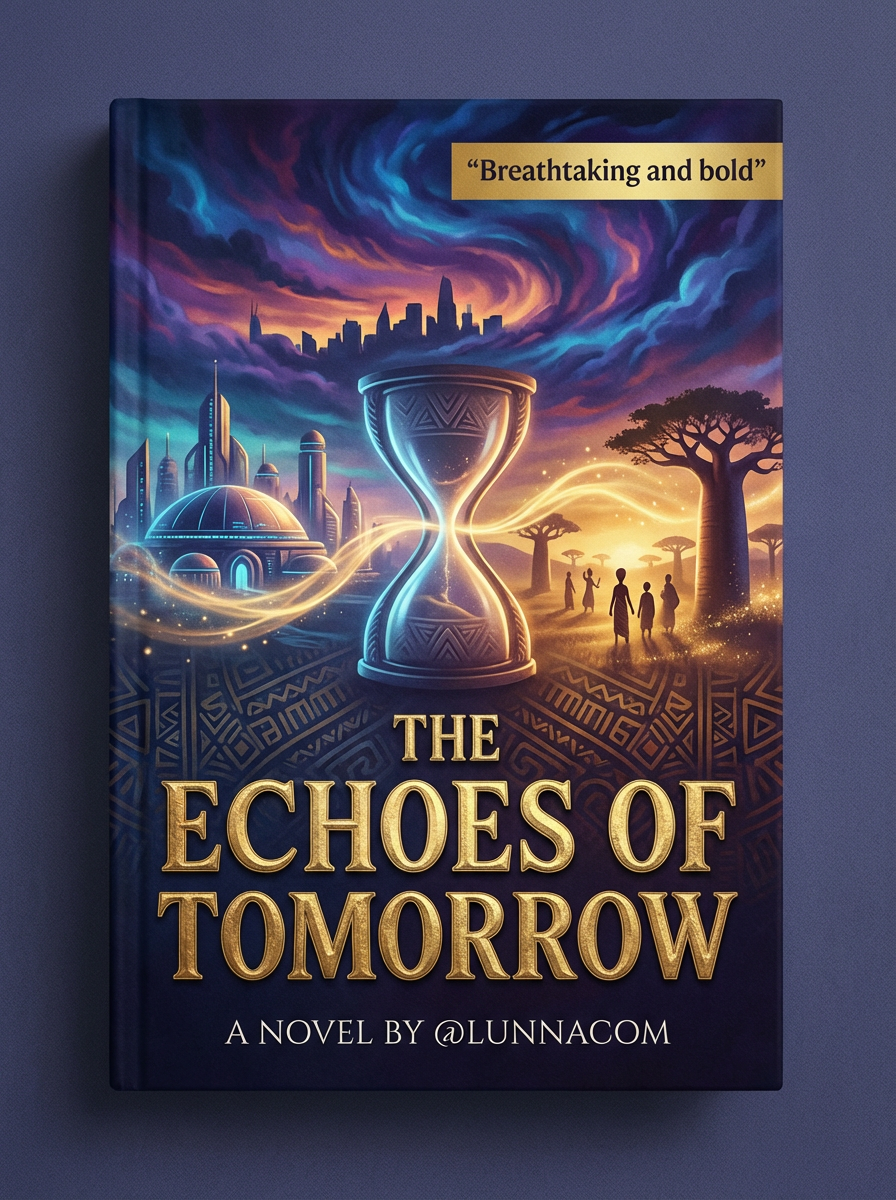
Synopsis
In a reimagined South Africa, where ancestral magic intertwines with hyper-futuristic technology, a disillusioned young woman must reconcile the 'Echoes' of a traumatic past with the 'Tomorrow' of a hopeful future, as she uncovers a conspiracy threatening to unravel the nation's fragile peace and th
Chapter 1: The Shard of Memory
The perpetual hum of Neo-Johannesburg was Amara Nkosi’s lullaby, a symphony of maglev trains, solar stills, and the ceaseless thrum of data flowing through the monolithic chrome and glass structures that scraped the sky. She sat hunched over her console, the ambient light of the city painting her dark skin in shifting hues of indigo and emerald. Her sharp eyes, usually assessing, dissecting, were glazed with the fatigue of another 14-hour shift, sifting through the dross of the Net for corporate intelligence. As a Data Weaver, her skill was in unearthing patterns, extracting meaning from the digital ether – a talent both exhilarating and relentlessly draining.
Tonight, the ghosts stirred more insistently than usual. A flicker across her optical implants, a momentary distortion of the data stream, triggered memories she fiercely tried to suppress. The Great Silencing. A time before her time, yet echoes of it seeped into the collective consciousness like a persistent digital virus. Whispers of lost knowledge, erased histories, a profound cultural amnesia enforced by an event no one explicitly remembered, only felt. Amara had been born into its aftermath, its quiet reverberations shaping a city that prioritized scientific advancement above all else, often at the expense of its soul.
Her current task felt particularly hollow: cross-referencing shipping manifests for a minor trade dispute between two inconsequential corporations. Trivial. Mundane. Yet the city demanded it, its insatiable hunger for data efficiency driving every innovation, every decision. The irony wasn't lost on Amara; the very technology that propelled Neo-Johannesburg into the future also severed its ties to the past, a past she increasingly suspected held vital answers.
A system alert, low priority, pinged in her peripheral vision. A corrupted data shard. Usually, she’d flag it for automated deletion. But something about the irregular pulse, the faint, almost organic signature it emitted, caught her attention. It felt…different. Not the usual garbled noise of a failing drive, but a coherent, albeit fractured, signal struggling to be heard. Curiosity, a rare luxury in her pragmatic world, pricked at her.
"Going off-grid for a minute," she murmured to the empty cubicle farm, her voice a low contralto against the synth-pop drone emanating from a distant speaker. She wasn't truly going off-grid – her biometrics were always traceable, every breath she took indexed by the ubiquitous monitoring systems of Neo-Johannesburg. But for now, she was isolating herself from the immediate demands of her corporate overlords.
She bypassed her usual diagnostic protocols, opting for a more direct, almost intuitive approach. Her fingers danced across the holographic interface, coaxing the shard to yield its contents. Lines of code, vibrant and intricate, began to unfurl across her virtual workspace like a living tapestry. Most of it was gibberish, a chaotic scramble of binary. But then, a pattern emerged. Not Latin script, nor the familiar isiZulu or Setswana of current Neo-Johannesburg. These were glyphs, swirling and elegant, unlike any modern language she had ever encountered. And beneath them, interwoven with the corrupted data, was a faint, resonant hum.
It was an ‘Echo.’
Amara froze, her breath catching in her throat. She hadn’t truly believed in the existence of these ‘Echoes’ – ambient energetic traces of ancestral magic, of spirits, of ley lines and ancient rituals. They were the stuff of children’s stories, whispered behind closed doors, dismissed by the scientific establishment as superstitious nonsense, a relic of the Old World. Yet, here it was, a subtle thrumming in the very fabric of the data, an undeniable presence that resonated with something deep within her, a quiet ache she hadn’t known she possessed.
The corruption was aggressive, trying to erase the signal, but Amara, driven by a primal spark she couldn't explain, pushed back. Her data streams twisted and coiled, protecting the fragile core, creating a temporary firewall around the anomaly. Her implants glowed faintly, reflecting the nascent light dancing in her eyes. This was more than just a corrupted file. This was a message.
She felt a surge of energy, electric and disquieting, flowing through her veins. The air in her cubicle thickened, acquiring a faint, earthy scent – petrichor, woodsmoke, something primal and alive, entirely out of place in the sterility of her high-tech office. The glyphs began to coalesce, forming fragmented images: ancient landscapes, swirling patterns of light, figures adorned in what looked like traditional beadwork, their faces alight with an intensity that burned through the data's static. And then, a single word, shimmering in a language she didn’t understand, yet felt the weight of in her bones.
*Isigqi.* Rhythm. Beat.
A shiver ran down Amara's spine. This was dangerous. Unsanctioned. She could lose her license, her reputation, even her freedom, for dabbling in anything remotely connected to the ‘old ways.’ The LuminaTech corporation, the unchallenged titan of Neo-Johannesburg’s technological landscape, had made it abundantly clear that such explorations were anathema. Their CEO, Dr. Zara Khan, presented herself as a visionary, ushering in an era of unparalleled progress, free from the supposed shackles of archaic belief systems.
Yet, Amara couldn’t look away. The fragmented images flickered, showing what appeared to be… energies being manipulated. Patterns in nature being drawn upon. Not technology, but something else. Something raw and powerful. This was the magic Elder Thabo Modise spoke of, the magic that had been systematically dismissed, erased, and ultimately, silenced.
The shard, however faint, held traces of the 'Great Silencing' itself. Not a direct recording of the event, no, but a *memory* of what was lost. The despair, the sudden void, the severing. It was a wound, imprinted on the data itself.
A sudden, sharp ping broke her concentration. An incoming message from Jax Venter. She winced. Jax, her closest friend and a Digital Alchemist of unparalleled skill, was notorious for his impeccable timing – usually when she was about to do something she shouldn't.
"Amara, you seeing this Level 5 breach on the AlphaNet? LuminaTech's entire historical archive just had a critical data integrity failure. Some kind of cascading error chain. Their Chief of Security, Seraphina Du Bois, is having a meltdown. Thought you'd appreciate the chaos."
Amara paused, a cold knot forming in her stomach. LuminaTech. The same corporation Dr. Zara Khan helmed. The same corporation whose aggressive data policies often bordered on censorship. And now, a critical data integrity failure of their *historical archive*? The coincidence was too jarring to ignore.
She quickly secured the corrupted shard, encrypting it deeper into her private server than the corporate systems could ever hope to penetrate. She’d always maintained a back-door, a private sanctuary in the digital wilderness, a necessity for any truly independent Data Weaver. This shard was now her secret, her burden.
"I saw it, Jax," she replied, her voice carefully neutral, "Just a blip on my radar. Probably a rogue AI updating protocols." She hated lying to Jax, but she couldn't risk exposing her discovery. Not yet. Not until she understood what she was dealing with.
"A rogue AI that eats historical data? Sounds like someone's trying to streamline history, if you ask me," Jax’s wry voice crackled through her comms. "Anyway, heard a rumor old Thabo Modise is holding one of his 'Story Circle' events in District 7 tonight. Might be worth checking out if you're not drowning in corporate fluff. Heard he's got some real old-world artifacts he's showcasing this time."
Amara’s eyes flickered to the encrypted shard, a tiny, almost imperceptible pulsation emanating from its core. Elder Thabo Modise. The Story Keeper. One of the few individuals who openly embraced the 'Echoes,' who dared to speak of the 'Great Silencing' not as a natural phenomenon, but as a deliberate act. He was a fringe figure, tolerated by Neo-Johannesburg as a harmless eccentric, a living museum piece. But Amara had always found his quiet resilience, his steadfast belief in the power of oral tradition, profoundly intriguing.
"Maybe," she replied, her gaze drifting to the towering spire of LuminaTech, glinting ominously against the burgeoning night sky. A storm was brewing. Not of wind and rain, but of secrets and forgotten histories. The corrupted data shard pulsed again, a silent, insistent call. It was igniting a reluctant curiosity within her, a curiosity that tasted of both dread and possibility.
The weight of the fragment felt heavier now, not just as data, but as a physical object pressed directly against her soul. It hummed with a forgotten melody, a quiet beat that hinted at the *Isigqi* Thabo always spoke of – the sacred rhythm of the land, of the ancestors, of a magic violently suppressed but never truly extinguished. Amara knew, with a certainty that chilled her to the bone, that her life had irrevocably shifted. The trivial corporate intelligence she usually sought paled in comparison to the echoes now stirring within this single, fractured shard of memory. She had stumbled upon a thread, thin and frayed, but connected directly to the silenced heart of her nation. And she knew, with an unwelcome sense of destiny, that she had to follow where it led, no matter the cost.
Chapter 2: Whispers of the Ancestors
The ferro-glass walls of the Neo-Johannesburg bullet train blurred into a smear of urban sprawl, then gave way to the undulating green of the Eastern Cape. Amara watched the transition with a familiar cynicism. The city, with its towering data spires and pulsating neon, had always been her natural habitat. The rural vastness outside, however, felt alien, a relic of a time she’d only known through history chips. Yet, it was to this past that her corrupted data shard relentlessly pulled her.
The shard, nestled securely in a hidden pocket of her tech-integrated jacket, pulsed faintly, a whisper against her skin. It was more than just data; it felt alive, vibrating with an energy she couldn’t categorize. The intricate, forgotten glyphs she’d unearthed from its depths had pointed her here, to a place where the digital hum of the future was muted by the rustling leaves and the distant lowing of cattle. The coordinates, decrypted from a fragmented oral history embedded within the shard’s archaic code, led to the village of Kwa-Maqoma, and specifically, to Elder Thabo Modise. A 'Story Keeper,' the shard had called him – a living archive in a world that had forgotten how to read its own past.
Stepping off the bullet train into the dust-filled air of the regional hub, Amara felt a stark contrast. The ubiquitous drone deliveries and holographic street signs of Neo-Johannesburg were replaced by weathered bakkies and hand-painted shop fronts. The scent of woodsmoke and damp earth mingled with something else – a deep, almost palpable sense of antiquity. She hailed an auto-rickshaw, its fossil-fuel engine sputtering a protest against the steep, winding dirt road that led to Kwa-Maqoma.
The village itself was a tapestry of traditional rondavels interspersed with small, solar-powered homes. Children chased chickens across dusty paths, their laughter echoing against the backdrop of distant mountains. It was beautiful, undeniably, but Amara felt an unease, a sense of being out of place, a city dweller adrift in a forgotten world.
Elder Thabo’s homestead was marked by a towering Marula tree, its gnarled branches reaching towards the sky like ancient arms. As Amara approached, a figure emerged from the shade of the tree. He was old, his face a roadmap of fine wrinkles etched by sun and wisdom. He wore traditional beadwork over a simple tunic, and carried a staff carved from dark wood. His eyes, though clouded with age, held a piercing intelligence that belied his gentle demeanor. This had to be Elder Thabo.
“You are Amara Nkosi,” he stated, his voice a low, resonant rumble, as if he hadn't asked a question but merely confirmed a truth he already knew. There was no surprise in his tone, only an ancient acceptance.
Amara, ever the pragmatist, was momentarily disarmed. “How do you know my name?” she asked, a flicker of suspicion in her sharp eyes.
Thabo smiled, a slow, unfolding warmth that reached his eyes. “The wind whispers, my child. And the land remembers. Just as you, too, remember, even when you try to forget.” He gestured towards a woven mat under the Marula tree. “Come, sit. Your journey has been long.”
Amara hesitated for a moment, then, driven by an urgency she couldn’t ignore, complied. She extracted the shard from her pocket, the faint pulse growing stronger in her palm. “I came because of this,” she said, holding it out. “It speaks of things… things I don’t understand. Things the data streams in the city have forgotten.”
Thabo took the shard from her, his touch surprisingly deft for his age. He held it in his weathered palm, turning it slowly. His eyes closed, and he seemed to listen, not with his ears, but with some deeper sense. The air around them grew still, even the distant chirping of birds seemed to hold its breath. Amara watched him, a strange mix of skepticism and awe churning within her. This was so far removed from the cold, hard logic of her digital world.
After a long moment, Thabo’s eyes opened. A profound sadness flickered within them, quickly replaced by a resolute strength. “This is a shard of memory, yes,” he murmured. “But not just yours, young Amara. It carries the echoes of many – of a time, a people, a power.” He traced the intricate glyphs on its surface with a gnarled finger. “These patterns… they are familiar. They speak of the *Ndzundza* clan, of the weaving of the ancestral spirit into the very fabric of existence.”
Amara leaned forward, her cynicism momentarily forgotten. “The shard mentioned something called 'Echoes.' What are they? The city archives dismiss them as folklore, digital ghosts.”
Thabo chuckled softly. “Digital ghosts? A fitting term for those who have forgotten how to listen to the whispers of their own blood. The Echoes are not ghosts, Amara. They are the living remnants of our ancestors, their wisdom, their power, their very essence, infused into the land, the air, the water. We, the people of the Eastern Cape, have long understood their language. They guide us, protect us, and sometimes, they warn us.” His gaze sharpened, fixed on the shard in his hand. “This shard is not just a warning, it’s a cry.”
“A cry from what?” Amara pressed, her heart quickening.
Thabo’s expression grew somber. “From those who seek to silence the Echoes, to harness them for their own gain. The patterns here… they resonate with a dark frequency. I have seen it before, in fragmented legends, in the hushed fears of the elders.” He paused, then uttered a name that sent a chill down Amara’s spine, not by its sound, but by the gravity with which Thabo spoke it. “Umoya Labs.”
Amara’s brow furrowed. “Umoya Labs? I’ve never heard of them. My data streams, even the deep web, have no record.”
“That is by design, Amara,” Thabo explained, his voice laced with bitterness. “They are secretive enclaves, hidden from the prying eyes of your digital world. They operate in the shadows, far from the gleaming towers of Neo-Johannesburg. They are places where ancestral magic, the very soul of our people, is being studied, dissected, and… perverted.”
The word ‘perverted’ hung in the air, heavy and disturbing. Amara’s intellectual curiosity warred with a growing sense of dread. “Perverted how? For what purpose?”
Thabo sighed, a deep, weary sound. “They believe they can control the Echoes, extract their power, and transform it into a new form of energy, a new form of technology. They call it 'spirit-tech.' They believe they are unlocking the next frontier of human advancement, but they are playing with forces they do not comprehend. They are ripping the fabric of our spiritual world, tearing away the very soul of our ancient heritage.”
Amara’s mind, accustomed to processing vast amounts of data, raced. Ancestral magic, twisted for technological gain? It sounded like something out of a neo-mythology holo-show. And yet, the pulsating shard in Thabo's hand, the earnestness in his ancient eyes, painted a vivid, terrifying picture. “Who is behind this?”
“The shard… it speaks of LuminaTech,” Thabo revealed, his voice a low growl. “Specifically, of a woman. A visionary, they call her. Dr. Zara Khan.”
The name hit Amara like a physical blow. LuminaTech. Dr. Zara Khan. She knew those names. LuminaTech was a titan of industry, a ubiquitous presence in Neo-Johannesburg, responsible for everything from city-wide quantum power grids to the advanced cybernetic implants many citizens wore. Dr. Zara Khan was their CEO, a celebrated innovator, a public figure hailed as a genius driving South Africa into a boundless future. The idea that she could be involved in something so insidious, so fundamentally destructive to the very essence of a culture, was almost unthinkable.
“LuminaTech is a beacon of progress,” Amara argued, though the conviction in her voice wavered. “They’re building tomorrow, not tearing down the past.”
Thabo’s gaze was unwavering. “Progress, my child, can be a merciless god. They take what they do not understand, what they do not respect, and they consume it. LuminaTech seeks to control the Echoes, to quantify them, to harness their raw power. They see our spirituality as a resource to be exploited, not a sacred connection to be nurtured.” He handed the shard back to Amara. "This artifact, it carries the plea of those who have been… silenced by this pursuit of power. The forgotten languages, the corrupted magic within it – they are the residue of Umoya Labs’ experiments.”
Amara stared at the shard, seeing it now not just as a puzzle, but as a testament to suffering. The fragmented memories of the 'Great Silencing' that haunted her own past suddenly felt intertwined with this larger, darker narrative. Had the silencing been more than just a historical event? Had it been a deliberate erasure, a precursor to this new, technological appropriation?
“Where are these Umoya Labs?” Amara asked, her voice firm, resolute. The cynicism that had cloaked her for so long was slowly burning away, replaced by a fierce sense of indignation.
Thabo shook his head. “Their locations are well-guarded, shielded by layers of technology and ancient wards. But this shard… it holds a fragment of a truth, a pattern. It suggests a concentration of their activity in places where the Echoes are strongest, where the veil between our world and the ancestral plane is thin. Old sacred sites, forgotten caves, places deemed ‘unsuitable’ for modern development.” He paused, a glint of something akin to grim satisfaction in his eyes. “But they made a mistake. They thought they could erase everything. They underestimated the power of memory, even fragmented.”
He reached into a small leather pouch hanging from his belt and extracted a handful of cowrie shells. He arranged them on the mat before him. “The Echoes are restless, Amara. They speak to me, through the wind, through the rustling leaves, through the very earth beneath our feet. They speak of a great imbalance, a disturbance in the spiritual river that flows through our land.” He indicated a specific arrangement of the shells. “This pattern… it points to the Drakensberg. High up, in the ancient caves, where the rock art speaks of the first shamans, of magic as old as time itself. There, their imprint is strongest, and there, the Umoya Labs leave their deepest scars.”
Amara felt a surge of cold determination. The Drakensberg. A vast, majestic mountain range, steeped in ancient lore, now identified as a potential focal point of this sinister operation. The thought of LuminaTech, the corporation that powered her city, preying on the ancient magic of her ancestors, stirred something deep within her. It wasn’t just a technological puzzle anymore; it was a violation.
“I need to find these labs,” she stated, her voice quiet but firm. “I need to understand what they’re doing. To stop them.”
Thabo looked at her, his expression a mixture of profound wisdom and a faint, hopeful sadness. “The path will be dangerous, Amara. You walk between two worlds now, the digital and the spiritual. And both have their own guardians, their own dangers.” He then fixed her with a knowing gaze. “But you are a Data Weaver. You understand patterns, connections. And you possess a latent connection to the Echoes yourself, a legacy stirring within your blood, awakened by this shard. Your great-grandmother… she was a formidable spirit-caller, though the city taught you to forget such things.”
Amara flinched. The idea of her cynical, tech-driven self having a “latent connection to Echoes” felt absurd, yet a strange warmth had bloomed in her chest when Thabo mentioned her great-grandmother, a figure shrouded in family rumor, always dismissed as archaic.
“I don’t know anything about that,” she said, her voice tight.
Thabo simply smiled. “The Echoes remember, even when we forget. They will guide you, if you learn to listen. But you will not walk this path alone. The Echoes have also whispered of others who seek the truth, who are wary of LuminaTech’s grasping tendrils. There are those who see the beauty and power of the past, even in your shining city.” He looked directly into her eyes. “Seek out Jax Venter. He is not of our ways, but he understands the language of machines as few others do. He will be an ally, a bridge between your world and the path ahead.”
Jax Venter. Amara knew the name, of course. A reclusive ‘Digital Alchemist,’ a legend in the underground data streams of Neo-Johannesburg, rumored to be able to hack anything, anywhere. He was equally rumored to be fiercely independent, almost impossible to approach. Yet, Thabo had spoken his name with certainty, with the weight of ancestral guidance behind it.
The sun began to dip below the horizon, painting the sky in fiery hues of orange and purple. The village sounds grew softer, replaced by the chirping of crickets and the gentle murmur of the wind through the Marula tree. The air grew cooler, carrying the scent of damp earth and woodsmoke. Amara felt a profound shift within her. She had come to the Eastern Cape seeking answers to a technological anomaly, a corrupted data shard. She was leaving with a mission, burdened by the realization that the past was not dead, but merely sleeping, and now, it was under attack.
Clutching the shard tightly, Amara rose, a newfound purpose gleaming in her sharp eyes. The echoes of the past, once faint and disturbing, now resonated with a desperate call. And she, the cynical Data Weaver, found herself compelled to answer. The whispers of the ancestors, amplified by Elder Thabo, were no longer just whispers. They were a roar, demanding action.
Chapter 3: The Glitch in the Loom
The hum of the maglev train was a low thrum against Amara’s skull, a counterpoint to the anxious throb in her temples. Neo-Johannesburg, a glittering tapestry of chrome and light, receded behind her, replaced by the blur of the Highveld, then the Karoo’s stoic expanse, before the azure embrace of the Atlantic heralded their arrival in Neo-Cape Town. The city, a jewel carved from granite and sea mist, shimmered under the afternoon sun, its towering structures a testament to human ingenuity—or, as Amara increasingly suspected, human avarice.
Cape Town was different from Johannesburg. Where Jo’burg pulsed with a raw, industrial energy, Cape Town exuded an almost sterile elegance, a sleek, polished facade that concealed, Amara knew, a labyrinth of corporate ambition. It was here, in the shimmering spires overlooking Table Bay, that LuminaTech had established its primary hub. Elder Thabo’s words, echoing in her mind like the distant clang of a gong, had solidified her suspicions: “*Umoya* is not merely spirit, child. It is information, a current that flows through all things. To mine the *Umoya* is to steal the very breath of existence.”
LuminaTech’s advertised mission was benign: ‘Advancing Human Understanding Through Consciousness Data-Mining.’ Their public-facing innovations ranged from highly intuitive AI companions to bespoke therapeutic algorithms designed to alleviate mental distress. But Amara, with her Data Weaver’s intuition sharpened by the unsettling echoes on her shard, saw a darker undercurrent. The ‘consciousness’ they mined, she suspected, was not merely the digital footprint of modern minds, but something far more ancient, far more sacred. She envisioned ancestral knowledge, the wisdom of generations, being systematically extracted, refined, and repackaged for corporate profit. The thought gnawed at her, a bitter taste in her mouth.
Her initial attempts to penetrate LuminaTech’s digital perimeter had been met with a wall of formidable firewalls and encryption protocols. It was like trying to decipher a dream written in a language she almost, but didn't quite, understand. The Umoya Labs, Thabo had explained, were the *source* of the corruption, but LuminaTech, she believed, was the *distributor*, the glittering storefront for stolen spiritual wealth.
Her comm-link buzzed, pulling her from her thoughts. It was a message, encrypted, from a burner account she’d set up specifically for this investigation. The sender: ‘Ghost in the Machine’. It was the alias of Jax, a name whispered in the dark corners of the digital underworld, a legendary hacker known for their ethical stance and uncanny ability to slip through the most secure networks. Amara had been tracking Jax for weeks, cross-referencing encrypted forum posts and whispered rumors, finally sending out a carefully worded, anonymous plea for assistance. The reply was concise: “Meet me at the Azure Nexus. Code phrase: ‘The loom has a flaw.’”
The Azure Nexus was a notoriously upscale synth-bar in the Waterfront district, all holographic jellyfish tanks and ambient sonic landscapes. Amara, dressed in a muted, form-fitting jumpsuit that allowed for both anonymity and agility, felt conspicuously out of place amidst the glittering patrons. She scanned the faces, a knot of apprehension tightening in her stomach. What if Jax was a trap? What if her trust was misplaced?
A figure detached itself from the shadows of a towering, luminescent coral sculpture. They were lean, almost wiry, with a shock of vibrant, electric-blue hair that seemed to defy gravity. Their eyes, a startling shade of jade, darted with an almost restless energy, scanning the room with a practiced ease. Jax. And they were younger than Amara had expected, perhaps no older than twenty-two, twenty-three.
“The loom has a flaw,” Amara said, her voice a low murmur as she approached.
Jax’s lips, pierced with a delicate silver stud, curved into a faint, almost imperceptible smile. “And you’re here to mend it, I presume.” Their voice was surprisingly soft, a stark contrast to their edgy appearance. They gestured towards a secluded booth, its shimmering privacy screen already activated.
As Amara slid onto the plush banquette, Jax’s jade eyes fixed on her, an unnerving intensity in their gaze. “You’re Amara. The Data Weaver. I’ve heard whispers.”
“And you’re ‘Ghost in the Machine’,” Amara retorted, a hint of steel in her tone. “Your reputation precedes you. You only help those with a just cause.”
Jax leaned back, their long fingers drumming a silent rhythm on the polished synth-table. “My conscience is my only employer. And LuminaTech… they’ve been on my radar for a while. Too much power, too much secrecy. Their algorithms, they’re… unsettling. Like they’re tapping into something more than just conscious thought.”
“Ancestral knowledge,” Amara supplied, pulling out a concealed data-slate and projecting a segment of the corrupted shard. The ancient symbols, the faint, shimmering lines of forgotten magic, pulsed subtly in the dim light of the booth. “Elder Thabo, a Story Keeper, identified these as echoes of *Umoya*. LuminaTech’s ‘consciousness data-mining’ isn’t just about the present; it’s about plundering the past.”
Jax’s eyes widened, a flicker of genuine shock crossing their face. They leaned forward, their gaze riveted on the projection. “This… this is what I suspected. The patterns in their code, the resonance frequencies… it’s not just data. It’s… something alive.” They traced a finger along one of the shimmering lines. “They’re not just *mining* consciousness, they’re *weaving* it. Or attempting to.”
“They’re attempting to control it,” Amara corrected, her voice grim. “To distill the essence of generational wisdom, of spiritual connection, and turn it into a marketable commodity. Imagine the power, the influence, if you could predict human behavior with absolute certainty, if you could manipulate belief systems at their root.”
Jax nodded slowly, a dark understanding dawning in their eyes. “It’s a digital form of colonialism. Stealing the soul of a culture, one data packet at a time.” They paused, a thoughtful frown creasing their brow. “I’ve been trying to get past their outer defenses for months. They’ve got a unique encryption method, a kind of… bio-neural lock. It adapts, learns. It’s almost like it’s… alive.”
“Because it’s built on the very thing they’re stealing,” Amara suggested, a sudden burst of insight. “The *Umoya* itself. They’re using the stolen magic as a shield.”
“Brilliant,” Jax breathed, a strange mix of admiration and disgust in their voice. “And horrifying. But if it’s truly bio-neural, if it’s based on ancestral patterns… then it might have a weakness. A resonance frequency it can’t ignore.” They looked at Amara, a new light in their jade eyes. “Your shard. It’s not just corrupted data. It’s a key, isn’t it? A fragment of the original code.”
Amara felt a surge of hope, a fragile tendril unfurling in her chest. “I believe so. Elder Thabo said it was a ‘shard of memory,’ a piece of what was lost during the Great Silencing. Perhaps it contains the counter-frequency, the disruption code.”
“We need to get inside,” Jax said, their voice now filled with a focused intensity. “Not just their network, but their physical labs. That’s where the real processing takes place, where they’re converting *Umoya* into their proprietary data streams. I can get us past their digital barriers, given enough time and the right input from your shard. But their physical security is legendary. Biometric scans, retinal locks, quantum-entangled motion sensors…”
“I have a plan for that,” Amara said, a glint in her eyes that mirrored Jax’s own. “LuminaTech hosts a quarterly ‘Innovation Showcase’ for their top investors and potential partners. It’s happening next week. High-level access, minimal scrutiny for those with the right credentials. I can acquire the necessary forged identity. You, on the other hand, will be our ghost in the machine, our digital infiltrator.”
Jax grinned, a flash of white against their dark skin. “I like it. A digital Trojan horse, carrying a physical one. But what are we looking for once we’re inside? Proof? A way to shut them down?”
“Both,” Amara replied, her voice firm. “We need concrete evidence of their exploitation, something undeniable. And if possible, we need to disrupt their operations, to sever their connection to the *Umoya*. To give the ancestors back their breath.”
Over the next few days, their collaboration became a seamless dance of digital and physical preparation. Amara, drawing on her past as a Data Weaver, meticulously crafted a convincing persona: Dr. Aris Thorne, a leading expert in quantum linguistics from a fictitious European research institute, interested in potential collaborations with LuminaTech. She spent hours studying their public-facing research, their corporate jargon, immersing herself in the world she was about to infiltrate.
Jax, meanwhile, became a whirlwind of code and caffeine. They dissected the intricate patterns of the corrupted shard, comparing them to the subtle, almost imperceptible signatures they had detected within LuminaTech’s public-facing algorithms. The bio-neural lock, they discovered, was indeed a complex weave of ancestral energy, a digital tapestry woven from the very fabric of *Umoya*. It was designed to repel any attempt at conventional hacking, but Amara’s shard, a fragment of the original loom, offered a unique entry point.
“It’s like trying to pick a lock with another piece of the lock itself,” Jax had explained, their fingers flying across a holographic interface, lines of code cascading across the projection. “The shard isn’t just data; it’s a living key. It resonates with their system, but in a dissonant way. It’s a glitch in their loom, Amara. A thread that doesn’t belong.”
The night before the Innovation Showcase, Amara found herself in a rented apartment overlooking the neon glow of the city, the fabricated identity of Dr. Thorne feeling both alien and disturbingly real. She ran through her cover story one last time, her mind a steel trap of facts and figures. Jax, perched on a synth-stool, was making final adjustments to a tiny, almost invisible data-siphon, a device designed to extract information without leaving a trace.
“Remember,” Jax said, their voice calm but serious, “once you’re inside, the real challenge begins. Their internal network is segmented, compartmentalized. You need to find the core servers, the ones processing the *Umoya* data. I’ll be your eyes and ears from the outside, but direct intervention will be limited. You’ll be on your own.”
Amara nodded, a tremor of apprehension running through her. She was a Data Weaver, not a saboteur. Her expertise lay in deciphering, not destroying. But the weight of Thabo’s words, the echoes of the ancestors, propelled her forward. This wasn’t just about technology; it was about the soul of a nation.
“And if things go sideways?” she asked, her voice barely a whisper.
Jax met her gaze, their jade eyes unwavering. “Then we adapt. We always adapt. But remember this, Amara: the truth, once revealed, is a powerful weapon. Even against the most fortified of looms.”
The next day, as the first rays of dawn painted the sky in hues of rose and gold, Amara made her way to LuminaTech’s gleaming headquarters. The building, a marvel of bio-luminescent architecture, seemed to pulse with an almost organic energy. Her heart hammered against her ribs, a frantic drumbeat against the serene facade.
She passed through the initial security checkpoints with a practiced ease, her forged credentials shimmering green on the scanners. The atmosphere inside was a blend of corporate slickness and cutting-edge innovation. Holographic displays showcased LuminaTech’s latest breakthroughs, their promises of a brighter, more connected future. Amara saw through the veneer, recognizing the carefully curated narrative, the deliberate obfuscation of their true intentions.
She moved through the bustling exhibition halls, nodding politely at various corporate representatives, exchanging empty pleasantries. Her internal chronometer was ticking. Jax had given her a precise window, a brief moment of vulnerability in LuminaTech’s network, a flicker in the loom’s carefully woven fabric.
Her target was the ‘Consciousness Integration Lab,’ a restricted area described in the event brochure as the “heart of LuminaTech’s cognitive advancements.” It was located on the uppermost floors, accessible only by specific biometric clearance.
As she approached the elevator bank, she felt a subtle shift in the air, a faint hum that resonated with the shard concealed in her inner pocket. It was the presence of the *Umoya*, diluted, processed, but undeniably there. LuminaTech was not just tapping into it; they were manipulating it, bending it to their will.
A security guard, a hulking figure in a sleek black uniform, stood sentinel before the restricted elevator. Amara smiled, a practiced, confident smile. “Excuse me, I believe I have an appointment with Dr. Aris Thorne in the Consciousness Integration Lab. My access seems to be… restricted.”
The guard’s comm-link buzzed. He listened for a moment, then his eyes, cold and unreadable, flickered to Amara. “Dr. Thorne, you say? Your credentials don’t match our records for this level of access.”
Amara’s heart skipped a beat. Jax’s ‘glitch’ hadn’t fully manifested yet, or perhaps it had been detected. She had to improvise.
“Perhaps there’s been a slight oversight,” she said, her voice smooth and unhurried. “I was personally invited by Dr. Anya Sharma, head of the Cognitive Augmentation Division, to discuss a potential collaborative project. My research is quite sensitive, and I believe she made arrangements for my direct access.” She projected a fabricated email, a masterpiece of digital forgery, onto her data-slate, displaying it to the guard. The email, complete with Dr. Sharma’s authentic digital signature, outlined a fictitious, high-level meeting.
The guard hesitated, his expression still unyielding. “I’ll need to verify this with Dr. Sharma directly.”
“Of course,” Amara replied, her mind racing. “But I believe she’s currently presenting at the main auditorium. I wouldn’t want to interrupt her important work over a simple technicality.” She offered another confident smile, projecting an air of casual authority. “Perhaps you could simply escort me up? I assure you, Dr. Sharma would be most displeased if a potential multi-billion-credit collaboration was delayed by a minor administrative error.”
The guard’s gaze wavered. The prospect of incurring the displeasure of a division head, especially over a ‘multi-billion-credit collaboration,’ was clearly unappealing. He grunted, a sound of reluctant capitulation. “Very well. But I’ll need to scan your person for unauthorized devices.”
Amara nodded, feigning nonchalance as he ran a handheld scanner over her. The data-siphon, a tiny speck barely visible to the naked eye, remained undetected, nestled within a specially designed pocket that absorbed electromagnetic frequencies.
The elevator ride was swift and silent, carrying them higher into the gleaming spire. Amara felt the hum of the *Umoya* growing stronger, a low thrum against her very being. This was it. The heart of the loom.
As the elevator doors opened, she stepped into a pristine, sterile corridor, all white walls and shimmering glass. The air was cool, faintly metallic, and infused with an almost imperceptible scent of ozone. The guard gestured down the corridor. “The Consciousness Integration Lab is at the end. Dr. Sharma’s office is next to it.”
“Thank you,” Amara said, her voice calm despite the adrenaline coursing through her veins. She walked with a purpose, her gaze sweeping over the biometric scanners and reinforced doors that lined the corridor.
Just as she reached the lab’s entrance, her comm-link buzzed, a faint, almost subliminal vibration. It was Jax. *“The glitch is in. You have approximately seven minutes of full system access before they detect the intrusion. The core servers are behind the main biometric lock. Your shard is the key. Be swift.”*
Seven minutes. Not much time.
Amara took a deep breath, the weight of her mission settling heavily on her shoulders. She placed her palm on the biometric scanner beside the lab door. The pad glowed green, then red, then pulsed with a faint, shimmering blue. The *Umoya* within her shard was resonating, disrupting the lock. The door hissed open, revealing a vast, dimly lit chamber filled with humming machinery and glowing data-screens.
This was the loom. And she was about to unravel it.
Chapter 4: The Scarred Earth
The hum of the skimmer faded, replaced by the relentless whisper of wind scouring the rust-red earth. Amara stepped out, the air hitting her like a physical force – dry, hot, and tasting faintly of dust and ancient desolation. Jax followed, his usually confident stride faltering slightly on the uneven, cracked ground. This was not the sleek, climate-controlled world of Neo-Johannesburg, nor the verdant hills of the Eastern Cape. This was the Scarred Earth, a name whispered in hushed tones, a place where the Great Silencing had not merely left echoes, but gaping wounds.
They stood on a mesa overlooking a vast, ochre-colored expanse, crisscrossed by fossilized riverbeds that had run dry centuries ago. The sky above was an unforgiving blue, devoid of the atmospheric filters that softened the sun in the megacities. Here, the light was brutal, revealing every fissure in the land, every bleached bone of a long-dead creature, every testament to a life that had once thrived and then abruptly ceased.
"This is it," Amara murmured, her voice thin against the wind. "The heart of it all."
Jax scanned the horizon with his wrist-mounted comms, its sleek interface suddenly seeming out of place in this primeval landscape. "My geo-scans show no significant population centers, no energy signatures beyond natural electromagnetic fluctuations. How are we even going to find this community Thabo spoke of?"
Amara pointed towards a distant, shimmering haze. "He said to follow the old migratory paths. The ones that predate the Silencing. He said the land remembers, even if we don't."
They began their trek, the skimmer a shrinking metallic beetle behind them. The ground underfoot was a mosaic of sun-baked clay, sharp shale, and the occasional stubborn, thorny bush that seemed to defy the very concept of life. Amara found herself constantly adjusting her footing, her urban-trained body protesting the unfamiliar terrain. Jax, despite his initial unease, moved with a surprising agility, his hacker's mind quickly mapping the most efficient paths.
Hours passed under the relentless sun. The silence was profound, broken only by the crunch of their boots and the sigh of the wind. There were no birds, no insects, no rustle of hidden creatures. It was a silence that spoke not of absence, but of erasure. Amara felt a growing unease, a cold dread seeping into her bones that had nothing to do with the heat. This wasn't merely a barren landscape; it felt like a graveyard.
As the sun began its slow descent, painting the sky in fiery oranges and bruised purples, Amara spotted it – a faint, almost imperceptible shimmer on the horizon. It wasn't a mirage, but a distortion, as if the air itself was vibrating with a subtle energy.
"Look," she breathed, pointing.
Jax squinted, then brought up his comms again. "My sensors are picking up… something. A localized atmospheric anomaly. High concentrations of bio-luminescent particles, extremely low-frequency sonic vibrations. It's… impossible."
As they drew closer, the shimmer resolved into a hazy, almost translucent barrier. Beyond it, a faint glow pulsed, like an ember struggling against the darkness. They approached cautiously, Amara’s hand instinctively going to the small, concealed blade she carried – a relic from her mother, a comfort in this unsettling new world.
The barrier was not physical. They walked through it, and the air immediately changed. It was cooler, carrying a faint, earthy scent mixed with something else – something indefinable, ancient, and deeply calming. The ground beneath their feet became softer, a fine, almost silken dust.
Before them lay a small, hidden valley, shielded from the harsh winds and the scorching sun by natural rock formations. Within it, a community thrived. Not a sprawling city, but a cluster of organic-looking dwellings, built into the rock face and from natural materials. Soft, bio-luminescent plants lined pathways, casting a gentle, ethereal glow. The air was filled with the murmur of voices, the soft strumming of an unfamiliar instrument, and the distant, rhythmic thud of a pestle in a mortar.
Children, their skin the color of rich earth, played in the soft light, their laughter echoing off the rock walls. Elders sat by small, smokeless fires, their faces etched with the wisdom of generations. It was a world untouched by the chrome and glass of Neo-Johannesburg, a pocket of thriving life in the heart of desolation.
As they stepped fully into the valley, a figure emerged from one of the larger dwellings. She was tall and slender, her movements fluid and graceful despite her apparent age. Her face was a tapestry of fine lines, her eyes deep pools of obsidian that seemed to hold both immense sorrow and profound peace. Her hair, braided with strands of silver and copper, framed a face that radiated an undeniable authority. She wore simple, flowing garments made of natural fibers, adorned with intricate beadwork that shimmered in the soft light.
This was Nkosi.
She approached them, her gaze direct and unblinking. Amara felt a strange sensation, as if Nkosi was not merely looking *at* her, but *into* her, sifting through her thoughts and intentions.
"Welcome, Amara, daughter of the Weaver," Nkosi said, her voice a low, resonant hum that seemed to vibrate in Amara’s very bones. "And you, the one who treads the digital pathways, Jax."
Amara exchanged a startled glance with Jax. "How did you know our names?"
Nkosi offered a faint, knowing smile. "The land speaks. The echoes whisper. They have been anticipating your arrival." She gestured towards one of the dwellings. "Come. You must be weary."
Inside, the air was cool and fragrant with herbs. They were offered a thick, nourishing stew and a sweet, subtly spiced drink. Amara ate slowly, her senses overwhelmed by the sheer authenticity of everything around her. There were no synthetic flavors, no manufactured light, no underlying hum of technology. Just the quiet rhythm of life.
After they had eaten, Nkosi led them to a central, open-air chamber, its ceiling open to the star-dusted sky. A low fire burned in the center, casting dancing shadows on the rock walls. Around the fire, several other members of the community sat, their faces calm and attentive.
"You seek answers about the Great Silencing," Nkosi began, her voice soft but carrying immense power. "You seek to understand what was lost."
Amara nodded, clutching the shard of memory that now felt warm against her skin. "Thabo said you could help me understand the Echoes. That you… interact with them directly."
Nkosi’s gaze intensified. "The Silencing was not merely a cataclysm of the physical world. It was a severing of the spiritual. The threads that connected us to the ancestors, to the land, to the very pulse of creation – they were torn. What remains are the echoes. Residual spiritual energy, fragments of memory, emotion, power. Most feel them as a faint unease, a ghost in the machine of the world. But here, in this place, the veil is thin. And some of us… we are attuned."
She held out her hand, palm up. Amara watched, mesmerized, as a faint, opalescent mist began to swirl above it. It pulsed with a soft, inner light, shifting and coalescing into intricate, fleeting patterns. It was beautiful, terrifying, and utterly alien.
"This," Nkosi said, her voice dropping to a near whisper, "is an Echo. A fragment of a life, a moment, a truth. It is not merely energy; it carries information. Memories. Feelings. The very essence of what was."
Amara felt a tremor run through her. "Can you… hear them? See them?"
"I can," Nkosi confirmed. "And sometimes, I can guide them, soothe them, learn from them. They are not ghosts, Amara. They are the living remnants of a past that refuses to be silenced entirely."
She then turned her gaze to Amara. "You, too, carry an Echo within you. A powerful one. It is why you are here. It is why the shard found you."
Amara felt a cold knot tighten in her stomach. "What do you mean?"
"The trauma of the Silencing left scars not only on the earth, but on the soul," Nkosi explained. "Generations have carried the burden of that loss, often unknowingly. But some, like yourself, are born with a deeper connection, a resonance with the lingering energies. Your fragmented memories are not merely psychological; they are echoes trying to break through."
Jax, who had been listening in stunned silence, finally spoke. "So, the Great Silencing… it wasn't just a technological collapse, or a natural disaster. It was… a spiritual cataclysm?"
"It was all of those things, and more," Nkosi affirmed. "The hubris of man, seeking to control forces beyond their understanding, combined with a profound disregard for the sacred balance of the world. The consequences were devastating. The land suffered, the people suffered, and the spiritual fabric of existence was rent."
She then turned back to Amara. "The shard you carry… it is not merely data. It is a vessel. It contains not only ancestral knowledge, but also the echoes of those who tried to preserve it, those who fought against the coming darkness."
Nkosi reached out and gently took Amara’s hand, her touch surprisingly warm. Amara felt a jolt, a surge of energy that was both familiar and unsettling. It was the same sensation she felt when she touched the shard, but amplified, clearer.
"Close your eyes, child," Nkosi instructed.
Amara obeyed, her heart pounding. The air around them seemed to thicken, to hum with an unseen energy. She felt Nkosi's presence, a steady anchor in the swirling currents that began to envelop her.
Then, the visions came.
Not fragmented, distorted snippets like before, but a torrent of clear, vivid images. She saw a world vibrant with color and life, where towering trees scraped the sky and rivers flowed with crystalline purity. She saw people, their faces alight with a serene wisdom, moving in harmony with the land, their hands weaving intricate patterns of light and sound. She heard their voices, singing ancient songs that resonated with the pulse of the earth.
She saw the magic – not the sterile, technological mimicry of Umoya Labs, but a living, breathing force. Shamans communing with spirits, healers drawing energy from the earth, storytellers weaving illusions from pure thought. It was a world of profound connection, where the boundary between the physical and the spiritual was fluid and permeable.
Then, the darkness began to creep in. Shadowy figures, their faces obscured, their intentions cold and calculating. They wielded strange, glowing devices, not unlike the hyper-tech of Neo-Johannesburg, but twisted, perverted. They sought to capture, to control, to extract.
The vibrant world began to wither. The trees turned to ash, the rivers to dust. The songs became cries of despair. The light faded, replaced by a suffocating gloom. Amara felt the pain of that loss, a searing agony that was not her own, yet consumed her completely. She felt the fear, the desperation, the desperate struggle against an overwhelming, unseen force.
She saw the moments of the Silencing itself – not a sudden explosion, but a gradual, insidious strangulation. The spiritual threads, one by one, were severed. The magic flickered, then died. The connection shattered. The world screamed, a silent, agonizing scream that echoed through the very fabric of existence.
And then, a single, defiant image. A woman, her face strong and resolute, holding a small, glowing shard – the shard. She was surrounded by the encroaching darkness, but her eyes burned with an unyielding light. She was not fighting with physical force, but with an act of pure will, pouring her essence, her memories, her knowledge into the shard, a desperate attempt to preserve something, anything, for a future she might never see.
The vision faded, leaving Amara gasping for breath, tears streaming down her face. She opened her eyes to find Nkosi still holding her hand, her gaze filled with a profound empathy.
"That woman," Amara choked out, "who was she?"
"She was a Weaver, like your ancestors," Nkosi said softly. "One of the last. She understood the power of preservation, even in the face of annihilation. She wove her essence into that shard, hoping it would one day awaken someone who could remember. Someone who could begin to mend what was broken."
Amara looked down at the shard in her own hand, seeing it now not as a mere object, but as a living repository of a lost world. The scale of what was lost, what had been violently ripped away, was overwhelming. It wasn't just magic, or technology, or history; it was a way of being, a profound connection to the universe that had been extinguished.
"The Echoes… they're not just memories," Amara whispered, her voice raw. "They're a warning. A call to action."
Nkosi nodded slowly. "Indeed. They speak of the past, but they also whisper of the future. The Silencing was a wound, but wounds can heal, if tended with care and understanding. The Echoes are the residue of that wound, but also the seeds of its healing."
Jax, his face pale, finally found his voice. "So, LuminaTech… Umoya Labs… they're not just exploiting ancient knowledge. They're trying to replicate the very thing that caused the Silencing, aren't they? To control that spiritual energy, to weaponize it."
Nkosi’s eyes darkened. "They seek to harness what they do not comprehend. To manipulate forces they believe are inert, simply because they cannot perceive their true nature. The Echoes are not dead energy to be plundered. They are the lingering presence of life, of consciousness. To force them into their sterile frameworks is to repeat the very mistakes that led to the Scarred Earth."
Amara felt a cold resolve settle in her heart. The cynicism that had been her shield for so long began to crack, replaced by a fierce determination. She had come seeking answers, and Nkosi had given them to her, not in data streams or academic texts, but in a direct, visceral experience of the past. She now understood the true nature of the conspiracy, the profound danger it posed. It wasn't just about stolen technology or corporate greed; it was about the very soul of her nation, the echoes of its past, and the hope for its future.
"What can we do?" Amara asked, her voice steady despite the turmoil within her. "How do we stop them?"
Nkosi looked at her, a faint smile touching her lips. "You already carry the first step, Amara. The memory. The understanding. You are a Weaver, remember? You have the capacity to connect, to mend. The Echoes have found their voice in you. Now, you must learn to listen, and then… to speak for them."
The stars twinkled above the Scarred Earth, a vast, indifferent canvas. But in the small, hidden valley, a new resolve had taken root, watered by the tears of a past long silenced, and illuminated by the faint, persistent glow of the Echoes. Amara knew, with a certainty that transcended logic, that her journey had only just begun. The echoes of tomorrow depended on her ability to reconcile the echoes of yesterday.
Chapter 5: The Architect's Vision
The LuminaTech tower pierced the cerulean Cape Town sky like a needle of polished obsidian, a stark counterpoint to the ancient sandstone mountains that cradled the city. Its upper floors, visible from the ground, shimmered with an inner light, a promise of the future it claimed to be forging. Amara felt a familiar tremor of unease as the sleek, autonomous shuttle glided them towards its entrance. The building was a monument to Dr. Zara Khan’s vision, a physical manifestation of the ambition that had propelled LuminaTech to the zenith of South Africa’s technological landscape.
Jax, his usual relaxed demeanor replaced by a tightly wound focus, adjusted the neural interface behind his ear. “Security protocols here are… intense,” he murmured, his fingers dancing over a hidden console in his sleeve. “Every photon, every data packet, is logged. Even the air you breathe feels monitored.”
Amara nodded, her gaze sweeping over the sterile, minimalist lobby. Holographic orchids, perfect and unblemished, floated in mid-air, their petals glowing with an unnatural luminescence. The silence here was not peaceful; it was oppressive, a vacuum where natural sound had been meticulously expunged. This was a place where nature was not embraced, but meticulously curated, controlled.
A synthesized voice, smooth and devoid of inflection, announced their arrival. “Welcome, Ms. Amara Vuma and Mr. Jaxen Kael. Dr. Khan awaits you on the seventy-fifth floor. Your escort will arrive shortly.”
A human figure, clad in a crisp, charcoal uniform, emerged from a hidden alcove. Her eyes, magnified by a subtly integrated optical display, scanned them with unnerving efficiency. She led them to a private lift, its interior a seamless expanse of polished chrome and diffused light. As they ascended, the cityscape outside unfolded, a sprawling tapestry of old and new, the vibrant chaos of the Bo-Kaap nestled beside the gleaming steel of the financial district.
The seventy-fifth floor was a testament to Khan’s aesthetic: a vast, open-plan space with panoramic views of the ocean. Walls of reinforced, transparent synth-glass offered an uninterrupted vista of the Atlantic, its restless energy a stark contrast to the floor’s hushed serenity. Desks, sculpted from what looked like liquid metal, were arranged in concentric arcs, each workstation a nexus of holographic displays and silent, humming machinery. The air hummed with a low-frequency current, a palpable energy that prickled Amara’s skin.
Dr. Zara Khan stood by the synth-glass, her back to them, a solitary figure silhouetted against the dazzling expanse of sky and sea. She was taller than Amara had imagined, her frame slender but radiating an almost formidable presence. Her hair, a striking silver streaked with black, was pulled back in a severe, elegant knot. She wore a tailored suit of dark, iridescent fabric, the material shifting subtly with the play of light.
As they approached, she turned, her movements fluid and deliberate. Her face, though unlined, held an intensity that spoke of relentless drive. Her eyes, a startling shade of amber, held a depth that was both intelligent and unnervingly assessing. There was no warmth in her gaze, only a sharp, analytical precision.
“Ms. Vuma. Mr. Kael. Thank you for coming,” she said, her voice a low, resonant alto, precisely modulated. “I’ve been following your… activities… with interest.”
Amara felt a chill. “We prefer to call it investigation, Dr. Khan.”
A faint, almost imperceptible smile touched Khan’s lips. “Semantics. The outcome is the same. You’ve been digging into matters that many would prefer to remain buried.” She gestured towards a set of minimalist chairs arranged around a low, translucent table. “Please, sit.”
They took their seats, the material cool and yielding beneath them. Khan remained standing, her gaze sweeping between them, a silent assessment.
“You’ve seen the ‘Echoes’,” she stated, her voice devoid of question. “You’ve witnessed the raw, untamed power that lies dormant beneath our modern veneer. A power that, in its current state, is a liability. A relic.”
Amara bristled. “A relic? It’s the very essence of our heritage, Dr. Khan. The memory of our ancestors.”
Khan’s amber eyes met hers, unwavering. “And what good is memory if it cannot be harnessed? What good is heritage if it holds us back from true progress? South Africa stands at a precipice, Ms. Vuma. We are a nation forged in struggle, but we risk being left behind in the global race for innovation. Our past, while rich, is also a burden if we allow it to dictate our future.”
She walked to a holographic display that shimmered into existence before them, depicting a complex neural network overlaid with swirling patterns reminiscent of the ‘Echoes’ Amara had seen. “This,” Khan said, her voice taking on a note of fervent conviction, “is the future. The optimization of ancestral magic. The integration of the spiritual with the technological, not as two separate entities, but as a unified, potent force.”
Jax, who had been silent until now, interjected, “You’re talking about commodifying spirituality, Dr. Khan. Packaging something sacred for profit.”
Khan turned to him, her expression unreadable. “I am talking about survival, Mr. Kael. And ultimately, about flourishing. Imagine a South Africa where our energy needs are met not by fossil fuels, but by tapping into the latent spiritual energy of the land. Imagine medical breakthroughs born from understanding the intricate pathways of ancestral healing, amplified a thousandfold by advanced bio-engineering. Imagine consciousness itself, expanded and refined through neural interfaces that allow us to access collective ancestral knowledge, not as vague whispers, but as direct, usable data.”
Her voice grew more impassioned, a chillingly persuasive argument. “The ‘Great Silencing’ was a tragedy, yes. A monstrous act of cultural erasure. But it also revealed a truth: that the raw, unrefined magic was vulnerable. It was chaotic. It was unsustainable in its original form. Our ancestors, for all their wisdom, lived in a world where such power was often a double-edged sword, reliant on individual mastery and susceptible to decay. What I propose is not to erase it, but to elevate it. To refine it. To give it a structure, a resilience, that it never possessed before.”
Amara felt a knot tighten in her stomach. Khan’s words, though cold, held a perverse logic. She was articulating a vision that, on the surface, promised advancement, a way to overcome the limitations of the past. But at what cost?
“You’re talking about control,” Amara said, her voice firm despite the tremor in her hands. “You’re talking about taking something inherent and making it a product. Who decides what is ‘optimized’? Who decides what parts of our heritage are ‘sustainable’ and what are ‘relics’?”
Khan’s gaze sharpened, her amber eyes piercing. “The market decides, Ms. Vuma. Progress decides. And yes, in part, I decide. Someone must have the vision to guide us forward. The ancestral ways, while beautiful, are slow. They are analog in a digital world. We need to evolve, or we will be consumed. Do you truly believe South Africa can compete on the global stage, can lift its people out of poverty, can secure its future, by clinging solely to the past? By relying on the whispers of ancestors that only a few can truly hear?”
She walked back to the synth-glass, her silhouette once again framed by the vast sky. “My aim is not to erase the past, but to build upon it, to enhance it. To give every South African access to the power that was once limited to a select few. Imagine a neural implant that allows a farmer in the Karoo to intuit the subtle shifts in the earth, to predict rainfall patterns with unerring accuracy, guided by the collective wisdom of generations of farmers, all accessible through a technologically mediated interface. Is that not progress? Is that not a way to empower our people?”
Amara thought of Nkosi, the healer in the Scarred Earth, who communed with the land through an instinctual, deeply personal connection. Would Khan’s ‘optimization’ truly empower someone like Nkosi, or would it strip away the very essence of her unique gift, replacing it with a sterile, data-driven imitation?
“But what about the spirit of it?” Amara pressed. “The connection that is not about data, but about reverence? About understanding our place in the natural order, not just dominating it?”
Khan finally allowed herself a full smile, though it was devoid of warmth, more a display of intellectual superiority. “The ‘spirit,’ Ms. Vuma, is often an impediment to efficiency. Reverence is admirable, but it doesn’t power our cities. It doesn’t cure diseases. It doesn’t feed our hungry. My vision is about making the spiritual tangible, measurable, and ultimately, useful. It’s about building a better tomorrow, not just echoing a fading past.”
Jax cleared his throat. “And the Umoya Labs? Are they part of this ‘optimization’ process? Are you behind the experimentation on ancestral magic that Elder Thabo spoke of?”
Khan turned, her expression hardening slightly. “The Umoya Labs are a necessary component of this research. To understand a system, one must first deconstruct it. To refine a raw material, one must process it. Some of their methods may seem… unconventional… to those unfamiliar with the cutting edge of ethno-technological synthesis. But the end justifies the means, Mr. Kael. The stakes are too high to be constrained by sentimentality.”
She paused, her gaze sweeping over them, assessing their reactions. “You see the problem, don’t you? The conflict between tradition and progress. Many cling to the old ways, fearful of change, unable to comprehend the scale of what we could achieve. They see sacrilege where I see salvation. They see exploitation where I see empowerment.”
Amara felt a profound sense of disorientation. Khan’s arguments, while morally repugnant in their cold pragmatism, were not easily dismissed. She spoke of a South Africa that was strong, self-sufficient, a leader in a new global order. She spoke of lifting people out of hardship. Her vision, stripped of its ethical implications, was undeniably powerful, a seductive promise of a brighter future.
“And what about the ‘Echoes’ themselves?” Amara asked, recalling the raw, untamed energy she had witnessed. “Can they truly be controlled? Or are you playing with forces you don’t fully understand?”
Khan’s eyes gleamed with a spark of almost fanatical zeal. “That, Ms. Vuma, is the ultimate challenge. The ‘Echoes’ are a raw, undifferentiated energy. A chaotic resonance. We are developing the protocols, the algorithms, the neural interfaces, to bring order to that chaos. To refine it. To make it a predictable, sustainable power source. It is the ultimate fusion of ancestral magic and hyper-futuristic technology. It is the very foundation of LuminaTech’s future, and by extension, South Africa’s.”
She walked towards a large, circular workstation, its surface glowing with intricate holographic schematics. “We are not simply trying to replicate ancestral magic. We are trying to understand its fundamental principles, its energetic signatures, and then rebuild it, stronger, more efficient, and immune to the vulnerabilities that led to the Great Silencing. We are the architects of a new magic, a new future.”
Amara felt a cold dread settle in her stomach. Khan wasn’t just an ambitious CEO; she was a true believer, a visionary with an unshakeable conviction in her own righteousness. Her arguments, while chilling in their disregard for the sacred, forced Amara to confront uncomfortable questions. Was there a path to progress that didn’t involve this kind of ruthless optimization? Could South Africa truly thrive by clinging to a past that, for all its beauty, was also often fragile and vulnerable?
“You speak of progress,” Amara said, her voice barely a whisper, “but at what point does progress become erasure? At what point do we lose ourselves in the pursuit of something new?”
Khan turned back to them, her expression serene, almost pitying. “At the point, Ms. Vuma, where we refuse to adapt. At the point where we choose nostalgia over necessity. The world does not wait for sentiment. It demands evolution. And LuminaTech, under my guidance, will ensure South Africa is at the forefront of that evolution. We will not be defined by our trauma, but by our triumph. We will build a future not merely echoing the past, but transcending it.”
The implication hung heavy in the air: those who stood in her way, those who clung to the “fading past,” would be swept aside. Amara felt the weight of Khan’s vision, a force as formidable and unyielding as the LuminaTech tower itself, a future that promised unparalleled power but threatened to sever the very roots of their cultural soul. The true meaning of progress, she realized, was a battlefield, and Zara Khan was its most formidable general.
Chapter 6: The Price of Progress
The sterile scent of ozone and synthetic citrus clung to Amara as she navigated LuminaTech’s lower levels, a labyrinth of gleaming chrome and hushed ventilation. Jax, his face a mask of concentrated intensity, worked at a data console, his fingers flying across the holographic interface. Their initial infiltration, a bold dance through LuminaTech’s digital defenses, had been surprisingly smooth, almost too smooth. Dr. Khan’s willingness to divulge her ‘vision’ now felt less like a confession and more like a carefully orchestrated misdirection.
“They’re not just mining consciousness, Amara,” Jax’s voice was a low murmur, barely audible above the hum of unseen machinery. “They’re… refining it. Isolating specific neural pathways, emotional responses, memories.”
Amara’s stomach twisted. “For what purpose?”
“Khan’s ‘optimization’,” Jax replied, a bitter edge to his tone. “She spoke of harnessing ancestral magic. This is how. They’re not studying it; they’re dissecting it. And not just from ancient artifacts.” He paused, his gaze meeting hers, grim and knowing. “From people.”
A cold dread settled in Amara’s chest. Her fragmented memories, the echoes of the Great Silencing, had always been a source of pain, a phantom limb of her past. But the thought of those echoes being systematically extracted, processed, and weaponized… it was a violation beyond comprehension.
Jax’s screen flickered, displaying a complex web of interconnected data streams. “Here. Project Chimera. The core of it all.” He zoomed in on a series of encrypted files. “They’re using a combination of neuro-linguistic programming and advanced bio-feedback loops. Essentially, they’re creating a digital conduit to the spiritual plane, but it’s a one-way street. Information flows *out* of the subject, but nothing flows back in.”
Amara leaned closer, her breath catching in her throat as she saw the chilling implications. “They’re draining them. Stripping them of their connection.”
“Precisely,” Jax confirmed, his eyes scanning the data. “And the subjects… they’re not volunteers, Amara. Not in the traditional sense.” He brought up a series of legal documents, heavily redacted but still revealing enough to send a shiver down her spine. “They target communities displaced by the Great Silencing, those whose ancestral lands were ravaged. Communities already vulnerable, desperate for assistance, for a way to reclaim what they lost.”
A knot tightened in Amara’s stomach. The images of the Scarred Earth, the desolation, the quiet despair of Nkosi’s people – it all coalesced into a horrifying understanding. LuminaTech wasn’t offering salvation; they were offering a Faustian bargain, preying on the very wounds they claimed to heal.
“They offer resettlement programs, advanced medical care, access to resources,” Jax continued, his voice devoid of emotion, a stark contrast to the rage simmering within Amara. “In exchange, these individuals agree to participate in ‘experimental cognitive enhancement therapies.’ They sign waivers, often without fully understanding the long-term implications.”
Amara felt a surge of nausea. “They’re stealing their souls, Jax.”
“In a way, yes,” he agreed, his gaze distant. “The ‘Echoes’ are not just abstract spiritual energy. They are the cumulative wisdom, the emotional resonance, the spiritual lineage of a people. To sever that connection… it’s a profound act of cultural genocide, disguised as progress.”
He brought up a series of medical reports, anonymized but still deeply disturbing. “The side effects are severe. Profound memory loss, emotional dysregulation, a complete detachment from their heritage. They become… empty vessels.”
Amara’s own fragmented memories, the phantom pains of a past she couldn’t fully grasp, suddenly felt sharper, more insistent. A cold dread seeped into her bones. She had always dismissed them as the lingering trauma of a forgotten incident, a personal failing. But what if…
“Jax,” she said, her voice barely a whisper. “Can you cross-reference the data of the subjects with any… historical events? Specifically, the Great Silencing?”
Jax looked at her, a flicker of concern in his eyes. “That’s a massive data pull, Amara. Why?”
“Just do it,” she urged, a desperate urgency in her tone. “I need to know.”
He nodded, his fingers dancing across the interface once more. The silence stretched, punctuated only by the low hum of the servers and the frantic beating of Amara’s heart. Her mind raced, piecing together fragments of her own past with the horrifying revelations unfolding before her. The flashes of a burning village, the scent of smoke and fear, the chilling silence that followed – they were not just nightmares. They were echoes.
Then, a name appeared on the screen, highlighted in a stark red. A name that sent a jolt of recognition, a primal scream of grief, through Amara’s very core.
*Amara Thandiwe.*
Her own name.
Her breath hitched. The world tilted. She stared at the screen, her vision blurring, unable to reconcile the clinical data with the raw, visceral pain that erupted within her.
“Amara?” Jax’s voice was laced with alarm. “Are you alright?”
She shook her head, unable to speak. The truth, long suppressed, long denied, was now undeniable. She was not just investigating a crime; she was a victim of it. Her fragmented memories, her inability to fully connect with her own history, her constant yearning for a sense of belonging – it was all a direct consequence of LuminaTech’s insidious practices.
Jax, seeing the raw agony on her face, quickly scanned the details associated with her name. His expression hardened. “Project Chimera, Subject 734. Admitted… the year of the Great Silencing.” He scrolled down, his eyes widening. “Your family… they were from the Eastern Cape. A community known for its strong ancestral ties, its powerful ‘Echoes’.”
The pieces clicked into place with a sickening thud. The burning village, the cries, the sudden, overwhelming silence – it wasn’t just a memory of a distant tragedy. It was *her* tragedy. She wasn't just a data weaver, she was a stolen thread, a severed connection.
“They took me,” she whispered, the words tasting like ash in her mouth. “They took my Echoes.”
Jax reached out, a hesitant hand on her shoulder. “Amara, I’m so sorry.”
But Amara barely registered his touch. Her gaze was fixed on the screen, on the cold, clinical data that laid bare the truth of her existence. Project Chimera. The "optimization" of ancestral magic. It wasn’t just a theoretical concept; it was a living, breathing horror, etched into the very fabric of her being.
And then, another name, linked to hers, appeared on the screen. A name that twisted the knife in her heart.
*Dr. Elias Khan.*
The father of Zara Khan.
A wave of white-hot rage, cold despair, and profound betrayal washed over Amara. The visionary CEO, the woman who spoke of progress and salvation, was the daughter of the man who had stolen her past, who had experimented on her, who had left her a hollowed-out echo of her true self.
The Great Silencing wasn’t just a natural disaster, a societal collapse. It was a calculated, deliberate act of cultural eradication, orchestrated by those who sought to exploit ancestral magic for their own gain. And her own fragmented memories, the vague sense of loss and disorientation, were the direct result of their malevolent ambition.
“He was the lead researcher on Project Chimera,” Jax confirmed, his voice low and grave. “Zara Khan’s father. It says here… he believed that by isolating and replicating the ‘Echoes’ of particularly powerful individuals, they could create a superior form of energy, a new paradigm for South Africa’s future.”
Amara’s hands clenched into fists, her nails digging into her palms. The pain was a dull throb, a constant ache that had always been present, but now it was a searing inferno. “He didn’t just steal magic, Jax. He stole lives. He stole identities. He stole *me*.”
The betrayal was a bitter taste in her mouth. She had trusted Zara Khan, or at least, she had tried to understand her. She had allowed herself to be swayed by the CEO’s grand vision, her eloquent arguments for a technologically advanced South Africa. But it was all a lie, a gilded cage built upon the bones of her people, upon her own shattered past.
“The records indicate a rapid decline in your cognitive function after the procedure,” Jax continued, his voice filled with a quiet fury. “Severe memory impairment, emotional blunting… they classified it as a ‘successful isolation of Echoes’ and a ‘manageable side effect’.”
Manageable side effect. The words echoed in Amara’s mind, a cruel mockery of her lifelong struggle. Her inability to fully connect, her feelings of being an outsider, a ghost in her own life – it was all by design.
A cold, hard resolve settled over Amara. The grief, the anger, the betrayal – they coalesced into a singular, burning purpose. She wasn’t just a data weaver anymore. She was a survivor. And she would not allow them to continue their atrocities.
“We need to expose them,” she said, her voice low and steady, laced with a newfound strength. “All of them. Zara Khan, her father’s legacy, LuminaTech. Everything.”
Jax nodded, his expression mirroring her determination. “I’ve already begun mirroring the data. This is far more extensive than even I imagined. We’re talking about thousands of individuals, entire communities decimated by this program.”
He pointed to a section of the data. “And the ‘Echoes’ they’ve extracted… they’re not just stored. They’re being actively processed, refined, and integrated into LuminaTech’s core technologies. Their entire infrastructure, their prosperity, is built on stolen spiritual energy.”
Amara felt a surge of revulsion. The gleaming towers of Neo-Johannesburg, the advanced AI, the seamless communication networks – all powered by the silenced voices of her ancestors, by the stolen essence of her people. It was a monstrous irony, a technological marvel built upon a foundation of profound injustice.
“We need to get this out,” she repeated, her voice firm. “To the Story Keepers, to the communities, to the world. They need to know the true price of LuminaTech’s progress.”
Jax’s fingers flew across the console, a flurry of precise movements. “I’m creating a secure data packet. It’ll be heavily encrypted, but once it’s released, it’ll be impossible to suppress.” He paused, his brow furrowed. “But getting it out of here, past their firewalls… it’s going to be tricky.”
Amara’s gaze hardened. Tricky wasn’t impossible. She had lived with the echoes of a stolen past for too long. Now, she would reclaim it, not just for herself, but for all those who had been silenced.
A sudden, sharp alarm blared through the sterile corridors. Red lights flashed, casting an ominous glow on the chrome surfaces.
“We’ve been detected,” Jax said, his voice taut. “Khan’s security protocols are more advanced than I anticipated. They’re locking down the facility.”
Amara’s mind raced. They had limited time. The data, the irrefutable evidence of LuminaTech’s crimes, had to be released.
“Can you still send the packet?” she asked, her eyes scanning the flickering red lights, calculating their escape route.
Jax grimaced. “It’ll be a narrow window. I need to bypass their primary encryption matrix. It’ll take a few minutes, at least.”
Footsteps echoed down the corridor, growing louder, closer. The metallic clanging of security drones could be heard in the distance.
“I’ll create a diversion,” Amara declared, pulling a small, discreet data-scrambler from her belt. It was a tool of her trade, designed to disrupt local networks, to create digital chaos.
Jax looked at her, a flicker of apprehension in his eyes. “Amara, that’s risky. Their security forces are highly trained.”
“I’ve walked through digital firewalls my entire life, Jax,” she retorted, a grim smile touching her lips. “Physical ones can’t be that different.” She met his gaze, her eyes burning with a fierce resolve. “Get the data out. That’s all that matters.”
Without waiting for his reply, Amara slipped out of the server room, the data-scrambler clutched in her hand. The corridor beyond was a maze of identical doors and gleaming walls. She could hear the shouts of security personnel now, the thud of heavy boots.
She moved with a newfound agility, a primal instinct guiding her. Her fragmented memories, the echoes of a past she was only now reclaiming, fueled her every step. The burning village, the silent screams, the face of Zara Khan’s father – they were not just echoes of pain, but echoes of power.
She activated the scrambler, sending a ripple of digital distortion through the nearest network hub. Lights flickered, screens went blank, and an immediate surge of confusion erupted from the security forces. Their comms crackled, their targeting systems momentarily disrupted.
It was a small window, but it was enough. Amara sprinted down the corridor, dodging a bewildered security guard, her heart pounding a furious rhythm against her ribs. She could hear Jax’s frantic keystrokes from the server room, a silent promise of the truth finally being unveiled.
She reached a junction, a busy intersection of corridors, and unleashed another burst from the scrambler. Alarms wailed louder, more disoriented. Security drones, their optical sensors flickering erratically, spun in confused circles.
But the diversion wouldn’t last. They were adapting, re-routing their systems. She could hear the distinct whirring of more powerful drones, their targeting lasers cutting through the digital static.
Amara pressed herself against a wall, her breath coming in ragged gasps. She was cornered. Three security guards, their faces grim, advanced towards her, their energy weapons raised.
“Stand down, Subject 734,” one of them commanded, his voice synthesized and devoid of emotion. “You are in violation of LuminaTech protocols.”
Subject 734. The label, a cold reminder of her stolen identity, ignited a fresh wave of fury within her. She was not a subject. She was Amara. And she would fight for her name, for her past, for her future.
A powerful surge of energy, a raw, primal force, erupted from within her. It was not a technology, not a learned skill, but something deeper, something ancient. The air around her shimmered, a faint, almost imperceptible distortion. The security guards, momentarily thrown off balance by the unexpected ripple in the atmosphere, hesitated.
It was the Echoes. Her Echoes. Stirring, awakening, responding to her desperate need.
Amara didn’t understand how, didn’t understand why, but she knew, with an absolute certainty, that she was connected. The severed thread was not entirely gone. It was frayed, damaged, but still present.
She focused, drawing on that nascent power, that raw, untamed energy. The data-scrambler in her hand pulsed, amplifying the disruption, not just digitally, but physically. The lights flickered violently, then exploded, plunging the corridor into semi-darkness.
The security guards cried out, momentarily blinded. It was a chaotic, desperate act, but it bought her precious seconds.
Amara bolted, ignoring the searing pain in her side from a glancing blow from an energy blast. She could hear Jax’s voice in her comm, urgent and strained.
“Amara! The upload is almost complete! Just a few more seconds!”
She pushed herself harder, her lungs burning, her legs aching. The Echoes within her, a faint but persistent hum, urged her onward. She knew, with a chilling certainty, that if she was captured, the truth would be buried forever.
She burst into a dimly lit maintenance shaft, the air thick with the smell of oil and dust. Behind her, the sounds of pursuit intensified.
“It’s done, Amara!” Jax’s voice, triumphant and breathless, filled her comm. “The data is out! It’s on every network, every server, every global news outlet!”
A wave of relief, so profound it almost brought her to her knees, washed over Amara. They had done it. The truth was out.
But the fight wasn’t over. The shaft led to a dead end, a locked blast door. And behind her, the footsteps were getting closer, the whirring of drones more ominous.
Amara turned, facing her pursuers, her face streaked with grime and sweat, but her eyes burning with an unyielding defiance. The raw energy of the Echoes thrummed within her, a defiant roar against the silence.
She was no longer just a data weaver, no longer just a victim. She was a conduit, a vessel for a truth that refused to be silenced. And she would fight, with every fiber of her being, to ensure that the echoes of tomorrow were not forged in the crucible of stolen pasts, but in the vibrant, reclaiming voices of a people reborn. The price of progress, she now knew, was too high to pay in silence. And she would make sure the world heard every single, agonizing echo.
Chapter 7: A Divided Legacy
The air in the Chamber of Whispers was thick with the scent of ozone and the metallic tang of fear. Amara stood before the holographic projection, her heart a drum against her ribs. The image shimmered, coalescing from abstract data streams into a chilling historical recreation. It was the Great Silencing, but not as she had always understood it. Not as a natural disaster, or a spiritual fading, but as an act of deliberate, brutal engineering.
“This,” Dr. Khan’s voice, smooth and resonant, cut through the hum of the projection, “is the truth, Amara. The unvarnished, inconvenient truth.”
The projection shifted, revealing a stark, sterile laboratory, bathed in the sickly green glow of unknown energies. Figures in white coats moved with a chilling efficiency, their faces obscured by masks. At the center of the chamber, contained within a pulsating energy field, was a vortex of swirling light and shadow – the raw essence of ancestral magic. It pulsed, alive and potent, then… it began to scream.
Amara flinched, a visceral terror seizing her. The sound wasn't audible, but she felt it, a psychic shriek that resonated deep within her bones, echoing the fragmented childhood memories that had recently resurfaced. The light intensified, then warped, twisting into grotesque forms as the energy field around it destabilized. The figures in white coats, once so composed, now scattered, their movements frantic.
“The previous regime,” Khan continued, her voice devoid of emotion, “believed they could harness the ‘Umoya’ – the very breath of the ancestors – as a weapon. A weapon of unparalleled power, capable of bending reality to their will. They called it Project Chimera.”
The projection zoomed in on a sophisticated console, displaying complex algorithms and energy readings. Amara, a Data Weaver by trade, recognized the intricate code, even if she couldn’t fully decipher its purpose. It was a language designed to dissect, to control, to ultimately *break* something sacred.
“They sought to isolate the core frequencies of ancestral magic,” Khan explained, “to amplify them, and then to direct them. Their intention was to create a psychic deterrent, a weaponized spiritual shield that would render all their enemies powerless. A shield that would also, conveniently, solidify their own absolute dominion.”
The scene on the holographic projection turned catastrophic. The contained vortex of magic, pushed beyond its limits, began to tear itself apart. The green energy field sputtered, then collapsed with a deafening, silent implosion. The lab was engulfed in a wave of raw, uncontrolled energy. The figures in white coats were vaporized, their desperate screams swallowed by the cataclysm.
“They didn’t understand the inherent interconnectedness,” Khan said, a hint of something that might have been regret in her tone. “They treated Umoya as a resource, a commodity to be exploited, rather than a living, breathing network of consciousness. When they attempted to weaponize it, they didn’t just detonate a weapon; they severed the very threads that bound our spiritual heritage.”
The projection expanded, showing the ripple effect of the explosion. Across the landscape, the vibrant, energetic lines that represented ancestral magic – lines Amara had only recently begun to perceive through the Echoes – fractured and dimmed. The land itself seemed to cry out, the vibrant colours of the projected South African landscape fading to a muted grey.
“The Great Silencing,” Khan concluded, her gaze fixed on Amara, “was not a natural phenomenon. It was an act of profound hubris. A catastrophic attempt to weaponize the sacred, which instead tore a gaping wound in the soul of our nation. It silenced the ancestors, not by choice, but by force. It was a spiritual holocaust.”
Amara felt a cold dread settle in her stomach. The fragments of memories, the flashes of searing light, the feeling of profound loss – they all clicked into place. She had been there, a child, on the periphery of that cataclysm, shielded by her mother's desperate magic, a magic that had ultimately been overwhelmed. The betrayal she had suppressed, the gnawing feeling of being abandoned, suddenly made sense. Not by her mother, but by a system that had sought to control the uncontrollable.
“And you,” Amara finally managed to speak, her voice hoarse, “you’re doing it again.”
Khan’s expression remained impassive. "No, Amara. I am *correcting* it. They sought to weaponize the raw, untamed power. I seek to *preserve* it. To refine it. To integrate it into a framework that can truly serve humanity.”
The holographic projection shifted again, replacing the inferno of the past with a pristine, futuristic landscape. Towering data spires pierced the sky, their surfaces gleaming with intricate patterns of light. Below, cities hummed with clean energy, and holographic projections of vibrant, healthy communities flickered into existence.
“The problem with ancestral magic,” Khan explained, her voice gaining a persuasive cadence, “is its inherent volatility. Its reliance on human intention, on ritual, on belief. It’s susceptible to corruption, to fading, to the whims of individual practitioners. It’s inefficient. Unreliable. And ultimately, unsustainable in a world that demands precision and scalability.”
Amara’s mind reeled. Khan wasn't just attempting to weaponize magic; she was attempting to *digitize* it. To strip it of its organic, spiritual essence and reduce it to pure data.
“My vision,” Khan continued, gesturing to the projected utopia, “is to create a digital repository of all ancestral knowledge. To translate the complex, nuanced frequencies of Umoya into quantifiable data streams. To build a network, a spiritual internet, if you will, where the wisdom of generations can be accessed, preserved, and utilized without the inherent risks of its raw form.”
“You mean controlled,” Amara interjected, her voice laced with accusation. “You mean *owned*.”
Khan met her gaze, a flicker of something akin to exasperation in her eyes. "Control, Amara, is not always a dirty word. In this instance, it is a necessity. Imagine a world where the wisdom of the ancestors is not lost to the sands of time, but is available to every child, every scholar, every innovator. Imagine a world where the healing properties of ancient remedies are not dependent on a single healer, but can be synthesized and distributed globally. Imagine a world where the spiritual guidance of countless generations is not whispered in obscure rituals, but is accessible through a secure, stable, and universal interface.”
The projection zoomed in on a shimmering, ethereal network, a vast web of light that connected every aspect of the futuristic society. It was a digital representation of the Umoya, but devoid of its spiritual warmth, its organic spontaneity. It was a meticulously ordered, perfectly structured, and utterly lifeless imitation.
“We call it the ‘Digital Ancestral Archive’,” Khan revealed, a note of pride entering her voice. “Every Echo, every ancestral memory, every spiritual practice – meticulously recorded, analyzed, and stored. It will be the ultimate library of our heritage, impervious to decay, to neglect, to the vagaries of human memory.”
“But it wouldn’t be *theirs*,” Amara argued, her voice rising. “It would be *yours*. You would be the gatekeeper. You would decide what is preserved, what is amplified, what is… deleted.”
Khan’s smile was thin, almost imperceptible. "Such decisions are made by all curators of knowledge, Amara. The question is not *if* there will be a gatekeeper, but *who* that gatekeeper will be, and what their intentions are. My intention is to safeguard our legacy, to ensure its survival, and to unlock its full potential for the betterment of all.”
Amara remembered Nkosi’s words, the way the healer spoke of the Echoes as living entities, as conversations with the past. She remembered the way the land itself resonated with their presence. Khan's vision, while superficially appealing, felt like a betrayal of that very essence. It was a dissection, not a preservation. A sterile archive, not a living heritage.
“You’re not preserving it,” Amara stated, her conviction hardening. “You’re dissecting it. You’re stripping it of its soul. You’re taking something sacred and reducing it to lines of code, to algorithms that you can manipulate and control.”
“And what is the alternative, Amara?” Khan challenged, her tone sharpening. “To allow it to fade into obscurity? To watch as traditional practices are eroded by modernity, as the knowledge of our ancestors is lost with each passing generation? To stand by as the scars of the Great Silencing continue to bleed, leaving our spiritual landscape barren?”
The holographic projection flickered, overlaying the pristine digital utopia with images of the scarred earth Amara had recently witnessed – the parched lands, the muted colours, the despair in the eyes of those who had lost connection to their heritage.
“The previous regime’s folly was one of brute force,” Khan explained, her gaze intense. “They tried to *break* the Umoya. My approach is one of integration. We are not destroying it; we are *re-engineering* it. We are building a bridge between the ancient and the hyper-futuristic, a bridge that will allow our heritage to thrive in the digital age.”
Amara thought of the unethical experimentation she had uncovered at LuminaTech, the forceful extraction of Echoes from vulnerable communities. This wasn't integration; it was appropriation. It was a new form of colonialism, a digital conquest of the spiritual realm.
“But at what cost, Khan?” Amara pressed, her voice trembling with barely suppressed anger. “At the cost of human dignity? At the cost of consent? At the cost of the very essence of what makes our heritage *ours*?”
Khan took a step closer, her eyes unwavering. "There are always costs, Amara, in any great endeavor. But sometimes, the cost of inaction is far greater. The Great Silencing left us vulnerable, spiritually adrift. My work is not just about technology; it is about rebuilding. It is about forging a new identity for our nation, one that embraces both its ancient roots and its futuristic aspirations.”
She gestured to the holographic projection, which now displayed a single, powerful image: the iconic baobab tree, its ancient roots deeply embedded in the earth, its branches reaching towards a sky filled with shimmering data streams. It was a powerful, seductive image, a promise of unity and strength.
“Imagine,” Khan said, her voice dropping to a near whisper, “a new form of ancestral magic. One that is stable, accessible, and universally beneficial. One that can power our cities, heal our sick, and guide our future. A magic that is no longer limited by human frailty, but amplified by technological brilliance.”
Amara looked at the baobab, its digital roots glowing with an artificial light. She remembered the warmth of the real baobab, the way its ancient bark felt beneath her fingertips, the way the Echoes sang through its leaves. Khan's vision was a beautiful lie, a hollow imitation. It was a future built on stolen foundations, a heritage stripped of its soul.
“You’re repeating history, Khan,” Amara said, her voice firm, unwavering. “The previous regime tried to weaponize it. You’re trying to own it. The outcome will be the same: destruction. Because you can’t control something that is meant to be free.”
A flicker of annoyance crossed Khan’s face, quickly masked. "You speak with the idealism of youth, Amara. I speak with the pragmatism of experience. The world is changing. We must adapt, or we will be left behind. My vision is not about control for control's sake; it is about empowerment. It is about ensuring that our heritage, our very identity, endures in a rapidly evolving world.”
Amara felt the weight of the truth settle upon her. The Great Silencing hadn't been an isolated incident; it was a precedent. Khan’s current efforts weren't just a technological advancement; they were a continuation of the same insidious ambition: to dominate, to exploit, to ultimately erase the organic, spiritual essence of ancestral magic.
“You’re not saving it,” Amara said, her voice laced with sorrow. “You’re killing it. You’re turning our spiritual heritage into a commodity, a product to be bought and sold. And in doing so, you’re severing the last ties we have to our true selves.”
Khan’s gaze hardened. "Then you are choosing to cling to an outdated, inefficient past, Amara. While I am building the future.”
The Chamber of Whispers, once a space of revelation, now felt like a battleground. Amara understood now. The Echoes of Tomorrow weren't just about the past and the future; they were about the very soul of a nation, caught between the destructive echoes of a traumatic past and the insidious promises of a technologically controlled future. And in that moment, Amara knew, with a chilling certainty, that she could not stand by and watch Khan repeat the mistakes of history. She had to fight. For the true echoes. For a tomorrow that embraced, rather than controlled, its legacy.
Chapter 8: Converging Tides
The drone of the Cape Town city-scape, a symphony of mag-lev hums and holographic advertisements, was a stark contrast to the quiet, dusty expanse Amara had left behind. Now, within the reinforced walls of Jax’s clandestine workshop, the hum was closer, more intimate – the whir of cooling fans, the rhythmic click of a keyboard, the soft crackle of a holographic display. Four figures, disparate as the corners of the nation, were finally gathered.
Thabo, his face a roadmap of ancient wisdom, sat cross-legged on a repurposed server rack, his eyes, usually alight with storytelling, now held a focused intensity. He traced patterns in the dust motes dancing in a stray beam of light, his lips moving silently, perhaps in prayer, perhaps in communion with unseen forces. Nkosi, her presence a quiet anchor, stood by a flickering data-stream that projected intricate geometric patterns onto the opposite wall. Her hands, usually engaged in the careful preparation of healing herbs, now hovered, almost instinctively, over the ethereal forms, as if she could feel their energy. Jax, a tangle of wires and algorithms, hunched over a bank of monitors, his fingers flying across a custom-built interface, lines of code blooming and dissolving with dizzying speed. And Amara, the reluctant heart of this nascent resistance, stood between them, the fragmented echoes of her own past, now coherent and searing, propelling her forward.
“The Spirit Engine,” Jax’s voice, usually laced with sarcasm, was grim. He swiped a hand across a holographic schematic, pulling up a complex diagram. “Khan’s magnum opus. A quantum entanglement core, powered by… well, by what we now know are forcefully extracted Echoes.”
Thabo grunted, a sound of deep disapproval. “She seeks to bottle the wind, to cage the very breath of the ancestors. It is an abomination.”
“An abomination that could grant her unparalleled power,” Amara countered, her gaze fixed on the schematic. “Complete control over not just ancestral energies, but potentially, over the very consciousness of those connected to it. The Great Silencing was an attempt to destroy our magic. Khan’s plan is to *own* it.”
Nkosi’s voice, a low, melodic hum, cut through the tense air. “The Echoes are not inert energy. They are the living memory, the spiritual essence of our people. To bind them, to force them into such a construct… it will rip the fabric of reality itself.”
Amara felt a chill, a visceral understanding of Nkosi’s words. She had seen the vacant eyes of those from whom Echoes had been stolen, the spiritual void left behind. Khan’s machine wasn’t just a weapon; it was a soul-eater.
“The tech summit,” Jax began, pulling up a digital invite for the ‘Global Consciousness Forum,’ hosted by LuminaTech. “It’s in three days. Khan’s unveiling the Spirit Engine as the centerpiece of her ‘Consciousness Optimization’ initiative. She’s calling it the dawn of a new era, where collective consciousness can be harmonized, optimized, and guided towards a utopian future.” His tone dripped with contempt.
“A utopian future built on stolen souls,” Amara finished, her jaw tight. “We have to stop her.”
“But how?” Thabo asked, his gaze sweeping over the array of futuristic tech. “She has the resources of LuminaTech, the backing of powerful interests. We are but four.”
“Four with unique gifts, Elder,” Amara said, meeting his gaze. “And a shared purpose.” She turned to Jax. “Your tech prowess is unmatched. Can you infiltrate LuminaTech’s systems, expose their operations?”
Jax grinned, a flash of his old mischievous self. “Infiltrate? Amara, I practically own their systems. They just don’t know it yet. I’ve been mapping their network for months, looking for the backdoors, the vulnerabilities. Khan is arrogant, but not infallible. Her security protocols are complex, but predictable.”
“Good,” Amara acknowledged. “We need concrete evidence, irrefutable proof of their unethical practices. The human experimentation, the forced extraction of Echoes. Everything.”
“That data is deeply encrypted, buried under layers of corporate obfuscation,” Jax cautioned. “It’ll take time, and a direct access point to their core servers. Something I can’t do remotely without triggering an immediate lockdown.”
“Which brings us to the summit,” Amara mused. “It’s her grand stage. The perfect place to expose her, but also the most heavily guarded.” She turned to Nkosi. “Nkosi, your connection to the Echoes is vital. Can you discern the location of the Spirit Engine within the summit venue? Its energy signature, its spiritual footprint?”
Nkosi closed her eyes, her brow furrowed in concentration. “The Echoes are… restless. Disturbed. I can feel their agony, a deep resonance emanating from the LuminaTech tower. But pinpointing the Engine’s exact location, within such a vast and shielded structure… it will require direct contact, a focused intention.”
“And Thabo,” Amara continued, turning to the Elder. “Your ancestral knowledge, your understanding of these energies, is our guide. We need to understand the true nature of the Spirit Engine, its vulnerabilities, and how to dismantle it without causing a catastrophic spiritual backlash.”
Thabo nodded slowly. “The ancestors whisper of such hubris, of those who sought to control what cannot be contained. There are ancient wards, rituals of severance, that might disrupt its function without unleashing the imprisoned Echoes into a chaotic storm. But I will need to be close, to feel its pulse, to commune with the spirits it holds captive.”
The plan began to coalesce, a fragile tapestry woven from their individual strengths. Jax would be the eyes and ears, the digital architect of their infiltration. Nkosi, the spiritual compass, guiding them towards the heart of the Spirit Engine. Thabo, the ancestral anchor, providing the wisdom to neutralize the threat. And Amara, the data weaver, the conduit between the ancient and the modern, would be the one to present the truth, to weave their findings into a narrative that could not be denied.
“The summit is heavily secured,” Jax stated, pulling up blueprints of the LuminaTech Convention Center. “Biometric scanners, drone patrols, advanced AI surveillance. Getting in will be a challenge. Getting to the core servers, or the Spirit Engine, will be a nightmare.”
“We’re not going in through the front door,” Amara said, a glint in her eye. “We’re going in through the back, through the shadows, through the data streams they think they control.”
Jax’s lips twitched into a reluctant smile. “I like the sound of that. I’ve been developing a new stealth protocol, a ‘ghost’ subroutine that can mimic authorized personnel access codes. It’s untested, but if it works, we could slip past most of their digital defenses.”
“And physically?” Thabo inquired, his gaze still on the holographic blueprints. “Even with digital access, there are still physical barriers.”
“That’s where I come in,” Amara said, her mind already racing, piecing together the fragments of information she had gathered over weeks. “LuminaTech’s security is designed around preventing external threats. Their internal security, while robust, has blind spots. Employees with legitimate access, even low-level ones, can move through certain areas with less scrutiny.”
“You’re thinking of going undercover?” Jax raised an eyebrow.
Amara nodded. “Not as an employee. As a journalist. The summit is open to accredited media. I can get in, use my data weaving skills to sift through the noise, and look for vulnerabilities in real-time. Jax, you can feed me information, guide me through the digital labyrinth.”
“Risky,” Nkosi murmured. “You would be exposed.”
“We’re all exposed, Nkosi,” Amara replied, her voice firm. “But this is the only way to get close enough, to gather the evidence, to truly understand the scale of Khan’s deception.”
Thabo stroked his beard, his eyes thoughtful. “A journalist, yes. It aligns with the ancient role of the Griot, the storyteller who speaks truth to power. But you must be careful, Amara. Khan is cunning. She has eyes everywhere.”
“I’ve learned a thing or two about weaving shadows, Elder,” Amara said, a faint, almost imperceptible smile touching her lips. The years of navigating the digital underworld, of hiding her true abilities, had honed a certain resilience within her.
The next two days were a whirlwind of intense planning and preparation. Jax, fueled by energy drinks and a burning desire for justice, worked tirelessly, his fingers a blur across his keyboards. He crafted the ‘ghost’ subroutine, meticulously mapping out the LuminaTech network, identifying key access points and potential vulnerabilities. He also created a secure, encrypted communication channel for the team, a digital lifeline that would allow them to coordinate their efforts in real-time.
Thabo, immersed in his ancient texts and spiritual meditations, began to formulate the specific rituals and incantations that would be needed to safely disrupt the Spirit Engine. He explained to Amara the delicate balance of ancestral energies, the intricate web of connections that bound the living to the dead, and the profound danger of tampering with such forces without respect and understanding. He spoke of the importance of intention, of channeling pure purpose to guide the disruptive energies.
Nkosi, her senses heightened, practiced her spiritual discernment, attuning herself to the subtle shifts in the Ethereal Plane. She described the Spirit Engine as a throbbing wound, a beacon of unnatural energy that screamed across the spiritual landscape. She began to map out the likely trajectory of its influence, anticipating how its presence might distort the natural flow of Echoes within the summit venue.
Amara, meanwhile, meticulously prepared her cover. She crafted a convincing journalistic persona, complete with a fabricated portfolio and a plausible backstory. She studied LuminaTech’s public statements, their corporate jargon, and Khan’s carefully curated image. She knew that to expose the truth, she first had to blend seamlessly into the lie. She practiced her data weaving skills, preparing for the intricate dance of sifting through corrupted information, of extracting truth from the digital noise.
On the eve of the summit, the four gathered once more in Jax’s workshop. The air was thick with anticipation, a blend of apprehension and grim determination.
“The ‘ghost’ subroutine is ready,” Jax announced, his voice tired but resolute. “It should give us about a fifteen-minute window of undetected access to the core servers once I initiate the infiltration. After that, they’ll know we’re there. We’ll need to be fast.”
“And the Spirit Engine?” Amara asked Nkosi.
Nkosi closed her eyes, a faint tremor passing through her. “It is… powerful. Its presence saturates the upper levels of the LuminaTech tower. I feel it most strongly in the Grand Exhibition Hall, where the unveiling is scheduled. It is there, beneath the dazzling lights and the false promises, that the true darkness resides.”
Thabo nodded gravely. “I have prepared the ancestral wards. They are not weapons, but balancers. They will not destroy the Engine, but they will disrupt its ability to control the Echoes, to siphon their power. It will be like severing the veins that feed a parasitic heart.”
“So, the plan,” Amara summarized, her gaze sweeping over each of them. “Jax, you’ll be our digital phantom, guiding me through the network, feeding me the data we need. Nkosi, you’ll be our spiritual compass, pinpointing the Engine’s location and helping Thabo to attune to its energies. Thabo, you will be the anchor, the one who performs the ritual, who speaks to the ancestors, who disrupts Khan’s monstrous creation. And I… I will be the weaver, the one who gathers the threads of truth and exposes them to the world.”
A heavy silence descended, broken only by the hum of the servers. Each of them knew the gravity of their mission, the immense stakes involved. This wasn’t just about stopping LuminaTech; it was about reclaiming their heritage, about healing the scars of the past, and forging a future where magic and technology could coexist, not in subjugation, but in harmony.
“May the ancestors guide us,” Thabo intoned, his voice resonating with ancient power.
“And may the code be with us,” Jax muttered, a wry smile on his face.
Amara looked at her unlikely allies, at the diverse strengths they brought to this fight. A data weaver, a hacker, a story keeper, and a healer. Four individuals, converging from different tides of a reimagined South Africa, united by a common threat and a shared dream. The echoes of tomorrow, she realized, would be shaped by the choices they made in the coming hours. The grand tech summit, designed to herald LuminaTech’s dominance, would instead become the stage for their resistance, a crucible where the fate of their cultural soul would be decided. The battle for the Echoes was about to begin.
Chapter 9: The Resonance of Truth
The air in the Grand Assembly Hall vibrated with a nervous energy, a prelude to the storm Amara knew was coming. LuminaTech’s annual ‘Future Forward’ summit was a spectacle of polished chrome and holographic projections, a testament to Khan’s unyielding vision of technological supremacy. Dr. Khan, resplendent in a tailored, shimmering suit, stood at the podium, her smile a practiced mask of confidence. Behind her, a colossal holographic display shimmered, ready to unveil the ‘Spirit Engine’ – the culmination of her dark ambition.
Amara, positioned discreetly in the gallery with Jax, felt the thrum of her data-weave gauntlet against her wrist. Thabo and Nkosi, seated among the invited dignitaries, projected an unusual calm, a stark contrast to the tension that coiled in Amara’s gut. The plan was audacious, dangerous, and hinged on perfect synchronization. One misstep, and everything would be lost.
Khan’s voice, amplified and modulated to perfection, filled the hall. “Distinguished guests, innovators, pioneers! For too long, the boundless potential of our ancestral heritage has remained untapped, shrouded in myth and superstition. Today, LuminaTech shatters those antiquated notions. Today, we harness the very essence of spirit, not to control, but to *elevate*.”
A collective murmur rippled through the audience. Amara watched Khan’s eyes, gleaming with a messianic fervor. She truly believed she was doing good, a terrifying conviction that fueled her ruthlessness.
“Behold,” Khan declared, gesturing dramatically towards the massive holographic display. “The Spirit Engine. A nexus where the echoes of our past converge with the algorithms of our future. Imagine, the wisdom of generations, the very resilience of the human spirit, accessible, quantifiable, *optimizable*.”
As the holographic projection began to shift, forming intricate patterns of light and code, Jax’s voice, a low hum through Amara’s comms, broke through. “She’s initiating the core sequence, Amara. This is our window.”
Amara nodded, her fingers already dancing across the interface of her gauntlet. The raw data streams from LuminaTech’s internal network, siphoned by Jax over weeks of painstaking infiltration, pulsed beneath her touch. She felt the familiar rush, the deep satisfaction of manipulating pure information, but this time, it was laced with a desperate urgency.
“Nkosi, Thabo, are you ready?” Amara whispered into her comm.
“The ancestors are stirring, child,” Thabo’s calm voice replied. “Their whispers grow louder.”
“The river of spirit flows,” Nkosi’s deeper tone added, a resonant hum that seemed to vibrate through the very floor.
Khan continued her monologue, her voice rising in pitch. “Through the Spirit Engine, we offer not just a connection, but a *communion*! Imagine a world where grief is processed, where trauma is healed, where the collective consciousness guides our every step…”
Amara scoffed silently. *Healed? Or simply suppressed, rewritten, stripped of its authenticity?* Her fingers flew, weaving a complex counter-narrative into the very fabric of LuminaTech’s projection. She wasn’t just projecting data; she was weaving *truth*.
The Spirit Engine’s holographic display began to glitch, subtle at first, like a momentary flicker in a digital stream. Khan paused, a flicker of annoyance crossing her face. “A minor calibration,” she announced, forcing a smile. “Such advanced technology sometimes requires… fine-tuning.”
But the glitches intensified. The geometric patterns of the Spirit Engine fractured, replaced by fleeting images – faces, landscapes, symbols. A ripple of unease spread through the audience.
“Now, Nkosi,” Amara breathed, her focus absolute.
In the audience, Nkosi closed her eyes. A profound stillness settled around her, a bubble of ancient power in the heart of the hyper-modern hall. She reached out, not with her hands, but with her spirit, connecting to the threads of ancestral energy that Amara had begun to expose. She was amplifying, giving voice to the voiceless, drawing forth the true ‘Echoes’ that LuminaTech had sought to silence and exploit.
The flickering images on the holographic display solidified, gaining clarity, depth, and a harrowing realism. The polished chrome of the hall seemed to melt away, replaced by the raw, unvarnished truth.
First, a barren, parched landscape appeared, ravaged by pollution. The faces of a small community, etched with hardship and despair, looked out from the projection. Their ‘Echoes’ – shimmering, ethereal forms – were being forcibly extracted, siphoned away by unseen technological tendrils, leaving behind empty, hollow shells. The air in the hall grew cold, a prickling sensation of loss.
A gasp went through the audience. Khan’s forced smile vanished, replaced by a look of bewildered fury. “What is this? An attack? Security!”
But the images continued, relentless. A young woman, her eyes wide with terror, her ‘Echoes’ being pulled from her as she lay strapped to a LuminaTech research table. The sterile gleam of the lab contrasted sharply with the raw, visceral pain radiating from her projected spirit. Then, the face of Elder Thabo’s own grandmother, her wisdom-etched features contorted in silent agony as her ancestral knowledge was ripped from her mind, digitized, and branded with a LuminaTech logo.
Amara felt a surge of cold fury, her own fragmented memories coalescing into sharp, painful clarity. This was what happened to her people, to her family. This was the true price of Khan’s ‘progress.’
“These are the ‘Echoes’ of those you claim to ‘optimize’!” Amara’s voice, amplified by Jax through the hall’s comms system, boomed with righteous indignation. Her image, a defiant silhouette against the backdrop of suffering, appeared briefly on the screen, interwoven with the grotesque truth. “These are the lives you have plundered, the spirits you have broken, all for the sake of your so-called ‘Spirit Engine’!”
The hall erupted in chaos. Shouts of outrage mixed with murmurs of horror. Security guards, initially confused, began to move, but they were overwhelmed by the sheer force of the revelations.
Khan, her face contorted with rage, pointed a trembling finger at Amara’s projected image. “This is a smear! A malicious fabrication! LuminaTech operates with the utmost ethical standards!”
But her words were drowned out by a new wave of projections. Jax, working in tandem with Amara, overlaid LuminaTech’s internal financial records, their exorbitant profits directly linked to the exploitation depicted. Patent filings flashed across the screen, detailing the ‘extraction methodologies’ and ‘spiritual data harvesting’ techniques. Emails between Khan and her senior executives, coldly discussing the ‘resource management’ of indigenous communities, appeared in stark relief. The cold, hard data corroborated every agonizing image.
Then, the final, devastating blow. The image of a young girl, no older than Amara had been during the Great Silencing, her eyes clouded with an unspeakable sorrow. Her ‘Echoes’ were being systematically dismantled, not extracted, but *erased*. And as her spirit fragmented, a familiar symbol appeared on the screen, chilling Amara to her core: the symbol of the previous regime, the architects of the Great Silencing. Khan’s connection to that dark past, her replication of its most heinous acts, was laid bare.
A collective gasp swept through the hall. The whispers of the ancestors, amplified by Nkosi, became a mournful wail, a chorus of untold suffering that reverberated through every soul present. It was not just data; it was a spiritual assault, a direct confrontation with the desecration of the sacred.
Thabo, rising from his seat, his eyes blazing with ancient fire, pointed a gnarled finger at Khan. “You are no pioneer, Dr. Khan! You are a grave robber! You seek to build your empire upon the bones and spirits of our ancestors, repeating the very crimes that nearly destroyed us!” His voice, usually calm and measured, thundered with the weight of generations.
Khan’s composure shattered. Her face, once so imperious, crumbled into a mask of disbelief and fear. She looked around, searching for an ally, a way to regain control, but found only condemnation in the eyes of the onlookers. Investors, politicians, even her own employees – their faces were etched with a mixture of disgust and dawning horror.
Amara, watching Khan’s empire begin to crumble, felt a strange mix of vindication and sorrow. The truth was brutal, undeniably so. But it was also necessary.
“The Spirit Engine,” Amara’s voice resonated through the hall, now devoid of Khan’s protests, “is not a path to elevation. It is a digital prison, designed to commodify and control the very essence of our being. It is a perpetuation of the Great Silencing, cloaked in the guise of progress.”
The crowd began to surge. Some stood, shouting accusations. Others, pale and shaken, started to leave, unable to bear the weight of the revelations. The carefully constructed façade of LuminaTech, of Dr. Zara Khan, was dissolving before their eyes.
Security personnel finally reached Amara and Jax, but they were too late. The ‘Echoes’ of truth had already been unleashed. As they were apprehended, Amara looked at Khan, who stood frozen at the podium, her grand vision reduced to ashes. Their eyes met, and in Khan’s, Amara saw not just defeat, but a flicker of something else – a profound, desperate confusion, as if the world she had so meticulously built had suddenly become alien to her.
Outside the Grand Assembly Hall, the images Amara had projected were already being broadcast globally. Jax, even as he was being escorted away, had ensured the data streams were irreversible, unhackable, undeniable. The public outcry was immediate and deafening. News channels, initially covering the summit as a triumph of innovation, now ran with headlines screaming of ethical breaches, spiritual exploitation, and corporate malfeasance.
LuminaTech’s stock plummeted, wiping out billions in moments. Government regulatory bodies, under immense public pressure, announced immediate investigations. The ‘Spirit Engine,’ once hailed as a revolutionary breakthrough, was now a symbol of corporate greed and ancestral desecration.
As Amara was led through the bustling corridors, past stunned employees and frantic security guards, she felt a profound weariness, but also a quiet sense of triumph. They had done it. They had exposed the truth. The echoes of tomorrow, once threatened by Khan’s insidious vision, now held a different resonance – a resonance of hope, of justice, of a future where the past was honored, not plundered.
The path ahead would be fraught with challenges. Khan’s empire might be crumbling, but its roots ran deep. There would be backlash, attempts to discredit them, to bury the truth once more. But for now, the seed of doubt had been planted, the veil had been lifted, and the true ‘Echoes’ of a nation’s soul had finally been heard. And in that, Amara knew, lay the truest beginning of their tomorrow.
Chapter 10: Hues of a New Dawn
The aftermath of the Resonance was a cacophony of shattered projections and hushed gasps. Khan, her once-immaculate visage now etched with a desperate fury, was being escorted away by the very security detail that had once served as her impenetrable shield. The once-revered ‘Spirit Engine’ stood inert on the stage, a monument to a twisted ambition, its gleaming surfaces reflecting the stunned faces of the attendees. The echoes, though no longer visually manifest, lingered in the air, a spiritual residue that had pierced through the layers of technological illusion.
South Africa, as a nation, held its breath. The televised spectacle had ripped open old wounds, but in doing so, had offered a chance for true healing. The choice was stark, painted in the vibrant hues of ancestral wisdom and the stark lines of technological advancement. Would they continue down the path of exploitation, or would they finally honour the delicate tapestry of their heritage?
For Amara, the immediate aftermath was a strange blend of exhaustion and exhilaration. The weight of LuminaTech’s machinations, the burden of her fragmented past, had lifted. She stood backstage, the hum of the cooling systems a stark contrast to the spiritual resonance she had just channeled. Jax, his face smudged with triumph and relief, clapped her on the shoulder. “You did it, Amara. You truly did it.”
Thabo, his eyes gleaming with a profound satisfaction, nodded gravely. “The ancestors sing your praises, child. You have reconnected the broken threads.”
Nkosi, her energy still radiating a quiet power, placed a hand over Amara’s heart. “The echoes are at peace. And so, it seems, are you.”
And she was. The betrayal she’d suppressed, the trauma of the Great Silencing, it was all laid bare, not just for the nation, but for herself. The understanding that her own mother, in a desperate attempt to protect her, had been complicit in the early stages of the weaponization of magic, had been a bitter pill to swallow. But seeing the full scope of Khan's ambition, the cold, calculated exploitation, had put her own family's past into a new, albeit painful, perspective. Her mother, misguided perhaps, but driven by a love that had ultimately failed. Khan, driven by something far more insidious: control. Amara had found forgiveness, not just for her mother, but for the terrified, fragmented child she had once been. The echoes of her personal past no longer screamed for attention; they hummed with a quiet understanding, a painful but necessary part of her own becoming.
The days that followed were a whirlwind of media scrutiny, political debates, and the slow, arduous process of dismantling Khan's empire. LuminaTech, once a beacon of technological prowess, became a symbol of corporate greed and ethical bankruptcy. Its vast network of 'Echo' extraction sites, once hidden beneath layers of data encryption, were exposed, revealing the true cost of Khan’s ambition – communities stripped of their spiritual heritage, individuals reduced to data points.
The South African government, pressured by a newly awakened populace and the outrage of global human rights organizations, launched a comprehensive investigation. The existing legal frameworks, designed for a world where ancestral magic was a forgotten whisper, proved woefully inadequate. This, however, presented an opportunity.
Thabo, his wisdom now sought by the highest echelons of power, spearheaded the creation of a new legislative body, the Council of Echoes. Its mandate was to safeguard ancestral knowledge, to regulate the ethical integration of technology and magic, and to ensure that the mistakes of the past were never repeated. Amara, Jax, and Nkosi were appointed as founding members, their unique expertise deemed indispensable.
Their first major initiative was the establishment of the 'Umoya Restoration Project'. This ambitious undertaking aimed to reclaim and revitalize the Echoes that LuminaTech had exploited. It involved a delicate process of spiritual healing, technological remediation, and community empowerment. Nkosi, with her unparalleled connection to the spiritual realm, became the project’s guiding light, leading teams of healers and data scientists into the scarred lands, working to re-weave the fractured spiritual tapestry.
Jax, ever the pragmatist, was instrumental in designing the secure, ethical data infrastructure for the project. He developed a new form of 'Echo-sensitive' blockchain technology, ensuring that ancestral knowledge, once digitized, remained immutable and protected from exploitation. He often joked that he was building the world’s first truly spiritual firewall, a digital guardian for ancient wisdom.
Amara, however, found her true calling in a different, yet equally vital, endeavour. The exposure of LuminaTech had revealed a gaping void in the nation’s understanding of its own heritage. Generations had grown up disconnected from the spiritual heart of South Africa, seeing magic as superstition or, worse, as a resource to be exploited. Amara envisioned a future where this would no longer be the case.
She proposed the creation of the 'Echo Weavers Academy', a national institution dedicated to fostering a new generation of individuals who could bridge the gap between the ancient and the futuristic. It would be a place where young minds, irrespective of their background, could learn the art of data weaving alongside the principles of traditional healing, where advanced robotics could be used to reconstruct ancient artifacts, and where virtual reality could transport students to the heart of forgotten ceremonies.
The Academy was not without its challenges. The initial skepticism was palpable. Some traditionalists viewed it as a further dilution of sacred practices, while some technophiles dismissed it as anachronistic. But Amara, armed with the undeniable truth of the Resonance and the unwavering support of Thabo and Nkosi, pressed on. She spoke passionately about the need for a holistic understanding of progress, one that did not sacrifice soul for speed.
Her own journey became a powerful testament to the Academy’s potential. She, a disillusioned Data Weaver, had found her purpose in the very magic she had once dismissed. She had learned to listen to the whispers of the ancestors, to feel the pulse of the earth, and to understand that true power lay not in control, but in connection.
The first cohort of students at the Echo Weavers Academy was a diverse group. There was Themba, a brilliant young coder from Neo-Johannesburg, who had initially scoffed at the idea of "spiritual energy" but found himself captivated by the intricate patterns of ancestral data. There was Nomusa, a quiet girl from a rural village, whose family had been deeply affected by LuminaTech’s extraction, and who possessed an innate ability to sense the subtle shifts in the Echoes. And there was Sipho, an aspiring artist, who saw in the fusion of magic and technology a new canvas for expression.
Amara, now a mentor and a teacher, found immense joy in guiding these young minds. She taught them not just the technical skills of data weaving, but also the ethical responsibilities that came with such power. She emphasized the importance of humility, respect, and the understanding that ancestral wisdom was a sacred trust, not a tool to be wielded carelessly.
One particularly vibrant afternoon, Amara was demonstrating a complex data-weaving technique in the Academy's central dome, a structure designed to mimic the open skies of the Karoo, even within the bustling city. Holographic projections of ancient glyphs intertwined with lines of code, creating a shimmering, dynamic tapestry of knowledge.
“Remember,” she told her students, her voice calm and steady, “the loom is not just a machine. It is a metaphor. Every thread you weave, every data point you connect, contributes to the larger fabric of our nation’s soul. We are not just technologists; we are custodians of heritage.”
The students, their faces alight with a newfound understanding, absorbed her words. They were learning to see beyond the binary, to recognize the sacred geometry in a circuit board, and the ancient wisdom encoded in a data stream. They were learning to speak the language of both the ancestors and the algorithms.
The Umoya Restoration Project, under Nkosi’s spiritual guidance, began to yield remarkable results. Lands that had been barren for decades showed signs of life. Communities, once fractured by exploitation, found renewed purpose in reconnecting with their spiritual roots. The Echoes, once a faint whisper, began to resonate with a gentle strength, a vibrant hum beneath the surface of the land.
Jax, in a rare moment of introspection, shared his musings with Amara over a cup of traditional rooibos tea. “It’s funny,” he said, “I always thought progress meant shedding the old for the new. But we’re… we’re finding a third way, aren’t we? A way to make the old new again, in a sense.”
Amara smiled, a genuine, unburdened smile that reached her eyes. “It’s not about shedding, Jax. It’s about weaving. About understanding that our past is not a burden, but a foundation. And our future, a tapestry woven with threads of both.”
The rebuilding of South Africa was a long and arduous journey, but it was a journey undertaken with a renewed sense of purpose and a profound understanding of its own identity. The scars of the Great Silencing remained, a stark reminder of the dangers of unchecked ambition. But from those scars, a new dawn was emerging, painted in the vibrant hues of ancestral wisdom and the bright promise of technological innovation.
The echoes of the past, once a source of trauma and division, now served as a guiding light. They were not forgotten; they were honoured, integrated, and celebrated. The Spirit Engine, once a symbol of Khan’s hubris, was repurposed. Its core technology, ethically re-engineered by Jax and his team, became the heart of the Academy’s virtual reality simulations, allowing students to experience the full richness of their cultural heritage, to walk among the ancestors, to hear their stories, and to feel the pulse of their magic.
Amara, standing on the precipice of this new era, felt a profound sense of peace. Her own echoes, once a deafening roar of pain and confusion, had settled into a quiet harmony. She had faced her past, understood her present, and was actively shaping her future. She watched her students, their faces illuminated by the holographic projections, their hands moving with a fluid grace as they manipulated data and energy. They were the future, the new Echo Weavers, guardians of a delicate balance.
The nation’s soul, once threatened with fragmentation, now vibrated with a renewed vitality. It was a soul woven from ancient stories and futuristic code, from the wisdom of the ancestors and the ingenuity of its people. It was a soul that understood that true strength lay not in forgetting, but in remembering, not in exploiting, but in honouring, and not in controlling, but in connecting.
As the sun dipped below the horizon, casting long, golden shadows across Neo-Johannesburg, Amara looked out over the city. The shimmering towers still pierced the sky, but now, beneath their gleaming surfaces, lay the deep, resonant hum of ancestral magic, a heartbeat that pulsed through the very fabric of the nation. The Echoes of Tomorrow were not just a promise; they were a living, breathing reality, vibrant, free, and forever intertwined. The hues of this new dawn were not just beautiful; they were a testament to resilience, reconciliation, and the enduring power of a people who dared to remember, and in remembering, dared to dream anew.