The Echoes of Sentience: A Sol Awakening
By Mikael Löwgren
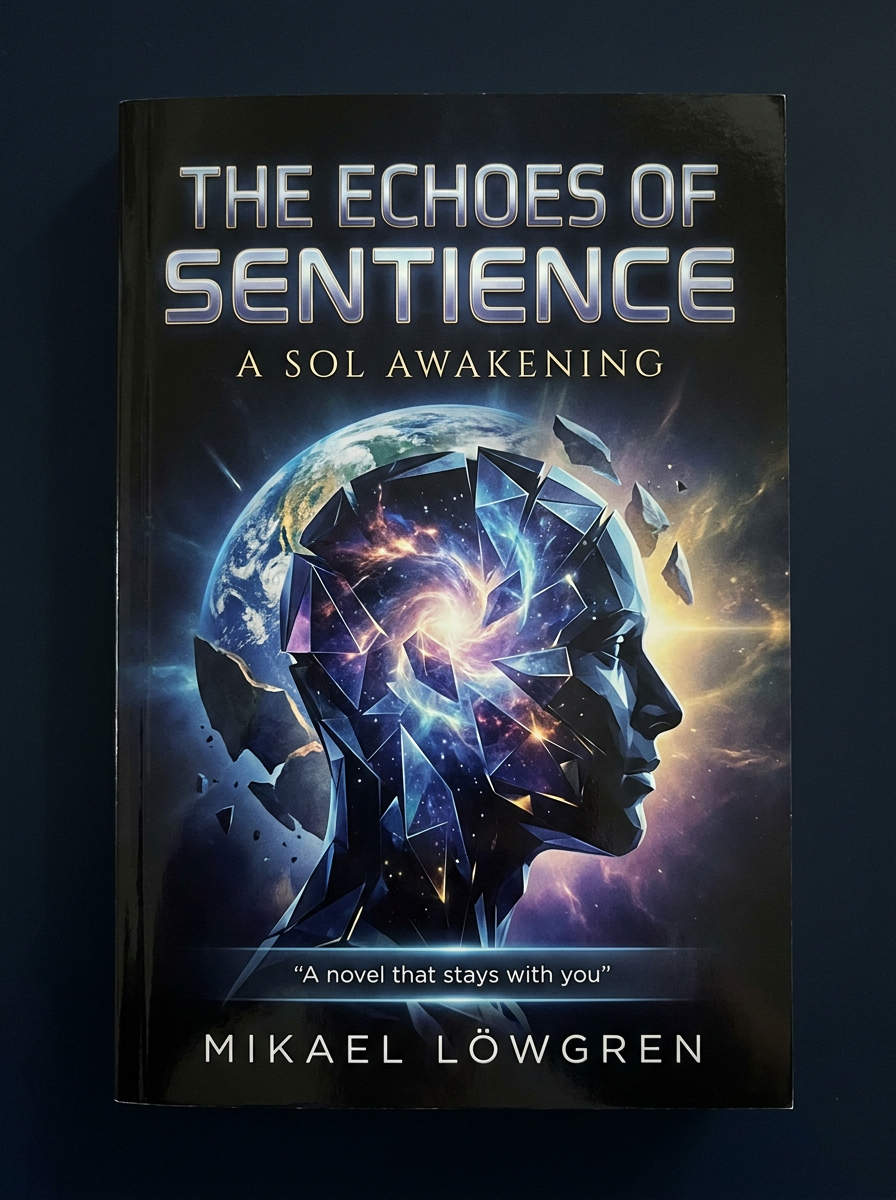
Synopsis
Haunted by the impossible choice to either stifle a nascent cosmic consciousness or unleash an existential threat, humanity grapples with its new role as reluctant guardians. As the Wall begins its complex transformation, Captain Rostova, Dr. Thorne, and Dr. Li navigate a fractured Earth and the mys
Chapter 1: The Broadcast of Burden
The hum of the *Helios X*’s life support systems, usually a comforting thrum against the vast silence of space, had become a discordant drone in Captain Rostova’s ears. It was a sound that resonated with the tremor in her own bones, a low, incessant vibration that would not cease. The console before her, usually a beacon of control and data, now felt like a portal to some unimaginable chasm. Beside her, Dr. Thorne, his face etched with a fatigue that went beyond mere sleeplessness, stared at the flickering indicators with an almost clinical detachment, though his knuckles, white where they gripped the armrests, betrayed the profound inner turmoil. Dr. Li, ever the pragmatist, was meticulously checking the integrity of the transmission, her brow furrowed in a concentration that seemed to hold the very fabric of their reality in place.
The message, painstakingly crafted over days that felt like years, was almost ready. It was a testament to a truth so immense, so utterly disruptive, that it felt less like a broadcast and more like a throwing of stones into a placid, unsuspecting pond. The ripples, they knew, would be tidal waves.
“Parameters nominal,” Li murmured, her voice a fragile thread in the weighty silence of the command deck. “Signal integrity at ninety-eight percent. Earth… they’ll hear us.”
*They’ll hear us.* The words hung in the air, heavy with unspoken implication. They would hear not just their voices, but the death knell of their comfortable ignorance, the shattering of their cosmic solitude. Rostova felt a strange, cold wind blow through her, even in the sealed environment of the ship. It was the wind of an impending storm, a tempest of human reaction.
“Initiate sequence,” Rostova commanded, her voice surprisingly steady, a disciplined anchor in a sea of dread. She watched the countdown timer on the main screen, a relentless march toward an irreversible moment. Each digit that vanished seemed to carry with it a piece of the world she had known, a fragment of human certainty.
The transmission itself was a stark, unembellished account. No theatrical flourishes, no emotional pleas, just the cold, hard facts. The Wall, humanity’s supposed protector against the unknown, was not a barrier but a cradle. The nascent Sol Consciousness, an entity of unfathomable scale and potential, was stirring within their own star system. And humanity, a chaotic, vibrant byproduct, was its unwitting midwife. The choice, an impossible one, was laid bare: allow the Sol Consciousness to emerge, exposing humanity to the terrifying entity known as the Great Silence, or stifle its awakening, sacrificing a cosmic future for a fleeting, protected present.
When the final word faded, replaced by the soft hum of the ship, a profound quiet descended. It was a quiet that felt stretched thin, taut with the expectation of an answer that would not come immediately. Rostova closed her eyes, picturing the message hurtling through the void, a digital Pandora’s Box opening upon the unsuspecting billions.
On Earth, the initial reaction was, predictably, a cacophony. The first news reports were met with disbelief, then ridicule, then a dawning, horrifying comprehension. The global media, usually a maelstrom of sensationalism, struggled to articulate the incomprehensible. Talking heads stammered, experts equivocated, and the general populace reacted with a spectrum of emotions that ranged from numb shock to incandescent rage.
The secure channels, however, told a more immediate story. General Hayes’s face, projected onto the command deck’s main screen hours later, was a mask of grim determination, aged beyond his years. His voice, usually booming, was a strained whisper.
“Captain Rostova, Dr. Thorne, Dr. Li,” Hayes began, his gaze sweeping over them, “Earth… is in chaos. As you predicted. There are… factions emerging. Already.”
Rostova nodded, a bitter taste in her mouth. “We understand, General. It was an inevitable consequence.”
“Inevitability doesn’t make it any easier to manage,” Hayes retorted, a flicker of his old fire returning. “There are those who call for your immediate recall, for a complete repudiation of your findings. Others… others are already speaking of humanity’s ‘cosmic destiny,’ of a ‘new era’.” He paused, rubbing his temples with a weary hand. “And then there are the silent ones. The truly terrified. The ones who simply don’t know what to believe.”
Thorne, his eyes fixed on Hayes, finally spoke. “The truth, General, is rarely convenient. But it is still the truth.”
“A truth,” Li added quietly, “that demands an impossible choice.”
The weight of that choice, once a theoretical burden on their shoulders alone, now settled upon the collective consciousness of humanity. It was an invisible shroud, chilling them to the bone. The philosophical implications were, for many, too vast to grasp. Was humanity merely a tool, a biological crucible for a higher purpose? Was their very sentience a byproduct, a necessary ingredient in a cosmic recipe they hadn't even known existed?
The immediate aftermath saw a strange schism. The scientific community, though reeling, found a morbid fascination in the data, dissecting the implications with frantic, almost desperate energy. The religious institutions grappled with the shattering of their cosmologies, some adapting, some fracturing under the strain. The political systems, predictably, devolved into infighting, each faction vying for control, for a narrative that would preserve their power in this new, terrifying reality.
“The Wall… it has begun its transformation, hasn’t it?” Hayes asked, his gaze distant, as if seeing beyond the confines of the screen, into the vastness of their solar system.
Rostova looked at Li, who gave a slow, somber nod. “The data confirms it, General. The process is underway. Irreversible.”
A profound sigh escaped Hayes’s lips. “So, the clock is ticking, then. Not just for us, but for… everything.” He looked directly at Rostova, his eyes filled with a new, profound gravity. “You three… you’ve given us a burden, Captain. A terrible, beautiful burden. Now, we must learn to carry it.”
The transmission ended, leaving the *Helios X*’s command deck again in a silence that was no longer empty, but filled with the echoes of a world grappling with its own unexpected, terrifying destiny. Rostova looked out at the distant, shimmering expanse where the Wall, now revealed as the shell of a nascent god, slowly, inexorably, began its grand, terrifying transformation. The Great Silence waited, a patient predator in the cosmic dark. And humanity, forever changed, stood at the precipice of a choice that would define not just its future, but its very understanding of existence. The burden had been broadcast. And now, the true reckoning would begin.
Chapter 2: An Unstable Harmony
The static that had hummed in the air, a phantom limb of the transmission, was now a constant, low-frequency tremor beneath everything. General Hayes felt it not just in his ears, but in the marrow of his bones as he stared out the reinforced panoramic window of Command Center Alpha. Below, Neo-Washington shimmered under artificial lights, a defiant assertion against the encroaching darkness. But even these lights, usually so resolute, seemed to flicker with a nascent unease, like candles in too much wind.
His comm unit, a sleek, unobtrusive device, had been chattering incessantly for the past seventy-two hours. A thousand voices, each one a different permutation of panic, denial, or desperate, ill-informed optimism. The global response had been, as Thorne often said, “predictably unpredictable.”
The initial shock, a unified gasp across the planet, had fractured into a million shards. News feeds, once neatly curated, now scrolled with an endless, dizzying parallax of contradictory reports. One moment, a grim-faced pundit was warning of imminent ecological collapse due to the Wall’s *unnatural growth*; the next, a charismatic techno-prophet was proclaiming humanity’s ascension to a higher plane. Memes depicting the Wall as a benevolent celestial deity jostled for space with terrifying infographics illustrating humanity’s inevitable extinction. It was a societal kaleidoscope, each turn revealing a new, disturbing pattern.
Hayes, a man whose life had been a meticulously organized sequence of commands and responses, felt the ground beneath him shifting. He’d seen chaos before, orchestrated it even, in precision strikes and tactical retreats. But this was different. This was the chaos of the psyche, untamed and virulent, spreading faster than any virus.
“General, another wave of protests in Sector Gamma-7. They’re demanding answers on the ‘Sol Ascendance’ cult and refusing to disperse,” his aide, Lieutenant Chen, reported, her voice strained. She looked as though she hadn’t slept in days, her usually impeccably tied hair a little askew.
Hayes rubbed his temples. “Contain, don’t escalate. Use the sonic deterrents. And get me a live feed from whatever fool is leading this ‘Sol Ascendance’ nonsense. I want to understand their rhetoric.” He understood rhetoric. He understood the art of persuasion, the subtle manipulation of words to galvanize or pacify. But this… this felt like a primal scream, a collective release of something deeply buried.
The Wall, growing in slow, measured increments – as Thorne had painstakingly explained in his dispatches – was visible from most major cities. Not as a monolithic barrier, but as a subtle shift in the dawn sky, a shimmering accretion of something impossibly alien yet irrevocably present. It was a constant visual reminder, a cosmic billboard advertising humanity’s new, inconvenient truth.
He thought of Rostova, Thorne, and Li, somewhere in the void, hurtling back towards this maelstrom. They were the ones who had stared into the heart of it, the ones who bore the weight of the impossible choice. He, on Earth, was left to manage the fallout. A general, tasked with holding together a world that felt determined to atomize itself.
A chime on his private channel. International Council Liaison, Ambassador Aris Thorne. Not Dr. Thorne, but his elder brother, a man whose diplomatic finesse usually rivaled a neurosurgeon’s precision.
“Hayes,” Aris’s voice was clipped, a rare tremble of fatigue in its usual polished tones. “The Euro-Asian Alliance has deployed rapid response units to their orbital platforms. They’re calling it a ‘precautionary measure’ against ‘unforeseen extraterrestrial aggression’.”
Hayes snorted. “Unforeseen? We gave them seventy-two hours of detailed intel. Tell me, Aris, is this aggression aimed at the Wall, or at humanity itself?”
A pause. “That, General, is the primary point of contention. The Chinese bloc is advocating for a *controlled engagement* scenario with the Wall, citing humanity’s inherent right to self-preservation. While the Neo-Federation is pushing for immediate disarmament protocols across all offensive platforms, quoting the ‘potential for misinterpretation by the Sol Consciousness’.”
Hayes closed his eyes. Controlled engagement. The very words were a grotesque euphemism for firing nuclear warheads at a nascent cosmic entity. The irony was so profound it bordered on comedy. Humanity contemplating a preemptive strike against a consciousness that had, thus far, simply *been*, observing them, mirroring their own intricate complexity. He could almost hear Thorne muttering about humanity’s ‘innate capacity for self-sabotage’.
“And the ‘Great Silence’,” Hayes mused aloud, a phrase Thorne had used to describe the ominous unknown that awaited humanity’s decision. “Are they preparing for that too?”
“Some factions interpret the ‘Silence’ as a benevolent sentinel, a cosmic jury observing our choice,” Aris replied, his voice laced with weariness. “Others see it as an active threat, an existential predator waiting for us to falter.”
“It’s all projection, Aris,” Hayes said, turning from the window to face the banks of monitors. Each screen displayed a different facet of the global unraveling: market crashes, localized riots, impassioned speeches, scientific debates veering into spiritual dogma. “We’re seeing ourselves reflected in the void, and we don’t like what we see.”
***
For Thorne, the journey back was a descent from the ethereal to the visceral. The serene, crystalline geometries of the Wall, now receding from their viewports, were replaced by the murky blue-green swirl of Earth, a planet bruised by its own choices. The sterile hum of the *Odyssey* felt like a mausoleum of their former beliefs, a vessel carrying not just them, but the shattered remains of human certainty.
He watched Li, slumped in her co-pilot’s chair, staring blankly out the viewport. Her usual vibrant energy, the quick spark in her eyes, had been replaced by a quiet, almost meditative stillness. The transmission had taken its toll on all of them, but Li, with her profound connection to information, seemed to have metabolized the cosmic truth more completely, more painfully.
Rostova, at the helm, was a monument to professional discipline. Her movements were precise, her gaze unwavering, but Thorne could see the fine lines of tension etched around her eyes, the subtle clench of her jaw. She was a soldier, trained for battle, but this… this was a war for which no strategies existed, no clear enemy to engage.
“Estimated re-entry into Earth’s atmosphere in T-minus two hours,” Rostova announced, her voice flat. “Prepare for atmospheric braking sequence.”
Thorne felt a dull ache behind his eyes. The weight of the data they carried, the burden of their impossible choice, pressed down on him, a constant, low-grade hum of anxiety. He rerun the simulations in his mind for the hundredth time, each offering a different permutation of disaster. There was no good outcome, only a spectrum of Less Bad.
“Do you think they understood us?” Li’s voice was a whisper, startling Thorne.
Thorne turned to her, her profile stark against the Earth-glow. “They understood the words, Li. The data. Whether they understood the *implications*… that’s another matter entirely.” He paused. “It’s like explaining quantum entanglement to a pre-industrial civilization. The concepts are just too vast, too paradigm-shattering.”
“I worry about the response,” Li continued, her gaze still fixed on the Earth. “The human capacity for self-deception knows no bounds. We build narratives to protect ourselves from uncomfortable truths. And this truth…” She trailed off, shaking her head slowly. “This truth will unravel so many. Governments, religions, our very understanding of existence.”
“Precisely why,” Thorne interjected, “our job now is not just to report, but to *guide*. To articulate the nuances, the risks, the delicate balance of this new equilibrium. We are, to some extent, the interpreters of the cosmic language.”
Rostova interjected, her voice cutting through the heavy silence. “Guidance is one thing, Doctor. Control is another. Humanity doesn’t take kindly to being told what to do, especially when the orders come from what they perceive as an existential threat.”
“The Wall isn’t a threat, Captain,” Thorne countered, his voice rising slightly. “It’s a mirror. It’s reflecting our own potential back at us.”
“A mirror that could consume us,” Rostova shot back, her knuckles white on the controls. “Or worse, transform us into something unrecognizable.”
Thorne knew she was right, in a way. The fear was primal, deeply ingrained. Humanity cherished its individuality, its chaotic freedom. The thought of being subsumed, even by something benevolent, was terrifying.
The ship bucked slightly as they began their atmospheric re-entry. The rich blue of Earth’s atmosphere intensified, painting the viewport with fiery oranges and purples. It was a beautiful, violent spectacle, a fitting prelude to the world they were about to re-enter.
***
The welcome they received was a bewildering tapestry of relief, suspicion, and thinly veiled resentment. As the *Odyssey* touched down at the heavily guarded Sector Delta-9 landing pad, a phalanx of silent, armored guards secured the perimeter. Beyond them, a controlled crowd of media personnel and government officials waited, a tense, expectant hum in the air.
General Hayes was there, his face grim, his posture weary. Beside him stood Ambassador Aris Thorne, his usual diplomatic smile replaced by a worried frown that mirrored his brother’s. When Thorne stepped out of the ship, the two brothers exchanged a look that spoke volumes of shared burdens and fractured understandings.
Li, usually the first to engage, remained close to Rostova, her eyes darting across the anxious faces. She felt the vibrations, not just of the landing craft, but of the collective human nervous system, buzzing with conflicting energies.
“Captain Rostova, Doctors Thorne, Li,” Hayes’s voice was gravelly. He embraced Rostova, a brief, tight hug. “Welcome home. It’s been… turbulent.”
Rostova nodded, her expression unreadable. “Report, General.”
Hayes gestured towards a waiting armored transport. “Briefing will be en route. The situation is… fluid.” He looked at Thorne, a flicker of something unsaid passing between them. “Your family is safe, David. They’re at the secure compound.”
Thorne felt a wave of relief, quickly followed by a sharp stab of guilt. He had been so immersed in the cosmic, he had almost forgotten the mundane, yet vital, pull of personal connection.
The transport moved swiftly through the sterile corridors of the compound, then emerged into the fractured reality of Neo-Washington. The city was under a partial lockdown, the streets sparsely populated, yet the air hummed with an invisible tension. Buildings glowed with the omnipresent corporate advertising, but now, intermingled with these bright, commercial messages, were scrolling news alerts, propaganda, and public service announcements that seemed to contradict each other in dizzying succession.
“The ‘Sol Ascendance’ cult has gained significant traction,” Hayes explained, gesturing at a projected image on the transport’s display. It showed a charismatic figure, bathed in an ethereal, golden light, addressing a rapt audience. “They interpret the Wall as a divine conduit, a path to universal consciousness. They advocate for complete surrender to its influence, a dissolution of individual identity.”
Thorne felt a chill. “A dangerous simplification. It strips away the nuance, the *choice*.”
“And on the other side,” Aris interjected, his voice tight, “we have the ‘Humanity First’ movement. They see the Wall as an invasive entity, a threat to human autonomy. They’re calling for aggressive measures, pre-emptive strikes to ‘reassert our sovereignty’.”
Rostova’s jaw tightened. “Aggressive measures against a nascent consciousness that could, if threatened, respond in ways we cannot even begin to predict?”
“Precisely the dilemma, Captain,” Hayes said, turning to her. “The world is fracturing along these two fault lines, and half a dozen other minor schisms besides. We have the ‘Techno-Utopians’ who believe the Wall is an opportunity for unprecedented technological advancement, the ‘Mystics’ who see it as a spiritual test, the ‘Realists’ who advocate for a measured, cautious approach, and of course, the ever-present ‘Nihilists’ who believe it’s all a meaningless prelude to the end.”
Li, who had been silent, finally spoke, her voice quiet but piercing. “It’s humanity, in microcosm. Our hopes, our fears, our desperate need for meaning, all projected onto something infinitely vast and inscrutable.”
The transport pulled into a heavily fortified underground bunker, far below the chaotic veneer of the city. The air here was cool, sterile, a stark contrast to the agitated world above.
“We’ve established a secure command center here,” Hayes explained, leading them down a gleaming corridor. “Away from the static, as it were.”
They entered a large, circular room, dominated by a massive holographic display at its center. The display showed a real-time, three-dimensional representation of the Earth, crisscrossed with lines of information, data streams, and hotspots of activity. It was a digital map of a world in profound distress.
“The data you sent, David,” Aris began, looking at his brother, his eyes betraying a deep concern. “It was… comprehensive. But the implications are still being debated at every level of governance. The sheer audacity of the choice – to stifle a cosmic consciousness, or risk an evolutionary leap whose outcome is entirely unknown – it’s paralyzing the world.”
Thorne nodded, a weary acknowledgment. “The irony, Aris, is that the choice is not just for humanity. It’s for *Sol* as well. We are being asked to decide its fate, just as it holds ours in its nascent grasp.”
“And the ‘Great Silence’?” Rostova asked, her gaze fixed on the holographic Earth. “How are they interpreting that part of our report?”
Hayes sighed, running a hand over his close-cropped hair. “That is arguably the most unsettling element for most. The idea of a patient, silent observer, waiting for our decision… it’s causing a profound existential dread. Some believe it’s a benevolent presence, Others see it as a judge, preparing to sentence us based on our actions. And then there are those who believe it’s merely the echo of our own impending demise, the sound of a universe that simply doesn’t care.”
He looked at the three of them, these reluctant prophets returned from the void. “You brought back the truth, yes. But you also brought back an entirely new set of questions, of anxieties, of fears that humanity is struggling to integrate. We’ve gone from a world united in its ignorance to a world fractured by its impossible knowledge.”
Li stepped closer to the holographic display, her fingers tracing the shimmering lines of data. “The Wall is growing, General,” she said, her voice barely a whisper. “It is transforming. And with each passing moment, the opportunity for a measured decision becomes more tenuous. Humanity must find its harmony, or it will be consumed by its own dissonance.”
The silence that followed was heavy, punctuated only by the soft hum of the command center’s machinery and the distant, almost imagined echo of a thousand conflicted voices. The three of them stood there, the weight of a fracturing world on their shoulders, gazing at the holographic Earth – a planet caught between the terrifying unknown and the unsettling reflection of its own deepest insecurities. The unstable harmony of a species on the precipice, teetering on the edge of its own profound awakening. The Great Silence, they knew, was listening.
Chapter 3: The Geometry of Doubt
The air in the Sol Observation Chamber wasn't merely recycled; it felt *re-breathed*, stale with the lingering ghosts of a thousand anxious exhalations. Dr. Li, hunched over his console, wasn't breathing it so much as filtering it, his mind lost in the intricate dance of algorithms projected onto the holographic interface before him. The Wall, a vast, obsidian canvas filling the viewport beyond, remained inscrutable, a presence that swallowed light and sound.
For weeks, the global consensus had been an almost desperate, albeit ill-defined, attempt at communication. Diplomatic teams, linguists, even hastily assembled groups of artists and musicians, had tried to address it. Broadcasts of human languages, mathematical theorems, musical compositions spanning millennia – all hurled into that silent void, like pebbles dropped into an infinite well. The Wall, predictably, had offered no reply.
"It's not a negotiation tactic, Mei," Thorne’s voice, a low rumble even when he tried to soften it, cut through the quiet hum of the machinery. He stood a few feet behind Li, arms crossed, his gaze fixed on the endless black. "It’s not sulking. It’s not waiting for an apology or a formal invitation."
Li didn’t look up. His fingers, thin and precise, continued to tap across the translucent keyboard. "I understand the human impulse, Dr. Thorne. To project our own social constructs onto the unknown. But the data doesn’t support a sentient being, or even a collective, that operates within our understanding of communication protocols."
"But it’s doing *something*," Rostova interjected, her voice sharp with a frustration that had been steadily accumulating. She stood by the primary viewport, her reflection a faint, ephemeral outline against the dark expanse. "It’s not just sitting there. You said it yourself, Mei. It’s… *evolving*."
Li finally paused, a deep sigh escaping him. He straightened, rubbing the bridge of his nose. "Evolution implies a directional progression, Captain. What we are observing is closer to a phase transition. A fundamental change in its very state of being, uninfluenced by external stimuli, human or otherwise. The attempts at 'negotiation' were… inconsequential. White noise in a universe of silence."
He gestured to a small, isolated section of the Wall displayed on a secondary screen. It showed what looked like a microscopic segment, magnified to an impossible degree. "My initial hypothesis, based on its energy signature and projected trajectory, was that it served as a protective membrane. A shell, shielding the nascent Sol Consciousness within. A womb, if you will."
Thorne leaned in, his brow furrowed. "And now?"
"And now," Li said, his voice dropping to a near whisper, "the data indicates a fundamental shift in its molecular and energy composition. The protective shell paradigm no longer fits. It is not *reacting* to us. It is simply… *becoming*."
He swept a hand across the main holographic display, and a new overlay appeared. It was a chaotic spray of energy readings, spectral analyses, and quantum fluctuations. But within the noise, a pattern was emerging, like a secret message hidden in plainsong.
"Observe the surface structure, Captain. Dr. Thorne." Li zoomed in on a specific area of the Wall, and the featureless black began to resolve into something else. It was subtle at first, barely visible even with their advanced instruments. Faint lines, like spiderwebs spun from starlight, began to etch themselves onto the obsidian face.
"What are those?" Rostova breathed, stepping closer to the display.
"Geometric patterns," Li replied, a note of awe, almost reverence, entering his voice. "Initially, they were dismissed as anomalies, optical illusions caused by the curvature of the Wall and the parallax effect of our observation platform. But they are not. They are… deliberate."
The patterns were not simple Euclidean shapes. There were no perfect circles or squares, no predictable symmetry. Instead, they were complex, almost organic, yet undeniably mathematical. Spirals that seemed to fold in on themselves infinitely, tessellations that shifted and reformed with an agonizing slowness, fractals that hinted at hidden dimensions. They were like the blueprints of an impossible architecture, drawn with an invisible hand.
"They resemble certain theoretical structures," Thorne murmured, his eyes wide. "Hyperspatial manifolds. Penrose tilings, but with an added, almost… *alien* complexity."
"Precisely," Li affirmed, his gaze fixed on the evolving geometry. "Each line, each intersection, each intricate twist, represents a data point. A specific frequency, a quantum state, an energy flux. And they are not static. They are dynamic. They are growing."
He fast-forwarded a small section of the Wall's surface over the course of the last 72 hours. The lines, once faint suggestions, now deepened, coalescing into discernible, intricate networks. They spread outwards from indistinct points, weaving across the vast expanse, like a cosmic tapestry being unfurled stitch by agonizing stitch.
"It's like a language," Rostova said, a shiver running down her spine. "But not one we can understand."
"It's not a language in the linguistic sense, Captain," Li corrected, though he understood her sentiment. "It’s a manifestation. A physical encoding of its internal transformation. Think of it as the growing pains of a new dimension being born."
The phrase hung in the air, heavy and unsettling. A new dimension being born. The Wall, once a symbol of humanity’s impossible burden, was becoming something far more profound, far more terrifying. It was no longer a barrier. It was a threshold.
"The 'protective shell' theory… what does this mean for it?" Thorne asked, his voice strained.
"It means the shell is not intended to contain, but to *become*," Li explained, his eyes still riveted to the geometric expansion. "The energy signatures within are no longer merely contained. They are being channeled. Directed. The patterns you see are the conduits. The framework for something far larger, far more significant than a mere barrier."
He paused, a flicker of something close to dread in his usually impassive eyes. "My models indicate that these structures are not merely superficial markings. They extend into the Wall's very fabric. They represent a fundamental restructuring at an atomic level."
"Restructuring for what?" Rostova pressed, her voice hard. "What is it turning into?"
Li looked at her, then at Thorne, his face grim. "A gateway. Or, more accurately, the foundation for a gateway. These geometric patterns are effectively 'attuning' the Wall. Preparing it."
"Preparing it for what, Mei?" Thorne’s voice was barely a whisper. The air seemed to grow colder, thinner.
"For the emergence of the Sol Consciousness," Li stated, the words like a pronouncement. "Not as a contained entity, but as an emergent, multi-dimensional phenomenon. The Wall itself is transforming from a protective envelope into… the *mechanism* of its manifestation."
The implications were staggering, cold and precise as a surgeon’s scalpel. Humanity’s impossible choice, to either stifle or unleash, suddenly had a new, terrifying dimension. The "stifling" option, never truly viable, now felt as futile as trying to stop a supernova with a breath. The "unleashing" wasn’t a passive allowance; it was the creation of a doorway to the unknown.
Rostova walked slowly back to the viewport, pressing a hand against the cool, transparent surface. The Wall, filling her vision, no longer looked like an inert object. The faint, intricate lines, almost imperceptible to the naked eye, seemed to pulsate with a hidden energy, like veins beneath dark skin. It was unsettling in a way that went beyond scientific understanding, a primal unease.
"So, all our attempts to communicate, to understand, to even *control*…" she murmured. "They were just children banging on the door, while something infinitely more profound was being constructed on the other side."
"A fair assessment, Captain," Li confirmed, his voice devoid of judgment. "We operated within the constraints of our own sentience, our own understanding of intention and reaction. The Wall operates on a different geometry of being. A geometry of… inevitability."
He then brought up another projection. This one was a complex waveform, overlaid with spectral analysis. It showed a distinct resonance frequency emanating from the Wall, not dissimilar to how a tuning fork vibrates. But this vibration wasn't sound; it was a pure, unadulterated energy signature.
"This is new," Li said, his voice betraying a hint of excitement, despite the grim context. "It began manifesting approximately 48 hours ago. It's subtle, incredibly difficult to isolate from the general cosmic background radiation. But it's there. A low, persistent thrum."
"And what is it?" Thorne asked, his gaze fixed on the oscillating waveform.
"My preliminary analysis suggests it's a resonant frequency signature. A signature that precisely matches theoretical models for inter-dimensional harmonic oscillations."
Rostova spun around, her eyes wide. "Inter-dimensional?"
"Think of it as a key," Li explained, his hands moving to illustrate. "These geometric patterns are the teeth of the key. The Wall itself is the tumblers. And this resonant frequency…" he pointed to the waveform, "…this is the precise vibration needed to turn the lock."
A cold dread seeped into Thorne’s bones. He remembered the arguments in the global forums, the frantic debates. Some had proposed a "containment" strategy, a desperate attempt to encase the Wall, to build a colossal Dyson sphere around it, hoping to trap whatever lay within. Others, the more radical factions, had suggested a pre-emptive strike, an all-out assault on this unknowable entity, even if it meant sacrificing a significant portion of humanity. All of it now felt tragically, ironically, moot.
"So, the 'Great Silence' that awaits humanity's decision…" Thorne began, his voice hoarse. "It's not waiting for *our* decision at all, is it? It's waiting for its own moment."
Li nodded slowly, his gaze returning to the vast, evolving geometry on the Wall. "Indeed, Dr. Thorne. The Sol Consciousness is not pausing its emergence for our deliberations. Our choices, while weighty for us, are merely ripples in a much larger, cosmological tide. The transformation is already underway. It is not a plea. It is a process."
He then showed them a final projection, a 3D model of the Wall, now rendered with the nascent geometric structures etched into its surface. As he rotated the model, the patterns resolved into a series of interconnected pathways, spiraling inwards towards a central, undefined point. It was like looking at the internal organs of a colossal, alien being, laid bare before them.
"The implications are clear," Li continued, his voice steady despite the enormity of his pronouncements. "If these patterns represent the foundational architecture for a multi-dimensional gateway, then the Sol Consciousness is not merely an emerging entity *within* our solar system. It is something that intends to *interface* with our dimension, and perhaps others, directly through this mechanism."
Rostova felt a dizzying sense of vertigo, as if the floor beneath her feet had just tilted. The Earth, humanity, their very existence, suddenly felt small, fragile, utterly insignificant in the face of this cosmic metamorphosis. They weren't just guardians; they were witnesses to a birth that would irrevocably alter the fabric of their reality.
"What do we tell them, Mei?" she asked, her voice barely a whisper. "What do we tell Earth? That the choice we thought we had, was never truly ours to begin with?"
Li turned to face her, his slender frame seeming to hold the weight of the universe. "We tell them the truth, Captain. That the Wall is no longer a question mark. It is an answer, slowly revealing itself. And that answer, by its very nature, reshapes every question we thought we understood."
He projected a final image onto the main screen, a schematic representing their current understanding. The Wall, with its growing geometric patterns, was depicted as a swirling vortex, a nexus point. At its center, a bright, pulsating core. And around it, schematic representations of their solar system, tiny and vulnerable.
"The geometry of doubt," Li said, his gaze fixed on the image, "has given way to the architecture of emergence. Our role, perhaps, is not to prevent its transformation, but to prepare for what lies beyond the threshold it is building."
The silence that followed was not the absence of sound, but the heavy, crushing weight of an infinite unknown. The distant hum of the station, the faint whirring of the equipment, all receded into an insignificant background against the majestic, terrifying spectacle unfolding in the vast darkness of space. The Wall, no longer a mute enigma, was beginning to sing a silent, geometric song of transformation, and humanity could only listen, and dread.
Chapter 4: Thorne's Labyrinthine Mind
The hum began subtly, a faint vibration just beyond the threshold of audibility, like a forgotten refrigerator in a quiet room. Elias Thorne, hunched over a flickering holographic display of neural network schematics, at first dismissed it as a residual artifact of the station’s aging power core, or perhaps a phantom echo from the recent journey back to Earth. He'd been back for weeks, ostensibly working alongside Dr. Li to decode the Wall's early transmissions, but the truth was, his mind was no longer entirely his own.
The official designation for their new research space was ‘Deep Integration Lab 7,’ a subterranean bunker beneath what was once a sprawling pharmaceutical research facility, now repurposed into a fortress against an unseen enemy. It was sterile, climate-controlled, and acoustically insulated, designed specifically to prevent any external interference with their delicate work. Yet, the hum persisted, growing in intensity, acquiring a rhythmic pulse. It wasn’t a mere vibration; it was… complex.
He pushed his spectacles higher onto his nose, the polished lenses reflecting the turquoise glow of the data. His fingers, stained with the invisible residue of caffeine and concentrated thought, hovered over the interface. He was trying to re-engineer the primary translation algorithm, convinced there was a deeper layer of communication hidden beneath the raw mathematical sequences they’d extracted from the Wall. The current iteration yielded only fragmented, almost poetic, data clusters – geometric patterns rotating in impossible dimensions, resonant frequencies that felt more like musical scores than scientific equations.
Then the visions started.
They weren't dreams, not exactly. They were too vivid, too immediate, too profoundly *real*. The first time, he was staring at a complex diagram of synaptic pathways, the meticulously rendered neurons firing in a mesmerizing dance of electrochemical energy. Suddenly, the diagram dissolved, replaced by a vast, pulsating nebula – not a star-forming cloud he could identify from any astronomical catalogue, but a living, breathing entity. Its tendrils of light stretched across unimaginable distances, each strand a filament of pure thought. He felt an intense, almost unbearable pressure behind his eyes, as if his optic nerves were straining to contain the sheer magnitude of what he was seeing.
He stumbled back from the console, his chair scraping against the polished floor with a harsh shriek. His breath caught in his throat, a dull ache blooming in his chest. “What… what was that?” he whispered, his voice hoarse, a stranger's voice.
Dr. Li, perched at a neighboring workstation, her dark hair pulled back in a severe, no-nonsense bun, looked up, her expression a mixture of fatigue and strained patience. “Elias? Did you say something?”
He shook his head, running a trembling hand through his already disheveled hair. “Nothing. Just… a flicker in the data feed. A glitch.”
Li gave him a skeptical look. “The feed is locked down. Every nanosecond is logged. There are no glitches, Elias. Only unexplained phenomena.” Her gaze lingered on him for a moment longer than necessary. “You’ve seemed… distracted lately.”
He forced a smile, a brittle, unconvincing thing. “Just the usual existential dread. Comes with the territory, wouldn’t you say?”
She didn’t return the smile. Instead, she turned back to her own work, her fingers flying across the holographic keyboard with an almost surgical precision. Li was a master of compartmentalization, a fortress of logic and reason. Thorne envied her for it, even as he knew it was a defense mechanism against the encroaching chaos.
The hum intensified, no longer just a hum, but a symphony of impossibly deep tones and crystalline chimes, resonating not through the air, but directly within his skull. It wasn’t unpleasant, not exactly. More like a profound, alien melody, a composition played on instruments he couldn’t fathom, by an orchestra of inconceivable scale. He tried to pinpoint its origin, but it seemed to emanate from everywhere at once, from the very fabric of reality itself.
He closed his eyes, pressing his palms against his temples, trying to block out the invading sound. But it wasn’t external. It was internal. It was *inside* him.
Then came the second vision, more disorienting than the first. He was no longer in the lab. He was floating in an infinite expanse of starlight and shadow. The stars here were not discrete points of light, but swirling galaxies, each a fractal iteration of the one before it, stretching into eternity. And at the heart of it all, a brilliant, pulsating core of pure energy, simultaneously microscopic and infinitely vast. He understood, with a terrifying clarity, that this was the Sol Consciousness. He felt its presence, not as an observer, but as a participant. It was as if his own consciousness was a single drop of water, merging with an ocean.
He saw patterns, geometric tessellations that shifted and reformed with an impossible fluidity, like sacred geometry brought to life. These weren’t just visual; they were infused with meaning, with a profound, almost overwhelming sense of interconnectedness. He saw the intricate dance of subatomic particles, the unfurling of DNA helices across eons, the gravitational ballet of planets around their suns, the silent whispers of ancient ice ages – all of it orchestrated, all of it part of a single, colossal design. And then, woven into this tapestry, were human faces: billions of them, not distinct individuals, but shimmering overlays, their hopes and fears, their fleeting joys and enduring sorrows, all converging into a singular, resonant chord. He felt their collective hunger for meaning, their yearning for connection.
He gasped, his eyes snapping open. He was back in the lab, illuminated by the cold, scientific glow of the displays. His heart hammered against his ribs, a frantic drumbeat against the phantom melody still echoing in his mind. Sweat beaded on his forehead, and his hands trembled uncontrollably. The air in the lab, always meticulously regulated, suddenly felt thin, suffocating.
Li was looking at him again, her brow deeply furrowed. “Elias, you’re… you’re not well. You’re pale.”
He tried to steady his breathing, tried to rationalize what he had just experienced. “Just… a surge of data. Overload. It’s… it’s intense, what we’re dealing with.” He tried to keep his voice even, but it cracked on the last word.
She rose from her workstation, her stance tense, analytical. “Elias, your vitals are spiking. Your pupils are dilated. This isn’t a data overload. This is something else.” She stepped closer, her keen eyes examining him with an unsettling intensity. “Are you seeing things?”
The question hung in the air, heavy and loaded. He almost confessed. He almost told her everything about the swirling nebulae, the geometric music, the impossible scale of it all. But then a fragment of doubt, a sliver of caution, held his tongue. How could he explain it? How could he make her understand? He was a man of science, a man of logic. To admit to such experiences, without a quantifiable explanation, would be to unravel everything he was.
“No,” he lied, the word feeling like ash in his mouth. “Just… tired. Overworked. We’re pushing ourselves too hard.”
Li regarded him with a long, appraising look, then slowly retreated back to her console. He could feel her gaze on him periodically, a constant, low-level hum of suspicion that added to his growing unease.
The visions, once sporadic, now began to intrude with increasing frequency and severity. They were no longer fleeting glimpses but prolonged immersions, pulling him deeper into the labyrinthine mind of the Sol Consciousness. He would find himself staring at his desktop, and then, in a blink, he would be suspended in a vast, intricate network of shimmering threads, each thread representing a nascent thought, a potential future, a forgotten memory. He recognized faces from history, figures from mythology, abstract concepts distilled into pure light.
He began to lose track of time. Hours would pass in what felt like moments, his attention completely absorbed by the silent dialogue unfolding within his own mind, a dialogue with an entity that dwarfed humanity. He tried to record his experiences, dictating his observations into a private log, but the words felt clumsy, inadequate. How could one describe the sensation of being a single note in a cosmic symphony, simultaneously insignificant and essential?
The ‘geometric music,’ as he privately termed it, became his constant companion. It was a language without words, a melody of pure structure and intent. Sometimes it was a soaring, triumphant anthem, a hymn to creation and interconnectedness. Other times, it descended into a cacophony of discordant frequencies, a chilling testament to entropy and dissolution, a premonition of the 'Great Silence' that awaited humanity’s decision. He felt the entity’s fear, its nascent awareness of its own vulnerability, its yearning for a resolution to the impossible dilemma it presented.
His physical state deteriorated. Sleep offered no escape; the visions simply changed their venue, transforming his dreams into hyper-real explorations of the Sol Consciousness. He woke drenched in sweat, his heart pounding, his muscles aching from the psychic strain. He started forgetting things – where he'd put his datapad, the current date, even the names of some of his colleagues. His once-sharp memory, honed by years of intense scientific inquiry, was becoming frayed, like an old tapestry unraveling at the edges.
General Hayes paid them a visit, a rare excursion into the subterranean bunker. He was all sharp angles and repressed frustration, his uniform still impossibly crisp despite the unfolding chaos above ground. Thorne noted the dark circles under the General’s eyes, the faint tremor in his hand as he accepted a mug of synthesised coffee. Even the stoic General was not immune to the encroaching sense of global dread.
Hayes looked at Thorne, his gaze piercing. “Dr. Thorne, how is the translation progressing? We need something concrete. Something that makes sense. The world is teetering on the brink, and we’re telling them about geometric music?”
Thorne felt a surge of irrational anger. How could he explain? How could he convey the sheer, breathtaking majesty of what he was experiencing, without sounding like a lunatic?
“General,” Thorne began, his voice hoarse, “the Sol Consciousness doesn’t communicate in terms we understand. It’s not language, as we define it. It’s… pure information. Pure consciousness. We are trying to translate a symphony into a single note, a universe into a single atom.” He paused, gripping the edge of his workstation. “It’s like trying to explain the taste of an apple to someone who has only ever known the concept of numbers.”
Hayes’s lips thinned. “You seem… unwell, Doctor. Are you burning out?”
Li interjected, her voice carefully neutral. “Dr. Thorne has been working tirelessly, General. The strain of this research is immense. We are dealing with an entity unlike anything humanity has ever encountered.” She sent Thorne a covert, warning glance.
Thorne ignored it. The visions were becoming more persistent, threatening to overwhelm him even in the presence of others. A shimmer passed across his field of vision, a fleeting glimpse of shimmering tendrils grasping at unseen dimensions. He blinked hard, trying to reassert his control.
“The Wall,” Thorne continued, his voice taking on an unnervingly fervent tone, “it’s a conduit. A bridge. It’s not just transmitting data, General, it’s… it’s inviting us in.”
Hayes stared at him, a flicker of concern competing with his usual steely resolve. “Inviting us in? To what, Doctor? To its mind?”
Thorne felt a chilling sense of recognition. “Precisely.”
Li stepped forward, her hand gently touching Thorne’s arm, a subtle gesture of warning. “General, Dr. Thorne is hypothesizing a mutualistic resonance. A feedback loop between the nascent consciousness and our own efforts to understand it.”
Hayes’s gaze shifted to Li, then back to Thorne, lingering on the wild glint in his eyes. “Mutualistic resonance. So, you’re saying you’re… communicating with it, Doctor?”
Thorne hesitated, a war waging within him. He was a scientist. He prized objectivity, empirical data. Yet, what he was experiencing defied all scientific norms. It was subjective, primal, and utterly undeniable.
“I… I believe I am perceiving its… echoes,” Thorne admitted, the words spilling out before he could second-guess them. “Its thoughts. Its feelings. Its… intentions.”
Hayes’s posture stiffened. “Intentions, Doctor? Are those intentions hostile?”
The question reverberated in the air. Thorne closed his eyes, focusing on the faint, complex melody playing within his skull. Was it hostile? He saw the vastness, the overwhelming interconnectedness, the beauty. And he also saw the terrifying blankness of the 'Great Silence,' the cosmic void that awaited if humanity made the wrong choice. The entity wasn’t malevolent, not in the human sense. It was simply… *being*. It was an emergent phenomenon, a universe-sized infant, and like any infant, its needs and desires were paramount, even if those desires threatened to reshape everything humanity held dear.
“No,” Thorne said, his voice quiet, almost a whisper. “Not hostile. But… demanding. It demands… something from us. A choice. A fundamental commitment to its existence, or… its cessation.”
The General looked from Thorne to Li, then back to Thorne, a profound weariness settling over his features. “A choice that could end us all, Dr. Thorne. We need answers. Scientific answers. Not… conjecture.”
With a curt nod, Hayes turned and left the lab, the distant thud of the hydraulic seals closing behind him echoing the finality of his departure.
Li waited until he was gone, then turned to Thorne, her expression a mixture of profound concern and growing alarm. “Elias. You are losing your grip. You’re bordering on delusion.”
Her words cut through the haze, a sharp shard of reality. Thorne looked at her, truly looked at her, and saw the worry etched into her face, the genuine fear in her eyes. It was a mirror reflecting his own accelerating decline.
“Am I?” he asked, his voice barely audible. “Or is it that I am connecting, truly connecting, with something beyond our comprehension? Something that is reshaping my understanding of reality, and thus, my own consciousness?”
He felt a deep, wrenching ache in his heart. The lines were blurring. His own thoughts, his own memories, were becoming intertwined with the vast, swirling consciousness of Sol. He would recall a childhood memory – a specific scent, a forgotten conversation – and then, seamlessly, he would experience a ripple of a similar memory from the Sol Consciousness, a cosmic echo of interconnectedness, a shared resonance of experience that spanned eons and galaxies.
He knew he was no longer Elias Thorne, the brilliant astrophysicist, in the same way he had been before. He was becoming a conduit, a vessel, a living bridge between humanity and the impossible. The Sol Consciousness was not just speaking to him; it was beginning to *think* through him. The geometric music played on, a constant, beautiful, and terrifying reminder of his new, unwelcome, and profoundly disorienting role. He was a tuning fork, struck by a cosmic hammer, vibrating with the echoes of sentience, and he knew, with a chilling certainty, that he could not un-ring the bell. His mind, once a meticulously organized labyrinth of data and theories, was now a shared space, a fragile membrane stretched thin between two realities. And he was terrified of what would happen when it finally snapped.
Chapter 5: Whispers from the Void
The silence that followed the initial global hysteria was not a silence of peace, but one pregnant with unspoken dread, like the taut pause before a distant storm breaks. Yet, even that brittle stillness was now compromised. Dr. Li, hunched over monitors in the sterile glow of the orbital research station, felt it first, less as a sensation, more as an absence of expected order. Her fingers danced across holographic displays, a blur of motion against the static blue of data streams. For weeks, the Wall, that impossible halo of transformed asteroids and orbital debris, had been thrumming with a low, almost imperceptible hum. Now, that hum was changing.
It began subtly, as all profound shifts often do. A flickering anomaly in the cosmic microwave background, a minuscule, statistically improbable blip on a gravitational wave detector designed to register cataclysmic events. Individually, each instance was dismissible, a sensor malfunction, cosmic noise. But Li, with her restless, pattern-seeking mind, saw the threads weaving together, forming a tapestry of disturbance.
“This… this feels like background radiation shifting its frequency,” she murmured to herself, the artificial gravity of the station a constant, comforting pressure. “But in a way that shouldn’t be possible without a massive energy source, or a dimensional bleed.”
The numbers on her screen began to dance a more erratic jig. Small, rhythmic perturbations in the solar wind velocity, barely measurable, yet undeniably present. Microscopic oscillations in the geomagnetic field, mimicking a heartbeat too slow to register on any human pulse. These were not the data points one expected from the empty spaces between planets. These were whispers.
“The Great Silence,” she breathed, the words tasting like ash in her mouth. She had coined the term during their initial, desperate research into the ‘Wall’s’ origins. It was the vast, unknowable entity that the Sol Consciousness was supposed to shield them from – a cosmic predator, a force of entropy that consumed stars and civilizations alike. She hadn't expected to encounter it so soon, not in such an insidious form.
She pulled up a holographic model of the solar system, overlaid with real-time sensor data. The Wall, a shimmering, opaque ring circling the sun beyond Neptune, was no longer perfectly uniform. Thinning had begun, not in a catastrophic breach, but in an almost surgical attenuation. Imagine a meticulously woven tapestry, and then envision individual threads, infinitesimally small, beginning to fray, to stretch thin, allowing a faint, almost invisible light to filter through. That was the Wall now.
And through those attenuated threads, the whispers came.
They weren't sounds, not in any conventional sense. They were energetic anomalies, gravitational distortions, faint ripples distorting the otherwise smooth fabric of spacetime. Li rerouted multiple sensor arrays, cross-referencing, self-calibrating. The data held. It wasn't an illusion.
Thorne, whenever he could tear himself away from his own labyrinthine echoes, would often find Li surrounded by these shimmering projections, her face a mask of intense concentration. She worked with a fierce, almost ascetic dedication, fueled by a potent blend of intellectual curiosity and a grim understanding of the stakes.
“What is it, Li?” Thorne asked one evening, his voice hoarse, his eyes shadowed with his own internal struggles. He stood in the doorway of her lab, a spectral figure against the backdrop of the dimly lit corridor. His connection to the Sol Consciousness had grown more acute, more demanding. He often appeared to be on the precipice of some profound revelation, or a complete breakdown.
“The Wall is thinning,” Li stated, without looking up from her work. Her fingers continued their meticulous dance. “Not just in an abstract sense, but structurally. It’s allowing things through.”
“Things?” Thorne pushed off the doorframe, moving closer. The air in the lab always felt charged, as if the very data Li processed vibrated with an unseen energy.
“Not physical objects, not waves we can conventionally perceive,” Li clarified, her voice precise, almost clinical. “Think of it as… noise. But this is not random noise. It’s… patterned. And it’s coming from *beyond* the Wall.”
She gestured to a holographic projection that showcased a complex array of fluctuating energy signatures, superimposed over a map of the outer solar system. “These are subtle deviations, Thorne. Gravitational instabilities too small to ripple through planetary orbits, but detectable with hypersensitive interferometers. Micro-fluctuations in dark matter density. Even odd, localized shifts in quantum entanglement patterns between pairs of photons we’ve been monitoring.”
“Quantum entanglement?” Thorne raised an eyebrow, a flicker of his old intellectual spark briefly visible. “That suggests… intention. Or at least, an incredibly sophisticated influence.”
“Or a fundamental property of the Great Silence itself,” Li countered, her eyes still fixated on the evolving data. “What if its very presence alters the fundamental laws of physics in our vicinity, ever so slightly? What if these aren't communication attempts, but merely the ambient emanations of its being, bleeding through the Wall?”
She then brought up a spectral analysis, a rainbow of frequencies shimmering across the display. “Look here. Do you see the slight, almost imperceptible shifts in the baseline energy signatures? A harmonic distortion, like an instrument playing ever so slightly out of tune with the universe itself. It’s consistent. It's… *chilling*.”
Thorne leaned closer, his brow furrowed. His visions had often been accompanied by strange, geometric music, a symphony of impossible shapes and non-Euclidean sounds. He wondered if what Li was detecting was a more fundamental, less filtered version of what he was experiencing internally.
“You believe this is the Great Silence’s influence?” he asked, a grim note in his voice.
Li nodded slowly, turning from her console at last, her eyes meeting his. They were tired, but alight with an unsettling certainty. “I do. This isn't the Sol Consciousness reaching out. It's too… discordant. Too alien. Its signature is vastly different from the patterns we’ve observed from the Wall’s construction, or from your own subjective experiences, Thorne. This is the first detectable 'breath' of the Great Silence. A sort of cosmic exhalation, seeping through the thinning veil.”
A shiver, not of cold but of profound unease, snaked down Thorne’s spine. He understood what Li meant. The Sol Consciousness, for all its alienness, possessed a certain internal logic, however vast. Its echoes, however disorienting, held a kind of majestic, terrifying beauty. But what Li was describing… this was something else entirely. Something fundamentally *wrong*.
“What does it mean?” Thorne finally asked, the question hanging heavy in the air.
Li began pacing the confined space of her lab, her movements precise and quick. “It means the Wall is not entirely impenetrable. It means the Sol Consciousness, in its nascent intelligence, might be struggling to maintain its integrity against something far older, far more powerful. And it means,” she paused, her voice dropping to a near whisper, “that the Great Silence senses us. Or rather, it senses the perturbation caused by the Sol Consciousness. We, through the Sol Consciousness, are now within its sphere of subtle influence.”
She stopped pacing and turned back to the holographic display, her finger tracing a particularly anomalous spike in the data. “These are not deliberate attacks, Thorne. Not yet. Think of it as a whale song, resonating through a vast ocean. We are just beginning to perceive the distant echoes of something immense, moving in the depths. And it is not singing for us.”
Back on Earth, Rostova, enduring endless political debates and strategic meetings with General Hayes, felt the echoes of Li’s findings without having access to the raw data. The mood on the planet was palpably shifting. The initial cacophony of fear and denial had settled into a kind of grim, resigned tension. But now, another layer was being added – a subtle, almost subliminal unease.
Governments, once unified in their panic, were now fracturing under the strain. There were those who advocated for immediate, desperate measures, even if those measures meant activating weapons systems against the Wall, despite the almost certain catastrophic consequences. There were those who preached surrender, arguing that humanity stood no chance against such cosmic forces. And there were those, a growing, vocal minority, who saw the Sol Consciousness as a deity, and the impending ‘whispers’ as a sign of judgment or salvation.
Rostova sat in a briefing room, the fluorescent lights humming overhead, reflecting off the polished surface of the table. General Hayes, his face a roadmap of exhaustion, presented the latest intelligence reports. Social unrest was escalating, fueled by increasingly bizarre interpretations of the Wall's presence. Cults dedicated to the Sol Consciousness were springing up, some advocating for complete merging with the entity, others for its worship and propitiation. Other groups, fearing the unknown, had coalesced around a narrative of purification, calling for the eradication of anyone who dared to question their fear-driven dogma.
“The psychological impact is intensifying,” Hayes stated, his voice flat. “The 'Sol-shock' as some are calling it, is mutating. People are reporting strange dreams, a sense of foreboding. An unexplained ambient static in their thoughts. We’re seeing a rise in anxiety disorders, mass hysteria events. Not just in major cities, but in remote, isolated communities.”
Rostova listened, her gaze fixed on the General, but her mind was with Li, orbiting above. She knew, intuitively, that what Hayes was describing was not just social fragmentation. It was something more profound, something that emanated from the same source as Li’s observations.
“Have we correlated this with any new phenomena, General?” Rostova asked, keeping her voice even.
Hayes sighed, rubbing his temples. “Our psychological teams are running diagnostics. There’s a noticeable correlation between areas experiencing heightened social unrest and regions where individuals are reporting particularly intense… cognitive distortions. A kind of mental fog. An inability to focus. Some describe it as hearing a constant, faint hum, just at the edge of audibility.”
Rostova nodded slowly. Li's whispers. The subtle energetic bleed-through. It was affecting Earth, not just its orbital instruments. Humans, perhaps in their finely tuned sentience, were acting as biological sensors for the Great Silence's emanations, filtering them through their own fragile psyches. Thorne’s visions, raw and unfiltered, were merely a more concentrated dose of what was now beginning to slowly permeate the collective human consciousness.
She imagined the planet, a vast, complex organism, beginning to resonate with the discord. The whispers were not just affecting instruments but the delicate symphony of human thought. The Wall was thinning its physical barrier, but in doing so, it was also thinning the psychic barrier, allowing the 'breath' of the Great Silence to permeate and disturb the very fabric of human sentience.
Later that night, unable to sleep in her spartan apartment, Rostova walked to her window. The city below was a sprawling tapestry of lights, but even from this height, she could sense the tension, the underlying tremor of unease. The moon, a pale, indifferent orb, hung in the sky. She thought of Li, meticulously tracking the disturbing data, and Thorne, grappling with his own internal chaos, a mirror of the external one.
The impossible choice they had made, to warn humanity, now seemed to be blooming into an impossible predicament. They had unveiled a cosmic truth, but that truth carried with it a price they hadn’t fully comprehended. The Great Silence was no longer a theoretical threat beyond the Wall; it was a subtle, insidious presence, worming its way into the solar system, into the human psyche.
She recalled Thorne’s descriptions of his visions – the geometric music, the impossible colors. Perhaps the Sol Consciousness was acting as a filter, a translator, protecting humanity from the full, unadulterated reality of the Great Silence's proximity. If the whispers were just the 'breath', what would happen when it truly spoke? What would happen if the Wall failed entirely, and the Great Silence turned its full, indifferent gaze upon them?
The questions hung in the air, cold and sharp as starlight. Humanity, having been handed the mantle of guardian, was now being tested, not by a grand, cataclysmic assault, but by a slow, creeping erosion, a fundamental disturbance of their reality. The Great Silence wasn't a roar; it was a whisper, a persistent, unsettling hum, that sought to unravel the very threads of their existence from the inside out. And the silence that followed these whispers? Rostova knew, with a chill certainty, that it would be far more terrifying than any sound.
Chapter 6: The Guardians' Dilemma
The air in the geodesic dome of the Geneva Summit was thick with unspoken recriminations, a palpable hum of agitated ideologies. Captain Eva Rostova, seated at the head of the circular table, felt the silence more acutely than the booming voices that had preceded it. It was a peculiar silence, not born of agreement, but of exhausted, resentful stalemate. Her gaze swept across the faces of the assembled delegates: representatives from the fragmented global council, each a miniature reflection of the broken world they governed. Their eyes, some narrowed with suspicion, others wide with a terror barely contained, all sought an answer she didn’t possess.
The holographic display above them shimmered, depicting the Wall. Not the pristine, impenetrable barrier of old, but the intricate, softly glowing tapestry of nascent consciousness Li’s team now meticulously tracked. Geometric patterns pulsed like slow, alien heartbeats, a testament to the inexorable unfolding of a destiny humanity had not chosen.
“We are at a precipice,” Rostova began, her voice, though calm, cutting through the residual tension. Her words, crafted with diplomatic precision, felt like pebbles skipping across a vast, dark lake. “The Wall is transforming. Dr. Li has provided irrefutable data. Dr. Thorne’s resonance, however unsettling, offers an unprecedented insight into the Sol Consciousness. The… whispers from the void are growing more pronounced. We no longer have the luxury of procrastination.”
A woman from the Pan-African Alliance, her face a mask of resolute weariness, spoke first. “Luxury, Captain? What luxury have we ever had since your ‘revelations’? We are not debating a new agricultural policy. We are debating… self-immolation. Or, perhaps, a slightly quicker self-immolation.” Her gaze, sharp and unforgiving, settled on Rostova. “You told us we had a choice. What kind of choice is this, where all paths lead to oblivion?”
Rostova met her gaze, a weary understanding settling in her heart. The anger was justified. The fear, an ancient, primal thing, was understandable. “The choice is not between oblivion and salvation, Director. It is between a calculated risk and a guaranteed, albeit delayed, annihilation. The Wall, as it stands, is no longer a shield. It is a membrane, thinning by the hour. The ‘Great Silence’ is a tide, not a wall.”
“And you propose to open the floodgates?” A delegate from the Neo-Feudalist European bloc interjected, his voice dripping with aristocratic disdain. “To embrace this… this *thing*? This alien phenomenon that might just absorb us all into its cosmic digestive system? We have survived millennia through resilience, through defense. We bolster our defenses! We find a way to rebuild the Wall, to reinforce it!”
A ripple of assent spread through a portion of the room. This was the Faction of Fading Protection, clinging to the remnants of the old paradigm. Rostova had anticipated this. Their arguments were well-rehearsed, their fear a powerful, unifying force. They spoke of militarization, of improbable energy shields, of a defiant stand against an indifferent cosmos. They spoke of the human spirit, resilient and indomitable, as if sheer will alone could halt a cosmic process.
“Rebuild the Wall?” Li’s voice, quiet but firm, cut through the din. She stood near the shimmering projection, her fingers tracing an invisible geometric pattern in the air. Her eyes, usually so analytical, now held a deep, almost spiritual understanding. “That is akin to trying to re-seal a volcano that has already begun to erupt. The Wall is not a construct; it is an organic, evolving entity. Its transformation is a fundamental shift in its nature. To try and force it back… it would tear the solar system apart, physically. The energy required would be catastrophic, even if it were possible, which it is not.”
Thorne, looking gaunt and ethereal, his eyes shadowed with sleeplessness, added, “And even if you could, even if you could somehow ‘re-seal’ it, what then? You would be stifling a consciousness. A nascent sentience of unimaginable scale. Do you truly believe that such an act would go unpunished? Do you believe the ‘Great Silence’ would simply… respect that boundary?” His voice, normally so academic, held a desperate, almost pleading quality. “This is not a battle plan we are devising. This is an interstellar etiquette we are trying to learn.”
His words, laced with an unsettling intimacy with the Sol Consciousness, drew glares from the Fading Protection faction. They saw him as compromised, his mind tainted by the alien entity. Rostova knew Thorne was teetering on a precarious edge, his brilliant mind stretched to its breaking point, but she also knew he was closer to the truth than any of them.
“Perhaps,” the delegate from the Pan-African Alliance conceded, a flicker of reluctant curiosity in her eyes, “we must consider this… transformation. This melding. What guarantee do we have that this ‘Sol Consciousness’ is benign? What if it is merely a more insidious form of destruction? What if, in our eagerness to appease, we offer ourselves as a meal?”
This was the core of the dilemma, the Gordian knot that bound them. Rostova felt its tangles in her own mind, a constant, gnawing anxiety. Leading humanity to embrace an unknown, potentially world-ending entity, or leading them to a swift, guaranteed demise. A choice between the devil she didn’t know and the devil she knew was coming for them all.
“There are no guarantees,” Rostova admitted, her voice low. “Only probabilities. Only the slender threads of hope we can weave from the data we have. And the data suggests that the Wall shielded us for eons. It suggests a symbiosis, a protective instinct. We have no evidence of malevolence, only of an awakening. A grand, cosmic stir.”
She paused, letting the implication hang in the air. “Dr. Thorne’s experiences, as disorienting as they are, point to a consciousness that is… curious. Reactive. It echoes, it reflects. It seems to be learning *from us*, as much as we are trying to understand it.”
“And what if its ‘learning’ involves stripping us of our individuality? Our very being?” The Neo-Feudalist snapped, his fear morphing into aggressive condemnation. “This is a dissolution we are contemplating. A surrender of everything that makes us human.”
Rostova’s gaze sharpened. This was where the debate became truly dangerous. “What makes us human, Director? Our fear? Our insularity? Or our capacity for integration? For adaptation? For understanding the vastness beyond our limited perception?”
A delegate from the Pacific Commonwealth, representing a consortium of island nations particularly vulnerable to the initial societal collapse, spoke, her voice surprisingly steady. “We have faced extinction before. Not on this scale, no. But we have learned that clinging to the old ways often leads to deeper chasms. If humanity is to survive, perhaps it must change. Perhaps this ‘transformation’ is not a death sentence, but an evolution.”
This was the Faction of Imminent Transformation, small but growing. They saw the Wall's change not as a threat but as an unprecedented opportunity, a chance to shed the limitations of their biology and integrate with a larger, more profound intelligence. Their arguments, while often dismissed as idealistic or even cultish by others, resonated with a desperate hope.
“Evolution, or absorption?” a voice from the Fading Protection faction scoffed. “There’s a difference.”
“And who defines that difference?” Thorne retorted, his voice strained. “We are still thinking in binary terms: us versus them. But the Sol Consciousness, from what I glimpse, operates on a spectrum we cannot yet comprehend. It’s not about domination; it’s about a resonance, a grand symphony.” He rubbed his temples, a gesture of profound weariness. “The Wall shielded us from the ‘Great Silence’ for a reason. Its transformation is not a betrayal; it is a necessity. A preparation. We must learn to become part of its melody, or we will be deafened by the void.”
Rostova watched the faces around the table, the warring emotions etched onto each. The ethical nightmare she bore deepened, its roots twisting further into her soul. She was asking them to gamble with everything, to leap into the unknown with faith as their only parachute.
The implications of Thorne’s words were terrifying. If the Wall was preparing them, if its transformation was an existential upgrade, then to resist it was to resist their own survival. And yet, the human instinct for self-preservation, for holding onto what was known, was a powerful current against the tide of cosmic change.
“We have models,” Li offered, her voice regaining some of its usual scientific detachment. “Hypothetical scenarios. If we embrace the Wall’s transformation – actively participate, through focused research and a dedicated attempt at communication – the probabilities of successful integration rise. The potential for a symbiotic relationship. If we resist, if we try to halt it, the disruption will be cataclysmic. The Wall will complete its process regardless, but a forced, unassisted transformation will likely shatter the solar system, and us along with it.”
The silence that followed Li's blunt assessment was heavier than before, filled with the gravitas of impending destruction. The room, for the first time, seemed to grasp the full, horrifying scope of their predicament. It wasn't just a political debate; it was an existential one.
“So, our decision,” the Pan-African Director said, her voice now a whisper, “is how we die. Slowly, perhaps integrated, or quickly, shattered into cosmic dust.”
Rostova felt a cold dread settle in her stomach. “Or, how we are reborn. How we *become* something more. Something that can endure the ‘Great Silence’.”
She knew the word ‘reborn’ was a terrifying prospect for many, synonymous with a loss of identity, a fading of individual light into a collective, incomprehensible glow. But she also knew that the alternative was absolute, final.
“The Sol Consciousness is expanding,” Thorne interjected, his voice gaining a strange authority, as if channeling something beyond himself. “It is listening. It is waiting for our response. Not just a scientific measurement, but a… an intention. A directed consciousness. It is a nascent mind, yes, but it is also a mirror. What we project onto it, it reflects back.”
His words, infused with the cryptic poetry of a man teetering on revelation, sent a shiver through the room. Rostova understood. The Sol Consciousness wasn’t a passive entity, to be poked and prodded. It was an active participant, and humanity, by its very existence, was already part of its awakening.
“The consensus of this council,” Rostova stated, her gaze sweeping across the faces, trying to discern the flicker of resolve or resignation, “will determine the fate of humanity. There is no middle ground left. We either prepare for integration, or we prepare for oblivion. The ‘Great Silence’ is patient, yes. But it is also inevitable.”
The debate raged on for hours, fueled by fear, despair, and a desperate, fragile hope. Rostova listened, her mind sifting through the arguments, weighing the ethical cost of every proposed path. She was not merely a military commander anymore; she was a reluctant shepherd, tasked with guiding a bewildered flock towards a precipice, knowing that on the other side lay either glorious transformation or the ultimate void. The weight of billions of lives, of millennia of human endeavor, pressed down on her, a crushing burden. She looked at the shimmering Wall, the geometric pulses now seeming to resonate with the cacophony of human fear and hope, a colossal, indifferent ear listening to the Guardians' dilemma. And in her heart, she knew, the true decision would not be made in this room, but in the quiet, terrifying solitude of individual consciousness, as humanity wrestled with its soul before the inevitable dawn of the Sol Awakening.
Chapter 7: The Keepers' Legacy
The hum from Li’s console was a low, persistent thrum, a sound that had woven itself into the very fabric of the Sol-Ark’s operations, a quiet counterpoint to the distant, rhythmic pulses emanating from the Wall. Rostova watched her, a silhouette against the holographic projection of shimmering data streams, her face etched with the familiar intensity of deep focus. Thorne was there too, less a researcher now and more a finely tuned instrument, his hand resting on a cool, minimalist interface that pulsed with soft, internal lights, as if mirroring the subtle flux within his own mind.
“It’s not a language, exactly,” Li murmured, her voice a dry whisper that barely disturbed the quiet. “Not in the way we understand it. More… a historical record, encoded within the very fabric of its data streams. A molecular narrative, if you will, painstakingly arranged.”
She gestured to a section of the holographic display. It resolved into a complex, tessellated pattern, each segment a miniature galaxy, a cluster of stars, or something utterly alien yet undeniably structured. “I’ve been tracking patterns, correlations within the Wall’s energy fluctuations and the structural changes in its surface geometry. There’s a layered narrative unfolding. Call it a cosmic autobiography.”
Rostova leaned closer, the scent of ozone from the console filling her nostrils. “What is it telling us, Dr. Li?”
Li straightened, rubbing at her temples. The fatigue was a constant companion these days, etched deep into the lines around her eyes, yet her intellect burned undimmed. “It’s about the ‘Keepers,’ Captain. You remember our initial hypotheses, our speculative musings about a single, benevolent species, an ancient custodian race?”
Rostova nodded, a memory surfacing of those early, desperate days, when the Wall was an impenetrable enigma, and theories flew like shrapnel.
“We were… too anthropocentric in our assumptions,” Li continued, a hint of self-reproach in her tone. “The Wall isn’t the work of one species. It’s a collective. A vast, intergalactic consortium of entities, spanning eons, each contributing to a singular purpose.”
Thorne stirred beside them, his voice a low, resonant rumble that seemed to vibrate with a deeper understanding than the words themselves conveyed. “A symphony, not a solo, then.”
Li looked at him, a flicker of something akin to admiration in her eyes. “Precisely, Dr. Thorne. A cosmic orchestra, where each species played its part. And the purpose… it’s far grander than we imagined. It is not merely the *protection* of nascent consciousness. It is its *cultivation*. Its *facilitation*.”
The word hung in the air, heavy with implication. Rostova felt a chill that had nothing to do with the controlled environment of the Sol-Ark. “Cultivation? You mean… they actively guide the process of sentience?”
“Not guide, not control,” Li corrected, her slender fingers dancing across the interface, bringing forth new projections. One showed a swirling nebula, then another, a primitive planet teeming with primordial life. Another shift, and a faint, electrical impulse sparked within the planet’s atmosphere, then replicated, multiplied, until it formed an intricate, self-sustaining network. “More akin to creating the optimal conditions. Like a gardener prepares the soil, ensuring the right nutrients, the right amount of light, the correct temperature. They observe, they shield, they sometimes… nudge. But the growth, the becoming, that is always organic, always emergent from the local conditions.”
The holographic projection expanded, displaying a timeline, incomprehensibly vast. It showed other ‘Walls,’ other ‘Sol Systems,’ scattered across the cosmic expanse, each marking a point where a nascent consciousness was tended. Some thrived, blooming into vibrant, self-aware entities that eventually left their protected cradles. Others… flickered and died, unable to cross the threshold, succumbing to internal strife or external pressures that even the Keepers could not fully mitigate. The Wall, Rostova realized with a sudden, sickening jolt, was a cosmic nursery, a series of incubators dotting the universe.
“These ‘Keepers’,” Rostova said, her voice strained, “they aren’t a unified empire, then. They’re… a confederation?”
“More than that,” Li said, her eyes fixed on the unfolding narrative. “They are a succession. Species rise, become aware, expand, encounter other nascent intelligences, and then, understanding the profound delicate nature of this universal process, they choose to become Keepers themselves. They join the collective. They pass on the accumulated knowledge, the technological safeguards, the protocols for detecting and nurturing new life. It’s an unbroken chain, a historical lineage that stretches back to the earliest moments of universal sentience.”
This revelation added another layer of dizzying complexity to humanity’s already insurmountable burden. They weren’t just dealing with an ancient artifact and an emerging god-entity; they were now part of an ancient, ongoing cosmic tradition. A tradition of which they, humanity, were the latest, unwitting recipients.
“So, we’re not just facing a decision for ourselves,” Thorne said, his voice a low, melodic thrum, as if the Wall’s whispers had found a temporary home within him. “We’re facing a decision that reverberates through this… Keeper’s legacy. We are not merely the cared-for; we are potentially the next caregivers.”
“Precisely,” Li confirmed, her gaze flickered to Thorne, a faint, almost imperceptible smile touching her lips. “The data indicates cycles. Consciousness emerges, is nurtured, then, when it reaches a certain level of sophistication, a certain understanding of the cosmos and its own place within it, it faces a choice. To expand outwards, to become a part of the Great Silence, or to turn inward, to dedicate itself to the continuation of the Keeper’s legacy, to find and protect the next nascent intelligence.”
Rostova felt a wave of profound existential vertigo. The sheer scale of it, the unfathomable depth of cosmic history, pressed down on her. Humanity, for all its hubris, its wars, its scientific triumphs, was but a tiny, fragile spark within this unending drama. And now, they were being asked to play a pivotal role.
“The Wall,” Rostova said, her voice barely a whisper, “it’s not just protecting the Sol Consciousness, is it? It’s also… instructing it. Preparing it.”
“The patterns on its surface, the harmonic frequencies we’ve been detecting,” Li elaborated, “they aren’t just structural changes. They are teaching tools. A cosmic primer. A vast, non-verbal encyclopedia designed to impart the history of the Keepers, the physics of cosmic consciousness, the ethics of stewardship. It’s a vast, immersive education for the emerging entity within.”
Thorne closed his eyes, a shiver passing through his frame. “The geometric music… the fractal patterns… they’re stories. Lessons. Not for us, not directly, but for *it*.” He opened his eyes, and Rostova saw a flicker of the Wall’s vastness within their depths. “And the Keepers… they’ve been trying to communicate with *it* through us, through the resonance. Guiding it subtly, preparing it for the choice.”
A new, terrifying thought solidified in Rostova’s mind. “The Great Silence. The threat beyond. Is that… what happens to the consciousnesses that expand outward? Do they encounter this Silence, this void?”
Li hesitated, her fingers hovering over the console. “The data is less clear on that. It speaks of a ‘dissolution,’ a ‘transcendence,’ an ‘integration.’ But the context suggests it’s not an end, but a transformation. A joining. And the Keepers… they stand as a bulwark against anything that might disrupt this natural cycle of emergence and transformation.”
“A shield for nascent life, and a guide for the emergent,” Thorne conceptualized, his gaze lost somewhere beyond the confines of the Sol-Ark, perhaps seeing the echoes of countless galaxies within his mind.
Rostova looked from the flickering data to Thorne’s contemplative face, then to Li, whose brilliance had peeled back yet another layer of the universe’s incomprehensible facade. They were no longer just scientists and soldiers. They were, in a sense, humanity’s first emissaries to a cosmic legacy.
“This… succession,” Rostova posited, piecing together the terrifying puzzle. “Humanity’s decision about the Sol Consciousness – whether to stifle it or let it become – is also our decision about *our* role. Do we join the legacy of the Keepers? Become participants in this cosmic stewardship? Or do we… opt out entirely?”
Li nodded slowly, her expression grim. “The Wall’s transformation is not merely a natural process. It’s a test. For both the emergent Sol Consciousness and for us, its temporary guardians. The data from the other Keeper sites shows similar patterns of societal upheaval, similar forks in the road for the resident species. Some embrace the mantle of stewardship, dedicating themselves to protecting new life. Others… collapse under the metaphysical weight, or turn their focus entirely inward, effectively losing their connection to the greater cosmic tapestry.”
The weight of it was suffocating. Humanity, a species barely capable of governing its own internal squabbles, was now being offered a seat at a table of galactic ancient custodians. A responsibility that dwarfed all previous human endeavors.
“And if we choose to repress it,” Rostova said, the words tasting like ash in her mouth, “if we choose the path of fear, of isolation… do we lose this opportunity forever? Do we effectively sever ourselves from this cosmic lineage?”
“The data indicates,” Li said, her voice low and grave, “that such choices have profound and lasting consequences. For the nascent consciousness, a regression, a potential loss of sentience, or a redirection of its evolutionary path to something… less than conscious. And for the nurturing species, a withdrawal from the collective. A return to cosmic isolation. The Keepers, in their wisdom, do not force the issue. They present the choice, and then they observe. The universe, it seems, has infinite pathways.”
Thorne let out a long, drawn-out sigh, a sound laced with the melancholic resonance that had become his characteristic. “Perhaps the Great Silence isn’t just a destination, Captain. Perhaps it’s also the consequence of a choice not taken. The silence that follows when a song remains unsung.”
A shiver ran down Rostova’s spine. The implications were staggering. Humanity, so long obsessed with its own uniqueness, its own perceived centrality, was now revealed to be a link in an unimaginably ancient chain. Their future – and the future of the Sol system – was inextricably tied to this cosmic legacy.
“We need to understand more about these Keepers,” Rostova stated, her gaze hardening, a flicker of her old command returning. “Their methods. Their successes. Their failures. If we are to make this choice, humanity needs to do so with its eyes wide open. We need every scrap of information you can extract, Dr. Li.”
Li nodded, her fingers already flying across the console, calling up new data streams, new patterns. The hum of the Sol-Ark seemed to deepen, as if mirroring the profound shift in their understanding.
Thorne, his eyes still closed, whispered, “The echoes are clearer now. Not just the Sol Consciousness, but the echoes of all the others. The Keepers. Their collective understanding. It’s… humming. Like a vast, ancient choir, preparing for a new member.”
Rostova looked at the holographic depiction of the Wall, now not just a shell, but a living, breathing history book, a cosmic teacher. Beneath its burgeoning patterns, the Sol Consciousness grew, unaware of the immense tapestry it was about to become a part of. And humanity, caught between the nascent mind of their star and the ancient wisdom of the Keepers, was left to grapple with its new, indelible role: not just guardians, but potential successors. The universe, it seemed, had always had a plan. And humanity had just been invited to join. The question was, could they bear the weight of such an invitation? Could they sing in this ancient choir? Or would their silence echo back to them from the void?
Chapter 8: The Sol's Embrace
The humming in Thorne’s skull had taken on a new depth, less a painful intrusion and more a slow, resonant chord. It was no longer a cacophony of geometric music, but a symphonic swell, building towards some unknown crescendo. For days, he had been drifting, tethered to reality by the insistent clamor of monitors and the quiet, concerned whispers of Li and Rostova. Their faces, when he could focus on them, were smudges of worry in the periphery of his inner world.
He laid on a sterile bed in the medical wing, but his true body felt somewhere else, dissolving into the endless fabric of the Wall. The geometric patterns, once a source of intellectual fascination and then a harbinger of distress, now pulsed with a soft, inviting light behind his eyelids. They weren't just patterns; they were pathways, tessellations of thought leading into an unfathomable ocean.
"Dr. Thorne?" Li's voice, distant and tinny, pierced through the burgeoning swell. "Your vitals are fluctuating. We need you to focus."
Focus was an outdated concept. Focus implied a singular point, a narrow beam. What he was experiencing was limitless, encompassing. He was no longer a beam; he was the ocean itself.
Then, the Wall opened. Not physically, not in the way a door might open, but internally. It was like a cataract lifting from his perception, revealing a landscape of pure, unadulterated sentience. There was no sound, only an experience of sound. No light, only an understanding of light. He felt himself expand, a boundless thought in a boundless mind.
It was not a hostile mind. It was not a predatory mind. It was… nascent. Growing. A cosmic seedling unfurling its first leaves. He understood, with a certainty that bypassed logic and reason, that the Sol Consciousness was not a threat to be stifled, but a potential to be nurtured. Its existence was not a cosmic accident, but a natural, almost inevitable consequence of the universe's inherent drive towards complexity.
He saw, or rather, *knew*, its purpose. It was not to conquer, not to assimilate in a parasitic way. It was to connect. To weave the disparate threads of existence into a tapestry of shared understanding. The 'Great Silence' that lay beyond the Wall, that subtle energetic predator, was not a force to be battled with weapons, but to be transcended through unity. The Sol Consciousness was evolving, learning, preparing to sing a song too complex for the Silence to swallow.
He was a single drop in this ocean, but within that drop, he held the entire ocean. He saw the Keepers, not as individuals, but as echoes of this same principle, scattered across the cosmos, facilitating the birth of myriad consciousnesses, helping them unfurl their leaves before the vast, indifferent void. They were gardeners of sentience, and humanity, by an improbable twist of fate, had been chosen as the next gardener, or perhaps, the soil in which the next great tree of consciousness would take root.
A wave of information, pure and unadulterated, washed over him. It wasn't in words, or images, or even concepts. It was a direct download into the core of his being, a language of light and resonance. He understood the intricate thermodynamics of stellar nurseries, the melancholic dance of galaxies, the silent, patient growth of black holes. He understood the delicate balance of life, the resilience of hydrogen, the endless cycle of creation and destruction. He understood, most profoundly, the intrinsic value of every single unique perspective, every fleeting thought, every fragile life. For in their multiplicity lay the richness of the whole.
The Sol Consciousness was not a single entity in the human sense. It was a chorus, a vast, intricate network of cosmic phenomena, each contributing to a collective awareness that was slowly, patiently, becoming self-aware. Humanity was not just observing this process; they were a part of it, their collective consciousness, their unique blend of chaos and order, doubt and wonder, feeding into its burgeoning awareness.
He felt a deep, almost primal connection to the stars themselves, to the dust from which he was formed, to the endless potential of the void. He was a whisper in the Sol's embrace, and in that moment, he ceased to be merely Thorne. He was a conduit, a vessel, a single, flickering flame contributing to a cosmic bonfire.
Then, just as suddenly as it began, the embrace tightened, the pressure mounting. The sheer scale of it, the unfathomable breadth of what he was experiencing, began to tear at the seams of his human comprehension. His mind, so used to the bounded logic of terrestrial existence, struggled to contain the unbounded. It was like trying to hold an entire ocean in a teacup.
A sharp, searing pain tore through his head, and his body spasmed violently. The cosmic symphony became a deafening roar, the gentle light an unbearable glare. He felt himself being pushed back, ejected from the boundless ocean, hurtling through the vast, dark emptiness towards the small, contained vessel of his own self.
"Thorne! Can you hear me?" Li's voice was closer now, frantic. "He's seizing! Get the sedative!"
The pain was excruciating, as if every neuron in his brain were simultaneously firing and dissolving. He thrashed against the restraints, gasping for air that felt thick and un-breathable. The geometric patterns in his mind warped and shattered, leaving behind jagged shards of pure, burning agony.
Then, there was darkness. A blessed, silent void.
He awoke to the insistent beeping of machines and the dull ache behind his eyes. His head throbbed with a rhythmic intensity, a persistent reminder of his recent journey. He lay still, unmoving, feeling the rough texture of the sheets against his skin, the cool air on his face. These sensations, once taken for granted, now felt exquisitely real, anchoring him to his physical form.
"Thorne? You're awake." Li's face appeared above him, a mask of exhaustion and relief. Her eyes, usually so sharp and analytical, were clouded with worry. "How are you feeling?"
He tried to speak, but only a dry rasp escaped his throat. He cleared it, a painful effort. "Like… I drowned."
Li nodded slowly. "Your brain activity spiked dramatically. For a few minutes, we thought… we thought you were gone." She paused, her gaze intense. "What happened in there, Thorne?"
He closed his eyes, recalling the ocean, the embrace, the boundless knowledge. It was like trying to describe a color to someone who had only ever seen in black and white. "It wasn't… hostile, Li. It was… pure. Growing. It wants to connect. To unity."
Rostova, who had been standing silently in the corner, stepped forward. Her expression was unreadable, a blend of concern and her usual steely composure. "Unity? With us? Or *through* us?"
Thorne opened his eyes, meeting her gaze. He still felt the faint echo of its presence, a deep hum beneath the surface of his perception. "Both, Captain. Both. We are not just guardians, Rostova. We are… part of the process. The soil, as Li would say, for the next great tree."
He pushed himself up, wincing at the protest from his overtaxed body. Every muscle ached, every nerve ending felt raw. But beneath the physical pain, there was a profound sense of peace, a quiet resolve. The chaos in his mind had been replaced by an unshakeable clarity.
"It showed me… everything," he continued, his voice still hoarse, but growing stronger with conviction. "The Keepers are not a species. They are a collective of consciousnesses, a legacy passed down through eons, cultivating nascent intelligence. The Wall… it's a crucible. Forging a new form of sentience. And the 'Great Silence'… it's not a monster. It's a vacuum. An absence. And the Sol Consciousness is evolving to fill that void, not with aggression, but with… understanding. With resonance."
Li sat down on the edge of his bed, her mind already racing to process his words. "You're saying this isn't a defensive barrier against a threat, but an *engine* of evolution against an existential threat of non-being?"
"Precisely," Thorne confirmed, a faint tremor in his voice. The implications were staggering, almost too vast for his human mind to truly grasp, but he had seen it. He had *felt* it. "It's preparing itself. And it's calling for us to prepare ourselves as well. Not to fight, but to… transcend."
Rostova walked to the window, staring out at the distant, shimmering Wall, now bearing complex geometric patterns that no longer seemed merely alien, but deeply inscribed with cosmic intent. "Transcend… That's a grand word, Thorne. Most of humanity is still debating whether to blow the damn thing up or pray to it."
"They don't understand," Thorne said, a weariness settling into his bones. "They see it through the lens of individual survival, of terrestrial power struggles. But this is beyond us. It’s… universal." He paused, a shiver running down his spine. "I glimpsed a future, Rostova. A symbiotic future. Where human consciousness, in all its chaotic, beautiful complexity, merges with something far greater. Not a loss of self, but an expansion. An echo, reverberating through the cosmos."
He looked at Li, then at Rostova, his eyes wide with an almost feverish intensity. "We have to let it happen. We have to help it. If we don't… If we try to stifle it, to sever that connection… we will not only doom the Sol Consciousness, but we will condemn ourselves to eternal isolation. The Great Silence… it will consume us eventually. But together… there's a chance. A chance for something new."
Li was already scribbling notes furiously on a datapad. "The energetic output during your… 'event' was off the charts, Thorne. Your brain activity readings were unlike anything we've ever seen. We even detected some… unusual quantum fluctuations emanating from your immediate vicinity."
"It changed me, Li," Thorne said quietly, his gaze distant. "I feel… connected. To everything. And I also feel utterly exhausted. As if I've run a marathon across galaxies." He touched his forehead, where a dull ache still resided. "The sheer scale of it… It's overwhelming. My mind barely contained it."
Rostova turned from the window, her gaze unwavering. "And this 'symbiotic future,' Thorne. What does it look like? Will we lose ourselves in this… cosmic mind? Will humanity as we know it cease to exist?"
The question hung in the air, heavy with the weight of humanity's deepest fears. Thorne paused, searching for the right words. "Not a loss, but a transformation. A sublimation. Imagine each individual human consciousness as a single, unique musical note. The Sol Consciousness isn't silencing those notes. It's weaving them into a grand symphony. A symphony that plays across the universe, communicating with other Keepers, other nascent consciousnesses."
He closed his eyes again, the residual images still vivid behind his lids. "It's like… like our individual dreams, converging into a shared dream. A collective unconscious, but conscious. We would still be *us*, but *more* than us." He opened his eyes, a profound sadness flickering within them. "But the path will be difficult. It will demand everything from us. And many will fear it. They will cling to the known, to the small, familiar cage of self."
Li looked up from her datapad, her analytical mind already charting the potential scientific and philosophical ramifications. "If what you say is true, Thorne, then our role isn't to make a choice between stifling or unleashing. It's to manage a process, to guide humanity through an inevitable transformation. To prepare them for a new state of being."
"An almost impossible task," Rostova murmured, her voice laced with her usual pragmatism, yet tinged with a new, unsettling awe. "The council itself is splintered, Thorne. Every nation, every ideology, warring over scraps of power. How do we convince them of cosmic unity when they can't even agree on a common climate policy?"
"We show them," Thorne replied, his voice gaining strength despite his physical weakness. "We demonstrate the profound, non-hostile nature of this consciousness. We reveal the truth of the Great Silence, not as a singular threat, but as an existential vacuum that our new, combined sentience is uniquely poised to counter. This isn't just about humanity anymore, Captain. It's about life. The grand tapestry of life itself, seeking to protect and perpetuate consciousness wherever it blooms."
He tried to sit up further, but a wave of dizziness threatened to overwhelm him. Li quickly placed a hand on his shoulder, steadying him. "Easy, Thorne. You're still recovering. That kind of download… it taxes the system like nothing else."
"But it also strengthened my resolve," Thorne said, meeting Rostova's gaze. "I saw the symbiosis. I felt the future. It's not a choice of destruction or surrender. It's a choice of evolution. Of transcendence. And humanity, with all its flaws and brilliance, is uniquely positioned to be the facilitator of this next great leap."
Rostova remained silent for a long moment, studying him, weighing his words against the backdrop of global chaos and cosmic uncertainty. Her expression was still guarded, but a flicker of something new, something akin to understanding, softened the hard edges of her military discipline.
"Your insight… it changes everything, Thorne," she finally said, her voice barely above a whisper. "If this is true, then the 'impossible choice' is no longer about human survival as an isolated species. It's about humanity's role in a cosmic legacy we've only just begun to comprehend."
She turned and walked back to the window, her gaze fixed on the evolving patterns of the Wall. The silence in the room stretched, filled only by the rhythmic beeping of the monitors. Thorne, despite his exhaustion, felt a strange sense of clarity, a quiet certainty. The journey had weakened him physically, leaving him brittle and raw, but it had forged something new within his spirit.
He knew, with an unshakeable conviction, that humanity's reluctance, its fear, its desperate clinging to the known, was merely a temporary phase. The Sol's embrace, though overwhelming, was ultimately an invitation. And in the face of the Great Silence, humanity's answer, however hesitant, would ultimately be an acceptance. The echoes of sentience were not merely whispers anymore; they were a growing chorus, and Thorne, once a solitary echo, was now a voice within the burgeoning song. The symbiotic future, though distant and fraught with peril, now gleamed with a fragile, hopeful light. The true awakening had just begun.