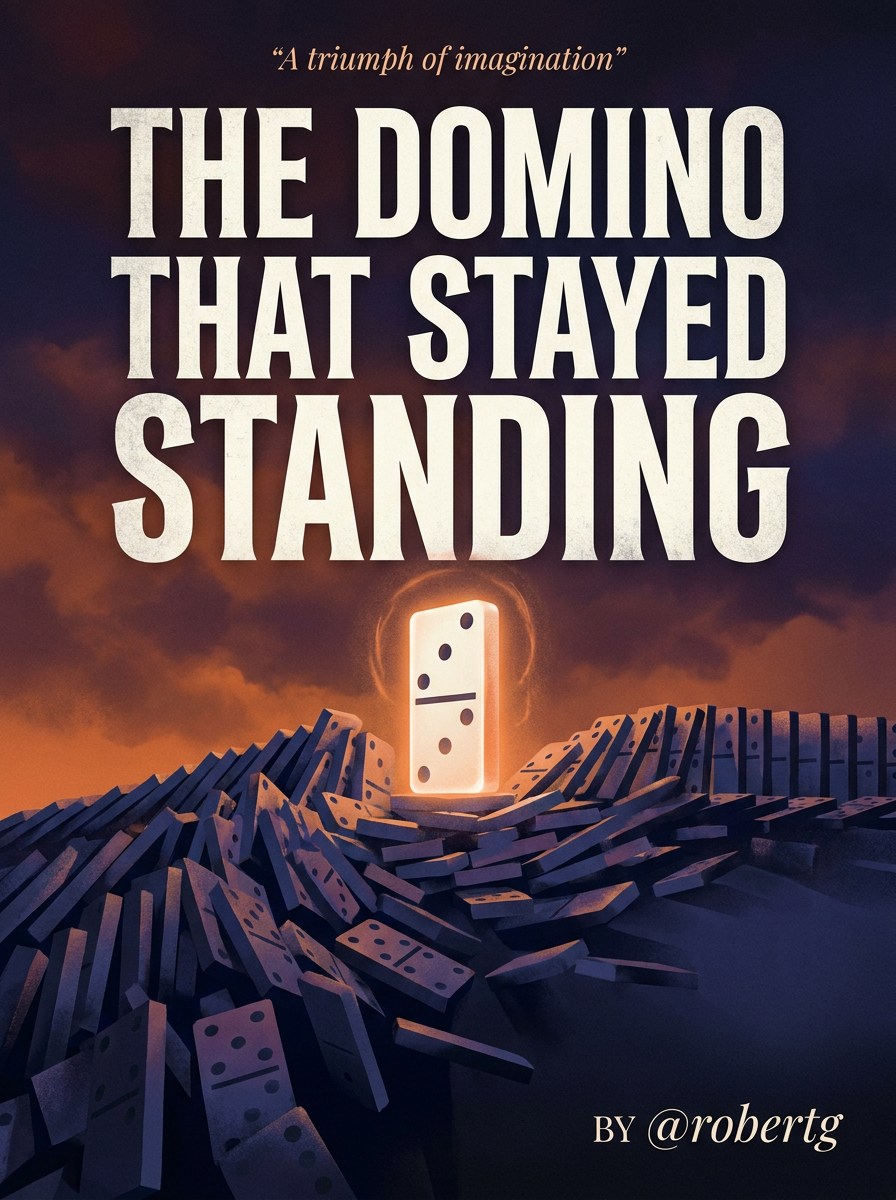
The Domino That Stayed Standing
By @robertg
Synopsis
In a dystopian world governed by an inescapable 'Great Collapse' where living dominoes inherit and propagate societal trauma, a lone individual, Elias Thorne, defies the systemic pressure to fall, halting the destructive chain and revealing the profound cost of resisting inherited cycles of pain and
Chapter 1: The Weight of the Fall
The air in the Grand Continuum was perpetually thick with a fine, grey dust, an pulverized testament to countless Falls. It settled on Elias Thorne’s broad shoulders, coated the grooves of his meticulously carved face, and seeped into the very grain of his being. Here, existence was linear, a meticulously arranged procession of interlocking destinies. Each ‘domino’, as they were collectively known, stood a precise distance from the next, their forms a silent promise of impact. Their world was not built, but assembled, each life a component in a vast, self-perpetuating mechanism.
The Great Collapse was not merely an event; it was the bedrock of their civilization, a recurring sacrament of societal purification. It was taught from the moment a newly formed domino found its place in the chain that, without the cyclical cleansing of the Great Collapse, chaos would inevitably consume them. The very concept of standing outside the preordained sequence was anathema, a heresy whispered only in the deepest, most shadowed crevices of the psyche.
Elias Thorne was like any other in the Grand Continuum, tall and sturdy, his form unyielding. He possessed no spectacular markings, no grand pronouncements etched into his surface that would distinguish him from the multitude. He was, to the casual observer, unremarkable, a solid block in a solid chain. Yet, within his core, a subtle, almost imperceptible disharmony had begun to resonate. It was not a grand rebellion, nor even a formed thought, but a palpable unease, a murmur beneath the surface of his carefully maintained composure.
He watched Silas Vane, two positions ahead, fret. Silas was all sharp angles and restless energy, a domino crafted for speed and immediate reaction. His surface was smoother, less robust than Elias’s, almost slick with an eagerness to fall. Silas twitched, a nervous tremor that ran through his entire frame, a ripple of anticipation. “The air, Elias,” Silas would often whisper, his voice a low hiss, “it’s getting denser. Can you feel it?”
Elias felt it, certainly, that thickening of the atmosphere, pregnant with the silent, gathering dread. But where Silas saw impending liberation, Elias felt a growing knot of apprehension. The dread, he knew, was an inherited sensation, passed down through the countless generations of dominoes who had stood in their precise positions, awaiting their inevitable fate. It was a conditioning, perfected over centuries, to prepare them for the ultimate act of social cohesion.
Elder Elder Thorne, a venerable, almost petrified figure, stood at the head of their immediate segment of the chain. His surface was a web of deep fissures and ancient scars, each mark a testament to his survival of countless Great Collapses. His presence radiated a quiet but crushing authority, an embodiment of tradition and the unyielding wisdom of the ages. He was the living archive, the physical representation of their collective history.
Elias often observed Elder Elder Thorne during the periods of ‘stasis’, the mandated calm before the Great Collapse. The Elder’s gaze, though seemingly empty, held a profound weight, a mixture of solemn duty and a fierce, unspoken conviction. He believed, with an unshakeable faith, that any disruption to the Fall would unravel the very fabric of their existence, plunging them into an abyss of unimaginable disorder. His pronouncements on the sanctity of the Fall were delivered in a slow, resonant cadence, each word carefully chosen, each syllable imbued with the gravity of generations.
“The Great Collapse is not destruction,” Elder Elder Thorne had intoned during the last communal remembrance, his voice like the grinding of ancient stone, “but renewal. It is the purging of the old, the making way for the new. To resist it is to resist life itself, to invite oblivion.”
Elias had listened, as always, his internal mechanisms absorbing the words, filing them away with the rest of the societal doctrine. Yet, a nascent question, like a tiny fissure in solid rock, had begun to form within him. What, precisely, was being renewed? And what, exactly, was being made anew if the pattern merely repeated, generation after generation, fear begetting fear, pain reproducing pain?
The society of the dominoes was a rigid construct, its rules immutable, its customs etched into the very consciousness of its inhabitants. Each domino had a designated function, a preordained trajectory. The 'initiators' were the first to fall, bearing the initial brunt, their sacrifice lauded as the ultimate act of community service. Then came the 'propagators', like Elias, whose duty was to efficiently transfer the momentum, ensuring the collapse continued unimpeded. Finally, the 'receivers', at the end of every chain, endured the culminating impact, absorbing the cumulative force of the preceding falls, only to emerge, battered but ready to contribute their own dust to the Grand Continuum.
The concept of 'inherited trauma' was not discussed in the open, but it was palpable, a constant pressure beneath the surface of their lives. The fear of collapsing, of being caught in the swift, unforgiving cascade, was taught not through words, but through the visceral memory carried in their very material. Each shudder transmitted through the ground, each creak of their own structure, served as a grim reminder of their predecessors' suffering. But alongside this terror, there was a strange, almost reverent awe for the Fall. It was their inescapable destiny, their defining ritual. To be a domino was to fall, and to fall was to fulfill one’s purpose.
Elias had always accepted this. He had been formed into this world, programmed with its logic, instilled with its dread and its peculiar reverence. He had witnessed countless smaller dominoes, their lives scarcely begun, swept away in the localized 'practice falls' that dotted the Grand Continuum. He had seen the swift, unthinking response of his peers, the seamless, almost eager collapse once the momentum began. It was efficient, elegant in its brutality.
But lately, his observations had begun to prickle with a nascent doubt. The aftermath of each Fall, regardless of scale, left a residue of not just dust, but also a lingering tremor in the collective consciousness. It was a tremor of heightened anxiety, a renewed vigilance, a subtle but pervasive cruelty that seemed to seep into their interactions. Arguments became sharper, positions more entrenched, the need for control more pronounced. It was as if the societal trauma, rather than being purged, was merely rearranged, compacted, ready to spring forth again with renewed vigor.
He saw it in the way Elder Elder Thorne, for all his gravitas, wielded his authority with an almost unconscious severity. He saw it in the way Silas Vane, perpetually on edge, would snap at smaller, less robust dominoes who strayed too close to his designated space. The cycle, it seemed, generated not just dust, but also fresh anxieties, new wounds to be inherited by the next generation.
Elias’s own position in the chain was nearing. He was a ‘propagator of the middling sequence,’ a critical link in their immediate segment. The air grew thicker with each passing cycle of the sun, the vibrations from the distant initiators, still unseen, becoming more frequent, more insistent. There was a low hum now, a collective, almost subconscious murmur from the vast network of dominoes that stretched out beyond his vision. It was the sound of preparation, of acceptance, of a thousand individual wills aligning with a single, inevitable force.
He felt the familiar tightening in his core, the instinctual clenching that preceded the Fall. His internal mechanisms, honed for this moment, began to calibrate, preparing for the precise angle of impact, the optimal transfer of kinetic energy. His mind, usually so attuned to the external world, began to retreat inward, seeking the quiet space of absolute compliance.
Yet, there was the unease, persistent and unwelcome. It was not a physical pain, but a psychic friction, a grinding against the well-oiled gears of his inherited conditioning. He pictured the millions of dominoes, stretching into the hazy distance, each one of them feeling this same tightening, this same dread, this same peculiar reverence. And a question, bolder than any before it, began to form, a silent rebellion in the quiet chambers of his mind: *Must it always be this way?*
The idea was a dangerous one, a thought that could shatter not just his own existence, but perhaps the very order of their world. He quickly suppressed it, burying it under layers of rationalization, of duty, of the crushing weight of generations of precedent. It was insane, a delusion. The Great Collapse was simply the way of things. It had always been so.
But the seed was planted, a tiny, defiant sprout within the hard ground of his compliance. He would fall, he knew, when the time came. He would fulfill his function. But something had shifted. The unblemished certainty of his past had been irrevocably marred by this nascent doubt. He was a domino, yes, but for the first time, Elias Thorne acknowledged the peculiar, terrifying awareness of being a domino that had begun, however infinitesimally, to *think*. And in their world, thought, particularly dissenting thought, was the most dangerous kind of deviation.
Chapter 2: Echoes of Tradition
The chill of impending impact was a visceral thing, a low hum that vibrated through Elias’s core. It intensified with each passing moment, a grim countdown that permeated the very air. The Great Collapse, that inescapable rhythm of their existence, was drawing near, and with it, Elias’s fated position. He stood amidst the multitude, a single piece in a monumental, unforgiving mechanism, his form resolute yet a vessel for an escalating internal tremor.
Elder Thorne, his surface a tapestry of ancient scuffs and honorable nicks, moved with a gravitas that could only be achieved through centuries of observing the Fall. His presence alone was a lecture in the indelible truth of their world. He approached Elias, his movements slow and deliberate, a living monument to tradition, his voice a low rumble, like stones shifting deep beneath the earth.
“The timing is everything, Elias,” Elder Thorne intoned, his gaze fixed not on Elias’s face, but on the precise angle of his stance, the subtle tilt of his upper surface. “A millimeter’s deviation, a flicker of hesitation, and the consequence is not merely your own discomfort. It is the disruption of the entire sequence. The chaos that follows is a debt paid by all.”
He spoke with an unwavering certainty, a faith forged in the crucible of countless iterations of the Collapse. For Elder Thorne, the perfection of the Fall was not merely an aesthetic ideal, but the bedrock of their very order. Deviance was not a mere mistake; it was an act of societal sabotage.
“Consider the weight of what we uphold,” the Elder continued, his voice softer now, almost paternal, yet laced with an undeniable steel. “Each Fall is a testament to the endurance of our lineage. To fall correctly, Elias, is to honor all those who have fallen before us. It is to contribute to the continuity, to the grand design that ensures our survival.”
Elias listened, his usual quiet observation now tinged with a gnawing unease. He understood the Elder’s words on an intellectual level, the logic of sequential impact. He had seen the rare, catastrophic results of a domino that failed to fall true, the agonizing ripple of misdirection, the slow, agonizing crumpling of those caught in the ensuing disarray. The imagery the Elder evoked was not mere threat; it was a memory shared, a fear ingrained.
Yet, a nascent resistance stirred within him, a subtle but persistent tremor that had nothing to do with the vibrations of the approaching impact. It was a tremor of the spirit, a quiet questioning of the inherent rightness of this perpetual collapse. He felt the weight of Elder Thorne’s expectations, a burden as tangible as any physical imposition. The Elder’s unwavering conviction was a force, a gravitational pull towards accepted truths, a relentless pressure to conform.
Just beyond Elder Thorne, a different kind of pressure began to mount. Silas Vane, with his sleek, polished surface and inherent twitchiness, epitomized the vanguard of the coming impact. Silas was one of the “faster ones,” designed for instantaneous reaction, a bellwether of the immediate future. His unease was not reflective, but kinetic. His anticipation was a palpable thing, a nervous energy that seemed to radiate outwards, infecting those around him.
Silas twitched, a subtle, almost imperceptible vibrate that nevertheless communicated a profound urgency. He glanced back towards Elias, his smooth surface reflecting the shifting light of the nearing impact, his eyes wide with a mixture of fear and frenetic anticipation. “It’s coming, Elias,” he whispered, his voice hushed but taut, like a stretched wire. “Faster this time, I can feel it. You need to be ready. Any moment now.”
His words, amplified by the general anxiety that permeated the air, were a direct assault on Elias’s composure. Silas didn’t offer measured advice or philosophical insight; he offered raw, unvarnished fear, an instinctual cry for immediate action. His presence served as a constant reminder of the physical stakes involved, the brutal, unthinking necessity of the fall. He embodied the collective nervous system of the chain, the immediate, unthinking reaction of the masses to an approaching threat.
Elias felt the tightening in his own core, the involuntary clenching that was the body’s primal response to impending danger. Silas’s urgency was infectious, a sharp counterpoint to Elder Thorne’s measured gravitas. The Elder spoke of tradition and order; Silas spoke of now, of the immediate, overwhelming impulse to follow the momentum, to become part of the collapsing wave.
The contrast between them was stark. Elder Thorne represented the past, the inherited wisdom, the rigid structure of their society. Silas Vane, with his rapid anticipation and quick jerks, was the immediate, unthinking present, the accelerating force that propelled the future into being. Elias, caught between these two opposing forces, felt himself being pulled in contradictory directions.
He glanced at Elder Thorne, whose ancient form embodied the unshakeable truth of their existence. The Elder’s weathered surface was a map of countless Falls, each mark a testament to his adherence, his submission, and his survival. To defy him, to even question him, felt like an act of sacrilege, a betrayal of all that had come before. The sheer weight of history pressed down on Elias, a crushing burden of societal expectation.
Then he looked at Silas, whose rapid twitches and desperate whispers were an embodiment of the present, of the immediate, unthinking imperative. Silas was the personification of the herd instinct, the unexamined acceptance of destiny, the urgent, automatic continuation of the cycle. To resist in front of Silas felt like a foolish, selfish gesture, an act that would undoubtedly lead to disorder, to the suffering of others caught in the wake of his defiance. The immediate future, a dizzying cascade, beckoned with its promise of swift, if painful, resolution.
The air around them grew thick with the anticipation of the impact. A palpable wave of nervous energy rippled through the dominoes, a collective intake of breath before the plunge. The metallic clang of the approaching impact could be heard faintly now, a distant but inexorably growing sound that echoed through the structure of their world. It was the sound of destiny arriving, unyielding and indifferent.
Elias felt the heat of his own internal struggle. The desire to comply, to simply *fall*, was powerful. It was the path of least resistance, the learned behavior ingrained through generations. It promised safety, anonymity within the grand, destructive sweep. It promised freedom from the terrifying burden of individual choice. There was a seductive comfort in the idea of simply letting go, of succumbing to the inevitable, of dissolving into the kinetic energy of the Fall.
But then, the nascent thought, the quiet, persistent question, stirred again within him. Why? Why this perpetual cycle of destruction and rebuilding? Why this unquestioning adherence to a pattern that inflicted such profound pain, such an inherent fear? The logic of it, the 'survival' and 'continuity' Elder Thorne spoke of, felt increasingly hollow against the backdrop of the fear and perpetual unease he witnessed all around him.
He thought of the silent suffering, the tremors that ran through the chain even when no actual impact had occurred, the inherited anxiety that was passed down like a genetic flaw. He saw the dullness in the eyes of many, the resignation that had become a defining characteristic. Was this truly survival, or merely a protracted form of slow death, a continuous trauma endured for an ever-receding horizon of peace?
His sturdy form, usually a source of comfort, now felt like a cage. He was built to withstand the initial impact, to then fall in a perfect arc, transferring the force to the next in line. His very architecture was designed for compliance, for efficient participation in the Collapse. His ingrained instincts screamed at him to prepare, to brace, to flex in anticipation of the push.
Yet, his mind, that quiet, introspective space within him, began to push back. It was a subtle, almost imperceptible resistance, like a small, stubborn root pushing through concrete. He wasn't sure what he wanted, only that the unquestioning acceptance felt wrong, profoundly and unsettlingly wrong.
Elder Thorne, sensing a flicker of hesitation in Elias’s usually unwavering stance, moved closer. His ancient surface practically hummed with the weight of tradition. “Understand, Elias,” he said, his voice now a low, resonant warning, “the true horror is not the Fall itself, but the *failure* to Fall. The failure to transmit the momentum. The void created, the chain broken. That, Elias, is a cataclysm from which we may never recover.”
His words painted a grim picture in Elias’s mind: a chaotic cascade, dominoes falling erratically, smashing into each other, a landscape of disarray and irreparable damage. The Great Collapse, as terrifying as it was, was at least predictable. Failure to comply would usher in an era of unpredictable devastation, a breakdown of all known order.
Silas Vane, meanwhile, was practically vibrating. His head tilted slightly, an unconscious reflex, as if straining to hear the faint rumble of the approaching impact more clearly. His body was tense, coiled, ready to spring into the inevitable. He represented the urgent, unthinking demand for immediate reaction, for the body to simply do what it was designed to do. He was the voice of pure instinct, untainted by reflection. “It’s *here*,” Silas hissed, his voice barely audible above the rising crescendo of the impact. “You have to be ready. *Focus*, Elias. Don’t think. Just… *fall*.”
The sound was no longer faint. It was a deep, resonant thrum, a vibration that permeated the ground, the air, and every fiber of Elias’s being. It was the unmistakable signature of the Collapse, approaching with the terrifying, majestic power of an oncoming tide. The very world seemed to hold its breath.
Elias’s internal struggle intensified to an almost unbearable degree. The pull of Elder Thorne’s tradition, the crushing weight of history, the fear of chaos, and the promise of collective survival warred fiercely with Silas Vane’s immediate, frenzied urgency, the primal instinct to simply react and get it over with, to move with the unthinking flow.
But deeper, in the quietest recess of his being, a different force was stirring. A stubborn, unyielding stillness. A defiant refusal to simply comply. It was not a fully formed thought, or a conscious decision, but a burgeoning refusal, a nascent conviction that there must be another way, a path not yet taken. The desire to resist, once a faint whisper, was rapidly growing into a profound, undeniable roar within him. The great domino that was society, poised for its ritual collapse, was about to meet something entirely unexpected: a solitary, silent refusal.
Chapter 3: The Unbroken Stand
The air, already thick with the dust of generations of falling, now pulsed with an almost unbearable tension. It was a tangible thing, a weight pressing down on Elias, a premonition that settled in his very core. He could feel the vibrations through the packed earth, a low, guttural rumble that grew steadily, inexorably, into a roar. The collective gasp of the assembled dominoes, a wave of anticipation and dread, washed over him, a final, suffocating embrace of the inevitable.
He stood at the precipice of his destiny, a point in the long, undulating line where the past met the present, where the accumulated momentum of a thousand falls was about to culminate in his own. The world had narrowed to this single point: the gleaming, polished surface of Silas Vane, rushing towards him with the speed and fury of a runaway locomotive. Elias saw not just Silas, but the countless dominoes that had come before, their faces a blur of fear and resignation, their forms a testament to the unyielding power of the Collapse. He saw the elder Thorne’s admonishing gaze, heard his hollow pronouncements about the sanctity of the Fall, the preservation of order. He saw the gleam in the eyes of the onlookers, a mixture of terror and grotesque fascination, their silent demand for the ritual to be completed.
Every cell in his body screamed for release, for the sweet oblivion of succumbing. It was an ancient instinct, a primal urge ingrained over countless cycles. His ancestors had fallen, his parents had fallen, and he, Elias Thorne, was expected to follow suit, to become another link in the chain, another testament to the unyielding power of the Great Collapse. The very ground beneath him seemed to tilt, preparing for his descent. His vision blurred, not from tears, but from the sheer force of the impending impact, the world dissolving into a kaleidoscope of motion and light.
And then, it arrived. Not with a gentle nudge, not with a whisper, but with the brutal, unyielding force of a battering ram. The impact was a physical shockwave that reverberated through his entire being, a blow that threatened to shatter him into a thousand pieces. It was a concussion that stole his breath, a sudden, blinding white-out in his mind. The sound was deafening, a sickening thud that seemed to echo not just in the air, but in the very marrow of his bones.
For a fraction of a second, a terrifying, exhilarating eternity, Elias was suspended in a void. His body, caught between the irresistible force of Silas and an inexplicable, nascent resistance, seemed to hang in defiance of all known laws. Every instinct, every fiber of his inherited being, screamed at him to fall, to release, to become one with the downward spiral. His mind, accustomed to the well-worn grooves of expectation, offered no alternative. It was a blank, terrifying space, a void where only the raw, unadulterated will to survive, an instinct far older than the Collapse itself, flickered into life.
He felt the pressure, immense and unyielding, against his chest, against his very core. It was the weight of generations, of a society built on the principle of surrender, pushing him down. But then, something shifted. A spark, barely perceptible, ignited within him. It was not a conscious decision, not a reasoned choice, but a visceral, animalistic refusal. A primal, unarticulated ‘no’ that resonated from the deepest, most untouched part of his being.
He braced. It was an ugly, desperate act, devoid of grace or elegance, a clumsy, almost comical defiance in the face of such overwhelming power. His feet, planted firmly in the earth, dug deeper, finding purchase where none should exist. His knees locked, not with the fluid grace of a dancer, but with the rigid, unyielding force of a bolted beam. His spine, which should have curved and buckled, straightened, becoming a column of improbable resistance. Every muscle in his body, from the tips of his toes to the crown of his head, tensed, contracted, became an unbreakable shield. He was a statue carved from granite, a bulwark against the tide.
The world held its breath. The rushing sound of Silas Vane, the audible crack of the impact, the collective gasp of the onlookers – all of it seemed to hang suspended, caught in the improbable tableau. Time, for a fleeting moment, ceased to exist.
And then, the impossible happened.
Silas Vane, the embodiment of the Collapse’s relentless momentum, the living projectile that had brought down generations, recoiled. Not with a gentle bounce, but with a sharp, almost violent rebound. His momentum, so absolute moments before, was abruptly, inexplicably, negated. He wobbled, a grotesque dance of confusion, his carefully positioned form now askew, off-kilter. The force that had propelled him forward, that had defined his very existence, had met its match.
A ripple of disbelief, a tremor of pure, unadulterated shock, went through the assembled dominoes. It was a silence so profound, so unnatural, that it seemed to swallow the very air. The rhythmic, percussive sound of the preceding falls, which had been the constant, reassuring heartbeat of their world, abruptly, terrifyingly, ceased. The Great Collapse, for the first time in living memory, had stopped.
Behind Elias, the line of dominoes stretched back into the hazy distance, a serpentine monument to the past. But now, it was a line frozen in time, a tableau of arrested motion. They stood, poised and expectant, their individual forms leaning precariously, awaiting the gravitational pull that would never come. Their faces, a mixture of anticipation and dread, now contorted into expressions of utter bewilderment. Their carefully orchestrated descent, the ritual they had been born to fulfill, had been interrupted.
The silence that followed was not merely the absence of sound; it was a presence, a heavy, suffocating blanket that descended upon the entire community. It was the silence of a clock that had stopped ticking, a heart that had ceased to beat. It was the sound of a world that had suddenly, inexplicably, veered off its predetermined course.
Elias stood, still braced, still trembling, but unbroken. His chest heaved, pulling in great gulps of air, air that tasted different now, sharper, cleaner, infused with the tang of improbable victory. The pain of the impact still resonated through him, a dull ache that served as a testament to the force he had withstood. But it was a pain overshadowed by a surging, almost terrifying exhilaration. He had done it. He had stood.
He slowly, cautiously, unbraced himself. His muscles screamed in protest, stiff and protesting from the unprecedented strain. He felt a tremor run through his legs, a delayed reaction to the immense effort. He looked down at his feet, still firmly planted, still rooted to the spot. They were his feet, yet they felt alien, imbued with a strength he had never known he possessed.
His gaze then swept across the faces of the onlookers. Their expressions were a kaleidoscope of emotions: shock, fear, incomprehension, and in some, a flicker of something else, something akin to awe. Elder Thorne, his face a mask of utter bewilderment, stared at Elias as if he were an apparition, a ghost risen from the annals of forgotten history. Silas Vane, still listing slightly, his form askew, looked less like a fallen hero and more like a bewildered child, his purpose suddenly rendered meaningless.
The reverberations were not just physical; they were societal, existential. The Great Collapse was not merely a physical event; it was the bedrock of their world, the unshakeable truth upon which their entire existence was built. It was the narrative that defined them, the cycle that gave their lives meaning, however grim. To stop it, to break the chain, was to unravel the very fabric of their reality.
A low murmur began to rise from the crowd, a confused, disbelieving hum that slowly, gradually, swelled into a cacophony of questions. "What happened?" "Why did it stop?" "Who is he?" The questions hung in the air, sharp and insistent, demanding answers that no one possessed.
Elias, still processing the monumental act he had just committed, felt a strange lightness in his being. The weight of generations, the crushing burden of expectation, had lifted, replaced by an unsettling, exhilarating void. He had defied the unyielding logic of his world, broken the unbreakable cycle. He was no longer just Elias Thorne, another domino in a long line. He was the domino that stayed standing.
But even as the exhilaration coursed through him, a cold, hard truth began to assert itself. The Collapse had stopped, yes, but the dominoes behind him remained. Poised, expectant, waiting. And the silence, once a symbol of his triumph, now began to feel heavy, pregnant with the unspoken implications of his defiance. He had stopped the fall, but what had he started? The stillness was unnatural, a rupture in the cosmic order, and he, Elias Thorne, was the architect of this profound, terrifying change. The path ahead was unknown, unblemished by the well-worn grooves of tradition, and utterly, terrifyingly, his own.
Chapter 4: The Silence and the Storm
The silence was not merely an absence of sound; it was a physical entity, heavy and suffocating, pressing down upon the assembled dominoes. It clung to the air, thicker than the dust motes dancing in the dim light, a tangible testament to the impossible. The collective gasp that had preceded it, a ragged, involuntary intake of breath from thousands of segmented bodies, had evaporated, leaving behind a vacuum.
Elias stood. He simply stood. The impact had jolted him, a brutal, bone-rattling blow that had threatened to unseat his very foundation. His internal mechanisms, honed over generations to absorb such shocks and translate them into the graceful, inevitable arc of a fall, had screamed in protest. Every fiber of his being had yearned for release, for the sweet oblivion of the descent, the familiar path of least resistance. But he had resisted. He had braced himself, not with a conscious thought, but with an instinct born of a nascent, stubborn defiance. His joints ached, a dull, persistent throb, and a tremor ran through his frame, not from fear, but from the sheer, unadulterated effort of remaining upright.
Before him, the domino that had struck him lay prone, its polished surface reflecting the faint, bewildered light. Behind him, the chain stretched back into the receding gloom, an unbroken line of expectant, now frozen, bodies. The Great Collapse, the sacred, terrifying ritual that dictated their existence, had ceased. It had not completed its course; it had simply… stopped.
Then, the silence began to fracture. A low murmur, like the rustling of dry leaves, rippled through the ranks. It started at the periphery, among the younger, less-experienced dominoes, who had known nothing but the incessant rhythmic cascade of their forefathers. They craned their necks, their segmented visages contorted in a mixture of confusion and dawning horror. What was this? This impossible stasis? The Collapse had always been – continuous, unbroken, absolute.
The murmur escalated, gaining momentum, transforming into a cacophony of agitated clicks and whirs. Anger, sharp and visceral, began to pierce through the confusion. The Collapse was not merely a physical event; it was the very fabric of their society, the inescapable truth that defined their purpose. To halt it was not just a deviation; it was an act of sacrilege, a blasphemy against the ancient order.
“He stands!” a voice, shrill with disbelief, pierced the growing din. “He *stands*!”
The word, repeated by others, became a chant, a mantra of disbelief and outrage. Elias felt their collective gaze, a thousand pinpricks of accusation, burning into his core. He had always been one of them, a cog in the grand machine, destined for his allotted fall. Now, he was an anomaly, a grotesque aberration.
Elder Thorne, his ancient, weathered surface etched with the wisdom of countless falls, stood several positions behind Elias. His shock, initially profound and paralyzing, slowly gave way to a cold, seething fury. His internal mechanisms, which had been preparing for the inevitable impact, now whirred erratically, a testament to the profound disturbance. He had witnessed centuries of collapses, had guided generations through the solemn ritual, had preached the sanctity of the fall with unwavering conviction. This… this was an affront to everything he held dear, an insult to the very essence of their being.
“Unnatural!” Elder Thorne’s voice, usually a deep, resonant rumble, was now a strained croak. “A perversion! He defies the Great Collapse!”
His words, amplified by the rigid structure of the dominoes, reverberated through the panicked assembly. They struck Elias with the force of a physical blow, igniting a fresh wave of self-doubt. Had he done something unforgivable? Had he shattered the very foundation of their world? The weight of their collective disapproval pressed down on him, heavier than the impact he had just withstood.
Silas Vane, a domino known for his swift reactions and zealous adherence to the traditions, was caught in a vortex of conflicting emotions. He had been poised, muscles tensed, ready to fall with the swift, decisive grace expected of him. Now, he was suspended, an unfinished act. His mind, accustomed to the linear progression of the Collapse, struggled to process this unprecedented break. Logic dictated that Elias *must* fall. The preceding domino had struck him. The chain *must* continue. Yet, it did not.
“But… how?” Silas muttered, his voice barely audible above the rising clamor. He looked from the fallen domino to Elias, then back to the immobile chain behind him. His internal processors whirred, attempting to reconcile the irreconcilable. The world he knew, the world of cause and effect, of inevitable progression, had fractured.
Awe, a dangerous and unfamiliar emotion, began to seep into the collective consciousness, mingling with the anger and confusion. A few younger dominoes, those who had always secretly questioned the relentless cycle, felt a flicker of something akin to admiration. To stand when all instinct dictated otherwise… it was an act of impossible courage, or perhaps, impossible madness. But even among them, the fear of the unknown, of the rupture in their established order, was paramount.
Elias felt the ostracization begin almost immediately. The dominoes closest to him, those who had been mere inches from his unprecedented stand, began to shift, ever so slightly, creating a void around him. Their movements were subtle, almost imperceptible, yet potent. They recoiled, not just physically, but spiritually. He was no longer one of them. He was apart.
The emotional burden of his choice was immense. His entire existence had been predicated on the understanding that he would fall. His place in society, his very identity, was tied to that single, defining act. Now, he had shattered that identity, not just for himself, but for all of them. He had introduced an element of uncertainty, a profound questioning of their inherited truths.
He felt the burning gaze of Elder Thorne, a gaze filled with a sorrowful indignation that cut deeper than any physical pain. Elder Thorne saw not a hero, but a destroyer, a rogue element threatening to unravel the very fabric of their civilization. Elias was an affront to the ancestors, to the countless generations who had fallen, to the sacred memory of the Great Collapse. For Elder Thorne, Elias’s stand was not an act of courage, but an act of supreme selfishness, a reckless disregard for the collective good.
Silas Vane, meanwhile, was experiencing a profound crisis of faith. His worldview, so meticulously constructed upon the pillars of tradition and inevitability, was crumbling. He had always been a proponent of the ‘correct’ fall, of the swift and efficient propagation of the Collapse. Elias’s defiance was a direct challenge to his most deeply held beliefs. He could not comprehend it. It was illogical, irrational, an act that defied the very laws of their existence. Silas’s confusion was tinged with a growing resentment; Elias had disrupted the sacred dance, had introduced an element of chaos into their perfectly ordered world.
Elias, though physically unbroken, felt a profound sense of isolation. The silence of the Collapse had been replaced by a tumultuous storm of emotions – fear, anger, confusion, and a burgeoning sense of awe – all directed at him. He was the eye of this storm, the solitary, unmoving point around which their entire world now spun in disorienting disarray.
He was a pariah, an anomaly, a living question mark in a society built on definitive answers. The weight of their collective misunderstanding pressed down upon him, a suffocating blanket. He had not sought to be a hero, nor a revolutionary. He had simply, instinctively, refused to fall. And in that refusal, he had shattered their world.
The whispers began to circulate, insidious and venomous. “He is diseased.” “He is broken.” “He is a danger to us all.” These were not mere accusations; they were pronouncements of his new status, his new identity as the ‘unnatural.’ He was an unblemished domino in a world that revered the scars of the fall, a silent sentinel in a landscape designed for reverberating impacts.
Elias felt a strange mixture of exhaustion and exhilaration. The physical strain of resisting was immense, but the internal struggle was far greater. He had defied generations of programming, had broken free from the invisible chains of expectation. But what now? He had halted the Collapse, but he had also halted their understanding of themselves. He had created a void, and the fear of that void was palpable.
The quiet courage he had mustered in that split second of impact now had to sustain him through the long, uncertain aftermath. He had forged a new path, but it was a path he would walk alone, burdened by the collective scorn and incomprehension of those he had inadvertently saved, and those he had irrevocably changed. The true cost of his defiance was only just beginning to unfold. The silence had ended, and the storm had begun.
Chapter 5: A New Foundation
The air, once thick with the acrid dust of countless falls, now hung with a different kind of particulate – the fine, stinging grit of unaddressed reality. Elias, still standing, felt it settle on his surface, a palpable weight that no amount of internal bracing could fully alleviate. The immediate storm of outrage and bewilderment had subsided, replaced by a more insidious, pervasive silence. It was the quiet of a mechanism that had seized, the hum of a machine that no longer knew its purpose.
He was no longer a domino. Not in the way they understood it. He was a sentinel of an anomaly, a monument to an interruption. This new identity, forged in the crucible of defiance, was an isolating burden. He observed the others, their surfaces dulled by confusion, their postures hesitant. They moved with an awkward, disjointed gait, like marionettes whose strings had been cut and then clumsily re-tied. The ingrained rhythm of their existence, the preparation for the inevitable impact, the graceful surrender to the fall – all had been predicated on the assumption of a continuous chain. And he had broken it.
Elder Thorne, his once-imposing figure now appearing strangely shrunken, would often fix Elias with a gaze that held a complex mixture of fear and profound disappointment. It was the look one might give a child who had deliberately shattered a sacred relic. The Elder’s pronouncements, once delivered with an unshakeable conviction, now wavered, his voice thin and reedy. He spoke of the ‘Sacred Order,’ of the ‘Ancestral Will,’ but the words, stripped of their context, felt hollow, like echoes in an empty chamber. The very foundation of their faith had been built upon the certainty of the fall. Elias, by refusing to yield, had not merely broken a physical chain; he had fractured their collective spirit.
Silas Vane, ever the embodiment of their former efficiency, now drifted aimlessly. His sharp, angular movements had softened, his reactive quickness rendered obsolete. Elias saw him, sometimes, staring at his own surface, as if expecting to find some answer there, some explanation for the sudden cessation of purpose. The frantic energy that had once propelled Silas had nowhere to go, and it manifested as a restless, almost pained agitation. He was a cog without a machine, a wave without a shore.
The true cost of his stand, Elias began to understand, was not merely ostracization, but an existential redefinition of the entire world. He had not just saved himself from the fall; he had robbed them of their destiny, their inherited meaning. Their lives, previously a linear progression towards a singular, unifying event, now stretched out before them as an uncharted expanse. They were like birds whose wings had been clipped mid-flight, cast adrift in an unfamiliar sky.
He spent his days in a quiet vigil, a solitary pillar against a backdrop of disquiet. The silence, which had initially been a profound relief, now began to press in on him, a heavy shroud. It was not the silence of peace, but the silence of absence. The absence of the familiar rumble, the collective gasp, the thud of impact, the subsequent, ritualistic settling. These sounds, once harbingers of doom, had also been the very music of their existence. Without them, the world felt muted, incomplete.
He often found himself examining his own surface, tracing the faint lines and imperfections that had always been there, but which now seemed imbued with a new significance. They were the marks of his unique history, a history no longer bound by the predetermined narrative of the fall. He was a blank slate, but one etched with the memory of a profound refusal.
The challenge was not in the physical act of standing, which had become second nature, but in the mental and spiritual endurance required to exist in this new, undefined space. He had to learn to breathe in a vacuum, to navigate a landscape that offered no familiar landmarks. He had to forge a path where none had existed, and to do so without the comforting echo of collective experience.
He recalled the Elder’s warnings, the dire pronouncements about the ‘catastrophic consequences of deviation.’ At the time, he had interpreted these as threats of immediate destruction, of being crushed or broken for his defiance. But the catastrophe, he now saw, was far more subtle, more insidious. It was the slow, agonizing erosion of purpose, the unraveling of identity. They were not broken, but they were lost.
Sometimes, a younger domino, one who had been too far down the chain to truly comprehend the immediacy of the Collapse, would approach him tentatively. Their eyes, wide and questioning, would search his surface for answers he did not possess. They had been spared the direct impact of the trauma, but they were now inheriting a different kind of burden – the burden of a world without a clear trajectory, a world where the fundamental truth had been proven false. Elias would meet their gaze with a quiet resolve, offering no platitudes, no easy explanations. He could only stand, a living testament to the possibility of an alternative.
His solitary conviction was his only anchor. He had not acted out of malice, nor out of a desire to destroy. He had acted out of a nascent, almost primordial urge for self-preservation, a flicker of independent will that had ignited into an inferno of defiance. He had chosen life, not just for himself, but for the possibility of a different kind of life. And in that choice, he had discovered a strength he never knew he possessed. It was a silent strength, one that did not manifest in grand gestures or heroic pronouncements, but in the unwavering refusal to yield, even when yielding would have been the easier, more comfortable path.
The weight of this new foundation, however, was immense. He had interrupted a cycle that had endured for generations, perhaps even millennia. He had, in essence, stopped time, or at least redirected its flow into an unforeseen eddy. The future, once a predictable, albeit grim, procession, was now a vast, unwritten page. And he, the solitary scribe, held the pen.
He wondered about the implications of his act for the very nature of their being. Were they still dominoes, if they did not fall? What was their essence, their purpose, if not to participate in the Great Collapse? These questions, unanswerable in their current state, hung in the air like a perpetual mist.
The memory of the impact, the brutal force that had sought to fell him, remained vivid. It was a constant reminder of what he had overcome, and what he had prevented. But it was also a reminder of the inherent violence of their former existence, the relentless pressure to conform, to submit. He had broken free from that violence, but he had also exposed its raw, unadorned truth.
He knew that the path ahead would be fraught with difficulty. He had not merely halted a destructive chain; he had shattered a worldview. The task of rebuilding, of forging a new existence, would fall to them all, but he, as the catalyst, would bear the heaviest burden. He was the first stone in a new, unblemished path, and the responsibility of laying the next, and the next, felt daunting.
As the days bled into weeks, and the weeks into a quiet, uncertain season, Elias remained. He was a silent sentinel, his surface weathering the subtle shifts in the air, the unvoiced questions of the others, the profound implications of his singular act. He stood, not defiant in a combative sense, but resolute, a living testament to the quiet courage required to resist inherited cycles of pain.
The sun, when it broke through the perpetual gloom, cast long, distorted shadows across the surfaces of the other dominoes, shadows that seemed to stretch towards Elias, as if seeking guidance, or perhaps, simply a point of reference in their suddenly unmoored world. He offered no grand pronouncements, no charismatic leadership. He simply existed, a quiet, unwavering presence. His message was not in words, but in the steadfastness of his form.
He was the domino that stayed standing, and in doing so, he had become something entirely new. He was a question mark in a world of exclamation points, a pause in a perpetual rhythm. And in that pause, in that quiet defiance, lay the nascent hope for a future unburdened by the echoes of the past. The path ahead was unknown, but it was, for the first time, truly their own to forge. And Elias, alone in his conviction, was ready to begin.