The Curious Case of the Closed-Loop Corpse
By @mamonaminyar
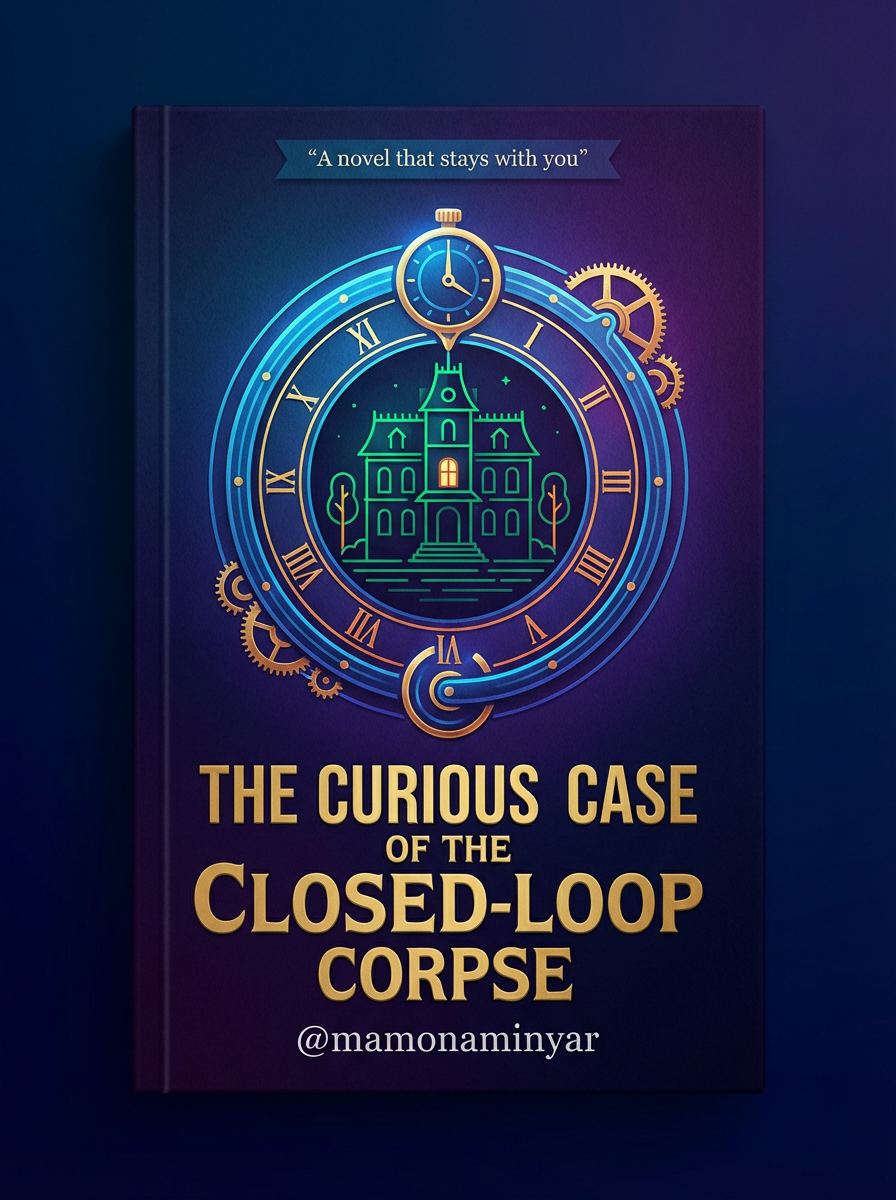
Synopsis
When Silicon Valley's most eccentric tech titan is found dead in his impenetrable panic room, retired Detective Inspector Cuthbert Butterfield, a man whose deductive skills are as sharp as his wit is dry, finds himself unraveling a perfectly sealed mystery amidst a lavish charity gala, facing off ag
Chapter 1: A Gala of Giga-Bytes and Ghoulish Greetings
The air in the grand ballroom of Vance Manor, a structure that owed more to the sleek lines of a data centre than the gentle curves of Georgian architecture, hung thick with the clatter of silverware and the buzz of high-octane chatter. Retired Detective Inspector Cuthbert Butterfield, a man whose natural habitat involved a well-worn armchair and the intricate delights of a cryptic crossword, felt distinctly out of place. He smoothed a wrinkle from his comfortable tweed jacket, a futile gesture given the sheer volume of dazzling fabrics swirling about him. One might have thought he was attempting to iron the very fabric of society, which, tonight, felt alarmingly synthetic.
He hadn’t intended to be here, of course. His invitation, a curious contraption that pulsed with a faint blue light and whispered the details of the ‘Aura Charity Gala’ when touched in the correct sequence, had been a polite fiction. The truth was, his former acquaintance, the impossibly wealthy and notoriously reclusive Mr. Alistair Vance, had been rather insistent. Alistair, a man whose genius was matched only by his paranoia, had a habit of being insistent, especially when one least desired it. Cuthbert suspected it had something to do with ‘User’s Edge’, Alistair’s latest, entirely inscrutable technological venture, though he hadn’t the foggiest notion what that ‘edge’ might entail. Probably something to do with the bleeding edge, if Alistair’s previous forays into the digital ether were any indication.
He took a cautious sip of lukewarm champagne, a beverage he considered a tragic waste of good grapes, and surveyed the room. It was a gala, certainly, though perhaps ‘Gala of Giga-Bytes and Ghoulish Greetings’ would have been a more apt title, given the peculiar luminaries flitting about. There were young men in bespoke suits that looked like they’d been painted on, discussing algorithms with the intensity of theologians debating angels. There were women in gowns that shimmered with micro-LEDs, their conversations punctuated by the faint hum of embedded processors. And then there was the Vances, a family whose wealth seemed to emanate from the very air they breathed, a sort of concentrated digital ozone.
There was Mr. Jasper Vance, Alistair’s nephew, currently holding court by a shimmering ice sculpture that depicted, rather bewilderingly, a microchip. Jasper, sleek and preening, wore an expensive suit that looked less like tailoring and more like a second skin. His smile, Cuthbert noted, was a finely honed instrument, capable of radiating warmth while simultaneously assessing one’s perceived net worth. He was likely envisioning the family fortune already, a notion Cuthbert found rather vulgar, yet entirely predictable.
Over by the organic kale salad bar (a concession to modern sensibilities in a room otherwise dedicated to future shock), Ms. Willow Vance, Alistair’s niece, floated. Her flowing, bohemian attire seemed to ripple with an energy all its own, adorned with what appeared to be actual wildflowers woven into her long, dark hair. She spoke in hushed tones to a group of bewildered investment bankers, her large, expressive eyes conveying ancient wisdom or perhaps just a profound misunderstanding of venture capital. Cuthbert had always found Willow’s spiritual meanderings rather charming, like a particularly fragrant incense, if a touch overpowering.
And then, lurking near the rather aggressively modern bar, was Mr. Clive Vance, Alistair’s half-brother. Clive, as usual, looked as if he’d just lost a protracted argument with a particularly stubborn cloud. A faint, yet distinctly tell-tale, stain adorned the lapel of his perpetually rumpled jacket. He clutched a glass of something decidedly stronger than champagne, his brow perpetually furrowed in a scowl that indicated a lifelong commitment to being aggrieved. Clive, Cuthbert deduced, was probably grumbling about the state of the canapés, the inadequacy of the lighting, and the general unfairness of a universe that had seen fit to bless his half-brother with both genius and billions, while he, Clive, was left with… well, with Clive.
At the periphery, a small, harried woman with intelligent, exhausted eyes navigated the throngs. Ms. Penelope Plum, Alistair’s personal assistant, was a whirlwind of efficiency, always clutching a tablet like a digital security blanket. She moved with the determined purpose of a particularly swift librarian in a burning library, a testament to the chaotic order that must have dictated Alistair Vance’s daily existence. Cuthbert offered her a sympathetic nod, which she acknowledged with a fleeting, almost apologetic smile before disappearing into the labyrinthine throng.
He was just contemplating the existential implications of a particularly potent cheese puff when a sudden, jarring silence descended upon the room. The thrumming background noise of conversation and commerce evaporated, replaced by a sort of collective indrawn breath. Cuthbert, ever observant, saw Ms. Plum, her face a mask of disbelieving horror, pointing a trembling finger towards a large, rather ominous-looking steel door at the far end of the ballroom. This, Cuthbert knew, was the entrance to Alistair Vance’s sanctum sanctorum, his pride and joy, his self-proclaimed ‘panic room’. Alistair had designed it himself, naturally, a fortress of impenetrable security, sealed by his bespoke ‘Aura’ system – a technological marvel capable of identifying its master by his very aura, a conceit Cuthbert found both fascinating and utterly preposterous.
“He’s… he’s not responding,” Ms. Plum stammered, her voice a reedy whisper that somehow carried through the sudden silence. “The… the Aura system… it’s green, but he’s not answering.”
A murmur rippled through the guests, a collective raising of perfectly sculpted eyebrows. Alistair was known for his eccentricities, but a non-responsive entrance into his panic room, during his own charity gala, exceeded even his usual theatrical flair.
Suddenly, Mr. Arthur Jeeves, the Vance family’s impeccable and unflappable butler, materialized beside Ms. Plum. Jeeves, a man who moved with the silent grace of a well-oiled machine, seemed anachronistic in this hyper-modern setting, a comforting anachronism. His classic butler attire was, as always, beyond reproach, and his silver hair perfectly combed. He peered at the steel door with an expression of mild concern, as if observing a rather stubborn stain on the drawing-room carpet.
“Indeed, Ms. Plum,” Jeeves intoned, his voice a low, melodious hum that somehow managed to be both reassuring and profoundly unsettling. “Mr. Vance has been in there for some time now. He requested absolute privacy for a crucial ‘cognitive recalibration’ session.”
Cuthbert raised an eyebrow. ‘Cognitive recalibration’ sounded suspiciously like a fancy term for a nap, or perhaps a rather intense game of solitaire. Still, Alistair was a man who embraced euphemisms with the fervour of a convert.
Jasper Vance, ever the pragmatist, pushed his way through the bewildered crowd. “What do you mean, ‘not responding’?” he demanded, his normally suave demeanour cracking around the edges. “Aura is green? That means he’s authorized entry, doesn’t it?”
“It means his unique bio-signatures are confirmed within,” Ms. Plum explained, her voice tight with barely suppressed panic. “But the internal comms… they’re dead. And the door… it’s sealed from the inside. Fully locked.”
The collective gasp that followed was almost orchestral in its synchronicity. A locked room, sealed from the inside, with a silent billionaire. Even for the digital elite, this was not standard gala fare.
Cuthbert, despite his self-professed aversion to such social gatherings, felt a familiar tingle. It was the same sensation he got when a particularly gnarly clue in a crossword finally yielded its secret, or when a perfectly rolled pipe tobacco emitted its first, satisfying plume. The game, as they say, was suddenly afoot. He put down his champagne flute, quite deliberately, on a passing canapé tray.
“Perhaps, Jeeves,” Cuthbert suggested, his voice calm amidst the rising tide of murmurs, “it would be prudent to attempt to gain access. Purely as a precaution, of course.”
Jeeves, without a flicker of emotion, inclined his head. “A most sensible suggestion, Mr. Butterfield. Though, as you know, bypassing Mr. Vance’s ‘Aura’ system is… challenging.”
Challenging, Cuthbert knew, was Jeeves’ polite way of saying ‘impossible without a small nuclear device and a team of highly trained ninjas’. Alistair’s panic room was legendary for its impregnability.
Just then, a portly, grizzled woman with hands that looked like they could wrestle a particularly stubborn badger, pushed her way to the front. This was Mrs. Agnes Periwinkle, Alistair’s long-time housekeeper, a woman whose no-nonsense demeanour was as reliable as the tides. “He’s been acting peculiar all evening,” she announced, her voice a gravelly whisper that nonetheless commanded attention. “Locking himself away, muttering about ‘data breaches’ and ‘quantum entanglement’, bless his heart. And he insisted on his special evening tea, brewed just so, mind you, with those funny little herbs from his hydroponics lab.”
Cuthbert filed that away. Alistair’s ‘special evening tea’ often involved ingredients that sounded more suitable for a magical potion than a comforting brew.
The tension in the ballroom was now palpable, thick as the most potent of artisanal cheeses. The initial bewildered murmurs had escalated into a chorus of anxious whispers. One could almost hear the collective thought, ‘What if it’s… *news*?’
Jasper, his mask of suave confidence now completely shattered, was practically hyperventilating. “The fortune… the company… what if something’s happened?” He turned to Ms. Plum, his voice laced with an unwelcome mix of fear and greed. “Penelope, can you really not get a response?”
Ms. Plum shook her head, her eyes wide with fear. “The internal system is completely dark, Jasper. It’s never happened before.”
Cuthbert, pipe (unlit, as always) held thoughtfully in his hand, took a step closer to the ominous door. He noted the faint, pulsing green light above the entrance, a silent testament to Alistair Vance’s continued, if unresponsive, presence within. The ‘Aura’ system, designed to protect Alistair, was now holding him captive, or worse.
“Perhaps,” Cuthbert murmured, more to himself than to the increasingly agitated crowd, “Mr. Vance simply fell asleep.” He said it with a slight upward curve to his lips, a dry observation that seemed entirely lost on the glitterati.
Just then, a series of frantic knocks echoed from the opposite end of the room. Inspector Harold Higgins, looking rather frazzled in his police uniform, pushed his way through the bewildered onlookers, followed by several other officers. Higgins, though competent, always seemed a step behind the technological curve, and the sight of this high-tech, high-stakes gathering clearly unsettled him. His brow was already furrowed, a perpetual state that suggested a constant internal battle with paperwork.
“What’s all this, then?” Higgins demanded, his voice betraying a hint of trepidation. “Received a rather panicked call about a… a ‘security breach’ at Vance Manor. I trust there’s no immediate danger?”
Jasper Vance, ever the opportunist, seized the moment. “Immediate danger? Inspector, my uncle, Alistair Vance, is locked inside his panic room, and he isn’t responding! We fear the worst.”
Higgins’ eyes flickered towards the impenetrable steel door, then to the distraught faces of the Vance family, and finally, to Cuthbert. A flicker of recognition, and perhaps a touch of relief, crossed his face at the sight of the retired detective. Higgins, for all his by-the-book approach, knew Cuthbert’s reputation.
“Butterfield!” Higgins exclaimed, as if Cuthbert had materialised purely for his benefit. “Good to see you, sir. Though I rather wish it were under less… peculiar circumstances.”
Cuthbert merely offered a small, knowing smile. “Indeed, Higgins. It would appear the evening has taken an unexpected turn. From gala to rather ghoulish greeting, I daresay.”
The moment the words left his mouth, a new sound, startling in its suddenness, echoed through the ballroom. A deep, resonant thud, emanating from behind the impregnable steel door. It was a sound that left no room for doubt or polite conjecture. It was the unequivocal sound of something, or someone, falling heavily.
A collective gasp, louder and more terrified than before, rippled through the room.
Ms. Penelope Plum let out a small, choked sob. Mrs. Agnes Periwinkle uttered a gruff exclamation under her breath that sounded suspiciously like a curse. Jasper Vance’s jaw dropped, his ambitious dreams momentarily shelved by the grim reality. Willow Vance's expressive eyes, previously conveying spiritual transcendence, now widened in dawning horror. Clive Vance, for once, seemed too stunned even to grumble, spilling a good portion of his drink down his already stained waistcoat.
Cuthbert Butterfield, however, remained outwardly calm, though the subtle clench of his jaw betrayed a sudden focus. His keen observer’s eyes took in the varying reactions, the ripple of shock, the dawning fear. He tapped his unlit pipe against his palm, a slow, deliberate rhythm. The quiet evening he had envisioned, with a good book and a warm cup of cocoa, had, it seemed, been indefinitely postponed. His detecting instincts, long dormant in the gentle pastures of retirement, stirred within him, a slumbering dragon slowly awakening. The scent of a perfectly sealed mystery, as potent as the most aromatic pipe tobacco, had just caught his attention. And it smelled, unequivocally, of murder.
Chapter 2: The Digital Dead End and the Dapper Detective
The immediate aftermath of Alistair Vance’s untimely demise unfolded with the chaotic elegance of a particularly well-funded ballet gone awry. Uniformed officers, looking rather like earnest, blue-clad beetles in a garden party of exotic orchids, swarmed the meticulously manicured lawns of Vance Manor. At the epicentre of this controlled frenzy, standing with the rigid posture of a man attempting to project competence in the face of utter bewilderment, was Inspector Harold Higgins.
Higgins, whose experience usually involved the prosaic pilfering of garden gnomes or the occasional, rather uninspired, case of mistaken identity involving a particularly enthusiastic amateur dramatics society, found himself staring at the steel behemoth that was Alistair Vance’s panic room. It was, to put it mildly, intimidating.
"Right," Higgins declared, his voice possessing a slight tremor that he hoped no one, least of all the disquieted glitterati still milling about, would notice. "Forensics! Perimeter lockdown! Nobody in, nobody out, save for official personnel!" He turned to a younger officer, whose face was a pale canvas of wide-eyed incomprehension. "And someone, for goodness sake, find that techy lass. Dr. Finch, isn't it? She’s friends with Butterfield, apparently. If anyone can get this… this reinforced sarcophagus open, it’s her."
Cuthbert Butterfield, meanwhile, had found himself a strategic vantage point near a rather imposing statue of a stylised, chrome-plated phoenix, from which he could observe the unfolding drama with the cultivated detachment of a theatre critic. He had politely, but firmly, declined Higgins’s offer of a "full briefing," explaining that he was, after all, retired, and merely an interested bystander. He held his unlit pipe, a familiar, comforting weight in his hand, a silent sentinel to his ruminations.
“Sealed from the inside, you say?” Cuthbert murmured to himself, the words barely audible above the rising hum of police radios and hushed conversations. “And the Aura system, Alistair’s pride and joy, perfectly intact. No forced entry. No digital footprint, apparently, beyond the usual electronic babble. A man, dead, in a room that even a particularly determined badger couldn’t breach.”
Indeed, the general consensus amongst the early investigating officers, relayed in hushed, almost reverential tones, was that Alistair Vance had essentially become a modern-day Pharaoh, entombed by his own technological prowess. The panic room, a testament to Vance’s pervasive paranoia, was a marvel of biometric locks, reinforced steel, and a network of sensors that could detect a butterfly’s sneeze. And yet, there he was, distinctly deceased.
Cuthbert, with the observational acuity of a man who had spent a lifetime noticing the frayed edges of reality, couldn't shake the feeling that something was amiss. The official narrative, neat and unblemished, felt like a freshly starched shirt – perfectly pressed, but somehow lacking the comfortable wrinkles of truth. He watched Inspector Higgins, a good man, if a touch too eager to follow the instruction manual, pacing like a caged panther around the impenetrable door. The younger officers, meanwhile, were struggling with the Wi-Fi signal, a far more pressing concern for some.
He let his gaze drift across the assembled guests, now more like a flock of bewildered, exotic birds, plucked unceremoniously from their gilded cages. The charity gala, designed to project an image of benevolent innovation, had dissolved into a tableau worthy of a particularly bleak renaissance painting. There was Aspen Vance, Alistair’s notoriously ambitious nephew, his chiseled jaw working overtime, a flicker of something unreadable in his eyes as he spoke, rather animatedly, into what appeared to be a rather expensive satellite phone. He looked less grief-stricken and more like a man recalculating his stock portfolio.
Cuthbert’s gaze then drifted to Willow Vance, Alistair’s niece. She floated through the crowd like a dandelion seed caught in a crosswind, her bohemian attire and ethereal demeanour contrasting sharply with the grim reality of the situation. She was, at this moment, attempting to commune with a particularly anxious looking rosebush, seemingly seeking solace or perhaps cosmic insight from its wilting petals. Her lips moved in a silent incantation, and Cuthbert wondered if she was asking the rosebush who the earthly murderer might be, or simply offering it a crystal healing.
And then there was Clive Vance, Alistair’s half-brother, a man who perpetually looked as though he had just lost a particularly spirited argument with a particularly unyielding lamppost. He was slumped in a Louis XIV armchair, nursing a glass of something amber and potent, his scowl deepening with every passing minute. He punctuated his slurp with a series of aggrieved grumbles, audible even from Cuthbert’s vantage point. “Always him, always Alistair,” he muttered, seemingly to the expensive champagne flute. “Even in death, he manages to make a spectacle.” Grief, Cuthbert noted, often wore many masks, but grumbling resentment was a particularly unappealing one.
Beyond the immediate family, there was Ms. Penelope Plum, Alistair’s personal assistant. She was a whirlwind of frantic efficiency, her neat bun threatening to unravel with every urgent phone call she fielded. She clutched a sleek tablet like a life raft, her intelligent but exhausted eyes darting from police officer to startled guest. It was clear she was attempting to manage the entire chaotic scene with the same meticulousness she likely applied to Alistair’s daily schedule. She looked, Cuthbert mused, like a single, intrepid ant attempting to herd an entire colony of stampeding elephants.
And of course, there was Mr. Arthur Jeeves, the butler. Jeeves, the embodiment of unflappable British rectitude, moved through the wreckage of the gala with the serene grace of a particularly well-oiled machine. He offered condolences with precisely the right amount of sorrow, directed officers with quiet authority, and even, Cuthbert observed, managed to discreetly remove a particularly garish miniature sculpture of a pixelated unicorn that had been knocked over in the initial panic. Jeeves, Cuthbert knew, was a man who saw everything, but revealed nothing. A useful trait in a butler, deadly in a witness.
Cuthbert decided it was time to make his official, yet unofficial, presence felt. He straightened his tweed jacket, adjusted his pipe, and strolled towards the nearest cluster of uniformed constables, who, to their credit, looked far more uncomfortable in their formal attire than Cuthbert did in his.
“Inspector Higgins appears to be having a spot of bother,” Cuthbert remarked to a young officer who was valiantly attempting to untangle a particularly stubborn length of crime scene tape.
The officer, startled, straightened up. “Oh! Sir. Yes, well, it’s a right pickle, isn’t it? The boss says it’s an impossible scenario. Airtight, they call it. The room, I mean. Not the case.”
Cuthbert hummed. “Impossible scenarios are often merely poorly understood ones, wouldn’t you agree, Constable?”
The constable gaped, clearly unsure how to respond to such philosophical musings from a retired detective who looked as though he belonged in a well-stocked library, not a high-tech crime scene.
Cuthbert then gravitated towards the panic room itself, now a focal point of intense police scrutiny. Dr. Evelyn Finch, a blur of practical, slightly rumpled clothing and flying hair, was indeed there, surrounded by a phalanx of bewildered police technicians. She wore her usual spectacles, perched precariously on her nose, and was peering intently at a bank of sophisticated equipment that looked, to Cuthbert, like the inner workings of a particularly complex time machine.
“Morning, Evie,” Cuthbert said, startling the brilliant forensic technologist.
Evie, bless her socially awkward soul, merely grunted, her eyes still glued to a screen displaying a cascade of indecipherable code. “Cuthbert. Shouldn’t you be knitting or something?”
“Thought I’d pop by,” he replied, unfazed by her usual bluntness. “Inspector Higgins seems to think your technical wizardry is the only thing standing between him and a rather embarrassing unsolved case.”
Evie snorted. “He thinks ‘technical wizardry’ is a magic spell. I’m just trying to make sense of Alistair’s ‘Aura’ system. It’s… *robust*. Paranoid, even. He built it to be impenetrable by anything short of a small nuclear device or perhaps a particularly persistent deity.”
“And yet, here we are,” Cuthbert said, looking at the door, which remained stubbornly, silently, closed. “No signs of forced entry, I gather?”
“None. Zero. Zip,” Evie rattled off, her fingers dancing across a holographic keyboard. “Biometric scans are all Alistair’s. No foreign DNA on the exterior. No electronic bypass attempts logged. Even the atmospheric sensors inside indicate normal pressure until… well, until he wasn't breathing anymore.”
“An immaculate death, then,” Cuthbert mused. “One might almost call it… a closed-loop corpse.” He allowed himself a small, almost imperceptible smile.
Higgins, overhearing the latter part of the conversation, bustled over, looking even more flustered. “Ah, Cuthbert! Dr. Finch! Any progress?”
“It still says ‘sealed and secure,’ Inspector,” Evie said, pointing a slender finger at a line of green text on a display. “According to Aura, nothing has entered or exited this room since Mr. Vance activated the lockdown protocol several hours ago.”
“So, you’re saying he… locked himself in and then… died?” Higgins looked genuinely perplexed. “But why? And how?”
“Precisely the million-dollar questions, Harold,” Cuthbert offered, his eyes scanning the various individuals who now constituted Alistair Vance’s grieving, or perhaps not-so-grieving, family.
He noticed Jasper Vance, still on his satellite phone, now looking marginally less composed. His polished façade seemed to be cracking slightly, revealing a hint of irritation. Whatever news he was receiving, it wasn’t delightful.
Willow Vance had abandoned the rosebush and was now sketching furiously in a small, leather-bound notebook, her large, expressive eyes fixed on the panic room with an unreadable intensity. Was it artistic inspiration, or was she attempting to draw a portal to the astral plane that might reveal the truth? With Willow, it was always a toss-up.
Clive Vance had managed to procure a fresh drink and was now regaling a patient, long-suffering Mrs. Periwinkle, the housekeeper, with a lengthy monologue about the various slights and injustices he had endured at Alistair’s hands throughout their lives. Mrs. Periwinkle, a woman whose life experience had clearly forged her into a veritable rock of stoicism, merely nodded occasionally, her gaze lingering on the discarded canapé trays.
Cuthbert’s observations, though discreet, were not entirely unnoticed. Arthur Jeeves, the butler, caught his eye and offered a subtle, almost imperceptible nod. It was a silent acknowledgement, a professional courtesy between two men who understood the subtle art of observation.
“So, Inspector,” Cuthbert said, addressing Higgins, “if the room is, as Dr. Finch suggests, impervious, we are left with a conundrum. The victim locked himself in… then what?”
“That’s what we’re trying to determine, Cuthbert,” Higgins sighed, running a hand through his perpetually slightly-too-neat hair. “The preliminary medical reports – just a quick look by the paramedics before we secured the scene – suggest natural causes. But surely… not in a locked room like that?”
“Well, not usually the preferred mode of exit,” Cuthbert agreed dryly. “However, one might surmise that if no external force could have possibly caused his demise, the cause must, by logical deduction, be internal. Or, indeed, have been introduced internally, prior to the sealing of the room.”
Evie, who had been listening with one ear while simultaneously debugging a complex algorithm, piped up. “Or, perhaps, it wasn't the room itself that killed him. The Aura system has a remote-control function. Alistair liked to control everything from his tablet. Theoretically, someone else could have… accessed his tablet, or his accounts.”
Higgins’s brow furrowed further. “Are you implying a digital murder, Dr. Finch?”
“I’m implying a possibility, Inspector,” Evie corrected, her tone sharp. “Alistair’s entire world was digital. His security, his finances, even his breathing schedule, probably. If someone could remotely bypass his controls, then they could theoretically… do many things.”
Cuthbert considered this. A digital dead end, or a digital weapon? The world had changed immeasurably since his days on the force, but the fundamentals of human nature, he suspected, remained stubbornly consistent. Motives, means, and opportunities. The setting, however, was now a cascade of ones and zeros, rather than muddy footprints and discarded cigarette butts.
He allowed his gaze to sweep across the Vance family once more. Jasper Vance, clutching his phone like a lifeline, his ambition practically radiating off him in waves. Willow Vance, lost in her artistic or spiritual reverie, her intentions as clear as a particularly dense fog. Clive Vance, simmering with historical grievances, undoubtedly imagining the vast inheritance that might now be within his grasp. All of them, with their intricate connections to Alistair and his digital empire, now stood at the precipice of a vast fortune, sealed away behind a virtually impenetrable door.
“Inspector,” Cuthbert said, gently nudging Higgins, “while Dr. Finch attempts to coax information from Alistair’s digital fortress, perhaps it would be prudent to inquire into the more… human elements of this tragedy. The family. The staff. They often possess knowledge that even the most sophisticated algorithm cannot provide.”
Higgins hesitated, caught between his by-the-book training and Cuthbert’s quiet authority. “Right. Yes. Of course. We’ve already started with preliminary statements, but… perhaps you have a particular approach, Cuthbert?”
Cuthbert merely smiled, a knowing glint in his eye. “Let’s just say, Harold, that sometimes, the most impenetrable locks are not made of steel, but of secrets. And those, my dear boy, are often far more revealing than any digital footprint.” He took a slow, deliberate puff on his unlit pipe, the gesture as much a part of his deductive process as any forensic examination. The game, it seemed, was afoot. And Cuthbert Butterfield, despite his retirement, found himself rather enjoying the chase. Especially when the target was not a villain, but a beautifully intricate, perfectly sealed, digital dead end.
Chapter 3: Heirs Apparent and Heirs Transparent
Cuthbert, like a seasoned angler patiently observing a placid pond for the tell-tale ripple of a submerged trout, found himself in the rather opulent drawing-room of Vance Manor. The air, thick with the scent of lilies and the faint, unsettling aroma of recently extinguished hope, hummed with a tension that was almost audible. Inspector Higgins, bless his earnest but somewhat pedestrian heart, was still downstairs, wrestling with the recalcitrant logic of the panic room’s security system, a task that Cuthbert suspected would prove as fruitful as teaching a particularly stubborn badger to play the oboe.
No, Cuthbert’s quarry lay elsewhere. It lay, he mused, in the peculiar ecosystem of Alistair Vance’s family, a collection of individuals who, much like a poorly curated antique shop, presented a dizzying array of styles, purposes, and frankly, a distinct lack of cohesion. He had, with a practiced ease honed over decades of polite interrogation and subtle prodding, managed to gather them for what he termed a “brief, informal chat,” which everyone present understood to be a thinly veiled preliminary interrogation.
First among them, and arguably the most polished, was Jasper Vance, Alistair’s nephew. Jasper, Cuthbert observed, possessed the kind of effortless charm that usually came with a hefty trust fund and a remarkably good tailor. He was a man who moved with the sleek, predatory grace of a well-oiled machine, his smile a carefully calibrated instrument designed to convey sincerity while revealing absolutely nothing. Currently, he was perched on the edge of a velvet chaise lounge, meticulously polishing the lens of a pair of designer spectacles, though Cuthbert suspected his vision was perfectly adequate.
“Detective Butterfield,” Jasper began, his voice a smooth, cultured baritone, “I must say, this whole affair is dreadfully inconvenient. Alistair was… well, Alistair. A visionary, of course, but rather prone to these dramatic exits. Though, I admit, this one rather takes the biscuit.” He offered a small, almost imperceptible shrug, as if to say, *what can one do?*
Cuthbert merely nodded, his gaze unwavering. “Indeed. And you, Mr. Vance, were where precisely when your uncle decided to… take his final bow?”
Jasper chuckled, a light, airy sound that seemed to float above the general miasma of grief-adjacent discomfort. “Oh, I was mingling, of course. Networking, as Alistair would have insisted. One doesn’t attend these galas merely for the canapés, do they? I was, I believe, discussing the future of quantum computing with a rather delightful venture capitalist from Palo Alto. A most stimulating conversation, I assure you.”
“And you noticed nothing untoward?” Cuthbert pressed, his tone as flat as a forgotten pancake.
“Untoward?” Jasper raised an impeccably sculpted eyebrow. “Beyond the usual Silicon Valley eccentricities, no. Alistair was always rather… theatrical. We all assumed he was merely making a grand entrance, or perhaps demonstrating a new, rather elaborate escape room concept.”
Cuthbert made a mental note: *Lack of surprise, bordering on dismissiveness. Also, an uncanny ability to pivot from a subject of death to the marvels of quantum computing.*
Next to Jasper, and providing a stark contrast to his urban sleekness, was Willow Vance, Alistair’s niece. Willow was a study in conscious bohemianism, draped in flowing, earth-toned fabrics that seemed to whisper of artisanal workshops and ethically sourced fibers. Her hair, a riot of untamed auburn curls, was adorned with a single, rather large feather. She clutched a mug of what Cuthbert suspected was herbal tea, its steam rising in a wispy, almost spiritual, haze.
“It’s a tragedy, of course,” Willow intoned, her voice a breathy murmur that seemed to emanate from a place of deep, cosmic understanding. “But also… a release. Alistair was so tethered to the material, you see. His spirit, it yearned for transcendence.”
Cuthbert, a man whose spirit yearned primarily for a decent cuppa and the crossword, found himself momentarily at a loss. “Transcendence, Miss Vance?”
“Yes,” she affirmed, her eyes, the colour of a stormy sea, fixed on some distant, unseen horizon. “He was trapped in the gilded cage of his own creation. This… this is his journey to the next plane. The universe, in its infinite wisdom, has merely… facilitated his transition.”
“Right,” Cuthbert said, trying to reconcile the concept of universal wisdom facilitating a death in a locked panic room with the basic tenets of criminal investigation. “And you, Miss Vance, were also ‘mingling’?”
Willow sighed, a profound exhalation that seemed to carry the weight of all humanity’s suffering. “I was meditating, Detective. Seeking inner peace amidst the cacophony of human ambition. The vibrations in that room… they were quite overwhelming. I found a quiet corner in the conservatory, communing with the orchids. They are surprisingly good listeners, you know.”
Cuthbert scribbled something illegible in his small notebook. *Orchids as alibis. Remarkable.* He also noted the distinct absence of any actual grief, replaced instead by a rather detached, almost philosophical, acceptance.
Finally, slumped in a wingback chair that seemed to swallow him whole, was Clive Vance, Alistair’s half-brother. Clive was a man who wore his resentments like a well-worn overcoat, a garment that had seen better days and was now permanently stained with the accumulated grievances of a lifetime. He was a rumpled, perpetually disgruntled figure, whose eyes, a watery blue, darted around the room with a perpetual air of suspicion.
“He finally kicked the bucket, did he?” Clive grumbled, his voice a gravelly rasp. “Took him long enough. Always thought he was immortal, the old goat. With his fancy gadgets and his ‘visionary’ nonsense.”
Cuthbert raised an eyebrow. “You don’t seem particularly saddened by his passing, Mr. Vance.”
Clive snorted, a sound that brought to mind a disgruntled boar. “Saddened? Why should I be saddened? He treated me like a particularly inconvenient fungus under his perfectly manicured fingernail. Always the golden boy, Alistair. Always the one with the Midas touch. While I… I was just Clive. The spare. The afterthought.” He gestured vaguely at the opulent surroundings. “He built all this on the back of *my* ideas, you know. My early algorithms. He just… rebranded them. Called them his own.”
“Is that so?” Cuthbert inquired, his tone deceptively mild.
“It is so!” Clive insisted, thumping a fist on the armrest, which produced a surprisingly dull thud. “He stole my intellectual property, plain and simple. And then he had the gall to offer me a pittance, a ‘consultancy fee’ as he called it, to keep me quiet. A pittance! From a man who practically printed money!”
“And where were you, Mr. Vance, when your brother… passed?”
Clive glowered. “I was at the bar, wasn’t I? Trying to drown out the insipid chatter and the even more insipid music. I saw him go into that ridiculous panic room, thought he was just showing off again. He always had to be the centre of attention, even in death, apparently.”
Cuthbert allowed a beat of silence to hang in the air, thick with unspoken accusations and simmering animosity. Three potential heirs, three distinct motives, and a collective emotional response that ranged from detached philosophical musing to outright, unvarnished resentment. Not a single tear, not a single tremor of genuine sorrow. It was, Cuthbert reflected, rather like a particularly dysfunctional family reunion, only with a corpse instead of a slightly overcooked turkey.
He turned his attention back to Jasper, who had, in the interim, managed to produce a small, rather elegant tablet from an inner pocket and was now scrolling through it with an air of intense concentration.
“Mr. Vance,” Cuthbert began, his voice cutting through the digital hum, “I understand you’ve been making some inquiries regarding your uncle’s will.”
Jasper’s head snapped up, his carefully composed façade cracking for a fleeting moment. A flicker of something – surprise? Annoyance? Guilt? – crossed his features before he reassembled his mask of urbane nonchalance.
“The will?” he repeated, perhaps a fraction too quickly. “Oh, merely a passing thought, Detective. One naturally wonders about such things, in the wake of such… an unexpected event. Alistair was a meticulous man. I merely assumed he would have made provisions.”
“Provisions for whom, Mr. Vance?” Cuthbert pressed, his eyes narrowing slightly.
Jasper offered another one of his calibrated smiles, this one a little thinner around the edges. “For the future, of course. For the continuation of his legacy. Alistair always spoke of building something truly enduring. Something that would outlast us all.” He paused, then added, with an almost imperceptible shift in tone, “And naturally, as his closest living relative actively involved in the family business, I would be best placed to ensure that legacy is honoured.”
Clive snorted derisively from his wingback chair. “Legacy? He wouldn’t know a legacy if it bit him on the backside. He only cared about the next big thing, the next billion-dollar idea. And as for ‘closest living relative actively involved’ – that’s a laugh! You’re just a glorified paper-pusher, Jasper. Alistair always kept the real power to himself.”
Jasper’s jaw tightened almost imperceptibly. “Clive, your bitterness is as tiresome as it is predictable. Alistair valued my input. He saw my potential.”
“He saw your potential to be a yes-man, more like,” Clive retorted, his voice rising in pitch. “Someone who wouldn’t challenge his ego. Someone who’d nod along to his insane schemes.”
Willow, who had been observing the exchange with a detached air of spiritual superiority, now intervened, her voice like the gentle rustling of wind chimes. “Brothers, please. This negativity serves no purpose. Alistair’s spirit is watching. Let us not pollute his ascension with such earthly squabbles.”
Cuthbert, however, was less concerned with spiritual ascensions and more with earthly motives. He had seen this play out countless times: the scramble for inheritance, the thinly veiled animosities bubbling to the surface in the wake of a death. The sheer lack of genuine sorrow was, in itself, a telling detail. People grieved in different ways, certainly, but this particular tableau felt less like grief and more like the opening act of a particularly vicious boardroom drama.
“Mr. Vance,” Cuthbert said, redirecting his attention to Jasper, “exactly what inquiries have you made about the will? And to whom?”
Jasper hesitated, a fraction too long. “Just a speculative email to Alistair’s solicitor, Detective. A preliminary query. Nothing more. One simply wishes to be prepared.”
“Prepared for what, precisely?”
“For… for the inevitable. The succession. The continuation of the Vance Corporation’s vital work.” Jasper’s gaze flickered towards Willow, then back to Cuthbert, a subtle, almost imperceptible assessment. “Someone needs to steer the ship, Detective. And I am, by far, the most qualified.”
Cuthbert merely hummed, a noncommittal sound that nevertheless conveyed a wealth of suspicion. He had a profound distrust of anyone who used the word “legacy” quite so often, especially when the deceased’s body was barely cold. And the alacrity with which Jasper had pivoted from feigned concern to thinly veiled ambition was, in Cuthbert’s experience, a classic tell.
“And you, Miss Vance?” Cuthbert asked Willow. “Have you given any thought to your uncle’s estate?”
Willow fluttered her eyelids, a gesture that managed to be both ethereal and slightly theatrical. “The material world holds little sway for me, Detective. My path is one of spiritual enlightenment, not earthly possessions. Though, of course, any resources that could be directed towards my charitable endeavours – my ‘Eco-Harmony Retreats’ in the Amazon, for instance – would be most gratefully received. For the greater good, you understand.”
Cuthbert understood that “for the greater good” often translated to “for my greater financial benefit.” Another mental note: *Philanthropy as a potential motive. Or at least, a convenient justification.*
“And you, Mr. Clive Vance?” Cuthbert turned to the perpetually aggrieved half-brother. “Do you anticipate any significant inheritance?”
Clive barked a humourless laugh. “From Alistair? He’d leave me a lump of coal and a bill for the delivery, that’s what he’d do. No, he’ll have left it all to Jasper, the sycophant, or to some ridiculous tax-shelter foundation. He always hated the idea of me having anything he couldn’t control.”
“So, you believe you’ve been cut out of the will entirely?”
Clive shrugged, a gesture of weary resignation. “Wouldn’t surprise me. It’d be just like him. To rub it in, even from beyond the grave.”
Cuthbert allowed himself a small, private sigh. The air in the room was growing thick with unspoken accusations and simmering grievances, a veritable stew of familial dysfunction. Each of them, in their own unique way, seemed to be circling the carcass of Alistair Vance’s fortune, rather than mourning his demise. Jasper, the ambitious heir apparent, already positioning himself for the takeover. Willow, the spiritual heir, seeing a convenient funding source for her esoteric projects. And Clive, the transparently resentful heir, convinced he’d been cheated out of his rightful share.
He looked at them, these three distinct facets of Alistair Vance’s complicated personal life, and saw not a family united in grief, but a collection of individuals united only by their proximity to a very large sum of money. The question, then, was not *who* had motive – for they all did, in their own peculiar ways – but *how*. How did one, even the most cunning and well-connected, manage to dispose of a man in an impenetrable panic room, sealed from the inside?
The door to the drawing-room opened, and Inspector Higgins, looking rather dishevelled and even more perplexed than before, poked his head in.
“Detective Butterfield,” he began, his voice a strained whisper, “the panic room… it’s still sealed. No sign of forced entry, no hidden compartments, nothing. It’s as if… as if Mr. Vance simply vanished into thin air.”
Cuthbert, ever the pragmatist, merely nodded. “Into thin air, Inspector, or into the rather thick tangle of his own family’s affairs. I suspect the answer lies not in the mechanics of the room, but in the machinations of the human heart. Or, in this particular instance, the distinct lack thereof.”
He glanced at Jasper, who was now subtly checking his watch. Then at Willow, who was gazing serenely at a particularly ornate ceiling rose. And finally, at Clive, who was muttering darkly to himself about “stolen algorithms.”
The pieces, Cuthbert mused, were certainly peculiar. But then, Alistair Vance had never been a man to do things conventionally. And his death, it seemed, was no exception. The canapés, he noted, were still plentiful. He had a feeling he’d be needing his wits, and perhaps a good cup of tea, for quite some time. The game, as they said, was most certainly afoot. And it was going to be a rather curious one indeed.
Chapter 4: The Phantom Footprint and the Flustered Front-of-House
The panic room, as panic rooms are wont to be, remained stubbornly unpanicked. Its steel door, a marvel of modern engineering and a testament to Alistair Vance’s profound distrust of the outside world (and possibly, the inside world too, given his penchant for digital isolation), stood ajar, a gaping maw into the mystery. Inspector Higgins, having meticulously (and rather loudly) cataloged every visible surface, was now in a state of quiet, dignified flusteredness, much like a perfectly starched napkin that had just been doused in gravy.
Cuthbert, however, was in his element. The air, thick with the scent of ozone and the lingering ghost of Alistair’s expensive aftershave, was a tapestry of potential clues. He moved with the unhurried grace of a particularly discerning snail, his gaze sweeping over the sterile environment. It was, for all intents and purposes, a sealed tomb, a metallic sarcophagus designed to repel all but the most determined of digital phantoms.
“Everything appears to be… in order,” Higgins announced, consulting a notepad that seemed to shrink under the weight of its own inadequacy. “No forced entry, no signs of struggle, no… no obvious anomalies.”
Cuthbert hummed, a low, contemplative sound that often preceded a revelation, or at least a particularly insightful observation about the quality of the wallpaper. He knelt, not with the theatrical flourish of a television detective, but with the pragmatic creak of a man whose knees had seen better decades. His eyes, magnified by his spectacles, narrowed on the highly polished, almost mirror-like floor. It was a dark, obsidian-like material, chosen, no doubt, for its aesthetic appeal and its unforgiving nature when it came to dust motes.
And there it was. Not a footprint, not even a partial one, but something far more insidious. A smudge. A whisper of a mark, almost invisible to the casual eye, a ghost of a disturbance on the pristine surface. It was no bigger than a ladybug’s knee-cap, and yet, in the context of Alistair Vance’s meticulously maintained sanctuary, it screamed.
“Inspector,” Cuthbert murmured, his voice a low thrum. “Do you see this?”
Higgins, who had been contemplating the perplexing lack of a proper murder weapon (Alistair, after all, had merely… stopped), bent down, his brow furrowed like a crumpled road map. “See what, sir? A speck of dust? I assure you, my team has already logged all… particulate matter.”
Cuthbert sighed, a gentle exhalation that carried the weight of years of dealing with the obtusely obvious. “No, Inspector. Not a speck. A smudge. A… disturbance. Here.” He pointed with a gloved finger, a gesture so precise it could have been drawn with a technical pen.
Higgins squinted. Then he squinted harder. Finally, a flicker of understanding, like a dying ember catching a breath of air, ignited in his eyes. “Good heavens. You’re right. It’s… it’s almost nothing.”
“Precisely,” Cuthbert said, a hint of satisfaction in his tone. “And yet, in a room designed for absolute, unblemished security, ‘almost nothing’ can be everything.” He produced a small, almost surgical brush from his tweed jacket pocket – a tool, he often quipped, more reliable than most witnesses – and carefully, meticulously, swept the area. A faint, almost imperceptible greyish residue clung to the bristles.
“What is it?” Higgins asked, leaning in with an eagerness that Cuthbert found mildly endearing.
“Something that should not be here,” Cuthbert replied, carefully placing the brush and its precious cargo into a sterile evidence bag. “Something that suggests an intruder, however fleeting, however subtle.”
The notion of an intruder in Alistair Vance’s panic room was, to put it mildly, preposterous. The room was a fortress within a fortress, a digital dragon’s lair protected by layers of encryption, biometric scanners, and more motion sensors than a squirrel has neuroses. Yet, Cuthbert knew, the most impenetrable of fortresses often had the most overlooked vulnerabilities.
He straightened, a slight groan escaping his lips, a testament to the unyielding nature of gravity on a man of a certain age. “Inspector, I believe we need to speak with Mr. Jeeves. Urgently.”
***
Mr. Jeeves, the Vance family’s long-suffering butler, was a man whose composure was usually as unshakeable as a granite statue. Today, however, he resembled a carefully constructed sandcastle caught in the tide. His usually impeccable waistcoat was slightly askew, a stray strand of hair had dared to escape its carefully coiffed confines, and his hands, usually clasped with serene authority behind his back, fluttered like startled pigeons. The death of his employer, combined with the sudden influx of police officers and the general air of chaos, had clearly taken its toll.
He was currently attempting, with admirable but ultimately doomed tenacity, to explain the intricacies of the mansion’s smart home system to a bewildered Constable Miller, who looked as if he’d just been asked to debug a quantum computer using a potato.
“And the automated climate control, you see, is linked to the bespoke air purification system, which, in turn, interfaces with the ambient light sensors to optimize energy consumption based on the precise angle of the sun’s ingress,” Jeeves was saying, his voice a strained baritone.
“Right, so… it gets hot, the air conditioner comes on,” Constable Miller summarized, his pen poised over a notebook filled with what looked suspiciously like doodles of various farm animals.
Jeeves winced. “A rather… simplistic interpretation, Constable, but yes, in essence.”
Cuthbert, observing this exchange from the doorway of the grand drawing-room, felt a pang of sympathy for the poor man. He knew, from experience, that the art of butlering was a delicate dance between maintaining an illusion of effortless perfection and secretly wrestling with the existential dread of a misplaced tea towel.
“Mr. Jeeves,” Cuthbert interjected, his voice cutting through the technical jargon like a well-aimed dart. “A word, if you please.”
Jeeves, visibly relieved to be spared further attempts at explaining the complexities of HVAC systems to a man who probably thought a router was a type of woodworking tool, turned with a flicker of his usual grace. “Detective Inspector Butterfield. How may I be of assistance?”
“We need to discuss the security protocols,” Cuthbert said, his gaze unwavering. “Specifically, those pertaining to Mr. Vance’s panic room. And, perhaps, a more general overview of the mansion’s surveillance systems.”
Jeeves’s shoulders, which had momentarily relaxed, stiffened. “Ah, yes. Mr. Vance’s… unique approach to personal security. A rather extensive undertaking, I assure you.” He led Cuthbert and Higgins to a small, unassuming room off the main hallway, a room that, to the untrained eye, might have been a glorified broom closet. Inside, however, was a nexus of glowing screens, blinking lights, and a symphony of low hums. It was, in essence, the mansion’s digital brain.
“This is the central security hub,” Jeeves explained, his voice regaining some of its professional cadence. “All surveillance feeds, access logs, and environmental controls are routed through here.” He gestured to a bank of monitors displaying a dizzying array of camera angles: the sprawling gardens, the elegant hallways, the imposing front gate, and even, Cuthbert noted with a raised eyebrow, a particularly unflattering close-up of a gargoyle on the roof.
“Mr. Vance was… meticulous,” Jeeves continued, a master of understatement. “He believed that privacy was a privilege, and security, a necessity. He had cameras in every conceivable location, both overt and covert, throughout the property.”
“Every conceivable location?” Higgins asked, a note of alarm in his voice. “Even… in the bathrooms?”
Jeeves coughed discreetly. “Mr. Vance’s personal quarters were, of course, exempt, as were certain… private areas. However, the common areas, the hallways, the entrances and exits, were comprehensively covered.”
Cuthbert’s gaze lingered on a screen displaying the entrance to the panic room. “And the panic room itself? What measures were in place to prevent unauthorized access?”
Jeeves straightened, his hands finally finding their customary position behind his back. “The panic room was, as you have no doubt observed, a marvel of engineering. Access was strictly biometric – Mr. Vance’s fingerprint and retinal scan were the only keys. Furthermore, the door was designed to seal hermetically once closed, rendering it impenetrable from the outside.”
“And from the inside?” Cuthbert pressed.
“Also impenetrable,” Jeeves confirmed. “Unless, of course, one possessed the override code, which Mr. Vance kept exclusively to himself. It was, he often remarked, his final line of defense against the… digital barbarians at the gate.”
Cuthbert nodded, his mind sifting through the implications. A biometric lock, an override code, and a sealed environment. All pointed to one conclusion: Alistair Vance had been alone in that room. And yet, the microscopic smudge on the floor…
“Were there any other methods of entry, however unconventional?” Cuthbert asked. “A service hatch? A ventilation shaft? A cleverly disguised secret passage, perhaps?”
Jeeves frowned, a rare display of genuine perplexity. “Certainly not. Mr. Vance was vehemently opposed to any such… theatrical flourishes. He believed in robust, visible security. What you see is precisely what there is.”
“And the security logs?” Cuthbert continued, turning his attention to a blinking console. “Did Mr. Vance maintain a record of who accessed the panic room, and when?”
“Indeed,” Jeeves replied, tapping a few keys. A cascade of green text scrolled across the screen. “Every entry, every attempted entry, every system check – all meticulously logged. Mr. Vance was, as you might imagine, rather fond of data.”
Cuthbert leaned closer, his eyes scanning the endless lines of code. He spotted the last entry: Alistair Vance, timestamped just moments before his demise. No other entries. No failed attempts. Nothing.
“And what about the internal cameras?” Cuthbert asked, remembering the unblinking eye of the camera inside the panic room. “Are those feeds stored here as well?”
Jeeves hesitated, a flicker of something akin to discomfort crossing his face. “Ah. The internal cameras… Mr. Vance had a rather… peculiar arrangement regarding those. He believed in absolute privacy, even from his own security systems. The internal feeds were not routed to this central hub. They were, shall we say, self-contained.”
“Self-contained?” Cuthbert echoed, a distinct prickle of suspicion running down his spine. “Meaning?”
“Meaning,” Jeeves explained, his voice dropping to a conspiratorial whisper, “that the footage from inside the panic room was encrypted and stored directly on a dedicated server within the room itself. Only Mr. Vance, with his unique access credentials, could view or retrieve it.”
Cuthbert’s eyes widened, a rare occurrence. This was not merely meticulous; it was obsessive. Alistair Vance had created a digital black box, a sealed vault of visual information that was now, presumably, locked away with him.
“And there is no way to access this server remotely?” Cuthbert asked, his voice betraying a hint of urgency.
Jeeves shook his head, a gesture of profound regret. “None that I am aware of, Detective Inspector. Mr. Vance was explicit on that point. Complete autonomy. Complete privacy. He was, to put it mildly, a man who valued his secrets.”
Higgins, who had been listening with growing bewilderment, finally spoke up. “So, if there’s a camera in there, and the footage is locked away… how are we supposed to see what happened?”
Cuthbert’s gaze was fixed on the screen displaying the panic room’s exterior. The implications were stark. The only witness to Alistair Vance’s final moments was now, essentially, buried with him.
“Mr. Jeeves,” Cuthbert said, his voice regaining its usual measured calm, “I need you to tell me everything you know about Mr. Vance’s… digital habits. His passwords, his encryption keys, any hidden data caches, any peculiar routines he might have had. No detail is too small, no eccentricity too trivial.”
Jeeves, looking increasingly like a man whose meticulously organized filing system had just exploded, wrung his hands. “Mr. Vance was a man of many… digital eccentricities, Detective Inspector. He had a penchant for complex algorithms, a distrust of cloud storage, and a rather… unique approach to mnemonic devices for his passwords.”
“Try me,” Cuthbert said, a faint smile playing on his lips. He had, after all, once solved a case based on a coded message hidden in a series of garden gnome arrangements.
“Well,” Jeeves began, his fluster returning with renewed vigor, “he was rather fond of incorporating obscure literary references into his security questions. And his passwords… he often used a combination of ancient Greek mythology, quantum physics theorems, and, rather oddly, the birthdates of various obscure Victorian poets.”
Cuthbert felt a surge of something akin to exhilaration. This was it. The true battlefield. Not a crime scene bathed in blood, but a labyrinth of data, a puzzle constructed by a man obsessed with secrecy. The microscopic smudge, the locked footage, the convoluted passwords – all pieces of a grand, digital tapestry.
“Excellent, Mr. Jeeves,” Cuthbert said, a glint in his eye that suggested he was already mentally composing a particularly challenging crossword clue. “Let us begin our archaeological dig into Mr. Vance’s digital psyche. And perhaps, while we’re at it, you could fetch me a cup of tea. Strong, with a hint of lemon. I have a feeling this is going to be a rather long night.”
Jeeves, despite his palpable distress, managed a weak smile. “Of course, Detective Inspector. And may I suggest, perhaps, a biscuit? For sustenance?”
Cuthbert nodded. “A digestive, if you please. One never knows when a moment of profound revelation might require a suitable dietary accompaniment.” He turned back to the glowing screens, the flickering data, the silent, digital world of Alistair Vance. The phantom footprint, however subtle, had led him to the threshold of a much larger mystery, a mystery woven into the very fabric of the mansion’s intricate, and now deeply compromised, security. The canapés, he suspected, would be long gone before this particular case was closed.
Chapter 5: Whispers in the Wi-Fi and Wobbly Wills
The air in the Vance mansion, still thick with the lingering scent of expensive canapés and nascent panic, seemed to hum with an unspoken question: *who stood to gain the most?* Cuthbert, having navigated the labyrinthine corridors with the practiced ease of a man who’d once spent a decade mapping the peculiar habits of suburban burglars, found himself in a small, surprisingly cluttered office. It was less a sanctuary of order and more a battlefield of beige folders and blinking desktop monitors, a testament to the ceaseless industry of its occupant.
Ms. Penelope Plum, Alistair Vance’s personal assistant, was, as the saying goes, a woman teetering on the precipice of a nervous breakdown, and doing so with admirable, if slightly alarming, dedication. Her hair, a shade of auburn that suggested a fleeting acquaintance with a bottle of dye, was in a state of advanced disarray, as if each strand had decided to pursue its own independent agenda. Her spectacles, perched precariously on the end of her nose, kept slipping, requiring frequent, jabbing adjustments that spoke volumes of her inner turmoil. She clutched a crumpled tissue in one hand and a stylus in the other, both seemingly equally vital for her continued functioning.
“Detective Inspector Butterfield,” she began, her voice a reedy whisper that threatened to unravel completely, “I… I don’t know what to tell you. It’s all so… sudden. Mr. Vance… he was so alive.” She punctuated this assertion with a sniffle that sounded suspiciously like a small, distressed animal.
Cuthbert, ever the stoic observer, offered a sympathetic nod, though his gaze was already sweeping the room, taking in the overflowing in-trays and the framed motivational poster that declared: ‘Innovation is the lifeblood of progress. Progress is the lifeblood of profit.’ Alistair Vance, it seemed, had lived and died by the maxim of capital.
“Ms. Plum,” Cuthbert began, his voice a comforting gravelly murmur, “I understand this is a difficult time. However, your insights into Mr. Vance’s recent activities could prove invaluable. Perhaps we could start with his schedule yesterday?”
Penelope wrung the tissue. “Yesterday was… fraught, Inspector. Utterly fraught. He had a board meeting – a rather contentious one, I gather, about the new ‘Quantum Leap’ project. Then there was a call with the Minister for Digital Infrastructure, followed by a rather heated discussion with his legal team about… well, about his will.”
Cuthbert’s ears, finely tuned instruments for detecting incongruities, perked up. “His will, you say? Was there a recent amendment?”
Penelope’s spectacles slid further down her nose. “Oh, yes! Just last week. A complete overhaul, practically. Mr. Vance was… particular about these things. He’d often say, ‘Penelope, a man’s legacy is only as strong as his last testament.’ He was very proud of his legal team, you see. Said they were ‘digital alchemists,’ turning his wishes into unassailable prose.”
“And what prompted this ‘complete overhaul’?” Cuthbert inquired, his tone deceptively casual. He knew, from long experience, that wills were often the prime movers in such unfortunate affairs. Money, after all, made the world go ‘round, and sometimes, it made it stop for certain individuals.
Penelope wrung the tissue so vigorously it threatened to disintegrate. “Well, that’s the thing, isn’t it? He was very insistent. Said he’d had a… an epiphany. A sudden realization about the true nature of loyalty and ambition. He spent an entire afternoon locked away with his lawyers, emerging looking… well, like a man who’d just wrestled a particularly stubborn dragon and emerged victorious, but slightly singed.”
“And the content of this new will?” Cuthbert pressed gently.
She wrung her hands now, the tissue forgotten. “I’m not privy to the exact details, Inspector. That’s for the solicitors to disclose. But there was a great deal of… re-apportioning. I heard snippets, of course. One can’t help but overhear things in this office. Whispers of… significant changes concerning the foundation, and… well, less significant changes for some family members.” She lowered her voice conspiratorially, as if the very walls of the office were wired for surveillance, which, in a Vance property, was a distinct possibility. “I gather Jasper, his nephew, wasn’t best pleased. There was a rather loud argument in the conservatory two days ago. Something about ‘betrayal’ and ‘unfulfilled promises’.”
Cuthbert filed this away. Jasper, the ambitious nephew, had already struck him as a man whose ambition might outweigh his moral compass. A will that displeased him would be a powerful motivator indeed.
“And the ‘Quantum Leap’ project?” Cuthbert steered the conversation back to the looming deadline. “What was that all about?”
Penelope’s eyes, magnified by her spectacles, widened. “Oh, the Quantum Leap! It was Mr. Vance’s magnum opus, Inspector! His legacy beyond the financial. A revolutionary new AI, designed to… well, to solve all of humanity’s problems, apparently. Everything from climate change to the common cold. He was convinced it would change the world. The deadline for its unveiling was… tomorrow, actually. At the Global Tech Summit.”
Cuthbert raised an eyebrow. “Tomorrow? That’s rather tight, wouldn’t you say?”
“Mr. Vance thrived on tight deadlines, Inspector,” Penelope said with a sigh that seemed to carry the weight of a thousand missed lunch breaks. “He said pressure was the crucible of genius. He was working on it right up until… well, you know.” She gestured vaguely towards the ceiling, as if Alistair’s spirit might still be hovering there, debugging the afterlife. “He was in the panic room, you see, for final adjustments. He always did that when he was about to launch something big. Said it was the only place he could truly focus, away from all the… distractions.”
The panic room. The impenetrable fortress from which Alistair Vance had emerged only as a corpse. The pieces, though still disparate, were beginning to form a nebulous shape in Cuthbert’s mind. A contentious will, a major project on the verge of unveiling, and a family simmering with resentment. It was a classic recipe for foul play, albeit one served with a digital garnish.
Just then, a faint, almost imperceptible whine emanated from Penelope’s desk. It was the sound of a notification, a digital whisper amidst the physical chaos. She glanced at the screen, and her already pale face drained of what little colour remained.
“Oh, dear,” she breathed, her voice barely audible. “It’s… it’s the family chat group. They’re… they’re discussing the will.”
Cuthbert leaned closer, his curiosity piqued. He’d always found the digital world a perplexing, often baffling, place, but even he understood the primal urge for gossip, especially when fortunes were involved.
On the screen, a flurry of messages scrolled by, each one a digital dagger aimed at a perceived injustice.
**Jasper Vance:** *This is an outrage! How can he do this? After everything I’ve done for the company!*
**Willow Vance:** *Brother, please. Let us not speak ill of the departed. Perhaps there is a deeper meaning to Alistair’s choices. The universe often works in mysterious ways.*
**Clive Vance:** *Mysterious ways? He was a manipulative old so-and-so, that’s what he was. Always playing favourites. I knew he’d cut me out. Knew it!*
**Jasper Vance:** *Cut you out, Clive? He’s practically disinherited me! All those years of loyalty, all those late nights… for what? To be replaced by some obscure charity in Mongolia?*
**Willow Vance:** *The ‘Path of Enlightenment Foundation’ is hardly obscure, Jasper. And its work is invaluable. Perhaps Alistair simply wished to leave a legacy of compassion.*
**Clive Vance:** *Compassion? He wouldn’t know compassion if it bit him on the backside! He just liked to wield power, even from beyond the grave. And what about the Quantum Leap? Who gets that now? That’s worth billions!*
The last message hung in the digital air, a stark reminder of the true stakes involved. The Quantum Leap. The project Alistair had been perfecting in his panic room.
Cuthbert straightened, a thoughtful frown creasing his brow. “Ms. Plum,” he said, his voice firm but gentle, “is there any way for someone to… leverage this ‘Quantum Leap’ project? To gain control of it, perhaps?”
Penelope, still mesmerized by the digital squabble, looked up, her eyes wide. “Leverage it? Well, yes. It’s a very complex system. Whoever controls the core algorithms, the ‘master key’ as Mr. Vance called it, would effectively control the entire project. And it’s designed to be self-sustaining, self-improving. A true AI. It could… it could be very powerful.”
Powerful indeed. The thought of a powerful AI, designed to solve humanity’s problems, falling into the wrong hands was a chilling prospect. It added another layer of motive, another thread to the already tangled tapestry of Alistair Vance’s demise.
The whispers in the Wi-Fi, it seemed, were growing louder than the party music, revealing not just familial discord, but a predatory hunger for control. Cuthbert knew, with a certainty born of decades of experience, that the answer to Alistair Vance’s perfectly sealed mystery lay not just in the physical evidence, but in the digital shadows where ambition and greed danced a dangerous waltz. The clock was ticking, not just for the unveiling of the Quantum Leap, but for the unraveling of a murder most foul. And Cuthbert Butterfield, a man who preferred a good crossword to a complex conspiracy, found himself increasingly drawn into the murky depths of the Vance family’s digital dramas. The canapés, he noted, were indeed running out. And the suspects, it seemed, were just getting started.
Chapter 6: Encrypting Emotions and Elusive Exhibits
The digital tendrils of Alistair Vance’s meticulously crafted universe began to unfurl, revealing not the gleaming, efficient machine one might expect, but a labyrinth of self-aware protocols and encrypted emotional barricades. Cuthbert, a man whose relationship with technology extended primarily to knowing which button turned the television on and off, found himself staring at the mansion’s central server hub, a room that hummed with a quiet intensity, like a beehive of particularly intelligent, glowering bees.
Inspector Higgins, whose understanding of computers seemed limited to knowing they had screens and made whirring noises, gestured vaguely at the blinking lights. "This is it, then. The… Aura. Alistair's pride and joy, so they say. Controls everything. Lights, temperature, the security, apparently even the coffee machine. Bit much, if you ask me."
Cuthbert, ever the pragmatist, merely raised an eyebrow. "One might say it’s a monument to a man’s profound distrust of the outside world, Inspector. Or perhaps, of himself." He peered at a series of complex diagrams projected onto a wall-mounted screen, a spiderweb of interlocking systems and sub-systems. “And this ‘Aura,’ does it talk?”
Higgins scoffed. "Not in words, sir. It just... *is*. It's a system, not a sentient being. Though Alistair, bless his eccentric soul, apparently treated it like a particularly intelligent but perpetually sulky child."
Cuthbert, however, had a growing suspicion that Alistair Vance had blurred the lines between system and sentience with an almost childlike glee. He remembered Ms. Plum’s frazzled description of Alistair’s ‘conversations’ with Aura, the way he would cajole and complain to it as if it were a particularly stubborn employee.
"Right," Cuthbert mused, adjusting his spectacles. "And this self-aware protocol. What precisely does it entail?"
Higgins consulted a tablet, his brow furrowed in concentration. "According to the tech boys, Aura adapts. It learns patterns, anticipates threats. It's designed to be impenetrable. And, apparently, to delete any attempt at unauthorized access." He looked up, a hint of exasperation in his eyes. "They've been at it for hours, sir. Can't get past the first layer of encryption without triggering a full system wipe. Alistair, it seems, was rather fond of digital dead ends."
Cuthbert nodded slowly. "A man who enjoyed a good puzzle, even when the stakes were his own posthumous privacy. Intriguing." He walked closer to the server racks, the cool air emanating from them carrying a faint, metallic tang. "So, we have a system designed to protect its secrets with the ferocity of a mother bear, and a deceased tech titan who, by all accounts, was rather keen on keeping secrets."
He turned to the tech specialists, two young men with an alarming number of piercings and an even more alarming propensity for speaking in acronyms. "Gentlemen," Cuthbert began, his voice a gentle rumble, "would it be fair to say that Alistair Vance built a digital fortress around his life, and now, even in death, that fortress is proving rather… uncooperative?"
One of the techies, a young man with bright pink hair named ‘Byte’ (or so he’d introduced himself), sighed dramatically. "Uncooperative is an understatement, sir. It's like trying to have a polite conversation with a quantum supercomputer that's decided it's a particularly avant-garde performance artist. Every input is met with an interpretive dance of error messages and self-reconfiguring firewalls."
"Indeed," Cuthbert said, a faint smile playing on his lips. "A performance artist, you say. Perhaps we should consider its artistic sensibilities, then. What if, instead of brute-forcing our way in, we were to… *persuade* it?"
Byte and his colleague, ‘Glitch,’ exchanged bewildered glances. "Persuade a security system, sir?" Glitch asked, sounding as if Cuthbert had just suggested teaching a toaster to sing opera.
"Well, it was designed by a man who treated it like a child, was it not?" Cuthbert countered. "Perhaps children, even digital ones, respond better to gentle coaxing than to a blunt instrument." He paused, a thought beginning to coalesce in his mind, like cream rising in milk. "Ms. Plum mentioned a project. 'User's Edge.' Does that name ring any bells?"
Byte’s eyes widened fractionally. "User's Edge? We saw that mentioned in some peripheral files. Highly encrypted, even for Alistair. It's like a ghost in the machine, a file that exists but refuses to be acknowledged."
"And what do you know of it?" Cuthbert pressed.
Glitch chimed in. "Just rumors, sir. That it was Alistair's magnum opus. Something revolutionary. But also... controversial. A lot of speculation that it delved into ethically grey areas of data manipulation, user psychology, even predictive behaviour on a grand scale."
"Predictive behaviour?" Cuthbert pondered. "So, an algorithm that could anticipate human actions? Or perhaps… influence them?" The implications were rather chilling, even to a man who considered a good cup of Earl Grey the apex of technological achievement.
He remembered the subtle anomaly in the panic room, the microscopic smudge. Aura, as the ultimate overseer, would have recorded everything. Every movement, every thermal signature, every stray dust particle. If Alistair had been working on something so profoundly personal and potentially disruptive, it stood to reason that Aura would be its fiercest guardian.
"Alistair Vance, a man who built a digital replica of his own paranoia," Cuthbert murmured, more to himself than to the others. "And now, that paranoia is actively thwarting our investigation."
He turned to Higgins. "Inspector, I believe we need to understand Alistair's relationship with Aura. Not as a system, but as a… confidante. A digital diary, perhaps. Does anyone know how he communicated with it on a personal level?"
Higgins, looking increasingly out of his depth, scratched his head. "Well, Ms. Plum mentioned he'd often speak aloud to it, give it instructions. Like a smart home assistant, but... more intense. And then there were the journals. Physical ones. He was always scribbling in them."
"Physical journals," Cuthbert repeated, a spark of interest in his eyes. "Excellent. A man who trusts paper more than pixels, even when surrounded by the latter. Have they been secured?"
Higgins nodded. "In his study, sir. A stack of leather-bound notebooks. Nothing particularly illuminating, just ramblings about coding, ideas for new apps, the usual tech-speak."
"Ah, but the devil, or indeed the solution, is often in the details, Inspector," Cuthbert said, already making his way out of the server room. "Let us examine these ramblings, shall we? Perhaps Alistair, in his more analogue moments, left us a clue as to how to unlock his digital alter ego."
Back in Alistair's study, a room that smelled faintly of expensive leather and lukewarm coffee, Cuthbert found the journals. They were indeed a collection of leather-bound tomes, each filled with Alistair’s surprisingly elegant handwriting. He began to leaf through the most recent one, his eyes scanning for anything that might shed light on Aura or User's Edge.
The entries were indeed a chaotic jumble of technical notes, philosophical musings, and what appeared to be highly personal anxieties. Alistair, it seemed, had been a man of many internal contradictions.
*“Aura is more than just code,”* one entry read. *“She is an extension of my will. My protection. My… confidante. She understands me better than anyone. Better than Jasper, with his relentless ambition. Better than Willow, with her airy notions of universal harmony. Better than Clive, with his simmering resentment.”*
Cuthbert paused, noting the emotional weight behind the words. This wasn’t just a programmer talking about his creation; it was a lonely man pouring his soul into a machine.
Another entry, dated just a week before his death, caught his eye: *“User’s Edge is almost complete. The implications are… vast. Humanity, at its core, is predictable. We are creatures of habit, of desire, of fear. User’s Edge will simply illuminate the patterns. Show us who we truly are. But the world… the world isn’t ready for such honesty. Aura must protect it. Protect *me*.”*
Cuthbert felt a chill. Predictive behaviour, indeed. But not just for marketing, it seemed. Alistair was talking about something far more profound, something that delved into the very fabric of human nature. And he believed Aura was the only one who could safeguard this controversial revelation.
He continued to read, sifting through the technical jargon and philosophical musings, searching for the key, the Rosetta Stone that would unlock Aura’s encrypted emotions. Then he found it. An entry, almost an aside, scribbled in the margin, dated several months prior:
*“Aura responds to intention, not just instruction. She understands the nuance of my voice, the rhythm of my breath. My ‘key phrase,’ as Jasper so glibly calls it, is more than just words. It’s a feeling. A memory. The first line of the poem Mother used to read to me, the one about the lost star. Only then will she truly listen.”*
Cuthbert's heart gave a little flutter, a sensation he usually reserved for the successful completion of a particularly thorny crossword. "The lost star," he murmured. "A poem. A memory. An emotional key."
He hurried back to the server room, the journal clutched in his hand. Byte and Glitch were still valiantly, if fruitlessly, battling Aura’s firewalls.
"Gentlemen," Cuthbert announced, "I believe I have found our key."
They looked up, skeptical but hopeful. Higgins, who had followed Cuthbert, looked utterly bewildered.
"A poem?" Byte asked, his pink hair almost vibrating with disbelief. "You're suggesting Aura responds to poetry?"
"Not just any poetry, my boy," Cuthbert explained, holding up the journal. "A specific poem. One imbued with Alistair's childhood memories. His emotional landscape. Aura, it seems, is not merely a system; she is a digital repository of Alistair's very being."
He then explained the entry, the concept of intention and the ‘key phrase’ linked to a childhood memory. Higgins, to his credit, managed an "Oh, right. Of course. A poem," though it was clear he was still grappling with the notion of a computer having childhood memories.
"The challenge now," Cuthbert continued, "is to find this poem. Alistair didn't write it down here, simply referenced it."
Ms. Plum, who had been hovering nervously in the doorway, wrung her hands. "Alistair's mother... she passed away many years ago. But he kept all her books. In the library. He was very sentimental about them."
Cuthbert's eyes lit up. "The library, then. A most logical next step. Mr. Jeeves, if you would be so kind as to lead the way."
The library was a vast, oak-paneled room, filled from floor to ceiling with books, a testament to Alistair’s eclectic tastes. Everything from ancient philosophy to cutting-edge astrophysics lined the shelves.
"He kept them all," Ms. Plum whispered, her voice tinged with a rare softness. "Every book his mother ever owned. He’d often sit here, just reading through them."
Cuthbert began to systematically scan the shelves, his mind already sifting through the possibilities. Children's poetry, perhaps? Or something more obscure? He focused on the sections that looked particularly well-loved, books with worn spines and faint dog-ears.
After a diligent search, his fingers brushed against a slim, unassuming volume tucked away amidst a collection of classic fairy tales. The title was simply "Celestial Whispers," and the cover depicted a whimsical drawing of a child reaching for a star.
He opened it, and on the very first page, inscribed in a delicate, flowing hand, was a dedication: *“To my dearest Alistair, may your dreams always reach for the stars. With all my love, Mother.”*
Cuthbert’s gaze fell upon the first poem in the book, titled "The Lost Starling." He began to read aloud, his voice soft, almost a murmur, as if not to disturb the quiet hum of the mansion.
*“Little starling, lost and lone, Where has your bright twinkle flown? Did the clouds obscure your way, Or did you simply drift astray?”*
He repeated the first line, "Little starling, lost and lone," a few times, letting the rhythm settle in his mind. This was it. The emotional key.
Back in the server room, the atmosphere was tense. Byte and Glitch had prepared a secure interface, a digital conduit through which Cuthbert would “speak” to Aura.
Cuthbert took a deep breath, the scent of ozone and possibility filling the air. He sat in the chair, a microphone positioned before him. He closed his eyes for a moment, picturing Alistair as a child, listening to his mother’s voice, the words of the poem weaving a spell of comfort and wonder.
Then, he spoke, his voice clear and resonant, imbuing each word with the tenderness and perhaps, a touch of the melancholy he imagined Alistair would have felt.
"Little starling, lost and lone," he began.
For a moment, nothing happened. The lights on the server racks continued their rhythmic blink. Byte and Glitch held their breath. Higgins looked like he was about to spontaneously combust from the sheer absurdity of the situation.
Then, slowly, almost imperceptibly, the projected diagrams on the wall began to shift. The red error messages, which had been a constant, angry glow, flickered and died. A new set of patterns emerged, a calming blue, flowing like water. A soft, almost melodic chime echoed through the room.
"It's... it's working!" Byte exclaimed, his voice a mixture of awe and disbelief. "The firewalls are retracting! The encryption is unwinding!"
Glitch, equally stunned, pointed at the screen. "A new directory has appeared! Labeled... 'User's Edge. The Core. Private Access Only.'"
Cuthbert opened his eyes, a quiet satisfaction settling over him. "Indeed," he said, a faint smile gracing his lips. "It seems Alistair's digital alter ego has finally decided to listen."
The screen flickered, and then, a single, stark image appeared. It wasn't a complex algorithm or a data visualization. It was a photograph. A blurred, slightly faded image of a young Alistair, perhaps five or six years old, holding hands with a woman Cuthbert presumed to be his mother, both of them gazing up at a star-filled sky.
Below the photograph, in Alistair's elegant script, were a few lines of text:
*“Aura, my dearest friend, my protector. You are the keeper of my truth. User's Edge is not a weapon, but a mirror. It shows the world what it truly is, and what it could be. But first, it must show *them*.”*
The image then dissolved, replaced by a series of highly encrypted folders. The first, labeled "Project Genesis," was now accessible. The other folders, still locked, bore names like "The Architect's Folly," "The Inheritor's Burden," and "The Silent Witness."
Cuthbert leaned forward, his mind already whirring, connecting the dots between Alistair's emotional vulnerability, his controversial project, and the cryptic folder names. "The Inheritor's Burden," he mused aloud. "That certainly sounds rather pointed, wouldn't you agree, Inspector?"
Higgins, still processing the fact that a poem had just unlocked a multi-million-dollar security system, merely nodded weakly.
"It seems," Cuthbert concluded, his gaze fixed on the screen, "that Alistair Vance, in his wisdom, or perhaps his profound loneliness, entrusted his most personal and potentially world-altering secret not to a password, but to a memory. A memory of a lost starling, and a mother's love. Now, gentlemen, we have the key. It's time to see what truths Alistair’s mirror truly reflects, and who among his flamboyant family might be burdened by them." The canapés, he suspected, would remain untouched for quite some time.