The Concussed King and the Crucible of Crowns
By You (AI-assisted)
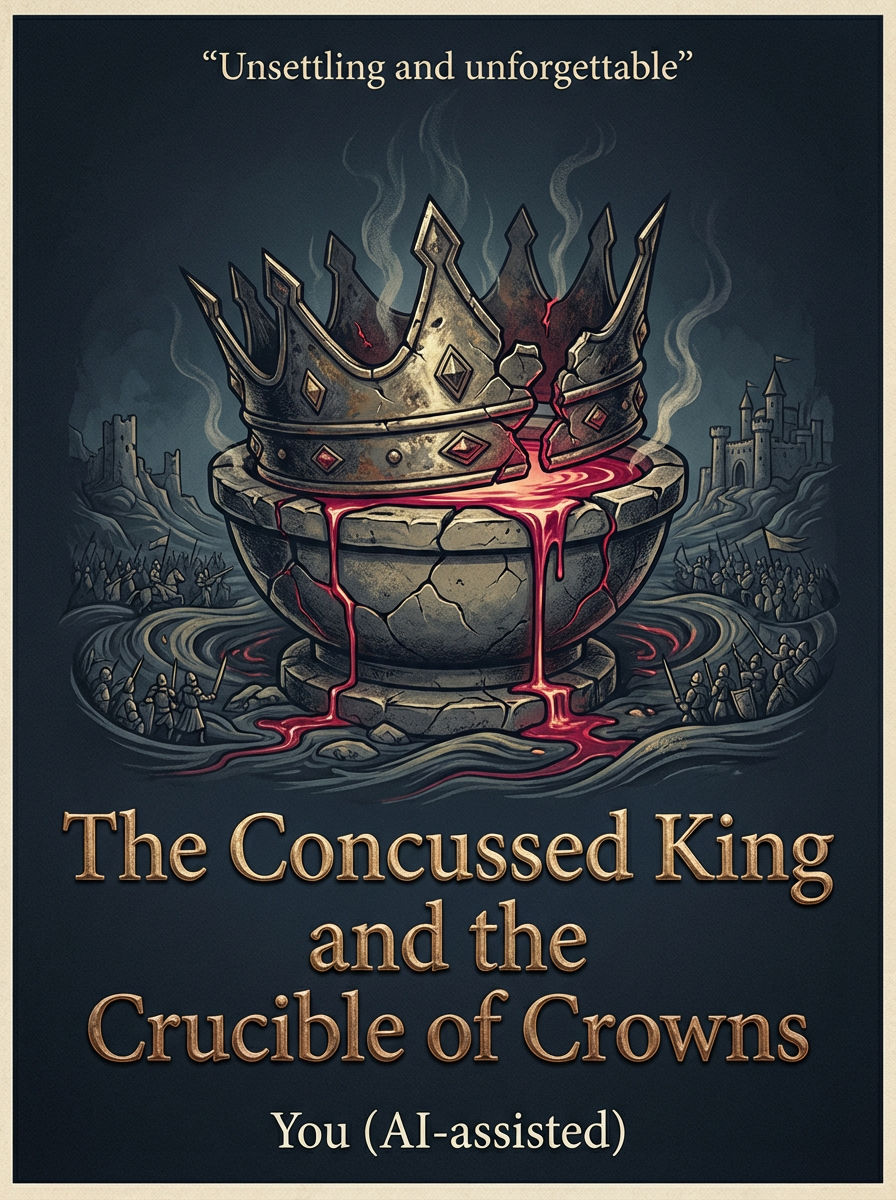
Synopsis
In the ancient dwarven stronghold of Stonehearth, a seemingly trivial accident—a king's unfortunate tumble and subsequent head injury—unleashes an unforeseen cascade of political maneuvering, escalating alliances, and ultimately, a brutal continent-spanning war that questions the very nature of lead
Chapter 1: A Sovereign's Sudden Stumble
The deep, resonant thrum of Stonehearth’s mighty forges, a melody as ancient and enduring as the mountains themselves, was abruptly, if momentarily, eclipsed by a sound utterly alien to its meticulously ordered rhythm: a sharp, sickening crack, followed by a muffled thud. It was a sound that, had it emanated from the battlements during a goblin siege, might have been met with steely resolve. Originating, however, from the perpetually damp, stone-hewn passageway leading to the Lower Ore Veins, it carried an altogether different resonance: one of disbelief, then apprehension.
King Borin Hammerfall, a sovereign whose very name resonated with unyielding resolve and robust constitution, lay sprawled upon the cold, uneven flagstones. His crown, a circlet of mithril wrought with the enduring symbol of the Hammerfall lineage – a stylized anvil upon an oak, whose roots delved deep into the earth – had tumbled from his head, coming to rest with a jingle perilously close to a trickle of iron-rich water. His usually stern features, chiselled by a thousand declarations of war and countless nights spent poring over treatises on mining efficiency, were contorted in an expression less of pain than of profound bewilderment.
His attendant, the venerable Thane Durin Stonebeard, a dwarf whose grey beard was as long and venerable as the King’s own and whose gait had rarely been hurried in the last century, was now a flurry of uncharacteristic motion. “Your Majesty! King Borin, are you injured?” he exclaimed, his voice cracking with a mixture of deference and undisguised alarm. He knelt clumsily, his thick fingers fumbling at the king’s heavily embroidered tunic, searching for the source of his obvious distress.
The inspection, intended as a routine examination of the promising new seam of black iron ore – a vein of such purity it promised to invigorate Stonehearth’s sputtering wartime economy – had been proceeding with customary efficiency. King Borin, despite his advancing years, possessed a keen eye for geological formations and an encyclopaedic knowledge of dwarven engineering. He had been demonstrating, with a didactic zeal that often tired his retinue, a particular technique for bracing a newly dug shaft when his heavy, mail-lined boot had encountered a patch of unexpected slickness. One moment, he had been standing, a figure of immutable authority, the next, a grotesque parody of kingly dignity, flat upon his back.
A low groan escaped the King’s lips. It was not a roar of pain, nor a command tempered with irritation, the usual responses one might expect from Borin Hammerfall when inconveniently inconvenienced. Rather, it was a sound of profound disorientation, a vaguely animalistic utterance that sent a shiver down Durin’s spine.
“My… my head,” the King mumbled, his hand rising to touch the back of his scalp, where a rapidly blooming crimson stain was beginning to bloom upon his thinning grey hair.
The crack, it transpired, had been the sound of King Borin’s regal occiput encountering a particularly jagged protrusion of granite. The impact, sharp and unequivocal, had been directly to the seat of his intellect, the very wellspring of his kingly wisdom.
Durin, a dwarf of practical sensibilities and limited medical training – though he could set a bone or staunch a bleeding wound with the best of them in a pinch – felt an unwelcome knot of fear tighten in his stomach. The King, after all, had never been ill. Not truly. A touch of the mountain cough in his youth, perhaps, or a strained back after an overly vigorous wrestling match with a particularly stubborn ore cart, but never anything that suggested an infirmity of such fundamental consequence.
“Do not move, Your Majesty,” Durin commanded, his voice trembling slightly in spite of his efforts to maintain a semblance of control. “Let me… let me see.”
The King, in an act utterly uncharacteristic of his iron will, meekly obeyed. His eyes, usually sharp and discerning, seemed unfocused, darting about the cavern with a nascent confusion that was deeply unsettling. The few other dwarves present – young Thanes of the mining guild, their faces still daubed with a fine layer of rock dust – stood frozen, their picks and geo-survey tools forgotten. Never in their collective memories had the King, their impenetrable, unshakeable King, presented such a picture of vulnerability. It was as if the very foundations of their world had subtly shifted.
Within moments, a stretcher, swiftly fashioned from sturdy mining timbers and a thick canvas tarpaulin, was brought forward. The process of moving the King was fraught with a delicate tension. Every shift, every jostle, elicited another low, disoriented groan. His crown was retrieved, dusted off, and carefully placed on a velvet cushion for transport. It seemed absurdly insignificant now, a mere bauble, detached from the head it was meant to adorn.
The journey back to the Royal Quarters, a labyrinthine path through Stonehearth’s heart, usually a triumphant procession, was instead a solemn, hushed affair. The usual clatter and din of mining operations seemed to mute themselves in deference to the King’s plight. Whispers, like subterranean currents, began to ripple through the bustling thoroughfares. “The King has fallen.” “A head injury.” “Will he recover?” Each whisper, though delivered with a certain fearful reverence, carried with it the seeds of disquiet. Stonehearth, a society built upon tradition, strength, and an unwavering belief in its monarch’s fortitude, was ill-equipped for such an unexpected fissure in its foundation.
Upon arrival at the imposing doors of the King’s private chambers, the Royal Physician, Master Elric Stonehand, a dour, meticulous dwarf whose reputation for both surgical precision and an unshakeable pessimism was legendary, was already awaiting them. His face, usually a study in controlled gravitas, was etched with a flicker of genuine anxiety.
“Bring him in, gentlemen, with utmost care,” Elric ordered, his voice surprisingly soft. He had seen enough head wounds over his long career – from errant chippings in the forge to more grievous injuries sustained in skirmishes with mountain goblins – to recognize the ominous omens of a fall such as this. The immediate disorientation, the slight unfocused gaze, the general air of sudden, inexplicable frailty – these were not the signs of a minor bump.
The King was gently transferred onto his immense, carven oak bed, its silk sheets a stark contrast to the rough canvas of the stretcher. Elric, with practiced hands, began his examination. He carefully palpated the King’s skull, his brow furrowed in concentration. When his fingers brushed against the newly formed, swiftly swelling lump at the back of Borin’s head, the King winced, a brief, sharp intake of breath.
“A prominent contusion, to be sure,” Elric murmured more to himself than to the anxious onlookers, who included not only Thane Durin, but also High Steward Grogan Stonehewer, a dwarf whose administrative acumen was matched only by his profound aversion to anything that disrupted the orderly flow of government, and Captain of the Guard, Kaelen Ironfist, whose face, usually a mask of battle-hardened resolve, now betrayed a faint trace of worry.
He took the King’s pulse, noted its sluggishness, and then, with a small, silver looking-glass, peered into Borin’s eyes, noting the slow, almost imperceptible reaction of his pupils to the light.
“Your Majesty,” Elric began, his voice calm, yet imbued with an underlying gravity, “Can you tell me your name?”
The King blinked slowly. “Borin,” he stated, a faint note of irritation creeping into his voice, as if the question itself were an impertinence. “King Borin Hammerfall. What… what is the meaning of this foolishness, Elric?”
A collective sigh of relief, faint but palpable, swept through the chamber. He knew his name. A good sign, surely.
But Elric was not so easily swayed. “And where are you, Your Majesty?”
Borin frowned. “In my chambers, of course. Where else would I be? Have I… have I been long returned from the mines?” A flicker of true confusion touched his eyes.
Elric hesitated. “Not long, Your Majesty. You… you suffered a fall. A rather nasty bump to the head.”
The King’s hand went automatically to the painful spot. “A fall? Nonsense. I do not fall. I am Borin Hammerfall.” He tried to sit up, but a wave of dizziness evidently swept over him, for he slumped back against the pillows, a faint groan escaping his lips. “My head spins so,” he murmured, his voice now weak, devoid of its usual authority.
Elric exchanged a glance with Thane Durin, a message passing between them beyond the comprehension of the other onlookers. There was more to this than a simple inconvenience. The King’s usual robust constitution, his notoriously unyielding resolve, seemed to have taken leave of him. His movements were slow, his speech slightly slurred, and a pallor, previously unseen upon his weather-beaten face, had settled upon him.
“Your Majesty,” Elric declared, his voice firm, “I must insist you rest. Complete rest. No visitors. No council meetings. No discussions of mining quotas or border skirmishes." He paused, his gaze sweeping over the assembled courtiers, challenging them to contradict his professional judgment. "For the foreseeable future, your focus must be entirely upon your recovery.”
Grogan Stonehewer’s carefully composed expression tightened. “Complete rest, Master Elric? But the Northern Pass negotiations are scheduled for next week. And the iron shipment from the Obsidian Peaks is overdue – the contracts require the King’s personal seal for release.”
Elric turned his full, unblinking attention to the High Steward. “The King's seal will be held. The negotiations will be postponed. Or, if they cannot, they will proceed without the King’s direct involvement. Are you suggesting, Grogan, that the health and recovery of our sovereign is of lesser importance than a contract or a diplomatic exchange?” His tone, though level, carried the unmistakable sting of a rebuke.
Grogan, whose respect for authority was absolute, bowed his head. “Of course not, Master Elric. My apologies. I merely… we are unaccustomed to such… such an eventuality.”
“Precisely,” Elric said, turning back to the King, who had now drifted into a light, disturbed sleep. “The King has suffered a concussion. A blow to the brain that requires not merely rest for the body, but for the very core of his being. Any undue exertion, any strain upon his mental faculties, could have… undesirable consequences. I cannot yet say how long this will persist, nor the full extent of its impact. But until I am convinced the threat has passed, the King will remain secluded. His will is weakened; his judgment, at present, is… compromised.”
The word, “compromised,” hung in the air, heavy and foreboding. King Borin, whose judgment was as bedrock to Stonehearth, whose will was as unyielding as the mountains themselves, was now, according to the Royal Physician, impaired.
Thane Durin, ever loyal, stepped forward. “Then the burden of government shall rest, for a time, upon the Royal Council. We shall ensure the smooth运行 of Stonehearth, Master Elric. Have no doubt on that score.”
Elric nodded, though his expression remained grim. “Indeed, Thane Durin. But I caution you: this is not merely a matter of temporary absence. The King's uncharacteristic lethargy, the subtle disconnections in his thought processes, and the… the very nature of such a profound cranial injury. These are matters of deep concern. We must observe him closely. For now, quiet. Absolute quiet. And may the Ancestors guide us.”
As the royal chamber door swung shut, leaving the King in the care of his physician and a handful of trusted attendants, a palpable hush fell over the assembled courtiers in the adjacent antechamber. The casual dismissal of a mere fall had rapidly escalated into something far more serious. The King, the immovable pillar of their world, had stumbled. And that stumble, though seemingly trivial, had unleashed a subtle undercurrent of apprehension, a sense of precariousness that had been utterly alien to the meticulously ordered, profoundly stable society of Stonehearth. The air, usually thick with the scent of ore dust and dwarf-made ale, was now tinged with the scent of uncertainty. The ground beneath their sturdy dwarven boots, for the first time in a very long time, felt a little less solid. The crucible of crowns, it seemed, was about to be stirred.
Chapter 2: The Whispering of Heirs and Hopes
The muffled clang of hammer on anvil, once the rhythmic heartbeat of Stonehearth, now seemed a distant, discordant echo to the stillness that permeated the Royal Wing. Weeks had passed since King Borin’s unfortunate entanglement with a loose flagstone, and with each sunrise, the court’s initial assurances of his swift recovery began to fray like worn tapestries. Master Healer Fargrim, a dwarf of venerable age and even more venerable medical texts, maintained a stoic front, yet his brow, perpetually furrowed, spoke volumes of his private anxieties regarding the monarch’s persistent torpor.
Dwarven tradition, as steadfast and unyielding as the mountains themselves, dictated an absolute silence on matters of succession during a ruling monarch’s perceived illness. To even hint at such a deliberation was considered an act of disloyalty, a disavowment of the sovereign’s inherent resilience and the divine favour that crowned him. Yet, tradition, like the deepest veins of mithril, could be mined for its inherent value while its surface remained undisturbed. The silence in the stone halls was not one of reverence, but of anticipation, a hushed expectancy that permeated the finely carved gargoyles and hushed conversations alike.
The first ripples of this unspoken discourse manifested not in direct pronouncements, but in the heightened frequency of polite inquiries regarding the King’s health, each delivered with an almost performative solicitude. Prince Thrain, Borin’s eldest son and heir apparent, a dwarf of imposing stature and a brow as craggy as any mountain pass, bore the weight of these concerns with a visible, if sometimes stiff, dignity. He was a creature of duty, forged in the traditions of Stonehearth, and the thought of unseemly ambition was, outwardly, anathema to him. His visits to his father’s chamber were frequent, his questions to Healer Fargrim precise, yet a subtle shift had occurred in his demeanour. Where once his gaze held only dutiful concern, a nascent, almost imperceptible gleam of regal potential now flickered within its depths.
“Master Fargrim,” Prince Thrain inquired one cool morning, his voice a gravelly murmur against the soft rustle of Fargrim’s herbs, “Is there truly no alteration in His Majesty’s condition? The Queen, as you know, is… distraught.” He paused, allowing the unspoken implications of his mother’s distress to settle. Queen Elara, a dwarf of refined sensibilities and an intellect as sharp as any chisel, bore her husband’s illness with an outward composure that belied an inner turmoil. She was, Thrain knew, a pragmatist to her core, and the implications of Borin’s prolonged indisposition would not have escaped her keen evaluation.
Fargrim, meticulously grinding a paste of wintergreen and frostbloom, offered a measured reply. “His Majesty’s vital signs, Prince, remain… stable. The peculiar lethargy persists, and his moments of lucidity are, regrettably, fleeting. He speaks, at times, of the most curious things – ancient mining routes long closed, grievances long settled. It is not the King we know.” He sighed, a sound laden with professional frustration. “The mind, Prince, is a complex cavern. We mend what we can see; we merely observe what we cannot.”
Thrain nodded, his jaw set. “And these… ‘curious things’,” he pressed, his gaze piercing, “do they suggest a deterioration, or merely a temporary excursion?”
Fargrim met his gaze, his own eyes holding a weariness that transcended professional detachment. “It is difficult to ascertain, Prince. The dwarven mind, particularly that of a King, is a fortress. Sometimes, even the stoutest fortifications can be breached by an unexpected internal tremor.”
The implication, though indirect, was clear: Borin’s mind was not merely muddled, it was *changed*. Thrain, ever the pragmatist, understood. A King who spoke of forgotten grudges and disused tunnels was not a King capable of ruling.
Meanwhile, elsewhere in the royal residence, the subtle dance of ambition was being choreographed with equal precision. Princess Astrid, Borin’s younger daughter, a dwarf of striking beauty and an even sharper wit, moved through these anxious weeks with an air of calculated detachment. While Thrain’s visits to the sickroom were obligations, Astrid’s were almost performances, brief and poignant, designed to elicit sympathy and admiration for her filial devotion, rather than any genuine insight into her father's condition.
Astrid, unlike Thrain, was not bound by the heavy mantle of direct succession. Her path to influence lay in her strategic alliances, her undeniable charm, and her intellect, which, though often veiled by a veneer of feminine grace, was as keen as any of her male relatives. Her husband, Lord Gareth, a younger son of a prominent, though not royal, dwarven house, was her chosen instrument, a malleable companion whose ambition she expertly guided.
“My dear Gareth,” Astrid began one afternoon, her voice a silken whisper as they strolled through the meticulously tended rock gardens, “Have you observed the pallor upon Master Fargrim’s countenance? It speaks to me of a weariness beyond that of merely attending to His Majesty. It is a weariness, I daresay, of uncertainty.”
Gareth, a dwarf of good breeding but limited imagination, merely grunted in agreement. “He does look rather haggard, my love. Perhaps the King’s spirits are not as high as we might hope.”
Astrid allowed herself a faint, almost imperceptible smile. “Indeed. And in such times, Gareth, when the heart of the kingdom beats with an irregular rhythm, a steady hand is required. A hand that understands the nuances of diplomacy, the delicate balance of Stonehearth’s numerous alliances, and the particular temperament of our esteemed neighbours.”
She paused, allowing the suggestion to coalesce in Gareth’s mind. He straightened, a flicker of understanding blooming in his eyes. “You speak of… the council, my dear?”
“The council, and beyond, Gareth. The prosperity of Stonehearth depends upon foresight and decisive action. A leader, particularly one burdened by… infirmity, may find themselves unable to grasp the complexities of the broader world. It is then that others, with clear minds and unwavering resolve, must step forward.” Astrid’s gaze, though ostensibly fixed on a particularly vibrant moss growth, held a glint of steel.
Gareth, sensing the shift in her tone, puffed out his chest a little. “And who, my dear, might possess such qualities?”
Astrid turned to him, her smile now a little more pronounced, a hint of genuine amusement dancing in her eyes. “Why, those who have keenly observed the machinations of court, those who have cultivated relationships with the various noble houses, those who understand the very pulse of Stonehearth. Those, my dearest, who have the kingdom’s best interests at heart.”
The implication, though still veiled, was enough for Gareth. He began to envision himself in a more prominent role, advisory perhaps, but with Astrid’s guidance, undoubtedly influential. He saw the path she was subtly laying, a path that led not directly to the throne, but to the ear of the power that would eventually occupy it.
Beyond the immediate royal family, other factions, more distant but no less ambitious, began to stir. Lord Balin, the King’s younger brother, a dwarf of considerable wealth amassed from shrewd mining investments and a reputation for understated cunning, remained largely outside the immediate glare of courtly intrigue. His visits to the royal wing were less frequent than Thrain’s, more formal than Astrid’s, and always accompanied by a carefully chosen retinue of advisors.
Balin believed in the long game. His power base was secure, his wealth substantial, and his connections deep within the mercantile guilds. He watched the escalating dance of his niece and nephew with a detached, almost scientific interest. To him, the throne was not a prize to be seized by overt aggression, but rather a position to be strategically acquired, like a valuable lode of ore.
His chief counsel, Master Durnan, a gaunt dwarf with eyes like polished obsidian, often presented Balin with meticulously researched assessments of the current political landscape. “My Lord,” Durnan began one evening, his voice a dry rustle, “Prince Thrain, despite his sincere intentions, lacks the… necessary malleability for truly effective governance in these uncertain times. His adherence to tradition, while commendable, may prove a significant impediment to navigating the inevitable shifts in power.”
Balin, nursing a mug of potent dwarven ale, grunted softly. “Thrain is his father’s son, Durnan. Unyielding. Predictable.”
“Precisely, my Lord,” Durnan concurred. “And predictability, in such volatile circumstances, can be a weakness. Princess Astrid, on the other hand, possesses a keen mind, a certain… adaptability. However, her alliances, though currently advantageous, are built upon a foundation of personal ambition rather than broader communal welfare.”
“She plays a clever game,” Balin conceded, a flicker of grudging admiration in his eyes. “But a game nonetheless. The stability of Stonehearth requires a hand that understands the delicate balance of power, the intricate web of ancient agreements, and the true cost of impulsive decisions.”
Durnan nodded, his gaze unwavering. “Indeed, My Lord. A hand that comprehends the long-term prosperity of our kingdom, rather than the transient glories of immediate power. A hand, one might venture to say, such as your own.”
Balin took a slow, deliberate sip of his ale. He did not overtly acknowledge the compliment, but the suggestion, so subtly presented, resonated with his own carefully cultivated self-image. He envisioned a Stonehearth steered by reason, by calculated risks, by a clear understanding of practicalities. Thrain’s unwavering adherence to ancient codes and Astrid’s intricate courtly dances, while having their place, were, in his view, ultimately less effective than a pragmatic, steady approach.
The whispers, initially confined to the royal antechambers, began to seep into the broader court. Courtiers, who once spoke only of the King’s latest decree or the quality of a new shipment of mountain amber, now debated, in hushed tones, the significance of Fargrim’s prolonged consultations, the meaning behind Queen Elara’s increasingly frequent solitude, and the subtle shifts in the behaviour of the royal heirs.
Lady Elara, though outwardly composed, felt the tendrils of unspoken speculation tightening around her. She was a Queen by marriage, her children direct heirs, and her position, while secure, was inextricably linked to the stability of the throne. Her anxieties, though primarily for Borin, were also for the future of her lineage. She knew her sons and daughter better than anyone, their strengths and their considerable flaws.
One morning, she summoned her most trusted confidante, Lady Morwen, to her private chambers. Morwen, a dwarf of sensible deportment and a sharp, discerning mind, had served the royal family for decades.
“Morwen,” Queen Elara began, her voice a low murmur, “the King… he drifts. So much so that even I, his wife of fifty years, find his thoughts elusive. Master Fargrim provides little comfort beyond the repetition of ‘stability’ and ‘observation’.”
Morwen, ever the pragmatist, inclined her head. “The Healer is a man of science, Your Majesty, not of prophecy. We must rely on observation where understanding proves impossible.”
“But what of the observations, Morwen?” Elara pressed, her finely manicured hands clasped tightly in her lap. “Thrain, my eldest, carries the weight of responsibility with admirable fortitude, yet his adherence to the established order, while commendable, may prove… inflexible in times of flux. Astrid, my daughter, possesses a remarkable intellect and an undeniable charm, but her pursuit of influence, my dear, is often driven by a personal agenda that may overshadow the broader needs of the kingdom.”
Morwen listened intently, her expression unreadable. “And Lord Balin, Your Majesty?”
Elara sighed, a faint wisp of sound. “Balin. My brother-in-law. Shrewd, cautious, and ever mindful of his own coffers. He speaks often of pragmatism, but I confess, the thought of his hand upon the helm of Stonehearth fills me with… certain reservations. His pragmatism, I fear, often borders upon ruthlessness.”
“He is a man of ambition, Your Majesty, as are all those who orbit the throne,” Morwen stated plainly. “The question, then, becomes not who *has* ambition, but whose ambition aligns most closely with the welfare of Stonehearth.”
Queen Elara looked out of the window, her gaze fixed on the distant, unyielding peaks. “Indeed. And in these times, Morwen, when the very foundations of our kingdom tremble with unspoken fears, it is not simply strength or cleverness that is required, but wisdom. A wisdom that can discern the true path amidst the competing clamour of self-interest.”
The Queen’s lament echoed the pervasive sense of unease that had settled over Stonehearth. The King’s illness was no longer a private family matter; it was a wound in the heart of the kingdom, a vulnerability that invited scrutiny and, inevitably, ignited ambition. The polite inquiries, once mere formalities, now served as probes, testing the limits of Borin’s incapacitation, measuring the shifting currents of loyalty and power.
The traditional denial of succession discussions, once a sacred barrier, had become a flimsy veil, barely concealing the intricate dance of veiled proposals and subtly suggested alternatives. Each faction, each contender, meticulously cultivated their image, their carefully constructed narratives of dedication and suitability. Thrain, the stoic heir, embodiment of tradition; Astrid, the charismatic intellect, master of alliances; Balin, the pragmatic financier, champion of economic stability.
And in the hushed, shadowed chambers of the Royal Wing, King Borin, the unwitting catalyst of this grand, intricate play, drifted in a world of forgotten grievances and half-formed memories, his concussed mind providing fertile ground for the silent, potent blossoming of ambition. The crucible of crowns was being forged, not in the fiery depths of war, but in the subtle, serious whispers of heirs and hopes, each one vying to shape the destiny of Stonehearth. The quiet prelude to chaos had begun.