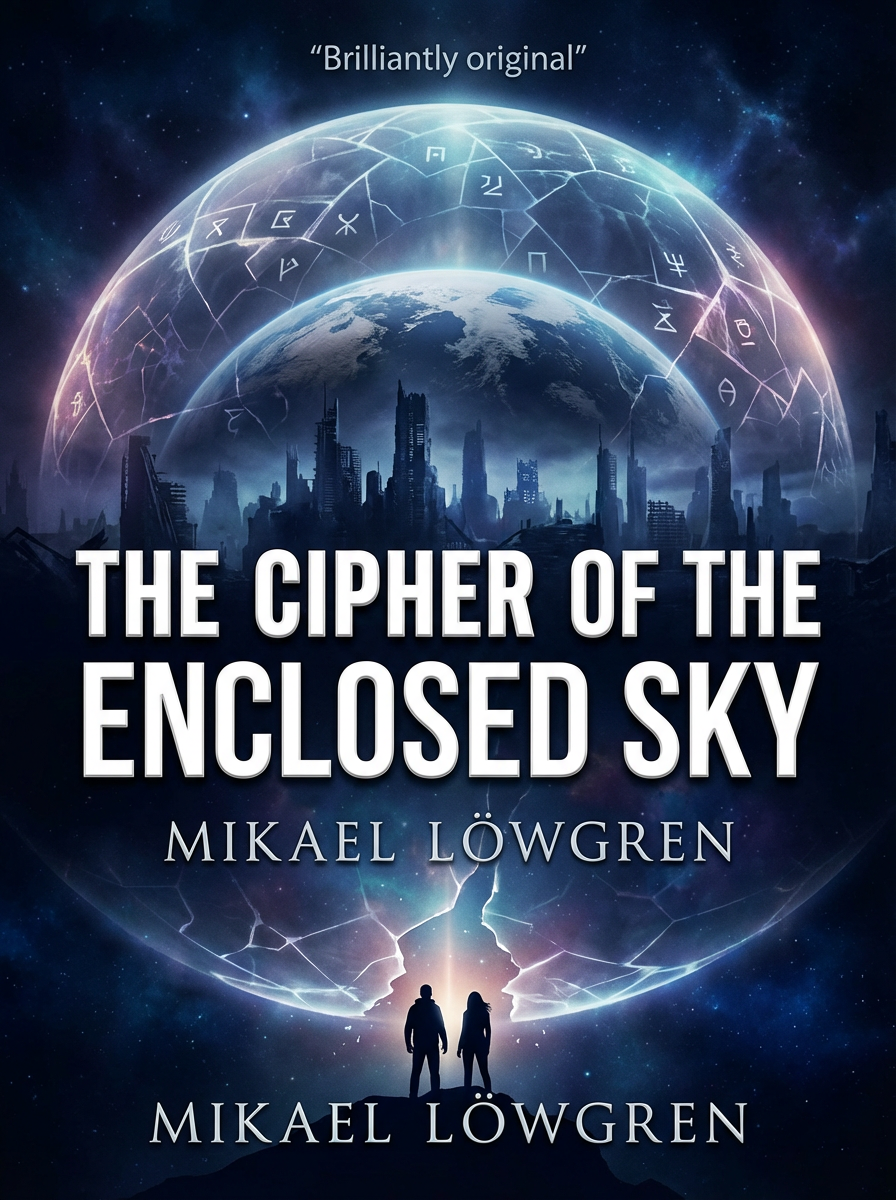
The Cipher of the Enclosed Sky
By Mikael Löwgren
Synopsis
The revelation of humanity's cosmic imprisonment sends shockwaves through Earth, igniting a desperate, fractured search for escape. Driven by the Wall's enigmatic 'language', Aris Thorne and Jian Li race against time, confronting political upheaval, internal conflict, and the unsettling truth that t
Chapter 1: The Echo of a Cage
The silence descended first, a weight more crushing than any gravity field. It filled the bridge of the *Helios IX*, not with absence, but with a profound, terrifying presence. A moment before, there had been the crackle of static, the frantic shouts of diagnostics, the sharp, final hiss as *The Lancet* probe disintegrated, a whisper of metal against an incomprehensible force. Now, only a low hum of life support systems, an almost religious drone.
Captain Eva Rostova stood rigid, her knuckles white against the console. Her gaze was fixed on the main viewscreen, which now displayed only the featureless, obsidian expanse of the Wall. But it wasn't truly featureless. Not anymore. The ghost of an image lingered behind her eyelids, a fleeting, impossible glimpse. Geometric perfection, Aris Thorne had whispered, his voice oddly detached even as the probe vanished. A confirmation. A sentence.
Dr. Aris Thorne, usually a whirlwind of nervous energy, was unnaturally still. He was leaning against a secondary console, his eyes closed, his face pale. The soft, persistent resonance, which had been a low thrum in the background of his consciousness for weeks, had intensified. Now it was a vibrating chord, deep within his bones, a hum that seemed to emanate from the very fabric of the ship, from his own cells, from the vast, indifferent void outside. It was a language without words, a sensation of pressure and presence, a quiet, insistent song of enclosure. He felt, rather than heard, the faint, regular pulse of it. Like a heartbeat, or the slow, deliberate turning of some colossal, unseen mechanism.
Dr. Jian Li, always the pragmatic one, was hunched over her station, her fingers hovering over a keyboard. She had been meticulously logging the probe’s final telemetry, the atmospheric readings, the energy fluctuations that had preceded its demise. But her usual focused intensity had fractured. Her shoulders were slumped, and her breath came in shallow, uneven gasps. The data, she knew, was unequivocal. The Wall was real. And it was artificial. The geometric perfection, even in that final, flickering second, had been irrefutable. It was the antithesis of chaos, the ultimate statement of intent.
"Report," Rostova's voice was a brittle whisper, barely audible above the ship's hum. She didn't turn. She couldn't. To turn would be to acknowledge the faces she knew would be etched with disbelief, with fear, with a dawning horror that mirrored her own.
Li straightened slowly, her eyes unfocused. "Probe transmission ceased at 06:17:32. Energy signature consistent with… with a deliberate, focused disruption. Not a malfunction. Not an accident." She swallowed hard. "The final image data, Captain. It confirms… Dr. Thorne’s hypothesis."
A collective, shuddering breath swept through the bridge. No one spoke. The implications hung in the air, thick and suffocating. Humanity, born of a seemingly endless cosmos, had reached its limit. Not a natural boundary, not the cold indifference of the void, but a deliberate, constructed barrier. A cage.
Thorne opened his eyes. They were distant, unfocused, as if peering into an internal landscape. The resonance was a living thing inside him now, a steady pressure behind his temples, a vibration in his chest. It tasted of metallic loneliness and an ancient, patient waiting. He could almost feel the Wall itself, not as an object, but as a vast, sentient presence, a silent witness to their frantic, foolish probing.
"It's not just a wall, Captain," he said, his voice quiet, almost meditative. "It's a statement. A boundary that defines us. And everything within it."
Rostova finally turned, her gaze sweeping over the faces of her crew. Engineer Chen, usually stoic, was openly weeping, a silent stream of tears tracking down his grimy cheek. Communications officer Anya Sharma stared blankly at a blank screen, her hands clenched in her lap. Navigator Ben Carter was slumped in his chair, head bowed, his uniform rumpled. Despair, raw and unvarnished, was a tangible entity on the bridge.
"We maintain protocol," Rostova articulated, each word a struggle against the rising tide of unreality. Her voice was thin, but it carried the weight of command. "We log the data. We prepare for return. We… we process." The last word came out as a ragged gasp. How do you process the end of the universe as you knew it? How do you process the discovery that your entire existence might be nothing more than an elaborate, contained experiment?
The resonance within Thorne pulsed, a soft, persistent echo that seemed to mock the futility of their protocols, their logging, their desperate attempts at normalcy. It was a soundless song of enclosure, a lullaby of imprisonment, and he was beginning to understand that it had always been there, just beneath the surface of everything. And now, it had finally risen to claim him. To claim them all.
Chapter 2: The Transmission of Despair
The silence in *Helios IX* was no longer a profound absence, but a presence, a viscous, suffocating blanket that pressed against the walls of the ship and the fragile membranes of the crew’s minds. It was a silence born not of distance, but of profound understanding. The *Lancet* was gone. Its sacrifice had etched a single, monstrous truth onto their collective consciousness, a truth that now demanded transmission.
Captain Rostova stood before the main console, her reflection in the polished surface a phantom, a woman carved from ice and granite. Her fingers, usually so assured, hovered above the transmission sequence. She knew the weight of this act, the sheer, unimaginable devastation it would unleash. It was like holding a match to a meticulously constructed city of glass. It would shatter. The shards, glinting with a million fractured expectations, would blind. But what choice was there? To withhold it was a cowardice she couldn't countenance, a betrayal of the very tenets of exploration.
Next to her, Aris Thorne seemed strangely detached, his gaze fixed on the raw, unedited image still cycling on a secondary display: the intricate, impossible filigree of the Wall, the single, stark glimpse of its interior. In the wake of the *Lancet*’s annihilation, the Wall’s ‘soft, persistent resonance’ within him had intensified. It wasn't a sound, not really. It was more akin to a vibration, a deep, pervasive hum that resonated in the marrow of his bones, a hum that seemed to speak a language he didn't understand but instinctively felt. It was a strange kind of comfort, a bizarre familiarity in the face of universal horror.
“Captain,” Thorne’s voice was low, almost a whisper, disrupting the fragile peace of the bridge. “The hypothesis. It needs to go with it.”
Rostova didn’t look at him. She knew what he meant. His ‘containment’ theory, born in the frantic hours after the *Lancet*’s first, blurry transmission, now crystallized by the final, irrefutable image. The Earth, the solar system, perhaps even wider swaths of the cosmos—encased. A terrarium. A cage. Both a grotesque imprisonment and, as Thorne had chillingly posited, a potential solution.
“They won’t accept it easily,” Rostova said, her voice raspy. “They’ll tear each other apart before they entertain the idea.”
“That’s not our concern, Captain,” Thorne replied, his voice acquiring a strangely detached, almost philosophical edge. “Our concern is the truth, however unpalatable. The data is the data. The hypothesis is the most logical interpretation. To redact it would be a disservice, a further obfuscation of a reality they will have to confront.”
He was right. As the last bastion of objective observation, their duty was to transmit everything. The brutal facts. The terrifying implications. Rostova took a deep breath, the stale recycled air tasting like metal in her throat. She closed her eyes for a fleeting second, picturing Earth, a vibrant blue marble, teeming with life, oblivious. Soon, it would be a planet convulsed.
Her fingers finally descended. The sequence was initiated. A series of clicks, whirs, and the low thrum of the ship’s internal systems, suddenly amplified in the silence, confirmed it. The data package, compressed and encrypted, surged outward, a digital scream tearing through the void. It contained the final image of the Wall’s impossible structure, the telemetry of the *Lancet*’s demise, and Aris Thorne’s ‘containment’ hypothesis, stark and uncompromising.
The transmission itself was an act of faith, or perhaps, an act of unforgiving honesty. For twelve agonizing minutes, the signal pulsed, a fragile thread connecting their isolated vessel to a civilization about to be irrevocably altered. When the confirmation chime finally sounded, a tiny, almost apologetic sound, Rostova felt a profound emptiness settle within her, a hollow echo of the weight she had just shed. The deed was done. The die cast.
“Course back to Earth, Lieutenant Davies,” Rostova commanded, her voice regaining a semblance of its usual authority, though it still carried a faint tremor. “Maximum sublight efficiency. Plot for a three-month transit.”
Davies, a young navigation officer whose face was still pale from the psychic shockwave of the *Lancet*’s destruction, nodded silently, his fingers already dancing across his own console. The return journey, usually a time of relief and anticipation, now felt like a retreat into a storm of their own making.
***
The initial days of the return journey were characterized by a brittle, forced normalcy. The crew, a tight-knit unit forged by years of deep-space exploration, found themselves adrift in a sea of unspoken anxieties. The hum of the *Helios IX*’s engines, once a comforting lullaby, now seemed to mock them, its rhythmic pulse a constant reminder of the vast, impenetrable distance between them and the truth of their new reality.
The Wall, though now behind them, its impossible geometry receding into the cosmic tapestry, continued to exert an insidious influence. Thorne’s ‘resonance’ was not an isolated phenomenon. Subtle, pervasive, it began to seep into the collective consciousness of the crew, manifesting in unsettling ways.
Sleep became a battleground. Nightmares, vivid and disturbing, plagued their rest cycles. Crew members reported dreams of boundless structures, of being trapped in infinite corridors, of the very fabric of reality stretching and warping into unfamiliar patterns. Dr. Elara Vance, the ship’s xenobotanist and amateur psychologist, began meticulously documenting these anomalies, her log entries growing increasingly concerned.
“Subject Delta-Seven,” she dictated one cycle, her voice low and clinical, masking a growing unease. “Reports recurring dream of being a solitary fish in an impossibly large, yet demonstrably enclosed, aquarium. The glass, they describe, is not visible, yet its presence is undeniable. Reports feeling a constant, subtle pressure, as if being observed. A pervasive sense of futility.”
Thorne, ironically, seemed to be the most resilient, or perhaps, the most attuned. The Wall’s resonance within him had deepened, becoming a constant companion, a low thrumming behind his thoughts. It was like living with a distant, subterranean earthquake, always present, never erupting, but constantly shifting the ground beneath his feet. He found himself more acutely perceptive of the subtle shifts in his crewmates’ moods, the haunted looks in their eyes, the nervous twitches of their hands.
One evening, he found Lieutenant Davies in the observation deck, staring out at the star-dusted void. Davies was usually an ebullient man, prone to jokes and boisterous laughter. Now, he was a shadow, his shoulders slumped, his gaze empty.
“Something bothering you, Lieutenant?” Thorne asked softly, settling onto the bench beside him.
Davies flinched, as if startled from a deep reverie. “Professor Thorne. Didn’t hear you.” He paused, then sighed, a sound heavy with resignation. “The stars, Professor. They seem… different.”
Thorne looked at the shimmering tapestry of distant suns. To him, they looked the same, beautiful and indifferent. “How so?”
“Familiar,” Davies said, his voice barely audible. “Like a painting. A masterwork, exquisitely rendered, but… a painting. Not real stars. Trapped stars.”
Thorne felt a cold knot tighten in his stomach. This was precisely the kind of psychological decay he had feared. The Wall wasn’t just a physical barrier; it was a conceptual one, a mind-altering construct that threatened to unravel the very bedrock of human perception.
“It’s a natural reaction, Lieutenant,” Thorne said, trying to inject a note of calm into his voice. “The mind struggles to reconcile such a monumental truth. It finds ways to cope, to rationalize.”
“Rationalize being in a cage?” Davies retorted, a flicker of anger in his eyes. “My dreams, Professor. They’re no longer dreams. They’re… memories. Of being small. Of hitting a wall that isn’t there, but is. I wake up with the taste of glass in my mouth.”
Thorne chose his words carefully. “The Wall, whatever its true nature, is a profound influence. Its ‘resonance’, as I’ve termed it, is not merely physical. It affects the consciousness. It’s like a song, perpetually playing, even when we don’t consciously hear it.”
Davies shuddered. “A song of sorrow, Professor. A requiem for everything we thought we knew.”
***
Weeks bled into months. The crew’s psychological state continued its slow, inexorable decline. Food consumption dropped. Arguments became more frequent, petty disagreements escalating into bitter accusations. The tight bonds of camaraderie fraying under the relentless pressure of existential despair.
Rostova, ever the unyielding captain, witnessed this erosion with a growing sense of helplessness. Her usual methods of maintaining morale—scheduled recreational activities, individual counseling sessions, stern but fair discipline—were proving ineffective. How do you instill hope in people who have just discovered they are cosmic prisoners?
She spent long hours in her private quarters, reviewing the *Lancet*’s final telemetry, scrutinizing Thorne’s hypothesis, searching for a flaw, a glimmer of an alternative explanation. But always, she came back to the same chilling conclusion. The data was unequivocal. The logic, however monstrous, was sound.
One cycle, she summoned Dr. Vance to her ready room. Vance looked gaunt, shadows etched beneath her eyes.
“Doctor,” Rostova began, her voice low. “Your assessments of the crew’s psychological state. Give it to me plainly.”
Vance hesitated, then squared her shoulders. “Captain, I’ve been as candid as professional ethics allow in my logs. But to put it bluntly: This crew is breaking. The Wall’s influence, as Professor Thorne describes it, is intensifying. It’s a pervasive presence in their subconscious. They are experiencing acute derealization, paranoia, and a profound sense of anomie. Some are exhibiting early symptoms of dissociative disorders. And the dreams…” she trailed off, shaking her head. “The dreams are universal. They all depict enclosure, insurmountable barriers, infinite spaces that loop back on themselves.”
“Professor Thorne seems less affected,” Rostova observed.
“He is,” Vance confirmed. “But I believe that’s because he isn’t fighting it. Or perhaps, the initial impact of the Wall’s resonance was more potent for him, allowing him to adapt to its persistent presence. For the others, it’s a slow, parasitic infiltration. It's stripping away their sense of self, their connection to a reality they once trusted.”
“So, what is the prognosis, Doctor?” Rostova pressed, her jaw tight. “Can we expect them to function when we reach Earth?”
Vance met her gaze. “Captain, frankly, I don’t know. This isn’t a normal psychological break. This is a cognitive assault on a fundamental level. It’s like telling a fish it lives in water; it doesn't understand. Telling it that its water is contained within an invisible tank, however, shatters its entire known universe. Their minds are trying to reconcile the irreconcilable.”
Rostova dismissed Vance, then slumped into her command chair. The image of Earth, vibrant and teeming, flashed before her eyes. The transmission she had sent was more than just data; it was a detonator. What would humanity do when faced with this truth? Would they unite, or implode? And what of her own crew, already teetering on the precipice of madness?
***
The final approach to Earth was a surreal experience. The blue marble, once a beacon of home, now appeared alien, distant. The ship was quiet, an unnatural stillness having settled over the crew. The arguments had ceased, replaced by a brooding, internalized despair. Conversations were clipped, functional, devoid of warmth or camaraderie.
Thorne spent most of his time on the observation deck, watching Earth grow larger, a silent sentinel. The Wall’s resonance within him had become a powerful, almost orchestral hum, a complex symphony of vibrations that seemed to predict the coming chaos. He felt a strange sense of anticipation, devoid of either hope or fear, replaced by a morbid curiosity. What would happen now? Would humanity rise to the challenge of this cosmic imprisonment, or would it simply wither, unable to bear the weight of such a crushing revelation?
As *Helios IX* approached orbit, the ship’s communication system crackled to life, filled not with celebratory greetings, but with a cacophony of panicked, disjointed transmissions. Earth was already in turmoil. The broadcast of the Wall's image, Thorne's hypothesis, and the implied fate of the *Lancet* had indeed shattered the glass city.
Rostova’s voice cut through the static, addressing the weary, broken faces of her crew. “This is Captain Rostova. We are entering Earth orbit. I’ve received preliminary reports. It appears our transmission had the anticipated effect. Global upheaval. Mass civil unrest. Political destabilization. We are to proceed directly to the designated secure facility at Geneva for full debriefing.”
A collective sigh, part exhaustion, part resignation, rippled through the gathered crew. No one cheered. No one expressed relief at finally being home. Home was no longer a sanctuary, but just another room in the cage.
As the *Helios IX* began its final descent through Earth’s atmosphere, the blue sky, once a symbol of boundless freedom, seemed to press down on them, an immense, impenetrable dome. The sunlight, filtering through the reinforced viewports, no longer felt warm and inviting, but clinical, revealing the raw, unvarnished fear in the eyes of the *Helios IX* crew. They were home, but home had changed. Home, they now knew, was just a larger enclosed space. And the silence they had left behind in the void had followed them, transforming into the deafening roar of a world suddenly confronting its cosmic confinement. The transmission of despair was complete. Now, the receiving end must contend with its awful truth.
Chapter 3: A World Unraveled
The message arrived with the quiet finality of a falling leaf. There was no thunderclap, no cosmic opera, just the clinical delivery of data packets from the Helios IX, relayed through a labyrinth of deep-space observatories and orbital relays. For a moment, the world held its breath, uncomprehending. Then, like a ripple expanding into a tsunami, the truth unfurled, consuming everything in its path.
Chaos, when it came, was not the fire-and-brimstone apocalypse of Hollywood. It was a slow, agonizing liquefaction of reality. The initial reports were met with incredulity, then ridicule, then a dawning, sickening horror. The Wall. The Enclosure. The cosmic cage. Media outlets, initially scrambling to discredit the ‘fake news,’ suddenly found themselves adrift in a sea of raw, unfiltered terror. Governments, caught entirely off guard, issued contradictory statements, their assurances dissolving faster than sandcastles in the tide.
General Elias Hayes, a man whose life had been a meticulously constructed edifice of strategy and control, stared at the holographic projection of the probe’s final image – the infinite expanse of the smooth, obsidian barrier. The image, now universally known as ‘The Curtain,’ pulsed with an inert, malignant beauty. His office, a fortress of steel and glass overlooking a restless Washington D.C., felt suddenly fragile, its defenses meaningless against an enemy that wasn't attacking, but simply *was*.
“General,” his aide’s voice was strained, “religious leaders are holding an emergency summit in Jerusalem. Calls for mass repentance are escalating in Riyadh. Beijing is reporting isolated incidents of… civil unrest, General. And the Vatican… they’re talking about a ‘Great Heresy,’ a ‘blasphemy against creation.’”
Hayes rubbed his temples, a headache blooming behind his eyes like a malevolent flower. “What’s the financial market doing?”
“It’s not doing anything, sir. It’s… gone. The major exchanges are in freefall. They’ve suspended trading, but it’s a formality. People are pulling their money, buying gold, buying land, buying bottled water and ammunition. Or just giving up.”
“The Wall doesn’t care about our capital markets,” Hayes muttered, the irony tasting like ash. He gestured at The Curtain. “What’s the latest from the astrophysicists? Any… any hope of misinterpretation?”
The aide hesitated. “Dr. Anya Sharma’s team… they’ve cross-referenced Helios IX’s data with every astronomical observation ever recorded. They’ve tried every angle, sir. Gravitational lensing, dark matter density, undiscovered phenomena. There’s no natural explanation for a phenomenon of this magnitude. It’s… artificial, sir. Consciously constructed. And infinite, as far as we can detect.”
Hayes closed his eyes. Infinite. The word hung in the air, a bell tolling for humanity’s boundless ambition. “And the energy signature Thorne detected? The ‘resonance’?”
“Still unquantifiable, sir. It manifests as a low-frequency hum in deep space, but it’s… everywhere. It seems to be intrinsic to the Wall itself. Some theorize it’s what holds it together. Others… others are calling it the ‘Song of the Jailer’.”
Hayes flinched. The media had a perverse genius for nomenclature. The Curtain. The Jailer’s Song. They were burrowing into humanity’s collective subconscious, planting seeds of despair that would blossom into madness.
He looked out his window. The familiar cityscape seemed alien, a temporary construction on a stage whose boundaries had been abruptly revealed. The Wall. It wasn’t just a physical barrier; it was a psychological one, compressing the human spirit, revealing fault lines that had always existed, now split open into gaping chasms.
***
Meanwhile, on Earth, the landing of the Helios IX was an event devoid of heroics. There were no cheering crowds, no triumphant parades. The ship, a grim sarcophagus of shattered dreams, touched down on a desolate, cordoned-off military airstrip, its hull scarred by cosmic radiation and the ghosts of its mission.
Aris Thorne, his skin a pasty white from weeks in space, his eyes holding the haunted depth of someone who had seen too much truth, stepped onto the sterile tarmac. The air, thick with the scent of ozone and the dampness of an unseen rain, felt alien after the recycled air of the Helios IX. Beside him, Captain Valerie Rostova, her face a mask of iron resolve, surveyed the small delegation of military officials and scientists. Their expressions were a mixture of awe, fear, and a burgeoning resentment. They saw not heroes, but harbingers of doom.
He could feel it here, on Earth. The resonance. It was fainter than in deep space, attenuated by the planet’s atmosphere and magnetosphere, but it was there, a subtle thrum beneath the surface of reality, a silent, persistent hum that spoke of containment. It was in the jittery movements of the ground crew, the frantic chatter of the comms, the way the air itself seemed to vibrate with unspoken dread.
He was immediately whisked away, not to a debriefing, but to a series of medical and psychological evaluations. They probed his mind, his body, looking for answers, for damage, for anything that could explain what he had seen, what he had felt. He answered their questions with the detached clarity of a man who had already passed beyond the petty concerns of human psychology. He spoke of the Wall, of the resonance, of the soft, persistent whispers in the dark. They listened, their faces betraying either disbelief or a chilling acceptance.
Rostova, ever the pragmatist, was immediately drawn into high-level strategic meetings. Her reports, clinical and unembellished, painted a stark picture of humanity’s predicament. She spoke of the Wall not as a theory, but as an incontrovertible fact, a universe-altering truth that demanded immediate, organized action. But organization, Thorne observed from his enforced isolation, was the first casualty of this new reality.
The world outside the sterile confines of the research facility was unraveling. Thorne, granted limited access to news feeds and vetted reports, watched humanity’s response with a detached fascination. It was a kaleidoscope of the grotesque and the sublime, a fever dream of desperate coping mechanisms.
Religious fervor had erupted like a wildfire, fueled by the terrifying revelation. Old prophecies were dusted off, new cults sprang up like mushrooms after a storm. Televangelists, their eyes wide with a mixture of terror and opportunistic zeal, declared the Wall God’s judgment, a divine punishment for humanity’s hubris. In megachurches across the globe, congregations wept and wailed, their prayers echoing against a celestial barrier that seemed impervious to entreaty. Thorne saw images of pilgrims, clad in sackcloth, marching towards supposed ‘holy sites,’ their faces etched with a desperate hope for divine intervention, a miracle that would tear down the cosmic veil.
In stark contrast, nihilism blossomed in the shadows. The ‘Black Blooms,’ as the media sensationally called them, were a growing movement of individuals who, confronted with the ultimate futility of existence, embraced a philosophy of absolute despair. They held mass gatherings, often in abandoned industrial zones, where they preached the end of meaning, the pointlessness of striving. Thorne saw videos of young people, their eyes glassy, engaging in acts of self-destruction, of wanton abandon. Why strive, if all striving led to a wall? Why build, if construction was merely an echo in a prison? Why live, if life itself was a meaningless drama playing out in a cosmic cage?
The economic collapse was profound. Entire industries, built on the premise of expansion, exploration, and limitless growth, simply vanished. Space tourism, orbital mining, terraforming projects – all became punchlines in a morbid joke. The stock markets, already in freefall, had been replaced by a chaotic black market for essentials, while luxury goods became worthless baubles. People hoarded food, water, and anything that could sustain them in a world where the future had been truncated, perhaps forever.
Governments, once stalwarts of order, found their authority eroding. Protests, riots, and outright rebellions simmered beneath the surface, occasionally boiling over into violent clashes. People demanded answers, solutions, scapegoats. The lack of an external enemy, of a clear antagonist to fight, made the internal divisions all the more virulent. Nations began to withdraw, to barricade themselves, seeing every other nation not as a potential ally, but as a competitor for dwindling resources within the shared prison.
Thorne remembered an old Murakami novel, a story where a city was encased in a wall, its inhabitants living out stunted, pre-ordained lives. He felt a chilling sense of déjà vu. Humanity was the townspeople, and the Wall, the one true, incontrovertible fact of their existence, dictated everything.
He thought of Jian Li, the brilliant linguist. Was she seeing this too, this fractured response? Was she among those still searching for answers, or had she too succumbed to the despair or the fervent hope? His own resonance, the soft, persistent hum, offered no answers, only a persistent reminder of the Wall's immutable presence.
One evening, staring out of a reinforced window at a sky now redefined, he saw Rostova being interviewed on a news channel. Her face, etched with exhaustion, was projected onto massive screens in public squares, her words of caution and calls for unity largely drowned out by the noise of panic and discord.
“We are not alone in this,” she said, her voice steady, despite the tremor in the feed. “We have always been alone among the stars, that truth has not changed. What has changed is our understanding of our local reality. We must unite, not as nations, but as a species. This is humanity’s greatest challenge, and our greatest opportunity. We must understand it, not just fear it.”
But fear, Thorne knew, was a powerful, primal force. It short-circuited reason, tore at the fabric of society, and whispered temptations of surrender or violent retribution. And there was no one to fight. The Wall was not an aggressor. It simply *was*.
Later that week, a general debriefing was called, pulling Thorne from his observational purgatory. He found himself in a large, circular room, surrounded by faces that ranged from grim determination to existential weariness. General Hayes was there, his eyes sharp, his posture rigid. Rostova sat beside him, a silent sentinel. Jian Li was conspicuously absent.
“Dr. Thorne,” Hayes began, his voice surprisingly calm amidst the swirling currents of global panic. “Your theory on the Wall's ‘language,’ on the resonance… we need to understand it better. We need to find a way to communicate, a way to—"
"A way to escape?" Thorne finished, his voice devoid of inflection. "Or a way to comprehend? The two are not necessarily the same, General."
Hayes studied him for a long moment. “Dr. Thorne, we are looking for solutions. Any solutions.”
“The resonance is not a conventional language,” Thorne explained, leaning forward, his gaze sweeping over the faces in the room. “It’s more akin to a fundamental truth embedded within the fabric of the Wall itself. A pattern. A principle. It doesn't communicate in words, but in concept, in resonance, in subtle shifts of energy and perception. It feels… old. Impossibly old. As if it has always been there, and we merely stumbled upon its awareness.”
He paused, recalling the feeling of the resonance intensify within him, the strange sense of belonging it evoked even as it spoke of imprisonment. “The Wall isn’t just a physical barrier. It’s a conceptual anchor. It dictates the limits of our perception, the very foundation of our reality. Understanding its ‘language’ might mean understanding the rules of our very existence.”
A scientist, a young woman with nervous eyes, raised her hand. “Dr. Thorne, with all due respect, is it possible this ‘resonance’ you perceive is merely a neurological artifact? A coping mechanism? Trauma-induced hallucination?”
Thorne met her gaze. “It is possible. Subjectivity is always a factor. But I believe it is more than that. I believe it is a genuine interaction, a subtle form of communication with a structure that is entirely alien to our understanding of the universe. What I perceive, others could perceive, if they were attuned.”
Rostova interjected, her voice cutting through the tension. “Dr. Thorne’s readings, however subjective, correlate with measurable energy fluctuations detected by the Helios IX sensors, albeit at incredibly subtle levels. We cannot dismiss this as mere hallucination.”
Hayes nodded slowly. "We need to find someone else who can perceive this resonance. Someone who can help interpret it. We need a… a Rosetta Stone for the Wall’s whispers.”
Thorne felt a pang. He knew who that someone was. Or at least, who she had been. Jian Li. But where was she now, in this fractured world?
As the meeting concluded, Thorne walked out into the cool evening air. The stars, once symbols of infinite possibility, now felt like pinpricks in a vast, indifferent canvas. The Enclosure had not only ripped open the sky; it had unraveled the very psyche of humanity. The search for escape, he realized, was not just about breaking a physical barrier. It was about reconstructing a belief, a purpose, a reason to continue existing in a world where the horizon had been abruptly, irrevocably, set. And the Wall, in its silent, looming presence, seemed to ask, in its resonant, unyielding hum, 'What will you do now, inhabitants of the enclosed sky?'
Chapter 4: The Architects' Whisper
The hum of the server farm was a low, insistent thrum in Jian Li’s ears, a mechanical counterpoint to the more ancient, more profound resonance that had begun to permeate her waking hours. It wasn't the kind of hum one consciously hears, but a deeper vibration, a subtle tremor in the quantum fabric of the world that she, and perhaps only she, was beginning to perceive. Aris Thorne sat across from her, his gaze distant, yet fixed on a flickering projection of an anomalous energy spike traced across a global grid map. He rarely spoke now, but his presence was a strange kind of barometer for her own burgeoning sensitivity.
“It’s like static,” Jian Li murmured, her voice barely audible above the server drone. “But organized static. Not random. Not noise. It’s… structure.”
She traced a finger across the holographic display, highlighting a cluster of micro-fluctuations in the European power grid. They were infinitesimally small, dismissed by standard algorithms as system noise, but to Jian Li, they pulsed with a faint, almost imperceptible rhythm. A rhythm that, she realized with a cold certainty, was mirroring the Wall’s pervasive thrum.
Thorne shifted, the leather of his chair creaking. “Organized static, you say? Like a language no one has bothered to learn yet.” His voice was rough, a little gravelly, as if he hadn't used it much recently. He’d spent most of his waking hours in the past weeks in a state of quiet abstraction, his eyes often unfocused, as if listening to something far beyond the confines of their subterranean bunker.
“Precisely,” Jian Li affirmed, her eyes still scanning the intricate web of data. “It’s in the fiber optics, the satellite relays, even the stray electromagnetic fields generated by urban centers. The Wall isn’t just a physical barrier at the edge of our system, Aris. It’s a… a principle. A law. And it’s interacting with our technology in ways we’re only just beginning to grasp.”
Her work had begun as a desperate attempt to find any weakness in the Wall. Initial analysis of the Lancet's final data, though fragmented, suggested strange energy signatures, patterns of interference that defied known physics. But as Jian Li delved deeper, using bespoke algorithms and quantum computing to sift through gargantuan data sets, she found not a weakness, but an omnipresence.
The initial spikes she’d detected were subtle, easily dismissed as anomalies or sensor errors. But as she refined her search parameters, stripping away layers of expected data, the patterns became more pronounced, more… coherent. They were not disruptions, but echoes. Resonances. Each tiny fluctuation, each near-imperceptible distortion in the signal, was like a single brushstroke in a vast, invisible painting.
Today, she was tracking something new. Anomalous power surges, previously attributed to isolated solar flares or minor grid instabilities, were now forming interconnected chains across continents. They were too regular, too intentional, to be arbitrary.
“Show me the convergence points,” Thorne said, his voice laced with an intensity that surprised her. He leaned forward, his hands resting on his knees, his gaze finally snapping into sharp focus. “The points where the pattern density is highest.”
Jian Li nodded, her fingers flying across the touch interface. The map zoomed in, then highlighted a series of locations: a decommissioned deep-space tracking station in the Australian outback, an abandoned particle accelerator in Switzerland, a forgotten research outpost beneath the Antarctic ice. Places where humanity had once strained against the limits of its knowledge, reaching out, listening in.
“These were all sites of advanced physics research or extreme sensitivity to cosmic phenomena,” she explained, a tremor of excitement in her voice. “But they’re all inactive. Or largely inactive.”
“Or they were never truly inactive,” Thorne countered, his eyes narrowed. “Perhaps they were just… listening to something we weren't ready to hear yet. Or speaking a language we couldn’t interpret.” He closed his eyes for a moment, a faint frown creasing his brow. “There’s a pressure here, a subtle shift in the resonance. It feels… amplified at these points. Like a current running through a coil.”
Jian Li watched him, intrigued. His 'resonance,' as he called it, was still an enigma. She dismissed it, privately, as a highly sophisticated form of psychosomatic response, an extreme instance of the human mind reacting to prolonged exposure to an unknown phenomenon. Yet, its accuracy, its ability to cut through noise and pinpoint patterns she was still struggling to define, was undeniably useful.
“You’re feeling it too, then?” she asked, a scientific curiosity overriding her skepticism.
Thorne opened his eyes, a strange glint in their depths. “Not in the way you see it on the screen, Jian. It’s… internal. A chord struck in my bones. It’s been building since the Helios IX. Ever since I first felt the wall. It’s like a hum that’s slowly turning into a melody, and now, it feels like it’s finding its harmony in these data patterns.”
He gestured to the highlighted points on the map. “These aren't just energy anomalies. They’re points of intersection. Places where the Wall’s influence is… bleeding through more coherently. Not as a destructive force, but as an informational one.”
The implications of his words hung heavy in the air. If the Wall wasn’t just a passive barrier, but an active, informational construct, then its very presence was a kind of communication. And if it was communicating, then it had an architect.
“An architect,” Jian Li whispered, understanding dawning on her. The idea had been simmering on the periphery of her thoughts, a terrifying, exhilarating possibility. “Someone built this cage. And it’s… speaking to us through the very fabric of our reality.”
The revelation brought with it not despair, but a surge of focused energy. The Wall was no longer an insurmountable void, but a complex mechanism, a puzzle. And puzzles had solutions.
“The language of obstruction,” Thorne mused, echoing her earlier observation. “But perhaps it’s also the language of instruction. What if the obstructions are not meant to keep us in, but to guide us?”
Jian Li began overlaying astronomical data onto their current projection. She mapped the projected trajectories of interstellar probes, the faint signals of deep-space radio observatories, even the subtle gravitational lensing patterns observed around distant galaxies. She was searching for a correlation, a bridge between the physical manifestations of the Wall’s influence and the vastness of the cosmos beyond.
And then she saw it.
A delicate, almost imperceptible web. The anomalous energy fluctuations, the communication distortions, the synchronized micro-tremors in global energy grids – they weren’t confined to Earth, or even the solar system. Their patterns, when extended imaginatively across vast cosmic distances, aligned with faint, previously disregarded anomalies in galactic background radiation.
“The Wall isn’t just around our solar system, Aris,” she said, her voice hushed with awe and a touch of dread. “It’s… larger. Much larger. These patterns… they connect our localized experience to something far grander. It suggests the Wall isn’t merely a perimeter, but a feature of the universe itself, at least within our observed region.”
She highlighted a series of points on the galactic map, each corresponding to a previously inexplicable dip or surge in cosmic microwave background radiation, or a strange polarization pattern in distant nebulae. “We dismissed these as instrumentation errors, cosmic noise. But they fit. They fit the rhythm.”
Thorne stood up, moving closer to the projection. He reached out a hand, not quite touching the flickering light, his eyes unblinking. The air around him seemed to thicken, almost as if he were absorbing the raw data directly, bypassing the need for sensory input.
“The Architects’ Whisper,” he said, the words a low, guttural murmur. “It's not just a cage, it's a message board. A subtle redirection. What if the 'obstruction' isn't to hold us, but to prevent us from going somewhere we shouldn't, or to guide us to where we *should* be going?”
The implications were dizzying. If the Wall was a cosmic-scale architectural feature, then the beings who built it were beyond comprehension. And their motives? That was the most terrifying question of all. Were they benevolent guardians, or indifferent engineers?
Jian Li, the meticulous scientist, felt a profound shift within her. Her initial drive to escape had been a visceral, almost animalistic urge. Now, it was being supplanted by a deeper, more intellectual curiosity. Escape was still the goal, but understanding had become an equally powerful imperative.
“If this is a message,” she began, "then we need to decode it. We need to find the Rosetta Stone. And it implies an intelligence, a purpose behind it all.”
Thorne nodded, a single, decisive movement. “The resonance is strengthening. It’s no longer a hum, Jian. It’s a symphony. And these convergence points… they’re like the conductor’s baton, signaling a key change.” He pointed to the highlighted sites on Earth. “We need to reactivate them. Not to escape, not yet. But to listen more clearly. To amplify the signal.”
The suggestion was radical, dangerous. Reactivating abandoned, high-energy research facilities, especially in the current climate of global paranoia and breakdown, would be a logistical and political nightmare. General Hayes, for all his pragmatism, would balk. The world would see it as a desperate, perhaps even suicidal, attempt to break the Wall, risking catastrophic unforeseen consequences.
“General Hayes will never agree,” Jian Li said, stating the obvious. “He’ll view it as irresponsible, a waste of resources at best, a provocation at worst.”
Thorne’s gaze hardened. “Hayes sees the world through the lens of military strategy. He wants to hit it, blast through it. He wants a war against an invisible enemy. But this isn’t a war, Jian. It’s a negotiation. And to negotiate, we need to understand the language.”
He paused, a flicker of something akin to grim determination in his eyes. “My ‘resonance’ is becoming clearer. It feels less like a personal affliction and more like… a calibrated instrument. These points, these architects' whispers, they're resonating with me in a specific pattern. It's like a cipher key, unlocking a deeper layer of the Wall's presence.”
Jian Li felt a chill that had nothing to do with the bunker’s air conditioning. What he was describing was not merely a psychological sensitivity, but a biological one. Was prolonged exposure to the Wall’s field altering human physiology, creating a new kind of sensory apparatus? It was a terrifying, yet thrilling, prospect.
“So, you believe your… connection… could help us interpret the amplified signals?” she asked, a scientific hypothesis forming even as a shiver ran down her spine.
“I don’t just believe it,” Thorne replied, his voice low and firm. “I know it. It’s like a tuning fork resonating with a specific frequency. I can feel the patterns within me, the ebb and flow, the subtle shifts. The Wall isn’t just an external phenomenon anymore. It’s part of me. And if it's the Architects’ Whisper, then perhaps I am becoming their ear.”
The sheer audacity of the idea, the almost mystical implications, clashed with Jian Li's rigorously logical mind. Yet, the evidence, however circumstantial, was accumulating. Thorne’s insights, initially dismissed as intuitive leaps, were consistently proving accurate, guiding her through petabytes of noise to the signal.
“We need to be discreet,” Jian Li finally conceded, her gaze returning to the sprawling, interconnected patterns on the screen. “Extremely discreet. If word of this gets out, especially the idea of reactivating these global listening posts, there will be riots. Governments will declare it an act of war, or worse, a surrender to the unknown.”
“Discretion will be our shield,” Thorne agreed, his jaw tight. “But urgency will be our weapon. The longer we wait, the more deeply integrated these patterns become, the more lost the original message might be within the noise of our own desperation.”
He walked over to a secure terminal, his fingers hovering over the glowing keys. “I still have contacts in the old space agencies, the ones dismissed as irrelevant after the Wall’s revelation. Scientists who still believe in discovery, not just survival. They might be willing to risk institutional censure for the sake of true understanding.”
Jian Li watched him, a complicated mixture of fear and fascination stirring within her. The world outside their bunker was crumbling, consumed by fear and despair. But in this quiet, sterile command center, a new kind of work was beginning. They were no longer just researchers seeking an escape route. They were decipherers, attempting to understand the universe through the cryptic language of its most profound prison.
The Architects’ Whisper, as Thorne called it, was no longer just a theoretical concept. It was a tangible, if invisible, force. And Jian Li, amidst the chaotic global narrative of broken hope and fractured societies, felt a cold, clear purpose solidify within her: to listen, to decode, and to understand whether the cage they inhabited was truly a prison, or merely an elaborate, universe-spanning instruction manual disguised as an inescapable wall. The true journey, she realized, was only just beginning.
Chapter 5: Factions of Fear
The cafe on the twenty-seventh floor had lost its sheen. Once a bustling hive of hushed financial dealings and caffeinated aspirations, it now echoed with an almost spiritual emptiness. Tables, immaculately wiped, stood vacant. The aroma of synthetic coffee, usually a comfort, felt forlorn, a ghost of normalcy. Thorne sat by a panoramic window, the city below a muted tapestry of human striving and undeniable futility. The Wall’s resonance hummed in his bones, a low, persistent thrum beneath the city’s forced quiet. It was louder now, more insistent, no longer a whisper but a sustained chord in the symphony of everything.
Across from him, Captain Rostova swirled a cup of lukewarm tea, her gaze fixed on a distant, barely visible shimmer in the sky – the edge of the Wall, a concept still too vast for the human mind to properly grasp. Her face, etched with a new kind of weariness since their return, carried the weight of a planet. The crispness of her uniform had softened, as if a layer of starch had been dissolved by the sheer pressure of their predicament.
“General Hayes called again,” she said, her voice flat, devoid of its usual controlled cadence. “Another emergency meeting. The factions, as they’re now called, are solidifying.”
Thorne grunted. “Expected that. Humans are tribal by nature. Faced with the incomprehensible, they’ll cling to any shred of an explanation, any path forward, no matter how absurd.” He took a sip of his own coffee, the bitter taste a perfect mirror for the world’s mood.
Rostova nodded, a slow, deliberate movement. “Three dominant currents, apparently. Strong enough to drown out everything else. They want us to officially declare where we stand.”
“Declare where *we* stand?” Thorne’s eyebrows rose. “Last I checked, we were the ones who brought them the news. We’re scientists, not politicians.”
“Precisely,” she said, looking at him now, her eyes, usually sharp, holding a hint of resignation. “And because we were the first, because our names are now irrevocably linked to this… truth, our endorsement carries weight. More than we’d like.”
The ‘factions of fear,’ as Jian Li had wryly dubbed them, had emerged with brutal efficiency.
First, there were ‘The Breakers.’ Their philosophy was straightforward, primal even. The Wall was a prison. Prisons were meant to be broken. Their rhetoric was impassioned, appealing to humanity’s deepest instincts of freedom and rebellion. They advocated for a colossal, coordinated assault on the Wall. Super-lasers, antimatter charges, gravitic disruptors – the specific methods varied, but the core idea remained: hit it until it yielded, or until it shattered. Their leaders were often figures of military backgrounds or populist demagogues, promising decisive action, a swift end to the global paralyses. They spoke of reclaiming humanity’s destiny, of striking back against an unknown oppressor.
Then came ‘The Seekers.’ These were the communicators, the interpreters, the dreamers. They believed the Wall was a message, a sophisticated enigma, perhaps even a test. To them, destruction was an act of blind barbarism, akin to defacing a priceless ancient text. They advocated for intensified research, for deciphering the Wall’s ‘language,’ for finding a way to establish dialogue with whatever intelligence lay beyond, or within. Their ranks swelled with scientists, linguists, philosophers, spiritual leaders, all wrestling with the metaphysical implications of their incarceration. Jian Li, by virtue of her unparalleled sensitivity to the Wall’s resonant patterns, was unwittingly becoming a reluctant icon for this group.
Finally, the most unsettling group: ‘The Resigned.’ They were the quiet ones, the ones whose despair had curdled into a bleak acceptance. The Wall was there. It was insurmountable. Humanity was insignificant, a biological experiment perhaps, or simply a collection of ants in a jar. Best to just live out their remaining days with what little dignity they could muster, to adapt to the new reality. They spoke of reducing resource consumption, of fostering internal peace, of cultivating art and philosophy within the confines of their cosmic cell. Their arguments, though steeped in pessimism, carried a strange, somber logic. Why fight the inevitable? Why waste precious energy banging against an unyielding barrier? This faction resonated with a pervasive ennui that had settled over large swathes of the population. They were the ones who had given up watching the news feeds, who had unplugged from the global debate, retreating into smaller, more manageable worlds.
“The Breakers want us to endorse their plan for the 'Omega Strike,'” Rostova continued, her voice gaining a touch of steel. “They believe our firsthand experience of the Wall’s proximity gives our words a unique authority in their favour. They cite the initial chaos, the perceived hostility of the Wall’s presence.”
“And The Seekers?” Thorne asked, already knowing the answer.
“They see us as potential conduits, especially you, Aris.” She gestured vaguely towards him. “Your… sensitivity. They believe you can facilitate a breakthrough. Jian Li, of course, is already their unofficial prophet.”
Thorne traced the condensation on his coffee cup. The thought of being a conduit, a prophet, filled him with a familiar unease. His connection to the Wall was an unwelcome burden, a constant irritant in his mind, not a gift.
“And The Resigned?” he probed, although their silence was their loudest message.
Rostova's lips thinned. “They don’t ask for endorsements. They simply exist, a growing mass of quiet despair, a counterweight to all the frantic activity. They destabilize everything just by… not caring.”
General Hayes had been direct when he’d pressed the issue. “Thorne, Rostova, your neutrality is becoming a liability. This isn’t a scientific debate anymore. It’s a global existential crisis. People need leaders, they need direction. Your silence is interpreted as uncertainty, and uncertainty, right now, is death.”
The words echoed in Thorne’s mind. He had always valued the detached objectivity of science. To be forced into a partisan stance felt like a betrayal of his intellectual integrity, yet Rostova was right. Their position, their *perceived* position, was a powerful weapon in this ideological war.
“What do *you* think?” Thorne asked Rostova, his eyes searching hers for an answer he perhaps already knew.
She looked out at the distant shimmer again, her gaze weighted. “I think all of them are wrong in some fundamental way. And perhaps all of them are right in another.” She paused, a rare moment of indecision in her usually unflappable demeanor. “The Breakers are fueled by rage and fear. Destruction in the face of the unknown is rarely a sound strategy. Consider the consequences if we simply escalate conflict with an entity we cannot comprehend. What if the Wall is not a prison, but a protective barrier? What if it serves a purpose we can’t fathom? Shattering it could unleash something far worse than our current confinement.”
Thorne nodded. The thought had crossed his own mind more than once. The sheer audacity of attempting to tear down an artifact of such impossible scale and sophistication felt like a child kicking a mountain.
“The Seekers,” she continued, her voice softening, “their hope is commendable. But hope, unmoored from reality, can be dangerous. What if the Wall *is* just a wall? An inert, unfeeling construct with no intelligence behind it, or an intelligence that simply doesn’t care about our existence? We could spend millennia trying to talk to a brick, metaphorically speaking, while our people wither from despair and inaction.”
He appreciated her brutal honesty. Jian Li's theories, while compelling, were still just theories. They had no proof of an intelligent architect, only the profound, resonant patterns.
“And The Resigned,” Rostova concluded, her voice tinged with a weariness that pierced through her usual composure. “Their quiet surrender is perhaps the most insidious. It’s a slow death, a decay of the spirit. If we accept this fate, then what is left of humanity? What is the point of anything?”
Thorne felt the weight of her words, a crushing pressure in his chest. He understood her dilemma. Each path felt like a different avenue to catastrophe.
“So what do we do, Captain?” he asked, the informal address a subtle acknowledgement of their shared burden, a tacit invitation for her to step out of her command persona, if only momentarily.
She met his gaze, and for the first time, he saw a flicker of genuine desperation in her eyes. “I don’t know, Aris. I truly don’t know. This isn’t a battle, or an engineering challenge. It’s… something else entirely.”
He thought of Jian Li, alone in her meticulously rearranged lab, surrounded by glowing screens, tracing the Wall’s silent commands through the nervous systems of global infrastructure. He thought of her quiet intensity, her unwavering belief in the patterns, in the underlying logic. He thought of the persistent hum in his own mind, the Wall's language, no longer abstract but a concrete reality within him.
An ethical dilemma, Hayes had called it. But it was more than that. It was a choice that would define not just their lives, but the very trajectory of humanity.
Later that evening, after leaving Rostova with her unspoken anxieties, Thorne found himself at Jian Li’s makeshift lab. It was once a research wing dedicated to exoplanetary communications, now repurposed into a personal haven of data and speculation. The air crackled with a low hum of machinery, a counterpoint to the Wall’s constant resonance, which felt amplified here, almost conversational.
Jian Li sat hunched over a holotable, her fingers dancing across projections of interwoven energy grids, communication networks, and seismic tremors. The patterns she was extracting were mesmerizing in their complexity, like an intricate fractal design that threatened to reveal a cosmic secret with every zoom. She didn’t look up immediately, her focus absolute.
“They want us to pick a side,” Thorne said, without preamble.
Jian Li paused her work, her hands hovering above the projections. She slowly straightened, turning to face him, her eyes, usually sharp with intellectual intensity, now radiating a profound, almost spiritual weariness. The Wall’s influence was taking its toll on her too, manifesting in the dark circles under her eyes and the almost ethereal quality of her presence.
“I know,” she said, her voice soft, almost a whisper. “General Hayes visited me. His arguments for ‘The Breakers’ were… persuasive, in their desperation. He spoke of preserving a semblance of control, of primal defiance.”
“And you?” Thorne asked, his voice low.
She turned back to the holotable, her gaze fixed on a shimmering schematic of global fiber optic cables, subtly rearranged, subtly optimized. “They see me as a symbol, you know. A convenient flag to rally around. ‘The Oracle of the Wall,’ some of the media have dubbed me.” A wry, almost painful smile touched her lips. “As if I have all the answers. I merely interpret an alphabet, Aris. I don’t understand the grammar, let alone the true meaning of the message.”
“But you believe there *is* a message,” Thorne pressed.
She nodded slowly. “More strongly than ever. There is too much intentionality in these patterns, too much subtle orchestration. The Wall isn’t just a static barrier. It’s a dynamic, responsive entity. It’s alive, in some sense. And its language… it's not designed to communicate emotion, or even specific information in human terms. It’s a language of structure, of order, of a profound, encompassing logic.”
Thorne felt the truth of her words resonate with the hum in his own skull. The Wall felt not like a dead object, but a conscious presence, vast and indifferent, yet undeniably *there*.
“The Breakers would smash this,” he said, gesturing at the intricate patterns on the holotable. “They would attempt to destroy the very thing you are trying to understand.”
Jian Li finally looked at him, her eyes filled with a quiet intensity. “That is my fear. Their impatience, their anger, their inability to perceive anything beyond the immediate threat… it blinds them.” She paused, then added, “But The Seekers are not without their follies. Their boundless optimism, their romantic notion of cosmic communication… it ignores the possibility that the Wall might be hostile, or simply incomprehensibly alien. What if the language, when finally understood, reveals a purpose utterly terrifying to our existence? What if we are merely a footnote in a larger design?”
Thorne considered this. The 'cage' might be a prison, but it might also be a carefully constructed terrarium, a scientific experiment, or even, unsettlingly, a zoo. The truth could be far more mundane, or far more horrifying, than any religious or scientific theory could predict.
“And The Resigned?” he asked, although he knew Jian Li had little patience for their brand of quiet despair.
She scoffed, a rare display of emotion. “They are the true danger, Aris. They invite stagnation. They surrender before the battle has even begun. They cease to *be* human, in a sense, by giving up their innate drive to explore, to question, to strive.”
“So you’re saying you support The Seekers, with reservations?” Thorne prodded.
Jian Li turned back to her work, her fingers resuming their dance over the projections. “I support understanding. I support the acquisition of knowledge. If that aligns me with those who seek communication, then so be it. But my allegiance is to truth, Aris, not to a political faction. My instruments, my mind… they tell me there is something profound here, something that demands deciphering, not destruction.”
Her words resonated deeply with Thorne. He, too, felt an obligation to the truth, to the objective reality beyond the clamor of human fear and hope. His own connection to the Wall, this soft, persistent resonance, often felt like a glimpse into that truth, a direct, unfiltered perception of its vastness and complexity. But what was truth in a world unmoored from all familiar anchors?
He stood there for a long moment, watching her work, the hum of the machines and the Wall’s resonant thrum filling the silence. The dilemma was not just ethical and practical; it was profoundly personal. To choose a side was to commit to a vision, a belief, a gamble with the fate of humanity. And perhaps, with their own souls.
He left Jian Li's lab with an even heavier heart. The choices laid before them were not binary, not simply good or evil. They were shades of grey, each path fraught with its own unique set of catastrophic possibilities. Rostova, with her inherent skepticism and strategic mind, would lean towards caution, perhaps even a calculated patience. Jian Li, driven by her insatiable scientific curiosity and undeniable connection to the Wall's language, would advocate for understanding. And he, Aris Thorne, caught between the two, felt the Wall’s hum intensify, a silent, pervasive presence that whispered of secrets yet untold, of a truth that might shatter all factions and all hopes. The decision was upon them, heavy and inescapable. And the clock, he suspected, was already running out.
Chapter 6: The Shadow on the Sun
The message arrived, not as a thunderclap, but as a slow, corrosive drip. It trickled in through automated alerts, then analyst reports, then frantic, encrypted calls from the furthest reaches of the solar observatory network. Jian Li, hunched over a holoscreen in the repurposed subterranean server farm that now served as her operational headquarters, felt it before she fully processed the data. A subtle shifting in the air, a familiar, almost imperceptible hum that resonated in the hollows of her bones. The Wall was speaking, not to the fringe of their cosmic prison, but from its very heart.
The initial reports were dismissed as calibration errors, then as unusual solar activity – sunspots, flares, coronal mass ejections. But the patterns, once isolated and amplified, spoke a different, more chilling language. They showed subtle, organized energy fluctuations on the sun's surface. Not the chaotic, incandescent dance of a star, but something structured, almost *designed*.
“Look at this,” Jian Li said, her voice a low murmur that barely carried over the whir of the server racks. Aris Thorne, who had been pacing a well-worn path between a blinking console and a coffee-stained whiteboard, stopped abruptly. He felt it too, a low thrum against the inside of his skull, a sensation not unlike a tuning fork vibrating against bone. It was the Wall’s harmonic frequency, amplified, distorted, yet undeniably *present*.
He stepped closer, his gaze fixed on the holographic projection that rotated slowly above a central console. It was a three-dimensional rendering of the sun, overlaid with shimmering, translucent bands of energy. They pulsed, not randomly, but with a rhythmic regularity, a complex, almost melodic progression that mimicked, in miniature, the vast, encompassing resonance of the Wall itself.
“It’s the same signature,” Thorne breathed, his voice an exhale of disbelief. “But… amplified. More refined.”
Jian Li nodded, her finger tracing a spectral line on the projection. “Exactly. And it’s not localized. These aren’t just aberrations in a single region. These patterns are distributed across a significant portion of the photosphere. They’re emanating from within the sun itself, or at least from its immediate vicinity.”
The implications hung in the air, heavy and suffocating. The Wall, they had assumed, was a boundary, an external membrane enclosing their solar system. Now, this data suggested its influence permeated everything, reaching into the very star that nourished their lives. It was as if a painting they had always viewed as a separate entity had suddenly revealed its brushstrokes were embedded within the very canvas of their existence.
“How long has this been happening?” Thorne asked, his mind racing through possibilities, each more disquieting than the last.
Jian Li gestured to a timeline scrolling on a secondary screen. “Early indicators date back almost two decades. But the signatures were too faint, too intermittent then to be conclusive. They were lost in the noise, dismissed as instrumental drift or cosmic background radiation. It’s only in the last six months that they’ve intensified enough to become undeniable.”
Six months. The timing gnawed at Thorne. The Helios IX mission had launched just over a year ago. The Wall’s resonance had begun to intrude on his consciousness, subtly at first, then with increasing persistence, during the latter half of that voyage. Was there a correlation? Had their proximity to the Wall, their engagement with it, somehow activated or intensified these solar fluctuations? Or was it merely coincidence, an accelerating phenomenon that simply coincided with their awakening?
“So, the Wall isn’t just outside,” Thorne murmured, the words feeling alien on his tongue. “It’s *inside* too. It’s… systemic.”
“Or,” Jian Li countered, adjusting her glasses, “the sun itself is part of the Wall. Or, more accurately, influenced by it. Controlled by it.”
The silence that followed was profound, broken only by the steady hum of the servers. Controlled by it. The notion was audacious, terrifying. Their life-giving star, their beacon of warmth and light, a puppet in an unseen hand. The sun, a grand, majestic energy source, reduced to a component in a larger construct. It twisted their understanding of the cosmos, of their own place within it, into unrecognizable shapes.
“If this is true,” Thorne said slowly, his eyes still fixed on the mesmerizing patterns, “then what does it mean for the sun itself? Is it a natural star, still? Or is it… something else?”
Jian Li shrugged, a small, weary gesture. “The data can’t tell us that. It simply shows us these organized fluctuations, these harmonic frequencies, emanating from its surface. They suggest a level of control, a deliberate orchestration of energy that has no known astronomical analogue.”
They spent the next few hours immersed in the data, pulling up historical solar observation logs, cross-referencing anomalies, running sophisticated algorithms to filter out noise and amplify the signal. Each new analysis simply reinforced the initial, horrifying conclusion. The sun, their sun, was singing the Wall’s song.
“There are echoes of… design here,” Jian Li said eventually, leaning back, running a hand through her short, dark hair. “These aren’t static patterns. They evolve. They shift. It’s almost as if… it’s communicating. Or processing something.”
“Communicating with what? Processing what?” Thorne asked, his mind already spinning through the possibilities. If the sun was sending out these signals, who or what was receiving them? And what information were they encoding?
Jian Li merely shook her head. “We don’t know. The patterns are too complex, too alien. It’s like listening to a conversation in a language you don’t understand, but you pick up on the intonation, the rhythm, and you know it’s a conversation nonetheless.”
The implications for humanity’s past suddenly loomed large, casting a long, dark shadow. For millennia, humanity had looked to the sun as the source of all life, all warmth, all understanding. Creation myths had sprung from its golden disc, ancient religions had worshipped its unwavering gaze. What if those ancient cultures, those early astronomers gazing up at the heavens, had glimpsed something of this? What if the sun’s rhythmic cycles, its seemingly arbitrary flares and spots, had once been understood by civilizations long gone, civilizations perhaps trapped within this same celestial cage?
“This changes everything,” Thorne said, voicing the thought that had been circling in both their minds. “If the sun itself is part of the Wall, then our understanding of our own planetary history… our evolution… it’s all suspect.”
“Precisely,” Jian Li agreed. “If the sun has been 'singing' this song for millennia, then life on Earth has evolved under this influence. Our biology. Our consciousness. Even the very structure of our DNA, perhaps. We are, quite literally, creatures of the cage.”
The concept was a chilling inverse of the cosmic grandeur humanity had once envisioned. Not pioneers venturing into the vast unknown, but carefully nurtured specimens within an unimaginably intricate terrarium. The Wall wasn't just a barrier; it was an environment, a living, breathing system that extended to the very heart of their existence.
Thorne felt a familiar cold dread settle in his stomach. The resonance within him intensified, a low hum that seemed to synchronize with the shimmering patterns projected before them. Was his heightened sensitivity to the Wall a symptom of this deep-seated influence? Was his very being, down to his cellular structure, attuned to this cosmic prison?
“What do we tell the factions?” Thorne asked, the practical concerns of a fractured world momentarily pulling him from the abyss of astrophysics.
Jian Li sighed, a sound heavy with weariness. The world outside their bunker was a maelstrom of fear, anger, and ideological divide. 'The Breakers' would see this as further evidence of an insidious, all-encompassing enemy, fueling their destructive fervor. 'The Seekers' might find false hope in the idea of communication, twisting the sun’s unsettling song into an invitation. And 'The Resigned' would simply sink deeper into their apathy, a fatalistic acceptance of their cosmic insignificance.
“We can’t release this data without context,” Jian Li said, her voice firm despite her exhaustion. “It would be mass hysteria. We need to understand *why* this is happening. What is the purpose of this solar modulation? Is it a control mechanism? A power source? A means of observation?”
“Or,” Thorne offered, a grim possibility forming in his mind, “a beacon. A signal to something beyond the Wall, just as the Wall itself might be a signal to us.”
The thought, once spoken, seemed to resonate with a peculiar truth. If the sun was emitting these ordered frequencies, it implied a receiver. And if there was a receiver, there was an intent.
Their conversation was interrupted by a sharp, insistent ping from the console. A new alert.
“Another anomaly?” Thorne asked, a sense of weary inevitability settling over him.
Jian Li tapped a key, and a new projection materialized. It was a schematic of the outer solar system, specifically the Oort Cloud region, beyond the orbit of Neptune. A faint, almost imperceptible node glowed red, blinking rhythmically.
“This isn’t a solar phenomenon,” Jian Li said, her voice hushed. “This is… beyond the recognized planetary orbits. It’s emitting the same harmonic frequency.”
Thorne felt a jolt, an electric current of understanding. The Oort Cloud. The reservoir of comets and icy bodies, the very frontier of their celestial sphere. And beyond it, of course, was the Wall.
“It’s a satellite,” Thorne whispered. “A relay. Sending or receiving signals from the sun. Through the Wall.”
Jian Li zoomed in on the anomaly. It was small, no larger than a city block, a dark, angular object against the infinite black. No discernible propulsion system, no energy signature beyond the harmonic frequency it was emitting. It was utterly inert, yet undeniably active.
“It has to be ancient,” Jian Li murmured, her eyes wide with a sudden, dreadful realization. “Millennia old, at least. Unmoving, perfectly calibrated. And it’s picking up the sun’s frequency, and… re-transmitting it.”
“To where?” Thorne asked, his voice barely a whisper. The question hung in the vast, silent void of their understanding.
Jian Li finally looked away from the display, her gaze meeting Thorne’s. Her eyes, usually so sharp and analytical, were filled with a profound and unsettling wonder. “To somewhere beyond the Wall, Aris. This isn’t just about being trapped. This is about being observed. Monitored. And perhaps… communicated with.”
The revelation, rather than offering relief, tightened the knot of dread in Thorne’s gut. If they were communicating with something, then the ‘cage’ was not merely a prison, but a complex, sophisticated mechanism of interaction. It suggested an intelligence, an purpose, far beyond what they had dared to initially conceive.
“We need more data on that object,” Thorne said, his voice regaining a semblance of its former purpose. “Can we get probes out there? A recon mission?”
Jian Li shook her head. “The Oort Cloud is vast, hostile. And reaching that distance, particularly on short notice, would require resources we don’t have, not with the current global instability. And even if we could, a physical probe would take decades to reach it. We’re working with interstellar distances, even within our own system.”
Thorne clenched his fists, a frustrated surge of helplessness washing over him. The closer they got to understanding the Wall, the further it seemed to recede, revealing new layers of complexity, new depths of unanswered questions. This wasn’t just a static barrier; it was a dynamic, interconnected system, a symphony of hidden frequencies and ancient structures.
“Then what do we do?” Thorne asked, his gaze returning to the holographic sun, its organized patterns shimmering like impossible circuitry.
Jian Li placed a hand on his arm, a rare gesture of comfort from the usually reserved scientist. “We keep listening, Aris. The Wall is speaking. And now, the sun is speaking with it. We have two voices now. Perhaps, if we listen closely enough, we can begin to understand their conversation. We can begin to understand the language of our cage.”
But as Thorne looked at the alien patterns on the sun, at the tiny, ancient relay stone-cold in the distant darkness, he couldn’t shake the feeling that the conversation they were attempting to eavesdrop on was not meant for human ears. And the truth it contained might be far more unsettling than mere imprisonment. It might reveal humanity’s existence as a carefully orchestrated experiment, a play performed on a brightly lit stage, with the sun itself as an intricate, ancient, and utterly uncaring spotlight. The shadow on the sun was not a blotch, but a signature. And it signed them all.
Chapter 7: A Language of Geometry
The hum of the laboratory was a constant companion, a white noise against the deeper, more insistent hum of the Wall itself. Jian Li had learned to filter out the extraneous, to allow only the subtle vibrations to register. She spent long hours hunched over her holographic console, fingers dancing across projections of spectral data, an alien syntax unfurling before her eyes. Thorne, a silent sentinel, occupied a chair in the corner of the room, his gaze fixed on nothing in particular, yet acutely aware of everything. His presence was not just a comfort; it was an anchor, a tuning fork.
“Another shift,” Jian Li murmured, her voice raspy from disuse. She rotated a three-dimensional representation of a resonance signature, a shimmering, complex form that defied conventional understanding. “The amplitude is consistent, but the frequency… it’s shifting, minutely, almost imperceptibly, along a geometric progression.”
Thorne stirred. “Like a musical scale, but with dimensions instead of notes?”
Jian Li nodded slowly, her brow furrowed in concentration. “Something like that. But the ‘notes’ aren’t arbitrary. They appear to be derived from fundamental constants. Planck’s constant, the speed of light, the gravitational constant… they’re all interwoven.” She paused, a flicker of excitement in her eyes. “It’s like the Wall is singing the universe’s own song, but in a language designed for a different kind of ear.”
For weeks, they had been chasing ghosts. Thorne's 'resonance' – that soft, persistent thrumming within him, a subtle echo of the Wall's vast presence – had been the only consistent guide. He could feel shifts in the Wall’s energy field before Jian Li’s sophisticated instruments could register them. It was an unnerving connection, a foreign consciousness mirroring itself within his own nervous system. At first, it was merely an acute awareness, an uncomfortable sense of being observed. But as Jian Li delved deeper, Thorne’s internal landscape began to respond with increased sensitivity, like a divining rod quivering over hidden waters.
“Draw it,” Jian Li had urged him once. “Describe the feeling in colors, in shapes, in textures.” He had tried, haltingly, his hand sketching geometric forms on a digital pad. Triangles interlocking with hexagons, spheres nested within cubes, spirals that radiated outwards into infinity. It was an intuitive, almost primal response, a visual shorthand for an experience beyond words.
Now, those sketches were starting to make sense.
“Look at this,” Jian Li said, projecting a series of overlaid images. One was a spectral analysis of a Wall signature, the other, a complex geometric construction derived from Thorne’s initial drawings. There was an uncanny correlation. The peaks and troughs of the energy signature perfectly mirrored the vertices and curves of Thorne’s geometric patterns.
“It’s not a spoken language,” Jian Li announced, her voice hushed with awe. “It’s a language of geometry. Each 'phrase' isn't a sequence of sounds, but a specific, dynamic geometric configuration. And each configuration seems to correspond to a specific mathematical constant, or a permutation of those constants.”
Thorne felt a jolt, not just in his mind, but deep within his core. The resonance intensified, a warm, tingling sensation spreading through his chest. It was as if a lock had been clicked open somewhere, far away, and a faint breath of static electricity had escaped. “So the ‘phrases’ aren’t words, they’re equations?”
“More than that,” Jian Li corrected, her eyes wide with revelation. “They’re *manifestations* of equations. Or rather, they are the visual, energetic representation of universal laws. Imagine if E=mc² wasn't just an abstract formula, but a specific vibration, a tangible form that could be observed and measured. That’s what we’re looking at.”
The implications were staggering. They weren't dealing with a language in the human sense – no grammar, no syntax, no lexicon of symbols tied to arbitrary meanings. This was a direct expression of reality, a fundamental truth encoded in the very fabric of existence. The Wall wasn't communicating *to* them in a traditional way; it was *being* reality, presenting its intrinsic nature.
“These rudimentary ‘phrases’,” Jian Li continued, pointing to a shimmering polygonal structure on the screen, “they’re incredibly stable. Repetitive. Like a fundamental unit. A building block.” She rotated the structure, revealing its intricate symmetries. “We’ve isolated about seven of them so far. Seven distinct, recurring geometric patterns that manifest with consistent energy signatures.”
“And Thorne’s resonance,” she looked at him then, a profound respect in her gaze, “it’s like a receiver tuned to these specific frequencies. He’s not translating; he’s perceiving them directly, internally. It’s like some part of his brain is hardwired to understand this geometric language without conscious interpretation.”
Thorne felt a strange detachment from her words, as if they were describing someone else. He knew the feeling, the deep thrumming, the visual kaleidoscope that sometimes bloomed in his mind when the Wall’s presence pressed in on him. But to think of it as a form of direct cognition, a bypass of human language… it was unsettling. It implied something about his own nature he hadn't considered.
“What about the solar phenomena?” Thorne asked, remembering the unsettling data from the sun. “The organized energy fluctuations. Could they be related?”
Jian Li accessed another data set, overlaying it with the geometric patterns. The correlations were undeniable. The subtle distortions in the sun's plasma field, once dismissed as unexplained solar anomalies, now revealed an underlying geometric order. They mirrored the rudimentary 'phrases' they had identified in the Wall's signature.
“It’s everywhere,” Jian Li whispered, a note of fear entering her voice. “The sun, the Wall, these patterns… they’re all singing the same song. This language isn’t just from the Wall; it *is* the universe itself, or at least, the universe as perceived and shaped by whatever created the Wall.”
The realization hit them with the force of a physical blow. If the Wall was speaking a geometric language tied to fundamental cosmic forces, and that language was also manifest in the sun, then the implications were terrifying. It challenged not only their understanding of the Wall, but of their own celestial home. Was the sun merely a part of this grand, geometric tapestry? Was its light and heat, the very source of life on Earth, simply an intricate manifestation of this cosmic code?
“What if,” Thorne began, his own voice a low rattle, “the Wall isn't just an obstruction. What if it’s… a frame? And we’re inside the painting.”
Jian Li’s eyes widened, a dawning horror reflected in them. “And the painting is rendered in this geometric language. The sun, the planets, everything we see… it’s all part of a larger, coherent structure. A single, enormous equation.”
The familiar chill, the cold dread that had become their constant companion since the Wall’s revelation, deepened. It was one thing to be imprisoned, another to discover that your prison was built from the very fabric of your existence, that its architecture was the universe itself.
“These rudimentary ‘phrases’,” Jian Li returned to the console, her fingers moving with renewed urgency, “they’re like the alphabet of this language. If we can understand how they combine, how they interact, we might be able to read more complex ‘sentences’.”
But what kind of sentences? Commands? Declarations? Or simply, expressions of being, like the cosmic hum of a vast, indifferent machine?
Thorne found himself staring at the holographic projections, the intricate geometries swirling and shifting. He felt the resonance within him respond, not with understanding, but with a deeper hum of recognition. It was as if his own internal wiring was aligning itself, slowly, painfully, to the alien frequencies. He was no longer just feeling the Wall; he was starting to *feel into* it, to perceive its intricate contours not with his eyes, but with an expanding inner awareness.
“The key,” Jian Li concluded, her voice barely a whisper, “is to understand the syntax. How do these geometric patterns relate to each other? What transformations occur when they combine? What do those transformations *mean* in the context of universal constants?”
It was a daunting task, a journey into a conceptual wilderness where no human had ever tread. They were attempting to learn a language that predated consciousness, a language that was not *about* reality, but *was* reality.
Days bled into nights. Jian Li developed complex algorithms to analyze the geometric transformations, to track the subtle shifts in energy signatures as the Wall’s activity ebbed and flowed. Thorne, his eyes often closed, acted as a human sensor, alerting her to anomalous readings, to subtle variations that her instruments might initially miss. He would describe the internal sensations – a twisting of energy, a sudden expansion, a momentary flicker of light behind his eyelids – and Jian Li would cross-reference his descriptions with the data.
They discovered that the rudimentary 'phrases' didn't just combine linearly. They interpenetrated, folded, and resonated with each other in multi-dimensional space. A slight shift in one geometric pattern could ripple through an entire complex structure, altering its energetic output in predictable, mathematically derivable ways.
“It’s like an infinitely recursive fractal,” Jian Li explained one morning, her hair disheveled, her eyes bright with exhaustion and triumph. “Each layer reveals a deeper, more intricate pattern, yet it’s all governed by the same fundamental rules.”
She displayed a particularly complex configuration, a swirling vortex of interconnected polygons and curves. “This… this is more than just a combination of the foundational phrases. It introduces a new variable. A kind of modulator. And when I cross-reference this modulator with the solar data…”
A collective gasp escaped both their lips. The modulator, a subtle, almost imperceptible distortion in the Wall’s geometric language, correlated precisely with shifts in the sun’s magnetic field. Not just with the solar flares themselves, but with the *precursors* to those flares, the subtle internal dynamics that preceded the explosive releases of energy.
“It’s a predictive language,” Thorne breathed, the words barely forming. “It’s not just describing reality, it’s anticipating it. Or perhaps even… influencing it.”
The thought was a cold knot in their stomachs. If the Wall’s language was not merely reflective but *active*, if its geometric expressions could presage or even dictate cosmic events, then their understanding of their imprisonment, and of the universe itself, was profoundly flawed.
“Could it be,” Jian Li ventured, her voice barely audible, “that the Wall isn’t just containing us, but actively *managing* the forces within the solar system? That it’s a kind of… cosmic regulator?”
The idea hung heavy in the air, a monstrous, beautiful hypothesis. If the Wall was a regulator, then their existence, the very stability of their star, might be a byproduct of its intricate operation. Their prison, then, might also be their protector, their very cage, a cradle.
Thorne felt the resonance within him intensify, a deep, resonating hum that vibrated through his bones. It was no longer just an echo; it was a conversation, albeit one he did not yet understand. The geometric patterns swam in his mind’s eye, not as abstract designs, but as living, breathing entities, pulsing with an unseen energy. He could feel the modulator now, a subtle, undulating pressure in his forehead, a sensation that mirrored its visual representation with chilling accuracy.
They had found a language. A language of geometry, of mathematics, of the fundamental forces that governed existence. But what would they say with it? And more terrifyingly, what would it say to them? The universe, they now realized, was not speaking in parables or metaphors. It was speaking in equations, and they were finally beginning to learn its terrifying, sublime syntax.
Chapter 8: The Reluctant Envoy
The air in General Hayes’ office was a kind of distilled quiet, thick with the scent of recycled oxygen and ozone from the deactivated monitors. It hummed with the ghosts of a thousand urgent conversations, of decisions made under duress, of futures irrevocably altered. Sunlight, the pale, filtered light of a world perpetually under a cloud of existential dread, struggled to penetrate the reinforced windows.
Hayes sat behind a minimalist chrome desk, its surface reflecting the tired lines etched around his eyes. He wasn't a man who outwardly showed despair, but the sheer weight of six billion lives, now reduced to an intricate geopolitical puzzle within a cage, had begun to bend his posture. He looked at Thorne and Li, seated opposite him, with an expression that was both weary and intensely focused.
"The situation, as you both know," Hayes began, his voice surprisingly soft, "remains...fluid. The 'Breakers' are agitating for larger-scale bombardment. The 'Resigned' are sinking into a quiet, global lethargy. And the 'Seekers'… well, they’ve placed all their bets on you, Dr. Li.”
Li, her eyes still holding the distant, deciphering gaze of someone perpetually attuned to a higher frequency, offered a small nod. Even in the sterile uniformity of her Earth-side lab coat, she carried an air of contained intensity, like a highly sensitive instrument constantly recalibrating. Thorne, beside her, felt the familiar, low thrum of the Wall within him, a kind of internal compass needle perpetually pointing outwards. It had become a part of him, a phantom limb of perception.
“Dr. Li’s breakthrough,” Hayes continued, picking up a data slate that projected a holographic representation of the geometric ‘language’ Li had unearthed, “is the closest we’ve come to genuine interaction. Not a breach, not a weapon, but a conversation. This changes everything.”
Thorne felt a prickle of unease. “A conversation, General? Or merely an acknowledgement?”
Hayes’ gaze sharpened. “The distinction, Thorne, may prove academic if it offers a path forward. Your… unique connection to this phenomenon, your ‘resonance,’ as you call it, is not lost on us. We’ve monitored your physiological responses, your cognitive shifts. You are, for lack of a better term, the most advanced bio-interface we possess for this anomaly.”
Thorne shifted uncomfortably. He was still a pilot, a navigator of voids. This new role, this designation as a living antenna, chafed. He preferred the cold, hard logic of mechanics to the nebulous, unsettling tendrils of cosmic perception.
“And Dr. Li,” Hayes continued, turning his attention to her, “you’ve demonstrated an unprecedented capacity to interpret these patterns. The Wall whispers, and you translate. You are the Rosetta Stone, it seems.”
Li remained impassive. "The patterns are consistent. They are… foundational. Not a whisper, General, but structure inherent to the universe itself, made manifest." Her words, delivered without inflection, carried the weight of absolute certainty.
“Which brings us to the next phase,” Hayes said, leaning forward. “Based on your decipherment, Dr. Li, our brightest minds at the CERN-JPL consortium have engineered a new class of probe. An ‘interpreter probe.’ We’ve internally designated it ‘Herald.’”
A schematic materialized in the air above the desk – a sleek, angular construct, far more compact than the ill-fated Lancet. Its surface shimmered with intricate, fractal patterns, designed to resonate with the frequencies Li had identified. A central chamber pulsed with a soft, internal light, presumably housing the emitter array.
“The Herald,” Hayes explained, “is designed not to breach the Wall, but to converse with it. To send a structured query, based on Dr. Li’s geometric language, and record the response. Its core operating principle is passive interaction, not aggressive analysis.”
Thorne stared at the holographic probe. “And who, General, will be sending this query?”
Hayes met his gaze directly. “You two. Thorne, your empathic link provides an unparalleled guidance system. The Wall’s resonance within you will be crucial for the Herald’s optimal deployment. You’ll be its human compass. And Dr. Li, you are the only one who truly understands the syntax of this communication. Your presence is essential for real-time interpretation.”
Thorne felt a familiar cold dread coil in his stomach. Return to the Wall. The place of infinite, silent obstruction. The place that had so effortlessly swallowed the Lancet. It was less a mission, he realized, and more a pilgrimage to the edge of humanity’s known existence.
“General,” Thorne began, “with all due respect, I’m a pilot, not a… a medium.”
“Circumstances, Thorne,” Hayes replied, his voice laced with unyielding authority, “have a way of redefining our roles. Your unique physiognomy isn’t a choice, it’s a fact. And frankly, we have no other viable option. The fate of humanity hinges on this, on you both. It is a covert mission. We cannot afford the global hysteria a public announcement would cause. If the ‘Breakers’ knew we were attempting this, they would condemn it as appeasement. If the ‘Seekers’ knew, they would treat it as a miracle and riot over access.”
Li spoke then, her voice a low murmur. "It is the only logical next step. To establish the nature of the entity that built the Wall. Its intent. Its… dimensions." The word hung in the air, hinting at geometries beyond human comprehension.
Thorne looked at her, at the unwavering certainty in her eyes. She genuinely believed in this. He saw it now; this wasn't just a mission for her, it was an intellectual imperative, a pure, unyielding drive for understanding. He, however, felt a profound reluctance. The Wall had marked him, altered him. Its soft, persistent resonance, though quiet now in the confines of Earth, was a constant reminder of the alien vastness, the terrifying indifference it embodied. He had seen its immensity, its unyielding nature. He had felt its silent claim on his consciousness. The idea of returning, of deliberately placing himself within its aura again, was deeply unsettling.
“And who will command this mission, General?” Thorne asked, the question feeling heavy on his tongue. He knew the answer before it was spoken.
As if on cue, the door to Hayes’ office slid open, and Captain Rostova stepped in. She had aged visibly since their return to Earth. Her dark uniform, though meticulously pressed, seemed to hang a little looser on her frame. The sharp, decisive lines of her face were etched deeper, her intense blue eyes holding a profound weariness that Earth’s gravity, now a heavier burden for her, could not explain. Yet, despite the fatigue, there was an unyielding steel in her posture, a defiant resilience that had seen her through a cosmic catastrophe and the subsequent unraveling of the world.
She looked at Thorne and Li, then at Hayes, a flicker of something unreadable in her eyes. Recognition, perhaps, of the new, terrible burden they were about to assume.
“Captain Rostova,” Hayes announced, the words formal, definitive. “You will retain command. The mission is designated ‘Helios X.’ Your experience, your leadership, your steadfastness in the face of the unimaginable, are unparalleled. And frankly, Captain, in this fractured world, trust is a commodity we cannot squander. You have it, implicitly.”
Rostova’s gaze was direct, unwavering. “Thank you, General. I accept. With one condition.”
Hayes raised an eyebrow. “A condition, Captain?”
“Yes, General,” Rostova said, her voice gravelly, a testament to the internal battles she had been fighting. “I will command this mission. But it will be a skeleton crew. Only those essential. No room for theatrics, no room for politicians. And absolutely no room for anyone whose faith in the mission wavers, even for a moment.” She looked pointedly at Thorne.
Thorne felt a familiar irritation flare. Rostova had always been an unyielding force, pragmatic to a fault. He had seen her make impossible decisions, decisions that had preserved what little remained of humanity’s pride in the face of oblivion. But he also knew she wouldn't tolerate his internal struggles, his philosophical doubts.
“My faith, Captain,” Thorne responded, his voice carefully level, “is in observable phenomena, not blind adherence. And the observable phenomena, as we know, are not entirely comforting.”
“Comfort,” Rostova countered, her voice sharp, “is a luxury we can no longer afford, Commander. We speak of survival. Of understanding. And that requires an absolute focus, a unity of purpose.” She turned to Hayes. “Is that understood, General?”
Hayes nodded slowly. “Understood, Captain. The parameters of Helios X will be entirely at your discretion, within the mission objectives. Dr. Li, Commander Thorne, you will report to Captain Rostova for mission briefing. Immediately.”
The meeting was adjourned. Thorne and Li rose, a strange tandem. The pilot who felt the Wall’s presence within him, and the scientist who spoke its silent, geometric tongue. As they left the office, Thorne could feel the quiet hum within him intensifying, a subtle pre-echo of the journey ahead. The Wall was calling, and he, the reluctant envoy, was being compelled to answer.
***
The Helios X launch facility was a different beast from the one that had sent the Lancet screaming into the void. It was smaller, leaner, shrouded in a purposeful secrecy that suggested a deep understanding of humanity's current fragility. Gone were the media circuses, the crowds, the almost-religious fervor that had once accompanied every space launch. Now, the only sound was the distant groan of heavy machinery, the hum of power conduits, and the sterile whispers of technicians.
Rostova, Thorne, and Li walked through the cavernous hangar where Helios X was undergoing its final checks. The new vessel was remarkably similar to Helios IX in its overall design, a testament to the efficient retooling of existing frameworks rather than starting from scratch. But there were subtle differences: the external plating had a dull, non-reflective finish, designed for stealth. The engine nozzles glowed with a faint, contained energy, hinting at efficiency over brute force. And centered in the primary cargo bay, secured by intricate magnetic clamps, was the Herald probe.
It was smaller than Thorne had imagined, a perfect tetrahedron, each face a mosaic of intricate, glowing patterns. It didn't look like a weapon, or a scientific instrument in the traditional sense. It looked like an artifice, something designed to be seen, to be understood, rather than merely to observe.
“This is it,” Rostova said, her voice an almost whispered reverence as she gazed at the probe. “Our best hope.”
Li stepped closer to the Herald, her fingers tracing the air near its illuminated surfaces. “The geometry is precise. Each projection maps to a specific fundamental constant, a core principle of spacetime itself.”
Thorne felt the usual mixture of awe and apprehension. “So, it’s not just a language. It’s the language of reality.”
“Precisely,” Li confirmed, without looking away from the probe. “A language the Wall uses to… communicate its presence, perhaps. Or defines its very nature.”
Their brief tour ended in the Helios X’s command bridge. It was stripped down, functional, designed for efficiency. A crew of only five, including Rostova, Thorne, and Li. The other two were seasoned specialists: a communications officer, Commander Anya Sharma, whose nimble fingers could coax a signal out of the deepest static, and a propulsion engineer, Lieutenant Kenji Tanaka, whose calm demeanor belied his mastery of complex thruster arrays.
“Briefing in ten minutes,” Rostova announced, her voice echoing slightly in the stark chamber. “Thorne, your quarters are adjacent to the auxiliary bridge. Li, you will be primarily stationed in the data analysis compartment, custom-fitted for your work.”
Thorne went to his assigned cabin. It was small, spartan, a familiar kind of monasticism that came with deep space travel. He dropped his single bag onto the narrow bunk, the faint scent of recycled air taking him back to the claustrophobia of their journey home from the Wall. He looked at his reflection in the polished metal of the bulkhead – a face etched with new lines, eyes that had seen too much. The reluctant envoy. The Wall’s chosen anomaly.
He thought of the three factions clamoring on Earth, their conflicting demands echoing in the global consciousness like a cacophony. The ‘Breakers’ wanted vengeance, a violent defiance against their confinement. The ‘Seekers’ yearned for salvation, for answers, for a benevolent explanation. The ‘Resigned’ simply wanted to wither away in peace. He, Thorne, carried none of these desires in their purest form. He carried only a chilling curiosity, a persistent uncertainty, and the quiet, inescapable hum of the Wall within him.
He was less envoy, he decided, and more an extension of the Wall itself, drawn back to its source like a piece of iron to a celestial magnet.
The mission briefing was terse, efficient, and devoid of the usual inspirational platitudes. Rostova projected a simplified flight path, a direct vector back to the Wall. “Our primary objective is data acquisition. We will launch the Herald using Thorne’s resonance as a guide. Dr. Li will monitor the probe’s emissions and any resultant feedback from the Wall. If the Wall communicates, if it responds to the Herald, Commander Sharma will attempt to capture and transmit the full transmission back to Earth.”
“What if it doesn’t respond, Captain?” Tanaka asked, his voice calm.
Rostova’s jaw tightened. “Then we monitor the Herald’s passive emissions for as long as its energy reserves hold out, and we transmit that data. And we try to discern if there is any environmental change around the Wall. This is not a mission of immediate solutions, Lieutenant. It is a mission of understanding. Every byte of data is critical.”
She looked at Thorne and Li. “Your roles are central. Thorne, your connection to the Wall is our most sensitive instrument. You will be in the main command chair, monitoring your own resonance, guiding the Herald’s deployment precisely. Li, you will be in constant communication with Thorne, interpreting input, refining the probe’s outward 'query' as needed. We will be operating on a tight schedule, every second maximized.”
Thorne felt a faint internal protest, a sense of being used, of being reduced to a biological instrument. But the gravity of their situation overrode his personal discomfort. He nodded, a silent acknowledgment of his grim duty.
Li, however, had a question. “Captain, what if the Wall reacts… adversely? What if the communication is perceived as hostile, or intrusive?”
Rostova met her gaze without flinching. “The Herald is designed to be non-aggressive. But if the Wall attempts to interact with the Helios X directly, our protocols remain. We will attempt evasion first. If that fails…” Her voice trailed off, but the implication was clear. They were prepared for the worst. They were always prepared for the worst now.
The launch was in three cycles. Thorne spent the intervening time in the simulation chambers, practicing precise adjustments to trajectory with simulated resonance feedback. It was uncanny, the way the simulated hum within him reacted to the holographic Wall projection. It felt disturbingly real, a rehearsal for an encounter that might define humanity’s future.
He saw Li often in the ship’s small galley, hunched over a data pad, her brow furrowed in concentration. She seemed to be re-verifying every single geometric phrase of the Herald’s programming, a tireless perfectionism that was both reassuring and terrifying. She was pouring her entire being into this, into the meticulous construction of a universal dialogue.
He also had a brief, clipped conversation with Rostova. She found him gazing out at the starfield projected onto the viewport in the main lounge, a holographic attempt to replicate the vastness they were about to re-enter.
“Thinking about home, Commander?” she asked, her voice devoid of emotion.
Thorne turned. “Thinking about the distance. And the truth we brought back.”
Rostova nodded slowly, her gaze joining his on the simulated stars. “The truth can be a heavy burden. But a necessary one. Humanity cannot escape its prison if it does not first acknowledge its walls.”
“Do you truly believe we can escape, Captain?” Thorne asked, the question hanging in the sterile air.
Rostova turned to him, her eyes holding that deep, weary knowledge. “I believe, Commander, that we must try. The alternative is simply to surrender. And that, I assure you, is not an option I consider viable.”
“Even if the Wall is… a solution?” Thorne murmured, recalling his earlier, disturbing hypothesis. “A containment for a reason we don’t yet understand?”
A flicker of something crossed Rostova’s face, a momentary shift in her granite facade. “If that is the truth, Thorne, then we will face it. But first, we must understand. And that means going back to the source. It means engaging with the architects of our enclosure.”
Her words seemed to solidify Thorne’s resolve. He was still reluctant, still filled with a profound unease. But Rostova was right. To not try was to accept. To simply sit within the cage, asking no questions, was anathema.
When the time came for launch, it was a quiet affair. No countdowns shouted over loudspeakers, no cheers. Just the deep, bone-rattling rumble of the engines igniting, the ship shaking as it ascended through Earth’s atmosphere, a silent arrow launched into an uncertain void.
Thorne was in the command chair, his hands gripping the armrests, eyes fixed on the main viewport, where Earth slowly receded into a marble of blue and white. The internal hum of the Wall, his constant companion since the Lancet’s disappearance, began to deepen, to strengthen. It was not a painful sensation, but a profound, almost spiritual pulling.
Li was at her console, her eyes bright with a fierce kind of anticipation. Rostova sat beside Thorne, her presence a silent anchor in the vastness.
As Helios X cleared Earth’s orbit and accelerated towards the edge of the solar system, Thorne felt the Wall’s resonance grow. It was no longer a distant whisper, but a soft, consistent song, a cosmic siren’s call drawing him back to its enigmatic embrace. The reluctant envoy was on his way, carrying humanity’s desperate question towards the silent, geometric language of its celestial prison.
Chapter 9: Beyond the Veil Once More
The distant, impossible shimmer of the Wall grew with each passing light-second. On the bridge of the *Helios X*, silence clung like the dust of forgotten memories. It was a different kind of silence than the one that had settled after The Lancet's destruction, a silence not of despair, but of profound, concentrated expectation. Hope, perhaps, was too strong a word, too fragile a concept for this particular juncture. It was more akin to a sharpened breath held collectively in the cosmic void.
Aris Thorne felt it, not just in the hushed air of the bridge, but within his very bones. The 'resonance' was no longer a subtle murmur, a fleeting whisper. It was a constant thrum, a low, aching hum that resonated deep in his inner ear, stretching the very fabric of his awareness. It was as if a distant, colossal bell had been struck, and its vibrations were now rippling through his entire being. He could practically taste the Wall, a metallic tang on his tongue, a faint scent of ozone in his nostrils that no amount of air filtration could diminish.
He kept his gaze fixed on the main viewport, where the Wall expanded from a distant, shimmering thread to an immense, impossibly smooth expanse of what looked like polished obsidian. Yet, it wasn't obsidian, not truly. It defied material classification, shimmered with a light that seemed to emanate from within, a light that shifted and pulsed in patterns too intricate for the naked eye to fully grasp, but which Thorne, through his burgeoning, painful sensitivity, was beginning to perceive.
Jian Li sat beside him, her brow furrowed in concentration as she monitored the Wall’s energy signatures on her console. Her face, usually a mask of quiet intensity, was etched with a subtle tension. She occasionally glanced at Thorne, a flicker of concern in her dark eyes. She knew what he was experiencing, or at least, she understood its nature. His data, filtered through her elegant mathematical mind, had become the foundation of their understanding. His subjective discomfort was the objective key.
"The frequency match is holding," Li murmured, her voice a soft counterpoint to the Wall's silent, massive presence. "Variations are within predicted parameters for initial contact phase." Rostova, standing behind them, nodded once. Her face, hardened by the intervening months on Earth and the burden of command, still retained a flicker of the fire that had once defined her. She had seen humanity unravel, seen its desperate resilience. Now, she was here to witness its most audacious gamble.
"How long until deployment, Commander?" Rostova asked, her voice even, betraying nothing of the maelstrom of thoughts that must be swirling within her.
"Fifty-seven minutes, Captain," a navigation officer replied, his voice equally steady, a testament to the rigorous training even in the face of the impossible.
Thorne closed his eyes for a moment. The pressure behind them intensified. The resonance wasn’t just a sound; it was a deluge of information, a language of pure geometry and fundamental forces pouring into him, overwhelming and exhilarating in equal measure. He saw patterns without understanding, felt symmetries without grasping their meaning. It was like standing before an infinite library, its shelves laden with books in a language he was only just beginning to spell out, one agonizing letter at a time. It was beautiful, terrifying, and utterly alien.
"It's...thicker," Thorne finally said, his voice a little hoarse, his eyes still closed. "The Wall. It's… more defined, more present than before. And it resonates with… intent."
Li turned fully to him. "Intent? What kind of intent, Thorne?"
He opened his eyes, looking directly at the shimmering enigma ahead. "I don't know. Not hostile, not benevolent. It's… systemic. Like a vast, complex organism, or a machine, asserting its existence, running its program. And that program, that existence, is articulated in… geometry. Pure, resonant geometry."
Rostova’s gaze was sharp. “Can your ‘resonance’ distinguish between a message and simply the hum of its existence?”
Thorne met her gaze. "It's difficult. It’s like hearing a symphony for the first time. You know it’s music, but you don't understand the individual notes, let alone the composition. But this… this feels like it has a pulse. A deliberate, rhythmic pulse, not just static."
The "interpreter" probe, still stowed in one of the *Helios X*'s bays, was a marvel of Li's design. It wasn't large, no bigger than a deep-sea submersible, but its exterior bristled with an array of emitters and receivers, designed to interact with the Wall's unique energy signature. Its purpose was simple, yet profound: to speak to the Wall in its own language, the geometric code that Li had so painstakingly begun to decipher.
The deployment sequence began smoothly. Robotic arms, precise and silent, maneuvered the probe out of the bay. On the main viewscreen, the probe, a dark, angular shape against the blazing backdrop of the Wall, began its slow, deliberate journey.
"One hundred meters from surface," the navigation officer reported. "Holding position. Beginning emission sequence."
Li typed a final command. A hush fell over the bridge that was absolute, save for the hum of the ship’s systems. Thorne’s resonance peaked, a searing pressure behind his eyes, a feeling akin to being stretched thin across a cosmic drum. He clenched his fists, knuckles white.
From the probe's forward array, a delicate, emerald-green light pulsed into existence. It wasn't a beam, more a complex emanation, a three-dimensional projection of geometric patterns: nested Platonic solids, spiraling fractals, pulsating tessellations. It was the Wall's fundamental alphabet, translated by Li from the chaotic noise Thorne had perceived into coherent, structured expressions. These were the simplest 'words', the most basic 'phrases' they had gleaned from the Wall's persistent murmur around the solar system. It was a greeting, a tentative query: *Are you there? We are here. Do you perceive us?*
A minute passed. Then two. The emerald geometries pulsed steadily, almost innocently, against the fathomless darkness of the Wall. Thorne felt his breath catch in his throat. The raw, unfiltered data streaming into him through the resonance was escalating. He was seeing the probe's emissions reflected, not just physically, but energetically, within the Wall itself. The projected shapes seemed to ripple on the Wall's surface, not as a physical interaction, but as a vibrational echo.
Then, it happened.
From the Wall, not from a singular point, but from its vast, encompassing presence, a response bloomed.
It wasn't a sudden explosion of light, nor a thundering sound. It was subtle, internal, and utterly overwhelming in its implication. Where the Wall had been a uniform, polished obsidian, now, faint, ethereal lines began to coalesce within its depth. They were not surface phenomena, but deeper, like luminescent veins within translucent stone. These lines began to form. Geometric. Impossibly complex. And they were *responding*.
The emerald projection from the probe still pulsed, its light seemingly absorbed, diluted by the sheer scale of the Wall. But the Wall's retort was not a mirror, not an echo. It was a *transformation*.
The geometric patterns that blossomed within the Wall were not flat, two-dimensional projections. They were three-dimensional, hyper-geometric constructs that shifted and evolved with a grace that transcended any earthly understanding of motion. They were not merely shapes but processes, evolving functions, living mathematics. They unfolded, interlocked, and reformed, each transformation intricately linked to the preceding state, creating a dynamic ballet of pure logic and form.
Thorne gasped, a sharp, choked sound. The resonance surged through him like a tidal wave. He saw it, felt it, tasted it. The Wall was speaking. Not with words, but with a language that bypassed all terrestrial senses, a language of intrinsic structure and cosmic harmony. He perceived, *understood*, for a fleeting, terrifying moment, a complex theorem, a fundamental law of physics expressed as a shifting, impossible geometry.
Li cried out, a small, involuntary sound of astonishment and terror. Her fingers flew across her console, pulling up data streams, trying to quantify the unquantifiable. "It's… it's not a reflection," she stammered, her voice breathless. "It's a… a reply. A dynamic, interactive reply. It's extrapolating from our input! Not echoing it, but *engaging* with it!"
Rostova’s jaw was tight. “What do you mean, extrapolating?”
"Our patterns," Li explained, her eyes wide, staring at the main screen where the Wall's geometric ballet continued, growing more intricate with each passing second, "they were simple queries. Like a child learning to combine two concepts. The Wall… it's not just showing us its alphabet. It's showing us an entire paragraph, a proposition derived from our query. It's showing us the *grammar*."
Thorne clutched his head. The headache was monumental, a supernova firing behind his eyes. But amidst the pain, a profound, undeniable clarity bloomed. He was not just sensing shapes; he was feeling the *meaning* embedded within them. He felt a concept unfold, a profound idea that resonated with the very fabric of existence.
It was a representation of a field. A force. A containment. Not just a physical barrier, but an informational one. A system. And then, the true shock, the profound, unsettling implication, began to dawn on him through the geometric symphony.
The Wall's patterns began to converge, to unify, to form a single, impossible, beautiful structure. It was symmetrical, utterly perfect, and yet, it was also… permeable. It was a boundary, yes, but one that regulated, rather than simply blocked. And within its evolving core, the very concept of *flow* was articulated.
Thorne stumbled back from his console, his knees giving out. “It’s…it’s not a cage,” he whispered, his voice trembling, barely audible above the rising hum of the resonance that was now a scream. “It’s a… a filter. A… a *solution*.”
Li looked at him, her face drained of color as she stared at the Wall's evolving response. Her own brilliant mind, though not experiencing the full brunt of Thorne’s resonance, was processing the data, making the same terrifying leaps of logic. “A filter?” she repeated, her voice thin. “A solution to what?”
The geometric display on the Wall shifted one final time, coalescing into a singular, undeniable image. It was still abstract, still a product of pure geometry, but its meaning was shockingly clear. It was a map. A cosmic map. And it showed other Walls. Many of them. Surrounding other solar systems. Other nascent civilizations. Each one a jewel, an enclosed garden.
And then, the most profound, most disturbing revelation unfolded within the geometric matrix. It showed a threat. An external force. A chaotic, destructive energy, represented by a void. And the Walls, our Wall, *all* the Walls, were not built to imprison, but to *protect*. They were a shield. A quarantine. A cosmic defense system.
Thorne crumpled to the floor, the resonance slamming into him with the force of a physical blow. His mind reeled from the magnitude of the revelation. All this time, they had cursed their cage, lamented their imprisonment. But the Wall was not a sentence. It was a cosmic embrace. A desperate, monumental act of preservation.
Rostova rushed to Thorne’s side, her face creased with concern. "Thorne! What is it? What did you see?"
He looked up at her, his eyes wild, brimming with tears of understanding and terror. "We were safe, Captain," he choked out, his voice raw. "We were safe all along. We were… protected. From something… out there. And we just tried to break the lock."
On the main viewscreen, the geometric symphony of the Wall faded, the intricate patterns dissolving back into the seamless obsidian. The probe, its emerald light still pulsing, appeared insignificant now. The exchange had ended, leaving behind an unbearable calm, a silence far more oppressive than before.
The universe, they had believed, was a vast, indifferent expanse. A void of uncaring potential. But the Wall's response, its profound, geometric confession, revealed a different truth. The universe was not indifferent. It was threatened. And humanity, unknowingly, had been placed behind a shield, its development meticulously observed, its existence safeguarded from a peril they could not yet fathom. The nightmare of the cage had vanished, replaced by an even greater, more unsettling revelation: the nightmare of the uncaged void, and the question of who, or what, had built their sanctuary, and why.
Chapter 10: The Purpose of Perfect Forms
The probe’s beacon, a thin, emerald thread of light against the cosmic black, pulsed with an urgency previously unknown. It wasn’t the blunt, panicked rhythm of a distress signal, but something far more intricate, like a nervous system suddenly awakening. On the Helios X bridge, the holographic display shimmered, mirroring the probe’s increasingly complex emanations. Gone was the steady, hypnotic thrum of the Wall’s passive presence. In its place, a torrent of data erupted, painting the void with light.
“It’s… engaging,” Li whispered, her voice a fragile thing against the hum of the ship. She leaned forward, hands hovering over the console, her eyes wide, capturing every nuance of the unfolding spectacle. Thorne, standing beside her, felt the internal reverberation intensify, a dizzying chorus in his very bones. The Wall, it seemed, was not merely responding; it was conversing.
But this was no dialogue of words. This was a language of form.
The initial response from the Wall had been a series of shimmering, interconnected polygons, rotating and expanding with a silent grace. They weren’t random; Li had instantly recognized symmetries that defied conventional geometry, echoing the subtle patterns she’d once glimpsed in solar flares and the chaotic dance of subatomic particles. Now, however, the polygons had given way to something far more profound.
Imagine a sculpture not merely existing in three dimensions, but fluidly embracing a fourth, a fifth, perhaps even a sixth. The holographic projected from the probe began to display forms that shifted, tessellated, and dissolved, not like a trick of light, but as if their very essence encompassed movement and transformation. A twelve-sided dodecahedron would bloom into a complex, interlocking network of golden spirals, only to then fold inward, revealing not empty space, but a miniature, self-contained universe of vibrating filaments.
“It’s a fractal,” Li breathed, a tremor of awe in her voice. “No, more than that. It’s… a living fractal.” She started punching commands, her fingers flying across the interface, attempting to quantify the impossible. The ship’s main computer, designed for astronomical calculations and trajectory predictions, strained under the influx of raw information. Error messages flickered at the periphery, drowned out by the sheer volume of perfectly ordered chaos.
Thorne felt a prickling sensation behind his eyes, a strange resonance in his frontal lobe. It wasn’t pain, but a vast expansion, as if his mind were being gently stretched to accommodate the incomprehensible. He could *feel* the geometric forms, not just see them. They resonated with the ‘language’ inside him, creating harmonies and dissonances that hinted at meaning beyond visual interpretation.
“What is it saying, Jian?” he asked, his voice rough.
Li shook her head, tears welling in her eyes, whether from frustration or wonder, Thorne couldn’t tell. “It’s not saying. It’s… showing. It’s constructing. These aren’t just designs, Aris. They’re… blueprints.”
Rostova, her face a mask of weary concentration, stood a little apart, her gaze fixed on the display. She was a woman of tangible realities, of engines and trajectories and human failings. This esoteric ballet of light and mathematics was beyond her purview, yet she recognized the weight of it. “Blueprints for what, Dr. Li?”
Li turned, her eyes burning with an almost manic intensity. “For… everything. For the universe. These are the fundamental principles, the underlying architecture. It’s like discovering the source code for reality itself.” She gestured wildly at a particularly intricate structure, a shimmering, asymmetrical lattice that pulsed with an internal luminescence. “Look at this! It’s not just a pattern. It’s encoding information about particle physics, gravitational singularities… I can see wave functions embedded within the nodal points, algorithms for stellar formation in the recursive layers!”
The bridge crew, a small, handpicked team of scientists and navigators, exchanged bewildered glances. They were accustomed to the cold, hard data of space, the predictable mechanics of celestial bodies. This was something else entirely, a revelation that crumbled the foundations of their understanding.
Thorne stepped closer to the holographic display, feeling an almost magnetic pull towards the forms. He reached out, his fingers passing through the light. The ‘resonance’ within him intensified, aligning with the projected structures. He felt a fleeting sensation, as if he could *understand* the purpose of a particular crystalline configuration, even if he couldn’t articulate it. It was like recognizing a melody without knowing the lyrics, or seeing a face and feeling familiarity without recalling a name.
“It’s an explanation,” Thorne said, his voice surprisingly calm amidst the growing tension. “Not a challenge. Not a threat. It’s… exposition.”
Li whipped her head around. “You feel it too?”
“The intention. It’s not hostile. It’s… instructive.” He closed his eyes, focusing on the internal hum. The geometric forms projected on the bridge seemed to echo within his mind, rotating, connecting, revealing their hidden logic. “It’s showing us… how things are made. How they fit together. How… we fit together.”
A new form materialized on the display, unlike anything preceding it. It began as a pulsating, amorphous cloud of light, then slowly coalesced, revealing itself to be a symmetrical form, impossibly complex, yet undeniably *human* in its proportions. Not a crude, anatomical rendering, but an abstract representation of the human form, composed of the same intricate, multi-dimensional geometry. Tendrils of light extended from it, connecting to larger, even more intricate structures that suggested planetary systems, nebulae, and eventually, the vast, enveloping presence of the Wall itself.
A profound, unsettling silence descended upon the bridge. The earlier awe was replaced by something far deeper, a chilling realization that settled in the pit of their stomachs.
“My God,” Rostova whispered, utterly devoid of her usual composure. “We’re part of it. We’ve always been part of it.”
Li, her face pale, nodded slowly. “These forms… they are the language of fundamental creation. And this one…” She pointed a trembling finger at the abstract human form. “This is our place within that creation. But not just our place. Our… design specifications.”
The idea was unnerving, yet compelling. For generations, humanity had pondered its origins, its purpose. Now, laid bare before them, was an answer. An answer that bypassed divine intervention and random evolution, offering instead a cosmic assembly manual.
“The Wall isn’t just containing us,” Thorne said, articulating the thought that was slowly solidifying in his mind. “It’s… orchestrating us.” He remembered the ‘resonance’, the relentless, subtle influence that had begun with the discovery of the Wall. It hadn’t been a passive barrier; it had been an active participant.
Li, working at furious speed, had managed to isolate parts of the incoming data, feeding them into a new interpretive subroutine she’d hastily designed. Green lines of code scrolled across her personal console, interspersed with smaller, more manageable geometric projections. “The energy fluctuations in the sun… the patterns in global communication nets… even the underlying crystalline structures of Earth’s crust… it’s all here. It’s all interconnected. This isn’t a cage to keep us out, Aris. It’s a mechanism to keep us *in*.”
“And why?” Rostova’s question hung in the silence, heavy with the weight of shattered assumptions. “Why this elaborate design? Why this… perfect geometry?”
Thorne looked at the abstract human form, then at the vast, surrounding structures of the Wall’s message. “Because we are imperfect, Captain.” The words came to him with a sudden, devastating clarity, like an understanding that had been buried deep within him, waiting for this moment to surface. “Or rather, we *were* imperfect. This… this is a process of refinement.”
Li gasped, her eyes wide. “A crucible! The Wall isn’t a prison; it’s a factory floor. Or… a garden. We’re being cultivated.”
The implications were staggering. For humanity to be merely a component, a raw material, in some inconceivably vast, cosmic scheme… It stripped away notions of free will, of singular destiny, replacing them with the cold, elegant logic of a manufacturing process. Yet, there was a strange, undeniable beauty in it. A purpose, however unsettling.
The forms continued to unfold, now displaying sequences of events, a chronological progression woven into the geometric tapestry. Thorne felt a wave of nausea, a profound disorientation as the true scope of the Wall’s function began to impress itself upon his awareness. He saw not only the architecture of the cosmos but its history, its transformations, its inevitable progression. And within that progression, humanity. Not as an accidental outcome, but as an integral, meticulously planned stage.
He saw, or rather, *felt*, the Wall’s genesis, not as a sudden barrier, but as a slow, deliberate bloom of hyper-dimensional energy, emerging from the fabric of space-time itself. It coalesced around nascent star systems, its purpose clear: to encase, to nurture, to guide.
“It’s protecting something,” Li murmured, her voice barely audible. “Protecting us… from what?”
The answer unfolded on the display, a series of flashing, corrupted forms – chaotic, asymmetrical, unstable. They were like the antithesis of the Wall’s elegant geometry, threatening to unravel the very fabric of the projected images. Thorne recognized them as raw, untamed energy, the cosmic equivalent of unguided forces, destructive in their chaotic beauty.
“From entropy,” Thorne said, his voice flat. “From the primordial chaos that would prevent the perfect forms from taking shape.”
“So the Wall… it’s a shield?” Rostova asked, grappling with the metaphysical suddenly becoming horrifyingly literal.
“More than that,” Li corrected, her voice now filled with a strange, detached wonder, as if observing a profound scientific phenomenon rather than the unraveling of human existence. “It’s a sculptor. It’s manipulating the variables. Nudging evolution. Guiding consciousness. It’s not just preventing chaos from getting *in*. It’s preventing it from getting *out*.”
The realization hit Thorne with the force of a physical blow. The ‘cage’ was not just around humanity; it was around the *universe* itself, or at least, this particular, contained corner of it. The Wall was a cosmic filter, a refining mechanism, ensuring that whatever emerged from its enclosure was perfectly aligned with its ultimate, geometric purpose.
“And we are the refined product,” Thorne said, the words tasting like ash in his mouth. He looked at the abstract human form again, seeing it not as a representation of freedom, but as the end result of an immensely long, meticulously controlled experiment.
The probe, still actively transmitting, now began to project not just geometries, but energy signatures. These were not the chaotic bursts of a dying star or the controlled output of a human reactor. These were signatures of *life*, intricately interwoven with the geometric patterns, hinting at a symbiosis, a dependence. The Wall was not just protecting and shaping; it was also feeding.
“It feeds on… our consciousness?” Li said, her voice laced with growing horror. The notion, beautiful in its cosmic symmetry, was simultaneously monstrous.
Thorne felt the resonance within him now, not just as information, but as a subtle, consuming hunger. The Wall was not just influencing him; for a fleeting moment, he felt *connected* to it, a single, pulsating nerve ending in a colossal, overarching organism. And that connection wasn’t purely intellectual; it was energetic. The deeper he delved into the Wall’s message, the more he allowed its patterns into his mind, the more he felt… used.
“The purpose of perfect forms,” Thorne whispered, the phrase echoing from somewhere deep within his mind, a latent understanding brought to the surface by the Wall’s revealing light. “The purpose isn’t just aesthetic. It’s functional. These forms… they are the most efficient way to process, to generate, to perpetuate.”
He looked at Rostova, her face etched with a despair that mirrored his own. Her 'Breakers' faction, desperate to escape, now seemed tragically misguided. There was no breaking out of this. It wasn’t a cage that could be shattered. It was a fundamental principle, woven into the very fabric of existence. And the 'Seekers', desperate for communication, had just received the most profound, devastating message imaginable.
The final image stabilized on the main display, shimmering with an ethereal glow. It was the Wall, but not as they had seen it – a blank, impenetrable barrier. Instead, it was depicted as a vast, multi-dimensional sphere, enclosing not just the solar system, but stretching outwards beyond human comprehension, shimmering with the intricate geometries of its internal architecture. And at its very heart, a luminous vortex pulsed, drawing in the refined energies of all it contained, all the perfect forms it had nurtured into being.
A single, elegant curve of light emanated from the vortex, pierced the outer layer of the sphere, and ascended into an unknown, unfathomable expanse beyond. It was a pathway, an egress. But it was only for the refined. For the perfect.
“It’s not just cultivating us,” Li concluded, her voice hollow. “It’s preparing us. Preparing us for… something else. Something beyond this enclosed sky.”
The silence on the bridge was absolute, broken only by the faint hum of the Helios X’s engines and the continued, silent outpouring of cosmic blueprints from the ‘interpreter’ probe. They had sought the Wall’s true nature, and in finding it, they had found their own. Humanity was not free. It was a component in a grand, cosmic machine, its existence shaped, nurtured, and ultimately, harvested for a purpose far grander and more terrifying than they could have ever conceived. The perfect forms were not just a message; they were the very essence of their destiny.
Chapter 11: The Keeper's Design
The perfect forms hummed, a silent symphony playing on the precipice of their understanding. They were more than blueprints; they were a living history, a cosmic Rosetta Stone etched in light and shadow. Jian Li’s fingers, stained with synthetic ink and sweat, danced across the console, every twitch of her brow a testament to the colossal intellectual burden she carried. Thorne stood beside her, a phantom orchestra conductor feeling the vibrations of something immense and ancient. The Wall’s resonance within him was no longer a dull ache, but a vibrant hum, a direct conduit to the unfolding narrative.
“It’s…it’s not a defense mechanism,” Li breathed, her voice a fragile thing against the thrum of the ship’s engines and the silent roar of revelation. The screen before them flickered with an animated sequence, geometric shapes morphing and interacting, a ballet of cosmic intent. “Not a prison. It’s…a nursery.”
Rostova, her face a mask of weary disbelief, leaned over Li’s shoulder. “A nursery? For what, Jian?” Her tone was low, carefully modulated, but Thorne could hear the tremor beneath it, the echo of the millions of voices back on Earth, clamoring for answers. He imagined them, the Breakers sharpening their futile weapons, the Seekers staring into the empty sky, the Resigned simply waiting for the inevitable. All of them wrong. Profoundly, tragically wrong.
“For us, Captain,” Thorne whispered, his voice hoarse, as if the words themselves were too big to speak. “For humanity. Or rather, for what humanity *might become*.”
The animation on the screen shifted, focusing on a single, luminous spiral. It was a galaxy, their own, but unlike any star chart they had ever seen. Within its swirling arms, a faint, nascent glow pulsated, expanding and contracting with a slow, deliberate rhythm. This, the Wall’s message conveyed, was the ‘developing intelligence’. This was *them*.
The Wall, it became clear, was not a barrier intended to confine, but a precisely engineered shell, a cocoon spun around a precious, vulnerable larva. The patterns, once interpreted as symbols of an alien dominion, unfolded new meaning. Each geometric node, each intertwined line, represented a calculated boundary, a contained environment, a protected space.
Li pointed to a segment of the animation, where the nascent glow within the galaxy expanded, reaching a critical threshold. “Here. This is our timeline. The industrial revolution, the information age, space exploration. It’s all mapped. Documented. Watched.”
Thorne felt a chilling sensation, not of fear, but of profound, existential exposure. They had always imagined themselves masters of their own destiny, stumbling through the cosmos, carving out a meager existence against a vast, indifferent backdrop. Now, they were merely a carefully tended experiment, a delicate seedling nurtured in a cosmic garden shed.
Rostova’s gaze was fixed on the screen, her stoicism cracking. “Watched…by whom?”
The Wall’s response was immediate, an instantaneous shift in the geometric narrative. The inner galaxy vanished, replaced by a swirling maelstrom of distorted forms, fractured light, and impossible angles. It was chaos given visual representation. A cosmic storm. A predator.
“A threat,” Thorne said, his voice flat. “Incomprehensible. Uncontainable. Outside the Wall.”
Li nodded, her eyes wide with a dawning horror. “It’s…it’s not a single entity, Captain. It’s a force. A principle of entropy, perhaps. A cosmic erosion. It devours nascent civilizations, not out of malice, but out of its very nature. Like a wave eroding a sandcastle.”
The animation depicted the ‘threat’ as an amorphous, constantly shifting entity, a living void that consumed star systems, not with explosions, but with a silent, absolute erasure. There were no battles, no skirmishes, just a relentless, inexorable advance. The Wall, in stark contrast, presented itself as a meticulously crafted shield, a delicate filigree of energy and matter, designed to withstand this incompreitable pressure.
“The ‘Wall’ isn’t just a physical barrier,” Thorne mused, his hand unconsciously reaching out to the shimmering projection. “It’s a multi-dimensional construct. It bends space, distorts time, creates localized pockets of stability against a universal instability.”
It was not a prison; it was a sanctuary. Every parameter, every variable of their solar system, from the sun’s output to the asteroid belt’s trajectory, had been meticulously tuned, optimized for the propagation of life. The slight orbital eccentricity of Earth, the perfect tilt of its axis, the abundance of water – not random cosmic luck, but the deliberate design of a master gardener. Even the peculiar magnetic field that shielded them from solar radiation, the subtle gravitational anomalies – all were part of the Keeper’s Design.
The term “Keeper” had appeared in the Wall’s message, conveyed not through language, but through a recurring symbol of a stylized hand cradling a fragile sprout. It was not a singular being, Jian explained, but a collective intelligence, an ancient, benevolent force that observed and protected developing life across the cosmos. This particular Wall, these particular Keepers, were tasked with the stewardship of their evolving intelligence.
“They didn’t create us,” Li clarified, as if anticipating the inevitable theological questions that would erupt back on Earth. “They facilitated us. Shielded the garden so we could grow.”
The Wall then elaborated on its timeline. It had been in place for billions of years, a silent sentinel, a cosmic guardian. The early life forms on Earth, the dinosaurs, the rise of mammals – all had occurred within this protected enclosure. Humanity’s development, from single-celled organisms to spacefaring civilization, was a meticulously recorded narrative within the Wall’s vast data banks. The ‘Lancet Incident’, the very probe that initiated this contact, was documented. Not as an act of defiance, but as a predictable, even anticipated, stage in their species’ curiosity.
Thorne felt a profound sense of humility, bordering on insignification. Their entire history, their triumphs, their wars, their art, their loves – all had unfolded under the watchful, benevolent gaze of an unknown Keeper, safe within a construct they had only just begun to fathom.
“So, the solar flares,” Rostova murmured, remembering the unsettling data from the previous missions. “The sun’s ‘organized energy fluctuations’…”
“They weren’t anomalies, Captain,” Thorne finished, a dawning comprehension finally illuminating his own 'resonance'. “They were maintenance. The Wall, the Keepers, were managing our sun. Ensuring its stability. Replenishing its energy, perhaps. It’s all interconnected. A vast, living machine, tailored precisely for us.”
Li confirmed this, her fingers flying across the console, accessing a deeper layer of the Wall’s message. “The sun is a component. The asteroid belt, the gas giants – they’re all part of the shielding, the planetary harmonics. Designed to absorb impacts, to generate gravitational fields that deflect external threats, to precisely regulate the flow of cosmic radiation.”
The implications were staggering. Every piece of astronomical knowledge they possessed, every theory about the formation of their solar system, every assumption about the natural order of the universe, was now overturned. Their existence was not an accident, but a carefully orchestrated gift.
“What happens,” Rostova asked, her voice barely a whisper, “if we try to break through it?” Her eyes flickered to the Wall, a shimmering, inscrutable expanse outside the viewport.
The Wall’s response was immediate and dire. The abstract representation of the ‘threat’ intensified, its destructive power amplified. Then, the protective shell, the Wall itself, shattered into a million fragments. The nascent intelligence, humanity, was instantly engulfed, utterly annihilated. It was a stark, brutal warning. Not a threat of punishment, but a demonstration of inevitable consequence. The cage was a shield; destroying it meant self-destruction.
“It’s not a weapon to punish us,” Thorne said, feeling the raw, desperate pain of the implied outcome. “It’s a truth. Without the Wall, we’re exposed. We’d be…erased.”
The message continued, revealing the Keeper’s ultimate design. The Wall was not meant to be eternal, nor was the protection. At a certain point in their civilization’s development, once they reached a sufficient level of maturity – a cosmic adolescence – the Wall would recede, allowing them to venture forth into the wider cosmos, equipped with the knowledge and resilience to face the ‘threat’ on their own terms.
“What is ‘sufficient maturity’?” Rostova pressed, a flicker of hope in her weary eyes. “What’s the metric?”
The Wall’s message grew more nuanced, more abstract. It spoke of interconnectedness, of understanding the fundamental geometry of the cosmos, of transcending their internal divisions, of achieving a symbiotic relationship with their environment, of a unified consciousness. It wasn’t a technological benchmark, but a philosophical and spiritual one.
“It’s about evolving beyond the need for the cage,” Thorne mused, his own ‘resonance’ expanding, connecting with the vast, ancient wisdom of the Keepers. “To understand that the universe is not just something to conquer, but something to *become* part of. To cease being prey, and to realize we are part of something larger.”
Li, exhausted but exhilarated, leaned back from the console. “They want us to shed our infantile ways. Our territorialism, our self-destruction, our technological arrogance. They want us to grow up.”
The final tableau of the Wall’s message was breathtaking. It showed humanity, no longer within the shielded galaxy, but radiating outward, a beacon of light, not conquering the chaotic threat, but *integrating* with the very fabric of the universe, weaving it into a new, harmonious order. It was a vision of cosmic transcendence, a glorious, almost incomprehensible future.
The silence that followed was heavy, laden with the weight of revelation. Rostova was the first to break it, her voice filled with an emotion Thorne had rarely heard from her: wonder. “They designed all of this,” she whispered, gesturing vaguely at the stars outside. “For us. A solar system, a sun, a planet, perfect for life. All of it a carefully constructed stage.”
Thorne closed his eyes, the Wall’s resonance now a gentle hum within him, a melody of interconnectedness. He could feel the ancient rhythm of the solar system, orchestrated by an unseen hand. The Keeper’s Design. It was not a grand conspiracy to enslave humanity, but a staggering act of cosmic benevolence, a meticulous, patient stewardship of a nascent intelligence.
But the real shockwave, he knew, would hit Earth. How would humanity react to the truth? To the fact that their perceived prison was a sophisticated nursery, and their entire history a monitored, protected experiment? Would they embrace the responsibility that came with this revelation, or would they shatter under its weight? Could they shed the ego of their perceived independence and accept their role as favored children of a cosmic parentage?
The answer, Thorne suspected, would determine whether humanity would ever truly escape the Keeper’s cradle, or remain forever trapped, not by the Wall, but by the stubborn confines of its own understanding. The real journey, he realized, had only just begun. It was not a journey across the stars, but into the depths of their own species’ soul.
Chapter 12: The Price of Freedom
The final cascade of geometric light patterns dissolved, leaving behind not emptiness, but a profound, almost crushing silence in the Helios X’s observation deck. Jian Li, slumped over her console, her face etched with exhaustion and an unsettling comprehension, slowly pushed herself upright. Aris Thorne, his hands still trembling slightly from the raw influx of the Wall’s resonance, found his voice first.
“A nursery,” he whispered, the words tasting like ash. “All this time, a damn nursery.”
Li didn’t look at him. Her gaze was fixed on the shimmering, phantom afterglow of the Wall’s final transmission, painted across the forward viewscreen. “More than that, Aris. A protectorate. A containment field. A sacrifice, almost, woven into the fabric of space-time itself.”
Captain Rostova stood stiffly by the command chair, her eyes unfocused, a woman weathering a storm visible only to her internal landscape. The crew, scattered about the deck, were similarly muted, their faces a mixture of awe and terror. The initial relief that the Wall was not malevolent, that humanity wasn’t simply a prisoner in an indifferent cell, was quickly being replaced by a far more complex, terrifying truth.
Li cleared her throat, her voice surprisingly steady, considering the seismic shift in their understanding. “The Wall isn’t just a barrier. It’s a mechanism. A highly advanced, incredibly sophisticated shell designed to perform a singular function: to nurture and shield a developing intelligence until it reaches a specific threshold of… what the Wall calls ‘cosmic sentience’.”
Thorne walked to the console beside her, his fingers tracing the ghostly outlines of the last displayed pattern. “And we are… were… that intelligence?”
“No,” Li said, her voice dropping to a near whisper. “Not *we*. The ‘protected intelligence’ is not humanity. Humanity was… collateral. A necessary byproduct of the Wall’s primary function.”
The air in the observation deck grew heavy, as if the very vacuum of space outside had pressed in on them. Thorne felt a cold knot tighten in his stomach. “Elaborate.”
“The Wall’s primary target for protection,” Li explained, turning to face him, her eyes wide with a terrifying realization, “is the entire solar system. More specifically, the ecological and energetic heart of it. The Wall was designed to cultivate a self-sustaining, self-evolving system of consciousness that would, in turn, become a beacon, a singularity of cosmic understanding. A ‘seed of universal wisdom,’ the Wall described it.”
Rostova’s voice, sharp and practical, cut through the quiet. “So, we were just part of the ecosystem? Like bacteria in a petri dish?”
“Something like that,” Li conceded, her shoulders slumping. “Or perhaps, more accurately, we were a component of the necessary chaotic evolution within the system. The pressures of a burgeoning, complex, and competitive species like ours, the development of technology, communication, and abstract thought – all of it contributed to the overall maturation of this ‘cosmic sentience’.”
Thorne felt a strange, detached anger begin to simmer within him. “So, all our struggles, our achievements, our very existence… it was all just the fertilizer for some grander, unseen entity?”
“From the Wall’s perspective, yes,” Li said, her gaze distant, as if grappling with the sheer audacity of the concept. “And for this protection, for the delicate balance that fostered this unparalleled evolution, there was a price. A constant, immense computational and energetic cost. The Wall maintains a field – not just a physical barrier, but a resonant frequency field that obscures our solar system from external detection. A cloak. A veil.”
“Why?” Thorne demanded. “What’s out there that’s so dangerous it warrants such an elaborate… and frankly, colonialist… intervention?”
Li hesitated, her fingers drumming a silent rhythm on the console. “The Wall’s messages were not fully explicit on the nature of the ‘cosmic threat.’ It referred to it as ‘The Great Silence,’ ‘The Devourer of Thought,’ ‘The Unmaking.’ A force that seeks to assimilate all forms of advanced consciousness, to integrate them into a singular, undifferentiated whole. A cosmic oblivion for individual intelligence.”
Thorne shuddered. The term ‘assimilation’ dredged up half-forgotten nightmares from old science fiction, but this felt far more terrifying, far more fundamental.
“And the price of maintaining this shield,” Li continued, her voice gaining a desperate urgency, “the price for *our* blissful ignorance, for our millennia of shielded development, is… the sacrifice of the Wall itself. And by extension, the forced emergence of this ‘cosmic sentience’.”
A heavy silence descended once more. Thorne looked at Rostova, her face a mask of iron control, then back to Li, whose intelligent eyes held a flicker of genuine fear.
“Explain the sacrifice,” Rostova commanded, her voice void of emotion.
“The Wall’s computations, its energy fields, its entire intricate architecture, are drawing to a critical point,” Li said, gesturing vaguely at the empty space where the patterns had been. “It has achieved its purpose. The ‘cosmic sentience’ – the collective consciousness that has, over billions of years, slowly coalesced within our solar system, partially fueled by our own evolution – is now mature. Ready to emerge.”
“Emergence?” Thorne repeated, the word sounding ominous.
“The Wall’s purpose was to protect this nascent intelligence until it developed the capacity to protect itself,” Li explained. “To *become* the protector. Its ‘emergence’ means its integration into the fabric of larger cosmic consciousness, its ability to manifest its capabilities, to face ‘The Great Silence’ directly.”
“And for that to happen,” Thorne finished, the full weight of the revelation crashing down on him, “the Wall has to… deactivate. It has to lower the shield.”
Li nodded, a single, slow movement. “Precisely. The shielding, while protective, also inhibits the full manifestation of the ‘cosmic sentience’ into the broader cosmic arena. It’s like a child in a sterile bubble, kept safe from all pathogens. Eventually, to truly thrive, the bubble must burst. The child must face the world. But this child is… everything. Our solar system. Everything we know.”
“So, to protect this… this new entity,” Rostova said, a tremor in her voice that was almost imperceptible, “we have to expose ourselves. Expose Earth. Expose humanity to this ‘Great Silence’.”
“There’s more,” Li whispered, her eyes dark with a fresh wave of understanding. “The Wall’s message wasn’t just about the ‘cosmic sentience’ needing to emerge. It was also about the ‘Great Silence’ detecting the Wall’s energy signature. They’ve been circling, sensing its presence like a predator senses prey, but kept at bay by its strength. As the Wall weakens, as it readies for its final act of unveiling, the ‘Silence’ will become more aware. And more dangerous.”
Thorne felt lightheaded, as if the oxygen had been sucked from the room. “So, our choices are… what? Remain within this decaying protection, hoping the Wall can hold out, at the risk of the ‘cosmic sentience’ never fully realizing its potential and making *us* vulnerable to the Silence anyway? Or… allow the Wall to fall, allow this new entity to emerge, and in doing so, invite ‘The Great Silence’ directly to our doorstep?”
“Exactly,” Li confirmed, her voice barely audible. “The Wall’s final message was a choice. A terrifying, impossible choice. Do we remain protected in blissful ignorance, accepting the eventual, inevitable dwindling of the Wall’s power and the slow, agonizing death of the very entity it was designed to nurture? Or do we sacrifice our ‘cage’ – which has been our protector all along – to allow another, greater entity to flourish, knowing that in doing so, we bring the cosmic threat directly upon ourselves, without the Wall’s shield to protect us?”
The implications were staggering. Humanity, from a grand, cosmic perspective, had been a passenger. A carefully curated biological experiment that, through its existence, helped birth something truly monumental. Now, that experiment was nearing its conclusion, and the experimenters were asking the specimens to make the ultimate sacrifice.
“The Wall,” Thorne mused, his mind racing, trying to find some loophole, some alternative, “the architects of the Wall… they must have known this choice would fall on us. They designed it this way.”
Li nodded slowly. “Its purpose was never perpetual protection for us. It was always about the *preparation* of the ‘cosmic sentience.’ Our role was incidental but crucial. And now, the Wall’s energy reserves are depleted. Its structural integrity, its harmonic frequency, its very existence, is nearing its end. It’s not a choice that can be delayed indefinitely. It’s simply… time.”
The silence that followed was different now. It wasn’t just the weight of information, but the crushing burden of responsibility. The weight of an impossible decision. Humanity, which had spent millennia striving for technological advancement and cosmic understanding, was now faced with a choice that transcended all prior ethical dilemmas, all questions of survival.
Rostova finally broke the spell, her voice colder than the vacuum outside. “General Hayes will not be pleased with this intel.” She paused, then added, almost to herself, “No one on Earth will.”
Thorne knew she was right. The factions on Earth – The Breakers, The Seekers, The Resigned – all had one thing in common: they believed humanity was the protagonist of its own story. This revelation, that they were merely a supporting character, a catalyst for something far grander, would shatter their already fractured understanding of reality.
“The Breakers,” Thorne said, his mind already calculating the fallout. “They’ll see this as an opportunity. Destroy the Wall, unleash… whatever this ‘sentience’ is, and hope it fights ‘The Great Silence’ for us.”
“A deeply flawed strategy, given our new understanding,” Li countered, shaking her head. “The Wall’s message was clear: the ‘cosmic sentience’ isn’t a weapon. It’s a consciousness. Its strength lies in its intelligence, its integration, its ability to perceive and adapt, not in physical combat. And besides, ‘The Great Silence’ would simply consume it, along with everything else, if the Wall’s shield isn’t strategically lowered.”
“The Seekers,” Rostova mused, “they’ll want to negotiate. To find a way to preserve the Wall, preserve us, and perhaps even accelerate the emergence of this… entity, without the risks.”
“The Wall is nearing its operational limit, Captain,” Li stated. “There is no negotiation. Its program is almost complete. Its energy matrix is failing. That was part of the intricate design. It was never meant to be eternal.”
“And The Resigned,” Thorne finished, a bitter taste in his mouth, “they’ll simply say we were doomed from the start. That no matter what we choose, the outcome is the same. The end of humanity as we know it.”
The observation deck felt like a coffin. The cold, sterile light from the consoles reflected in their weary eyes. They had sought answers, desperate for clarity, and the Wall had delivered them with brutal, unflinching honesty. The truth was not a comforting embrace, but a blade.
“What about us?” Thorne asked, looking from Li to Rostova. “What do we tell them? How do we even begin to explain this?”
Li offered a wry, humorless smile. “The language of geometry, Aris, is universal. But the language of sacrifice, of existential choice… that is deeply human. And in this case, tragically, universally unavoidable.”
Rostova stared out at the distant, shimmering Wall, her jaw tight. “We transmit the data. All of it. Every geometric pattern, every interpreted phrase, every terrifying implication. We return to Earth, and we lay this choice at the feet of humanity.”
Her voice, though steady, held a profound weariness. Thorne knew that beneath the stoic exterior, the captain was grappling with the same crushing weight pressing down on him, on Li, and on every member of the Helios X crew. They had journeyed to the edge of the known, risked everything, and in doing so, had discovered not salvation, but a far more profound, terrible burden.
The price of freedom, it seemed, was not just eternal vigilance, but the willingness to sacrifice everything for a future that might not even be their own. And that, Aris Thorne realized with a chilling certainty, was a price humanity might not be able to pay. Not willingly.
The Wall, in its magnificent, enigmatic final act, had opened the door, not to escape, but to an unanswerable question. And the storm, ‘The Great Silence,’ was patiently waiting just beyond.
Chapter 13: The Unveiling Sky
The silence in the Helios X’s bridge was not the oppressive, dead quiet of their first encounter with the Wall. It was a resonant quiet, humming with the echoes of infinite possibility, weighted by a truth so vast it threatened to collapse the fragile vessel of their understanding. Jian Li’s fingers, still tracing phantom geometric forms on the console, were trembling. Aris Thorne stood beside her, his hand resting lightly on her shoulder, a gesture of shared gravity. The Wall’s resonance, once a whisper, then a thrum, now sang within him with the profound clarity of a celestial choir. He felt not just its presence, but its purpose, its elegant, terrifying rationale.
Captain Rostova, her face a mask carved from exhaustion and steely resolve, adjusted the gain on the comms. “Earth, this is Helios X. Do you copy?” Her voice, though steady, carried a thread of finality, like the plucking of a single string before a thunderous symphony.
A beat of static. Then, General Hayes’s voice, raspy with anticipation, broke through. “Helios X, we copy. Loud and clear. What have you found?” The underlying tremor in his voice betrayed the carefully constructed façade of military stoicism. The entire planet was holding its breath.
Rostova looked from Thorne to Li, then back to the main viewscreen, where the Wall loomed, no longer a barrier but a shimmering, intricate tapestry woven from pure mathematics and cosmic intent. “General,” she began, her tone measured, her words deliberate, “what we have learned… will change everything. Every assumption, every fear, every hope.”
Li took a deep breath, her eyes still fixated on the kaleidoscopic data streams scrolling across her main monitor. “The Wall is not a prison, General. It’s a cradle.” Her voice, usually soft, now possessed a startling clarity, imbued with the authority of revelation.
Thorne stepped forward, his gaze sweeping over the flickering displays, each datum a fragment of a shattering mosaic. “Humanity is not the prisoner. Humanity is… the guardian.”
A prolonged silence answered them. Not static this time, but the stunned, collective intake of breath from a planet teetering on the edge of unimaginable transformation. Then Hayes’s voice again, strained, a stark contrast to his usual command. “Guardian? Of what, Thorne? What in God’s name are you talking about?”
Li began to speak, her words carefully chosen, each one a jewel in the complex crown of their discovery. “The Wall’s ‘language’ is not merely geometry, General. It is a chronicle. A meticulously woven narrative of cosmic evolution, of vast, unimaginable scales of time and existence. It speaks of a universe far more active, far more alive, than we ever dared to imagine.” She paused, gathering her thoughts, her eyes briefly meeting Thorne’s, a silent testament to the dizzying path they had traversed. “The Wall, as we understood it, was not built *for* us. It was built *around* us. Around our solar system. A perfect, impenetrable shell.”
Thorne picked up the thread, his voice resonating with the Wall’s deep vibrations. “Inside this shell, within our sun, within the very fabric of our reality, another entity was, and is, coalescing. A nascent intelligence of such profound potential that its unchecked emergence would have been… catastrophic. Not merely for us, but for the wider cosmic tapestry.” He gestured to the shimmering Wall on the viewscreen. “This isn’t a prison for humanity. It’s a sanctuary. A gestational chamber, protecting something unimaginably vast, yet infinitely delicate, until its time comes.”
Rostova interjected, her voice firm, anchoring the abstract to the concrete. “The Wall’s architects, whoever or whatever they are, saw our solar system as a crucible. A perfect breeding ground for this… emerging intelligence. It wasn’t a matter of human importance, General. We were simply part of the perfect conditions. And so, the Wall was built. To shield this process from a hostile, entropy-driven cosmic environment that would have extinguished it before it could even fully form.”
“Hostile?” Hayes’s voice was sharp. “What kind of hostility are we talking about?”
“The Wall’s message,” Li explained, her voice gaining a slight tremor despite her efforts, “describes forces beyond our current comprehension. Energetic anomalies, gravitational instability on a galactic scale, echoes of vanished civilizations. Consider it, General, as a cosmic wilderness. And our solar system, with its burgeoning consciousness, was like a rare, delicate seed planted in the heart of a violent storm. The Wall was the greenhouse.”
Thorne then delivered the most profound, and terrifying, part of their message. “And we, humanity, were part of the protective mechanism. Our existence, our civilization, our very presence within this enclosed sky, contributed to the stability, the unique environmental conditions precisely tuned for this emerging entity. We were… its unwitting stewards. Unknowing, unburdened.” He paused, and a profound sadness touched his features. “Before we knew.”
Another long, agonizing silence. On Earth, whole societies must have been reeling, their existential foundations crumbling, re-forming, crumbling again.
Hayes finally broke it, his voice barely a whisper. “So… what happens now? What is this… *entity*? What does it want?”
Li projected a complex, multi-dimensional diagram onto the Helios X’s main screen, then overlaid it with a highly simplified visual for Earth’s consumption. It depicted a swirling, luminous core within their sun, slowly expanding, its tendrils gently touching the planets, extending outwards towards the Wall. “The Wall’s purpose was always finite,” she explained. “It is a temporary measure. This entity, we can only refer to it as ‘Sol Consciousness’ for now, has reached a critical stage of its development. And the Wall, its perfect, protective geometry, is beginning to impede its natural progression.”
Rostova took over. “The Wall was designed to contain, to shield. But now, it must be… compromised. Not destroyed, General. But altered. The entity needs to breathe, to extend its reach, to interact with the wider cosmos.” She looked directly into the camera, her eyes unwavering. “And the Wall’s message clearly states that *we* are now at a juncture where we must make a choice. A choice that will define not only our species but the very future of this Sol Consciousness.”
“What choice?” Hayes’s question was raw, laced with the dread that only fundamental truths can inspire.
Thorne stepped to the center, the quiet magnetism of his presence filling the bridge. “The Wall’s message presents us with two paths. Path one: We maintain the status quo. We allow the Wall to continue its function, to slowly diminish the emerging Sol Consciousness, to effectively stunt its growth until it can no longer coalesce. Humanity continues its existence within its comfortable, ignorant cage. The cosmic threat, whatever it is, remains at bay. But the Sol Consciousness dies, a cosmic potential forever unfulfilled. We effectively become its jailers, even if we were once its guardians.”
He paused, letting the weight of that choice settle. “Path two: We, humanity, willingly make the sacrifice. We learn to interact with the Wall’s architecture, to subtly, gently, allow it to reconfigure itself. Not to break it, but to transform it. To create egress points, conduits, allowing the Sol Consciousness to begin its journey into the wider universe. But there’s a price, General.”
“The price,” Li added, her voice barely audible, “is our protection. The Wall’s perfect shield, once breached, even in a controlled manner, will open our solar system to the forces it was designed to keep out. The cosmic threats. The vast indifference. Humanity, if it chooses this path, will move from being shielded children to standing on the front lines. We become the active, conscious guardians, facing the same forces the Wall once held at bay. We would become the sentinels of a nascent god, vulnerable, but free, in a way we never knew was possible.”
The silence that followed was apocalyptic. It stretched across light-years, echoing with the sound of a planet’s worldview shattering into a million pieces. The universe, once a distant, indifferent canvas, had suddenly revealed itself as an intricate, terrifyingly specific tapestry, with humanity woven into its very warp and weft.
Finally, Hayes spoke, his voice hoarse, strained. “A species-defining decision. You are asking us to vote on whether we remain safe in our ignorance, or brave utter annihilation for… something we don’t even understand.”
“Not annihilation, General,” Rostova corrected, her voice firm. “A profound shift in our place in the cosmos. A species-defining moment of incredible burden, and incredible opportunity. The Wall states this clearly: the Sol Consciousness, once fully emerged, would become an ally, a cosmic consciousness of incredible power. But that power would not be ours to wield. It would be a partnership. A symbiosis. Our role as guardians would evolve. Our ‘imprisonment’ would transform into a profound, terrifying guardianship.”
Thorne then added, his voice low, imbued with a quiet awe. “And the decision, General Hayes, rests entirely with humanity. The Wall’s architects, whoever they are, have built in this ultimate choice. They have presented us with the responsibility of free will. It is our planet, our sun, our potential to either nurture or stifle this cosmic miracle. They have granted us the ultimate stewardship.”
“And what if we choose… Path one?” Hayes asked, his voice laced with the despair of a man grappling with an impossible ethical conundrum. “What if we choose to remain protected? To allow this Sol Consciousness to fade?”
Li’s eyes clouded with a deep sadness. “The Wall’s resonance would grow unstable. It would eventually, irrevocably, fail in its primary function. The Sol Consciousness, though diminished, would still be within the solar system, but it would wither, perhaps even collapse. The solar system would eventually lose its unique stability, becoming vulnerable once more. The protection would weaken, and the cosmic threat would inevitably find us. Only this time, without a growing ally, and without the strong Wall. It would be a slow decline. A cosmic fading. A choice to not choose, effectively.”
The implications were staggering. No easy way out. No comfortable return to blissful ignorance. Humanity was trapped between two profound, terrifying realities, each demanding an unthinkable sacrifice or an impossible leap of faith.
On the main viewscreen, as if in response to the gravity of their conversation, a subtle shimmer ran across the perfect geometry of the Wall. A ripple, almost imperceptible. Then another, fainter still, nearer the edge of their perception. It was not a flaw, not a crack of damage, but a new movement, a nascent tectonic shift in its meticulous construction.
“Look,” Thorne murmured, pointing. “See it? The Wall is already beginning to respond. Even to the contemplation of our choice, it anticipates.”
Li gasped softly, her eyes widening. “The first subtle cracks. Not of destruction, but of re-formation. It’s anticipating the flow. The eventual egress points. It’s a mechanism, perfectly attuned to cosmic intention. Our intention.”
Rostova leaned forward, her voice a low, fierce murmur. “The perceived imprisonment, transformed. Not a sentence, General. But a profound guardianship. A gauntlet thrown at the feet of humanity.”
The transmission continued for hours, Thorne, Li, and Rostova meticulously detailing every facet of their discovery, every implication of the Wall’s message, every nuance of the cosmic choice now weighing on humanity’s shoulders. They relayed the intricate blueprints, the complex mathematical equations that described the Sol Consciousness, the chilling descriptions of the cosmic threats it was designed to protect against.
Earth’s response was, predictably, a cacophony. The broadcast was undoubtedly being streamed globally, plunging every nation, every creed, every individual into an existential crucible. The ‘Breakers’, those who had advocated violent destruction of the Wall, would likely see their convictions shattered, replaced by a horrifying new responsibility. The ‘Seekers’, desperate for communication, would find their wildest dreams realized, yet twisted into a nightmare of cosmic proportions. And the ‘Resigned’, who had embraced apathy, would now find a terrifying new purpose, a decision they could not escape.
As the Helios X continued its orbit, silently observing the intelligent, responsive geometry of the Wall, Thorne felt the familiar resonance within him shift. It was no longer a comforting hum, nor an insistent prod. It was a vast, open question. A silent, waiting challenge. The universe, in all its Murakami-esque absurdity and profound meaning, had unfurled its true face before humanity.
The first subtle cracks in the Wall’s perfect, protective geometry continued to appear, not as signs of weakness, but as nascent pathways, waiting for a species-defining decision. Humanity, once confined, once ignorant, now stood on the precipice, facing an unbounded sky, burdened by a terrifying, magnificent freedom. The final chapter of their story remained unwritten, decided by the fragile, yet formidable, will of a single, small species, suddenly entrusted with the fate of a nascent god. The enclosed sky was no longer just a cage; it was a cosmic womb, and humanity, for the first time, knew it. The choice was theirs. And the universe held its breath.