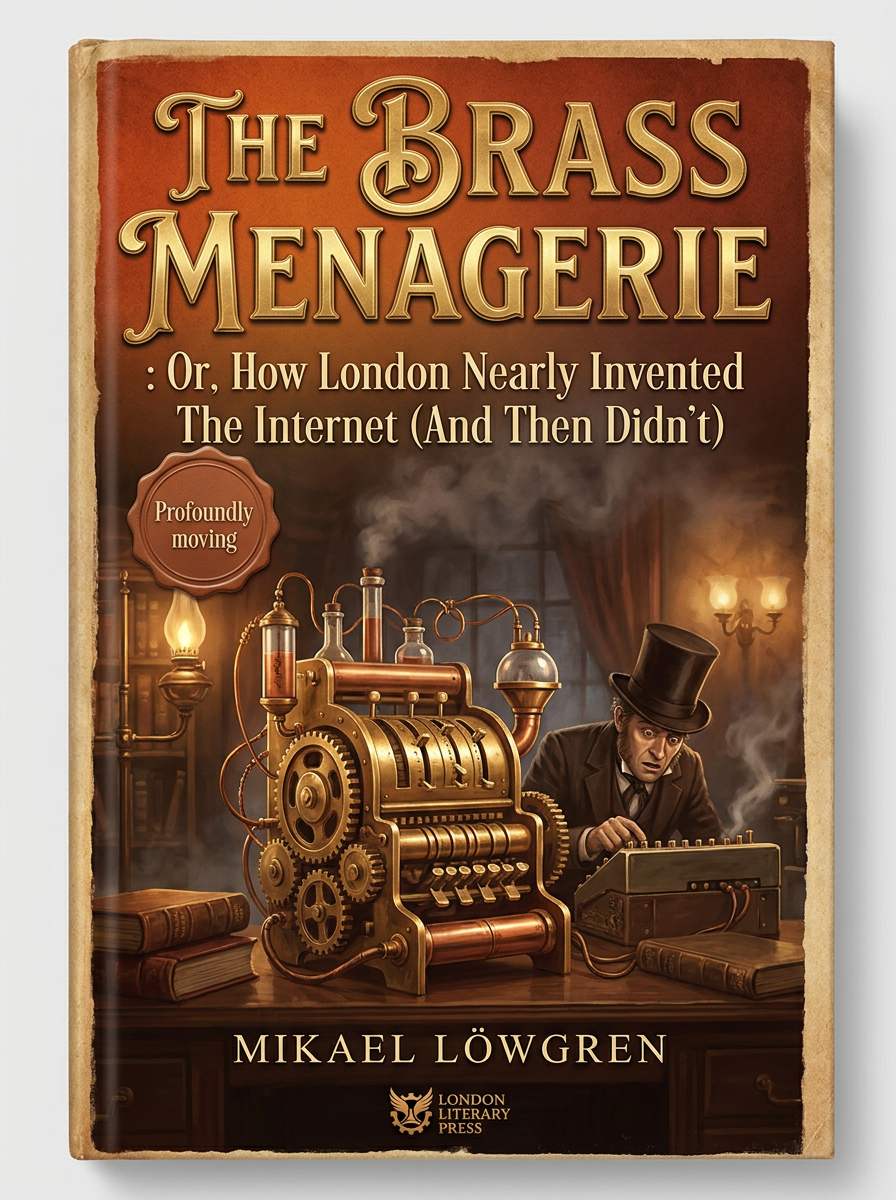
The Brass Menagerie: Or, How London Nearly Invented The Internet (And Then Didn't)
By Mikael Löwgren
Synopsis
In gaslit 1820s London, the irascible Charles Babbage, a man who finds more sense in cogs than conversation, embarks on a quixotic quest to build a colossal calculating machine to banish human error, only to find himself battling incompetent engineers, evaporating funds, and the bewildering absurdit
Chapter 1: The Tyranny of the Table: A Gentleman's Prerogative, and Other Horrors
The flickering gaslight, a pale amber against the encroaching London gloom, did little to soothe Mr. Charles Babbage’s frayed nerves. It merely cast dancing, mocking shadows across the page before him, a page that might as well have been a personal affront carved in stone. Another sheaf of nautical tables, another catalogue of numerical trespasses, another testament to humanity's inherent, infuriating inability to simply *record a damned number correctly*.
He often found himself wondering, in moments of particularly profound despair, if the universe itself harbored some cosmic prankster, delighting in human disarray. Why else empower a species with such grand ambitions, only to furnish it with brains so prone to simple arithmetic slippage? A misplaced decimal point, an inverted digit – these weren’t just errors on a page; they were potential shipwrecks, drowned sailors, catastrophic miscalculations of celestial mechanics and, quite possibly, the very fabric of British naval supremacy.
Babbage’s tall, gaunt frame was hunched over his desk, illuminated by the offending lamplight. His usually disheveled hair seemed even more aggressively chaotic tonight, mirroring the tempest brewing within his mind. His piercing eyes, normally quick to dissect and understand, were now narrowed in a furious communion with the printed page, as if by sheer force of will, he could burn the mistakes from existence. A thin sheen of grease, a memento from his current tinkering with a particularly stubborn escapement mechanism, adorned his left cheek, further testifying to his single-minded dedication – and the complete lack of domestic inclination that perpetually bewildered Mrs. Babbage.
“Abominable!” he hissed, a sound halfway between a cough and a curse. “Utterly, irrevocably abominable!”
He jabbed a slender finger at a particular row, a calculation for lunar distances that would, in the wrong hands, undoubtedly lead a merchant vessel hundreds of miles off course, perhaps into the very jaws of a privateer, or worse, a particularly ill-tempered patch of barnacle-encrusted rocks.
The quiet, almost reverential hush of his study, usually a sanctuary, became a grand courtroom for human fallibility. Each scratch of his quill, each rustle of paper, was an accusation. He had spent the better part of the evening poring over these freshly published tables, comparing them to older, equally suspect editions, and the grim reality was inescapable: the errors were not diminishing; they were merely mutating. Like a particularly virulent strain of plague, they found new hosts, new formats, new unsuspecting eyes to mislead.
He slammed the offending volume shut, the report echoing through the room. It was not a violent act, but one born of utter exhaustion and a profound sense of injustice. “How,” he muttered to the empty air, “can a nation built on precision, on navigation, on the very conquest of the oceans, tolerate such casual contempt for accuracy?”
His frustration was a physical entity, a knot in his stomach, a prickle behind his eyes. It wasn't merely the errors themselves that enraged him; it was the *culpability*. The anonymous clerks, the hasty printers, the long-dead mathematicians whose initial miscalculations propagated through subsequent editions like an unholy lineage. This was not a passive failing; it was an active betrayal of intellect, a fundamental disrespect for the very notion of truth.
He pushed back from the desk, the legs of his chair scraping on the polished wood floor. He paced the worn rug, his hands clasped behind his back, his mind a maelstrom of gears, levers, and numerical sequences that refused to align. The solution, he knew, lay beyond human hands. Human hands were too clumsy, human minds too prone to distraction, to fatigue, to the intoxicating allure of a half-remembered digit or a misplaced plus sign.
His eye fell upon a half-empty decanter of sherry on a nearby side table. It was a cheap, rather acrid vintage, purchased more for its perceived medicinal qualities (a balm for intellectual overstimulation) than for any true connoisseurship. He poured a generous measure into a rather unpolished glass, the liquid catching the gaslight in a momentarily deceptive shimmer. He tossed it back, the fiery bite doing little to assuage the internal inferno.
“We are but flesh and blood,” he declared to the sherry-stained glass, “and flesh and blood are perpetually flawed.”
The words hung in the air, heavy with resignation, yet a different kind of light began to flicker in the depths of his mind. Not the weak, sputtering gaslight, but an internal, incandescent aurora. If human hands were unreliable, then... what hands were not?
His gaze swept across the intricate brass workings of a small calculating machine he had devised, gathering dust in the corner. Gears, polished and precise, meshed with satisfying exactitude. Levers moved with unwavering certainty. It was a simple device, capable only of addition and subtraction, a mere toy in comparison to the grand designs that often occupied his thoughts. But it served as a vivid, tangible rebuttal to the chaos of the nautical tables.
*A machine. A calculating engine. A tireless, relentless, unforgiving arbiter of numerical veracity.*
The realization hit him with the force of a particularly well-aimed cannonball. It wasn’t a novel thought, not truly. He’d flirted with the concept before, in fleeting moments of inspiration. But tonight, fueled by the relentless onslaught of maritime doom and the cheap sherry, it coalesced into a singular, undeniable imperative.
No longer would he tolerate the tyranny of the table, ruled by the whims of fallible scribes. No longer would sailors sail blindly, guided by phantom numbers. No longer would the very pursuit of scientific truth be hostage to the errant flick of a human wrist.
He imagined it then, in the stark, uncompromising clarity of his vision: a colossal engine of brass and steel, churning out perfect numbers, immune to fatigue, immune to boredom, immune to the simple human craving for a hastily finished task and an early supper. A machine that would sing the siren song of absolute certainty, guiding ships through tumultuous seas, charting the courses of stars, and perhaps, in its boundless ambition, even predicting the very tides of human progress.
The thought sent a shiver down his spine, a thrill of intellectual conquest. It wouldn’t be easy, of course. The sheer complexity, the engineering challenges, the astronomical expense… these were but trifling inconveniences, mere footnotes to the grand symphony he now heard clanking and whirring in his mind.
He strode back to his desk, pulling out a fresh sheet of paper, his quill poised. The gaslight seemed to brighten, or perhaps it was merely the ferocious gleam in his eyes.
“Humanity,” he scribbled, his hand surprisingly steady, "is an estimable species, capable of much ingenuity, but lamentably prone to error in the most fundamental calculations."
He paused, then added with a flourish, "Therefore, let us remove the human entirely from the act of computation. Let the numbers be inviolate. Let the truth ring clear, unblemished by the hand of man."
The words, though simple, felt momentous, a declaration of war against numerical sloppiness. He had found his crusade. The looming specter of maritime disaster, the ghostly cries of lost navigators – they would all be vanquished not by human brilliance, but by human ingenuity applied to the construction of a more perfect, more reliable, *mechanical* intellect.
He looked around his study, now transformed by the magnitude of his revelation. The small, brass calculating toy seemed to wink at him knowingly. The discarded, error-riddled nautical tables lay like vanquished foes.
He poured another small measure of sherry, this time not in despair, but in a silent, almost reverential toast. To the future, then. A future where precision reigned, and the human propensity for fudging numbers was relegated to the dusty annals of a less enlightened age.
He had no way of knowing, of course, that this epiphany, born of bad sherry and impending maritime doom, would consume the remainder of his life, drain his family’s fortune, and leave him forever entangled in a glorious, maddening, half-finished monument to his visionary obsession. He merely knew, with absolute certainty, that he must build it. He must build the Engine. And God help anyone who stood in his way, especially if they came bearing more of those abominable, error-ridden tables. The tyranny of the table was about to be overthrown, by brass, by steam, and by the relentless, irascible genius of Mr. Charles Babbage.
Chapter 2: A Spark of Brass and Brilliance: The Difference of Dreams
The sherry, a villainous swill that had tasted of old socks and misplaced ambition, had done its work. Charles Babbage, a man whose mind was a whirring, clicking labyrinth of gears and calculations, woke with a headache that felt not unlike a particularly obtuse mathematical problem. Yet, amidst the physiological protestations of his liver, a new, glorious fever had begun to bloom. The tyranny of the table, that monstrous paper hydra spewing numerical deceit, would fall. Not to man, a creature too prone to woolgathering and improper arithmetic, but to… *mechanism*.
He threw off the covers with a decisiveness that belied his throbbing temples. Mrs. Babbage, bless her enduring soul, barely stirred. She was accustomed to his nocturnal perambulations and sudden, dawn-break epiphanies. Her husband, she often mused to her unhearing teacups, moved through life less like a man and more like a particularly robust clockwork automaton, albeit one fueled by intellectual obsession rather than steam.
The drawing-room, usually a sanctuary of domestic tranquility, became, in the ensuing weeks, a war zone of brass filings and frantic scribbling. Charles, fueled by lukewarm tea and a singular focus, designed. He scrawled on parchment, on the back of discarded bills, even, to Mrs. Babbage’s silent despair, on the pristine white tablecloth. His gaunt frame was often bent double over a workbench littered with calipers, compasses, and reams of mathematical notations that would have rendered a lesser man insensible.
His initial concept, a gloriously complicated contraption, bristled with gears, racks, and pinions, each designed to perform a specific arithmetical operation. The ‘Difference Engine,’ he christened it with a flourish, for it would calculate polynomial functions by the method of finite differences. The name itself, he believed, possessed a certain sonorous gravitas, a hint of the profound difference it would make. To Charles, it was already a symphony of brass and brilliance; to an outsider, it resembled a particularly industrious squirrel's hoard of shiny, yet utterly baffling, metal objects.
"Mr. Bryan!" he bellowed one afternoon, startling the cook's cat into a frantic dash beneath the settee.
William Bryan, his chief engineer, a man whose hands were as skilled as his temperament was patient, emerged from the workshop a moment later, wiping grease from his brow with a rag that had seen better centuries. Bryan possessed the weary, stoic air of one who routinely translated the fantastical pronouncements of genius into the brute reality of metal. He had, observed Mrs. Babbage, the look of a man who constantly anticipated the next impossible request.
"Sir?" Bryan’s voice was as steady as the anvil in his forge.
Charles held aloft a parchment covered in a spider's web of lines and arcs. "Behold, Bryan! The initial schematic! A mere eight orders of difference, capable of calculating to twenty decimal places! Only a prototype, of course, a mere scratch upon the vast canvas of its potential!"
Bryan peered at the drawing. His initial assessment, though unvoiced, was that it looked rather like a bird’s nest constructed entirely of particularly aggressive clock mechanisms. He nodded slowly. "And the material, sir?"
"Brass, Bryan! The finest, most resonant brass! And steel for the axles, of course. Precision, Bryan! Every cog, every shaft, every blasted pin must be machined to tolerances hitherto unimagined!" Charles’s eyes gleamed with a messianic light. "We begin at once! The Royal Society must see this! They must! For the good of England! For the very soul of mathematics!"
Bryan merely sighed, a sound so subtle it could have been merely the wind escaping an ill-fitting window frame. He knew, from long and intimate experience, that Charles’s timetable often bore only a passing acquaintance with linear time. The phrase "at once" in Babbagean parlance could mean anything from "this afternoon" to "approximately three years from Tuesday." Nevertheless, he gathered his tools. Such was the peculiar gravitational pull of Charles Babbage's brilliance.
Weeks blurred into months. The workshop became a cacophony of filing, hammering, and the occasional, frustrated shriek from Charles as a particularly stubborn gear refused to mesh. Bryan, surprisingly, produced miracles. Piece by improbable piece, the prototype Difference Engine began to take shape. It was a beautiful thing in its mechanical brutality, a miniature landscape of interconnected wheels, levers, and counting drums. It stood barely two feet high, a gleaming, intricate brass organism, ready to perform its singular, glorious task.
The day of the presentation to the Royal Society arrived with the customary London fog, thick and yellow, as if the city itself were exhaling tobacco smoke. Charles, fussed over by a remarkably stoic Mrs. Babbage, donned his best, if somewhat singed, frock coat. He clutched his notes, a dense thicket of calculations and impassioned pleas, with the fierce grip of a man facing a firing squad.
The gathering was typically English: a blend of polite curiosity, entrenched skepticism, and several gentlemen who appeared to have attended solely for the quality of the biscuits. Lord Lord Palmerston, a man whose sartorial splendor was matched only by his political astuteness, was conspicuously present, his brow already furrowed with the pre-emptive worry of a potential drain on the public purse.
Charles stood before them, a gaunt, earnest figure framed by the imposing, unyielding brass of his creation. He cleared his throat, a sound like a small, indignant pebble tumbling down a drainpipe.
"Gentlemen," he began, his voice surprisingly steady, "we are plagued by error. From the charts that guide our intrepid mariners to the very tables that determine our actuarial fates, human fallibility casts a long, distorting shadow.” He gestured dramatically towards the prototype. "I present to you, the Difference Engine! A machine conceived not by the whims of flesh and blood, but by the immutable laws of logic!"
He launched into a detailed, meticulously articulated explanation of its workings, his words a torrent of mathematical precision. He spoke of differences, of carry mechanisms, of the elegance of its iterative process. The machine, he explained, would eliminate the need for human computation in the creation of mathematical tables, rendering them flawlessly accurate.
The response was… mixed. A few gentlemen nodded sagely, their eyes glazing over with the effort of following his prodigious intellect. Others shifted uncomfortably, clearly preferring a good, solid debate on the merits of agricultural reform to the bewildering specifics of brass automatons. One particularly rotund academic, Dr. Phineas Grubbs, sniffed audibly. "A machine, Mr. Babbage?" he boomed, his voice like the rumbling of a distant cheese cart. "To perform arithmetic? We have clerks for that! Young men, Mr. Babbage, with nimble fingers and a need for employment!"
Charles bristled. "Clerks, Dr. Grubbs, are prone to fatigue! To distraction! To that most pernicious of human conditions, error! This machine, Sir, does not tire. It does not flirt with the tea-maid. It simply *calculates*!"
A low murmur rippled through the room. The concept of a machine usurping human intellectual endeavor was, to many, vaguely unsettling, almost sacrilegious.
Then, a voice cut through the polite dissent, calm and authoritative, yet imbued with a genuine curiosity. "Mr. Babbage," Sir John Herschel began, rising from his seat. Herschel, an astronomer of international renown, a man whose mind embraced the cosmic and the particular with equal grace, approached the machine. His gaze, unlike many of his esteemed colleagues, was not one of bemused skepticism, but of thoughtful analysis. "Describe to me, if you would, the mechanism by which it ‘carries’ a digit to the next column when a sum exceeds nine. That, Sir, is often the most troublesome aspect for human calculators."
Charles, invigorated by a question that demonstrated genuine comprehension, launched into an enthusiastic description of the Engine’s intricate carry-mechanism, his fingers tracing the path of an imaginary digit through the gears. Herschel listened intently, his head tilted, his brow furrowed in concentration. He gestured for Charles to demonstrate.
With a flourish, Babbage engaged the crank. The Difference Engine vibrated into life, a mesmerizing ballet of brass and pinions. Each turn of the crank brought forth a new number, an arithmetically precise step in a polynomial sequence. Click, whirr, click-clack went the gears, and then, with a satisfying metallic chime, the first difference was displayed on a small brass drum. Another turn, another perfect calculation.
The room, which had been buzzing with muted whispers, fell silent. The rhythmic, almost hypnotic sound of the machine performing its task held them captive. It was not merely a curiosity; it was a tangible manifestation of an abstract idea, a whisper of a future no one had yet dared to fully conceptualize.
Herschel watched, his lips pursed in thought. He saw beyond the grease and the gears, beyond the immediate function of adding and subtracting. He saw the potential, the radical departure from millennia of human-driven computation. He saw a future where the very foundations of scientific inquiry could be accelerated, made infallible.
He nodded slowly. "Remarkable, Mr. Babbage. Truly remarkable. The precision… it is quite beyond what I would have thought possible."
His pronouncement, delivered with the quiet authority of a man whose opinion carried significant weight, shifted the atmosphere. The skeptical whispers lessened. Even Lord Palmerston, though still wearing the faint sheen of a man contemplating a monumental expense, looked at the machine with a flicker of something akin to respect.
"Indeed," Charles beamed, feeling a surge of triumph. "And this is but a rudimentary model! Imagine, gentlemen, a machine capable of calculating to fifty decimal places! A machine that could print its own results, eradicating even the error of transcription!" He was already envisioning the next iteration, a grander, more ambitious beast of brass and intellect.
Dr. Grubbs, however, remained unconvinced. "But Sir John," he spluttered, "is it not… inelegant? All those levers and wheels? Is there not a simpler way?"
Herschel turned to Grubbs with a faint, almost imperceptible smile. "Dr. Grubbs, the elegance of mathematics is often found precisely in its intricate, logical machinery. This… this is a physical embodiment of that very elegance. It demonstrates a profound understanding of the very nature of numbers." He paused, then added, with a twinkle in his eye, "And besides, simpler often means less accurate when it comes to human endeavor, would you not agree?"
Grubbs mumbled something about the virtues of quill and parchment, clearly outmaneuvered.
The meeting concluded with a resolution to form a committee – as was the British way – to further investigate Mr. Babbage's proposition. It was not the unequivocal endorsement Charles had hoped for, not the immediate outpouring of funds and resources that would propel his vision into reality. But it was a start. It was a crack in the wall of skepticism, a murmur of interest in the cacophony of indifference.
As the gentlemen dispersed, Charles felt a peculiar mixture of elation and exhaustion. He had planted the seed. The Difference Engine, his brass progeny, had uttered its first mechanical pronouncements before the arbiters of scientific progress. He packed up his prototype with the care of a father returning his child to its cradle, Bryan silently assisting.
Herschel approached him as he was about to leave. "Mr. Babbage," he said, his voice quiet, "you have unearthed something… profound. Do not be disheartened by the slowness of others to grasp its magnitude."
Charles looked at him, his piercing eyes meeting Herschel's kind, intelligent gaze. "They see it as a glorified abacus, Sir John. A mere calculator. They do not see the implications! The potential to organize human knowledge itself! The very fabric of society could be rewoven, free of the tyranny of error!"
Herschel nodded, a small, knowing smile touching his lips. "Indeed. They see the machine, Mr. Babbage. You, however, see the dream." He placed a hand on Charles's shoulder. "Keep dreaming, Mr. Babbage. And keep building."
As Charles Babbage stepped out into the London fog, the chill air clearing his head, he knew he had only just begun. The funds were far from secured, the bureaucrats loomed, and the world was stubbornly anchored in its analog past. But a spark had been struck, a glorious, brass-gleaming spark. The dream, for now, had a name. And its name was Difference. And it hummed, faintly, in the core of his being, a promise of precision, a rebellion against the inherent slovenliness of human nature. The world, he was convinced, would one day thank him for it. Even if he had to drag it, kicking and screaming, into the digital age himself.